Fundamentals of
Geomorphology
This extensively revised, restructured, and updated edition continues to present an engaging and
comprehensive introduction to the subject, exploring the world’s landforms from a broad systems
perspective. It covers the basics of Earth surface forms and processes, while reflecting on the latest
developments in the field. Fundamentals of Geomorphology begins with a consideration of the nature
of geomorphology, process and form, history, and geomorphic systems, and moves on to discuss:
• Structure: structural landforms associated with plate tectonics and those associated with volcanoes,
impact craters, and folds, faults, and joints.
• Process and form: landforms resulting from, or influenced by, the exogenic agencies of weathering,
running water, flowing ice and meltwater, ground ice and frost, the wind, and the sea; landforms
developed on limestone; and landscape evolution, a discussion of ancient landforms, including
palaeosurfaces, stagnant landscape features, and evolutionary aspects of landscape change.
This third edition has been fully updated to include a clearer initial explanation of the nature of
geomorphology, of land-surface process and form, and of land-surface change over different timescales.
The text has been restructured to incorporate information on geomorphic materials and processes at
suitable points in the book. Finally, historical geomorphology has been integrated throughout the text
to reflect the importance of history in all aspects of geomorphology.
Fundamentals of Geomorphology provides a stimulating and innovative perspective on the key topics
and debates within the field of geomorphology. Written in an accessible and lively manner, it includes
guides to further reading, chapter summaries, and an extensive glossary of key terms. The book is also
illustrated throughout with over 200 informative diagrams and attractive photographs, all in colour.
Richard John Huggett is a Reader in Physical Geography at the University of Manchester, UK.
ROUTLEDGE FUNDAMENTALS OF PHYSICAL GEOGRAPHY SERIES
Series Editor: John Gerrard
This new series of focused, introductory textbooks presents comprehensive, up-to-date introductions
to the fundamental concepts, natural processes and human/environmental impacts within each of the
core physical geography sub-disciplines. Each volume in this uniformly designed series contains student-
friendly features: plentiful illustrations, boxed case studies, key concepts and summaries, further reading
guides and a glossary.
Already published:
Fundamentals of Soils
John Gerrard
Fundamentals of Biogeography, Second edition
Richard John Huggett
Fundamentals of Geomorphology, Second edition
Richard John Huggett
Fundamentals of Hydrology, Second edition
Tim Davie
Fundamentals of Geomorphology, Third edition
Richard John Huggett
Fundamentals of
Geomorphology
Third Edition
Richard John Huggett
First edition published in 2002
Second edition published in 2007
Third edition published in 2011
by Routledge
2 Park Square, Milton Park, Abingdon, Oxon, OX14 4RN
Simultaneously published in the USA and Canada
by Routledge
270 Madison Avenue, New York, NY 10016
Routledge is an imprint of the Taylor & Francis Group, an informa business
© 2002, 2007, 2011 Richard John Huggett
All rights reserved. No part of this book may be reprinted or
reproduced or utilized in any form or by any electronic, mechanical,
or other means, now known or hereafter invented, including photocopying
and recording, or in any information storage or retrieval system,
without permission in writing from the publishers.
British Library Cataloguing in Publication Data
A catalogue record for this book is available from the British Library
Library of Congress Cataloging in Publication Data
Huggett, Richard J.
Fundamentals of geomorphology/Richard John Huggett.
p. cm.
Includes bibliographical references and index.
1. Geomorphology. I. Title.
GB401.5.H845 2011
551.41 – dc22 2010031716
ISBN: 978-0-415-56774-9 (hbk)
ISBN: 978-0-415-56775-6 (pbk)
ISBN: 978-0-203-86008-3 (ebk)
This edition published in the Taylor & Francis e-Library, 2011.
To purchase your own copy of this or any of Taylor & Francis or Routledge’s
collection of thousands of eBooks please go to www.eBookstore.tandf.co.uk.
ISBN 0-203-86008-X Master e-book ISBN
for my family
10111
Series editor’s preface ix
Author’s preface to third edition xi
Author’s preface to second edition xii
Author’s preface to first edition xiii
Acknowledgements xv
PART I
INTRODUCING LANDFORMS
AND LANDSCAPES 1
1 What is geomorphology? 3
2 Introducing process and form 19
3 Introducing history 44
4 The geomorphic system 54
PART II
STRUCTURE 85
5 Plate tectonics and associated
structural landforms 87
6 Volcanoes, impact craters, folds,
and faults 108
PART III
PROCESS AND FORM 135
7 Weathering and associated landforms 137
8 Hillslopes 164
9 Fluvial landscapes 187
10 Glacial and glaciofluvial landscapes 247
11 Periglacial landscapes 290
12 Aeolian landscapes 314
13 Coastal landscapes 345
14 Karst landscapes 389
15 Landscape evolution: long-term
geomorphology 433
Appendix 1: The geological timescale 461
Appendix 2: Dating techniques 462
Glossary 468
References 477
Index 503
CONTENTS
We are presently living in a time of unparalleled
change and when concern for the environment has
never been greater. Global warming and climate
change, possible rising sea levels, deforestation,
desertification, and widespread soil erosion are
just some of the issues of current concern.
Although it is the role of human activity in such
issues that is of most concern, this activity affects
the operation of the natural processes that occur
within the physical environment. Most of these
processes and their effects are taught and
researched within the academic discipline of
physical geography. A knowledge and under-
standing of physical geography, and all it entails,
is vitally important.
It is the aim of this Fundamentals of Physical
Geography Series to provide, in five volumes, the
fundamental nature of the physical processes
that act on or just above the surface of the Earth.
The volumes in the series are Climatology,
Geomorphology, Biogeography, Hydrology, and
Soils. The topics are treated in sufficient breadth
and depth to provide the coverage expected in a
Fundamentals series. Each volume leads into the
topic by outlining the approach adopted. This is
important because there may be several ways of
approaching individual topics. Although each
volume is complete in itself, there are many
explicit and implicit references to the topics
covered in the other volumes. Thus, the five
volumes together provide a comprehensive insight
into the totality that is Physical Geography.
The flexibility provided by separate volumes
has been designed to meet the demand created by
the variety of courses currently operating in higher
education institutions. The advent of modular
courses has meant that physical geography is now
rarely taught, in its entirety, in an ‘all-embracing’
course but is generally split into its main
components. This is also the case with many
Advanced Level syllabuses. Thus students and
teachers are being frustrated increasingly by lack
of suitable books and are having to recommend
texts of which only a small part might be relevant
to their needs. Such texts also tend to lack the
detail required. It is the aim of this series to provide
individual volumes of sufficient breadth and depth
to fulfil new demands. The volumes should also
be of use to sixth-form teachers where modular
syllabuses are also becoming common.
Each volume has been written by higher-
education teachers with a wealth of experience in
SERIES EDITOR’S PREFACE
all aspects of the topics they cover and a proven
ability in presenting information in a lively and
interesting way. Each volume provides a compre-
hensive coverage of the subject matter using clear
text divided into easily accessible sections and
subsections. Tables, figures, and photographs are
used where appropriate as well as boxed case
studies and summary notes. References to import-
ant previous studies and results are included but
are used sparingly to avoid overloading the text.
Suggestions for further reading are also provided.
The main target readership is introductory-level
undergraduate students of physical geography or
environmental science, but there will be much of
interest to students from other disciplines, and it
is also hoped that sixth-form teachers will be able
to use the information that is provided in each
volume.
John Gerrard
x SERIES EDITOR’S PREFACE
ThethirdeditionofFundamentalsofGeomorphology
comes hot on the heels of the second edition.
Anonymous reviewers of the second edition
suggested that some rearrangement of material
might be beneficial, and I have taken most of their
suggestionsonboard.Thekeychangesare:splitting
the first chapter into three sections, the first
explaining the nature of geomorphology, the
second outlining ideas about land surface process
and form, and the third introducing concepts
about the history of the land surface; losing the
chapter on geomorphic material and process, its
components being dished out among relevant
chapters elsewhere (i.e. reverting to the arrange-
ment in the first edition – I’ve never known a set
ofreviewerssounanimousonapointasthisone!);
integratingmuchofthematerialinthetwohistory
chapters (14 and 15 in the second edition) at
appropriate points in other chapters to reflect the
importance of history in all aspects of geomorph-
ology and to provide a better way of integrating
processandhistoricalideasandstudies;placingthe
karst chapter towards the end of the book; and
revampingthefinalchapterdealingwithlandscape
evolutionasawhole.Itrustthattheseadjustments
will aid understanding. In the text, the use of bold
type indicates that a concept or phenomenon is
important in the context of the book; within
Glossary definitions, it indicates that a term has its
own entry.
Once again, I should like to thank many people
who have made the completion of this book
possible: Nick Scarle for revising some of the
second-edition diagrams, for drawing the many
new ones, and for colouring all of them. Andrew
Mould for persuading me to pen a new edition.
Stefan Doerr, Derek C. Ford, Neil Glasser, Stefan
Grab, Adrian Hall, Mike Hambrey, Kate Holden,
Karna Lidmar-Bergström, David Knighton, Phil
Murphy, Alexei Rudoy, Nick Scarle, Wayne
Stephenson, Wilf Theakstone, Dave Thomas,
Heather Viles, Tony Waltham, Jeff Warburton,
Clive Westlake, and Jamie Woodward for letting
me re-use their photographs; and Stéphane
Bonnet, Fabio De Blasio, Karin Ebert, Marli Miller,
Dave Montgomery, Paul Sanborn, Steve Scott,
Andy Short, Tony Waltham, and Ray Womack for
supplying me with fresh ones. And, as always, my
wife and family for sharing the highs and lows of
writing a book.
Richard John Huggett
Poynton
June 2010
AUTHOR’S PREFACE
TO THIRD EDITION
ThefirsteditionofFundamentalsofGeomorphology
was published in 2003. I was delighted that it was
wellreceivedandthatIwasaskedtowriteasecond
edition. Anonymous reviewers of the first edition
suggested that some rearrangement of material
might be beneficial, and I have taken most of their
suggestions on board. Cliff Ollier also kindly
provided me with many ideas for improvements.
The key changes are new chapters on geomorphic
materials and processes and on hillslopes, the
reorganizingofthetectonicandstructuralchapters
into large-scale and small-scale landforms, and
the splitting of the single history chapter into a
chapter dealing with Quaternary landforms and
a chapter dealing with ancient landforms. I have
also taken the opportunity to update some
information and examples.
Once again, I should like to thank many people
who have made the completion of this book
possible: Nick Scarle for revising some of the first-
edition diagrams and for drawing the many new
ones. Andrew Mould for persuading me to pen a
newedition.GeorgeA.Brook,StefanDoerr,Derek
C. Ford, Mike Hambrey, Kate Holden, Karna
Lidmar-Bergström,DavidKnighton,PhilMurphy,
Alexei Rudoy, Nick Scarle, Wayne Stephenson,
Wilf Theakstone, Dave Thomas, Heather Viles,
Tony Waltham, Jeff Warburton, and Clive
Westlake for letting me re-use their photographs;
andNeilGlasser,StefanGrab,AdrianHall,Heather
Viles, Tony Waltham, and Jamie Woodward for
supplying me with fresh ones. And, as always, my
wife and family for sharing the ups and downs of
writing a book.
Richard John Huggett
Poynton
October 2006
AUTHOR’S PREFACE
TO SECOND EDITION
Geomorphology has always been a favourite
subject of mine. For the first twelve years of my
life I lived in north London, and I recall playing
by urban rivers and in disused quarries. During
the cricket season, Saturday and Sunday after-
noons would be spent exploring the landscape
around the grounds where my father was playing
cricket. H. W. (‘Masher’) Martin, the head of
geography and geology at Hertford Grammar
School, whose ‘digressions’ during classes were
tremendously educational, aroused my first formal
interest in landforms. The sixth-form fieldtrips
to the Forest of Dean and the Lake District
were unforgettable. While at University College
London, I was lucky enough to come under the
tutelage of Eric H. Brown, Claudio Vita-Finzi,
Andrew Warren, and Ron Cooke, to whom I am
indebted for a remarkable six years as an
undergraduate and postgraduate. Since arriving at
Manchester, I have taught several courses with
large geomorphological components but have seen
myself very much as a physical geographer with a
dislike of disciplinary boundaries and the fashion
for overspecialization. Nonetheless, I thought that
writing a new, student-friendly geomorphological
text would pose an interesting challenge and, with
Fundamentals of Biogeography, make a useful
accompaniment to my more academic works.
In writing Fundamentals of Geomorphology, I
have tried to combine process geomorphology,
which has dominated the subject for the last
several decades, with the less fashionable but fast-
resurging historical geomorphology. Few would
question the astounding achievements of process
studies, but plate-tectonics theory and a reliable
calendar of events have given historical studies a
huge boost. I also feel that too many books get far
too bogged down in process equations: there is a
grandeur in the diversity of physical forms found
at the Earth’s surface and a wonderment to be
had in seeing them. So, while explaining geo-
morphic processes and not shying away from
equations, I have tried to capture the richness of
landform types and the pleasure to be had in trying
to understand how they form. I also discuss the
interactions between landforms, geomorphic
processes, and humans, which, it seems to me,
are an important aspect of geomorphology today.
The book is quadripartite. Part I introduces
landforms and landscapes, studying the nature of
geomorphology and outlining the geomorphic
system. It then divides the material into three
AUTHOR’S PREFACE
TO FIRST EDITION
parts: structure, form and process, and history.
William Morris Davis established the logic of this
scheme a century ago. The argument is that any
landform depends upon the structure of the rocks
– including their composition and structural
attitude – that it is formed in or on, the processes
acting upon it, and the time over which it has been
evolving. Part II looks at tectonic and structural
landforms. Part III investigates process and form,
withchaptersonweatheringandrelatedlandforms,
karst landscapes, fluvial landscapes, glacial land-
scapes, periglacial landscapes, aeolian landscapes,
and coastal landscapes. Each of these chapters,
excepting the one on weathering, considers the
environments in which the landscapes occur,
the processes involved in their formation, the
landforms they contain, and how they affect, and
are affected by, humans. Part IV examines the role
of history in understanding landscapes and
landformevolution,examiningsomegreatachieve-
ments of modern historical geomorphology.
There are several people to whom I wish to
say ‘thanks’: Nick Scarle, for drawing all the
diagrams and handling the photographic mater-
ial. Andrew Mould at Routledge, for taking on
another Huggett book. Six anonymous reviewers,
for the thoughtful and perceptive comments on
an embarrassingly rough draft of the work that
led to several major improvements, particularly
in the overall structure; any remaining short-
comings and omissions are of course down to me.
A small army of colleagues, identified individually
on the plate captions, for kindly providing me
with slides. Clive Agnew and the other staff at
Manchester, for friendship and assistance, and in
particular Kate Richardson for making several
invaluable suggestions about the structure and
content of Chapter 1. As always, Derek Davenport,
for discussing all manner of things. And, finally,
my wife and family, who understand the ups and
downs of book-writing and give unbounded
support.
Richard John Huggett
Poynton
March 2002
xiv AUTHOR’S PREFACE TO FIRST EDITION
The author and publisher would like to thank the
following for granting permission to reproduce
material in this work:
The copyright of photographs remains held by
the individuals who kindly supplied them (please
see photograph captions for individual names);
Figure 1.5 after Figure 3.10 from S. A. Schumm
(1991) To Interpret the Earth: Ten Ways to
Be Wrong (Cambridge: Cambridge University
Press), reproduced by permission of Cambridge
University Press; Figure 2.10 after Figure 3
from Earth and Planetary Science Letters 264,
J. J. Roering, J. T. Perron, and J. W. Kirchner,
‘Functional relationships between denudation and
hillslope form and relief’, pp. 245–58 copyright ©
2007, with permission from Elsevier; Figure 3.1
after Figure 3 from Claudio Vita-Finzi (1969)
The Mediterranean Valleys: Geological Changes
in Historical Times (Cambridge: Cambridge
University Press), reproduced by permission of
Cambridge University Press; Figure 6.9 reprinted
from Earth-Science Reviews 69, J. W. Cole, D. M.
Milner, and K. D. Spinks, ‘Calderas and caldera
structures: a review’, pp. 1–26, copyright © 2005,
with permission from Elsevier; Figure 6.18 after
Figure 4.9 from M. A. Summerfield (1991) Global
Geomorphology: An Introduction to the Study of
Landforms (Harlow, Essex: Longman), © M. A.
Summerfield, reprinted by permission of Pearson
Education Limited; Figure 7.1 after Figures 3.3
and 3.5 from G. Taylor and R. A. Eggleton (2001)
Regolith Geology and Geomorphology (Chichester:
John Wiley & Sons), Copyright © 2001, repro-
duced by permission of John Wiley & Sons
Limited; Figures 7.5, 7.6, 9.14, and 9.19 after
Figures 11.11, 11.18, 16.2, and 16.7 from C. R.
Twidale and E. M. Campbell (2005) Australian
Landforms: Structure, Process and Time (Kenthurst:
Rosenberg Publishing), reproduced by permission
of C. R. Twidale; Figure 9.12 after Figure 14.1
from F. Ahnert (1998) Introduction to Geo-
morphology (London: Arnold), reproduced by
permission of Verlag Eugen Ulmer, Stuttgart (the
original German language publishers); Figure 9.28
after Figure 2 from Quaternary International 79,
J. Rose, B. S. P. Moorlock, and R. J. O. Hamblin,
‘Pre-Anglian fluvial and coastal deposits in Eastern
England: lithostratigraphy and palaeoenviron-
ments’, pp. 5–22, copyright © 2005, with per-
mission from Elsevier; Figure 9.32 after Figure 6
from Warburton and M. Danks (1998) ‘Historical
and contemporary channel change, Swinhope
ACKNOWLEDGEMENTS
xvi ACKNOWLEDGEMENTS
Burn’, in J. Warburton (ed.) Geomorphological
Studies in the North Pennines: Field Guide, pp.
77–91 (Durham: Department of Geography,
University of Durham, British Geomorphological
Research Group), reproduced by permission of
Jeff Warburton; Figure 10.4 after Figure 2 from
Geomorphology 71, N. F. Glasser, K. M. Jansson,
S. Harrison, and A. Rivera, ‘Geomorphological
evidence for variations of the North Patagonian
Icefield during the Holocene’, pp. 263–77,
copyright © 2005, with permission from Elsevier;
Figure 10.9 slightly adapted from Figure 6.9 in A.
S. Trenhaile (1998) Geomorphology: A Canadian
Perspective (Toronto: Oxford University Press),
© Oxford University Press, Canada, reprinted by
permission of the publisher; Figure 13.9 slightly
adapted from Figures 1, 3, 5, 7, 9, 11, 13, 15, 17,
19, 21, and 23 in A. D. Short, http://www.ozcoasts.
org.au/conceptual_mods/beaches/beach_intro.
jsp, reproduced by permission of Andy Short;
Figure 14.1 after ‘Plan of Poole’s Cavern’ from
D. G. Allsop (1992) Visitor’s Guide to Poole’s
Cavern (Buxton, Derbyshire: Buxton and District
Civic Association), after a survey by P. Deakin
and the Eldon Pothole Club, reproduced by
permission of Poole’s Cavern and Country Park;
Figures 15.2 and 15.3 after Figures 10 and 14 from
K. Ebert, Cenozoic Landscape Evolution in Northern
Sweden: Geomorphological Interpretation within
a GIS-Framework, unpublished PhD disserta-
tion no. 19, Department of Physical Geography
and Quaternary Geology, Stockholm University,
Sweden (2009), reproduced with permission
from Karin Ebert; Figure 15.9 after Figure 10
from D. K. C. Jones (1999) ‘Evolving models
of the Tertiary evolutionary geomorphology of
southern England, with special reference to the
Chalklands’ in B. J. Smith, W. B. Whalley, and
P. A. Warke (eds) Uplift, Erosion and Stability:
Perspectives on Long-term Landscape Development
(Geological Society, London, Special Publication
162), pp. 1–23, reproduced by permission of
the Geological Society, London, and David
K. C. Jones; Figure 15.12 after Figure 16 from
P. Japsen, T. Bidstrup, and K. Lidmar-Bergström
(2002) ‘Neogene uplift and erosion of southern
Scandinavia induced by the rise of the South
Swedish Dome’ in A. G. Doré, J. A. Cartwright,
M. S. Stoker, J. P. Turner, and N. White (eds)
Exhumation of the North Atlantic Margin: Timing,
Mechanisms and Implications for Petroleum
Exploration (Geological Society, London, Special
Publication 196), pp. 183–207, reproduced by
permission of the Geological Society, London,
and Peter Japsen.
Every effort has been made to contact copyright
holders for their permission to reprint material in
this book. The publishers would be grateful to
hear from any copyright holder who is not here
acknowledged and will undertake to rectify any
errors or omissions in future editions of this
book.
PART ONE
INTRODUCING
LANDFORMS AND
LANDSCAPES
CHAPTER ONE
WHAT IS
GEOMORPHOLOGY?
1
Geomorphology is the study of landforms and the processes that create them.
This chapter covers:
• The nature of geomorphology
• Historical approaches
• Process approaches
• Other approaches
• Geomorphological ‘isms’
The word geomorphology derives from three
Greek words: gew (the Earth), morfh (form), and
logo~ (discourse). Geomorphology is therefore
‘a discourse on Earth forms’. The term was coined
sometime in the 1870s and 1880s to describe
the morphology of the Earth’s surface (e.g. de
Margerie 1886, 315), was originally defined as
‘the genetic study of topographic forms’ (McGee
1888, 547), and was used in popular parlance
by 1896. Despite the modern acquisition of its
name, geomorphology is a venerable discipline
(Box 1.1). Today, geomorphology is the study
of Earth’s physical land-surface features, its
landforms – rivers, hills, plains, beaches, sand
dunes, and myriad others. Some workers in-
clude submarine landforms within the scope of
geomorphology; and some would add the
landforms of other terrestrial-type planets and
satellites in the Solar System – Mars, the Moon,
Venus, and so on.
Landforms are conspicuous features of the
Earth and occur everywhere. They range in size
from molehills to mountains to major tectonic
plates, and their ‘lifespans’ range from days to
millennia to aeons (Figure 1.1).
Geomorphology investigates landforms and
the processes that fashion them. Form, process,
and the interrelationships between them are
central to understanding the origin and develop-
ment of landforms. In geomorphology, form
or morphology has three facets – constitution
(chemical and physical properties described by
material property variables), configuration (size
and form described by geometry variables), and
mass flow (rates of flow described by such mass-
flow variables as discharge, precipitation rate,
and evaporation rate) (Figure 1.2; Strahler 1980).
These form variables contrast with dynamic
variables (chemical and mechanical properties
representing the expenditure of energy and the
Ancient Greek and Roman philosophers wondered how mountains and other surface
features in the natural landscape had formed. Aristotle, Herodotus, Seneca, Strabo,
Xenophanes, and many others discoursed on topics such as the origin of river valleys
and deltas, and the presence of seashells in mountains. Xenophanes of Colophon
(c. 580–480 BC) speculated that, as seashells are found on the tops of mountains, the
surface of the Earth must have risen and fallen. Herodotus (c. 484–420) thought that the
lower part of Egypt was a former marine bay, reputedly saying ‘Egypt is the gift of the
river’, referring to the year-by-year accumulation of river-borne silt in the Nile delta region.
Aristotle (384–322 BC) conjectured that land and sea change places, with areas that are
now dry land once being sea and areas that are now sea once being dry land. Strabo
(64/63 BC–AD 23?) observed that the land rises and falls, and suggested that the size of
a river delta depends on the nature of its catchment, the largest deltas being found where
the catchment areas are large and the surface rocks within it are weak. Lucius Annaeus
Seneca (4 BC–AD 65) appears to have appreciated that rivers possess the power to erode
their valleys. About a millennium later, the illustrious Arab scholar ibn-Sina, also known
as Avicenna (980–1037), who translated Aristotle, propounded the view that some
mountains are produced by differential erosion, running water and wind hollowing out
softer rocks. During the Renaissance, many scholars debated Earth history. Leonardo
da Vinci (1452–1519) believed that changes in the levels of land and sea explained the
presence of fossil marine shells in mountains. He also opined that valleys were cut by
streams and that streams carried material from one place and deposited it elsewhere.
In the eighteenth century, Giovanni Targioni-Tozzetti (1712–84) recognized evidence of
stream erosion. He argued that rivers and floods resulting from the bursting of barrier
lakes excavated the valleys of the Arno, Val di Chaina, and Ombrosa in Italy, and
suggested that the irregular courses of streams relate to the differences in the rocks in
which they cut, a process now called differential erosion. Jean-Étienne Guettard (1715–86)
argued that streams destroy mountains and the sediment produced in the process builds
floodplains before being carried to the sea. He also pointed to the efficacy of marine
erosion, noting the rapid destruction of chalk cliffs in northern France by the sea, and
the fact that the mountains of the Auvergne were extinct volcanoes. Horace-Bénédict de
Saussure (1740–99) contended that valleys were produced by the streams that flow
within them, and that glaciers may erode rocks. From these early ideas on the origin of
landforms arose modern geomorphology. (See Chorley et al. 1964 and Kennedy 2005
for details on the development of the subject.)
Box 1.1 THE ORIGIN OF GEOMORPHOLOGY
4 INTRODUCING LANDFORMS AND LANDSCAPES
doing of work) associated with geomorphic pro-
cesses; they include power, energy flux, force,
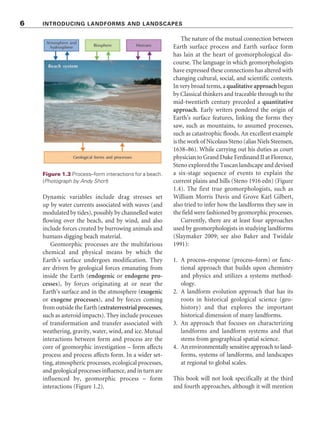
stress, and momentum. Take the case of a beach
(Figure 1.3). Constitutional properties include the
degree of sorting of grains, mean diameter of
grains, grain shape, and moisture content of the
beach; configurational properties include such
measures of beach geometry as slope angle, beach
profile form, and water depth; mass-flow variables
include rates of erosion, transport, and deposition.
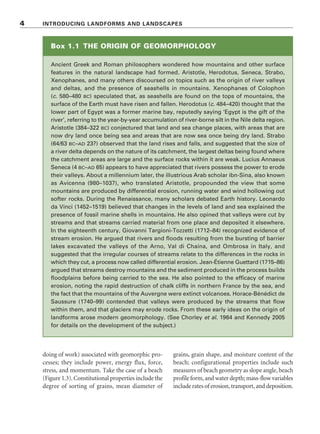
Figure 1.1 Landforms at different scales and their interactions with exogenic (external) and endogenic
(internal) processes.
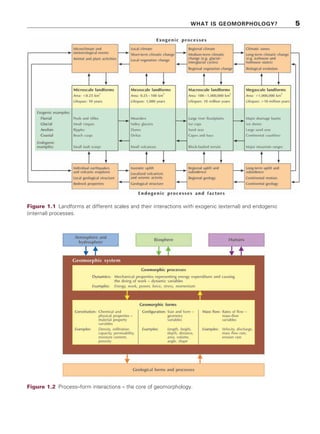
Figure 1.2 Process–form interactions – the core of geomorphology.
WHAT IS GEOMORPHOLOGY? 5
Dynamic variables include drag stresses set
up by water currents associated with waves (and
modulated by tides), possibly by channelled water
flowing over the beach, and by wind, and also
include forces created by burrowing animals and
humans digging beach material.
Geomorphic processes are the multifarious
chemical and physical means by which the
Earth’s surface undergoes modification. They
are driven by geological forces emanating from
inside the Earth (endogenic or endogene pro-
cesses), by forces originating at or near the
Earth’s surface and in the atmosphere (exogenic
or exogene processes), and by forces coming
from outside the Earth (extraterrestrial processes,
such as asteroid impacts). They include processes
of transformation and transfer associated with
weathering, gravity, water, wind, and ice. Mutual
interactions between form and process are the
core of geomorphic investigation – form affects
process and process affects form. In a wider set-
ting, atmospheric processes, ecological processes,
and geological processes influence, and in turn are
influenced by, geomorphic process – form
interactions (Figure 1.2).
The nature of the mutual connection between
Earth surface process and Earth surface form
has lain at the heart of geomorphological dis-
course. The language in which geomorphologists
have expressed these connections has altered with
changing cultural, social, and scientific contexts.
In very broad terms, a qualitative approach begun
by Classical thinkers and traceable through to the
mid-twentieth century preceded a quantitative
approach. Early writers pondered the origin of
Earth’s surface features, linking the forms they
saw, such as mountains, to assumed processes,
such as catastrophic floods. An excellent example
is the work of Nicolaus Steno (alias Niels Steensen,
1638–86). While carrying out his duties as court
physician to Grand Duke Ferdinand II at Florence,
Steno explored the Tuscan landscape and devised
a six-stage sequence of events to explain the
current plains and hills (Steno 1916 edn) (Figure
1.4). The first true geomorphologists, such as
William Morris Davis and Grove Karl Gilbert,
also tried to infer how the landforms they saw in
the field were fashioned by geomorphic processes.
Currently, there are at least four approaches
used by geomorphologists in studying landforms
(Slaymaker 2009; see also Baker and Twidale
1991):
1. A process–response (process–form) or func-
tional approach that builds upon chemistry
and physics and utilizes a systems method-
ology.
2. A landform evolution approach that has its
roots in historical geological science (geo-
history) and that explores the important
historical dimension of many landforms.
3. An approach that focuses on characterizing
landforms and landform systems and that
stems from geographical spatial science.
4. An environmentally sensitive approach to land-
forms, systems of landforms, and landscapes
at regional to global scales.
This book will not look specifically at the third
and fourth approaches, although it will mention
Figure 1.3 Process–form interactions for a beach.
(Photograph by Andy Short)
6 INTRODUCING LANDFORMS AND LANDSCAPES
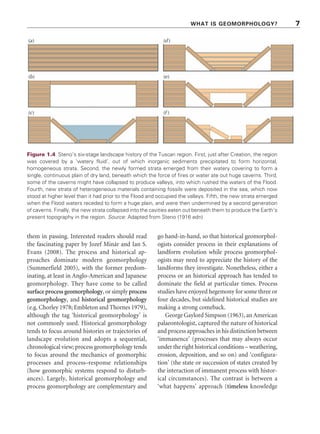
Figure 1.4 Steno’s six-stage landscape history of the Tuscan region. First, just after Creation, the region
was covered by a ‘watery fluid’, out of which inorganic sediments precipitated to form horizontal,
homogeneous strata. Second, the newly formed strata emerged from their watery covering to form a
single, continuous plain of dry land, beneath which the force of fires or water ate out huge caverns. Third,
some of the caverns might have collapsed to produce valleys, into which rushed the waters of the Flood.
Fourth, new strata of heterogeneous materials containing fossils were deposited in the sea, which now
stood at higher level than it had prior to the Flood and occupied the valleys. Fifth, the new strata emerged
when the Flood waters receded to form a huge plain, and were then undermined by a second generation
of caverns. Finally, the new strata collapsed into the cavities eaten out beneath them to produce the Earth’s
present topography in the region. Source: Adapted from Steno (1916 edn)
WHAT IS GEOMORPHOLOGY? 7
them in passing. Interested readers should read
the fascinating paper by Jozef Minár and Ian S.
Evans (2008). The process and historical ap-
proaches dominate modern geomorphology
(Summerfield 2005), with the former predom-
inating, at least in Anglo-American and Japanese
geomorphology. They have come to be called
surface process geomorphology, or simply process
geomorphology, and historical geomorphology
(e.g. Chorley 1978; Embleton and Thornes 1979),
although the tag ‘historical geomorphology’ is
not commonly used. Historical geomorphology
tends to focus around histories or trajectories of
landscape evolution and adopts a sequential,
chronological view; process geomorphology tends
to focus around the mechanics of geomorphic
processes and process–response relationships
(how geomorphic systems respond to disturb-
ances). Largely, historical geomorphology and
process geomorphology are complementary and
go hand-in-hand, so that historical geomorphol-
ogists consider process in their explanations of
landform evolution while process geomorphol-
ogists may need to appreciate the history of the
landforms they investigate. Nonetheless, either a
process or an historical approach has tended to
dominate the field at particular times. Process
studies have enjoyed hegemony for some three or
four decades, but sidelined historical studies are
making a strong comeback.
George Gaylord Simpson (1963), an American
palaeontologist, captured the nature of historical
and process approaches in his distinction between
‘immanence’ (processes that may always occur
under the right historical conditions – weathering,
erosion, deposition, and so on) and ‘configura-
tion’ (the state or succession of states created by
the interaction of immanent process with histor-
ical circumstances). The contrast is between a
‘what happens’ approach (timeless knowledge
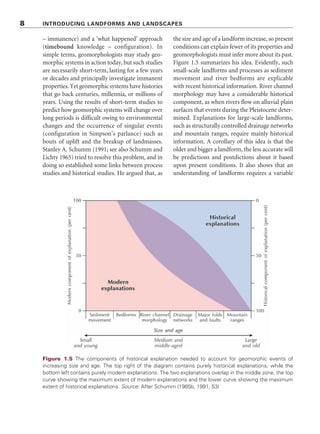
Figure 1.5 The components of historical explanation needed to account for geomorphic events of
increasing size and age. The top right of the diagram contains purely historical explanations, while the
bottom left contains purely modern explanations. The two explanations overlap in the middle zone, the top
curve showing the maximum extent of modern explanations and the lower curve showing the maximum
extent of historical explanations. Source: After Schumm (1985b, 1991, 53)
– immanence) and a ‘what happened’ approach
(timebound knowledge – configuration). In
simple terms, geomorphologists may study geo-
morphic systems in action today, but such studies
are necessarily short-term, lasting for a few years
or decades and principally investigate immanent
properties. Yet geomorphic systems have histories
that go back centuries, millennia, or millions of
years. Using the results of short-term studies to
predict how geomorphic systems will change over
long periods is difficult owing to environmental
changes and the occurrence of singular events
(configuration in Simpson’s parlance) such as
bouts of uplift and the breakup of landmasses.
Stanley A. Schumm (1991; see also Schumm and
Lichty 1965) tried to resolve this problem, and in
doing so established some links between process
studies and historical studies. He argued that, as
the size and age of a landform increase, so present
conditions can explain fewer of its properties and
geomorphologists must infer more about its past.
Figure 1.5 summarizes his idea. Evidently, such
small-scale landforms and processes as sediment
movement and river bedforms are explicable
with recent historical information. River channel
morphology may have a considerable historical
component, as when rivers flow on alluvial plain
surfaces that events during the Pleistocene deter-
mined. Explanations for large-scale landforms,
such as structurally controlled drainage networks
and mountain ranges, require mainly historical
information. A corollary of this idea is that the
older and bigger a landform, the less accurate will
be predictions and postdictions about it based
upon present conditions. It also shows that an
understanding of landforms requires a variable
8 INTRODUCING LANDFORMS AND LANDSCAPES
WHAT IS GEOMORPHOLOGY? 9
mix of process geomorphology and historical geo-
morphology; and that the two subjects should
work together rather than stand in polar opposi-
tion.
HISTORICAL GEOMORPHOLOGY
All landforms have a history. Such landforms as
ripples on beaches and in riverbeds and terra-
cettes on hillslopes tend to be short-lived, so that
their history will pass unrecorded unless burial
by sediments ensures their survival in the strati-
graphic (rock) record. For this reason, geomor-
phologists with a prime interest in long-term
changes usually deal with relatively more persistent
landforms at scales ranging from coastal features,
landslides, and river terraces, through plains and
plateaux, to regional and continental drainage
systems. Nonetheless, ripple marks and other
small-scale sedimentary features that do manage
to survive can provide clues to past processes and
events.
Historical geomorphology is the study of
landform evolution or changes in landforms over
medium and long timescales, usually timescales
well beyond the span of an individual human’s
experience – centuries, millennia, millions and
hundreds of millions of years. It brings in the
historical dimension of the subject with all its
attendant assumptions and methods, and relies
mainly on the form of the land surface and on the
sedimentary record for its databases.
The foundations of historical
geomorphology
Traditionally, historical geomorphologists strove
to work out landscape history by mapping mor-
phological (form) and sedimentary features. Their
golden rule was the dictum that ‘the present is
the key to the past’. This was a warrant to assume
that the effects of geomorphic processes seen in
action today may be legitimately used to infer the
causes of assumed landscape changes in the past.
Before reliable dating techniques were available,
such studies were difficult and largely educated
guesswork. However, the brilliant successes of
early historical geomorphologists should not be
overlooked.
William Morris Davis
The ‘geographical cycle’, expounded by William
Morris Davis, was the first modern theory of
landscape evolution (e.g. Davis 1889, 1899, 1909).
It assumed that uplift takes place quickly. Geo-
morphic processes, without further complica-
tions from tectonic movements, then gradually
wear down the raw topography. Furthermore,
slopes within landscapes decline through time
– maximum slope angles slowly lessen (though
few field studies have substantiated this claim).
So topography is reduced, little by little, to an
extensive flat region close to baselevel – a
peneplain. The peneplain may contain occasional
hills, called monadnocks after Mount Monadnock
in New Hampshire, USA, which are local erosional
remnants, standing conspicuously above the
general level. The reduction process creates a time
sequence of landforms that progress through the
stages of youth, maturity, and old age. However,
these terms, borrowed from biology, are mis-
leading and much censured (e.g. Ollier 1967; Ollier
and Pain 1996, 204–5). The ‘geographical cycle’
was designed to account for the development of
humid temperate landforms produced by pro-
longed wearing down of uplifted rocks offering
uniform resistance to erosion. It was extended to
other landforms, including arid landscapes, glacial
landscapes, periglacial landscapes, to landforms
produced by shore processes, and to karst
landscapes.
WilliamMorrisDavis’s‘geographicalcycle’–in
whichlandscapesareseentoevolvethroughstages
ofyouth,maturity,andoldage–mustberegarded
as a classic work, even if it has been superseded
(Figure 1.6). Its appeal seems to have lain in its
theoretical tenor and in its simplicity (Chorley
1965). It had an all-pervasive influence on
geomorphological thought and spawned the once
highly influential field of denudation chronology.
refer
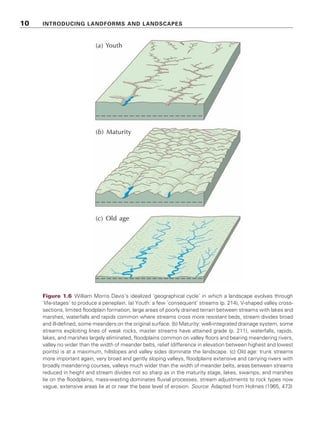
Figure 1.6 William Morris Davis’s idealized ‘geographical cycle’ in which a landscape evolves through
‘life-stages’ to produce a peneplain. (a) Youth: a few ‘consequent’ streams (p. 214), V-shaped valley cross-
sections, limited floodplain formation, large areas of poorly drained terrain between streams with lakes and
marshes, waterfalls and rapids common where streams cross more resistant beds, stream divides broad
and ill-defined, some meanders on the original surface. (b) Maturity: well-integrated drainage system, some
streams exploiting lines of weak rocks, master streams have attained grade (p. 211), waterfalls, rapids,
lakes, and marshes largely eliminated, floodplains common on valley floors and bearing meandering rivers,
valley no wider than the width of meander belts, relief (difference in elevation between highest and lowest
points) is at a maximum, hillslopes and valley sides dominate the landscape. (c) Old age: trunk streams
more important again, very broad and gently sloping valleys, floodplains extensive and carrying rivers with
broadly meandering courses, valleys much wider than the width of meander belts, areas between streams
reduced in height and stream divides not so sharp as in the maturity stage, lakes, swamps, and marshes
lie on the floodplains, mass-wasting dominates fluvial processes, stream adjustments to rock types now
vague, extensive areas lie at or near the base level of erosion. Source: Adapted from Holmes (1965, 473)
10 INTRODUCING LANDFORMS AND LANDSCAPES
WHAT IS GEOMORPHOLOGY? 11
Eduard Brückner and Albrecht Penck
Other early historical geomorphologists used
geologically young sediments to interpret Pleis-
tocene events. Eduard Brückner and Albrecht
Penck’s work on glacial effects on the Bavarian
Alps and their forelands provided the first insights
into the effects of the Pleistocene ice ages on relief
(Penck and Brückner 1901–9). Their classic river-
terrace sequence gave names to the main glacial
stages – Donau, Gunz, Mindel, Riss, and Würm –
and sired Quaternary geomorphology (see Appen-
dix 1 for the divisions of the geological time).
Modern historical geomorphology
Historical geomorphology has developed since
Davis’s time, and geomorphologists no longer
squeeze the interpretation of longer-term changes
of landscapes into the straitjacket of the geo-
graphical cycle. They rely now on various chrono-
logical analyses, particularly those based on
stratigraphical studies of Quaternary sediments,
and upon a much fuller appreciation of geo-
morphicandtectonicprocesses(e.g.Brown1980).
Observed stratigraphical relationships furnish
relative chronologies (events placed in order of
occurrence but without accurately fixed dates);
absolutechronologiesderivefromsequencesdated
using historical records, radiocarbon analysis,
dendrochronology, luminescence, palaeomag-
netism, and so forth (Appendix 2). Historical
studies tend to fall into two groups: Quaternary
geomorphology and long-term geomorphology.
Quaternary geomorphology
The environmental vicissitudes of the last couple
of million years have wrought substantial adjust-
ments in many landforms and landscapes. In
particular, climatic swings from glacial to inter-
glacial conditions altered geomorphic process
rates and process regimes in landscapes. These
alterations drove some landscapes into disequi-
librium, causing geomorphic activity to increase
for a while or possibly to stop. This was especially
true with a change in process regime as the
landscape was automatically in disequilibrium
with the new processes. The disequilibrium con-
ditions produced a phase of intense activity, in-
volving the reshaping of hillslopes, the reworking
of regolith, and the changing of sediment stores
in valley bottoms.
Richard Chorley and his co-authors (1984,
1–42) claimed that geomorphologists working on
Quaternary timescales lacked a cogent theoretical
base for explaining the links between climatic
forcing and geomorphic change, and adopted a
rather spongy paradigm involving the concepts
of thresholds, feedbacks, complex response, and
episodic activity. Over twenty years later, climatic
changes induced by changes in the frequency and
magnitude of solar radiation receipt – orbital
forcing (p. 258) – provide in part the missing
theoretical base against which to assess the com-
plex dynamics of landform systems. The discovery
was that landscape changes over periods of 1,000
to 100,000 years display consistent patterns largely
forced by the interplay of climatic changes, sea
level changes, uplift, and subsidence.
Originally, most Quaternary geomorphologists
concerned themselves with local and regional
changes, usually confining their enquiries to
Holocene and Late Pleistocene, so to roughly the
last 18,000 years of the 2.6-million-year-long
Quaternary. Since the 1950s, as their knowledge
of the last 18,000 years grew, Quaternary geo-
morphologists started applying this knowledge
to earlier times. In doing so, they collaborated
with other Earth scientists to produce palaeogeo-
graphical reconstructions of particular areas at
specific times and to build postdictive or
retrodictive models (that is, models that predict
in retrospect), so contributing to a revival of
historical geomorphology (Nunn 1987).
Long-term geomorphology
Studies of landforms and landscapes older than the
Quaternary, or even late Quaternary, have come
to be called long-term geomorphology (e.g. Ollier
1992). They include investigations of Cenozoic,
Mesozoic, and even Palaeozoic landforms. Davis’s
12 INTRODUCING LANDFORMS AND LANDSCAPES
geographical cycle was in some ways the pro-
genitor of long-term geomorphology. Later, other
geomorphologists became interested in baselevel
surfaces and the school of denudation chronology
emerged studying the historical development of
landscapes by denudation, usually at times before
the Quaternary, using as evidence erosion surfaces
and their mantling deposits, drainage patterns,
stream long-profiles, and geological structures.
Key figures in this endeavour were Sydney W.
Wooldridge and David L. Linton in Britain, Eric
Brown in Wales, and Lester C. King in South
Africa.
Baselevel surfaces still engage the attention of
geomorphologists. Indeed, since about 1990, the
field of long-term geomorphology has experi-
enced a spectacular instauration. The reasons for
this lie in the stimulation provided by the plate
tectonics revolution and its rebuilding of the
links between tectonics and topography, in the
development of numerical models that investi-
gate the links between tectonic processes and
surface processes, and in major breakthroughs
in analytical and geochronological (absolute
dating) techniques (Bishop 2007). The latest
numerical models of landscape evolution routinely
combine bedrock river processes and slope pro-
cesses; they tend to focus on high-elevation passive
continental margins and convergent zones; and
they regularly include the effects of rock flexure
(bending and folding) and isostasy (the re-
establishment of gravitational equilibrium in the
lithosphere following, for example, the melting
of an ice sheet or the deposition of sediment).
Radiogenic dating methods, such as apatite
fission-track analysis (Appendix 2), allow the
determination of rates of rock uplift and ex-
humation by denudation from relatively shallow
crustal depths (up to about 4 km). Despite this,
long-term geomorphology still depends on
landform analysis and relative dating, as most
absolute dating methods fail for the timescales of
interest. It is not an easy task to set an accurate
age to long-term development landforms, and in
many cases, later processes alter or destroy them.
The old landforms surviving in today’s landscapes
are, in the main, large-scale features that erosion
or deposition might have modified before or
during the Quaternary.
PROCESS GEOMORPHOLOGY
The history of process
geomorphology
Process geomorphology is the study of the pro-
cesses responsible for landform development.
In the modern era, the first process geomor-
phologist, carrying on the tradition started by
Leonardo da Vinci (p. 4), was Grove Karl Gilbert.
In his treatise on the Henry Mountains of Utah,
USA, Gilbert discussed the mechanics of fluvial
processes (Gilbert 1877), and later he investigated
the transport of debris by running water (Gilbert
1914). Up to about 1950, important contributors
to process geomorphology included Ralph Alger
Bagnold (p. 316), who considered the physics of
blown sand and desert dunes, and Filip Hjulstrøm
(p. 195), who investigated fluvial processes.
After 1950, several ‘big players’ emerged who
set process geomorphology moving apace. Arthur
N. Strahler was instrumental in establishing
process geomorphology, his 1952 paper called
‘Dynamic basis of geomorphology’ being a land-
mark publication. He proposed a ‘system of
geomorphology grounded in basic principles of
mechanics and fluid dynamics’ that he hoped
would ‘enable geomorphic processes to be treated
as manifestations of various types of shear stresses,
both gravitational and molecular, acting upon any
type of earth material to produce varieties of strain,
or failure, which we recognize as the manifold
processes of weathering, erosion, transportation
and deposition’ (Strahler 1952, 923). In fact, the
research of Strahler and his students, and that
of Luna B. Leopold and M. Gordon Wolman in
fluvial geomorphology (e.g. Leopold et al. 1964),
was largely empirical, involving a statistical
treatment of form variables (such as width, depth,
and meander wavelength) and surrogates for
variables that controlled them (such as river dis-
charge) (see Lane and Richards 1997). The chal-
lenge of characterizing the geomorphic processes
themselves was eventually taken up by William E.
H. Culling (1960, 1963, 1965) and Michael J.
Kirkby (1971). It was not until the 1980s that geo-
morphologists, in particular William E. Dietrich
and his colleagues in the Universities of Wash-
ington and Berkeley, USA (e.g. Dietrich and Smith
1983), developed Strahler’s vision of a truly
dynamic geomorphology (see Lane and Richards
1997). There is no doubt that Strahler’s ground-
breaking ideas spawned a generation of Anglo-
American geomorphologists who researched the
small-scale erosion, transport, and deposition of
sediments in a mechanistic and fluid dynamic
framework (cf. Martin and Church 2004). More-
over, modern modelling studies of the long-term
evolution of entire landscapes represent a
culmination of this work (pp. 174–7).
Another line of process geomorphology
considered ideas about stability in landscapes.
Stanley A. Schumm, a fluvial geomorphologist,
refined notions of landscape stability to include
thresholds and dynamically metastable states
and made an important contribution to the under-
standing of timescales (p. 27). Stanley W. Trimble
worked on historical and modern sediment
budgets in small catchments (e.g. Trimble 1983).
Richard J. Chorley brought process geomorphol-
ogy to the UK and demonstrated the power of a
systems approach to the subject.
The legacy of process
geomorphology
Process geomorphologists have done their subject
at least three great services. First, they have built
up a database of process rates in various parts of
the globe. Second, they have built increasingly
refined models for predicting the short-term (and
in some cases long-term) changes in landforms.
Third, they have generated some enormously
powerful ideas about stability and instability in
geomorphic systems (see pp. 23–32).
Measuring geomorphic processes
Some geomorphic processes have a long record
of measurement. The oldest year-by-year record
is the flood levels of the River Nile in Lower Egypt.
Yearly readings at Cairo are available from the
time of Muhammad, and some stone-inscribed
records date from the first dynasty of the pharaohs,
around 3100 BC. The amount of sediment
annually carried down the Mississippi River was
gauged during the 1840s, and the rates of modern
denudation in some of the world’s major rivers
were estimated in the 1860s. The first efforts to
measure weathering rates were made in the late
nineteenth century. Measurements of the dis-
solved load of rivers enabled estimates of chemical
denudation rates to be made in the first half of the
twentieth century, and patchy efforts were made
to widen the range of processes measured in the
field. But it was the quantitative revolution in
geomorphology, started in the 1940s, that was
largely responsible for the measuring of process
rates in different environments.
Since about 1950, the attempts to quantify
geomorphic processes in the field have grown
fast. An early example is the work of Anders Rapp
(1960), who tried to quantify all the processes
active in a subarctic environment and assess their
comparative significance. His studies enabled him
to conclude that the most powerful agent of
removal from the Karkevagge drainage basin
was running water bearing material in solution.
An increasing number of hillslopes and drain-
age basins have been instrumented, that is, had
measuring devices installed to record a range of
geomorphic processes. The instruments used
on hillslopes and in geomorphology generally are
explained in several books (e.g. Goudie 1994).
Interestingly, some of the instrumented catch-
ments established in the 1960s have recently
received unexpected attention from scientists
studying global warming, because records last-
ing decades in climatically sensitive areas – high
latitudes and high altitudes – are invaluable.
However, after half a century of intensive field
measurements, some areas, including Europe
WHAT IS GEOMORPHOLOGY? 13
and North America, still have better coverage
than other areas. And field measurement pro-
grammes should ideally be ongoing and work
on as fine a resolution as practicable, because
rates measured at a particular place may vary
through time and may not be representative of
nearby places.
Modelling geomorphic processes
Since the 1960s and 1970s, geomorphologists
have tended to direct process studies towards the
construction of models for predicting short-term
changes in landforms, that is, changes happen-
ing over human timescales. Such models have
drawn heavily on soil engineering, for example in
the case of slope stability, and hydraulic engin-
eering in the cases of flow and sediment entrain-
ment and deposition in rivers. Nonetheless, some
geomorphologists, including Michael J. Kirkby
and Jonathan D. Phillips, have carved out a niche
for themselves in the modelling department. These
groundbreaking endeavours led to the model-
ling of long-term landscape evolution, which now
lies at the forefront of geomorphic research. The
spur to these advances in landscape modelling
was huge advances in computational technology,
coupled with the establishment of a set of process
equations designated ‘geomorphic transport laws’
(Dietrich et al. 2003). As Yvonne Martin and
Michael Church (2004, 334) put it, ‘The modelling
of landscape evolution has been made quanti-
tatively feasible by the advent of high speed com-
puters that permit the effects of multiple processes
to be integrated together over complex topo-
graphic surfaces and extended periods of time’.
Figure 1.7 shows the output from a hillslope
evolution model; landscape evolution models will
be discussed in Chapter 8.
Process studies and global
environmental change
With the current craze for taking a global view,
process geomorphology has found natural links
with other Earth and life sciences. Main thrusts
of research investigate (1) energy and mass fluxes
and (2) the response of landforms to climate,
hydrology, tectonics, and land use (Slaymaker
2000b, 5). The focus on mass and energy fluxes
explores the short-term links between land-surface
systems and climate that are forged through
the storages and movements of energy, water,
biogeochemicals, and sediments. Longer-term
and broader-scale interconnections between
landforms and climate, water budgets, vegetation
cover, tectonics, and human activity are a focus
for process geomorphologists who take a histor-
ical perspective and investigate the causes and
effects of changing processes regimes during the
Quaternary.
The developments in geomorphology partly
parallel developments in the new field of biogeo-
science. This rapidly evolving interdisciplinary
subject investigates the interactions between the
biological, chemical, and physical processes in life
(the biosphere) with the atmosphere, hydrosphere,
pedosphere, and geosphere (the solid Earth). It
has its own journal – Biogeosciences – that started
in 2001. Moreover, the American Geophysical
Union now has a biogeoscience section that
focuses upon biogeochemistry, biophysics, and
planetary ecosystems.
OTHER GEOMORPHOLOGIES
Although process and historical studies dominate
much modern geomorphological enquiry, par-
ticularly in English-speaking nations, other types
of study exist. For example, structural geomor-
phologists, who were once a very influential group,
argued that underlying geological structures are
the key to understanding many landforms. Today,
other geomorphologies include applied geo-
morphology, tectonic geomorphology, submarine
geomorphology, climatic geomorphology, and
planetary geomorphology.
Applied geomorphology
Applied geomorphology, which is largely an
extension of process geomorphology, tackles the
14 INTRODUCING LANDFORMS AND LANDSCAPES
Figure 1.7 Example of a geomorphic model: the predicted evolution of a scarp bounding a plateau
according to assumptions made about slope processes using a numerical model of hillslope evolution built
by Mike Kirkby. (a) Slope evolution with creep processes running at 100 cm2
/year and no wash processes.
(b) Slope evolution with wash process dominating.
manner in which geomorphic processes affect,
and are affected by, human activities. Process
geomorphologists, armed with their models,
have contributed to the investigation of worrying
problems associated with the human impacts
on landscapes. They have studied coastal erosion
and beach management (e.g. Bird 1996; Viles
and Spencer 1996), soil erosion, the weathering of
buildings, landslide protection, river manage-
ment and river channel restoration (e.g. Brookes
and Shields 1996), and the planning and design
of landfill sites (e.g. Gray 1993). Other process
geomorphologists have tackled general applied
issues. Geomorphology in Environmental Planning
(Hooke 1988), for example, considered the inter-
action between geomorphology and public
WHAT IS GEOMORPHOLOGY? 15
16 INTRODUCING LANDFORMS AND LANDSCAPES
policies, with contributions on rural land-use
and soil erosion, urban land-use, slope manage-
ment, river management, coastal management,
and policy formulation. Geomorphology in Envir-
onmental Management (Cooke 1990), as its title
suggests, looked at the role played by geomor-
phology in management aspects of the environ-
ment. Geomorphology and Land Management
in a Changing Environment (McGregor and
Thompson 1995) focused upon problems of man-
aging land against a background of environmental
change. The conservation of ancient and modern
landforms is an expanding aspect of applied
geomorphology.
Three aspects of applied geomorphology have
been brought into a sharp focus by the impending
environmental change associated with global
warming (Slaymaker 2000b) and illustrate the
value of geomorphological expertise. First, applied
geomorphologists are ideally placed to work on
the mitigation of natural hazards of geomorphic
origin, which may well increase in magnitude and
frequency during the twenty-first century and
beyond. Landslides and debris flows may become
more common, soil erosion may become more
severe and the sediment load of some rivers
increase, some beaches and cliffs may erode faster,
coastal lowlands may become submerged, and
frozen ground in the tundra environments may
thaw. Applied geomorphologists can address all
these potentially damaging changes. Second, a
worrying aspect of global warming is its effect on
natural resources – water, vegetation, crops, and
so on. Applied geomorphologists, equipped with
such techniques as terrain mapping, remote
sensing, and geographical information systems,
can contribute to environmental management
programmes. Third, applied geomorphologists
are able to translate the predictions of global and
regional temperature rises into predictions of
critical boundary changes, such as the poleward
shift of the permafrost line and the tree-line, which
can then guide decisions about tailoring economic
activity to minimize the effects of global environ-
mental change.
Tectonic geomorphology
This studies the interaction between tectonic and
geomorphic processes in regions where the Earth’s
crust actively deforms. Advances in the meas-
urement of rates and in the understanding of
the physical basis of tectonic and geomorphic
processes have revitalized it as a field of enquiry.
It is a stimulating and highly integrative field that
uses techniques and data drawn from studies of
geomorphology, seismology, geochronology,
structure, geodesy, and Quaternary climate change
(e.g. Burbank and Anderson 2001).
Submarine geomorphology
This deals with the form, origin, and development
of features of the sea floor. Submarine landforms
cover about 71 per cent of the Earth’s surface, but
are mostly less well studied than their terrestrial
counterparts are. In shallow marine environments,
landforms include ripples, dunes, sand waves,
sand ridges, shorelines, and subsurface channels.
In the continental slope transition zone are sub-
marine canyons and gullies, inter-canyon areas,
intraslope basins, and slump and slide scars. The
deep marine environment contains varied land-
forms, including trench and basin plains, trench
fans, sediment wedges, abyssal plains, distributary
channels, and submarine canyons.
Planetary geomorphology
This is the study of landforms on planets and large
moons with a solid crust, for example Venus,
Mars, and some moons of Jupiter and Saturn.
It is a thriving branch of geomorphology (e.g.
Howard 1978; Baker 1981; Grant 2000; Irwin
et al. 2005). Surface processes on other planets
and their satellites depend materially on their
mean distance from the Sun, which dictates the
annual receipt of solar energy, on their rotational
period, and on the nature of the planetary atmos-
phere. Observed processes include weathering,
aeolian activity, fluvial activity, glacial activity,
and mass movements.
Climatic geomorphology
The chief climatic geomorphologist exponents
are French and German. Their arguments rest
on the not universally accepted observation that
each climatic zone (tropical, arid, temperate,
for example) engenders a distinctive suite of
landforms (e.g. Tricart and Cailleux 1972; Büdel
1982). Climate does strongly influence geo-
morphic processes, but it is doubtful that the set
of geomorphic processes within each climatic zone
creates characteristic landforms. The current
consensus is that, owing to climatic and tectonic
change, the climatic factor in landform develop-
ment is more complicated than climatic geo-
morphologists have suggested on occasions
(cf. p. 51).
GEOMORPHOLOGICAL ‘ISMS’:
A NOTE ON METHODOLOGY
Process and historical geomorphologists alike
face a problem with their methodological base.
In practising their trade, all scientists, including
geomorphologists, follow rules. Scientific prac-
titioners established these rules, or guidelines.
They advise scientists how to go about the busi-
ness of making scientific enquiries. In other words,
they are guidelines concerned with scientific
methodology or procedures. The foremost guide-
line – the uniformity of law – is the premise from
which all scientists work. It is the presupposition
that natural laws are invariant in time and space.
In simple terms, this means that, throughout
Earth history, the laws of physics, chemistry, and
biology have always been the same. Water has
always flowed downhill, carbon dioxide has always
been a greenhouse gas, and most living things
have always depended upon carbon, hydrogen,
and oxygen.
Three other guidelines are relevant to geo-
morphology. Unlike the uniformity of law, which
is a universally accepted basis for scientific investi-
gation, they are substantial claims or supposi-
tions about how the Earth works and are open to
interpretation. First, the principle of simplicity
or, as it is commonly called in geomorphology,
the uniformity of process states that no extra,
fanciful, or unknown causes should be invoked
if available processes will do the job. It is the
supposition of actualism, the belief that past events
are the outcome of processes seen in operation
today. However, the dogma of actualism is being
challenged, and its flip-side – non-actualism – is
gaining ground. Some geologists and geomorphol-
ogists are coming round to the view that the
circumstances under which processes acted in the
past were very different from those experienced
today, and that those differences greatly influence
the interpretation of past processes. So, before the
evolution of land plants, and especially the grasses,
the processes of weathering, erosion, and deposi-
tion would have occurred in a different context,
and Palaeozoic deserts, or even Permian deserts,
may not directly correspond to modern deserts.
The second substantive claim concerns the rate of
Earth surface processes, two extreme views being
gradualism and catastrophism (p. 33). The third
substantive claim concerns the changing state of
the Earth’s surface, steady-statism arguing for a
more or less constant state, or at least cyclical
changes about a comparatively invariant mean
state, and directionalism arguing in favour of
directional changes.
Uniformitarianism is a widely, but too often
loosely, used term in geomorphology. A com-
mon mistake is to equate uniformitarianism
with actualism. Uniformitarianism was a system
of assumptions about Earth history argued by
Charles Lyell, the nineteenth-century geologist.
Lyell articulately advocated three ‘uniformities’,
as well as the uniformity of law: the uniformity
of process (actualism), the uniformity of rate
(gradualism), and the uniformity of state (steady-
statism). Plainly, extended to geomorphology,
uniformitarianism, as introduced by Lyell, is a
set of beliefs about Earth surface processes and
states. Other sets of beliefs are possible. The
diametric opposite of Lyell’s uniformitarian
position would be a belief in the non-uniformity
WHAT IS GEOMORPHOLOGY? 17
of process (non-actualism), the non-uniformity of
rate (catastrophism), and the non-uniformity
of state (directionalism). All other combina-
tions of assumption are possible and give rise to
different ‘systems of Earth history’ (Huggett
1997a). The various systems may be tested against
field evidence. To be sure, directionalism was
accepted even before Lyell’s death, and non-
actualism and, in particular, catastrophism are
discussed in geomorphological circles.
SUMMARY
Geomorphology is the study of landforms. Three
key elements of geomorphology are land form,
geomorphic process, and land-surface history.
The two complementary main brands of geo-
morphology are historical geomorphology and
process geomorphology. Other brands include
applied geomorphology, tectonic geomorphol-
ogy, submarine geomorphology, planetary geo-
morphology, and climatic geomorphology.
Geomorphology has engaged in methodological
debates over the extent to which the present is the
key to the past and the rates of Earth surface
processes.
ESSAY QUESTIONS
1 To what extent are early ideas in geo-
morphology relevant today?
2 Explain why geomorphology encom-
passes a wide range of approaches.
3 Does geomorphology have a future?
FURTHER READING
Ahnert, F. (1998) Introduction to Geomorphology.
London: Arnold.
A good starting text with many unusual examples.
Bloom, A. L. (1998) Geomorphology: A Systematic
Analysis of Late Cenozoic Landforms, 3rd edn.
Upper Saddle River, N.J. and London: Prentice
Hall.
A sound text with a focus on North America.
Kennedy, B. A. (2005) Inventing the Earth: Ideas on
Landscape Development since 1740. Oxford:
Blackwell.
A good read on the relatively recent history of
ideas about landscape development.
Slaymaker, O. (2009) The future of geomorphology.
Geography Compass 3, 329–49.
Heavy on philosophy and not a smooth ride for
the beginner, but worth the effort.
Strahler, A. H. and Strahler, A. N. (2006) Introducing
Physical Geography, 4th edn. New York: John
Wiley & Sons.
Comprehensive and accessible coverage of all
aspects of physical geography if a general
background is needed.
Summerfield, M. A. (1991) Global Geomorphology:
An Introduction to the Study of Landforms.
Harlow, Essex: Longman.
A classic after just twenty years. Includes material
on the geomorphology of other planets.
Summerfield, M. A. (2005) A tale of two scales, or
the two geomorphologies. Transactions of the
Institute of British Geographers, New Series 30,
402–15.
A plainly written and thoughtful paper.
Thorn, C. E. (1988) An Introduction to Theoretical
Geomorphology. Boston, Mass.: Unwin Hyman.
A very clear discussion of the big theoretical
issues in geomorphology. Well worth a look.
18 INTRODUCING LANDFORMS AND LANDSCAPES
CHAPTER TWO
INTRODUCING
PROCESS AND FORM
2
Earth surface process and land form are key to geomorphic understanding. This chapter
introduces:
• Geomorphic systems
• Geomorphic models
• Land form
GEOMORPHIC SYSTEMS
Defining systems
What is a geomorphic system?
Process geomorphologists commonly adopt a
systems approach to their subject. To illustrate
what this approach entails, take the example of a
hillslope system. A hillslope extends from an
interfluve crest, along a valley side, to a sloping
valley floor. It is a system insofar as it consists of
things (rock waste, organic matter, and so forth)
arranged in a particular way. The arrangement is
seemingly meaningful, rather than haphazard,
because it is explicable in terms of physical
processes (Figure 2.1). The ‘things’ of which a
hillslope is composed may be described by such
variables as particle size, soil moisture content,
vegetation cover, and slope angle. These variables,
and many others, interact to form a regular and
connected whole: a hillslope, and the mantle of
debris on it, records a propensity towards
reciprocal adjustment among a complex set of
variables. The complex set of variables includes
rock type, which influences weathering rates, the
geotechnical properties of the soil, and rates of
infiltration; climate, which influences slope
hydrology and so the routing of water over and
through the hillslope mantle; tectonic activity,
which may alter baselevel; and the geometry of the
hillslope, which, acting mainly through slope angle
and distance from the divide, influences the rates
of processes such as landsliding, creep, solifluction
(see p. 168), and wash. Change in any of the
variables will tend to cause a readjustment of
hillslope form and process.
Isolated, closed, open, and
dissipative systems
Systems of all kinds are open, closed, or isolated
according to how they interact, or do not interact,
Figure 2.1 A hillslope as a system, showing storages (waste mantle), inputs (e.g. wind deposition and
debris production), outputs (e.g. wind erosion), throughputs (debris transport), and units (channel, valley-
side slope, interfluve).
20 INTRODUCING LANDFORMS AND LANDSCAPES
with their surroundings (Huggett 1985, 5–7).
Traditionally, an isolated system is a system that
is completely cut off from its surroundings and
that cannot therefore import or export matter or
energy. A closed system has boundaries open to
the passage of energy but not of matter. An open
system has boundaries across which energy and
materials may move. All geomorphic systems,
including hillslopes, are open systems as they
exchange energy and matter with their sur-
roundings. They are also dissipative systems,
which means that irreversible processes resulting
in the dissipation of energy (generally in form of
friction or turbulence) govern them. Thus, to
maintain itself, a geomorphic system dissipates
energy from such external sources as solar energy,
tectonic uplift, and precipitation.
Internal and external system
variables
Any geomorphic system has internal and external
variables. Take a drainage basin. Soil wetness,
streamflow, and other variables lying inside the
system are endogenous or internal variables.
Precipitation, solar radiation, tectonic uplift,
and other such variables originating outside the
system and affecting drainage basin dynamics are
exogenous or external variables. Interestingly, all
geomorphic systems can be thought of as resulting
from a basic antagonism between endogenic
(tectonic and volcanic) processes driven by
geological forces and exogenic (geomorphic)
processes driven by climatic forces (Scheidegger
1979). In short, tectonic processes create land,
and climatically influenced weathering and
erosion destroy it. The events between the creation
and the final destruction are what fascinate
geomorphologists.
Classifying systems
Systems are mental constructs and defined in
various ways. Two conceptions of systems are
important in geomorphology: systems as process
and form structures, and systems as simple and
complex structures (Huggett 1985, 4–5, 17–44).
Figure 2.2 A cliff and talus slope viewed as (a) a form system, (b) a flow or cascading system, and (c) a
process–form or process–response system. Details are given in the text.
INTRODUCING PROCESS AND FORM 21
Geomorphic systems as form and
process structures
Four kinds of geomorphic system may be
identified: form systems, process systems, form
and process systems, and control systems.
1. Form systems. Form or morphological systems
are sets of form variables deemed to interrelate
in a meaningful way in terms of system origin
or system function. Several measurements
could be made to describe the form of a
hillslope system. Form elements would include
measures of anything on a hillslope that has
size, shape, or physical properties. A simple
characterization of hillslope form is shown in
Figure 2.2a, which depicts a cliff with a talus
slope at its base. All that could be learnt from
this ‘form system’ is that the talus lies below
the cliff; no causal connections between the
processes linking the cliff and talus slope are
inferred. Sophisticated characterizations of
hillslope and land-surface forms may be made
using digital terrain models.
2. Process systems. Process systems, which are
also called cascading or flow systems, are
defined as ‘interconnected pathways of trans-
port of energy or matter or both, together with
such storages of energy and matter as may be
required’ (Strahler 1980, 10). An example is a
hillslope represented as a store of materials:
weathering of bedrock and wind deposition
add materials to the store, and erosion by wind
and fluvial erosion at the slope base removes
materials from the store. The materials pass
through the system and in doing so link the
morphological components. In the case of the
cliff and talus slope, it could be assumed that
rocks and debris fall from the cliff and deliver
energy and rock debris to the talus below
(Figure 2.2b).
3. Form and process systems. Process–form
systems, also styled process–response systems,
compriseanenergy-flowsystemlinkedtoaform
system in such a way that system processes may
alter the system form and, in turn, the changed
system form alters the system processes.
A hillslope may be viewed in this way with
slope form variables and slope process variables
interacting. In the cliff-and-talus example, rock
falling off the cliff builds up the talus store
(Figure 2.2c). However, as the talus store
increasesinsize,soitbeginstoburythecliffface,
reducing the area that supplies debris. In
consequence,therateoftalusgrowthdiminishes
and the system changes at an ever-decreasing
rate. The process described is an example of
negative feedback, which is an important facet
of many process–form systems (Box 2.1).
4. Control systems. Control systems are process–
form systems that interact with humans.
They include managed rivers, coasts with sea
defences, and some caves.
Geomorphic systems as simple or
complex structures
Three main types of system are recognized under
this heading: simple systems, complex but
disorganized systems, and complex and organized
systems.
1. Simple systems. The first two of these types
have a long and illustrious history of study.
Since at least the seventeenth-century revolu-
tion in science, astronomers have referred to
a set of heavenly bodies connected together
and acting upon each other according to
certain laws as a system. The Solar System is
the Sun and its planets. The Uranian system is
Uranus and its moons. These structures may
be thought of as simple systems. In geomor-
phology, a few boulders resting on a talus slope
is a simple system. The conditions needed to
dislodge the boulders, and their fate after
dislodgement, is predictable from mechanical
laws involving forces, resistances, and equa-
tions of motion, in much the same way that the
motion of the planets around the Sun can be
predicted from Newtonian laws.
2. In a complex but disorganized system, a vast
number of objects interact in a weak and
Negative feedback occurs when a change in a system sets in motion a sequence of
changes that eventually neutralize the effects of the original change, so stabilizing the
system. An example occurs in a drainage basin system, where increased channel erosion
leads to a steepening of valley-side slopes, which accelerates slope erosion, which
increases stream bed-load, which reduces channel erosion (Figure 2.3a). The reduced
channel erosion then stimulates a sequence of events that stabilizes the system and
counteracts the effects of the original change. Some geomorphic systems also display
positive feedback relationships characterized by an original change being magnified and
the system being made unstable. An example is an eroding hillslope where the slope
erosion causes a reduction in infiltration capacity of water, which increases the amount
of surface runoff, which promotes even more slope erosion (Figure 2.3b). In short, a
‘vicious circle’ is created, and the system, being unstabilized, continues changing.
Box 2.1 NEGATIVE AND POSITIVE FEEDBACK
Figure 2.3 Feedback relationships in geomorphic
systems. (a) Negative feedback in a valley-side
slope–stream system. (b) Positive feedback in an
eroding hillslope system. Details of the relation-
ships are given in the text.
22 INTRODUCING LANDFORMS AND LANDSCAPES
INTRODUCING PROCESS AND FORM 23
haphazard way. An example is a gas in a jar.
This system might comprise upward of 1023
molecules colliding with each other. In the
same way, the countless individual particles
in a hillslope mantle could be regarded as a
complex but rather disorganized system. In
both the gas and the hillslope mantle, the
interactions are somewhat haphazard and far
too numerous to study individually, so aggre-
gate measures must be employed (see Huggett
1985, 74–7; Scheidegger 1991, 251–8).
3. In a third and later conception of systems,
objects are seen to interact strongly with one
another to form systems of a complex and
organized nature. Most biological and eco-
logical systems are of this kind. Many structures
in geomorphology display high degrees of
regularity and rich connections, and may be
thought of as complexly organized systems. A
hillslope represented as a process–form system
could be placed into this category. Other
examples include soils, rivers, and beaches.
System hierarchy: the scale
problem
A big problem faced by geomorphologists is that,
as the size of geomorphic systems increases, the
explanations of their behaviour may change.
Take the case of a fluvial system. The form and
function of a larger-scale drainage network require
a different explanation from a smaller-scale
meandering river within the network, and an even
smaller-scale point bar along the meander requires
a different explanation again. The process could
carry on down through bedforms on the point bar,
to the position and nature of individual sediment
grains within the bedforms (cf. Schumm 1985a;
1991, 49). A similar problem applies to the time
dimension. Geomorphic systems may be studied
in action today. Such studies are short-term,
lasting for a few years or decades. Yet geomorphic
systems have a history that goes back centuries,
millennia, or millions of years. Using the results
of short-term studies to explain how geomorphic
systems will change over long periods is beset with
difficulties. Stanley A. Schumm (1985, 1991) tried
to resolve the scale problem, and in doing so
established some links between process and
historical studies (p. 8).
System dynamics: stasis
and change
The adoption by process geomorphologists of a
systems approach has provided a common
language and a theoretical basis for discussing
static and changing conditions in geomorphic
systems. It is helpful to explore the matter by
consideringhowageomorphicsystemrespondsto
a disturbance or a change in driving force (a
perturbation),suchasachangeinstreamdischarge.
Table 2.1 shows some common perturbers of
geomorphic systems and their characteristics.
Discussion of responses to disturbances in the
geomorphological literature tends to revolve
around the notion of equilibrium, which has a
long and involved history. In simple terms,
equilibrium is ‘a condition in which some kind of
balance is maintained’ (Chorley and Kennedy
1971, 348), but it is a complex concept, its com-
plexity lying in the multiplicity of equilibrium
patterns and the fact that not all components of
a system need be in balance at the same time for
some form of equilibrium to obtain. The more
recently introduced ideas of disequilibrium
(moving towards a stable end state, but not yet
there) and non-equilibrium (not moving towards
any particular stable or steady state) add another
dimension to the debate.
Equilibrium
Figure 2.4 shows eight conditions of equilibrium
(a–h). Thermodynamic equilibrium is the tend-
ency towards maximum entropy, as demanded
by the second law of thermodynamics. In geo-
morphology, such a tendency would lead to a
continuous and gradual reduction of energy
gradients (slopes) and an attendant lessening of
the rates of geomorphic processes. A featureless
Table 2.1 Disturbance characteristics for selected geomorphic disturbances
Characteristics
Frequency Magnitude Duration Spatial Speed of Spatial Temporal
extent onset dispersion spacing
Disturbing agency
Fire
Frequent to Low to Short Moderate to Diffuse Random Rapid
rare moderate extensive
Drought
Frequent to Low to Short to Extensive Slow Diffuse Random to
rare moderate moderate cyclical
Volcanic eruption
Rare Low to Short Local to Rapid Concentrated Random
extreme extensive
Eustatic sea-level change
Rare Moderate to Long Extensive to Slow Diffuse Cyclical
extreme global
Subsidence
Rare to Low to high Short to Local to Slow to Moderate to Random
moderate moderate moderate rapid concentrated
Mining
Singular Extreme Short to Local Rapid Concentrated Singular
moderate
Source: Adapted from Gares et al. (1994) and Phillips (2009)
24 INTRODUCING LANDFORMS AND LANDSCAPES
plain would be in a state of thermodynamic
equilibrium, but virtually all landscapes are far
removed from such an extreme state.
Several forms of equilibrium occur where
landforms or geomorphic processes do not change
and maintain static or stationary states. Static
equilibrium is the condition where an object has
forces acting upon it but it does not move because
the forces balance. Examples are a boulder resting
on a slope and a stream that has cut down to its
base level, so preventing further entrenchment.
Stable equilibrium is the tendency of a system to
return to its original state after experiencing a
small perturbation, as when a sand grain at the
base of a depression is rolled a little by a gust of
wind but rolls back when the wind drops. Negative
feedback processes may lead to the process of
restoration. Unstable equilibrium occurs when a
small perturbation forces a system away from its
old equilibrium state towards a new one. If the
disturbance persists or grows, perhaps through
positive feedback processes, it may lead to
disequilibrium or non-equilibrium. A simple
example would a boulder perched atop a hill; a
force sufficient to dislodge the boulder would lead
to its rolling downslope.
In another common form of equilibrium, a
geomorphic system self-maintains a constant form
or steady state in the face of all but the largest
perturbations. An example is a concavo-convex
hillslope profile typical of humid climates with a
concave lower portion and a convex upper slope,
where erosion, deposition, and mass movement
continue to operate, and the basic slope form stays
the same. Such steady-state equilibrium occurs
when numerous small-scale fluctuations occur
about a mean stable state. The notion of steady
state is perhaps the least controversial of systems
Figure 2.4 Types of equilibrium in geomorphology. Source: Adapted from Chorley and Kennedy
(1971, 202) and Renwick (1992)
INTRODUCING PROCESS AND FORM 25
concepts in physical geography. Any open system
may eventually attain time-independent equilib-
rium state – a steady state – in which the system
and its parts are unchanging, with maximum
entropy and minimum free energy. In such a
steady state, a system stays constant as a whole and
in its parts, but material or energy continually
passes through it. As a rule, steady states are
irreversible. Before arriving at a steady state, the
system will pass through a transient state (a sort
of start-up or warm-up period). For instance, the
amount of water in a lake could remain steady
Chemists first used the expression dynamic equilibrium to mean equilibrium between
a solid and a solute maintained by solutional loss from the solid and precipitation from
the solution running at equal rates. The word equilibrium captured that balance and the
word dynamic captured the idea that, despite the equilibrium state, changes take place.
In other words, the situation is a dynamic, and not a static, equilibrium. Grove Karl Gilbert
(1877) possibly first applied the term in this sense in a geomorphic context. He suggested
that all streams work towards a graded condition, and attain a state of dynamic
equilibrium when the net effect of the flowing water is neither the erosion of the bed
nor the deposition of sediment, in which situation the landscape then reflects a balance
between force and resistance. Applied to any landform, dynamic equilibrium would
represent a state of balance in a changing situation. Thus, a spit may appear to be
unchanging, although deposition feeds it from its landward end, and erosion consumes
it at its seaward end.
John T. Hack (1960) developed Gilbert’s ideas, arguing that a landscape should attain
a steady state, a condition in which land-surface form does not change despite material
being added by tectonic uplift and removed by a constant set of geomorphic processes.
He contended that, in an erosional landscape, dynamic equilibrium prevails where all
slopes, both hillslopes and river slopes, are adjusted to each other (cf. Gilbert 1877, 123–4;
Hack 1960, 81), and ‘the forms and processes are in a steady state of balance and may
be considered as time independent’ (Hack 1960, 85). In practice, this notion of dynamic
equilibrium was open to question (e.g. Ollier 1968) and difficult to apply to landscapes.
Other geomorphologists have used the term dynamic equilibrium to mean ‘balanced
fluctuations about a constantly changing system condition which has a trajectory of
unrepeated states through time’ (Chorley and Kennedy 1971, 203), which is similar to
Alfred J. Lotka’s (1924) idea of moving equilibrium (cf. Ollier 1968, 1981, 302–4).
Currently then, dynamic equilibrium in physical geography is synonymous with a
‘steady state’ or with a misleading state, where the system appears to be in equilibrium
but in reality is changing extremely sluggishly. Thus, the term has been a replacement
for such concepts as grade (p. 211). Problems with the concept relate to the application
of a microscale phenomenon in physics to macroscale geomorphic systems, and to the
difficulty of separating any observed fluctuations from a theoretical underlying trend
(Thorn and Welford 1994). On balance, it is perhaps better for physical geographers to
abandon the notion of dynamic equilibrium, and indeed some of the other brands of
equilibrium, and instead adopt the terminology of non-linear dynamics.
Box 2.2 DYNAMIC EQUILIBRIUM
26 INTRODUCING LANDFORMS AND LANDSCAPES
because gains of water (incoming river water
and precipitation) balance losses through river
outflow, groundwater seepage, and evaporation.
If the lake started empty, then its filling up would
be a transient state. Dynamic equilibrium is a
disputatious term and discussed in Box 2.2.
From the 1960s onward, some geomorph-
ologists began questioning simplistic notions of
equilibrium and steady state. In 1965, Alan D.
Howard noted that geomorphic systems might
possess thresholds (Box 2.3) that separate two
rather different system economies. Schumm
Plate 2.1 The terraced landscape around Douglas Creek, Wyoming, USA. The photo was taken from a
bluff along the west side looking northeast. The abandoned channel that turns right near the left side of
the photo is the 1961 surface. On the right side of the channel is a crescent-shaped terrace with saltcedars
dated to 1937. The unvegetated, near-vertical bluff line in the centre right of the photo leads up to the 1900
surface. The valley floor steps up gently to the east to the 1882 surface. (Photograph by Ray Womack)
INTRODUCING PROCESS AND FORM 27
(1973, 1977) introduced the notions of metastable
equilibrium and dynamic metastable equilibrium,
showing that thresholds within a fluvial system
cause a shift in its mean state. The thresholds,
which may be intrinsic or extrinsic, are not part
of a change continuum, but show up as dramatic
changes resulting from minor shifts in system
dynamics, such as caused by a small disturbance.
In metastable equilibrium, static states episodic-
ally shift when thresholds are crossed. It involves
a stable equilibrium acted upon by some form of
incremental change (a trigger mechanism) that
drives the system over a threshold into a new
equilibrium state. A stream, for instance, if forced
away from a steady state, will adjust to the change,
although the nature of the adjustment may vary
in different parts of the stream and at different
times. Douglas Creek in western Colorado, USA,
was subject to overgrazing during the ‘cowboy
era’ and, since about 1882, it has cut into its
channel bed (Plate 2.1; Womack and Schumm
1977). The manner of cutting has been complex,
with discontinuous episodes of downcutting
interrupted by phases of deposition, and with the
erosion–deposition sequence varying from one
cross-section to another. Trees have been used to
date terraces at several locations. The terraces are
unpaired (p. 227), which is not what would be
expected from a classic case of river incision, and
they are discontinuous in a downstream direction.
This kind of study serves to dispel forever the
simplistic cause-and-effect view of landscape
evolution in which change is seen as a simple
response to an altered input. It shows that
28 INTRODUCING LANDFORMS AND LANDSCAPES
landscape dynamics may involve abrupt and
discontinuous behaviour involving flips between
quasi-stable states as system thresholds are crossed.
In dynamic metastable equilibrium, thresholds
trigger episodic changes in states of dynamic
equilibrium (dynamic equilibrium meaning here
a trending mean state). So, dynamic metastable
equilibrium is a combination of dynamic and
metastable equilibria, in which large jumps across
thresholds break in upon small-scale fluctuations
about a moving mean. For this reason, dynamic
metastable equilibrium is really a form of dis-
equilibrium as a progressive change of the mean
state occurs (Renwick 1992).
The seminal idea of thresholds led eventually
to applications of bifurcation theory (Box 2.4)
and chaos (Box 2.5) in geomorphology, which
deal with non-equilibrium as well as equilibrium
states (see Huggett 2007).
Non-equilibrium
Figure 2.4 also shows four types of non-
equilibrium (not tending towards any particular
stable or steady state), which range from a system
lurching from one state to another in response to
episodic threshold events, through a continuous
change of state driven by positive feedback and
threshold-dominated abrupt changes of state, to
a fully chaotic sequence of state changes. These
non-equilibrium interpretations of response in
geomorphic systems come from the field of
dynamic systems theory, which embraces the
A threshold separates different states of a system. It marks some kind of transition in
the behaviour, operation, or state of a system. Everyday examples abound. Water in a
boiling kettle crosses a temperature threshold in changing from a liquid to a gas.
Similarly, ice taken out of a refrigerator and placed upon a table in a room with an air
temperature of 10°C will melt because a temperature threshold has been crossed. In both
examples, the huge differences in state – liquid water to water vapour, and solid water
to liquid water – may result from tiny changes of temperature. Many geomorphic
processes operate only after the crossing of a threshold. Landslides, for instance, require
a critical slope angle, all other factors being constant, before they occur. Stanley A.
Schumm (1979) made a powerful distinction between external and internal system
thresholds. A geomorphic system will not cross an external threshold unless forced to
do so by a change in an external variable. A prime example is the response of a
geomorphic system to climatic change. Climate is the external variable. If, say, runoff
were to increase beyond a critical level, then the geomorphic system might suddenly
respond by reorganizing itself into a new state. No change in an external variable is
required for a geomorphic system to cross an internal threshold. Rather, some chance
fluctuation in an internal variable within a geomorphic system may take a system across
an internal threshold and lead to its reorganization. This appears to happen in some river
channels where an initial disturbance by, say, overgrazing in the river catchment triggers
a complex response in the river channel: a complicated pattern of erosion and deposition
occurs with phases of alluviation and downcutting taking place concurrently in different
parts of the channel system (see p. 27).
Box 2.3 THRESHOLDS
buzzwords complexity and chaos. The argument
runs that steady states in the landscape may be rare
because landscapes are inherently unstable. This
is because any process that reinforces itself keeps
the system changing through a positive feedback
circuit and readily disrupts any balance obtaining
in a steady state. The ‘instability principle’, which
recognizes that, in many landscapes, accidental
deviations from a ‘balanced’ condition tend to be
self-reinforcing, formalizes this idea (Scheidegger
1983). It explains why cirques tend to grow, sink-
holes increase in size, and longitudinal mountain
valley profiles become stepped. The intrinsic
instability of landscapes is borne out by math-
ematical analyses that point to the chaotic nature
of much landscape change (e.g. Phillips 1999;
Scheidegger 1994).
Reaction, relaxation, resistance,
resilience, and recursion
In many geomorphic systems, change in system
form trails behind a change in input (a disturb-
ance). This lag is the time taken for some
mechanism to react to the changed input and is
called the reaction time (Figure 2.6a). In the case
of river bedload, particles will not react to
increased discharge until a critical shear stress is
applied. In other words, a system response requires
the crossing of a threshold. Another reason for a
lag between a changed input and a change in form
is that the input and the form response are
separated geographically. A case in point is
pyroclastic material ejected from a volcanic vent,
which cannot change the elevation of the land
surface surrounding the volcano until it has
INTRODUCING PROCESS AND FORM 29
Some geomorphologists applied bifurcation theory to geomorphic systems in the late
1970s and early 1980s. They based their arguments on catastrophe theory, which is a
special branch of bifurcation theory developed by René Thom (1975), and tried to use
Thom’s ideas (his cusp catastrophe proved a favourite) to explain certain processes at
the Earth’s surface. An example is John Thornes’s (1983) model of sediment transport
in a river, in which a three-dimensional surface defines the equilibrium value of sediment
load (the response variable) in relation to stream power (control variable 1 or the splitting
parameter) and the ratio of sediment sorting to sediment size (control variable 2 or the
normal parameter) (Figure 2.5). For low values of the sorting–size ratio, the equilibrium
surface is a single, smooth curve; beyond the point where the surface splits (point A in
the diagram) and becomes complex, three equilibria points exist, the middle of which
is unstable. After the splitting point, the system jumps from one of the equilibrium states
to another – the transition is not smooth. The model suggests that for mixed sediments
of relatively small mean size, the equilibrium sediment load is a smooth function of stream
power, but that larger and better sorted sediments are entrained in a discontinuous
manner, the sediment load of the rising and falling limbs of a hydrograph being very
different.
The cusp catastrophe model still has some currency, being used, for example, to
explain the instability of a slip-buckling landslide, where a translational slip of rock
layers leads to buckling of rock slabs near the slope base (Qin et al. 2001).
Box 2.4 BIFURCATION THEORY AND GEOMORPHIC
SYSTEMS
Figure 2.5 A cusp catastrophe model applied to sediment transport in a river. Source: Adapted from
Thornes (1983)
Early ideas on complex dynamics and non-equilibrium within systems found a firm
theoretical footing with the theory of nonlinear dynamics and chaotic systems that
scientists from a range of disciplines developed, including geomorphology itself. Classical
open systems research characteristically dealt with linear relationships in systems near
equilibrium. A fresh direction in thought and a deeper understanding came with the
discovery of deterministic chaos by Edward Lorenz in 1963. The key change was the
recognition of nonlinear relationships in systems. In geomorphology, nonlinearity means
that system outputs (or responses) are not proportional to system inputs (or forcings)
across the full gamut of inputs (cf. Phillips 2006).
Nonlinear relationships produce rich and complex dynamics in systems far removed
from equilibrium, which display periodic and chaotic behaviour. The most surprising
feature of such systems is the generation of ‘order out of chaos’, with systems states
Box 2.5 CHAOS
continued . . .
30 INTRODUCING LANDFORMS AND LANDSCAPES
unexpectedly moving to higher levels of organization under the driving power of internal
entropy production and entropy dissipation. Systems of this kind, which dissipate energy
in maintaining order in states removed from equilibrium, are dissipative systems. The
theory of complex dynamics predicts a new order of order, an order arising out of, and
poised perilously at the edge of, chaos. It is a fractal order that evolves to form a
hierarchy of spatial systems whose properties are holistic and irreducible to the laws of
physics and chemistry. Geomorphic examples are flat or irregular beds of sand on
streambeds or in deserts that self-organize themselves into regularly spaced forms –
ripples and dunes – that are rather similar in size and shape (e.g. Baas 2002; see Murray
et al. 2009 for other examples). Conversely, some systems display the opposite tendency
– that of non-self-organization – as when relief reduces to a plain. A central implication
of chaotic dynamics for the natural world is that all Nature may contain fundamentally
erratic, discontinuous, and inherently unpredictable elements. Nonetheless, nonlinear
Nature is not all complex and chaotic. Phillips (2006) astutely noted that ‘Nonlinear
systems are not all, or always, complex, and even those which can be chaotic are not
chaotic under all circumstances. Conversely, complexity can arise due to factors other
than nonlinear dynamics’.
Phillips (2006) suggested ways of detecting chaos in geomorphic systems. He argued
that convergence versus divergence of a suitable system descriptor (elevation or regolith
thickness, for instance) is an immensely significant indicator of stability behaviour in a
geomorphic system. In landscape evolution, convergence associates with downwasting
and a reduction of relief, while divergence relates to dissection and an increase of relief.
More fundamentally, convergence and divergence underpin developmental, ‘equilibrium’
conceptual frameworks, with a monotonic move to a unique endpoint (peneplain or other
steady-state landform), as well as evolutionary, ‘non-equilibrium’ frameworks that
engender historical happenstance, multiple potential pathways and end-states, and
unstable states. The distinction between instability and new equilibria is critical to
understanding the dynamics of actual geomorphic systems, and for a given scale of
observation or investigation, it separates two conditions. On the one hand sits a new
steady-state equilibrium governed by stable equilibrium dynamics that develops after a
change in boundary conditions or in external forcings. On the other hand sits a persistence
of the disproportionate impacts of small disturbances associated with dynamic instability
in a non-equilibrium system (or a system governed by unstable equilibrium dynamics)
(Phillips 2006). The distinction is critical because the establishment of a new steady-state
equilibrium implies a consistent and predictable response throughout the system,
predictable in the sense that the same changes in boundary conditions affecting the same
system at a different place or time would produce the same outcome. In contrast, a
dynamically unstable system possesses variable modes of system adjustment and
inconsistent responses, with different outcomes possible for identical or similar changes
or disturbances.
Box 2.5 continued
INTRODUCING PROCESS AND FORM 31
32 INTRODUCING LANDFORMS AND LANDSCAPES
travelled through the atmosphere. It is common
in geomorphic systems for system form to be
unable to keep pace with a change in input, which
delays the attainment of a new equilibrium
state irrespective of any reaction-time effects
(Figure 2.6b). The time taken for the system to
adjust to the changed input is the relaxation time.
Geomorphic systems may possess reaction times
and relaxation times, which combine to give the
system response time. In summary, the reaction
time is the time needed for a system to start
responding to a changed input and the relaxation
time is the time taken for the system to complete
the response.
Resistance is the ability of a geomorphic system
to avoid or to lessen responses to driving forces.
It has two components – strength and capacity.
The ‘strength’ of a system is measurable as literal
strength (as in shear strength), chemical or mech-
anical stability (as in mineral stability, hardness,
cohesion), or susceptibility to modification (as in
soil erodibility). These must be compared to some
measure related to the magnitude of the drivers
of change. For instance, the ratio of shear strength
to shear stress ratio is used in assessing slope
stability (p. 66). A geomorphic system may also
resist changes to inputs by absorbing them, and
the ability to do so depends on the system’s
‘capacity’. So, what happens to sediment delivered
to a channel by a landslide or by soil erosion from
fields will depend in part on the sediment trans-
port capacity of the stream: if the stream has a
low transport capacity, then the sediment will
accumulate; if it has a high transport capacity then
it will be removed. Resilience is the ability of a
system to recover towards its state before disturb-
ance. It is a direct function of the dynamical
stability of the system. A geomorphic system in a
steady state will display resilience within certain
bounds. Recursion involves the changes in the
system following a disturbance feeding back
upon themselves. Recursive feedbacks may be
positive, reinforcing and thus perpetuating or even
accelerating the change, or negative, slowing or
even negating the change (p. 22).
Magnitude and frequency
Interesting debates centre on the variations in
process rates through time. The ‘tame’ end of this
debate concerns arguments over magnitude and
frequency (Box 2.6), the pertinent question here
being which events perform the most geomorphic
work: small and infrequent events, medium and
moderately frequent events, or big but rare events?
The first work on this issue concluded, albeit
provisionally until further field work was carried
out, that events occurring once or twice a year
perform most geomorphic work (Wolman and
Miller 1960). Some later work has highlighted the
geomorphic significance of rare events. Large-
scale anomalies in atmospheric circulation systems
Figure 2.6 (a) Reaction time and (b) relaxation
time in geomorphic systems.
INTRODUCING PROCESS AND FORM 33
As a rule of thumb, bigger floods, stronger winds, higher waves, and so forth occur less
often than their smaller, weaker, and lower counterparts do. Indeed, graphs showing
the relationship between the frequency and magnitude of many geomorphic processes
are right skewed, which means that a lot of low-magnitude events occur in comparison
with the smaller number of high-magnitude events, and very few very high magnitude
events. The frequency with which an event of a specific magnitude occurs is the return
period or recurrence interval, which is calculated as the average length of time between
events of a given magnitude. Take the case of river floods. Observations may produce
a dataset comprising the maximum discharge for each year over a period of years. To
compute the flood–frequency relationships, the peak discharges are listed according to
magnitude, with the highest discharge first. The recurrence interval is then calculated
using the equation
T = _____
n + 1
m
where T is the recurrence interval, n is the number of years of record, and m is the
magnitude of the flood (with m = 1 at the highest recorded discharge). Each flood is then
plotted against its recurrence interval on Gumbel graph paper and the points connected
to form a frequency curve. If a flood of a particular magnitude has a recurrence interval
of 10 years, it would mean that there is a 1-in-10 (10 per cent) chance that a flood of this
magnitude (2,435 cumecs in the Wabash River example shown in Figure 2.7) will occur
in any year. It also means that, on average, one such flood will occur every 10 years.
The magnitudes of 5-year, 10-year, 25-year, and 50-year floods are helpful for engineering
work, flood control, and flood alleviation. The 2.33-year flood (Q2.33) is the mean annual
flood (1,473 cumecs in the example), the 2.0-year flood (Q2.0) is the median annual flood
(not shown), and the 1.58-year flood (Q1.58) is the most probable flood (1,133 cumecs in
the example).
Box 2.6 MAGNITUDE AND FREQUENCY
very occasionally produce short-lived superfloods
that have long-term effects on landscapes (Baker
1977, 1983; Partridge and Baker 1987). Another
study revealed that low-frequency, high-
magnitude events greatly affect stream channels
(Gupta 1983). The ‘wilder’ end of the debate
engages hot arguments over gradualism and
catastrophism (Huggett 1989, 1997a, 2006). The
crux of the gradualist–catastrophist debate is the
seemingly innocuous question: have the present
rates of geomorphic processes remained much
the same throughout Earth surface history?
Gradualists claim that process rates have been
uniform in the past, not varying much beyond
their present levels. Catastrophists make the
counterclaim that the rates of geomorphic pro-
cesses have differed in the past, and on occasions,
some of them have acted with suddenness and
extreme violence, pointing to the effects of massive
volcanic explosions, the impacts of asteroids and
comets, and the landsliding of whole mountain-
sides into the sea. The dichotomy between
gradualists and catastrophists polarizes the
spectrum of possible rates of change. It suggests
34 INTRODUCING LANDFORMS AND LANDSCAPES
Figure 2.7 Magnitude–frequency plot of annual floods on the Wabash River, at Lafayette, Indiana, USA.
See text for details. Source: Adapted from Dury (1969)
that there is either gradual and gentle change, or
else abrupt and violent change. In fact, all grades
between these two extremes, and combinations of
gentle and violent processes, are conceivable. It
seems reasonable to suggest that land-surface
history has involved a combination of gentle and
violent processes.
GEOMORPHIC MODELS
In trying to single out the components and
interrelations of geomorphic systems, some degree
of abstraction or simplification is necessary: the
landscape is too rich a mix of objects and inter-
actions to account for all components and rela-
tionships in them. The process of simplifying real
landscapes to manageable proportions is model
building. Defined in a general way, a geomorphic
model is a simplified representation of some aspect
of a real landscape that happens to interest a
geomorphologist. It is an attempt to describe,
analyse, simplify, or display a geomorphic system
(cf. Strahler 1980).
Geomorphologists, like all scientists, build
models at different levels of abstraction (Figure
2.8). The simplest level involves a change of scale.
In this case, a hardware model represents the
system (see Mosley and Zimpfer 1978). There are
two chief kinds of hardware model: scale models
and analogue models. Scale (or iconic) models
are miniature, or sometimes gigantic, copies of
systems. They differ from the systems they
represent only in size. Relief models, fashioned out
of a suitable material such as plaster of Paris, have
been used to represent topography as a three-
dimensional surface. Scale models need not be
static: models made using materials identical to
those found in Nature, but with the dimensions
of the system scaled down, can be used to simulate
dynamic behaviour. In practice, scale models of
INTRODUCING PROCESS AND FORM 35
this kind imitate a portion of the real world so
closely that they are, in effect, ‘controlled’ natural
systems. An example is Stanley A. Schumm’s
(1956) use of the badlands at Perth Amboy, New
Jersey, to study the evolution of slopes and
drainage basins. The great advantage of this type
of scale model, in which the geometry and
dynamics of the model and system are virtually
identical, is that the investigator wields a high
degree of control over the simplified experimental
conditions. Other scale models use natural mater-
ials, but the geometry of the model is dissimilar
to the geometry of the system it imitates – the
investigator scales down the size of the system. The
process of reducing the size of a system may create
a number of awkward problems associated with
scaling. For instance, a model of the Severn estuary
made at a scale of 1 : 10,000 can easily preserve
geometrical and topographical relationships.
However, when adding water, an actual depth of
water of, say, 7 m is represented in the model by
a layer of water less than 0.7 mm deep. In such a
thin layer of water, surface tensions will cause
enormous problems, and it will be impossible to
simulate tidal range and currents. Equally, material
scaled down to represent sand in the real system
would be so tiny that most of it would float. These
problems of scaling are usually surmountable, to
a certain extent at least, and scale models are used
to mimic the behaviour of a variety of geomorphic
systems. For example, scale models have assisted
studies of the dynamics of rivers and river systems
using waterproof troughs and flumes, and aided
studies of talus slopes (Plate 2.2).
Analogue models are more abstract scale
models. The most commonly used analogue
models are maps and remotely sensed images. On
a map, the surface features of a landscape are
reduced in scale and represented by symbols: rivers
by lines, relief by contours, and spot heights by
points, for instance. Remotely sensed images
represent, at a reduced scale, certain properties
of the landscape systems. Maps and remotely
sensed images are, except where a series of them
is available for different times, static analogue
models. Dynamic analogue models may also be
built. They are hardware models in which the
system size is changed, and in which the materials
used are analogous to, but not the same as, the
natural materials of the system. The analogous
materials simulate the dynamics of the real system.
In a laboratory, the clay kaolin can be used in
place of ice to model the behaviour of a valley
glacier. Under carefully controlled conditions,
many features of valley glaciers, including
crevasses and step faults, develop in the clay.
Difficulties arise in this kind of analogue model,
not the least of which is the problem of finding a
material that has mechanical properties compar-
able to the material in the natural system. How-
ever, they can prove a very useful tool, for example
in studying long-term landscape development
(Plate 2.3).
Conceptual models are initial attempts to
clarify loose thoughts about the structure and
function of a geomorphic system. They often form
the basis for the construction of mathematical
models. Mathematical models translate the ideas
encapsulated in a conceptual model into the
formal, symbolic logic of mathematics. The
language of mathematics offers a powerful tool of
investigation limited only by the creativity of the
human mind. Of all modes of argument, math-
ematics is the most rigorous. Nonetheless, the act
of quantification, of translating ideas and observa-
tions into symbols and numbers, is in itself
nothing unless validated by explanation and pre-
diction. The art and science of using mathematics
Figure 2.8 Types of model in geomorphology.
Source: After Huggett (1993, 4)
36 INTRODUCING LANDFORMS AND LANDSCAPES
Plate 2.2 (left) An analogue model simulating talus development (De Blasio and Sæter 2009). The model
used a 1.5-m-long board sloping at 37.5° (a tad lower than the angle of repose of the rocky material) and
bolted to a frame of aluminium and steel. Compacted angular grains were glued to the board with epoxy
to increase the friction angle and avoid particle slippage against the base. Grains of basalt in five size classes
(each a different colour), were dropped from a suspended plate at the top of the slope. The ratio between
table length and maximum particle size was about a hundred, which agrees with the ratio of talus length
to maximum boulder diameter in the field. At the start of the experiment, the grains developed a gradation
along the slope similar to the gradation found on natural talus slopes, where small grains settle at the top
and large grains roll downwards to the bottom section. However, after a transient period dominated by
single-particle dynamics on the inert granular medium, the talus evolution was more variable than
expected. Owing to the continuous shower of falling grains, the shear stress at the bottom of the upper
granular layer increased, so initially producing a slow creep downslope that finally collapsed in large
avalanches and homogenizing the material. (Photographs by Fabio De Blasio)
Plate 2.3 An analogue model for simulating long-term landform evolution with uplift and variable rainfall
rate (Bonnet and Crave 2003). The model used a paste of pure silica grains (mean grain size of 0.02 mm)
mixed with water, the content of which ensured that the paste had a vertical angle of rest and that water
infiltration was negligible. The paste was placed in a box with a vertically adjustable base, the movements
of which were driven by a screw and a computer-controlled stepping motor. During an experimental run,
uplift was simulated by raising the base of the box at a constant rate, so pushing out the paste from the
top of the box. Precipitation was generated by a system of four sprinklers. These delivered water droplets
with a diameter of approximately 0.01 mm, which was small enough to avoid any splash dispersion at the
surface of the model. The precipitation rate could be controlled by changing the water pressure and
the configuration of the sprinklers. The surface of the model was eroded by running water at its surface
and grain detachment and transport occurred mainly by shear detachment through surface runoff.
(Photographs by Stéphane Bonnet)
INTRODUCING PROCESS AND FORM 37
to study geomorphic systems is to discover
expressions with explanatory and predictive
powers. These powers set mathematical models
apart from conceptual models. An unquantified
conceptual model is not susceptible of formal
proof; it is simply a body of ideas. A mathematical
model, on the other hand, is testable by matching
predictions against the yardstick of observation.
By a continual process of mathematical model
building, model testing, and model redesign, the
understanding of the form and function of
geomorphic systems should advance.
Three chief classes of mathematical model
assist the study of geomorphic systems: stochastic
models, statistical models, and deterministic
models. The first two classes are both probabilistic
models. Stochastic models have a random com-
ponent built into them that describes a system, or
some facet of it, based on probability. Statistical
models, like stochastic models, have random
components. In statistical models, the random
components represent unpredictable fluctuations
in laboratory or field data that may arise from
measurement error, equation error, or the
inherent variability of the objects being measured.
A body of inferential statistical theory exists that
determines the manner in which the data should
be collected and how relationships between the
data should be managed. Statistical models are, in
a sense, second best to deterministic models: they
can be applied only under strictly controlled
conditions, suffer from a number of deficiencies,
and are perhaps most profitably employed only
when the ‘laws’ determining system form and
process are poorly understood. Deterministic
models are conceptual models expressed math-
ematically and containing no random com-
ponents. They are derivable from physical and
chemical principles without recourse to experi-
ment. It is sound practice, therefore, to test the
validity of a deterministic model by comparing its
predictions with independent observations made
in the field or the laboratory. Hillslope models
based on the conservation of mass are examples
of deterministic models (p. 175).
FORM
The two main approaches to form in geomorph-
ology are description (field description and
morphological mapping) and mathematical
representation (geomorphometry).
Field description and morphological
mapping
The only way fully to appreciate landforms is to
go into the field and see them. Much can be learnt
from the now seemingly old-fashioned techniques
of field description, field sketching, and map
reading and map making.
The mapping of landforms is an art (see
Dackombe and Gardiner 1983, 13–20, 28–41;
Evans 1994). Landforms vary enormously in shape
and size. Some, such as karst depressions and
volcanoes, may be represented as points. Others,
such as faults and rivers, are linear features that
are best depicted as lines. In other cases, areal
properties may be of prime concern and suitable
means of spatial representation must be employed.
Morphological maps capture areal properties.
Morphological mapping attempts to identify
basic landform units in the field, on aerial
photographs, or on maps. It sees the ground
surface as an assemblage of landform elements.
Landform elements are recognized as simply
curved geometric surfaces lacking inflections
(complicated kinks) and are considered in rela-
tion to upslope, downslope, and lateral elements.
They go by a plethora of names – facets, sites,
land elements, terrain components, and facies.
The ‘site’ (Linton 1951) was an elaboration of the
‘facet’ (Wooldridge 1932), and involved altitude,
extent, slope, curvature, ruggedness, and relation
to the water table. The other terms were coined
in the 1960s (see Speight 1974). Figure 2.9 shows
the land surface of Longdendale in the Pennines,
England, represented as a morphological map.
The map combines landform elements derived
from a nine-unit land-surface model (p. 179)
with depictions of deep-seated mass movements
38 INTRODUCING LANDFORMS AND LANDSCAPES
Figure
2.9
Morphological
map
of
Longdendale,
north
Derbyshire,
England.
The
map
portrays
units
of
a
nine-unit
land-surface
model,
types
of
mass
movement,
and
geological
formations.
The
superficial
mass
movements
are:
1
Mudflow,
earthflow,
or
peat
burst;
2
Soil
slump;
3
Minor
soil
slump;
4
Rockfall;
5
Scree;
6
Solifluction
lobe;
7
Terracettes;
8
Soil
creep
or
block
creep
and
soliflucted
material.
The
other
features
are:
9
Incised
stream;
10
Rock
cliff;
11
Valley-floor
alluvial
fan.
Source:
Adapted
from
Johnson
(1980)
and superficial mass movements. Digital eleva-
tion models lie within the ambits of landform
morphometry and are dealt with below. They have
greatly extended, but by no means replaced, the
classic work on landform elements and their
descriptors as prosecuted by the morphological
mappers.
Geomorphometry
A branch of geomorphology – landform morph-
ometry or geomorphometry – studies quanti-
tatively the form of the land surface (see Hengl and
Reuter 2009). Geomorphometry in the modern
era is traceable to the work of Alexander von
Humboldt and Carl Ritter in the early and mid-
nineteenth century (see Pike 1999). It had a strong
post-war tradition in North America and the
UK, and it has been ‘reinvented’ with the advent
of remotely sensed images and Geographical
Information Systems (GIS) software. The contri-
butions of geomorphometry to geomorphology
and cognate fields are legion. Geomorphometry
is an important component of terrain analysis and
surface modelling. Its specific applications include
measuring the morphometry of continental ice
surfaces, characterizing glacial troughs, mapping
sea-floor terrain types, guiding missiles, assessing
soil erosion, analysing wildfire propagation, and
mapping ecoregions (Pike 1995, 1999). It also
contributes to engineering, transportation, public
works, and military operations.
Digital elevation models
The resurgence of geomorphometry since the
1970s is in large measure due to two develop-
ments. First is the light-speed development
and use of GIS, which allow input, storage, and
manipulation of digital data representing spatial
and aspatial features of the Earth’s surface. The
digital representation of topography has probably
attracted greater attention than that of any
other surface feature. Second is the development
of Electronic Distance Measurement (EDM)
in surveying and, more recently, the Global
Positioning System (GPS), which made the very
time-consuming process of making large-scale
maps much quicker and more fun.
The spatial form of surface topography is
modelled in several ways. Digital representations
are referred to as either Digital Elevation Models
(DEMs) or Digital Terrain Models (DTMs). A
DEM is ‘an ordered array of numbers that
represent the spatial distribution of elevations
above some arbitrary datum in a landscape’
(Moore et al. 1991, 4). DTMs are ‘ordered arrays
of numbers that represent the spatial distribution
of terrain attributes’ (Moore et al. 1991, 4). DEMs
are, therefore, a subset of DTMs. Topographic
elements of a landscape can be computed directly
from a DEM (p. 181). Further details of DEMs
and their applications are given in several recent
books (e.g. Wilson and Gallant 2000; Huggett and
Cheesman 2002). Geomorphological applications
are many and various, including modelling
geomorphic processes and identifying remnant
inselbergs in northern Sweden (p. 436).
Remote sensing
Modern digital terrain representations derived
from remotely sensed data greatly aid the under-
standing of Earth surface processes. Applications
of remote sensing to geomorphology (and to the
environmental sciences in general) fall into four
periods. Before 1950, the initial applications of
aerial photography were made. From 1950 to 1970
was a transition period from photographic
applications to unconventional imagery systems
(such as thermal infra-red scanners and side-
looking airborne radars), and from low-altitude
aircraft to satellite platforms. From 1972 to 2000,
the application of multispectral scanners and
radiometer data obtained from operational
satellite platforms predominated. Since about
2000, a range of new remote sensing techniques
has led to a proliferation of information on terrain.
Raw elevation data for DEMs are derivable
from photogrammetric methods, including stereo
aerial photographs, satellite imagery, and airborne
laser interferometry, or from field surveys using
40 INTRODUCING LANDFORMS AND LANDSCAPES
INTRODUCING PROCESS AND FORM 41
GPS or total stations (a total station is an electronic
theodolite integrated with an electronic distance
meter that reads distances from the instrument to
a particular point; it is usually linked to a data-
logger and automated mapping software). If stereo
aerial photographs and satellite images are the
sources for elevation data, there will be a complete
coverage of the landscape at the resolution of the
image or photographs. An advantage of using
satellite images is that they are already in digital
format. Airborne laser interferometry uses
scanners to provide high-resolution surface
measurements. An example is Light Detection
And Ranging (LiDAR). Although LiDAR is a
relatively young and complex technology, it pro-
vides a technique that is accurate, that is suitable
for areas of rugged and difficult terrain, and
that is increasingly affordable. LiDAR works by
measuring the laser-pulse travel time from a
transmitter to a target and back to the receiver.
The laser pulse travels at the speed of light, so
very accurate timing is required to obtain fine
vertical resolutions. As the aircraft flies over an
area, a scanning mirror directs the laser pulses
back and forth across-track. The collected data is
a set of points arranged across the flight-line. The
combination of multiple flight-line data provides
coverage for an area. An extremely useful charac-
teristic of LiDAR is its ability to penetrate the
vegetation canopy and map the ground beneath.
Terrestrial Laser Scanner (TLS) and Airborne
Laser Swath Mapping (ALSM) technology, using
LiDAR technology, now provide high-resolution
topographic data with advantages over traditional
survey techniques, including the capability of
producing sub-metre resolution DTMs, and high-
quality land-cover information (Digital Surface
Models or DSMs) over large areas (Tarolli
et al. 2009). New topographic data has aided
geomorphic studies, including the analysis of
land-surface form, landsliding, channel network
structure, river morphology and bathymetry, the
recognition of palaeosurfaces, and tectonics
(Figure 2.10). Figure 2.11 shows the current spatial
and temporal resolution of satellite sensors for
geomorphic studies.
SUMMARY
Geomorphologists commonly use a systems
approach to their subject. Form systems, flow
or cascading systems, process–form or process–
response systems, and control systems are all
recognized. Hugely important are ideas about
stasis and change, with equilibrium and non-
equilibrium views providing a focus for much
debate. Non-equilibrium views grew from notions
of complexity and chaos. The language of systems
concepts employs such terms as negative feedback
and positive feedback, reaction, relaxation,
thresholds, and magnitude and frequency. Great
achievements using systems-based arguments
include notions of stability, instability, and
thresholds in landscapes, the last two of which
belie simplistic ideas on cause and effect in
landscape evolution. Magnitude and frequency
studies have led to unexpected results: at first,
geomorphologists believed that medium-
magnitude and medium-frequency events did the
greatest geomorphic work, but some studies now
suggest that rare events such as immense floods
may have long-lasting effects on landforms.
Geomorphic models are exceedingly useful tools.
Scale and analogue hardware models, conceptual
models, and mathematical models all play a
role in the advancement of geomorphological
understanding. Geomorphic form is describable
by morphological maps and, more recently, by
geomorphometry. Geomorphometry today uses
digital elevation models, remote sensing, and GIS
and is a sophisticated discipline.
ESSAY QUESTIONS
1 Discuss the pros and cons of a ‘systems
approach’ in geomorphology.
2 Explain the different types of equilibrium
and non-equilibrium recognized in geo-
morphic systems.
3 To what extent have remote sensing and
GIS revolutionized geomorphology?
Figure 2.10 Airborne altimetry data: perspective shaded relief images of Gabilan Mesa (top) and Oregon Coast
Range (bottom) study sites using high-resolution topographic data acquired via airborne laser altimetry. Steep, nearly
planar slopes of the Oregon Coast Range contrast with the broad, convex Gabilan Mesa slopes. Source: After
Roering et al. (2007)
42 INTRODUCING LANDFORMS AND LANDSCAPES
Figure 2.11 Constraints of spatial and temporal resolutions of satellite sensors on geomorphic studies.
Source: Adapted from Millington and Townshend (1987) and Smith and Pain (2009)
INTRODUCING PROCESS AND FORM 43
FURTHER READING
Allen, P. A. (1997) Earth Surface Processes. Oxford:
Blackwell Science.
Anoutstandingaccountofgeomorphicprocesses.
Butler, D. R. (1995) Zoogeomorphology: Animals as
Geomorphic Agents. Cambridge: Cambridge
University Press.
An engaging account of the role of animals in
landscape development.
Goudie, A. S. (ed.) (1994) Geomorphological
Techniques, 2nd edn. London and New York:
Routledge.
Covers the topics not covered by the present book
– how geomorphologists measure form and
process.
Goudie, A. (1995) The Changing Earth: Rates of
Geomorphological Processes. Oxford and
Cambridge, Mass.: Blackwell.
A good survey of spatial and temporal variations
in the rates at which geomorphic processes
operate.
Ritter, D. F., Kochel, R. C., and Miller, J. R. (1995)
Process Geomorphology, 3rd edn. Dubuque, Ill.,
and London: William C. Brown.
A good, well-illustrated, basic text with a
fondness for North American examples.
Stoddart, D. R. (ed.) (1997) Process and Form in
Geomorphology. London: Routledge.
This book will give the flavour of process
geomorphology and more.
RECONSTRUCTING
GEOMORPHIC HISTORY
The problem with measuring geomorphic pro-
cesses is that, although it establishes current
operative processes and their rates, it does not
provide a dependable guide to processes that were
in action a million years ago, ten thousand years
ago, or even a hundred years ago. In trying to
work out the long-term evolution of landforms
and landscapes, geomorphologists have three
options open to them – stratigraphic and environ-
mental reconstruction, chronosequence studies,
and numerical modelling.
Stratigraphic and environmental
reconstruction
Fortunately for researchers into past landscapes,
several archives of past environmental conditions
exist: tree rings, lake sediments, polar ice cores,
mid-latitude ice cores, coral deposits, loess, ocean
cores, pollen, palaeosols, sedimentary rocks, and
historical records (see Huggett 1997b, 8–21).
Sedimentary deposits are an especially valuable
source of information about past landscapes. In
some cases, geomorphologists may apply the
principles of stratigraphy to the deposits to
establish a relative sequence of events. Colluvium
for example, which builds up towards a hillslope
base, is commonly deposited episodically. The
result is that distinct layers are evident in a section,
the upper layers being progressively younger than
the lower layers. If such techniques as radiocarbon
dating or dendrochronology can date these
sediments, then they may provide an absolute
timescale for the past activities on the hillslope, or
at least the past activities that have left traces in
the sedimentary record (Appendix 2). Recognizing
the origin of the deposits may also be possible –
glacial, periglacial, colluvial, or whatever. More-
over, sometimes geomorphologists use techniques
CHAPTER THREE
INTRODUCING
HISTORY
3The Earth’s surface has a history that leaves traces in present-day landscapes and
sediments. These traces make possible the partial reconstruction of long-term landscape
change. This chapter introduces:
• Reconstruction of land-surface history
• Vestiges of past landscapes
• Unforeseen events and geomorphic systems
of environmental reconstruction to establish the
climatic and other environmental conditions at
the time of sediment deposition.
To illustrate the process of stratigraphic and
environmental reconstruction, take the case of
the river alluvium and colluvium that fills many
valleys in countries bordering the Mediterranean
Sea. Claudio Vita-Finzi (1969) pioneered research
into the origin of the valley fills, concluding that
almost all alluvium and colluvium was laid down
during two episodes of increased aggradation
(times when deposition of sediment outstripped
erosion). Figure 3.1 is a schematic reconstruc-
tion of the geomorphic history of a valley in
Tripolitania (western Libya). The key to unlocking
the history of the valleys in the area was datable
archaeological material in the fluvial deposits.
Vita-Finzi found three main deposits of differing
ages. The oldest contains Palaeolithic imple-
ments and seems to have accumulated during the
Pleistocene. Rivers cut into it between about 9,000
and 3,000 years ago. The second deposit accumu-
lated behind dams built by Romans to store water
and retain sediment. Late in the Empire, flood-
waters breached or found a way around the dams
and cut into the Roman alluvium. Rivers built up
the third deposit, which contained Roman and
earlier material as well as pottery and charcoal
placing in the Medieval Period (AD 1200–1500),
within the down-cut wadis. The deposition of this
Younger Fill was followed by reduced alluviation
and down-cutting through the fill.
INTRODUCING HISTORY 45
Figure 3.1 A reconstruction of the geomorphic history of a wadi in Tripolitania, western Libya. (a) Original
valley. (b) Deposition of Older Fill. (c) River cut into Older Fill. (d) Roman dams impound silt. (e) Rivers cut
further into Older Fill and Roman alluvium. (f) Deposition of Younger Fill. (g) Present valley and its alluvial
deposits. Source: After Vita-Finzi (1969, 10)
Wider examination of alluvia in Mediterranean
valleys allowed Vita-Finzi to recognize an Older
Fill dating from the Pleistocene and a Younger Fill
dating from about AD 500–1500. The Older Fill
was deposited as a substantial body of colluvium
(slope wash) under a ‘periglacial’ regime during
the last glacial stage. The Younger Fill was a
product of phases of erosion during the later
Roman Imperial times, through the Dark Ages,
and to the Middle Ages. Vita-Finzi believed it to
be the result of increased erosion associated with
the climate of the Medieval Warm Period or the
Little Ice Age, a view supported by John Bintliff
(1976, 2002). Other geomorphologists, including
Karl Butzer (1980, 2005) and Tjierd van Andel and
his co-workers (1986), favoured human activity
as the chief cause, pointing to post-medieval
deforestation and agricultural expansion into
marginal environments. The matter is still open
to debate (see p. 237).
The recent global environmental change
agenda has given environmental reconstruction
techniques a fillip. Past Global Changes (PAGES)
is a core project of the IGBP (International
Geosphere–Biosphere Programme). It concen-
trates on two slices of time: (1) the last 2,000 years
of Earth history, with a temporal resolution of
decades, years, and even months; and (2) the last
several hundred thousand years, covering
glacial–interglacial cycles, in the hope of providing
insights into the processes that induce global
change (IGBP 1990). Examples of geomorpho-
logical contributions to environmental change
over these timescales may be found in the book
Geomorphology and Global Environmental Change
(Slaymaker et al. 2009; see also Slaymaker 2000a).
Landform chronosequences
Another option open to the historical geo-
morphologist is to find a site where a set of
landforms differ from place to place and where
that spatial sequence of landforms may be
interpreted as a time sequence. Such sequences
are called topographic chronosequences, and the
procedure is sometimes referred to as space–time
substitution or, using a term borrowed from
physics, ergodicity. Charles Darwin used the
chronosequence method to test his ideas on coral-
reef formation. He thought that barrier reefs,
fringing reefs, and atolls occurring at different
places represented different evolutionary stages
of island development applicable to any subsiding
volcanic peak in tropical waters. William Morris
Davis applied this evolutionary schema to
landforms in different places and derived what
he deemed was a time sequence of landform
development – the geographical cycle – running
from youth, through maturity, to senility. This
seductively simple approach is open to misuse.
The temptation is to fit the landforms into some
preconceived view of landscape change, even
though other sequences might be constructed. A
study of south-west African landforms since
Mesozoic times highlights the significance of this
problem, where several styles of landscape
evolution were consistent with the observed
history of the region (Gilchrist et al. 1994). Users
of the method must also be warned that not all
spatial differences are temporal differences –
factors other than time exert a strong influence on
the form of the land surface, and landforms of the
same age might differ through historical accidents.
Moreover, it pays to be aware of equifinality, the
idea that different sets of processes may produce
the same landform. The converse of this idea is
that landform is an unreliable guide to process.
Given these consequential difficulties, it is best to
treat chronosequences circumspectly.
Trustworthy topographic chronosequences
are rare. The best examples normally come from
man-made landscapes, though there are some
landscapes in which, by quirks of history, spatial
differences are translatable into time sequences.
Occasionally, field conditions lead to adjacent
hillslopes being progressively removed from the
action of a fluvial or marine process at their bases.
This has happened along a segment of the South
Wales coast, in the British Isles, where cliffs have
formed in Old Red Sandstone (Savigear 1952,
46 INTRODUCING LANDFORMS AND LANDSCAPES
Figure 3.2 A topographic chronosequence in South Wales. (a) The coast between Gilman Point and the
Taff estuary. The sand spit has grown progressively from west to east so that the cliffs to the west have
been longest-protected from wave action. (b) The general form of the hillslope profiles located on Figure
3.2a. Cliff profiles become progressively older in alphabetical order, A–N. Source: From Huggett (1997b,
238) after Savigear (1952, 1956)
1956). Originally, the coast between Gilman Point
and the Taff estuary was exposed to wave action.
A sand spit started to grow. Wind-blown and
marsh deposits accumulated between the spit and
the original shoreline, causing the sea progressively
to abandon the cliff base from west to east. The
present cliffs are thus a topographic chrono-
sequence: the cliffs furthest west have been subject
to subaerial denudation without waves cutting
their base the longest, while those to the east are
progressively younger (Figure 3.2). Slope profiles
along Port Hudson bluff, on the Mississippi
River in Louisiana, southern USA, reveal a
chronosequence (Brunsden and Kesel 1973).
INTRODUCING HISTORY 47
48 INTRODUCING LANDFORMS AND LANDSCAPES
The Mississippi River was undercutting the entire
bluff segment in 1722. Since then, the channel
has shifted about 3 km downstream with a con-
comitant cessation of undercutting. The changing
conditions at the slope bases have reduced the
mean slope angle from 40° to 22°.
Numerical modelling
Mathematical models of landscapes predict what
happens if a particular combination of slope
and river processes is allowed to run for millions
of years, given assumptions about the initial
topography, tectonic uplift and subsidence, and
conditions at the boundaries (the removal of
sediment, for example). Some geomorphologists
would argue that these models are of limited worth
because environmental conditions will not stay
constant, or approximately constant, for millions
or even hundreds of thousands of years. None-
theless, the models do show the broad patterns of
hillslope and land-surface change that occur under
particular process regimes. They also enable the
study of landscape evolution as part of a coupled
tectonic–climatic system with the potential for
feedbacks between climatically influenced surface
processes and crustal deformation (see pp. 78–80).
Some examples of long-term landscape models
will be given in Chapter 8.
VESTIGES OF THE PAST:
RELICT FEATURES
‘Little of the earth’s topography is older than the
Tertiary and most of it no older than Pleistocene’
(Thornbury 1954, 26). For many decades, this
view was widely held by geomorphologists.
Research over the last twenty years has revealed
that a significant part of the land surface is
surprisingly ancient, surviving in either relict or
buried form (see Twidale 1999). These survivors
from long-past climatic and environmental
regimes were almost invariably created by pro-
cesses no longer acting on them. Such landforms
are relicts. Relict landforms and landscapes may
endure for thousands, millions, tens of millions,
or hundreds of millions of years. As Arthur L.
Bloom (2002) put it, just a few very young land-
forms result from currently active geomorphic
processes, and because the timescale of landscape
evolution is far longer than the timescale of late
Cenozoic climate changes, nearly all landscapes are
palimpsests, written over repeatedly by various
combinations of climate-determined processes.
For instance, it is common for a cliff, a floodplain,
a cirque, and many other landscape features to
survive longer than the climatic regime that
created them. Seldom does the erosion promoted
by a new climatic regime renew all the landforms
in a landscape. Far more commonly, remnants of
past landforms are preserved. Consequently, most
landscapes are a complex collection of landforms
inherited from several generations of landscape
development.
It is helpful to distinguish relict landforms from
a non-glacial perspective and relict landforms
from a glacial perspective (Ebert 2009a). From a
non-glacial perspective, the term relict landform
applies to many landforms worldwide (Bloom
2002). From a glacial perspective, a relict landform
is one that cold-based ice (p. 261) has preserved,
owing to the fact that little or no deformation
takes place under ice continuously frozen to the
ground (Kleman 1994). The term preglacial
landform refers to any landform older than a
specified glaciation.
Relict landforms
In some landscapes, the inherited forms were
fashioned by processes similar to those now
operating there, but it is common to find
polygenetic landscapes in which the processes
responsible for a particular landform no longer
operate. The clearest and least equivocal example
of this is the glacial and periglacial landforms left
as a vestige of the Ice Age in mid-latitudes. Many
oftheglaciallandformsdiscussedinChapter10are
relicts from the Pleistocene glaciations. In upland
Britain, for instance, hillslopes sometimes bear
ridges and channels that were fashioned by ice
andmeltwaterduringthelasticeage.IntheEnglish
LakeDistrict,U-shapedvalleys,rochesmoutonnées,
striations,andsoonattesttoanicypast.However,
not all signs of glaciation are incontrovertible.
Manylandformsandsedimentsfoundinglaciated
regions, even those regions buried beneath deep
and fast-flowing ice, have no modern analogues.
Landforms with no modern analogues include
drumlins, large-scale flutings, rogen moraines
(p. 278), and hummocky topography. This means
that drumlins are not forming at present and the
processes that fashion them cannot be studied
directly but can only be inferred from the size,
shape, composition, and location of relict forms.
Glacial landforms created by Pleistocene ice may
be used as analogues for older glaciations. For
instance, roches moutonnées occur in the
geological record: abraded bedrock surfaces in the
Neoproterozoic sequence of Mauritania contain
several well-developed ones, and others have been
found in the Late Palaeozoic Dwykas Tillite of
South Africa (Hambrey 1994, 104).
Other polygenetic landscapes are common. In
deserts, ancient river systems, old archaeological
sites, fossil karst phenomena, high lake strandlines,
and deep weathering profiles are relict elements
that attest to past humid phases; while stabilized
fossil dune fields on desert margins are relicts of
more arid phases. In the humid tropics, a sur-
prising number of landscape features are relict.
Researchers working in the central Amazonian
Basin (Tricart 1985) and in Sierra Leone (Thomas
and Thorp 1985) have unearthed vestiges of fluvial
dissection that occurred under dry conditions
between about 20,000 and 12,500 years ago. In
New South Wales, Australia, a relict karst cave
that could not have formed under today’s climate
has possibly survived from the Mesozoic (Osborne
and Branagan 1988).
Relict land surfaces
In tectonically stable regions, land surfaces,
especially those capped by duricrusts, may persist
a 100 million years or more, witness the
Gondwanan and post-Gondwanan erosion sur-
faces in the Southern Hemisphere (King 1983).
Some weathering profiles in Australia are 100
million years old or even older (Ollier 1991, 53).
Remnants of a ferricrete-mantled land surface
surviving from the early Mesozoic era are
widespread in the Mount Lofty Ranges, Kangaroo
Island, and the south Eyre Peninsula of South
Australia (Twidale et al. 1974). Indeed, much of
south-eastern Australia contains many very old
topographical features (Young 1983; Bishop et al.
1985; Twidale and Campbell 1995). Some upland
surfaces originated in the Mesozoic era and others
in the early Palaeogene period; and in some areas
the last major uplift and onset of canyon cutting
occurred before the Oligocene epoch. In southern
Nevada, early to middle Pleistocene colluvial
deposits, mainly darkly varnished boulders, are
common features of hillslopes formed in volcanic
tuff. Their long-term survival indicates that
denudation rates on resistant volcanic hillslopes
in the southern Great Basin have been exceedingly
low throughout Quaternary times (Whitney and
Harrington 1993).
The palaeoclimatic significance of these
finds has not passed unnoticed: for much of the
Cenozoic era, the tropical climatic zone of
the Earth extended much further polewards than
it does today. Indeed, evidence from deposits
in the landscape, as well as evidence in the
palaeobotanical record, indicates that warm and
moist conditions extended to high latitudes in
the North Atlantic during the late Cretaceous
and Palaeogene periods. Julius Büdel (1982)
was convinced that Europe suffered extensive
etchplanation during Tertiary times (p. 440). Signs
of ancient saprolites and duricrusts, bauxite and
laterite, and the formation and preservation of
erosional landforms, including tors, inselbergs,
and pediments, have been detected (Summerfield
and Thomas 1987). Traces of a tropical weathering
regime have been unearthed (e.g. Battiau-Queney
1996). In the British Isles, several Tertiary weather-
ing products and associated landforms and soils
INTRODUCING HISTORY 49
50 INTRODUCING LANDFORMS AND LANDSCAPES
have been discovered (e.g. Battiau-Queney 1984,
1987). On Anglesey, which has been a tectonically
stable area since at least the Triassic period,
inselbergs, such as Mynydd Bodafon, have
survived several large changes of climatic regime
(Battiau-Queney 1987). Karin Ebert (2009b)
has recognized many inselbergs in northern
Sweden formed before the Quaternary and
surviving late Cenozoic glaciations (Plate 3.1). In
Europe, Asia, and North America many karst
landscapes are now interpreted as fossil landforms
originally produced under a tropical weathering
regime during Tertiary times (Büdel 1982; Bosák
et al. 1989).
The connection between landforms and
climate is the subject of considerable dispute, with
protagonists being on the one hand climatic
geomorphologists, who believe that different
climatic zones cultivate distinct suites of land-
forms, and on the other hand those geomorpholo-
gists who are unconvinced by the climatic
argument, at least in its most extreme form. This
debate has relevance to the interpretation of relict
landscape features (Box 3.1).
Plate 3.1 Kuormakka, a remnant inselberg in northern Sweden surviving late Cenozoic glaciations.
(Photograph by Karin Ebert)
Table 3.1 A simple scheme relating geomorphic processes to climate
Climate Weathering process Weathering depth Mass movement
Glacial Frost Shallow Rock glacier
(chemical effects reduced by Solifluction (wet)
low temperatures) Scree slopes
Humid Chemical Deep Creep
Landslides
Arid Salt Deep Rockfalls
Source: Adapted from Ollier (1988)
Climatic geomorphologists have made careers out of deciphering the generations of landforms
derived from past climates. Their arguments hinge on the assumption that present climatic zones
tend to foster distinctive suites of landforms (e.g. Tricart and Cailleux 1972; Büdel 1982; Bremer
1988). Such an assumption is certainly not without foundation, but many geomorphologists,
particularly in English-speaking countries, have questioned it. A close connection between process
regimes and process rates will be noted at several points in the book (e.g. pp. 155–9). Whether
the set of geomorphic processes within each climatic zone creates characteristic landforms –
whether a set of morphogenetic regions may be established – is debatable.
Climatic geomorphology has been criticized for using temperature and rainfall data, which
provide too gross a picture of the relationships between rainfall, soil moisture, and runoff, and
for excluding the magnitude and frequency of storms and floods, which are important in landform
development. Some landforms are more climatically zonal in character than are others. Arid, nival,
periglacial, and glacial landforms are quite distinct. Other morphoclimatic zones have been
distinguished, but their constituent landforms are not clearly determined by climate. In all
morphoclimatic regions, the effects of geological structure and etching processes are significant,
even in those regions where climate exerts a strong influence on landform development (Twidale
and Lageat 1994). It is likely that, for over half the world’s land surface, climate is not of overarching
importance in landform development. Indeed, some geomorphologists opine that landforms, and
especially hillslopes, will be the same regardless of climate in all geographical and climatic zones
(see Ruhe 1975).
The conclusion is that, mainly because of ongoing climatic and tectonic change, the climatic
factor in landform development is not so plain and simple as climatic geomorphologists have on
occasions suggested. Responses to these difficulties go in two directions – towards complexity
and towards simplicity. The complexities of climate–landform relations are explored in at least
two ways. One way is to attempt a fuller characterization of climate. A recent study of climatic
landscape regions of the world’s mountains used several pertinent criteria: the height of timberline,
the number and character of altitudinal vegetational zones, the amount and seasonality of moisture
available to vegetation, physiographic processes, topographic effects of frost, and the relative levels
of the timberline and permafrost limit (Thompson 1990). Another way of delving into the complexity
of climatic influences is to bring modern views on fluvial system dynamics to bear on the question.
One such study has taken a fresh look at the notion of morphogenetic regions and the response
of geomorphic systems to climatic change (Bull 1992). A simpler model of climatic influence on
landforms is equally illuminating (Ollier 1988). It seems reasonable to reduce climate to three
fundamental classes: humid where water dominates, arid where water is in short supply, and glacial
where water is frozen (Table 3.1). Each of these ‘climates’ fosters certain weathering and slope
processes. Deep weathering occurs where water is unfrozen. Arid and glacial landscapes bear the
full brunt of climatic influences because they lack the protection afforded by vegetation in humid
landscapes. Characteristic landforms do occur in each of these climatic regions, and it is usually
possible to identify past tropical landscapes from clay minerals in relict weathering profiles. It seems
reasonable, therefore, by making the assumption of actualism (p. 17), to use these present
climate–landform associations to interpret relict features that bear the mark of particular climatic
regimes. Julius Büdel (1982, 329–38), for instance, interprets the ‘etchplain stairways’ and polja
of central Dalmatia as relicts from the late Tertiary period, when the climate was more ‘tropical’,
being much warmer and possibly wetter. Such conditions would favour polje formation through
‘double planation’ (p. 440): chemical decomposition and solution of a basal weathering surface
under a thick sheet of soil or sediment, the surface of which was subject to wash processes.
Box 3.1 RELICT LANDFORMS AND CLIMATIC GEOMORPHOLOGY
52 INTRODUCING LANDFORMS AND LANDSCAPES
CONTINGENCY: PROCESS,
PLACE, AND TIME
Contingency relates geomorphic states and
processes to particular places and specific times.
The response of a geomorphic system can be
contingent upon the timing, sequence, and initial
conditions of events. Thus, soil erosion brought
about by an intense spring thunderstorm may
depend as much on whether the storm occurs
before or after a crop has emerged as on the
intensity of the rainfall and the properties of the
soil surface (Phillips 2009). However, contingency
operates over all timescales and its effects are
perhaps more noticeable when looking at long-
term changes in geomorphic systems, for Earth
history is replete with unforeseen events that can
have a big impact on what happens later.
There is an interesting connection between
geomorphic systems and unforeseen events. Many
and various environmental controls and forcings
affect geomorphic systems to create many different
landscapes and landforms. Some of these controls
and forcings are casually contingent and specific
to a time and place. Dynamical instability creates
and magnifies some of this contingency by
encouraging the effects of small initial variations
and local disturbances to persist and grow
disproportionately large. The combined prob-
ability of any particular set of global controls is
low, and the probability of any set of local,
contingent controls is even lower. In consequence,
the likelihood of any landscape or geomorphic
system existing at a particular place and time is
negligibly small – all landscapes are perfect, in the
sense that they are an improbable coincidence of
several different forces or factors (Phillips 2007).
This fascinating notion, which has much in com-
mon with Cliff Ollier’s ‘evolutionary geomorph-
ology’ (p. 457), dispenses with the view that all
landscapes and landforms are the inevitable
outcome of deterministic laws. Rather, it offers a
powerful and integrative new view that sees land-
scapes and landforms as circumstantial and con-
tingent outcomes of deterministic laws operating
in a specific environmental and historical context,
with several outcomes possible for each set of
processes and boundary conditions. This view
may help to reconcile different geomorphological
traditions, including process and historical
approaches.
It seems clear from the discussion in this
chapter that, on empirical and theoretical fronts,
the hegemony of process geomorphology is
eroding fast. The new historical geomorphology
is giving the subject a fresh direction. The message
is plain: the understanding of landforms should
be based on knowledge of history and process.
Without a consideration of process, history is
undecipherable; without knowledge of history,
process lacks a context. Together, process and
history lead to better appreciation of the Earth’s
surface forms, their behaviour and their evolution.
SUMMARY
Historical geomorphologists reconstruct past
changes in landscapes using the methods of
stratigraphic and environmental reconstruction
and topographic chronosequences, often hand in
hand with dating techniques, and numerical
modelling. Some landforms survive in either relict
or buried form from long-past climatic and
environmental regimes. These relict landforms
and land surfaces were created by processes no
longer acting on them today. They may last for
thousands, millions, many millions of years.
Contingency gives a historical context to geo-
morphic changes, pinning forms and processes
to particular places and specific times. It acts over
all timescales but its effects are sometimes striking
over the long term, because Earth history is full
of unexpected events that partly dictate what
happens later.
ESSAY QUESTIONS
1 To what extent do process geomorphology
and historical geomorphology inform each
other?
INTRODUCING HISTORY 53
2 How important are relict landforms in
understanding landscape evolution?
3 Explain the nature of contingency in
geomorphology.
FURTHER READING
Bloom, A. L. (2002) Teaching about relict, no-analog
landscapes. Geomorphology 47, 303–11.
A very interesting paper.
Kennedy, B. A. (2005) Inventing the Earth: Ideas on
Landscape Development since 1740. Oxford:
Blackwell.
A good read on the relatively recent history of
ideas about landscape development.
Phillips, J. D. (2007) The perfect landscape.
Geomorphology 84, 159–69.
A thought-provoking paper.
Summerfield, M. A. (1991) Global Geomorphology:
An Introduction to the Study of Landforms.
Harlow, Essex: Longman.
A classic after just twenty years. Contains some
historical material.
Twidale, C. R. and Campbell, E. M. (2005) Australian
Landforms: Understanding a Low, Flat, Arid and
Old Landscape. Kenthurst, New South Wales:
Rosenberg Publishing.
Contains some useful and well-illustrated
chapters on historical aspects of geomorphology.
CHAPTER FOUR
THE GEOMORPHIC
SYSTEM
4The Earth’s topography results from the interplay of many processes, some originating
inside the Earth, some outside it, and some on it. This chapter covers:
• Grand cycles of water and rock
• The wearing away and the building up of the land surface
• Tectonics, erosion, and climate
• Humans as geomorphic agents
THE EARTH’S SURFACE IN
ACTION: MOUNTAIN UPLIFT
AND GLOBAL COOLING
Overthelast40millionyears,theupliftofmountains
hasbeenaveryactiveprocess.Duringthattime,the
Tibetan Plateau has risen by up to 4,000 m, with at
least 2,000 m in the last 10 million years. Two-
thirds of the uplift of the Sierra Nevada in the USA
has occurred in the past 10 million years. Similar
changeshavetakenplace(andarestilltakingplace)
inothermountainousareasoftheNorthAmerican
west,intheBolivianAndes,andintheNewZealand
Alps.Thisperiodofactivemountainbuildingseems
to link to global climatic change, in part through
airflowmodificationandinpartthroughweathering.
Young mountains weather and erode quickly.
Weatheringprocessesremovecarbondioxidefrom
the atmosphere by converting it to soluble carbon-
ates.Thecarbonatesarecarriedtotheoceans,where
theyaredepositedandburied.Itispossiblethatthe
growth of the Himalaya scrubbed enough carbon
dioxide from the atmosphere to cause a global
climaticcoolingthatculminatedintheQuaternary
ice ages (Raymo and Ruddiman 1992; Ruddiman
1997). This shows how important the geomorphic
system can be to environmental change.
ROCK AND WATER CYCLES
The Earth’s surface – the toposphere – sits at the
interfaces of the solid lithosphere, the gaseous
atmosphere, and the watery hydrosphere. It is also
the dwelling-place of many living things. Gases,
liquids, and solids are exchanged between these
spheres in three grand cycles, two of which – the
water or hydrological cycle and the rock cycle –
are crucial to understanding landform evolution.
The third grand cycle – the biogeochemical cycle
– is the circulation of chemical elements (carbon,
oxygen, sodium, calcium, and so on) through the
upper mantle, crust, and ecosphere. It is less
significant to landform development than the
other two cycles, although some biogeochemical
cycles regulate the composition of the atmosphere,
which in turn can affect weathering.
Water cycle
The hydrosphere – the surface and near-surface
waters of the Earth – is made of meteoric water.
The water cycle is the circulation of meteoric
water through the hydrosphere, atmosphere, and
upper parts of the crust. It connects with the
circulation of deep-seated juvenile water associ-
ated with magma production and the rock cycle.
Juvenile water ascends from deep rock layers
through volcanoes, where it issues into the
meteoric zone for the first time. On the other
hand, meteoric water held in hydrous minerals
and pore spaces in sediments, known as connate
water, may be removed from the meteoric cycle
at subduction sites, where it is carried deep inside
the Earth.
The land phase of the water cycle is of special
interest to geomorphologists. It sees water
transferred from the atmosphere to the land and
then from the land back to the atmosphere and
to the sea. It includes a surface drainage system
and a subsurface drainage system. Water flowing
within these drainage systems tends to be
organized within drainage basins, which are also
called watersheds in the USA and catchments in
the UK. The basin water system may be viewed as
a set of water stores that receive inputs from the
atmosphere and deep inflow from deep ground-
water storage, that lose outputs through evapora-
tion and streamflow and deep outflow, and that
are linked by internal flows. In summary, the basin
water runs like this. Precipitation entering the
system is stored on the soil or rock surface, or is
intercepted by vegetation and stored there, or falls
directly into a stream channel. From the vegetation
it runs down branches and trunks (stemflow), or
drips off leaves and branches (leaf and stem drip),
or it is evaporated. From the soil or rock surface,
it flows over the surface (overland flow), infiltrates
the soil or rock, or evaporates. Once in the rock
or soil, water may move laterally down hillsides
(throughflow, pipeflow, interflow) to feed rivers,
or it may move downwards to recharge ground-
water storage, or it may evaporate. Groundwater
may rise by capillary action to top up the rock and
soil water stores, or it may flow into a stream
(baseflow), or may exchange water with deep
storage.
Rock cycle
After the Earth had evolved a solid land surface
and an atmosphere, the water cycle and plate
tectonic processes combined to create the rock
cycle. The rock cycle is the repeated creation and
destruction of crustal material – rocks and
minerals (Box 4.1). Volcanoes, folding, faulting,
and uplift all bring igneous and other rocks, water,
and gases to the base of the atmosphere and
hydrosphere. Once exposed to the air and
meteoric water, these rocks begin to decompose
and disintegrate by the action of weathering.
Gravity, wind, and water transport the weathering
products to the oceans. Deposition occurs on the
ocean floor. Burial of the loose sediments leads to
compaction, cementation, and recrystallization,
and so to the formation of sedimentary rocks.
Deep burial may convert sedimentary rocks into
metamorphic rocks. Other deep-seated processes
may produce granite. If uplifted, intruded or
extruded, and exposed at the land surface, the
loose sediments, consolidated sediments, meta-
morphic rocks, and granite may join in the next
round of the rock cycle.
Weathering, transport, and deposition are
essential processes in the rock cycle. In conjunc-
tion with geological structures, tectonic processes,
climate, and living things, they fashion landforms
and landscapes. Volcanic action, folding, faulting,
and uplift may all impart potential energy to the
toposphere, creating the ‘raw relief’ on which
geomorphic agents act to fashion the marvellously
multifarious array of landforms found on the
Earth’s surface – the physical toposphere.
Geomorphic or exogenic agents are wind, water,
waves, and ice, which act from outside or above
the toposphere; these contrast with endogenic
(tectonic and volcanic) agents, which act upon
the toposphere from inside the planet.
THE GEOMORPHIC SYSTEM 55
The average composition by weight of chemical elements in the lithosphere is oxygen 47 per
cent, silicon 28 per cent, aluminium 8.1 per cent, iron 5 per cent, calcium 3.6 per cent, sodium
2.8 per cent, potassium 2.6 per cent, magnesium 2.1 per cent, and the remaining eighty-three
elements 0.8 per cent. These elements combine to form minerals. The chief minerals in the
lithosphere are feldspars (aluminium silicates with potassium, sodium, or calcium), quartz (a form
of silicon dioxide), clay minerals (complex aluminium silicates), iron minerals such as limonite
and hematite, and ferromagnesian minerals (complex iron, magnesium, and calcium silicates).
Ore deposits consist of common minerals precipitated from hot fluids. They include pyrite (iron
sulphide), galena (lead sulphide), blende or sphalerite (zinc sulphide), and cinnabar (mercury
sulphide).
Rocks are mixtures of crystalline forms of minerals. There are three main types: igneous,
sedimentary, and metamorphic.
Igneous rocks
These form by solidification of molten rock (magma). They have varied compositions (Figure 4.1).
Most igneous rocks consist of silicate minerals, especially those of the felsic mineral group, which
comprises quartz and feldspars (potash and plagioclase). Felsic minerals have silicon, aluminium,
potassium, calcium, and sodium as the dominant elements.
Other important mineral groups are the micas, amphiboles, and pyroxenes. All three groups
contain aluminium, magnesium, iron, and potassium or calcium as major elements. Olivine is a
magnesium and iron silicate. The micas, amphiboles (mainly hornblende), pyroxenes, and olivine
constitute the mafic minerals, which are darker in colour and denser than the felsic minerals.
Felsic rocks include diorite, tonalite, granodiorite, rhyolite, andesite, dacite, and granite. Mafic
rocks include gabbro and basalt. Ultramafic rocks, which are denser still than mafic rocks, include
peridotite and serpentine. Much of the lithosphere below the crust is made of peridotite. Eclogite
is an ultramafic rock that forms deep in the crust, nodules of which are sometimes carried to the
surface by volcanic action. At about 400 km below the surface, olivine undergoes a phase change
(it fits into a more tightly packed crystal lattice whilst keeping the same chemical composition)
to spinel, a denser silicate mineral. In turn, at about 670 km depth, spinel undergoes a phase
change into perovskite, which is probably the chief mantle constituent and the most abundant
mineral in the Earth.
Sedimentary rocks
These are layered accumulations of mineral particles derived mostly from weathering and erosion
of pre-existing rocks. They are clastic, organic, or chemical in origin. Clastic sedimentary rocks
are unconsolidated or indurated sediments (boulders, gravel, sand, silt, clay) derived from
geomorphic processes. Conglomerate, breccia, sandstone, mudstone, claystone, and shale are
Box 4.1 ROCKS AND MINERALS
continued . . .
56 INTRODUCING LANDFORMS AND LANDSCAPES
examples. Organic sedimentary rocks and mineral fuels form from organic materials. Examples
are coal, petroleum, and natural gas. Chemical sedimentary rocks form by chemical precipitation
in oceans, seas, lakes, caves, and, less commonly, rivers. Limestone, dolomite, chert, tufa, and
evaporites are examples.
Metamorphic rocks
These form through physical and chemical changes in igneous and sedimentary rocks.
Temperatures or pressures high enough to bring about recrystallization of the component
minerals cause the changes. Slate, schist, quartzite, marble, and gneiss are examples.
Box 4.1 continued
Figure 4.1 Igneous rocks and their component minerals. The classification is based on the silica content,
which produces an ultrabasic–acid axis. The terms ‘acid’ and ‘basic’ are not meant to suggest that the rocks
are acidic or alkaline in the customary sense, but merely describe their silica content.
THE GEOMORPHIC SYSTEM 57
The ability of rocks to resist the agents of denudation depends upon such factors as particle size,
hardness, porosity, permeability, the degree to which particles are cemented, and mineralogy.
Particle size determines the surface area exposed to chemical attack: gravels and sands weather
slowly compared with silts and clays. The hardness, mineralogy, and degree of rock cementation
influences the rate at which weathering decomposes and disintegrates them: a siliceous sandstone
is more resistant to weathering than a calcareous sandstone.
Permeability is an important property in shaping weathering because it determines the rate
at which water seeps into a rock body and dictates the internal surface area exposed to weathering
(Table 4.1). As a rule, igneous and metamorphic rocks are resistant to weathering and erosion.
They tend to form the basements of cratons, but where they are exposed at the surface or are
thrust through the overlying sedimentary cover by tectonic movements they often give rise to
resistant hills. English examples are the Malvern Hills in Herefordshire and Worcestershire, which
have a long and narrow core of gneisses, and Charnwood Forest in the Midlands, which is
formed of Precambrian volcanic and plutonic rocks. The strongest igneous and metamorphic rocks
are quartzite, dolerite, gabbro, and basalt, followed by marble, granite, and gneiss. These resistant
rocks tend to form relief features in landscapes. The quartz-dolerite Whin Sill of northern England
is in places is a prominent topographic feature (p. 111). Basalt may cap plateaux and other
sedimentary hill features. Slate is a moderately strong rock, while schist is weak.
Sedimentary rocks vary greatly in their ability to resist weathering and erosion. The weakest
of them are chalk and rock salt. However, the permeability of chalk compensates for its weakness
and chalk resists denudation, sometimes with the help of more resistant bands within it, to form
cuestas (p. 124), as in the North and South Downs of south-east England. Coal, claystone, and
siltstone are weak rocks that offer little resistance to erosion and tend to form vales. An example
from south-east England is the lowland developed on the thick Weald Clay. Sandstone is a
moderately strong rock that may form scarps and cliffs. Whether or not it does so depends upon
the nature of the sandstone and the environment in which it is found (e.g. Robinson and Williams
1994). Clay-rich or silty sandstones are often cemented weakly, and the clay reduces their
Box 4.2 ROCKS AND RELIEF: DIFFERENTIAL EROSION
continued . . .
The surface phase, and particularly the land-
surface phase, of the rock cycle is the domain of
geomorphologists.Thefluxofmaterialsacrossthe
land surface is, overall, unidirectional and is a
cascade rather than a cycle. The basics of the land-
surface debris cascade are as follows. Weathering
agents move into the soil and rock along a
weathering front, and in doing so, bring fresh rock
into the system. Material may be added to the land
surface by deposition, having been borne by wind,
water,ice,oranimals.Allthematerialsinthesystem
are subject to transformations by the complex
processesofweathering.Someweatheringproducts
reverttoarock-likestatebyfurthertransformations:
under the right conditions, some chemicals
precipitateoutfromsolutiontoformhardpansand
crusts. And many organisms produce resistant
organic and inorganic materials to shield or to
support their bodies. The weathered mantle may
remain in place or it may move downhill. It may
creep, slide, slump, or flow downhill under the
influenceofgravity(massmovements),ormoving
water may wash or carry it downhill. In addition,
the wind may erode it and take it elsewhere.
The land-surface debris cascade produces
landforms. It does so partly by selectively weather-
ing and eroding weaker rocks, a process called
differential erosion (Box 4.2).
58 INTRODUCING LANDFORMS AND LANDSCAPES
permeability. In temperate European environments, they weather and are eroded readily and form
low relief, as is the case with the Sandgate Beds of the Lower Greenland, south-east England. In
arid regions, they may produce prominent cuestas. Weakly cemented sands and sandstones that
contain larger amounts of quartz often form higher ground in temperate Europe, probably
because their greater porosity reduces runoff and erosion. A case in point is the Folkestone Sands
of south-east England, which form a low relief feature in the northern and western margins of
the Weald, though it is overshadowed by the impressive Hythe Beds cuesta. Interestingly, the
Hythe Beds comprise incoherent sands over much of the Weald, but in the west and north-west
they contain sandstones and chert beds, and in the north and north-east the sands are partly
replaced by interbedded sandy limestones and loosely cemented sandstones. These resistant
bands produce a discontinuous cuesta that is absent in the south-eastern Weald, but elsewhere
rises to form splendid ramparts at Hindhead (273 m), Blackdown (280 m), and Leith Hill (294 m)
that tower above the Low Weald (Jones 1981, 18). However, in general, hillslopes on the
aforementioned sandstones are rarely steep and usually covered with soil. Massive and more
strongly cemented sandstones and gritstones normally form steep slopes and commonly bear
steep cliffs and isolated pillars. They do so throughout the world. Details of the influence of rocks
upon relief will be discussed in Chapters 5 and 6.
Box 4.2 continued
Table 4.1 Porosities and permeabilities of rocks and sediments
Material Representative porosity Permeability range
(per cent void space) (litres/day/m2
)
Unconsolidated
Clay 50–60 0.0004–0.04
Silt and glacial till 20–40 0.04–400
Alluvial sands 30–40 400–400,000
Alluvial gravels 25–35 400,000–40,000,000
Indurated: sedimentary
Shale 5–15 0.000004–0.004
Siltstone 5–20 0.0004–40
Sandstone 5–25 0.04–4,000
Conglomerate 5–25 0.04–4,000
Limestone 0.1–10 0.004–400
Indurated: igneous and metamorphic
Volcanic (basalt) 0.001–50 0.004–40
Granite (weathered) 0.001–10 0.0004–0.4
Granite (fresh) 0.0001–1 0.000004–0.0004
Slate 0.001–1 0.000004–0.004
Schist 0.001–1 0.00004–0.04
Gneiss 0.0001–1 0.000004–0.004
Tuff 10–80 0.0004–40
Source: Adapted from Waltz (1969)
THE GEOMORPHIC SYSTEM 59
60 INTRODUCING LANDFORMS AND LANDSCAPES
Biogeochemical cycles
The biosphere powers a global cycle of carbon,
oxygen, hydrogen, nitrogen, and other mineral
elements. These minerals circulate with the eco-
sphere and are exchanged between the ecosphere
and its environment. The circulations are called
biogeochemical cycles. The land phase of these
cycles is intimately linked with water and debris
movements.
Interacting cycles
The water cycle and the rock cycle interact
(Figure 4.2). John Playfair was perhaps the first
person to recognize this crucial interaction in the
Earth system, and he was perhaps the great-
grandfather of Earth System Science (Box 4.3).
Here is how he described it in old-fashioned but
most elegant language:
We have long been accustomed to admire that
beautiful contrivance in Nature, by which the
water of the ocean, drawn up in vapour by the
atmosphere, imparts in its descent, fertility to
the earth, and becomes the great cause of
vegetation and of life; but now we find, that this
vapour not only fertilizes, but creates the soil;
prepares it from the soil rock, and, after
employing it in the great operations of the
surface, carries it back into the regions where
all its mineral characters are renewed. Thus, the
circulation of moisture through the air, is a
prime mover, not only in the annual succession
of seasons, but in the great geological cycle, by
which the waste and reproduction of entire
continents is circumscribed.
(Playfair 1802, 128)
Figure 4.2 The rock cycle, the water cycle, and their interaction.
THE GEOMORPHIC SYSTEM 61
DENUDATION AND
DEPOSITION
Weathering and erosion
Weathering is the decay of rocks by biological,
chemical, and mechanical agents with little or no
transport. It produces a mantle of rock waste. The
weathered mantle may stay in place, or it may
move down hillslopes, down rivers, and down
submarine slopes. Gravity and fluid forces impel
this downslope movement. The term mass wasting
is sometimes used to describe all processes that
lower the ground surface. It is also used more
specifically as a synonym of mass movement,
which is the bulk transfer of bodies of rock debris
down slopes under the influence of gravity.
Erosion, which is derived from the Latin (erodere,
to gnaw; erosus, eaten away), is the sum of all
destructive processes by which weathering
products are picked up (entrained) and carried by
transporting media – ice, water, and wind. Most
geomorphologists regard transport as an integral
part of erosion, although it could be argued,
somewhat pedantically, that erosion is simply the
acquisition of material by mobile agencies and
does not include transport. Water is a widespread
transporting agent, ice far less so. Moving air may
erode and carry sediments in all subaerial
environments. It is most effective where vegetation
cover is scanty or absent. Winds may carry
sediments up slopes and over large distances (see
Simonson 1995). Dust-sized particles may travel
around the globe. Denudation, which comes from
the Latin denudare, meaning ‘to lay bare’, is the
conjoint action of weathering and erosion, which
processes simultaneously wear away the land
surface.
Earth system science takes the view that all the terrestrial spheres interact in a basic
way: the solid Earth (lithosphere, mantle, and core), atmosphere, hydrosphere,
pedosphere, and biosphere are interdependent (Figure 4.3). From a geomorphological
perspective, a key suggestion of this view is that denudation processes are a major link
between crustal tectonic processes and the atmosphere and hydrosphere (Beaumont
et al. 2000). Mantle convection largely drives tectonic processes, but the denudational
link with the atmosphere–hydrosphere system has a large effect. In turn, tectonic
processes, acting through the climatic effects of mountain ranges, influence the
atmosphere. Similarly, the Earth’s climate depends upon ocean circulation patterns,
which in turn are influenced by the distribution of continents and oceans, and ultimately
upon long-term changes in mantle convection.
The denudational link works through weathering, the carbon cycle, and the unloading
of crustal material. Growing mountains and plateaux influence chemical weathering rates.
As mountains grow, atmospheric carbon dioxide combines with the fresh rocks during
weathering and is carried to the sea. Global cooling during the Cenozoic era may have
been instigated by the uplift of the Tibetan Plateau (p. 54). Increase in chemical weather-
ing associated with this uplift has caused a decrease in atmospheric carbon dioxide
concentrations over the last 40 million years (Raymo and Ruddiman 1992; Ruddiman
Box 4.3 EARTH SYSTEM SCIENCE
continued . . .
1997). The interaction of continental drift, runoff, and weathering has also affected global climates
during the last 570 million years (Otto-Bliesner 1995). The removal of surface material by erosion
along passive margins, as in the Western Ghats in India, causes a different effect. Unburdened
by part of its surficial layers, and in conjunction with the deposition of sediment in offshore basins,
the lithosphere rises by ‘flexural rebound’, promoting the growth of escarpments that wear back
and are separated from inland plateaux that wear down (p. 101).
Box 4.3 continued
Figure 4.3 Interacting terrestrial spheres and their cosmic and geological settings. Source: Adapted from
Huggett (1991, 1995, 1997b)
62 INTRODUCING LANDFORMS AND LANDSCAPES
Water and ice in the pedosphere (including
the weathered part of exposed rocks) may be
regarded as liquid and solid components of the
weathered mantle. Weathered products, along
with water and ice, tend to flow downhill along
lines of least resistance, which typically lie at right
angles to the topographic contours. The flowlines
run from mountain and hill summits to sea floors.
In moving down a flowline, the relative proportion
of water to sediment alters. On hillslopes, there is
little, if any, water to a large body of sediment.
Mass movements prevail. These take place under
the influence of gravity, without the aid of moving
water, ice, or air. In glaciers, rivers, and seas, a large
body of water bears some suspended and dissolved
sediment. Movement occurs through glacial,
fluvial, and marine transport.
Transport
A river in flood demonstrates sediment transport,
the dirty floodwaters bearing a burden of material
derivedfromthelandsurface.Aswellasthevisible
sediment, the river also carries a load of material
in solution. Geomorphologists often distinguish
between sediment transport, which is essentially
mechanical, and solutional transport, which is
essentiallychemical;theyalsodiscriminatebetween
processes involving a lot of sediment moving en
masse – mass movement – and sediment moving
as individual grains more or less dispersed in a
fluid–fluidtransport(cf.Statham1977,1).Inmass
movement, the weight of sediment is a key con-
trollingfactorofmotion,whereasinfluidtransport
the action of an external fluid agency (wind or
water) is the key factor. However, the distinction
blurs in case of slow mass movements, which
resemble flows, and in the continuous transition
from dry moving material to muddy water.
Geomorphic forces
The transport of all materials, from solid particles
to dissolved ions, needs a force to start and main-
tain motion. Such forces make boulders fall from
cliffs, soils and sediment move down hillslopes,
and water and ice flow along channels. For this
reason, the mechanical principles controlling
movement underpin the understanding of trans-
port processes (Box 4.4).
The forces that drive sediment movement
largely derive from gravity, from climatic effects
(heating and cooling, freezing and thawing,
winds), and from the action of animals and plants.
They may act directly, as in the case of gravity, or
indirectly through such agencies as water and
wind. In the first case, the force makes the
sediment move, as in landslides; while, in the
second case, the force makes the agency move
(water for instance) and in turn the moving agency
exerts a force on the sediment and tends to move
it, as in sediment transport in rivers. The chief
forces that act upon geomorphic materials are
gravitational forces, fluid forces, water pressure
forces, expansion forces, global fluid movements,
and biological forces.
1. Gravitational forces. Gravity is the largest force
for driving geomorphic processes. It acts
directly on bodies of rock, sediment, water,
and ice, tending to make them move. More-
over, it acts the world over at a nearly uniform
magnitude of 9.81 metres per second per
second (m/s2
), with slight variations resulting
from distance from the Earth’s centre and
latitude.
2. Fluid forces. Water flows over sloping land
surfaces. It does so as a subdivided or uniform
sheet or as channel flows in streams and rivers.
Water is a fluid so that it moves in the direction
of any force that is applied to it, and no critical
force is necessary. So water flows downhill
under the influence of its own weight, which
is a gravitational force. Moving the water uses
only part of the downslope force, and the
portion left after overcoming various resist-
ances to flow may carry material in the flow or
along the water–ground contact. The water
also carries dissolved material that travels at the
same velocity as the water and essentially
behaves as part of the fluid itself.
THE GEOMORPHIC SYSTEM 63
A body will not move unless a force is applied, and its movement will not continue without the
sustained exertion of a force. Likewise, forces act on a body at rest that are in balance while the
body remains stationary. For this reason, forces are immensely important in determining if the
transport of sediments takes place.
A force is an action in a specified direction that tends to alter the state of motion of a body.
An equal and opposite force called the reaction always balances it. A boulder resting on the ground
exerts a vertical force on the ground due to its weight; the ground exerts a force of the same
magnitude in the opposite direction on the boulder; and, if it did not do so, the boulder would
sink into the ground. Forces result from the acceleration of a body. If a body is not subject to an
acceleration, then it cannot exert a force in any direction. At the Earth’s surface, most bodies are
subject to the acceleration due to gravity and exert a force in the direction of gravity, which is
approximately vertically. The magnitude of this force is generally the weight of the body in a
static condition (but, if the body is moving, the force alters).
Forces have direction and magnitude. If two or more forces are acting on a body, then the
magnitude and direction of a resultant force is determinable. For example, a sediment grain
entrained in flowing water is subject to several forces: a vertical force pushing it vertically
upwards in the flow, the force of its own weight dragging it down vertically, and the downstream
force of the flowing water carrying it along the river channel. The magnitude and direction of all
these forces dictate the net direction in which the grain will travel and so whether it will stay
suspended or sink to the riverbed. If a single force is known, its effects in different directions (its
components) can be worked out. Take the case of a boulder on a hillslope (Figure 4.4). The weight
of the boulder acts vertically in the direction of gravity, but the reaction with the ground surface
prevents the boulder from moving in that direction. Nonetheless, movement downslope is
possible because the weight of the boulder is resolvable into two forces – a force normal to the
slope, which tends to hold the boulder in place, and a force parallel to the slope, which tends to
move the boulder downhill. Normal and parallel reaction forces balance these. Now, the boulder
will not move unless the downslope force can overcome the resistance to movement (friction)
to counter the parallel reaction force. Once the downslope force exceeds the surface resistance,
the boulder will accelerate, and its reaction then involves an inertia force due to the boulder’s
accelerating down the slope. This means that a smaller downslope force component is required
to continue the motion at constant velocity, in the same way that it is easier to pull a sledge once
it is moving than it is to start it moving.
Resistance is fundamental to transport processes. Without resistance, Earth surface materials
would move under the force of gravity until the landscape was all but flat. Many factors affect
resistance, but none so much as friction. Friction exists between bodies and the surface over
which they move. It occurs between where matter in any state (solid, liquid, gas) comes into contact,
as in solids on solids, solids on fluids, fluids on fluids, and gases on solids or fluids. In a river,
friction occurs at the fluid bed contact and within the water, owing to differential velocity of flow
and turbulent eddies. In the case of a boulder at rest on a flat surface, if no lateral force is applied
Box 4.4 FORCE AND RESISTANCE
continued . . .
64 INTRODUCING LANDFORMS AND LANDSCAPES
to the boulder, then the frictional resistance is zero as there is no force to resist. If a lateral force,
F, is applied, then the frictional force, Ff, increases to balance the force system. At a critical value
for F, the frictional resistance, generated between the boulder and the surface, will be unable to
balance the applied force and the boulder will start to accelerate. For any given surface contact
Fcritical /Rn = a constant= s.
As the ratio is constant, the force required to move the boulder increases in proportion with
Rn (the normal reaction, which, on a flat surface, is equal to the weight of the boulder).
Box 4.4 continued
Figure 4.4 Forces acting upon a boulder lying on a
hillside.
3. Water pressure forces. Water in soil and
sediment creates various forces that can affect
sediment movement. The forces in saturated
(all the pores filled) and unsaturated (some of
the pores filled) conditions differ. First, under
saturated conditions with the soil or sediment
immersed in a body of water (for example,
below the water table), an upward buoyancy
or water pressure force equal to the weight of
water displaces and relieves some of the
downward force created by the weight of the
sediment. Second, under unsaturated condi-
tions, a negative pore pressure or suction force
tends to hold the water within the pores and
even draw it up from the water table by
capillary rise. Such negative pore pressure
increases the normal force between sediment
grains and increases their resistance to move-
ment. This capillary cohesion force keeps
sandcastles from collapsing. Falling raindrops
also create a force when they strike the ground.
Depending on their size and terminal velocity,
they may create a force strong enough to move
sediment grains.
4. Expansion forces. Sediments, soils, and even
solid rock may expand and contract in response
to changes of temperature (heating and
cooling, freezing and thawing) or moisture
content (wetting and drying), and sometimes
in response to chemical changes in minerals.
THE GEOMORPHIC SYSTEM 65
Expansion tends to act equally in all directions,
and so any movement that occurs is reversible.
However, on slopes, the action of gravity means
that expansion in a downslope direction is
greater than contraction in an upslope
direction, producing an overall downslope
movement of material.
5. Global fluid movements. Wind carries
sediment in much the same way as water does
– along the ‘bed’ or in suspension. But, as air
is far less dense a fluid than water, for the same
flow velocity it carries sediment of smaller grain
size.
6. Biological forces. Animals and plants create
forces that influence sediment movement.
Plant root systems push material aside, and if
this occurs on a slope, an overall downslope
movement may result. Burrowing animals
mine soils and sediment, redistributing it across
the land surface (see Butler 1995). Where
animals burrow into slopes, a tendency for an
overall downslope movement occurs. Humans
are the most potent biological force of all.
In summary, most movements of sediment
require a downslope force resulting from action
of gravity, but climatic, meteorological, and biotic
factors may also play an important role in moving
materials.
Shear stress, friction, cohesion, and
shear strength
A handful of key mechanisms explain much about
transport processes – force, stress, friction, and
shear strength. The case of soil resting on a slope
demonstrates these mechanisms. The force of
gravity acts upon the sediment, creating stresses.
The normal stress (acting perpendicular to the
slope) tends to hold the sediment in place. The
shear stress acts in a downslope direction and, if
large enough, will move the soil downhill.
Three factors resist this downhill movement –
friction, cohesion, and shear strength. Friction
resists sliding. Many factors affect it, the most
important being:
• friction between the sediment and the
underlying rock
• internal friction of grains within the sediment
(which depends upon their size, shape,
arrangement, resistance to crushing, and the
number of contacts per unit volume)
• normal stress (the larger this is, the greater the
degree of friction)
• smoothness of the plane of contact between the
sediment and the rock, which influences the
angle of friction.
A soil mass on a slope needs no externally
applied force for it to move. If the slope angle is
steep enough, the downslope component of the
soil’s weight will provide sufficient downslope
force to cause movement. When the slope angle
reaches a critical value, the soil will start to slide.
This critical angle is the static angle of sliding
friction, , the tangent of which is equal to the
coefficient of static friction. The effective normal
stress, which allows for the pore water pressure in
the soil, also influences sliding. In dry material, the
effective normal stress is the same as the normal
stress, but in wet but unsaturated soils, where
pore water pressure is negative, the effective shear
stress is less than the shear stress. Cohesion of the
soil (the degree to which the individual grains are
held together) also affects sliding, cohesive
sediment resisting sliding more than non-cohesive
sediment. Finally, shear strength, which is the
resistance of the soil to shear stress, affects
movement. Mohr–Coulomb’s law relates shear
strength to cohesion, gravity, and friction (see
below). When shear stress (a driving force) exceeds
shear strength (a resisting force), then slope failure
occurs and the soil moves. In rock, weathering
(which may increase cohesion), the presence of
joints and bedding planes (which may reduce the
angle of friction), pore water (which reduces
effective normal stress and increases cohesion),
and vegetation (which increases the angle of
friction and may increase cohesion) affect shear
strength. Other factors influencing shear strength
include extra weight added to a slope as water or
66 INTRODUCING LANDFORMS AND LANDSCAPES
Figure 4.5 Stress–strain relationships in earth materials. (a) Elastic solids (rocks). (b) Viscous fluids (water and
fluidized sediments). (c) Plastic solids (some soil materials). (d) Pseudo-viscous solids (ice). Source: Adapted from
Leopold et al. (1964, 31)
THE GEOMORPHIC SYSTEM 67
building materials, earthquakes, and erosion or
excavation of rock units.
Soil behaviour: response to stress
Materials are classed as rigid solids, elastic solids,
plastics, or fluids. Each of these classes reacts
differently to stress: they each have a characteristic
relationship between the rate of deformation
(strain rate) and the applied stress (shear stress)
(Figure 4.5). Solids and liquids are easy to define.
A perfect Newtonian fluid starts to deform
immediately a stress is applied, the strain rate
increasing linearly with the shear stress at a rate
determined by the viscosity. Solids may have any
amount of stress applied and remain rigid until
the strength of the material is overstepped, at
which point it will either deform or fracture
depending on the rate at which the stress is
applied. If a bar of hard toffee is suddenly struck,
it behaves as a rigid solid and fractures. If gentle
pressure is applied to it for some time, it behaves
as an elastic solid and deforms reversibly before
fracturing. Earth materials behave elastically when
small stresses are applied to them. Perfect plastic
solids resist deformation until the shear stress
reaches a threshold value called the yield limit.
Once beyond the yield stress, deformation of
plastic bodies is unlimited and they do not revert
to their original shape once the stress is withdrawn.
Liquids include water and liquefied soils or
sediments, that is, soil and sediments that behave
as fluids.
An easy way of appreciating the rheology
(response to stress) of different materials is to
imagine a rubber ball, a clay ball, a glob of honey,
and a cubic crystal of rock salt (cf. Selby 1982, 74).
When dropped from the same height on to a hard
floor, the elastic ball deforms on impact but
quickly recovers its shape; the plastic clay sticks
to the floor as a blob; the viscous honey spreads
slowly over the floor; and the brittle rock salt
crystal shatters and fragments are strewn over the
floor.
Soil materials can behave as solids, elastic
solids, plastics, or even fluids, in accordance with
how much water they contain. In soils, clay
content, along with the air and water content of
voids, determines the mechanical behaviour. The
shrinkage limit defines the point below which
soils preserve a constant volume upon drying and
behave as a solid. The plastic limit is minimum
moisture content at which the soil can be
moulded. The liquid limit is the point at which,
owing to high moisture content, the soil becomes
a suspension of particles in water and will flow
under its own weight. The three limits separating
different kinds of soil behaviour – shrinkage limit,
plastic limit, and fluid limit – are known as
Atterberg limits, after Albert Atterberg, the
Swedish soil scientist who first investigated them
(Figure 4.6). The plasticity index, defined as the
liquid limit minus the plastic limit, is an important
indicator of potential slope instability. It shows the
moisture range over which a soil will behave as a
plastic. The higher the index, the less stable the
slope.
Some soils, which are referred to as quick clays
or sensitive soils, have a honeycomb structure
that allows water content to go above the liquid
limit. If such soils are subject to high shear stresses,
perhaps owing to an earthquake or to burial, they
may suddenly collapse, squeezing out water and
turning the soil into a fluid. Quick clays are
commonly associated with large and swift flows
of slope materials. A violent shaking, as given by
a seismic shock, may also liquefy a saturated mass
of sand.
Deposition
Deposition is the laying down of sediment by
chemical, physical, or biological means. Gravita-
tional and fluid forces move eroded material.
Where the transporting capacity of the fluid is
insufficient to carry the solid sediment load, or
where the chemical environment leads to the
precipitation of the solute load, deposition of
sediment occurs. Sedimentary bodies occur where
deposition outpaces erosion, and where chemical
precipitation exceeds solutional loss. Sediment
repositories include the lower half of hillslopes,
valley bottoms, rivers, lakes, estuaries, beaches,
continental shelves, and open ocean bottoms.
Sediments are material temporarily resting –
albeit for up to hundreds of millions of years in
the case of sea-floor sediment – at or near the
Earth’s surface. Sedimentary material comes from
weathering, from denudation and erosion, from
volcanic activity, from the impact of cosmic
bodies, and from biological processes. Nearly
all sediments accumulate in neat layers that
obligingly record their own history of deposi-
tion. In the fullness of Earth history, deposition
has produced the geological or stratigraphic
column (see Appendix 1). The summing of the
maximum known sedimentary thickness for each
Phanerozoic period produces about 140,000 m of
sediment (Holmes 1965, 157).
Clastic sediments
Clastic or detrital sediments form through rock
weathering and erosion. Weathering attacks rocks
chemically and physically and so softens, weakens,
and breaks them. The process releases fragments
or particles of rock, which range from clay to large
boulders. These particles may accumulate in situ
to form a regolith. Once transported by a fluid
medium (air, water, or ice) they become clastic
sediments.
Size is the normal criterion for grouping clastic
sediments. Loose sediments and their cemented
or compacted equivalents have different names
(Table 4.2). The coarsest loose fragments (2 mm
or more in diameter) are rudaceous deposits.
They comprise gravels of various kinds – boulders,
pebbles, cobbles, granules – and sometimes form
distinct deposits such as glacial till. When indur-
ated, these coarse deposits form rudaceous
Figure 4.6 The composition of soil, ranging from air-filled
pores, to water-filled pores, to a liquid. The Atterberg or soil
limits are shown. Source: Adapted from Selby (1982, 76)
68 INTRODUCING LANDFORMS AND LANDSCAPES
sedimentary rocks. Examples are conglomerate,
which consists largely of rounded fragments held
together by a cement, breccia, which consists
largely of angular fragments cemented together,
and gritstone. Loose fragments in the size
range 2–0.0625 mm (the lower size limit varies a
little between different systems) are sands or
arenaceous deposits. Indurated sands are known
as arenaceous sedimentary rocks. They include
sandstone, arkose, greywacke, and flags. Loose
fragments smaller than 0.0625 mm are silts and
clays and form argillaceous deposits. Silt is loose
particles with a diameter in the range 0.0625–0.002
mm. Clay is loose and colloidal material smaller
than 0.002 mm in diameter. Indurated equivalents
are termed argillaceous rocks (which embrace silts
and clays). Examples are claystone, siltstone,
mudstone, shale, and marl. Clay-sized particles are
often made of clay minerals, but they may also be
made of other mineral fragments.
Chemical sediments
The materials in chemical sediments derive mainly
from weathering, which releases mineral matter
in solution and in solid form. Under suitable
conditions, the soluble material is precipitated
chemically. The precipitation usually takes place
in situ within soils, sediments, or water bodies
(oceans, seas, lakes, and, less commonly, rivers).
Iron oxides and hydroxides precipitate on the
sea-floor as chamosite, a green iron silicate. On
land, iron released by weathering goes into solu-
tion and, under suitable conditions, precipitates
to form various minerals, including siderite,
limonite (bog iron), and vivianite. Calcium
carbonate carried in groundwater precipitates in
caves and grottoes as sheets of flowstone or as
stalagmites, stalactites, and columns of dripstone
(p. 422). It sometimes precipitates around springs,
where it encrusts plants to produce tufa or
travertine (p. 415). Evaporites form by soluble-salt
Table 4.2 Size grades of sedimentary particles
Particle names Particle diameter Deposits
 (phi) unitsa
mm Unconsolidated Consolidated
examples examples
Gravelb
Boulders –8 256 Rudaceous deposits
Cobbles –6 to –8 64–256 Till Conglomerate,
breccia, gritstone
Pebbles –2 to –6 4–64
Granules –1 to –2 2–4
Sand Very coarse sand 0 to –1 1–2 Arenaceous deposits
Coarse sand 1 to 0 0.5–1 Sand Sandstone, arkose,
greywacke, flags
Medium sand 2 to 1 0.25–0.5
Fine sand 3 to 2 0.125–0.25
Very fine sand 4 to 3 0.0625–0.125
Silt 8 to 4 0.002–0.0625 Argillaceous deposits
Clay 8 0.002 Clay, mud, silt Siltstone, claystone,
mudstone, shale, marl
Notes:
a The phi scale expresses the particle diameter, d, as the negative logarithm to the base 2:  = –log2 d
b The subdivisions of coarse particles vary according to authorities
THE GEOMORPHIC SYSTEM 69
precipitation in low-lying land areas and inland
seas. They include halite or rock salt (sodium
chloride), gypsum (hydrated calcium sulphate),
anhydrite (calcium sulphate), carnallite (hydrated
chloride of potassium and magnesium), and
sylvite (potassium chloride). Evaporite deposits
occur where clastic additions are low and evapora-
tion high. At present, evaporites are forming in the
Arabian Gulf, in salt flats or sabkhas, and around
the margins of inland lakes, such as Salt Lake,
Utah, USA. Salt flat deposits are known in the
geological record, but the massive evaporite
accumulations, which include the Permian
Zechstein Basin of northern Europe and the North
Sea, may be deep-water deposits, at least in part.
Chemicals precipitated in soils and sediments
often form hard layers called duricrusts. These
occur as hard nodules or crusts, or simply as hard
layers. The chief types are mentioned on p. 147.
Biogenic sediments
Ultimately, the chemicals in biogenic sediments
and mineral fuels come from rock, water, and
air. They are incorporated into organic bodies
and may accumulate after the organisms die.
Limestone is a common biogenic rock. The shells
of organisms that extract calcium carbonate from
seawater form it. Chalk is a fine-grained and
generally friable variety of limestone. Some organ-
isms extract a little magnesium as well as calcium
to construct their shells – these produce magnesian
limestones. Dolomite is a calcium–magnesium
carbonate. Other organisms, including diatoms,
radiolarians, and sponges, utilize silica. These are
sources of siliceous deposits such as chert and
flint and siliceous ooze.
The organic parts of dead organisms may
accumulate to form a variety of biogenic sedi-
ments. The chief varieties are organic muds
(consisting of finely divided plant detritus) and
peats (called coal when lithified). Traditionally,
organic materials are divided into sedimentary
(transported) and sedentary (residual). Sediment-
ary organic materials are called dy, gyttja, and
alluvial peat. Dy and gyttja are Swedish words that
have no English equivalent. Dy is a gelatinous,
acidic sediment formed in humic lakes and pools
by the flocculation and precipitation of dissolved
humic materials. Gyttja comprises several bio-
logically produced sedimentary oozes. It is
commonly subdivided into organic, calcareous,
and siliceous types. Sedentary organic materials
are peats, of which there are many types.
Sedimentary environments
The three main sedimentary environments are
terrestrial, shallow marine, and deep marine.
A single sedimentary process dominates each
of these: gravity-driven flows (dry and wet) in
terrestrial environments; fluid flows (tidal move-
ments and wave-induced currents) in shallow
marine environments; and suspension settling
and unidirectional flow created by density currents
in deep marine environments (Fraser 1989).
Transition zones separate the three main sedi-
mentary environments. The coastal transition
zone separates the terrestrial and shallow marine
environments; the shelf-edge–upper-slope transi-
tion zone separates the shallow and the deep
marine environments.
Sediments accumulate in all terrestrial and
marine environments to produce depositional
landforms. As a rule, the land is a sediment source
and the ocean is a sediment sink. Nonetheless,
there are extensive bodies of sediments on land
and many erosional features on the ocean floor.
Sedimentary deposits are usually named after the
processes responsible for creating them. Wind
produces aeolian deposits, rain and rivers produce
fluvial deposits, lakes produce lacustrine deposits,
ice produces glacial deposits, and the sea produces
marine deposits. Some deposits have mixed
provenance, as in glaciofluvial deposits and
glaciomarine deposits (also spelt glacifluvial and
glacimarine). On land, the most pervasive
‘sedimentary body’ is the weathered mantle or
regolith. The thickness of the regolith depends
upon the rate at which the weathering front
advances into fresh bedrock and the net rate of
erosional loss (the difference between sediment
70 INTRODUCING LANDFORMS AND LANDSCAPES
THE GEOMORPHIC SYSTEM 71
carried in and sediment carried out by water and
wind). At sites where thick bodies of terrestrial
sediments accumulate, as in some alluvial plains,
the materials would normally be called sediments
rather than regolith. However, regolith and thick
sedimentary bodies are both the product of
geomorphic processes. They are thus distinct from
the underlying bedrock, which is a production of
lithospheric processes.
Gravity, water, and wind transport uncon-
solidated weathered material in the regolith
across hillslopes and down river valleys. Local
accumulations form stores of sediment. Sedi-
ment stored on slopes is talus, colluvium, and
talluvium. Talus is made of large rock fragments,
colluvium of finer material, and talluvium of a fine
and coarse material mix. Sediment stored in
valleys is alluvium. It occurs in alluvial fans and
in floodplains. All these slope and valley stores,
except for talus, are fluvial deposits (transported
by flowing water).
DENUDATION AND GLOBAL
CLIMATE
Measurements of the amount of sediment
annually carried down the Mississippi River were
made during the 1840s, and Archibald Geikie
worked out the rates of modern denudation in
some of the world’s major rivers in the 1860s.
Measurements of the dissolved load of rivers
enabled estimates of chemical denudation rates to
be made in the first few decades of the twentieth
century. Not until after the ‘quantitative revolu-
tion’ in geomorphology, which started in the
1940s, were rates of geomorphic processes
measured in different environments and a global
picture of denudation rates pieced together.
Mechanical denudation
Measuring denudation rates
Overall rates of denudation are judged from the
dissolved and suspended loads of rivers, from
reservoir sedimentation, and from the rates of
geological sedimentation. Figure 4.7a depicts the
pattern of sediment yield from the world’s major
drainage basins, and Figure 4.7b displays the
annual discharge of sediment from the world’s
major rivers to the sea. It should be emphasized
that these figures do not measure the total rate of
soil erosion, since much sediment is eroded from
upland areas and deposited on lowlands where it
remains in store, so delaying for a long time its
arrival at the sea (Milliman and Meade 1983).
Table 4.3 shows the breakdown of chemical and
mechanical denudation by continent.
Factors controlling denudation rates
The controls on mechanical denudation are so
complex and the data so sketchy that it is
challenging to attempt to assess the comparative
roles of the variables involved. Undaunted, some
researchers have tried to make sense of the
available data (e.g. Fournier 1960; Strakhov 1967).
Frédéric Fournier (1960), using sediment data
from 78 drainage basins, correlated suspended
sediment yield with a climatic parameter, p2
/P,
where p is the rainfall of the month with the
highest rainfall and P is the mean annual rainfall.
Although, as might be expected, sediment yields
increased as rainfall increased, a better degree of
explanation was found when basins were grouped
into relief classes. Fournier fitted an empirical
equation to the data:
log E = –1.56 + 2.65 log (p2
/P+ 0.46 logH
_
– tan )
where E is suspended sediment yield (t/km2
/yr),
p2
/P, is the climatic factor (mm), H
_
is mean height
of a drainage basin, and tan  (theta) is the tangent
of the mean slope of a drainage basin. Applying
this equation, Fournier mapped the distribution
of world mechanical erosion. His map portrayed
maximum rates in the seasonally humid tropics,
declining in equatorial regions where there is no
seasonal effect, and also declining in arid regions,
where total runoff is low.
John D. Milliman (1980) identified several
natural factors that appear to control the
Figure 4.7 (a) Sediment yield of the world’s chief drainage basins. Blank spaces indicate essentially no discharge
to the ocean. (b) Annual discharge of suspended sediment from large drainage basins of the world. The width of the
arrows corresponds to relative discharge. Numbers refer to average annual input in millions of tonnes. The direction
of the arrows does not indicate the direction of sediment movement. Source: Adapted from Milliman and Meade
(1983)
72 INTRODUCING LANDFORMS AND LANDSCAPES
Table 4.3 Chemical and mechanical denudation of the continents
Continent Chemical denudationa
Mechanical denudationb
Ratio of Specific
mechanical discharge
to chemical (l/s/km2
)
denudation
Drainage Solute Drainage Solute
area yield area yield
(106
km2
) (t/km2
/yr) (106
km2
) (t/km2
/yr)
Africa 17.55 9.12 15.34 35 3.84 6.1
North America 21.5 33.44 17.50c
84 2.51 8.1
South America 16.4 29.76 17.90 97 3.26 21.2
Asia 31.46 46.22 16.88 380 8.22 12.5
Europe 8.3 49.16 15.78d
58 1.18 9.7
Oceania 4.7 54.04 5.2 1,028e
19.02 16.1
Notes:
a Data from Meybeck (1979, Annex 3)
b Data from Milliman and Meade (1983, Table 4)
c Includes Central America
d Milliman and Meade separate Europe (4.61  106
km2
) and Eurasian Arctic (11.17  106
km2
)
e The sediment yield for Australia is a mere 28 t/km2
/yr, whereas the yield for large Pacific islands is 1,028 t/km2
/yr
Source: After Huggett (1991, 87)
THE GEOMORPHIC SYSTEM 73
suspended sediment load of rivers: drainage basin
relief, drainage basin area, specific discharge,
drainage basin geology, climate, and the presence
of lakes. The climatic factor influences suspended
sediment load through mean annual temperature,
total rainfall, and the seasonality of rainfall. Heavy
rainfall tends to generate high runoff, but heavy
seasonal rainfall, as in the monsoon climate of
southern Asia, is very efficacious in producing a
big load of suspended sediment. On the other
hand, in areas of high, year-round rainfall, such
as the Congo basin, sediment loads are not
necessarily high. In arid regions, low rainfall
produces little river discharge and low sediment
yields; but, owing to the lack of water, suspended
sediment concentrations may still be high. This is
the case for many Australian rivers. The greatest
suspended sediment yields come from mountain-
ous tropical islands, areas with active glaciers,
mountainous areas near coasts, and areas draining
loess soils: they are not determined directly by
climate (Berner and Berner 1987, 183). As one
might expect, sediments deposited on inner
continental shelves reflect climatic differences in
source basins: mud is most abundant off areas
with high temperature and high rainfall; sand is
everywhere abundant but especially so in areas of
moderate temperature and rainfall and in all arid
areas save those with extremely cold climates;
gravel is most common off areas with low
temperature; and rock is most common off cold
areas (Hayes 1967).
Large amounts of quartz, in association with
high ratios of silica to alumina, in river sediments
indicate intense tropical weathering regimes.
Work carried out on the chemistry of river
sediments has revealed patterns attributable to
differing weathering regimes in (1) the tropical
zone and (2) the temperate and frigid zones. River
sands with high quartz and high silica-to-alumina
ratios occur mainly in tropical river basins of low
relief, where weathering is intense enough (or has
proceeded uninterrupted long enough) to elimin-
ate any differences arising from rock type, while
river sands with low quartz content but high silica-
to-alumina ratios occur chiefly in the basins
located in temperate and frigid regions (Potter
1978). A basic distinction between tropical
regions, with intense weathering regimes, and
temperate and frigid regions, with less intense
weathering regimes, is also brought out by the
composition of the particulate load of rivers
(Martin and Meybeck 1979). The tropical rivers
studied had high concentrations of iron and
aluminium relative to soluble elements because
their particulate load was derived from soils in
which soluble material had been thoroughly
leached. The temperate and arctic rivers studied
had lower concentrations of iron and aluminium
in suspended matter relative to soluble elements
because a smaller fraction of the soluble con-
stituents had been removed. This broad pattern
will almost certainly be distorted by the effects of
relief and rock type. Indeed, the particulate load
(p. 194) data include exceptions to the rule: some
of their tropical rivers have high calcium con-
centrations, probably owing to the occurrence of
limestone within the basin. Moreover, in explain-
ing the generally low concentrations of calcium in
sediments of tropical rivers, it should be borne in
mind that carbonate rocks are more abundant
in the temperate zone than in the tropical zone
(cf. Figure 14.2).
Climate and denudation
Ignoring infrequent but extreme values and
correcting for the effects of relief, overall rates of
denudation show a relationship with climate
(Table 4.4). Valley glaciation is substantially faster
than normal erosion in any climate, though not
necessarily so erosion by ice sheets. The wide
spread of denudation rates in polar and montane
environments may reflect the large range of
rainfall encountered. The lowest minimum and,
possibly, the lowest maximum rates of denudation
occur in humid temperate climates, where creep
rates are slow, wash is very slow owing to the
dense cover of vegetation, and solution is relatively
slow because of the low temperatures. Other
conditions being the same, the rate of denudation
in temperate continental climates is somewhat
brisker. Semi-arid, savannah, and tropical land-
scapes all appear to denude fairly rapidly. Clearly,
further long-term studies of denudational pro-
cesses in all climatic zones are needed to obtain a
clearer picture of the global pattern of denudation.
Chemical denudation
The controls on the rates of chemical denudation
are perhaps easier to ascertain than the controls
on the rates of mechanical denudation. Reliable
estimates of the loss of material from continents
in solution have been available for several decades
(e.g. Livingstone 1963), though more recent
estimates overcome some of the deficiencies
in the older data sets. It is clear from the data in
Table 4.3 that the amount of material removed
in solution from continents is not directly related
to the average specific discharge (discharge per
unit area). South America has the highest specific
discharge but the second lowest chemical denuda-
tion rate. Europe has a relatively low specific
discharge but the second-highest chemical
denudation rate. On the other hand, Africa has the
lowest specific discharge and the lowest chemical
denudation rate. In short, the continents show
differences in resistance to being worn away that
cannot be accounted for merely in terms of
climatic differences.
The primary controls on chemical denudation
of the continents can be elicited from data on the
chemical composition of the world’s major rivers
(Table 4.5). The differences in solute composition
of river water between continents result partly
from differences of relief and lithology, and partly
from climatic differences. Waters draining off the
continents are dominated by calcium ions and
bicarbonate ions. These chemical species account
for the dilute waters of South America and the
more concentrated waters of Europe. Dissolved
silica and chlorine concentrations show no
consistent relationship with total dissolved solids.
The reciprocal relation between calcium ion
concentrations and dissolved silica concentrations
suggests a degree of control by rock type: chiefly
74 INTRODUCING LANDFORMS AND LANDSCAPES
Table 4.4 Rates of denudation in climatic zones
Climate Relief Typical range for denudation rate (mm/millennium)
Minimum Maximum
Glacial Normal (= ice sheets) 50 200
Steep (= valley glaciers) 1,000 5,000
Polar and montane Mostly steep 10 1,000
Temperate maritime Mostly normal 5 100
Temperate continental Normal 10 100
Steep 100 200+
Mediterranean – 10 ?
Semi-arid Normal 100 1,000
Arid – 10 ?
Subtropical – 10? 1,000?
Savannah – 100 500
Tropical rain forest Normal 10 100
Steep 100 1,000
Any climate Badlands 1,000 1,000,000
Source: Adapted from Saunders and Young (1983)
Table 4.5 Average composition of river waters by continentsa
(mg/l)
Continent SiO2 Ca2+
Mg2+
Na+
K+
Cl–
SO4
2–
HCO3
–
i
b
Africa 12 5.25 2.15 3.8 1.4 3.35 3.15 26.7 45.8
North 7.2 20.1 4.9 6.45 1.5 7 14.9 71.4 126.3
America
South 10.3 6.3 1.4 3.3 1 4.1 3.5 24.4 44
America
Asia 11 16.6 4.3 6.6 1.55 7.6 9.7 66.2 112.5
Europe 6.8 24.2 5.2 3.15 1.05 4.65 15.1 80.1 133.5
Oceania 16.3 15 3.8 7 1.05 5.9 6.5 65.1 104.5
World 10.4 13.4 3.35 5.15 1.3 5.75 8.25 52 89.2
Notes:
a The concentrations are exoreic runoff with human inputs deducted
b i is the sum of the other materials
Source: Adapted from Meybeck (1979)
THE GEOMORPHIC SYSTEM 75
sedimentary rocks underlie Europe and North
America, whereas mainly crystalline rocks underlie
Africa and South America. However, because the
continents mainly consist of a heterogeneous
mixture of rocks, it would be unwise to read too
much into these figures and to overplay this
interpretation.
Many factors affect the natural chemical
composition of river water: the amount and nature
of rainfall and evaporation, drainage basin geology
and weathering history, average temperature,
relief, and biota (Berner and Berner 1987, 193).
According to Ronald J. Gibbs (1970, 1973), who
plotted total dissolved solids of some major rivers
against the content of calcium plus sodium, there
are three chief types of surface waters:
1. Waters with low total dissolved solid loads
(about 10 mg/l) but large loads of dissolved
calcium and sodium, such as the Matari and
Negro rivers, which depend very much on the
amount and composition of precipitation.
2. Waters with intermediate total dissolved solid
loads (about 100–1,000 mg/l) but low to
medium loads of dissolved calcium and
sodium, such as the Nile and Danube rivers,
which are influenced strongly by the
weathering of rocks.
3. Waters with high total dissolved solid loads
(about 10,000 mg/l) and high loads of dissolved
calcium and sodium, which are determined
primarily by evaporation and fractional
crystallization and which are exemplified by the
Rio Grande and Pecos rivers.
This classification has been the subject of much
debate (see Berner and Berner 1987, 197–205), but
it seems undeniable that climate does have a role
in determining the composition of river water, a
fact borne out by the origin of solutes entering the
oceans. Chemical erosion is greatest in mountain-
ous regions of humid temperate and tropical
zones. Consequently, most of the dissolved ionic
load going into the oceans originates from
mountainous areas, while 74 per cent of silica
comes from the tropical zone alone.
Further work has clarified the association
betweenchemicalweathering,mechanicalweather-
ing, lithology, and climate (Meybeck 1987).
Chemicaltransport,measuredasthesumofmajor
ionsplusdissolvedsilica,increaseswithincreasing
specific runoff, but the load for a given runoff
depends on underlying rock type (Figure 4.8).
Individualsolutesshowasimilarpattern.Dissolved
silica is interesting because, though the rate of
increase with increasing specific discharge is
roughlythesameinallclimates,theactualamount
of dissolved silica increases with increasing temp-
erature (Figure 4.8b). This situation suggests that,
although lithology, distance to the ocean, and
climate all affect solute concentration in rivers,
transport rates, especially in the major rivers,
depend first and foremost on specific river runoff
(itself related to climatic factors) and then on
lithology.
Regional and global patterns of
denudation
Enormous variations in sediment and solute loads
of rivers occur within particular regions owing to
the local effects of rock type, vegetation cover,
and so forth. Attempts to account for regional
variations of denudation have met with more
success than attempts to explain global patterns,
largely because coverage of measuring stations is
better and it is easier to take factors other than
climate into consideration. Positive correlations
between suspended sediment yields and mean
annual rainfall and mean annual runoff have been
established for drainage basins in all parts of the
world, and simply demonstrate the fact that the
more water that enters the system, the greater the
erosivity. Solute loads, like suspended sediment
loads, exhibit striking local variations about the
global trend. The effects of rock type in partic-
ular become far more pronounced in smaller
regions. For example, dissolved loads in Great
Britain range from 10 to more than 200 t/km2
/yr,
and the national pattern is influenced far more
by lithology than by the amount of annual
runoff (Walling and Webb 1986). Very high solute
loads are associated with outcrops of soluble rocks.
An exceedingly high solute load of 6,000 t/km2
/yr
has been recorded in the River Cana, which
drains an area of halite deposits in Amazonia;
and a load of 750 t/km2
/yr has been measured
in an area draining karst terrain in Papua
New Guinea.
All the general and detailed summaries of
global and regional sediment yield (e.g. Fournier
1960; Jansson 1988; Milliman and Meade 1983;
Summerfield and Hulton 1994) split into two
camps of opinion concerning the chief determin-
76 INTRODUCING LANDFORMS AND LANDSCAPES
Figure 4.8 Dissolved loads in relation to runoff. (a) Chemical transport of all major ions plus dissolved silica versus
runoff (specific discharge) for various major drainage basins underlain by sedimentary, volcanic, and metamorphic
and plutonic rocks. (b) Evolution of the specific transport of dissolved silica for cold, temperate, and hot regions.
Source: Adapted from Meybeck (1987)
THE GEOMORPHIC SYSTEM 77
ants of erosion at large scales. Camp one sees relief
as the prime factor influencing denudation rates,
with climate playing a secondary role. Camp two
casts climate in the leading role and relegates relief
to a supporting part. Everybody seems to agree
that either relief or climate, as measured by
surrogates of rainfall erosivity, is the major control
of erosion rates on a global scale. The problem is
deciding on the relative contribution made by
each factor. Jonathan D. Phillips (1990) set about
the task of solving this problem by considering
three questions: (1) whether indeed relief and
climate are major determinants of soil loss; (2) if
so, whether relief or climate is the more important
determinant at the global scale; and (3) whether
other factors known to influence soil loss at a local
scale have a significant effect at the global scale.
Phillips’s results showed that slope gradient (the
relief factor) is the main determinant of soil loss,
explaining about 70 per cent of the maximum
expected variation within global erosion rates.
Climate, measured as rainfall erosivity, was less
important but with relief (slope gradient) and a
runoff factor accounted for 99 per cent of the
maximum expected variation. The importance of
a runoff factor, represented by a variable
describing retention of precipitation (which is
independent of climatic influences on runoff )
was surprising. It was more important than the
precipitation factors. Given Phillips’s findings, it
may pay to probe more carefully the fact that the
variation in sediment yield within climatic zones
is greater than the variation between climatic
zones (Jansson 1988). At local scales, the influence
of vegetation cover may play a critical role in
dictating soil erosion rates (e.g. Thornes 1990).
Niels Hovius (1998) collated data on fourteen
climatic and topographic variables used in pre-
vious studies for ninety-seven major catchments
around the world. He found that none of the
variables correlated well with sediment yield,
which suggests that no single variable is an over-
riding determinant of sediment yield. However,
sediment yield was successfully predicted by a
combination of variables in a multiple regression
equation. A five-term model explained 49 per cent
of the variation in sediment yield:
ln E = 3.585 – 0.416 ln A + 4.26  10–4
Hmax +
0.150T + 0.095Trange + 0.0015R
where E is specific sediment yield (t/km2
/yr),
A is drainage area (km2
), Hmax is the maximum
elevation of the catchment (m), T is the mean
annual temperature (°C), Trange is the annual
temperature range (°C), and R is the specific
runoff (mm/yr). Of course, 51 per cent of the
variation in sediment yield remains unexplained
by the five-term model. One factor that might
explain some of this unaccounted variation is the
supply of erodible material, which, in geological
terms, is largely determined by the uplift of rocks.
Inputs of new matter by uplift should explain
additional variation beyond that explained by the
erosivity of materials.
A global survey of chemical and physical
erosion data drew several interesting conclusions
about the comparative roles of tectonics, the
environment, and humans in explaining regional
variations (Stallard 1995). Four chief points
emerged from this study. First, in tectonically
active mountain belts, carbonate and evaporite
weathering dominates dissolved loads, and the
erosion of poorly lithified sediment dominates
solid loads. In such regions, human activities may
increase physical erosion by orders of magnitude
for short periods. About 1,000m of uplift every
million years is needed to sustain the observed
chemical and physical erosion rates. Second, in old
mountain belts, physical erosion is lower than in
young mountain belts of comparable relief,
perhaps because the weakest rocks have been
stripped by earlier erosion. Third, on shields,
chemical and physical erosion are very slow
because weak rocks are little exposed owing to
former erosion. And, finally, a basic distinction
may be drawn between areas where soil develop-
ment and sediment storage occur (terrains where
erosion is limited by transport capacity) and
areas of rapid erosion (terrains where erosion is
limited by the production of fresh sediment by
weathering).
THE GLOBAL TECTONIC AND
CLIMATIC SYSTEMS
Since the 1990s, geomorphologists have come
to realize that the global tectonic system and
the world climate system interact in complex
ways. The interactions give rise to fundamental
changes in atmospheric circulation patterns,
in precipitation, in climate, in the rate of uplift
and denudation, in chemical weathering, and in
sedimentation (Raymo and Ruddiman 1992;
Small and Anderson 1995; Montgomery et al.
2001). The interaction of large-scale landforms,
climate, and geomorphic processes occurs in at
least three ways – through the direct effect of plate
tectonic process upon topography (pp. 99–113),
through the direct effect of topography upon
climate (and the effects of climate upon uplift),
and through the indirect influence of topog-
raphy upon chemical weathering rates and the
concentration of atmosphere carbon dioxide.
Changes in topography, such as the uplift of
mountain belts and plateaux, can influence
regional climates, both by locally increasing
precipitation, notably on the windward side of
the barrier, and through the cooling effect of
raising the ground surface to higher elevations
(e.g. Ollier 2004a). Changes in topography could
potentially have wide-ranging impacts if they
interactwithkeycomponentsoftheEarth’sclimatic
system. In southern Africa, uplift of 1,000 m
78 INTRODUCING LANDFORMS AND LANDSCAPES
THE GEOMORPHIC SYSTEM 79
during the Neogene, especially in the eastern
part of the subcontinent, would have reduced
surface temperatures by roughly the same amount
as during glacial episodes at high latitudes
(Partridge 1998). The uplift of the Tibetan Plateau
and its bordering mountains may have actively
forced climatic change by intensifying the Asian
monsoon (through altering surface atmospheric
pressure owing to elevation increase), by creating
a high-altitude barrier to airflow that affected the
jet stream, and by encouraging inter-hemispher-
ical exchange of heat (Liu and Ding 1998; Fang
et al. 1999a, b). These forcings seem to have
occurred around 800,000 years ago. However,
oxygen isotope work on late Eocene and younger
deposits in the centre of the plateau suggests that
this area at least has stood at more than 4 km for
about 35 million years (Rowley and Currie 2006).
Recent research shows that local and regional
climatic changes caused by uplift may promote
further uplift through a positive feedback loop
involving the extrusion of crustal rocks (e.g.
Molnar and England 1990; Hodges 2006). In the
Himalaya, the Asian monsoon sheds prodigious
amounts of rain on the southern flanks of the
mountains. The rain erodes the rocks, which
enables the fluid lower crust beneath Tibet to
extrude towards the zone of erosion. Uplift results
from the extrusion of rock and counterbalances
the erosion, which reduces the land-surface
elevation. Therefore, the extrusion process keeps
the front range of the Himalaya steep, which
encourages heavy monsoon rains, so completing
the feedback loop (but see Ollier 2006 for a
different view).
Carbon dioxide is a key factor in determining
mean global temperatures. Over geological time-
scales (millions and tens of millions of years),
atmospheric carbon dioxide levels depend upon
the rate of carbon dioxide input through vol-
canism, especially that along mid-ocean ridges,
and the rate of carbon dioxide withdrawal through
the weathering of silicate rocks by carbonation, a
process that consumes carbon dioxide. Given that
carbon dioxide inputs through volcanism seem to
have varied little throughout Earth history, it is fair
to assume that variations in global chemical
weathering rates should explain very long-term
variations in the size of the atmospheric carbon
dioxide pool. So what causes large changes in
chemical weathering rates? Steep slopes seem to
play a crucial role. This relatively new finding rests
on the fact that weathering rates depend greatly
on the amount of water passing through the
weathering zone. Rates are highest on steep slopes
with little or no weathered mantle and high runoff.
In regions experiencing these conditions, erosional
processes are more likely to remove weathered
material, so exposing fresh bedrock to attack by
percolating water. In regions of thick weathered
mantle and shallow slopes, little water reaches the
weathering front and little chemical weathering
occurs. Interestingly, steep slopes characterize
areas of active uplift, which also happen to
be areas of high precipitation and runoff. In
consequence, ‘variations in rates of mountain
building through geological time could affect
overall rates of global chemical weathering and
thereby global mean temperatures by altering the
concentration of atmospheric CO2’ (Summerfield
2007, 105). If chemical weathering rates increase
owing to increased tectonic uplift, then CO2
will be drawn out of the atmosphere, but there
must be some overall negative feedback in the
system otherwise atmospheric CO2 would become
exhausted, or would keep on increasing and cause
a runaway greenhouse effect. Neither has occurred
during Earth history, and the required negative
feedback probably occurs through an indirect
effect of temperature on chemical weathering
rates. It is likely that if global temperatures increase
this will speed up the hydrological cycle and
increase runoff. This will, in turn, tend to increase
chemical weathering rates, which will draw
down atmospheric CO2 and thereby reduce global
mean temperature. It is also possible that
variations in atmospheric CO2 concentration
may directly affect chemical weathering rates, and
this could provide another negative feedback
mechanism.
The idea that increased weathering rates
associated with tectonic uplift increases erosion
and removes enough carbon dioxide from the
atmosphere to control climate has its dissenters.
Ollier (2004a) identified what he termed ‘three
misconceptions’ in the relationships between
erosion, weathering, and carbon dioxide. First,
weathering and erosion are not necessarily cur-
rent processes – erosion, especially erosion in
mountainous regions, may occur with little
chemical alteration of rock or mineral fragments.
Second, in most situations, hydrolysis and not
carbonation is the chief weathering process –
weathering produces clays and not carbonates.
Furthermore, evidence suggests that chemical
weathering rates have declined since the mid- or
early Tertiary, before which time deep weathering
profiles formed in broad plains. Today, deep
weathering profiles form only in the humid
tropics. Third, Ollier questions the accepted
chronology of mountain building, which sees
Tibet, the highlands of western North America,
and the Andes beginning to rise about 40 million
years ago, favouring instead rise over the last few
million years.
HUMANS AS GEOMORPHIC
AGENTS
Geomorphic footprint
Over the last two centuries or so, humans have had
an increasingly significant impact on the transfer
of Earth materials and the modification of
landforms, chiefly through agricultural practices,
mining and quarrying, and the building of roads
and cities. As Harrison Brown (1956, 1031)
commented:
A population of 30 billion would consume rock
at a rate of about 1,500 tons per year. If we were
to assume that all the land areas of the world
were available for such processing, then, on
the average, man [sic] would “eat” his way
downward at a rate of 3.3 millimeters per year,
or over 3 meters per millennium. This figure
gives us some idea of the denudation rates that
might be approached in the centuries ahead.
And it gives us an idea of the powers for
denudation which lie in mankind’s hands.
The ‘geomorphic footprint’ is a measure of the
rate at which humans create new landforms and
mobilize sediment (Rivas et al. 2006). For four
study areas – one in northern Spain and three in
central and eastern Argentina – new landforms
were created by excavation and mining activities
at a rate of 7.9 m2
per person per year in the
Spanish area and 5.93 m2
per person per year in
the Argentinean areas. The volume of sediment
created by these activities was 30.4 m3
per person
per year and 6.4 m3
per person per year for the
Spanish and Argentinean areas respectively. These
values convert to a sediment mobilization rate of
2.4 mm/yr for the Spanish study site and 0.8
mm/yr for the Argentinian study sites, which
values exceed the rate mobilization of sediment by
natural processes by an order of magnitude of
two. If these figures are typical of other human-
dominated areas, then Brown’s denudation rates
may be reached during the present century with
a smaller population.
Humans have become increasingly adept at
ploughing land and at excavating and moving
materials in construction and mining activities.
Indeed, humans are so efficient at unintentionally
and deliberately moving soils and sediments that
they have become the leading geomorphic agent
of erosion (e.g. Hooke 2000). Placing human-
induced erosion in a geological perspective
demonstrates the point (Wilkinson 2005). The
weathered debris stored in continental and oceanic
sedimentary rocks suggest that, on average,
continental surfaces have lowered through natural
denudation at a rate of a few tens of metres per
million years. By contrast, construction, mining,
and agricultural activities presently transport
sediment and rock, and lower all ice-free
continental surfaces by a few hundred metres per
million years. Therefore, the human species is
80 INTRODUCING LANDFORMS AND LANDSCAPES
Table 4.6 Natural and mining-induced erosion rates of the continents
Continent Natural erosion Hard coal, 1885 Brown coal Iron ores, 1995 Copper ores,
(Mt/yr)a
(Mt) and lignite, (Mt) 1995
1995 (Mt) (Mt)
North and 2,996 4,413 1,139 348 1,314
Central America
South America 2,201 180 1 712 1,337
Europe 967 3,467 6,771 587 529
Asia 17,966 8,990 1,287 1,097 679
Africa 1,789 993 – 156 286
Australia 267 944 505 457 296
Total 26,156 18,987 9,703 3,357 4,442
Note:
a Mt = megatonnes (= 1 million tonnes)
Source: Adapted from Douglas and Lawson (2001)
THE GEOMORPHIC SYSTEM 81
now more important at moving sediment than all
other geomorphic processes put together by an
order of magnitude.
The key areas of human influence on sediment
fluxes are through mining and construction,
agriculture, and dam building.
Mining and construction
Locally and regionally, humans transfer solid
materialsbetweenthenaturalenvironmentandthe
urban and industrial built environment. Robert
Lionel Sherlock, in his book Man as a Geological
Agent: An Account of His Action on Inanimate
Nature (1922), recognized the role of human
activity in geomorphic processes, and supplied
many illustrations of the quantities of material
involved in mining, construction, and urban
development. Recent work confirms the potency
of mining and construction activities in Earth
surface change. In Britain, such processes as direct
excavation, urban development, and waste
dumping are driving landscape change: humans
deliberately shift some 688 to 972 million tonnes
of Earth-surface materials each year; the precise
figure depends on whether or not the replacement
of overburden in opencast mining is taken into
account. British rivers export only 10 million
tonnes of solid sediment and 40 million tonnes of
solutes to the surrounding seas. The astonishing
fact is that the deliberate human transfers move
nearly fourteen times more material than natural
processes. The British land surface is changing
faster than at any time since the last ice age, and
perhapsfasterthanatanytimeinthelast60million
years (Douglas and Lawson 2001).
Every year humans move about 57 billion
tonnes of material through mineral extraction
processes. Rivers transport around 22 billion
tonnes of sediment to the oceans annually, so the
human cargo of sediment exceeds the river load
by a factor of nearly three. Table 4.6 gives a
breakdown of the figures. The data suggest that,
in excavating and filling portions of the Earth’s
surface, humans are at present the most efficient
geomorphic agent on the planet. Even where
rivers, such as the Mekong, the Ganges, and the
Yangtze, bear the sediment from accelerated
erosion within their catchments, they still
discharge a smaller mass of materials than the
global production of an individual mineral
commodity in a single year. Moreover, fluvial
sediment discharges to the oceans from the
continents are either similar in magnitude to, or
smaller than, the total movement of materials for
minerals production on those continents.
82 INTRODUCING LANDFORMS AND LANDSCAPES
Mining and construction activities create new
landforms. Coal mining areas are dotted with spoil
tips. In Stoke-on-Trent, Staffordshire, UK, tip
banks are conspicuous constructional landforms
associated with coal mining in the area. They are
colossal mounds of material, possibly containing
more debris than that deposited by the last glaciers
in the region. Increasingly, humans are building
‘trash mountains’ at landfill sites. The highest
point in Palm Beach County, Florida, USA, is a
landfill site. In England and Wales, landfill covers
about 28,000 ha (a little under 0.2 per cent of the
land area). Some extraction industries cause
ground subsidence. Widespread subsidence has
occurred because of coal mining in Ohio, USA,
West Yorkshire, UK, and the southern Sydney
Basin, Australia. In Cheshire, UK, salt flashes are
shallow lakes or meres formed by subsidence
associated with underground salt mining. In Los
Angeles, USA, the extraction of petroleum from
beneath the city has caused subsidence, which led
to the collapse of the Baldwin Hills Reservoir dam
on 14 December 1963, killing five people and
destroying 277 homes, and to the sinking of the
bed of Long Beach Harbor by several metres,
which was partly remedied by pumping salty water
into the oil-bearing rocks. Similarly, water
extraction from beneath Mexico City, Mexico,
has produced subsidence substantial enough to
damage buildings, the fall being about 2 to 8 cm
per year.
Soil erosion
In transporting sediment to the oceans, rivers
maintain a vital leg of the rock cycle and are a key
component of the global denudation system. The
amount of sediment carried down rivers is a
measure of land degradation and the related
reduction in the global soil resource. Many factors
influence fluxes of river sediments, including
reservoir construction, land clearance and land-
use change, other forms of land disturbance (such
as mining activity), soil and water conservation
measures and sediment control programmes, and
climate change. Land-clearance, most land-use
change, and land disturbance cause an increase of
sediment loads; soil and water conservation,
sediment control programmes, and reservoir
construction cause a decrease in sediment loads.
A recent study provided a first assessment of
current trends in the sediment loads of the world’s
rivers (Walling and Fang 2003). Analysis of longer-
term records of annual sediment load and runoff
assembled for 145 major rivers revealed that some
50 per cent of the sediment-load records contain
evidence of statistically significant upward or
downward trends, although the majority display
diminishing loads. The evidence pointed to
reservoir construction as probably the most
important influence on land–ocean sediment
fluxes, although the influence of other controls
resulting in increasing sediment loads was
detectable.
Dam building
The construction of dams, and other human
activities, alters the amount of sediment carried
by rivers to coastal environments, so affecting
coastal geomorphology. Dams reduce the amount
of sediment carried to coasts by about 1.4 billion
tonnes per years, although soil erosion and mining
and construction activities have increased it by
about 2.3 billion tonnes per year (Syvitski et al.
2005). The increased sediment can make coastal
areas less vulnerable to erosion, even if it can
adversely affect coastal ecosystems. The positive
and negative influences of human activities on
river flow could balance each other out, but the
net global result at present is that rivers carry less
sediment to the coastal zone, with considerable
differences on the regional level. In Indonesia,
where fewer dams have meant fewer sediment-
trapping reservoirs, more sediment is building up
along the coastline because of human activities,
chiefly deforestation. In general, Africa and Asia
have seen the largest reduction in sediment to the
coast. The effects of dams on rivers will be
discussed in Chapter 9.
Life as a geomorphic agent
A recent line of enquiry in geomorphology is the
role of life in landform development, which, in
effect, extends the notion of a control system to
include organisms other than humans (cf. p. 22).
To be sure, from the 1980s onward, some geo-
morphologists have emphasized the importance
of biotic processes to landscape development and
developed the subject of biogeomorphology (e.g.
Viles 1988; Naylor et al. 2002), with zoogeo-
morphology specifically considering the role of
animals as geomorphic agents (Butler 1995). An
example is the impact of beaver dams on stream
processes. A culmination of biogeomorphological
thinking is the contention that life has a ‘topo-
graphic signature’ (Dietrich and Perron 2006).
The argument runs that over short timescales,
biotic processes mediate chemical reactions,
disrupt the ground surface, expand soil, and
strengthen soil by weaving a network of roots,
which changes affect weathering, soil formation
and erosion, slope stability, and river dynamics.
Over geological timescales, biotic effects are less
patent but no less significant. Animals and plants
help to shape climate, and in turn, climate dictates
the mechanisms and rates of erosion that constrain
topographic evolution (Dietrich and Perron 2006).
SUMMARY
Three grand cycles of matter affect Earth surface
processes – the water cycle (evaporation, con-
densation, precipitation, and runoff ), the rock
cycle (uplift, weathering, erosion, deposition, and
lithification), and the biogeochemical cycles.
Denudationencompassesweatheringanderosion.
Erosive agents – ice, water, and wind – pick up
weathered debris, transport it, and deposit it.
Transportrequiresforcestosetmaterialinmotion
and keep it moving. The chief forces that act upon
geomorphicmaterialsaregravitationalforces,fluid
forces, water pressure forces, expansion forces,
global fluid movements, and biological forces.
Eroded materials eventually come to rest. Deposi-
tion occurs in several ways to produce different
classes of sediment: clastic (solid fragments),
chemical (precipitated materials), or biogenic
(producedbylivingthings).Sedimentsaccumulate
in three main environments: the land surface
(terrestrial sediments); around continental edges
(shallowmarinesediments);andontheopenocean
floor (deep marine sediments). Climate partly
determinesdenudation(weatheringanderosion).
In addition, geological and topographic factors
affect mechanical denudation. Climate, rock type,
topographic factors, and organisms influence
chemical denudation. Climate, topography, and
plate tectonic process interact in complex ways.
Uplift changes climates, climatic changes may
increase erosion, erosion may affect the flow of
crustal rocks and so influence uplift. Erosion of
mountains may affect the carbon dioxide balance
of the atmosphere and promote climatic change.
Humans are potent geomorphic agents, currently
moving more material than natural processes and
making unmistakeable geomorphic footprints on
the land surface. Mining and construction, agri-
cultural practices and land-use, and dam building
have significant impacts upon sediment fluxes.
Recentworksuggeststhatalllife,notjusthumans,
is a potent geomorphic agent.
ESSAY QUESTIONS
1 To what extent are the Earth’s grand
‘cycles’ interconnected?
2 Assess the relative importance of the
factors that influence denudation rates.
3 How significant are humans as geo-
morphic agents?
FURTHER READING
Berner, E. K. and Berner, R. A. (1987) The Global
Water Cycle: Geochemistry and Environment.
Englewood Cliffs, N.J.: Prentice Hall.
Old but still worth reading.
THE GEOMORPHIC SYSTEM 83
Berner, R. A. and Berner, E. K. (1995) Global
Environment: Water and Geochemical Cycles.
Upper Saddle River, N.J.: Prentice Hall.
A later incarnation of the previous book.
Ruddiman, W. F. (ed.) (1997) Tectonic Uplift and
Climatic Change. New York: Plenum Press.
A detailed account of the connections between
tectonics, weathering, and climate.
Westbroek, P. (1991) Life as a Geological Force:
Dynamics of the Earth. New York: W.W. Norton.
A leisurely and winning introduction to geological
and biogeochemical cycles from the perspective
of Earth history.
84 INTRODUCING LANDFORMS AND LANDSCAPES
PART TWO
STRUCTURE
SPLITTING A CONTINENT
On 14 September 2005, a 4.7-magnitude earth-
quake in Dabbahu, 400 km north-east of Addis
Ababa,Ethiopia,wasfollowedbymoderatetremors.
Between 14 September and 4 October 2005, 163
earthquakesgreaterthanmagnitude3.9andasmall
volcanic eruption (on 26 September) occurred
along the 60-km Dabbahu rift segment in the Afar
Depression(Figure5.1).Thisvolcano-seismicevent
marked a sudden sundering of the African and
Arabian tectonic plates (Wright et al. 2006). It
created an 8-m rift in just three weeks (Plate 5.1),
a thin column of which filled up with magma
forming a dyke between 2 and 9 km deep, with 2.5
km3
ofmagmainjection.Thesuddenriftingadded
to the long-term split that is currently tearing the
north-east of Ethiopia and Eritrea from the rest of
Africa and could eventually create a huge new sea.
The earth movements of September 2005 are a
smallstepinthecreationofanewwholeoceanthat
willtakemillionsofyearstocomplete.However,this
event is unparalleled in geological investigation
and it has given geologists a rare opportunity to
monitor the rupture process first-hand.
TECTONICS AND LANDFORM
The ascent of internal energy originating in the
Earth’s core impels a complicated set of geological
processes. Deep-seated processes and structures in
the lithosphere (the relatively rigid and cold top
50–200 km of the solid Earth), and ultimately
processes in the core and mantle, influence the
shape and dynamics of the toposphere (the totality
of the Earth’s topography). The primary surface
CHAPTER FIVE
PLATE TECTONICS
AND ASSOCIATED
STRUCTURAL
LANDFORMS
5
Deep-seated geological processes and structures stamp their mark on many large
landforms. This chapter looks at:
• Plate tectonic, diastrophic, and volcanic and plutonic processes
• How tectonic plates bear characteristic large-scale landforms at their active and
passive margins and in their interiors
• The connections between tectonic geomorphology and large-scale landforms
Figure 5.1 Topographic relief of the 60-km-long Dabbahu rift segment within the Afar Depression. The inset shows
directions of plate divergence between the stable African (Nubian), Arabian, and Somalian plates. Source: Adapted
from Cynthia Ebinger, Royal Holloway, University of London.
88 STRUCTURE
features of the globe are in very large measure the
product of geological processes and, in particular,
tectonic processes. Tectonics (from the Greek
tekton, meaning builder or mason) involves the
structures in the lithosphere, and notably with
the geological forces and movements that act to
create these structures. This primary tectonic
influence on the toposphere expresses itself in the
structure of mountain chains, volcanoes, island
arcs, and other large-scale structures exposed at
Plate 5.1 The explosive volcanic vent that opened on 26 September 2005, Dabbahu, Ethiopia, after two
days of nearly continuous seismic activity. (a) The 500-m-long, 60-m-wide vent looking north. To the right
lies a 200-m-wide, 4-km-long zone of open fissures and normal faults that may mark the subsurface location
of the dyke. (Photograph by Elizabeth Baker, Royal Holloway, University of London). (b) View to the south
from the north end of the vent. Notice the tunnel at the southern end. Notice also the layers of ash that
built up over a period of days around the vent. The rhyolitic rocks in the foreground were blown out of the
vent. (Photograph by Julie Rowland, University of Auckland )
PLATE TECTONICS AND ASSOCIATED STRUCTURAL LANDFORMS 89
the Earth’s surface, as well as in smaller features
such as fault scarps.
Endogenic landforms may be tectonic or
structural in origin (Twidale 1971, 1). Tectonic
landforms are productions of the Earth’s interior
processes without the intervention of the forces
of denudation. They include volcanic cones and
craters, fault scarps, and mountain ranges. The
influence of tectonic processes on landforms,
particularly at continental and large regional
scales, is the subject matter of morphotectonics.
Tectonic geomorphology investigates the effects
of active tectonic processes – faulting, tilting,
folding, uplift, and subsidence – upon landforms.
A recent and prolific development in geomorph-
ology is the idea of ‘tectonic predesign’. Several
landscape features, patently of exogenic origin,
have tectonic or endogenic features stamped on
them (or, literally speaking, stamped under them).
Tectonic predesign arises from the tendency of
erosion and other exogenic processes to follow
stress patterns in the lithosphere (Hantke and
Scheidegger 1999). The resulting landscape
features are not fashioned directly by the stress
fields. Rather, the exogenic processes act prefer-
entially in conformity with the lithospheric stress
(see p. 216). The conformity is either with the
direction of a shear or, where there is a free surface,
in the direction of a principal stress.
Few landforms are purely tectonic in origin:
exogenous forces – weathering, gravity, running
water, glaciers, waves, or wind – act on tectonic
landforms, picking out less resistant rocks or lines
of weakness, to produce structural landforms. An
example is a volcanic plug, created when one part
of a volcano is weathered and eroded more than
another. A breached anticline is another example.
Most textbooks on geomorphology abound with
examples of structural landforms. Even in the
Scottish Highlands, many present landscape
features, which resulted from Tertiary etching,
are closely adjusted to underlying rock types and
structures (Hall 1991). Such passive influences of
geological structures upon landforms are called
structural geomorphology.
PLATE TECTONICS AND
VOLCANISM
The outer shell of the solid Earth – the lithosphere
–is not a single, unbroken shell of rock; it is a set
of snugly tailored plates (Figure 5.2). At present
there are seven large plates, all with an area over
100 million km2
. They are the African, North
American, South American, Antarctic, Australian–
Indian, Eurasian, and Pacific plates. Two dozen
or so smaller plates have areas in the range 1–10
million km2
. They include the Nazca, Cocos,
Philippine, Caribbean, Arabian, Somali, Juan de
Fuca, Caroline, Bismarck, and Scotia plates, and
a host of microplates or platelets. In places, as
along the western edge of the American con-
tinents, continental margins coincide with plate
boundaries and are active margins. Where
continental margins lie inside plates, they are
passive margins. The breakup of Pangaea created
many passive margins, including the east coast of
South America and the west coast of Africa.
Passive margins are sometimes designated rifted
margins where plate motion has been divergent,
and sheared margins where plate motion has been
transformed, that is, where adjacent crustal blocks
have moved in opposite directions. The distinction
between active and passive margins is crucial to
interpreting some large-scale features of the
toposphere.
Earth’s tectonic plates are continuously created
at mid-ocean ridges and destroyed at subduction
sites, and are ever on the move. Their motions
explain virtually all tectonic forces that affect the
lithosphere and thus the Earth’s surface. Indeed,
plate tectonics provides a good explanation for the
primary topographic features of the Earth: the
division between continents and oceans, the dis-
position of mountain ranges, and the placement
of sedimentary basins at plate boundaries.
Plate tectonic processes
The plate tectonic model currently explains
changesintheEarth’scrust.Thismodelisthought
90 STRUCTURE
Figure
5.2
Tectonic
plates,
spreading
sites,
and
subduction
sites.
Source:
Adapted
from
Ollier
(1996)
satisfactorily to explain geological structures, the
distribution and variation of igneous and meta-
morphic activity, and sedimentary facies. In fact,
itexplainsallmajoraspectsoftheEarth’slong-term
tectonicevolution(e.g.KeareyandVine1990).The
platetectonicmodelcomprisestwotectonic‘styles’.
Thefirstinvolvestheoceanicplatesandthesecond
involves the continental landmasses.
Oceanic plate tectonics
The oceanic plates connect to the cooling and
recycling system comprising the mesosphere,
asthenosphere, and lithosphere beneath the ocean
floors. The chief cooling mechanism is sub-
duction. Volcanic eruptions along mid-ocean
ridges produce new oceanic lithosphere. The
newly formed material moves away from the
ridges. In doing so, it cools, contracts, and
thickens. Eventually, the oceanic lithosphere
becomes denser than the underlying mantle and
sinks. The sinking takes place along subduction
zones. These are associated with earthquakes and
volcanicity. Cold oceanic slabs may sink well into
the mesosphere, perhaps as much as 670 km or
below the surface. Indeed, subducted material
may accumulate to form ‘lithospheric graveyards’
(Engebretson et al. 1992).
It is uncertain why plates should move. Several
driving mechanisms are plausible. Basaltic lava
upwellingatamid-oceanridgemaypushadjacent
lithospheric plates to either side. Or, as elevation
tends to decrease and slab thickness to increase
away from construction sites, the plate may move
by gravity sliding. Another possibility, currently
thought to be the primary driving mechanism, is
that the cold, sinking slab at subduction sites pulls
therestoftheplatebehindit.Inthisscenario,mid-
ocean ridges stem from passive spreading – the
oceaniclithosphereisstretchedandthinnedbythe
tectonic pull of older and denser lithosphere
sinking into the mantle at a subduction site; this
would explain why the sea-floor tends to spread
morerapidlyinplatesattachedtolongsubduction
zones. As well as these three mechanisms, or
perhaps instead of them, mantle convection may
be the number one motive force, though this now
seems unlikely, as many spreading sites do not sit
over upwelling mantle convection cells. If the
mantle-convectionmodelwerecorrect,mid-ocean
ridgesshoulddisplayaconsistentpatternofgravity
anomalies,whichtheydonot,andwouldprobably
not develop fractures (transform faults). But,
although convection is perhaps not the master
driverofplatemotions,itdoesoccur.Thereissome
disagreementaboutthedepthoftheconvectivecell.
It could be confined to the asthenosphere, the
upper mantle, or the entire mantle (upper and
lower). Whole mantle convection (Davies 1977,
1992) has gained much support, although it now
seems that whole mantle convection and a
shallower circulation may both operate.
The lithosphere may be regarded as the cool
surface layer of the Earth’s convective system
(Park 1988, 5). As part of a convective system, it
cannot be considered in isolation (Figure 5.3). It
gainsmaterialfromtheasthenosphere,itselffedby
uprisingmaterialfromtheunderlyingmesosphere,
at constructive plate boundaries. It migrates
laterally from mid-ocean ridge axes as cool,
relatively rigid, rock. Then, at destructive plate
boundaries, it loses material to the asthenosphere
andmesosphere.Thefateofthesubductedmaterial
is not clear. It meets with resistance in penetrating
the lower mantle, but is driven on by its thermal
inertia and continues to sink, though more slowly
than in the upper mantle, causing accumulations
of slab material (Fukao et al. 1994). Some slab
material may eventually be recycled to create new
lithosphere. However, the basalt erupted at mid-
ocean ridges shows a few signs of being new
material that has not passed through a rock cycle
before(Francis1993,49).First,ithasaremarkably
consistent composition, which is difficult to
account for by recycling. Second, it emits gases,
such as helium, that seem to be arriving at the
surfaceforthefirsttime.Equally,itisnot‘primitive’
and formed in a single step by melting of mantle
materials–itsmanufacturerequiresseveralstages.
It is worth noting that the transformation of rock
from mesosphere, through the asthenosphere, to
92 STRUCTURE
Figure 5.3 Interactions between the asthenosphere, lithosphere, and mesosphere. The oceanic
lithosphere gains material from the mesosphere (via the asthenosphere) at constructive plate boundaries
and hotspots and loses material to the mesosphere at destructive plate boundaries. Subduction feeds slab
material (oceanic sediments derived from the denudation of continents and oceanic crust), mantle
lithosphere, and mantle wedge materials to the deep mantle. These materials undergo chemical alteration
and accumulate in the deep mantle until mantle plumes bear them to the surface, where they form new
oceanic lithosphere. Source: Adapted from Tatsumi (2005)
PLATE TECTONICS AND ASSOCIATED STRUCTURAL LANDFORMS 93
the lithosphere chiefly entails temperature and
viscosity (rheidity) changes. Material changes do
occur: partial melting in the asthenosphere
generatesmagmasthatriseintothelithosphere,and
volatiles enter and leave the system.
Continental plate tectonics
The continental lithosphere does not take part in
the mantle-convection process. It is 150 km thick
and consists of buoyant low-density crust (the
tectosphere) and relatively buoyant upper mantle.
It therefore floats on the underlying astheno-
sphere. Continents break up and reassemble, but
they remain floating at the surface. They move in
response to lateral mantle movements, gliding
serenely over the Earth’s surface. In breaking up,
small fragments of continent sometimes shear off;
these are called terranes. They drift around until
they meet another continent, to which they
become attached (rather than being subducted) or
possibly are sheared along it. As they may come
from a different continent from the one they are
attached to, they are called exotic or suspect
terranes (p. 105). Most of the western seaboard
of North America appears to consist of these exotic
terranes. In moving, continents have a tendency
to drift away from mantle hot zones, some of
which they may have produced: stationary
continents insulate the underlying mantle, causing
it to warm. This warming may eventually lead to
a large continent breaking into several smaller
ones. Most continents are now sitting on, or
moving towards, cold parts of the mantle. An
exception is Africa, which was the core of Pangaea.
Continental drift leads to collisions between
continental blocks and to the overriding of oceanic
lithosphere by continental lithosphere along
subduction zones.
Continents are affected by, and affect,
underlying mantle and adjacent plates. They are
maintained against erosion (rejuvenated in a
sense) by the welding of sedimentary prisms to
continental margins through metamorphism,
by the stacking of thrust sheets, by the sweeping
up of microcontinents and island arcs at their
leading edges, and by the addition of magma
through intrusions and extrusions (Condie 1989).
Geologists have established the relative movement
of continents over the Phanerozoic aeon with a
high degree of confidence, although pre-Pangaean
reconstructions are less reliable than post-
Pangaean reconstructions. Figure 5.4 charts the
probable breakup of Pangaea.
The creation and breakup of supercontinents
may occur as a result of an ocean life-cycle, called
the Wilson cycle after the Canadian geologist
J. Tuzo Wilson. The cycle starts with continental
rifting and the opening of a new ocean and ends,
approximately 800 million years later, with
orogeny and then ocean closure (Wilson 1968).
Plume tectonic processes may drive it (Figure 5.5).
A superplume breaks up a supercontinent, the
supercontinental fragments then drifting into the
super-ocean. Subduction zones develop at random
sites. Stagnant, cold slabs of lithospheric material
accumulate at about 670 km depth. These
megaliths then collapse episodically into the lower
mantle. A huge and regular mantle downwelling
may form – a cold superplume – that ‘attracts’
continents and leads to the formation of a massive
cratonic sedimentary basin. To form a super-
continent, subduction zones evolve at the edges
of the commingled continents. A chain of cold
plumes girdles the supercontinent. The down-
welling cold slabs (megaliths) squeeze out a
Figure 5.4 Changing arrangement of continents
over the last 245 million years, showing the break-
up of Pangaea, during the Early Triassic period;
during the Callovian age (Middle Jurassic); during
the Cenomanian age (Late Cretaceous); and during
the Oligocene epoch. All maps use Mollweide’s
equal-area projection. Source: Adapted from maps
in Smith et al. (1994)
94 STRUCTURE
superplume by thermally perturbing the outer
core–lower mantle interface. This superplume
then starts to destroy the supercontinent that
created it and the cycle starts anew.
Diastrophic processes
Traditionally, tectonic (or geotectonic) forces
divide into two groups: (1) diastrophic forces and
(2) volcanic and plutonic forces. Diastrophic
forces lead to the folding, faulting, uplift, and
subsidence of the lithosphere. Volcanic forces
lead to the extrusion of magma on to the
Earth’s surface as lava and to minor intrusions
(e.g. dykes and sills) into other rocks. Plutonic
forces, which originate deep in the Earth,
produce major intrusions (plutons) and associated
veins.
Diastrophic forces may deform the lithosphere
through folding, faulting, uplift, and subsidence.
They are responsible for some of the major
features of the physical toposphere. Two categories
of diastrophism are recognized: orogeny and
epeirogeny, but these terms are a source of much
confusion (Ollier and Pain 2000, 4–8). Orogeny
literally means the genesis of mountains, and when
first used it meant just that. Later, it became
associated with the idea of folding, and eventually
it came to mean the folding of rocks in fold belts.
As mountain building is not associated with the
folding of rocks, it cannot be synonymous with
orogeny (Ollier 2003). Epeirogeny is the upheaval
or depression of large areas of cratons without
significant folding or fracture. The only folding
associated with epeirogeny is the broadest of
undulations. Epeirogeny includes isostatic
movements, such as the rebound of land after an
ice sheet has melted, and cymatogeny, which is the
arching, and sometimes doming, of rocks with
little deformation over 10–1,000 km. Some
geomorphologists believe that mountains result
from the erosion of areas uplifted epeirogenically
(e.g. Ollier and Pain 2000, 8; Ollier 2003; see
Huggett 2006, 29–30).
The relative motion of adjacent plates primarily
creates the many tectonic forces in the lithosphere.
Indeed, relative plate motions underlie almost all
surface tectonic processes. Plate boundaries are
particularly important for understanding geo-
tectonics. They are sites of strain and associated
with faulting, earthquakes, and, in some instances,
mountain building (Figure 5.6). Most boundaries
sit between two adjacent plates, but, in places,
three plates come into contact. This happens
where the North American, South American, and
Eurasian plates meet (Figure 4.2). Such Y-shaped
boundaries are triple junctions. Three plate-
boundary types produce distinctive tectonic
regimes:
Figure 5.5 Schematic illustration of the Wilson
cycle explained by plume tectonics. Source:
Adapted from Maruyama (1994)
PLATE TECTONICS AND ASSOCIATED STRUCTURAL LANDFORMS 95
Figure
5.6
Global
distribution
of
earthquakes.
Source:
Adapted
from
Ollier
(1996)
96 STRUCTURE
PLATE TECTONICS AND ASSOCIATED STRUCTURAL LANDFORMS 97
1. Divergent plate boundaries at construction
sites, which lie along mid-ocean ridges, are
associated with divergent tectonic regimes
involving shallow, low-magnitude earthquakes.
The ridge height depends primarily on the
spreading rate. Incipient divergence occurs
within continents, including Africa, and creates
rift valleys, which are linear fault systems and,
like mid-ocean ridges, are prone to shallow
earthquakes and volcanism (p. 131). Volcanoes
at divergent boundaries produce basalt.
2. Convergent plate boundaries vary according
to the nature of the converging plates.
Convergent tectonic regimes are equally varied;
they normally lead to partial melting and the
production of granite and the eruption of
andesite and rhyolite. An oceanic trench, a
volcanic island arc, and a dipping planar region
of seismic activity (a Benioff zone) with
earthquakes of varying magnitude mark a
collision between two slabs of oceanic litho-
sphere. An example is the Scotia arc, lying at
the junctions of the Scotia and South American
plates. Subduction of oceanic lithosphere
beneath continental lithosphere produces two
chief features. First, it forms an oceanic trench,
a dipping zone of seismic activity, and
volcanicity in an orogenic mountain belt (or
orogen) lying on the continental lithosphere
next to the oceanic trench (as in western South
America). Second, it creates intra-oceanic arcs
of volcanic islands (as in parts of the western
Pacific Ocean). In a few cases of continent–
ocean collision, a slab of ocean floor has
overridden rather than underridden the
continent. This process, called obduction, has
produced the Troödos Mountain region of
Cyprus. Collisions of continental lithosphere
result in crustal thickening and the production
of a mountain belt, but little subduction. A
fine example is the Himalaya, produced by
India’s colliding with Asia. Divergence and
convergence may occur obliquely. Oblique
divergence is normally accommodated by
transform offsets along a mid-oceanic ridge
crest, and oblique convergence by the complex
microplate adjustments along plate boundaries.
An example is found in the Betic cordillera,
Spain, where the African and Iberian plates
slipped by one another from the Jurassic to
Tertiary periods.
3. Conservative or transform plate boundaries
occur where adjoining plates move sideways
past each other along a transform fault without
any convergent or divergent motion. They are
associated with strike-slip tectonic regimes
and with shallow earthquakes of variable
magnitude. They occur as fracture zones
along mid-ocean ridges and as strike-slip fault
zones within continental lithosphere. A prime
example of the latter is the San Andreas fault
system in California.
Tectonic activity also occurs within lithospheric
plates, and not just at plate edges. This is called
within-plate tectonics to distinguish it from plate-
boundary tectonics.
Volcanic and plutonic processes
Volcanic forces are either intrusive or extrusive
forces. Intrusive forces are found within the
lithosphere and produce such features as
batholiths, dykes, and sills. The deep-seated, major
intrusions – batholiths and stocks – result from
plutonic processes, while the minor, nearer-
surface intrusions such as dykes and sills, which
occur as independent bodies or as offshoots from
plutonic intrusions, result from hypabyssal
processes. Extrusive forces occur at the very top
of the lithosphere and lead to exhalations,
eruptions, and explosions of materials through
volcanic vents, all of which are the result of
volcanic processes.
The location of volcanoes
Most volcanoes sit at plate boundaries, along
either mid-ocean ridges or subduction zones.
A few, including the Cape Verde volcano group
in the southern Atlantic Ocean and the Tibesti
Mountains in Saharan Africa, occur within plates.
These ‘hot-spot’ volcanoes are surface expressions
of thermal mantle plumes. Hot-spots are
characterized by topographic bumps (typically
500–1,200 m high and 1,000–1,500 km wide),
volcanoes, high gravity anomalies, and high heat
flow. Commonly, a mantle plume stays in the
same position while a plate slowly slips over it. In
the ocean, this produces a chain of volcanic
islands, or a hot-spot trace, as in the Hawaiian
Islands. On continents, it produces a string of
volcanoes. Such a volcanic string is found in the
Snake River Plain province of North America,
where a hot-spot currently sitting below
Yellowstone National Park, Wyoming, has created
an 80-km-wide band across 450 km of continental
crust, producing prodigious quantities of basalt
in the process. Even more voluminous are
continental flood basalts. These occupy large
tracts of land in far-flung places. The Siberian
province covers more than 340,000 km2
. India’s
Deccan Traps once covered about 1,500,000 km2
;
erosion has left about 500,000 km2
.
Mantle plumes
Mantle plumes appear to play a major role in
plate tectonics. They may start growing at the
core–mantle boundary, but the mechanisms by
which they form and grow are undecided. They
may involve rising plumes of liquid metal and
light elements pumping latent heat outwards from
the inner-core boundary by compositional
convection, the outer core then supplying heat to
the core–mantle boundary, whence giant silicate
magma chambers pump it into the mantle, so
providing a plume source. Mantle plumes may be
hundreds of kilometres in diameter and rise
towards the Earth’s surface. A plume consists of
a leading ‘glob’ of hot material that is followed by
a ‘stalk’. On approaching the lithosphere, the
plume head is forced to mushroom beneath the
lithosphere, spreading sideways and downwards
a little. The plume temperature is 250–300°C
hotter than the surrounding upper mantle, so that
10–20 per cent of the surrounding rock melts.
This melted rock may then run on to the Earth’s
surface as flood basalt, as occurred in India during
the Cretaceous period when the Deccan Traps
formed.
Superplumes may develop. One appears to
have done so beneath the Pacific Ocean during the
middle of the Cretaceous period (Larson 1991).
It rose rapidly from the core–mantle boundary
about 125 million years ago. Production tailed off
by 80 million years ago, but it did not stop until
50 million years later. It is possible that super-
plumes are caused by cold, subducted oceanic
crust on both edges of a tectonic plate accumu-
lating at the top of the lower mantle. These two
cold pools of rock then sink to the hot layer just
above the core, and a giant plume is squeezed out
between them. Plume tectonics may be the
dominant style of convection in the major part of
the mantle. Two super-upwellings (the South
Pacific and African superplumes) and one super-
downwelling (the Asian cold plume) appear to
prevail (Figure 5.7).
It should be mentioned that a minority of
geologists have always spoken out against plumes.
However, since about the turn of the millennium
the number of voices has swollen, and the validity
of the plume model has emerged as a key debate
in Earth science (see Foulger et al. 2005; Huggett
2006, 21–5).
LANDFORMS RELATED TO
TECTONIC PLATES
Tectonic processes primarily determine large-scale
landforms, though water, wind, and ice partly
shape their detailed surface form. Geomorph-
ologists classify large-scale landforms in many
ways. One scheme rests on crustal types: con-
tinental shields, continental platforms, rift systems,
and orogenic belts. It is convenient to discuss
these large units under three headings – plate
interiors, passive plate margins, and active
plate margins.
98 STRUCTURE
Figure 5.7 A possible grand circulation of Earth materials. Oceanic lithosphere, created at mid-ocean
ridges, is subducted into the deeper mantle. It stagnates at around 670 km and accumulates for 100–400
million years. Eventually, gravitational collapse forms a cold downwelling on to the outer core, as in the
Asian cold superplume, which leads to mantle upwelling occurring elsewhere, as in the South Pacific and
African hot superplumes. Source: Adapted from Fukao et al. (1994)
PLATE TECTONICS AND ASSOCIATED STRUCTURAL LANDFORMS 99
Plate-interior landforms
Cratons are the broad, central parts of continents.
They are somewhat stable continental shield areas
with a basement of Precambrian rocks that are
largely unaffected by orogenic forces but are
subject to epeirogeny. The main large-scale
landforms associated with these areas are basins,
plateaux (upwarps and swells), rift valleys, and
intracontinental volcanoes. Equally important
landforms lie along passive continental margins,
that is, margins of continents created when
formerly single landmasses split in two, as
happened to Africa and South America when the
supercontinent Pangaea broke apart. Intra-
cratonic basins may be 1,000 km or more across.
Some, such as the Lake Eyre basin of Australia and
the Chad and Kalahari basins of Africa, are
enclosed and internally drained. Others, such as
the region drained by the Congo river systems, are
breached by one or more major rivers.
Some continents, and particularly Africa,
possess extensive plateaux sitting well above the
average height of continental platforms. The
Ahaggar Plateau and Tibesti Plateau in North
Africa are examples. These plateaux appear to
have been uplifted without rifting occurring but
with some volcanic activity.
Continental rifting occurs at sites where the
continental crust is stretched and faulted. The rift
valley running north to south along much of
East Africa is probably the most famous example
(p. 131), and its formation is linked with domal
uplift. Volcanic activity is often associated
with continental rifting. It is also associated with
hot-spots.
Figure 5.8 The chief morphotectonic features of a passive continent margin with mountains. Source: Adapted from
Ollier and Pain (1997)
Passive-margin landforms
Figure 5.8 shows the basic geomorphic features of
passive or Atlantic-type margins with mountains
(see Battiau-Queney 1991; Ollier 2004b). It seems
likely that these features start as an old plain
(palaeoplain) of a continental interior that breaks
along a rift valley (Ollier and Pain 1997). The
palaeoplainatthenewcontinentaledge,createdby
the rifting, experiences downwarping. Sea-floor
spreading then favours the growth of a new ocean
inwhichpost-riftsedimentsaccumulateasawedge
on the submerged palaeoplain to form
a seawards-sloping basal unconformity. This is
the breakup unconformity owing to its associa-
tion with the fragmenting of a supercontinent
(Ollier 2004b). Inland the palaeoplain survives as
plateaux. Some plateaux may be depositional but
most are erosion surfaces formed of uplifted
palaeoplains.Inareaswherethesedimentarystrata
form folds, the uplands are bevelled cuestas and
accordant, level strike ridges. The plateaux may
extend over large areas or they may have suffered
dissection and survive as fragments on the hardest
rocks.Theyoftenretaintheancientdrainagelines.
Marginal swells are widespread asymmetrical
bulgesalongcontinentaledgesthatfalldirectlyinto
the sea with steeper (2°) slopes towards the coast.
They develop after the formation of plateaux and
major valleys. Great escarpments are highly
distinctive landforms of many passive margins.
They are extraordinary topographic features
formed in a variety of rocks (folded sedimentary
rocks, granites, basalts, and metamorphic rocks)
andseparatethehighplateauxfromcoastalplains.
The great escarpment in southern Africa in places
100 STRUCTURE
Figure 5.9 Great escarpments on passive margins. Source: Adapted from Summerfield (1991, 86)
PLATE TECTONICS AND ASSOCIATED STRUCTURAL LANDFORMS 101
standsmorethan1,000mhigh.Greatescarpments
often separate soft relief on inland plateaux from
highlydissectedreliefbeyondtheescarpmentfoot.
Notallpassivemarginsbeargreatescarpments,but
manydo(Figure5.9).Agreatescarpmenthaseven
beenidentifiedinNorway,wherethevalleysdeeply
incisedintotheescarpment,althoughmodifiedby
glaciers, are still recognizable (Lidmar-Bergström
et al. 2000). Some passive margins that lack great
escarpments do possess low marginal upwarps
flankedbyasignificantbreakofslope.TheFallLine
on the eastern seaboard of North America marks
an increase in stream gradient and in places forms
a distinct escarpment. Below great escarpments,
ruggedmountainousareasformthroughthedeep
dissection of old plateaux surfaces. Many of the
world’s large waterfalls lie where a river crosses a
great escarpment, as in the Wollomombi Falls,
Australia. Lowland or coastal plains lie seawards
ofgreatescarpments.Theyarelargelytheproducts
of erosion. Offshore from the coastal plain is a
wedge of sediments, at the base of which is an
unconformity, sloping seawards.
Interesting questions about passive-margin
landforms are starting to be answered. The
Western Ghats, which fringe the west coast
of peninsular India, are a great escarpment
bordering the Deccan Plateau. The ridge crests
stand 500–1,900 m tall and display a remarkable
continuity for 1,500 km, despite structural
variations. The continuity suggests a single, post-
Cretaceous process of scarp recession and shoulder
uplift (Gunnell and Fleitout 2000). A possible
explanation involves denudation and backwearing
of the margin, which promotes flexural upwarp
and shoulder uplift (Figure 5.10). Shoulder uplift
could also be effected by tectonic processes driven
by forces inside the Earth.
102 STRUCTURE
Active-margin landforms
Where tectonic plates converge or slide past each
other, the continental margins are said to be active.
They may be called Pacific-type margins as they
are common around the Pacific Ocean’s rim.
The basic landforms connected with converg-
ent margins are island arcs and orogens. Their
specific form depends upon (1) what it is that is
doing the converging – two continents, a con-
tinent and an island arc, or two island arcs; and
(2) whether subduction of oceanic crust occurs or
a collision occurs. Subduction is deemed to create
steady-state margins in the sense that oceanic crust
is subducted indefinitely while a continent or
island arc resists subduction. Collisions are
deemed to occur when the continents or island
arcs crash into one other but tend to resist
subduction.
Steady-state margins
Steady-state margins produce two major land-
forms – intra-oceanic island arcs and continental-
margin orogens (Figure 5.11).
Intra-oceanic island arcs result from oceanic
lithosphere being subducted beneath another
oceanic plate. The heating of the plate that is
subducted produces volcanoes and other thermal
effects that build the island arc. Currently, about
twenty intra-oceanic island arcs sit at subduction
zones. Most of these lie in the western Pacific
Ocean and include the Aleutian Arc, the Marianas
Arc, the Celebes Arc, the Solomon Arc, and the
Tonga Arc. The arcs build relief through the large-
scale intrusion of igneous rocks and volcanic
activity. A deep trench often forms ahead of the
arc at the point where the oceanic lithosphere
starts plunging into the mantle. The Marianas
Trench, at –11,033 m the deepest known place on
the Earth’s surface, is an example.
Continental-margin orogens form when
oceanic lithosphere is subducted beneath
continental lithosphere. The Andes of South
America are probably the finest example of this
type of orogen. Indeed, the orogen is sometimes
called an Andean-type orogen, as well as a
Cordilleran-type orogen. Continental-margin
island arcs form if the continental crust is below
Figure 5.10 Conceptual model of passive margin denudation and shoulder uplift by flexural rebound
based on the Western Ghats, India. Source: Adapted from Gunnell and Fleitout (2000)
PLATE TECTONICS AND ASSOCIATED STRUCTURAL LANDFORMS 103
sea level. An example is the Sumatra–Java section
of the Sunda Arc in the East Indies.
Collision margins
Landforms of collision margins vary according to
the properties of the colliding plate boundaries.
Four types of collision are possible: a continent
colliding with another continent; an island arc
colliding with a continent; a continent colliding
with an island arc; and an island arc colliding with
an island arc (Figure 5.12):
1. Continent–continent collisions create inter-
continental collision orogens. A splendid
example is the Himalaya. The collision of India
with Asia produced an orogen running over
2,500 km.
2. Island arc–continent collisions occur where an
island arc moves towards a subduction zone
adjacent to a continent. The result is a modified
continental-margin orogen.
3. Continent–island arc collisions occur when
continents drift towards subduction zones
connected with intra-oceanic island arcs. The
continent resists significant subduction and a
modified passive continental margin results.
Northern New Guinea may be an example.
4. Island arc–island arc collisions are poorly
understood because there are no present
examples from which to work out the processes
involved. However, the outcome would prob-
ably be a compound intra-oceanic island arc.
Transform margins
Rather than colliding, some plates slip by one
another along transform or oblique-slip faults.
Convergent and divergent forces occur at
transform margins. Divergent or transtensional
forces may lead to pull-apart basins, of which the
Salton Sea trough in the southern San Andreas
Fault system, California, USA, is a good example
(Figure 5.13a). Convergent or transpressional
forces may produce transverse orogens, of which
the 3,000-m San Gabriel and San Bernardino
Mountains (collectively called the Transverse
Ranges) in California are examples (Figure 5.13b).
As transform faults are often sinuous, pull-apart
basins and transverse orogens may occur near to
each other. The bending of originally straight
faults also leads to spays and wedges of crust.
Along anastomosing faults, movement may
produce upthrust blocks and down-sagging ponds
(Figure 5.14). A change in the dominant direction
of stress may render all these transform margin
features more complex. A classic area of transform
margin complexity is the southern section of the
San Andreas fault system. Some 1,000 km of
movement has occurred along the fault over the
last 25 million years. The individual faults branch,
join, and sidestep each other, producing many
areas of uplift and subsidence.
Figure 5.11 The two kinds of steady-state
margins. (a) Intra-ocean island arc formed where an
oceanic plate is subducted beneath another oceanic
plate. These are common in the western Pacific
Ocean. (b) A continental margin orogen formed
where an oceanic plate is subducted beneath a
continental ‘plate’. An example is the Andes.
Source: Adapted from Summerfield (1991, 58)
Figure 5.12 Four kinds of collisional margins. (a) Intercontinental collision orogen formed where two continental
‘plates’ collide. An example is the Himalaya. (b) Modified continental-margin orogen formed where an intra-oceanic
island arc moves into a subduction zone bounded by continental crust. (c) Modified passive continental margin
formed where a continent moves towards a subduction zone associated with an intra-oceanic island arc. (d)
Compound intra-oceanic island arc formed by the collision of two intra-oceanic island arcs. Source: Adapted from
Summerfield (1991, 59–60)
104 STRUCTURE
Terranes
Slivers of continental crust that somehow become
detached and then travel independently of their
parent body, sometimes over great distances, may
eventually attach to another body of continental
crust. Such wandering slivers go by several names:
allochthonous terranes, displaced terranes, exotic
terranes, native terranes, and suspect terranes.
Exotic or allochthonous terranes originate from
a continent different from that against which they
now rest. Suspect terranes may be exotic, but their
exoticism is not confirmable. Native terranes
manifestly relate to the continental margin against
which they presently sit. Over 70 per cent of the
North American Cordillera is composed of dis-
placed terranes, most of which travelled thousands
of kilometres and joined the margin of the North
American craton during the Mesozoic and
Cenozoic eras (Coney et al. 1980). Many displaced
terranes also occur in the Alps and the Himalayas,
including Adria and Sicily in Italy (Nur and Ben-
Avraham 1982).
TECTONIC GEOMORPHOLOGY
AND CONTINENTAL
LANDFORMS
Important interactions between endogenic factors
and exogenic processes produce macroscale and
megascale landforms (Figure 1.1). Plate tectonics
explains some major features of the Earth’s
topography. An example is the striking connection
between mountain belts and processes of tectonic
plate convergence. However, the nature of the
relationship between mountain belts (orogens)
and plate tectonics is far from clear, with several
questions remaining unsettled (Summerfield
2007). What factors, for example, control the
elevation of orogens? Why do the world’s two
highest orogens – the Himalaya–Tibetan Plateau
and the Andes – include large plateaux with exten-
sive areas of internal drainage? Does denudation
shape mountain belts at the large scale, and are
its effects more fundamental than the minor
modification of landforms that are essentially a
Figure 5.13 Landforms associated with oblique-
slip faults. (a) Pull-apart basin formed by trans-
tension. (b) Transverse orogen formed by trans-
pression.
Figure 5.14 Landforms produced by anastomos-
ing faults. (a) Anastomosing faults before move-
ment. (b) Anastomosing faults after movement
with upthrust blocks and down-sagging ponds.
Source: Adapted from Kingma (1958)
PLATE TECTONICS AND ASSOCIATED STRUCTURAL LANDFORMS 105
product of tectonic processes? Since the 1990s,
researchers have addressed such questions as
these by treating orogens, and landscapes more
generally, as products of a coupled tectonic–
climatic system with the potential for feedbacks
between climatically influenced surface processes
and crustal deformation (Beaumont et al. 2000;
Pinter and Brandon 1997; Willett 1999).
The elevation of orogens appears crucially to
depend upon the crustal strength of rocks. Where
crustal convergence rates are high, surface uplift
soon creates (in geological terms) an elevation of
around 6 to 7 km that the crustal strength of rocks
cannot sustain, although individual mountain
peaks may stand higher where the strength of the
surrounding crust supports them. However, in
most mountain belts, the effects of denudation
prevent elevations from attaining this upper
ceiling. As tectonic uplift occurs and elevation
increases, river gradients become steeper, so
raising denudation rates. The growth of topog-
raphy is also likely to increase precipitation
(through the orographic effect) and therefore
runoff, which will also tend to enhance denuda-
tion (Summerfield and Hulton 1994). In parts of
such highly active mountain ranges as the
Southern Alps of New Zealand, rivers actively
incise and maintain, through frequent landslides,
the adjacent valley-side slopes at their threshold
angle of stability. In consequence, an increase in
the tectonic uplift rate produces a speedy response
in denudation rate as river channels cut down and
trigger landslides on adjacent slopes (Montgomery
and Brandon 2002). Where changes in tectonic
uplift rate are (geologically speaking) rapidly
matched by adjustments in denudation rates,
orogens seem to maintain a roughly steady-state
topography (Summerfield 2007). The actual
steady-state elevation is a function of climatic and
lithological factors, higher overall elevations being
attained where rocks are resistant and where dry
climates produce little runoff. Such orogens never
achieve a perfect steady state because there is
always a delay in the response of topography to
changing controlling variables such as climate,
and especially to changing tectonic uplift rates
because the resulting fall in baselevel must be
propagated along drainage systems to the axis of
the range. Work with simulation models suggests
that variations in denudation rates across orogens
appear to affect patterns of crustal deformation
(Beaumont et al. 2000; Willett 1999).
For relatively simple orogens, the prevailing
direction of rain-bearing winds seems significant.
On the windward side of the orogen, higher runoff
generated by higher precipitation totals leads to
higher rates of denudation than on the drier,
leeward side. As a result, crustal rocks rise more
rapidly on the windward flank than on the leeward
flank, so creating a patent asymmetry in depths
of denudation across the orogen and producing
a characteristic pattern of crustal deformation.
Such modelling studies indicate that a reversal of
prevailing rain-bearing winds will produce a
change in topography, spatial patterns of denuda-
tion, and the form of crustal deformation
(Summerfield 2007). In addition, they show that
the topographic and deformational evolution of
orogens results from a complex interplay between
tectonic processes and geomorphic processes
driven by climate.
SUMMARY
Geological processes and geological structures
stamp their marks on, or in many cases under,
landforms of all sizes. Plate tectonic processes
dictate the gross landforms of the Earth – con-
tinents, oceans, mountain ranges, large plateaux,
and so on – and many smaller landforms.
Diastrophic forces fold, fault, lift up, and cast
down rocks. Orogeny is a diastrophic process that
builds mountains. Epeirogeny is a diastrophic
process that upheaves or depresses large areas of
continental cores without causing much folding
or faulting. The boundaries of tectonic plates are
crucial to understanding many large-scale land-
forms: divergent boundaries, convergent bound-
aries, and transform boundaries are associated
with characteristic topographic features. Incipient
106 STRUCTURE
PLATE TECTONICS AND ASSOCIATED STRUCTURAL LANDFORMS 107
divergent boundaries may produce rift valleys.
Mature divergent boundaries on continents
are associated with passive margins and great
escarpments. Convergent boundaries produce
volcanic arcs, oceanic trenches, and mountain
belts (orogens). Transform boundaries produce
fracture zones with accompanying strike-slip faults
and other features. Plate tectonic processes exert
an important influence upon such continental-
scale landforms as mountain belts, but there is an
important interplay between uplift, climate, and
denudation.
ESSAY QUESTIONS
1 Explain the landforms associated with
active margins.
2 Explain the landforms associated with
passive margins.
3 Examine the factors that determine the
major relief features of the Earth’s surface.
FURTHER READING
Burbank, D. W. and Anderson, R. S. (2001) Tectonic
Geomorphology: A Frontier in Earth Science.
Malden, Mass.: Blackwell Science.
A detailed and insightful discussion of one of
geomorphology’s latest developments, but not
easy for trainee geomorphologists.
Godard, A., Lagasquie, J.-J., and Lageat, Y. (2001)
Basement Regions. Translated by Yanni Gunnell.
Heidelberg: Springer.
An insight into modern French geomorphology.
Huggett, R. J. (1997) Environmental Change: The
Evolving Ecosphere. London: Routledge.
You may find some of the material in here of use.
I did!
Summerfield, M. A. (ed.) (2000) Geomorphology
and Global Tectonics, pp. 321–38. Chichester:
John Wiley  Sons.
Not easy for the beginner, but a dip into this
volume will reward the student with an enticing
peep at one of geomorphology’s fast-growing
fields.
CHAPTER SIX
VOLCANOES,
IMPACT CRATERS,
FOLDS, AND FAULTS
6The folding, faulting, and jointing of rocks creates many large and small landforms. This
chapter looks at:
• How molten rocks (magma) produce volcanic landforms and landforms related to
deep-seated (plutonic) processes; and how impact craters form
• How the folding of rocks produces scarps and vales and drainage patterns
• How faults and joints in rocks act as sites of weathering and produce large features
such as rift valleys
GEOLOGICAL FORCES IN
ACTION: THE BIRTH OF
SURTSEY
On8November1963,episodicvolcaniceruptions
began to occur 33 km south of the Icelandic
mainland and 20 km south-west of the island of
Heimaey (Moore 1985; Thorarinsson 1964). To
begin with, the eruptions were explosive as water
and magma mixed. They produced dark clouds of
ash and steam that shot to a few hundred metres,
and on occasions 10 km, in the air above the
growing island. Base surges and fall-out of glassy
tephra from the volcano built a tuff ring. On 31
January 1964, a new vent appeared 400 m to the
north-west.Thenewventproducedanewtuffring
that protected the old vent from seawater. This
encouraged the eruptions at the old vent to settle
down into a gentle effusion of pillow lava and
ejections of lava fountains. The lava, an alkali-
olivine basalt, built up the island to the south and
protected the unconsolidated tephra from wave
action. After 17 May 1965, Surtsey was quiet until
19August1966,whenactivitystartedafreshatnew
vents at the older tuff ring on the east side of the
island and fresh lava moved southwards. The
eruptionsstoppedon5June1967.Theyhadlasted
three-and-a-half years. Thus was the island of
Surtseycreatedfromaboutacubickilometreofash
and lava, of which only 9 per cent breached the
ocean’s surface. The island was named after the
giant of fire in Icelandic mythology. Surtsey is
about 1.5 km in diameter with an area of 2.8 km2
.
Between 1967 and 1991, Surtsey subsided about
1.1 m (Moore et al. 1992), probably because the
volcanic material compacted, the sea-floor sedi-
mentsunderthevolcanocompacted,andpossibly
becausethelithospherewaspusheddownwardsby
theweightofthevolcano.Today,thehighestpoint
on Surtsey is 174 m above sea level.
VOLCANIC AND PLUTONIC
LANDFORMS
Magma may be extruded on to the Earth’s surface
or intruded into country rock, which is an existing
rock into which a new rock is introduced or found.
Lava extruded from volcanic vents may build
landforms directly. On the other hand, lava could
be buried beneath sediments, be re-exposed by
erosion at a later date, and then influence land-
form development. Intruded rocks, which must
be mobile but not necessarily molten, may have
a direct effect on landforms by causing doming of
the surface, but otherwise they do not create
landforms until they are exposed by erosion.
Volcanic forms depend very much of the
composition of the lava, which affects among
other things its viscosity. Basic lavas are the least
viscous and flow the most readily, sometimes
forming long thin flows guided by local topog-
raphy. They produce effusive volcanic eruptions.
Acid lavas (silica rich) are the most viscous, never
flow freely, and produce explosive eruptions. In
ocean basins, the magma supplying volcanoes is
dominantly basaltic in composition. At divergent
plate boundaries, the thin crust encourages the
partial melting of magma, enabling volcanoes to
form along mid-ocean ridges. In places, such
as Iceland, these volcanoes rise above sea level.
In the Pacific Basin, the ‘andesite line’ separates
a large central area of basaltic volcanoes, which
includes the Hawaiian Islands, from a circum-
Pacific fringe of dominantly andesite magmas,
which, containing more silica than basalt,
normally erupt with greater violence as explosive
eruptions. The most silica-rich magmas, with
compositions similar to granite, give rise to
volcanoes of rhyolite or ignimbrite that also erupt
explosively. The more acidic magmas are associ-
ated with subduction sites where water released
from rocks in subducting plates lowers the melting
temperature of the overlying mantle, producing
viscous magma that rises to the surface. Examples
are the volcanoes of the Andes and western North
America. Hotspots, which do not necessarily occur
under plate boundaries, sit atop mantle plumes
and can produce pipes that vent magma to the
surface, as in the Yellowstone caldera and the
Hawaiian Islands, USA.
Intrusions
Intrusions form where molten and mobile igneous
rocks cool and solidify without breaching the
ground surface to form a volcano. They are said
to be active when they force a space in rocks for
themselves, and passive when they fill already
existing spaces in rocks.
Batholiths and lopoliths
The larger intrusions – batholiths, lopoliths, and
stocks – are roughly circular or oval in plan
and have a surface exposure of over 100 km2
(Figure 6.1). They tend to be deep-seated and are
usually composed of coarse-grained plutonic
rocks.
Figure 6.1 Major intrusions. (a) Batholith with stocks and
roof pendants. (b) Lopolith. Source: Adapted from Sparks
(1971, 68, 90)
VOLCANOES, IMPACT CRATERS, FOLDS, AND FAULTS 109
Batholiths, also called bosses or plutons
(Figure 6.1a), are often granitic in composition.
The granite rises to the surface over millions of
years through diapirs, that is, hot plumes of rock
ascending through cooler and denser country
rock. Enormous granite batholiths often underlie
and support the most elevated sections of
continental margin orogens, as in the Andes.
Mount Kinabalu on the island of Borneo, which
at 4,101 m is the highest mountain in South-East
Asia, was formed 1.5 million years ago by the
intrusion of an adamellite (granitic) pluton into
the surrounding Tertiary sediments. Batholiths
may cause a doming of sediments and the ground
surface. This has occurred in the Wicklow
Mountains, Ireland, where the Leinster granite
has led to the doming of the overlying Lower
Palaeozoic strata. Once erosion exposes granite
batholiths, weathering penetrates the joints. The
joint pattern consists initially of three sets of more
or less orthogonal joints, but unloading effects
pressure release in the top 100 m or so of the
batholith and a secondary set of joints appears
lying approximately parallel to the surface.
These joints play a key role in the development
of weathering landforms and drainage patterns
(p. 152).
The upwards pushing of a granite pluton may
produce active gneiss domes (Ollier and Pain
1981). These landforms occur in Papua New
Guinea (e.g. Dayman dome and Goodenough
dome), with ancient examples from the USA (e.g.
Okanogon dome, Washington State), and many
of the world’s orogens. They stand 2,000–3,000 m
high and are tens of kilometres across. Their
formation seems to involve the metamorphosing
of sediments to gneiss; the formation of granite,
which starts to rise as a pluton; the arching of the
gneiss by the rising pluton to form a dome of
foliated gneiss; and the eruption of the dome at
the ground surface, shouldering aside the
bounding rocks.
Lopoliths are vast, saucer-shaped, and layered
intrusions of basic rocks, typically of a gabbro-type
composition (Figure 6.1b). In Tasmania, dolerite
magma intruded flat Permian and Triassic
sediments, lifting them as a roof. In the process,
the dolerite formed several very large and shallow
saucers, each cradling a raft of sediments.
Lopoliths are seldom as large as batholiths. Their
erosion produces a series of inward-facing scarps.
The type example is the Duluth gabbro, which
runs from the south-western corner of Lake
Superior, Minnesota, USA, for 120 miles to the
north-east, and has an estimated volume of
200,000 km3
. In South Africa, the Precambrian
Bushveld Complex, originally interpreted as one
huge lopolith, is a cluster of lopoliths.
Stocks or plugs are the largest intrusive bodies
of basic rocks. They are discordant and are the
solidified remains of magma chambers. One stock
in Hawaii is about 20 km long and 12 km wide at
the surface and is 1 km deep.
Dykes, sills, laccoliths, and other
minor intrusions
Smaller intrusions exist alongside the larger forms
and extrusive volcanic features (Figure 6.2a). They
are classed as concordant where they run along the
bedding planes of pre-existing strata, or as
discordant where they cut through the bedding
planes. Their form depends upon the configura-
tion of the fractures and lines of weakness in the
country rock and upon the viscosity of the
intruding magma. If exposed by erosion, small
intrusions can produce landforms, especially when
they are composed of rock that is harder than the
surrounding rock.
Dykes are discordant intrusions, character-
istically 1 to 10 m wide, and commonly composed
of dolerite (Figure 6.2a). They often occur in
swarms. Along the coast of Arran, Scotland, a
swarm of 525 dykes occurs along a 24-km section,
the average dyke thickness being 3.5 m. When
exposed, they form linear features that may cut
across the grain of the relief. The Great Dyke of
Zimbabwe is over 500 km long and averages 6–8
km wide. On occasions, dykes radiate out from a
central supply point to form cone sheets (Figure
6.2b). Necks and pipes are the cylindrical feeders
110 STRUCTURE
VOLCANOES, IMPACT CRATERS, FOLDS, AND FAULTS 111
Figure 6.2 Minor intrusions. (a) Laccoliths and associated features (dykes, sills, and bysmaliths). (b) Cone sheets.
Source: Adapted from Sparks (1971, 90, 101)
of volcanoes and appear to occur in a zone close
to the ground surface. They are more common in
acid igneous rocks than in basalts. They may
represent the last stage of what was mainly a dyke
eruption. Six dykes radiate from Ship Rock
volcanic neck in New Mexico, USA (Plate 6.1).
They were probably only 750 to 1,000 m below the
land surface at the time of their formation.
Sills are concordant intrusions and frequently
form resistant, tabular bands within sedimentary
beds, although they may cross beds to spread along
other bedding planes (Figure 6.2a). They may be
hundreds of metres thick, as they are in Tasmania,
but are normally between 10 and 30 m. Sills
composed of basic rocks often have a limited
extent, but they may extend for thousands of
square kilometres. Dolerite sills in the Karoo
sediments of South Africa underlie an area over
500,000 km2
and constitute 15–25 per cent of the
rock column in the area. In general, sills form
harder members of strata into which they intrude.
When eroded, they may form escarpments or
ledges in plateau regions and encourage waterfalls
where they cut across river courses. In addition,
their jointing may add a distinctive feature to the
relief, as in the quartz-dolerite Whin Sill of
northern England, which was intruded into
Carboniferous sediments. Inland, the Whin Sill
causes waterfalls on some streams and in places
is a prominent topographic feature, as where
Hadrian’s Wall sits upon it (Plate 6.2). Near the
north Northumberland coast, it forms small scarps
and crags, some of which are used as the sites of
castles, for instance Lindisfarne Castle and
Dunstanburgh Castle. It also affects the coastal
scenery at Bamburgh and the Farne Islands. The
Farne Islands are tilted slabs of Whin Sill dolerite.
Laccoliths are sills that have thickened to
produce domes (Figure 6.2a). The doming arches
the overlying rocks. Bysmaliths are laccoliths that
have been faulted (Figure 6.2a). The Henry
Mountains, Utah, USA, are a famous set of
predominantly diorite-porphyry laccoliths and
associated features that appear to spread out from
central discordant stocks into mainly Mesozoic
shales and sandstones. The uplift connected with
the intrusion of the stocks and laccoliths has
produced several peaks lying about 1,500 m above
the level of the Colorado Plateau. Eroded
bysmaliths and laccoliths may produce relief
features. Traprain Law, a prominent hill, is a
phonolite laccolith lying 32 km east of Edinburgh
in Scotland. However, the adjacent trachyte
laccolith at Pencraig Wood has little topographic
expression.
Phacoliths are lens-shaped masses seated in
anticlinalcrestsandsynclinaltroughs(Figure6.3a).
They extend along the direction of anticlinal and
Plate 6.1 Ship Rock (in the mid-distance) and one of its dykes (in the foreground), New Mexico, USA.
Ship Rock is an exhumed volcanic neck from which radiate six dykes. (Photograph by Tony Waltham
Geophotos)
Plate 6.2 Whin Sill, a dolerite intrusion in Northumberland, England, with Hadrian’s Wall running along
the top. (Photograph by Tony Waltham Geophotos)
112 STRUCTURE
synclinal axes. Unlike laccoliths, which tend to be
circular in plan, they are elongated. Eroded
phacoliths may produce relief features. Corndon
Hill, which lies east of Montgomery in Powys,
Wales, is a circular phacolith made of Ordovician
dolerite (Figure 6.3b).
Volcanoes
Volcanoes erupt lava on to the land surface
explosively and effusively. They also exhale
gases. The landforms built by eruptions depend
primarily upon whether rock is blown out or
poured out of the volcano, and, for effusive
volcanoes, upon the viscosity of the lava. Explosive
or pyroclastic volcanoes blow pyroclastic rocks
(solid fragments, loosely termed ash and pumice)
out of a vent, while effusive volcanoes pour
out lava.
Runny (low viscosity) lava spreads out over a
large area, while sticky (high viscosity) lava oozes
out and spreads very little. Mixed-eruption
volcanoes combine explosive phases with phases
of lava production. Pyroclastic rocks that fall to
the ground from eruption clouds are called tephra
(from the Greek for ashes), while both lavas and
pyroclastic rocks that have a fragmented, cindery
texture are called scoria (from the Greek for
refuse).
Pyroclastic volcanoes
Explosive or pyroclastic volcanoes produce
fragments of lava that accumulate around the
volcanic vent to produce scoria mounds and
other topographic forms (Figure 6.4; Plate 6.3).
Pyroclastic flows and the deposits they produce are
varied. Tephra is a term covering three types of
pyroclastic material of differing grain size. Ashes
are particles less than 4 mm in diameter, lapilli
(from the Italian for ‘little stones’) are between 4
and 32 mm in diameter, and blocks are larger
than 32 mm. The main types of pyroclastic flow
and their related deposits are shown in Table 6.1.
Notice that two chief mechanisms trigger pyro-
clastic flows: (1) column collapse and (2) lava
flow and dome collapse. The first of these involves
the catastrophic collapse of convecting columns
of erupted material that stream upwards into the
atmosphere from volcanic vents. The second
involves the explosive or gravitational collapse of
lava flows or domes. Pumice contains the most
vesicles (empty spaces) and blocks the least.
Ignimbrites (derived from two Latin words to
mean ‘fire cloud rock’) are deposits of pumice,
which may cover large areas in volcanic regions
around the world. The pumiceous pyroclastic
flows that produce them may run uphill, so that
ignimbrite deposits often surmount topography
and fill valleys and hills alike, although valleys
often contain deposits tens of metres thick known
as valley pond ignimbrite, while hills bear an
ignimbrite veneer up to 5 m thick. A nuée ardente
is a pyroclastic flow or ‘glowing avalanche’ of
volcanic blocks and ash derived from dense rock.
Scoria cones are mounds of scoria, seldom
more than 200–300 m high, with a crater in the
middle (Figure 6.4a). Young scoria scones have
slopes of 33°, which is the angle of rest for loose
scoria. Monogenetic volcanoes – that is, volcanoes
created by a solitary eruptive episode that may
Figure 6.3 Phacoliths. (a) Occurrence in anticlinal
crests and synclinal troughs. (b) Corndon Hill, near
Montgomery in Wales, an eroded phacolith.
Source: Adapted from Sparks (1971, 93, 94)
VOLCANOES, IMPACT CRATERS, FOLDS, AND FAULTS 113
last hours or years – produce them under dry
conditions (i.e. there is no interaction between
the lava and water). They occur as elements of
scoria cone fields or as parasitic vents on the flanks
of larger volcanoes. Dozens sit on the flanks of
Mount Etna, Sicily. Once the eruption ceases,
solidification seals off the volcanic vent and the
volcano never erupts again. Monte Nuovo, near
Naples, is a scoria cone that grew 130 m in a few
days in 1538; San Benedicto, off the Pacific coast
of Mexico, grew 300 m in 1952–3. Scoria mounds
are like scoria cones but bear no apparent crater.
An example is the Anakies, Victoria, Australia.
Nested scoria cones occur where one scoria cone
grows within another.
Maars form in a similar way to scoria cones,
but in this case involving the interaction between
magma and a water-bearing stratum – an aquifer.
The result of this combination is explosive. In the
simplest case, an explosion occurs in the phreatic
or groundwater zone and blasts upwards to the
surface creating a large hole in the ground. Thirty
craters about a kilometre across were formed in
this way in the Eifel region of Germany. These
Plate 6.3 Cinder cone, Mono Craters, California, USA. Cinder cones are the simplest of volcanoes. They
are built of cinder that falls around a vent to form a circular or oval cone, no more than 300 m or so high,
usually with a bowl-shaped crater sitting at the top. (Photograph by Kate Holden)
Figure 6.4 Pyroclastic volcanoes. (a) Scoria cone.
(b) Tuff ring. (c) Tuff cone. Source: Adapted from
Wohletz and Sheridan (1983)
114 STRUCTURE
Table 6.1 Pyroclastic flows and deposits
Pyroclastic flow Pyroclastic deposit
Column collapse
Pumice flow Ignimbrite; pumice and ash deposit
Scoria flow Scoria and ash deposit
Semi-vesicular andesite flow Semi-vesicular andesite and ash deposit
Lava flow and dome collapse (explosive and gravitational)
Block and ash flow; nuée ardente Block and ash deposit
Source: Adapted from Wright et al. (1980)
VOLCANOES, IMPACT CRATERS, FOLDS, AND FAULTS 115
craters are now filled by lakes known as maars,
which gave their name to the landforms. Some
maars are the surface expression of diatremes,
that is, vertical pipes blasted through basement
rocks and that contain rock fragments of all sorts
and conditions. Diatremes are common in the
Swabian Alps region of Germany, where more
than 300 occur within an area of 1,600 km2
. Being
some 15–20 million years old, the surface expres-
sion of these particular diatremes is subdued, but
some form faint depressions.
Tuff rings are produced by near-surface
subterranean explosions where magma and water
mix, but instead of being holes in the ground they
are surface accumulations of highly fragmented
basaltic scoria (Figure 6.4b). A first-rate example
is Cerro Xico, which lies just 15 km from the
centre of Mexico City. It formed in the basin of
shallow Lake Texcoco before the Spanish drained
it in the sixteenth century. Tuff cones are smaller
and steeper versions of tuff rings (Figure 6.4c). An
example is El Caldera, which lies a few kilometres
from Cerro Xico.
Mixed-eruption volcanoes
As their name suggests, a mixture of lava eruptions
and scoria deposits produces mixed-eruption
volcanoes. They are built of layers of lava and
scoria and are sometimes known as strato-
volcanoes (Figure 6.5). The simplest form of
strato-volcano is a simple cone, which is a scoria
cone that carries on erupting. The result is a single
vent at the summit and a stunningly symmetrical
cone, as seen on Mount Mayon in the Philippines
and Mount Fuji, Japan. Lava flows often adorn the
summit regions of simple cones. Composite cones
have experienced a more complex evolutionary
history, despite which they retain a radial
symmetry about a single locus of activity. In the
history of Mount Vesuvius, Italy, for instance, a
former cone (now Monte Somma) was demol-
ished by the eruption of AD 79 and a younger
cone grew in its place. Mount Etna is a huge
composite volcano, standing 3,308 m high with
several summit vents and innumerable parasitic
monogenetic vents on its flanks.
Another level of complexity is found in
compound or multiple volcanoes. Compound
volcanoes consist, not of a single cone, but of a
collection of cones intermixed with domes and
craters covering large areas. Nevado Ojos del
Salado, at 6,885 m the world’s highest volcano,
covers an area of around 70 km2
on the frontier
between Chile and Argentina, and consists of at
least a dozen cones.
Volcano complexes are even more complex
than compound volcanoes. They are so muddled
that it is difficult to identify the source of the
magma. In essence, they are associations of major
and minor volcanic centres and their related lava
flows and pyroclastic rocks. An example is Cordon
Punta Negra, Chile, where at least twenty-five
small cones with well-developed summit craters
are present in an area of some 500 km2
. None of
the cones is more than a few hundred metres tall
and some of the older ones are almost buried
beneath a jumbled mass of lavas, the origin of
whose vents is difficult to trace.
Basic-lava volcanoes – shields
Basic lava, such as basalt, is very fluid. It spreads
readily, so raising volcanoes of low gradient (often
less than 10°) and usually convex profile. Basic-
lava volcanoes are composed almost wholly of
lava, with little or no addition of pyroclastic
material or talus. Several types of basic-lava
volcano are recognized: lava shields, lava domes,
lava cones, lava mounds, and lava discs (Figure
6.6). Classic examples of lava shields are found on
the Hawaiian Islands. Mauna Loa and Mauna Kea
rise nearly 9 km from the Pacific floor. Lava domes
are smaller than, and often occur on, lava shields.
Individual peaks on Hawaii, such as Mauna Kea,
are lava domes. Lava cones are even smaller.
Mount Hamilton, Victoria, Australia, is an
example. Lava mounds bear no signs of craters.
Lava discs are aberrant forms, examples of which
are found in Victoria, Australia.
Figure 6.5 The structure of a typical strato-volcano. Source: Adapted from MacDonald (1972, 23)
Figure 6.6 Types of basic-lava volcanoes, not
drawn to scale. Source: Adapted from Ollier
(1969, 21)
116 STRUCTURE
Figure 6.7 Lava domes. (a) Cumulo-dome. (b) Coulée. (c) Peléean dome. (d) Upheaved plug. Not drawn to scale.
Source: Adapted from Blake (1989)
VOLCANOES, IMPACT CRATERS, FOLDS, AND FAULTS 117
More voluminous are continental flood basalts
or traps, which commonly form plateaux and
mountain ranges. They occupy large tracts of land
in far-flung places and are the most extensive
terrestrial volcanic landforms. Examples include
the Columbia–Snake River flood basalts in western
mainland USA, the Kerguelen Plateau in the
southern Indian Ocean, and the Brito-Arctic
Province in the North Atlantic. The Siberian Traps
covers more than 340,000 km2
. India’s Deccan
Traps once covered about 1,500,000 km2
; erosion
has left about 500,000 million km2
.
Acid-lava volcanoes – lava domes
Acid lava, formed for instance of dacite or rhyolite
or trachyte, is very viscous. It moves sluggishly
and forms thick, steep-sided, dome-shaped
extrusions. Volcanoes erupting acidic lava often
explode, and even where extrusion takes place it
is often accompanied by some explosive activity
so that a low cone of ejecta surrounds the
extrusions. Indeed, the extrusion commonly
represents the last phase in an explosive eruptive
cycle. Extrusions of acid lava take the form of
various kinds of lava dome: cumulo-domes and
tholoids, coulées, Peléean domes, and upheaved
plugs (Figure 6.7).
Cumulo-domes are isolated low lava domes
that resemble upturned bowls (Figure 6.7a).The
Puy Grand Sarcoui in the Auvergne, France, the
mamelons of Réunion, in the Indian Ocean, and
the tortas (‘cakes’) of the central Andes are
examples. A larger example is Lassen Peak,
California, which has a diameter of 2.5 km.
Tholoids, although they sound like an alien race
in a Star Trek episode, are cumulo-domes within
large craters and derive their name from the Greek
tholos, a ‘domed building’ (Plate 6.4). Their growth
is often associated with nuée ardente eruptions,
which wipe out towns unfortunate enough to lie
118 STRUCTURE
in their path. A tholoid sits in the crater of Mount
Egmont, New Zealand. Coulées are dome–lava-
flow hybrids. They form where thick extrusions
ooze on to steep slopes and flow downhill (Figure
6.7b). The Chao lava in northern Chile is a huge
example with a lava volume of 24 km3
. Peléean
domes (Figure 6.7c) are typified by Mont Pelée,
Martinique, a lava dome that grew in the vent of
the volcano after the catastrophic eruption that
occurred on 8 May 1902, when a nuée ardente
destroyed Saint Pierre. The dome is craggy, with
lava spines on the top and a collar of debris around
the sides. Upheaved plugs, also called plug domes
or pitons, are produced by the most viscous of
lavas. They look like a monolith poking out of the
ground, which is what they are (Figure 6.7d).
Some upheaved plugs bear a topping of country
rock. Two upheaved plugs with country-rock
cappings appeared on the Usu volcano, Japan, the
first in 1910, which was named Meiji Sin-Zan
or ‘Roof Mountain’, and the second in 1943,
which was named Showa Sin-Zan or ‘New Roof
Mountain’.
Calderas
Calderas are depressions in volcanic areas or
over volcanic centres (Figure 6.8; Plate 6.5). They
are productions of vast explosions or tectonic
sinking, sometimes after an eruption (Figure 6.9).
An enormous caldera formed in Yellowstone
National Park, USA, some 600,000 years ago when
some 1,000 km3
of pyroclastic material was
erupted leaving a depression some 70 km across.
Another large caldera formed some 74,000 years
ago in northern Sumatra following a massive
volcanic eruption, the ash from which was
deposited 2,000 km away in India. The Toba
caldera is about 100 km long and 30 km wide
and is now filled by Lake Toba. It is a resurgent
caldera, which means that, after the initial
subsidence amounting to about 2 km, the central
floor has slowly risen again to produce Samosir
Island. Large silicic calderas commonly occur in
clusters or complexes. A case is the caldera
complex found in the San Juan volcanic field,
south-western Colorado, USA, which contains at
least eighteen separate calderas between 22 million
Plate 6.4 Novarupta rhyolite tholoid formed in 1912 in the Katmai caldera, Katmai National Park, Alaska
USA. (Photograph by Tony Waltham Geophotos)
VOLCANOES, IMPACT CRATERS, FOLDS, AND FAULTS 119
Plate 6.5 Caldera, Crater Lake, Oregon, USA, showing Wizard Island, a small cone. (Photograph by
Marli Miller)
Figure 6.8 Crater Lake caldera, Oregon, USA; see Plate 6.5. Source: Adapted from MacDonald (1972, 301)
and 30 million years old. Ignimbrites from these
calderas cover 25,000 km2
.
Indirect effects of volcanoes
Volcanoes have several indirect impacts on
landforms. Two important effects are drainage
modification and relief inversion.
Radial drainage patterns often develop on
volcanoes, and the pattern may last well after the
volcano has been eroded. In addition, volcanoes
bury pre-existing landscapes under lava and, in
doing so, may radically alter the drainage patterns.
A good example is the diversion of the drainage
in the central African rift valley (Figure 6.10).
Five million years ago, volcanoes associated with
the construction of the Virunga Mountains
impounded Lake Kivu. Formerly, drainage was
northward to join the Nile by way of Lake Albert
(Figure 6.10a). When stopped from flowing
northwards by the Virunga Mountains, the waters
eventually overflowed Lake Kivu and spilled
Figure 6.9 Four end-member mechanisms of caldera collapse. (a) Piston or plate collapse. (b) Piecemeal.
(c) Trapdoor. (d) Downsag. Source: After Cole et al. (2005)
120 STRUCTURE
Figure 6.10 Drainage diversion by volcanoes in central Africa. (a) The Nile drainage through the Western Rift before
the eruptions that built the Virunga Mountains. (b) The Nile drainage after the formation of the Virunga Mountains.
Source: Adapted from Francis (1993, 366)
VOLCANOES, IMPACT CRATERS, FOLDS, AND FAULTS 121
southwards at the southern end of the rift through
the Ruzizi River into Lake Tanganyika (Figure
6.10b). From Lake Tanganyika, the waters reached
the River Congo through the River Lukuga, and
so were diverted from the Mediterranean via the
Nile to the Atlantic via the Congo (King 1942,
153–4).
Occasionally, lava flows set in train a sequence
of events that ultimately inverts the relief – valleys
become hills and hills become valleys (cf. p. 149).
Lava tends to flow down established valleys.
Erosion then reduces the adjacent hillside leaving
the more resistant volcanic rock as a ridge between
two valleys. Such inverted relief is remarkably
common (Pain and Ollier 1995). On Eigg, a small
Hebridean island in Scotland, a Tertiary rhyolite
lava flow originally filled a river valley eroded into
older basalt lavas. The rhyolite is now preserved
on the Scuir of Eigg, an imposing 400-m-high
and 5-km-long ridge standing well above the
existing valleys.
IMPACT CRATERS
The remains of craters formed by the impact of
asteroids, meteoroids, and comets scar the Earth’s
surface. Over 170 craters and geological structures
discovered so far show strong signs of an impact
origin (see Huggett 2006). Admittedly, impact
craters are relatively rare landforms, but they are
of interest.
In terms of morphology, terrestrial impact
structures are either simple or complex (Figure
6.11). Simple structures, such as Brent crater in
Figure 6.11 Simple and complex impact structures.
Ontario, Canada, are bowl-shaped (Figure 6.11a).
The rim area is uplifted and, in the most recent
cases, is surmounted by an overturned flap of
near-surface target rocks with inverted strati-
graphy. Fallout ejecta commonly lie on the
overturned flap. Autochthonous target rock that
is fractured and brecciated marks the base of a
simple crater. A lens of shocked and unshocked
allochthonous target rock partially fills the true
crater. Craters with diameters larger than about
2 km in sedimentary rocks and 4 km in crystalline
rocks do not have a simple bowl shape. Rather,
they are complex structures that, in compar-
ison with simple structures, are rather shallow
(Figure 6.11b). The most recent examples,
such as Clearwater Lakes in Quebec, Canada,
typically have three distinct form facets. First, a
structurally uplifted central area, displaying shock-
metamorphic effects in the autochthonous target
rocks, that may be exposed as a central peak or
rings; second, an annular depression, partially
filled by autochthonous breccia, or an annular
sheet of so-called impact melt rocks, or a mixture
of the two; and, third, a faulted rim area.
Impact craters occur on all continents. As of
19 March 2010, 176 had been identified as impact
craters from the presence of meteorite fragments,
shock metamorphic features, or a combination
of the two (Figure 6.12). This is a small total
compared with the number identified on planets
retaining portions of their earliest crust. However,
impact structures are likely to be scarce on the
Earth owing to the relative youthfulness and the
dynamic nature of the terrestrial geosphere. Both
factors serve to obscure and remove the impact
record by erosion and sedimentation. Craters
would have originally marked sites of all impacts.
Owing to erosion, older sites are now obscure, all
that remains being signs of shock metamorphism
in the rocks. Thus, impacts will always leave a
122 STRUCTURE
Figure 6.12 The distribution of known impact craters.
VOLCANOES, IMPACT CRATERS, FOLDS, AND FAULTS 123
very long-lasting, though not indelible, signature
in rocks, but the landforms (craters) they produce
will gradually fade, like the face of the Cheshire
Cat. The current list of known impact structures
is certainly incomplete, for researchers discover
about five new impact sites every year. Researchers
have also found several impact structures in the
seafloor.
The spatial distribution of terranean impact
structures reveals a concentration on the Pre-
cambrian shield areas of North America and
Europe (Figure 6.12). This concentration reflects
the fact that the Precambrian shields in North
America and Europe have been geologically
stable for a long time, and that the search for,
and study of, impact craters has been conducted
chiefly in those areas. It is not a reflection of
the impaction process, which occurs at random
over the globe.
LANDFORMS ASSOCIATED
WITH FOLDS
Flat beds
Stratified rocks may stay horizontal or they may
be folded. Sedimentary rocks that remain more or
less horizontal once the sea has retreated or after
they have been uplifted form characteristic
landforms (Table 6.2). If the beds stay flat and are
not dissected by river valleys, they form large
sedimentary plains (sediplains). Many of the flat
riverine plains of the Channel Country, south-
western Queensland, Australia, are of this type.
If the beds stay flat but are dissected by river
valleys, they form plateaux, plains, and stepped
topography (Plate 6.6). In sedimentary terrain,
plateaux are extensive areas of low relief that sit
above surrounding lower land, from which they
Table 6.2 Landforms associated with sedimentary rocks
Formative conditions Landform Description
Horizontal beds
Not dissected by rivers Sediplain Large sedimentary plain
Dissected by rivers with Plateau Extensive flat area formed on caprock, surrounded by
thin caprock lower land, and flanked by scarps
Mesa or table Small, steep-sided, flat-topped plateau
Butte Very small, steep-sided, flat-topped plateau
Isolated tower, rounded Residual forms produced when caprock has been eroded
peak, jagged hill, domed
plateau
Stepped scarp A scarp with many bluffs, debris slopes, and structural
benches
Ribbed scarp A stepped scarp developed in thin-bedded strata
Debris slope A slope cut in bedrock lying beneath the bluff and
covered with a sometimes patchy veneer of debris
from it
Dissected by rivers with Bluffs, often with peculiar Straight bluffs breached only by major rivers.
thick caprock weathering patterns Weathering patterns include elephant skin weathering,
crocodile skin weatheringa
, fretted surfaces, tafoni,
large hollows at the bluff base
Folded beds
Primary folds at various Anticlinal hills or Jura-type Folded surfaces that directly mirror the
stages of erosion relief underlying geological structures
Inverted relief Structural lows occupy high areas (e.g. a perched
syncline) and structural highs low areas (e.g. an anticlinal
valley)
Planated relief Highly eroded folds
Appalachian-type relief Planated relief that is uplifted and dissected, leaving
vestiges of the plains high in the relief
Differential erosion of Ridge and valley Terrain with ridges and valleys generally following the
folded sedimentary topography strike of the beds and so the pattern of folding (includes
sequences breached anticlines and domes)
Cuesta Ridge formed in gently dipping strata with an
asymmetrical cross-section of escarpment and dip-slope
Homoclinal ridge or strike Ridge formed in moderately dipping strata with just
ridge about asymmetrical cross-section
Hogback Ridge formed in steeply dipping strata with symmetrical
cross-section
Escarpment (scarp face, The side of a ridge that cuts across the strata. Picks out
scarp slope) lithological variations in the strata
Dip-slope The side of a ridge that accords with the dip of the strata
Flatiron (revet crag) A roughly triangular facet produced by regularly spaced
streams eating into a dip-slope or ridge (especially a
cuesta or homoclinal ridge)
Note:
a Sedimentary rocks weathered to produce the same pattern as an elephant’s skin or crocodile’s hide
Source: Partly after discussion in Twidale and Campbell (1993, 187–211)
124 STRUCTURE
Plate 6.6 Mesas and buttes in sandstone, Monument Valley, Arizona, USA. (Photograph by Tony
Waltham Geophotos)
VOLCANOES, IMPACT CRATERS, FOLDS, AND FAULTS 125
are isolated by scarps (see Figure 6.16, p. 129).
A bed of hard rock called caprock normally
crowns them. A mesa or table is a small plateau,
but there is no fine dividing line between a mesa
and a plateau. A butte is a very small plateau, and
a mesa becomes a butte when the maximum
diameter of its flat top is less than its height
above the encircling plain. When eventually the
caprock is eroded away, a butte may become an
isolated tower, a jagged peak, or a rounded hill,
depending on the caprock thickness. In stepped
topography, scarps display a sequence of structural
benches, produced by harder beds, and steep
bluffs where softer beds have been eaten away (see
Plate 9.2, p. 201).
Folded beds
Anticlines are arches in strata, while synclines are
troughs (Figure 6.13). In recumbent anticlines, the
beds are folded over. Isoclinal folding occurs
where a series of overfolds are arranged such that
their limbs dip in the same direction. Monoclines
are the simple folds in which beds are flexed from
one level to another. An example is the Isle of
Wight monocline, England, which runs from east
to west across the island with Cretaceous rocks
sitting at a lower level to the north than to the
south. In nearly all cases, monoclines are very
asymmetrical anticlines with much elongated arch
and trough limbs. Anticlines, monoclines, and
synclines form through shearing or tangential or
lateral pressures applied to sedimentary rocks.
Domes, which may be regarded as double
anticlines, and basins, which may be regarded as
double synclines, are formed if additional forces
come from other directions. Domes are also
termed periclines. An example is the Chaldon
pericline in Dorset, England, in which rings of
progressively younger rocks – Wealden Beds,
Upper Greensand, and Chalk – outcrop around
a core of Upper Jurassic Portland and Purbeck
beds. Domed structures also form where the crust
is thrust upwards, although these forms are usually
simpler than those formed by more complex
pressure distributions. Domes are found, too,
where plugs of light material, such as salt, rise
through the overlying strata as diapirs.
126 STRUCTURE
Figure 6.13 Structures formed in folded strata.
In tilted beds, the bedding planes are said to dip. The dip or true dip of a bed is given as the
maximum angle between the bed and the horizontal (Figure 6.14a). The strike is the direction at
right angles to the dip measured as an azimuth (compass direction) in the horizontal plane.
An anticlinal axis that is tilted is said to pitch or plunge (Figure 6.14b). The angle of plunge is
the angle between the anticlinal axis and a horizontal plane. Plunging anticlines can be thought
of as elongated domes. Synclinal axes may also plunge.
Box 6.1 DIP, STRIKE, AND PLUNGE
Figure 6.14 Terms relating to sedimentary structures. (a) Dip and strike. (b) Plunge.
Folds may be symmetrical or asymmetrical,
open or tight, simple or complex. Relief formed
directly by folds is rare, but some anticlinal hills
do exist. The 11-km-long Mount Stewart–
Halcombe anticline near Wellington, New
Zealand, is formed in Late Pleistocene sediments
of the coastal plain. It has an even crest, the
surfaces of both its flanks run parallel to the dip
of the underlying beds (Box 6.1), and its arched
surface replicates the fold (Ollier 1981, 59). Even
anticlinal hills exposed by erosion are not that
common, although many anticlinal hills in the
Jura Mountains north of the European Alps
remain barely breached by rivers.
The commonest landforms connected with
folding are breached anticlines and breached
domes. This is because, once exposed, the crest of
an anticline (or the top of a dome) is subject to
erosion. The strike ridges on each side tend to be
archetypal dip and scarp slopes, with a typical
drainage pattern, and between the streams that
cross the strike the dipping strata have the
characteristic forms of flatirons, which are
triangular facets with their bases parallel to the
strike and their apices pointing up the dip of the
rock. The strike ridges are very long where the
folds are horizontal, but they form concentric
rings where the folds form a dome. The scarp and
vale sequence of the Kentish Weald, England, is a
classic case of a breached anticline (Figure 6.15).
Strike ridges may surround structural basins, with
the flatirons pointing in the opposite direction.
Where strata of differing resistance are inclined
over a broad area, several landforms develop
according to the dip of the beds (Figure 6.16).
Cuestas form in beds dipping gently, perhaps up
to 5°. They are asymmetrical forms characterized
by an escarpment or scarp, which normally forms
steep slopes of cliffs, crowned by more resistant
beds, and a dip slope, which runs along the dip
of the strata. Homoclinal ridges, or strike ridges,
are only just asymmetrical and develop in more
steeply tilted strata with a dip between 10° and 30°.
Hogbacks are symmetrical forms that develop
where the strata dip very steeply at 40° or more.
They are named after the Hog’s Back, a ridge of
almost vertically dipping chalk in the North
Downs, England.
On a larger scale, large warps in the ground
surface form major swells about 1,000 km across.
In Africa, raised rims and major faults separate
eleven basins, including the Congo basin, Sudan
basin, and Karoo basin.
LANDFORMS ASSOCIATED
WITH FAULTS AND JOINTS
Faults and joints are the two major types of
fracture found in rocks. A fault is a fracture along
which movement associated with an earthquake
has taken place, one side of the fault moving
differentially to the other side. They are called
active faults if movement was recent. Faults are
commonly large-scale structures and tend to occur
in fault zones rather than by themselves. A joint
is a small-scale fracture along which no movement
has taken place, or at least no differential
movement. Joints arise from the cooling of
igneous rocks, from drying and shrinkage in
sedimentary rocks, or, in many cases, from
tectonic stress. Many fractures described as joints
are in fact faults along which no or minute
differential movement has taken place.
Dip-slip faults
Many tectonic forms result directly from faulting.
It is helpful to classify them according to the type
of fault involved – dip-slip or normal faults and
strike-slip faults and thrust faults (Figure 6.17).
Dip-slip faults produce fault scarps, grabens, half-
grabens, horsts, and tilted blocks. Strike-slip faults
sometimes produce shutter ridges and fault scarps
(p. 132). Thrust faults tend to produce noticeable
topographic features only if they are high-angle
thrusts (Figure 6.17c).
Fault scarps
The fault scarp is the commonest form to arise
from faulting. Many fault scarps associated with
VOLCANOES, IMPACT CRATERS, FOLDS, AND FAULTS 127
Figure 6.15 A breached anticline in south-east England. (a) Some structurally influenced topographic features. (b)
Solid geology. Source: (a) Adapted from Jones (1981, 38)
128 STRUCTURE
Figure 6.16 Landforms associated with dipping and horizontal strata – cuesta, homoclinal or strike ridge, hogback,
butte, mesa, and plateau. The chief streams found in landscapes with dipping strata – strike streams, anti-dip
streams, and dip streams – are shown. Notice that a cuesta consists of a dip slope and a steeper escarpment of
scarp slope. The black band represents a hard rock formation that caps the butte, mesa, and plateau.
Figure 6.17 Faulted structures. (a) Normal fault. (b) Strike-slip fault. (c) High-angle reverse or thrust fault.
(d) Low-angle thrust fault. Source: Adapted from Ahnert (1998, 233)
VOLCANOES, IMPACT CRATERS, FOLDS, AND FAULTS 129
faulting during earthquakes have been observed
(Plate 6.7). The scarp is formed on the face of the
upthrown block and overlooking the downthrown
block. Erosion may remove all trace of a fault
scarp but, providing that the rocks on either side
of the fault line differ in hardness, the position of
the fault is likely to be preserved by differential
erosion. The erosion may produce a new scarp.
Rather than being a fault scarp, this new landform
is more correctly called a fault-line scarp. Once
formed, faults are lines of weakness, and move-
ment along them often occurs again and again.
Uplift along faults may produce prominent scarps
that are dissected by streams. The ends of the
spurs are ‘sliced off’ along the fault line to produce
triangular facets. If the fault moves repeatedly,
the streams are rejuvenated to form wineglass or
funnel valleys (Plate 6.8). Some fault scarps occur
singly, but many occur in clusters. Individual
members of fault-scarp clusters may run side by
side for long distances, or they may run en échelon
(offset but in parallel), or they may run in an
intricate manner with no obvious pattern.
Rift valleys, horsts, and tilt blocks
Crustal blocks are sometimes raised or lowered
between roughly parallel faults without being
subjected to tilting. The resulting features are
Plate 6.7 Fault scarp from 1959 Hebgen Lake earthquake, Montana, USA. (Photograph by Marti Miller)
Plate 6.8 Fault-controlled range front with wineglass valleys, Black Mountains, Death Valley, California,
USA. (Photograph by Marti Miller)
130 STRUCTURE
Figure 6.18 Down-faulted structures. (a) Graben. (b) Half-graben. Source: After Summerfield (1991, 92)
VOLCANOES, IMPACT CRATERS, FOLDS, AND FAULTS 131
called rift valleys and horsts. A rift valley or graben
(after the German word for a ditch) is a long and
narrow valley formed by subsidence between two
parallel faults (Figure 6.18a). Rift valleys are not
true valleys (p. 220) and they are not all associated
with linear depressions. Many rift valleys lie in
zones of tension in the Earth’s crust, as in the
Great Rift Valley of East Africa, the Red Sea, and
the Levant, which is the largest graben in the
world. Grabens may be very deep, some in
northern Arabia holding at least 10 km of alluvial
fill. Rift valleys are commonly associated with
volcanic activity and earthquakes. They form
where the Earth’s crust is being extended or
stretched horizontally, causing steep faults to
develop. Some rift valleys, such as the Rhine
graben in Germany, are isolated, while others lie
in graben fields and form many, nearly parallel
structures, as in the Aegean extensional province
of Greece.
A half-graben is bounded by a major fault
only on one side (Figure 6.18b). This is called a
listric (spoon-shaped) fault. The secondary or
antithetic fault on the other side is normally a
product of local strain on the hanging wall block.
Examples are Death Valley in the Basin and Range
Province of the USA, and the Menderes Valley,
Turkey.
Ahorstisalongandfairlynarrowuplandraised
by upthrust between two faults (Figure 6.19a).
Examples of horsts are the Vosges Mountains,
which lie west of the Rhine graben in Germany,
and the Black Forest Plateau, which lies to the
east of it.
Tilted or monoclinal blocks are formed
where a section of crust between two faults is
tilted (Figure 6.19b). The tilting may produce
mountains and intervening basins. In the Basin
and Range Province of the western USA, these
are called tilt-block mountains and tilt-block
basins where they are the direct result of faulting
(Plate 6.9).
Dip-faults and drainage disruption
Fault scarps may disrupt drainage patterns in
several ways. A fault-line lake forms where a fault
scarp of sufficient size is thrown up on the
downstream side of a stream. The stream is then
saidtobebeheaded.Waterfallsformwherethefault
scarp is thrown up on the upstream side of a
stream.Characteristicdrainagepatternsareassoci-
atedwithhalf-grabens.Back-tilteddrainageoccurs
behindthefootwallscarprelatedtothelistricfault.
Axial drainage runs along the fault axis, where
lakes often form. Roll-over drainage develops on
the roll-over section of the rift (Figure 6.18b).
Strike-slip faults
Shutter ridges and sag ponds
If movement occurs along a strike-slip fault in
rugged country, the ridge crests are displaced in
different directions on either side of the fault line.
When movement brings ridge crests on one side
of the fault opposite valleys on the other side, the
valleys are ‘shut off ‘. The ridges are therefore
called shutter ridges (Figure 6.20).
Where tensional stresses dominate strike-slip
faults,subsidenceoccursandlong,shallowdepres-
sionsorsagsmayform.Theseareusuallyafewtens
ofmetreswideandafewhundredmetreslong,and
they may hold sag ponds. Where compressional
stresses dominate a strike-slip fault, ridges and
linear and en échelon scarplets may develop.
Plate 6.9 Tilted fault block surrounded by fans coalesced into a bajada, Eagle Mountain, south-east
California, USA. (Photograph by Marli Miller)
Figure 6.19 Up-faulted structures. (a) Horst. (b) Tilted block.
Figure 6.20 Shutter ridges along a strike-slip
fault. Source: Adapted from Ollier (1981, 68)
132 STRUCTURE
Figure 6.21 Offset drainage along the San Andreas Fault, California, USA.
VOLCANOES, IMPACT CRATERS, FOLDS, AND FAULTS 133
Offset drainage
Offset drainage is the chief result of strike-slip
faulting. The classic example is the many streams
that are offset across the line of the San Andreas
Fault, California, USA (Figure 6.21).
Lineaments
Any linear feature on the Earth’s surface that is too
precise to have arisen by chance is a lineament.
Many lineaments are straight lines but some are
curves. Faults are more or less straight lineaments,
while island arcs are curved lineaments. Most
lineaments are tectonic in origin. Air photography
and remotely sensed images have greatly facilitated
the mapping of lineaments. At times, ‘the search
for lineaments verges on numerology, and their
alleged significance can take on almost magical
properties’ (Ollier 1981, 90). Several geologists
believe that two sets of lineaments are basic to
structural and physiographic patterns the world
over – a meridional and orthogonal set, and a
diagonal set. In Europe, north–south lineaments
include the Pennines in England, east–west
lineaments include the Hercynian axes, and
diagonal lineaments include the Caledonian axes
(e.g. Affleck 1970). Lineaments undoubtedly exist,
but establishing worldwide sets is difficult owing
to continental drift. Unless continents keep the
same orientation while they are drifting, which is
not the case, the lineaments formed before a
particular landmass began to drift would need
rotating back to their original positions. In
consequence, a worldwide set of lineaments with
common alignments must be fortuitous. That is
not to say that there is not a worldwide system of
stress and strain that could produce global patterns
of lineaments, but on a planet with a mobile
surface its recognition is formidable.
SUMMARY
Plutonic and hypabyssal forces intrude molten
rock (magma) into the deep and near-surface
layers of the Earth respectively, while volcanic
forces extrude it on to the Earth’s surface. Volcanic
and plutonic landforms arise from the injection
of magma into rocks and the effusion and ejection
of magma above the ground. Intrusions include
batholiths and lopoliths, dykes and sills, laccoliths
and phacoliths, all of which may express them-
selves in topographic features (hills, basins, domes,
and so on). Extrusions and ejections produce
volcanoes of various types, which are tectonic
landforms. Impacts by asteroids, meteoroids, and
comets pock the Earth’s surface with craters
and impact structures that fade with time. Flat
sedimentary beds and folded sedimentary rocks
produce distinctive suites of structural landforms.
Flat beds tend to form plateaux, mesas, and buttes.
Folded beds produce a range of landforms
including anticlinal hills, cuestas, and hogbacks.
Faults and joints are foci for weathering and
produce large-scale landforms. Dip-slip faults may
produce fault scarps, grabens, horsts, and tilted
blocks. Strike-slip faults are sometimes connected
with shutter ridges, sag ponds, and offset drainage.
ESSAY QUESTIONS
1 Explain the landforms associated with
folding.
2 Explain the structural landforms associated
with rifting.
3 To what extent do landforms result from
‘tectonic predesign’?
FURTHER READING
Ollier, C. D. (1981) Tectonics and Landforms
(Geomorphology Texts 6). London and New
York: Longman.
Old, given the pace of developments in the
subject, but still a good read for the novice
geomorphologist.
Scheidegger, A. E. (2004) Morphotectonics. Berlin:
Springer.
Looks at the relationships between landform
and tectonics. Unusual and interesting.
Sparks, B. W. (1971) Rocks and Relief. London:
Longman.
Very old by almost any criterion, but worth a
look.
Twidale, C. R. (1971) Structural Landforms:
Landforms Associated with Granitic Rocks,
Faults, and Folded Strata (An Introduction to
Systematic Geomorphology, vol. 5). Cambridge,
Mass., and London: MIT Press.
An excellent account of structural controls on
landforms that has not dated unduly.
Twidale, C. R. and Campbell, E. M. (1993) Australian
Landforms: Structure, Process and Time.
Adelaide: Gleneagles Publishing.
Although the emphasis is on Australia, general
geomorphological issues are covered. Makes a
refreshing change from the usual British and
North American focus.
Twidale, C. R. and Campbell, E. M. (2005) Australian
Landforms: Understanding a Low, Flat, Arid and
Old Landscape. Kenthurst, New South Wales:
Rosenberg Publishing.
A revised version of the previous book, and
equally useful with a stunning selection of colour
plates.
134 STRUCTURE
PART THREE
PROCESS AND FORM
WEATHERING IN ACTION: THE
DECAY OF HISTORIC
BUILDINGS
The Parthenon is a temple dedicated to the
goddess Athena, built between 447 and 432 BC on
the Acropolis of Athens, Greece. During its 2,500-
year history, the Parthenon has suffered damage.
(The Elgin Marbles, for example, now contro-
versially displayed in the British Museum, London,
once formed an outside frieze on the Parthenon).
Firm evidence now suggests that continuous
damage is being caused to the building by air
pollution and that substantial harm has already
been inflicted in this way. For example, the
inward-facing carbonate stone surfaces of the
columns and the column capitals bear black crusts
or coatings. These damaged areas are not signifi-
cantly wetted by rain or rain runoff, although acid
precipitation may do some harm. The coatings
seem to be caused by sulphur dioxide uptake, in
the presence of moisture, on the stone surface.
Once on the moist surface, the sulphur dioxide is
converted to sulphuric acid, which in turn results
in the formation of a layer of gypsum. Researchers
are undecided about the best way of retarding and
remedying this type of air pollution damage.
WEATHERING PROCESSES
Weathering is the breakdown of rocks by mechan-
ical disintegration and chemical decomposition.
Many rocks form under high temperatures and
pressures deep in the Earth’s crust. When exposed
to the lower temperatures and pressures at the
Earth’s surface and brought into contact with air,
water, and organisms, they start to decay. The
process tends to be self-reinforcing: weathering
weakens the rocks and makes them more per-
meable, so rendering them more vulnerable to
CHAPTER SEVEN
WEATHERING
AND ASSOCIATED
LANDFORMS 7
The decomposition and disintegration of rock is a primary process in the tectonic cycle
and landscape evolution. This chapter covers:
• Weathering processes
• Regolith and soils
• Weathering landforms
• The global pattern of leaching and weathering
• Weathering and buildings
removal by agents of erosion, and the removal of
weathered products exposes more rock to
weathering. Living things have an influential role
in weathering, attacking rocks and minerals
through various biophysical and biochemical
processes, most of which are not well understood.
Weathering debris
Weathering acts upon rocks to produce solid,
colloidal, and soluble materials. These materials
differ in size and behaviour.
1. Solids range from boulders, through sand, and
silt, to clay (Table 4.2). They are large, medium,
and small fragments of rock subjected to
disintegration and decomposition plus new
materials, especially secondary clays built from
the weathering products by a process called
neoformation. At the lower end of the size
range they grade into pre-colloids, colloids,
and solutes.
2. Solutes are ‘particles’ less than 1 nanometre
(1 nm = 0.001 micrometre) in diameter that
are highly dispersed and exist in molecular
solution.
3. Colloids are particles of organic and mineral
substances that range in size from 1 to 100 nm.
They normally exist in a highly dispersed state
but may adopt a semi-solid form. Common
colloids produced by weathering are oxides
and hydroxides of silicon, aluminium, and
iron. Amorphous silica and opaline silica are
colloidal forms of silicon dioxide. Gibbsite and
boehmite are aluminium hydroxides. Hematite
is an iron oxide and goethite a hydrous iron
oxide. Pre-colloidal materials are transitional
to solids and range in size from about 100 to
1,000 nm.
Mechanical or physical weathering
Mechanical processes reduce rocks into pro-
gressively smaller fragments. The disintegration
increases the surface area exposed to chemical
attack. The main processes of mechanical
weathering are unloading, frost action, thermal
stress caused by heating and cooling, swelling and
shrinking due to wetting and drying, and pressures
exerted by salt-crystal growth. A significant
ingredient in mechanical weathering is fatigue,
which is the repeated generation of stress, by for
instance heating and cooling, in a rock. The result
of fatigue is that the rock will fracture at a lower
stress level than a non-fatigued specimen.
Unloading
When erosion removes surface material, the
confining pressure on the underlying rocks is
eased. The lower pressure enables mineral grains
to move further apart, creating voids, and the rock
expands or dilates. In mineshafts cut in granite or
other dense rocks, the pressure release can cause
treacherous explosive rockbursts. Under natural
conditions, rock dilates at right-angles to an
erosional surface (valley side, rock face, or what-
ever). The dilation produces large or small cracks
(fractures and joints) that run parallel to the
surface. The dilation joints encourage rock falls
and other kinds of mass movement. The small
fractures and incipient joints provide lines of
weakness along which individual crystals or
particles may disintegrate and exfoliation may
occur. Exfoliation is the spalling of rock sheets
from the main rock body. In some rocks, such as
granite, it may produce convex hills known
as exfoliation domes. Half-Dome in Yosemite
Valley, California, USA, is a classic exfoliation
dome (Plates 7.1 and 7.2). In the original grano-
diorite intrusion, exposure to erosion leads to
pressure changes that cause the dome to crack,
forming shells that fall away from the mountain.
Although its name suggests that half the mountain
has collapsed in that manner, in fact about 80 per
cent still stands. Stone Mountain, Georgia, USA,
is an exfoliated inselberg.
Frost action
Water occupying the pores and interstices within
a soil or rock body expands by 9 per cent upon
138 PROCESS AND FORM
Plate 7.1 Half-Dome: a classic
exfoliation dome in Yosemite
Valley, California, USA. The granite
mountain of Half-Dome has a
vertical wall 700 m high.
(Photograph by Tony Waltham
Geophotos)
Plate 7.2 Detail of
exfoliation jointing in
granite batholiths, Half-
Dome, Yosemite Valley,
California, USA. The
hikers on the cable
ladder give scale.
(Photograph by Tony
Waltham Geophotos)
WEATHERING AND ASSOCIATED LANDFORMS 139
140 PROCESS AND FORM
freezing. This expansion builds up stress in the
pores and fissures, causing the physical disinte-
gration of rocks. Frost weathering or frost
shattering breaks off small grains and large
boulders, the boulders then being fragmented into
smaller pieces. It is an important process in cold
environments, where freeze–thaw cycles are
common. Furthermore, if water-filled fissures and
pores freeze rapidly at the surface, the expanding
ice induces a hydrostatic or cryostatic pressure
that is transmitted with equal intensity through
all the interconnected hollow spaces to the still
unfrozen water below. The force produced is large
enough to shatter rocks, and the process is called
hydrofracturing (Selby 1982, 16). It means that
frost shattering can occur below the depth of
frozen ground. Ice segregation, the formation of
discrete bodies of ground ice in cold-environment
soils, may lead to bedrock fracture (Murton et al.
2006).
Heating and cooling
Rocks have low thermal conductivities, which
means that they are not good at conducting heat
away from their surfaces. When they are heated,
the outer few millimetres become much hotter
than the inner portion and the outsides expand
more than the insides. In addition, in rocks
composed of crystals of different colours, the
darker crystals warm up faster and cool down
more slowly than the lighter crystals. All these
thermal stresses may cause rock disintegration
and the formation of rock flakes, shells, and huge
sheets. Repeated heating and cooling produces a
fatigue effect, which enhances the thermal
weathering or thermoclasty.
The production of sheets by thermal stress was
once called exfoliation, but today exfoliation
encompasses a wider range of processes that
produce rock flakes and rock sheets of various
kinds and sizes. Intense heat generated by bush
fires and nuclear explosions assuredly may cause
rock to flake and split. In India and Egypt, fire was
for many years used as a quarrying tool. However,
the everyday temperature fluctuations found even
in deserts are well below the extremes achieved
by local fires. Recent research points to chemical,
not physical, weathering as the key to under-
standing rock disintegration, flaking, and splitting.
In the Egyptian desert near Cairo, for instance,
where rainfall is very low and temperatures very
high, fallen granite columns some 3,600 years
old are more weathered on their shady sides
than they are on the sides exposed to the sun
(Twidale and Campbell 2005, 66). Also, rock
disintegration and flaking occur at depths where
daily heat stresses would be negligible. Current
opinion thus favours moisture, which is present
even in hot deserts, as the chief agent of rock decay
and rock breakdown, under both humid and arid
conditions.
Wetting and drying
Some clay minerals (Box 7.1), including smectite
and vermiculite, swell upon wetting and shrink
when they dry out. Materials containing these
clays, such as mudstone and shale, expand
considerably on wetting, inducing microcrack
formation, the widening of existing cracks, or the
disintegration of the rock mass. Upon drying, the
absorbed water of the expanded clays evaporates,
and shrinkage cracks form. Alternate swelling and
shrinking associated with wetting–drying cycles,
in conjunction with the fatigue effect, leads to
wet–dry weathering, or slaking, which physically
disintegrates rocks.
Salt-crystal growth
In coastal and arid regions, crystals may grow in
saline solutions on evaporation. Salt crystallizing
within the interstices of rocks produces stresses,
which widen them, and this leads to granular
disintegration. This process is known as salt
weathering or haloclasty (Wellman and Wilson
1965). When salt crystals formed within pores are
heated, or saturated with water, they expand and
exert pressure against the confining pore walls; this
produces thermal stress or hydration stress
respectively, both of which contribute to salt
weathering.
Chemical weathering
Weathering involves a huge number of chemical
reactions acting together upon many different
types of rock under the full gamut of climatic
conditions. Six main chemical reactions are
engaged in rock decomposition: solution,
hydration, oxidation and reduction, carbonation,
and hydrolysis.
Solution
Mineral salts may dissolve in water, which is a
very effective solvent. The process, which is called
solution or dissolution, involves the dissociation
of the molecules into their anions and cations and
each ion becomes surrounded by water. It is a
mechanical rather than a chemical process, but is
normally discussed with chemical weathering as
it occurs in partnership with other chemical
weathering processes. Solution is readily reversed
– when the solution becomes saturated some of
the dissolved material precipitates. The saturation
level is defined by the equilibrium solubility, that
is, the amount of a substance that can dissolve in
water. It is expressed as parts per million (ppm)
by volume or milligrams per litre (mg/l). Once a
solution is saturated, no more of the substance can
dissolve. Minerals vary in their solubility. The
most soluble natural minerals are chlorides of the
alkali metals: rock salt or halite (NaCl) and potash
salt (KCl). These are found only in very arid
climates. Gypsum (CaSO4.2H2O) is also fairly
soluble. Quartz has a very low solubility. The
solubility of many minerals depends upon the
number of free hydrogen ions in the water, which
may be measured as the pH value (Box 7.2).
WEATHERING AND ASSOCIATED LANDFORMS 141
Clay minerals are hydrous silicates that contain metal cations. They are variously known
as layer silicates, phyllosilicates, and sheet silicates. Their basic building-blocks are
sheets of silica (Si) tetrahedra and oxygen (O) and hydroxyl (OH) octahedra. A silica
tetrahedron consists of four oxygen atoms surrounding a silicon atom. Aluminium
frequently, and iron less frequently, substitutes for the silicon. The tetrahedra link by
sharing three corners to form a hexagon mesh pattern. An oxygen–hydroxyl octahedron
consists of a combination of hydroxyl and oxygen atoms surrounding an aluminium (Al)
atom. The octahedral are linked by sharing edges. The silica sheets and the octahedral
sheets share atoms of oxygen, the oxygen on the fourth corner of the tetrahedrons
forming part of the adjacent octahedral sheet.
Three groups of clay minerals are formed by combining the two types of sheet
(Figure 7.1). The 1 : 1 clays have one tetrahedral sheet combined with one flanking
octahedral sheet, closely bonded by hydrogen ions (Figure 7.1a). The anions exposed at
the surface of the octahedral sheets are hydroxyls. Kaolinite is an example, the structural
formula of which is Al2Si2O5(OH)4. Halloysite is similar in composition to kaolinite. The
2 : 1 clays have an octahedral sheet with two flanking tetrahedral sheets, which are strongly
bonded by potassium ions (Figure 7.1b). An example is illite. A third group, the 2 : 2 clays,
consist of 2 : 1 layers with octahedral sheets between them (Figure 7.1c). An example is
smectite (formerly called montmorillonite), which is similar to illite but the layers are deeper
and allow water and certain organic substances to enter the lattice leading to expansion
or swelling. This allows much ion exchange within the clays.
Box 7.1 CLAY MINERALS
Figure 7.1 Clay mineral structure. (a) Kaolinite, a 1 : 1 dioctahedral layer silicate. (b) Illite, a 2 : 1 layer
silicate, consisting of one octahedral sheet with two flanking tetrahedral sheets. (c) Smectite, a 2 : 2 layer
silicate, consisting of 2 : 1 layers with octahedral sheets between. Å stands for an angstrom, a unit of length
(1Å = 10–8
cm). Source: After Taylor and Eggleton (2001, 59, 61)
142 PROCESS AND FORM
WEATHERING AND ASSOCIATED LANDFORMS 143
pH is a measure of the acidity or alkalinity of aqueous solutions. The term stands for the
concentration of hydrogen ions in a solution, with the p standing for Potenz (the German
word for ‘power’). It is expressed as a logarithmic scale of numbers ranging from about 0 to 14
(Figure 7.2). Formulaically, pH = –log[H+
], where [H+
] is the hydrogen ion concentration (in gram-
equivalents per litre) in an aqueous solution. A pH of 14 corresponds to a hydrogen ion con-
centration of 10–14
gram-equivalents per
litre. A pH of 7, which is neutral (neither
acid nor alkaline), corresponds to a
hydrogen ion concentration of 10–7
gram-
equivalents per litre. A pH of 0 corresponds
to a hydrogen ion concentration of 10–0
(= 1) gram-equivalents per litre. A solution
with a pH greater than 7 is said to be
alkaline, whereas a solution with a pH
less than 7 is said to be acidic (Figure 7.2).
In weathering, any precipitation with a
pH below 5.6 is deemed to be acidic and
referred to as ‘acid rain’.
The solubility of minerals also depends
upon the Eh or redox (reduction–oxida-
tion) potential of a solution. The redox
potential measures the oxidizing or
reducing characteristics of a solution. More
specifically, it measures the ability of a
solution to supply electrons to an oxidizing
agent, or to take up electrons from a
reducing agent. So redox potentials are
electrical potentials or voltages. Solutions
may have positive or negative redox
potentials, with values ranging from about
–0.6 volts to +1.4 volts. High Eh values
correspond to oxidizing conditions, while
low Eh values correspond to reducing
conditions.
Combined, pH and Eh determine the
solubility of clay minerals and other
weathering products. For example,
goethite, a hydrous iron oxide, forms
where Eh is relatively high and pH is
medium. Under high oxidizing conditions
(Eh  +100 millivolts) and a moderate pH,
it slowly changes to hematite.
Box 7.2 pH AND Eh
Figure 7.2 The pH scale, with the pH of assorted
substances shown.
Hydration
Hydration is transitional between chemical and
mechanical weathering. It occurs when minerals
absorbwatermoleculesontheiredgesandsurfaces,
or, for simple salts, in their crystal lattices, without
otherwise changing the chemical composition of
the original material. For instance, if water is added
to anhydrite, which is calcium sulphate (CaSO4),
gypsum(CaSO4.2H2O)isproduced.Thewaterinthe
crystal lattice leads to an increase of volume, which
maycausehydrationfoldingingypsumsandwiched
between other beds. Under humid mid-latitude
climates, brownish to yellowish soil colours are
caused by the hydration of the reddish iron oxide
hematitetorust-colouredgoethite.Thetakingupof
water by clay particles is also a form of hydration. It
leads to the clay’s swelling when wet. Hydration
assists other weathering processes by placing water
molecules deep inside crystal structures.
Oxidation and reduction
Oxidation occurs when an atom or an ion loses an
electron,increasingitspositivechargeordecreasing
its negative charge. It involves oxygen combining
with a substance. Oxygen dissolved in water is a
prevalent oxidizing agent in the environment.
Oxidation weathering chiefly affects minerals
containing iron, though such elements as
manganese, sulphur, and titanium may also be
oxidized.Thereactionforiron,whichoccursmainly
whenoxygendissolvedinwatercomesintocontact
with iron-containing minerals, is written:
4Fe2 + 3O2 + 2e → 2Fe2O3 [e = electron]
Alternatively, the ferrous iron, Fe2+
, which
occurs in most rock-forming minerals, may be
converted to its ferric form, Fe3+
, upsetting the
neutral charge of the crystal lattice, sometimes
causing it to collapse and making the mineral
more prone to chemical attack.
If soil or rock becomes saturated with stagnant
water, it becomes oxygen-deficient and, with the
aid of anaerobic bacteria, reduction occurs.
Reduction is the opposite of oxidation, and the
changes it promotes are called gleying. In colour,
gley soil horizons are commonly a shade of
grey.
The propensity for oxidation or reduction to
occur is shown by the redox potential, Eh. This is
measured in units of millivolts (mV), positive
values registering as oxidizing potential and
negative values as reducing potential (Box 7.2).
Carbonation
Carbonation is the formation of carbonates, which
are the salts of carbonic acid (H2CO3). Carbon
dioxidedissolvesinnaturalwaterstoformcarbonic
acid. The reversible reaction combines water with
carbon dioxide to form carbonic acid, which then
dissociatesintoahydrogenionandabicarbonateion.
Carbonicacidattacksminerals,formingcarbonates.
Carbonationdominatestheweatheringofcalcareous
rocks (limestones and dolomites) where the main
mineral is calcite or calcium carbonate (CaCO3).
Calcite reacts with carbonic acid to form calcium
hydrogencarbonate(Ca(HCO3)2)that,unlikecalcite,
is readily dissolved in water. This is why some
limestones are so prone to solution (p. 393). The
reversible reactions between carbon dioxide, water,
and calcium carbonate are complex. In essence, the
process may be written:
CaCO3 + H2O + CO2 ⇔ Ca2+
+ 2HCO3
–
This formula summarizes a sequence of events
starting with dissolved carbon dioxide (from the
air) reacting speedily with water to produce
carbonic acid, which is always in an ionic state:
CO2 + H2O ⇔ H+
+ HCO3
Carbonate ions from the dissolved limestone react
at once with the hydrogen ions to produce
bicarbonate ions:
CO3
2–
+ H+
⇔ HCO3
2–
This reaction upsets the chemical equilibrium in
the system, more limestone goes into solution to
144 PROCESS AND FORM
WEATHERING AND ASSOCIATED LANDFORMS 145
compensate, and more dissolved carbon dioxide
reacts with the water to make more carbonic acid.
The process raises the concentration by about
8 mg/l, but it also brings the carbon dioxide partial
pressure of the air (a measure of the amount of
carbon dioxide in a unit volume of air) and in the
water into disequilibrium. In response, carbon
dioxide diffuses from the air to the water, which
enables further solution of limestone through the
chain of reactions.
Diffusion of carbon dioxide through water is
a slow process compared with the earlier reactions
and sets the limit for limestone solution rates.
Interestingly, the rate of reaction between carbonic
acid and calcite increases with temperature, but
the equilibrium solubility of carbon dioxide
decreases with temperature. For this reason, high
concentrations of carbonic acid may occur in cold
regions, even though carbon dioxide is produced
at a slow rate by organisms in such environments.
Carbonation is a step in the complex weather-
ing of many other minerals, such as in the
hydrolysis of feldspar.
Hydrolysis
Generally, hydrolysis is the main process of
chemical weathering and can completely decom-
pose or drastically modify susceptible primary
minerals in rocks. In hydrolysis, water splits into
hydrogen cations (H+
) and hydroxyl anions
(OH–
) and reacts directly with silicate minerals in
rocks and soils. The hydrogen ion is exchanged
with a metal cation of the silicate minerals, com-
monly potassium (K+
), sodium (Na+
), calcium
(Ca2+
), or magnesium (Mg2+
). The released cation
then combines with the hydroxyl anion. The
reaction for the hydrolysis of orthoclase, which has
the chemical formula KAlSi3O8, is as follows:
2KAlSi3O8 + 2H+
2OH–
→ 2HAlSi3O8 + 2KOH
So the orthoclase is converted to aluminosilicic
acid, HAlSi3O8, and potassium hydroxide, KOH.
The aluminosilicic acid and potassium hydroxide
are unstable and react further. The potassium
hydroxide is carbonated to potassium carbonate,
K2CO3, and water, H2O:
2KOH + H2CO3 → K2CO3 + 2H2O
The potassium carbonate so formed is soluble
in and removed by water. The aluminosilicic
acid reacts with water to produce kaolinite,
Al2Si2O5(OH)4 (a clay mineral), and silicic acid,
H4SiO4:
2HAlSi3O8 + 9H2O → Al2Si2O5(OH)4 + 2H4SiO4
The silicic acid is soluble in and removed by water
leaving kaolinite as a residue, a process termed
desilication as it involves the loss of silicon. If the
solution equilibrium of the silicic acid changes,
then silicon dioxide (silica) may be precipitated
out of the solution:
H4SiO4 → 2H2O + SiO2
Weathering of rock by hydrolysis may be complete
or partial (Pedro 1979). Complete hydrolysis or
allitization produces gibbsite. Partial hydrolysis
produces either 1 : 1 clays by a process called
monosiallitization, or 2 : 1 and 2 : 2 clays through
a process called bisiallitization (cf. p. 158).
Chelation
This is the removal of metal ions, and in particular
ions of aluminium, iron, and manganese, from
solids by binding with such organic acids as fulvic
and humic acid to form soluble organic matter–
metal complexes. The chelating agents are in part
the decomposition products of plants and in part
secretions from plant roots. Chelation encourages
chemical weathering and the transfer of metals in
the soil or rock.
Biological weathering
Some organisms attack rocks mechanically, or
chemically, or by a combination of mechanical
and chemical processes.
Plant roots, and especially tree roots, growing
in bedding planes and joints have a biomechanical
effect – as they grow, mounting pressure may lead
to rock fracture. Dead lichen leaves a dark stain
on rock surfaces. The dark spots absorb more
thermal radiation than the surrounding lighter
areas, so encouraging thermal weathering. A pale
crust of excrement often found below birds’ nests
on rock walls reflects solar radiation and reduces
local heating, so reducing the strength of rocks.
In coastal environments, marine organisms bore
into rocks and graze them (e.g. Yatsu 1988,
285–397; Spencer 1988; Trenhaile 1987, 64–82).
This process is particularly effective in tropical
limestones. Boring organisms include bivalve
molluscs and clinoid sponges. An example is the
blue mussel (Mytilus edulis). Grazing organisms
include echinoids, chitons, and gastropods, all of
which displace material from the rock surface. An
example is the West Indian top shell (Cittarium
pica), a herbivorous gastropod.
Under some conditions, bacteria, algae, fungi,
and lichens may chemically alter minerals in rocks.
The boring sponge (Cliona celata) secretes minute
amounts of acid to bore into calcareous rocks.
The rock minerals may be removed, leading to
biological rock erosion. In an arid area of southern
Tunisia, weathering is concentrated in topo-
graphic lows (pits and pans) where moisture is
concentrated and algae bore, pluck, and etch the
limestone substrate (Smith et al. 2000).
Humans have exposed bedrock in quarries,
mines, and road and rail cuts. They have disrupted
soils by detonating explosive devices, and they
have sealed the soil in urban areas under a layer
of concrete and tarmac. Their agriculture practices
have greatly modified soil and weathering
processes in many regions.
WEATHERING PRODUCTS:
REGOLITH AND SOILS
There are two chief weathering environments with
different types of product – weathering-limited
environmentsandtransport-limitedenvironments.
In weathering-limited environments, transport
processes rates outstrip weathering processes rates.
Consequently, any material released by weathering
is removed and a regolith or soil is unable
to develop. Rock composition and structure
largely determine the resulting surface forms. In
transport-limited environments, weathering rates
run faster than transport rates, so that regolith or
soil is able to develop. Mass movements then
dominate surface forms, and forms fashioned
directly by weathering are confined to the interface
between regolith or soil and unweathered rock.
Materials released by weathering are subject to
continued weathering. This section will consider
transport-limited weathering products; the
next section will consider weathering-limited
weathering products.
Regolith
The weathered mantle or regolith is all the
weathered material lying above the unaltered or
fresh bedrock (see Ehlen 2005). It may include
lumps of fresh bedrock. Often the weathered
mantle or crust is differentiated into visible
horizons and is called a weathering profile
(Figure 7.3). The weathering front is the boundary
between fresh and weathered rock. The layer
immediately above the weathering front is
sometimes called saprock, which represents the
first stages of weathering. Above the saprock lies
saprolite; this is more weathered than saprock but
still retains most of the structures found in the
parent bedrock. Saprolite lies where it was formed,
undisturbed by mass movements or other erosive
agents. Deep weathering profiles, saprock, and
saprolite are common in the tropics. No satis-
factory name exists for the material lying above
the saprolite, where weathering is advanced and
the parent rock fabric is not distinguishable,
although the terms ‘mobile zone’, ‘zone of lost
fabric’, ‘residuum’, and ‘pedolith’ are all used (see
Taylor and Eggleton 2001, 160).
Weathering can produce distinct mantles.
The intense frost weathering of exposed bedrock,
146 PROCESS AND FORM
Figure 7.3 Typical weathering profile in granite. The weathering front separates fresh bedrock from the
regolith. The regolith is divided into saprock, saprolite, and a mobile zone.
WEATHERING AND ASSOCIATED LANDFORMS 147
for instance, produces blockfields, which are
also called felsenmeer, block meer, and stone
fields. Blockfields are large expanses of coarse
and angular rock rubble. They typically occur on
plateaux in mid and high latitudes that escaped
erosion by warm-based ice during the Pleistocene,
as well as polar deserts and semi-deserts. Steeper
fields, up to 35°, are called blockstreams. An
example is the ‘stone runs’ of the Falkland
Islands. Some blockfields, such as those in the
Cairngorms, Scotland, are relict features that
predate the last advance of sheet. Talus (scree)
slopes and talus cones are accumulations of rock
fragments that fall from steep rock faces after
loosening by weathering (Plate 7.3). Debris cones
are the accumulation of material moved in
debris flows.
Duricrusts and hardpans
Under some circumstances, soluble materials
precipitate within or on the weathered mantle
to form duricrusts, hardpans, and plinthite.
Duricrusts are important in landform develop-
ment as they act like a band of resistant rock and
may cap hills. They occur as hard nodules or
crusts, or simply as hard layers. The chief types are
ferricrete (rich in iron), calcrete (rich in calcium
carbonate), silcrete (rich in silica), alcrete (rich in
aluminium),gypcrete(richingypsum),magnecrete
(rich in magnesite), and manganocrete (rich in
manganese).
Ferricrete and alcrete are associated with deep
weathering profiles. They occur in humid to
subhumid tropical environments, with alcretes
favouring drier parts of such regions.
Laterite is a term used to describe weathering
deposits rich in iron and aluminium.
Bauxite refers to weathering deposits rich
enough in aluminium to make economic
extraction worthwhile.
Silcrete, or siliceous duricrust, commonly
consists of more than 95 per cent silica. It occurs
in humid and arid tropical environments, and
notably in central Australia and parts of northern
and southern Africa and parts of Europe,
sometimes in the same weathering profiles as
ferricretes. In more arid regions, it is sometimes
associated with calcrete.
Calcrete is composed of around 80 per cent
calcium carbonate. It is mostly confined to areas
where the current mean annual rainfall lies in the
range 200 to 600 mm and covers a large portion
of the world’s semi-arid environments, perhaps
underlying 13 per cent of the global land-surface
area.
Gypcrete is a crust of gypsum (hydrated
calcium sulphate). It occurs largely in very arid
regions with a mean annual precipitation below
250 mm. It forms by gypsum crystals growing in
clastic sediments, either by enclosing or by
displacing the clastic particles.
Magnecrete is a rare duricrust made of
magnesite (magnesium carbonate). Manganocrete
is a duricrust with a cement of manganese-oxide
minerals.
Hardpans and plinthite also occur. They are
hard layers but, unlike duricrusts, are not enriched
in a specific element.
Duricrusts are commonly harder than the
materials in which they occur and more resistant
to erosion. In consequence, they act as a shell of
armour, protecting land surfaces from denuda-
tional agents. Duricrusts that develop in low-lying
areas where surface and subsurface flows of water
converge may retard valley down-cutting to such
an extent that the surrounding higher regions
wear down faster than the valley floor, eventually
leading to inverted relief (Box 7.3). Where
duricrusts have been broken up by prolonged
erosion, fragments may persist on the surface,
carrying on their protective role. The gibber plains
of central Australia are an example of such long-
lasting remnants of duricrusts and consist of
silcrete boulders strewn about the land surface.
Soil
The idea of soil is complicated: soil, like love and
home, is difficult to define (Retallack 2003).
Geologists and engineers see soil as soft, uncon-
solidated rock. The entire profile of weathered
Plate 7.3 Talus cone, Sierra Nevada, California,
USA. (Photograph by Marli Miller)
148 PROCESS AND FORM
Geomorphic processes that create resistant material in the regolith may promote relief
inversion. Duricrusts are commonly responsible for inverting relief. Old valley bottoms
with ferricrete in them resist erosion and eventually come to occupy hilltops (Figure 7.4).
Even humble alluvium may suffice to cause relief inversion (Mills 1990). Floors of valleys
in the Appalachian Mountains, eastern USA, become filled with large quartzite boulders,
more than 1 m in diameter. These boulders protect the valley floors from further erosion
by running water. Erosion then switches to sideslopes of the depressions and, eventually,
ridges capped with bouldery colluvium on deep saprolite form. Indeed, the saprolite is
deeper than that under many uncapped ridges.
Box 7.3 INVERTED RELIEF
Figure 7.4 Development of inverted relief associated with duricrust formation.
WEATHERING AND ASSOCIATED LANDFORMS 149
rock and unconsolidated rock material, of what-
ever origin, lying above unaltered bedrock is then
soil material. By this definition, soil is the same as
regolith, that is, all the weathered material lying
above the unaltered or fresh bedrock. It includes
in situ weathered rock (saprolite), disturbed
weathered rock (residuum), transported surficial
sediments, chemical products, topsoil, and a
miscellany of other products, including volcanic
ash. Most pedologists regard soil as the portion of
the regolith that supports plant life and where
soil-forming processes dominate (e.g. Buol et al.
2003). This definition poses problems. Some saline
soils and laterite surfaces cannot support plants –
are they true soils? Is a lichen-encrusted bare rock
surface a soil? Pedologists (scientists who study
soils) cannot agree on these troubling issues. A
possible way of dodging the problem is to define
exposed hard rocks as soils (Jenny 1980, 47). This
suggestion is not as daft as it might seem. Exposed
rocks, like soils, are influenced by climate; like
some soils, they will support little or no plant life.
Pursuing this idea, soil may be defined as ‘rock that
has encountered the ecosphere’ (Huggett 1995,
12). This definition eschews the somewhat
arbitrary distinctions between soil and regolith,
and between soil processes and geomorphic
processes. It means that the pedosphere is the part
of the lithosphere living things affect, and that
‘the soil’ includes sedimentary material affected by
150 PROCESS AND FORM
physical and chemical processes, and to far lesser
degree, by biological processes. If pedologists feel
unhappy with a geological definition of soil, then
they can use a homegrown pedological term –
solum. The solum is the genetic soil developed by
soil-building forces (Soil Survey Staff 1999), and
normally comprises the A and B horizons of a soil
profile, that is, the topsoil and the subsoil.
The very strong links between soils, soil pro-
cesses, geomorphology, and hydrology are seen in
landscapes. Researchers have proposed several
frameworks for linking pedological, hydrological,
and geomorphic processes within landscapes,
most them concerned with two-dimensional
catenas. The idea of soil–landscape systems
was an early attempt at an integrated, three-
dimensional model (Huggett 1975). The argument
was that dispersion of all the debris of weathering
– solids, colloids, and solutes – is, in a general and
fundamental way, influenced by land-surface
form, and organized in three dimensions within
a framework dictated by the drainage network. In
moving down slopes, weathering products tend to
move at right angles to land-surface contours.
Flowlines of material converge and diverge
according to contour curvature. The pattern
of vergency influences the amounts of water,
solutes, colloids, and clastic sediments held in
store at different landscape positions. Naturally,
the movement of weathering products alters
the topography, which in turn influences the
movement of the weathering products – there is
feedback between the two systems. Research into
the relationships between soils and geomorph-
ology has proved highly fruitful (e.g. Gerrard 1992;
Daniels and Hammer 1992; Birkeland 1999;
Schaetzl and Anderson 2005).
WEATHERING PRODUCTS:
LANDFORMS
Bare rock is exposed in many landscapes. It results
fromthedifferentialweatheringofbedrockandthe
removal of weathered debris by slope processes.
Two groups of weathering landforms associated
withbarerockinweathering-limitedenvironments
are(1)large-scalecliffsandpillarsand(2)smaller-
scale rock-basins, tafoni, and honeycombs.
Cliffs and pillars
Cliffs and crags are associated with several
rock types, including limestones, sandstones, and
gritstones. Take the case of sandstone cliffs
(Robinson and Williams 1994). These form in
strongly cemented sandstones, especially on the
sides of deeply incised valleys and around
the edges of plateaux. Isolated pillars of rock are
also common at such sites. Throughout the world,
sandstone cliffs and pillars are distinctive features
of sandstone terrain. They are eye-catching in arid
areas, but tend to be concealed by vegetation in
more humid regions, such as England. The cliffs
formed in the Ardingly Sandstone, south-east
England, are hidden by dense woodland. Many
cliffs are dissected by widened vertical joints that
form open clefts or passageways. In Britain, such
widened joints are called gulls or wents, which are
terms used by quarrymen. On some outcrops, the
passageways develop into a labyrinth through
which it is possible to walk.
Many sandstone cliffs, pillars, and boulders are
undercut towards their bases. In the case of
boulders and pillars, the undercutting produces
mushroom, perched, or pedestal rocks. Processes
invoked to account for the undercutting include
(1) the presence of softer and more effortlessly
weathered bands of rock; (2) abrasion by wind-
blown sand (cf. p. 317); (3) salt weathering
brought about by salts raised by capillary action
from soil-covered talus at the cliff base; (4) the
intensified rotting of the sandstone by moisture
rising from the soil or talus; and (5) subsurface
weathering that occurs prior to footslope lowering.
Rock-basins, tafoni, and
honeycombs
Virtually all exposed rock outcrops bear irregular
surfaces that seem to result from weathering.
Flutes and runnels, pits and cavernous forms are
common on all rock types in all climates. They are
most apparent in arid and semiarid environments,
mainly because these environments have a greater
area of bare rock surfaces. They usually find their
fullest development on limestone (Chapter 14)
but occur on, for example, granite.
Flutes, rills, runnels, grooves, and gutters, as
they are variously styled, form on many rock
types in many environments. They may develop
a regularly spaced pattern. Individual rills can
be 5–30 cm deep and 22–100 cm wide. Their
development on limestone is striking (p. 398).
Rock-basins, also called weathering pits,
weatherpits, or gnammas, are closed, circular, or
oval depressions, a few centimetres to several
metres wide, formed on flat or gently sloping
surfaces of limestones, granites, basalts, gneisses,
and other rock types (Plate 7.4). They are
commonly flat-floored and steep-sided, and no
more than a metre or so deep, though some are
more saucer-shaped. The steep-sided varieties may
bear overhanging rims and undercut sides.
Rainwater collecting in the basins may overflow
to produce spillways, and some basins may
contain incised spillways that lead to their being
permanently drained. Rock-basins start from
small depressions in which water collects after
rainfall or snowmelt. The surrounding surfaces dry
out, but the depression stays moist or even holds
a small pool for long periods, so providing a focus
for more rapid weathering. In consequence, the
rock-basin expands and deepens. As rock-basins
expand, they may coalesce to form compound
forms. Solution pools (pans, solution basins, flat-
bottomed pools) occur on shore platforms cut in
calcareous rocks. The initiation of these various
weathering cavities often involves positive
feedback, as the depression tends to collect more
moisture and enlarge further.
Tafoni (singular tafone) are large weathering
features that take the form of hollows or cavities
on a rock surface (Plate 7.5), the term being
originally used to describe hollows excavated in
granites on the island of Corsica. They tend to
form in vertical or near-vertical faces of rock. They
can be as little as 0.1 m to several metres in height,
width, and depth, with arched-shaped entrances,
concave walls, sometimes with overhanging hoods
or visors, especially in case-hardened rocks (rocks
with a surface made harder by the local mobiliza-
tion and reprecipitation of minerals on its surface),
and smooth and gently sloping, debris-strewn
floors. Some tafoni cut right through boulders or
slabs of rock to form rounded shafts or windows.
The origins of tafoni are complex. Salt action
is the process commonly invoked in tafoni
formation, but researchers cannot agree whether
the salts promote selective chemical attack or
whether they promote physical weathering, the
growing crystals prising apart grains of rock.
Plate 7.4 Weathering pit on Clach Bhàn, Ben Avon, in the
eastern Cairngorms, Scotland. (Photograph by Adrian M. Hall)
WEATHERING AND ASSOCIATED LANDFORMS 151
Plate 7.5 Large tafoni in granite boulder, Corsica. (Photograph by Heather Viles)
152 PROCESS AND FORM
Both processes may operate, but not all tafoni
contain a significant quantity of salts. Once
formed, tafoni are protected from rainwash and
may become the foci for salt accumulations and
further salt weathering. Parts of the rock that are
less effectively case-hardened are more vulnerable
to such chemical attack. Evidence also suggests
that the core of boulders sometimes more readily
weathers than the surface, which could aid the
selective development of weathering cavities.
Tafoni are common in coastal environments but
are also found in arid environments. Some appear
to be relict forms.
Honeycomb weathering is a term used to
describe numerous small pits or alveoli, no more
than a few centimetres wide and deep, separated
by an intricate network of narrow walls and
resembling a honeycomb (Plate 7.6). They are
often thought of as a small-scale version of
multiple tafoni. The terms alveolar weathering,
stone lattice, and stone lace are synonyms.
Honeycomb weathering is particularly evident in
semiarid and coastal environments where salts
are in ready supply and wetting and drying cycles
are common. A study of honeycomb weathering
on the coping stones of the sea walls at Weston-
super-Mare, Avon, England, suggests stages of
development (Mottershead 1994). The walls were
finished in 1888. The main body of the walls is
made of Carboniferous limestone, which is capped
by Forest of Dean stone (Lower Carboniferous
Pennant sandstone). Nine weathering grades can
be recognized on the coping stones (Table 7.1).
The maximum reduction of the original surface
is at least 110 mm, suggesting a minimum
weathering rate of 1 mm/yr.
Joints and weathering
All rocks are fractured to some extent. A broad
range of fractures exists, many of which split rock
into cubic or quadrangular blocks. All joints are
avenues of weathering and potential seats of
erosion. The geomorphic significance of a set of
joints depends upon many factors, including their
openness, pattern and spacing, and other physical
properties of the rock mass. Outcrops of resistant
rocks such as granite may be reduced to plains,
given time, because fractures allow water and
therefore weathering to eat into the rock. If the
granite has a high density of fractures, the many
avenues of water penetration promote rapid rock
decay that, if rivers are able to cut down and
remove the weathering products, may produce a
plain of low relief. This has happened on many old
continental shields, as in the northern Eyre
Peninsula, Australia. Even granite with a moderate
density of fractures, spaced about 1 to 3 m apart,
may completely decay given sufficient time, owing
to water penetrating along the fractures and then
into the rock blocks between the fractures through
openings created by the weathering of mica and
feldspar.
The weathering of granite with moderately
spaced joints produces distinctive landforms
(Figure 7.5). The weathering of the joint-defined
blocks proceeds fastest on the block corners, at an
average rate on the edges, and slowest on the faces.
This differential weathering leads to the rounding
of the angular blocks to produce rounded kernels
or corestones surrounded by weathered rock. The
weathered rock or grus is easily eroded and once
removed leaves behind a cluster of rounded
Plate 7.6 Alveoli formed in sandstone near Coos Bay, Sunset Bay State Park, Oregon, USA. (Photograph
by Marli Miller)
Table 7.1 Honeycomb weathering grades on
sea walls at Weston-super-Mare, Avon, UK
Grade Description
0 No visible weathering forms
1 Isolated circular pits
2 Pitting covers more than 50 per cent
of the area
3 Honeycomb present
4 Honeycomb covers more than 50 per
cent of the area
5 Honeycomb shows some wall
breakdown
6 Honeycomb partially stripped
7 Honeycomb stripping covers more
than 50 per cent of the area
8 Only reduced walls remain
9 Surface completely stripped
Source: Adapted from Mottershead (1994)
WEATHERING AND ASSOCIATED LANDFORMS 153
154 PROCESS AND FORM
boulders that is typical of many granite outcrops.
A similar dual process of weathering along joints
and grus removal operates in other plutonic rocks
such as diorite and gabbro, and less commonly in
sandstone and limestone. It also occurs in rocks
with different fracture patterns, such as gneisses
with well-developed cleavage or foliation, but
instead of producing boulders it fashions slabs
known as penitent rocks, monkstones, or
tombstones (Plate 7.7).
Another common feature of granite weathering
is a bedrock platform extending from the edge of
inselbergs (island mountains). These platforms
appear to have formed by etching (p. 440).
Inselbergs come in three varieties: bornhardts,
which are dome-shaped hills (Plate 7.8); nubbins
or knolls, which bear a scattering of blocks (Plate
7.9); and small and angular castle koppies.
Nubbins and koppies appear to derive from
bornhardts, which are deemed the basic form.
Bornhardts occur in rocks with very few open
joints (massive rocks), mainly granites and
gneisses but also silicic volcanic rocks such as
dacite, in sandstone (Uluru), and in conglomerate
(e.g. the Olgas complex, also near Alice Springs,
Australia); and there are equivalent forms – tower
karst – that develop in limestone (p. 410). Most
of them meet the adjacent plains, which are usually
composed of the same rock as the inselbergs, at a
sharp break of slope called the piedmont angle.
One possible explanation for the formation of
bornhardts invokes long-distance scarp retreat.
Another plausible explanation envisages a two-
stage process of deep weathering and stripping,
similar to the two-stage process envisaged in the
Figure 7.5 Weathering of jointed rocks in two
stages. (a) Subsurface weathering occurs mainly
along joints to produce corestones surrounded
by grus (weathered granite). (b) The grus is eroded
to leave boulders. Source: After Twidale and
Campbell (2005, 136)
Plate 7.7 Tombstone flags in columnar basalt,
Devils Postpile, California, USA. (Photograph by
Tony Waltham Geophotos)
formation of granite boulders. It assumes that the
fracturedensityofagranitemassifhashighandlow
compartments.Inthefirststage,etchingactsmore
readily on the highly fractured compartment,
tendingtoleavetheless-fracturedcompartmentdry
andresistanttoerosion.Inthesecondstage,thegrus
inthemoreweathered,denselyfracturedcompart-
mentiseroded.Thistheoryappearstoapplytothe
bornhardts in or near the valley of the Salt River,
south of Kellerberrin, Western Australia (Twidale
etal.1999).Thesebornhardtsstartedassubsurface
bedrockrisesbulgingintothebaseofaCretaceous
and earlier Mesozoic regolith. They were then
exposed during the Early Cenozoic era as the
rejuvenated Salt River and its tributaries stripped
the regolith. If the two-stage theory of bornhardt
formation should be accepted, then the develop-
ment of nubbins and koppies from bornhardts is
explained by different patterns of subsurface
weathering.Nubbinsformthroughthedecayofthe
outer few shells of sheet structures in warm and
humidclimates,suchasnorthernAustralia(Figure
7.6a). Koppies probably form by the subsurface
weathering of granite domes whose crests are
exposed at the surface as platforms (Figure 7.6b).
However, inselbergs and associated landforms in
thecentralNamibDesert,Namibia,shownosigns
ofdeepweathering,andstrippingandscarpretreat
seem unlikely as formative mechanisms.
A third possibility is mantle planation (Ollier
1978). In this environment, weathering attacks
any rocks protruding above the ground surface,
levelling them off to create a plane surface littered
with a mantle of debris. Successive bevelling
episodesofmantleplanationwouldreducethelevel
oftheplains,leavingpocketsofmoredurablerock
as high-standing residuals with their boundaries
corresponding with geological boundaries. Inter-
estingly,therefore,threedifferentsuitesofprocesses
may produce the same suite of landforms, a case
of convergent landform evolution.
Tors, which are outcrops of rock that stand out
on all sides from the surrounding slopes, probably
form in a similar way to bornhardts (Plate 7.10).
They are common on crystalline rocks, but are
known to occur on other resistant rock types,
including quartzites and some sandstones. Some
geomorphologists claim that deep weathering is
a prerequisite for tor formation. They envisage a
period of intense chemical weathering acting along
joints and followed by a period when environ-
mental conditions are conducive to the stripping
of the weathered material by erosion. Other
geomorphologists believe that tors can develop
without deep weathering under conditions where
weathering and stripping operate at the same time
on rocks of differing resistance.
WEATHERING AND CLIMATE
Weathering processes and weathering crusts differ
from place to place. These spatial differences are
determined by a set of interacting factors, chiefly
rock type, climate, topography, organisms, and the
age of the weathered surface. Climate is a leading
factor in determining chemical, mechanical, and
biological weathering rates. Temperature influ-
ences the rate of weathering, but seldom the type
of weathering. As a rough guide, a 10°C rise in
temperature speeds chemical reactions, especially
sluggish ones, and some biological reactions by a
factor of two to three, a fact discovered by Jacobus
Hendricus van’t Hoff in 1884. The storage and
movement of water in the regolith is a highly
influential factor in determining weathering rates,
partly integrating the influence of all other factors.
Louis Peltier (1950) argued that rates of chemical
and mechanical weathering are guided by
temperature and rainfall conditions (Figure 7.7).
The intensity of chemical weathering depends on
the availability of moisture and high air temp-
eratures. It is minimal in dry regions, because
water is scarce, and in cold regions, where temp-
eratures are low and water is scarce (because it is
frozen for much or all of the year). Mechanical
weathering depends upon the presence of water
but is very effective where repeated freezing and
thawing occurs. It is therefore minimal where
temperatures are high enough to rule out freezing
and where it is so cold that water seldom thaws.
WEATHERING AND ASSOCIATED LANDFORMS 155
Plate 7.8 Bornhardt granite block standing out by differential weathering, Iuiu, Minas Gerais, Brazil
(Photograph by Tony Waltham Geophotos)
Plate 7.9 Nubbin weathering remnants in massive sandstone, Hammersley Ranges, Pilbara, Western
Australia. (Photograph by Tony Waltham Geophotos)
156 PROCESS AND FORM
Figure 7.6 Formation of (a) nubbins and (b) castle koppies from bornhardts. Source: After Twidale and Campbell
(2005, 137)
Plate 7.10 Granite tor,
Haytor, Dartmoor, England.
(Photograph by Tony
Waltham Geophotos)
WEATHERING AND ASSOCIATED LANDFORMS 157
Figure 7.7 Louis Peltier’s scheme relating chemical and mechanical weathering rates to temperature and rainfall.
This is a classic diagram, but note that Peltier equated mechanical weathering with freeze–thaw action and
overlooked thermal weathering and salt weathering. Source: Adapted from Peltier (1950)
158 PROCESS AND FORM
Leaching regimes
Climate and the other factors determining the
water budget of the regolith (and so the internal
microclimate of a weathered profile) are crucial
to the formation of clays by weathering and by
neoformation. The kind of secondary clay mineral
formed in the regolith depends chiefly on two
things: (1) the balance between the rate of dis-
solution of primary minerals from rocks and the
rate of flushing of solutes by water; and (2) the
balance between the rate of flushing of silica, which
tends to build up tetrahedral layers, and the rate
of flushing of cations, which fit into the voids
between the crystalline layers formed from silica.
Manifestly, the leaching regime of the regolith is
crucial to these balances since it determines, in
large measure, the opportunity that the weather-
ing products have to interact. Three degrees
of leaching are associated with the formation of
different types of secondary clay minerals – weak,
moderate, and intense (e.g. Pedro 1979):
1. Weak leaching favours an approximate balance
between silica and cations. Under these
conditions the process of bisiallitization or
smectization creates 2 : 2 clays, such as smectite,
and 2 : 1 clays.
2. Moderate leaching tends to flush cations from
the regolith, leaving a surplus of silica. Under
these conditions, the processes of monosial-
litization or kaolinization form 1 : 1 clays, such
as kaolinite and goethite.
3. Intenseleachingleavesveryfewbasesunflushed
fromtheregolith,andhydrolysisistotal,whereas
it is only partial in bisiallitization and mono-
Figure 7.8 The main weathering zones of the Earth. Source: Adapted from Thomas (1974, 5)
WEATHERING AND ASSOCIATED LANDFORMS 159
siallitization.Undertheseconditions,theprocess
ofallitization(alsotermedsoluviation,ferralliti-
zation,laterization,andlatosolization)produces
aluminium hydroxides such as gibbsite.
Soil water charged with organic acids compli-
cates the association of clay minerals with leaching
regimes. Organic-acid-rich waters lead to chel-
uviation, a process associated with podzolization
in soils, which leads to aluminium compounds,
alkaline earths, and alkaline cations being flushed
out in preference to silica.
Weathering patterns
Giventhattheleachingregimeoftheregolithstrongly
influencestheneoformationofclayminerals,itisnot
surprising that different climatic zones nurture
distinct types of weathering and weathering crust.
Severalresearchershaveattemptedtoidentifyzonal
patterns in weathering (e.g. Chernyakhovsky
et al. 1976; Duchaufour 1982). One scheme, which
extends Georges Pedro’s work, recognizes six
weathering zones (Figure 7.8) (Thomas 1994):
1. The allitization zone coincides with the intense
leaching regimes of the humid tropics and is
associated with the tropical rainforest of the
Amazonbasin,Congobasin,andSouth-EastAsia.
2. The kaolinization zone accords with the
seasonal leaching regime of the seasonal tropics
and is associated with savannah vegetation.
3. The smectization zone corresponds to the
subtropical and extratropical areas, where
leaching is relatively weak, allowing smectite to
form. It is found in many arid and semi-arid
areas and in many temperate areas.
4. The little-chemical-weathering zone is con-
fined to hyperarid areas in the hearts of large
hot and cold deserts.
5. The podzolization zone conforms to the boreal
climatic zone.
6. The ice-cover zone, where, owing to the
presence of ice sheets, weathering is more or
less suspended.
Within each of the first five zones, parochial
variations arise owing to the effect of topography,
parent rock, and other local factors. Podzolization,
for example, occurs under humid tropical climates
on sandy parent materials.
The effects of local factors
Within the broad weathering zones, local factors
– parent rock, topography, vegetation – play an
important part in weathering and may profoundly
modify climatically controlled weathering pro-
cesses. Particularly important are local factors that
affect soil drainage. In temperate climates, for
example, soluble organic acids and strong acidity
speed up weathering rates but slow down the
neoformation of clays or even cause pre-existing
clays to degrade. On the other hand, high con-
centrations of alkaline-earth cations and strong
biological activity slow down weathering, while
promoting the neoformation or the conservation
of clays that are richer in silica. In any climate, clay
neoformation is more marked in basic volcanic
rocks than in acid crystalline rocks.
Topography and drainage
The effects of local factors mean that a wider range
of clay minerals occur in some climatic zones than
would be the case if the climate were the sole
determinant of clay formation. Take the case of
tropical climates. Soils within small areas of this
climatic zone may contain a range of clay minerals
where two distinct leaching regimes sit side by
side. On sites where high rainfall and good
drainage promote fast flushing, both cations and
silica are removed and gibbsite forms. On sites
where there is less rapid flushing, but still enough
to remove all cations and a little silica, then
kaolinite forms. For instance, the type of clay
formed in soils developed in basalts of Hawaii
depends upon mean annual rainfall, with smectite,
kaolinite, and bauxite forming a sequence
along the gradient of low to high rainfall. The
same is true of clays formed on igneous rocks in
California, where the peak contents of different
clay minerals occur in the following order along
a moisture gradient: smectite, illite (only on
acid igneous rocks), kaolinite and halloysite,
vermiculite, and gibbsite (Singer 1980). Similarly,
in soils on islands of Indonesia, the clay mineral
formed depends on the degree of drainage: where
drainage is good, kaolinite forms; where it is poor,
smectite forms (Mohr and van Baren 1954; cf.
Figure 7.9). This last example serves to show the
role played by landscape position, acting through
its influence on drainage, on clay mineral forma-
tion. Comparable effects of topography on clay
formation in oxisols have been found in soils
formed on basalt on the central plateau of Brazil
(Curi and Franzmeier 1984).
Age
Time is a further factor that obscures the direct
climatic impact on weathering. Ferrallitization,
for example, results from prolonged leaching. Its
association with the tropics is partly attributable
to the antiquity of many tropical landscapes rather
than to the unique properties of tropical climates.
More generally, the extent of chemical weathering
is correlated with the age of continental surfaces
(Kronberg and Nesbitt 1981). In regions where
chemical weathering has acted without inter-
ruption, even if at a variable rate, since the start
of the Cenozoic era, advanced and extreme
weathering products are commonly found. In
some regions, glaciation, volcanism, and alluvia-
tion have reset the chemical weathering ‘clock’ by
creating fresh rock debris. Soils less than 3 million
years old, which display signs of incipient and
intermediate weathering, are common in these
areas. In view of these complicating factors, and
the changes of climate that have occurred even
during the Holocene epoch, claims that weather-
ing crusts of recent origin (recent in the sense that
160 PROCESS AND FORM
they are still forming and have been subject to
climatic conditions similar to present climatic
conditions during their formation) are related to
climate must be looked at guardedly.
WEATHERING AND HUMANS
Limestone weathers faster in urban environments
than in surrounding rural areas. Archibald Geikie
established this fact in his study of the weathering
of gravestones in Edinburgh and its environs.
Recent studies of weathering rates on marble
gravestones in and around Durham, England, give
rates of 2 microns per year in a rural site and 10
microns per year in an urban industrial site
(Attewell and Taylor 1988).
In the last few decades, concern has been voiced
over the economic and cultural costs of historic
buildings being attacked by pollutants in cities
(Plate 7.11). Geomorphologists can advise such
bodies as the Cathedrals Fabric Commission in an
informed way by studying urban weathering
forms, measuring weathering rates, and estab-
lishing the connections between the two (e.g.
Inkpen et al. 1994). The case of the Parthenon,
Athens, was mentioned at the start of the chapter.
St Paul’s Cathedral in London, England, which is
built of Portland limestone, is also being damaged
by weathering (Plate 7.12). It has suffered con-
siderable attack by weathering over the past few
hundred years. Portland limestone is a bright
white colour. Before recent cleaning, St Paul’s was
a sooty black. Acid rainwaters have etched out
hollows where they run across the building’s
surface. Along these channels, bulbous gypsum
precipitates have formed beneath anvils and
gargoyles, and acids, particularly sulphuric acid,
in rainwater have reacted with the limestone.
About 0.62 microns of the limestone surface is lost
each year, which represents a cumulative loss of
1.5 cm since St Paul’s was built (Sharp et al. 1982).
Salt weathering is playing havoc with buildings
of ethnic, religious, and cultural value in some
parts of the world. In the towns of Khiva, Bukhara,
and Samarkand, which lie in the centre of
Uzbekistan’s irrigated cotton belt, prime examples
of Islamic architecture – including mausolea,
minarets, mosques, and madrasses – are being
ruined by capillary rise, a rising water table
resulting from over-irrigation, and an increase in
the salinity of the groundwater (Cooke 1994). The
solution to these problems is that the capillary
fringe and the salts connected with it must be
removed from the buildings, which might be
achieved by more effective water management
(e.g. the installation of effective pumping wells)
and the construction of damp-proof courses in
selected buildings to prevent capillary rise.
Building stones in coastal environments often
show signs of advanced alveolar weathering owing
to the crystallization of salt from sea spray.
Weathering plays an important role in releasing
trace elements from rocks and soil, some of which
are beneficial to humans and some injurious,
usually depending on the concentrations involved
in both cases. It is therefore relevant to
geomedicine, a subject that considers the effects
of trace elements or compounds in very small
amounts – usually in the range of 10 to 100 parts
per million (ppm) or less – on human health. For
example, iodine is essential to the proper
functioning of the thyroid gland. Low iodine levels
lead to the enlargement of the thyroid and to the
deficiency disease known as goitre. This disease is
common in the northern half of the USA,
Figure 7.9 Clay types in a typical tropical
toposequence. Source: Adapted from Ollier and
Pain (1996, 141)
WEATHERING AND ASSOCIATED LANDFORMS 161
probably because the soils in this area are deficient
in iodine owing to low levels in bedrock and the
leaching of iodine (which has soluble salts) by
large volumes of meltwater associated with
deglaciation. Weathering may also influence the
accumulation of toxic levels of such elements as
arsenic and selenium in soils and water bodies.
SUMMARY
Chemical, physical, and biological processes
weather rocks. Rock weathering manufactures
debris that ranges in size from coarse boulders,
through sands and silt, to colloidal clays and
then solutes. The chief physical or mechanical
weathering processes are unloading (the removal
of surface cover), frost action, alternate heating
and cooling, repeated wetting and drying, and
the growth of salt crystals. The chief chemical
weathering processes are solution or dissolution,
hydration, oxidation, carbonation, hydrolysis, and
chelation. The chemical and mechanical action
Plate 7.12 A bust of Saint Andrew, removed
from St. Paul’s Cathedral because of accelerated
decay, London, UK. (Photograph by Heather A.
Viles)
Plate 7.11 Weathered
balustrade on the
Ashmolean Museum,
Oxford, England. The
balustrade has now been
cleaned. (Photograph by
Heather A. Viles)
162 PROCESS AND FORM
WEATHERING AND ASSOCIATED LANDFORMS 163
of animals and plants bring about biological
weathering. Weathering products depend upon
weathering environments. Transport-limited
environments lead to the production of a
weathered mantle (regolith and soil); weathering-
limited environments lead to the generation of
weathering landforms. The weathered mantle or
regolith is all the weathered debris lying above
the unweathered bedrock. Saprock and saprolite
is the portion of the regolith that remains in the
place that it was weathered, unmoved by mass
movements and erosive agents. Geomorphic
processes of mass wasting and erosion have moved
the mobile upper portion of regolith, sometimes
called the mobile zone, residuum, or pedolith.
Weathering landforms include large-scale cliffs
and pillars, and smaller-scale rock-basins, tafoni,
and honeycombs. Joints have a strong influence
on many weathering landforms, including those
formed on granite. Characteristic forms include
bornhardts and tors. Weathering processes are
influenced by climate, rock type, topography and
drainage, and time. Climatically controlled
leaching regimes are crucial to understanding the
building of new clays (neoformation) from
weathering products. A distinction is made
between weak leaching, which promotes the
formation of 2 : 2 clays, moderate leaching,
which encourages the formation of 1 : 1 clays, and
intense leaching, which fosters the formation of
aluminium hydroxides. The world distribution
of weathering crusts mirrors the world distribu-
tion of leaching regimes. Weathering processes
attack historic buildings and monuments,
including the Parthenon and St Paul’s Cathedral,
and they can be a factor in understanding the
occurrence of some human diseases.
ESSAY QUESTIONS
1 Describe the chief weathering processes.
2 Evaluate the relative importance of factors
that affect weathering.
3 Explore the impact of weathering on
human-made structures.
FURTHER READING
Goudie, A. (1995) The Changing Earth: Rates of
Geomorphological Process. Oxford and
Cambridge, Mass.: Blackwell.
A good section in here on rates of weathering.
Ollier, C. D. and Pain, C. F. (1996) Regolith, Soils and
Landforms. Chichester: John Wiley  Sons.
An intriguing textbook on connections between
geomorphology, soil, and regolith.
Taylor, G. and Eggleton, R. A. (2001) Regolith
Geology and Geomorphology. Chichester: John
Wiley  Sons.
An excellent book with a geological focus, but no
worse for that.
Thomas, M. F. (1994) Geomorphology in the Tropics:
A Study of Weathering and Denudation in Low
Latitudes. Chichester: John Wiley  Sons.
A most agreeable antidote to all those geo-
morphological writings on middle and high
latitudes.
CHAPTER EIGHT
HILLSLOPES
8Hillslopes are an almost universal landform, occupying some 90 per cent of the land
surface. This chapter will explore:
• Hillslope environments
• Hillslope transport processes and hillslope development
• The form of hillslopes
• Humans and hillslopes
HAZARDOUS HILLSLOPES
Any geomorphic process of sufficient magnitude
that occurs suddenly and without warning is a
danger to humans. Landslides, debris flows,
rockfalls, and many other mass movements
associated with hillslopes take their toll on human
life. Most textbooks on geomorphology catalogue
such disasters. A typical case is the Mount
Huascarán debris avalanches. At 6,768 m, Mount
Huascarán is Peru’s highest mountain. Its peaks
are snow- and ice-covered. In 1962, some
2,000,000 m3
of ice avalanched from the mountain
slopes and mixed with mud and water. The
resulting debris avalanche, estimated to have had
a volume of 10,000,000 m3
, rushed down the Rio
Shacsha valley at 100 km/hr carrying boulders
weighing up to 2,000 tonnes. It killed 4,000 people,
mainly in the town of Ranrahirca. Eight years
later, on 31 May 1970, an earthquake of about
magnitude 7.7 on the Richter scale, whose
epicentre lay 30 km off the Peruvian coast where
the Nazca plate is being subducted, released
another massive debris avalanche that started as
a sliding mass about 1 km wide and 1.5 km long.
The avalanche swept about 18 km to the village
of Yungay at up to 320 km/hr, picking up glacial
deposits en route where it crossed a glacial
moraine. It bore boulders the size of houses.
By the time it reached Yungay, it had picked up
enough fine sediment and water to become a
mudflow consisting of 50–100 million tonnes of
water, mud, and rocks with a 1-km-wide front.
Yungay and Ranrahirca were buried. Some 1,800
people died in Yungay and 17,000 in Ranrahirca.
HILLSLOPE ENVIRONMENTS
Hillslopes are ubiquitous, forming by far
the greater part of the landscape. Currently, ice-
free landscapes of the world are 90 per cent
hillslopes and 10 per cent river channels and
their floodplains. Hillslopes are an integral part of
the drainage basin system, delivering water and
HILLSLOPES 165
sediment to streams. They range from flat to steep.
Commonly, hillslopes form catenas – sequences
of linked slope units running from drainage divide
to valley floor. Given that climate, vegetation,
lithology, and geological structure vary so much
from place to place, it is not surprising that
hillslope processes also vary in different settings
and that hillslopes have a rich diversity of forms.
Nonetheless, geomorphologists have found that
many areas have a characteristic hillslope form
that determines the general appearance of the
terrain. Such characteristic hillslopes will have
evolved to a more-or-less equilibrium state under
particular constraints of rock type and climate.
Hillslopes may be bare rock surfaces, regolith
and soil may cover them, or they may comprise a
mixofbarerockandsoil-coveredareas.Hillslopes
mantled with regolith or soil, perhaps with some
exposuresofbarerock,areprobablythedominant
type. They are usually designated soil-mantled
hillslopes.However,hillslopesformedinbarerock
– rock slopes – are common. They tend to form
in three situations (Selby 1982, 152). First, rock
slopescommonlyformwhereeitherupliftordeep
incisionmeansthattheysitattoohighanelevation
for debris to accumulate and bury them. Second,
theyoftenformwhereactiveprocessesattheirbases
remove debris, so preventing its accumulation.
Third, they may form where the terrain is too
steep or the climate is too cold or too dry for
chemical weathering and vegetation to create and
sustain a regolith. More generally, bare rock faces
form in many environments where slope angles
exceed about 45°, which is roughly the maximum
angle maintained by rock debris. In the humid
tropics, a regolith may form on slopes as steep as
80°onrockssuchasmudstonesandbasaltsbecause
weathering and vegetation establishment are so
speedy. Such steep regolith-covered slopes occur
on Tahiti and in Papua New Guinea where, after
a landslide, rock may remain bare for just a few
years. Rock properties and slope processes
determine the form of rock slopes. There are two
extreme cases of rock properties. The first case is
‘hard’ rocks with a very high internal strength (the
strength imparted by the internal cohesive and
frictionalpropertiesoftherock).Theseusuallyfail
along partings in the rock mass – joints and
fractures. The second case is ‘soft’ rocks of lower
intact strength or intense fracturing that behave
more like soils. As a rule of thumb, bare rock
slopes form on hard rocks. However, there are
circumstances that favour the formation of bare
rock slopes on soft rocks. For example, steep rock
slopes may occur on mudstones and shales that lie
at high elevations where the slopes are regularly
undercut. Even so, such slopes denude far more
rapidly than do slopes on hard rocks, and they are
far more likely to develop a soil and vegetation
cover(Selby1982,152).Somerockslopesspeedily
come into equilibrium with formative processes
and rock properties, their form reflecting the
strength of the rock units on which they have
developed. Such rock slopes occur on massive and
horizontallybeddedrocks.Ondippingandfolded
rocks, the form of bare rock slopes conforms to
underlying geological structures.
HILLSLOPE PROCESSES
Gravity, flowing water, and temperature changes
are the main forces behind hillslope processes,
with the action of animals and plants being
important in some situations. Weathering on
hillslopes, as elsewhere, includes the in situ
conversion of bedrock into regolith and the
subsequent chemical and mechanical transforma-
tion of regolith. Several hillslope processes serve
to transport regolith and other weathering
products. They range from slow and continual
processes to rapid and intermittent processes. Slow
and continual processes fall into three categories:
leaching, soil creep, and rainsplash and sheet wash.
Gravitational hillslope processes
Stress and strain in rocks, soils,
and sediments
Earth materials are subject to stress and strain.
A stress is any force that tends to move materials
downslope. Gravity is the main force, but swelling
and shrinking, expansion and contraction, ice-
crystal growth, and the activities of animals and
plants set up forces in a soil body. The stress of a
body of soil on a slope depends largely upon the
mass of the soil body, m, and the angle of slope,
 (theta):
Stress = m sin 
Strain is the effect of stress upon a soil body.
It may be spread uniformly throughout the body,
or it may focus around joints where fracture may
occur. It may affect individual particles or the
entire soil column.
Materials possess an inherent resistance against
downslope movement. Friction is a force that acts
against gravity and resists movement. It depends
on the roughness of the plane between the soil and
the underlying material. Downslope movement of
a soil body can occur only when the applied stress
is large enough to overcome the maximum
frictional resistance. Friction is expressed as a
coefficient,  (mu), which is equal to the angle at
which sliding begins (called the angle of plane
sliding friction). In addition to friction, cohesion
between particles resists downslope movement.
Cohesion measures the tendency of particles
within the soil body to stick together. It arises
through capillary suction of water in pores,
compaction (which may cause small grains to
interlock), chemical bonds (mainly Van der Waals
bonds), plant root systems, and the presence of
such cements as carbonates, silica, and iron oxides.
Soil particles affect the mass cohesion of a soil
body by tending to stick together and by gener-
ating friction between one another, which is called
the internal friction or shearing resistance and is
determined by particle size and shape, and the
degree to which particles touch each other. The
Mohr–Coulomb equation defines the shear stress
that a body of soil on a slope can withstand before
it moves:
s = c + 	 tan 
where s (tau-s) is the shear strength of the soil,
c is soil cohesion, 	 (sigma) is the normal stress
(at right-angles to the slope), and  (phi) is the
angle of internal friction or shearing resistance.
The angle  is the angle of internal friction within
the slope mass and represents the angle of contact
between the particles making up the soil or
unconsolidated mass and the underlying surface.
It is usually greater than the slope angle, except in
free-draining, cohesionless sediments. To visualize
it, take a bowl of sugar and slowly tilt it: the angle
of internal friction is the degree of tilt required for
failure (the flow of sugar grains) to occur. All
unconsolidated materials tend to fail at angles less
than the slope angle upon which they rest, loosely
compacted materials failing at lower angles than
compacted materials. The pressure of water in the
soil voids, that is, the pore water pressure, 
 (xi),
modifies the shear strength:
s = c + (	 – 
) tan 
This accounts for the common occurrence of slope
failures after heavy rain, when pore water pressures
are high and effective normal stresses (	 – 
) low.
On 10 and 11 January 1999, a large portion of the
upper part of Beachy Head, Sussex, England,
collapsed (cf. p. 345). The rockfall appears to have
resulted from increased pore pressures in the chalk
following a wetter than normal year in 1998 and
rain falling on most days in the fortnight before
the fall.
The Mohr–Coulomb equation can be used to
define the shear strength of a unit of rock resting
on a failure plane and the susceptibility of that
material to landsliding, providing the effects of
fractures and joints are included. Whenever the
stress applied to a rock body is greater than the
shear strength, the material will fail and move
downslope. A scheme for defining the intact rock
strength (the strength of rock excluding the
effects of joints and fractures) has been devised.
Rock mass strength may be assessed using intact
rock strength and other factors (weathering,
joint spacing, joint orientations, joint width, joint
166 PROCESS AND FORM
Table 8.1 Mass movements and fluid movements
Main mechanism Water content
Very low Low Moderate High Very high Extremely
high
Creep Rock creep
Continuous creep
Flow Dry flow Slow earthflow Solifluction Rapid Mudflow
earthflow
Debris avalanche Gelifluction Rainwash Slush
(struzstrom) avalanche
Snow avalanche Debris flow Sheet wash Ice flow
(slab avalanche)
Sluff (small, loose Rill wash
snow avalanche)
River flow
Lake currents
Slide (translational) Debris slide Debris slide Rapids (in part)
Earth slide Earth slide Ice sliding
Debris block slide Debris block slide
Earth block slide Earth block slide
Rockslide
Rock block slide
Slide (rotational) Rock slump Debris slump
Earth slump
Heave Soil creep
Talus creep
Fall Rock fall Waterfall
Debris fall (topple) Ice fall
Earth fall (topple)
Subsidence Cavity collapse
Settlement
Source: From Huggett (1997, 196), partly adapted from Varnes (1978)
HILLSLOPES 167
continuity and infill, and groundwater outflow).
Combining these factors gives a rock mass strength
rating ranging from very strong, through strong,
moderate, and weak, to very weak (see Selby 1980).
Mass movements
Mass movements may be classified in many ways.
Table 8.1 summarizes a scheme recognizing six
basic types and several subtypes, according to the
chief mechanisms involved (creep, flow, slide,
heave, fall, and subsidence) and the water content
of the moving body (very low, low, moderate,
high, very high, and extremely high):
1. Rock creep and continuous creep are the very
slow plastic deformation of soil or rock. They
result from stress applied by the weight of the
soil or rock body and usually occur at depth,
below the weathered mantle. They should not
be confused with soil creep, which is a form of
heave (see below). They are part of a wider
phenomenon of rock mass deformation
induced by gravity that may affect topography,
notably in mountainous terrain. The nature
of the deformation depends on many factors,
the most important of which appear to be
weathering and alteration of the rock mass
caused by climatic factors and the circulation
of fluids within the mountain, which both
depend upon the physicochemical and
mechanical properties of the rock. The basic
process appears to be that rock weathering and
alteration progressively reduce the effective
strength an initially homogeneous and stable
mountain so that it eventually undergoes
increasing inelastic, gravity-driven deforma-
tion, including the sagging of crests and the
appearance of large fractures that may create
landslides (Chemenda et al. 2009).
2. Flow involves shear through the soil, rock, or
snow and ice debris. The rate of flow is slow at
the base of the flowing body and increases
towards the surface. Most movement occurs as
turbulent motion. Flows are classed as
avalanches (the rapid downslope movement of
earth, rock, ice, or snow), debris flows,
earthflows, or mudflows, according to the
predominant materials – snow and ice, rock
debris, sandy material, or clay. Dry flows may
also occur; water and ice flow. Dry ravel is the
rolling, bouncing, and sliding of individual
particles down a slope (Gabet 2003). It is a
dominant hillslope sediment-transport process
in steep arid and semiarid landscapes, and
includes the mobilization of particles during
fires when sediment wedges that have
accumulated behind vegetation collapse, as
well as mobilization by bioturbation and by
small landslides. Solifluction (or soil fluction)
is the slowest flow. It is the downslope
movement of water-saturated soil over frozen
ground, which acts as a sliding plane, during
summer months in periglacial environments.
It results from the combined action of frost
creep and gelifluction, which is the slow
saturated flowage of thawed ice-rich sediments
(see p. 295). A debris flow is a fast-moving
body of sediment particles with water or air or
both that often has the consistency of wet
cement. Debris flows occur as a series of surges
lasting from a few seconds to several hours
that move at 1 to 20 m/s. They may flow
several kilometres beyond their source areas
(Figure 8.1a). Some are powerful enough to
destroy buildings and snap off trees that lie in
their path. Mudflows triggered by water
saturating the debris on the sides of volcanoes
are called lahars. When Mount St Helens, USA,
exploded on 18 May 1980 a huge debris
avalanche mobilized a huge body of sediment
into a remarkable lahar that ran 60 km from
the volcano down the north and south forks
of the Toutle River, damaging 300 km of road
and 48 road bridges in the process.
3. Slides are a widespread form of mass
movement. They take place along clear-cut
shear planes and are usually ten times longer
than they are wide. Two subtypes are
translational slides and rotational slides.
Translational slides occur along planar shear
planes and include debris slides, earth slides,
earth block slides, rock slides, and rock block
slides (Figure 8.1b). Rotational slides, also
called slumps, occur along concave shear
planes, normally under conditions of low to
moderate water content, and are commonest
on thick, uniform materials such as clays
(Figure 8.1c; Plate 8.1; Plate 8.2). They include
rock slumps, debris slumps, and earth slumps.
4. Heave is produced by alternating phases of
expansion and contraction caused by heating
and cooling, wetting and drying, and by the
burrowing activities of animals. Material moves
downslope during the cycles because expansion
lifts material at right-angles to the slope but
contraction drops it nearly vertically under the
influence of gravity. Heave is classed as soil
creep (finer material) or talus creep (coarser
168 PROCESS AND FORM
Figure 8.1 Some mass movements. (a) Flow. (b) Translational slide. (c) Rotational slide or slump. (d) Fall.
Plate 8.1 Shallow rotational landslide, Rockies foothills, Wyoming, USA. (Photograph by Tony Waltham
Geophotos)
HILLSLOPES 169
Plate 8.2 Slump and earthflow. (Photograph by Marti Miller)
170 PROCESS AND FORM
material). Soil creep is common under humid
and temperate climates (Plate 8.3). It occurs
mainly in environments with seasonal changes
in moisture and soil temperature. It mainly
depends upon heaving and settling movements
in the soils occasioned by biogenic mechanisms
(burrowing animals, tree throw, and so on),
solution, freeze–thaw cycles, warming–cooling
cycles, wetting–drying cycles, and, in some
hillslopes, the shrinking and swelling of clays
and the filling of desiccation cracks from
upslope. Talus creep is the slow downslope
movement of talus and results chiefly from
rockfall impact, but thermal expansion and
contraction may play a role. Frost creep occurs
when the expansion and contraction is brought
about by freezing and thawing (p. 295).
Terracettes frequently occur on steep grassy
slopes. Soil creep may produce them, although
shallow landslides may be an important factor
in their formation.
5. Fall is the downward movement of rock, or
occasionally soil, through the air. Soil may
topple from cohesive soil bodies, as in
riverbanks. Rock-falls are more common,
especially in landscapes with steep, towering
rock slopes and cliffs (Figure 8.1d). Talus slopes
commonly form in such landscapes. Water and
ice may also fall as waterfalls and icefalls. Debris
falls and earth falls, also called debris and earth
topples, occur, for example, along river banks.
6. Subsidence occurs in two ways: cavity collapse
and settlement. First, in cavity collapse, rock
or soil plummets into underground cavities, as
in karst terrain (p. 395), in lava tubes, or in
mining areas. In settlement, the ground surface
is lowered progressively by compaction, often
because of groundwater withdrawal or
earthquake vibrations.
Gravity tectonics
Mass movements may occur on geological scales.
Large rock bodies slide or spread under the
influence of gravity to produce such large-scale
features as thrusts and nappes. Most of the huge
nappes in the European Alps and other inter-
continental orogens are probably the product of
massive gravity slides. Tectonic denudation is a
term that describes the unloading of mountains
by gravity sliding and spreading. The slides are
Plate 8.3 Bent tree trunks from soil creep, east Nevada, USA. These are known as pistol-butt trees.
(Photograph by Marti Miller)
HILLSLOPES 171
slow, being only about 100 m/yr under optimal
conditions (that is, over such layers as salt that
offer little frictional resistance).
Hillslope transport processes
Surface processes: rainsplash
and rainflow
Rainsplash and sheet wash are common in arid
environments and associated with the generation
of Hortonian overland flow (p. 196). There is a
continuum from rainsplash, through rainflow, to
sheet wash. Falling raindrops dislodge sediment
to form ‘splash’, which moves in all directions
through the air resulting in a net downslope
transport of material. Experimental studies using
a sand trough and simulated rainfall showed that
on a 5° slope about 60 per cent of the sediment
moved by raindrop impact moves downslope and
40 per cent upslope; on a 25° slope 95 per cent of
the sediment moved downslope (Mosley 1973).
Smaller particles are more susceptible to rainsplash
than larger ones. The amount of splash depends
upon many factors, including rainfall properties
(e.g. drop size and velocity, drop circumference,
drop momentum, kinetic energy, and rainfall
intensity) and such landscape characteristics as
slope angle and vegetation cover (see Salles et al.
2000). Rain power is a mathematical expression
that unites rainfall, hillslope, and vegetation
characteristics, and that allows for the modulation
by flow depth (Gabet and Dunne 2003). It is a
good predictor of the detachment rate of fine-
grained particles.
Rainflow is transport caused by the traction of
overland flow combined with detachment by
raindrop impact, which carries particles further
thanrainsplashalone.Sheetwashcarriessediment
inathinlayerofwaterrunningoverthesoilsurface.
This is not normally a uniformly thick layer of
water moving downslope; rather, the sheet
subdividesandfollowsmanyflowpathsdictatedby
the microtopography of the surface. Sheet wash
resultsfromoverlandflow.Onsmoothrockandsoil
surfaces, a continuous sheet of water carries sedi-
ment downslope. On slightly rougher terrain, a set
of small rivulets link water-filled depressions and
bearsediment.Ongrassedslopes,sediment-bearing
threads of water pass around stems; and, in forests
withathicklitterlayer,overlandflowoccursunder
decaying leaves and twigs. The efficacy of sheet
wash in transporting material is evident in the
accumulation of fine sediment upslope of hedges
at the bottom of cultivated fields.
Vegetation cover has a huge impact on erosion
by rainsplash, rainflow, and sheet wash. Soils with
very little or no cover of plants, leaf litter, or crop
residues are far more vulnerable to erosion. Plants,
surface litter, and organic residues serve to guard
the soil from raindrop impact and splash, to slow
down the flow rate of surface runoff, and to allow
excess surface water to infiltrate the soil.
Subsurface processes: leaching and
through-wash
Leaching involves the removal of weathered
products in solution through the rock and the
soil. Solution is an efficacious process in hillslope
denudation. It does not always lead to surface
lowering, at least at first, because the volume of
rock and soil may stay the same. Solution takes
place in the body of the regolith and along
subsurface lines of concentrated water flow,
including throughflow in percolines and pipes.
In well-vegetated regions, the bulk of falling
rain passes into the soil and moves to the water
table or moves underneath the hillslope surface as
throughflow. Throughflow carries sediment in
solution and in suspension. This process is
variously called through-wash, internal erosion,
and suffossion, which means a digging under or
undermining (Chapuis 1992). Suspended particles
and colloids transported this way will be about ten
times smaller than the grains they pass through,
and through-wash is important only in washing
silt and clay out of clean sands, and in washing
clays through cracks and roots holes. For instance,
in the Northaw Great Wood, Hertfordshire,
England, field evidence suggests that silt and clay
have moved downslope through Pebble Gravel,
owing to through-wash (Huggett 1976).Where
throughflow returns to the surface at seeps,
positive pore pressures may develop that grow
large enough to cause material to become detached
and removed. Throughflow may occur along
percolines. It may also form pipes in the soil,
which form gullies if they should collapse, perhaps
during a heavy rainstorm.
Bioturbation
Geomorphologists have until recently tended to
dismiss the effects of animals and plants on
hillslope processes, this despite the early attri-
bution of soil creep to the action of soil animals
and plant roots (Davis 1898). However, animals
and plants make use of the soil for food and for
shelter and, in doing so, affect it in multifarious
ways. For instance, the uprooting of trees
may break up bedrock and transport soil down-
slope. Since the mid-1980s, the importance of
bioturbation – the churning and stirring of soil
by organisms – to sediment transport and soil
production on hillslopes has come to the fore.
Andre Lehre (1987) found that biogenic creep is
more important than inorganic creep. Another
study concluded that bioturbated areas on Alpine
slopes in the Rocky Mountains of Colorado,
USA, have sediment movement rates increased
by one or two orders of magnitude compared
with areas not subject to significant bioturbation
(Caine 1986). A review in 2003 concluded that
bioturbation is undeniably a key geomorphic
factor in many landscapes (Gabet et al. 2003), a
fact strongly supported by William E. Dietrich
and J. Taylor Perron (2006).
Climate and hillslope processes
Extensive field measurements since about 1960
show that hillslope processes appear to vary
considerably with climate (Young 1974; Saunders
and Young 1983; Young and Saunders 1986).
Soil creep in temperate maritime climates shifts
about 0.5–2.0 mm/year of material in the upper
20–25 cm of regolith; in temperate continental
climates rates run in places a little higher at
2–15 mm/year, probably owing to more severe
freezing of the ground in winter. Generalizations
172 PROCESS AND FORM
abouttheratesofsoilcreepinotherclimaticzones
are unforthcoming owing to the paucity of data.
In mediterranean, semi-arid, and savannah
climates, creep is probably far less important than
surface wash as a denuder of the landscape and
probably contributes significantly to slope retreat
only where soils are wet, as in substantially curved
concavitiesorinseepagezones.Suchstudiesashave
beenmadeintropicalsitesindicatearateofaround
4–5 mm/year. Solifluction, which includes frost
creep caused by heaving and gelifluction, occurs
10–100 times more rapidly than soil creep and
affects material down to about 50 cm, typical rates
falling within the range 10–100 mm/year. Wet
conditions and silty soils favour solifluction: clays
are too cohesive, and sands drain too readily.
Solifluctionishighlyseasonal,mostofitoccurring
during the summer months. The rate of surface
wash, which comprises rainsplash and surface
flow, is determined very much by the degree of
vegetation cover, and its relation to climate is not
clear. The range is 0.002–0.2 mm/year. It is an
especially important denudational agent in semi-
aridand(probably)aridenvironments,andmakes
asignificantcontributiontodenudationintropical
rainforests. Solution (leaching) probably removes
as much material from drainage basins as all
other processes combined. Rates are not so well
documented as for other geomorphic processes,
but typical values, expressed as surface-lowering
rates, are as follows: in temperate climates on
siliceous rocks, 2–100 mm/millennium, and on
limestones 2–500 mm/millennium. In other
climates,dataarefragmentary,butoftenfallinthe
range 2–20 mm/millennium and show little clear
relationshipwithtemperatureorrainfall.Onslopes
where landslides are active, the removal rates are
very high irrespective of climate, running at
between 500 and 5,000 mm/millennium.
Transport-limited and supply-
limited processes
It is common to draw a distinction between
hillslope processes limited by the transporting
capacity of sediment and hillslope processes
limited by the supply of transportable material
(Kirkby 1971; cf. p. 146). In transport-limited
processes, the rate of soil and rock transport limits
the delivery of sediment to streams. In other
words, the supply of sediment exceeds the capacity
to remove it, and transport processes and their
spatial variation dictate hillslope form. Soil creep,
gelifluction, through-wash, rainflow, rainsplash,
and rillwash are all hillslope processes limited by
transporting capacity. On supply-limited (or
weathering-limited) hillslopes, the rate of sedi-
ment production by weathering and erosional
detachment (through overland flow and mass
movement) limits the delivery of sediment to
streams. In other words, weathering and erosional
processes dictate hillslope form. Leaching of
solutes, landsliding, debris avalanches, debris
flows, and rockfall are all hillslope processes
limited by sediment supply.
The distinction between transport-limited and
supply-limited processes is often blurred. None-
theless, it is an important distinction because it
affects the long-term evolution of hillslopes.
Hillslopes and landscapes dominated by transport-
limited removal typically carry a thick soil layer
supporting vegetation, and slope gradients tend
to reduce with time. Hillslopes and landscapes
dominated by supply-limited removal often
bear thin soils with little vegetation cover, and
characteristically steep slopes tend to retreat main-
taining a sharp gradient. Mathematical models of
hillslope evolution support these findings, sug-
gesting that the wearing back or wearing down
of the mid-slope depends upon the processes in
operation. As a generalization, surface wash
processes lead to a back-wearing of slopes, whereas
creep processes lead to a down-wearing of slopes
(e.g. Nash 1981). Nonetheless, the pattern of slope
retreat and slope decline is crucially dependent on
conditions at the slope base, an especially on the
transport capacity of streams.
A study of young fault scarps formed in
alluvium in north-central Nevada, USA, showed
that hillslope processes change as the scarps age
HILLSLOPES 173
(Wallace 1977) (Figure 8.2). The original fault
scarps stand at 50° to 70°. At this stage, mass
wasting is the dominant process, a free face
develops at the scarp top, which retreats through
debris fall, and material accumulates lower down.
Later, the scarp slope adopts the angle of repose
of the debris, which is about 35°. At this gentler
gradient, wash erosion dominates hillslope
development and further slope decline occurs.
Hillslope development
Slope processes fashion hillsides over hundreds of
thousands to millions of years. It is therefore
impossible to study hillslope evolution directly.
Space–time substitution allows the reconstruction
of long-term changes in hillslopes under special
circumstances (p. 46). Mathematical models offer
another means of probing long-term changes in
hillslope form.
Michael J. Kirkby is a leading figure in the field
of hillslope modelling. He used the continuity
equation of debris moving on hillslopes and in
rivers as a basis for hillslope models (Kirkby 1971).
In one dimension, the equation of debris on a
hillside is:
h
__ = – dS
__
t dx
where h is the height of the land surface and S is
the sediment transport rate, which needs defining
by a transport (process) equation for the process
or processes being modelled. A general sediment
transport equation is:
S = f(x)m
(dh
__
)
n
dx
where f(x)m
is a function representing hillslope
processes in which sediment transport is propor-
tional to distance from the watershed (roughly
the distance of overland flow) and (dh/dx)n
represents processes in which sediment transport
is proportional to slope gradient. Empirical work
suggests that f(x)m
= xm, where m varies according
to the sediment-moving processes in operation,
representative values being 0 for soil creep and
rainsplash and 1.3–1.7 for soil wash. The exponent
n is typically 1.0 for soil creep, 1.0–2.0 for
rainsplash, and 1.3–2.0 for soil wash (Kirkby
174 PROCESS AND FORM
Figure 8.2 Proposed sequence of change on a fault
scarp developed in alluvium, Nevada, USA. The changes
are incremental, the dashed line shown at each stage
representing the hillslope profile at the previous stage.
Source: Adapted from Wallace (1977)
HILLSLOPES 175
1971). For a hillslope catena, the solution of the
equation takes the general form:
h = f(x,t)
This equation describes the development of a
hillslope profile for specified slope processes, an
assumed initial state (the original hillslope profile),
and boundary conditions (what happens to
material at the slope base, for example). Some of
Kirkby’s later models demonstrate the process,
and some of the drawbacks, of long-term hillslope
modelling (Box 8.1).
Hillslope models have become highly sophis-
ticated. They still use the continuity equation
for mass conservation, but now apply reasonably
well established geomorphic transport laws
(e.g. Dietrich and Perron 2006). The basis of such
models, which include river systems as well as
hillslopes, is the equation
dh
__ = U – P –
qs
dt
which,inordinarylanguage,statesthat(Figure8.5):
Rate of change in elevation (dz/dt) = Uplift rate
(U) – Soil production rate (P) – Sediment
transport (
qs).
Figure 8.6 shows how a three-dimensional
hillslope model of this kind explains the develop-
ment of ridge-and-valley topography in soil-
mantled terrain (Dietrich and Perron 2006).
Michael J. Kirkby’s (1985) attempts to model the effect of rock type on hillslope
development, with rock type acting through the regolith and soil, nicely demonstrate
the process of hillslope modelling. Figure 8.3 shows the components and linkages in the
model, which are more precisely defined than in traditional models of hillslope
development. Rock type influences rates of denudation by solution, the geotechnical
properties of soil, and the rates of percolation through the rock mass and its network of
voids to groundwater. Climate acts through its control of slope hydrology, which in turn
determines the partitioning of overland and subsurface flow. With suitable process
equations fitted, the model simulates the development of hillslopes and soils for a fixed
base level. Figure 8.4 is the outcome of a simulation that started with a gently sloping
plateau ending in a steep bluff and a band of hard rock dipping at 10° into the slope.
The hard rock is less soluble, and has a lower rate of landslide retreat than the soft band,
but has the same threshold gradient for landsliding. Threshold gradients, or angles
close to them, develop rapidly on the soft strata. The hard rock is undercut, forming a
free face within a few hundred years. After some 20,000 years, a summit convexity begins
to replace the threshold slope above the hard band, the process of replacement being
complete by 200,000 years when the hard band has little or no topographic expression.
The lower slope after 200,000 years stands at an almost constant gradient of 12.4°, just
below the landslide threshold. Soil development (not shown on the diagram) involves
initial thickening on the plateau and thinning by landslides on the scarp. Soil distribution
is uneven owing to the localized nature of landslides. Once the slope stabilizes, thick
soils form everywhere except over the hard band.
Box 8.1 HILLSLOPE MODELS
continued . . .
From this simulation and another in which solution is the sole process, Kirkby makes
a number of deductions that appear to correspond to features in actual landscapes. First,
the geotechnical properties of rock, in particular the rate of decline towards the threshold
gradient of landslides, are more important than solution in determining slope form. Only
on slopes of low gradient and after long times (200,000 years and more) do solutional
properties play a dominant role in influencing slope form. Second, gradient steepening
and soil thinning over ‘resistant’ strata are strictly associated with the current location
of an outcrop, though resistant beds, by maintaining locally steep gradients, tend to hold
Box 8.1 continued
Figure 8.3
Components and
linkages in Kirkby’s
model of hillslope
evolution. Source:
Adapted from Kirkby
(1985)
Figure 8.4 Simulation of hillslope
change for an initial gently sloping
plateau ending in a steep bluff with a
band of hard rock dipping at 10° into
the hillside. Time is in years. Source:
Adapted from Kirkby (1985)
continued . . .
176 PROCESS AND FORM
HILLSLOPE FORMS
Slope units
The term slope has two meanings. First, it refers
to the angle of inclination of the ground surface,
expressed in degrees or as a percentage. Second,
it refers to the inclined surface itself. To avoid
misunderstanding, the term hillslope usually
applies to the inclined surface and the term
slope angle, slope gradient, or simply slope to its
inclination. All landforms consist of one or more
slopes of variable inclination, orientation, length,
and shape (Butzer 1976, 79). Most hillslope
profiles consist of three slope units – an upper
the less resistant beds close to the landslide threshold and so increase gradients
everywhere. Third, gradients close to landslide threshold gradients commonly outlive
landslide activity by many thousands of years and, because of this, may play a dominant
role in determining regional relief in a tectonically stable area. Fourth, soils are generally
thin under active landsliding and wash; thick soils tend to indicate the predominance of
solution and creep or solifluction processes. Catenas in humid climates can be expected
to develop thicker soils in downslope positions but in semi-arid areas, where wash
keeps soils thin except on the lowest gradients, catenas can be expected to have deeper
soils upslope and thinner soils downslope.
Box 8.1 continued
Figure 8.5 Components of numerical landscape
models.
Figure 8.6 An explanation for the development of ridge-and-
valley topography in soil-mantled terrain. Slope-dependent
(diffusive) transport leads to convex hillslopes, and when the
topography is laterally perturbed the transport direction (black
lines) causes the topographic highs to lower and topographic
lows to fill in, resulting in smooth topography, as suggested
by the dashed line. In contrast, advective transport, which
depends on water flow and slope gradient, carries sediment
downslope and produces concave hillslopes. Flow con-
centrations (black flowpaths) resulting from lateral topographic
perturbation lead to incision, as suggested by the dashed lines.
The competition of these two processes leads to diffusion-
dominated ridges and advection-dominated valleys. Source:
Adapted from Dietrich and Perron (2006)
HILLSLOPES 177
Plate 8.4 Concavo-convex slope on the chalk ridge, Isle of Purbeck, Dorset, England. The ruins of Corfe
Castle lie in the middle ground. (Photograph by Tony Waltham Geophotos)
Figure 8.7 Three form elements of slopes.
Figure 8.8 Abrupt and smooth transitions between
slope elements.
178 PROCESS AND FORM
convex unit where gradient increases with length,
a straight middle unit of constant gradient, and a
concave lower unit where gradient decreases with
length (Figure 8.7) (White 1966). The transition
between these slope units may be smooth or
abrupt (Figure 8.8). The middle unit is some-
times absent, giving a concavo-convex slope
profile, as commonly found in English Chalklands
(Plate 8.4; see also p. 307).
The terms used to describe slope units vary.
Anthony Young (1971) defined them as follows:
a slope unit is either a segment or an element,
whereas a segment is a portion of a slope profile
on which the angle remains roughly the same,
and an element is a portion of a slope profile on
which the curvature remains roughly the same.
Convex, straight, and concave hillslope units form
a geomorphic catena, which is a sequence of linked
slope units (cf. Speight 1974; Scheidegger 1986).
Several schemes devised to describe hillslope
profiles recognize these three basic units, although
subunits are also distinguished (Figure 8.9). One
scheme recognizes four slope units: the waxing
slope, also called the convex slope or upper wash
slope; the free face, also called the gravity or
derivation slope; the constant slope, also called the
talus or debris slope where scree is present; and
the waning slope, also called the pediment, valley-
floor basement, and lower wash slope (Wood
1942). A widely used system has five slope units
– summit, shoulder, backslope, footslope, and
toeslope (Figure 8.10) (Ruhe 1960). A similar
system uses different names – upland flats
(gradient less than 2°), crest slope, midslope,
footslope, and lowland flats (gradient less than
2°) (Savigear 1965). The nine-unit land-surface
model embraces and embellishes all these schemes
and distinguishes the following units – interfluve,
seepage slope, convex creep slope, fall face,
transportational slope, colluvial footslope, alluvial
toeslope, channel wall, and channel bed (Figure
8.9; Dalrymple et al. 1968).
Different slope processes tend to dominate the
various slope elements along a catena (Figure 8.11).
On convex slope segments, commonly found
on the upper parts of hillslope profiles, soil creep
and rainsplash erosion dominate, at least when
slopes are below the threshold for rapid mass
wasting; subsurface movement of soil water is also
Figure 8.9 Systems for naming hillslope elements.
Figure 8.10 Ruhe’s (1960) slope units.
HILLSLOPES 179
Figure 8.11 Hillslope processes typically associated with units in the nine-unit land-surface model.
important. Where convex segments are steeper
than about 45°, fall, slide, and physical weathering
are the chief processes. Straight (midslope)
elements usually receive a large amount of material
from upslope by mass wasting processes
(including flow, slump, and slide), surface wash,
and subsurface water movement. Concave slope
elements are commonly sites of transport and
deposition. They usually develop near the base of
hillslope profiles in situations where waste material
moving down the hillside through mass wasting
and surface and subsurface water action comes
to rest and rivers at the hillslope base do not
remove it.
Landform elements
From a geomorphological viewpoint, the ground
surface is composed of landform elements.
Landform elements are recognized as simply-
curved geometric surfaces lacking inflections
(complicated kinks) and are considered in relation
to upslope, downslope, and lateral elements. Slope
is essential in defining them. Landscape elements
go by a plethora of names – facets, sites, land
elements, terrain components, and facies. The
‘site’ (Linton 1951) was an elaboration of the
‘facet’ (Wooldridge 1932), and involved altitude,
extent, slope, curvature, ruggedness, and relation
to the water table. The other terms appeared in
the 1960s (see Speight 1974). Landform element
is perhaps the best term, as it seems suitably
neutral.
Landform elements are described by local
land-surface geometry. Several parameters are
derivatives of altitude – slope angle, slope profile
curvature, and contour curvature. Further
parameters go beyond local geometry, placing the
element in a wider landscape setting – distance
from the element to the crest, catchment area per
unit of contour length, dispersal area (the land
area down-slope from a short increment of
contour). Digital elevation models (DEMs) have
largely superseded the classic work on landform
elements and their descriptors. Topographic
elements of a landscape can be computed directly
from a DEM, and these are often classified into
primary (or first-order) and secondary (or second-
order) attributes (Moore et al. 1993). Primary
attributes are calculated directly from the digital
180 PROCESS AND FORM
Table 8.2 Primary and secondary attributes that can be computed from DEMs
Attribute Definition Applications
Primary attributes
Altitude Height above mean sea level or Climate variables (e.g. pressure, temperature),
local reference point vegetation and soil patterns, material volumes,
cut-and-fill and visibility calculations, potential
energy determination
Slope Rate of change of elevation – Steepness of topography, overland and
gradient subsurface flow, resistance to uphill transport,
geomorphology, soil water content
Aspect Compass direction of steepest Solar insolation and irradiance,
downhill slope – azimuth of slope evapotranspiration
Profile curvature Rate of change of slope Flow acceleration, erosion and deposition
patterns and rate, soil and land evaluation
indices, terrain unit classification
Plan curvature Rate of change of aspect Converging and diverging flow, soil water
characteristics, terrain unit classification
Secondary attributes
Wetness Index ln (As / tan b) where As is specific Index of moisture retention
catchment and b is slope
Irradiance Amount of solar energy received Soil and vegetation studies, evapotranspiration
per unit area
Source: Adapted from Huggett and Cheesman (2002, 20)
HILLSLOPES 181
elevation data and the most commonly derived
include slope and aspect (Table 8.2). Secondary
attributes combine primary attributes and are
‘indices that describe or characterise the spatial
variability of specific processes occurring in the
landscape’ (Moore et al. 1993, 15); examples are
irradiance and a wetness index (Table 8.2). Such
methods allow modellers to represent the spatial
variability of the processes, whereas in the past
they could model them only as point processes.
An enormous literature describes the use of DEMs
to produce both primary and secondary attributes;
an equally large literature also considers how best
to incorporate primary and secondary attributes
into spatial models that simulate physical
processes influenced and controlled by the nature
of topography (e.g. Wilson and Gallant 2000).
Slope and aspect are two of the most important
topographic attributes. Slope is a plane tangent to
the terrain surface represented by the DEM at any
given point. It has two components: (1) gradient,
which is the maximum rate of change of altitude
and expressed in degrees or per cent; and (2)
aspect, the compass direction of the maximum
rate of change (the orientation of the line of
steepest descent expressed in degrees and
converted to a compass bearing). Because slope
allows gravity to induce the flow of water and
other materials, it lies at the core of many
geomorphological process models. For instance,
slope and flowpath (i.e. slope steepness and
length) are parameters in the dimensionless
Universal Soil Loss Equation (USLE), which is
designed to quantify sheet and rill erosion by water
(p. 184).
The paper by Jozef Minár and Ian S. Evans
(2008) provides an excellent discussion of
approaches to land surface segmentation and
the theoretical basis for terrain analysis and
geomorphological mapping.
Landform classification
The toposphere contains a stupendous array
of landforms. Unfortunately, landforms are
notoriously difficult to classify quantitatively.
Geomorphologists make a fundamental distinc-
tion between erosional landforms (sculptured by
the action of wind, water, and ice) and deposi-
tional landforms (built by sediment accumu-
lation). They also recognize basic differences
between landforms in terrestrial, shallow marine,
and deep marine environments, each of which
fosters a distinct suite of geomorphic processes.
However, many landform classifications use topo-
graphic form, and ignore geomorphic process.
For example, one scheme for large-scale land-
form classification uses three chief topographic
characteristics (Hammond 1954). The first char-
acteristic is the relative amount of gently sloping
land (land with less than an 8 per cent slope). The
second characteristic is the local relief (the
difference between highest and lowest elevation in
an area). The third characteristic is the ‘generalized
profile’. This defines the location of the gently
sloping land – in valley bottoms or in uplands. In
combination, these characteristics define the
following landforms:
• Plains with a predominance of gently sloping
land combined with low relief.
• Plains with some features of considerable relief.
This group may be subdivided by the position
of the gently sloping land into three types –
plains with hills, mountains, and tablelands.
• Hills with gently sloping land and low-to-
moderate relief.
• Mountains with little gently sloping land and
high local relief.
There are many such schemes, all with their good
and bad points. Modern research in this field
combines terrain attributes to create some form
of regional topographic classification (e.g. Giles
1998; Giles and Franklin 1998).
HUMANS AND HILLSLOPES
Hillslopes are the location of much human
activity, and their study has practical applications.
Knowledge of runoff and erosion on slopes is
important for planning agricultural, recreational,
and other activities. Land management often calls
for slopes designed for long-term stability. Mine
tailing piles, especially those containing toxic
materials, and the reclamation of strip-mined
areas also call for a stable slope design. This final
section will consider the effects of humans upon
hillslope soil erosion.
Soil erosion modelling
Soil erosion has become a global issue because of
its environmental consequences, including pollu-
tion and sedimentation. Major pollution problems
may occur from relatively moderate and frequent
erosion events in both temperate and tropical
climates. In almost every country of the world
under almost all land-cover types the control and
prevention of erosion are needed. Prevention of
soil erosion means reducing the rate of soil loss
to approximately the rate that would exist under
natural conditions. It is crucially important and
depends upon the implementation of suitable
soil conservation strategies (Morgan 1995). Soil
conservation strategies demand a thorough
understanding of the processes of erosion and the
ability to provide predictions of soil loss, which is
where geomorphologists have a key role to play.
Factors affecting the rate of soil erosion include
rainfall, runoff, wind, soil, slope, land cover, and
the presence or absence of conservation strategies.
Soil erosion is an area where process geo-
morphological modelling has had a degree of
success. One of the first and most widely used
empirical models was the Universal Soil Loss
Equation (USLE) (Box 8.2). The USLE has been
widely used, especially in the USA, for predicting
sheet and rill erosion in national assessments of
soil erosion. However, empirical models predict
182 PROCESS AND FORM
HILLSLOPES 183
Table 8.3 Examples of physically based soil erosion models
Model Use References
Lumped or non-spatial models
CREAMS (Chemicals, Runoff Field-scale model for assessing non-point- Knisel (1980)
and Erosion from Agricultural source pollution and the effects of different
Management Systems) agricultural practices
WEPP (Water Erosion Designed to replace ULSE in routine Nearing et al. (1989)
Prediction Project) assessments of soil erosion
EUROSEM (European Soil Predicts transport, erosion, and deposition Morgan (1994)
Erosion Model) of sediment throughout a storm event
Distributed or spatial models
ANSWERS (Areal Nonpoint Models surface runoff and soil erosion Beasley et al. (1980)
Source Watershed Environment within a catchment
Response Simulation)
LISEM (Limburg Soil Erosion Hydrological and soil erosion model, De Roo et al. (1996)
Model) incorporating raster GIS (information
stored on a spatial grid), that may be used
for planning and conservation purposes
soil erosion on a single slope according to
statistical relationships between important factors
and are rather approximate. Models based on the
physics of soil erosion were developed during the
1980s to provide better results. Two types of
physically based model have evolved – lumped
models and distributed models (see Huggett and
Cheesman 2002, 156–9). Lumped models are non-
spatial, predicting the overall or average response
of a watershed. Distributed models are spatial,
which means that they predict the spatial distri-
bution of runoff and sediment movement over the
land surface during individual storm events,
as well as predicting total runoff and soil loss
(Table 8.3). Many physically based soil-erosion
models have benefited from GIS technology.
Hillslope erosion along trails
The trampling of humans (walking or riding) and
other animals along trails may lead to soil erosion.
Anyone who has walked along footpaths,
especially those in hilly terrain, is bound to have
firsthand experience of the problem. The problem
has become acute over the last twenty or thirty
years as the number of people using mountain
trails, either on foot or in some form of off-road
transport, has risen sharply. A study in Costa Rican
forest confirmed that trails generate runoff more
quickly, and erode sooner, than is the case in off-
trail settings (Wallin and Harden 1996). This
finding, which is typical of trail erosion studies in
all environments, underscores the need for careful
management of ecotourism in trail-dependent
activities. Strategies for combating trail erosion can
work. Smedley Park lies in the Crum Creek
watershed, Delaware County, near Media,
Pennsylvania, USA. The trails in the park pass
through several areas with fragile environments
(Lewandowski and McLaughlin 1995). A strategy
was devised using network analysis, which altered
the efficiency of the trail system by more fully
connecting sites with robust environments
and reducing the potential for visitors to use
environmentally fragile sites. Some of the severest
erosion is associated with logging trails. In the
Paragominas region of eastern Amazonia, tree
damage in unplanned and planned logging opera-
tions was associated with each of five logging
phases: tree felling, machine manoeuvring to
The USLE (Wischmeier and Smith 1978) predicts soil loss from information about (1)
the potential erosivity of rainfall and (2) the erodibility of the soil surface. The equation
is usually written as:
E = R  K  L  S  C  P
where E is the mean annual rainfall loss, R is the rainfall erosivity factor, K is the soil
erodibility factor, L is the slope length factor, S is the slope steepness factor, C is the
crop management factor, and P is the erosion control practice factor. The rainfall erosivity
factor is often expressed as a rainfall erosion index, EI30, where E is rainstorm energy
and I is rainfall intensity during a specified period, usually 30 minutes. Soil erodibility,
K , is defined as the erosion rate (per unit of erosion index, EI30) on a specific soil in a
cultivated continuous fallow on a 9 per cent slope on a plot 22.6 m long. Slope length,
L, and slope steepness, S, are commonly combined to produce a single index, LS, that
represents the ratio of soil loss under a given slope steepness and slope length to the
soil loss from a standard 9 per cent, 22.6-m-long slope. Crop management, C, is given
as the ratio of soil loss from a field with a specific cropping-management strategy
compared with the standard continuous cultivated fallow. Erosion control, P, is the ratio
of soil loss with contouring strip cultivation or terracing to that of straight-row, up-and-
down slope farming systems. The measurements of the standard plot – a slope length
of 22.6 m (721
⁄2 feet), 9 per cent gradient, with a bare fallow land-use ploughed up and
down the slope – seem very arbitrary and indeed are historical accidents. They are
derived from the condition common at experimental field stations where measured soil
losses provided the basic data for calibrating the equation. It was convenient to use a
plot area of 1/100 acre and a plot width of 6 feet, which meant that the plot length must
be 721
⁄2 feet.
To use the USLE, a range of erosion measurements must be made, which are usually
taken on small bounded plots. The problem here is that the plot itself affects the erosion
rate. On small plots, all material that starts to move is collected and measured.
Moreover, the evacuation of water and sediment at the slope base may itself trigger
erosion, with rills eating back through the plot, picking up and transporting new sources
of sediment in the process. Another difficulty lies in the assumption that actual slopes
are uniform and behave like small plots. Natural slopes usually have a complex
topography that creates local erosion and deposition of sediment. For these reasons,
erosion plots established to provide the empirical data needed to apply the USLE almost
always overestimate the soil-loss rate from hillslopes by a factor twice to ten times
the natural rate.
Box 8.2 THE UNIVERSAL SOIL LOSS EQUATION (USLE)
184 PROCESS AND FORM
attach felled boles to chokers, skidding boles to
log landings, constructing log landings, and
constructing logging roads (Johns et al. 1996).
The nature of trail use affects the degree of soil
erosion. The comparative impact of hikers, horses,
motorcycles, and off-road bicycles on water runoff
and sediment yield was investigated on two trails
– the Emerald Lake Trail and the New World
Gulch Trail – in, and just outside, respectively, the
Gallatin National Forest, Montana, USA (Wilson
and Seney 1994). The results revealed the complex
interactions that occur between topographic, soil,
and geomorphic variables, and the difficulty of
interpreting their impact on existing trails. In
brief, horses and hikers (hooves and feet) made
more sediment available than wheels (motorcycles
and off-road bicycles), with horses producing the
most sediment, and sediment production was
greater on pre-wetted trails. In the northern Rocky
Mountains, Montana, USA, trails across meadow
vegetation bear signs of damage – bare soil and
eroded areas – through human use (Weaver and
Dale 1978). The meadows were principally Idaho
fescue–Kentucky bluegrass (Festuca idahoensis–
Poa pratensis) communities. Experiments were
run on meadows underlain by deep sandy-loam
soils at 2,070 m near Battle Ridge US Forest Ranger
Service Station, in the Bridge Range. They involved
getting hikers, horse riders, and a motorcyclist to
pass up and down slopes of 15°. The hikers
weighed 82–91 kg and wore hiking boots with
cleated soles; the horses weighed 500–79 kg
and had uncleated shoes; the motorcycle was a
Honda 90 running in second gear at speeds below
20 km/hr. The experiments showed that horses
and motorcycles do more damage (as measured
by per-cent-bare area, trail width, and trail depth)
on these trails than do hikers (Figure 8.12). Hikers,
horses, and motorcycles all do more damage on
sloping ground than on level ground. Hikers cause
their greatest damage going downhill. Horses do
more damage going uphill than downhill, but the
difference is not that big. Motorcycles do much
damage going downhill and uphill, but cut deep
trails when going uphill.
SUMMARY
Hillslopes are the commonest landform. There
are bare and soil-mantled varieties. Gravity and
water (and sometimes wind) transport material
over and through hillslopes. Weathered debris
may move downslope under its own weight, a
process called mass wasting. Gravity-driven mass
wasting is determined largely by the relation-
ships between stress and strain in Earth materials,
and by the rheological behaviour of brittle
solids, elastic solids, plastic solids, and liquids.
Mass movements occur in six ways: creep, flow,
Figure 8.12 Experimental damage done by hikers, bikers,
and horses moving uphill and downhill on trails in Bridge
Range, Montana, USA, on a sloping 15° meadow site.
Source: Adapted from Weaver and Dale (1978)
HILLSLOPES 185
slide, heave, fall, and subsidence. Half-mountain-
sized mass movements are the subject of gravity
tectonics. Transport processes on hillslopes
include surface processes (rain splash, rainflow,
sheet wash) and subsurface process (leaching,
through-wash, and mixing by organisms or
bioturbation). Transport-limited processes, such
as creep and rainsplash, are distinct from supply-
limited processes, such as solute leaching and
debris avalanching. Hillslopes with transport
limitations tend to carry a thick soil mantle, and
their slopes tend to decline with time. Hillslopes
limited by the supply of material through
weathering tend to be bare or have thin soils, and
their slopes tend to retreat at a constant angle.
Mathematical models based on the continuity
equation for mass conservation and geomorphic
transport laws provide a means of probing long-
term hillslope development. A hillslope profile
consists of slope units, which may be slope
segments (with a roughly constant gradient) or
slope elements (with a roughly constant curva-
ture). A common sequence of slope elements,
starting at the hilltop, is convex–straight–concave.
These elements form a geomorphic catena. Dif-
ferent geomorphic processes dominate different
slope elements along a catena. Landform elements
are basic units of the two-dimensional land
surface. Properties such as slope angle, slope
curvature, and aspect define them. Land-surface
form is also the basis of landform classifica-
tion schemes. Human activities alter hillslope
processes. This is evident in the erosion of soil-
mantled hillslopes caused by agricultural practices,
logging, road building, and so forth. The move-
ment of people, animals, and vehicles along trails
may also cause soil to erode.
ESSAY QUESTIONS
1 Compare and contrast the role of surface
and subsurface processes in hillslope
development.
2 How useful are mathematical models in
understanding the long-term evolution of
hillslopes?
3 How important is slope gradient in
predicting soil erosion on hillslopes?
FURTHER READING
Anderson, M. G. and Brooks, S. M. (eds) (1996)
Advances in Hillslope Processes, 2 vols.
Chichester: John Wiley  Sons.
A very good state-of-the-art (in the mid-1990s)
and advanced text.
Carson, M. A. and Kirkby, M. J. (2009) Hillslope
Form and Process. Cambridge: Cambridge
University Press.
A digitally printed version of the 1972 classic.
Morgan, R. P. C. (2005) Soil Erosion and Con-
servation, 3rd edn. Oxford: Blackwell.
Probably the best introductory text on the
topic.
Selby, M. J. (1993) Hillslope Materials and Processes,
2nd edn. With a contribution by A. P. W. Hodder.
Oxford: Oxford University Press.
An excellent account of the geomorphology of
hillslopes.
Thornes, J. B. (ed.) (1990) Vegetation and Erosion:
Processes and Environments. Chichester: John
Wiley  Sons.
A collection of essays that, as the title suggests,
consider the effects of vegetation on soil erosion
in different environments.
186 PROCESS AND FORM
RUNNING WATER IN
ACTION: FLOODS
Plum Creek flows northwards over a sand bed
between Colorado Springs and Denver in the USA,
and eventually joins the South Platte River. On 16
June 1965, a series of intense convective cells in
the region climaxed in an intense storm, with 360
mm of rain falling in four hours, and a flood
(Osterkamp and Costa 1987). The flood had a
recurrence interval of between 900 and 1,600 years
and a peak discharge of 4,360 m3
/s, which was
fifteen times higher than the 50-year flood. It
destroyed the gauging station at Louviers and
swept through Denver causing severe damage.
The flow at Louviers is estimated to have gone
from less than 5 m3
/s to 4,360 m3
/s in about 40
minutes. At peak flow, the water across the valley
averaged from 2.4 to 2.9 m deep, and in places was
5.8 m deep. The deeper sections flowed at around
5.4 m/s. The flood had far-reaching effects on the
geomorphology and vegetation of the valley floor.
Rampant erosion and undercutting of banks
led to bank failures and channel widening. The
processes were aided by debris snagged on trees
and other obstructions, which caused them to
topple and encourage sites of rapid scouring.
Along a 4.08-km study reach, the average channel
width increased from 26 to 68 m. Just over half
the woody vegetation was destroyed. Following a
heavy spring runoff in 1973, the channel increased
to 115 m in width and increased its degree of
braiding.
FLUVIAL ENVIRONMENTS
Running water dominates fluvial environments,
which are widespread except in frigid regions,
where ice dominates, and in dry regions, where
wind tends to be the main erosive agent. However,
in arid and semi-arid areas, fluvial activity can be
instrumental in fashioning landforms. Flash floods
CHAPTER NINE
FLUVIAL LANDSCAPES
9
Running water wears away molehills and mountains, and builds fans, floodplains, and
deltas. This chapter covers:
• Running water and fluvial processes
• Water-carved landforms
• Water-constructed landforms
• Fluvial landscapes and humans
• Past fluvial landscapes
build alluvial fans and run out on to desert floors.
In the past, rivers once flowed across many areas
that today lack permanent watercourses.
Water runs over hillslopes as overland flow
and rushes down gullies and river channels as
streamflow. The primary determinant of overland
flow and streamflow is runoff production. Runoff
is a component of the land-surface water balance.
In brief, runoff is the difference between precipi-
tation and evaporation rates, assuming that soil
water storage stays roughly constant. In broad
terms, fluvial environments dominate where, over
a year, precipitation exceeds evaporation and the
temperature regime does not favour persistent ice
formation. Those conditions cover a sizeable
portion of the land surface. The lowest annual
runoff rates, less than 5 cm, are found in deserts.
Humid climatic regions and mountains generate
the most runoff, upwards of 100 cm in places,
and have the highest river discharges.
Runoff is not produced evenly throughout the
year. Seasonal changes in precipitation and
evaporation generate systematic patterns of runoff
that are echoed in streamflow. Streamflow tends
to be highest during wet seasons and lowest during
dry seasons. The changes of streamflow through
a year define a river regime. Each climatic type
fosters a distinct river regime. In monsoon
climates, for example, river discharge swings from
high to low with the shift from the wet season to
the dry season. Humid climates tend to sustain a
year-round flow of water in perennial streams.
Some climates do not sustain a year-round river
discharge. Intermittent streams flow for at least
one month a year when runoff is produced.
Ephemeral streams, which are common in arid
environments, flow after occasional storms but are
dry the rest of the time.
FLUVIAL PROCESSES
Flowing water
Figure 9.1 is a cartoon of the chief hydrological
processes that influence the geomorphology of
hillslopes and streams. Notice that water flows
over and through landscapes in unconcentrated
and concentrated forms.
Splash, overland flow, and rill flow
Rainsplash results from raindrops striking rock
and soil surfaces. An impacting raindrop com-
presses and spreads sideways. The spreading
causes a shear on the rock or soil that may detach
particles from the surface, usually particles less
than 20 micrometres in diameter. If entrained by
water from the original raindrop, the particles
may rebound from the surface and travel in a
parabolic curve, usually no more than a metre or
so. Rainsplash releases particles for entrainment
and subsequent transport by unconcentrated
surface flow, which by itself may lack the power
to dislodge and lift attached particles.
Unconcentrated surface flow (overland flow)
occurs as inter-rill flow. Inter-rill flow is variously
termed sheet flow, sheet wash, and slope wash. It
involves a thin layer of moving water together
with strands of deeper and faster-flowing water
that diverge and converge around surface bulges
causing erosion by soil detachment (largely the
result of impacting raindrops) and sediment
transfer. Overland flow is produced by two
mechanisms:
1. Hortonian overland flow occurs when the rate
at which rain is falling exceeds the rate at which
it can percolate into the soil (the infiltration
rate). Hortonian overland flow is more
common on bare rock surfaces, and in deserts,
where soils tend to be thin, bedrock outcrops
common, vegetation scanty, and rainfall rates
high. It can contribute large volumes of water
to streamflow and cover large parts of an arid
drainage basin, and is the basis of the ‘partial
area model’ of streamflow generation.
2. Saturation overland flow or seepage flow
occurs where the groundwater table sits at the
ground surface. Some of the water feeding
saturation overland flow is flow that has
entered the hillside upslope and moved laterally
188 PROCESS AND FORM
Figure 9.1 The chief hydrological processes that influence the geomorphology of hillslopes and streams. Water
flows over and through landscapes in unconcentrated and concentrated forms.
FLUVIAL LANDSCAPES 189
through the soil as throughflow; this is called
return flow. Rain falling directly on the
hillslope may feed saturation overland flow.
Rill flow is deeper and speedier than inter-rill flow
and is characteristically turbulent. It is a sporadic
concentrated flow that grades into streamflow.
Subsurface flow
Flow within a rock or soil body may take
place under unsaturated conditions, but faster
subsurface flow is associated with localized soil
saturation. Where the hydraulic conductivity of
soil horizons decreases with depth, and especially
when hardpans or clay-rich substrata are present
in the soil, infiltrating water is deflected down-
slope as throughflow. Engineering hydrologists
use the term interflow to refer to water arriving
in the stream towards the end of a storm after
having followed a deep subsurface route, typically
through bedrock. Baseflow is water entering the
stream from the water table or delayed interflow
that keeps rivers in humid climates flowing during
dry periods. Subsurface flow may take place as a
slow movement through rock and soil pores,
sometimes along distinct lines called percolines,
or as a faster movement in cracks, soil pipes (pipe
flow), and underground channels in caves.
Springs
Springs occur where the land surface and the water
table cross. Whereas saturation overland flow is
the seepage from a temporary saturation zone,
springs arise where the water table is almost
permanent. Once a spring starts to flow, it causes
a dip in the water table that creates a pressure
gradient in the aquifer. The pressure gradient then
encourages water to move towards the spring.
Several types of spring are recognized, including
waste cover springs, contact springs, fault springs,
artesian springs, karst springs, vauclusian springs,
and geysers (Table 9.1).
Streamflow
Rivers are natural streams of water that flow
from higher to lower elevations across the land
surface. Their continued existence relies upon a
supply of water from overland flow, throughflow,
interflow, baseflow, and precipitation falling
directly into the river. Channelized rivers are
streams structurally engineered to control floods,
improve drainage, maintain navigation, and so
on. In some lowland catchments of Europe, more
than 95 per cent of river channels have been
altered by channelization.
Water flowing in an open channel (open
channel flow) is subject to gravitational and
frictional forces. Gravity impels the water down-
slope, while friction from within the water body
(viscosity) and between the flowing water and the
channel surface resists movement. Viscosity
arises through cohesion and collisions between
molecules (molecular or dynamic viscosity) and
the interchange of water adjacent to zones of flow
within eddies (eddy viscosity).
Water flow may be turbulent or laminar.
In laminar flow, thin layers of water ‘slide’ over
each other, with resistance to flow arising from
molecular viscosity (Figure 9.2a). In turbulent
flow, which is the predominant type of flow
in stream channels, the chaotic flow-velocity
fluctuations are superimposed on the main
forward flow, and resistance is contributed by
molecular viscosity and eddy viscosity. In most
channels, a thin layer or laminar flow near the
stream bed is surmounted by a much thicker zone
of turbulent flow (Figure 9.2b). Mean flow
velocity, molecular viscosity, fluid density, and
the size of the flow section determine the type of
flow. The size of the flow section may be measured
as either the depth of flow or as the hydraulic
radius. The hydraulic radius, R, is the cross-
sectional area of flow, A, divided by the wetted
perimeter, P, which is the length of the boundary
along which water is in contact with the channel
(Figure 9.3):
190 PROCESS AND FORM
Table 9.1 Springs
Type Occurrence Example
Waste cover Dells and hollows where lower layers Common on hillslopes in humid
of soil or bedrock are impervious environments
Contact Flat or gently dipping beds of differing Junction of Totternhoe Sands and
perviousness or permeability at the underlying Chalk Marl, Cambridgeshire,
contact of an aquifer and an aquiclude. England
Often occur as a spring line
Fault Fault boundaries between pervious and Delphi, Greece
impervious , or permeable and
impermeable, rocks
Artesian Synclinal basin with an aquifer sandwiched Artois region of northern France
between two aquicludes
Karst Karst landscapes Orbe spring near Vallorbe, Switzerland
Vauclusian U-shaped pipe in karst where water is Vaucluse, France; Blautopf near
under pressure and one end opens on to Blaubeuren, Germany
the land surface
Thermal Hot springs Many in Yellowstone National Park,
Wyoming, USA
Geyser A thermal spring that spurts water into Old Faithful, Yellowstone National Park
the air at regular intervals
FLUVIAL LANDSCAPES 191
R = A
__.
P
In broad, shallow channels, the flow depth can
approximate the hydraulic radius. The Reynolds
number, Re, named after English scientist and
engineer Osborne Reynolds, may be used to
predict the type of flow (laminar or turbulent) in
a stream (Box 9.1)
In natural channels, irregularities on the
channel bed induce variations in the depth of
flow, so propagating ripples or waves that exert a
Figure 9.2 Velocity profiles of (a) laminar and (b) turbulent flow in a river.
Figure 9.3 Variables used in describing streamflow.
The Reynolds number is a dimensionless number that includes the effects of the flow
characteristics, velocity, and depth, and the fluid density and viscosity. It may be calculated
by multiplying the mean flow velocity, v, and hydraulic radius, R, and dividing by the
kinematic viscosity,  (nu), which represents the ratio between molecular viscosity,
 (mu), and the fluid density,  (rho) (and therefore inverted to give / in the equation):
Rs =
R
____
 .
For stream channels at moderate temperatures, the maximum Reynolds number at
which laminar flow is sustained is about 500. Above values of about 2,000, flow is
turbulent, and between 500 and 2,000 laminar and turbulent flow are both present.
The Froude number is defined by the square root of the ratio of the inertia force to
the gravity force, or the ratio of the flow velocity to the velocity of a small gravity wave
(a wave propagated by, say, a tossed pebble) in still water. The Froude number is usually
computed as:
F = v
____
√⎯ ⎯
gd
where v is the flow velocity, g is the acceleration of gravity, d is the depth of flow, and
√⎯ ⎯
gd is the velocity of the gravity waves. When F  1 (but more than zero) the wave velocity
is greater than the mean flow velocity and the flow is known as subcritical or tranquil or
streaming. Under these conditions, ripples propagated by a pebble dropped into a stream
create an egg-shaped wave that moves out in all directions from the point of impact. When
F = 1 flow is critical, and when F  1 it is supercritical or rapid or shooting. These different
types of flow occur because changes in discharge can be accompanied by changes in depth
and velocity of flow. In other words, a given discharge is transmittable along a stream
channel either as a deep, slow-moving, subcritical flow or else as a shallow, rapid,
supercritical flow. In natural channels, mean Froude numbers are not usually higher than
0.5 and supercritical flows are only temporary, since the large energy losses that occur
with this type of flow promote bulk erosion and channel enlargement. This erosion
results in a lowering of flow velocity and a consequential reduction in the Froude number
of the flow through negative feedback. For a fixed velocity, streaming flow may occur in
deeper sections of the channel and shooting flow in shallower sections.
Box 9.1 REYNOLDS AND FROUDE NUMBERS
192 PROCESS AND FORM
weight or gravity force. The Froude number, F, of
the flow, named after the English engineer and
naval architect William Froude, can be used to
distinguish different states of flow – subcritical
flow and critical flow (Box 9.1). Plunging flow is
a third kind of turbulent flow. It occurs at a
waterfall, when water plunges in free fall over very
steep, often vertical or overhanging rocks. The
water falls as a coherent mass or as individual
water strands or, if the falls are very high and the
discharge low, as a mist resulting from the water
dissolving into droplets.
Flow velocity controls the switch between
subcritical and supercritical flow. A hydraulic
jump is a sudden change from supercritical to
subcritical flow. It produces a stationary wave and
an increase in water depth (Figure 9.4a). A
hydraulic drop marks a change from subcritical
to supercritical flow and is accompanied by a
reduction in water depth (Figure 9.4b). These
abrupt changes in flow regimes may happen where
there is a sudden change in channel bed form, a
situation rife in mountain streams where there
are usually large obstructions such as boulders.
Slope gradient, bed roughness, and cross-
sectional form of the channel affect flow velocity
in streams. It is very time-consuming to measure
streamflow velocity directly, and empirical
equations have been devised to estimate mean
flow velocities from readily measured channel
properties. The Chézy equation, named after the
eighteenth-century French hydraulic engineer
Antoine de Chézy, estimates velocity in terms of
the hydraulic radius and channel gradient, and a
coefficient expressing the gravitational and
frictional forces acting upon the water. It defines
mean flow velocity, 
_
, as:

_
= C√⎯ ⎯
Rs
where R is the hydraulic radius, s is the channel
gradient, and C is the Chézy coefficient repre-
senting gravitational and frictional forces. The
Manning equation, which was devised by the
American hydraulic engineer Robert Manning at
the end of the nineteenth century, is a more
commonly used formula for estimating flow
velocity:

_
= _
R2/3
s1/2
_____
n
where R is the hydraulic radius, s the channel
gradient, and n the Manning roughness
coefficient, which is an index of bed roughness
and is usually estimated from standard tables or
by comparison with photographs of channels
of known roughness. Manning’s formula can be
useful in estimating the discharge in flood condi-
tions. The height of the water can be determined
from debris stranded in trees and high on the
bank. Only the channel cross-section and the slope
need measuring.
Fluvial erosion and transport
Streams are powerful geomorphic agents capable
of eroding, carrying, and depositing sediment.
Stream power is the capacity of a stream to do
work. It may be expressed as:
 = gQs
where  (omega) is stream power per unit length
of stream channel,  (rho) is water density, Q is
stream discharge, and s is the channel slope. It
defines the rate at which potential energy, which
is the product of the weight of water, mg (mass,
m, times gravitational acceleration, g), and its
height above a given datum, h, is expended per
unit length of channel. In other words, stream
power is the rate at which a stream works to
transport sediment, overcome frictional resistance,
and generate heat. It increases with increasing
discharge and increasing channel slope.
Figure 9.4 (a) Hydraulic jump. (b) Hydraulic drop.
FLUVIAL LANDSCAPES 193
194 PROCESS AND FORM
Stream load
All the material carried by a stream is its load. The
total load consists of the dissolved load (solutes),
the suspended load (grains small enough to be
suspended in the water), and the bed load (grains
too large to be suspended for very long under
normal flow conditions). In detail, the three
components of stream load are as follows:
1. The dissolved load or solute load comprises
ions and molecules derived from chemical
weathering plus some dissolved organic
substances. Its composition depends upon
several environmental factors, including
climate, geology, topography, and vegetation.
Rivers fed by water that has passed though
swamps, bogs, and marshes are especially rich
in dissolved organic substances. River waters
draining large basins tend to have a similar
chemical composition, with bicarbonate,
sulphate, chloride, calcium, and sodium being
the dominant ions (but see p. 75 for continental
differences). Water in smaller streams is more
likely to mirror the composition of the
underlying rocks.
2. The suspended load consists of solid particles,
mostly silts and clays, that are small enough and
light enough to be supported by turbulence
and vortices in the water. Sand is lifted by
strong currents, and small gravel can be
suspended for a short while during floods. The
suspended load reduces the inner turbulence
of the stream water, so diminishing frictional
losses and making the stream more efficient.
Most of the suspended load is carried near the
stream bed, and the concentrations become
lower in moving towards the water surface.
3. Thebedloadortractionloadconsistsofgravel,
cobbles, and boulders, which are rolled or
draggedalongthechannelbedbytraction.Ifthe
current is very strong, they may be bounced
along in short jumps by saltation. Sand may be
part of the bed load or part of the suspended
load,dependingontheflowconditions.Thebed
load moves more slowly than the water flows
as the grains are moved fitfully. The particles
may move singly or in groups by rolling and
sliding. Once in motion, large grains move
more easily and faster than small ones, and
rounder particles move more readily than flat
or angular ones. A stream’s competence is
defined as the biggest size of grain that a stream
can move in traction as bed load. Its capacity
is defined as the maximum amount of debris
that it can carry in traction as bed load.
In addition to these three loads, the suspended
load and the bed load are sometimes collectively
called the solid-debris load or the particulate load.
And the wash load, a term used by some
hydrologists, refers to that part of the sediment
load comprising grains finer than those on the
channel bed. It consists of very small clay-sized
particles that stay in more or less permanent
suspension.
Stream erosion and transport
Streams may attack their channels and beds by
corrosion, corrasion, and cavitation. Corrosion is
the chemical weathering of bed and bank materials
in contact with the stream water. Corrasion or
abrasion is the wearing away of surfaces over
which the water flows by the impact or grinding
action of particles moving with the water body.
Evorsion is a form of corrasion in which the sheer
force of water smashes bedrock without the aid
of particles. In alluvial channels, hydraulicking is
the removal of loose material by the impact of
water alone. Cavitation occurs only when flow
velocities are high, as at the bottom of waterfalls,
in rapids, and in some artificial conduits. It
involves shockwaves released by imploding
bubbles, which are produced by pressure changes
in fast-flowing streams, smashing into the channel
walls, hammer-like, and causing rapid erosion.
The three main erosive processes are abetted by
vortices that may develop in the stream and that
may suck material from the streambed.
Streams may erode their channels downwards
or sideways. Vertical erosion in an alluvial channel
bed (a bed formed in fluvial sediments) takes place
when there is a net removal of sands and gravels.
In bedrock channels (channels cut into bedrock),
vertical erosion is caused by the channel’s bed
load abrading the bed. Lateral erosion occurs
when the channel banks are worn away, usually
by being undercut, which leads to slumping and
bank collapse.
The ability of flowing water to erode and
transport rocks and sediment is a function of a
stream’s kinetic energy (the energy of motion).
Kinetic energy, Ek, is half the product of mass and
velocity, so for a stream it may be defined as
Ek = mv2
/2
where m is the mass of water and v is the flow
velocity. If Chézy’s equation (p. 193) is substituted
for velocity, the equation reads
Ek = (mCRs)/2
This equation shows that kinetic energy in a
stream is directly proportional to the product of
the hydraulic radius, R (which is virtually the same
as depth in large rivers), and the stream gradient,
s. In short, the deeper and faster a stream, the
greater its kinetic energy and the larger its potential
to erode. The equation also conforms to the
DuBoys equation defining the shear stress or
tractive force,  (tau), on a channel bed:
 = gds
where  (gamma) is the specific weight of the
water (g/cm3
), d is water depth (cm), and s is the
stream gradient expressed as a tangent of the slope
angle. A stream’s ability to set a pebble in motion
– its competence – is largely determined by the
product of depth and slope (or the square of its
velocity). It can move a pebble of mass m when
the shear force it creates is equal to or exceeds the
critical shear force necessary for the movement of
the pebble, which is determined by the mass,
shape, and position of the pebble in relation to the
current. The pebbles in gravel bars often develop
an imbricated structure (overlapping like tiles
on a roof), which is particularly resistant to
erosion. In an imbricated structure, the pebbles
have their long axes lying across the flow direction
and their second-longest axes aligned parallel to
the flow direction and angled down upstream.
Consequently, each pebble is protected by its
neighbouring upstream pebble. Only if a high
discharge occurs are the pebbles set in motion
again.
A series of experiments enabled Filip Hjulstrøm
(1935) to establish relationships between a
stream’s flow velocity and its ability to erode and
transport grains of a particular size. The relation-
ships, which are conveniently expressed in the
oft-reproduced Hjulstrøm diagram (Figure 9.5),
cover a wide range of grain sizes and flow
velocities. The upper curve is a band showing the
critical velocities at which grains of a given size
start to erode. The curve is a band rather than a
single line because the critical velocity depends
partly on the position of the grains and the way
that they lie on the bed. Notice that medium sand
(0.25–0.5 mm) is eroded at the lowest velocities.
Clay and silt particles, even though they are smaller
than sand particles, require a higher velocity
for erosion to occur because they lie within the
bottom zone of laminar flow and, in the case of
clay particles, because of the cohesive forces
holding them together. The lower curve in the
Hjulstrøm diagram shows the velocity at which
particles already in motion cannot be transported
further and fall to the channel bed. This is called
the fall velocity. It depends not just on grain size
but on density and shape, too, as well as on the
viscosity and density of the water. Interestingly,
because the viscosity and density of the water
change with the amount of sediment the stream
carries, the relationship between flow velocity and
deposition is complicated. As the flow velocity
reduces, so the coarser grains start to fall out,
while the finer grains remain in motion. The result
is differential settling and sediment sorting. Clay
and silt particles stay in suspension at velocities
FLUVIAL LANDSCAPES 195
Figure 9.5 The Hjulstrøm diagram showing the water velocity at which entrainment and deposition occur
for particles of a given size in well-sorted sediments. Source: Adapted from Hjulstrøm (1935)
of 1–2 cm/s, which explains why suspended load
deposits are not dumped on streambeds. The
region between the lower curve and the upper
band defines the velocities at which particles of
different sizes are transported. The wider is the gap
between the upper and lower lines, the more
continuous is the transport. Notice that the gap
for particles larger than 2 mm is small. In conse-
quence, a piece of gravel eroded at just above the
critical velocity will be deposited as soon as it
arrives in a region of slightly lower velocity, which
is likely to lie near the point of erosion. As a rule
of thumb, the flow velocity at which erosion starts
for grains larger than 0.5 mm is roughly pro-
portional to the square root of the grain size. Or,
to put it another way, the maximum grain size
eroded is proportional to the square of the flow
velocity.
It should be noted that the Hjulstrøm diagram,
based on laboratory conditions, is not easily
applied to natural channels, where flow conditions
may change rapidly, bed sediments are often of
mixed calibre, and bank erosion is a source of
sediment. Moreover, the Hjulstrøm diagram
applies only to erosion, transport, and deposition
in alluvial channels. In bedrock channels, the bed
load abrades the rock floor and causes vertical
erosion. Where a stationary eddy forms, a small
hollow is ground out that may eventually deepen
to produce a pothole (Plate 9.1).
Channel initiation
Stream channels can be created on a newly
exposed surface or develop by the expansion of an
existing channel network. Their formation
depends upon water flowing over a slope
becoming sufficiently concentrated for channel
incision to occur. Once formed, a channel may
grow to form a permanent feature. Robert E.
Horton (1945) was the first to formalize the
importance of topography to hillslope hydrology
by proposing that a critical hillslope length was
required to generate a channel (cf. p. 188). The
critical length was identified as that required to
generate a boundary shear stress of Hortonian
overland flow sufficient to overcome the surface
196 PROCESS AND FORM
Plate 9.1 Pothole in bedrock bed of River Clough, near Sedbergh, Cumbria, England. The bedrock is Great
Scar Limestone (Carboniferous). (Photograph by Richard Huggett)
FLUVIAL LANDSCAPES 197
resistance and result in scour. In Horton’s model,
before overland flow is able to erode the soil, it
has to reach a critical depth at which the eroding
stress of the flow exceeds the shear resistance of
the soil surface (Figure 9.6). Horton proposed
that a ‘belt of no erosion’ is present on the upper
part of slopes because here the flow depth is not
sufficient to cause erosion. However, subsequent
work has demonstrated that some surface wash is
possible even on slope crests, although here it does
not lead to rill development because the rate of
incision is slow and incipient rills are filled by
rainsplash.
Further studies have demonstrated that a
range of relationships between channel network
properties and topography exist, although the
physical processes driving these are not as well
understood. In semi-arid and arid environments,
the Hortonian overland-flow model provides a
reasonable framework for explaining channel
initiation, but it does not for humid regions.
Thomas Dunne’s (1980) research into humid
channelsshowedthatspringsappingfromground-
water and throughflow may create channels. In
humid regions, channel initiation is more related
to the location of surface and subsurface flow
convergence, usually in slope concavities and
adjacent to existing drainage lines, than to a critical
distance of overland flow. Rills can develop as a
result of a sudden outburst of subsurface flow at
the surface close to the base of a slope. So, channel
development in humid regions is very likely to
occur where subsurface pipes are present. Pipe
networks can help initiate channel development,
either through roof collapse or by the concentra-
tion of runoff and erosion downslope of pipe
outlets. Piping can also be important in semi-arid
regions. Channel initiation may also take place
where slope wash and similar mass movements
dominate soil creep and creep-like processes
(e.g. Smith and Bretherton 1972; Tarboton et al.
1992; Montgomery and Dietrich 1988, 1989).
Recent work in the Higashi-gouchi catchment in
the Akaishi Mountains of central Honshu, Japan
Figure 9.6 Horton’s model of overland flow production. Source: Adapted from Horton (1945)
198 PROCESS AND FORM
showed that surface and subsurface flows created
most channel heads in the deeply incised subcatch-
ments, although many landslides have also
occurred around the channel heads (Imaizumi
et al. 2009).
Fluvial deposition
Rivers may deposit material anywhere along
their course, but they mainly deposit material
in valley bottoms where gradients are low, at
places where gradients change suddenly, or where
channelled flow diverges, with a reduction in
depth and velocity. The Hjulstrøm diagram
(p. 196) defines the approximate conditions under
which solid-load particles are deposited upon the
stream bed. Four types of fluvial deposit are
recognized: channel deposits, channel margin
deposits, overbank floodplain deposits, and valley
margin deposits (Table 9.2). When studying
stream deposition, it is useful to take the broad
perspective of erosion and deposition within
drainage basins. Stream erosion and deposition
take place during flood events. As discharge
increases during a flood, so erosion rates rise and
the stream bed is scoured. As the flood abates,
sediment is redeposited over days or weeks.
Nothing much then happens until the next flood.
Such scour-and-fill cycles shift sediment along
the streambed. Scour-and-fill and channel
deposits are found in most streams. Some streams
actively accumulate sediment along much of their
courses, and many streams deposit material in
broad expanses in the lower reaches but not in
their upper reaches. Alluviation is large-scale
deposition affecting much of a stream system. It
results from fill preponderating scour for long
periods. As a rule, scour and erosion dominate
upstream channels, and fill and deposition domin-
ate downstream channels. This pattern arises from
steeper stream gradients, smaller hydraulic radii,
androugherchannelsupstreampromotingerosion;
and shallower gradients, larger hydraulic radii,
and smoother channels downstream promoting
Table 9.2 Classification of valley sediments
Type of deposit Description
Channel deposits
Transitory channel deposits Resting bed-load. Part may be preserved in more durable channel fills
or lateral accretions
Lag deposits Sequestrations of larger or heavier particles. Persist longer than
transitory channel deposits
Channel fills Sediment accumulated in abandoned or aggrading channel segments.
Range from coarse bed-load to fine-grained oxbow lake deposits
Channel margin deposits
Lateral accretion deposits Point bars and marginal bars preserved by channel shifting and added
to the overbank floodplain
Overbank floodplain deposits
Vertical accretion deposits Fine-grained sediment deposited from the load suspended in overbank
flood-water. Includes natural levees and backswamp deposits
Splays Local accumulations of bed-load materials spread from channel onto
bordering floodplains
Valley margin deposits
Colluvium Deposits derived mainly from unconcentrated slope wash and soil
creep on valley sides bordering floodplains
Mass movement deposits Debris from earthflow, debris avalanches, and landslides, commonly
intermixed with marginal colluvium. Mudflows normally follow
channels but may spill over the channel bank
Source: Adapted from Benedict et al. (1971)
FLUVIAL LANDSCAPES 199
deposition. In addition, flat, low-lying land
bordering a stream that forms a suitable platform
for deposition is more common at downstream
sites.
Alluviation may be studied by calculating
sediment budgets for alluvial or valley storage in
a drainage basin. The change in storage during a
time interval is the difference between the
sediment gains and the sediment losses. Where
gains exceed losses, storage increases with a
resulting aggradation of channels or floodplains
or both. Where losses exceed gains, channels and
floodplains are eroded (degraded). It is feasible
that gains counterbalance losses to produce a
steady state. This condition is surprisingly rare,
however. Usually, valley storage and fluxes con-
form to one of four common patterns under
natural conditions (Trimble 1995): a quasi-steady-
state typical of humid regions, vertical accretion
of channels and aggradation of floodplains, valley
trenching (arroyo cutting), episodic gains and
losses in mountain and arid streams (Figure 9.7).
FLUVIAL EROSIONAL
LANDFORMS
The action of flowing water cuts rills, gullies, and
river channels into the land surface.
Rills and gullies
Rills are tiny hillside channels a few centimetres
wide and deep that are cut by ephemeral rivulets.
They grade into gullies. An arbitrary upper limit
Figure 9.7 Four common patterns of valley sediment storage and flux under natural conditions. (a) Quasi-steady-
state typical of humid regions. (b) Great sediment influx with later amelioration producing vertical accretion of
channels and aggradation of floodplains. (c) Valley trenching (arroyo cutting). (d) High-energy instability seen as
episodic gains and losses in mountain and arid streams. Source: Adapted from Trimble (1995)
200 PROCESS AND FORM
for rills is less than a third of a metre wide and
two-thirds of a metre deep. Any fluvial hillside
channel larger than that is a gully. Gullies are
intermediate between rills and arroyos, which
are larger incised stream beds. They tend to be
deep and long and narrow, and continuous or
discontinuous. They are not as long as valleys but
are too deep to be crossed by wheeled vehicles or
to be ‘ironed out’ by ploughing. They often start
at a head-scarp or waterfall. Gullies bear many
local names, including dongas, vocarocas, ramps,
and lavakas. Much current gullying appears to
result from human modification of the land
surface leading to disequilibrium in the hillslope
system. Arroyos, which are also called wadis,
washes, dry washes, and coulees, are ephemeral
stream channels in arid and semiarid regions.
They often have steep or vertical walls and flat,
sandy floors. Flash floods course down normally
dry arroyos during seasonal or irregular rain-
storms, causing considerable erosion, transport,
and deposition.
Bedrock channels
River channels may cut into rock and sediment.
It is common to distinguish alluvial and bedrock
channels, but many river channels form in a
combination of alluvium and bedrock. Bedrock
may alternate with thick alluvial fills, or bedrock
Plate 9.2 Incised meander, a 350-m deep canyon of the San Juan River at Goosenecks, southern Utah,
USA. (Photograph by Tony Waltham Geophotos)
FLUVIAL LANDSCAPES 201
may lie below a thin veneer of alluvium. The three
chief types of river channel are bedrock channels,
alluvial channels, and semi-controlled or
channelized channels.
Bedrock channels are eroded into rock. They
are resistant to erosion and tend to persist for
long periods. They may move laterally in rock
that is less resistant to erosion. The rate of river
incision into bedrock is critical for studies of long-
term landscape evolution and of the linkages
between climate, erosion, and tectonics as it
dictates the style and tempo of long-term land-
scape change in mountainous regions (Whipple
2004). Most rivers cut into bedrock in their upper
reaches, where gradients are steep and their loads
coarser. However, some rivers, such as many in
Africa, flow in alluvium in their upper reaches
and cut into bedrock in the lower reaches (cf.
p. 99). Bedrock channels are not well researched,
with most attention being given to such small-
scale erosional features as scour marks and
potholes in the channel bed. The long profiles of
bedrock channels are usually more irregular than
the long profiles of alluvial channels. The irregu-
larities may result from the occurrence of more
resistant beds, from a downstream steepening of
gradient below a knickpoint caused by a fall of
baselevel, from faulting, or from landslides and
other mass movements dumping a pile of debris
in the channel. Rapids and waterfalls often mark
their position.
Given that many kinds of bedrock are resistant
to erosion, it might seem improbable that bed-
rock channels would meander. However, incised
meanders do form in horizontally bedded strata.
They form when a meandering river on alluvium
eatsdownintotheunderlyingbedrock.Intrenched
meanders, such as those in the San Juan River,
Utah, USA, are symmetrical forms and evolve
where downcutting is fast enough to curtail lateral
meander migration, a situation that would arise
when a large fall of baselevel induced a knickpoint
tomigrateupstream(Plate9.2).Ingrownmeanders
areasymmetricalandresultfrommeandersmoving
sideways at the same time as they slowly incise
owing to regional warping. A natural arch or
bridge forms where two laterally migrating
meanders cut through a bedrock spur (p. 415).
202 PROCESS AND FORM
Springs sometimes cut into bedrock. Many
springs issue from alcoves, channels, or ravines
that have been excavated by the spring water. The
‘box canyons’ that open into the canyon of the
Snake River in southern Idaho, USA, were cut
into basalt by the springs that now rise at the
canyon heads.
Alluvial channels
Alluvial channels form in sediment that has been,
and is being, transported by flowing water. They
are very diverse owing to the variability in the
predominant grain size of the alluvium, which
ranges from clay to boulders. They may change
form substantially as discharge, sediment supply,
and other factors change because alluvium is
normally unable to resist erosion to any great
extent. In plan view, alluvial channels display four
basic forms that represent a graded series –
straight, meandering, braided, and anastomosing
(Figure 9.8a). Wandering channels are sometimes
recognized as an intermediate grade between
meandering channels and braided channels.
Anabranching channels are another category
(Figure 9.8b).
Straight channels
These are uncommon in the natural world. They
are usually restricted to stretches of V-shaped
valleys that are themselves straight owing to
structural control exerted by faults or joints.
Straight channels in flat valley-floors are almost
invariably artificial. Even in a straight channel,
the thalweg (the trace of the deepest points along
the channel) usually winds from side to side, and
the long profile usually displays a series of deeper
and shallower sections (pools and riffles, p. 223)
much like a meandering stream or a braided
stream.
Meandering channels
Meandering channels wander snake-like across a
floodplain (Plate 9.3 and Plate 9.4). The dividing
line between straight and meandering is arbitrarily
defined by a sinuosity of 1.5, calculated by dividing
the channel length by the valley length. Water
flows through meanders in a characteristic pattern
(Figure 9.9). The flow pattern encourages erosion
and undercutting of banks on the outside of
bends and deposition, and the formation of point
bars, on the inside of bends. The position of
meanders changes, leading to the alteration of the
course through cut-offs and channel diversion
(avulsions). Avulsions are the sudden change in
the course of a river leading to a section of
abandoned channel, a section of new channel,
and a segment of higher land (part of the
floodplain) between them. Meanders may cut
down or incise. Plate 9.2 shows the famous incised
meanders of the San Juan River, southern Utah,
USA. Cut-off incised meanders may also form.
Meanders may be defined by several morph-
ological parameters (Figure 9.10). Natural
meanders are seldom perfectly symmetrical
and regular owing to variations in the channel
bed. Nonetheless, for most meandering rivers,
the relationships between the morphometric
parameters give a consistent picture: meander
wavelength is about ten times channel width and
about five times the radius of curvature.
Meandering is favoured where banks resist
erosion, so forming deep and narrow channels.
However, why rivers meander is not entirely clear.
Ideas centre on: (1) the distribution and dissipa-
tion of energy within a river; (2) helical flow; and
(3) the interplay of bank erosion, sediment load,
and deposition. A consensus has emerged that
meandering is caused by the intrinsic instabilities
of turbulent water against a movable channel
bank.
Braided channels
Braided channels (Plates 9.5 and 9.6) are essen-
tially depositional forms that occur where the flow
divides into a series of braids separated by islands
or bars of accumulated sediment (see Best and
Bristow 1993). The islands support vegetation
and last a long time, while the bars are more
impermanent. Once bars form in braided rivers,
Figure 9.8 Classifications of channel patterns. (a) Channel form classified according to channel pattern
(straight, meandering, braided, and anastomosing) and sediment load (suspended load, suspended-load
and bed-load mix, bed load). (b) A classification of river patterns that includes single-channel and
anabranching forms. Sources: (a) Adapted from Schumm (1981, 1985b) and Knighton and Nanson (1993);
(b) Adapted from Nanson and Knighton (1996)
FLUVIAL LANDSCAPES 203
Figure 9.9 Water flow in a meandering channel.
Plate 9.3 Meanders on the River Bollin, Cheshire, England. (Photograph by David Knighton)
204 PROCESS AND FORM
Plate 9.4 Meandering river and abandoned channels, Owens River, California, USA. (Photograph by Marli
Miller)
Figure 9.10 Parameters for describing meanders.
FLUVIAL LANDSCAPES 205
they are rapidly colonized by plants, so stabilizing
the bar sediments and forming islands. However,
counteracting the stabilization process is a highly
variable stream discharge, which encourages
alternate phases of degradation and aggradation
in the channel and militates against vegetation
establishment. Some braided rivers have twenty
or more channels at one location.
Braided channels tend to form where (1)
stream energy is high; (2) the channel gradient is
steep; (3) sediment supply from hillslopes,
tributaries, or glaciers is high and a big portion of
coarse material is transported as bed load; and
(4) bank material is erodible, allowing the channel
to shift sideways with relative ease. They are
common in glaciated mountains, where channel
Plate 9.5 The lower, braided
reach of Nigel Creek, Alberta,
Canada. (Photograph by David
Knighton)
Plate 9.6 Braiding in
Resurrection River, Alaska,
USA. (Photograph by Marli
Miller)
206 PROCESS AND FORM
slopes are steep and the channel bed is very
gravelly. They form in sand-bed and silt-bed
streams where the sediment load is high, as in
parts of the Brahmaputra River on the Indian
subcontinent.
Anastomosing channels
Anastomosing channels have a set of distrib-
utaries that branch and rejoin (Plate 9.7). They
are suggestive of braided channels, but braided
channels are single-channel forms in which
flow is diverted around obstacles in the channel,
while anastomosing channels are a set of inter-
connected channels separated by bedrock or by
stable alluvium. The formation of anastomosing
channels is favoured by an aggradational regime
involving a high suspended-sediment load in
sites where lateral expansion is constrained.
Plate 9.7 The junction
of two anastomosing
rivers, Queensland,
Australia. (Photograph
by David Knighton)
FLUVIAL LANDSCAPES 207
Anastomosing channels are rare: River Feshie,
Scotland, is the only example in the UK.
Anabranching channels
Anabranching rivers consist of multiple channels
separated by vegetated and semi-permanent
alluvial islands or alluvial ridges. The islands
are cut out of the floodplain or are constructed
in channels by the accretion of sediments.
Anabranching is a fairly uncommon but a wide-
spread channel pattern that may affect straight,
meandering, and braided channels alike (Figure
9.8). Conditions conducive to the development of
anabranching include frequent floods, channel
banks that resist erosion, and mechanisms that
block or restrict channels and trigger avulsions.
The anabranching rivers of the Australian interior
seem to be the outcome of low-angle slopes and
irregular flow regimes. Those on the alluvial plains
of south-western New South Wales form a
complicated network along 100 km and more of
the Edward and Murray Rivers; for instance,
Beveridge Island is about 10 km long and lies
between two roughly equal branches of the
Murray River. Those on the Northern Plains near
Alice Springs appear to be a stable river pattern
designed to preserve a throughput of relatively
coarse sediment in low-gradient channels that
characteristically have abundant vegetation in
them and declining downstream discharges
(Tooth and Nanson 1999).
Channels in mountains
Mountain drainage basins have their own
characteristic set of channel forms. The basic
channel processes are the same as in other streams,
but mountain streams tend to be confined,
hillslope processes and riparian vegetation may
play a large role in their development, and they
often contain much woody debris. There are seven
channel-reach types: colluvial, bedrock, and five
alluvial channel types – cascade, step–pool, plane
bed, pool–riffle, and dune ripple (Figure 9.11).
The form of the alluvial channels reflects specific
roughness configurations adjusted to the relative
magnitudes of sediment supply and transport
capacity: steep alluvial channels (cascade and
step–pool) have high transport capacities and a
low supply of sediment and so are resilient
to changes in discharge and in sediment supply;
low-gradient alluvial channels (pool–riffle and
dune ripple) have lower transport capacities
Figure 9.11 Channel forms in mountain streams. Sources: Adapted from Montgomery and Buffington (1997);
(Photographs by Dave Montgomery)
208 PROCESS AND FORM
and a greater supply of sediment, and so show
significant and prolonged response to changes in
sediment supply and discharge (Montgomery and
Buffington 1997).
Hydraulic geometry
The controlling influence of discharge upon
channel form, resistance to flow, and flow velocity
is explored in the concept of hydraulic geometry.
The key to this concept is the discharge equation:
Q = wdv
where Q is stream discharge (m3
/s), w is the stream
width (m), d is the mean depth of the stream in
a cross-section (m), and v is the mean flow velocity
in the cross-section (m/s). Hydraulic geometry
considers the relationships between the average
channel form and discharge. It does so at-a-station
(discharge changes at a specific point along a river)
and downstream (discharge changes along a river).
Discharge is the independent variable and channel
form (width, depth, and velocity) are the depend-
ent variables. At-a-station dependent variables are
power functions of discharge (Leopold and
Maddock 1953):
w = aQb
d = cQf
v = kQm
The exponents indicate the increase in hydraulic
variable (width, depth, and velocity) per unit
increase in discharge. Manning’s roughness factor
and slope can be added to the list of dependent
variables (Singh 2003). Now, discharge is the
product of width and depth (cross-sectional area)
and velocity, so:
Q = wdv = (aQb
)(cQf
)(kQm
)
which may be written
Q = wdv = ackQb+f+m
Therefore,
ack = 1 and b + f + m = 1
The values of the exponents vary with location,
climate, and discharge conditions. There seems to
be a tendency for the river to establish steady state
between the dominant discharge and the sediment
load. Proceeding downstream on the same river,
width, depth, and velocity all increase regularly
with increasing discharge. The downstream
relationships between the dependent hydraulic
variables and the independent discharge are
expressible as a similar set of equations to the at-
a-station relationships:
w = hQr
d = pQs
v = nQt
As a rule of thumb, the mean velocity and
width–depthratio(w/d)bothincreasedownstream
along alluvial channels as discharge increases. If
dischargestaysthesame,thentheproductwdvdoes
not change. Any change in width or depth or
velocity causes compensating changes in the other
two components. If stream width reduces, then
water depth increases. The increased depth,
throughtherelationshipsexpressedintheManning
equation (p. 193), leads to an increased velocity.
In turn, the increased velocity may then
cause bank erosion, so widening the stream again
and returning the system to a balance. The
compensating changes are conservative in that
they operate to achieve a roughly continuous and
uniform rate of energy loss – a channel’s geometry
is designed to keep total energy expenditure to a
minimum.Nonetheless,theinteractionsofwidth,
depth, and velocity are indeterminate in the sense
that it is difficult to predict an increase of velocity
in a particular stream channel. They are also
FLUVIAL LANDSCAPES 209
complicatedbythefactthatwidth,depth,velocity,
and other channel variables respond at different
rates to changing discharge. Bedforms and the
width–depthratioareusuallythemostresponsive,
while the channel slope is the least responsive.
Another difficulty lies in knowing which stream
discharge a channel adjusts to. Early work by M.
Gordon Wolman and John P. Miller (1960)
suggested that the bankfull discharge, which has a
5-year recurrence interval, is the dominant
discharge, but recent research shows that as
hydrological variability or channel boundary
resistance(orboth)becomesgreater,thenchannel
form tends to adjust to the less frequent floods.
Such incertitude over the relationship between
channelformanddischargemakesreconstructions
ofpasthydrologicalconditionsfromrelictchannels
problematic. Despite problems associated with
them (see Singh (2003) for an excellent discussion
of these), the hydraulic geometry relationships
have proved of immense practical value in
predicting channel changes, in the design of stable
canals and intakes, river flow control works,
irrigationschemes,andriverimprovementworks,
and in many other ways.
Changes in hydrological regimes may lead
to a complete alteration of alluvial channel
form, or what Stanley A. Schumm called a ‘river
metamorphosis’. Such a thoroughgoing reorgan-
ization of channels may take decades or centuries.
Human interference within a catchment often
triggers it, but it may also occur owing to internal
thresholds within the fluvial system and happen
independently of changes in discharge and
sediment supply. A good example of this comes
from the western USA, where channels incised
when aggradation caused the alluvial valley floor
to exceed a threshold slope (Schumm and Parker
1977). As the channels cut headwards, so the
increased sediment supply caused aggradation and
braiding in downstream reaches. When incision
ceased, less sediment was produced at the stream
head and incision began in the lower reaches. Two
or three such aggradation–incision cycles occurred
before equilibrium was accomplished.
River long profiles, baselevel,
and grade
The longitudinal profile or long profile of a river
is the gradient of its water-surface line from source
to mouth. Streams with discharge increasing
downstream have concave long profiles. This is
because the drag force of flowing water depends
on the product of channel gradient and water
depth. Depth increases with increasing discharge
and so, in moving downstream, a progressively
lower gradient is sufficient to transport the bed
load. Many river long profiles are not smoothly
concave but contain flatter and steeper sections.
The steeper sections, which start at knickpoints,
may result from outcrops of hard rock, the action
of local tectonic movements, sudden changes
in discharge, or critical stages in valley develop-
ment such as active headward erosion. The long
profile of the River Rhine in Germany is shown
in Figure 9.12. Notice that the river is 1,236 km
long and falls about 3 km from source to mouth,
so the vertical distance from source to mouth is
just 0.24 per cent of the length. Knickpoints can
be seen at the Rhine Falls near Schaffhausen and
just below Bingen. Most long profiles are difficult
to interpret solely in terms of fluvial processes,
especially in the case of big rivers, which are
normally old rivers with lengthy histories, unique
tectonic and other events which may have
influenced their development. Even young rivers
cutting into bedrock in the Swiss Alps and the
Southern Alps of New Zealand have knickpoints,
which seem to result from large rock-slope failures
(Korup 2006).
Baselevel is the lowest elevation to which
downcutting by a stream is possible. The ultimate
baselevel for any stream is the water body into
which it flows – sea, lake, or, in the case of some
enclosed basins, playa, or salt lake (p. 227). Main
channels also prevent further downcutting by
tributaries and so provide a baselevel. Local
baselevels arise from bands of resistant rock, dams
of woody debris, beaver ponds, and human-made
dams, weirs, and so on. The complex long profile
210 PROCESS AND FORM
Figure 9.12 Long-profile of the River Rhine, shown on an arithmetic height scale (dashed line) and
logarithmic height scale (solid line). Source: After Ahnert (1998, 174)
FLUVIAL LANDSCAPES 211
of the River Rhine has three segments, each with
a local baselevel. The first is Lake Constance, the
second lies below Basel, where the Upper Rhine
Plain lies within the Rhine Graben, and the third
lies below Bonn, where the Lower Rhine embay-
ment serves as a regional baselevel above the
mouth of the river at the North Sea (Figure 9.12).
Grade, as defined by J. Hoover Mackin (1948),
is a state of a river system in which controlling
variables and baselevel are constant:
A graded stream is one in which, over a period
of years, slope is delicately adjusted to provide,
with available discharge and with prevailing
channel characteristics, just the velocity
required for the transportation of the load
provided by the drainage basin. The graded
stream is a system in equilibrium; its diagnostic
characteristic is that any change in any of the
controlling factors will cause a displacement of
the equilibrium in a direction that will tend to
absorb the effect of the change.
(Mackin 1948, 471)
If the baselevel changes, then streams adjust their
grade by changing their channel slope (through
aggradation or degradation), or by changing their
channel pattern, width, or roughness. However,
as the controlling variables usually change more
frequently than the time taken for the channel
properties to respond, a graded stream displays a
quasi-equilibrium rather than a true steady state.
Drainage basins and river channel
networks
A river system can be considered as a network in
which nodes (stream tips and stream junctions)
are joined by links (streams). Stream segments or
links are the basic units of stream networks.
Stream order is used to denote the hierarchical
relationship between stream segments and allows
drainage basins to be classified according to size.
Stream order is a basic property of stream net-
works because it relates to the relative discharge
of a channel segment. Several stream-ordering
systems exist, the most commonly used being
Figure 9.13 Stream ordering. (a) Strahler’s system. (b) Shreve’s system.
212 PROCESS AND FORM
those devised by Arthur N. Strahler and by Ronald
L. Shreve (Figure 9.13). In Strahler’s ordering
system, a stream segment with no tributaries that
flows from the stream source is denoted as a first-
order segment. A second-order segment is created
by joining two first-order segments, a third-order
segment by joining two second-order segments,
and so on. There is no increase in order when a
segment of one order is joined by another of a
lower order. Strahler’s system takes no account of
distance and all fourth-order basins are considered
as similar. Shreve’s ordering system, on the other
hand, defines the magnitude of a channel segment
as the total number of tributaries that feed it.
Stream magnitude is closely related to the
proportion of the total basin area contributing
runoff, and so it provides a good estimate of
relative stream discharge for small river systems.
Strahler’s stream order has been applied to
many river systems and it has been proved
statistically to be related to a number of drainage-
basin morphometry elements. For instance, the
mean stream gradients of each order approximate
an inverse geometric series, in which the first
term is the mean gradient of first-order streams.
A commonly used topological property is the
bifurcation ratio, that is, the ratio between
the number of stream segments of one order and
the number of the next-highest order. A mean
bifurcation ratio is usually used because the ratio
values for different successive basins will vary
slightly. With relatively homogeneous lithology,
the bifurcation ratio is normally not more than
five or less than three. However, a value of ten or
more is possible in very elongated basins where
there are narrow, alternating outcrops of soft and
resistant strata.
The main geometrical properties of stream
networks and drainage basins are listed in Table
9.3. The most important of these is probably
drainage density, which is the average length of
channel per unit area of drainage basin. Drainage
density is a measure of how frequently streams
occur on the land surface. It reflects a balance
between erosive forces and the resistance of the
ground surface, and is therefore related closely to
climate, lithology, and vegetation. Drainage
densities can range from less than 5 km/km2
when
slopes are gentle, rainfall low, and bedrock
permeable (e.g. sandstones), to much larger values
Table 9.3 Selected morphometric properties of stream networks and drainage basins
Property Symbol Definition
Network properties
Drainage density D Mean length of stream channels per unit area
Stream frequency F Number of stream segments per unit area
Length of overland flow Lg The mean upslope distance from channels to watershed
Areal properties
Texture ratio T The number of crenulations in the basin contour having the
maximum number of crenulations divided by the basin
perimeter length. Usually bears a strong relationship to
drainage density
Circulatory ratio C Basin area divided by the area of a circle with the same basin
perimeter
Elongation ratio E Diameter of circle with the same area as the drainage basin
divided by the maximum length of the drainage basin
Lemniscate ratio k The square of basin length divided by four times the basin area
Relief properties
Basin relief H Elevational difference between the highest and lowest points
in the basin
Relative relief Rhp Basin relief divided by the basin perimeter
Relief ratio Rh Basin relief divided by the maximum basin length
Ruggedness number N The product of basin relief and drainage density
Source: Adapted from Huggett and Cheesman (2002, 98)
FLUVIAL LANDSCAPES 213
of more than 500 km/km2
in upland areas where
rocks are impermeable, slopes are steep, and
rainfall totals are high (e.g. on unvegetated clay
‘badlands’ – Plate 9.8). Climate is important in
basins of very high drainage densities in some
semi-arid environments that seem to result
from the prevalence of surface runoff and the
relative ease with which new channels are created.
Vegetation density is influential in determining
drainage density, since it binds the surface layer
preventing overland flow from concentrating
along definite lines and from eroding small
rills, which may develop into stream channels.
Vegetation slows the rate of overland flow and
effectively stores some of the water for short time
periods. Drainage density also relates to the length
of overland flow, which is approximately equal
to the reciprocal of twice the drainage density.
And, importantly, it determines the distance from
streams to valley divides, which strongly affects the
general appearance of any landscape.
Early studies of stream networks indicated that
purely random processes could generate fluvial
systems with topological properties similar to
natural systems (Shreve 1975; Smart 1978). Such
random-model thinking has been extremely
influential in channel network studies. However,
later research has identified numerous regularities
in stream network topology. These systematic
variations appear to be a result of various factors,
including the need for lower-order basins to fit
together, the sinuosity of valleys and the migration
of valley bends downstream, and the length and
steepness of valley sides. These elements are more
pronounced in large basins, but they are present
in small catchments.
Plate 9.8 High drainage density in the Zabriskie Point badlands, Death Valley, California, USA.
(Photograph by Kate Holden)
214 PROCESS AND FORM
Folds, rivers, and drainage patterns
Geomorphologists once described individual
streams according to their relationship with
the initial surface upon which they developed.
A consequent stream flowed down, and was a
consequence of, the slope of the presumed original
land surface. Streams that developed subsequently
along lines of weakness, such as soft strata or
faults running along the strike of the rocks,
were subsequent streams. Subsequent streams
carved out new valleys and created new slopes
drained by secondary consequent or resequent
streams, which flowed in the same direction as
the consequent stream, and obsequent streams,
which flowed in the opposite direction. This
nomenclature is defunct, since it draws upon a
presumed time-sequence in the origin of differ-
ent streams. In reality, the entire land area drains
from the start, and it is patently not the case
that some parts remain undrained until main
drainage channels have evolved. Modern stream
nomenclature rests upon structural control of
drainage development (Figure 6.16). In regions
where a sequence of strata of differing resistance
is tilted, streams commonly develop along the
strike. Strike streams gouge out strike valleys,
which are separated by strike ridges. Tributaries
to the strike streams enter almost at right angles.
Those that run down the dip slope are dip streams
and those that run counter to the dip slope
are anti-dip streams. The length of dip and anti-
dip streams depends upon the angle of dip.
Where dip is gentle, dip streams are longer than
anti-dip streams. Where the dip is very steep, as
in hogbacks, the dip streams and anti-dip streams
will be roughly the same length, but often the
drainage density is higher on the anti-dip slope
and the contours are more crenulated because
the antidip streams take advantage of joints in the
hard stratum while dip streams simply run over
the surface.
Most stream networks are adapted to regional
slope and geological structures, picking out the
main fractures in the underlying rocks. The high
degree of conformity between stream networks
and geological structure is evident in the nine
chief drainage patterns (Morisawa 1985). A tenth
Figure 9.14 Drainage patterns controlled by structure or slope. Source: Mainly after Twidale and
Campbell (2005, 191) and adapted from Twidale (2004, 173)
FLUVIAL LANDSCAPES 215
category, irregular or complex drainage, which
displays no unambiguous pattern, could be added
– as could an eleventh, deranged drainage, which
forms on newly exposed land, such as that exposed
beneath a retreating ice sheet, where there is
almost no structural or bedrock control and
drainage is characterized by irregular stream
courses with short tributaries, lakes, and swamps.
Figure 9.14 shows the major types of drainage
pattern and their relationship to structural
controls:
1. Dendritic drainage has a spreading, tree-like
pattern with an irregular branching of
tributaries in many directions and at almost
any angle. It occurs mostly on horizontal and
uniformly resistant strata and unconsolidated
sediments and on homogeneous igneous rocks
where there are no structural controls. Pinnate
drainage, which is associated with very steep
slopes, is a special dendritic pattern wherein the
tributaries are more or less parallel and join the
main stream at acute angles.
2. Parallel drainage displays regularly spaced
and more or less parallel main streams with
tributaries joining at acute angles. Parallel
dip streams dominate the pattern. It develops
where strata are uniformly resistant and
the regional slope is marked, or where there
is strong structural control exerted by a
series of closely spaced faults, monoclines,
or isoclines.
Figure 9.15 Drainage patterns influenced by mantle plumes. (a) The drainage pattern of peninsular India
with the postulated Deccan plume superimposed. Most of the peninsula preserves dome-flank drainage.
The Gulf of Cambay, Narmada, and Tapti systems exhibit rift-related drainage. (b) The drainage pattern of
southern Brazil with superimposed plume. Dome-flank drainage is dominant except near Porto Alegre. (c)
The drainage pattern in south-eastern and south-western Africa with the Paraná plume (left) and Karoo
plume (right) superimposed. Rivers over the Paraná plume show an irregular dome-flank pattern drainage
eastwards into the Kalahari. Notice that the Orange River gorge is formed where antecedent drainage has
cut through younger uplift. Rivers over the Karoo plume display preserved dome-flank drainage west of the
Drakensberg escarpment. The dotted line separates dome-flank drainage in the south from rift-related
drainage in the north. Source: Adapted from Cox (1989)
3. Trellis drainage has a dominant drainage
direction with a secondary direction parallel to
it, so that primary tributaries join main streams
at right angles and secondary tributaries run
parallel to the main streams. It is associated
with alternating bands of hard and soft dipping
or folded beds or recently deposited and
aligned glacial debris. Fold mountains tend to
have trellis drainage patterns. An example is the
Appalachian Mountains, north-east USA,
where alternating weak and strong strata have
been truncated by stream erosion.
4. Radial drainage has streams flowing outwards
in all directions from a central elevated tract.
It is found on topographic domes, such as
volcanic cones and other sorts of isolated
conical hills. On a large scale, radial drainage
networks form on rifted continental margins
over mantle plumes, which create lithospheric
domes (Cox 1989; Kent 1991). A postulated
Deccan plume beneath India caused the growth
of a topographic dome, the eastern half of
which is now gone (Figure 9.15a). Most of the
rivers rise close to the west coast and drain
eastwards into the Bay of Bengal, except those
in the north, which drain north-eastwards into
the Ganges, and a few that flow westwards or
south-westwards (possibly along failed rift
arms). Mantle plumes beneath southern Brazil
and southern Africa would account for many
features of the drainage patterns in those
regions (Figure 9.15b–c).
5. Centrifugal drainage is similar to radial and
occurs where, for example, gutters develop on
the insides of meander loops on the tidal
mudflats of coastal north-west Queensland,
Australia.
6. Centripetal drainage has all streams flowing
towards the lowest central point in a basin
floor. It occurs in calderas, craters, dolines,
and tectonic basins. A large area of internal
drainage lies on the central Tibetan Plateau.
7. Distributary drainage typifies rivers debouch-
ing from narrow mountain gorges and running
over plains or valleys, particularly during
occasional floods when they overtop their
banks. Many deltas display a similar pattern of
drainage (p. 376).
8. Rectangular drainage displays a perpendicular
network of streams with tributaries and main
streams joining at right angles. It is less regular
than trellis drainage, and is controlled by joints
and faults. Rectangular drainage is common
along the Norwegian coast and in portions of
the Adirondack Mountains, USA. Angulate
drainage is a variant of rectangular drainage
and occurs where joints or faults join each
other at acute or obtuse angles rather than at
right angles.
9. Annular drainage has main streams arranged
in a circular pattern with subsidiary streams
lying at right angles to them. It evolves in a
breached or dissected dome or basin in which
erosion exposes concentrically arranged hard
and soft bands of rock. An example is found
in the Woolhope Dome in Herefordshire,
England.
Recent investigations by Adrian E. Scheidegger
reveal a strong tectonic control on drainage
216 PROCESS AND FORM
FLUVIAL LANDSCAPES 217
lines in some landscapes. In eastern Nepal, joint
orientations, which strike consistently east to
west, in large measure determine the orientation
of rivers (Scheidegger 1999). In south-western
Ontario, Canada, the Proterozoic basement
(Canadian Shield), which lies under Pleistocene
glacial sediments, carries a network of buried
bedrock channels. The orientation of these
channels shows a statistically significant rela-
tionship with the orientation of regional bedrock
joints that formed in response to the mid-
continental stress field. Postglacial river valleys in
the area are also orientated in a similar direction
to the bedrock joints. Both the bedrock channels
and modern river channels bear the hallmarks
of tectonically predesigned landforms (Eyles and
Scheidegger 1995; Eyles et al. 1997; Hantke and
Scheidegger 1999).
Structural and tectonic features, such as joints,
faults, and lineaments (p. 133), may produce
essentially straight rivers, that is, rivers with
limited meander development (Twidale 2004).
Joints and faults may produce short linear
sections of rivers, typically a few tens of metres
long. Longer straight rivers commonly follow
regional lineament patterns, an example coming
from central and northern Australia, where long
sections of several alluvial rivers, including the
Finke River, Georgina River, Thompson River,
Darling River, and Lachlan River, track lineaments
in the underlying bedrock. The Darling River,
flowing over Quaternary alluvium, follows a
lineament in Palaeozoic and Mesozoic bedrock
between St George in south-east Queensland and
near Menindee in western New South Wales, a
distance of about 750 km.
Anomalous drainage patterns
Anomalous drainage bucks structural controls,
flowing across geological and topographic units.
A common anomalous pattern is where a major
stream flows across a mountain range when
just a short distance away is an easier route.
In the Appalachian Mountains, north-east USA,
the structural controls are aligned south-west
to north-east but main rivers, including the
Susquehanna, run north-west to south-east.
Such transverse drainage has prompted a variety
of hypotheses: diversion, capture or piracy,
antecedence, superimposition, stream persistence,
and valley impression.
Diverted rivers
Glacial ice, uplifted fault blocks, gentle folding, and
lava flows may all cause major river diversions.
Glacial ice is the most common agent of river
diversions. Where it flows across or against the
regional slope of the land, the natural drainage is
blocked and proglacial or ice-dammed marginal
lakes grow. Continental diversion of drainage took
place during the last glaciation across northern
Eurasia (Figure 9.16; cf. p. 285).
The Murray River was forced to go around the
Cadell Fault Block, which was uplifted in the Late
Pleistocene near Echuca, Victoria, Australia
(Figure 9.17a). The Diamantina River, north-west
Queensland, Australia, was diverted by Pleistocene
uplift along the Selwyn Upwarp (Figure 9.17b).
Faults may also divert drainage (see p. 133).
Captured rivers
Trellis drainage patterns, which are characteristic
of folded mountain belts, result from the capture
of strike streams by dip or anti-dip streams
workingheadwardsandbreachingridgesorranges.
Captureisoftenshownbyabruptchangesinstream
course, or what are called elbows of capture.
Figure 9.16 Proglacial drainage systems in
northern Eurasia during the last glaciation. Source:
Adapted from Grosswald (1998)
Figure 9.17 River diversions in Australia. (a)
The diversion of the Murray River near Echuca,
Victoria. (b) The diversion of the Diamantina River,
north Queensland, owing to the Selwyn Upwarp.
Sources: (a) Adapted from Bowler and Harford
(1966) and (b) Adapted from Twidale and Campbell
(2005, 110)
218 PROCESS AND FORM
FLUVIAL LANDSCAPES 219
Antecedent rivers
An antecedent stream develops on a land surface
before uplift by folding or faulting occurs. When
uplift does occur, the stream is able to cut down
fast enough to hold its existing course and carves
out a gorge in a raised block of land. The River
Brahmaputra in the Himalaya is probably an
antecedent river, but proving its antecedence is
difficult. The problem of proof applies to most
suspected cases of antecedent rivers.
Superimposed rivers
Superimposed drainage occurs when a drainage
network established on one geological forma-
tion cuts down to, and is inherited by, a lower
geological formation. The superimposed pattern
may be discordant with the structure of the
formation upon which it is impressed. A prime
example comes from the English Lake District
(Figure 9.18). The present radial drainage pattern
is a response to the doming of Carboniferous, and
possibly Cretaceous, limestones. The streams cut
through the base of the Carboniferous limestone
and into the underlying Palaeozoic folded meta-
morphic rock and granite. The radial drainage
pattern has endured on the much-deformed
structure of the bedrock over which the streams
now flow, and is anomalous with respect to their
Palaeozoic base.
Persistent rivers
Streams adjusted to a particular structure may, on
downcutting, meet a different structure. A strike
stream flowing around the snout of a plunging
anticline, for example, may erode down a few
hundred metres and be held up by a harder
formation (Figure 9.19). The stream may then be
diverted or, if it is powerful enough, incise a gorge
in the resistant strata and form a breached snout.
Valleys
Valleys are so common that geomorphologists
seldom defined them and, strangely, tended to
overlook them as landforms. True valleys are
simply linear depressions on the land surface that
are almost invariably longer than they are wide
with floors that slope downwards. Under special
circumstances, as in some over-deepened glaciated
valleys (p. 266), sections of a valley floor may be
flat or slope upwards. Valleys occur in a range of
sizes and go by a welter of names, some of which
refer to the specific types of valley – gully, draw,
defile, ravine, gulch, hollow, run, arroyo, gorge,
canyon, dell, glen, dale, and vale.
As a rule, valleys are created by fluvial erosion,
but often in conjunction with tectonic processes.
Some landforms that are called ‘valleys’ are
produced almost entirely by tectonic processes
and are not true valleys – Death Valley, California,
which is a half-graben, is a case in point. Indeed,
some seemingly archetypal fluvial landforms,
including river valleys, river benches, and river
gorges, appear to be basically structural landforms
that have been modified by weathering and
erosion. The Aare Gorge in the Bernese Oberland,
the Moutier–Klus Gorge in the Swiss Jura, the
Samaria Gorge in Crete, hill-klamms in the Vienna
Woods, Austria, and the Niagara Gorge in Ontario
and New York state all follow pre-existing faults
and clefts (Scheidegger and Hantke 1994). Erosive
processes may have deepened and widened them,
but they are essentially endogenic features and
not the product of antecedent rivers.
Like the rivers that fashion them, valleys form
networks of main valleys and tributaries. Valleys
grow by becoming deeper, wider, and longer
through the action of running water. Valleys
deepen by hydraulic action, corrasion, abrasion,
potholing, corrosion, and weathering of the valley
floor. They widen by lateral stream erosion and
by weathering, mass movements, and fluvial
processes on the valley sides. They lengthen
by headward erosion, by valley meandering, by
extending over newly exposed land at their bottom
ends, and by forming deltas.
Some valley systems are exceptionally old –
the Kimberly area of Australia had been land
throughout the Phanerozoic and was little affected
by the ice ages (Ollier 1991, 99). The drainage
system in the area is at least 500 million years old.
Permian, Mesozoic, Mid- to Late Cretaceous, and
220 PROCESS AND FORM
Figure 9.18 Superimposed drainage in the English Lake District. Source: Adapted from Holmes (1965, 564)
FLUVIAL LANDSCAPES 221
Early Tertiary drainage has also been identified on
the Australian continent.
FLUVIAL DEPOSITIONAL
LANDFORMS
Alluvial bedforms
Riverbeds develop a variety of landforms gener-
ated by turbulence associated with irregular
cross-channel or vertical velocity distributions
that erode and deposit alluvium. The forms are
riffle–pool sequences (Box 9.2) and ripple–
antidune sequences (Figure 9.21). In steep
headwater streams, steps often alternate with pools
to create step–pool sequences in which form
maximizes resistance to streamflow; maximum
flow resistance appears to obtain when the steps
are regularly spaced and the mean step steepness
slightly exceeds the channel slope (Abrahams
et al. 1995). It is possible that step–pools are
analogous to meanders in the vertical dimension
that form because a mountain stream, being
unable to adjust energy expenditure in the plane
dimension, instead adjusts it in the vertical to
produce rhythmic gravel bedforms along the
channel that may merge into riffle–pool sequences
downstream (Chin 2002).
Floodplains
Most rivers, save those in mountains, are flanked
by an area of moderately flat land called a
floodplain, which is formed from debris deposited
when the river is in flood. Small floods that occur
frequently cover a part of the floodplain, while rare
major floods submerge the entire area. The width
of floodplains is roughly proportional to river
discharge. The active floodplain of the lower
Mississippi River is some 15 km across. Adjacent
floodplains in regions of subdued topography may
coalesce to form alluvial plains.
Convex floodplains
The low-gradient floodplains of most large rivers,
includingthoseoftheRiversMississippi,Amazon,
andNile,arebroadandhaveslightlyconvexcross-
sections,thelandslopingawayfromtheriverbank
to the valley sides (Figure 9.22a). The convexity is
primarily a product of sedimentation. Bed load
and suspended sediment are laid down in the
low-water channel and along its immediate edges,
while only suspended materials are laid down in
the flood basins and backswamps. Bed load
accumulates more rapidly than suspended load,
and deposition is more frequent in and near to the
channel than it is in overbank sites. In conse-
quence, the channel banks and levees grow faster
thanthefloodbasinsandmaystand1–15mhigher.
Flat floodplains
The majority of small floodplains are flat or gently
concave in cross-section (Figure 9.22b). On these
flat floodplains, natural levees are small or absent
and the alluvial flats rise gently to the valley sides.
222 PROCESS AND FORM
Figure 9.19 Gorge development in a snout of a resistant
rock formation by stream persistence across a plunging
anticline. Source: After Twidale and Campbell (2005, 195)
The concave form is encouraged by a small flood-
plain area that is liable to continual reworking by
the stream. Most medium-sized rivers, and many
major rivers, have flat floodplains formed chiefly
by lateral accretion (sedimentation on the inside
of meander bends). Flat floodplains may also form
by alluviation in braided streams.
Alluvial fans
An alluvial fan is a cone-shaped body that
forms where a stream flowing out of mountains
debouches on to a plain (Plate 9.10). The alluvial
deposits radiate from the fan apex, which is the
point at which the stream emerges from the
FLUVIAL LANDSCAPES 223
River channels, even initially straight ones, tend to develop deeper and shallower sections. These
are called pools and riffles respectively (Plate 9.9). Experiments in flumes, with water fed in at a
constant rate, produce pool-and-riffle sequences, in which the spacing from one pool to the next
is about five times the channel width (Figure 9.20). Continued development sees meanders
forming with alternate pools migrating to opposite sides. The meander wavelength is roughly
two inter-pool spacings of ten channel widths, as is common in natural rivers.
Box 9.2 POOLS AND RIFFLES
Plate 9.9 Riffles and pools in a meandering section
of the Poynton Brook, Poynton Coppice, Cheshire,
England. (Photograph by Richard Huggett)
Figure 9.20 Pool-and-riffle sequences in river channels.
(a) Alternating zones of channel erosion and accretion
in response to faster and slower flow. (b) Pool spacing
influencing the evolution of a straight channel into
a meandering channel. (c) Additional pools form as
the meandering channel lengthens. (d) Development
of meandering channel with pools and riffles. Source:
Adapted from Dury (1969)
Figure 9.21 Bedforms in a sandy alluvial channel change as the Froude number, F, changes. At low flow velocities,
ripples form that change into dunes as velocity increases. A further increase of velocity planes off bed undulations,
and eventually a plane bed forms. The plane bed reduces resistance to flow, and sediment rates increase. The
channel then stands poised at the threshold of subcritical and supercritical flow. A further increase of velocity initiates
supercritical flow, and standing antidunes form. Flow resistance is low at this stage because the antidunes are in
phase with the standing waves. The antidunes move upstream because they lose sediment from their downstream
sides faster than they gain it through deposition. At the highest velocities, fast-flowing and shallow chutes alternate
with deeper pools. Source: Adapted from Simons and Richardson (1963) and Simons (1969)
224 PROCESS AND FORM
mountains. Radiating channels cut into the fan.
These are at their deepest near the apex and
shallow with increasing distance from the apex,
eventually converging with the fan surface.
The zone of deposition on the fan runs back from
the break of slope between the fan surface and the
flat land in front of the fan toe. It was once thought
that deposition was induced by a break of slope
in the stream profile at the fan apex, but it has been
shown that only rarely is there a break of slope at
that point. The steepness of the fan slope depends
on the size of the stream and the coarseness of the
Figure 9.22 Sections through floodplains. (a) A convex floodplain. Point-bar deposits occur on inside meander
bends and rarely opposite developing levees. The vertical exaggeration is considerable. (b) A flat floodplain. Source:
Adapted from Butzer (1976, 155, 159)
FLUVIAL LANDSCAPES 225
load, with the steepest alluvial fans being
associated with small streams and coarse loads.
Fans are common in arid and semi-arid areas but
occur in all climatic zones. They range greatly in
size. Some in Queensland, Australia, are plain to
see on topographic maps or satellite images, but
cannot be recognized on the ground because they
have radii of about 100 km and are so flat.
Alluvial fans are dynamic landforms. External
environmental forcing by climate change, tectonic
movements, and baselevel change, and internal
feedbacks between process and form, control
their evolution (Nicholas et al. 2009). Internal
feedbacks include switches between sheet flow
and channelized flow, driven by aggradation and
degradation, which may bring about changes in
sediment transport capacity. Numerical modelling
demonstrates that internal feedbacks between fan
size, aggradation rate, flow width, and sediment
transport capacity can drive spectacular and long-
term (millennial scale) fan entrenchment in the
absence of external forcing, superimposed on
which short-term (decadal to centennial scale)
fluctuations in water and sediment supply lead to
the formation of a complex sequence of unpaired
terraces (Nicholas and Quine 2007).
Active alluvial fans tend to occur in arid and
semi-arid environments. They are common in
closed basins of continental interiors, which are
called bolsons in North America. The bolsons are
surrounded by mountains out of which flood-
waters laden with sediment debouch into the
basin. The coarser sediment is deposited to form
alluvial fans, which may coalesce to form complex
sloping plains known as bajadas (Plate 9.11).
The remaining material – mainly fine sand, silt,
226 PROCESS AND FORM
Plate 9.10 Dark alluvial fan abutting white playa deposits; road around toe of fan, Death Valley, California.
(Photograph by Marli Miller)
Plate 9.11 Bajada in Death Valley, California. Note the light-coloured active channels and the dark
interfluves where clasts are coated with rock varnish. (Photograph by Marli Miller)
FLUVIAL LANDSCAPES 227
Plate 9.12 Playa in Panamint Valley, California, USA. A bajada can be seen rising towards the mountains
in the background. (Photograph by Tony Waltham Geophotos)
and clay – washes out over the playa and settles
as the water evaporates. The floor of the playa
accumulates sediment at the rate of a few
centimetres to a metre in a millennium. As water
fills the lowest part of the playa, deposited
sediment tends to level the terrain. Indeed, playas
are the flattest and the smoothest landforms on
the Earth (Plate 9.12). A prime example is the
Bonneville salt flats in Utah, USA, which is ideal
for high-speed car racing, although some playas
contain large desiccation cracks so caution is
advised. Playas are known as salinas in Australia
and South America and sabkhas or sebkhas in
Africa. Playas typically occupy about 2–6 per cent
of the depositional area in a bolson. Many bolsons
contained perennial lakes during the Pleistocene.
River terraces
A terrace is a roughly flat area that is limited by
sloping surfaces on the upslope and downslope
sides. River terraces are the remains of old valley
floors that are left sitting on valley sides after river
downcutting. Resistant beds in horizontally lying
strata may produce flat areas on valley sides –
structural benches – so the recognition of terraces
requires that structural controls have been ruled
out. River terraces slope downstream but not
necessarily at the same grade as the active flood-
plain. Paired terraces form where the vertical
downcutting by the river is faster than the lateral
migration of the river channel (Figure 9.23a).
Unpaired terraces form where the channel shifts
laterally faster than it cuts down, so terraces are
formed by being cut in turn on each side of the
valley (Figure 9.23b).
The floor of a river valley is a precondition for
river terrace formation. Two main types of river
terrace exist that correspond to two types of valley
floor: bedrock terraces and alluvial terraces.
Bedrock terraces
Bedrock or strath terraces start in valleys where a
river cuts down through bedrock to produce a V-
shaped valley, the floor of which then widens by
lateral erosion (Figure 9.24). A thin layer of gravel
often covers the flat, laterally eroded surface.
Renewed downcutting into this valley floor then
Figure 9.23 Paired and unpaired terraces. (a) Paired, polycyclic terraces. (b) Unpaired, noncyclic terraces. The
terraces are numbered 1, 2, 3, and so on. Sources: Adapted from Sparks (1960, 221–23) and Thornbury (1954, 158)
Figure 9.24 Strath (bedrock) terrace formation. (a) Original V-shaped valley cut in bedrock. (b) Lateral erosion cuts
a rock-floored terrace. (c) Renewed incision cuts through the floor of the terrace.
Figure 9.25 Terraces on the upper Loire River, France
(diagrammatic). Source: Adapted from Colls et al. (2001)
228 PROCESS AND FORM
leaves remnants of the former valley floor on the
slopes of the deepened valley as rock-floored
terraces. Rock-floored terraces are pointers to
prolonged downcutting, often resulting from
tectonic uplift. The rock floors are cut by lateral
erosion during intermissions in uplift.
Alluvial terraces
Alluvial or accumulation terraces are relicts of
alluvial valley floors (Plate 9.13). Once a valley is
formedbyverticalerosion,itmayfillwithalluvium
to create a floodplain. Recommenced vertical
erosionthencutsthroughthealluvium,sometimes
Plate 9.13 Sequence of
river terraces, Kadjerte River,
Kyrgyzstan. (Photograph
by Marli Miller)
FLUVIAL LANDSCAPES 229
leaving accumulation terraces stranded on the
valley sides. The suites of alluvial terraces in
particular valleys have often had complicated
histories, with several phases of accumulation and
downcutting that are interrupted by phases of
lateral erosion. They often form a staircase, with
each tread (a terrace) being separated by risers. A
schematicdiagramoftheterracesoftheupperLoire
River, central France, is shown in Figure 9.25.
Terrace formation and survival
Four groups of processes promote river terrace
formation: (1) crustal movement, especially
tectonic and isostatic movements; (2) eustatic sea-
level changes; (3) climatic changes; and (4) stream
capture. In many cases, these factors work in
combination. River terraces formed by stream
capture are a special case. If the upper reach of a
lower-lying stream captures a stream with a high
baselevel, the captured stream suddenly has a new
and lower baselevel and cuts down into its former
valley floor. This is a one-off process and creates
just one terrace level. Crustal movements may
trigger bouts of downcutting. Eustatic falls of sea
level may lead to headward erosion from the coast
inland if the sea-floor is less steep than the river.
Static sea levels favour lateral erosion and valley
widening. Rising sea levels cause a different set
of processes. The sea level rose and fell by over
100 m during the Pleistocene glacial–interglacial
cycles, stimulating the formation of suites of
terraces in many coastal European river valleys, for
instance.
Climaticchangesaffectstreamdischargeandthe
grain size and volume of the transported load
(Figure 9.26). The classic terrace sequences on the
Rivers Iller and Lech, in the Swabian–Bavarian
Alpineforeland,areclimaticallycontrolledterraces
produced as the climate swung from glacial to
interglacial states and back again. The rivers
depositedlargetractsofgravelduringglacialstages,
and then cut into them during interglacial stages.
Semi-arid regions are very susceptible to climatic
changes because moderate changes in annual
precipitation may produce material changes in
vegetation cover and thus a big change in the
sediment supply to streams. In the south-west
USA, arroyos (ephemeral stream channels) show
phases of aggradation and entrenchment over the
last few hundred years, with the most recent phase
of entrenchment and terrace formation lasting
from the 1860s to about 1915.
Terraces tend to survive in parts of a valley
that escape erosion. The slip-off slopes of
meanders are such a place. The stream is directed
away from the slip-slope while it cuts down and
is not undercut by the stream. Spurs at the conflu-
ence of tributary valleys also tend to avoid being
eroded. Some of the medieval castles of the middle
Rhine, Germany – the castles of Gutenfels and
Maus, for example – stand on small rock-floored
terraces protected by confluence spurs on the
upstream side of tributary valleys.
Lacustrine deltas
Lacustrine or lake deltas are accumulations of
alluvium laid down where rivers flow into lakes.
In moving from a river to a lake, water movement
slows and with it the water’s capacity and com-
petence to carry sediment. Providing sediment is
deposited faster than it is eroded, a lacustrine delta
will form.
HUMAN IMPACTS ON THE
FLUVIAL SYSTEM
Human agricultural, mining, and urban activities
have caused changes in rivers. This section will
consider three topics: the increased flux of fluvial
sediments; the effect of dams on streamflow,
sediment transfer, and channels; and river
modification and management.
River sediment increase
In North America, agricultural land-use typically
accelerates erosion tenfold to a hundredfold
through fluvial and aeolian processes. Much of this
high sediment yield is stored somewhere in the
230 PROCESS AND FORM
river system, mainly in channels, behind dams,
and as alluvium and colluvium. Many other
reports in the literature support this conclusion.
With the maturation of farmlands worldwide, and
with the development of better soil conservation
practices, it is probable that the human-induced
erosion is less than it was several decades ago
(e.g. Trimble 1999). Overall, however, there has
been a significant anthropogenic increase in the
mobilization of sediments through fluvial pro-
cesses. Global estimates of the quantities vary
considerably: one study gave a range of 24–64
billion tonnes per year of bulk sediments, depend-
ing on the scenario used (Stallard 1998); another
study calculated that as much as 200 billion tonnes
of sediment move every year (Smith et al. 2001).
Figure 9.26 Alluvial terrace formation. (a) An initial convex floodplain. (b) Burial of the initial floodplain
by coarser sediments through rapid alluviation of braided channels. (c) A stable, flat floodplain forms by
alluviation and some lateral planation. (d) Another environmental change leads to dissection of alluvium and
the abandonment of the flat floodplain. (e) A new convex floodplain is established by the alluviation of fine
sediments and lateral planation. Source: Adapted from Butzer (1976, 170)
FLUVIAL LANDSCAPES 231
Figure 9.27 Domains of channel change in response to changing sediment load and discharge in different regions.
Responses are to (a) A dominant reduction in sediment loads, (b) A dominant reduction in floods. (c) The special case
of channel change below a tributary confluence in a regulated river dominated by flood reduction. Source: Adapted
from Petts and Gurnell (2005)
River channels and dams
Dams impose changes in streamflow and the
transfer of sediment. A study of the impacts of
633 of the world’s largest reservoirs (with a
maximum storage capacity of 0.5 km3
or more),
and the potential impacts of the remaining
44,000 smaller reservoirs reveals the strong
influence of dams on streamflow and sediment
flux (Vörösmarty et al. 2003). It uses the residence
time change (the time that otherwise free-flowing
river water stays in a reservoir), in conjunction
with a sediment retention function, as a guide to
the amount of incoming sediment that is trapped.
Across the globe, the discharge-weighted mean
residence time change for individual impound-
ments is 0.21 years for large reservoirs and 0.011
years for small reservoirs. The large reservoirs
intercept more than 40 per cent of global river
discharge, and approximately 70 per cent of this
discharge maintains a theoretical sediment-
trapping efficiency in excess of 50 per cent. Half
of all discharge entering large reservoirs shows a
local sediment trapping efficiency of 80 per cent
or more. Between 1950 and 1968, global sediment
trapping in large reservoirs tripled from 5 per cent
to 15 per cent; it doubled to 30 per cent between
1968 and 1985, but then stabilized. Several large
basins such as the Colorado and Nile show almost
complete trapping due to large reservoir construc-
tion and flow diversion. From the standpoint of
sediment retention rates, the most heavily
regulated drainage basins lie in Europe. Large
reservoirs also strongly affect sediment retention
rates in North America, Africa, and Australia–
Oceania. Worldwide, artificial impoundments
potentially trap more than 50 per cent of basin-
scale sediment flux in regulated basins, with
discharge-weighted sediment trapping due to large
reservoirs of 30 per cent, and an additional
contribution of 23 per cent from small reservoirs.
Taking regulated and unregulated basins together,
the interception of global sediment flux by all
45,000 registered reservoirs is at least 4–5 billion
tonnes per year, or 25–30 per cent of the total.
There is an additional but unknown impact due
to the still smaller 800,000 or so unregistered
impoundments. The study shows that river
impoundment is a significant component in the
global fluxes of water and sediment.
232 PROCESS AND FORM
Changes in streamflow and sediment transfer
caused by dams lead to downstream changes in
channel form. The degradation of rivers down-
stream of dams is a concern around the world. It
has proved difficult to generalize about responses
of channels downstream of dams. Figure 9.27
displays expected responses over a timescale of
about fifty years to a reduction in sediment load
(Figure 9.27a) and a reduction in flood magnitude
(Figure 9.27b). Figure 9.27c shows the special case
in which a tributary confluence is involved. In all
cases, a change in a single process may produce
any one of four channel responses.
River modification and management
Fluvial environments present humans with many
challenges. Many European rivers are complex
managed entities. In the Swiss Jura, changes in
some rivers to improve navigation destabilized
the channels and a second set of engineering works
was needed to correct the impacts of the first
(Douglas 1971). Within the Rhine Valley, the river
channel is canalized and flows so swiftly that it
scours its bed. To obviate undue scouring, a large
and continuous programme of gravel replenish-
ment is in operation. The Piave river, in the eastern
Alps of Italy, has experienced remarkable channel
changes following decreased flows and decreased
sediment supply (Surian 1999). The width of the
channel has shrunk to about 35 per cent of its
original size, and in several reaches the pattern has
altered from braided to wandering. In England,
the channelization of the River Mersey through
the south of Manchester has led to severe bank
erosion downstream of the channelized section,
and electricity pylons have had to be relocated
(Douglas and Lawson 2001).
By the 1980s, increasing demand for environ-
mental sensitivity in river management, and the
realization that hard engineering solutions were
not fulfilling their design life expectancy, or were
transferring erosion problems elsewhere in river
systems, produced a spur for changes in manage-
ment practices. Mounting evidence and theory
demanded a geomorphological approach to river
management (e.g. Dunne and Leopold 1978;
Brookes 1985). Thus, to control bank erosion in
the UK, two major changes in the practices and
perceptions of river managers took place. First,
they started thinking about bank erosion in the
context of the sediment dynamics of whole river
systems, and began to examine upstream and
downstream results of bank protection work.
Second, they started prescribing softer, more
natural materials to protect banks, including both
traditional vegetation, such as willow, osier, and
ash, and new geotextiles to stimulate or assist the
regrowth of natural plant cover (Walker 1999).
River management today involves scientists from
many disciplines – geomorphology, hydrology,
and ecology – as well as conservationists and
various user groups, such as anglers (e.g. Douglas
2000). Thus, in Greater Manchester, England, the
upper Mersey basin has a structure plan that
incorporates flood control, habitat restoration,
and the recreational use of floodplains; while,
in the same area, the Mersey Basin Campaign
strives to improve water quality and river valley
amenities, including industrial land regeneration
throughout the region (Struthers 1997).
FLUVIAL LANDSCAPES
IN THE PAST
The fluvial system responds to environmental
change. It is especially responsive to tectonic
changes, climatic changes, and changes in vegeta-
tion cover and land use. Some of the effects of
tectonic processes on drainage and drainage
patterns were considered earlier in the chapter.
Climatic changes are evidenced in misfit streams
(streams presently too small to have created the
valleys they occupy), entrenched meanders, and
relict fluvial features in deserts. Deserts with
hyper-arid climates today contain landforms
created by fluvial processes – alluvial spreads,
pediments, and valleys carved out by streams.
Wind erosion does not readily obliterate these
features, and they linger on as vestiges of former
FLUVIAL LANDSCAPES 233
Figure 9.28 Early Pleistocene and early Middle Pleistocene fluvial and offshore palaeogeography of midland and
eastern England and the adjacent North Sea basin. The heavy lines indicate main drainage trajectories based on ‘long-
established’ valley systems and Early and early Middle Pleistocene sediments. Over this period, eastern England
acted as a depositional centre for drainage from the Thames, Bytham, and Ancaster catchments. The distribution of
lithostratigraphic units is given, along with the location of outcrop of distinctive indicator lithologies, that were
transported by the river systems to the coastal zone. (a) The drainage system and extent of coastal deposits at the
time of deposition of the Red and Norwich Crag Formations. (b) The drainage system and extent of coastal deposits
at the time of the deposition of the Dobb’s Plantation and How Hill Members of the Wroxham Crag Formation. (c)
The drainage system and extent of coastal deposits at the time of deposition of the Mundesley Member of the
Wroxham Crag Formation. Source: After Rose et al. (2001)
moist episodes. The geomorphic effects of
changing land use are evident in the evolution of
some Holocene river systems. The Romans
transformed fluvial landscapes in Europe and
North Africa by building dams, aqueducts, and
terraces (p. 45). A water diversion on the Min
River in Sichuan, China, has been operating
ceaselessly for over 2,000 years. In the north-
eastern USA, forest clearance and subsequent
urban and industrial activities greatly altered rivers
early in the nineteenth century. To expand upon
these points, this section will look at the effects of
glacial–interglacial cycles during the Pleistocene
on fluvial landscapes, at the impact of Holocene
climatic and vegetation changes in the USA, and
at the complex Holocene history of river systems
in Mediterranean valleys and in Germany.
Pleistocene changes
A study of Early and Middle Pleistocene fluvial and
coastal palaeoenvironments in eastern England
showed that changes in river energetics accorded
with the relative importance of geomorphic
processes operating in river catchments deter-
mined by orbital forcing (Rose et al. 2001) (cf.
p. 258). The size distributions and lithologies of
deposits indicate a shift from low-energy systems
comprising mainly suspended-load sediments and
locally important bedload sediments to higher-
energy bedload and bedload assemblages contain-
ing much far-travelled material with a glacial input
(Figure 9.28). This shift correlates with a switch
from low-amplitude climatic change dominated
by the 21,000-year precession cycle to moderate-
amplitude climatic change dominated by the
41,000-year tilt cycle. The low-amplitude, high-
frequency climate lasted through the Pliocene to
about 2.6 million years ago, and the moderate-
amplitude, moderate-frequency climate from
2.6 million years ago to about 900,000 years
ago. It seems that the shift from low to moderate
climatic variations, and especially the trend
towards a colder climate, would have favoured
the operation of cold climate processes, such as
gelifluction and glaciation. Peak river discharges
produced by seasonal meltwater under this
climatic regime were able to carry coarse-grained
sediment along river channels and through river
catchments as bedload. The longer duration of
the climatic variations would have given enough
time for gelifluction and other slope processes to
take material from hillside slopes to valley
bottoms, and for glaciers to develop to a large size
and subglacial material to reach the glacier margin.
Such conditions would enable material in the
upper reaches of river networks to arrive at the
lower reaches. It seems likely that the nineteen
orbitally forced cold episodes in the 800,000-year-
long period dominated by moderate-amplitude,
moderate-frequency climatic variations allowed
bedload to move from the upper Thames catch-
ment in Wales and an inferred Ancaster river in
the Pennines to the western coast of the North Sea
in East Anglia. Similarly, in cold episodes during
the next 1.3 million years, bedload moved through
the river systems. The arrival of the Anglian
glaciation some 480,000 years ago, with ice up
234 PROCESS AND FORM
FLUVIAL LANDSCAPES 235
to 1,000 m thick that reached as far as London
and Bristol, was associated with large-magnitude,
long-duration 100,000-year eccentricity cycle
driven climatic changes. It radically altered the
catchments and the topography.
Holocene changes
Alluviation in the USA
Early discussion of alluvial episodes in the USA
engaged the minds of big names in geomorph-
ology (Box 9.3). A modern review of the response
of river systems to Holocene climates in the USA
argued that fluvial episodes in regions of varying
vegetation cover occurred roughly at the same
times, and that the responsiveness of the rivers to
climatic change increased as vegetation cover
decreased (Knox 1984). Alluvial episodes occurred
between roughly 8,000 and 6,000, 4,500 and 3,000,
and 2,000 and 800 years ago. Before 8,000 years
ago, changing vegetation and rapid climatic
warming caused widespread alluviation. The
magnitude of this alluvial episode generally rose
to the west in parallel with increased drying and
increased vegetation change. Between 8,000 and
7,500 years ago, erosion broke in upon alluviation.
Although of minor proportions in the East and
humid Mid-West, this erosion was severe in the
South-West. For the next 2,000 years, warm and
dry conditions in the southern South-West and
parts of the East and South-East (caused by the
persistent zonal circulation of the early Holocene
epoch) led to a slowing of alluviation in all places
except the South-West, where major erosion of
236 PROCESS AND FORM
Prior to about 1890, American geomorphologists ascribed alluvial river terraces to
movements of the Earth’s crust. A little later, and they attributed terraces in glaciated
and unglaciated regions to climatic change (Davis 1902; Gilbert 1900; Johnson 1901).
William Morris Davis (1902) posited that the slope of the long profile of a river reflects
a balance between the erosion and transport of sediments, and believed that the volume
and nature of the sediment load are adjusted to climate. A change from a humid to an
arid climate, he surmised, would cause river long profiles to steepen and aggradation
to occur in valleys; whereas a change from an arid to a humid climate would cause river
long profiles to become less steep and trenches to form in valleys. Later workers were
divided as to the relative importance of, on the one hand, flood characteristics and, on
the other, sediment supply in explaining the form and sedimentology of alluvial channels
and floodplains. Ellsworth Huntington (1914) opined that valley alluviation in the south-
west USA occurred during dry episodes when vegetation was scanty and sediment
yields were high; and, conversely, degradation (channel entrenchment) occurred during
wet episodes when vegetation was more abundant and the sediment load lower. In
contrast, Kirk Bryan (1928) held that channel entrenchment in the south-west was
associated with periods of prolonged drought and occurred because the much-reduced
vegetation cover during long dry episodes gave large floods. In turn, the large floods
initiated entrenchment, the trenches then expanding upstream. Ernst Antevs (1951)
endorsed this view. Taking yet another tack, C. Warren Thornthwaite and his associates
(1942) attributed trenching over the last 2,000 years not to major climatic shifts, but to
changes in the intensity of storms.
Box 9.3 OLD IDEAS ON NORTH AMERICAN ALLUVIATION
valley fills occurred. Although the South-East was
warm and wet at the time, it did not suffer erosion
because forests were established. From 6,000 to
4,500 years ago, all the Holocene valley fills were
eroded, except those in the South-West, where
alluviation continued. The extensive erosive phase
resulted from a climatic cooling that improved the
vegetation cover, reduced sediment loads, and
promoted trenching; and from the circulation of
the atmosphere becoming increasingly meridional
during summer, so bringing higher rainfall and
larger floods. The South-West was untouched by
the erosive phase because the climate there became
more arid, owing to the northward displacement
of the subtropical high-pressure cell. Between
about 4,500 and 3,000 years ago, the rates of
erosion and deposition slackened but were high
again in many regions between 3,000 and 1,800
years ago. The nature of the intensification of
erosion and deposition varied from place to place.
In the northern Mid-West, very active lateral
channel migration with erosion and deposition
took place. On the western edge of the Great
Plains, alluviation occurred at many sites. In the
southern Great Plains of Texas, erosion and
entrenchment were rife. The intensity of fluvial
activity then died down again and stayed subdued
until 1,200 to 800 years ago, when cutting, filling,
and active lateral channel migration occurred.
From 800 years ago to the late nineteenth century,
a moderate alluviation took place, after which
time trenching started in most regions. A lesson
to be learnt from this, and from other alluvial
chronologies in other parts of the world, is that
the response of the fluvial system to climatic
change may not be synchronous, varying from
region to region, partly owing to regional
variations of climate and partly to thresholds
within the fluvial system itself.
Alluvial history of the Mediterranean
valleys – climatic change or human
malpractices?
Chapter 3 (p. 45) described Claudio Vita-Finzi’s
classic work on the history of alluvial fills in the
Mediterranean valleys. Vita-Finzi recognized two
chief fills – an Older Fill produced under glacial
conditions, and a Younger Fill produced by
episodes of erosion from later Roman Imperial
times to the Middle Ages. Vita-Finzi attributed
both these fills to changing climatic regimes.
Other workers point to human activities as the
primary cause of the Younger Fill (see Macklin and
Woodward 2009). Explanations for the Medieval
Fill in the area around Olympia, Greece – the site
of the ancient Olympian Games – illustrate the
arguments for climatic versus human causes.
Olympia sits to the north of the Alphéios valley
where the Kládheos stream enters (Figure 9.29;
Plate 9.14).The sacred site of Altis lies just eastward
of the Kládheos, close to the foot of Kronos hill.
Excavations at the site revealed stone buildings,
including the Temple of Zeus, a Hippodrome,
and a Byzantine fortress. The archaeological
remains lie beneath 5–6 m of silt, which appears
to have begun accumulating after AD 600. In
antiquity, the Kládheos stream seems to have
occupied a lower level than it does today, a basal
conglomerate, possibly of early Pleistocene date,
indicating its bed. A pipe built during the reign
of the Emperor Hadrian in AD 130 to drain the
athletes’ baths, the kitchens, and the sanitation
facilities could not have functioned without
sewage backing up unless the average levels of the
Alphéios and Kládheos were about 2 m lower
in antiquity than today (Büdel 1982, 343). During
the deposition of the Medieval (Younger) Fill, the
Kládheos flowed at a higher level than today, its
floodplain burying the Olympian ruins and the
Byzantine fortress. Some time after the Medieval
Fill ceased forming, possibly in the fourteenth or
fifteenth century, the Kládheos cut down to near
its original level, breaching a Roman confining
wall now mainly on its west side. At the same
time, the Alphéios shifted northwards, eating into
the remains of the Hippodrome and forming a cliff
in the tail of the Kládheos sediments that defines
the edge of a Medieval terrace (Figure 9.29). These
changes seem to have stopped by the mid-
eighteenth century.
FLUVIAL LANDSCAPES 237
Figure 9.29 Olympia. (a) The archaeological site (Altis) with the Kládheos stream running alongside it to enter the
Alphéios from the north. (b) North–south cross-section of Kronos Hill and the Alphéios terraces and valley floor.
Source: Adapted from Büdel (1963)
238 PROCESS AND FORM
Plate 9.14 The site of Altis, excavated from the Younger Fill, looking towards Kronos Hill, Olympia, Greece. The
building on the near left still contains the fill. (Photograph by Jamie Woodward)
FLUVIAL LANDSCAPES 239
Julius Büdel (1982, 345) believed that human
activities caused the changes in fluvial activity. He
argued that the fairly uniform conditions of the
Alphéios bed from about 1000 BC to AD 500
reflected a long period of political and agricultural
stability. The phase of medieval alluviation, he
contended, stemmed from the destruction of a
well-ordered peasant agriculture, the lapse of a
sacred truce that allowed people from a wide area
to flock to the Games every four years, and an
exodus of the populace to safer areas. However,
this argument seems the wrong way round: while
the population of the area was rising and the land
was used more intensively, the landscape was
stable, but once the population declined erosion
set in (Grove and Rackham 2001, 292). A scrutiny
of the wider region of Olympia places the question
of erosion in a different perspective (Table 9.4).
First, the Ládon, a tributary of the Alphéios, con-
nects through underground passages to Phenéos,
a large karst basin. The underground channels
block and unblock owing to earthquakes and the
washing in and out of trees from the surrounding
forests. When blocked, a lake forms in the
Phenéos. If the lake should reach 100 m before
decanting, the catastrophic discharge would
uproot trees in the Ládon and Alphéios valleys
and carry them downstream. Gravel-pits near
Alphioússa, 5 km downstream from Olympia,
contain tree trunks with roots attached, some lying
about 2 m below the surface and some on the
surface, the latter being radiocarbon dated to the
last 300 years. Second, a site at Górtys, which lies
on an upstream tributary of the Alphéios, shows
three phases of slope erosion and alluviation:
prehistoric, early Byzantine, and several centuries
later. This additional evidence shows the complex-
ities of invoking a single cause for alluviation in
all catchments. On the Alphéios, at least two
catastrophic events dislodged huge quantities of
gravel, uprooted trees, and carried them down-
stream. These events little affected the Kládheos,
although the Alphéios gravels could have encour-
aged the trapping of finer sediment in the
Kládheos. Near Górtys, on the Loúsios river, a
tributary of the Alphéios, two phases of historical
deposition occurred, each followed by down-
cutting. Given the tectonic instability of this
region, it is perhaps not surprising that different
areas suffer massive erosion at different times
(Grove and Rackham 2001, 295).
Karl Butzer (2005) favours an interpretation of
the fluvial history of Olympia based on extreme
precipitation events associated with intervals of
high climatic variability triggering or exacer-
bating a landscape already destabilized by human
activity. He contends that such events lead to
the erosion of susceptible slopes by sheetfloods
240 PROCESS AND FORM
Table 9.4 Timetable of events in the Alphéios basin, Peloponnese, Greece
Time Site
Olympia Phenéos karst basin Górtys
1766–1990 AD Archaeological digs: 1829, High lake levels in late Archaeological dig: 1954
1975–81, 1936–41 and later eighteenth century,
1821–34, 1838–1907
1500–1766 AD Kládheos cuts down; Loúsios cuts down
Alphéios moves north several metres
1200–1500 AD Kládheos cuts down Partial burial of Chapel
of St Andrew
1000–1200 AD Chapel of St Andrew built
on terrace step
800–1000 AD Kládheos deposits 3–6 m of Loúsios cuts down a few
sediment (Medieval fill) on metres
Altis site
600–800 AD Thermal baths buried
393–600 AD Cult and Games abandoned;
Zeus temple overthrown;
Christian basilica and other
buildings built
776 BC–393 AD Great sanctuary; Olympian At least five cycles of lake Thermal baths on
Games held; Temple of Zeus filling and emptying ‘Holocene’ terrace
and other temples and
treasuries built
1000–776 BC Beginnings of Altis sanctuaries
2000–1000 BC Bronze Age settlement;
Alphioússa gravel terrace starts
to form; pre-1700 BC structures
buried
Earlier Settlement starts Accumulation of
prehistoric ‘Holocene’ terrace of
Loúsios river
Source: Adapted from Grove and Rackham (2001, 296)
FLUVIAL LANDSCAPES 241
or gullying. The eroded material then forms
poorly sorted colluvium on concave footslopes,
any excess sediment being carried into streams
during heavy bouts of rain. A stable phase ensues
if an abatement of human activity allows
vegetation to recover. However, should human
pressures resume, secondary episodes of landscape
disequilibrium would see renewed erosion, the
entrenchment of channels, and braided streams.
Human impacts in the Lippe valley,
Germany
The Holocene history of the River Lippe shows
how human activities can materially alter a fluvial
system (Herget 1998). The Lippe starts as a karst
spring at the town of Bad Lippspringe and flows
westwards to the lower Rhine at Wessel. The Lippe
Valley contains a floodplain and two Holocene
terraces, the younger being called the Aue or
Auenterrasse and the older the Inselterrasse.
Both these sit within an older terrace – the
115,000–110,000-year-old Weichselian Lower
Terrace (Figure 9.30). The Inselterrasse (‘island
terrace’) is a local feature of the lower Lippe Valley
west of Lünen. It began to accumulate about 8,000
years ago and stopped accumulating about AD
980, and survived as separate terrace islands left
by abandoned channels. The Aue (or ‘towpath’)
runs from the headwaters, where it is quite wide,
to the lower valley, where it forms a narrow strip
paralleling the river channel. It is younger than the
Inselterrasse. The characteristics of the Holocene
valley bottom are not typical of valley bottoms
elsewhere in central Europe in at least four ways.
First, the Inselterrasse is confined to the lower
Lippe Valley; second, it is in places split into two
levels that are not always easy to distinguish; third,
the Aue is just a narrow strip in the lower reaches;
and fourth, it lies above the average flood level,
while the Inselterrasse is periodically flooded and
in historical times was frequently flooded.
Human activities in the valley may explain
these features, but two interpretations are possible
(Figure 9.31):
1. Natural river anastomosing and Roman dam
building. Under natural conditions, the River
Lippe anastomosed with discharge running
through several channels. The valley bottom
was then a single broad level. Evidence for this
interpretation comes from the lower valley,
where some of the abandoned channels are too
narrow and shallow to have conveyed the mean
discharge, and several channels could easily
have formed in the highly erodible sandy
sediments. Later, during their campaign against
the German tribes, the Romans used the river
to transport supplies. Although there is no
archaeological evidence for this, they may have
dammed some channels, so concentrating
Figure 9.30 Schematic cross-section of the lower Lippe Valley in north-west Germany, showing
terraces. Source: Adapted from Herget (1998)
Figure 9.31 Evolution of Holocene terraces in the Lippe Valley. (a) Interpretation 1. (b) Interpretation 2. Source:
Adapted from Herget (1998)
242 PROCESS AND FORM
FLUVIAL LANDSCAPES 243
discharge into a single channel that would then
broaden and deepen and start behaving as a
meandering river.
2. Natural meandering river with modification
starting in medieval times. Under natural
conditions, the Lippe actively meandered
across the floodplain, eroding into meanders
and eroding avulsion channels during floods,
and the Aue consisted of several small channels
that carried discharge during floods. Starting
about 1,000 years ago, several meanders were
artificially cut to shorten the navigation route
and new towpaths built in sections of the
avulsion channels. Shipbuilding started in
Dorsten in the twelfth century, and it is known
that a towpath was built next to the river
at variable heights to move the ships. The
artificial cutting steepened the channel gradient
and encouraged meander incision. In the
nineteenth century, a higher water level was
needed for navigation on the river, and
sediments from sections with steep embank-
ments and natural levees were used to narrow
the channel. The result was another bout of
channel incision and the building of a new
towpath. Recently, the towpath has widened
owing to flood erosion, and the river is building
a new terrace between the higher level of the
Inselterrasse and the Weichselian Lower
Terrace.
This example shows how difficult it can be to
reconstruct the history of river valleys, and how
humans have affected rivers for at least 2,000 years.
River changes in Swinhope Burn,
1815–1991
Swinhope Burn is a tributary of the upper River
Wear, in the northern Pennines, England. It is a
gravel-bed stream with a catchment area of
10.5 km2
(Warburton and Danks 1998; see also
Warburton et al. 2002). Figure 9.32 shows the
historical evidence for changes in the river pattern
from 1815 to 1991. In 1815 the river meandered
with a sinuosity similar to that of the present
meanders (Plate 9.15). By 1844 this meandering
pattern had broken down to be replaced by a
relatively straight channel with a bar braid at the
head, which is still preserved in the floodplain. By
1856, the stream was meandering again, which
pattern persists to the present day. The change
from meandering to braiding appears to be
associated with lead mining. A small vein of galena
cuts across the catchment, and there is a record
of 326 tonnes of galena coming out of Swinhope
mine between 1823 and 1846. It is interesting that,
although the mining operations were modest, they
appear to have had a major impact on the stream
channel.
SUMMARY
Flowing water is a considerable geomorphic agent
in most environments, and a dominant one in
fluvial environments. Water runs over the land
surface, through the soil and rock (sometimes
emerging as springs), and along rills and rivers.
Streams are particularly effective landform-
makers. They conduct material along their beds,
keep finer particles in suspension, and carry a
burden of dissolved substances. They wear away
their channels and beds by corrosion, corrasion,
and cavitation, and they erode downwards and
sideways. They lay down sediments as channel
deposits, channel margin deposits, overbank
floodplain deposits, and valley margin deposits.
Episodes of continued deposition and valley filling
(alluviation) often alternate with periods of
erosion and valley cutting. Flowing water carves
many erosional landforms, including rills and
gullies, bedrock channels, and alluvial channels.
River profiles, drawn from source to mouth, are
normally concave, although they often possess
knickpoints marked by steeper gradients. Rivers
form networks that may be described by several
geometrical and topological properties. River
systems commonly display distinct drainage
patterns that often reflect the structure of under-
lying folded sedimentary beds. Valleys are an
overlooked erosional landform. Flowing water
Figure 9.32 Channel change in Swinhope Burn, Upper Weardale, Yorkshire. The diagram shows the channel
centre-line determined from maps, plans, and an air photograph. Source: After Warburton and Danks (1998)
244 PROCESS AND FORM
Plate 9.15 River meanders in Swinhope Burn, northern Pennines, England. (Photograph by Jeff Warburton)
FLUVIAL LANDSCAPES 245
deposits sediment to build many depositional
landforms. The smallest of these are features on
channel beds (riffles and dunes, for example).
Larger forms are floodplains, alluvial fans, river
terraces, and lake deltas. Human agricultural,
mining, and urban activities cause changes in
rivers. Overall, they increase the flux of fluvial
sediments. Dams affect streamflow, sediment
transfer, and channel form downstream. Human
actions modify many rivers, which need
managing. Fluvial geomorphology lies at the heart
of modern river management. Flowing water is
sensitive to environmental change, and especially
to changes of climate, vegetation cover, and
land-use. Many river valleys record a history of
changing conditions during the Quaternary,
induced by changing climates and changing
land-use, that have produced adjustments in the
fluvial system. Fluvial system response to environ-
mental change is usually complex. Large changes
occur in the wake of shifts from glacial to
interglacial climates. Changes in historical times,
as deciphered from sequences of alluvial deposits,
suggest that the response of the fluvial system to
climatic change may vary from place to place,
partly owing to regional variations of climate and
partly to thresholds within the fluvial system itself.
In places where human occupancy has affected
geomorphic processes, as in the Mediterranean
valleys, it is difficult to disentangle climatic effects
from anthropogenic effects.
ESSAY QUESTIONS
1 How would you convince a sceptical friend
that rivers carved the valleys through
which they flow?
2 Why do river channel patterns vary?
3 To what extent have humans modified
fluvial landscapes?
4 Discuss the problems of interpreting
historical changes in fluvial systems.
FURTHER READING
Acreman, M. (2000) The Hydrology of the UK: A
Study of Change. London: Routledge.
Not strictly geomorphology, but highly relevant
to the subject.
Bridge, J. S. (2003) Rivers and Floodplains: Forms,
Processes, and Sedimentary Record. Oxford:
Blackwell Science.
A useful text for more advanced readers.
Brookes, A. J. and Shields, F. D. (1996) River Channel
Restoration: Guiding Principles for Sustainable
Projects. Chichester: John Wiley  Sons.
If you are interested in applied fluvial geo-
morphology, try this.
Charlton, R. (2008) Fundamentals of Fluvial
Geomorphology. Abingdon: Routledge.
An ideal book for undergraduate geomorph-
ologists.
Jones, J. A. A. (1997) Global Hydrology: Process,
Resources and Environmental Management.
Harlow, Essex: Longman.
Gives a hydrological context for fluvial processes.
Knighton, A. D. (1998) Fluvial Forms and Processes:
A New Perspective, 2nd edn. London: Arnold.
A top-rate book on fluvial geomorphology.
Kondolf, M. and Pigay, H. (2002) Methods in Fluvial
Geomorphology. New York: John Wiley  Sons.
Discusses an integrated approach to river
restoration.
Leopold, L. B., Wolman, M. G., and Miller, J. P.
(1964) Fluvial Processes in Geomorphology.
San Francisco, Calif., London: W. H. Freeman.
(Published by Dover Publications, New York,
1992.)
The book that process geomorphologists used to
rave about. Worth dipping into but not always
easy reading.
Lewin, J., Macklin, M. G., and Woodward, J. C.
(eds) (1996) Mediterranean Quaternary River
Environments. Rotterdam: Balkema.
A useful set of case studies, although not easy
for the novice.
Robert, A. (2003) River Processes: An Introduction
to Fluvial Dynamics. London: Arnold.
A very good treatment of physical processes in
alluvial channels.
Thorne, C. R., Hey, R. D., and Newson, M. D. (1997)
Applied Fluvial Geomorphology for River
Engineering and Management. Chichester: John
Wiley  Sons.
Another book that considers applied aspects of
the subject.
246 PROCESS AND FORM
MELTWATER IN ACTION:
GLACIAL SUPERFLOODS
The Altai Mountains in southern Russia consist
of huge intermontane basins and high mountain
ranges, some over 4,000 m. During the Pleistocene,
the basins were filled by lakes wherever glaciers
grew large enough to act as dams. Research in this
remote area has revealed a fascinating geomorphic
history (Rudoy 1998). The glacier-dammed lakes
regularly burst out to generate glacial superfloods
that have left behind exotic relief forms and
deposits – giant current ripple-marks, swells and
terraces, spillways, outburst and oversplash gorges,
dry waterfalls, and so on. These features are
‘diluvial’ in origin, meaning they were produced
by a large flood. They are allied to the Channeled
Scabland features of Washington State, USA,
which were produced by catastrophic outbursts
from glacial Lake Missoula. The outburst super-
floods discharged at a rate in excess of 1 million
cubic metres per second, flowed at dozens of
metres a second, and some stood more than a
100 metres deep. The super-powerful diluvial
waters changed the land surface in minutes, hours,
and days. Diluvial accumulation, diluvial erosion,
and diluvial evorsion were widespread. Diluvial
accumulation built up ramparts and terraces
(some of which were made of deposits 240 m
thick), diluvial berms (large-scale counterparts of
boulder-block ramparts and spits – ‘cobblestone
pavements’ – on big modern rivers), and giant
ripple-marks with wavelengths up to 200 m and
heights up to 15 m (Plate 10.1). Some giant ripple-
marks in the foothills of the Altai, between Platovo
and Podgornoye, which lie 300 km from the site
CHAPTER TEN
GLACIAL AND
GLACIOFLUVIAL
LANDSCAPES 10
Sheets, caps, and rivers of ice flow over frozen landscapes; seasonal meltwater courses
over landscapes at the edges of ice bodies. This chapter covers:
• Ice and where it is found
• Processes associated with ice
• Glaciated valleys and other landforms created by ice erosion
• Drumlins and other landforms created by ice deposition
• Eskers and other landforms created by meltwater
• Ice-conditioned landforms
• Humans and icy landscapes
Plate 10.1 Giant current ripples in the Kuray Basin, Altai Mountains, southern Siberia. (Photograph by
Alexei N. Rudoy)
248 PROCESS AND FORM
of the flood outbursts, point to a mean flood
velocity of 16 m/s, a flood depth of 60 m, and a
discharge of no less than 600,000 m3
/s. Diluvial
super-erosion led to the formation of deep
outburst gorges, open-valley spillways, and diluvial
valleys and oversplash gorges where water could
not be contained within the valley and plunged
over the local watershed. Diluvial evorsion, which
occurred beneath mighty waterfalls, forced out
hollows in bedrock that today are dry or occupied
by lakes.
GLACIAL ENVIRONMENTS
The totality of Earth’s frozen waters constitutes the
cryosphere. The cryosphere consists of ice and
snow, which is present in the atmosphere, in
lakes and rivers, in oceans, on the land, and under
the Earth’s surface (Figure 10.1). It constitutes
less than 2 per cent of the total water in the
hydrosphere, but glaciers and permanent snow
account for just over two-thirds of all fresh water
(Table 10.1). At present, glaciers cover about
10 per cent of the Earth’s land surface, and pack
or sea ice coats about 7 per cent of the ocean
surface (during winter conditions, when such ice
is at its maximum extent). Most of the glacier ice
is confined to polar latitudes, with 99 per cent
being found in Antarctica, Greenland, and the
islands of the Arctic archipelago. At the height of
the last glaciation, currently estimated to have
occurred between 26,500 and 19,000–20,000 years
ago (Clark et al. 2009), ice covered some 32 per
cent of the Earth’s land surface. Continuous and
discontinuous zones of permanently frozen
ground underlie another 22 per cent of the Earth’s
land surface, but volumetrically they account for
less than 1 per cent of all fresh water (Table 10.1).
These permafrost zones contain ground ice and
will be dealt with in the next chapter.
Glaciers
Glaciers are large masses of ice formed of
compressed snow that move slowly under their
own weight. They may be classed according to
Figure 10.1 Distribution of ice.
GLACIAL AND GLACIOFLUVIAL LANDSCAPES 249
250 PROCESS AND FORM
Table 10.1 Water in the cryosphere
Water Water volume Percentage of total Percentage of
(km3
) water in hydrosphere freshwater
Total water in hydrosphere 1,386,000,000 100 –
Total freshwater 35,029,000 100
Glacier ice and permanent snow 24,064,000 1.74 68.70
Ground ice and permafrost 300,000 0.022 0.86
Source: Adapted from Laycock (1987) and Shiklomanov (1993)
their form and to their relationship to underlying
topography (Sugden and John 1976, 56). Two
types of glacier are unconstrained by topography:
(1) ice sheets and ice caps, and (2) ice shelves.
Ice sheets, ice caps, and ice shelves
Ice sheets and ice caps are essentially the same, the
only difference being their size: ice caps are
normally taken to be less than 50,000 km2
and ice
sheets more than 50,000 km2
. They include ice
domes, which are domelike masses of ice, and
outlet glaciers, which are glaciers radiating from
an ice dome and commonly lying in significant
topographic depressions. Ice sheets, sometimes
referred to as inlandsis in the French literature,
are the largest and most all-inclusive scale of
glacier. They are complexes of related terrestrial
ice sheets, ice domes, ice caps, and valley glaciers.
There are two ice sheets in Antarctica: the East
Antarctic Ice Sheet and the West Antarctic Ice
Sheet (Box 10.1). The eastern ice sheet covers
some 10,350,000 km2
and includes three domes –
Antarctica (Figure 10.2) is the fifth-largest continent, but the highest (with an average elevation
exceeding 2,000 m, over twice that of Asia), the coldest, and the windiest. With an area of about
14,000,000 km2
, it is bigger than Australia (9,000,000 km2
) and the subcontinent of Europe
(10,200,000 km2
). Ice and snow cover 13,720,000 km2
of the continent, and just 280,000 km2
, or
about 2 per cent, is ice-free. With a very low snowfall, most of Antarctica is strictly a desert, with
the ice sheet containing almost 70 per cent of global fresh water and 90 per cent of global ice
reserves. Huge icebergs break off each year from the floating ice shelves and half of the
surrounding ocean freezes over in winter, more than doubling the size of the continent.
The Antarctic ice sheet is in places more than 4,500 m thick. The ice lies in deep subglacial
basins and over high subglacial plateaux. The Transantarctic Mountains separate the two main
ice sheets of East Antarctica and West Antarctica. These ice sheets have different characteristics.
The East Antarctic Ice Sheet is similar to the ice sheet covering Greenland in that they both cover
landmasses and are frozen to the bedrock. Its ice ranges in thickness from approximately 2,000
to 4,000 metres. Terrestrial ice streams drain the edge of the East Antarctica Ice Sheet, which
contains several ice shelves, including the Amery Ice Shelf. Only the Lambert Glacier runs deeply
into the heart of the ice sheet. The West Antarctic Ice Sheet lies on a generally rugged bedrock
floor, much of which lies below sea level. If the ice were to melt, this floor would rise through
isostatic compensation. Apart from several islands, this area would remain below sea level.
Box 10.1 ANTARCTICA
continued . . .
GLACIAL AND GLACIOFLUVIAL LANDSCAPES 251
In part owing to the ruggedness of the bedrock floor, the surface of the West Antarctic Ice
Sheet has an irregular topography. Floating ice shelves in protected embayments, such as the
Ronne Ice Shelf, fringe it. Marine ice controls the seaward drainage. The West Antarctica Ice Sheet
is the world’s only remaining marine ice sheet. It is grounded over deep interior subglacial
basins, which helps to stop it collapsing. A current concern is that, in theory, the ice sheet is
unstable and a small retreat could destabilize it, leading to rapid disintegration. The estimated
rise of sea level caused by such disintegration is about 3.3 m (Bamber et al. 2009). However, the
instability of large ice sheets is not universally accepted (see Ollier 2010).
Box 10.1 continued
Figure 10.2 Antarctica. The dashed blue outer line denotes the 500-m bathymetric contour, red interior lines
denote ice divides with domes D and saddles S, solid blue lines denote tidewater ice-sheet margins, dotted
blue lines denote ice shelf grounding lines, and brown areas denote mountains above the ice sheet. Source:
Adapted from Hughes et al. (1985)
Figure 10.3 Satellite image showing the arterial character of West Antarctic ice streams. The labels
identify the Mercer (A), Whillans (B), Kamb (C), Bindschadler (D), and MayAyeal (E) ice streams. Satellite
imagery from the Canadian Space Agency. Source: Slightly adapted by Garry Clarke (2005) after Joughlin
et al. (2002), copyright by the American Geophysical Union (2002)
the Argus Dome, the Titan Dome (close to the
South Pole), and the Circe Dome. The ice is some
4,776 m thick under the Argus Dome. Many
parts of this ice sheet attain altitudes in excess
of 3,000 m. The Transantarctic Chain separates the
western ice sheet from the eastern ice sheet.
It covers some 1,970,000 km2
, and the Ross Sea,
the Weddell Sea, and the Antarctic Peninsula
bound it.
Ice at the base of an ice sheet is generally
warmer than ice at the cold surface, and in places,
it may be warm enough to melt. Meltwater so
created lubricates the ice sheet, helping it to flow
more speedily, as does the presence of deformable
bed material. The result is fast-flowing currents –
ice streams – in the ice sheet. Ice streams are
characteristically hundreds of kilometres long,
tens of kilometres wide (with a maximum of
around 50 km), and up to 2,000 m thick; some
flow at speeds of over 1,000 m/yr (Figure 10.3).
They account for about 10 per cent of the ice
volume in any ice sheet, but most of the ice leaving
an ice sheet goes through them. Ice streams tend
to form within an ice sheet near its margin, usually
252 PROCESS AND FORM
in places where water is present and ice flow
converges strongly. The nature of the bed material
– hard rock or soft and deformable sediments –
is important in controlling their velocity. At ice
stream edges, stream deformation causes ice to
recrystallize, so rendering it softer and concen-
trating the deformation into narrow bands or
shear margins. Crevasses, produced by rapid
deformation, are common in shear margins. The
fastest-moving ice streams have the heaviest
crevassing. Terrestrial and marine ice streams
exist. Terrestrial ice streams lie on a bed that slopes
uphill inland. Marine ice streams ground farther
below sea level on a bed that slopes downhill into
marine subglacial basins. In Antarctica (Box 10.1),
ice streams are the most dynamic part of the ice
sheet, and drain most of the ice. Ice streams may
play two major roles in the global climate system.
First, by being the chief determinant of ablation
rates, they partly regulate the response of their
parent ice sheets to climate change. Second, they
partly determine changes of global sea level by
regulating the amount of fresh water stored in the
ice sheets – ice streams account for some 90 per
cent of the discharge from Antarctica.
Ice divides separate ice moving down opposite
flanks of an ice sheet, so partitioning the ice sheet
into several ice drainage basins. Interior domes
and saddles are high and low points along ice
divides. The chief ice divide on Antarctica is Y-
shaped, with a central dome – Dome Argus – at
the centre of the Y and branching ice dives at each
extremity, the longest passing near the South Pole
and extending into West Antarctica and the two
shorter extending into Wilkes Land and Queen
Maud Land respectively (Figure 10.2).
An ice shelf is a floating ice cap or part of an
ice sheet attached to a terrestrial glacier that
supplies it with ice. It is loosely constrained by the
coastal configuration and it deforms under its
own weight. Ice is less dense than water and,
because near the coast ice sheets generally rest on
a bed below sea level, there comes a point where
it begins to float. It floats in hydrostatic equi-
librium and either it stays attached to the ice sheet
as an ice shelf, or it breaks away (calves) as an
iceberg. Being afloat, ice shelves experience no
friction under them, so they tend to flow even
more rapidly than ice streams, up to 3 km/year.
Ice shelves fringe much of Antarctica (Box 10.1).
The Ross and Ronne–Filchner ice shelves each
have areas greater than the British Isles. Antarctic
ice shelves comprise about 11 per cent of the
Antarctic Ice Sheet and discharge most of its ice.
They average about 500 m thick, compared with
an average of 2,000 m for grounded Antarctic ice.
All current ice shelves in Antarctica are probably
floating leftovers of collapsed marine portions of
the larger grounded Antarctic Ice Sheet that
existed at the height of the last glaciation.
Ice fields and other types of glacier
Several types of glacier are constrained by
topography including ice fields, niche glaciers,
cirque glaciers, valley glaciers, and other small
glaciers. Ice fields are roughly level areas of ice in
which underlying topography controls flow.
Figure 10.4 shows the North Patagonian Ice Field
and the glacial landforms associated with it.
Mountain glaciers form in high mountainous
regions, often flowing out of ice fields spanning
several mountain peaks or a mountain range.
Hanging glaciers, or ice aprons, cling to steep
mountainsides. They are common in the Alps,
where they often trigger avalanches, owing to their
association with steep slopes. Niche glaciers are
very small, occupying gullies and hollows on
north-facing slopes (in the northern hemisphere)
and looking like large snowfields. They may
develop into a cirque glacier under favourable
conditions. Cirque or corrie glaciers are small
ice masses occupying armchair-shaped bedrock
hollows in mountains (Plate 10.2). Valley glaciers
sit in rock valleys and rock cliffs overlook them
(Plate 10.3). They commonly begin as a cirque
glacier or an ice sheet. Tributary valley glaciers may
join large valley glaciers to create a valley-glacier
network. Piedmont glaciers form where valley
glaciers leave mountains and spread on to a flat
land as large lobes of spreading ice, an example
GLACIAL AND GLACIOFLUVIAL LANDSCAPES 253
Figure 10.4 Glacial geomorphological map of the North Patagonian Ice Field constructed from a visual
interpretation of remotely sensed images from satellites. Source: After Glasser et al. (2005)
254 PROCESS AND FORM
Plate 10.2 Cirque glaciers feeding glacier with clean ice and snow above dirty summer ice, separated by
balance line, Glacière de la Lex Blanche, Mont Blanc, Italy. (Photograph by Tony Waltham Geophotos)
Plate 10.3 Merging valley glaciers with medial moraines, Meade Glacier, Juneau Icefield, Alaska, USA.
(Photograph by Tony Waltham Geophotos)
GLACIAL AND GLACIOFLUVIAL LANDSCAPES 255
Figure 10.5 Temperature changes over the last 750,000 years, showing alternating colder (glacial) and
warmer (interglacial) stages.
being the Malaspina Glacier, Alaska. Tidewater
glaciers are valley glaciers that flow into the sea,
where they produce many small icebergs that may
pose a danger to shipping.
The map of the North Patagonian Ice Field
(Figure 10.4) shows how remotely sensed images
provide a means of charting glacial landscapes
as a whole. Remote sensing and associated tech-
niques do not rule out the need for field investi-
gation, but they do enable the detailed mapping
of glaciers and glacial features, as well as ice and
snow properties, over large areas that may include
much inaccessible terrain. It is worth adding here
that GIS is proving a huge boon for glacial geo-
morphologists, who use it to integrate data from
several sources, to manage information across
a variety of scales, and to identify previously
unrecognized spatial and temporal relationships
(Napieralski et al. 2007). And GIS-based analyses
connected with numerical modelling have boosted
understanding of glacial landscape evolution, have
enabled new quantitative and systematic investi-
gations of spatial and temporal patterns of glacial
landforms and processes, and have promoted the
development of insights and concepts unlikely to
have emerged using only traditional methods
(Napieralski et al. 2007).
Quaternary glaciations
It is important to realize that the current distri-
bution of ice is much smaller than its distribution
during glacial stages over the last million years
or so. Oxygen isotope data from deep-sea cores
(and loess sequences) has revealed a sequence
of alternating frigid conditions and warm inter-
ludes known as glacial and interglacial stages
(Figure 10.5), which were driven by cycles in
the Earth’s orbital parameters, often referred to
as Milankovitch or Croll–Milankovitch cycles
(Box 10.2). The coldest conditions occurred at
high latitudes, but the entire Earth seems to have
cooled down, with snowlines lower than at present
even in the tropics (Figure 10.6). Palaeoglaciology
deals with the reconstruction of these Quaternary,
and older, ice sheets, mainly by analysing the
nature and distribution of glacial landforms (see
Glasser and Bennett 2004).
256 PROCESS AND FORM
Figure 10.6 Latitudinal cross-section of the highest summits and highest and lowest snowlines. Source:
Adapted from Barry and Ives (1974)
GLACIAL AND GLACIOFLUVIAL LANDSCAPES 257
Quaternary glacial–interglacial cycles have
caused distinctive changes in middle- and high-
latitude landscapes. At the extremes, cold and
dry climates alternated with warm and moist
climates. These changes would have affected
weathering, erosion, transport, and deposition,
causing shifts in the type and rate of geomorphic
processes operating. As a rule, during warm and
wet interglacials, strong chemical weathering
processes (such as leaching and piping) would
have led to deep soil and regolith formation.
During cold and dry glacials, permafrost, ice
sheets, and cold deserts developed. The landforms
and soils produced by glacial and by interglacial
process regimes are generally distinctive, and are
normally separated in time by erosional forms
created in the relatively brief transition period
from one climatic regime to another. When the
climate is in transition, both glacial and interglacial
processes proceed at levels exceeding thresholds
in the slope and river systems (Figure 10.7). Leslek
Starkel (1987) summarized the changes in a temp-
erate soil landscape during a glacial–interglacial
cycle. During a cold stage, erosion is dominant on
the upper part of valley-side slopes, while in the
lower reaches of valleys abundant sediment supply
leads to overloading of the river, to deposition,
and to braiding. During a warm stage, erosion
thresholds are not normally exceeded, most of the
slopes are stable, and soil formation proceeds, at
least once the paraglacial period ends (p. 286).
Meandering channels tend to aggrade, and erosion
is appreciable only in the lowest parts of under-
cut valley-side slopes and in headwater areas. All
these changes create distinct sequences of sedi-
ments in different parts of the fluvial system.
Equivalent changes occurred in arid and semiarid
environments. For instance, gullying eroded
talus deposits formed during prolonged mildly
arid to semiarid pluvial climatic modes, leaving
talus flatiron relicts during arid to extremely
arid interpluvial climatic modes (Gerson and
Figure 10.7 Suggested changes in geomorphic systems during a glacial–interglacial cycle. Source:
Adapted from Starkel (1987)
The Earth turns about its rotatory or spin axis while revolving around the Sun on the ecliptic (the
plane of its orbit). However, the gravitational jostling of the planets, their satellites, and the Sun
leads to orbital variations occurring with periods in the range 10,000 to 500,000 years that perturb
Earth’s climate. Four orbital variations are important in Milutin Milankovitch’s theory, although
Milankovitch was unaware of the fourth of these:
1. Earth’s orbit is a nearly circular ellipse that has the barycentre (centre of mass) of the Solar
System at one focus. The eccentricity of the orbit measures the divergence of the orbital ellipse
from a circle. Variations in Earth’s orbital eccentricity display periods of about 100,000 years
(short eccentricity cycle) and 400,000 years (long eccentricity cycle).
2. Earth’s axis of rotation tilts. At present, the angle of tilt from the equatorial plane (technically
called the equinoctial plane) is about 23.5°. The Earth’s axial tilt causes the march of the
seasons: if the spin axis stood bolt upright, there would be no seasons. The tilt of the spin
Box 10.2 MILANKOVITCH CYCLES
continued . . .
258 PROCESS AND FORM
Grossman 1987). In north-western Texas and
eastern New Mexico, a vast sheet of Quaternary
loess (Blackwater Draw Formation) covers more
than 100,000 km2
and lies up to 27 m thick; it
records more than 1.4 million years of aeolian
sedimentation (Holliday 1988, 1989). Six buried
soils in the formation reveal that stable landscapes
obtained under subhumid to semiarid conditions,
similar to those of the past several tens of
thousands of years, whereas regional wind
deflation and aeolian deposition prevailed during
periods of prolonged drought.
axis slowly oscillates between 22° and 24° 30'. The oscillations have a major periodicity
of 41,000 years.
3. The orientation of the Earth’s rotatory axis gradually alters relative to reference
frame of the stars. In other words, the celestial poles (the points where the
Earth’s spin axis, when extended, pierce the celestial sphere) change. The North
Pole slowly rotates or precesses in the opposite direction to the Earth’s rotation.
In doing so, it traces out a circle that, when joined to the Earth’s centre of
mass, describes a precessional cone. The South Pole moves in the same manner.
This slow movement of the rotation axis is axial precession. It takes 25,800 years
for the spin axis to precess once round the precessional cone relative to a fixed
perihelion. The average periodicity of precession is 21,700 years, with major periods
of 19,000 and 23,000 years.
4. The inclination of the orbital plane compared to the invariable plane of the Solar
System varies by about 2° over a 100,000-year cycle, which may accentuate the
climatic effects of the short eccentricity cycle.
These orbital forcings do not change the total amount of solar energy received by
the Earth during the course of a year, but they do modulate the seasonal and latitudinal
distribution of solar energy. In doing so, they wield a considerable influence over
climate (Table 10.2). Orbital variations in the 10,000–500,000-year frequency band appear
to have driven climatic change during the Pleistocene and Holocene. Orbital forcing has
led to climatic change in middle and high latitudes, where ice sheets have waxed and
waned, and to climatic change in low latitudes, where water budgets and heat budgets
have marched in step with high-latitude climatic cycles. Quaternary loess deposits, sea-
level changes, and oxygen-isotope ratios of marine cores record the 100,000-year cycle
of eccentricity. The precessional cycle (with 23,000- and 19,000-year components) and
the 41,000-year tilt cycle ride on the 100,000-year cycle. They, too, generate climatic
changes that register in marine and terrestrial sediments. Oxygen isotope ratios (O18
)
in ocean cores normally contain signatures of all the Earth’s orbital cycles, though the
tilt cycle, as it affects seasonality, has a stronger signature in sediments deposited at
high latitudes.
Table 10.2 Orbital forcing cycles
Cycle Approximate period (years)
Tilt 41,000
Precession 19,000 and 23,000
Short eccentricity and orbital plane inclination 100,000
Long eccentricity 400,000
GLACIAL AND GLACIOFLUVIAL LANDSCAPES 259
Box 4.1 continued
GLACIAL PROCESSES
Ice, snow, and frost are solid forms of water. Each
is a powerful geomorphic agent. It is convenient
to discuss frost and snow processes in the
periglacial landscape chapter and focus here on
processes associated with flowing ice in glaciers.
Glacier mass balance
A glacier will form whenever ‘a body of snow
accumulates, compacts, and turns to ice’ (Bennett
and Glasser 2009, 41). The process of glacier
formation may occur in any climate where snow
falls at a faster rate than it melts. The more rapid
the accumulation of snow and its conversion to
ice, the quicker a glacier will form. Once formed,
the survival of a glacier depends upon the balance
between the rate of accumulation and the rate of
ablation (ice loss). This mass balance of a glacier
depends strongly on climate and determines the
net gain or loss of ice on all kinds of glacier.
A glacier mass balance is an account of the
inputs and outputs of water occurring in a glacier
over a specified time, often a year or more. A
glacier balance year is the time between two
consecutive summer surfaces, where a summer
surface is the date when the glacier mass is lowest.
Mass balance terms vary with time and may be
defined seasonally. The winter season begins when
the rate of ice gain (accumulation) exceeds the rate
of ice loss (ablation), and the summer season
begins when the ablation rate exceeds the accumu-
lation rate. By these definitions, the glacier balance
year begins and ends in late summer or autumn
for most temperate and subpolar regions. Snowfall
accounts for most ice accumulation, but contribu-
tions may come from rainfall freezing on the ice
surface, hail, the condensation and freezing of
saturated air, the refreezing of meltwater and slush,
and avalanching of snow from valley sides above
the glacier. In temperate regions, ablation results
mainly from melting, but it is also accomplished
by evaporation, sublimation, wind and stream
erosion, and calving into lakes and the sea. In
Antarctica, calving is nearly the sole mechanism
of ice loss.
The changes in the form of a glacier during an
equilibrium balance year are shown in Figure 10.8.
The upper part of the glacier is a snow-covered
accumulation zone and the lower part is an
ablation zone. Firn or névé is the term for snow
that survives a summer melt season and begins its
conversion to glacier ice. The firn line is the
dividing line between the accumulation and
ablation zones. For a glacier that is in equilibrium,
the net gains of water in the accumulation zone
match the net losses of water in the ablation zone
and the glacier retains its overall shape and volume
from year to year. If there is either a net gain or a
net loss of water from the entire glacier, then
attendant changes in glacier shape and volume
and in the position of the firn line will result.
Mass balances may also be drawn up for
continental ice sheets and ice caps. In an ice sheet,
the accumulation zone lies in the central, elevated
portion and a skirting ablation zone surrounds it
at lower elevation. In Antarctica, the situation
is more complicated because some ice streams
suffer net ablation in the arid interior and net
accumulation nearer to the wetter coasts.
It is important to distinguish between active ice
and stagnant ice. Active ice moves downslope and
Figure 10.8 Glacier mass balance: schematic
changes in the geometry of a glacier during an
equilibrium budget year. Source: Adapted from
Marcus (1969)
260 PROCESS AND FORM
GLACIAL AND GLACIOFLUVIAL LANDSCAPES 261
is replenished by snow accumulation in its source
region. Stagnant ice is unmoving, no longer
replenished from its former source region, and
decays where it stands.
Cold-based and warm-based
glaciers
Glaciers are often classed as warm (or temperate)
and cold (or polar), according to the temperature
of the ice. A key idea in understanding the
difference between warm and cold glaciers is
the pressure melting point. The melting point
of ice within a glacier varies with depth owing to
pressure changes – the greater the depth of over-
lying ice the higher the pressure. The melting
point at the base of a 2000-m-thick ice sheet is
–1.6°C, rather than 0°C. Warm glaciers have ice
at pressure melting point except near the surface,
where cooling occurs in winter. Cold glaciers
have a considerable portion of ice below pressure
melting point. However, glaciologists now recog-
nize that warm and cold ice may occur within the
same glacier or ice sheet. The Antarctic sheet, for
instance, consists mainly of cold ice, but basal
layers of warm ice are present in places. A more
useful distinction may be between warm-based
glaciers, with a basal layer at pressure melting
point, and cold-based glaciers, with a basal layer
below pressure melting point. The presence of
thick ice, slow ice movement, no summer melting,
and severe winter freezing favour the formation
of cold-based glaciers; whereas the presence of
thin ice, fast ice movement, and much summer
melting promote the growth of warm-based
glaciers.
The basal thermal regime of a glacier is hugely
important to geomorphology because it controls
the pattern of erosion and deposition within the
ice. Glaciers of cold ice are frozen to their beds,
no meltwater is present at the interface between
ice and bed, and no basal sliding occurs. Glaciers
of warm ice have a constant supply of lubricating
meltwater at their beds that encourages basal
sliding. Warm ice glaciers therefore have the
potential to flow much faster than cold ice glaciers
and to erode their beds.
Ice flow
Ice in a glacier flows because gravity causes it to
deform. The slope of a glacier from its origin to
its end sets up the gravitational potential. Three
mechanisms cause ice to flow, all of which are a
response to shear stress: internal deformation
(creep and large-scale folding and faulting), basal
sliding, and subglacial bed deformation.
Internal deformation
Creep occurs because individual planes of
hydrogen atoms slide on their basal surfaces. In
addition, crystals move relative to one another
owing to recrystallization, crystal growth, and the
migration of crystal boundaries. Flow rates are
speeded by thicker ice, higher water contents, and
higher temperatures. For this reason, flow rates
tend to be swiftest in warm ice. Warm ice is at the
pressure melting point and contrasts with cold
ice, which is below the pressure melting point.
For a given stress, ice at 0°C deforms a hundred
times faster than ice at –20°C. These thermal
differences have led to a distinction between warm
and cold glaciers, even though cold and warm ice
may occur in the same glacier. Details of glacier
flow are given in Box 10.3.
Where creep cannot accommodate the applied
stresses in the ice, faults and folds may develop.
Crevasses are tensional fractures that occur on
the surface. They are normally around 30 m deep
in warm ice, but may be much deeper in cold ice.
Shear fractures, which result from ice moving
along slip planes, are common in thin ice near the
glacier snout. Fractures tend not to occur under
very thick ice where creep is operative.
Basal sliding
Ice may slip or slide over the glacier bed. Sliding
cannot take place in a cold-ice glacier, because
the glacier bottom is frozen to its bed. In a warm-
ice glacier, sliding is common and is aided by
Glaciers flow because gravity produces compressive stresses within the ice. The compressive
stress depends on the weight of the overlying ice and has two components: the hydrostatic
pressure and the shear stress. Hydrostatic pressure depends on the weight of the overlying ice
and is spread equally in all directions. Shear stress depends upon the weight of the ice and the
slope of the ice surface. At any point at the base of the ice, the shear stress, 0, is defined as
0 = igh sin
where i is ice density, g is the acceleration of gravity, h is ice thickness, and  is the ice-surface
slope. The product of ice density and the gravitational acceleration is roughly constant at
9 kN/m3
, so that the shear stress at the ice base depends on ice thickness and ice-surface slope.
The shear stress at the base of glaciers lies between 50 and 150 kN/m2
.
Under stress, ice crystals deform by basal glide, which process occurs in layers running
parallel to the crystals’ basal planes. In glaciers, higher stresses are required to produce basal
glide because the ice crystals are not usually orientated for basal glide in the direction of the
applied stress. Ice responds to applied stress as a pseudoplastic body (see Figure 4.5). Deformation
of ice crystals begins as soon as a shear stress is applied, but the response is at first elastic and
the ice returns to its original form if the stress is removed. With increasing stress, however, the
ice deforms plastically and attains a nearly steady value beyond the elastic limit or yield strength.
In this condition, the ice continues to deform without an increase in stress and is able to creep
or flow under its own weight. Glen’s power flow law gives the relationship between shear strain
and applied stress in ice:


= Ai n
where 

 (epsilon dot) is the strain rate, Ai is an ice hardness ‘constant’,  (tau) is the shear stress,
and n is a constant that depends upon the confining pressure and the amount of rock debris in
the ice – it ranges from about 1.3 to 4.5 and is often around 3. Ai – is controlled by temperature,
by crystal orientation, and by the impurity content of the ice. Its effect is that cold ice flows more
slowly than warm ice, because a 20°C change in temperature generates a hundredfold increase
in strain rate for a given shear stress. With an exponent n = 3, a small increase in ice thickness
will have a large effect on the strain rate as it will cube the shear stress. With no basal sliding,
Glen’s flow law dictates that the surface velocity of a glacier varies with the fourth power of ice
thickness and with the third power of the ice-surface gradient.
Box 10.3 GLACIER FLOW
262 PROCESS AND FORM
lubricating meltwater, which if under pressure
will also help to bear the weight of the overlying
ice. Enhanced basal creep, whereby increased stress
on the stoss- (up-ice) side of obstacles raises the
strain rate and allows ice to flow around the
obstacle, assists the slippage of ice over irregular
beds in warm-based and cold-based glaciers. It is
an extension of the normal ice-creep process. Also,
under warm-based glaciers, water may melt as
pressures rise on striking an obstacle and refreeze
(a process called regelation) as pressures fall in the
lee of the obstacle (Figure 10.9). Such pressure
melting appears to work best for obstacles smaller
than about 1 m.
Subglacial bed deformation
In some situations, glaciers may also move forward
by deforming their beds: soft and wet sediments
lying on plains may yield to the force exerted by
the overlying ice. So, it would be wrong to suppose
that the beds of all glaciers are passive and rigid
layers over which ice moves. Where the bed
consists of soft material (till), rather than solid
bedrock, the ice and bed form a coupled system
in which the bed materials deform in response to
applied stress from the ice and so contribute to
glacier motion. Thus the ice itself creeps and may
slide over the till, ploughing the upper layers of
till as it does so. The moving ice causes shear stress
within the body of till, which itself may move
along small fault lines near its base.
Glacial erosion
Three chief processes achieve glacial erosion:
quarrying or plucking (the crushing and fracturing
of structurally uniform rock and of jointed rock),
abrasion, and meltwater erosion (p. 279). The
bottom of the glacier entrains the material eroded
by abrasion and fracturing.
1. Quarrying or plucking. This involves two
separate processes: the fracturing of bedrock
beneath a glacier, and the entrainment of the
fractured or crushed bedrock. Thin and fast-
flowing ice favours quarrying because it
encourages extensive separation of the ice from
its bed to create subglacial cavities and because
it focuses stresses at sites, such as bedrock
ledges, where ice touches the bed. In uniform
rocks, the force of large clasts in moving ice
may crush and fracture structurally homog-
eneous bedrock at the glacier bed. The process
creates crescent-shaped features, sheared
boulders, and chattermarks (p. 273). Bedrock
may also fracture by pressure release once the
ice has melted. With the weight of ice gone, the
bedrock is in a stressed state and joints may
develop, which often leads to exfoliation of
large sheets of rock on steep valley sides. Rocks
particularly prone to glacial fracture are those
that possessed joint systems before the advent
of ice, and those prone to erosion are stratified,
foliated, and faulted. The joints may not have
been weathered before the arrival of the ice;
but, with an ice cover present, freeze–thaw
action at the glacier bed may loosen blocks and
subglacial meltwater may erode the joint lines.
The loosening and erosion facilitate the
quarrying of large blocks of rock by the sliding
ice to form rafts. Block removal is common on
the down-glacier sides of roches moutonnées
(p. 271).
2. Glacialabrasion. This is the scoring of bedrock
by subglacial sediment or individual rock
fragments (clasts) sliding over bedrock. The
clasts scratch, groove, and polish the bedrock
Figure 10.9 Basal sliding in ice. (a) High stresses
upstream of obstacles in the glacier bed cause
the ice to deform and flow around them. (b)
Obstacles are also bypassed by pressure melting
on the upstream side of obstacles and meltwater
refreezing (relegation) on the downstream side.
Sources: (a) Adapted from Weertman (1957); (b)
Adapted from Kamb (1964)
GLACIAL AND GLACIOFLUVIAL LANDSCAPES 263
to produce striations (fine grooves) and other
features (Plates 10.4 and 10.5), as well as
grinding the bedrock to mill fine-grained
materials(lessthan100micrometresdiameter).
Smoothed bedrock surfaces, commonly carry-
ing striations, testify to the efficacy of glacial
abrasion. Rock flour (silt-sized and clay-sized
particles), which finds its way into glacial
meltwater streams, is a product of glacial
abrasion. The effectiveness of glacial abrasion
dependsuponatleasteightfactors(cf.Hambrey
1994, 81). (1) The presence and concentration
ofbasal-icedebris.(2)Thevelocityatwhichthe
glacier slides. (3) The rate at which fresh debris
iscarriedtowardstheglacierbasetokeepakeen
abrading surface. (4) The ice thickness, which
definesthenormalstressatthecontactbetween
entrained glacial debris and substrate at the
glacierbed.Allotherfactorsbeingconstant,the
abrasion rate increases as the basal pressure
rises. Eventually, the friction between an
entraineddebrisparticleandtheglacierbedrises
to a point where the ice starts to flow over the
glacier-bed debris and the abrasion rate falls.
And, when the pressure reaches a high enough
level, debris movement, and hence abrasion,
stops.(5)Inwarm-basedglaciers,thebasalwater
pressure, which partly counteracts the normal
Plate 10.4 Striations on Tertiary gabbro with
erratics, Loch Coruisk, Isle of Skye, Scotland.
(Photograph by Mike Hambrey)
Plate 10.5 Glacially polished rock with striations
from Laurentian ice sheet, shore of Lake Superior,
Canada. (Photograph by Tony Waltham Geophotos)
264 PROCESS AND FORM
Figure 10.10 Transport by ice: supraglacial, englacial, and subglacial paths. Source: Adapted from
Summerfield (1991, 271)
GLACIAL AND GLACIOFLUVIAL LANDSCAPES 265
stress and buoys up the glacier. (6) The differ-
ence in hardness between the abrading clasts
and the bedrock. (7) The size and shape of the
clasts. (8) The efficiency with which eroded
debris is removed, particularly by meltwater.
Quarrying and abrasion can occur under cold-
based glaciers, but they have a major impact on
glacial erosion only under temperate glaciers
where released meltwater lubricates the glacier
base and promotes sliding.
Glacial debris entrainment
and transport
Two processes incorporate detached bedrock into
a glacier. Small rock fragments adhere to the ice
when refreezing (regelation) takes place, which is
common on the downstream side of bedrock
obstacles. Large blocks are entrained as the ice
deforms around them and engulfs them. Warm-
based glaciers also entrain sediments derived from
earlier ice advances, such as till, alluvium, and
talus, by freezing on to the glacier sole.
Moving ice is a potent erosive agent only if
sediment continues to be entrained and trans-
ported (Figure 10.10). Subglacial debris is carried
along the glacier base. It is produced by basal
melting in ‘warm’ ice and subsequent refreezing
(regelation), which binds it to the basal ice. Creep
may also add to the subglacial debris store, as
may the squeezing of material into subglacial
cavities in warm-based glaciers and the occurrence
of thrust as ice moves over large obstacles.
Supraglacial debris falls on to the ice surface from
rock walls and other ice-free areas. It is far more
common on valley and cirque glaciers than over
large ice sheets. It may stay on the ice surface
within the ablation zone, but it tends to become
buried in the accumulation zone. Once buried, the
debris is called englacial debris, which may re-
emerge at the ice surface in the ablation zone or
become trapped with subglacial debris, or it may
travel to the glacier snout. Where compression
near the glacier base leads to slip lines in the ice,
which is common in the ablation zone, subglacial
debris may be carried into an englacial position.
Glacial deposition
A host of processes bring about the deposition of
glacial sediments. The mechanisms involved may
be classified according to location relative to a
glacier – subglacial, supraglacial, and marginal.
266 PROCESS AND FORM
Subglacial deposition is effected by at least
three mechanisms: (1) undermelt, which is the
deposition of sediments from melting basal ice; (2)
basal lodgement, which is the plastering of fine
sediments on to a glacier bed; and (3) basal
flowage, which is in part an erosional process and
involves the pushing of unconsolidated water-
soaked sediments into basal ice concavities and the
streamlining of till by overriding ice. Supraglacial
deposition is caused by two processes: melt-out
and flowage. Melt-out, which is the deposition of
sediments by the melting of the ice surface, is
most active in the snout of warm glaciers, where
ablation may reduce the ice surface by 20 m in one
summer. Flowage is the movement of debris down
the ice surface. It is especially common near the
glacier snout and ranges from a slow creep to
rapid liquid flow. Marginal deposition arises from
several processes. Saturated till may be squeezed
from under the ice, and some supraglacial and
englacial debris may be dumped by melt-out.
Proglacial sediments form in front of an ice
sheet or glacier. The sediments are borne by
meltwater and deposited in braided river channels
and proglacial lakes. The breaching of glacial
lakes may lay down glacial sediments over vast
areas (p. 247).
EROSIONAL GLACIAL
LANDFORMS
Glaciers and ice sheets are very effective agents of
erosion. Large areas of lowland, including the
Laurentian Shield of North America, bear the scars
of past ice movements. More spectacular are the
effects of glacial erosion in mountainous terrain,
where ice carries material wrested from bedrock
to lower-lying regions (Figure 10.4).
Glacial erosion moulds a panoply of landforms.
One way of grouping these landforms is by the
dominant formative process: abrasion, abrasion
and rock fracture combined, rock crushing,
and erosion by glacier ice and frost shattering
(Table 10.3). Notice that abraded landforms
are ‘streamlined’, landforms resulting from the
combined effects of abrasion and rock fracture
are partly streamlined, while the landforms
resulting from rock fracture are not streamlined.
The remaining group of landforms is residual,
representing the ruins of an elevated mass of
bedrock after abrasion, fracturing by ice, frost-
shattering, and mass movements have operated.
Abrasional landforms
Glacial abrasion produces a range of streamlined
landforms that range in size from millimetres to
thousands of kilometres (Table 10.3). In sliding
over obstacles, ice tends to abrade the up-ice side
or stoss-side and smooth it. The down-ice side or
leeside is subject to bedrock fracture, the loosening
and displacement of rock fragments, and the
entrainment of these fragments into the sliding
glacier base. In consequence, the downstream
surfaces tend to be rough and are described as
plucked and quarried.
Scoured regions
The largest abrasive feature is a low-amplitude
but irregular relief produced by the areal scouring
of large regions such as broad portions of the
Laurentian Shield, North America. Scoured
bedrock regions usually comprise a collection of
streamlined bedrock features, rock basins, and
stoss and lee forms (see below and Figure 10.4).
In Scotland, parts of the north-west Highlands
were scoured in this way to give ‘knock and
lochan’ topography; the ‘knocks’ are rocky knolls
and the ‘lochans’ are lakes that lie in depressions.
Glacial troughs – glaciated valleys
and fjords
Glacial troughs are dramatic landforms (Plates
10.6 and 10.7). Either valley glaciers erode
them or they develop beneath ice sheets and ice
caps where ice streaming occurs. Most glacial
troughs have, to varying degrees, a U-shaped
cross-section, and a very irregular long-profile
with short and steep sections alternating with long
and flat sections. The long, flat sections often
Table 10.3 Landforms created by glacial erosion
Landform Description
Abrasion by glacier ice – streamlined relief forms (mm to 1000s km)
Areal scouring Regional expanses of lowland bedrock, up to 1000s km in extent, scoured by ice.
Sometimes contain sets of parallel grooves and bedrock flutes
Glaciated valley Glacial trough, the floor of which is above sea level. Often U-shaped
Fjord Glacial trough, the floor of which is below sea level. Often U-shaped
Hanging valley Tributary valley whose floor sits above the floor of the trunk valley
Breached watershed Col abraded by a valley glaciers spilling out of its confining trough
Dome Dome-shaped structure found in uniform bedrock where ice has abraded an obstacle to
leave a smoothed rock hillock that has been subject to exfoliation after the ice has left
Whaleback or rock Glacially-streamlined erosional feature 100–1000 m long, intermediate in size
drumlin between a roche moutonnée and a flyggberg
Striation Scratch on bedrock or clast made by ice (or other geomorphic agents such as landslides,
tectonic disturbance, and animals)
Polished surface Bedrock surface made shiny by a host of tiny scratches scored by fine-gained clasts
Groove A furrow cut into bedrock by fragments of rock (clasts) held in advancing ice
Plastically moulded- Smooth and complex forms on rock surfaces. They include cavetto forms (channels on
forms (p-forms) steep rock faces) and grooves (on open flat surfaces). Sichelwannen and Nye channels
(curved and winding channels) are also p-forms, but probably produced mainly by meltwater
erosion (Table 10.5)
Abrasion and rock fracturing by glacier ice – partly streamlined relief forms (1 m to 10 km)
Trough head Steep, rocky face at the head of many glaciated valleys and fjords
Rock or valley step Bedrock steps in the floor of glacial troughs, possibly where the bedrock is harder and often
where the valley narrows
Riegel Low rock ridge, step, or barrier lying across a glaciated-valley floor
Cirque Steep-walled, semi-circular recess or basin in a mountain
Col Low pass connecting two cirques facing in opposite directions
Roche mountonnée Bedrock feature, generally less than 100 m long, the long-axis of which lies parallel to the
direction of ice movement. The up-ice (stoss) side is abraded, polished, and gently sloping,
and the down-ice (lee) side is rugged and steep
Flyggberg Large (1000 m long) streamlined bedrock feature, formed through erosion by flowing ice.
The up-ice (stoss) side is polished and gently sloping, whereas the down-ice (lee) side is
rough, irregular, and steep. A flyggberg is a large-scale roche moutonnée or whaleback.
The name is Swedish.
Crag-and-tail or An asymmetrical landform comprising a rugged crag with a smooth tail in its lee
lee-side cone
Rock crushing – non-streamlined relief forms (1 cm to 10s cm)
Lunate fracture Crescent-shaped fractures with the concavity facing the direction of ice flow
Crescentic gouge Crescent-shaped features with the concavity facing away from the direction of ice flow
Crescentic fracture Small, crescent-shaped fractures with the concavity facing away from the direction of ice flow
Chattermarks Crescent-shaped friction cracks on bedrock, produced by the juddering motion of moving ice
Erosion by glacier ice, frost shattering, mass movement – residual relief forms (100 m to 100 km)
Arête Narrow, sharp-edged ridge separating two cirques
Horn Peak formed by the intersecting walls of three or more cirques. An example is the
Matterhorn in the European Alps
Nunatak Unglaciated ‘island’ of bedrock, formerly or currently surrounded by ice
Source: Adapted from Hambrey (1994, 84)
Plate 10.6 Glacial trough
with a hanging valley to the
right, Yosemite, California,
USA. (Photograph by Mike
Hambrey)
Plate 10.7 Glacial trough
with valley glaciers at head,
East Greenland.
(Photograph by Mike
Hambrey)
268 PROCESS AND FORM
contain rock basins filled by lakes. In glacial
troughs where a line of basins holds lakes, the
lakes are called paternoster lakes after their
likeness to beads on a string (a rosary). The
irregular long-profile appears to result from
uneven over-deepening by the ice, probably in
response to variations in the resistance of bedrock
rather than to any peculiarities of glacier flow.
Paraglacial stress release of valley-side slopes),
associated with the departure of ice during
interglacial stages, helps to fashion the shape of
glacial troughs (p. 286).
There are two kinds of glacial trough: glaciated
valleys and fjords. A glaciated-valley floor lies
above sea level, while a fjord floor lies below sea
level and is a glaciated valley drowned by the sea.
Plate 10.8 Two-metre
deep striated groove carved
by the Laurentide ice sheet,
Whitefish Falls, Ontario,
Canada. (Photograph by
Mike Hambrey)
GLACIAL AND GLACIOFLUVIAL LANDSCAPES 269
In most respects, glaciated valleys and fjords are
similar landforms. Indeed, a glaciated valley may
pass into a fjord. Many fjords, and especially those
in Norway, are deeper in their inner reaches
because ice action was greatest there. In their outer
reaches, where the fjord opens into the sea, there
is often a shallow sill or lip. The Sognefjord,
Norway, is 200 km long and has a maximum depth
of 1,308 m. At its entrance, it is just 3 km wide
and is 160m deep, and its excavation required the
removal of about 2,000 km3
of rock (Andersen and
Borns 1994). Skelton Inlet, Antarctica, is 1,933 m
deep.
Breached watersheds and hanging valleys are
of the same order of size as glacial troughs, but
perhaps generally a little smaller. Breached
watersheds occur where ice from one glacier spills
over to an adjacent one, eroding the intervening
col in the process. Indeed, the eroding may deepen
the col to such an extent that the glacier itself is
diverted. Hanging valleys are the vestiges of
tributary glaciers that were less effective at eroding
bedrock than the main trunk glacier, so that the
tributary valley is cut off sharply where it meets
the steep wall of the main valley (Plate 10.6), often
with a waterfall coursing over the edge.
Domes and whalebacks
Various glacially abraded forms are less than about
100 m in size. Domes and whalebacks (rock
drumlins, tadpole rocks, streamlined hills) form
where flowing ice encounters an obstruction and,
unable to obliterate it, leaves an upstanding,
rounded hillock.
Striated, polished, and grooved
bedrock
Striated, polished, and grooved surfaces are all
fashioned by rock material carried by flowing
ice. Large clasts (about 1 cm or bigger) erode
by scratching and create striations and grooves.
Finer material (less than a centimetre or so), and
especially the silt fractions, erodes by polishing
bedrock surfaces. Striations are finely cut, U-
shaped grooves or scratches, up to a metre long or
more, scored into bedrock by the base of a sliding
glacier.Theycomeinamultiplicityofforms,some
of which, such as rattails, indicate the direction of
ice flow. Large striations are called grooves, which
attain depths and widths of a few metres and
lengths of a few hundred metres (Plate 10.8).
Glacial valleys may be thought of as enormous
grooves. Grooves form through glacial abrasion
Plate 10.9 Plastically
moulded forms (p-forms)
and striations on a roche
moutonnée near calving
front of Columbia Glacier,
Prince William Sound,
Alaska. (Photograph by
Mike Hambrey)
Plate 10.10 Subglacially
formed p-forms and
pothole, cut in Proterozoic
schists, Loch Treig,
Grampian Highlands,
Scotland. (Photograph by
Mike Hambrey)
or the generation of meltwater under pressure.
Bedrock bearing a multitude of tiny scratches has
a polished look. The finer is the abrading material,
the higher is the polish. Striations are equivocal
evidence of ice action, especially in the geological
record, as such other processes as avalanches and
debris flows are capable of scratching bedrock.
Rock basins are depressions with diameters in the
rangeseveralmetrestohundredsofmetres,carved
into bedrock, commonly found in association
with roches moutonnées. They form where rocks
contain structural weaknesses exploitable by
glacial erosion.
Plastically moulded forms
Some glaciated rock surfaces carry complex,
smoothformsknownasplasticallymouldedforms,
or p-forms (Plates 10.9 and 10.10). The origin of
270 PROCESS AND FORM
GLACIAL AND GLACIOFLUVIAL LANDSCAPES 271
thesepuzzlingfeaturesisdebatable.Possibilitiesare
glacial abrasion, the motion of saturated till (till
slurry) at the bottom or sides of a glacier, and
meltwatererosion,especiallymeltwaterunderhigh
pressure beneath a glacier. If a meltwater origin is
certain, then the features are s-forms.
Abrasion-cum-rock-fracture
landforms
In combination, glacial abrasion and rock fracture
produce partly streamlined landforms that range
in size from about 1 m to 10 km (Table 10.3).
Trough heads, valley steps,
and riegels
Trough heads (or trough ends) and valley steps
are similar to roches moutonnées (see below) but
larger. Trough heads are steep and rocky faces
that mark the limit of over-deepening of glacial
troughs. Their ‘plucked’ appearance suggests that
they may follow original breaks of slope related
to hard rock outcrops. In sliding over the break
of slope, the ice loses contact with the ground,
creating a cavity in which freeze–thaw processes
aid the loosening of blocks. The ice reconnects
with the ground further down the valley. Where
another hard rock outcrop associated with an
original break of slope is met, a rock or valley step
develops by a similar process. However, the
formation of trough heads and rock steps is little
researched and far from clear.
A riegel is a rock barrier that sits across a valley,
often where a band of hard rock outcrops. It may
impound a lake.
Cirques
Cirques are typically armchair-shaped hollows
that form in mountainous terrain, though their
form and size are varied (see Figure 10.11). The
classical shape is a deep rock basin, with a steep
headwall at its back and a residual lip or low
bedrock rim at its front, and often containing a
lake. A terminal moraine commonly buries the lip.
Cirques possess several local names, including
corrie in England and Scotland and cwm in Wales.
They form through the conjoint action of warm-
based ice and abundant meltwater. Corries are
commonly deemed to be indisputable indicators
of past glacial activity, and geomorphologists use
them to reconstruct former regional snowlines
(Box 10.4).
Stoss and lee forms
Rochesmoutonnées,flyggbergs,andcrag-and-tail
featuresareallasymmetrical,beingstreamlinedon
the stoss-side and ‘craggy’ on the leeside. They are
the productions of glacial abrasion and quarrying.
Roches moutonnées are common in glacially
eroded terrain. They are named after the wavy
wigs (moutonnées) that were popular in Europe
at the close of the eighteenth century (Embleton
and King 1975a, 152). Roches moutonnées are
probably small hills that existed before the ice
came and glacial action modified them. They vary
from a few tens to a few hundreds of metres long,
arebestdevelopedinjointedcrystallinerocks,and
cover large areas (Plate 10.11). In general, they
provide a good pointer to the direction of past ice
flowifusedinconjunctionwithstriations,grooves,
and other features. Flyggbergs are large roches
moutonnées, more than 1,000 m long. Crag-and-
tail features are tadpole-shaped landforms of
upstanding resistant rocks eroded on the rugged
stoss-side (the crag) with softer rocks, sometimes
bearing till, in the protected and smooth leeside.
In East Lothian, Scotland, deep glacial erosion
has produced several crags of resistant volcanic
necks and plugs intruded into relatively soft
Carboniferous sedimentary rocks; North Berwick
Law is an excellent example. Small crag-and-tail
features occur where resistant grains or mineral
crystals protect rock from glacial abrasion. An
example is found on slate in North Wales, where
pyrite crystals have small tails of rock that indicate
the orientation and direction of ice flow (Gray
1982), and on carbonate rocks in Arctic Canada,
where limestone ridges less than 5 cm high and
25 cm long form in the lee of more resistant
chert nodules (England 1986).
Plate 10.11 Roche Moutonnée, shaped in granite by glacial flow, ice moving right to left, Yosemite
National Park, California, USA. (Photograph by Marli Miller)
Cirques usually start as depressions excavated by streams, or as any hollow in which snow collects
and accumulates (nivation hollow). Snow tends to accumulate on the leeside of mountains, so
cirques in the Northern Hemisphere tend to face north and east. In the steep terrain of alpine regions,
it is usual for cirques to show poor development and to slope outwards. In less precipitous terrain,
as in the English Lake District, they often have rock basins, possibly with a moraine at the lip, that
frequently hold lakes (tarns). Despite their variable form and size, the ratio of length to height (from
the lip of a mature cirque to the top of the headwall) is surprisingly constant, and lies within the
range 2.8 : 1 to 3.2 : 1 (Manley 1959). The largest known cirque is Walcott Cirque, Victoria Land,
Antarctica, which is 16 km wide and 3 km high. Some cirques have a composite character. Many
British mountains have cirques-within-cirques. In Coire Bà, one of the largest cirques in Britain,
which lies on the east face of Black Mount, Scotland, several small cirques cut into the headwall
of the main cirque. Cirque staircases occur. In Snowdon, Wales, Cwm Llydaw is an over-deepened
basin with a tarn and sheer headwall. Cwm Glaslyn, a smaller cirque, which also holds a tarn,
breaches the headwall partway up. And above Cwm Glaslyn lies an incipient cirque just below
the summit of Y Wyddfa. It is unclear if such staircases represent the influence of different
snowlines or the exploitation of several stream-cut hollows or geological sites.
Box 10.4 CIRQUES
272 PROCESS AND FORM
Plate 10.12 Chattermarks on Cambrian quartzite, An Teallach, north-west Highlands, Scotland. (Photograph
by Mike Hambrey)
GLACIAL AND GLACIOFLUVIAL LANDSCAPES 273
Rock-crushed landforms
Small-scale, crescent-shaped features, ranging in
size from a few centimetres up to a couple of
metres, occur on striated and polished rock
surfaces. These features are the outcome of rock
crushingbydebrislodgedatthebottomofaglacier.
Theycomeinavarietyofformsandincludelunate
fractures, crescentic gouges, crescentic fractures,
and chattermarks. Lunate features are fractures
shaped like crescents with the concavity facing the
direction of ice flow. Crescentic gouges are
crescent-shapedgouges,butunlikelunatefeatures
they face away from the direction of ice flow.
Crescenticfracturesaresimilartocrescenticgouges
butarefracturesratherthangouges.Chattermarks
are also crescent-shaped. They are friction marks
on bedrock formed as moving ice judders and are
comparabletotherib-likemarkingssometimesleft
on wood and metal by cutting tools (Plate 10.12).
Residual landforms
Arêtes, cols, and horns
In glaciated mountains, abrasion, fracturing by
ice, frost-shattering, and mass movements erode
the mountain mass and in doing so sculpt a set
of related landforms: arêtes, cols, and horns
(Figure 10.11). These landforms tend to survive
as relict features long after the ice has melted.
Arêtes form where two adjacent cirques eat away
at the intervening ridge until it becomes a knife-
edge, serrated ridge. Frost shattering helps to give
the ridge its serrated appearance, upstanding
pinnacles on which are called gendarmes
(‘policemen’). The ridges, or arêtes, are sometimes
breached in places by cols. If three or more cirques
eat into a mountain mass from different sides,
a pyramidal peak or horn may eventually form.
The classic example is the Matterhorn on the
Swiss–Italian border.
274 PROCESS AND FORM
Nunataks
Nunataks are rock outcrops, ranging from less
than a kilometre to hundreds of kilometres in size,
surrounded by ice. They include parts of moun-
tains where ice has not formed, or entire mountain
ranges, including the Transantarctic Mountains on
Antarctica (see Figure 10.2), that have escaped ice
formation everywhere but their flanks.
DEPOSITIONAL GLACIAL
LANDFORMS
Debris carried by ice is eventually dumped to
produce an array of landforms (Table 10.4). It is
expedient to group these landforms primarily
according to their position in relation to the ice
(supraglacial, subglacial, and marginal) and
secondarily according to their orientation with
respect to the direction of ice flow (parallel,
transverse, and non-orientated).
Supraglacial landforms
Debris on a glacier surface lasts only as long as the
glacier, but it produces eye-catching features in
current glacial environments. Lateral moraines
and medial moraines lie parallel to the glacier.
Shear or thrust moraines, produced by longi-
tudinal compression forcing debris to the surface,
and rockfalls, which spread debris across a glacier,
lie transversely on the glacier surface. Dirt cones,
erratics (Plate 10.4), and crevasse fills have no
particular orientation with respect to the ice
movement.
Many features of supraglacial origin survive in
the landscape once the ice has gone. The chief
such forms are lateral moraines and moraine
dumps, both of which lie parallel to the ice flow,
and hummocky moraines and erratics, which have
no particular orientation. Lateral moraines are
impressive landforms. They form from frost-
shattered debris falling from cliffs above the glacier
and from debris trapped between the glacier and
the valley sides (Figure 10.11c). Once the ice has
gone, lateral moraines collapse. But even in
Britain, where glaciers disappeared 10,000 years
ago, traces of lateral moraines are still visible as
small steps on mountainsides (Plate 10.13).
Moraine dumps rarely survive glacial recession.
Hummocky moraines, also called dead-ice
moraines or disintegration moraines, are seem-
ingly random assemblages of hummocks, knobs,
and ridges of till and other poorly sorted clastic
sediments, dotted with kettles, depressions,
and basins frequently containing lacustrine
sediment. Most researchers regard the majority of
hummocky moraines as the product of supra-
glacial deposition, although some landforms
suggest subglacial origins. Far-travelled erratics
are useful in tracing ice movements.
Subglacial landforms
A wealth of landforms form beneath a glacier.
It is convenient to class them according to
their orientation with respect to the direction of
ice movement (parallel, transverse, and non-
orientated). Forms lying parallel to ice flow are
drumlins, drumlinized ridges, flutes, and crag-
and-tail ridges. Drumlins are elongated hills, some
2–50 m high and 10–20,000 m long, with an oval,
an egg-shaped, or a cigar-shaped outline. They
are composed of sediment, sometimes with a rock
core (Plate 10.14), and usually occur as drumlin
fields, giving rise to the so-called ‘basket of eggs’
topography because of their likeness to birds’ eggs.
They are perhaps the most characteristic features
of landscapes created by glacial deposition. The
origin of drumlins is debatable, and at least four
hypotheses exist (Menzies 1989). First, they may
be material previously deposited beneath a glacier
that subglacial meltwater moulds. Second, they
may be the result of textural differences in
subglacial debris. Third, they may result from
Figure 10.11 The evolution of some alpine glacial
landforms. (a) A landscape before an ice age. (b) The
same landscape during an ice age, and (c) after an
ice age. Source: After Trenhaile (1998, 128)
GLACIAL AND GLACIOFLUVIAL LANDSCAPES 275
Table 10.4 Landforms created by glacial deposition
Orientation Landform Description
with ice flow
Supraglacial (still accumulating)
Parallel Lateral moraine A moraine, often with an ice core, formed along the side of a valley
glacier
Medial moraine A moraine formed by the coalescence of two lateral moraines at a
spur between two valley glaciers
Transverse Shear or thrust moraine Ridges of debris from the base of a glacier brought to the surface by
longitudinal compression
Rockfall Rockslides from the valley-side slopes deposit lobes of angular debris
across a glacier
Non-orientated Dirt cone Cones of debris derived from pools in supraglacial streams
Erratic A large, isolated angular block of rock carried by a glacier and
deposited far from its source
Crevasse fill Debris washed into an originally clean crevasse by surface meltwater
streams
Supraglacial during deposition
Parallel Lateral moraine A moraine, often with an ice core, formed along the side of a valley
glacier (in part subglacial)
Moraine dump A blanket of debris near the glacier snout where several medial
moraines merge
Non-orientated Hummocky (or dead ice/ A seemingly random assemblage of hummocks, knobs, and ridges
disintegration) moraine (composed of till and ill-sorted clastic sediments) that contains
kettles, depressions, and basins
Erratic A large rock fragment (clast) transported by ice action and of different
composition from the local rocks
Subglacial during deposition
Parallel Drumlin An elongated hill with an oval, egg-shaped, or cigar-shaped outline
Drumlinoid ridge Elongated, cigar-shaped ridges, and spindle forms. Formed under ice
(drumlinized ground in conditions unsuited to individual drumlin formation
moraine)
Fluted moraine (flute) Large furrows, up to about 2 m in wavelength, resembling a ploughed
field. Found on fresh lodgement till (till laid in ground moraine under
the ice) surfaces and, occasionally, glaciofluvial sand and gravel
Crag-and-tail ridge A tail of glacial sediments in the lee of a rock obstruction
Transverse De Geer (washboard) A series of small, roughly parallel ridges of till lying across the
moraine direction of ice advance. Often associated with lakes or former lakes
Rogen (ribbed, A crescentic landform composed chiefly of till, orientated with its long
cross-valley) moraine axis normal to ice flow and its horns pointing in the down-ice direction
Non-orientated Ground moraine A blanket of mixed glacial sediments (primarily tills and other
diamictons), characteristically of low relief
Till plain Almost flat, slightly rolling, gently sloping plains comprising a thick
blanket of till
Gentle hill A mound of till resting on a isolated block of bedrock
continued . . .
276 PROCESS AND FORM
Table 10.4 . . . continued
Orientation Landform Description
with ice flow
Hummocky ground (See hummocky moraine above)
moraine
Cover moraine A thin and patchy layer of till that reveals the bedrock topography in
part (a blanket ) or in full (a veneer)
Ice marginal during deposition
Transverse End moraines Any moraine formed at a glacier snout or margin
Terminal moraine An arcuate end moraine forming around the lobe of a glacier at its
peak extent
Recessional moraine An end moraine marking a time of temporary halt to glacial retreat
and not currently abutting a glacier
Push moraine An end moraine formed by sediment being bulldozed by a glacier
snout. Some push moraines show annual cycles of formation and
comprise a set of small, closely spaced ridges
Non-orientated Hummocky moraine (See hummocky moraine above)
Rockfall, slump, Discrete landforms produced by each type of mass movement
debris flow
Source: Mainly adapted from Hambrey (1994)
Plate 10.13 Line of angular boulders marking remnants of a lateral moraine in Coire Riabhach, Isle of
Skye, Scotland. Cuillin ridge – an arête – may be seen in the background. The peak in the right background
is Sgurr nan Gillean – a horn. (Photograph by Mike Hambrey)
GLACIAL AND GLACIOFLUVIAL LANDSCAPES 277
Plate 10.14 Rock-cored drumlin, New Zealand. (Photograph by Neil Glasser)
278 PROCESS AND FORM
active basal meltwater carving cavities beneath an
ice mass and afterwards filling in space with a
range of stratified sediments. Catastrophic melt-
water floods underneath Pleistocene ice sheets
may have fashioned some large drumlin fields,
the form of which is redolent of bedforms created
by turbulent airflow and turbulent water flow
(Shaw et al. 1989; Shaw 1994). A fourth and
currently popular hypothesis is the subglacial
deformation of till (for a review, see Bennett and
Glasser 2009, 268–83). It may be that several
different sets of processes can create drumlins,
and if this should be so, it would provide an
excellent example of equifinality.
De Geer and Rogen moraines lie transversely
to the direction of ice flow. De Geer moraines or
washboard moraines are series of small and
roughly parallel ridges of till that are ordinarily
associated with lakes or former lakes. Rogen
moraines, also called ribbed moraines and cross-
valley moraines, are crescent-shaped landforms
composed largely of till that are formed by
subglacial thrusting. They grade into drumlins.
Various types of ground moraine display no
particular orientation with respect to ice flow.
A ground moraine is a blanket of mixed glacial
sediments – mainly tills and other diamictons –
formed beneath a glacier. Typically, ground
moraines have low relief. Four kinds of ground
moraine are recognized: till plain, gentle hill,
hummocky ground moraine, and cover moraine.
Till plains (or till sheets) are the thickest type and
cover moraine the thinnest. The most repre-
sentative, and by far the most common, form of
deposit in lowland areas is a till sheet or till plain,
usually gently undulating and sometimes with
drumlins. A review of subglacial tills argues that
they form through a range of processes – deforma-
tion, flow, sliding, lodgement, and ploughing –
that act to mobilize and carry sediment and lay it
down in a great variety of forms, ranging from
glaciotectonically folded and faulted stratified
material to texturally uniform diamicton (Evans
et al. 2006). Moreover, owing to the fact that
glacier beds are mosaics of deformation and
sliding and warm- and cold-based conditions,
most subglacial tills are likely to be hybrids created
by a range of processes active in the subglacial
traction zone. Nonetheless, glacial geologists can
identify three distinct till types (Evans et al. 2006):
Plate 10.15 A pair of lateral moraines from a valley glacier in the Cordillera Blanca, Peru. Former ice flow
is towards the viewer. (Photograph by Neil Glasser)
GLACIAL AND GLACIOFLUVIAL LANDSCAPES 279
1. Glaciotectonite – rock or sediment deformed
by subglacial shearing or deformation (or both)
and retaining some structural characteristics of
the parent material.
2. Subglacial traction till – sediment released
directly from the ice by pressure melting or
liberated from the substrate (or both) and
then disaggregated and completely or largely
homogenized by shearing sediment that is laid
down by a glacier sole while sliding over or
deforming its bed (or both).
3. Melt-out till – sediment released by the melting
of stagnant or slowly moving debris-rich glacier
ice, and directly deposited without later
transport or deformation.
Ice-margin landforms
Landforms produced at the ice margin include
different types of end moraine, all of which form
aroundaglaciersnout.Alateralmoraineliesatthe
sidesofaglacier(Plate10.15).Aterminalmoraine
is an arcuate end moraine that forms around the
lobeofaglacieratitsfarthestlimit(Plate10.16;see
also Figure 10.4). A recessional moraine marks a
time of temporary halt to glacial retreat and is not
currently touching a glacier. A push moraine is
formed by sediment being bulldozed by a glacier
snout, especially a cold glacier. Some push
moraines show annual cycles of formation and
comprise a set of small, closely spaced ridges.
Other ice-marginal landforms, which have no
preferred orientation with respect to ice flow, are
hummocky moraine and various forms resulting
from mass movements (rockfalls, slumps, and
debris flows). A hummocky moraine formed near
the ice margin is similar to a hummocky moraine
produced elsewhere, but it includes irregular heaps
of debris that fall from an ice mass in the ice-
marginal zone and debris from dead ice that
becomes detached from the main ice mass.
GLACIOFLUVIAL LANDFORMS
Meltwater shifts huge quantities of sediment.
Indeed, more sediment may leave a glacial system
280 PROCESS AND FORM
Plate 10.16 Nepal Himalaya, Langtang Himal, Kyimoshung Tsang glacier, showing ice retreat over last
400 years, leaving bare stony ground inside terminal moraine left in Little Ice Age. (Photograph by Tony
Waltham Geophotos)
in meltwater than in ice. Sediment-charged
meltwater under a glacier is a potent erosive
agent, especially towards the glacier snout. After
leaving a glacier, meltwater may erode sedi-
ments, as well as laying down debris to create ice-
marginal and proglacial depositional landforms
(Table 10.5).
Subglacial landforms
Channels
Someglaciallandscapescontainarangeofchannels
cut into bedrock and soft sediments. The largest
of these are tunnel valleys, such as those in East
Anglia, England, which are eroded into chalk and
Table 10.5 Glaciofluvial landforms
Formative process Landform Description
Subglacial
Erosion by subglacial Tunnel valley (Rinnen) A large, subglacial meltwater channel eroded into soft sediment
water or bedrock
Subglacial gorge Deep channel eroded in bedrock
Nye (bedrock) channel Meltwater channel cut into bedrock under high pressure
Channel in loose Meltwater channel eroded in unconsolidated or other types of
sediment glacial deposit
Glacial meltwater chute Channel running down a steep rock slope marginal to a glacier
continued . . .
GLACIAL AND GLACIOFLUVIAL LANDSCAPES 281
Table 10.5 . . . continued
Formative process Landform Description
Glacial meltwater Circular cavity bored into bedrock by meltwater
pothole
Sichelwannen Crescentic depressions and scallop-like features on bedrock
(‘sickle-shape troughs’) surfaces caused largely by meltwater, with cavitation being a key
process
Deposition in Esker Lengthy, winding ridge or series of mounds, composed mainly
subglacial channels, of stratified or semi-stratified sand and gravel
etc
Nye channel fill Debris plugging a Nye channel
Moulin kame Mound of debris accumulated at the bottom of a moulin
Ice marginal (ice contact)
Ice-marginal stream Meltwater (or hillside) Meltwater channel tending to run along the side of a cold
erosion channel glacier
Overflow channel Meltwater channel cut by marginal stream overtopping low cols
at or below the ice-surface level
Ice-contact deposition Kame Flat-topped deposit of stratified debris
from meltwater or in
lakes or both
Kame field Large area covered with many individual kames
Kame plateau Broad area of ice-contact sediments deposited next to a glacier
but not yet dissected
Kame terrace Kame deposited by a stream flowing between the flank of a
glacier and the valley wall, left stranded on the hillside after the
ice goes
Kame delta (delta Flat-topped, fan-shaped mound formed by meltwater coming from
moraine) a glacier snout or flank and discharging into a lake or the sea
Crevasse fill Stratified debris carried into crevasses by supraglacial meltwater
Proglacial
Meltwater erosion Scabland topography, Meltwater features in front of a glacier snout. Water collected in
coulee, spillway ice-marginal or proglacial lakes may overflow through spillways
Meltwater deposition Outwash plain or sandur Plain formed of material derived wholly or partially from glacial
(plural sandar) debris transported or reworked by meltwater and other streams.
Most sandar are composed wholly of outwash, but some contain
inwash as well
Valley train Collection of coarse river-sediment and braided rivers occupying
the full width of a valley with mountains rising steep at either
side
Braided outwash fan Debris fan formed where rivers, constrained by valleys,
disembogue onto lowlands beyond a mountain range
Kettle (kettle hole, pond) Bowl-shaped depression in glacial sediment left when a detached
or buried block of ice melts. Often contains a pond
Pitted plain Outwash plain pitted with numerous kettle holes
Source: Adapted from Hambrey (1994)
Figure 10.12 Subglacial and ice-margin landforms. (a) A landscape at the final stage of deglaciation. (b) A landscape
after deglaciation. Please note that, although the diagram may imply that eskers, kames, kame terraces, and so
forth form under conditions of stagnant ice, these features commonly form in association with active glaciers.
Source: Adapted from Flint (1971, 209)
associated bedrock. They can be 2–4 km wide,
over 100 m deep, and 30–100 km long, and
sediments–usuallysomecombinationofsilt,clay,
gravel,andpeat–oftenfillthemtovaryingdepths.
As to their formation, three mechanisms may
explain these tunnels (Ó’Cofaigh 1996): (1) the
creep of deformable subglacial sediment into a
subglacialconduit,andthesubsequentremovalof
thismaterialbymeltwater;(2)subglacialmeltwater
erosionduringdeglaciation;and(3)erosionbythe
catastrophicreleaseofsubglacialmeltwater.Where
the meltwater is under pressure, the water may be
forced uphill to give a reversed gradient, as in the
Rinnen of Denmark. Subglacial gorges, which are
often several metres wide compared with tens of
metres deep, are carved out of solid bedrock.
282 PROCESS AND FORM
Plate 10.17 Esker made up of slightly deformed stratified sands and gravels near the ice margin of
Comfortlessbreen, Svalbard, Norway. (Photograph by Mike Hambrey)
GLACIAL AND GLACIOFLUVIAL LANDSCAPES 283
Eskers
Eskers are the chief landform created by subglacial
meltwater and form by the infilling of subglacial
or englacial channels or by sedimentation in
supraglacial channels (Figure 10.12; Plate 10.17).
Minor forms include sediment-filled Nye channels
and moulin kames, which are somewhat fleeting
piles of debris at the bottom of a moulin (a pothole
in a glacier that may extend from the surface to
the glacier bed). Esker is an Irish word and is now
applied to long and winding ridges formed mostly
of sand and gravel and laid down in a meltwater
tunnel underneath a glacier. Some eskers form at
ice margins, and are not to be confused with kames
and kame terraces (see below), which are ice-
contact deposits at the ice margin. In the past,
confusion has beset the use of these terms, but the
terminology was clarified in the 1970s (see Price
1973 and Embleton and King 1975a). Eskers can
run uphill; sometimes they split, sometimes they
are beaded. They may run for a few hundred
kilometres and be 700 m wide and 50 m high,
although they are typically an order of magnitude
smaller.
Ice-margin landforms
Meltwater and overflow channels
Erosion by meltwater coursing alongside ice
margins produces meltwater channels and over-
flow channels. Meltwater channels tend to run
along the side of glaciers, particularly cold glaciers.
They may be in contact with the ice or they may
lie between an ice-cored lateral moraine and the
valley side. After the ice has retreated, they can
often be traced across a hillside.
Overflow channels are cut by streams at the ice
margin overtopping low cols lying at or below the
same level as the ice. Lakes may form before the
overflow occurs. Until the mechanisms of
subglacial drainage were understood, channels
found in formerly glaciated temperate regions
were ascribed to meltwater overflow, but many of
these channels are now known to have been
wrought by subglacial erosion.
Kames
The main depositional landforms associated
with ice margins are kames of various kinds
(Figure 10.12). Crevasse-fillings, which comprise
stratified debris that entered crevasses through
supraglacial streams, are minor landforms. Kames
commonly occur with eskers. They are flat-topped
and appear as isolated hummocks, as broader
plateau areas, or, usually in proglacial settings, as
broken terraces. Individual kames range from a
few hundred metres to over a kilometre long, and
a few tens of metres to over a hundred metres
wide. They have no preferred orientation with
respect to the direction of ice flow. If many
individual kames cover a large area, the term
‘kame field’ is at times applied.
Kame terraces develop parallel to the ice-flow
direction from streams flowing along the sides of
a stable or slowly receding ice margin. They consist
of similar material to kames and they slope down-
valley in accordance with the former ice level and
often slope up the adjacent hillside.
Kame deltas or delta moraines are related to
kames but are usually much bigger. They are flat-
topped, fan-shaped mounds formed by meltwater
coming from a glacier snout or flank and running
into a proglacial lake or the sea. They lie at right-
angles to the direction of ice flow and contain
debris from the ice itself, as well as glaciofluvial
debris. The three Salpausselkä moraines, Finland,
are probably the biggest delta-moraine complexes
in the world. They are associated with a lake
impounded by the Fennoscandian ice sheet, which
covered the southern Baltic Sea region.
Proglacial landforms
Scablands and spillways
Meltwater streams issuing from a glacier are
usually charged with sediment and fast-flowing.
They deposit the sediment in front of a glacier, and
streams become clogged, leading to braiding.
Lakes are common in this proglacial environment,
and tend to fill and overflow through spillways
during the summer. The impounding sediments
are often soft and, once breached, are cut through
quickly, lowering the lake level. Although
uncommon today, large proglacial lakes were
plentiful near the southern limits of the Pleistocene
ice sheets and many abandoned spillways are
known (Figure 10.13). Where huge glacial lakes
broke through their containing dams, the rush of
water produced scablands (p. 247).
Jökulhlaups are outbursts of meltwater stored
beneath a glacier or ice sheet as a subglacial lake.
The best-known jökulhlaups occurred in the last
century, with major ones in 1918 (Katla) and 1996
(Skeidarásandur). Skeidarásandur jökulhlaup
resulted from the rapid melting of some 3.8 km3
of ice after a volcanic eruption on 30 September
1996 underneath the Vatnajökull ice cap, Iceland
(Gudmundsson et al. 1997). The ensuing flood
involved a discharge of about 20,000 m3
/s, running
at its peak at around 6 m/s and capable of
transporting ice blocks at least 25 m large (van
Loon 2004). It destroyed part of the main road
along the southern coast of Iceland, including a
bridge over the Skeidarásandur. Catastrophic
though the Skeidarásandur jökulhlaup was, it
was tame in comparison with the 1918 Katla
jökulhlaup, which involved a flood of about
300,000 m3
/s of water that carried 25,000 tons of
ice and an equal amount of sediment every second
(Tómasson 1996).
Outwash plains, valley trains, and
braided outwash fans
Much of the vast quantity of sediment normally
carried by meltwaters is laid down in the proglacial
environment. Where glaciers end on land, systems
of braided rivers, called outwash plains or sandar
(singular sandur) develop (Plate 10.18; see also
Figure 10.4). In south-eastern Iceland, outwash
plains may be as wide as they are long and full of
active braids. When jökulhlaups occur, the entire
plain may be flooded. In mountainous terrain,
braided river systems may extend across the full
width of the valley floor, with mountains rising
steeply from either edge. Such elongated and flat
systems are called valley trains. Good examples
come from the Southern Alps, New Zealand.
Braided outwash fans occur where river systems
284 PROCESS AND FORM
Figure 10.13 Glacial spillways in northern Eurasia. For a more recent and better-dated reconstruction of late-
Quaternary ice-sheet history in northern Eurasia, see Svendsen et al. (2004). Source: Adapted from Grosswald (1998)
GLACIAL AND GLACIOFLUVIAL LANDSCAPES 285
hemmed in by valleys discharge on to lowlands
beyond a mountain range. Many examples are
found north of the European Alps.
Kettle holes and pitted plains
Many braided-river plains carry water-filled pits.
These pits are called kettles, kettle holes, or ice
pits. They form as a block of ‘dead’ ice decays and
is buried. The ice block may be an ice remnant left
stranded when the glacier retreated or a lump of
ice washed down a stream during a flood. The
water-filled kettles are called kettle lakes (Plate
10.19). An outwash plain pocked with many kettle
holes is called a pitted plain.
PARAGLACIAL LANDFORMS
Paraglacial processes occur after a glacier
retreats, exposing a landscape susceptible of rapid
change. They do not involve glacial ice; rather
Plate 10.18 Braided outwash plain in front, and to the side, of the snout of the debris-covered Casement
Glacier, Glacier Bay, Alaska. (Photograph by Mike Hambrey)
Plate 10.19 Small kettle-hole lake in end-moraine complex
of Saskatchewan Glacier (seen in background) in the Canadian
Rockies. (Photograph by Mike Hambrey)
286 PROCESS AND FORM
they modify landforms conditioned by glaciation
and deglaciation to fashion paraglacial landforms
(see Ballantyne 2002). Once ice disappears, several
changes occur in former glacial landscapes. Rock
slopes steepened by valley glaciers become
unstable and vulnerable to slope failure and
rockfall once the ice no longer acts as a buttress.
Slopes bearing a mantle of drift but no vegetation
become subject to rapid reworking by debris
flows, snow avalanches, and slope wash. Glacier
forelands become exposed to wind erosion
and frost action. Rivers pick up and redistribute
large amounts of unconsolidated sediment
of glacial origin, later depositing it in a range of
terrestrial, lacustrine, and marine environments.
Wind entrains finer sediments, particularly
silts, and may bear them thousands of kilometres
and deposit them as loess deposits (p. 334).
This accelerated geomorphic activity follows
deglaciation and lasts up to 10,000 years, until the
landscape adjusts to non-glacial conditions.
June M. Ryder (1971a, b) coined the term
‘paraglacial’ to describe alluvial fans in British
Columbia, Canada, formed through the reworking
of glacial sediment by rivers and debris flows after
the Late Pleistocene deglaciation. Michael Church
and Ryder (1972, 3059) then formalized the idea
by defining ‘paraglacial’ as ‘nonglacial processes
that are directly conditioned by glaciation’, which
includes proglacial processes and processes
occurring ‘around and within the margins of a
former glacier that are the direct result of the
former presence of ice’. Moreover, they recognized
a ‘paraglacial period’ – the time during which
paraglacial processes operate. Later, they extended
the notion to include all periods of glacier retreat,
and not just the Late Pleistocene deglaciation
(Church and Ryder 1989).
Colin K. Ballantyne (2002) recognized six
paraglacial ‘land systems’ – rock slopes, drift-
mantled slopes, glacier forelands, and alluvial,
lacustrine, and coastal systems – each containing
a variety of paraglacial landforms and sediment
facies. Taken together, he regarded these land-
forms and sediments – talus accumulations, debris
cones, alluvial fans, valley fills, deltas, coastal
barrier structures, and so forth – as storage com-
ponents within an interrupted sediment cascade.
The cascade has four primary sources of material
– rockwalls, drift-mantled slopes, valley-floor
glaciogenic deposits, and coastal glaciogenic
deposits. And it has four terminal sediment sinks
– alluvial valley-fill deposits, lacustrine deposits,
coastal and nearshore deposits, and shelf and
offshore deposits.
HUMANS AND GLACIAL
ENVIRONMENTS
Glacial landscapes are productions of frigid
climates. During the Quaternary, the covering of
ice in polar regions and on mountain tops waxed
and waned in synchrony with swings of climate
through glacial–interglacial cycles. Humans can
live in glacial and periglacial environments but
only at low densities. Direct human impacts
on current glacial landscapes are small, even in
areas where tourism is popular. Indirect human
impacts, which work through the medium of
climatic change, are substantial: global warming
appears to be melting the world’s ice and snow.
Over the last 100 years, mean global temperatures
have risen by about 0.6°C, about half the rise
occurring in the last 25 years. The rise is higher
in high latitudes. For example, mean winter
temperatures at sites in Alaska and northern
Eurasia have risen by 6°C over the last 30 years
(Serreze et al. 2000), which is why glacial environ-
ments are so vulnerable to the current warming
trend.
Relict glacial landscapes, left after the last
deglaciation some 10,000 years ago, are home to
millions of people in Eurasia and North America.
The relict landforms are ploughed up to produce
crops, dug into for sand and gravel, and covered
byconcreteandtarmac.Suchuseofrelictlandscape
raises issues of landscape conservation. The other
side of the coin is that knowledge of Quaternary
sediments and their properties can aid human use
of relict glacial landscapes (Box 10.5).
GLACIAL AND GLACIOFLUVIAL LANDSCAPES 287
An understanding of the Quaternary sediments aids the designing of waste disposal sites
in south Norfolk, England (Gray 1993). Geologically, south Norfolk is a till plain that is
dissected in places by shallow river valleys. It contains very few disused gravel pits and
quarries that could be used as landfill sites for municipal waste. In May 1991, Norfolk
County Council applied for planning permission to create an aboveground or ‘landraise’
waste disposal site of 1.5 million cubic metres at a disused US Second World War
airfield at Hardwick. The proposal was to dig a 2–4-m-deep pit in the Lowestoft Till and
overfill it to make a low hill standing up to 10 m above the plain. The problem of leachate
leakage from the site, which might contaminate groundwater and rivers, was to be
addressed by relying on the low permeability of the till and reworking the till around the
edges of the site to remove potentially leaky sand-lenses in its upper layers. In August
1993, after a public inquiry into the Hardwick site, planning permission was refused, partly
because knowledge of the site’s geology and land drainage was inadequate and
alternative sites were available. Research into the site prompted by the proposal
suggested that leachate containment was a real problem and that Norfolk County Council
was mistaken in believing that the till would prevent leachates from leaking. It also
identified other sites in south Norfolk that would be suitable landfill sites, including the
extensive sand and gravel deposits along the margins of the River Yare and its tributaries.
Landraising in a till plain is also unwelcome on geomorphological grounds, unless
perhaps the resulting hill should be screened by woodland. A lesson from this case study
is that knowledge of Quaternary geology is central to the planning and design of landfill
in areas of glacial sediments.
Box 10.5 WASTE DISPOSAL SITES IN NORFOLK, ENGLAND
288 PROCESS AND FORM
Another aspect of human impact on glacial
landscapes is the issue of global warming. Warmer
temperatures alter glacier mass balances, with
more melting occurring. The melting causes the
glaciers to shrink and to thin, their snouts
withdrawing. More glaciers have retreated than
have advanced since around 1850, the end of the
Little Ice Age (Zemp et al. 2008). Over recent
decades, the melting trend has increased, which
many researchers attribute to human-induced
climate warming. Should the predictions of 1.4°
to 5.8°C temperature rises during the present
century prove accurate, then melting will proceed
apace. Already, the Alps have lost about half of
their glacial terrain since the 1850s. Not all glaciers
are in retreat and the mass balance patterns are
varied. For example, some glaciers in maritime
climates – Patagonia, Iceland, southeast Alaska, as
well as coastal parts of Norway and New Zealand
– show high mass turnovers, low equilibrium lines
and firn and ice at melting temperatures. On the
other hand, some glaciers in dry-continental
climates – northern Alaska, Arctic Canada, sub-
Arctic Russia, parts of the Andes near the Atacama
Desert, and in many central Asian mountain
chains – show low mass turnover, equilibrium
lines at high altitudes and firn and ice well below
melting temperatures (Zemp et al. 2009).
SUMMARY
Ice covers about 10 per cent of the land surface,
although 20,000 years ago it covered 32 per cent.
Most of the ice is in polar regions. Glaciers come
GLACIAL AND GLACIOFLUVIAL LANDSCAPES 289
in a variety of forms and sizes: ice sheets, ice caps,
ice shelves, ice shields, cirque glaciers, valley
glaciers, and other small glaciers. Glaciers have
an accumulation zone, where ice is produced, and
an ablation zone, where ice is destroyed. Ice
abrades and fractures rock, picks up and carries
large and small rock fragments, and deposits
entrained material. Glaciers carry rock debris at
the glacier base (subglacial debris), in the ice
(englacial debris), and on the glacier surface
(supraglacial debris). They also deposit sediment
under, on, and by the side of the moving ice.
Meltwater issuing from glacier snouts lays down
proglacial sediments. Erosion by ice creates a
wealth of landforms by abrasion, by fracture, by
crushing, and by eroding a mountain mass.
Examples include glacially scoured regions, glacial
troughs, striated bedrock, trough heads, cirques,
flyggbergs, crescentic gouges, horns, and nunataks.
Debris laid down by ice produces an equal variety
of landforms. Supraglacial deposits form lateral
moraines, medial moraines, dirt cones, erratics,
and many more features. Subglacial forms include
drumlins and crags-and-tails. Terminal moraines,
push moraines, hummocky moraines, and other
forms occur at ice margins. Meltwater, which
issues from glaciers in copious amounts during the
spring, cuts valleys and deposits eskers beneath the
ice, produces meltwater channels and kames at the
edge of the ice, and fashions a variety of landforms
ahead of the ice, including spectacular scablands
and spillways, outwash plains, and, on a much
smaller scale, kettle holes. A variety of paraglacial
landforms develop immediately glaciers melt.
Humans interact with glacial landscapes. Their
current industrial and domestic activities may,
through global warming, shrink the cryosphere
and destroy Quaternary landforms. Conversely,
knowledge of Quaternary sediments is indis-
pensable in the judicious use of glacially derived
resources (such as sands and gravels) and in the
siting of such features as landfill sites.
ESSAY QUESTIONS
1 How does ice flow?
2 How does ice fashion landforms?
3 Appraise the evidence for catastrophic
glaciofluvial events.
FURTHER READING
Ballantyne, C. K. (2002) Paraglacial geomorphology.
Quaternary Science Reviews 21, 1935–2017.
A superb and well-illustrated review of
paraglacial geomorphology.
Benn, D. I. and Evans, D. J. A. (1998) Glaciers and
Glaciation. London: Arnold.
An excellent text.
Bennett, M. R. and Glasser, N. F. (2009) Glacial
Geology: Ice Sheets and Landforms, 2nd edn.
Chichester: Wiley-Blackwell.
Another excellent text.
Hambrey, M. J. (1994) Glacial Environments.
London: UCL Press.
Beautifully illustrated and readable treatise on
glacial landforms and processes.
Hubbard, B. and Glasser, N. F. (2005) Field
Techniques in Glaciology and Glacial Geo-
morphology. Chichester: John Wiley  Sons.
An excellent book for those interested in
measuring glacial landforms and processes.
Knight, J. and Harrison, S. (eds) (2009) Periglacial and
Paraglacial Processes and Environments
(Geological Society special publications 320).
London: Geological Society.
Includes up-to-date chapters on paraglacial
landforms and processes.
Martini, I. P., Brookfield, M. E., and Sadura, S. (2001)
Principles of Glacial Geomorphology and
Geology. Upper Saddle River, N.J.: Prentice Hall.
Up-to-date, accessible, and non-mathematical
treatment that provides a good bridge between
fundamental studies and advanced reading.
Sugden, D. E. and John, B. S. (1976) Glaciers and
Landscape: A Geomorphological Approach.
London: Edward Arnold.
A must, even after thirty-five years.
CHAPTER ELEVEN
PERIGLACIAL
LANDSCAPES
11
Frozen ground without an icy cover bears an assortment of odd landforms. This chapter
covers:
• Ice in frosty landscapes
• Frost, snow, water, and wind action
• Pingos, palsas, and other periglacial landforms
• Humans in periglacial environments
• Post periglaciation
A WINDOW ON THE
PERIGLACIAL WORLD
In 1928, the airship Graf Zeppelin flew over the
Arctic to reveal:
the truly bizarre landscape of the polar
world. In some areas there were flat plains
stretching from horizon to horizon that were
dotted with innumerable and inexplicable
lakes. In other regions, linear gashes up to a
mile or more long intersected to form giant
polygonal networks. This bird’s-eye view
confirmed what were then only incidental
surface impressions that unglaciated polar
environments were very unusual.
(Butzer 1976, 336)
PERIGLACIAL ENVIRONMENTS
The Polish geomorphologist Walery von Lozinzki
first used the term ‘periglacial’ in 1909 to describe
frost weathering conditions in the Carpathian
Mountains of Central Europe. In 1910, the idea
of a ‘periglacial zone’ was established at the
Eleventh Geological Congress in Stockholm to
describe climatic and geomorphic conditions in
areas peripheral to Pleistocene ice sheets and
glaciers. This periglacial zone covered tundra
regions, extending as far south as the latitudinal
tree-line. In modern usage, periglacial refers to a
wider range of cold but non-glacial conditions,
regardless of their proximity to a glacier. It
includes regions at high latitudes and below
the altitudinal and latitudinal tree-lines: polar
deserts and semi-deserts, the High Arctic and
ice-free areas of Antarctica, tundra zones, boreal
forest zones, and high alpine periglacial zones,
which extend in mid-latitudes and even low
latitudes. The largest alpine periglacial zone is
the Qinghai–Xizang (Tibet) Plateau of China.
Periglacial environments characteristically experi-
ence intense frosts during winter months and
snow-free ground during summer months. Four
distinct climates produce such conditions – polar
lowlands, subpolar lowlands, mid-latitude low-
lands, and highlands (Washburn 1979, 7–8).
1. Polar lowland climates have a mean temp-
erature of the coldest month less than 3°C.
They are associated with zones occupied by
ice caps, bare rock surfaces, and tundra
vegetation.
2. Subpolar lowland climates also have a mean
temperature of the coldest month less than
3°C, but the temperature of the warmest month
exceeds 10°C. In the Northern Hemisphere,
the 10°C isotherm for the warmest month sits
roughly at the latitudinal tree-line, and sub-
polar lowland climates are associated with the
northern boreal forests.
3. Mid-latitude lowland climates have a mean
temperature of the coldest month less than
3°C, but the mean temperature is more than
10°C for at least four months of the year.
4. Highland climates are cold owing to high
elevation. They vary considerably over short
distances owing to aspect. Daily temperature
changes tend to be great.
Permafrost
Continuous and discontinuous zones of per-
manently frozen ground, known as permafrost,
currently underlie some 25 per cent of the Earth’s
land surface. Permafrost is soil or rock that
remains frozen for two or more consecutive years.
It is not the same as frozen ground, as depressed
freezing points allow some materials to stay
unfrozen below 0°C and considerable amounts
of liquid water may exist in frozen ground.
Permafrost underlies large areas of the Northern
Hemisphere Arctic and subarctic. It ranges from
thin layers that have stayed frozen between two
successive winters to frozen ground hundreds of
metres thick and thousands of years old. It
develops where the depth of winter freezing is
greater than the depth of summer thawing, so
creating a zone of permanently frozen ground.
Continuous and discontinuous permafrost zones
are recognized (Figure 11.1). Some authors have
subdivided the zone of discontinuous permafrost
into two, three, or four subzones. In North
America, a tripartite sequence of widespread
permafrost, sporadic permafrost, and isolated
patches of permafrost is typical; in Russia, massive
island permafrost, islands permafrost, and spor-
adic permafrost zones are a common sequence
(Heginbottom 2002). A suprapermafrost layer,
which is the ground that lies above the permafrost
table, tops all types of permafrost. It consists of
an active layer and an unfrozen layer or talik.
The active layer is the layer of seasonal freezing
and thawing of the ground above permafrost
(Figure 11.2). The depth of the active layer varies
from about 10 cm to 3 m. In the continuous
permafrost zone, the active layer usually sits
directly upon the permafrost table. In the dis-
continuous permafrost zone, the active layer may
not reach the permafrost table and the permafrost
itself consists of patches of ice. Lying within,
below, or sometimes above the permafrost are
taliks, which are unfrozen areas of irregular
shapes. In the discontinuous permafrost, chimney-
like taliks may puncture the frozen ground.
Closed taliks are completely engulfed by frozen
ground, while open taliks are connected with the
active layer. Open taliks normally occur near lakes
and other bodies of standing water, which provide
a source of heat. Closed taliks result from lake
drainage, past climates, and other reasons.
As well as occurring in Arctic and Antarctic
regions (polar or latitudinal permafrost), perma-
frost also occurs in the alpine zone (mountain
permafrost), on some plateaux (plateau perma-
frost), and under some seas (marine permafrost)
(Figure 11.1).
Ground ice
Ground ice is ice in frozen ground. It has a
fundamental influence upon periglacial geo-
morphology, affecting landform initiation and
evolution (Thorn 1992). It comes in a variety of
PERIGLACIAL LANDSCAPES 291
Figure 11.1 Distribution of permafrost in the Northern Hemisphere. Isolated areas of alpine permafrost, which are
not shown, are found in high mountains of Mexico, Hawaii, Japan, and Europe. Source: Adapted from Péwé (1991)
292 PROCESS AND FORM
forms (Table 11.1): soil ice (needle ice, segregated
ice, and ice filling pore spaces); vein ice (single
veins and ice wedges); intrusive ice (pingo ice and
sheet ice); extrusive ice, which is formed sub-
aerially, as on floodplains; ice from sublimation,
which is formed in cavities by crystallization from
water vapour; and buried ice (buried icebergs and
buried glacier ice) (Embleton and King 1975b,
34). Some ground ice lasts for a day, forming
under present climatic conditions, some of it for
thousands of years, forming under past climates
and persisting as a relict feature. Almost all the
water in permafrost occurs as ground ice, which
can account for up to 90 per cent of the ground
volume, although some areas of permafrost
contain little ground ice and are ‘dry’. Ice-rich
permafrost occurs in the continuous and the
discontinuous permafrost zones.
Figure 11.2 Transect across continuous and discontinuous permafrost zones in Canada. Source: Adapted from
Brown (1970, 8)
Table 11.1 Types of ground ice
Type Subtype Formative process
Epigenetic (formed within Needle ice (pipkrake) Forms under stones or patches of earth that cool rapidly as
pre-existing sediments) air temperatures fall
Ice wedges Freezing of water in polygonal cracks
Pore ice In situ freezing of subsurface water in voids
Segregation ice Migration of water through voids to a freezing surface to
form segregation ice layers and lenses
Intrusive ice Injection of moisture under pressure into sediments
Aggradational ice Upwards migration of the permafrost table, combining
many segregated ice lenses, owing to a change in the
environment
Syngenetic ice (formed in Buried ice Burial of snowbanks, stagnant glacial ice, or drift ice by
accumulating sediments) deltaic, alluvial, or other sediments
PERIGLACIAL LANDSCAPES 293
PERIGLACIAL PROCESSES
Most geomorphic processes occurring in peri-
glacial zones occur in other climatic zones as well.
Fluvial activity in particular is often the dominant
process in periglacial landscapes. Some processes,
and notably those related to the freezing and
thawingofwater,arehighlyactiveunderperiglacial
conditionsandmayproducedistinctivelandforms.
Frost and snow processes
The freezing of water in rock, soil, and sediment
gives rise to several processes – frost shattering,
heaving and thrusting, and cracking – that are
intense in the periglacial zone. Water in the
ground may freeze in situ within voids, or it may
migrate through the voids (towards areas where
temperatures are sub-zero) to form discrete
294 PROCESS AND FORM
masses of segregated ice. Segregated ice is
common in sediments dominated by intermediate
grain sizes, such as silt. Coarse sediments, such as
gravel, are too permeable and very fine-grained
sediments, such as clay, too are impermeable
and have too high a suction potential (the force
with which water is held in the soil body) for
segregation to occur. Frost action is crucially
determined by the occurrence of freeze–thaw
cycles at the ground surface. Freeze–thaw cycles
are mainly determined by air temperature
fluctuations, but they are modulated by the
thermal properties of the ground-surface
materials, vegetation cover, and snow cover.
Frost weathering and shattering
Frost weathering was covered in an earlier section
(p. 140). Many periglacial landscapes are carpeted
by angular rock debris, the origin of which is
traditionally attributed to frost shattering.
However, frost shattering requires freeze–thaw
cycles and a supply of water. Field investigations,
which admittedly are not yet large in number,
indicate that such conditions may not be as
common as one might imagine. Other processes,
such as hydration shattering (caused by pressure
of adsorbed water between grains in rocks on
silicate mineral surfaces) and salt weathering
(p. 140) in arid and coastal sites, may play a role
in rock disintegration. It is also possible that,
especially in lower-latitude glacial environments,
the pervasive angular rock debris is a relict of
Pleistocene climates, which were more favourable
to frost shattering.
Frost heaving and thrusting
Ice formation causes frost heaving, which is a
vertical movement of material, and frost thrusting,
which is a horizontal movement of material.
Heaving and thrusting normally occur together,
though heaving is probably predominant because
the pressure created by volume expansion of ice
acts parallel to the direction of the maximum
temperature gradient, which normally lies at right-
angles to the ground surface. Surface stones may
be lifted when needle ice forms. Needle ice or
pipkrake forms from ice crystals that extend
upwards to a maximum of about 30 mm (cf.
Table 11.1). Frost heaving in the active layer seems
to result from three processes: ice-lens growth as
downward freezing progresses; ice-lens growth
near the bottom of the active layer caused by
upward freezing from the permafrost layer; and
the progressive freezing of pore water as the active
layer cools below freezing point. Frost heaving
displaces sediments and appears to occasion the
differential vertical movement of sedimentary
particles of different sizes. In particular, the
upward passage of stones in periglacial environ-
ments is a widely observed phenomenon. The
mechanisms by which this process arises are
debatable. Two groups of hypotheses have
emerged: the frost-pull hypotheses and the frost-
push hypotheses. In essence, frost-pull involves all
soil materials rising with ground expansion on
freezing, followed by the collapse of fine material
on thawing while larger stones are still supported
on ice. When the ice eventually melts, the fine
materials support the stones. Frost-push results
from ice forming beneath clasts (individual
fragments of rock), owing to their higher thermal
conductivity (which means that they cool down
more quickly than the surrounding soil matrix),
and then pushing them towards and eventually
through the ground surface; the soil matrix
collapses into the spaces beneath the clasts during
the spring ice melt. The frost-push mechanism
works under laboratory conditions but applies to
stones near the surface. The frost-pull mechanism
is in all likelihood the more important under
natural circumstances.
Mass displacement
Frost action may cause local vertical and
horizontal movements of material within soils.
Such mass displacement may arise from cryostatic
pressures within pockets of unfrozen soil caught
between the permafrost table and the freezing
front. However, differential heating resulting from
annual freezing and thawing would lead to a
similar effect. It is possible that, towards the foot
of slopes, positive pore-water pressures would
bring about mass displacement to form peri-
glacial involutions in the active layer. Periglacial
involutions consist of interpenetrating layers of
sediment that originally lay flat.
Frost cracking
At sub-zero temperatures, the ground may crack
by thermal contraction, a process called frost
cracking. The polygonal fracture patterns so
prevalent in periglacial environments largely result
from this mechanism, though similar systems of
cracks are made by drying out (desiccation
cracking) and by differential heaving (dilation
cracking).
Solifluction
Most kinds of mass movement occur in peri-
glacial environments, but solifluction (‘soil flow’)
is of paramount significance (p. 168). The term
solifluction originally referred to a slow flowage
of saturated regolith near the ground surface
under the influence of gravity, as first observed in
the Falkland Islands. Today, solifluction is widely
seen as a process of cold climates involving frost
creep and gelifluction. Frost creep moves some
material downslope during alternate freeze–thaw
cycles. Save in relatively dry environments, the
bulk of material moves through gelifluction,
which is the slow flowage of saturated regolith. It
is especially important where regolith commonly
becomes saturated owing to restricted drainage
associated with a permafrost layer or seasonally
frozen water table, and to moisture delivered by
the thawing of snow and ice. The saturation creates
high pressures in the soil pores and a drop in
mechanical stability (liquefaction), so that the soil
starts to flow downhill, even on slopes as shallow
as 0.5°.
Nivation
This process is associated with late-lying or
perennial snow patches. It is a local denudation
brought about by the combined effects of frost
action (freeze–thaw weathering, particularly the
annual freeze), chemical weathering, gelifluction,
frost creep, and meltwater flow (see Thorn and
Hall 2002). It is most vigorous in subarctic and
alpine environments, where it leads to the forming
of nivation hollows as snow patches eat into
hillsides. Snow patches often start in a small
existing depression. Once initiated under a snow
patch, a nivation hollow (Plate 11.1) increases its
size and tends to collect more snow each year, so
providing an example of positive feedback (p. 22).
Weathering, water, and wind
processes in periglacial
environments
Weathering
Geomorphologists have traditionally assumed
that chemical weathering is subdued under peri-
glacial climates, owing to the low temperatures,
the storage of much water as ice for much of the
year, and the low levels of biological activity.
However, studies on comparative rates of chemical
and mechanical weathering in periglacial environ-
ments are few. One study from northern Sweden
indicated that material released by chemical
weathering and removed in solution by streams
accounted for about half of the denudational loss
of all material (Rapp 1986). Later studies suggest
that, where water is available, chemical weathering
can be a major component of the weathering
regime in cold environments (e.g. Hall et al. 2002).
Geomorphic processes characteristic of periglacial
conditions include frost action, mass movement,
nivation, fluvial activity, and aeolian activity.
Fluvial action
Geomorphologists once deemed fluvial activity a
relatively inconsequential process in periglacial
environments due to the long period of freezing,
during which running water is unavailable, and
to the low annual precipitation. However, peri-
glacial landscapes look similar to fluvial landscapes
elsewhere and the role of fluvial activity in their
creation has been re-evaluated. To be sure, river
PERIGLACIAL LANDSCAPES 295
regimes are highly seasonal with high discharges
sustained by the spring thaw. This high spring
discharge makes fluvial action in periglacial
climates a more potent force than the low
precipitation levels might suggest, and even small
streams are capable of conveying coarse debris
and high sediment loads. In Arctic Canada, the
River Mecham is fed by an annual precipitation
of 135 mm, half of which falls as snow. Some
80–90 per cent of its annual flow occurs in a
10-day period, during which peak velocities reach
up to 4 m/s and the whole river bed may be in
motion.
Aeolian action
Dry periglacial environments are prone to
wind erosion, as witnessed by currently arid parts
of the periglacial environments and by areas
marginal to the Northern Hemisphere ice sheets
during the Pleistocene epoch. Strong winds,
freeze-dried sediments, low precipitation, low
temperatures, and scant vegetation cover promote
much aeolian activity. Erosional forms include
faceted and grooved bedrock surfaces, deflation
hollows (p. 320) in unconsolidated sediments,
and ventifacts (p. 323). Wind is also responsible
for loess accumulation (p. 334).
PERIGLACIAL LANDFORMS
Many periglacial landforms originate from the
presence of ice in the soil. The chief such land-
forms are ice and sand wedges, frost mounds of
sundry kinds, thermokarst and oriented lakes,
patterned ground, periglacial slopes, and cryo-
planation terraces and cryopediments. They are
conveniently discussed under the headings
ground-ice landforms, ground-ice degradation
landforms, and landforms resulting from seasonal
freezing and thawing.
Ground-ice landforms
Ice and sand wedges
IcewedgesareV-shapedmassesofgroundicethat
penetrate the active layer and run down into the
permafrost (Figure 11.3). In North America, they
are typically 2–3 m wide, 3– 4 m deep, and formed
in pre-existing sediments. Some in the Siberian
lowlands are more than 5 m wide, 40–50 m long,
296 PROCESS AND FORM
Plate 11.1 A nivation hollow in Old Man Range, South Island, New Zealand. (Photograph by Stefan Grab)
PERIGLACIAL LANDSCAPES 297
andformedinaggradingalluvialdeposits.InNorth
America, active ice wedges are associated with
continuous permafrost; relict wedges occur in the
discontinuous permafrost zone. Ice wedges form
during winter, when water in the ground freezes.
Once the temperature falls to –17°C or lower, the
ice acts as a solid and contacts to create surface
cracks that later fill with snowmelt that freezes.
The ice wedges may grow each year. Sand wedges
form by the filling in of winter contraction cracks.
Ice wedge pseudomorphs form where thawing
and erosion of an ice wedge produces an empty
trough, which fills with loess or sand.
Perennial frost mounds
The expansion of water during freezing, plus
hydrostatic or hydraulic water pressures (or
both), creates a host of multifarious landforms
collectively called ‘frost mounds’ (see French
1996, 101–8). The chief long-lived mounds are
pingos, palsas, and peat plateaux, while short-
lived mounds include earth hummocks (p. 302),
and seasonal forms include frost blisters, and icing
mounds and icing blisters.
Pingos (also called hydrolaccoliths or cryolac-
coliths) are large, perennial, conical, ice-cored
mounds that are common in some low-lying
permafrost areas dominated by fine-grained
sediments, with the ice forming from injected
water (Box 11.1). Their name is the Inuit word for
a hill. Relict or inactive pingos occur in central
Alaska, the Alaskan coastal plain, and the floor of
the Beaufort Sea, in the Canadian Arctic. Active
pingos occur in central Alaska and coastal
Greenland, and the north of Siberia, particularly
in deltas, estuaries, and alluvial areas.
A palsa is a low peat hill, commonly conical or
dome-shaped, standing some 1–10 m high and
having a diameter of 10–50 m. Palsas (or palsen)
have a core of frozen peat or silt (or both), small
ice crystals, and a multitude of segregated thin ice
lenses and partings. They often form islands within
bogs. Those lacking a peaty cover are mineral
permafrost mounds (lithalsas or mineral palsas).
Peat plateaux are larger landforms formed by the
coalescence of palsas.
Manytundralandscapescontainsmallmounds,
with or without ice cores or ice lenses. The variety
of these features suggests that they may have more
than one origin. The North American literature
describes them as low, circular mounds, rarely
standing more than 2 m high and normally in the
Figure 11.3 Ice-wedges, ice-wedge polygons, and raised rims. Source: Adapted from Butzer (1976, 342)
298 PROCESS AND FORM
Pingos are approximately circular to elliptical in plan (Plate 11.2). They stand 3 to 70 m high and
are 30 to 7,500 m in diameter. The summit commonly bears dilation cracks, caused by the
continuing growth of the ice core. Where these cracks open far enough, they may expose the ice
core, causing it to thaw. This process creates a collapsed pingo, consisting of a nearly circular
depression with a raised rim. Young pingos may grow vertically around 20 cm a year, but older
pingos grow far less rapidly, taking thousands of years to evolve. The growth of the ice at the
heart of a pingo appears to result from pressure exerted by water being forced upwards. Water
may be forced upwards in at least two ways, depending on the absence (hydrostatic or closed-
system pingos) or presence (hydraulic or open-system pingos) of a continuing source of unfrozen
water after the formation of the initial core. First, in hydrostatic or closed-system pingos, a lake
may be in-filled by sediment and vegetation, so reducing the insulation of the underlying,
unfrozen ground (Figure 11.4a). Freezing of the lake surface will then cause permafrost to encroach
from the lake margins, so trapping a body of water that is under hydrostatic pressure. The
pressure causes the water to rise and spread sideways, eventually encountering ground
Box 11.1 PINGOS
Plate 11.2 Pingo beside Tuktoyaktuk, an Inuit village on the Mackenzie Delta on the Arctic coast of
Northwest Territories, Canada. The houses all stand on piles bored into the permafrost. (Photograph by Tony
Waltham Geophotos)
continued . . .
PERIGLACIAL LANDSCAPES 299
temperatures cold enough to freeze it, at which point it expands and causes the overlying
sediments and vegetation to dome. The same process would occur when a river is diverted or
a lake drained. This mechanism for the origin at cryostatic pressure is supported by pingos in
the Mackenzie Delta region, North West Territories, in Arctic Canada, where 98 per cent of 1,380
pingos recorded lie in, or near to, lake basins. A second plausible mechanism for forcing water
upwards arises in hydraulic or open-system pingos (Figure 11.4b). Groundwater flowing
downslope through taliks under hydrostatic pressure towards the site of a pingo may find a crack
in the permafrost and freeze as it forces its way towards the surface. However, unconfined
groundwater is unlikely to generate enough hydrostatic force to raise a pingo, and the open-
system mechanisms may occur under temporary closed-system conditions as open taliks are
frozen in winter.
Box 4.1 continued
Figure 11.4 Pingo formation. (a) Hydrostatic or closed-system pingo produced after the infilling of a lake.
(b) Hydraulic or open-system pingo. Source: (a) Adapted from Mackay (1998, 8)
range 15–50 m in diameter. They stand out as
relatively dry sites and owls use them as perches.
The Russian literature dubs them bugors (the
Russian word for knolls) and bugor-like forms,
and describes them as gently rising oval mounds
or hydrolaccoliths that occur in scattered groups
within the active layer. They are 5–10 m high,
50–80mwide,and100–5,000mlongandresemble
pingos and palsas. The origin of all these small
tundramoundsisunclear,astheybearnoapparent
relationship to topography. Localized ice segre-
gation owing to subtle thermal differences in soil
and vegetation may be the key. Even smaller
hydrolaccoliths, which are never more than 1 m
high or about 4 m in diameter, occur in parts of
theNorthAmericanArctic,includingSouthampton
Island, in Northwest Territories, Canada, and
Alaska,USA.Thesefeaturesseemtoresultfromthe
segregation of ice.
String bogs, also called patterned fens, occur
in muskeg. They are alternations of thin, string-
like strips or ridges of peat, mainly Sphagnum
moss, which may contain ice for at least part
of the year and may include true palsas, and
vegetation with shallow, linear depressions
and ponds. The ridges stand some 1.5 m high,
are 1–3 m wide, and are tens of metres long. The
linear features often lie at right-angles to the
regional slope. It is not certain how string bogs
form. Possible formative processes include geli-
fluction, frost thrusting of ridges from adjacent
ponds, differential frost heaving, ice-lens growth,
and differential thawing of permafrost, and may
involve hydrological and botanical factors.
Seasonal frost mounds
Smaller mounds than palsas contain ice cores or
ice lenses. Seasonal frost blisters, common in
Arctic and subarctic regions, may grow a few
metres high and a few to around 70 m long during
winter freeze-back, when spring water under high
pressure freezes and uplifts soil and organic
sediments. They are similar to palsas but form in
a different way, grow at a faster rate, and tend to
occur in groups as opposed to singly. Icings or ice
mounds are sheet-like masses of ice formed during
winter by the freezing of successive flows of water
seeping from the ground, flowing from springs,
or emerging through fractures in river ice. They
may grow up to 13 m thick. They store water
above ground until it is released in spring and
summer, when they boost runoff enormously.
Icings in stream valleys block spring runoff,
promoting lateral erosion by the re-routed flow.
By so widening the main channel, they encourage
braiding. Icing blisters are ice mounds created by
groundwater injected at high pressure between
icing layers.
Ground-ice degradation landforms
Thermokarst is irregular terrain characterized by
topographic depressions with hummocks between
them. It results mainly from the thawing of ground
ice, material collapsing into the spaces formerly
occupied by ice. Thermokarst features may also
be fashioned by flowing water released as the ice
thaws. The thawed water is relatively warm and
causes thermal and mechanical erosion of ice
masses exposed along cliffs or in stream banks. The
term thermokarst reflects the resulting landform’s
likeness to a karst landscape in limestone regions.
Thermokarst features may result from climatic
warming, but they are often part of the natural
variability in the periglacial environment. Any
modification of surface conditions can give rise to
them, including vegetation disturbance, cliff
retreat, and river-course changes.
Thaw lakes are prevalent in thermokarst
landscapes (Plate 11.3). Many thaw lakes are
elliptical in plan, with their long axes pointing in
the same direction, at right-angles to the prevailing
wind during periods of open water. The alignment
may relate to zones of maximum current, littoral
drift, and erosion, but its causes are far from fully
studied. Oriented thaw lakes are common in
permafrost regions, but oriented lakes occur in
other environments, too.
300 PROCESS AND FORM
Plate 11.3 Thermokarst thaw lakes, Mackenzie Delta, Northwest Territories, Canada. (Photograph by
Tony Waltham Geophotos)
PERIGLACIAL LANDSCAPES 301
Landforms resulting from seasonal
freezing and thawing
Patterned ground
In the periglacial zone, the ground surface
commonly bears a variety of cells, mounds, and
ridges that create a regular geometric pattern.
Such ground patterning occurs in other environ-
ments, but it is especially common in periglacial
regions, where the patterns tend to be more
prominent. The main forms are circles, polygons,
nets, and stripes (Washburn 1979, 122–56). All
these may occur in sorted or non-sorted forms.
In sorted forms, coarser material is separated from
finer material, whereas in non-sorted forms there
is no segregation of particles by size and the
patterns are disclosed by microtopography or
vegetation or both. The various forms usually
connect, with a transition from polygons, circles,
and nets on flattish surfaces grading into steps
and then stripes as slopes become steeper and
mass movements become important.
1. Circles occur individually or in sets. They are
usually 0.5 to 3 m in diameter. Sorted circles
have fine material at the centre and a rim of
stones, the stones being large in larger circles
(Plate11.4).Thedebrisislandisaparticulartype
of sorted stone circle in which a core of fine
material is girded by blocks and boulders on
steep,debris-coveredslopes.Non-sortedcircles
are dome-shaped, lack stony borders, and are
fringed by vegetation. Circles are not restricted
to areas of permafrost, and unsorted sorts are
recorded from non-periglacial environments.
2. Polygons occur in sets. Non-sorted polygons
range in size from about a metre across to
large tundra or ice-wedge polygons that may
be a hundred metres or more across. Sorted
polygons are at most 10 m across and the
borders of the polygons are formed of stones
with finer material between them (Plate 11.5a).
They are usually associated with flat land, while
non-sorted polygons may occur on relatively
steep slopes. Furrows or cracks edge non-sorted
polygons (Figure 11.3). The best-developed
polygons occur in regions with frosty climates,
but polygons are known from hot deserts. Ice-
wedge polygons are exclusively found in
permafrost zones, the ice-wedges often
occurring at the edges of large, non-sorted
polygons. Two kinds of ice-wedge polygons
are recognized. The first is a saucer-shaped
polygon with a low centre, which may hold
standing water in summer, and marginal ridges
on either side of the ice-wedge trough. The
second has a high centre hemmed by ice-wedge
troughs. Both types form through repeated
cracking of permafrost, and freezing of
meltwater in cracks (p. 296).
3. Nets are a transitional form between circles
and polygons. They are typically small with a
diameter of less than a couple of metres. Earth
hummocks (also called thúfur and pounus)
consist of a domed core of mineral soil
crowned by vegetation and are a common type
of unsorted net. They are about 0.5 m high
and 1–2 m in diameter and form mainly in
fine-grained material in cold environments
where ample moisture and seasonal frost
penetration permanently displace surface
materials. Earth hummocks occur mainly in
polar and subpolar regions, but examples are
known from alpine environments. They are
present and periodically active in the alpine
Mohlesi Valley of Lesotho, southern Africa
(Grab 1994, 2005) (Plate 11.6).
4. Stripes, which are not confined to periglacial
environments, tend to develop on steeper
slopes than steps (p. 305). Sorted stripes are
composed of alternating stripes of coarse and
fine material downslope (Plate 11.5b). Sorted
stripes at High Pike in the northern English
Lake District occur at 658 m on a scree with
an aspect of 275° and a slope angle of 17–18°
(Warburton and Caine 1999). These stripes
are formed at a relatively low altitude, possibly
because the scree has a large proportion of fine
material susceptible to frost action and is free
of vegetation. The sorted stripes are still active.
Non-sorted stripes are marked by lines of
vegetation lying in slight troughs with bare soil
on the intervening slight ridges (Plate 11.7).
The origin of patterned ground is not fully
clear. Three sets of processes seem important –
sorting processes, slope processes, and patterning
processes (Figure 11.5). The main patterning pro-
cesses are cracking, either by thermal contraction
(frost cracking), drying (desiccation cracking), or
heaving (dilation cracking), of which only frost
cracking is confined to periglacial environments.
Patterning may also result from frost heaving and
mass displacement. Frost heaving is also an
important source of sorting, helping to segregate
the large stones by shifting them upwards and
outwards leaving a fine-grained centre. As many
Plate 11.4 Stone circles, Kongsfjord, Spitsbergen.
(Photograph by Wilfred H. Theakstone)
302 PROCESS AND FORM
Plate 11.5 (a) Stone polygons in active layer over permafrost in old lake bed, Tangle Lakes, Denali
Highway, Alaska, USA. (b) Stone stripes, Disko Island, western Greenland. (Photographs by Tony Waltham
Geophotos)
(a)
(b)
PERIGLACIAL LANDSCAPES 303
forms of patterned ground are so regular, some
geomorphologists have suggested that convective
cells form in the active layer. The cells would
develop because water is at its densest at 4°C.
Water at the thawing front is therefore less
dense than the overlying, slightly warmer water
and rises. Relatively warm descending limbs of
the convective cells would cause undulations in the
interface between frozen and unfrozen soil that
might be echoed in the ground surface topog-
raphy. How the echoing takes place is uncertain,
but frost heaving is one of several possible
Plate 11.7 Non-sorted striped ground (elongate earth hummocks), Rock and Pillar Range, South Island,
New Zealand. (Photograph by Stefan Grab)
Plate 11.6 Earth hummocks, Drakensberg, Lesotho.
(Photograph by Stefan Grab)
Figure 11.5 Relationships between patterned
ground and sorting processes, slope processes,
and patterning processes. Source: Adapted from
Washburn (1979, 160)
304 PROCESS AND FORM
Plate 11.8 Solifluction lobes, Drakensberg, South Africa. (Photograph by Stefan Grab)
PERIGLACIAL LANDSCAPES 305
mechanisms. Stripe forms would, by this argu-
ment, result from a downslope distortion of the
convective cells. Another possibility is that con-
vective cells develop in the soil itself, and evidence
for a cell-like soil circulation has been found.
But the processes involved in patterned ground
formation are complex, and all the more so
because similar kinds of patterned ground
appear to be created by different processes (an
example of equifinality – see p. 46), and the
same processes can produce different kinds of
patterned ground. For instance, patterned ground
occurs in deserts.
Solifluction landforms
Solifluction (frost-creep and gelifluction) is an
important periglacial process and forms sheets,
lobes, terraces, and ploughing boulders. Such
landforms are more common in Low Arctic,
subarctic and alpine environments than in High
Arctic polar deserts, which are too dry to promote
much solifluction. Tongue-like lobes are common
in the tundra and forest tundra, where some
vegetation patches occur (Plate 11.8). Solifluction
lobes tend to form below snow patches. Typically,
they are tongued-shaped features, 10 to 100 m
long, 5 to 50 m wide, with steep frontal margins
or risers, which may stand 1.5 m high. Frost-
sorting processes often bring about a concentra-
tion of clasts around a lobe’s outer margins, which
are called stone-banked lobes; lobes lacking
marginal clasts are turf-banked lobes. Areas of
widespread solifluction lobes are solifluction
sheets, which can produce smooth terrain with
low slope gradients (1° to 3°) where vegetation is
scanty. Terraces are common on lower slopes of
valleys (Plate 11.9). Steps are terrace-like land-
forms that occur on relatively steep slopes. They
develop from circles, polygons, and nets, and run
either parallel to hillside contours or become
elongated downslope to create lobate forms. In
unsorted steps, the rise of the step is well vegetated
and the tread is bare. In sorted steps, the step is
edged with larger stones. The lobate varieties are
called stone garlands. No step forms are limited
to permafrost environments. Ploughing boulders
or ploughing blocks move down slopes through
the surrounding soil, leaving a vegetated furrow
in their wake and building a lobe in their van
(Plate 11.10).
Rock glaciers are lobes or tongues of frozen,
angular rock and fine debris mixed with interstitial
ice and ice lenses (Plate 11.11). They occur in high
mountains of polar, subpolar, mid-latitude, and
low-latitude regions. Active forms tend to be
found in continental and semiarid climates, where
ice glaciers do not fill all suitable sites. They range
from several hundred metres to more than a
kilometre long and up to 50 m thick. They flow
slowly, at a 1 m or so a year. They are the com-
monest permafrost landforms in many alpine
environments. Recent work has shown that all
active rock glaciers contain a deforming ice core,
usually 50–90 per cent of rock glacier volume.
Their formation is debatable, but basic ingredients
Plate 11.9 Solifluction terrace at Okstindan, northern
Norway. Notice that the vegetation in the foreground, which
lies immediately in front of the solifluction lobe, is different
from the vegetation on the lobe itself. (Photograph by Wilfred
H. Theakstone)
Plate 11.10 Ploughing boulder with furrow, levee,
and frontal lobe, Rock and Pillar Range, New
Zealand. (Photograph by Stefan Grab)
306 PROCESS AND FORM
seem to be a cold climate, a copious supply of
rock debris, and a slope. Three possibilities are the
burial of a glacier by debris to leave an ice core
(glacigenic ice core origin), the sinking of
meltwater and rain into debris to form interstitial
ice (glacigenic permafrost origin), and the
accumulation of debris in an environment where
average annual temperature is zero degrees or less
and the ratio between the debris input and
precipitation creates a suitable mix (Barsch 1996;
Clark et al. 1998). It is possible that all three
processes produce rock glaciers, which would then
provide a fine example of equifinality (p. 46).
Periglacial hillslopes
Periglacial slopes are much like slopes formed in
other climatic regimes, but some differences arise
owing to frost action, a lack of vegetation, and the
presence of frozen ground. Slope profiles in
periglacial regions seem to come in five forms
(French 1996, 170–80). Type 1, which is the best-
known slope form from periglacial regions,
consists of a steep cliff above a concave debris
(talus) slope, and gentler slope below the talus
(Figure 11.6a). Type 2 are rectilinear debris-
mantled slopes, sometimes called Richter slopes,
in which debris supply and debris removal are
roughly balanced (Figure 11.6b). They occur in
arid and ice-free valleys in parts of Antarctica and
in the unglaciated northern Yukon, Canada. Type
3 comprises frost-shattered and gelifluction debris
with moderately smooth, concavo-convex profiles
(Figure 11.6c). Residual hillside tors may project
through the debris on the upper valley sides. Such
profiles are often identified as relict periglacial
forms dating from the Pleistocene, but they are not
widely reported from present-day periglacial
regions. Type 4 profiles are formed of gently
sloping cryoplanation terraces (also called ‘goletz’
terraces, altiplanation terraces, nivation terraces,
and equiplanation terraces) in the middle and
upper portions of some slopes that are cut into
bedrock on hill summits or upper hillslopes
(Figure 11.6d). Cryoplanation terraces range from
10 m to 2 km across and up to 10 km in length.
The risers between the terraces may be 70 m high
and slope at angles of 30° or more where covered
with debris or perpendicularly where cut into
bedrock. Cryoplanation terraces occur chiefly in
unglaciated northern Yukon and Alaska, and in
Siberia. They are attributed to nivation and scarp
recession through gelifluction (e.g. Nelson 1998),
but substantive field research into their formation
is very limited (see Thorn and Hall 2002). Type 5
profiles are rectilinear cryopediments, which are
very gently concave erosional surfaces that usually
cut into the base of valley-side or mountain slopes,
and are common in very dry periglacial regions
Plate 11.11 Active rock glacier, Swiss Alps. (Photograph
by Stefan Grab)
PERIGLACIAL LANDSCAPES 307
(Figure 11.6e). Unless they cut across geological
structures, they are difficult to distinguish
from structural benches (p. 125). Lithological
and structural controls are important in their
development, which occurs in much the same
way as cryoplanation terraces except that slope
wash, rather than gelifluction, is more active in
aiding scarp recession. The processes involved
in their formation appear to be bedrock weather-
ing by frost action combined with gravity-
controlled cliff retreat and slope replacement from
below. In profile types 3 and 4, residual hilltop
or summit tors surrounded by gentler slopes
are common on the interfluves. Many authorities
argue that periglacial slopes evolve to become
smoother and flatter, as erosion is concentrated
on the higher section and deposition on the lower
section.
HUMANS AND PERIGLACIAL
ENVIRONMENTS
Attemptstodevelopperiglacialregionsfaceunique
anddifficultproblemsassociatedwithbuildingon
an icy substrate (Box 11.2). Undeterred, humans
have exploited tundra landscapes for 150 years or
more, with severe disturbances occurring after the
Second World War with the exploration for
petroleum and other resource development (e.g.
Bliss1990). Permafrostdegradationoccurswhere
the thermal balance of the permafrost is broken,
either by climatic changes or by changing
conditions at the ground surface. The main effect
is the deepening of the active layer, which causes
subsidence and thermokarst development in ice-
rich permafrost.
In the Low Arctic, mineral exploration has led
to the melting of permafrost. Under natural
conditions, peat, which is a good insulator,
tends to prevent permafrost from melting.
Where the peat layer is disturbed or removed,
as by the use of tracked vehicles along summer
roads, permafrost melt is encouraged. Ground-ice
melting and subsequent subsidence produce
thermokarst, which resembles karst landscapes
Figure 11.6 Types of periglacial slopes. (a) Cliff above a
debris slope. (b) Rectilinear, debris-mantled or Richter slope.
(c) Smooth concavo-convex profile with frost-shattered
and solifluction debris. (d) Stepped profiles: cryoplanation
or altiplanation terraces. (e) Pediment-like forms, or cryo-
pediments. Source: Adapted from French (2007, 217)
308 PROCESS AND FORM
Buildings, roads, and railways erected on the ground surface in permafrost areas face two
problems (e.g. French 1996, 285–91). First, the freezing of the ground causes frost heaving, which
disturbs buildings, foundations, and road surfaces. Second, the structures themselves may cause
the underlying ice to thaw, bringing about heaving and subsidence, and they may sink into the
ground (Plate 11.12). To overcome this difficulty, the use of a pad or some kind of fill (usually gravel)
may be placed upon the surface. If the pad or fill is of the appropriate thickness, the thermal regime
of the underlying permafrost is unchanged. Structures that convey significant amounts of heat to
the permafrost, such as heated buildings and warm oil pipelines, require the taking of additional
measures. A common practice is to mount buildings on piles, so allowing an air space below
between the building and the ground surface in which cold air may circulate (Plate 11.2). Even so,
in ground subject to seasonal freezing, the pile foundations may move, pushing the piles upwards.
In consequence, bridges, buildings, military installations, and pipelines may be damaged or
destroyed if the piles are not placed judiciously. Other measures include inserting open-ended
culverts into pads and the laying of insulating matting beneath them. In addition, where the cost
Box 11.2 PROBLEMS OF DEVELOPMENT ON PERMAFROST
continued . . .
(cf. p. 393). In the Tanana Flats, Alaska, USA,
ice-rich permafrost that supports birch forest
is thawing rapidly, the forests changing to
minerotrophic floating mat fens (Osterkamp et al.
2000). A hundred years ago or more at this site,
some 83 per cent of 260,000 ha was underlain by
permafrost. About 42 per cent of this permafrost
has been affected by thermokarst development
within the last 100 to 200 years. The thaw depths
are typically 1–2 m, with some values as high as 6
m. On the Yamal Peninsula of north-west Siberia,
land-use and climatic changes since the 1960s,
when supergiant natural gas fields were dis-
covered, have led to changes in the tundra
landscape (Forbes 1999). Extensive exploration
meant that large areas were given over to the
construction of roads and buildings. Disturbance
associated with this development has affected
thousands of hectares of land. The increasing
amount of land given over to roads and buildings,
together with the associated disturbed land, has
driven a fairly constant or increasing reindeer
population on to progressively smaller patches of
pasture. In consequence, the patches have suffered
excessive grazing and trampling of lichens,
bryophytes, and shrubs. In many areas, sandy soils
have been deflated (see p. 320). The human- and
reindeer-induced disturbance may easily initiate
thermokarst formation and aeolian erosion, which
would lead to significant further losses of pasture.
Thermokarst is less likely to develop in the
High Arctic, owing to the lower permafrost
temperatures and the generally lower ice content.
Nonetheless, gully erosion can be a serious prob-
lem in places lacking a peat cover. For instance,
snow piled up when clear areas for airstrips and
camps are ploughed melts in the spring. The
meltwater runs along minor ruts caused by
vehicles. In a few years, erosion may turn these
minor ruts into sizeable gullies. A trickle of water
may become a potent erosive force that transforms
the tundra landscape into a slurry of mud and
eroding peat. Restoration work is difficult because
gravel is in short supply and a loss of soil volume
occurs during the summer melt. In any case, gravel
roads, although they will prevent permafrost melt
and subsidence if they are thick enough, have
deleterious side-effects. For instance, culverts
designed to take water under the roads may fill
with gravel or with ice in the winter. In three sites
PERIGLACIAL LANDSCAPES 309
is justified, refrigeration units may be set around pads or through pilings. Pipes providing
municipal services, such as water supply and sewage disposal, cannot be laid underground in
permafrost regions. One solution, which was used at Inuvik, in the Canadian Northwest Territories,
is to use utilidors. Utilidors are continuously insulated aluminium boxes that run above ground
on supports, linking buildings to a central system.
The Trans-Alaska Pipeline System (TAPS), which was finished in 1977, is a striking achievement
of construction under permafrost conditions. The pipeline is 1,285 km long and carries crude oil
from Prudhoe Bay on the North Slope to an ice-free port at Valdez on the Pacific Coast. It was
originally planned to bury the pipe in the ground for most of the route, but as the oil is carried
at 70–80°C this would have melted the permafrost and the resulting soil flow would have damaged
the pipe. In the event, about half of the pipe was mounted on elevated beams held up by 120,000
vertical support members (VSMs) that were frozen firmly into the permafrost using special heat-
radiating thermal devices to prevent their moving. This system allows the heat from the pipe to
be dissipated into the air, so minimizing its impact on the permafrost.
Few roads and railways have been built in permafrost regions. Most roads are unpaved.
Summer thawing, with concomitant loss of load-bearing strength in fine-grained sediments, and
winter frost-heaving call for the constant grading of roads to maintain a surface smooth enough
Box 11.2 continued
Plate 11.12 Subsidence due to thawing of permafrost, Dawson, Klondike, Alaska, USA. (Photograph by
Tony Waltham Geophotos)
continued . . .
310 PROCESS AND FORM
within the Prudhoe Bay Oil Field, studied from
1968 to 1983, blocked drainage-ways have led to
9 per cent of the mapped area being flooded and
1 per cent of the area being thermokarst (Walker
et al. 1987). Had not the collecting systems, the
camps, and the pipeline corridors been built in an
environmentally acceptable manner, the flooding
and conversion to thermokarst might have been
far greater. Water running parallel to the roads and
increased flow from the culverts may lead to
combined thermal and hydraulic erosion and the
production of thermokarst.
Future enhanced global warming, with its
associated changes in temperature and precipita-
tion regimes, will have a huge impact on the
climatically determined environments where peri-
glacial processes occur, and above all in upland
and glaciated catchments (see Knight and
Harrison 2009). It seems likely that sediment
production and supply will decrease over time as
the land area under ‘periglacial friendly’ climates
shrinks. Should human activities extend and
make warmer the current interglacial, then
sediment fluxes from the headwaters of mid-
latitude glaciated basins will decrease radically,
leading to sediment starvation and, eventually, to
cannibalization of river lowlands and coastal
fringes (Knight and Harrison 2009). In high-
latitude areas, permafrost melt and reduced sea-
ice protection is already boosting coastal erosion
and sediment supply (Lawrence et al. 2008). And,
to be sure, global warming is already causing a
decrease in the continuity and interconnectedness
of permafrost and associated periglacial processes
(Lunardini 1996; Lemke et al. 2007). Much of the
discontinuous permafrost in Alaska is now
extremely warm, usually within 1–2°C of thawing.
Ice at this temperature is highly susceptible to
thermal degradation, and any additional warming
during the current century will result in the
formation of new thermokarst (Osterkamp et al.
2000). In the Yamal Peninsula, a slight warming
of climate, even without the human impacts on
the landscape, would produce massive thermokarst
erosion (Forbes 1999).
RELICT PERIGLACIAL
FEATURES
Areas fringing the Northern Hemisphere ice
sheets and other areas that were appreciably
colder during the Quaternary are rich in relict
features of periglaciation. The blockfields (p. 147)
of the Appalachian Mountains, eastern USA, are
considered fossil periglacial landforms, and in
Norway, some Tertiary blockfields have been
identified that seem to have formed under a
mediterranean-type climate. Studies in Europe
have yielded a large number of relict periglacial
features (Box 11.3). Periglacial landforms also
for driving. Paved roads tend to become rough very quickly, most of them requiring resurfacing
every 3 to 5 years. Railways are difficult to build and expensive to keep up in permafrost regions.
The Trans-Siberian Railway, and some Canadian railways in the north of the country (e.g. the
Hudson Bay railway), cross areas where the ground ice is thick. At these sites, year-round, costly
maintenance programmes are needed to combat the effects of summer thawing and winter frost-
heaving and keep the track level. The Hudson Bay railway has been operating for over sixty years.
For all that time, it has faced problems of thaw settlement along the railway embankment and
the destruction of bridge decks by frost heave. Heat pipes help to minimize thaw subsidence but
they are very expensive.
Box 11.2 continued
PERIGLACIAL LANDSCAPES 311
survive from previous cold periods. Siltstones
with fossil root traces and surface mats of fossil
plants occur in the mid- Carboniferous Seaham
Formation near Lochinvar, New South Wales,
Australia (Retallack 1999). They represent ancient
soils of tundra and bear signs of freeze–thaw
banding and earth hummocks.
SUMMARY
Periglacial landscapes experience intense frosts
during winter and snow-free ground during the
summer.Theyareunderlainbyeithercontinuous
orpatchypermafrost(permanentlyfrozenground),
which at present lies beneath about 22 per cent of
the land surface. Several geomorphic processes
operate in periglacial environments. Frost action
is a key process. It causes weathering, heaving and
thrusting, mass displacement, and cracking.
Solifluction(frostcreepandgelifluction)dominates
mass movements. Nivation combines several
processes to form hollows under snow patches.
Fluvial and aeolian action may also be very
effectiveland-formersinperiglacialenvironments.
Periglacial landforms, some of them bizarre,
include ground-ice landforms (ice wedges and a
range of frost mounds – pingos, palsa, peat
plateaux, string bogs, frost blisters, icing mounds
and icing blisters), ground-ice degradation
landforms (thermokarst and oriented lakes), and
landforms resulting from seasonal freezing and
thawing(patternedgroundandperiglacialslopes).
Patternedgroundisageometricalarrangementof
circles,polygons,nets,steps,andstripes.Periglacial
312 PROCESS AND FORM
England possesses many landforms formed under periglacial conditions and surviving as relicts.
A few examples will illustrate the point.
‘Head’ is used to describe deposits of variable composition that were mainly produced by a
gelifluction or solifluction moving material from higher to lower ground. Head deposits are
widespread in eastern England and are a relict periglacial feature (Catt 1987). They occur on lower
scarp and valley slopes and overlie a variety of bedrock types. Thick Coombe Deposits lie on the
floors of dry chalkland valleys. They consist of frost-shattered bedrock that has been carried down
slopes greater than 2° by rolling, frost creep, or mass sliding over melting ice lenses or a
permafrost table. The more extensive thin spreads of stony fine loams – clay vale head deposits
– that cover the floors of clay vales occur on very gentle slopes (often less than 1°) or almost level
ground but contain stones from hard rock escarpments several kilometres away. They appear to
be cold climate mudflows initiated on steep slopes (7–10°) that fluvial activity has reworked a little.
Non-sorted frost-wedge polygons and stripes are found over large areas of the Chalk outcrop
in eastern England, including many areas covered by Coombe Deposits. They are readily apparent
in soil and crop marks in aerial photographs. Near Evesham, in southern England, polygonal
patterns with meshes 8 m across have been noted. Remnants of pingos occur in the south of
Ireland, beyond the limits of the last glaciation (Coxon and O’Callaghan 1987). The pingo remnants
are large (10–100 m in diameter) and occur as individuals, as small groups, and as large clusters.
The tors, rock platforms, and debris slopes on the Stiperstones in Shropshire appear to have
formed concurrently under periglacial conditions (Clark 1994). The landscape is thus inherited.
The crest-line cryoplanation platforms are probably the clearest of the remnant and they display
manifest relationships with the tors and debris slopes.
Box 11.3 RELICT PERIGLACIAL FEATURES IN ENGLAND
slopes include cryoplanation terraces. Human
activities in periglacial environments and global
warmingareleadingtopermafrostdegradationand
the formation of thermokarst. Many current
periglacialfeaturesarevestigesoffrigidconditions
during the Quaternary ice ages.
ESSAY QUESTIONS
1 How distinctive are periglacial landforms?
2 How does patterned ground form?
3 Examine the problems of living in peri-
glacial environments.
FURTHER READING
Ballantyne, C. K. and Harris, C. (1994) The
Periglaciation of Great Britain. Cambridge:
Cambridge University Press.
A very good book that includes an introduction
to the idea of periglaciation.
French, H. M. (2007) The Periglacial Environment,
3rd edn. Chichester: John Wiley  Sons.
The best recent account of periglacial landforms
and processes.
French, H. M. (ed.) (2004) Periglacial Geomorph-
ology (Geomorphology: Critical Concepts in
Geography, vol. V). London: Routledge.
A valuable collection of essays on various aspects
of periglaciation.
Knight, J. and Harrison, S. (eds) (2009) Periglacial and
Paraglacial Processes and Environments (Geo-
logical Society, London, Special Publications,
Vol. 320). London: Geological Society.
A fascinating selection of up-to-date essays.
Washburn, A. L. (1979) Geocryology: A Survey of
Periglacial Processes and Environments. London:
Edward Arnold.
Another good account of periglacial landscapes,
but dated.
Williams, P. J. and Smith, M. W. (1989) The Frozen
Earth: Fundamentals of Geocryology. Cambridge:
Cambridge University Press.
Well worth a look.
PERIGLACIAL LANDSCAPES 313
WIND IN ACTION
As an agent of transport, and therefore of
erosion and deposition, the work of the wind
is familiar wherever loose surface materials are
unprotected by a covering of vegetation. The
raising of clouds of dust from ploughed fields
after a spell of dry weather and the drift of
wind-swept sand along a dry beach are known
to everyone. In humid regions, except along the
seashore, wind erosion is limited by the
prevalent cover of grass and trees and by the
binding action of moisture in the soil. But the
trials of exploration, warfare and prospecting
in the desert have made it hardly necessary to
stress the fact that in arid regions the effects of
the wind are unrestrained. The ‘scorching
sand-laden breath of the desert’ wages its own
war on nerves. Dust-storms darken the sky,
transform the air into a suffocating blast and
carry enormous quantities of material over
great distances. Vessels passing through the
Red Sea often receive a baptism of fine sand
from the desert winds of Arabia; and dunes
have accumulated in the Canary Islands from
sand blown across the sea from the Sahara.
(Holmes 1965, 748–9)
AEOLIAN ENVIRONMENTS
Wind is a geomorphic agent in all terrestrial
environments. It is a potent agent only in dry
areas with fine-grained soils and sediments and
little or no vegetation. The extensive sand seas
and grooved bedrock in the world’s arid regions
attest to the potency of aeolian processes.
More local wind action is seen along sandy
coasts and over bare fields, and in alluvial plains
containing migrating channels, especially in areas
marginal to glaciers and ice sheets. In all other
CHAPTER TWELVE
AEOLIAN
LANDSCAPES
12
Wind is a forceful instrument of erosion and deposition where conditions are dry and
the ground surface bare. This chapter covers:
• Places where wind is an important geomorphic agent
• Wind processes
• Landforms fashioned by wind erosion
• Landforms fashioned by wind deposition
• Humans and wind processes
• Windy landscapes in the past
AEOLIAN LANDSCAPES 315
Figure 12.1 The world’s deserts. Source: Adapted from Thomas (1989)
environments, wind activity is limited by a
protective cover of vegetation and moist soil,
which helps to bind soil particles together and
prevent their being winnowed out and carried by
the wind, and only in spaces between bushes and
on such fast-drying surfaces as beaches can the
wind free large quantities of sand.
Deserts are regions with very low annual
rainfall (less than 300 mm), meagre vegetation,
extensive areas of bare and rocky mountains and
plateaux, and alluvial plains, that cover about a
third of the Earth’s land surface (Figure 12.1).
Many deserts are hot or tropical, but some polar
regions, including Antarctica, are deserts because
they are dry. Aridity forms the basis of classifi-
cations of deserts. Most classifications use some
combination of the number of rainy days, the
total annual rainfall, temperature, humidity, and
other factors. In 1953, Peveril Meigs divided desert
regions on Earth into three categories according
to the amount of precipitation they receive:
1. extremely arid lands have at least 12 con-
secutive months without rainfall;
2. arid lands have less than 250 mm of annual
rainfall;
3. semi-arid lands have a mean annual precipi-
tation of between 250 and 500 mm.
Arid and extremely arid land are deserts; semi-arid
grasslands mostly prairies or steppes. The United
Nations Environment Programme (UNEP) uses
a different index of aridity, defined as
AI = PE/P
where PE is the potential evapotranspiration and
P is the average annual precipitation (Middleton
and Thomas 1997). Four degrees of aridity derive
from this index (Table 12.1).
Although wind action is an important process
in shaping desert landforms, desert landform
assemblages vary in different tectonic settings.
Table 12.2, which shows the proportion of
landforms in the tectonically active south-west
USA and in the tectonically stable Sahara, brings
out these regional differences.
AEOLIAN PROCESSES
Air is a dusty gas. It moves in three ways: (1) as
streamlines, which are parallel layers of moving
air; (2) as turbulent flow, which is irregular
movements of air involving up-and-down and
side-to-side currents; and as (3) vortices, which
are helical or spiral flows, commonly around a
vertical central axis. Streamlined objects, such as
aircraft wings, split streamlines without creating
much turbulence. Blunt objects, such as rock
outcrops and buildings, split streamlines and stir
up turbulent flow, the zones of turbulence
depending on the shape of the object.
Air moving in the lower 1,000 m of the
atmosphere (the boundary layer) is affected by
the frictional drag associated with the ground
surface. The drag hampers motion near the
ground and greatly lessens the mean wind speed.
In consequence, the wind-speed profile looks
much like the velocity profile of water in an open
channel and increases at a declining rate with
height, as established in wind-tunnel experiments
by the English engineer and professional soldier
Brigadier Ralph Alger Bagnold (1941). The wind-
velocity profile (Figure 12.2) may be written as:
uz = u*
__ ln z
__
 z0
where uz is the wind speed at height z, z is height
above the ground,  (kappa) is the Kármán
constant (which is usually taken as ≈0.4), z0 is
roughness length (which depends on grain size),
and u* is the shear or friction, defined as:
Table 12.1 Degrees of aridity defined by an
aridity index
Aridity type Aridity index World land
area (per cent)
Hyper-arid 0.05 7.5
Arid 0.05–0.20 12.1
Semi-arid 0.20–0.50 17.7
Dry subhumid 0.50–0.65 9.9
Table 12.2 Landforms assemblages in deserts of the South-west USA and the Sahara
Landform South-west USA (per cent) Sahara (per cent)
Desert mountains 38.1 43.0
Playas 1.1 1.0
Desert flats 20.5 10.0
Bedrock fields (including hamadas) 0.7 10.0
Regions bordering through-flowing rivers 1.2 1.0
Dry washes (ephemeral stream beds) 3.6 1.0
Alluvial fans and bajadas 31.4 1.0
Sand dunes 0.6 28.0
Badlands 2.6 2.0
Volcanic cones and fields 0.2 3.0
Source: Adapted from Cooke et al. (1993, 20)
316 PROCESS AND FORM
u* =
√⎯ ⎯
0
__
a
where 0 (tau-zero) is the shear force per unit area
and a (rho-a) is the air density.
In moving, air behaves much like water. As air
is about a thousand times less dense than water, it
cannottransportsuchlargeparticles.Nonetheless,
the wind is an agent of erosion and transport. The
ability of wind to erode, entrain, and convey rock
and soil particles depends upon the nature of
thewind,thenatureofthegroundsurface,andthe
nature of the soil or rock. Crucial wind factors
arethewindvelocityandthedegreeofturbulence,
with air density and viscosity playing lesser roles.
Ground-surface factors include vegetation cover,
roughness, obstacles, and topographic form.
Soil factors include moisture content, structure,
and density.
Wind erosion
Wind erosion engages two processes – deflation
and abrasion. Deflation is the removal of loose
particles by the wind. Smaller sedimentary
particles are more susceptible to wind erosion
than larger particles. Particles of about 100
micrometres diameter are the most vulnerable to
wind erosion. Above that size, increasingly higher
velocities are needed to entrain increasingly large
grains and to keep them airborne. Below that
diameter, and especially for clay particles, greater
wind velocities are needed to surmount the
cohesional forces binding individual grains
together. Deflation of sand-sized particles is
localized, and it takes a long time to move sand
great distances. Silt and clay, on the other hand,
are far more readily lifted by turbulence and
carried in suspension in the atmosphere, the finest
material being transported great distances. The
world’s hot deserts are a leading source of
atmospheric dust. Even temperate areas may
produce dust. In south-eastern Australia, a wind-
blown dust, locally called parna, covers wide areas.
Soil erosion by wind is well documented and well
known (p. 336).
Wind without grains is an impotent geo-
morphic agent; wind armed with grains may be a
powerful erosive agent. Abrasion is the cannon-
adingofrockandothersurfacesbyparticlescarried
inthewind–asortofnatural‘sandblasting’.Rocks
and boulders exposed at the ground surface may
beabradedbysandandsiltparticles.Abrasionrates
appear to be highest where strong winds carry
hard sand grains from soft and friable rocks
upwind. Sand particles are carried within a metre
or two of the ground surface, and abrasion is not
important above that height.
Wind transport
Before the wind can transport particles, it must
lift them from the ground surface. Particles are
raised by ‘lift’, which is produced by the Bernoulli
effect and the local acceleration of wind, and
bombardment by particles already in the air.
Figure 12.2 Wind velocity profile. Note that the relation-
ship between wind velocity and height is a straight line
because the height axis is logarithmic; in the diagram
showing the velocity profile in water (Figure 9.2), the height
axis is arithmetic and the relationship is a curve.
AEOLIAN LANDSCAPES 317
Figure 12.3 Modes of grain transport by wind. Source: Adapted from Livingstone and Warren (1996, 13)
The Bernoulli effect arises from the fact that wind
speed increases swiftly away from the ground
surface, so that a surface particle sits in a pressure
gradient, the top of the particle experiencing a
lower pressure than the bottom of the particle. The
Bernoulli effect is boosted where airflow acceler-
ates around protruding objects. However, the
most effective mechanism for getting particles
airborne is bombardment by particles already in
flight. So the movement of particles is slow when
a wind starts, as only lift is operative, but it picks
up by leaps and bounds once saltation and
associated bombardment come into play.
Wind transport encompasses four processes
– saltation, reptation, suspension, and creep
(Figure 12.3):
1. Saltation. Sand grains bound, land, and
rebound, imparting renewed impetus to other
sand grains. Such motion is confined to short
distances and heights of about 2 m.
2. Reptation. On hitting the surface, saltating
grains release a small splash-like shower of
particles that make small hops from the point
of impact. This process is reptation.
3. Suspension. Particles of silt and clay lifted into
the atmosphere become suspended and may
be carried great distances. Sand particles
may be lifted into the lower layers of the
atmosphere, as in sandstorms, but will fall
out near the point of takeoff. Dust particles
may be carried around the globe. Dust storms
may carry 100 million tonnes of material
for thousands of kilometres. A dramatic dust
storm, which carried an estimated 2 million
tonnes of dust, engulfed Melbourne, Australia,
on 8 February 1983 (Raupach et al. 1994).
4. Creep and related near-surface activity. Coarse
sand and small pebbles inch forward by rolling
and sliding with the momentum gained
from the impact of jumping sand particles and
down the tiny crater-slopes produced by an
impacting particle.
It should be stressed that saltation is the key
process. Once saltation cuts in, it powers all the
other processes, especially creep and reptation.
Even the entrainment of fine particles destined
to become suspended is mainly induced by
jumping grains.
The dividing line between saltation and
suspension appears to lie at about particles
of 100 micrometres diameter. Particles smaller
than 100 micrometres have fall velocities lower
318 PROCESS AND FORM
than the upward velocity of the turbulent wind
and so stay in the air until the wind abates, which
may be thousands of kilometres from the point
of entrainment. Indeed, dust particles can be
carried around the world (in less than 80 days!)
(p. 61). Dust is a somewhat loose term but can be
taken as a suspension of solid particles in the air
(or a deposit of such particles, familiar to anyone
who has done housework). Most atmospheric dust
is smaller than 100 micrometres and a large
portion is smaller than 20 micrometres.
Wind deposition
Wind moves much sediment around the globe,
although by no means so much as the sediment
moved by rivers. Some of this sediment,
representing 10 per cent of that carried by rivers,
is delivered to the oceans. The rest falls on land.
In Israel, the average fall is 0.25 kg/m2
/yr but falls
of as much as 8.3 kg/m2
/yr are recorded after
storms.
Wind deposition may take place in three ways
(Bagnold 1941): (1) sedimentation, (2) accretion,
and (3) encroachment. Sedimentation occurs
when grains fall out of the air or stop creeping
forward. For sand grains, this happens if the air
is moving with insufficient force to carry the grains
forwards by saltation or to move other grains by
creep. For silt and clay, this happens if particles
are brought to the ground by air currents or if the
air is still enough for them to settle out (dry
deposition), or if they are brought down by rain
(wet deposition). Wet deposition appears to be
significant where dust plumes pass over humid
regions and out over the oceans. It is the main
process bringing down Saharan dust in the
Mediterranean region (Löye-Pilot and Martin
1996). Wet deposition may give rise to blood rains
and red rains. Measured deposition rates on land
range from 3.5 t/km2
/yr to 200 t/km2
/yr (Goudie
1995; Middleton 1997). Accretion occurs when
grains being moved by saltation hit the surface
with such force that some grains carry on moving
forward as surface creep, but the majority come
to rest where they strike. Accretion deposits are
thus moulded by the combined action of saltation
and surface creep. Encroachment takes place when
deposition occurs on a rough surface. Under these
conditions, grains moving as surface creep are
held up, while saltating grains may move on.
Deposition by encroachment occurs on the front
of a dune when grains roll down the surface and
come to rest. Coarse grains are often associated
with erosional surfaces, as the fine grains are
winnowed by the wind. Fine grains tend to occur
on depositional surfaces. Coarse particles may
also move to the ground surface from below.
AEOLIAN EROSIONAL FORMS
Landforms resulting from wind erosion are
seldom preserved except in arid areas. In alluvial
plains and beaches, subsequent action by rivers
and by waves erases traces of aeolian erosion. In
arid areas, other denudational agents are often
weak or absent and fail to destroy erosional
landforms. The chief erosional forms in drylands
caused by wind erosion are lag deposits, desert
pavements, ventifacts, yardangs, and basins (see
Livingstone and Warren 1996; Breed et al. 1997;
Goudie 1999).
Lag deposits and stone pavements
Deflation winnows silt and fine sand, lowering
the level of the ground surface and leaving a
concentrated layer of rock and coarse sand that
acts as a protective blanket. Such thin veneers of
gravel, or coarser material, that overlie predomin-
antly finer materials are called lag deposits
(Plate 12.1). Lag deposits cover a significant
proportion of the world’s deserts, but they also
occur in other environments with little vegetation,
including mountains and periglacial zones. The
coarse material has several local names – gibber
in Australia, desert armour in North America,
and hammada, serir, and reg in the Arab world.
Lag deposits may result from the deflation of
poorly sorted deposits, such as alluvium, that
AEOLIAN LANDSCAPES 319
contain a mix of gravel, sand, and silt. The wind
removes the finer surface particles, leaving a
blanket of material too coarse to undergo
deflation. The blanket shields the underlying finer
materials from the wind. However, other processes
can lead to the concentration of coarse particles
on bare surfaces – surface wash, heating and
cooling cycles, freezing and thawing cycles, wetting
and drying cycles, and the solution and
recrystallization of salts.
Where the stone cover is continuous (and the
particles generally flat), surfaces covered by lag
deposits are called stone pavements, but they go
by a variety of local names – desert pavements in
the USA, gibber plains in Australia, gobi in Central
Asia, and hammada, reg, or serir in the Arab world.
Hammada is rocky desert, in which the lag consists
of coarse, mechanically weathered regolith. Serir
is pebbly desert with a lag of rounded gravel and
coarse sand produced by deflation of alluvial
deposits.
Deflation hollows and pans
Deflation can scour out large or small depressions
called deflation hollows or blowouts. Blowouts are
the commonest landforms produced by wind
erosion. They are most common in weak,
unconsolidated sediments. In size, they range from
less than a metre deep and a few metres across,
through enclosed basins a few metres deep and
hundreds of metres across (pans), to very large
features more than 100 m deep and over 100 km
across. They are no deeper than the water table,
which may be several hundred metres below the
ground surface.
Pans are closed depressions that are common
in many dryland areas and that seem to be at least
partly formed by deflation (Figure 12.4; Plate
12.2). In size, they range from a few metres wide
and only centimetres deep, to kilometres across
and tens of metres deep. The largest known pan,
which was discovered in eastern Australia, is 45
km wide. Pans are prominently developed in
southern Africa, on the High Plains of the USA,
in the Argentinian pampas, Manchuria, western
and southern Australia, the west Siberian steppes,
and Kazakhstan (Goudie 1999). They sometimes
have clay dunes or lunette dunes formed on their
leeside that are composed of sandy, silty, clayey,
and salty material from the pan floor. The presence
of a lunette is a sure sign that a pan has suffered
deflation. The evolution of pans is a matter of
debate (Box 12.1).
Plate 12.1 Lag deposits
lying on a stone pavement,
Dhakla, Western Desert,
Egypt. (Photograph by
Tony Waltham Geophotos)
320 PROCESS AND FORM
Deflation appears to have played a starring role
in scooping out great erosional basins, such as the
large oasis depressions in the Libyan Desert.
However, such large basins are almost certain
to have had a complex evolution involving pro-
cesses additional to deflation, including tectonic
subsidence. The deepest of such basins is the
Qattara Depression in northern Egypt, which is
cut into Pliocene sediments. At its lowest point,
the Qattara Depression lies 134 m below sea level.
Yardangs and Zeugen
Yardangs are normally defined as spectacular
streamlined, sharp and sinuous ridges that extend
parallel to the wind, and are separated by parallel
depressions. They are sometimes said to resemble
upturned ships’ hulls. Yet the form of yardangs
varies. Two size classes are distinguished – mega-
yardangs and yardangs. Mega-yardangs, which
are over 100 m long and up to 1,000 m wide, are
reported only from the central Sahara and Egypt,
some good examples occurring in the Boukou
area near the Tibesti Mountains of Chad.
Figure 12.4 A pan in southern Africa. Source:
Adapted from Grove (1969)
Plate 12.2 Floor of Rooipan, a small pan or deflation hollow in the south-west Kalahari, southern Africa
The pan accumulates limited rainfall (less than 150 mm per annum in this area) in the wet season, but
receives additional moisture by groundwater seepage. (Photograph by Dave Thomas)
AEOLIAN LANDSCAPES 321
In the Qaidam Basin, Central Asia, eight forms
of yardang occur: mesas, sawtooth crests, cones,
pyramids, very long ridges, hogbacks, whalebacks,
and low streamlined whalebacks (Halimov and
Fezer 1989). Yardangs have been reported from
Central Asia (the Taklimakan Desert, China), the
Near East (the Lut Desert, south-eastern Iran; the
Khash Desert, Afghanistan; the Sinai Peninsula;
and Saudi Arabia), several localities across the
Saharan region, North America (the Mojave
Desert, California), and South America (the Talara
and Paracas–Ica regions, Peru). The yardangs in
the Lut Basin, Iran, are among the largest on the
planet. They stand up to 80 m tall and are carved
out of the Lut Formation, which consists of fine-
grained, horizontally bedded, silty clays and limey
gypsum-bearing sands.
Yardangs are fashioned from sediments by
abrasion and deflation, although gully formation,
mass movements, and salt weathering may also be
involved. Yardang evolution appears to follow a
series of steps (Halimov and Fezer 1989; Goudie
1999). First, suitable sediments (e.g. lake beds and
swamp deposits) form under humid conditions.
These sediments then dry out and are initially
eaten into by the wind or by fluvial gullying. The
resulting landscape consists of high ridges and
mesas separated by narrow corridors that cut
down towards the base of the sediments. Abrasion
then widens the corridors and causes the ridge
noses to retreat. At this stage, slopes become very
steep and mass failures occur, particularly along
desiccation and contraction cracks. The ridges are
slowly converted into cones, pyramids, sawtooth
forms, hogbacks, and whalebacks. Once the relief
is reduced to less than 2 m, the whole surface is
abraded to create a simple aerodynamic form – a
low streamlined whaleback – which is eventually
reduced to a plain surface.
Zeugen (singular Zeuge), also called perched
or mushroom rocks, are related to yardangs
(Plate 12.3). They are produced by the wind eating
away strata, and especially soft strata close to the
ground. In some cases, harder strata overlying
A uniquely aeolian origin for pans is disputable. Recent research indicates that a range
of processes may lead to pan formation. Deflation may top the list, but excavation by
animals and karst-type solution may play a role in some cases. Pan formation appears
to run along the following lines (Goudie and Wells 1995). First, certain environmental
conditions are prerequisites to pan formation. Low effective precipitation and sparse
vegetation cover are the main necessary conditions, but salt accumulation helps as it
curbs vegetation growth. Second, the local ground surface and sedimentary cover must
be susceptible of erosion. Vulnerable materials include sands and sandstones, clays and
shales, and marls. These materials are susceptible only where more than a thin layer of
a resistant deposit such as calcrete does not cap them. Once an initial depression is
created, several processes may assist its growth. Deflation is the chief process but it may
be enhanced by animals’ overgrazing and trampling the ground and by salt weathering
(p. 140), which may attack bedrock. A depression will not continue to grow unless it is
protected from fluvial processes by being isolated from an effective and integrated
fluvial system. Such protection may be afforded by low slope angles, episodic desiccation
and dune encroachment, dolerite intrusions, and tectonic disturbance.
Box 12.1 THE ORIGIN OF PANS
322 PROCESS AND FORM
Plate 12.3 Zeugen, Farafra, Western Desert, Egypt. The limestone pillars are undercut by sand-blasting.
(Photograph by Tony Waltham Geophotos)
AEOLIAN LANDSCAPES 323
softer aid the differential weathering near the
ground. Exceptionally, where sand-laden wind
is funnelled by topography, even hard rocks
may be fluted, grooved, pitted, and polished by
sandblasting. An example comes from Windy
Point, near Palm Springs, in the Mojave Desert,
California.
Ventifacts
Cobbles and pebbles on stony desert surfaces often
bear facets called ventifacts. The number of edges
or keels they carry is sometimes connoted by the
German terms Einkanter (one-sided), Zweikanter
(two-sided), and Dreikanter (three-sided). The
pyramid-shaped Dreikanter are particularly
common (Plate 12.4). The abrasion of more than
one side of a pebble or cobble does not necessarily
mean more than one prevailing wind direction.
Experimental studies have shown that ventifacts
may form even when the wind has no preferred
direction. And, even where the wind does tend to
come from one direction, a ventifact may be
realigned by dislodgement.
The mechanisms by which ventifacts form are
debatable, despite over a century of investigation
(see Livingstone and Warren 1996, pp. 30–2), but
abrasion by dust and silt, rather than by blasting
by sand, is probably the chief cause. Interestingly,
the best-developed ventifacts come from polar
and periglacial regions, where, owing partly to the
higher density of the air and partly to the higher
wind speeds, larger particles are carried by the
wind than in other environments.
AEOLIAN DEPOSITIONAL
FORMS
Sand accumulations come in a range of sizes
and forms. Deposition may occur as sheets of
sand (dune fields and sand seas) or loess or as
characteristic dunes. It is a popular misconception
that the world’s deserts are vast seas of sand. Sandy
desert (or erg) covers just 25 per cent of the Sahara,
and little more than a quarter of the world’s
deserts. Smaller sand accumulations and dune
fields are found in almost all the world’s arid and
semi-arid regions.
Sand accumulations, in sand seas and in
smaller features, usually evolve bedforms. They are
called bedforms because they are produced on the
‘bed’ of the atmosphere by fluid movement –
airflow. They often develop regular and repeating
patterns in response to the shearing force of the
wind interacting with the sediment on the ground
surface. The wind moulds the sediment into
various landforms. In turn, the landforms modify
the airflow. A kind of equilibrium may become
established between the airflow and the evolving
landforms, but it is readily disrupted by changes
in sand supply, wind direction, wind speed, and,
where present, vegetation.
Dune formation
Traditionally, geomorphologists studied dune
form and the texture of dune sediments. Since
around 1980, emphasis has shifted to investiga-
tions of sediment transport and deposition and
of their connection to dune inception, growth,
and maintenance. Research has involved field
work and wind-tunnel experiments, as well as
mathematical models that simulate dune forma-
tion and development (see Nickling and McKenna
Neuman 1999). Nonetheless, it is still not fully
clear how wind, blowing freely over a desert plain,
fashions dunes out of sand. The interactions
between the plain and the flow of sand in which
regular turbulent patterns are set up are probably
the key. Plainly, it is essential that wind velocity
is reduced to allow grains to fall out of the
conveying wind. Airflow rates are much reduced
in the lee of obstacles and in hollows. In addition,
subtle influences of surface roughness, caused by
grain size differences, can induce aerodynamic
effects that encourage deposition. Deposition may
produce a sand patch. Once a sand patch is
established, it may grow into a dune by trapping
saltating grains, which are unable to rebound on
impact as easily as they are on the surrounding
stony surface. This mechanism works only if the
sand body is broader than the flight lengths of
saltating grains. A critical lower width of 1–5 m
seems to represent the limiting size for dunes.
On the leeside of the dune, airflow separates
and decelerates. This change enhances sand
Plate 12.4 Ventifacts, eroded by wind into vesicular basalt, Death Valley, California, USA. (Photograph
by Marli Miller)
324 PROCESS AND FORM
accumulation and reduces sand erosion, so the
dune increases in size. The grains tend to be
trapped on the slip face, a process aided by wind
compression and consequent acceleration over
the windward slope. The accelerated airflow erodes
the windward slope and deposits the sand on the
lee slope. As the sand patch grows it becomes a
dune. Eventually, a balance is reached between
the angle of the windward slope, the dune
height, the level of airflow acceleration, and so
the amount of erosion and deposition on the
windward and lee slopes. The dune may move
downwind (Figure 12.5).
Figure 12.6 is a speculative model of the
conditions conducive to the formation of differ-
ent dune types, which are discussed below
(Livingstone and Warren 1996, 80). The two
axes represent the two main factors controlling
dune type. The first represents an unspecified
measure of the amount of sand available for dune
formation, while the second axis represents the
variability of wind direction.
Dune types
Some researchers believe that aeolian bedforms
form a three-tiered hierarchy. Nicholas Lancaster
(1995) identified three superimposed bedforms,
the first two of which occur in all sand seas: (1)
wind ripples; (2) individual simple dunes or
superimposed dunes on compound and complex
dunes; and (3) compound and complex dunes or
draa.
Ripples
Wind ripples are the smallest aeolian bedform.
They are regular, wave-like undulations lying at
right-angles to the prevailing wind direction. The
size of ripples increases with increasing particle
size, but they typically range from about 10 to
300 mm high and are typically spaced a few
centimetres to tens of metres apart (Plates 12.5 and
12.6). Wind ripples develop in minutes to hours
and quickly change if wind direction or wind
speed alters.
Seemingly simple aeolian bedforms, ripples
have withstood attempts to explain them. Several
hypotheses have been forthcoming, but most are
flawed (see Livingstone and Warren 1996, 27).
According to what is perhaps the most plausible
model (Anderson 1987; Anderson and Bunas
1993), ripple initiation requires an irregularity in
the bed that perturbs the population of reptating
grains. By simulating the process, repeated ripples
occurred after about 5,000 saltation impacts with
a realistic wavelength of about six mean reptation
wavelengths. In a later version of the model
(Anderson and Bunas 1993), two grain sizes were
included. Again, ripples developed and these bore
coarser particles at their crests, as is ordinarily the
case in actual ripples.
Free dunes
Dunes are collections of loose sand built piecemeal
by the wind (Figure 12.7). They usually range
Figure 12.5 The downwind progress of a trans-
verse dune. Source: Adapted from Livingstone and
Warren (1996, 73)
Figure 12.6 Dune types in relation to the variability
of wind direction and sand supply. Source: Adapted
from Livingstone and Warren (1996, 80)
AEOLIAN LANDSCAPES 325
from a few metres across and a few centimetres
high to 2 km across and 400 m high. Typical
sizes are 5–30 m high and spacing at 50–500 m
intervals. The largest dunes are called draa or
mega-dunes and may stand 400 m high and sit
more than 500 m apart, with some displaying a
spacing of up to 4 km.
Dunes may occur singly or in dune fields. They
may be active or else fixed by vegetation. And they
may be free dunes or dunes anchored in the lee
of an obstacle (impeded dunes). The form of free
dunes is determined largely by wind character-
istics, while the form of anchored dunes is strongly
influenced by vegetation, topography, or highly
local sediment sources. Classifications of dune
forms are many and varied, with local names often
being used to describe the same forms. A recent
classification is based upon dune formation and
identifies two primary forms – free and anchored
– with secondary forms being established accord-
ing to morphology or orientation, in the case of
326 PROCESS AND FORM
Plate 12.5 Rippled linear dune flank in the
northern Namib Sand Sea, Namibia (Photograph by
Dave Thomas)
Plate 12.6 Mega-
ripples formed on a
hard sebkha surface
in the United Arab
Emirates. (Photograph
by Dave Thomas)
AEOLIAN LANDSCAPES 327
Figure 12.7 The main features of a dune. Source: Adapted from Livingstone and Warren (1996, 65)
free dunes, and vegetation and topography, in the
case of anchored dunes (Livingstone and Warren
1996, 75) (Table 12.3).
Free dunes may be classed according to
orientation (transverse) or form (linear, star, and
sheet) (Figure 12.8). All types of transverse dune
cover about 40 per cent of active and stabilized
sand seas. The transverse variety (Table 12.3) is
produced by unidirectional winds and forms
asymmetric ridges that look like a series of barchan
dunes whose horns are joined, with their slip faces
all facing roughly in the same direction. Barchans
are isolated forms that are some 0.5–100 m high
and 30–300 m wide (Plate 12.7). They rest on firm
desert surfaces, such as stone pavements, and
move in the direction of the horns, sometimes as
much as 40 m/yr. They form under conditions of
limited sand supply and unidirectional winds.
Other transverse dune types are domes and
reversing dunes. Domes lack slip faces but have
an orientation and pattern of sand transport allied
to transverse dunes. Reversing dunes, which have
slip faces on opposite sides of the crest that form
in response to wind coming from two opposing
directions, are included in the transverse class
because net sand transport runs at right-angles to
the crest.
Linear dunes have slip faces on either side of
a crest line, but only one of them is active at any
time, and sand transport runs parallel to the crest.
They may be divided into sharp-crested seifs, also
called siefs and sayfs (Plate 12.8), and more
rounded sand ridges. Both are accumulating forms
that either trap downwind sand from two
directions or lie parallel to the dominant wind.
Linear dunes occur in all the world’s major sandy
deserts. They stand from less than a couple of
metres high to around a couple of hundred metres
high and may extend for tens of kilometres. They
often run parallel but many meander with varied
spacing and may join at ‘Y’ or ‘tuning fork’
junctions.
Dune networks and star dunes possess a
confused set of slip faces that point in several
directions. Dune networks, which are very wide-
spread, usually occur in a continuous sand cover.
They are composed of dunes no more than a few
metres high and spaced 100 m or so apart. Stars
dunes bear several arms that radiate from a central
peak (Plate 12.9). They may be up to 400 m high
Table 12.3 A classification of dunes
Primary Criteria for Secondary Description
dune forms subdivision dune forms
Free Morphology or orientation:
Transverse Transverse Asymmetric ridge
Barchan Crescentic form
Dome Circular or elliptical mound
Reversing Asymmetric ridge with slip faces on either side of the crest
Linear Seif Sharp-crested ridge
Sand ridge Rounded, symmetric ridge, straight or sinuous
Star Star Central peak with three or more arms
Network Confused collection of individual dunes whose slip faces
have no preferred orientation
(Sheets) Zibar Coarse-grained bedform of low relief and possessing no slip
face
Streaks or stringers Large bodies of sand with no discernible dune forms
or sand sheets
Anchored Vegetation and topography:
Topography Echo Elongated ridge lying roughly parallel to, and separated
from, the windward side of a topographic obstacle
Climbing dune or Irregular accumulation going up the windward side of a
sand ramp topographic obstacle
Cliff-top Dune sitting atop a scarp
Falling Irregular accumulation going down the leeward side of a
large topographic obstacle
Lee Elongated downwind from a topographic obstacle
Fore Roughly arcuate with arms extending downwind around
either side of a topographic obstacle
Lunette Crescent-shaped opening upwind
Vegetation Vegetated sand Roughly elliptical to irregular in plan, streamlined downwind
mounds
Parabolic U-shaped or V-shaped in plan with arms opening upwind
Coastal Dunes formed behind a beach
Blowout Circular rim around a depression
Source: Based on Livingstone and Warren (1996, 74–101)
328 PROCESS AND FORM
and spaced between about 150 and at least 5,000
m. Found in many of the world’s major sand seas,
star dunes cover a large area only in the Great
Eastern Sand Sea of Algeria.
Sheets of sand come in two varieties – zibars
and streaks. Zibars are coarse-grained bedforms
of low relief with no slip faces. Their surfaces
consist exclusively of wind ripples and local
shadow and shrub-coppice dunes. They are
common on sand sheets and upwind of sand seas.
Streaks, also called sand sheets or stringers, are
large bodies of sand that bear no obvious dune
forms. They occupy larger areas of sand seas than
accumulations with dunes.
Figure 12.8 Types of free dunes. Source: Adapted from McKee (1979)
Plate 12.7 Barchan sand dunes moving to right, Luderitz diamond fields, Namibia. (Photograph by Tony
Waltham Geophotos)
AEOLIAN LANDSCAPES 329
330 PROCESS AND FORM
Plate 12.8 Linear dunes in the Mesquite Flat Dunes, which include crescent dunes and star dunes, Death
Valley, California, USA. (Photograph by Marli Miller)
Plate 12.9 Star dunes in the Ibex Dunes, Death Valley, California, USA. (Photograph by Marli Miller)
Anchored dunes
Several types of dune are controlled by vegetation,
topography, or local sediment sources. These
anchored or impeded dunes come in a variety of
forms (Table 12.3; Figure 12.9). Topographic
features cause several distinct types of anchored
dune. Lee dunes and foredunes are connected to
the pattern of airflow around obstacles. Wind-
tunnel experiments have shown that the growth
of climbing dunes (Plate 12.10) and echo dunes
depends upon the slope of the obstacle. When the
upwind slope of an obstacle is less than around
30°, sand blows over it. When it is above 30°, then
sand is trapped and a climbing dune or sand ramp
forms. If it exceeds 50°, then an echo dune forms
at an upwind distance of some thrice the height
of the obstacle. Cliff-top dunes may form in the
zone of slightly lower wind velocity just beyond
the crest of an obstacle. Falling dunes form in the
lee of an obstacle, where the air is calmer. If the
obstacle is narrow, then sand moving around the
edges may form lee dunes that extend downwind.
Lunettes are crescent-shaped dunes that open
upwind and are associated with pans (p. 320).
Plants may act as foci for dune formation, and
threetypesofduneareassociatedwithvegetation.
The commonest type of plant-anchored dune is
vegetated sand mounds, also known as nabkha,
nebkha, shrub dunes, coppice dunes, hummock
dunes, and phreatophyte mounds (Plate 12.11).
Theseformaroundabushorclumpofgrass,which
acts as an obstacle for sand entrapment. Parabolic
dunes, or ‘hairpin’ dunes, are U-shaped or V-
shaped in plan with their arms opening upwind.
They are common in vegetated desert margins.
In the Thar Desert, India, they may attain heights
ofmanytensofmetres.Theyarealsofoundincold
climates, as in Canada and the central USA, and at
coastal sites. As to their formation, it is generally
thoughtthatparabolicdunesgrowfromblowouts.
Blowouts are depressions created by the defla-
tionofloosesandpartlyboundbyplantroots.They
are bare hollows within vegetated dunes and are
very common in coastal dunes and in stabilized
(vegetated) dunes around desert margins.
Dunefields and sand seas
Dunefields are accumulations of sand, occupying
areas of less than 30,000 km2
with at least ten
individual dunes spaced at distances exceeding
the dune wavelength (Cooke et al. 1993, 403).
They contain relatively small and simple dunes.
They may occur anywhere that loose sand is blown
by the wind, even at high latitudes, and there are
thousands of them. In North America, dunefields
occur in the south-western region, and in
intermontane basins such as Kelso and Death
Valley, California.
Sand seas differ from dunefields in covering
areas exceeding 30,000 km2
and in bearing more
complex and bigger dunes. In both sand seas and
dunefields, ridges or mounds of sand may be
repeated in rows, giving the surface a wavy
appearance. About 60 per cent of sand seas are
dune-covered, while others may be dune-free and
comprise low sand sheets, often with some
vegetation cover. Sand seas have several local
names: ergs in the northern Sahara, edeyen in
Libya, qoz in the Sahara, koum or kum and peski
in Central Asia, and nafud or nefud in Arabia.
They are regional accumulations of windblown
sand with complex ancestry that are typically dom-
inated by very large dunes (at least 500 m long or
wide or both) of compound or complex form with
transverse or pyramidal shapes (Figure 12.10).
They also include accumulations of playa and lake
deposits between the dunes and areas of fluvial,
lake, and marine sediments. Sand seas are confined
to areas where annual rainfall is less than 150 mm
within two latitudinal belts, one 20°–40° N and the
other 20°–40° S. The largest sand sea is the Rub’
al Khali (the ‘Empty Quarter’) in Saudi Arabia,
which is part of a 770,000-km2
area of continuous
dunes. About fifty comparable, if somewhat less
extensive, sand seas occur in North and southern
Africa, Central and Western Asia, and central
Australia. In South America, the Andes constrain
the size of sand seas, but they occur in coastal
Peru and north-west Argentina and contain very
large dunes. In North America, the only active
AEOLIAN LANDSCAPES 331
Figure 12.9 Types of anchored dunes. Source: Partly adapted from Livingstone and Warren (1996, 88)
Plate 12.10 Small climbing dunes in the Mohave Desert, south-western USA. (Photograph by Dave
Thomas)
332 PROCESS AND FORM
Plate 12.11 Nebkha dunes formed from gypsum-rich sands in central Tunisia. Note that the palm trees
in the background are growing on an artesian spring mound. (Photograph by Dave Thomas)
Figure 12.10 World distribution of active and relict ergs. Sources: Adapted from Sarnthein (1978) and Wells (1989)
AEOLIAN LANDSCAPES 333
sand sea is in the Gran Desierto of northern
Sonora, northern Mexico, which extends
northwards into the Yuma Desert of Arizona and
the Algodones Dunes of south-eastern California.
The Nebraska Sand Hills are a sand sea that has
been fixed by vegetation. A single sand sea may
store vast quantities of sand. The Erg Oriental in
north-east Algeria, with an area of 192,000 km2
and average thickness of 26 m, houses 4,992 km3
of sand. The Namib Sand Sea is more modest,
storing 680 km3
of sand (Lancaster 1999). Sand
seas that have accumulated in subsiding basins
may be at least 1,000 m thick, but others, such as
the ergs of linear dunes in the Simpson and Great
Sandy Deserts of Australia, are as thick as the
individual dunes that lie on the alluvial plains.
Dunefields and sand seas occur largely in
regions lying downwind of plentiful sources of
dry, loose sand, such as dry river beds and deltas,
floodplains, glacial outwash plains, dry lakes, and
beaches. Almost all major ergs are located down-
wind from abandoned river courses in dry areas
lacking vegetation that are prone to persistent
wind erosion. Most of the Sahara sand supply, for
instance, probably comes from alluvial, fluvial,
and lacustrine systems fed by sediments origin-
ating from the Central African uplands, which are
built of Neogene beds. The sediments come
directly from deflation of alluvial sediments and,
in the cases of the Namib, Gran Desierto, Sinai,
Atacama, and Arabian sand seas, indirectly from
coastal sediments. Conventional wisdom holds
that sand from these voluminous sources moves
downwind and piles up as very large dunes in
places where its transport is curtailed by topo-
graphic barriers that disrupt airflow or by airflow
being forced to converge. By this process, whole
ergs and dunefields may migrate downwind for
hundreds of kilometres from their sand sources.
Loess
Loess is a terrestrial sediment composed largely
of windblown silt particles made of quartz. It
covers some 5–10 per cent of the Earth’s land
surface, much of it forming a blanket over pre-
existing topography that may be up to 400 m thick
(Figure 12.11; Plate 12.12). On the Chinese loess
plateau, thicknesses of 100 m are common, with
330 m recorded near Lanzhou. In North America,
thicknesses range from traces ( 1 m) to a
maximum of 40–50 m in western Nebraska and
western Iowa. Loess is easily eroded by running
water and possesses underground pipe systems,
pseudo-karst features, and gullies. In areas of high
relief, landslides are a hazard.
To form, loess requires three things: (1) a
source of silt; (2) wind to transport the silt; and
(3) a suitable site for deposition and accumulation
(Pye and Sherwin 1999). In the 1960s, it was
thought that glacial grinding of rocks provided the
quartz-dominated silt needed for loess formation.
It is now known that several other processes
produce silt-sized particles – comminution by
rivers, abrasion by wind, frost weathering, salt
weathering, and chemical weathering. However
produced, medium and coarse silt is transported
near the ground surface in short-term suspen-
sion and by saltation. Vegetation, topographic
obstacles, and water bodies easily trap materials
of this size. Fine silt may be borne further and be
brought down by wet or dry deposition. This is
why loess becomes thinner and finer-grained away
from the dust source. To accumulate, dust must
be deposited on rough surfaces because deposits
on a dry and smooth surface are vulnerable to
resuspension by wind or impacting particles.
Vegetation surfaces encourage loess accumulation.
Even so, for a ‘typical’ loess deposit to form, the
dust must accumulate at more than 0.5 mm/year,
which is equivalent to a mass accumulation of
625 g/m2
/yr. A lower rate of deposition will lead
to dilution by weathering, by mixing by burrowing
animals, by mixing with other sediments, and by
colluvial reworking. During the late Pleistocene
in North America and Western Europe, loess
accumulated at more than 2 mm/yr, equivalent to
2,600 g/m2
/yr. Much of the loess in humid mid-
latitudes, especially in Europe, is a relict of the Late
Pleistocene, when it was produced by deflation of
334 PROCESS AND FORM
Figure 12.11 World distribution of loess. Source: Adapted from Livingstone and Warren (1996, 58)
Plate 12.12 Section through an approximately 15 m-thick loess exposure on the Columbia Plateau in
Washington State, USA. (Photograph by Kate Holden)
AEOLIAN LANDSCAPES 335
outwash plains (sandar) during the retreat of
ice-sheets.
HUMANS AND AEOLIAN
LANDSCAPES
Wind erosion may bring about long-term impacts
on humans and human activities. It may damage
agricultural and recreational lands, and, on
occasions, impair human health. As Livingstone
and Warren (1996, 144) put it:
There has been and continues to be massive
investment across the world in the control of
aeolian geomorphological processes. It has
happened in Saharan and Arabian oases for
thousands of years; on the Dutch coast since
the fourteenth century; on the Danish
sandlands particularly in the eighteenth and
nineteenth centuries; in the Landes of south-
western France from the nineteenth century;
in the United States since the Dust Bowl of the
1930s; on the Israeli coast since shortly after the
creation of the State in the late 1940s; on the
Russian and central Asian steppes since the
Stalinist period; since the 1950s in the oil-rich
desert countries of the Middle East; since the
early 1970s in the Sahel, North Africa, India
and China; and less intensively but significantly
in other places. In most of these situations,
applied aeolian geomorphology won huge
resources and prestige.
The chief problems are the erosion of agricultural
soils, the raising of dust storms, and the activation
of sand dunes, all of which may result from human
disturbance, overgrazing, drought, deflated
areas, and the emissions of alkali-rich dust (see
Livingstone and Warren 1996, 144–71).
Cases of wind erosion
The Dust Bowl of the 1930s is the classic example
of wind erosion (Box 12.2). Even greater soil-
erosion events occurred in the Eurasian steppes
in the 1950s and 1960s. On a smaller scale, loss of
soil by wind erosion in Britain, locally called
blowing, is a worse problem than erosion by water.
The light sandy soils of East Anglia, Lincolnshire,
and east Yorkshire, and the light peats of the Fens
are the most susceptible. Blows can remove up to
2 cm of topsoil containing seeds, damage crops by
sandblasting them, and block ditches and roads.
Blowing is recorded as long ago as the thirteenth
century, but the problem worsened during the
1960s, probably owing to a change in agricultural
practices. Inorganic fertilizers replaced farmyard
manure, heavy machinery was brought in to
cultivate and harvest some crops, and hedgerows
were grubbed to make fields better-suited to
mechanized farming. Intensively cultivated areas
with light soils in Europe are generally prone to
wind erosion and the subject of the European
Union research project on Wind Erosion and
European Light Soils (WEELS) (e.g. Riksen
and De Graaff 2001). This international project
began in 1998 and looked at sites in England,
Sweden, Germany, and the Netherlands where
serious wind-erosion problems occur. The damage
recorded depended very much on landscape
factors and land-use. Most on-site damage, mainly
in the form of crop losses and the cost of reseeding,
occurred in sugar beet, oilseed rape, potato, and
maize fields. In the cases of sugar beet and oilseed
rape, the costs may be as much as €500 per hectare
every five years, although farmers are fully aware
of the risk of wind erosion and take preventive
measures. In Sweden, measures taken to reduce
wind erosivity include smaller fields, autumn
sowing, rows planted on wind direction, mixed
cropping, and shelterbelts. And measures taken to
reduce soil erodibility include minimum tillage,
manuring, applying rubber emulsion, watering
the soil, and pressing furrows.
Modelling wind erosion
Researchers have devised empirical models,
similar in form to the Universal Soil Loss Equation
(p. 182), to predict the potential amount of wind
336 PROCESS AND FORM
The natural vegetation of the Southern Great Plains of Colorado, Kansas, New Mexico,
Oklahoma, and Texas is prairie grassland that is adapted to low rainfall and occasional
severe droughts. During the ‘Dirty Thirties’, North American settlers arrived from the
east. Being accustomed to more rainfall, they ploughed up the prairie and planted wheat.
Wet years saw good harvests; dry years, which were common during the 1930s, brought
crop failures and dust storms. In 1934 and 1935, conditions were atrocious. Livestock
died from eating excessive amounts of sand, human sickness increased because of the
dust-laden air. Machinery was ruined, cars were damaged, and some roads became
impassable. A report of the time evokes the starkness of the conditions:
The conditions around innumerable farmsteads are pathetic. A common farm scene
is one with high drifts filling yards, banked high against buildings, and partly or
wholly covering farm machinery, wood piles, tanks, troughs, shrubs, and young trees.
In the fields near by may be seen the stretches of hard, bare, unproductive subsoil
and sand drifts piled along fence rows, across farm roads, and around Russian-
thistles and other plants. The effects of the black blizzards [massive dust storms that
blotted out the Sun and turned day into night] are generally similar to those of snow
blizzards. The scenes are dismal to the passerby; to the resident they are demoralizing.
(Joel 1937, 2)
The results were the abandonment of farms and an exodus of families, remedied only
when the prairies affected were put back under grass. The effects of the dust storms
were not always localized:
On 9 May [1934], brown earth from Montana and Wyoming swirled up from the
ground, was captured by extremely high-level winds, and was blown eastward toward
the Dakotas. More dirt was sucked into the airstream, until 350 million tons were riding
toward urban America. By late afternoon the storm had reached Dubuque and
Madison, and by evening 12 million tons of dust were falling like snow over Chicago
– 4 pounds for each person in the city. Midday at Buffalo on 10 May was darkened
by dust, and the advancing gloom stretched south from there over several states,
moving as fast as 100 miles an hour. The dawn of 11 May found the dust settling over
Boston, New York, Washington, and Atlanta, and then the storm moved out to sea.
Savannah’s skies were hazy all day 12 May; it was the last city to report dust conditions.
But there were still ships in the Atlantic, some of them 300 miles off the coast, that
found dust on their decks during the next day or two.
(Worster 1979, 13–14)
Box 12.2 THE DUST BOWL
AEOLIAN LANDSCAPES 337
338 PROCESS AND FORM
erosion under given conditions and to serve as
guide to the management practices needed to
control the erosion. The Wind Erosion Equation
(WEQ), originally developed by William S. Chepil,
takes the form:
E = f (I , C, K , L, V )
where E is the soil loss by wind, I is the erodibility
of the soil (vulnerability to wind erosion), C is a
factor representing local wind conditions, K is the
soil surface roughness, L is the width of the field
in the direction of the prevailing wind, and V is a
measure of the vegetation cover. Although this
equation is similar to the USLE, its components
cannot be multiplied together to find the result.
Instead, graphical, tabular, or computer solutions
are required. Originally designed to predict wind
erosion in the Great Plains, the WEQ has been
applied to other regions in the USA, especially by
the Natural Resources Conservation Service
(NRCS). However, the WEQ suffered from several
drawbacks. It was calibrated for conditions in
eastern Kansas, where the climate is rather dry; it
was only slowly adapted to tackle year-round
changes in crops and soils; it was unable to cope
with the complex interplay between crops,
weather, soil, and erosion; and it over-generalized
wind characteristics.
Advances in computing facilities and data-
bases have prompted the development of a more
refined Wind Erosion Prediction System (WEPS),
which is designed to replace WEQ. This computer-
based model simulates the spatial and temporal
variability of field conditions and soil erosion
and deposition within fields of varying shapes
and edge types and complex topographies. It
does so by using the basic processes of wind
erosion and the processes that influence the
erodibility of the soil. Another Revised Wind
Erosion Equation (RWEQ) has been used in
conjunction with GIS databases to scale up the
field-scale model to a regional model (Zobeck et
al. 2000). An integrated wind-erosion modelling
system, built in Australia, combines a physically
based wind-erosion scheme, a high-resolution
atmospheric model, a dust-transport model, and
a GIS database (Lu and Shao 2001). The system
predicts the pattern and intensity of wind erosion,
and especially dust emissions from the soil surface
and dust concentrations in the atmosphere. It can
also be used to predict individual dust-storm
events.
Desertification
In 1949, Auguste Aubréville, a French forester,
noticed that the Sahara Desert was expanding
into surrounding savannahs and coined the
term desertification to describe the process.
The term became widely known in the 1970s
when a ruinous drought in the Sahel region of
Africa led to the United Nations Conference on
Desertification (UNCOD) in 1977, which showed
that the process was probably occurring in all the
world’s drylands. The topic has since generated a
huge literature, a legion of definitions, a collection
of world maps, and much controversy. In essence,
the process of desertification degrades land in
arid, semi-arid, and dry subhumid areas, reducing
the land’s capacity to accept, store, and recycle
water, energy, and nutrients. The primary causes
of desertification are climatic variations, ecological
change, and socio-economic factors, although
the details of cause and effect are complex.
At root, desertification occurs because dryland
ecosystems are vulnerable to certain climatic
changes and overexploitation and unsuitable
land use – drought, poverty, political instability,
deforestation, overgrazing by livestock, over-
cultivation, and bad irrigation practices can
all weaken the land’s fertility and allow degrada-
tion to take hold. Soil compaction and crusting,
quarrying, and desert warfare may also be causa-
tive factors in some cases. Whatever its causes,
desertification directly affects over 250 million
people, and puts at risk some 1 billion people in
over a hundred countries, which is why it has
generated so much research, to which physical
geographers have made valuable contributions.
Wind erosion can be an important factor
in desertification. In the Sahel region of Africa
centred on southern Mali, wind erosion of
degraded soils leads to high burdens of atmos-
pheric dust that travels thousands of kilometres
over Africa and the tropical Atlantic, altering
radiation and water balances. Cyril Moulin and
Isabelle Chiapello (2006) established a direct
correlation between dust optical thickness (a
measure of dust content in the air) and the severity
of wind erosion over the last two decades.
AEOLIAN LANDSCAPES
IN THE PAST
‘The Earth’s most imposing aeolian landforms are
inherited rather than products of contemporary
processes’ (Livingstone and Warren 1996, 125).
Why should this be? The answer seems to lie in
the changing windiness of the planet and in the
changing distribution of arid desert environments.
A drier and windier world
The Earth is calm at present. During periods of
the Pleistocene, and notably around the last glacial
maximum, some 20,000 years ago, it was much
windier and, in places, drier. Many aeolian features
are inherited from those windy times in the
Pleistocene when episodes of aeolian accumu-
lation occurred in the world’s drylands. Some
sand seas expanded considerably and accumu-
lated vast quantities of sand. Areas of expansion
included the Sahel in northern Africa, the
Kalahari in southern Africa, the Great Plains in the
central USA, and large parts of Hungary and
central Poland. Grass and trees now fix many of
these inherited sand accumulations. Inherited
Pleistocene landforms include the largest desert
dunes, mega-yardangs as seen in the Tibesti region
of the Sahara, and loess deposits, some 400 m
thick, that cover about 10 per cent of the land
area. High winds of the Pleistocene were also the
main contributors to the large thickness of dust
on ocean floors.
How do geomorphologists distinguish ancient
dune systems from their modern counterparts?
Several lines of biological, geomorphic, and
sedimentologicalevidenceareusedtointerpretthe
palaeoenvironments of aeolian deposits (e.g.
Tchakerian 1999) (Table 12.4). Dune surface
vegetation is a piece of biological evidence.
Geomorphic evidence includes dune form, dune
mobility, dune size, and dune dating. Sediment-
ologicalevidenceincludesgranulometricanalysis,
sedimentarystructures,grainroundness,palaeosols
and carbonate horizons, silt and clay particles,
dune reddening, scanning electron microscopy of
quartz grain microfeatures, and aeolian dust.
By using methods of palaeoenvironmental
reconstruction and dating, reliable pictures of
Pleistocene changes in the world’s drylands are
emerging. The Kalahari sand sea was once much
larger, covering 2.5 million km2
. This Mega-
Kalahari sand sea now consists mainly of linear
dunes bearing vegetation interspersed with dry
lakes (Thomas and Shaw 1991). Luminescence
dating shows that the three chief linear dunefields
present in the Mega-Kalahari – the northern,
southern, and eastern – were active at different
times during the late Quaternary (Stokes et al.
1997). In the south-western portion of the sand
sea, two dune-building (arid) episodes occurred,
one between 27,000 and 23,000 years ago and
the other between 17 and 10 million years ago.
In the north-eastern portion, four dune-building
episodes occurred at the following times:
115,000–95,000 years ago, 46,000–41,000 years
ago, 26,000–22,000 years ago, and 16,000–9,000
years ago. The arid, dune-building phases lasted
some 5,000 to 20,000 years, while the intervening
humid periods lasted longer – between 20,000
and 40,000 years. Figure 12.12 shows the com-
pounded nature of large, complex, linear dunes
in the Akchar Erg, Mauritania (Kocurek et al.
1991). The dune core consists of Pleistocene sand
laid down 20,000 to 13,000 years ago. When
rainfall increased, from 11,000 to 4,500 years ago,
vegetation stabilized the dunes, soil formation
altered the dune sediments, and lakes formed
AEOLIAN LANDSCAPES 339
340 PROCESS AND FORM
Table 12.4 Evidence used in reconstructing dune palaeoenvironments
Evidence Explanation
Biological evidence
Dune vegetation Presence of dune vegetation indicates reduced aeolian activity and dune
stabilization
Geomorphological evidence
Dune form Degraded or wholly vegetated dunes in areas not presently subject to aeolian
activity (with mean annual rainfall less than 250 mm) indicate relict dunes
Dune mobility A ‘dune mobility index’ (Lancaster 1988) indicates whether dunes are active or
inactivea
Dune size Mega-dunes may form only during sustained high winds, as blew in the tropical
deserts around the peak of the last ice age around 20,000 years ago
Dune dating Relative or absolute dating techniques may be used to fix the age of a dune,
luminescence dating being a promising approach in environments where
organic remains are very limited
Sedimentological evidence
Granulometric analysis Standard granulometric measures – mean grain size, sorting (standard
deviation), skewness, and kurtosis – (measuring the ‘peakedness’ of a
distribution) may sometimes be used to distinguish ancient from modern dunes
Sedimentary structures Primary structures may be altered or destroyed by processes after deposition,
but may help in identifying past aeolian beds
Grain roundness Active aeolian sand grains tend to be sub-rounded to sub-angular; ancient sand
grains tend to be more rounded, but roundness also varies with dune type
Palaeosols and When found in aeolian accumulations, these suggest periods of geomorphic
carbonate horizons stability and act as useful dating markers
Silt and clay particles Ancient dunes tend to contain a higher proportion of silt and clay particles than
active dunes
Dune reddening Ancient dune sediments tend to be redder than modern dune sediments,
though factors determining the redness of sediments are complex and
ambiguous
Quartz surface Scanning electron microscope analysis of sand grains may help to identify
microfeatures aeolian sediments and to distinguish between different depositional
environments
Aeolian dust May be found in alluvial fans, soils, and marine sediments
Note:
a The dune mobility index, M, is defined as the length of time the wind blows above the threshold velocity for sand
transport (5 m/s), W, multiplied by the precipitation–potential evapotranspiration ratio, P/PE: M = W/(P/PE). Lancaster
(1988) suggests four classes of dune activity: (1) inactive dunes (M  50); (2) dune crests only active (50  M  100);
(3) dune crests active, lower windward and slip faces and interdune depressions vegetated (100  M 200); (4) fully
active dunes (M  200)
Source: Adapted from discussion in Tchakerian (1999)
AEOLIAN LANDSCAPES 341
Figure 12.12 Amalgamated deposits of linear dunes in the Akchar Sand Sea, Mauritania. Source: Adapted from
Kocurek et al. (1991)
between the dunes. Renewed dune formation after
4,000 years ago cannibalized existing aeolian
sediments on the upwind edge of the sand sea. The
active crescentic dunes that cap the older, linear
dunes date from the last forty years.
It is possible that major dune production
episodes relate to Croll–Milankovitch climatic
cycles, which induce swings from glacial to inter-
glacial climates. Gary Kocurek (1998, 1999) has
presented a model relating the two (Figure 12.13).
The key feature of the model is the interplay of
sediment production, sediment availability, and
transport capacity through a humid–arid cycle.
During the humid period, geomorphic processes
produce sediment, but this becomes available only
during the arid period. The wind is capable of
transporting sediment throughout the cycle, but
its transport capacity is higher during the humid
phase. The combined effects of these changes are
complex. The humid phase sees sediment produc-
tion and storage, with some sediment influx
limited by availability. As the humid phase gives
way to the arid phase, sediment influx increases
as availability increases. It goes on increasing to
the peak of the arid phases as transporting capacity
rises to a maximal level. As the arid phase starts
to decline, the lack of sediment production
leads to sand-starved conditions. The dune-fields
respond to these changes as follows. During the
humid phase, the dunes stabilize. As the arid phase
kicks in, dune-building occurs using sediments
released by increased availability and then
increased transport capacity. Once the sediment
supply dries up, the dunes are destroyed. This
plausible model requires detailed field-testing.
The pattern of dunes within sand seas appears
to involve several factors with a historical
dimension (Box 12.3).
Ancient aridity
The distribution of desert climates has shifted
during geological time. Most modern areas of
aridity began during late Tertiary times, and
especially in the Mid- to Late Miocene, as the
climates of subtropical regions took on a modern
aspect.
In the more distant past, the geological record
of aeolian sandstones and evaporite deposits
furnishes evidence for extensive deserts at several
times in the Earth’s history. The oldest aeolian
deposits discovered so far come from Precambrian
rocks in the Northwest Territories of Canada and
from India. In Britain, the oldest aeolian deposits
are of Devonian age and were formed when Britain
lay south of the Equator in an arid and semi-arid
palaeoclimatic belt. Remnants of large star dunes
have been identified in Devonian sandstones of
Scotland and fossil sand seas in Ireland. The best-
known aeolian sandstones in Britain and northern
Europe occur in Permo-Triassic rocks deposited
when Britain had moved north of the Equator
and into another arid climatic zone. The
Rotliegendes (Early Permian) sandstones of the
North Sea basin trap oil and gas. Quarry sections
at Durham, England, reveal large linear mega-
dunes with smaller features superimposed. Some
of the Triassic sandstones of Cheshire and
Lancashire are also aeolian deposits.
SUMMARY
Wind erodes dry, bare, fine-grained soils and
sediments. It is most effective in deserts, sandy
coasts, and alluvial plains next to glaciers. Wind
erodes by deflating sediments and sandblasting
rocks. Particles caught by the wind bounce
(saltation), hop (reptation), ‘float’ (suspension),
or roll and slide (creep). Wind deposits particles
by dropping them or ceasing to propel them along
the ground. Several landforms are products of
wind erosion. Examples are lag deposits and stone
pavements, deflation hollows and pans, yardangs
and Zeugen, and ventifacts. Sand accumulations
range in size from ripples, through dunes, to
dunefields and sand seas. Dunes may be grouped
into free and anchored types. Free dunes include
transverse dunes, seifs, star dunes, and zibars.
Anchored dunes form with the help of topog-
raphy or vegetation. They include echo dunes,
falling dunes, parabolic dunes, and coastal dunes.
Dunefields and sand seas are collections of
individual dunes. The largest sand sea – the Rub’
al Khali of Saudi Arabia – occupies 770,000 km2
.
Loessisanaccumulationofwindblownsiltparticles
andcoversabout5–10percentofthelandsurface.
Wind erosion can often be a self-inflicted hazard
tohumans,damagingagriculturalandrecreational
land and harming human health. Several models
predict wind erosion at field and regional scales,
Figure 12.13 Process–response model for Saharan sand seas based on sediment production, sediment availability
(supply), and transport capacity. The system is driven by a climatic cycle from humid to arid, shown on the left. An
explanation is given in the text. Source: Adapted from Kocurek (1998)
342 PROCESS AND FORM
The dune forms in a sand sea are primarily a response to wind conditions and sand supply.
Nonetheless, the pattern of dunes in many sand seas is much more intricate and requires more
complex explanations (Lancaster 1999). Recent research points to the significance of sea-level
and climatic changes in affecting sediment supply, sediment availability, and wind energy. The
upshot of such changes is the production of different generations of dunes. So the varied size,
spacing, and nature of dunes in sand seas catalogue changes in sand supply, sand availability,
and sand mobility that have produced many superimposed generations of dune forms, each of
a distinct type, size, alignment, and composition. In addition, the large dunes that characterize
sand seas – compound dunes and complex dunes, megadunes, and draa – commonly seem to
be admixtures of several phases of dune building, stabilization, and reworking. The indications
are that, rather than being solely the production of contemporary processes, the form of sand
seas is partly inherited, and to unlock the historical processes involved requires investigations
of past conditions affecting sand accumulation. Vast sand accumulations take much time to grow.
Ergs with very large dunes, as in the Arabian Peninsula, North Africa, and central Asia, may have
taken a million or more years to form (Wilson 1971). Certainly, cycles of climatic change during
the Quaternary period, involving swings from glacial to interglacial conditions, have played a
key role in influencing sediment supply, availability, and mobility. Furthermore, different sand
seas may react differently to sea-level and climatic changes. A crucial factor appears to be the
size of the sand source. Where the sand supply is small, as in the Simpson Desert and the Akchar
sand sea of Mauritania, the chief control on aeolian accumulation is sediment availability, and
sand seas suffer multiple episodes of dune reworking. Where sand supply is plentiful, as in the
Gran Desierto, Namib, and Wahiba sand seas, the accumulation of sand is effectively unlimited
and multiple dune generations are likely to develop. A third possibility, which applies to the
Australian Desert, is where sand accumulation is limited by the transporting capacity of the wind.
Box 12.3 DUNE PATTERNS IN SAND SEAS: THE HISTORICAL
DIMENSION
AEOLIAN LANDSCAPES 343
the latest examples combining physical processes
withGISdatabasesandatmosphericmodels.Many
aeolian landforms are inherited from the height of
the last ice age when the planet was drier and
windier. The geological record registers colder
times when aridity prevailed.
ESSAY QUESTIONS
1 How does wind shape landforms?
2 How do sand dunes form?
3 Discuss the problems and remedies of soil
erosion by wind.
4 Compare and contrast sediment transport
by wind and by water.
FURTHER READING
Cooke, R. U., Warren, A., and Goudie, A. S. (1993)
Desert Geomorphology. London: UCL Press.
A comprehensive and clear account of form
and process in arid and semi-arid environ-
ments.
Goudie, A. S., Livingstone, I., and Stokes, S. (eds)
(1999) Aeolian Environments, Sediments and
Landforms. Chichester: John Wiley  Sons.
Perhaps a little heavy for the neophyte, but full
of excellent papers.
Lancaster, N. (1995) Geomorphology of Desert
Dunes. London: Routledge.
If you are interested in sand dunes, then look
no further.
Livingstone, I. and Warren, A. (1996) Aeolian Geo-
morphology: An Introduction. Harlow, Essex:
Longman.
The best introduction to the subject. A must for
the serious student.
Thomas, D. S. G. (ed.) (1997) Arid Zone Geomorph-
ology: Process, Form and Change in Drylands,
2nd edn. Chichester: John Wiley  Sons.
An excellent collection of essays that is full of
interesting ideas and examples.
344 PROCESS AND FORM
CHAPTER THIRTEEN
COASTAL
LANDSCAPES
13
The relentless buffeting of coasts by waves and their perpetual washing by currents
fashion a thin line of unique landforms. This chapter covers:
• Waves, tides, and currents
• Coastal processes
• Cliffs, caves, and other erosional coastal landforms
• Beaches, barriers, and other depositional coastal landforms
• Humans and coasts
• Past coast landscapes
CLIFF RETREAT: THE BEACHY
HEAD ROCKFALL
Beachy Head and the Seven Sisters cliffs to the west
are made of a hard chalk and stand up to 160 m
above sea level along the southern coast of
England. On 10 and 11 January 1999, the upper
part of Beachy Head collapsed. The fallen portion
was about 70 m long and 17 m deep with a mass
of 50,000–100,000 tonnes, which buried the cliff
base and is seen as 5–10 m of accumulated chalk
rubble with blocks up to 4 m in diameter. The
failure occurred along one of the vertical joints or
minor fault planes that are common in the chalk.
To the east of the main slip, a fracture some 2 m
deep and 1 m wide and extending up to 10 m
from the cliff edge has appeared. It runs down
most of the cliff face. The toe of the chalk rubble
erodes at high tide, when it produces a sediment
plume that runs from just east of Beachy Head
Cave to the unmanned Beachy Head Lighthouse.
The cause of the rockfall is not certain, but 1998
was a wetter year than normal, and during the
fortnight before the fall heavy rain fell on most
days. The wet conditions may have increased the
pore pressures in the chalk and triggered the
rockfall. Events such as the Beachy Head rockfall
have been occurring for thousands of years along
southern and eastern English coastlines and have
led to cliff retreat.
COASTAL ENVIRONMENTS
Classifying coasts
Coasts are difficult to classify, chiefly because a
range of disciplines studies them, each discipline
with its own interest in coasts, and because they
Table 13.1 Fairbridge’s classification of coasts
Basic elements Explanation
Coastal material
Soft, weakly consolidated, Relatively insoluble: detrital products such as mud, silt, sand, gravel, boulders
easily erodible (relatively soluble (loose)
in seawater and rainwater; Relatively soluble: reef limestones; bioclastic carbonate debris (foraminifera,
create mudflats, beaches, calcareous algae, mollusca, coral); beachrock and aeolianite
bluffs, and low cliffs) Pre-weathered hard rocks: ‘grusification’ or reduction in hot-wet tropics to grus
or crumble, leaving unweathered corestones within easily eroded saprolite
Hard concretions (such as cherts or flints) released by differential wave erosion
to create cobble or ‘shingle’ beaches
Volcanic materials (interlayered lavas, pumice, ash or lapilli (p. 113)), reduced by
wave action to boulders, black sands, and so on
Hard rock and cliffed coasts Longevity of hard-rock coasts
Anomalous hard-rock boulders due to diachronous sea-ice transport
Landsliding, with rotational slip
Landsliding on volcanic cones, with control of atoll form
Fault-controlled cliffs
Fossil or ‘dead’ cliffs (falaises mortes in French – cliffs no longer in contact
with water)
Physical setting
Latitude Solar radiation, seasonality, and weathering potential
Climate Prevailing winds, storms, sea ice
Fetch Open water for wave approach
Offshore bathymetry Wave regime and longshore currents
Tides Diurnal, fortnightly, seasonal, 18.6-year lunar nodal
Tsunami potential Volcanoes, submarine slides
Homogeneity Beach extent, headland frequency
Erosive agencies
Physical agencies Abrasion
Hydraulic impact
Wind and tide-driven ice floes and icebergs
Ice-foot (glacial)
Chemical agencies (water, Subaerial weathering preparation (mainly feldspars and micas)
carbon dioxide, methane) Carbonate rocks
continued . . .
346 PROCESS AND FORM
cross several geographical scales (for example, a
beach between two headlands, a single coastline,
a full continental coastline) and several timescales
(days and years, centuries, millennia, and millions
of years). Rhodes W. Fairbridge (2004) suggested
that a description of a given coast demands a
minimum of three terms covering (Table 13.1):
coastal material (hard or soft, soluble or non-
soluble otherwise); coastal agencies (erosive,
constructive, physical, chemical, biological, and
their geographical setting – latitude, exposure,
fetch); and historical factors (geotectonic, glacio-
isostatic, eustatic, steric, human timescales). This
scheme embraces the main coastal features and
processes of interest to geomorphologists, many
of which are discussed below.
Table 13.1 . . . continued
Basic elements Explanation
Biological agencies Mangrove and salt marsh
Limestone and uplifted coral reef undercuts populated by borers and scrapers
Barnacles, footing solution
Echinoids and boring molluscs
Kelp and other algal holdfasts
History
Plate margin setting Extensional, passive, trailing edge or pull-apart plate margins
Collision or intermediate-type (back-arc) plate margins
Isostatic readjustments Geotectonic, vertical motions associated with plate rupture
Glacio-isostatic, crustal response to glacial loading and unloading (including
marginal bulge effect)
Hydro-isostatic crustal response to water loading
Geoidal readjustments Earth’s spin rate
Mass loading
Atmospheric pressure
Winds and currents
Steric changes Volumetric response to thermal and salinity changes
Eustatic changes Tectono-eustatic
Sedimento-eustatic
Glacio-eustatic
Artificial or human-made coasts
Source: Based on Fairbridge (2004)
COASTAL LANDSCAPES 347
Waves
Waves are undulations formed by wind blowing
over a water surface. Turbulence in airflow
generating pressure variations on the water causes
them. Once formed, waves help to disturb the
airflow and are partly self-sustaining. Energy is
transferred from the wind to the water within the
wave-generation area. The amount of energy
transfer depends upon the wind speed, the wind
duration (how long the wind blows), and the fetch
(the extent of water over which the wind blows).
Sea waves are formed by the wind within the
generation area. They often have short crests and
steep cross-sections, and are irregular. In mid-
ocean, prolonged strong winds associated with
severe storms and blowing over hundreds of
kilometres produce waves more than 20 m high
that travel up to 80 km/hr. On passing out of the
generation area, sea waves become swell waves
(or simply swell) and they are more regular with
longer periods and longer crests. They may travel
thousands of kilometres across oceans.
Waves formed in water deep enough for free
orbital motion to occur are called waves of
oscillation. The motion is called ‘free orbital’
because the chief movement of the water is
roughly circular in the direction of flow, moving
forwards on the crest, upwards on the front,
backwards in the trough, and downwards on the
back (Figure 13.1). Water moves slowly in the
direction of wave propagation because water
moves faster on the crest than in the troughs.
Oscillatory waves form wave trains. Solitary waves
or waves of translation, in contrast, involve water
moving in the direction of propagation without
any compensatory backward motion. They are
single, independent units and not associated with
348 PROCESS AND FORM
Figure 13.1 Terms associated with waves, including the orbital motion of waves in deep, intermediate, and
shallow water. Source: Adapted from Komar (1998, 166)
wave trains. They lack the distinct crests and
troughs of oscillatory waves and appear as weals
separated by almost flat water surfaces and are
effective transporters and eroders of sediments
and rocks. The breaking of oscillatory waves often
generates them.
Once waves approaching a coastline ‘feel
bottom’, they slow down. The waves crowd
together, and their fronts steepen. Wave refraction
occurs because the inshore part of a wave crest
moves more slowly than the offshore part, owing
to the shallow water depth, and the offshore part
swings forwards and the wave crests tend to run
parallel to the depth contours. Figure 13.2 shows
wave refraction near a submarine canyon and a
headland.
Eventually, the waves lunge forward or break
to form surf. In breaking, waves of oscillation
convert to waves of translation and rush up the
beach as swash. After having attained its
farthermost forward position, the water runs
down the seaward slope as backwash. Four types
of breaking wave are recognized: spilling,
plunging, collapsing, and surging (Figure 13.3).
Spilling breakers give the appearance of foam
cascading down from the peaking wave crest.
Plunging breakers have waves curling over and a
mass of water collapsing on to the sea surface
(Plate 13.1). Collapsing breakers have wave crests
peaking as if about to plunge, but the base of the
wave then rushes up the shore as a thin layer of
foaming water. Surging breakers retain a smooth
wave form with no prominent crest as they slide
up the shore, entraining little air in the act. The
occurrence of these waves depends upon the
deep-water wave height and the bottom slope.
For a given deep-water wave height, waves will
spill, plunge, collapse, and surge with increasing
bottom slope. Spilling waves require a slope of
less than about 11°, plunging waves up to 36°,
collapsing waves up to 50°, and surging waves
more than 50°.
Breaking waves are either constructive or
destructive, depending on whether they cause a
net shoreward or a net seaward movement of
beach material. As a rule of thumb, surging,
spilling, and collapsing breakers create a strong
swash and gentle backwash and tend to be
constructive, washing sediment on to a beach.
Plunging waves have a relatively short swash and
longer backwash, and tend to be destructive,
removing material from a beach.
Nearshore currents
Currents created in the nearshore zone have
a different origin from ocean currents, tidal
currents, and wind-induced currents. Nearshore
currents are produced by waves. They include
longshore currents, rip currents, and offshore
currents. Longshore or littoral currents are created
when waves approach a coastline obliquely. They
dominate the surf zone and travel parallel to the
coast. Rip currents, or rips, are fed by longshore
currents and develop at more or less regular
intervals perpendicularly to the beach and flow
through the breaker zone. They are strong currents
and dangerous to swimmers. Onshore currents are
slower and develop between rip currents. Even
where waves approach a coastline head on, a
nearshore circulation of longshore currents, rip
currents, and onshore currents may evolve.
Tsunamis
Tsunamis are commonly produced by faulting of
the sea floor, and much less commonly by volcanic
eruptions, landslides or slumping, or by impacting
asteroids and comets. They are also referred to as
tidal waves, although they bear no relation to tides
and are named after the Japanese word meaning
‘harbour wave’. The pushing up of water by
sudden changes in the ocean floor generates a
tsunami. From the site of generation, a tsunami
propagates across the deep ocean at up to 700
km/hr. While in the deep ocean a tsunami is not
perceptible as it is at most a few metres high with
a wavelength about 600 times longer than its
height. On approaching land, a tsunami slows
down to around 100 km/hr and grows in height
by a factor of about ten. It rushes ashore, either
as a tide-like flood, or, if wave refraction and
shoaling allow, a high wall of water.
Tsunamis occur on a regular basis. The
historical average of reported tsunamis is fifty-
seven tsunamis per decade, but in the period
1990–99 eighty-two were reported, ten of which
were generated by earthquakes associated with
plate collisions around the Pacific Rim and killed
more than 4,000 people (Box 13.1).
Tides
Tides are the movement of water bodies set up by
the gravitational interaction between celestial
bodies, mainly the Earth, the Moon, and the Sun.
COASTAL LANDSCAPES 349
Figure 13.2 Wave refraction approaching head-
lands and bays above differing offshore topography.
Source: Adapted from Bird (2000, 11)
Figure 13.3 Kinds of breaking waves derived from high-speed moving pictures. Source: Adapted from Komar
(1998, 210)
Plate 13.1 Plunging waves,
Narrabeen Beach, Sydney, Australia.
(Photograph by Andrew Short)
350 PROCESS AND FORM
They cause changes of water levels along coasts.
In most places, there are semi-diurnal tides – two
highs and two lows in a day. Spring tides, which
are higher than normal high tides, occur every
14–75 days when the Moon and the Sun are in
alignment. Neap tides, which are lower than
normal low tides, alternate with spring tides
and occur when the Sun and the Moon are posi-
tioned at an angle of 90° with respect to the Earth.
The form of the wave created by tides depends
upon several factors, including the size and shape
of the sea or ocean basin, the shape of the
shoreline, and the weather. Much of the coast-
line around the Pacific Ocean has mixed tides,
with highs and lows of differing magnitude in
each 24-hour period. Antarctic coasts have diurnal
tides with just one high and one low every
24 hours.
On 17 July 1998, an major earthquake occurred some 70 km south-east of Vanimo, Papua
New Guinea. It had an epicentre about 20 km offshore and a depth of focus of less than
33 km. It registered a magnitude of 7.1. The earthquake stirred up three locally destructive
tsunamis. Minutes after the earthquake rocked the area, the successive tsunamis, the
largest of which was about 10 m high, buffeted three fishing villages – Sissano, Arop,
and Warapu – and other smaller villages along a 30-km stretch of coast west of Atape.
The subsequent events were described by a survivor, retired colonel John Sanawe, who
lived near the south-east end of the sandbar at Arop (González 1999). He reported that,
just after the main shock struck, the sea rose above the horizon and then sprayed
vertically some 30 m. Unexpected sounds – first like distant thunder and then like a nearby
helicopter – faded as he watched the sea recede below the normal low-water mark. After
four or five minutes’ silence, he heard a rumble like a low-flying jet plane and then spotted
his first tsunami, perhaps 3–4 m high. He tried to run home, but the wave overtook him.
A second and larger wave flattened the village and swept him a kilometre into a mangrove
forest on the inland shore of the lagoon. Other villagers were not so lucky. Some were
carried across the lagoon and became impaled on broken mangrove branches. Many
were struck by debris. Thirty survivors eventually lost limbs to gangrene, and saltwater
crocodiles and wild dogs preyed on the dead before help could arrive. The rush of water
swept away two of the villages, one on the spit separating the sea from Sissano lagoon.
A priest’s house was swept 200 m inland. At Warapu and at Arop no house was left
standing, and palm and coconut trees were torn out of the ground. In all, the tsunamis
killed more than 2,200 people, including 240 children, and left more than 6,000 people
homeless. About 18 minutes after the earthquake, the sea was calm again and the sand
bar barren, with bare spots marking the former site of structures.
Box 13.1 THE 1998 PAPUA NEW GUINEAN TSUNAMI
COASTAL LANDSCAPES 351
Tidal ranges have a greater impact on coastal
processes than tidal types. Three tidal ranges are
distinguished – microtidal (less than 2 m),
mesotidal (2 to 4 m), and macrotidal (more than
4 m) – corresponding to small, medium, and large
tidal ranges (Figure 13.4). A large tidal range tends
to produce a broad intertidal zone, so waves must
cross a wide and shallow shore zone before
breaking against the high-tide line. This saps some
of the waves’ energy and favours the formation of
salt marshes and tidal flats. The greatest tidal
ranges occur where the shape of the coast and the
submarine topography effect an oscillation of
water in phase with the tidal period. The tidal
range is almost 16 m in the Bay of Fundy, north-
eastern Canada. Some estuaries, such as the Severn
Estuary in England, with high tidal ranges develop
tidal bores, which are usually single waves up to
several metres high that form as incoming tidal
flow suffers drag on entering shallower water.
Tidal bores run at up to 30 km/hr and are effective
agents of erosion. Small tidal ranges encourage a
more unremitting breaking of waves along the
same piece of shoreline, which deters the
formation of coastal wetlands.
Tides also produce tidal currents that run along
the shoreline. They transport and erode sediment
where they are strong, as in estuaries. Currents
associated with rising or flood tides and falling or
ebb tides often move in opposite directions.
Figure 13.4 Global pattern of tidal range. The ranges indicated are for spring tides. Source: Adapted from Davies
(1980, 51)
352 PROCESS AND FORM
Wave and tide dominance
Coasts are commonly classed as wave-dominated
(with microtidal ranges) or tide-dominated (with
mesotidal ranges). Each type tends to produce a
distinct coastal morphology. However, while there
is little doubt that the relative effects of waves and
tides are extremely important in understanding
coastal landforms, wave energy conditions are also
significant (Davis and Hayes 1984). This is evident
in the fact that some wave-dominated coasts have
almost no tidal range, whilst some tide-dominated
coasts have very small tidal ranges.
The interplay of waves and tides has a huge
control over beach formation. Important factors
involved are breaking wave height, wave period,
spring tidal range, and sediment size. The three
chief types are wave-dominated beaches, tide-
modified beaches, and tide-dominated beaches
(Anthony and Orford 2002; Short 2006; Short and
Woodroffe 2009). In brief, wave-dominated
beaches occur where waves accompany microtidal
ranges. Tide-modified beaches occur in areas of
higher tide range exposed to persistent waves.
Tide-dominated beaches occur where very low
waves accompany areas of a higher tide range.
These beach types will be explored more fully later
in the chapter.
COASTAL PROCESSES
Coastallandformsarefashionedbyweathering,by
sediment erosion and transport associated with
waveactionandtides,andbysedimentdeposition.
Forexpediency,itishelpfultodistinguishdegrada-
tional processes from aggradational processes.
COASTAL LANDSCAPES 353
Degradational processes
Shoreline weathering
The same weathering processes act upon shore
environments as upon land environments, but
the action of seawater and the repeated wetting
and drying of rocks and sediments resulting from
tides are extra factors with big effects. Direct
chemical attack by seawater takes place on
limestone coasts: solution of carbonate rocks
occurs, but as seawater is normally supersaturated
with respect to calcium carbonate, it presumably
takes place in rock pools, where the acidity of the
seawater may change. Salt weathering is an
important process in shoreline weathering, being
most effective where the coastal rocks are able to
absorb seawater and spray. As tides rise and fall,
so the zone between the low-water mark and the
highest limit reached by waves and spray at high
tide is wetted and dried. Water-layer weathering
is associated with these wetting and drying cycles.
Biological erosion, or bioerosion, is the direct
action of organisms on rock. It is probably more
important in tropical regions, where wave energy
is weak and coastal substrates are home to a
multitude of marine organisms. Tactics employed
by organisms in the erosive process are chemical,
mechanical, or a mixture of the two. Algae, fungi,
lichens, and animals without hard parts are limited
to chemical attack through secretions. Algae, and
especially cyanobacteria, are probably the most
important bioerosional instruments on rock
coasts. Many other animals secrete fluids that
weaken the rock before abrading it with teeth
and other hard parts. Grazing animals include
gastropods, chitons, and echinoids (p. 146).
Wave erosion
The pounding of the coast by waves is an
enormously powerful process of erosion. The
effects of waves vary with the resistance of the
rocks being attacked and with the wave energy.
Where cliffs plunge straight into deep water,
waves do not break before they strike and cause
little erosion. Where waves break on a coastline,
water is displaced up the shore, and erosion and
transport occur.
Plunging breakers produce the greatest
pressures on rocks – up to 600 kPa or more –
because air may become trapped and compressed
between the leading wave front and the shore. Air
compression and the sudden impact of a large
mass of water dislodge fractured rock and other
loose particles, a process called quarrying. Well-
jointed rocks and unconsolidated or loosely
consolidated rocks are the most susceptible to
wave erosion. Breaking waves also pick up debris
and throw it against the shore, causing abrasion
of shoreline materials. Some seashore organisms
erode rocks by boring into them – some molluscs,
boring sponges, and sea urchins do this (p. 146).
Aggradational processes
Sediment transport and deposition
Coastal sediments come from land inland of the
shore or littoral zone, the offshore zone and
beyond, and the coastal landforms themselves. In
high-energy environments, cliff erosion may
provide copious sediment, but in low-energy
environments, which are common in the tropics,
such erosion is minimal. For this reason, few
tropical coasts form in bedrock and tropical cliffs
recede slowly, although fossil beaches and dunes
are eroded by waves. Sediment from the land
arrives through mass movement, especially where
cliffs are undercut. In periglacial environments,
thermal erosion of ice-rich sediments (permafrost)
combines with wave action to cause rapid coastal
retreat and abundant supplies of sediment in
some places. Nevertheless, the chief sediment
source is fluvial erosion. Globally, rivers contribute
a hundred times more sediment to coasts than
marine erosion, with a proportionally greater
contribution in the tropics and lower contribution
at higher latitudes. Onshore transport of sedi-
ments may carry previously eroded beach material
or fluvial sediments from the offshore zone to the
littoral zone. Very severe storm waves, storm
surges, and tsunamis may carry sediments from
beyond the offshore zone. During the Holocene,
sediment deposited on exposed continental
shelves and then submerged by rising sea levels
has been carried landwards. In some places,
this supply of sediment appears to have dried up
and some Holocene depositional landforms are
eroding.
Tides and wave action tend to move sediments
towardsandawayfromshorelines.However,owing
to the effects of longshore currents, the primary
sediment movement is along the coast, parallel to
the shoreline. This movement, called longshore
drift,dependsuponthewaveenergyandtheangle
thatthewavesapproachthecoast.Longshoredrift
is maximal when waves strike the coast at around
30°. It occurs below the breaker zone where waves
aresteep,orbybeachdriftwherewavesareshallow.
Beach drift occurs as waves approaching a beach
obliquelyrunuptheshoreinthedirectionofwave
propagation, but their backwash moves down the
steepest slope, normally perpendicular to the
shoreline, under the influence of gravity (Figure
13.5). Consequently, particles being moved by
swash and backwash follow a parabolic path that
slowly moves them along the shore. Wherever
beachdriftisimpeded,coastallandformsdevelop.
Longshore currents and beach drifting may act in
the same or opposite directions.
Biological activity
Some marine organisms build, and some help to
build, particular coastal landforms. Corals and
other carbonate-secreting organisms make coral
reefs, which can be spectacularly large. The Great
Barrier Reef extends along much of the north-
east coast of Australia. Corals grow in the tropics,
extratropical regions being too cold for them.
Coral reefs cover about 2 million km2
of tropical
oceans and are the largest biologically built
formation on Earth. Calcareous algae produce
carbonate encrustations along many tropical
shores.
Salt-tolerant plants colonize salt marshes.
Mangroves are a big component of coastal tropical
vegetation. With other salt-tolerant plants, they
help to trap sediment in their root systems. Plants
stabilize coastal dunes.
COASTAL EROSIONAL
LANDFORMS
Erosional landforms dominate rocky coasts, but
are also found in association with predominantly
depositional landforms. Tidal creeks, for instance,
occur within salt marshes. For the purposes of
discussion, it seems sensible to deal with erosional
features based in depositional environments under
the ‘depositional landform’ rubric, and to isolate
rocky coasts as the quintessential landforms of
destructive wave action.
Shore platforms and plunging cliffs
Rocky coasts fall into three chief types – two
varieties of shore platform (sloping shore platform
and horizontal shore platform) and plunging cliff
(Figure 13.6). Variants of these basic types reflect
rock types and geological structures, weathering
properties of rocks, tides, exposure to wave attack,
and the inheritance of minor changes in relative
sea level (Sunamura 1992, 139).
Horizontal platforms are flat or almost so
(Plate 13.2). They go by a host of names: abrasion
or denuded benches, coastal platforms, low-rock
Figure 13.5 Beach drift. Source: Adapted from Butzer
(1976, 226)
354 PROCESS AND FORM
terraces or platforms, marine benches, rock
platforms, shore benches, shore platforms, storm-
wave platforms, storm terraces, wave-cut benches,
and wave-cut platforms. Some of these terms
indicatecausalagents,e.g.‘wave-cut’and‘abrasion’.
Because the processes involved in platform evolu-
tion are not fully known, the purely descriptive
term ‘shore platform’ is preferable to any others
from the wide choice available. Sloping platforms
are eye-catching features of rocky coasts. As their
name intimates, they slope gently between about
1° and 5°. They are variously styled abrasion
platforms, beach platforms, benches, coastal
platforms, shore platforms, submarine platforms,
wave-cut benches, wave-cut platforms, wave-cut
terraces, and wave ramps.
Shore platforms can form only if cliffs recede
through cliff erosion, which involves weathering
and the removal of material by mass movement.
Two basic factors determine the degree of cliff
erosion: the force of the assailing waves and the
resisting force of the rocks. Rock resistance to
wave attack depends on weathering and fatigue
effects and upon biological factors. Tidal effects
are also significant as they determine the height
of wave attack and the kind of waves doing the
attacking, and as they may influence weathering
and biological activities. The tide itself possesses
no erosive force.
Plunging-cliff coasts lack any development of
shore platforms. Most plunging cliffs are formed
by the drowning of pre-existing, wave-formed
cliffs resulting from a fall of land level or a rise of
sea level.
Figure 13.6 Three major forms on rocky coasts:
shore platforms and plunging cliffs
Plate 13.2 Horizontal shore platform at low
tide, Atia Point, Kaikoura Peninsula, South Island,
New Zealand. Higher Pleistocene coastal terraces
are also visible, the highest standing at 108 m.
(Photograph by Wayne Stephenson)
COASTAL LANDSCAPES 355
356 PROCESS AND FORM
Figure 13.7 Erosional features of a rocky coast. Source: Adapted from Trenhaile (1998, 264)
Landforms of cliffs and platforms
Several coastal features of rocky coasts are
associated with the shore platforms and plunging
cliffs (Figure 13.7), including cliffs, notches, ramps
and ramparts, and several small-scale weathering
(including solution pools and tafoni, p. 151) and
erosional features. Indeed, shore platforms, cliffs,
stacks, arches, caves, and many other landforms
routinely form conjointly.
Cliffs, notches, ramps, ramparts,
and potholes
Cliffs are steep or vertical slopes that rise
precipitouslyfromtheseaorfromabasalplatform
(Plate 13.3). About 80 per cent of the world’s
oceanic coasts are edged with cliffs (Emery and
Kuhn1982).Cliff-basenotchesaresuresignsofcliff
erosion(Plate13.4).Shallownotchesaresometimes
callednips.Therateatwhichnotchesgrowdepends
upon the strength of the rocks in which the cliff is
formed,theenergyofthewavesarrivingatthecliff
base,andtheamountofabrasivematerialchurned
up at the cliff–beach junction.
Ramps occur at cliff bases and slope more
steeply than the rest of the shore platform. They
occur on sloping and horizontal shore platforms.
Horizontal shore platforms may carry ridges or
ramparts, perhaps a metre or so high, at their
seaward margins.
Marine potholes are roughly cylindrical or
bowl-shaped depressions in shore platforms that
the swirling action of sand, gravel, pebbles, and
boulders associated with wave action grind out.
Caves, arches, stacks, and related
landforms
Small bays, narrow inlets, sea caves, arches, stacks,
and allied features usually result from enhanced
erosion along lines of structural weakness in rocks.
COASTAL LANDSCAPES 357
Plate 13.3 Chalk cliffs with horizontal shore platform at Flamborough Head, Yorkshire, England.
(Photograph by Nick Scarle)
Plate 13.4 Wave-cut, cliff-base notch in limestone, Ha Long Bay, Vietnam. (Photograph by Tony Waltham
Geophotos)
Bedding planes, joints, and fault planes are all
vulnerable to attack by erosive agents. Although
the lines of weakness are eroded out, the rock
body still has sufficient strength to stand as high,
almost perpendicular slopes, and as cave, tunnel,
and arch roofs.
A gorge is a narrow, steep-sided, and often
spectacular cleft, usually developed by erosion
along vertical fault planes or joints in rock with a
low dip. They may also form by the erosion of
dykes, the collapse of lava tunnels in igneous rock,
and the collapse of mining tunnels. In Scotland,
and sometimes elsewhere, gorges are known as
geos or yawns (Plate 13.5), and on the granitic
peninsula of Land’s End in Cornwall, south-west
England, as zawns.
A sea cave is a hollow excavated by waves in a
zone of weakness on a cliff (Plate 13.6). The cave
depth is greater than the entrance width. Sea caves
tend to form at points of geological weakness,
such as bedding planes, joints, and faults. Fingal’s
Cave, Isle of Staffa, Scotland, which is formed in
columnar basalt, is a prime example. It is 20 m
high and 70 m long. A blowhole may form in the
roof of a sea cave by the hydraulic and pneumatic
action of waves, with fountains of spray emerging
from the top. If blowholes become enlarged, they
may collapse. An example of this is the Lion’s Den
on the Lizard Peninsula of Cornwall, England.
Where waves attack a promontory from both
sides, a hollow may form at the promontory base,
often at a point of geological weakness, to form a
sea arch (Plate 13.7). If an arch is significantly
longer than the width of its entrance, the term ‘sea
tunnel’ is more appropriate. Merlin’s Cave, at
Tintagel, Cornwall, England, is a 100 m-long sea
tunnel that has been excavated along a fault line.
The toppling of a sea arch produces a sea stack
(Plates 13.8 and 13.9). Old Harry Rocks are a
group of stacks that were once part of the
Foreland, which lies on the chalk promontory of
Ballard Down in Dorset, England. On the west
coast of the Orkney Islands, Scotland, the Old
Man of Hoy is a 140-m stack separated from
towering cliffs formed in Old Red Sandstone.
COASTAL DEPOSITIONAL
LANDFORMS
Beaches
Beaches are the most significant accumulations of
sediments along coasts. They form in the zone
where wave processes affect coastal sediments. In
composition, they consist of a range of organic and
inorganic particles, mostly sands or shingle or
pebbles. Pebble beaches are more common at
middle and high latitudes, where pebbles are
supplied by coarse glacial and periglacial debris.
Plate 13.5 Geo at Huntsman’s Leap fault cleft,
Castlemartin, South Dyfed, Wales. (Photograph by
Tony Waltham Geophotos)
358 PROCESS AND FORM
Sand beaches are prevalent along tropical coasts,
probably because rivers carry predominantly fine
sediments and cliff erosion donates little to littoral
deposits in the tropics (Plate 13.10). Under some
conditions, and notably in the tropics, beach
sediments may, through the precipitation of
calcium carbonate, form beachrock.
Beach profile
Beaches have characteristic profiles, the details of
which are determined by the size, shape, and
composition of beach material, by the tidal range,
and by the kind and properties of incoming waves
(Figure 13.8).
Beach profiles all consist of a series of ridges
and troughs, the two extreme forms being steep,
storm profiles and shallow, swell profiles, with all
grades in between. The most inland point of the
beach, especially a storm beach, is the berm, which
Plate 13.6 Sea caves, Flamborough Head, Yorkshire, England. (Photograph by Nick Scarle)
Plate 13.7 Sea arch, Flamborough Head, Yorkshire, England.
(Photograph by Nick Scarle)
COASTAL LANDSCAPES 359
Plate 13.8 Sea stack,
Flamborough Head,
Yorkshire, England.
(Photograph by Nick Scarle)
Plate 13.9 Sea stacks at
Bedruthan Steps, Cornwall,
England. (Photograph by
Tony Waltham Geophotos)
360 PROCESS AND FORM
marks the landward limit of wave swash. Over the
berm crest lies the beach face, the gradient of
which is largely controlled by the size of beach
sediment. Fine sand beaches slope at about 2°,
and coarse pebble beaches slope at as much as
20°, the difference being accounted for by the high
permeability of pebbly sediment, which discour-
ages backwash. On shallow-gradient beaches, a
submerged longshore bar often sits offshore,
separated from the beach by a trough. Offshore
bars, which are more common on swell beaches,
seem to result from the action of breaking waves
and migrate to and from the shoreline in response
to changing wave characteristics. Similarly, the
beach profile changes as wave properties run
through an annual cycle. Beach-profile shape
adjusts swiftly to changes in the wave ‘climate’,
which commonly changes seasonally. Often, a
beach will have two or more berms, the higher
ones recording the action of very large storms in
the past.
Basic beach types reflect varying degrees of
wave and tide dominance. Andrew Short (2006;
Short and Woodroffe 2009) established the
following categories for Australian beaches, but
they have general applicability (Figure 13.9):
1. Wave-dominated beaches range from dissipa-
tive to reflective (Figure 13.9a). Dissipative
beaches tend to occur on high-energy coasts
where waves regularly exceed 2.5 m and the
dominant beach material is fine sand. These
factors combine to maintain a low gradient
surfzoneupto500mwidewithusuallytwoand
occasionallythreeshore-parallelbars,separated
by subdued troughs. Waves start breaking
several hundred metres offshore as spilling
breakers on the outer bar, then reform in the
outer trough to break again and again on the
innerbarorbars;insodoing,theydissipatetheir
Plate 13.10 A wave-dominated beach with well-developed transverse bars and adjacent deeper rip
channels, Lighthouse Beach, New South Wales, Australia. (Photograph by Andrew Short)
Figure 13.8 Terminology used to describe (a)
wave and current processes in the nearshore, and
(b) the beach profile. Source: Adapted from Komar
(1998, 46)
COASTAL LANDSCAPES 361
Figure 13.9 Beach types classified by wave and tide dominance. Source: Adapted from Short (2006,
2010) and Short and Woodroffe (2009)
energy across the wide surf zone. Reflective
beacheslieatthelowerenergyendofthewave-
dominated beach spectrum; they are typically
relatively steep and narrow and built of coarser
sand (0.4 mm). Intermediate types are long-
shorebarandtrough,rhythmicbarandbeach,
transverse bar and rip, and low tide terrace.
2. Tide-modified beaches occur mainly where
higher tide ranges and lower waves result in
the spring tide range being three to ten times
greater than the average breaker wave height
(Figure 13.9b). Reflective plus low tide terrace
beaches tend to occur with short-period waves
averaging 0.45 m in height and a tide range
averaging up to ten times the wave height (that
is,4.5m).Theyarecharacteristicallyarelatively
steep cusped reflective high tide beach, gener-
ally composed of medium sand (0.45 mm).
362 PROCESS AND FORM
Figure 13.9 continued
COASTAL LANDSCAPES 363
Reflective plus low tide rips beaches are the
highest energy of the tide-affected types and
form where waves average 0.7 m, sand is
medium, and tides average 2.5 m. At high tide,
the waves pass over the bar without breaking
until the beach face, where they usually
maintain a relatively steep beach with cusps.
Ultradissipativebeachesoccurinhigherenergy
(waves averaging 0.6 m high) tide-modified
locations, where the beaches are composed of
finesand.Theypossessaverywide(200–400m)
intertidalzone,withalowtomoderategradient
high-tide beach and a very low gradient to
almost horizontal low-tide beach. The low
beach gradient means that waves break across
a relatively wide, shallow surf zone as a series
ofspillingbreakersthatcontinuallydissipatethe
wave energy, hence the name ‘ultradissipative’.
3. Tide-dominated beaches occur mainly where
the spring tide range is ten to fifty times greater
than the average breaker wave (Figure 13.9c).
They consist of a low high-tide beach fronted
increasingly by inter- to low-tide tidal flats, the
latter grading with lower energy into true tidal
flats. The three types are reflective plus ridged
sand flats, beach plus sand flats, and beach
plus tidal mudflats.
Beach cusps and crescentic bars
Viewed from the air, beaches possess several
distinctive curved plan-forms that show a series
of regularly spaced secondary curved features
(Figure 13.10). The primary and secondary
features range in size from metres to more than
100 km. Beach cusps are crescent-shaped scallops
lying parallel to the shore on the upper beach face
and along the seaward margins of the berm with
a spacing of less than about 25 m. Most researchers
believe that they form when waves approach at
right-angles to the shore, although a few think
that oblique waves cause them. Their mode of
formation is disputed, and they have been
variously regarded as depositional features,
erosional features, or features resulting from a
combination of erosion and deposition.
Inner and outer crescentic bars are sometimes
called rhythmic topography. They have wave-
lengths of 100–2,000 m, although the majority are
somewhere between 200 and 500 m. Inner bars are
short-lived and associated with rip currents and
cell circulations. Their horns often extend across
surf-zone shoals into very large shoreline cusps
known as sand waves, which lie parallel to the
shore and have wavelengths of about 200–300 m.
Outer crescentic bars may be detached from the
shore and are more stable than inner crescentic
bars.
Many coasts display an orderly sequence of
capes and bays. The bays usually contain bayhead
or pocket beaches (Figure 13.11). In some places,
including parts of the east coast of Australia,
asymmetrically curved bays link each headland,
with each beach section recessed behind its
neighbour. These are called headland bay beaches,
or fish-hook beaches, or zetaform beaches, owing
to their likeness in plan-view to the Greek letter
zeta,  (Figure 13.12).
Figure 13.10 Cusps and crescentic bars. Source: Adapted
from Komar (1998, 475)
Figure 13.11 Depositional coastal landforms,
shown diagrammatically.
Figure 13.12 Zetaform beaches: Venus Bay and
Waratah Bay, Victoria, Australia. Source: Adapted
from Bird (2000, 119)
364 PROCESS AND FORM
COASTAL LANDSCAPES 365
Table 13.2 Beach types
Form Name Comment
Beaches attached to land at one end
Length greater than width Barrier spit A continuation of the original coast or running
parallel to the coasta
Comet-tail spit Stretch from the leeside of an island
Arrow Stretch from the coast at high anglesb
Length less than width Foreland (cuspate spit) –
Beaches attached to land at two ends
Looped forms stretching Looped barriers Stretch from the leeside of an island
out from the coast Cuspate barriers
Looped spit A spit curving back onto the land
Double-fringing spit Two joined spits or tombolos
Connecting islands with Tombolo Single form
islands or islands with
the mainland (tombolos)
Y-tombolo Single beach looped at one end
Double tombolo Two beaches
Closing off a bay or Baymouth barrier At the mouth (front) of a bay
estuary (barrier beaches)
Midbay barrier Between the head and mouth of a bay
Bayhead barrier At the head (back) of a bay
Forms detached from the land
A discrete, elongated Barrier island No connection with the land. Runs parallel to the
segment coast. Often recurved at both ends and backed by
a lagoon or swamp
Notes:
a A winged headland is a special case. It involves an eroding headland providing sediment to barrier spits that extend
from each side of the headland
b A flying spit is a former tombolo connected to an island that has now disappeared
Source: Adapted from Trenhaile (1998, 244)
Spits, barriers, and related forms
Accumulation landforms occur where the deposi-
tion of sediment is favoured (Figure 13.11).
Suitable sites include places where obstructions
interrupt longshore flow, where the coast abruptly
changes direction, and in sheltered zones (‘wave
shadows’) between islands and the mainland.
Accumulation landforms are multifarious. They
may be simply classified by their degree of attach-
ment to the land (Table 13.2). Beaches attached
to the land at one end are spits of different types
and forelands. Spits are longer than they are wide,
while forelands are wider than they are long.
Beaches that are attached to the land at two
ends are looped barriers and cuspate barriers,
tombolos, and barrier beaches. Beaches detached
from the land are barrier islands.
366 PROCESS AND FORM
Spits and forelands
Barrier spits often form at the mouths of estuaries
and other places where the coast suddenly changes
direction. Sediment moving along the shore is
laid down and tends to extend along the original
line of the coast. Some spits project into the ocean
and then curve round to run parallel to the coast.
An example is Orfordness on the east coast of
England, where the River Alde has been deflected
some 18 km to the south. Recurved spits have
their ends curving sharply away from incoming
waves towards the land, and compound recurved
spits have a series of landward-turning recurved
sections along their inner side. Blakeney Point,
which lies in north Norfolk, England, is a
famous recurved spit. Spits that have twisting axes,
created in response to shifting currents, are called
‘serpentines’. Comet-tail spits form where long-
shore movement of material down each side of an
island leads to accumulation in the island’s lee, as
has happened at the Plage de Grands Sables on
the eastern end of the Île de Groix, which lies
off the coast of Brittany, France. Arrows are spit-
like forms that grow seawards from a coast as they
are nourished by longshore movement on both
sides. Sometimes spits grow towards one another
owing to the configuration of the coast. Such
paired spits are found at the entrance to Poole
Harbour, in Dorset, England, where the northern
spit, the Sandbanks peninsula, has grown towards
the southern spit, the South Haven peninsula.
Forelands or cuspate spits tend to be less
protuberant than spits. They grow out from coasts,
making them more irregular.
Tombolos
Tombolos are wave-built ridges of beach material
connecting islands to the mainland or islands to
islands. They come in single and double varieties.
Chesil Beach in Dorset, England, is part of a
double tombolo that attaches the Isle of Purbeck
to the Dorset mainland. Tombolos tend to grow
in the lee of islands, where a protection is afforded
from strong wave action and where waves are
refracted and convergent. Y-shaped tombolos
develop where comet-tail spits merge with cuspate
forms projecting from the mainland or where a
cuspate barrier extends landwards or seawards. A
tombolino or tie-bar is a tombolo that is partly
or completely submerged by the sea at high tide.
Barriers and barrier beaches
Coastal barriers and barrier islands form on beach
material deposited offshore, or across the mouths
of inlets and embayments. They extend above the
level of the highest tides, in part or in whole, and
enclose lagoons or swamps. They differ from bars,
which are submerged during at least part of the
tidal cycle.
Coastal barriers are built of sand or gravel.
Looped barriers and cuspate barriers result from
growing spits touching an opposite shore, another
spit, or an island. Looped barriers grow in the lee
of an island when two comet-tail spits join.
Cuspate barriers (cuspate forelands) resemble
forelands except that the building of beach ridges
parallel to their shores has enlarged them and they
contain lagoons or swampy areas. An example is
Dungeness in Kent, England, which is backed by
marshland. If the lagoons or swamps drain and fill
with sediment, cuspate barriers become forelands.
Cuspate barriers form by a spit curving back to
the land (a looped spit), or else by two spits or
tombolos becoming joined to an island, which
then vanishes (double-fringing spit).
Barrier beaches seal off or almost seal off the
fronts, middles, or heads of bays and inlets.
They are the product of single spits growing
across bays or from pairs of converging spits built
out by opposing longshore currents. They may
also possibly form by sediment carried into
bays by wave action independently of longshore
movement.
Barrier islands
Barrier islands are elongated offshore ridges
of sand paralleling the mainland coast and separ-
ated for almost their entire length by lagoons,
COASTAL LANDSCAPES 367
swamps, or other shallow-water bodies, which are
connected to the sea by channels or tidal inlets
between islands. They are also called barrier
beaches, barrier bars, and offshore bars. Sections
of long barrier-island chains may be large spits
or barrier beaches still attached to land at one
end. As to their formation, some barriers are
sections of long spits that have become detached,
while some may simply be ‘overgrown’ bars
(Figure 13.13). Others may have been formed by
the rising sea levels over the last 10,000 years and
perhaps have grown on former dunes, storm
ridges, and berms, with lagoons forming as the
land behind the old beaches was flooded. Barrier
beaches may also have formed by the accumu-
lation of sediment carried landwards by wave
action as sea level rose.
Interestingly, tectonic plate margins strongly
influence the occurrence of barrier coasts (barrier
spits, barrier beaches, and barrier islands). Of all
the world’s barrier coasts, 49 per cent occur on
passive margins, 24 per cent on collisional
margins, and 27 per cent on marginal seacoasts.
Beach ridges and cheniers
Sandy beach ridges mark the position of former
shorelines, forming where sand or shingle have
been stacked up by wave action along a prograding
coast. They may be tens of metres wide, a few
metres high, and several kilometres long. Beach
ridge plains may consist of 200 individual ridges
and intervening swales.
Cheniers are low and long ridges of sand, shelly
sand, and gravel surrounded by low-lying mudflats
or marshes. They were first described from south-
western Louisiana and south-eastern Texas, USA,
where five major sets of ridges sit on a 200 km-
long and 20–30 km-wide plain. These ridges
bear rich vegetation and are settled by people.
The word ‘chenier’ is from a Cajun expression
originating from the French word for oak (chêne),
which species dominates the crests of the higher
ridges. Cheniers can be up to 1 km wide, 100 km
long, and 6 m high. Chenier plains consist of two
or more ridges with marshy or muddy sediments
between. Most cheniers are found in tropical and
subtropical regions, but they can occur in a wide
range of climates (Figure 13.14). They cannot
form in coasts with high wave energy as the fine-
grained sediments needed for their growth are
carried offshore (Figure 13.15).
Figure 13.13 Ways in which barrier islands may form. (a)
The growth of a submarine bar. (b) The elongation of a spit.
(c) The submergence of a beach ridge or dunes by a rising
sea-level. Source: Adapted from Hoyt (1967)
368 PROCESS AND FORM
Coastal sand dunes
Coastal dunes are heaps of windblown sediment
deposited at the edge of large lakes and seas. With
few exceptions, they are made from sediment
blown off a beach to accumulate in areas sheltered
from the action of waves and currents. Small,
crescentic dune fields often form at the back of
bays enclosed by rocky headlands, while larger
prograding dune fields form on straight, sandy
coasts that are exposed to prevailing and dominant
onshore winds. They shield the land from extreme
waves and tides and are stores of sediment that
may replenish beaches during and after storms.
Dunes may also occur on cliff tops. Coastal dunes
are similar to desert dunes, but the foredune
(the first dune formed behind the beach) is a
Figure 13.14 World distribution of cheniers. Source: Adapted from Augustinus (1989)
Figure 13.15 Formation of a chenier plain.
Source: Adapted from Hoyt (1969)
COASTAL LANDSCAPES 369
370 PROCESS AND FORM
prominent feature resulting from the interaction
of nearshore processes, wind, sediments, and
vegetation. The ‘valleys’ between the dune ridges
are dune slacks.
Coastaldunesaremainlycomposedofmedium-
sized to fine quartz grains that are well to very well
sorted,butcalciumcarbonateiscommoninwarm
tropicalandmediterraneanregions.Theyarefound
in a range of environments (Carter et al. 1990)
(Figure 13.16). The largest dune systems occur in
mid-latitudes,behindhigh-energytointermediate
wave-energy coasts and facing the prevailing and
dominant westerly winds. Dunes also develop on
east-facing swell and trade-wind coasts, but they
are less common and smaller in polar and tropical
regions. The occurrence and nature of coastal
dunesaretheoutcomeofasetofinteractingfactors
(Box 13.2).
Blowouts are shallow, saucer-shaped depres-
sions or deep and elongated troughs occurring in
dunefields (cf. p. 331). They are begun by wave
erosion, overwash, a lack of aeolian deposition, or
deflation of vegetation or poorly vegetated areas.
Once started, they are enlarged by wind scour and
slumping, and avalanching on the sidewalls.
Estuaries
Estuaries are tidal inlets, often long and narrow,
that stretch across a coastal alluvial plain or run
inwards along a river to the highest point reached
by the tide. They are partially enclosed but
connected to the open sea. They are transition
zones between rivers and the sea in which fresh
river water mixes with salty ocean water. Early in
their evolution, their shape is determined by
Figure 13.16 World distribution of coastal dunes. Source: Adapted from Carter et al. (1990)
COASTAL LANDSCAPES 371
Coastal dunes are fashioned by the interplay of wind, waves, vegetation, and sediment supply
(Pye 1990). Figure 13.17 depicts six basic cases. Rapidly prograding beach ridge plains with little
dune development form where the beach sand budget is positive and wind energy is low (Figure
13.17a). Parallel foredune ridges occur under similar circumstances save that wind energy is higher
and sand-trapping vegetation is present, leading to slower beach progradation (Figure 13.17b).
Irregular ‘hummock’ dunes with incipient blowouts and parabolic dunes form on moderately
prograding coasts where the beach-sand sediment budget is positive, wind energy is moderate,
and there is an ineffectual or patchy vegetation cover (Figure 13.17c). Single foredune ridges,
which grow upwards with no change of shore position, occur when sand supplied to the beach
is delivered to the dunes and trapped by vegetation (Figure 13.17d). Slowly migrating parabolic
dunes, blowouts, and salt-scalded vegetation occur behind beaches that slowly retreat landwards
when the sand supplied to the beach is slightly less than that supplied to the dunes (Figure 13.17e).
Transgressive sand sheets of low relief form when little or no sand is supplied to the beach and
wind energy is high (Figure 13.17f). Under these conditions, the beach is rapidly lowered and
dune vegetation destroyed, which increases exposure to storms and initiates coastal retreat.
Box 13.2 COASTAL DUNES: NATURE AND OCCURRENCE
Figure 13.17 Factors affecting dune morphology. For explanation, see text. Source: Adapted from Pye (1990)
coastal topography, but this changes fairly rapidly
as sediment erosion and deposition reach a steady
state. Many are young features formed in valleys
that were carved out during the last glacial stage
and then drowned by rising sea levels during the
Holocene epoch. Figure 13.18 is a physiographic
classification due to Rhodes W. Fairbridge (1980).
Tidal flats, salt marshes, and
mangals
Currents associated with tides carry copious
amounts of sediment inside areas of shallow water.
The ebb and flow of tidal currents fashions a range
of coastal landforms.
Figure 13.18 Types of estuary: a physiographic classification. Fjords are drowned glacial troughs (p. 268).
Rias are erstwhile river valleys drowned by Holocene sea-level rise. They may include mudflats and have
barrier spits at their mouths. Coastal plain estuaries are, as their name suggests, estuaries in coastal plains.
Bar-built or barrier estuaries have barriers that enclose broad and shallow lagoons. Blind estuaries are
closed by an ephemeral bar and stagnate in dry seasons. Delta-front estuaries are associated with river
deltas. Tectonic estuaries are formed by folding, faulting, or other tectonic processes. Part of the San
Francisco Bay, California, estuary comes under this heading. Source: Adapted from Fairbridge (1980)
372 PROCESS AND FORM
Tidal flats
Tidal flats are banks of mud or sand that are
exposed at low tide (Plate 13.11). They are not
actually flat but slope very gently towards the sea
from the high-tide level down to a little below the
low-tide level. Three basic units may be identified
in tidal flats: the high-tide flat (a gently sloping
surface that is partly submerged at high tide); the
intertidal slope (a steeper but still gently inclined
zone lying between the high-tide flat and the lower
tidal limit); and the subtidal slope, which is
submerged even at low tide (Figure 13.19).
Tidal flats end at the edge of the sea or in major
tidal channels, the floors of which lie below the
lowest tide levels. As well as major tidal channels,
tidal creeks flow across tidal flats. These are
shallower than tidal channels and run down to
low-tide level. On muddy tidal flats, tidal creeks
often display a dendritic pattern with winding
courses and point bars. On sandy tidal flats, tidal
creeks have ill-defined banks, straight courses,
and few tributaries.
Tidal flats are built up from clay-sized and fine
silt-sized sediments carried to the coast by rivers.
On meeting salt water, particles of clay and silt
flocculate (form clot-like clusters) to become
larger aggregates. They then settle out as mud in
quiet coastal waters such as lagoons and sheltered
estuaries. The mud is carried in by the incoming
tide and deposited before the tide reverses. If the
mud continues to build upwards, a part of the tidal
flat will be exposed just above normal high-tide
Plate 13.11 Tidal creeks and tidal channels on a tidal flat, Coos Bay, Oregon, USA. (Photograph by Marli
Miller)
Figure 13.19 Tidal flats and their morphological units
based on low- and high-tide positions. Source: Adapted from
Davies (1980, 170)
COASTAL LANDSCAPES 373
Figure 13.20 World distribution of salt marshes and mangals. Source: Adapted from Chapman (1977)
374 PROCESS AND FORM
level. This area is then open to colonization by salt-
tolerant plants, and salt marshes or mangroves
may develop.
Salt marshes
Salt marshes are widespread in temperate
regions, and are not uncommon in the tropics
(Figure 13.20). They start to form when tidal flats
are high enough to permit colonization by salt-
tolerant terrestrial plants. Depending on their
degree of exposure, salt marshes stretch from
around the mean high-water, neap-tide level to a
point between the mean and extreme high-water,
spring-tide levels. Their seaward edge abuts bare
intertidal flats, and their landward edge sits where
salt-tolerant plants fail to compete with terrestrial
plants. Salt marsh sediments are typically heavy
or sandy clay, silty sand, or silty peat. Many salt
marshes contain numerous shallow depressions,
or pans, that are devoid of vegetation and fill with
water at high spring tides.
Mangals
‘Mangrove’ is a general term for a variety of
mainly tropical and subtropical salt-tolerant trees
and shrubs inhabiting low inter-tidal areas.
Mangals are communities of mangroves – shrubs
and long-lived trees and with associated lianas,
palms, and ferns – that colonize tidal flats in
the tropics, and occur in river-dominated, tide-
dominated, and wave-dominated coastal environ-
ments (Woodroffe 1990). They specifically favour
tidal shorelines with low wave energy, and
in particular brackish waters of estuaries and
deltas (Figure 13.20). Some mangrove species are
tolerant of more frequent flooding than salt marsh
species, and so mangals extend from around the
high spring-tide level to a little above mean sea
level. They often contain lagoons and pools, but
not the pans of salt marshes. Like salt marshes,
mangals have creek systems, although their banks
are often formed of tree roots.
Marine deltas
Marine deltas are formed by deposition where
rivers run into the sea. So long as the deposition
rate surpasses the erosion rate, a delta will grow.
Deltas are found in a range of coastal environ-
ments. Some deltas form along low-energy coasts
with low tidal ranges and weak waves. Others form
in high-energy coasts with large tidal ranges and
powerful waves. The trailing-edge coasts of
continents (passive margins) and coasts facing
marginal seas appear to favour the growth of large
deltas.
Some deltas are triangular in plan, like the
Greek letter delta, , after which they were
named almost 2,500 years ago by Herodotus.
But deltas come in a multiplicity of forms, their
precise shape depending upon the ability of
waves to rework and redistribute the incoming
rush of river-borne sediment. Six basic types are
recognized (Box 13.3).
Coral reefs and atolls
A coral reef is a ridge or mound built of the skeletal
remains of generations of coral animals, upon
which grow living coral polyps. Reefs typically
grow in shallow, clear waters of tropical oceans.
The Great Barrier Reef, in the Coral Sea off the
north-east Australian coast is, at over 2,600 km
long, the world’s largest living reef, and indeed
the largest living organic feature. It comprises
more than 3,000 individual reefs and hundreds
of small coral islands, ranging in size from about
10 ha to 10,000 ha, formed along the edge of the
continental shelf.
An atoll is a ring of coral reef and small sandy
islands that encircles a shallow lagoon. Atolls are
common in the tropical Pacific Ocean, where such
groups of islands as the Marshall Islands and
Kiribati are chains of atolls. They form when
volcanic islands move away from the heating
anomaly that creates them, as in the Hawaiian
island hot-spot trace (p. 98), and they begin to
subside beneath sea level. Reefs initially form as a
fringe in the shallow waters around a volcanic
island, as in Tahiti. With time, the island erodes
and subsides. However, the reef continues growing
upwards to create an offshore barrier reef separ-
ated from the main island by a lagoon, as in the
case of Bora Bora in the Society Islands. The lifting
of a reef above sea level creates a raised atoll. These
often have spectacular cave landscapes.
HUMANS AND COASTS
Humans affect erosion and deposition along
coasts. They do so through increasing or decreas-
ing the sediment load of rivers, by building
protective structures, and indirectly by setting in
train climatic processes that lead to sea-level rise.
Two important issues focus around beach erosion
and beach nourishment and the effect of rising sea
levels over the next century.
Beach erosion and beach
nourishment
To combat beach erosion, especially where it
threatens to undermine and ruin roads and
buildings, humans have often built sea walls. The
idea is that a sea wall will stop waves attacking the
eroding coast, commonly a retreating cliff, and
undermining a slumping bluff or a truncated
dune. Sea walls often start as banks of earth, but
once these are damaged they are usually replaced
by stone or concrete constructions. Other options
are boulder ramparts (also called revetments or
riprap) and artificial structures such as tetrapods,
which are made of reinforced concrete. Solid sea
walls, and even boulder barriers and other artificial
structures, are effective and reflect breaking waves
seawards, leading to a backwash that scours the
beach of material. Such is the demand for counter-
measures against coastal erosion that the world’s
COASTAL LANDSCAPES 375
Based on their overall morphology, six basic delta types are recognized that may be classified
according to the importance of river, wave, and tidal processes (Wright 1985; Figure 13.21). The
characteristics of the six types are as follows (Trenhaile 1997, 227–8):
• Type 1 deltas are dominated by river processes. They are elongated distributary mouth bar
sands, aligned roughly at right-angles to the overall line of the coast. The protrusions are called
bar-finger sands. In the modern birdfoot delta of the Mississippi River, seaward progradation
of the principal distributaries has formed thick, elongated bodies of sand up to 24–32 km long
and 6–8 km wide. Type 1 deltas form in areas with a low tidal range, very low wave energy,
low offshore slopes, low littoral drift, and high, fine-grained suspended load. Examples are
the deltas of the Mississippi in the USA, the Paraná in Brazil, the Dnieper in the Ukraine, and
the Orinoco in Venezuela.
• Type 2 deltas are dominated by tides. They have broad, seaward-flaring, finger-like channel
sand protuberances. Sandy tidal ridges produced by tidal deposition and reworked river
sediments at distributary mouths front them. They occur in areas with a high tidal range
and strong tidal currents, low wave energy, and low littoral drift. Examples are the deltas of
the Ord in Western Australia, the Indus in Pakistan, the Colorado in the USA, and the
Ganges–Brahmaputra in Bangladesh.
• Type 3 deltas are affected by waves and tidal currents. The tidal currents create sand-filled
river channels and tidal creeks running approximately at right-angles to the coast, while the
waves redistribute the riverine sand to produce beach–dune ridge complexes and barriers
running parallel to the coast. Type 3 deltas are common in areas of intermediate wave energy,
moderate to high tides, and low littoral drift. Examples are the Irrawaddy Delta in Burma, the
Mekong Delta in Vietnam, and the Danube Delta in Romania.
• Type 4 deltas consist of finger-like bodies of sand deposited as distributary mouth bars, or
they may coalesce to form a broad sheet of sand. They prograde into lagoons, bays,
or estuaries sheltered by offshore or baymouth barriers. Their development is encouraged by
intermediate wave energy, low offshore slopes, low sediment yields, and a low tidal range.
Examples are the Brazos Delta in Texas and the Horton Delta in Canada.
• Type 5 deltas have extensive beach ridges and dune fields. These extensive sand sheets are
shaped by wave redistribution of river-borne sands. They form where moderate to high wave
energy is unremitting, where littoral drift is low, and where offshore slopes are moderate to
steep. Examples are the deltas of the São Francisco in Brazil and the Godavari in India.
• Type 6 deltas form on coasts totally dominated by wave action. The waves straighten
the coasts, and deltas consist of numerous sandy spit barriers running parallel to the
coastline that alternate with fine-grained, abandoned channel fills. They are found in environ-
ments with strong waves, unidirectional longshore transport, and steep offshore slopes.
Examples are the deltas of the Shoalhaven in New South Wales, Australia, and the Tumpat
in Malaysia.
Box 13.3 TYPES OF DELTA
continued . . .
376 PROCESS AND FORM
Box 13.3 continued
Figure 13.21 Types of deltas. Source: Partly adapted from Wright (1985)
COASTAL LANDSCAPES 377
It costs money to nourish beaches, and any beach nourishment programme has to consider the
economics of letting beaches retreat compared with the economics of sustaining them. Take the
Atlantic coastline of Delaware, eastern USA (Daniel 2001). Delaware’s coastline combines high
shoreline-property values with a growing coastal tourism industry. It is also a dynamic coastline,
with storm damage and erosion of recreational beaches posing a serious threat to coastal
communities. Local and state officials are tackling the problem. A comprehensive management
plan, called Beaches 2000, considered beach nourishment and retreat. The goal of Beaches 2000
is to safeguard Delaware’s beaches for the citizens of Delaware and out-of-state beach visitors.
Since Beaches 2000 was published, Delaware’s shorelines have been managed through
nourishment activities, which have successfully maintained beach widths. Coastal tourism,
recreational beach use, and real-estate values in the area continue to grow. The possibility of
letting the coastline retreat was considered in the plan, but shelved as an option for the distant
future. One study estimated the land and capital costs of letting Delaware’s beaches retreat inland
over the next fifity years (Parsons and Powell 2001). The conclusion was that, if erosion rates
remain at historical levels for the next fifty years, the cost would be $291,000,000 but would be
greater should erosion rates accelerate. In the light of this figure, beach nourishment makes
economic sense, at least over the fifty-year time period.
Box 13.4 BEACH EROSION VERSUS BEACH NOURISHMENT – A
DELAWARE CASE STUDY
coastline is littered with a battery of artificial
structures. Some structures are successful, but the
unsuccessful ones stand in ruins. Some have
helped to maintain beaches, but others, by
promoting eroding backwash, simply worsen
beach erosion.
In an effort to prevent beach loss, the dumping
of sand or gravel on the shore has become a
common practice, mainly in the USA, Western
Europe, and Australia. Such beach nourishment
aims to create a beach formation, depleted by
erosion, that ‘will protect the coastline and persist
in the face of wave action’ (Bird 2000, 160). Many
beach nourishment programmes were imple-
mented at seaside resorts, where beaches are
needed for recreational use (Box 13.4). Recently,
the value of a beach in absorbing wave energy has
been realized, and nourishment beaches are
sometimes used to defend against further cliff
erosion or damage to coastal roads and buildings.
The key to a successful beach nourishment
programme is a thorough comprehension of
coastal geomorphology. Before developing and
implementing a programme, it is necessary to find
out the movement of sand and gravel in relation
to the wave regimes and the effects of any artificial
structures on the section of shore to be treated. It
is also necessary to understand why the beach is
eroding and where the sediment has gone –
landward, seaward, or alongshore. The modelling
of beach forms and processes can be helpful at this
stage, but an experimental approach, based on
accumulated experience, is often more productive.
The sediment used to nourish a beach should be
at least as coarse as the natural beach sediment and
durable, but it may come from any source. More
material than is necessary to restore the beach (so
allowing for onshore, offshore, and alongshore
losses) is usually dumped to form a beach terrace
that is worked on by waves and currents to form
378 PROCESS AND FORM
a natural beach profile, often with sand bars just
offshore. The restored beach may be held in place
by building a retaining backwater or a series of
groynes. In some cases, a beach can be nourished
by dumping material where it is known that
longshore or shoreward drift will carry it to the
shore. Nourished beaches normally still erode and
occasionally need replacing. More details of beach
management are found in Bird (1996).
The effects of rising sea levels
in the twenty-first century
A current worry is how coastlines will respond
to rising sea levels during the present century.
The rise will result from water additions to the
oceans owing to the melting of glaciers and from
the thermal expansion of seawater. Estimates of
sea-level rise are about 50 cm by the year 2100
(the range is about 10 to 90 cm, depending on the
assumptions made) (Houghton et al. 2001). The
predicted rises will put coastal ecosystems, already
under considerable pressure from development
(60 per cent of the world’s population living
within 100 km of the coast), under further risk.
Some areas are particularly vulnerable to sea-level
rise; for example, in the South Pacific region
where many island nations are threatened. These
islands, which include Tonga, Fiji, Samoa, and
Tuvalu, are low-lying and likely to see increased
flooding and inundation, with other environ-
mental impacts expected to include beach erosion,
saltwater intrusion, and the distribution of the
communications and other infrastructure.
Geomorphic effects of sea-level rise are varied.
Inevitably, submerging coastlines, presently
limited to areas where the land is subsiding, will
become widespread and emerging coastlines
will become a rarity. Broadly speaking, low-
lying coastal areas will be extensively submerged
and their high- and low-tide lines will advance
landwards, covering the present intertidal zone.
On steep, rocky coasts, high- and low-tide levels
will simply rise, and the coastline stay in the same
position. It seems likely that the sea will continue
to rise, with little prospect of stabilization. If it does
so, then coastal erosion will accelerate and become
more prevalent as compensating sedimentation
tails off. The rising seas will reach, reshape, and
eventually submerge ‘raised beaches’ created
during the Pleistocene interglacials. Forms similar
to those found around the present world’s
coasts would not develop until sea level stabilized,
which would presumably occur either when the
measures adopted to counterbalance increasing
greenhouse gases worked, or else when all the
world’s glaciers, ice sheets, and snowfields had
melted, occasioning a global sea-level rise of more
than 60 m (Bird 2000, 276).
Figure 13.22 summarizes specific effects of
rising sea levels on different types of coast. Cliffs
and rocky shores were largely produced by the
tolerably stable sea levels that have dominated
over the last 6,000 years. Rising sea levels will
submerge shore platforms and rocky shores,
allowing larger waves to reach cliffs and bluffs, so
accelerating their erosion on all but the most
resistant rocks (Figure 13.22a). Some eastern
British cliffs are retreating about 100 cm a year,
and this rate will increase by 35 cm a year for
every 1 mm rise of sea level (Clayton 1989). Cliff
notches will enlarge upwards as the rising sea eats
into successively higher levels. Rising sea levels
are also likely to increase the occurrence of coastal
landslides and produce new and extensive slumps,
especially where rocks dip towards the sea. The
slump material will add to sediment supply for
beaches, perhaps in part compensating for the
rising sea level. The rise of sea level by 1 to 2 mm
per year over the last few decades has caused
beach erosion in many places around the world.
Accelerating sea-level rise will greatly exacerbate
this problem. The seaward advance of prograding
beacheswillstopanderosionsetin(Figure13.22b).
Where the beach is narrow, with high ground
behind it, the beach may rapidly disappear unless
nearby cliff erosion provides enough replenish-
ment of sediment. Beaches fronting salt marshes
and mangals will probably be eroded and over-
washed. Beaches ahead of sea walls will be eroded
COASTAL LANDSCAPES 379
Figure 13.22 Coastal changes brought about by a rising sea level. (a) Cliffed coast with shore platform.
(b) Beach ridges. (c) Marsh terrace. (d) Barrier-fringed lagoon. (e) Coral reef. Source: Adapted from Bird
(2000, 278)
380 PROCESS AND FORM
or be removed by the scour resulting from the
reflection of incident waves. Beaches will persist
wherever the supply of sand or shingle is sustained,
or where additional material is provided by cliff
erosion or increased sediment load from rivers.
Most present beaches will probably be lost as sea
levels rise, but on coastal plains with coastal dunes
new beaches may form by the shoreward drifting
of sediment up to the new coastline, along the
contour on which submergence stops.
Salt marshes, mangals, and intertidal areas will
all be submerged beneath rising sea levels (Figure
13.22c). Small cliffs on the seaward margins of salt
marshes and mangrove terraces will erode faster
than at present. Continued submergence will see
the seaward and landward margins move inland.
In low-lying areas, this may produce new salt
marshes or mangals, but steep-rising hinterlands
will cause a narrowing and perhaps eventual
disappearance of the salt marsh and mangal zone.
The loss of salt marshes and mangals will not
occur in areas where sediment continues to be
supplied at a rate sufficient for a depositional
terrace to persist. And modelling suggests the salt
marshes of mesotidal estuaries, such as the Tagus
estuary in Portugal, do not appear vulnerable to
sea-level rise in all but the worst-case scenario
with several industrialized nations not meeting
the terms of the Kyoto Protocol (Simas et al. 2001).
Inner salt marsh or mangal edges may expand
inland, the net result being a widening of the
aggrading salt-marsh or mangrove terrace.
Intertidal areas – sandflats, mudflats, and rocky
shores – will change as the sea level rises. The
outer fringe of the present intertidal zone will
become permanently submerged. As backing salt
marshes and mangals are eroded and coastal
lowland edges cut back, they will be replaced by
mudflats or sandflats, and underlying rock areas
will be exposed to form new rocky shores.
Estuaries will generally widen and deepen as sea
level goes up, and may move inland. Coastal
lagoons will become larger and deeper, and their
shores and fringing swamp areas suffer erosion
(Figure 13.22d). The enclosing barriers may be
eroded and breached to form new lagoon inlets
that, with continued erosion and submergence,
may open up to form marine inlets and embay-
ments. New lagoons may form where rising sea
levels cause the flooding of low-lying areas behind
dune fringes on coastal plains. They may also form
where depressions are flooded as rising water
tables promote the development of seasonal or
permanent lakes and swamps. Wherever there is
a supply of replenishing sediment, the deepening
and enlargement of estuaries and lagoons may
be countered.
Corals and algae living on the surface of
intertidal reef platforms will be spurred into
action by a rising sea level and grow upwards
(Figure 13.22e). However, reef revival depends
upon a range of ecological factors that influence
the ability of coral species to recolonize sub-
merging reef platforms. In addition, the response
of corals to rising sea levels will depend upon the
rate of sea-level rise. An accelerating rate could
lead to the drowning and death of some corals,
and to the eventual submergence of inert reef
platforms. Studies suggest that reefs are likely
to keep pace with a sea-level rise of less than
1 cm/year, to be growing upwards when sea-level
rise falls within the range by 1–2 cm/year, and to
be drowned when sea-level rise exceeds 2 cm/year
(Spencer 1995).
COASTAL LANDSCAPES
IN THE PAST
Sea-level change
Sea level seldom remains unchanged for long as
changes in ocean volume, or changes of the distri-
bution of mass within oceans, alter it (Box 13.5).
Tectonics is the ultimate control of sea level. In
the case of tectono-eustasy, the control is direct.
In the case of glacio-eustasy, the control is indirect:
tectonics (and other factors) alter climate and
climate alters sea level.
Sealevelfluctuatesoveralltimescales.Medium-
term and long-term changes are recorded in
COASTAL LANDSCAPES 381
Volumetric and mass distribution changes in the oceans cause sea-level change (Table 13.3). Ocean
volume changes are eustatic or steric. Eustatic change results from water additions or extractions
from the oceans (glacio-eustatic change), and from changes in ocean-basin volume (tectono-
eustatic change). Steric change results from temperature or density changes in seawater. Much
of the predicted sea-level rise during the twenty-first century will result from the thermal expansion
of seawater. Ocean thermal expansion is about 20 cm/°C/1,000 m (Mörner 1994).
Glacio-eustatic change
Glacio-eustatic change is tightly bound to climatic change. Globally, inputs from precipitation
and runoff normally balance losses from evaporation. (Gains from juvenile water probably
balance losses in buried connate water.) However, when the climate system switches to an
icehouse state, a substantial portion the world’s water supply is locked up in ice sheets and glaciers.
Sea level drops during glacial stages, and rises during interglacial stages. Additions and
subtractions of water from the oceans, other than that converted to ice, may cause small changes
in ocean volume. This minor process might be termed hydro-eustasy.
382 PROCESS AND FORM
Box 13.5 CAUSES OF SEA-LEVEL CHANGE
Table 13.3 Causes of eustatic change
Seat of change Type of change Approximate Causative process
magnitude
of change (m)
Ocean basin volume Tectono-eustatic 50–250 Orogeny, mid-ocean ridge growth, plate
tectonics, sea-floor subsidence, other Earth
movements
Ocean water volume Glacio-eustatic 100–200 Climatic change
Hydro-eustatic Minor Changes in liquid water stored in sediment,
lakes, and clouds; additions of juvenile
water; loss of connate water
Ocean mass Geoidal eustatic Up to 18 Tides
distribution and
surface ‘topography’
A few metres Obliquity of the ecliptic
1 m per millisecond Rotation rate
of rotation
Up to 5 Differential rotation
2 (during Holocene) Deformation of geoid relief
Climo-eustatic Up to 5 for major Short-term meteorological, hydrological,
ocean currents and oceanographic changes
Source: From Huggett (1997b, 151), partly adapted from Mörner (1987, 1994)
continued . . .
COASTAL LANDSCAPES 383
Tectono-eustatic change
Geological processes drive tectono-eustatic change. Even when the water cycle is in a steady
state, so that additions from precipitation balance losses through evaporation, sea level may
change owing to volumetric changes in the ocean basins. An increasing volume of ocean basin
would lead to a fall of sea level and a decreasing volume to a rise of sea level. Decreasing volumes
of ocean basin are caused by sedimentation, the growth of mid-ocean ridges, and Earth expansion
(if it should have occurred); increasing volumes are caused by a reduced rate or cessation of
mid-ocean ridge production.
Other eustatic effects
Geoidal eustasy results from processes that alter the Earth’s equipotential surface, or geoid. The
ocean geoid is also called the geodetic sea level. The relief of the geoid is considerable: there is
a 180-m sea-level difference between the rise at New Guinea and the depression centred on the
Maldives, which lie a mere 50–60 degrees of longitude from one another. There is also a geoid
beneath the continents. The configuration of the geoid depends on the interaction of the Earth’s
gravitational and rotational potentials. Changes in geoid relief are often rapid and lead to swift
changes in sea level.
On a short timescale, local changes in weather, hydrology, and oceanography produce relatively
tame fluctuations of sea level. These fluctuations might be called climo-eustasy. They may
involve up to 5 m of sea-level change for major ocean currents, but less than half that for
meteorological and hydrological changes.
Isostatic change
Isostasy refers the principle of buoyancy or flotation of continents and oceans. It assumes a state
of gravitational equilibrium between the lithosphere and underlying asthenosphere such that the
tectonic plates ‘float’ at an elevation dependent on their thickness and density. During ice ages,
areas covered by ice tend to ‘sink’ under the weight of ice. Once the ice has melted, the rebounding
of the lithosphere restores isostatic equilibrium. The uplift involved in this process, called glacial
isostatic adjustment, produces an apparent lowering of sea level in areas affected. The adjustment
may involve downward and lateral movement of the lithosphere, as well as rebound, and can
lead to global sea level changes by deforming the shape of the planet (Peltier 1998, 1999).
Box 13.5 continued
sedimentary rocks and revealed by the technique
of seismic stratigraphy (e.g. Vail et al. 1977, 1991).
This technique offers a precise means of
subdividing,correlating,andmappingsedimentary
rocks. It uses primary seismic reflections. The
reflections come from geological discontinuities
betweenstratigraphicunitsthatresultfromrelative
changes of sea level. The discontinuities are
lithological transitions caused by abrupt changes
in sediment delivery, and they can be correlated
worldwide. They display six superimposed orders
ofcyclicalsea-levelchangeduringthePhanerozoic
aeon (Table 13.4). Each cycle has a distinct
signature. First-order cycles reflect major con-
tinental flooding. Second-order cycles register
facieschangesassociatedwithmajortransgression–
regression cycles. The lower-order cycles record
stratigraphic deposition sequences, systems tracts
(sets of linked contemporaneous depositional
systems), and parasequences (the building blocks
of systems tracts). The changes in sea level result-
ing from the first- and second-order cycles can
be as much as 250 m (Figure 13.23). Such very
long-term changes of sea level provide a useful
yardstick against which to discuss Quaternary
sea-level changes and predicted rises of sea level
over the next century.
Whatever the cause of sea-level change, higher
and lower sea levels, especially those that occurred
during the Quaternary, leave traces in landscapes
(e.g. Butzer 1975; Bloom and Yonekura 1990;
Gallup et al. 1994; Ludwig et al. 1996). Marine
terraces and drowned landscapes record high-
standsandlowstandsofsealevelduringQuaternary
glacialandinterglacialclimates.Highlevelsduring
interglacial stages alternate with low levels during
glacial stages, glacio-eustatic mechanisms largely
driving the system. Classical work around the
Mediterranean Sea recognized a suite of higher
levelscorrespondingtoglacialstages(Figure13.24).
Highstands of sea level
Many shorelines bear evidence of higher sea levels.
Various types of raised shoreline – stranded beach
deposits, beds of marine shells, ancient coral reefs,
384 PROCESS AND FORM
Figure 13.23 Proposed Phanerozoic eustatic curve. Sources: The Palaeozoic section is adapted from an average
estimated by Algeo and Seslavinsky (1995) and the Mesozoic and Cenozoic portion is adapted from Haq et al. (1987)
and platforms backed by steep cliff-like slopes –
all attest to higher stands of sea level. Classic
examples come from fringing coasts of formerly
glaciated areas, such as Scotland, Scandinavia, and
North America. An example is the Patella raised
beach on the Gower Peninsula, South Wales
(Bowen 1973). A shingle deposit lies underneath
tills and periglacial deposits associated with the last
glacial advance. The shingle is well cemented and
sits upon a rock platform standing 3–5 m above
COASTAL LANDSCAPES 385
Table 13.4 Quasi-periodic sea-cycles revealed by seismic stratigraphy
Cycle order Duration (years) Eustatic expression Possible cause
First More than 50 million Major continental Change in ocean volume owing to sea-floor
flooding cycle spreading rates and continental dispersal
Second 3 million to 50 million Transgressive–regressive Change in ocean volume owing to sea-floor
cycles spreading rates
Third 500,000 to 3 million Sequence cycles Unclear
Fourth 80,000 to 500,000 Systems tracts Orbital forcing in the Croll–Milankovitch
frequency band
Fifth 30,000 to 80,000 Episodic parasequences Orbital forcing in the Croll–Milankovitch
frequency band
Sixth 10,000 to 30,000 Episodic parasequences Orbital forcing in the Croll–Milankovitch
frequency band
Source: Partly adapted from Vail et al. (1991)
Figure 13.24 Quaternary sea-levels in the Mediterranean: the classic interpretation.
Figure 13.25 The Flandrian transgression in north-western Europe. Notice the rapid rise between about 9,000
and 7,000 years ago; this amounted to about 20 m, an average increase of 1 m per century. Source: Adapted from
Mörner (1980)
the present beach. It probably formed around
125,000 years ago during the last interglacial stage,
when the sea was 5 m higher than now.
Ancient coral reefs sitting above modern sea
level are indicative of higher sea levels in the past.
In Eniwetok atoll, the Florida Keys, and the
Bahamas, a suite of ancient coral reefs corres-
pond to three interglacial highstands of sea
level 120,000 years ago, 80,000 years ago, and
today (Broecker 1965). Similarly, three coral-reef
terraces on Barbados match interglacial episodes
that occurred 125,000, 105,000, and 82,000 years
ago (Broecker et al. 1968).
Lowstands of sea level
Submerged coastal features record lower sea levels
during the Quaternary. Examples are the drowned
mouths of rivers (rias), submerged coastal dunes,
notches and benches cut into submarine slopes,
and the remains of forests or peat layers lying
below modern sea level.
The lowering of the sea was substantial. During
the Riss glaciation, a lowering of 137–59 m is
estimated, while during the last glaciation (the
Würm) a figure of 105–23 m is likely. A fall of
100 m or thereabouts during the last glaciation
was enough to link several islands with nearby
mainland: Britain to mainland Europe, Ireland
to Britain, New Guinea to Australia, and Japan
to China. It would have also led to the floors of
the Red Sea and the Persian Gulf becoming dry
land.
Of particular interest to geomorphologists
is the rise of sea level following the melting of
the ice, which started around 12,000 years ago.
This rise is known as the Holocene or Flandrian
transgression.Itwasveryrapidatfirst,uptoabout
7,000 years ago, and then tailed off (Figure 13.25).
Steps on coastal shelves suggest that the rapid
transgression involved stillstands, or even small
regressions, superimposed on an overall rise. The
spread of sea over land during this transgression
wouldhavebeenswift.InthePersianGulfregions,
386 PROCESS AND FORM
an advance rate of 100–120 m a year is likely and
eveninDevonandCornwall,England,thecoastline
would have retreated at about 8 m a year.
SUMMARY
Waves and tsunamis buffet coasts, nearshore
currents wash them, and tides wet them. Weather-
ing and wave erosion destroy coastlines, while
sediment deposition, reef-building corals, and the
mangal and marsh builders create them. Rocky
coasts are dominated by erosional landforms –
shore platforms and plunging cliffs, caves, and
arches and stacks, and many more. Some erosional
landforms occur in predominantly depositional
environments, as in tidal creeks cutting across salt
marshes. Depositional landforms along coasts are
many and varied. Beaches are the commonest
features, with wave-dominated, tide-modified,
and tide-dominated being the three chief types,
but assorted species of spits and barriers are
widespread. Other depositional landforms include
beach ridges, cheniers, coastal sand dunes,
estuaries, tidal flats, salt marshes, mangals, marine
deltas, and coral reefs and atolls. Humans affect
coastal erosion and deposition by increasing or
decreasing the sediment load of rivers and by
building protective structures. Many beaches in
Western Europe, the USA, and Australia need
feeding with sand to maintain them. The effects
of a rising sea level over the next century following
the warming trend are far-reaching and likely to
impact severely on humans living at or near coasts.
Sea-level changes are brought about by gains and
losses of water to and from the oceans (glacio-
eustatic changes), from increases and decreases in
oceanic basin volume (tectono-eustatic changes),
and from fluctuations in ocean temperature or
density (steric changes). Highstands and lowstands
of sea level leave their marks on the land surface
and beneath the waves. Stranded beach deposits,
beds of marine shells, ancient coral reefs, and
platforms backed by steep cliff-like slopes mark
higher ocean levels. Submerged coastal features,
including rias, notches, and benches cut into
submarine slopes, and sunken forests mark lower
levels. The rise of sea level associated with de-
glaciation may be very rapid, witness the Flandrian
transgression.
ESSAY QUESTIONS
1 How do currents and waves produce
landforms?
2 Why do deltas display such a variety of
forms?
3 Assess the likely consequences of a rising
sea level during the present century for
coastal landforms.
FURTHER READING
Bird, E. C. F. (2000) Coastal Geomorphology: An
Introduction. Chichester: John Wiley  Sons.
A highly readable, systematic coverage of form
and process along coasts. Excellent.
Carter, R. W. G. (1992) Coastal Environments.
London: Edward Arnold.
Covers applied coastal geomorphology, linking
the physical and biological resources of coasts
with their exploitation and use. Good for students
interested in coastal management.
King, C. A. M. (1972) Beaches and Coasts, 2nd edn.
London: Edward Arnold.
Dated, but is well worth digging out for the
classic examples of coastal features.
Komar, P. D. (1998) Beach Processes and Sedi-
mentation, 2nd edn. Upper Saddle River, N.J.:
Prentice Hall.
A top-flight technical book on beach process, but
some mathematical knowledge is needed.
Masselink, G. and Hughes, M. G. (2003) An
Introduction to Coastal Processes and Geo-
morphology. London: Arnold.
An excellent introduction to the environments
and processes occurring along the coastlines of
the world.
Short, A. D. and Woodroffe, C. D. (2009) The Coast
of Australia. Cambridge: Cambridge University
Press.
An excellent account of Australian coasts, with
wider applicability.
COASTAL LANDSCAPES 387
Sunamura, T. (1992) Geomorphology of Rocky
Coasts. Chichester: John Wiley  Sons.
A good, if somewhat technical, account of form
and process along rocky coasts.
Trenhaile, A. S. (1997) Coastal Dynamics and
Landforms. Oxford: Clarendon Press.
An expansive treatment, brimful with detailed
discussions and examples.
Woodroffe, C. D. (2002) Coasts: Form, Process and
Evolution. Cambridge University Press.
A useful text for advanced undergraduates. It has
a strong emphasis on coastal processes.
388 PROCESS AND FORM
UNDERGROUND KARST:
POOLE’S CAVERN,
DERBYSHIRE
Poole’s Cavern is a limestone cave lying under
GrinWood,almost2kmfromthecentreofBuxton,
a spa town in Derbyshire, England (Figure 14.1).
The waters of the River Wye formed it. In about
1440,thehighwaymanandoutlawPoolereputedly
used the cave as a lair and a base from which to
waylay and rob travellers. He gave his name to the
cave. Inside the cave entrance, which was cleared
andlevelledin1854,isglacialsedimentcontaining
the bones of sheep, goats, deer, boars, oxen, and
humans.ArtefactsfromtheNeolithic,BronzeAge,
Iron Age, and Roman periods are all present.
Further into the cave is the ‘Dome’, a 12-m-high
chamber that was probably hollowed out by
meltwater coursing through the cavern at the end
of the last ice age and forming a great whirlpool.
Flowstone is seen on the chamber walls, stained
blue-grey by manganese oxide or shale. A little
furtherinliestheRiverWye,whichnowflowsonly
inwinterastheriverentersthecavefromareservoir
overflow. The river sinks into the stream bed and
reappearsabout400mawayatWyeHead,although
thousands of years ago it would have flowed out
through the cave entrance. The river bed contains
the ‘Petrifying Well’, a pool that will encrust such
articles as bird’s nests placed in it with calcite and
‘turn them to stone’. The ‘Constant Drip’ is a
stalagmitethathasgrownoverthousandsofyears,
but, perhaps owing to an increased drip rate over
recent years, it now has a hole drilled in it. Nearby
isanewwhiteflowstoneformationthatismadeby
waterpassingthrougholdlime-tipsonthehillside
CHAPTER FOURTEEN
KARST
LANDSCAPES
14
Acid attacking rocks that dissolve easily, and some rocks that do not dissolve so easily,
creates very distinctive and imposing landforms at the ground surface and underground.
This chapter covers:
• The nature of soluble-rock terrain
• The dissolution of limestone
• Landforms formed on limestone
• Landforms formed within limestone
• Humans and karst
• Past karst
above. Further along hangs the largest stalactite in
the cave – the ‘Flitch of Bacon’, so called owing to
its resemblance to a half-side of that meat. It is
almost 2 m long, but was longer before some
vandalous visitor broke off the bottom section
around 1840. Nearby, on the cave floor, are
rimstonepools.Thenextchamberisthe‘Poached
Egg Chamber’, which contains stalactites, straws,
flowstones, columns, and curtains, all coloured in
white, orange (from iron oxide), and blue-grey
(from manganese oxide). These formations are
created from lime waste from an old quarry tip
above the cave. The iron has coated the tips
of stalagmites to give them the appearance of
poached eggs. At the far end of the Poached Egg
Chamber are thousands of straws and stalactites,
with a cascade of new flowstone on top of an
old one known as the ‘Frozen Waterfall’. Above
this formation is the ‘Big Drip’, a 0.45-m-high
stalagmitethatisveryactive,splashingdripsaround
its sides, so making itself thicker. At this point,
bedding planes in the limestone show signs of
cavern collapse. Turning to the left, the ‘Mary
Queen of Scots Pillar’, a 2-m-high stalactite boss,
presents itself. This feature is said to have been
named by Mary Queen of Scots when she visited
the cavern in 1582. In the last chamber, the River
Wye can be seen emerging from the 15-m-high
boulder choke that blocks the rest of the cavern
system. A beautiful flowstone structure in this
chamber was named the ‘Sculpture’ by a party of
local schoolchildren in 1977, and above it is the
‘Grand Cascade’, another impressive flowstone
formation stained with oxides of iron and
manganese.
KARST ENVIRONMENTS
Karst is the German form of the Indo-European
word kar, which means rock. The Italian term is
carso, and the Slovenian kras. In Slovenia, kras or
krš means ‘bare stony ground’ and is also a rugged
region in the west of the country. In geomorph-
ology, karst is terrain in which soluble rocks
are altered above and below ground by the dis-
solving action of water and that bears distinctive
characteristics of relief and drainage (Jennings
1971, 1). It usually refers to limestone terrain
characteristically lacking surface drainage, possess-
ing a patchy and thin soil cover, containing many
enclosed depressions, and supporting a network
of subterranean features, including caves and
Figure 14.1 Plan of Poole’s Cavern, Buxton, Derbyshire,
England Source: After Allsop (1992)
390 PROCESS AND FORM
Table 14.1 Karst and pseudokarst
Formed in Formative processes Examples
Karst
Limestone, dolomite, and Bicarbonate solution Poole’s Cavern, Buxton, England; Mammoth
other carbonate rocks Cave, Kentucky, USA
Evaporites (gypsum, Dissolution Mearat Malham, Mt Sedom, Israel
halite, anhydrite)
Silicate rocks (e.g. Silicate solution Kukenan Tepui, Venezuela; Phu Hin Rong Kla
sandstone, quartzites, National Park, Thailand; Mawenge Mwena,
basalt, granite, laterite) Zimbabwe
Pseudokarst
Basalts Evacuation of molten rock Kazumura Cave, Hawaii
Ice Evacuation of meltwater Glacier caves, e.g. Paradise Ice Caves,
Washington, USA
Soil, especially duplex profiles Dissolution and granular Soil pipes, e.g. Yulirenji Cave, Arnhemland,
disintegration Australia
Most rocks, especially Hydraulic plucking, some Sea caves, e.g. Fingal’s Cave, Isle of Staffa,
bedded and foliated ones exsudation (weathering by Scotland
expansion on gypsum and
halite crystallization)
Most rocks Tectonic movements Fault fissures, e.g. Dan y Ogof, Wales;
Onesquethaw Cave, New York, USA
Sandstones Granular disintegration and Rock shelters, e.g. Ubiri Rock, Kakadu, Australia
wind transport
Many rocks, especially with Granular disintegration aided Tafoni, rock shelters, and boulder caves, e.g.
granular lithologies by seepage moisture Greenhorn Caves, California, USA
Source: Partly after Gillieson (1996, 2)
KARST LANDSCAPES 391
grottoes. However, all rocks are soluble to some
extent in water, and karst is not confined to the
most soluble rock types. Karst may form in
evaporites such as gypsum and halite, in silicates
such as sandstone and quartzite, and in some
basalts and granites under favourable conditions
(Table 14.1). Karst features may also form by other
means – weathering, hydraulic action, tectonic
movements, meltwater, and the evacuation of
molten rock (lava). These features are called
pseudokarst as solution is not the dominant
process in their development (Table 14.1).
Extensive areas of karst evolve in carbonate
rocks(limestonesanddolomites),andsometimes
in evaporites, which include halite (rock salt),
anhydrite, and gypsum. Figure 14.2 shows the
global distribution of exposed carbonate rocks.
Limestones and dolomites are a complex and
diverse group of rocks (Figure 14.3). Limestone is
a rock containing at least 50 per cent calcium
carbonate (CaCO3), which occurs largely as the
mineral calcite and rarely as aragonite. Pure
limestones contain at least 90 per cent calcite.
Dolomite is a rock containing at least 50 per cent
calcium–magnesium carbonate (CaMg(CO3)2), a
mineral called dolomite. Pure dolomites (also
called dolostones) contain at least 90 per cent
dolomite. Carbonate rocks of intermediate
composition between pure limestones and pure
dolomites are given various names, including
magnesian limestone, dolomitic limestone, and
calcareous dolomite.
Figure 14.2 World distribution of carbonate rocks. Source: Adapted from Ford and Williams (1989, 4)
Figure 14.3 Classification of carbonate rocks. Source: Adapted from Leighton and Pendexter (1962)
392 PROCESS AND FORM
Karst features achieve their fullest evolution in
beds of fairly pure limestone, with more than 80
per cent calcium carbonate, that are very thick,
mechanically strong, and contain massive joints.
Theseconditionsarefulfilledintheclassickarstarea
of countries bordering the eastern side of the
Adriatic Sea. Chalk, although being a very pure
limestone, is mechanically weak and does not
favour the formation of underground drainage,
whichisapreconditionfortheevolutionofmedium-
scale and large-scale surface-karst landforms.
KARST AND PSEUDOKARST
PROCESSES
Few geomorphic processes are confined to karst
landscapes, but in areas underlain by soluble rocks
some processes operate in unique ways and
produce characteristic features. Solution is often
the dominant process in karst landscapes, but it
may be subordinate to other geomorphic pro-
cesses. Various terms are added to karst to signify
the chief formative processes in particular areas.
True karst denotes karst in which solutional
processes dominate. The term holokarst is some-
times used to signify areas, such as parts of
southern China and Indonesia, where karst pro-
cesses create almost all landforms. Fluviokarst is
karst in which solution and stream action operate
together on at least equal terms, and is common
in Western and Central Europe and in the mid-
western United States, where the dissection of
limestone blocks by rivers favours the formation
of caves and true karst in interfluves. Glaciokarst
is karst in which glacial and karst processes work
in tandem, and is common in ice-scoured surfaces
in Canada, and in the calcareous High Alps and
Pyrenees of Europe. Finally, thermokarst is
irregular terrain produced by the thawing of
ground ice in periglacial environments and is not
strictly karst or pseudokarst at all, but its topog-
raphy is superficially similar to karst topography
(see p. 300).
Karst drainage systems are a key to under-
standing many karst features (Figure 14.4). From
a hydrological standpoint, karst is divided into
the surface and near-surface zones, or epikarst,
and the subsurface zones, or endokarst. Epikarst
comprises the surface and soil (cutaneous zone),
and the regolith and enlarged fissures (sub-
cutaneous zone). Endokarst is similarly divided
into two parts: the vadose zone of unsaturated
water flow and the phreatic zone of saturated
water flow. In the upper portion of the vadose
zone, threads of water in the subcutaneous zone
combine to form percolation streams, and this
region is often called the percolation zone.
Each zone has particular hydraulic, chemical, and
hydrological properties, but the zones expand
and contract with time and cannot be rigidly
circumscribed.
The chief geomorphic processes characteristic
of karst landscapes are solution and precipitation,
subsidence, and collapse. Fluvial processes may be
significant in the formation of some surface and
subterranean landforms. Hydrothermal processes
are locally important in caves. A distinction is
often drawn between tropical karst and karst
in other areas. The process of karstification is
intense under tropical climates and produces such
features as towers and cones (p. 409), which are
not produced, at least not to the same degree,
under temperate and cold climates. Discoveries
in northwest Canada have shown that towers
may form under cold climates (p. 410), but the
widespread distribution of tropical karst testifies
to the extremity of limestone solution under
humid tropical climatic regimes.
SOLUTION AND
PRECIPITATION
Limestone, dolomite, and
evaporites
As limestone is the most widespread karst rock,
its solution and deposition are important karst
processes. With a saturation concentration of
about 13 mg/l at 16°C and about 15 mg/l at 25°C,
calcite has a modest solubility in pure water.
KARST LANDSCAPES 393
Figure 14.4 The karst drainage system: storages and flows. Source: Adapted from Ford and Williams
(1989, 169)
394 PROCESS AND FORM
However, it is far more soluble in waters charged
with carbonic acid. It also appears to be more
soluble in waters holding organic acids released by
rotting vegetation, and is very soluble in waters
containing sulphuric acid produced by the
weathering of sulphide minerals such as pyrite
and marcasite. Carbonic acid is the main solvent
in karst landscapes, limestones readily succumbing
to carbonation (p. 144). Dolomite rock behaves
similarly to limestones in natural waters, although
it appears to be slightly less soluble than lime-
stone under normal conditions. Complexities
are added with the presence of magnesium in
dolomites. Evaporites, including gypsum, are
much more soluble than limestone or dolomite
but carbon dioxide is not involved in their
solution. Gypsum becomes increasingly soluble up
to a maximum of 37°C. It is deposited as warm
water cools sufficiently and when evaporation
leads to supersaturation.
Silicate rocks
Active sinkholes, dolines, and cave systems in
quartzite must be produced by the excavation and
underground transport of rock. As quartzite has a
very low solubility, it is difficult to see how such
processes could proceed. One possibility is that,
ratherthandissolvingtheentirerock,itisnecessary
only to dissolve the cementing material around
individual quartz grains. Quartz grains have a
solubility of less than 10 mg/l, while amorphous
silica, which is the chief cement, has a solubility of
150mg/l.Withthecementdissolved,thequartzite
wouldbecomemechanicallyincoherent,andloose
grains could be removed by piping, so eroding
underground passages. Alternatively, corrosion
of the quartzite itself might produce the under-
ground karst features. Corrosion of quartz is a
slowprocessbut,givensufficienttime,thisprocess
could open underground passages. To be sure,
somekarst-likeformsexcavatedinquartzitesofthe
CuevaKukenan,aVenezuelancavesystem,consist
ofroundedcolumnssome2–3mhigh.Ifthesehad
beenformedbycementremoval,theyshouldhave
a tapered cross-section aligned in the direction of
flow. All the columns are circular, suggesting that
corrosionhasattackedtherockequallyonallsides
(see Doerr 1999). Also, thin sections of rocks from
thecavesystemshowthattheindividualgrainsare
strongly interlocked by silicate overgrowths and,
were any silica cement to be removed, they would
still resist disintegration. Only after the crystalline
grains themselves were partly dissolved could
disintegration proceed.
Slow mass movements and collapse
It is expedient to distinguish between collapse,
which is the sudden mass movement of the karst
bedrock, and the slow mass movement of soil and
weathered mantles (Jennings 1971, 32). The
distinction would be artificial in most rocks, but
in karst rocks solution ordinarily assures a clear
division between the bedrock and the regolith.
Slow mass movements
Soil and regolith on calcareous rocks tend to be
drierthantheywouldbeonimperviousrocks.This
fact means that lubricated mass movements
(rotationalslumps,debrisslides,debrisavalanches,
anddebrisflows)arelessactiveinkarstlandscapes.
In addition, there is little insoluble material in
karst rocks, and soils tend to be shallow, which
reduces mass movement. Calcium carbonate
deposition may also bond soil particles, further
limiting the possibility of mass movement.
Conversely, the widespread action of solution in
karst landscapes removes support in all types of
unconsolidated material, so encouraging creep,
block slumps, debris slides, and especially soilfall
and earthflow. As a rider, it should be noted that
pipingoccursinkarstsoilandregolith,andindeed
maybestimulatedbysolutionalprocessesbeneath
soils and regolith covers. Piping or tunnelling is
causedbypercolatingwaterstransportingclayand
silt internally to leave underground conduits that
may promote mass movements.
Collapse
Rockfalls, block slides, and rock slides are very
common in karst landscapes. This is because there
are many bare rock slopes and cliffs, and because
solution acts as effectively sideways as downwards,
leading to the undercutting of stream banks.
Fluvial and hydrothermal processes
Solution is the chief player in cave formation, but
corrosion by floodwaters and hydrothermal action
can have significant roles. Maze caves, for instance,
often form where horizontal, well-bedded lime-
stones are invaded by floodwaters to produce a
complicated series of criss-crossing passages. They
may also form by hydrothermal action, either
when waters rich in carbon dioxide or when waters
loaded with corrosive sulphuric acid derived from
pyrites invade well-jointed limestone.
SURFACE KARST FORMS
Early studies of karst landscapes centred on
Vienna, with work carried out on the Dinaric
karst, a mountain system running some 640 km
along the eastern Adriatic Sea from the Isonzo
River in north-eastern Italy, through Slovenia,
Croatia, Bosnia and Herzegovina, Montenegro
and Serbia, to the Drin River, northern Albania.
The Dinaric karst is still regarded as the ‘type’
area, and the Serbo-Croat names applied to karst
features in this region have stuck, although most
have English equivalents. However, the reader
should be made aware that karst terms are very
troublesome and the subject of much confusion.
It may also be helpful to be mindful of a contrast
often made between bare karst, in which bedrock
KARST LANDSCAPES 395
396 PROCESS AND FORM
Figure 14.5 Schematic diagram of some karst features.
is largely exposed to the atmosphere, and covered
karst, in which bedrock is hardly exposed to the
atmosphere at all. All degrees of cover, from
total to none, are possible. Another basic distinc-
tion is drawn between free karst, which drains
unimpeded to the sea, and impounded karst,
which is surrounded by impervious rocks and has
to drain through different hydrogeological systems
to reach the sea.
Figure 14.5 illustrates diagrammatically some
of the main karst landforms discussed in the
following sections.
Karren
Karren is an umbrella term, which comes from
Germany, to cover an elaborately diverse group
of small-scale solutional features and sculpturing
found on limestone and dolomite surfaces exposed
at the ground surface or in caves. The French
word lapis and the Spanish word lapiaz mean the
same thing. Widespread, exposed tracts of karren
on pavements and other extensive surfaces of
calcareous rocks are termed Karrenfeld (karren
fields). The terminology dealing with types of
karren is bafflingly elaborate. The nomenclature
devised by Joe Jennings (1971, 1985) brings some
sense of order to a multilingual lexicon of confused
and inconsistent usage. The basic forms are
divided according to the degree of cover by soil
and vegetation – bare (‘free karren’), partly
covered (‘half-free karren’), and covered (‘covered
karren’) (Bögli 1960). The bare forms are divided
into those produced by surface wetting and those
produced by concentrated surface runoff. Derek
Ford and Paul Williams (1989, 376–7) offered a
purely morphological classification of karren types
because current understanding of karren-forming
processes is too immature to build useful genetic
classifications. However, their scheme, although
using morphology as the basis for the major
divisions, uses genetic factors for subdivisions.
Jennings’s classification underpins the following
discussion, but a few types mentioned by Ford and
Williams, and their ‘polygenetic’ class, are
included (Table 14.2).
KARST LANDSCAPES 397
Table 14.2 Small limestone landforms produced by solution
Form Comment
Bare limestone forms (surface wetting)
Micropits and etched surfaces Small pits produced by rain falling on gently sloping or flat bare rocks
Microrills Rills no deeper or wider than about 1 mm and not longer than a few
centimetres. Called Rillenstein when formed on stones and blocks
Solution ripples or fluted scallops Shallow, ripple-like flutes formed on steep to vertical surfaces by
flowing water normal to the direction of water flow. Prominent as a
component of cockling patterns (a mixture of scallops, fluted scallops,
or ripples) on steep and bare slopes
Solution flutes (Rillenkarren) Longitudinal hollows that start at the slope crest and run down the
maximum slope of fairly steep to vertical rock surfaces. They are of
uniform fingertip width and depth, with sharp ribs between
neighbouring flutes. May occur with rippling to give the rock a netted
appearance
Solution bevels Very smooth, flat or nearly so, forming tiny treads backed by steeper,
(Ausgleichsflächen) fluted rises. A rare variant is the solution funnel step or heelprint
(Trittkarren or Trichterkarren)
Solution runnels (Rinnenkarren) Solution hollows, which result from Hortonian overland flow, running
down the maximum slope of the rock, larger than solution flutes and
increasing in depth and width down their length owing to increased
water flow. Thick ribs between neighbouring runnels may be sharp
and carry solution flutes
Decantation runnels Forms related to solution runnels and include meandering runnels
(Mäanderkarren) and wall solution runnels (Wandkarren). Produced by
the dripping of acidulated water from an upslope point source.
Channels reduce in size downslope
Decantation flutings Packed channels, which often reduce in width downslope, produced
by acidulated water released from a diffuse upslope source
Bare limestone forms (concentrated surface runoff)
Microfissures Small fissures, up to several centimetres long but no more than 1 cm
deep, that follow small joints
Splitkarren Solution fissures, centimetres to a few metres long and centimetres
deep, that follow joints, stylolites, or veins. Taper with depth unless
occupied by channel flow. May be transitional to pits, karren shafts,
or grikes
Grikes (Kluftkarren) Major solution fissures following joints or fault lines. The largest
forms include bogaz, corridors, and streets
Clints (Flackkarren) Tabular blocks between grikes
Solution spikes (Spitzkarren) Sharp projections between grikes
Partly covered forms
Solution pits Round-bottomed or tapered forms. Occur under soil and on bare rock
Solution pans Dish-shaped depressions formed on flat or nearly flat limestone, with
sides that may overhang and carry solution flutes. The bottom of the
pans may have a cover of organic remains, silt, clay, or rock debris
Undercut solution runnels Similar to runnels become larger with depth resulting from damp
(Hohlkarren) conditions near the base associated with humus or soil accumulations
continued . . .
Bare forms
Bare forms produced by surface wetting comprise
pits, ripples, flutes, bevels, and runnels, all of
which are etched into bare limestone by rain
hitting and flowing over the naked rock surface
or dripping or seeping on to it. They are small
landforms, the smallest, micropits and microrills,
being at most 1 cm wide and deep, and the largest,
solution flutes (Rillenkarren), averaging about
1.0–2.5 m wide and 15 m long. The smallest
features are called microkarren. Solutional
features of a few micrometers can be discerned
under an electron microscope. Exposed karst rocks
may develop relief of 1 mm or more within a few
decades. The main bare forms resulting from
surface wetting are solution ripples, solution flutes
(Rillenkarren), solution bevels (Ausgleichsflächen),
solution runnels (Rinnenkarren), and decantation
runnels and flutings (Table 14.2; Figure 14.6;
Plates 14.1 and 14.2).
398 PROCESS AND FORM
Table 14.2 . . . continued
Form Comment
Solution notches Inward-curved recesses etched by soil abutting rock
(Korrosionkehlen)
Covered forms
Rounded solution runnels Runnels formed under an ‘acidulated’ soil or sediment cover that
(Rundkarren) smoothes out the features
Cutters An American term for soil-covered grikes that are widened at the top
and taper with depth. Intervening clints are called subsoil pinnacles
Solution pipes, shafts, or wells Cylindrical or conical holes developed along joint planes that connect
to proto-caves or small caves. Shaft-like forms weathered below a
deep and periodically saturated soil cover contain small caverns and
are known as ‘bone yard’ forms. These are popularly used in
ornamental rockeries
Polygenetic forms – assemblages of karren
Karren fields (Karrenfeld) Exposed tracts of karren that may cover up to several square
kilometres
Limestone pavement A type of karren field characterized by regular clints and grikes. They
are called stepped pavements (Schichttreppenkarst) when benched
Pinnacle karst and stone forest Topography with pinnacles, sometimes exposed by soil erosion,
formed on karst rocks. Pinnacles may stand up to 45 m tall and 20 m
wide at the base
Ruiniform karst Karst with wide grikes and degrading clints exposed by soil erosion.
Transitional to tors
Corridor karst or labyrinth Large-scale clint-and-grike terrains with grikes several metres or
karst or giant grikeland) more wide and up to 1 km long
Coastal karren A distinctive solutional topography on limestone or dolomite found
around coasts and lakes
Source: After discussion in Jennings (1971, 1985) and Ford and Williams (1989, 376–7)
Plate 14.1 Rillenkarren formed on limestone in
the Mortitx Valley, Serra de Tramunana, Mallorca,
Spain. (Photograph by Nick Scarle)
KARST LANDSCAPES 399
Figure 14.6 Solution flutes (Rillenkarren), decantation runnels, and decantation flutings. Source: After Ford and
Williams (1989, 383)
Bare forms resulting from concentrated runoff
are microfissures, splitkarren, grikes, clints, and
solution spikes. Microfissures are solutional
features following small joints. Splitkarren are
larger solution channels that run along larger lines
of weakness – joints, stylolites, and veins. Grikes
(Kluftkarren), which are called solution slots in
America, follow joints and cleavage planes, so may
be straight, deep, and long, often occurring in
networks (Plate 14.3). Grikes are the leading
karren feature in most karren assemblages. Large
openings may develop at joint intersections, some
several metres deep and called karst wells, which
are related to solution pipes and potholes. The
intervening tabular blocks between grikes are
called clints (Flackkarren) (Plate 14.3). Grikes in
upright bedding planes are enlarged in the same
ways as joints in flat bedding planes and are called
bedding grikes (Schichtfugenkarren). However,
residual blocks left between them commonly break
into pinnacles or solution spikes (Spitzkarren)
and beehives decorated by solution flutes. In
horizontal strata, the near-surface bedding planes
are likely to be opened up by seepage. This process
may free the intervening clints and lead to their
breaking up to form shillow (a term from
northern England), which is roughly equivalent to
the German Trümmerkarren and Scherbenkarst.
All these forms are small. Grikes average about 5
cm across and up to several metres deep, clints
may be up to several metres across, and solution
spikes up to several metres long. Large-scale grikes,
variously termed bogaz, corridors, and streets, are
found in some areas and follow major joints and
faults. Bogaz are up to 4 m wide, 5 m deep, and
tens of metres long. Karst corridors and streets are
even larger and take the form of gorges (p. 403).
Covered and partly covered forms
Partly covered forms develop in areas with a
patchy soil, sediment, litter, or moss cover.
Solution pits are round-bottomed or tapered
forms, usually less than 1 m in diameter. Larger
ones merge into solution pans. They occur under
soil and on bare limestone. Along with shafts, they
are the most widespread karren form. Many are
transitional to shafts. Solution pans or solution
basins are small depressions shaped like basins or
dishes, usually with a thin cover of soil or algal or
vegetal remains. They are no more than 3 m wide
and 0.5 m deep, but many are much smaller. Some
of the carbon dioxide released by the decaying
organic matter dissolves in the water collected in
the pans and boosts their dissolution. The Slav
term for them is kamenice (singular kamenica),
and the American term is tinajitas. Undercut
solution runnels (Hohlkarren) are like runnels
in form and size, except that they become wider
with increasing depth, probably owing to accumu-
lated organic matter or soil keeping the sides and
Plate 14.2 Decantation runnels (Rinnenkarren)
on marble near Pikhauga Ridge, Svartisen, Norway.
(Photograph by Derek C. Ford)
400 PROCESS AND FORM
Plate 14.3 Clints and grikes on a ‘textbook’ limestone pavement on the lip of Malham Cove, Yorkshire,
England. Towards the cliff edge, the soils have always been thin; the grikes are simple linear features and
the clints show little dissection. In the fore- and middle-ground, grike edges are rounded and clints
dissected by subsoil Rundkarren. The figure is a young Paul Williams. (Photograph by Derek C. Ford)
KARST LANDSCAPES 401
base near the bottom damp. Solution notches
(Korrosionkehlen) are about 1m high and wide and
10 m long. They are formed where soil lies against
projectingrock,givingrisetoinward-curvedrecesses.
Covered forms develop under a blanket of
soil or sediment, which acts like ‘an acidulated
sponge’ (Jennings 1971, 48). Where it contacts
the underlying limestone, the ‘sponge’ etches out
its own array of landforms, the chief among which
are rounded solution runnels and solution pipes.
Rounded solution runnels (Rundkarren) are the
same size as ordinary runnels but they are worn
smooth by the active corrosion identified with
acid soil waters. They are visible only when the
soil or sediment blanket has been stripped off
(Plate 14.3, foreground). Cutters are soil-covered
clints that are widened at the top and taper with
depth (Plate 14.4). Solution pipes (or shafts or
wells) are up to 1 m across and 2–5 m deep, usually
becoming narrower with depth, but many are
smaller. They are cylindrical or conical holes,
occurring on such soft limestones as chalk, as well
as on the mechanically stronger and less permeable
limestones. Solution pipes usually form along joint
planes, but in the chalk of north-west Europe they
can develop in an isolated fashion.
Polygenetic karst
Limestone pavements
Limestone pavements are karren fields developed
in flat or gently dipping strata. They occur as
extensive benches or plains of bare rock in
horizontally bedded limestones and dolomites
(Plate 14.3). Solution dissolves clefts in limestone
and dolomite pavements that are between 0.5 and
25 m deep. The clefts, or grikes, separate surfaces
(clints) that bear several solution features (karren).
A survey in the early 1970s listed 573 pavements
in the British Isles, most of them occurring on the
Carboniferous limestone of the northern Pennines
in the counties of North Yorkshire, Lancashire,
and Cumbria (Ward and Evans 1976).
Debate surrounds the origin of pavements,
some geomorphologists arguing that a cover of soil
that is from time to time scoured by erosion
encourages their formation. To be sure, the British
pavements appear to have been produced by the
weathering of the limestone while it was covered
by glacial till. Later scouring by ice would remove
any soil cover and accumulated debris. It may be
no coincidence that limestone pavements are very
common in Canada, where ice-scouring has
occurred regularly (Lundberg and Ford 1994).
Lesser pavements occur where waves, rivers in
flood, or even sheet wash on pediments do the
scouring instead of ice.
Pinnacle karst
Large Spitzkarren dominate pinnacle karst. In
China, a famous example of pinnacle karst is the
Yunnan Stone Forest (Plates 14.5 and 14.6).
This is an area of grey limestone pillars covering
about 350 km3
. The pillars stand 1–35 m tall with
402 PROCESS AND FORM
Plate 14.4 Cutters in a limestone fanglomerate in western Turkey. (Photograph by Derek C. Ford)
Plate 14.5 Pinnacle karst or shilin (shilin means
‘stone forest’ in Mandarin) exposed in a road-cut in
Shilin National Park, Yunnan, China. The subsoil
origin of the pinnacles is plainly seen. Their
emergence is due to the general erosion of regional
cover sediment. (Photograph by Derek C. Ford)
diameters of 1–20 m. Arête-and-pinnacle karst,
which is found on Mount Kaijende in Papua
New Guinea and Mount Api in Sarawak, consists
of bare, net-like, saw-topped ridges with almost
vertical sides that stand up to 120 m high.
The spectacular ridges rise above forest-covered
corridors and depressions. They seem to have
formed by limestone solution without having
previously been buried.
Ruiniform karst
This is an assemblage of exceptionally wide grikes
and degrading clints that have been exposed by
soil erosion (Plate 14.7). The clints stick out like
‘miniature city blocks in a ruined townscape’
(Ford and Williams 1989, 391). Ruiniform karst
is found in the French Causses, where deforesta-
tion and soil erosion have occurred. On high
crests, ruiniform karst is transitional to limestone
tors.
Corridor karst
In places, grikes grow large to form a topography
of aligned or criss-crossing corridors. The large
grikes are called bogaz, corridors, zanjones, and
streets. Grike-wall recession produces square-
shaped or box valleys and large closed depressions
called platea. Corridor karst landscapes are
called labyrinth karst, corridor karst, or giant
grikeland. It is large-scale clint-and-grike terrain
but may have a complex history of development.
KARST LANDSCAPES 403
Plate 14.6 Pinnacle karst in Shilin National Park, Yunnan, China. (Photograph by Tony Waltham Geophotos)
Plate 14.7 A ruiniform assemblage (residual clint blocks)
in flat-lying limestones near Padua, Italy. (Photograph by
Derek C. Ford )
Plate 14.8a View of Nahanni labyrinth karst, showing intersecting networks of karst streets interspersed
with karst platea, Mackenzie Mountains, Canada. (Photograph by Paul Sanborn)
Plate 14.8b Nahanni labyrinth karst at ground level. (Photograph by Simon Scott)
404 PROCESS AND FORM
Grikelands form under tropical and temperate
rainforest and in arid and semi-arid areas. Smaller-
scale versions occur in the Nahanni limestone
karst region of the Mackenzie Mountains, Canada
(Brook and Ford 1978). Here, the labyrinth karst
is stunning, with individual streets longer than
1 km and deeper than 50 m (Plate 14.8).
Coastal karren
Around coasts and lakes, limestone or dolomite
outcrops often display a distinctive solutional
topography, with features including intertidal and
subtidal notches (also called nips; Plate 14.9) and
a dense formation of pits, pans, micropits, and
spikes (Plate 14.10). Boring and grazing organisms
may help to form coastal karren, as may wave
action, wetting and drying, salt weathering, and
hydration.
Coral island karst
Carbonate sediments are the building material of
the world’s coral islands, all of which bear at least
some karst features. For instance, Navassa Island,
a 5-km2
island in the Caribbean Sea between
Haiti and Jamaica, may have started life as a
small coral atoll. Some 5 million years ago, these
coral reefs began to emerge, leading to the
conversion of calcium carbonate sediments
(aragonite) to calcium–magnesium carbonate
rock (dolomite), the formation of a terrace around
the island, and the onset of chemical weathering
and the evolution of karst landforms, particularly
caves and karst holes. Similarly, Yoron-Jima, a
21-km2
carbonate island located in the central
Ryukyu Island Arc of southern Japan, was raised
above sea level in the Quaternary period. Subse-
quent karst processes have produced many closed
depressions (Terry 2005).
Plate 14.9 A limestone solution notch on a modern shore
platform on the east coast of Okinawa, Japan. (Photograph
by Derek C. Ford)
Plate 14.10 Limestone coastal karren pitting (sometimes called phytokarst or biokarst) on the west coast
of Puerto Rico. (Photograph by Derek C. Ford)
KARST LANDSCAPES 405
Closed depressions
Dolines
The word doline derives from the Slovene word
dolina, meaning a depression in the landscape.
It is applied to the simpler forms of closed depres-
sions in karst landscapes. Sinkhole, swallet, and
swallow hole are English terms with rather loose
connotations. Dolines resemble various shapes –
dishes, bowls, cones, and cylinders. They range in
size from less than a metre wide and deep to over
hundreds of metres deep and several hundred
metres or even a kilometre wide. The large forms
tend to be complex and grade into other classes
of closed depressions.
Several processes form dolines: surface solu-
tion, cave collapse, piping, subsidence, and
stream removal of superficial covers. Although
these processes frequently occur in combination
and most dolines are polygenetic, they serve as a
basis for a five-fold classification of dolines
(Jennings 1985, 107; Ford and Williams 1989,
398) (Figure 14.7):
1. Solution dolines start where solution is
concentrated around a favourable point such
as joint intersections. The solution lowers the
bedrock surface, so eating out a small depres-
sion (Figure 14.7a; Plate 14.11). The depression
traps water, encouraging more solution and
depression enlargement. Once begun, doline
formation is thus self-perpetuating. However,
insoluble residues and other debris may clog
the doline floor, sometimes forming swampy
areas or pools to form pond dolines. Dolines
are one of the few karst landforms that develop
in soft limestones such as chalk (e.g. Matthews
et al. 2000).
2. Collapse dolines are produced suddenly when
the roof of a cave formed by underground
solution gives way and fractures or ruptures
rock and soil (Figure 14.7b; Plate 14.12).
Initially, they have steep walls, but, without
further collapse, they become cone-shaped or
bowl-shaped as the sides are worn down and
the bottom is filled with debris. Eventually,
they may be indistinguishable from other
dolines except by excavation. The largest open
collapse doline is Crveno Jezero (‘Red Lake’)
in Croatia, which is 421 m deep at its lowest
rim and 518 m deep at its highest rim. If the
collapse occurs into a water-filled cave, or if the
Figure 14.7 The main genetic classes of doline. (a) Solution
doline. (b) Collapse doline. (c) Suffossion doline. (d) Subsidence
doline. Source: Adapted from Ford and Williams (1989, 398)
Plate 14.11 Small doline in steeply dipping
limestone in the Rocky Mountain Front Ranges.
The doline is formed on a cirque floor in the
valley of Ptolemy Creek, Crownest Pass, Alberta,
Canada. (Photograph by Derek C. Ford)
406 PROCESS AND FORM
water table has risen after the collapse occurred,
the collapse doline may contain a lake, often
deep, covering its floor. Such lakes are called
cenotes on the Yucatán Peninsula, Mexico, and
‘obruk’ lakes on the Turkish plateau. Some of
the cenotes near the Mayan ruins of the
northern Yucatán are very large. Dzitnup, at the
Mayan ruins of Chichén Itzá, is a vertical-
walled sinkhole some 60 m wide and 39 m
deep, half-filled with water. Subjacent karst-
collapse dolines form even more dramatically
than collapse dolines when beds of an over-
lying non-calcareous rock unit fall into a
cave in the underlying limestone. An example
is the Big Hole, near Braidwood, New South
Wales, Australia. Here, a 115-m-deep hole in
Devonian quartz sandstone is assumed to have
collapsed into underlying Silurian limestone
(Jennings 1967). As with collapse dolines,
subjacent karst-collapse dolines start life as
steep-walled and deep features but progres-
sively come to resemble other dolines.
3. Suffossion dolines form in an analogous
manner to subjacent karst-collapse dolines,
with a blanket of superficial deposits or
thick soil being washed or falling into widened
joints and solution pipes in the limestone
beneath (Figure 14.7c). In England, the ‘shake-
holes’ of Craven, near Ingleborough, northern
England, are conical suffossion dolines in
glacial moraine laid upon the limestone during
the ultimate Pleistocene glaciation (Sweeting
1950).
4. Subsidence dolines form gradually by the
sagging or settling of the ground surface
without any manifest breakage of soil or rock
(Figure 14.7d). Natural dolines of subsidence
origin are rare and are found where the dis-
solution of underground evaporite beds occurs,
as in Cheshire, England, where salt extraction
from Triassic rocks has produced depressions
on the surface, locally known as flashes.
5. Alluvial stream-sink dolines form in alluvium
where streams descend into underlying
calcareous rocks. The stream-sink is the point
at which a stream disappears underground.
Several examples are found in the White Peak
District of Derbyshire, England (Figure 14.8).
Karst windows
These are unroofed portions of underground
caverns in which streams flow out of the cavern
at one end, across the floor, and into a cavern
at the other end. The openings may be mere
peepholes or much larger.
Uvalas and egg-box topography
Uvalas, a word from Slovenia, are compound
sinkholes or complex depressions composed of
more than one hollow. They are larger than small
dolines. Elongated forms follow strike lines or
fault lines, while lobate forms occur on horizontal
beds. Solution may play a big role in their
formation, but, without further study, other
processes cannot be discounted.
On thick limestone, where the water table is
deep, solutional sinkholes may be punched
downwards to form egg-box topography, known
as fengcong in China, with sharp residual peaks
along the doline rim and a local relief of hundreds
of metres.
Plate 14.12 Collapse dolines at the water
table, Wood Buffalo National Park, Alberta, Canada.
The dolines are created by collapses through
dolostone into underlying gypsum. The diameters
are 40–100 m. (Photograph from Parks Canada
archives)
KARST LANDSCAPES 407
Polja
A polje (plural polja) is a large, usually elongated,
closed depression with a flat floor. Polja have
many regional names, including plans in Provence,
France; wangs in Malaysia; and hojos in Cuba.
Intermittent or perennial streams, which may be
liable to flood and become lakes, may flow across
their floors and drain underground through
stream-sinks called ponors or through gorges
cutting through one of the polje walls. The floods
occur because the ponors cannot carry the water
away fast enough. Many of the lakes are seasonal,
but some are permanent features of polje floors,
as in Cerkniča Polje, Slovenia.
Polja come in three basic kinds: border polja,
structural polja, and baselevel polja (Figure 14.9)
(Ford and Williams 1989, 431–2). Border polja are
fed by rivers from outside the karst region
(allogenic rivers) that, owing to the position of the
water table in the feed area and floodplain deposits
over the limestone, tend to stay on the ground
surface to cause lateral planation and alluviation.
Figure 14.8 Stream-sinks on the River Manifold in the English Peak District. Source: Adapted from
Warwick (1953)
408 PROCESS AND FORM
Structural polja are largely controlled by geology,
often being associated with down-faulted inliers
of impervious rocks in limestone terrain. They
include the largest karst depressions in the world
and are the dominant type of polje in the Dinaric
karst. Baselevel polja occur in limestone where a
regional water table intersects the ground surface.
Cone karst
Tropical karst is one of the landform wonders
of the world. Extensive areas of it occur in
southern Mexico, Central America, the Caribbean,
South-East Asia, southern China, South America,
Madagascar, the Middle East, New Guinea,
and northern Australia. Under humid tropical
climates, karst landscapes take on a rather different
aspect from ‘classic’ karst. In many places, owing
to rapid and vigorous solution, dolines have grown
large enough to interfere with each other and
have destroyed the original land surface. Such
landscapes are called cone karst (Kegelkarst
in German) and are dominated by projecting
residual relief rather than by closed depressions
(Plate 14.13). The outcome is a polygonal pattern
Figure 14.9 Types of polje. (a) Border polje. (b)
Structural polje. (c) Baselevel polje. Source: After
Ford and Williams (1989, 429)
Plate 14.13 Fengcong cone karst, hemispherical hills of limestone under soil cover, Gunung Sewu, Java,
Indonesia. (Photograph by Tony Waltham Geophotos)
KARST LANDSCAPES 409
of ridges surrounding individual dolines. The
intensity of the karstification process in the humid
tropics is partly a result of high runoff rates and
partly a result of thick soil and vegetation cover
promoting high amounts of soil carbon dioxide.
Two types of cone karst are recognized –
cockpit karst and tower karst – although they
grade into one another and there are other forms
that conform to neither. Cockpits are tropical
dolines (Figure 14.10). In cockpit karst, the
residual hills are half-spheres, called Kugelkarst in
German, and the closed depressions, shaped like
starfish, are called cockpits, the name given to
them in Jamaica owing to their resembling cock-
fighting arenas. In tower karst (Turmkarst in
German), the residual hills are towers or mogotes
(also called haystack hills), standing 100 m or
more tall, with extremely steep to overhanging
lower slopes (Plate 14.14). They sit in broad
alluvial plains that contain flat-floored, swampy
depressions. The residual hills may have extra-
ordinarily sharp edges and form pinnacle karst
(p. 402).
Studies in the Mackenzie Mountains, north-
west Canada, have shattered the notion that cone
karst, and especially tower karst, is a tropical
landform(BrookandFord1978).Limestoneinthe
Mackenzie Mountains is massive and very thick
with widely spaced joints. Karst evolution in the
areaappearstohavebegunwiththeopeningofdeep
dolinesat‘weak’pointsalongjoints.Later,longand
narrow gorges called karst streets formed, to be
followed by a rectilinear network of deep gorges
withothercross-cuttinglinesoferosion–labyrinth
karst. In the final stage, the rock wall of the gorges
suffered lateral planation, so fashioning towers.
410 PROCESS AND FORM
Figure 14.10 Tropical dolines (cockpits). (a) Block diagram.
(b) Plan view. Source: Adapted from Williams (1969)
Plate 14.14 Fenglin tower karst, Yangshuo, Guilin,
Guangxi, China. (Photograph by Tony Waltham
Geophotos)
KARST LANDSCAPES 411
Fluvial karst
Although a lack of surface drainage is a character-
istic feature of karst landscapes, several surface
landforms owe their existence to fluvial action.
Rivers do traverse and rise within karst areas,
eroding various types of valley and building
peculiar carbonate deposits.
Gorges
In karst terrain, rivers tend to erode gorges
more frequently than they do in other rock types.
In France, the Grands Causses of the Massif
Centrale is divided into four separate plateaux
by the 300–500-m-deep Lot, Tarn, Jonte, and
Dourbie gorges. The gorges are commonplace in
karst landscape because river incision acts more
effectively than slope processes, which fail to flare
back the valley-sides to a V-shaped cross-section.
Some gorges form by cavern collapse, but others
are ‘through valleys’ eroded by rivers that manage
to cross karst terrain without disappearing
underground.
Blind and half-blind valleys
Rivers flowing through karst terrain may, in places,
sink through the channel bed. The process lowers
the bedrock and traps some of the sediment load.
The sinking of the channel bed saps the power of
the stream below the point of leakage. An upward
step or threshold develops in the long profile of
the stream, and the underground course becomes
larger, diverting increasingly more flow. When
large enough, the underground conduit takes all
the flow at normal stages but cannot accom-
modate flood discharge, which ponds behind the
step and eventually overspills it. The resulting
landform is a half-blind valley. A half-blind valley
is found on the Cooleman Plain, New South
Wales, Australia (Figure 14.11a). A small creek
flowing off a granodiorite hill flows for 150 m
over Silurian limestone before sinking through
an earth hole. Beyond the hole is a 3-m-high grassy
threshold separating the depression from a gravel
stream bed that only rarely holds overflow. If a
stream cuts down its bed far enough and enlarges
its underground course so that even flood
discharges sink through it, a blind valley is created
that is closed abruptly at its lower end by a cliff
or slope facing up the valley. Blind valleys carry
perennial or intermittent streams, with sinks at
their lower ends, or they may be dry valleys. Many
blind valleys occur at Yarrangobilly, New South
Wales, Australia. The stream here sinks into the
Bath House Cave, underneath crags in a steep,
15-m-high counter-slope (Figure 14.11b).
Steepheads
Steepheads or pocket valleys are steep-sided
valleys in karst, generally short and ending
abruptly upstream where a stream issues forth in
a spring, or did so in the past. These cul-de-sac
valleys are particularly common around plateau
margins or mountain flanks. In Provence, France,
the Fountain of Vaucluse emerges beneath a
200-m-high cliff at the head of a steephead.
Similarly, if less spectacularly, the Punch Bowl at
Burton Salmon, formed on Upper Magnesian
Limestone, Yorkshire, England, is a steephead
with a permanent spring issuing from the base of
its headwall (Murphy 2000). Malham Cove,
England, is also a steephead (Plate 14.15). Steep-
heads may form by headward recession, as spring
sapping eats back into the rock mass, or by
cave-roof collapse.
Dry valleys
Dry valleys are much like regular river valleys
save that they lack surface stream channels
on their floors. They occur on many types of
rock but are noticeably common in karst land-
scapes. Eye-catching dry valleys occur where
rivers flowing over impermeable rock sink on
entering karst terrain, but their former courses
are traceable above ground. In the Craven
district, England, the Watlowes is a craggy dry
valley in which the stream fed by Malham Tarn
formerly flowed over the limestone to cascade
over the 75-m cliff of Malham Cove (Figure 14.12;
Plate 14.15).
Figure 14.11 Blind and half-blind valleys in New South Wales, Australia. (a) A half-blind valley on Cooleman Plain.
(b) A blind valley at Yarrangobilly. Source: Adapted from Jennings (1971, 110, 111)
Plate 14.15 Malham Cove, a 80 m-high limestone cliff with water from a sink on the limestone plateau emerging
from a flooded tarn at the base, North Yorkshire, England. (Photograph by Tony Waltham Geophotos)
412 PROCESS AND FORM
Figure 14.12 Limestone features around Malham Cove, Craven, Yorkshire Dales, England. Compare
with Plate 14.15. Source: Adapted from Jennings (1971, 91)
KARST LANDSCAPES 413
Extensive dry valley networks occur in some
areas of karst. An impressive set is found in the
White Peak, England. Here, a few major streams
– the Rivers Manifold, Dove, and Wye – flow
across the region, but most other valleys are dry
(Figure 14.13). Many of the dry valleys start as
shallow, bowl-like basins that develop into rock-
walledvalleysandgorges.Other,smallerdryvalleys
hang above the major dry valleys and the per-
manent river valleys. The origin of such networks
is puzzling but they appear to be the legacy of a
former cover of impervious shales (Warwick
414 PROCESS AND FORM
Figure 14.13 Dry valley systems in the White Peak, Peak District, England. Source: Adapted from Warwick (1964)
1964). Once the impervious cover was removed
by erosion, the rivers cut into the limestone
beneath until solution exploited planes of weak-
ness and diverted the drainage underground. The
‘hanging valleys’, which are reported in many karst
areas, resulted from the main valleys’ continuing
to incise after their tributaries ceased to have
surface flow.
Meander caves
Meander caves are formed where the outer
bend of a meander undercuts a valley-side. Now,
stream debris does not hamper rivers from lateral
erosion in karst landscapes as it does rivers
on other rocks, because rivers carrying a large
clastic load cannot move laterally by corrosion
as easily as rivers bearing a small clastic load can
by corrosion. For this reason, meander caves are
better developed in karst terrain than elsewhere.
A prime example is Verandah Cave, Borenore,
New South Wales, Australia (Figure 14.14).
Natural bridges
Natural bridges are formed of rock and span
ravines or valleys. They are productions of erosion
and are commoner in karst terrain than elsewhere.
Three mechanisms seem able to build natural
bridges in karst areas. First, a river may cut
through a very narrow band of limestone that
crosses its path. Second, cave roofs may collapse
leaving sections still standing. Third, rivers may
capture each other by piracy (Figure 14.15). This
happens where meander caves on one or both
sides of a meander spur breach the wall of
limestone between them (Figure 14.15).
Tufa and travertine deposits
Karst rivers may carry supersaturated con-
centrations of carbonates. When deposited, the
carbonates may build landforms. Carbonate
depositionoccurswhen(1)waterisexposedtothe
atmosphere,andsotocarbondioxide,onemerging
from underground; (2) when evaporation super-
saturates the water; and (3) when plants secrete
calcareous skeletons or carbonate is deposited
around their external tissues. Porous accumula-
tions of calcium carbonate deposited from spring,
river, or lake waters in association with plants are
called tufa (Plate 14.16). Compact, crystalline,
often banded calcium carbonate deposits precipi-
tated from spring, river, or lake water are called
travertine, or sometimes calc-sinter(Plate 14.17).
However, some geomorphologists use the terms
tufa and travertine interchangeably. Tufa and
travertine deposition is favoured in well-aerated
places, which promote plant growth, evaporation,
and carbon dioxide diffusion from the air. Any
irregularity in a stream profile is a prime site.
A barrier slowly builds up, on the front side of
which frothing and bubbling encourage further
deposition. The end result is that a dam and
waterfall form across a karst river. The waterfall
maymovedownthevalleyleavingafilloftravertine
in its wake. Travertine may cover large areas. In
Antalya,south-westTurkey,atravertinecomplex,
constructed by the supersaturated calcareous
waters of the Kirkgöz spring group, occupies
600 km2
and has a maximum thickness of 270 m
(Burger 1990). A sequence of tufa dams in the
Korana Valley, Croatia, impounds the impressive
Plitvice Lakes.
Karst forms on quartzite
It was once thought that quartzites were far too
insoluble to be susceptible to chemical weathering.
Starting in the mid-1960s with the discovery of
quartzite karst in Venezuela (White et al. 1966; see
also Wirthmann 2000, 104–9), karst-like land-
forms have been found on quartzose rock in
several parts of the tropics. The quartzitic sand-
stone plateau of the Phu Hin Rong Kla National
Park, north-central Thailand, bears features found
in limestone terrain – rock pavements, karren
fields, crevasses, and caves – as well as weathered
polygonal crack patterns on exposed rock surfaces
and bollard-shaped rocks (Doerr 2000). The
crevasses, which resemble grikes, occur near the
edge of the plateau and are 0.5–2 m wide, up to
30 m deep, and between 1 and 10 m apart. Smaller
KARST LANDSCAPES 415
Figure 14.14 A meander cave on Boree Creek, Borenore, New South Wales, Australia. Source: Adapted
from Jennings (1971, 101)
416 PROCESS AND FORM
Figure 14.15 Natural Bridge, Cedar Creek, Virginia, USA. (a) Landscape before river piracy. (b) Landscape
after river piracy. Source: Adapted from Woodward (1936)
Plate 14.16 Tufa towers, Lake Mono, east-central California, USA. The towers reformed under water as
calcium-bearing springs well up through the alkaline lake water that is rich in carbonates. A falling lake level
has exposed the tufa towers, which cease to grow in the air. (Photograph by Kate Holden)
KARST LANDSCAPES 417
features are reminiscent of solution runnels and
solution flutes. Caves up to 30 m long have been
found in the National Park and were used for
shelter during air raids while the area was a
stronghold for the communists during the 1970s.
Some of the caves are really crevasses that have
been widened some metres below the surface, but
others are underground passages that are not
associated with enlarged vertical joints. In one of
them, the passage is 0.5–1 m high and 16 m long.
The bollard-shaped rock features are found near
the plateau edge (Plate 14.18). They are 30–50 cm
high with diameters of 20–100 cm. Their forma-
tion appears to start with the development of a
case-hardened surface and its sudden cracking
under tensile stresses to form a polygonal crack-
ing pattern (cf. Williams and Robinson 1989;
Robinson and Williams 1992). The cracks are then
exploited by weathering. Further weathering
deepens the cracks, rounding off the tops of the
polygonal blocks, and eventually eradicates
the polygonal blocks’ edges and deepens and
widens the cracks to form bollard-shaped rocks
(Figure 14.16).
Karst-like landforms also exist on the surfaces
of quartzite table mountains (Tepuis) in south-
eastern Venezuela (Doerr 1999). At 2,700 m, the
Kukenan Tepui is one of the highest table
mountains in South America. The topography
includes caves, crevasse-like fissures, sinkholes,
isolated towers 3–10 m high, and shallow karren-
like features. Evidence points to corrosion, rather
than to erosive processes, as the formative agent
of these landforms (see p. 194).
SUBTERRANEAN KARST
FORMS
Waters from streams sinking into limestone flow
through a karst drainage system – a network of
fissures and conduits that carry water and erosion
products to springs – where they reunite with the
surface drainage system. In flowing through the
karst drainage system, the water and its load
abrade and corrode the rock, helping to produce
cavern systems. These subterranean landforms
contain a rich variety of erosional and depositional
forms.
Plate 14.17 Hot spring travertine terraces at Pamukkale,
Turkey. (Photograph by Derek C. Ford)
Plate 14.18 Bollard rocks formed in quartzitic
sandstone, north-central Thailand. (Photograph by
Stefan Doerr)
418 PROCESS AND FORM
Erosional forms in caves
Caves are natural cavities in bedrock. They func-
tion as conduits for water flowing from a sink or
a percolation point to a spring or to a seepage
point (Figure 14.17). To form, caves need an initial
cavity or cavities that channel the flow of rock-
dissolving water. The origin of these cavities is
debatable, with three main views taken:
Figure 14.16 Proposed sequence of events leading to
‘bollard’ rock formation in quartzitic sandstone, north-central
Thailand. (a) Polygonal cracks develop in a case-hardened
surface that act as avenues of weathering. (b) Weathering
deepens the cracks, forming a convex surface on each
polygonal block. (c) Further weathering removes the edges
of the polygonal blocks and deepens and widens the cracks.
Source: Adapted from Robinson and Williams (1992) and
Doerr (2000)
Figure 14.17 The cave system. Source: Adapted from Gillieson (1996, 7)
KARST LANDSCAPES 419
1. The kinetic view sees tiny capillaries in the rock
determining the nature of flow – laminar or
turbulent. In capillaries large enough to permit
turbulence, a helical flow accelerates solution
of the capillary walls and positive feedback does
the rest to form a principal cave conduit.
2. The inheritance or inception horizon view
envisions a pre-existing small cavity or chain
of vugs, which were formed by tectonic,
diagenetic (mineralization), or artesian pro-
cesses, being flooded and enlarged by karst
groundwater, so forming a cave conduit.
3. The hypergene view imagines hydrothermal
waters charged with carbon dioxide, hydrogen
sulphide, or other acids producing heavily
mineralized cavities, which are then overrun by
cool karst waters to create larger and more
integrated cavities or networks. All or any of
these three processes may have operated in any
cave during its history. In all cases, it is usually
the case that, once an initial cave conduit
forms, it dominates the network of passages
and enlarges, becoming a primary tube that
may adopt a variety of shapes (from a simple
meandering tube to a highly angular or linear
conduit) depending on rock structure.
Cave form
Cavern systems can be very extensive. Mammoth
Cave, Kentucky, USA, comprises over 800 km of
subterranean hollows and passages arranged on
several levels, representing major limestone units
with a vertical depth of 110 m. At 563,270 m, the
cave system is the longest in the world. The form
of caverns – their plan and cross-section – depends
upon the purity of the limestone in which they are
formed and the nature of the network of fissures
dissecting the rock, as well as their hydrological
setting.
The shape of caves is directed by lithology, by
the pattern of joints, fractures, and faults, and by
cave breakdown and evaporite weathering:
1. Lithology. Caves often sit at changes of
lithology, with passages forming along or close
to lithological junctions, for example the
junctions between pure and impure limestones,
between limestones and underlying shales,
and between limestones and igneous rocks.
Passages may have a propensity to form
in a particular bed, which is then known
as the inception horizon (Lowe 1992). For
instance, in the Forest of Dean, England,
caves start to form in interbedded sandstones
and unconformities in the Carboniferous
limestone.
2. Joints, fractures, and faults. Joint networks
greatly facilitate the circulation of water in
karst. Large joints begin as angular, irregular
cavities that become rounded by solution. Cave
formation is promoted when the joint spacing
is 100–300 m, which allows flowing water to
become concentrated. Some passages in most
caves follow the joint network, and in extreme
cases the passages follow the joint network
fairly rigidly to produce a maze cave, such
as Wind Cave, South Dakota, USA. Larger
geological structures, and specifically faults,
affect the complex pattern of caves in length
and depth. Many of the world’s deepest known
shafts, such as 451-m-deep Epos in Greece,
are located in fault zones. Individual cave
chambers may be directed by faults, an example
being Gaping Ghyll in Yorkshire, England.
Lubang Nasib Bagsu (Good Luck Cave), Mulu,
Sarawak is at 12 million cubic metres the
world’s largest known underground chamber
and owes its existence to a combination of
folding and faulting.
3. Cave breakdown and evaporite weathering.
Limestone is a strong rock but brittle and
fractures easily. Cave wall and ceiling collapse
are important in shaping passages and
chambers. Collapse is common near the cave
entrance, where stress caused by unloading
(p. 138) produces a denser joint network.
Rock weathering by gypsum and halite
crystallization (exsudation) may alter passage
form. Water rich in soluble material seeping
through the rocks evaporates upon reaching
420 PROCESS AND FORM
Figure 14.18 Types of caves. (a) Vadose). (b) Water-table or epiphreatic. (c) Deep phreatic. (e) Deep phreatic with
loops. (f) Phreatic with loops. (f) Mixed loop and epiphreatic. Source: Adapted from Ford and Ewers (1978)
KARST LANDSCAPES 421
the cave wall. The expansion of crystals in the
bedding planes or small fissures instigates
sensational spalling.
Caves may also be classified in relation to the
water table. The three main types are phreatic,
vadose, and water table caves (Figure 14.18a, b, c).
Vadose caves lie above the water table, in the
unsaturatedvadosezone,watertableorepiphreatic
orshallowphreaticcaveslieatthewatertable,and
phreatic caves below the water table, where the
cavities and caverns are permanently filled with
water. Subtypes are recognized according to the
presence of cave loops (Figure 14.18d, e, f ).
Speleogens
Cave forms created by weathering and by water
and wind erosion are called speleogens. Examples
are current markings, potholes and rock mills,
rock pendants, and scallops.
Potholes and current markings are gouged out
by sediment-laden, flowing water in conjunction
with some solutional erosion. The swirling
motion of water is important in the formation of
potholes. In the cave system behind God’s Bridge
rising in Chapel-le-Dale, North Yorkshire,
England, grooves in bedrock, which look like
rounded solution runnels, seem to be carved out
by abrasion during times of high flow (Murphy
and Cordingley 1999).
Rock pendants and scallops are products of
solution. Rock pendants, which normally occur in
groups, are smooth-surfaced protuberances in a
cave roof. Scallops are asymmetrical, cuspate,
oyster-shell-shaped hollows with a steep semi-
circular step on the upstream side and a gentle rise
downstream ending in a point of the next
downstream hollow (Plate 14.19). Scallop size
varies inversely with the flow velocity of the water,
and scallops may be used to assess flow conditions.
In the main passage of Joint Hole, Chapel-le-Dale,
North Yorkshire, England, two contrasting-size
populations of scallops were found (Murphy et al.
2000). Larger scallops occupy the walls and
ceilings, and smaller scallops occupy the floor.
The floor scallops suggest a higher velocity at the
bottom of the conduit. Presumed solution features
in the phreatic zone include spongework, bedding
plane and joint anastomoses, wall and ceiling
pockets, joint wall and ceiling cavities, ceiling half
tubes, continuous rock spans, and mazes of
passages (see Jennings 1971, 156–7).
Depositional forms in caves
Three types of deposit are laid down in caves: (1)
cave formations or speleothems; (2) material
weathered in situ; and (3) clastic sediments carried
mechanically into the cave and deposited there
(White 1976). Cave sediments are beyond the
scope of this introductory text (see Gillieson 1996,
pp. 143–66, for an excellent review), but the
chemical precipitates known as speleothems will
be discussed.
Most speleothems are made of carbonate
deposits, with calcite and aragonite accounting
for about 95 per cent of all cave minerals. The
carbonates are deposited mainly by carbon dioxide
loss (degassing) or by evaporation. Formations of
carbonate may be arranged into three groups:
dripstone and flowstone forms, eccentric or erratic
forms, and sub-aqueous forms (White 1976).
Dripstone and flowstone
Dripstone is a deposit, usually composed of calcite,
formed of drips from cave ceilings or walls.
Flowstone is a deposit, again usually composed of
Plate 14.19 Scallops in Joint Hole, Chapel-le-Dale, North
Yorkshire, England, taken underwater. (Photograph by Phil
Murphy)
422 PROCESS AND FORM
calcite, formed from thin films or trickles of water
over floors or walls. The forms fashioned by
dripstone and flowstone are stalactites, stalagmites,
draperies, and flowstone sheets. Stalactites, which
develop downwards, grow from dripping walls
and ceilings. The basic form is a straw stalactite
formed by a single drop of water on the ceiling
degassing and producing a ring of calcite about
5 mm in diameter that grows into a straw
(Plates 14.20 and 14.21). The longest known straw
stalactite is in Strong’s Cave, Western Australia,
and is 6.2 m. Leakage and blockage of a straw
leads to the growth of a carrot-shaped stalactite.
Stalagmites grow from the floor, their exact form
(columnar or conical) depending upon drip rates,
water hardness, and the cave atmosphere. A
column forms where an upward-growing stalag-
mite joins a downward-growing stalactite. A study
of six cave systems in Europe revealed that, for five
sites with a good soil cover, stalagmite growth rate
depends chiefly upon mean annual temperature
and the calcium content of the drip-water, but was
unaffected by the drip rate (Genty et al. 2001). One
site in the Grotte de Clamouse, which has little soil
cover, failed to display a correlation between
stalagmite growth rate and temperature, either
because little carbon dioxide was produced in the
thin soil or because calcite was precipitated before
entering the system.
Plate 14.20 Close-up of a straw stalactite, Ogof
Ffynnon Ddu, Wales. (Photograph by Clive Westlake)
Plate 14.21 Straw stalactites,
Pippikin Hole, Yorkshire Dales,
England. (Photograph by Tony
Waltham Geophotos)
KARST LANDSCAPES 423
Water trickling down sloping walls or under a
tapering stalactite produces draperies (curtains
and shawls), which may be a single crystal thick
(Plate 14.22). Varieties with coloured bands are
called ‘bacon’. Flowstone sheets are general sheets
of flowstone laid down over walls and ceilings.
Eccentric forms
Eccentric or erratic forms, which are speleothems
of abnormal shape or attitude, include shields,
helictites, botryoidal forms, anthodites, and
moonmilk. Shields or palettes are made of two
parallel plates with a small cavity between them
through which water seeps. They grow up to 5 m
in diameter and 4–10 cm thick. Helictites change
their axis from the vertical during their growth,
appearing to disobey gravity, to give a curving or
angular, twig-like form (Plate 14.23). Botryoidal
forms resemble bunches of grapes. They are a
variety of coralloid forms, which are nodular and
globular and look like coral. Anthodites are
gypsum clusters that radiate from a central point.
Moonmilk or rockmilk is a soft, white, plastic,
moist form of calcite, and often shaped like a
cauliflower.
Sub-aqueous forms
Sub-aqueous forms are rimstone pools, concre-
tions, pool deposits, and crystal linings. Rimstone
pools form behind rimstone dams, sometimes
called gours, which build up in channels or on
flowstones (Plate 14.24). In rimstone pools, a suite
of deposits precipitates from supersaturated
meteoric water flowing over the outflow rim and
builds a rimstone dam. Pool deposits are any
sediment or crystalline deposits in a cave pool.
Crystal linings are made of well-formed crystals
and are found in cave pools with little or no
overflow.
Pisoliths or cave pearls are small balls, ranging
from about 0.2 mm to 15 mm in diameter, formed
by regular accretions of calcite about a nucleus
such as a sand grain (Plate 14.25). A few to
thousands may grow in shallow pools that are
agitated by drops of feedwater.
HUMAN IMPACTS ON KARST
Surface and subsurface karst are vulnerable to
human activities. Visitors damage caves, and
agricultural practices may lead to the erosion of
soil cover from karst areas.
Soil erosion on karst
Karst areas worldwide tend to be susceptible to soil
erosion. Their soils are usually shallow and stony,
and, being freely drained, leached of nutrients.
Plate 14.22 Curtains in Otter Hole, Chepstow, South Wales.
(Photograph by Clive Westlake)
424 PROCESS AND FORM
Plate 14.23 Helictites in Ogof Draenen, Pwll Ddu, South Wales. (Photograph by Clive Westlake)
Plate 14.24 Crystal pool, Ogof Ffynnon Ddu at Penwyllt, South Wales. Crystal deposits within the dam
rim are visible. (Photograph by Clive Westlake)
KARST LANDSCAPES 425
When vegetation is removed from limestone soils
or when they are heavily used, soil stripping down
to bedrock is common. It can be seen on the
Burren, Ireland, in the classic karst of the Dinaric
Alps, in karst of China, in the cone karst of the
Philippines, and elsewhere. In Greece, soil
stripping over limestone began some 2,000 years
ago. The limestone pavement above Malham
Cove (Plate 4.3) may be a legacy of agricultural
practices since Neolithic times, soils being thin
largely because of overgrazing by sheep. Apart
from resulting in the loss of an agricultural
resource, soil stripping has repercussions in
subterranean karst. The eroded material swiftly
finds its way underground, where it blocks
passages, diverts or impounds cave streams, and
chokes cave life.
The prevention of soil erosion and the
maintenance of critical soil properties depend
crucially upon the presence of a stable vegetation
cover. The Universal Soil Loss Equation or its
more recent derivatives (p. 182) can predict soil
erosion on karst terrain, but higher rates may be
expected on karst as compared with most other
soil types because features of the geomorphology
conspire to promote even greater erosion than
elsewhere. In most non-karst areas, soil erosion
depends upon slope gradient and slope length, as
well as the other factors in the USLE. It also
depends partly on slope gradient and slope length
in karst terrain but, in addition, the close con-
nections between the surface drainage system and
the underground conduit system produce a locally
steeper hydraulic gradient that promotes erosive
processes. Moreover, eroded material in karst
areas has a greater potential to be lost down
joints and fissures by sinkhole collapse, gullying,
or soil stripping. An adequate vegetation cover
and soil structure (which reduce erodibility) take
on a greater significance in lessening this effect in
karst areas than in most other places.
Humans and caves
Humans have long used caves for shelter, defence,
sanctuaries, troglodytic settlements, a source of
resources (water, food, guano, ore in mine-caves),
and as spiritual sites. In the last few hundred years,
caves have been used for the mining of cave
formations and guano (especially during the
American Civil War), for hydroelectric power
generation from cave streams and springs (in
China), for storage, and as sanatoria and tourist
attractions. Evidence for the human occupancy of
caves in China dates from over 700,000 years ago.
Many caves are known to have housed humans
at the start of the last glacial stage, and several
have walls adorned with splendid paintings.
Plate 14.25 Cave pearls in Peak Cavern, Castleton, England.
(Photograph by Clive Westlake)
426 PROCESS AND FORM
Many caves in the Guilin tower karst, China, have
walls at their entrances, suggesting that they were
defended. Medieval fortified caves are found in
Switzerland in the Grisons and Vallais. In Europe
and the USA, some caves were used as sanatoria
for tuberculosis patients on the erroneous premise
that the moist air and constant temperature would
aid recovery. Caves have also been widely used for
cheese-making and rope manufacture, as in the
entrance to Peak Cavern, Derbyshire, England.
Kentucky bourbon from the Jack Daniels distillery
relies partly on cave spring water.
Cave tourism started in the late eighteenth and
early nineteenth centuries in Europe, when candle
lanterns were used (e.g. Nicod 1998). Today, cave
tourism is a growth industry: fibre-optic lights
illuminate some caves, and electric trains transport
tourists through the caverns. Tourism has an
injurious impact on caves (Box 14.1). To combat
the problems of cave tourism, cave management
has evolved and is prosecuted by a body of
government and private professionals. Several
international groups are active in cave and
karst management: the International Union of
Speleology, the International Speleology Heritage
Association, the International Geographical Union
and the Commission for National Parks and
Protected Areas, and the International Union
for the Conservation of Nature and Natural
Resources (IUCN).
Managing karst
Karst management is based on an understanding
of karst geomorphology, hydrology, biology, and
ecology. It has to consider surface and subsurface
processes, since the two are intimately linked. The
basic aims of karst management are to maintain
the natural quality and quantity of water and air
movement through the landscape, given the
prevailing climatic and biotic conditions. The flux
of carbon dioxide from the air, through the soils,
to cave passages is a crucial karst process that must
be addressed in management plans. In particular,
the system that produces high levels of carbon
dioxide in soil, which depends upon plant root
respiration, microbial activity, and a thriving soil
invertebrate fauna, needs to be kept running
smoothly.
Many pollutants enter cave systems from
domestic and municipal, agricultural, construc-
tional and mining, and industrial sources. In
Britain, 1,458 licensed landfill sites are located on
limestone, many of which take industrial wastes.
Material leached from these sites may travel to
contaminate underground streams and springs
for several kilometres. Sewage pollution is also
common in British karst areas (Chapman 1993).
Limestone and marble are quarried around the
world and used for cement manufacture, for high-
grade building stones, for agricultural lime, and
for abrasives. Limestone mining mars karst
scenery, causes water pollution, and produces
much dust. Quarrying has destroyed some British
limestone caves and threatens to destroy others.
In southern China, many small quarries in the
Guilin tower karst extract limestone for cement
manufactories and for industrial fluxes. In
combination with vegetation removal and acid
rain from coal burning, the quarrying has scarred
many of the karst towers around Guilin city, which
rise from the alluvial plain of the Li River. It is
ironic that much of the cement is used to build
hotels and shops for the tourists coming to see
the limestone towers. In central Queensland,
Australia, Mount Etna is a limestone mountain
containing forty-six named caves, many of which
are famous for their spectacular formations.
The caves are home to some half a million
insectivorous bats, including the rare ghost bat
(Macroderma gigas). The mining of Mount Etna
by the Central Queensland Cement Company has
destroyed or affected many well-decorated caves.
A public outcry led to part of the mountain being
declared a reserve in 1988, although mining
operations continue outside the protected area,
where the landscape is badly scarred.
The IUCN World Commission on Protected
Areas recognizes karst landscapes as critical targets
for protected area status. The level of protection
KARST LANDSCAPES 427
428 PROCESS AND FORM
Some 20 million people visit caves every year. Mammoth Cave in Kentucky, USA, alone has 2
million visitors annually. Great Britain has some 20 show caves, with the most-visited receiving
over 500,000 visitors every year. About 650 caves around the world have lighting systems, and
many others are used for ‘wild’ cave tours where visitors carry their own lamps. Tourists damage
caves and karst directly and indirectly through the infrastructure built for the tourists’ convenience
– car parking areas, entrance structures, paths, kiosks, toilets, and hotels. The infrastructure can
lead to hydrological changes within the cave systems. Land surfaced with concrete or bitumen
is far less permeable than natural karst, and the danger is that the feedwaters for stalactites may
be dramatically reduced or stopped. Similarly, drains may alter water flow patterns and lead to
changes in speleothem deposition. Drainage problems may be in part alleviated by using gravel-
surfaced car parks and paths, or by including strips where infiltration may occur. Within caves,
paths and stairs may alter the flow of water. Impermeable surfaces made of concrete or steel
may divert natural water movement away from flowstones or stream channels, so leading to the
drying out of cave formations or to increased sediment transport. These problems are in part
overcome by the use of permeable steel, wooden, or aluminium walkways, frequent drains
leading to sediment traps, and small barriers to water movement that approximate the natural
flow of water in caves.
Cave tourists alter the cave atmosphere by exhaling carbon dioxide in respiration, by their
body heat, and by the heat produced by cave lighting. A party of tourists may raise carbon dioxide
levels in caves by 200 per cent or more. One person releases between 82 and 116 watts of heat,
roughly equivalent to a single incandescent light bulb, which may raise air temperatures by up
to 3°C. A party of tourists in Altamira Cave, Spain, increased air temperature by 2°C, trebled the
carbon dioxide content from 0.4 per cent to 1.2 per cent, and reduced the relative humidity from
90 per cent to 75 per cent. All these changes led to widespread flaking of the cave walls, which
affected the prehistoric wall paintings (Gillieson 1996, 242). A prolonged increase in carbon
dioxide levels in caves can upset the equilibria of speleothems and result in solution, especially
in poorly ventilated caves with low concentrations of the calcium ion in drip water (Baker and
Genty 1998). Other reported effects of cave tourism include the colonization of green plants (mainly
algae, mosses, and ferns) around continuous lighting, which is known as lampenflora, and a layer
of dust on speleothems (lint from clothing, dead skin cells, fungal spores, insects, and inorganic
material). The cleaning of cave formations removes the dust and lampenflora but also damages
the speleothems. A partial solution is to provide plastic mesh walkways at cave entrances and
for tourists to wear protective clothing. Recreational cavers may also adversely affect caves
(Gillieson 1996, 246–7). They do so by carbide dumping and the marking of walls; the compaction
of sediments with its concomitant effects on cave hydrology and fauna; the erosion of rock surfaces
in ladder and rope grooves and direct lowering by foot traffic; the introduction of energy sources
from mud on clothes and foot residues; the introduction of faeces and urine; the widening of
entrances and passages by traffic or by digging; and the performing of cave vandalism and graffiti.
The best way of limiting the impact of cave users is through education and the development of
minimal-impact codes, which follow cave management plans drawn up by speleologists, to
ensure responsible conduct (see Glasser and Barber 1995).
Box 14.1 CAVE TOURISM
KARST LANDSCAPES 429
given in different countries is highly variable,
despite the almost universal aesthetic, archaeo-
logical, biological, cultural, historical, and recrea-
tional significance of karst landscapes. Take the
case of South-East Asia, one of the world’s
outstanding carbonate karst landscapes, with a
total karst area of 458,000 km2
, or 10 per cent of
the land area (Day and Urich 2000). Karstlands
in this region are topographically diverse and
include cockpit and cone karst, tower karst, and
pinnacle karst, together with extensive dry valleys,
cave systems, and springs. They include classic
tropical karst landscapes: the Gunung Sewu of
Java, the Chocolate Hills of Bohol, the pinnacles
and caves of Gunong Mulu, and the karst towers
of Vietnam and peninsular Malaysia. Human
impacts on the South-East Asian karst landscapes
are considerable: less than 10 per cent of the area
maintains its natural vegetation. About 12 per
cent of the regional karst landscape has been
provided nominal protection by designation as a
protected area, but levels of protection vary from
country to country (Table 14.3). Protection is
significant in Indonesia, Malaysia, the Philippines,
and Thailand. Indonesia, for instance, has forty-
four protected karst areas, which amount to
15 per cent of its total karst area. In Cambodia,
Myanmar (Burma), and Papua New Guinea, karst
conservation is minimal, but additional protected
areas may be designated in these countries as
well as in Vietnam and in Laos. Even so, South-
East Asia’s karstlands have an uncertain future.
It should be stressed that the designation of karst
as protected areas in South-East Asia is not based
on the intrinsic or scientific value of the karst
landscapes, but on unrelated contexts, such as
biological diversity, timber resources, hydrological
potential, or archaeological and recreational value.
Nor, it must be said, does the conferral of a
protected area status guarantee effective protection
from such threats as forest clearance, agricultural
inroads, or the plundering of archaeological
materials.
The conservation of karst in the Caribbean is
in a similar position to that in South-East Asia
(Kueny and Day 1998). Some 130,000 km2
, more
than half the land area of the Caribbean, is
limestonekarst.MuchofitisfoundontheGreater
Antilles, with other significant areas in the
Bahamas, Anguilla, Antigua, the Cayman Islands,
theVirginIslands,Guadeloupe,Barbados,Trinidad
andTobago,andtheNetherlandsAntilles.Features
Table 14.3 Protected karst areas in South-East Asia, 2000
Country Karst area (km2
) Protected karst Protected karst Number of
area (km2
) area (%) protected areas
Cambodia 20,000 0 0 0
Indonesia 145,000 22,000 15 44
Laos 30,000 3,000 10 10
Malaysia 18,000 8,000 45 28
Myanmar (Burma) 80,000 650 1 2
Papua New Guinea 50,000 0 0 0
Philippines 35,000 10,000 29 14
Thailand 20,000 5,000 25 41
Vietnam 60,000 4,000 7 15
Total 458,000 52,650 12 154
Source: Adapted from Day and Urich (2000)
430 PROCESS AND FORM
include cockpits, towers, dry valleys, dolines, and
caves. Humans have impacted on the karst
landscapes and the necessity for protection at
regional and international level is recognized.
However, karst is in almost all cases protected by
accident – karst areas happen to lie within parks,
reserves, and sanctuaries set up to safeguard
biodiversity, natural resources, or cultural and
archaeological sites. Very few areas are given
protected area status because of the inherent
scientific interest of karst landscapes. At the
regional level, 121 karst areas, covering 18,441
km2
or 14.3 per cent of the total karst, are afforded
protected area status. Higher levels of protection
are found in Cuba, the Dominican Republic,
andtheBahamas.Lowerlevelsofprotectionoccur
in Jamaica, Puerto Rico, Trinidad, and the
Netherlands Antilles, and minimal protection is
established in the smaller islands. In Trinidad and
Tobago,forinstance,karstformscomprisekarren,
caves, springs, valley systems, and a range of
sinkholes, including an area of polygonal cockpit
karst (Day and Chenoweth 2004). Quarrying, and
to a lesser degree logging and agriculture, have
destroyed much of the karst in western Trinidad,
whilsturbandevelopmentandtourismhaveadded
to the damage in Trinidad and in the lowlands of
western Tobago. Few of these karstlands lie within
existing protected areas.
KARST IN THE PAST
Karst that formed in the geological past and
survives to the present is surprisingly common.
Such old karst is known as palaeokarst, although
sometimes the term ‘fossil karst’, which is rather
ambiguous, is employed (see Bosák et al. 1989).
Palaeokarst may be divided into buried karst and
intrastratal karst.
Buried karst is karst formed at the ground
surface and then covered by later sediments.
Intrastratal karst is karst formed within bedding
planes or unconformities of soluble rocks that are
already buried by younger strata. An important
distinction between buried karst and intrastratal
karst is that buried karst is older than the covering
rocks, while intrastratal karst is younger than
the covering rocks. Subjacent karst is the most
common form of intrastratal karst and develops
in soluble rocks that lie below less soluble
or insoluble strata. No intrastratal karst feature
has ever belonged to a former karst landscape.
A complication here is that, in many places,
intrastratal karst is forming today. Palaeo-
intrastratal karst is inactive or inert. The oldest
known buried karst features are caves and cave
deposits in the Transvaal, South Africa, which
formed 2,200 million years ago (Martini 1981). In
Quebec, Canada, Middle Ordovician dolines,
rounded solution runnels, and solution pans have
been discovered, exposed after survival beneath a
blanket of later rocks (Desrochers and James
1988).
Another group of karst features was formed
in the past when the climate and other environ-
mental factors were different, but survive today,
often in a degraded state, under conditions that
are no longer conducive to their development.
Such karst features are called relict karst and
occur above and below ground. A cave system
abandoned by the groundwater streams that
carved it, owing to a lowering of the ground-
water table, is an example of subterranean relict
karst. Some caves are Tertiary in age, and some
relict cave passages may even survive from the
Mesozoic era (Osborne and Branagan 1988).
Similar processes have operated over these time-
scales to produce deposits that can be investigated
to reconstruct changing conditions. Other pro-
cesses have operated to leave relict features that
have no modern analogues (Gillieson 1996, 106).
An example of a surface relict-karst feature is the
stream-sink dolines found in the Northaw Great
Wood, Hertfordshire, England, where the Cuffley
Brook cuts down through London Clay and
Reading Beds to reach Chalk. At the eastern end
of the wood, where the Chalk lies just below
alluvium, there are several stream-sink dolines
standing higher than the present stream channel
and were probably formed when the stream
occupied a different and higher course. On a larger
scale, the Qattara Depression, Egypt, may have
started as a river valley, but karst processes mainly
formed it during the Late Miocene period. It has
subsequently been lowered by deflation (p. 320),
but is partly a relict karst feature (Albritton
et al. 1990).
To complicate matters even more, buried karst
is sometimes re-exposed through the erosion of
the covering strata to form exhumed karst. Near
Madoc, Ontario, Canada, pure dolostones dating
from the Grenville Orogeny, some 977 million
years ago, today form a hilly terrain that is
being exhumed from the Late Cambrian–Lower
Ordovician cover rocks. Cone karst and cockpits,
together with lesser dolines and grikes, have been
identified in the exhumed surface (Springer 1983).
If the environmental conditions on re-exposure
are favourable, renewed karstification may pro-
ceed and create rejuvenated karst. The present
upland surface of the Mendip Hills of Somerset,
England, is the rejuvenated surface of a Triassic
island, and some of the fissures on the Mendips
may have been dolines or cenotes (Ford 1989).
Similarly, the Yunnan Stone Forest (p. 402) started
as a rugged tor-and-pediment topography that
was buried by Tertiary sands and clays. Smooth
and rounded pinnacles developed while the cover
was present. Recent re-exposure is sharpening the
pinnacles over an area of 35,000 ha.
SUMMARY
Karst is terrain with scant surface drainage, thin
and patchy soils, closed depressions, and caves.
Its distinctive features develop on fairly pure
limestones, but also occur in evaporites and
silicate rocks. It forms by the dissolution of
limestone or other soluble rocks, in conjunction
with creep, block slumps, debris slides, earthflows,
soilfalls, rockfalls, block slides, and rock slides.
Fluvial and hydrothermal processes may affect
karst development. A multitude of landforms
form on limestone: karren of many shapes and
sizes, limestone pavements, pinnacles, karst ruins,
corridors, and coastal karst features; also, a range
of closed depressions: dolines, karst windows,
uvalas, and polja. Cone karst is a tropical form of
karst, two varieties of which are cockpit karst and
tower karst. Labyrinth karst is an extratropical
version of tower karst. Despite a scarcity of surface
drainage in karst terrain, fluvial processes affect
some karst landforms, including gorges, blind and
half-blind valleys, steepheads, dry valleys, meander
caves, natural bridges, and tufa and travertine
deposits. Another multitude of landforms form
within limestone in subterranean karst. Speleogens
are erosional forms in caves. They include pot-
holes and current-markings, rock pendants and
scallops. Within caves, three types of deposit are
found: cave formations or speleothems, material
weathered in situ, and clastic sediments carried
into caves and laid down there. Speleothems are
multifarious, and may be grouped into dripstones
(such as stalactites and stalagmites), eccentric
forms (such as helictites and moonmilk), and
subaqueous forms (such as rimstone pools
and gours). Agricultural practices have led to
the stripping of soil from some karst areas. The
fascination of caves has produced a thriving cave
tourist industry, but cave visitors may destroy the
features they come to view. Karstlands, too, are
threatened in many parts of the world and require
protection. Karst surviving from the geological
past – palaeokarst – is common.
ESSAY QUESTIONS
1 How distinctive are karst landscapes?
2 Discuss the role of climate in karst
formation.
3 Analyse the problems of karst manage-
ment.
FURTHER READING
Ford, D. C. and Williams, P. W. (2007) Karst
Geomorphology and Hydrology, revised edition.
Chichester: John Wiley  Sons.
Simply the best book on karst.
KARST LANDSCAPES 431
Gillieson, D. (1996) Caves: Processes, Development
and Management. Oxford: Blackwell.
A superb book on subterranean karst that
includes chapters on management.
Jennings, J. N. (1985) Karst Geomorphology. Oxford
and New York: Blackwell.
A classic by an author whose name is
synonymous with karst geomorphology. A little
dated but may still be read with profit.
Trudgill, S. (1985) Limestone Geomorphology.
Harlow, Essex: Longman.
Includes a good discussion of karst processes.
432 PROCESS AND FORM
LANDSCAPE INACTION
I have seen no inland rocks in Great Britain
which seem to point so unequivocally to the
action of the sea as the Brimham Rocks
[Plate 15.1], about nine miles from Harrogate.
They fringe an eminence, or upheaved island,
partly spared and partly wrecked by the sea.
A group of picturesque columns may be seen
on the eastern shore of this ancient island, but
the grand assemblage of ruins occurs on the
north-western side . . .
First, a line of cliff . . . extending along the
western and north-western part of the risen
island of Brimham for more than half a mile.
A detached part of this coastline, behind Mrs
Weatherhead’s farmhouse, shows a projecting
arched rock with associated phenomena,
which one familiar with sea-coast scenery could
have no more hesitation in referring to wave-
action than if he still beheld them whitened
by the spray. Farther northwards the line of
cliff in some places shows other characteristics
of a modern sea-coast. Here an immense
block of millstone grit has tumbled down
through an undermining process – there a
block seems ready to fall, but in that perilous
position it would seem to have remained
since the billows which failed to detach it
retreated to a lower level. Along the base of the
cliffs many blocks lie scattered far and near,
and often occupy positions in reference to
the cliffs and to each other which a power
capable of transporting will alone explain.
From the cliff-line passages ramify and
graduate into the spaces separating the rocky
pillars, which form the main attraction of this
romantic spot. . . .
As we gaze on this wonderful group of
insular wrecks, varying in form from the
CHAPTER FIFTEEN
LANDSCAPE
EVOLUTION:
LONG-TERM
GEOMORPHOLOGY
15
Some landforms and landscapes are remarkably old, survivors from long-gone climatic
regimes. Some landscapes evolve over geological timescales. This chapter covers:
• Old landforms and landscapes
• Evolving landscapes
434 PROCESS AND FORM
solemn to the grotesque, and presenting now
the same general outlines with which they rose
above the sea, we can scarcely resist contrasting
the permanence of the ‘everlasting hills’ with
the evanescence of man. Generation after
generation of the inhabitants of the valleys
within sight of the eminence on which we
stand, have sunk beneath the sod, and their
descendants can still behold in these rocky
pillars emblems of eternity compared with their
own fleeting career; but fragile, and transient,
compared with the great cycle of geological
events. Though the Brimham Rocks may
continue invulnerable to the elements for
thousands of years, their time will come, and
that time will be when, through another
submergence of the land, the sea shall regain
ascendancy of these monuments of its ancient
sway, completing the work of denudation it has
left half-finished.
(Mackintosh 1869, 119–24)
OLD LANDFORMS AND
LANDSCAPES
Some geomorphologists, mainly the ‘big names’
in the field, have turned their attention to the
long-term change of landscapes. Starting with
William Morris Davis’s ‘geographical cycle’
(p. 9), several theories to explain the prolonged
decay of regional landscapes have been promul-
gated. Walther Penck offered a variation on
Davis’s scheme. According to the Davisian model,
uplift and planation take place alternately. But, in
many landscapes, uplift and denudation occur at
the same time. The continuous and gradual inter-
action of tectonic processes and denudation
leads to a different model of landscape evolution,
in which the evolution of individual slopes is
thought to determine the evolution of the entire
landscape (Penck 1924, 1953). Three main slope
forms evolve with different combinations of uplift
and denudation rates. First, convex slope profiles,
Plate 15.1 Brimham Rocks, eroded remnants of Millstone Grit sandstone, Nidderdale, North Yorkshire, England.
(Photograph by Tony Waltham Geophotos)
LANDSCAPE EVOLUTION: LONG-TERM GEOMORPHOLOGY 435
Figure 15.1 Slope recession, which produces a pediplain (p. 439) and slope decline, which produces a peneplain.
Source: Adapted from Gossman (1970)
resulting from waxing development (aufsteigende
Entwicklung), form when the uplift rate exceeds
the denudation rate. Second, straight slopes,
resulting from stationary (or steady-state) devel-
opment (gleichförmige Entwicklung), form when
uplift and denudation rates match one another.
And, third, concave slopes, resulting from waning
development (absteigende Entwicklung), form
when the uplift rate is less than the denudation
rate. Later work has shown that valley-side shape
depends not on the simple interplay of erosion
rates and uplift rates, but on slope materials and
the nature of slope-eroding processes.
According to Penck’s arguments, slopes may
either recede at the original gradient or else flatten,
according to circumstances. Many textbooks claim
that Penck advocated ‘parallel retreat of slopes’,
but this is a false belief (see Simons 1962). Penck
(1953, 135–6) argued that a steep rock face would
move upslope, maintaining its original gradient,
but would soon be eliminated by a growing basal
slope. If the cliff face was the scarp of a tableland,
however, it would take a long time to disappear.
He reasoned that a lower-angle slope, which
starts growing from the bottom of the basal
slope, replaces the basal slope. Continued slope
replacement then leads to a flattening of slopes,
with steeper sections formed during earlier stages
of development sometimes surviving in summit
areas (Penck 1953, 136–41). In short, Penck’s
complicated analysis predicted both slope
recession and slope decline, a result that extends
Davis’s simple idea of slope decline (Figure 15.1).
Field studies have confirmed that slope retreat is
common in a wide range of situations. However,
a slope that is actively eroded at its base (by a river
or by the sea) may decline if the basal erosion
should stop. Moreover, a tableland scarp retains
its angle through parallel retreat until the erosion
removes the protective cap rock, when slope
decline sets in (Ollier and Tuddenham 1962).
Commontoallthesetheoriesistheassumption
that, however the land surface may appear at the
outset, it will gradually be reduced to a low-lying
plain that cuts across geological structures and
rock types. These planation surfaces or erosion
surfacesarevariouslystyledpeneplains,panplains,
etchplains, and so forth (Table 15.1). Cliff Ollier
(1991, 78) suggested that the term palaeoplain is
preferable since it has no genetic undertones and
simply means ‘old plain’; the term palaeosurface
is equally neutral. It is worth bearing in mind
when discussing the classic theories of landscape
evolution that palaeoplain formation takes
hundredsofmillionsofyearstoaccomplish,sothat
during the Proterozoic aeon enough time elapsed
for but a few erosion surfaces to form. In south-
easternAustralia,thepalaeoplainfirstdescribedby
Edwin Sherbon Hills is still preserved along much
of the Great Divide and is probably of Mesozoic
Table 15.1 Types of palaeoplain
Landform Definition References
or surface
Defined by genesis and appearance
Erosion surface A surface formed by removal of material through agents of Adams (1975)
erosion (glaciers, rivers, sea, wind), but not mass movements
or weathering
Denudation A surface created by denudational processes – weathering Lidmar-Bergström
surface plus erosion (the weathering is crucial as it renders the bedrock (1988)
removable)
Peneplain An almost featureless surface of low relief, in which occasional Davis (1899)
residual hills (monadnocks) may occur. Forms through the
down-wearing of slopes to baselevel (sea level) after a bout of uplift
Pediplain A flat area of low relief at the foot of an elevated feature, such as Penck (1924)
a hill or a mountain), occasionally broken up by residual hills
(inselbergs). Forms as the end-product of a landscape fashioned
by parallel slope retreat
Panplain A broad and level surface fashioned by lateral corrasion of rivers Crickmay
leading to the coalescence of adjacent floodplains (1933, 1975)
Etch surface A surface at the interface between weathered saprolite and Büdel (1982),
unweathered bedrock Thomas (1974,
1994)
Etchplain A flattish surface created in tropical and subtropical environments Thomas (1989a,
when chemical weathering produces a thick regolith that erosion 1989b)
then strips
Exhumed A surface covered by, for example, Palaeozoic or Mesozoic cover Lidmar-Bergström
surface rocks and later successively uncovered (exhumed) (1988, 1995)
Defined by appearance
Planation ‘Land surfaces modelled by surface or near-surface wear on a rock Adams (1975)
surface mass, where the result of the wear is reasonably plane (planate)’
Defined by ancient age and preservation to the present
Palaeosurface ‘an identifiable topographic surface of either endogenic or Widdowson (1997)
exogenic origin . . . of demonstrable antiquity, which is, or was
originally, of regional significance, and which as a consequence
of its evolution, displays the effects of surface alteration resulting
from a prolonged period of weathering, erosion, or non-deposition’
Source: Adapted from Ebert (2009a)
436 PROCESS AND FORM
age.InSouthAmerica,whereuplifthasbeenfaster,
there are three or more erosion surfaces. Old
erosion surfaces are commonly preserved in the
geological record as unconformities.
KarinEbert’s(2009b)researchintheTjeuralako
area of northern Sweden is a fine example of
palaeosurface identification and interpretation.
UsingGISanalysisofDEMmodels,sherecognized
five palaeosurface generations (Figure 5.2). Each
palaeosurface generation survives in a different
way, the two highest as mountain peaks, the next
two lower mainly on the plateau and representing
a valley-in-valley pattern, and the fifth and lowest
mainly as valley benches along the major valleys.
Figure 15.2 Surface and slope map of Tjeuralako Plateau, northern Sweden, and its surroundings with palaeo-
surface remnants and corresponding elevation classes shown in colour. Source: After Ebert (2009b)
LANDSCAPE EVOLUTION: LONG-TERM GEOMORPHOLOGY 437
In general, the palaeosurface remnants are best
preserved at intermediate elevations, probably
because their preservation under cold-based ice
during glaciation was favoured in those localities.
Figure 15.3 shows a tentative sequence of events
thatledtotheformationofthefivepalaeosurfaces.
Palaeoplains and their development
Erosion surfaces
Denudation chronologists once eagerly sought
erosion surfaces. However, the search for erosion
surfaces became unfashionable, particularly in
British geomorphological circles, during the
second half of the twentieth century, with many
geomorphologists questioning their existence. The
current consensus is that they do exist, and a
revival of interest in them is apparent. As Ollier
(1981, 152) not so tactfully put it, ‘Most people
who are not blind or stupid can tell when they are
in an area of relatively flat country: they can
recognize a plain when they see one’. Of course,
a plain may be depositional, constructed from
successive layers of alluvial, lacustrine, marine, or
other sediments. Erosional plains that cut across
diverse bedrock types and geological structures
are all planation surfaces of some kind. They
occur in low-lying areas and at elevation. Elevated
plains sometimes bear signs of an erosional
origin followed by subsequent dissection. A good
example is a bevelled cuesta. Here, the flat top or
bevel on a cuesta is credible evidence that an upper
erosion surface, sitting at about the level of the
bevel, existed before differential erosion moulded
the cuesta. A word of warning is in order here: one
Figure 15.3 Karin Ebert’s schematic development of
surface generations in the Tjeuralako Plateau area of northern
Sweden. Incision and slope backwearing adapted the
landscape to a new baselevel after land uplift. Land uplift was
asymmetrical in the northern Scandes. This caused an
inclination of the landscape of up to 0.5º and had consequently
only minor effects on palaeosurface inclination. Glacial erosion
is not included. (a) A gently undulating palaeosurface, surface
generation 1. (b) Watercourses incise wide valleys (surface
generation 2) into the palaeosurface, caused by baselevel
lowering after land uplift. Pediments develop through slope
backwearing. The pediment angle is steepest at locations
close to the escarpment. (c) A new valley is incised to the
current base level (surface generation 3). Surface generations
1 and 2 are only left in remnants. Valley pediments close to
the valley sides have the maximum pediment angle of 11°.
(d) The valley centre is eroded through renewed valley incision
after land uplift. A valley-in-valley pattern develops. Valley
pediments of surface generation 3 are left as valley benches
in the newly incised valley of surface generation 4. Source:
After Ebert (2009b)
438 PROCESS AND FORM
Figure 15.4 Traditional Davisian stage names for valley profiles and for landscape profiles. Source:
Adapted from Ollier and Pain (1996, 204, 205)
LANDSCAPE EVOLUTION: LONG-TERM GEOMORPHOLOGY 439
bevelled cuesta does not a planation surface make.
An isolated bevel might have been a river terrace
or some other small flat feature. Only when many
bevelled cuestas occur, with the bevels all at about
the same elevation, does the former existence of
a planation surface seem likely. A shelf is produced
if planation fails to remove the entire top of a
cuesta and instead erodes a bench. A much dis-
cussed example is the early Pleistocene bench on
the North Downs and Chiltern Hills of England.
Plateaux are also elevated plains.
Peneplains
The Davisian system of landscape evolution (p. 9)
consists of two separate and distinct cyclical
models, one for the progressive development of
erosional stream valleys and another for the
development of whole landscapes (Higgins 1975).
Valleys are thought to be V-shaped in youth, flat-
bottomed in maturity, after lateral erosion has
become dominant, and to possess very shallow
features of extensive plains in old age, after
lateral erosion has removed all hills (Figure 15.4).
Young landscapes are characterized by much flat
topography of the original uplifted peneplain.
Mature landscapes have deeper and wider V-
shaped valleys that have consumed much of the
interfluves bearing remnants of the original land
surface. Old landscapes are characterized by a
peneplain, in which the interfluves are reduced to
minor undulations (Figure 15.4).
Pediplains
Penck’s model of slope retreat was adopted by
Lester Charles King, who, in another model of
landscape evolution, proposed that slope retreat
produces pediments and that, where enough
pediments form, a pediplain results (King 1953,
1967, 1983). King envisaged ‘cycles of pedi-
mentation’. Each cycle starts with a sudden burst
of cymatogenic diastrophism and passes into a
period of diastrophic quiescence, during which
subaerial processes reduce the relief to a pediplain.
However, cymatogeny and pediplanation are
interconnected. As a continent is denuded, so the
eroded sediment is deposited offshore. With some
sediment removed, the continental margins rise.
At the same time, the weight of sediment in off-
shore regions causes depression. The concurrent
uplift and depression institutes the development
of a major scarp near the coast that cuts back
inland. As the scarp retreats, leaving a pediplain
in its wake, it further unloads the continent and
places an extra load of sediment offshore. Event-
ually, a fresh bout of uplift and depression will
produce a new scarp. Thus, because of the cyclical
relationship between continental unloading and
the offshore loading, continental landscapes come
to consist of a huge staircase of erosion surfaces
(pediplains), the oldest steps of which occur well
inland.
Panplains
Another variation on slope retreat concerns the
notion of unequal activity espoused by Colin
Hayter Crickmay (1933, 1975). Davis’s, Penck’s,
and King’s models of landscape evolution
assume that slope processes act evenly on indi-
vidual slopes. However, geomorphic agents act
unequally. For this reason, a slope may recede
only where a stream (or the sea) erodes its base.
If this should be so, then slope denudation
is largely achieved by the lateral corrasion of
rivers (or marine erosion at a cliff foot). This
will mean that some parts of the landscape will
stay virtually untouched by slope recession.
Some evidence supports this contention (p. 45).
Crickmay opined that lateral planation by rivers
creates panplains.
Etchplains and etched surfaces
Traditionalmodelsoflandscapeevolutionassumed
that mechanical erosion predominates. It was
realizedthatchemicalweatheringreducesthemass
ofweatheredmaterial,butonlyonrocksespecially
vulnerable to solution (such as limestones) were
chemical processes thought to have an overriding
influence on landscape evolution. However, it
now seems that forms of chemical weathering
are important in the evolution of landscapes.
Groundwater sapping, for instance, shapes the
features of some drainage basins (e.g. Howard
et al. 1988). And the solute load in three catch-
ments in Australia comprised more than 80 per
cent of the total load, except in one case where it
comprised54percent(OllierandPain1996,216).
What makes these figures startling is that igneous
rocks underlay the catchments. Information of
thiskindismakingsomegeomorphologistssuspect
thatchemicalweatheringplaysastarringroleinthe
evolution of nearly all landscapes.
In tropical and subtropical environments,
chemicalweatheringproducesathickregoliththat
erosion then strips (Thomas 1989a, 1989b, 1994).
This process is called etchplanation. It creates an
etched plain or etchplain. The interface between
the weathered saprolite and the unweathered
bedrock is the etch surface, which is exposed after
stripping takes place. The etchplain is largely a
productionofchemicalweathering.Inplaceswhere
theregolithisdeeper,weaklyacidwaterlowersthe
weathering front, in the same way that an acid-
soaked sponge would etch a metal surface. Some
researcherscontendthatsurfaceerosionlowersthe
land surface at the same rate that chemical etching
lowers the weathering front (Figure 15.5). This is
the theory of double planation. It envisages land
surfaces of low relief being maintained during
prolonged,slowupliftbythecontinuouslowering
ofdoubleplanationsurfaces–thewashsurfaceand
thebasalweatheringsurface(etchsurface)(Büdel
1957, 1982; Thomas 1965). A rival view, depicted
schematicallyinFigure15.6,isthataperiodofdeep
chemical weathering precedes a phase of regolith
stripping (e.g. Linton 1955; Ollier 1959, 1960; Hill
et al. 1995; see Twidale 2002 for an excellent
review).
Whatever the details of the etching process, it
is very effective in creating landforms, even in
regions lying beyond the present tropics. The
Scottish Highlands experienced a major uplift in
theEarlyTertiary.After50millionyears,theterrain
evolved by dynamic etching with deep weathering
of varied geology under a warm to temperate
humid climate (Hall 1991). This etching led to a
progressive differentiation of relief features,
with the evolution of basins, valleys, scarps, and
inselbergs. In like manner, etchplanation may
have played a basic role in the Tertiary evolution-
ary geomorphology of the southern England
Chalklands,atopicthathasalwaysgeneratedmuch
heat. There is a growing recognition that the
fundamentalerosionalsurfaceisasummitsurface
formed by etchplanation during the Palaeogene
period, and is not a peneplain formed during the
Miocene and Pliocene periods (Box 15.1).
440 PROCESS AND FORM
Figure 15.5 Double planation surfaces: the wash surface and the basal-weathering surface. Source: Adapted from
Büdel (1982, 126)
Figure 15.6 Theories of etchplanation. Source: Adapted from Jessen (1936) and Ollier (1995)
LANDSCAPE EVOLUTION: LONG-TERM GEOMORPHOLOGY 441
442 PROCESS AND FORM
The study of Tertiary landscape evolution in southern Britain nicely shows how emphasis in
historical geomorphology has changed from land-surface morphology being the key to
interpretation to a more careful examination of evidence for past geomorphic processes. As Jones
(1981, 4–5) put it,
[this] radical transformation has in large part resulted from a major shift in methodology, the
heavily morphologically-biased approach of the first half of the twentieth century having
given way to studies that have concentrated on the detailed examination of superficial deposits,
including their faunal and floral content, and thereby provided a sounder basis for the dating
of geomorphological events.
The key to Wooldridge and Linton’s (1939, 1955) classic model of landscape evolution in Tertiary
south-east England was three basic surfaces, each strongly developed on the Chalkland flanks
of the London Basin (Figure 15.7). First is an inclined, recently exhumed, marine-trimmed surface
that fringes the present outcrop of Palaeogene sediments. Wooldridge and Linton called this the
Sub-Eocene Surface (it is now more accurately termed the Sub-Palaeogene surface). Second is
an undulating Summit Surface lying above about 210 m, mantled with thick residual deposits of
‘Clay-with-Flints’, and interpreted by Wooldridge and Linton as the remnants of a region-wide
subaerial peneplain, as originally suggested by Davis in 1895, rather than a high-level marine
plain lying not far above the present summits. Third is a prominent, gently inclined erosional
platform, lying between about 150 and 200 m and cutting into the Summit Surface and seemingly
truncating the Sub-Eocene Surface. As it bears sedimentary evidence of marine activity,
Wooldridge and Linton interpreted it as a Pliocene marine plain. Wooldridge and Linton believed
that the two higher surfaces – the Summit Surface and the marine platform – were not warped.
They argued, therefore, that these surfaces must have formed after the tectonic episode that
deformed the Sub-Eocene Surface, and that the summit plain had to be a peneplain fashioned
during the Miocene and Pliocene epochs.
The Wooldridge and Linton model of Tertiary landscape evolution was the ruling theory until
at least the early 1960s and perhaps as late as the early 1970s. Following Wooldridge’s death in
1963, interest in the long-term landform evolution of Britain – or denudation chronology, as many
geomorphologists facetiously dubbed it – waned. Critics accused denudation chronologists of
letting their eyes deceive them: most purely morphological evidence is ‘so ambiguous that
theory feeds readily on preconception’ (Chorley 1965, 151). However, alongside the denigration
of and declining interest in denudation chronology, some geomorphologists reappraised the
evidence for long-term landscape changes. This fresh work led in the early 1980s to the destruction
of Wooldridge and Linton’s ‘grand design’ and to the creation of a new framework that discarded
the obsession with morphological evidence in favour of the careful examination of Quaternary
deposits (Jones 1999, 5–6). The reappraisal was in part inspired by Philippe Pinchemel’s (1954)
alternative idea that the gross form of the Chalk backslopes in southern England and northern
Box 15.1 TERTIARY LANDSCAPE EVOLUTION IN SOUTH-EAST
ENGLAND
continued . . .
LANDSCAPE EVOLUTION: LONG-TERM GEOMORPHOLOGY 443
France results from intersecting Palaeogene erosion surfaces that suffered exhumation and
modification during the Neogene and the Quaternary times. Foremost among the architects of
the new model of Tertiary landscape evolution in southern England were David Jones (1981) and
Chris Green (1985). Jones (1999) confirmed this model in a region-wide synthesis, which,
paraphrasing Jones’s explanation, runs thus (Figures 15.8 and 15.9):
1. As a result of a combination of a eustatic fall in sea level and tectonic deformation, the
deposition of a continuous and thick (up to 550 m) sheet of Upper Cretaceous Chalk ceased
in the Maastrichtian, and dry land had probably emerged by 65 million years ago.
2. Palaeocene denudation rapidly stripped up to 350 m of Chalk, with the severest erosion on
such uplift axes as the Weald and the Channel High, and in the west, where subaerial denudation
under tropical climatic conditions quickly removed most of a sizeable Chalk layer. A combination
of eustatic fluctuations and tectonic movements led to a progressive encroachment of marine
conditions from the east, starting with the Thanet Sands during the Palaeocene epoch around
57 million years ago, and ending in a nearly complete inundation by the London Clay sea in
the Early Eocene epoch, some 53 million year ago (Pomerol 1989). The Palaeocene and Early
Eocene sediments accumulated on a multifaceted or polycyclic, marine-trimmed Sub-
Palaeogene Surface cut in Chalk. The only exception is the extreme west, where the Upper
Greensand had been exposed by the close of the Palaeocene epoch beneath a widespread
etchplain, the lower parts of which were easily submerged by the transgressing London Clay
sea.
3. Continuing pulses of tectonic deformation throughout the remainder of the Palaeogene period
saw the further definition of the structural basins (London and Hampshire–Dieppe Basins) due
to the progressive growth of the Weald–Artois Anticline and the Isle of Wight Monocline.
Box 15.1 continued
Figure 15.7 A sketch section of a Chalk cuesta depicting the three basic surfaces of Wooldridge and Linton
(1955). Source: Adapted from Jones (1981)
continued . . .
Sub-aerial erosion on the axes of these upwarps led to the development of further facets of
the Sub-Palaeogene Surface, while sedimentation was progressively limited to the basin areas
and ultimately restricted to the Hampshire Basin in the Oligocene. Elsewhere, sub-aerial
erosion under the hot climatic conditions of the Eocene epoch created an extensive etchplain
with duricrusts over most of the present Chalklands that sat at an elevation a few tens of metres
above the highest present summits. In the west, this surface had originated in the Palaeocene
Box 15.1 continued
Figure 15.8 Classic and evolutionary interpretations of Tertiary landscape evolution in southern England.
Source: Adapted from Jones (1999)
continued . . .
444 PROCESS AND FORM
Box 15.1 continued
Figure 15.9 Cartoon depiction of a possible evolutionary model for the prominent backslope bench of the
London Basin involving modified etchplanation. (a) Neogene duricrusted surface of low relief. (b) Red Crag
incursion (see Figure 9.28) following downwarping to the east. (c) After marine regression. (d) Accentuated
weathering beneath former marine platform leads to the development of an etchsurface. (e) Differential uplift
in the Pleistocene leads to dissection and the removal of much regolith with the remainder greatly disturbed
and mixed by periglaciation. Source: After Jones (1999). Reproduced by permission of the Geological Society,
London, and David Jones
continued . . .
LANDSCAPE EVOLUTION: LONG-TERM GEOMORPHOLOGY 445
446 PROCESS AND FORM
epoch and slowly evolved through a predominantly morphostatic episode, but to the east it
had evolved through erosion of the previously deposited Palaeogene cover and Chalk,
especially in areas subject to tectonic movements.
4. Rather more pronounced tectonic deformation in the early Miocene epoch saw the further
development of the structural pattern to almost its present form. The uplift of upwarped areas
and major inversion axes generated both relief and erosion, so that denudation accelerated
on the Channel High and Weald–Artois Anticline. Elsewhere, the lesser scale of tectonic
movements resulted in the development of Neogene surfaces (Miocene and Pliocene) at the
expense of the late Palaeogene Summit Surface. In some areas, including the West Country
tablelands and the Chilterns, the limited scale of deformation aided the survival and continuing
development of the late Palaeogene Summit Surface, sometimes to such a negligible degree
that morphostasis during the Neogene seems likely.
5. The extent to which Pliocene marine transgressions invaded the lower and flatter portions of
the Late Neogene land surface remains controversial. There exists evidence for a Red Crag
(Pre-Ludhamian) incursion that affected the London Basin and eastern parts of the Weald, but
growing uncertainty as to the validity of an earlier Lenham Beds incursion. The Red Crag
incursion appears the consequence of relatively localized downwarping, and is considered to
have caused minimal erosion, but sufficient to disrupt the surface duricrusts.
6. The subsequent marine regression revealed a gently inclined marine plain that suffered
lowering through etchplanation that fashioned the prominent ‘platforms’ exposed on the
flanks of the London Basin.
7. At some time after 2 million years ago, further uplift and warping occurred, possibly as
discontinuous pulses through much of the Pleistocene epoch. While eastern East Anglia
suffered subsidence, the remainder of southern England experienced differential uplift to a
maximum of at least 250 m (Jones 1999) and possibly up to 400 m (Preece et al. 1990). This
uplift, in conjunction with oscillating sea levels and climatic fluctuations, resulted in episodic
erosion that increased in scale as r
fundamentalsofgeomorphology_routledgefundamentalsofphysicalgeography.pdf

fundamentalsofgeomorphology_routledgefundamentalsofphysicalgeography.pdf

  • 2.
    Fundamentals of Geomorphology This extensivelyrevised, restructured, and updated edition continues to present an engaging and comprehensive introduction to the subject, exploring the world’s landforms from a broad systems perspective. It covers the basics of Earth surface forms and processes, while reflecting on the latest developments in the field. Fundamentals of Geomorphology begins with a consideration of the nature of geomorphology, process and form, history, and geomorphic systems, and moves on to discuss: • Structure: structural landforms associated with plate tectonics and those associated with volcanoes, impact craters, and folds, faults, and joints. • Process and form: landforms resulting from, or influenced by, the exogenic agencies of weathering, running water, flowing ice and meltwater, ground ice and frost, the wind, and the sea; landforms developed on limestone; and landscape evolution, a discussion of ancient landforms, including palaeosurfaces, stagnant landscape features, and evolutionary aspects of landscape change. This third edition has been fully updated to include a clearer initial explanation of the nature of geomorphology, of land-surface process and form, and of land-surface change over different timescales. The text has been restructured to incorporate information on geomorphic materials and processes at suitable points in the book. Finally, historical geomorphology has been integrated throughout the text to reflect the importance of history in all aspects of geomorphology. Fundamentals of Geomorphology provides a stimulating and innovative perspective on the key topics and debates within the field of geomorphology. Written in an accessible and lively manner, it includes guides to further reading, chapter summaries, and an extensive glossary of key terms. The book is also illustrated throughout with over 200 informative diagrams and attractive photographs, all in colour. Richard John Huggett is a Reader in Physical Geography at the University of Manchester, UK.
  • 3.
    ROUTLEDGE FUNDAMENTALS OFPHYSICAL GEOGRAPHY SERIES Series Editor: John Gerrard This new series of focused, introductory textbooks presents comprehensive, up-to-date introductions to the fundamental concepts, natural processes and human/environmental impacts within each of the core physical geography sub-disciplines. Each volume in this uniformly designed series contains student- friendly features: plentiful illustrations, boxed case studies, key concepts and summaries, further reading guides and a glossary. Already published: Fundamentals of Soils John Gerrard Fundamentals of Biogeography, Second edition Richard John Huggett Fundamentals of Geomorphology, Second edition Richard John Huggett Fundamentals of Hydrology, Second edition Tim Davie Fundamentals of Geomorphology, Third edition Richard John Huggett
  • 4.
  • 5.
    First edition publishedin 2002 Second edition published in 2007 Third edition published in 2011 by Routledge 2 Park Square, Milton Park, Abingdon, Oxon, OX14 4RN Simultaneously published in the USA and Canada by Routledge 270 Madison Avenue, New York, NY 10016 Routledge is an imprint of the Taylor & Francis Group, an informa business © 2002, 2007, 2011 Richard John Huggett All rights reserved. No part of this book may be reprinted or reproduced or utilized in any form or by any electronic, mechanical, or other means, now known or hereafter invented, including photocopying and recording, or in any information storage or retrieval system, without permission in writing from the publishers. British Library Cataloguing in Publication Data A catalogue record for this book is available from the British Library Library of Congress Cataloging in Publication Data Huggett, Richard J. Fundamentals of geomorphology/Richard John Huggett. p. cm. Includes bibliographical references and index. 1. Geomorphology. I. Title. GB401.5.H845 2011 551.41 – dc22 2010031716 ISBN: 978-0-415-56774-9 (hbk) ISBN: 978-0-415-56775-6 (pbk) ISBN: 978-0-203-86008-3 (ebk) This edition published in the Taylor & Francis e-Library, 2011. To purchase your own copy of this or any of Taylor & Francis or Routledge’s collection of thousands of eBooks please go to www.eBookstore.tandf.co.uk. ISBN 0-203-86008-X Master e-book ISBN
  • 6.
  • 8.
    Series editor’s prefaceix Author’s preface to third edition xi Author’s preface to second edition xii Author’s preface to first edition xiii Acknowledgements xv PART I INTRODUCING LANDFORMS AND LANDSCAPES 1 1 What is geomorphology? 3 2 Introducing process and form 19 3 Introducing history 44 4 The geomorphic system 54 PART II STRUCTURE 85 5 Plate tectonics and associated structural landforms 87 6 Volcanoes, impact craters, folds, and faults 108 PART III PROCESS AND FORM 135 7 Weathering and associated landforms 137 8 Hillslopes 164 9 Fluvial landscapes 187 10 Glacial and glaciofluvial landscapes 247 11 Periglacial landscapes 290 12 Aeolian landscapes 314 13 Coastal landscapes 345 14 Karst landscapes 389 15 Landscape evolution: long-term geomorphology 433 Appendix 1: The geological timescale 461 Appendix 2: Dating techniques 462 Glossary 468 References 477 Index 503 CONTENTS
  • 10.
    We are presentlyliving in a time of unparalleled change and when concern for the environment has never been greater. Global warming and climate change, possible rising sea levels, deforestation, desertification, and widespread soil erosion are just some of the issues of current concern. Although it is the role of human activity in such issues that is of most concern, this activity affects the operation of the natural processes that occur within the physical environment. Most of these processes and their effects are taught and researched within the academic discipline of physical geography. A knowledge and under- standing of physical geography, and all it entails, is vitally important. It is the aim of this Fundamentals of Physical Geography Series to provide, in five volumes, the fundamental nature of the physical processes that act on or just above the surface of the Earth. The volumes in the series are Climatology, Geomorphology, Biogeography, Hydrology, and Soils. The topics are treated in sufficient breadth and depth to provide the coverage expected in a Fundamentals series. Each volume leads into the topic by outlining the approach adopted. This is important because there may be several ways of approaching individual topics. Although each volume is complete in itself, there are many explicit and implicit references to the topics covered in the other volumes. Thus, the five volumes together provide a comprehensive insight into the totality that is Physical Geography. The flexibility provided by separate volumes has been designed to meet the demand created by the variety of courses currently operating in higher education institutions. The advent of modular courses has meant that physical geography is now rarely taught, in its entirety, in an ‘all-embracing’ course but is generally split into its main components. This is also the case with many Advanced Level syllabuses. Thus students and teachers are being frustrated increasingly by lack of suitable books and are having to recommend texts of which only a small part might be relevant to their needs. Such texts also tend to lack the detail required. It is the aim of this series to provide individual volumes of sufficient breadth and depth to fulfil new demands. The volumes should also be of use to sixth-form teachers where modular syllabuses are also becoming common. Each volume has been written by higher- education teachers with a wealth of experience in SERIES EDITOR’S PREFACE
  • 11.
    all aspects ofthe topics they cover and a proven ability in presenting information in a lively and interesting way. Each volume provides a compre- hensive coverage of the subject matter using clear text divided into easily accessible sections and subsections. Tables, figures, and photographs are used where appropriate as well as boxed case studies and summary notes. References to import- ant previous studies and results are included but are used sparingly to avoid overloading the text. Suggestions for further reading are also provided. The main target readership is introductory-level undergraduate students of physical geography or environmental science, but there will be much of interest to students from other disciplines, and it is also hoped that sixth-form teachers will be able to use the information that is provided in each volume. John Gerrard x SERIES EDITOR’S PREFACE
  • 12.
    ThethirdeditionofFundamentalsofGeomorphology comes hot onthe heels of the second edition. Anonymous reviewers of the second edition suggested that some rearrangement of material might be beneficial, and I have taken most of their suggestionsonboard.Thekeychangesare:splitting the first chapter into three sections, the first explaining the nature of geomorphology, the second outlining ideas about land surface process and form, and the third introducing concepts about the history of the land surface; losing the chapter on geomorphic material and process, its components being dished out among relevant chapters elsewhere (i.e. reverting to the arrange- ment in the first edition – I’ve never known a set ofreviewerssounanimousonapointasthisone!); integratingmuchofthematerialinthetwohistory chapters (14 and 15 in the second edition) at appropriate points in other chapters to reflect the importance of history in all aspects of geomorph- ology and to provide a better way of integrating processandhistoricalideasandstudies;placingthe karst chapter towards the end of the book; and revampingthefinalchapterdealingwithlandscape evolutionasawhole.Itrustthattheseadjustments will aid understanding. In the text, the use of bold type indicates that a concept or phenomenon is important in the context of the book; within Glossary definitions, it indicates that a term has its own entry. Once again, I should like to thank many people who have made the completion of this book possible: Nick Scarle for revising some of the second-edition diagrams, for drawing the many new ones, and for colouring all of them. Andrew Mould for persuading me to pen a new edition. Stefan Doerr, Derek C. Ford, Neil Glasser, Stefan Grab, Adrian Hall, Mike Hambrey, Kate Holden, Karna Lidmar-Bergström, David Knighton, Phil Murphy, Alexei Rudoy, Nick Scarle, Wayne Stephenson, Wilf Theakstone, Dave Thomas, Heather Viles, Tony Waltham, Jeff Warburton, Clive Westlake, and Jamie Woodward for letting me re-use their photographs; and Stéphane Bonnet, Fabio De Blasio, Karin Ebert, Marli Miller, Dave Montgomery, Paul Sanborn, Steve Scott, Andy Short, Tony Waltham, and Ray Womack for supplying me with fresh ones. And, as always, my wife and family for sharing the highs and lows of writing a book. Richard John Huggett Poynton June 2010 AUTHOR’S PREFACE TO THIRD EDITION
  • 13.
    ThefirsteditionofFundamentalsofGeomorphology was published in2003. I was delighted that it was wellreceivedandthatIwasaskedtowriteasecond edition. Anonymous reviewers of the first edition suggested that some rearrangement of material might be beneficial, and I have taken most of their suggestions on board. Cliff Ollier also kindly provided me with many ideas for improvements. The key changes are new chapters on geomorphic materials and processes and on hillslopes, the reorganizingofthetectonicandstructuralchapters into large-scale and small-scale landforms, and the splitting of the single history chapter into a chapter dealing with Quaternary landforms and a chapter dealing with ancient landforms. I have also taken the opportunity to update some information and examples. Once again, I should like to thank many people who have made the completion of this book possible: Nick Scarle for revising some of the first- edition diagrams and for drawing the many new ones. Andrew Mould for persuading me to pen a newedition.GeorgeA.Brook,StefanDoerr,Derek C. Ford, Mike Hambrey, Kate Holden, Karna Lidmar-Bergström,DavidKnighton,PhilMurphy, Alexei Rudoy, Nick Scarle, Wayne Stephenson, Wilf Theakstone, Dave Thomas, Heather Viles, Tony Waltham, Jeff Warburton, and Clive Westlake for letting me re-use their photographs; andNeilGlasser,StefanGrab,AdrianHall,Heather Viles, Tony Waltham, and Jamie Woodward for supplying me with fresh ones. And, as always, my wife and family for sharing the ups and downs of writing a book. Richard John Huggett Poynton October 2006 AUTHOR’S PREFACE TO SECOND EDITION
  • 14.
    Geomorphology has alwaysbeen a favourite subject of mine. For the first twelve years of my life I lived in north London, and I recall playing by urban rivers and in disused quarries. During the cricket season, Saturday and Sunday after- noons would be spent exploring the landscape around the grounds where my father was playing cricket. H. W. (‘Masher’) Martin, the head of geography and geology at Hertford Grammar School, whose ‘digressions’ during classes were tremendously educational, aroused my first formal interest in landforms. The sixth-form fieldtrips to the Forest of Dean and the Lake District were unforgettable. While at University College London, I was lucky enough to come under the tutelage of Eric H. Brown, Claudio Vita-Finzi, Andrew Warren, and Ron Cooke, to whom I am indebted for a remarkable six years as an undergraduate and postgraduate. Since arriving at Manchester, I have taught several courses with large geomorphological components but have seen myself very much as a physical geographer with a dislike of disciplinary boundaries and the fashion for overspecialization. Nonetheless, I thought that writing a new, student-friendly geomorphological text would pose an interesting challenge and, with Fundamentals of Biogeography, make a useful accompaniment to my more academic works. In writing Fundamentals of Geomorphology, I have tried to combine process geomorphology, which has dominated the subject for the last several decades, with the less fashionable but fast- resurging historical geomorphology. Few would question the astounding achievements of process studies, but plate-tectonics theory and a reliable calendar of events have given historical studies a huge boost. I also feel that too many books get far too bogged down in process equations: there is a grandeur in the diversity of physical forms found at the Earth’s surface and a wonderment to be had in seeing them. So, while explaining geo- morphic processes and not shying away from equations, I have tried to capture the richness of landform types and the pleasure to be had in trying to understand how they form. I also discuss the interactions between landforms, geomorphic processes, and humans, which, it seems to me, are an important aspect of geomorphology today. The book is quadripartite. Part I introduces landforms and landscapes, studying the nature of geomorphology and outlining the geomorphic system. It then divides the material into three AUTHOR’S PREFACE TO FIRST EDITION
  • 15.
    parts: structure, formand process, and history. William Morris Davis established the logic of this scheme a century ago. The argument is that any landform depends upon the structure of the rocks – including their composition and structural attitude – that it is formed in or on, the processes acting upon it, and the time over which it has been evolving. Part II looks at tectonic and structural landforms. Part III investigates process and form, withchaptersonweatheringandrelatedlandforms, karst landscapes, fluvial landscapes, glacial land- scapes, periglacial landscapes, aeolian landscapes, and coastal landscapes. Each of these chapters, excepting the one on weathering, considers the environments in which the landscapes occur, the processes involved in their formation, the landforms they contain, and how they affect, and are affected by, humans. Part IV examines the role of history in understanding landscapes and landformevolution,examiningsomegreatachieve- ments of modern historical geomorphology. There are several people to whom I wish to say ‘thanks’: Nick Scarle, for drawing all the diagrams and handling the photographic mater- ial. Andrew Mould at Routledge, for taking on another Huggett book. Six anonymous reviewers, for the thoughtful and perceptive comments on an embarrassingly rough draft of the work that led to several major improvements, particularly in the overall structure; any remaining short- comings and omissions are of course down to me. A small army of colleagues, identified individually on the plate captions, for kindly providing me with slides. Clive Agnew and the other staff at Manchester, for friendship and assistance, and in particular Kate Richardson for making several invaluable suggestions about the structure and content of Chapter 1. As always, Derek Davenport, for discussing all manner of things. And, finally, my wife and family, who understand the ups and downs of book-writing and give unbounded support. Richard John Huggett Poynton March 2002 xiv AUTHOR’S PREFACE TO FIRST EDITION
  • 16.
    The author andpublisher would like to thank the following for granting permission to reproduce material in this work: The copyright of photographs remains held by the individuals who kindly supplied them (please see photograph captions for individual names); Figure 1.5 after Figure 3.10 from S. A. Schumm (1991) To Interpret the Earth: Ten Ways to Be Wrong (Cambridge: Cambridge University Press), reproduced by permission of Cambridge University Press; Figure 2.10 after Figure 3 from Earth and Planetary Science Letters 264, J. J. Roering, J. T. Perron, and J. W. Kirchner, ‘Functional relationships between denudation and hillslope form and relief’, pp. 245–58 copyright © 2007, with permission from Elsevier; Figure 3.1 after Figure 3 from Claudio Vita-Finzi (1969) The Mediterranean Valleys: Geological Changes in Historical Times (Cambridge: Cambridge University Press), reproduced by permission of Cambridge University Press; Figure 6.9 reprinted from Earth-Science Reviews 69, J. W. Cole, D. M. Milner, and K. D. Spinks, ‘Calderas and caldera structures: a review’, pp. 1–26, copyright © 2005, with permission from Elsevier; Figure 6.18 after Figure 4.9 from M. A. Summerfield (1991) Global Geomorphology: An Introduction to the Study of Landforms (Harlow, Essex: Longman), © M. A. Summerfield, reprinted by permission of Pearson Education Limited; Figure 7.1 after Figures 3.3 and 3.5 from G. Taylor and R. A. Eggleton (2001) Regolith Geology and Geomorphology (Chichester: John Wiley & Sons), Copyright © 2001, repro- duced by permission of John Wiley & Sons Limited; Figures 7.5, 7.6, 9.14, and 9.19 after Figures 11.11, 11.18, 16.2, and 16.7 from C. R. Twidale and E. M. Campbell (2005) Australian Landforms: Structure, Process and Time (Kenthurst: Rosenberg Publishing), reproduced by permission of C. R. Twidale; Figure 9.12 after Figure 14.1 from F. Ahnert (1998) Introduction to Geo- morphology (London: Arnold), reproduced by permission of Verlag Eugen Ulmer, Stuttgart (the original German language publishers); Figure 9.28 after Figure 2 from Quaternary International 79, J. Rose, B. S. P. Moorlock, and R. J. O. Hamblin, ‘Pre-Anglian fluvial and coastal deposits in Eastern England: lithostratigraphy and palaeoenviron- ments’, pp. 5–22, copyright © 2005, with per- mission from Elsevier; Figure 9.32 after Figure 6 from Warburton and M. Danks (1998) ‘Historical and contemporary channel change, Swinhope ACKNOWLEDGEMENTS
  • 17.
    xvi ACKNOWLEDGEMENTS Burn’, inJ. Warburton (ed.) Geomorphological Studies in the North Pennines: Field Guide, pp. 77–91 (Durham: Department of Geography, University of Durham, British Geomorphological Research Group), reproduced by permission of Jeff Warburton; Figure 10.4 after Figure 2 from Geomorphology 71, N. F. Glasser, K. M. Jansson, S. Harrison, and A. Rivera, ‘Geomorphological evidence for variations of the North Patagonian Icefield during the Holocene’, pp. 263–77, copyright © 2005, with permission from Elsevier; Figure 10.9 slightly adapted from Figure 6.9 in A. S. Trenhaile (1998) Geomorphology: A Canadian Perspective (Toronto: Oxford University Press), © Oxford University Press, Canada, reprinted by permission of the publisher; Figure 13.9 slightly adapted from Figures 1, 3, 5, 7, 9, 11, 13, 15, 17, 19, 21, and 23 in A. D. Short, http://www.ozcoasts. org.au/conceptual_mods/beaches/beach_intro. jsp, reproduced by permission of Andy Short; Figure 14.1 after ‘Plan of Poole’s Cavern’ from D. G. Allsop (1992) Visitor’s Guide to Poole’s Cavern (Buxton, Derbyshire: Buxton and District Civic Association), after a survey by P. Deakin and the Eldon Pothole Club, reproduced by permission of Poole’s Cavern and Country Park; Figures 15.2 and 15.3 after Figures 10 and 14 from K. Ebert, Cenozoic Landscape Evolution in Northern Sweden: Geomorphological Interpretation within a GIS-Framework, unpublished PhD disserta- tion no. 19, Department of Physical Geography and Quaternary Geology, Stockholm University, Sweden (2009), reproduced with permission from Karin Ebert; Figure 15.9 after Figure 10 from D. K. C. Jones (1999) ‘Evolving models of the Tertiary evolutionary geomorphology of southern England, with special reference to the Chalklands’ in B. J. Smith, W. B. Whalley, and P. A. Warke (eds) Uplift, Erosion and Stability: Perspectives on Long-term Landscape Development (Geological Society, London, Special Publication 162), pp. 1–23, reproduced by permission of the Geological Society, London, and David K. C. Jones; Figure 15.12 after Figure 16 from P. Japsen, T. Bidstrup, and K. Lidmar-Bergström (2002) ‘Neogene uplift and erosion of southern Scandinavia induced by the rise of the South Swedish Dome’ in A. G. Doré, J. A. Cartwright, M. S. Stoker, J. P. Turner, and N. White (eds) Exhumation of the North Atlantic Margin: Timing, Mechanisms and Implications for Petroleum Exploration (Geological Society, London, Special Publication 196), pp. 183–207, reproduced by permission of the Geological Society, London, and Peter Japsen. Every effort has been made to contact copyright holders for their permission to reprint material in this book. The publishers would be grateful to hear from any copyright holder who is not here acknowledged and will undertake to rectify any errors or omissions in future editions of this book.
  • 18.
  • 20.
    CHAPTER ONE WHAT IS GEOMORPHOLOGY? 1 Geomorphologyis the study of landforms and the processes that create them. This chapter covers: • The nature of geomorphology • Historical approaches • Process approaches • Other approaches • Geomorphological ‘isms’ The word geomorphology derives from three Greek words: gew (the Earth), morfh (form), and logo~ (discourse). Geomorphology is therefore ‘a discourse on Earth forms’. The term was coined sometime in the 1870s and 1880s to describe the morphology of the Earth’s surface (e.g. de Margerie 1886, 315), was originally defined as ‘the genetic study of topographic forms’ (McGee 1888, 547), and was used in popular parlance by 1896. Despite the modern acquisition of its name, geomorphology is a venerable discipline (Box 1.1). Today, geomorphology is the study of Earth’s physical land-surface features, its landforms – rivers, hills, plains, beaches, sand dunes, and myriad others. Some workers in- clude submarine landforms within the scope of geomorphology; and some would add the landforms of other terrestrial-type planets and satellites in the Solar System – Mars, the Moon, Venus, and so on. Landforms are conspicuous features of the Earth and occur everywhere. They range in size from molehills to mountains to major tectonic plates, and their ‘lifespans’ range from days to millennia to aeons (Figure 1.1). Geomorphology investigates landforms and the processes that fashion them. Form, process, and the interrelationships between them are central to understanding the origin and develop- ment of landforms. In geomorphology, form or morphology has three facets – constitution (chemical and physical properties described by material property variables), configuration (size and form described by geometry variables), and mass flow (rates of flow described by such mass- flow variables as discharge, precipitation rate, and evaporation rate) (Figure 1.2; Strahler 1980). These form variables contrast with dynamic variables (chemical and mechanical properties representing the expenditure of energy and the
  • 21.
    Ancient Greek andRoman philosophers wondered how mountains and other surface features in the natural landscape had formed. Aristotle, Herodotus, Seneca, Strabo, Xenophanes, and many others discoursed on topics such as the origin of river valleys and deltas, and the presence of seashells in mountains. Xenophanes of Colophon (c. 580–480 BC) speculated that, as seashells are found on the tops of mountains, the surface of the Earth must have risen and fallen. Herodotus (c. 484–420) thought that the lower part of Egypt was a former marine bay, reputedly saying ‘Egypt is the gift of the river’, referring to the year-by-year accumulation of river-borne silt in the Nile delta region. Aristotle (384–322 BC) conjectured that land and sea change places, with areas that are now dry land once being sea and areas that are now sea once being dry land. Strabo (64/63 BC–AD 23?) observed that the land rises and falls, and suggested that the size of a river delta depends on the nature of its catchment, the largest deltas being found where the catchment areas are large and the surface rocks within it are weak. Lucius Annaeus Seneca (4 BC–AD 65) appears to have appreciated that rivers possess the power to erode their valleys. About a millennium later, the illustrious Arab scholar ibn-Sina, also known as Avicenna (980–1037), who translated Aristotle, propounded the view that some mountains are produced by differential erosion, running water and wind hollowing out softer rocks. During the Renaissance, many scholars debated Earth history. Leonardo da Vinci (1452–1519) believed that changes in the levels of land and sea explained the presence of fossil marine shells in mountains. He also opined that valleys were cut by streams and that streams carried material from one place and deposited it elsewhere. In the eighteenth century, Giovanni Targioni-Tozzetti (1712–84) recognized evidence of stream erosion. He argued that rivers and floods resulting from the bursting of barrier lakes excavated the valleys of the Arno, Val di Chaina, and Ombrosa in Italy, and suggested that the irregular courses of streams relate to the differences in the rocks in which they cut, a process now called differential erosion. Jean-Étienne Guettard (1715–86) argued that streams destroy mountains and the sediment produced in the process builds floodplains before being carried to the sea. He also pointed to the efficacy of marine erosion, noting the rapid destruction of chalk cliffs in northern France by the sea, and the fact that the mountains of the Auvergne were extinct volcanoes. Horace-Bénédict de Saussure (1740–99) contended that valleys were produced by the streams that flow within them, and that glaciers may erode rocks. From these early ideas on the origin of landforms arose modern geomorphology. (See Chorley et al. 1964 and Kennedy 2005 for details on the development of the subject.) Box 1.1 THE ORIGIN OF GEOMORPHOLOGY 4 INTRODUCING LANDFORMS AND LANDSCAPES doing of work) associated with geomorphic pro- cesses; they include power, energy flux, force, stress, and momentum. Take the case of a beach (Figure 1.3). Constitutional properties include the degree of sorting of grains, mean diameter of grains, grain shape, and moisture content of the beach; configurational properties include such measures of beach geometry as slope angle, beach profile form, and water depth; mass-flow variables include rates of erosion, transport, and deposition.
  • 22.
    Figure 1.1 Landformsat different scales and their interactions with exogenic (external) and endogenic (internal) processes. Figure 1.2 Process–form interactions – the core of geomorphology. WHAT IS GEOMORPHOLOGY? 5
  • 23.
    Dynamic variables includedrag stresses set up by water currents associated with waves (and modulated by tides), possibly by channelled water flowing over the beach, and by wind, and also include forces created by burrowing animals and humans digging beach material. Geomorphic processes are the multifarious chemical and physical means by which the Earth’s surface undergoes modification. They are driven by geological forces emanating from inside the Earth (endogenic or endogene pro- cesses), by forces originating at or near the Earth’s surface and in the atmosphere (exogenic or exogene processes), and by forces coming from outside the Earth (extraterrestrial processes, such as asteroid impacts). They include processes of transformation and transfer associated with weathering, gravity, water, wind, and ice. Mutual interactions between form and process are the core of geomorphic investigation – form affects process and process affects form. In a wider set- ting, atmospheric processes, ecological processes, and geological processes influence, and in turn are influenced by, geomorphic process – form interactions (Figure 1.2). The nature of the mutual connection between Earth surface process and Earth surface form has lain at the heart of geomorphological dis- course. The language in which geomorphologists have expressed these connections has altered with changing cultural, social, and scientific contexts. In very broad terms, a qualitative approach begun by Classical thinkers and traceable through to the mid-twentieth century preceded a quantitative approach. Early writers pondered the origin of Earth’s surface features, linking the forms they saw, such as mountains, to assumed processes, such as catastrophic floods. An excellent example is the work of Nicolaus Steno (alias Niels Steensen, 1638–86). While carrying out his duties as court physician to Grand Duke Ferdinand II at Florence, Steno explored the Tuscan landscape and devised a six-stage sequence of events to explain the current plains and hills (Steno 1916 edn) (Figure 1.4). The first true geomorphologists, such as William Morris Davis and Grove Karl Gilbert, also tried to infer how the landforms they saw in the field were fashioned by geomorphic processes. Currently, there are at least four approaches used by geomorphologists in studying landforms (Slaymaker 2009; see also Baker and Twidale 1991): 1. A process–response (process–form) or func- tional approach that builds upon chemistry and physics and utilizes a systems method- ology. 2. A landform evolution approach that has its roots in historical geological science (geo- history) and that explores the important historical dimension of many landforms. 3. An approach that focuses on characterizing landforms and landform systems and that stems from geographical spatial science. 4. An environmentally sensitive approach to land- forms, systems of landforms, and landscapes at regional to global scales. This book will not look specifically at the third and fourth approaches, although it will mention Figure 1.3 Process–form interactions for a beach. (Photograph by Andy Short) 6 INTRODUCING LANDFORMS AND LANDSCAPES
  • 24.
    Figure 1.4 Steno’ssix-stage landscape history of the Tuscan region. First, just after Creation, the region was covered by a ‘watery fluid’, out of which inorganic sediments precipitated to form horizontal, homogeneous strata. Second, the newly formed strata emerged from their watery covering to form a single, continuous plain of dry land, beneath which the force of fires or water ate out huge caverns. Third, some of the caverns might have collapsed to produce valleys, into which rushed the waters of the Flood. Fourth, new strata of heterogeneous materials containing fossils were deposited in the sea, which now stood at higher level than it had prior to the Flood and occupied the valleys. Fifth, the new strata emerged when the Flood waters receded to form a huge plain, and were then undermined by a second generation of caverns. Finally, the new strata collapsed into the cavities eaten out beneath them to produce the Earth’s present topography in the region. Source: Adapted from Steno (1916 edn) WHAT IS GEOMORPHOLOGY? 7 them in passing. Interested readers should read the fascinating paper by Jozef Minár and Ian S. Evans (2008). The process and historical ap- proaches dominate modern geomorphology (Summerfield 2005), with the former predom- inating, at least in Anglo-American and Japanese geomorphology. They have come to be called surface process geomorphology, or simply process geomorphology, and historical geomorphology (e.g. Chorley 1978; Embleton and Thornes 1979), although the tag ‘historical geomorphology’ is not commonly used. Historical geomorphology tends to focus around histories or trajectories of landscape evolution and adopts a sequential, chronological view; process geomorphology tends to focus around the mechanics of geomorphic processes and process–response relationships (how geomorphic systems respond to disturb- ances). Largely, historical geomorphology and process geomorphology are complementary and go hand-in-hand, so that historical geomorphol- ogists consider process in their explanations of landform evolution while process geomorphol- ogists may need to appreciate the history of the landforms they investigate. Nonetheless, either a process or an historical approach has tended to dominate the field at particular times. Process studies have enjoyed hegemony for some three or four decades, but sidelined historical studies are making a strong comeback. George Gaylord Simpson (1963), an American palaeontologist, captured the nature of historical and process approaches in his distinction between ‘immanence’ (processes that may always occur under the right historical conditions – weathering, erosion, deposition, and so on) and ‘configura- tion’ (the state or succession of states created by the interaction of immanent process with histor- ical circumstances). The contrast is between a ‘what happens’ approach (timeless knowledge
  • 25.
    Figure 1.5 Thecomponents of historical explanation needed to account for geomorphic events of increasing size and age. The top right of the diagram contains purely historical explanations, while the bottom left contains purely modern explanations. The two explanations overlap in the middle zone, the top curve showing the maximum extent of modern explanations and the lower curve showing the maximum extent of historical explanations. Source: After Schumm (1985b, 1991, 53) – immanence) and a ‘what happened’ approach (timebound knowledge – configuration). In simple terms, geomorphologists may study geo- morphic systems in action today, but such studies are necessarily short-term, lasting for a few years or decades and principally investigate immanent properties. Yet geomorphic systems have histories that go back centuries, millennia, or millions of years. Using the results of short-term studies to predict how geomorphic systems will change over long periods is difficult owing to environmental changes and the occurrence of singular events (configuration in Simpson’s parlance) such as bouts of uplift and the breakup of landmasses. Stanley A. Schumm (1991; see also Schumm and Lichty 1965) tried to resolve this problem, and in doing so established some links between process studies and historical studies. He argued that, as the size and age of a landform increase, so present conditions can explain fewer of its properties and geomorphologists must infer more about its past. Figure 1.5 summarizes his idea. Evidently, such small-scale landforms and processes as sediment movement and river bedforms are explicable with recent historical information. River channel morphology may have a considerable historical component, as when rivers flow on alluvial plain surfaces that events during the Pleistocene deter- mined. Explanations for large-scale landforms, such as structurally controlled drainage networks and mountain ranges, require mainly historical information. A corollary of this idea is that the older and bigger a landform, the less accurate will be predictions and postdictions about it based upon present conditions. It also shows that an understanding of landforms requires a variable 8 INTRODUCING LANDFORMS AND LANDSCAPES
  • 26.
    WHAT IS GEOMORPHOLOGY?9 mix of process geomorphology and historical geo- morphology; and that the two subjects should work together rather than stand in polar opposi- tion. HISTORICAL GEOMORPHOLOGY All landforms have a history. Such landforms as ripples on beaches and in riverbeds and terra- cettes on hillslopes tend to be short-lived, so that their history will pass unrecorded unless burial by sediments ensures their survival in the strati- graphic (rock) record. For this reason, geomor- phologists with a prime interest in long-term changes usually deal with relatively more persistent landforms at scales ranging from coastal features, landslides, and river terraces, through plains and plateaux, to regional and continental drainage systems. Nonetheless, ripple marks and other small-scale sedimentary features that do manage to survive can provide clues to past processes and events. Historical geomorphology is the study of landform evolution or changes in landforms over medium and long timescales, usually timescales well beyond the span of an individual human’s experience – centuries, millennia, millions and hundreds of millions of years. It brings in the historical dimension of the subject with all its attendant assumptions and methods, and relies mainly on the form of the land surface and on the sedimentary record for its databases. The foundations of historical geomorphology Traditionally, historical geomorphologists strove to work out landscape history by mapping mor- phological (form) and sedimentary features. Their golden rule was the dictum that ‘the present is the key to the past’. This was a warrant to assume that the effects of geomorphic processes seen in action today may be legitimately used to infer the causes of assumed landscape changes in the past. Before reliable dating techniques were available, such studies were difficult and largely educated guesswork. However, the brilliant successes of early historical geomorphologists should not be overlooked. William Morris Davis The ‘geographical cycle’, expounded by William Morris Davis, was the first modern theory of landscape evolution (e.g. Davis 1889, 1899, 1909). It assumed that uplift takes place quickly. Geo- morphic processes, without further complica- tions from tectonic movements, then gradually wear down the raw topography. Furthermore, slopes within landscapes decline through time – maximum slope angles slowly lessen (though few field studies have substantiated this claim). So topography is reduced, little by little, to an extensive flat region close to baselevel – a peneplain. The peneplain may contain occasional hills, called monadnocks after Mount Monadnock in New Hampshire, USA, which are local erosional remnants, standing conspicuously above the general level. The reduction process creates a time sequence of landforms that progress through the stages of youth, maturity, and old age. However, these terms, borrowed from biology, are mis- leading and much censured (e.g. Ollier 1967; Ollier and Pain 1996, 204–5). The ‘geographical cycle’ was designed to account for the development of humid temperate landforms produced by pro- longed wearing down of uplifted rocks offering uniform resistance to erosion. It was extended to other landforms, including arid landscapes, glacial landscapes, periglacial landscapes, to landforms produced by shore processes, and to karst landscapes. WilliamMorrisDavis’s‘geographicalcycle’–in whichlandscapesareseentoevolvethroughstages ofyouth,maturity,andoldage–mustberegarded as a classic work, even if it has been superseded (Figure 1.6). Its appeal seems to have lain in its theoretical tenor and in its simplicity (Chorley 1965). It had an all-pervasive influence on geomorphological thought and spawned the once highly influential field of denudation chronology. refer
  • 27.
    Figure 1.6 WilliamMorris Davis’s idealized ‘geographical cycle’ in which a landscape evolves through ‘life-stages’ to produce a peneplain. (a) Youth: a few ‘consequent’ streams (p. 214), V-shaped valley cross- sections, limited floodplain formation, large areas of poorly drained terrain between streams with lakes and marshes, waterfalls and rapids common where streams cross more resistant beds, stream divides broad and ill-defined, some meanders on the original surface. (b) Maturity: well-integrated drainage system, some streams exploiting lines of weak rocks, master streams have attained grade (p. 211), waterfalls, rapids, lakes, and marshes largely eliminated, floodplains common on valley floors and bearing meandering rivers, valley no wider than the width of meander belts, relief (difference in elevation between highest and lowest points) is at a maximum, hillslopes and valley sides dominate the landscape. (c) Old age: trunk streams more important again, very broad and gently sloping valleys, floodplains extensive and carrying rivers with broadly meandering courses, valleys much wider than the width of meander belts, areas between streams reduced in height and stream divides not so sharp as in the maturity stage, lakes, swamps, and marshes lie on the floodplains, mass-wasting dominates fluvial processes, stream adjustments to rock types now vague, extensive areas lie at or near the base level of erosion. Source: Adapted from Holmes (1965, 473) 10 INTRODUCING LANDFORMS AND LANDSCAPES
  • 28.
    WHAT IS GEOMORPHOLOGY?11 Eduard Brückner and Albrecht Penck Other early historical geomorphologists used geologically young sediments to interpret Pleis- tocene events. Eduard Brückner and Albrecht Penck’s work on glacial effects on the Bavarian Alps and their forelands provided the first insights into the effects of the Pleistocene ice ages on relief (Penck and Brückner 1901–9). Their classic river- terrace sequence gave names to the main glacial stages – Donau, Gunz, Mindel, Riss, and Würm – and sired Quaternary geomorphology (see Appen- dix 1 for the divisions of the geological time). Modern historical geomorphology Historical geomorphology has developed since Davis’s time, and geomorphologists no longer squeeze the interpretation of longer-term changes of landscapes into the straitjacket of the geo- graphical cycle. They rely now on various chrono- logical analyses, particularly those based on stratigraphical studies of Quaternary sediments, and upon a much fuller appreciation of geo- morphicandtectonicprocesses(e.g.Brown1980). Observed stratigraphical relationships furnish relative chronologies (events placed in order of occurrence but without accurately fixed dates); absolutechronologiesderivefromsequencesdated using historical records, radiocarbon analysis, dendrochronology, luminescence, palaeomag- netism, and so forth (Appendix 2). Historical studies tend to fall into two groups: Quaternary geomorphology and long-term geomorphology. Quaternary geomorphology The environmental vicissitudes of the last couple of million years have wrought substantial adjust- ments in many landforms and landscapes. In particular, climatic swings from glacial to inter- glacial conditions altered geomorphic process rates and process regimes in landscapes. These alterations drove some landscapes into disequi- librium, causing geomorphic activity to increase for a while or possibly to stop. This was especially true with a change in process regime as the landscape was automatically in disequilibrium with the new processes. The disequilibrium con- ditions produced a phase of intense activity, in- volving the reshaping of hillslopes, the reworking of regolith, and the changing of sediment stores in valley bottoms. Richard Chorley and his co-authors (1984, 1–42) claimed that geomorphologists working on Quaternary timescales lacked a cogent theoretical base for explaining the links between climatic forcing and geomorphic change, and adopted a rather spongy paradigm involving the concepts of thresholds, feedbacks, complex response, and episodic activity. Over twenty years later, climatic changes induced by changes in the frequency and magnitude of solar radiation receipt – orbital forcing (p. 258) – provide in part the missing theoretical base against which to assess the com- plex dynamics of landform systems. The discovery was that landscape changes over periods of 1,000 to 100,000 years display consistent patterns largely forced by the interplay of climatic changes, sea level changes, uplift, and subsidence. Originally, most Quaternary geomorphologists concerned themselves with local and regional changes, usually confining their enquiries to Holocene and Late Pleistocene, so to roughly the last 18,000 years of the 2.6-million-year-long Quaternary. Since the 1950s, as their knowledge of the last 18,000 years grew, Quaternary geo- morphologists started applying this knowledge to earlier times. In doing so, they collaborated with other Earth scientists to produce palaeogeo- graphical reconstructions of particular areas at specific times and to build postdictive or retrodictive models (that is, models that predict in retrospect), so contributing to a revival of historical geomorphology (Nunn 1987). Long-term geomorphology Studies of landforms and landscapes older than the Quaternary, or even late Quaternary, have come to be called long-term geomorphology (e.g. Ollier 1992). They include investigations of Cenozoic, Mesozoic, and even Palaeozoic landforms. Davis’s
  • 29.
    12 INTRODUCING LANDFORMSAND LANDSCAPES geographical cycle was in some ways the pro- genitor of long-term geomorphology. Later, other geomorphologists became interested in baselevel surfaces and the school of denudation chronology emerged studying the historical development of landscapes by denudation, usually at times before the Quaternary, using as evidence erosion surfaces and their mantling deposits, drainage patterns, stream long-profiles, and geological structures. Key figures in this endeavour were Sydney W. Wooldridge and David L. Linton in Britain, Eric Brown in Wales, and Lester C. King in South Africa. Baselevel surfaces still engage the attention of geomorphologists. Indeed, since about 1990, the field of long-term geomorphology has experi- enced a spectacular instauration. The reasons for this lie in the stimulation provided by the plate tectonics revolution and its rebuilding of the links between tectonics and topography, in the development of numerical models that investi- gate the links between tectonic processes and surface processes, and in major breakthroughs in analytical and geochronological (absolute dating) techniques (Bishop 2007). The latest numerical models of landscape evolution routinely combine bedrock river processes and slope pro- cesses; they tend to focus on high-elevation passive continental margins and convergent zones; and they regularly include the effects of rock flexure (bending and folding) and isostasy (the re- establishment of gravitational equilibrium in the lithosphere following, for example, the melting of an ice sheet or the deposition of sediment). Radiogenic dating methods, such as apatite fission-track analysis (Appendix 2), allow the determination of rates of rock uplift and ex- humation by denudation from relatively shallow crustal depths (up to about 4 km). Despite this, long-term geomorphology still depends on landform analysis and relative dating, as most absolute dating methods fail for the timescales of interest. It is not an easy task to set an accurate age to long-term development landforms, and in many cases, later processes alter or destroy them. The old landforms surviving in today’s landscapes are, in the main, large-scale features that erosion or deposition might have modified before or during the Quaternary. PROCESS GEOMORPHOLOGY The history of process geomorphology Process geomorphology is the study of the pro- cesses responsible for landform development. In the modern era, the first process geomor- phologist, carrying on the tradition started by Leonardo da Vinci (p. 4), was Grove Karl Gilbert. In his treatise on the Henry Mountains of Utah, USA, Gilbert discussed the mechanics of fluvial processes (Gilbert 1877), and later he investigated the transport of debris by running water (Gilbert 1914). Up to about 1950, important contributors to process geomorphology included Ralph Alger Bagnold (p. 316), who considered the physics of blown sand and desert dunes, and Filip Hjulstrøm (p. 195), who investigated fluvial processes. After 1950, several ‘big players’ emerged who set process geomorphology moving apace. Arthur N. Strahler was instrumental in establishing process geomorphology, his 1952 paper called ‘Dynamic basis of geomorphology’ being a land- mark publication. He proposed a ‘system of geomorphology grounded in basic principles of mechanics and fluid dynamics’ that he hoped would ‘enable geomorphic processes to be treated as manifestations of various types of shear stresses, both gravitational and molecular, acting upon any type of earth material to produce varieties of strain, or failure, which we recognize as the manifold processes of weathering, erosion, transportation and deposition’ (Strahler 1952, 923). In fact, the research of Strahler and his students, and that of Luna B. Leopold and M. Gordon Wolman in fluvial geomorphology (e.g. Leopold et al. 1964), was largely empirical, involving a statistical treatment of form variables (such as width, depth, and meander wavelength) and surrogates for
  • 30.
    variables that controlledthem (such as river dis- charge) (see Lane and Richards 1997). The chal- lenge of characterizing the geomorphic processes themselves was eventually taken up by William E. H. Culling (1960, 1963, 1965) and Michael J. Kirkby (1971). It was not until the 1980s that geo- morphologists, in particular William E. Dietrich and his colleagues in the Universities of Wash- ington and Berkeley, USA (e.g. Dietrich and Smith 1983), developed Strahler’s vision of a truly dynamic geomorphology (see Lane and Richards 1997). There is no doubt that Strahler’s ground- breaking ideas spawned a generation of Anglo- American geomorphologists who researched the small-scale erosion, transport, and deposition of sediments in a mechanistic and fluid dynamic framework (cf. Martin and Church 2004). More- over, modern modelling studies of the long-term evolution of entire landscapes represent a culmination of this work (pp. 174–7). Another line of process geomorphology considered ideas about stability in landscapes. Stanley A. Schumm, a fluvial geomorphologist, refined notions of landscape stability to include thresholds and dynamically metastable states and made an important contribution to the under- standing of timescales (p. 27). Stanley W. Trimble worked on historical and modern sediment budgets in small catchments (e.g. Trimble 1983). Richard J. Chorley brought process geomorphol- ogy to the UK and demonstrated the power of a systems approach to the subject. The legacy of process geomorphology Process geomorphologists have done their subject at least three great services. First, they have built up a database of process rates in various parts of the globe. Second, they have built increasingly refined models for predicting the short-term (and in some cases long-term) changes in landforms. Third, they have generated some enormously powerful ideas about stability and instability in geomorphic systems (see pp. 23–32). Measuring geomorphic processes Some geomorphic processes have a long record of measurement. The oldest year-by-year record is the flood levels of the River Nile in Lower Egypt. Yearly readings at Cairo are available from the time of Muhammad, and some stone-inscribed records date from the first dynasty of the pharaohs, around 3100 BC. The amount of sediment annually carried down the Mississippi River was gauged during the 1840s, and the rates of modern denudation in some of the world’s major rivers were estimated in the 1860s. The first efforts to measure weathering rates were made in the late nineteenth century. Measurements of the dis- solved load of rivers enabled estimates of chemical denudation rates to be made in the first half of the twentieth century, and patchy efforts were made to widen the range of processes measured in the field. But it was the quantitative revolution in geomorphology, started in the 1940s, that was largely responsible for the measuring of process rates in different environments. Since about 1950, the attempts to quantify geomorphic processes in the field have grown fast. An early example is the work of Anders Rapp (1960), who tried to quantify all the processes active in a subarctic environment and assess their comparative significance. His studies enabled him to conclude that the most powerful agent of removal from the Karkevagge drainage basin was running water bearing material in solution. An increasing number of hillslopes and drain- age basins have been instrumented, that is, had measuring devices installed to record a range of geomorphic processes. The instruments used on hillslopes and in geomorphology generally are explained in several books (e.g. Goudie 1994). Interestingly, some of the instrumented catch- ments established in the 1960s have recently received unexpected attention from scientists studying global warming, because records last- ing decades in climatically sensitive areas – high latitudes and high altitudes – are invaluable. However, after half a century of intensive field measurements, some areas, including Europe WHAT IS GEOMORPHOLOGY? 13
  • 31.
    and North America,still have better coverage than other areas. And field measurement pro- grammes should ideally be ongoing and work on as fine a resolution as practicable, because rates measured at a particular place may vary through time and may not be representative of nearby places. Modelling geomorphic processes Since the 1960s and 1970s, geomorphologists have tended to direct process studies towards the construction of models for predicting short-term changes in landforms, that is, changes happen- ing over human timescales. Such models have drawn heavily on soil engineering, for example in the case of slope stability, and hydraulic engin- eering in the cases of flow and sediment entrain- ment and deposition in rivers. Nonetheless, some geomorphologists, including Michael J. Kirkby and Jonathan D. Phillips, have carved out a niche for themselves in the modelling department. These groundbreaking endeavours led to the model- ling of long-term landscape evolution, which now lies at the forefront of geomorphic research. The spur to these advances in landscape modelling was huge advances in computational technology, coupled with the establishment of a set of process equations designated ‘geomorphic transport laws’ (Dietrich et al. 2003). As Yvonne Martin and Michael Church (2004, 334) put it, ‘The modelling of landscape evolution has been made quanti- tatively feasible by the advent of high speed com- puters that permit the effects of multiple processes to be integrated together over complex topo- graphic surfaces and extended periods of time’. Figure 1.7 shows the output from a hillslope evolution model; landscape evolution models will be discussed in Chapter 8. Process studies and global environmental change With the current craze for taking a global view, process geomorphology has found natural links with other Earth and life sciences. Main thrusts of research investigate (1) energy and mass fluxes and (2) the response of landforms to climate, hydrology, tectonics, and land use (Slaymaker 2000b, 5). The focus on mass and energy fluxes explores the short-term links between land-surface systems and climate that are forged through the storages and movements of energy, water, biogeochemicals, and sediments. Longer-term and broader-scale interconnections between landforms and climate, water budgets, vegetation cover, tectonics, and human activity are a focus for process geomorphologists who take a histor- ical perspective and investigate the causes and effects of changing processes regimes during the Quaternary. The developments in geomorphology partly parallel developments in the new field of biogeo- science. This rapidly evolving interdisciplinary subject investigates the interactions between the biological, chemical, and physical processes in life (the biosphere) with the atmosphere, hydrosphere, pedosphere, and geosphere (the solid Earth). It has its own journal – Biogeosciences – that started in 2001. Moreover, the American Geophysical Union now has a biogeoscience section that focuses upon biogeochemistry, biophysics, and planetary ecosystems. OTHER GEOMORPHOLOGIES Although process and historical studies dominate much modern geomorphological enquiry, par- ticularly in English-speaking nations, other types of study exist. For example, structural geomor- phologists, who were once a very influential group, argued that underlying geological structures are the key to understanding many landforms. Today, other geomorphologies include applied geo- morphology, tectonic geomorphology, submarine geomorphology, climatic geomorphology, and planetary geomorphology. Applied geomorphology Applied geomorphology, which is largely an extension of process geomorphology, tackles the 14 INTRODUCING LANDFORMS AND LANDSCAPES
  • 32.
    Figure 1.7 Exampleof a geomorphic model: the predicted evolution of a scarp bounding a plateau according to assumptions made about slope processes using a numerical model of hillslope evolution built by Mike Kirkby. (a) Slope evolution with creep processes running at 100 cm2 /year and no wash processes. (b) Slope evolution with wash process dominating. manner in which geomorphic processes affect, and are affected by, human activities. Process geomorphologists, armed with their models, have contributed to the investigation of worrying problems associated with the human impacts on landscapes. They have studied coastal erosion and beach management (e.g. Bird 1996; Viles and Spencer 1996), soil erosion, the weathering of buildings, landslide protection, river manage- ment and river channel restoration (e.g. Brookes and Shields 1996), and the planning and design of landfill sites (e.g. Gray 1993). Other process geomorphologists have tackled general applied issues. Geomorphology in Environmental Planning (Hooke 1988), for example, considered the inter- action between geomorphology and public WHAT IS GEOMORPHOLOGY? 15
  • 33.
    16 INTRODUCING LANDFORMSAND LANDSCAPES policies, with contributions on rural land-use and soil erosion, urban land-use, slope manage- ment, river management, coastal management, and policy formulation. Geomorphology in Envir- onmental Management (Cooke 1990), as its title suggests, looked at the role played by geomor- phology in management aspects of the environ- ment. Geomorphology and Land Management in a Changing Environment (McGregor and Thompson 1995) focused upon problems of man- aging land against a background of environmental change. The conservation of ancient and modern landforms is an expanding aspect of applied geomorphology. Three aspects of applied geomorphology have been brought into a sharp focus by the impending environmental change associated with global warming (Slaymaker 2000b) and illustrate the value of geomorphological expertise. First, applied geomorphologists are ideally placed to work on the mitigation of natural hazards of geomorphic origin, which may well increase in magnitude and frequency during the twenty-first century and beyond. Landslides and debris flows may become more common, soil erosion may become more severe and the sediment load of some rivers increase, some beaches and cliffs may erode faster, coastal lowlands may become submerged, and frozen ground in the tundra environments may thaw. Applied geomorphologists can address all these potentially damaging changes. Second, a worrying aspect of global warming is its effect on natural resources – water, vegetation, crops, and so on. Applied geomorphologists, equipped with such techniques as terrain mapping, remote sensing, and geographical information systems, can contribute to environmental management programmes. Third, applied geomorphologists are able to translate the predictions of global and regional temperature rises into predictions of critical boundary changes, such as the poleward shift of the permafrost line and the tree-line, which can then guide decisions about tailoring economic activity to minimize the effects of global environ- mental change. Tectonic geomorphology This studies the interaction between tectonic and geomorphic processes in regions where the Earth’s crust actively deforms. Advances in the meas- urement of rates and in the understanding of the physical basis of tectonic and geomorphic processes have revitalized it as a field of enquiry. It is a stimulating and highly integrative field that uses techniques and data drawn from studies of geomorphology, seismology, geochronology, structure, geodesy, and Quaternary climate change (e.g. Burbank and Anderson 2001). Submarine geomorphology This deals with the form, origin, and development of features of the sea floor. Submarine landforms cover about 71 per cent of the Earth’s surface, but are mostly less well studied than their terrestrial counterparts are. In shallow marine environments, landforms include ripples, dunes, sand waves, sand ridges, shorelines, and subsurface channels. In the continental slope transition zone are sub- marine canyons and gullies, inter-canyon areas, intraslope basins, and slump and slide scars. The deep marine environment contains varied land- forms, including trench and basin plains, trench fans, sediment wedges, abyssal plains, distributary channels, and submarine canyons. Planetary geomorphology This is the study of landforms on planets and large moons with a solid crust, for example Venus, Mars, and some moons of Jupiter and Saturn. It is a thriving branch of geomorphology (e.g. Howard 1978; Baker 1981; Grant 2000; Irwin et al. 2005). Surface processes on other planets and their satellites depend materially on their mean distance from the Sun, which dictates the annual receipt of solar energy, on their rotational period, and on the nature of the planetary atmos- phere. Observed processes include weathering, aeolian activity, fluvial activity, glacial activity, and mass movements.
  • 34.
    Climatic geomorphology The chiefclimatic geomorphologist exponents are French and German. Their arguments rest on the not universally accepted observation that each climatic zone (tropical, arid, temperate, for example) engenders a distinctive suite of landforms (e.g. Tricart and Cailleux 1972; Büdel 1982). Climate does strongly influence geo- morphic processes, but it is doubtful that the set of geomorphic processes within each climatic zone creates characteristic landforms. The current consensus is that, owing to climatic and tectonic change, the climatic factor in landform develop- ment is more complicated than climatic geo- morphologists have suggested on occasions (cf. p. 51). GEOMORPHOLOGICAL ‘ISMS’: A NOTE ON METHODOLOGY Process and historical geomorphologists alike face a problem with their methodological base. In practising their trade, all scientists, including geomorphologists, follow rules. Scientific prac- titioners established these rules, or guidelines. They advise scientists how to go about the busi- ness of making scientific enquiries. In other words, they are guidelines concerned with scientific methodology or procedures. The foremost guide- line – the uniformity of law – is the premise from which all scientists work. It is the presupposition that natural laws are invariant in time and space. In simple terms, this means that, throughout Earth history, the laws of physics, chemistry, and biology have always been the same. Water has always flowed downhill, carbon dioxide has always been a greenhouse gas, and most living things have always depended upon carbon, hydrogen, and oxygen. Three other guidelines are relevant to geo- morphology. Unlike the uniformity of law, which is a universally accepted basis for scientific investi- gation, they are substantial claims or supposi- tions about how the Earth works and are open to interpretation. First, the principle of simplicity or, as it is commonly called in geomorphology, the uniformity of process states that no extra, fanciful, or unknown causes should be invoked if available processes will do the job. It is the supposition of actualism, the belief that past events are the outcome of processes seen in operation today. However, the dogma of actualism is being challenged, and its flip-side – non-actualism – is gaining ground. Some geologists and geomorphol- ogists are coming round to the view that the circumstances under which processes acted in the past were very different from those experienced today, and that those differences greatly influence the interpretation of past processes. So, before the evolution of land plants, and especially the grasses, the processes of weathering, erosion, and deposi- tion would have occurred in a different context, and Palaeozoic deserts, or even Permian deserts, may not directly correspond to modern deserts. The second substantive claim concerns the rate of Earth surface processes, two extreme views being gradualism and catastrophism (p. 33). The third substantive claim concerns the changing state of the Earth’s surface, steady-statism arguing for a more or less constant state, or at least cyclical changes about a comparatively invariant mean state, and directionalism arguing in favour of directional changes. Uniformitarianism is a widely, but too often loosely, used term in geomorphology. A com- mon mistake is to equate uniformitarianism with actualism. Uniformitarianism was a system of assumptions about Earth history argued by Charles Lyell, the nineteenth-century geologist. Lyell articulately advocated three ‘uniformities’, as well as the uniformity of law: the uniformity of process (actualism), the uniformity of rate (gradualism), and the uniformity of state (steady- statism). Plainly, extended to geomorphology, uniformitarianism, as introduced by Lyell, is a set of beliefs about Earth surface processes and states. Other sets of beliefs are possible. The diametric opposite of Lyell’s uniformitarian position would be a belief in the non-uniformity WHAT IS GEOMORPHOLOGY? 17
  • 35.
    of process (non-actualism),the non-uniformity of rate (catastrophism), and the non-uniformity of state (directionalism). All other combina- tions of assumption are possible and give rise to different ‘systems of Earth history’ (Huggett 1997a). The various systems may be tested against field evidence. To be sure, directionalism was accepted even before Lyell’s death, and non- actualism and, in particular, catastrophism are discussed in geomorphological circles. SUMMARY Geomorphology is the study of landforms. Three key elements of geomorphology are land form, geomorphic process, and land-surface history. The two complementary main brands of geo- morphology are historical geomorphology and process geomorphology. Other brands include applied geomorphology, tectonic geomorphol- ogy, submarine geomorphology, planetary geo- morphology, and climatic geomorphology. Geomorphology has engaged in methodological debates over the extent to which the present is the key to the past and the rates of Earth surface processes. ESSAY QUESTIONS 1 To what extent are early ideas in geo- morphology relevant today? 2 Explain why geomorphology encom- passes a wide range of approaches. 3 Does geomorphology have a future? FURTHER READING Ahnert, F. (1998) Introduction to Geomorphology. London: Arnold. A good starting text with many unusual examples. Bloom, A. L. (1998) Geomorphology: A Systematic Analysis of Late Cenozoic Landforms, 3rd edn. Upper Saddle River, N.J. and London: Prentice Hall. A sound text with a focus on North America. Kennedy, B. A. (2005) Inventing the Earth: Ideas on Landscape Development since 1740. Oxford: Blackwell. A good read on the relatively recent history of ideas about landscape development. Slaymaker, O. (2009) The future of geomorphology. Geography Compass 3, 329–49. Heavy on philosophy and not a smooth ride for the beginner, but worth the effort. Strahler, A. H. and Strahler, A. N. (2006) Introducing Physical Geography, 4th edn. New York: John Wiley & Sons. Comprehensive and accessible coverage of all aspects of physical geography if a general background is needed. Summerfield, M. A. (1991) Global Geomorphology: An Introduction to the Study of Landforms. Harlow, Essex: Longman. A classic after just twenty years. Includes material on the geomorphology of other planets. Summerfield, M. A. (2005) A tale of two scales, or the two geomorphologies. Transactions of the Institute of British Geographers, New Series 30, 402–15. A plainly written and thoughtful paper. Thorn, C. E. (1988) An Introduction to Theoretical Geomorphology. Boston, Mass.: Unwin Hyman. A very clear discussion of the big theoretical issues in geomorphology. Well worth a look. 18 INTRODUCING LANDFORMS AND LANDSCAPES
  • 36.
    CHAPTER TWO INTRODUCING PROCESS ANDFORM 2 Earth surface process and land form are key to geomorphic understanding. This chapter introduces: • Geomorphic systems • Geomorphic models • Land form GEOMORPHIC SYSTEMS Defining systems What is a geomorphic system? Process geomorphologists commonly adopt a systems approach to their subject. To illustrate what this approach entails, take the example of a hillslope system. A hillslope extends from an interfluve crest, along a valley side, to a sloping valley floor. It is a system insofar as it consists of things (rock waste, organic matter, and so forth) arranged in a particular way. The arrangement is seemingly meaningful, rather than haphazard, because it is explicable in terms of physical processes (Figure 2.1). The ‘things’ of which a hillslope is composed may be described by such variables as particle size, soil moisture content, vegetation cover, and slope angle. These variables, and many others, interact to form a regular and connected whole: a hillslope, and the mantle of debris on it, records a propensity towards reciprocal adjustment among a complex set of variables. The complex set of variables includes rock type, which influences weathering rates, the geotechnical properties of the soil, and rates of infiltration; climate, which influences slope hydrology and so the routing of water over and through the hillslope mantle; tectonic activity, which may alter baselevel; and the geometry of the hillslope, which, acting mainly through slope angle and distance from the divide, influences the rates of processes such as landsliding, creep, solifluction (see p. 168), and wash. Change in any of the variables will tend to cause a readjustment of hillslope form and process. Isolated, closed, open, and dissipative systems Systems of all kinds are open, closed, or isolated according to how they interact, or do not interact,
  • 37.
    Figure 2.1 Ahillslope as a system, showing storages (waste mantle), inputs (e.g. wind deposition and debris production), outputs (e.g. wind erosion), throughputs (debris transport), and units (channel, valley- side slope, interfluve). 20 INTRODUCING LANDFORMS AND LANDSCAPES with their surroundings (Huggett 1985, 5–7). Traditionally, an isolated system is a system that is completely cut off from its surroundings and that cannot therefore import or export matter or energy. A closed system has boundaries open to the passage of energy but not of matter. An open system has boundaries across which energy and materials may move. All geomorphic systems, including hillslopes, are open systems as they exchange energy and matter with their sur- roundings. They are also dissipative systems, which means that irreversible processes resulting in the dissipation of energy (generally in form of friction or turbulence) govern them. Thus, to maintain itself, a geomorphic system dissipates energy from such external sources as solar energy, tectonic uplift, and precipitation. Internal and external system variables Any geomorphic system has internal and external variables. Take a drainage basin. Soil wetness, streamflow, and other variables lying inside the system are endogenous or internal variables. Precipitation, solar radiation, tectonic uplift, and other such variables originating outside the system and affecting drainage basin dynamics are exogenous or external variables. Interestingly, all geomorphic systems can be thought of as resulting from a basic antagonism between endogenic (tectonic and volcanic) processes driven by geological forces and exogenic (geomorphic) processes driven by climatic forces (Scheidegger 1979). In short, tectonic processes create land, and climatically influenced weathering and erosion destroy it. The events between the creation and the final destruction are what fascinate geomorphologists. Classifying systems Systems are mental constructs and defined in various ways. Two conceptions of systems are important in geomorphology: systems as process and form structures, and systems as simple and complex structures (Huggett 1985, 4–5, 17–44).
  • 38.
    Figure 2.2 Acliff and talus slope viewed as (a) a form system, (b) a flow or cascading system, and (c) a process–form or process–response system. Details are given in the text. INTRODUCING PROCESS AND FORM 21 Geomorphic systems as form and process structures Four kinds of geomorphic system may be identified: form systems, process systems, form and process systems, and control systems. 1. Form systems. Form or morphological systems are sets of form variables deemed to interrelate in a meaningful way in terms of system origin or system function. Several measurements could be made to describe the form of a hillslope system. Form elements would include measures of anything on a hillslope that has size, shape, or physical properties. A simple characterization of hillslope form is shown in Figure 2.2a, which depicts a cliff with a talus slope at its base. All that could be learnt from this ‘form system’ is that the talus lies below the cliff; no causal connections between the processes linking the cliff and talus slope are inferred. Sophisticated characterizations of hillslope and land-surface forms may be made using digital terrain models. 2. Process systems. Process systems, which are also called cascading or flow systems, are defined as ‘interconnected pathways of trans- port of energy or matter or both, together with such storages of energy and matter as may be required’ (Strahler 1980, 10). An example is a hillslope represented as a store of materials: weathering of bedrock and wind deposition add materials to the store, and erosion by wind and fluvial erosion at the slope base removes materials from the store. The materials pass through the system and in doing so link the morphological components. In the case of the cliff and talus slope, it could be assumed that rocks and debris fall from the cliff and deliver energy and rock debris to the talus below (Figure 2.2b). 3. Form and process systems. Process–form systems, also styled process–response systems, compriseanenergy-flowsystemlinkedtoaform system in such a way that system processes may alter the system form and, in turn, the changed system form alters the system processes. A hillslope may be viewed in this way with slope form variables and slope process variables interacting. In the cliff-and-talus example, rock falling off the cliff builds up the talus store (Figure 2.2c). However, as the talus store increasesinsize,soitbeginstoburythecliffface, reducing the area that supplies debris. In consequence,therateoftalusgrowthdiminishes and the system changes at an ever-decreasing rate. The process described is an example of negative feedback, which is an important facet of many process–form systems (Box 2.1).
  • 39.
    4. Control systems.Control systems are process– form systems that interact with humans. They include managed rivers, coasts with sea defences, and some caves. Geomorphic systems as simple or complex structures Three main types of system are recognized under this heading: simple systems, complex but disorganized systems, and complex and organized systems. 1. Simple systems. The first two of these types have a long and illustrious history of study. Since at least the seventeenth-century revolu- tion in science, astronomers have referred to a set of heavenly bodies connected together and acting upon each other according to certain laws as a system. The Solar System is the Sun and its planets. The Uranian system is Uranus and its moons. These structures may be thought of as simple systems. In geomor- phology, a few boulders resting on a talus slope is a simple system. The conditions needed to dislodge the boulders, and their fate after dislodgement, is predictable from mechanical laws involving forces, resistances, and equa- tions of motion, in much the same way that the motion of the planets around the Sun can be predicted from Newtonian laws. 2. In a complex but disorganized system, a vast number of objects interact in a weak and Negative feedback occurs when a change in a system sets in motion a sequence of changes that eventually neutralize the effects of the original change, so stabilizing the system. An example occurs in a drainage basin system, where increased channel erosion leads to a steepening of valley-side slopes, which accelerates slope erosion, which increases stream bed-load, which reduces channel erosion (Figure 2.3a). The reduced channel erosion then stimulates a sequence of events that stabilizes the system and counteracts the effects of the original change. Some geomorphic systems also display positive feedback relationships characterized by an original change being magnified and the system being made unstable. An example is an eroding hillslope where the slope erosion causes a reduction in infiltration capacity of water, which increases the amount of surface runoff, which promotes even more slope erosion (Figure 2.3b). In short, a ‘vicious circle’ is created, and the system, being unstabilized, continues changing. Box 2.1 NEGATIVE AND POSITIVE FEEDBACK Figure 2.3 Feedback relationships in geomorphic systems. (a) Negative feedback in a valley-side slope–stream system. (b) Positive feedback in an eroding hillslope system. Details of the relation- ships are given in the text. 22 INTRODUCING LANDFORMS AND LANDSCAPES
  • 40.
    INTRODUCING PROCESS ANDFORM 23 haphazard way. An example is a gas in a jar. This system might comprise upward of 1023 molecules colliding with each other. In the same way, the countless individual particles in a hillslope mantle could be regarded as a complex but rather disorganized system. In both the gas and the hillslope mantle, the interactions are somewhat haphazard and far too numerous to study individually, so aggre- gate measures must be employed (see Huggett 1985, 74–7; Scheidegger 1991, 251–8). 3. In a third and later conception of systems, objects are seen to interact strongly with one another to form systems of a complex and organized nature. Most biological and eco- logical systems are of this kind. Many structures in geomorphology display high degrees of regularity and rich connections, and may be thought of as complexly organized systems. A hillslope represented as a process–form system could be placed into this category. Other examples include soils, rivers, and beaches. System hierarchy: the scale problem A big problem faced by geomorphologists is that, as the size of geomorphic systems increases, the explanations of their behaviour may change. Take the case of a fluvial system. The form and function of a larger-scale drainage network require a different explanation from a smaller-scale meandering river within the network, and an even smaller-scale point bar along the meander requires a different explanation again. The process could carry on down through bedforms on the point bar, to the position and nature of individual sediment grains within the bedforms (cf. Schumm 1985a; 1991, 49). A similar problem applies to the time dimension. Geomorphic systems may be studied in action today. Such studies are short-term, lasting for a few years or decades. Yet geomorphic systems have a history that goes back centuries, millennia, or millions of years. Using the results of short-term studies to explain how geomorphic systems will change over long periods is beset with difficulties. Stanley A. Schumm (1985, 1991) tried to resolve the scale problem, and in doing so established some links between process and historical studies (p. 8). System dynamics: stasis and change The adoption by process geomorphologists of a systems approach has provided a common language and a theoretical basis for discussing static and changing conditions in geomorphic systems. It is helpful to explore the matter by consideringhowageomorphicsystemrespondsto a disturbance or a change in driving force (a perturbation),suchasachangeinstreamdischarge. Table 2.1 shows some common perturbers of geomorphic systems and their characteristics. Discussion of responses to disturbances in the geomorphological literature tends to revolve around the notion of equilibrium, which has a long and involved history. In simple terms, equilibrium is ‘a condition in which some kind of balance is maintained’ (Chorley and Kennedy 1971, 348), but it is a complex concept, its com- plexity lying in the multiplicity of equilibrium patterns and the fact that not all components of a system need be in balance at the same time for some form of equilibrium to obtain. The more recently introduced ideas of disequilibrium (moving towards a stable end state, but not yet there) and non-equilibrium (not moving towards any particular stable or steady state) add another dimension to the debate. Equilibrium Figure 2.4 shows eight conditions of equilibrium (a–h). Thermodynamic equilibrium is the tend- ency towards maximum entropy, as demanded by the second law of thermodynamics. In geo- morphology, such a tendency would lead to a continuous and gradual reduction of energy gradients (slopes) and an attendant lessening of the rates of geomorphic processes. A featureless
  • 41.
    Table 2.1 Disturbancecharacteristics for selected geomorphic disturbances Characteristics Frequency Magnitude Duration Spatial Speed of Spatial Temporal extent onset dispersion spacing Disturbing agency Fire Frequent to Low to Short Moderate to Diffuse Random Rapid rare moderate extensive Drought Frequent to Low to Short to Extensive Slow Diffuse Random to rare moderate moderate cyclical Volcanic eruption Rare Low to Short Local to Rapid Concentrated Random extreme extensive Eustatic sea-level change Rare Moderate to Long Extensive to Slow Diffuse Cyclical extreme global Subsidence Rare to Low to high Short to Local to Slow to Moderate to Random moderate moderate moderate rapid concentrated Mining Singular Extreme Short to Local Rapid Concentrated Singular moderate Source: Adapted from Gares et al. (1994) and Phillips (2009) 24 INTRODUCING LANDFORMS AND LANDSCAPES plain would be in a state of thermodynamic equilibrium, but virtually all landscapes are far removed from such an extreme state. Several forms of equilibrium occur where landforms or geomorphic processes do not change and maintain static or stationary states. Static equilibrium is the condition where an object has forces acting upon it but it does not move because the forces balance. Examples are a boulder resting on a slope and a stream that has cut down to its base level, so preventing further entrenchment. Stable equilibrium is the tendency of a system to return to its original state after experiencing a small perturbation, as when a sand grain at the base of a depression is rolled a little by a gust of wind but rolls back when the wind drops. Negative feedback processes may lead to the process of restoration. Unstable equilibrium occurs when a small perturbation forces a system away from its old equilibrium state towards a new one. If the disturbance persists or grows, perhaps through positive feedback processes, it may lead to disequilibrium or non-equilibrium. A simple example would a boulder perched atop a hill; a force sufficient to dislodge the boulder would lead to its rolling downslope. In another common form of equilibrium, a geomorphic system self-maintains a constant form or steady state in the face of all but the largest perturbations. An example is a concavo-convex hillslope profile typical of humid climates with a concave lower portion and a convex upper slope, where erosion, deposition, and mass movement continue to operate, and the basic slope form stays the same. Such steady-state equilibrium occurs when numerous small-scale fluctuations occur about a mean stable state. The notion of steady state is perhaps the least controversial of systems
  • 42.
    Figure 2.4 Typesof equilibrium in geomorphology. Source: Adapted from Chorley and Kennedy (1971, 202) and Renwick (1992) INTRODUCING PROCESS AND FORM 25 concepts in physical geography. Any open system may eventually attain time-independent equilib- rium state – a steady state – in which the system and its parts are unchanging, with maximum entropy and minimum free energy. In such a steady state, a system stays constant as a whole and in its parts, but material or energy continually passes through it. As a rule, steady states are irreversible. Before arriving at a steady state, the system will pass through a transient state (a sort of start-up or warm-up period). For instance, the amount of water in a lake could remain steady
  • 43.
    Chemists first usedthe expression dynamic equilibrium to mean equilibrium between a solid and a solute maintained by solutional loss from the solid and precipitation from the solution running at equal rates. The word equilibrium captured that balance and the word dynamic captured the idea that, despite the equilibrium state, changes take place. In other words, the situation is a dynamic, and not a static, equilibrium. Grove Karl Gilbert (1877) possibly first applied the term in this sense in a geomorphic context. He suggested that all streams work towards a graded condition, and attain a state of dynamic equilibrium when the net effect of the flowing water is neither the erosion of the bed nor the deposition of sediment, in which situation the landscape then reflects a balance between force and resistance. Applied to any landform, dynamic equilibrium would represent a state of balance in a changing situation. Thus, a spit may appear to be unchanging, although deposition feeds it from its landward end, and erosion consumes it at its seaward end. John T. Hack (1960) developed Gilbert’s ideas, arguing that a landscape should attain a steady state, a condition in which land-surface form does not change despite material being added by tectonic uplift and removed by a constant set of geomorphic processes. He contended that, in an erosional landscape, dynamic equilibrium prevails where all slopes, both hillslopes and river slopes, are adjusted to each other (cf. Gilbert 1877, 123–4; Hack 1960, 81), and ‘the forms and processes are in a steady state of balance and may be considered as time independent’ (Hack 1960, 85). In practice, this notion of dynamic equilibrium was open to question (e.g. Ollier 1968) and difficult to apply to landscapes. Other geomorphologists have used the term dynamic equilibrium to mean ‘balanced fluctuations about a constantly changing system condition which has a trajectory of unrepeated states through time’ (Chorley and Kennedy 1971, 203), which is similar to Alfred J. Lotka’s (1924) idea of moving equilibrium (cf. Ollier 1968, 1981, 302–4). Currently then, dynamic equilibrium in physical geography is synonymous with a ‘steady state’ or with a misleading state, where the system appears to be in equilibrium but in reality is changing extremely sluggishly. Thus, the term has been a replacement for such concepts as grade (p. 211). Problems with the concept relate to the application of a microscale phenomenon in physics to macroscale geomorphic systems, and to the difficulty of separating any observed fluctuations from a theoretical underlying trend (Thorn and Welford 1994). On balance, it is perhaps better for physical geographers to abandon the notion of dynamic equilibrium, and indeed some of the other brands of equilibrium, and instead adopt the terminology of non-linear dynamics. Box 2.2 DYNAMIC EQUILIBRIUM 26 INTRODUCING LANDFORMS AND LANDSCAPES because gains of water (incoming river water and precipitation) balance losses through river outflow, groundwater seepage, and evaporation. If the lake started empty, then its filling up would be a transient state. Dynamic equilibrium is a disputatious term and discussed in Box 2.2. From the 1960s onward, some geomorph- ologists began questioning simplistic notions of equilibrium and steady state. In 1965, Alan D. Howard noted that geomorphic systems might possess thresholds (Box 2.3) that separate two rather different system economies. Schumm
  • 44.
    Plate 2.1 Theterraced landscape around Douglas Creek, Wyoming, USA. The photo was taken from a bluff along the west side looking northeast. The abandoned channel that turns right near the left side of the photo is the 1961 surface. On the right side of the channel is a crescent-shaped terrace with saltcedars dated to 1937. The unvegetated, near-vertical bluff line in the centre right of the photo leads up to the 1900 surface. The valley floor steps up gently to the east to the 1882 surface. (Photograph by Ray Womack) INTRODUCING PROCESS AND FORM 27 (1973, 1977) introduced the notions of metastable equilibrium and dynamic metastable equilibrium, showing that thresholds within a fluvial system cause a shift in its mean state. The thresholds, which may be intrinsic or extrinsic, are not part of a change continuum, but show up as dramatic changes resulting from minor shifts in system dynamics, such as caused by a small disturbance. In metastable equilibrium, static states episodic- ally shift when thresholds are crossed. It involves a stable equilibrium acted upon by some form of incremental change (a trigger mechanism) that drives the system over a threshold into a new equilibrium state. A stream, for instance, if forced away from a steady state, will adjust to the change, although the nature of the adjustment may vary in different parts of the stream and at different times. Douglas Creek in western Colorado, USA, was subject to overgrazing during the ‘cowboy era’ and, since about 1882, it has cut into its channel bed (Plate 2.1; Womack and Schumm 1977). The manner of cutting has been complex, with discontinuous episodes of downcutting interrupted by phases of deposition, and with the erosion–deposition sequence varying from one cross-section to another. Trees have been used to date terraces at several locations. The terraces are unpaired (p. 227), which is not what would be expected from a classic case of river incision, and they are discontinuous in a downstream direction. This kind of study serves to dispel forever the simplistic cause-and-effect view of landscape evolution in which change is seen as a simple response to an altered input. It shows that
  • 45.
    28 INTRODUCING LANDFORMSAND LANDSCAPES landscape dynamics may involve abrupt and discontinuous behaviour involving flips between quasi-stable states as system thresholds are crossed. In dynamic metastable equilibrium, thresholds trigger episodic changes in states of dynamic equilibrium (dynamic equilibrium meaning here a trending mean state). So, dynamic metastable equilibrium is a combination of dynamic and metastable equilibria, in which large jumps across thresholds break in upon small-scale fluctuations about a moving mean. For this reason, dynamic metastable equilibrium is really a form of dis- equilibrium as a progressive change of the mean state occurs (Renwick 1992). The seminal idea of thresholds led eventually to applications of bifurcation theory (Box 2.4) and chaos (Box 2.5) in geomorphology, which deal with non-equilibrium as well as equilibrium states (see Huggett 2007). Non-equilibrium Figure 2.4 also shows four types of non- equilibrium (not tending towards any particular stable or steady state), which range from a system lurching from one state to another in response to episodic threshold events, through a continuous change of state driven by positive feedback and threshold-dominated abrupt changes of state, to a fully chaotic sequence of state changes. These non-equilibrium interpretations of response in geomorphic systems come from the field of dynamic systems theory, which embraces the A threshold separates different states of a system. It marks some kind of transition in the behaviour, operation, or state of a system. Everyday examples abound. Water in a boiling kettle crosses a temperature threshold in changing from a liquid to a gas. Similarly, ice taken out of a refrigerator and placed upon a table in a room with an air temperature of 10°C will melt because a temperature threshold has been crossed. In both examples, the huge differences in state – liquid water to water vapour, and solid water to liquid water – may result from tiny changes of temperature. Many geomorphic processes operate only after the crossing of a threshold. Landslides, for instance, require a critical slope angle, all other factors being constant, before they occur. Stanley A. Schumm (1979) made a powerful distinction between external and internal system thresholds. A geomorphic system will not cross an external threshold unless forced to do so by a change in an external variable. A prime example is the response of a geomorphic system to climatic change. Climate is the external variable. If, say, runoff were to increase beyond a critical level, then the geomorphic system might suddenly respond by reorganizing itself into a new state. No change in an external variable is required for a geomorphic system to cross an internal threshold. Rather, some chance fluctuation in an internal variable within a geomorphic system may take a system across an internal threshold and lead to its reorganization. This appears to happen in some river channels where an initial disturbance by, say, overgrazing in the river catchment triggers a complex response in the river channel: a complicated pattern of erosion and deposition occurs with phases of alluviation and downcutting taking place concurrently in different parts of the channel system (see p. 27). Box 2.3 THRESHOLDS
  • 46.
    buzzwords complexity andchaos. The argument runs that steady states in the landscape may be rare because landscapes are inherently unstable. This is because any process that reinforces itself keeps the system changing through a positive feedback circuit and readily disrupts any balance obtaining in a steady state. The ‘instability principle’, which recognizes that, in many landscapes, accidental deviations from a ‘balanced’ condition tend to be self-reinforcing, formalizes this idea (Scheidegger 1983). It explains why cirques tend to grow, sink- holes increase in size, and longitudinal mountain valley profiles become stepped. The intrinsic instability of landscapes is borne out by math- ematical analyses that point to the chaotic nature of much landscape change (e.g. Phillips 1999; Scheidegger 1994). Reaction, relaxation, resistance, resilience, and recursion In many geomorphic systems, change in system form trails behind a change in input (a disturb- ance). This lag is the time taken for some mechanism to react to the changed input and is called the reaction time (Figure 2.6a). In the case of river bedload, particles will not react to increased discharge until a critical shear stress is applied. In other words, a system response requires the crossing of a threshold. Another reason for a lag between a changed input and a change in form is that the input and the form response are separated geographically. A case in point is pyroclastic material ejected from a volcanic vent, which cannot change the elevation of the land surface surrounding the volcano until it has INTRODUCING PROCESS AND FORM 29 Some geomorphologists applied bifurcation theory to geomorphic systems in the late 1970s and early 1980s. They based their arguments on catastrophe theory, which is a special branch of bifurcation theory developed by René Thom (1975), and tried to use Thom’s ideas (his cusp catastrophe proved a favourite) to explain certain processes at the Earth’s surface. An example is John Thornes’s (1983) model of sediment transport in a river, in which a three-dimensional surface defines the equilibrium value of sediment load (the response variable) in relation to stream power (control variable 1 or the splitting parameter) and the ratio of sediment sorting to sediment size (control variable 2 or the normal parameter) (Figure 2.5). For low values of the sorting–size ratio, the equilibrium surface is a single, smooth curve; beyond the point where the surface splits (point A in the diagram) and becomes complex, three equilibria points exist, the middle of which is unstable. After the splitting point, the system jumps from one of the equilibrium states to another – the transition is not smooth. The model suggests that for mixed sediments of relatively small mean size, the equilibrium sediment load is a smooth function of stream power, but that larger and better sorted sediments are entrained in a discontinuous manner, the sediment load of the rising and falling limbs of a hydrograph being very different. The cusp catastrophe model still has some currency, being used, for example, to explain the instability of a slip-buckling landslide, where a translational slip of rock layers leads to buckling of rock slabs near the slope base (Qin et al. 2001). Box 2.4 BIFURCATION THEORY AND GEOMORPHIC SYSTEMS
  • 47.
    Figure 2.5 Acusp catastrophe model applied to sediment transport in a river. Source: Adapted from Thornes (1983) Early ideas on complex dynamics and non-equilibrium within systems found a firm theoretical footing with the theory of nonlinear dynamics and chaotic systems that scientists from a range of disciplines developed, including geomorphology itself. Classical open systems research characteristically dealt with linear relationships in systems near equilibrium. A fresh direction in thought and a deeper understanding came with the discovery of deterministic chaos by Edward Lorenz in 1963. The key change was the recognition of nonlinear relationships in systems. In geomorphology, nonlinearity means that system outputs (or responses) are not proportional to system inputs (or forcings) across the full gamut of inputs (cf. Phillips 2006). Nonlinear relationships produce rich and complex dynamics in systems far removed from equilibrium, which display periodic and chaotic behaviour. The most surprising feature of such systems is the generation of ‘order out of chaos’, with systems states Box 2.5 CHAOS continued . . . 30 INTRODUCING LANDFORMS AND LANDSCAPES
  • 48.
    unexpectedly moving tohigher levels of organization under the driving power of internal entropy production and entropy dissipation. Systems of this kind, which dissipate energy in maintaining order in states removed from equilibrium, are dissipative systems. The theory of complex dynamics predicts a new order of order, an order arising out of, and poised perilously at the edge of, chaos. It is a fractal order that evolves to form a hierarchy of spatial systems whose properties are holistic and irreducible to the laws of physics and chemistry. Geomorphic examples are flat or irregular beds of sand on streambeds or in deserts that self-organize themselves into regularly spaced forms – ripples and dunes – that are rather similar in size and shape (e.g. Baas 2002; see Murray et al. 2009 for other examples). Conversely, some systems display the opposite tendency – that of non-self-organization – as when relief reduces to a plain. A central implication of chaotic dynamics for the natural world is that all Nature may contain fundamentally erratic, discontinuous, and inherently unpredictable elements. Nonetheless, nonlinear Nature is not all complex and chaotic. Phillips (2006) astutely noted that ‘Nonlinear systems are not all, or always, complex, and even those which can be chaotic are not chaotic under all circumstances. Conversely, complexity can arise due to factors other than nonlinear dynamics’. Phillips (2006) suggested ways of detecting chaos in geomorphic systems. He argued that convergence versus divergence of a suitable system descriptor (elevation or regolith thickness, for instance) is an immensely significant indicator of stability behaviour in a geomorphic system. In landscape evolution, convergence associates with downwasting and a reduction of relief, while divergence relates to dissection and an increase of relief. More fundamentally, convergence and divergence underpin developmental, ‘equilibrium’ conceptual frameworks, with a monotonic move to a unique endpoint (peneplain or other steady-state landform), as well as evolutionary, ‘non-equilibrium’ frameworks that engender historical happenstance, multiple potential pathways and end-states, and unstable states. The distinction between instability and new equilibria is critical to understanding the dynamics of actual geomorphic systems, and for a given scale of observation or investigation, it separates two conditions. On the one hand sits a new steady-state equilibrium governed by stable equilibrium dynamics that develops after a change in boundary conditions or in external forcings. On the other hand sits a persistence of the disproportionate impacts of small disturbances associated with dynamic instability in a non-equilibrium system (or a system governed by unstable equilibrium dynamics) (Phillips 2006). The distinction is critical because the establishment of a new steady-state equilibrium implies a consistent and predictable response throughout the system, predictable in the sense that the same changes in boundary conditions affecting the same system at a different place or time would produce the same outcome. In contrast, a dynamically unstable system possesses variable modes of system adjustment and inconsistent responses, with different outcomes possible for identical or similar changes or disturbances. Box 2.5 continued INTRODUCING PROCESS AND FORM 31
  • 49.
    32 INTRODUCING LANDFORMSAND LANDSCAPES travelled through the atmosphere. It is common in geomorphic systems for system form to be unable to keep pace with a change in input, which delays the attainment of a new equilibrium state irrespective of any reaction-time effects (Figure 2.6b). The time taken for the system to adjust to the changed input is the relaxation time. Geomorphic systems may possess reaction times and relaxation times, which combine to give the system response time. In summary, the reaction time is the time needed for a system to start responding to a changed input and the relaxation time is the time taken for the system to complete the response. Resistance is the ability of a geomorphic system to avoid or to lessen responses to driving forces. It has two components – strength and capacity. The ‘strength’ of a system is measurable as literal strength (as in shear strength), chemical or mech- anical stability (as in mineral stability, hardness, cohesion), or susceptibility to modification (as in soil erodibility). These must be compared to some measure related to the magnitude of the drivers of change. For instance, the ratio of shear strength to shear stress ratio is used in assessing slope stability (p. 66). A geomorphic system may also resist changes to inputs by absorbing them, and the ability to do so depends on the system’s ‘capacity’. So, what happens to sediment delivered to a channel by a landslide or by soil erosion from fields will depend in part on the sediment trans- port capacity of the stream: if the stream has a low transport capacity, then the sediment will accumulate; if it has a high transport capacity then it will be removed. Resilience is the ability of a system to recover towards its state before disturb- ance. It is a direct function of the dynamical stability of the system. A geomorphic system in a steady state will display resilience within certain bounds. Recursion involves the changes in the system following a disturbance feeding back upon themselves. Recursive feedbacks may be positive, reinforcing and thus perpetuating or even accelerating the change, or negative, slowing or even negating the change (p. 22). Magnitude and frequency Interesting debates centre on the variations in process rates through time. The ‘tame’ end of this debate concerns arguments over magnitude and frequency (Box 2.6), the pertinent question here being which events perform the most geomorphic work: small and infrequent events, medium and moderately frequent events, or big but rare events? The first work on this issue concluded, albeit provisionally until further field work was carried out, that events occurring once or twice a year perform most geomorphic work (Wolman and Miller 1960). Some later work has highlighted the geomorphic significance of rare events. Large- scale anomalies in atmospheric circulation systems Figure 2.6 (a) Reaction time and (b) relaxation time in geomorphic systems.
  • 50.
    INTRODUCING PROCESS ANDFORM 33 As a rule of thumb, bigger floods, stronger winds, higher waves, and so forth occur less often than their smaller, weaker, and lower counterparts do. Indeed, graphs showing the relationship between the frequency and magnitude of many geomorphic processes are right skewed, which means that a lot of low-magnitude events occur in comparison with the smaller number of high-magnitude events, and very few very high magnitude events. The frequency with which an event of a specific magnitude occurs is the return period or recurrence interval, which is calculated as the average length of time between events of a given magnitude. Take the case of river floods. Observations may produce a dataset comprising the maximum discharge for each year over a period of years. To compute the flood–frequency relationships, the peak discharges are listed according to magnitude, with the highest discharge first. The recurrence interval is then calculated using the equation T = _____ n + 1 m where T is the recurrence interval, n is the number of years of record, and m is the magnitude of the flood (with m = 1 at the highest recorded discharge). Each flood is then plotted against its recurrence interval on Gumbel graph paper and the points connected to form a frequency curve. If a flood of a particular magnitude has a recurrence interval of 10 years, it would mean that there is a 1-in-10 (10 per cent) chance that a flood of this magnitude (2,435 cumecs in the Wabash River example shown in Figure 2.7) will occur in any year. It also means that, on average, one such flood will occur every 10 years. The magnitudes of 5-year, 10-year, 25-year, and 50-year floods are helpful for engineering work, flood control, and flood alleviation. The 2.33-year flood (Q2.33) is the mean annual flood (1,473 cumecs in the example), the 2.0-year flood (Q2.0) is the median annual flood (not shown), and the 1.58-year flood (Q1.58) is the most probable flood (1,133 cumecs in the example). Box 2.6 MAGNITUDE AND FREQUENCY very occasionally produce short-lived superfloods that have long-term effects on landscapes (Baker 1977, 1983; Partridge and Baker 1987). Another study revealed that low-frequency, high- magnitude events greatly affect stream channels (Gupta 1983). The ‘wilder’ end of the debate engages hot arguments over gradualism and catastrophism (Huggett 1989, 1997a, 2006). The crux of the gradualist–catastrophist debate is the seemingly innocuous question: have the present rates of geomorphic processes remained much the same throughout Earth surface history? Gradualists claim that process rates have been uniform in the past, not varying much beyond their present levels. Catastrophists make the counterclaim that the rates of geomorphic pro- cesses have differed in the past, and on occasions, some of them have acted with suddenness and extreme violence, pointing to the effects of massive volcanic explosions, the impacts of asteroids and comets, and the landsliding of whole mountain- sides into the sea. The dichotomy between gradualists and catastrophists polarizes the spectrum of possible rates of change. It suggests
  • 51.
    34 INTRODUCING LANDFORMSAND LANDSCAPES Figure 2.7 Magnitude–frequency plot of annual floods on the Wabash River, at Lafayette, Indiana, USA. See text for details. Source: Adapted from Dury (1969) that there is either gradual and gentle change, or else abrupt and violent change. In fact, all grades between these two extremes, and combinations of gentle and violent processes, are conceivable. It seems reasonable to suggest that land-surface history has involved a combination of gentle and violent processes. GEOMORPHIC MODELS In trying to single out the components and interrelations of geomorphic systems, some degree of abstraction or simplification is necessary: the landscape is too rich a mix of objects and inter- actions to account for all components and rela- tionships in them. The process of simplifying real landscapes to manageable proportions is model building. Defined in a general way, a geomorphic model is a simplified representation of some aspect of a real landscape that happens to interest a geomorphologist. It is an attempt to describe, analyse, simplify, or display a geomorphic system (cf. Strahler 1980). Geomorphologists, like all scientists, build models at different levels of abstraction (Figure 2.8). The simplest level involves a change of scale. In this case, a hardware model represents the system (see Mosley and Zimpfer 1978). There are two chief kinds of hardware model: scale models and analogue models. Scale (or iconic) models are miniature, or sometimes gigantic, copies of systems. They differ from the systems they represent only in size. Relief models, fashioned out of a suitable material such as plaster of Paris, have been used to represent topography as a three- dimensional surface. Scale models need not be static: models made using materials identical to those found in Nature, but with the dimensions of the system scaled down, can be used to simulate dynamic behaviour. In practice, scale models of
  • 52.
    INTRODUCING PROCESS ANDFORM 35 this kind imitate a portion of the real world so closely that they are, in effect, ‘controlled’ natural systems. An example is Stanley A. Schumm’s (1956) use of the badlands at Perth Amboy, New Jersey, to study the evolution of slopes and drainage basins. The great advantage of this type of scale model, in which the geometry and dynamics of the model and system are virtually identical, is that the investigator wields a high degree of control over the simplified experimental conditions. Other scale models use natural mater- ials, but the geometry of the model is dissimilar to the geometry of the system it imitates – the investigator scales down the size of the system. The process of reducing the size of a system may create a number of awkward problems associated with scaling. For instance, a model of the Severn estuary made at a scale of 1 : 10,000 can easily preserve geometrical and topographical relationships. However, when adding water, an actual depth of water of, say, 7 m is represented in the model by a layer of water less than 0.7 mm deep. In such a thin layer of water, surface tensions will cause enormous problems, and it will be impossible to simulate tidal range and currents. Equally, material scaled down to represent sand in the real system would be so tiny that most of it would float. These problems of scaling are usually surmountable, to a certain extent at least, and scale models are used to mimic the behaviour of a variety of geomorphic systems. For example, scale models have assisted studies of the dynamics of rivers and river systems using waterproof troughs and flumes, and aided studies of talus slopes (Plate 2.2). Analogue models are more abstract scale models. The most commonly used analogue models are maps and remotely sensed images. On a map, the surface features of a landscape are reduced in scale and represented by symbols: rivers by lines, relief by contours, and spot heights by points, for instance. Remotely sensed images represent, at a reduced scale, certain properties of the landscape systems. Maps and remotely sensed images are, except where a series of them is available for different times, static analogue models. Dynamic analogue models may also be built. They are hardware models in which the system size is changed, and in which the materials used are analogous to, but not the same as, the natural materials of the system. The analogous materials simulate the dynamics of the real system. In a laboratory, the clay kaolin can be used in place of ice to model the behaviour of a valley glacier. Under carefully controlled conditions, many features of valley glaciers, including crevasses and step faults, develop in the clay. Difficulties arise in this kind of analogue model, not the least of which is the problem of finding a material that has mechanical properties compar- able to the material in the natural system. How- ever, they can prove a very useful tool, for example in studying long-term landscape development (Plate 2.3). Conceptual models are initial attempts to clarify loose thoughts about the structure and function of a geomorphic system. They often form the basis for the construction of mathematical models. Mathematical models translate the ideas encapsulated in a conceptual model into the formal, symbolic logic of mathematics. The language of mathematics offers a powerful tool of investigation limited only by the creativity of the human mind. Of all modes of argument, math- ematics is the most rigorous. Nonetheless, the act of quantification, of translating ideas and observa- tions into symbols and numbers, is in itself nothing unless validated by explanation and pre- diction. The art and science of using mathematics Figure 2.8 Types of model in geomorphology. Source: After Huggett (1993, 4)
  • 53.
  • 54.
    Plate 2.2 (left)An analogue model simulating talus development (De Blasio and Sæter 2009). The model used a 1.5-m-long board sloping at 37.5° (a tad lower than the angle of repose of the rocky material) and bolted to a frame of aluminium and steel. Compacted angular grains were glued to the board with epoxy to increase the friction angle and avoid particle slippage against the base. Grains of basalt in five size classes (each a different colour), were dropped from a suspended plate at the top of the slope. The ratio between table length and maximum particle size was about a hundred, which agrees with the ratio of talus length to maximum boulder diameter in the field. At the start of the experiment, the grains developed a gradation along the slope similar to the gradation found on natural talus slopes, where small grains settle at the top and large grains roll downwards to the bottom section. However, after a transient period dominated by single-particle dynamics on the inert granular medium, the talus evolution was more variable than expected. Owing to the continuous shower of falling grains, the shear stress at the bottom of the upper granular layer increased, so initially producing a slow creep downslope that finally collapsed in large avalanches and homogenizing the material. (Photographs by Fabio De Blasio) Plate 2.3 An analogue model for simulating long-term landform evolution with uplift and variable rainfall rate (Bonnet and Crave 2003). The model used a paste of pure silica grains (mean grain size of 0.02 mm) mixed with water, the content of which ensured that the paste had a vertical angle of rest and that water infiltration was negligible. The paste was placed in a box with a vertically adjustable base, the movements of which were driven by a screw and a computer-controlled stepping motor. During an experimental run, uplift was simulated by raising the base of the box at a constant rate, so pushing out the paste from the top of the box. Precipitation was generated by a system of four sprinklers. These delivered water droplets with a diameter of approximately 0.01 mm, which was small enough to avoid any splash dispersion at the surface of the model. The precipitation rate could be controlled by changing the water pressure and the configuration of the sprinklers. The surface of the model was eroded by running water at its surface and grain detachment and transport occurred mainly by shear detachment through surface runoff. (Photographs by Stéphane Bonnet) INTRODUCING PROCESS AND FORM 37
  • 55.
    to study geomorphicsystems is to discover expressions with explanatory and predictive powers. These powers set mathematical models apart from conceptual models. An unquantified conceptual model is not susceptible of formal proof; it is simply a body of ideas. A mathematical model, on the other hand, is testable by matching predictions against the yardstick of observation. By a continual process of mathematical model building, model testing, and model redesign, the understanding of the form and function of geomorphic systems should advance. Three chief classes of mathematical model assist the study of geomorphic systems: stochastic models, statistical models, and deterministic models. The first two classes are both probabilistic models. Stochastic models have a random com- ponent built into them that describes a system, or some facet of it, based on probability. Statistical models, like stochastic models, have random components. In statistical models, the random components represent unpredictable fluctuations in laboratory or field data that may arise from measurement error, equation error, or the inherent variability of the objects being measured. A body of inferential statistical theory exists that determines the manner in which the data should be collected and how relationships between the data should be managed. Statistical models are, in a sense, second best to deterministic models: they can be applied only under strictly controlled conditions, suffer from a number of deficiencies, and are perhaps most profitably employed only when the ‘laws’ determining system form and process are poorly understood. Deterministic models are conceptual models expressed math- ematically and containing no random com- ponents. They are derivable from physical and chemical principles without recourse to experi- ment. It is sound practice, therefore, to test the validity of a deterministic model by comparing its predictions with independent observations made in the field or the laboratory. Hillslope models based on the conservation of mass are examples of deterministic models (p. 175). FORM The two main approaches to form in geomorph- ology are description (field description and morphological mapping) and mathematical representation (geomorphometry). Field description and morphological mapping The only way fully to appreciate landforms is to go into the field and see them. Much can be learnt from the now seemingly old-fashioned techniques of field description, field sketching, and map reading and map making. The mapping of landforms is an art (see Dackombe and Gardiner 1983, 13–20, 28–41; Evans 1994). Landforms vary enormously in shape and size. Some, such as karst depressions and volcanoes, may be represented as points. Others, such as faults and rivers, are linear features that are best depicted as lines. In other cases, areal properties may be of prime concern and suitable means of spatial representation must be employed. Morphological maps capture areal properties. Morphological mapping attempts to identify basic landform units in the field, on aerial photographs, or on maps. It sees the ground surface as an assemblage of landform elements. Landform elements are recognized as simply curved geometric surfaces lacking inflections (complicated kinks) and are considered in rela- tion to upslope, downslope, and lateral elements. They go by a plethora of names – facets, sites, land elements, terrain components, and facies. The ‘site’ (Linton 1951) was an elaboration of the ‘facet’ (Wooldridge 1932), and involved altitude, extent, slope, curvature, ruggedness, and relation to the water table. The other terms were coined in the 1960s (see Speight 1974). Figure 2.9 shows the land surface of Longdendale in the Pennines, England, represented as a morphological map. The map combines landform elements derived from a nine-unit land-surface model (p. 179) with depictions of deep-seated mass movements 38 INTRODUCING LANDFORMS AND LANDSCAPES
  • 56.
  • 57.
    and superficial massmovements. Digital eleva- tion models lie within the ambits of landform morphometry and are dealt with below. They have greatly extended, but by no means replaced, the classic work on landform elements and their descriptors as prosecuted by the morphological mappers. Geomorphometry A branch of geomorphology – landform morph- ometry or geomorphometry – studies quanti- tatively the form of the land surface (see Hengl and Reuter 2009). Geomorphometry in the modern era is traceable to the work of Alexander von Humboldt and Carl Ritter in the early and mid- nineteenth century (see Pike 1999). It had a strong post-war tradition in North America and the UK, and it has been ‘reinvented’ with the advent of remotely sensed images and Geographical Information Systems (GIS) software. The contri- butions of geomorphometry to geomorphology and cognate fields are legion. Geomorphometry is an important component of terrain analysis and surface modelling. Its specific applications include measuring the morphometry of continental ice surfaces, characterizing glacial troughs, mapping sea-floor terrain types, guiding missiles, assessing soil erosion, analysing wildfire propagation, and mapping ecoregions (Pike 1995, 1999). It also contributes to engineering, transportation, public works, and military operations. Digital elevation models The resurgence of geomorphometry since the 1970s is in large measure due to two develop- ments. First is the light-speed development and use of GIS, which allow input, storage, and manipulation of digital data representing spatial and aspatial features of the Earth’s surface. The digital representation of topography has probably attracted greater attention than that of any other surface feature. Second is the development of Electronic Distance Measurement (EDM) in surveying and, more recently, the Global Positioning System (GPS), which made the very time-consuming process of making large-scale maps much quicker and more fun. The spatial form of surface topography is modelled in several ways. Digital representations are referred to as either Digital Elevation Models (DEMs) or Digital Terrain Models (DTMs). A DEM is ‘an ordered array of numbers that represent the spatial distribution of elevations above some arbitrary datum in a landscape’ (Moore et al. 1991, 4). DTMs are ‘ordered arrays of numbers that represent the spatial distribution of terrain attributes’ (Moore et al. 1991, 4). DEMs are, therefore, a subset of DTMs. Topographic elements of a landscape can be computed directly from a DEM (p. 181). Further details of DEMs and their applications are given in several recent books (e.g. Wilson and Gallant 2000; Huggett and Cheesman 2002). Geomorphological applications are many and various, including modelling geomorphic processes and identifying remnant inselbergs in northern Sweden (p. 436). Remote sensing Modern digital terrain representations derived from remotely sensed data greatly aid the under- standing of Earth surface processes. Applications of remote sensing to geomorphology (and to the environmental sciences in general) fall into four periods. Before 1950, the initial applications of aerial photography were made. From 1950 to 1970 was a transition period from photographic applications to unconventional imagery systems (such as thermal infra-red scanners and side- looking airborne radars), and from low-altitude aircraft to satellite platforms. From 1972 to 2000, the application of multispectral scanners and radiometer data obtained from operational satellite platforms predominated. Since about 2000, a range of new remote sensing techniques has led to a proliferation of information on terrain. Raw elevation data for DEMs are derivable from photogrammetric methods, including stereo aerial photographs, satellite imagery, and airborne laser interferometry, or from field surveys using 40 INTRODUCING LANDFORMS AND LANDSCAPES
  • 58.
    INTRODUCING PROCESS ANDFORM 41 GPS or total stations (a total station is an electronic theodolite integrated with an electronic distance meter that reads distances from the instrument to a particular point; it is usually linked to a data- logger and automated mapping software). If stereo aerial photographs and satellite images are the sources for elevation data, there will be a complete coverage of the landscape at the resolution of the image or photographs. An advantage of using satellite images is that they are already in digital format. Airborne laser interferometry uses scanners to provide high-resolution surface measurements. An example is Light Detection And Ranging (LiDAR). Although LiDAR is a relatively young and complex technology, it pro- vides a technique that is accurate, that is suitable for areas of rugged and difficult terrain, and that is increasingly affordable. LiDAR works by measuring the laser-pulse travel time from a transmitter to a target and back to the receiver. The laser pulse travels at the speed of light, so very accurate timing is required to obtain fine vertical resolutions. As the aircraft flies over an area, a scanning mirror directs the laser pulses back and forth across-track. The collected data is a set of points arranged across the flight-line. The combination of multiple flight-line data provides coverage for an area. An extremely useful charac- teristic of LiDAR is its ability to penetrate the vegetation canopy and map the ground beneath. Terrestrial Laser Scanner (TLS) and Airborne Laser Swath Mapping (ALSM) technology, using LiDAR technology, now provide high-resolution topographic data with advantages over traditional survey techniques, including the capability of producing sub-metre resolution DTMs, and high- quality land-cover information (Digital Surface Models or DSMs) over large areas (Tarolli et al. 2009). New topographic data has aided geomorphic studies, including the analysis of land-surface form, landsliding, channel network structure, river morphology and bathymetry, the recognition of palaeosurfaces, and tectonics (Figure 2.10). Figure 2.11 shows the current spatial and temporal resolution of satellite sensors for geomorphic studies. SUMMARY Geomorphologists commonly use a systems approach to their subject. Form systems, flow or cascading systems, process–form or process– response systems, and control systems are all recognized. Hugely important are ideas about stasis and change, with equilibrium and non- equilibrium views providing a focus for much debate. Non-equilibrium views grew from notions of complexity and chaos. The language of systems concepts employs such terms as negative feedback and positive feedback, reaction, relaxation, thresholds, and magnitude and frequency. Great achievements using systems-based arguments include notions of stability, instability, and thresholds in landscapes, the last two of which belie simplistic ideas on cause and effect in landscape evolution. Magnitude and frequency studies have led to unexpected results: at first, geomorphologists believed that medium- magnitude and medium-frequency events did the greatest geomorphic work, but some studies now suggest that rare events such as immense floods may have long-lasting effects on landforms. Geomorphic models are exceedingly useful tools. Scale and analogue hardware models, conceptual models, and mathematical models all play a role in the advancement of geomorphological understanding. Geomorphic form is describable by morphological maps and, more recently, by geomorphometry. Geomorphometry today uses digital elevation models, remote sensing, and GIS and is a sophisticated discipline. ESSAY QUESTIONS 1 Discuss the pros and cons of a ‘systems approach’ in geomorphology. 2 Explain the different types of equilibrium and non-equilibrium recognized in geo- morphic systems. 3 To what extent have remote sensing and GIS revolutionized geomorphology?
  • 59.
    Figure 2.10 Airbornealtimetry data: perspective shaded relief images of Gabilan Mesa (top) and Oregon Coast Range (bottom) study sites using high-resolution topographic data acquired via airborne laser altimetry. Steep, nearly planar slopes of the Oregon Coast Range contrast with the broad, convex Gabilan Mesa slopes. Source: After Roering et al. (2007) 42 INTRODUCING LANDFORMS AND LANDSCAPES
  • 60.
    Figure 2.11 Constraintsof spatial and temporal resolutions of satellite sensors on geomorphic studies. Source: Adapted from Millington and Townshend (1987) and Smith and Pain (2009) INTRODUCING PROCESS AND FORM 43 FURTHER READING Allen, P. A. (1997) Earth Surface Processes. Oxford: Blackwell Science. Anoutstandingaccountofgeomorphicprocesses. Butler, D. R. (1995) Zoogeomorphology: Animals as Geomorphic Agents. Cambridge: Cambridge University Press. An engaging account of the role of animals in landscape development. Goudie, A. S. (ed.) (1994) Geomorphological Techniques, 2nd edn. London and New York: Routledge. Covers the topics not covered by the present book – how geomorphologists measure form and process. Goudie, A. (1995) The Changing Earth: Rates of Geomorphological Processes. Oxford and Cambridge, Mass.: Blackwell. A good survey of spatial and temporal variations in the rates at which geomorphic processes operate. Ritter, D. F., Kochel, R. C., and Miller, J. R. (1995) Process Geomorphology, 3rd edn. Dubuque, Ill., and London: William C. Brown. A good, well-illustrated, basic text with a fondness for North American examples. Stoddart, D. R. (ed.) (1997) Process and Form in Geomorphology. London: Routledge. This book will give the flavour of process geomorphology and more.
  • 61.
    RECONSTRUCTING GEOMORPHIC HISTORY The problemwith measuring geomorphic pro- cesses is that, although it establishes current operative processes and their rates, it does not provide a dependable guide to processes that were in action a million years ago, ten thousand years ago, or even a hundred years ago. In trying to work out the long-term evolution of landforms and landscapes, geomorphologists have three options open to them – stratigraphic and environ- mental reconstruction, chronosequence studies, and numerical modelling. Stratigraphic and environmental reconstruction Fortunately for researchers into past landscapes, several archives of past environmental conditions exist: tree rings, lake sediments, polar ice cores, mid-latitude ice cores, coral deposits, loess, ocean cores, pollen, palaeosols, sedimentary rocks, and historical records (see Huggett 1997b, 8–21). Sedimentary deposits are an especially valuable source of information about past landscapes. In some cases, geomorphologists may apply the principles of stratigraphy to the deposits to establish a relative sequence of events. Colluvium for example, which builds up towards a hillslope base, is commonly deposited episodically. The result is that distinct layers are evident in a section, the upper layers being progressively younger than the lower layers. If such techniques as radiocarbon dating or dendrochronology can date these sediments, then they may provide an absolute timescale for the past activities on the hillslope, or at least the past activities that have left traces in the sedimentary record (Appendix 2). Recognizing the origin of the deposits may also be possible – glacial, periglacial, colluvial, or whatever. More- over, sometimes geomorphologists use techniques CHAPTER THREE INTRODUCING HISTORY 3The Earth’s surface has a history that leaves traces in present-day landscapes and sediments. These traces make possible the partial reconstruction of long-term landscape change. This chapter introduces: • Reconstruction of land-surface history • Vestiges of past landscapes • Unforeseen events and geomorphic systems
  • 62.
    of environmental reconstructionto establish the climatic and other environmental conditions at the time of sediment deposition. To illustrate the process of stratigraphic and environmental reconstruction, take the case of the river alluvium and colluvium that fills many valleys in countries bordering the Mediterranean Sea. Claudio Vita-Finzi (1969) pioneered research into the origin of the valley fills, concluding that almost all alluvium and colluvium was laid down during two episodes of increased aggradation (times when deposition of sediment outstripped erosion). Figure 3.1 is a schematic reconstruc- tion of the geomorphic history of a valley in Tripolitania (western Libya). The key to unlocking the history of the valleys in the area was datable archaeological material in the fluvial deposits. Vita-Finzi found three main deposits of differing ages. The oldest contains Palaeolithic imple- ments and seems to have accumulated during the Pleistocene. Rivers cut into it between about 9,000 and 3,000 years ago. The second deposit accumu- lated behind dams built by Romans to store water and retain sediment. Late in the Empire, flood- waters breached or found a way around the dams and cut into the Roman alluvium. Rivers built up the third deposit, which contained Roman and earlier material as well as pottery and charcoal placing in the Medieval Period (AD 1200–1500), within the down-cut wadis. The deposition of this Younger Fill was followed by reduced alluviation and down-cutting through the fill. INTRODUCING HISTORY 45 Figure 3.1 A reconstruction of the geomorphic history of a wadi in Tripolitania, western Libya. (a) Original valley. (b) Deposition of Older Fill. (c) River cut into Older Fill. (d) Roman dams impound silt. (e) Rivers cut further into Older Fill and Roman alluvium. (f) Deposition of Younger Fill. (g) Present valley and its alluvial deposits. Source: After Vita-Finzi (1969, 10)
  • 63.
    Wider examination ofalluvia in Mediterranean valleys allowed Vita-Finzi to recognize an Older Fill dating from the Pleistocene and a Younger Fill dating from about AD 500–1500. The Older Fill was deposited as a substantial body of colluvium (slope wash) under a ‘periglacial’ regime during the last glacial stage. The Younger Fill was a product of phases of erosion during the later Roman Imperial times, through the Dark Ages, and to the Middle Ages. Vita-Finzi believed it to be the result of increased erosion associated with the climate of the Medieval Warm Period or the Little Ice Age, a view supported by John Bintliff (1976, 2002). Other geomorphologists, including Karl Butzer (1980, 2005) and Tjierd van Andel and his co-workers (1986), favoured human activity as the chief cause, pointing to post-medieval deforestation and agricultural expansion into marginal environments. The matter is still open to debate (see p. 237). The recent global environmental change agenda has given environmental reconstruction techniques a fillip. Past Global Changes (PAGES) is a core project of the IGBP (International Geosphere–Biosphere Programme). It concen- trates on two slices of time: (1) the last 2,000 years of Earth history, with a temporal resolution of decades, years, and even months; and (2) the last several hundred thousand years, covering glacial–interglacial cycles, in the hope of providing insights into the processes that induce global change (IGBP 1990). Examples of geomorpho- logical contributions to environmental change over these timescales may be found in the book Geomorphology and Global Environmental Change (Slaymaker et al. 2009; see also Slaymaker 2000a). Landform chronosequences Another option open to the historical geo- morphologist is to find a site where a set of landforms differ from place to place and where that spatial sequence of landforms may be interpreted as a time sequence. Such sequences are called topographic chronosequences, and the procedure is sometimes referred to as space–time substitution or, using a term borrowed from physics, ergodicity. Charles Darwin used the chronosequence method to test his ideas on coral- reef formation. He thought that barrier reefs, fringing reefs, and atolls occurring at different places represented different evolutionary stages of island development applicable to any subsiding volcanic peak in tropical waters. William Morris Davis applied this evolutionary schema to landforms in different places and derived what he deemed was a time sequence of landform development – the geographical cycle – running from youth, through maturity, to senility. This seductively simple approach is open to misuse. The temptation is to fit the landforms into some preconceived view of landscape change, even though other sequences might be constructed. A study of south-west African landforms since Mesozoic times highlights the significance of this problem, where several styles of landscape evolution were consistent with the observed history of the region (Gilchrist et al. 1994). Users of the method must also be warned that not all spatial differences are temporal differences – factors other than time exert a strong influence on the form of the land surface, and landforms of the same age might differ through historical accidents. Moreover, it pays to be aware of equifinality, the idea that different sets of processes may produce the same landform. The converse of this idea is that landform is an unreliable guide to process. Given these consequential difficulties, it is best to treat chronosequences circumspectly. Trustworthy topographic chronosequences are rare. The best examples normally come from man-made landscapes, though there are some landscapes in which, by quirks of history, spatial differences are translatable into time sequences. Occasionally, field conditions lead to adjacent hillslopes being progressively removed from the action of a fluvial or marine process at their bases. This has happened along a segment of the South Wales coast, in the British Isles, where cliffs have formed in Old Red Sandstone (Savigear 1952, 46 INTRODUCING LANDFORMS AND LANDSCAPES
  • 64.
    Figure 3.2 Atopographic chronosequence in South Wales. (a) The coast between Gilman Point and the Taff estuary. The sand spit has grown progressively from west to east so that the cliffs to the west have been longest-protected from wave action. (b) The general form of the hillslope profiles located on Figure 3.2a. Cliff profiles become progressively older in alphabetical order, A–N. Source: From Huggett (1997b, 238) after Savigear (1952, 1956) 1956). Originally, the coast between Gilman Point and the Taff estuary was exposed to wave action. A sand spit started to grow. Wind-blown and marsh deposits accumulated between the spit and the original shoreline, causing the sea progressively to abandon the cliff base from west to east. The present cliffs are thus a topographic chrono- sequence: the cliffs furthest west have been subject to subaerial denudation without waves cutting their base the longest, while those to the east are progressively younger (Figure 3.2). Slope profiles along Port Hudson bluff, on the Mississippi River in Louisiana, southern USA, reveal a chronosequence (Brunsden and Kesel 1973). INTRODUCING HISTORY 47
  • 65.
    48 INTRODUCING LANDFORMSAND LANDSCAPES The Mississippi River was undercutting the entire bluff segment in 1722. Since then, the channel has shifted about 3 km downstream with a con- comitant cessation of undercutting. The changing conditions at the slope bases have reduced the mean slope angle from 40° to 22°. Numerical modelling Mathematical models of landscapes predict what happens if a particular combination of slope and river processes is allowed to run for millions of years, given assumptions about the initial topography, tectonic uplift and subsidence, and conditions at the boundaries (the removal of sediment, for example). Some geomorphologists would argue that these models are of limited worth because environmental conditions will not stay constant, or approximately constant, for millions or even hundreds of thousands of years. None- theless, the models do show the broad patterns of hillslope and land-surface change that occur under particular process regimes. They also enable the study of landscape evolution as part of a coupled tectonic–climatic system with the potential for feedbacks between climatically influenced surface processes and crustal deformation (see pp. 78–80). Some examples of long-term landscape models will be given in Chapter 8. VESTIGES OF THE PAST: RELICT FEATURES ‘Little of the earth’s topography is older than the Tertiary and most of it no older than Pleistocene’ (Thornbury 1954, 26). For many decades, this view was widely held by geomorphologists. Research over the last twenty years has revealed that a significant part of the land surface is surprisingly ancient, surviving in either relict or buried form (see Twidale 1999). These survivors from long-past climatic and environmental regimes were almost invariably created by pro- cesses no longer acting on them. Such landforms are relicts. Relict landforms and landscapes may endure for thousands, millions, tens of millions, or hundreds of millions of years. As Arthur L. Bloom (2002) put it, just a few very young land- forms result from currently active geomorphic processes, and because the timescale of landscape evolution is far longer than the timescale of late Cenozoic climate changes, nearly all landscapes are palimpsests, written over repeatedly by various combinations of climate-determined processes. For instance, it is common for a cliff, a floodplain, a cirque, and many other landscape features to survive longer than the climatic regime that created them. Seldom does the erosion promoted by a new climatic regime renew all the landforms in a landscape. Far more commonly, remnants of past landforms are preserved. Consequently, most landscapes are a complex collection of landforms inherited from several generations of landscape development. It is helpful to distinguish relict landforms from a non-glacial perspective and relict landforms from a glacial perspective (Ebert 2009a). From a non-glacial perspective, the term relict landform applies to many landforms worldwide (Bloom 2002). From a glacial perspective, a relict landform is one that cold-based ice (p. 261) has preserved, owing to the fact that little or no deformation takes place under ice continuously frozen to the ground (Kleman 1994). The term preglacial landform refers to any landform older than a specified glaciation. Relict landforms In some landscapes, the inherited forms were fashioned by processes similar to those now operating there, but it is common to find polygenetic landscapes in which the processes responsible for a particular landform no longer operate. The clearest and least equivocal example of this is the glacial and periglacial landforms left as a vestige of the Ice Age in mid-latitudes. Many oftheglaciallandformsdiscussedinChapter10are relicts from the Pleistocene glaciations. In upland Britain, for instance, hillslopes sometimes bear
  • 66.
    ridges and channelsthat were fashioned by ice andmeltwaterduringthelasticeage.IntheEnglish LakeDistrict,U-shapedvalleys,rochesmoutonnées, striations,andsoonattesttoanicypast.However, not all signs of glaciation are incontrovertible. Manylandformsandsedimentsfoundinglaciated regions, even those regions buried beneath deep and fast-flowing ice, have no modern analogues. Landforms with no modern analogues include drumlins, large-scale flutings, rogen moraines (p. 278), and hummocky topography. This means that drumlins are not forming at present and the processes that fashion them cannot be studied directly but can only be inferred from the size, shape, composition, and location of relict forms. Glacial landforms created by Pleistocene ice may be used as analogues for older glaciations. For instance, roches moutonnées occur in the geological record: abraded bedrock surfaces in the Neoproterozoic sequence of Mauritania contain several well-developed ones, and others have been found in the Late Palaeozoic Dwykas Tillite of South Africa (Hambrey 1994, 104). Other polygenetic landscapes are common. In deserts, ancient river systems, old archaeological sites, fossil karst phenomena, high lake strandlines, and deep weathering profiles are relict elements that attest to past humid phases; while stabilized fossil dune fields on desert margins are relicts of more arid phases. In the humid tropics, a sur- prising number of landscape features are relict. Researchers working in the central Amazonian Basin (Tricart 1985) and in Sierra Leone (Thomas and Thorp 1985) have unearthed vestiges of fluvial dissection that occurred under dry conditions between about 20,000 and 12,500 years ago. In New South Wales, Australia, a relict karst cave that could not have formed under today’s climate has possibly survived from the Mesozoic (Osborne and Branagan 1988). Relict land surfaces In tectonically stable regions, land surfaces, especially those capped by duricrusts, may persist a 100 million years or more, witness the Gondwanan and post-Gondwanan erosion sur- faces in the Southern Hemisphere (King 1983). Some weathering profiles in Australia are 100 million years old or even older (Ollier 1991, 53). Remnants of a ferricrete-mantled land surface surviving from the early Mesozoic era are widespread in the Mount Lofty Ranges, Kangaroo Island, and the south Eyre Peninsula of South Australia (Twidale et al. 1974). Indeed, much of south-eastern Australia contains many very old topographical features (Young 1983; Bishop et al. 1985; Twidale and Campbell 1995). Some upland surfaces originated in the Mesozoic era and others in the early Palaeogene period; and in some areas the last major uplift and onset of canyon cutting occurred before the Oligocene epoch. In southern Nevada, early to middle Pleistocene colluvial deposits, mainly darkly varnished boulders, are common features of hillslopes formed in volcanic tuff. Their long-term survival indicates that denudation rates on resistant volcanic hillslopes in the southern Great Basin have been exceedingly low throughout Quaternary times (Whitney and Harrington 1993). The palaeoclimatic significance of these finds has not passed unnoticed: for much of the Cenozoic era, the tropical climatic zone of the Earth extended much further polewards than it does today. Indeed, evidence from deposits in the landscape, as well as evidence in the palaeobotanical record, indicates that warm and moist conditions extended to high latitudes in the North Atlantic during the late Cretaceous and Palaeogene periods. Julius Büdel (1982) was convinced that Europe suffered extensive etchplanation during Tertiary times (p. 440). Signs of ancient saprolites and duricrusts, bauxite and laterite, and the formation and preservation of erosional landforms, including tors, inselbergs, and pediments, have been detected (Summerfield and Thomas 1987). Traces of a tropical weathering regime have been unearthed (e.g. Battiau-Queney 1996). In the British Isles, several Tertiary weather- ing products and associated landforms and soils INTRODUCING HISTORY 49
  • 67.
    50 INTRODUCING LANDFORMSAND LANDSCAPES have been discovered (e.g. Battiau-Queney 1984, 1987). On Anglesey, which has been a tectonically stable area since at least the Triassic period, inselbergs, such as Mynydd Bodafon, have survived several large changes of climatic regime (Battiau-Queney 1987). Karin Ebert (2009b) has recognized many inselbergs in northern Sweden formed before the Quaternary and surviving late Cenozoic glaciations (Plate 3.1). In Europe, Asia, and North America many karst landscapes are now interpreted as fossil landforms originally produced under a tropical weathering regime during Tertiary times (Büdel 1982; Bosák et al. 1989). The connection between landforms and climate is the subject of considerable dispute, with protagonists being on the one hand climatic geomorphologists, who believe that different climatic zones cultivate distinct suites of land- forms, and on the other hand those geomorpholo- gists who are unconvinced by the climatic argument, at least in its most extreme form. This debate has relevance to the interpretation of relict landscape features (Box 3.1). Plate 3.1 Kuormakka, a remnant inselberg in northern Sweden surviving late Cenozoic glaciations. (Photograph by Karin Ebert) Table 3.1 A simple scheme relating geomorphic processes to climate Climate Weathering process Weathering depth Mass movement Glacial Frost Shallow Rock glacier (chemical effects reduced by Solifluction (wet) low temperatures) Scree slopes Humid Chemical Deep Creep Landslides Arid Salt Deep Rockfalls Source: Adapted from Ollier (1988)
  • 68.
    Climatic geomorphologists havemade careers out of deciphering the generations of landforms derived from past climates. Their arguments hinge on the assumption that present climatic zones tend to foster distinctive suites of landforms (e.g. Tricart and Cailleux 1972; Büdel 1982; Bremer 1988). Such an assumption is certainly not without foundation, but many geomorphologists, particularly in English-speaking countries, have questioned it. A close connection between process regimes and process rates will be noted at several points in the book (e.g. pp. 155–9). Whether the set of geomorphic processes within each climatic zone creates characteristic landforms – whether a set of morphogenetic regions may be established – is debatable. Climatic geomorphology has been criticized for using temperature and rainfall data, which provide too gross a picture of the relationships between rainfall, soil moisture, and runoff, and for excluding the magnitude and frequency of storms and floods, which are important in landform development. Some landforms are more climatically zonal in character than are others. Arid, nival, periglacial, and glacial landforms are quite distinct. Other morphoclimatic zones have been distinguished, but their constituent landforms are not clearly determined by climate. In all morphoclimatic regions, the effects of geological structure and etching processes are significant, even in those regions where climate exerts a strong influence on landform development (Twidale and Lageat 1994). It is likely that, for over half the world’s land surface, climate is not of overarching importance in landform development. Indeed, some geomorphologists opine that landforms, and especially hillslopes, will be the same regardless of climate in all geographical and climatic zones (see Ruhe 1975). The conclusion is that, mainly because of ongoing climatic and tectonic change, the climatic factor in landform development is not so plain and simple as climatic geomorphologists have on occasions suggested. Responses to these difficulties go in two directions – towards complexity and towards simplicity. The complexities of climate–landform relations are explored in at least two ways. One way is to attempt a fuller characterization of climate. A recent study of climatic landscape regions of the world’s mountains used several pertinent criteria: the height of timberline, the number and character of altitudinal vegetational zones, the amount and seasonality of moisture available to vegetation, physiographic processes, topographic effects of frost, and the relative levels of the timberline and permafrost limit (Thompson 1990). Another way of delving into the complexity of climatic influences is to bring modern views on fluvial system dynamics to bear on the question. One such study has taken a fresh look at the notion of morphogenetic regions and the response of geomorphic systems to climatic change (Bull 1992). A simpler model of climatic influence on landforms is equally illuminating (Ollier 1988). It seems reasonable to reduce climate to three fundamental classes: humid where water dominates, arid where water is in short supply, and glacial where water is frozen (Table 3.1). Each of these ‘climates’ fosters certain weathering and slope processes. Deep weathering occurs where water is unfrozen. Arid and glacial landscapes bear the full brunt of climatic influences because they lack the protection afforded by vegetation in humid landscapes. Characteristic landforms do occur in each of these climatic regions, and it is usually possible to identify past tropical landscapes from clay minerals in relict weathering profiles. It seems reasonable, therefore, by making the assumption of actualism (p. 17), to use these present climate–landform associations to interpret relict features that bear the mark of particular climatic regimes. Julius Büdel (1982, 329–38), for instance, interprets the ‘etchplain stairways’ and polja of central Dalmatia as relicts from the late Tertiary period, when the climate was more ‘tropical’, being much warmer and possibly wetter. Such conditions would favour polje formation through ‘double planation’ (p. 440): chemical decomposition and solution of a basal weathering surface under a thick sheet of soil or sediment, the surface of which was subject to wash processes. Box 3.1 RELICT LANDFORMS AND CLIMATIC GEOMORPHOLOGY
  • 69.
    52 INTRODUCING LANDFORMSAND LANDSCAPES CONTINGENCY: PROCESS, PLACE, AND TIME Contingency relates geomorphic states and processes to particular places and specific times. The response of a geomorphic system can be contingent upon the timing, sequence, and initial conditions of events. Thus, soil erosion brought about by an intense spring thunderstorm may depend as much on whether the storm occurs before or after a crop has emerged as on the intensity of the rainfall and the properties of the soil surface (Phillips 2009). However, contingency operates over all timescales and its effects are perhaps more noticeable when looking at long- term changes in geomorphic systems, for Earth history is replete with unforeseen events that can have a big impact on what happens later. There is an interesting connection between geomorphic systems and unforeseen events. Many and various environmental controls and forcings affect geomorphic systems to create many different landscapes and landforms. Some of these controls and forcings are casually contingent and specific to a time and place. Dynamical instability creates and magnifies some of this contingency by encouraging the effects of small initial variations and local disturbances to persist and grow disproportionately large. The combined prob- ability of any particular set of global controls is low, and the probability of any set of local, contingent controls is even lower. In consequence, the likelihood of any landscape or geomorphic system existing at a particular place and time is negligibly small – all landscapes are perfect, in the sense that they are an improbable coincidence of several different forces or factors (Phillips 2007). This fascinating notion, which has much in com- mon with Cliff Ollier’s ‘evolutionary geomorph- ology’ (p. 457), dispenses with the view that all landscapes and landforms are the inevitable outcome of deterministic laws. Rather, it offers a powerful and integrative new view that sees land- scapes and landforms as circumstantial and con- tingent outcomes of deterministic laws operating in a specific environmental and historical context, with several outcomes possible for each set of processes and boundary conditions. This view may help to reconcile different geomorphological traditions, including process and historical approaches. It seems clear from the discussion in this chapter that, on empirical and theoretical fronts, the hegemony of process geomorphology is eroding fast. The new historical geomorphology is giving the subject a fresh direction. The message is plain: the understanding of landforms should be based on knowledge of history and process. Without a consideration of process, history is undecipherable; without knowledge of history, process lacks a context. Together, process and history lead to better appreciation of the Earth’s surface forms, their behaviour and their evolution. SUMMARY Historical geomorphologists reconstruct past changes in landscapes using the methods of stratigraphic and environmental reconstruction and topographic chronosequences, often hand in hand with dating techniques, and numerical modelling. Some landforms survive in either relict or buried form from long-past climatic and environmental regimes. These relict landforms and land surfaces were created by processes no longer acting on them today. They may last for thousands, millions, many millions of years. Contingency gives a historical context to geo- morphic changes, pinning forms and processes to particular places and specific times. It acts over all timescales but its effects are sometimes striking over the long term, because Earth history is full of unexpected events that partly dictate what happens later. ESSAY QUESTIONS 1 To what extent do process geomorphology and historical geomorphology inform each other?
  • 70.
    INTRODUCING HISTORY 53 2How important are relict landforms in understanding landscape evolution? 3 Explain the nature of contingency in geomorphology. FURTHER READING Bloom, A. L. (2002) Teaching about relict, no-analog landscapes. Geomorphology 47, 303–11. A very interesting paper. Kennedy, B. A. (2005) Inventing the Earth: Ideas on Landscape Development since 1740. Oxford: Blackwell. A good read on the relatively recent history of ideas about landscape development. Phillips, J. D. (2007) The perfect landscape. Geomorphology 84, 159–69. A thought-provoking paper. Summerfield, M. A. (1991) Global Geomorphology: An Introduction to the Study of Landforms. Harlow, Essex: Longman. A classic after just twenty years. Contains some historical material. Twidale, C. R. and Campbell, E. M. (2005) Australian Landforms: Understanding a Low, Flat, Arid and Old Landscape. Kenthurst, New South Wales: Rosenberg Publishing. Contains some useful and well-illustrated chapters on historical aspects of geomorphology.
  • 71.
    CHAPTER FOUR THE GEOMORPHIC SYSTEM 4TheEarth’s topography results from the interplay of many processes, some originating inside the Earth, some outside it, and some on it. This chapter covers: • Grand cycles of water and rock • The wearing away and the building up of the land surface • Tectonics, erosion, and climate • Humans as geomorphic agents THE EARTH’S SURFACE IN ACTION: MOUNTAIN UPLIFT AND GLOBAL COOLING Overthelast40millionyears,theupliftofmountains hasbeenaveryactiveprocess.Duringthattime,the Tibetan Plateau has risen by up to 4,000 m, with at least 2,000 m in the last 10 million years. Two- thirds of the uplift of the Sierra Nevada in the USA has occurred in the past 10 million years. Similar changeshavetakenplace(andarestilltakingplace) inothermountainousareasoftheNorthAmerican west,intheBolivianAndes,andintheNewZealand Alps.Thisperiodofactivemountainbuildingseems to link to global climatic change, in part through airflowmodificationandinpartthroughweathering. Young mountains weather and erode quickly. Weatheringprocessesremovecarbondioxidefrom the atmosphere by converting it to soluble carbon- ates.Thecarbonatesarecarriedtotheoceans,where theyaredepositedandburied.Itispossiblethatthe growth of the Himalaya scrubbed enough carbon dioxide from the atmosphere to cause a global climaticcoolingthatculminatedintheQuaternary ice ages (Raymo and Ruddiman 1992; Ruddiman 1997). This shows how important the geomorphic system can be to environmental change. ROCK AND WATER CYCLES The Earth’s surface – the toposphere – sits at the interfaces of the solid lithosphere, the gaseous atmosphere, and the watery hydrosphere. It is also the dwelling-place of many living things. Gases, liquids, and solids are exchanged between these spheres in three grand cycles, two of which – the water or hydrological cycle and the rock cycle – are crucial to understanding landform evolution. The third grand cycle – the biogeochemical cycle – is the circulation of chemical elements (carbon, oxygen, sodium, calcium, and so on) through the upper mantle, crust, and ecosphere. It is less significant to landform development than the other two cycles, although some biogeochemical cycles regulate the composition of the atmosphere, which in turn can affect weathering.
  • 72.
    Water cycle The hydrosphere– the surface and near-surface waters of the Earth – is made of meteoric water. The water cycle is the circulation of meteoric water through the hydrosphere, atmosphere, and upper parts of the crust. It connects with the circulation of deep-seated juvenile water associ- ated with magma production and the rock cycle. Juvenile water ascends from deep rock layers through volcanoes, where it issues into the meteoric zone for the first time. On the other hand, meteoric water held in hydrous minerals and pore spaces in sediments, known as connate water, may be removed from the meteoric cycle at subduction sites, where it is carried deep inside the Earth. The land phase of the water cycle is of special interest to geomorphologists. It sees water transferred from the atmosphere to the land and then from the land back to the atmosphere and to the sea. It includes a surface drainage system and a subsurface drainage system. Water flowing within these drainage systems tends to be organized within drainage basins, which are also called watersheds in the USA and catchments in the UK. The basin water system may be viewed as a set of water stores that receive inputs from the atmosphere and deep inflow from deep ground- water storage, that lose outputs through evapora- tion and streamflow and deep outflow, and that are linked by internal flows. In summary, the basin water runs like this. Precipitation entering the system is stored on the soil or rock surface, or is intercepted by vegetation and stored there, or falls directly into a stream channel. From the vegetation it runs down branches and trunks (stemflow), or drips off leaves and branches (leaf and stem drip), or it is evaporated. From the soil or rock surface, it flows over the surface (overland flow), infiltrates the soil or rock, or evaporates. Once in the rock or soil, water may move laterally down hillsides (throughflow, pipeflow, interflow) to feed rivers, or it may move downwards to recharge ground- water storage, or it may evaporate. Groundwater may rise by capillary action to top up the rock and soil water stores, or it may flow into a stream (baseflow), or may exchange water with deep storage. Rock cycle After the Earth had evolved a solid land surface and an atmosphere, the water cycle and plate tectonic processes combined to create the rock cycle. The rock cycle is the repeated creation and destruction of crustal material – rocks and minerals (Box 4.1). Volcanoes, folding, faulting, and uplift all bring igneous and other rocks, water, and gases to the base of the atmosphere and hydrosphere. Once exposed to the air and meteoric water, these rocks begin to decompose and disintegrate by the action of weathering. Gravity, wind, and water transport the weathering products to the oceans. Deposition occurs on the ocean floor. Burial of the loose sediments leads to compaction, cementation, and recrystallization, and so to the formation of sedimentary rocks. Deep burial may convert sedimentary rocks into metamorphic rocks. Other deep-seated processes may produce granite. If uplifted, intruded or extruded, and exposed at the land surface, the loose sediments, consolidated sediments, meta- morphic rocks, and granite may join in the next round of the rock cycle. Weathering, transport, and deposition are essential processes in the rock cycle. In conjunc- tion with geological structures, tectonic processes, climate, and living things, they fashion landforms and landscapes. Volcanic action, folding, faulting, and uplift may all impart potential energy to the toposphere, creating the ‘raw relief’ on which geomorphic agents act to fashion the marvellously multifarious array of landforms found on the Earth’s surface – the physical toposphere. Geomorphic or exogenic agents are wind, water, waves, and ice, which act from outside or above the toposphere; these contrast with endogenic (tectonic and volcanic) agents, which act upon the toposphere from inside the planet. THE GEOMORPHIC SYSTEM 55
  • 73.
    The average compositionby weight of chemical elements in the lithosphere is oxygen 47 per cent, silicon 28 per cent, aluminium 8.1 per cent, iron 5 per cent, calcium 3.6 per cent, sodium 2.8 per cent, potassium 2.6 per cent, magnesium 2.1 per cent, and the remaining eighty-three elements 0.8 per cent. These elements combine to form minerals. The chief minerals in the lithosphere are feldspars (aluminium silicates with potassium, sodium, or calcium), quartz (a form of silicon dioxide), clay minerals (complex aluminium silicates), iron minerals such as limonite and hematite, and ferromagnesian minerals (complex iron, magnesium, and calcium silicates). Ore deposits consist of common minerals precipitated from hot fluids. They include pyrite (iron sulphide), galena (lead sulphide), blende or sphalerite (zinc sulphide), and cinnabar (mercury sulphide). Rocks are mixtures of crystalline forms of minerals. There are three main types: igneous, sedimentary, and metamorphic. Igneous rocks These form by solidification of molten rock (magma). They have varied compositions (Figure 4.1). Most igneous rocks consist of silicate minerals, especially those of the felsic mineral group, which comprises quartz and feldspars (potash and plagioclase). Felsic minerals have silicon, aluminium, potassium, calcium, and sodium as the dominant elements. Other important mineral groups are the micas, amphiboles, and pyroxenes. All three groups contain aluminium, magnesium, iron, and potassium or calcium as major elements. Olivine is a magnesium and iron silicate. The micas, amphiboles (mainly hornblende), pyroxenes, and olivine constitute the mafic minerals, which are darker in colour and denser than the felsic minerals. Felsic rocks include diorite, tonalite, granodiorite, rhyolite, andesite, dacite, and granite. Mafic rocks include gabbro and basalt. Ultramafic rocks, which are denser still than mafic rocks, include peridotite and serpentine. Much of the lithosphere below the crust is made of peridotite. Eclogite is an ultramafic rock that forms deep in the crust, nodules of which are sometimes carried to the surface by volcanic action. At about 400 km below the surface, olivine undergoes a phase change (it fits into a more tightly packed crystal lattice whilst keeping the same chemical composition) to spinel, a denser silicate mineral. In turn, at about 670 km depth, spinel undergoes a phase change into perovskite, which is probably the chief mantle constituent and the most abundant mineral in the Earth. Sedimentary rocks These are layered accumulations of mineral particles derived mostly from weathering and erosion of pre-existing rocks. They are clastic, organic, or chemical in origin. Clastic sedimentary rocks are unconsolidated or indurated sediments (boulders, gravel, sand, silt, clay) derived from geomorphic processes. Conglomerate, breccia, sandstone, mudstone, claystone, and shale are Box 4.1 ROCKS AND MINERALS continued . . . 56 INTRODUCING LANDFORMS AND LANDSCAPES
  • 74.
    examples. Organic sedimentaryrocks and mineral fuels form from organic materials. Examples are coal, petroleum, and natural gas. Chemical sedimentary rocks form by chemical precipitation in oceans, seas, lakes, caves, and, less commonly, rivers. Limestone, dolomite, chert, tufa, and evaporites are examples. Metamorphic rocks These form through physical and chemical changes in igneous and sedimentary rocks. Temperatures or pressures high enough to bring about recrystallization of the component minerals cause the changes. Slate, schist, quartzite, marble, and gneiss are examples. Box 4.1 continued Figure 4.1 Igneous rocks and their component minerals. The classification is based on the silica content, which produces an ultrabasic–acid axis. The terms ‘acid’ and ‘basic’ are not meant to suggest that the rocks are acidic or alkaline in the customary sense, but merely describe their silica content. THE GEOMORPHIC SYSTEM 57
  • 75.
    The ability ofrocks to resist the agents of denudation depends upon such factors as particle size, hardness, porosity, permeability, the degree to which particles are cemented, and mineralogy. Particle size determines the surface area exposed to chemical attack: gravels and sands weather slowly compared with silts and clays. The hardness, mineralogy, and degree of rock cementation influences the rate at which weathering decomposes and disintegrates them: a siliceous sandstone is more resistant to weathering than a calcareous sandstone. Permeability is an important property in shaping weathering because it determines the rate at which water seeps into a rock body and dictates the internal surface area exposed to weathering (Table 4.1). As a rule, igneous and metamorphic rocks are resistant to weathering and erosion. They tend to form the basements of cratons, but where they are exposed at the surface or are thrust through the overlying sedimentary cover by tectonic movements they often give rise to resistant hills. English examples are the Malvern Hills in Herefordshire and Worcestershire, which have a long and narrow core of gneisses, and Charnwood Forest in the Midlands, which is formed of Precambrian volcanic and plutonic rocks. The strongest igneous and metamorphic rocks are quartzite, dolerite, gabbro, and basalt, followed by marble, granite, and gneiss. These resistant rocks tend to form relief features in landscapes. The quartz-dolerite Whin Sill of northern England is in places is a prominent topographic feature (p. 111). Basalt may cap plateaux and other sedimentary hill features. Slate is a moderately strong rock, while schist is weak. Sedimentary rocks vary greatly in their ability to resist weathering and erosion. The weakest of them are chalk and rock salt. However, the permeability of chalk compensates for its weakness and chalk resists denudation, sometimes with the help of more resistant bands within it, to form cuestas (p. 124), as in the North and South Downs of south-east England. Coal, claystone, and siltstone are weak rocks that offer little resistance to erosion and tend to form vales. An example from south-east England is the lowland developed on the thick Weald Clay. Sandstone is a moderately strong rock that may form scarps and cliffs. Whether or not it does so depends upon the nature of the sandstone and the environment in which it is found (e.g. Robinson and Williams 1994). Clay-rich or silty sandstones are often cemented weakly, and the clay reduces their Box 4.2 ROCKS AND RELIEF: DIFFERENTIAL EROSION continued . . . The surface phase, and particularly the land- surface phase, of the rock cycle is the domain of geomorphologists.Thefluxofmaterialsacrossthe land surface is, overall, unidirectional and is a cascade rather than a cycle. The basics of the land- surface debris cascade are as follows. Weathering agents move into the soil and rock along a weathering front, and in doing so, bring fresh rock into the system. Material may be added to the land surface by deposition, having been borne by wind, water,ice,oranimals.Allthematerialsinthesystem are subject to transformations by the complex processesofweathering.Someweatheringproducts reverttoarock-likestatebyfurthertransformations: under the right conditions, some chemicals precipitateoutfromsolutiontoformhardpansand crusts. And many organisms produce resistant organic and inorganic materials to shield or to support their bodies. The weathered mantle may remain in place or it may move downhill. It may creep, slide, slump, or flow downhill under the influenceofgravity(massmovements),ormoving water may wash or carry it downhill. In addition, the wind may erode it and take it elsewhere. The land-surface debris cascade produces landforms. It does so partly by selectively weather- ing and eroding weaker rocks, a process called differential erosion (Box 4.2). 58 INTRODUCING LANDFORMS AND LANDSCAPES
  • 76.
    permeability. In temperateEuropean environments, they weather and are eroded readily and form low relief, as is the case with the Sandgate Beds of the Lower Greenland, south-east England. In arid regions, they may produce prominent cuestas. Weakly cemented sands and sandstones that contain larger amounts of quartz often form higher ground in temperate Europe, probably because their greater porosity reduces runoff and erosion. A case in point is the Folkestone Sands of south-east England, which form a low relief feature in the northern and western margins of the Weald, though it is overshadowed by the impressive Hythe Beds cuesta. Interestingly, the Hythe Beds comprise incoherent sands over much of the Weald, but in the west and north-west they contain sandstones and chert beds, and in the north and north-east the sands are partly replaced by interbedded sandy limestones and loosely cemented sandstones. These resistant bands produce a discontinuous cuesta that is absent in the south-eastern Weald, but elsewhere rises to form splendid ramparts at Hindhead (273 m), Blackdown (280 m), and Leith Hill (294 m) that tower above the Low Weald (Jones 1981, 18). However, in general, hillslopes on the aforementioned sandstones are rarely steep and usually covered with soil. Massive and more strongly cemented sandstones and gritstones normally form steep slopes and commonly bear steep cliffs and isolated pillars. They do so throughout the world. Details of the influence of rocks upon relief will be discussed in Chapters 5 and 6. Box 4.2 continued Table 4.1 Porosities and permeabilities of rocks and sediments Material Representative porosity Permeability range (per cent void space) (litres/day/m2 ) Unconsolidated Clay 50–60 0.0004–0.04 Silt and glacial till 20–40 0.04–400 Alluvial sands 30–40 400–400,000 Alluvial gravels 25–35 400,000–40,000,000 Indurated: sedimentary Shale 5–15 0.000004–0.004 Siltstone 5–20 0.0004–40 Sandstone 5–25 0.04–4,000 Conglomerate 5–25 0.04–4,000 Limestone 0.1–10 0.004–400 Indurated: igneous and metamorphic Volcanic (basalt) 0.001–50 0.004–40 Granite (weathered) 0.001–10 0.0004–0.4 Granite (fresh) 0.0001–1 0.000004–0.0004 Slate 0.001–1 0.000004–0.004 Schist 0.001–1 0.00004–0.04 Gneiss 0.0001–1 0.000004–0.004 Tuff 10–80 0.0004–40 Source: Adapted from Waltz (1969) THE GEOMORPHIC SYSTEM 59
  • 77.
    60 INTRODUCING LANDFORMSAND LANDSCAPES Biogeochemical cycles The biosphere powers a global cycle of carbon, oxygen, hydrogen, nitrogen, and other mineral elements. These minerals circulate with the eco- sphere and are exchanged between the ecosphere and its environment. The circulations are called biogeochemical cycles. The land phase of these cycles is intimately linked with water and debris movements. Interacting cycles The water cycle and the rock cycle interact (Figure 4.2). John Playfair was perhaps the first person to recognize this crucial interaction in the Earth system, and he was perhaps the great- grandfather of Earth System Science (Box 4.3). Here is how he described it in old-fashioned but most elegant language: We have long been accustomed to admire that beautiful contrivance in Nature, by which the water of the ocean, drawn up in vapour by the atmosphere, imparts in its descent, fertility to the earth, and becomes the great cause of vegetation and of life; but now we find, that this vapour not only fertilizes, but creates the soil; prepares it from the soil rock, and, after employing it in the great operations of the surface, carries it back into the regions where all its mineral characters are renewed. Thus, the circulation of moisture through the air, is a prime mover, not only in the annual succession of seasons, but in the great geological cycle, by which the waste and reproduction of entire continents is circumscribed. (Playfair 1802, 128) Figure 4.2 The rock cycle, the water cycle, and their interaction.
  • 78.
    THE GEOMORPHIC SYSTEM61 DENUDATION AND DEPOSITION Weathering and erosion Weathering is the decay of rocks by biological, chemical, and mechanical agents with little or no transport. It produces a mantle of rock waste. The weathered mantle may stay in place, or it may move down hillslopes, down rivers, and down submarine slopes. Gravity and fluid forces impel this downslope movement. The term mass wasting is sometimes used to describe all processes that lower the ground surface. It is also used more specifically as a synonym of mass movement, which is the bulk transfer of bodies of rock debris down slopes under the influence of gravity. Erosion, which is derived from the Latin (erodere, to gnaw; erosus, eaten away), is the sum of all destructive processes by which weathering products are picked up (entrained) and carried by transporting media – ice, water, and wind. Most geomorphologists regard transport as an integral part of erosion, although it could be argued, somewhat pedantically, that erosion is simply the acquisition of material by mobile agencies and does not include transport. Water is a widespread transporting agent, ice far less so. Moving air may erode and carry sediments in all subaerial environments. It is most effective where vegetation cover is scanty or absent. Winds may carry sediments up slopes and over large distances (see Simonson 1995). Dust-sized particles may travel around the globe. Denudation, which comes from the Latin denudare, meaning ‘to lay bare’, is the conjoint action of weathering and erosion, which processes simultaneously wear away the land surface. Earth system science takes the view that all the terrestrial spheres interact in a basic way: the solid Earth (lithosphere, mantle, and core), atmosphere, hydrosphere, pedosphere, and biosphere are interdependent (Figure 4.3). From a geomorphological perspective, a key suggestion of this view is that denudation processes are a major link between crustal tectonic processes and the atmosphere and hydrosphere (Beaumont et al. 2000). Mantle convection largely drives tectonic processes, but the denudational link with the atmosphere–hydrosphere system has a large effect. In turn, tectonic processes, acting through the climatic effects of mountain ranges, influence the atmosphere. Similarly, the Earth’s climate depends upon ocean circulation patterns, which in turn are influenced by the distribution of continents and oceans, and ultimately upon long-term changes in mantle convection. The denudational link works through weathering, the carbon cycle, and the unloading of crustal material. Growing mountains and plateaux influence chemical weathering rates. As mountains grow, atmospheric carbon dioxide combines with the fresh rocks during weathering and is carried to the sea. Global cooling during the Cenozoic era may have been instigated by the uplift of the Tibetan Plateau (p. 54). Increase in chemical weather- ing associated with this uplift has caused a decrease in atmospheric carbon dioxide concentrations over the last 40 million years (Raymo and Ruddiman 1992; Ruddiman Box 4.3 EARTH SYSTEM SCIENCE continued . . .
  • 79.
    1997). The interactionof continental drift, runoff, and weathering has also affected global climates during the last 570 million years (Otto-Bliesner 1995). The removal of surface material by erosion along passive margins, as in the Western Ghats in India, causes a different effect. Unburdened by part of its surficial layers, and in conjunction with the deposition of sediment in offshore basins, the lithosphere rises by ‘flexural rebound’, promoting the growth of escarpments that wear back and are separated from inland plateaux that wear down (p. 101). Box 4.3 continued Figure 4.3 Interacting terrestrial spheres and their cosmic and geological settings. Source: Adapted from Huggett (1991, 1995, 1997b) 62 INTRODUCING LANDFORMS AND LANDSCAPES
  • 80.
    Water and icein the pedosphere (including the weathered part of exposed rocks) may be regarded as liquid and solid components of the weathered mantle. Weathered products, along with water and ice, tend to flow downhill along lines of least resistance, which typically lie at right angles to the topographic contours. The flowlines run from mountain and hill summits to sea floors. In moving down a flowline, the relative proportion of water to sediment alters. On hillslopes, there is little, if any, water to a large body of sediment. Mass movements prevail. These take place under the influence of gravity, without the aid of moving water, ice, or air. In glaciers, rivers, and seas, a large body of water bears some suspended and dissolved sediment. Movement occurs through glacial, fluvial, and marine transport. Transport A river in flood demonstrates sediment transport, the dirty floodwaters bearing a burden of material derivedfromthelandsurface.Aswellasthevisible sediment, the river also carries a load of material in solution. Geomorphologists often distinguish between sediment transport, which is essentially mechanical, and solutional transport, which is essentiallychemical;theyalsodiscriminatebetween processes involving a lot of sediment moving en masse – mass movement – and sediment moving as individual grains more or less dispersed in a fluid–fluidtransport(cf.Statham1977,1).Inmass movement, the weight of sediment is a key con- trollingfactorofmotion,whereasinfluidtransport the action of an external fluid agency (wind or water) is the key factor. However, the distinction blurs in case of slow mass movements, which resemble flows, and in the continuous transition from dry moving material to muddy water. Geomorphic forces The transport of all materials, from solid particles to dissolved ions, needs a force to start and main- tain motion. Such forces make boulders fall from cliffs, soils and sediment move down hillslopes, and water and ice flow along channels. For this reason, the mechanical principles controlling movement underpin the understanding of trans- port processes (Box 4.4). The forces that drive sediment movement largely derive from gravity, from climatic effects (heating and cooling, freezing and thawing, winds), and from the action of animals and plants. They may act directly, as in the case of gravity, or indirectly through such agencies as water and wind. In the first case, the force makes the sediment move, as in landslides; while, in the second case, the force makes the agency move (water for instance) and in turn the moving agency exerts a force on the sediment and tends to move it, as in sediment transport in rivers. The chief forces that act upon geomorphic materials are gravitational forces, fluid forces, water pressure forces, expansion forces, global fluid movements, and biological forces. 1. Gravitational forces. Gravity is the largest force for driving geomorphic processes. It acts directly on bodies of rock, sediment, water, and ice, tending to make them move. More- over, it acts the world over at a nearly uniform magnitude of 9.81 metres per second per second (m/s2 ), with slight variations resulting from distance from the Earth’s centre and latitude. 2. Fluid forces. Water flows over sloping land surfaces. It does so as a subdivided or uniform sheet or as channel flows in streams and rivers. Water is a fluid so that it moves in the direction of any force that is applied to it, and no critical force is necessary. So water flows downhill under the influence of its own weight, which is a gravitational force. Moving the water uses only part of the downslope force, and the portion left after overcoming various resist- ances to flow may carry material in the flow or along the water–ground contact. The water also carries dissolved material that travels at the same velocity as the water and essentially behaves as part of the fluid itself. THE GEOMORPHIC SYSTEM 63
  • 81.
    A body willnot move unless a force is applied, and its movement will not continue without the sustained exertion of a force. Likewise, forces act on a body at rest that are in balance while the body remains stationary. For this reason, forces are immensely important in determining if the transport of sediments takes place. A force is an action in a specified direction that tends to alter the state of motion of a body. An equal and opposite force called the reaction always balances it. A boulder resting on the ground exerts a vertical force on the ground due to its weight; the ground exerts a force of the same magnitude in the opposite direction on the boulder; and, if it did not do so, the boulder would sink into the ground. Forces result from the acceleration of a body. If a body is not subject to an acceleration, then it cannot exert a force in any direction. At the Earth’s surface, most bodies are subject to the acceleration due to gravity and exert a force in the direction of gravity, which is approximately vertically. The magnitude of this force is generally the weight of the body in a static condition (but, if the body is moving, the force alters). Forces have direction and magnitude. If two or more forces are acting on a body, then the magnitude and direction of a resultant force is determinable. For example, a sediment grain entrained in flowing water is subject to several forces: a vertical force pushing it vertically upwards in the flow, the force of its own weight dragging it down vertically, and the downstream force of the flowing water carrying it along the river channel. The magnitude and direction of all these forces dictate the net direction in which the grain will travel and so whether it will stay suspended or sink to the riverbed. If a single force is known, its effects in different directions (its components) can be worked out. Take the case of a boulder on a hillslope (Figure 4.4). The weight of the boulder acts vertically in the direction of gravity, but the reaction with the ground surface prevents the boulder from moving in that direction. Nonetheless, movement downslope is possible because the weight of the boulder is resolvable into two forces – a force normal to the slope, which tends to hold the boulder in place, and a force parallel to the slope, which tends to move the boulder downhill. Normal and parallel reaction forces balance these. Now, the boulder will not move unless the downslope force can overcome the resistance to movement (friction) to counter the parallel reaction force. Once the downslope force exceeds the surface resistance, the boulder will accelerate, and its reaction then involves an inertia force due to the boulder’s accelerating down the slope. This means that a smaller downslope force component is required to continue the motion at constant velocity, in the same way that it is easier to pull a sledge once it is moving than it is to start it moving. Resistance is fundamental to transport processes. Without resistance, Earth surface materials would move under the force of gravity until the landscape was all but flat. Many factors affect resistance, but none so much as friction. Friction exists between bodies and the surface over which they move. It occurs between where matter in any state (solid, liquid, gas) comes into contact, as in solids on solids, solids on fluids, fluids on fluids, and gases on solids or fluids. In a river, friction occurs at the fluid bed contact and within the water, owing to differential velocity of flow and turbulent eddies. In the case of a boulder at rest on a flat surface, if no lateral force is applied Box 4.4 FORCE AND RESISTANCE continued . . . 64 INTRODUCING LANDFORMS AND LANDSCAPES
  • 82.
    to the boulder,then the frictional resistance is zero as there is no force to resist. If a lateral force, F, is applied, then the frictional force, Ff, increases to balance the force system. At a critical value for F, the frictional resistance, generated between the boulder and the surface, will be unable to balance the applied force and the boulder will start to accelerate. For any given surface contact Fcritical /Rn = a constant= s. As the ratio is constant, the force required to move the boulder increases in proportion with Rn (the normal reaction, which, on a flat surface, is equal to the weight of the boulder). Box 4.4 continued Figure 4.4 Forces acting upon a boulder lying on a hillside. 3. Water pressure forces. Water in soil and sediment creates various forces that can affect sediment movement. The forces in saturated (all the pores filled) and unsaturated (some of the pores filled) conditions differ. First, under saturated conditions with the soil or sediment immersed in a body of water (for example, below the water table), an upward buoyancy or water pressure force equal to the weight of water displaces and relieves some of the downward force created by the weight of the sediment. Second, under unsaturated condi- tions, a negative pore pressure or suction force tends to hold the water within the pores and even draw it up from the water table by capillary rise. Such negative pore pressure increases the normal force between sediment grains and increases their resistance to move- ment. This capillary cohesion force keeps sandcastles from collapsing. Falling raindrops also create a force when they strike the ground. Depending on their size and terminal velocity, they may create a force strong enough to move sediment grains. 4. Expansion forces. Sediments, soils, and even solid rock may expand and contract in response to changes of temperature (heating and cooling, freezing and thawing) or moisture content (wetting and drying), and sometimes in response to chemical changes in minerals. THE GEOMORPHIC SYSTEM 65
  • 83.
    Expansion tends toact equally in all directions, and so any movement that occurs is reversible. However, on slopes, the action of gravity means that expansion in a downslope direction is greater than contraction in an upslope direction, producing an overall downslope movement of material. 5. Global fluid movements. Wind carries sediment in much the same way as water does – along the ‘bed’ or in suspension. But, as air is far less dense a fluid than water, for the same flow velocity it carries sediment of smaller grain size. 6. Biological forces. Animals and plants create forces that influence sediment movement. Plant root systems push material aside, and if this occurs on a slope, an overall downslope movement may result. Burrowing animals mine soils and sediment, redistributing it across the land surface (see Butler 1995). Where animals burrow into slopes, a tendency for an overall downslope movement occurs. Humans are the most potent biological force of all. In summary, most movements of sediment require a downslope force resulting from action of gravity, but climatic, meteorological, and biotic factors may also play an important role in moving materials. Shear stress, friction, cohesion, and shear strength A handful of key mechanisms explain much about transport processes – force, stress, friction, and shear strength. The case of soil resting on a slope demonstrates these mechanisms. The force of gravity acts upon the sediment, creating stresses. The normal stress (acting perpendicular to the slope) tends to hold the sediment in place. The shear stress acts in a downslope direction and, if large enough, will move the soil downhill. Three factors resist this downhill movement – friction, cohesion, and shear strength. Friction resists sliding. Many factors affect it, the most important being: • friction between the sediment and the underlying rock • internal friction of grains within the sediment (which depends upon their size, shape, arrangement, resistance to crushing, and the number of contacts per unit volume) • normal stress (the larger this is, the greater the degree of friction) • smoothness of the plane of contact between the sediment and the rock, which influences the angle of friction. A soil mass on a slope needs no externally applied force for it to move. If the slope angle is steep enough, the downslope component of the soil’s weight will provide sufficient downslope force to cause movement. When the slope angle reaches a critical value, the soil will start to slide. This critical angle is the static angle of sliding friction, , the tangent of which is equal to the coefficient of static friction. The effective normal stress, which allows for the pore water pressure in the soil, also influences sliding. In dry material, the effective normal stress is the same as the normal stress, but in wet but unsaturated soils, where pore water pressure is negative, the effective shear stress is less than the shear stress. Cohesion of the soil (the degree to which the individual grains are held together) also affects sliding, cohesive sediment resisting sliding more than non-cohesive sediment. Finally, shear strength, which is the resistance of the soil to shear stress, affects movement. Mohr–Coulomb’s law relates shear strength to cohesion, gravity, and friction (see below). When shear stress (a driving force) exceeds shear strength (a resisting force), then slope failure occurs and the soil moves. In rock, weathering (which may increase cohesion), the presence of joints and bedding planes (which may reduce the angle of friction), pore water (which reduces effective normal stress and increases cohesion), and vegetation (which increases the angle of friction and may increase cohesion) affect shear strength. Other factors influencing shear strength include extra weight added to a slope as water or 66 INTRODUCING LANDFORMS AND LANDSCAPES
  • 84.
    Figure 4.5 Stress–strainrelationships in earth materials. (a) Elastic solids (rocks). (b) Viscous fluids (water and fluidized sediments). (c) Plastic solids (some soil materials). (d) Pseudo-viscous solids (ice). Source: Adapted from Leopold et al. (1964, 31) THE GEOMORPHIC SYSTEM 67 building materials, earthquakes, and erosion or excavation of rock units. Soil behaviour: response to stress Materials are classed as rigid solids, elastic solids, plastics, or fluids. Each of these classes reacts differently to stress: they each have a characteristic relationship between the rate of deformation (strain rate) and the applied stress (shear stress) (Figure 4.5). Solids and liquids are easy to define. A perfect Newtonian fluid starts to deform immediately a stress is applied, the strain rate increasing linearly with the shear stress at a rate determined by the viscosity. Solids may have any amount of stress applied and remain rigid until the strength of the material is overstepped, at which point it will either deform or fracture depending on the rate at which the stress is applied. If a bar of hard toffee is suddenly struck, it behaves as a rigid solid and fractures. If gentle pressure is applied to it for some time, it behaves as an elastic solid and deforms reversibly before fracturing. Earth materials behave elastically when small stresses are applied to them. Perfect plastic solids resist deformation until the shear stress reaches a threshold value called the yield limit. Once beyond the yield stress, deformation of plastic bodies is unlimited and they do not revert to their original shape once the stress is withdrawn. Liquids include water and liquefied soils or sediments, that is, soil and sediments that behave as fluids. An easy way of appreciating the rheology (response to stress) of different materials is to imagine a rubber ball, a clay ball, a glob of honey, and a cubic crystal of rock salt (cf. Selby 1982, 74). When dropped from the same height on to a hard floor, the elastic ball deforms on impact but quickly recovers its shape; the plastic clay sticks to the floor as a blob; the viscous honey spreads slowly over the floor; and the brittle rock salt crystal shatters and fragments are strewn over the floor. Soil materials can behave as solids, elastic solids, plastics, or even fluids, in accordance with how much water they contain. In soils, clay content, along with the air and water content of voids, determines the mechanical behaviour. The shrinkage limit defines the point below which soils preserve a constant volume upon drying and behave as a solid. The plastic limit is minimum moisture content at which the soil can be moulded. The liquid limit is the point at which, owing to high moisture content, the soil becomes a suspension of particles in water and will flow under its own weight. The three limits separating different kinds of soil behaviour – shrinkage limit, plastic limit, and fluid limit – are known as Atterberg limits, after Albert Atterberg, the Swedish soil scientist who first investigated them
  • 85.
    (Figure 4.6). Theplasticity index, defined as the liquid limit minus the plastic limit, is an important indicator of potential slope instability. It shows the moisture range over which a soil will behave as a plastic. The higher the index, the less stable the slope. Some soils, which are referred to as quick clays or sensitive soils, have a honeycomb structure that allows water content to go above the liquid limit. If such soils are subject to high shear stresses, perhaps owing to an earthquake or to burial, they may suddenly collapse, squeezing out water and turning the soil into a fluid. Quick clays are commonly associated with large and swift flows of slope materials. A violent shaking, as given by a seismic shock, may also liquefy a saturated mass of sand. Deposition Deposition is the laying down of sediment by chemical, physical, or biological means. Gravita- tional and fluid forces move eroded material. Where the transporting capacity of the fluid is insufficient to carry the solid sediment load, or where the chemical environment leads to the precipitation of the solute load, deposition of sediment occurs. Sedimentary bodies occur where deposition outpaces erosion, and where chemical precipitation exceeds solutional loss. Sediment repositories include the lower half of hillslopes, valley bottoms, rivers, lakes, estuaries, beaches, continental shelves, and open ocean bottoms. Sediments are material temporarily resting – albeit for up to hundreds of millions of years in the case of sea-floor sediment – at or near the Earth’s surface. Sedimentary material comes from weathering, from denudation and erosion, from volcanic activity, from the impact of cosmic bodies, and from biological processes. Nearly all sediments accumulate in neat layers that obligingly record their own history of deposi- tion. In the fullness of Earth history, deposition has produced the geological or stratigraphic column (see Appendix 1). The summing of the maximum known sedimentary thickness for each Phanerozoic period produces about 140,000 m of sediment (Holmes 1965, 157). Clastic sediments Clastic or detrital sediments form through rock weathering and erosion. Weathering attacks rocks chemically and physically and so softens, weakens, and breaks them. The process releases fragments or particles of rock, which range from clay to large boulders. These particles may accumulate in situ to form a regolith. Once transported by a fluid medium (air, water, or ice) they become clastic sediments. Size is the normal criterion for grouping clastic sediments. Loose sediments and their cemented or compacted equivalents have different names (Table 4.2). The coarsest loose fragments (2 mm or more in diameter) are rudaceous deposits. They comprise gravels of various kinds – boulders, pebbles, cobbles, granules – and sometimes form distinct deposits such as glacial till. When indur- ated, these coarse deposits form rudaceous Figure 4.6 The composition of soil, ranging from air-filled pores, to water-filled pores, to a liquid. The Atterberg or soil limits are shown. Source: Adapted from Selby (1982, 76) 68 INTRODUCING LANDFORMS AND LANDSCAPES
  • 86.
    sedimentary rocks. Examplesare conglomerate, which consists largely of rounded fragments held together by a cement, breccia, which consists largely of angular fragments cemented together, and gritstone. Loose fragments in the size range 2–0.0625 mm (the lower size limit varies a little between different systems) are sands or arenaceous deposits. Indurated sands are known as arenaceous sedimentary rocks. They include sandstone, arkose, greywacke, and flags. Loose fragments smaller than 0.0625 mm are silts and clays and form argillaceous deposits. Silt is loose particles with a diameter in the range 0.0625–0.002 mm. Clay is loose and colloidal material smaller than 0.002 mm in diameter. Indurated equivalents are termed argillaceous rocks (which embrace silts and clays). Examples are claystone, siltstone, mudstone, shale, and marl. Clay-sized particles are often made of clay minerals, but they may also be made of other mineral fragments. Chemical sediments The materials in chemical sediments derive mainly from weathering, which releases mineral matter in solution and in solid form. Under suitable conditions, the soluble material is precipitated chemically. The precipitation usually takes place in situ within soils, sediments, or water bodies (oceans, seas, lakes, and, less commonly, rivers). Iron oxides and hydroxides precipitate on the sea-floor as chamosite, a green iron silicate. On land, iron released by weathering goes into solu- tion and, under suitable conditions, precipitates to form various minerals, including siderite, limonite (bog iron), and vivianite. Calcium carbonate carried in groundwater precipitates in caves and grottoes as sheets of flowstone or as stalagmites, stalactites, and columns of dripstone (p. 422). It sometimes precipitates around springs, where it encrusts plants to produce tufa or travertine (p. 415). Evaporites form by soluble-salt Table 4.2 Size grades of sedimentary particles Particle names Particle diameter Deposits (phi) unitsa mm Unconsolidated Consolidated examples examples Gravelb Boulders –8 256 Rudaceous deposits Cobbles –6 to –8 64–256 Till Conglomerate, breccia, gritstone Pebbles –2 to –6 4–64 Granules –1 to –2 2–4 Sand Very coarse sand 0 to –1 1–2 Arenaceous deposits Coarse sand 1 to 0 0.5–1 Sand Sandstone, arkose, greywacke, flags Medium sand 2 to 1 0.25–0.5 Fine sand 3 to 2 0.125–0.25 Very fine sand 4 to 3 0.0625–0.125 Silt 8 to 4 0.002–0.0625 Argillaceous deposits Clay 8 0.002 Clay, mud, silt Siltstone, claystone, mudstone, shale, marl Notes: a The phi scale expresses the particle diameter, d, as the negative logarithm to the base 2: = –log2 d b The subdivisions of coarse particles vary according to authorities THE GEOMORPHIC SYSTEM 69
  • 87.
    precipitation in low-lyingland areas and inland seas. They include halite or rock salt (sodium chloride), gypsum (hydrated calcium sulphate), anhydrite (calcium sulphate), carnallite (hydrated chloride of potassium and magnesium), and sylvite (potassium chloride). Evaporite deposits occur where clastic additions are low and evapora- tion high. At present, evaporites are forming in the Arabian Gulf, in salt flats or sabkhas, and around the margins of inland lakes, such as Salt Lake, Utah, USA. Salt flat deposits are known in the geological record, but the massive evaporite accumulations, which include the Permian Zechstein Basin of northern Europe and the North Sea, may be deep-water deposits, at least in part. Chemicals precipitated in soils and sediments often form hard layers called duricrusts. These occur as hard nodules or crusts, or simply as hard layers. The chief types are mentioned on p. 147. Biogenic sediments Ultimately, the chemicals in biogenic sediments and mineral fuels come from rock, water, and air. They are incorporated into organic bodies and may accumulate after the organisms die. Limestone is a common biogenic rock. The shells of organisms that extract calcium carbonate from seawater form it. Chalk is a fine-grained and generally friable variety of limestone. Some organ- isms extract a little magnesium as well as calcium to construct their shells – these produce magnesian limestones. Dolomite is a calcium–magnesium carbonate. Other organisms, including diatoms, radiolarians, and sponges, utilize silica. These are sources of siliceous deposits such as chert and flint and siliceous ooze. The organic parts of dead organisms may accumulate to form a variety of biogenic sedi- ments. The chief varieties are organic muds (consisting of finely divided plant detritus) and peats (called coal when lithified). Traditionally, organic materials are divided into sedimentary (transported) and sedentary (residual). Sediment- ary organic materials are called dy, gyttja, and alluvial peat. Dy and gyttja are Swedish words that have no English equivalent. Dy is a gelatinous, acidic sediment formed in humic lakes and pools by the flocculation and precipitation of dissolved humic materials. Gyttja comprises several bio- logically produced sedimentary oozes. It is commonly subdivided into organic, calcareous, and siliceous types. Sedentary organic materials are peats, of which there are many types. Sedimentary environments The three main sedimentary environments are terrestrial, shallow marine, and deep marine. A single sedimentary process dominates each of these: gravity-driven flows (dry and wet) in terrestrial environments; fluid flows (tidal move- ments and wave-induced currents) in shallow marine environments; and suspension settling and unidirectional flow created by density currents in deep marine environments (Fraser 1989). Transition zones separate the three main sedi- mentary environments. The coastal transition zone separates the terrestrial and shallow marine environments; the shelf-edge–upper-slope transi- tion zone separates the shallow and the deep marine environments. Sediments accumulate in all terrestrial and marine environments to produce depositional landforms. As a rule, the land is a sediment source and the ocean is a sediment sink. Nonetheless, there are extensive bodies of sediments on land and many erosional features on the ocean floor. Sedimentary deposits are usually named after the processes responsible for creating them. Wind produces aeolian deposits, rain and rivers produce fluvial deposits, lakes produce lacustrine deposits, ice produces glacial deposits, and the sea produces marine deposits. Some deposits have mixed provenance, as in glaciofluvial deposits and glaciomarine deposits (also spelt glacifluvial and glacimarine). On land, the most pervasive ‘sedimentary body’ is the weathered mantle or regolith. The thickness of the regolith depends upon the rate at which the weathering front advances into fresh bedrock and the net rate of erosional loss (the difference between sediment 70 INTRODUCING LANDFORMS AND LANDSCAPES
  • 88.
    THE GEOMORPHIC SYSTEM71 carried in and sediment carried out by water and wind). At sites where thick bodies of terrestrial sediments accumulate, as in some alluvial plains, the materials would normally be called sediments rather than regolith. However, regolith and thick sedimentary bodies are both the product of geomorphic processes. They are thus distinct from the underlying bedrock, which is a production of lithospheric processes. Gravity, water, and wind transport uncon- solidated weathered material in the regolith across hillslopes and down river valleys. Local accumulations form stores of sediment. Sedi- ment stored on slopes is talus, colluvium, and talluvium. Talus is made of large rock fragments, colluvium of finer material, and talluvium of a fine and coarse material mix. Sediment stored in valleys is alluvium. It occurs in alluvial fans and in floodplains. All these slope and valley stores, except for talus, are fluvial deposits (transported by flowing water). DENUDATION AND GLOBAL CLIMATE Measurements of the amount of sediment annually carried down the Mississippi River were made during the 1840s, and Archibald Geikie worked out the rates of modern denudation in some of the world’s major rivers in the 1860s. Measurements of the dissolved load of rivers enabled estimates of chemical denudation rates to be made in the first few decades of the twentieth century. Not until after the ‘quantitative revolu- tion’ in geomorphology, which started in the 1940s, were rates of geomorphic processes measured in different environments and a global picture of denudation rates pieced together. Mechanical denudation Measuring denudation rates Overall rates of denudation are judged from the dissolved and suspended loads of rivers, from reservoir sedimentation, and from the rates of geological sedimentation. Figure 4.7a depicts the pattern of sediment yield from the world’s major drainage basins, and Figure 4.7b displays the annual discharge of sediment from the world’s major rivers to the sea. It should be emphasized that these figures do not measure the total rate of soil erosion, since much sediment is eroded from upland areas and deposited on lowlands where it remains in store, so delaying for a long time its arrival at the sea (Milliman and Meade 1983). Table 4.3 shows the breakdown of chemical and mechanical denudation by continent. Factors controlling denudation rates The controls on mechanical denudation are so complex and the data so sketchy that it is challenging to attempt to assess the comparative roles of the variables involved. Undaunted, some researchers have tried to make sense of the available data (e.g. Fournier 1960; Strakhov 1967). Frédéric Fournier (1960), using sediment data from 78 drainage basins, correlated suspended sediment yield with a climatic parameter, p2 /P, where p is the rainfall of the month with the highest rainfall and P is the mean annual rainfall. Although, as might be expected, sediment yields increased as rainfall increased, a better degree of explanation was found when basins were grouped into relief classes. Fournier fitted an empirical equation to the data: log E = –1.56 + 2.65 log (p2 /P+ 0.46 logH _ – tan ) where E is suspended sediment yield (t/km2 /yr), p2 /P, is the climatic factor (mm), H _ is mean height of a drainage basin, and tan (theta) is the tangent of the mean slope of a drainage basin. Applying this equation, Fournier mapped the distribution of world mechanical erosion. His map portrayed maximum rates in the seasonally humid tropics, declining in equatorial regions where there is no seasonal effect, and also declining in arid regions, where total runoff is low. John D. Milliman (1980) identified several natural factors that appear to control the
  • 89.
    Figure 4.7 (a)Sediment yield of the world’s chief drainage basins. Blank spaces indicate essentially no discharge to the ocean. (b) Annual discharge of suspended sediment from large drainage basins of the world. The width of the arrows corresponds to relative discharge. Numbers refer to average annual input in millions of tonnes. The direction of the arrows does not indicate the direction of sediment movement. Source: Adapted from Milliman and Meade (1983) 72 INTRODUCING LANDFORMS AND LANDSCAPES
  • 90.
    Table 4.3 Chemicaland mechanical denudation of the continents Continent Chemical denudationa Mechanical denudationb Ratio of Specific mechanical discharge to chemical (l/s/km2 ) denudation Drainage Solute Drainage Solute area yield area yield (106 km2 ) (t/km2 /yr) (106 km2 ) (t/km2 /yr) Africa 17.55 9.12 15.34 35 3.84 6.1 North America 21.5 33.44 17.50c 84 2.51 8.1 South America 16.4 29.76 17.90 97 3.26 21.2 Asia 31.46 46.22 16.88 380 8.22 12.5 Europe 8.3 49.16 15.78d 58 1.18 9.7 Oceania 4.7 54.04 5.2 1,028e 19.02 16.1 Notes: a Data from Meybeck (1979, Annex 3) b Data from Milliman and Meade (1983, Table 4) c Includes Central America d Milliman and Meade separate Europe (4.61 106 km2 ) and Eurasian Arctic (11.17 106 km2 ) e The sediment yield for Australia is a mere 28 t/km2 /yr, whereas the yield for large Pacific islands is 1,028 t/km2 /yr Source: After Huggett (1991, 87) THE GEOMORPHIC SYSTEM 73 suspended sediment load of rivers: drainage basin relief, drainage basin area, specific discharge, drainage basin geology, climate, and the presence of lakes. The climatic factor influences suspended sediment load through mean annual temperature, total rainfall, and the seasonality of rainfall. Heavy rainfall tends to generate high runoff, but heavy seasonal rainfall, as in the monsoon climate of southern Asia, is very efficacious in producing a big load of suspended sediment. On the other hand, in areas of high, year-round rainfall, such as the Congo basin, sediment loads are not necessarily high. In arid regions, low rainfall produces little river discharge and low sediment yields; but, owing to the lack of water, suspended sediment concentrations may still be high. This is the case for many Australian rivers. The greatest suspended sediment yields come from mountain- ous tropical islands, areas with active glaciers, mountainous areas near coasts, and areas draining loess soils: they are not determined directly by climate (Berner and Berner 1987, 183). As one might expect, sediments deposited on inner continental shelves reflect climatic differences in source basins: mud is most abundant off areas with high temperature and high rainfall; sand is everywhere abundant but especially so in areas of moderate temperature and rainfall and in all arid areas save those with extremely cold climates; gravel is most common off areas with low temperature; and rock is most common off cold areas (Hayes 1967). Large amounts of quartz, in association with high ratios of silica to alumina, in river sediments indicate intense tropical weathering regimes. Work carried out on the chemistry of river sediments has revealed patterns attributable to differing weathering regimes in (1) the tropical zone and (2) the temperate and frigid zones. River sands with high quartz and high silica-to-alumina ratios occur mainly in tropical river basins of low relief, where weathering is intense enough (or has proceeded uninterrupted long enough) to elimin- ate any differences arising from rock type, while river sands with low quartz content but high silica- to-alumina ratios occur chiefly in the basins
  • 91.
    located in temperateand frigid regions (Potter 1978). A basic distinction between tropical regions, with intense weathering regimes, and temperate and frigid regions, with less intense weathering regimes, is also brought out by the composition of the particulate load of rivers (Martin and Meybeck 1979). The tropical rivers studied had high concentrations of iron and aluminium relative to soluble elements because their particulate load was derived from soils in which soluble material had been thoroughly leached. The temperate and arctic rivers studied had lower concentrations of iron and aluminium in suspended matter relative to soluble elements because a smaller fraction of the soluble con- stituents had been removed. This broad pattern will almost certainly be distorted by the effects of relief and rock type. Indeed, the particulate load (p. 194) data include exceptions to the rule: some of their tropical rivers have high calcium con- centrations, probably owing to the occurrence of limestone within the basin. Moreover, in explain- ing the generally low concentrations of calcium in sediments of tropical rivers, it should be borne in mind that carbonate rocks are more abundant in the temperate zone than in the tropical zone (cf. Figure 14.2). Climate and denudation Ignoring infrequent but extreme values and correcting for the effects of relief, overall rates of denudation show a relationship with climate (Table 4.4). Valley glaciation is substantially faster than normal erosion in any climate, though not necessarily so erosion by ice sheets. The wide spread of denudation rates in polar and montane environments may reflect the large range of rainfall encountered. The lowest minimum and, possibly, the lowest maximum rates of denudation occur in humid temperate climates, where creep rates are slow, wash is very slow owing to the dense cover of vegetation, and solution is relatively slow because of the low temperatures. Other conditions being the same, the rate of denudation in temperate continental climates is somewhat brisker. Semi-arid, savannah, and tropical land- scapes all appear to denude fairly rapidly. Clearly, further long-term studies of denudational pro- cesses in all climatic zones are needed to obtain a clearer picture of the global pattern of denudation. Chemical denudation The controls on the rates of chemical denudation are perhaps easier to ascertain than the controls on the rates of mechanical denudation. Reliable estimates of the loss of material from continents in solution have been available for several decades (e.g. Livingstone 1963), though more recent estimates overcome some of the deficiencies in the older data sets. It is clear from the data in Table 4.3 that the amount of material removed in solution from continents is not directly related to the average specific discharge (discharge per unit area). South America has the highest specific discharge but the second lowest chemical denuda- tion rate. Europe has a relatively low specific discharge but the second-highest chemical denudation rate. On the other hand, Africa has the lowest specific discharge and the lowest chemical denudation rate. In short, the continents show differences in resistance to being worn away that cannot be accounted for merely in terms of climatic differences. The primary controls on chemical denudation of the continents can be elicited from data on the chemical composition of the world’s major rivers (Table 4.5). The differences in solute composition of river water between continents result partly from differences of relief and lithology, and partly from climatic differences. Waters draining off the continents are dominated by calcium ions and bicarbonate ions. These chemical species account for the dilute waters of South America and the more concentrated waters of Europe. Dissolved silica and chlorine concentrations show no consistent relationship with total dissolved solids. The reciprocal relation between calcium ion concentrations and dissolved silica concentrations suggests a degree of control by rock type: chiefly 74 INTRODUCING LANDFORMS AND LANDSCAPES
  • 92.
    Table 4.4 Ratesof denudation in climatic zones Climate Relief Typical range for denudation rate (mm/millennium) Minimum Maximum Glacial Normal (= ice sheets) 50 200 Steep (= valley glaciers) 1,000 5,000 Polar and montane Mostly steep 10 1,000 Temperate maritime Mostly normal 5 100 Temperate continental Normal 10 100 Steep 100 200+ Mediterranean – 10 ? Semi-arid Normal 100 1,000 Arid – 10 ? Subtropical – 10? 1,000? Savannah – 100 500 Tropical rain forest Normal 10 100 Steep 100 1,000 Any climate Badlands 1,000 1,000,000 Source: Adapted from Saunders and Young (1983) Table 4.5 Average composition of river waters by continentsa (mg/l) Continent SiO2 Ca2+ Mg2+ Na+ K+ Cl– SO4 2– HCO3 – i b Africa 12 5.25 2.15 3.8 1.4 3.35 3.15 26.7 45.8 North 7.2 20.1 4.9 6.45 1.5 7 14.9 71.4 126.3 America South 10.3 6.3 1.4 3.3 1 4.1 3.5 24.4 44 America Asia 11 16.6 4.3 6.6 1.55 7.6 9.7 66.2 112.5 Europe 6.8 24.2 5.2 3.15 1.05 4.65 15.1 80.1 133.5 Oceania 16.3 15 3.8 7 1.05 5.9 6.5 65.1 104.5 World 10.4 13.4 3.35 5.15 1.3 5.75 8.25 52 89.2 Notes: a The concentrations are exoreic runoff with human inputs deducted b i is the sum of the other materials Source: Adapted from Meybeck (1979) THE GEOMORPHIC SYSTEM 75 sedimentary rocks underlie Europe and North America, whereas mainly crystalline rocks underlie Africa and South America. However, because the continents mainly consist of a heterogeneous mixture of rocks, it would be unwise to read too much into these figures and to overplay this interpretation. Many factors affect the natural chemical composition of river water: the amount and nature of rainfall and evaporation, drainage basin geology and weathering history, average temperature, relief, and biota (Berner and Berner 1987, 193). According to Ronald J. Gibbs (1970, 1973), who plotted total dissolved solids of some major rivers
  • 93.
    against the contentof calcium plus sodium, there are three chief types of surface waters: 1. Waters with low total dissolved solid loads (about 10 mg/l) but large loads of dissolved calcium and sodium, such as the Matari and Negro rivers, which depend very much on the amount and composition of precipitation. 2. Waters with intermediate total dissolved solid loads (about 100–1,000 mg/l) but low to medium loads of dissolved calcium and sodium, such as the Nile and Danube rivers, which are influenced strongly by the weathering of rocks. 3. Waters with high total dissolved solid loads (about 10,000 mg/l) and high loads of dissolved calcium and sodium, which are determined primarily by evaporation and fractional crystallization and which are exemplified by the Rio Grande and Pecos rivers. This classification has been the subject of much debate (see Berner and Berner 1987, 197–205), but it seems undeniable that climate does have a role in determining the composition of river water, a fact borne out by the origin of solutes entering the oceans. Chemical erosion is greatest in mountain- ous regions of humid temperate and tropical zones. Consequently, most of the dissolved ionic load going into the oceans originates from mountainous areas, while 74 per cent of silica comes from the tropical zone alone. Further work has clarified the association betweenchemicalweathering,mechanicalweather- ing, lithology, and climate (Meybeck 1987). Chemicaltransport,measuredasthesumofmajor ionsplusdissolvedsilica,increaseswithincreasing specific runoff, but the load for a given runoff depends on underlying rock type (Figure 4.8). Individualsolutesshowasimilarpattern.Dissolved silica is interesting because, though the rate of increase with increasing specific discharge is roughlythesameinallclimates,theactualamount of dissolved silica increases with increasing temp- erature (Figure 4.8b). This situation suggests that, although lithology, distance to the ocean, and climate all affect solute concentration in rivers, transport rates, especially in the major rivers, depend first and foremost on specific river runoff (itself related to climatic factors) and then on lithology. Regional and global patterns of denudation Enormous variations in sediment and solute loads of rivers occur within particular regions owing to the local effects of rock type, vegetation cover, and so forth. Attempts to account for regional variations of denudation have met with more success than attempts to explain global patterns, largely because coverage of measuring stations is better and it is easier to take factors other than climate into consideration. Positive correlations between suspended sediment yields and mean annual rainfall and mean annual runoff have been established for drainage basins in all parts of the world, and simply demonstrate the fact that the more water that enters the system, the greater the erosivity. Solute loads, like suspended sediment loads, exhibit striking local variations about the global trend. The effects of rock type in partic- ular become far more pronounced in smaller regions. For example, dissolved loads in Great Britain range from 10 to more than 200 t/km2 /yr, and the national pattern is influenced far more by lithology than by the amount of annual runoff (Walling and Webb 1986). Very high solute loads are associated with outcrops of soluble rocks. An exceedingly high solute load of 6,000 t/km2 /yr has been recorded in the River Cana, which drains an area of halite deposits in Amazonia; and a load of 750 t/km2 /yr has been measured in an area draining karst terrain in Papua New Guinea. All the general and detailed summaries of global and regional sediment yield (e.g. Fournier 1960; Jansson 1988; Milliman and Meade 1983; Summerfield and Hulton 1994) split into two camps of opinion concerning the chief determin- 76 INTRODUCING LANDFORMS AND LANDSCAPES
  • 94.
    Figure 4.8 Dissolvedloads in relation to runoff. (a) Chemical transport of all major ions plus dissolved silica versus runoff (specific discharge) for various major drainage basins underlain by sedimentary, volcanic, and metamorphic and plutonic rocks. (b) Evolution of the specific transport of dissolved silica for cold, temperate, and hot regions. Source: Adapted from Meybeck (1987) THE GEOMORPHIC SYSTEM 77 ants of erosion at large scales. Camp one sees relief as the prime factor influencing denudation rates, with climate playing a secondary role. Camp two casts climate in the leading role and relegates relief to a supporting part. Everybody seems to agree that either relief or climate, as measured by surrogates of rainfall erosivity, is the major control of erosion rates on a global scale. The problem is deciding on the relative contribution made by each factor. Jonathan D. Phillips (1990) set about the task of solving this problem by considering three questions: (1) whether indeed relief and climate are major determinants of soil loss; (2) if so, whether relief or climate is the more important determinant at the global scale; and (3) whether other factors known to influence soil loss at a local scale have a significant effect at the global scale. Phillips’s results showed that slope gradient (the relief factor) is the main determinant of soil loss, explaining about 70 per cent of the maximum expected variation within global erosion rates. Climate, measured as rainfall erosivity, was less important but with relief (slope gradient) and a runoff factor accounted for 99 per cent of the maximum expected variation. The importance of a runoff factor, represented by a variable describing retention of precipitation (which is independent of climatic influences on runoff ) was surprising. It was more important than the precipitation factors. Given Phillips’s findings, it may pay to probe more carefully the fact that the variation in sediment yield within climatic zones is greater than the variation between climatic zones (Jansson 1988). At local scales, the influence
  • 95.
    of vegetation covermay play a critical role in dictating soil erosion rates (e.g. Thornes 1990). Niels Hovius (1998) collated data on fourteen climatic and topographic variables used in pre- vious studies for ninety-seven major catchments around the world. He found that none of the variables correlated well with sediment yield, which suggests that no single variable is an over- riding determinant of sediment yield. However, sediment yield was successfully predicted by a combination of variables in a multiple regression equation. A five-term model explained 49 per cent of the variation in sediment yield: ln E = 3.585 – 0.416 ln A + 4.26 10–4 Hmax + 0.150T + 0.095Trange + 0.0015R where E is specific sediment yield (t/km2 /yr), A is drainage area (km2 ), Hmax is the maximum elevation of the catchment (m), T is the mean annual temperature (°C), Trange is the annual temperature range (°C), and R is the specific runoff (mm/yr). Of course, 51 per cent of the variation in sediment yield remains unexplained by the five-term model. One factor that might explain some of this unaccounted variation is the supply of erodible material, which, in geological terms, is largely determined by the uplift of rocks. Inputs of new matter by uplift should explain additional variation beyond that explained by the erosivity of materials. A global survey of chemical and physical erosion data drew several interesting conclusions about the comparative roles of tectonics, the environment, and humans in explaining regional variations (Stallard 1995). Four chief points emerged from this study. First, in tectonically active mountain belts, carbonate and evaporite weathering dominates dissolved loads, and the erosion of poorly lithified sediment dominates solid loads. In such regions, human activities may increase physical erosion by orders of magnitude for short periods. About 1,000m of uplift every million years is needed to sustain the observed chemical and physical erosion rates. Second, in old mountain belts, physical erosion is lower than in young mountain belts of comparable relief, perhaps because the weakest rocks have been stripped by earlier erosion. Third, on shields, chemical and physical erosion are very slow because weak rocks are little exposed owing to former erosion. And, finally, a basic distinction may be drawn between areas where soil develop- ment and sediment storage occur (terrains where erosion is limited by transport capacity) and areas of rapid erosion (terrains where erosion is limited by the production of fresh sediment by weathering). THE GLOBAL TECTONIC AND CLIMATIC SYSTEMS Since the 1990s, geomorphologists have come to realize that the global tectonic system and the world climate system interact in complex ways. The interactions give rise to fundamental changes in atmospheric circulation patterns, in precipitation, in climate, in the rate of uplift and denudation, in chemical weathering, and in sedimentation (Raymo and Ruddiman 1992; Small and Anderson 1995; Montgomery et al. 2001). The interaction of large-scale landforms, climate, and geomorphic processes occurs in at least three ways – through the direct effect of plate tectonic process upon topography (pp. 99–113), through the direct effect of topography upon climate (and the effects of climate upon uplift), and through the indirect influence of topog- raphy upon chemical weathering rates and the concentration of atmosphere carbon dioxide. Changes in topography, such as the uplift of mountain belts and plateaux, can influence regional climates, both by locally increasing precipitation, notably on the windward side of the barrier, and through the cooling effect of raising the ground surface to higher elevations (e.g. Ollier 2004a). Changes in topography could potentially have wide-ranging impacts if they interactwithkeycomponentsoftheEarth’sclimatic system. In southern Africa, uplift of 1,000 m 78 INTRODUCING LANDFORMS AND LANDSCAPES
  • 96.
    THE GEOMORPHIC SYSTEM79 during the Neogene, especially in the eastern part of the subcontinent, would have reduced surface temperatures by roughly the same amount as during glacial episodes at high latitudes (Partridge 1998). The uplift of the Tibetan Plateau and its bordering mountains may have actively forced climatic change by intensifying the Asian monsoon (through altering surface atmospheric pressure owing to elevation increase), by creating a high-altitude barrier to airflow that affected the jet stream, and by encouraging inter-hemispher- ical exchange of heat (Liu and Ding 1998; Fang et al. 1999a, b). These forcings seem to have occurred around 800,000 years ago. However, oxygen isotope work on late Eocene and younger deposits in the centre of the plateau suggests that this area at least has stood at more than 4 km for about 35 million years (Rowley and Currie 2006). Recent research shows that local and regional climatic changes caused by uplift may promote further uplift through a positive feedback loop involving the extrusion of crustal rocks (e.g. Molnar and England 1990; Hodges 2006). In the Himalaya, the Asian monsoon sheds prodigious amounts of rain on the southern flanks of the mountains. The rain erodes the rocks, which enables the fluid lower crust beneath Tibet to extrude towards the zone of erosion. Uplift results from the extrusion of rock and counterbalances the erosion, which reduces the land-surface elevation. Therefore, the extrusion process keeps the front range of the Himalaya steep, which encourages heavy monsoon rains, so completing the feedback loop (but see Ollier 2006 for a different view). Carbon dioxide is a key factor in determining mean global temperatures. Over geological time- scales (millions and tens of millions of years), atmospheric carbon dioxide levels depend upon the rate of carbon dioxide input through vol- canism, especially that along mid-ocean ridges, and the rate of carbon dioxide withdrawal through the weathering of silicate rocks by carbonation, a process that consumes carbon dioxide. Given that carbon dioxide inputs through volcanism seem to have varied little throughout Earth history, it is fair to assume that variations in global chemical weathering rates should explain very long-term variations in the size of the atmospheric carbon dioxide pool. So what causes large changes in chemical weathering rates? Steep slopes seem to play a crucial role. This relatively new finding rests on the fact that weathering rates depend greatly on the amount of water passing through the weathering zone. Rates are highest on steep slopes with little or no weathered mantle and high runoff. In regions experiencing these conditions, erosional processes are more likely to remove weathered material, so exposing fresh bedrock to attack by percolating water. In regions of thick weathered mantle and shallow slopes, little water reaches the weathering front and little chemical weathering occurs. Interestingly, steep slopes characterize areas of active uplift, which also happen to be areas of high precipitation and runoff. In consequence, ‘variations in rates of mountain building through geological time could affect overall rates of global chemical weathering and thereby global mean temperatures by altering the concentration of atmospheric CO2’ (Summerfield 2007, 105). If chemical weathering rates increase owing to increased tectonic uplift, then CO2 will be drawn out of the atmosphere, but there must be some overall negative feedback in the system otherwise atmospheric CO2 would become exhausted, or would keep on increasing and cause a runaway greenhouse effect. Neither has occurred during Earth history, and the required negative feedback probably occurs through an indirect effect of temperature on chemical weathering rates. It is likely that if global temperatures increase this will speed up the hydrological cycle and increase runoff. This will, in turn, tend to increase chemical weathering rates, which will draw down atmospheric CO2 and thereby reduce global mean temperature. It is also possible that variations in atmospheric CO2 concentration may directly affect chemical weathering rates, and this could provide another negative feedback mechanism.
  • 97.
    The idea thatincreased weathering rates associated with tectonic uplift increases erosion and removes enough carbon dioxide from the atmosphere to control climate has its dissenters. Ollier (2004a) identified what he termed ‘three misconceptions’ in the relationships between erosion, weathering, and carbon dioxide. First, weathering and erosion are not necessarily cur- rent processes – erosion, especially erosion in mountainous regions, may occur with little chemical alteration of rock or mineral fragments. Second, in most situations, hydrolysis and not carbonation is the chief weathering process – weathering produces clays and not carbonates. Furthermore, evidence suggests that chemical weathering rates have declined since the mid- or early Tertiary, before which time deep weathering profiles formed in broad plains. Today, deep weathering profiles form only in the humid tropics. Third, Ollier questions the accepted chronology of mountain building, which sees Tibet, the highlands of western North America, and the Andes beginning to rise about 40 million years ago, favouring instead rise over the last few million years. HUMANS AS GEOMORPHIC AGENTS Geomorphic footprint Over the last two centuries or so, humans have had an increasingly significant impact on the transfer of Earth materials and the modification of landforms, chiefly through agricultural practices, mining and quarrying, and the building of roads and cities. As Harrison Brown (1956, 1031) commented: A population of 30 billion would consume rock at a rate of about 1,500 tons per year. If we were to assume that all the land areas of the world were available for such processing, then, on the average, man [sic] would “eat” his way downward at a rate of 3.3 millimeters per year, or over 3 meters per millennium. This figure gives us some idea of the denudation rates that might be approached in the centuries ahead. And it gives us an idea of the powers for denudation which lie in mankind’s hands. The ‘geomorphic footprint’ is a measure of the rate at which humans create new landforms and mobilize sediment (Rivas et al. 2006). For four study areas – one in northern Spain and three in central and eastern Argentina – new landforms were created by excavation and mining activities at a rate of 7.9 m2 per person per year in the Spanish area and 5.93 m2 per person per year in the Argentinean areas. The volume of sediment created by these activities was 30.4 m3 per person per year and 6.4 m3 per person per year for the Spanish and Argentinean areas respectively. These values convert to a sediment mobilization rate of 2.4 mm/yr for the Spanish study site and 0.8 mm/yr for the Argentinian study sites, which values exceed the rate mobilization of sediment by natural processes by an order of magnitude of two. If these figures are typical of other human- dominated areas, then Brown’s denudation rates may be reached during the present century with a smaller population. Humans have become increasingly adept at ploughing land and at excavating and moving materials in construction and mining activities. Indeed, humans are so efficient at unintentionally and deliberately moving soils and sediments that they have become the leading geomorphic agent of erosion (e.g. Hooke 2000). Placing human- induced erosion in a geological perspective demonstrates the point (Wilkinson 2005). The weathered debris stored in continental and oceanic sedimentary rocks suggest that, on average, continental surfaces have lowered through natural denudation at a rate of a few tens of metres per million years. By contrast, construction, mining, and agricultural activities presently transport sediment and rock, and lower all ice-free continental surfaces by a few hundred metres per million years. Therefore, the human species is 80 INTRODUCING LANDFORMS AND LANDSCAPES
  • 98.
    Table 4.6 Naturaland mining-induced erosion rates of the continents Continent Natural erosion Hard coal, 1885 Brown coal Iron ores, 1995 Copper ores, (Mt/yr)a (Mt) and lignite, (Mt) 1995 1995 (Mt) (Mt) North and 2,996 4,413 1,139 348 1,314 Central America South America 2,201 180 1 712 1,337 Europe 967 3,467 6,771 587 529 Asia 17,966 8,990 1,287 1,097 679 Africa 1,789 993 – 156 286 Australia 267 944 505 457 296 Total 26,156 18,987 9,703 3,357 4,442 Note: a Mt = megatonnes (= 1 million tonnes) Source: Adapted from Douglas and Lawson (2001) THE GEOMORPHIC SYSTEM 81 now more important at moving sediment than all other geomorphic processes put together by an order of magnitude. The key areas of human influence on sediment fluxes are through mining and construction, agriculture, and dam building. Mining and construction Locally and regionally, humans transfer solid materialsbetweenthenaturalenvironmentandthe urban and industrial built environment. Robert Lionel Sherlock, in his book Man as a Geological Agent: An Account of His Action on Inanimate Nature (1922), recognized the role of human activity in geomorphic processes, and supplied many illustrations of the quantities of material involved in mining, construction, and urban development. Recent work confirms the potency of mining and construction activities in Earth surface change. In Britain, such processes as direct excavation, urban development, and waste dumping are driving landscape change: humans deliberately shift some 688 to 972 million tonnes of Earth-surface materials each year; the precise figure depends on whether or not the replacement of overburden in opencast mining is taken into account. British rivers export only 10 million tonnes of solid sediment and 40 million tonnes of solutes to the surrounding seas. The astonishing fact is that the deliberate human transfers move nearly fourteen times more material than natural processes. The British land surface is changing faster than at any time since the last ice age, and perhapsfasterthanatanytimeinthelast60million years (Douglas and Lawson 2001). Every year humans move about 57 billion tonnes of material through mineral extraction processes. Rivers transport around 22 billion tonnes of sediment to the oceans annually, so the human cargo of sediment exceeds the river load by a factor of nearly three. Table 4.6 gives a breakdown of the figures. The data suggest that, in excavating and filling portions of the Earth’s surface, humans are at present the most efficient geomorphic agent on the planet. Even where rivers, such as the Mekong, the Ganges, and the Yangtze, bear the sediment from accelerated erosion within their catchments, they still discharge a smaller mass of materials than the global production of an individual mineral commodity in a single year. Moreover, fluvial sediment discharges to the oceans from the continents are either similar in magnitude to, or smaller than, the total movement of materials for minerals production on those continents.
  • 99.
    82 INTRODUCING LANDFORMSAND LANDSCAPES Mining and construction activities create new landforms. Coal mining areas are dotted with spoil tips. In Stoke-on-Trent, Staffordshire, UK, tip banks are conspicuous constructional landforms associated with coal mining in the area. They are colossal mounds of material, possibly containing more debris than that deposited by the last glaciers in the region. Increasingly, humans are building ‘trash mountains’ at landfill sites. The highest point in Palm Beach County, Florida, USA, is a landfill site. In England and Wales, landfill covers about 28,000 ha (a little under 0.2 per cent of the land area). Some extraction industries cause ground subsidence. Widespread subsidence has occurred because of coal mining in Ohio, USA, West Yorkshire, UK, and the southern Sydney Basin, Australia. In Cheshire, UK, salt flashes are shallow lakes or meres formed by subsidence associated with underground salt mining. In Los Angeles, USA, the extraction of petroleum from beneath the city has caused subsidence, which led to the collapse of the Baldwin Hills Reservoir dam on 14 December 1963, killing five people and destroying 277 homes, and to the sinking of the bed of Long Beach Harbor by several metres, which was partly remedied by pumping salty water into the oil-bearing rocks. Similarly, water extraction from beneath Mexico City, Mexico, has produced subsidence substantial enough to damage buildings, the fall being about 2 to 8 cm per year. Soil erosion In transporting sediment to the oceans, rivers maintain a vital leg of the rock cycle and are a key component of the global denudation system. The amount of sediment carried down rivers is a measure of land degradation and the related reduction in the global soil resource. Many factors influence fluxes of river sediments, including reservoir construction, land clearance and land- use change, other forms of land disturbance (such as mining activity), soil and water conservation measures and sediment control programmes, and climate change. Land-clearance, most land-use change, and land disturbance cause an increase of sediment loads; soil and water conservation, sediment control programmes, and reservoir construction cause a decrease in sediment loads. A recent study provided a first assessment of current trends in the sediment loads of the world’s rivers (Walling and Fang 2003). Analysis of longer- term records of annual sediment load and runoff assembled for 145 major rivers revealed that some 50 per cent of the sediment-load records contain evidence of statistically significant upward or downward trends, although the majority display diminishing loads. The evidence pointed to reservoir construction as probably the most important influence on land–ocean sediment fluxes, although the influence of other controls resulting in increasing sediment loads was detectable. Dam building The construction of dams, and other human activities, alters the amount of sediment carried by rivers to coastal environments, so affecting coastal geomorphology. Dams reduce the amount of sediment carried to coasts by about 1.4 billion tonnes per years, although soil erosion and mining and construction activities have increased it by about 2.3 billion tonnes per year (Syvitski et al. 2005). The increased sediment can make coastal areas less vulnerable to erosion, even if it can adversely affect coastal ecosystems. The positive and negative influences of human activities on river flow could balance each other out, but the net global result at present is that rivers carry less sediment to the coastal zone, with considerable differences on the regional level. In Indonesia, where fewer dams have meant fewer sediment- trapping reservoirs, more sediment is building up along the coastline because of human activities, chiefly deforestation. In general, Africa and Asia have seen the largest reduction in sediment to the coast. The effects of dams on rivers will be discussed in Chapter 9.
  • 100.
    Life as ageomorphic agent A recent line of enquiry in geomorphology is the role of life in landform development, which, in effect, extends the notion of a control system to include organisms other than humans (cf. p. 22). To be sure, from the 1980s onward, some geo- morphologists have emphasized the importance of biotic processes to landscape development and developed the subject of biogeomorphology (e.g. Viles 1988; Naylor et al. 2002), with zoogeo- morphology specifically considering the role of animals as geomorphic agents (Butler 1995). An example is the impact of beaver dams on stream processes. A culmination of biogeomorphological thinking is the contention that life has a ‘topo- graphic signature’ (Dietrich and Perron 2006). The argument runs that over short timescales, biotic processes mediate chemical reactions, disrupt the ground surface, expand soil, and strengthen soil by weaving a network of roots, which changes affect weathering, soil formation and erosion, slope stability, and river dynamics. Over geological timescales, biotic effects are less patent but no less significant. Animals and plants help to shape climate, and in turn, climate dictates the mechanisms and rates of erosion that constrain topographic evolution (Dietrich and Perron 2006). SUMMARY Three grand cycles of matter affect Earth surface processes – the water cycle (evaporation, con- densation, precipitation, and runoff ), the rock cycle (uplift, weathering, erosion, deposition, and lithification), and the biogeochemical cycles. Denudationencompassesweatheringanderosion. Erosive agents – ice, water, and wind – pick up weathered debris, transport it, and deposit it. Transportrequiresforcestosetmaterialinmotion and keep it moving. The chief forces that act upon geomorphicmaterialsaregravitationalforces,fluid forces, water pressure forces, expansion forces, global fluid movements, and biological forces. Eroded materials eventually come to rest. Deposi- tion occurs in several ways to produce different classes of sediment: clastic (solid fragments), chemical (precipitated materials), or biogenic (producedbylivingthings).Sedimentsaccumulate in three main environments: the land surface (terrestrial sediments); around continental edges (shallowmarinesediments);andontheopenocean floor (deep marine sediments). Climate partly determinesdenudation(weatheringanderosion). In addition, geological and topographic factors affect mechanical denudation. Climate, rock type, topographic factors, and organisms influence chemical denudation. Climate, topography, and plate tectonic process interact in complex ways. Uplift changes climates, climatic changes may increase erosion, erosion may affect the flow of crustal rocks and so influence uplift. Erosion of mountains may affect the carbon dioxide balance of the atmosphere and promote climatic change. Humans are potent geomorphic agents, currently moving more material than natural processes and making unmistakeable geomorphic footprints on the land surface. Mining and construction, agri- cultural practices and land-use, and dam building have significant impacts upon sediment fluxes. Recentworksuggeststhatalllife,notjusthumans, is a potent geomorphic agent. ESSAY QUESTIONS 1 To what extent are the Earth’s grand ‘cycles’ interconnected? 2 Assess the relative importance of the factors that influence denudation rates. 3 How significant are humans as geo- morphic agents? FURTHER READING Berner, E. K. and Berner, R. A. (1987) The Global Water Cycle: Geochemistry and Environment. Englewood Cliffs, N.J.: Prentice Hall. Old but still worth reading. THE GEOMORPHIC SYSTEM 83
  • 101.
    Berner, R. A.and Berner, E. K. (1995) Global Environment: Water and Geochemical Cycles. Upper Saddle River, N.J.: Prentice Hall. A later incarnation of the previous book. Ruddiman, W. F. (ed.) (1997) Tectonic Uplift and Climatic Change. New York: Plenum Press. A detailed account of the connections between tectonics, weathering, and climate. Westbroek, P. (1991) Life as a Geological Force: Dynamics of the Earth. New York: W.W. Norton. A leisurely and winning introduction to geological and biogeochemical cycles from the perspective of Earth history. 84 INTRODUCING LANDFORMS AND LANDSCAPES
  • 102.
  • 104.
    SPLITTING A CONTINENT On14 September 2005, a 4.7-magnitude earth- quake in Dabbahu, 400 km north-east of Addis Ababa,Ethiopia,wasfollowedbymoderatetremors. Between 14 September and 4 October 2005, 163 earthquakesgreaterthanmagnitude3.9andasmall volcanic eruption (on 26 September) occurred along the 60-km Dabbahu rift segment in the Afar Depression(Figure5.1).Thisvolcano-seismicevent marked a sudden sundering of the African and Arabian tectonic plates (Wright et al. 2006). It created an 8-m rift in just three weeks (Plate 5.1), a thin column of which filled up with magma forming a dyke between 2 and 9 km deep, with 2.5 km3 ofmagmainjection.Thesuddenriftingadded to the long-term split that is currently tearing the north-east of Ethiopia and Eritrea from the rest of Africa and could eventually create a huge new sea. The earth movements of September 2005 are a smallstepinthecreationofanewwholeoceanthat willtakemillionsofyearstocomplete.However,this event is unparalleled in geological investigation and it has given geologists a rare opportunity to monitor the rupture process first-hand. TECTONICS AND LANDFORM The ascent of internal energy originating in the Earth’s core impels a complicated set of geological processes. Deep-seated processes and structures in the lithosphere (the relatively rigid and cold top 50–200 km of the solid Earth), and ultimately processes in the core and mantle, influence the shape and dynamics of the toposphere (the totality of the Earth’s topography). The primary surface CHAPTER FIVE PLATE TECTONICS AND ASSOCIATED STRUCTURAL LANDFORMS 5 Deep-seated geological processes and structures stamp their mark on many large landforms. This chapter looks at: • Plate tectonic, diastrophic, and volcanic and plutonic processes • How tectonic plates bear characteristic large-scale landforms at their active and passive margins and in their interiors • The connections between tectonic geomorphology and large-scale landforms
  • 105.
    Figure 5.1 Topographicrelief of the 60-km-long Dabbahu rift segment within the Afar Depression. The inset shows directions of plate divergence between the stable African (Nubian), Arabian, and Somalian plates. Source: Adapted from Cynthia Ebinger, Royal Holloway, University of London. 88 STRUCTURE features of the globe are in very large measure the product of geological processes and, in particular, tectonic processes. Tectonics (from the Greek tekton, meaning builder or mason) involves the structures in the lithosphere, and notably with the geological forces and movements that act to create these structures. This primary tectonic influence on the toposphere expresses itself in the structure of mountain chains, volcanoes, island arcs, and other large-scale structures exposed at
  • 106.
    Plate 5.1 Theexplosive volcanic vent that opened on 26 September 2005, Dabbahu, Ethiopia, after two days of nearly continuous seismic activity. (a) The 500-m-long, 60-m-wide vent looking north. To the right lies a 200-m-wide, 4-km-long zone of open fissures and normal faults that may mark the subsurface location of the dyke. (Photograph by Elizabeth Baker, Royal Holloway, University of London). (b) View to the south from the north end of the vent. Notice the tunnel at the southern end. Notice also the layers of ash that built up over a period of days around the vent. The rhyolitic rocks in the foreground were blown out of the vent. (Photograph by Julie Rowland, University of Auckland ) PLATE TECTONICS AND ASSOCIATED STRUCTURAL LANDFORMS 89
  • 107.
    the Earth’s surface,as well as in smaller features such as fault scarps. Endogenic landforms may be tectonic or structural in origin (Twidale 1971, 1). Tectonic landforms are productions of the Earth’s interior processes without the intervention of the forces of denudation. They include volcanic cones and craters, fault scarps, and mountain ranges. The influence of tectonic processes on landforms, particularly at continental and large regional scales, is the subject matter of morphotectonics. Tectonic geomorphology investigates the effects of active tectonic processes – faulting, tilting, folding, uplift, and subsidence – upon landforms. A recent and prolific development in geomorph- ology is the idea of ‘tectonic predesign’. Several landscape features, patently of exogenic origin, have tectonic or endogenic features stamped on them (or, literally speaking, stamped under them). Tectonic predesign arises from the tendency of erosion and other exogenic processes to follow stress patterns in the lithosphere (Hantke and Scheidegger 1999). The resulting landscape features are not fashioned directly by the stress fields. Rather, the exogenic processes act prefer- entially in conformity with the lithospheric stress (see p. 216). The conformity is either with the direction of a shear or, where there is a free surface, in the direction of a principal stress. Few landforms are purely tectonic in origin: exogenous forces – weathering, gravity, running water, glaciers, waves, or wind – act on tectonic landforms, picking out less resistant rocks or lines of weakness, to produce structural landforms. An example is a volcanic plug, created when one part of a volcano is weathered and eroded more than another. A breached anticline is another example. Most textbooks on geomorphology abound with examples of structural landforms. Even in the Scottish Highlands, many present landscape features, which resulted from Tertiary etching, are closely adjusted to underlying rock types and structures (Hall 1991). Such passive influences of geological structures upon landforms are called structural geomorphology. PLATE TECTONICS AND VOLCANISM The outer shell of the solid Earth – the lithosphere –is not a single, unbroken shell of rock; it is a set of snugly tailored plates (Figure 5.2). At present there are seven large plates, all with an area over 100 million km2 . They are the African, North American, South American, Antarctic, Australian– Indian, Eurasian, and Pacific plates. Two dozen or so smaller plates have areas in the range 1–10 million km2 . They include the Nazca, Cocos, Philippine, Caribbean, Arabian, Somali, Juan de Fuca, Caroline, Bismarck, and Scotia plates, and a host of microplates or platelets. In places, as along the western edge of the American con- tinents, continental margins coincide with plate boundaries and are active margins. Where continental margins lie inside plates, they are passive margins. The breakup of Pangaea created many passive margins, including the east coast of South America and the west coast of Africa. Passive margins are sometimes designated rifted margins where plate motion has been divergent, and sheared margins where plate motion has been transformed, that is, where adjacent crustal blocks have moved in opposite directions. The distinction between active and passive margins is crucial to interpreting some large-scale features of the toposphere. Earth’s tectonic plates are continuously created at mid-ocean ridges and destroyed at subduction sites, and are ever on the move. Their motions explain virtually all tectonic forces that affect the lithosphere and thus the Earth’s surface. Indeed, plate tectonics provides a good explanation for the primary topographic features of the Earth: the division between continents and oceans, the dis- position of mountain ranges, and the placement of sedimentary basins at plate boundaries. Plate tectonic processes The plate tectonic model currently explains changesintheEarth’scrust.Thismodelisthought 90 STRUCTURE
  • 108.
  • 109.
    satisfactorily to explaingeological structures, the distribution and variation of igneous and meta- morphic activity, and sedimentary facies. In fact, itexplainsallmajoraspectsoftheEarth’slong-term tectonicevolution(e.g.KeareyandVine1990).The platetectonicmodelcomprisestwotectonic‘styles’. Thefirstinvolvestheoceanicplatesandthesecond involves the continental landmasses. Oceanic plate tectonics The oceanic plates connect to the cooling and recycling system comprising the mesosphere, asthenosphere, and lithosphere beneath the ocean floors. The chief cooling mechanism is sub- duction. Volcanic eruptions along mid-ocean ridges produce new oceanic lithosphere. The newly formed material moves away from the ridges. In doing so, it cools, contracts, and thickens. Eventually, the oceanic lithosphere becomes denser than the underlying mantle and sinks. The sinking takes place along subduction zones. These are associated with earthquakes and volcanicity. Cold oceanic slabs may sink well into the mesosphere, perhaps as much as 670 km or below the surface. Indeed, subducted material may accumulate to form ‘lithospheric graveyards’ (Engebretson et al. 1992). It is uncertain why plates should move. Several driving mechanisms are plausible. Basaltic lava upwellingatamid-oceanridgemaypushadjacent lithospheric plates to either side. Or, as elevation tends to decrease and slab thickness to increase away from construction sites, the plate may move by gravity sliding. Another possibility, currently thought to be the primary driving mechanism, is that the cold, sinking slab at subduction sites pulls therestoftheplatebehindit.Inthisscenario,mid- ocean ridges stem from passive spreading – the oceaniclithosphereisstretchedandthinnedbythe tectonic pull of older and denser lithosphere sinking into the mantle at a subduction site; this would explain why the sea-floor tends to spread morerapidlyinplatesattachedtolongsubduction zones. As well as these three mechanisms, or perhaps instead of them, mantle convection may be the number one motive force, though this now seems unlikely, as many spreading sites do not sit over upwelling mantle convection cells. If the mantle-convectionmodelwerecorrect,mid-ocean ridgesshoulddisplayaconsistentpatternofgravity anomalies,whichtheydonot,andwouldprobably not develop fractures (transform faults). But, although convection is perhaps not the master driverofplatemotions,itdoesoccur.Thereissome disagreementaboutthedepthoftheconvectivecell. It could be confined to the asthenosphere, the upper mantle, or the entire mantle (upper and lower). Whole mantle convection (Davies 1977, 1992) has gained much support, although it now seems that whole mantle convection and a shallower circulation may both operate. The lithosphere may be regarded as the cool surface layer of the Earth’s convective system (Park 1988, 5). As part of a convective system, it cannot be considered in isolation (Figure 5.3). It gainsmaterialfromtheasthenosphere,itselffedby uprisingmaterialfromtheunderlyingmesosphere, at constructive plate boundaries. It migrates laterally from mid-ocean ridge axes as cool, relatively rigid, rock. Then, at destructive plate boundaries, it loses material to the asthenosphere andmesosphere.Thefateofthesubductedmaterial is not clear. It meets with resistance in penetrating the lower mantle, but is driven on by its thermal inertia and continues to sink, though more slowly than in the upper mantle, causing accumulations of slab material (Fukao et al. 1994). Some slab material may eventually be recycled to create new lithosphere. However, the basalt erupted at mid- ocean ridges shows a few signs of being new material that has not passed through a rock cycle before(Francis1993,49).First,ithasaremarkably consistent composition, which is difficult to account for by recycling. Second, it emits gases, such as helium, that seem to be arriving at the surfaceforthefirsttime.Equally,itisnot‘primitive’ and formed in a single step by melting of mantle materials–itsmanufacturerequiresseveralstages. It is worth noting that the transformation of rock from mesosphere, through the asthenosphere, to 92 STRUCTURE
  • 110.
    Figure 5.3 Interactionsbetween the asthenosphere, lithosphere, and mesosphere. The oceanic lithosphere gains material from the mesosphere (via the asthenosphere) at constructive plate boundaries and hotspots and loses material to the mesosphere at destructive plate boundaries. Subduction feeds slab material (oceanic sediments derived from the denudation of continents and oceanic crust), mantle lithosphere, and mantle wedge materials to the deep mantle. These materials undergo chemical alteration and accumulate in the deep mantle until mantle plumes bear them to the surface, where they form new oceanic lithosphere. Source: Adapted from Tatsumi (2005) PLATE TECTONICS AND ASSOCIATED STRUCTURAL LANDFORMS 93 the lithosphere chiefly entails temperature and viscosity (rheidity) changes. Material changes do occur: partial melting in the asthenosphere generatesmagmasthatriseintothelithosphere,and volatiles enter and leave the system. Continental plate tectonics The continental lithosphere does not take part in the mantle-convection process. It is 150 km thick and consists of buoyant low-density crust (the tectosphere) and relatively buoyant upper mantle. It therefore floats on the underlying astheno- sphere. Continents break up and reassemble, but they remain floating at the surface. They move in response to lateral mantle movements, gliding serenely over the Earth’s surface. In breaking up, small fragments of continent sometimes shear off; these are called terranes. They drift around until they meet another continent, to which they become attached (rather than being subducted) or possibly are sheared along it. As they may come from a different continent from the one they are attached to, they are called exotic or suspect terranes (p. 105). Most of the western seaboard of North America appears to consist of these exotic terranes. In moving, continents have a tendency to drift away from mantle hot zones, some of which they may have produced: stationary continents insulate the underlying mantle, causing it to warm. This warming may eventually lead to
  • 111.
    a large continentbreaking into several smaller ones. Most continents are now sitting on, or moving towards, cold parts of the mantle. An exception is Africa, which was the core of Pangaea. Continental drift leads to collisions between continental blocks and to the overriding of oceanic lithosphere by continental lithosphere along subduction zones. Continents are affected by, and affect, underlying mantle and adjacent plates. They are maintained against erosion (rejuvenated in a sense) by the welding of sedimentary prisms to continental margins through metamorphism, by the stacking of thrust sheets, by the sweeping up of microcontinents and island arcs at their leading edges, and by the addition of magma through intrusions and extrusions (Condie 1989). Geologists have established the relative movement of continents over the Phanerozoic aeon with a high degree of confidence, although pre-Pangaean reconstructions are less reliable than post- Pangaean reconstructions. Figure 5.4 charts the probable breakup of Pangaea. The creation and breakup of supercontinents may occur as a result of an ocean life-cycle, called the Wilson cycle after the Canadian geologist J. Tuzo Wilson. The cycle starts with continental rifting and the opening of a new ocean and ends, approximately 800 million years later, with orogeny and then ocean closure (Wilson 1968). Plume tectonic processes may drive it (Figure 5.5). A superplume breaks up a supercontinent, the supercontinental fragments then drifting into the super-ocean. Subduction zones develop at random sites. Stagnant, cold slabs of lithospheric material accumulate at about 670 km depth. These megaliths then collapse episodically into the lower mantle. A huge and regular mantle downwelling may form – a cold superplume – that ‘attracts’ continents and leads to the formation of a massive cratonic sedimentary basin. To form a super- continent, subduction zones evolve at the edges of the commingled continents. A chain of cold plumes girdles the supercontinent. The down- welling cold slabs (megaliths) squeeze out a Figure 5.4 Changing arrangement of continents over the last 245 million years, showing the break- up of Pangaea, during the Early Triassic period; during the Callovian age (Middle Jurassic); during the Cenomanian age (Late Cretaceous); and during the Oligocene epoch. All maps use Mollweide’s equal-area projection. Source: Adapted from maps in Smith et al. (1994) 94 STRUCTURE
  • 112.
    superplume by thermallyperturbing the outer core–lower mantle interface. This superplume then starts to destroy the supercontinent that created it and the cycle starts anew. Diastrophic processes Traditionally, tectonic (or geotectonic) forces divide into two groups: (1) diastrophic forces and (2) volcanic and plutonic forces. Diastrophic forces lead to the folding, faulting, uplift, and subsidence of the lithosphere. Volcanic forces lead to the extrusion of magma on to the Earth’s surface as lava and to minor intrusions (e.g. dykes and sills) into other rocks. Plutonic forces, which originate deep in the Earth, produce major intrusions (plutons) and associated veins. Diastrophic forces may deform the lithosphere through folding, faulting, uplift, and subsidence. They are responsible for some of the major features of the physical toposphere. Two categories of diastrophism are recognized: orogeny and epeirogeny, but these terms are a source of much confusion (Ollier and Pain 2000, 4–8). Orogeny literally means the genesis of mountains, and when first used it meant just that. Later, it became associated with the idea of folding, and eventually it came to mean the folding of rocks in fold belts. As mountain building is not associated with the folding of rocks, it cannot be synonymous with orogeny (Ollier 2003). Epeirogeny is the upheaval or depression of large areas of cratons without significant folding or fracture. The only folding associated with epeirogeny is the broadest of undulations. Epeirogeny includes isostatic movements, such as the rebound of land after an ice sheet has melted, and cymatogeny, which is the arching, and sometimes doming, of rocks with little deformation over 10–1,000 km. Some geomorphologists believe that mountains result from the erosion of areas uplifted epeirogenically (e.g. Ollier and Pain 2000, 8; Ollier 2003; see Huggett 2006, 29–30). The relative motion of adjacent plates primarily creates the many tectonic forces in the lithosphere. Indeed, relative plate motions underlie almost all surface tectonic processes. Plate boundaries are particularly important for understanding geo- tectonics. They are sites of strain and associated with faulting, earthquakes, and, in some instances, mountain building (Figure 5.6). Most boundaries sit between two adjacent plates, but, in places, three plates come into contact. This happens where the North American, South American, and Eurasian plates meet (Figure 4.2). Such Y-shaped boundaries are triple junctions. Three plate- boundary types produce distinctive tectonic regimes: Figure 5.5 Schematic illustration of the Wilson cycle explained by plume tectonics. Source: Adapted from Maruyama (1994) PLATE TECTONICS AND ASSOCIATED STRUCTURAL LANDFORMS 95
  • 113.
  • 114.
    PLATE TECTONICS ANDASSOCIATED STRUCTURAL LANDFORMS 97 1. Divergent plate boundaries at construction sites, which lie along mid-ocean ridges, are associated with divergent tectonic regimes involving shallow, low-magnitude earthquakes. The ridge height depends primarily on the spreading rate. Incipient divergence occurs within continents, including Africa, and creates rift valleys, which are linear fault systems and, like mid-ocean ridges, are prone to shallow earthquakes and volcanism (p. 131). Volcanoes at divergent boundaries produce basalt. 2. Convergent plate boundaries vary according to the nature of the converging plates. Convergent tectonic regimes are equally varied; they normally lead to partial melting and the production of granite and the eruption of andesite and rhyolite. An oceanic trench, a volcanic island arc, and a dipping planar region of seismic activity (a Benioff zone) with earthquakes of varying magnitude mark a collision between two slabs of oceanic litho- sphere. An example is the Scotia arc, lying at the junctions of the Scotia and South American plates. Subduction of oceanic lithosphere beneath continental lithosphere produces two chief features. First, it forms an oceanic trench, a dipping zone of seismic activity, and volcanicity in an orogenic mountain belt (or orogen) lying on the continental lithosphere next to the oceanic trench (as in western South America). Second, it creates intra-oceanic arcs of volcanic islands (as in parts of the western Pacific Ocean). In a few cases of continent– ocean collision, a slab of ocean floor has overridden rather than underridden the continent. This process, called obduction, has produced the Troödos Mountain region of Cyprus. Collisions of continental lithosphere result in crustal thickening and the production of a mountain belt, but little subduction. A fine example is the Himalaya, produced by India’s colliding with Asia. Divergence and convergence may occur obliquely. Oblique divergence is normally accommodated by transform offsets along a mid-oceanic ridge crest, and oblique convergence by the complex microplate adjustments along plate boundaries. An example is found in the Betic cordillera, Spain, where the African and Iberian plates slipped by one another from the Jurassic to Tertiary periods. 3. Conservative or transform plate boundaries occur where adjoining plates move sideways past each other along a transform fault without any convergent or divergent motion. They are associated with strike-slip tectonic regimes and with shallow earthquakes of variable magnitude. They occur as fracture zones along mid-ocean ridges and as strike-slip fault zones within continental lithosphere. A prime example of the latter is the San Andreas fault system in California. Tectonic activity also occurs within lithospheric plates, and not just at plate edges. This is called within-plate tectonics to distinguish it from plate- boundary tectonics. Volcanic and plutonic processes Volcanic forces are either intrusive or extrusive forces. Intrusive forces are found within the lithosphere and produce such features as batholiths, dykes, and sills. The deep-seated, major intrusions – batholiths and stocks – result from plutonic processes, while the minor, nearer- surface intrusions such as dykes and sills, which occur as independent bodies or as offshoots from plutonic intrusions, result from hypabyssal processes. Extrusive forces occur at the very top of the lithosphere and lead to exhalations, eruptions, and explosions of materials through volcanic vents, all of which are the result of volcanic processes. The location of volcanoes Most volcanoes sit at plate boundaries, along either mid-ocean ridges or subduction zones. A few, including the Cape Verde volcano group in the southern Atlantic Ocean and the Tibesti
  • 115.
    Mountains in SaharanAfrica, occur within plates. These ‘hot-spot’ volcanoes are surface expressions of thermal mantle plumes. Hot-spots are characterized by topographic bumps (typically 500–1,200 m high and 1,000–1,500 km wide), volcanoes, high gravity anomalies, and high heat flow. Commonly, a mantle plume stays in the same position while a plate slowly slips over it. In the ocean, this produces a chain of volcanic islands, or a hot-spot trace, as in the Hawaiian Islands. On continents, it produces a string of volcanoes. Such a volcanic string is found in the Snake River Plain province of North America, where a hot-spot currently sitting below Yellowstone National Park, Wyoming, has created an 80-km-wide band across 450 km of continental crust, producing prodigious quantities of basalt in the process. Even more voluminous are continental flood basalts. These occupy large tracts of land in far-flung places. The Siberian province covers more than 340,000 km2 . India’s Deccan Traps once covered about 1,500,000 km2 ; erosion has left about 500,000 km2 . Mantle plumes Mantle plumes appear to play a major role in plate tectonics. They may start growing at the core–mantle boundary, but the mechanisms by which they form and grow are undecided. They may involve rising plumes of liquid metal and light elements pumping latent heat outwards from the inner-core boundary by compositional convection, the outer core then supplying heat to the core–mantle boundary, whence giant silicate magma chambers pump it into the mantle, so providing a plume source. Mantle plumes may be hundreds of kilometres in diameter and rise towards the Earth’s surface. A plume consists of a leading ‘glob’ of hot material that is followed by a ‘stalk’. On approaching the lithosphere, the plume head is forced to mushroom beneath the lithosphere, spreading sideways and downwards a little. The plume temperature is 250–300°C hotter than the surrounding upper mantle, so that 10–20 per cent of the surrounding rock melts. This melted rock may then run on to the Earth’s surface as flood basalt, as occurred in India during the Cretaceous period when the Deccan Traps formed. Superplumes may develop. One appears to have done so beneath the Pacific Ocean during the middle of the Cretaceous period (Larson 1991). It rose rapidly from the core–mantle boundary about 125 million years ago. Production tailed off by 80 million years ago, but it did not stop until 50 million years later. It is possible that super- plumes are caused by cold, subducted oceanic crust on both edges of a tectonic plate accumu- lating at the top of the lower mantle. These two cold pools of rock then sink to the hot layer just above the core, and a giant plume is squeezed out between them. Plume tectonics may be the dominant style of convection in the major part of the mantle. Two super-upwellings (the South Pacific and African superplumes) and one super- downwelling (the Asian cold plume) appear to prevail (Figure 5.7). It should be mentioned that a minority of geologists have always spoken out against plumes. However, since about the turn of the millennium the number of voices has swollen, and the validity of the plume model has emerged as a key debate in Earth science (see Foulger et al. 2005; Huggett 2006, 21–5). LANDFORMS RELATED TO TECTONIC PLATES Tectonic processes primarily determine large-scale landforms, though water, wind, and ice partly shape their detailed surface form. Geomorph- ologists classify large-scale landforms in many ways. One scheme rests on crustal types: con- tinental shields, continental platforms, rift systems, and orogenic belts. It is convenient to discuss these large units under three headings – plate interiors, passive plate margins, and active plate margins. 98 STRUCTURE
  • 116.
    Figure 5.7 Apossible grand circulation of Earth materials. Oceanic lithosphere, created at mid-ocean ridges, is subducted into the deeper mantle. It stagnates at around 670 km and accumulates for 100–400 million years. Eventually, gravitational collapse forms a cold downwelling on to the outer core, as in the Asian cold superplume, which leads to mantle upwelling occurring elsewhere, as in the South Pacific and African hot superplumes. Source: Adapted from Fukao et al. (1994) PLATE TECTONICS AND ASSOCIATED STRUCTURAL LANDFORMS 99 Plate-interior landforms Cratons are the broad, central parts of continents. They are somewhat stable continental shield areas with a basement of Precambrian rocks that are largely unaffected by orogenic forces but are subject to epeirogeny. The main large-scale landforms associated with these areas are basins, plateaux (upwarps and swells), rift valleys, and intracontinental volcanoes. Equally important landforms lie along passive continental margins, that is, margins of continents created when formerly single landmasses split in two, as happened to Africa and South America when the supercontinent Pangaea broke apart. Intra- cratonic basins may be 1,000 km or more across. Some, such as the Lake Eyre basin of Australia and the Chad and Kalahari basins of Africa, are enclosed and internally drained. Others, such as the region drained by the Congo river systems, are breached by one or more major rivers. Some continents, and particularly Africa, possess extensive plateaux sitting well above the average height of continental platforms. The Ahaggar Plateau and Tibesti Plateau in North Africa are examples. These plateaux appear to have been uplifted without rifting occurring but with some volcanic activity. Continental rifting occurs at sites where the continental crust is stretched and faulted. The rift valley running north to south along much of East Africa is probably the most famous example (p. 131), and its formation is linked with domal uplift. Volcanic activity is often associated with continental rifting. It is also associated with hot-spots.
  • 117.
    Figure 5.8 Thechief morphotectonic features of a passive continent margin with mountains. Source: Adapted from Ollier and Pain (1997) Passive-margin landforms Figure 5.8 shows the basic geomorphic features of passive or Atlantic-type margins with mountains (see Battiau-Queney 1991; Ollier 2004b). It seems likely that these features start as an old plain (palaeoplain) of a continental interior that breaks along a rift valley (Ollier and Pain 1997). The palaeoplainatthenewcontinentaledge,createdby the rifting, experiences downwarping. Sea-floor spreading then favours the growth of a new ocean inwhichpost-riftsedimentsaccumulateasawedge on the submerged palaeoplain to form a seawards-sloping basal unconformity. This is the breakup unconformity owing to its associa- tion with the fragmenting of a supercontinent (Ollier 2004b). Inland the palaeoplain survives as plateaux. Some plateaux may be depositional but most are erosion surfaces formed of uplifted palaeoplains.Inareaswherethesedimentarystrata form folds, the uplands are bevelled cuestas and accordant, level strike ridges. The plateaux may extend over large areas or they may have suffered dissection and survive as fragments on the hardest rocks.Theyoftenretaintheancientdrainagelines. Marginal swells are widespread asymmetrical bulgesalongcontinentaledgesthatfalldirectlyinto the sea with steeper (2°) slopes towards the coast. They develop after the formation of plateaux and major valleys. Great escarpments are highly distinctive landforms of many passive margins. They are extraordinary topographic features formed in a variety of rocks (folded sedimentary rocks, granites, basalts, and metamorphic rocks) andseparatethehighplateauxfromcoastalplains. The great escarpment in southern Africa in places 100 STRUCTURE
  • 118.
    Figure 5.9 Greatescarpments on passive margins. Source: Adapted from Summerfield (1991, 86) PLATE TECTONICS AND ASSOCIATED STRUCTURAL LANDFORMS 101 standsmorethan1,000mhigh.Greatescarpments often separate soft relief on inland plateaux from highlydissectedreliefbeyondtheescarpmentfoot. Notallpassivemarginsbeargreatescarpments,but manydo(Figure5.9).Agreatescarpmenthaseven beenidentifiedinNorway,wherethevalleysdeeply incisedintotheescarpment,althoughmodifiedby glaciers, are still recognizable (Lidmar-Bergström et al. 2000). Some passive margins that lack great escarpments do possess low marginal upwarps flankedbyasignificantbreakofslope.TheFallLine on the eastern seaboard of North America marks an increase in stream gradient and in places forms a distinct escarpment. Below great escarpments, ruggedmountainousareasformthroughthedeep dissection of old plateaux surfaces. Many of the world’s large waterfalls lie where a river crosses a great escarpment, as in the Wollomombi Falls, Australia. Lowland or coastal plains lie seawards ofgreatescarpments.Theyarelargelytheproducts of erosion. Offshore from the coastal plain is a wedge of sediments, at the base of which is an unconformity, sloping seawards. Interesting questions about passive-margin landforms are starting to be answered. The Western Ghats, which fringe the west coast of peninsular India, are a great escarpment bordering the Deccan Plateau. The ridge crests stand 500–1,900 m tall and display a remarkable continuity for 1,500 km, despite structural variations. The continuity suggests a single, post- Cretaceous process of scarp recession and shoulder uplift (Gunnell and Fleitout 2000). A possible explanation involves denudation and backwearing of the margin, which promotes flexural upwarp and shoulder uplift (Figure 5.10). Shoulder uplift could also be effected by tectonic processes driven by forces inside the Earth.
  • 119.
    102 STRUCTURE Active-margin landforms Wheretectonic plates converge or slide past each other, the continental margins are said to be active. They may be called Pacific-type margins as they are common around the Pacific Ocean’s rim. The basic landforms connected with converg- ent margins are island arcs and orogens. Their specific form depends upon (1) what it is that is doing the converging – two continents, a con- tinent and an island arc, or two island arcs; and (2) whether subduction of oceanic crust occurs or a collision occurs. Subduction is deemed to create steady-state margins in the sense that oceanic crust is subducted indefinitely while a continent or island arc resists subduction. Collisions are deemed to occur when the continents or island arcs crash into one other but tend to resist subduction. Steady-state margins Steady-state margins produce two major land- forms – intra-oceanic island arcs and continental- margin orogens (Figure 5.11). Intra-oceanic island arcs result from oceanic lithosphere being subducted beneath another oceanic plate. The heating of the plate that is subducted produces volcanoes and other thermal effects that build the island arc. Currently, about twenty intra-oceanic island arcs sit at subduction zones. Most of these lie in the western Pacific Ocean and include the Aleutian Arc, the Marianas Arc, the Celebes Arc, the Solomon Arc, and the Tonga Arc. The arcs build relief through the large- scale intrusion of igneous rocks and volcanic activity. A deep trench often forms ahead of the arc at the point where the oceanic lithosphere starts plunging into the mantle. The Marianas Trench, at –11,033 m the deepest known place on the Earth’s surface, is an example. Continental-margin orogens form when oceanic lithosphere is subducted beneath continental lithosphere. The Andes of South America are probably the finest example of this type of orogen. Indeed, the orogen is sometimes called an Andean-type orogen, as well as a Cordilleran-type orogen. Continental-margin island arcs form if the continental crust is below Figure 5.10 Conceptual model of passive margin denudation and shoulder uplift by flexural rebound based on the Western Ghats, India. Source: Adapted from Gunnell and Fleitout (2000)
  • 120.
    PLATE TECTONICS ANDASSOCIATED STRUCTURAL LANDFORMS 103 sea level. An example is the Sumatra–Java section of the Sunda Arc in the East Indies. Collision margins Landforms of collision margins vary according to the properties of the colliding plate boundaries. Four types of collision are possible: a continent colliding with another continent; an island arc colliding with a continent; a continent colliding with an island arc; and an island arc colliding with an island arc (Figure 5.12): 1. Continent–continent collisions create inter- continental collision orogens. A splendid example is the Himalaya. The collision of India with Asia produced an orogen running over 2,500 km. 2. Island arc–continent collisions occur where an island arc moves towards a subduction zone adjacent to a continent. The result is a modified continental-margin orogen. 3. Continent–island arc collisions occur when continents drift towards subduction zones connected with intra-oceanic island arcs. The continent resists significant subduction and a modified passive continental margin results. Northern New Guinea may be an example. 4. Island arc–island arc collisions are poorly understood because there are no present examples from which to work out the processes involved. However, the outcome would prob- ably be a compound intra-oceanic island arc. Transform margins Rather than colliding, some plates slip by one another along transform or oblique-slip faults. Convergent and divergent forces occur at transform margins. Divergent or transtensional forces may lead to pull-apart basins, of which the Salton Sea trough in the southern San Andreas Fault system, California, USA, is a good example (Figure 5.13a). Convergent or transpressional forces may produce transverse orogens, of which the 3,000-m San Gabriel and San Bernardino Mountains (collectively called the Transverse Ranges) in California are examples (Figure 5.13b). As transform faults are often sinuous, pull-apart basins and transverse orogens may occur near to each other. The bending of originally straight faults also leads to spays and wedges of crust. Along anastomosing faults, movement may produce upthrust blocks and down-sagging ponds (Figure 5.14). A change in the dominant direction of stress may render all these transform margin features more complex. A classic area of transform margin complexity is the southern section of the San Andreas fault system. Some 1,000 km of movement has occurred along the fault over the last 25 million years. The individual faults branch, join, and sidestep each other, producing many areas of uplift and subsidence. Figure 5.11 The two kinds of steady-state margins. (a) Intra-ocean island arc formed where an oceanic plate is subducted beneath another oceanic plate. These are common in the western Pacific Ocean. (b) A continental margin orogen formed where an oceanic plate is subducted beneath a continental ‘plate’. An example is the Andes. Source: Adapted from Summerfield (1991, 58)
  • 121.
    Figure 5.12 Fourkinds of collisional margins. (a) Intercontinental collision orogen formed where two continental ‘plates’ collide. An example is the Himalaya. (b) Modified continental-margin orogen formed where an intra-oceanic island arc moves into a subduction zone bounded by continental crust. (c) Modified passive continental margin formed where a continent moves towards a subduction zone associated with an intra-oceanic island arc. (d) Compound intra-oceanic island arc formed by the collision of two intra-oceanic island arcs. Source: Adapted from Summerfield (1991, 59–60) 104 STRUCTURE
  • 122.
    Terranes Slivers of continentalcrust that somehow become detached and then travel independently of their parent body, sometimes over great distances, may eventually attach to another body of continental crust. Such wandering slivers go by several names: allochthonous terranes, displaced terranes, exotic terranes, native terranes, and suspect terranes. Exotic or allochthonous terranes originate from a continent different from that against which they now rest. Suspect terranes may be exotic, but their exoticism is not confirmable. Native terranes manifestly relate to the continental margin against which they presently sit. Over 70 per cent of the North American Cordillera is composed of dis- placed terranes, most of which travelled thousands of kilometres and joined the margin of the North American craton during the Mesozoic and Cenozoic eras (Coney et al. 1980). Many displaced terranes also occur in the Alps and the Himalayas, including Adria and Sicily in Italy (Nur and Ben- Avraham 1982). TECTONIC GEOMORPHOLOGY AND CONTINENTAL LANDFORMS Important interactions between endogenic factors and exogenic processes produce macroscale and megascale landforms (Figure 1.1). Plate tectonics explains some major features of the Earth’s topography. An example is the striking connection between mountain belts and processes of tectonic plate convergence. However, the nature of the relationship between mountain belts (orogens) and plate tectonics is far from clear, with several questions remaining unsettled (Summerfield 2007). What factors, for example, control the elevation of orogens? Why do the world’s two highest orogens – the Himalaya–Tibetan Plateau and the Andes – include large plateaux with exten- sive areas of internal drainage? Does denudation shape mountain belts at the large scale, and are its effects more fundamental than the minor modification of landforms that are essentially a Figure 5.13 Landforms associated with oblique- slip faults. (a) Pull-apart basin formed by trans- tension. (b) Transverse orogen formed by trans- pression. Figure 5.14 Landforms produced by anastomos- ing faults. (a) Anastomosing faults before move- ment. (b) Anastomosing faults after movement with upthrust blocks and down-sagging ponds. Source: Adapted from Kingma (1958) PLATE TECTONICS AND ASSOCIATED STRUCTURAL LANDFORMS 105
  • 123.
    product of tectonicprocesses? Since the 1990s, researchers have addressed such questions as these by treating orogens, and landscapes more generally, as products of a coupled tectonic– climatic system with the potential for feedbacks between climatically influenced surface processes and crustal deformation (Beaumont et al. 2000; Pinter and Brandon 1997; Willett 1999). The elevation of orogens appears crucially to depend upon the crustal strength of rocks. Where crustal convergence rates are high, surface uplift soon creates (in geological terms) an elevation of around 6 to 7 km that the crustal strength of rocks cannot sustain, although individual mountain peaks may stand higher where the strength of the surrounding crust supports them. However, in most mountain belts, the effects of denudation prevent elevations from attaining this upper ceiling. As tectonic uplift occurs and elevation increases, river gradients become steeper, so raising denudation rates. The growth of topog- raphy is also likely to increase precipitation (through the orographic effect) and therefore runoff, which will also tend to enhance denuda- tion (Summerfield and Hulton 1994). In parts of such highly active mountain ranges as the Southern Alps of New Zealand, rivers actively incise and maintain, through frequent landslides, the adjacent valley-side slopes at their threshold angle of stability. In consequence, an increase in the tectonic uplift rate produces a speedy response in denudation rate as river channels cut down and trigger landslides on adjacent slopes (Montgomery and Brandon 2002). Where changes in tectonic uplift rate are (geologically speaking) rapidly matched by adjustments in denudation rates, orogens seem to maintain a roughly steady-state topography (Summerfield 2007). The actual steady-state elevation is a function of climatic and lithological factors, higher overall elevations being attained where rocks are resistant and where dry climates produce little runoff. Such orogens never achieve a perfect steady state because there is always a delay in the response of topography to changing controlling variables such as climate, and especially to changing tectonic uplift rates because the resulting fall in baselevel must be propagated along drainage systems to the axis of the range. Work with simulation models suggests that variations in denudation rates across orogens appear to affect patterns of crustal deformation (Beaumont et al. 2000; Willett 1999). For relatively simple orogens, the prevailing direction of rain-bearing winds seems significant. On the windward side of the orogen, higher runoff generated by higher precipitation totals leads to higher rates of denudation than on the drier, leeward side. As a result, crustal rocks rise more rapidly on the windward flank than on the leeward flank, so creating a patent asymmetry in depths of denudation across the orogen and producing a characteristic pattern of crustal deformation. Such modelling studies indicate that a reversal of prevailing rain-bearing winds will produce a change in topography, spatial patterns of denuda- tion, and the form of crustal deformation (Summerfield 2007). In addition, they show that the topographic and deformational evolution of orogens results from a complex interplay between tectonic processes and geomorphic processes driven by climate. SUMMARY Geological processes and geological structures stamp their marks on, or in many cases under, landforms of all sizes. Plate tectonic processes dictate the gross landforms of the Earth – con- tinents, oceans, mountain ranges, large plateaux, and so on – and many smaller landforms. Diastrophic forces fold, fault, lift up, and cast down rocks. Orogeny is a diastrophic process that builds mountains. Epeirogeny is a diastrophic process that upheaves or depresses large areas of continental cores without causing much folding or faulting. The boundaries of tectonic plates are crucial to understanding many large-scale land- forms: divergent boundaries, convergent bound- aries, and transform boundaries are associated with characteristic topographic features. Incipient 106 STRUCTURE
  • 124.
    PLATE TECTONICS ANDASSOCIATED STRUCTURAL LANDFORMS 107 divergent boundaries may produce rift valleys. Mature divergent boundaries on continents are associated with passive margins and great escarpments. Convergent boundaries produce volcanic arcs, oceanic trenches, and mountain belts (orogens). Transform boundaries produce fracture zones with accompanying strike-slip faults and other features. Plate tectonic processes exert an important influence upon such continental- scale landforms as mountain belts, but there is an important interplay between uplift, climate, and denudation. ESSAY QUESTIONS 1 Explain the landforms associated with active margins. 2 Explain the landforms associated with passive margins. 3 Examine the factors that determine the major relief features of the Earth’s surface. FURTHER READING Burbank, D. W. and Anderson, R. S. (2001) Tectonic Geomorphology: A Frontier in Earth Science. Malden, Mass.: Blackwell Science. A detailed and insightful discussion of one of geomorphology’s latest developments, but not easy for trainee geomorphologists. Godard, A., Lagasquie, J.-J., and Lageat, Y. (2001) Basement Regions. Translated by Yanni Gunnell. Heidelberg: Springer. An insight into modern French geomorphology. Huggett, R. J. (1997) Environmental Change: The Evolving Ecosphere. London: Routledge. You may find some of the material in here of use. I did! Summerfield, M. A. (ed.) (2000) Geomorphology and Global Tectonics, pp. 321–38. Chichester: John Wiley Sons. Not easy for the beginner, but a dip into this volume will reward the student with an enticing peep at one of geomorphology’s fast-growing fields.
  • 125.
    CHAPTER SIX VOLCANOES, IMPACT CRATERS, FOLDS,AND FAULTS 6The folding, faulting, and jointing of rocks creates many large and small landforms. This chapter looks at: • How molten rocks (magma) produce volcanic landforms and landforms related to deep-seated (plutonic) processes; and how impact craters form • How the folding of rocks produces scarps and vales and drainage patterns • How faults and joints in rocks act as sites of weathering and produce large features such as rift valleys GEOLOGICAL FORCES IN ACTION: THE BIRTH OF SURTSEY On8November1963,episodicvolcaniceruptions began to occur 33 km south of the Icelandic mainland and 20 km south-west of the island of Heimaey (Moore 1985; Thorarinsson 1964). To begin with, the eruptions were explosive as water and magma mixed. They produced dark clouds of ash and steam that shot to a few hundred metres, and on occasions 10 km, in the air above the growing island. Base surges and fall-out of glassy tephra from the volcano built a tuff ring. On 31 January 1964, a new vent appeared 400 m to the north-west.Thenewventproducedanewtuffring that protected the old vent from seawater. This encouraged the eruptions at the old vent to settle down into a gentle effusion of pillow lava and ejections of lava fountains. The lava, an alkali- olivine basalt, built up the island to the south and protected the unconsolidated tephra from wave action. After 17 May 1965, Surtsey was quiet until 19August1966,whenactivitystartedafreshatnew vents at the older tuff ring on the east side of the island and fresh lava moved southwards. The eruptionsstoppedon5June1967.Theyhadlasted three-and-a-half years. Thus was the island of Surtseycreatedfromaboutacubickilometreofash and lava, of which only 9 per cent breached the ocean’s surface. The island was named after the giant of fire in Icelandic mythology. Surtsey is about 1.5 km in diameter with an area of 2.8 km2 . Between 1967 and 1991, Surtsey subsided about 1.1 m (Moore et al. 1992), probably because the volcanic material compacted, the sea-floor sedi- mentsunderthevolcanocompacted,andpossibly becausethelithospherewaspusheddownwardsby theweightofthevolcano.Today,thehighestpoint on Surtsey is 174 m above sea level.
  • 126.
    VOLCANIC AND PLUTONIC LANDFORMS Magmamay be extruded on to the Earth’s surface or intruded into country rock, which is an existing rock into which a new rock is introduced or found. Lava extruded from volcanic vents may build landforms directly. On the other hand, lava could be buried beneath sediments, be re-exposed by erosion at a later date, and then influence land- form development. Intruded rocks, which must be mobile but not necessarily molten, may have a direct effect on landforms by causing doming of the surface, but otherwise they do not create landforms until they are exposed by erosion. Volcanic forms depend very much of the composition of the lava, which affects among other things its viscosity. Basic lavas are the least viscous and flow the most readily, sometimes forming long thin flows guided by local topog- raphy. They produce effusive volcanic eruptions. Acid lavas (silica rich) are the most viscous, never flow freely, and produce explosive eruptions. In ocean basins, the magma supplying volcanoes is dominantly basaltic in composition. At divergent plate boundaries, the thin crust encourages the partial melting of magma, enabling volcanoes to form along mid-ocean ridges. In places, such as Iceland, these volcanoes rise above sea level. In the Pacific Basin, the ‘andesite line’ separates a large central area of basaltic volcanoes, which includes the Hawaiian Islands, from a circum- Pacific fringe of dominantly andesite magmas, which, containing more silica than basalt, normally erupt with greater violence as explosive eruptions. The most silica-rich magmas, with compositions similar to granite, give rise to volcanoes of rhyolite or ignimbrite that also erupt explosively. The more acidic magmas are associ- ated with subduction sites where water released from rocks in subducting plates lowers the melting temperature of the overlying mantle, producing viscous magma that rises to the surface. Examples are the volcanoes of the Andes and western North America. Hotspots, which do not necessarily occur under plate boundaries, sit atop mantle plumes and can produce pipes that vent magma to the surface, as in the Yellowstone caldera and the Hawaiian Islands, USA. Intrusions Intrusions form where molten and mobile igneous rocks cool and solidify without breaching the ground surface to form a volcano. They are said to be active when they force a space in rocks for themselves, and passive when they fill already existing spaces in rocks. Batholiths and lopoliths The larger intrusions – batholiths, lopoliths, and stocks – are roughly circular or oval in plan and have a surface exposure of over 100 km2 (Figure 6.1). They tend to be deep-seated and are usually composed of coarse-grained plutonic rocks. Figure 6.1 Major intrusions. (a) Batholith with stocks and roof pendants. (b) Lopolith. Source: Adapted from Sparks (1971, 68, 90) VOLCANOES, IMPACT CRATERS, FOLDS, AND FAULTS 109
  • 127.
    Batholiths, also calledbosses or plutons (Figure 6.1a), are often granitic in composition. The granite rises to the surface over millions of years through diapirs, that is, hot plumes of rock ascending through cooler and denser country rock. Enormous granite batholiths often underlie and support the most elevated sections of continental margin orogens, as in the Andes. Mount Kinabalu on the island of Borneo, which at 4,101 m is the highest mountain in South-East Asia, was formed 1.5 million years ago by the intrusion of an adamellite (granitic) pluton into the surrounding Tertiary sediments. Batholiths may cause a doming of sediments and the ground surface. This has occurred in the Wicklow Mountains, Ireland, where the Leinster granite has led to the doming of the overlying Lower Palaeozoic strata. Once erosion exposes granite batholiths, weathering penetrates the joints. The joint pattern consists initially of three sets of more or less orthogonal joints, but unloading effects pressure release in the top 100 m or so of the batholith and a secondary set of joints appears lying approximately parallel to the surface. These joints play a key role in the development of weathering landforms and drainage patterns (p. 152). The upwards pushing of a granite pluton may produce active gneiss domes (Ollier and Pain 1981). These landforms occur in Papua New Guinea (e.g. Dayman dome and Goodenough dome), with ancient examples from the USA (e.g. Okanogon dome, Washington State), and many of the world’s orogens. They stand 2,000–3,000 m high and are tens of kilometres across. Their formation seems to involve the metamorphosing of sediments to gneiss; the formation of granite, which starts to rise as a pluton; the arching of the gneiss by the rising pluton to form a dome of foliated gneiss; and the eruption of the dome at the ground surface, shouldering aside the bounding rocks. Lopoliths are vast, saucer-shaped, and layered intrusions of basic rocks, typically of a gabbro-type composition (Figure 6.1b). In Tasmania, dolerite magma intruded flat Permian and Triassic sediments, lifting them as a roof. In the process, the dolerite formed several very large and shallow saucers, each cradling a raft of sediments. Lopoliths are seldom as large as batholiths. Their erosion produces a series of inward-facing scarps. The type example is the Duluth gabbro, which runs from the south-western corner of Lake Superior, Minnesota, USA, for 120 miles to the north-east, and has an estimated volume of 200,000 km3 . In South Africa, the Precambrian Bushveld Complex, originally interpreted as one huge lopolith, is a cluster of lopoliths. Stocks or plugs are the largest intrusive bodies of basic rocks. They are discordant and are the solidified remains of magma chambers. One stock in Hawaii is about 20 km long and 12 km wide at the surface and is 1 km deep. Dykes, sills, laccoliths, and other minor intrusions Smaller intrusions exist alongside the larger forms and extrusive volcanic features (Figure 6.2a). They are classed as concordant where they run along the bedding planes of pre-existing strata, or as discordant where they cut through the bedding planes. Their form depends upon the configura- tion of the fractures and lines of weakness in the country rock and upon the viscosity of the intruding magma. If exposed by erosion, small intrusions can produce landforms, especially when they are composed of rock that is harder than the surrounding rock. Dykes are discordant intrusions, character- istically 1 to 10 m wide, and commonly composed of dolerite (Figure 6.2a). They often occur in swarms. Along the coast of Arran, Scotland, a swarm of 525 dykes occurs along a 24-km section, the average dyke thickness being 3.5 m. When exposed, they form linear features that may cut across the grain of the relief. The Great Dyke of Zimbabwe is over 500 km long and averages 6–8 km wide. On occasions, dykes radiate out from a central supply point to form cone sheets (Figure 6.2b). Necks and pipes are the cylindrical feeders 110 STRUCTURE
  • 128.
    VOLCANOES, IMPACT CRATERS,FOLDS, AND FAULTS 111 Figure 6.2 Minor intrusions. (a) Laccoliths and associated features (dykes, sills, and bysmaliths). (b) Cone sheets. Source: Adapted from Sparks (1971, 90, 101) of volcanoes and appear to occur in a zone close to the ground surface. They are more common in acid igneous rocks than in basalts. They may represent the last stage of what was mainly a dyke eruption. Six dykes radiate from Ship Rock volcanic neck in New Mexico, USA (Plate 6.1). They were probably only 750 to 1,000 m below the land surface at the time of their formation. Sills are concordant intrusions and frequently form resistant, tabular bands within sedimentary beds, although they may cross beds to spread along other bedding planes (Figure 6.2a). They may be hundreds of metres thick, as they are in Tasmania, but are normally between 10 and 30 m. Sills composed of basic rocks often have a limited extent, but they may extend for thousands of square kilometres. Dolerite sills in the Karoo sediments of South Africa underlie an area over 500,000 km2 and constitute 15–25 per cent of the rock column in the area. In general, sills form harder members of strata into which they intrude. When eroded, they may form escarpments or ledges in plateau regions and encourage waterfalls where they cut across river courses. In addition, their jointing may add a distinctive feature to the relief, as in the quartz-dolerite Whin Sill of northern England, which was intruded into Carboniferous sediments. Inland, the Whin Sill causes waterfalls on some streams and in places is a prominent topographic feature, as where Hadrian’s Wall sits upon it (Plate 6.2). Near the north Northumberland coast, it forms small scarps and crags, some of which are used as the sites of castles, for instance Lindisfarne Castle and Dunstanburgh Castle. It also affects the coastal scenery at Bamburgh and the Farne Islands. The Farne Islands are tilted slabs of Whin Sill dolerite. Laccoliths are sills that have thickened to produce domes (Figure 6.2a). The doming arches the overlying rocks. Bysmaliths are laccoliths that have been faulted (Figure 6.2a). The Henry Mountains, Utah, USA, are a famous set of predominantly diorite-porphyry laccoliths and associated features that appear to spread out from central discordant stocks into mainly Mesozoic shales and sandstones. The uplift connected with the intrusion of the stocks and laccoliths has produced several peaks lying about 1,500 m above the level of the Colorado Plateau. Eroded bysmaliths and laccoliths may produce relief features. Traprain Law, a prominent hill, is a phonolite laccolith lying 32 km east of Edinburgh in Scotland. However, the adjacent trachyte laccolith at Pencraig Wood has little topographic expression. Phacoliths are lens-shaped masses seated in anticlinalcrestsandsynclinaltroughs(Figure6.3a). They extend along the direction of anticlinal and
  • 129.
    Plate 6.1 ShipRock (in the mid-distance) and one of its dykes (in the foreground), New Mexico, USA. Ship Rock is an exhumed volcanic neck from which radiate six dykes. (Photograph by Tony Waltham Geophotos) Plate 6.2 Whin Sill, a dolerite intrusion in Northumberland, England, with Hadrian’s Wall running along the top. (Photograph by Tony Waltham Geophotos) 112 STRUCTURE
  • 130.
    synclinal axes. Unlikelaccoliths, which tend to be circular in plan, they are elongated. Eroded phacoliths may produce relief features. Corndon Hill, which lies east of Montgomery in Powys, Wales, is a circular phacolith made of Ordovician dolerite (Figure 6.3b). Volcanoes Volcanoes erupt lava on to the land surface explosively and effusively. They also exhale gases. The landforms built by eruptions depend primarily upon whether rock is blown out or poured out of the volcano, and, for effusive volcanoes, upon the viscosity of the lava. Explosive or pyroclastic volcanoes blow pyroclastic rocks (solid fragments, loosely termed ash and pumice) out of a vent, while effusive volcanoes pour out lava. Runny (low viscosity) lava spreads out over a large area, while sticky (high viscosity) lava oozes out and spreads very little. Mixed-eruption volcanoes combine explosive phases with phases of lava production. Pyroclastic rocks that fall to the ground from eruption clouds are called tephra (from the Greek for ashes), while both lavas and pyroclastic rocks that have a fragmented, cindery texture are called scoria (from the Greek for refuse). Pyroclastic volcanoes Explosive or pyroclastic volcanoes produce fragments of lava that accumulate around the volcanic vent to produce scoria mounds and other topographic forms (Figure 6.4; Plate 6.3). Pyroclastic flows and the deposits they produce are varied. Tephra is a term covering three types of pyroclastic material of differing grain size. Ashes are particles less than 4 mm in diameter, lapilli (from the Italian for ‘little stones’) are between 4 and 32 mm in diameter, and blocks are larger than 32 mm. The main types of pyroclastic flow and their related deposits are shown in Table 6.1. Notice that two chief mechanisms trigger pyro- clastic flows: (1) column collapse and (2) lava flow and dome collapse. The first of these involves the catastrophic collapse of convecting columns of erupted material that stream upwards into the atmosphere from volcanic vents. The second involves the explosive or gravitational collapse of lava flows or domes. Pumice contains the most vesicles (empty spaces) and blocks the least. Ignimbrites (derived from two Latin words to mean ‘fire cloud rock’) are deposits of pumice, which may cover large areas in volcanic regions around the world. The pumiceous pyroclastic flows that produce them may run uphill, so that ignimbrite deposits often surmount topography and fill valleys and hills alike, although valleys often contain deposits tens of metres thick known as valley pond ignimbrite, while hills bear an ignimbrite veneer up to 5 m thick. A nuée ardente is a pyroclastic flow or ‘glowing avalanche’ of volcanic blocks and ash derived from dense rock. Scoria cones are mounds of scoria, seldom more than 200–300 m high, with a crater in the middle (Figure 6.4a). Young scoria scones have slopes of 33°, which is the angle of rest for loose scoria. Monogenetic volcanoes – that is, volcanoes created by a solitary eruptive episode that may Figure 6.3 Phacoliths. (a) Occurrence in anticlinal crests and synclinal troughs. (b) Corndon Hill, near Montgomery in Wales, an eroded phacolith. Source: Adapted from Sparks (1971, 93, 94) VOLCANOES, IMPACT CRATERS, FOLDS, AND FAULTS 113
  • 131.
    last hours oryears – produce them under dry conditions (i.e. there is no interaction between the lava and water). They occur as elements of scoria cone fields or as parasitic vents on the flanks of larger volcanoes. Dozens sit on the flanks of Mount Etna, Sicily. Once the eruption ceases, solidification seals off the volcanic vent and the volcano never erupts again. Monte Nuovo, near Naples, is a scoria cone that grew 130 m in a few days in 1538; San Benedicto, off the Pacific coast of Mexico, grew 300 m in 1952–3. Scoria mounds are like scoria cones but bear no apparent crater. An example is the Anakies, Victoria, Australia. Nested scoria cones occur where one scoria cone grows within another. Maars form in a similar way to scoria cones, but in this case involving the interaction between magma and a water-bearing stratum – an aquifer. The result of this combination is explosive. In the simplest case, an explosion occurs in the phreatic or groundwater zone and blasts upwards to the surface creating a large hole in the ground. Thirty craters about a kilometre across were formed in this way in the Eifel region of Germany. These Plate 6.3 Cinder cone, Mono Craters, California, USA. Cinder cones are the simplest of volcanoes. They are built of cinder that falls around a vent to form a circular or oval cone, no more than 300 m or so high, usually with a bowl-shaped crater sitting at the top. (Photograph by Kate Holden) Figure 6.4 Pyroclastic volcanoes. (a) Scoria cone. (b) Tuff ring. (c) Tuff cone. Source: Adapted from Wohletz and Sheridan (1983) 114 STRUCTURE
  • 132.
    Table 6.1 Pyroclasticflows and deposits Pyroclastic flow Pyroclastic deposit Column collapse Pumice flow Ignimbrite; pumice and ash deposit Scoria flow Scoria and ash deposit Semi-vesicular andesite flow Semi-vesicular andesite and ash deposit Lava flow and dome collapse (explosive and gravitational) Block and ash flow; nuée ardente Block and ash deposit Source: Adapted from Wright et al. (1980) VOLCANOES, IMPACT CRATERS, FOLDS, AND FAULTS 115 craters are now filled by lakes known as maars, which gave their name to the landforms. Some maars are the surface expression of diatremes, that is, vertical pipes blasted through basement rocks and that contain rock fragments of all sorts and conditions. Diatremes are common in the Swabian Alps region of Germany, where more than 300 occur within an area of 1,600 km2 . Being some 15–20 million years old, the surface expres- sion of these particular diatremes is subdued, but some form faint depressions. Tuff rings are produced by near-surface subterranean explosions where magma and water mix, but instead of being holes in the ground they are surface accumulations of highly fragmented basaltic scoria (Figure 6.4b). A first-rate example is Cerro Xico, which lies just 15 km from the centre of Mexico City. It formed in the basin of shallow Lake Texcoco before the Spanish drained it in the sixteenth century. Tuff cones are smaller and steeper versions of tuff rings (Figure 6.4c). An example is El Caldera, which lies a few kilometres from Cerro Xico. Mixed-eruption volcanoes As their name suggests, a mixture of lava eruptions and scoria deposits produces mixed-eruption volcanoes. They are built of layers of lava and scoria and are sometimes known as strato- volcanoes (Figure 6.5). The simplest form of strato-volcano is a simple cone, which is a scoria cone that carries on erupting. The result is a single vent at the summit and a stunningly symmetrical cone, as seen on Mount Mayon in the Philippines and Mount Fuji, Japan. Lava flows often adorn the summit regions of simple cones. Composite cones have experienced a more complex evolutionary history, despite which they retain a radial symmetry about a single locus of activity. In the history of Mount Vesuvius, Italy, for instance, a former cone (now Monte Somma) was demol- ished by the eruption of AD 79 and a younger cone grew in its place. Mount Etna is a huge composite volcano, standing 3,308 m high with several summit vents and innumerable parasitic monogenetic vents on its flanks. Another level of complexity is found in compound or multiple volcanoes. Compound volcanoes consist, not of a single cone, but of a collection of cones intermixed with domes and craters covering large areas. Nevado Ojos del Salado, at 6,885 m the world’s highest volcano, covers an area of around 70 km2 on the frontier between Chile and Argentina, and consists of at least a dozen cones. Volcano complexes are even more complex than compound volcanoes. They are so muddled that it is difficult to identify the source of the magma. In essence, they are associations of major and minor volcanic centres and their related lava flows and pyroclastic rocks. An example is Cordon Punta Negra, Chile, where at least twenty-five small cones with well-developed summit craters are present in an area of some 500 km2 . None of
  • 133.
    the cones ismore than a few hundred metres tall and some of the older ones are almost buried beneath a jumbled mass of lavas, the origin of whose vents is difficult to trace. Basic-lava volcanoes – shields Basic lava, such as basalt, is very fluid. It spreads readily, so raising volcanoes of low gradient (often less than 10°) and usually convex profile. Basic- lava volcanoes are composed almost wholly of lava, with little or no addition of pyroclastic material or talus. Several types of basic-lava volcano are recognized: lava shields, lava domes, lava cones, lava mounds, and lava discs (Figure 6.6). Classic examples of lava shields are found on the Hawaiian Islands. Mauna Loa and Mauna Kea rise nearly 9 km from the Pacific floor. Lava domes are smaller than, and often occur on, lava shields. Individual peaks on Hawaii, such as Mauna Kea, are lava domes. Lava cones are even smaller. Mount Hamilton, Victoria, Australia, is an example. Lava mounds bear no signs of craters. Lava discs are aberrant forms, examples of which are found in Victoria, Australia. Figure 6.5 The structure of a typical strato-volcano. Source: Adapted from MacDonald (1972, 23) Figure 6.6 Types of basic-lava volcanoes, not drawn to scale. Source: Adapted from Ollier (1969, 21) 116 STRUCTURE
  • 134.
    Figure 6.7 Lavadomes. (a) Cumulo-dome. (b) Coulée. (c) Peléean dome. (d) Upheaved plug. Not drawn to scale. Source: Adapted from Blake (1989) VOLCANOES, IMPACT CRATERS, FOLDS, AND FAULTS 117 More voluminous are continental flood basalts or traps, which commonly form plateaux and mountain ranges. They occupy large tracts of land in far-flung places and are the most extensive terrestrial volcanic landforms. Examples include the Columbia–Snake River flood basalts in western mainland USA, the Kerguelen Plateau in the southern Indian Ocean, and the Brito-Arctic Province in the North Atlantic. The Siberian Traps covers more than 340,000 km2 . India’s Deccan Traps once covered about 1,500,000 km2 ; erosion has left about 500,000 million km2 . Acid-lava volcanoes – lava domes Acid lava, formed for instance of dacite or rhyolite or trachyte, is very viscous. It moves sluggishly and forms thick, steep-sided, dome-shaped extrusions. Volcanoes erupting acidic lava often explode, and even where extrusion takes place it is often accompanied by some explosive activity so that a low cone of ejecta surrounds the extrusions. Indeed, the extrusion commonly represents the last phase in an explosive eruptive cycle. Extrusions of acid lava take the form of various kinds of lava dome: cumulo-domes and tholoids, coulées, Peléean domes, and upheaved plugs (Figure 6.7). Cumulo-domes are isolated low lava domes that resemble upturned bowls (Figure 6.7a).The Puy Grand Sarcoui in the Auvergne, France, the mamelons of Réunion, in the Indian Ocean, and the tortas (‘cakes’) of the central Andes are examples. A larger example is Lassen Peak, California, which has a diameter of 2.5 km. Tholoids, although they sound like an alien race in a Star Trek episode, are cumulo-domes within large craters and derive their name from the Greek tholos, a ‘domed building’ (Plate 6.4). Their growth is often associated with nuée ardente eruptions, which wipe out towns unfortunate enough to lie
  • 135.
    118 STRUCTURE in theirpath. A tholoid sits in the crater of Mount Egmont, New Zealand. Coulées are dome–lava- flow hybrids. They form where thick extrusions ooze on to steep slopes and flow downhill (Figure 6.7b). The Chao lava in northern Chile is a huge example with a lava volume of 24 km3 . Peléean domes (Figure 6.7c) are typified by Mont Pelée, Martinique, a lava dome that grew in the vent of the volcano after the catastrophic eruption that occurred on 8 May 1902, when a nuée ardente destroyed Saint Pierre. The dome is craggy, with lava spines on the top and a collar of debris around the sides. Upheaved plugs, also called plug domes or pitons, are produced by the most viscous of lavas. They look like a monolith poking out of the ground, which is what they are (Figure 6.7d). Some upheaved plugs bear a topping of country rock. Two upheaved plugs with country-rock cappings appeared on the Usu volcano, Japan, the first in 1910, which was named Meiji Sin-Zan or ‘Roof Mountain’, and the second in 1943, which was named Showa Sin-Zan or ‘New Roof Mountain’. Calderas Calderas are depressions in volcanic areas or over volcanic centres (Figure 6.8; Plate 6.5). They are productions of vast explosions or tectonic sinking, sometimes after an eruption (Figure 6.9). An enormous caldera formed in Yellowstone National Park, USA, some 600,000 years ago when some 1,000 km3 of pyroclastic material was erupted leaving a depression some 70 km across. Another large caldera formed some 74,000 years ago in northern Sumatra following a massive volcanic eruption, the ash from which was deposited 2,000 km away in India. The Toba caldera is about 100 km long and 30 km wide and is now filled by Lake Toba. It is a resurgent caldera, which means that, after the initial subsidence amounting to about 2 km, the central floor has slowly risen again to produce Samosir Island. Large silicic calderas commonly occur in clusters or complexes. A case is the caldera complex found in the San Juan volcanic field, south-western Colorado, USA, which contains at least eighteen separate calderas between 22 million Plate 6.4 Novarupta rhyolite tholoid formed in 1912 in the Katmai caldera, Katmai National Park, Alaska USA. (Photograph by Tony Waltham Geophotos)
  • 136.
    VOLCANOES, IMPACT CRATERS,FOLDS, AND FAULTS 119 Plate 6.5 Caldera, Crater Lake, Oregon, USA, showing Wizard Island, a small cone. (Photograph by Marli Miller) Figure 6.8 Crater Lake caldera, Oregon, USA; see Plate 6.5. Source: Adapted from MacDonald (1972, 301) and 30 million years old. Ignimbrites from these calderas cover 25,000 km2 . Indirect effects of volcanoes Volcanoes have several indirect impacts on landforms. Two important effects are drainage modification and relief inversion. Radial drainage patterns often develop on volcanoes, and the pattern may last well after the volcano has been eroded. In addition, volcanoes bury pre-existing landscapes under lava and, in doing so, may radically alter the drainage patterns. A good example is the diversion of the drainage in the central African rift valley (Figure 6.10). Five million years ago, volcanoes associated with the construction of the Virunga Mountains impounded Lake Kivu. Formerly, drainage was northward to join the Nile by way of Lake Albert (Figure 6.10a). When stopped from flowing northwards by the Virunga Mountains, the waters eventually overflowed Lake Kivu and spilled
  • 137.
    Figure 6.9 Fourend-member mechanisms of caldera collapse. (a) Piston or plate collapse. (b) Piecemeal. (c) Trapdoor. (d) Downsag. Source: After Cole et al. (2005) 120 STRUCTURE
  • 138.
    Figure 6.10 Drainagediversion by volcanoes in central Africa. (a) The Nile drainage through the Western Rift before the eruptions that built the Virunga Mountains. (b) The Nile drainage after the formation of the Virunga Mountains. Source: Adapted from Francis (1993, 366) VOLCANOES, IMPACT CRATERS, FOLDS, AND FAULTS 121 southwards at the southern end of the rift through the Ruzizi River into Lake Tanganyika (Figure 6.10b). From Lake Tanganyika, the waters reached the River Congo through the River Lukuga, and so were diverted from the Mediterranean via the Nile to the Atlantic via the Congo (King 1942, 153–4). Occasionally, lava flows set in train a sequence of events that ultimately inverts the relief – valleys become hills and hills become valleys (cf. p. 149). Lava tends to flow down established valleys. Erosion then reduces the adjacent hillside leaving the more resistant volcanic rock as a ridge between two valleys. Such inverted relief is remarkably common (Pain and Ollier 1995). On Eigg, a small Hebridean island in Scotland, a Tertiary rhyolite lava flow originally filled a river valley eroded into older basalt lavas. The rhyolite is now preserved on the Scuir of Eigg, an imposing 400-m-high and 5-km-long ridge standing well above the existing valleys. IMPACT CRATERS The remains of craters formed by the impact of asteroids, meteoroids, and comets scar the Earth’s surface. Over 170 craters and geological structures discovered so far show strong signs of an impact origin (see Huggett 2006). Admittedly, impact craters are relatively rare landforms, but they are of interest. In terms of morphology, terrestrial impact structures are either simple or complex (Figure 6.11). Simple structures, such as Brent crater in
  • 139.
    Figure 6.11 Simpleand complex impact structures. Ontario, Canada, are bowl-shaped (Figure 6.11a). The rim area is uplifted and, in the most recent cases, is surmounted by an overturned flap of near-surface target rocks with inverted strati- graphy. Fallout ejecta commonly lie on the overturned flap. Autochthonous target rock that is fractured and brecciated marks the base of a simple crater. A lens of shocked and unshocked allochthonous target rock partially fills the true crater. Craters with diameters larger than about 2 km in sedimentary rocks and 4 km in crystalline rocks do not have a simple bowl shape. Rather, they are complex structures that, in compar- ison with simple structures, are rather shallow (Figure 6.11b). The most recent examples, such as Clearwater Lakes in Quebec, Canada, typically have three distinct form facets. First, a structurally uplifted central area, displaying shock- metamorphic effects in the autochthonous target rocks, that may be exposed as a central peak or rings; second, an annular depression, partially filled by autochthonous breccia, or an annular sheet of so-called impact melt rocks, or a mixture of the two; and, third, a faulted rim area. Impact craters occur on all continents. As of 19 March 2010, 176 had been identified as impact craters from the presence of meteorite fragments, shock metamorphic features, or a combination of the two (Figure 6.12). This is a small total compared with the number identified on planets retaining portions of their earliest crust. However, impact structures are likely to be scarce on the Earth owing to the relative youthfulness and the dynamic nature of the terrestrial geosphere. Both factors serve to obscure and remove the impact record by erosion and sedimentation. Craters would have originally marked sites of all impacts. Owing to erosion, older sites are now obscure, all that remains being signs of shock metamorphism in the rocks. Thus, impacts will always leave a 122 STRUCTURE
  • 140.
    Figure 6.12 Thedistribution of known impact craters. VOLCANOES, IMPACT CRATERS, FOLDS, AND FAULTS 123 very long-lasting, though not indelible, signature in rocks, but the landforms (craters) they produce will gradually fade, like the face of the Cheshire Cat. The current list of known impact structures is certainly incomplete, for researchers discover about five new impact sites every year. Researchers have also found several impact structures in the seafloor. The spatial distribution of terranean impact structures reveals a concentration on the Pre- cambrian shield areas of North America and Europe (Figure 6.12). This concentration reflects the fact that the Precambrian shields in North America and Europe have been geologically stable for a long time, and that the search for, and study of, impact craters has been conducted chiefly in those areas. It is not a reflection of the impaction process, which occurs at random over the globe. LANDFORMS ASSOCIATED WITH FOLDS Flat beds Stratified rocks may stay horizontal or they may be folded. Sedimentary rocks that remain more or less horizontal once the sea has retreated or after they have been uplifted form characteristic landforms (Table 6.2). If the beds stay flat and are not dissected by river valleys, they form large sedimentary plains (sediplains). Many of the flat riverine plains of the Channel Country, south- western Queensland, Australia, are of this type. If the beds stay flat but are dissected by river valleys, they form plateaux, plains, and stepped topography (Plate 6.6). In sedimentary terrain, plateaux are extensive areas of low relief that sit above surrounding lower land, from which they
  • 141.
    Table 6.2 Landformsassociated with sedimentary rocks Formative conditions Landform Description Horizontal beds Not dissected by rivers Sediplain Large sedimentary plain Dissected by rivers with Plateau Extensive flat area formed on caprock, surrounded by thin caprock lower land, and flanked by scarps Mesa or table Small, steep-sided, flat-topped plateau Butte Very small, steep-sided, flat-topped plateau Isolated tower, rounded Residual forms produced when caprock has been eroded peak, jagged hill, domed plateau Stepped scarp A scarp with many bluffs, debris slopes, and structural benches Ribbed scarp A stepped scarp developed in thin-bedded strata Debris slope A slope cut in bedrock lying beneath the bluff and covered with a sometimes patchy veneer of debris from it Dissected by rivers with Bluffs, often with peculiar Straight bluffs breached only by major rivers. thick caprock weathering patterns Weathering patterns include elephant skin weathering, crocodile skin weatheringa , fretted surfaces, tafoni, large hollows at the bluff base Folded beds Primary folds at various Anticlinal hills or Jura-type Folded surfaces that directly mirror the stages of erosion relief underlying geological structures Inverted relief Structural lows occupy high areas (e.g. a perched syncline) and structural highs low areas (e.g. an anticlinal valley) Planated relief Highly eroded folds Appalachian-type relief Planated relief that is uplifted and dissected, leaving vestiges of the plains high in the relief Differential erosion of Ridge and valley Terrain with ridges and valleys generally following the folded sedimentary topography strike of the beds and so the pattern of folding (includes sequences breached anticlines and domes) Cuesta Ridge formed in gently dipping strata with an asymmetrical cross-section of escarpment and dip-slope Homoclinal ridge or strike Ridge formed in moderately dipping strata with just ridge about asymmetrical cross-section Hogback Ridge formed in steeply dipping strata with symmetrical cross-section Escarpment (scarp face, The side of a ridge that cuts across the strata. Picks out scarp slope) lithological variations in the strata Dip-slope The side of a ridge that accords with the dip of the strata Flatiron (revet crag) A roughly triangular facet produced by regularly spaced streams eating into a dip-slope or ridge (especially a cuesta or homoclinal ridge) Note: a Sedimentary rocks weathered to produce the same pattern as an elephant’s skin or crocodile’s hide Source: Partly after discussion in Twidale and Campbell (1993, 187–211) 124 STRUCTURE
  • 142.
    Plate 6.6 Mesasand buttes in sandstone, Monument Valley, Arizona, USA. (Photograph by Tony Waltham Geophotos) VOLCANOES, IMPACT CRATERS, FOLDS, AND FAULTS 125 are isolated by scarps (see Figure 6.16, p. 129). A bed of hard rock called caprock normally crowns them. A mesa or table is a small plateau, but there is no fine dividing line between a mesa and a plateau. A butte is a very small plateau, and a mesa becomes a butte when the maximum diameter of its flat top is less than its height above the encircling plain. When eventually the caprock is eroded away, a butte may become an isolated tower, a jagged peak, or a rounded hill, depending on the caprock thickness. In stepped topography, scarps display a sequence of structural benches, produced by harder beds, and steep bluffs where softer beds have been eaten away (see Plate 9.2, p. 201). Folded beds Anticlines are arches in strata, while synclines are troughs (Figure 6.13). In recumbent anticlines, the beds are folded over. Isoclinal folding occurs where a series of overfolds are arranged such that their limbs dip in the same direction. Monoclines are the simple folds in which beds are flexed from one level to another. An example is the Isle of Wight monocline, England, which runs from east to west across the island with Cretaceous rocks sitting at a lower level to the north than to the south. In nearly all cases, monoclines are very asymmetrical anticlines with much elongated arch and trough limbs. Anticlines, monoclines, and synclines form through shearing or tangential or lateral pressures applied to sedimentary rocks. Domes, which may be regarded as double anticlines, and basins, which may be regarded as double synclines, are formed if additional forces come from other directions. Domes are also termed periclines. An example is the Chaldon pericline in Dorset, England, in which rings of progressively younger rocks – Wealden Beds, Upper Greensand, and Chalk – outcrop around a core of Upper Jurassic Portland and Purbeck beds. Domed structures also form where the crust is thrust upwards, although these forms are usually simpler than those formed by more complex pressure distributions. Domes are found, too, where plugs of light material, such as salt, rise through the overlying strata as diapirs.
  • 143.
    126 STRUCTURE Figure 6.13Structures formed in folded strata. In tilted beds, the bedding planes are said to dip. The dip or true dip of a bed is given as the maximum angle between the bed and the horizontal (Figure 6.14a). The strike is the direction at right angles to the dip measured as an azimuth (compass direction) in the horizontal plane. An anticlinal axis that is tilted is said to pitch or plunge (Figure 6.14b). The angle of plunge is the angle between the anticlinal axis and a horizontal plane. Plunging anticlines can be thought of as elongated domes. Synclinal axes may also plunge. Box 6.1 DIP, STRIKE, AND PLUNGE Figure 6.14 Terms relating to sedimentary structures. (a) Dip and strike. (b) Plunge.
  • 144.
    Folds may besymmetrical or asymmetrical, open or tight, simple or complex. Relief formed directly by folds is rare, but some anticlinal hills do exist. The 11-km-long Mount Stewart– Halcombe anticline near Wellington, New Zealand, is formed in Late Pleistocene sediments of the coastal plain. It has an even crest, the surfaces of both its flanks run parallel to the dip of the underlying beds (Box 6.1), and its arched surface replicates the fold (Ollier 1981, 59). Even anticlinal hills exposed by erosion are not that common, although many anticlinal hills in the Jura Mountains north of the European Alps remain barely breached by rivers. The commonest landforms connected with folding are breached anticlines and breached domes. This is because, once exposed, the crest of an anticline (or the top of a dome) is subject to erosion. The strike ridges on each side tend to be archetypal dip and scarp slopes, with a typical drainage pattern, and between the streams that cross the strike the dipping strata have the characteristic forms of flatirons, which are triangular facets with their bases parallel to the strike and their apices pointing up the dip of the rock. The strike ridges are very long where the folds are horizontal, but they form concentric rings where the folds form a dome. The scarp and vale sequence of the Kentish Weald, England, is a classic case of a breached anticline (Figure 6.15). Strike ridges may surround structural basins, with the flatirons pointing in the opposite direction. Where strata of differing resistance are inclined over a broad area, several landforms develop according to the dip of the beds (Figure 6.16). Cuestas form in beds dipping gently, perhaps up to 5°. They are asymmetrical forms characterized by an escarpment or scarp, which normally forms steep slopes of cliffs, crowned by more resistant beds, and a dip slope, which runs along the dip of the strata. Homoclinal ridges, or strike ridges, are only just asymmetrical and develop in more steeply tilted strata with a dip between 10° and 30°. Hogbacks are symmetrical forms that develop where the strata dip very steeply at 40° or more. They are named after the Hog’s Back, a ridge of almost vertically dipping chalk in the North Downs, England. On a larger scale, large warps in the ground surface form major swells about 1,000 km across. In Africa, raised rims and major faults separate eleven basins, including the Congo basin, Sudan basin, and Karoo basin. LANDFORMS ASSOCIATED WITH FAULTS AND JOINTS Faults and joints are the two major types of fracture found in rocks. A fault is a fracture along which movement associated with an earthquake has taken place, one side of the fault moving differentially to the other side. They are called active faults if movement was recent. Faults are commonly large-scale structures and tend to occur in fault zones rather than by themselves. A joint is a small-scale fracture along which no movement has taken place, or at least no differential movement. Joints arise from the cooling of igneous rocks, from drying and shrinkage in sedimentary rocks, or, in many cases, from tectonic stress. Many fractures described as joints are in fact faults along which no or minute differential movement has taken place. Dip-slip faults Many tectonic forms result directly from faulting. It is helpful to classify them according to the type of fault involved – dip-slip or normal faults and strike-slip faults and thrust faults (Figure 6.17). Dip-slip faults produce fault scarps, grabens, half- grabens, horsts, and tilted blocks. Strike-slip faults sometimes produce shutter ridges and fault scarps (p. 132). Thrust faults tend to produce noticeable topographic features only if they are high-angle thrusts (Figure 6.17c). Fault scarps The fault scarp is the commonest form to arise from faulting. Many fault scarps associated with VOLCANOES, IMPACT CRATERS, FOLDS, AND FAULTS 127
  • 145.
    Figure 6.15 Abreached anticline in south-east England. (a) Some structurally influenced topographic features. (b) Solid geology. Source: (a) Adapted from Jones (1981, 38) 128 STRUCTURE
  • 146.
    Figure 6.16 Landformsassociated with dipping and horizontal strata – cuesta, homoclinal or strike ridge, hogback, butte, mesa, and plateau. The chief streams found in landscapes with dipping strata – strike streams, anti-dip streams, and dip streams – are shown. Notice that a cuesta consists of a dip slope and a steeper escarpment of scarp slope. The black band represents a hard rock formation that caps the butte, mesa, and plateau. Figure 6.17 Faulted structures. (a) Normal fault. (b) Strike-slip fault. (c) High-angle reverse or thrust fault. (d) Low-angle thrust fault. Source: Adapted from Ahnert (1998, 233) VOLCANOES, IMPACT CRATERS, FOLDS, AND FAULTS 129 faulting during earthquakes have been observed (Plate 6.7). The scarp is formed on the face of the upthrown block and overlooking the downthrown block. Erosion may remove all trace of a fault scarp but, providing that the rocks on either side of the fault line differ in hardness, the position of the fault is likely to be preserved by differential erosion. The erosion may produce a new scarp. Rather than being a fault scarp, this new landform is more correctly called a fault-line scarp. Once formed, faults are lines of weakness, and move- ment along them often occurs again and again. Uplift along faults may produce prominent scarps that are dissected by streams. The ends of the spurs are ‘sliced off’ along the fault line to produce triangular facets. If the fault moves repeatedly, the streams are rejuvenated to form wineglass or funnel valleys (Plate 6.8). Some fault scarps occur singly, but many occur in clusters. Individual members of fault-scarp clusters may run side by side for long distances, or they may run en échelon (offset but in parallel), or they may run in an intricate manner with no obvious pattern. Rift valleys, horsts, and tilt blocks Crustal blocks are sometimes raised or lowered between roughly parallel faults without being subjected to tilting. The resulting features are
  • 147.
    Plate 6.7 Faultscarp from 1959 Hebgen Lake earthquake, Montana, USA. (Photograph by Marti Miller) Plate 6.8 Fault-controlled range front with wineglass valleys, Black Mountains, Death Valley, California, USA. (Photograph by Marti Miller) 130 STRUCTURE
  • 148.
    Figure 6.18 Down-faultedstructures. (a) Graben. (b) Half-graben. Source: After Summerfield (1991, 92) VOLCANOES, IMPACT CRATERS, FOLDS, AND FAULTS 131 called rift valleys and horsts. A rift valley or graben (after the German word for a ditch) is a long and narrow valley formed by subsidence between two parallel faults (Figure 6.18a). Rift valleys are not true valleys (p. 220) and they are not all associated with linear depressions. Many rift valleys lie in zones of tension in the Earth’s crust, as in the Great Rift Valley of East Africa, the Red Sea, and the Levant, which is the largest graben in the world. Grabens may be very deep, some in northern Arabia holding at least 10 km of alluvial fill. Rift valleys are commonly associated with volcanic activity and earthquakes. They form where the Earth’s crust is being extended or stretched horizontally, causing steep faults to develop. Some rift valleys, such as the Rhine graben in Germany, are isolated, while others lie in graben fields and form many, nearly parallel structures, as in the Aegean extensional province of Greece. A half-graben is bounded by a major fault only on one side (Figure 6.18b). This is called a listric (spoon-shaped) fault. The secondary or antithetic fault on the other side is normally a product of local strain on the hanging wall block. Examples are Death Valley in the Basin and Range Province of the USA, and the Menderes Valley, Turkey. Ahorstisalongandfairlynarrowuplandraised by upthrust between two faults (Figure 6.19a). Examples of horsts are the Vosges Mountains, which lie west of the Rhine graben in Germany, and the Black Forest Plateau, which lies to the east of it. Tilted or monoclinal blocks are formed where a section of crust between two faults is tilted (Figure 6.19b). The tilting may produce mountains and intervening basins. In the Basin and Range Province of the western USA, these are called tilt-block mountains and tilt-block basins where they are the direct result of faulting (Plate 6.9). Dip-faults and drainage disruption Fault scarps may disrupt drainage patterns in several ways. A fault-line lake forms where a fault scarp of sufficient size is thrown up on the downstream side of a stream. The stream is then saidtobebeheaded.Waterfallsformwherethefault scarp is thrown up on the upstream side of a stream.Characteristicdrainagepatternsareassoci- atedwithhalf-grabens.Back-tilteddrainageoccurs behindthefootwallscarprelatedtothelistricfault. Axial drainage runs along the fault axis, where lakes often form. Roll-over drainage develops on the roll-over section of the rift (Figure 6.18b).
  • 149.
    Strike-slip faults Shutter ridgesand sag ponds If movement occurs along a strike-slip fault in rugged country, the ridge crests are displaced in different directions on either side of the fault line. When movement brings ridge crests on one side of the fault opposite valleys on the other side, the valleys are ‘shut off ‘. The ridges are therefore called shutter ridges (Figure 6.20). Where tensional stresses dominate strike-slip faults,subsidenceoccursandlong,shallowdepres- sionsorsagsmayform.Theseareusuallyafewtens ofmetreswideandafewhundredmetreslong,and they may hold sag ponds. Where compressional stresses dominate a strike-slip fault, ridges and linear and en échelon scarplets may develop. Plate 6.9 Tilted fault block surrounded by fans coalesced into a bajada, Eagle Mountain, south-east California, USA. (Photograph by Marli Miller) Figure 6.19 Up-faulted structures. (a) Horst. (b) Tilted block. Figure 6.20 Shutter ridges along a strike-slip fault. Source: Adapted from Ollier (1981, 68) 132 STRUCTURE
  • 150.
    Figure 6.21 Offsetdrainage along the San Andreas Fault, California, USA. VOLCANOES, IMPACT CRATERS, FOLDS, AND FAULTS 133 Offset drainage Offset drainage is the chief result of strike-slip faulting. The classic example is the many streams that are offset across the line of the San Andreas Fault, California, USA (Figure 6.21). Lineaments Any linear feature on the Earth’s surface that is too precise to have arisen by chance is a lineament. Many lineaments are straight lines but some are curves. Faults are more or less straight lineaments, while island arcs are curved lineaments. Most lineaments are tectonic in origin. Air photography and remotely sensed images have greatly facilitated the mapping of lineaments. At times, ‘the search for lineaments verges on numerology, and their alleged significance can take on almost magical properties’ (Ollier 1981, 90). Several geologists believe that two sets of lineaments are basic to structural and physiographic patterns the world over – a meridional and orthogonal set, and a diagonal set. In Europe, north–south lineaments include the Pennines in England, east–west lineaments include the Hercynian axes, and diagonal lineaments include the Caledonian axes (e.g. Affleck 1970). Lineaments undoubtedly exist, but establishing worldwide sets is difficult owing to continental drift. Unless continents keep the same orientation while they are drifting, which is not the case, the lineaments formed before a particular landmass began to drift would need rotating back to their original positions. In consequence, a worldwide set of lineaments with common alignments must be fortuitous. That is not to say that there is not a worldwide system of
  • 151.
    stress and strainthat could produce global patterns of lineaments, but on a planet with a mobile surface its recognition is formidable. SUMMARY Plutonic and hypabyssal forces intrude molten rock (magma) into the deep and near-surface layers of the Earth respectively, while volcanic forces extrude it on to the Earth’s surface. Volcanic and plutonic landforms arise from the injection of magma into rocks and the effusion and ejection of magma above the ground. Intrusions include batholiths and lopoliths, dykes and sills, laccoliths and phacoliths, all of which may express them- selves in topographic features (hills, basins, domes, and so on). Extrusions and ejections produce volcanoes of various types, which are tectonic landforms. Impacts by asteroids, meteoroids, and comets pock the Earth’s surface with craters and impact structures that fade with time. Flat sedimentary beds and folded sedimentary rocks produce distinctive suites of structural landforms. Flat beds tend to form plateaux, mesas, and buttes. Folded beds produce a range of landforms including anticlinal hills, cuestas, and hogbacks. Faults and joints are foci for weathering and produce large-scale landforms. Dip-slip faults may produce fault scarps, grabens, horsts, and tilted blocks. Strike-slip faults are sometimes connected with shutter ridges, sag ponds, and offset drainage. ESSAY QUESTIONS 1 Explain the landforms associated with folding. 2 Explain the structural landforms associated with rifting. 3 To what extent do landforms result from ‘tectonic predesign’? FURTHER READING Ollier, C. D. (1981) Tectonics and Landforms (Geomorphology Texts 6). London and New York: Longman. Old, given the pace of developments in the subject, but still a good read for the novice geomorphologist. Scheidegger, A. E. (2004) Morphotectonics. Berlin: Springer. Looks at the relationships between landform and tectonics. Unusual and interesting. Sparks, B. W. (1971) Rocks and Relief. London: Longman. Very old by almost any criterion, but worth a look. Twidale, C. R. (1971) Structural Landforms: Landforms Associated with Granitic Rocks, Faults, and Folded Strata (An Introduction to Systematic Geomorphology, vol. 5). Cambridge, Mass., and London: MIT Press. An excellent account of structural controls on landforms that has not dated unduly. Twidale, C. R. and Campbell, E. M. (1993) Australian Landforms: Structure, Process and Time. Adelaide: Gleneagles Publishing. Although the emphasis is on Australia, general geomorphological issues are covered. Makes a refreshing change from the usual British and North American focus. Twidale, C. R. and Campbell, E. M. (2005) Australian Landforms: Understanding a Low, Flat, Arid and Old Landscape. Kenthurst, New South Wales: Rosenberg Publishing. A revised version of the previous book, and equally useful with a stunning selection of colour plates. 134 STRUCTURE
  • 152.
  • 154.
    WEATHERING IN ACTION:THE DECAY OF HISTORIC BUILDINGS The Parthenon is a temple dedicated to the goddess Athena, built between 447 and 432 BC on the Acropolis of Athens, Greece. During its 2,500- year history, the Parthenon has suffered damage. (The Elgin Marbles, for example, now contro- versially displayed in the British Museum, London, once formed an outside frieze on the Parthenon). Firm evidence now suggests that continuous damage is being caused to the building by air pollution and that substantial harm has already been inflicted in this way. For example, the inward-facing carbonate stone surfaces of the columns and the column capitals bear black crusts or coatings. These damaged areas are not signifi- cantly wetted by rain or rain runoff, although acid precipitation may do some harm. The coatings seem to be caused by sulphur dioxide uptake, in the presence of moisture, on the stone surface. Once on the moist surface, the sulphur dioxide is converted to sulphuric acid, which in turn results in the formation of a layer of gypsum. Researchers are undecided about the best way of retarding and remedying this type of air pollution damage. WEATHERING PROCESSES Weathering is the breakdown of rocks by mechan- ical disintegration and chemical decomposition. Many rocks form under high temperatures and pressures deep in the Earth’s crust. When exposed to the lower temperatures and pressures at the Earth’s surface and brought into contact with air, water, and organisms, they start to decay. The process tends to be self-reinforcing: weathering weakens the rocks and makes them more per- meable, so rendering them more vulnerable to CHAPTER SEVEN WEATHERING AND ASSOCIATED LANDFORMS 7 The decomposition and disintegration of rock is a primary process in the tectonic cycle and landscape evolution. This chapter covers: • Weathering processes • Regolith and soils • Weathering landforms • The global pattern of leaching and weathering • Weathering and buildings
  • 155.
    removal by agentsof erosion, and the removal of weathered products exposes more rock to weathering. Living things have an influential role in weathering, attacking rocks and minerals through various biophysical and biochemical processes, most of which are not well understood. Weathering debris Weathering acts upon rocks to produce solid, colloidal, and soluble materials. These materials differ in size and behaviour. 1. Solids range from boulders, through sand, and silt, to clay (Table 4.2). They are large, medium, and small fragments of rock subjected to disintegration and decomposition plus new materials, especially secondary clays built from the weathering products by a process called neoformation. At the lower end of the size range they grade into pre-colloids, colloids, and solutes. 2. Solutes are ‘particles’ less than 1 nanometre (1 nm = 0.001 micrometre) in diameter that are highly dispersed and exist in molecular solution. 3. Colloids are particles of organic and mineral substances that range in size from 1 to 100 nm. They normally exist in a highly dispersed state but may adopt a semi-solid form. Common colloids produced by weathering are oxides and hydroxides of silicon, aluminium, and iron. Amorphous silica and opaline silica are colloidal forms of silicon dioxide. Gibbsite and boehmite are aluminium hydroxides. Hematite is an iron oxide and goethite a hydrous iron oxide. Pre-colloidal materials are transitional to solids and range in size from about 100 to 1,000 nm. Mechanical or physical weathering Mechanical processes reduce rocks into pro- gressively smaller fragments. The disintegration increases the surface area exposed to chemical attack. The main processes of mechanical weathering are unloading, frost action, thermal stress caused by heating and cooling, swelling and shrinking due to wetting and drying, and pressures exerted by salt-crystal growth. A significant ingredient in mechanical weathering is fatigue, which is the repeated generation of stress, by for instance heating and cooling, in a rock. The result of fatigue is that the rock will fracture at a lower stress level than a non-fatigued specimen. Unloading When erosion removes surface material, the confining pressure on the underlying rocks is eased. The lower pressure enables mineral grains to move further apart, creating voids, and the rock expands or dilates. In mineshafts cut in granite or other dense rocks, the pressure release can cause treacherous explosive rockbursts. Under natural conditions, rock dilates at right-angles to an erosional surface (valley side, rock face, or what- ever). The dilation produces large or small cracks (fractures and joints) that run parallel to the surface. The dilation joints encourage rock falls and other kinds of mass movement. The small fractures and incipient joints provide lines of weakness along which individual crystals or particles may disintegrate and exfoliation may occur. Exfoliation is the spalling of rock sheets from the main rock body. In some rocks, such as granite, it may produce convex hills known as exfoliation domes. Half-Dome in Yosemite Valley, California, USA, is a classic exfoliation dome (Plates 7.1 and 7.2). In the original grano- diorite intrusion, exposure to erosion leads to pressure changes that cause the dome to crack, forming shells that fall away from the mountain. Although its name suggests that half the mountain has collapsed in that manner, in fact about 80 per cent still stands. Stone Mountain, Georgia, USA, is an exfoliated inselberg. Frost action Water occupying the pores and interstices within a soil or rock body expands by 9 per cent upon 138 PROCESS AND FORM
  • 156.
    Plate 7.1 Half-Dome:a classic exfoliation dome in Yosemite Valley, California, USA. The granite mountain of Half-Dome has a vertical wall 700 m high. (Photograph by Tony Waltham Geophotos) Plate 7.2 Detail of exfoliation jointing in granite batholiths, Half- Dome, Yosemite Valley, California, USA. The hikers on the cable ladder give scale. (Photograph by Tony Waltham Geophotos) WEATHERING AND ASSOCIATED LANDFORMS 139
  • 157.
    140 PROCESS ANDFORM freezing. This expansion builds up stress in the pores and fissures, causing the physical disinte- gration of rocks. Frost weathering or frost shattering breaks off small grains and large boulders, the boulders then being fragmented into smaller pieces. It is an important process in cold environments, where freeze–thaw cycles are common. Furthermore, if water-filled fissures and pores freeze rapidly at the surface, the expanding ice induces a hydrostatic or cryostatic pressure that is transmitted with equal intensity through all the interconnected hollow spaces to the still unfrozen water below. The force produced is large enough to shatter rocks, and the process is called hydrofracturing (Selby 1982, 16). It means that frost shattering can occur below the depth of frozen ground. Ice segregation, the formation of discrete bodies of ground ice in cold-environment soils, may lead to bedrock fracture (Murton et al. 2006). Heating and cooling Rocks have low thermal conductivities, which means that they are not good at conducting heat away from their surfaces. When they are heated, the outer few millimetres become much hotter than the inner portion and the outsides expand more than the insides. In addition, in rocks composed of crystals of different colours, the darker crystals warm up faster and cool down more slowly than the lighter crystals. All these thermal stresses may cause rock disintegration and the formation of rock flakes, shells, and huge sheets. Repeated heating and cooling produces a fatigue effect, which enhances the thermal weathering or thermoclasty. The production of sheets by thermal stress was once called exfoliation, but today exfoliation encompasses a wider range of processes that produce rock flakes and rock sheets of various kinds and sizes. Intense heat generated by bush fires and nuclear explosions assuredly may cause rock to flake and split. In India and Egypt, fire was for many years used as a quarrying tool. However, the everyday temperature fluctuations found even in deserts are well below the extremes achieved by local fires. Recent research points to chemical, not physical, weathering as the key to under- standing rock disintegration, flaking, and splitting. In the Egyptian desert near Cairo, for instance, where rainfall is very low and temperatures very high, fallen granite columns some 3,600 years old are more weathered on their shady sides than they are on the sides exposed to the sun (Twidale and Campbell 2005, 66). Also, rock disintegration and flaking occur at depths where daily heat stresses would be negligible. Current opinion thus favours moisture, which is present even in hot deserts, as the chief agent of rock decay and rock breakdown, under both humid and arid conditions. Wetting and drying Some clay minerals (Box 7.1), including smectite and vermiculite, swell upon wetting and shrink when they dry out. Materials containing these clays, such as mudstone and shale, expand considerably on wetting, inducing microcrack formation, the widening of existing cracks, or the disintegration of the rock mass. Upon drying, the absorbed water of the expanded clays evaporates, and shrinkage cracks form. Alternate swelling and shrinking associated with wetting–drying cycles, in conjunction with the fatigue effect, leads to wet–dry weathering, or slaking, which physically disintegrates rocks. Salt-crystal growth In coastal and arid regions, crystals may grow in saline solutions on evaporation. Salt crystallizing within the interstices of rocks produces stresses, which widen them, and this leads to granular disintegration. This process is known as salt weathering or haloclasty (Wellman and Wilson 1965). When salt crystals formed within pores are heated, or saturated with water, they expand and exert pressure against the confining pore walls; this produces thermal stress or hydration stress respectively, both of which contribute to salt weathering.
  • 158.
    Chemical weathering Weathering involvesa huge number of chemical reactions acting together upon many different types of rock under the full gamut of climatic conditions. Six main chemical reactions are engaged in rock decomposition: solution, hydration, oxidation and reduction, carbonation, and hydrolysis. Solution Mineral salts may dissolve in water, which is a very effective solvent. The process, which is called solution or dissolution, involves the dissociation of the molecules into their anions and cations and each ion becomes surrounded by water. It is a mechanical rather than a chemical process, but is normally discussed with chemical weathering as it occurs in partnership with other chemical weathering processes. Solution is readily reversed – when the solution becomes saturated some of the dissolved material precipitates. The saturation level is defined by the equilibrium solubility, that is, the amount of a substance that can dissolve in water. It is expressed as parts per million (ppm) by volume or milligrams per litre (mg/l). Once a solution is saturated, no more of the substance can dissolve. Minerals vary in their solubility. The most soluble natural minerals are chlorides of the alkali metals: rock salt or halite (NaCl) and potash salt (KCl). These are found only in very arid climates. Gypsum (CaSO4.2H2O) is also fairly soluble. Quartz has a very low solubility. The solubility of many minerals depends upon the number of free hydrogen ions in the water, which may be measured as the pH value (Box 7.2). WEATHERING AND ASSOCIATED LANDFORMS 141 Clay minerals are hydrous silicates that contain metal cations. They are variously known as layer silicates, phyllosilicates, and sheet silicates. Their basic building-blocks are sheets of silica (Si) tetrahedra and oxygen (O) and hydroxyl (OH) octahedra. A silica tetrahedron consists of four oxygen atoms surrounding a silicon atom. Aluminium frequently, and iron less frequently, substitutes for the silicon. The tetrahedra link by sharing three corners to form a hexagon mesh pattern. An oxygen–hydroxyl octahedron consists of a combination of hydroxyl and oxygen atoms surrounding an aluminium (Al) atom. The octahedral are linked by sharing edges. The silica sheets and the octahedral sheets share atoms of oxygen, the oxygen on the fourth corner of the tetrahedrons forming part of the adjacent octahedral sheet. Three groups of clay minerals are formed by combining the two types of sheet (Figure 7.1). The 1 : 1 clays have one tetrahedral sheet combined with one flanking octahedral sheet, closely bonded by hydrogen ions (Figure 7.1a). The anions exposed at the surface of the octahedral sheets are hydroxyls. Kaolinite is an example, the structural formula of which is Al2Si2O5(OH)4. Halloysite is similar in composition to kaolinite. The 2 : 1 clays have an octahedral sheet with two flanking tetrahedral sheets, which are strongly bonded by potassium ions (Figure 7.1b). An example is illite. A third group, the 2 : 2 clays, consist of 2 : 1 layers with octahedral sheets between them (Figure 7.1c). An example is smectite (formerly called montmorillonite), which is similar to illite but the layers are deeper and allow water and certain organic substances to enter the lattice leading to expansion or swelling. This allows much ion exchange within the clays. Box 7.1 CLAY MINERALS
  • 159.
    Figure 7.1 Claymineral structure. (a) Kaolinite, a 1 : 1 dioctahedral layer silicate. (b) Illite, a 2 : 1 layer silicate, consisting of one octahedral sheet with two flanking tetrahedral sheets. (c) Smectite, a 2 : 2 layer silicate, consisting of 2 : 1 layers with octahedral sheets between. Å stands for an angstrom, a unit of length (1Å = 10–8 cm). Source: After Taylor and Eggleton (2001, 59, 61) 142 PROCESS AND FORM
  • 160.
    WEATHERING AND ASSOCIATEDLANDFORMS 143 pH is a measure of the acidity or alkalinity of aqueous solutions. The term stands for the concentration of hydrogen ions in a solution, with the p standing for Potenz (the German word for ‘power’). It is expressed as a logarithmic scale of numbers ranging from about 0 to 14 (Figure 7.2). Formulaically, pH = –log[H+ ], where [H+ ] is the hydrogen ion concentration (in gram- equivalents per litre) in an aqueous solution. A pH of 14 corresponds to a hydrogen ion con- centration of 10–14 gram-equivalents per litre. A pH of 7, which is neutral (neither acid nor alkaline), corresponds to a hydrogen ion concentration of 10–7 gram- equivalents per litre. A pH of 0 corresponds to a hydrogen ion concentration of 10–0 (= 1) gram-equivalents per litre. A solution with a pH greater than 7 is said to be alkaline, whereas a solution with a pH less than 7 is said to be acidic (Figure 7.2). In weathering, any precipitation with a pH below 5.6 is deemed to be acidic and referred to as ‘acid rain’. The solubility of minerals also depends upon the Eh or redox (reduction–oxida- tion) potential of a solution. The redox potential measures the oxidizing or reducing characteristics of a solution. More specifically, it measures the ability of a solution to supply electrons to an oxidizing agent, or to take up electrons from a reducing agent. So redox potentials are electrical potentials or voltages. Solutions may have positive or negative redox potentials, with values ranging from about –0.6 volts to +1.4 volts. High Eh values correspond to oxidizing conditions, while low Eh values correspond to reducing conditions. Combined, pH and Eh determine the solubility of clay minerals and other weathering products. For example, goethite, a hydrous iron oxide, forms where Eh is relatively high and pH is medium. Under high oxidizing conditions (Eh +100 millivolts) and a moderate pH, it slowly changes to hematite. Box 7.2 pH AND Eh Figure 7.2 The pH scale, with the pH of assorted substances shown.
  • 161.
    Hydration Hydration is transitionalbetween chemical and mechanical weathering. It occurs when minerals absorbwatermoleculesontheiredgesandsurfaces, or, for simple salts, in their crystal lattices, without otherwise changing the chemical composition of the original material. For instance, if water is added to anhydrite, which is calcium sulphate (CaSO4), gypsum(CaSO4.2H2O)isproduced.Thewaterinthe crystal lattice leads to an increase of volume, which maycausehydrationfoldingingypsumsandwiched between other beds. Under humid mid-latitude climates, brownish to yellowish soil colours are caused by the hydration of the reddish iron oxide hematitetorust-colouredgoethite.Thetakingupof water by clay particles is also a form of hydration. It leads to the clay’s swelling when wet. Hydration assists other weathering processes by placing water molecules deep inside crystal structures. Oxidation and reduction Oxidation occurs when an atom or an ion loses an electron,increasingitspositivechargeordecreasing its negative charge. It involves oxygen combining with a substance. Oxygen dissolved in water is a prevalent oxidizing agent in the environment. Oxidation weathering chiefly affects minerals containing iron, though such elements as manganese, sulphur, and titanium may also be oxidized.Thereactionforiron,whichoccursmainly whenoxygendissolvedinwatercomesintocontact with iron-containing minerals, is written: 4Fe2 + 3O2 + 2e → 2Fe2O3 [e = electron] Alternatively, the ferrous iron, Fe2+ , which occurs in most rock-forming minerals, may be converted to its ferric form, Fe3+ , upsetting the neutral charge of the crystal lattice, sometimes causing it to collapse and making the mineral more prone to chemical attack. If soil or rock becomes saturated with stagnant water, it becomes oxygen-deficient and, with the aid of anaerobic bacteria, reduction occurs. Reduction is the opposite of oxidation, and the changes it promotes are called gleying. In colour, gley soil horizons are commonly a shade of grey. The propensity for oxidation or reduction to occur is shown by the redox potential, Eh. This is measured in units of millivolts (mV), positive values registering as oxidizing potential and negative values as reducing potential (Box 7.2). Carbonation Carbonation is the formation of carbonates, which are the salts of carbonic acid (H2CO3). Carbon dioxidedissolvesinnaturalwaterstoformcarbonic acid. The reversible reaction combines water with carbon dioxide to form carbonic acid, which then dissociatesintoahydrogenionandabicarbonateion. Carbonicacidattacksminerals,formingcarbonates. Carbonationdominatestheweatheringofcalcareous rocks (limestones and dolomites) where the main mineral is calcite or calcium carbonate (CaCO3). Calcite reacts with carbonic acid to form calcium hydrogencarbonate(Ca(HCO3)2)that,unlikecalcite, is readily dissolved in water. This is why some limestones are so prone to solution (p. 393). The reversible reactions between carbon dioxide, water, and calcium carbonate are complex. In essence, the process may be written: CaCO3 + H2O + CO2 ⇔ Ca2+ + 2HCO3 – This formula summarizes a sequence of events starting with dissolved carbon dioxide (from the air) reacting speedily with water to produce carbonic acid, which is always in an ionic state: CO2 + H2O ⇔ H+ + HCO3 Carbonate ions from the dissolved limestone react at once with the hydrogen ions to produce bicarbonate ions: CO3 2– + H+ ⇔ HCO3 2– This reaction upsets the chemical equilibrium in the system, more limestone goes into solution to 144 PROCESS AND FORM
  • 162.
    WEATHERING AND ASSOCIATEDLANDFORMS 145 compensate, and more dissolved carbon dioxide reacts with the water to make more carbonic acid. The process raises the concentration by about 8 mg/l, but it also brings the carbon dioxide partial pressure of the air (a measure of the amount of carbon dioxide in a unit volume of air) and in the water into disequilibrium. In response, carbon dioxide diffuses from the air to the water, which enables further solution of limestone through the chain of reactions. Diffusion of carbon dioxide through water is a slow process compared with the earlier reactions and sets the limit for limestone solution rates. Interestingly, the rate of reaction between carbonic acid and calcite increases with temperature, but the equilibrium solubility of carbon dioxide decreases with temperature. For this reason, high concentrations of carbonic acid may occur in cold regions, even though carbon dioxide is produced at a slow rate by organisms in such environments. Carbonation is a step in the complex weather- ing of many other minerals, such as in the hydrolysis of feldspar. Hydrolysis Generally, hydrolysis is the main process of chemical weathering and can completely decom- pose or drastically modify susceptible primary minerals in rocks. In hydrolysis, water splits into hydrogen cations (H+ ) and hydroxyl anions (OH– ) and reacts directly with silicate minerals in rocks and soils. The hydrogen ion is exchanged with a metal cation of the silicate minerals, com- monly potassium (K+ ), sodium (Na+ ), calcium (Ca2+ ), or magnesium (Mg2+ ). The released cation then combines with the hydroxyl anion. The reaction for the hydrolysis of orthoclase, which has the chemical formula KAlSi3O8, is as follows: 2KAlSi3O8 + 2H+ 2OH– → 2HAlSi3O8 + 2KOH So the orthoclase is converted to aluminosilicic acid, HAlSi3O8, and potassium hydroxide, KOH. The aluminosilicic acid and potassium hydroxide are unstable and react further. The potassium hydroxide is carbonated to potassium carbonate, K2CO3, and water, H2O: 2KOH + H2CO3 → K2CO3 + 2H2O The potassium carbonate so formed is soluble in and removed by water. The aluminosilicic acid reacts with water to produce kaolinite, Al2Si2O5(OH)4 (a clay mineral), and silicic acid, H4SiO4: 2HAlSi3O8 + 9H2O → Al2Si2O5(OH)4 + 2H4SiO4 The silicic acid is soluble in and removed by water leaving kaolinite as a residue, a process termed desilication as it involves the loss of silicon. If the solution equilibrium of the silicic acid changes, then silicon dioxide (silica) may be precipitated out of the solution: H4SiO4 → 2H2O + SiO2 Weathering of rock by hydrolysis may be complete or partial (Pedro 1979). Complete hydrolysis or allitization produces gibbsite. Partial hydrolysis produces either 1 : 1 clays by a process called monosiallitization, or 2 : 1 and 2 : 2 clays through a process called bisiallitization (cf. p. 158). Chelation This is the removal of metal ions, and in particular ions of aluminium, iron, and manganese, from solids by binding with such organic acids as fulvic and humic acid to form soluble organic matter– metal complexes. The chelating agents are in part the decomposition products of plants and in part secretions from plant roots. Chelation encourages chemical weathering and the transfer of metals in the soil or rock. Biological weathering Some organisms attack rocks mechanically, or chemically, or by a combination of mechanical and chemical processes.
  • 163.
    Plant roots, andespecially tree roots, growing in bedding planes and joints have a biomechanical effect – as they grow, mounting pressure may lead to rock fracture. Dead lichen leaves a dark stain on rock surfaces. The dark spots absorb more thermal radiation than the surrounding lighter areas, so encouraging thermal weathering. A pale crust of excrement often found below birds’ nests on rock walls reflects solar radiation and reduces local heating, so reducing the strength of rocks. In coastal environments, marine organisms bore into rocks and graze them (e.g. Yatsu 1988, 285–397; Spencer 1988; Trenhaile 1987, 64–82). This process is particularly effective in tropical limestones. Boring organisms include bivalve molluscs and clinoid sponges. An example is the blue mussel (Mytilus edulis). Grazing organisms include echinoids, chitons, and gastropods, all of which displace material from the rock surface. An example is the West Indian top shell (Cittarium pica), a herbivorous gastropod. Under some conditions, bacteria, algae, fungi, and lichens may chemically alter minerals in rocks. The boring sponge (Cliona celata) secretes minute amounts of acid to bore into calcareous rocks. The rock minerals may be removed, leading to biological rock erosion. In an arid area of southern Tunisia, weathering is concentrated in topo- graphic lows (pits and pans) where moisture is concentrated and algae bore, pluck, and etch the limestone substrate (Smith et al. 2000). Humans have exposed bedrock in quarries, mines, and road and rail cuts. They have disrupted soils by detonating explosive devices, and they have sealed the soil in urban areas under a layer of concrete and tarmac. Their agriculture practices have greatly modified soil and weathering processes in many regions. WEATHERING PRODUCTS: REGOLITH AND SOILS There are two chief weathering environments with different types of product – weathering-limited environmentsandtransport-limitedenvironments. In weathering-limited environments, transport processes rates outstrip weathering processes rates. Consequently, any material released by weathering is removed and a regolith or soil is unable to develop. Rock composition and structure largely determine the resulting surface forms. In transport-limited environments, weathering rates run faster than transport rates, so that regolith or soil is able to develop. Mass movements then dominate surface forms, and forms fashioned directly by weathering are confined to the interface between regolith or soil and unweathered rock. Materials released by weathering are subject to continued weathering. This section will consider transport-limited weathering products; the next section will consider weathering-limited weathering products. Regolith The weathered mantle or regolith is all the weathered material lying above the unaltered or fresh bedrock (see Ehlen 2005). It may include lumps of fresh bedrock. Often the weathered mantle or crust is differentiated into visible horizons and is called a weathering profile (Figure 7.3). The weathering front is the boundary between fresh and weathered rock. The layer immediately above the weathering front is sometimes called saprock, which represents the first stages of weathering. Above the saprock lies saprolite; this is more weathered than saprock but still retains most of the structures found in the parent bedrock. Saprolite lies where it was formed, undisturbed by mass movements or other erosive agents. Deep weathering profiles, saprock, and saprolite are common in the tropics. No satis- factory name exists for the material lying above the saprolite, where weathering is advanced and the parent rock fabric is not distinguishable, although the terms ‘mobile zone’, ‘zone of lost fabric’, ‘residuum’, and ‘pedolith’ are all used (see Taylor and Eggleton 2001, 160). Weathering can produce distinct mantles. The intense frost weathering of exposed bedrock, 146 PROCESS AND FORM
  • 164.
    Figure 7.3 Typicalweathering profile in granite. The weathering front separates fresh bedrock from the regolith. The regolith is divided into saprock, saprolite, and a mobile zone. WEATHERING AND ASSOCIATED LANDFORMS 147 for instance, produces blockfields, which are also called felsenmeer, block meer, and stone fields. Blockfields are large expanses of coarse and angular rock rubble. They typically occur on plateaux in mid and high latitudes that escaped erosion by warm-based ice during the Pleistocene, as well as polar deserts and semi-deserts. Steeper fields, up to 35°, are called blockstreams. An example is the ‘stone runs’ of the Falkland Islands. Some blockfields, such as those in the Cairngorms, Scotland, are relict features that predate the last advance of sheet. Talus (scree) slopes and talus cones are accumulations of rock fragments that fall from steep rock faces after loosening by weathering (Plate 7.3). Debris cones are the accumulation of material moved in debris flows. Duricrusts and hardpans Under some circumstances, soluble materials precipitate within or on the weathered mantle to form duricrusts, hardpans, and plinthite. Duricrusts are important in landform develop- ment as they act like a band of resistant rock and may cap hills. They occur as hard nodules or crusts, or simply as hard layers. The chief types are ferricrete (rich in iron), calcrete (rich in calcium carbonate), silcrete (rich in silica), alcrete (rich in aluminium),gypcrete(richingypsum),magnecrete
  • 165.
    (rich in magnesite),and manganocrete (rich in manganese). Ferricrete and alcrete are associated with deep weathering profiles. They occur in humid to subhumid tropical environments, with alcretes favouring drier parts of such regions. Laterite is a term used to describe weathering deposits rich in iron and aluminium. Bauxite refers to weathering deposits rich enough in aluminium to make economic extraction worthwhile. Silcrete, or siliceous duricrust, commonly consists of more than 95 per cent silica. It occurs in humid and arid tropical environments, and notably in central Australia and parts of northern and southern Africa and parts of Europe, sometimes in the same weathering profiles as ferricretes. In more arid regions, it is sometimes associated with calcrete. Calcrete is composed of around 80 per cent calcium carbonate. It is mostly confined to areas where the current mean annual rainfall lies in the range 200 to 600 mm and covers a large portion of the world’s semi-arid environments, perhaps underlying 13 per cent of the global land-surface area. Gypcrete is a crust of gypsum (hydrated calcium sulphate). It occurs largely in very arid regions with a mean annual precipitation below 250 mm. It forms by gypsum crystals growing in clastic sediments, either by enclosing or by displacing the clastic particles. Magnecrete is a rare duricrust made of magnesite (magnesium carbonate). Manganocrete is a duricrust with a cement of manganese-oxide minerals. Hardpans and plinthite also occur. They are hard layers but, unlike duricrusts, are not enriched in a specific element. Duricrusts are commonly harder than the materials in which they occur and more resistant to erosion. In consequence, they act as a shell of armour, protecting land surfaces from denuda- tional agents. Duricrusts that develop in low-lying areas where surface and subsurface flows of water converge may retard valley down-cutting to such an extent that the surrounding higher regions wear down faster than the valley floor, eventually leading to inverted relief (Box 7.3). Where duricrusts have been broken up by prolonged erosion, fragments may persist on the surface, carrying on their protective role. The gibber plains of central Australia are an example of such long- lasting remnants of duricrusts and consist of silcrete boulders strewn about the land surface. Soil The idea of soil is complicated: soil, like love and home, is difficult to define (Retallack 2003). Geologists and engineers see soil as soft, uncon- solidated rock. The entire profile of weathered Plate 7.3 Talus cone, Sierra Nevada, California, USA. (Photograph by Marli Miller) 148 PROCESS AND FORM
  • 166.
    Geomorphic processes thatcreate resistant material in the regolith may promote relief inversion. Duricrusts are commonly responsible for inverting relief. Old valley bottoms with ferricrete in them resist erosion and eventually come to occupy hilltops (Figure 7.4). Even humble alluvium may suffice to cause relief inversion (Mills 1990). Floors of valleys in the Appalachian Mountains, eastern USA, become filled with large quartzite boulders, more than 1 m in diameter. These boulders protect the valley floors from further erosion by running water. Erosion then switches to sideslopes of the depressions and, eventually, ridges capped with bouldery colluvium on deep saprolite form. Indeed, the saprolite is deeper than that under many uncapped ridges. Box 7.3 INVERTED RELIEF Figure 7.4 Development of inverted relief associated with duricrust formation. WEATHERING AND ASSOCIATED LANDFORMS 149 rock and unconsolidated rock material, of what- ever origin, lying above unaltered bedrock is then soil material. By this definition, soil is the same as regolith, that is, all the weathered material lying above the unaltered or fresh bedrock. It includes in situ weathered rock (saprolite), disturbed weathered rock (residuum), transported surficial sediments, chemical products, topsoil, and a miscellany of other products, including volcanic ash. Most pedologists regard soil as the portion of the regolith that supports plant life and where soil-forming processes dominate (e.g. Buol et al. 2003). This definition poses problems. Some saline soils and laterite surfaces cannot support plants – are they true soils? Is a lichen-encrusted bare rock surface a soil? Pedologists (scientists who study soils) cannot agree on these troubling issues. A possible way of dodging the problem is to define exposed hard rocks as soils (Jenny 1980, 47). This suggestion is not as daft as it might seem. Exposed rocks, like soils, are influenced by climate; like some soils, they will support little or no plant life. Pursuing this idea, soil may be defined as ‘rock that has encountered the ecosphere’ (Huggett 1995, 12). This definition eschews the somewhat arbitrary distinctions between soil and regolith, and between soil processes and geomorphic processes. It means that the pedosphere is the part of the lithosphere living things affect, and that ‘the soil’ includes sedimentary material affected by
  • 167.
    150 PROCESS ANDFORM physical and chemical processes, and to far lesser degree, by biological processes. If pedologists feel unhappy with a geological definition of soil, then they can use a homegrown pedological term – solum. The solum is the genetic soil developed by soil-building forces (Soil Survey Staff 1999), and normally comprises the A and B horizons of a soil profile, that is, the topsoil and the subsoil. The very strong links between soils, soil pro- cesses, geomorphology, and hydrology are seen in landscapes. Researchers have proposed several frameworks for linking pedological, hydrological, and geomorphic processes within landscapes, most them concerned with two-dimensional catenas. The idea of soil–landscape systems was an early attempt at an integrated, three- dimensional model (Huggett 1975). The argument was that dispersion of all the debris of weathering – solids, colloids, and solutes – is, in a general and fundamental way, influenced by land-surface form, and organized in three dimensions within a framework dictated by the drainage network. In moving down slopes, weathering products tend to move at right angles to land-surface contours. Flowlines of material converge and diverge according to contour curvature. The pattern of vergency influences the amounts of water, solutes, colloids, and clastic sediments held in store at different landscape positions. Naturally, the movement of weathering products alters the topography, which in turn influences the movement of the weathering products – there is feedback between the two systems. Research into the relationships between soils and geomorph- ology has proved highly fruitful (e.g. Gerrard 1992; Daniels and Hammer 1992; Birkeland 1999; Schaetzl and Anderson 2005). WEATHERING PRODUCTS: LANDFORMS Bare rock is exposed in many landscapes. It results fromthedifferentialweatheringofbedrockandthe removal of weathered debris by slope processes. Two groups of weathering landforms associated withbarerockinweathering-limitedenvironments are(1)large-scalecliffsandpillarsand(2)smaller- scale rock-basins, tafoni, and honeycombs. Cliffs and pillars Cliffs and crags are associated with several rock types, including limestones, sandstones, and gritstones. Take the case of sandstone cliffs (Robinson and Williams 1994). These form in strongly cemented sandstones, especially on the sides of deeply incised valleys and around the edges of plateaux. Isolated pillars of rock are also common at such sites. Throughout the world, sandstone cliffs and pillars are distinctive features of sandstone terrain. They are eye-catching in arid areas, but tend to be concealed by vegetation in more humid regions, such as England. The cliffs formed in the Ardingly Sandstone, south-east England, are hidden by dense woodland. Many cliffs are dissected by widened vertical joints that form open clefts or passageways. In Britain, such widened joints are called gulls or wents, which are terms used by quarrymen. On some outcrops, the passageways develop into a labyrinth through which it is possible to walk. Many sandstone cliffs, pillars, and boulders are undercut towards their bases. In the case of boulders and pillars, the undercutting produces mushroom, perched, or pedestal rocks. Processes invoked to account for the undercutting include (1) the presence of softer and more effortlessly weathered bands of rock; (2) abrasion by wind- blown sand (cf. p. 317); (3) salt weathering brought about by salts raised by capillary action from soil-covered talus at the cliff base; (4) the intensified rotting of the sandstone by moisture rising from the soil or talus; and (5) subsurface weathering that occurs prior to footslope lowering. Rock-basins, tafoni, and honeycombs Virtually all exposed rock outcrops bear irregular surfaces that seem to result from weathering.
  • 168.
    Flutes and runnels,pits and cavernous forms are common on all rock types in all climates. They are most apparent in arid and semiarid environments, mainly because these environments have a greater area of bare rock surfaces. They usually find their fullest development on limestone (Chapter 14) but occur on, for example, granite. Flutes, rills, runnels, grooves, and gutters, as they are variously styled, form on many rock types in many environments. They may develop a regularly spaced pattern. Individual rills can be 5–30 cm deep and 22–100 cm wide. Their development on limestone is striking (p. 398). Rock-basins, also called weathering pits, weatherpits, or gnammas, are closed, circular, or oval depressions, a few centimetres to several metres wide, formed on flat or gently sloping surfaces of limestones, granites, basalts, gneisses, and other rock types (Plate 7.4). They are commonly flat-floored and steep-sided, and no more than a metre or so deep, though some are more saucer-shaped. The steep-sided varieties may bear overhanging rims and undercut sides. Rainwater collecting in the basins may overflow to produce spillways, and some basins may contain incised spillways that lead to their being permanently drained. Rock-basins start from small depressions in which water collects after rainfall or snowmelt. The surrounding surfaces dry out, but the depression stays moist or even holds a small pool for long periods, so providing a focus for more rapid weathering. In consequence, the rock-basin expands and deepens. As rock-basins expand, they may coalesce to form compound forms. Solution pools (pans, solution basins, flat- bottomed pools) occur on shore platforms cut in calcareous rocks. The initiation of these various weathering cavities often involves positive feedback, as the depression tends to collect more moisture and enlarge further. Tafoni (singular tafone) are large weathering features that take the form of hollows or cavities on a rock surface (Plate 7.5), the term being originally used to describe hollows excavated in granites on the island of Corsica. They tend to form in vertical or near-vertical faces of rock. They can be as little as 0.1 m to several metres in height, width, and depth, with arched-shaped entrances, concave walls, sometimes with overhanging hoods or visors, especially in case-hardened rocks (rocks with a surface made harder by the local mobiliza- tion and reprecipitation of minerals on its surface), and smooth and gently sloping, debris-strewn floors. Some tafoni cut right through boulders or slabs of rock to form rounded shafts or windows. The origins of tafoni are complex. Salt action is the process commonly invoked in tafoni formation, but researchers cannot agree whether the salts promote selective chemical attack or whether they promote physical weathering, the growing crystals prising apart grains of rock. Plate 7.4 Weathering pit on Clach Bhàn, Ben Avon, in the eastern Cairngorms, Scotland. (Photograph by Adrian M. Hall) WEATHERING AND ASSOCIATED LANDFORMS 151
  • 169.
    Plate 7.5 Largetafoni in granite boulder, Corsica. (Photograph by Heather Viles) 152 PROCESS AND FORM Both processes may operate, but not all tafoni contain a significant quantity of salts. Once formed, tafoni are protected from rainwash and may become the foci for salt accumulations and further salt weathering. Parts of the rock that are less effectively case-hardened are more vulnerable to such chemical attack. Evidence also suggests that the core of boulders sometimes more readily weathers than the surface, which could aid the selective development of weathering cavities. Tafoni are common in coastal environments but are also found in arid environments. Some appear to be relict forms. Honeycomb weathering is a term used to describe numerous small pits or alveoli, no more than a few centimetres wide and deep, separated by an intricate network of narrow walls and resembling a honeycomb (Plate 7.6). They are often thought of as a small-scale version of multiple tafoni. The terms alveolar weathering, stone lattice, and stone lace are synonyms. Honeycomb weathering is particularly evident in semiarid and coastal environments where salts are in ready supply and wetting and drying cycles are common. A study of honeycomb weathering on the coping stones of the sea walls at Weston- super-Mare, Avon, England, suggests stages of development (Mottershead 1994). The walls were finished in 1888. The main body of the walls is made of Carboniferous limestone, which is capped by Forest of Dean stone (Lower Carboniferous Pennant sandstone). Nine weathering grades can be recognized on the coping stones (Table 7.1). The maximum reduction of the original surface is at least 110 mm, suggesting a minimum weathering rate of 1 mm/yr. Joints and weathering All rocks are fractured to some extent. A broad range of fractures exists, many of which split rock into cubic or quadrangular blocks. All joints are avenues of weathering and potential seats of erosion. The geomorphic significance of a set of joints depends upon many factors, including their openness, pattern and spacing, and other physical properties of the rock mass. Outcrops of resistant rocks such as granite may be reduced to plains, given time, because fractures allow water and therefore weathering to eat into the rock. If the
  • 170.
    granite has ahigh density of fractures, the many avenues of water penetration promote rapid rock decay that, if rivers are able to cut down and remove the weathering products, may produce a plain of low relief. This has happened on many old continental shields, as in the northern Eyre Peninsula, Australia. Even granite with a moderate density of fractures, spaced about 1 to 3 m apart, may completely decay given sufficient time, owing to water penetrating along the fractures and then into the rock blocks between the fractures through openings created by the weathering of mica and feldspar. The weathering of granite with moderately spaced joints produces distinctive landforms (Figure 7.5). The weathering of the joint-defined blocks proceeds fastest on the block corners, at an average rate on the edges, and slowest on the faces. This differential weathering leads to the rounding of the angular blocks to produce rounded kernels or corestones surrounded by weathered rock. The weathered rock or grus is easily eroded and once removed leaves behind a cluster of rounded Plate 7.6 Alveoli formed in sandstone near Coos Bay, Sunset Bay State Park, Oregon, USA. (Photograph by Marli Miller) Table 7.1 Honeycomb weathering grades on sea walls at Weston-super-Mare, Avon, UK Grade Description 0 No visible weathering forms 1 Isolated circular pits 2 Pitting covers more than 50 per cent of the area 3 Honeycomb present 4 Honeycomb covers more than 50 per cent of the area 5 Honeycomb shows some wall breakdown 6 Honeycomb partially stripped 7 Honeycomb stripping covers more than 50 per cent of the area 8 Only reduced walls remain 9 Surface completely stripped Source: Adapted from Mottershead (1994) WEATHERING AND ASSOCIATED LANDFORMS 153
  • 171.
    154 PROCESS ANDFORM boulders that is typical of many granite outcrops. A similar dual process of weathering along joints and grus removal operates in other plutonic rocks such as diorite and gabbro, and less commonly in sandstone and limestone. It also occurs in rocks with different fracture patterns, such as gneisses with well-developed cleavage or foliation, but instead of producing boulders it fashions slabs known as penitent rocks, monkstones, or tombstones (Plate 7.7). Another common feature of granite weathering is a bedrock platform extending from the edge of inselbergs (island mountains). These platforms appear to have formed by etching (p. 440). Inselbergs come in three varieties: bornhardts, which are dome-shaped hills (Plate 7.8); nubbins or knolls, which bear a scattering of blocks (Plate 7.9); and small and angular castle koppies. Nubbins and koppies appear to derive from bornhardts, which are deemed the basic form. Bornhardts occur in rocks with very few open joints (massive rocks), mainly granites and gneisses but also silicic volcanic rocks such as dacite, in sandstone (Uluru), and in conglomerate (e.g. the Olgas complex, also near Alice Springs, Australia); and there are equivalent forms – tower karst – that develop in limestone (p. 410). Most of them meet the adjacent plains, which are usually composed of the same rock as the inselbergs, at a sharp break of slope called the piedmont angle. One possible explanation for the formation of bornhardts invokes long-distance scarp retreat. Another plausible explanation envisages a two- stage process of deep weathering and stripping, similar to the two-stage process envisaged in the Figure 7.5 Weathering of jointed rocks in two stages. (a) Subsurface weathering occurs mainly along joints to produce corestones surrounded by grus (weathered granite). (b) The grus is eroded to leave boulders. Source: After Twidale and Campbell (2005, 136) Plate 7.7 Tombstone flags in columnar basalt, Devils Postpile, California, USA. (Photograph by Tony Waltham Geophotos)
  • 172.
    formation of graniteboulders. It assumes that the fracturedensityofagranitemassifhashighandlow compartments.Inthefirststage,etchingactsmore readily on the highly fractured compartment, tendingtoleavetheless-fracturedcompartmentdry andresistanttoerosion.Inthesecondstage,thegrus inthemoreweathered,denselyfracturedcompart- mentiseroded.Thistheoryappearstoapplytothe bornhardts in or near the valley of the Salt River, south of Kellerberrin, Western Australia (Twidale etal.1999).Thesebornhardtsstartedassubsurface bedrockrisesbulgingintothebaseofaCretaceous and earlier Mesozoic regolith. They were then exposed during the Early Cenozoic era as the rejuvenated Salt River and its tributaries stripped the regolith. If the two-stage theory of bornhardt formation should be accepted, then the develop- ment of nubbins and koppies from bornhardts is explained by different patterns of subsurface weathering.Nubbinsformthroughthedecayofthe outer few shells of sheet structures in warm and humidclimates,suchasnorthernAustralia(Figure 7.6a). Koppies probably form by the subsurface weathering of granite domes whose crests are exposed at the surface as platforms (Figure 7.6b). However, inselbergs and associated landforms in thecentralNamibDesert,Namibia,shownosigns ofdeepweathering,andstrippingandscarpretreat seem unlikely as formative mechanisms. A third possibility is mantle planation (Ollier 1978). In this environment, weathering attacks any rocks protruding above the ground surface, levelling them off to create a plane surface littered with a mantle of debris. Successive bevelling episodesofmantleplanationwouldreducethelevel oftheplains,leavingpocketsofmoredurablerock as high-standing residuals with their boundaries corresponding with geological boundaries. Inter- estingly,therefore,threedifferentsuitesofprocesses may produce the same suite of landforms, a case of convergent landform evolution. Tors, which are outcrops of rock that stand out on all sides from the surrounding slopes, probably form in a similar way to bornhardts (Plate 7.10). They are common on crystalline rocks, but are known to occur on other resistant rock types, including quartzites and some sandstones. Some geomorphologists claim that deep weathering is a prerequisite for tor formation. They envisage a period of intense chemical weathering acting along joints and followed by a period when environ- mental conditions are conducive to the stripping of the weathered material by erosion. Other geomorphologists believe that tors can develop without deep weathering under conditions where weathering and stripping operate at the same time on rocks of differing resistance. WEATHERING AND CLIMATE Weathering processes and weathering crusts differ from place to place. These spatial differences are determined by a set of interacting factors, chiefly rock type, climate, topography, organisms, and the age of the weathered surface. Climate is a leading factor in determining chemical, mechanical, and biological weathering rates. Temperature influ- ences the rate of weathering, but seldom the type of weathering. As a rough guide, a 10°C rise in temperature speeds chemical reactions, especially sluggish ones, and some biological reactions by a factor of two to three, a fact discovered by Jacobus Hendricus van’t Hoff in 1884. The storage and movement of water in the regolith is a highly influential factor in determining weathering rates, partly integrating the influence of all other factors. Louis Peltier (1950) argued that rates of chemical and mechanical weathering are guided by temperature and rainfall conditions (Figure 7.7). The intensity of chemical weathering depends on the availability of moisture and high air temp- eratures. It is minimal in dry regions, because water is scarce, and in cold regions, where temp- eratures are low and water is scarce (because it is frozen for much or all of the year). Mechanical weathering depends upon the presence of water but is very effective where repeated freezing and thawing occurs. It is therefore minimal where temperatures are high enough to rule out freezing and where it is so cold that water seldom thaws. WEATHERING AND ASSOCIATED LANDFORMS 155
  • 173.
    Plate 7.8 Bornhardtgranite block standing out by differential weathering, Iuiu, Minas Gerais, Brazil (Photograph by Tony Waltham Geophotos) Plate 7.9 Nubbin weathering remnants in massive sandstone, Hammersley Ranges, Pilbara, Western Australia. (Photograph by Tony Waltham Geophotos) 156 PROCESS AND FORM
  • 174.
    Figure 7.6 Formationof (a) nubbins and (b) castle koppies from bornhardts. Source: After Twidale and Campbell (2005, 137) Plate 7.10 Granite tor, Haytor, Dartmoor, England. (Photograph by Tony Waltham Geophotos) WEATHERING AND ASSOCIATED LANDFORMS 157
  • 175.
    Figure 7.7 LouisPeltier’s scheme relating chemical and mechanical weathering rates to temperature and rainfall. This is a classic diagram, but note that Peltier equated mechanical weathering with freeze–thaw action and overlooked thermal weathering and salt weathering. Source: Adapted from Peltier (1950) 158 PROCESS AND FORM Leaching regimes Climate and the other factors determining the water budget of the regolith (and so the internal microclimate of a weathered profile) are crucial to the formation of clays by weathering and by neoformation. The kind of secondary clay mineral formed in the regolith depends chiefly on two things: (1) the balance between the rate of dis- solution of primary minerals from rocks and the rate of flushing of solutes by water; and (2) the balance between the rate of flushing of silica, which tends to build up tetrahedral layers, and the rate of flushing of cations, which fit into the voids between the crystalline layers formed from silica. Manifestly, the leaching regime of the regolith is crucial to these balances since it determines, in large measure, the opportunity that the weather- ing products have to interact. Three degrees of leaching are associated with the formation of different types of secondary clay minerals – weak, moderate, and intense (e.g. Pedro 1979): 1. Weak leaching favours an approximate balance between silica and cations. Under these conditions the process of bisiallitization or smectization creates 2 : 2 clays, such as smectite, and 2 : 1 clays. 2. Moderate leaching tends to flush cations from the regolith, leaving a surplus of silica. Under these conditions, the processes of monosial- litization or kaolinization form 1 : 1 clays, such as kaolinite and goethite. 3. Intenseleachingleavesveryfewbasesunflushed fromtheregolith,andhydrolysisistotal,whereas it is only partial in bisiallitization and mono-
  • 176.
    Figure 7.8 Themain weathering zones of the Earth. Source: Adapted from Thomas (1974, 5) WEATHERING AND ASSOCIATED LANDFORMS 159 siallitization.Undertheseconditions,theprocess ofallitization(alsotermedsoluviation,ferralliti- zation,laterization,andlatosolization)produces aluminium hydroxides such as gibbsite. Soil water charged with organic acids compli- cates the association of clay minerals with leaching regimes. Organic-acid-rich waters lead to chel- uviation, a process associated with podzolization in soils, which leads to aluminium compounds, alkaline earths, and alkaline cations being flushed out in preference to silica. Weathering patterns Giventhattheleachingregimeoftheregolithstrongly influencestheneoformationofclayminerals,itisnot surprising that different climatic zones nurture distinct types of weathering and weathering crust. Severalresearchershaveattemptedtoidentifyzonal patterns in weathering (e.g. Chernyakhovsky et al. 1976; Duchaufour 1982). One scheme, which extends Georges Pedro’s work, recognizes six weathering zones (Figure 7.8) (Thomas 1994): 1. The allitization zone coincides with the intense leaching regimes of the humid tropics and is associated with the tropical rainforest of the Amazonbasin,Congobasin,andSouth-EastAsia. 2. The kaolinization zone accords with the seasonal leaching regime of the seasonal tropics and is associated with savannah vegetation. 3. The smectization zone corresponds to the subtropical and extratropical areas, where leaching is relatively weak, allowing smectite to form. It is found in many arid and semi-arid areas and in many temperate areas. 4. The little-chemical-weathering zone is con- fined to hyperarid areas in the hearts of large hot and cold deserts.
  • 177.
    5. The podzolizationzone conforms to the boreal climatic zone. 6. The ice-cover zone, where, owing to the presence of ice sheets, weathering is more or less suspended. Within each of the first five zones, parochial variations arise owing to the effect of topography, parent rock, and other local factors. Podzolization, for example, occurs under humid tropical climates on sandy parent materials. The effects of local factors Within the broad weathering zones, local factors – parent rock, topography, vegetation – play an important part in weathering and may profoundly modify climatically controlled weathering pro- cesses. Particularly important are local factors that affect soil drainage. In temperate climates, for example, soluble organic acids and strong acidity speed up weathering rates but slow down the neoformation of clays or even cause pre-existing clays to degrade. On the other hand, high con- centrations of alkaline-earth cations and strong biological activity slow down weathering, while promoting the neoformation or the conservation of clays that are richer in silica. In any climate, clay neoformation is more marked in basic volcanic rocks than in acid crystalline rocks. Topography and drainage The effects of local factors mean that a wider range of clay minerals occur in some climatic zones than would be the case if the climate were the sole determinant of clay formation. Take the case of tropical climates. Soils within small areas of this climatic zone may contain a range of clay minerals where two distinct leaching regimes sit side by side. On sites where high rainfall and good drainage promote fast flushing, both cations and silica are removed and gibbsite forms. On sites where there is less rapid flushing, but still enough to remove all cations and a little silica, then kaolinite forms. For instance, the type of clay formed in soils developed in basalts of Hawaii depends upon mean annual rainfall, with smectite, kaolinite, and bauxite forming a sequence along the gradient of low to high rainfall. The same is true of clays formed on igneous rocks in California, where the peak contents of different clay minerals occur in the following order along a moisture gradient: smectite, illite (only on acid igneous rocks), kaolinite and halloysite, vermiculite, and gibbsite (Singer 1980). Similarly, in soils on islands of Indonesia, the clay mineral formed depends on the degree of drainage: where drainage is good, kaolinite forms; where it is poor, smectite forms (Mohr and van Baren 1954; cf. Figure 7.9). This last example serves to show the role played by landscape position, acting through its influence on drainage, on clay mineral forma- tion. Comparable effects of topography on clay formation in oxisols have been found in soils formed on basalt on the central plateau of Brazil (Curi and Franzmeier 1984). Age Time is a further factor that obscures the direct climatic impact on weathering. Ferrallitization, for example, results from prolonged leaching. Its association with the tropics is partly attributable to the antiquity of many tropical landscapes rather than to the unique properties of tropical climates. More generally, the extent of chemical weathering is correlated with the age of continental surfaces (Kronberg and Nesbitt 1981). In regions where chemical weathering has acted without inter- ruption, even if at a variable rate, since the start of the Cenozoic era, advanced and extreme weathering products are commonly found. In some regions, glaciation, volcanism, and alluvia- tion have reset the chemical weathering ‘clock’ by creating fresh rock debris. Soils less than 3 million years old, which display signs of incipient and intermediate weathering, are common in these areas. In view of these complicating factors, and the changes of climate that have occurred even during the Holocene epoch, claims that weather- ing crusts of recent origin (recent in the sense that 160 PROCESS AND FORM
  • 178.
    they are stillforming and have been subject to climatic conditions similar to present climatic conditions during their formation) are related to climate must be looked at guardedly. WEATHERING AND HUMANS Limestone weathers faster in urban environments than in surrounding rural areas. Archibald Geikie established this fact in his study of the weathering of gravestones in Edinburgh and its environs. Recent studies of weathering rates on marble gravestones in and around Durham, England, give rates of 2 microns per year in a rural site and 10 microns per year in an urban industrial site (Attewell and Taylor 1988). In the last few decades, concern has been voiced over the economic and cultural costs of historic buildings being attacked by pollutants in cities (Plate 7.11). Geomorphologists can advise such bodies as the Cathedrals Fabric Commission in an informed way by studying urban weathering forms, measuring weathering rates, and estab- lishing the connections between the two (e.g. Inkpen et al. 1994). The case of the Parthenon, Athens, was mentioned at the start of the chapter. St Paul’s Cathedral in London, England, which is built of Portland limestone, is also being damaged by weathering (Plate 7.12). It has suffered con- siderable attack by weathering over the past few hundred years. Portland limestone is a bright white colour. Before recent cleaning, St Paul’s was a sooty black. Acid rainwaters have etched out hollows where they run across the building’s surface. Along these channels, bulbous gypsum precipitates have formed beneath anvils and gargoyles, and acids, particularly sulphuric acid, in rainwater have reacted with the limestone. About 0.62 microns of the limestone surface is lost each year, which represents a cumulative loss of 1.5 cm since St Paul’s was built (Sharp et al. 1982). Salt weathering is playing havoc with buildings of ethnic, religious, and cultural value in some parts of the world. In the towns of Khiva, Bukhara, and Samarkand, which lie in the centre of Uzbekistan’s irrigated cotton belt, prime examples of Islamic architecture – including mausolea, minarets, mosques, and madrasses – are being ruined by capillary rise, a rising water table resulting from over-irrigation, and an increase in the salinity of the groundwater (Cooke 1994). The solution to these problems is that the capillary fringe and the salts connected with it must be removed from the buildings, which might be achieved by more effective water management (e.g. the installation of effective pumping wells) and the construction of damp-proof courses in selected buildings to prevent capillary rise. Building stones in coastal environments often show signs of advanced alveolar weathering owing to the crystallization of salt from sea spray. Weathering plays an important role in releasing trace elements from rocks and soil, some of which are beneficial to humans and some injurious, usually depending on the concentrations involved in both cases. It is therefore relevant to geomedicine, a subject that considers the effects of trace elements or compounds in very small amounts – usually in the range of 10 to 100 parts per million (ppm) or less – on human health. For example, iodine is essential to the proper functioning of the thyroid gland. Low iodine levels lead to the enlargement of the thyroid and to the deficiency disease known as goitre. This disease is common in the northern half of the USA, Figure 7.9 Clay types in a typical tropical toposequence. Source: Adapted from Ollier and Pain (1996, 141) WEATHERING AND ASSOCIATED LANDFORMS 161
  • 179.
    probably because thesoils in this area are deficient in iodine owing to low levels in bedrock and the leaching of iodine (which has soluble salts) by large volumes of meltwater associated with deglaciation. Weathering may also influence the accumulation of toxic levels of such elements as arsenic and selenium in soils and water bodies. SUMMARY Chemical, physical, and biological processes weather rocks. Rock weathering manufactures debris that ranges in size from coarse boulders, through sands and silt, to colloidal clays and then solutes. The chief physical or mechanical weathering processes are unloading (the removal of surface cover), frost action, alternate heating and cooling, repeated wetting and drying, and the growth of salt crystals. The chief chemical weathering processes are solution or dissolution, hydration, oxidation, carbonation, hydrolysis, and chelation. The chemical and mechanical action Plate 7.12 A bust of Saint Andrew, removed from St. Paul’s Cathedral because of accelerated decay, London, UK. (Photograph by Heather A. Viles) Plate 7.11 Weathered balustrade on the Ashmolean Museum, Oxford, England. The balustrade has now been cleaned. (Photograph by Heather A. Viles) 162 PROCESS AND FORM
  • 180.
    WEATHERING AND ASSOCIATEDLANDFORMS 163 of animals and plants bring about biological weathering. Weathering products depend upon weathering environments. Transport-limited environments lead to the production of a weathered mantle (regolith and soil); weathering- limited environments lead to the generation of weathering landforms. The weathered mantle or regolith is all the weathered debris lying above the unweathered bedrock. Saprock and saprolite is the portion of the regolith that remains in the place that it was weathered, unmoved by mass movements and erosive agents. Geomorphic processes of mass wasting and erosion have moved the mobile upper portion of regolith, sometimes called the mobile zone, residuum, or pedolith. Weathering landforms include large-scale cliffs and pillars, and smaller-scale rock-basins, tafoni, and honeycombs. Joints have a strong influence on many weathering landforms, including those formed on granite. Characteristic forms include bornhardts and tors. Weathering processes are influenced by climate, rock type, topography and drainage, and time. Climatically controlled leaching regimes are crucial to understanding the building of new clays (neoformation) from weathering products. A distinction is made between weak leaching, which promotes the formation of 2 : 2 clays, moderate leaching, which encourages the formation of 1 : 1 clays, and intense leaching, which fosters the formation of aluminium hydroxides. The world distribution of weathering crusts mirrors the world distribu- tion of leaching regimes. Weathering processes attack historic buildings and monuments, including the Parthenon and St Paul’s Cathedral, and they can be a factor in understanding the occurrence of some human diseases. ESSAY QUESTIONS 1 Describe the chief weathering processes. 2 Evaluate the relative importance of factors that affect weathering. 3 Explore the impact of weathering on human-made structures. FURTHER READING Goudie, A. (1995) The Changing Earth: Rates of Geomorphological Process. Oxford and Cambridge, Mass.: Blackwell. A good section in here on rates of weathering. Ollier, C. D. and Pain, C. F. (1996) Regolith, Soils and Landforms. Chichester: John Wiley Sons. An intriguing textbook on connections between geomorphology, soil, and regolith. Taylor, G. and Eggleton, R. A. (2001) Regolith Geology and Geomorphology. Chichester: John Wiley Sons. An excellent book with a geological focus, but no worse for that. Thomas, M. F. (1994) Geomorphology in the Tropics: A Study of Weathering and Denudation in Low Latitudes. Chichester: John Wiley Sons. A most agreeable antidote to all those geo- morphological writings on middle and high latitudes.
  • 181.
    CHAPTER EIGHT HILLSLOPES 8Hillslopes arean almost universal landform, occupying some 90 per cent of the land surface. This chapter will explore: • Hillslope environments • Hillslope transport processes and hillslope development • The form of hillslopes • Humans and hillslopes HAZARDOUS HILLSLOPES Any geomorphic process of sufficient magnitude that occurs suddenly and without warning is a danger to humans. Landslides, debris flows, rockfalls, and many other mass movements associated with hillslopes take their toll on human life. Most textbooks on geomorphology catalogue such disasters. A typical case is the Mount Huascarán debris avalanches. At 6,768 m, Mount Huascarán is Peru’s highest mountain. Its peaks are snow- and ice-covered. In 1962, some 2,000,000 m3 of ice avalanched from the mountain slopes and mixed with mud and water. The resulting debris avalanche, estimated to have had a volume of 10,000,000 m3 , rushed down the Rio Shacsha valley at 100 km/hr carrying boulders weighing up to 2,000 tonnes. It killed 4,000 people, mainly in the town of Ranrahirca. Eight years later, on 31 May 1970, an earthquake of about magnitude 7.7 on the Richter scale, whose epicentre lay 30 km off the Peruvian coast where the Nazca plate is being subducted, released another massive debris avalanche that started as a sliding mass about 1 km wide and 1.5 km long. The avalanche swept about 18 km to the village of Yungay at up to 320 km/hr, picking up glacial deposits en route where it crossed a glacial moraine. It bore boulders the size of houses. By the time it reached Yungay, it had picked up enough fine sediment and water to become a mudflow consisting of 50–100 million tonnes of water, mud, and rocks with a 1-km-wide front. Yungay and Ranrahirca were buried. Some 1,800 people died in Yungay and 17,000 in Ranrahirca. HILLSLOPE ENVIRONMENTS Hillslopes are ubiquitous, forming by far the greater part of the landscape. Currently, ice- free landscapes of the world are 90 per cent hillslopes and 10 per cent river channels and their floodplains. Hillslopes are an integral part of the drainage basin system, delivering water and
  • 182.
    HILLSLOPES 165 sediment tostreams. They range from flat to steep. Commonly, hillslopes form catenas – sequences of linked slope units running from drainage divide to valley floor. Given that climate, vegetation, lithology, and geological structure vary so much from place to place, it is not surprising that hillslope processes also vary in different settings and that hillslopes have a rich diversity of forms. Nonetheless, geomorphologists have found that many areas have a characteristic hillslope form that determines the general appearance of the terrain. Such characteristic hillslopes will have evolved to a more-or-less equilibrium state under particular constraints of rock type and climate. Hillslopes may be bare rock surfaces, regolith and soil may cover them, or they may comprise a mixofbarerockandsoil-coveredareas.Hillslopes mantled with regolith or soil, perhaps with some exposuresofbarerock,areprobablythedominant type. They are usually designated soil-mantled hillslopes.However,hillslopesformedinbarerock – rock slopes – are common. They tend to form in three situations (Selby 1982, 152). First, rock slopescommonlyformwhereeitherupliftordeep incisionmeansthattheysitattoohighanelevation for debris to accumulate and bury them. Second, theyoftenformwhereactiveprocessesattheirbases remove debris, so preventing its accumulation. Third, they may form where the terrain is too steep or the climate is too cold or too dry for chemical weathering and vegetation to create and sustain a regolith. More generally, bare rock faces form in many environments where slope angles exceed about 45°, which is roughly the maximum angle maintained by rock debris. In the humid tropics, a regolith may form on slopes as steep as 80°onrockssuchasmudstonesandbasaltsbecause weathering and vegetation establishment are so speedy. Such steep regolith-covered slopes occur on Tahiti and in Papua New Guinea where, after a landslide, rock may remain bare for just a few years. Rock properties and slope processes determine the form of rock slopes. There are two extreme cases of rock properties. The first case is ‘hard’ rocks with a very high internal strength (the strength imparted by the internal cohesive and frictionalpropertiesoftherock).Theseusuallyfail along partings in the rock mass – joints and fractures. The second case is ‘soft’ rocks of lower intact strength or intense fracturing that behave more like soils. As a rule of thumb, bare rock slopes form on hard rocks. However, there are circumstances that favour the formation of bare rock slopes on soft rocks. For example, steep rock slopes may occur on mudstones and shales that lie at high elevations where the slopes are regularly undercut. Even so, such slopes denude far more rapidly than do slopes on hard rocks, and they are far more likely to develop a soil and vegetation cover(Selby1982,152).Somerockslopesspeedily come into equilibrium with formative processes and rock properties, their form reflecting the strength of the rock units on which they have developed. Such rock slopes occur on massive and horizontallybeddedrocks.Ondippingandfolded rocks, the form of bare rock slopes conforms to underlying geological structures. HILLSLOPE PROCESSES Gravity, flowing water, and temperature changes are the main forces behind hillslope processes, with the action of animals and plants being important in some situations. Weathering on hillslopes, as elsewhere, includes the in situ conversion of bedrock into regolith and the subsequent chemical and mechanical transforma- tion of regolith. Several hillslope processes serve to transport regolith and other weathering products. They range from slow and continual processes to rapid and intermittent processes. Slow and continual processes fall into three categories: leaching, soil creep, and rainsplash and sheet wash. Gravitational hillslope processes Stress and strain in rocks, soils, and sediments Earth materials are subject to stress and strain. A stress is any force that tends to move materials
  • 183.
    downslope. Gravity isthe main force, but swelling and shrinking, expansion and contraction, ice- crystal growth, and the activities of animals and plants set up forces in a soil body. The stress of a body of soil on a slope depends largely upon the mass of the soil body, m, and the angle of slope, (theta): Stress = m sin Strain is the effect of stress upon a soil body. It may be spread uniformly throughout the body, or it may focus around joints where fracture may occur. It may affect individual particles or the entire soil column. Materials possess an inherent resistance against downslope movement. Friction is a force that acts against gravity and resists movement. It depends on the roughness of the plane between the soil and the underlying material. Downslope movement of a soil body can occur only when the applied stress is large enough to overcome the maximum frictional resistance. Friction is expressed as a coefficient, (mu), which is equal to the angle at which sliding begins (called the angle of plane sliding friction). In addition to friction, cohesion between particles resists downslope movement. Cohesion measures the tendency of particles within the soil body to stick together. It arises through capillary suction of water in pores, compaction (which may cause small grains to interlock), chemical bonds (mainly Van der Waals bonds), plant root systems, and the presence of such cements as carbonates, silica, and iron oxides. Soil particles affect the mass cohesion of a soil body by tending to stick together and by gener- ating friction between one another, which is called the internal friction or shearing resistance and is determined by particle size and shape, and the degree to which particles touch each other. The Mohr–Coulomb equation defines the shear stress that a body of soil on a slope can withstand before it moves: s = c + tan where s (tau-s) is the shear strength of the soil, c is soil cohesion, (sigma) is the normal stress (at right-angles to the slope), and (phi) is the angle of internal friction or shearing resistance. The angle is the angle of internal friction within the slope mass and represents the angle of contact between the particles making up the soil or unconsolidated mass and the underlying surface. It is usually greater than the slope angle, except in free-draining, cohesionless sediments. To visualize it, take a bowl of sugar and slowly tilt it: the angle of internal friction is the degree of tilt required for failure (the flow of sugar grains) to occur. All unconsolidated materials tend to fail at angles less than the slope angle upon which they rest, loosely compacted materials failing at lower angles than compacted materials. The pressure of water in the soil voids, that is, the pore water pressure, (xi), modifies the shear strength: s = c + ( – ) tan This accounts for the common occurrence of slope failures after heavy rain, when pore water pressures are high and effective normal stresses ( – ) low. On 10 and 11 January 1999, a large portion of the upper part of Beachy Head, Sussex, England, collapsed (cf. p. 345). The rockfall appears to have resulted from increased pore pressures in the chalk following a wetter than normal year in 1998 and rain falling on most days in the fortnight before the fall. The Mohr–Coulomb equation can be used to define the shear strength of a unit of rock resting on a failure plane and the susceptibility of that material to landsliding, providing the effects of fractures and joints are included. Whenever the stress applied to a rock body is greater than the shear strength, the material will fail and move downslope. A scheme for defining the intact rock strength (the strength of rock excluding the effects of joints and fractures) has been devised. Rock mass strength may be assessed using intact rock strength and other factors (weathering, joint spacing, joint orientations, joint width, joint 166 PROCESS AND FORM
  • 184.
    Table 8.1 Massmovements and fluid movements Main mechanism Water content Very low Low Moderate High Very high Extremely high Creep Rock creep Continuous creep Flow Dry flow Slow earthflow Solifluction Rapid Mudflow earthflow Debris avalanche Gelifluction Rainwash Slush (struzstrom) avalanche Snow avalanche Debris flow Sheet wash Ice flow (slab avalanche) Sluff (small, loose Rill wash snow avalanche) River flow Lake currents Slide (translational) Debris slide Debris slide Rapids (in part) Earth slide Earth slide Ice sliding Debris block slide Debris block slide Earth block slide Earth block slide Rockslide Rock block slide Slide (rotational) Rock slump Debris slump Earth slump Heave Soil creep Talus creep Fall Rock fall Waterfall Debris fall (topple) Ice fall Earth fall (topple) Subsidence Cavity collapse Settlement Source: From Huggett (1997, 196), partly adapted from Varnes (1978) HILLSLOPES 167 continuity and infill, and groundwater outflow). Combining these factors gives a rock mass strength rating ranging from very strong, through strong, moderate, and weak, to very weak (see Selby 1980). Mass movements Mass movements may be classified in many ways. Table 8.1 summarizes a scheme recognizing six basic types and several subtypes, according to the chief mechanisms involved (creep, flow, slide, heave, fall, and subsidence) and the water content of the moving body (very low, low, moderate, high, very high, and extremely high): 1. Rock creep and continuous creep are the very slow plastic deformation of soil or rock. They result from stress applied by the weight of the soil or rock body and usually occur at depth,
  • 185.
    below the weatheredmantle. They should not be confused with soil creep, which is a form of heave (see below). They are part of a wider phenomenon of rock mass deformation induced by gravity that may affect topography, notably in mountainous terrain. The nature of the deformation depends on many factors, the most important of which appear to be weathering and alteration of the rock mass caused by climatic factors and the circulation of fluids within the mountain, which both depend upon the physicochemical and mechanical properties of the rock. The basic process appears to be that rock weathering and alteration progressively reduce the effective strength an initially homogeneous and stable mountain so that it eventually undergoes increasing inelastic, gravity-driven deforma- tion, including the sagging of crests and the appearance of large fractures that may create landslides (Chemenda et al. 2009). 2. Flow involves shear through the soil, rock, or snow and ice debris. The rate of flow is slow at the base of the flowing body and increases towards the surface. Most movement occurs as turbulent motion. Flows are classed as avalanches (the rapid downslope movement of earth, rock, ice, or snow), debris flows, earthflows, or mudflows, according to the predominant materials – snow and ice, rock debris, sandy material, or clay. Dry flows may also occur; water and ice flow. Dry ravel is the rolling, bouncing, and sliding of individual particles down a slope (Gabet 2003). It is a dominant hillslope sediment-transport process in steep arid and semiarid landscapes, and includes the mobilization of particles during fires when sediment wedges that have accumulated behind vegetation collapse, as well as mobilization by bioturbation and by small landslides. Solifluction (or soil fluction) is the slowest flow. It is the downslope movement of water-saturated soil over frozen ground, which acts as a sliding plane, during summer months in periglacial environments. It results from the combined action of frost creep and gelifluction, which is the slow saturated flowage of thawed ice-rich sediments (see p. 295). A debris flow is a fast-moving body of sediment particles with water or air or both that often has the consistency of wet cement. Debris flows occur as a series of surges lasting from a few seconds to several hours that move at 1 to 20 m/s. They may flow several kilometres beyond their source areas (Figure 8.1a). Some are powerful enough to destroy buildings and snap off trees that lie in their path. Mudflows triggered by water saturating the debris on the sides of volcanoes are called lahars. When Mount St Helens, USA, exploded on 18 May 1980 a huge debris avalanche mobilized a huge body of sediment into a remarkable lahar that ran 60 km from the volcano down the north and south forks of the Toutle River, damaging 300 km of road and 48 road bridges in the process. 3. Slides are a widespread form of mass movement. They take place along clear-cut shear planes and are usually ten times longer than they are wide. Two subtypes are translational slides and rotational slides. Translational slides occur along planar shear planes and include debris slides, earth slides, earth block slides, rock slides, and rock block slides (Figure 8.1b). Rotational slides, also called slumps, occur along concave shear planes, normally under conditions of low to moderate water content, and are commonest on thick, uniform materials such as clays (Figure 8.1c; Plate 8.1; Plate 8.2). They include rock slumps, debris slumps, and earth slumps. 4. Heave is produced by alternating phases of expansion and contraction caused by heating and cooling, wetting and drying, and by the burrowing activities of animals. Material moves downslope during the cycles because expansion lifts material at right-angles to the slope but contraction drops it nearly vertically under the influence of gravity. Heave is classed as soil creep (finer material) or talus creep (coarser 168 PROCESS AND FORM
  • 186.
    Figure 8.1 Somemass movements. (a) Flow. (b) Translational slide. (c) Rotational slide or slump. (d) Fall. Plate 8.1 Shallow rotational landslide, Rockies foothills, Wyoming, USA. (Photograph by Tony Waltham Geophotos) HILLSLOPES 169
  • 187.
    Plate 8.2 Slumpand earthflow. (Photograph by Marti Miller) 170 PROCESS AND FORM material). Soil creep is common under humid and temperate climates (Plate 8.3). It occurs mainly in environments with seasonal changes in moisture and soil temperature. It mainly depends upon heaving and settling movements in the soils occasioned by biogenic mechanisms (burrowing animals, tree throw, and so on), solution, freeze–thaw cycles, warming–cooling cycles, wetting–drying cycles, and, in some hillslopes, the shrinking and swelling of clays and the filling of desiccation cracks from upslope. Talus creep is the slow downslope movement of talus and results chiefly from rockfall impact, but thermal expansion and contraction may play a role. Frost creep occurs when the expansion and contraction is brought about by freezing and thawing (p. 295). Terracettes frequently occur on steep grassy slopes. Soil creep may produce them, although shallow landslides may be an important factor in their formation. 5. Fall is the downward movement of rock, or occasionally soil, through the air. Soil may topple from cohesive soil bodies, as in riverbanks. Rock-falls are more common, especially in landscapes with steep, towering rock slopes and cliffs (Figure 8.1d). Talus slopes commonly form in such landscapes. Water and ice may also fall as waterfalls and icefalls. Debris falls and earth falls, also called debris and earth topples, occur, for example, along river banks. 6. Subsidence occurs in two ways: cavity collapse and settlement. First, in cavity collapse, rock or soil plummets into underground cavities, as in karst terrain (p. 395), in lava tubes, or in mining areas. In settlement, the ground surface is lowered progressively by compaction, often because of groundwater withdrawal or earthquake vibrations. Gravity tectonics Mass movements may occur on geological scales. Large rock bodies slide or spread under the influence of gravity to produce such large-scale features as thrusts and nappes. Most of the huge nappes in the European Alps and other inter- continental orogens are probably the product of massive gravity slides. Tectonic denudation is a term that describes the unloading of mountains by gravity sliding and spreading. The slides are
  • 188.
    Plate 8.3 Benttree trunks from soil creep, east Nevada, USA. These are known as pistol-butt trees. (Photograph by Marti Miller) HILLSLOPES 171 slow, being only about 100 m/yr under optimal conditions (that is, over such layers as salt that offer little frictional resistance). Hillslope transport processes Surface processes: rainsplash and rainflow Rainsplash and sheet wash are common in arid environments and associated with the generation of Hortonian overland flow (p. 196). There is a continuum from rainsplash, through rainflow, to sheet wash. Falling raindrops dislodge sediment to form ‘splash’, which moves in all directions through the air resulting in a net downslope transport of material. Experimental studies using a sand trough and simulated rainfall showed that on a 5° slope about 60 per cent of the sediment moved by raindrop impact moves downslope and 40 per cent upslope; on a 25° slope 95 per cent of the sediment moved downslope (Mosley 1973). Smaller particles are more susceptible to rainsplash than larger ones. The amount of splash depends upon many factors, including rainfall properties (e.g. drop size and velocity, drop circumference, drop momentum, kinetic energy, and rainfall intensity) and such landscape characteristics as slope angle and vegetation cover (see Salles et al. 2000). Rain power is a mathematical expression that unites rainfall, hillslope, and vegetation characteristics, and that allows for the modulation by flow depth (Gabet and Dunne 2003). It is a good predictor of the detachment rate of fine- grained particles. Rainflow is transport caused by the traction of overland flow combined with detachment by raindrop impact, which carries particles further thanrainsplashalone.Sheetwashcarriessediment inathinlayerofwaterrunningoverthesoilsurface. This is not normally a uniformly thick layer of water moving downslope; rather, the sheet subdividesandfollowsmanyflowpathsdictatedby the microtopography of the surface. Sheet wash resultsfromoverlandflow.Onsmoothrockandsoil surfaces, a continuous sheet of water carries sedi- ment downslope. On slightly rougher terrain, a set of small rivulets link water-filled depressions and bearsediment.Ongrassedslopes,sediment-bearing
  • 189.
    threads of waterpass around stems; and, in forests withathicklitterlayer,overlandflowoccursunder decaying leaves and twigs. The efficacy of sheet wash in transporting material is evident in the accumulation of fine sediment upslope of hedges at the bottom of cultivated fields. Vegetation cover has a huge impact on erosion by rainsplash, rainflow, and sheet wash. Soils with very little or no cover of plants, leaf litter, or crop residues are far more vulnerable to erosion. Plants, surface litter, and organic residues serve to guard the soil from raindrop impact and splash, to slow down the flow rate of surface runoff, and to allow excess surface water to infiltrate the soil. Subsurface processes: leaching and through-wash Leaching involves the removal of weathered products in solution through the rock and the soil. Solution is an efficacious process in hillslope denudation. It does not always lead to surface lowering, at least at first, because the volume of rock and soil may stay the same. Solution takes place in the body of the regolith and along subsurface lines of concentrated water flow, including throughflow in percolines and pipes. In well-vegetated regions, the bulk of falling rain passes into the soil and moves to the water table or moves underneath the hillslope surface as throughflow. Throughflow carries sediment in solution and in suspension. This process is variously called through-wash, internal erosion, and suffossion, which means a digging under or undermining (Chapuis 1992). Suspended particles and colloids transported this way will be about ten times smaller than the grains they pass through, and through-wash is important only in washing silt and clay out of clean sands, and in washing clays through cracks and roots holes. For instance, in the Northaw Great Wood, Hertfordshire, England, field evidence suggests that silt and clay have moved downslope through Pebble Gravel, owing to through-wash (Huggett 1976).Where throughflow returns to the surface at seeps, positive pore pressures may develop that grow large enough to cause material to become detached and removed. Throughflow may occur along percolines. It may also form pipes in the soil, which form gullies if they should collapse, perhaps during a heavy rainstorm. Bioturbation Geomorphologists have until recently tended to dismiss the effects of animals and plants on hillslope processes, this despite the early attri- bution of soil creep to the action of soil animals and plant roots (Davis 1898). However, animals and plants make use of the soil for food and for shelter and, in doing so, affect it in multifarious ways. For instance, the uprooting of trees may break up bedrock and transport soil down- slope. Since the mid-1980s, the importance of bioturbation – the churning and stirring of soil by organisms – to sediment transport and soil production on hillslopes has come to the fore. Andre Lehre (1987) found that biogenic creep is more important than inorganic creep. Another study concluded that bioturbated areas on Alpine slopes in the Rocky Mountains of Colorado, USA, have sediment movement rates increased by one or two orders of magnitude compared with areas not subject to significant bioturbation (Caine 1986). A review in 2003 concluded that bioturbation is undeniably a key geomorphic factor in many landscapes (Gabet et al. 2003), a fact strongly supported by William E. Dietrich and J. Taylor Perron (2006). Climate and hillslope processes Extensive field measurements since about 1960 show that hillslope processes appear to vary considerably with climate (Young 1974; Saunders and Young 1983; Young and Saunders 1986). Soil creep in temperate maritime climates shifts about 0.5–2.0 mm/year of material in the upper 20–25 cm of regolith; in temperate continental climates rates run in places a little higher at 2–15 mm/year, probably owing to more severe freezing of the ground in winter. Generalizations 172 PROCESS AND FORM
  • 190.
    abouttheratesofsoilcreepinotherclimaticzones are unforthcoming owingto the paucity of data. In mediterranean, semi-arid, and savannah climates, creep is probably far less important than surface wash as a denuder of the landscape and probably contributes significantly to slope retreat only where soils are wet, as in substantially curved concavitiesorinseepagezones.Suchstudiesashave beenmadeintropicalsitesindicatearateofaround 4–5 mm/year. Solifluction, which includes frost creep caused by heaving and gelifluction, occurs 10–100 times more rapidly than soil creep and affects material down to about 50 cm, typical rates falling within the range 10–100 mm/year. Wet conditions and silty soils favour solifluction: clays are too cohesive, and sands drain too readily. Solifluctionishighlyseasonal,mostofitoccurring during the summer months. The rate of surface wash, which comprises rainsplash and surface flow, is determined very much by the degree of vegetation cover, and its relation to climate is not clear. The range is 0.002–0.2 mm/year. It is an especially important denudational agent in semi- aridand(probably)aridenvironments,andmakes asignificantcontributiontodenudationintropical rainforests. Solution (leaching) probably removes as much material from drainage basins as all other processes combined. Rates are not so well documented as for other geomorphic processes, but typical values, expressed as surface-lowering rates, are as follows: in temperate climates on siliceous rocks, 2–100 mm/millennium, and on limestones 2–500 mm/millennium. In other climates,dataarefragmentary,butoftenfallinthe range 2–20 mm/millennium and show little clear relationshipwithtemperatureorrainfall.Onslopes where landslides are active, the removal rates are very high irrespective of climate, running at between 500 and 5,000 mm/millennium. Transport-limited and supply- limited processes It is common to draw a distinction between hillslope processes limited by the transporting capacity of sediment and hillslope processes limited by the supply of transportable material (Kirkby 1971; cf. p. 146). In transport-limited processes, the rate of soil and rock transport limits the delivery of sediment to streams. In other words, the supply of sediment exceeds the capacity to remove it, and transport processes and their spatial variation dictate hillslope form. Soil creep, gelifluction, through-wash, rainflow, rainsplash, and rillwash are all hillslope processes limited by transporting capacity. On supply-limited (or weathering-limited) hillslopes, the rate of sedi- ment production by weathering and erosional detachment (through overland flow and mass movement) limits the delivery of sediment to streams. In other words, weathering and erosional processes dictate hillslope form. Leaching of solutes, landsliding, debris avalanches, debris flows, and rockfall are all hillslope processes limited by sediment supply. The distinction between transport-limited and supply-limited processes is often blurred. None- theless, it is an important distinction because it affects the long-term evolution of hillslopes. Hillslopes and landscapes dominated by transport- limited removal typically carry a thick soil layer supporting vegetation, and slope gradients tend to reduce with time. Hillslopes and landscapes dominated by supply-limited removal often bear thin soils with little vegetation cover, and characteristically steep slopes tend to retreat main- taining a sharp gradient. Mathematical models of hillslope evolution support these findings, sug- gesting that the wearing back or wearing down of the mid-slope depends upon the processes in operation. As a generalization, surface wash processes lead to a back-wearing of slopes, whereas creep processes lead to a down-wearing of slopes (e.g. Nash 1981). Nonetheless, the pattern of slope retreat and slope decline is crucially dependent on conditions at the slope base, an especially on the transport capacity of streams. A study of young fault scarps formed in alluvium in north-central Nevada, USA, showed that hillslope processes change as the scarps age HILLSLOPES 173
  • 191.
    (Wallace 1977) (Figure8.2). The original fault scarps stand at 50° to 70°. At this stage, mass wasting is the dominant process, a free face develops at the scarp top, which retreats through debris fall, and material accumulates lower down. Later, the scarp slope adopts the angle of repose of the debris, which is about 35°. At this gentler gradient, wash erosion dominates hillslope development and further slope decline occurs. Hillslope development Slope processes fashion hillsides over hundreds of thousands to millions of years. It is therefore impossible to study hillslope evolution directly. Space–time substitution allows the reconstruction of long-term changes in hillslopes under special circumstances (p. 46). Mathematical models offer another means of probing long-term changes in hillslope form. Michael J. Kirkby is a leading figure in the field of hillslope modelling. He used the continuity equation of debris moving on hillslopes and in rivers as a basis for hillslope models (Kirkby 1971). In one dimension, the equation of debris on a hillside is: h __ = – dS __ t dx where h is the height of the land surface and S is the sediment transport rate, which needs defining by a transport (process) equation for the process or processes being modelled. A general sediment transport equation is: S = f(x)m (dh __ ) n dx where f(x)m is a function representing hillslope processes in which sediment transport is propor- tional to distance from the watershed (roughly the distance of overland flow) and (dh/dx)n represents processes in which sediment transport is proportional to slope gradient. Empirical work suggests that f(x)m = xm, where m varies according to the sediment-moving processes in operation, representative values being 0 for soil creep and rainsplash and 1.3–1.7 for soil wash. The exponent n is typically 1.0 for soil creep, 1.0–2.0 for rainsplash, and 1.3–2.0 for soil wash (Kirkby 174 PROCESS AND FORM Figure 8.2 Proposed sequence of change on a fault scarp developed in alluvium, Nevada, USA. The changes are incremental, the dashed line shown at each stage representing the hillslope profile at the previous stage. Source: Adapted from Wallace (1977)
  • 192.
    HILLSLOPES 175 1971). Fora hillslope catena, the solution of the equation takes the general form: h = f(x,t) This equation describes the development of a hillslope profile for specified slope processes, an assumed initial state (the original hillslope profile), and boundary conditions (what happens to material at the slope base, for example). Some of Kirkby’s later models demonstrate the process, and some of the drawbacks, of long-term hillslope modelling (Box 8.1). Hillslope models have become highly sophis- ticated. They still use the continuity equation for mass conservation, but now apply reasonably well established geomorphic transport laws (e.g. Dietrich and Perron 2006). The basis of such models, which include river systems as well as hillslopes, is the equation dh __ = U – P –
  • 193.
    qs dt which,inordinarylanguage,statesthat(Figure8.5): Rate of changein elevation (dz/dt) = Uplift rate (U) – Soil production rate (P) – Sediment transport (
  • 194.
    qs). Figure 8.6 showshow a three-dimensional hillslope model of this kind explains the develop- ment of ridge-and-valley topography in soil- mantled terrain (Dietrich and Perron 2006). Michael J. Kirkby’s (1985) attempts to model the effect of rock type on hillslope development, with rock type acting through the regolith and soil, nicely demonstrate the process of hillslope modelling. Figure 8.3 shows the components and linkages in the model, which are more precisely defined than in traditional models of hillslope development. Rock type influences rates of denudation by solution, the geotechnical properties of soil, and the rates of percolation through the rock mass and its network of voids to groundwater. Climate acts through its control of slope hydrology, which in turn determines the partitioning of overland and subsurface flow. With suitable process equations fitted, the model simulates the development of hillslopes and soils for a fixed base level. Figure 8.4 is the outcome of a simulation that started with a gently sloping plateau ending in a steep bluff and a band of hard rock dipping at 10° into the slope. The hard rock is less soluble, and has a lower rate of landslide retreat than the soft band, but has the same threshold gradient for landsliding. Threshold gradients, or angles close to them, develop rapidly on the soft strata. The hard rock is undercut, forming a free face within a few hundred years. After some 20,000 years, a summit convexity begins to replace the threshold slope above the hard band, the process of replacement being complete by 200,000 years when the hard band has little or no topographic expression. The lower slope after 200,000 years stands at an almost constant gradient of 12.4°, just below the landslide threshold. Soil development (not shown on the diagram) involves initial thickening on the plateau and thinning by landslides on the scarp. Soil distribution is uneven owing to the localized nature of landslides. Once the slope stabilizes, thick soils form everywhere except over the hard band. Box 8.1 HILLSLOPE MODELS continued . . .
  • 195.
    From this simulationand another in which solution is the sole process, Kirkby makes a number of deductions that appear to correspond to features in actual landscapes. First, the geotechnical properties of rock, in particular the rate of decline towards the threshold gradient of landslides, are more important than solution in determining slope form. Only on slopes of low gradient and after long times (200,000 years and more) do solutional properties play a dominant role in influencing slope form. Second, gradient steepening and soil thinning over ‘resistant’ strata are strictly associated with the current location of an outcrop, though resistant beds, by maintaining locally steep gradients, tend to hold Box 8.1 continued Figure 8.3 Components and linkages in Kirkby’s model of hillslope evolution. Source: Adapted from Kirkby (1985) Figure 8.4 Simulation of hillslope change for an initial gently sloping plateau ending in a steep bluff with a band of hard rock dipping at 10° into the hillside. Time is in years. Source: Adapted from Kirkby (1985) continued . . . 176 PROCESS AND FORM
  • 196.
    HILLSLOPE FORMS Slope units Theterm slope has two meanings. First, it refers to the angle of inclination of the ground surface, expressed in degrees or as a percentage. Second, it refers to the inclined surface itself. To avoid misunderstanding, the term hillslope usually applies to the inclined surface and the term slope angle, slope gradient, or simply slope to its inclination. All landforms consist of one or more slopes of variable inclination, orientation, length, and shape (Butzer 1976, 79). Most hillslope profiles consist of three slope units – an upper the less resistant beds close to the landslide threshold and so increase gradients everywhere. Third, gradients close to landslide threshold gradients commonly outlive landslide activity by many thousands of years and, because of this, may play a dominant role in determining regional relief in a tectonically stable area. Fourth, soils are generally thin under active landsliding and wash; thick soils tend to indicate the predominance of solution and creep or solifluction processes. Catenas in humid climates can be expected to develop thicker soils in downslope positions but in semi-arid areas, where wash keeps soils thin except on the lowest gradients, catenas can be expected to have deeper soils upslope and thinner soils downslope. Box 8.1 continued Figure 8.5 Components of numerical landscape models. Figure 8.6 An explanation for the development of ridge-and- valley topography in soil-mantled terrain. Slope-dependent (diffusive) transport leads to convex hillslopes, and when the topography is laterally perturbed the transport direction (black lines) causes the topographic highs to lower and topographic lows to fill in, resulting in smooth topography, as suggested by the dashed line. In contrast, advective transport, which depends on water flow and slope gradient, carries sediment downslope and produces concave hillslopes. Flow con- centrations (black flowpaths) resulting from lateral topographic perturbation lead to incision, as suggested by the dashed lines. The competition of these two processes leads to diffusion- dominated ridges and advection-dominated valleys. Source: Adapted from Dietrich and Perron (2006) HILLSLOPES 177
  • 197.
    Plate 8.4 Concavo-convexslope on the chalk ridge, Isle of Purbeck, Dorset, England. The ruins of Corfe Castle lie in the middle ground. (Photograph by Tony Waltham Geophotos) Figure 8.7 Three form elements of slopes. Figure 8.8 Abrupt and smooth transitions between slope elements. 178 PROCESS AND FORM convex unit where gradient increases with length, a straight middle unit of constant gradient, and a concave lower unit where gradient decreases with length (Figure 8.7) (White 1966). The transition between these slope units may be smooth or abrupt (Figure 8.8). The middle unit is some- times absent, giving a concavo-convex slope profile, as commonly found in English Chalklands (Plate 8.4; see also p. 307). The terms used to describe slope units vary. Anthony Young (1971) defined them as follows: a slope unit is either a segment or an element, whereas a segment is a portion of a slope profile on which the angle remains roughly the same,
  • 198.
    and an elementis a portion of a slope profile on which the curvature remains roughly the same. Convex, straight, and concave hillslope units form a geomorphic catena, which is a sequence of linked slope units (cf. Speight 1974; Scheidegger 1986). Several schemes devised to describe hillslope profiles recognize these three basic units, although subunits are also distinguished (Figure 8.9). One scheme recognizes four slope units: the waxing slope, also called the convex slope or upper wash slope; the free face, also called the gravity or derivation slope; the constant slope, also called the talus or debris slope where scree is present; and the waning slope, also called the pediment, valley- floor basement, and lower wash slope (Wood 1942). A widely used system has five slope units – summit, shoulder, backslope, footslope, and toeslope (Figure 8.10) (Ruhe 1960). A similar system uses different names – upland flats (gradient less than 2°), crest slope, midslope, footslope, and lowland flats (gradient less than 2°) (Savigear 1965). The nine-unit land-surface model embraces and embellishes all these schemes and distinguishes the following units – interfluve, seepage slope, convex creep slope, fall face, transportational slope, colluvial footslope, alluvial toeslope, channel wall, and channel bed (Figure 8.9; Dalrymple et al. 1968). Different slope processes tend to dominate the various slope elements along a catena (Figure 8.11). On convex slope segments, commonly found on the upper parts of hillslope profiles, soil creep and rainsplash erosion dominate, at least when slopes are below the threshold for rapid mass wasting; subsurface movement of soil water is also Figure 8.9 Systems for naming hillslope elements. Figure 8.10 Ruhe’s (1960) slope units. HILLSLOPES 179
  • 199.
    Figure 8.11 Hillslopeprocesses typically associated with units in the nine-unit land-surface model. important. Where convex segments are steeper than about 45°, fall, slide, and physical weathering are the chief processes. Straight (midslope) elements usually receive a large amount of material from upslope by mass wasting processes (including flow, slump, and slide), surface wash, and subsurface water movement. Concave slope elements are commonly sites of transport and deposition. They usually develop near the base of hillslope profiles in situations where waste material moving down the hillside through mass wasting and surface and subsurface water action comes to rest and rivers at the hillslope base do not remove it. Landform elements From a geomorphological viewpoint, the ground surface is composed of landform elements. Landform elements are recognized as simply- curved geometric surfaces lacking inflections (complicated kinks) and are considered in relation to upslope, downslope, and lateral elements. Slope is essential in defining them. Landscape elements go by a plethora of names – facets, sites, land elements, terrain components, and facies. The ‘site’ (Linton 1951) was an elaboration of the ‘facet’ (Wooldridge 1932), and involved altitude, extent, slope, curvature, ruggedness, and relation to the water table. The other terms appeared in the 1960s (see Speight 1974). Landform element is perhaps the best term, as it seems suitably neutral. Landform elements are described by local land-surface geometry. Several parameters are derivatives of altitude – slope angle, slope profile curvature, and contour curvature. Further parameters go beyond local geometry, placing the element in a wider landscape setting – distance from the element to the crest, catchment area per unit of contour length, dispersal area (the land area down-slope from a short increment of contour). Digital elevation models (DEMs) have largely superseded the classic work on landform elements and their descriptors. Topographic elements of a landscape can be computed directly from a DEM, and these are often classified into primary (or first-order) and secondary (or second- order) attributes (Moore et al. 1993). Primary attributes are calculated directly from the digital 180 PROCESS AND FORM
  • 200.
    Table 8.2 Primaryand secondary attributes that can be computed from DEMs Attribute Definition Applications Primary attributes Altitude Height above mean sea level or Climate variables (e.g. pressure, temperature), local reference point vegetation and soil patterns, material volumes, cut-and-fill and visibility calculations, potential energy determination Slope Rate of change of elevation – Steepness of topography, overland and gradient subsurface flow, resistance to uphill transport, geomorphology, soil water content Aspect Compass direction of steepest Solar insolation and irradiance, downhill slope – azimuth of slope evapotranspiration Profile curvature Rate of change of slope Flow acceleration, erosion and deposition patterns and rate, soil and land evaluation indices, terrain unit classification Plan curvature Rate of change of aspect Converging and diverging flow, soil water characteristics, terrain unit classification Secondary attributes Wetness Index ln (As / tan b) where As is specific Index of moisture retention catchment and b is slope Irradiance Amount of solar energy received Soil and vegetation studies, evapotranspiration per unit area Source: Adapted from Huggett and Cheesman (2002, 20) HILLSLOPES 181 elevation data and the most commonly derived include slope and aspect (Table 8.2). Secondary attributes combine primary attributes and are ‘indices that describe or characterise the spatial variability of specific processes occurring in the landscape’ (Moore et al. 1993, 15); examples are irradiance and a wetness index (Table 8.2). Such methods allow modellers to represent the spatial variability of the processes, whereas in the past they could model them only as point processes. An enormous literature describes the use of DEMs to produce both primary and secondary attributes; an equally large literature also considers how best to incorporate primary and secondary attributes into spatial models that simulate physical processes influenced and controlled by the nature of topography (e.g. Wilson and Gallant 2000). Slope and aspect are two of the most important topographic attributes. Slope is a plane tangent to the terrain surface represented by the DEM at any given point. It has two components: (1) gradient, which is the maximum rate of change of altitude and expressed in degrees or per cent; and (2) aspect, the compass direction of the maximum rate of change (the orientation of the line of steepest descent expressed in degrees and converted to a compass bearing). Because slope allows gravity to induce the flow of water and other materials, it lies at the core of many geomorphological process models. For instance, slope and flowpath (i.e. slope steepness and length) are parameters in the dimensionless Universal Soil Loss Equation (USLE), which is designed to quantify sheet and rill erosion by water (p. 184). The paper by Jozef Minár and Ian S. Evans (2008) provides an excellent discussion of approaches to land surface segmentation and the theoretical basis for terrain analysis and geomorphological mapping.
  • 201.
    Landform classification The topospherecontains a stupendous array of landforms. Unfortunately, landforms are notoriously difficult to classify quantitatively. Geomorphologists make a fundamental distinc- tion between erosional landforms (sculptured by the action of wind, water, and ice) and deposi- tional landforms (built by sediment accumu- lation). They also recognize basic differences between landforms in terrestrial, shallow marine, and deep marine environments, each of which fosters a distinct suite of geomorphic processes. However, many landform classifications use topo- graphic form, and ignore geomorphic process. For example, one scheme for large-scale land- form classification uses three chief topographic characteristics (Hammond 1954). The first char- acteristic is the relative amount of gently sloping land (land with less than an 8 per cent slope). The second characteristic is the local relief (the difference between highest and lowest elevation in an area). The third characteristic is the ‘generalized profile’. This defines the location of the gently sloping land – in valley bottoms or in uplands. In combination, these characteristics define the following landforms: • Plains with a predominance of gently sloping land combined with low relief. • Plains with some features of considerable relief. This group may be subdivided by the position of the gently sloping land into three types – plains with hills, mountains, and tablelands. • Hills with gently sloping land and low-to- moderate relief. • Mountains with little gently sloping land and high local relief. There are many such schemes, all with their good and bad points. Modern research in this field combines terrain attributes to create some form of regional topographic classification (e.g. Giles 1998; Giles and Franklin 1998). HUMANS AND HILLSLOPES Hillslopes are the location of much human activity, and their study has practical applications. Knowledge of runoff and erosion on slopes is important for planning agricultural, recreational, and other activities. Land management often calls for slopes designed for long-term stability. Mine tailing piles, especially those containing toxic materials, and the reclamation of strip-mined areas also call for a stable slope design. This final section will consider the effects of humans upon hillslope soil erosion. Soil erosion modelling Soil erosion has become a global issue because of its environmental consequences, including pollu- tion and sedimentation. Major pollution problems may occur from relatively moderate and frequent erosion events in both temperate and tropical climates. In almost every country of the world under almost all land-cover types the control and prevention of erosion are needed. Prevention of soil erosion means reducing the rate of soil loss to approximately the rate that would exist under natural conditions. It is crucially important and depends upon the implementation of suitable soil conservation strategies (Morgan 1995). Soil conservation strategies demand a thorough understanding of the processes of erosion and the ability to provide predictions of soil loss, which is where geomorphologists have a key role to play. Factors affecting the rate of soil erosion include rainfall, runoff, wind, soil, slope, land cover, and the presence or absence of conservation strategies. Soil erosion is an area where process geo- morphological modelling has had a degree of success. One of the first and most widely used empirical models was the Universal Soil Loss Equation (USLE) (Box 8.2). The USLE has been widely used, especially in the USA, for predicting sheet and rill erosion in national assessments of soil erosion. However, empirical models predict 182 PROCESS AND FORM
  • 202.
    HILLSLOPES 183 Table 8.3Examples of physically based soil erosion models Model Use References Lumped or non-spatial models CREAMS (Chemicals, Runoff Field-scale model for assessing non-point- Knisel (1980) and Erosion from Agricultural source pollution and the effects of different Management Systems) agricultural practices WEPP (Water Erosion Designed to replace ULSE in routine Nearing et al. (1989) Prediction Project) assessments of soil erosion EUROSEM (European Soil Predicts transport, erosion, and deposition Morgan (1994) Erosion Model) of sediment throughout a storm event Distributed or spatial models ANSWERS (Areal Nonpoint Models surface runoff and soil erosion Beasley et al. (1980) Source Watershed Environment within a catchment Response Simulation) LISEM (Limburg Soil Erosion Hydrological and soil erosion model, De Roo et al. (1996) Model) incorporating raster GIS (information stored on a spatial grid), that may be used for planning and conservation purposes soil erosion on a single slope according to statistical relationships between important factors and are rather approximate. Models based on the physics of soil erosion were developed during the 1980s to provide better results. Two types of physically based model have evolved – lumped models and distributed models (see Huggett and Cheesman 2002, 156–9). Lumped models are non- spatial, predicting the overall or average response of a watershed. Distributed models are spatial, which means that they predict the spatial distri- bution of runoff and sediment movement over the land surface during individual storm events, as well as predicting total runoff and soil loss (Table 8.3). Many physically based soil-erosion models have benefited from GIS technology. Hillslope erosion along trails The trampling of humans (walking or riding) and other animals along trails may lead to soil erosion. Anyone who has walked along footpaths, especially those in hilly terrain, is bound to have firsthand experience of the problem. The problem has become acute over the last twenty or thirty years as the number of people using mountain trails, either on foot or in some form of off-road transport, has risen sharply. A study in Costa Rican forest confirmed that trails generate runoff more quickly, and erode sooner, than is the case in off- trail settings (Wallin and Harden 1996). This finding, which is typical of trail erosion studies in all environments, underscores the need for careful management of ecotourism in trail-dependent activities. Strategies for combating trail erosion can work. Smedley Park lies in the Crum Creek watershed, Delaware County, near Media, Pennsylvania, USA. The trails in the park pass through several areas with fragile environments (Lewandowski and McLaughlin 1995). A strategy was devised using network analysis, which altered the efficiency of the trail system by more fully connecting sites with robust environments and reducing the potential for visitors to use environmentally fragile sites. Some of the severest erosion is associated with logging trails. In the Paragominas region of eastern Amazonia, tree damage in unplanned and planned logging opera- tions was associated with each of five logging phases: tree felling, machine manoeuvring to
  • 203.
    The USLE (Wischmeierand Smith 1978) predicts soil loss from information about (1) the potential erosivity of rainfall and (2) the erodibility of the soil surface. The equation is usually written as: E = R K L S C P where E is the mean annual rainfall loss, R is the rainfall erosivity factor, K is the soil erodibility factor, L is the slope length factor, S is the slope steepness factor, C is the crop management factor, and P is the erosion control practice factor. The rainfall erosivity factor is often expressed as a rainfall erosion index, EI30, where E is rainstorm energy and I is rainfall intensity during a specified period, usually 30 minutes. Soil erodibility, K , is defined as the erosion rate (per unit of erosion index, EI30) on a specific soil in a cultivated continuous fallow on a 9 per cent slope on a plot 22.6 m long. Slope length, L, and slope steepness, S, are commonly combined to produce a single index, LS, that represents the ratio of soil loss under a given slope steepness and slope length to the soil loss from a standard 9 per cent, 22.6-m-long slope. Crop management, C, is given as the ratio of soil loss from a field with a specific cropping-management strategy compared with the standard continuous cultivated fallow. Erosion control, P, is the ratio of soil loss with contouring strip cultivation or terracing to that of straight-row, up-and- down slope farming systems. The measurements of the standard plot – a slope length of 22.6 m (721 ⁄2 feet), 9 per cent gradient, with a bare fallow land-use ploughed up and down the slope – seem very arbitrary and indeed are historical accidents. They are derived from the condition common at experimental field stations where measured soil losses provided the basic data for calibrating the equation. It was convenient to use a plot area of 1/100 acre and a plot width of 6 feet, which meant that the plot length must be 721 ⁄2 feet. To use the USLE, a range of erosion measurements must be made, which are usually taken on small bounded plots. The problem here is that the plot itself affects the erosion rate. On small plots, all material that starts to move is collected and measured. Moreover, the evacuation of water and sediment at the slope base may itself trigger erosion, with rills eating back through the plot, picking up and transporting new sources of sediment in the process. Another difficulty lies in the assumption that actual slopes are uniform and behave like small plots. Natural slopes usually have a complex topography that creates local erosion and deposition of sediment. For these reasons, erosion plots established to provide the empirical data needed to apply the USLE almost always overestimate the soil-loss rate from hillslopes by a factor twice to ten times the natural rate. Box 8.2 THE UNIVERSAL SOIL LOSS EQUATION (USLE) 184 PROCESS AND FORM
  • 204.
    attach felled bolesto chokers, skidding boles to log landings, constructing log landings, and constructing logging roads (Johns et al. 1996). The nature of trail use affects the degree of soil erosion. The comparative impact of hikers, horses, motorcycles, and off-road bicycles on water runoff and sediment yield was investigated on two trails – the Emerald Lake Trail and the New World Gulch Trail – in, and just outside, respectively, the Gallatin National Forest, Montana, USA (Wilson and Seney 1994). The results revealed the complex interactions that occur between topographic, soil, and geomorphic variables, and the difficulty of interpreting their impact on existing trails. In brief, horses and hikers (hooves and feet) made more sediment available than wheels (motorcycles and off-road bicycles), with horses producing the most sediment, and sediment production was greater on pre-wetted trails. In the northern Rocky Mountains, Montana, USA, trails across meadow vegetation bear signs of damage – bare soil and eroded areas – through human use (Weaver and Dale 1978). The meadows were principally Idaho fescue–Kentucky bluegrass (Festuca idahoensis– Poa pratensis) communities. Experiments were run on meadows underlain by deep sandy-loam soils at 2,070 m near Battle Ridge US Forest Ranger Service Station, in the Bridge Range. They involved getting hikers, horse riders, and a motorcyclist to pass up and down slopes of 15°. The hikers weighed 82–91 kg and wore hiking boots with cleated soles; the horses weighed 500–79 kg and had uncleated shoes; the motorcycle was a Honda 90 running in second gear at speeds below 20 km/hr. The experiments showed that horses and motorcycles do more damage (as measured by per-cent-bare area, trail width, and trail depth) on these trails than do hikers (Figure 8.12). Hikers, horses, and motorcycles all do more damage on sloping ground than on level ground. Hikers cause their greatest damage going downhill. Horses do more damage going uphill than downhill, but the difference is not that big. Motorcycles do much damage going downhill and uphill, but cut deep trails when going uphill. SUMMARY Hillslopes are the commonest landform. There are bare and soil-mantled varieties. Gravity and water (and sometimes wind) transport material over and through hillslopes. Weathered debris may move downslope under its own weight, a process called mass wasting. Gravity-driven mass wasting is determined largely by the relation- ships between stress and strain in Earth materials, and by the rheological behaviour of brittle solids, elastic solids, plastic solids, and liquids. Mass movements occur in six ways: creep, flow, Figure 8.12 Experimental damage done by hikers, bikers, and horses moving uphill and downhill on trails in Bridge Range, Montana, USA, on a sloping 15° meadow site. Source: Adapted from Weaver and Dale (1978) HILLSLOPES 185
  • 205.
    slide, heave, fall,and subsidence. Half-mountain- sized mass movements are the subject of gravity tectonics. Transport processes on hillslopes include surface processes (rain splash, rainflow, sheet wash) and subsurface process (leaching, through-wash, and mixing by organisms or bioturbation). Transport-limited processes, such as creep and rainsplash, are distinct from supply- limited processes, such as solute leaching and debris avalanching. Hillslopes with transport limitations tend to carry a thick soil mantle, and their slopes tend to decline with time. Hillslopes limited by the supply of material through weathering tend to be bare or have thin soils, and their slopes tend to retreat at a constant angle. Mathematical models based on the continuity equation for mass conservation and geomorphic transport laws provide a means of probing long- term hillslope development. A hillslope profile consists of slope units, which may be slope segments (with a roughly constant gradient) or slope elements (with a roughly constant curva- ture). A common sequence of slope elements, starting at the hilltop, is convex–straight–concave. These elements form a geomorphic catena. Dif- ferent geomorphic processes dominate different slope elements along a catena. Landform elements are basic units of the two-dimensional land surface. Properties such as slope angle, slope curvature, and aspect define them. Land-surface form is also the basis of landform classifica- tion schemes. Human activities alter hillslope processes. This is evident in the erosion of soil- mantled hillslopes caused by agricultural practices, logging, road building, and so forth. The move- ment of people, animals, and vehicles along trails may also cause soil to erode. ESSAY QUESTIONS 1 Compare and contrast the role of surface and subsurface processes in hillslope development. 2 How useful are mathematical models in understanding the long-term evolution of hillslopes? 3 How important is slope gradient in predicting soil erosion on hillslopes? FURTHER READING Anderson, M. G. and Brooks, S. M. (eds) (1996) Advances in Hillslope Processes, 2 vols. Chichester: John Wiley Sons. A very good state-of-the-art (in the mid-1990s) and advanced text. Carson, M. A. and Kirkby, M. J. (2009) Hillslope Form and Process. Cambridge: Cambridge University Press. A digitally printed version of the 1972 classic. Morgan, R. P. C. (2005) Soil Erosion and Con- servation, 3rd edn. Oxford: Blackwell. Probably the best introductory text on the topic. Selby, M. J. (1993) Hillslope Materials and Processes, 2nd edn. With a contribution by A. P. W. Hodder. Oxford: Oxford University Press. An excellent account of the geomorphology of hillslopes. Thornes, J. B. (ed.) (1990) Vegetation and Erosion: Processes and Environments. Chichester: John Wiley Sons. A collection of essays that, as the title suggests, consider the effects of vegetation on soil erosion in different environments. 186 PROCESS AND FORM
  • 206.
    RUNNING WATER IN ACTION:FLOODS Plum Creek flows northwards over a sand bed between Colorado Springs and Denver in the USA, and eventually joins the South Platte River. On 16 June 1965, a series of intense convective cells in the region climaxed in an intense storm, with 360 mm of rain falling in four hours, and a flood (Osterkamp and Costa 1987). The flood had a recurrence interval of between 900 and 1,600 years and a peak discharge of 4,360 m3 /s, which was fifteen times higher than the 50-year flood. It destroyed the gauging station at Louviers and swept through Denver causing severe damage. The flow at Louviers is estimated to have gone from less than 5 m3 /s to 4,360 m3 /s in about 40 minutes. At peak flow, the water across the valley averaged from 2.4 to 2.9 m deep, and in places was 5.8 m deep. The deeper sections flowed at around 5.4 m/s. The flood had far-reaching effects on the geomorphology and vegetation of the valley floor. Rampant erosion and undercutting of banks led to bank failures and channel widening. The processes were aided by debris snagged on trees and other obstructions, which caused them to topple and encourage sites of rapid scouring. Along a 4.08-km study reach, the average channel width increased from 26 to 68 m. Just over half the woody vegetation was destroyed. Following a heavy spring runoff in 1973, the channel increased to 115 m in width and increased its degree of braiding. FLUVIAL ENVIRONMENTS Running water dominates fluvial environments, which are widespread except in frigid regions, where ice dominates, and in dry regions, where wind tends to be the main erosive agent. However, in arid and semi-arid areas, fluvial activity can be instrumental in fashioning landforms. Flash floods CHAPTER NINE FLUVIAL LANDSCAPES 9 Running water wears away molehills and mountains, and builds fans, floodplains, and deltas. This chapter covers: • Running water and fluvial processes • Water-carved landforms • Water-constructed landforms • Fluvial landscapes and humans • Past fluvial landscapes
  • 207.
    build alluvial fansand run out on to desert floors. In the past, rivers once flowed across many areas that today lack permanent watercourses. Water runs over hillslopes as overland flow and rushes down gullies and river channels as streamflow. The primary determinant of overland flow and streamflow is runoff production. Runoff is a component of the land-surface water balance. In brief, runoff is the difference between precipi- tation and evaporation rates, assuming that soil water storage stays roughly constant. In broad terms, fluvial environments dominate where, over a year, precipitation exceeds evaporation and the temperature regime does not favour persistent ice formation. Those conditions cover a sizeable portion of the land surface. The lowest annual runoff rates, less than 5 cm, are found in deserts. Humid climatic regions and mountains generate the most runoff, upwards of 100 cm in places, and have the highest river discharges. Runoff is not produced evenly throughout the year. Seasonal changes in precipitation and evaporation generate systematic patterns of runoff that are echoed in streamflow. Streamflow tends to be highest during wet seasons and lowest during dry seasons. The changes of streamflow through a year define a river regime. Each climatic type fosters a distinct river regime. In monsoon climates, for example, river discharge swings from high to low with the shift from the wet season to the dry season. Humid climates tend to sustain a year-round flow of water in perennial streams. Some climates do not sustain a year-round river discharge. Intermittent streams flow for at least one month a year when runoff is produced. Ephemeral streams, which are common in arid environments, flow after occasional storms but are dry the rest of the time. FLUVIAL PROCESSES Flowing water Figure 9.1 is a cartoon of the chief hydrological processes that influence the geomorphology of hillslopes and streams. Notice that water flows over and through landscapes in unconcentrated and concentrated forms. Splash, overland flow, and rill flow Rainsplash results from raindrops striking rock and soil surfaces. An impacting raindrop com- presses and spreads sideways. The spreading causes a shear on the rock or soil that may detach particles from the surface, usually particles less than 20 micrometres in diameter. If entrained by water from the original raindrop, the particles may rebound from the surface and travel in a parabolic curve, usually no more than a metre or so. Rainsplash releases particles for entrainment and subsequent transport by unconcentrated surface flow, which by itself may lack the power to dislodge and lift attached particles. Unconcentrated surface flow (overland flow) occurs as inter-rill flow. Inter-rill flow is variously termed sheet flow, sheet wash, and slope wash. It involves a thin layer of moving water together with strands of deeper and faster-flowing water that diverge and converge around surface bulges causing erosion by soil detachment (largely the result of impacting raindrops) and sediment transfer. Overland flow is produced by two mechanisms: 1. Hortonian overland flow occurs when the rate at which rain is falling exceeds the rate at which it can percolate into the soil (the infiltration rate). Hortonian overland flow is more common on bare rock surfaces, and in deserts, where soils tend to be thin, bedrock outcrops common, vegetation scanty, and rainfall rates high. It can contribute large volumes of water to streamflow and cover large parts of an arid drainage basin, and is the basis of the ‘partial area model’ of streamflow generation. 2. Saturation overland flow or seepage flow occurs where the groundwater table sits at the ground surface. Some of the water feeding saturation overland flow is flow that has entered the hillside upslope and moved laterally 188 PROCESS AND FORM
  • 208.
    Figure 9.1 Thechief hydrological processes that influence the geomorphology of hillslopes and streams. Water flows over and through landscapes in unconcentrated and concentrated forms. FLUVIAL LANDSCAPES 189 through the soil as throughflow; this is called return flow. Rain falling directly on the hillslope may feed saturation overland flow. Rill flow is deeper and speedier than inter-rill flow and is characteristically turbulent. It is a sporadic concentrated flow that grades into streamflow. Subsurface flow Flow within a rock or soil body may take place under unsaturated conditions, but faster subsurface flow is associated with localized soil saturation. Where the hydraulic conductivity of soil horizons decreases with depth, and especially when hardpans or clay-rich substrata are present in the soil, infiltrating water is deflected down- slope as throughflow. Engineering hydrologists use the term interflow to refer to water arriving in the stream towards the end of a storm after having followed a deep subsurface route, typically through bedrock. Baseflow is water entering the stream from the water table or delayed interflow that keeps rivers in humid climates flowing during dry periods. Subsurface flow may take place as a slow movement through rock and soil pores, sometimes along distinct lines called percolines, or as a faster movement in cracks, soil pipes (pipe flow), and underground channels in caves. Springs Springs occur where the land surface and the water table cross. Whereas saturation overland flow is the seepage from a temporary saturation zone, springs arise where the water table is almost permanent. Once a spring starts to flow, it causes a dip in the water table that creates a pressure gradient in the aquifer. The pressure gradient then encourages water to move towards the spring.
  • 209.
    Several types ofspring are recognized, including waste cover springs, contact springs, fault springs, artesian springs, karst springs, vauclusian springs, and geysers (Table 9.1). Streamflow Rivers are natural streams of water that flow from higher to lower elevations across the land surface. Their continued existence relies upon a supply of water from overland flow, throughflow, interflow, baseflow, and precipitation falling directly into the river. Channelized rivers are streams structurally engineered to control floods, improve drainage, maintain navigation, and so on. In some lowland catchments of Europe, more than 95 per cent of river channels have been altered by channelization. Water flowing in an open channel (open channel flow) is subject to gravitational and frictional forces. Gravity impels the water down- slope, while friction from within the water body (viscosity) and between the flowing water and the channel surface resists movement. Viscosity arises through cohesion and collisions between molecules (molecular or dynamic viscosity) and the interchange of water adjacent to zones of flow within eddies (eddy viscosity). Water flow may be turbulent or laminar. In laminar flow, thin layers of water ‘slide’ over each other, with resistance to flow arising from molecular viscosity (Figure 9.2a). In turbulent flow, which is the predominant type of flow in stream channels, the chaotic flow-velocity fluctuations are superimposed on the main forward flow, and resistance is contributed by molecular viscosity and eddy viscosity. In most channels, a thin layer or laminar flow near the stream bed is surmounted by a much thicker zone of turbulent flow (Figure 9.2b). Mean flow velocity, molecular viscosity, fluid density, and the size of the flow section determine the type of flow. The size of the flow section may be measured as either the depth of flow or as the hydraulic radius. The hydraulic radius, R, is the cross- sectional area of flow, A, divided by the wetted perimeter, P, which is the length of the boundary along which water is in contact with the channel (Figure 9.3): 190 PROCESS AND FORM Table 9.1 Springs Type Occurrence Example Waste cover Dells and hollows where lower layers Common on hillslopes in humid of soil or bedrock are impervious environments Contact Flat or gently dipping beds of differing Junction of Totternhoe Sands and perviousness or permeability at the underlying Chalk Marl, Cambridgeshire, contact of an aquifer and an aquiclude. England Often occur as a spring line Fault Fault boundaries between pervious and Delphi, Greece impervious , or permeable and impermeable, rocks Artesian Synclinal basin with an aquifer sandwiched Artois region of northern France between two aquicludes Karst Karst landscapes Orbe spring near Vallorbe, Switzerland Vauclusian U-shaped pipe in karst where water is Vaucluse, France; Blautopf near under pressure and one end opens on to Blaubeuren, Germany the land surface Thermal Hot springs Many in Yellowstone National Park, Wyoming, USA Geyser A thermal spring that spurts water into Old Faithful, Yellowstone National Park the air at regular intervals
  • 210.
    FLUVIAL LANDSCAPES 191 R= A __. P In broad, shallow channels, the flow depth can approximate the hydraulic radius. The Reynolds number, Re, named after English scientist and engineer Osborne Reynolds, may be used to predict the type of flow (laminar or turbulent) in a stream (Box 9.1) In natural channels, irregularities on the channel bed induce variations in the depth of flow, so propagating ripples or waves that exert a Figure 9.2 Velocity profiles of (a) laminar and (b) turbulent flow in a river. Figure 9.3 Variables used in describing streamflow.
  • 211.
    The Reynolds numberis a dimensionless number that includes the effects of the flow characteristics, velocity, and depth, and the fluid density and viscosity. It may be calculated by multiplying the mean flow velocity, v, and hydraulic radius, R, and dividing by the kinematic viscosity, (nu), which represents the ratio between molecular viscosity, (mu), and the fluid density, (rho) (and therefore inverted to give / in the equation): Rs = R ____ . For stream channels at moderate temperatures, the maximum Reynolds number at which laminar flow is sustained is about 500. Above values of about 2,000, flow is turbulent, and between 500 and 2,000 laminar and turbulent flow are both present. The Froude number is defined by the square root of the ratio of the inertia force to the gravity force, or the ratio of the flow velocity to the velocity of a small gravity wave (a wave propagated by, say, a tossed pebble) in still water. The Froude number is usually computed as: F = v ____ √⎯ ⎯ gd where v is the flow velocity, g is the acceleration of gravity, d is the depth of flow, and √⎯ ⎯ gd is the velocity of the gravity waves. When F 1 (but more than zero) the wave velocity is greater than the mean flow velocity and the flow is known as subcritical or tranquil or streaming. Under these conditions, ripples propagated by a pebble dropped into a stream create an egg-shaped wave that moves out in all directions from the point of impact. When F = 1 flow is critical, and when F 1 it is supercritical or rapid or shooting. These different types of flow occur because changes in discharge can be accompanied by changes in depth and velocity of flow. In other words, a given discharge is transmittable along a stream channel either as a deep, slow-moving, subcritical flow or else as a shallow, rapid, supercritical flow. In natural channels, mean Froude numbers are not usually higher than 0.5 and supercritical flows are only temporary, since the large energy losses that occur with this type of flow promote bulk erosion and channel enlargement. This erosion results in a lowering of flow velocity and a consequential reduction in the Froude number of the flow through negative feedback. For a fixed velocity, streaming flow may occur in deeper sections of the channel and shooting flow in shallower sections. Box 9.1 REYNOLDS AND FROUDE NUMBERS 192 PROCESS AND FORM weight or gravity force. The Froude number, F, of the flow, named after the English engineer and naval architect William Froude, can be used to distinguish different states of flow – subcritical flow and critical flow (Box 9.1). Plunging flow is a third kind of turbulent flow. It occurs at a waterfall, when water plunges in free fall over very steep, often vertical or overhanging rocks. The water falls as a coherent mass or as individual water strands or, if the falls are very high and the discharge low, as a mist resulting from the water dissolving into droplets.
  • 212.
    Flow velocity controlsthe switch between subcritical and supercritical flow. A hydraulic jump is a sudden change from supercritical to subcritical flow. It produces a stationary wave and an increase in water depth (Figure 9.4a). A hydraulic drop marks a change from subcritical to supercritical flow and is accompanied by a reduction in water depth (Figure 9.4b). These abrupt changes in flow regimes may happen where there is a sudden change in channel bed form, a situation rife in mountain streams where there are usually large obstructions such as boulders. Slope gradient, bed roughness, and cross- sectional form of the channel affect flow velocity in streams. It is very time-consuming to measure streamflow velocity directly, and empirical equations have been devised to estimate mean flow velocities from readily measured channel properties. The Chézy equation, named after the eighteenth-century French hydraulic engineer Antoine de Chézy, estimates velocity in terms of the hydraulic radius and channel gradient, and a coefficient expressing the gravitational and frictional forces acting upon the water. It defines mean flow velocity, _ , as: _ = C√⎯ ⎯ Rs where R is the hydraulic radius, s is the channel gradient, and C is the Chézy coefficient repre- senting gravitational and frictional forces. The Manning equation, which was devised by the American hydraulic engineer Robert Manning at the end of the nineteenth century, is a more commonly used formula for estimating flow velocity: _ = _ R2/3 s1/2 _____ n where R is the hydraulic radius, s the channel gradient, and n the Manning roughness coefficient, which is an index of bed roughness and is usually estimated from standard tables or by comparison with photographs of channels of known roughness. Manning’s formula can be useful in estimating the discharge in flood condi- tions. The height of the water can be determined from debris stranded in trees and high on the bank. Only the channel cross-section and the slope need measuring. Fluvial erosion and transport Streams are powerful geomorphic agents capable of eroding, carrying, and depositing sediment. Stream power is the capacity of a stream to do work. It may be expressed as: = gQs where (omega) is stream power per unit length of stream channel, (rho) is water density, Q is stream discharge, and s is the channel slope. It defines the rate at which potential energy, which is the product of the weight of water, mg (mass, m, times gravitational acceleration, g), and its height above a given datum, h, is expended per unit length of channel. In other words, stream power is the rate at which a stream works to transport sediment, overcome frictional resistance, and generate heat. It increases with increasing discharge and increasing channel slope. Figure 9.4 (a) Hydraulic jump. (b) Hydraulic drop. FLUVIAL LANDSCAPES 193
  • 213.
    194 PROCESS ANDFORM Stream load All the material carried by a stream is its load. The total load consists of the dissolved load (solutes), the suspended load (grains small enough to be suspended in the water), and the bed load (grains too large to be suspended for very long under normal flow conditions). In detail, the three components of stream load are as follows: 1. The dissolved load or solute load comprises ions and molecules derived from chemical weathering plus some dissolved organic substances. Its composition depends upon several environmental factors, including climate, geology, topography, and vegetation. Rivers fed by water that has passed though swamps, bogs, and marshes are especially rich in dissolved organic substances. River waters draining large basins tend to have a similar chemical composition, with bicarbonate, sulphate, chloride, calcium, and sodium being the dominant ions (but see p. 75 for continental differences). Water in smaller streams is more likely to mirror the composition of the underlying rocks. 2. The suspended load consists of solid particles, mostly silts and clays, that are small enough and light enough to be supported by turbulence and vortices in the water. Sand is lifted by strong currents, and small gravel can be suspended for a short while during floods. The suspended load reduces the inner turbulence of the stream water, so diminishing frictional losses and making the stream more efficient. Most of the suspended load is carried near the stream bed, and the concentrations become lower in moving towards the water surface. 3. Thebedloadortractionloadconsistsofgravel, cobbles, and boulders, which are rolled or draggedalongthechannelbedbytraction.Ifthe current is very strong, they may be bounced along in short jumps by saltation. Sand may be part of the bed load or part of the suspended load,dependingontheflowconditions.Thebed load moves more slowly than the water flows as the grains are moved fitfully. The particles may move singly or in groups by rolling and sliding. Once in motion, large grains move more easily and faster than small ones, and rounder particles move more readily than flat or angular ones. A stream’s competence is defined as the biggest size of grain that a stream can move in traction as bed load. Its capacity is defined as the maximum amount of debris that it can carry in traction as bed load. In addition to these three loads, the suspended load and the bed load are sometimes collectively called the solid-debris load or the particulate load. And the wash load, a term used by some hydrologists, refers to that part of the sediment load comprising grains finer than those on the channel bed. It consists of very small clay-sized particles that stay in more or less permanent suspension. Stream erosion and transport Streams may attack their channels and beds by corrosion, corrasion, and cavitation. Corrosion is the chemical weathering of bed and bank materials in contact with the stream water. Corrasion or abrasion is the wearing away of surfaces over which the water flows by the impact or grinding action of particles moving with the water body. Evorsion is a form of corrasion in which the sheer force of water smashes bedrock without the aid of particles. In alluvial channels, hydraulicking is the removal of loose material by the impact of water alone. Cavitation occurs only when flow velocities are high, as at the bottom of waterfalls, in rapids, and in some artificial conduits. It involves shockwaves released by imploding bubbles, which are produced by pressure changes in fast-flowing streams, smashing into the channel walls, hammer-like, and causing rapid erosion. The three main erosive processes are abetted by vortices that may develop in the stream and that may suck material from the streambed. Streams may erode their channels downwards or sideways. Vertical erosion in an alluvial channel
  • 214.
    bed (a bedformed in fluvial sediments) takes place when there is a net removal of sands and gravels. In bedrock channels (channels cut into bedrock), vertical erosion is caused by the channel’s bed load abrading the bed. Lateral erosion occurs when the channel banks are worn away, usually by being undercut, which leads to slumping and bank collapse. The ability of flowing water to erode and transport rocks and sediment is a function of a stream’s kinetic energy (the energy of motion). Kinetic energy, Ek, is half the product of mass and velocity, so for a stream it may be defined as Ek = mv2 /2 where m is the mass of water and v is the flow velocity. If Chézy’s equation (p. 193) is substituted for velocity, the equation reads Ek = (mCRs)/2 This equation shows that kinetic energy in a stream is directly proportional to the product of the hydraulic radius, R (which is virtually the same as depth in large rivers), and the stream gradient, s. In short, the deeper and faster a stream, the greater its kinetic energy and the larger its potential to erode. The equation also conforms to the DuBoys equation defining the shear stress or tractive force, (tau), on a channel bed: = gds where (gamma) is the specific weight of the water (g/cm3 ), d is water depth (cm), and s is the stream gradient expressed as a tangent of the slope angle. A stream’s ability to set a pebble in motion – its competence – is largely determined by the product of depth and slope (or the square of its velocity). It can move a pebble of mass m when the shear force it creates is equal to or exceeds the critical shear force necessary for the movement of the pebble, which is determined by the mass, shape, and position of the pebble in relation to the current. The pebbles in gravel bars often develop an imbricated structure (overlapping like tiles on a roof), which is particularly resistant to erosion. In an imbricated structure, the pebbles have their long axes lying across the flow direction and their second-longest axes aligned parallel to the flow direction and angled down upstream. Consequently, each pebble is protected by its neighbouring upstream pebble. Only if a high discharge occurs are the pebbles set in motion again. A series of experiments enabled Filip Hjulstrøm (1935) to establish relationships between a stream’s flow velocity and its ability to erode and transport grains of a particular size. The relation- ships, which are conveniently expressed in the oft-reproduced Hjulstrøm diagram (Figure 9.5), cover a wide range of grain sizes and flow velocities. The upper curve is a band showing the critical velocities at which grains of a given size start to erode. The curve is a band rather than a single line because the critical velocity depends partly on the position of the grains and the way that they lie on the bed. Notice that medium sand (0.25–0.5 mm) is eroded at the lowest velocities. Clay and silt particles, even though they are smaller than sand particles, require a higher velocity for erosion to occur because they lie within the bottom zone of laminar flow and, in the case of clay particles, because of the cohesive forces holding them together. The lower curve in the Hjulstrøm diagram shows the velocity at which particles already in motion cannot be transported further and fall to the channel bed. This is called the fall velocity. It depends not just on grain size but on density and shape, too, as well as on the viscosity and density of the water. Interestingly, because the viscosity and density of the water change with the amount of sediment the stream carries, the relationship between flow velocity and deposition is complicated. As the flow velocity reduces, so the coarser grains start to fall out, while the finer grains remain in motion. The result is differential settling and sediment sorting. Clay and silt particles stay in suspension at velocities FLUVIAL LANDSCAPES 195
  • 215.
    Figure 9.5 TheHjulstrøm diagram showing the water velocity at which entrainment and deposition occur for particles of a given size in well-sorted sediments. Source: Adapted from Hjulstrøm (1935) of 1–2 cm/s, which explains why suspended load deposits are not dumped on streambeds. The region between the lower curve and the upper band defines the velocities at which particles of different sizes are transported. The wider is the gap between the upper and lower lines, the more continuous is the transport. Notice that the gap for particles larger than 2 mm is small. In conse- quence, a piece of gravel eroded at just above the critical velocity will be deposited as soon as it arrives in a region of slightly lower velocity, which is likely to lie near the point of erosion. As a rule of thumb, the flow velocity at which erosion starts for grains larger than 0.5 mm is roughly pro- portional to the square root of the grain size. Or, to put it another way, the maximum grain size eroded is proportional to the square of the flow velocity. It should be noted that the Hjulstrøm diagram, based on laboratory conditions, is not easily applied to natural channels, where flow conditions may change rapidly, bed sediments are often of mixed calibre, and bank erosion is a source of sediment. Moreover, the Hjulstrøm diagram applies only to erosion, transport, and deposition in alluvial channels. In bedrock channels, the bed load abrades the rock floor and causes vertical erosion. Where a stationary eddy forms, a small hollow is ground out that may eventually deepen to produce a pothole (Plate 9.1). Channel initiation Stream channels can be created on a newly exposed surface or develop by the expansion of an existing channel network. Their formation depends upon water flowing over a slope becoming sufficiently concentrated for channel incision to occur. Once formed, a channel may grow to form a permanent feature. Robert E. Horton (1945) was the first to formalize the importance of topography to hillslope hydrology by proposing that a critical hillslope length was required to generate a channel (cf. p. 188). The critical length was identified as that required to generate a boundary shear stress of Hortonian overland flow sufficient to overcome the surface 196 PROCESS AND FORM
  • 216.
    Plate 9.1 Potholein bedrock bed of River Clough, near Sedbergh, Cumbria, England. The bedrock is Great Scar Limestone (Carboniferous). (Photograph by Richard Huggett) FLUVIAL LANDSCAPES 197 resistance and result in scour. In Horton’s model, before overland flow is able to erode the soil, it has to reach a critical depth at which the eroding stress of the flow exceeds the shear resistance of the soil surface (Figure 9.6). Horton proposed that a ‘belt of no erosion’ is present on the upper part of slopes because here the flow depth is not sufficient to cause erosion. However, subsequent work has demonstrated that some surface wash is possible even on slope crests, although here it does not lead to rill development because the rate of incision is slow and incipient rills are filled by rainsplash. Further studies have demonstrated that a range of relationships between channel network properties and topography exist, although the physical processes driving these are not as well understood. In semi-arid and arid environments, the Hortonian overland-flow model provides a reasonable framework for explaining channel initiation, but it does not for humid regions. Thomas Dunne’s (1980) research into humid channelsshowedthatspringsappingfromground- water and throughflow may create channels. In humid regions, channel initiation is more related to the location of surface and subsurface flow convergence, usually in slope concavities and adjacent to existing drainage lines, than to a critical distance of overland flow. Rills can develop as a result of a sudden outburst of subsurface flow at the surface close to the base of a slope. So, channel development in humid regions is very likely to occur where subsurface pipes are present. Pipe networks can help initiate channel development, either through roof collapse or by the concentra- tion of runoff and erosion downslope of pipe outlets. Piping can also be important in semi-arid regions. Channel initiation may also take place where slope wash and similar mass movements dominate soil creep and creep-like processes (e.g. Smith and Bretherton 1972; Tarboton et al. 1992; Montgomery and Dietrich 1988, 1989). Recent work in the Higashi-gouchi catchment in the Akaishi Mountains of central Honshu, Japan
  • 217.
    Figure 9.6 Horton’smodel of overland flow production. Source: Adapted from Horton (1945) 198 PROCESS AND FORM showed that surface and subsurface flows created most channel heads in the deeply incised subcatch- ments, although many landslides have also occurred around the channel heads (Imaizumi et al. 2009). Fluvial deposition Rivers may deposit material anywhere along their course, but they mainly deposit material in valley bottoms where gradients are low, at places where gradients change suddenly, or where channelled flow diverges, with a reduction in depth and velocity. The Hjulstrøm diagram (p. 196) defines the approximate conditions under which solid-load particles are deposited upon the stream bed. Four types of fluvial deposit are recognized: channel deposits, channel margin deposits, overbank floodplain deposits, and valley margin deposits (Table 9.2). When studying stream deposition, it is useful to take the broad perspective of erosion and deposition within drainage basins. Stream erosion and deposition take place during flood events. As discharge increases during a flood, so erosion rates rise and the stream bed is scoured. As the flood abates, sediment is redeposited over days or weeks. Nothing much then happens until the next flood. Such scour-and-fill cycles shift sediment along the streambed. Scour-and-fill and channel deposits are found in most streams. Some streams actively accumulate sediment along much of their courses, and many streams deposit material in broad expanses in the lower reaches but not in their upper reaches. Alluviation is large-scale deposition affecting much of a stream system. It results from fill preponderating scour for long periods. As a rule, scour and erosion dominate upstream channels, and fill and deposition domin- ate downstream channels. This pattern arises from steeper stream gradients, smaller hydraulic radii, androugherchannelsupstreampromotingerosion; and shallower gradients, larger hydraulic radii, and smoother channels downstream promoting
  • 218.
    Table 9.2 Classificationof valley sediments Type of deposit Description Channel deposits Transitory channel deposits Resting bed-load. Part may be preserved in more durable channel fills or lateral accretions Lag deposits Sequestrations of larger or heavier particles. Persist longer than transitory channel deposits Channel fills Sediment accumulated in abandoned or aggrading channel segments. Range from coarse bed-load to fine-grained oxbow lake deposits Channel margin deposits Lateral accretion deposits Point bars and marginal bars preserved by channel shifting and added to the overbank floodplain Overbank floodplain deposits Vertical accretion deposits Fine-grained sediment deposited from the load suspended in overbank flood-water. Includes natural levees and backswamp deposits Splays Local accumulations of bed-load materials spread from channel onto bordering floodplains Valley margin deposits Colluvium Deposits derived mainly from unconcentrated slope wash and soil creep on valley sides bordering floodplains Mass movement deposits Debris from earthflow, debris avalanches, and landslides, commonly intermixed with marginal colluvium. Mudflows normally follow channels but may spill over the channel bank Source: Adapted from Benedict et al. (1971) FLUVIAL LANDSCAPES 199 deposition. In addition, flat, low-lying land bordering a stream that forms a suitable platform for deposition is more common at downstream sites. Alluviation may be studied by calculating sediment budgets for alluvial or valley storage in a drainage basin. The change in storage during a time interval is the difference between the sediment gains and the sediment losses. Where gains exceed losses, storage increases with a resulting aggradation of channels or floodplains or both. Where losses exceed gains, channels and floodplains are eroded (degraded). It is feasible that gains counterbalance losses to produce a steady state. This condition is surprisingly rare, however. Usually, valley storage and fluxes con- form to one of four common patterns under natural conditions (Trimble 1995): a quasi-steady- state typical of humid regions, vertical accretion of channels and aggradation of floodplains, valley trenching (arroyo cutting), episodic gains and losses in mountain and arid streams (Figure 9.7). FLUVIAL EROSIONAL LANDFORMS The action of flowing water cuts rills, gullies, and river channels into the land surface. Rills and gullies Rills are tiny hillside channels a few centimetres wide and deep that are cut by ephemeral rivulets. They grade into gullies. An arbitrary upper limit
  • 219.
    Figure 9.7 Fourcommon patterns of valley sediment storage and flux under natural conditions. (a) Quasi-steady- state typical of humid regions. (b) Great sediment influx with later amelioration producing vertical accretion of channels and aggradation of floodplains. (c) Valley trenching (arroyo cutting). (d) High-energy instability seen as episodic gains and losses in mountain and arid streams. Source: Adapted from Trimble (1995) 200 PROCESS AND FORM for rills is less than a third of a metre wide and two-thirds of a metre deep. Any fluvial hillside channel larger than that is a gully. Gullies are intermediate between rills and arroyos, which are larger incised stream beds. They tend to be deep and long and narrow, and continuous or discontinuous. They are not as long as valleys but are too deep to be crossed by wheeled vehicles or to be ‘ironed out’ by ploughing. They often start at a head-scarp or waterfall. Gullies bear many local names, including dongas, vocarocas, ramps, and lavakas. Much current gullying appears to result from human modification of the land surface leading to disequilibrium in the hillslope system. Arroyos, which are also called wadis, washes, dry washes, and coulees, are ephemeral stream channels in arid and semiarid regions. They often have steep or vertical walls and flat, sandy floors. Flash floods course down normally dry arroyos during seasonal or irregular rain- storms, causing considerable erosion, transport, and deposition. Bedrock channels River channels may cut into rock and sediment. It is common to distinguish alluvial and bedrock channels, but many river channels form in a combination of alluvium and bedrock. Bedrock may alternate with thick alluvial fills, or bedrock
  • 220.
    Plate 9.2 Incisedmeander, a 350-m deep canyon of the San Juan River at Goosenecks, southern Utah, USA. (Photograph by Tony Waltham Geophotos) FLUVIAL LANDSCAPES 201 may lie below a thin veneer of alluvium. The three chief types of river channel are bedrock channels, alluvial channels, and semi-controlled or channelized channels. Bedrock channels are eroded into rock. They are resistant to erosion and tend to persist for long periods. They may move laterally in rock that is less resistant to erosion. The rate of river incision into bedrock is critical for studies of long- term landscape evolution and of the linkages between climate, erosion, and tectonics as it dictates the style and tempo of long-term land- scape change in mountainous regions (Whipple 2004). Most rivers cut into bedrock in their upper reaches, where gradients are steep and their loads coarser. However, some rivers, such as many in Africa, flow in alluvium in their upper reaches and cut into bedrock in the lower reaches (cf. p. 99). Bedrock channels are not well researched, with most attention being given to such small- scale erosional features as scour marks and potholes in the channel bed. The long profiles of bedrock channels are usually more irregular than the long profiles of alluvial channels. The irregu- larities may result from the occurrence of more resistant beds, from a downstream steepening of gradient below a knickpoint caused by a fall of baselevel, from faulting, or from landslides and other mass movements dumping a pile of debris in the channel. Rapids and waterfalls often mark their position. Given that many kinds of bedrock are resistant to erosion, it might seem improbable that bed- rock channels would meander. However, incised meanders do form in horizontally bedded strata. They form when a meandering river on alluvium eatsdownintotheunderlyingbedrock.Intrenched meanders, such as those in the San Juan River, Utah, USA, are symmetrical forms and evolve where downcutting is fast enough to curtail lateral meander migration, a situation that would arise when a large fall of baselevel induced a knickpoint tomigrateupstream(Plate9.2).Ingrownmeanders areasymmetricalandresultfrommeandersmoving sideways at the same time as they slowly incise owing to regional warping. A natural arch or bridge forms where two laterally migrating meanders cut through a bedrock spur (p. 415).
  • 221.
    202 PROCESS ANDFORM Springs sometimes cut into bedrock. Many springs issue from alcoves, channels, or ravines that have been excavated by the spring water. The ‘box canyons’ that open into the canyon of the Snake River in southern Idaho, USA, were cut into basalt by the springs that now rise at the canyon heads. Alluvial channels Alluvial channels form in sediment that has been, and is being, transported by flowing water. They are very diverse owing to the variability in the predominant grain size of the alluvium, which ranges from clay to boulders. They may change form substantially as discharge, sediment supply, and other factors change because alluvium is normally unable to resist erosion to any great extent. In plan view, alluvial channels display four basic forms that represent a graded series – straight, meandering, braided, and anastomosing (Figure 9.8a). Wandering channels are sometimes recognized as an intermediate grade between meandering channels and braided channels. Anabranching channels are another category (Figure 9.8b). Straight channels These are uncommon in the natural world. They are usually restricted to stretches of V-shaped valleys that are themselves straight owing to structural control exerted by faults or joints. Straight channels in flat valley-floors are almost invariably artificial. Even in a straight channel, the thalweg (the trace of the deepest points along the channel) usually winds from side to side, and the long profile usually displays a series of deeper and shallower sections (pools and riffles, p. 223) much like a meandering stream or a braided stream. Meandering channels Meandering channels wander snake-like across a floodplain (Plate 9.3 and Plate 9.4). The dividing line between straight and meandering is arbitrarily defined by a sinuosity of 1.5, calculated by dividing the channel length by the valley length. Water flows through meanders in a characteristic pattern (Figure 9.9). The flow pattern encourages erosion and undercutting of banks on the outside of bends and deposition, and the formation of point bars, on the inside of bends. The position of meanders changes, leading to the alteration of the course through cut-offs and channel diversion (avulsions). Avulsions are the sudden change in the course of a river leading to a section of abandoned channel, a section of new channel, and a segment of higher land (part of the floodplain) between them. Meanders may cut down or incise. Plate 9.2 shows the famous incised meanders of the San Juan River, southern Utah, USA. Cut-off incised meanders may also form. Meanders may be defined by several morph- ological parameters (Figure 9.10). Natural meanders are seldom perfectly symmetrical and regular owing to variations in the channel bed. Nonetheless, for most meandering rivers, the relationships between the morphometric parameters give a consistent picture: meander wavelength is about ten times channel width and about five times the radius of curvature. Meandering is favoured where banks resist erosion, so forming deep and narrow channels. However, why rivers meander is not entirely clear. Ideas centre on: (1) the distribution and dissipa- tion of energy within a river; (2) helical flow; and (3) the interplay of bank erosion, sediment load, and deposition. A consensus has emerged that meandering is caused by the intrinsic instabilities of turbulent water against a movable channel bank. Braided channels Braided channels (Plates 9.5 and 9.6) are essen- tially depositional forms that occur where the flow divides into a series of braids separated by islands or bars of accumulated sediment (see Best and Bristow 1993). The islands support vegetation and last a long time, while the bars are more impermanent. Once bars form in braided rivers,
  • 222.
    Figure 9.8 Classificationsof channel patterns. (a) Channel form classified according to channel pattern (straight, meandering, braided, and anastomosing) and sediment load (suspended load, suspended-load and bed-load mix, bed load). (b) A classification of river patterns that includes single-channel and anabranching forms. Sources: (a) Adapted from Schumm (1981, 1985b) and Knighton and Nanson (1993); (b) Adapted from Nanson and Knighton (1996) FLUVIAL LANDSCAPES 203
  • 223.
    Figure 9.9 Waterflow in a meandering channel. Plate 9.3 Meanders on the River Bollin, Cheshire, England. (Photograph by David Knighton) 204 PROCESS AND FORM
  • 224.
    Plate 9.4 Meanderingriver and abandoned channels, Owens River, California, USA. (Photograph by Marli Miller) Figure 9.10 Parameters for describing meanders. FLUVIAL LANDSCAPES 205 they are rapidly colonized by plants, so stabilizing the bar sediments and forming islands. However, counteracting the stabilization process is a highly variable stream discharge, which encourages alternate phases of degradation and aggradation in the channel and militates against vegetation establishment. Some braided rivers have twenty or more channels at one location. Braided channels tend to form where (1) stream energy is high; (2) the channel gradient is steep; (3) sediment supply from hillslopes, tributaries, or glaciers is high and a big portion of coarse material is transported as bed load; and (4) bank material is erodible, allowing the channel to shift sideways with relative ease. They are common in glaciated mountains, where channel
  • 225.
    Plate 9.5 Thelower, braided reach of Nigel Creek, Alberta, Canada. (Photograph by David Knighton) Plate 9.6 Braiding in Resurrection River, Alaska, USA. (Photograph by Marli Miller) 206 PROCESS AND FORM slopes are steep and the channel bed is very gravelly. They form in sand-bed and silt-bed streams where the sediment load is high, as in parts of the Brahmaputra River on the Indian subcontinent. Anastomosing channels Anastomosing channels have a set of distrib- utaries that branch and rejoin (Plate 9.7). They are suggestive of braided channels, but braided channels are single-channel forms in which flow is diverted around obstacles in the channel, while anastomosing channels are a set of inter- connected channels separated by bedrock or by stable alluvium. The formation of anastomosing channels is favoured by an aggradational regime involving a high suspended-sediment load in sites where lateral expansion is constrained.
  • 226.
    Plate 9.7 Thejunction of two anastomosing rivers, Queensland, Australia. (Photograph by David Knighton) FLUVIAL LANDSCAPES 207 Anastomosing channels are rare: River Feshie, Scotland, is the only example in the UK. Anabranching channels Anabranching rivers consist of multiple channels separated by vegetated and semi-permanent alluvial islands or alluvial ridges. The islands are cut out of the floodplain or are constructed in channels by the accretion of sediments. Anabranching is a fairly uncommon but a wide- spread channel pattern that may affect straight, meandering, and braided channels alike (Figure 9.8). Conditions conducive to the development of anabranching include frequent floods, channel banks that resist erosion, and mechanisms that block or restrict channels and trigger avulsions. The anabranching rivers of the Australian interior seem to be the outcome of low-angle slopes and irregular flow regimes. Those on the alluvial plains of south-western New South Wales form a complicated network along 100 km and more of the Edward and Murray Rivers; for instance, Beveridge Island is about 10 km long and lies between two roughly equal branches of the Murray River. Those on the Northern Plains near Alice Springs appear to be a stable river pattern designed to preserve a throughput of relatively coarse sediment in low-gradient channels that characteristically have abundant vegetation in them and declining downstream discharges (Tooth and Nanson 1999). Channels in mountains Mountain drainage basins have their own characteristic set of channel forms. The basic channel processes are the same as in other streams, but mountain streams tend to be confined, hillslope processes and riparian vegetation may play a large role in their development, and they often contain much woody debris. There are seven channel-reach types: colluvial, bedrock, and five alluvial channel types – cascade, step–pool, plane bed, pool–riffle, and dune ripple (Figure 9.11). The form of the alluvial channels reflects specific roughness configurations adjusted to the relative magnitudes of sediment supply and transport capacity: steep alluvial channels (cascade and step–pool) have high transport capacities and a low supply of sediment and so are resilient to changes in discharge and in sediment supply; low-gradient alluvial channels (pool–riffle and dune ripple) have lower transport capacities
  • 227.
    Figure 9.11 Channelforms in mountain streams. Sources: Adapted from Montgomery and Buffington (1997); (Photographs by Dave Montgomery) 208 PROCESS AND FORM
  • 228.
    and a greatersupply of sediment, and so show significant and prolonged response to changes in sediment supply and discharge (Montgomery and Buffington 1997). Hydraulic geometry The controlling influence of discharge upon channel form, resistance to flow, and flow velocity is explored in the concept of hydraulic geometry. The key to this concept is the discharge equation: Q = wdv where Q is stream discharge (m3 /s), w is the stream width (m), d is the mean depth of the stream in a cross-section (m), and v is the mean flow velocity in the cross-section (m/s). Hydraulic geometry considers the relationships between the average channel form and discharge. It does so at-a-station (discharge changes at a specific point along a river) and downstream (discharge changes along a river). Discharge is the independent variable and channel form (width, depth, and velocity) are the depend- ent variables. At-a-station dependent variables are power functions of discharge (Leopold and Maddock 1953): w = aQb d = cQf v = kQm The exponents indicate the increase in hydraulic variable (width, depth, and velocity) per unit increase in discharge. Manning’s roughness factor and slope can be added to the list of dependent variables (Singh 2003). Now, discharge is the product of width and depth (cross-sectional area) and velocity, so: Q = wdv = (aQb )(cQf )(kQm ) which may be written Q = wdv = ackQb+f+m Therefore, ack = 1 and b + f + m = 1 The values of the exponents vary with location, climate, and discharge conditions. There seems to be a tendency for the river to establish steady state between the dominant discharge and the sediment load. Proceeding downstream on the same river, width, depth, and velocity all increase regularly with increasing discharge. The downstream relationships between the dependent hydraulic variables and the independent discharge are expressible as a similar set of equations to the at- a-station relationships: w = hQr d = pQs v = nQt As a rule of thumb, the mean velocity and width–depthratio(w/d)bothincreasedownstream along alluvial channels as discharge increases. If dischargestaysthesame,thentheproductwdvdoes not change. Any change in width or depth or velocity causes compensating changes in the other two components. If stream width reduces, then water depth increases. The increased depth, throughtherelationshipsexpressedintheManning equation (p. 193), leads to an increased velocity. In turn, the increased velocity may then cause bank erosion, so widening the stream again and returning the system to a balance. The compensating changes are conservative in that they operate to achieve a roughly continuous and uniform rate of energy loss – a channel’s geometry is designed to keep total energy expenditure to a minimum.Nonetheless,theinteractionsofwidth, depth, and velocity are indeterminate in the sense that it is difficult to predict an increase of velocity in a particular stream channel. They are also FLUVIAL LANDSCAPES 209
  • 229.
    complicatedbythefactthatwidth,depth,velocity, and other channelvariables respond at different rates to changing discharge. Bedforms and the width–depthratioareusuallythemostresponsive, while the channel slope is the least responsive. Another difficulty lies in knowing which stream discharge a channel adjusts to. Early work by M. Gordon Wolman and John P. Miller (1960) suggested that the bankfull discharge, which has a 5-year recurrence interval, is the dominant discharge, but recent research shows that as hydrological variability or channel boundary resistance(orboth)becomesgreater,thenchannel form tends to adjust to the less frequent floods. Such incertitude over the relationship between channelformanddischargemakesreconstructions ofpasthydrologicalconditionsfromrelictchannels problematic. Despite problems associated with them (see Singh (2003) for an excellent discussion of these), the hydraulic geometry relationships have proved of immense practical value in predicting channel changes, in the design of stable canals and intakes, river flow control works, irrigationschemes,andriverimprovementworks, and in many other ways. Changes in hydrological regimes may lead to a complete alteration of alluvial channel form, or what Stanley A. Schumm called a ‘river metamorphosis’. Such a thoroughgoing reorgan- ization of channels may take decades or centuries. Human interference within a catchment often triggers it, but it may also occur owing to internal thresholds within the fluvial system and happen independently of changes in discharge and sediment supply. A good example of this comes from the western USA, where channels incised when aggradation caused the alluvial valley floor to exceed a threshold slope (Schumm and Parker 1977). As the channels cut headwards, so the increased sediment supply caused aggradation and braiding in downstream reaches. When incision ceased, less sediment was produced at the stream head and incision began in the lower reaches. Two or three such aggradation–incision cycles occurred before equilibrium was accomplished. River long profiles, baselevel, and grade The longitudinal profile or long profile of a river is the gradient of its water-surface line from source to mouth. Streams with discharge increasing downstream have concave long profiles. This is because the drag force of flowing water depends on the product of channel gradient and water depth. Depth increases with increasing discharge and so, in moving downstream, a progressively lower gradient is sufficient to transport the bed load. Many river long profiles are not smoothly concave but contain flatter and steeper sections. The steeper sections, which start at knickpoints, may result from outcrops of hard rock, the action of local tectonic movements, sudden changes in discharge, or critical stages in valley develop- ment such as active headward erosion. The long profile of the River Rhine in Germany is shown in Figure 9.12. Notice that the river is 1,236 km long and falls about 3 km from source to mouth, so the vertical distance from source to mouth is just 0.24 per cent of the length. Knickpoints can be seen at the Rhine Falls near Schaffhausen and just below Bingen. Most long profiles are difficult to interpret solely in terms of fluvial processes, especially in the case of big rivers, which are normally old rivers with lengthy histories, unique tectonic and other events which may have influenced their development. Even young rivers cutting into bedrock in the Swiss Alps and the Southern Alps of New Zealand have knickpoints, which seem to result from large rock-slope failures (Korup 2006). Baselevel is the lowest elevation to which downcutting by a stream is possible. The ultimate baselevel for any stream is the water body into which it flows – sea, lake, or, in the case of some enclosed basins, playa, or salt lake (p. 227). Main channels also prevent further downcutting by tributaries and so provide a baselevel. Local baselevels arise from bands of resistant rock, dams of woody debris, beaver ponds, and human-made dams, weirs, and so on. The complex long profile 210 PROCESS AND FORM
  • 230.
    Figure 9.12 Long-profileof the River Rhine, shown on an arithmetic height scale (dashed line) and logarithmic height scale (solid line). Source: After Ahnert (1998, 174) FLUVIAL LANDSCAPES 211 of the River Rhine has three segments, each with a local baselevel. The first is Lake Constance, the second lies below Basel, where the Upper Rhine Plain lies within the Rhine Graben, and the third lies below Bonn, where the Lower Rhine embay- ment serves as a regional baselevel above the mouth of the river at the North Sea (Figure 9.12). Grade, as defined by J. Hoover Mackin (1948), is a state of a river system in which controlling variables and baselevel are constant: A graded stream is one in which, over a period of years, slope is delicately adjusted to provide, with available discharge and with prevailing channel characteristics, just the velocity required for the transportation of the load provided by the drainage basin. The graded stream is a system in equilibrium; its diagnostic characteristic is that any change in any of the controlling factors will cause a displacement of the equilibrium in a direction that will tend to absorb the effect of the change. (Mackin 1948, 471) If the baselevel changes, then streams adjust their grade by changing their channel slope (through aggradation or degradation), or by changing their channel pattern, width, or roughness. However, as the controlling variables usually change more frequently than the time taken for the channel properties to respond, a graded stream displays a quasi-equilibrium rather than a true steady state. Drainage basins and river channel networks A river system can be considered as a network in which nodes (stream tips and stream junctions) are joined by links (streams). Stream segments or links are the basic units of stream networks. Stream order is used to denote the hierarchical relationship between stream segments and allows drainage basins to be classified according to size. Stream order is a basic property of stream net- works because it relates to the relative discharge of a channel segment. Several stream-ordering systems exist, the most commonly used being
  • 231.
    Figure 9.13 Streamordering. (a) Strahler’s system. (b) Shreve’s system. 212 PROCESS AND FORM those devised by Arthur N. Strahler and by Ronald L. Shreve (Figure 9.13). In Strahler’s ordering system, a stream segment with no tributaries that flows from the stream source is denoted as a first- order segment. A second-order segment is created by joining two first-order segments, a third-order segment by joining two second-order segments, and so on. There is no increase in order when a segment of one order is joined by another of a lower order. Strahler’s system takes no account of distance and all fourth-order basins are considered as similar. Shreve’s ordering system, on the other hand, defines the magnitude of a channel segment as the total number of tributaries that feed it. Stream magnitude is closely related to the proportion of the total basin area contributing runoff, and so it provides a good estimate of relative stream discharge for small river systems. Strahler’s stream order has been applied to many river systems and it has been proved statistically to be related to a number of drainage- basin morphometry elements. For instance, the mean stream gradients of each order approximate an inverse geometric series, in which the first term is the mean gradient of first-order streams. A commonly used topological property is the bifurcation ratio, that is, the ratio between the number of stream segments of one order and the number of the next-highest order. A mean bifurcation ratio is usually used because the ratio values for different successive basins will vary slightly. With relatively homogeneous lithology, the bifurcation ratio is normally not more than five or less than three. However, a value of ten or more is possible in very elongated basins where there are narrow, alternating outcrops of soft and resistant strata. The main geometrical properties of stream networks and drainage basins are listed in Table 9.3. The most important of these is probably drainage density, which is the average length of channel per unit area of drainage basin. Drainage density is a measure of how frequently streams occur on the land surface. It reflects a balance between erosive forces and the resistance of the ground surface, and is therefore related closely to climate, lithology, and vegetation. Drainage densities can range from less than 5 km/km2 when slopes are gentle, rainfall low, and bedrock permeable (e.g. sandstones), to much larger values
  • 232.
    Table 9.3 Selectedmorphometric properties of stream networks and drainage basins Property Symbol Definition Network properties Drainage density D Mean length of stream channels per unit area Stream frequency F Number of stream segments per unit area Length of overland flow Lg The mean upslope distance from channels to watershed Areal properties Texture ratio T The number of crenulations in the basin contour having the maximum number of crenulations divided by the basin perimeter length. Usually bears a strong relationship to drainage density Circulatory ratio C Basin area divided by the area of a circle with the same basin perimeter Elongation ratio E Diameter of circle with the same area as the drainage basin divided by the maximum length of the drainage basin Lemniscate ratio k The square of basin length divided by four times the basin area Relief properties Basin relief H Elevational difference between the highest and lowest points in the basin Relative relief Rhp Basin relief divided by the basin perimeter Relief ratio Rh Basin relief divided by the maximum basin length Ruggedness number N The product of basin relief and drainage density Source: Adapted from Huggett and Cheesman (2002, 98) FLUVIAL LANDSCAPES 213 of more than 500 km/km2 in upland areas where rocks are impermeable, slopes are steep, and rainfall totals are high (e.g. on unvegetated clay ‘badlands’ – Plate 9.8). Climate is important in basins of very high drainage densities in some semi-arid environments that seem to result from the prevalence of surface runoff and the relative ease with which new channels are created. Vegetation density is influential in determining drainage density, since it binds the surface layer preventing overland flow from concentrating along definite lines and from eroding small rills, which may develop into stream channels. Vegetation slows the rate of overland flow and effectively stores some of the water for short time periods. Drainage density also relates to the length of overland flow, which is approximately equal to the reciprocal of twice the drainage density. And, importantly, it determines the distance from streams to valley divides, which strongly affects the general appearance of any landscape. Early studies of stream networks indicated that purely random processes could generate fluvial systems with topological properties similar to natural systems (Shreve 1975; Smart 1978). Such random-model thinking has been extremely influential in channel network studies. However, later research has identified numerous regularities in stream network topology. These systematic variations appear to be a result of various factors, including the need for lower-order basins to fit together, the sinuosity of valleys and the migration of valley bends downstream, and the length and steepness of valley sides. These elements are more pronounced in large basins, but they are present in small catchments.
  • 233.
    Plate 9.8 Highdrainage density in the Zabriskie Point badlands, Death Valley, California, USA. (Photograph by Kate Holden) 214 PROCESS AND FORM Folds, rivers, and drainage patterns Geomorphologists once described individual streams according to their relationship with the initial surface upon which they developed. A consequent stream flowed down, and was a consequence of, the slope of the presumed original land surface. Streams that developed subsequently along lines of weakness, such as soft strata or faults running along the strike of the rocks, were subsequent streams. Subsequent streams carved out new valleys and created new slopes drained by secondary consequent or resequent streams, which flowed in the same direction as the consequent stream, and obsequent streams, which flowed in the opposite direction. This nomenclature is defunct, since it draws upon a presumed time-sequence in the origin of differ- ent streams. In reality, the entire land area drains from the start, and it is patently not the case that some parts remain undrained until main drainage channels have evolved. Modern stream nomenclature rests upon structural control of drainage development (Figure 6.16). In regions where a sequence of strata of differing resistance is tilted, streams commonly develop along the strike. Strike streams gouge out strike valleys, which are separated by strike ridges. Tributaries to the strike streams enter almost at right angles. Those that run down the dip slope are dip streams and those that run counter to the dip slope are anti-dip streams. The length of dip and anti- dip streams depends upon the angle of dip. Where dip is gentle, dip streams are longer than anti-dip streams. Where the dip is very steep, as in hogbacks, the dip streams and anti-dip streams will be roughly the same length, but often the drainage density is higher on the anti-dip slope and the contours are more crenulated because the antidip streams take advantage of joints in the hard stratum while dip streams simply run over the surface. Most stream networks are adapted to regional slope and geological structures, picking out the main fractures in the underlying rocks. The high degree of conformity between stream networks and geological structure is evident in the nine chief drainage patterns (Morisawa 1985). A tenth
  • 234.
    Figure 9.14 Drainagepatterns controlled by structure or slope. Source: Mainly after Twidale and Campbell (2005, 191) and adapted from Twidale (2004, 173) FLUVIAL LANDSCAPES 215 category, irregular or complex drainage, which displays no unambiguous pattern, could be added – as could an eleventh, deranged drainage, which forms on newly exposed land, such as that exposed beneath a retreating ice sheet, where there is almost no structural or bedrock control and drainage is characterized by irregular stream courses with short tributaries, lakes, and swamps. Figure 9.14 shows the major types of drainage pattern and their relationship to structural controls: 1. Dendritic drainage has a spreading, tree-like pattern with an irregular branching of tributaries in many directions and at almost any angle. It occurs mostly on horizontal and uniformly resistant strata and unconsolidated sediments and on homogeneous igneous rocks where there are no structural controls. Pinnate drainage, which is associated with very steep slopes, is a special dendritic pattern wherein the tributaries are more or less parallel and join the main stream at acute angles. 2. Parallel drainage displays regularly spaced and more or less parallel main streams with tributaries joining at acute angles. Parallel dip streams dominate the pattern. It develops where strata are uniformly resistant and the regional slope is marked, or where there is strong structural control exerted by a series of closely spaced faults, monoclines, or isoclines.
  • 235.
    Figure 9.15 Drainagepatterns influenced by mantle plumes. (a) The drainage pattern of peninsular India with the postulated Deccan plume superimposed. Most of the peninsula preserves dome-flank drainage. The Gulf of Cambay, Narmada, and Tapti systems exhibit rift-related drainage. (b) The drainage pattern of southern Brazil with superimposed plume. Dome-flank drainage is dominant except near Porto Alegre. (c) The drainage pattern in south-eastern and south-western Africa with the Paraná plume (left) and Karoo plume (right) superimposed. Rivers over the Paraná plume show an irregular dome-flank pattern drainage eastwards into the Kalahari. Notice that the Orange River gorge is formed where antecedent drainage has cut through younger uplift. Rivers over the Karoo plume display preserved dome-flank drainage west of the Drakensberg escarpment. The dotted line separates dome-flank drainage in the south from rift-related drainage in the north. Source: Adapted from Cox (1989) 3. Trellis drainage has a dominant drainage direction with a secondary direction parallel to it, so that primary tributaries join main streams at right angles and secondary tributaries run parallel to the main streams. It is associated with alternating bands of hard and soft dipping or folded beds or recently deposited and aligned glacial debris. Fold mountains tend to have trellis drainage patterns. An example is the Appalachian Mountains, north-east USA, where alternating weak and strong strata have been truncated by stream erosion. 4. Radial drainage has streams flowing outwards in all directions from a central elevated tract. It is found on topographic domes, such as volcanic cones and other sorts of isolated conical hills. On a large scale, radial drainage networks form on rifted continental margins over mantle plumes, which create lithospheric domes (Cox 1989; Kent 1991). A postulated Deccan plume beneath India caused the growth of a topographic dome, the eastern half of which is now gone (Figure 9.15a). Most of the rivers rise close to the west coast and drain eastwards into the Bay of Bengal, except those in the north, which drain north-eastwards into the Ganges, and a few that flow westwards or south-westwards (possibly along failed rift arms). Mantle plumes beneath southern Brazil and southern Africa would account for many features of the drainage patterns in those regions (Figure 9.15b–c). 5. Centrifugal drainage is similar to radial and occurs where, for example, gutters develop on the insides of meander loops on the tidal mudflats of coastal north-west Queensland, Australia. 6. Centripetal drainage has all streams flowing towards the lowest central point in a basin floor. It occurs in calderas, craters, dolines, and tectonic basins. A large area of internal drainage lies on the central Tibetan Plateau. 7. Distributary drainage typifies rivers debouch- ing from narrow mountain gorges and running over plains or valleys, particularly during occasional floods when they overtop their banks. Many deltas display a similar pattern of drainage (p. 376). 8. Rectangular drainage displays a perpendicular network of streams with tributaries and main streams joining at right angles. It is less regular than trellis drainage, and is controlled by joints and faults. Rectangular drainage is common along the Norwegian coast and in portions of the Adirondack Mountains, USA. Angulate drainage is a variant of rectangular drainage and occurs where joints or faults join each other at acute or obtuse angles rather than at right angles. 9. Annular drainage has main streams arranged in a circular pattern with subsidiary streams lying at right angles to them. It evolves in a breached or dissected dome or basin in which erosion exposes concentrically arranged hard and soft bands of rock. An example is found in the Woolhope Dome in Herefordshire, England. Recent investigations by Adrian E. Scheidegger reveal a strong tectonic control on drainage 216 PROCESS AND FORM
  • 236.
  • 237.
    lines in somelandscapes. In eastern Nepal, joint orientations, which strike consistently east to west, in large measure determine the orientation of rivers (Scheidegger 1999). In south-western Ontario, Canada, the Proterozoic basement (Canadian Shield), which lies under Pleistocene glacial sediments, carries a network of buried bedrock channels. The orientation of these channels shows a statistically significant rela- tionship with the orientation of regional bedrock joints that formed in response to the mid- continental stress field. Postglacial river valleys in the area are also orientated in a similar direction to the bedrock joints. Both the bedrock channels and modern river channels bear the hallmarks of tectonically predesigned landforms (Eyles and Scheidegger 1995; Eyles et al. 1997; Hantke and Scheidegger 1999). Structural and tectonic features, such as joints, faults, and lineaments (p. 133), may produce essentially straight rivers, that is, rivers with limited meander development (Twidale 2004). Joints and faults may produce short linear sections of rivers, typically a few tens of metres long. Longer straight rivers commonly follow regional lineament patterns, an example coming from central and northern Australia, where long sections of several alluvial rivers, including the Finke River, Georgina River, Thompson River, Darling River, and Lachlan River, track lineaments in the underlying bedrock. The Darling River, flowing over Quaternary alluvium, follows a lineament in Palaeozoic and Mesozoic bedrock between St George in south-east Queensland and near Menindee in western New South Wales, a distance of about 750 km. Anomalous drainage patterns Anomalous drainage bucks structural controls, flowing across geological and topographic units. A common anomalous pattern is where a major stream flows across a mountain range when just a short distance away is an easier route. In the Appalachian Mountains, north-east USA, the structural controls are aligned south-west to north-east but main rivers, including the Susquehanna, run north-west to south-east. Such transverse drainage has prompted a variety of hypotheses: diversion, capture or piracy, antecedence, superimposition, stream persistence, and valley impression. Diverted rivers Glacial ice, uplifted fault blocks, gentle folding, and lava flows may all cause major river diversions. Glacial ice is the most common agent of river diversions. Where it flows across or against the regional slope of the land, the natural drainage is blocked and proglacial or ice-dammed marginal lakes grow. Continental diversion of drainage took place during the last glaciation across northern Eurasia (Figure 9.16; cf. p. 285). The Murray River was forced to go around the Cadell Fault Block, which was uplifted in the Late Pleistocene near Echuca, Victoria, Australia (Figure 9.17a). The Diamantina River, north-west Queensland, Australia, was diverted by Pleistocene uplift along the Selwyn Upwarp (Figure 9.17b). Faults may also divert drainage (see p. 133). Captured rivers Trellis drainage patterns, which are characteristic of folded mountain belts, result from the capture of strike streams by dip or anti-dip streams workingheadwardsandbreachingridgesorranges. Captureisoftenshownbyabruptchangesinstream course, or what are called elbows of capture. Figure 9.16 Proglacial drainage systems in northern Eurasia during the last glaciation. Source: Adapted from Grosswald (1998) Figure 9.17 River diversions in Australia. (a) The diversion of the Murray River near Echuca, Victoria. (b) The diversion of the Diamantina River, north Queensland, owing to the Selwyn Upwarp. Sources: (a) Adapted from Bowler and Harford (1966) and (b) Adapted from Twidale and Campbell (2005, 110) 218 PROCESS AND FORM
  • 238.
  • 239.
    Antecedent rivers An antecedentstream develops on a land surface before uplift by folding or faulting occurs. When uplift does occur, the stream is able to cut down fast enough to hold its existing course and carves out a gorge in a raised block of land. The River Brahmaputra in the Himalaya is probably an antecedent river, but proving its antecedence is difficult. The problem of proof applies to most suspected cases of antecedent rivers. Superimposed rivers Superimposed drainage occurs when a drainage network established on one geological forma- tion cuts down to, and is inherited by, a lower geological formation. The superimposed pattern may be discordant with the structure of the formation upon which it is impressed. A prime example comes from the English Lake District (Figure 9.18). The present radial drainage pattern is a response to the doming of Carboniferous, and possibly Cretaceous, limestones. The streams cut through the base of the Carboniferous limestone and into the underlying Palaeozoic folded meta- morphic rock and granite. The radial drainage pattern has endured on the much-deformed structure of the bedrock over which the streams now flow, and is anomalous with respect to their Palaeozoic base. Persistent rivers Streams adjusted to a particular structure may, on downcutting, meet a different structure. A strike stream flowing around the snout of a plunging anticline, for example, may erode down a few hundred metres and be held up by a harder formation (Figure 9.19). The stream may then be diverted or, if it is powerful enough, incise a gorge in the resistant strata and form a breached snout. Valleys Valleys are so common that geomorphologists seldom defined them and, strangely, tended to overlook them as landforms. True valleys are simply linear depressions on the land surface that are almost invariably longer than they are wide with floors that slope downwards. Under special circumstances, as in some over-deepened glaciated valleys (p. 266), sections of a valley floor may be flat or slope upwards. Valleys occur in a range of sizes and go by a welter of names, some of which refer to the specific types of valley – gully, draw, defile, ravine, gulch, hollow, run, arroyo, gorge, canyon, dell, glen, dale, and vale. As a rule, valleys are created by fluvial erosion, but often in conjunction with tectonic processes. Some landforms that are called ‘valleys’ are produced almost entirely by tectonic processes and are not true valleys – Death Valley, California, which is a half-graben, is a case in point. Indeed, some seemingly archetypal fluvial landforms, including river valleys, river benches, and river gorges, appear to be basically structural landforms that have been modified by weathering and erosion. The Aare Gorge in the Bernese Oberland, the Moutier–Klus Gorge in the Swiss Jura, the Samaria Gorge in Crete, hill-klamms in the Vienna Woods, Austria, and the Niagara Gorge in Ontario and New York state all follow pre-existing faults and clefts (Scheidegger and Hantke 1994). Erosive processes may have deepened and widened them, but they are essentially endogenic features and not the product of antecedent rivers. Like the rivers that fashion them, valleys form networks of main valleys and tributaries. Valleys grow by becoming deeper, wider, and longer through the action of running water. Valleys deepen by hydraulic action, corrasion, abrasion, potholing, corrosion, and weathering of the valley floor. They widen by lateral stream erosion and by weathering, mass movements, and fluvial processes on the valley sides. They lengthen by headward erosion, by valley meandering, by extending over newly exposed land at their bottom ends, and by forming deltas. Some valley systems are exceptionally old – the Kimberly area of Australia had been land throughout the Phanerozoic and was little affected by the ice ages (Ollier 1991, 99). The drainage system in the area is at least 500 million years old. Permian, Mesozoic, Mid- to Late Cretaceous, and 220 PROCESS AND FORM
  • 240.
    Figure 9.18 Superimposeddrainage in the English Lake District. Source: Adapted from Holmes (1965, 564) FLUVIAL LANDSCAPES 221
  • 241.
    Early Tertiary drainagehas also been identified on the Australian continent. FLUVIAL DEPOSITIONAL LANDFORMS Alluvial bedforms Riverbeds develop a variety of landforms gener- ated by turbulence associated with irregular cross-channel or vertical velocity distributions that erode and deposit alluvium. The forms are riffle–pool sequences (Box 9.2) and ripple– antidune sequences (Figure 9.21). In steep headwater streams, steps often alternate with pools to create step–pool sequences in which form maximizes resistance to streamflow; maximum flow resistance appears to obtain when the steps are regularly spaced and the mean step steepness slightly exceeds the channel slope (Abrahams et al. 1995). It is possible that step–pools are analogous to meanders in the vertical dimension that form because a mountain stream, being unable to adjust energy expenditure in the plane dimension, instead adjusts it in the vertical to produce rhythmic gravel bedforms along the channel that may merge into riffle–pool sequences downstream (Chin 2002). Floodplains Most rivers, save those in mountains, are flanked by an area of moderately flat land called a floodplain, which is formed from debris deposited when the river is in flood. Small floods that occur frequently cover a part of the floodplain, while rare major floods submerge the entire area. The width of floodplains is roughly proportional to river discharge. The active floodplain of the lower Mississippi River is some 15 km across. Adjacent floodplains in regions of subdued topography may coalesce to form alluvial plains. Convex floodplains The low-gradient floodplains of most large rivers, includingthoseoftheRiversMississippi,Amazon, andNile,arebroadandhaveslightlyconvexcross- sections,thelandslopingawayfromtheriverbank to the valley sides (Figure 9.22a). The convexity is primarily a product of sedimentation. Bed load and suspended sediment are laid down in the low-water channel and along its immediate edges, while only suspended materials are laid down in the flood basins and backswamps. Bed load accumulates more rapidly than suspended load, and deposition is more frequent in and near to the channel than it is in overbank sites. In conse- quence, the channel banks and levees grow faster thanthefloodbasinsandmaystand1–15mhigher. Flat floodplains The majority of small floodplains are flat or gently concave in cross-section (Figure 9.22b). On these flat floodplains, natural levees are small or absent and the alluvial flats rise gently to the valley sides. 222 PROCESS AND FORM Figure 9.19 Gorge development in a snout of a resistant rock formation by stream persistence across a plunging anticline. Source: After Twidale and Campbell (2005, 195)
  • 242.
    The concave formis encouraged by a small flood- plain area that is liable to continual reworking by the stream. Most medium-sized rivers, and many major rivers, have flat floodplains formed chiefly by lateral accretion (sedimentation on the inside of meander bends). Flat floodplains may also form by alluviation in braided streams. Alluvial fans An alluvial fan is a cone-shaped body that forms where a stream flowing out of mountains debouches on to a plain (Plate 9.10). The alluvial deposits radiate from the fan apex, which is the point at which the stream emerges from the FLUVIAL LANDSCAPES 223 River channels, even initially straight ones, tend to develop deeper and shallower sections. These are called pools and riffles respectively (Plate 9.9). Experiments in flumes, with water fed in at a constant rate, produce pool-and-riffle sequences, in which the spacing from one pool to the next is about five times the channel width (Figure 9.20). Continued development sees meanders forming with alternate pools migrating to opposite sides. The meander wavelength is roughly two inter-pool spacings of ten channel widths, as is common in natural rivers. Box 9.2 POOLS AND RIFFLES Plate 9.9 Riffles and pools in a meandering section of the Poynton Brook, Poynton Coppice, Cheshire, England. (Photograph by Richard Huggett) Figure 9.20 Pool-and-riffle sequences in river channels. (a) Alternating zones of channel erosion and accretion in response to faster and slower flow. (b) Pool spacing influencing the evolution of a straight channel into a meandering channel. (c) Additional pools form as the meandering channel lengthens. (d) Development of meandering channel with pools and riffles. Source: Adapted from Dury (1969)
  • 243.
    Figure 9.21 Bedformsin a sandy alluvial channel change as the Froude number, F, changes. At low flow velocities, ripples form that change into dunes as velocity increases. A further increase of velocity planes off bed undulations, and eventually a plane bed forms. The plane bed reduces resistance to flow, and sediment rates increase. The channel then stands poised at the threshold of subcritical and supercritical flow. A further increase of velocity initiates supercritical flow, and standing antidunes form. Flow resistance is low at this stage because the antidunes are in phase with the standing waves. The antidunes move upstream because they lose sediment from their downstream sides faster than they gain it through deposition. At the highest velocities, fast-flowing and shallow chutes alternate with deeper pools. Source: Adapted from Simons and Richardson (1963) and Simons (1969) 224 PROCESS AND FORM mountains. Radiating channels cut into the fan. These are at their deepest near the apex and shallow with increasing distance from the apex, eventually converging with the fan surface. The zone of deposition on the fan runs back from the break of slope between the fan surface and the flat land in front of the fan toe. It was once thought that deposition was induced by a break of slope in the stream profile at the fan apex, but it has been shown that only rarely is there a break of slope at that point. The steepness of the fan slope depends on the size of the stream and the coarseness of the
  • 244.
    Figure 9.22 Sectionsthrough floodplains. (a) A convex floodplain. Point-bar deposits occur on inside meander bends and rarely opposite developing levees. The vertical exaggeration is considerable. (b) A flat floodplain. Source: Adapted from Butzer (1976, 155, 159) FLUVIAL LANDSCAPES 225 load, with the steepest alluvial fans being associated with small streams and coarse loads. Fans are common in arid and semi-arid areas but occur in all climatic zones. They range greatly in size. Some in Queensland, Australia, are plain to see on topographic maps or satellite images, but cannot be recognized on the ground because they have radii of about 100 km and are so flat. Alluvial fans are dynamic landforms. External environmental forcing by climate change, tectonic movements, and baselevel change, and internal feedbacks between process and form, control their evolution (Nicholas et al. 2009). Internal feedbacks include switches between sheet flow and channelized flow, driven by aggradation and degradation, which may bring about changes in sediment transport capacity. Numerical modelling demonstrates that internal feedbacks between fan size, aggradation rate, flow width, and sediment transport capacity can drive spectacular and long- term (millennial scale) fan entrenchment in the absence of external forcing, superimposed on which short-term (decadal to centennial scale) fluctuations in water and sediment supply lead to the formation of a complex sequence of unpaired terraces (Nicholas and Quine 2007). Active alluvial fans tend to occur in arid and semi-arid environments. They are common in closed basins of continental interiors, which are called bolsons in North America. The bolsons are surrounded by mountains out of which flood- waters laden with sediment debouch into the basin. The coarser sediment is deposited to form alluvial fans, which may coalesce to form complex sloping plains known as bajadas (Plate 9.11). The remaining material – mainly fine sand, silt,
  • 245.
    226 PROCESS ANDFORM Plate 9.10 Dark alluvial fan abutting white playa deposits; road around toe of fan, Death Valley, California. (Photograph by Marli Miller) Plate 9.11 Bajada in Death Valley, California. Note the light-coloured active channels and the dark interfluves where clasts are coated with rock varnish. (Photograph by Marli Miller)
  • 246.
    FLUVIAL LANDSCAPES 227 Plate9.12 Playa in Panamint Valley, California, USA. A bajada can be seen rising towards the mountains in the background. (Photograph by Tony Waltham Geophotos) and clay – washes out over the playa and settles as the water evaporates. The floor of the playa accumulates sediment at the rate of a few centimetres to a metre in a millennium. As water fills the lowest part of the playa, deposited sediment tends to level the terrain. Indeed, playas are the flattest and the smoothest landforms on the Earth (Plate 9.12). A prime example is the Bonneville salt flats in Utah, USA, which is ideal for high-speed car racing, although some playas contain large desiccation cracks so caution is advised. Playas are known as salinas in Australia and South America and sabkhas or sebkhas in Africa. Playas typically occupy about 2–6 per cent of the depositional area in a bolson. Many bolsons contained perennial lakes during the Pleistocene. River terraces A terrace is a roughly flat area that is limited by sloping surfaces on the upslope and downslope sides. River terraces are the remains of old valley floors that are left sitting on valley sides after river downcutting. Resistant beds in horizontally lying strata may produce flat areas on valley sides – structural benches – so the recognition of terraces requires that structural controls have been ruled out. River terraces slope downstream but not necessarily at the same grade as the active flood- plain. Paired terraces form where the vertical downcutting by the river is faster than the lateral migration of the river channel (Figure 9.23a). Unpaired terraces form where the channel shifts laterally faster than it cuts down, so terraces are formed by being cut in turn on each side of the valley (Figure 9.23b). The floor of a river valley is a precondition for river terrace formation. Two main types of river terrace exist that correspond to two types of valley floor: bedrock terraces and alluvial terraces. Bedrock terraces Bedrock or strath terraces start in valleys where a river cuts down through bedrock to produce a V- shaped valley, the floor of which then widens by lateral erosion (Figure 9.24). A thin layer of gravel often covers the flat, laterally eroded surface. Renewed downcutting into this valley floor then
  • 247.
    Figure 9.23 Pairedand unpaired terraces. (a) Paired, polycyclic terraces. (b) Unpaired, noncyclic terraces. The terraces are numbered 1, 2, 3, and so on. Sources: Adapted from Sparks (1960, 221–23) and Thornbury (1954, 158) Figure 9.24 Strath (bedrock) terrace formation. (a) Original V-shaped valley cut in bedrock. (b) Lateral erosion cuts a rock-floored terrace. (c) Renewed incision cuts through the floor of the terrace. Figure 9.25 Terraces on the upper Loire River, France (diagrammatic). Source: Adapted from Colls et al. (2001) 228 PROCESS AND FORM
  • 248.
    leaves remnants ofthe former valley floor on the slopes of the deepened valley as rock-floored terraces. Rock-floored terraces are pointers to prolonged downcutting, often resulting from tectonic uplift. The rock floors are cut by lateral erosion during intermissions in uplift. Alluvial terraces Alluvial or accumulation terraces are relicts of alluvial valley floors (Plate 9.13). Once a valley is formedbyverticalerosion,itmayfillwithalluvium to create a floodplain. Recommenced vertical erosionthencutsthroughthealluvium,sometimes Plate 9.13 Sequence of river terraces, Kadjerte River, Kyrgyzstan. (Photograph by Marli Miller) FLUVIAL LANDSCAPES 229
  • 249.
    leaving accumulation terracesstranded on the valley sides. The suites of alluvial terraces in particular valleys have often had complicated histories, with several phases of accumulation and downcutting that are interrupted by phases of lateral erosion. They often form a staircase, with each tread (a terrace) being separated by risers. A schematicdiagramoftheterracesoftheupperLoire River, central France, is shown in Figure 9.25. Terrace formation and survival Four groups of processes promote river terrace formation: (1) crustal movement, especially tectonic and isostatic movements; (2) eustatic sea- level changes; (3) climatic changes; and (4) stream capture. In many cases, these factors work in combination. River terraces formed by stream capture are a special case. If the upper reach of a lower-lying stream captures a stream with a high baselevel, the captured stream suddenly has a new and lower baselevel and cuts down into its former valley floor. This is a one-off process and creates just one terrace level. Crustal movements may trigger bouts of downcutting. Eustatic falls of sea level may lead to headward erosion from the coast inland if the sea-floor is less steep than the river. Static sea levels favour lateral erosion and valley widening. Rising sea levels cause a different set of processes. The sea level rose and fell by over 100 m during the Pleistocene glacial–interglacial cycles, stimulating the formation of suites of terraces in many coastal European river valleys, for instance. Climaticchangesaffectstreamdischargeandthe grain size and volume of the transported load (Figure 9.26). The classic terrace sequences on the Rivers Iller and Lech, in the Swabian–Bavarian Alpineforeland,areclimaticallycontrolledterraces produced as the climate swung from glacial to interglacial states and back again. The rivers depositedlargetractsofgravelduringglacialstages, and then cut into them during interglacial stages. Semi-arid regions are very susceptible to climatic changes because moderate changes in annual precipitation may produce material changes in vegetation cover and thus a big change in the sediment supply to streams. In the south-west USA, arroyos (ephemeral stream channels) show phases of aggradation and entrenchment over the last few hundred years, with the most recent phase of entrenchment and terrace formation lasting from the 1860s to about 1915. Terraces tend to survive in parts of a valley that escape erosion. The slip-off slopes of meanders are such a place. The stream is directed away from the slip-slope while it cuts down and is not undercut by the stream. Spurs at the conflu- ence of tributary valleys also tend to avoid being eroded. Some of the medieval castles of the middle Rhine, Germany – the castles of Gutenfels and Maus, for example – stand on small rock-floored terraces protected by confluence spurs on the upstream side of tributary valleys. Lacustrine deltas Lacustrine or lake deltas are accumulations of alluvium laid down where rivers flow into lakes. In moving from a river to a lake, water movement slows and with it the water’s capacity and com- petence to carry sediment. Providing sediment is deposited faster than it is eroded, a lacustrine delta will form. HUMAN IMPACTS ON THE FLUVIAL SYSTEM Human agricultural, mining, and urban activities have caused changes in rivers. This section will consider three topics: the increased flux of fluvial sediments; the effect of dams on streamflow, sediment transfer, and channels; and river modification and management. River sediment increase In North America, agricultural land-use typically accelerates erosion tenfold to a hundredfold through fluvial and aeolian processes. Much of this high sediment yield is stored somewhere in the 230 PROCESS AND FORM
  • 250.
    river system, mainlyin channels, behind dams, and as alluvium and colluvium. Many other reports in the literature support this conclusion. With the maturation of farmlands worldwide, and with the development of better soil conservation practices, it is probable that the human-induced erosion is less than it was several decades ago (e.g. Trimble 1999). Overall, however, there has been a significant anthropogenic increase in the mobilization of sediments through fluvial pro- cesses. Global estimates of the quantities vary considerably: one study gave a range of 24–64 billion tonnes per year of bulk sediments, depend- ing on the scenario used (Stallard 1998); another study calculated that as much as 200 billion tonnes of sediment move every year (Smith et al. 2001). Figure 9.26 Alluvial terrace formation. (a) An initial convex floodplain. (b) Burial of the initial floodplain by coarser sediments through rapid alluviation of braided channels. (c) A stable, flat floodplain forms by alluviation and some lateral planation. (d) Another environmental change leads to dissection of alluvium and the abandonment of the flat floodplain. (e) A new convex floodplain is established by the alluviation of fine sediments and lateral planation. Source: Adapted from Butzer (1976, 170) FLUVIAL LANDSCAPES 231
  • 251.
    Figure 9.27 Domainsof channel change in response to changing sediment load and discharge in different regions. Responses are to (a) A dominant reduction in sediment loads, (b) A dominant reduction in floods. (c) The special case of channel change below a tributary confluence in a regulated river dominated by flood reduction. Source: Adapted from Petts and Gurnell (2005) River channels and dams Dams impose changes in streamflow and the transfer of sediment. A study of the impacts of 633 of the world’s largest reservoirs (with a maximum storage capacity of 0.5 km3 or more), and the potential impacts of the remaining 44,000 smaller reservoirs reveals the strong influence of dams on streamflow and sediment flux (Vörösmarty et al. 2003). It uses the residence time change (the time that otherwise free-flowing river water stays in a reservoir), in conjunction with a sediment retention function, as a guide to the amount of incoming sediment that is trapped. Across the globe, the discharge-weighted mean residence time change for individual impound- ments is 0.21 years for large reservoirs and 0.011 years for small reservoirs. The large reservoirs intercept more than 40 per cent of global river discharge, and approximately 70 per cent of this discharge maintains a theoretical sediment- trapping efficiency in excess of 50 per cent. Half of all discharge entering large reservoirs shows a local sediment trapping efficiency of 80 per cent or more. Between 1950 and 1968, global sediment trapping in large reservoirs tripled from 5 per cent to 15 per cent; it doubled to 30 per cent between 1968 and 1985, but then stabilized. Several large basins such as the Colorado and Nile show almost complete trapping due to large reservoir construc- tion and flow diversion. From the standpoint of sediment retention rates, the most heavily regulated drainage basins lie in Europe. Large reservoirs also strongly affect sediment retention rates in North America, Africa, and Australia– Oceania. Worldwide, artificial impoundments potentially trap more than 50 per cent of basin- scale sediment flux in regulated basins, with discharge-weighted sediment trapping due to large reservoirs of 30 per cent, and an additional contribution of 23 per cent from small reservoirs. Taking regulated and unregulated basins together, the interception of global sediment flux by all 45,000 registered reservoirs is at least 4–5 billion tonnes per year, or 25–30 per cent of the total. There is an additional but unknown impact due to the still smaller 800,000 or so unregistered impoundments. The study shows that river impoundment is a significant component in the global fluxes of water and sediment. 232 PROCESS AND FORM
  • 252.
    Changes in streamflowand sediment transfer caused by dams lead to downstream changes in channel form. The degradation of rivers down- stream of dams is a concern around the world. It has proved difficult to generalize about responses of channels downstream of dams. Figure 9.27 displays expected responses over a timescale of about fifty years to a reduction in sediment load (Figure 9.27a) and a reduction in flood magnitude (Figure 9.27b). Figure 9.27c shows the special case in which a tributary confluence is involved. In all cases, a change in a single process may produce any one of four channel responses. River modification and management Fluvial environments present humans with many challenges. Many European rivers are complex managed entities. In the Swiss Jura, changes in some rivers to improve navigation destabilized the channels and a second set of engineering works was needed to correct the impacts of the first (Douglas 1971). Within the Rhine Valley, the river channel is canalized and flows so swiftly that it scours its bed. To obviate undue scouring, a large and continuous programme of gravel replenish- ment is in operation. The Piave river, in the eastern Alps of Italy, has experienced remarkable channel changes following decreased flows and decreased sediment supply (Surian 1999). The width of the channel has shrunk to about 35 per cent of its original size, and in several reaches the pattern has altered from braided to wandering. In England, the channelization of the River Mersey through the south of Manchester has led to severe bank erosion downstream of the channelized section, and electricity pylons have had to be relocated (Douglas and Lawson 2001). By the 1980s, increasing demand for environ- mental sensitivity in river management, and the realization that hard engineering solutions were not fulfilling their design life expectancy, or were transferring erosion problems elsewhere in river systems, produced a spur for changes in manage- ment practices. Mounting evidence and theory demanded a geomorphological approach to river management (e.g. Dunne and Leopold 1978; Brookes 1985). Thus, to control bank erosion in the UK, two major changes in the practices and perceptions of river managers took place. First, they started thinking about bank erosion in the context of the sediment dynamics of whole river systems, and began to examine upstream and downstream results of bank protection work. Second, they started prescribing softer, more natural materials to protect banks, including both traditional vegetation, such as willow, osier, and ash, and new geotextiles to stimulate or assist the regrowth of natural plant cover (Walker 1999). River management today involves scientists from many disciplines – geomorphology, hydrology, and ecology – as well as conservationists and various user groups, such as anglers (e.g. Douglas 2000). Thus, in Greater Manchester, England, the upper Mersey basin has a structure plan that incorporates flood control, habitat restoration, and the recreational use of floodplains; while, in the same area, the Mersey Basin Campaign strives to improve water quality and river valley amenities, including industrial land regeneration throughout the region (Struthers 1997). FLUVIAL LANDSCAPES IN THE PAST The fluvial system responds to environmental change. It is especially responsive to tectonic changes, climatic changes, and changes in vegeta- tion cover and land use. Some of the effects of tectonic processes on drainage and drainage patterns were considered earlier in the chapter. Climatic changes are evidenced in misfit streams (streams presently too small to have created the valleys they occupy), entrenched meanders, and relict fluvial features in deserts. Deserts with hyper-arid climates today contain landforms created by fluvial processes – alluvial spreads, pediments, and valleys carved out by streams. Wind erosion does not readily obliterate these features, and they linger on as vestiges of former FLUVIAL LANDSCAPES 233
  • 253.
    Figure 9.28 EarlyPleistocene and early Middle Pleistocene fluvial and offshore palaeogeography of midland and eastern England and the adjacent North Sea basin. The heavy lines indicate main drainage trajectories based on ‘long- established’ valley systems and Early and early Middle Pleistocene sediments. Over this period, eastern England acted as a depositional centre for drainage from the Thames, Bytham, and Ancaster catchments. The distribution of lithostratigraphic units is given, along with the location of outcrop of distinctive indicator lithologies, that were transported by the river systems to the coastal zone. (a) The drainage system and extent of coastal deposits at the time of deposition of the Red and Norwich Crag Formations. (b) The drainage system and extent of coastal deposits at the time of the deposition of the Dobb’s Plantation and How Hill Members of the Wroxham Crag Formation. (c) The drainage system and extent of coastal deposits at the time of deposition of the Mundesley Member of the Wroxham Crag Formation. Source: After Rose et al. (2001) moist episodes. The geomorphic effects of changing land use are evident in the evolution of some Holocene river systems. The Romans transformed fluvial landscapes in Europe and North Africa by building dams, aqueducts, and terraces (p. 45). A water diversion on the Min River in Sichuan, China, has been operating ceaselessly for over 2,000 years. In the north- eastern USA, forest clearance and subsequent urban and industrial activities greatly altered rivers early in the nineteenth century. To expand upon these points, this section will look at the effects of glacial–interglacial cycles during the Pleistocene on fluvial landscapes, at the impact of Holocene climatic and vegetation changes in the USA, and at the complex Holocene history of river systems in Mediterranean valleys and in Germany. Pleistocene changes A study of Early and Middle Pleistocene fluvial and coastal palaeoenvironments in eastern England showed that changes in river energetics accorded with the relative importance of geomorphic processes operating in river catchments deter- mined by orbital forcing (Rose et al. 2001) (cf. p. 258). The size distributions and lithologies of deposits indicate a shift from low-energy systems comprising mainly suspended-load sediments and locally important bedload sediments to higher- energy bedload and bedload assemblages contain- ing much far-travelled material with a glacial input (Figure 9.28). This shift correlates with a switch from low-amplitude climatic change dominated by the 21,000-year precession cycle to moderate- amplitude climatic change dominated by the 41,000-year tilt cycle. The low-amplitude, high- frequency climate lasted through the Pliocene to about 2.6 million years ago, and the moderate- amplitude, moderate-frequency climate from 2.6 million years ago to about 900,000 years ago. It seems that the shift from low to moderate climatic variations, and especially the trend towards a colder climate, would have favoured the operation of cold climate processes, such as gelifluction and glaciation. Peak river discharges produced by seasonal meltwater under this climatic regime were able to carry coarse-grained sediment along river channels and through river catchments as bedload. The longer duration of the climatic variations would have given enough time for gelifluction and other slope processes to take material from hillside slopes to valley bottoms, and for glaciers to develop to a large size and subglacial material to reach the glacier margin. Such conditions would enable material in the upper reaches of river networks to arrive at the lower reaches. It seems likely that the nineteen orbitally forced cold episodes in the 800,000-year- long period dominated by moderate-amplitude, moderate-frequency climatic variations allowed bedload to move from the upper Thames catch- ment in Wales and an inferred Ancaster river in the Pennines to the western coast of the North Sea in East Anglia. Similarly, in cold episodes during the next 1.3 million years, bedload moved through the river systems. The arrival of the Anglian glaciation some 480,000 years ago, with ice up 234 PROCESS AND FORM
  • 254.
  • 255.
    to 1,000 mthick that reached as far as London and Bristol, was associated with large-magnitude, long-duration 100,000-year eccentricity cycle driven climatic changes. It radically altered the catchments and the topography. Holocene changes Alluviation in the USA Early discussion of alluvial episodes in the USA engaged the minds of big names in geomorph- ology (Box 9.3). A modern review of the response of river systems to Holocene climates in the USA argued that fluvial episodes in regions of varying vegetation cover occurred roughly at the same times, and that the responsiveness of the rivers to climatic change increased as vegetation cover decreased (Knox 1984). Alluvial episodes occurred between roughly 8,000 and 6,000, 4,500 and 3,000, and 2,000 and 800 years ago. Before 8,000 years ago, changing vegetation and rapid climatic warming caused widespread alluviation. The magnitude of this alluvial episode generally rose to the west in parallel with increased drying and increased vegetation change. Between 8,000 and 7,500 years ago, erosion broke in upon alluviation. Although of minor proportions in the East and humid Mid-West, this erosion was severe in the South-West. For the next 2,000 years, warm and dry conditions in the southern South-West and parts of the East and South-East (caused by the persistent zonal circulation of the early Holocene epoch) led to a slowing of alluviation in all places except the South-West, where major erosion of 236 PROCESS AND FORM Prior to about 1890, American geomorphologists ascribed alluvial river terraces to movements of the Earth’s crust. A little later, and they attributed terraces in glaciated and unglaciated regions to climatic change (Davis 1902; Gilbert 1900; Johnson 1901). William Morris Davis (1902) posited that the slope of the long profile of a river reflects a balance between the erosion and transport of sediments, and believed that the volume and nature of the sediment load are adjusted to climate. A change from a humid to an arid climate, he surmised, would cause river long profiles to steepen and aggradation to occur in valleys; whereas a change from an arid to a humid climate would cause river long profiles to become less steep and trenches to form in valleys. Later workers were divided as to the relative importance of, on the one hand, flood characteristics and, on the other, sediment supply in explaining the form and sedimentology of alluvial channels and floodplains. Ellsworth Huntington (1914) opined that valley alluviation in the south- west USA occurred during dry episodes when vegetation was scanty and sediment yields were high; and, conversely, degradation (channel entrenchment) occurred during wet episodes when vegetation was more abundant and the sediment load lower. In contrast, Kirk Bryan (1928) held that channel entrenchment in the south-west was associated with periods of prolonged drought and occurred because the much-reduced vegetation cover during long dry episodes gave large floods. In turn, the large floods initiated entrenchment, the trenches then expanding upstream. Ernst Antevs (1951) endorsed this view. Taking yet another tack, C. Warren Thornthwaite and his associates (1942) attributed trenching over the last 2,000 years not to major climatic shifts, but to changes in the intensity of storms. Box 9.3 OLD IDEAS ON NORTH AMERICAN ALLUVIATION
  • 256.
    valley fills occurred.Although the South-East was warm and wet at the time, it did not suffer erosion because forests were established. From 6,000 to 4,500 years ago, all the Holocene valley fills were eroded, except those in the South-West, where alluviation continued. The extensive erosive phase resulted from a climatic cooling that improved the vegetation cover, reduced sediment loads, and promoted trenching; and from the circulation of the atmosphere becoming increasingly meridional during summer, so bringing higher rainfall and larger floods. The South-West was untouched by the erosive phase because the climate there became more arid, owing to the northward displacement of the subtropical high-pressure cell. Between about 4,500 and 3,000 years ago, the rates of erosion and deposition slackened but were high again in many regions between 3,000 and 1,800 years ago. The nature of the intensification of erosion and deposition varied from place to place. In the northern Mid-West, very active lateral channel migration with erosion and deposition took place. On the western edge of the Great Plains, alluviation occurred at many sites. In the southern Great Plains of Texas, erosion and entrenchment were rife. The intensity of fluvial activity then died down again and stayed subdued until 1,200 to 800 years ago, when cutting, filling, and active lateral channel migration occurred. From 800 years ago to the late nineteenth century, a moderate alluviation took place, after which time trenching started in most regions. A lesson to be learnt from this, and from other alluvial chronologies in other parts of the world, is that the response of the fluvial system to climatic change may not be synchronous, varying from region to region, partly owing to regional variations of climate and partly to thresholds within the fluvial system itself. Alluvial history of the Mediterranean valleys – climatic change or human malpractices? Chapter 3 (p. 45) described Claudio Vita-Finzi’s classic work on the history of alluvial fills in the Mediterranean valleys. Vita-Finzi recognized two chief fills – an Older Fill produced under glacial conditions, and a Younger Fill produced by episodes of erosion from later Roman Imperial times to the Middle Ages. Vita-Finzi attributed both these fills to changing climatic regimes. Other workers point to human activities as the primary cause of the Younger Fill (see Macklin and Woodward 2009). Explanations for the Medieval Fill in the area around Olympia, Greece – the site of the ancient Olympian Games – illustrate the arguments for climatic versus human causes. Olympia sits to the north of the Alphéios valley where the Kládheos stream enters (Figure 9.29; Plate 9.14).The sacred site of Altis lies just eastward of the Kládheos, close to the foot of Kronos hill. Excavations at the site revealed stone buildings, including the Temple of Zeus, a Hippodrome, and a Byzantine fortress. The archaeological remains lie beneath 5–6 m of silt, which appears to have begun accumulating after AD 600. In antiquity, the Kládheos stream seems to have occupied a lower level than it does today, a basal conglomerate, possibly of early Pleistocene date, indicating its bed. A pipe built during the reign of the Emperor Hadrian in AD 130 to drain the athletes’ baths, the kitchens, and the sanitation facilities could not have functioned without sewage backing up unless the average levels of the Alphéios and Kládheos were about 2 m lower in antiquity than today (Büdel 1982, 343). During the deposition of the Medieval (Younger) Fill, the Kládheos flowed at a higher level than today, its floodplain burying the Olympian ruins and the Byzantine fortress. Some time after the Medieval Fill ceased forming, possibly in the fourteenth or fifteenth century, the Kládheos cut down to near its original level, breaching a Roman confining wall now mainly on its west side. At the same time, the Alphéios shifted northwards, eating into the remains of the Hippodrome and forming a cliff in the tail of the Kládheos sediments that defines the edge of a Medieval terrace (Figure 9.29). These changes seem to have stopped by the mid- eighteenth century. FLUVIAL LANDSCAPES 237
  • 257.
    Figure 9.29 Olympia.(a) The archaeological site (Altis) with the Kládheos stream running alongside it to enter the Alphéios from the north. (b) North–south cross-section of Kronos Hill and the Alphéios terraces and valley floor. Source: Adapted from Büdel (1963) 238 PROCESS AND FORM
  • 258.
    Plate 9.14 Thesite of Altis, excavated from the Younger Fill, looking towards Kronos Hill, Olympia, Greece. The building on the near left still contains the fill. (Photograph by Jamie Woodward) FLUVIAL LANDSCAPES 239 Julius Büdel (1982, 345) believed that human activities caused the changes in fluvial activity. He argued that the fairly uniform conditions of the Alphéios bed from about 1000 BC to AD 500 reflected a long period of political and agricultural stability. The phase of medieval alluviation, he contended, stemmed from the destruction of a well-ordered peasant agriculture, the lapse of a sacred truce that allowed people from a wide area to flock to the Games every four years, and an exodus of the populace to safer areas. However, this argument seems the wrong way round: while the population of the area was rising and the land was used more intensively, the landscape was stable, but once the population declined erosion set in (Grove and Rackham 2001, 292). A scrutiny of the wider region of Olympia places the question of erosion in a different perspective (Table 9.4). First, the Ládon, a tributary of the Alphéios, con- nects through underground passages to Phenéos, a large karst basin. The underground channels block and unblock owing to earthquakes and the washing in and out of trees from the surrounding forests. When blocked, a lake forms in the Phenéos. If the lake should reach 100 m before decanting, the catastrophic discharge would uproot trees in the Ládon and Alphéios valleys and carry them downstream. Gravel-pits near Alphioússa, 5 km downstream from Olympia, contain tree trunks with roots attached, some lying about 2 m below the surface and some on the surface, the latter being radiocarbon dated to the last 300 years. Second, a site at Górtys, which lies on an upstream tributary of the Alphéios, shows three phases of slope erosion and alluviation: prehistoric, early Byzantine, and several centuries
  • 259.
    later. This additionalevidence shows the complex- ities of invoking a single cause for alluviation in all catchments. On the Alphéios, at least two catastrophic events dislodged huge quantities of gravel, uprooted trees, and carried them down- stream. These events little affected the Kládheos, although the Alphéios gravels could have encour- aged the trapping of finer sediment in the Kládheos. Near Górtys, on the Loúsios river, a tributary of the Alphéios, two phases of historical deposition occurred, each followed by down- cutting. Given the tectonic instability of this region, it is perhaps not surprising that different areas suffer massive erosion at different times (Grove and Rackham 2001, 295). Karl Butzer (2005) favours an interpretation of the fluvial history of Olympia based on extreme precipitation events associated with intervals of high climatic variability triggering or exacer- bating a landscape already destabilized by human activity. He contends that such events lead to the erosion of susceptible slopes by sheetfloods 240 PROCESS AND FORM Table 9.4 Timetable of events in the Alphéios basin, Peloponnese, Greece Time Site Olympia Phenéos karst basin Górtys 1766–1990 AD Archaeological digs: 1829, High lake levels in late Archaeological dig: 1954 1975–81, 1936–41 and later eighteenth century, 1821–34, 1838–1907 1500–1766 AD Kládheos cuts down; Loúsios cuts down Alphéios moves north several metres 1200–1500 AD Kládheos cuts down Partial burial of Chapel of St Andrew 1000–1200 AD Chapel of St Andrew built on terrace step 800–1000 AD Kládheos deposits 3–6 m of Loúsios cuts down a few sediment (Medieval fill) on metres Altis site 600–800 AD Thermal baths buried 393–600 AD Cult and Games abandoned; Zeus temple overthrown; Christian basilica and other buildings built 776 BC–393 AD Great sanctuary; Olympian At least five cycles of lake Thermal baths on Games held; Temple of Zeus filling and emptying ‘Holocene’ terrace and other temples and treasuries built 1000–776 BC Beginnings of Altis sanctuaries 2000–1000 BC Bronze Age settlement; Alphioússa gravel terrace starts to form; pre-1700 BC structures buried Earlier Settlement starts Accumulation of prehistoric ‘Holocene’ terrace of Loúsios river Source: Adapted from Grove and Rackham (2001, 296)
  • 260.
    FLUVIAL LANDSCAPES 241 orgullying. The eroded material then forms poorly sorted colluvium on concave footslopes, any excess sediment being carried into streams during heavy bouts of rain. A stable phase ensues if an abatement of human activity allows vegetation to recover. However, should human pressures resume, secondary episodes of landscape disequilibrium would see renewed erosion, the entrenchment of channels, and braided streams. Human impacts in the Lippe valley, Germany The Holocene history of the River Lippe shows how human activities can materially alter a fluvial system (Herget 1998). The Lippe starts as a karst spring at the town of Bad Lippspringe and flows westwards to the lower Rhine at Wessel. The Lippe Valley contains a floodplain and two Holocene terraces, the younger being called the Aue or Auenterrasse and the older the Inselterrasse. Both these sit within an older terrace – the 115,000–110,000-year-old Weichselian Lower Terrace (Figure 9.30). The Inselterrasse (‘island terrace’) is a local feature of the lower Lippe Valley west of Lünen. It began to accumulate about 8,000 years ago and stopped accumulating about AD 980, and survived as separate terrace islands left by abandoned channels. The Aue (or ‘towpath’) runs from the headwaters, where it is quite wide, to the lower valley, where it forms a narrow strip paralleling the river channel. It is younger than the Inselterrasse. The characteristics of the Holocene valley bottom are not typical of valley bottoms elsewhere in central Europe in at least four ways. First, the Inselterrasse is confined to the lower Lippe Valley; second, it is in places split into two levels that are not always easy to distinguish; third, the Aue is just a narrow strip in the lower reaches; and fourth, it lies above the average flood level, while the Inselterrasse is periodically flooded and in historical times was frequently flooded. Human activities in the valley may explain these features, but two interpretations are possible (Figure 9.31): 1. Natural river anastomosing and Roman dam building. Under natural conditions, the River Lippe anastomosed with discharge running through several channels. The valley bottom was then a single broad level. Evidence for this interpretation comes from the lower valley, where some of the abandoned channels are too narrow and shallow to have conveyed the mean discharge, and several channels could easily have formed in the highly erodible sandy sediments. Later, during their campaign against the German tribes, the Romans used the river to transport supplies. Although there is no archaeological evidence for this, they may have dammed some channels, so concentrating Figure 9.30 Schematic cross-section of the lower Lippe Valley in north-west Germany, showing terraces. Source: Adapted from Herget (1998)
  • 261.
    Figure 9.31 Evolutionof Holocene terraces in the Lippe Valley. (a) Interpretation 1. (b) Interpretation 2. Source: Adapted from Herget (1998) 242 PROCESS AND FORM
  • 262.
    FLUVIAL LANDSCAPES 243 dischargeinto a single channel that would then broaden and deepen and start behaving as a meandering river. 2. Natural meandering river with modification starting in medieval times. Under natural conditions, the Lippe actively meandered across the floodplain, eroding into meanders and eroding avulsion channels during floods, and the Aue consisted of several small channels that carried discharge during floods. Starting about 1,000 years ago, several meanders were artificially cut to shorten the navigation route and new towpaths built in sections of the avulsion channels. Shipbuilding started in Dorsten in the twelfth century, and it is known that a towpath was built next to the river at variable heights to move the ships. The artificial cutting steepened the channel gradient and encouraged meander incision. In the nineteenth century, a higher water level was needed for navigation on the river, and sediments from sections with steep embank- ments and natural levees were used to narrow the channel. The result was another bout of channel incision and the building of a new towpath. Recently, the towpath has widened owing to flood erosion, and the river is building a new terrace between the higher level of the Inselterrasse and the Weichselian Lower Terrace. This example shows how difficult it can be to reconstruct the history of river valleys, and how humans have affected rivers for at least 2,000 years. River changes in Swinhope Burn, 1815–1991 Swinhope Burn is a tributary of the upper River Wear, in the northern Pennines, England. It is a gravel-bed stream with a catchment area of 10.5 km2 (Warburton and Danks 1998; see also Warburton et al. 2002). Figure 9.32 shows the historical evidence for changes in the river pattern from 1815 to 1991. In 1815 the river meandered with a sinuosity similar to that of the present meanders (Plate 9.15). By 1844 this meandering pattern had broken down to be replaced by a relatively straight channel with a bar braid at the head, which is still preserved in the floodplain. By 1856, the stream was meandering again, which pattern persists to the present day. The change from meandering to braiding appears to be associated with lead mining. A small vein of galena cuts across the catchment, and there is a record of 326 tonnes of galena coming out of Swinhope mine between 1823 and 1846. It is interesting that, although the mining operations were modest, they appear to have had a major impact on the stream channel. SUMMARY Flowing water is a considerable geomorphic agent in most environments, and a dominant one in fluvial environments. Water runs over the land surface, through the soil and rock (sometimes emerging as springs), and along rills and rivers. Streams are particularly effective landform- makers. They conduct material along their beds, keep finer particles in suspension, and carry a burden of dissolved substances. They wear away their channels and beds by corrosion, corrasion, and cavitation, and they erode downwards and sideways. They lay down sediments as channel deposits, channel margin deposits, overbank floodplain deposits, and valley margin deposits. Episodes of continued deposition and valley filling (alluviation) often alternate with periods of erosion and valley cutting. Flowing water carves many erosional landforms, including rills and gullies, bedrock channels, and alluvial channels. River profiles, drawn from source to mouth, are normally concave, although they often possess knickpoints marked by steeper gradients. Rivers form networks that may be described by several geometrical and topological properties. River systems commonly display distinct drainage patterns that often reflect the structure of under- lying folded sedimentary beds. Valleys are an overlooked erosional landform. Flowing water
  • 263.
    Figure 9.32 Channelchange in Swinhope Burn, Upper Weardale, Yorkshire. The diagram shows the channel centre-line determined from maps, plans, and an air photograph. Source: After Warburton and Danks (1998) 244 PROCESS AND FORM
  • 264.
    Plate 9.15 Rivermeanders in Swinhope Burn, northern Pennines, England. (Photograph by Jeff Warburton) FLUVIAL LANDSCAPES 245 deposits sediment to build many depositional landforms. The smallest of these are features on channel beds (riffles and dunes, for example). Larger forms are floodplains, alluvial fans, river terraces, and lake deltas. Human agricultural, mining, and urban activities cause changes in rivers. Overall, they increase the flux of fluvial sediments. Dams affect streamflow, sediment transfer, and channel form downstream. Human actions modify many rivers, which need managing. Fluvial geomorphology lies at the heart of modern river management. Flowing water is sensitive to environmental change, and especially to changes of climate, vegetation cover, and land-use. Many river valleys record a history of changing conditions during the Quaternary, induced by changing climates and changing land-use, that have produced adjustments in the fluvial system. Fluvial system response to environ- mental change is usually complex. Large changes occur in the wake of shifts from glacial to interglacial climates. Changes in historical times, as deciphered from sequences of alluvial deposits, suggest that the response of the fluvial system to climatic change may vary from place to place, partly owing to regional variations of climate and partly to thresholds within the fluvial system itself. In places where human occupancy has affected geomorphic processes, as in the Mediterranean valleys, it is difficult to disentangle climatic effects from anthropogenic effects. ESSAY QUESTIONS 1 How would you convince a sceptical friend that rivers carved the valleys through which they flow? 2 Why do river channel patterns vary? 3 To what extent have humans modified fluvial landscapes? 4 Discuss the problems of interpreting historical changes in fluvial systems. FURTHER READING Acreman, M. (2000) The Hydrology of the UK: A Study of Change. London: Routledge.
  • 265.
    Not strictly geomorphology,but highly relevant to the subject. Bridge, J. S. (2003) Rivers and Floodplains: Forms, Processes, and Sedimentary Record. Oxford: Blackwell Science. A useful text for more advanced readers. Brookes, A. J. and Shields, F. D. (1996) River Channel Restoration: Guiding Principles for Sustainable Projects. Chichester: John Wiley Sons. If you are interested in applied fluvial geo- morphology, try this. Charlton, R. (2008) Fundamentals of Fluvial Geomorphology. Abingdon: Routledge. An ideal book for undergraduate geomorph- ologists. Jones, J. A. A. (1997) Global Hydrology: Process, Resources and Environmental Management. Harlow, Essex: Longman. Gives a hydrological context for fluvial processes. Knighton, A. D. (1998) Fluvial Forms and Processes: A New Perspective, 2nd edn. London: Arnold. A top-rate book on fluvial geomorphology. Kondolf, M. and Pigay, H. (2002) Methods in Fluvial Geomorphology. New York: John Wiley Sons. Discusses an integrated approach to river restoration. Leopold, L. B., Wolman, M. G., and Miller, J. P. (1964) Fluvial Processes in Geomorphology. San Francisco, Calif., London: W. H. Freeman. (Published by Dover Publications, New York, 1992.) The book that process geomorphologists used to rave about. Worth dipping into but not always easy reading. Lewin, J., Macklin, M. G., and Woodward, J. C. (eds) (1996) Mediterranean Quaternary River Environments. Rotterdam: Balkema. A useful set of case studies, although not easy for the novice. Robert, A. (2003) River Processes: An Introduction to Fluvial Dynamics. London: Arnold. A very good treatment of physical processes in alluvial channels. Thorne, C. R., Hey, R. D., and Newson, M. D. (1997) Applied Fluvial Geomorphology for River Engineering and Management. Chichester: John Wiley Sons. Another book that considers applied aspects of the subject. 246 PROCESS AND FORM
  • 266.
    MELTWATER IN ACTION: GLACIALSUPERFLOODS The Altai Mountains in southern Russia consist of huge intermontane basins and high mountain ranges, some over 4,000 m. During the Pleistocene, the basins were filled by lakes wherever glaciers grew large enough to act as dams. Research in this remote area has revealed a fascinating geomorphic history (Rudoy 1998). The glacier-dammed lakes regularly burst out to generate glacial superfloods that have left behind exotic relief forms and deposits – giant current ripple-marks, swells and terraces, spillways, outburst and oversplash gorges, dry waterfalls, and so on. These features are ‘diluvial’ in origin, meaning they were produced by a large flood. They are allied to the Channeled Scabland features of Washington State, USA, which were produced by catastrophic outbursts from glacial Lake Missoula. The outburst super- floods discharged at a rate in excess of 1 million cubic metres per second, flowed at dozens of metres a second, and some stood more than a 100 metres deep. The super-powerful diluvial waters changed the land surface in minutes, hours, and days. Diluvial accumulation, diluvial erosion, and diluvial evorsion were widespread. Diluvial accumulation built up ramparts and terraces (some of which were made of deposits 240 m thick), diluvial berms (large-scale counterparts of boulder-block ramparts and spits – ‘cobblestone pavements’ – on big modern rivers), and giant ripple-marks with wavelengths up to 200 m and heights up to 15 m (Plate 10.1). Some giant ripple- marks in the foothills of the Altai, between Platovo and Podgornoye, which lie 300 km from the site CHAPTER TEN GLACIAL AND GLACIOFLUVIAL LANDSCAPES 10 Sheets, caps, and rivers of ice flow over frozen landscapes; seasonal meltwater courses over landscapes at the edges of ice bodies. This chapter covers: • Ice and where it is found • Processes associated with ice • Glaciated valleys and other landforms created by ice erosion • Drumlins and other landforms created by ice deposition • Eskers and other landforms created by meltwater • Ice-conditioned landforms • Humans and icy landscapes
  • 267.
    Plate 10.1 Giantcurrent ripples in the Kuray Basin, Altai Mountains, southern Siberia. (Photograph by Alexei N. Rudoy) 248 PROCESS AND FORM of the flood outbursts, point to a mean flood velocity of 16 m/s, a flood depth of 60 m, and a discharge of no less than 600,000 m3 /s. Diluvial super-erosion led to the formation of deep outburst gorges, open-valley spillways, and diluvial valleys and oversplash gorges where water could not be contained within the valley and plunged over the local watershed. Diluvial evorsion, which occurred beneath mighty waterfalls, forced out hollows in bedrock that today are dry or occupied by lakes. GLACIAL ENVIRONMENTS The totality of Earth’s frozen waters constitutes the cryosphere. The cryosphere consists of ice and snow, which is present in the atmosphere, in lakes and rivers, in oceans, on the land, and under the Earth’s surface (Figure 10.1). It constitutes less than 2 per cent of the total water in the hydrosphere, but glaciers and permanent snow account for just over two-thirds of all fresh water (Table 10.1). At present, glaciers cover about 10 per cent of the Earth’s land surface, and pack or sea ice coats about 7 per cent of the ocean surface (during winter conditions, when such ice is at its maximum extent). Most of the glacier ice is confined to polar latitudes, with 99 per cent being found in Antarctica, Greenland, and the islands of the Arctic archipelago. At the height of the last glaciation, currently estimated to have occurred between 26,500 and 19,000–20,000 years ago (Clark et al. 2009), ice covered some 32 per cent of the Earth’s land surface. Continuous and discontinuous zones of permanently frozen ground underlie another 22 per cent of the Earth’s land surface, but volumetrically they account for less than 1 per cent of all fresh water (Table 10.1). These permafrost zones contain ground ice and will be dealt with in the next chapter. Glaciers Glaciers are large masses of ice formed of compressed snow that move slowly under their own weight. They may be classed according to
  • 268.
    Figure 10.1 Distributionof ice. GLACIAL AND GLACIOFLUVIAL LANDSCAPES 249
  • 269.
    250 PROCESS ANDFORM Table 10.1 Water in the cryosphere Water Water volume Percentage of total Percentage of (km3 ) water in hydrosphere freshwater Total water in hydrosphere 1,386,000,000 100 – Total freshwater 35,029,000 100 Glacier ice and permanent snow 24,064,000 1.74 68.70 Ground ice and permafrost 300,000 0.022 0.86 Source: Adapted from Laycock (1987) and Shiklomanov (1993) their form and to their relationship to underlying topography (Sugden and John 1976, 56). Two types of glacier are unconstrained by topography: (1) ice sheets and ice caps, and (2) ice shelves. Ice sheets, ice caps, and ice shelves Ice sheets and ice caps are essentially the same, the only difference being their size: ice caps are normally taken to be less than 50,000 km2 and ice sheets more than 50,000 km2 . They include ice domes, which are domelike masses of ice, and outlet glaciers, which are glaciers radiating from an ice dome and commonly lying in significant topographic depressions. Ice sheets, sometimes referred to as inlandsis in the French literature, are the largest and most all-inclusive scale of glacier. They are complexes of related terrestrial ice sheets, ice domes, ice caps, and valley glaciers. There are two ice sheets in Antarctica: the East Antarctic Ice Sheet and the West Antarctic Ice Sheet (Box 10.1). The eastern ice sheet covers some 10,350,000 km2 and includes three domes – Antarctica (Figure 10.2) is the fifth-largest continent, but the highest (with an average elevation exceeding 2,000 m, over twice that of Asia), the coldest, and the windiest. With an area of about 14,000,000 km2 , it is bigger than Australia (9,000,000 km2 ) and the subcontinent of Europe (10,200,000 km2 ). Ice and snow cover 13,720,000 km2 of the continent, and just 280,000 km2 , or about 2 per cent, is ice-free. With a very low snowfall, most of Antarctica is strictly a desert, with the ice sheet containing almost 70 per cent of global fresh water and 90 per cent of global ice reserves. Huge icebergs break off each year from the floating ice shelves and half of the surrounding ocean freezes over in winter, more than doubling the size of the continent. The Antarctic ice sheet is in places more than 4,500 m thick. The ice lies in deep subglacial basins and over high subglacial plateaux. The Transantarctic Mountains separate the two main ice sheets of East Antarctica and West Antarctica. These ice sheets have different characteristics. The East Antarctic Ice Sheet is similar to the ice sheet covering Greenland in that they both cover landmasses and are frozen to the bedrock. Its ice ranges in thickness from approximately 2,000 to 4,000 metres. Terrestrial ice streams drain the edge of the East Antarctica Ice Sheet, which contains several ice shelves, including the Amery Ice Shelf. Only the Lambert Glacier runs deeply into the heart of the ice sheet. The West Antarctic Ice Sheet lies on a generally rugged bedrock floor, much of which lies below sea level. If the ice were to melt, this floor would rise through isostatic compensation. Apart from several islands, this area would remain below sea level. Box 10.1 ANTARCTICA continued . . .
  • 270.
    GLACIAL AND GLACIOFLUVIALLANDSCAPES 251 In part owing to the ruggedness of the bedrock floor, the surface of the West Antarctic Ice Sheet has an irregular topography. Floating ice shelves in protected embayments, such as the Ronne Ice Shelf, fringe it. Marine ice controls the seaward drainage. The West Antarctica Ice Sheet is the world’s only remaining marine ice sheet. It is grounded over deep interior subglacial basins, which helps to stop it collapsing. A current concern is that, in theory, the ice sheet is unstable and a small retreat could destabilize it, leading to rapid disintegration. The estimated rise of sea level caused by such disintegration is about 3.3 m (Bamber et al. 2009). However, the instability of large ice sheets is not universally accepted (see Ollier 2010). Box 10.1 continued Figure 10.2 Antarctica. The dashed blue outer line denotes the 500-m bathymetric contour, red interior lines denote ice divides with domes D and saddles S, solid blue lines denote tidewater ice-sheet margins, dotted blue lines denote ice shelf grounding lines, and brown areas denote mountains above the ice sheet. Source: Adapted from Hughes et al. (1985)
  • 271.
    Figure 10.3 Satelliteimage showing the arterial character of West Antarctic ice streams. The labels identify the Mercer (A), Whillans (B), Kamb (C), Bindschadler (D), and MayAyeal (E) ice streams. Satellite imagery from the Canadian Space Agency. Source: Slightly adapted by Garry Clarke (2005) after Joughlin et al. (2002), copyright by the American Geophysical Union (2002) the Argus Dome, the Titan Dome (close to the South Pole), and the Circe Dome. The ice is some 4,776 m thick under the Argus Dome. Many parts of this ice sheet attain altitudes in excess of 3,000 m. The Transantarctic Chain separates the western ice sheet from the eastern ice sheet. It covers some 1,970,000 km2 , and the Ross Sea, the Weddell Sea, and the Antarctic Peninsula bound it. Ice at the base of an ice sheet is generally warmer than ice at the cold surface, and in places, it may be warm enough to melt. Meltwater so created lubricates the ice sheet, helping it to flow more speedily, as does the presence of deformable bed material. The result is fast-flowing currents – ice streams – in the ice sheet. Ice streams are characteristically hundreds of kilometres long, tens of kilometres wide (with a maximum of around 50 km), and up to 2,000 m thick; some flow at speeds of over 1,000 m/yr (Figure 10.3). They account for about 10 per cent of the ice volume in any ice sheet, but most of the ice leaving an ice sheet goes through them. Ice streams tend to form within an ice sheet near its margin, usually 252 PROCESS AND FORM
  • 272.
    in places wherewater is present and ice flow converges strongly. The nature of the bed material – hard rock or soft and deformable sediments – is important in controlling their velocity. At ice stream edges, stream deformation causes ice to recrystallize, so rendering it softer and concen- trating the deformation into narrow bands or shear margins. Crevasses, produced by rapid deformation, are common in shear margins. The fastest-moving ice streams have the heaviest crevassing. Terrestrial and marine ice streams exist. Terrestrial ice streams lie on a bed that slopes uphill inland. Marine ice streams ground farther below sea level on a bed that slopes downhill into marine subglacial basins. In Antarctica (Box 10.1), ice streams are the most dynamic part of the ice sheet, and drain most of the ice. Ice streams may play two major roles in the global climate system. First, by being the chief determinant of ablation rates, they partly regulate the response of their parent ice sheets to climate change. Second, they partly determine changes of global sea level by regulating the amount of fresh water stored in the ice sheets – ice streams account for some 90 per cent of the discharge from Antarctica. Ice divides separate ice moving down opposite flanks of an ice sheet, so partitioning the ice sheet into several ice drainage basins. Interior domes and saddles are high and low points along ice divides. The chief ice divide on Antarctica is Y- shaped, with a central dome – Dome Argus – at the centre of the Y and branching ice dives at each extremity, the longest passing near the South Pole and extending into West Antarctica and the two shorter extending into Wilkes Land and Queen Maud Land respectively (Figure 10.2). An ice shelf is a floating ice cap or part of an ice sheet attached to a terrestrial glacier that supplies it with ice. It is loosely constrained by the coastal configuration and it deforms under its own weight. Ice is less dense than water and, because near the coast ice sheets generally rest on a bed below sea level, there comes a point where it begins to float. It floats in hydrostatic equi- librium and either it stays attached to the ice sheet as an ice shelf, or it breaks away (calves) as an iceberg. Being afloat, ice shelves experience no friction under them, so they tend to flow even more rapidly than ice streams, up to 3 km/year. Ice shelves fringe much of Antarctica (Box 10.1). The Ross and Ronne–Filchner ice shelves each have areas greater than the British Isles. Antarctic ice shelves comprise about 11 per cent of the Antarctic Ice Sheet and discharge most of its ice. They average about 500 m thick, compared with an average of 2,000 m for grounded Antarctic ice. All current ice shelves in Antarctica are probably floating leftovers of collapsed marine portions of the larger grounded Antarctic Ice Sheet that existed at the height of the last glaciation. Ice fields and other types of glacier Several types of glacier are constrained by topography including ice fields, niche glaciers, cirque glaciers, valley glaciers, and other small glaciers. Ice fields are roughly level areas of ice in which underlying topography controls flow. Figure 10.4 shows the North Patagonian Ice Field and the glacial landforms associated with it. Mountain glaciers form in high mountainous regions, often flowing out of ice fields spanning several mountain peaks or a mountain range. Hanging glaciers, or ice aprons, cling to steep mountainsides. They are common in the Alps, where they often trigger avalanches, owing to their association with steep slopes. Niche glaciers are very small, occupying gullies and hollows on north-facing slopes (in the northern hemisphere) and looking like large snowfields. They may develop into a cirque glacier under favourable conditions. Cirque or corrie glaciers are small ice masses occupying armchair-shaped bedrock hollows in mountains (Plate 10.2). Valley glaciers sit in rock valleys and rock cliffs overlook them (Plate 10.3). They commonly begin as a cirque glacier or an ice sheet. Tributary valley glaciers may join large valley glaciers to create a valley-glacier network. Piedmont glaciers form where valley glaciers leave mountains and spread on to a flat land as large lobes of spreading ice, an example GLACIAL AND GLACIOFLUVIAL LANDSCAPES 253
  • 273.
    Figure 10.4 Glacialgeomorphological map of the North Patagonian Ice Field constructed from a visual interpretation of remotely sensed images from satellites. Source: After Glasser et al. (2005) 254 PROCESS AND FORM
  • 274.
    Plate 10.2 Cirqueglaciers feeding glacier with clean ice and snow above dirty summer ice, separated by balance line, Glacière de la Lex Blanche, Mont Blanc, Italy. (Photograph by Tony Waltham Geophotos) Plate 10.3 Merging valley glaciers with medial moraines, Meade Glacier, Juneau Icefield, Alaska, USA. (Photograph by Tony Waltham Geophotos) GLACIAL AND GLACIOFLUVIAL LANDSCAPES 255
  • 275.
    Figure 10.5 Temperaturechanges over the last 750,000 years, showing alternating colder (glacial) and warmer (interglacial) stages. being the Malaspina Glacier, Alaska. Tidewater glaciers are valley glaciers that flow into the sea, where they produce many small icebergs that may pose a danger to shipping. The map of the North Patagonian Ice Field (Figure 10.4) shows how remotely sensed images provide a means of charting glacial landscapes as a whole. Remote sensing and associated tech- niques do not rule out the need for field investi- gation, but they do enable the detailed mapping of glaciers and glacial features, as well as ice and snow properties, over large areas that may include much inaccessible terrain. It is worth adding here that GIS is proving a huge boon for glacial geo- morphologists, who use it to integrate data from several sources, to manage information across a variety of scales, and to identify previously unrecognized spatial and temporal relationships (Napieralski et al. 2007). And GIS-based analyses connected with numerical modelling have boosted understanding of glacial landscape evolution, have enabled new quantitative and systematic investi- gations of spatial and temporal patterns of glacial landforms and processes, and have promoted the development of insights and concepts unlikely to have emerged using only traditional methods (Napieralski et al. 2007). Quaternary glaciations It is important to realize that the current distri- bution of ice is much smaller than its distribution during glacial stages over the last million years or so. Oxygen isotope data from deep-sea cores (and loess sequences) has revealed a sequence of alternating frigid conditions and warm inter- ludes known as glacial and interglacial stages (Figure 10.5), which were driven by cycles in the Earth’s orbital parameters, often referred to as Milankovitch or Croll–Milankovitch cycles (Box 10.2). The coldest conditions occurred at high latitudes, but the entire Earth seems to have cooled down, with snowlines lower than at present even in the tropics (Figure 10.6). Palaeoglaciology deals with the reconstruction of these Quaternary, and older, ice sheets, mainly by analysing the nature and distribution of glacial landforms (see Glasser and Bennett 2004). 256 PROCESS AND FORM
  • 276.
    Figure 10.6 Latitudinalcross-section of the highest summits and highest and lowest snowlines. Source: Adapted from Barry and Ives (1974) GLACIAL AND GLACIOFLUVIAL LANDSCAPES 257 Quaternary glacial–interglacial cycles have caused distinctive changes in middle- and high- latitude landscapes. At the extremes, cold and dry climates alternated with warm and moist climates. These changes would have affected weathering, erosion, transport, and deposition, causing shifts in the type and rate of geomorphic processes operating. As a rule, during warm and wet interglacials, strong chemical weathering processes (such as leaching and piping) would have led to deep soil and regolith formation. During cold and dry glacials, permafrost, ice sheets, and cold deserts developed. The landforms and soils produced by glacial and by interglacial process regimes are generally distinctive, and are normally separated in time by erosional forms created in the relatively brief transition period from one climatic regime to another. When the climate is in transition, both glacial and interglacial processes proceed at levels exceeding thresholds in the slope and river systems (Figure 10.7). Leslek Starkel (1987) summarized the changes in a temp- erate soil landscape during a glacial–interglacial cycle. During a cold stage, erosion is dominant on the upper part of valley-side slopes, while in the lower reaches of valleys abundant sediment supply leads to overloading of the river, to deposition, and to braiding. During a warm stage, erosion thresholds are not normally exceeded, most of the slopes are stable, and soil formation proceeds, at least once the paraglacial period ends (p. 286). Meandering channels tend to aggrade, and erosion is appreciable only in the lowest parts of under- cut valley-side slopes and in headwater areas. All these changes create distinct sequences of sedi- ments in different parts of the fluvial system. Equivalent changes occurred in arid and semiarid environments. For instance, gullying eroded talus deposits formed during prolonged mildly arid to semiarid pluvial climatic modes, leaving talus flatiron relicts during arid to extremely arid interpluvial climatic modes (Gerson and
  • 277.
    Figure 10.7 Suggestedchanges in geomorphic systems during a glacial–interglacial cycle. Source: Adapted from Starkel (1987) The Earth turns about its rotatory or spin axis while revolving around the Sun on the ecliptic (the plane of its orbit). However, the gravitational jostling of the planets, their satellites, and the Sun leads to orbital variations occurring with periods in the range 10,000 to 500,000 years that perturb Earth’s climate. Four orbital variations are important in Milutin Milankovitch’s theory, although Milankovitch was unaware of the fourth of these: 1. Earth’s orbit is a nearly circular ellipse that has the barycentre (centre of mass) of the Solar System at one focus. The eccentricity of the orbit measures the divergence of the orbital ellipse from a circle. Variations in Earth’s orbital eccentricity display periods of about 100,000 years (short eccentricity cycle) and 400,000 years (long eccentricity cycle). 2. Earth’s axis of rotation tilts. At present, the angle of tilt from the equatorial plane (technically called the equinoctial plane) is about 23.5°. The Earth’s axial tilt causes the march of the seasons: if the spin axis stood bolt upright, there would be no seasons. The tilt of the spin Box 10.2 MILANKOVITCH CYCLES continued . . . 258 PROCESS AND FORM Grossman 1987). In north-western Texas and eastern New Mexico, a vast sheet of Quaternary loess (Blackwater Draw Formation) covers more than 100,000 km2 and lies up to 27 m thick; it records more than 1.4 million years of aeolian sedimentation (Holliday 1988, 1989). Six buried soils in the formation reveal that stable landscapes obtained under subhumid to semiarid conditions, similar to those of the past several tens of thousands of years, whereas regional wind deflation and aeolian deposition prevailed during periods of prolonged drought.
  • 278.
    axis slowly oscillatesbetween 22° and 24° 30'. The oscillations have a major periodicity of 41,000 years. 3. The orientation of the Earth’s rotatory axis gradually alters relative to reference frame of the stars. In other words, the celestial poles (the points where the Earth’s spin axis, when extended, pierce the celestial sphere) change. The North Pole slowly rotates or precesses in the opposite direction to the Earth’s rotation. In doing so, it traces out a circle that, when joined to the Earth’s centre of mass, describes a precessional cone. The South Pole moves in the same manner. This slow movement of the rotation axis is axial precession. It takes 25,800 years for the spin axis to precess once round the precessional cone relative to a fixed perihelion. The average periodicity of precession is 21,700 years, with major periods of 19,000 and 23,000 years. 4. The inclination of the orbital plane compared to the invariable plane of the Solar System varies by about 2° over a 100,000-year cycle, which may accentuate the climatic effects of the short eccentricity cycle. These orbital forcings do not change the total amount of solar energy received by the Earth during the course of a year, but they do modulate the seasonal and latitudinal distribution of solar energy. In doing so, they wield a considerable influence over climate (Table 10.2). Orbital variations in the 10,000–500,000-year frequency band appear to have driven climatic change during the Pleistocene and Holocene. Orbital forcing has led to climatic change in middle and high latitudes, where ice sheets have waxed and waned, and to climatic change in low latitudes, where water budgets and heat budgets have marched in step with high-latitude climatic cycles. Quaternary loess deposits, sea- level changes, and oxygen-isotope ratios of marine cores record the 100,000-year cycle of eccentricity. The precessional cycle (with 23,000- and 19,000-year components) and the 41,000-year tilt cycle ride on the 100,000-year cycle. They, too, generate climatic changes that register in marine and terrestrial sediments. Oxygen isotope ratios (O18 ) in ocean cores normally contain signatures of all the Earth’s orbital cycles, though the tilt cycle, as it affects seasonality, has a stronger signature in sediments deposited at high latitudes. Table 10.2 Orbital forcing cycles Cycle Approximate period (years) Tilt 41,000 Precession 19,000 and 23,000 Short eccentricity and orbital plane inclination 100,000 Long eccentricity 400,000 GLACIAL AND GLACIOFLUVIAL LANDSCAPES 259 Box 4.1 continued
  • 279.
    GLACIAL PROCESSES Ice, snow,and frost are solid forms of water. Each is a powerful geomorphic agent. It is convenient to discuss frost and snow processes in the periglacial landscape chapter and focus here on processes associated with flowing ice in glaciers. Glacier mass balance A glacier will form whenever ‘a body of snow accumulates, compacts, and turns to ice’ (Bennett and Glasser 2009, 41). The process of glacier formation may occur in any climate where snow falls at a faster rate than it melts. The more rapid the accumulation of snow and its conversion to ice, the quicker a glacier will form. Once formed, the survival of a glacier depends upon the balance between the rate of accumulation and the rate of ablation (ice loss). This mass balance of a glacier depends strongly on climate and determines the net gain or loss of ice on all kinds of glacier. A glacier mass balance is an account of the inputs and outputs of water occurring in a glacier over a specified time, often a year or more. A glacier balance year is the time between two consecutive summer surfaces, where a summer surface is the date when the glacier mass is lowest. Mass balance terms vary with time and may be defined seasonally. The winter season begins when the rate of ice gain (accumulation) exceeds the rate of ice loss (ablation), and the summer season begins when the ablation rate exceeds the accumu- lation rate. By these definitions, the glacier balance year begins and ends in late summer or autumn for most temperate and subpolar regions. Snowfall accounts for most ice accumulation, but contribu- tions may come from rainfall freezing on the ice surface, hail, the condensation and freezing of saturated air, the refreezing of meltwater and slush, and avalanching of snow from valley sides above the glacier. In temperate regions, ablation results mainly from melting, but it is also accomplished by evaporation, sublimation, wind and stream erosion, and calving into lakes and the sea. In Antarctica, calving is nearly the sole mechanism of ice loss. The changes in the form of a glacier during an equilibrium balance year are shown in Figure 10.8. The upper part of the glacier is a snow-covered accumulation zone and the lower part is an ablation zone. Firn or névé is the term for snow that survives a summer melt season and begins its conversion to glacier ice. The firn line is the dividing line between the accumulation and ablation zones. For a glacier that is in equilibrium, the net gains of water in the accumulation zone match the net losses of water in the ablation zone and the glacier retains its overall shape and volume from year to year. If there is either a net gain or a net loss of water from the entire glacier, then attendant changes in glacier shape and volume and in the position of the firn line will result. Mass balances may also be drawn up for continental ice sheets and ice caps. In an ice sheet, the accumulation zone lies in the central, elevated portion and a skirting ablation zone surrounds it at lower elevation. In Antarctica, the situation is more complicated because some ice streams suffer net ablation in the arid interior and net accumulation nearer to the wetter coasts. It is important to distinguish between active ice and stagnant ice. Active ice moves downslope and Figure 10.8 Glacier mass balance: schematic changes in the geometry of a glacier during an equilibrium budget year. Source: Adapted from Marcus (1969) 260 PROCESS AND FORM
  • 280.
    GLACIAL AND GLACIOFLUVIALLANDSCAPES 261 is replenished by snow accumulation in its source region. Stagnant ice is unmoving, no longer replenished from its former source region, and decays where it stands. Cold-based and warm-based glaciers Glaciers are often classed as warm (or temperate) and cold (or polar), according to the temperature of the ice. A key idea in understanding the difference between warm and cold glaciers is the pressure melting point. The melting point of ice within a glacier varies with depth owing to pressure changes – the greater the depth of over- lying ice the higher the pressure. The melting point at the base of a 2000-m-thick ice sheet is –1.6°C, rather than 0°C. Warm glaciers have ice at pressure melting point except near the surface, where cooling occurs in winter. Cold glaciers have a considerable portion of ice below pressure melting point. However, glaciologists now recog- nize that warm and cold ice may occur within the same glacier or ice sheet. The Antarctic sheet, for instance, consists mainly of cold ice, but basal layers of warm ice are present in places. A more useful distinction may be between warm-based glaciers, with a basal layer at pressure melting point, and cold-based glaciers, with a basal layer below pressure melting point. The presence of thick ice, slow ice movement, no summer melting, and severe winter freezing favour the formation of cold-based glaciers; whereas the presence of thin ice, fast ice movement, and much summer melting promote the growth of warm-based glaciers. The basal thermal regime of a glacier is hugely important to geomorphology because it controls the pattern of erosion and deposition within the ice. Glaciers of cold ice are frozen to their beds, no meltwater is present at the interface between ice and bed, and no basal sliding occurs. Glaciers of warm ice have a constant supply of lubricating meltwater at their beds that encourages basal sliding. Warm ice glaciers therefore have the potential to flow much faster than cold ice glaciers and to erode their beds. Ice flow Ice in a glacier flows because gravity causes it to deform. The slope of a glacier from its origin to its end sets up the gravitational potential. Three mechanisms cause ice to flow, all of which are a response to shear stress: internal deformation (creep and large-scale folding and faulting), basal sliding, and subglacial bed deformation. Internal deformation Creep occurs because individual planes of hydrogen atoms slide on their basal surfaces. In addition, crystals move relative to one another owing to recrystallization, crystal growth, and the migration of crystal boundaries. Flow rates are speeded by thicker ice, higher water contents, and higher temperatures. For this reason, flow rates tend to be swiftest in warm ice. Warm ice is at the pressure melting point and contrasts with cold ice, which is below the pressure melting point. For a given stress, ice at 0°C deforms a hundred times faster than ice at –20°C. These thermal differences have led to a distinction between warm and cold glaciers, even though cold and warm ice may occur in the same glacier. Details of glacier flow are given in Box 10.3. Where creep cannot accommodate the applied stresses in the ice, faults and folds may develop. Crevasses are tensional fractures that occur on the surface. They are normally around 30 m deep in warm ice, but may be much deeper in cold ice. Shear fractures, which result from ice moving along slip planes, are common in thin ice near the glacier snout. Fractures tend not to occur under very thick ice where creep is operative. Basal sliding Ice may slip or slide over the glacier bed. Sliding cannot take place in a cold-ice glacier, because the glacier bottom is frozen to its bed. In a warm- ice glacier, sliding is common and is aided by
  • 281.
    Glaciers flow becausegravity produces compressive stresses within the ice. The compressive stress depends on the weight of the overlying ice and has two components: the hydrostatic pressure and the shear stress. Hydrostatic pressure depends on the weight of the overlying ice and is spread equally in all directions. Shear stress depends upon the weight of the ice and the slope of the ice surface. At any point at the base of the ice, the shear stress, 0, is defined as 0 = igh sin where i is ice density, g is the acceleration of gravity, h is ice thickness, and is the ice-surface slope. The product of ice density and the gravitational acceleration is roughly constant at 9 kN/m3 , so that the shear stress at the ice base depends on ice thickness and ice-surface slope. The shear stress at the base of glaciers lies between 50 and 150 kN/m2 . Under stress, ice crystals deform by basal glide, which process occurs in layers running parallel to the crystals’ basal planes. In glaciers, higher stresses are required to produce basal glide because the ice crystals are not usually orientated for basal glide in the direction of the applied stress. Ice responds to applied stress as a pseudoplastic body (see Figure 4.5). Deformation of ice crystals begins as soon as a shear stress is applied, but the response is at first elastic and the ice returns to its original form if the stress is removed. With increasing stress, however, the ice deforms plastically and attains a nearly steady value beyond the elastic limit or yield strength. In this condition, the ice continues to deform without an increase in stress and is able to creep or flow under its own weight. Glen’s power flow law gives the relationship between shear strain and applied stress in ice: = Ai n where (epsilon dot) is the strain rate, Ai is an ice hardness ‘constant’, (tau) is the shear stress, and n is a constant that depends upon the confining pressure and the amount of rock debris in the ice – it ranges from about 1.3 to 4.5 and is often around 3. Ai – is controlled by temperature, by crystal orientation, and by the impurity content of the ice. Its effect is that cold ice flows more slowly than warm ice, because a 20°C change in temperature generates a hundredfold increase in strain rate for a given shear stress. With an exponent n = 3, a small increase in ice thickness will have a large effect on the strain rate as it will cube the shear stress. With no basal sliding, Glen’s flow law dictates that the surface velocity of a glacier varies with the fourth power of ice thickness and with the third power of the ice-surface gradient. Box 10.3 GLACIER FLOW 262 PROCESS AND FORM lubricating meltwater, which if under pressure will also help to bear the weight of the overlying ice. Enhanced basal creep, whereby increased stress on the stoss- (up-ice) side of obstacles raises the strain rate and allows ice to flow around the obstacle, assists the slippage of ice over irregular beds in warm-based and cold-based glaciers. It is an extension of the normal ice-creep process. Also, under warm-based glaciers, water may melt as pressures rise on striking an obstacle and refreeze (a process called regelation) as pressures fall in the lee of the obstacle (Figure 10.9). Such pressure melting appears to work best for obstacles smaller than about 1 m.
  • 282.
    Subglacial bed deformation Insome situations, glaciers may also move forward by deforming their beds: soft and wet sediments lying on plains may yield to the force exerted by the overlying ice. So, it would be wrong to suppose that the beds of all glaciers are passive and rigid layers over which ice moves. Where the bed consists of soft material (till), rather than solid bedrock, the ice and bed form a coupled system in which the bed materials deform in response to applied stress from the ice and so contribute to glacier motion. Thus the ice itself creeps and may slide over the till, ploughing the upper layers of till as it does so. The moving ice causes shear stress within the body of till, which itself may move along small fault lines near its base. Glacial erosion Three chief processes achieve glacial erosion: quarrying or plucking (the crushing and fracturing of structurally uniform rock and of jointed rock), abrasion, and meltwater erosion (p. 279). The bottom of the glacier entrains the material eroded by abrasion and fracturing. 1. Quarrying or plucking. This involves two separate processes: the fracturing of bedrock beneath a glacier, and the entrainment of the fractured or crushed bedrock. Thin and fast- flowing ice favours quarrying because it encourages extensive separation of the ice from its bed to create subglacial cavities and because it focuses stresses at sites, such as bedrock ledges, where ice touches the bed. In uniform rocks, the force of large clasts in moving ice may crush and fracture structurally homog- eneous bedrock at the glacier bed. The process creates crescent-shaped features, sheared boulders, and chattermarks (p. 273). Bedrock may also fracture by pressure release once the ice has melted. With the weight of ice gone, the bedrock is in a stressed state and joints may develop, which often leads to exfoliation of large sheets of rock on steep valley sides. Rocks particularly prone to glacial fracture are those that possessed joint systems before the advent of ice, and those prone to erosion are stratified, foliated, and faulted. The joints may not have been weathered before the arrival of the ice; but, with an ice cover present, freeze–thaw action at the glacier bed may loosen blocks and subglacial meltwater may erode the joint lines. The loosening and erosion facilitate the quarrying of large blocks of rock by the sliding ice to form rafts. Block removal is common on the down-glacier sides of roches moutonnées (p. 271). 2. Glacialabrasion. This is the scoring of bedrock by subglacial sediment or individual rock fragments (clasts) sliding over bedrock. The clasts scratch, groove, and polish the bedrock Figure 10.9 Basal sliding in ice. (a) High stresses upstream of obstacles in the glacier bed cause the ice to deform and flow around them. (b) Obstacles are also bypassed by pressure melting on the upstream side of obstacles and meltwater refreezing (relegation) on the downstream side. Sources: (a) Adapted from Weertman (1957); (b) Adapted from Kamb (1964) GLACIAL AND GLACIOFLUVIAL LANDSCAPES 263
  • 283.
    to produce striations(fine grooves) and other features (Plates 10.4 and 10.5), as well as grinding the bedrock to mill fine-grained materials(lessthan100micrometresdiameter). Smoothed bedrock surfaces, commonly carry- ing striations, testify to the efficacy of glacial abrasion. Rock flour (silt-sized and clay-sized particles), which finds its way into glacial meltwater streams, is a product of glacial abrasion. The effectiveness of glacial abrasion dependsuponatleasteightfactors(cf.Hambrey 1994, 81). (1) The presence and concentration ofbasal-icedebris.(2)Thevelocityatwhichthe glacier slides. (3) The rate at which fresh debris iscarriedtowardstheglacierbasetokeepakeen abrading surface. (4) The ice thickness, which definesthenormalstressatthecontactbetween entrained glacial debris and substrate at the glacierbed.Allotherfactorsbeingconstant,the abrasion rate increases as the basal pressure rises. Eventually, the friction between an entraineddebrisparticleandtheglacierbedrises to a point where the ice starts to flow over the glacier-bed debris and the abrasion rate falls. And, when the pressure reaches a high enough level, debris movement, and hence abrasion, stops.(5)Inwarm-basedglaciers,thebasalwater pressure, which partly counteracts the normal Plate 10.4 Striations on Tertiary gabbro with erratics, Loch Coruisk, Isle of Skye, Scotland. (Photograph by Mike Hambrey) Plate 10.5 Glacially polished rock with striations from Laurentian ice sheet, shore of Lake Superior, Canada. (Photograph by Tony Waltham Geophotos) 264 PROCESS AND FORM
  • 284.
    Figure 10.10 Transportby ice: supraglacial, englacial, and subglacial paths. Source: Adapted from Summerfield (1991, 271) GLACIAL AND GLACIOFLUVIAL LANDSCAPES 265 stress and buoys up the glacier. (6) The differ- ence in hardness between the abrading clasts and the bedrock. (7) The size and shape of the clasts. (8) The efficiency with which eroded debris is removed, particularly by meltwater. Quarrying and abrasion can occur under cold- based glaciers, but they have a major impact on glacial erosion only under temperate glaciers where released meltwater lubricates the glacier base and promotes sliding. Glacial debris entrainment and transport Two processes incorporate detached bedrock into a glacier. Small rock fragments adhere to the ice when refreezing (regelation) takes place, which is common on the downstream side of bedrock obstacles. Large blocks are entrained as the ice deforms around them and engulfs them. Warm- based glaciers also entrain sediments derived from earlier ice advances, such as till, alluvium, and talus, by freezing on to the glacier sole. Moving ice is a potent erosive agent only if sediment continues to be entrained and trans- ported (Figure 10.10). Subglacial debris is carried along the glacier base. It is produced by basal melting in ‘warm’ ice and subsequent refreezing (regelation), which binds it to the basal ice. Creep may also add to the subglacial debris store, as may the squeezing of material into subglacial cavities in warm-based glaciers and the occurrence of thrust as ice moves over large obstacles. Supraglacial debris falls on to the ice surface from rock walls and other ice-free areas. It is far more common on valley and cirque glaciers than over large ice sheets. It may stay on the ice surface within the ablation zone, but it tends to become buried in the accumulation zone. Once buried, the debris is called englacial debris, which may re- emerge at the ice surface in the ablation zone or become trapped with subglacial debris, or it may travel to the glacier snout. Where compression near the glacier base leads to slip lines in the ice, which is common in the ablation zone, subglacial debris may be carried into an englacial position. Glacial deposition A host of processes bring about the deposition of glacial sediments. The mechanisms involved may be classified according to location relative to a glacier – subglacial, supraglacial, and marginal.
  • 285.
    266 PROCESS ANDFORM Subglacial deposition is effected by at least three mechanisms: (1) undermelt, which is the deposition of sediments from melting basal ice; (2) basal lodgement, which is the plastering of fine sediments on to a glacier bed; and (3) basal flowage, which is in part an erosional process and involves the pushing of unconsolidated water- soaked sediments into basal ice concavities and the streamlining of till by overriding ice. Supraglacial deposition is caused by two processes: melt-out and flowage. Melt-out, which is the deposition of sediments by the melting of the ice surface, is most active in the snout of warm glaciers, where ablation may reduce the ice surface by 20 m in one summer. Flowage is the movement of debris down the ice surface. It is especially common near the glacier snout and ranges from a slow creep to rapid liquid flow. Marginal deposition arises from several processes. Saturated till may be squeezed from under the ice, and some supraglacial and englacial debris may be dumped by melt-out. Proglacial sediments form in front of an ice sheet or glacier. The sediments are borne by meltwater and deposited in braided river channels and proglacial lakes. The breaching of glacial lakes may lay down glacial sediments over vast areas (p. 247). EROSIONAL GLACIAL LANDFORMS Glaciers and ice sheets are very effective agents of erosion. Large areas of lowland, including the Laurentian Shield of North America, bear the scars of past ice movements. More spectacular are the effects of glacial erosion in mountainous terrain, where ice carries material wrested from bedrock to lower-lying regions (Figure 10.4). Glacial erosion moulds a panoply of landforms. One way of grouping these landforms is by the dominant formative process: abrasion, abrasion and rock fracture combined, rock crushing, and erosion by glacier ice and frost shattering (Table 10.3). Notice that abraded landforms are ‘streamlined’, landforms resulting from the combined effects of abrasion and rock fracture are partly streamlined, while the landforms resulting from rock fracture are not streamlined. The remaining group of landforms is residual, representing the ruins of an elevated mass of bedrock after abrasion, fracturing by ice, frost- shattering, and mass movements have operated. Abrasional landforms Glacial abrasion produces a range of streamlined landforms that range in size from millimetres to thousands of kilometres (Table 10.3). In sliding over obstacles, ice tends to abrade the up-ice side or stoss-side and smooth it. The down-ice side or leeside is subject to bedrock fracture, the loosening and displacement of rock fragments, and the entrainment of these fragments into the sliding glacier base. In consequence, the downstream surfaces tend to be rough and are described as plucked and quarried. Scoured regions The largest abrasive feature is a low-amplitude but irregular relief produced by the areal scouring of large regions such as broad portions of the Laurentian Shield, North America. Scoured bedrock regions usually comprise a collection of streamlined bedrock features, rock basins, and stoss and lee forms (see below and Figure 10.4). In Scotland, parts of the north-west Highlands were scoured in this way to give ‘knock and lochan’ topography; the ‘knocks’ are rocky knolls and the ‘lochans’ are lakes that lie in depressions. Glacial troughs – glaciated valleys and fjords Glacial troughs are dramatic landforms (Plates 10.6 and 10.7). Either valley glaciers erode them or they develop beneath ice sheets and ice caps where ice streaming occurs. Most glacial troughs have, to varying degrees, a U-shaped cross-section, and a very irregular long-profile with short and steep sections alternating with long and flat sections. The long, flat sections often
  • 286.
    Table 10.3 Landformscreated by glacial erosion Landform Description Abrasion by glacier ice – streamlined relief forms (mm to 1000s km) Areal scouring Regional expanses of lowland bedrock, up to 1000s km in extent, scoured by ice. Sometimes contain sets of parallel grooves and bedrock flutes Glaciated valley Glacial trough, the floor of which is above sea level. Often U-shaped Fjord Glacial trough, the floor of which is below sea level. Often U-shaped Hanging valley Tributary valley whose floor sits above the floor of the trunk valley Breached watershed Col abraded by a valley glaciers spilling out of its confining trough Dome Dome-shaped structure found in uniform bedrock where ice has abraded an obstacle to leave a smoothed rock hillock that has been subject to exfoliation after the ice has left Whaleback or rock Glacially-streamlined erosional feature 100–1000 m long, intermediate in size drumlin between a roche moutonnée and a flyggberg Striation Scratch on bedrock or clast made by ice (or other geomorphic agents such as landslides, tectonic disturbance, and animals) Polished surface Bedrock surface made shiny by a host of tiny scratches scored by fine-gained clasts Groove A furrow cut into bedrock by fragments of rock (clasts) held in advancing ice Plastically moulded- Smooth and complex forms on rock surfaces. They include cavetto forms (channels on forms (p-forms) steep rock faces) and grooves (on open flat surfaces). Sichelwannen and Nye channels (curved and winding channels) are also p-forms, but probably produced mainly by meltwater erosion (Table 10.5) Abrasion and rock fracturing by glacier ice – partly streamlined relief forms (1 m to 10 km) Trough head Steep, rocky face at the head of many glaciated valleys and fjords Rock or valley step Bedrock steps in the floor of glacial troughs, possibly where the bedrock is harder and often where the valley narrows Riegel Low rock ridge, step, or barrier lying across a glaciated-valley floor Cirque Steep-walled, semi-circular recess or basin in a mountain Col Low pass connecting two cirques facing in opposite directions Roche mountonnée Bedrock feature, generally less than 100 m long, the long-axis of which lies parallel to the direction of ice movement. The up-ice (stoss) side is abraded, polished, and gently sloping, and the down-ice (lee) side is rugged and steep Flyggberg Large (1000 m long) streamlined bedrock feature, formed through erosion by flowing ice. The up-ice (stoss) side is polished and gently sloping, whereas the down-ice (lee) side is rough, irregular, and steep. A flyggberg is a large-scale roche moutonnée or whaleback. The name is Swedish. Crag-and-tail or An asymmetrical landform comprising a rugged crag with a smooth tail in its lee lee-side cone Rock crushing – non-streamlined relief forms (1 cm to 10s cm) Lunate fracture Crescent-shaped fractures with the concavity facing the direction of ice flow Crescentic gouge Crescent-shaped features with the concavity facing away from the direction of ice flow Crescentic fracture Small, crescent-shaped fractures with the concavity facing away from the direction of ice flow Chattermarks Crescent-shaped friction cracks on bedrock, produced by the juddering motion of moving ice Erosion by glacier ice, frost shattering, mass movement – residual relief forms (100 m to 100 km) Arête Narrow, sharp-edged ridge separating two cirques Horn Peak formed by the intersecting walls of three or more cirques. An example is the Matterhorn in the European Alps Nunatak Unglaciated ‘island’ of bedrock, formerly or currently surrounded by ice Source: Adapted from Hambrey (1994, 84)
  • 287.
    Plate 10.6 Glacialtrough with a hanging valley to the right, Yosemite, California, USA. (Photograph by Mike Hambrey) Plate 10.7 Glacial trough with valley glaciers at head, East Greenland. (Photograph by Mike Hambrey) 268 PROCESS AND FORM contain rock basins filled by lakes. In glacial troughs where a line of basins holds lakes, the lakes are called paternoster lakes after their likeness to beads on a string (a rosary). The irregular long-profile appears to result from uneven over-deepening by the ice, probably in response to variations in the resistance of bedrock rather than to any peculiarities of glacier flow. Paraglacial stress release of valley-side slopes), associated with the departure of ice during interglacial stages, helps to fashion the shape of glacial troughs (p. 286). There are two kinds of glacial trough: glaciated valleys and fjords. A glaciated-valley floor lies above sea level, while a fjord floor lies below sea level and is a glaciated valley drowned by the sea.
  • 288.
    Plate 10.8 Two-metre deepstriated groove carved by the Laurentide ice sheet, Whitefish Falls, Ontario, Canada. (Photograph by Mike Hambrey) GLACIAL AND GLACIOFLUVIAL LANDSCAPES 269 In most respects, glaciated valleys and fjords are similar landforms. Indeed, a glaciated valley may pass into a fjord. Many fjords, and especially those in Norway, are deeper in their inner reaches because ice action was greatest there. In their outer reaches, where the fjord opens into the sea, there is often a shallow sill or lip. The Sognefjord, Norway, is 200 km long and has a maximum depth of 1,308 m. At its entrance, it is just 3 km wide and is 160m deep, and its excavation required the removal of about 2,000 km3 of rock (Andersen and Borns 1994). Skelton Inlet, Antarctica, is 1,933 m deep. Breached watersheds and hanging valleys are of the same order of size as glacial troughs, but perhaps generally a little smaller. Breached watersheds occur where ice from one glacier spills over to an adjacent one, eroding the intervening col in the process. Indeed, the eroding may deepen the col to such an extent that the glacier itself is diverted. Hanging valleys are the vestiges of tributary glaciers that were less effective at eroding bedrock than the main trunk glacier, so that the tributary valley is cut off sharply where it meets the steep wall of the main valley (Plate 10.6), often with a waterfall coursing over the edge. Domes and whalebacks Various glacially abraded forms are less than about 100 m in size. Domes and whalebacks (rock drumlins, tadpole rocks, streamlined hills) form where flowing ice encounters an obstruction and, unable to obliterate it, leaves an upstanding, rounded hillock. Striated, polished, and grooved bedrock Striated, polished, and grooved surfaces are all fashioned by rock material carried by flowing ice. Large clasts (about 1 cm or bigger) erode by scratching and create striations and grooves. Finer material (less than a centimetre or so), and especially the silt fractions, erodes by polishing bedrock surfaces. Striations are finely cut, U- shaped grooves or scratches, up to a metre long or more, scored into bedrock by the base of a sliding glacier.Theycomeinamultiplicityofforms,some of which, such as rattails, indicate the direction of ice flow. Large striations are called grooves, which attain depths and widths of a few metres and lengths of a few hundred metres (Plate 10.8). Glacial valleys may be thought of as enormous grooves. Grooves form through glacial abrasion
  • 289.
    Plate 10.9 Plastically mouldedforms (p-forms) and striations on a roche moutonnée near calving front of Columbia Glacier, Prince William Sound, Alaska. (Photograph by Mike Hambrey) Plate 10.10 Subglacially formed p-forms and pothole, cut in Proterozoic schists, Loch Treig, Grampian Highlands, Scotland. (Photograph by Mike Hambrey) or the generation of meltwater under pressure. Bedrock bearing a multitude of tiny scratches has a polished look. The finer is the abrading material, the higher is the polish. Striations are equivocal evidence of ice action, especially in the geological record, as such other processes as avalanches and debris flows are capable of scratching bedrock. Rock basins are depressions with diameters in the rangeseveralmetrestohundredsofmetres,carved into bedrock, commonly found in association with roches moutonnées. They form where rocks contain structural weaknesses exploitable by glacial erosion. Plastically moulded forms Some glaciated rock surfaces carry complex, smoothformsknownasplasticallymouldedforms, or p-forms (Plates 10.9 and 10.10). The origin of 270 PROCESS AND FORM
  • 290.
    GLACIAL AND GLACIOFLUVIALLANDSCAPES 271 thesepuzzlingfeaturesisdebatable.Possibilitiesare glacial abrasion, the motion of saturated till (till slurry) at the bottom or sides of a glacier, and meltwatererosion,especiallymeltwaterunderhigh pressure beneath a glacier. If a meltwater origin is certain, then the features are s-forms. Abrasion-cum-rock-fracture landforms In combination, glacial abrasion and rock fracture produce partly streamlined landforms that range in size from about 1 m to 10 km (Table 10.3). Trough heads, valley steps, and riegels Trough heads (or trough ends) and valley steps are similar to roches moutonnées (see below) but larger. Trough heads are steep and rocky faces that mark the limit of over-deepening of glacial troughs. Their ‘plucked’ appearance suggests that they may follow original breaks of slope related to hard rock outcrops. In sliding over the break of slope, the ice loses contact with the ground, creating a cavity in which freeze–thaw processes aid the loosening of blocks. The ice reconnects with the ground further down the valley. Where another hard rock outcrop associated with an original break of slope is met, a rock or valley step develops by a similar process. However, the formation of trough heads and rock steps is little researched and far from clear. A riegel is a rock barrier that sits across a valley, often where a band of hard rock outcrops. It may impound a lake. Cirques Cirques are typically armchair-shaped hollows that form in mountainous terrain, though their form and size are varied (see Figure 10.11). The classical shape is a deep rock basin, with a steep headwall at its back and a residual lip or low bedrock rim at its front, and often containing a lake. A terminal moraine commonly buries the lip. Cirques possess several local names, including corrie in England and Scotland and cwm in Wales. They form through the conjoint action of warm- based ice and abundant meltwater. Corries are commonly deemed to be indisputable indicators of past glacial activity, and geomorphologists use them to reconstruct former regional snowlines (Box 10.4). Stoss and lee forms Rochesmoutonnées,flyggbergs,andcrag-and-tail featuresareallasymmetrical,beingstreamlinedon the stoss-side and ‘craggy’ on the leeside. They are the productions of glacial abrasion and quarrying. Roches moutonnées are common in glacially eroded terrain. They are named after the wavy wigs (moutonnées) that were popular in Europe at the close of the eighteenth century (Embleton and King 1975a, 152). Roches moutonnées are probably small hills that existed before the ice came and glacial action modified them. They vary from a few tens to a few hundreds of metres long, arebestdevelopedinjointedcrystallinerocks,and cover large areas (Plate 10.11). In general, they provide a good pointer to the direction of past ice flowifusedinconjunctionwithstriations,grooves, and other features. Flyggbergs are large roches moutonnées, more than 1,000 m long. Crag-and- tail features are tadpole-shaped landforms of upstanding resistant rocks eroded on the rugged stoss-side (the crag) with softer rocks, sometimes bearing till, in the protected and smooth leeside. In East Lothian, Scotland, deep glacial erosion has produced several crags of resistant volcanic necks and plugs intruded into relatively soft Carboniferous sedimentary rocks; North Berwick Law is an excellent example. Small crag-and-tail features occur where resistant grains or mineral crystals protect rock from glacial abrasion. An example is found on slate in North Wales, where pyrite crystals have small tails of rock that indicate the orientation and direction of ice flow (Gray 1982), and on carbonate rocks in Arctic Canada, where limestone ridges less than 5 cm high and 25 cm long form in the lee of more resistant chert nodules (England 1986).
  • 291.
    Plate 10.11 RocheMoutonnée, shaped in granite by glacial flow, ice moving right to left, Yosemite National Park, California, USA. (Photograph by Marli Miller) Cirques usually start as depressions excavated by streams, or as any hollow in which snow collects and accumulates (nivation hollow). Snow tends to accumulate on the leeside of mountains, so cirques in the Northern Hemisphere tend to face north and east. In the steep terrain of alpine regions, it is usual for cirques to show poor development and to slope outwards. In less precipitous terrain, as in the English Lake District, they often have rock basins, possibly with a moraine at the lip, that frequently hold lakes (tarns). Despite their variable form and size, the ratio of length to height (from the lip of a mature cirque to the top of the headwall) is surprisingly constant, and lies within the range 2.8 : 1 to 3.2 : 1 (Manley 1959). The largest known cirque is Walcott Cirque, Victoria Land, Antarctica, which is 16 km wide and 3 km high. Some cirques have a composite character. Many British mountains have cirques-within-cirques. In Coire Bà, one of the largest cirques in Britain, which lies on the east face of Black Mount, Scotland, several small cirques cut into the headwall of the main cirque. Cirque staircases occur. In Snowdon, Wales, Cwm Llydaw is an over-deepened basin with a tarn and sheer headwall. Cwm Glaslyn, a smaller cirque, which also holds a tarn, breaches the headwall partway up. And above Cwm Glaslyn lies an incipient cirque just below the summit of Y Wyddfa. It is unclear if such staircases represent the influence of different snowlines or the exploitation of several stream-cut hollows or geological sites. Box 10.4 CIRQUES 272 PROCESS AND FORM
  • 292.
    Plate 10.12 Chattermarkson Cambrian quartzite, An Teallach, north-west Highlands, Scotland. (Photograph by Mike Hambrey) GLACIAL AND GLACIOFLUVIAL LANDSCAPES 273 Rock-crushed landforms Small-scale, crescent-shaped features, ranging in size from a few centimetres up to a couple of metres, occur on striated and polished rock surfaces. These features are the outcome of rock crushingbydebrislodgedatthebottomofaglacier. Theycomeinavarietyofformsandincludelunate fractures, crescentic gouges, crescentic fractures, and chattermarks. Lunate features are fractures shaped like crescents with the concavity facing the direction of ice flow. Crescentic gouges are crescent-shapedgouges,butunlikelunatefeatures they face away from the direction of ice flow. Crescenticfracturesaresimilartocrescenticgouges butarefracturesratherthangouges.Chattermarks are also crescent-shaped. They are friction marks on bedrock formed as moving ice judders and are comparabletotherib-likemarkingssometimesleft on wood and metal by cutting tools (Plate 10.12). Residual landforms Arêtes, cols, and horns In glaciated mountains, abrasion, fracturing by ice, frost-shattering, and mass movements erode the mountain mass and in doing so sculpt a set of related landforms: arêtes, cols, and horns (Figure 10.11). These landforms tend to survive as relict features long after the ice has melted. Arêtes form where two adjacent cirques eat away at the intervening ridge until it becomes a knife- edge, serrated ridge. Frost shattering helps to give the ridge its serrated appearance, upstanding pinnacles on which are called gendarmes (‘policemen’). The ridges, or arêtes, are sometimes breached in places by cols. If three or more cirques eat into a mountain mass from different sides, a pyramidal peak or horn may eventually form. The classic example is the Matterhorn on the Swiss–Italian border.
  • 293.
  • 294.
    Nunataks Nunataks are rockoutcrops, ranging from less than a kilometre to hundreds of kilometres in size, surrounded by ice. They include parts of moun- tains where ice has not formed, or entire mountain ranges, including the Transantarctic Mountains on Antarctica (see Figure 10.2), that have escaped ice formation everywhere but their flanks. DEPOSITIONAL GLACIAL LANDFORMS Debris carried by ice is eventually dumped to produce an array of landforms (Table 10.4). It is expedient to group these landforms primarily according to their position in relation to the ice (supraglacial, subglacial, and marginal) and secondarily according to their orientation with respect to the direction of ice flow (parallel, transverse, and non-orientated). Supraglacial landforms Debris on a glacier surface lasts only as long as the glacier, but it produces eye-catching features in current glacial environments. Lateral moraines and medial moraines lie parallel to the glacier. Shear or thrust moraines, produced by longi- tudinal compression forcing debris to the surface, and rockfalls, which spread debris across a glacier, lie transversely on the glacier surface. Dirt cones, erratics (Plate 10.4), and crevasse fills have no particular orientation with respect to the ice movement. Many features of supraglacial origin survive in the landscape once the ice has gone. The chief such forms are lateral moraines and moraine dumps, both of which lie parallel to the ice flow, and hummocky moraines and erratics, which have no particular orientation. Lateral moraines are impressive landforms. They form from frost- shattered debris falling from cliffs above the glacier and from debris trapped between the glacier and the valley sides (Figure 10.11c). Once the ice has gone, lateral moraines collapse. But even in Britain, where glaciers disappeared 10,000 years ago, traces of lateral moraines are still visible as small steps on mountainsides (Plate 10.13). Moraine dumps rarely survive glacial recession. Hummocky moraines, also called dead-ice moraines or disintegration moraines, are seem- ingly random assemblages of hummocks, knobs, and ridges of till and other poorly sorted clastic sediments, dotted with kettles, depressions, and basins frequently containing lacustrine sediment. Most researchers regard the majority of hummocky moraines as the product of supra- glacial deposition, although some landforms suggest subglacial origins. Far-travelled erratics are useful in tracing ice movements. Subglacial landforms A wealth of landforms form beneath a glacier. It is convenient to class them according to their orientation with respect to the direction of ice movement (parallel, transverse, and non- orientated). Forms lying parallel to ice flow are drumlins, drumlinized ridges, flutes, and crag- and-tail ridges. Drumlins are elongated hills, some 2–50 m high and 10–20,000 m long, with an oval, an egg-shaped, or a cigar-shaped outline. They are composed of sediment, sometimes with a rock core (Plate 10.14), and usually occur as drumlin fields, giving rise to the so-called ‘basket of eggs’ topography because of their likeness to birds’ eggs. They are perhaps the most characteristic features of landscapes created by glacial deposition. The origin of drumlins is debatable, and at least four hypotheses exist (Menzies 1989). First, they may be material previously deposited beneath a glacier that subglacial meltwater moulds. Second, they may be the result of textural differences in subglacial debris. Third, they may result from Figure 10.11 The evolution of some alpine glacial landforms. (a) A landscape before an ice age. (b) The same landscape during an ice age, and (c) after an ice age. Source: After Trenhaile (1998, 128) GLACIAL AND GLACIOFLUVIAL LANDSCAPES 275
  • 295.
    Table 10.4 Landformscreated by glacial deposition Orientation Landform Description with ice flow Supraglacial (still accumulating) Parallel Lateral moraine A moraine, often with an ice core, formed along the side of a valley glacier Medial moraine A moraine formed by the coalescence of two lateral moraines at a spur between two valley glaciers Transverse Shear or thrust moraine Ridges of debris from the base of a glacier brought to the surface by longitudinal compression Rockfall Rockslides from the valley-side slopes deposit lobes of angular debris across a glacier Non-orientated Dirt cone Cones of debris derived from pools in supraglacial streams Erratic A large, isolated angular block of rock carried by a glacier and deposited far from its source Crevasse fill Debris washed into an originally clean crevasse by surface meltwater streams Supraglacial during deposition Parallel Lateral moraine A moraine, often with an ice core, formed along the side of a valley glacier (in part subglacial) Moraine dump A blanket of debris near the glacier snout where several medial moraines merge Non-orientated Hummocky (or dead ice/ A seemingly random assemblage of hummocks, knobs, and ridges disintegration) moraine (composed of till and ill-sorted clastic sediments) that contains kettles, depressions, and basins Erratic A large rock fragment (clast) transported by ice action and of different composition from the local rocks Subglacial during deposition Parallel Drumlin An elongated hill with an oval, egg-shaped, or cigar-shaped outline Drumlinoid ridge Elongated, cigar-shaped ridges, and spindle forms. Formed under ice (drumlinized ground in conditions unsuited to individual drumlin formation moraine) Fluted moraine (flute) Large furrows, up to about 2 m in wavelength, resembling a ploughed field. Found on fresh lodgement till (till laid in ground moraine under the ice) surfaces and, occasionally, glaciofluvial sand and gravel Crag-and-tail ridge A tail of glacial sediments in the lee of a rock obstruction Transverse De Geer (washboard) A series of small, roughly parallel ridges of till lying across the moraine direction of ice advance. Often associated with lakes or former lakes Rogen (ribbed, A crescentic landform composed chiefly of till, orientated with its long cross-valley) moraine axis normal to ice flow and its horns pointing in the down-ice direction Non-orientated Ground moraine A blanket of mixed glacial sediments (primarily tills and other diamictons), characteristically of low relief Till plain Almost flat, slightly rolling, gently sloping plains comprising a thick blanket of till Gentle hill A mound of till resting on a isolated block of bedrock continued . . . 276 PROCESS AND FORM
  • 296.
    Table 10.4 .. . continued Orientation Landform Description with ice flow Hummocky ground (See hummocky moraine above) moraine Cover moraine A thin and patchy layer of till that reveals the bedrock topography in part (a blanket ) or in full (a veneer) Ice marginal during deposition Transverse End moraines Any moraine formed at a glacier snout or margin Terminal moraine An arcuate end moraine forming around the lobe of a glacier at its peak extent Recessional moraine An end moraine marking a time of temporary halt to glacial retreat and not currently abutting a glacier Push moraine An end moraine formed by sediment being bulldozed by a glacier snout. Some push moraines show annual cycles of formation and comprise a set of small, closely spaced ridges Non-orientated Hummocky moraine (See hummocky moraine above) Rockfall, slump, Discrete landforms produced by each type of mass movement debris flow Source: Mainly adapted from Hambrey (1994) Plate 10.13 Line of angular boulders marking remnants of a lateral moraine in Coire Riabhach, Isle of Skye, Scotland. Cuillin ridge – an arête – may be seen in the background. The peak in the right background is Sgurr nan Gillean – a horn. (Photograph by Mike Hambrey) GLACIAL AND GLACIOFLUVIAL LANDSCAPES 277
  • 297.
    Plate 10.14 Rock-coreddrumlin, New Zealand. (Photograph by Neil Glasser) 278 PROCESS AND FORM active basal meltwater carving cavities beneath an ice mass and afterwards filling in space with a range of stratified sediments. Catastrophic melt- water floods underneath Pleistocene ice sheets may have fashioned some large drumlin fields, the form of which is redolent of bedforms created by turbulent airflow and turbulent water flow (Shaw et al. 1989; Shaw 1994). A fourth and currently popular hypothesis is the subglacial deformation of till (for a review, see Bennett and Glasser 2009, 268–83). It may be that several different sets of processes can create drumlins, and if this should be so, it would provide an excellent example of equifinality. De Geer and Rogen moraines lie transversely to the direction of ice flow. De Geer moraines or washboard moraines are series of small and roughly parallel ridges of till that are ordinarily associated with lakes or former lakes. Rogen moraines, also called ribbed moraines and cross- valley moraines, are crescent-shaped landforms composed largely of till that are formed by subglacial thrusting. They grade into drumlins. Various types of ground moraine display no particular orientation with respect to ice flow. A ground moraine is a blanket of mixed glacial sediments – mainly tills and other diamictons – formed beneath a glacier. Typically, ground moraines have low relief. Four kinds of ground moraine are recognized: till plain, gentle hill, hummocky ground moraine, and cover moraine. Till plains (or till sheets) are the thickest type and cover moraine the thinnest. The most repre- sentative, and by far the most common, form of deposit in lowland areas is a till sheet or till plain, usually gently undulating and sometimes with drumlins. A review of subglacial tills argues that they form through a range of processes – deforma- tion, flow, sliding, lodgement, and ploughing – that act to mobilize and carry sediment and lay it down in a great variety of forms, ranging from glaciotectonically folded and faulted stratified material to texturally uniform diamicton (Evans et al. 2006). Moreover, owing to the fact that glacier beds are mosaics of deformation and sliding and warm- and cold-based conditions, most subglacial tills are likely to be hybrids created by a range of processes active in the subglacial traction zone. Nonetheless, glacial geologists can identify three distinct till types (Evans et al. 2006):
  • 298.
    Plate 10.15 Apair of lateral moraines from a valley glacier in the Cordillera Blanca, Peru. Former ice flow is towards the viewer. (Photograph by Neil Glasser) GLACIAL AND GLACIOFLUVIAL LANDSCAPES 279 1. Glaciotectonite – rock or sediment deformed by subglacial shearing or deformation (or both) and retaining some structural characteristics of the parent material. 2. Subglacial traction till – sediment released directly from the ice by pressure melting or liberated from the substrate (or both) and then disaggregated and completely or largely homogenized by shearing sediment that is laid down by a glacier sole while sliding over or deforming its bed (or both). 3. Melt-out till – sediment released by the melting of stagnant or slowly moving debris-rich glacier ice, and directly deposited without later transport or deformation. Ice-margin landforms Landforms produced at the ice margin include different types of end moraine, all of which form aroundaglaciersnout.Alateralmoraineliesatthe sidesofaglacier(Plate10.15).Aterminalmoraine is an arcuate end moraine that forms around the lobeofaglacieratitsfarthestlimit(Plate10.16;see also Figure 10.4). A recessional moraine marks a time of temporary halt to glacial retreat and is not currently touching a glacier. A push moraine is formed by sediment being bulldozed by a glacier snout, especially a cold glacier. Some push moraines show annual cycles of formation and comprise a set of small, closely spaced ridges. Other ice-marginal landforms, which have no preferred orientation with respect to ice flow, are hummocky moraine and various forms resulting from mass movements (rockfalls, slumps, and debris flows). A hummocky moraine formed near the ice margin is similar to a hummocky moraine produced elsewhere, but it includes irregular heaps of debris that fall from an ice mass in the ice- marginal zone and debris from dead ice that becomes detached from the main ice mass. GLACIOFLUVIAL LANDFORMS Meltwater shifts huge quantities of sediment. Indeed, more sediment may leave a glacial system
  • 299.
    280 PROCESS ANDFORM Plate 10.16 Nepal Himalaya, Langtang Himal, Kyimoshung Tsang glacier, showing ice retreat over last 400 years, leaving bare stony ground inside terminal moraine left in Little Ice Age. (Photograph by Tony Waltham Geophotos) in meltwater than in ice. Sediment-charged meltwater under a glacier is a potent erosive agent, especially towards the glacier snout. After leaving a glacier, meltwater may erode sedi- ments, as well as laying down debris to create ice- marginal and proglacial depositional landforms (Table 10.5). Subglacial landforms Channels Someglaciallandscapescontainarangeofchannels cut into bedrock and soft sediments. The largest of these are tunnel valleys, such as those in East Anglia, England, which are eroded into chalk and Table 10.5 Glaciofluvial landforms Formative process Landform Description Subglacial Erosion by subglacial Tunnel valley (Rinnen) A large, subglacial meltwater channel eroded into soft sediment water or bedrock Subglacial gorge Deep channel eroded in bedrock Nye (bedrock) channel Meltwater channel cut into bedrock under high pressure Channel in loose Meltwater channel eroded in unconsolidated or other types of sediment glacial deposit Glacial meltwater chute Channel running down a steep rock slope marginal to a glacier continued . . .
  • 300.
    GLACIAL AND GLACIOFLUVIALLANDSCAPES 281 Table 10.5 . . . continued Formative process Landform Description Glacial meltwater Circular cavity bored into bedrock by meltwater pothole Sichelwannen Crescentic depressions and scallop-like features on bedrock (‘sickle-shape troughs’) surfaces caused largely by meltwater, with cavitation being a key process Deposition in Esker Lengthy, winding ridge or series of mounds, composed mainly subglacial channels, of stratified or semi-stratified sand and gravel etc Nye channel fill Debris plugging a Nye channel Moulin kame Mound of debris accumulated at the bottom of a moulin Ice marginal (ice contact) Ice-marginal stream Meltwater (or hillside) Meltwater channel tending to run along the side of a cold erosion channel glacier Overflow channel Meltwater channel cut by marginal stream overtopping low cols at or below the ice-surface level Ice-contact deposition Kame Flat-topped deposit of stratified debris from meltwater or in lakes or both Kame field Large area covered with many individual kames Kame plateau Broad area of ice-contact sediments deposited next to a glacier but not yet dissected Kame terrace Kame deposited by a stream flowing between the flank of a glacier and the valley wall, left stranded on the hillside after the ice goes Kame delta (delta Flat-topped, fan-shaped mound formed by meltwater coming from moraine) a glacier snout or flank and discharging into a lake or the sea Crevasse fill Stratified debris carried into crevasses by supraglacial meltwater Proglacial Meltwater erosion Scabland topography, Meltwater features in front of a glacier snout. Water collected in coulee, spillway ice-marginal or proglacial lakes may overflow through spillways Meltwater deposition Outwash plain or sandur Plain formed of material derived wholly or partially from glacial (plural sandar) debris transported or reworked by meltwater and other streams. Most sandar are composed wholly of outwash, but some contain inwash as well Valley train Collection of coarse river-sediment and braided rivers occupying the full width of a valley with mountains rising steep at either side Braided outwash fan Debris fan formed where rivers, constrained by valleys, disembogue onto lowlands beyond a mountain range Kettle (kettle hole, pond) Bowl-shaped depression in glacial sediment left when a detached or buried block of ice melts. Often contains a pond Pitted plain Outwash plain pitted with numerous kettle holes Source: Adapted from Hambrey (1994)
  • 301.
    Figure 10.12 Subglacialand ice-margin landforms. (a) A landscape at the final stage of deglaciation. (b) A landscape after deglaciation. Please note that, although the diagram may imply that eskers, kames, kame terraces, and so forth form under conditions of stagnant ice, these features commonly form in association with active glaciers. Source: Adapted from Flint (1971, 209) associated bedrock. They can be 2–4 km wide, over 100 m deep, and 30–100 km long, and sediments–usuallysomecombinationofsilt,clay, gravel,andpeat–oftenfillthemtovaryingdepths. As to their formation, three mechanisms may explain these tunnels (Ó’Cofaigh 1996): (1) the creep of deformable subglacial sediment into a subglacialconduit,andthesubsequentremovalof thismaterialbymeltwater;(2)subglacialmeltwater erosionduringdeglaciation;and(3)erosionbythe catastrophicreleaseofsubglacialmeltwater.Where the meltwater is under pressure, the water may be forced uphill to give a reversed gradient, as in the Rinnen of Denmark. Subglacial gorges, which are often several metres wide compared with tens of metres deep, are carved out of solid bedrock. 282 PROCESS AND FORM
  • 302.
    Plate 10.17 Eskermade up of slightly deformed stratified sands and gravels near the ice margin of Comfortlessbreen, Svalbard, Norway. (Photograph by Mike Hambrey) GLACIAL AND GLACIOFLUVIAL LANDSCAPES 283 Eskers Eskers are the chief landform created by subglacial meltwater and form by the infilling of subglacial or englacial channels or by sedimentation in supraglacial channels (Figure 10.12; Plate 10.17). Minor forms include sediment-filled Nye channels and moulin kames, which are somewhat fleeting piles of debris at the bottom of a moulin (a pothole in a glacier that may extend from the surface to the glacier bed). Esker is an Irish word and is now applied to long and winding ridges formed mostly of sand and gravel and laid down in a meltwater tunnel underneath a glacier. Some eskers form at ice margins, and are not to be confused with kames and kame terraces (see below), which are ice- contact deposits at the ice margin. In the past, confusion has beset the use of these terms, but the terminology was clarified in the 1970s (see Price 1973 and Embleton and King 1975a). Eskers can run uphill; sometimes they split, sometimes they are beaded. They may run for a few hundred kilometres and be 700 m wide and 50 m high, although they are typically an order of magnitude smaller. Ice-margin landforms Meltwater and overflow channels Erosion by meltwater coursing alongside ice margins produces meltwater channels and over- flow channels. Meltwater channels tend to run along the side of glaciers, particularly cold glaciers. They may be in contact with the ice or they may lie between an ice-cored lateral moraine and the valley side. After the ice has retreated, they can often be traced across a hillside. Overflow channels are cut by streams at the ice margin overtopping low cols lying at or below the same level as the ice. Lakes may form before the overflow occurs. Until the mechanisms of subglacial drainage were understood, channels found in formerly glaciated temperate regions were ascribed to meltwater overflow, but many of these channels are now known to have been wrought by subglacial erosion. Kames The main depositional landforms associated with ice margins are kames of various kinds
  • 303.
    (Figure 10.12). Crevasse-fillings,which comprise stratified debris that entered crevasses through supraglacial streams, are minor landforms. Kames commonly occur with eskers. They are flat-topped and appear as isolated hummocks, as broader plateau areas, or, usually in proglacial settings, as broken terraces. Individual kames range from a few hundred metres to over a kilometre long, and a few tens of metres to over a hundred metres wide. They have no preferred orientation with respect to the direction of ice flow. If many individual kames cover a large area, the term ‘kame field’ is at times applied. Kame terraces develop parallel to the ice-flow direction from streams flowing along the sides of a stable or slowly receding ice margin. They consist of similar material to kames and they slope down- valley in accordance with the former ice level and often slope up the adjacent hillside. Kame deltas or delta moraines are related to kames but are usually much bigger. They are flat- topped, fan-shaped mounds formed by meltwater coming from a glacier snout or flank and running into a proglacial lake or the sea. They lie at right- angles to the direction of ice flow and contain debris from the ice itself, as well as glaciofluvial debris. The three Salpausselkä moraines, Finland, are probably the biggest delta-moraine complexes in the world. They are associated with a lake impounded by the Fennoscandian ice sheet, which covered the southern Baltic Sea region. Proglacial landforms Scablands and spillways Meltwater streams issuing from a glacier are usually charged with sediment and fast-flowing. They deposit the sediment in front of a glacier, and streams become clogged, leading to braiding. Lakes are common in this proglacial environment, and tend to fill and overflow through spillways during the summer. The impounding sediments are often soft and, once breached, are cut through quickly, lowering the lake level. Although uncommon today, large proglacial lakes were plentiful near the southern limits of the Pleistocene ice sheets and many abandoned spillways are known (Figure 10.13). Where huge glacial lakes broke through their containing dams, the rush of water produced scablands (p. 247). Jökulhlaups are outbursts of meltwater stored beneath a glacier or ice sheet as a subglacial lake. The best-known jökulhlaups occurred in the last century, with major ones in 1918 (Katla) and 1996 (Skeidarásandur). Skeidarásandur jökulhlaup resulted from the rapid melting of some 3.8 km3 of ice after a volcanic eruption on 30 September 1996 underneath the Vatnajökull ice cap, Iceland (Gudmundsson et al. 1997). The ensuing flood involved a discharge of about 20,000 m3 /s, running at its peak at around 6 m/s and capable of transporting ice blocks at least 25 m large (van Loon 2004). It destroyed part of the main road along the southern coast of Iceland, including a bridge over the Skeidarásandur. Catastrophic though the Skeidarásandur jökulhlaup was, it was tame in comparison with the 1918 Katla jökulhlaup, which involved a flood of about 300,000 m3 /s of water that carried 25,000 tons of ice and an equal amount of sediment every second (Tómasson 1996). Outwash plains, valley trains, and braided outwash fans Much of the vast quantity of sediment normally carried by meltwaters is laid down in the proglacial environment. Where glaciers end on land, systems of braided rivers, called outwash plains or sandar (singular sandur) develop (Plate 10.18; see also Figure 10.4). In south-eastern Iceland, outwash plains may be as wide as they are long and full of active braids. When jökulhlaups occur, the entire plain may be flooded. In mountainous terrain, braided river systems may extend across the full width of the valley floor, with mountains rising steeply from either edge. Such elongated and flat systems are called valley trains. Good examples come from the Southern Alps, New Zealand. Braided outwash fans occur where river systems 284 PROCESS AND FORM
  • 304.
    Figure 10.13 Glacialspillways in northern Eurasia. For a more recent and better-dated reconstruction of late- Quaternary ice-sheet history in northern Eurasia, see Svendsen et al. (2004). Source: Adapted from Grosswald (1998) GLACIAL AND GLACIOFLUVIAL LANDSCAPES 285
  • 305.
    hemmed in byvalleys discharge on to lowlands beyond a mountain range. Many examples are found north of the European Alps. Kettle holes and pitted plains Many braided-river plains carry water-filled pits. These pits are called kettles, kettle holes, or ice pits. They form as a block of ‘dead’ ice decays and is buried. The ice block may be an ice remnant left stranded when the glacier retreated or a lump of ice washed down a stream during a flood. The water-filled kettles are called kettle lakes (Plate 10.19). An outwash plain pocked with many kettle holes is called a pitted plain. PARAGLACIAL LANDFORMS Paraglacial processes occur after a glacier retreats, exposing a landscape susceptible of rapid change. They do not involve glacial ice; rather Plate 10.18 Braided outwash plain in front, and to the side, of the snout of the debris-covered Casement Glacier, Glacier Bay, Alaska. (Photograph by Mike Hambrey) Plate 10.19 Small kettle-hole lake in end-moraine complex of Saskatchewan Glacier (seen in background) in the Canadian Rockies. (Photograph by Mike Hambrey) 286 PROCESS AND FORM
  • 306.
    they modify landformsconditioned by glaciation and deglaciation to fashion paraglacial landforms (see Ballantyne 2002). Once ice disappears, several changes occur in former glacial landscapes. Rock slopes steepened by valley glaciers become unstable and vulnerable to slope failure and rockfall once the ice no longer acts as a buttress. Slopes bearing a mantle of drift but no vegetation become subject to rapid reworking by debris flows, snow avalanches, and slope wash. Glacier forelands become exposed to wind erosion and frost action. Rivers pick up and redistribute large amounts of unconsolidated sediment of glacial origin, later depositing it in a range of terrestrial, lacustrine, and marine environments. Wind entrains finer sediments, particularly silts, and may bear them thousands of kilometres and deposit them as loess deposits (p. 334). This accelerated geomorphic activity follows deglaciation and lasts up to 10,000 years, until the landscape adjusts to non-glacial conditions. June M. Ryder (1971a, b) coined the term ‘paraglacial’ to describe alluvial fans in British Columbia, Canada, formed through the reworking of glacial sediment by rivers and debris flows after the Late Pleistocene deglaciation. Michael Church and Ryder (1972, 3059) then formalized the idea by defining ‘paraglacial’ as ‘nonglacial processes that are directly conditioned by glaciation’, which includes proglacial processes and processes occurring ‘around and within the margins of a former glacier that are the direct result of the former presence of ice’. Moreover, they recognized a ‘paraglacial period’ – the time during which paraglacial processes operate. Later, they extended the notion to include all periods of glacier retreat, and not just the Late Pleistocene deglaciation (Church and Ryder 1989). Colin K. Ballantyne (2002) recognized six paraglacial ‘land systems’ – rock slopes, drift- mantled slopes, glacier forelands, and alluvial, lacustrine, and coastal systems – each containing a variety of paraglacial landforms and sediment facies. Taken together, he regarded these land- forms and sediments – talus accumulations, debris cones, alluvial fans, valley fills, deltas, coastal barrier structures, and so forth – as storage com- ponents within an interrupted sediment cascade. The cascade has four primary sources of material – rockwalls, drift-mantled slopes, valley-floor glaciogenic deposits, and coastal glaciogenic deposits. And it has four terminal sediment sinks – alluvial valley-fill deposits, lacustrine deposits, coastal and nearshore deposits, and shelf and offshore deposits. HUMANS AND GLACIAL ENVIRONMENTS Glacial landscapes are productions of frigid climates. During the Quaternary, the covering of ice in polar regions and on mountain tops waxed and waned in synchrony with swings of climate through glacial–interglacial cycles. Humans can live in glacial and periglacial environments but only at low densities. Direct human impacts on current glacial landscapes are small, even in areas where tourism is popular. Indirect human impacts, which work through the medium of climatic change, are substantial: global warming appears to be melting the world’s ice and snow. Over the last 100 years, mean global temperatures have risen by about 0.6°C, about half the rise occurring in the last 25 years. The rise is higher in high latitudes. For example, mean winter temperatures at sites in Alaska and northern Eurasia have risen by 6°C over the last 30 years (Serreze et al. 2000), which is why glacial environ- ments are so vulnerable to the current warming trend. Relict glacial landscapes, left after the last deglaciation some 10,000 years ago, are home to millions of people in Eurasia and North America. The relict landforms are ploughed up to produce crops, dug into for sand and gravel, and covered byconcreteandtarmac.Suchuseofrelictlandscape raises issues of landscape conservation. The other side of the coin is that knowledge of Quaternary sediments and their properties can aid human use of relict glacial landscapes (Box 10.5). GLACIAL AND GLACIOFLUVIAL LANDSCAPES 287
  • 307.
    An understanding ofthe Quaternary sediments aids the designing of waste disposal sites in south Norfolk, England (Gray 1993). Geologically, south Norfolk is a till plain that is dissected in places by shallow river valleys. It contains very few disused gravel pits and quarries that could be used as landfill sites for municipal waste. In May 1991, Norfolk County Council applied for planning permission to create an aboveground or ‘landraise’ waste disposal site of 1.5 million cubic metres at a disused US Second World War airfield at Hardwick. The proposal was to dig a 2–4-m-deep pit in the Lowestoft Till and overfill it to make a low hill standing up to 10 m above the plain. The problem of leachate leakage from the site, which might contaminate groundwater and rivers, was to be addressed by relying on the low permeability of the till and reworking the till around the edges of the site to remove potentially leaky sand-lenses in its upper layers. In August 1993, after a public inquiry into the Hardwick site, planning permission was refused, partly because knowledge of the site’s geology and land drainage was inadequate and alternative sites were available. Research into the site prompted by the proposal suggested that leachate containment was a real problem and that Norfolk County Council was mistaken in believing that the till would prevent leachates from leaking. It also identified other sites in south Norfolk that would be suitable landfill sites, including the extensive sand and gravel deposits along the margins of the River Yare and its tributaries. Landraising in a till plain is also unwelcome on geomorphological grounds, unless perhaps the resulting hill should be screened by woodland. A lesson from this case study is that knowledge of Quaternary geology is central to the planning and design of landfill in areas of glacial sediments. Box 10.5 WASTE DISPOSAL SITES IN NORFOLK, ENGLAND 288 PROCESS AND FORM Another aspect of human impact on glacial landscapes is the issue of global warming. Warmer temperatures alter glacier mass balances, with more melting occurring. The melting causes the glaciers to shrink and to thin, their snouts withdrawing. More glaciers have retreated than have advanced since around 1850, the end of the Little Ice Age (Zemp et al. 2008). Over recent decades, the melting trend has increased, which many researchers attribute to human-induced climate warming. Should the predictions of 1.4° to 5.8°C temperature rises during the present century prove accurate, then melting will proceed apace. Already, the Alps have lost about half of their glacial terrain since the 1850s. Not all glaciers are in retreat and the mass balance patterns are varied. For example, some glaciers in maritime climates – Patagonia, Iceland, southeast Alaska, as well as coastal parts of Norway and New Zealand – show high mass turnovers, low equilibrium lines and firn and ice at melting temperatures. On the other hand, some glaciers in dry-continental climates – northern Alaska, Arctic Canada, sub- Arctic Russia, parts of the Andes near the Atacama Desert, and in many central Asian mountain chains – show low mass turnover, equilibrium lines at high altitudes and firn and ice well below melting temperatures (Zemp et al. 2009). SUMMARY Ice covers about 10 per cent of the land surface, although 20,000 years ago it covered 32 per cent. Most of the ice is in polar regions. Glaciers come
  • 308.
    GLACIAL AND GLACIOFLUVIALLANDSCAPES 289 in a variety of forms and sizes: ice sheets, ice caps, ice shelves, ice shields, cirque glaciers, valley glaciers, and other small glaciers. Glaciers have an accumulation zone, where ice is produced, and an ablation zone, where ice is destroyed. Ice abrades and fractures rock, picks up and carries large and small rock fragments, and deposits entrained material. Glaciers carry rock debris at the glacier base (subglacial debris), in the ice (englacial debris), and on the glacier surface (supraglacial debris). They also deposit sediment under, on, and by the side of the moving ice. Meltwater issuing from glacier snouts lays down proglacial sediments. Erosion by ice creates a wealth of landforms by abrasion, by fracture, by crushing, and by eroding a mountain mass. Examples include glacially scoured regions, glacial troughs, striated bedrock, trough heads, cirques, flyggbergs, crescentic gouges, horns, and nunataks. Debris laid down by ice produces an equal variety of landforms. Supraglacial deposits form lateral moraines, medial moraines, dirt cones, erratics, and many more features. Subglacial forms include drumlins and crags-and-tails. Terminal moraines, push moraines, hummocky moraines, and other forms occur at ice margins. Meltwater, which issues from glaciers in copious amounts during the spring, cuts valleys and deposits eskers beneath the ice, produces meltwater channels and kames at the edge of the ice, and fashions a variety of landforms ahead of the ice, including spectacular scablands and spillways, outwash plains, and, on a much smaller scale, kettle holes. A variety of paraglacial landforms develop immediately glaciers melt. Humans interact with glacial landscapes. Their current industrial and domestic activities may, through global warming, shrink the cryosphere and destroy Quaternary landforms. Conversely, knowledge of Quaternary sediments is indis- pensable in the judicious use of glacially derived resources (such as sands and gravels) and in the siting of such features as landfill sites. ESSAY QUESTIONS 1 How does ice flow? 2 How does ice fashion landforms? 3 Appraise the evidence for catastrophic glaciofluvial events. FURTHER READING Ballantyne, C. K. (2002) Paraglacial geomorphology. Quaternary Science Reviews 21, 1935–2017. A superb and well-illustrated review of paraglacial geomorphology. Benn, D. I. and Evans, D. J. A. (1998) Glaciers and Glaciation. London: Arnold. An excellent text. Bennett, M. R. and Glasser, N. F. (2009) Glacial Geology: Ice Sheets and Landforms, 2nd edn. Chichester: Wiley-Blackwell. Another excellent text. Hambrey, M. J. (1994) Glacial Environments. London: UCL Press. Beautifully illustrated and readable treatise on glacial landforms and processes. Hubbard, B. and Glasser, N. F. (2005) Field Techniques in Glaciology and Glacial Geo- morphology. Chichester: John Wiley Sons. An excellent book for those interested in measuring glacial landforms and processes. Knight, J. and Harrison, S. (eds) (2009) Periglacial and Paraglacial Processes and Environments (Geological Society special publications 320). London: Geological Society. Includes up-to-date chapters on paraglacial landforms and processes. Martini, I. P., Brookfield, M. E., and Sadura, S. (2001) Principles of Glacial Geomorphology and Geology. Upper Saddle River, N.J.: Prentice Hall. Up-to-date, accessible, and non-mathematical treatment that provides a good bridge between fundamental studies and advanced reading. Sugden, D. E. and John, B. S. (1976) Glaciers and Landscape: A Geomorphological Approach. London: Edward Arnold. A must, even after thirty-five years.
  • 309.
    CHAPTER ELEVEN PERIGLACIAL LANDSCAPES 11 Frozen groundwithout an icy cover bears an assortment of odd landforms. This chapter covers: • Ice in frosty landscapes • Frost, snow, water, and wind action • Pingos, palsas, and other periglacial landforms • Humans in periglacial environments • Post periglaciation A WINDOW ON THE PERIGLACIAL WORLD In 1928, the airship Graf Zeppelin flew over the Arctic to reveal: the truly bizarre landscape of the polar world. In some areas there were flat plains stretching from horizon to horizon that were dotted with innumerable and inexplicable lakes. In other regions, linear gashes up to a mile or more long intersected to form giant polygonal networks. This bird’s-eye view confirmed what were then only incidental surface impressions that unglaciated polar environments were very unusual. (Butzer 1976, 336) PERIGLACIAL ENVIRONMENTS The Polish geomorphologist Walery von Lozinzki first used the term ‘periglacial’ in 1909 to describe frost weathering conditions in the Carpathian Mountains of Central Europe. In 1910, the idea of a ‘periglacial zone’ was established at the Eleventh Geological Congress in Stockholm to describe climatic and geomorphic conditions in areas peripheral to Pleistocene ice sheets and glaciers. This periglacial zone covered tundra regions, extending as far south as the latitudinal tree-line. In modern usage, periglacial refers to a wider range of cold but non-glacial conditions, regardless of their proximity to a glacier. It includes regions at high latitudes and below the altitudinal and latitudinal tree-lines: polar deserts and semi-deserts, the High Arctic and ice-free areas of Antarctica, tundra zones, boreal forest zones, and high alpine periglacial zones, which extend in mid-latitudes and even low latitudes. The largest alpine periglacial zone is the Qinghai–Xizang (Tibet) Plateau of China. Periglacial environments characteristically experi- ence intense frosts during winter months and snow-free ground during summer months. Four
  • 310.
    distinct climates producesuch conditions – polar lowlands, subpolar lowlands, mid-latitude low- lands, and highlands (Washburn 1979, 7–8). 1. Polar lowland climates have a mean temp- erature of the coldest month less than 3°C. They are associated with zones occupied by ice caps, bare rock surfaces, and tundra vegetation. 2. Subpolar lowland climates also have a mean temperature of the coldest month less than 3°C, but the temperature of the warmest month exceeds 10°C. In the Northern Hemisphere, the 10°C isotherm for the warmest month sits roughly at the latitudinal tree-line, and sub- polar lowland climates are associated with the northern boreal forests. 3. Mid-latitude lowland climates have a mean temperature of the coldest month less than 3°C, but the mean temperature is more than 10°C for at least four months of the year. 4. Highland climates are cold owing to high elevation. They vary considerably over short distances owing to aspect. Daily temperature changes tend to be great. Permafrost Continuous and discontinuous zones of per- manently frozen ground, known as permafrost, currently underlie some 25 per cent of the Earth’s land surface. Permafrost is soil or rock that remains frozen for two or more consecutive years. It is not the same as frozen ground, as depressed freezing points allow some materials to stay unfrozen below 0°C and considerable amounts of liquid water may exist in frozen ground. Permafrost underlies large areas of the Northern Hemisphere Arctic and subarctic. It ranges from thin layers that have stayed frozen between two successive winters to frozen ground hundreds of metres thick and thousands of years old. It develops where the depth of winter freezing is greater than the depth of summer thawing, so creating a zone of permanently frozen ground. Continuous and discontinuous permafrost zones are recognized (Figure 11.1). Some authors have subdivided the zone of discontinuous permafrost into two, three, or four subzones. In North America, a tripartite sequence of widespread permafrost, sporadic permafrost, and isolated patches of permafrost is typical; in Russia, massive island permafrost, islands permafrost, and spor- adic permafrost zones are a common sequence (Heginbottom 2002). A suprapermafrost layer, which is the ground that lies above the permafrost table, tops all types of permafrost. It consists of an active layer and an unfrozen layer or talik. The active layer is the layer of seasonal freezing and thawing of the ground above permafrost (Figure 11.2). The depth of the active layer varies from about 10 cm to 3 m. In the continuous permafrost zone, the active layer usually sits directly upon the permafrost table. In the dis- continuous permafrost zone, the active layer may not reach the permafrost table and the permafrost itself consists of patches of ice. Lying within, below, or sometimes above the permafrost are taliks, which are unfrozen areas of irregular shapes. In the discontinuous permafrost, chimney- like taliks may puncture the frozen ground. Closed taliks are completely engulfed by frozen ground, while open taliks are connected with the active layer. Open taliks normally occur near lakes and other bodies of standing water, which provide a source of heat. Closed taliks result from lake drainage, past climates, and other reasons. As well as occurring in Arctic and Antarctic regions (polar or latitudinal permafrost), perma- frost also occurs in the alpine zone (mountain permafrost), on some plateaux (plateau perma- frost), and under some seas (marine permafrost) (Figure 11.1). Ground ice Ground ice is ice in frozen ground. It has a fundamental influence upon periglacial geo- morphology, affecting landform initiation and evolution (Thorn 1992). It comes in a variety of PERIGLACIAL LANDSCAPES 291
  • 311.
    Figure 11.1 Distributionof permafrost in the Northern Hemisphere. Isolated areas of alpine permafrost, which are not shown, are found in high mountains of Mexico, Hawaii, Japan, and Europe. Source: Adapted from Péwé (1991) 292 PROCESS AND FORM forms (Table 11.1): soil ice (needle ice, segregated ice, and ice filling pore spaces); vein ice (single veins and ice wedges); intrusive ice (pingo ice and sheet ice); extrusive ice, which is formed sub- aerially, as on floodplains; ice from sublimation, which is formed in cavities by crystallization from water vapour; and buried ice (buried icebergs and buried glacier ice) (Embleton and King 1975b, 34). Some ground ice lasts for a day, forming under present climatic conditions, some of it for thousands of years, forming under past climates and persisting as a relict feature. Almost all the water in permafrost occurs as ground ice, which can account for up to 90 per cent of the ground volume, although some areas of permafrost contain little ground ice and are ‘dry’. Ice-rich permafrost occurs in the continuous and the discontinuous permafrost zones.
  • 312.
    Figure 11.2 Transectacross continuous and discontinuous permafrost zones in Canada. Source: Adapted from Brown (1970, 8) Table 11.1 Types of ground ice Type Subtype Formative process Epigenetic (formed within Needle ice (pipkrake) Forms under stones or patches of earth that cool rapidly as pre-existing sediments) air temperatures fall Ice wedges Freezing of water in polygonal cracks Pore ice In situ freezing of subsurface water in voids Segregation ice Migration of water through voids to a freezing surface to form segregation ice layers and lenses Intrusive ice Injection of moisture under pressure into sediments Aggradational ice Upwards migration of the permafrost table, combining many segregated ice lenses, owing to a change in the environment Syngenetic ice (formed in Buried ice Burial of snowbanks, stagnant glacial ice, or drift ice by accumulating sediments) deltaic, alluvial, or other sediments PERIGLACIAL LANDSCAPES 293 PERIGLACIAL PROCESSES Most geomorphic processes occurring in peri- glacial zones occur in other climatic zones as well. Fluvial activity in particular is often the dominant process in periglacial landscapes. Some processes, and notably those related to the freezing and thawingofwater,arehighlyactiveunderperiglacial conditionsandmayproducedistinctivelandforms. Frost and snow processes The freezing of water in rock, soil, and sediment gives rise to several processes – frost shattering, heaving and thrusting, and cracking – that are intense in the periglacial zone. Water in the ground may freeze in situ within voids, or it may migrate through the voids (towards areas where temperatures are sub-zero) to form discrete
  • 313.
    294 PROCESS ANDFORM masses of segregated ice. Segregated ice is common in sediments dominated by intermediate grain sizes, such as silt. Coarse sediments, such as gravel, are too permeable and very fine-grained sediments, such as clay, too are impermeable and have too high a suction potential (the force with which water is held in the soil body) for segregation to occur. Frost action is crucially determined by the occurrence of freeze–thaw cycles at the ground surface. Freeze–thaw cycles are mainly determined by air temperature fluctuations, but they are modulated by the thermal properties of the ground-surface materials, vegetation cover, and snow cover. Frost weathering and shattering Frost weathering was covered in an earlier section (p. 140). Many periglacial landscapes are carpeted by angular rock debris, the origin of which is traditionally attributed to frost shattering. However, frost shattering requires freeze–thaw cycles and a supply of water. Field investigations, which admittedly are not yet large in number, indicate that such conditions may not be as common as one might imagine. Other processes, such as hydration shattering (caused by pressure of adsorbed water between grains in rocks on silicate mineral surfaces) and salt weathering (p. 140) in arid and coastal sites, may play a role in rock disintegration. It is also possible that, especially in lower-latitude glacial environments, the pervasive angular rock debris is a relict of Pleistocene climates, which were more favourable to frost shattering. Frost heaving and thrusting Ice formation causes frost heaving, which is a vertical movement of material, and frost thrusting, which is a horizontal movement of material. Heaving and thrusting normally occur together, though heaving is probably predominant because the pressure created by volume expansion of ice acts parallel to the direction of the maximum temperature gradient, which normally lies at right- angles to the ground surface. Surface stones may be lifted when needle ice forms. Needle ice or pipkrake forms from ice crystals that extend upwards to a maximum of about 30 mm (cf. Table 11.1). Frost heaving in the active layer seems to result from three processes: ice-lens growth as downward freezing progresses; ice-lens growth near the bottom of the active layer caused by upward freezing from the permafrost layer; and the progressive freezing of pore water as the active layer cools below freezing point. Frost heaving displaces sediments and appears to occasion the differential vertical movement of sedimentary particles of different sizes. In particular, the upward passage of stones in periglacial environ- ments is a widely observed phenomenon. The mechanisms by which this process arises are debatable. Two groups of hypotheses have emerged: the frost-pull hypotheses and the frost- push hypotheses. In essence, frost-pull involves all soil materials rising with ground expansion on freezing, followed by the collapse of fine material on thawing while larger stones are still supported on ice. When the ice eventually melts, the fine materials support the stones. Frost-push results from ice forming beneath clasts (individual fragments of rock), owing to their higher thermal conductivity (which means that they cool down more quickly than the surrounding soil matrix), and then pushing them towards and eventually through the ground surface; the soil matrix collapses into the spaces beneath the clasts during the spring ice melt. The frost-push mechanism works under laboratory conditions but applies to stones near the surface. The frost-pull mechanism is in all likelihood the more important under natural circumstances. Mass displacement Frost action may cause local vertical and horizontal movements of material within soils. Such mass displacement may arise from cryostatic pressures within pockets of unfrozen soil caught between the permafrost table and the freezing front. However, differential heating resulting from annual freezing and thawing would lead to a
  • 314.
    similar effect. Itis possible that, towards the foot of slopes, positive pore-water pressures would bring about mass displacement to form peri- glacial involutions in the active layer. Periglacial involutions consist of interpenetrating layers of sediment that originally lay flat. Frost cracking At sub-zero temperatures, the ground may crack by thermal contraction, a process called frost cracking. The polygonal fracture patterns so prevalent in periglacial environments largely result from this mechanism, though similar systems of cracks are made by drying out (desiccation cracking) and by differential heaving (dilation cracking). Solifluction Most kinds of mass movement occur in peri- glacial environments, but solifluction (‘soil flow’) is of paramount significance (p. 168). The term solifluction originally referred to a slow flowage of saturated regolith near the ground surface under the influence of gravity, as first observed in the Falkland Islands. Today, solifluction is widely seen as a process of cold climates involving frost creep and gelifluction. Frost creep moves some material downslope during alternate freeze–thaw cycles. Save in relatively dry environments, the bulk of material moves through gelifluction, which is the slow flowage of saturated regolith. It is especially important where regolith commonly becomes saturated owing to restricted drainage associated with a permafrost layer or seasonally frozen water table, and to moisture delivered by the thawing of snow and ice. The saturation creates high pressures in the soil pores and a drop in mechanical stability (liquefaction), so that the soil starts to flow downhill, even on slopes as shallow as 0.5°. Nivation This process is associated with late-lying or perennial snow patches. It is a local denudation brought about by the combined effects of frost action (freeze–thaw weathering, particularly the annual freeze), chemical weathering, gelifluction, frost creep, and meltwater flow (see Thorn and Hall 2002). It is most vigorous in subarctic and alpine environments, where it leads to the forming of nivation hollows as snow patches eat into hillsides. Snow patches often start in a small existing depression. Once initiated under a snow patch, a nivation hollow (Plate 11.1) increases its size and tends to collect more snow each year, so providing an example of positive feedback (p. 22). Weathering, water, and wind processes in periglacial environments Weathering Geomorphologists have traditionally assumed that chemical weathering is subdued under peri- glacial climates, owing to the low temperatures, the storage of much water as ice for much of the year, and the low levels of biological activity. However, studies on comparative rates of chemical and mechanical weathering in periglacial environ- ments are few. One study from northern Sweden indicated that material released by chemical weathering and removed in solution by streams accounted for about half of the denudational loss of all material (Rapp 1986). Later studies suggest that, where water is available, chemical weathering can be a major component of the weathering regime in cold environments (e.g. Hall et al. 2002). Geomorphic processes characteristic of periglacial conditions include frost action, mass movement, nivation, fluvial activity, and aeolian activity. Fluvial action Geomorphologists once deemed fluvial activity a relatively inconsequential process in periglacial environments due to the long period of freezing, during which running water is unavailable, and to the low annual precipitation. However, peri- glacial landscapes look similar to fluvial landscapes elsewhere and the role of fluvial activity in their creation has been re-evaluated. To be sure, river PERIGLACIAL LANDSCAPES 295
  • 315.
    regimes are highlyseasonal with high discharges sustained by the spring thaw. This high spring discharge makes fluvial action in periglacial climates a more potent force than the low precipitation levels might suggest, and even small streams are capable of conveying coarse debris and high sediment loads. In Arctic Canada, the River Mecham is fed by an annual precipitation of 135 mm, half of which falls as snow. Some 80–90 per cent of its annual flow occurs in a 10-day period, during which peak velocities reach up to 4 m/s and the whole river bed may be in motion. Aeolian action Dry periglacial environments are prone to wind erosion, as witnessed by currently arid parts of the periglacial environments and by areas marginal to the Northern Hemisphere ice sheets during the Pleistocene epoch. Strong winds, freeze-dried sediments, low precipitation, low temperatures, and scant vegetation cover promote much aeolian activity. Erosional forms include faceted and grooved bedrock surfaces, deflation hollows (p. 320) in unconsolidated sediments, and ventifacts (p. 323). Wind is also responsible for loess accumulation (p. 334). PERIGLACIAL LANDFORMS Many periglacial landforms originate from the presence of ice in the soil. The chief such land- forms are ice and sand wedges, frost mounds of sundry kinds, thermokarst and oriented lakes, patterned ground, periglacial slopes, and cryo- planation terraces and cryopediments. They are conveniently discussed under the headings ground-ice landforms, ground-ice degradation landforms, and landforms resulting from seasonal freezing and thawing. Ground-ice landforms Ice and sand wedges IcewedgesareV-shapedmassesofgroundicethat penetrate the active layer and run down into the permafrost (Figure 11.3). In North America, they are typically 2–3 m wide, 3– 4 m deep, and formed in pre-existing sediments. Some in the Siberian lowlands are more than 5 m wide, 40–50 m long, 296 PROCESS AND FORM Plate 11.1 A nivation hollow in Old Man Range, South Island, New Zealand. (Photograph by Stefan Grab)
  • 316.
    PERIGLACIAL LANDSCAPES 297 andformedinaggradingalluvialdeposits.InNorth America,active ice wedges are associated with continuous permafrost; relict wedges occur in the discontinuous permafrost zone. Ice wedges form during winter, when water in the ground freezes. Once the temperature falls to –17°C or lower, the ice acts as a solid and contacts to create surface cracks that later fill with snowmelt that freezes. The ice wedges may grow each year. Sand wedges form by the filling in of winter contraction cracks. Ice wedge pseudomorphs form where thawing and erosion of an ice wedge produces an empty trough, which fills with loess or sand. Perennial frost mounds The expansion of water during freezing, plus hydrostatic or hydraulic water pressures (or both), creates a host of multifarious landforms collectively called ‘frost mounds’ (see French 1996, 101–8). The chief long-lived mounds are pingos, palsas, and peat plateaux, while short- lived mounds include earth hummocks (p. 302), and seasonal forms include frost blisters, and icing mounds and icing blisters. Pingos (also called hydrolaccoliths or cryolac- coliths) are large, perennial, conical, ice-cored mounds that are common in some low-lying permafrost areas dominated by fine-grained sediments, with the ice forming from injected water (Box 11.1). Their name is the Inuit word for a hill. Relict or inactive pingos occur in central Alaska, the Alaskan coastal plain, and the floor of the Beaufort Sea, in the Canadian Arctic. Active pingos occur in central Alaska and coastal Greenland, and the north of Siberia, particularly in deltas, estuaries, and alluvial areas. A palsa is a low peat hill, commonly conical or dome-shaped, standing some 1–10 m high and having a diameter of 10–50 m. Palsas (or palsen) have a core of frozen peat or silt (or both), small ice crystals, and a multitude of segregated thin ice lenses and partings. They often form islands within bogs. Those lacking a peaty cover are mineral permafrost mounds (lithalsas or mineral palsas). Peat plateaux are larger landforms formed by the coalescence of palsas. Manytundralandscapescontainsmallmounds, with or without ice cores or ice lenses. The variety of these features suggests that they may have more than one origin. The North American literature describes them as low, circular mounds, rarely standing more than 2 m high and normally in the Figure 11.3 Ice-wedges, ice-wedge polygons, and raised rims. Source: Adapted from Butzer (1976, 342)
  • 317.
    298 PROCESS ANDFORM Pingos are approximately circular to elliptical in plan (Plate 11.2). They stand 3 to 70 m high and are 30 to 7,500 m in diameter. The summit commonly bears dilation cracks, caused by the continuing growth of the ice core. Where these cracks open far enough, they may expose the ice core, causing it to thaw. This process creates a collapsed pingo, consisting of a nearly circular depression with a raised rim. Young pingos may grow vertically around 20 cm a year, but older pingos grow far less rapidly, taking thousands of years to evolve. The growth of the ice at the heart of a pingo appears to result from pressure exerted by water being forced upwards. Water may be forced upwards in at least two ways, depending on the absence (hydrostatic or closed- system pingos) or presence (hydraulic or open-system pingos) of a continuing source of unfrozen water after the formation of the initial core. First, in hydrostatic or closed-system pingos, a lake may be in-filled by sediment and vegetation, so reducing the insulation of the underlying, unfrozen ground (Figure 11.4a). Freezing of the lake surface will then cause permafrost to encroach from the lake margins, so trapping a body of water that is under hydrostatic pressure. The pressure causes the water to rise and spread sideways, eventually encountering ground Box 11.1 PINGOS Plate 11.2 Pingo beside Tuktoyaktuk, an Inuit village on the Mackenzie Delta on the Arctic coast of Northwest Territories, Canada. The houses all stand on piles bored into the permafrost. (Photograph by Tony Waltham Geophotos) continued . . .
  • 318.
    PERIGLACIAL LANDSCAPES 299 temperaturescold enough to freeze it, at which point it expands and causes the overlying sediments and vegetation to dome. The same process would occur when a river is diverted or a lake drained. This mechanism for the origin at cryostatic pressure is supported by pingos in the Mackenzie Delta region, North West Territories, in Arctic Canada, where 98 per cent of 1,380 pingos recorded lie in, or near to, lake basins. A second plausible mechanism for forcing water upwards arises in hydraulic or open-system pingos (Figure 11.4b). Groundwater flowing downslope through taliks under hydrostatic pressure towards the site of a pingo may find a crack in the permafrost and freeze as it forces its way towards the surface. However, unconfined groundwater is unlikely to generate enough hydrostatic force to raise a pingo, and the open- system mechanisms may occur under temporary closed-system conditions as open taliks are frozen in winter. Box 4.1 continued Figure 11.4 Pingo formation. (a) Hydrostatic or closed-system pingo produced after the infilling of a lake. (b) Hydraulic or open-system pingo. Source: (a) Adapted from Mackay (1998, 8)
  • 319.
    range 15–50 min diameter. They stand out as relatively dry sites and owls use them as perches. The Russian literature dubs them bugors (the Russian word for knolls) and bugor-like forms, and describes them as gently rising oval mounds or hydrolaccoliths that occur in scattered groups within the active layer. They are 5–10 m high, 50–80mwide,and100–5,000mlongandresemble pingos and palsas. The origin of all these small tundramoundsisunclear,astheybearnoapparent relationship to topography. Localized ice segre- gation owing to subtle thermal differences in soil and vegetation may be the key. Even smaller hydrolaccoliths, which are never more than 1 m high or about 4 m in diameter, occur in parts of theNorthAmericanArctic,includingSouthampton Island, in Northwest Territories, Canada, and Alaska,USA.Thesefeaturesseemtoresultfromthe segregation of ice. String bogs, also called patterned fens, occur in muskeg. They are alternations of thin, string- like strips or ridges of peat, mainly Sphagnum moss, which may contain ice for at least part of the year and may include true palsas, and vegetation with shallow, linear depressions and ponds. The ridges stand some 1.5 m high, are 1–3 m wide, and are tens of metres long. The linear features often lie at right-angles to the regional slope. It is not certain how string bogs form. Possible formative processes include geli- fluction, frost thrusting of ridges from adjacent ponds, differential frost heaving, ice-lens growth, and differential thawing of permafrost, and may involve hydrological and botanical factors. Seasonal frost mounds Smaller mounds than palsas contain ice cores or ice lenses. Seasonal frost blisters, common in Arctic and subarctic regions, may grow a few metres high and a few to around 70 m long during winter freeze-back, when spring water under high pressure freezes and uplifts soil and organic sediments. They are similar to palsas but form in a different way, grow at a faster rate, and tend to occur in groups as opposed to singly. Icings or ice mounds are sheet-like masses of ice formed during winter by the freezing of successive flows of water seeping from the ground, flowing from springs, or emerging through fractures in river ice. They may grow up to 13 m thick. They store water above ground until it is released in spring and summer, when they boost runoff enormously. Icings in stream valleys block spring runoff, promoting lateral erosion by the re-routed flow. By so widening the main channel, they encourage braiding. Icing blisters are ice mounds created by groundwater injected at high pressure between icing layers. Ground-ice degradation landforms Thermokarst is irregular terrain characterized by topographic depressions with hummocks between them. It results mainly from the thawing of ground ice, material collapsing into the spaces formerly occupied by ice. Thermokarst features may also be fashioned by flowing water released as the ice thaws. The thawed water is relatively warm and causes thermal and mechanical erosion of ice masses exposed along cliffs or in stream banks. The term thermokarst reflects the resulting landform’s likeness to a karst landscape in limestone regions. Thermokarst features may result from climatic warming, but they are often part of the natural variability in the periglacial environment. Any modification of surface conditions can give rise to them, including vegetation disturbance, cliff retreat, and river-course changes. Thaw lakes are prevalent in thermokarst landscapes (Plate 11.3). Many thaw lakes are elliptical in plan, with their long axes pointing in the same direction, at right-angles to the prevailing wind during periods of open water. The alignment may relate to zones of maximum current, littoral drift, and erosion, but its causes are far from fully studied. Oriented thaw lakes are common in permafrost regions, but oriented lakes occur in other environments, too. 300 PROCESS AND FORM
  • 320.
    Plate 11.3 Thermokarstthaw lakes, Mackenzie Delta, Northwest Territories, Canada. (Photograph by Tony Waltham Geophotos) PERIGLACIAL LANDSCAPES 301 Landforms resulting from seasonal freezing and thawing Patterned ground In the periglacial zone, the ground surface commonly bears a variety of cells, mounds, and ridges that create a regular geometric pattern. Such ground patterning occurs in other environ- ments, but it is especially common in periglacial regions, where the patterns tend to be more prominent. The main forms are circles, polygons, nets, and stripes (Washburn 1979, 122–56). All these may occur in sorted or non-sorted forms. In sorted forms, coarser material is separated from finer material, whereas in non-sorted forms there is no segregation of particles by size and the patterns are disclosed by microtopography or vegetation or both. The various forms usually connect, with a transition from polygons, circles, and nets on flattish surfaces grading into steps and then stripes as slopes become steeper and mass movements become important. 1. Circles occur individually or in sets. They are usually 0.5 to 3 m in diameter. Sorted circles have fine material at the centre and a rim of stones, the stones being large in larger circles (Plate11.4).Thedebrisislandisaparticulartype of sorted stone circle in which a core of fine material is girded by blocks and boulders on steep,debris-coveredslopes.Non-sortedcircles are dome-shaped, lack stony borders, and are fringed by vegetation. Circles are not restricted to areas of permafrost, and unsorted sorts are recorded from non-periglacial environments. 2. Polygons occur in sets. Non-sorted polygons range in size from about a metre across to large tundra or ice-wedge polygons that may be a hundred metres or more across. Sorted polygons are at most 10 m across and the borders of the polygons are formed of stones with finer material between them (Plate 11.5a). They are usually associated with flat land, while non-sorted polygons may occur on relatively steep slopes. Furrows or cracks edge non-sorted
  • 321.
    polygons (Figure 11.3).The best-developed polygons occur in regions with frosty climates, but polygons are known from hot deserts. Ice- wedge polygons are exclusively found in permafrost zones, the ice-wedges often occurring at the edges of large, non-sorted polygons. Two kinds of ice-wedge polygons are recognized. The first is a saucer-shaped polygon with a low centre, which may hold standing water in summer, and marginal ridges on either side of the ice-wedge trough. The second has a high centre hemmed by ice-wedge troughs. Both types form through repeated cracking of permafrost, and freezing of meltwater in cracks (p. 296). 3. Nets are a transitional form between circles and polygons. They are typically small with a diameter of less than a couple of metres. Earth hummocks (also called thúfur and pounus) consist of a domed core of mineral soil crowned by vegetation and are a common type of unsorted net. They are about 0.5 m high and 1–2 m in diameter and form mainly in fine-grained material in cold environments where ample moisture and seasonal frost penetration permanently displace surface materials. Earth hummocks occur mainly in polar and subpolar regions, but examples are known from alpine environments. They are present and periodically active in the alpine Mohlesi Valley of Lesotho, southern Africa (Grab 1994, 2005) (Plate 11.6). 4. Stripes, which are not confined to periglacial environments, tend to develop on steeper slopes than steps (p. 305). Sorted stripes are composed of alternating stripes of coarse and fine material downslope (Plate 11.5b). Sorted stripes at High Pike in the northern English Lake District occur at 658 m on a scree with an aspect of 275° and a slope angle of 17–18° (Warburton and Caine 1999). These stripes are formed at a relatively low altitude, possibly because the scree has a large proportion of fine material susceptible to frost action and is free of vegetation. The sorted stripes are still active. Non-sorted stripes are marked by lines of vegetation lying in slight troughs with bare soil on the intervening slight ridges (Plate 11.7). The origin of patterned ground is not fully clear. Three sets of processes seem important – sorting processes, slope processes, and patterning processes (Figure 11.5). The main patterning pro- cesses are cracking, either by thermal contraction (frost cracking), drying (desiccation cracking), or heaving (dilation cracking), of which only frost cracking is confined to periglacial environments. Patterning may also result from frost heaving and mass displacement. Frost heaving is also an important source of sorting, helping to segregate the large stones by shifting them upwards and outwards leaving a fine-grained centre. As many Plate 11.4 Stone circles, Kongsfjord, Spitsbergen. (Photograph by Wilfred H. Theakstone) 302 PROCESS AND FORM
  • 322.
    Plate 11.5 (a)Stone polygons in active layer over permafrost in old lake bed, Tangle Lakes, Denali Highway, Alaska, USA. (b) Stone stripes, Disko Island, western Greenland. (Photographs by Tony Waltham Geophotos) (a) (b) PERIGLACIAL LANDSCAPES 303 forms of patterned ground are so regular, some geomorphologists have suggested that convective cells form in the active layer. The cells would develop because water is at its densest at 4°C. Water at the thawing front is therefore less dense than the overlying, slightly warmer water and rises. Relatively warm descending limbs of the convective cells would cause undulations in the interface between frozen and unfrozen soil that might be echoed in the ground surface topog- raphy. How the echoing takes place is uncertain, but frost heaving is one of several possible
  • 323.
    Plate 11.7 Non-sortedstriped ground (elongate earth hummocks), Rock and Pillar Range, South Island, New Zealand. (Photograph by Stefan Grab) Plate 11.6 Earth hummocks, Drakensberg, Lesotho. (Photograph by Stefan Grab) Figure 11.5 Relationships between patterned ground and sorting processes, slope processes, and patterning processes. Source: Adapted from Washburn (1979, 160) 304 PROCESS AND FORM
  • 324.
    Plate 11.8 Solifluctionlobes, Drakensberg, South Africa. (Photograph by Stefan Grab) PERIGLACIAL LANDSCAPES 305 mechanisms. Stripe forms would, by this argu- ment, result from a downslope distortion of the convective cells. Another possibility is that con- vective cells develop in the soil itself, and evidence for a cell-like soil circulation has been found. But the processes involved in patterned ground formation are complex, and all the more so because similar kinds of patterned ground appear to be created by different processes (an example of equifinality – see p. 46), and the same processes can produce different kinds of patterned ground. For instance, patterned ground occurs in deserts. Solifluction landforms Solifluction (frost-creep and gelifluction) is an important periglacial process and forms sheets, lobes, terraces, and ploughing boulders. Such landforms are more common in Low Arctic, subarctic and alpine environments than in High Arctic polar deserts, which are too dry to promote much solifluction. Tongue-like lobes are common in the tundra and forest tundra, where some vegetation patches occur (Plate 11.8). Solifluction lobes tend to form below snow patches. Typically, they are tongued-shaped features, 10 to 100 m long, 5 to 50 m wide, with steep frontal margins or risers, which may stand 1.5 m high. Frost- sorting processes often bring about a concentra- tion of clasts around a lobe’s outer margins, which are called stone-banked lobes; lobes lacking marginal clasts are turf-banked lobes. Areas of widespread solifluction lobes are solifluction sheets, which can produce smooth terrain with low slope gradients (1° to 3°) where vegetation is scanty. Terraces are common on lower slopes of valleys (Plate 11.9). Steps are terrace-like land- forms that occur on relatively steep slopes. They develop from circles, polygons, and nets, and run either parallel to hillside contours or become elongated downslope to create lobate forms. In unsorted steps, the rise of the step is well vegetated and the tread is bare. In sorted steps, the step is edged with larger stones. The lobate varieties are called stone garlands. No step forms are limited to permafrost environments. Ploughing boulders or ploughing blocks move down slopes through the surrounding soil, leaving a vegetated furrow in their wake and building a lobe in their van (Plate 11.10).
  • 325.
    Rock glaciers arelobes or tongues of frozen, angular rock and fine debris mixed with interstitial ice and ice lenses (Plate 11.11). They occur in high mountains of polar, subpolar, mid-latitude, and low-latitude regions. Active forms tend to be found in continental and semiarid climates, where ice glaciers do not fill all suitable sites. They range from several hundred metres to more than a kilometre long and up to 50 m thick. They flow slowly, at a 1 m or so a year. They are the com- monest permafrost landforms in many alpine environments. Recent work has shown that all active rock glaciers contain a deforming ice core, usually 50–90 per cent of rock glacier volume. Their formation is debatable, but basic ingredients Plate 11.9 Solifluction terrace at Okstindan, northern Norway. Notice that the vegetation in the foreground, which lies immediately in front of the solifluction lobe, is different from the vegetation on the lobe itself. (Photograph by Wilfred H. Theakstone) Plate 11.10 Ploughing boulder with furrow, levee, and frontal lobe, Rock and Pillar Range, New Zealand. (Photograph by Stefan Grab) 306 PROCESS AND FORM
  • 326.
    seem to bea cold climate, a copious supply of rock debris, and a slope. Three possibilities are the burial of a glacier by debris to leave an ice core (glacigenic ice core origin), the sinking of meltwater and rain into debris to form interstitial ice (glacigenic permafrost origin), and the accumulation of debris in an environment where average annual temperature is zero degrees or less and the ratio between the debris input and precipitation creates a suitable mix (Barsch 1996; Clark et al. 1998). It is possible that all three processes produce rock glaciers, which would then provide a fine example of equifinality (p. 46). Periglacial hillslopes Periglacial slopes are much like slopes formed in other climatic regimes, but some differences arise owing to frost action, a lack of vegetation, and the presence of frozen ground. Slope profiles in periglacial regions seem to come in five forms (French 1996, 170–80). Type 1, which is the best- known slope form from periglacial regions, consists of a steep cliff above a concave debris (talus) slope, and gentler slope below the talus (Figure 11.6a). Type 2 are rectilinear debris- mantled slopes, sometimes called Richter slopes, in which debris supply and debris removal are roughly balanced (Figure 11.6b). They occur in arid and ice-free valleys in parts of Antarctica and in the unglaciated northern Yukon, Canada. Type 3 comprises frost-shattered and gelifluction debris with moderately smooth, concavo-convex profiles (Figure 11.6c). Residual hillside tors may project through the debris on the upper valley sides. Such profiles are often identified as relict periglacial forms dating from the Pleistocene, but they are not widely reported from present-day periglacial regions. Type 4 profiles are formed of gently sloping cryoplanation terraces (also called ‘goletz’ terraces, altiplanation terraces, nivation terraces, and equiplanation terraces) in the middle and upper portions of some slopes that are cut into bedrock on hill summits or upper hillslopes (Figure 11.6d). Cryoplanation terraces range from 10 m to 2 km across and up to 10 km in length. The risers between the terraces may be 70 m high and slope at angles of 30° or more where covered with debris or perpendicularly where cut into bedrock. Cryoplanation terraces occur chiefly in unglaciated northern Yukon and Alaska, and in Siberia. They are attributed to nivation and scarp recession through gelifluction (e.g. Nelson 1998), but substantive field research into their formation is very limited (see Thorn and Hall 2002). Type 5 profiles are rectilinear cryopediments, which are very gently concave erosional surfaces that usually cut into the base of valley-side or mountain slopes, and are common in very dry periglacial regions Plate 11.11 Active rock glacier, Swiss Alps. (Photograph by Stefan Grab) PERIGLACIAL LANDSCAPES 307
  • 327.
    (Figure 11.6e). Unlessthey cut across geological structures, they are difficult to distinguish from structural benches (p. 125). Lithological and structural controls are important in their development, which occurs in much the same way as cryoplanation terraces except that slope wash, rather than gelifluction, is more active in aiding scarp recession. The processes involved in their formation appear to be bedrock weather- ing by frost action combined with gravity- controlled cliff retreat and slope replacement from below. In profile types 3 and 4, residual hilltop or summit tors surrounded by gentler slopes are common on the interfluves. Many authorities argue that periglacial slopes evolve to become smoother and flatter, as erosion is concentrated on the higher section and deposition on the lower section. HUMANS AND PERIGLACIAL ENVIRONMENTS Attemptstodevelopperiglacialregionsfaceunique anddifficultproblemsassociatedwithbuildingon an icy substrate (Box 11.2). Undeterred, humans have exploited tundra landscapes for 150 years or more, with severe disturbances occurring after the Second World War with the exploration for petroleum and other resource development (e.g. Bliss1990). Permafrostdegradationoccurswhere the thermal balance of the permafrost is broken, either by climatic changes or by changing conditions at the ground surface. The main effect is the deepening of the active layer, which causes subsidence and thermokarst development in ice- rich permafrost. In the Low Arctic, mineral exploration has led to the melting of permafrost. Under natural conditions, peat, which is a good insulator, tends to prevent permafrost from melting. Where the peat layer is disturbed or removed, as by the use of tracked vehicles along summer roads, permafrost melt is encouraged. Ground-ice melting and subsequent subsidence produce thermokarst, which resembles karst landscapes Figure 11.6 Types of periglacial slopes. (a) Cliff above a debris slope. (b) Rectilinear, debris-mantled or Richter slope. (c) Smooth concavo-convex profile with frost-shattered and solifluction debris. (d) Stepped profiles: cryoplanation or altiplanation terraces. (e) Pediment-like forms, or cryo- pediments. Source: Adapted from French (2007, 217) 308 PROCESS AND FORM
  • 328.
    Buildings, roads, andrailways erected on the ground surface in permafrost areas face two problems (e.g. French 1996, 285–91). First, the freezing of the ground causes frost heaving, which disturbs buildings, foundations, and road surfaces. Second, the structures themselves may cause the underlying ice to thaw, bringing about heaving and subsidence, and they may sink into the ground (Plate 11.12). To overcome this difficulty, the use of a pad or some kind of fill (usually gravel) may be placed upon the surface. If the pad or fill is of the appropriate thickness, the thermal regime of the underlying permafrost is unchanged. Structures that convey significant amounts of heat to the permafrost, such as heated buildings and warm oil pipelines, require the taking of additional measures. A common practice is to mount buildings on piles, so allowing an air space below between the building and the ground surface in which cold air may circulate (Plate 11.2). Even so, in ground subject to seasonal freezing, the pile foundations may move, pushing the piles upwards. In consequence, bridges, buildings, military installations, and pipelines may be damaged or destroyed if the piles are not placed judiciously. Other measures include inserting open-ended culverts into pads and the laying of insulating matting beneath them. In addition, where the cost Box 11.2 PROBLEMS OF DEVELOPMENT ON PERMAFROST continued . . . (cf. p. 393). In the Tanana Flats, Alaska, USA, ice-rich permafrost that supports birch forest is thawing rapidly, the forests changing to minerotrophic floating mat fens (Osterkamp et al. 2000). A hundred years ago or more at this site, some 83 per cent of 260,000 ha was underlain by permafrost. About 42 per cent of this permafrost has been affected by thermokarst development within the last 100 to 200 years. The thaw depths are typically 1–2 m, with some values as high as 6 m. On the Yamal Peninsula of north-west Siberia, land-use and climatic changes since the 1960s, when supergiant natural gas fields were dis- covered, have led to changes in the tundra landscape (Forbes 1999). Extensive exploration meant that large areas were given over to the construction of roads and buildings. Disturbance associated with this development has affected thousands of hectares of land. The increasing amount of land given over to roads and buildings, together with the associated disturbed land, has driven a fairly constant or increasing reindeer population on to progressively smaller patches of pasture. In consequence, the patches have suffered excessive grazing and trampling of lichens, bryophytes, and shrubs. In many areas, sandy soils have been deflated (see p. 320). The human- and reindeer-induced disturbance may easily initiate thermokarst formation and aeolian erosion, which would lead to significant further losses of pasture. Thermokarst is less likely to develop in the High Arctic, owing to the lower permafrost temperatures and the generally lower ice content. Nonetheless, gully erosion can be a serious prob- lem in places lacking a peat cover. For instance, snow piled up when clear areas for airstrips and camps are ploughed melts in the spring. The meltwater runs along minor ruts caused by vehicles. In a few years, erosion may turn these minor ruts into sizeable gullies. A trickle of water may become a potent erosive force that transforms the tundra landscape into a slurry of mud and eroding peat. Restoration work is difficult because gravel is in short supply and a loss of soil volume occurs during the summer melt. In any case, gravel roads, although they will prevent permafrost melt and subsidence if they are thick enough, have deleterious side-effects. For instance, culverts designed to take water under the roads may fill with gravel or with ice in the winter. In three sites PERIGLACIAL LANDSCAPES 309
  • 329.
    is justified, refrigerationunits may be set around pads or through pilings. Pipes providing municipal services, such as water supply and sewage disposal, cannot be laid underground in permafrost regions. One solution, which was used at Inuvik, in the Canadian Northwest Territories, is to use utilidors. Utilidors are continuously insulated aluminium boxes that run above ground on supports, linking buildings to a central system. The Trans-Alaska Pipeline System (TAPS), which was finished in 1977, is a striking achievement of construction under permafrost conditions. The pipeline is 1,285 km long and carries crude oil from Prudhoe Bay on the North Slope to an ice-free port at Valdez on the Pacific Coast. It was originally planned to bury the pipe in the ground for most of the route, but as the oil is carried at 70–80°C this would have melted the permafrost and the resulting soil flow would have damaged the pipe. In the event, about half of the pipe was mounted on elevated beams held up by 120,000 vertical support members (VSMs) that were frozen firmly into the permafrost using special heat- radiating thermal devices to prevent their moving. This system allows the heat from the pipe to be dissipated into the air, so minimizing its impact on the permafrost. Few roads and railways have been built in permafrost regions. Most roads are unpaved. Summer thawing, with concomitant loss of load-bearing strength in fine-grained sediments, and winter frost-heaving call for the constant grading of roads to maintain a surface smooth enough Box 11.2 continued Plate 11.12 Subsidence due to thawing of permafrost, Dawson, Klondike, Alaska, USA. (Photograph by Tony Waltham Geophotos) continued . . . 310 PROCESS AND FORM
  • 330.
    within the PrudhoeBay Oil Field, studied from 1968 to 1983, blocked drainage-ways have led to 9 per cent of the mapped area being flooded and 1 per cent of the area being thermokarst (Walker et al. 1987). Had not the collecting systems, the camps, and the pipeline corridors been built in an environmentally acceptable manner, the flooding and conversion to thermokarst might have been far greater. Water running parallel to the roads and increased flow from the culverts may lead to combined thermal and hydraulic erosion and the production of thermokarst. Future enhanced global warming, with its associated changes in temperature and precipita- tion regimes, will have a huge impact on the climatically determined environments where peri- glacial processes occur, and above all in upland and glaciated catchments (see Knight and Harrison 2009). It seems likely that sediment production and supply will decrease over time as the land area under ‘periglacial friendly’ climates shrinks. Should human activities extend and make warmer the current interglacial, then sediment fluxes from the headwaters of mid- latitude glaciated basins will decrease radically, leading to sediment starvation and, eventually, to cannibalization of river lowlands and coastal fringes (Knight and Harrison 2009). In high- latitude areas, permafrost melt and reduced sea- ice protection is already boosting coastal erosion and sediment supply (Lawrence et al. 2008). And, to be sure, global warming is already causing a decrease in the continuity and interconnectedness of permafrost and associated periglacial processes (Lunardini 1996; Lemke et al. 2007). Much of the discontinuous permafrost in Alaska is now extremely warm, usually within 1–2°C of thawing. Ice at this temperature is highly susceptible to thermal degradation, and any additional warming during the current century will result in the formation of new thermokarst (Osterkamp et al. 2000). In the Yamal Peninsula, a slight warming of climate, even without the human impacts on the landscape, would produce massive thermokarst erosion (Forbes 1999). RELICT PERIGLACIAL FEATURES Areas fringing the Northern Hemisphere ice sheets and other areas that were appreciably colder during the Quaternary are rich in relict features of periglaciation. The blockfields (p. 147) of the Appalachian Mountains, eastern USA, are considered fossil periglacial landforms, and in Norway, some Tertiary blockfields have been identified that seem to have formed under a mediterranean-type climate. Studies in Europe have yielded a large number of relict periglacial features (Box 11.3). Periglacial landforms also for driving. Paved roads tend to become rough very quickly, most of them requiring resurfacing every 3 to 5 years. Railways are difficult to build and expensive to keep up in permafrost regions. The Trans-Siberian Railway, and some Canadian railways in the north of the country (e.g. the Hudson Bay railway), cross areas where the ground ice is thick. At these sites, year-round, costly maintenance programmes are needed to combat the effects of summer thawing and winter frost- heaving and keep the track level. The Hudson Bay railway has been operating for over sixty years. For all that time, it has faced problems of thaw settlement along the railway embankment and the destruction of bridge decks by frost heave. Heat pipes help to minimize thaw subsidence but they are very expensive. Box 11.2 continued PERIGLACIAL LANDSCAPES 311
  • 331.
    survive from previouscold periods. Siltstones with fossil root traces and surface mats of fossil plants occur in the mid- Carboniferous Seaham Formation near Lochinvar, New South Wales, Australia (Retallack 1999). They represent ancient soils of tundra and bear signs of freeze–thaw banding and earth hummocks. SUMMARY Periglacial landscapes experience intense frosts during winter and snow-free ground during the summer.Theyareunderlainbyeithercontinuous orpatchypermafrost(permanentlyfrozenground), which at present lies beneath about 22 per cent of the land surface. Several geomorphic processes operate in periglacial environments. Frost action is a key process. It causes weathering, heaving and thrusting, mass displacement, and cracking. Solifluction(frostcreepandgelifluction)dominates mass movements. Nivation combines several processes to form hollows under snow patches. Fluvial and aeolian action may also be very effectiveland-formersinperiglacialenvironments. Periglacial landforms, some of them bizarre, include ground-ice landforms (ice wedges and a range of frost mounds – pingos, palsa, peat plateaux, string bogs, frost blisters, icing mounds and icing blisters), ground-ice degradation landforms (thermokarst and oriented lakes), and landforms resulting from seasonal freezing and thawing(patternedgroundandperiglacialslopes). Patternedgroundisageometricalarrangementof circles,polygons,nets,steps,andstripes.Periglacial 312 PROCESS AND FORM England possesses many landforms formed under periglacial conditions and surviving as relicts. A few examples will illustrate the point. ‘Head’ is used to describe deposits of variable composition that were mainly produced by a gelifluction or solifluction moving material from higher to lower ground. Head deposits are widespread in eastern England and are a relict periglacial feature (Catt 1987). They occur on lower scarp and valley slopes and overlie a variety of bedrock types. Thick Coombe Deposits lie on the floors of dry chalkland valleys. They consist of frost-shattered bedrock that has been carried down slopes greater than 2° by rolling, frost creep, or mass sliding over melting ice lenses or a permafrost table. The more extensive thin spreads of stony fine loams – clay vale head deposits – that cover the floors of clay vales occur on very gentle slopes (often less than 1°) or almost level ground but contain stones from hard rock escarpments several kilometres away. They appear to be cold climate mudflows initiated on steep slopes (7–10°) that fluvial activity has reworked a little. Non-sorted frost-wedge polygons and stripes are found over large areas of the Chalk outcrop in eastern England, including many areas covered by Coombe Deposits. They are readily apparent in soil and crop marks in aerial photographs. Near Evesham, in southern England, polygonal patterns with meshes 8 m across have been noted. Remnants of pingos occur in the south of Ireland, beyond the limits of the last glaciation (Coxon and O’Callaghan 1987). The pingo remnants are large (10–100 m in diameter) and occur as individuals, as small groups, and as large clusters. The tors, rock platforms, and debris slopes on the Stiperstones in Shropshire appear to have formed concurrently under periglacial conditions (Clark 1994). The landscape is thus inherited. The crest-line cryoplanation platforms are probably the clearest of the remnant and they display manifest relationships with the tors and debris slopes. Box 11.3 RELICT PERIGLACIAL FEATURES IN ENGLAND
  • 332.
    slopes include cryoplanationterraces. Human activities in periglacial environments and global warmingareleadingtopermafrostdegradationand the formation of thermokarst. Many current periglacialfeaturesarevestigesoffrigidconditions during the Quaternary ice ages. ESSAY QUESTIONS 1 How distinctive are periglacial landforms? 2 How does patterned ground form? 3 Examine the problems of living in peri- glacial environments. FURTHER READING Ballantyne, C. K. and Harris, C. (1994) The Periglaciation of Great Britain. Cambridge: Cambridge University Press. A very good book that includes an introduction to the idea of periglaciation. French, H. M. (2007) The Periglacial Environment, 3rd edn. Chichester: John Wiley Sons. The best recent account of periglacial landforms and processes. French, H. M. (ed.) (2004) Periglacial Geomorph- ology (Geomorphology: Critical Concepts in Geography, vol. V). London: Routledge. A valuable collection of essays on various aspects of periglaciation. Knight, J. and Harrison, S. (eds) (2009) Periglacial and Paraglacial Processes and Environments (Geo- logical Society, London, Special Publications, Vol. 320). London: Geological Society. A fascinating selection of up-to-date essays. Washburn, A. L. (1979) Geocryology: A Survey of Periglacial Processes and Environments. London: Edward Arnold. Another good account of periglacial landscapes, but dated. Williams, P. J. and Smith, M. W. (1989) The Frozen Earth: Fundamentals of Geocryology. Cambridge: Cambridge University Press. Well worth a look. PERIGLACIAL LANDSCAPES 313
  • 333.
    WIND IN ACTION Asan agent of transport, and therefore of erosion and deposition, the work of the wind is familiar wherever loose surface materials are unprotected by a covering of vegetation. The raising of clouds of dust from ploughed fields after a spell of dry weather and the drift of wind-swept sand along a dry beach are known to everyone. In humid regions, except along the seashore, wind erosion is limited by the prevalent cover of grass and trees and by the binding action of moisture in the soil. But the trials of exploration, warfare and prospecting in the desert have made it hardly necessary to stress the fact that in arid regions the effects of the wind are unrestrained. The ‘scorching sand-laden breath of the desert’ wages its own war on nerves. Dust-storms darken the sky, transform the air into a suffocating blast and carry enormous quantities of material over great distances. Vessels passing through the Red Sea often receive a baptism of fine sand from the desert winds of Arabia; and dunes have accumulated in the Canary Islands from sand blown across the sea from the Sahara. (Holmes 1965, 748–9) AEOLIAN ENVIRONMENTS Wind is a geomorphic agent in all terrestrial environments. It is a potent agent only in dry areas with fine-grained soils and sediments and little or no vegetation. The extensive sand seas and grooved bedrock in the world’s arid regions attest to the potency of aeolian processes. More local wind action is seen along sandy coasts and over bare fields, and in alluvial plains containing migrating channels, especially in areas marginal to glaciers and ice sheets. In all other CHAPTER TWELVE AEOLIAN LANDSCAPES 12 Wind is a forceful instrument of erosion and deposition where conditions are dry and the ground surface bare. This chapter covers: • Places where wind is an important geomorphic agent • Wind processes • Landforms fashioned by wind erosion • Landforms fashioned by wind deposition • Humans and wind processes • Windy landscapes in the past
  • 334.
    AEOLIAN LANDSCAPES 315 Figure12.1 The world’s deserts. Source: Adapted from Thomas (1989) environments, wind activity is limited by a protective cover of vegetation and moist soil, which helps to bind soil particles together and prevent their being winnowed out and carried by the wind, and only in spaces between bushes and on such fast-drying surfaces as beaches can the wind free large quantities of sand. Deserts are regions with very low annual rainfall (less than 300 mm), meagre vegetation, extensive areas of bare and rocky mountains and plateaux, and alluvial plains, that cover about a third of the Earth’s land surface (Figure 12.1). Many deserts are hot or tropical, but some polar regions, including Antarctica, are deserts because they are dry. Aridity forms the basis of classifi- cations of deserts. Most classifications use some combination of the number of rainy days, the total annual rainfall, temperature, humidity, and other factors. In 1953, Peveril Meigs divided desert regions on Earth into three categories according to the amount of precipitation they receive: 1. extremely arid lands have at least 12 con- secutive months without rainfall; 2. arid lands have less than 250 mm of annual rainfall; 3. semi-arid lands have a mean annual precipi- tation of between 250 and 500 mm. Arid and extremely arid land are deserts; semi-arid grasslands mostly prairies or steppes. The United Nations Environment Programme (UNEP) uses a different index of aridity, defined as AI = PE/P where PE is the potential evapotranspiration and P is the average annual precipitation (Middleton
  • 335.
    and Thomas 1997).Four degrees of aridity derive from this index (Table 12.1). Although wind action is an important process in shaping desert landforms, desert landform assemblages vary in different tectonic settings. Table 12.2, which shows the proportion of landforms in the tectonically active south-west USA and in the tectonically stable Sahara, brings out these regional differences. AEOLIAN PROCESSES Air is a dusty gas. It moves in three ways: (1) as streamlines, which are parallel layers of moving air; (2) as turbulent flow, which is irregular movements of air involving up-and-down and side-to-side currents; and as (3) vortices, which are helical or spiral flows, commonly around a vertical central axis. Streamlined objects, such as aircraft wings, split streamlines without creating much turbulence. Blunt objects, such as rock outcrops and buildings, split streamlines and stir up turbulent flow, the zones of turbulence depending on the shape of the object. Air moving in the lower 1,000 m of the atmosphere (the boundary layer) is affected by the frictional drag associated with the ground surface. The drag hampers motion near the ground and greatly lessens the mean wind speed. In consequence, the wind-speed profile looks much like the velocity profile of water in an open channel and increases at a declining rate with height, as established in wind-tunnel experiments by the English engineer and professional soldier Brigadier Ralph Alger Bagnold (1941). The wind- velocity profile (Figure 12.2) may be written as: uz = u* __ ln z __ z0 where uz is the wind speed at height z, z is height above the ground, (kappa) is the Kármán constant (which is usually taken as ≈0.4), z0 is roughness length (which depends on grain size), and u* is the shear or friction, defined as: Table 12.1 Degrees of aridity defined by an aridity index Aridity type Aridity index World land area (per cent) Hyper-arid 0.05 7.5 Arid 0.05–0.20 12.1 Semi-arid 0.20–0.50 17.7 Dry subhumid 0.50–0.65 9.9 Table 12.2 Landforms assemblages in deserts of the South-west USA and the Sahara Landform South-west USA (per cent) Sahara (per cent) Desert mountains 38.1 43.0 Playas 1.1 1.0 Desert flats 20.5 10.0 Bedrock fields (including hamadas) 0.7 10.0 Regions bordering through-flowing rivers 1.2 1.0 Dry washes (ephemeral stream beds) 3.6 1.0 Alluvial fans and bajadas 31.4 1.0 Sand dunes 0.6 28.0 Badlands 2.6 2.0 Volcanic cones and fields 0.2 3.0 Source: Adapted from Cooke et al. (1993, 20) 316 PROCESS AND FORM
  • 336.
    u* = √⎯ ⎯ 0 __ a where0 (tau-zero) is the shear force per unit area and a (rho-a) is the air density. In moving, air behaves much like water. As air is about a thousand times less dense than water, it cannottransportsuchlargeparticles.Nonetheless, the wind is an agent of erosion and transport. The ability of wind to erode, entrain, and convey rock and soil particles depends upon the nature of thewind,thenatureofthegroundsurface,andthe nature of the soil or rock. Crucial wind factors arethewindvelocityandthedegreeofturbulence, with air density and viscosity playing lesser roles. Ground-surface factors include vegetation cover, roughness, obstacles, and topographic form. Soil factors include moisture content, structure, and density. Wind erosion Wind erosion engages two processes – deflation and abrasion. Deflation is the removal of loose particles by the wind. Smaller sedimentary particles are more susceptible to wind erosion than larger particles. Particles of about 100 micrometres diameter are the most vulnerable to wind erosion. Above that size, increasingly higher velocities are needed to entrain increasingly large grains and to keep them airborne. Below that diameter, and especially for clay particles, greater wind velocities are needed to surmount the cohesional forces binding individual grains together. Deflation of sand-sized particles is localized, and it takes a long time to move sand great distances. Silt and clay, on the other hand, are far more readily lifted by turbulence and carried in suspension in the atmosphere, the finest material being transported great distances. The world’s hot deserts are a leading source of atmospheric dust. Even temperate areas may produce dust. In south-eastern Australia, a wind- blown dust, locally called parna, covers wide areas. Soil erosion by wind is well documented and well known (p. 336). Wind without grains is an impotent geo- morphic agent; wind armed with grains may be a powerful erosive agent. Abrasion is the cannon- adingofrockandothersurfacesbyparticlescarried inthewind–asortofnatural‘sandblasting’.Rocks and boulders exposed at the ground surface may beabradedbysandandsiltparticles.Abrasionrates appear to be highest where strong winds carry hard sand grains from soft and friable rocks upwind. Sand particles are carried within a metre or two of the ground surface, and abrasion is not important above that height. Wind transport Before the wind can transport particles, it must lift them from the ground surface. Particles are raised by ‘lift’, which is produced by the Bernoulli effect and the local acceleration of wind, and bombardment by particles already in the air. Figure 12.2 Wind velocity profile. Note that the relation- ship between wind velocity and height is a straight line because the height axis is logarithmic; in the diagram showing the velocity profile in water (Figure 9.2), the height axis is arithmetic and the relationship is a curve. AEOLIAN LANDSCAPES 317
  • 337.
    Figure 12.3 Modesof grain transport by wind. Source: Adapted from Livingstone and Warren (1996, 13) The Bernoulli effect arises from the fact that wind speed increases swiftly away from the ground surface, so that a surface particle sits in a pressure gradient, the top of the particle experiencing a lower pressure than the bottom of the particle. The Bernoulli effect is boosted where airflow acceler- ates around protruding objects. However, the most effective mechanism for getting particles airborne is bombardment by particles already in flight. So the movement of particles is slow when a wind starts, as only lift is operative, but it picks up by leaps and bounds once saltation and associated bombardment come into play. Wind transport encompasses four processes – saltation, reptation, suspension, and creep (Figure 12.3): 1. Saltation. Sand grains bound, land, and rebound, imparting renewed impetus to other sand grains. Such motion is confined to short distances and heights of about 2 m. 2. Reptation. On hitting the surface, saltating grains release a small splash-like shower of particles that make small hops from the point of impact. This process is reptation. 3. Suspension. Particles of silt and clay lifted into the atmosphere become suspended and may be carried great distances. Sand particles may be lifted into the lower layers of the atmosphere, as in sandstorms, but will fall out near the point of takeoff. Dust particles may be carried around the globe. Dust storms may carry 100 million tonnes of material for thousands of kilometres. A dramatic dust storm, which carried an estimated 2 million tonnes of dust, engulfed Melbourne, Australia, on 8 February 1983 (Raupach et al. 1994). 4. Creep and related near-surface activity. Coarse sand and small pebbles inch forward by rolling and sliding with the momentum gained from the impact of jumping sand particles and down the tiny crater-slopes produced by an impacting particle. It should be stressed that saltation is the key process. Once saltation cuts in, it powers all the other processes, especially creep and reptation. Even the entrainment of fine particles destined to become suspended is mainly induced by jumping grains. The dividing line between saltation and suspension appears to lie at about particles of 100 micrometres diameter. Particles smaller than 100 micrometres have fall velocities lower 318 PROCESS AND FORM
  • 338.
    than the upwardvelocity of the turbulent wind and so stay in the air until the wind abates, which may be thousands of kilometres from the point of entrainment. Indeed, dust particles can be carried around the world (in less than 80 days!) (p. 61). Dust is a somewhat loose term but can be taken as a suspension of solid particles in the air (or a deposit of such particles, familiar to anyone who has done housework). Most atmospheric dust is smaller than 100 micrometres and a large portion is smaller than 20 micrometres. Wind deposition Wind moves much sediment around the globe, although by no means so much as the sediment moved by rivers. Some of this sediment, representing 10 per cent of that carried by rivers, is delivered to the oceans. The rest falls on land. In Israel, the average fall is 0.25 kg/m2 /yr but falls of as much as 8.3 kg/m2 /yr are recorded after storms. Wind deposition may take place in three ways (Bagnold 1941): (1) sedimentation, (2) accretion, and (3) encroachment. Sedimentation occurs when grains fall out of the air or stop creeping forward. For sand grains, this happens if the air is moving with insufficient force to carry the grains forwards by saltation or to move other grains by creep. For silt and clay, this happens if particles are brought to the ground by air currents or if the air is still enough for them to settle out (dry deposition), or if they are brought down by rain (wet deposition). Wet deposition appears to be significant where dust plumes pass over humid regions and out over the oceans. It is the main process bringing down Saharan dust in the Mediterranean region (Löye-Pilot and Martin 1996). Wet deposition may give rise to blood rains and red rains. Measured deposition rates on land range from 3.5 t/km2 /yr to 200 t/km2 /yr (Goudie 1995; Middleton 1997). Accretion occurs when grains being moved by saltation hit the surface with such force that some grains carry on moving forward as surface creep, but the majority come to rest where they strike. Accretion deposits are thus moulded by the combined action of saltation and surface creep. Encroachment takes place when deposition occurs on a rough surface. Under these conditions, grains moving as surface creep are held up, while saltating grains may move on. Deposition by encroachment occurs on the front of a dune when grains roll down the surface and come to rest. Coarse grains are often associated with erosional surfaces, as the fine grains are winnowed by the wind. Fine grains tend to occur on depositional surfaces. Coarse particles may also move to the ground surface from below. AEOLIAN EROSIONAL FORMS Landforms resulting from wind erosion are seldom preserved except in arid areas. In alluvial plains and beaches, subsequent action by rivers and by waves erases traces of aeolian erosion. In arid areas, other denudational agents are often weak or absent and fail to destroy erosional landforms. The chief erosional forms in drylands caused by wind erosion are lag deposits, desert pavements, ventifacts, yardangs, and basins (see Livingstone and Warren 1996; Breed et al. 1997; Goudie 1999). Lag deposits and stone pavements Deflation winnows silt and fine sand, lowering the level of the ground surface and leaving a concentrated layer of rock and coarse sand that acts as a protective blanket. Such thin veneers of gravel, or coarser material, that overlie predomin- antly finer materials are called lag deposits (Plate 12.1). Lag deposits cover a significant proportion of the world’s deserts, but they also occur in other environments with little vegetation, including mountains and periglacial zones. The coarse material has several local names – gibber in Australia, desert armour in North America, and hammada, serir, and reg in the Arab world. Lag deposits may result from the deflation of poorly sorted deposits, such as alluvium, that AEOLIAN LANDSCAPES 319
  • 339.
    contain a mixof gravel, sand, and silt. The wind removes the finer surface particles, leaving a blanket of material too coarse to undergo deflation. The blanket shields the underlying finer materials from the wind. However, other processes can lead to the concentration of coarse particles on bare surfaces – surface wash, heating and cooling cycles, freezing and thawing cycles, wetting and drying cycles, and the solution and recrystallization of salts. Where the stone cover is continuous (and the particles generally flat), surfaces covered by lag deposits are called stone pavements, but they go by a variety of local names – desert pavements in the USA, gibber plains in Australia, gobi in Central Asia, and hammada, reg, or serir in the Arab world. Hammada is rocky desert, in which the lag consists of coarse, mechanically weathered regolith. Serir is pebbly desert with a lag of rounded gravel and coarse sand produced by deflation of alluvial deposits. Deflation hollows and pans Deflation can scour out large or small depressions called deflation hollows or blowouts. Blowouts are the commonest landforms produced by wind erosion. They are most common in weak, unconsolidated sediments. In size, they range from less than a metre deep and a few metres across, through enclosed basins a few metres deep and hundreds of metres across (pans), to very large features more than 100 m deep and over 100 km across. They are no deeper than the water table, which may be several hundred metres below the ground surface. Pans are closed depressions that are common in many dryland areas and that seem to be at least partly formed by deflation (Figure 12.4; Plate 12.2). In size, they range from a few metres wide and only centimetres deep, to kilometres across and tens of metres deep. The largest known pan, which was discovered in eastern Australia, is 45 km wide. Pans are prominently developed in southern Africa, on the High Plains of the USA, in the Argentinian pampas, Manchuria, western and southern Australia, the west Siberian steppes, and Kazakhstan (Goudie 1999). They sometimes have clay dunes or lunette dunes formed on their leeside that are composed of sandy, silty, clayey, and salty material from the pan floor. The presence of a lunette is a sure sign that a pan has suffered deflation. The evolution of pans is a matter of debate (Box 12.1). Plate 12.1 Lag deposits lying on a stone pavement, Dhakla, Western Desert, Egypt. (Photograph by Tony Waltham Geophotos) 320 PROCESS AND FORM
  • 340.
    Deflation appears tohave played a starring role in scooping out great erosional basins, such as the large oasis depressions in the Libyan Desert. However, such large basins are almost certain to have had a complex evolution involving pro- cesses additional to deflation, including tectonic subsidence. The deepest of such basins is the Qattara Depression in northern Egypt, which is cut into Pliocene sediments. At its lowest point, the Qattara Depression lies 134 m below sea level. Yardangs and Zeugen Yardangs are normally defined as spectacular streamlined, sharp and sinuous ridges that extend parallel to the wind, and are separated by parallel depressions. They are sometimes said to resemble upturned ships’ hulls. Yet the form of yardangs varies. Two size classes are distinguished – mega- yardangs and yardangs. Mega-yardangs, which are over 100 m long and up to 1,000 m wide, are reported only from the central Sahara and Egypt, some good examples occurring in the Boukou area near the Tibesti Mountains of Chad. Figure 12.4 A pan in southern Africa. Source: Adapted from Grove (1969) Plate 12.2 Floor of Rooipan, a small pan or deflation hollow in the south-west Kalahari, southern Africa The pan accumulates limited rainfall (less than 150 mm per annum in this area) in the wet season, but receives additional moisture by groundwater seepage. (Photograph by Dave Thomas) AEOLIAN LANDSCAPES 321
  • 341.
    In the QaidamBasin, Central Asia, eight forms of yardang occur: mesas, sawtooth crests, cones, pyramids, very long ridges, hogbacks, whalebacks, and low streamlined whalebacks (Halimov and Fezer 1989). Yardangs have been reported from Central Asia (the Taklimakan Desert, China), the Near East (the Lut Desert, south-eastern Iran; the Khash Desert, Afghanistan; the Sinai Peninsula; and Saudi Arabia), several localities across the Saharan region, North America (the Mojave Desert, California), and South America (the Talara and Paracas–Ica regions, Peru). The yardangs in the Lut Basin, Iran, are among the largest on the planet. They stand up to 80 m tall and are carved out of the Lut Formation, which consists of fine- grained, horizontally bedded, silty clays and limey gypsum-bearing sands. Yardangs are fashioned from sediments by abrasion and deflation, although gully formation, mass movements, and salt weathering may also be involved. Yardang evolution appears to follow a series of steps (Halimov and Fezer 1989; Goudie 1999). First, suitable sediments (e.g. lake beds and swamp deposits) form under humid conditions. These sediments then dry out and are initially eaten into by the wind or by fluvial gullying. The resulting landscape consists of high ridges and mesas separated by narrow corridors that cut down towards the base of the sediments. Abrasion then widens the corridors and causes the ridge noses to retreat. At this stage, slopes become very steep and mass failures occur, particularly along desiccation and contraction cracks. The ridges are slowly converted into cones, pyramids, sawtooth forms, hogbacks, and whalebacks. Once the relief is reduced to less than 2 m, the whole surface is abraded to create a simple aerodynamic form – a low streamlined whaleback – which is eventually reduced to a plain surface. Zeugen (singular Zeuge), also called perched or mushroom rocks, are related to yardangs (Plate 12.3). They are produced by the wind eating away strata, and especially soft strata close to the ground. In some cases, harder strata overlying A uniquely aeolian origin for pans is disputable. Recent research indicates that a range of processes may lead to pan formation. Deflation may top the list, but excavation by animals and karst-type solution may play a role in some cases. Pan formation appears to run along the following lines (Goudie and Wells 1995). First, certain environmental conditions are prerequisites to pan formation. Low effective precipitation and sparse vegetation cover are the main necessary conditions, but salt accumulation helps as it curbs vegetation growth. Second, the local ground surface and sedimentary cover must be susceptible of erosion. Vulnerable materials include sands and sandstones, clays and shales, and marls. These materials are susceptible only where more than a thin layer of a resistant deposit such as calcrete does not cap them. Once an initial depression is created, several processes may assist its growth. Deflation is the chief process but it may be enhanced by animals’ overgrazing and trampling the ground and by salt weathering (p. 140), which may attack bedrock. A depression will not continue to grow unless it is protected from fluvial processes by being isolated from an effective and integrated fluvial system. Such protection may be afforded by low slope angles, episodic desiccation and dune encroachment, dolerite intrusions, and tectonic disturbance. Box 12.1 THE ORIGIN OF PANS 322 PROCESS AND FORM
  • 342.
    Plate 12.3 Zeugen,Farafra, Western Desert, Egypt. The limestone pillars are undercut by sand-blasting. (Photograph by Tony Waltham Geophotos) AEOLIAN LANDSCAPES 323 softer aid the differential weathering near the ground. Exceptionally, where sand-laden wind is funnelled by topography, even hard rocks may be fluted, grooved, pitted, and polished by sandblasting. An example comes from Windy Point, near Palm Springs, in the Mojave Desert, California. Ventifacts Cobbles and pebbles on stony desert surfaces often bear facets called ventifacts. The number of edges or keels they carry is sometimes connoted by the German terms Einkanter (one-sided), Zweikanter (two-sided), and Dreikanter (three-sided). The pyramid-shaped Dreikanter are particularly common (Plate 12.4). The abrasion of more than one side of a pebble or cobble does not necessarily mean more than one prevailing wind direction. Experimental studies have shown that ventifacts may form even when the wind has no preferred direction. And, even where the wind does tend to come from one direction, a ventifact may be realigned by dislodgement. The mechanisms by which ventifacts form are debatable, despite over a century of investigation (see Livingstone and Warren 1996, pp. 30–2), but abrasion by dust and silt, rather than by blasting by sand, is probably the chief cause. Interestingly, the best-developed ventifacts come from polar and periglacial regions, where, owing partly to the higher density of the air and partly to the higher wind speeds, larger particles are carried by the wind than in other environments. AEOLIAN DEPOSITIONAL FORMS Sand accumulations come in a range of sizes and forms. Deposition may occur as sheets of sand (dune fields and sand seas) or loess or as characteristic dunes. It is a popular misconception that the world’s deserts are vast seas of sand. Sandy desert (or erg) covers just 25 per cent of the Sahara, and little more than a quarter of the world’s deserts. Smaller sand accumulations and dune fields are found in almost all the world’s arid and semi-arid regions.
  • 343.
    Sand accumulations, insand seas and in smaller features, usually evolve bedforms. They are called bedforms because they are produced on the ‘bed’ of the atmosphere by fluid movement – airflow. They often develop regular and repeating patterns in response to the shearing force of the wind interacting with the sediment on the ground surface. The wind moulds the sediment into various landforms. In turn, the landforms modify the airflow. A kind of equilibrium may become established between the airflow and the evolving landforms, but it is readily disrupted by changes in sand supply, wind direction, wind speed, and, where present, vegetation. Dune formation Traditionally, geomorphologists studied dune form and the texture of dune sediments. Since around 1980, emphasis has shifted to investiga- tions of sediment transport and deposition and of their connection to dune inception, growth, and maintenance. Research has involved field work and wind-tunnel experiments, as well as mathematical models that simulate dune forma- tion and development (see Nickling and McKenna Neuman 1999). Nonetheless, it is still not fully clear how wind, blowing freely over a desert plain, fashions dunes out of sand. The interactions between the plain and the flow of sand in which regular turbulent patterns are set up are probably the key. Plainly, it is essential that wind velocity is reduced to allow grains to fall out of the conveying wind. Airflow rates are much reduced in the lee of obstacles and in hollows. In addition, subtle influences of surface roughness, caused by grain size differences, can induce aerodynamic effects that encourage deposition. Deposition may produce a sand patch. Once a sand patch is established, it may grow into a dune by trapping saltating grains, which are unable to rebound on impact as easily as they are on the surrounding stony surface. This mechanism works only if the sand body is broader than the flight lengths of saltating grains. A critical lower width of 1–5 m seems to represent the limiting size for dunes. On the leeside of the dune, airflow separates and decelerates. This change enhances sand Plate 12.4 Ventifacts, eroded by wind into vesicular basalt, Death Valley, California, USA. (Photograph by Marli Miller) 324 PROCESS AND FORM
  • 344.
    accumulation and reducessand erosion, so the dune increases in size. The grains tend to be trapped on the slip face, a process aided by wind compression and consequent acceleration over the windward slope. The accelerated airflow erodes the windward slope and deposits the sand on the lee slope. As the sand patch grows it becomes a dune. Eventually, a balance is reached between the angle of the windward slope, the dune height, the level of airflow acceleration, and so the amount of erosion and deposition on the windward and lee slopes. The dune may move downwind (Figure 12.5). Figure 12.6 is a speculative model of the conditions conducive to the formation of differ- ent dune types, which are discussed below (Livingstone and Warren 1996, 80). The two axes represent the two main factors controlling dune type. The first represents an unspecified measure of the amount of sand available for dune formation, while the second axis represents the variability of wind direction. Dune types Some researchers believe that aeolian bedforms form a three-tiered hierarchy. Nicholas Lancaster (1995) identified three superimposed bedforms, the first two of which occur in all sand seas: (1) wind ripples; (2) individual simple dunes or superimposed dunes on compound and complex dunes; and (3) compound and complex dunes or draa. Ripples Wind ripples are the smallest aeolian bedform. They are regular, wave-like undulations lying at right-angles to the prevailing wind direction. The size of ripples increases with increasing particle size, but they typically range from about 10 to 300 mm high and are typically spaced a few centimetres to tens of metres apart (Plates 12.5 and 12.6). Wind ripples develop in minutes to hours and quickly change if wind direction or wind speed alters. Seemingly simple aeolian bedforms, ripples have withstood attempts to explain them. Several hypotheses have been forthcoming, but most are flawed (see Livingstone and Warren 1996, 27). According to what is perhaps the most plausible model (Anderson 1987; Anderson and Bunas 1993), ripple initiation requires an irregularity in the bed that perturbs the population of reptating grains. By simulating the process, repeated ripples occurred after about 5,000 saltation impacts with a realistic wavelength of about six mean reptation wavelengths. In a later version of the model (Anderson and Bunas 1993), two grain sizes were included. Again, ripples developed and these bore coarser particles at their crests, as is ordinarily the case in actual ripples. Free dunes Dunes are collections of loose sand built piecemeal by the wind (Figure 12.7). They usually range Figure 12.5 The downwind progress of a trans- verse dune. Source: Adapted from Livingstone and Warren (1996, 73) Figure 12.6 Dune types in relation to the variability of wind direction and sand supply. Source: Adapted from Livingstone and Warren (1996, 80) AEOLIAN LANDSCAPES 325
  • 345.
    from a fewmetres across and a few centimetres high to 2 km across and 400 m high. Typical sizes are 5–30 m high and spacing at 50–500 m intervals. The largest dunes are called draa or mega-dunes and may stand 400 m high and sit more than 500 m apart, with some displaying a spacing of up to 4 km. Dunes may occur singly or in dune fields. They may be active or else fixed by vegetation. And they may be free dunes or dunes anchored in the lee of an obstacle (impeded dunes). The form of free dunes is determined largely by wind character- istics, while the form of anchored dunes is strongly influenced by vegetation, topography, or highly local sediment sources. Classifications of dune forms are many and varied, with local names often being used to describe the same forms. A recent classification is based upon dune formation and identifies two primary forms – free and anchored – with secondary forms being established accord- ing to morphology or orientation, in the case of 326 PROCESS AND FORM Plate 12.5 Rippled linear dune flank in the northern Namib Sand Sea, Namibia (Photograph by Dave Thomas) Plate 12.6 Mega- ripples formed on a hard sebkha surface in the United Arab Emirates. (Photograph by Dave Thomas)
  • 346.
    AEOLIAN LANDSCAPES 327 Figure12.7 The main features of a dune. Source: Adapted from Livingstone and Warren (1996, 65) free dunes, and vegetation and topography, in the case of anchored dunes (Livingstone and Warren 1996, 75) (Table 12.3). Free dunes may be classed according to orientation (transverse) or form (linear, star, and sheet) (Figure 12.8). All types of transverse dune cover about 40 per cent of active and stabilized sand seas. The transverse variety (Table 12.3) is produced by unidirectional winds and forms asymmetric ridges that look like a series of barchan dunes whose horns are joined, with their slip faces all facing roughly in the same direction. Barchans are isolated forms that are some 0.5–100 m high and 30–300 m wide (Plate 12.7). They rest on firm desert surfaces, such as stone pavements, and move in the direction of the horns, sometimes as much as 40 m/yr. They form under conditions of limited sand supply and unidirectional winds. Other transverse dune types are domes and reversing dunes. Domes lack slip faces but have an orientation and pattern of sand transport allied to transverse dunes. Reversing dunes, which have slip faces on opposite sides of the crest that form in response to wind coming from two opposing directions, are included in the transverse class because net sand transport runs at right-angles to the crest. Linear dunes have slip faces on either side of a crest line, but only one of them is active at any time, and sand transport runs parallel to the crest. They may be divided into sharp-crested seifs, also called siefs and sayfs (Plate 12.8), and more rounded sand ridges. Both are accumulating forms that either trap downwind sand from two directions or lie parallel to the dominant wind. Linear dunes occur in all the world’s major sandy deserts. They stand from less than a couple of metres high to around a couple of hundred metres high and may extend for tens of kilometres. They often run parallel but many meander with varied spacing and may join at ‘Y’ or ‘tuning fork’ junctions. Dune networks and star dunes possess a confused set of slip faces that point in several directions. Dune networks, which are very wide- spread, usually occur in a continuous sand cover. They are composed of dunes no more than a few metres high and spaced 100 m or so apart. Stars dunes bear several arms that radiate from a central peak (Plate 12.9). They may be up to 400 m high
  • 347.
    Table 12.3 Aclassification of dunes Primary Criteria for Secondary Description dune forms subdivision dune forms Free Morphology or orientation: Transverse Transverse Asymmetric ridge Barchan Crescentic form Dome Circular or elliptical mound Reversing Asymmetric ridge with slip faces on either side of the crest Linear Seif Sharp-crested ridge Sand ridge Rounded, symmetric ridge, straight or sinuous Star Star Central peak with three or more arms Network Confused collection of individual dunes whose slip faces have no preferred orientation (Sheets) Zibar Coarse-grained bedform of low relief and possessing no slip face Streaks or stringers Large bodies of sand with no discernible dune forms or sand sheets Anchored Vegetation and topography: Topography Echo Elongated ridge lying roughly parallel to, and separated from, the windward side of a topographic obstacle Climbing dune or Irregular accumulation going up the windward side of a sand ramp topographic obstacle Cliff-top Dune sitting atop a scarp Falling Irregular accumulation going down the leeward side of a large topographic obstacle Lee Elongated downwind from a topographic obstacle Fore Roughly arcuate with arms extending downwind around either side of a topographic obstacle Lunette Crescent-shaped opening upwind Vegetation Vegetated sand Roughly elliptical to irregular in plan, streamlined downwind mounds Parabolic U-shaped or V-shaped in plan with arms opening upwind Coastal Dunes formed behind a beach Blowout Circular rim around a depression Source: Based on Livingstone and Warren (1996, 74–101) 328 PROCESS AND FORM and spaced between about 150 and at least 5,000 m. Found in many of the world’s major sand seas, star dunes cover a large area only in the Great Eastern Sand Sea of Algeria. Sheets of sand come in two varieties – zibars and streaks. Zibars are coarse-grained bedforms of low relief with no slip faces. Their surfaces consist exclusively of wind ripples and local shadow and shrub-coppice dunes. They are common on sand sheets and upwind of sand seas. Streaks, also called sand sheets or stringers, are large bodies of sand that bear no obvious dune forms. They occupy larger areas of sand seas than accumulations with dunes.
  • 348.
    Figure 12.8 Typesof free dunes. Source: Adapted from McKee (1979) Plate 12.7 Barchan sand dunes moving to right, Luderitz diamond fields, Namibia. (Photograph by Tony Waltham Geophotos) AEOLIAN LANDSCAPES 329
  • 349.
    330 PROCESS ANDFORM Plate 12.8 Linear dunes in the Mesquite Flat Dunes, which include crescent dunes and star dunes, Death Valley, California, USA. (Photograph by Marli Miller) Plate 12.9 Star dunes in the Ibex Dunes, Death Valley, California, USA. (Photograph by Marli Miller)
  • 350.
    Anchored dunes Several typesof dune are controlled by vegetation, topography, or local sediment sources. These anchored or impeded dunes come in a variety of forms (Table 12.3; Figure 12.9). Topographic features cause several distinct types of anchored dune. Lee dunes and foredunes are connected to the pattern of airflow around obstacles. Wind- tunnel experiments have shown that the growth of climbing dunes (Plate 12.10) and echo dunes depends upon the slope of the obstacle. When the upwind slope of an obstacle is less than around 30°, sand blows over it. When it is above 30°, then sand is trapped and a climbing dune or sand ramp forms. If it exceeds 50°, then an echo dune forms at an upwind distance of some thrice the height of the obstacle. Cliff-top dunes may form in the zone of slightly lower wind velocity just beyond the crest of an obstacle. Falling dunes form in the lee of an obstacle, where the air is calmer. If the obstacle is narrow, then sand moving around the edges may form lee dunes that extend downwind. Lunettes are crescent-shaped dunes that open upwind and are associated with pans (p. 320). Plants may act as foci for dune formation, and threetypesofduneareassociatedwithvegetation. The commonest type of plant-anchored dune is vegetated sand mounds, also known as nabkha, nebkha, shrub dunes, coppice dunes, hummock dunes, and phreatophyte mounds (Plate 12.11). Theseformaroundabushorclumpofgrass,which acts as an obstacle for sand entrapment. Parabolic dunes, or ‘hairpin’ dunes, are U-shaped or V- shaped in plan with their arms opening upwind. They are common in vegetated desert margins. In the Thar Desert, India, they may attain heights ofmanytensofmetres.Theyarealsofoundincold climates, as in Canada and the central USA, and at coastal sites. As to their formation, it is generally thoughtthatparabolicdunesgrowfromblowouts. Blowouts are depressions created by the defla- tionofloosesandpartlyboundbyplantroots.They are bare hollows within vegetated dunes and are very common in coastal dunes and in stabilized (vegetated) dunes around desert margins. Dunefields and sand seas Dunefields are accumulations of sand, occupying areas of less than 30,000 km2 with at least ten individual dunes spaced at distances exceeding the dune wavelength (Cooke et al. 1993, 403). They contain relatively small and simple dunes. They may occur anywhere that loose sand is blown by the wind, even at high latitudes, and there are thousands of them. In North America, dunefields occur in the south-western region, and in intermontane basins such as Kelso and Death Valley, California. Sand seas differ from dunefields in covering areas exceeding 30,000 km2 and in bearing more complex and bigger dunes. In both sand seas and dunefields, ridges or mounds of sand may be repeated in rows, giving the surface a wavy appearance. About 60 per cent of sand seas are dune-covered, while others may be dune-free and comprise low sand sheets, often with some vegetation cover. Sand seas have several local names: ergs in the northern Sahara, edeyen in Libya, qoz in the Sahara, koum or kum and peski in Central Asia, and nafud or nefud in Arabia. They are regional accumulations of windblown sand with complex ancestry that are typically dom- inated by very large dunes (at least 500 m long or wide or both) of compound or complex form with transverse or pyramidal shapes (Figure 12.10). They also include accumulations of playa and lake deposits between the dunes and areas of fluvial, lake, and marine sediments. Sand seas are confined to areas where annual rainfall is less than 150 mm within two latitudinal belts, one 20°–40° N and the other 20°–40° S. The largest sand sea is the Rub’ al Khali (the ‘Empty Quarter’) in Saudi Arabia, which is part of a 770,000-km2 area of continuous dunes. About fifty comparable, if somewhat less extensive, sand seas occur in North and southern Africa, Central and Western Asia, and central Australia. In South America, the Andes constrain the size of sand seas, but they occur in coastal Peru and north-west Argentina and contain very large dunes. In North America, the only active AEOLIAN LANDSCAPES 331
  • 351.
    Figure 12.9 Typesof anchored dunes. Source: Partly adapted from Livingstone and Warren (1996, 88) Plate 12.10 Small climbing dunes in the Mohave Desert, south-western USA. (Photograph by Dave Thomas) 332 PROCESS AND FORM
  • 352.
    Plate 12.11 Nebkhadunes formed from gypsum-rich sands in central Tunisia. Note that the palm trees in the background are growing on an artesian spring mound. (Photograph by Dave Thomas) Figure 12.10 World distribution of active and relict ergs. Sources: Adapted from Sarnthein (1978) and Wells (1989) AEOLIAN LANDSCAPES 333
  • 353.
    sand sea isin the Gran Desierto of northern Sonora, northern Mexico, which extends northwards into the Yuma Desert of Arizona and the Algodones Dunes of south-eastern California. The Nebraska Sand Hills are a sand sea that has been fixed by vegetation. A single sand sea may store vast quantities of sand. The Erg Oriental in north-east Algeria, with an area of 192,000 km2 and average thickness of 26 m, houses 4,992 km3 of sand. The Namib Sand Sea is more modest, storing 680 km3 of sand (Lancaster 1999). Sand seas that have accumulated in subsiding basins may be at least 1,000 m thick, but others, such as the ergs of linear dunes in the Simpson and Great Sandy Deserts of Australia, are as thick as the individual dunes that lie on the alluvial plains. Dunefields and sand seas occur largely in regions lying downwind of plentiful sources of dry, loose sand, such as dry river beds and deltas, floodplains, glacial outwash plains, dry lakes, and beaches. Almost all major ergs are located down- wind from abandoned river courses in dry areas lacking vegetation that are prone to persistent wind erosion. Most of the Sahara sand supply, for instance, probably comes from alluvial, fluvial, and lacustrine systems fed by sediments origin- ating from the Central African uplands, which are built of Neogene beds. The sediments come directly from deflation of alluvial sediments and, in the cases of the Namib, Gran Desierto, Sinai, Atacama, and Arabian sand seas, indirectly from coastal sediments. Conventional wisdom holds that sand from these voluminous sources moves downwind and piles up as very large dunes in places where its transport is curtailed by topo- graphic barriers that disrupt airflow or by airflow being forced to converge. By this process, whole ergs and dunefields may migrate downwind for hundreds of kilometres from their sand sources. Loess Loess is a terrestrial sediment composed largely of windblown silt particles made of quartz. It covers some 5–10 per cent of the Earth’s land surface, much of it forming a blanket over pre- existing topography that may be up to 400 m thick (Figure 12.11; Plate 12.12). On the Chinese loess plateau, thicknesses of 100 m are common, with 330 m recorded near Lanzhou. In North America, thicknesses range from traces ( 1 m) to a maximum of 40–50 m in western Nebraska and western Iowa. Loess is easily eroded by running water and possesses underground pipe systems, pseudo-karst features, and gullies. In areas of high relief, landslides are a hazard. To form, loess requires three things: (1) a source of silt; (2) wind to transport the silt; and (3) a suitable site for deposition and accumulation (Pye and Sherwin 1999). In the 1960s, it was thought that glacial grinding of rocks provided the quartz-dominated silt needed for loess formation. It is now known that several other processes produce silt-sized particles – comminution by rivers, abrasion by wind, frost weathering, salt weathering, and chemical weathering. However produced, medium and coarse silt is transported near the ground surface in short-term suspen- sion and by saltation. Vegetation, topographic obstacles, and water bodies easily trap materials of this size. Fine silt may be borne further and be brought down by wet or dry deposition. This is why loess becomes thinner and finer-grained away from the dust source. To accumulate, dust must be deposited on rough surfaces because deposits on a dry and smooth surface are vulnerable to resuspension by wind or impacting particles. Vegetation surfaces encourage loess accumulation. Even so, for a ‘typical’ loess deposit to form, the dust must accumulate at more than 0.5 mm/year, which is equivalent to a mass accumulation of 625 g/m2 /yr. A lower rate of deposition will lead to dilution by weathering, by mixing by burrowing animals, by mixing with other sediments, and by colluvial reworking. During the late Pleistocene in North America and Western Europe, loess accumulated at more than 2 mm/yr, equivalent to 2,600 g/m2 /yr. Much of the loess in humid mid- latitudes, especially in Europe, is a relict of the Late Pleistocene, when it was produced by deflation of 334 PROCESS AND FORM
  • 354.
    Figure 12.11 Worlddistribution of loess. Source: Adapted from Livingstone and Warren (1996, 58) Plate 12.12 Section through an approximately 15 m-thick loess exposure on the Columbia Plateau in Washington State, USA. (Photograph by Kate Holden) AEOLIAN LANDSCAPES 335
  • 355.
    outwash plains (sandar)during the retreat of ice-sheets. HUMANS AND AEOLIAN LANDSCAPES Wind erosion may bring about long-term impacts on humans and human activities. It may damage agricultural and recreational lands, and, on occasions, impair human health. As Livingstone and Warren (1996, 144) put it: There has been and continues to be massive investment across the world in the control of aeolian geomorphological processes. It has happened in Saharan and Arabian oases for thousands of years; on the Dutch coast since the fourteenth century; on the Danish sandlands particularly in the eighteenth and nineteenth centuries; in the Landes of south- western France from the nineteenth century; in the United States since the Dust Bowl of the 1930s; on the Israeli coast since shortly after the creation of the State in the late 1940s; on the Russian and central Asian steppes since the Stalinist period; since the 1950s in the oil-rich desert countries of the Middle East; since the early 1970s in the Sahel, North Africa, India and China; and less intensively but significantly in other places. In most of these situations, applied aeolian geomorphology won huge resources and prestige. The chief problems are the erosion of agricultural soils, the raising of dust storms, and the activation of sand dunes, all of which may result from human disturbance, overgrazing, drought, deflated areas, and the emissions of alkali-rich dust (see Livingstone and Warren 1996, 144–71). Cases of wind erosion The Dust Bowl of the 1930s is the classic example of wind erosion (Box 12.2). Even greater soil- erosion events occurred in the Eurasian steppes in the 1950s and 1960s. On a smaller scale, loss of soil by wind erosion in Britain, locally called blowing, is a worse problem than erosion by water. The light sandy soils of East Anglia, Lincolnshire, and east Yorkshire, and the light peats of the Fens are the most susceptible. Blows can remove up to 2 cm of topsoil containing seeds, damage crops by sandblasting them, and block ditches and roads. Blowing is recorded as long ago as the thirteenth century, but the problem worsened during the 1960s, probably owing to a change in agricultural practices. Inorganic fertilizers replaced farmyard manure, heavy machinery was brought in to cultivate and harvest some crops, and hedgerows were grubbed to make fields better-suited to mechanized farming. Intensively cultivated areas with light soils in Europe are generally prone to wind erosion and the subject of the European Union research project on Wind Erosion and European Light Soils (WEELS) (e.g. Riksen and De Graaff 2001). This international project began in 1998 and looked at sites in England, Sweden, Germany, and the Netherlands where serious wind-erosion problems occur. The damage recorded depended very much on landscape factors and land-use. Most on-site damage, mainly in the form of crop losses and the cost of reseeding, occurred in sugar beet, oilseed rape, potato, and maize fields. In the cases of sugar beet and oilseed rape, the costs may be as much as €500 per hectare every five years, although farmers are fully aware of the risk of wind erosion and take preventive measures. In Sweden, measures taken to reduce wind erosivity include smaller fields, autumn sowing, rows planted on wind direction, mixed cropping, and shelterbelts. And measures taken to reduce soil erodibility include minimum tillage, manuring, applying rubber emulsion, watering the soil, and pressing furrows. Modelling wind erosion Researchers have devised empirical models, similar in form to the Universal Soil Loss Equation (p. 182), to predict the potential amount of wind 336 PROCESS AND FORM
  • 356.
    The natural vegetationof the Southern Great Plains of Colorado, Kansas, New Mexico, Oklahoma, and Texas is prairie grassland that is adapted to low rainfall and occasional severe droughts. During the ‘Dirty Thirties’, North American settlers arrived from the east. Being accustomed to more rainfall, they ploughed up the prairie and planted wheat. Wet years saw good harvests; dry years, which were common during the 1930s, brought crop failures and dust storms. In 1934 and 1935, conditions were atrocious. Livestock died from eating excessive amounts of sand, human sickness increased because of the dust-laden air. Machinery was ruined, cars were damaged, and some roads became impassable. A report of the time evokes the starkness of the conditions: The conditions around innumerable farmsteads are pathetic. A common farm scene is one with high drifts filling yards, banked high against buildings, and partly or wholly covering farm machinery, wood piles, tanks, troughs, shrubs, and young trees. In the fields near by may be seen the stretches of hard, bare, unproductive subsoil and sand drifts piled along fence rows, across farm roads, and around Russian- thistles and other plants. The effects of the black blizzards [massive dust storms that blotted out the Sun and turned day into night] are generally similar to those of snow blizzards. The scenes are dismal to the passerby; to the resident they are demoralizing. (Joel 1937, 2) The results were the abandonment of farms and an exodus of families, remedied only when the prairies affected were put back under grass. The effects of the dust storms were not always localized: On 9 May [1934], brown earth from Montana and Wyoming swirled up from the ground, was captured by extremely high-level winds, and was blown eastward toward the Dakotas. More dirt was sucked into the airstream, until 350 million tons were riding toward urban America. By late afternoon the storm had reached Dubuque and Madison, and by evening 12 million tons of dust were falling like snow over Chicago – 4 pounds for each person in the city. Midday at Buffalo on 10 May was darkened by dust, and the advancing gloom stretched south from there over several states, moving as fast as 100 miles an hour. The dawn of 11 May found the dust settling over Boston, New York, Washington, and Atlanta, and then the storm moved out to sea. Savannah’s skies were hazy all day 12 May; it was the last city to report dust conditions. But there were still ships in the Atlantic, some of them 300 miles off the coast, that found dust on their decks during the next day or two. (Worster 1979, 13–14) Box 12.2 THE DUST BOWL AEOLIAN LANDSCAPES 337
  • 357.
    338 PROCESS ANDFORM erosion under given conditions and to serve as guide to the management practices needed to control the erosion. The Wind Erosion Equation (WEQ), originally developed by William S. Chepil, takes the form: E = f (I , C, K , L, V ) where E is the soil loss by wind, I is the erodibility of the soil (vulnerability to wind erosion), C is a factor representing local wind conditions, K is the soil surface roughness, L is the width of the field in the direction of the prevailing wind, and V is a measure of the vegetation cover. Although this equation is similar to the USLE, its components cannot be multiplied together to find the result. Instead, graphical, tabular, or computer solutions are required. Originally designed to predict wind erosion in the Great Plains, the WEQ has been applied to other regions in the USA, especially by the Natural Resources Conservation Service (NRCS). However, the WEQ suffered from several drawbacks. It was calibrated for conditions in eastern Kansas, where the climate is rather dry; it was only slowly adapted to tackle year-round changes in crops and soils; it was unable to cope with the complex interplay between crops, weather, soil, and erosion; and it over-generalized wind characteristics. Advances in computing facilities and data- bases have prompted the development of a more refined Wind Erosion Prediction System (WEPS), which is designed to replace WEQ. This computer- based model simulates the spatial and temporal variability of field conditions and soil erosion and deposition within fields of varying shapes and edge types and complex topographies. It does so by using the basic processes of wind erosion and the processes that influence the erodibility of the soil. Another Revised Wind Erosion Equation (RWEQ) has been used in conjunction with GIS databases to scale up the field-scale model to a regional model (Zobeck et al. 2000). An integrated wind-erosion modelling system, built in Australia, combines a physically based wind-erosion scheme, a high-resolution atmospheric model, a dust-transport model, and a GIS database (Lu and Shao 2001). The system predicts the pattern and intensity of wind erosion, and especially dust emissions from the soil surface and dust concentrations in the atmosphere. It can also be used to predict individual dust-storm events. Desertification In 1949, Auguste Aubréville, a French forester, noticed that the Sahara Desert was expanding into surrounding savannahs and coined the term desertification to describe the process. The term became widely known in the 1970s when a ruinous drought in the Sahel region of Africa led to the United Nations Conference on Desertification (UNCOD) in 1977, which showed that the process was probably occurring in all the world’s drylands. The topic has since generated a huge literature, a legion of definitions, a collection of world maps, and much controversy. In essence, the process of desertification degrades land in arid, semi-arid, and dry subhumid areas, reducing the land’s capacity to accept, store, and recycle water, energy, and nutrients. The primary causes of desertification are climatic variations, ecological change, and socio-economic factors, although the details of cause and effect are complex. At root, desertification occurs because dryland ecosystems are vulnerable to certain climatic changes and overexploitation and unsuitable land use – drought, poverty, political instability, deforestation, overgrazing by livestock, over- cultivation, and bad irrigation practices can all weaken the land’s fertility and allow degrada- tion to take hold. Soil compaction and crusting, quarrying, and desert warfare may also be causa- tive factors in some cases. Whatever its causes, desertification directly affects over 250 million people, and puts at risk some 1 billion people in over a hundred countries, which is why it has generated so much research, to which physical geographers have made valuable contributions.
  • 358.
    Wind erosion canbe an important factor in desertification. In the Sahel region of Africa centred on southern Mali, wind erosion of degraded soils leads to high burdens of atmos- pheric dust that travels thousands of kilometres over Africa and the tropical Atlantic, altering radiation and water balances. Cyril Moulin and Isabelle Chiapello (2006) established a direct correlation between dust optical thickness (a measure of dust content in the air) and the severity of wind erosion over the last two decades. AEOLIAN LANDSCAPES IN THE PAST ‘The Earth’s most imposing aeolian landforms are inherited rather than products of contemporary processes’ (Livingstone and Warren 1996, 125). Why should this be? The answer seems to lie in the changing windiness of the planet and in the changing distribution of arid desert environments. A drier and windier world The Earth is calm at present. During periods of the Pleistocene, and notably around the last glacial maximum, some 20,000 years ago, it was much windier and, in places, drier. Many aeolian features are inherited from those windy times in the Pleistocene when episodes of aeolian accumu- lation occurred in the world’s drylands. Some sand seas expanded considerably and accumu- lated vast quantities of sand. Areas of expansion included the Sahel in northern Africa, the Kalahari in southern Africa, the Great Plains in the central USA, and large parts of Hungary and central Poland. Grass and trees now fix many of these inherited sand accumulations. Inherited Pleistocene landforms include the largest desert dunes, mega-yardangs as seen in the Tibesti region of the Sahara, and loess deposits, some 400 m thick, that cover about 10 per cent of the land area. High winds of the Pleistocene were also the main contributors to the large thickness of dust on ocean floors. How do geomorphologists distinguish ancient dune systems from their modern counterparts? Several lines of biological, geomorphic, and sedimentologicalevidenceareusedtointerpretthe palaeoenvironments of aeolian deposits (e.g. Tchakerian 1999) (Table 12.4). Dune surface vegetation is a piece of biological evidence. Geomorphic evidence includes dune form, dune mobility, dune size, and dune dating. Sediment- ologicalevidenceincludesgranulometricanalysis, sedimentarystructures,grainroundness,palaeosols and carbonate horizons, silt and clay particles, dune reddening, scanning electron microscopy of quartz grain microfeatures, and aeolian dust. By using methods of palaeoenvironmental reconstruction and dating, reliable pictures of Pleistocene changes in the world’s drylands are emerging. The Kalahari sand sea was once much larger, covering 2.5 million km2 . This Mega- Kalahari sand sea now consists mainly of linear dunes bearing vegetation interspersed with dry lakes (Thomas and Shaw 1991). Luminescence dating shows that the three chief linear dunefields present in the Mega-Kalahari – the northern, southern, and eastern – were active at different times during the late Quaternary (Stokes et al. 1997). In the south-western portion of the sand sea, two dune-building (arid) episodes occurred, one between 27,000 and 23,000 years ago and the other between 17 and 10 million years ago. In the north-eastern portion, four dune-building episodes occurred at the following times: 115,000–95,000 years ago, 46,000–41,000 years ago, 26,000–22,000 years ago, and 16,000–9,000 years ago. The arid, dune-building phases lasted some 5,000 to 20,000 years, while the intervening humid periods lasted longer – between 20,000 and 40,000 years. Figure 12.12 shows the com- pounded nature of large, complex, linear dunes in the Akchar Erg, Mauritania (Kocurek et al. 1991). The dune core consists of Pleistocene sand laid down 20,000 to 13,000 years ago. When rainfall increased, from 11,000 to 4,500 years ago, vegetation stabilized the dunes, soil formation altered the dune sediments, and lakes formed AEOLIAN LANDSCAPES 339
  • 359.
    340 PROCESS ANDFORM Table 12.4 Evidence used in reconstructing dune palaeoenvironments Evidence Explanation Biological evidence Dune vegetation Presence of dune vegetation indicates reduced aeolian activity and dune stabilization Geomorphological evidence Dune form Degraded or wholly vegetated dunes in areas not presently subject to aeolian activity (with mean annual rainfall less than 250 mm) indicate relict dunes Dune mobility A ‘dune mobility index’ (Lancaster 1988) indicates whether dunes are active or inactivea Dune size Mega-dunes may form only during sustained high winds, as blew in the tropical deserts around the peak of the last ice age around 20,000 years ago Dune dating Relative or absolute dating techniques may be used to fix the age of a dune, luminescence dating being a promising approach in environments where organic remains are very limited Sedimentological evidence Granulometric analysis Standard granulometric measures – mean grain size, sorting (standard deviation), skewness, and kurtosis – (measuring the ‘peakedness’ of a distribution) may sometimes be used to distinguish ancient from modern dunes Sedimentary structures Primary structures may be altered or destroyed by processes after deposition, but may help in identifying past aeolian beds Grain roundness Active aeolian sand grains tend to be sub-rounded to sub-angular; ancient sand grains tend to be more rounded, but roundness also varies with dune type Palaeosols and When found in aeolian accumulations, these suggest periods of geomorphic carbonate horizons stability and act as useful dating markers Silt and clay particles Ancient dunes tend to contain a higher proportion of silt and clay particles than active dunes Dune reddening Ancient dune sediments tend to be redder than modern dune sediments, though factors determining the redness of sediments are complex and ambiguous Quartz surface Scanning electron microscope analysis of sand grains may help to identify microfeatures aeolian sediments and to distinguish between different depositional environments Aeolian dust May be found in alluvial fans, soils, and marine sediments Note: a The dune mobility index, M, is defined as the length of time the wind blows above the threshold velocity for sand transport (5 m/s), W, multiplied by the precipitation–potential evapotranspiration ratio, P/PE: M = W/(P/PE). Lancaster (1988) suggests four classes of dune activity: (1) inactive dunes (M 50); (2) dune crests only active (50 M 100); (3) dune crests active, lower windward and slip faces and interdune depressions vegetated (100 M 200); (4) fully active dunes (M 200) Source: Adapted from discussion in Tchakerian (1999)
  • 360.
    AEOLIAN LANDSCAPES 341 Figure12.12 Amalgamated deposits of linear dunes in the Akchar Sand Sea, Mauritania. Source: Adapted from Kocurek et al. (1991) between the dunes. Renewed dune formation after 4,000 years ago cannibalized existing aeolian sediments on the upwind edge of the sand sea. The active crescentic dunes that cap the older, linear dunes date from the last forty years. It is possible that major dune production episodes relate to Croll–Milankovitch climatic cycles, which induce swings from glacial to inter- glacial climates. Gary Kocurek (1998, 1999) has presented a model relating the two (Figure 12.13). The key feature of the model is the interplay of sediment production, sediment availability, and transport capacity through a humid–arid cycle. During the humid period, geomorphic processes produce sediment, but this becomes available only during the arid period. The wind is capable of transporting sediment throughout the cycle, but its transport capacity is higher during the humid phase. The combined effects of these changes are complex. The humid phase sees sediment produc- tion and storage, with some sediment influx limited by availability. As the humid phase gives way to the arid phase, sediment influx increases as availability increases. It goes on increasing to the peak of the arid phases as transporting capacity rises to a maximal level. As the arid phase starts to decline, the lack of sediment production leads to sand-starved conditions. The dune-fields respond to these changes as follows. During the humid phase, the dunes stabilize. As the arid phase kicks in, dune-building occurs using sediments released by increased availability and then increased transport capacity. Once the sediment supply dries up, the dunes are destroyed. This plausible model requires detailed field-testing. The pattern of dunes within sand seas appears to involve several factors with a historical dimension (Box 12.3). Ancient aridity The distribution of desert climates has shifted during geological time. Most modern areas of aridity began during late Tertiary times, and especially in the Mid- to Late Miocene, as the climates of subtropical regions took on a modern aspect. In the more distant past, the geological record of aeolian sandstones and evaporite deposits furnishes evidence for extensive deserts at several times in the Earth’s history. The oldest aeolian deposits discovered so far come from Precambrian rocks in the Northwest Territories of Canada and from India. In Britain, the oldest aeolian deposits are of Devonian age and were formed when Britain lay south of the Equator in an arid and semi-arid palaeoclimatic belt. Remnants of large star dunes have been identified in Devonian sandstones of Scotland and fossil sand seas in Ireland. The best- known aeolian sandstones in Britain and northern
  • 361.
    Europe occur inPermo-Triassic rocks deposited when Britain had moved north of the Equator and into another arid climatic zone. The Rotliegendes (Early Permian) sandstones of the North Sea basin trap oil and gas. Quarry sections at Durham, England, reveal large linear mega- dunes with smaller features superimposed. Some of the Triassic sandstones of Cheshire and Lancashire are also aeolian deposits. SUMMARY Wind erodes dry, bare, fine-grained soils and sediments. It is most effective in deserts, sandy coasts, and alluvial plains next to glaciers. Wind erodes by deflating sediments and sandblasting rocks. Particles caught by the wind bounce (saltation), hop (reptation), ‘float’ (suspension), or roll and slide (creep). Wind deposits particles by dropping them or ceasing to propel them along the ground. Several landforms are products of wind erosion. Examples are lag deposits and stone pavements, deflation hollows and pans, yardangs and Zeugen, and ventifacts. Sand accumulations range in size from ripples, through dunes, to dunefields and sand seas. Dunes may be grouped into free and anchored types. Free dunes include transverse dunes, seifs, star dunes, and zibars. Anchored dunes form with the help of topog- raphy or vegetation. They include echo dunes, falling dunes, parabolic dunes, and coastal dunes. Dunefields and sand seas are collections of individual dunes. The largest sand sea – the Rub’ al Khali of Saudi Arabia – occupies 770,000 km2 . Loessisanaccumulationofwindblownsiltparticles andcoversabout5–10percentofthelandsurface. Wind erosion can often be a self-inflicted hazard tohumans,damagingagriculturalandrecreational land and harming human health. Several models predict wind erosion at field and regional scales, Figure 12.13 Process–response model for Saharan sand seas based on sediment production, sediment availability (supply), and transport capacity. The system is driven by a climatic cycle from humid to arid, shown on the left. An explanation is given in the text. Source: Adapted from Kocurek (1998) 342 PROCESS AND FORM
  • 362.
    The dune formsin a sand sea are primarily a response to wind conditions and sand supply. Nonetheless, the pattern of dunes in many sand seas is much more intricate and requires more complex explanations (Lancaster 1999). Recent research points to the significance of sea-level and climatic changes in affecting sediment supply, sediment availability, and wind energy. The upshot of such changes is the production of different generations of dunes. So the varied size, spacing, and nature of dunes in sand seas catalogue changes in sand supply, sand availability, and sand mobility that have produced many superimposed generations of dune forms, each of a distinct type, size, alignment, and composition. In addition, the large dunes that characterize sand seas – compound dunes and complex dunes, megadunes, and draa – commonly seem to be admixtures of several phases of dune building, stabilization, and reworking. The indications are that, rather than being solely the production of contemporary processes, the form of sand seas is partly inherited, and to unlock the historical processes involved requires investigations of past conditions affecting sand accumulation. Vast sand accumulations take much time to grow. Ergs with very large dunes, as in the Arabian Peninsula, North Africa, and central Asia, may have taken a million or more years to form (Wilson 1971). Certainly, cycles of climatic change during the Quaternary period, involving swings from glacial to interglacial conditions, have played a key role in influencing sediment supply, availability, and mobility. Furthermore, different sand seas may react differently to sea-level and climatic changes. A crucial factor appears to be the size of the sand source. Where the sand supply is small, as in the Simpson Desert and the Akchar sand sea of Mauritania, the chief control on aeolian accumulation is sediment availability, and sand seas suffer multiple episodes of dune reworking. Where sand supply is plentiful, as in the Gran Desierto, Namib, and Wahiba sand seas, the accumulation of sand is effectively unlimited and multiple dune generations are likely to develop. A third possibility, which applies to the Australian Desert, is where sand accumulation is limited by the transporting capacity of the wind. Box 12.3 DUNE PATTERNS IN SAND SEAS: THE HISTORICAL DIMENSION AEOLIAN LANDSCAPES 343 the latest examples combining physical processes withGISdatabasesandatmosphericmodels.Many aeolian landforms are inherited from the height of the last ice age when the planet was drier and windier. The geological record registers colder times when aridity prevailed. ESSAY QUESTIONS 1 How does wind shape landforms? 2 How do sand dunes form? 3 Discuss the problems and remedies of soil erosion by wind. 4 Compare and contrast sediment transport by wind and by water. FURTHER READING Cooke, R. U., Warren, A., and Goudie, A. S. (1993) Desert Geomorphology. London: UCL Press. A comprehensive and clear account of form and process in arid and semi-arid environ- ments.
  • 363.
    Goudie, A. S.,Livingstone, I., and Stokes, S. (eds) (1999) Aeolian Environments, Sediments and Landforms. Chichester: John Wiley Sons. Perhaps a little heavy for the neophyte, but full of excellent papers. Lancaster, N. (1995) Geomorphology of Desert Dunes. London: Routledge. If you are interested in sand dunes, then look no further. Livingstone, I. and Warren, A. (1996) Aeolian Geo- morphology: An Introduction. Harlow, Essex: Longman. The best introduction to the subject. A must for the serious student. Thomas, D. S. G. (ed.) (1997) Arid Zone Geomorph- ology: Process, Form and Change in Drylands, 2nd edn. Chichester: John Wiley Sons. An excellent collection of essays that is full of interesting ideas and examples. 344 PROCESS AND FORM
  • 364.
    CHAPTER THIRTEEN COASTAL LANDSCAPES 13 The relentlessbuffeting of coasts by waves and their perpetual washing by currents fashion a thin line of unique landforms. This chapter covers: • Waves, tides, and currents • Coastal processes • Cliffs, caves, and other erosional coastal landforms • Beaches, barriers, and other depositional coastal landforms • Humans and coasts • Past coast landscapes CLIFF RETREAT: THE BEACHY HEAD ROCKFALL Beachy Head and the Seven Sisters cliffs to the west are made of a hard chalk and stand up to 160 m above sea level along the southern coast of England. On 10 and 11 January 1999, the upper part of Beachy Head collapsed. The fallen portion was about 70 m long and 17 m deep with a mass of 50,000–100,000 tonnes, which buried the cliff base and is seen as 5–10 m of accumulated chalk rubble with blocks up to 4 m in diameter. The failure occurred along one of the vertical joints or minor fault planes that are common in the chalk. To the east of the main slip, a fracture some 2 m deep and 1 m wide and extending up to 10 m from the cliff edge has appeared. It runs down most of the cliff face. The toe of the chalk rubble erodes at high tide, when it produces a sediment plume that runs from just east of Beachy Head Cave to the unmanned Beachy Head Lighthouse. The cause of the rockfall is not certain, but 1998 was a wetter year than normal, and during the fortnight before the fall heavy rain fell on most days. The wet conditions may have increased the pore pressures in the chalk and triggered the rockfall. Events such as the Beachy Head rockfall have been occurring for thousands of years along southern and eastern English coastlines and have led to cliff retreat. COASTAL ENVIRONMENTS Classifying coasts Coasts are difficult to classify, chiefly because a range of disciplines studies them, each discipline with its own interest in coasts, and because they
  • 365.
    Table 13.1 Fairbridge’sclassification of coasts Basic elements Explanation Coastal material Soft, weakly consolidated, Relatively insoluble: detrital products such as mud, silt, sand, gravel, boulders easily erodible (relatively soluble (loose) in seawater and rainwater; Relatively soluble: reef limestones; bioclastic carbonate debris (foraminifera, create mudflats, beaches, calcareous algae, mollusca, coral); beachrock and aeolianite bluffs, and low cliffs) Pre-weathered hard rocks: ‘grusification’ or reduction in hot-wet tropics to grus or crumble, leaving unweathered corestones within easily eroded saprolite Hard concretions (such as cherts or flints) released by differential wave erosion to create cobble or ‘shingle’ beaches Volcanic materials (interlayered lavas, pumice, ash or lapilli (p. 113)), reduced by wave action to boulders, black sands, and so on Hard rock and cliffed coasts Longevity of hard-rock coasts Anomalous hard-rock boulders due to diachronous sea-ice transport Landsliding, with rotational slip Landsliding on volcanic cones, with control of atoll form Fault-controlled cliffs Fossil or ‘dead’ cliffs (falaises mortes in French – cliffs no longer in contact with water) Physical setting Latitude Solar radiation, seasonality, and weathering potential Climate Prevailing winds, storms, sea ice Fetch Open water for wave approach Offshore bathymetry Wave regime and longshore currents Tides Diurnal, fortnightly, seasonal, 18.6-year lunar nodal Tsunami potential Volcanoes, submarine slides Homogeneity Beach extent, headland frequency Erosive agencies Physical agencies Abrasion Hydraulic impact Wind and tide-driven ice floes and icebergs Ice-foot (glacial) Chemical agencies (water, Subaerial weathering preparation (mainly feldspars and micas) carbon dioxide, methane) Carbonate rocks continued . . . 346 PROCESS AND FORM cross several geographical scales (for example, a beach between two headlands, a single coastline, a full continental coastline) and several timescales (days and years, centuries, millennia, and millions of years). Rhodes W. Fairbridge (2004) suggested that a description of a given coast demands a minimum of three terms covering (Table 13.1): coastal material (hard or soft, soluble or non- soluble otherwise); coastal agencies (erosive, constructive, physical, chemical, biological, and their geographical setting – latitude, exposure, fetch); and historical factors (geotectonic, glacio- isostatic, eustatic, steric, human timescales). This scheme embraces the main coastal features and processes of interest to geomorphologists, many of which are discussed below.
  • 366.
    Table 13.1 .. . continued Basic elements Explanation Biological agencies Mangrove and salt marsh Limestone and uplifted coral reef undercuts populated by borers and scrapers Barnacles, footing solution Echinoids and boring molluscs Kelp and other algal holdfasts History Plate margin setting Extensional, passive, trailing edge or pull-apart plate margins Collision or intermediate-type (back-arc) plate margins Isostatic readjustments Geotectonic, vertical motions associated with plate rupture Glacio-isostatic, crustal response to glacial loading and unloading (including marginal bulge effect) Hydro-isostatic crustal response to water loading Geoidal readjustments Earth’s spin rate Mass loading Atmospheric pressure Winds and currents Steric changes Volumetric response to thermal and salinity changes Eustatic changes Tectono-eustatic Sedimento-eustatic Glacio-eustatic Artificial or human-made coasts Source: Based on Fairbridge (2004) COASTAL LANDSCAPES 347 Waves Waves are undulations formed by wind blowing over a water surface. Turbulence in airflow generating pressure variations on the water causes them. Once formed, waves help to disturb the airflow and are partly self-sustaining. Energy is transferred from the wind to the water within the wave-generation area. The amount of energy transfer depends upon the wind speed, the wind duration (how long the wind blows), and the fetch (the extent of water over which the wind blows). Sea waves are formed by the wind within the generation area. They often have short crests and steep cross-sections, and are irregular. In mid- ocean, prolonged strong winds associated with severe storms and blowing over hundreds of kilometres produce waves more than 20 m high that travel up to 80 km/hr. On passing out of the generation area, sea waves become swell waves (or simply swell) and they are more regular with longer periods and longer crests. They may travel thousands of kilometres across oceans. Waves formed in water deep enough for free orbital motion to occur are called waves of oscillation. The motion is called ‘free orbital’ because the chief movement of the water is roughly circular in the direction of flow, moving forwards on the crest, upwards on the front, backwards in the trough, and downwards on the back (Figure 13.1). Water moves slowly in the direction of wave propagation because water moves faster on the crest than in the troughs. Oscillatory waves form wave trains. Solitary waves or waves of translation, in contrast, involve water moving in the direction of propagation without any compensatory backward motion. They are single, independent units and not associated with
  • 367.
    348 PROCESS ANDFORM Figure 13.1 Terms associated with waves, including the orbital motion of waves in deep, intermediate, and shallow water. Source: Adapted from Komar (1998, 166) wave trains. They lack the distinct crests and troughs of oscillatory waves and appear as weals separated by almost flat water surfaces and are effective transporters and eroders of sediments and rocks. The breaking of oscillatory waves often generates them. Once waves approaching a coastline ‘feel bottom’, they slow down. The waves crowd together, and their fronts steepen. Wave refraction occurs because the inshore part of a wave crest moves more slowly than the offshore part, owing to the shallow water depth, and the offshore part swings forwards and the wave crests tend to run parallel to the depth contours. Figure 13.2 shows wave refraction near a submarine canyon and a headland. Eventually, the waves lunge forward or break to form surf. In breaking, waves of oscillation convert to waves of translation and rush up the beach as swash. After having attained its farthermost forward position, the water runs down the seaward slope as backwash. Four types of breaking wave are recognized: spilling, plunging, collapsing, and surging (Figure 13.3). Spilling breakers give the appearance of foam cascading down from the peaking wave crest. Plunging breakers have waves curling over and a mass of water collapsing on to the sea surface (Plate 13.1). Collapsing breakers have wave crests peaking as if about to plunge, but the base of the wave then rushes up the shore as a thin layer of foaming water. Surging breakers retain a smooth wave form with no prominent crest as they slide up the shore, entraining little air in the act. The occurrence of these waves depends upon the deep-water wave height and the bottom slope. For a given deep-water wave height, waves will spill, plunge, collapse, and surge with increasing bottom slope. Spilling waves require a slope of less than about 11°, plunging waves up to 36°, collapsing waves up to 50°, and surging waves more than 50°. Breaking waves are either constructive or destructive, depending on whether they cause a net shoreward or a net seaward movement of beach material. As a rule of thumb, surging, spilling, and collapsing breakers create a strong swash and gentle backwash and tend to be constructive, washing sediment on to a beach. Plunging waves have a relatively short swash and longer backwash, and tend to be destructive, removing material from a beach.
  • 368.
    Nearshore currents Currents createdin the nearshore zone have a different origin from ocean currents, tidal currents, and wind-induced currents. Nearshore currents are produced by waves. They include longshore currents, rip currents, and offshore currents. Longshore or littoral currents are created when waves approach a coastline obliquely. They dominate the surf zone and travel parallel to the coast. Rip currents, or rips, are fed by longshore currents and develop at more or less regular intervals perpendicularly to the beach and flow through the breaker zone. They are strong currents and dangerous to swimmers. Onshore currents are slower and develop between rip currents. Even where waves approach a coastline head on, a nearshore circulation of longshore currents, rip currents, and onshore currents may evolve. Tsunamis Tsunamis are commonly produced by faulting of the sea floor, and much less commonly by volcanic eruptions, landslides or slumping, or by impacting asteroids and comets. They are also referred to as tidal waves, although they bear no relation to tides and are named after the Japanese word meaning ‘harbour wave’. The pushing up of water by sudden changes in the ocean floor generates a tsunami. From the site of generation, a tsunami propagates across the deep ocean at up to 700 km/hr. While in the deep ocean a tsunami is not perceptible as it is at most a few metres high with a wavelength about 600 times longer than its height. On approaching land, a tsunami slows down to around 100 km/hr and grows in height by a factor of about ten. It rushes ashore, either as a tide-like flood, or, if wave refraction and shoaling allow, a high wall of water. Tsunamis occur on a regular basis. The historical average of reported tsunamis is fifty- seven tsunamis per decade, but in the period 1990–99 eighty-two were reported, ten of which were generated by earthquakes associated with plate collisions around the Pacific Rim and killed more than 4,000 people (Box 13.1). Tides Tides are the movement of water bodies set up by the gravitational interaction between celestial bodies, mainly the Earth, the Moon, and the Sun. COASTAL LANDSCAPES 349 Figure 13.2 Wave refraction approaching head- lands and bays above differing offshore topography. Source: Adapted from Bird (2000, 11)
  • 369.
    Figure 13.3 Kindsof breaking waves derived from high-speed moving pictures. Source: Adapted from Komar (1998, 210) Plate 13.1 Plunging waves, Narrabeen Beach, Sydney, Australia. (Photograph by Andrew Short) 350 PROCESS AND FORM They cause changes of water levels along coasts. In most places, there are semi-diurnal tides – two highs and two lows in a day. Spring tides, which are higher than normal high tides, occur every 14–75 days when the Moon and the Sun are in alignment. Neap tides, which are lower than normal low tides, alternate with spring tides and occur when the Sun and the Moon are posi- tioned at an angle of 90° with respect to the Earth. The form of the wave created by tides depends upon several factors, including the size and shape of the sea or ocean basin, the shape of the shoreline, and the weather. Much of the coast- line around the Pacific Ocean has mixed tides, with highs and lows of differing magnitude in each 24-hour period. Antarctic coasts have diurnal tides with just one high and one low every 24 hours.
  • 370.
    On 17 July1998, an major earthquake occurred some 70 km south-east of Vanimo, Papua New Guinea. It had an epicentre about 20 km offshore and a depth of focus of less than 33 km. It registered a magnitude of 7.1. The earthquake stirred up three locally destructive tsunamis. Minutes after the earthquake rocked the area, the successive tsunamis, the largest of which was about 10 m high, buffeted three fishing villages – Sissano, Arop, and Warapu – and other smaller villages along a 30-km stretch of coast west of Atape. The subsequent events were described by a survivor, retired colonel John Sanawe, who lived near the south-east end of the sandbar at Arop (González 1999). He reported that, just after the main shock struck, the sea rose above the horizon and then sprayed vertically some 30 m. Unexpected sounds – first like distant thunder and then like a nearby helicopter – faded as he watched the sea recede below the normal low-water mark. After four or five minutes’ silence, he heard a rumble like a low-flying jet plane and then spotted his first tsunami, perhaps 3–4 m high. He tried to run home, but the wave overtook him. A second and larger wave flattened the village and swept him a kilometre into a mangrove forest on the inland shore of the lagoon. Other villagers were not so lucky. Some were carried across the lagoon and became impaled on broken mangrove branches. Many were struck by debris. Thirty survivors eventually lost limbs to gangrene, and saltwater crocodiles and wild dogs preyed on the dead before help could arrive. The rush of water swept away two of the villages, one on the spit separating the sea from Sissano lagoon. A priest’s house was swept 200 m inland. At Warapu and at Arop no house was left standing, and palm and coconut trees were torn out of the ground. In all, the tsunamis killed more than 2,200 people, including 240 children, and left more than 6,000 people homeless. About 18 minutes after the earthquake, the sea was calm again and the sand bar barren, with bare spots marking the former site of structures. Box 13.1 THE 1998 PAPUA NEW GUINEAN TSUNAMI COASTAL LANDSCAPES 351 Tidal ranges have a greater impact on coastal processes than tidal types. Three tidal ranges are distinguished – microtidal (less than 2 m), mesotidal (2 to 4 m), and macrotidal (more than 4 m) – corresponding to small, medium, and large tidal ranges (Figure 13.4). A large tidal range tends to produce a broad intertidal zone, so waves must cross a wide and shallow shore zone before breaking against the high-tide line. This saps some of the waves’ energy and favours the formation of salt marshes and tidal flats. The greatest tidal ranges occur where the shape of the coast and the submarine topography effect an oscillation of water in phase with the tidal period. The tidal range is almost 16 m in the Bay of Fundy, north- eastern Canada. Some estuaries, such as the Severn Estuary in England, with high tidal ranges develop tidal bores, which are usually single waves up to several metres high that form as incoming tidal flow suffers drag on entering shallower water. Tidal bores run at up to 30 km/hr and are effective agents of erosion. Small tidal ranges encourage a more unremitting breaking of waves along the same piece of shoreline, which deters the formation of coastal wetlands. Tides also produce tidal currents that run along the shoreline. They transport and erode sediment where they are strong, as in estuaries. Currents associated with rising or flood tides and falling or ebb tides often move in opposite directions.
  • 371.
    Figure 13.4 Globalpattern of tidal range. The ranges indicated are for spring tides. Source: Adapted from Davies (1980, 51) 352 PROCESS AND FORM Wave and tide dominance Coasts are commonly classed as wave-dominated (with microtidal ranges) or tide-dominated (with mesotidal ranges). Each type tends to produce a distinct coastal morphology. However, while there is little doubt that the relative effects of waves and tides are extremely important in understanding coastal landforms, wave energy conditions are also significant (Davis and Hayes 1984). This is evident in the fact that some wave-dominated coasts have almost no tidal range, whilst some tide-dominated coasts have very small tidal ranges. The interplay of waves and tides has a huge control over beach formation. Important factors involved are breaking wave height, wave period, spring tidal range, and sediment size. The three chief types are wave-dominated beaches, tide- modified beaches, and tide-dominated beaches (Anthony and Orford 2002; Short 2006; Short and Woodroffe 2009). In brief, wave-dominated beaches occur where waves accompany microtidal ranges. Tide-modified beaches occur in areas of higher tide range exposed to persistent waves. Tide-dominated beaches occur where very low waves accompany areas of a higher tide range. These beach types will be explored more fully later in the chapter. COASTAL PROCESSES Coastallandformsarefashionedbyweathering,by sediment erosion and transport associated with waveactionandtides,andbysedimentdeposition. Forexpediency,itishelpfultodistinguishdegrada- tional processes from aggradational processes.
  • 372.
    COASTAL LANDSCAPES 353 Degradationalprocesses Shoreline weathering The same weathering processes act upon shore environments as upon land environments, but the action of seawater and the repeated wetting and drying of rocks and sediments resulting from tides are extra factors with big effects. Direct chemical attack by seawater takes place on limestone coasts: solution of carbonate rocks occurs, but as seawater is normally supersaturated with respect to calcium carbonate, it presumably takes place in rock pools, where the acidity of the seawater may change. Salt weathering is an important process in shoreline weathering, being most effective where the coastal rocks are able to absorb seawater and spray. As tides rise and fall, so the zone between the low-water mark and the highest limit reached by waves and spray at high tide is wetted and dried. Water-layer weathering is associated with these wetting and drying cycles. Biological erosion, or bioerosion, is the direct action of organisms on rock. It is probably more important in tropical regions, where wave energy is weak and coastal substrates are home to a multitude of marine organisms. Tactics employed by organisms in the erosive process are chemical, mechanical, or a mixture of the two. Algae, fungi, lichens, and animals without hard parts are limited to chemical attack through secretions. Algae, and especially cyanobacteria, are probably the most important bioerosional instruments on rock coasts. Many other animals secrete fluids that weaken the rock before abrading it with teeth and other hard parts. Grazing animals include gastropods, chitons, and echinoids (p. 146). Wave erosion The pounding of the coast by waves is an enormously powerful process of erosion. The effects of waves vary with the resistance of the rocks being attacked and with the wave energy. Where cliffs plunge straight into deep water, waves do not break before they strike and cause little erosion. Where waves break on a coastline, water is displaced up the shore, and erosion and transport occur. Plunging breakers produce the greatest pressures on rocks – up to 600 kPa or more – because air may become trapped and compressed between the leading wave front and the shore. Air compression and the sudden impact of a large mass of water dislodge fractured rock and other loose particles, a process called quarrying. Well- jointed rocks and unconsolidated or loosely consolidated rocks are the most susceptible to wave erosion. Breaking waves also pick up debris and throw it against the shore, causing abrasion of shoreline materials. Some seashore organisms erode rocks by boring into them – some molluscs, boring sponges, and sea urchins do this (p. 146). Aggradational processes Sediment transport and deposition Coastal sediments come from land inland of the shore or littoral zone, the offshore zone and beyond, and the coastal landforms themselves. In high-energy environments, cliff erosion may provide copious sediment, but in low-energy environments, which are common in the tropics, such erosion is minimal. For this reason, few tropical coasts form in bedrock and tropical cliffs recede slowly, although fossil beaches and dunes are eroded by waves. Sediment from the land arrives through mass movement, especially where cliffs are undercut. In periglacial environments, thermal erosion of ice-rich sediments (permafrost) combines with wave action to cause rapid coastal retreat and abundant supplies of sediment in some places. Nevertheless, the chief sediment source is fluvial erosion. Globally, rivers contribute a hundred times more sediment to coasts than marine erosion, with a proportionally greater contribution in the tropics and lower contribution at higher latitudes. Onshore transport of sedi- ments may carry previously eroded beach material or fluvial sediments from the offshore zone to the littoral zone. Very severe storm waves, storm surges, and tsunamis may carry sediments from
  • 373.
    beyond the offshorezone. During the Holocene, sediment deposited on exposed continental shelves and then submerged by rising sea levels has been carried landwards. In some places, this supply of sediment appears to have dried up and some Holocene depositional landforms are eroding. Tides and wave action tend to move sediments towardsandawayfromshorelines.However,owing to the effects of longshore currents, the primary sediment movement is along the coast, parallel to the shoreline. This movement, called longshore drift,dependsuponthewaveenergyandtheangle thatthewavesapproachthecoast.Longshoredrift is maximal when waves strike the coast at around 30°. It occurs below the breaker zone where waves aresteep,orbybeachdriftwherewavesareshallow. Beach drift occurs as waves approaching a beach obliquelyrunuptheshoreinthedirectionofwave propagation, but their backwash moves down the steepest slope, normally perpendicular to the shoreline, under the influence of gravity (Figure 13.5). Consequently, particles being moved by swash and backwash follow a parabolic path that slowly moves them along the shore. Wherever beachdriftisimpeded,coastallandformsdevelop. Longshore currents and beach drifting may act in the same or opposite directions. Biological activity Some marine organisms build, and some help to build, particular coastal landforms. Corals and other carbonate-secreting organisms make coral reefs, which can be spectacularly large. The Great Barrier Reef extends along much of the north- east coast of Australia. Corals grow in the tropics, extratropical regions being too cold for them. Coral reefs cover about 2 million km2 of tropical oceans and are the largest biologically built formation on Earth. Calcareous algae produce carbonate encrustations along many tropical shores. Salt-tolerant plants colonize salt marshes. Mangroves are a big component of coastal tropical vegetation. With other salt-tolerant plants, they help to trap sediment in their root systems. Plants stabilize coastal dunes. COASTAL EROSIONAL LANDFORMS Erosional landforms dominate rocky coasts, but are also found in association with predominantly depositional landforms. Tidal creeks, for instance, occur within salt marshes. For the purposes of discussion, it seems sensible to deal with erosional features based in depositional environments under the ‘depositional landform’ rubric, and to isolate rocky coasts as the quintessential landforms of destructive wave action. Shore platforms and plunging cliffs Rocky coasts fall into three chief types – two varieties of shore platform (sloping shore platform and horizontal shore platform) and plunging cliff (Figure 13.6). Variants of these basic types reflect rock types and geological structures, weathering properties of rocks, tides, exposure to wave attack, and the inheritance of minor changes in relative sea level (Sunamura 1992, 139). Horizontal platforms are flat or almost so (Plate 13.2). They go by a host of names: abrasion or denuded benches, coastal platforms, low-rock Figure 13.5 Beach drift. Source: Adapted from Butzer (1976, 226) 354 PROCESS AND FORM
  • 374.
    terraces or platforms,marine benches, rock platforms, shore benches, shore platforms, storm- wave platforms, storm terraces, wave-cut benches, and wave-cut platforms. Some of these terms indicatecausalagents,e.g.‘wave-cut’and‘abrasion’. Because the processes involved in platform evolu- tion are not fully known, the purely descriptive term ‘shore platform’ is preferable to any others from the wide choice available. Sloping platforms are eye-catching features of rocky coasts. As their name intimates, they slope gently between about 1° and 5°. They are variously styled abrasion platforms, beach platforms, benches, coastal platforms, shore platforms, submarine platforms, wave-cut benches, wave-cut platforms, wave-cut terraces, and wave ramps. Shore platforms can form only if cliffs recede through cliff erosion, which involves weathering and the removal of material by mass movement. Two basic factors determine the degree of cliff erosion: the force of the assailing waves and the resisting force of the rocks. Rock resistance to wave attack depends on weathering and fatigue effects and upon biological factors. Tidal effects are also significant as they determine the height of wave attack and the kind of waves doing the attacking, and as they may influence weathering and biological activities. The tide itself possesses no erosive force. Plunging-cliff coasts lack any development of shore platforms. Most plunging cliffs are formed by the drowning of pre-existing, wave-formed cliffs resulting from a fall of land level or a rise of sea level. Figure 13.6 Three major forms on rocky coasts: shore platforms and plunging cliffs Plate 13.2 Horizontal shore platform at low tide, Atia Point, Kaikoura Peninsula, South Island, New Zealand. Higher Pleistocene coastal terraces are also visible, the highest standing at 108 m. (Photograph by Wayne Stephenson) COASTAL LANDSCAPES 355
  • 375.
    356 PROCESS ANDFORM Figure 13.7 Erosional features of a rocky coast. Source: Adapted from Trenhaile (1998, 264) Landforms of cliffs and platforms Several coastal features of rocky coasts are associated with the shore platforms and plunging cliffs (Figure 13.7), including cliffs, notches, ramps and ramparts, and several small-scale weathering (including solution pools and tafoni, p. 151) and erosional features. Indeed, shore platforms, cliffs, stacks, arches, caves, and many other landforms routinely form conjointly. Cliffs, notches, ramps, ramparts, and potholes Cliffs are steep or vertical slopes that rise precipitouslyfromtheseaorfromabasalplatform (Plate 13.3). About 80 per cent of the world’s oceanic coasts are edged with cliffs (Emery and Kuhn1982).Cliff-basenotchesaresuresignsofcliff erosion(Plate13.4).Shallownotchesaresometimes callednips.Therateatwhichnotchesgrowdepends upon the strength of the rocks in which the cliff is formed,theenergyofthewavesarrivingatthecliff base,andtheamountofabrasivematerialchurned up at the cliff–beach junction. Ramps occur at cliff bases and slope more steeply than the rest of the shore platform. They occur on sloping and horizontal shore platforms. Horizontal shore platforms may carry ridges or ramparts, perhaps a metre or so high, at their seaward margins. Marine potholes are roughly cylindrical or bowl-shaped depressions in shore platforms that the swirling action of sand, gravel, pebbles, and boulders associated with wave action grind out. Caves, arches, stacks, and related landforms Small bays, narrow inlets, sea caves, arches, stacks, and allied features usually result from enhanced erosion along lines of structural weakness in rocks.
  • 376.
    COASTAL LANDSCAPES 357 Plate13.3 Chalk cliffs with horizontal shore platform at Flamborough Head, Yorkshire, England. (Photograph by Nick Scarle) Plate 13.4 Wave-cut, cliff-base notch in limestone, Ha Long Bay, Vietnam. (Photograph by Tony Waltham Geophotos)
  • 377.
    Bedding planes, joints,and fault planes are all vulnerable to attack by erosive agents. Although the lines of weakness are eroded out, the rock body still has sufficient strength to stand as high, almost perpendicular slopes, and as cave, tunnel, and arch roofs. A gorge is a narrow, steep-sided, and often spectacular cleft, usually developed by erosion along vertical fault planes or joints in rock with a low dip. They may also form by the erosion of dykes, the collapse of lava tunnels in igneous rock, and the collapse of mining tunnels. In Scotland, and sometimes elsewhere, gorges are known as geos or yawns (Plate 13.5), and on the granitic peninsula of Land’s End in Cornwall, south-west England, as zawns. A sea cave is a hollow excavated by waves in a zone of weakness on a cliff (Plate 13.6). The cave depth is greater than the entrance width. Sea caves tend to form at points of geological weakness, such as bedding planes, joints, and faults. Fingal’s Cave, Isle of Staffa, Scotland, which is formed in columnar basalt, is a prime example. It is 20 m high and 70 m long. A blowhole may form in the roof of a sea cave by the hydraulic and pneumatic action of waves, with fountains of spray emerging from the top. If blowholes become enlarged, they may collapse. An example of this is the Lion’s Den on the Lizard Peninsula of Cornwall, England. Where waves attack a promontory from both sides, a hollow may form at the promontory base, often at a point of geological weakness, to form a sea arch (Plate 13.7). If an arch is significantly longer than the width of its entrance, the term ‘sea tunnel’ is more appropriate. Merlin’s Cave, at Tintagel, Cornwall, England, is a 100 m-long sea tunnel that has been excavated along a fault line. The toppling of a sea arch produces a sea stack (Plates 13.8 and 13.9). Old Harry Rocks are a group of stacks that were once part of the Foreland, which lies on the chalk promontory of Ballard Down in Dorset, England. On the west coast of the Orkney Islands, Scotland, the Old Man of Hoy is a 140-m stack separated from towering cliffs formed in Old Red Sandstone. COASTAL DEPOSITIONAL LANDFORMS Beaches Beaches are the most significant accumulations of sediments along coasts. They form in the zone where wave processes affect coastal sediments. In composition, they consist of a range of organic and inorganic particles, mostly sands or shingle or pebbles. Pebble beaches are more common at middle and high latitudes, where pebbles are supplied by coarse glacial and periglacial debris. Plate 13.5 Geo at Huntsman’s Leap fault cleft, Castlemartin, South Dyfed, Wales. (Photograph by Tony Waltham Geophotos) 358 PROCESS AND FORM
  • 378.
    Sand beaches areprevalent along tropical coasts, probably because rivers carry predominantly fine sediments and cliff erosion donates little to littoral deposits in the tropics (Plate 13.10). Under some conditions, and notably in the tropics, beach sediments may, through the precipitation of calcium carbonate, form beachrock. Beach profile Beaches have characteristic profiles, the details of which are determined by the size, shape, and composition of beach material, by the tidal range, and by the kind and properties of incoming waves (Figure 13.8). Beach profiles all consist of a series of ridges and troughs, the two extreme forms being steep, storm profiles and shallow, swell profiles, with all grades in between. The most inland point of the beach, especially a storm beach, is the berm, which Plate 13.6 Sea caves, Flamborough Head, Yorkshire, England. (Photograph by Nick Scarle) Plate 13.7 Sea arch, Flamborough Head, Yorkshire, England. (Photograph by Nick Scarle) COASTAL LANDSCAPES 359
  • 379.
    Plate 13.8 Seastack, Flamborough Head, Yorkshire, England. (Photograph by Nick Scarle) Plate 13.9 Sea stacks at Bedruthan Steps, Cornwall, England. (Photograph by Tony Waltham Geophotos) 360 PROCESS AND FORM marks the landward limit of wave swash. Over the berm crest lies the beach face, the gradient of which is largely controlled by the size of beach sediment. Fine sand beaches slope at about 2°, and coarse pebble beaches slope at as much as 20°, the difference being accounted for by the high permeability of pebbly sediment, which discour- ages backwash. On shallow-gradient beaches, a submerged longshore bar often sits offshore, separated from the beach by a trough. Offshore bars, which are more common on swell beaches, seem to result from the action of breaking waves and migrate to and from the shoreline in response to changing wave characteristics. Similarly, the beach profile changes as wave properties run through an annual cycle. Beach-profile shape
  • 380.
    adjusts swiftly tochanges in the wave ‘climate’, which commonly changes seasonally. Often, a beach will have two or more berms, the higher ones recording the action of very large storms in the past. Basic beach types reflect varying degrees of wave and tide dominance. Andrew Short (2006; Short and Woodroffe 2009) established the following categories for Australian beaches, but they have general applicability (Figure 13.9): 1. Wave-dominated beaches range from dissipa- tive to reflective (Figure 13.9a). Dissipative beaches tend to occur on high-energy coasts where waves regularly exceed 2.5 m and the dominant beach material is fine sand. These factors combine to maintain a low gradient surfzoneupto500mwidewithusuallytwoand occasionallythreeshore-parallelbars,separated by subdued troughs. Waves start breaking several hundred metres offshore as spilling breakers on the outer bar, then reform in the outer trough to break again and again on the innerbarorbars;insodoing,theydissipatetheir Plate 13.10 A wave-dominated beach with well-developed transverse bars and adjacent deeper rip channels, Lighthouse Beach, New South Wales, Australia. (Photograph by Andrew Short) Figure 13.8 Terminology used to describe (a) wave and current processes in the nearshore, and (b) the beach profile. Source: Adapted from Komar (1998, 46) COASTAL LANDSCAPES 361
  • 381.
    Figure 13.9 Beachtypes classified by wave and tide dominance. Source: Adapted from Short (2006, 2010) and Short and Woodroffe (2009) energy across the wide surf zone. Reflective beacheslieatthelowerenergyendofthewave- dominated beach spectrum; they are typically relatively steep and narrow and built of coarser sand (0.4 mm). Intermediate types are long- shorebarandtrough,rhythmicbarandbeach, transverse bar and rip, and low tide terrace. 2. Tide-modified beaches occur mainly where higher tide ranges and lower waves result in the spring tide range being three to ten times greater than the average breaker wave height (Figure 13.9b). Reflective plus low tide terrace beaches tend to occur with short-period waves averaging 0.45 m in height and a tide range averaging up to ten times the wave height (that is,4.5m).Theyarecharacteristicallyarelatively steep cusped reflective high tide beach, gener- ally composed of medium sand (0.45 mm). 362 PROCESS AND FORM
  • 382.
    Figure 13.9 continued COASTALLANDSCAPES 363 Reflective plus low tide rips beaches are the highest energy of the tide-affected types and form where waves average 0.7 m, sand is medium, and tides average 2.5 m. At high tide, the waves pass over the bar without breaking until the beach face, where they usually maintain a relatively steep beach with cusps. Ultradissipativebeachesoccurinhigherenergy (waves averaging 0.6 m high) tide-modified locations, where the beaches are composed of finesand.Theypossessaverywide(200–400m) intertidalzone,withalowtomoderategradient high-tide beach and a very low gradient to almost horizontal low-tide beach. The low
  • 383.
    beach gradient meansthat waves break across a relatively wide, shallow surf zone as a series ofspillingbreakersthatcontinuallydissipatethe wave energy, hence the name ‘ultradissipative’. 3. Tide-dominated beaches occur mainly where the spring tide range is ten to fifty times greater than the average breaker wave (Figure 13.9c). They consist of a low high-tide beach fronted increasingly by inter- to low-tide tidal flats, the latter grading with lower energy into true tidal flats. The three types are reflective plus ridged sand flats, beach plus sand flats, and beach plus tidal mudflats. Beach cusps and crescentic bars Viewed from the air, beaches possess several distinctive curved plan-forms that show a series of regularly spaced secondary curved features (Figure 13.10). The primary and secondary features range in size from metres to more than 100 km. Beach cusps are crescent-shaped scallops lying parallel to the shore on the upper beach face and along the seaward margins of the berm with a spacing of less than about 25 m. Most researchers believe that they form when waves approach at right-angles to the shore, although a few think that oblique waves cause them. Their mode of formation is disputed, and they have been variously regarded as depositional features, erosional features, or features resulting from a combination of erosion and deposition. Inner and outer crescentic bars are sometimes called rhythmic topography. They have wave- lengths of 100–2,000 m, although the majority are somewhere between 200 and 500 m. Inner bars are short-lived and associated with rip currents and cell circulations. Their horns often extend across surf-zone shoals into very large shoreline cusps known as sand waves, which lie parallel to the shore and have wavelengths of about 200–300 m. Outer crescentic bars may be detached from the shore and are more stable than inner crescentic bars. Many coasts display an orderly sequence of capes and bays. The bays usually contain bayhead or pocket beaches (Figure 13.11). In some places, including parts of the east coast of Australia, asymmetrically curved bays link each headland, with each beach section recessed behind its neighbour. These are called headland bay beaches, or fish-hook beaches, or zetaform beaches, owing to their likeness in plan-view to the Greek letter zeta, (Figure 13.12). Figure 13.10 Cusps and crescentic bars. Source: Adapted from Komar (1998, 475) Figure 13.11 Depositional coastal landforms, shown diagrammatically. Figure 13.12 Zetaform beaches: Venus Bay and Waratah Bay, Victoria, Australia. Source: Adapted from Bird (2000, 119) 364 PROCESS AND FORM
  • 384.
  • 385.
    Table 13.2 Beachtypes Form Name Comment Beaches attached to land at one end Length greater than width Barrier spit A continuation of the original coast or running parallel to the coasta Comet-tail spit Stretch from the leeside of an island Arrow Stretch from the coast at high anglesb Length less than width Foreland (cuspate spit) – Beaches attached to land at two ends Looped forms stretching Looped barriers Stretch from the leeside of an island out from the coast Cuspate barriers Looped spit A spit curving back onto the land Double-fringing spit Two joined spits or tombolos Connecting islands with Tombolo Single form islands or islands with the mainland (tombolos) Y-tombolo Single beach looped at one end Double tombolo Two beaches Closing off a bay or Baymouth barrier At the mouth (front) of a bay estuary (barrier beaches) Midbay barrier Between the head and mouth of a bay Bayhead barrier At the head (back) of a bay Forms detached from the land A discrete, elongated Barrier island No connection with the land. Runs parallel to the segment coast. Often recurved at both ends and backed by a lagoon or swamp Notes: a A winged headland is a special case. It involves an eroding headland providing sediment to barrier spits that extend from each side of the headland b A flying spit is a former tombolo connected to an island that has now disappeared Source: Adapted from Trenhaile (1998, 244) Spits, barriers, and related forms Accumulation landforms occur where the deposi- tion of sediment is favoured (Figure 13.11). Suitable sites include places where obstructions interrupt longshore flow, where the coast abruptly changes direction, and in sheltered zones (‘wave shadows’) between islands and the mainland. Accumulation landforms are multifarious. They may be simply classified by their degree of attach- ment to the land (Table 13.2). Beaches attached to the land at one end are spits of different types and forelands. Spits are longer than they are wide, while forelands are wider than they are long. Beaches that are attached to the land at two ends are looped barriers and cuspate barriers, tombolos, and barrier beaches. Beaches detached from the land are barrier islands. 366 PROCESS AND FORM
  • 386.
    Spits and forelands Barrierspits often form at the mouths of estuaries and other places where the coast suddenly changes direction. Sediment moving along the shore is laid down and tends to extend along the original line of the coast. Some spits project into the ocean and then curve round to run parallel to the coast. An example is Orfordness on the east coast of England, where the River Alde has been deflected some 18 km to the south. Recurved spits have their ends curving sharply away from incoming waves towards the land, and compound recurved spits have a series of landward-turning recurved sections along their inner side. Blakeney Point, which lies in north Norfolk, England, is a famous recurved spit. Spits that have twisting axes, created in response to shifting currents, are called ‘serpentines’. Comet-tail spits form where long- shore movement of material down each side of an island leads to accumulation in the island’s lee, as has happened at the Plage de Grands Sables on the eastern end of the Île de Groix, which lies off the coast of Brittany, France. Arrows are spit- like forms that grow seawards from a coast as they are nourished by longshore movement on both sides. Sometimes spits grow towards one another owing to the configuration of the coast. Such paired spits are found at the entrance to Poole Harbour, in Dorset, England, where the northern spit, the Sandbanks peninsula, has grown towards the southern spit, the South Haven peninsula. Forelands or cuspate spits tend to be less protuberant than spits. They grow out from coasts, making them more irregular. Tombolos Tombolos are wave-built ridges of beach material connecting islands to the mainland or islands to islands. They come in single and double varieties. Chesil Beach in Dorset, England, is part of a double tombolo that attaches the Isle of Purbeck to the Dorset mainland. Tombolos tend to grow in the lee of islands, where a protection is afforded from strong wave action and where waves are refracted and convergent. Y-shaped tombolos develop where comet-tail spits merge with cuspate forms projecting from the mainland or where a cuspate barrier extends landwards or seawards. A tombolino or tie-bar is a tombolo that is partly or completely submerged by the sea at high tide. Barriers and barrier beaches Coastal barriers and barrier islands form on beach material deposited offshore, or across the mouths of inlets and embayments. They extend above the level of the highest tides, in part or in whole, and enclose lagoons or swamps. They differ from bars, which are submerged during at least part of the tidal cycle. Coastal barriers are built of sand or gravel. Looped barriers and cuspate barriers result from growing spits touching an opposite shore, another spit, or an island. Looped barriers grow in the lee of an island when two comet-tail spits join. Cuspate barriers (cuspate forelands) resemble forelands except that the building of beach ridges parallel to their shores has enlarged them and they contain lagoons or swampy areas. An example is Dungeness in Kent, England, which is backed by marshland. If the lagoons or swamps drain and fill with sediment, cuspate barriers become forelands. Cuspate barriers form by a spit curving back to the land (a looped spit), or else by two spits or tombolos becoming joined to an island, which then vanishes (double-fringing spit). Barrier beaches seal off or almost seal off the fronts, middles, or heads of bays and inlets. They are the product of single spits growing across bays or from pairs of converging spits built out by opposing longshore currents. They may also possibly form by sediment carried into bays by wave action independently of longshore movement. Barrier islands Barrier islands are elongated offshore ridges of sand paralleling the mainland coast and separ- ated for almost their entire length by lagoons, COASTAL LANDSCAPES 367
  • 387.
    swamps, or othershallow-water bodies, which are connected to the sea by channels or tidal inlets between islands. They are also called barrier beaches, barrier bars, and offshore bars. Sections of long barrier-island chains may be large spits or barrier beaches still attached to land at one end. As to their formation, some barriers are sections of long spits that have become detached, while some may simply be ‘overgrown’ bars (Figure 13.13). Others may have been formed by the rising sea levels over the last 10,000 years and perhaps have grown on former dunes, storm ridges, and berms, with lagoons forming as the land behind the old beaches was flooded. Barrier beaches may also have formed by the accumu- lation of sediment carried landwards by wave action as sea level rose. Interestingly, tectonic plate margins strongly influence the occurrence of barrier coasts (barrier spits, barrier beaches, and barrier islands). Of all the world’s barrier coasts, 49 per cent occur on passive margins, 24 per cent on collisional margins, and 27 per cent on marginal seacoasts. Beach ridges and cheniers Sandy beach ridges mark the position of former shorelines, forming where sand or shingle have been stacked up by wave action along a prograding coast. They may be tens of metres wide, a few metres high, and several kilometres long. Beach ridge plains may consist of 200 individual ridges and intervening swales. Cheniers are low and long ridges of sand, shelly sand, and gravel surrounded by low-lying mudflats or marshes. They were first described from south- western Louisiana and south-eastern Texas, USA, where five major sets of ridges sit on a 200 km- long and 20–30 km-wide plain. These ridges bear rich vegetation and are settled by people. The word ‘chenier’ is from a Cajun expression originating from the French word for oak (chêne), which species dominates the crests of the higher ridges. Cheniers can be up to 1 km wide, 100 km long, and 6 m high. Chenier plains consist of two or more ridges with marshy or muddy sediments between. Most cheniers are found in tropical and subtropical regions, but they can occur in a wide range of climates (Figure 13.14). They cannot form in coasts with high wave energy as the fine- grained sediments needed for their growth are carried offshore (Figure 13.15). Figure 13.13 Ways in which barrier islands may form. (a) The growth of a submarine bar. (b) The elongation of a spit. (c) The submergence of a beach ridge or dunes by a rising sea-level. Source: Adapted from Hoyt (1967) 368 PROCESS AND FORM
  • 388.
    Coastal sand dunes Coastaldunes are heaps of windblown sediment deposited at the edge of large lakes and seas. With few exceptions, they are made from sediment blown off a beach to accumulate in areas sheltered from the action of waves and currents. Small, crescentic dune fields often form at the back of bays enclosed by rocky headlands, while larger prograding dune fields form on straight, sandy coasts that are exposed to prevailing and dominant onshore winds. They shield the land from extreme waves and tides and are stores of sediment that may replenish beaches during and after storms. Dunes may also occur on cliff tops. Coastal dunes are similar to desert dunes, but the foredune (the first dune formed behind the beach) is a Figure 13.14 World distribution of cheniers. Source: Adapted from Augustinus (1989) Figure 13.15 Formation of a chenier plain. Source: Adapted from Hoyt (1969) COASTAL LANDSCAPES 369
  • 389.
    370 PROCESS ANDFORM prominent feature resulting from the interaction of nearshore processes, wind, sediments, and vegetation. The ‘valleys’ between the dune ridges are dune slacks. Coastaldunesaremainlycomposedofmedium- sized to fine quartz grains that are well to very well sorted,butcalciumcarbonateiscommoninwarm tropicalandmediterraneanregions.Theyarefound in a range of environments (Carter et al. 1990) (Figure 13.16). The largest dune systems occur in mid-latitudes,behindhigh-energytointermediate wave-energy coasts and facing the prevailing and dominant westerly winds. Dunes also develop on east-facing swell and trade-wind coasts, but they are less common and smaller in polar and tropical regions. The occurrence and nature of coastal dunesaretheoutcomeofasetofinteractingfactors (Box 13.2). Blowouts are shallow, saucer-shaped depres- sions or deep and elongated troughs occurring in dunefields (cf. p. 331). They are begun by wave erosion, overwash, a lack of aeolian deposition, or deflation of vegetation or poorly vegetated areas. Once started, they are enlarged by wind scour and slumping, and avalanching on the sidewalls. Estuaries Estuaries are tidal inlets, often long and narrow, that stretch across a coastal alluvial plain or run inwards along a river to the highest point reached by the tide. They are partially enclosed but connected to the open sea. They are transition zones between rivers and the sea in which fresh river water mixes with salty ocean water. Early in their evolution, their shape is determined by Figure 13.16 World distribution of coastal dunes. Source: Adapted from Carter et al. (1990)
  • 390.
    COASTAL LANDSCAPES 371 Coastaldunes are fashioned by the interplay of wind, waves, vegetation, and sediment supply (Pye 1990). Figure 13.17 depicts six basic cases. Rapidly prograding beach ridge plains with little dune development form where the beach sand budget is positive and wind energy is low (Figure 13.17a). Parallel foredune ridges occur under similar circumstances save that wind energy is higher and sand-trapping vegetation is present, leading to slower beach progradation (Figure 13.17b). Irregular ‘hummock’ dunes with incipient blowouts and parabolic dunes form on moderately prograding coasts where the beach-sand sediment budget is positive, wind energy is moderate, and there is an ineffectual or patchy vegetation cover (Figure 13.17c). Single foredune ridges, which grow upwards with no change of shore position, occur when sand supplied to the beach is delivered to the dunes and trapped by vegetation (Figure 13.17d). Slowly migrating parabolic dunes, blowouts, and salt-scalded vegetation occur behind beaches that slowly retreat landwards when the sand supplied to the beach is slightly less than that supplied to the dunes (Figure 13.17e). Transgressive sand sheets of low relief form when little or no sand is supplied to the beach and wind energy is high (Figure 13.17f). Under these conditions, the beach is rapidly lowered and dune vegetation destroyed, which increases exposure to storms and initiates coastal retreat. Box 13.2 COASTAL DUNES: NATURE AND OCCURRENCE Figure 13.17 Factors affecting dune morphology. For explanation, see text. Source: Adapted from Pye (1990) coastal topography, but this changes fairly rapidly as sediment erosion and deposition reach a steady state. Many are young features formed in valleys that were carved out during the last glacial stage and then drowned by rising sea levels during the Holocene epoch. Figure 13.18 is a physiographic classification due to Rhodes W. Fairbridge (1980). Tidal flats, salt marshes, and mangals Currents associated with tides carry copious amounts of sediment inside areas of shallow water. The ebb and flow of tidal currents fashions a range of coastal landforms.
  • 391.
    Figure 13.18 Typesof estuary: a physiographic classification. Fjords are drowned glacial troughs (p. 268). Rias are erstwhile river valleys drowned by Holocene sea-level rise. They may include mudflats and have barrier spits at their mouths. Coastal plain estuaries are, as their name suggests, estuaries in coastal plains. Bar-built or barrier estuaries have barriers that enclose broad and shallow lagoons. Blind estuaries are closed by an ephemeral bar and stagnate in dry seasons. Delta-front estuaries are associated with river deltas. Tectonic estuaries are formed by folding, faulting, or other tectonic processes. Part of the San Francisco Bay, California, estuary comes under this heading. Source: Adapted from Fairbridge (1980) 372 PROCESS AND FORM
  • 392.
    Tidal flats Tidal flatsare banks of mud or sand that are exposed at low tide (Plate 13.11). They are not actually flat but slope very gently towards the sea from the high-tide level down to a little below the low-tide level. Three basic units may be identified in tidal flats: the high-tide flat (a gently sloping surface that is partly submerged at high tide); the intertidal slope (a steeper but still gently inclined zone lying between the high-tide flat and the lower tidal limit); and the subtidal slope, which is submerged even at low tide (Figure 13.19). Tidal flats end at the edge of the sea or in major tidal channels, the floors of which lie below the lowest tide levels. As well as major tidal channels, tidal creeks flow across tidal flats. These are shallower than tidal channels and run down to low-tide level. On muddy tidal flats, tidal creeks often display a dendritic pattern with winding courses and point bars. On sandy tidal flats, tidal creeks have ill-defined banks, straight courses, and few tributaries. Tidal flats are built up from clay-sized and fine silt-sized sediments carried to the coast by rivers. On meeting salt water, particles of clay and silt flocculate (form clot-like clusters) to become larger aggregates. They then settle out as mud in quiet coastal waters such as lagoons and sheltered estuaries. The mud is carried in by the incoming tide and deposited before the tide reverses. If the mud continues to build upwards, a part of the tidal flat will be exposed just above normal high-tide Plate 13.11 Tidal creeks and tidal channels on a tidal flat, Coos Bay, Oregon, USA. (Photograph by Marli Miller) Figure 13.19 Tidal flats and their morphological units based on low- and high-tide positions. Source: Adapted from Davies (1980, 170) COASTAL LANDSCAPES 373
  • 393.
    Figure 13.20 Worlddistribution of salt marshes and mangals. Source: Adapted from Chapman (1977) 374 PROCESS AND FORM level. This area is then open to colonization by salt- tolerant plants, and salt marshes or mangroves may develop. Salt marshes Salt marshes are widespread in temperate regions, and are not uncommon in the tropics (Figure 13.20). They start to form when tidal flats are high enough to permit colonization by salt- tolerant terrestrial plants. Depending on their degree of exposure, salt marshes stretch from around the mean high-water, neap-tide level to a point between the mean and extreme high-water, spring-tide levels. Their seaward edge abuts bare intertidal flats, and their landward edge sits where salt-tolerant plants fail to compete with terrestrial plants. Salt marsh sediments are typically heavy or sandy clay, silty sand, or silty peat. Many salt marshes contain numerous shallow depressions, or pans, that are devoid of vegetation and fill with water at high spring tides. Mangals ‘Mangrove’ is a general term for a variety of mainly tropical and subtropical salt-tolerant trees and shrubs inhabiting low inter-tidal areas. Mangals are communities of mangroves – shrubs and long-lived trees and with associated lianas, palms, and ferns – that colonize tidal flats in the tropics, and occur in river-dominated, tide- dominated, and wave-dominated coastal environ- ments (Woodroffe 1990). They specifically favour tidal shorelines with low wave energy, and in particular brackish waters of estuaries and deltas (Figure 13.20). Some mangrove species are tolerant of more frequent flooding than salt marsh species, and so mangals extend from around the high spring-tide level to a little above mean sea
  • 394.
    level. They oftencontain lagoons and pools, but not the pans of salt marshes. Like salt marshes, mangals have creek systems, although their banks are often formed of tree roots. Marine deltas Marine deltas are formed by deposition where rivers run into the sea. So long as the deposition rate surpasses the erosion rate, a delta will grow. Deltas are found in a range of coastal environ- ments. Some deltas form along low-energy coasts with low tidal ranges and weak waves. Others form in high-energy coasts with large tidal ranges and powerful waves. The trailing-edge coasts of continents (passive margins) and coasts facing marginal seas appear to favour the growth of large deltas. Some deltas are triangular in plan, like the Greek letter delta, , after which they were named almost 2,500 years ago by Herodotus. But deltas come in a multiplicity of forms, their precise shape depending upon the ability of waves to rework and redistribute the incoming rush of river-borne sediment. Six basic types are recognized (Box 13.3). Coral reefs and atolls A coral reef is a ridge or mound built of the skeletal remains of generations of coral animals, upon which grow living coral polyps. Reefs typically grow in shallow, clear waters of tropical oceans. The Great Barrier Reef, in the Coral Sea off the north-east Australian coast is, at over 2,600 km long, the world’s largest living reef, and indeed the largest living organic feature. It comprises more than 3,000 individual reefs and hundreds of small coral islands, ranging in size from about 10 ha to 10,000 ha, formed along the edge of the continental shelf. An atoll is a ring of coral reef and small sandy islands that encircles a shallow lagoon. Atolls are common in the tropical Pacific Ocean, where such groups of islands as the Marshall Islands and Kiribati are chains of atolls. They form when volcanic islands move away from the heating anomaly that creates them, as in the Hawaiian island hot-spot trace (p. 98), and they begin to subside beneath sea level. Reefs initially form as a fringe in the shallow waters around a volcanic island, as in Tahiti. With time, the island erodes and subsides. However, the reef continues growing upwards to create an offshore barrier reef separ- ated from the main island by a lagoon, as in the case of Bora Bora in the Society Islands. The lifting of a reef above sea level creates a raised atoll. These often have spectacular cave landscapes. HUMANS AND COASTS Humans affect erosion and deposition along coasts. They do so through increasing or decreas- ing the sediment load of rivers, by building protective structures, and indirectly by setting in train climatic processes that lead to sea-level rise. Two important issues focus around beach erosion and beach nourishment and the effect of rising sea levels over the next century. Beach erosion and beach nourishment To combat beach erosion, especially where it threatens to undermine and ruin roads and buildings, humans have often built sea walls. The idea is that a sea wall will stop waves attacking the eroding coast, commonly a retreating cliff, and undermining a slumping bluff or a truncated dune. Sea walls often start as banks of earth, but once these are damaged they are usually replaced by stone or concrete constructions. Other options are boulder ramparts (also called revetments or riprap) and artificial structures such as tetrapods, which are made of reinforced concrete. Solid sea walls, and even boulder barriers and other artificial structures, are effective and reflect breaking waves seawards, leading to a backwash that scours the beach of material. Such is the demand for counter- measures against coastal erosion that the world’s COASTAL LANDSCAPES 375
  • 395.
    Based on theiroverall morphology, six basic delta types are recognized that may be classified according to the importance of river, wave, and tidal processes (Wright 1985; Figure 13.21). The characteristics of the six types are as follows (Trenhaile 1997, 227–8): • Type 1 deltas are dominated by river processes. They are elongated distributary mouth bar sands, aligned roughly at right-angles to the overall line of the coast. The protrusions are called bar-finger sands. In the modern birdfoot delta of the Mississippi River, seaward progradation of the principal distributaries has formed thick, elongated bodies of sand up to 24–32 km long and 6–8 km wide. Type 1 deltas form in areas with a low tidal range, very low wave energy, low offshore slopes, low littoral drift, and high, fine-grained suspended load. Examples are the deltas of the Mississippi in the USA, the Paraná in Brazil, the Dnieper in the Ukraine, and the Orinoco in Venezuela. • Type 2 deltas are dominated by tides. They have broad, seaward-flaring, finger-like channel sand protuberances. Sandy tidal ridges produced by tidal deposition and reworked river sediments at distributary mouths front them. They occur in areas with a high tidal range and strong tidal currents, low wave energy, and low littoral drift. Examples are the deltas of the Ord in Western Australia, the Indus in Pakistan, the Colorado in the USA, and the Ganges–Brahmaputra in Bangladesh. • Type 3 deltas are affected by waves and tidal currents. The tidal currents create sand-filled river channels and tidal creeks running approximately at right-angles to the coast, while the waves redistribute the riverine sand to produce beach–dune ridge complexes and barriers running parallel to the coast. Type 3 deltas are common in areas of intermediate wave energy, moderate to high tides, and low littoral drift. Examples are the Irrawaddy Delta in Burma, the Mekong Delta in Vietnam, and the Danube Delta in Romania. • Type 4 deltas consist of finger-like bodies of sand deposited as distributary mouth bars, or they may coalesce to form a broad sheet of sand. They prograde into lagoons, bays, or estuaries sheltered by offshore or baymouth barriers. Their development is encouraged by intermediate wave energy, low offshore slopes, low sediment yields, and a low tidal range. Examples are the Brazos Delta in Texas and the Horton Delta in Canada. • Type 5 deltas have extensive beach ridges and dune fields. These extensive sand sheets are shaped by wave redistribution of river-borne sands. They form where moderate to high wave energy is unremitting, where littoral drift is low, and where offshore slopes are moderate to steep. Examples are the deltas of the São Francisco in Brazil and the Godavari in India. • Type 6 deltas form on coasts totally dominated by wave action. The waves straighten the coasts, and deltas consist of numerous sandy spit barriers running parallel to the coastline that alternate with fine-grained, abandoned channel fills. They are found in environ- ments with strong waves, unidirectional longshore transport, and steep offshore slopes. Examples are the deltas of the Shoalhaven in New South Wales, Australia, and the Tumpat in Malaysia. Box 13.3 TYPES OF DELTA continued . . . 376 PROCESS AND FORM
  • 396.
    Box 13.3 continued Figure13.21 Types of deltas. Source: Partly adapted from Wright (1985) COASTAL LANDSCAPES 377
  • 397.
    It costs moneyto nourish beaches, and any beach nourishment programme has to consider the economics of letting beaches retreat compared with the economics of sustaining them. Take the Atlantic coastline of Delaware, eastern USA (Daniel 2001). Delaware’s coastline combines high shoreline-property values with a growing coastal tourism industry. It is also a dynamic coastline, with storm damage and erosion of recreational beaches posing a serious threat to coastal communities. Local and state officials are tackling the problem. A comprehensive management plan, called Beaches 2000, considered beach nourishment and retreat. The goal of Beaches 2000 is to safeguard Delaware’s beaches for the citizens of Delaware and out-of-state beach visitors. Since Beaches 2000 was published, Delaware’s shorelines have been managed through nourishment activities, which have successfully maintained beach widths. Coastal tourism, recreational beach use, and real-estate values in the area continue to grow. The possibility of letting the coastline retreat was considered in the plan, but shelved as an option for the distant future. One study estimated the land and capital costs of letting Delaware’s beaches retreat inland over the next fifity years (Parsons and Powell 2001). The conclusion was that, if erosion rates remain at historical levels for the next fifty years, the cost would be $291,000,000 but would be greater should erosion rates accelerate. In the light of this figure, beach nourishment makes economic sense, at least over the fifty-year time period. Box 13.4 BEACH EROSION VERSUS BEACH NOURISHMENT – A DELAWARE CASE STUDY coastline is littered with a battery of artificial structures. Some structures are successful, but the unsuccessful ones stand in ruins. Some have helped to maintain beaches, but others, by promoting eroding backwash, simply worsen beach erosion. In an effort to prevent beach loss, the dumping of sand or gravel on the shore has become a common practice, mainly in the USA, Western Europe, and Australia. Such beach nourishment aims to create a beach formation, depleted by erosion, that ‘will protect the coastline and persist in the face of wave action’ (Bird 2000, 160). Many beach nourishment programmes were imple- mented at seaside resorts, where beaches are needed for recreational use (Box 13.4). Recently, the value of a beach in absorbing wave energy has been realized, and nourishment beaches are sometimes used to defend against further cliff erosion or damage to coastal roads and buildings. The key to a successful beach nourishment programme is a thorough comprehension of coastal geomorphology. Before developing and implementing a programme, it is necessary to find out the movement of sand and gravel in relation to the wave regimes and the effects of any artificial structures on the section of shore to be treated. It is also necessary to understand why the beach is eroding and where the sediment has gone – landward, seaward, or alongshore. The modelling of beach forms and processes can be helpful at this stage, but an experimental approach, based on accumulated experience, is often more productive. The sediment used to nourish a beach should be at least as coarse as the natural beach sediment and durable, but it may come from any source. More material than is necessary to restore the beach (so allowing for onshore, offshore, and alongshore losses) is usually dumped to form a beach terrace that is worked on by waves and currents to form 378 PROCESS AND FORM
  • 398.
    a natural beachprofile, often with sand bars just offshore. The restored beach may be held in place by building a retaining backwater or a series of groynes. In some cases, a beach can be nourished by dumping material where it is known that longshore or shoreward drift will carry it to the shore. Nourished beaches normally still erode and occasionally need replacing. More details of beach management are found in Bird (1996). The effects of rising sea levels in the twenty-first century A current worry is how coastlines will respond to rising sea levels during the present century. The rise will result from water additions to the oceans owing to the melting of glaciers and from the thermal expansion of seawater. Estimates of sea-level rise are about 50 cm by the year 2100 (the range is about 10 to 90 cm, depending on the assumptions made) (Houghton et al. 2001). The predicted rises will put coastal ecosystems, already under considerable pressure from development (60 per cent of the world’s population living within 100 km of the coast), under further risk. Some areas are particularly vulnerable to sea-level rise; for example, in the South Pacific region where many island nations are threatened. These islands, which include Tonga, Fiji, Samoa, and Tuvalu, are low-lying and likely to see increased flooding and inundation, with other environ- mental impacts expected to include beach erosion, saltwater intrusion, and the distribution of the communications and other infrastructure. Geomorphic effects of sea-level rise are varied. Inevitably, submerging coastlines, presently limited to areas where the land is subsiding, will become widespread and emerging coastlines will become a rarity. Broadly speaking, low- lying coastal areas will be extensively submerged and their high- and low-tide lines will advance landwards, covering the present intertidal zone. On steep, rocky coasts, high- and low-tide levels will simply rise, and the coastline stay in the same position. It seems likely that the sea will continue to rise, with little prospect of stabilization. If it does so, then coastal erosion will accelerate and become more prevalent as compensating sedimentation tails off. The rising seas will reach, reshape, and eventually submerge ‘raised beaches’ created during the Pleistocene interglacials. Forms similar to those found around the present world’s coasts would not develop until sea level stabilized, which would presumably occur either when the measures adopted to counterbalance increasing greenhouse gases worked, or else when all the world’s glaciers, ice sheets, and snowfields had melted, occasioning a global sea-level rise of more than 60 m (Bird 2000, 276). Figure 13.22 summarizes specific effects of rising sea levels on different types of coast. Cliffs and rocky shores were largely produced by the tolerably stable sea levels that have dominated over the last 6,000 years. Rising sea levels will submerge shore platforms and rocky shores, allowing larger waves to reach cliffs and bluffs, so accelerating their erosion on all but the most resistant rocks (Figure 13.22a). Some eastern British cliffs are retreating about 100 cm a year, and this rate will increase by 35 cm a year for every 1 mm rise of sea level (Clayton 1989). Cliff notches will enlarge upwards as the rising sea eats into successively higher levels. Rising sea levels are also likely to increase the occurrence of coastal landslides and produce new and extensive slumps, especially where rocks dip towards the sea. The slump material will add to sediment supply for beaches, perhaps in part compensating for the rising sea level. The rise of sea level by 1 to 2 mm per year over the last few decades has caused beach erosion in many places around the world. Accelerating sea-level rise will greatly exacerbate this problem. The seaward advance of prograding beacheswillstopanderosionsetin(Figure13.22b). Where the beach is narrow, with high ground behind it, the beach may rapidly disappear unless nearby cliff erosion provides enough replenish- ment of sediment. Beaches fronting salt marshes and mangals will probably be eroded and over- washed. Beaches ahead of sea walls will be eroded COASTAL LANDSCAPES 379
  • 399.
    Figure 13.22 Coastalchanges brought about by a rising sea level. (a) Cliffed coast with shore platform. (b) Beach ridges. (c) Marsh terrace. (d) Barrier-fringed lagoon. (e) Coral reef. Source: Adapted from Bird (2000, 278) 380 PROCESS AND FORM
  • 400.
    or be removedby the scour resulting from the reflection of incident waves. Beaches will persist wherever the supply of sand or shingle is sustained, or where additional material is provided by cliff erosion or increased sediment load from rivers. Most present beaches will probably be lost as sea levels rise, but on coastal plains with coastal dunes new beaches may form by the shoreward drifting of sediment up to the new coastline, along the contour on which submergence stops. Salt marshes, mangals, and intertidal areas will all be submerged beneath rising sea levels (Figure 13.22c). Small cliffs on the seaward margins of salt marshes and mangrove terraces will erode faster than at present. Continued submergence will see the seaward and landward margins move inland. In low-lying areas, this may produce new salt marshes or mangals, but steep-rising hinterlands will cause a narrowing and perhaps eventual disappearance of the salt marsh and mangal zone. The loss of salt marshes and mangals will not occur in areas where sediment continues to be supplied at a rate sufficient for a depositional terrace to persist. And modelling suggests the salt marshes of mesotidal estuaries, such as the Tagus estuary in Portugal, do not appear vulnerable to sea-level rise in all but the worst-case scenario with several industrialized nations not meeting the terms of the Kyoto Protocol (Simas et al. 2001). Inner salt marsh or mangal edges may expand inland, the net result being a widening of the aggrading salt-marsh or mangrove terrace. Intertidal areas – sandflats, mudflats, and rocky shores – will change as the sea level rises. The outer fringe of the present intertidal zone will become permanently submerged. As backing salt marshes and mangals are eroded and coastal lowland edges cut back, they will be replaced by mudflats or sandflats, and underlying rock areas will be exposed to form new rocky shores. Estuaries will generally widen and deepen as sea level goes up, and may move inland. Coastal lagoons will become larger and deeper, and their shores and fringing swamp areas suffer erosion (Figure 13.22d). The enclosing barriers may be eroded and breached to form new lagoon inlets that, with continued erosion and submergence, may open up to form marine inlets and embay- ments. New lagoons may form where rising sea levels cause the flooding of low-lying areas behind dune fringes on coastal plains. They may also form where depressions are flooded as rising water tables promote the development of seasonal or permanent lakes and swamps. Wherever there is a supply of replenishing sediment, the deepening and enlargement of estuaries and lagoons may be countered. Corals and algae living on the surface of intertidal reef platforms will be spurred into action by a rising sea level and grow upwards (Figure 13.22e). However, reef revival depends upon a range of ecological factors that influence the ability of coral species to recolonize sub- merging reef platforms. In addition, the response of corals to rising sea levels will depend upon the rate of sea-level rise. An accelerating rate could lead to the drowning and death of some corals, and to the eventual submergence of inert reef platforms. Studies suggest that reefs are likely to keep pace with a sea-level rise of less than 1 cm/year, to be growing upwards when sea-level rise falls within the range by 1–2 cm/year, and to be drowned when sea-level rise exceeds 2 cm/year (Spencer 1995). COASTAL LANDSCAPES IN THE PAST Sea-level change Sea level seldom remains unchanged for long as changes in ocean volume, or changes of the distri- bution of mass within oceans, alter it (Box 13.5). Tectonics is the ultimate control of sea level. In the case of tectono-eustasy, the control is direct. In the case of glacio-eustasy, the control is indirect: tectonics (and other factors) alter climate and climate alters sea level. Sealevelfluctuatesoveralltimescales.Medium- term and long-term changes are recorded in COASTAL LANDSCAPES 381
  • 401.
    Volumetric and massdistribution changes in the oceans cause sea-level change (Table 13.3). Ocean volume changes are eustatic or steric. Eustatic change results from water additions or extractions from the oceans (glacio-eustatic change), and from changes in ocean-basin volume (tectono- eustatic change). Steric change results from temperature or density changes in seawater. Much of the predicted sea-level rise during the twenty-first century will result from the thermal expansion of seawater. Ocean thermal expansion is about 20 cm/°C/1,000 m (Mörner 1994). Glacio-eustatic change Glacio-eustatic change is tightly bound to climatic change. Globally, inputs from precipitation and runoff normally balance losses from evaporation. (Gains from juvenile water probably balance losses in buried connate water.) However, when the climate system switches to an icehouse state, a substantial portion the world’s water supply is locked up in ice sheets and glaciers. Sea level drops during glacial stages, and rises during interglacial stages. Additions and subtractions of water from the oceans, other than that converted to ice, may cause small changes in ocean volume. This minor process might be termed hydro-eustasy. 382 PROCESS AND FORM Box 13.5 CAUSES OF SEA-LEVEL CHANGE Table 13.3 Causes of eustatic change Seat of change Type of change Approximate Causative process magnitude of change (m) Ocean basin volume Tectono-eustatic 50–250 Orogeny, mid-ocean ridge growth, plate tectonics, sea-floor subsidence, other Earth movements Ocean water volume Glacio-eustatic 100–200 Climatic change Hydro-eustatic Minor Changes in liquid water stored in sediment, lakes, and clouds; additions of juvenile water; loss of connate water Ocean mass Geoidal eustatic Up to 18 Tides distribution and surface ‘topography’ A few metres Obliquity of the ecliptic 1 m per millisecond Rotation rate of rotation Up to 5 Differential rotation 2 (during Holocene) Deformation of geoid relief Climo-eustatic Up to 5 for major Short-term meteorological, hydrological, ocean currents and oceanographic changes Source: From Huggett (1997b, 151), partly adapted from Mörner (1987, 1994) continued . . .
  • 402.
    COASTAL LANDSCAPES 383 Tectono-eustaticchange Geological processes drive tectono-eustatic change. Even when the water cycle is in a steady state, so that additions from precipitation balance losses through evaporation, sea level may change owing to volumetric changes in the ocean basins. An increasing volume of ocean basin would lead to a fall of sea level and a decreasing volume to a rise of sea level. Decreasing volumes of ocean basin are caused by sedimentation, the growth of mid-ocean ridges, and Earth expansion (if it should have occurred); increasing volumes are caused by a reduced rate or cessation of mid-ocean ridge production. Other eustatic effects Geoidal eustasy results from processes that alter the Earth’s equipotential surface, or geoid. The ocean geoid is also called the geodetic sea level. The relief of the geoid is considerable: there is a 180-m sea-level difference between the rise at New Guinea and the depression centred on the Maldives, which lie a mere 50–60 degrees of longitude from one another. There is also a geoid beneath the continents. The configuration of the geoid depends on the interaction of the Earth’s gravitational and rotational potentials. Changes in geoid relief are often rapid and lead to swift changes in sea level. On a short timescale, local changes in weather, hydrology, and oceanography produce relatively tame fluctuations of sea level. These fluctuations might be called climo-eustasy. They may involve up to 5 m of sea-level change for major ocean currents, but less than half that for meteorological and hydrological changes. Isostatic change Isostasy refers the principle of buoyancy or flotation of continents and oceans. It assumes a state of gravitational equilibrium between the lithosphere and underlying asthenosphere such that the tectonic plates ‘float’ at an elevation dependent on their thickness and density. During ice ages, areas covered by ice tend to ‘sink’ under the weight of ice. Once the ice has melted, the rebounding of the lithosphere restores isostatic equilibrium. The uplift involved in this process, called glacial isostatic adjustment, produces an apparent lowering of sea level in areas affected. The adjustment may involve downward and lateral movement of the lithosphere, as well as rebound, and can lead to global sea level changes by deforming the shape of the planet (Peltier 1998, 1999). Box 13.5 continued
  • 403.
    sedimentary rocks andrevealed by the technique of seismic stratigraphy (e.g. Vail et al. 1977, 1991). This technique offers a precise means of subdividing,correlating,andmappingsedimentary rocks. It uses primary seismic reflections. The reflections come from geological discontinuities betweenstratigraphicunitsthatresultfromrelative changes of sea level. The discontinuities are lithological transitions caused by abrupt changes in sediment delivery, and they can be correlated worldwide. They display six superimposed orders ofcyclicalsea-levelchangeduringthePhanerozoic aeon (Table 13.4). Each cycle has a distinct signature. First-order cycles reflect major con- tinental flooding. Second-order cycles register facieschangesassociatedwithmajortransgression– regression cycles. The lower-order cycles record stratigraphic deposition sequences, systems tracts (sets of linked contemporaneous depositional systems), and parasequences (the building blocks of systems tracts). The changes in sea level result- ing from the first- and second-order cycles can be as much as 250 m (Figure 13.23). Such very long-term changes of sea level provide a useful yardstick against which to discuss Quaternary sea-level changes and predicted rises of sea level over the next century. Whatever the cause of sea-level change, higher and lower sea levels, especially those that occurred during the Quaternary, leave traces in landscapes (e.g. Butzer 1975; Bloom and Yonekura 1990; Gallup et al. 1994; Ludwig et al. 1996). Marine terraces and drowned landscapes record high- standsandlowstandsofsealevelduringQuaternary glacialandinterglacialclimates.Highlevelsduring interglacial stages alternate with low levels during glacial stages, glacio-eustatic mechanisms largely driving the system. Classical work around the Mediterranean Sea recognized a suite of higher levelscorrespondingtoglacialstages(Figure13.24). Highstands of sea level Many shorelines bear evidence of higher sea levels. Various types of raised shoreline – stranded beach deposits, beds of marine shells, ancient coral reefs, 384 PROCESS AND FORM Figure 13.23 Proposed Phanerozoic eustatic curve. Sources: The Palaeozoic section is adapted from an average estimated by Algeo and Seslavinsky (1995) and the Mesozoic and Cenozoic portion is adapted from Haq et al. (1987)
  • 404.
    and platforms backedby steep cliff-like slopes – all attest to higher stands of sea level. Classic examples come from fringing coasts of formerly glaciated areas, such as Scotland, Scandinavia, and North America. An example is the Patella raised beach on the Gower Peninsula, South Wales (Bowen 1973). A shingle deposit lies underneath tills and periglacial deposits associated with the last glacial advance. The shingle is well cemented and sits upon a rock platform standing 3–5 m above COASTAL LANDSCAPES 385 Table 13.4 Quasi-periodic sea-cycles revealed by seismic stratigraphy Cycle order Duration (years) Eustatic expression Possible cause First More than 50 million Major continental Change in ocean volume owing to sea-floor flooding cycle spreading rates and continental dispersal Second 3 million to 50 million Transgressive–regressive Change in ocean volume owing to sea-floor cycles spreading rates Third 500,000 to 3 million Sequence cycles Unclear Fourth 80,000 to 500,000 Systems tracts Orbital forcing in the Croll–Milankovitch frequency band Fifth 30,000 to 80,000 Episodic parasequences Orbital forcing in the Croll–Milankovitch frequency band Sixth 10,000 to 30,000 Episodic parasequences Orbital forcing in the Croll–Milankovitch frequency band Source: Partly adapted from Vail et al. (1991) Figure 13.24 Quaternary sea-levels in the Mediterranean: the classic interpretation.
  • 405.
    Figure 13.25 TheFlandrian transgression in north-western Europe. Notice the rapid rise between about 9,000 and 7,000 years ago; this amounted to about 20 m, an average increase of 1 m per century. Source: Adapted from Mörner (1980) the present beach. It probably formed around 125,000 years ago during the last interglacial stage, when the sea was 5 m higher than now. Ancient coral reefs sitting above modern sea level are indicative of higher sea levels in the past. In Eniwetok atoll, the Florida Keys, and the Bahamas, a suite of ancient coral reefs corres- pond to three interglacial highstands of sea level 120,000 years ago, 80,000 years ago, and today (Broecker 1965). Similarly, three coral-reef terraces on Barbados match interglacial episodes that occurred 125,000, 105,000, and 82,000 years ago (Broecker et al. 1968). Lowstands of sea level Submerged coastal features record lower sea levels during the Quaternary. Examples are the drowned mouths of rivers (rias), submerged coastal dunes, notches and benches cut into submarine slopes, and the remains of forests or peat layers lying below modern sea level. The lowering of the sea was substantial. During the Riss glaciation, a lowering of 137–59 m is estimated, while during the last glaciation (the Würm) a figure of 105–23 m is likely. A fall of 100 m or thereabouts during the last glaciation was enough to link several islands with nearby mainland: Britain to mainland Europe, Ireland to Britain, New Guinea to Australia, and Japan to China. It would have also led to the floors of the Red Sea and the Persian Gulf becoming dry land. Of particular interest to geomorphologists is the rise of sea level following the melting of the ice, which started around 12,000 years ago. This rise is known as the Holocene or Flandrian transgression.Itwasveryrapidatfirst,uptoabout 7,000 years ago, and then tailed off (Figure 13.25). Steps on coastal shelves suggest that the rapid transgression involved stillstands, or even small regressions, superimposed on an overall rise. The spread of sea over land during this transgression wouldhavebeenswift.InthePersianGulfregions, 386 PROCESS AND FORM
  • 406.
    an advance rateof 100–120 m a year is likely and eveninDevonandCornwall,England,thecoastline would have retreated at about 8 m a year. SUMMARY Waves and tsunamis buffet coasts, nearshore currents wash them, and tides wet them. Weather- ing and wave erosion destroy coastlines, while sediment deposition, reef-building corals, and the mangal and marsh builders create them. Rocky coasts are dominated by erosional landforms – shore platforms and plunging cliffs, caves, and arches and stacks, and many more. Some erosional landforms occur in predominantly depositional environments, as in tidal creeks cutting across salt marshes. Depositional landforms along coasts are many and varied. Beaches are the commonest features, with wave-dominated, tide-modified, and tide-dominated being the three chief types, but assorted species of spits and barriers are widespread. Other depositional landforms include beach ridges, cheniers, coastal sand dunes, estuaries, tidal flats, salt marshes, mangals, marine deltas, and coral reefs and atolls. Humans affect coastal erosion and deposition by increasing or decreasing the sediment load of rivers and by building protective structures. Many beaches in Western Europe, the USA, and Australia need feeding with sand to maintain them. The effects of a rising sea level over the next century following the warming trend are far-reaching and likely to impact severely on humans living at or near coasts. Sea-level changes are brought about by gains and losses of water to and from the oceans (glacio- eustatic changes), from increases and decreases in oceanic basin volume (tectono-eustatic changes), and from fluctuations in ocean temperature or density (steric changes). Highstands and lowstands of sea level leave their marks on the land surface and beneath the waves. Stranded beach deposits, beds of marine shells, ancient coral reefs, and platforms backed by steep cliff-like slopes mark higher ocean levels. Submerged coastal features, including rias, notches, and benches cut into submarine slopes, and sunken forests mark lower levels. The rise of sea level associated with de- glaciation may be very rapid, witness the Flandrian transgression. ESSAY QUESTIONS 1 How do currents and waves produce landforms? 2 Why do deltas display such a variety of forms? 3 Assess the likely consequences of a rising sea level during the present century for coastal landforms. FURTHER READING Bird, E. C. F. (2000) Coastal Geomorphology: An Introduction. Chichester: John Wiley Sons. A highly readable, systematic coverage of form and process along coasts. Excellent. Carter, R. W. G. (1992) Coastal Environments. London: Edward Arnold. Covers applied coastal geomorphology, linking the physical and biological resources of coasts with their exploitation and use. Good for students interested in coastal management. King, C. A. M. (1972) Beaches and Coasts, 2nd edn. London: Edward Arnold. Dated, but is well worth digging out for the classic examples of coastal features. Komar, P. D. (1998) Beach Processes and Sedi- mentation, 2nd edn. Upper Saddle River, N.J.: Prentice Hall. A top-flight technical book on beach process, but some mathematical knowledge is needed. Masselink, G. and Hughes, M. G. (2003) An Introduction to Coastal Processes and Geo- morphology. London: Arnold. An excellent introduction to the environments and processes occurring along the coastlines of the world. Short, A. D. and Woodroffe, C. D. (2009) The Coast of Australia. Cambridge: Cambridge University Press. An excellent account of Australian coasts, with wider applicability. COASTAL LANDSCAPES 387
  • 407.
    Sunamura, T. (1992)Geomorphology of Rocky Coasts. Chichester: John Wiley Sons. A good, if somewhat technical, account of form and process along rocky coasts. Trenhaile, A. S. (1997) Coastal Dynamics and Landforms. Oxford: Clarendon Press. An expansive treatment, brimful with detailed discussions and examples. Woodroffe, C. D. (2002) Coasts: Form, Process and Evolution. Cambridge University Press. A useful text for advanced undergraduates. It has a strong emphasis on coastal processes. 388 PROCESS AND FORM
  • 408.
    UNDERGROUND KARST: POOLE’S CAVERN, DERBYSHIRE Poole’sCavern is a limestone cave lying under GrinWood,almost2kmfromthecentreofBuxton, a spa town in Derbyshire, England (Figure 14.1). The waters of the River Wye formed it. In about 1440,thehighwaymanandoutlawPoolereputedly used the cave as a lair and a base from which to waylay and rob travellers. He gave his name to the cave. Inside the cave entrance, which was cleared andlevelledin1854,isglacialsedimentcontaining the bones of sheep, goats, deer, boars, oxen, and humans.ArtefactsfromtheNeolithic,BronzeAge, Iron Age, and Roman periods are all present. Further into the cave is the ‘Dome’, a 12-m-high chamber that was probably hollowed out by meltwater coursing through the cavern at the end of the last ice age and forming a great whirlpool. Flowstone is seen on the chamber walls, stained blue-grey by manganese oxide or shale. A little furtherinliestheRiverWye,whichnowflowsonly inwinterastheriverentersthecavefromareservoir overflow. The river sinks into the stream bed and reappearsabout400mawayatWyeHead,although thousands of years ago it would have flowed out through the cave entrance. The river bed contains the ‘Petrifying Well’, a pool that will encrust such articles as bird’s nests placed in it with calcite and ‘turn them to stone’. The ‘Constant Drip’ is a stalagmitethathasgrownoverthousandsofyears, but, perhaps owing to an increased drip rate over recent years, it now has a hole drilled in it. Nearby isanewwhiteflowstoneformationthatismadeby waterpassingthrougholdlime-tipsonthehillside CHAPTER FOURTEEN KARST LANDSCAPES 14 Acid attacking rocks that dissolve easily, and some rocks that do not dissolve so easily, creates very distinctive and imposing landforms at the ground surface and underground. This chapter covers: • The nature of soluble-rock terrain • The dissolution of limestone • Landforms formed on limestone • Landforms formed within limestone • Humans and karst • Past karst
  • 409.
    above. Further alonghangs the largest stalactite in the cave – the ‘Flitch of Bacon’, so called owing to its resemblance to a half-side of that meat. It is almost 2 m long, but was longer before some vandalous visitor broke off the bottom section around 1840. Nearby, on the cave floor, are rimstonepools.Thenextchamberisthe‘Poached Egg Chamber’, which contains stalactites, straws, flowstones, columns, and curtains, all coloured in white, orange (from iron oxide), and blue-grey (from manganese oxide). These formations are created from lime waste from an old quarry tip above the cave. The iron has coated the tips of stalagmites to give them the appearance of poached eggs. At the far end of the Poached Egg Chamber are thousands of straws and stalactites, with a cascade of new flowstone on top of an old one known as the ‘Frozen Waterfall’. Above this formation is the ‘Big Drip’, a 0.45-m-high stalagmitethatisveryactive,splashingdripsaround its sides, so making itself thicker. At this point, bedding planes in the limestone show signs of cavern collapse. Turning to the left, the ‘Mary Queen of Scots Pillar’, a 2-m-high stalactite boss, presents itself. This feature is said to have been named by Mary Queen of Scots when she visited the cavern in 1582. In the last chamber, the River Wye can be seen emerging from the 15-m-high boulder choke that blocks the rest of the cavern system. A beautiful flowstone structure in this chamber was named the ‘Sculpture’ by a party of local schoolchildren in 1977, and above it is the ‘Grand Cascade’, another impressive flowstone formation stained with oxides of iron and manganese. KARST ENVIRONMENTS Karst is the German form of the Indo-European word kar, which means rock. The Italian term is carso, and the Slovenian kras. In Slovenia, kras or krš means ‘bare stony ground’ and is also a rugged region in the west of the country. In geomorph- ology, karst is terrain in which soluble rocks are altered above and below ground by the dis- solving action of water and that bears distinctive characteristics of relief and drainage (Jennings 1971, 1). It usually refers to limestone terrain characteristically lacking surface drainage, possess- ing a patchy and thin soil cover, containing many enclosed depressions, and supporting a network of subterranean features, including caves and Figure 14.1 Plan of Poole’s Cavern, Buxton, Derbyshire, England Source: After Allsop (1992) 390 PROCESS AND FORM
  • 410.
    Table 14.1 Karstand pseudokarst Formed in Formative processes Examples Karst Limestone, dolomite, and Bicarbonate solution Poole’s Cavern, Buxton, England; Mammoth other carbonate rocks Cave, Kentucky, USA Evaporites (gypsum, Dissolution Mearat Malham, Mt Sedom, Israel halite, anhydrite) Silicate rocks (e.g. Silicate solution Kukenan Tepui, Venezuela; Phu Hin Rong Kla sandstone, quartzites, National Park, Thailand; Mawenge Mwena, basalt, granite, laterite) Zimbabwe Pseudokarst Basalts Evacuation of molten rock Kazumura Cave, Hawaii Ice Evacuation of meltwater Glacier caves, e.g. Paradise Ice Caves, Washington, USA Soil, especially duplex profiles Dissolution and granular Soil pipes, e.g. Yulirenji Cave, Arnhemland, disintegration Australia Most rocks, especially Hydraulic plucking, some Sea caves, e.g. Fingal’s Cave, Isle of Staffa, bedded and foliated ones exsudation (weathering by Scotland expansion on gypsum and halite crystallization) Most rocks Tectonic movements Fault fissures, e.g. Dan y Ogof, Wales; Onesquethaw Cave, New York, USA Sandstones Granular disintegration and Rock shelters, e.g. Ubiri Rock, Kakadu, Australia wind transport Many rocks, especially with Granular disintegration aided Tafoni, rock shelters, and boulder caves, e.g. granular lithologies by seepage moisture Greenhorn Caves, California, USA Source: Partly after Gillieson (1996, 2) KARST LANDSCAPES 391 grottoes. However, all rocks are soluble to some extent in water, and karst is not confined to the most soluble rock types. Karst may form in evaporites such as gypsum and halite, in silicates such as sandstone and quartzite, and in some basalts and granites under favourable conditions (Table 14.1). Karst features may also form by other means – weathering, hydraulic action, tectonic movements, meltwater, and the evacuation of molten rock (lava). These features are called pseudokarst as solution is not the dominant process in their development (Table 14.1). Extensive areas of karst evolve in carbonate rocks(limestonesanddolomites),andsometimes in evaporites, which include halite (rock salt), anhydrite, and gypsum. Figure 14.2 shows the global distribution of exposed carbonate rocks. Limestones and dolomites are a complex and diverse group of rocks (Figure 14.3). Limestone is a rock containing at least 50 per cent calcium carbonate (CaCO3), which occurs largely as the mineral calcite and rarely as aragonite. Pure limestones contain at least 90 per cent calcite. Dolomite is a rock containing at least 50 per cent calcium–magnesium carbonate (CaMg(CO3)2), a mineral called dolomite. Pure dolomites (also called dolostones) contain at least 90 per cent dolomite. Carbonate rocks of intermediate composition between pure limestones and pure dolomites are given various names, including magnesian limestone, dolomitic limestone, and calcareous dolomite.
  • 411.
    Figure 14.2 Worlddistribution of carbonate rocks. Source: Adapted from Ford and Williams (1989, 4) Figure 14.3 Classification of carbonate rocks. Source: Adapted from Leighton and Pendexter (1962) 392 PROCESS AND FORM
  • 412.
    Karst features achievetheir fullest evolution in beds of fairly pure limestone, with more than 80 per cent calcium carbonate, that are very thick, mechanically strong, and contain massive joints. Theseconditionsarefulfilledintheclassickarstarea of countries bordering the eastern side of the Adriatic Sea. Chalk, although being a very pure limestone, is mechanically weak and does not favour the formation of underground drainage, whichisapreconditionfortheevolutionofmedium- scale and large-scale surface-karst landforms. KARST AND PSEUDOKARST PROCESSES Few geomorphic processes are confined to karst landscapes, but in areas underlain by soluble rocks some processes operate in unique ways and produce characteristic features. Solution is often the dominant process in karst landscapes, but it may be subordinate to other geomorphic pro- cesses. Various terms are added to karst to signify the chief formative processes in particular areas. True karst denotes karst in which solutional processes dominate. The term holokarst is some- times used to signify areas, such as parts of southern China and Indonesia, where karst pro- cesses create almost all landforms. Fluviokarst is karst in which solution and stream action operate together on at least equal terms, and is common in Western and Central Europe and in the mid- western United States, where the dissection of limestone blocks by rivers favours the formation of caves and true karst in interfluves. Glaciokarst is karst in which glacial and karst processes work in tandem, and is common in ice-scoured surfaces in Canada, and in the calcareous High Alps and Pyrenees of Europe. Finally, thermokarst is irregular terrain produced by the thawing of ground ice in periglacial environments and is not strictly karst or pseudokarst at all, but its topog- raphy is superficially similar to karst topography (see p. 300). Karst drainage systems are a key to under- standing many karst features (Figure 14.4). From a hydrological standpoint, karst is divided into the surface and near-surface zones, or epikarst, and the subsurface zones, or endokarst. Epikarst comprises the surface and soil (cutaneous zone), and the regolith and enlarged fissures (sub- cutaneous zone). Endokarst is similarly divided into two parts: the vadose zone of unsaturated water flow and the phreatic zone of saturated water flow. In the upper portion of the vadose zone, threads of water in the subcutaneous zone combine to form percolation streams, and this region is often called the percolation zone. Each zone has particular hydraulic, chemical, and hydrological properties, but the zones expand and contract with time and cannot be rigidly circumscribed. The chief geomorphic processes characteristic of karst landscapes are solution and precipitation, subsidence, and collapse. Fluvial processes may be significant in the formation of some surface and subterranean landforms. Hydrothermal processes are locally important in caves. A distinction is often drawn between tropical karst and karst in other areas. The process of karstification is intense under tropical climates and produces such features as towers and cones (p. 409), which are not produced, at least not to the same degree, under temperate and cold climates. Discoveries in northwest Canada have shown that towers may form under cold climates (p. 410), but the widespread distribution of tropical karst testifies to the extremity of limestone solution under humid tropical climatic regimes. SOLUTION AND PRECIPITATION Limestone, dolomite, and evaporites As limestone is the most widespread karst rock, its solution and deposition are important karst processes. With a saturation concentration of about 13 mg/l at 16°C and about 15 mg/l at 25°C, calcite has a modest solubility in pure water. KARST LANDSCAPES 393
  • 413.
    Figure 14.4 Thekarst drainage system: storages and flows. Source: Adapted from Ford and Williams (1989, 169) 394 PROCESS AND FORM However, it is far more soluble in waters charged with carbonic acid. It also appears to be more soluble in waters holding organic acids released by rotting vegetation, and is very soluble in waters containing sulphuric acid produced by the weathering of sulphide minerals such as pyrite and marcasite. Carbonic acid is the main solvent in karst landscapes, limestones readily succumbing to carbonation (p. 144). Dolomite rock behaves similarly to limestones in natural waters, although it appears to be slightly less soluble than lime- stone under normal conditions. Complexities are added with the presence of magnesium in dolomites. Evaporites, including gypsum, are much more soluble than limestone or dolomite but carbon dioxide is not involved in their solution. Gypsum becomes increasingly soluble up to a maximum of 37°C. It is deposited as warm water cools sufficiently and when evaporation leads to supersaturation. Silicate rocks Active sinkholes, dolines, and cave systems in quartzite must be produced by the excavation and underground transport of rock. As quartzite has a very low solubility, it is difficult to see how such processes could proceed. One possibility is that, ratherthandissolvingtheentirerock,itisnecessary only to dissolve the cementing material around individual quartz grains. Quartz grains have a solubility of less than 10 mg/l, while amorphous silica, which is the chief cement, has a solubility of 150mg/l.Withthecementdissolved,thequartzite
  • 414.
    wouldbecomemechanicallyincoherent,andloose grains could beremoved by piping, so eroding underground passages. Alternatively, corrosion of the quartzite itself might produce the under- ground karst features. Corrosion of quartz is a slowprocessbut,givensufficienttime,thisprocess could open underground passages. To be sure, somekarst-likeformsexcavatedinquartzitesofthe CuevaKukenan,aVenezuelancavesystem,consist ofroundedcolumnssome2–3mhigh.Ifthesehad beenformedbycementremoval,theyshouldhave a tapered cross-section aligned in the direction of flow. All the columns are circular, suggesting that corrosionhasattackedtherockequallyonallsides (see Doerr 1999). Also, thin sections of rocks from thecavesystemshowthattheindividualgrainsare strongly interlocked by silicate overgrowths and, were any silica cement to be removed, they would still resist disintegration. Only after the crystalline grains themselves were partly dissolved could disintegration proceed. Slow mass movements and collapse It is expedient to distinguish between collapse, which is the sudden mass movement of the karst bedrock, and the slow mass movement of soil and weathered mantles (Jennings 1971, 32). The distinction would be artificial in most rocks, but in karst rocks solution ordinarily assures a clear division between the bedrock and the regolith. Slow mass movements Soil and regolith on calcareous rocks tend to be drierthantheywouldbeonimperviousrocks.This fact means that lubricated mass movements (rotationalslumps,debrisslides,debrisavalanches, anddebrisflows)arelessactiveinkarstlandscapes. In addition, there is little insoluble material in karst rocks, and soils tend to be shallow, which reduces mass movement. Calcium carbonate deposition may also bond soil particles, further limiting the possibility of mass movement. Conversely, the widespread action of solution in karst landscapes removes support in all types of unconsolidated material, so encouraging creep, block slumps, debris slides, and especially soilfall and earthflow. As a rider, it should be noted that pipingoccursinkarstsoilandregolith,andindeed maybestimulatedbysolutionalprocessesbeneath soils and regolith covers. Piping or tunnelling is causedbypercolatingwaterstransportingclayand silt internally to leave underground conduits that may promote mass movements. Collapse Rockfalls, block slides, and rock slides are very common in karst landscapes. This is because there are many bare rock slopes and cliffs, and because solution acts as effectively sideways as downwards, leading to the undercutting of stream banks. Fluvial and hydrothermal processes Solution is the chief player in cave formation, but corrosion by floodwaters and hydrothermal action can have significant roles. Maze caves, for instance, often form where horizontal, well-bedded lime- stones are invaded by floodwaters to produce a complicated series of criss-crossing passages. They may also form by hydrothermal action, either when waters rich in carbon dioxide or when waters loaded with corrosive sulphuric acid derived from pyrites invade well-jointed limestone. SURFACE KARST FORMS Early studies of karst landscapes centred on Vienna, with work carried out on the Dinaric karst, a mountain system running some 640 km along the eastern Adriatic Sea from the Isonzo River in north-eastern Italy, through Slovenia, Croatia, Bosnia and Herzegovina, Montenegro and Serbia, to the Drin River, northern Albania. The Dinaric karst is still regarded as the ‘type’ area, and the Serbo-Croat names applied to karst features in this region have stuck, although most have English equivalents. However, the reader should be made aware that karst terms are very troublesome and the subject of much confusion. It may also be helpful to be mindful of a contrast often made between bare karst, in which bedrock KARST LANDSCAPES 395
  • 415.
    396 PROCESS ANDFORM Figure 14.5 Schematic diagram of some karst features. is largely exposed to the atmosphere, and covered karst, in which bedrock is hardly exposed to the atmosphere at all. All degrees of cover, from total to none, are possible. Another basic distinc- tion is drawn between free karst, which drains unimpeded to the sea, and impounded karst, which is surrounded by impervious rocks and has to drain through different hydrogeological systems to reach the sea. Figure 14.5 illustrates diagrammatically some of the main karst landforms discussed in the following sections. Karren Karren is an umbrella term, which comes from Germany, to cover an elaborately diverse group of small-scale solutional features and sculpturing found on limestone and dolomite surfaces exposed at the ground surface or in caves. The French word lapis and the Spanish word lapiaz mean the same thing. Widespread, exposed tracts of karren on pavements and other extensive surfaces of calcareous rocks are termed Karrenfeld (karren fields). The terminology dealing with types of karren is bafflingly elaborate. The nomenclature devised by Joe Jennings (1971, 1985) brings some sense of order to a multilingual lexicon of confused and inconsistent usage. The basic forms are divided according to the degree of cover by soil and vegetation – bare (‘free karren’), partly covered (‘half-free karren’), and covered (‘covered karren’) (Bögli 1960). The bare forms are divided into those produced by surface wetting and those produced by concentrated surface runoff. Derek Ford and Paul Williams (1989, 376–7) offered a purely morphological classification of karren types because current understanding of karren-forming processes is too immature to build useful genetic classifications. However, their scheme, although using morphology as the basis for the major divisions, uses genetic factors for subdivisions. Jennings’s classification underpins the following discussion, but a few types mentioned by Ford and Williams, and their ‘polygenetic’ class, are included (Table 14.2).
  • 416.
    KARST LANDSCAPES 397 Table14.2 Small limestone landforms produced by solution Form Comment Bare limestone forms (surface wetting) Micropits and etched surfaces Small pits produced by rain falling on gently sloping or flat bare rocks Microrills Rills no deeper or wider than about 1 mm and not longer than a few centimetres. Called Rillenstein when formed on stones and blocks Solution ripples or fluted scallops Shallow, ripple-like flutes formed on steep to vertical surfaces by flowing water normal to the direction of water flow. Prominent as a component of cockling patterns (a mixture of scallops, fluted scallops, or ripples) on steep and bare slopes Solution flutes (Rillenkarren) Longitudinal hollows that start at the slope crest and run down the maximum slope of fairly steep to vertical rock surfaces. They are of uniform fingertip width and depth, with sharp ribs between neighbouring flutes. May occur with rippling to give the rock a netted appearance Solution bevels Very smooth, flat or nearly so, forming tiny treads backed by steeper, (Ausgleichsflächen) fluted rises. A rare variant is the solution funnel step or heelprint (Trittkarren or Trichterkarren) Solution runnels (Rinnenkarren) Solution hollows, which result from Hortonian overland flow, running down the maximum slope of the rock, larger than solution flutes and increasing in depth and width down their length owing to increased water flow. Thick ribs between neighbouring runnels may be sharp and carry solution flutes Decantation runnels Forms related to solution runnels and include meandering runnels (Mäanderkarren) and wall solution runnels (Wandkarren). Produced by the dripping of acidulated water from an upslope point source. Channels reduce in size downslope Decantation flutings Packed channels, which often reduce in width downslope, produced by acidulated water released from a diffuse upslope source Bare limestone forms (concentrated surface runoff) Microfissures Small fissures, up to several centimetres long but no more than 1 cm deep, that follow small joints Splitkarren Solution fissures, centimetres to a few metres long and centimetres deep, that follow joints, stylolites, or veins. Taper with depth unless occupied by channel flow. May be transitional to pits, karren shafts, or grikes Grikes (Kluftkarren) Major solution fissures following joints or fault lines. The largest forms include bogaz, corridors, and streets Clints (Flackkarren) Tabular blocks between grikes Solution spikes (Spitzkarren) Sharp projections between grikes Partly covered forms Solution pits Round-bottomed or tapered forms. Occur under soil and on bare rock Solution pans Dish-shaped depressions formed on flat or nearly flat limestone, with sides that may overhang and carry solution flutes. The bottom of the pans may have a cover of organic remains, silt, clay, or rock debris Undercut solution runnels Similar to runnels become larger with depth resulting from damp (Hohlkarren) conditions near the base associated with humus or soil accumulations continued . . .
  • 417.
    Bare forms Bare formsproduced by surface wetting comprise pits, ripples, flutes, bevels, and runnels, all of which are etched into bare limestone by rain hitting and flowing over the naked rock surface or dripping or seeping on to it. They are small landforms, the smallest, micropits and microrills, being at most 1 cm wide and deep, and the largest, solution flutes (Rillenkarren), averaging about 1.0–2.5 m wide and 15 m long. The smallest features are called microkarren. Solutional features of a few micrometers can be discerned under an electron microscope. Exposed karst rocks may develop relief of 1 mm or more within a few decades. The main bare forms resulting from surface wetting are solution ripples, solution flutes (Rillenkarren), solution bevels (Ausgleichsflächen), solution runnels (Rinnenkarren), and decantation runnels and flutings (Table 14.2; Figure 14.6; Plates 14.1 and 14.2). 398 PROCESS AND FORM Table 14.2 . . . continued Form Comment Solution notches Inward-curved recesses etched by soil abutting rock (Korrosionkehlen) Covered forms Rounded solution runnels Runnels formed under an ‘acidulated’ soil or sediment cover that (Rundkarren) smoothes out the features Cutters An American term for soil-covered grikes that are widened at the top and taper with depth. Intervening clints are called subsoil pinnacles Solution pipes, shafts, or wells Cylindrical or conical holes developed along joint planes that connect to proto-caves or small caves. Shaft-like forms weathered below a deep and periodically saturated soil cover contain small caverns and are known as ‘bone yard’ forms. These are popularly used in ornamental rockeries Polygenetic forms – assemblages of karren Karren fields (Karrenfeld) Exposed tracts of karren that may cover up to several square kilometres Limestone pavement A type of karren field characterized by regular clints and grikes. They are called stepped pavements (Schichttreppenkarst) when benched Pinnacle karst and stone forest Topography with pinnacles, sometimes exposed by soil erosion, formed on karst rocks. Pinnacles may stand up to 45 m tall and 20 m wide at the base Ruiniform karst Karst with wide grikes and degrading clints exposed by soil erosion. Transitional to tors Corridor karst or labyrinth Large-scale clint-and-grike terrains with grikes several metres or karst or giant grikeland) more wide and up to 1 km long Coastal karren A distinctive solutional topography on limestone or dolomite found around coasts and lakes Source: After discussion in Jennings (1971, 1985) and Ford and Williams (1989, 376–7) Plate 14.1 Rillenkarren formed on limestone in the Mortitx Valley, Serra de Tramunana, Mallorca, Spain. (Photograph by Nick Scarle)
  • 418.
    KARST LANDSCAPES 399 Figure14.6 Solution flutes (Rillenkarren), decantation runnels, and decantation flutings. Source: After Ford and Williams (1989, 383)
  • 419.
    Bare forms resultingfrom concentrated runoff are microfissures, splitkarren, grikes, clints, and solution spikes. Microfissures are solutional features following small joints. Splitkarren are larger solution channels that run along larger lines of weakness – joints, stylolites, and veins. Grikes (Kluftkarren), which are called solution slots in America, follow joints and cleavage planes, so may be straight, deep, and long, often occurring in networks (Plate 14.3). Grikes are the leading karren feature in most karren assemblages. Large openings may develop at joint intersections, some several metres deep and called karst wells, which are related to solution pipes and potholes. The intervening tabular blocks between grikes are called clints (Flackkarren) (Plate 14.3). Grikes in upright bedding planes are enlarged in the same ways as joints in flat bedding planes and are called bedding grikes (Schichtfugenkarren). However, residual blocks left between them commonly break into pinnacles or solution spikes (Spitzkarren) and beehives decorated by solution flutes. In horizontal strata, the near-surface bedding planes are likely to be opened up by seepage. This process may free the intervening clints and lead to their breaking up to form shillow (a term from northern England), which is roughly equivalent to the German Trümmerkarren and Scherbenkarst. All these forms are small. Grikes average about 5 cm across and up to several metres deep, clints may be up to several metres across, and solution spikes up to several metres long. Large-scale grikes, variously termed bogaz, corridors, and streets, are found in some areas and follow major joints and faults. Bogaz are up to 4 m wide, 5 m deep, and tens of metres long. Karst corridors and streets are even larger and take the form of gorges (p. 403). Covered and partly covered forms Partly covered forms develop in areas with a patchy soil, sediment, litter, or moss cover. Solution pits are round-bottomed or tapered forms, usually less than 1 m in diameter. Larger ones merge into solution pans. They occur under soil and on bare limestone. Along with shafts, they are the most widespread karren form. Many are transitional to shafts. Solution pans or solution basins are small depressions shaped like basins or dishes, usually with a thin cover of soil or algal or vegetal remains. They are no more than 3 m wide and 0.5 m deep, but many are much smaller. Some of the carbon dioxide released by the decaying organic matter dissolves in the water collected in the pans and boosts their dissolution. The Slav term for them is kamenice (singular kamenica), and the American term is tinajitas. Undercut solution runnels (Hohlkarren) are like runnels in form and size, except that they become wider with increasing depth, probably owing to accumu- lated organic matter or soil keeping the sides and Plate 14.2 Decantation runnels (Rinnenkarren) on marble near Pikhauga Ridge, Svartisen, Norway. (Photograph by Derek C. Ford) 400 PROCESS AND FORM
  • 420.
    Plate 14.3 Clintsand grikes on a ‘textbook’ limestone pavement on the lip of Malham Cove, Yorkshire, England. Towards the cliff edge, the soils have always been thin; the grikes are simple linear features and the clints show little dissection. In the fore- and middle-ground, grike edges are rounded and clints dissected by subsoil Rundkarren. The figure is a young Paul Williams. (Photograph by Derek C. Ford) KARST LANDSCAPES 401 base near the bottom damp. Solution notches (Korrosionkehlen) are about 1m high and wide and 10 m long. They are formed where soil lies against projectingrock,givingrisetoinward-curvedrecesses. Covered forms develop under a blanket of soil or sediment, which acts like ‘an acidulated sponge’ (Jennings 1971, 48). Where it contacts the underlying limestone, the ‘sponge’ etches out its own array of landforms, the chief among which are rounded solution runnels and solution pipes. Rounded solution runnels (Rundkarren) are the same size as ordinary runnels but they are worn smooth by the active corrosion identified with acid soil waters. They are visible only when the soil or sediment blanket has been stripped off (Plate 14.3, foreground). Cutters are soil-covered clints that are widened at the top and taper with depth (Plate 14.4). Solution pipes (or shafts or wells) are up to 1 m across and 2–5 m deep, usually becoming narrower with depth, but many are smaller. They are cylindrical or conical holes, occurring on such soft limestones as chalk, as well as on the mechanically stronger and less permeable limestones. Solution pipes usually form along joint planes, but in the chalk of north-west Europe they can develop in an isolated fashion. Polygenetic karst Limestone pavements Limestone pavements are karren fields developed in flat or gently dipping strata. They occur as extensive benches or plains of bare rock in horizontally bedded limestones and dolomites (Plate 14.3). Solution dissolves clefts in limestone and dolomite pavements that are between 0.5 and 25 m deep. The clefts, or grikes, separate surfaces (clints) that bear several solution features (karren). A survey in the early 1970s listed 573 pavements in the British Isles, most of them occurring on the Carboniferous limestone of the northern Pennines in the counties of North Yorkshire, Lancashire, and Cumbria (Ward and Evans 1976). Debate surrounds the origin of pavements, some geomorphologists arguing that a cover of soil that is from time to time scoured by erosion
  • 421.
    encourages their formation.To be sure, the British pavements appear to have been produced by the weathering of the limestone while it was covered by glacial till. Later scouring by ice would remove any soil cover and accumulated debris. It may be no coincidence that limestone pavements are very common in Canada, where ice-scouring has occurred regularly (Lundberg and Ford 1994). Lesser pavements occur where waves, rivers in flood, or even sheet wash on pediments do the scouring instead of ice. Pinnacle karst Large Spitzkarren dominate pinnacle karst. In China, a famous example of pinnacle karst is the Yunnan Stone Forest (Plates 14.5 and 14.6). This is an area of grey limestone pillars covering about 350 km3 . The pillars stand 1–35 m tall with 402 PROCESS AND FORM Plate 14.4 Cutters in a limestone fanglomerate in western Turkey. (Photograph by Derek C. Ford) Plate 14.5 Pinnacle karst or shilin (shilin means ‘stone forest’ in Mandarin) exposed in a road-cut in Shilin National Park, Yunnan, China. The subsoil origin of the pinnacles is plainly seen. Their emergence is due to the general erosion of regional cover sediment. (Photograph by Derek C. Ford)
  • 422.
    diameters of 1–20m. Arête-and-pinnacle karst, which is found on Mount Kaijende in Papua New Guinea and Mount Api in Sarawak, consists of bare, net-like, saw-topped ridges with almost vertical sides that stand up to 120 m high. The spectacular ridges rise above forest-covered corridors and depressions. They seem to have formed by limestone solution without having previously been buried. Ruiniform karst This is an assemblage of exceptionally wide grikes and degrading clints that have been exposed by soil erosion (Plate 14.7). The clints stick out like ‘miniature city blocks in a ruined townscape’ (Ford and Williams 1989, 391). Ruiniform karst is found in the French Causses, where deforesta- tion and soil erosion have occurred. On high crests, ruiniform karst is transitional to limestone tors. Corridor karst In places, grikes grow large to form a topography of aligned or criss-crossing corridors. The large grikes are called bogaz, corridors, zanjones, and streets. Grike-wall recession produces square- shaped or box valleys and large closed depressions called platea. Corridor karst landscapes are called labyrinth karst, corridor karst, or giant grikeland. It is large-scale clint-and-grike terrain but may have a complex history of development. KARST LANDSCAPES 403 Plate 14.6 Pinnacle karst in Shilin National Park, Yunnan, China. (Photograph by Tony Waltham Geophotos) Plate 14.7 A ruiniform assemblage (residual clint blocks) in flat-lying limestones near Padua, Italy. (Photograph by Derek C. Ford )
  • 423.
    Plate 14.8a Viewof Nahanni labyrinth karst, showing intersecting networks of karst streets interspersed with karst platea, Mackenzie Mountains, Canada. (Photograph by Paul Sanborn) Plate 14.8b Nahanni labyrinth karst at ground level. (Photograph by Simon Scott) 404 PROCESS AND FORM
  • 424.
    Grikelands form undertropical and temperate rainforest and in arid and semi-arid areas. Smaller- scale versions occur in the Nahanni limestone karst region of the Mackenzie Mountains, Canada (Brook and Ford 1978). Here, the labyrinth karst is stunning, with individual streets longer than 1 km and deeper than 50 m (Plate 14.8). Coastal karren Around coasts and lakes, limestone or dolomite outcrops often display a distinctive solutional topography, with features including intertidal and subtidal notches (also called nips; Plate 14.9) and a dense formation of pits, pans, micropits, and spikes (Plate 14.10). Boring and grazing organisms may help to form coastal karren, as may wave action, wetting and drying, salt weathering, and hydration. Coral island karst Carbonate sediments are the building material of the world’s coral islands, all of which bear at least some karst features. For instance, Navassa Island, a 5-km2 island in the Caribbean Sea between Haiti and Jamaica, may have started life as a small coral atoll. Some 5 million years ago, these coral reefs began to emerge, leading to the conversion of calcium carbonate sediments (aragonite) to calcium–magnesium carbonate rock (dolomite), the formation of a terrace around the island, and the onset of chemical weathering and the evolution of karst landforms, particularly caves and karst holes. Similarly, Yoron-Jima, a 21-km2 carbonate island located in the central Ryukyu Island Arc of southern Japan, was raised above sea level in the Quaternary period. Subse- quent karst processes have produced many closed depressions (Terry 2005). Plate 14.9 A limestone solution notch on a modern shore platform on the east coast of Okinawa, Japan. (Photograph by Derek C. Ford) Plate 14.10 Limestone coastal karren pitting (sometimes called phytokarst or biokarst) on the west coast of Puerto Rico. (Photograph by Derek C. Ford) KARST LANDSCAPES 405
  • 425.
    Closed depressions Dolines The worddoline derives from the Slovene word dolina, meaning a depression in the landscape. It is applied to the simpler forms of closed depres- sions in karst landscapes. Sinkhole, swallet, and swallow hole are English terms with rather loose connotations. Dolines resemble various shapes – dishes, bowls, cones, and cylinders. They range in size from less than a metre wide and deep to over hundreds of metres deep and several hundred metres or even a kilometre wide. The large forms tend to be complex and grade into other classes of closed depressions. Several processes form dolines: surface solu- tion, cave collapse, piping, subsidence, and stream removal of superficial covers. Although these processes frequently occur in combination and most dolines are polygenetic, they serve as a basis for a five-fold classification of dolines (Jennings 1985, 107; Ford and Williams 1989, 398) (Figure 14.7): 1. Solution dolines start where solution is concentrated around a favourable point such as joint intersections. The solution lowers the bedrock surface, so eating out a small depres- sion (Figure 14.7a; Plate 14.11). The depression traps water, encouraging more solution and depression enlargement. Once begun, doline formation is thus self-perpetuating. However, insoluble residues and other debris may clog the doline floor, sometimes forming swampy areas or pools to form pond dolines. Dolines are one of the few karst landforms that develop in soft limestones such as chalk (e.g. Matthews et al. 2000). 2. Collapse dolines are produced suddenly when the roof of a cave formed by underground solution gives way and fractures or ruptures rock and soil (Figure 14.7b; Plate 14.12). Initially, they have steep walls, but, without further collapse, they become cone-shaped or bowl-shaped as the sides are worn down and the bottom is filled with debris. Eventually, they may be indistinguishable from other dolines except by excavation. The largest open collapse doline is Crveno Jezero (‘Red Lake’) in Croatia, which is 421 m deep at its lowest rim and 518 m deep at its highest rim. If the collapse occurs into a water-filled cave, or if the Figure 14.7 The main genetic classes of doline. (a) Solution doline. (b) Collapse doline. (c) Suffossion doline. (d) Subsidence doline. Source: Adapted from Ford and Williams (1989, 398) Plate 14.11 Small doline in steeply dipping limestone in the Rocky Mountain Front Ranges. The doline is formed on a cirque floor in the valley of Ptolemy Creek, Crownest Pass, Alberta, Canada. (Photograph by Derek C. Ford) 406 PROCESS AND FORM
  • 426.
    water table hasrisen after the collapse occurred, the collapse doline may contain a lake, often deep, covering its floor. Such lakes are called cenotes on the Yucatán Peninsula, Mexico, and ‘obruk’ lakes on the Turkish plateau. Some of the cenotes near the Mayan ruins of the northern Yucatán are very large. Dzitnup, at the Mayan ruins of Chichén Itzá, is a vertical- walled sinkhole some 60 m wide and 39 m deep, half-filled with water. Subjacent karst- collapse dolines form even more dramatically than collapse dolines when beds of an over- lying non-calcareous rock unit fall into a cave in the underlying limestone. An example is the Big Hole, near Braidwood, New South Wales, Australia. Here, a 115-m-deep hole in Devonian quartz sandstone is assumed to have collapsed into underlying Silurian limestone (Jennings 1967). As with collapse dolines, subjacent karst-collapse dolines start life as steep-walled and deep features but progres- sively come to resemble other dolines. 3. Suffossion dolines form in an analogous manner to subjacent karst-collapse dolines, with a blanket of superficial deposits or thick soil being washed or falling into widened joints and solution pipes in the limestone beneath (Figure 14.7c). In England, the ‘shake- holes’ of Craven, near Ingleborough, northern England, are conical suffossion dolines in glacial moraine laid upon the limestone during the ultimate Pleistocene glaciation (Sweeting 1950). 4. Subsidence dolines form gradually by the sagging or settling of the ground surface without any manifest breakage of soil or rock (Figure 14.7d). Natural dolines of subsidence origin are rare and are found where the dis- solution of underground evaporite beds occurs, as in Cheshire, England, where salt extraction from Triassic rocks has produced depressions on the surface, locally known as flashes. 5. Alluvial stream-sink dolines form in alluvium where streams descend into underlying calcareous rocks. The stream-sink is the point at which a stream disappears underground. Several examples are found in the White Peak District of Derbyshire, England (Figure 14.8). Karst windows These are unroofed portions of underground caverns in which streams flow out of the cavern at one end, across the floor, and into a cavern at the other end. The openings may be mere peepholes or much larger. Uvalas and egg-box topography Uvalas, a word from Slovenia, are compound sinkholes or complex depressions composed of more than one hollow. They are larger than small dolines. Elongated forms follow strike lines or fault lines, while lobate forms occur on horizontal beds. Solution may play a big role in their formation, but, without further study, other processes cannot be discounted. On thick limestone, where the water table is deep, solutional sinkholes may be punched downwards to form egg-box topography, known as fengcong in China, with sharp residual peaks along the doline rim and a local relief of hundreds of metres. Plate 14.12 Collapse dolines at the water table, Wood Buffalo National Park, Alberta, Canada. The dolines are created by collapses through dolostone into underlying gypsum. The diameters are 40–100 m. (Photograph from Parks Canada archives) KARST LANDSCAPES 407
  • 427.
    Polja A polje (pluralpolja) is a large, usually elongated, closed depression with a flat floor. Polja have many regional names, including plans in Provence, France; wangs in Malaysia; and hojos in Cuba. Intermittent or perennial streams, which may be liable to flood and become lakes, may flow across their floors and drain underground through stream-sinks called ponors or through gorges cutting through one of the polje walls. The floods occur because the ponors cannot carry the water away fast enough. Many of the lakes are seasonal, but some are permanent features of polje floors, as in Cerkniča Polje, Slovenia. Polja come in three basic kinds: border polja, structural polja, and baselevel polja (Figure 14.9) (Ford and Williams 1989, 431–2). Border polja are fed by rivers from outside the karst region (allogenic rivers) that, owing to the position of the water table in the feed area and floodplain deposits over the limestone, tend to stay on the ground surface to cause lateral planation and alluviation. Figure 14.8 Stream-sinks on the River Manifold in the English Peak District. Source: Adapted from Warwick (1953) 408 PROCESS AND FORM
  • 428.
    Structural polja arelargely controlled by geology, often being associated with down-faulted inliers of impervious rocks in limestone terrain. They include the largest karst depressions in the world and are the dominant type of polje in the Dinaric karst. Baselevel polja occur in limestone where a regional water table intersects the ground surface. Cone karst Tropical karst is one of the landform wonders of the world. Extensive areas of it occur in southern Mexico, Central America, the Caribbean, South-East Asia, southern China, South America, Madagascar, the Middle East, New Guinea, and northern Australia. Under humid tropical climates, karst landscapes take on a rather different aspect from ‘classic’ karst. In many places, owing to rapid and vigorous solution, dolines have grown large enough to interfere with each other and have destroyed the original land surface. Such landscapes are called cone karst (Kegelkarst in German) and are dominated by projecting residual relief rather than by closed depressions (Plate 14.13). The outcome is a polygonal pattern Figure 14.9 Types of polje. (a) Border polje. (b) Structural polje. (c) Baselevel polje. Source: After Ford and Williams (1989, 429) Plate 14.13 Fengcong cone karst, hemispherical hills of limestone under soil cover, Gunung Sewu, Java, Indonesia. (Photograph by Tony Waltham Geophotos) KARST LANDSCAPES 409
  • 429.
    of ridges surroundingindividual dolines. The intensity of the karstification process in the humid tropics is partly a result of high runoff rates and partly a result of thick soil and vegetation cover promoting high amounts of soil carbon dioxide. Two types of cone karst are recognized – cockpit karst and tower karst – although they grade into one another and there are other forms that conform to neither. Cockpits are tropical dolines (Figure 14.10). In cockpit karst, the residual hills are half-spheres, called Kugelkarst in German, and the closed depressions, shaped like starfish, are called cockpits, the name given to them in Jamaica owing to their resembling cock- fighting arenas. In tower karst (Turmkarst in German), the residual hills are towers or mogotes (also called haystack hills), standing 100 m or more tall, with extremely steep to overhanging lower slopes (Plate 14.14). They sit in broad alluvial plains that contain flat-floored, swampy depressions. The residual hills may have extra- ordinarily sharp edges and form pinnacle karst (p. 402). Studies in the Mackenzie Mountains, north- west Canada, have shattered the notion that cone karst, and especially tower karst, is a tropical landform(BrookandFord1978).Limestoneinthe Mackenzie Mountains is massive and very thick with widely spaced joints. Karst evolution in the areaappearstohavebegunwiththeopeningofdeep dolinesat‘weak’pointsalongjoints.Later,longand narrow gorges called karst streets formed, to be followed by a rectilinear network of deep gorges withothercross-cuttinglinesoferosion–labyrinth karst. In the final stage, the rock wall of the gorges suffered lateral planation, so fashioning towers. 410 PROCESS AND FORM Figure 14.10 Tropical dolines (cockpits). (a) Block diagram. (b) Plan view. Source: Adapted from Williams (1969) Plate 14.14 Fenglin tower karst, Yangshuo, Guilin, Guangxi, China. (Photograph by Tony Waltham Geophotos)
  • 430.
    KARST LANDSCAPES 411 Fluvialkarst Although a lack of surface drainage is a character- istic feature of karst landscapes, several surface landforms owe their existence to fluvial action. Rivers do traverse and rise within karst areas, eroding various types of valley and building peculiar carbonate deposits. Gorges In karst terrain, rivers tend to erode gorges more frequently than they do in other rock types. In France, the Grands Causses of the Massif Centrale is divided into four separate plateaux by the 300–500-m-deep Lot, Tarn, Jonte, and Dourbie gorges. The gorges are commonplace in karst landscape because river incision acts more effectively than slope processes, which fail to flare back the valley-sides to a V-shaped cross-section. Some gorges form by cavern collapse, but others are ‘through valleys’ eroded by rivers that manage to cross karst terrain without disappearing underground. Blind and half-blind valleys Rivers flowing through karst terrain may, in places, sink through the channel bed. The process lowers the bedrock and traps some of the sediment load. The sinking of the channel bed saps the power of the stream below the point of leakage. An upward step or threshold develops in the long profile of the stream, and the underground course becomes larger, diverting increasingly more flow. When large enough, the underground conduit takes all the flow at normal stages but cannot accom- modate flood discharge, which ponds behind the step and eventually overspills it. The resulting landform is a half-blind valley. A half-blind valley is found on the Cooleman Plain, New South Wales, Australia (Figure 14.11a). A small creek flowing off a granodiorite hill flows for 150 m over Silurian limestone before sinking through an earth hole. Beyond the hole is a 3-m-high grassy threshold separating the depression from a gravel stream bed that only rarely holds overflow. If a stream cuts down its bed far enough and enlarges its underground course so that even flood discharges sink through it, a blind valley is created that is closed abruptly at its lower end by a cliff or slope facing up the valley. Blind valleys carry perennial or intermittent streams, with sinks at their lower ends, or they may be dry valleys. Many blind valleys occur at Yarrangobilly, New South Wales, Australia. The stream here sinks into the Bath House Cave, underneath crags in a steep, 15-m-high counter-slope (Figure 14.11b). Steepheads Steepheads or pocket valleys are steep-sided valleys in karst, generally short and ending abruptly upstream where a stream issues forth in a spring, or did so in the past. These cul-de-sac valleys are particularly common around plateau margins or mountain flanks. In Provence, France, the Fountain of Vaucluse emerges beneath a 200-m-high cliff at the head of a steephead. Similarly, if less spectacularly, the Punch Bowl at Burton Salmon, formed on Upper Magnesian Limestone, Yorkshire, England, is a steephead with a permanent spring issuing from the base of its headwall (Murphy 2000). Malham Cove, England, is also a steephead (Plate 14.15). Steep- heads may form by headward recession, as spring sapping eats back into the rock mass, or by cave-roof collapse. Dry valleys Dry valleys are much like regular river valleys save that they lack surface stream channels on their floors. They occur on many types of rock but are noticeably common in karst land- scapes. Eye-catching dry valleys occur where rivers flowing over impermeable rock sink on entering karst terrain, but their former courses are traceable above ground. In the Craven district, England, the Watlowes is a craggy dry valley in which the stream fed by Malham Tarn formerly flowed over the limestone to cascade over the 75-m cliff of Malham Cove (Figure 14.12; Plate 14.15).
  • 431.
    Figure 14.11 Blindand half-blind valleys in New South Wales, Australia. (a) A half-blind valley on Cooleman Plain. (b) A blind valley at Yarrangobilly. Source: Adapted from Jennings (1971, 110, 111) Plate 14.15 Malham Cove, a 80 m-high limestone cliff with water from a sink on the limestone plateau emerging from a flooded tarn at the base, North Yorkshire, England. (Photograph by Tony Waltham Geophotos) 412 PROCESS AND FORM
  • 432.
    Figure 14.12 Limestonefeatures around Malham Cove, Craven, Yorkshire Dales, England. Compare with Plate 14.15. Source: Adapted from Jennings (1971, 91) KARST LANDSCAPES 413 Extensive dry valley networks occur in some areas of karst. An impressive set is found in the White Peak, England. Here, a few major streams – the Rivers Manifold, Dove, and Wye – flow across the region, but most other valleys are dry (Figure 14.13). Many of the dry valleys start as shallow, bowl-like basins that develop into rock- walledvalleysandgorges.Other,smallerdryvalleys hang above the major dry valleys and the per- manent river valleys. The origin of such networks is puzzling but they appear to be the legacy of a former cover of impervious shales (Warwick
  • 433.
    414 PROCESS ANDFORM Figure 14.13 Dry valley systems in the White Peak, Peak District, England. Source: Adapted from Warwick (1964)
  • 434.
    1964). Once theimpervious cover was removed by erosion, the rivers cut into the limestone beneath until solution exploited planes of weak- ness and diverted the drainage underground. The ‘hanging valleys’, which are reported in many karst areas, resulted from the main valleys’ continuing to incise after their tributaries ceased to have surface flow. Meander caves Meander caves are formed where the outer bend of a meander undercuts a valley-side. Now, stream debris does not hamper rivers from lateral erosion in karst landscapes as it does rivers on other rocks, because rivers carrying a large clastic load cannot move laterally by corrosion as easily as rivers bearing a small clastic load can by corrosion. For this reason, meander caves are better developed in karst terrain than elsewhere. A prime example is Verandah Cave, Borenore, New South Wales, Australia (Figure 14.14). Natural bridges Natural bridges are formed of rock and span ravines or valleys. They are productions of erosion and are commoner in karst terrain than elsewhere. Three mechanisms seem able to build natural bridges in karst areas. First, a river may cut through a very narrow band of limestone that crosses its path. Second, cave roofs may collapse leaving sections still standing. Third, rivers may capture each other by piracy (Figure 14.15). This happens where meander caves on one or both sides of a meander spur breach the wall of limestone between them (Figure 14.15). Tufa and travertine deposits Karst rivers may carry supersaturated con- centrations of carbonates. When deposited, the carbonates may build landforms. Carbonate depositionoccurswhen(1)waterisexposedtothe atmosphere,andsotocarbondioxide,onemerging from underground; (2) when evaporation super- saturates the water; and (3) when plants secrete calcareous skeletons or carbonate is deposited around their external tissues. Porous accumula- tions of calcium carbonate deposited from spring, river, or lake waters in association with plants are called tufa (Plate 14.16). Compact, crystalline, often banded calcium carbonate deposits precipi- tated from spring, river, or lake water are called travertine, or sometimes calc-sinter(Plate 14.17). However, some geomorphologists use the terms tufa and travertine interchangeably. Tufa and travertine deposition is favoured in well-aerated places, which promote plant growth, evaporation, and carbon dioxide diffusion from the air. Any irregularity in a stream profile is a prime site. A barrier slowly builds up, on the front side of which frothing and bubbling encourage further deposition. The end result is that a dam and waterfall form across a karst river. The waterfall maymovedownthevalleyleavingafilloftravertine in its wake. Travertine may cover large areas. In Antalya,south-westTurkey,atravertinecomplex, constructed by the supersaturated calcareous waters of the Kirkgöz spring group, occupies 600 km2 and has a maximum thickness of 270 m (Burger 1990). A sequence of tufa dams in the Korana Valley, Croatia, impounds the impressive Plitvice Lakes. Karst forms on quartzite It was once thought that quartzites were far too insoluble to be susceptible to chemical weathering. Starting in the mid-1960s with the discovery of quartzite karst in Venezuela (White et al. 1966; see also Wirthmann 2000, 104–9), karst-like land- forms have been found on quartzose rock in several parts of the tropics. The quartzitic sand- stone plateau of the Phu Hin Rong Kla National Park, north-central Thailand, bears features found in limestone terrain – rock pavements, karren fields, crevasses, and caves – as well as weathered polygonal crack patterns on exposed rock surfaces and bollard-shaped rocks (Doerr 2000). The crevasses, which resemble grikes, occur near the edge of the plateau and are 0.5–2 m wide, up to 30 m deep, and between 1 and 10 m apart. Smaller KARST LANDSCAPES 415
  • 435.
    Figure 14.14 Ameander cave on Boree Creek, Borenore, New South Wales, Australia. Source: Adapted from Jennings (1971, 101) 416 PROCESS AND FORM
  • 436.
    Figure 14.15 NaturalBridge, Cedar Creek, Virginia, USA. (a) Landscape before river piracy. (b) Landscape after river piracy. Source: Adapted from Woodward (1936) Plate 14.16 Tufa towers, Lake Mono, east-central California, USA. The towers reformed under water as calcium-bearing springs well up through the alkaline lake water that is rich in carbonates. A falling lake level has exposed the tufa towers, which cease to grow in the air. (Photograph by Kate Holden) KARST LANDSCAPES 417
  • 437.
    features are reminiscentof solution runnels and solution flutes. Caves up to 30 m long have been found in the National Park and were used for shelter during air raids while the area was a stronghold for the communists during the 1970s. Some of the caves are really crevasses that have been widened some metres below the surface, but others are underground passages that are not associated with enlarged vertical joints. In one of them, the passage is 0.5–1 m high and 16 m long. The bollard-shaped rock features are found near the plateau edge (Plate 14.18). They are 30–50 cm high with diameters of 20–100 cm. Their forma- tion appears to start with the development of a case-hardened surface and its sudden cracking under tensile stresses to form a polygonal crack- ing pattern (cf. Williams and Robinson 1989; Robinson and Williams 1992). The cracks are then exploited by weathering. Further weathering deepens the cracks, rounding off the tops of the polygonal blocks, and eventually eradicates the polygonal blocks’ edges and deepens and widens the cracks to form bollard-shaped rocks (Figure 14.16). Karst-like landforms also exist on the surfaces of quartzite table mountains (Tepuis) in south- eastern Venezuela (Doerr 1999). At 2,700 m, the Kukenan Tepui is one of the highest table mountains in South America. The topography includes caves, crevasse-like fissures, sinkholes, isolated towers 3–10 m high, and shallow karren- like features. Evidence points to corrosion, rather than to erosive processes, as the formative agent of these landforms (see p. 194). SUBTERRANEAN KARST FORMS Waters from streams sinking into limestone flow through a karst drainage system – a network of fissures and conduits that carry water and erosion products to springs – where they reunite with the surface drainage system. In flowing through the karst drainage system, the water and its load abrade and corrode the rock, helping to produce cavern systems. These subterranean landforms contain a rich variety of erosional and depositional forms. Plate 14.17 Hot spring travertine terraces at Pamukkale, Turkey. (Photograph by Derek C. Ford) Plate 14.18 Bollard rocks formed in quartzitic sandstone, north-central Thailand. (Photograph by Stefan Doerr) 418 PROCESS AND FORM
  • 438.
    Erosional forms incaves Caves are natural cavities in bedrock. They func- tion as conduits for water flowing from a sink or a percolation point to a spring or to a seepage point (Figure 14.17). To form, caves need an initial cavity or cavities that channel the flow of rock- dissolving water. The origin of these cavities is debatable, with three main views taken: Figure 14.16 Proposed sequence of events leading to ‘bollard’ rock formation in quartzitic sandstone, north-central Thailand. (a) Polygonal cracks develop in a case-hardened surface that act as avenues of weathering. (b) Weathering deepens the cracks, forming a convex surface on each polygonal block. (c) Further weathering removes the edges of the polygonal blocks and deepens and widens the cracks. Source: Adapted from Robinson and Williams (1992) and Doerr (2000) Figure 14.17 The cave system. Source: Adapted from Gillieson (1996, 7) KARST LANDSCAPES 419
  • 439.
    1. The kineticview sees tiny capillaries in the rock determining the nature of flow – laminar or turbulent. In capillaries large enough to permit turbulence, a helical flow accelerates solution of the capillary walls and positive feedback does the rest to form a principal cave conduit. 2. The inheritance or inception horizon view envisions a pre-existing small cavity or chain of vugs, which were formed by tectonic, diagenetic (mineralization), or artesian pro- cesses, being flooded and enlarged by karst groundwater, so forming a cave conduit. 3. The hypergene view imagines hydrothermal waters charged with carbon dioxide, hydrogen sulphide, or other acids producing heavily mineralized cavities, which are then overrun by cool karst waters to create larger and more integrated cavities or networks. All or any of these three processes may have operated in any cave during its history. In all cases, it is usually the case that, once an initial cave conduit forms, it dominates the network of passages and enlarges, becoming a primary tube that may adopt a variety of shapes (from a simple meandering tube to a highly angular or linear conduit) depending on rock structure. Cave form Cavern systems can be very extensive. Mammoth Cave, Kentucky, USA, comprises over 800 km of subterranean hollows and passages arranged on several levels, representing major limestone units with a vertical depth of 110 m. At 563,270 m, the cave system is the longest in the world. The form of caverns – their plan and cross-section – depends upon the purity of the limestone in which they are formed and the nature of the network of fissures dissecting the rock, as well as their hydrological setting. The shape of caves is directed by lithology, by the pattern of joints, fractures, and faults, and by cave breakdown and evaporite weathering: 1. Lithology. Caves often sit at changes of lithology, with passages forming along or close to lithological junctions, for example the junctions between pure and impure limestones, between limestones and underlying shales, and between limestones and igneous rocks. Passages may have a propensity to form in a particular bed, which is then known as the inception horizon (Lowe 1992). For instance, in the Forest of Dean, England, caves start to form in interbedded sandstones and unconformities in the Carboniferous limestone. 2. Joints, fractures, and faults. Joint networks greatly facilitate the circulation of water in karst. Large joints begin as angular, irregular cavities that become rounded by solution. Cave formation is promoted when the joint spacing is 100–300 m, which allows flowing water to become concentrated. Some passages in most caves follow the joint network, and in extreme cases the passages follow the joint network fairly rigidly to produce a maze cave, such as Wind Cave, South Dakota, USA. Larger geological structures, and specifically faults, affect the complex pattern of caves in length and depth. Many of the world’s deepest known shafts, such as 451-m-deep Epos in Greece, are located in fault zones. Individual cave chambers may be directed by faults, an example being Gaping Ghyll in Yorkshire, England. Lubang Nasib Bagsu (Good Luck Cave), Mulu, Sarawak is at 12 million cubic metres the world’s largest known underground chamber and owes its existence to a combination of folding and faulting. 3. Cave breakdown and evaporite weathering. Limestone is a strong rock but brittle and fractures easily. Cave wall and ceiling collapse are important in shaping passages and chambers. Collapse is common near the cave entrance, where stress caused by unloading (p. 138) produces a denser joint network. Rock weathering by gypsum and halite crystallization (exsudation) may alter passage form. Water rich in soluble material seeping through the rocks evaporates upon reaching 420 PROCESS AND FORM
  • 440.
    Figure 14.18 Typesof caves. (a) Vadose). (b) Water-table or epiphreatic. (c) Deep phreatic. (e) Deep phreatic with loops. (f) Phreatic with loops. (f) Mixed loop and epiphreatic. Source: Adapted from Ford and Ewers (1978) KARST LANDSCAPES 421 the cave wall. The expansion of crystals in the bedding planes or small fissures instigates sensational spalling. Caves may also be classified in relation to the water table. The three main types are phreatic, vadose, and water table caves (Figure 14.18a, b, c). Vadose caves lie above the water table, in the unsaturatedvadosezone,watertableorepiphreatic orshallowphreaticcaveslieatthewatertable,and phreatic caves below the water table, where the cavities and caverns are permanently filled with water. Subtypes are recognized according to the presence of cave loops (Figure 14.18d, e, f ). Speleogens Cave forms created by weathering and by water and wind erosion are called speleogens. Examples are current markings, potholes and rock mills, rock pendants, and scallops.
  • 441.
    Potholes and currentmarkings are gouged out by sediment-laden, flowing water in conjunction with some solutional erosion. The swirling motion of water is important in the formation of potholes. In the cave system behind God’s Bridge rising in Chapel-le-Dale, North Yorkshire, England, grooves in bedrock, which look like rounded solution runnels, seem to be carved out by abrasion during times of high flow (Murphy and Cordingley 1999). Rock pendants and scallops are products of solution. Rock pendants, which normally occur in groups, are smooth-surfaced protuberances in a cave roof. Scallops are asymmetrical, cuspate, oyster-shell-shaped hollows with a steep semi- circular step on the upstream side and a gentle rise downstream ending in a point of the next downstream hollow (Plate 14.19). Scallop size varies inversely with the flow velocity of the water, and scallops may be used to assess flow conditions. In the main passage of Joint Hole, Chapel-le-Dale, North Yorkshire, England, two contrasting-size populations of scallops were found (Murphy et al. 2000). Larger scallops occupy the walls and ceilings, and smaller scallops occupy the floor. The floor scallops suggest a higher velocity at the bottom of the conduit. Presumed solution features in the phreatic zone include spongework, bedding plane and joint anastomoses, wall and ceiling pockets, joint wall and ceiling cavities, ceiling half tubes, continuous rock spans, and mazes of passages (see Jennings 1971, 156–7). Depositional forms in caves Three types of deposit are laid down in caves: (1) cave formations or speleothems; (2) material weathered in situ; and (3) clastic sediments carried mechanically into the cave and deposited there (White 1976). Cave sediments are beyond the scope of this introductory text (see Gillieson 1996, pp. 143–66, for an excellent review), but the chemical precipitates known as speleothems will be discussed. Most speleothems are made of carbonate deposits, with calcite and aragonite accounting for about 95 per cent of all cave minerals. The carbonates are deposited mainly by carbon dioxide loss (degassing) or by evaporation. Formations of carbonate may be arranged into three groups: dripstone and flowstone forms, eccentric or erratic forms, and sub-aqueous forms (White 1976). Dripstone and flowstone Dripstone is a deposit, usually composed of calcite, formed of drips from cave ceilings or walls. Flowstone is a deposit, again usually composed of Plate 14.19 Scallops in Joint Hole, Chapel-le-Dale, North Yorkshire, England, taken underwater. (Photograph by Phil Murphy) 422 PROCESS AND FORM
  • 442.
    calcite, formed fromthin films or trickles of water over floors or walls. The forms fashioned by dripstone and flowstone are stalactites, stalagmites, draperies, and flowstone sheets. Stalactites, which develop downwards, grow from dripping walls and ceilings. The basic form is a straw stalactite formed by a single drop of water on the ceiling degassing and producing a ring of calcite about 5 mm in diameter that grows into a straw (Plates 14.20 and 14.21). The longest known straw stalactite is in Strong’s Cave, Western Australia, and is 6.2 m. Leakage and blockage of a straw leads to the growth of a carrot-shaped stalactite. Stalagmites grow from the floor, their exact form (columnar or conical) depending upon drip rates, water hardness, and the cave atmosphere. A column forms where an upward-growing stalag- mite joins a downward-growing stalactite. A study of six cave systems in Europe revealed that, for five sites with a good soil cover, stalagmite growth rate depends chiefly upon mean annual temperature and the calcium content of the drip-water, but was unaffected by the drip rate (Genty et al. 2001). One site in the Grotte de Clamouse, which has little soil cover, failed to display a correlation between stalagmite growth rate and temperature, either because little carbon dioxide was produced in the thin soil or because calcite was precipitated before entering the system. Plate 14.20 Close-up of a straw stalactite, Ogof Ffynnon Ddu, Wales. (Photograph by Clive Westlake) Plate 14.21 Straw stalactites, Pippikin Hole, Yorkshire Dales, England. (Photograph by Tony Waltham Geophotos) KARST LANDSCAPES 423
  • 443.
    Water trickling downsloping walls or under a tapering stalactite produces draperies (curtains and shawls), which may be a single crystal thick (Plate 14.22). Varieties with coloured bands are called ‘bacon’. Flowstone sheets are general sheets of flowstone laid down over walls and ceilings. Eccentric forms Eccentric or erratic forms, which are speleothems of abnormal shape or attitude, include shields, helictites, botryoidal forms, anthodites, and moonmilk. Shields or palettes are made of two parallel plates with a small cavity between them through which water seeps. They grow up to 5 m in diameter and 4–10 cm thick. Helictites change their axis from the vertical during their growth, appearing to disobey gravity, to give a curving or angular, twig-like form (Plate 14.23). Botryoidal forms resemble bunches of grapes. They are a variety of coralloid forms, which are nodular and globular and look like coral. Anthodites are gypsum clusters that radiate from a central point. Moonmilk or rockmilk is a soft, white, plastic, moist form of calcite, and often shaped like a cauliflower. Sub-aqueous forms Sub-aqueous forms are rimstone pools, concre- tions, pool deposits, and crystal linings. Rimstone pools form behind rimstone dams, sometimes called gours, which build up in channels or on flowstones (Plate 14.24). In rimstone pools, a suite of deposits precipitates from supersaturated meteoric water flowing over the outflow rim and builds a rimstone dam. Pool deposits are any sediment or crystalline deposits in a cave pool. Crystal linings are made of well-formed crystals and are found in cave pools with little or no overflow. Pisoliths or cave pearls are small balls, ranging from about 0.2 mm to 15 mm in diameter, formed by regular accretions of calcite about a nucleus such as a sand grain (Plate 14.25). A few to thousands may grow in shallow pools that are agitated by drops of feedwater. HUMAN IMPACTS ON KARST Surface and subsurface karst are vulnerable to human activities. Visitors damage caves, and agricultural practices may lead to the erosion of soil cover from karst areas. Soil erosion on karst Karst areas worldwide tend to be susceptible to soil erosion. Their soils are usually shallow and stony, and, being freely drained, leached of nutrients. Plate 14.22 Curtains in Otter Hole, Chepstow, South Wales. (Photograph by Clive Westlake) 424 PROCESS AND FORM
  • 444.
    Plate 14.23 Helictitesin Ogof Draenen, Pwll Ddu, South Wales. (Photograph by Clive Westlake) Plate 14.24 Crystal pool, Ogof Ffynnon Ddu at Penwyllt, South Wales. Crystal deposits within the dam rim are visible. (Photograph by Clive Westlake) KARST LANDSCAPES 425
  • 445.
    When vegetation isremoved from limestone soils or when they are heavily used, soil stripping down to bedrock is common. It can be seen on the Burren, Ireland, in the classic karst of the Dinaric Alps, in karst of China, in the cone karst of the Philippines, and elsewhere. In Greece, soil stripping over limestone began some 2,000 years ago. The limestone pavement above Malham Cove (Plate 4.3) may be a legacy of agricultural practices since Neolithic times, soils being thin largely because of overgrazing by sheep. Apart from resulting in the loss of an agricultural resource, soil stripping has repercussions in subterranean karst. The eroded material swiftly finds its way underground, where it blocks passages, diverts or impounds cave streams, and chokes cave life. The prevention of soil erosion and the maintenance of critical soil properties depend crucially upon the presence of a stable vegetation cover. The Universal Soil Loss Equation or its more recent derivatives (p. 182) can predict soil erosion on karst terrain, but higher rates may be expected on karst as compared with most other soil types because features of the geomorphology conspire to promote even greater erosion than elsewhere. In most non-karst areas, soil erosion depends upon slope gradient and slope length, as well as the other factors in the USLE. It also depends partly on slope gradient and slope length in karst terrain but, in addition, the close con- nections between the surface drainage system and the underground conduit system produce a locally steeper hydraulic gradient that promotes erosive processes. Moreover, eroded material in karst areas has a greater potential to be lost down joints and fissures by sinkhole collapse, gullying, or soil stripping. An adequate vegetation cover and soil structure (which reduce erodibility) take on a greater significance in lessening this effect in karst areas than in most other places. Humans and caves Humans have long used caves for shelter, defence, sanctuaries, troglodytic settlements, a source of resources (water, food, guano, ore in mine-caves), and as spiritual sites. In the last few hundred years, caves have been used for the mining of cave formations and guano (especially during the American Civil War), for hydroelectric power generation from cave streams and springs (in China), for storage, and as sanatoria and tourist attractions. Evidence for the human occupancy of caves in China dates from over 700,000 years ago. Many caves are known to have housed humans at the start of the last glacial stage, and several have walls adorned with splendid paintings. Plate 14.25 Cave pearls in Peak Cavern, Castleton, England. (Photograph by Clive Westlake) 426 PROCESS AND FORM
  • 446.
    Many caves inthe Guilin tower karst, China, have walls at their entrances, suggesting that they were defended. Medieval fortified caves are found in Switzerland in the Grisons and Vallais. In Europe and the USA, some caves were used as sanatoria for tuberculosis patients on the erroneous premise that the moist air and constant temperature would aid recovery. Caves have also been widely used for cheese-making and rope manufacture, as in the entrance to Peak Cavern, Derbyshire, England. Kentucky bourbon from the Jack Daniels distillery relies partly on cave spring water. Cave tourism started in the late eighteenth and early nineteenth centuries in Europe, when candle lanterns were used (e.g. Nicod 1998). Today, cave tourism is a growth industry: fibre-optic lights illuminate some caves, and electric trains transport tourists through the caverns. Tourism has an injurious impact on caves (Box 14.1). To combat the problems of cave tourism, cave management has evolved and is prosecuted by a body of government and private professionals. Several international groups are active in cave and karst management: the International Union of Speleology, the International Speleology Heritage Association, the International Geographical Union and the Commission for National Parks and Protected Areas, and the International Union for the Conservation of Nature and Natural Resources (IUCN). Managing karst Karst management is based on an understanding of karst geomorphology, hydrology, biology, and ecology. It has to consider surface and subsurface processes, since the two are intimately linked. The basic aims of karst management are to maintain the natural quality and quantity of water and air movement through the landscape, given the prevailing climatic and biotic conditions. The flux of carbon dioxide from the air, through the soils, to cave passages is a crucial karst process that must be addressed in management plans. In particular, the system that produces high levels of carbon dioxide in soil, which depends upon plant root respiration, microbial activity, and a thriving soil invertebrate fauna, needs to be kept running smoothly. Many pollutants enter cave systems from domestic and municipal, agricultural, construc- tional and mining, and industrial sources. In Britain, 1,458 licensed landfill sites are located on limestone, many of which take industrial wastes. Material leached from these sites may travel to contaminate underground streams and springs for several kilometres. Sewage pollution is also common in British karst areas (Chapman 1993). Limestone and marble are quarried around the world and used for cement manufacture, for high- grade building stones, for agricultural lime, and for abrasives. Limestone mining mars karst scenery, causes water pollution, and produces much dust. Quarrying has destroyed some British limestone caves and threatens to destroy others. In southern China, many small quarries in the Guilin tower karst extract limestone for cement manufactories and for industrial fluxes. In combination with vegetation removal and acid rain from coal burning, the quarrying has scarred many of the karst towers around Guilin city, which rise from the alluvial plain of the Li River. It is ironic that much of the cement is used to build hotels and shops for the tourists coming to see the limestone towers. In central Queensland, Australia, Mount Etna is a limestone mountain containing forty-six named caves, many of which are famous for their spectacular formations. The caves are home to some half a million insectivorous bats, including the rare ghost bat (Macroderma gigas). The mining of Mount Etna by the Central Queensland Cement Company has destroyed or affected many well-decorated caves. A public outcry led to part of the mountain being declared a reserve in 1988, although mining operations continue outside the protected area, where the landscape is badly scarred. The IUCN World Commission on Protected Areas recognizes karst landscapes as critical targets for protected area status. The level of protection KARST LANDSCAPES 427
  • 447.
    428 PROCESS ANDFORM Some 20 million people visit caves every year. Mammoth Cave in Kentucky, USA, alone has 2 million visitors annually. Great Britain has some 20 show caves, with the most-visited receiving over 500,000 visitors every year. About 650 caves around the world have lighting systems, and many others are used for ‘wild’ cave tours where visitors carry their own lamps. Tourists damage caves and karst directly and indirectly through the infrastructure built for the tourists’ convenience – car parking areas, entrance structures, paths, kiosks, toilets, and hotels. The infrastructure can lead to hydrological changes within the cave systems. Land surfaced with concrete or bitumen is far less permeable than natural karst, and the danger is that the feedwaters for stalactites may be dramatically reduced or stopped. Similarly, drains may alter water flow patterns and lead to changes in speleothem deposition. Drainage problems may be in part alleviated by using gravel- surfaced car parks and paths, or by including strips where infiltration may occur. Within caves, paths and stairs may alter the flow of water. Impermeable surfaces made of concrete or steel may divert natural water movement away from flowstones or stream channels, so leading to the drying out of cave formations or to increased sediment transport. These problems are in part overcome by the use of permeable steel, wooden, or aluminium walkways, frequent drains leading to sediment traps, and small barriers to water movement that approximate the natural flow of water in caves. Cave tourists alter the cave atmosphere by exhaling carbon dioxide in respiration, by their body heat, and by the heat produced by cave lighting. A party of tourists may raise carbon dioxide levels in caves by 200 per cent or more. One person releases between 82 and 116 watts of heat, roughly equivalent to a single incandescent light bulb, which may raise air temperatures by up to 3°C. A party of tourists in Altamira Cave, Spain, increased air temperature by 2°C, trebled the carbon dioxide content from 0.4 per cent to 1.2 per cent, and reduced the relative humidity from 90 per cent to 75 per cent. All these changes led to widespread flaking of the cave walls, which affected the prehistoric wall paintings (Gillieson 1996, 242). A prolonged increase in carbon dioxide levels in caves can upset the equilibria of speleothems and result in solution, especially in poorly ventilated caves with low concentrations of the calcium ion in drip water (Baker and Genty 1998). Other reported effects of cave tourism include the colonization of green plants (mainly algae, mosses, and ferns) around continuous lighting, which is known as lampenflora, and a layer of dust on speleothems (lint from clothing, dead skin cells, fungal spores, insects, and inorganic material). The cleaning of cave formations removes the dust and lampenflora but also damages the speleothems. A partial solution is to provide plastic mesh walkways at cave entrances and for tourists to wear protective clothing. Recreational cavers may also adversely affect caves (Gillieson 1996, 246–7). They do so by carbide dumping and the marking of walls; the compaction of sediments with its concomitant effects on cave hydrology and fauna; the erosion of rock surfaces in ladder and rope grooves and direct lowering by foot traffic; the introduction of energy sources from mud on clothes and foot residues; the introduction of faeces and urine; the widening of entrances and passages by traffic or by digging; and the performing of cave vandalism and graffiti. The best way of limiting the impact of cave users is through education and the development of minimal-impact codes, which follow cave management plans drawn up by speleologists, to ensure responsible conduct (see Glasser and Barber 1995). Box 14.1 CAVE TOURISM
  • 448.
    KARST LANDSCAPES 429 givenin different countries is highly variable, despite the almost universal aesthetic, archaeo- logical, biological, cultural, historical, and recrea- tional significance of karst landscapes. Take the case of South-East Asia, one of the world’s outstanding carbonate karst landscapes, with a total karst area of 458,000 km2 , or 10 per cent of the land area (Day and Urich 2000). Karstlands in this region are topographically diverse and include cockpit and cone karst, tower karst, and pinnacle karst, together with extensive dry valleys, cave systems, and springs. They include classic tropical karst landscapes: the Gunung Sewu of Java, the Chocolate Hills of Bohol, the pinnacles and caves of Gunong Mulu, and the karst towers of Vietnam and peninsular Malaysia. Human impacts on the South-East Asian karst landscapes are considerable: less than 10 per cent of the area maintains its natural vegetation. About 12 per cent of the regional karst landscape has been provided nominal protection by designation as a protected area, but levels of protection vary from country to country (Table 14.3). Protection is significant in Indonesia, Malaysia, the Philippines, and Thailand. Indonesia, for instance, has forty- four protected karst areas, which amount to 15 per cent of its total karst area. In Cambodia, Myanmar (Burma), and Papua New Guinea, karst conservation is minimal, but additional protected areas may be designated in these countries as well as in Vietnam and in Laos. Even so, South- East Asia’s karstlands have an uncertain future. It should be stressed that the designation of karst as protected areas in South-East Asia is not based on the intrinsic or scientific value of the karst landscapes, but on unrelated contexts, such as biological diversity, timber resources, hydrological potential, or archaeological and recreational value. Nor, it must be said, does the conferral of a protected area status guarantee effective protection from such threats as forest clearance, agricultural inroads, or the plundering of archaeological materials. The conservation of karst in the Caribbean is in a similar position to that in South-East Asia (Kueny and Day 1998). Some 130,000 km2 , more than half the land area of the Caribbean, is limestonekarst.MuchofitisfoundontheGreater Antilles, with other significant areas in the Bahamas, Anguilla, Antigua, the Cayman Islands, theVirginIslands,Guadeloupe,Barbados,Trinidad andTobago,andtheNetherlandsAntilles.Features Table 14.3 Protected karst areas in South-East Asia, 2000 Country Karst area (km2 ) Protected karst Protected karst Number of area (km2 ) area (%) protected areas Cambodia 20,000 0 0 0 Indonesia 145,000 22,000 15 44 Laos 30,000 3,000 10 10 Malaysia 18,000 8,000 45 28 Myanmar (Burma) 80,000 650 1 2 Papua New Guinea 50,000 0 0 0 Philippines 35,000 10,000 29 14 Thailand 20,000 5,000 25 41 Vietnam 60,000 4,000 7 15 Total 458,000 52,650 12 154 Source: Adapted from Day and Urich (2000)
  • 449.
    430 PROCESS ANDFORM include cockpits, towers, dry valleys, dolines, and caves. Humans have impacted on the karst landscapes and the necessity for protection at regional and international level is recognized. However, karst is in almost all cases protected by accident – karst areas happen to lie within parks, reserves, and sanctuaries set up to safeguard biodiversity, natural resources, or cultural and archaeological sites. Very few areas are given protected area status because of the inherent scientific interest of karst landscapes. At the regional level, 121 karst areas, covering 18,441 km2 or 14.3 per cent of the total karst, are afforded protected area status. Higher levels of protection are found in Cuba, the Dominican Republic, andtheBahamas.Lowerlevelsofprotectionoccur in Jamaica, Puerto Rico, Trinidad, and the Netherlands Antilles, and minimal protection is established in the smaller islands. In Trinidad and Tobago,forinstance,karstformscomprisekarren, caves, springs, valley systems, and a range of sinkholes, including an area of polygonal cockpit karst (Day and Chenoweth 2004). Quarrying, and to a lesser degree logging and agriculture, have destroyed much of the karst in western Trinidad, whilsturbandevelopmentandtourismhaveadded to the damage in Trinidad and in the lowlands of western Tobago. Few of these karstlands lie within existing protected areas. KARST IN THE PAST Karst that formed in the geological past and survives to the present is surprisingly common. Such old karst is known as palaeokarst, although sometimes the term ‘fossil karst’, which is rather ambiguous, is employed (see Bosák et al. 1989). Palaeokarst may be divided into buried karst and intrastratal karst. Buried karst is karst formed at the ground surface and then covered by later sediments. Intrastratal karst is karst formed within bedding planes or unconformities of soluble rocks that are already buried by younger strata. An important distinction between buried karst and intrastratal karst is that buried karst is older than the covering rocks, while intrastratal karst is younger than the covering rocks. Subjacent karst is the most common form of intrastratal karst and develops in soluble rocks that lie below less soluble or insoluble strata. No intrastratal karst feature has ever belonged to a former karst landscape. A complication here is that, in many places, intrastratal karst is forming today. Palaeo- intrastratal karst is inactive or inert. The oldest known buried karst features are caves and cave deposits in the Transvaal, South Africa, which formed 2,200 million years ago (Martini 1981). In Quebec, Canada, Middle Ordovician dolines, rounded solution runnels, and solution pans have been discovered, exposed after survival beneath a blanket of later rocks (Desrochers and James 1988). Another group of karst features was formed in the past when the climate and other environ- mental factors were different, but survive today, often in a degraded state, under conditions that are no longer conducive to their development. Such karst features are called relict karst and occur above and below ground. A cave system abandoned by the groundwater streams that carved it, owing to a lowering of the ground- water table, is an example of subterranean relict karst. Some caves are Tertiary in age, and some relict cave passages may even survive from the Mesozoic era (Osborne and Branagan 1988). Similar processes have operated over these time- scales to produce deposits that can be investigated to reconstruct changing conditions. Other pro- cesses have operated to leave relict features that have no modern analogues (Gillieson 1996, 106). An example of a surface relict-karst feature is the stream-sink dolines found in the Northaw Great Wood, Hertfordshire, England, where the Cuffley Brook cuts down through London Clay and Reading Beds to reach Chalk. At the eastern end of the wood, where the Chalk lies just below alluvium, there are several stream-sink dolines standing higher than the present stream channel and were probably formed when the stream
  • 450.
    occupied a differentand higher course. On a larger scale, the Qattara Depression, Egypt, may have started as a river valley, but karst processes mainly formed it during the Late Miocene period. It has subsequently been lowered by deflation (p. 320), but is partly a relict karst feature (Albritton et al. 1990). To complicate matters even more, buried karst is sometimes re-exposed through the erosion of the covering strata to form exhumed karst. Near Madoc, Ontario, Canada, pure dolostones dating from the Grenville Orogeny, some 977 million years ago, today form a hilly terrain that is being exhumed from the Late Cambrian–Lower Ordovician cover rocks. Cone karst and cockpits, together with lesser dolines and grikes, have been identified in the exhumed surface (Springer 1983). If the environmental conditions on re-exposure are favourable, renewed karstification may pro- ceed and create rejuvenated karst. The present upland surface of the Mendip Hills of Somerset, England, is the rejuvenated surface of a Triassic island, and some of the fissures on the Mendips may have been dolines or cenotes (Ford 1989). Similarly, the Yunnan Stone Forest (p. 402) started as a rugged tor-and-pediment topography that was buried by Tertiary sands and clays. Smooth and rounded pinnacles developed while the cover was present. Recent re-exposure is sharpening the pinnacles over an area of 35,000 ha. SUMMARY Karst is terrain with scant surface drainage, thin and patchy soils, closed depressions, and caves. Its distinctive features develop on fairly pure limestones, but also occur in evaporites and silicate rocks. It forms by the dissolution of limestone or other soluble rocks, in conjunction with creep, block slumps, debris slides, earthflows, soilfalls, rockfalls, block slides, and rock slides. Fluvial and hydrothermal processes may affect karst development. A multitude of landforms form on limestone: karren of many shapes and sizes, limestone pavements, pinnacles, karst ruins, corridors, and coastal karst features; also, a range of closed depressions: dolines, karst windows, uvalas, and polja. Cone karst is a tropical form of karst, two varieties of which are cockpit karst and tower karst. Labyrinth karst is an extratropical version of tower karst. Despite a scarcity of surface drainage in karst terrain, fluvial processes affect some karst landforms, including gorges, blind and half-blind valleys, steepheads, dry valleys, meander caves, natural bridges, and tufa and travertine deposits. Another multitude of landforms form within limestone in subterranean karst. Speleogens are erosional forms in caves. They include pot- holes and current-markings, rock pendants and scallops. Within caves, three types of deposit are found: cave formations or speleothems, material weathered in situ, and clastic sediments carried into caves and laid down there. Speleothems are multifarious, and may be grouped into dripstones (such as stalactites and stalagmites), eccentric forms (such as helictites and moonmilk), and subaqueous forms (such as rimstone pools and gours). Agricultural practices have led to the stripping of soil from some karst areas. The fascination of caves has produced a thriving cave tourist industry, but cave visitors may destroy the features they come to view. Karstlands, too, are threatened in many parts of the world and require protection. Karst surviving from the geological past – palaeokarst – is common. ESSAY QUESTIONS 1 How distinctive are karst landscapes? 2 Discuss the role of climate in karst formation. 3 Analyse the problems of karst manage- ment. FURTHER READING Ford, D. C. and Williams, P. W. (2007) Karst Geomorphology and Hydrology, revised edition. Chichester: John Wiley Sons. Simply the best book on karst. KARST LANDSCAPES 431
  • 451.
    Gillieson, D. (1996)Caves: Processes, Development and Management. Oxford: Blackwell. A superb book on subterranean karst that includes chapters on management. Jennings, J. N. (1985) Karst Geomorphology. Oxford and New York: Blackwell. A classic by an author whose name is synonymous with karst geomorphology. A little dated but may still be read with profit. Trudgill, S. (1985) Limestone Geomorphology. Harlow, Essex: Longman. Includes a good discussion of karst processes. 432 PROCESS AND FORM
  • 452.
    LANDSCAPE INACTION I haveseen no inland rocks in Great Britain which seem to point so unequivocally to the action of the sea as the Brimham Rocks [Plate 15.1], about nine miles from Harrogate. They fringe an eminence, or upheaved island, partly spared and partly wrecked by the sea. A group of picturesque columns may be seen on the eastern shore of this ancient island, but the grand assemblage of ruins occurs on the north-western side . . . First, a line of cliff . . . extending along the western and north-western part of the risen island of Brimham for more than half a mile. A detached part of this coastline, behind Mrs Weatherhead’s farmhouse, shows a projecting arched rock with associated phenomena, which one familiar with sea-coast scenery could have no more hesitation in referring to wave- action than if he still beheld them whitened by the spray. Farther northwards the line of cliff in some places shows other characteristics of a modern sea-coast. Here an immense block of millstone grit has tumbled down through an undermining process – there a block seems ready to fall, but in that perilous position it would seem to have remained since the billows which failed to detach it retreated to a lower level. Along the base of the cliffs many blocks lie scattered far and near, and often occupy positions in reference to the cliffs and to each other which a power capable of transporting will alone explain. From the cliff-line passages ramify and graduate into the spaces separating the rocky pillars, which form the main attraction of this romantic spot. . . . As we gaze on this wonderful group of insular wrecks, varying in form from the CHAPTER FIFTEEN LANDSCAPE EVOLUTION: LONG-TERM GEOMORPHOLOGY 15 Some landforms and landscapes are remarkably old, survivors from long-gone climatic regimes. Some landscapes evolve over geological timescales. This chapter covers: • Old landforms and landscapes • Evolving landscapes
  • 453.
    434 PROCESS ANDFORM solemn to the grotesque, and presenting now the same general outlines with which they rose above the sea, we can scarcely resist contrasting the permanence of the ‘everlasting hills’ with the evanescence of man. Generation after generation of the inhabitants of the valleys within sight of the eminence on which we stand, have sunk beneath the sod, and their descendants can still behold in these rocky pillars emblems of eternity compared with their own fleeting career; but fragile, and transient, compared with the great cycle of geological events. Though the Brimham Rocks may continue invulnerable to the elements for thousands of years, their time will come, and that time will be when, through another submergence of the land, the sea shall regain ascendancy of these monuments of its ancient sway, completing the work of denudation it has left half-finished. (Mackintosh 1869, 119–24) OLD LANDFORMS AND LANDSCAPES Some geomorphologists, mainly the ‘big names’ in the field, have turned their attention to the long-term change of landscapes. Starting with William Morris Davis’s ‘geographical cycle’ (p. 9), several theories to explain the prolonged decay of regional landscapes have been promul- gated. Walther Penck offered a variation on Davis’s scheme. According to the Davisian model, uplift and planation take place alternately. But, in many landscapes, uplift and denudation occur at the same time. The continuous and gradual inter- action of tectonic processes and denudation leads to a different model of landscape evolution, in which the evolution of individual slopes is thought to determine the evolution of the entire landscape (Penck 1924, 1953). Three main slope forms evolve with different combinations of uplift and denudation rates. First, convex slope profiles, Plate 15.1 Brimham Rocks, eroded remnants of Millstone Grit sandstone, Nidderdale, North Yorkshire, England. (Photograph by Tony Waltham Geophotos)
  • 454.
    LANDSCAPE EVOLUTION: LONG-TERMGEOMORPHOLOGY 435 Figure 15.1 Slope recession, which produces a pediplain (p. 439) and slope decline, which produces a peneplain. Source: Adapted from Gossman (1970) resulting from waxing development (aufsteigende Entwicklung), form when the uplift rate exceeds the denudation rate. Second, straight slopes, resulting from stationary (or steady-state) devel- opment (gleichförmige Entwicklung), form when uplift and denudation rates match one another. And, third, concave slopes, resulting from waning development (absteigende Entwicklung), form when the uplift rate is less than the denudation rate. Later work has shown that valley-side shape depends not on the simple interplay of erosion rates and uplift rates, but on slope materials and the nature of slope-eroding processes. According to Penck’s arguments, slopes may either recede at the original gradient or else flatten, according to circumstances. Many textbooks claim that Penck advocated ‘parallel retreat of slopes’, but this is a false belief (see Simons 1962). Penck (1953, 135–6) argued that a steep rock face would move upslope, maintaining its original gradient, but would soon be eliminated by a growing basal slope. If the cliff face was the scarp of a tableland, however, it would take a long time to disappear. He reasoned that a lower-angle slope, which starts growing from the bottom of the basal slope, replaces the basal slope. Continued slope replacement then leads to a flattening of slopes, with steeper sections formed during earlier stages of development sometimes surviving in summit areas (Penck 1953, 136–41). In short, Penck’s complicated analysis predicted both slope recession and slope decline, a result that extends Davis’s simple idea of slope decline (Figure 15.1). Field studies have confirmed that slope retreat is common in a wide range of situations. However, a slope that is actively eroded at its base (by a river or by the sea) may decline if the basal erosion should stop. Moreover, a tableland scarp retains its angle through parallel retreat until the erosion removes the protective cap rock, when slope decline sets in (Ollier and Tuddenham 1962). Commontoallthesetheoriesistheassumption that, however the land surface may appear at the outset, it will gradually be reduced to a low-lying plain that cuts across geological structures and rock types. These planation surfaces or erosion surfacesarevariouslystyledpeneplains,panplains, etchplains, and so forth (Table 15.1). Cliff Ollier (1991, 78) suggested that the term palaeoplain is preferable since it has no genetic undertones and simply means ‘old plain’; the term palaeosurface is equally neutral. It is worth bearing in mind when discussing the classic theories of landscape evolution that palaeoplain formation takes hundredsofmillionsofyearstoaccomplish,sothat during the Proterozoic aeon enough time elapsed for but a few erosion surfaces to form. In south- easternAustralia,thepalaeoplainfirstdescribedby Edwin Sherbon Hills is still preserved along much of the Great Divide and is probably of Mesozoic
  • 455.
    Table 15.1 Typesof palaeoplain Landform Definition References or surface Defined by genesis and appearance Erosion surface A surface formed by removal of material through agents of Adams (1975) erosion (glaciers, rivers, sea, wind), but not mass movements or weathering Denudation A surface created by denudational processes – weathering Lidmar-Bergström surface plus erosion (the weathering is crucial as it renders the bedrock (1988) removable) Peneplain An almost featureless surface of low relief, in which occasional Davis (1899) residual hills (monadnocks) may occur. Forms through the down-wearing of slopes to baselevel (sea level) after a bout of uplift Pediplain A flat area of low relief at the foot of an elevated feature, such as Penck (1924) a hill or a mountain), occasionally broken up by residual hills (inselbergs). Forms as the end-product of a landscape fashioned by parallel slope retreat Panplain A broad and level surface fashioned by lateral corrasion of rivers Crickmay leading to the coalescence of adjacent floodplains (1933, 1975) Etch surface A surface at the interface between weathered saprolite and Büdel (1982), unweathered bedrock Thomas (1974, 1994) Etchplain A flattish surface created in tropical and subtropical environments Thomas (1989a, when chemical weathering produces a thick regolith that erosion 1989b) then strips Exhumed A surface covered by, for example, Palaeozoic or Mesozoic cover Lidmar-Bergström surface rocks and later successively uncovered (exhumed) (1988, 1995) Defined by appearance Planation ‘Land surfaces modelled by surface or near-surface wear on a rock Adams (1975) surface mass, where the result of the wear is reasonably plane (planate)’ Defined by ancient age and preservation to the present Palaeosurface ‘an identifiable topographic surface of either endogenic or Widdowson (1997) exogenic origin . . . of demonstrable antiquity, which is, or was originally, of regional significance, and which as a consequence of its evolution, displays the effects of surface alteration resulting from a prolonged period of weathering, erosion, or non-deposition’ Source: Adapted from Ebert (2009a) 436 PROCESS AND FORM age.InSouthAmerica,whereuplifthasbeenfaster, there are three or more erosion surfaces. Old erosion surfaces are commonly preserved in the geological record as unconformities. KarinEbert’s(2009b)researchintheTjeuralako area of northern Sweden is a fine example of palaeosurface identification and interpretation. UsingGISanalysisofDEMmodels,sherecognized five palaeosurface generations (Figure 5.2). Each palaeosurface generation survives in a different way, the two highest as mountain peaks, the next two lower mainly on the plateau and representing a valley-in-valley pattern, and the fifth and lowest mainly as valley benches along the major valleys.
  • 456.
    Figure 15.2 Surfaceand slope map of Tjeuralako Plateau, northern Sweden, and its surroundings with palaeo- surface remnants and corresponding elevation classes shown in colour. Source: After Ebert (2009b) LANDSCAPE EVOLUTION: LONG-TERM GEOMORPHOLOGY 437
  • 457.
    In general, thepalaeosurface remnants are best preserved at intermediate elevations, probably because their preservation under cold-based ice during glaciation was favoured in those localities. Figure 15.3 shows a tentative sequence of events thatledtotheformationofthefivepalaeosurfaces. Palaeoplains and their development Erosion surfaces Denudation chronologists once eagerly sought erosion surfaces. However, the search for erosion surfaces became unfashionable, particularly in British geomorphological circles, during the second half of the twentieth century, with many geomorphologists questioning their existence. The current consensus is that they do exist, and a revival of interest in them is apparent. As Ollier (1981, 152) not so tactfully put it, ‘Most people who are not blind or stupid can tell when they are in an area of relatively flat country: they can recognize a plain when they see one’. Of course, a plain may be depositional, constructed from successive layers of alluvial, lacustrine, marine, or other sediments. Erosional plains that cut across diverse bedrock types and geological structures are all planation surfaces of some kind. They occur in low-lying areas and at elevation. Elevated plains sometimes bear signs of an erosional origin followed by subsequent dissection. A good example is a bevelled cuesta. Here, the flat top or bevel on a cuesta is credible evidence that an upper erosion surface, sitting at about the level of the bevel, existed before differential erosion moulded the cuesta. A word of warning is in order here: one Figure 15.3 Karin Ebert’s schematic development of surface generations in the Tjeuralako Plateau area of northern Sweden. Incision and slope backwearing adapted the landscape to a new baselevel after land uplift. Land uplift was asymmetrical in the northern Scandes. This caused an inclination of the landscape of up to 0.5º and had consequently only minor effects on palaeosurface inclination. Glacial erosion is not included. (a) A gently undulating palaeosurface, surface generation 1. (b) Watercourses incise wide valleys (surface generation 2) into the palaeosurface, caused by baselevel lowering after land uplift. Pediments develop through slope backwearing. The pediment angle is steepest at locations close to the escarpment. (c) A new valley is incised to the current base level (surface generation 3). Surface generations 1 and 2 are only left in remnants. Valley pediments close to the valley sides have the maximum pediment angle of 11°. (d) The valley centre is eroded through renewed valley incision after land uplift. A valley-in-valley pattern develops. Valley pediments of surface generation 3 are left as valley benches in the newly incised valley of surface generation 4. Source: After Ebert (2009b) 438 PROCESS AND FORM
  • 458.
    Figure 15.4 TraditionalDavisian stage names for valley profiles and for landscape profiles. Source: Adapted from Ollier and Pain (1996, 204, 205) LANDSCAPE EVOLUTION: LONG-TERM GEOMORPHOLOGY 439 bevelled cuesta does not a planation surface make. An isolated bevel might have been a river terrace or some other small flat feature. Only when many bevelled cuestas occur, with the bevels all at about the same elevation, does the former existence of a planation surface seem likely. A shelf is produced if planation fails to remove the entire top of a cuesta and instead erodes a bench. A much dis- cussed example is the early Pleistocene bench on the North Downs and Chiltern Hills of England. Plateaux are also elevated plains. Peneplains The Davisian system of landscape evolution (p. 9) consists of two separate and distinct cyclical models, one for the progressive development of erosional stream valleys and another for the development of whole landscapes (Higgins 1975). Valleys are thought to be V-shaped in youth, flat- bottomed in maturity, after lateral erosion has become dominant, and to possess very shallow features of extensive plains in old age, after lateral erosion has removed all hills (Figure 15.4). Young landscapes are characterized by much flat topography of the original uplifted peneplain. Mature landscapes have deeper and wider V- shaped valleys that have consumed much of the interfluves bearing remnants of the original land surface. Old landscapes are characterized by a peneplain, in which the interfluves are reduced to minor undulations (Figure 15.4). Pediplains Penck’s model of slope retreat was adopted by Lester Charles King, who, in another model of landscape evolution, proposed that slope retreat produces pediments and that, where enough pediments form, a pediplain results (King 1953, 1967, 1983). King envisaged ‘cycles of pedi- mentation’. Each cycle starts with a sudden burst of cymatogenic diastrophism and passes into a period of diastrophic quiescence, during which subaerial processes reduce the relief to a pediplain. However, cymatogeny and pediplanation are interconnected. As a continent is denuded, so the eroded sediment is deposited offshore. With some sediment removed, the continental margins rise. At the same time, the weight of sediment in off- shore regions causes depression. The concurrent uplift and depression institutes the development of a major scarp near the coast that cuts back inland. As the scarp retreats, leaving a pediplain in its wake, it further unloads the continent and places an extra load of sediment offshore. Event- ually, a fresh bout of uplift and depression will produce a new scarp. Thus, because of the cyclical
  • 459.
    relationship between continentalunloading and the offshore loading, continental landscapes come to consist of a huge staircase of erosion surfaces (pediplains), the oldest steps of which occur well inland. Panplains Another variation on slope retreat concerns the notion of unequal activity espoused by Colin Hayter Crickmay (1933, 1975). Davis’s, Penck’s, and King’s models of landscape evolution assume that slope processes act evenly on indi- vidual slopes. However, geomorphic agents act unequally. For this reason, a slope may recede only where a stream (or the sea) erodes its base. If this should be so, then slope denudation is largely achieved by the lateral corrasion of rivers (or marine erosion at a cliff foot). This will mean that some parts of the landscape will stay virtually untouched by slope recession. Some evidence supports this contention (p. 45). Crickmay opined that lateral planation by rivers creates panplains. Etchplains and etched surfaces Traditionalmodelsoflandscapeevolutionassumed that mechanical erosion predominates. It was realizedthatchemicalweatheringreducesthemass ofweatheredmaterial,butonlyonrocksespecially vulnerable to solution (such as limestones) were chemical processes thought to have an overriding influence on landscape evolution. However, it now seems that forms of chemical weathering are important in the evolution of landscapes. Groundwater sapping, for instance, shapes the features of some drainage basins (e.g. Howard et al. 1988). And the solute load in three catch- ments in Australia comprised more than 80 per cent of the total load, except in one case where it comprised54percent(OllierandPain1996,216). What makes these figures startling is that igneous rocks underlay the catchments. Information of thiskindismakingsomegeomorphologistssuspect thatchemicalweatheringplaysastarringroleinthe evolution of nearly all landscapes. In tropical and subtropical environments, chemicalweatheringproducesathickregoliththat erosion then strips (Thomas 1989a, 1989b, 1994). This process is called etchplanation. It creates an etched plain or etchplain. The interface between the weathered saprolite and the unweathered bedrock is the etch surface, which is exposed after stripping takes place. The etchplain is largely a productionofchemicalweathering.Inplaceswhere theregolithisdeeper,weaklyacidwaterlowersthe weathering front, in the same way that an acid- soaked sponge would etch a metal surface. Some researcherscontendthatsurfaceerosionlowersthe land surface at the same rate that chemical etching lowers the weathering front (Figure 15.5). This is the theory of double planation. It envisages land surfaces of low relief being maintained during prolonged,slowupliftbythecontinuouslowering ofdoubleplanationsurfaces–thewashsurfaceand thebasalweatheringsurface(etchsurface)(Büdel 1957, 1982; Thomas 1965). A rival view, depicted schematicallyinFigure15.6,isthataperiodofdeep chemical weathering precedes a phase of regolith stripping (e.g. Linton 1955; Ollier 1959, 1960; Hill et al. 1995; see Twidale 2002 for an excellent review). Whatever the details of the etching process, it is very effective in creating landforms, even in regions lying beyond the present tropics. The Scottish Highlands experienced a major uplift in theEarlyTertiary.After50millionyears,theterrain evolved by dynamic etching with deep weathering of varied geology under a warm to temperate humid climate (Hall 1991). This etching led to a progressive differentiation of relief features, with the evolution of basins, valleys, scarps, and inselbergs. In like manner, etchplanation may have played a basic role in the Tertiary evolution- ary geomorphology of the southern England Chalklands,atopicthathasalwaysgeneratedmuch heat. There is a growing recognition that the fundamentalerosionalsurfaceisasummitsurface formed by etchplanation during the Palaeogene period, and is not a peneplain formed during the Miocene and Pliocene periods (Box 15.1). 440 PROCESS AND FORM
  • 460.
    Figure 15.5 Doubleplanation surfaces: the wash surface and the basal-weathering surface. Source: Adapted from Büdel (1982, 126) Figure 15.6 Theories of etchplanation. Source: Adapted from Jessen (1936) and Ollier (1995) LANDSCAPE EVOLUTION: LONG-TERM GEOMORPHOLOGY 441
  • 461.
    442 PROCESS ANDFORM The study of Tertiary landscape evolution in southern Britain nicely shows how emphasis in historical geomorphology has changed from land-surface morphology being the key to interpretation to a more careful examination of evidence for past geomorphic processes. As Jones (1981, 4–5) put it, [this] radical transformation has in large part resulted from a major shift in methodology, the heavily morphologically-biased approach of the first half of the twentieth century having given way to studies that have concentrated on the detailed examination of superficial deposits, including their faunal and floral content, and thereby provided a sounder basis for the dating of geomorphological events. The key to Wooldridge and Linton’s (1939, 1955) classic model of landscape evolution in Tertiary south-east England was three basic surfaces, each strongly developed on the Chalkland flanks of the London Basin (Figure 15.7). First is an inclined, recently exhumed, marine-trimmed surface that fringes the present outcrop of Palaeogene sediments. Wooldridge and Linton called this the Sub-Eocene Surface (it is now more accurately termed the Sub-Palaeogene surface). Second is an undulating Summit Surface lying above about 210 m, mantled with thick residual deposits of ‘Clay-with-Flints’, and interpreted by Wooldridge and Linton as the remnants of a region-wide subaerial peneplain, as originally suggested by Davis in 1895, rather than a high-level marine plain lying not far above the present summits. Third is a prominent, gently inclined erosional platform, lying between about 150 and 200 m and cutting into the Summit Surface and seemingly truncating the Sub-Eocene Surface. As it bears sedimentary evidence of marine activity, Wooldridge and Linton interpreted it as a Pliocene marine plain. Wooldridge and Linton believed that the two higher surfaces – the Summit Surface and the marine platform – were not warped. They argued, therefore, that these surfaces must have formed after the tectonic episode that deformed the Sub-Eocene Surface, and that the summit plain had to be a peneplain fashioned during the Miocene and Pliocene epochs. The Wooldridge and Linton model of Tertiary landscape evolution was the ruling theory until at least the early 1960s and perhaps as late as the early 1970s. Following Wooldridge’s death in 1963, interest in the long-term landform evolution of Britain – or denudation chronology, as many geomorphologists facetiously dubbed it – waned. Critics accused denudation chronologists of letting their eyes deceive them: most purely morphological evidence is ‘so ambiguous that theory feeds readily on preconception’ (Chorley 1965, 151). However, alongside the denigration of and declining interest in denudation chronology, some geomorphologists reappraised the evidence for long-term landscape changes. This fresh work led in the early 1980s to the destruction of Wooldridge and Linton’s ‘grand design’ and to the creation of a new framework that discarded the obsession with morphological evidence in favour of the careful examination of Quaternary deposits (Jones 1999, 5–6). The reappraisal was in part inspired by Philippe Pinchemel’s (1954) alternative idea that the gross form of the Chalk backslopes in southern England and northern Box 15.1 TERTIARY LANDSCAPE EVOLUTION IN SOUTH-EAST ENGLAND continued . . .
  • 462.
    LANDSCAPE EVOLUTION: LONG-TERMGEOMORPHOLOGY 443 France results from intersecting Palaeogene erosion surfaces that suffered exhumation and modification during the Neogene and the Quaternary times. Foremost among the architects of the new model of Tertiary landscape evolution in southern England were David Jones (1981) and Chris Green (1985). Jones (1999) confirmed this model in a region-wide synthesis, which, paraphrasing Jones’s explanation, runs thus (Figures 15.8 and 15.9): 1. As a result of a combination of a eustatic fall in sea level and tectonic deformation, the deposition of a continuous and thick (up to 550 m) sheet of Upper Cretaceous Chalk ceased in the Maastrichtian, and dry land had probably emerged by 65 million years ago. 2. Palaeocene denudation rapidly stripped up to 350 m of Chalk, with the severest erosion on such uplift axes as the Weald and the Channel High, and in the west, where subaerial denudation under tropical climatic conditions quickly removed most of a sizeable Chalk layer. A combination of eustatic fluctuations and tectonic movements led to a progressive encroachment of marine conditions from the east, starting with the Thanet Sands during the Palaeocene epoch around 57 million years ago, and ending in a nearly complete inundation by the London Clay sea in the Early Eocene epoch, some 53 million year ago (Pomerol 1989). The Palaeocene and Early Eocene sediments accumulated on a multifaceted or polycyclic, marine-trimmed Sub- Palaeogene Surface cut in Chalk. The only exception is the extreme west, where the Upper Greensand had been exposed by the close of the Palaeocene epoch beneath a widespread etchplain, the lower parts of which were easily submerged by the transgressing London Clay sea. 3. Continuing pulses of tectonic deformation throughout the remainder of the Palaeogene period saw the further definition of the structural basins (London and Hampshire–Dieppe Basins) due to the progressive growth of the Weald–Artois Anticline and the Isle of Wight Monocline. Box 15.1 continued Figure 15.7 A sketch section of a Chalk cuesta depicting the three basic surfaces of Wooldridge and Linton (1955). Source: Adapted from Jones (1981) continued . . .
  • 463.
    Sub-aerial erosion onthe axes of these upwarps led to the development of further facets of the Sub-Palaeogene Surface, while sedimentation was progressively limited to the basin areas and ultimately restricted to the Hampshire Basin in the Oligocene. Elsewhere, sub-aerial erosion under the hot climatic conditions of the Eocene epoch created an extensive etchplain with duricrusts over most of the present Chalklands that sat at an elevation a few tens of metres above the highest present summits. In the west, this surface had originated in the Palaeocene Box 15.1 continued Figure 15.8 Classic and evolutionary interpretations of Tertiary landscape evolution in southern England. Source: Adapted from Jones (1999) continued . . . 444 PROCESS AND FORM
  • 464.
    Box 15.1 continued Figure15.9 Cartoon depiction of a possible evolutionary model for the prominent backslope bench of the London Basin involving modified etchplanation. (a) Neogene duricrusted surface of low relief. (b) Red Crag incursion (see Figure 9.28) following downwarping to the east. (c) After marine regression. (d) Accentuated weathering beneath former marine platform leads to the development of an etchsurface. (e) Differential uplift in the Pleistocene leads to dissection and the removal of much regolith with the remainder greatly disturbed and mixed by periglaciation. Source: After Jones (1999). Reproduced by permission of the Geological Society, London, and David Jones continued . . . LANDSCAPE EVOLUTION: LONG-TERM GEOMORPHOLOGY 445
  • 465.
    446 PROCESS ANDFORM epoch and slowly evolved through a predominantly morphostatic episode, but to the east it had evolved through erosion of the previously deposited Palaeogene cover and Chalk, especially in areas subject to tectonic movements. 4. Rather more pronounced tectonic deformation in the early Miocene epoch saw the further development of the structural pattern to almost its present form. The uplift of upwarped areas and major inversion axes generated both relief and erosion, so that denudation accelerated on the Channel High and Weald–Artois Anticline. Elsewhere, the lesser scale of tectonic movements resulted in the development of Neogene surfaces (Miocene and Pliocene) at the expense of the late Palaeogene Summit Surface. In some areas, including the West Country tablelands and the Chilterns, the limited scale of deformation aided the survival and continuing development of the late Palaeogene Summit Surface, sometimes to such a negligible degree that morphostasis during the Neogene seems likely. 5. The extent to which Pliocene marine transgressions invaded the lower and flatter portions of the Late Neogene land surface remains controversial. There exists evidence for a Red Crag (Pre-Ludhamian) incursion that affected the London Basin and eastern parts of the Weald, but growing uncertainty as to the validity of an earlier Lenham Beds incursion. The Red Crag incursion appears the consequence of relatively localized downwarping, and is considered to have caused minimal erosion, but sufficient to disrupt the surface duricrusts. 6. The subsequent marine regression revealed a gently inclined marine plain that suffered lowering through etchplanation that fashioned the prominent ‘platforms’ exposed on the flanks of the London Basin. 7. At some time after 2 million years ago, further uplift and warping occurred, possibly as discontinuous pulses through much of the Pleistocene epoch. While eastern East Anglia suffered subsidence, the remainder of southern England experienced differential uplift to a maximum of at least 250 m (Jones 1999) and possibly up to 400 m (Preece et al. 1990). This uplift, in conjunction with oscillating sea levels and climatic fluctuations, resulted in episodic erosion that increased in scale as r