Francheska Dimaano andTishdale
Fresnido
Communication toward Mutual
Understanding:
Hi! How are
you? Basic
Communica
tion
Models
2.
Learning Objectives:
● Thelearners will understand the different models of
communication
● The learners will be able to differentiate and explore the
characteristics of the models of communication
● The learners will observe the evolution of the models
discussed and how it changes the flow of communication
● The learners will learn about the different forms of
communication
3.
A Silent
Communication
● Thepresenters will choose five (5) students to participate
● Papers written with different elements of communication will
be randomly distributed to each of them, and will be
attached to their forehead. They are not supposed to know
what’s written on their own paper.
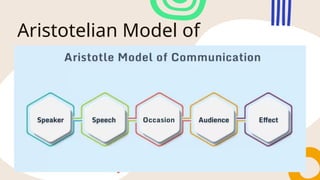
● Once the game starts, the participants have to arrange
themselves in correct order according to Aristotle’s model of
communication.
● All participants are NOT allowed to talk during the game.
● If they are not able to arrange themselves in correct order or
didn’t comply to the rules, they have to answer the 5
questions prepared by the presenters at the end of
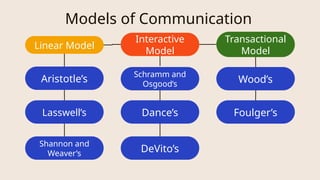
Linear Model
The linearcommunication model
explains the process of one-way
communication, whereby a sender
transmits a message and a
receiver absorbs it.
6.
Aristotle (300 BC)
Aristotle’smodel is the first and earliest
model of communication.
Aristotle’s model of communication is
mainly a speaker centered model
where the speaker and speech are very
important.
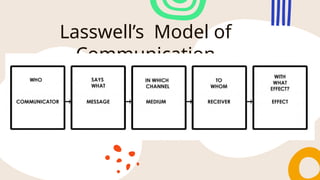
Harold Lasswell (1948)
Thismodel is helpful in
understanding communication
because it poses questions that, when
answered, provide the
communication process.
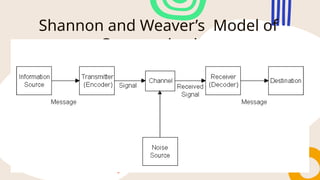
Claude Shannon and
WarrenWeaver (1949)
The model is often called the
“Telephone Model” because it is based
on the experience of having the
message interfered with by noise.
Shannon-Weaver model is known as
the mother of communication models.
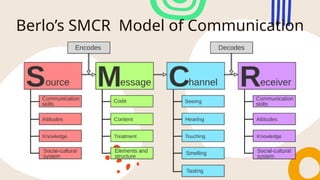
David Berlo (1960)
ForBerlo, the source and the
receiver should have good
communication skills so that the
messages will be encoded and
decoded effectively.
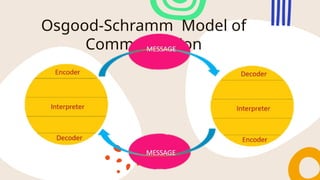
Wilbur Schramm and
CharlesOsgood
(1954)
Their model is presented as a
revolutionary shift towards viewing
communication as a dynamic,
interactive process.
Joseph DeVito
(2003)
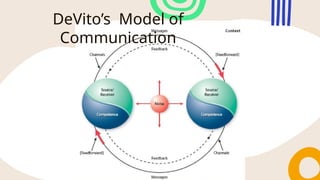
DeVito mentionedthat
communication refers to the act by
one or more persons of sending
and receiving messages that are
distorted by noise, occur within a
context, and provide opportunity
for feedback.
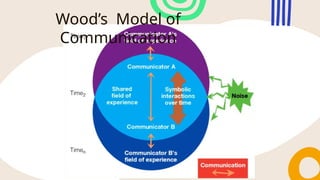
Julia Wood (2009)
Accordingto Julia Wood,
communication is a systemic
process in which individuals
interact with and through symbols
to create and interpret meanings.
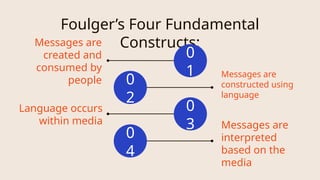
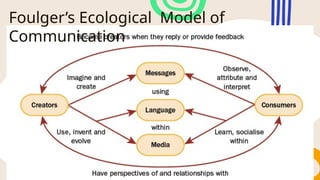
Foulger’s Four Fundamental
Constructs:
Messagesare
created and
consumed by
people
0
1 Messages are
constructed using
language
0
2
Language occurs
within media
0
3 Messages are
interpreted
based on the
media
0
4
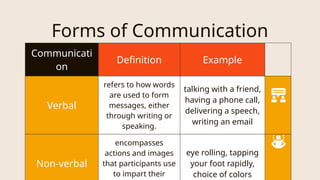
Forms of Communication
Communicati
on
DefinitionExample
Verbal
refers to how words
are used to form
messages, either
through writing or
speaking.
talking with a friend,
having a phone call,
delivering a speech,
writing an email
Non-verbal
encompasses
actions and images
that participants use
to impart their
eye rolling, tapping
your foot rapidly,
choice of colors