C
Programming
Functions
By:
Er.Anupam Sharma
Introduction
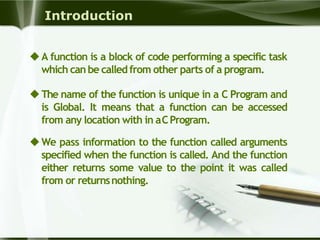
A function is a block of code performing a specific task
which canbe calledfrom other parts of a program.
The name of the function is unique in a C Program and
is Global. It means that a function can be accessed
from any location with in aCProgram.
We pass information to the function called arguments
specified when the function is called. And the function
either returns some value to the point it was called
from or returnsnothing.
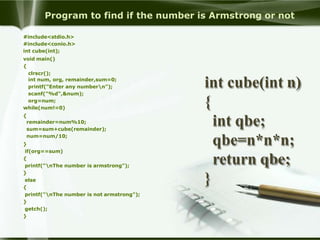
Program to find if the number is Armstrong or not
#include<stdio.h>
#include<conio.h>
int cube(int);
void main()
{
clrscr();
int num, org, remainder,sum=0;
printf("Enter any numbern");
scanf("%d",&num);
org=num;
while(num!=0)
{
remainder=num%10;
sum=sum+cube(remainder);
num=num/10;
}
if(org==sum)
{
printf("nThe number is armstrong");
}
else
{
printf("nThe number is not armstrong");
}
getch();
}
int cube(int n)
{
int qbe;
qbe=n*n*n;
return qbe;
}
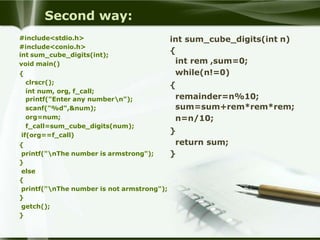
Second way:
#include<stdio.h>
#include<conio.h>
int sum_cube_digits(int);
void main()
{
clrscr();
int num, org, f_call;
printf("Enter any numbern");
scanf("%d",&num);
org=num;
f_call=sum_cube_digits(num);
if(org==f_call)
{
printf("nThe number is armstrong");
}
else
{
printf("nThe number is not armstrong");
}
getch();
}
int sum_cube_digits(int n)
{
int rem ,sum=0;
while(n!=0)
{
remainder=n%10;
sum=sum+rem*rem*rem;
n=n/10;
}
return sum;
}
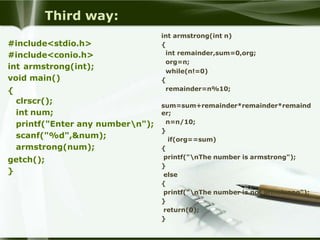
Third way:
#include<stdio.h>
#include<conio.h>
int armstrong(int);
void main()
{
clrscr();
int num;
printf("Enter any numbern");
scanf("%d",&num);
armstrong(num);
getch();
}
int armstrong(int n)
{
int remainder,sum=0,org;
org=n;
while(n!=0)
{
remainder=n%10;
sum=sum+remainder*remainder*remaind
er;
n=n/10;
}
if(org==sum)
{
printf("nThe number is armstrong");
}
else
{
printf("nThe number is not armstrong");
}
return(0);
}
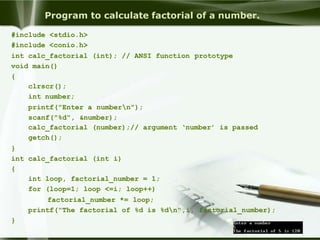
Program to calculate factorial of a number.
#include <stdio.h>
#include <conio.h>
int calc_factorial (int); // ANSI function prototype
void main()
{
clrscr();
int number;
printf("Enter a numbern");
scanf("%d", &number);
calc_factorial (number);// argument ‘number’ is passed
getch();
}
int calc_factorial (int i)
{
int loop, factorial_number = 1;
for (loop=1; loop <=i; loop++)
factorial_number *= loop;
printf("The factorial of %d is %dn",i, factorial_number);
}
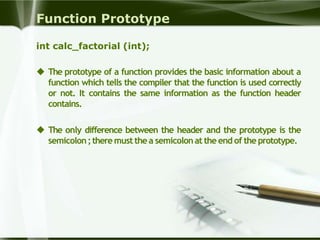
Function Prototype
int calc_factorial (int);
 The prototype of a function provides the basic information about a
function which tells the compiler that the function is used correctly
or not. It contains the same information as the function header
contains.
 The only difference between the header and the prototype is the
semicolon;there must the a semicolonat the end of the prototype.
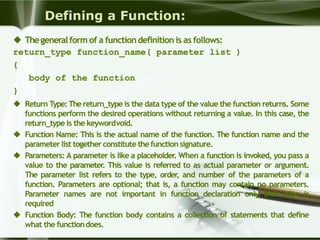
Defining a Function:
 Thegeneralform of a functiondefinition is as follows:
return_type function_name( parameter list )
{
body of the function
}
 Return Type: The return_type is the data type of the value the function returns. Some
functions perform the desired operations without returning a value. In this case, the
return_type is the keywordvoid.
 Function Name: This is the actual name of the function. The function name and the
parameter list together constitute the function signature.
 Parameters: A parameter is like a placeholder. When a function is invoked, you pass a
value to the parameter. This value is referred to as actual parameter or argument.
The parameter list refers to the type, order, and number of the parameters of a
function. Parameters are optional; that is, a function may contain no parameters.
Parameter names are not important in function declaration only their type is
required
 Function Body: The function body contains a collection of statements that define
what the functiondoes.
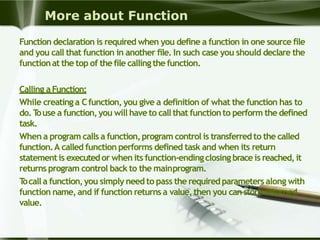
More about Function
Function declaration is required when you define a function in one source file
and you call that function in another file. In such case you should declare the
functionat the top of thefile callingthe function.
Calling aFunction:
While creating a Cfunction, you give a definition of what the function has to
do.Touse a function,you will haveto callthat functionto perform the defined
task.
When a program calls a function,program control is transferred to the called
function.A called function performs defined task and when its return
statementis executedor when its function-endingclosing brace is reached,it
returns program control back to the mainprogram.
Tocalla function,you simply need to pass the requiredparameters along with
function name, and if function returns a value,then you can store returned
value.
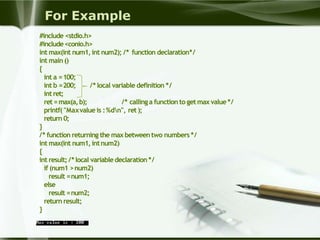
For Example
#include <stdio.h>
#include<conio.h>
int max(int num1,int num2); /* function declaration*/
int main ()
{
int a =100;
/* local variable definition */int b =200;
int ret;
ret =max(a,b); /* callinga function to getmaxvalue*/
printf( "Maxvalue is :%dn", ret );
return 0;
}
/* function returning the max between two numbers */
int max(int num1,intnum2)
{
int result; /*local variable declaration */
if (num1 >num2)
result =num1;
else
result =num2;
return result;
}
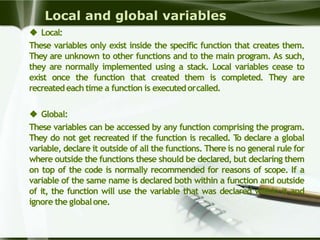
Local and global variables
 Local:
These variables only exist inside the specific function that creates them.
They are unknown to other functions and to the main program. As such,
they are normally implemented using a stack. Local variables cease to
exist once the function that created them is completed. They are
recreatedeach time a function is executedorcalled.
 Global:
These variables can be accessed by any function comprising the program.
They do not get recreated if the function is recalled. To declare a global
variable, declare it outside of all the functions. There is no general rule for
where outside the functions these should be declared, but declaring them
on top of the code is normally recommended for reasons of scope. If a
variable of the same name is declared both within a function and outside
of it, the function will use the variable that was declared within it and
ignore the globalone.
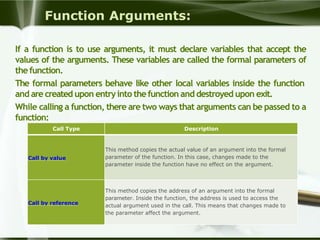
Function Arguments:
If a function is to use arguments, it must declare variables that accept the
values of the arguments. These variables are called the formal parameters of
thefunction.
The formal parameters behave like other local variables inside the function
and are created upon entryinto thefunction and destroyed upon exit.
While calling a function, there are two ways that arguments can be passed to a
function:
Call Type Description
Call by value
This method copies the actual value of an argument into the formal
parameter of the function. In this case, changes made to the
parameter inside the function have no effect on the argument.
Call by reference
This method copies the address of an argument into the formal
parameter. Inside the function, the address is used to access the
actual argument used in the call. This means that changes made to
the parameter affect the argument.
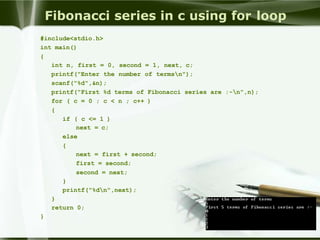
Fibonacci series in c using for loop
#include<stdio.h>
int main()
{
int n, first = 0, second = 1, next, c;
printf("Enter the number of termsn");
scanf("%d",&n);
printf("First %d terms of Fibonacci series are :-n",n);
for ( c = 0 ; c < n ; c++ )
{
if ( c <= 1 )
next = c;
else
{
next = first + second;
first = second;
second = next;
}
printf("%dn",next);
}
return 0;
}
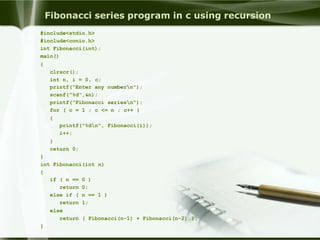
Fibonacci series program in c using recursion
#include<stdio.h>
#include<conio.h>
int Fibonacci(int);
main()
{
clrscr();
int n, i = 0, c;
printf("Enter any numbern");
scanf("%d",&n);
printf("Fibonacci seriesn");
for ( c = 1 ; c <= n ; c++ )
{
printf("%dn", Fibonacci(i));
i++;
}
return 0;
}
int Fibonacci(int n)
{
if ( n == 0 )
return 0;
else if ( n == 1 )
return 1;
else
return ( Fibonacci(n-1) + Fibonacci(n-2) );
}
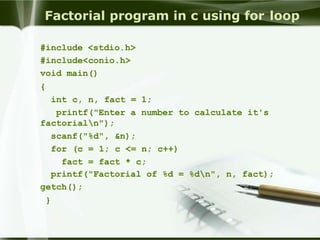
Factorial program in c using for loop
#include <stdio.h>
#include<conio.h>
void main()
{
int c, n, fact = 1;
printf("Enter a number to calculate it's
factorialn");
scanf("%d", &n);
for (c = 1; c <= n; c++)
fact = fact * c;
printf("Factorial of %d = %dn", n, fact);
getch();
}
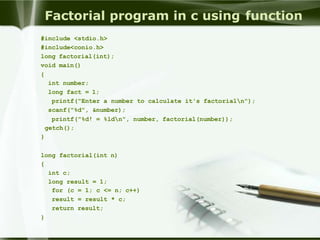
Factorial program in c using function
#include <stdio.h>
#include<conio.h>
long factorial(int);
void main()
{
int number;
long fact = 1;
printf("Enter a number to calculate it's factorialn");
scanf("%d", &number);
printf("%d! = %ldn", number, factorial(number));
getch();
}
long factorial(int n)
{
int c;
long result = 1;
for (c = 1; c <= n; c++)
result = result * c;
return result;
}
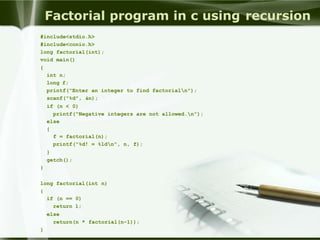
Factorial program in c using recursion
#include<stdio.h>
#include<conio.h>
long factorial(int);
void main()
{
int n;
long f;
printf("Enter an integer to find factorialn");
scanf("%d", &n);
if (n < 0)
printf("Negative integers are not allowed.n");
else
{
f = factorial(n);
printf("%d! = %ldn", n, f);
}
getch();
}
long factorial(int n)
{
if (n == 0)
return 1;
else
return(n * factorial(n-1));
}
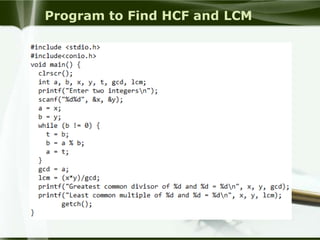
Program to Find HCF and LCM
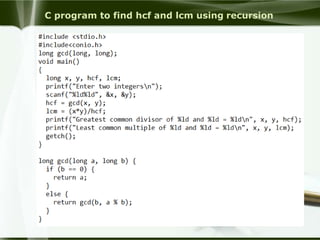
C program to find hcf and lcm using recursion
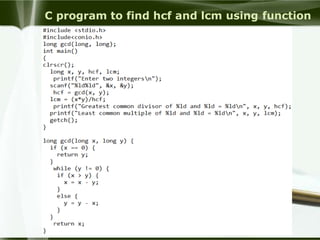
C program to find hcf and lcm using function
Program to sum the digits of number using recursive function
#include <stdio.h>
#include<conio.h>
int add_digits(int);
void main()
{
int n, result;
scanf("%d", &n);
result = add_digits(n);
printf("%dn", result);
getch();
}
int add_digits(int n) {
int sum = 0;
if (n == 0)
{
return 0;
}
sum = n%10 + add_digits(n/10);
return sum;
}
Function in c

Function in c

  • 1.
  • 2.
    Introduction A function isa block of code performing a specific task which canbe calledfrom other parts of a program. The name of the function is unique in a C Program and is Global. It means that a function can be accessed from any location with in aCProgram. We pass information to the function called arguments specified when the function is called. And the function either returns some value to the point it was called from or returnsnothing.
  • 3.
    Program to findif the number is Armstrong or not #include<stdio.h> #include<conio.h> int cube(int); void main() { clrscr(); int num, org, remainder,sum=0; printf("Enter any numbern"); scanf("%d",&num); org=num; while(num!=0) { remainder=num%10; sum=sum+cube(remainder); num=num/10; } if(org==sum) { printf("nThe number is armstrong"); } else { printf("nThe number is not armstrong"); } getch(); } int cube(int n) { int qbe; qbe=n*n*n; return qbe; }
  • 4.
    Second way: #include<stdio.h> #include<conio.h> int sum_cube_digits(int); voidmain() { clrscr(); int num, org, f_call; printf("Enter any numbern"); scanf("%d",&num); org=num; f_call=sum_cube_digits(num); if(org==f_call) { printf("nThe number is armstrong"); } else { printf("nThe number is not armstrong"); } getch(); } int sum_cube_digits(int n) { int rem ,sum=0; while(n!=0) { remainder=n%10; sum=sum+rem*rem*rem; n=n/10; } return sum; }
  • 5.
    Third way: #include<stdio.h> #include<conio.h> int armstrong(int); voidmain() { clrscr(); int num; printf("Enter any numbern"); scanf("%d",&num); armstrong(num); getch(); } int armstrong(int n) { int remainder,sum=0,org; org=n; while(n!=0) { remainder=n%10; sum=sum+remainder*remainder*remaind er; n=n/10; } if(org==sum) { printf("nThe number is armstrong"); } else { printf("nThe number is not armstrong"); } return(0); }
  • 6.
    Program to calculatefactorial of a number. #include <stdio.h> #include <conio.h> int calc_factorial (int); // ANSI function prototype void main() { clrscr(); int number; printf("Enter a numbern"); scanf("%d", &number); calc_factorial (number);// argument ‘number’ is passed getch(); } int calc_factorial (int i) { int loop, factorial_number = 1; for (loop=1; loop <=i; loop++) factorial_number *= loop; printf("The factorial of %d is %dn",i, factorial_number); }
  • 7.
    Function Prototype int calc_factorial(int);  The prototype of a function provides the basic information about a function which tells the compiler that the function is used correctly or not. It contains the same information as the function header contains.  The only difference between the header and the prototype is the semicolon;there must the a semicolonat the end of the prototype.
  • 8.
    Defining a Function: Thegeneralform of a functiondefinition is as follows: return_type function_name( parameter list ) { body of the function }  Return Type: The return_type is the data type of the value the function returns. Some functions perform the desired operations without returning a value. In this case, the return_type is the keywordvoid.  Function Name: This is the actual name of the function. The function name and the parameter list together constitute the function signature.  Parameters: A parameter is like a placeholder. When a function is invoked, you pass a value to the parameter. This value is referred to as actual parameter or argument. The parameter list refers to the type, order, and number of the parameters of a function. Parameters are optional; that is, a function may contain no parameters. Parameter names are not important in function declaration only their type is required  Function Body: The function body contains a collection of statements that define what the functiondoes.
  • 9.
    More about Function Functiondeclaration is required when you define a function in one source file and you call that function in another file. In such case you should declare the functionat the top of thefile callingthe function. Calling aFunction: While creating a Cfunction, you give a definition of what the function has to do.Touse a function,you will haveto callthat functionto perform the defined task. When a program calls a function,program control is transferred to the called function.A called function performs defined task and when its return statementis executedor when its function-endingclosing brace is reached,it returns program control back to the mainprogram. Tocalla function,you simply need to pass the requiredparameters along with function name, and if function returns a value,then you can store returned value.
  • 10.
    For Example #include <stdio.h> #include<conio.h> intmax(int num1,int num2); /* function declaration*/ int main () { int a =100; /* local variable definition */int b =200; int ret; ret =max(a,b); /* callinga function to getmaxvalue*/ printf( "Maxvalue is :%dn", ret ); return 0; } /* function returning the max between two numbers */ int max(int num1,intnum2) { int result; /*local variable declaration */ if (num1 >num2) result =num1; else result =num2; return result; }
  • 11.
    Local and globalvariables  Local: These variables only exist inside the specific function that creates them. They are unknown to other functions and to the main program. As such, they are normally implemented using a stack. Local variables cease to exist once the function that created them is completed. They are recreatedeach time a function is executedorcalled.  Global: These variables can be accessed by any function comprising the program. They do not get recreated if the function is recalled. To declare a global variable, declare it outside of all the functions. There is no general rule for where outside the functions these should be declared, but declaring them on top of the code is normally recommended for reasons of scope. If a variable of the same name is declared both within a function and outside of it, the function will use the variable that was declared within it and ignore the globalone.
  • 12.
    Function Arguments: If afunction is to use arguments, it must declare variables that accept the values of the arguments. These variables are called the formal parameters of thefunction. The formal parameters behave like other local variables inside the function and are created upon entryinto thefunction and destroyed upon exit. While calling a function, there are two ways that arguments can be passed to a function: Call Type Description Call by value This method copies the actual value of an argument into the formal parameter of the function. In this case, changes made to the parameter inside the function have no effect on the argument. Call by reference This method copies the address of an argument into the formal parameter. Inside the function, the address is used to access the actual argument used in the call. This means that changes made to the parameter affect the argument.
  • 13.
    Fibonacci series inc using for loop #include<stdio.h> int main() { int n, first = 0, second = 1, next, c; printf("Enter the number of termsn"); scanf("%d",&n); printf("First %d terms of Fibonacci series are :-n",n); for ( c = 0 ; c < n ; c++ ) { if ( c <= 1 ) next = c; else { next = first + second; first = second; second = next; } printf("%dn",next); } return 0; }
  • 14.
    Fibonacci series programin c using recursion #include<stdio.h> #include<conio.h> int Fibonacci(int); main() { clrscr(); int n, i = 0, c; printf("Enter any numbern"); scanf("%d",&n); printf("Fibonacci seriesn"); for ( c = 1 ; c <= n ; c++ ) { printf("%dn", Fibonacci(i)); i++; } return 0; } int Fibonacci(int n) { if ( n == 0 ) return 0; else if ( n == 1 ) return 1; else return ( Fibonacci(n-1) + Fibonacci(n-2) ); }
  • 15.
    Factorial program inc using for loop #include <stdio.h> #include<conio.h> void main() { int c, n, fact = 1; printf("Enter a number to calculate it's factorialn"); scanf("%d", &n); for (c = 1; c <= n; c++) fact = fact * c; printf("Factorial of %d = %dn", n, fact); getch(); }
  • 16.
    Factorial program inc using function #include <stdio.h> #include<conio.h> long factorial(int); void main() { int number; long fact = 1; printf("Enter a number to calculate it's factorialn"); scanf("%d", &number); printf("%d! = %ldn", number, factorial(number)); getch(); } long factorial(int n) { int c; long result = 1; for (c = 1; c <= n; c++) result = result * c; return result; }
  • 17.
    Factorial program inc using recursion #include<stdio.h> #include<conio.h> long factorial(int); void main() { int n; long f; printf("Enter an integer to find factorialn"); scanf("%d", &n); if (n < 0) printf("Negative integers are not allowed.n"); else { f = factorial(n); printf("%d! = %ldn", n, f); } getch(); } long factorial(int n) { if (n == 0) return 1; else return(n * factorial(n-1)); }
  • 18.
    Program to FindHCF and LCM
  • 19.
    C program tofind hcf and lcm using recursion
  • 20.
    C program tofind hcf and lcm using function
  • 21.
    Program to sumthe digits of number using recursive function #include <stdio.h> #include<conio.h> int add_digits(int); void main() { int n, result; scanf("%d", &n); result = add_digits(n); printf("%dn", result); getch(); } int add_digits(int n) { int sum = 0; if (n == 0) { return 0; } sum = n%10 + add_digits(n/10); return sum; }