INTRODUCTI
ON TO
ENGINEERIN
G
LECTURE 3: KEY TOPICS &
OBJECTIVES
1
Functionalities Of
Engineering
Students should understand
the Functions of
Engineering
2
Engineering Career
Path
Students should also
understand Engineering
Team, and the importance
of working in a team
3
Engineering Support
Personnel & Teamwork
Students should be exposed
to some career paths in
Engineering
INTRODUCTION TO
FUNCTIONS OF
ENGINEERING
Within a given engineering field of specialization, there is a wide range
of functions or activities in which engineers may be involved.
Engineers can be involved in some combination of these functions,
and, conceivably, could perform all of them over the course of a
career. These functions include:
• Research
• Development
• Design
• Production
• Construction
• Operations
• Sales
• and Management.
FUNCTIONS OF
ENGINEERING
Research
involves seeking new knowledge or a better
understanding of the significance and
relationship of facts already known.
Development
involves making the discoveries and results of
research available in the form of useful
products, methods, or processes.
FUNCTIONS OF
ENGINEERING
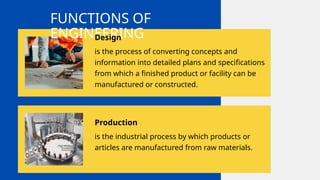
Design
is the process of converting concepts and
information into detailed plans and specifications
from which a finished product or facility can be
manufactured or constructed.
Production
is the industrial process by which products or
articles are manufactured from raw materials.
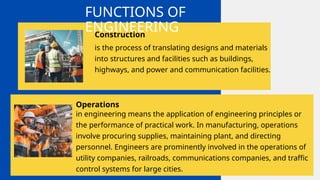
is the process of translating designs and materials
into structures and facilities such as buildings,
highways, and power and communication facilities.
FUNCTIONS OF
ENGINEERING
Construction
Operations
in engineering means the application of engineering principles or
the performance of practical work. In manufacturing, operations
involve procuring supplies, maintaining plant, and directing
personnel. Engineers are prominently involved in the operations of
utility companies, railroads, communications companies, and traffic
control systems for large cities.
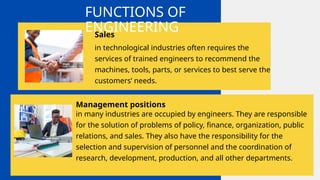
in technological industries often requires the
services of trained engineers to recommend the
machines, tools, parts, or services to best serve the
customers’ needs.
FUNCTIONS OF
ENGINEERING
Sales
Management positions
in many industries are occupied by engineers. They are responsible
for the solution of problems of policy, finance, organization, public
relations, and sales. They also have the responsibility for the
selection and supervision of personnel and the coordination of
research, development, production, and all other departments.
ENGINEERING CAREER PATH -
INTRODUCTION
There are at least seven career options for graduating
engineering students:
1. The corporate ladder.
2. The independent entrepreneur.
3. Employment Opportunities In Government
4. Engineering and social service abroad.
5. The professor-engineer.
6. Graduate work outside of engineering.
7. A mix of two or more of the first six options.
ENGINEERING CAREER PATH -THE
CORPORATE LADDER
The great majority of engineers are employed by private industrial or business
organizations. Most of the jobs in engineering are with large corporations.
• Engineers who work for large companies typically have many career options.
The possibilities include the practice of “hands-on” engineering, proposal
writing, marketing of engineering services, and upper echelon management.
• The immense breadth of corporate activity minimizes the career damage that
might result from working in an inappropriate job. The engineer, for example,
who finds that by the age of thirty he is bored with the laboratory can quietly
move laterally, if he is inherently qualified, into management or sales.
ENGINEERING CAREER PATH -THE INDEPENDENT
ENTREPRENEUR
Many graduating engineers prefer to work for themselves. Some
become consultants, providing engineering services to individual
clients and to public agencies. A good way to gain entrance into this
activity is to work for three to five years in a corporation, a public
agency, or for another, more experienced consultant. That
experience will help to build the high level of individual responsibility
that consulting engineering firms demand.
ENGINEERING CAREER PATH -
EMPLOYMENT OPPORTUNITIES IN
GOVERNMENT
• Government employment for engineers is available in two ways: you can join
the military or you can work as a civilian employee. Many believe that the
superior alternative is to join one of the uniformed services such as Navy
Engineer Corps or the Army Corps of Engineers and the Airforce.
• Because of the nature of the defense establishment, young engineers wearing
the uniform have opportunities for immediate and intensive interfacing with
ultra-high technologies and state-of-the-art equipment that generally are not
present in even the most advanced regions of the private sector. Also, because
of the nature of the military establishment, there is far less stress on age,
experience, and seasoning than one often finds in the civilian corporation or
company.
ENGINEERING CAREER PATH -
EMPLOYMENT OPPORTUNITIES IN
GOVERNMENT
• Civilian engineering positions exist in numerous agencies of the federal
government including the Federal Highway Administration, the Federal Aviation
Administration, the Army Corps of Engineers, and the National Aeronautics and
Space Administration (NASA), to name a few. Civilian engineers can be found
performing research in harbor protection, designing and maintaining facilities on
Air Force bases and in naval shipyards, and contributing to NASA’s vast and
exciting program to explore outer space
• At the state level, engineers are employed in large numbers by state highway
agencies and may be found in agencies concerned with port operation, water
resources management, and protection of the environment.
• At the local level, engineers serve as directors of public works, manage water
treatment plants, and oversee pollution control programs.
ENGINEERING CAREER PATH -
ENGINEERING AND SOCIAL SERVICES
ABROAD
The problem of technological transfer is perhaps the most urgent
one facing an uneasy world today. It requires sensitivity beyond
measure to devise techniques for grafting urgently needed
technologies upon ancient cultures in such a way that the culture
retains its social, economic, and religious validity, and ethnic
integrity. This is the job for the engineer whose command of his or
her specialty is balanced by sensitivity, humor, patience, empathy,
great social imagination, and a love of people in all the incredibly
immense variety of their values, attitudes, and lifestyles.
ENGINEERING CAREER PATH - THE
ENGINEERING PROFESSOR
The academic career option is essentially in two forms. Of the 280 or so
departments, schools, or colleges of engineering in the nation, many are
straightforwardly academic, campus-centered departments or colleges in just the
sense that chemistry, or botany, or English at these same schools are academic
departments. That is, the teaching task is primary and central. The engineering
professors in these departments and colleges may and indeed generally do
research leading to publication—like anyone else, they need to keep themselves on
the leading edge of their specialty—but it is understood that whatever research
projects they undertake must be fitted in around their classroom responsibilities. In
other words, engineering professors at these mainline teaching institutions will
generally carry a full teaching load, from 9 to 12 classroom hours per semester, and
devote whatever time is left over, after lecturing, grading papers, and advising
students, to their research.
ENGINEERING CAREER PATH -
GRADUATE WORK OUTSIDE OF
ENGINEERING
The person with a Bachelor of Science degree in engineering can
move with great propriety from an undergraduate commitment to
engineering into such fields as law, business, and medicine; this is
a possibility that should never be overlooked by the undergraduate
engineer assessing the possibilities of graduate work beyond the
first degree.
ENGINEERING CAREER PATH - THE
MULTIPLE-TRACK, VARIABLE CAREER
In one sense, of course, the above discussion of the six life-options facing
most engineers achieving the baccalaureate degree is artificial and
somewhat misleading, since it suggests that you must follow one option for
life, to the exclusion of all the others. But this is not the case. Life is long, and
the growth of the individual cannot be predicted in such a tidy manner. It is
easy to imagine a career in which, for the first seven or eight years, you are a
hands-on, laboratory-centered engineer immersed in research and
development for a large corporation. With that experience under your belt,
and some accumulated capital to go on, you abandon the corporate ladder
and the big city, spending the next five or six years as an independent
entrepreneur, running your own three-man consulting firm in a small town.
ENGINEERING CAREER PATH - THE
MULTIPLE-TRACK, VARIABLE CAREER
Your reputation as a consultant grows with the years, however, and you find
yourself occasionally abroad, serving as a technical advisor to foreign
governments and corporations. You discover, a little to your surprise, that
you have a taste for travel, a talent for languages, and a growing interest in
foreign cultures, and so you finally accept a post offered by the government
of one of the developing Third World nations.
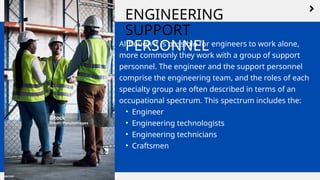
Although it is possible for engineers to work alone,
more commonly they work with a group of support
personnel. The engineer and the support personnel
comprise the engineering team, and the roles of each
specialty group are often described in terms of an
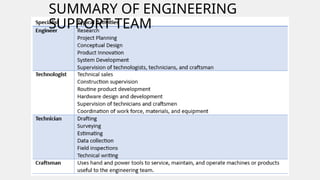
occupational spectrum. This spectrum includes the:
• Engineer
• Engineering technologists
• Engineering technicians
• Craftsmen
ENGINEERING
SUPPORT
PERSONNEL
ENGINEER AS A
SUPPORT
PERSONNEL
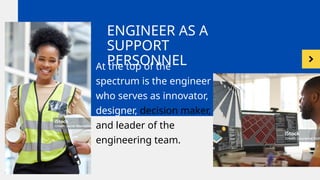
At the top of the
spectrum is the engineer
who serves as innovator,
designer, decision maker,
and leader of the
engineering team.
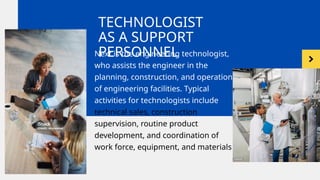
Next is the engineering technologist,
who assists the engineer in the
planning, construction, and operation
of engineering facilities. Typical
activities for technologists include
technical sales, construction
supervision, routine product
development, and coordination of
work force, equipment, and materials
TECHNOLOGIST
AS A SUPPORT
PERSONNEL
TECHNICIAN AS
A SUPPORT
PERSONNEL
A Technician only possesses the basic
knowledge on certain things and has
minimal understanding of the technology.
He is only knowledgeable on the basic
know-how of troubleshooting. A technician
often works under a technologist. They
need the technologist’s leadership ability
and skills to guide them and teach them
what to do and what to work on. Generally,
a technician needs only a certificate or
diploma which requires two years of study.
TECHNICIAN VRS TECHNOLOGIST
• There will be no technicians if there are no technologists and vice versa. Even
though technicians are only knowledgeable of the basic principles and
troubleshooting, they play an important role in the process of improving and
creating better things for the future generations. While technologists design
new things, technicians, on the other hand, turn their designs and ideas into
reality.
• Technologists possess the intellectual skills whereas technicians put their
whole being in practical techniques and applications.
• Technologists do the intricate work and technicians manage the order and
maintenance of their work.
• One can think of a technologist as the general of a military unit who conducts
plans and studies enemy territories while technicians are private officers who
battle the enemies in accordance with the general’s plans.
Craftsmen are skilled workers who
produce the materials and products
or facilities specified by the design.
Such specialists include electricians,
carpenters, welders, machinists, and
model builders. Craftsmen normally
acquire their skills by on-the-job
training; their education typically
does not extend beyond high school.
CRAFT MAN AS
A SUPPORT
PERSONNEL
SUMMARY OF ENGINEERING
SUPPORT TEAM
An Engineering
Team
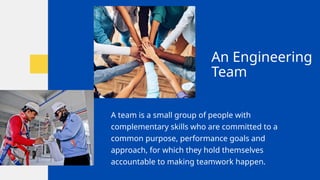
A team is a small group of people with
complementary skills who are committed to a
common purpose, performance goals and
approach, for which they hold themselves
accountable to making teamwork happen.
AN ENGINEERING
TEAM
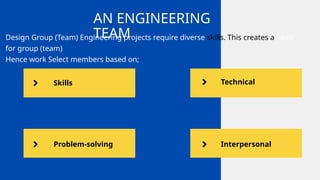
Design Group (Team) Engineering projects require diverse skills. This creates a need
for group (team)
Hence work Select members based on;
Skills Technical
Problem-solving Interpersonal
AN ENGINEERING TEAM - Benefits of
Working in Teams – overview
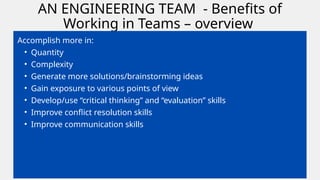
Accomplish more in:
• Quantity
• Complexity
• Generate more solutions/brainstorming ideas
• Gain exposure to various points of view
• Develop/use “critical thinking” and “evaluation” skills
• Improve conflict resolution skills
• Improve communication skills
AN ENGINEERING TEAM - Benefits of
Working in Teams – overview
• Accomplish projects an individual cannot do – Most engineering
projects are too large or too complex for one individual to complete
alone. Imagine trying to build the Golden Gate Bridge all by yourself.
• Brainstorm More Solution Options - Different people looking at the
same problem will find different solutions. Detect Flaws in Solutions - A
team looking at different proposed solutions may find pitfalls that an
individual might miss.
• Build Community - Members of effective teams can form personal
bonds which are good for individual and workplace morale. In the
university setting, students on teams often form bonds that extend
beyond the classroom.
AN ENGINEERING TEAM - Benefits of
Working in Teams – overview
• Exposure to different points of view - You learn different ways of approaching a
problem when you are exposed to methods and ideas that other people have.
• Critical Thinking and Evaluation Skills – You must use these skills to evaluate the
complex issues of team project goals and to formulate appropriate solutions and
plans.
• Conflict Resolution Skills - Yes, teams have conflicts, but you can develop the skills
to facilitate solutions to conflicts so that the team remains functional. Students
may do more academic work - Some students may accomplish more in order to
keep up with the rest of the team.
• Communication Skills - A team relies on communication among members. Actively
and effectively listen to their team members to understand their ideas and
concerns. Effectively articulate their ideas or their concerns to others. Provide
genuinely constructive feedback to team members
REFERENCES
• Engineering in Perspective by Tony Ridley ( Imperial College London, UK)
• Engineering in Perspective , Lessons for Successful career, Tony Ridley,
(8th Edition )
• Engineering to Engineering Design,5 th Edition, by James W. Delly
• https://slideplayer.com/slide/5872666/

FUNCTIONS AND IMPORTANCE OF ENGINEERING.pptx

  • 1.
  • 2.
    LECTURE 3: KEYTOPICS & OBJECTIVES 1 Functionalities Of Engineering Students should understand the Functions of Engineering 2 Engineering Career Path Students should also understand Engineering Team, and the importance of working in a team 3 Engineering Support Personnel & Teamwork Students should be exposed to some career paths in Engineering
  • 3.
    INTRODUCTION TO FUNCTIONS OF ENGINEERING Withina given engineering field of specialization, there is a wide range of functions or activities in which engineers may be involved. Engineers can be involved in some combination of these functions, and, conceivably, could perform all of them over the course of a career. These functions include: • Research • Development • Design • Production • Construction • Operations • Sales • and Management.
  • 4.
    FUNCTIONS OF ENGINEERING Research involves seekingnew knowledge or a better understanding of the significance and relationship of facts already known. Development involves making the discoveries and results of research available in the form of useful products, methods, or processes.
  • 5.
    FUNCTIONS OF ENGINEERING Design is theprocess of converting concepts and information into detailed plans and specifications from which a finished product or facility can be manufactured or constructed. Production is the industrial process by which products or articles are manufactured from raw materials.
  • 6.
    is the processof translating designs and materials into structures and facilities such as buildings, highways, and power and communication facilities. FUNCTIONS OF ENGINEERING Construction Operations in engineering means the application of engineering principles or the performance of practical work. In manufacturing, operations involve procuring supplies, maintaining plant, and directing personnel. Engineers are prominently involved in the operations of utility companies, railroads, communications companies, and traffic control systems for large cities.
  • 7.
    in technological industriesoften requires the services of trained engineers to recommend the machines, tools, parts, or services to best serve the customers’ needs. FUNCTIONS OF ENGINEERING Sales Management positions in many industries are occupied by engineers. They are responsible for the solution of problems of policy, finance, organization, public relations, and sales. They also have the responsibility for the selection and supervision of personnel and the coordination of research, development, production, and all other departments.
  • 8.
    ENGINEERING CAREER PATH- INTRODUCTION There are at least seven career options for graduating engineering students: 1. The corporate ladder. 2. The independent entrepreneur. 3. Employment Opportunities In Government 4. Engineering and social service abroad. 5. The professor-engineer. 6. Graduate work outside of engineering. 7. A mix of two or more of the first six options.
  • 9.
    ENGINEERING CAREER PATH-THE CORPORATE LADDER The great majority of engineers are employed by private industrial or business organizations. Most of the jobs in engineering are with large corporations. • Engineers who work for large companies typically have many career options. The possibilities include the practice of “hands-on” engineering, proposal writing, marketing of engineering services, and upper echelon management. • The immense breadth of corporate activity minimizes the career damage that might result from working in an inappropriate job. The engineer, for example, who finds that by the age of thirty he is bored with the laboratory can quietly move laterally, if he is inherently qualified, into management or sales.
  • 10.
    ENGINEERING CAREER PATH-THE INDEPENDENT ENTREPRENEUR Many graduating engineers prefer to work for themselves. Some become consultants, providing engineering services to individual clients and to public agencies. A good way to gain entrance into this activity is to work for three to five years in a corporation, a public agency, or for another, more experienced consultant. That experience will help to build the high level of individual responsibility that consulting engineering firms demand.
  • 11.
    ENGINEERING CAREER PATH- EMPLOYMENT OPPORTUNITIES IN GOVERNMENT • Government employment for engineers is available in two ways: you can join the military or you can work as a civilian employee. Many believe that the superior alternative is to join one of the uniformed services such as Navy Engineer Corps or the Army Corps of Engineers and the Airforce. • Because of the nature of the defense establishment, young engineers wearing the uniform have opportunities for immediate and intensive interfacing with ultra-high technologies and state-of-the-art equipment that generally are not present in even the most advanced regions of the private sector. Also, because of the nature of the military establishment, there is far less stress on age, experience, and seasoning than one often finds in the civilian corporation or company.
  • 12.
    ENGINEERING CAREER PATH- EMPLOYMENT OPPORTUNITIES IN GOVERNMENT • Civilian engineering positions exist in numerous agencies of the federal government including the Federal Highway Administration, the Federal Aviation Administration, the Army Corps of Engineers, and the National Aeronautics and Space Administration (NASA), to name a few. Civilian engineers can be found performing research in harbor protection, designing and maintaining facilities on Air Force bases and in naval shipyards, and contributing to NASA’s vast and exciting program to explore outer space • At the state level, engineers are employed in large numbers by state highway agencies and may be found in agencies concerned with port operation, water resources management, and protection of the environment. • At the local level, engineers serve as directors of public works, manage water treatment plants, and oversee pollution control programs.
  • 13.
    ENGINEERING CAREER PATH- ENGINEERING AND SOCIAL SERVICES ABROAD The problem of technological transfer is perhaps the most urgent one facing an uneasy world today. It requires sensitivity beyond measure to devise techniques for grafting urgently needed technologies upon ancient cultures in such a way that the culture retains its social, economic, and religious validity, and ethnic integrity. This is the job for the engineer whose command of his or her specialty is balanced by sensitivity, humor, patience, empathy, great social imagination, and a love of people in all the incredibly immense variety of their values, attitudes, and lifestyles.
  • 14.
    ENGINEERING CAREER PATH- THE ENGINEERING PROFESSOR The academic career option is essentially in two forms. Of the 280 or so departments, schools, or colleges of engineering in the nation, many are straightforwardly academic, campus-centered departments or colleges in just the sense that chemistry, or botany, or English at these same schools are academic departments. That is, the teaching task is primary and central. The engineering professors in these departments and colleges may and indeed generally do research leading to publication—like anyone else, they need to keep themselves on the leading edge of their specialty—but it is understood that whatever research projects they undertake must be fitted in around their classroom responsibilities. In other words, engineering professors at these mainline teaching institutions will generally carry a full teaching load, from 9 to 12 classroom hours per semester, and devote whatever time is left over, after lecturing, grading papers, and advising students, to their research.
  • 15.
    ENGINEERING CAREER PATH- GRADUATE WORK OUTSIDE OF ENGINEERING The person with a Bachelor of Science degree in engineering can move with great propriety from an undergraduate commitment to engineering into such fields as law, business, and medicine; this is a possibility that should never be overlooked by the undergraduate engineer assessing the possibilities of graduate work beyond the first degree.
  • 16.
    ENGINEERING CAREER PATH- THE MULTIPLE-TRACK, VARIABLE CAREER In one sense, of course, the above discussion of the six life-options facing most engineers achieving the baccalaureate degree is artificial and somewhat misleading, since it suggests that you must follow one option for life, to the exclusion of all the others. But this is not the case. Life is long, and the growth of the individual cannot be predicted in such a tidy manner. It is easy to imagine a career in which, for the first seven or eight years, you are a hands-on, laboratory-centered engineer immersed in research and development for a large corporation. With that experience under your belt, and some accumulated capital to go on, you abandon the corporate ladder and the big city, spending the next five or six years as an independent entrepreneur, running your own three-man consulting firm in a small town.
  • 17.
    ENGINEERING CAREER PATH- THE MULTIPLE-TRACK, VARIABLE CAREER Your reputation as a consultant grows with the years, however, and you find yourself occasionally abroad, serving as a technical advisor to foreign governments and corporations. You discover, a little to your surprise, that you have a taste for travel, a talent for languages, and a growing interest in foreign cultures, and so you finally accept a post offered by the government of one of the developing Third World nations.
  • 18.
    Although it ispossible for engineers to work alone, more commonly they work with a group of support personnel. The engineer and the support personnel comprise the engineering team, and the roles of each specialty group are often described in terms of an occupational spectrum. This spectrum includes the: • Engineer • Engineering technologists • Engineering technicians • Craftsmen ENGINEERING SUPPORT PERSONNEL
  • 19.
    ENGINEER AS A SUPPORT PERSONNEL Atthe top of the spectrum is the engineer who serves as innovator, designer, decision maker, and leader of the engineering team.
  • 20.
    Next is theengineering technologist, who assists the engineer in the planning, construction, and operation of engineering facilities. Typical activities for technologists include technical sales, construction supervision, routine product development, and coordination of work force, equipment, and materials TECHNOLOGIST AS A SUPPORT PERSONNEL
  • 21.
    TECHNICIAN AS A SUPPORT PERSONNEL ATechnician only possesses the basic knowledge on certain things and has minimal understanding of the technology. He is only knowledgeable on the basic know-how of troubleshooting. A technician often works under a technologist. They need the technologist’s leadership ability and skills to guide them and teach them what to do and what to work on. Generally, a technician needs only a certificate or diploma which requires two years of study.
  • 22.
    TECHNICIAN VRS TECHNOLOGIST •There will be no technicians if there are no technologists and vice versa. Even though technicians are only knowledgeable of the basic principles and troubleshooting, they play an important role in the process of improving and creating better things for the future generations. While technologists design new things, technicians, on the other hand, turn their designs and ideas into reality. • Technologists possess the intellectual skills whereas technicians put their whole being in practical techniques and applications. • Technologists do the intricate work and technicians manage the order and maintenance of their work. • One can think of a technologist as the general of a military unit who conducts plans and studies enemy territories while technicians are private officers who battle the enemies in accordance with the general’s plans.
  • 23.
    Craftsmen are skilledworkers who produce the materials and products or facilities specified by the design. Such specialists include electricians, carpenters, welders, machinists, and model builders. Craftsmen normally acquire their skills by on-the-job training; their education typically does not extend beyond high school. CRAFT MAN AS A SUPPORT PERSONNEL
  • 24.
  • 25.
    An Engineering Team A teamis a small group of people with complementary skills who are committed to a common purpose, performance goals and approach, for which they hold themselves accountable to making teamwork happen.
  • 26.
    AN ENGINEERING TEAM Design Group(Team) Engineering projects require diverse skills. This creates a need for group (team) Hence work Select members based on; Skills Technical Problem-solving Interpersonal
  • 27.
    AN ENGINEERING TEAM- Benefits of Working in Teams – overview Accomplish more in: • Quantity • Complexity • Generate more solutions/brainstorming ideas • Gain exposure to various points of view • Develop/use “critical thinking” and “evaluation” skills • Improve conflict resolution skills • Improve communication skills
  • 28.
    AN ENGINEERING TEAM- Benefits of Working in Teams – overview • Accomplish projects an individual cannot do – Most engineering projects are too large or too complex for one individual to complete alone. Imagine trying to build the Golden Gate Bridge all by yourself. • Brainstorm More Solution Options - Different people looking at the same problem will find different solutions. Detect Flaws in Solutions - A team looking at different proposed solutions may find pitfalls that an individual might miss. • Build Community - Members of effective teams can form personal bonds which are good for individual and workplace morale. In the university setting, students on teams often form bonds that extend beyond the classroom.
  • 29.
    AN ENGINEERING TEAM- Benefits of Working in Teams – overview • Exposure to different points of view - You learn different ways of approaching a problem when you are exposed to methods and ideas that other people have. • Critical Thinking and Evaluation Skills – You must use these skills to evaluate the complex issues of team project goals and to formulate appropriate solutions and plans. • Conflict Resolution Skills - Yes, teams have conflicts, but you can develop the skills to facilitate solutions to conflicts so that the team remains functional. Students may do more academic work - Some students may accomplish more in order to keep up with the rest of the team. • Communication Skills - A team relies on communication among members. Actively and effectively listen to their team members to understand their ideas and concerns. Effectively articulate their ideas or their concerns to others. Provide genuinely constructive feedback to team members
  • 30.
    REFERENCES • Engineering inPerspective by Tony Ridley ( Imperial College London, UK) • Engineering in Perspective , Lessons for Successful career, Tony Ridley, (8th Edition ) • Engineering to Engineering Design,5 th Edition, by James W. Delly • https://slideplayer.com/slide/5872666/