@gmuecke
Functional Load Testing
GERALD MÜCKE
JAVALAND 2018
𝑓 𝑥 =
1
𝜎 2𝜋
𝑒
−
1
2
𝑥−𝜇
𝜎
2
𝐵 𝑘 𝑝, 𝑛 =
𝑛
𝑘
𝑝 𝑘
1 − 𝑝 𝑛−𝑘
𝑃 𝜆 𝑘 =
𝜆 𝑘
𝑘!
𝑒−𝜆
2
@gmuecke
This talk is not about
 Load Testing a Function
 Loading a Function Test
 Loading a Test Function
 Testing a Load Function
 Test Loading a Function
 Testing a Function Load
It’s about using Functions to conduct Load Testing
4
@gmuecke
This Photo by Unknown Author is licensed under CC BY-SA
Siméon Denis Poisson
5
Jakob I. Bernoulli
This Photo by Unknown Author is licensed under CC BY-SA
Carl Friedrich Gauss
@gmuecke
What is Testing?
 “Software testing is a process of executing a program or application
with the intent of finding the software bugs.” (ISTQB)
 Testing is a information-providing service,
not a "quality assurance" function.
 The value of testing is determined by whether it provides useful and
timely information.
 A tester is a customer advocate.
6
@gmuecke
"Dieses Foto" von Unbekannter Autor ist lizenziert gemäß CC BY
Context is
everything
 The value of any
practice depends on
its context.
 There are good
practices in context,
but there are no best
practices.
(From Seven Principles of Context Driven Testing)
7
@gmuecke
How to do Performance Testing?
8
@gmuecke
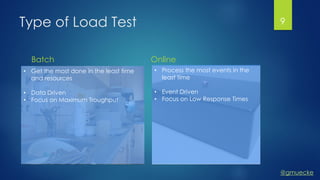
Type of Load Test
Batch Online
9
• Process the most events in the
least time
• Event Driven
• Focus on Low Response Times
• Get the most done in the least time
and resources
• Data Driven
• Focus on Maximum Troughput
@gmuecke
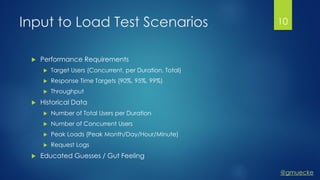
Input to Load Test Scenarios
 Performance Requirements
 Target Users (Concurrent, per Duration, Total)
 Response Time Targets (90%, 95%, 99%)
 Throughput
 Historical Data
 Number of Total Users per Duration
 Number of Concurrent Users
 Peak Loads (Peak Month/Day/Hour/Minute)
 Request Logs
 Educated Guesses / Gut Feeling
10
@gmuecke
Example
Requirements
 The system is capable of
 Serving 1000 concurrent users with
an average Response Time of 1.5s
 Source: The Project Manager
 What are the most relevant
information?
This Photo by Unknown Author is licensed under CC BY-NC-SA
11
@gmuecke
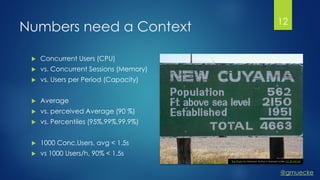
Numbers need a Context
 Concurrent Users (CPU)
 vs. Concurrent Sessions (Memory)
 vs. Users per Period (Capacity)
 Average
 vs. perceived Average (90 %)
 vs. Percentiles (95%,99%,99.9%)
 1000 Conc.Users, avg < 1.5s
 vs 1000 Users/h, 90% < 1.5s
This Photo by Unknown Author is licensed under CC BY-NC-SA
12
@gmuecke
Load Testing Practices
 Soak Testing
 Discover Leaks
 SLA Regressions
 Stress Testing
 Testing Stability
 Overload / Recovery
 Benchmarking
 Discover Regressions between different Versions or Configurations
13
@gmuecke
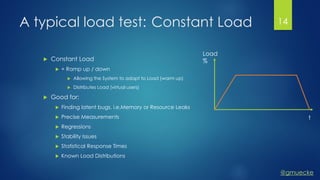
A typical load test: Constant Load
 Constant Load
 + Ramp up / down
 Allowing the System to adapt to Load (warm up)
 Distributes Load (virtual users)
 Good for:
 Finding latent bugs, i.e.Memory or Resource Leaks
 Precise Measurements
 Regressions
 Stability Issues
 Statistical Response Times
 Known Load Distributions
Load
%
t
14
@gmuecke
Why do a ramp up?
 System Warm-up
 Allow JIT to optimize code
 Allow Caches to be populated
 Fetch or Initiate Resources (i.e. Database
Connections)
 Allow Queues and Buffers to fill to a stable level
 Distribute Load evenly
 System’s Performance Characteristics are
non-linear during ramup
15
This Photo by Unknown Author is licensed under CC BY-NC-ND
@gmuecke
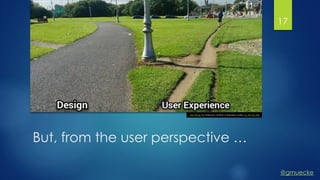
But, from the user perspective …
This Photo by Unknown Author is licensed under CC BY-NC-ND
17
@gmuecke
What is the
user value
of…
 My car consumes 4.8 l
per 100 km in the
benchmark test
 Yet in the City,
I constantly use more
than 6.5 l per 100 km
18
@gmuecke
What is the user
value of…
 98% of all trains are on time
 Yet, I miss 1 in 10 connecting trains
with a connection time of 3 mins
 Yet, I miss all connecting trains
during peak hours (adding 30mins)
19
@gmuecke
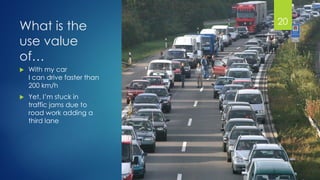
What is the
use value
of…
 With my car
I can drive faster than
200 km/h
 Yet, I’m stuck in
traffic jams due to
road work adding a
third lane
20
@gmuecke
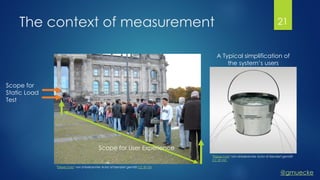
The context of measurement 21
"Dieses Foto" von Unbekannter Autor ist lizenziert gemäß CC BY-SA
Scope for
Static Load
Test
Scope for User Experience
"Dieses Foto" von Unbekannter Autor ist lizenziert gemäß
CC BY-NC
A Typical simplification of
the system’s users
@gmuecke
Today’s Challenges
23
@gmuecke
Real Life Scenarios
 Singular Events
 Launch of Marketing
Campaign / Black Friday Sales
 Launch of new Service or
WebSite
 Users Logging in in the
morning
 Clients connect to a system
on schedule
 Automated Updates
 Daily Patterns
 “McDonalds” M
 asymmetric-M
24
@gmuecke
The Challenges
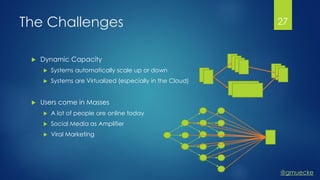
 Dynamic Capacity
 Systems automatically scale up or down
 Systems are Virtualized (especially in the Cloud)
 Users come in Masses
 A lot of people are online today
 Social Media as Amplifier
 Viral Marketing
27
@gmuecke
The information we need
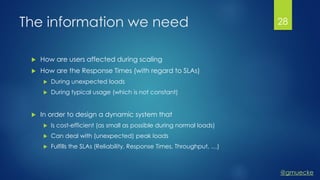
 How are users affected during scaling
 How are the Response Times (with regard to SLAs)
 During unexpected loads
 During typical usage (which is not constant)
 In order to design a dynamic system that
 Is cost-efficient (as small as possible during normal loads)
 Can deal with (unexpected) peak loads
 Fulfills the SLAs (Reliability, Response Times, Throughput, …)
28
@gmuecke
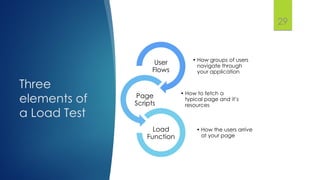
Three
elements of
a Load Test
• How groups of users
navigate through
your application
User
Flows
• How to fetch a
typical page and it’s
resources
Page
Scripts
• How the users arrive
at your page
Load
Function
29
@gmuecke
Three
elements of
a Load Test
User
Flows
Page
Scripts
Load
Function
30
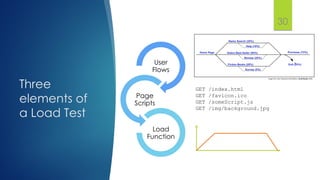
GET /index.html
GET /favicon.ico
GET /someScript.js
GET /img/background.jpg
@gmuecke
Load Function
This Photo by Unknown Author is licensed under CC BY-NC-SA
33
@gmuecke
What is a load function?
 How Load is distributed over time
 Defined by a rate of events in a period
 Users arriving at the application
 Requests
 Actions / Clicks
 Bytes
 Load Functions define when the Load Generator sends a request
34
@gmuecke
Arrival Rate
 Each User acts as an individuum, independent from all other users
 Unknown arrival rates can be best approximated, using a statistical
distribution function
 We need a load generator that can generate
 indepent user requests
 user requests following an arrival rate defined by f(t)
35
@gmuecke
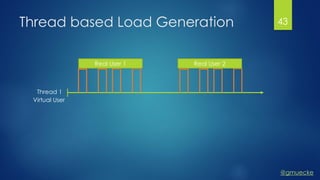
Thread based Load Generation
Thread 1
Virtual User
36
@gmuecke
Thread based Load Generation
Thread 1
Request
Virtual User
37
@gmuecke
Thread based Load Generation
Thread 1
Thread
WAIT
Virtual User
38
@gmuecke
Thread based Load Generation
Thread 1
Response
Virtual User
39
@gmuecke
Thread based Load Generation
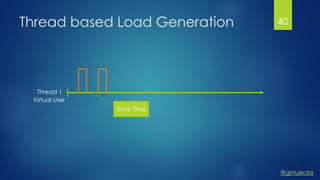
Thread 1
Think Time
Virtual User
40
@gmuecke
Thread based Load Generation
Thread 1
User
Scenario
Virtual User
41
@gmuecke
Thread based Load Generation
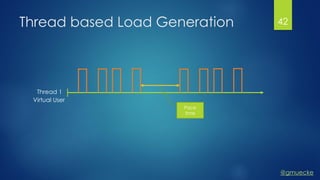
Thread 1
Pace
time
Virtual User
42
@gmuecke
Thread based Load Generation
Thread 1
Virtual User
Real User 1 Real User 2
43
@gmuecke
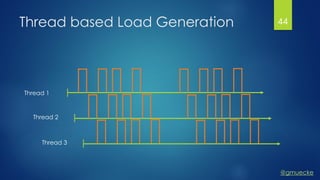
Thread based Load Generation
Thread 1
Thread 2
44
Thread 3
@gmuecke
Thread based Load Generation
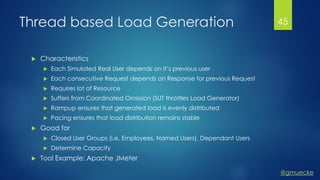
 Characteristics
 Each Simulated Real User depends on it’s previous user
 Each consecutive Request depends on Response for previous Request
 Requires lot of Resource
 Suffers from Coordinated Omission (SUT throttles Load Generator)
 Rampup ensures that generated load is evenly distributed
 Pacing ensures that load distribution remains stable
 Good for
 Closed User Groups (i.e. Employees, Named Users), Dependant Users
 Determine Capacity
 Tool Example: Apache JMeter
45
@gmuecke
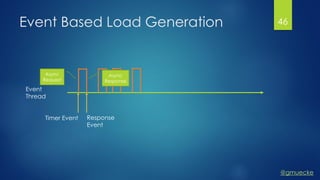
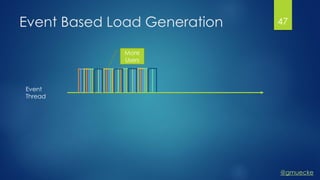
Event Based Load Generation
Event
Thread
Timer Event Response
Event
Async
Request
Async
Response
46
@gmuecke
Event Based Load Generation
Event
Thread
47
More
Users
@gmuecke
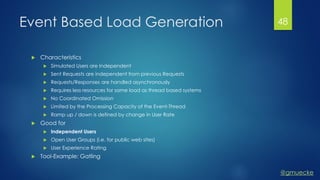
Event Based Load Generation
 Characteristics
 Simulated Users are Independent
 Sent Requests are independent from previous Requests
 Requests/Responses are handled asynchronously
 Requires less resources for same load as thread based systems
 No Coordinated Omission
 Limited by the Processing Capacity of the Event-Thread
 Ramp up / down is defined by change in User Rate
 Good for
 Independent Users
 Open User Groups (i.e. for public web sites)
 User Experience Rating
 Tool-Example: Gatling
48
@gmuecke
Gatling
49
@gmuecke
Test Development with Gatling 50
Scenarios Load ModelsPages
@gmuecke
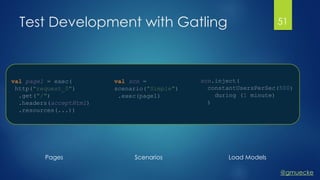
Test Development with Gatling 51
val page1 = exec(
http("request_0")
.get("/")
.headers(acceptHtml)
.resources(...))
Pages Scenarios
val scn =
scenario("Simple")
.exec(page1)
Load Models
scn.inject(
constantUsersPerSec(500)
during (1 minute)
)
@gmuecke
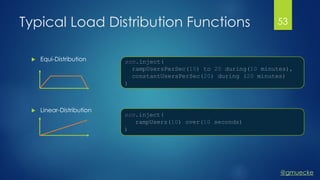
Typical Load Distribution Functions
 Equi-Distribution
 Linear-Distribution
scn.inject(
rampUsersPerSec(10) to 20 during(10 minutes),
constantUsersPerSec(20) during (20 minutes)
)
scn.inject(
rampUsers(10) over(10 seconds)
)
53
@gmuecke
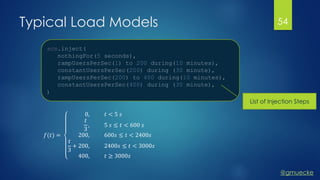
scn.inject(
nothingFor(5 seconds),
rampUsersPerSec(1) to 200 during(10 minutes),
constantUsersPerSec(200) during (30 minute),
rampUsersPerSec(200) to 400 during(10 minutes),
constantUsersPerSec(400) during (30 minute),
)
Typical Load Models
𝑓(𝑡) =
0, 𝑡 < 5 𝑠
𝑡
3
, 5 𝑠 ≤ 𝑡 < 600 𝑠
200, 600𝑠 ≤ 𝑡 < 2400𝑠
𝑡
3
+ 200, 2400𝑠 ≤ 𝑡 < 3000𝑠
400, 𝑡 ≥ 3000𝑠
List of Injection Steps
54
@gmuecke
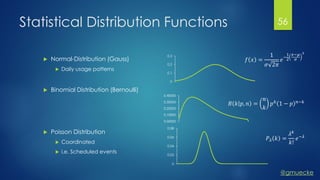
Statistical Distribution Functions
 Normal-Distribution (Gauss)
 Daily usage patterns
 Binomial Distribution (Bernoulli)
 Poisson Distribution
 Coordinated
 i.e. Scheduled events
𝑓 𝑥 =
1
𝜎 2𝜋
𝑒
−
1
2
𝑥−𝜇
𝜎
2
𝐵 𝑘 𝑝, 𝑛 =
𝑛
𝑘
𝑝 𝑘
1 − 𝑝 𝑛−𝑘
𝑃 𝜆 𝑘 =
𝜆 𝑘
𝑘!
𝑒−𝜆
0
0.1
0.2
0.3
0.00000
0.10000
0.20000
0.30000
0.40000
0
0.02
0.04
0.06
0.08
56
@gmuecke
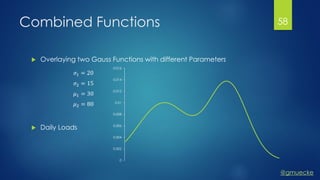
Combined Functions
 Overlaying two Gauss Functions with different Parameters
 Daily Loads
0
0.002
0.004
0.006
0.008
0.01
0.012
0.014
0.016
𝜎1 = 20
𝜎2 = 15
𝜇1 = 30
𝜇2 = 80
58
@gmuecke
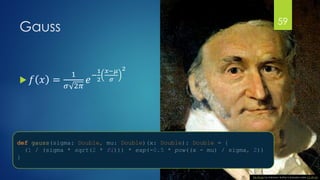
Gauss
 𝑓 𝑥 =
1
𝜎 2𝜋
𝑒
−
1
2
𝑥−𝜇
𝜎
2
This Photo by Unknown Author is licensed under CC BY-SA
def gauss(sigma: Double, mu: Double)(x: Double): Double = {
(1 / (sigma * sqrt(2 * Pi))) * exp(-0.5 * pow((x - mu) / sigma, 2))
}
59
@gmuecke
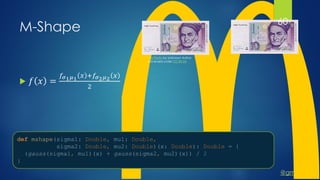
M-Shape
 𝑓 𝑥 =
𝑓𝜎1 𝜇1 𝑥 +𝑓𝜎2 𝜇2 𝑥
2
def mshape(sigma1: Double, mu1: Double,
sigma2: Double, mu2: Double)(x: Double): Double = {
(gauss(sigma1, mu1)(x) + gauss(sigma2, mu2)(x)) / 2
}
This Photo by Unknown Author
is licensed under CC BY-SA
60
@gmuecke
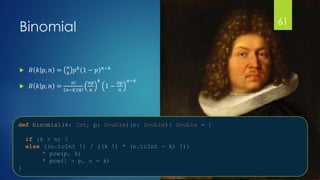
Binomial
 𝐵 𝑘 𝑝, 𝑛 = 𝑛
𝑘
𝑝 𝑘 1 − 𝑝 𝑛−𝑘
 𝐵 𝑘 𝑝, 𝑛 =
𝑛!
𝑛−𝑘 !𝑘!
𝑛𝑝
𝑛
𝑘
1 −
𝑛𝑝
𝑛
𝑛−𝑘
def binomial(k: Int, p: Double)(n: Double): Double = {
if (k > n) 0
else ((n.toInt !) / ((k !) * (n.toInt - k) !))
* pow(p, k)
* pow(1 - p, n - k)
}
61
@gmuecke
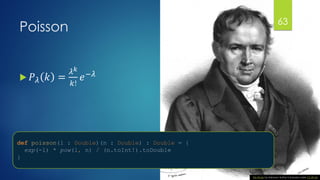
Poisson
 𝑃 𝜆 𝑘 =
𝜆 𝑘
𝑘!
𝑒−𝜆
This Photo by Unknown Author is licensed under CC BY-SA
def poisson(l : Double)(n : Double) : Double = {
exp(-l) * pow(l, n) / (n.toInt!).toDouble
}
63
@gmuecke
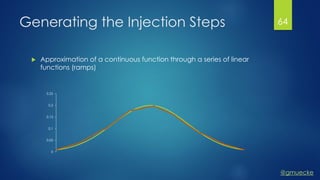
Generating the Injection Steps
 Approximation of a continuous function through a series of linear
functions (ramps)
64
0
0.05
0.1
0.15
0.2
0.25
@gmuecke
Generating the Injection Steps 65
def f()= _ => List[InjectionStep]
@gmuecke
Generating the Injection Steps
def continuousUserRate(duration: FiniteDuration,
totalUsers: Int,
distrFun: (Int) => (Double => Double),
stepFun: (Duration) => (Int) = (d) => d.toMinutes.toInt):
List[InjectionStep] = {
val steps = stepFun(duration)
val stepDuration = duration / steps
def fun(x: Double) : Double =
totalUsers * distrFun(steps)(x) / stepDuration.toSeconds
List.range(0, steps).map(
step => rampUsersPerSec(fun(step)) to fun(step + 1) during stepDuration)
}
66
@gmuecke
def continuousUserRate(duration: FiniteDuration,
totalUsers: Int,
distrFun: (Int) => (Double => Double),
stepFun: (Duration) => (Int) = (d) => d.toMinutes.toInt):
List[InjectionStep] = {
val steps = stepFun(duration)
val stepDuration = duration / steps
def fun(x: Double) : Double =
totalUsers * distrFun(steps)(x) / stepDuration.toSeconds
List.range(0, steps).map(
step => rampUsersPerSec(fun(step)) to fun(step + 1) during stepDuration)
}
Generating the Injection Steps 67
Number of Injection Steps
@gmuecke
def continuousUserRate(duration: FiniteDuration,
totalUsers: Int,
distrFun: (Int) => (Double => Double),
stepFun: (Duration) => (Int) = (d) => d.toMinutes.toInt):
List[InjectionStep] = {
val steps = stepFun(duration)
val stepDuration = duration / steps
def fun(x: Double) : Double =
totalUsers * distrFun(steps)(x) / stepDuration.toSeconds
List.range(0, steps).map(
step => rampUsersPerSec(fun(step)) to fun(step + 1) during stepDuration)
}
Generating the Injection Steps 68
Duration of a single step (1 minute)
@gmuecke
def continuousUserRate(duration: FiniteDuration,
totalUsers: Int,
distrFun: (Int) => (Double => Double),
stepFun: (Duration) => (Int) = (d) => d.toMinutes.toInt):
List[InjectionStep] = {
val steps = stepFun(duration)
val stepDuration = duration / steps
def fun(x: Double) : Double =
totalUsers * distrFun(steps)(x) / stepDuration.toSeconds
List.range(0, steps).map(
step => rampUsersPerSec(fun(step)) to fun(step + 1) during stepDuration)
}
Generating the Injection Steps
Calculate the user/sec rate for a
specific step using the distribution
function
Calculate the linear change in user/sec
rate between two steps
69
@gmuecke
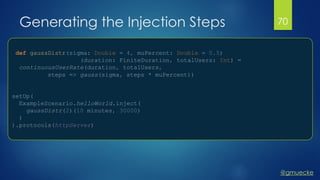
Generating the Injection Steps
def gaussDistr(sigma: Double = 4, muPercent: Double = 0.5)
(duration: FiniteDuration, totalUsers: Int) =
continuousUserRate(duration, totalUsers,
steps => gauss(sigma, steps * muPercent))
setUp(
ExampleScenario.helloWorld.inject(
gaussDistr(2)(10 minutes, 30000)
)
).protocols(httpServer)
70
@gmuecke
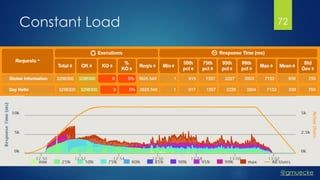
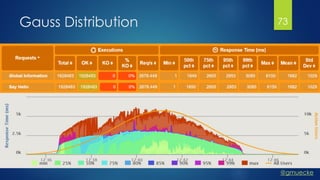
Examples
 Elastic System that dynamically scales up / down depending on
load
 Parameters define the inertia of responding to load
71
@gmuecke
Constant Load 72
@gmuecke
Gauss Distribution 73
@gmuecke
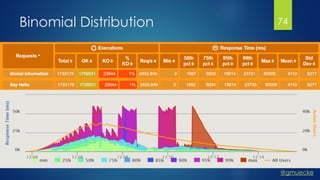
Binomial Distribution 74
@gmuecke
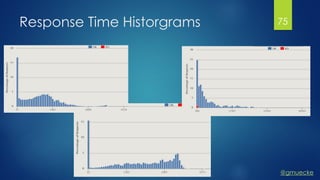
Response Time Historgrams 75
@gmuecke
78
@gmuecke
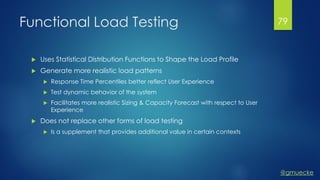
Functional Load Testing
 Uses Statistical Distribution Functions to Shape the Load Profile
 Generate more realistic load patterns
 Response Time Percentiles better reflect User Experience
 Test dynamic behavior of the system
 Facilitates more realistic Sizing & Capacity Forecast with respect to User
Experience
 Does not replace other forms of load testing
 Is a supplement that provides additional value in certain contexts
79
@gmuecke
 Example source code available at
 https://github.com/gmuecke/flt-example
80
@gmuecke
Thank you!
QUESTIONS & FEEDBACK APPRECIATED!
81

Functional Load Testing with Gatling

  • 1.
    @gmuecke Functional Load Testing GERALDMÜCKE JAVALAND 2018 𝑓 𝑥 = 1 𝜎 2𝜋 𝑒 − 1 2 𝑥−𝜇 𝜎 2 𝐵 𝑘 𝑝, 𝑛 = 𝑛 𝑘 𝑝 𝑘 1 − 𝑝 𝑛−𝑘 𝑃 𝜆 𝑘 = 𝜆 𝑘 𝑘! 𝑒−𝜆 2
  • 2.
    @gmuecke This talk isnot about  Load Testing a Function  Loading a Function Test  Loading a Test Function  Testing a Load Function  Test Loading a Function  Testing a Function Load It’s about using Functions to conduct Load Testing 4
  • 3.
    @gmuecke This Photo byUnknown Author is licensed under CC BY-SA This Photo by Unknown Author is licensed under CC BY-SA Siméon Denis Poisson 5 Jakob I. Bernoulli This Photo by Unknown Author is licensed under CC BY-SA Carl Friedrich Gauss
  • 4.
    @gmuecke What is Testing? “Software testing is a process of executing a program or application with the intent of finding the software bugs.” (ISTQB)  Testing is a information-providing service, not a "quality assurance" function.  The value of testing is determined by whether it provides useful and timely information.  A tester is a customer advocate. 6
  • 5.
    @gmuecke "Dieses Foto" vonUnbekannter Autor ist lizenziert gemäß CC BY Context is everything  The value of any practice depends on its context.  There are good practices in context, but there are no best practices. (From Seven Principles of Context Driven Testing) 7
  • 6.
    @gmuecke How to doPerformance Testing? 8
  • 7.
    @gmuecke Type of LoadTest Batch Online 9 • Process the most events in the least time • Event Driven • Focus on Low Response Times • Get the most done in the least time and resources • Data Driven • Focus on Maximum Troughput
  • 8.
    @gmuecke Input to LoadTest Scenarios  Performance Requirements  Target Users (Concurrent, per Duration, Total)  Response Time Targets (90%, 95%, 99%)  Throughput  Historical Data  Number of Total Users per Duration  Number of Concurrent Users  Peak Loads (Peak Month/Day/Hour/Minute)  Request Logs  Educated Guesses / Gut Feeling 10
  • 9.
    @gmuecke Example Requirements  The systemis capable of  Serving 1000 concurrent users with an average Response Time of 1.5s  Source: The Project Manager  What are the most relevant information? This Photo by Unknown Author is licensed under CC BY-NC-SA 11
  • 10.
    @gmuecke Numbers need aContext  Concurrent Users (CPU)  vs. Concurrent Sessions (Memory)  vs. Users per Period (Capacity)  Average  vs. perceived Average (90 %)  vs. Percentiles (95%,99%,99.9%)  1000 Conc.Users, avg < 1.5s  vs 1000 Users/h, 90% < 1.5s This Photo by Unknown Author is licensed under CC BY-NC-SA 12
  • 11.
    @gmuecke Load Testing Practices Soak Testing  Discover Leaks  SLA Regressions  Stress Testing  Testing Stability  Overload / Recovery  Benchmarking  Discover Regressions between different Versions or Configurations 13
  • 12.
    @gmuecke A typical loadtest: Constant Load  Constant Load  + Ramp up / down  Allowing the System to adapt to Load (warm up)  Distributes Load (virtual users)  Good for:  Finding latent bugs, i.e.Memory or Resource Leaks  Precise Measurements  Regressions  Stability Issues  Statistical Response Times  Known Load Distributions Load % t 14
  • 13.
    @gmuecke Why do aramp up?  System Warm-up  Allow JIT to optimize code  Allow Caches to be populated  Fetch or Initiate Resources (i.e. Database Connections)  Allow Queues and Buffers to fill to a stable level  Distribute Load evenly  System’s Performance Characteristics are non-linear during ramup 15 This Photo by Unknown Author is licensed under CC BY-NC-ND
  • 14.
    @gmuecke But, from theuser perspective … This Photo by Unknown Author is licensed under CC BY-NC-ND 17
  • 15.
    @gmuecke What is the uservalue of…  My car consumes 4.8 l per 100 km in the benchmark test  Yet in the City, I constantly use more than 6.5 l per 100 km 18
  • 16.
    @gmuecke What is theuser value of…  98% of all trains are on time  Yet, I miss 1 in 10 connecting trains with a connection time of 3 mins  Yet, I miss all connecting trains during peak hours (adding 30mins) 19
  • 17.
    @gmuecke What is the usevalue of…  With my car I can drive faster than 200 km/h  Yet, I’m stuck in traffic jams due to road work adding a third lane 20
  • 18.
    @gmuecke The context ofmeasurement 21 "Dieses Foto" von Unbekannter Autor ist lizenziert gemäß CC BY-SA Scope for Static Load Test Scope for User Experience "Dieses Foto" von Unbekannter Autor ist lizenziert gemäß CC BY-NC A Typical simplification of the system’s users
  • 19.
  • 20.
    @gmuecke Real Life Scenarios Singular Events  Launch of Marketing Campaign / Black Friday Sales  Launch of new Service or WebSite  Users Logging in in the morning  Clients connect to a system on schedule  Automated Updates  Daily Patterns  “McDonalds” M  asymmetric-M 24
  • 21.
    @gmuecke The Challenges  DynamicCapacity  Systems automatically scale up or down  Systems are Virtualized (especially in the Cloud)  Users come in Masses  A lot of people are online today  Social Media as Amplifier  Viral Marketing 27
  • 22.
    @gmuecke The information weneed  How are users affected during scaling  How are the Response Times (with regard to SLAs)  During unexpected loads  During typical usage (which is not constant)  In order to design a dynamic system that  Is cost-efficient (as small as possible during normal loads)  Can deal with (unexpected) peak loads  Fulfills the SLAs (Reliability, Response Times, Throughput, …) 28
  • 23.
    @gmuecke Three elements of a LoadTest • How groups of users navigate through your application User Flows • How to fetch a typical page and it’s resources Page Scripts • How the users arrive at your page Load Function 29
  • 24.
    @gmuecke Three elements of a LoadTest User Flows Page Scripts Load Function 30 GET /index.html GET /favicon.ico GET /someScript.js GET /img/background.jpg
  • 25.
    @gmuecke Load Function This Photoby Unknown Author is licensed under CC BY-NC-SA 33
  • 26.
    @gmuecke What is aload function?  How Load is distributed over time  Defined by a rate of events in a period  Users arriving at the application  Requests  Actions / Clicks  Bytes  Load Functions define when the Load Generator sends a request 34
  • 27.
    @gmuecke Arrival Rate  EachUser acts as an individuum, independent from all other users  Unknown arrival rates can be best approximated, using a statistical distribution function  We need a load generator that can generate  indepent user requests  user requests following an arrival rate defined by f(t) 35
  • 28.
    @gmuecke Thread based LoadGeneration Thread 1 Virtual User 36
  • 29.
    @gmuecke Thread based LoadGeneration Thread 1 Request Virtual User 37
  • 30.
    @gmuecke Thread based LoadGeneration Thread 1 Thread WAIT Virtual User 38
  • 31.
    @gmuecke Thread based LoadGeneration Thread 1 Response Virtual User 39
  • 32.
    @gmuecke Thread based LoadGeneration Thread 1 Think Time Virtual User 40
  • 33.
    @gmuecke Thread based LoadGeneration Thread 1 User Scenario Virtual User 41
  • 34.
    @gmuecke Thread based LoadGeneration Thread 1 Pace time Virtual User 42
  • 35.
    @gmuecke Thread based LoadGeneration Thread 1 Virtual User Real User 1 Real User 2 43
  • 36.
    @gmuecke Thread based LoadGeneration Thread 1 Thread 2 44 Thread 3
  • 37.
    @gmuecke Thread based LoadGeneration  Characteristics  Each Simulated Real User depends on it’s previous user  Each consecutive Request depends on Response for previous Request  Requires lot of Resource  Suffers from Coordinated Omission (SUT throttles Load Generator)  Rampup ensures that generated load is evenly distributed  Pacing ensures that load distribution remains stable  Good for  Closed User Groups (i.e. Employees, Named Users), Dependant Users  Determine Capacity  Tool Example: Apache JMeter 45
  • 38.
    @gmuecke Event Based LoadGeneration Event Thread Timer Event Response Event Async Request Async Response 46
  • 39.
    @gmuecke Event Based LoadGeneration Event Thread 47 More Users
  • 40.
    @gmuecke Event Based LoadGeneration  Characteristics  Simulated Users are Independent  Sent Requests are independent from previous Requests  Requests/Responses are handled asynchronously  Requires less resources for same load as thread based systems  No Coordinated Omission  Limited by the Processing Capacity of the Event-Thread  Ramp up / down is defined by change in User Rate  Good for  Independent Users  Open User Groups (i.e. for public web sites)  User Experience Rating  Tool-Example: Gatling 48
  • 41.
  • 42.
    @gmuecke Test Development withGatling 50 Scenarios Load ModelsPages
  • 43.
    @gmuecke Test Development withGatling 51 val page1 = exec( http("request_0") .get("/") .headers(acceptHtml) .resources(...)) Pages Scenarios val scn = scenario("Simple") .exec(page1) Load Models scn.inject( constantUsersPerSec(500) during (1 minute) )
  • 44.
    @gmuecke Typical Load DistributionFunctions  Equi-Distribution  Linear-Distribution scn.inject( rampUsersPerSec(10) to 20 during(10 minutes), constantUsersPerSec(20) during (20 minutes) ) scn.inject( rampUsers(10) over(10 seconds) ) 53
  • 45.
    @gmuecke scn.inject( nothingFor(5 seconds), rampUsersPerSec(1) to200 during(10 minutes), constantUsersPerSec(200) during (30 minute), rampUsersPerSec(200) to 400 during(10 minutes), constantUsersPerSec(400) during (30 minute), ) Typical Load Models 𝑓(𝑡) = 0, 𝑡 < 5 𝑠 𝑡 3 , 5 𝑠 ≤ 𝑡 < 600 𝑠 200, 600𝑠 ≤ 𝑡 < 2400𝑠 𝑡 3 + 200, 2400𝑠 ≤ 𝑡 < 3000𝑠 400, 𝑡 ≥ 3000𝑠 List of Injection Steps 54
  • 46.
    @gmuecke Statistical Distribution Functions Normal-Distribution (Gauss)  Daily usage patterns  Binomial Distribution (Bernoulli)  Poisson Distribution  Coordinated  i.e. Scheduled events 𝑓 𝑥 = 1 𝜎 2𝜋 𝑒 − 1 2 𝑥−𝜇 𝜎 2 𝐵 𝑘 𝑝, 𝑛 = 𝑛 𝑘 𝑝 𝑘 1 − 𝑝 𝑛−𝑘 𝑃 𝜆 𝑘 = 𝜆 𝑘 𝑘! 𝑒−𝜆 0 0.1 0.2 0.3 0.00000 0.10000 0.20000 0.30000 0.40000 0 0.02 0.04 0.06 0.08 56
  • 47.
    @gmuecke Combined Functions  Overlayingtwo Gauss Functions with different Parameters  Daily Loads 0 0.002 0.004 0.006 0.008 0.01 0.012 0.014 0.016 𝜎1 = 20 𝜎2 = 15 𝜇1 = 30 𝜇2 = 80 58
  • 48.
    @gmuecke Gauss  𝑓 𝑥= 1 𝜎 2𝜋 𝑒 − 1 2 𝑥−𝜇 𝜎 2 This Photo by Unknown Author is licensed under CC BY-SA def gauss(sigma: Double, mu: Double)(x: Double): Double = { (1 / (sigma * sqrt(2 * Pi))) * exp(-0.5 * pow((x - mu) / sigma, 2)) } 59
  • 49.
    @gmuecke M-Shape  𝑓 𝑥= 𝑓𝜎1 𝜇1 𝑥 +𝑓𝜎2 𝜇2 𝑥 2 def mshape(sigma1: Double, mu1: Double, sigma2: Double, mu2: Double)(x: Double): Double = { (gauss(sigma1, mu1)(x) + gauss(sigma2, mu2)(x)) / 2 } This Photo by Unknown Author is licensed under CC BY-SA 60
  • 50.
    @gmuecke Binomial  𝐵 𝑘𝑝, 𝑛 = 𝑛 𝑘 𝑝 𝑘 1 − 𝑝 𝑛−𝑘  𝐵 𝑘 𝑝, 𝑛 = 𝑛! 𝑛−𝑘 !𝑘! 𝑛𝑝 𝑛 𝑘 1 − 𝑛𝑝 𝑛 𝑛−𝑘 def binomial(k: Int, p: Double)(n: Double): Double = { if (k > n) 0 else ((n.toInt !) / ((k !) * (n.toInt - k) !)) * pow(p, k) * pow(1 - p, n - k) } 61
  • 51.
    @gmuecke Poisson  𝑃 𝜆𝑘 = 𝜆 𝑘 𝑘! 𝑒−𝜆 This Photo by Unknown Author is licensed under CC BY-SA def poisson(l : Double)(n : Double) : Double = { exp(-l) * pow(l, n) / (n.toInt!).toDouble } 63
  • 52.
    @gmuecke Generating the InjectionSteps  Approximation of a continuous function through a series of linear functions (ramps) 64 0 0.05 0.1 0.15 0.2 0.25
  • 53.
    @gmuecke Generating the InjectionSteps 65 def f()= _ => List[InjectionStep]
  • 54.
    @gmuecke Generating the InjectionSteps def continuousUserRate(duration: FiniteDuration, totalUsers: Int, distrFun: (Int) => (Double => Double), stepFun: (Duration) => (Int) = (d) => d.toMinutes.toInt): List[InjectionStep] = { val steps = stepFun(duration) val stepDuration = duration / steps def fun(x: Double) : Double = totalUsers * distrFun(steps)(x) / stepDuration.toSeconds List.range(0, steps).map( step => rampUsersPerSec(fun(step)) to fun(step + 1) during stepDuration) } 66
  • 55.
    @gmuecke def continuousUserRate(duration: FiniteDuration, totalUsers:Int, distrFun: (Int) => (Double => Double), stepFun: (Duration) => (Int) = (d) => d.toMinutes.toInt): List[InjectionStep] = { val steps = stepFun(duration) val stepDuration = duration / steps def fun(x: Double) : Double = totalUsers * distrFun(steps)(x) / stepDuration.toSeconds List.range(0, steps).map( step => rampUsersPerSec(fun(step)) to fun(step + 1) during stepDuration) } Generating the Injection Steps 67 Number of Injection Steps
  • 56.
    @gmuecke def continuousUserRate(duration: FiniteDuration, totalUsers:Int, distrFun: (Int) => (Double => Double), stepFun: (Duration) => (Int) = (d) => d.toMinutes.toInt): List[InjectionStep] = { val steps = stepFun(duration) val stepDuration = duration / steps def fun(x: Double) : Double = totalUsers * distrFun(steps)(x) / stepDuration.toSeconds List.range(0, steps).map( step => rampUsersPerSec(fun(step)) to fun(step + 1) during stepDuration) } Generating the Injection Steps 68 Duration of a single step (1 minute)
  • 57.
    @gmuecke def continuousUserRate(duration: FiniteDuration, totalUsers:Int, distrFun: (Int) => (Double => Double), stepFun: (Duration) => (Int) = (d) => d.toMinutes.toInt): List[InjectionStep] = { val steps = stepFun(duration) val stepDuration = duration / steps def fun(x: Double) : Double = totalUsers * distrFun(steps)(x) / stepDuration.toSeconds List.range(0, steps).map( step => rampUsersPerSec(fun(step)) to fun(step + 1) during stepDuration) } Generating the Injection Steps Calculate the user/sec rate for a specific step using the distribution function Calculate the linear change in user/sec rate between two steps 69
  • 58.
    @gmuecke Generating the InjectionSteps def gaussDistr(sigma: Double = 4, muPercent: Double = 0.5) (duration: FiniteDuration, totalUsers: Int) = continuousUserRate(duration, totalUsers, steps => gauss(sigma, steps * muPercent)) setUp( ExampleScenario.helloWorld.inject( gaussDistr(2)(10 minutes, 30000) ) ).protocols(httpServer) 70
  • 59.
    @gmuecke Examples  Elastic Systemthat dynamically scales up / down depending on load  Parameters define the inertia of responding to load 71
  • 60.
  • 61.
  • 62.
  • 63.
  • 64.
  • 65.
    @gmuecke Functional Load Testing Uses Statistical Distribution Functions to Shape the Load Profile  Generate more realistic load patterns  Response Time Percentiles better reflect User Experience  Test dynamic behavior of the system  Facilitates more realistic Sizing & Capacity Forecast with respect to User Experience  Does not replace other forms of load testing  Is a supplement that provides additional value in certain contexts 79
  • 66.
    @gmuecke  Example sourcecode available at  https://github.com/gmuecke/flt-example 80
  • 67.
    @gmuecke Thank you! QUESTIONS &FEEDBACK APPRECIATED! 81