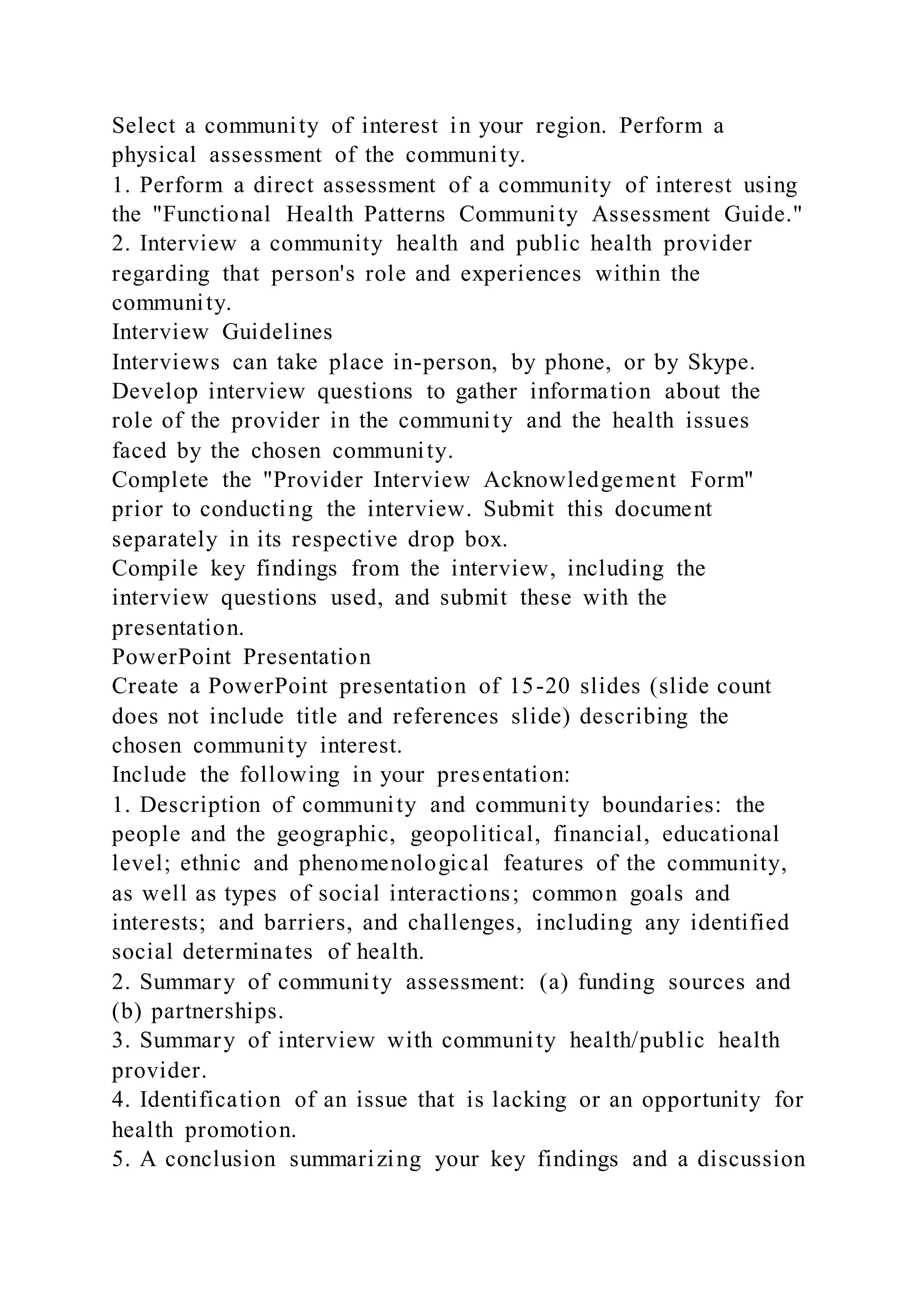
Functional Health Patterns Community Assessment Guide
Functional Health Pattern (FHP) Template Directions:
This FHP template is to be used for organizing community
assessment data in preparation for completion of the topic
assignment. Address every bulleted statement in each section
with data or rationale for deferral. You may also add additional
bullet points if applicable to your community.
Value/Belief Pattern
· Predominant ethnic and cultural groups along with beliefs
related to health.
· Predominant spiritual beliefs in the community that may
influence health.
· Availability of spiritual resources within or near the
community (churches/chapels, synagogues, chaplains, Bible
studies, sacraments, self-help groups, support groups, etc.).
· Do the community members value health promotion measures?
What is the evidence that they do or do not (e.g., involvement in
education, fundraising events, etc.)?
· What does the community value? How is this evident?
· On what do the community members spend their money? Are
funds adequate?
Health Perception/Management
· Predominant health problems: Compare at least one health
problem to a credible statistic (CDC, county, or state).
· Immunization rates (age appropriate).
· Appropriate death rates and causes, if applicable.
· Prevention programs (dental, fire, fitness, safety, etc.): Does
the community think these are sufficient?
· Available health professionals, health resources within the
community, and usage.
· Common referrals to outside agencies.
Nutrition/Metabolic
· Indicators of nutrient deficiencies.
· Obesity rates or percentages: Compare to CDC statisti cs.
· Affordability of food/available discounts or food programs
and usage (e.g., WIC, food boxes, soup kitchens, meals-on-
wheels, food stamps, senior discounts, employee discounts,
etc.).
· Availability of water (e.g., number and quality of drinking
fountains).
· Fast food and junk food accessibility (vending machines).
· Evidence of healthy food consumption or unhealthy food
consumption (trash, long lines, observations, etc.).
· Provisions for special diets, if applicable.
· For schools (in addition to above):
· Nutritional content of food in cafeteria and vending machines:
Compare to ARS 15-242/The Arizona Nutrition Standards (or
other state standards based on residence)
· Amount of free or reduced lunch
Elimination (Environmental Health Concerns)
· Common air contaminants’ impact on the community.
· Noise.
· Waste disposal.
· Pest control: Is the community notified of pesticides usage?
· Hygiene practices (laundry services, hand washing, etc.).
· Bathrooms: Number of bathrooms; inspect for cleanliness,
supplies, if possible.
· Universal precaution practices of health providers, teachers,
members (if applicable).
· Temperature controls (e.g., within buildings, outside shade
structures).
· Safety (committee, security guards, crossing guards, badges,
locked campuses).
Activity/Exercise
· Community fitness programs (gym discounts, P.E., recess,
sports, access to YMCA, etc.).
· Recreational facilities and usage (gym, playgrounds, bike
paths, hiking trails, courts, pools, etc.).
· Safety programs (rules and regulations, safety training,
incentives, athletic trainers, etc.).
· Injury statistics or most common injuries.
· Evidence of sedentary leisure activities (amount of time
watching TV, videos, and computer).
· Means of transportation.
Sleep/Rest
· Sleep routines/hours of your community: Compare with sleep
hour standards (from National Institutes of Health [NIH]).
· Indicators of general “restedness” and energy levels.
· Factors affecting sleep:
· Shift work prevalence of community members
· Environment (noise, lights, crowding, etc.)
· Consumption of caffeine, nicotine, alcohol, and drugs
· Homework/Extracurricular activities
· Health issues
Cognitive/Perceptual
· Primary language: Is this a communication barrier?
· Educational levels: For geopolitical communities, use
http://www.census.gov and compare the city in which your
community belongs with the national statistics.
· Opportunities/Programs:
· Educational offerings (in-services, continuing education,
GED, etc.)
· Educational mandates (yearly in-services, continuing
education, English learners, etc.)
· Special education programs (e.g., learning disabled,
emotionally disabled, physically disabled, and gifted)
· Library or computer/Internet resources and usage.
· Funding resources (tuition reimbursement, scholarships, etc.).
Self-Perception/Self-Concept
· Age levels.
· Programs and activities related to community building
(strengthening the community).
· Community history.
· Pride indicators: Self-esteem or caring behaviors.
· Published description (pamphlets, Web sites, etc.).
Role/Relationship
· Interaction of community members (e.g., friendliness,
openness, bullying, prejudices, etc.).
· Vulnerable populations:
· Why are they vulnerable?
· How does this impact health?
· Power groups (church council, student council, administration,
PTA, and gangs):
· How do they hold power?
· Positive or negative influence on community?
· Harassment policies/discrimination policies.
· Relationship with broader community:
· Police
· Fire/EMS (response time)
· Other (food drives, blood drives, missions, etc.)
Sexuality/Reproductive
· Relationships and behavior among community members.
· Educational offerings/programs (e.g., growth and
development, STD/AIDS education, contraception, abstinence,
etc.).
· Access to birth control.
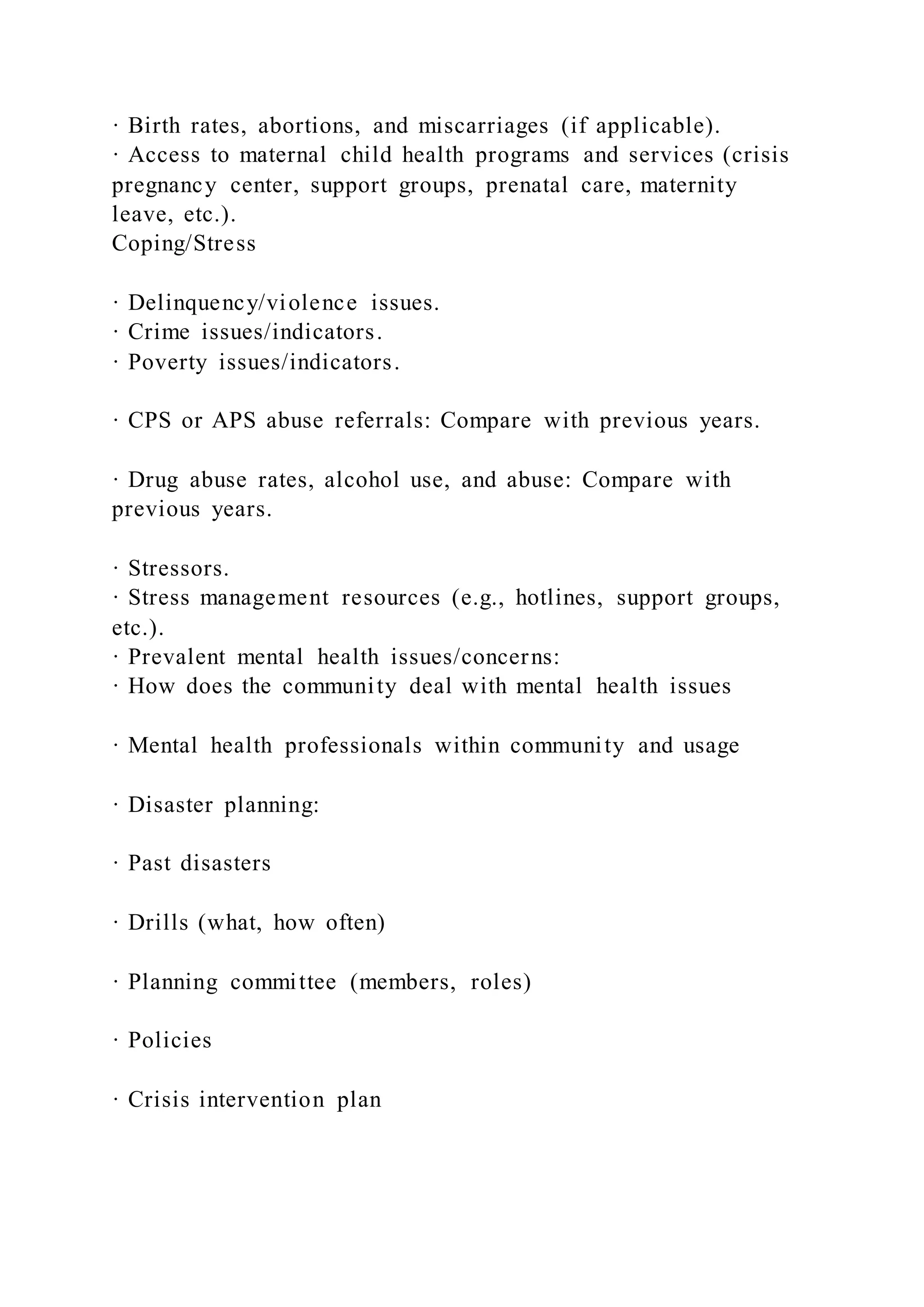
· Birth rates, abortions, and miscarriages (if applicable).
· Access to maternal child health programs and services (crisis
pregnancy center, support groups, prenatal care, maternity
leave, etc.).
Coping/Stress
· Delinquency/violence issues.
· Crime issues/indicators.
· Poverty issues/indicators.
· CPS or APS abuse referrals: Compare with previous years.
· Drug abuse rates, alcohol use, and abuse: Compare with
previous years.
· Stressors.
· Stress management resources (e.g., hotlines, support groups,
etc.).
· Prevalent mental health issues/concerns:
· How does the community deal with mental health issues
· Mental health professionals within community and usage
· Disaster planning:
· Past disasters
· Drills (what, how often)
· Planning committee (members, roles)
· Policies
· Crisis intervention plan
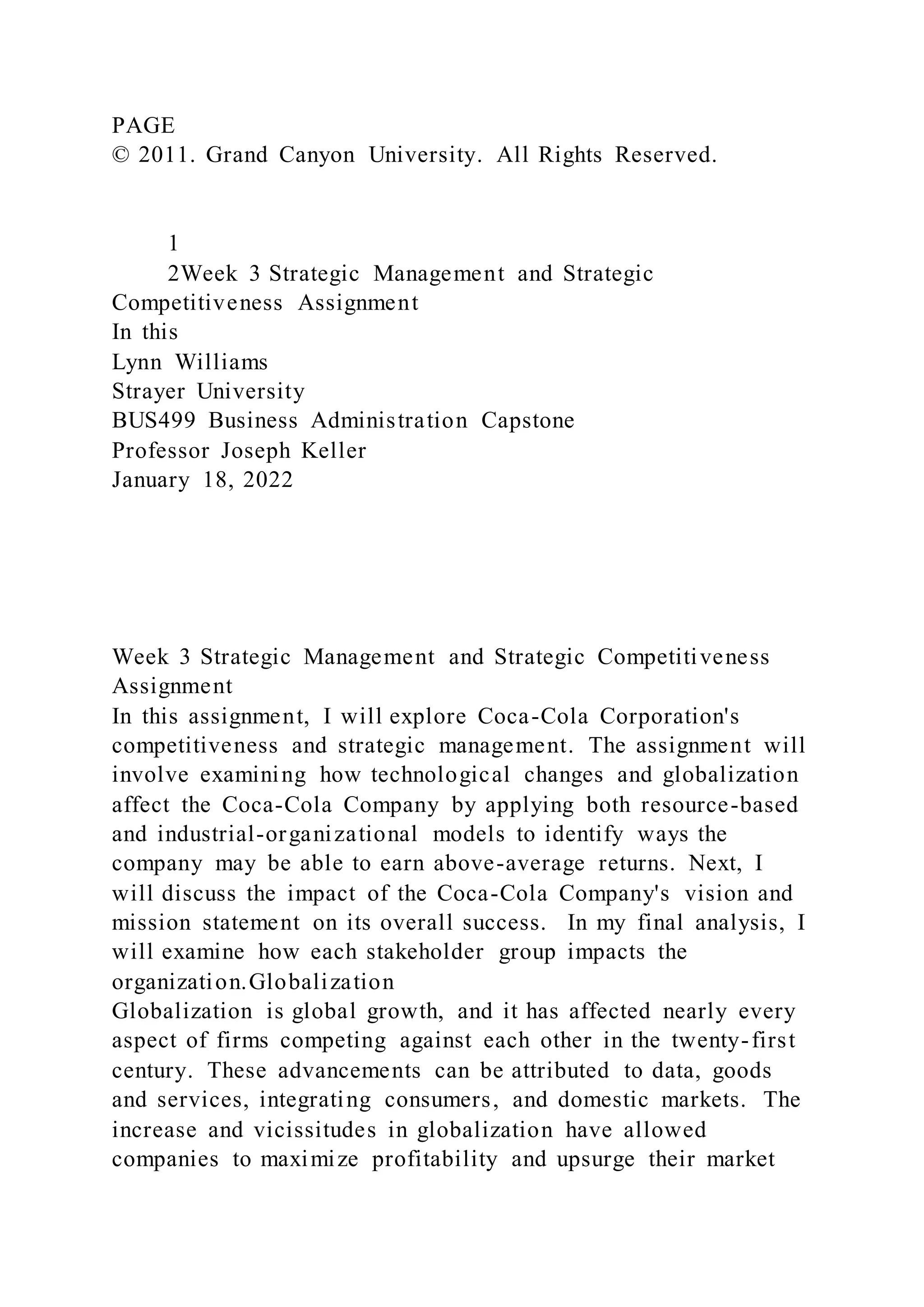
PAGE
© 2011. Grand Canyon University. All Rights Reserved.
1
2Week 3 Strategic Management and Strategic
Competitiveness Assignment
In this
Lynn Williams
Strayer University
BUS499 Business Administration Capstone
Professor Joseph Keller
January 18, 2022
Week 3 Strategic Management and Strategic Competitiveness
Assignment
In this assignment, I will explore Coca-Cola Corporation's
competitiveness and strategic management. The assignment will
involve examining how technological changes and globalization
affect the Coca-Cola Company by applying both resource-based
and industrial-organizational models to identify ways the
company may be able to earn above-average returns. Next, I
will discuss the impact of the Coca-Cola Company's vision and
mission statement on its overall success. In my final analysis, I
will examine how each stakeholder group impacts the
organization.Globalization
Globalization is global growth, and it has affected nearly every
aspect of firms competing against each other in the twenty-first
century. These advancements can be attributed to data, goods
and services, integrating consumers, and domestic markets. The
increase and vicissitudes in globalization have allowed
companies to maximize profitability and upsurge their market
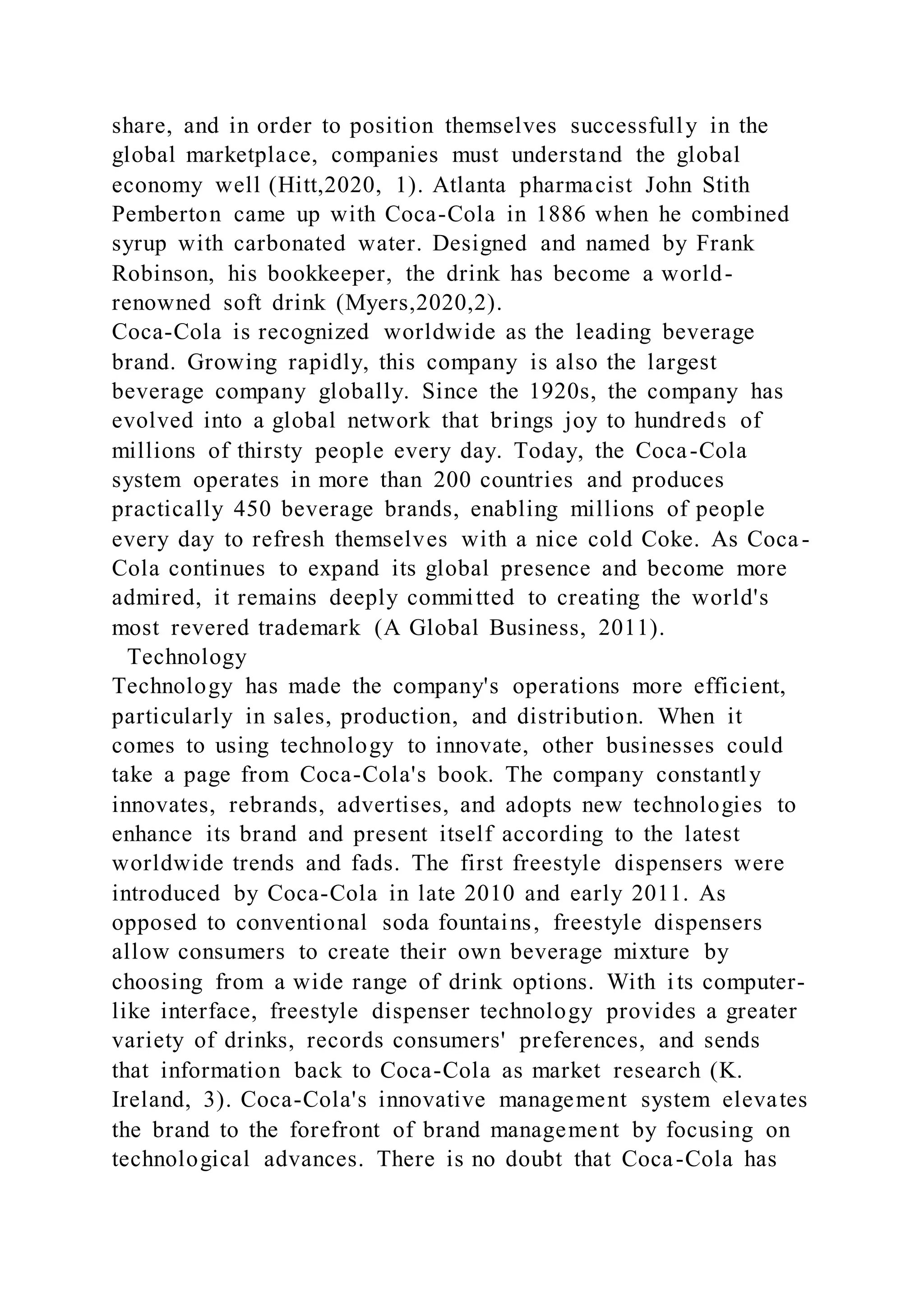
share, and in order to position themselves successfully in the
global marketplace, companies must understand the global
economy well (Hitt,2020, 1). Atlanta pharmacist John Stith
Pemberton came up with Coca-Cola in 1886 when he combined
syrup with carbonated water. Designed and named by Frank
Robinson, his bookkeeper, the drink has become a world-
renowned soft drink (Myers,2020,2).
Coca-Cola is recognized worldwide as the leading beverage
brand. Growing rapidly, this company is also the largest
beverage company globally. Since the 1920s, the company has
evolved into a global network that brings joy to hundreds of
millions of thirsty people every day. Today, the Coca-Cola
system operates in more than 200 countries and produces
practically 450 beverage brands, enabling millions of people
every day to refresh themselves with a nice cold Coke. As Coca-
Cola continues to expand its global presence and become more
admired, it remains deeply committed to creating the world's
most revered trademark (A Global Business, 2011).
Technology
Technology has made the company's operations more efficient,
particularly in sales, production, and distribution. When it
comes to using technology to innovate, other businesses could
take a page from Coca-Cola's book. The company constantly
innovates, rebrands, advertises, and adopts new technologies to
enhance its brand and present itself according to the latest
worldwide trends and fads. The first freestyle dispensers were
introduced by Coca-Cola in late 2010 and early 2011. As
opposed to conventional soda fountains, freestyle dispensers
allow consumers to create their own beverage mixture by
choosing from a wide range of drink options. With its computer-
like interface, freestyle dispenser technology provides a greater
variety of drinks, records consumers' preferences, and sends
that information back to Coca-Cola as market research (K.
Ireland, 3). Coca-Cola's innovative management system elevates
the brand to the forefront of brand management by focusing on
technological advances. There is no doubt that Coca-Cola has
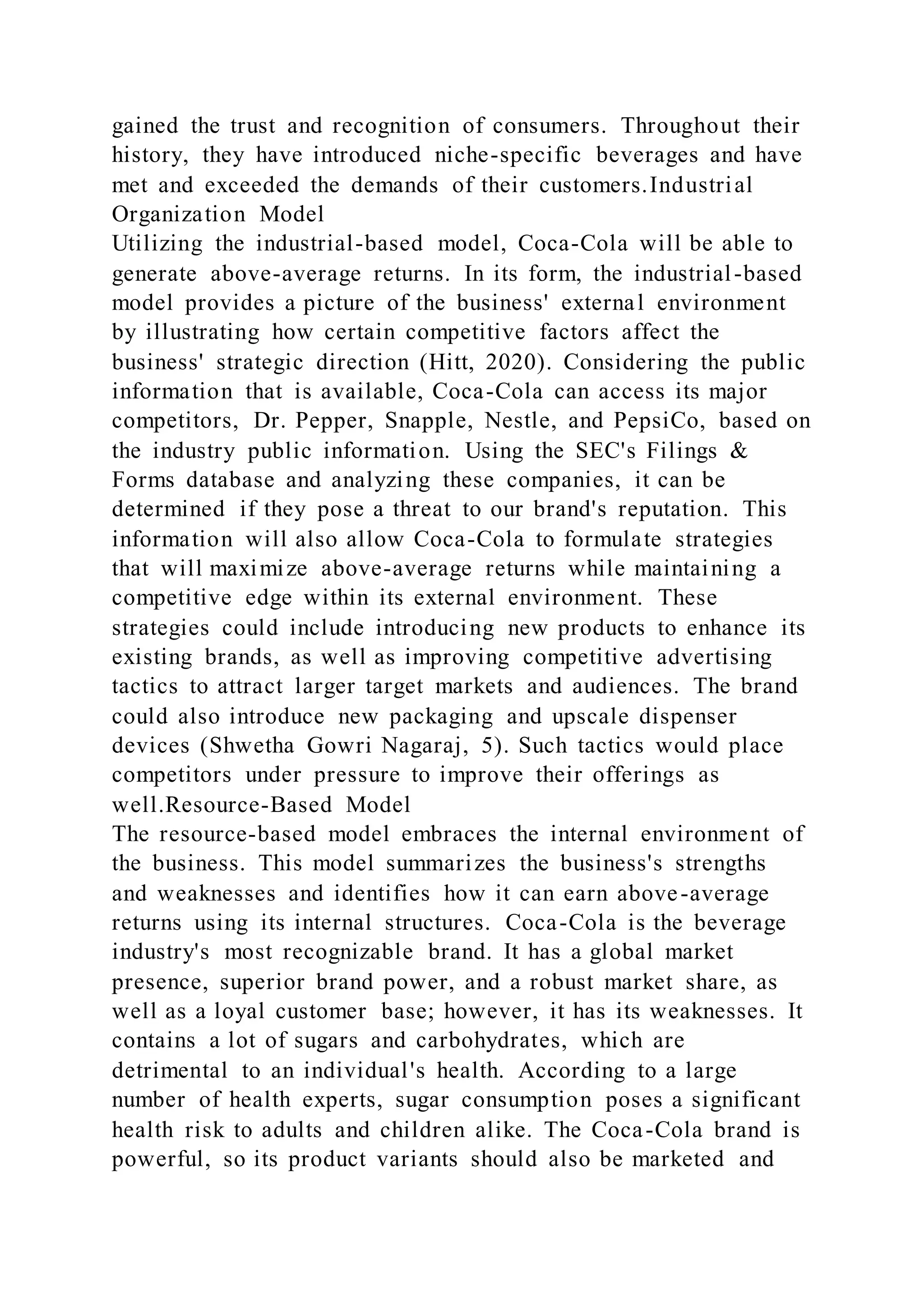
gained the trust and recognition of consumers. Throughout their
history, they have introduced niche-specific beverages and have
met and exceeded the demands of their customers.Industrial
Organization Model
Utilizing the industrial-based model, Coca-Cola will be able to
generate above-average returns. In its form, the industrial-based
model provides a picture of the business' external environment
by illustrating how certain competitive factors affect the
business' strategic direction (Hitt, 2020). Considering the public
information that is available, Coca-Cola can access its major
competitors, Dr. Pepper, Snapple, Nestle, and PepsiCo, based on
the industry public information. Using the SEC's Filings &
Forms database and analyzing these companies, it can be
determined if they pose a threat to our brand's reputation. This
information will also allow Coca-Cola to formulate strategies
that will maximize above-average returns while maintaining a
competitive edge within its external environment. These
strategies could include introducing new products to enhance its
existing brands, as well as improving competitive advertising
tactics to attract larger target markets and audiences. The brand
could also introduce new packaging and upscale dispenser
devices (Shwetha Gowri Nagaraj, 5). Such tactics would place
competitors under pressure to improve their offerings as
well.Resource-Based Model
The resource-based model embraces the internal environment of
the business. This model summarizes the business's strengths
and weaknesses and identifies how it can earn above-average
returns using its internal structures. Coca-Cola is the beverage
industry's most recognizable brand. It has a global market
presence, superior brand power, and a robust market share, as
well as a loyal customer base; however, it has its weaknesses. It
contains a lot of sugars and carbohydrates, which are
detrimental to an individual's health. According to a large
number of health experts, sugar consumption poses a significant
health risk to adults and children alike. The Coca-Cola brand is
powerful, so its product variants should also be marketed and
introduced to the market. These might include sugar-free
snacks, beverages, or other products. This will allow Coca-Cola
to gain market shares, improve its appeal to the health-
conscious, earn above-average returns as well as continue on its
path to becoming more sustainable in the future. (Shwetha
Gowri Nagaraj, 5).Vision
Vision statements describe what a company aspires to achieve,
which provides meaning and significance to its existence. Coca-
Cola's business operations reflect its vision and mission
statements; the brand still adheres to its statements after more
than 120 years in business. In its vision statement, "Our vision
is to craft the brands and choice of drinks that people love, to
refresh them in body & spirit" (Coca-Cola,2022,6). Coca-Cola
refers to the brand as a catalyst for change and development
both inside and outside the beverage industry. During this
process, the company transformed its business practices in order
to become socially responsible and environmentally sustainable
so that it can benefit and impact its employees, as well as the
community. While simultaneously enhancing its brand
recognition for the future, Coca-Cola leads the industry in
innovation, strategic and management competitiveness, design,
and marketing excellence, making its brand loved by consumers.
In addition to establishing leadership across brands, Coca-Cola
develops strong business alliances locally and globally to create
opportunities for people and communities. It is these initiatives
that contribute to the strength of its brand worldwide (Coca-
Cola,2022,6).Mission
Coca-Cola's mission specifies three essential elements; Refresh
the World to Make a Difference and, at the same time, Spread
Optimism and Happiness. Throughout the history of Coca-Cola,
it has been defined as a beverage to refresh the world. As part
of its sustainable business, it aims to refresh the body, mind,
and spirit through its products. It is Coca-Cola's commitment to
make a difference by working together to create a better future
for humanity, communities, and the world as a whole. Through
their operations, Coca-Cola promotes optimism and happiness
over time. Today, Coca-Cola is recognized as a universal
symbol of happiness. As long as the brand continues to exist, it
will never cease to offer refreshing products that are refreshing,
inspire optimism, and spread happiness to all of its loyal
customers. (The Coca-Cola,2022,6).Stakeholders
A company's stakeholder participation is crucial to its success,
and companies rely heavily on them since they facilitate its
advancement, achieving their goals and objectives, and ensuring
survival and success. Coca-Cola has a number of stakeholders in
both its local and global operations. Among them are the
company's management team and staff, who are responsible for
the organization's daily operations. Employees in the production
areas are included. They are also accountable for complying
with all rules and regulations when going about their daily
activities by prioritizing productivity, safety, and security.
Customers, restaurants, and small businesses are also
stakeholders. These entities are combined in the community and
business world. They are people and companies to whom Coca-
Cola has provided good quality products, benefits, and
assistance with customers' needs. Additionally, Coca-Cola's
suppliers are stakeholders as well, contributing to the
company's growth by helping it meet its objectives, succeed in
the marketplace, and deliver high-quality products and services
(Coca-Cola Company, 7).
Conclusion
In conclusion, strategic management and competitiveness have
become universal concepts, where businesses constantly strive
to differentiate themselves in the marketplace, and technology
is advancing at an accelerating rate. We are living in a
challenging economic time, and it is critical for organizations to
have strategic management and competitiveness processes in
order to successfully compete in a global market.
Sources
1. Michael A. Hitt. 2020. Strategic Management: Concepts and
Cases: Competitiveness and Globalization 13th ed. Cengage
Learning.
2. Myers, A. (2020). Coca-Cola Company. Salem Press
Encyclopedia.
3. The Coca-Cola Company (2012, December 13). A Chronical
of Coca-Cola: A Global Business Retrieved, from
https://www.coca-colacompany.com/news/the-chronicle-of-
coca-cola-a-global-business
4. Kay Ireland. No date. Does Coca-Cola Use Technology to
Gain an Advantage? https://smallbusiness.chron.com/cocacola-
use-technology-gain-advantage-27339.html.
5. Shwetha Gowri Najaraj. No date. The Coca-Cola Company’s
Competitive
Strategies. https://medium.com/@shwethagowri/coca-cola-
competitive-strategies-6af18bb70d6f.
6. The Coca-Cola Company. Analysis of Coca-Cola Mission,
Vision & Values
2022. https://visionarybusinessperson.com/coca-cola/.
7. The Coca-Cola Company. No date. Who Are Your Partners on
Sustainability 2022? https://www.coca-
colacompany.com/faqs/who-are-your-partners-on-sustainability.
1
Figures title: 7Week 8 Business-Level and Corporate-Level
Strategies Assignment
Lynn Williams
BUS499 Business Administration Capstone
Dr. Joseph Keller
February 23,2022
Week 8 Business-Level and Corporate-Level Strategies
Assignment
Coca-Cola is an American international corporation and the
world's biggest beverage producer and supplier. Its portfolio
includes 3500 goods sold under 500 distinct brand names and it
functions in 200 nations and serves more than 1.8 billion people
every day (Coca-Cola, 2022,1). Apart from competitiveness, the
company has substantial challenges, such as health issues,
which have shifted consumer preferences toward healthier
products. To overcome the obstacles inherent in today's
business world, the company has implemented a variety of
tactics, including corporate-level and business-level approaches,
in order to maintain its market position. This paper explains an
analysis of all business and corporate approaches and identifies
those which are most efficient and includes Coca-Cola's primary
competition, Pepsi, to determine if it can outperform the
latter.Business-Level Strategies
Since its founding in 1886, the firm has worked hard to
distinguish its products from those of its competitors around the
world in order to give customers with distinctive and high-
quality items. For example, its top goods, such as Coca-Cola,
Sprite as well as Fanta, are produced under precisely and
strictly controlled formula, which have distinguished them as
distinctive and refreshing, attracting a large number of
consumers around the world. Apart from that, distinction can be
observed in other corporate processes like marketing (Banks,
2016,2). Marketing efforts and labeling for the company have
always been distinctive. In addition, it always comes in a
variety of bottle forms to choose from. It is essential to note
that the company is constantly introducing new varieties of its
old items, allowing customers to choose from a selection of
enhanced tastes for their products.
Low-cost leadership approach is employed by the organization
to ensure that it provides high-quality items at a low and
affordable cost. In order to maintain a healthy profit margin and
acquire a competitive edge, the Coca-Cola business has
concentrated its efforts for many years on managing its
administrative and marketing expenses. Research and
development, producing, as well as promotional efforts have all
contributed to Coca-Cola’s ability to spend the bare minimum
of funds in the manufacturing method, allowing them to sell
products at a cheaper cost than its rivals (Najaf, Najaf & Shah,
2017,3). The corporation has managed to retain a high degree of
standardization, allowing it to maintain firm control over the
production of its manufacturing operation, packaging, and
marketing, allowing it to flourish comfortably in today's hard
corporate environment while having a diverse product range.
Based on an examination of the three business-level approaches
of differentiation, low-cost leadership, as well as focus strategy,
we may draw certain conclusions. Differentiation, in my view,
will continue to be the most excellent method in the near future
and into the future. As a matter of fact, Coca-Cola products are
renowned throughout the world for their distinctiveness. Take,
for instance, Coca-Cola, the world's most popular beverage,
which is renowned for the distinct flavor of its goods and the
value proposition that goes with it (Najaf, Najaf & Shah,
2017,3). In the long term, if the company continues to provide
unique products by experimenting with different flavors and
developing new items with a distinct taste, the company will
distinguish itself from its rivals and obtain a competitive
advantage over the competition. market leading position in the
international beverage business, which is critical to notably, if
the changes are relevant and follow the consumer goods Coca-
Cola will remain to be ahead of the competition.Corporate-
Level Strategies
. To achieve its growth objectives, the corporation has
implemented a variety of growth techniques, including
horizontal and growth strategies. A horizontal expansion
strategy, for example, is used when the company plans to reach
new and overseas markets. As a consequence, the organization
now operates in 200 countries over six different geographic
zones. Apart from that, the company has worked hard to develop
and enhance its distribution model in a variety of potential
markets by pouring large sums of money into its supply chain in
order to increase its vertical growth by allowing it to regulate
the processing and marketing expenses in order to support
expansion into new geographical areas (Najaf, Najaf & Shah,
2017,3). In order to create a diverse market mix, the corporation
implements a diversification strategy. When the company first
started out, it was a soft drink maker. Over the years, the
corporation has ventured into new sectors like mineral water,
fruit juice, soda, coffee, and tea, to name just a few. These
efforts have enabled the organization to more successfully
compete in the global marketplace against other leading
beverage brands.
The Coca-Cola Corporation has used stability methods on a
number of different times. Stability strategies entail undertaking
measures that assist the organization to avoid incurring losses
and hence prevent going out of business. For example, Coca-
Cola has suspended the operations of some of its subsidiaries
during periods of severe economic conditions or due to internal
problems (Banks, 2016,2). When some growth tactics are
deemed unworkable, they may be fully abandoned or
temporarily suspended. These initiatives have allowed the
company to avoid incurring a monetary loss as a result of
participating in financially unviable ventures.
The company applies the retrenchment approaches to affiliates
or business divisions that are underperforming financially. This
includes a variety of operations such as budget reductions in
manufacturing, research and development, as well as marketing,
among others. This is typically done in order to avoid losses in
regions where the firm is not performing well. When the
scenario does not appear to be improving, the corporation may
choose to entirely cease operations and sell the business entity
to other parties who are interested in purchasing the business.
The business strategy is the most significant strategy since it is
the strategy that drives growth. There are yet more markets to
be discovered. Consequently, if the corporation strengthens its
distribution network and achieves vertical growth in a variety of
different areas of the globe, it will be able to expand the number
of markets where it can sell the goods, thereby strengthening its
market position in the highly competitive global drinks industry
(Najaf, Najaf & Shah, 2017,3). Growth strategies are the only
way to achieve continuous progress in company operations,
business network, as well as product quality and reliability.
Aside from that, the diversification component of the growth
plan will ensure that the firm has a market mix by delivering
items that support the major corporate brands in cases when
they are underperforming in a particular market.Competitive
Environment
The beverage sector is extremely competitive on a global scale.
Presently, there are a number of small to large scale businesses
that provide a wide range of products. For example, the Pepsi
corporation, which has enjoyed enormous development in recent
years and is the second most wanted brand in the beverage
market, with its Pepsi cola operating relatively well, is the
toughest rival in this specific industry.
The Pepsi Corporation was formed in New York City, US in
1965. It is involved in the manufacture of nonalcoholic drinks
as well as food processing products. Note that Pepsi is a largest
multinational manufacturer of foods and beverages as well as
snacks, which is important to remember. PepsiCo and PepsiCo
International were the names of the two units that used to
function within the company. Pepsi's primary priority has been
on quality; this is one of the business aspects that PepsiCo has
emphasized. Its primary commitment has been to safeguard and
attract clients. That is why they notify their consumers about
the criteria that apply to all PepsiCo products (Kayaba, Boyraz,
& Derdiyok, 2017,4). They place quality assurance labels on
them to increase trust. Additionally, it adheres to environmental
standards in order to avoid running afoul of the government.
PepsiCo's promotional technique has offered a substantial
challenge to Coca-Cola in recent years (Kayabao, Boyraz, &
Derdiyok, 2017,4). It communicates with clients about its brand
portfolio through a variety of celebrity figures, music, and
games in order to appeal to the younger generation, which is
getting more interested in carbonated beverages than the older
generations. Additionally, it promotes their products using the
internet, other digital channels such as social media, and
sponsorships. Customers have been more health concerned in
recent years. This transition poses a hazard since it makes
consumers choosy, as they carefully consider the health
implications of things prior to purchasing. As a result, coke has
ramped up and begun producing coke without sugar for
individuals who have sugar-related health concerns, thereby
increasing market share.
PepsiCo, like Coca-Cola, has expanded its product line beyond
carbonated beverages to include snacks. Its snack offerings have
seen significant growth in recent years, assisting the company
in increasing its income. Some analysts believe that the
company's expansion into the snack business will provide it
with an additional source of competitive edge over its rival
Coca-Cola in the future. For example, the corporation's success
in the snack market is something that the Coca-Cola
Corporation has struggled to emulate and compete with (Coca-
Cola, 2022,1). Pepsi's competitive advantage, gained as a
consequence of its snack business, along with the organization's
growth in the water sector, will continue to aid the firm's
productivity and speed into the future.Market Cycles
The competition between the two will intensify in the first cycle
market, however Coke will still lead the way, since first cycle
markets are extremely competitive. Companies that want to
thrive must constantly invent new goods and also come up with
methods that will allow them to outperform their competition
and survive. Because of Coca-Cola's inventive nature, the
corporation will continue to thrive and maintain its competiti ve
advantage against Pepsi. The volatility of the market means that
a corporation cannot rely on a single set of resources (Hitt,
Ireland, & Hoskisson, 2020,5). The needs of consumers are
continuously altering, and businesses that want to succeed must
go out of their way to detect gaps and emerging trends, and then
incorporate these into their goods or services to stay
competitive. As a result, the Pepsi Corporation will maintain its
competitiveness by diversification and timely responses to
consumer changes, ensuring that it remains a formidable
competitor against Coca-Cola. The performance will not change
even in a slow market. In summary, despite severe competition
from other well-established organizations such as PepsiCo, the
Coca-Cola Corporation will always be the leader in the
beverage sector. Its differentiation approach always leads in the
creation of one-of-a-kind products. Coca-Cola, for example, has
addressed the high sugar complaints in its beverages raised by
specific consumers by developing a cola that contains no sugar
at all. That the organization is responding positively to
consumer awareness of healthy products is evidenced by the
fact that they have maintained their momentum and will
continue to be a trusted brand by many consumers in the future.
On the contrary, his nearest competitor, Pepsi Co., has
expanded its product line by entering the snack business, which
has been well received by customers, allowing it to achieve a
competitive edge over Coca-Cola in the process. Coca-Cola, on
the other hand, will always be able to keep ahead of the
competition because of its large range of goods and its well -
known brand name.
Sources
1. The Coca-Cola Company (2022). https://www.coca-
colacompany.com/packages/brands
2. Banks, Hamish, 2016. "The Business of Peace: Coca-Cola's
contribution to Stability, Growth, and Optimism," Business
Horizons, Elsevier, vol. 59(5), pages 455-461.
3. Kayaba, T. D., Boyraz, G., & Derdiyok, R. (2017).
Examining Coca-Cola and Pepsi Brands under the Basis of
Globalization and Multinational Companies. International
Journal of Academic Research in Business and Social Sciences.
Vol.7, No.12, pgs. 351-358.
4. Najaf, R., Najaf, K., & Shah, I. H. (2017). Strategic Alliances
for International Business and Global Competition.
International Journal of Information, Business and Management;
Chung-Li Vol. 9, Iss. 3, pgs. 131-146.
5. Michael A. Hitt. 2020. Strategic Management: Concepts and
Cases: Competitiveness and Globalization 13th ed. Cengage
Learning.
1
Figures title: 7Week 8 Business-Level and Corporate-Level
Strategies Assignment
Lynn Williams
BUS499 Business Administration Capstone
Dr. Joseph Keller
February 23,2022
Week 8 Business-Level and Corporate-Level Strategies
Assignment
Coca-Cola is an American international corporation and the
world's biggest beverage producer and supplier. Its portfolio
includes 3500 goods sold under 500 distinct brand names and it
functions in 200 nations and serves more than 1.8 billion people
every day (Coca-Cola, 2022,1). Apart from competitiveness, the
company has substantial challenges, such as health issues,
which have shifted consumer preferences toward healthier
products. To overcome the obstacles inherent in today's
business world, the company has implemented a variety of
tactics, including corporate-level and business-level approaches,
in order to maintain its market position. This paper explains an
analysis of all business and corporate approaches and identifies
those which are most efficient and includes Coca-Cola's primary
competition, Pepsi, to determine if it can outperform the
latter.Business-Level Strategies
Since its founding in 1886, the firm has worked hard to
distinguish its products from those of its competitors around the
world in order to give customers with distinctive and high-
quality items. For example, its top goods, such as Coca-Cola,
Sprite as well as Fanta, are produced under precisely and
strictly controlled formula, which have distinguished them as
distinctive and refreshing, attracting a large number of
consumers around the world. Apart from that, distinction can be
observed in other corporate processes like marketing (Banks,
2016,2). Marketing efforts and labeling for the company have
always been distinctive. In addition, it always comes in a
variety of bottle forms to choose from. It is essential to note
that the company is constantly introducing new varieties of its
old items, allowing customers to choose from a selection of
enhanced tastes for their products.
Low-cost leadership approach is employed by the organization
to ensure that it provides high-quality items at a low and
affordable cost. In order to maintain a healthy profit margin and
acquire a competitive edge, the Coca-Cola business has
concentrated its efforts for many years on managing its
administrative and marketing expenses. Research and
development, producing, as well as promotional efforts have all
contributed to Coca-Cola’s ability to spend the bare minimum
of funds in the manufacturing method, allowing them to sell
products at a cheaper cost than its rivals (Najaf, Najaf & Shah,
2017,3). The corporation has managed to retain a high degree of
standardization, allowing it to maintain firm control over the
production of its manufacturing operation, packaging, and
marketing, allowing it to flourish comfortably in today's hard
corporate environment while having a diverse product range.
Based on an examination of the three business-level approaches
of differentiation, low-cost leadership, as well as focus strategy,
we may draw certain conclusions. Differentiation, in my view,
will continue to be the most excellent method in the near future
and into the future. As a matter of fact, Coca-Cola products are
renowned throughout the world for their distinctiveness. Take,
for instance, Coca-Cola, the world's most popular beverage,
which is renowned for the distinct flavor of its goods and the
value proposition that goes with it (Najaf, Najaf & Shah,
2017,3). In the long term, if the company continues to provide
unique products by experimenting with different flavors and
developing new items with a distinct taste, the company will
distinguish itself from its rivals and obtain a competitive
advantage over the competition. market leading position in the
international beverage business, which is critical to notably, if
the changes are relevant and follow the consumer goods Coca-
Cola will remain to be ahead of the competition.Corporate-
Level Strategies
. To achieve its growth objectives, the corporation has
implemented a variety of growth techniques, including
horizontal and growth strategies. A horizontal expansion
strategy, for example, is used when the company plans to reach
new and overseas markets. As a consequence, the organization
now operates in 200 countries over six different geographic
zones. Apart from that, the company has worked hard to develop
and enhance its distribution model in a variety of potential
markets by pouring large sums of money into its supply chain in
order to increase its vertical growth by allowing it to regulate
the processing and marketing expenses in order to support
expansion into new geographical areas (Najaf, Najaf & Shah,
2017,3). In order to create a diverse market mix, the corporation
implements a diversification strategy. When the company first
started out, it was a soft drink maker. Over the years, the
corporation has ventured into new sectors like mineral water,
fruit juice, soda, coffee, and tea, to name just a few. These
efforts have enabled the organization to more successfully
compete in the global marketplace against other leading
beverage brands.
The Coca-Cola Corporation has used stability methods on a
number of different times. Stability strategies entail undertaking
measures that assist the organization to avoid incurring losses
and hence prevent going out of business. For example, Coca-
Cola has suspended the operations of some of its subsidiaries
during periods of severe economic conditions or due to internal
problems (Banks, 2016,2). When some growth tactics are
deemed unworkable, they may be fully abandoned or
temporarily suspended. These initiatives have allowed the
company to avoid incurring a monetary loss as a result of
participating in financially unviable ventures.
The company applies the retrenchment approaches to affiliates
or business divisions that are underperforming financially. This
includes a variety of operations such as budget reductions in
manufacturing, research and development, as well as marketing,
among others. This is typically done in order to avoid losses in
regions where the firm is not performing well. When the
scenario does not appear to be improving, the corporation may
choose to entirely cease operations and sell the business entity
to other parties who are interested in purchasing the business.
The business strategy is the most significant strategy since it is
the strategy that drives growth. There are yet more markets to
be discovered. Consequently, if the corporation strengthens its
distribution network and achieves vertical growth in a variety of
different areas of the globe, it will be able to expand the number
of markets where it can sell the goods, thereby strengthening its
market position in the highly competitive global drinks industry
(Najaf, Najaf & Shah, 2017,3). Growth strategies are the only
way to achieve continuous progress in company operations,
business network, as well as product quality and reliability.
Aside from that, the diversification component of the growth
plan will ensure that the firm has a market mix by delivering
items that support the major corporate brands in cases when
they are underperforming in a particular market.Competitive
Environment
The beverage sector is extremely competitive on a global scale.
Presently, there are a number of small to large scale businesses
that provide a wide range of products. For example, the Pepsi
corporation, which has enjoyed enormous development in recent
years and is the second most wanted brand in the beverage
market, with its Pepsi cola operating relatively well, is the
toughest rival in this specific industry.
The Pepsi Corporation was formed in New York City, US in
1965. It is involved in the manufacture of nonalcoholic drinks
as well as food processing products. Note that Pepsi is a largest
multinational manufacturer of foods and beverages as well as
snacks, which is important to remember. PepsiCo and PepsiCo
International were the names of the two units that used to
function within the company. Pepsi's primary priority has been
on quality; this is one of the business aspects that PepsiCo has
emphasized. Its primary commitment has been to safeguard and
attract clients. That is why they notify their consumers about
the criteria that apply to all PepsiCo products (Kayaba, Boyraz,
& Derdiyok, 2017,4). They place quality assurance labels on
them to increase trust. Additionally, it adheres to environmental
standards in order to avoid running afoul of the government.
PepsiCo's promotional technique has offered a substantial
challenge to Coca-Cola in recent years (Kayabao, Boyraz, &
Derdiyok, 2017,4). It communicates with clients about its brand
portfolio through a variety of celebrity figures, music, and
games in order to appeal to the younger generation, which is
getting more interested in carbonated beverages than the older
generations. Additionally, it promotes their products using the
internet, other digital channels such as social media, and
sponsorships. Customers have been more health concerned in
recent years. This transition poses a hazard since it makes
consumers choosy, as they carefully consider the health
implications of things prior to purchasing. As a result, coke has
ramped up and begun producing coke without sugar for
individuals who have sugar-related health concerns, thereby
increasing market share.
PepsiCo, like Coca-Cola, has expanded its product line beyond
carbonated beverages to include snacks. Its snack offerings have
seen significant growth in recent years, assisting the company
in increasing its income. Some analysts believe that the
company's expansion into the snack business will provide it
with an additional source of competitive edge over its rival
Coca-Cola in the future. For example, the corporation's success
in the snack market is something that the Coca-Cola
Corporation has struggled to emulate and compete with (Coca-
Cola, 2022,1). Pepsi's competitive advantage, gained as a
consequence of its snack business, along with the organization's
growth in the water sector, will continue to aid the firm's
productivity and speed into the future.Market Cycles
The competition between the two will intensify in the first cycle
market, however Coke will still lead the way, since first cycle
markets are extremely competitive. Companies that want to
thrive must constantly invent new goods and also come up with
methods that will allow them to outperform their competition
and survive. Because of Coca-Cola's inventive nature, the
corporation will continue to thrive and maintain its competitive
advantage against Pepsi. The volatility of the market means that
a corporation cannot rely on a single set of resources (Hi tt,
Ireland, & Hoskisson, 2020,5). The needs of consumers are
continuously altering, and businesses that want to succeed must
go out of their way to detect gaps and emerging trends, and then
incorporate these into their goods or services to stay
competitive. As a result, the Pepsi Corporation will maintain its
competitiveness by diversification and timely responses to
consumer changes, ensuring that it remains a formidable
competitor against Coca-Cola. The performance will not change
even in a slow market. In summary, despite severe competition
from other well-established organizations such as PepsiCo, the
Coca-Cola Corporation will always be the leader in the
beverage sector. Its differentiation approach always leads in the
creation of one-of-a-kind products. Coca-Cola, for example, has
addressed the high sugar complaints in its beverages raised by
specific consumers by developing a cola that contains no sugar
at all. That the organization is responding positively to
consumer awareness of healthy products is evidenced by the
fact that they have maintained their momentum and will
continue to be a trusted brand by many consumers in the future.
On the contrary, his nearest competitor, Pepsi Co., has
expanded its product line by entering the snack business, which
has been well received by customers, allowing it to achieve a
competitive edge over Coca-Cola in the process. Coca-Cola, on
the other hand, will always be able to keep ahead of the
competition because of its large range of goods and its well -
known brand name.
Sources
1. The Coca-Cola Company (2022). https://www.coca-
colacompany.com/packages/brands
2. Banks, Hamish, 2016. "The Business of Peace: Coca-Cola's
contribution to Stability, Growth, and Optimism," Business
Horizons, Elsevier, vol. 59(5), pages 455-461.
3. Kayaba, T. D., Boyraz, G., & Derdiyok, R. (2017).
Examining Coca-Cola and Pepsi Brands under the Basis of
Globalization and Multinational Companies. International
Journal of Academic Research in Business and Social Sciences.
Vol.7, No.12, pgs. 351-358.
4. Najaf, R., Najaf, K., & Shah, I. H. (2017). Strategic Alliances
for International Business and Global Competition.
International Journal of Information, Business and Management;
Chung-Li Vol. 9, Iss. 3, pgs. 131-146.
5. Michael A. Hitt. 2020. Strategic Management: Concepts and
Cases: Competitiveness and Globalization 13th ed. Cengage
Learning.
BUS499 Capstone
Week 10 Assignment
Insert Student’s Name Here
Insert what you would said to introduce yourself to your
executive audience and tell them what you are going to cover in
your presentation
Do Not type every word you plan to say on the slide. Use bullet
points only.
Everything you would say if you were giving a live presentation
should be provided in text form in the speaker notes section of
each slide.
1
SWOT Analysis of Company NameStrengths
Insert a bullet or two describing strengths of the
firmWeaknesses
Insert a bullet or two describing weaknesses of the
firmOpportunities
Insert a bullet or two describing opportuni ties available to the
firmThreats
Insert a bullet or two describing threats to the firm
Insert exactly what you would say to your executive audience to
describe each bullet point on this slide
You should thoroughly outline a strategy for the company to
capitalize on its strengths and opportunities.
2
SWOT Analysis Strategy
Strengths and Opportunities
Insert a bullet describing the strategy to capitalize on strengths
and opportunities
Insert another bullet describing the strategy to capitalize on
strengths and opportunities
Insert exactly what you would say to your executive audience to
describe each bullet point on this slide
You should thoroughly outline a strategy for the company to
capitalize on its strengths and opportunities.
3
SWOT Analysis Strategy
Weaknesses and Threats
Insert a bullet describing the strategy to minimize weaknesses
and threats
Insert another bullet describing the strategy to minimize
weaknesses and threats
Insert exactly what you would say to your executive audience to
describe each bullet point on this slide
You should thoroughly outline a strategy for the company to
minimize its weaknesses and threats.
4
Competitiveness Strategy
Competitiveness
1st bullet point of levels and types of strategies to maximize
competitiveness
2nd bullet point of levels and types of strategies to maximize
competitiveness
Insert exactly what you would say to your executive audience to
describe each bullet point on this slide
You should thoroughly discuss the various levels and types of
strategies the firm may use to maximize its competitiveness.
5
Profitability Strategy
Profitability
1st bullet point of levels and types of strategies to maximize
profitability
2nd bullet point of levels and types of strategies to maximize
profitability
Insert exactly what you would say to your executive audience to
describe each bullet point on this slide
You should thoroughly discuss the various levels and types of
strategies the firm may use to maximize its profitability.
6
Communications Plan
Competitiveness Strategies
1st bullet point on the plan to communicate the competitiveness
strategies to stakeholders
2nd bullet point on the plan to communicate the competitiveness
strategies to stakeholders
Insert exactly what you would say to your executive audience to
describe each bullet point on this slide
You should thoroughly outline a communications plan the
company could use to make the strategies you recommended on
the previous slide known to all stakeholders.
7
Communications Plan
Profitability Strategies
1st bullet point on the plan to communicate the profitability
strategies to stakeholders
2nd bullet point on the plan to communicate the profitability
strategies to stakeholders
Insert exactly what you would say to your executive audience to
describe each bullet point on this slide
You should thoroughly outline a communications plan the
company could use to make the strategies you recommended
known to all stakeholders.
8
Corporate Social Responsibility
Responsible (ethical) corporate citizen
1st bullet point on the assessment of efforts by the corporation
to be a responsible (ethical) corporate citizen – specific
example
2nd bullet point on the assessment of efforts by the corporation
to be a responsible (ethical) corporate citizen – specific
example
Impact of efforts on company’s bottom line
1st bullet point on the impact the efforts have on the company’s
bottom line – specific example
2nd bullet point on the impact the efforts have on the
company’s bottom line – specific example
Insert exactly what you would say to your executive audience to
describe each bullet point on this slide
You should thoroughly assess efforts by this corporation to be a
responsible (ethical) corporate citizen and thoroughly determine
the impact these efforts (or lack thereof) have on the company's
bottom line. Provide specific examples to support your
response.
9
References
Michael A. Hitt. 2020. Strategic Management: Concepts and
Cases: Competitiveness and Globalization 13th ed. Cengage
Learning.
Insert second source
Insert third source
Insert any additional sources
You should use at least three (3) quality references, one of
which should be the course textbook. Wikipedia and similar
websites do not quality as academic resources.
10
Provider Interview Acknowledgement Form
Student Name: __________________
Section & Faculty
Name:_________________________________
Date of Interview: ________________
Provider Information
Provider Name :
Last
First
M.I.
Credentials:
Title:
(i.e. MS, RN, etc.)
Organization:
Phone Number:
E-mail Address:
Interview Acknowledgement
I _______________________acknowledge that I was
interviewed by _____________________on the
(Provider Name)
(Student Name)
date listed above. The organization / agency does not endorse
the university or the student however, the student learning
experience is considered appropriate for educational purposes.
______________________________
_________________
Provider Signature
Date Signed
NOTE:
Acknowledgement form is to be returned to the student for
electronic submission to the faculty member.
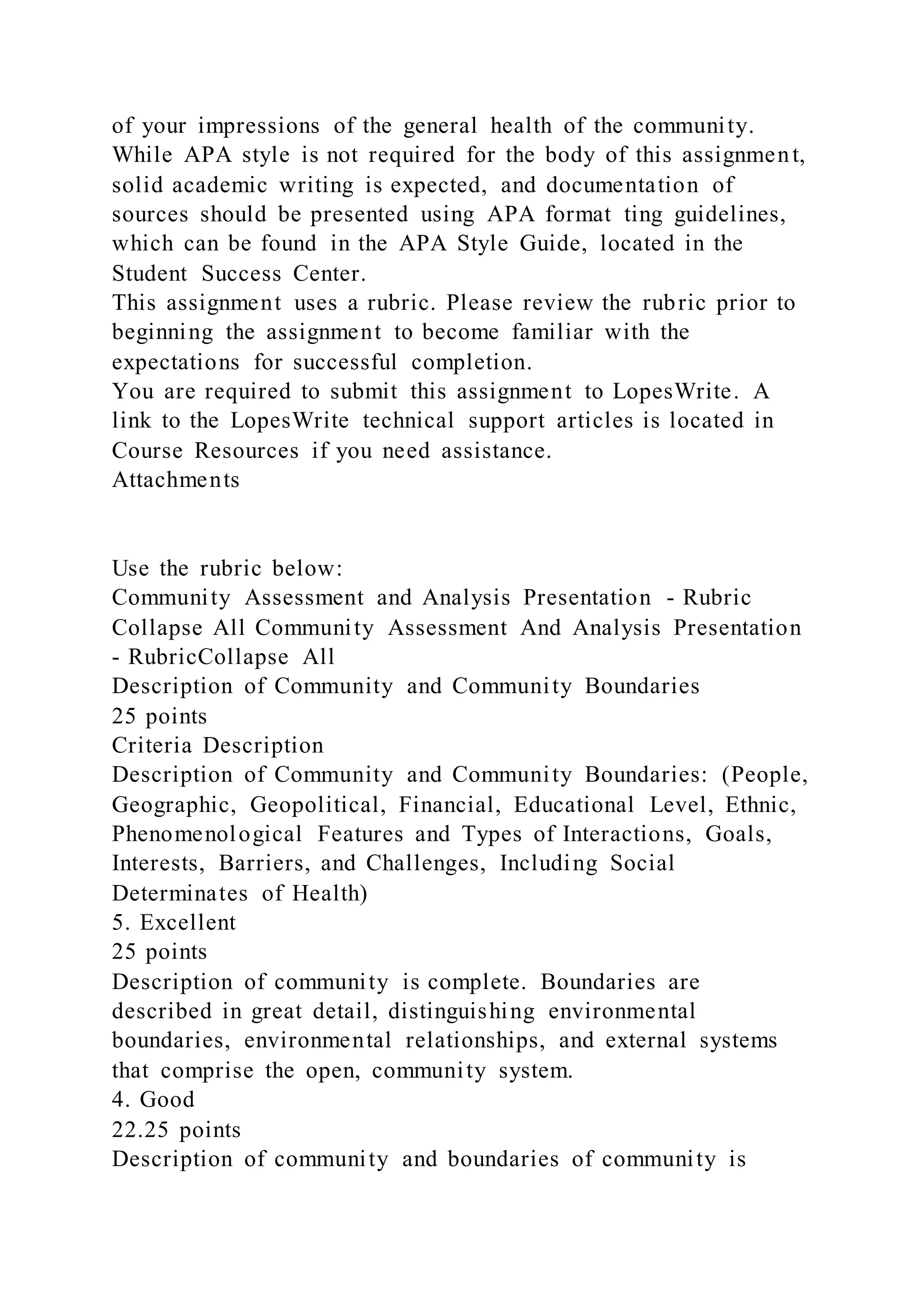
Assessment Description
The RN to BSN program meets the requirements for clinical
competencies as defined by the Commission on Collegiate
Nursing Education (CCNE) and the American Association of
Colleges of Nursing (AACN), using nontraditional experiences
for practicing nurses. These experiences come in the form of
direct and indirect care experiences in which licensed nursing
students engage in learning within the context of their hospital
organization, specific care discipline, and local communities.
This assignment consists of both an interview and a PowerPoint
(PPT) presentation.
Assessment/Interview
Select a community of interest in your region. Perform a
physical assessment of the community.
1. Perform a direct assessment of a community of interest using
the "Functional Health Patterns Community Assessment Guide."
2. Interview a community health and public health provider
regarding that person's role and experiences within the
community.
Interview Guidelines
Interviews can take place in-person, by phone, or by Skype.
Develop interview questions to gather information about the
role of the provider in the community and the health issues
faced by the chosen community.
Complete the "Provider Interview Acknowledgement Form"
prior to conducting the interview. Submit this document
separately in its respective drop box.
Compile key findings from the interview, including the
interview questions used, and submit these with the
presentation.
PowerPoint Presentation
Create a PowerPoint presentation of 15-20 slides (slide count
does not include title and references slide) describing the
chosen community interest.
Include the following in your presentation:
1. Description of community and community boundaries: the
people and the geographic, geopolitical, financial, educational
level; ethnic and phenomenological features of the community,
as well as types of social interactions; common goals and
interests; and barriers, and challenges, including any identified
social determinates of health.
2. Summary of community assessment: (a) funding sources and
(b) partnerships.
3. Summary of interview with community health/public health
provider.
4. Identification of an issue that is lacking or an opportunity for
health promotion.
5. A conclusion summarizing your key findings and a discussion
of your impressions of the general health of the community.
While APA style is not required for the body of this assignment,
solid academic writing is expected, and documentation of
sources should be presented using APA format ting guidelines,
which can be found in the APA Style Guide, located in the
Student Success Center.
This assignment uses a rubric. Please review the rubric prior to
beginning the assignment to become familiar with the
expectations for successful completion.
You are required to submit this assignment to LopesWrite. A
link to the LopesWrite technical support articles is located in
Course Resources if you need assistance.
Attachments
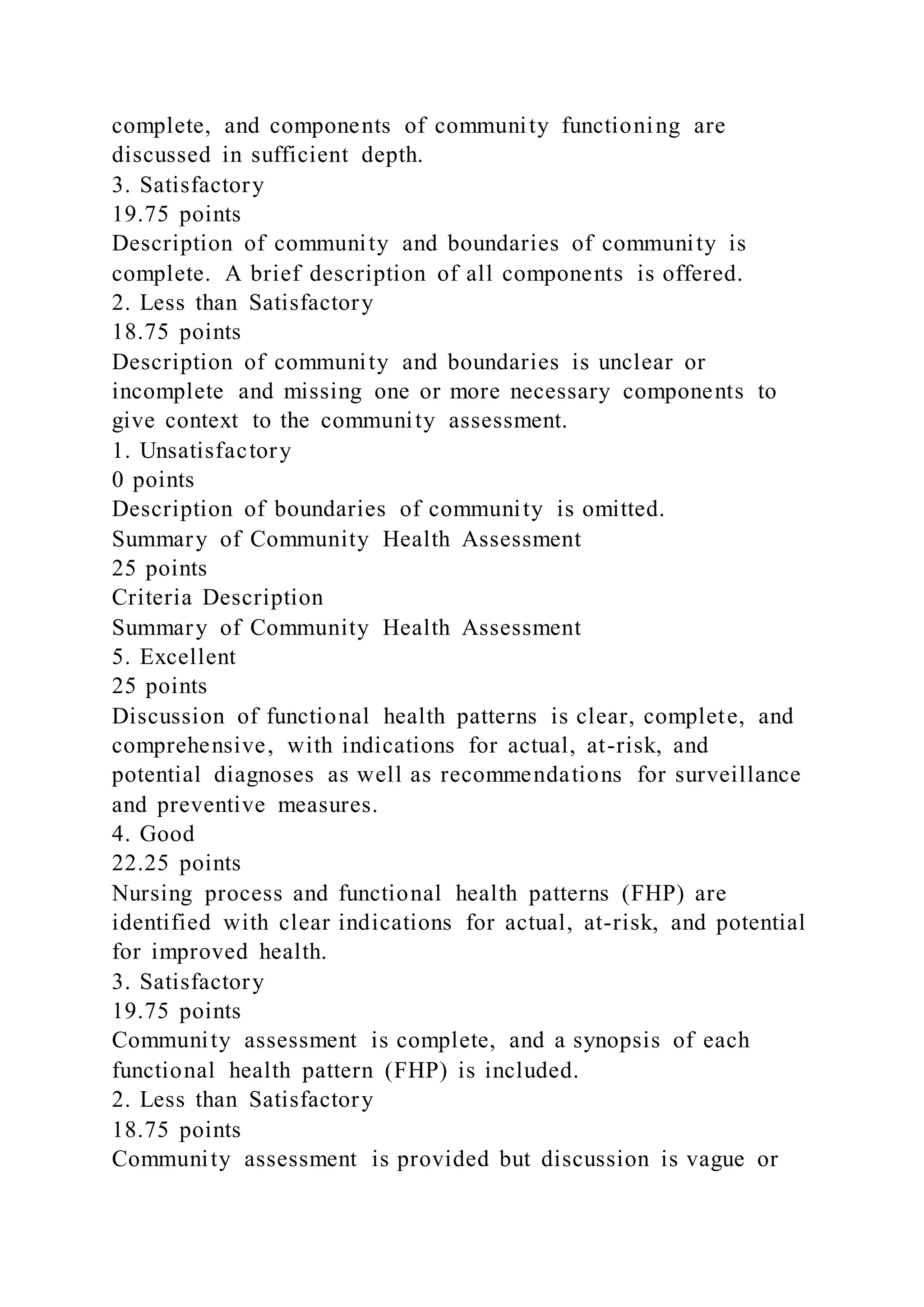
Use the rubric below:
Community Assessment and Analysis Presentation - Rubric
Collapse All Community Assessment And Analysis Presentation
- RubricCollapse All
Description of Community and Community Boundaries
25 points
Criteria Description
Description of Community and Community Boundaries: (People,
Geographic, Geopolitical, Financial, Educational Level, Ethnic,
Phenomenological Features and Types of Interactions, Goals,
Interests, Barriers, and Challenges, Including Social
Determinates of Health)
5. Excellent
25 points
Description of community is complete. Boundaries are
described in great detail, distinguishing environmental
boundaries, environmental relationships, and external systems
that comprise the open, community system.
4. Good
22.25 points
Description of community and boundaries of community is
complete, and components of community functioning are
discussed in sufficient depth.
3. Satisfactory
19.75 points
Description of community and boundaries of community is
complete. A brief description of all components is offered.
2. Less than Satisfactory
18.75 points
Description of community and boundaries is unclear or
incomplete and missing one or more necessary components to
give context to the community assessment.
1. Unsatisfactory
0 points
Description of boundaries of community is omitted.
Summary of Community Health Assessment
25 points
Criteria Description
Summary of Community Health Assessment
5. Excellent
25 points
Discussion of functional health patterns is clear, complete, and
comprehensive, with indications for actual, at-risk, and
potential diagnoses as well as recommendations for surveillance
and preventive measures.
4. Good
22.25 points
Nursing process and functional health patterns (FHP) are
identified with clear indications for actual, at-risk, and potential
for improved health.
3. Satisfactory
19.75 points
Community assessment is complete, and a synopsis of each
functional health pattern (FHP) is included.
2. Less than Satisfactory
18.75 points
Community assessment is provided but discussion is vague or
incomplete.
1. Unsatisfactory
0 points
Community assessment is omitted.
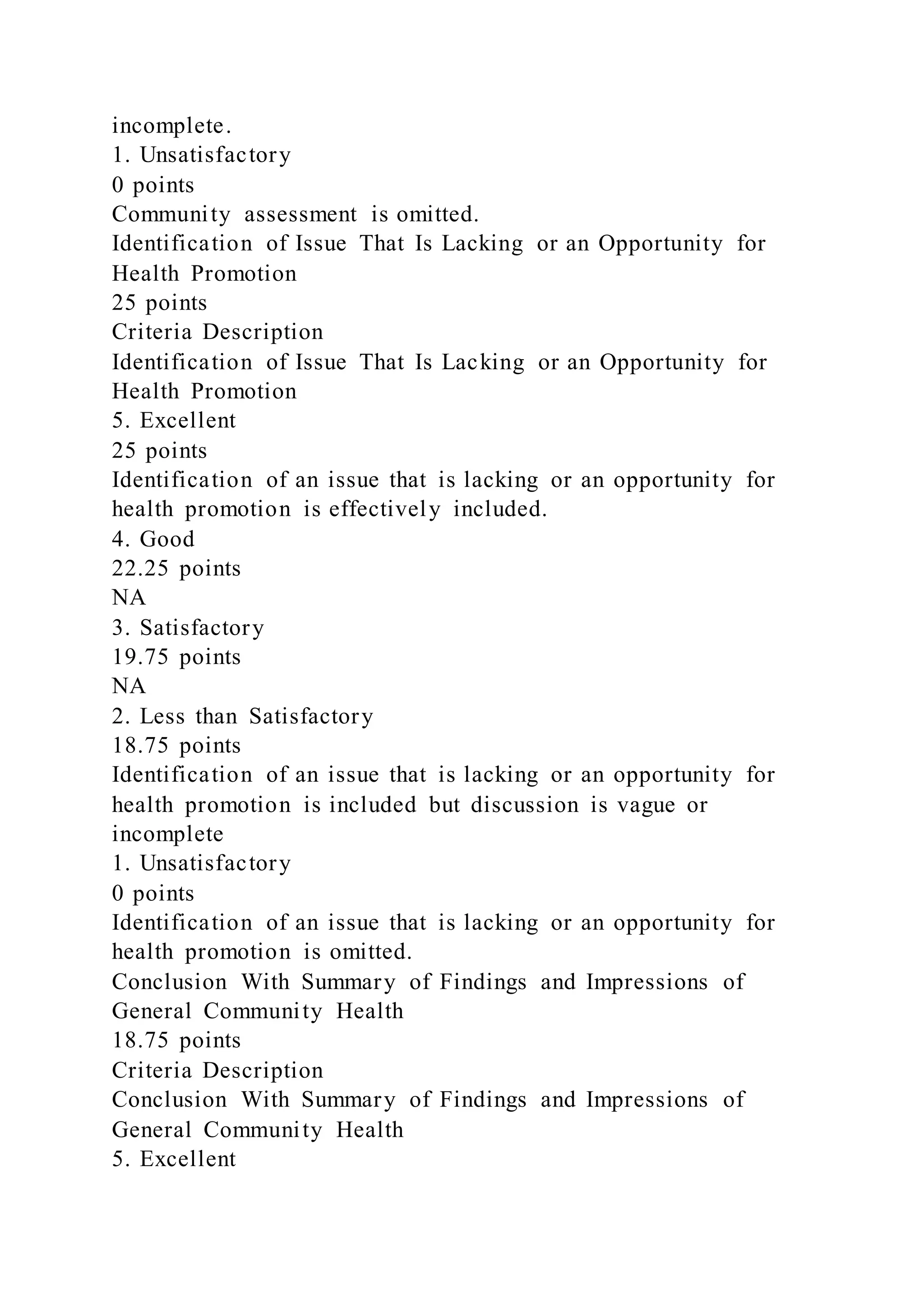
Identification of Issue That Is Lacking or an Opportunity for
Health Promotion
25 points
Criteria Description
Identification of Issue That Is Lacking or an Opportunity for
Health Promotion
5. Excellent
25 points
Identification of an issue that is lacking or an opportunity for
health promotion is effectively included.
4. Good
22.25 points
NA
3. Satisfactory
19.75 points
NA
2. Less than Satisfactory
18.75 points
Identification of an issue that is lacking or an opportunity for
health promotion is included but discussion is vague or
incomplete
1. Unsatisfactory
0 points
Identification of an issue that is lacking or an opportunity for
health promotion is omitted.
Conclusion With Summary of Findings and Impressions of
General Community Health
18.75 points
Criteria Description
Conclusion With Summary of Findings and Impressions of
General Community Health
5. Excellent
18.75 points
Conclusion is comprehensive, with a detailed summary of key
findings that explains general health of the community and
offers rationale for recommendations.
4. Good
16.69 points
Conclusion is clear, with a comprehensive discussion of
findings and general health of the community.
3. Satisfactory
14.81 points
Conclusion is complete, with general summary of findings.
2. Less than Satisfactory
14.06 points
Conclusion is incomplete or unclear.
1. Unsatisfactory
0 points
Conclusion is omitted.
Summary of Interview With Community Health/Public Health
Provider
18.75 points
Criteria Description
Summary of Interview With Community Health/Public Health
Provider
5. Excellent
18.75 points
Summary table is comprehensive, with a detailed description of
findings, as well as actual, at-risk, and potential diagnoses and
recommendations for surveillance and preventative measures.
4. Good
16.69 points
Summary table is clear, with a detailed and comprehensive
description of findings from an assessment of the chosen
community.
3. Satisfactory
14.81 points
Summary table includes all functional health patterns with
adequate documentation.
2. Less than Satisfactory
14.06 points
Summary table is incomplete or unclear.
1. Unsatisfactory
0 points
Summary table is omitted.
Layout
6.25 points
Criteria Description
Layout
5. Excellent
6.25 points
The layout is visually pleasing and contributes to the overall
message with appropriate use of headings, subheadings, and
white space. Text is appropriate in length for the target
audience and to the point. The background and colors enhance
the readability of the text.
4. Good
5.56 points
The layout background and text complement each other and
enable the content to be easily read. The fonts are easy to read
and point size varies appropriately for headings and text.
3. Satisfactory
4.94 points
The layout uses horizontal and vertical white space
appropriately. Sometimes the fonts are easy to read, but in a few
places the use of fonts, italics, bold, long paragraphs, color, or
busy background detracts and does not enhance readabi lity.
2. Less than Satisfactory
4.69 points
The layout shows some structure, but appears cluttered and busy
or distracting with large gaps of white space or a distracting
background. Overall readability is difficult due to lengthy
paragraphs, too many different fonts, dark or busy background,
overuse of bold, or lack of appropriate indentations of text.
1. Unsatisfactory
0 points
The layout is cluttered, confusing, and does not use spacing,
headings, and subheadings to enhance the readability. The text
is extremely difficult to read with long blocks of text, small
point size for fonts, and inappropriate contrasting colors. Poor
use of headings, subheadings, indentations, or bold formatting
is evident.
Language Use and Audience Awareness (includes sentence
construction, word choice, etc.)
6.25 points
Criteria Description
Language Use and Audience Awareness (includes sentence
construction, word choice, etc.)
5. Excellent
6.25 points
The writer uses a variety of sentence constructions, figures of
speech, and word choice in distinctive and creative ways that
are appropriate to purpose, discipline, and scope.
4. Good
5.56 points
The writer is clearly aware of audience, uses a variety of
appropriate vocabulary for the targeted audience, and uses
figures of speech to communicate clearly.
3. Satisfactory
4.94 points
Language is appropriate to the targeted audience for the most
part.
2. Less than Satisfactory
4.69 points
Some distracting inconsistencies in language choice (register)
or word choice are present. The writer exhibits some lack of
control in using figures of speech appropriately.
1. Unsatisfactory
0 points
Inappropriate word choice and lack of variety in language use
are evident. Writer appears to be unaware of audience. Use of
primer prose indicates writer either does not apply figures of
speech or uses them inappropriately.

Functional Health Patterns Community Assessment GuideFunctio

  • 1.
    Functional Health PatternsCommunity Assessment Guide Functional Health Pattern (FHP) Template Directions: This FHP template is to be used for organizing community assessment data in preparation for completion of the topic assignment. Address every bulleted statement in each section with data or rationale for deferral. You may also add additional bullet points if applicable to your community. Value/Belief Pattern · Predominant ethnic and cultural groups along with beliefs related to health. · Predominant spiritual beliefs in the community that may influence health. · Availability of spiritual resources within or near the community (churches/chapels, synagogues, chaplains, Bible studies, sacraments, self-help groups, support groups, etc.). · Do the community members value health promotion measures? What is the evidence that they do or do not (e.g., involvement in education, fundraising events, etc.)? · What does the community value? How is this evident? · On what do the community members spend their money? Are funds adequate? Health Perception/Management · Predominant health problems: Compare at least one health problem to a credible statistic (CDC, county, or state).
  • 2.
    · Immunization rates(age appropriate). · Appropriate death rates and causes, if applicable. · Prevention programs (dental, fire, fitness, safety, etc.): Does the community think these are sufficient? · Available health professionals, health resources within the community, and usage. · Common referrals to outside agencies. Nutrition/Metabolic · Indicators of nutrient deficiencies. · Obesity rates or percentages: Compare to CDC statisti cs. · Affordability of food/available discounts or food programs and usage (e.g., WIC, food boxes, soup kitchens, meals-on- wheels, food stamps, senior discounts, employee discounts, etc.). · Availability of water (e.g., number and quality of drinking fountains). · Fast food and junk food accessibility (vending machines). · Evidence of healthy food consumption or unhealthy food consumption (trash, long lines, observations, etc.). · Provisions for special diets, if applicable. · For schools (in addition to above): · Nutritional content of food in cafeteria and vending machines: Compare to ARS 15-242/The Arizona Nutrition Standards (or other state standards based on residence) · Amount of free or reduced lunch Elimination (Environmental Health Concerns) · Common air contaminants’ impact on the community.
  • 3.
    · Noise. · Wastedisposal. · Pest control: Is the community notified of pesticides usage? · Hygiene practices (laundry services, hand washing, etc.). · Bathrooms: Number of bathrooms; inspect for cleanliness, supplies, if possible. · Universal precaution practices of health providers, teachers, members (if applicable). · Temperature controls (e.g., within buildings, outside shade structures). · Safety (committee, security guards, crossing guards, badges, locked campuses). Activity/Exercise · Community fitness programs (gym discounts, P.E., recess, sports, access to YMCA, etc.). · Recreational facilities and usage (gym, playgrounds, bike paths, hiking trails, courts, pools, etc.). · Safety programs (rules and regulations, safety training, incentives, athletic trainers, etc.). · Injury statistics or most common injuries. · Evidence of sedentary leisure activities (amount of time watching TV, videos, and computer). · Means of transportation. Sleep/Rest · Sleep routines/hours of your community: Compare with sleep hour standards (from National Institutes of Health [NIH]). · Indicators of general “restedness” and energy levels. · Factors affecting sleep: · Shift work prevalence of community members
  • 4.
    · Environment (noise,lights, crowding, etc.) · Consumption of caffeine, nicotine, alcohol, and drugs · Homework/Extracurricular activities · Health issues Cognitive/Perceptual · Primary language: Is this a communication barrier? · Educational levels: For geopolitical communities, use http://www.census.gov and compare the city in which your community belongs with the national statistics. · Opportunities/Programs: · Educational offerings (in-services, continuing education, GED, etc.) · Educational mandates (yearly in-services, continuing education, English learners, etc.) · Special education programs (e.g., learning disabled, emotionally disabled, physically disabled, and gifted) · Library or computer/Internet resources and usage. · Funding resources (tuition reimbursement, scholarships, etc.). Self-Perception/Self-Concept · Age levels.
  • 5.
    · Programs andactivities related to community building (strengthening the community). · Community history. · Pride indicators: Self-esteem or caring behaviors. · Published description (pamphlets, Web sites, etc.). Role/Relationship · Interaction of community members (e.g., friendliness, openness, bullying, prejudices, etc.). · Vulnerable populations: · Why are they vulnerable? · How does this impact health? · Power groups (church council, student council, administration, PTA, and gangs): · How do they hold power? · Positive or negative influence on community? · Harassment policies/discrimination policies. · Relationship with broader community: · Police · Fire/EMS (response time) · Other (food drives, blood drives, missions, etc.) Sexuality/Reproductive · Relationships and behavior among community members. · Educational offerings/programs (e.g., growth and development, STD/AIDS education, contraception, abstinence, etc.). · Access to birth control.
  • 6.
    · Birth rates,abortions, and miscarriages (if applicable). · Access to maternal child health programs and services (crisis pregnancy center, support groups, prenatal care, maternity leave, etc.). Coping/Stress · Delinquency/violence issues. · Crime issues/indicators. · Poverty issues/indicators. · CPS or APS abuse referrals: Compare with previous years. · Drug abuse rates, alcohol use, and abuse: Compare with previous years. · Stressors. · Stress management resources (e.g., hotlines, support groups, etc.). · Prevalent mental health issues/concerns: · How does the community deal with mental health issues · Mental health professionals within community and usage · Disaster planning: · Past disasters · Drills (what, how often) · Planning committee (members, roles) · Policies · Crisis intervention plan
  • 7.
    PAGE © 2011. GrandCanyon University. All Rights Reserved. 1 2Week 3 Strategic Management and Strategic Competitiveness Assignment In this Lynn Williams Strayer University BUS499 Business Administration Capstone Professor Joseph Keller January 18, 2022 Week 3 Strategic Management and Strategic Competitiveness Assignment In this assignment, I will explore Coca-Cola Corporation's competitiveness and strategic management. The assignment will involve examining how technological changes and globalization affect the Coca-Cola Company by applying both resource-based and industrial-organizational models to identify ways the company may be able to earn above-average returns. Next, I will discuss the impact of the Coca-Cola Company's vision and mission statement on its overall success. In my final analysis, I will examine how each stakeholder group impacts the organization.Globalization Globalization is global growth, and it has affected nearly every aspect of firms competing against each other in the twenty-first century. These advancements can be attributed to data, goods and services, integrating consumers, and domestic markets. The increase and vicissitudes in globalization have allowed companies to maximize profitability and upsurge their market
  • 8.
    share, and inorder to position themselves successfully in the global marketplace, companies must understand the global economy well (Hitt,2020, 1). Atlanta pharmacist John Stith Pemberton came up with Coca-Cola in 1886 when he combined syrup with carbonated water. Designed and named by Frank Robinson, his bookkeeper, the drink has become a world- renowned soft drink (Myers,2020,2). Coca-Cola is recognized worldwide as the leading beverage brand. Growing rapidly, this company is also the largest beverage company globally. Since the 1920s, the company has evolved into a global network that brings joy to hundreds of millions of thirsty people every day. Today, the Coca-Cola system operates in more than 200 countries and produces practically 450 beverage brands, enabling millions of people every day to refresh themselves with a nice cold Coke. As Coca- Cola continues to expand its global presence and become more admired, it remains deeply committed to creating the world's most revered trademark (A Global Business, 2011). Technology Technology has made the company's operations more efficient, particularly in sales, production, and distribution. When it comes to using technology to innovate, other businesses could take a page from Coca-Cola's book. The company constantly innovates, rebrands, advertises, and adopts new technologies to enhance its brand and present itself according to the latest worldwide trends and fads. The first freestyle dispensers were introduced by Coca-Cola in late 2010 and early 2011. As opposed to conventional soda fountains, freestyle dispensers allow consumers to create their own beverage mixture by choosing from a wide range of drink options. With its computer- like interface, freestyle dispenser technology provides a greater variety of drinks, records consumers' preferences, and sends that information back to Coca-Cola as market research (K. Ireland, 3). Coca-Cola's innovative management system elevates the brand to the forefront of brand management by focusing on technological advances. There is no doubt that Coca-Cola has
  • 9.
    gained the trustand recognition of consumers. Throughout their history, they have introduced niche-specific beverages and have met and exceeded the demands of their customers.Industrial Organization Model Utilizing the industrial-based model, Coca-Cola will be able to generate above-average returns. In its form, the industrial-based model provides a picture of the business' external environment by illustrating how certain competitive factors affect the business' strategic direction (Hitt, 2020). Considering the public information that is available, Coca-Cola can access its major competitors, Dr. Pepper, Snapple, Nestle, and PepsiCo, based on the industry public information. Using the SEC's Filings & Forms database and analyzing these companies, it can be determined if they pose a threat to our brand's reputation. This information will also allow Coca-Cola to formulate strategies that will maximize above-average returns while maintaining a competitive edge within its external environment. These strategies could include introducing new products to enhance its existing brands, as well as improving competitive advertising tactics to attract larger target markets and audiences. The brand could also introduce new packaging and upscale dispenser devices (Shwetha Gowri Nagaraj, 5). Such tactics would place competitors under pressure to improve their offerings as well.Resource-Based Model The resource-based model embraces the internal environment of the business. This model summarizes the business's strengths and weaknesses and identifies how it can earn above-average returns using its internal structures. Coca-Cola is the beverage industry's most recognizable brand. It has a global market presence, superior brand power, and a robust market share, as well as a loyal customer base; however, it has its weaknesses. It contains a lot of sugars and carbohydrates, which are detrimental to an individual's health. According to a large number of health experts, sugar consumption poses a significant health risk to adults and children alike. The Coca-Cola brand is powerful, so its product variants should also be marketed and
  • 10.
    introduced to themarket. These might include sugar-free snacks, beverages, or other products. This will allow Coca-Cola to gain market shares, improve its appeal to the health- conscious, earn above-average returns as well as continue on its path to becoming more sustainable in the future. (Shwetha Gowri Nagaraj, 5).Vision Vision statements describe what a company aspires to achieve, which provides meaning and significance to its existence. Coca- Cola's business operations reflect its vision and mission statements; the brand still adheres to its statements after more than 120 years in business. In its vision statement, "Our vision is to craft the brands and choice of drinks that people love, to refresh them in body & spirit" (Coca-Cola,2022,6). Coca-Cola refers to the brand as a catalyst for change and development both inside and outside the beverage industry. During this process, the company transformed its business practices in order to become socially responsible and environmentally sustainable so that it can benefit and impact its employees, as well as the community. While simultaneously enhancing its brand recognition for the future, Coca-Cola leads the industry in innovation, strategic and management competitiveness, design, and marketing excellence, making its brand loved by consumers. In addition to establishing leadership across brands, Coca-Cola develops strong business alliances locally and globally to create opportunities for people and communities. It is these initiatives that contribute to the strength of its brand worldwide (Coca- Cola,2022,6).Mission Coca-Cola's mission specifies three essential elements; Refresh the World to Make a Difference and, at the same time, Spread Optimism and Happiness. Throughout the history of Coca-Cola, it has been defined as a beverage to refresh the world. As part of its sustainable business, it aims to refresh the body, mind, and spirit through its products. It is Coca-Cola's commitment to make a difference by working together to create a better future for humanity, communities, and the world as a whole. Through their operations, Coca-Cola promotes optimism and happiness
  • 11.
    over time. Today,Coca-Cola is recognized as a universal symbol of happiness. As long as the brand continues to exist, it will never cease to offer refreshing products that are refreshing, inspire optimism, and spread happiness to all of its loyal customers. (The Coca-Cola,2022,6).Stakeholders A company's stakeholder participation is crucial to its success, and companies rely heavily on them since they facilitate its advancement, achieving their goals and objectives, and ensuring survival and success. Coca-Cola has a number of stakeholders in both its local and global operations. Among them are the company's management team and staff, who are responsible for the organization's daily operations. Employees in the production areas are included. They are also accountable for complying with all rules and regulations when going about their daily activities by prioritizing productivity, safety, and security. Customers, restaurants, and small businesses are also stakeholders. These entities are combined in the community and business world. They are people and companies to whom Coca- Cola has provided good quality products, benefits, and assistance with customers' needs. Additionally, Coca-Cola's suppliers are stakeholders as well, contributing to the company's growth by helping it meet its objectives, succeed in the marketplace, and deliver high-quality products and services (Coca-Cola Company, 7). Conclusion In conclusion, strategic management and competitiveness have become universal concepts, where businesses constantly strive to differentiate themselves in the marketplace, and technology is advancing at an accelerating rate. We are living in a challenging economic time, and it is critical for organizations to have strategic management and competitiveness processes in order to successfully compete in a global market. Sources 1. Michael A. Hitt. 2020. Strategic Management: Concepts and Cases: Competitiveness and Globalization 13th ed. Cengage Learning.
  • 12.
    2. Myers, A.(2020). Coca-Cola Company. Salem Press Encyclopedia. 3. The Coca-Cola Company (2012, December 13). A Chronical of Coca-Cola: A Global Business Retrieved, from https://www.coca-colacompany.com/news/the-chronicle-of- coca-cola-a-global-business 4. Kay Ireland. No date. Does Coca-Cola Use Technology to Gain an Advantage? https://smallbusiness.chron.com/cocacola- use-technology-gain-advantage-27339.html. 5. Shwetha Gowri Najaraj. No date. The Coca-Cola Company’s Competitive Strategies. https://medium.com/@shwethagowri/coca-cola- competitive-strategies-6af18bb70d6f. 6. The Coca-Cola Company. Analysis of Coca-Cola Mission, Vision & Values 2022. https://visionarybusinessperson.com/coca-cola/. 7. The Coca-Cola Company. No date. Who Are Your Partners on Sustainability 2022? https://www.coca- colacompany.com/faqs/who-are-your-partners-on-sustainability. 1 Figures title: 7Week 8 Business-Level and Corporate-Level Strategies Assignment Lynn Williams BUS499 Business Administration Capstone Dr. Joseph Keller February 23,2022 Week 8 Business-Level and Corporate-Level Strategies Assignment
  • 13.
    Coca-Cola is anAmerican international corporation and the world's biggest beverage producer and supplier. Its portfolio includes 3500 goods sold under 500 distinct brand names and it functions in 200 nations and serves more than 1.8 billion people every day (Coca-Cola, 2022,1). Apart from competitiveness, the company has substantial challenges, such as health issues, which have shifted consumer preferences toward healthier products. To overcome the obstacles inherent in today's business world, the company has implemented a variety of tactics, including corporate-level and business-level approaches, in order to maintain its market position. This paper explains an analysis of all business and corporate approaches and identifies those which are most efficient and includes Coca-Cola's primary competition, Pepsi, to determine if it can outperform the latter.Business-Level Strategies Since its founding in 1886, the firm has worked hard to distinguish its products from those of its competitors around the world in order to give customers with distinctive and high- quality items. For example, its top goods, such as Coca-Cola, Sprite as well as Fanta, are produced under precisely and strictly controlled formula, which have distinguished them as distinctive and refreshing, attracting a large number of consumers around the world. Apart from that, distinction can be observed in other corporate processes like marketing (Banks, 2016,2). Marketing efforts and labeling for the company have always been distinctive. In addition, it always comes in a variety of bottle forms to choose from. It is essential to note that the company is constantly introducing new varieties of its old items, allowing customers to choose from a selection of enhanced tastes for their products. Low-cost leadership approach is employed by the organization to ensure that it provides high-quality items at a low and affordable cost. In order to maintain a healthy profit margin and acquire a competitive edge, the Coca-Cola business has concentrated its efforts for many years on managing its administrative and marketing expenses. Research and
  • 14.
    development, producing, aswell as promotional efforts have all contributed to Coca-Cola’s ability to spend the bare minimum of funds in the manufacturing method, allowing them to sell products at a cheaper cost than its rivals (Najaf, Najaf & Shah, 2017,3). The corporation has managed to retain a high degree of standardization, allowing it to maintain firm control over the production of its manufacturing operation, packaging, and marketing, allowing it to flourish comfortably in today's hard corporate environment while having a diverse product range. Based on an examination of the three business-level approaches of differentiation, low-cost leadership, as well as focus strategy, we may draw certain conclusions. Differentiation, in my view, will continue to be the most excellent method in the near future and into the future. As a matter of fact, Coca-Cola products are renowned throughout the world for their distinctiveness. Take, for instance, Coca-Cola, the world's most popular beverage, which is renowned for the distinct flavor of its goods and the value proposition that goes with it (Najaf, Najaf & Shah, 2017,3). In the long term, if the company continues to provide unique products by experimenting with different flavors and developing new items with a distinct taste, the company will distinguish itself from its rivals and obtain a competitive advantage over the competition. market leading position in the international beverage business, which is critical to notably, if the changes are relevant and follow the consumer goods Coca- Cola will remain to be ahead of the competition.Corporate- Level Strategies . To achieve its growth objectives, the corporation has implemented a variety of growth techniques, including horizontal and growth strategies. A horizontal expansion strategy, for example, is used when the company plans to reach new and overseas markets. As a consequence, the organization now operates in 200 countries over six different geographic zones. Apart from that, the company has worked hard to develop and enhance its distribution model in a variety of potential markets by pouring large sums of money into its supply chain in
  • 15.
    order to increaseits vertical growth by allowing it to regulate the processing and marketing expenses in order to support expansion into new geographical areas (Najaf, Najaf & Shah, 2017,3). In order to create a diverse market mix, the corporation implements a diversification strategy. When the company first started out, it was a soft drink maker. Over the years, the corporation has ventured into new sectors like mineral water, fruit juice, soda, coffee, and tea, to name just a few. These efforts have enabled the organization to more successfully compete in the global marketplace against other leading beverage brands. The Coca-Cola Corporation has used stability methods on a number of different times. Stability strategies entail undertaking measures that assist the organization to avoid incurring losses and hence prevent going out of business. For example, Coca- Cola has suspended the operations of some of its subsidiaries during periods of severe economic conditions or due to internal problems (Banks, 2016,2). When some growth tactics are deemed unworkable, they may be fully abandoned or temporarily suspended. These initiatives have allowed the company to avoid incurring a monetary loss as a result of participating in financially unviable ventures. The company applies the retrenchment approaches to affiliates or business divisions that are underperforming financially. This includes a variety of operations such as budget reductions in manufacturing, research and development, as well as marketing, among others. This is typically done in order to avoid losses in regions where the firm is not performing well. When the scenario does not appear to be improving, the corporation may choose to entirely cease operations and sell the business entity to other parties who are interested in purchasing the business. The business strategy is the most significant strategy since it is the strategy that drives growth. There are yet more markets to be discovered. Consequently, if the corporation strengthens its distribution network and achieves vertical growth in a variety of different areas of the globe, it will be able to expand the number
  • 16.
    of markets whereit can sell the goods, thereby strengthening its market position in the highly competitive global drinks industry (Najaf, Najaf & Shah, 2017,3). Growth strategies are the only way to achieve continuous progress in company operations, business network, as well as product quality and reliability. Aside from that, the diversification component of the growth plan will ensure that the firm has a market mix by delivering items that support the major corporate brands in cases when they are underperforming in a particular market.Competitive Environment The beverage sector is extremely competitive on a global scale. Presently, there are a number of small to large scale businesses that provide a wide range of products. For example, the Pepsi corporation, which has enjoyed enormous development in recent years and is the second most wanted brand in the beverage market, with its Pepsi cola operating relatively well, is the toughest rival in this specific industry. The Pepsi Corporation was formed in New York City, US in 1965. It is involved in the manufacture of nonalcoholic drinks as well as food processing products. Note that Pepsi is a largest multinational manufacturer of foods and beverages as well as snacks, which is important to remember. PepsiCo and PepsiCo International were the names of the two units that used to function within the company. Pepsi's primary priority has been on quality; this is one of the business aspects that PepsiCo has emphasized. Its primary commitment has been to safeguard and attract clients. That is why they notify their consumers about the criteria that apply to all PepsiCo products (Kayaba, Boyraz, & Derdiyok, 2017,4). They place quality assurance labels on them to increase trust. Additionally, it adheres to environmental standards in order to avoid running afoul of the government. PepsiCo's promotional technique has offered a substantial challenge to Coca-Cola in recent years (Kayabao, Boyraz, & Derdiyok, 2017,4). It communicates with clients about its brand portfolio through a variety of celebrity figures, music, and games in order to appeal to the younger generation, which is
  • 17.
    getting more interestedin carbonated beverages than the older generations. Additionally, it promotes their products using the internet, other digital channels such as social media, and sponsorships. Customers have been more health concerned in recent years. This transition poses a hazard since it makes consumers choosy, as they carefully consider the health implications of things prior to purchasing. As a result, coke has ramped up and begun producing coke without sugar for individuals who have sugar-related health concerns, thereby increasing market share. PepsiCo, like Coca-Cola, has expanded its product line beyond carbonated beverages to include snacks. Its snack offerings have seen significant growth in recent years, assisting the company in increasing its income. Some analysts believe that the company's expansion into the snack business will provide it with an additional source of competitive edge over its rival Coca-Cola in the future. For example, the corporation's success in the snack market is something that the Coca-Cola Corporation has struggled to emulate and compete with (Coca- Cola, 2022,1). Pepsi's competitive advantage, gained as a consequence of its snack business, along with the organization's growth in the water sector, will continue to aid the firm's productivity and speed into the future.Market Cycles The competition between the two will intensify in the first cycle market, however Coke will still lead the way, since first cycle markets are extremely competitive. Companies that want to thrive must constantly invent new goods and also come up with methods that will allow them to outperform their competition and survive. Because of Coca-Cola's inventive nature, the corporation will continue to thrive and maintain its competiti ve advantage against Pepsi. The volatility of the market means that a corporation cannot rely on a single set of resources (Hitt, Ireland, & Hoskisson, 2020,5). The needs of consumers are continuously altering, and businesses that want to succeed must go out of their way to detect gaps and emerging trends, and then incorporate these into their goods or services to stay
  • 18.
    competitive. As aresult, the Pepsi Corporation will maintain its competitiveness by diversification and timely responses to consumer changes, ensuring that it remains a formidable competitor against Coca-Cola. The performance will not change even in a slow market. In summary, despite severe competition from other well-established organizations such as PepsiCo, the Coca-Cola Corporation will always be the leader in the beverage sector. Its differentiation approach always leads in the creation of one-of-a-kind products. Coca-Cola, for example, has addressed the high sugar complaints in its beverages raised by specific consumers by developing a cola that contains no sugar at all. That the organization is responding positively to consumer awareness of healthy products is evidenced by the fact that they have maintained their momentum and will continue to be a trusted brand by many consumers in the future. On the contrary, his nearest competitor, Pepsi Co., has expanded its product line by entering the snack business, which has been well received by customers, allowing it to achieve a competitive edge over Coca-Cola in the process. Coca-Cola, on the other hand, will always be able to keep ahead of the competition because of its large range of goods and its well - known brand name. Sources 1. The Coca-Cola Company (2022). https://www.coca- colacompany.com/packages/brands 2. Banks, Hamish, 2016. "The Business of Peace: Coca-Cola's contribution to Stability, Growth, and Optimism," Business Horizons, Elsevier, vol. 59(5), pages 455-461. 3. Kayaba, T. D., Boyraz, G., & Derdiyok, R. (2017). Examining Coca-Cola and Pepsi Brands under the Basis of
  • 19.
    Globalization and MultinationalCompanies. International Journal of Academic Research in Business and Social Sciences. Vol.7, No.12, pgs. 351-358. 4. Najaf, R., Najaf, K., & Shah, I. H. (2017). Strategic Alliances for International Business and Global Competition. International Journal of Information, Business and Management; Chung-Li Vol. 9, Iss. 3, pgs. 131-146. 5. Michael A. Hitt. 2020. Strategic Management: Concepts and Cases: Competitiveness and Globalization 13th ed. Cengage Learning. 1 Figures title: 7Week 8 Business-Level and Corporate-Level Strategies Assignment Lynn Williams BUS499 Business Administration Capstone Dr. Joseph Keller February 23,2022 Week 8 Business-Level and Corporate-Level Strategies Assignment Coca-Cola is an American international corporation and the world's biggest beverage producer and supplier. Its portfolio includes 3500 goods sold under 500 distinct brand names and it functions in 200 nations and serves more than 1.8 billion people every day (Coca-Cola, 2022,1). Apart from competitiveness, the company has substantial challenges, such as health issues,
  • 20.
    which have shiftedconsumer preferences toward healthier products. To overcome the obstacles inherent in today's business world, the company has implemented a variety of tactics, including corporate-level and business-level approaches, in order to maintain its market position. This paper explains an analysis of all business and corporate approaches and identifies those which are most efficient and includes Coca-Cola's primary competition, Pepsi, to determine if it can outperform the latter.Business-Level Strategies Since its founding in 1886, the firm has worked hard to distinguish its products from those of its competitors around the world in order to give customers with distinctive and high- quality items. For example, its top goods, such as Coca-Cola, Sprite as well as Fanta, are produced under precisely and strictly controlled formula, which have distinguished them as distinctive and refreshing, attracting a large number of consumers around the world. Apart from that, distinction can be observed in other corporate processes like marketing (Banks, 2016,2). Marketing efforts and labeling for the company have always been distinctive. In addition, it always comes in a variety of bottle forms to choose from. It is essential to note that the company is constantly introducing new varieties of its old items, allowing customers to choose from a selection of enhanced tastes for their products. Low-cost leadership approach is employed by the organization to ensure that it provides high-quality items at a low and affordable cost. In order to maintain a healthy profit margin and acquire a competitive edge, the Coca-Cola business has concentrated its efforts for many years on managing its administrative and marketing expenses. Research and development, producing, as well as promotional efforts have all contributed to Coca-Cola’s ability to spend the bare minimum of funds in the manufacturing method, allowing them to sell products at a cheaper cost than its rivals (Najaf, Najaf & Shah, 2017,3). The corporation has managed to retain a high degree of standardization, allowing it to maintain firm control over the
  • 21.
    production of itsmanufacturing operation, packaging, and marketing, allowing it to flourish comfortably in today's hard corporate environment while having a diverse product range. Based on an examination of the three business-level approaches of differentiation, low-cost leadership, as well as focus strategy, we may draw certain conclusions. Differentiation, in my view, will continue to be the most excellent method in the near future and into the future. As a matter of fact, Coca-Cola products are renowned throughout the world for their distinctiveness. Take, for instance, Coca-Cola, the world's most popular beverage, which is renowned for the distinct flavor of its goods and the value proposition that goes with it (Najaf, Najaf & Shah, 2017,3). In the long term, if the company continues to provide unique products by experimenting with different flavors and developing new items with a distinct taste, the company will distinguish itself from its rivals and obtain a competitive advantage over the competition. market leading position in the international beverage business, which is critical to notably, if the changes are relevant and follow the consumer goods Coca- Cola will remain to be ahead of the competition.Corporate- Level Strategies . To achieve its growth objectives, the corporation has implemented a variety of growth techniques, including horizontal and growth strategies. A horizontal expansion strategy, for example, is used when the company plans to reach new and overseas markets. As a consequence, the organization now operates in 200 countries over six different geographic zones. Apart from that, the company has worked hard to develop and enhance its distribution model in a variety of potential markets by pouring large sums of money into its supply chain in order to increase its vertical growth by allowing it to regulate the processing and marketing expenses in order to support expansion into new geographical areas (Najaf, Najaf & Shah, 2017,3). In order to create a diverse market mix, the corporation implements a diversification strategy. When the company first started out, it was a soft drink maker. Over the years, the
  • 22.
    corporation has venturedinto new sectors like mineral water, fruit juice, soda, coffee, and tea, to name just a few. These efforts have enabled the organization to more successfully compete in the global marketplace against other leading beverage brands. The Coca-Cola Corporation has used stability methods on a number of different times. Stability strategies entail undertaking measures that assist the organization to avoid incurring losses and hence prevent going out of business. For example, Coca- Cola has suspended the operations of some of its subsidiaries during periods of severe economic conditions or due to internal problems (Banks, 2016,2). When some growth tactics are deemed unworkable, they may be fully abandoned or temporarily suspended. These initiatives have allowed the company to avoid incurring a monetary loss as a result of participating in financially unviable ventures. The company applies the retrenchment approaches to affiliates or business divisions that are underperforming financially. This includes a variety of operations such as budget reductions in manufacturing, research and development, as well as marketing, among others. This is typically done in order to avoid losses in regions where the firm is not performing well. When the scenario does not appear to be improving, the corporation may choose to entirely cease operations and sell the business entity to other parties who are interested in purchasing the business. The business strategy is the most significant strategy since it is the strategy that drives growth. There are yet more markets to be discovered. Consequently, if the corporation strengthens its distribution network and achieves vertical growth in a variety of different areas of the globe, it will be able to expand the number of markets where it can sell the goods, thereby strengthening its market position in the highly competitive global drinks industry (Najaf, Najaf & Shah, 2017,3). Growth strategies are the only way to achieve continuous progress in company operations, business network, as well as product quality and reliability. Aside from that, the diversification component of the growth
  • 23.
    plan will ensurethat the firm has a market mix by delivering items that support the major corporate brands in cases when they are underperforming in a particular market.Competitive Environment The beverage sector is extremely competitive on a global scale. Presently, there are a number of small to large scale businesses that provide a wide range of products. For example, the Pepsi corporation, which has enjoyed enormous development in recent years and is the second most wanted brand in the beverage market, with its Pepsi cola operating relatively well, is the toughest rival in this specific industry. The Pepsi Corporation was formed in New York City, US in 1965. It is involved in the manufacture of nonalcoholic drinks as well as food processing products. Note that Pepsi is a largest multinational manufacturer of foods and beverages as well as snacks, which is important to remember. PepsiCo and PepsiCo International were the names of the two units that used to function within the company. Pepsi's primary priority has been on quality; this is one of the business aspects that PepsiCo has emphasized. Its primary commitment has been to safeguard and attract clients. That is why they notify their consumers about the criteria that apply to all PepsiCo products (Kayaba, Boyraz, & Derdiyok, 2017,4). They place quality assurance labels on them to increase trust. Additionally, it adheres to environmental standards in order to avoid running afoul of the government. PepsiCo's promotional technique has offered a substantial challenge to Coca-Cola in recent years (Kayabao, Boyraz, & Derdiyok, 2017,4). It communicates with clients about its brand portfolio through a variety of celebrity figures, music, and games in order to appeal to the younger generation, which is getting more interested in carbonated beverages than the older generations. Additionally, it promotes their products using the internet, other digital channels such as social media, and sponsorships. Customers have been more health concerned in recent years. This transition poses a hazard since it makes consumers choosy, as they carefully consider the health
  • 24.
    implications of thingsprior to purchasing. As a result, coke has ramped up and begun producing coke without sugar for individuals who have sugar-related health concerns, thereby increasing market share. PepsiCo, like Coca-Cola, has expanded its product line beyond carbonated beverages to include snacks. Its snack offerings have seen significant growth in recent years, assisting the company in increasing its income. Some analysts believe that the company's expansion into the snack business will provide it with an additional source of competitive edge over its rival Coca-Cola in the future. For example, the corporation's success in the snack market is something that the Coca-Cola Corporation has struggled to emulate and compete with (Coca- Cola, 2022,1). Pepsi's competitive advantage, gained as a consequence of its snack business, along with the organization's growth in the water sector, will continue to aid the firm's productivity and speed into the future.Market Cycles The competition between the two will intensify in the first cycle market, however Coke will still lead the way, since first cycle markets are extremely competitive. Companies that want to thrive must constantly invent new goods and also come up with methods that will allow them to outperform their competition and survive. Because of Coca-Cola's inventive nature, the corporation will continue to thrive and maintain its competitive advantage against Pepsi. The volatility of the market means that a corporation cannot rely on a single set of resources (Hi tt, Ireland, & Hoskisson, 2020,5). The needs of consumers are continuously altering, and businesses that want to succeed must go out of their way to detect gaps and emerging trends, and then incorporate these into their goods or services to stay competitive. As a result, the Pepsi Corporation will maintain its competitiveness by diversification and timely responses to consumer changes, ensuring that it remains a formidable competitor against Coca-Cola. The performance will not change even in a slow market. In summary, despite severe competition from other well-established organizations such as PepsiCo, the
  • 25.
    Coca-Cola Corporation willalways be the leader in the beverage sector. Its differentiation approach always leads in the creation of one-of-a-kind products. Coca-Cola, for example, has addressed the high sugar complaints in its beverages raised by specific consumers by developing a cola that contains no sugar at all. That the organization is responding positively to consumer awareness of healthy products is evidenced by the fact that they have maintained their momentum and will continue to be a trusted brand by many consumers in the future. On the contrary, his nearest competitor, Pepsi Co., has expanded its product line by entering the snack business, which has been well received by customers, allowing it to achieve a competitive edge over Coca-Cola in the process. Coca-Cola, on the other hand, will always be able to keep ahead of the competition because of its large range of goods and its well - known brand name. Sources 1. The Coca-Cola Company (2022). https://www.coca- colacompany.com/packages/brands 2. Banks, Hamish, 2016. "The Business of Peace: Coca-Cola's contribution to Stability, Growth, and Optimism," Business Horizons, Elsevier, vol. 59(5), pages 455-461. 3. Kayaba, T. D., Boyraz, G., & Derdiyok, R. (2017). Examining Coca-Cola and Pepsi Brands under the Basis of Globalization and Multinational Companies. International Journal of Academic Research in Business and Social Sciences. Vol.7, No.12, pgs. 351-358. 4. Najaf, R., Najaf, K., & Shah, I. H. (2017). Strategic Alliances for International Business and Global Competition. International Journal of Information, Business and Management;
  • 26.
    Chung-Li Vol. 9,Iss. 3, pgs. 131-146. 5. Michael A. Hitt. 2020. Strategic Management: Concepts and Cases: Competitiveness and Globalization 13th ed. Cengage Learning. BUS499 Capstone Week 10 Assignment Insert Student’s Name Here Insert what you would said to introduce yourself to your executive audience and tell them what you are going to cover in your presentation Do Not type every word you plan to say on the slide. Use bullet points only. Everything you would say if you were giving a live presentation should be provided in text form in the speaker notes section of
  • 27.
    each slide. 1 SWOT Analysisof Company NameStrengths Insert a bullet or two describing strengths of the firmWeaknesses Insert a bullet or two describing weaknesses of the firmOpportunities Insert a bullet or two describing opportuni ties available to the firmThreats Insert a bullet or two describing threats to the firm Insert exactly what you would say to your executive audience to describe each bullet point on this slide You should thoroughly outline a strategy for the company to capitalize on its strengths and opportunities. 2 SWOT Analysis Strategy Strengths and Opportunities Insert a bullet describing the strategy to capitalize on strengths and opportunities Insert another bullet describing the strategy to capitalize on strengths and opportunities
  • 28.
    Insert exactly whatyou would say to your executive audience to describe each bullet point on this slide You should thoroughly outline a strategy for the company to capitalize on its strengths and opportunities. 3 SWOT Analysis Strategy Weaknesses and Threats Insert a bullet describing the strategy to minimize weaknesses and threats Insert another bullet describing the strategy to minimize weaknesses and threats Insert exactly what you would say to your executive audience to describe each bullet point on this slide You should thoroughly outline a strategy for the company to minimize its weaknesses and threats. 4 Competitiveness Strategy Competitiveness 1st bullet point of levels and types of strategies to maximize
  • 29.
    competitiveness 2nd bullet pointof levels and types of strategies to maximize competitiveness Insert exactly what you would say to your executive audience to describe each bullet point on this slide You should thoroughly discuss the various levels and types of strategies the firm may use to maximize its competitiveness. 5 Profitability Strategy Profitability 1st bullet point of levels and types of strategies to maximize profitability 2nd bullet point of levels and types of strategies to maximize profitability Insert exactly what you would say to your executive audience to describe each bullet point on this slide
  • 30.
    You should thoroughlydiscuss the various levels and types of strategies the firm may use to maximize its profitability. 6 Communications Plan Competitiveness Strategies 1st bullet point on the plan to communicate the competitiveness strategies to stakeholders 2nd bullet point on the plan to communicate the competitiveness strategies to stakeholders Insert exactly what you would say to your executive audience to describe each bullet point on this slide You should thoroughly outline a communications plan the company could use to make the strategies you recommended on the previous slide known to all stakeholders. 7 Communications Plan Profitability Strategies 1st bullet point on the plan to communicate the profitability strategies to stakeholders 2nd bullet point on the plan to communicate the profitability strategies to stakeholders
  • 31.
    Insert exactly whatyou would say to your executive audience to describe each bullet point on this slide You should thoroughly outline a communications plan the company could use to make the strategies you recommended known to all stakeholders. 8 Corporate Social Responsibility Responsible (ethical) corporate citizen 1st bullet point on the assessment of efforts by the corporation to be a responsible (ethical) corporate citizen – specific example 2nd bullet point on the assessment of efforts by the corporation to be a responsible (ethical) corporate citizen – specific example Impact of efforts on company’s bottom line 1st bullet point on the impact the efforts have on the company’s bottom line – specific example 2nd bullet point on the impact the efforts have on the company’s bottom line – specific example Insert exactly what you would say to your executive audience to describe each bullet point on this slide You should thoroughly assess efforts by this corporation to be a responsible (ethical) corporate citizen and thoroughly determine
  • 32.
    the impact theseefforts (or lack thereof) have on the company's bottom line. Provide specific examples to support your response. 9 References Michael A. Hitt. 2020. Strategic Management: Concepts and Cases: Competitiveness and Globalization 13th ed. Cengage Learning. Insert second source Insert third source Insert any additional sources You should use at least three (3) quality references, one of which should be the course textbook. Wikipedia and similar websites do not quality as academic resources. 10 Provider Interview Acknowledgement Form Student Name: __________________ Section & Faculty Name:_________________________________ Date of Interview: ________________
  • 33.
    Provider Information Provider Name: Last First M.I. Credentials: Title: (i.e. MS, RN, etc.) Organization: Phone Number: E-mail Address: Interview Acknowledgement I _______________________acknowledge that I was interviewed by _____________________on the (Provider Name)
  • 34.
    (Student Name) date listedabove. The organization / agency does not endorse the university or the student however, the student learning experience is considered appropriate for educational purposes. ______________________________ _________________ Provider Signature Date Signed NOTE: Acknowledgement form is to be returned to the student for electronic submission to the faculty member. Assessment Description The RN to BSN program meets the requirements for clinical competencies as defined by the Commission on Collegiate Nursing Education (CCNE) and the American Association of Colleges of Nursing (AACN), using nontraditional experiences for practicing nurses. These experiences come in the form of direct and indirect care experiences in which licensed nursing students engage in learning within the context of their hospital organization, specific care discipline, and local communities. This assignment consists of both an interview and a PowerPoint (PPT) presentation. Assessment/Interview
  • 35.
    Select a communityof interest in your region. Perform a physical assessment of the community. 1. Perform a direct assessment of a community of interest using the "Functional Health Patterns Community Assessment Guide." 2. Interview a community health and public health provider regarding that person's role and experiences within the community. Interview Guidelines Interviews can take place in-person, by phone, or by Skype. Develop interview questions to gather information about the role of the provider in the community and the health issues faced by the chosen community. Complete the "Provider Interview Acknowledgement Form" prior to conducting the interview. Submit this document separately in its respective drop box. Compile key findings from the interview, including the interview questions used, and submit these with the presentation. PowerPoint Presentation Create a PowerPoint presentation of 15-20 slides (slide count does not include title and references slide) describing the chosen community interest. Include the following in your presentation: 1. Description of community and community boundaries: the people and the geographic, geopolitical, financial, educational level; ethnic and phenomenological features of the community, as well as types of social interactions; common goals and interests; and barriers, and challenges, including any identified social determinates of health. 2. Summary of community assessment: (a) funding sources and (b) partnerships. 3. Summary of interview with community health/public health provider. 4. Identification of an issue that is lacking or an opportunity for health promotion. 5. A conclusion summarizing your key findings and a discussion
  • 36.
    of your impressionsof the general health of the community. While APA style is not required for the body of this assignment, solid academic writing is expected, and documentation of sources should be presented using APA format ting guidelines, which can be found in the APA Style Guide, located in the Student Success Center. This assignment uses a rubric. Please review the rubric prior to beginning the assignment to become familiar with the expectations for successful completion. You are required to submit this assignment to LopesWrite. A link to the LopesWrite technical support articles is located in Course Resources if you need assistance. Attachments Use the rubric below: Community Assessment and Analysis Presentation - Rubric Collapse All Community Assessment And Analysis Presentation - RubricCollapse All Description of Community and Community Boundaries 25 points Criteria Description Description of Community and Community Boundaries: (People, Geographic, Geopolitical, Financial, Educational Level, Ethnic, Phenomenological Features and Types of Interactions, Goals, Interests, Barriers, and Challenges, Including Social Determinates of Health) 5. Excellent 25 points Description of community is complete. Boundaries are described in great detail, distinguishing environmental boundaries, environmental relationships, and external systems that comprise the open, community system. 4. Good 22.25 points Description of community and boundaries of community is
  • 37.
    complete, and componentsof community functioning are discussed in sufficient depth. 3. Satisfactory 19.75 points Description of community and boundaries of community is complete. A brief description of all components is offered. 2. Less than Satisfactory 18.75 points Description of community and boundaries is unclear or incomplete and missing one or more necessary components to give context to the community assessment. 1. Unsatisfactory 0 points Description of boundaries of community is omitted. Summary of Community Health Assessment 25 points Criteria Description Summary of Community Health Assessment 5. Excellent 25 points Discussion of functional health patterns is clear, complete, and comprehensive, with indications for actual, at-risk, and potential diagnoses as well as recommendations for surveillance and preventive measures. 4. Good 22.25 points Nursing process and functional health patterns (FHP) are identified with clear indications for actual, at-risk, and potential for improved health. 3. Satisfactory 19.75 points Community assessment is complete, and a synopsis of each functional health pattern (FHP) is included. 2. Less than Satisfactory 18.75 points Community assessment is provided but discussion is vague or
  • 38.
    incomplete. 1. Unsatisfactory 0 points Communityassessment is omitted. Identification of Issue That Is Lacking or an Opportunity for Health Promotion 25 points Criteria Description Identification of Issue That Is Lacking or an Opportunity for Health Promotion 5. Excellent 25 points Identification of an issue that is lacking or an opportunity for health promotion is effectively included. 4. Good 22.25 points NA 3. Satisfactory 19.75 points NA 2. Less than Satisfactory 18.75 points Identification of an issue that is lacking or an opportunity for health promotion is included but discussion is vague or incomplete 1. Unsatisfactory 0 points Identification of an issue that is lacking or an opportunity for health promotion is omitted. Conclusion With Summary of Findings and Impressions of General Community Health 18.75 points Criteria Description Conclusion With Summary of Findings and Impressions of General Community Health 5. Excellent
  • 39.
    18.75 points Conclusion iscomprehensive, with a detailed summary of key findings that explains general health of the community and offers rationale for recommendations. 4. Good 16.69 points Conclusion is clear, with a comprehensive discussion of findings and general health of the community. 3. Satisfactory 14.81 points Conclusion is complete, with general summary of findings. 2. Less than Satisfactory 14.06 points Conclusion is incomplete or unclear. 1. Unsatisfactory 0 points Conclusion is omitted. Summary of Interview With Community Health/Public Health Provider 18.75 points Criteria Description Summary of Interview With Community Health/Public Health Provider 5. Excellent 18.75 points Summary table is comprehensive, with a detailed description of findings, as well as actual, at-risk, and potential diagnoses and recommendations for surveillance and preventative measures. 4. Good 16.69 points Summary table is clear, with a detailed and comprehensive description of findings from an assessment of the chosen community. 3. Satisfactory 14.81 points Summary table includes all functional health patterns with
  • 40.
    adequate documentation. 2. Lessthan Satisfactory 14.06 points Summary table is incomplete or unclear. 1. Unsatisfactory 0 points Summary table is omitted. Layout 6.25 points Criteria Description Layout 5. Excellent 6.25 points The layout is visually pleasing and contributes to the overall message with appropriate use of headings, subheadings, and white space. Text is appropriate in length for the target audience and to the point. The background and colors enhance the readability of the text. 4. Good 5.56 points The layout background and text complement each other and enable the content to be easily read. The fonts are easy to read and point size varies appropriately for headings and text. 3. Satisfactory 4.94 points The layout uses horizontal and vertical white space appropriately. Sometimes the fonts are easy to read, but in a few places the use of fonts, italics, bold, long paragraphs, color, or busy background detracts and does not enhance readabi lity. 2. Less than Satisfactory 4.69 points The layout shows some structure, but appears cluttered and busy or distracting with large gaps of white space or a distracting background. Overall readability is difficult due to lengthy paragraphs, too many different fonts, dark or busy background, overuse of bold, or lack of appropriate indentations of text.
  • 41.
    1. Unsatisfactory 0 points Thelayout is cluttered, confusing, and does not use spacing, headings, and subheadings to enhance the readability. The text is extremely difficult to read with long blocks of text, small point size for fonts, and inappropriate contrasting colors. Poor use of headings, subheadings, indentations, or bold formatting is evident. Language Use and Audience Awareness (includes sentence construction, word choice, etc.) 6.25 points Criteria Description Language Use and Audience Awareness (includes sentence construction, word choice, etc.) 5. Excellent 6.25 points The writer uses a variety of sentence constructions, figures of speech, and word choice in distinctive and creative ways that are appropriate to purpose, discipline, and scope. 4. Good 5.56 points The writer is clearly aware of audience, uses a variety of appropriate vocabulary for the targeted audience, and uses figures of speech to communicate clearly. 3. Satisfactory 4.94 points Language is appropriate to the targeted audience for the most part. 2. Less than Satisfactory 4.69 points Some distracting inconsistencies in language choice (register) or word choice are present. The writer exhibits some lack of control in using figures of speech appropriately. 1. Unsatisfactory 0 points Inappropriate word choice and lack of variety in language use
  • 42.
    are evident. Writerappears to be unaware of audience. Use of primer prose indicates writer either does not apply figures of speech or uses them inappropriately.