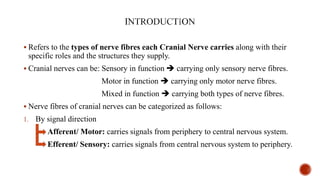
 Refers to the types of nerve fibres each Cranial Nerve carries along with their
specific roles and the structures they supply.
 Cranial nerves can be: Sensory in function  carrying only sensory nerve fibres.
Motor in function  carrying only motor nerve fibres.
Mixed in function  carrying both types of nerve fibres.
 Nerve fibres of cranial nerves can be categorized as follows:
1. By signal direction
Afferent/ Motor: carries signals from periphery to central nervous system.
Efferent/ Sensory: carries signals from central nervous system to periphery.
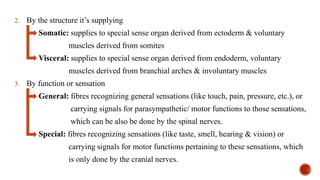
2. By the structure it’s supplying
Somatic: supplies to special sense organ derived from ectoderm & voluntary
muscles derived from somites
Visceral: supplies to special sense organ derived from endoderm, voluntary
muscles derived from branchial arches & involuntary muscles
3. By function or sensation
General: fibres recognizing general sensations (like touch, pain, pressure, etc.), or
carrying signals for parasympathetic/ motor functions to those sensations,
which can be also be done by the spinal nerves.
Special: fibres recognizing sensations (like taste, smell, hearing & vision) or
carrying signals for motor functions pertaining to these sensations, which
is only done by the cranial nerves.
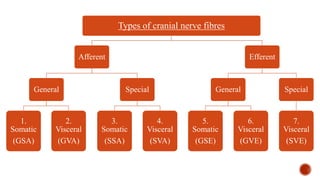
Types of cranial nerve fibres
Afferent
General
1.
Somatic
(GSA)
2.
Visceral
(GVA)
Special
3.
Somatic
(SSA)
4.
Visceral
(SVA)
Efferent
General
5.
Somatic
(GSE)
6.
Visceral
(GVE)
Special
7.
Visceral
(SVE)
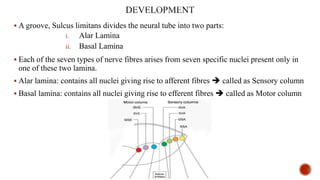
 A groove, Sulcus limitans divides the neural tube into two parts:
i. Alar Lamina
ii. Basal Lamina
 Each of the seven types of nerve fibres arises from seven specific nuclei present only in
one of these two lamina.
 Alar lamina: contains all nuclei giving rise to afferent fibres  called as Sensory column
 Basal lamina: contains all nuclei giving rise to efferent fibres  called as Motor column
Types of
Nerve Fibre
Supplies
Cranial nerves with the
fibre
GSA
General somatic senses &
proprioceptive senses from muscles &
joints
V, VII, IX, X
GVA General senses from viscera IX, X
SSA Special senses (eye & ear) I, II, VIII
SVA Special senses (nose and tongue) VII, IX
GSE Skeletal muscles of somatic origin III, IV, VI, XII
GVE
Smooth muscles, cardiac muscles &
glands
III, VII, IX, X
SVE Skeletal muscles of branchial origin V, VII, IX, X, XI
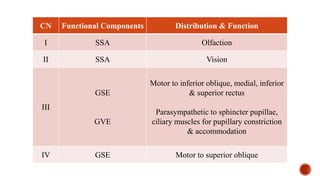
CN Functional Components Distribution & Function
I SSA Olfaction
II SSA Vision
III
GSE
GVE
Motor to inferior oblique, medial, inferior
& superior rectus
Parasympathetic to sphincter pupillae,
ciliary muscles for pupillary constriction
& accommodation
IV GSE Motor to superior oblique
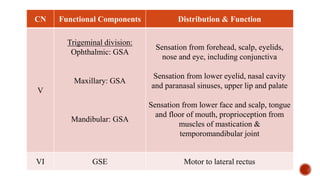
CN Functional Components Distribution & Function
V
Trigeminal division:
Ophthalmic: GSA
Maxillary: GSA
Mandibular: GSA
Sensation from forehead, scalp, eyelids,
nose and eye, including conjunctiva
Sensation from lower eyelid, nasal cavity
and paranasal sinuses, upper lip and palate
Sensation from lower face and scalp, tongue
and floor of mouth, proprioception from
muscles of mastication &
temporomandibular joint
VI GSE Motor to lateral rectus
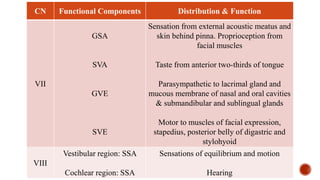
CN Functional Components Distribution & Function
VII
GSA
SVA
GVE
SVE
Sensation from external acoustic meatus and
skin behind pinna. Proprioception from
facial muscles
Taste from anterior two-thirds of tongue
Parasympathetic to lacrimal gland and
mucous membrane of nasal and oral cavities
& submandibular and sublingual glands
Motor to muscles of facial expression,
stapedius, posterior belly of digastric and
stylohyoid
VIII
Vestibular region: SSA
Cochlear region: SSA
Sensations of equilibrium and motion
Hearing
CN Functional Components Distribution & Function
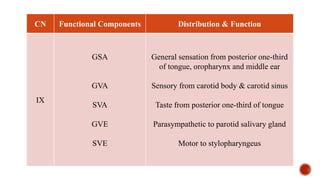
IX
GSA
GVA
SVA
GVE
SVE
General sensation from posterior one-third
of tongue, oropharynx and middle ear
Sensory from carotid body & carotid sinus
Taste from posterior one-third of tongue
Parasympathetic to parotid salivary gland
Motor to stylopharyngeus
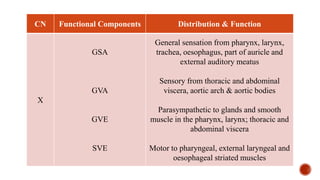
CN Functional Components Distribution & Function
X
GSA
GVA
GVE
SVE
General sensation from pharynx, larynx,
trachea, oesophagus, part of auricle and
external auditory meatus
Sensory from thoracic and abdominal
viscera, aortic arch & aortic bodies
Parasympathetic to glands and smooth
muscle in the pharynx, larynx; thoracic and
abdominal viscera
Motor to pharyngeal, external laryngeal and
oesophageal striated muscles
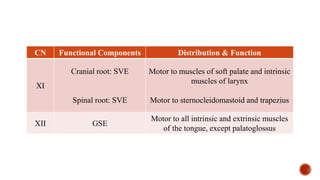
CN Functional Components Distribution & Function
XI
Cranial root: SVE
Spinal root: SVE
Motor to muscles of soft palate and intrinsic
muscles of larynx
Motor to sternocleidomastoid and trapezius
XII GSE
Motor to all intrinsic and extrinsic muscles
of the tongue, except palatoglossus
Functional components of cranial nerves.pptx

Functional components of cranial nerves.pptx

  • 2.
     Refers tothe types of nerve fibres each Cranial Nerve carries along with their specific roles and the structures they supply.  Cranial nerves can be: Sensory in function  carrying only sensory nerve fibres. Motor in function  carrying only motor nerve fibres. Mixed in function  carrying both types of nerve fibres.  Nerve fibres of cranial nerves can be categorized as follows: 1. By signal direction Afferent/ Motor: carries signals from periphery to central nervous system. Efferent/ Sensory: carries signals from central nervous system to periphery.
  • 3.
    2. By thestructure it’s supplying Somatic: supplies to special sense organ derived from ectoderm & voluntary muscles derived from somites Visceral: supplies to special sense organ derived from endoderm, voluntary muscles derived from branchial arches & involuntary muscles 3. By function or sensation General: fibres recognizing general sensations (like touch, pain, pressure, etc.), or carrying signals for parasympathetic/ motor functions to those sensations, which can be also be done by the spinal nerves. Special: fibres recognizing sensations (like taste, smell, hearing & vision) or carrying signals for motor functions pertaining to these sensations, which is only done by the cranial nerves.
  • 4.
    Types of cranialnerve fibres Afferent General 1. Somatic (GSA) 2. Visceral (GVA) Special 3. Somatic (SSA) 4. Visceral (SVA) Efferent General 5. Somatic (GSE) 6. Visceral (GVE) Special 7. Visceral (SVE)
  • 5.
     A groove,Sulcus limitans divides the neural tube into two parts: i. Alar Lamina ii. Basal Lamina  Each of the seven types of nerve fibres arises from seven specific nuclei present only in one of these two lamina.  Alar lamina: contains all nuclei giving rise to afferent fibres  called as Sensory column  Basal lamina: contains all nuclei giving rise to efferent fibres  called as Motor column
  • 6.
    Types of Nerve Fibre Supplies Cranialnerves with the fibre GSA General somatic senses & proprioceptive senses from muscles & joints V, VII, IX, X GVA General senses from viscera IX, X SSA Special senses (eye & ear) I, II, VIII SVA Special senses (nose and tongue) VII, IX GSE Skeletal muscles of somatic origin III, IV, VI, XII GVE Smooth muscles, cardiac muscles & glands III, VII, IX, X SVE Skeletal muscles of branchial origin V, VII, IX, X, XI
  • 7.
    CN Functional ComponentsDistribution & Function I SSA Olfaction II SSA Vision III GSE GVE Motor to inferior oblique, medial, inferior & superior rectus Parasympathetic to sphincter pupillae, ciliary muscles for pupillary constriction & accommodation IV GSE Motor to superior oblique
  • 8.
    CN Functional ComponentsDistribution & Function V Trigeminal division: Ophthalmic: GSA Maxillary: GSA Mandibular: GSA Sensation from forehead, scalp, eyelids, nose and eye, including conjunctiva Sensation from lower eyelid, nasal cavity and paranasal sinuses, upper lip and palate Sensation from lower face and scalp, tongue and floor of mouth, proprioception from muscles of mastication & temporomandibular joint VI GSE Motor to lateral rectus
  • 9.
    CN Functional ComponentsDistribution & Function VII GSA SVA GVE SVE Sensation from external acoustic meatus and skin behind pinna. Proprioception from facial muscles Taste from anterior two-thirds of tongue Parasympathetic to lacrimal gland and mucous membrane of nasal and oral cavities & submandibular and sublingual glands Motor to muscles of facial expression, stapedius, posterior belly of digastric and stylohyoid VIII Vestibular region: SSA Cochlear region: SSA Sensations of equilibrium and motion Hearing
  • 10.
    CN Functional ComponentsDistribution & Function IX GSA GVA SVA GVE SVE General sensation from posterior one-third of tongue, oropharynx and middle ear Sensory from carotid body & carotid sinus Taste from posterior one-third of tongue Parasympathetic to parotid salivary gland Motor to stylopharyngeus
  • 11.
    CN Functional ComponentsDistribution & Function X GSA GVA GVE SVE General sensation from pharynx, larynx, trachea, oesophagus, part of auricle and external auditory meatus Sensory from thoracic and abdominal viscera, aortic arch & aortic bodies Parasympathetic to glands and smooth muscle in the pharynx, larynx; thoracic and abdominal viscera Motor to pharyngeal, external laryngeal and oesophageal striated muscles
  • 12.
    CN Functional ComponentsDistribution & Function XI Cranial root: SVE Spinal root: SVE Motor to muscles of soft palate and intrinsic muscles of larynx Motor to sternocleidomastoid and trapezius XII GSE Motor to all intrinsic and extrinsic muscles of the tongue, except palatoglossus