C- Functions
Functions: Defining and accessing: Passing arguments, Function
prototypes, Function calls- Categories of functions- Nesting of
functionsRecursion. Use of library functions, Scope , Visibility and
Lifetime of variables.
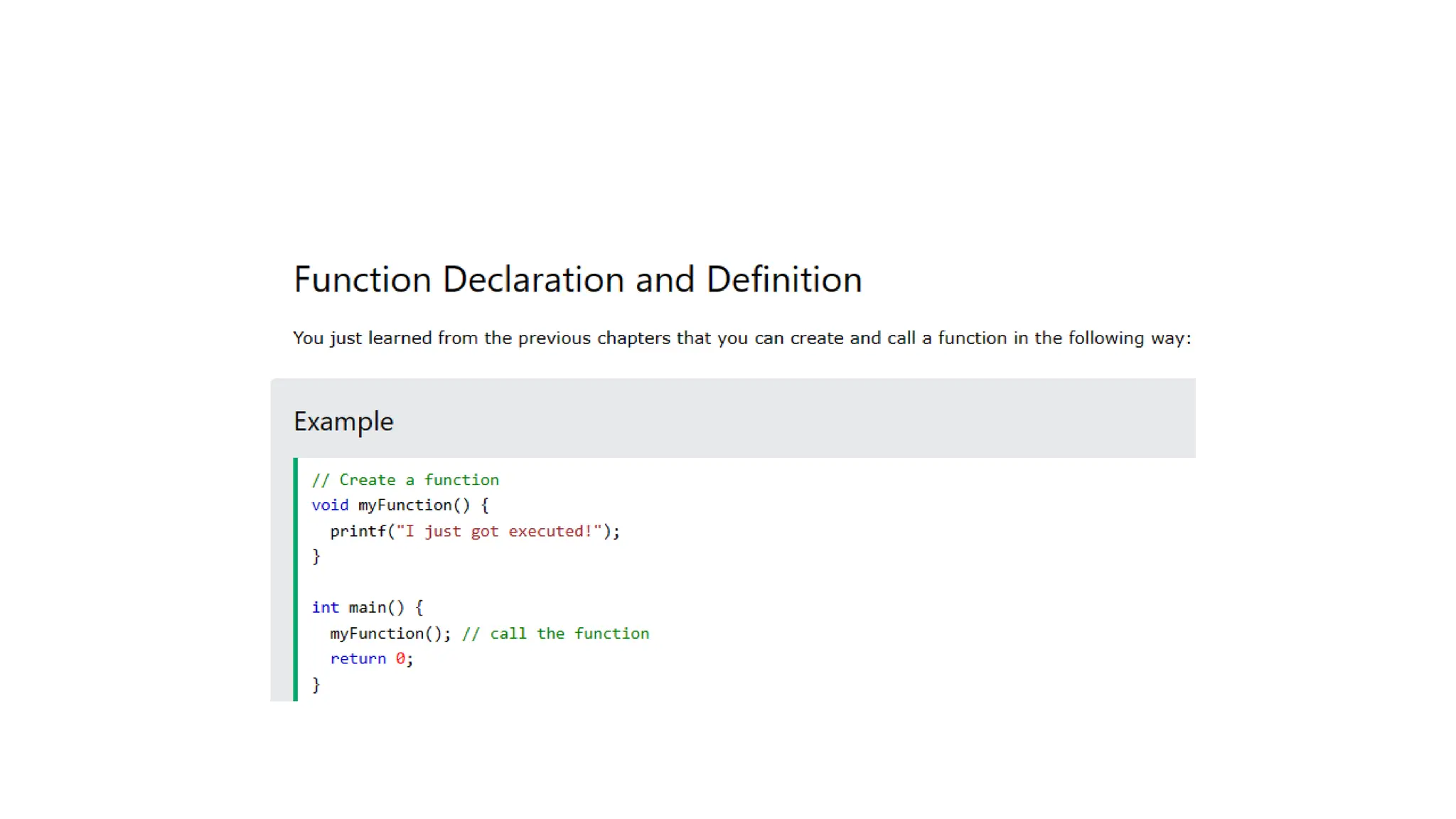
• A function is a group of statements that together perform a task.
Every C program has at least one function, which is main(), and all the
most trivial programs can define additional functions. You can divide
up your code into separate functions. How you divide up your code
among different functions is up to you, but logically the division is
such that each function performs a specific task. A function
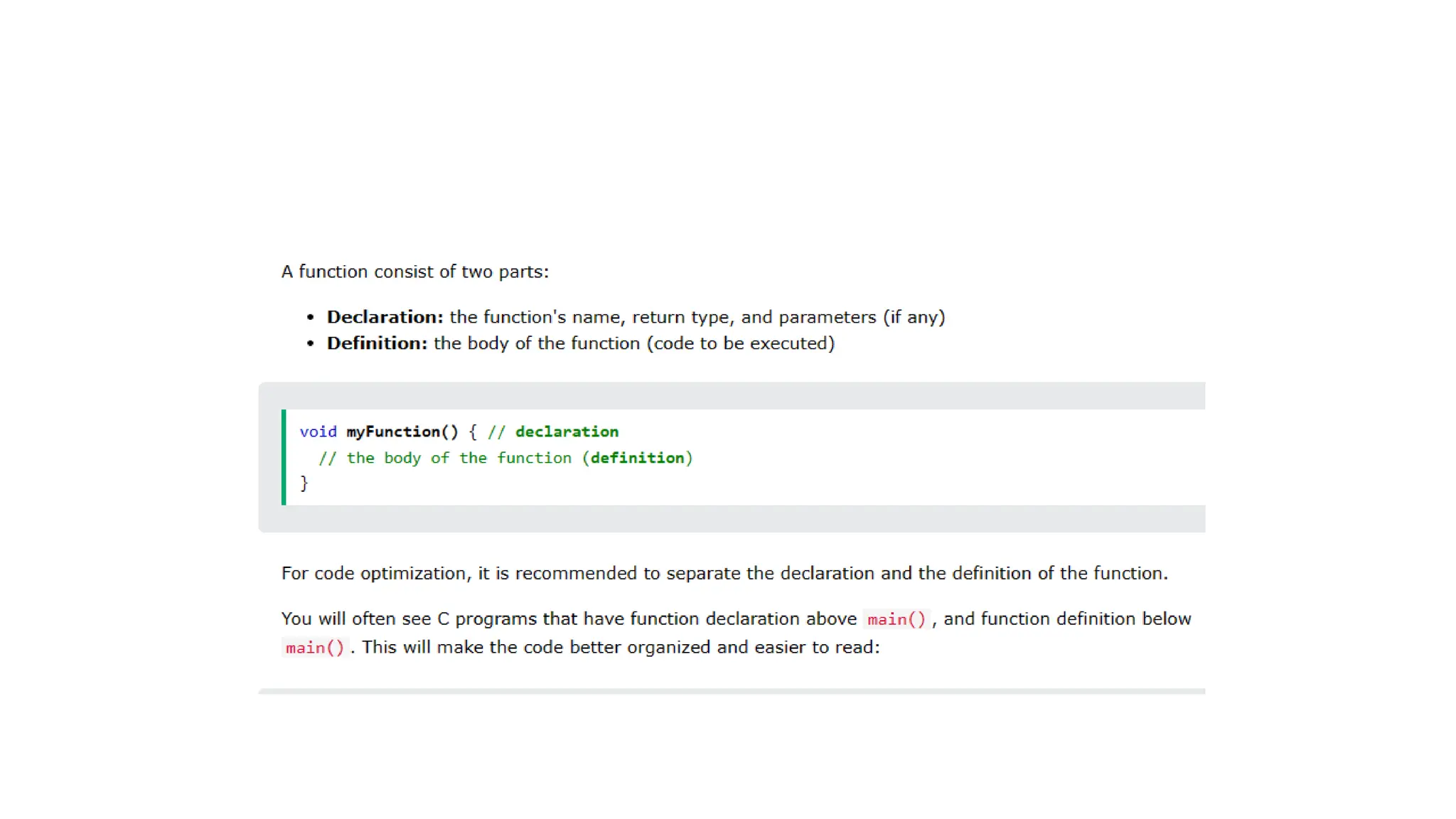
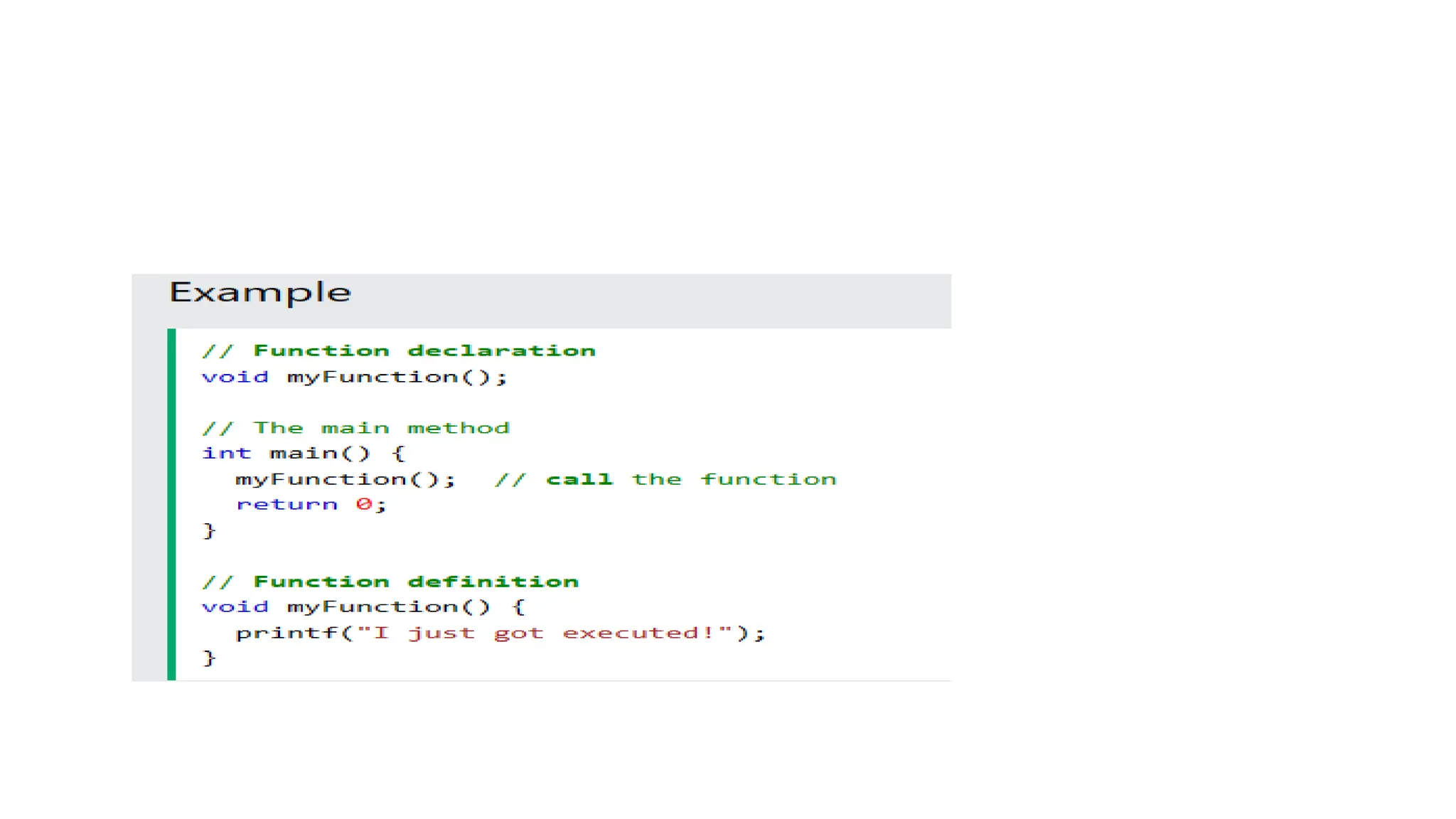
declaration tells the compiler about a function's name, return type,
and parameters. A function definition provides the actual body of the
function.
Defining a Function
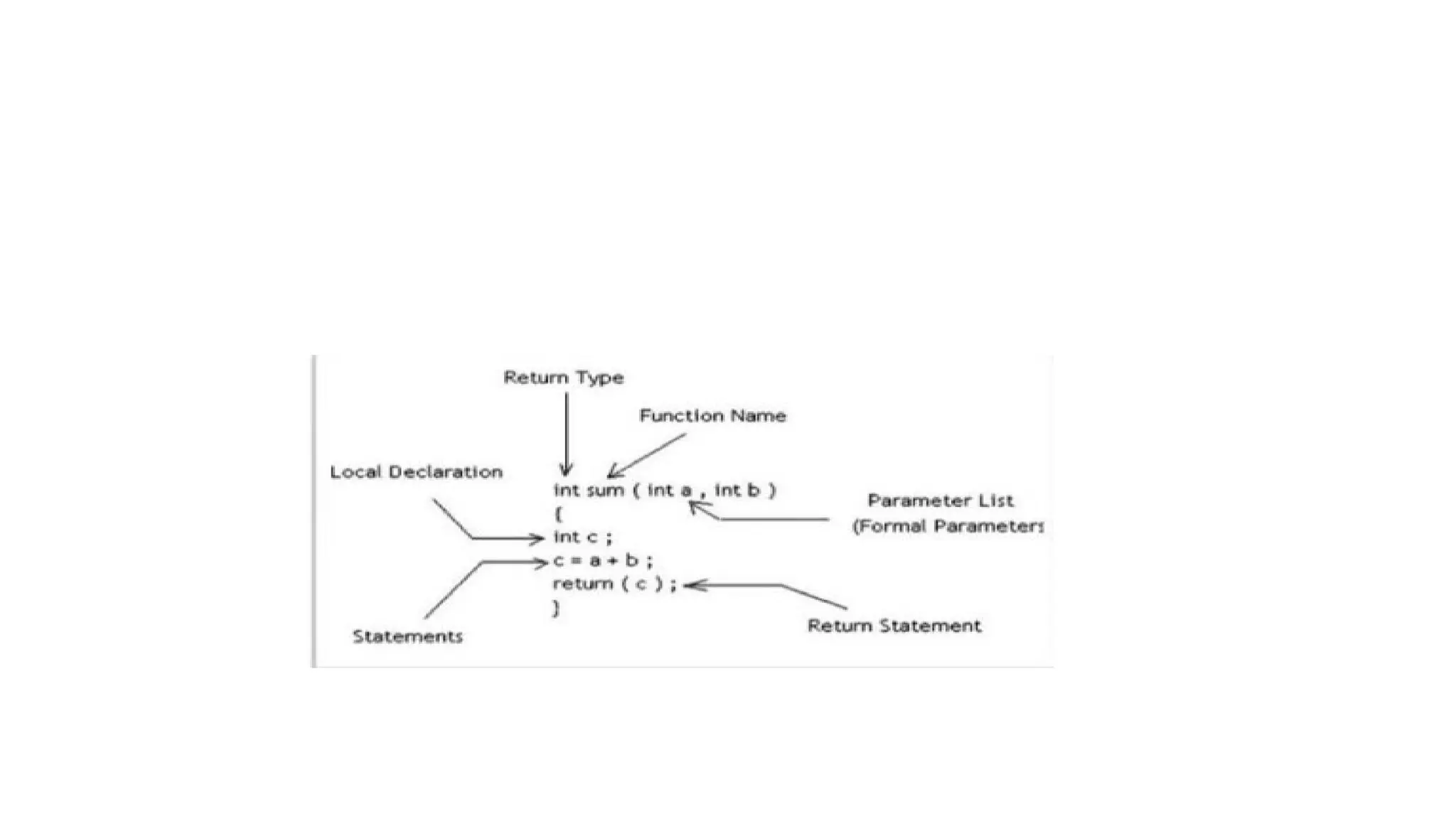
• The general form of a function definition in C programming language
is as follows − return_type function_name( parameter list ) { body of
the function } A function definition in C programming consists of a
function header and a function body. Here are all the parts of a
function −
• Return Type − A function may return a value. The return_type is the
data type of the value the function returns. Some functions perform
the desired operations without returning a value. In this case, the
return_type is the keyword void.
• Function Name − This is the actual name of the function. The function
name and the parameter list together constitute the function
signature
• Parameters − A parameter is like a placeholder. When a function is
invoked, you pass a value to the parameter. This value is referred to as
actual parameter or argument. The parameter list refers to the type,
order, and number of the parameters of a function. Parameters are
optional; that is, a function may contain no parameters.
• Function Body − The function body contains a collection of
statements that define what the function does.
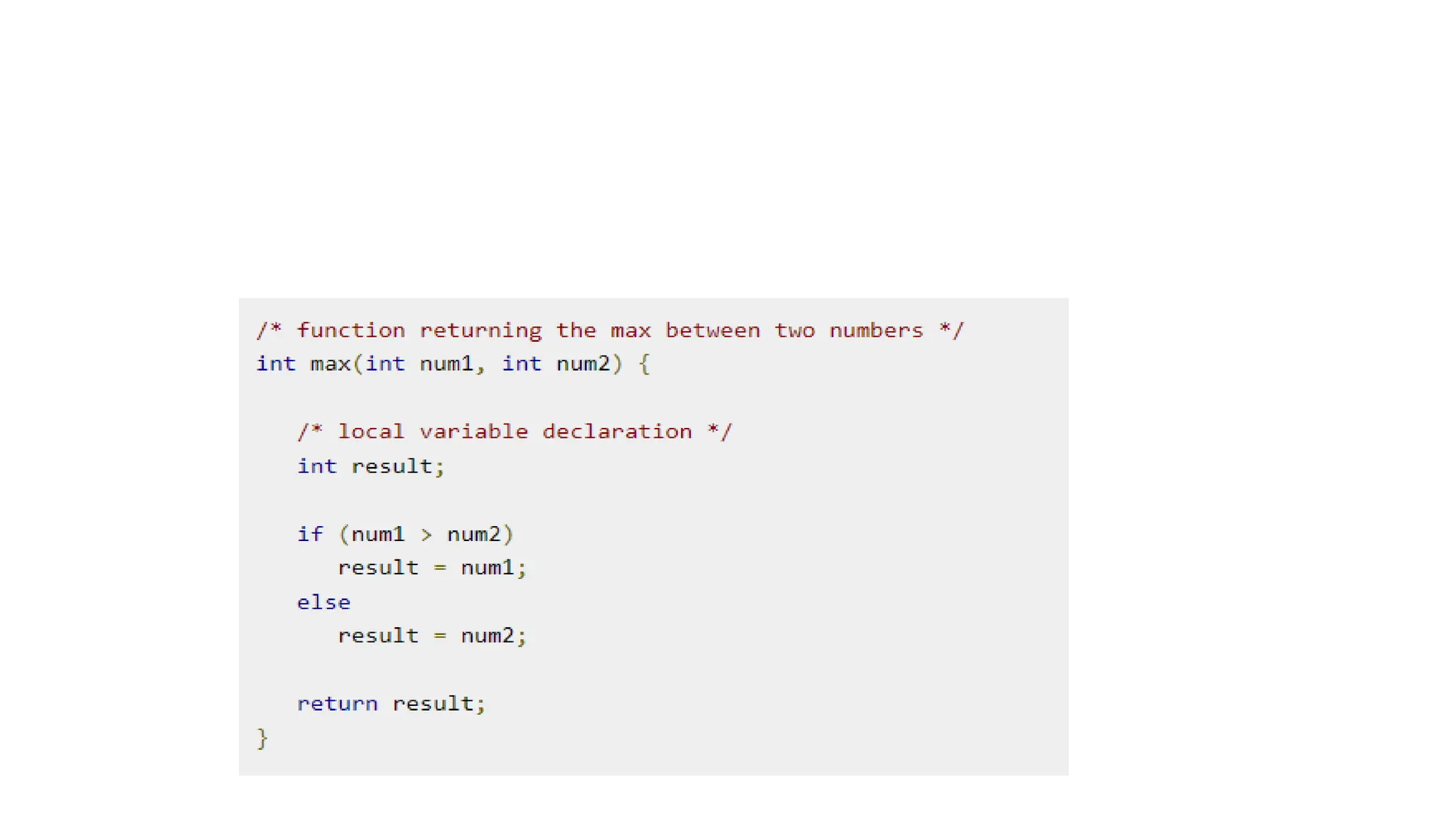
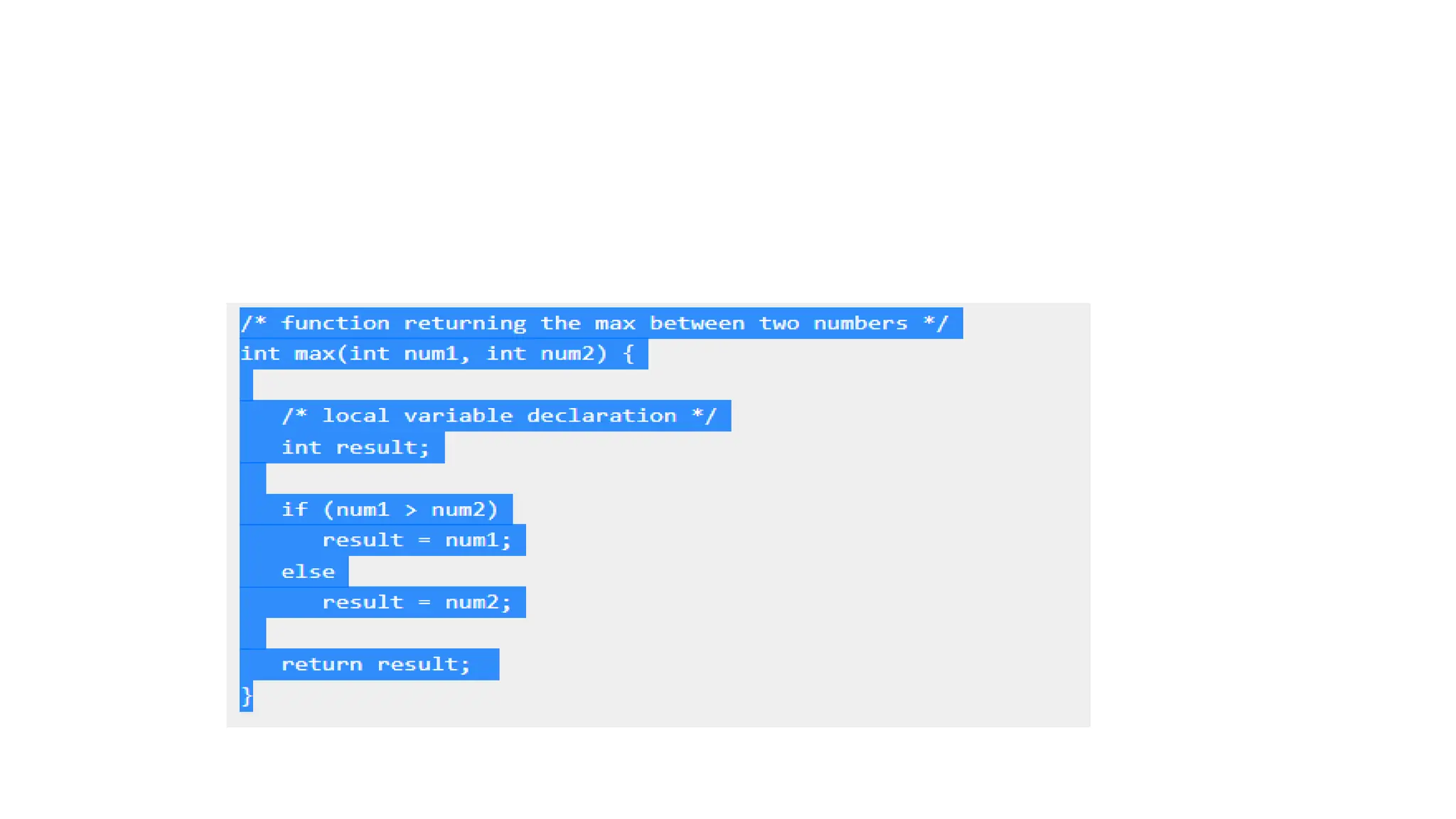
• Example Given below is the source code for a function called max().
This function takes two parameters num1 and num2 and returns the
maximum value between the two −
• int max(int num1, int num2)
• { int result;
• if (num1 > num2)
• result = num1;
• else result = num2;
• return result; }
Function Arguments
• If a function is to use arguments, it must declare variables that accept
the values of the arguments. These variables are called the formal
parameters of the function. Formal parameters behave like other local
variables inside the function and are created upon entry into the
function and destroyed upon exit. While calling a function, there are
two ways in which arguments can be passed to a function
• By default, C uses call by value to pass arguments. In general, it means
the code within a function cannot alter the arguments used to call the
function
Function prototype
• The function prototypes are used to tell the compiler about the
number of arguments and about the required data types of a function
parameter, it also tells about the return type of the function. By this
information, the compiler cross-checks the function signatures before
calling it. If the function prototypes are not mentioned, then the
program may be compiled with some warnings, and sometimes
generate some strange output
Categories of Functions
• Depending on whether arguments are present or not and whether a
value is returned or not, functions are categorized into − Functions

without arguments and without return values Functions without

arguments and with return values Functions with arguments and

without return values Functions with arguments and with return

values
Library functions are built-in functions
• Library functions are built-in functions that are grouped together and
placed in a common location called library. Each function here
performs a specific operation. We can use this library functions to get
the pre-defined output. All C standard library functions are declared
by using many header files. These library functions are created at the
time of designing the compilers. We include the header files in our C
program by using #include. Whenever the program is run and
executed, the related files are included in the C program
• Some of the header file functions are as follows − stdio.h − It is a
standard i/o header file in which Input/output functions are declared
conio.h − This is a console input/output header file. string.h − All
string related functions are in this header file. stdlib.h − This file
contains common functions which are used in the C programs. math.h
− All functions related to mathematics are in this header file. time.h −
This file contains time and clock related functions.Built functions in
stdio.h
C- Scope of variable
• A scope in any programming is a region of the program where a
defined variable can have its existence and beyond that variable it
cannot be accessed. There are three places where variables can be
declared in C programming language − Inside a function or a block

which is called local variables. Outside of all functions which is

called global variables. In the definition of function parameters

which are called formalparameters.
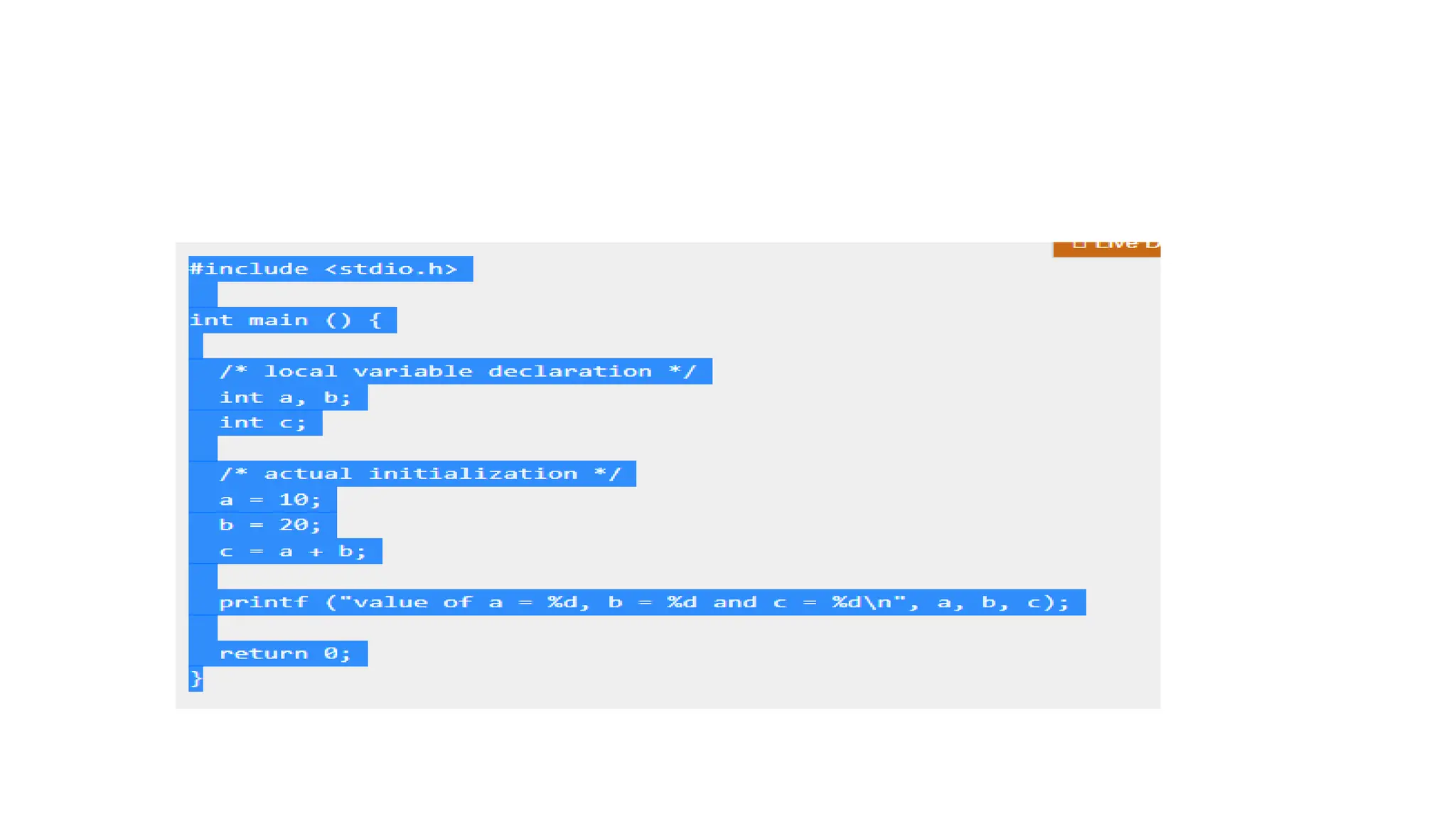
Local Variables
• Variables that are declared inside a function or block are called local
variables. They can be used only by statements that are inside that
function or block of code. Local variables are not known to functions
outside their own. The following example shows how local variables
are used. Here all the variables a, b, and c are local to main() function.
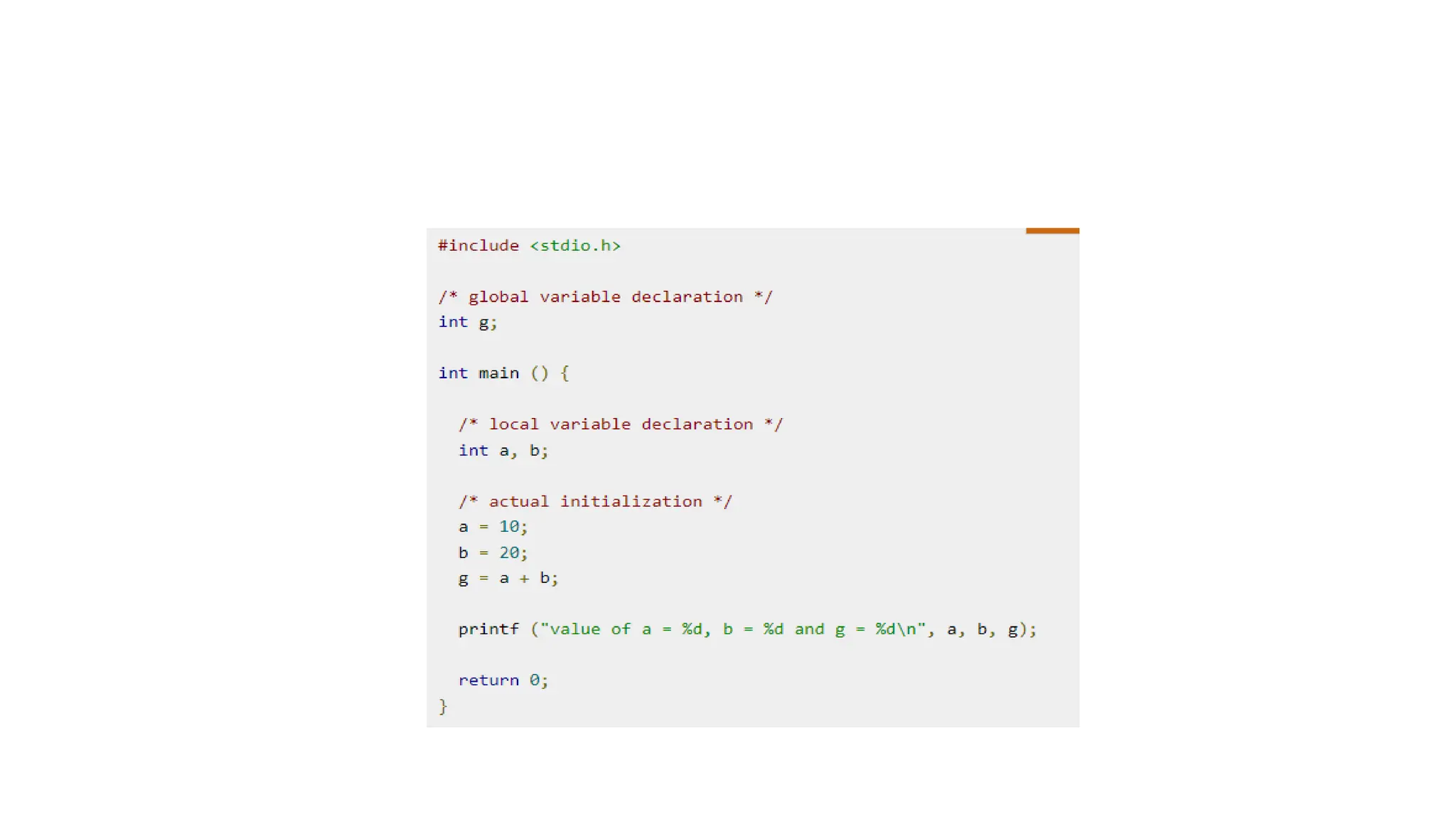
Global Variables
• Global variables are defined outside a function, usually on top of the
program. Global variables hold their values throughout the lifetime of
your program and they can be accessed inside any of the functions
defined for the program. A global variable can be accessed by any
function. That is, a global variable is available for use throughout your
entire program after its declaration. The following program show how
global variables are used in a program.
Difference between Call by Value and Call by Reference
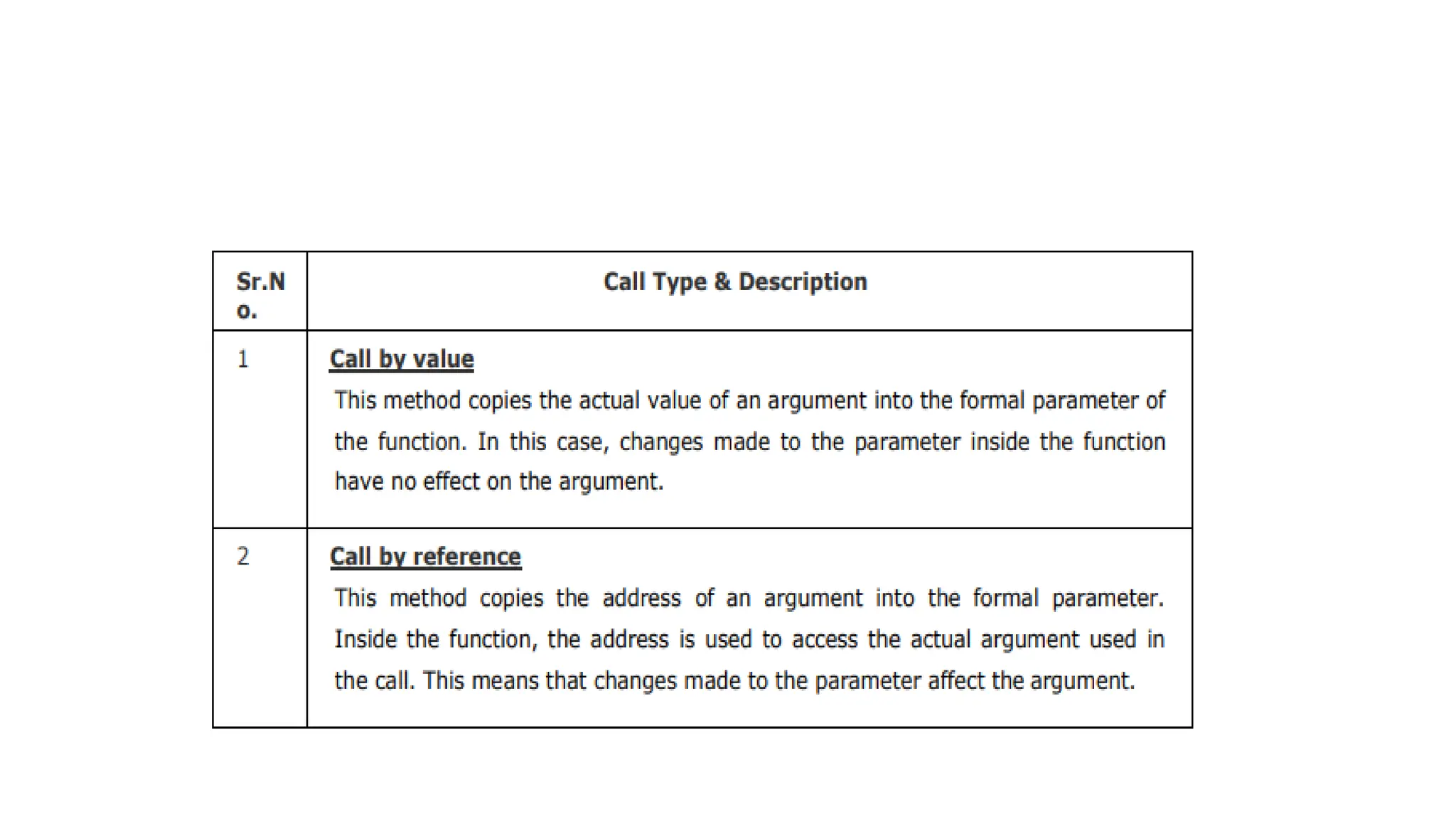
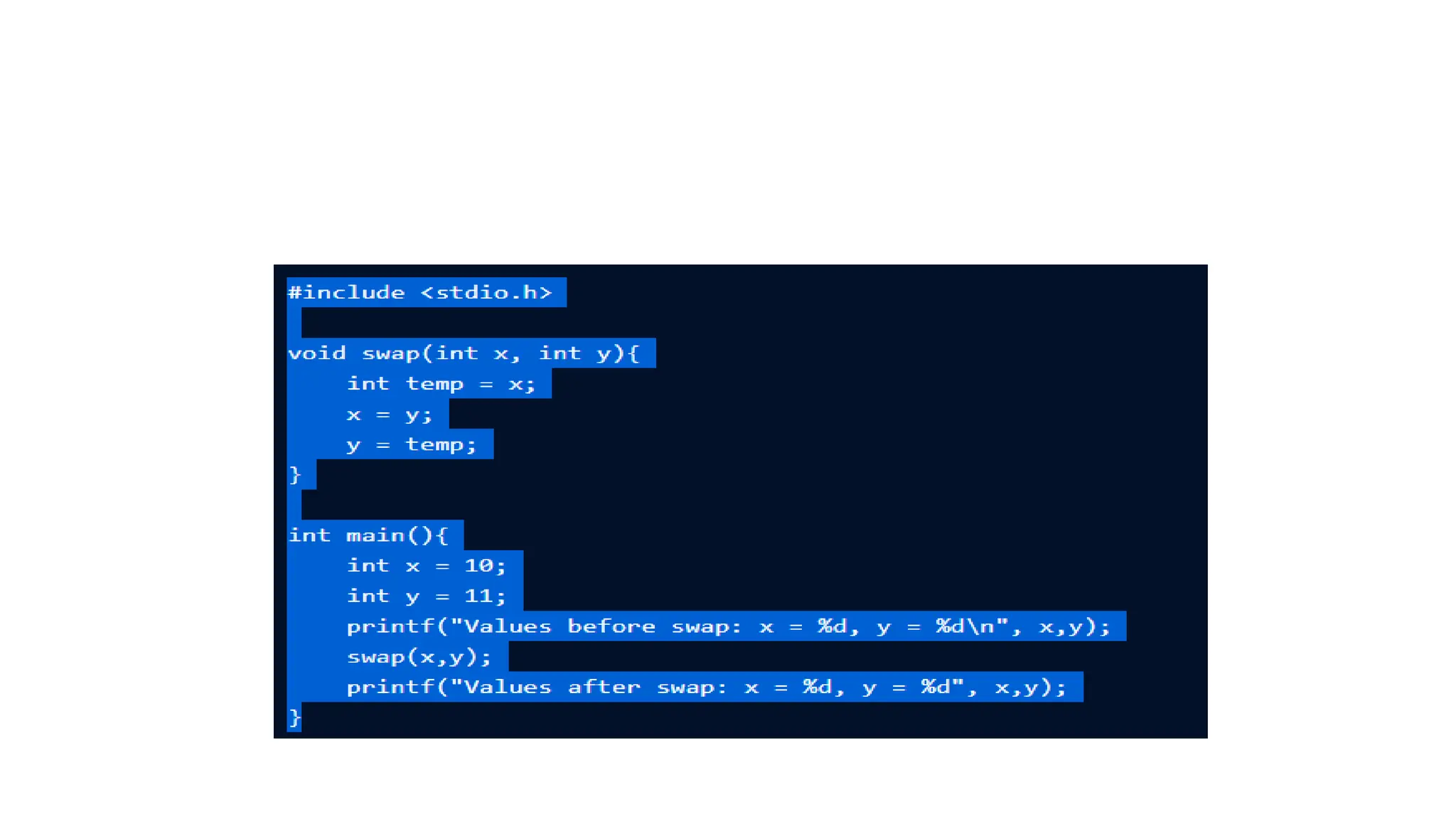
• Functions can be invoked in two ways: Call by Value or Call
by Reference. These two ways are generally differentiated
by the type of values passed to them as parameters.
• The parameters passed to function are called actual
parameters whereas the parameters received by function are
called formal parameters.
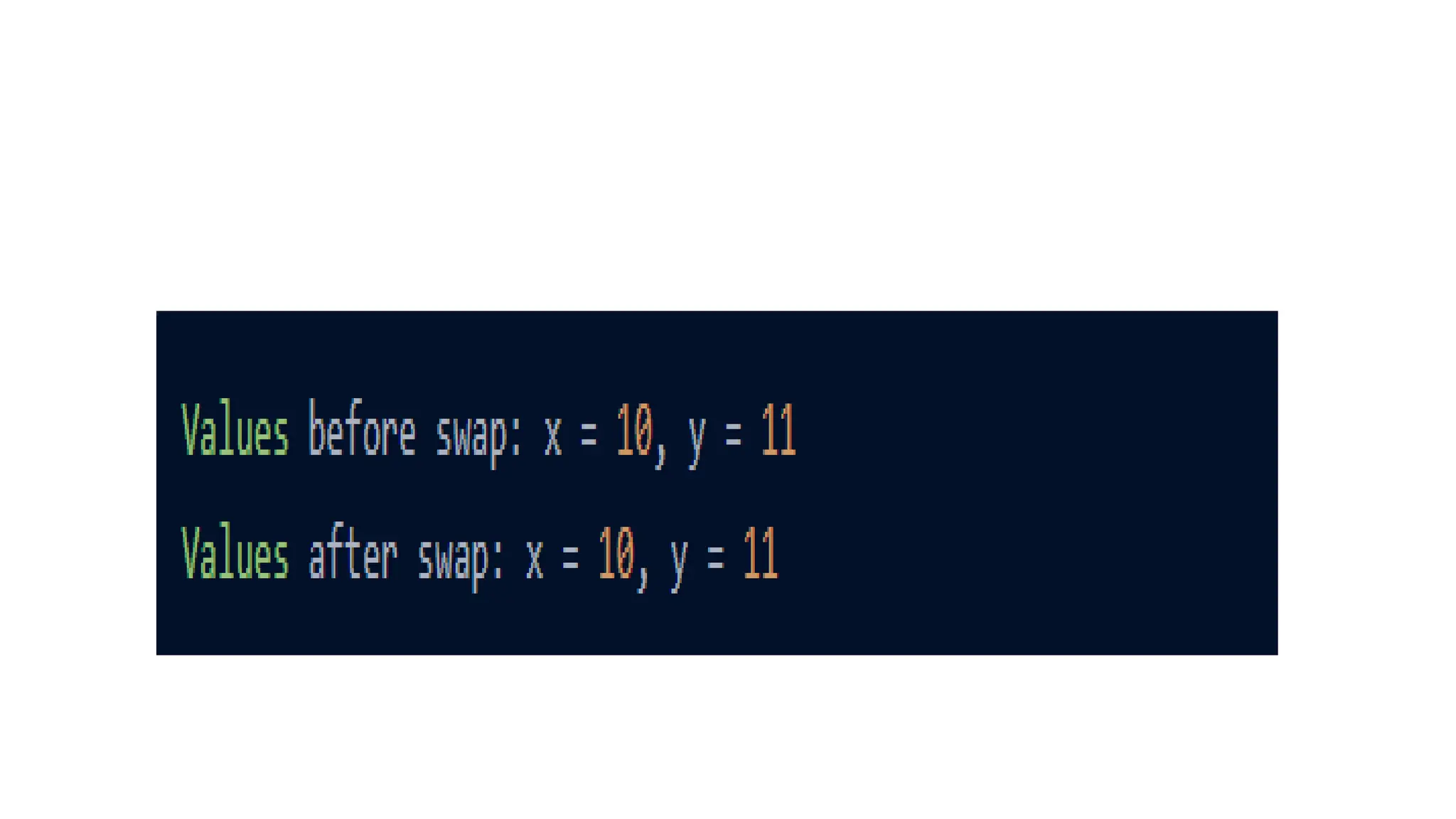
• Call By Value: In this parameter passing method, values of
actual parameters are copied to function’s formal
parameters and the two types of parameters are stored in
different memory locations. So any changes made inside
functions are not reflected in actual parameters of the caller.
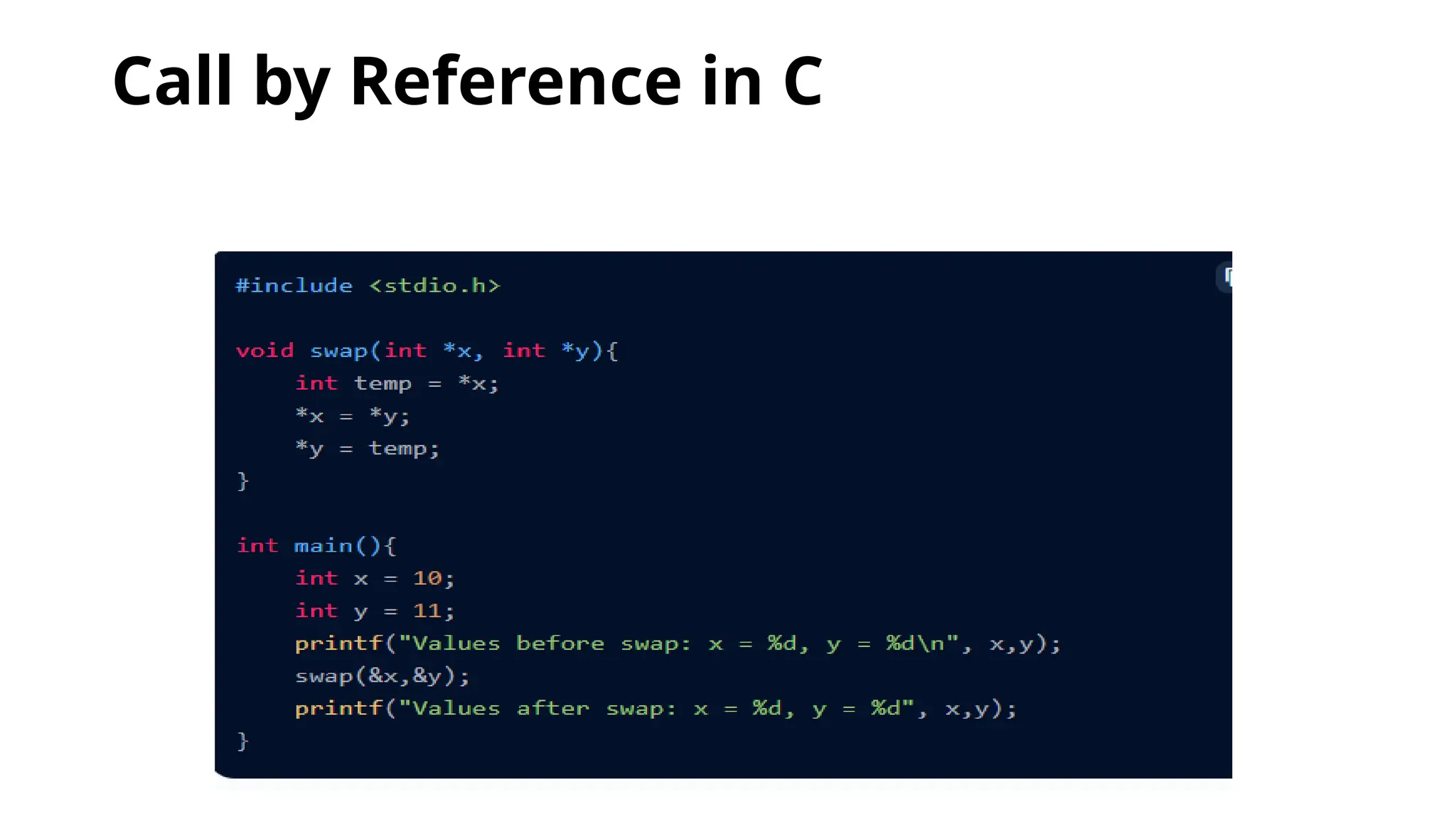
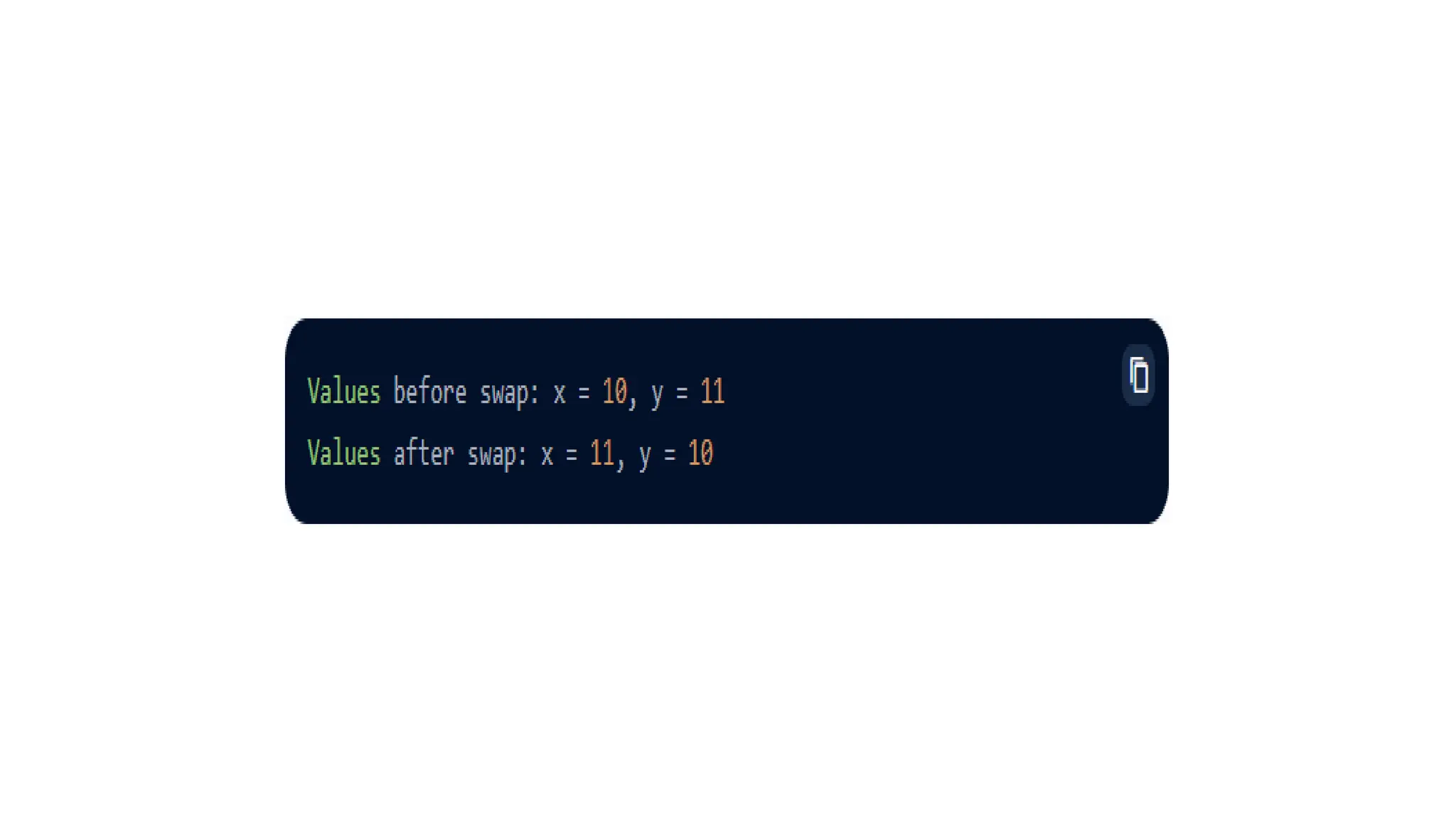
• Call by Reference: Both the actual and formal parameters
refer to the same locations, so any changes made inside the
function are actually reflected in actual parameters of the
caller.
Call by Reference in C
Advantages of Using Call by Value
Method
• Guarantees that changes that alter the behavior of a
parameter stay within its scope and do not affect the value
of an object passed into the function
• Reduce the chance of introducing subtle bugs which can be
difficult to monitor.
• Passing by value removes the possible side effects of a
function which makes your program easier to maintain and
reason with.
Advantages of Using Call by Reference Method
• Calling a function by reference does not incur performance
penalties that copying would require. Likewise, it does not
duplicate the memory necessary to access the content of an
object that resides in our program.
• Allows a function to update the value of an object that is passed
into it.
• Allows you to pass functions as references through a technique
called function pointers which may alter the behavior of a
function. Likewise, lambda expressions may also be passed
inside a function. Both enable function composition which has
neat theoretical properties.
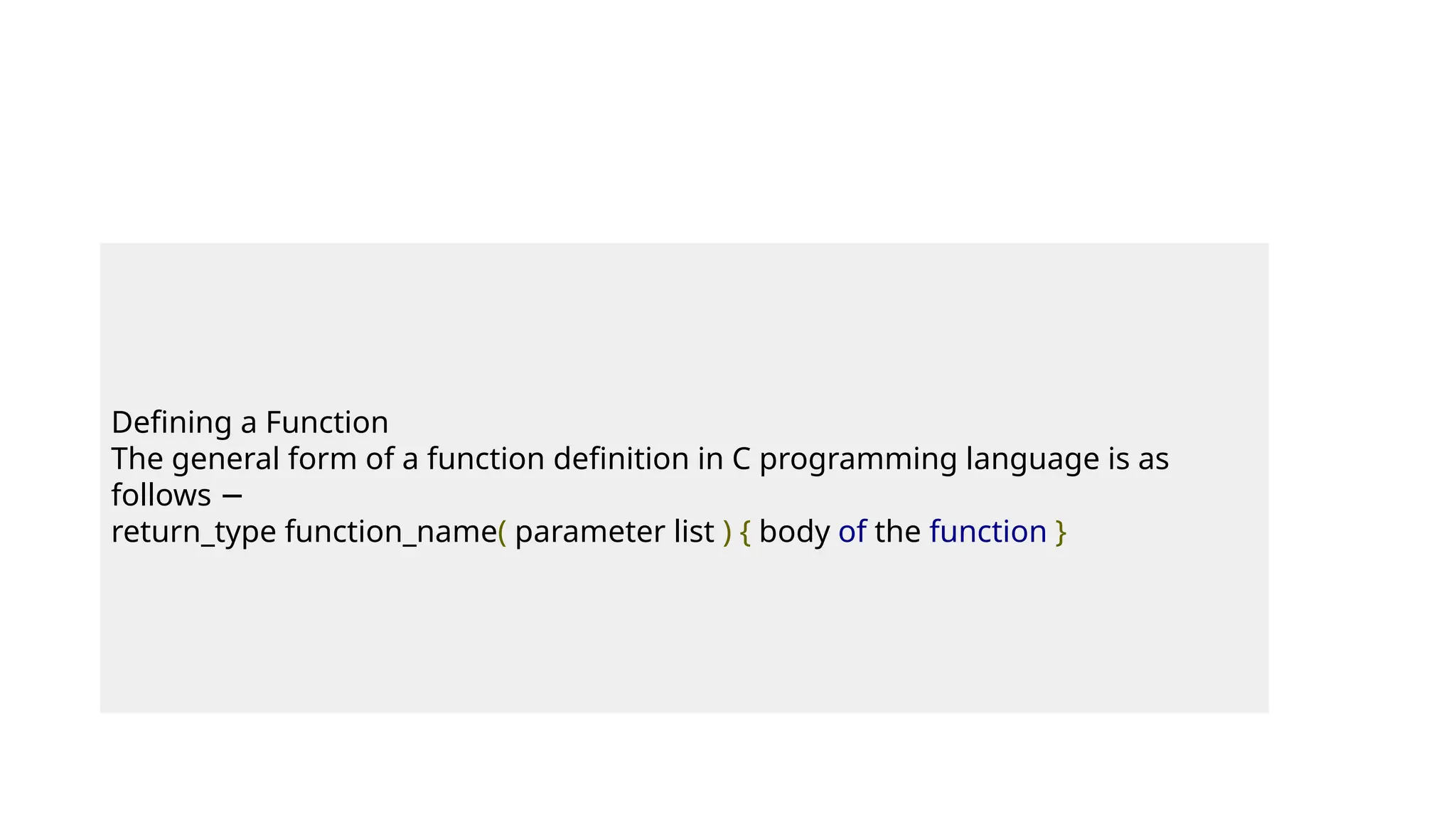
Defining a Function
The general form of a function definition in C programming language is as
follows −
return_type function_name( parameter list ) { body of the function }
• A function definition in C programming consists of a function header and a function
body. Here are all the parts of a function −
• Return Type A function may return a value. The
− return_type is the data type of
the value the function returns. Some functions perform the desired operations
without returning a value. In this case, the return_type is the keyword void.
• Function Name This is the actual name of the function. The function name and
−
the parameter list together constitute the function signature.
• Parameters A parameter is like a placeholder. When a function is invoked, you
−
pass a value to the parameter. This value is referred to as actual parameter or
argument. The parameter list refers to the type, order, and number of the
parameters of a function. Parameters are optional; that is, a function may contain no
parameters.
• Function Body The function body contains a collection of statements that define
−
what the function does.
Function Declarations
A function declaration tells the compiler about a function name and how to
call the function. The actual body of the function can be defined separately.
A function declaration has the following parts −
return_type function_name( parameter list );
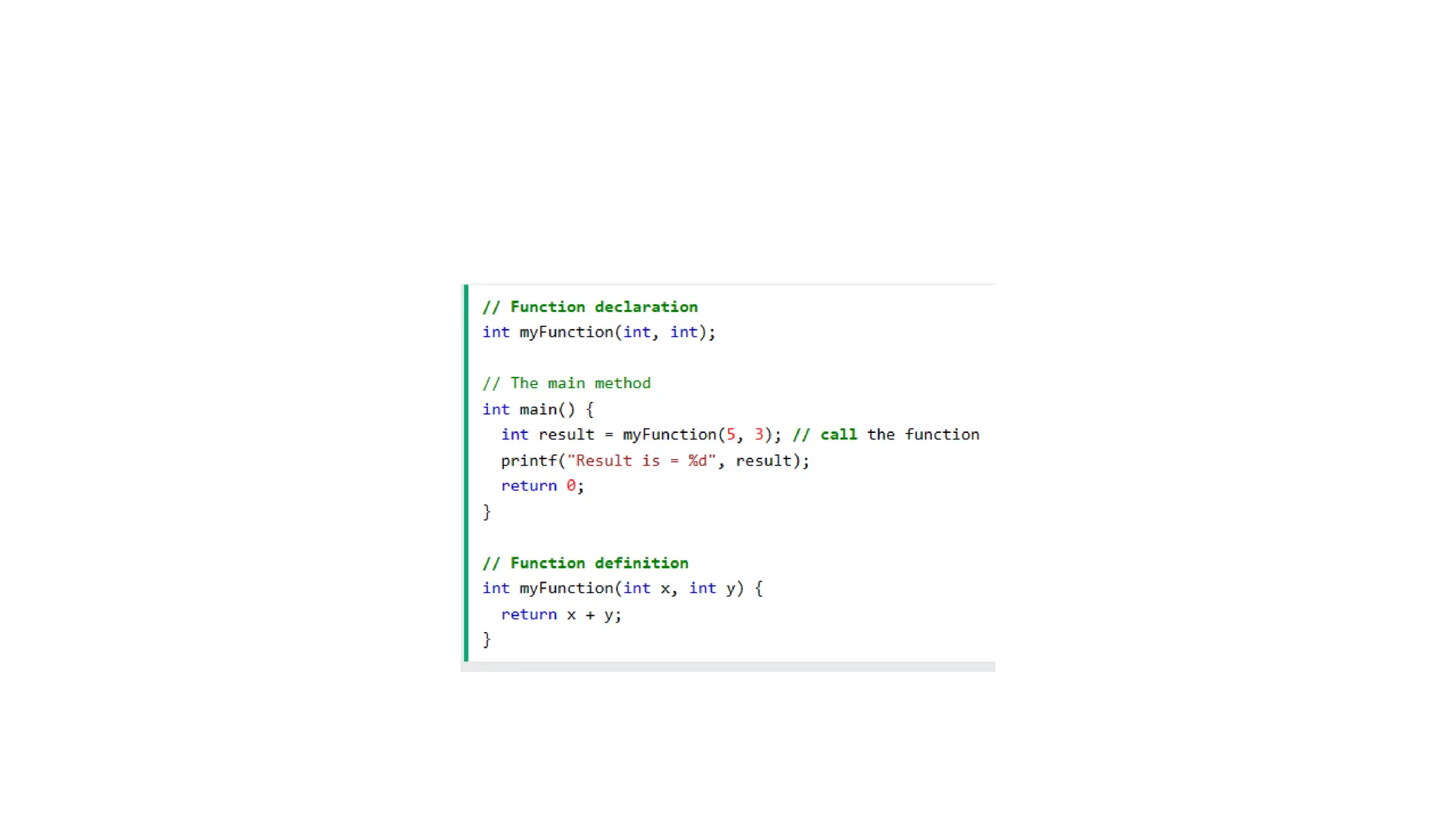
For the above defined function max(), the function declaration is as
follows −
int max(int num1, int num2);
Parameter names are not import
ant in function declaration only their type is required, so the following
is also a valid declaration −
int max(int, int);
Function declaration is required when you define a function in
one source file and you call that function in another file. In
such case, you should declare the function at the top of the file
calling the function.
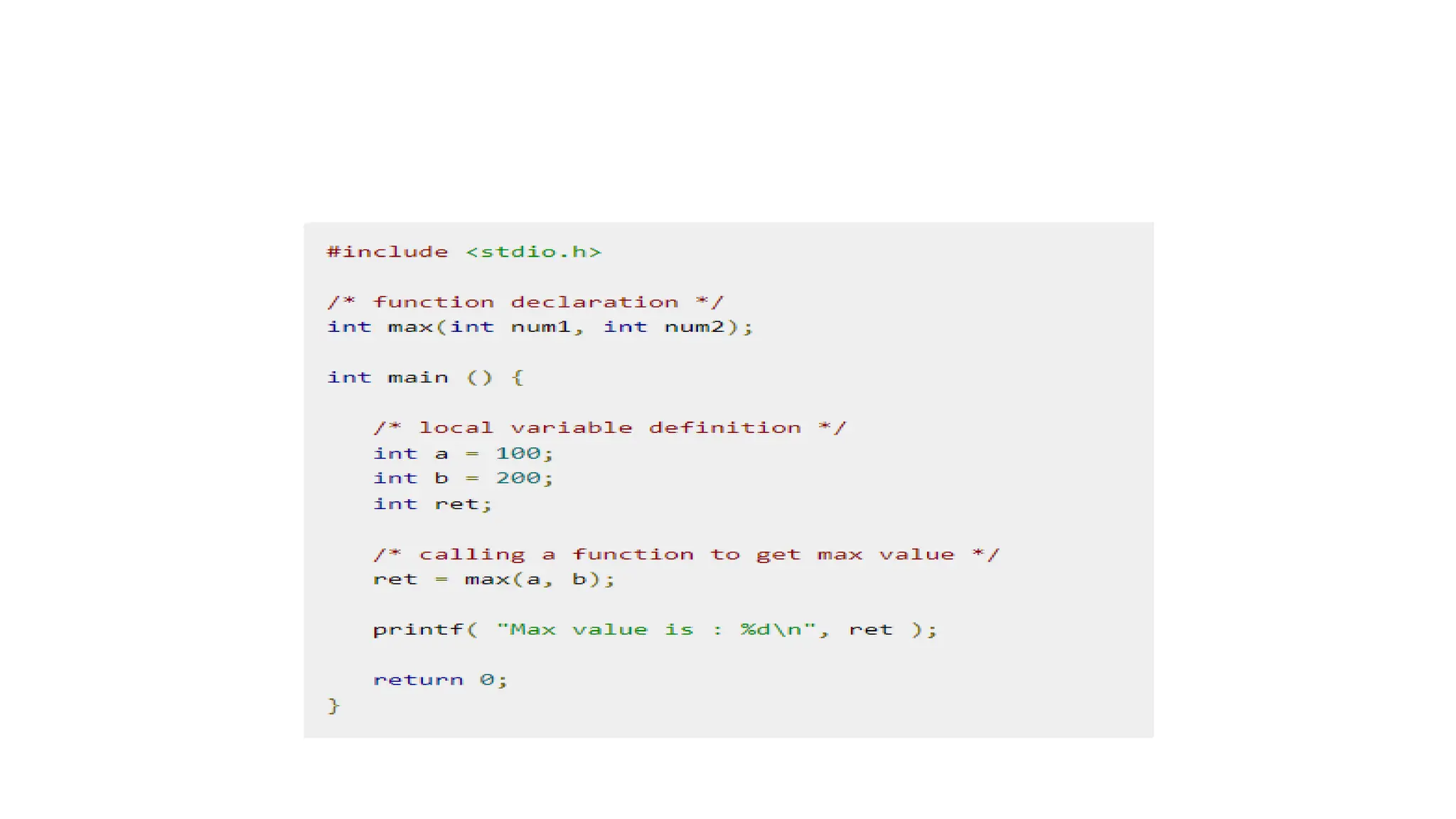
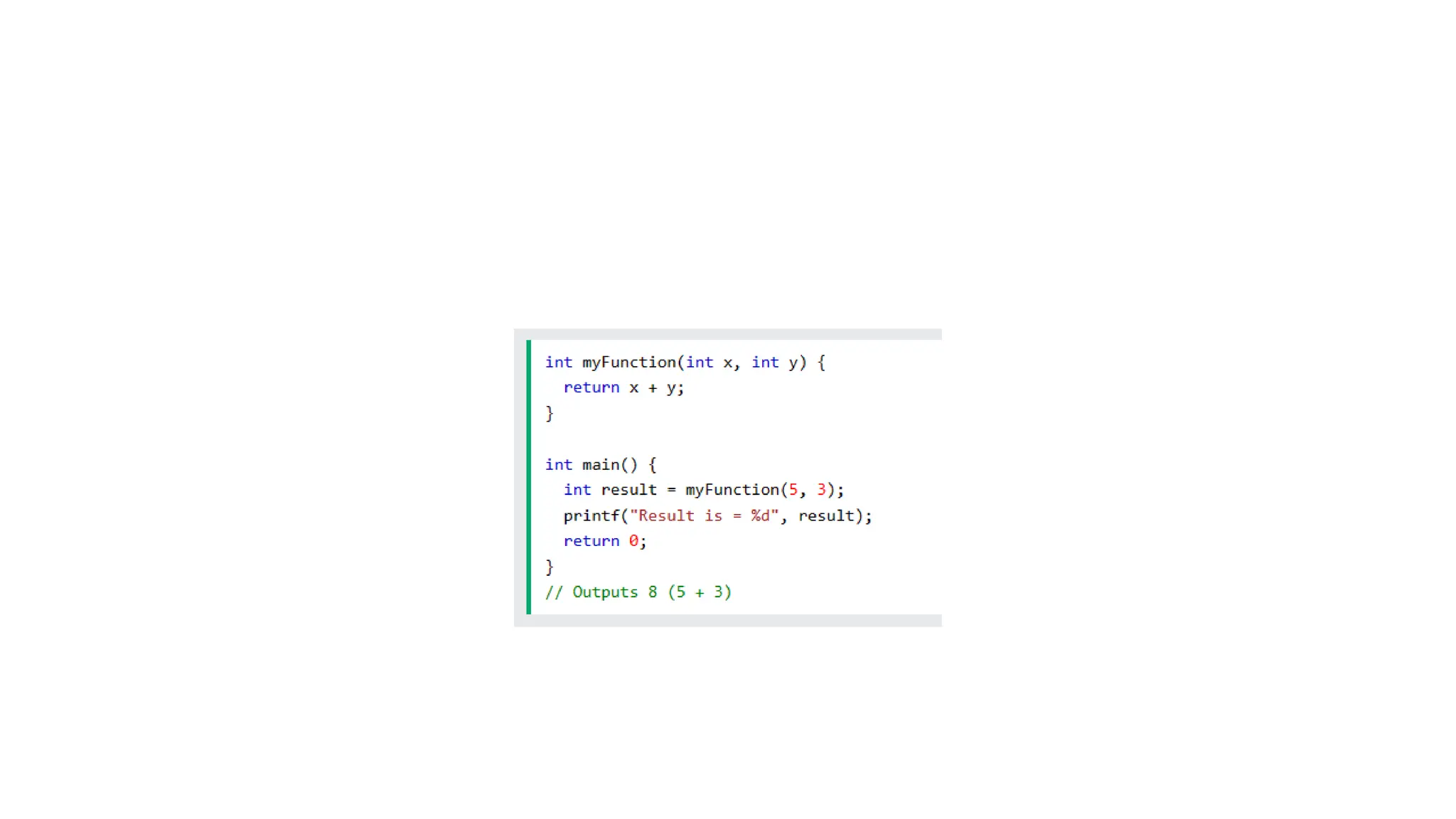
• Calling a Function
• While creating a C function, you give a definition of what the function
has to do. To use a function, you will have to call that function to
perform the defined task.
• When a program calls a function, the program control is transferred to
the called function. A called function performs a defined task and when
its return statement is executed or when its function-ending closing
brace is reached, it returns the program control back to the main
program.
• To call a function, you simply need to pass the required parameters
along with the function name, and if the function returns a value, then
you can store the returned value. For example −
C - Scope Rules
• A scope in any programming is a region of the program where
a defined variable can have its existence and beyond that
variable it cannot be accessed. There are three places where
variables can be declared in C programming language −
• Inside a function or a block which is called local variables.
• Outside of all functions which is called global variables.
• In the definition of function parameters which are
called formal parameters.
• Let us understand what are local and global variables,
and formal parameters.
• Local Variables
• Variables that are declared inside a function or block are
called local variables. They can be used only by statements
that are inside that function or block of code. Local variables
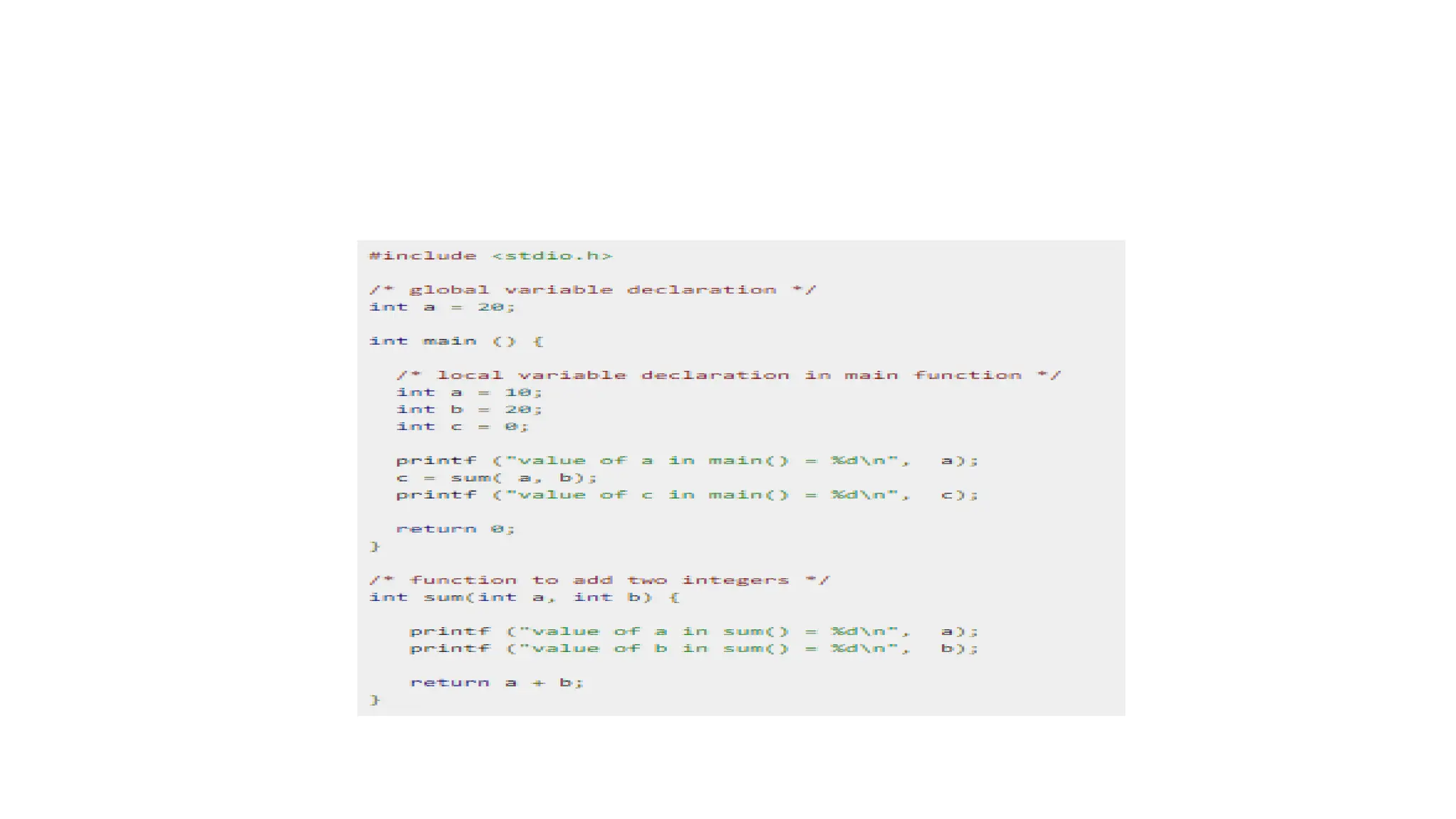
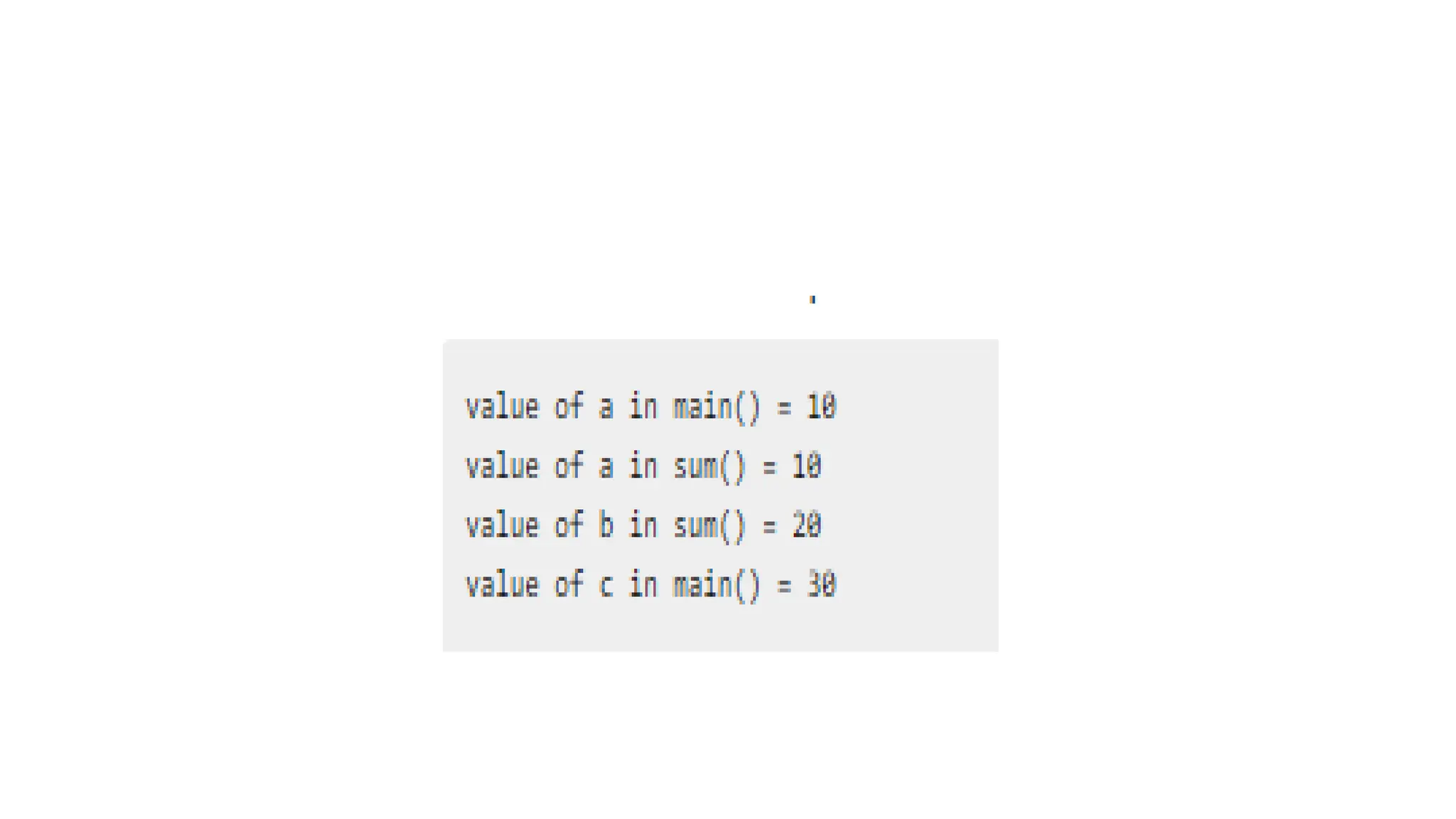
are not known to functions outside their own. The following
example shows how local variables are used. Here all the
variables a, b, and c are local to main() function.
• Global Variables
• Global variables are defined outside a function, usually on
top of the program. Global variables hold their values
throughout the lifetime of your program and they can be
accessed inside any of the functions defined for the
program.
• A global variable can be accessed by any function. That is, a
global variable is available for use throughout your entire
program after its declaration. The following program show
how global variables are used in a program.
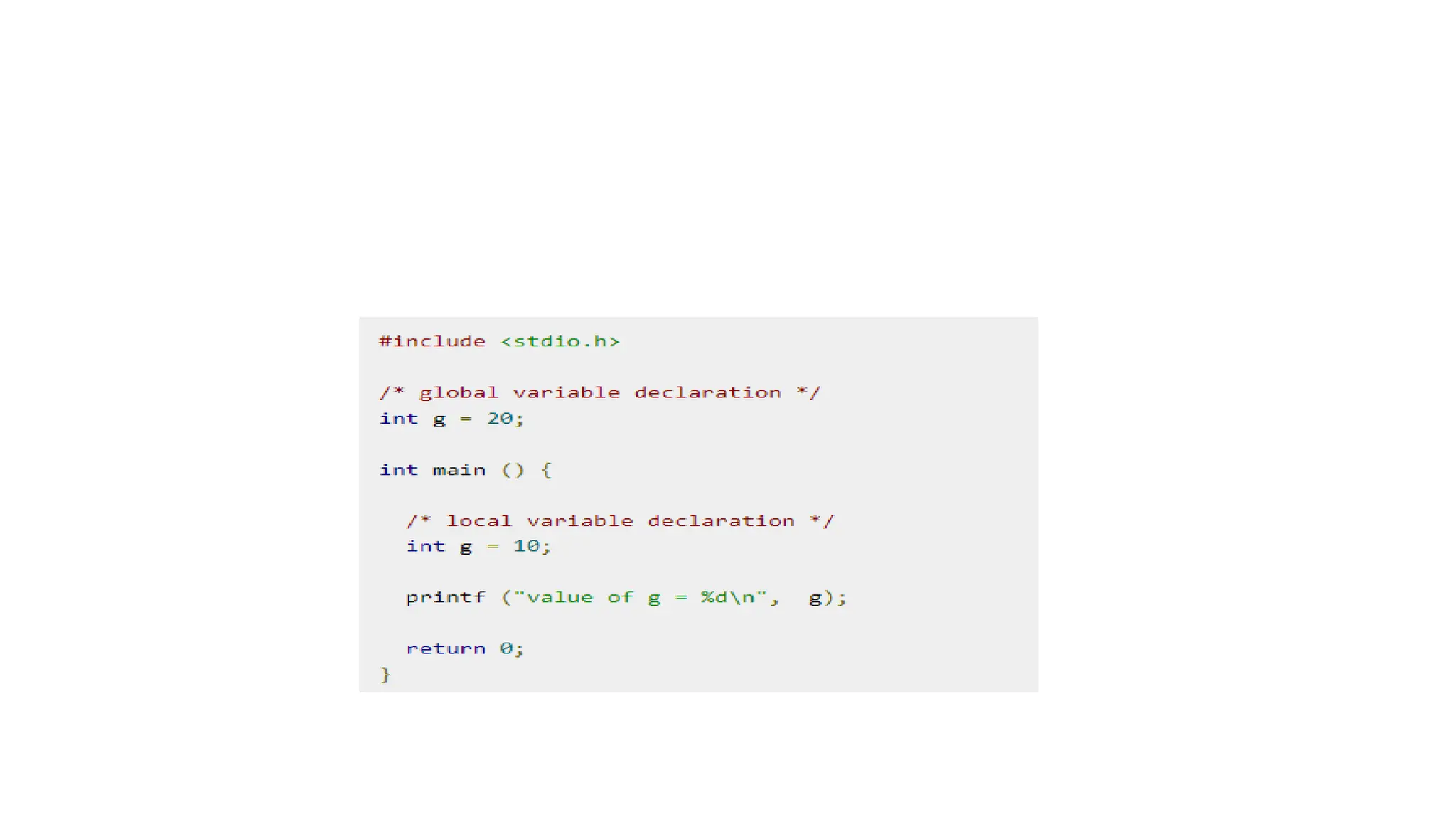
• A program can have same name for local and global
variables but the value of local variable inside a function will
take preference. Here is an example −
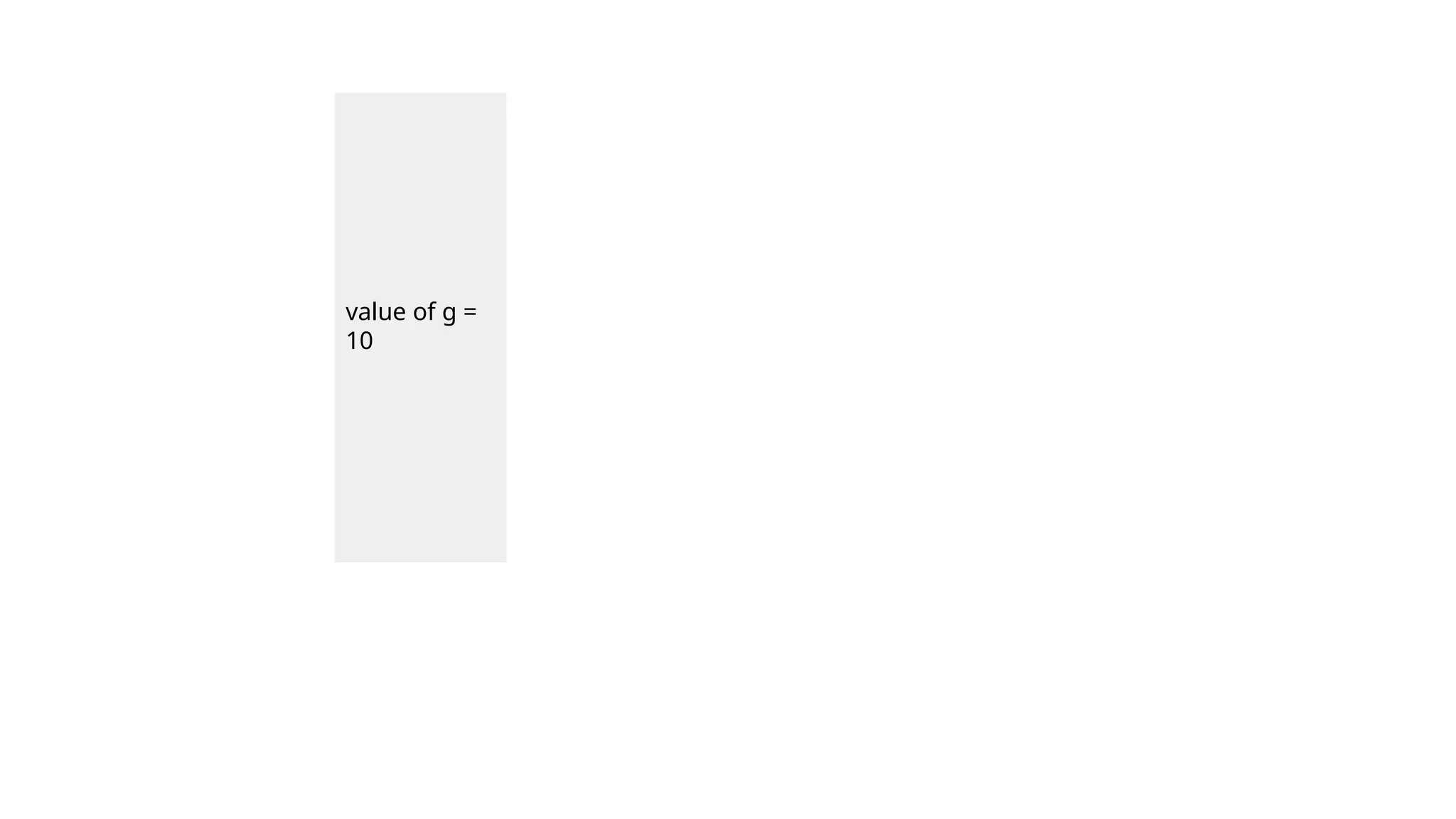
value of g =
10
FUNCTION.pptxfkrdutytrtttrrtttttttttttttt

FUNCTION.pptxfkrdutytrtttrrtttttttttttttt

  • 1.
    C- Functions Functions: Definingand accessing: Passing arguments, Function prototypes, Function calls- Categories of functions- Nesting of functionsRecursion. Use of library functions, Scope , Visibility and Lifetime of variables.
  • 2.
    • A functionis a group of statements that together perform a task. Every C program has at least one function, which is main(), and all the most trivial programs can define additional functions. You can divide up your code into separate functions. How you divide up your code among different functions is up to you, but logically the division is such that each function performs a specific task. A function declaration tells the compiler about a function's name, return type, and parameters. A function definition provides the actual body of the function.
  • 3.
    Defining a Function •The general form of a function definition in C programming language is as follows − return_type function_name( parameter list ) { body of the function } A function definition in C programming consists of a function header and a function body. Here are all the parts of a function −
  • 5.
    • Return Type− A function may return a value. The return_type is the data type of the value the function returns. Some functions perform the desired operations without returning a value. In this case, the return_type is the keyword void. • Function Name − This is the actual name of the function. The function name and the parameter list together constitute the function signature
  • 6.
    • Parameters −A parameter is like a placeholder. When a function is invoked, you pass a value to the parameter. This value is referred to as actual parameter or argument. The parameter list refers to the type, order, and number of the parameters of a function. Parameters are optional; that is, a function may contain no parameters. • Function Body − The function body contains a collection of statements that define what the function does.
  • 7.
    • Example Givenbelow is the source code for a function called max(). This function takes two parameters num1 and num2 and returns the maximum value between the two − • int max(int num1, int num2) • { int result; • if (num1 > num2) • result = num1; • else result = num2; • return result; }
  • 8.
    Function Arguments • Ifa function is to use arguments, it must declare variables that accept the values of the arguments. These variables are called the formal parameters of the function. Formal parameters behave like other local variables inside the function and are created upon entry into the function and destroyed upon exit. While calling a function, there are two ways in which arguments can be passed to a function
  • 10.
    • By default,C uses call by value to pass arguments. In general, it means the code within a function cannot alter the arguments used to call the function
  • 11.
    Function prototype • Thefunction prototypes are used to tell the compiler about the number of arguments and about the required data types of a function parameter, it also tells about the return type of the function. By this information, the compiler cross-checks the function signatures before calling it. If the function prototypes are not mentioned, then the program may be compiled with some warnings, and sometimes generate some strange output
  • 12.
    Categories of Functions •Depending on whether arguments are present or not and whether a value is returned or not, functions are categorized into − Functions  without arguments and without return values Functions without  arguments and with return values Functions with arguments and  without return values Functions with arguments and with return  values
  • 13.
    Library functions arebuilt-in functions • Library functions are built-in functions that are grouped together and placed in a common location called library. Each function here performs a specific operation. We can use this library functions to get the pre-defined output. All C standard library functions are declared by using many header files. These library functions are created at the time of designing the compilers. We include the header files in our C program by using #include. Whenever the program is run and executed, the related files are included in the C program
  • 14.
    • Some ofthe header file functions are as follows − stdio.h − It is a standard i/o header file in which Input/output functions are declared conio.h − This is a console input/output header file. string.h − All string related functions are in this header file. stdlib.h − This file contains common functions which are used in the C programs. math.h − All functions related to mathematics are in this header file. time.h − This file contains time and clock related functions.Built functions in stdio.h
  • 15.
    C- Scope ofvariable • A scope in any programming is a region of the program where a defined variable can have its existence and beyond that variable it cannot be accessed. There are three places where variables can be declared in C programming language − Inside a function or a block  which is called local variables. Outside of all functions which is  called global variables. In the definition of function parameters  which are called formalparameters.
  • 16.
    Local Variables • Variablesthat are declared inside a function or block are called local variables. They can be used only by statements that are inside that function or block of code. Local variables are not known to functions outside their own. The following example shows how local variables are used. Here all the variables a, b, and c are local to main() function.
  • 17.
    Global Variables • Globalvariables are defined outside a function, usually on top of the program. Global variables hold their values throughout the lifetime of your program and they can be accessed inside any of the functions defined for the program. A global variable can be accessed by any function. That is, a global variable is available for use throughout your entire program after its declaration. The following program show how global variables are used in a program.
  • 18.
    Difference between Callby Value and Call by Reference • Functions can be invoked in two ways: Call by Value or Call by Reference. These two ways are generally differentiated by the type of values passed to them as parameters. • The parameters passed to function are called actual parameters whereas the parameters received by function are called formal parameters.
  • 19.
    • Call ByValue: In this parameter passing method, values of actual parameters are copied to function’s formal parameters and the two types of parameters are stored in different memory locations. So any changes made inside functions are not reflected in actual parameters of the caller. • Call by Reference: Both the actual and formal parameters refer to the same locations, so any changes made inside the function are actually reflected in actual parameters of the caller.
  • 22.
  • 24.
    Advantages of UsingCall by Value Method • Guarantees that changes that alter the behavior of a parameter stay within its scope and do not affect the value of an object passed into the function • Reduce the chance of introducing subtle bugs which can be difficult to monitor. • Passing by value removes the possible side effects of a function which makes your program easier to maintain and reason with.
  • 25.
    Advantages of UsingCall by Reference Method • Calling a function by reference does not incur performance penalties that copying would require. Likewise, it does not duplicate the memory necessary to access the content of an object that resides in our program. • Allows a function to update the value of an object that is passed into it. • Allows you to pass functions as references through a technique called function pointers which may alter the behavior of a function. Likewise, lambda expressions may also be passed inside a function. Both enable function composition which has neat theoretical properties.
  • 26.
    Defining a Function Thegeneral form of a function definition in C programming language is as follows − return_type function_name( parameter list ) { body of the function }
  • 27.
    • A functiondefinition in C programming consists of a function header and a function body. Here are all the parts of a function − • Return Type A function may return a value. The − return_type is the data type of the value the function returns. Some functions perform the desired operations without returning a value. In this case, the return_type is the keyword void. • Function Name This is the actual name of the function. The function name and − the parameter list together constitute the function signature. • Parameters A parameter is like a placeholder. When a function is invoked, you − pass a value to the parameter. This value is referred to as actual parameter or argument. The parameter list refers to the type, order, and number of the parameters of a function. Parameters are optional; that is, a function may contain no parameters. • Function Body The function body contains a collection of statements that define − what the function does.
  • 29.
    Function Declarations A functiondeclaration tells the compiler about a function name and how to call the function. The actual body of the function can be defined separately. A function declaration has the following parts − return_type function_name( parameter list );
  • 30.
    For the abovedefined function max(), the function declaration is as follows − int max(int num1, int num2); Parameter names are not import ant in function declaration only their type is required, so the following is also a valid declaration −
  • 31.
    int max(int, int); Functiondeclaration is required when you define a function in one source file and you call that function in another file. In such case, you should declare the function at the top of the file calling the function.
  • 32.
    • Calling aFunction • While creating a C function, you give a definition of what the function has to do. To use a function, you will have to call that function to perform the defined task. • When a program calls a function, the program control is transferred to the called function. A called function performs a defined task and when its return statement is executed or when its function-ending closing brace is reached, it returns the program control back to the main program. • To call a function, you simply need to pass the required parameters along with the function name, and if the function returns a value, then you can store the returned value. For example −
  • 35.
    C - ScopeRules • A scope in any programming is a region of the program where a defined variable can have its existence and beyond that variable it cannot be accessed. There are three places where variables can be declared in C programming language − • Inside a function or a block which is called local variables. • Outside of all functions which is called global variables. • In the definition of function parameters which are called formal parameters. • Let us understand what are local and global variables, and formal parameters.
  • 36.
    • Local Variables •Variables that are declared inside a function or block are called local variables. They can be used only by statements that are inside that function or block of code. Local variables are not known to functions outside their own. The following example shows how local variables are used. Here all the variables a, b, and c are local to main() function.
  • 38.
    • Global Variables •Global variables are defined outside a function, usually on top of the program. Global variables hold their values throughout the lifetime of your program and they can be accessed inside any of the functions defined for the program. • A global variable can be accessed by any function. That is, a global variable is available for use throughout your entire program after its declaration. The following program show how global variables are used in a program.
  • 40.
    • A programcan have same name for local and global variables but the value of local variable inside a function will take preference. Here is an example −
  • 42.