Alternative
Energy Project
Team 4
Jordan Yost, Brian Etzel, Laurentiu Petrut,
Burhaan Farah, Kyle Johnston
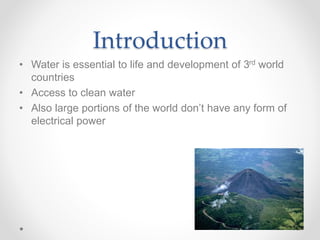
Introduction
• Water is essential to life and development of 3rd world
countries
• Access to clean water
• Also large portions of the world don’t have any form of
electrical power
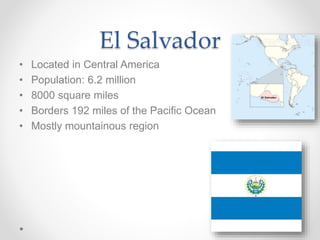
El Salvador
• Located in Central America
• Population: 6.2 million
• 8000 square miles
• Borders 192 miles of the Pacific Ocean
• Mostly mountainous region
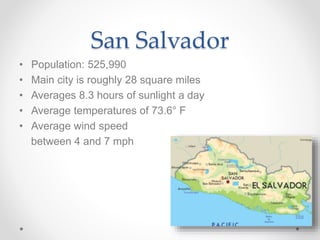
San Salvador
• Population: 525,990
• Main city is roughly 28 square miles
• Averages 8.3 hours of sunlight a day
• Average temperatures of 73.6° F
• Average wind speed
between 4 and 7 mph
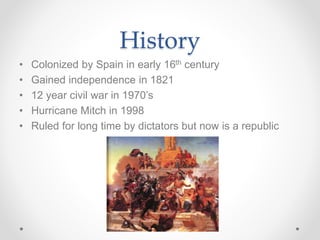
History
• Colonized by Spain in early 16th century
• Gained independence in 1821
• 12 year civil war in 1970’s
• Hurricane Mitch in 1998
• Ruled for long time by dictators but now is a republic
Status of Power Grid
Infrastructure
• About 83% of population have access to electricity
• Plans in effect to add solar power to rural areas with little
to no access to network of electricity
• Hurricanes, earthquakes, and floods do most of the
damage to El Salvador
• During the 6 month rainy season many of the rural and
secondary roads are flooded with water
• Of the roughly 6000 miles of roads only about 1200
miles of the roadways are paved
Accessibility to Clean
Water
• In El Salvador, environmental laws and clean water acts
are not being enforced as heavily as they should be
• About 55% of the rural population have access to the
public water supply compared to 90% of the urban
population having access to the public water supply
• In rural areas many people have to walk and carry water
back to their houses
Shortage of Clean Water
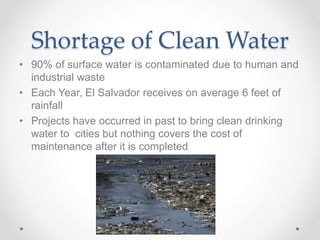
• 90% of surface water is contaminated due to human and
industrial waste
• Each Year, El Salvador receives on average 6 feet of
rainfall
• Projects have occurred in past to bring clean drinking
water to cities but nothing covers the cost of
maintenance after it is completed
Access to Clean Water
• Clean water means the difference in everything
• In all underdeveloped countries, access to clean water is
a problem for large portions of the population, especially
in rural areas
• Dirty water leads to people getting sick and dying
• Polluted water causes more deaths to children than
diseases like malaria
Access cont.
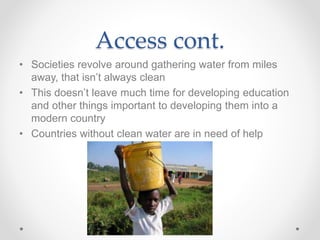
• Societies revolve around gathering water from miles
away, that isn’t always clean
• This doesn’t leave much time for developing education
and other things important to developing them into a
modern country
• Countries without clean water are in need of help
Providing Clean Water
• Providing clean water to areas in need has become
important for cultures, societies, and religions
• There are always projects being done by different
churches and communities to supply clean water to
different parts of the world
Possible positive and negative impacts
of renewable-energy
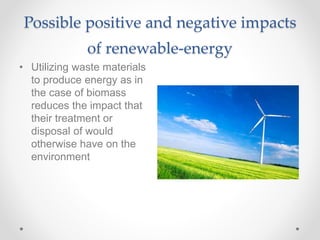
• Utilizing waste materials
to produce energy as in
the case of biomass
reduces the impact that
their treatment or
disposal of would
otherwise have on the
environment
Pros and Cons cont.
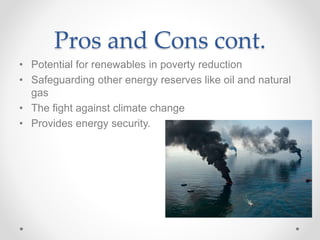
• Potential for renewables in poverty reduction
• Safeguarding other energy reserves like oil and natural
gas
• The fight against climate change
• Provides energy security.
Pros and Cons cont.
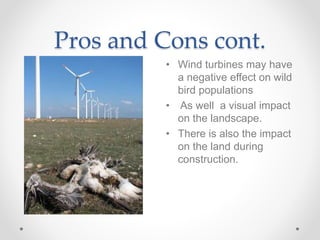
• Wind turbines may have
a negative effect on wild
bird populations
• As well a visual impact
on the landscape.
• There is also the impact
on the land during
construction.
Pros and Cons cont.
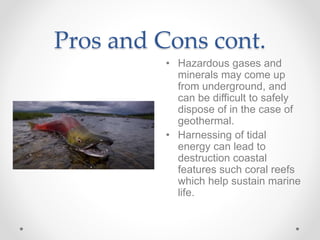
• Hazardous gases and
minerals may come up
from underground, and
can be difficult to safely
dispose of in the case of
geothermal.
• Harnessing of tidal
energy can lead to
destruction coastal
features such coral reefs
which help sustain marine
life.
Pros and Cons cont.
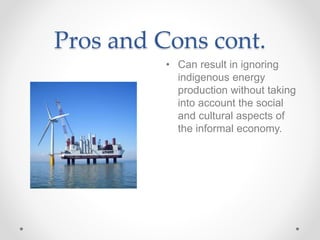
• Can result in ignoring
indigenous energy
production without taking
into account the social
and cultural aspects of
the informal economy.
Pros and Cons cont.
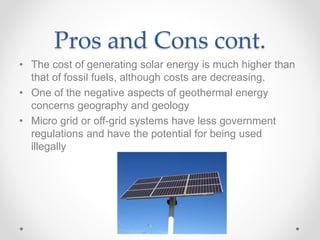
• The cost of generating solar energy is much higher than
that of fossil fuels, although costs are decreasing.
• One of the negative aspects of geothermal energy
concerns geography and geology
• Micro grid or off-grid systems have less government
regulations and have the potential for being used
illegally
Political Parties
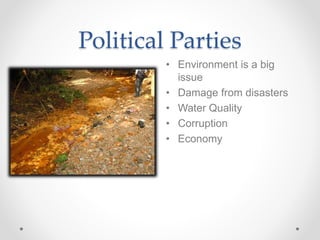
• Environment is a big
issue
• Damage from disasters
• Water Quality
• Corruption
• Economy
Instability
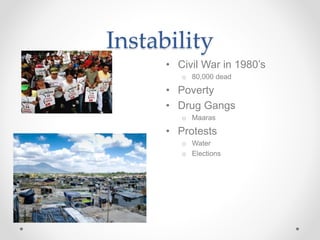
• Civil War in 1980’s
o 80,000 dead
• Poverty
• Drug Gangs
o Maaras
• Protests
o Water
o Elections
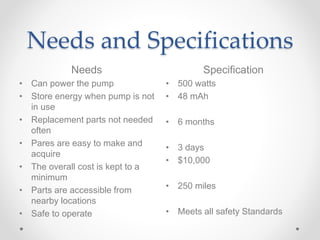
Needs and Specifications
Needs Specification
• Can power the pump
• Store energy when pump is not
in use
• Replacement parts not needed
often
• Pares are easy to make and
acquire
• The overall cost is kept to a
minimum
• Parts are accessible from
nearby locations
• Safe to operate
• 500 watts
• 48 mAh
• 6 months
• 3 days
• $10,000
• 250 miles
• Meets all safety Standards
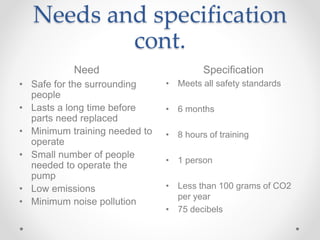
Needs and specification
cont.
Need Specification
• Safe for the surrounding
people
• Lasts a long time before
parts need replaced
• Minimum training needed to
operate
• Small number of people
needed to operate the
pump
• Low emissions
• Minimum noise pollution
• Meets all safety standards
• 6 months
• 8 hours of training
• 1 person
• Less than 100 grams of CO2
per year
• 75 decibels
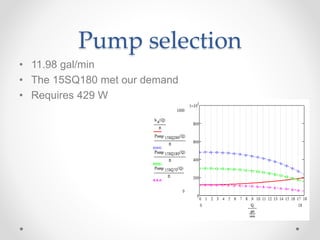
Pump selection
• 11.98 gal/min
• The 15SQ180 met our demand
• Requires 429 W
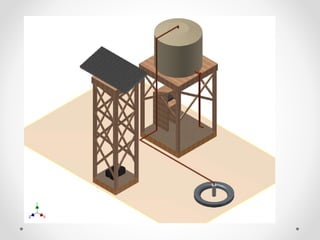
Power Design
• Includes
o Grundfos 15SQ180
o Cabin Off-grid DC kit 2
• Four 140 watt solar panels to produce a total 560 watts.
• 12 volt DC 400 AH battery included
o 1000 gallon plastic tank
• Total cost of $3,735.95
References
• Pump: SQ07
• http://www.supremewatersales.com/grundfos-15sq07-180-
96160149-3-submersible-pump-15-gpm-3-4-hp-2-wire-230-
volt.htmlSQ 05
• Pump: SQ05
• http://www.supremewatersales.com/grundfos-10sq05-160-
96160167-3-submersible-pump-1-2-hp-2-wire-115-volt.html
• Pump: Wayne Deep Well
• http://www.northerntool.com/shop/tools/product_200311417_200311
417
• _-40876
• Solar Panel: DC Kit 1
• http://www.wholesalesolar.com/solarpowersystems/cabin
-1-dc-off-grid-solar-kit.html
• Solar Panel: DC Kit 2
• http://www.wholesalesolar.com/solarpowersystems/cabin
-2-dc-off-grid-solar-kit.html
• Wind Turbine: Nature Power
• http://www.northerntool.com/shop/tools/product_200615
833_200615833?cm_mmc=Aggregates-_-Shopzilla-_-
Alternative + Renewable Energy>Wind Solutions-_-
40876
• Water Tanks:
• http://www.manta.com/c/mthg7dh/store-it-h2o
• http://www.watertanks.com/products/0045-005.asp
• http://www.agratech.co.uk
• http://www.bizrice.co.uk.
• El Salvador:
• http://data.worldbank.org/country/el-salvador
• http://www.nationsencyclopedia.com/economies/America
s/El-Salvador.html
• http://www.factmonster.com/ipka/A0107489.html
• http://www.weatherspark.com/averages/32651/San-
Salvador-La -Paz-El -Salvador
• http://www.globalissues.org/news/2010/12/09/7891
• San Salvador:
• http://www.tradingeconomics.com/el-
salvador/unemployment-rate
• http://www.npr.org/templates/story/story.php?storyId=498
3325
• http://www.climate-
charts.com/Locations/s/SV78663038005100.php

Full final powerpoint

  • 1.
    Alternative Energy Project Team 4 JordanYost, Brian Etzel, Laurentiu Petrut, Burhaan Farah, Kyle Johnston
  • 2.
    Introduction • Water isessential to life and development of 3rd world countries • Access to clean water • Also large portions of the world don’t have any form of electrical power
  • 3.
    El Salvador • Locatedin Central America • Population: 6.2 million • 8000 square miles • Borders 192 miles of the Pacific Ocean • Mostly mountainous region
  • 4.
    San Salvador • Population:525,990 • Main city is roughly 28 square miles • Averages 8.3 hours of sunlight a day • Average temperatures of 73.6° F • Average wind speed between 4 and 7 mph
  • 5.
    History • Colonized bySpain in early 16th century • Gained independence in 1821 • 12 year civil war in 1970’s • Hurricane Mitch in 1998 • Ruled for long time by dictators but now is a republic
  • 6.
    Status of PowerGrid Infrastructure • About 83% of population have access to electricity • Plans in effect to add solar power to rural areas with little to no access to network of electricity • Hurricanes, earthquakes, and floods do most of the damage to El Salvador • During the 6 month rainy season many of the rural and secondary roads are flooded with water • Of the roughly 6000 miles of roads only about 1200 miles of the roadways are paved
  • 7.
    Accessibility to Clean Water •In El Salvador, environmental laws and clean water acts are not being enforced as heavily as they should be • About 55% of the rural population have access to the public water supply compared to 90% of the urban population having access to the public water supply • In rural areas many people have to walk and carry water back to their houses
  • 8.
    Shortage of CleanWater • 90% of surface water is contaminated due to human and industrial waste • Each Year, El Salvador receives on average 6 feet of rainfall • Projects have occurred in past to bring clean drinking water to cities but nothing covers the cost of maintenance after it is completed
  • 9.
    Access to CleanWater • Clean water means the difference in everything • In all underdeveloped countries, access to clean water is a problem for large portions of the population, especially in rural areas • Dirty water leads to people getting sick and dying • Polluted water causes more deaths to children than diseases like malaria
  • 10.
    Access cont. • Societiesrevolve around gathering water from miles away, that isn’t always clean • This doesn’t leave much time for developing education and other things important to developing them into a modern country • Countries without clean water are in need of help
  • 11.
    Providing Clean Water •Providing clean water to areas in need has become important for cultures, societies, and religions • There are always projects being done by different churches and communities to supply clean water to different parts of the world
  • 12.
    Possible positive andnegative impacts of renewable-energy • Utilizing waste materials to produce energy as in the case of biomass reduces the impact that their treatment or disposal of would otherwise have on the environment
  • 13.
    Pros and Conscont. • Potential for renewables in poverty reduction • Safeguarding other energy reserves like oil and natural gas • The fight against climate change • Provides energy security.
  • 14.
    Pros and Conscont. • Wind turbines may have a negative effect on wild bird populations • As well a visual impact on the landscape. • There is also the impact on the land during construction.
  • 15.
    Pros and Conscont. • Hazardous gases and minerals may come up from underground, and can be difficult to safely dispose of in the case of geothermal. • Harnessing of tidal energy can lead to destruction coastal features such coral reefs which help sustain marine life.
  • 16.
    Pros and Conscont. • Can result in ignoring indigenous energy production without taking into account the social and cultural aspects of the informal economy.
  • 17.
    Pros and Conscont. • The cost of generating solar energy is much higher than that of fossil fuels, although costs are decreasing. • One of the negative aspects of geothermal energy concerns geography and geology • Micro grid or off-grid systems have less government regulations and have the potential for being used illegally
  • 18.
    Political Parties • Environmentis a big issue • Damage from disasters • Water Quality • Corruption • Economy
  • 19.
    Instability • Civil Warin 1980’s o 80,000 dead • Poverty • Drug Gangs o Maaras • Protests o Water o Elections
  • 20.
    Needs and Specifications NeedsSpecification • Can power the pump • Store energy when pump is not in use • Replacement parts not needed often • Pares are easy to make and acquire • The overall cost is kept to a minimum • Parts are accessible from nearby locations • Safe to operate • 500 watts • 48 mAh • 6 months • 3 days • $10,000 • 250 miles • Meets all safety Standards
  • 21.
    Needs and specification cont. NeedSpecification • Safe for the surrounding people • Lasts a long time before parts need replaced • Minimum training needed to operate • Small number of people needed to operate the pump • Low emissions • Minimum noise pollution • Meets all safety standards • 6 months • 8 hours of training • 1 person • Less than 100 grams of CO2 per year • 75 decibels
  • 22.
    Pump selection • 11.98gal/min • The 15SQ180 met our demand • Requires 429 W
  • 23.
    Power Design • Includes oGrundfos 15SQ180 o Cabin Off-grid DC kit 2 • Four 140 watt solar panels to produce a total 560 watts. • 12 volt DC 400 AH battery included o 1000 gallon plastic tank • Total cost of $3,735.95
  • 25.
    References • Pump: SQ07 •http://www.supremewatersales.com/grundfos-15sq07-180- 96160149-3-submersible-pump-15-gpm-3-4-hp-2-wire-230- volt.htmlSQ 05 • Pump: SQ05 • http://www.supremewatersales.com/grundfos-10sq05-160- 96160167-3-submersible-pump-1-2-hp-2-wire-115-volt.html • Pump: Wayne Deep Well • http://www.northerntool.com/shop/tools/product_200311417_200311 417 • _-40876
  • 26.
    • Solar Panel:DC Kit 1 • http://www.wholesalesolar.com/solarpowersystems/cabin -1-dc-off-grid-solar-kit.html • Solar Panel: DC Kit 2 • http://www.wholesalesolar.com/solarpowersystems/cabin -2-dc-off-grid-solar-kit.html • Wind Turbine: Nature Power • http://www.northerntool.com/shop/tools/product_200615 833_200615833?cm_mmc=Aggregates-_-Shopzilla-_- Alternative + Renewable Energy>Wind Solutions-_- 40876
  • 27.
    • Water Tanks: •http://www.manta.com/c/mthg7dh/store-it-h2o • http://www.watertanks.com/products/0045-005.asp • http://www.agratech.co.uk • http://www.bizrice.co.uk.
  • 28.
    • El Salvador: •http://data.worldbank.org/country/el-salvador • http://www.nationsencyclopedia.com/economies/America s/El-Salvador.html • http://www.factmonster.com/ipka/A0107489.html • http://www.weatherspark.com/averages/32651/San- Salvador-La -Paz-El -Salvador • http://www.globalissues.org/news/2010/12/09/7891
  • 29.
    • San Salvador: •http://www.tradingeconomics.com/el- salvador/unemployment-rate • http://www.npr.org/templates/story/story.php?storyId=498 3325 • http://www.climate- charts.com/Locations/s/SV78663038005100.php