ACCESS POLICY CONSOLIDATION FOR 
EVENT PROCESSING SYSTEMS 
Student Name:- V.SATISH (312275715036)
CONTENTS 
 Introduction 
 Existing System 
 Proposed System 
 System Requirements Specification 
 Modules 
 Algorithm 
 System Design 
 Screen Shots 
 Test Cases 
 Conclusion
INTRODUCTION 
 The project ACCESS POLICY CONSOLIDATION FOR 
EVENT PROCESSING SYSTEMS deals with the 
manufacturer, shipping company and customers about the 
product’s buy or sale of establishments online. 
 Event processing systems respond to events in the system’s 
environment or user interface. 
 The key characteristic of event processing systems is that the 
timing of events is unpredictable and the system must be able 
to Scope with these events when they occur.
INTRODUCTION CONT… 
 In business processes, it is necessary to detect inconsistencies 
or failures early. For example, in manufacturing and logistics 
processes, items are tracked continuously to detect loss or to 
reroute them during transport. To answer this need complex 
event processing (CEP) systems have evolved as a key 
paradigm for business and industrial applications. 
 CEP systems allow to detect situations by performing 
operations on event streams which emerge from sensors all 
over the world, e.g. from packet tracking devices.
EXISTING SYSTEMS 
 Current event processing systems lack methods to preserve 
privacy constraints of incoming event streams in a chain of 
subsequently applied stream operations. 
 This is a problem in large-scale distributed applications like a 
logistic chain where event processing operators may be spread 
over multiple security domains. 
 An adversary can guess from legally received outgoing event 
streams confidential input streams of the event processing 
system.
DISADVANTAGES OF EXISTING SYSTEM: 
 Its take lot of time 
 Delivery problem in customer and manufacturer
PROPOSED SYSTEM 
 This project presents a fine-grained access management for 
complex event processing. 
 Each incoming event stream can be protected by the 
specification of an access policy. 
 The utility of the event processing system is increased by 
providing and computing in a scalable manner.
ADVANTAGES OF PROPOSED SYSTEM: 
 Clear content based public or subscribe systems. 
 Time saving. 
 Clear communication system between user and 
manufacture.
HARDWARE-SOFTWARE REQUIREMENT 
SPECIFICATION 
Software Requirements 
 Operating System - Windows XP /7/8 
 Application Server - Apache Tomcat 6.0 
 Front End - HTML, Java 
 Server side Script - Java Server Pages. 
 Database - MySQL 
 Software Tools - Eclipse IDE 
 Database Connectivity - JDBC.
HARDWARE-SOFTWARE REQUIREMENT 
SPECIFICATION 
Hardware Requirements 
• Processor - Pentium IV or above 
• Speed - 1.1 GHz 
• RAM - 512 MB or above 
• Hard Disk - 20 GB or above 
• Key Board - Standard Windows Keyboard 
• Mouse - Two or Three Button Mouse
MODULES 
Modules in this project are: 
 Event Processing 
 Manufacturer 
 Shipping Company 
 Customer
MODULES DESCRIPTION 
 Event Processing:- Event processing systems respond to events in 
the system’s environment or user interface. The key characteristic of 
event processing systems is that the timing of events is unpredictable 
and the system must be able to cope with these events when they 
occur. 
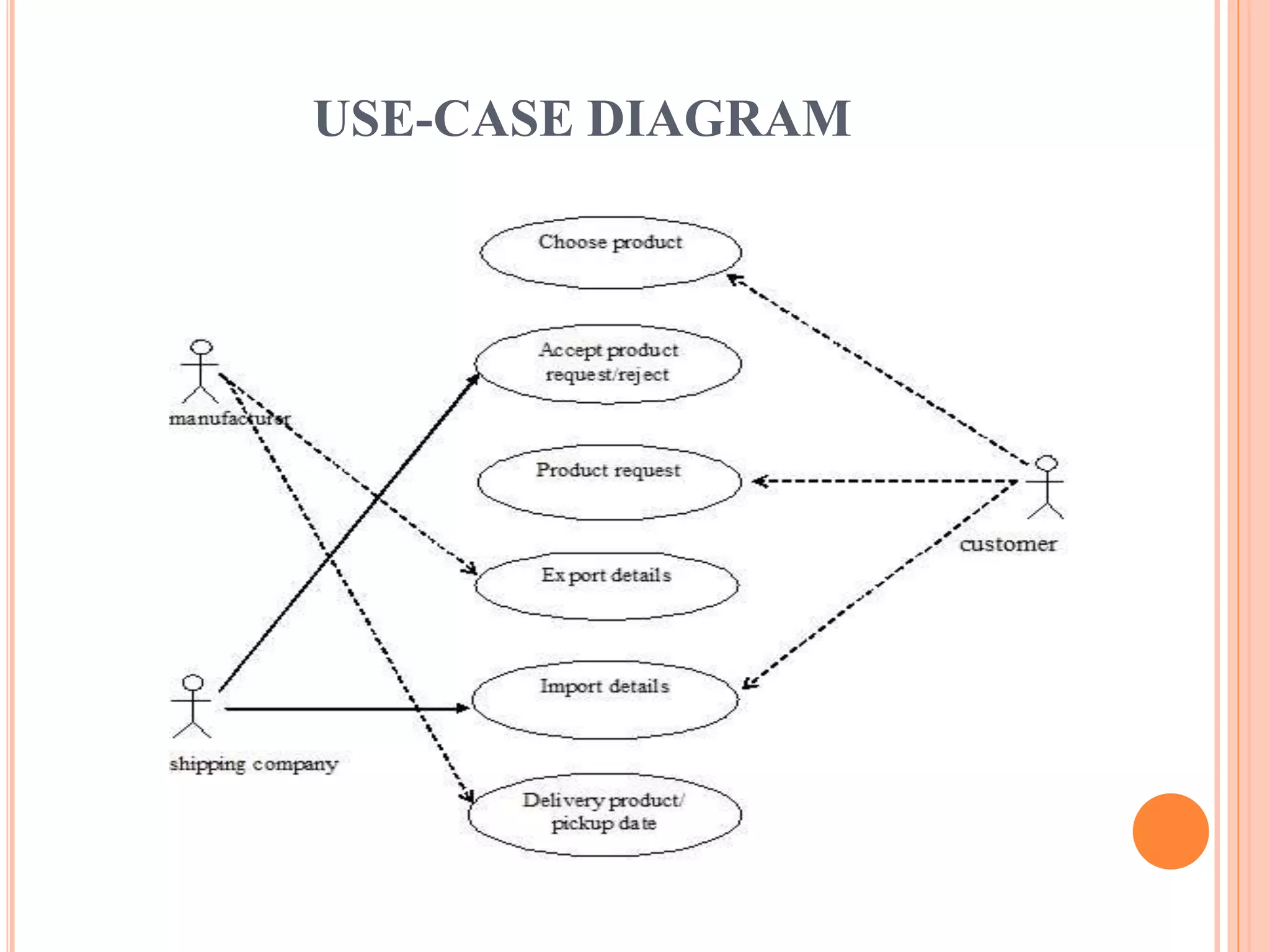
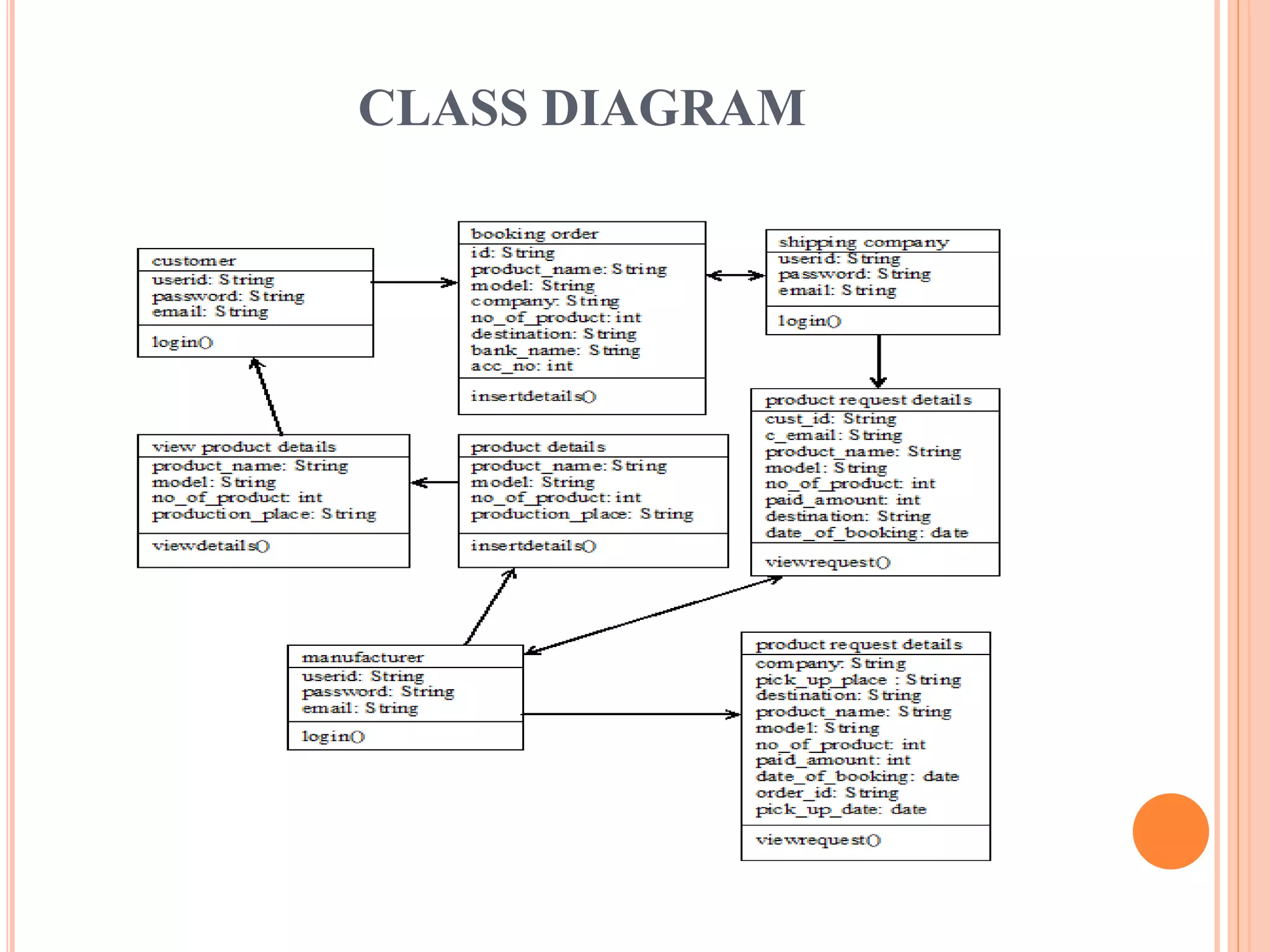
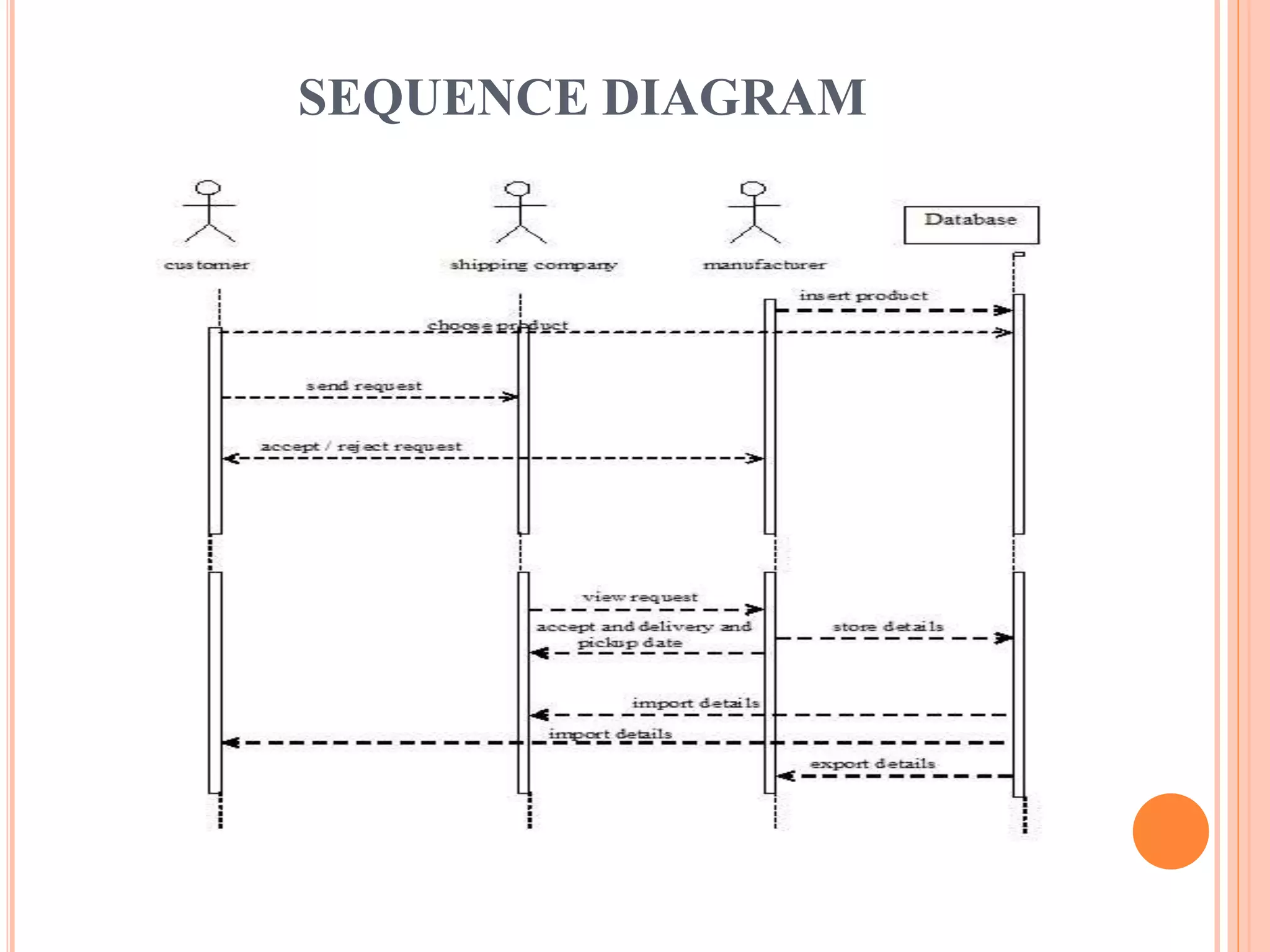
 Manufacturer:- In this module manufacturer, insert the product 
details. The shipping company will forward the request to 
manufacturer sent by customer. So manufacturer can view product 
request from shipping company. The manufacturer will send the 
product details to shipping company to delivery date and pickup time 
means the manufacturer will send the export details.
MODULE DESCRIPTION CONT… 
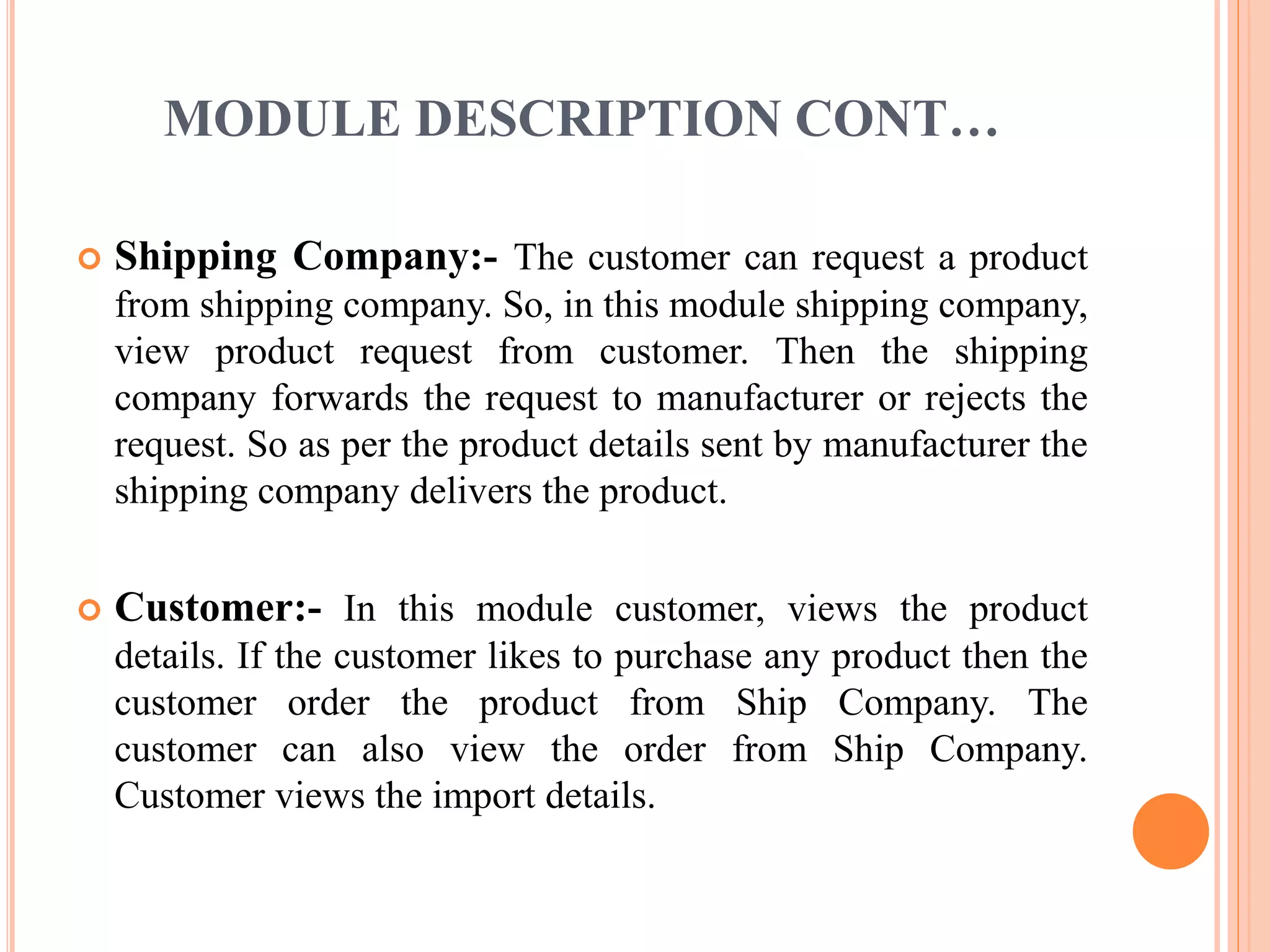
 Shipping Company:- The customer can request a product 
from shipping company. So, in this module shipping company, 
view product request from customer. Then the shipping 
company forwards the request to manufacturer or rejects the 
request. So as per the product details sent by manufacturer the 
shipping company delivers the product. 
 Customer:- In this module customer, views the product 
details. If the customer likes to purchase any product then the 
customer order the product from Ship Company. The 
customer can also view the order from Ship Company. 
Customer views the import details.
ALGORITHM : LOCAL OBFUSCATION CALCULATION: 
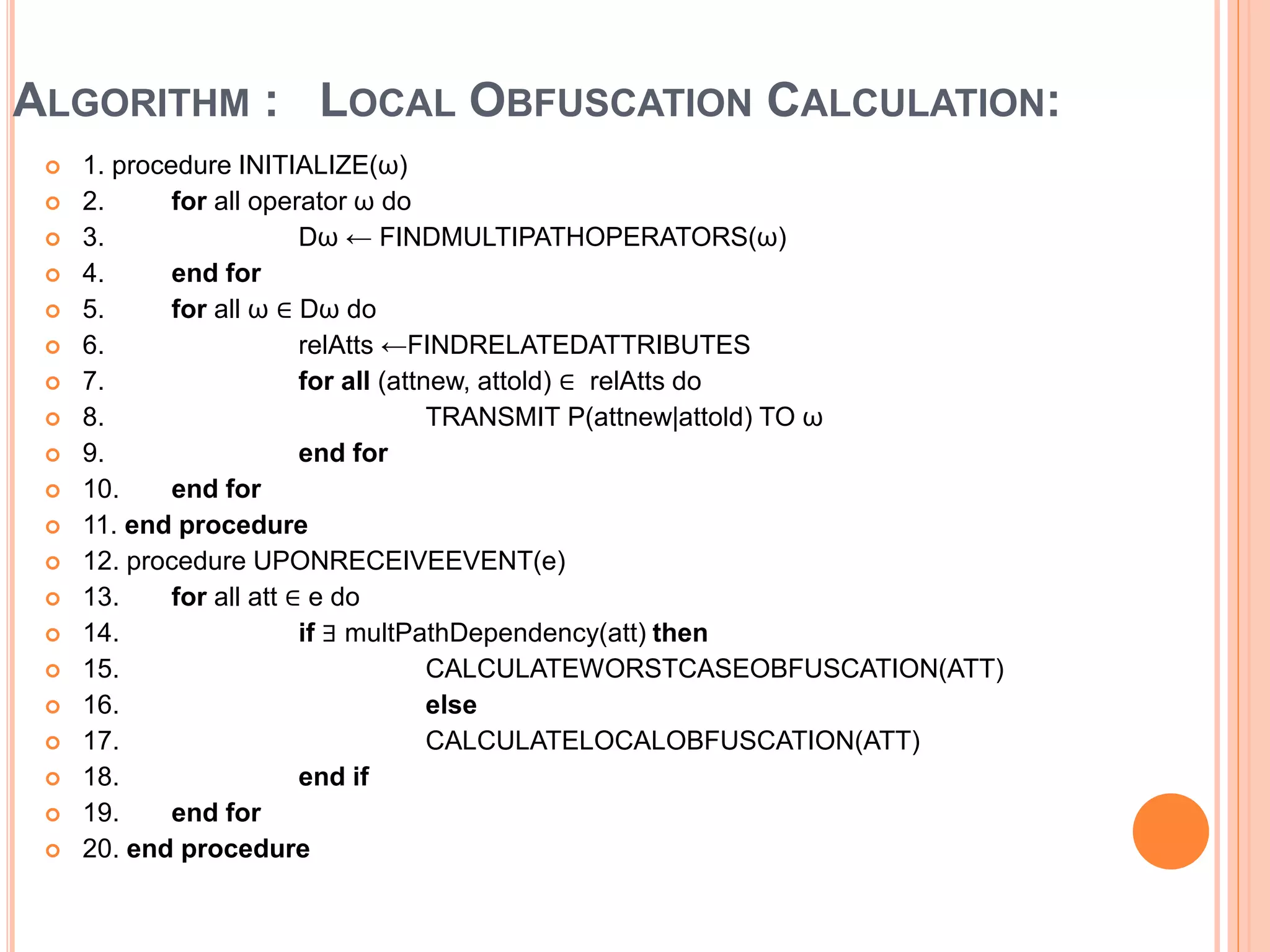
 1. procedure INITIALIZE(ω) 
 2. for all operator ω do 
 3. Dω ← FINDMULTIPATHOPERATORS(ω) 
 4. end for 
 5. for all ω ∈ Dω do 
 6. relAtts ←FINDRELATEDATTRIBUTES 
 7. for all (attnew, attold) ∈ relAtts do 
 8. TRANSMIT P(attnew|attold) TO ω 
 9. end for 
 10. end for 
 11. end procedure 
 12. procedure UPONRECEIVEEVENT(e) 
 13. for all att ∈ e do 
 14. if ∃ multPathDependency(att) then 
 15. CALCULATEWORSTCASEOBFUSCATION(ATT) 
 16. else 
 17. CALCULATELOCALOBFUSCATION(ATT) 
 18. end if 
 19. end for 
 20. end procedure
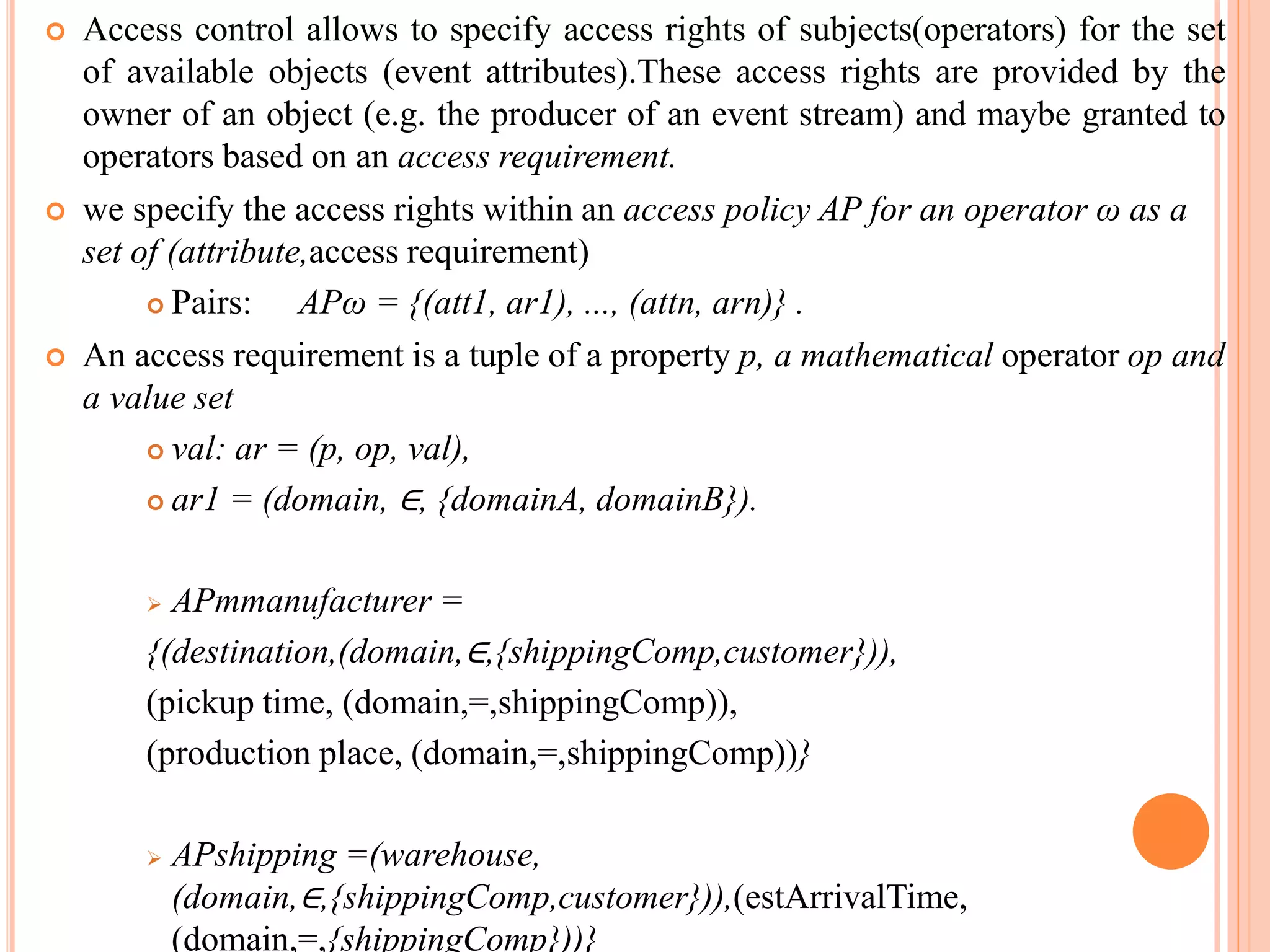
 Access control allows to specify access rights of subjects(operators) for the set 
of available objects (event attributes).These access rights are provided by the 
owner of an object (e.g. the producer of an event stream) and maybe granted to 
operators based on an access requirement. 
 we specify the access rights within an access policy AP for an operator ω as a 
set of (attribute,access requirement) 
 Pairs: APω = {(att1, ar1), ..., (attn, arn)} . 
 An access requirement is a tuple of a property p, a mathematical operator op and 
a value set 
 val: ar = (p, op, val), 
 ar1 = (domain, ∈, {domainA, domainB}). 
 APmmanufacturer = 
{(destination,(domain,∈,{shippingComp,customer})), 
(pickup time, (domain,=,shippingComp)), 
(production place, (domain,=,shippingComp))} 
 APshipping =(warehouse, 
(domain,∈,{shippingComp,customer})),(estArrivalTime, 
(domain,=,{shippingComp}))}
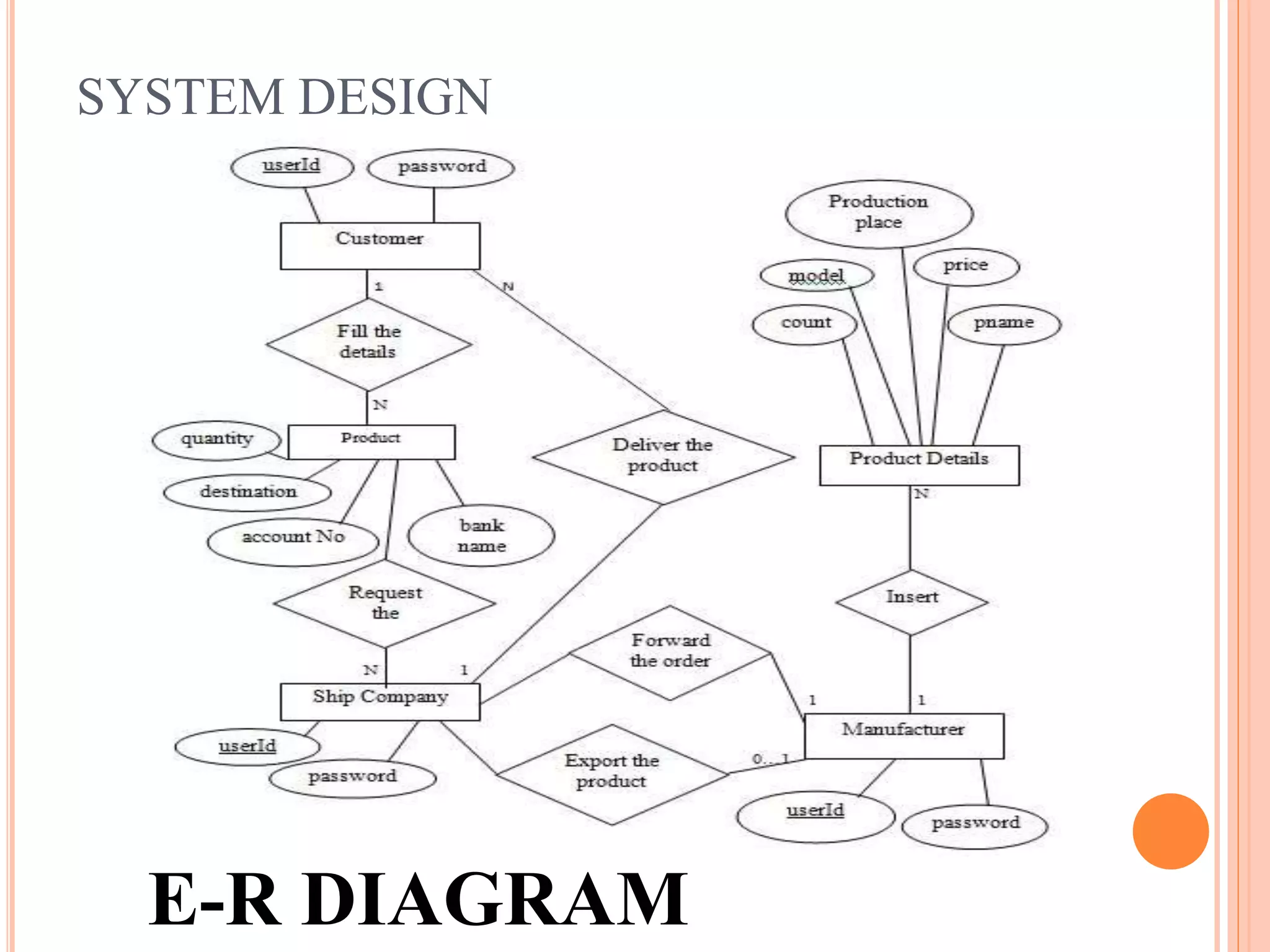
SYSTEM DESIGN 
E-R DIAGRAM
USE-CASE DIAGRAM
CLASS DIAGRAM
SEQUENCE DIAGRAM
SCREEN SHOT 
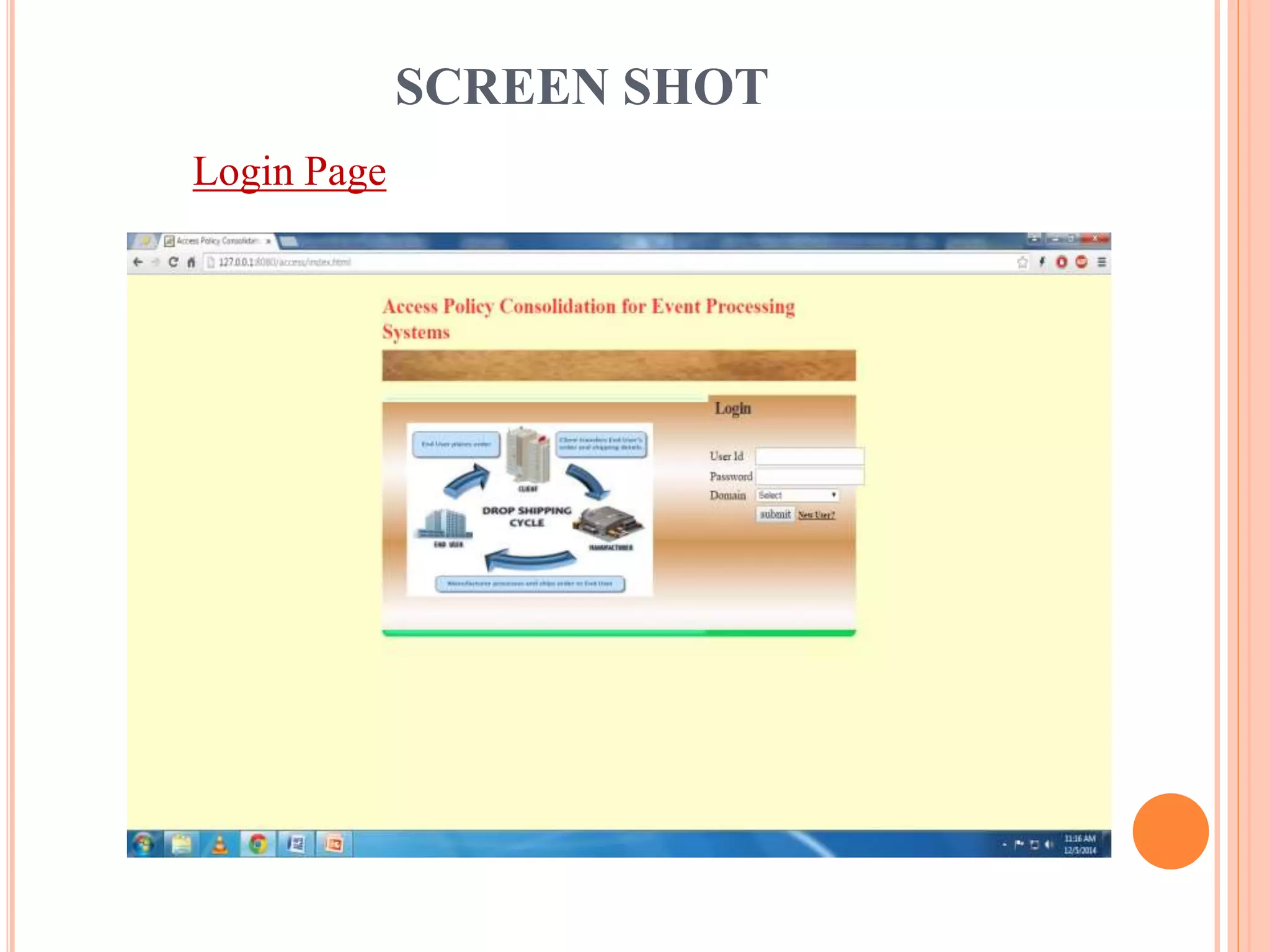
Login Page
SCREEN SHOTS 
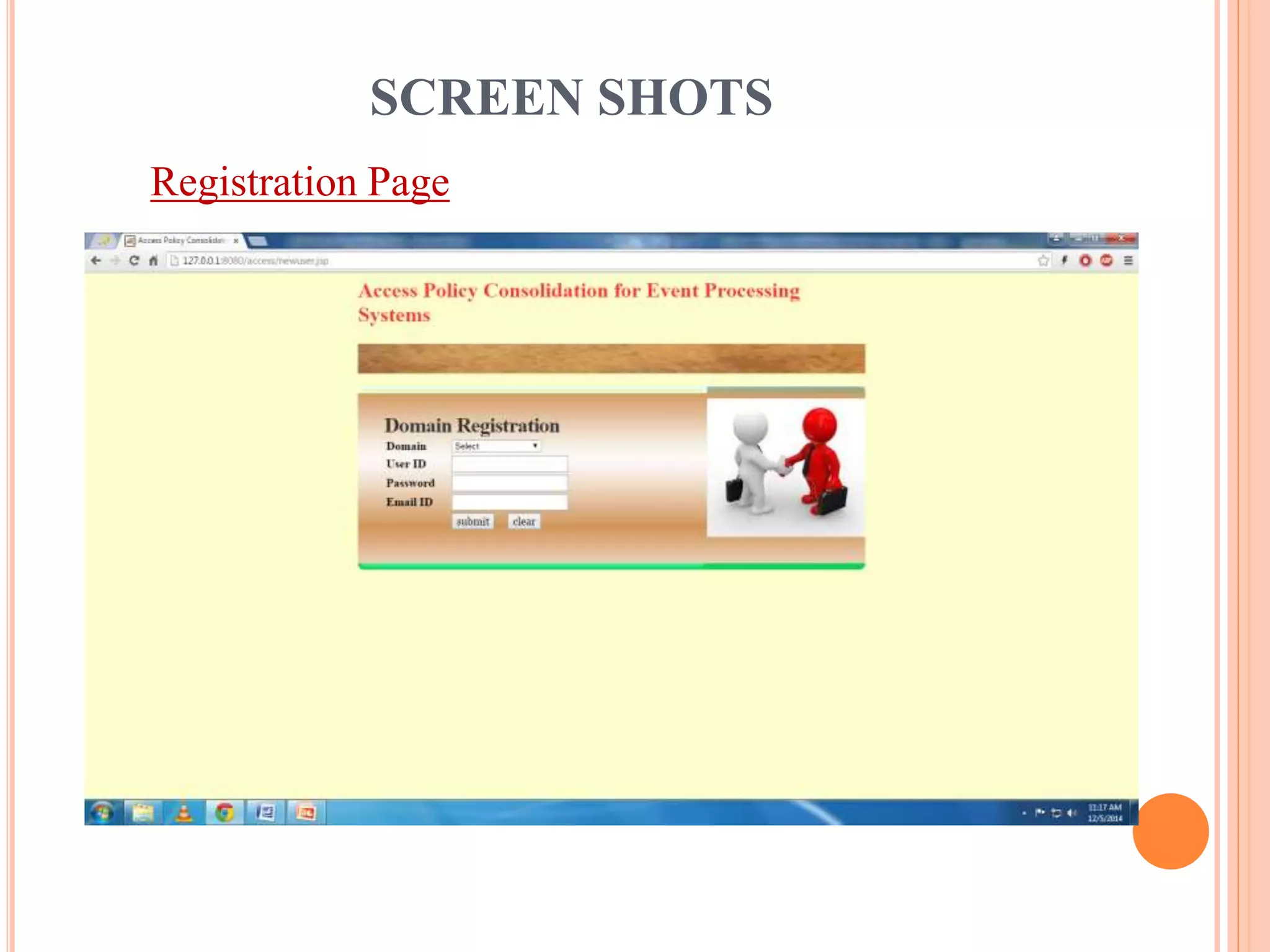
Registration Page
SCREEN SHOTS 
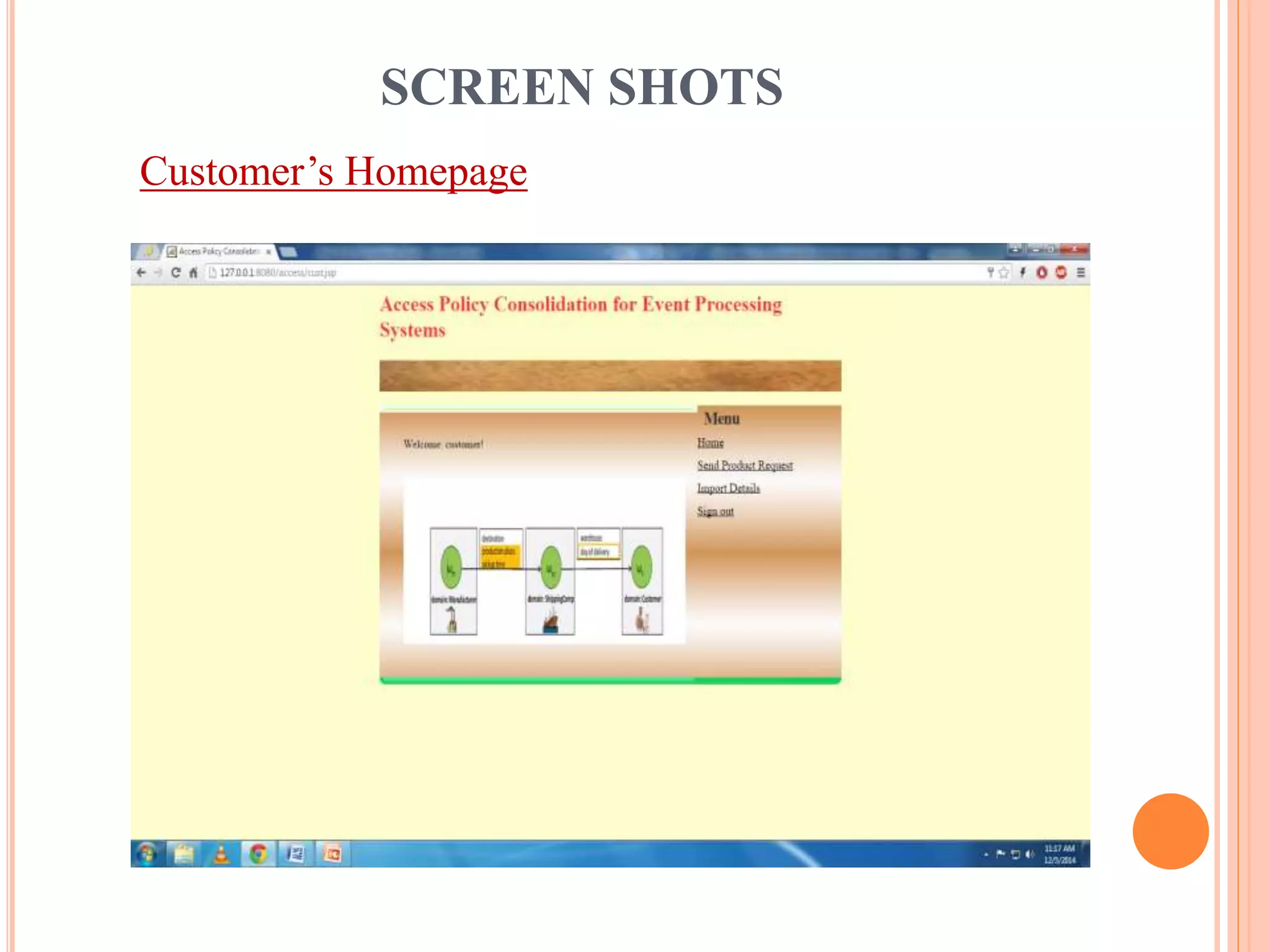
Customer’s Homepage
SCREEN SHOTS 
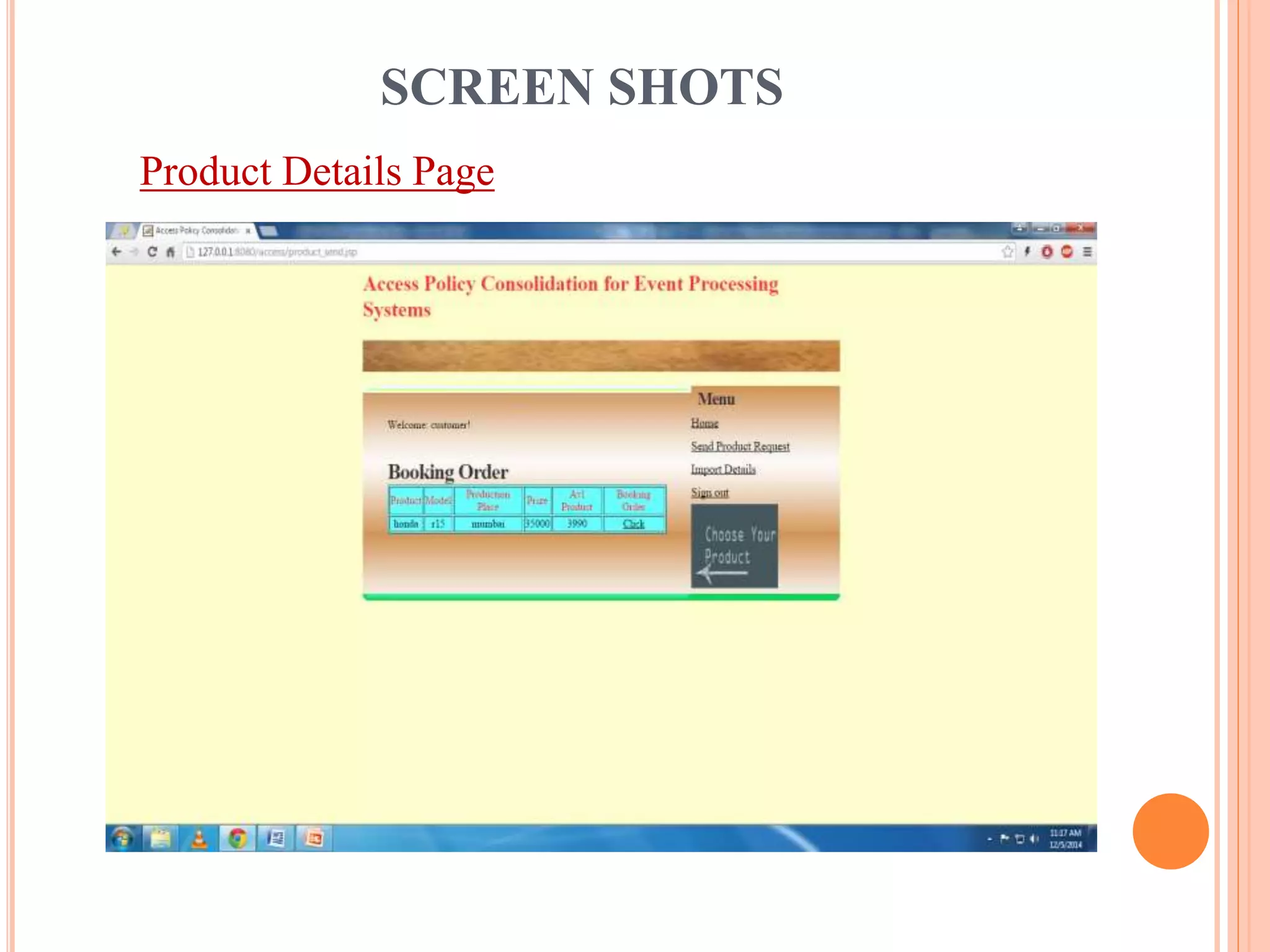
Product Details Page
SCREEN SHOTS 
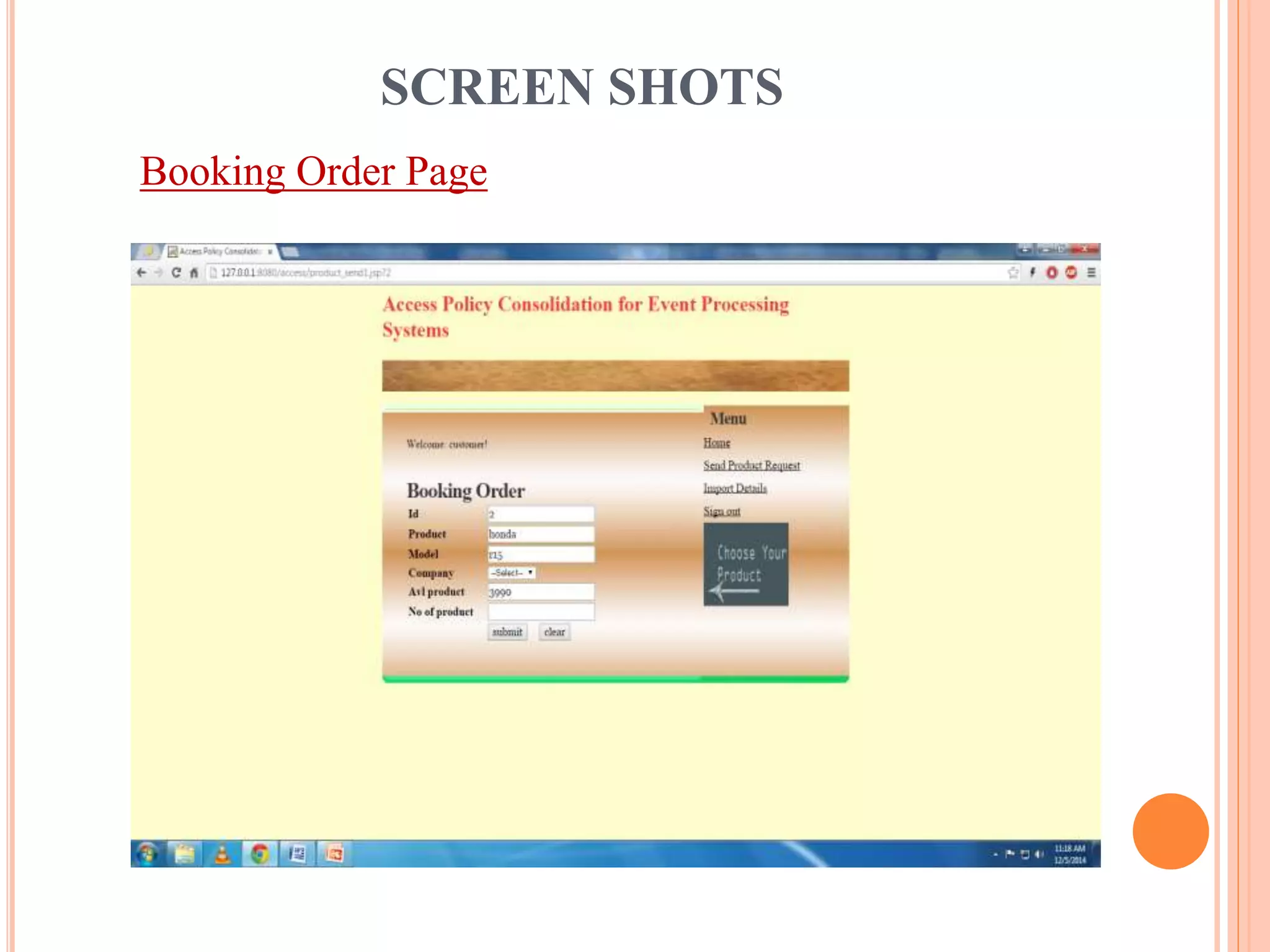
Booking Order Page
SCREEN SHOTS 
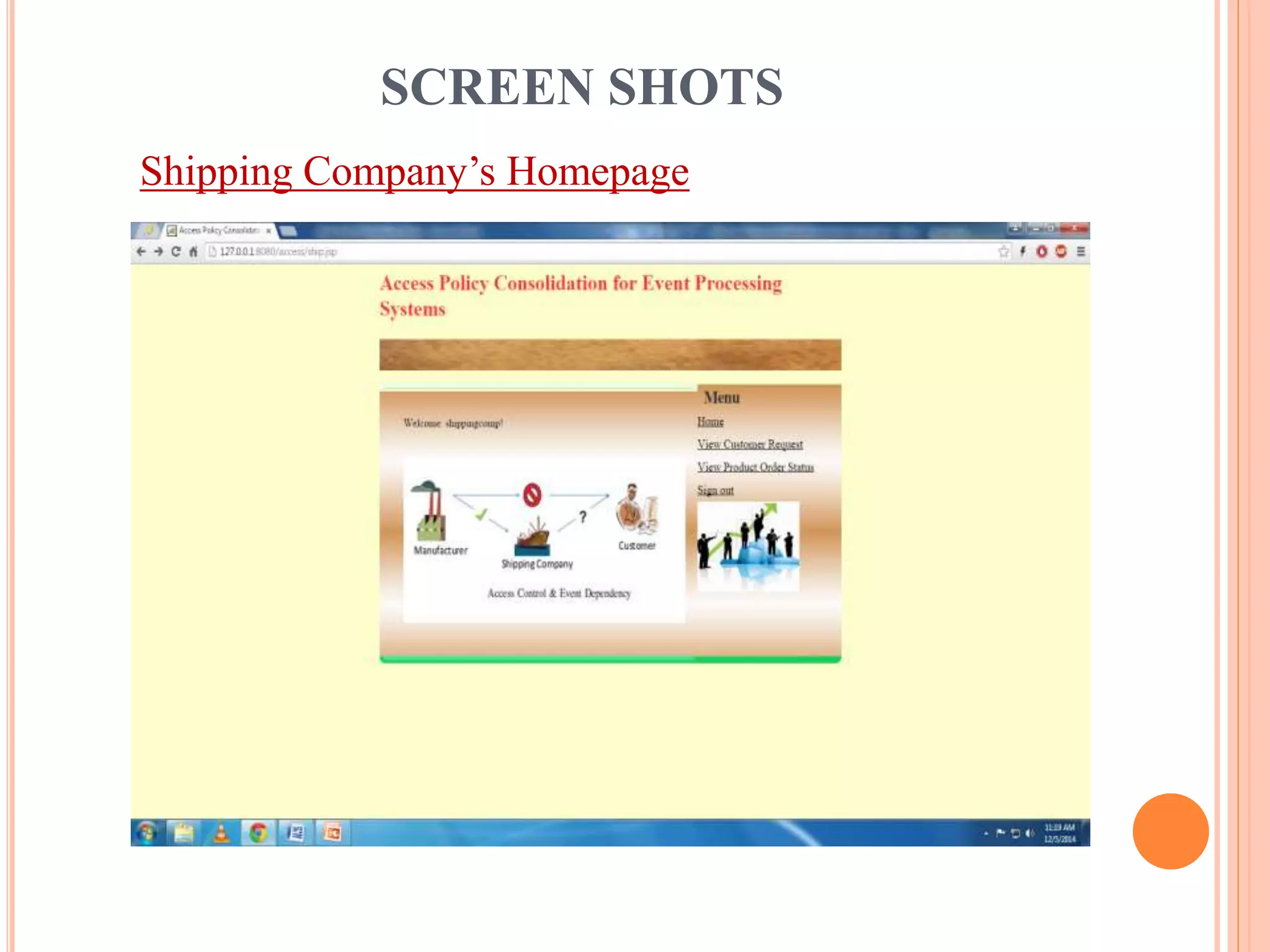
Shipping Company’s Homepage
SCREEN SHOTS 
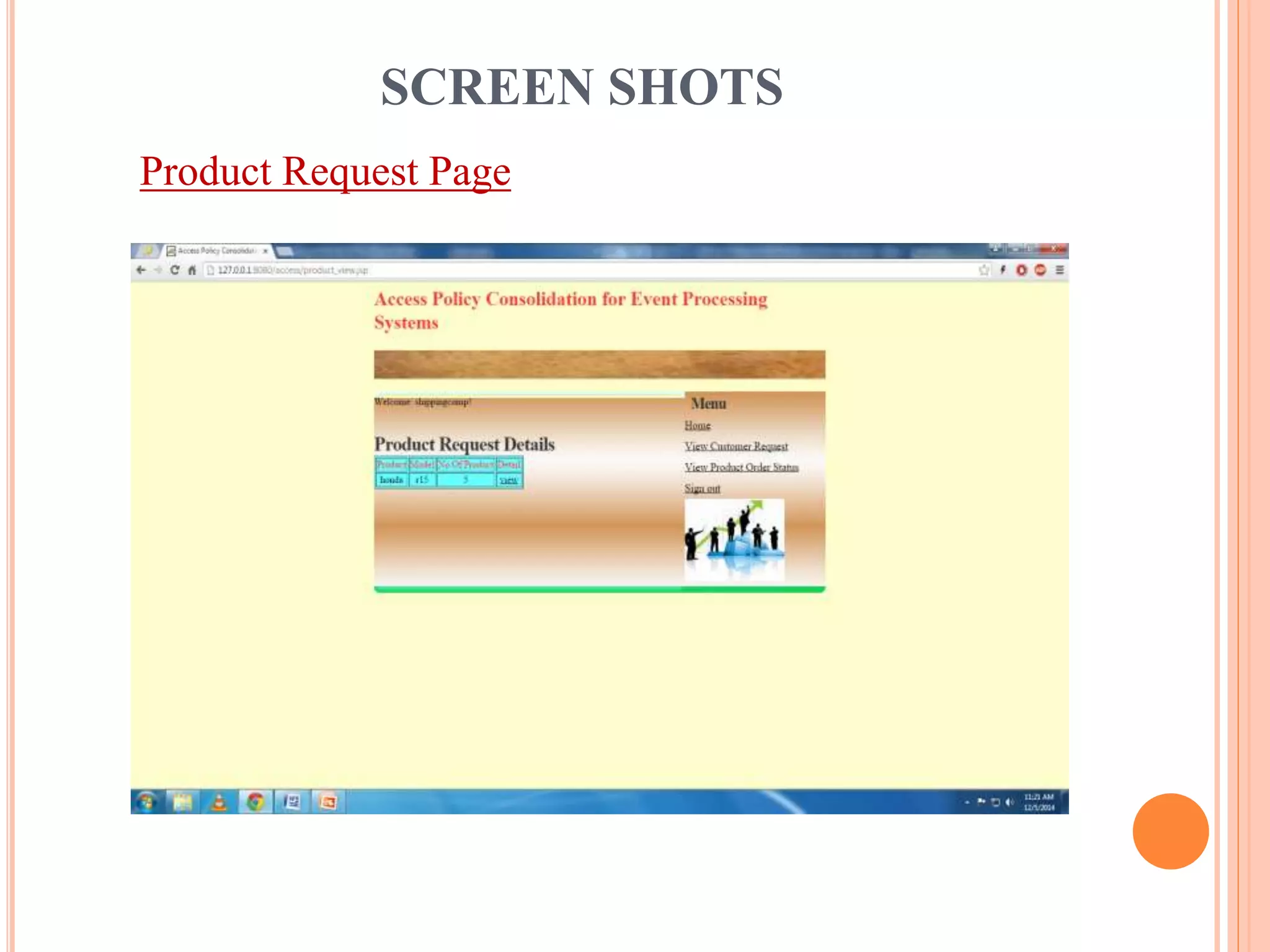
Product Request Page
SCREEN SHOTS 
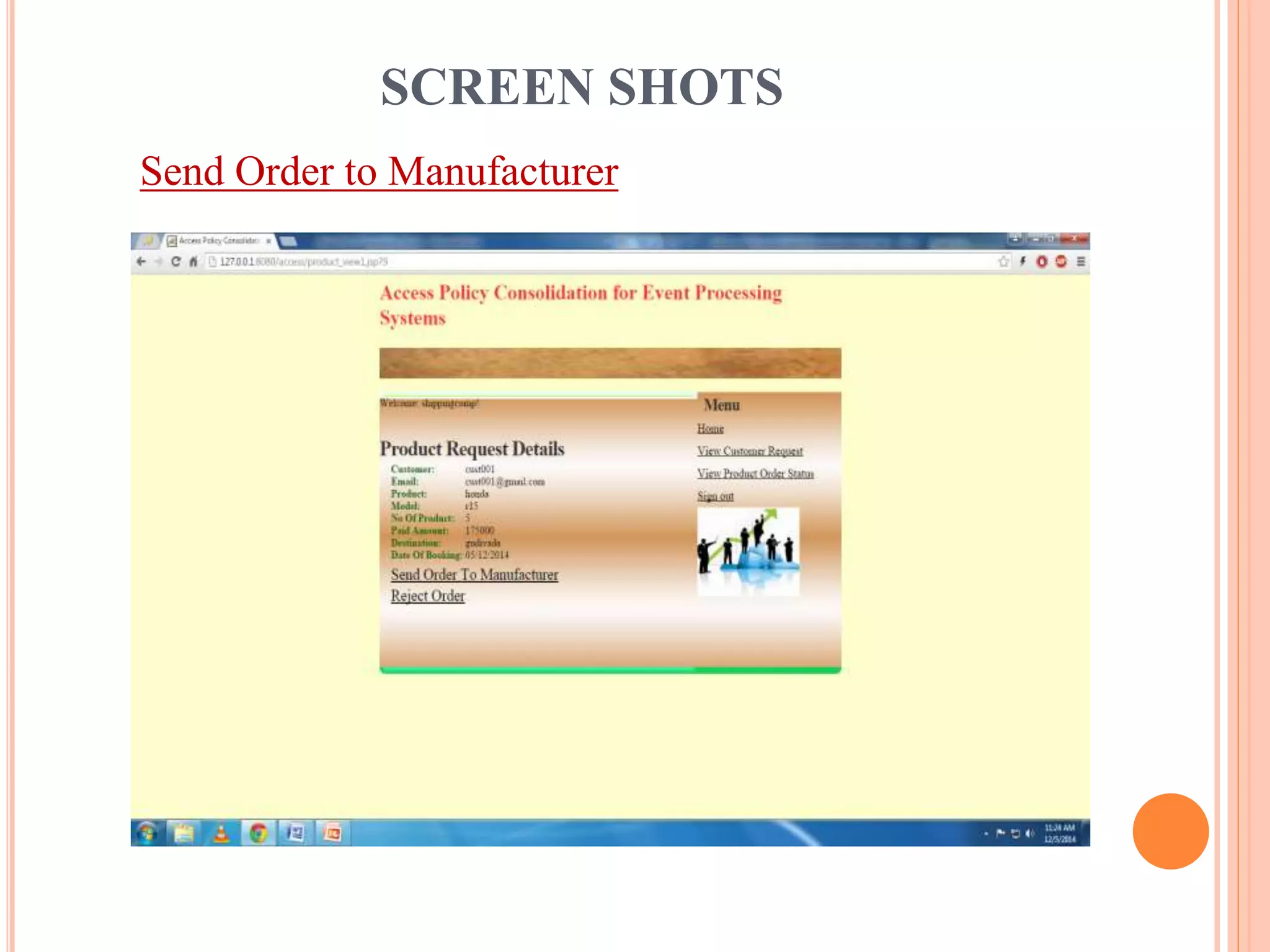
Send Order to Manufacturer
SCREEN SHOTS 
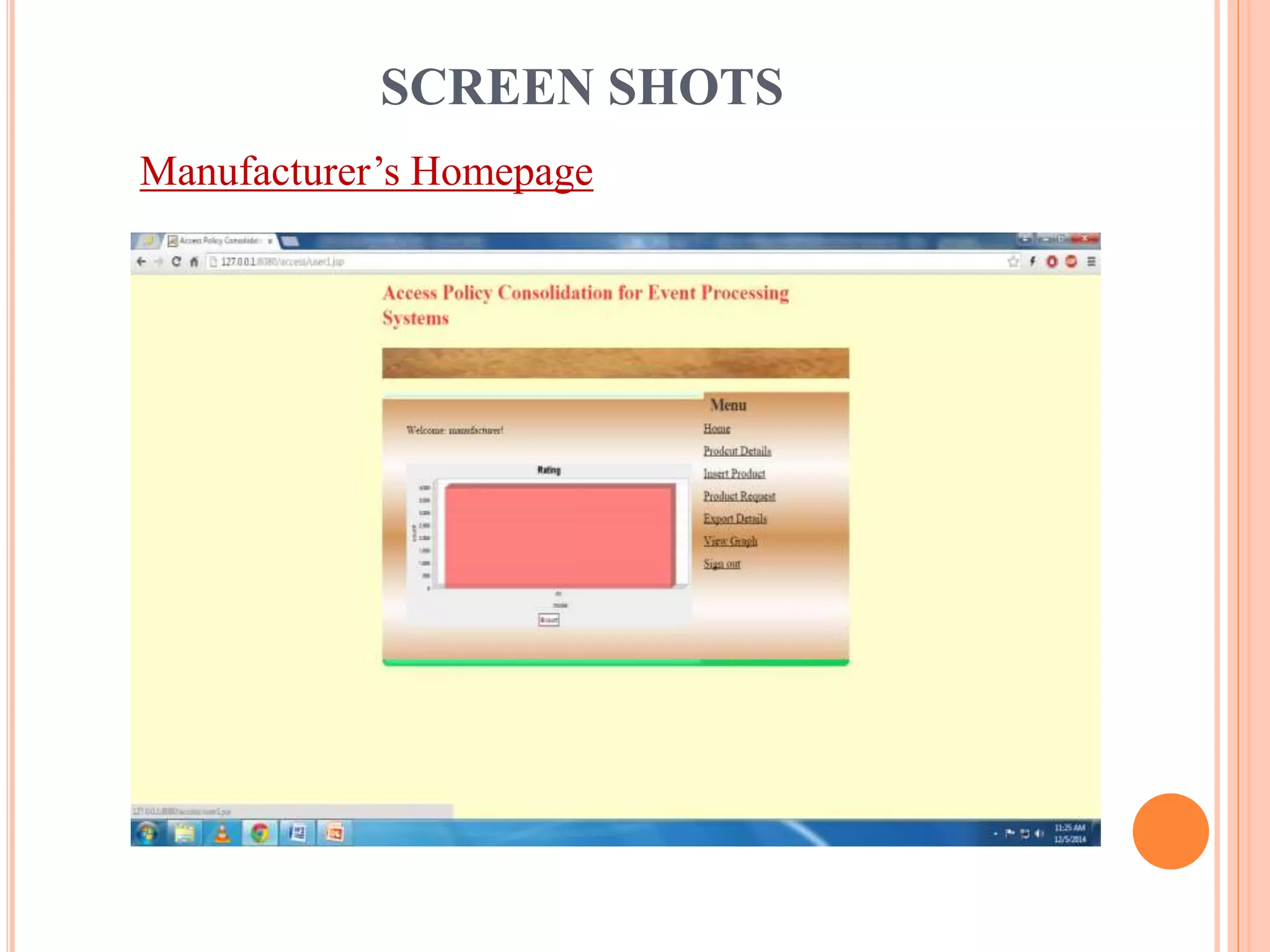
Manufacturer’s Homepage
SCREEN SHOTS 
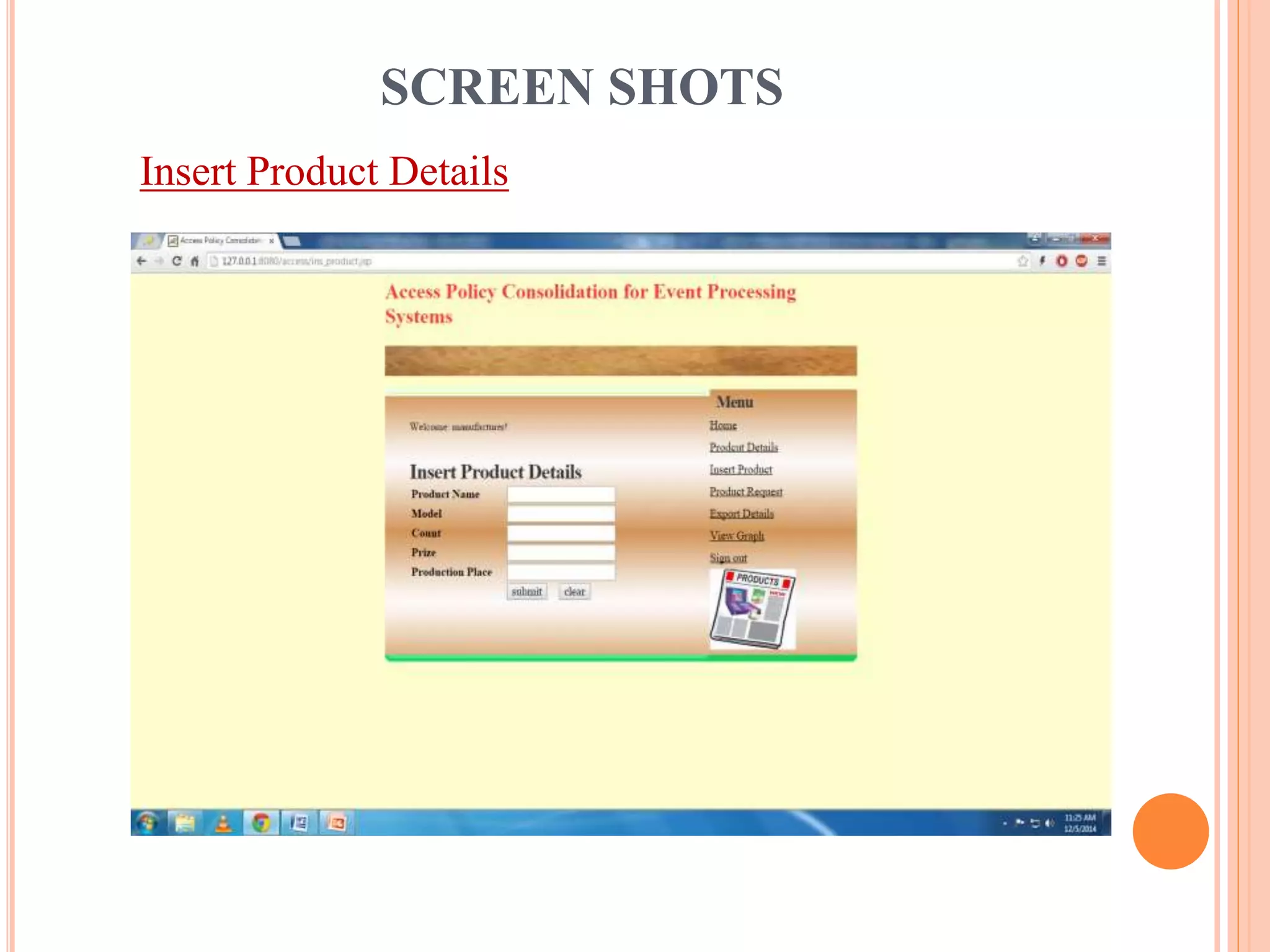
Insert Product Details
SCREEN SHOTS 
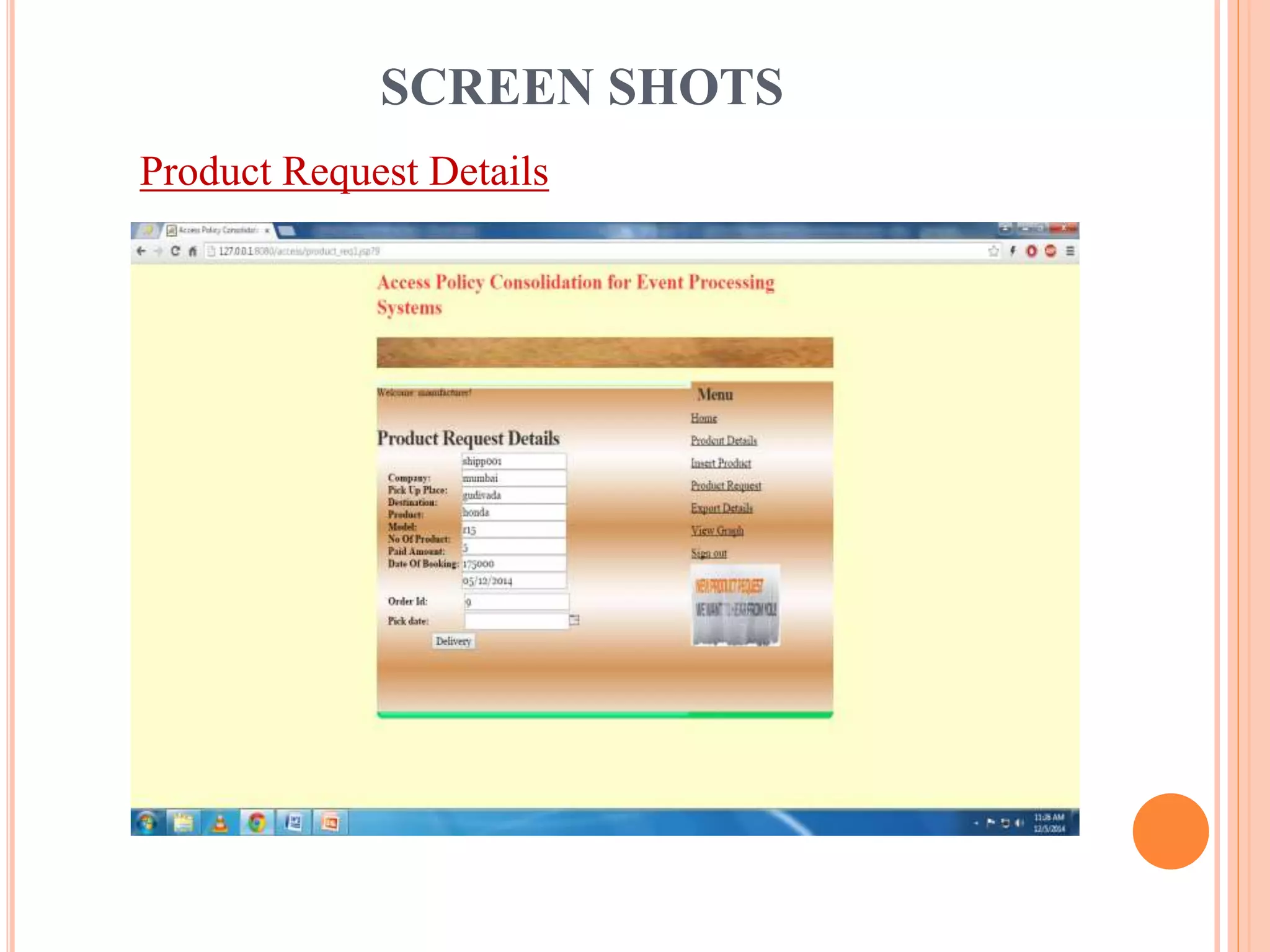
Product Request Details
SCREEN SHOTS 
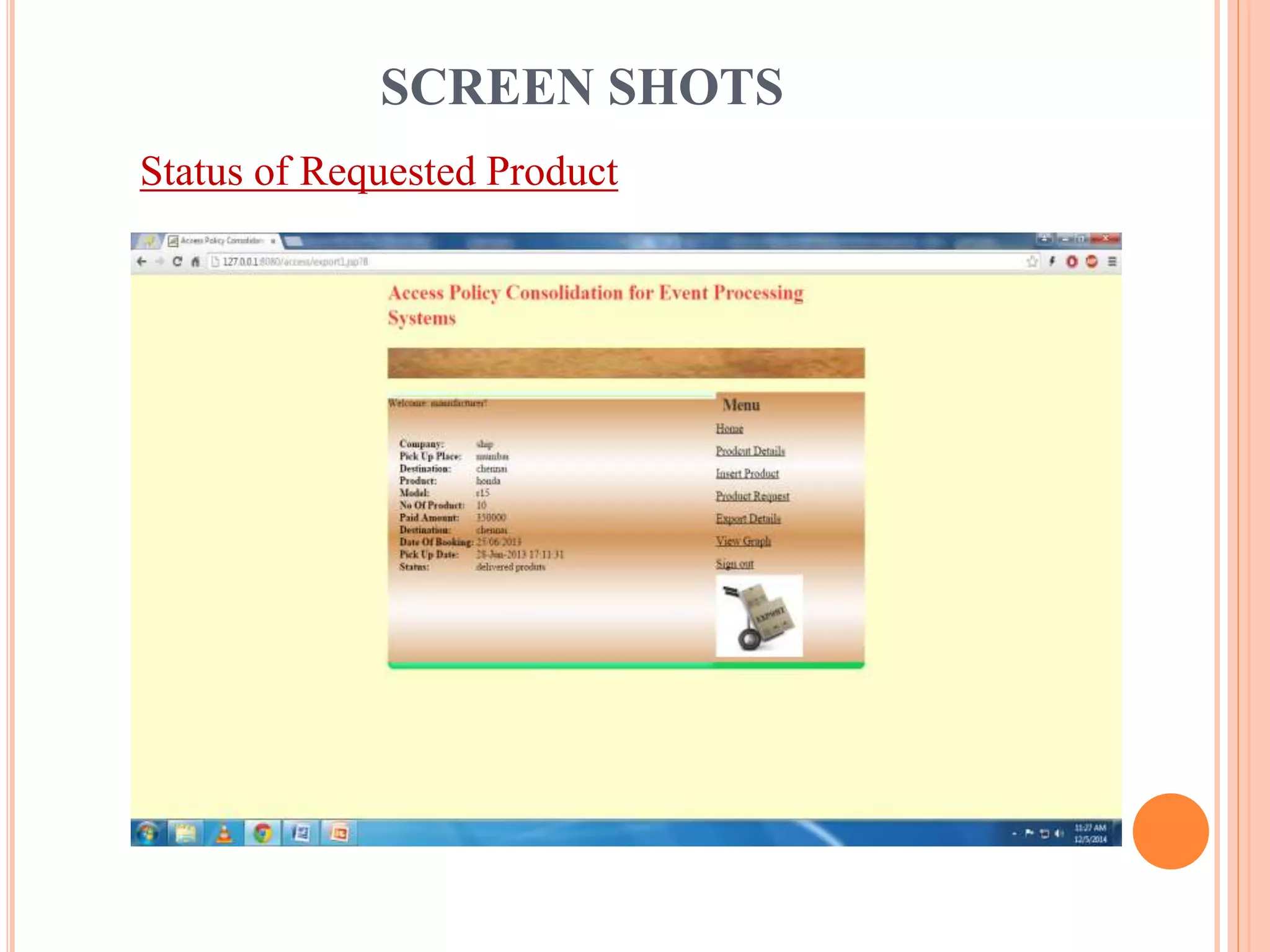
Status of Requested Product
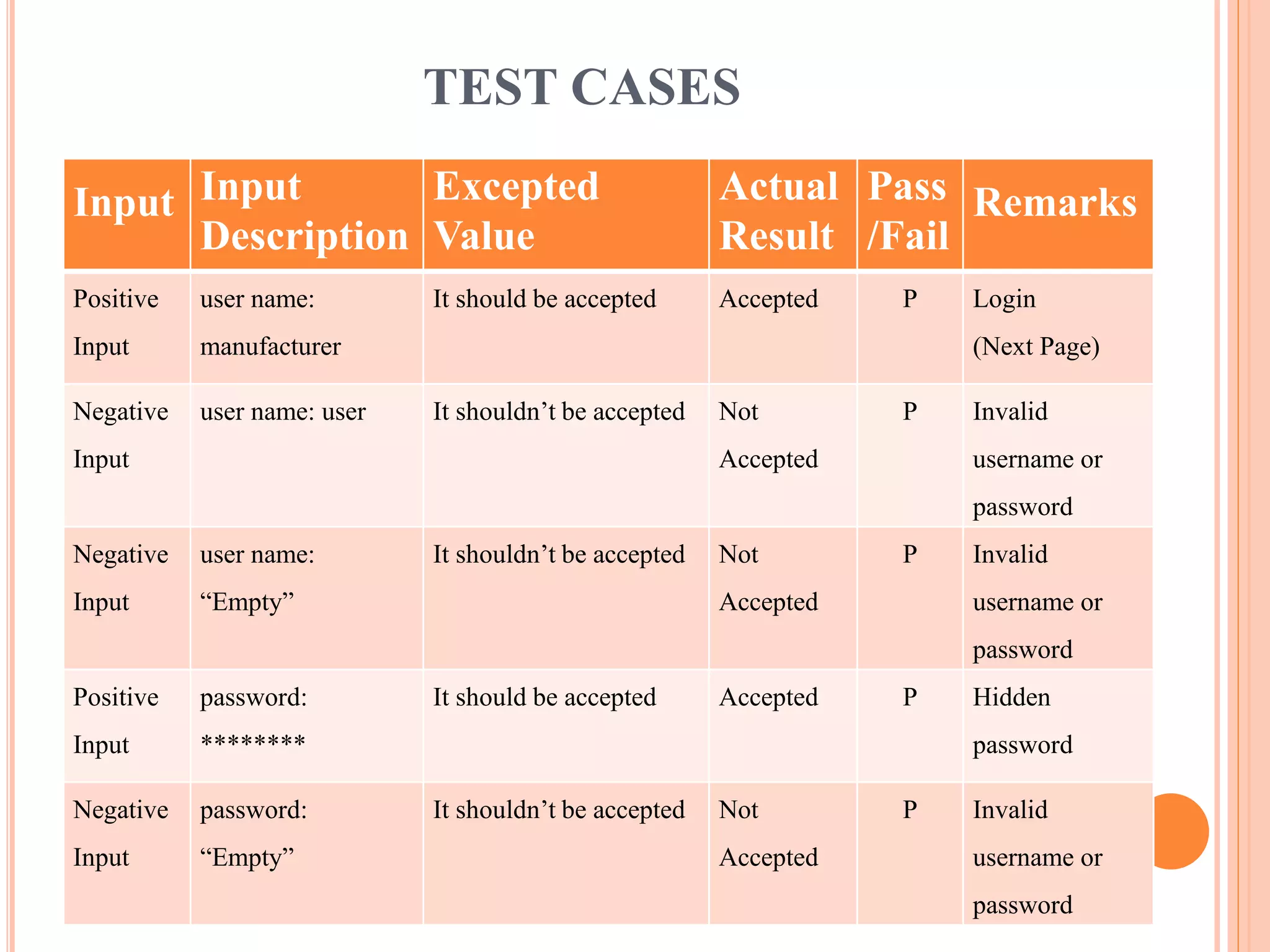
TEST CASES 
Input Input 
Description 
Excepted 
Value 
Actual 
Result 
Pass 
/Fail 
Remarks 
Positive 
Input 
user name: 
manufacturer 
It should be accepted Accepted P Login 
(Next Page) 
Negative 
Input 
user name: user It shouldn’t be accepted Not 
Accepted 
P Invalid 
username or 
password 
Negative 
Input 
user name: 
“Empty” 
It shouldn’t be accepted Not 
Accepted 
P Invalid 
username or 
password 
Positive 
Input 
password: 
******** 
It should be accepted Accepted P Hidden 
password 
Negative 
Input 
password: 
“Empty” 
It shouldn’t be accepted Not 
Accepted 
P Invalid 
username or 
password
CONCLUSION 
 This project addressed the inheritance and consolidation of 
access policies in heterogeneous CEP systems. 
 We identified a lack of security in multi-hop event processing 
networks and proposed a solution to close this gap. 
 More specific, we presented an approach that allows the 
inheritance of access requirements, when events are correlated 
to complex events.
Full accesspolicyconsolidation for event processing systems

Full accesspolicyconsolidation for event processing systems

  • 1.
    ACCESS POLICY CONSOLIDATIONFOR EVENT PROCESSING SYSTEMS Student Name:- V.SATISH (312275715036)
  • 2.
    CONTENTS  Introduction  Existing System  Proposed System  System Requirements Specification  Modules  Algorithm  System Design  Screen Shots  Test Cases  Conclusion
  • 3.
    INTRODUCTION  Theproject ACCESS POLICY CONSOLIDATION FOR EVENT PROCESSING SYSTEMS deals with the manufacturer, shipping company and customers about the product’s buy or sale of establishments online.  Event processing systems respond to events in the system’s environment or user interface.  The key characteristic of event processing systems is that the timing of events is unpredictable and the system must be able to Scope with these events when they occur.
  • 4.
    INTRODUCTION CONT… In business processes, it is necessary to detect inconsistencies or failures early. For example, in manufacturing and logistics processes, items are tracked continuously to detect loss or to reroute them during transport. To answer this need complex event processing (CEP) systems have evolved as a key paradigm for business and industrial applications.  CEP systems allow to detect situations by performing operations on event streams which emerge from sensors all over the world, e.g. from packet tracking devices.
  • 5.
    EXISTING SYSTEMS Current event processing systems lack methods to preserve privacy constraints of incoming event streams in a chain of subsequently applied stream operations.  This is a problem in large-scale distributed applications like a logistic chain where event processing operators may be spread over multiple security domains.  An adversary can guess from legally received outgoing event streams confidential input streams of the event processing system.
  • 6.
    DISADVANTAGES OF EXISTINGSYSTEM:  Its take lot of time  Delivery problem in customer and manufacturer
  • 7.
    PROPOSED SYSTEM This project presents a fine-grained access management for complex event processing.  Each incoming event stream can be protected by the specification of an access policy.  The utility of the event processing system is increased by providing and computing in a scalable manner.
  • 8.
    ADVANTAGES OF PROPOSEDSYSTEM:  Clear content based public or subscribe systems.  Time saving.  Clear communication system between user and manufacture.
  • 9.
    HARDWARE-SOFTWARE REQUIREMENT SPECIFICATION Software Requirements  Operating System - Windows XP /7/8  Application Server - Apache Tomcat 6.0  Front End - HTML, Java  Server side Script - Java Server Pages.  Database - MySQL  Software Tools - Eclipse IDE  Database Connectivity - JDBC.
  • 10.
    HARDWARE-SOFTWARE REQUIREMENT SPECIFICATION Hardware Requirements • Processor - Pentium IV or above • Speed - 1.1 GHz • RAM - 512 MB or above • Hard Disk - 20 GB or above • Key Board - Standard Windows Keyboard • Mouse - Two or Three Button Mouse
  • 11.
    MODULES Modules inthis project are:  Event Processing  Manufacturer  Shipping Company  Customer
  • 12.
    MODULES DESCRIPTION Event Processing:- Event processing systems respond to events in the system’s environment or user interface. The key characteristic of event processing systems is that the timing of events is unpredictable and the system must be able to cope with these events when they occur.  Manufacturer:- In this module manufacturer, insert the product details. The shipping company will forward the request to manufacturer sent by customer. So manufacturer can view product request from shipping company. The manufacturer will send the product details to shipping company to delivery date and pickup time means the manufacturer will send the export details.
  • 13.
    MODULE DESCRIPTION CONT…  Shipping Company:- The customer can request a product from shipping company. So, in this module shipping company, view product request from customer. Then the shipping company forwards the request to manufacturer or rejects the request. So as per the product details sent by manufacturer the shipping company delivers the product.  Customer:- In this module customer, views the product details. If the customer likes to purchase any product then the customer order the product from Ship Company. The customer can also view the order from Ship Company. Customer views the import details.
  • 14.
    ALGORITHM : LOCALOBFUSCATION CALCULATION:  1. procedure INITIALIZE(ω)  2. for all operator ω do  3. Dω ← FINDMULTIPATHOPERATORS(ω)  4. end for  5. for all ω ∈ Dω do  6. relAtts ←FINDRELATEDATTRIBUTES  7. for all (attnew, attold) ∈ relAtts do  8. TRANSMIT P(attnew|attold) TO ω  9. end for  10. end for  11. end procedure  12. procedure UPONRECEIVEEVENT(e)  13. for all att ∈ e do  14. if ∃ multPathDependency(att) then  15. CALCULATEWORSTCASEOBFUSCATION(ATT)  16. else  17. CALCULATELOCALOBFUSCATION(ATT)  18. end if  19. end for  20. end procedure
  • 15.
     Access controlallows to specify access rights of subjects(operators) for the set of available objects (event attributes).These access rights are provided by the owner of an object (e.g. the producer of an event stream) and maybe granted to operators based on an access requirement.  we specify the access rights within an access policy AP for an operator ω as a set of (attribute,access requirement)  Pairs: APω = {(att1, ar1), ..., (attn, arn)} .  An access requirement is a tuple of a property p, a mathematical operator op and a value set  val: ar = (p, op, val),  ar1 = (domain, ∈, {domainA, domainB}).  APmmanufacturer = {(destination,(domain,∈,{shippingComp,customer})), (pickup time, (domain,=,shippingComp)), (production place, (domain,=,shippingComp))}  APshipping =(warehouse, (domain,∈,{shippingComp,customer})),(estArrivalTime, (domain,=,{shippingComp}))}
  • 16.
  • 17.
  • 18.
  • 19.
  • 20.
  • 21.
  • 22.
  • 23.
  • 24.
  • 25.
    SCREEN SHOTS ShippingCompany’s Homepage
  • 26.
  • 27.
    SCREEN SHOTS SendOrder to Manufacturer
  • 28.
  • 29.
    SCREEN SHOTS InsertProduct Details
  • 30.
    SCREEN SHOTS ProductRequest Details
  • 31.
    SCREEN SHOTS Statusof Requested Product
  • 32.
    TEST CASES InputInput Description Excepted Value Actual Result Pass /Fail Remarks Positive Input user name: manufacturer It should be accepted Accepted P Login (Next Page) Negative Input user name: user It shouldn’t be accepted Not Accepted P Invalid username or password Negative Input user name: “Empty” It shouldn’t be accepted Not Accepted P Invalid username or password Positive Input password: ******** It should be accepted Accepted P Hidden password Negative Input password: “Empty” It shouldn’t be accepted Not Accepted P Invalid username or password
  • 33.
    CONCLUSION  Thisproject addressed the inheritance and consolidation of access policies in heterogeneous CEP systems.  We identified a lack of security in multi-hop event processing networks and proposed a solution to close this gap.  More specific, we presented an approach that allows the inheritance of access requirements, when events are correlated to complex events.