Frontend Monolithen: 

Rette sich wer kann!
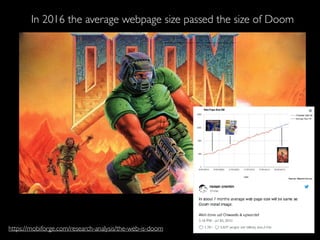
In 2016 the average webpage size passed the size of Doom
https://mobiforge.com/research-analysis/the-web-is-doom
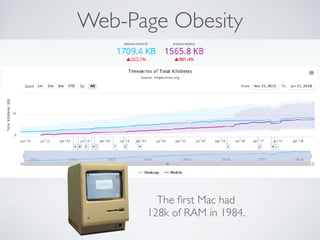
Web-Page Obesity
The first Mac had
128k of RAM in 1984.
Web: Size does Matter!
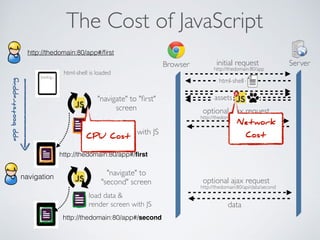
The Cost of JavaScript
optional ajax request
data
http://thedomain:80/app
http://thedomain:80/api/data/first
http://thedomain:80/app#/first
http://thedomain:80/app#/second
"navigate" to "first"
screen
http://thedomain:80/app#/first
navigation
Browser Serverinitial request
html-shell
assets
load data &
render screen with JS
"navigate" to
"second" screen
load data &
render screen with JS
html-shell is loaded
optional ajax request
http://thedomain:80/api/data/second
data
loading...
appbootstrapping
Network
CostCPU Cost
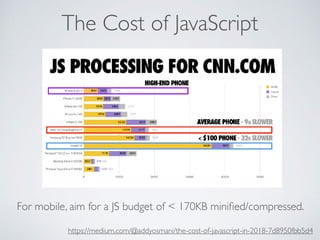
The Cost of JavaScript
https://medium.com/@addyosmani/the-cost-of-javascript-in-2018-7d8950fbb5d4
For mobile, aim for a JS budget of < 170KB minified/compressed.
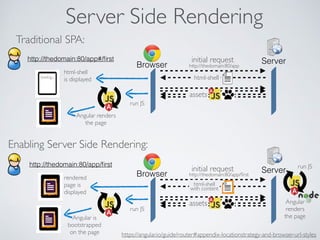
Server Side Rendering
http://thedomain:80/app
http://thedomain:80/app#/first
Browser Serverinitial request
html-shell
assets
html-shell 

is displayedloading...
Angular renders 

the page
run JS
http://thedomain:80/app/first
Browser Serverinitial request
html-shell

with content
assets
rendered
page is
displayed
Angular is
bootstrapped 

on the page
run JS
Angular
renders 

the page
run JS
Traditional SPA:
Enabling Server Side Rendering:
https://angular.io/guide/router#appendix-locationstrategy-and-browser-url-styles
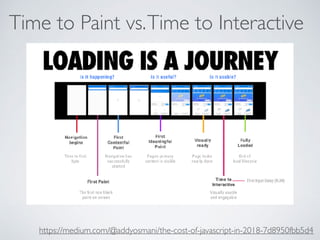
Time to Paint vs.Time to Interactive
https://medium.com/@addyosmani/the-cost-of-javascript-in-2018-7d8950fbb5d4
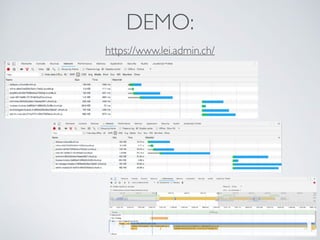
DEMO:
https://www.lei.admin.ch/
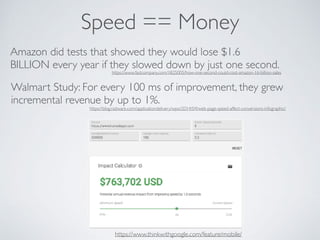
Speed == Money
https://www.thinkwithgoogle.com/feature/mobile/
Amazon did tests that showed they would lose $1.6
BILLION every year if they slowed down by just one second.

Walmart Study: For every 100 ms of improvement, they grew
incremental revenue by up to 1%.
https://www.fastcompany.com/1825005/how-one-second-could-cost-amazon-16-billion-sales
https://blog.radware.com/applicationdelivery/wpo/2014/04/web-page-speed-affect-conversions-infographic/
Enterprise Applications
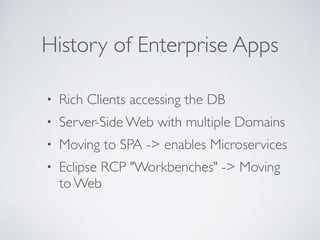
History of Enterprise Apps
• Rich Clients accessing the DB
• Server-Side Web with multiple Domains
• Moving to SPA -> enables Microservices
• Eclipse RCP "Workbenches" -> Moving
to Web
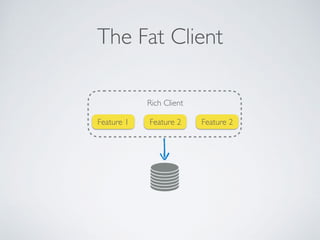
The Fat Client
Feature 1 Feature 2 Feature 2
Rich Client
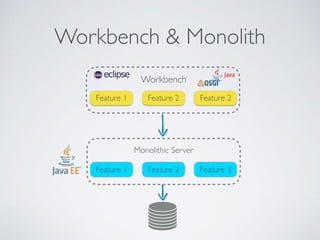
Workbench & Monolith
Feature 1 Feature 2 Feature 2
Workbench
Monolithic Server
Feature 1 Feature 2 Feature 3
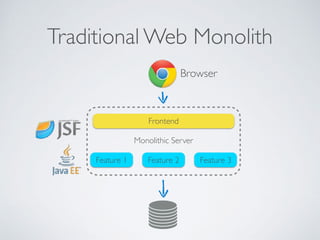
Traditional Web Monolith
Feature 1 Feature 2 Feature 3
Frontend
Browser
Monolithic Server
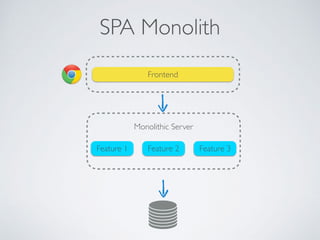
SPA Monolith
Feature 1 Feature 2 Feature 3
Frontend
Monolithic Server
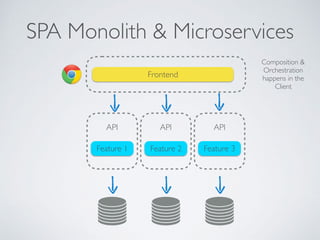
SPA Monolith & Microservices
Feature 1 Feature 2 Feature 3
Frontend
API API API
Composition &
Orchestration
happens in the
Client
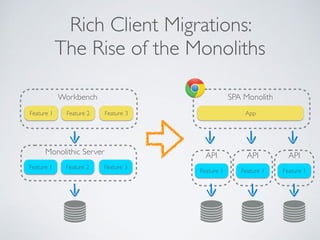
Rich Client Migrations: 

The Rise of the Monoliths
API
Workbench
Monolithic Server
Feature 1 Feature 2 Feature 3
Feature 1
API
Feature 1
API
Feature 1
SPA Monolith
App
API
Workbench
Monolithic Server
Feature 1 Feature 2 Feature 3
Feature 1
API
Feature 1
API
Feature 1
SPA Monolith
App
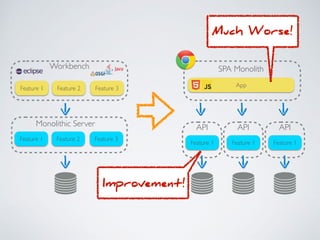
Improvement!
Much Worse!
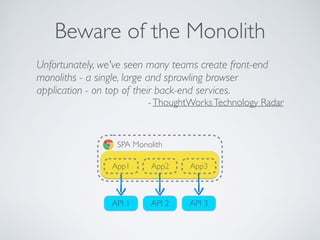
Beware of the Monolith
Unfortunately, we've seen many teams create front-end
monoliths - a single, large and sprawling browser
application - on top of their back-end services.
-ThoughtWorksTechnology Radar
App1 App2 App3
API 1 API 2 API 3
SPA Monolith
Problems of the Frontend Monolith
• Performance 

-> size is still relevant for web applications!
• Coupling & Dependencies
• preventing change / agility / time to market
• preventing effective/simple organization

(effective end-to-end delivery, self organizing teams ...)
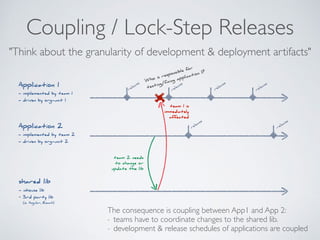
Coupling / Lock-Step Releases
"Think about the granularity of development & deployment artifacts"
Application 1
- implemented by team 1
- driven by org-unit 1
Application 2
- implemented by team 2
- driven by org-unit 2
shared lib
- inhouse lib
- 3rd party lib 

(ie. Angular, React)
team 2 needs
to change or
update the lib
team 1 is
immediately
affected
The consequence is coupling between App1 and App 2:
- teams have to coordinate changes to the shared lib.
- development & release schedules of applications are coupled
Who is responsible for
testing/fixing application 1?
release
release
release
release
release
release
Problems of the Frontend Monolith
• The web is traditionally not made for
complex applications
• global scope / no isolation / no modularization concepts
• extremely dynamic (typing, monkey paching ...)
• browser differences
• Frequent technology changes
• core technologies are very backwards compatible
• ecosystem moves at break-neck speed
The Bad Parts
http://www.commitstrip.com/en/2018/01/08/new-year-new-frameworks/
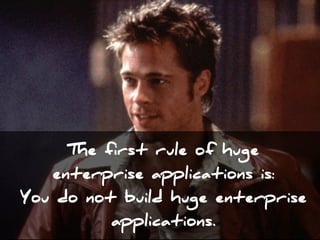
The first rule of huge 

enterprise applications is: 

You do not build huge enterprise
applications.
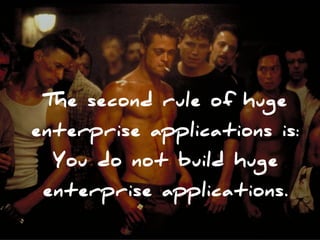
The second rule of huge
enterprise applications is:
You do not build huge
enterprise applications.
How?
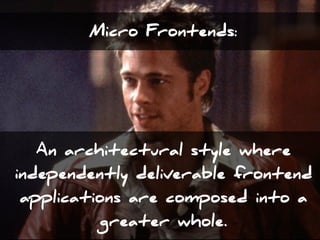
Micro Frontends:
An architectural style where
independently deliverable frontend
applications are composed into a
greater whole.
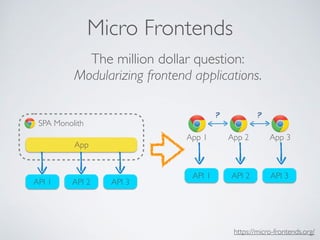
?
Micro Frontends
App 1 App 2 App 3
App
API 1 API 2 API 3
SPA Monolith
API 1 API 2 API 3
? ?
The million dollar question:

Modularizing frontend applications.
https://micro-frontends.org/
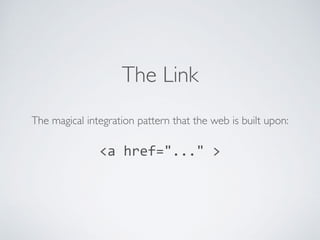
The Link
<a	href="..."	>
The magical integration pattern that the web is built upon:
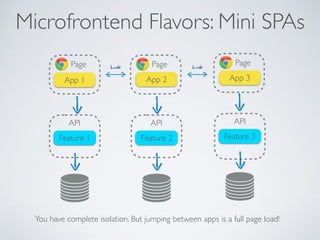
Microfrontend Flavors: Mini SPAs
Feature 1 Feature 2 Feature 3
App 1
API API API
App 2 App 3
Page Page PageLink Link
You have complete isolation. But jumping between apps is a full page load!
DEMO
Mini SPAs
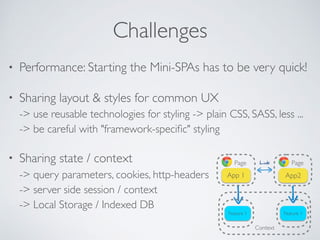
Challenges
• Performance: Starting the Mini-SPAs has to be very quick!
• Sharing layout & styles for common UX

-> use reusable technologies for styling -> plain CSS, SASS, less ...

-> be careful with "framework-specific" styling
• Sharing state / context

-> query parameters, cookies, http-headers

-> server side session / context

-> Local Storage / Indexed DB
Feature 1
App 1
Page Link
App2
Page
Feature 1
Context
Remember: Size does Matter
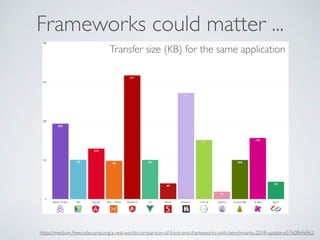
Frameworks could matter ...
Transfer size (KB) for the same application 
https://medium.freecodecamp.org/a-real-world-comparison-of-front-end-frameworks-with-benchmarks-2018-update-e5760fb4a962
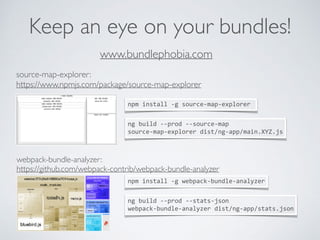
Keep an eye on your bundles!
source-map-explorer:

https://www.npmjs.com/package/source-map-explorer
webpack-bundle-analyzer:

https://github.com/webpack-contrib/webpack-bundle-analyzer
npm	install	-g	source-map-explorer	
ng	build	--prod	--source-map	
source-map-explorer	dist/ng-app/main.XYZ.js
npm	install	-g	webpack-bundle-analyzer
ng	build	--prod	--stats-json	
webpack-bundle-analyzer	dist/ng-app/stats.json
www.bundlephobia.com
But I need a single SPA!
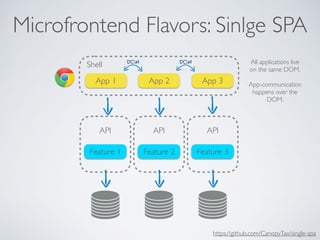
Microfrontend Flavors: Sinlge SPA
Feature 1 Feature 2 Feature 3
App 1
API API API
App 2 App 3
Shell D0M D0M
https://github.com/CanopyTax/single-spa
All applications live
on the same DOM.
App-communication
happens over the
DOM.
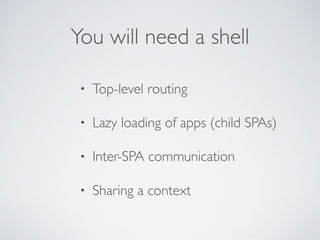
You will need a shell
• Top-level routing
• Lazy loading of apps (child SPAs)
• Inter-SPA communication
• Sharing a context
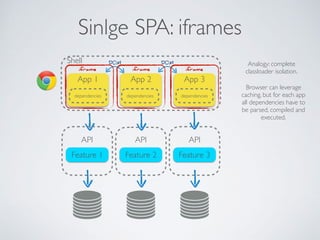
Sinlge SPA: iframes
Feature 1 Feature 2 Feature 3
App 1
API API API
App 2 App 3
Shell
dependencies dependencies dependencies
D0M D0M Analogy: complete
classloader isolation.
Browser can leverage
caching, but for each app
all dependencies have to
be parsed, compiled and
executed.
iframeiframeiframe
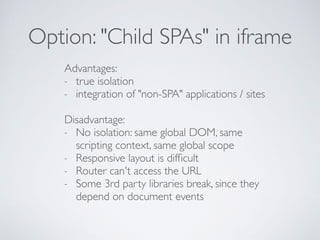
Option: "Child SPAs" in iframe
Advantages:
- true isolation
- integration of "non-SPA" applications / sites
Disadvantage:
- No isolation: same global DOM, same
scripting context, same global scope
- Responsive layout is difficult
- Router can't access the URL
- Some 3rd party libraries break, since they
depend on document events
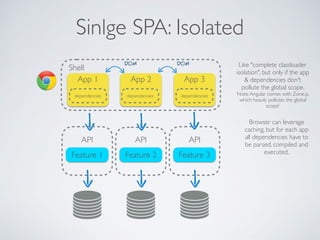
Sinlge SPA: Isolated
Feature 1 Feature 2 Feature 3
App 1
API API API
App 2 App 3
Shell
dependencies dependencies dependencies
D0M D0M
Browser can leverage
caching, but for each app
all dependencies have to
be parsed, compiled and
executed.
Like "complete classloader
isolation", but only if the app
& dependencies don't
pollute the global scope. 

Note:Angular comes with Zone.js,
which heavily pollutes the global
scope!
DEMO: Single-Spa
https://single-spa.js.org/
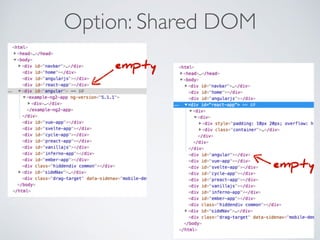
Option: Shared DOM
empty
empty
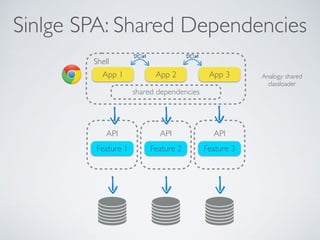
Sinlge SPA: Shared Dependencies
Feature 1 Feature 2 Feature 3
App 1
API API API
App 2 App 3
Shell
shared dependencies
D0M D0M
Analogy: shared
classloader
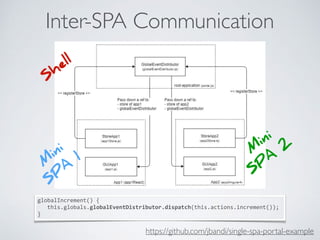
Inter-SPA Communication
https://github.com/jbandi/single-spa-portal-example
globalIncrement()	{	
			this.globals.globalEventDistributor.dispatch(this.actions.increment());	
}
Shell
M
ini
SP
A
1
M
ini
SP
A
2
DEMO: Single-Spa
https://single-spa.js.org/
Thighter Integration
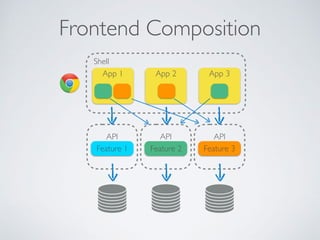
Frontend Composition
Feature 1 Feature 2 Feature 3
App 1
API API API
App 2 App 3
Shell
How?
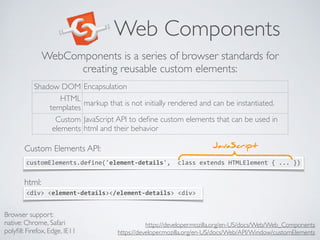
Web Components
Custom Elements API:
customElements.define('element-details',		class	extends	HTMLElement	{	...	})
WebComponents is a series of browser standards for
creating reusable custom elements:
https://developer.mozilla.org/en-US/docs/Web/Web_Components

https://developer.mozilla.org/en-US/docs/Web/API/Window/customElements
Shadow DOM Encapsulation
HTML
templates
markup that is not initially rendered and can be instantiated.
Custom
elements
JavaScript API to define custom elements that can be used in
html and their behavior
JavaScript
html:
<div>	<element-details></element-details>	<div>	
Browser support:
native: Chrome, Safari
polyfill: Firefox, Edge, IE11
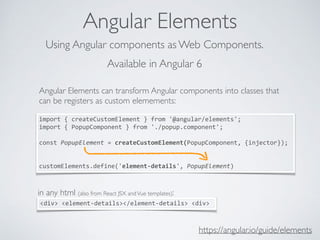
Angular Elements
Angular Elements
https://angular.io/guide/elements
Using Angular components as Web Components.
Angular Elements can transform Angular components into classes that
can be registers as custom elemements:
import	{	createCustomElement	}	from	'@angular/elements';	
import	{	PopupComponent	}	from	'./popup.component';	
const	PopupElement	=	createCustomElement(PopupComponent,	{injector});	
customElements.define('element-details',	PopupElement)
Available in Angular 6
in any html (also from React JSX andVue templates):
<div>	<element-details></element-details>	<div>
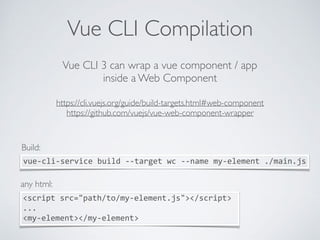
Vue CLI Compilation
Vue CLI 3 can wrap a vue component / app
inside a Web Component
https://cli.vuejs.org/guide/build-targets.html#web-component 

https://github.com/vuejs/vue-web-component-wrapper
vue-cli-service	build	--target	wc	--name	my-element	./main.js
Build:
<script	src="path/to/my-element.js"></script>	
...	
<my-element></my-element>
any html:
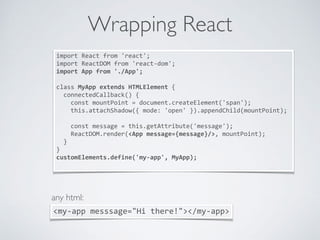
Wrapping React
import	React	from	'react';	
import	ReactDOM	from	'react-dom';	
import	App	from	'./App';	
class	MyApp	extends	HTMLElement	{	
		connectedCallback()	{	
				const	mountPoint	=	document.createElement('span');	
				this.attachShadow({	mode:	'open'	}).appendChild(mountPoint);	
				const	message	=	this.getAttribute('message');	
				ReactDOM.render(<App	message={message}/>,	mountPoint);	
		}	
}	
customElements.define('my-app',	MyApp);	
<my-app	messsage="Hi	there!"></my-app>
any html:
DEMO
https://github.com/manfredsteyer/Angular_MicroApps_Different_Technologies
https://github.com/manfredsteyer/angular-elements-dashboard
More than ever: Size does Matter!
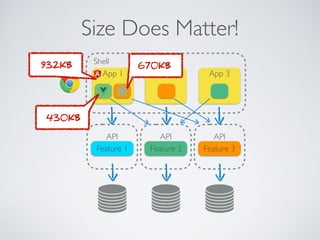
Size Does Matter!
Feature 1 Feature 2 Feature 3
App 1
API API API
App 2 App 3
Shell
670KB
430KB
932KB
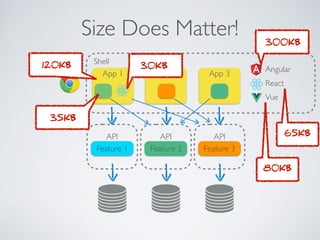
Size Does Matter!
Feature 1 Feature 2 Feature 3
App 1
API API API
App 2 App 3
Shell
30KB
35KB
120KB
Angular
React
Vue
300KB
65KB
80KB
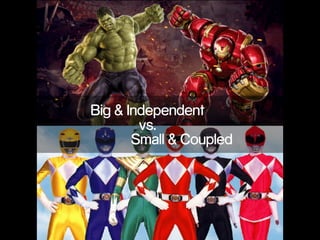
Big & Independent 

vs. 

Small & Coupled
More Challenges
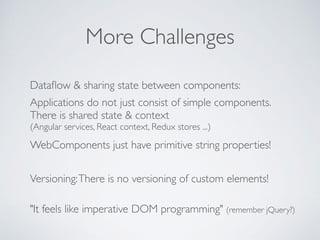
Dataflow & sharing state between components:
Applications do not just consist of simple components.

There is shared state & context

(Angular services, React context, Redux stores ...)
WebComponents just have primitive string properties!
Versioning:There is no versioning of custom elements!
"It feels like imperative DOM programming" (remember jQuery?)
There is no Silver Bullet for 

Frontend Modularization
Fragen?
JavaScript / Angular / React Schulungen
& Coachings,

Project-Setup & Proof-of-Concept:
http://ivorycode.com/#schulung

jonas.bandi@ivorycode.com
https://github.com/jbandi/sbb-dev-day-2018

Frontend Monoliths: Run if you can!

  • 1.
  • 2.
    In 2016 theaverage webpage size passed the size of Doom https://mobiforge.com/research-analysis/the-web-is-doom
  • 3.
    Web-Page Obesity The firstMac had 128k of RAM in 1984.
  • 4.
  • 5.
    The Cost ofJavaScript optional ajax request data http://thedomain:80/app http://thedomain:80/api/data/first http://thedomain:80/app#/first http://thedomain:80/app#/second "navigate" to "first" screen http://thedomain:80/app#/first navigation Browser Serverinitial request html-shell assets load data & render screen with JS "navigate" to "second" screen load data & render screen with JS html-shell is loaded optional ajax request http://thedomain:80/api/data/second data loading... appbootstrapping Network CostCPU Cost
  • 6.
    The Cost ofJavaScript https://medium.com/@addyosmani/the-cost-of-javascript-in-2018-7d8950fbb5d4 For mobile, aim for a JS budget of < 170KB minified/compressed.
  • 7.
    Server Side Rendering http://thedomain:80/app http://thedomain:80/app#/first BrowserServerinitial request html-shell assets html-shell 
 is displayedloading... Angular renders 
 the page run JS http://thedomain:80/app/first http://thedomain:80/app/first Browser Serverinitial request html-shell
 with content assets rendered page is displayed Angular is bootstrapped 
 on the page run JS Angular renders 
 the page run JS Traditional SPA: Enabling Server Side Rendering: https://angular.io/guide/router#appendix-locationstrategy-and-browser-url-styles
  • 8.
    Time to Paintvs.Time to Interactive https://medium.com/@addyosmani/the-cost-of-javascript-in-2018-7d8950fbb5d4
  • 9.
  • 10.
    Speed == Money https://www.thinkwithgoogle.com/feature/mobile/ Amazondid tests that showed they would lose $1.6 BILLION every year if they slowed down by just one second. Walmart Study: For every 100 ms of improvement, they grew incremental revenue by up to 1%. https://www.fastcompany.com/1825005/how-one-second-could-cost-amazon-16-billion-sales https://blog.radware.com/applicationdelivery/wpo/2014/04/web-page-speed-affect-conversions-infographic/
  • 11.
  • 12.
    History of EnterpriseApps • Rich Clients accessing the DB • Server-Side Web with multiple Domains • Moving to SPA -> enables Microservices • Eclipse RCP "Workbenches" -> Moving to Web
  • 13.
    The Fat Client Feature1 Feature 2 Feature 2 Rich Client
  • 14.
    Workbench & Monolith Feature1 Feature 2 Feature 2 Workbench Monolithic Server Feature 1 Feature 2 Feature 3
  • 15.
    Traditional Web Monolith Feature1 Feature 2 Feature 3 Frontend Browser Monolithic Server
  • 16.
    SPA Monolith Feature 1Feature 2 Feature 3 Frontend Monolithic Server
  • 17.
    SPA Monolith &Microservices Feature 1 Feature 2 Feature 3 Frontend API API API Composition & Orchestration happens in the Client
  • 18.
    Rich Client Migrations:
 The Rise of the Monoliths API Workbench Monolithic Server Feature 1 Feature 2 Feature 3 Feature 1 Feature 2 Feature 3 Feature 1 API Feature 1 API Feature 1 SPA Monolith App
  • 19.
    API Workbench Monolithic Server Feature 1Feature 2 Feature 3 Feature 1 Feature 2 Feature 3 Feature 1 API Feature 1 API Feature 1 SPA Monolith App Improvement! Much Worse!
  • 20.
    Beware of theMonolith Unfortunately, we've seen many teams create front-end monoliths - a single, large and sprawling browser application - on top of their back-end services. -ThoughtWorksTechnology Radar App1 App2 App3 API 1 API 2 API 3 SPA Monolith
  • 21.
    Problems of theFrontend Monolith • Performance 
 -> size is still relevant for web applications! • Coupling & Dependencies • preventing change / agility / time to market • preventing effective/simple organization
 (effective end-to-end delivery, self organizing teams ...)
  • 22.
    Coupling / Lock-StepReleases "Think about the granularity of development & deployment artifacts" Application 1 - implemented by team 1 - driven by org-unit 1 Application 2 - implemented by team 2 - driven by org-unit 2 shared lib - inhouse lib - 3rd party lib 
 (ie. Angular, React) team 2 needs to change or update the lib team 1 is immediately affected The consequence is coupling between App1 and App 2: - teams have to coordinate changes to the shared lib. - development & release schedules of applications are coupled Who is responsible for testing/fixing application 1? release release release release release release
  • 23.
    Problems of theFrontend Monolith • The web is traditionally not made for complex applications • global scope / no isolation / no modularization concepts • extremely dynamic (typing, monkey paching ...) • browser differences • Frequent technology changes • core technologies are very backwards compatible • ecosystem moves at break-neck speed
  • 24.
  • 26.
  • 27.
    The first ruleof huge 
 enterprise applications is: 
 You do not build huge enterprise applications.
  • 28.
    The second ruleof huge enterprise applications is: You do not build huge enterprise applications.
  • 29.
  • 30.
    Micro Frontends: An architecturalstyle where independently deliverable frontend applications are composed into a greater whole.
  • 31.
  • 32.
    Micro Frontends App 1App 2 App 3 App API 1 API 2 API 3 SPA Monolith API 1 API 2 API 3 ? ? The million dollar question:
 Modularizing frontend applications. https://micro-frontends.org/
  • 33.
    The Link <a href="..." > The magicalintegration pattern that the web is built upon:
  • 34.
    Microfrontend Flavors: MiniSPAs Feature 1 Feature 2 Feature 3 App 1 API API API App 2 App 3 Page Page PageLink Link You have complete isolation. But jumping between apps is a full page load!
  • 35.
  • 36.
    Challenges • Performance: Startingthe Mini-SPAs has to be very quick! • Sharing layout & styles for common UX
 -> use reusable technologies for styling -> plain CSS, SASS, less ...
 -> be careful with "framework-specific" styling • Sharing state / context
 -> query parameters, cookies, http-headers
 -> server side session / context
 -> Local Storage / Indexed DB Feature 1 App 1 Page Link App2 Page Feature 1 Context
  • 37.
  • 38.
    Frameworks could matter... Transfer size (KB) for the same application  https://medium.freecodecamp.org/a-real-world-comparison-of-front-end-frameworks-with-benchmarks-2018-update-e5760fb4a962
  • 39.
    Keep an eyeon your bundles! source-map-explorer:
 https://www.npmjs.com/package/source-map-explorer webpack-bundle-analyzer:
 https://github.com/webpack-contrib/webpack-bundle-analyzer npm install -g source-map-explorer ng build --prod --source-map source-map-explorer dist/ng-app/main.XYZ.js npm install -g webpack-bundle-analyzer ng build --prod --stats-json webpack-bundle-analyzer dist/ng-app/stats.json www.bundlephobia.com
  • 40.
    But I needa single SPA!
  • 41.
    Microfrontend Flavors: SinlgeSPA Feature 1 Feature 2 Feature 3 App 1 API API API App 2 App 3 Shell D0M D0M https://github.com/CanopyTax/single-spa All applications live on the same DOM. App-communication happens over the DOM.
  • 42.
    You will needa shell • Top-level routing • Lazy loading of apps (child SPAs) • Inter-SPA communication • Sharing a context
  • 43.
    Sinlge SPA: iframes Feature1 Feature 2 Feature 3 App 1 API API API App 2 App 3 Shell dependencies dependencies dependencies D0M D0M Analogy: complete classloader isolation. Browser can leverage caching, but for each app all dependencies have to be parsed, compiled and executed. iframeiframeiframe
  • 44.
    Option: "Child SPAs"in iframe Advantages: - true isolation - integration of "non-SPA" applications / sites Disadvantage: - No isolation: same global DOM, same scripting context, same global scope - Responsive layout is difficult - Router can't access the URL - Some 3rd party libraries break, since they depend on document events
  • 45.
    Sinlge SPA: Isolated Feature1 Feature 2 Feature 3 App 1 API API API App 2 App 3 Shell dependencies dependencies dependencies D0M D0M Browser can leverage caching, but for each app all dependencies have to be parsed, compiled and executed. Like "complete classloader isolation", but only if the app & dependencies don't pollute the global scope. 
 Note:Angular comes with Zone.js, which heavily pollutes the global scope!
  • 46.
  • 47.
  • 48.
    Sinlge SPA: SharedDependencies Feature 1 Feature 2 Feature 3 App 1 API API API App 2 App 3 Shell shared dependencies D0M D0M Analogy: shared classloader
  • 49.
  • 50.
  • 51.
  • 52.
    Frontend Composition Feature 1Feature 2 Feature 3 App 1 API API API App 2 App 3 Shell
  • 53.
  • 54.
    Web Components Custom ElementsAPI: customElements.define('element-details', class extends HTMLElement { ... }) WebComponents is a series of browser standards for creating reusable custom elements: https://developer.mozilla.org/en-US/docs/Web/Web_Components
 https://developer.mozilla.org/en-US/docs/Web/API/Window/customElements Shadow DOM Encapsulation HTML templates markup that is not initially rendered and can be instantiated. Custom elements JavaScript API to define custom elements that can be used in html and their behavior JavaScript html: <div> <element-details></element-details> <div> Browser support: native: Chrome, Safari polyfill: Firefox, Edge, IE11
  • 56.
  • 57.
    Angular Elements https://angular.io/guide/elements Using Angularcomponents as Web Components. Angular Elements can transform Angular components into classes that can be registers as custom elemements: import { createCustomElement } from '@angular/elements'; import { PopupComponent } from './popup.component'; const PopupElement = createCustomElement(PopupComponent, {injector}); customElements.define('element-details', PopupElement) Available in Angular 6 in any html (also from React JSX andVue templates): <div> <element-details></element-details> <div>
  • 58.
    Vue CLI Compilation VueCLI 3 can wrap a vue component / app inside a Web Component https://cli.vuejs.org/guide/build-targets.html#web-component 
 https://github.com/vuejs/vue-web-component-wrapper vue-cli-service build --target wc --name my-element ./main.js Build: <script src="path/to/my-element.js"></script> ... <my-element></my-element> any html:
  • 59.
  • 60.
  • 61.
    More than ever:Size does Matter!
  • 62.
    Size Does Matter! Feature1 Feature 2 Feature 3 App 1 API API API App 2 App 3 Shell 670KB 430KB 932KB
  • 63.
    Size Does Matter! Feature1 Feature 2 Feature 3 App 1 API API API App 2 App 3 Shell 30KB 35KB 120KB Angular React Vue 300KB 65KB 80KB
  • 64.
    Big & Independent
 vs. 
 Small & Coupled
  • 65.
    More Challenges Dataflow &sharing state between components: Applications do not just consist of simple components.
 There is shared state & context
 (Angular services, React context, Redux stores ...) WebComponents just have primitive string properties! Versioning:There is no versioning of custom elements! "It feels like imperative DOM programming" (remember jQuery?)
  • 66.
    There is noSilver Bullet for 
 Frontend Modularization
  • 67.
    Fragen? JavaScript / Angular/ React Schulungen & Coachings,
 Project-Setup & Proof-of-Concept: http://ivorycode.com/#schulung
 jonas.bandi@ivorycode.com https://github.com/jbandi/sbb-dev-day-2018