Download to read offline




![A Clojure primer
(ns codemotion.demo)
(defn hello-user
[user]
(when (seq user)
(str "Hello, " user "!")))
(hello-user "world")](https://image.slidesharecdn.com/6rftj7nat4y42lgi6qbq-signature-3d941db5d489cfa5638ac24d8d95a55c501d9ebc850364327138448fd01a6ad1-poli-171116161618/85/Carlo-Sciolla-Above-and-beyond-type-systems-with-clojure-spec-Codemotion-Milan-2017-9-320.jpg)
![A Clojure primer
(ns codemotion.demo)
(defn hello-user
[user]
(when (seq user)
(str "Hello, " user "!")))
(hello-user "world")
(hello-user 42)
As clojure is a dynamically typed language, no compile time error is thrown when feeding functions with
unexpected kind of input.](https://image.slidesharecdn.com/6rftj7nat4y42lgi6qbq-signature-3d941db5d489cfa5638ac24d8d95a55c501d9ebc850364327138448fd01a6ad1-poli-171116161618/85/Carlo-Sciolla-Above-and-beyond-type-systems-with-clojure-spec-Codemotion-Milan-2017-10-320.jpg)
![We start with a predicate
user> (doc string?)
-------------------------
clojure.core/string?
([x])
Return true if x is a String
user> (string? 42)
false
user> (string? "I'm a string")
true
Predicates are functions that return boolean values. Any predicate can be used as a spec.](https://image.slidesharecdn.com/6rftj7nat4y42lgi6qbq-signature-3d941db5d489cfa5638ac24d8d95a55c501d9ebc850364327138448fd01a6ad1-poli-171116161618/85/Carlo-Sciolla-Above-and-beyond-type-systems-with-clojure-spec-Codemotion-Milan-2017-12-320.jpg)
![Attach the spec to a function
(ns codemotion.demo
(:require [clojure.spec.alpha :as s]))
(defn hello-user!
[user]
(when (seq user)
(str "Hello, " user "!")))
(s/fdef hello-user!
:args (s/cat :user string?))](https://image.slidesharecdn.com/6rftj7nat4y42lgi6qbq-signature-3d941db5d489cfa5638ac24d8d95a55c501d9ebc850364327138448fd01a6ad1-poli-171116161618/85/Carlo-Sciolla-Above-and-beyond-type-systems-with-clojure-spec-Codemotion-Milan-2017-13-320.jpg)

![Function spec at its finest
(s/fdef hello-user!
:args (s/cat :user ::non-blank-string)
:ret ::non-blank-string
:fn (fn [{ret :ret
{user :user} :args}]
(= (count ret)
(+ 9 (count user)))))
You can spec the input arguments, the return value and the function invariants.](https://image.slidesharecdn.com/6rftj7nat4y42lgi6qbq-signature-3d941db5d489cfa5638ac24d8d95a55c501d9ebc850364327138448fd01a6ad1-poli-171116161618/85/Carlo-Sciolla-Above-and-beyond-type-systems-with-clojure-spec-Codemotion-Milan-2017-15-320.jpg)


![Philosophy and philology of
[Lisp] has assisted a number of our most gifted fellow humans in thinking previously impossible
thoughts
E. W. Dijkstra](https://image.slidesharecdn.com/6rftj7nat4y42lgi6qbq-signature-3d941db5d489cfa5638ac24d8d95a55c501d9ebc850364327138448fd01a6ad1-poli-171116161618/85/Carlo-Sciolla-Above-and-beyond-type-systems-with-clojure-spec-Codemotion-Milan-2017-23-320.jpg)
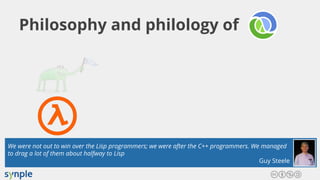
![Philosophy and philology of
[Clojure was] designed to be useful for the work I was doing, where you have customers that have
requirements that things run on one of these standard platforms
Rich Hickey](https://image.slidesharecdn.com/6rftj7nat4y42lgi6qbq-signature-3d941db5d489cfa5638ac24d8d95a55c501d9ebc850364327138448fd01a6ad1-poli-171116161618/85/Carlo-Sciolla-Above-and-beyond-type-systems-with-clojure-spec-Codemotion-Milan-2017-25-320.jpg)



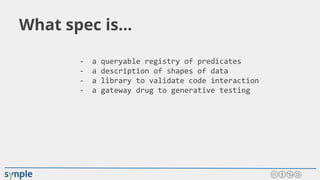
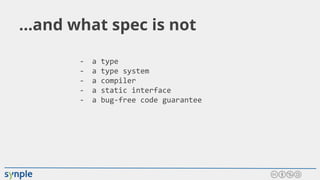
The document discusses Clojure's spec library, which acts as a queryable registry of predicates to validate data shapes and code interactions. It emphasizes that spec is not a type system or a bug guarantee, but can improve function reliability with specification and generative testing. The text also highlights the philosophical influence of Lisp and Clojure, aiming to attract programmers from different backgrounds.


