From Mouse to Monkey:
Revolutionizing Research via Preclinical
Continuous Glucose Telemetry
Scientists present wireless glucose monitoring methodology, best practices,
research findings, and discuss the power of continuous glucose profiles,
particularly when combined with other gold standard assays to study obesity,
diabetes and cardiovascular related diseases.
From Mouse to Monkey:
Revolutionizing Research via Preclinical
Continuous Glucose Telemetry
Dr. Stephanie Simonds
NHMRC/NHF Research fellow
Monash University,
Melbourne, Australia
Megan Fine, DVM
MS, DACVS-LA
Veterinary Surgeon,
Attending Veterinarian
Data Sciences International
InsideScientific is an online educational environment designed for life science
researchers. Our goal is to aid in the sharing and distribution of scientific
information regarding innovative technologies, protocols, research tools and
laboratory services
To access webinar content, Q&A reports, FAQ documents, and
information on lab workshops, subscribe to our mail list
Copyright 2018 S. Simonds and InsideScientific. All Rights Reserved.
Experimental applications of DSI
continuous blood glucose monitoring
in mice.
Dr. Stephanie Simonds
NHMRC/NHF Research fellow
Monash University, Melbourne, Australia
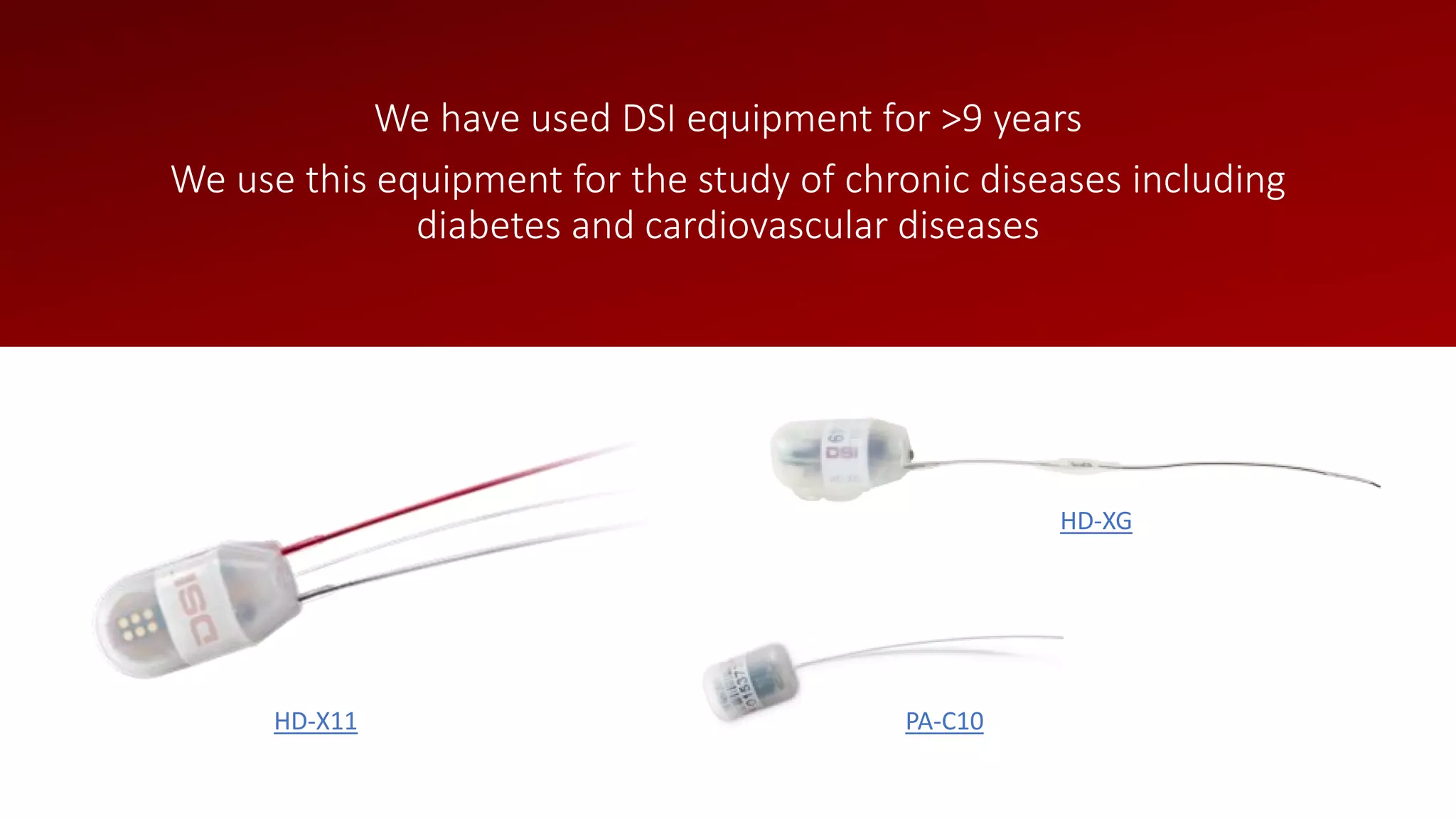
We have used DSI equipment for >9 years
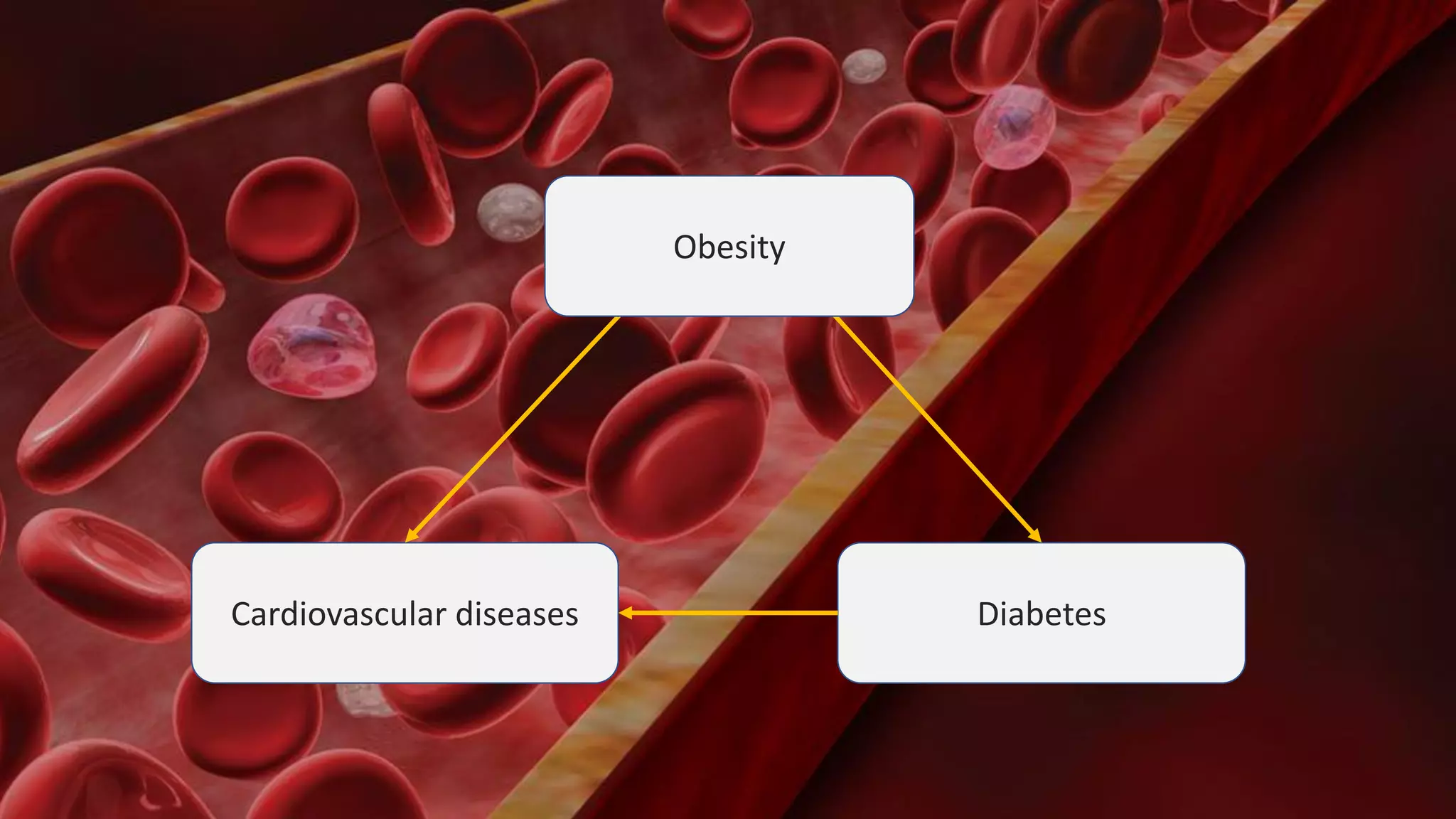
We use this equipment for the study of chronic diseases including
diabetes and cardiovascular diseases
HD-X11
HD-XG
PA-C10
Cardiovascular diseases Diabetes
Obesity
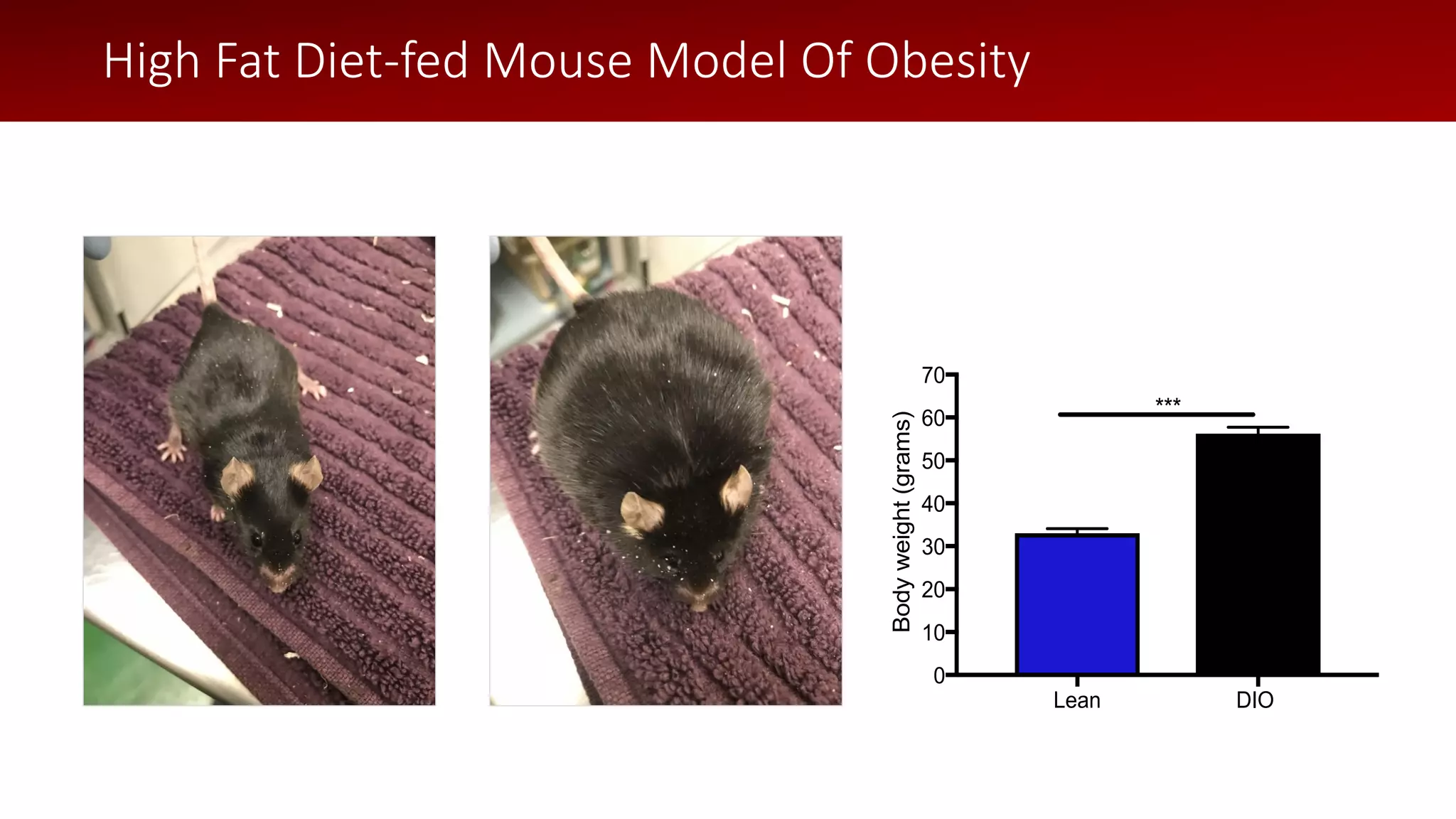
Lean DIO
0
10
20
30
40
50
60
70
Bodyweight(grams)
***
High Fat Diet-fed Mouse Model Of Obesity
Using Continuous Glucose
Monitoring to Assess Phenotypes
Lean DIO
0
10
20
30
40
50
60
70
Bodyweight(grams)
***
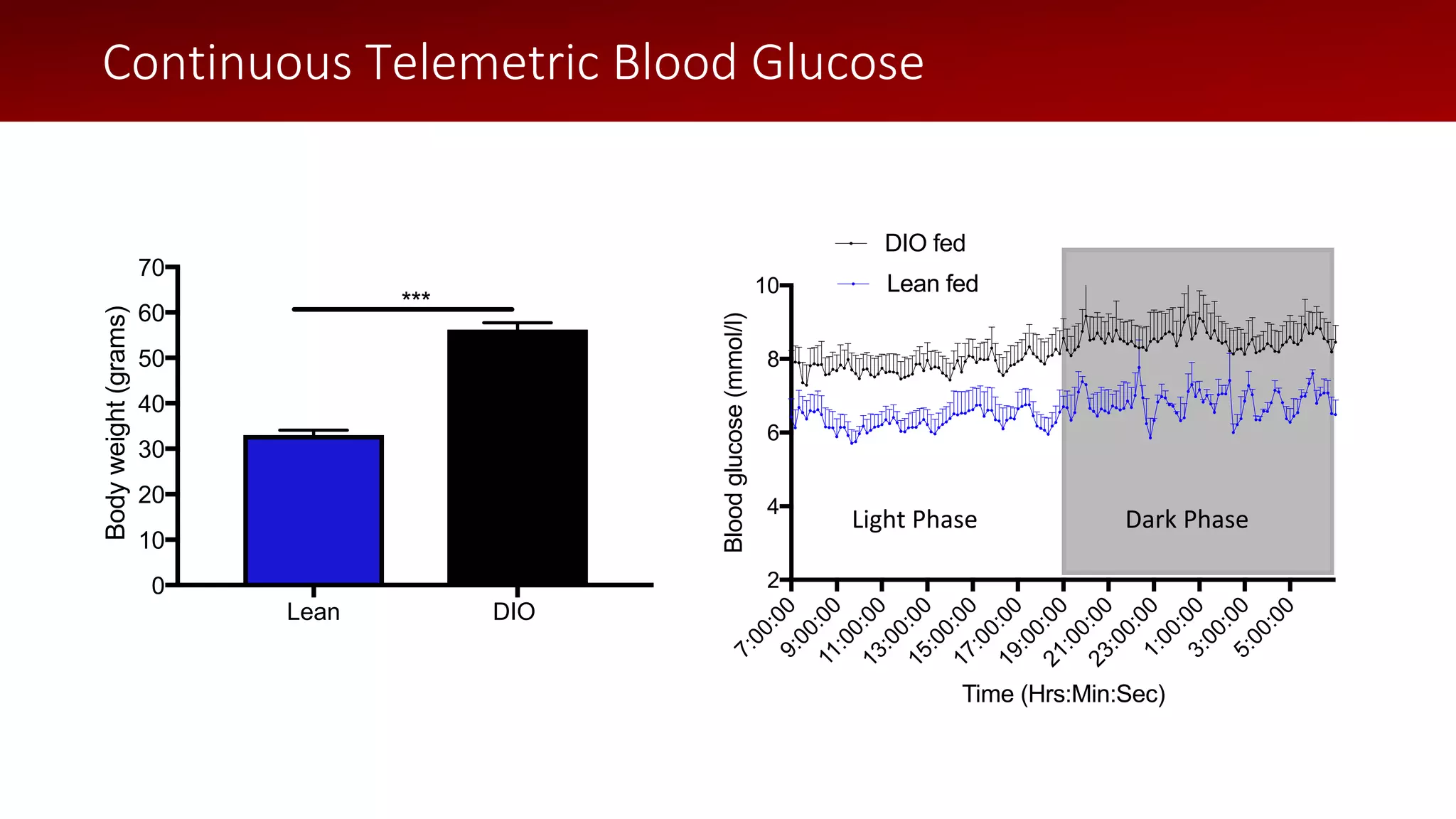
Continuous Telemetric Blood Glucose
7:00:009:00:0011:00:0013:00:0015:00:0017:00:0019:00:0021:00:0023:00:001:00:003:00:005:00:00
2
4
6
8
10
Time (Hrs:Min:Sec)
Bloodglucose(mmol/l)
DIO fed
Lean fed
Light Phase Dark Phase
7:00:009:00:0011:00:0013:00:0015:00:0017:00:0019:00:0021:00:0023:00:001:00:003:00:005:00:00
2
Time (Hrs:Min:Sec)
Blo
DIO fed
Lean fed
0:00:004:00:008:00:00
12:00:00
16:00:00
20:00:000:00:004:00:008:00:00
12:00:00
16:00:00
20:00:000:00:004:00:008:00:00
12:00:00
16:00:00
20:00:000:00:004:00:008:00:00
32
34
36
38
Temp(Degrees)
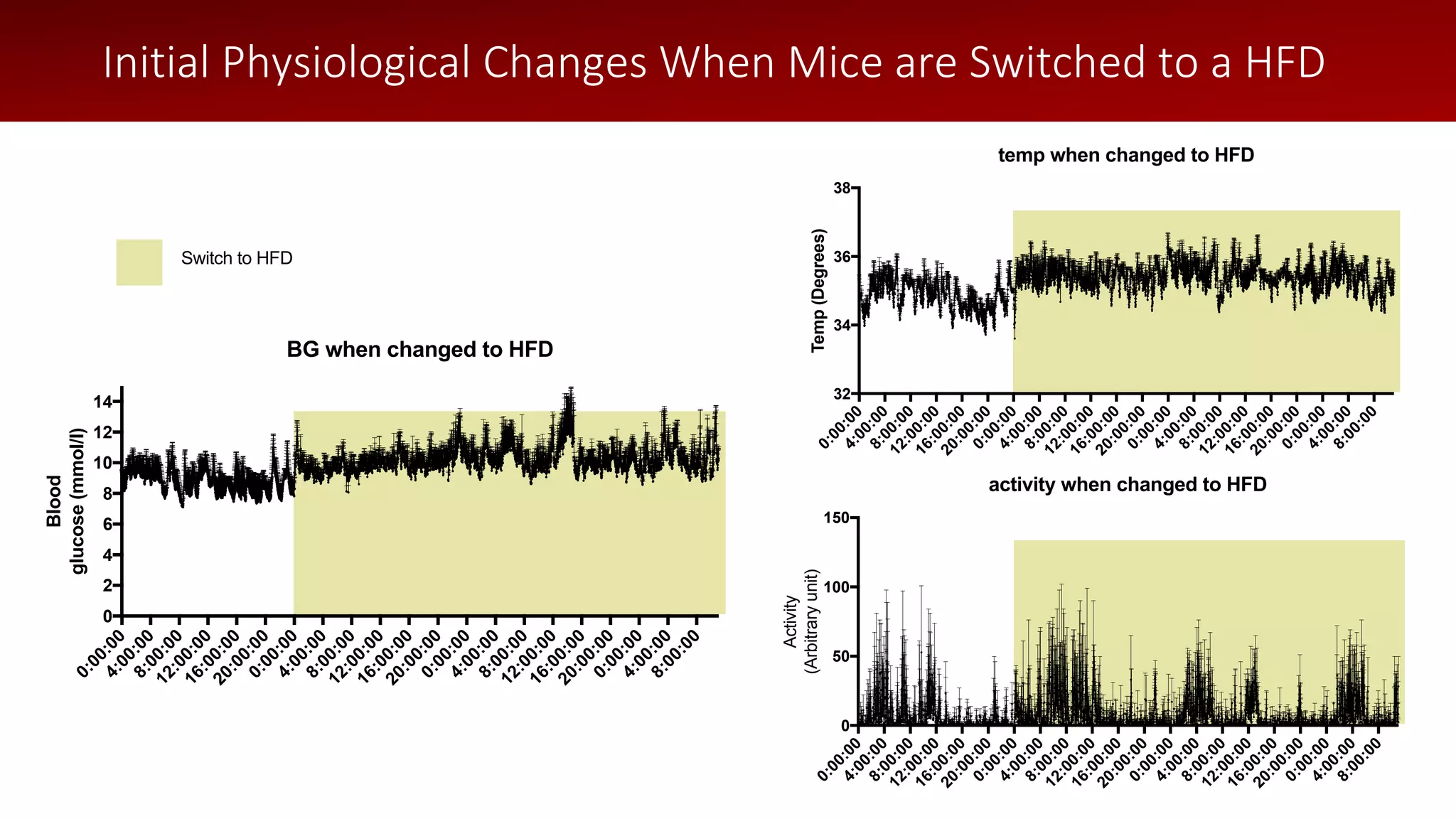
temp when changed to HFD
Switch to HFD
0:00:004:00:008:00:00
12:00:00
16:00:00
20:00:000:00:004:00:008:00:00
12:00:00
16:00:00
20:00:000:00:004:00:008:00:00
12:00:00
16:00:00
20:00:000:00:004:00:008:00:00
0
50
100
150
Activity
(Arbitraryunit)
activity when changed to HFD
0:00:004:00:008:00:00
12:00:00
16:00:00
20:00:000:00:004:00:008:00:00
12:00:00
16:00:00
20:00:000:00:004:00:008:00:00
12:00:00
16:00:00
20:00:000:00:004:00:008:00:00
0
2
4
6
8
10
12
14
Blood
glucose(mmol/l)
BG when changed to HFD
00:00:008:00:00
12:00:00
16:00:00
20:00:000:00:004:00:008:00:00
12:00:00
16:00:00
20:00:000:00:004:00:008:00:00
12:00:00
16:00:00
20:00:000:00:004:00:008:00:00
Switch to HFD
Initial Physiological Changes When Mice are Switched to a HFD
Using Continuous Glucose Monitoring
to Assess Drug Therapy Efficacy
0:00:00
0:30:00
1:00:00
1:30:00
2:00:00
2:30:00
3:00:00
3:30:00
4:00:00
4:30:00
5:00:00
5:30:00
6:00:00
6:30:00
7:00:00
0
10
20
30
40
Time (Hrs:Min: Sec)
Blood
glucose(mmol/l)
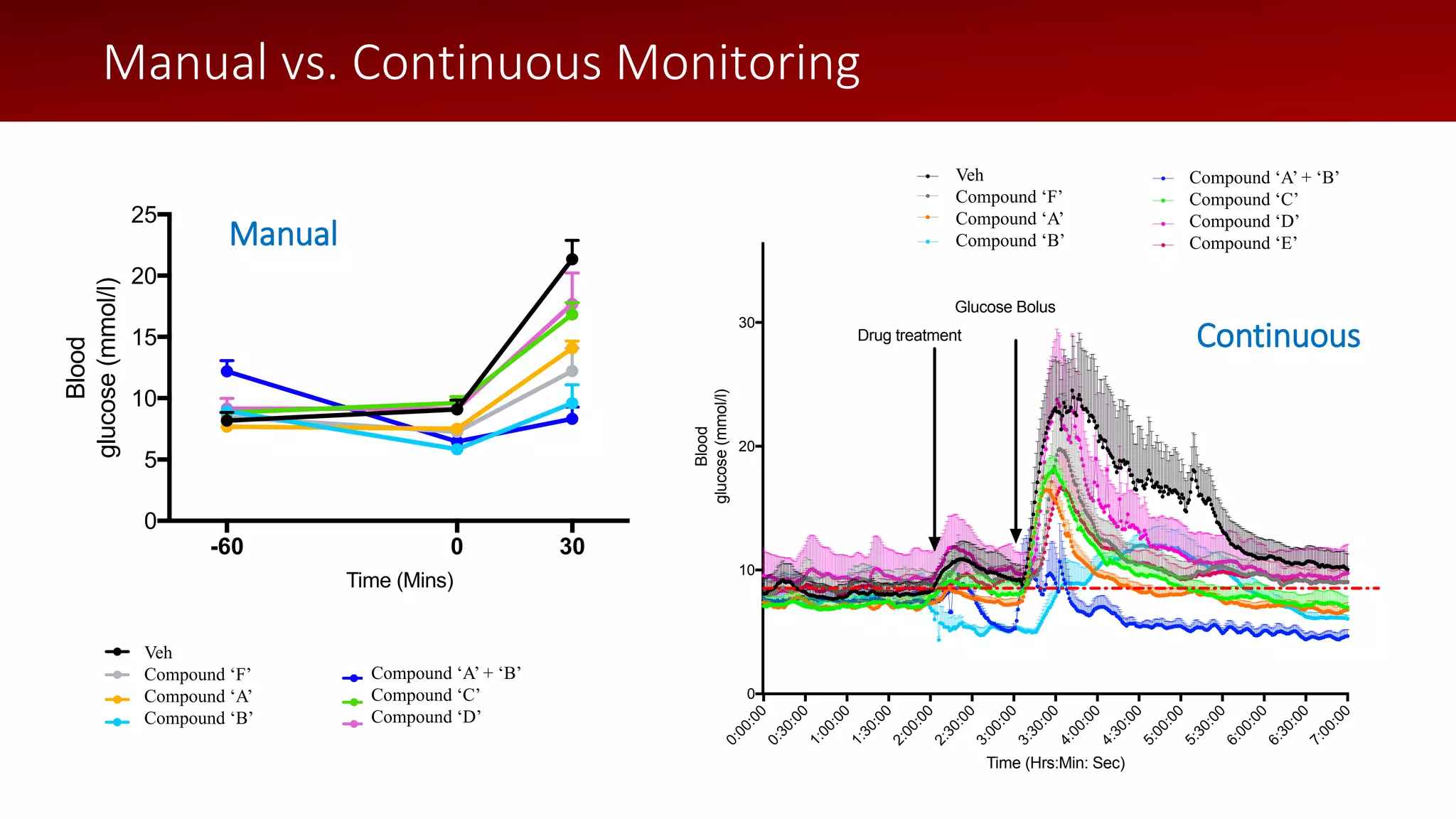
Drug treatment
Glucose Bolus
Veh
-60 0 30
0
5
10
15
20
25
Time (Mins)
Blood
glucose(mmol/l)
Manual gluose
Veh
Synthetic compound ‘B’
Synthetic compound ‘A’
Native Peptide ‘A’
Combination Drug ‘A’ + ‘B’
-60 0 30
0
5
10
15
20
25
Time (Mins)
Blood
glucose(mmol/l)
Manual gluose
Veh
Synthetic compound ‘B’
Synthetic compound ‘C’
Synthetic compound ‘A’
Native Peptide ‘A’
Synthetic compound ‘D’
Combination Drug ‘A’ + ‘B’
Manual vs. Continuous Monitoring
0 30
Time (Mins)
anual gluose
Veh
Synthetic compound ‘B’
Synthetic compound ‘C’
Synthetic compound ‘A’
Native Peptide ‘A’
Synthetic compound ‘D’
Combination Drug ‘A’ + ‘B’
Manual
Continuous
0:00:00
0:30:00
1:00:00
1:30:00
2:00:00
2:30:00
3:00:00
3:30:00
4:00:00
4:30:00
5:00:00
5:30:00
6:00:00
6:30:00
7
0
Time (Hrs:Min: Sec)
Synthetic compound ‘C’
Synthetic compound ‘A’
Native Peptide ‘A’
Synthetic compound ‘D’
Synthetic compound ‘E’
Combination Drug ‘A’ + ‘B’
Synthetic compound ‘B’
Veh
0:00:00
0:30:00
1:00:00
1:30:00
2:00:00
2:30:00
3:00:00
3:30:00
4:00
Time (Hrs:Min:
Synthetic compound ‘C’
Synthetic compound ‘A’
Native Peptide ‘A’
Synthetic compound ‘D’
Synthetic compound ‘E’
Combination Drug ‘A’ + ‘B’
Synthetic compound ‘B’
Veh
Veh
Compound ‘F’
Compound ‘A’
Compound ‘B’
Compound ‘A’ + ‘B’
Compound ‘C’
Compound ‘D’
Veh
Compound ‘F’
Compound ‘A’
Compound ‘B’
Compound ‘A’ + ‘B’
Compound ‘C’
Compound ‘D’
Compound ‘E’
Using Continuous Glucose Monitoring to
Determine Hormone Physiological Actions
https://www.ncbi.nlm.nih.gov/pubmed/8603777
More than 20 years ago…
Zymogenetics Corporation is a wholly owned subsidiary of Novo
Nordisk A/S, a manufacturer of therapeutics for the treatment of
diabetes.
BBB, blood-brain barrier; CRH, corticotropin-releasing hormone;
MES, 2-[Nmorpholino]ethanesulfonic acid; NPY, neuropeptide Y;
PVN, paraventricular nucleus.
DIABETES, VOL. 45, APRIL 1996
(A) Serum glucose in ob/ob and db/db mice after 5 daily intraperitoneal
injections of 150 µg of recombinant murine leptin or saline
genotype: ob/ob db/db
treatment:
Specificity of Leptin Action on
Elevated Blood Glucose Levels and
Hypothalamic Neuropeptide Y Gene
Expression in ob/ob Mice
Michael W. Schwartz, Denis G. Baskin, Thomas R. Bukowski,
Joseph L. Kuijper, Donald Foster, Gerry Lasser, Donna E.
Prunkard, Daniel Porte, Jr., Stephen C. Woods, Randy J. Seeley,
and David S. Weigle
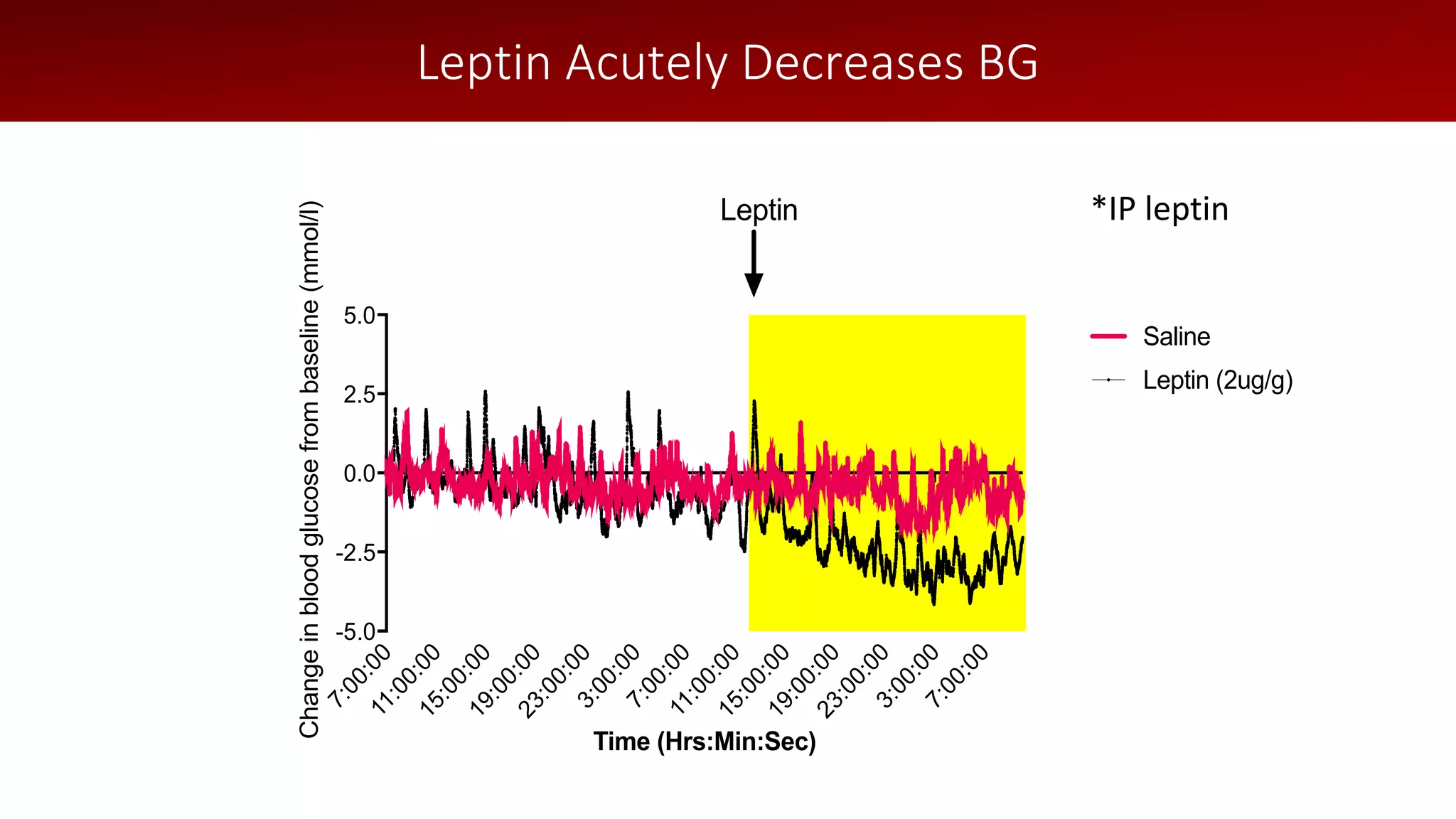
7:00:0011:00:0015:00:0019:00:0023:00:003:00:007:00:0011:00:0015:00:0019:00:0023:00:003:00:007:00:00
-5.0
-2.5
0.0
2.5
5.0
Time (Hrs:Min:Sec)
Changeinbloodglucosefrombaseline(mmol/l)
Leptin
Saline
Leptin (2ug/g)
*IP leptin
Leptin Acutely Decreases BG
Using Continuous Glucose Monitoring
in Combination with Chemogenetics
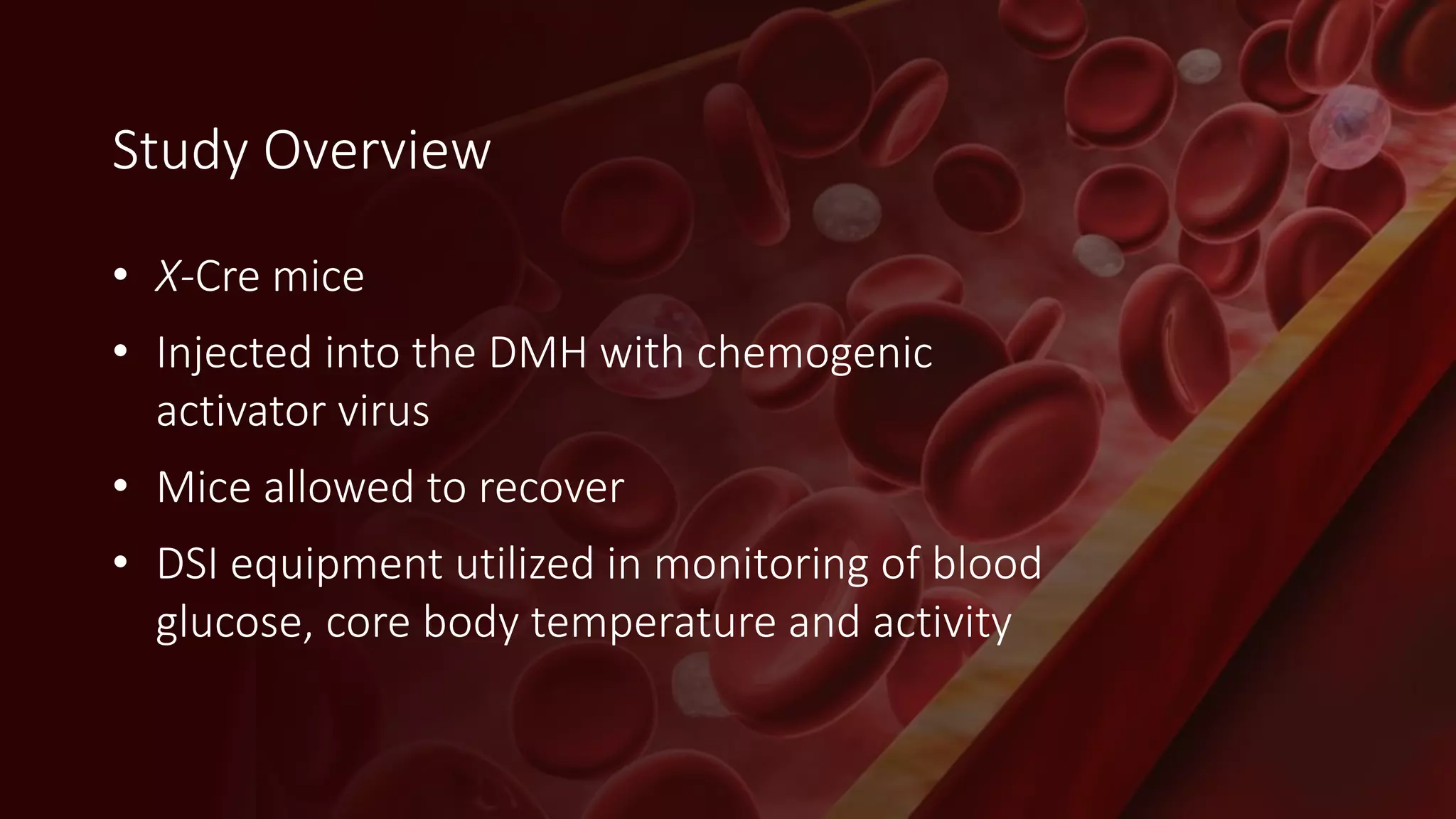
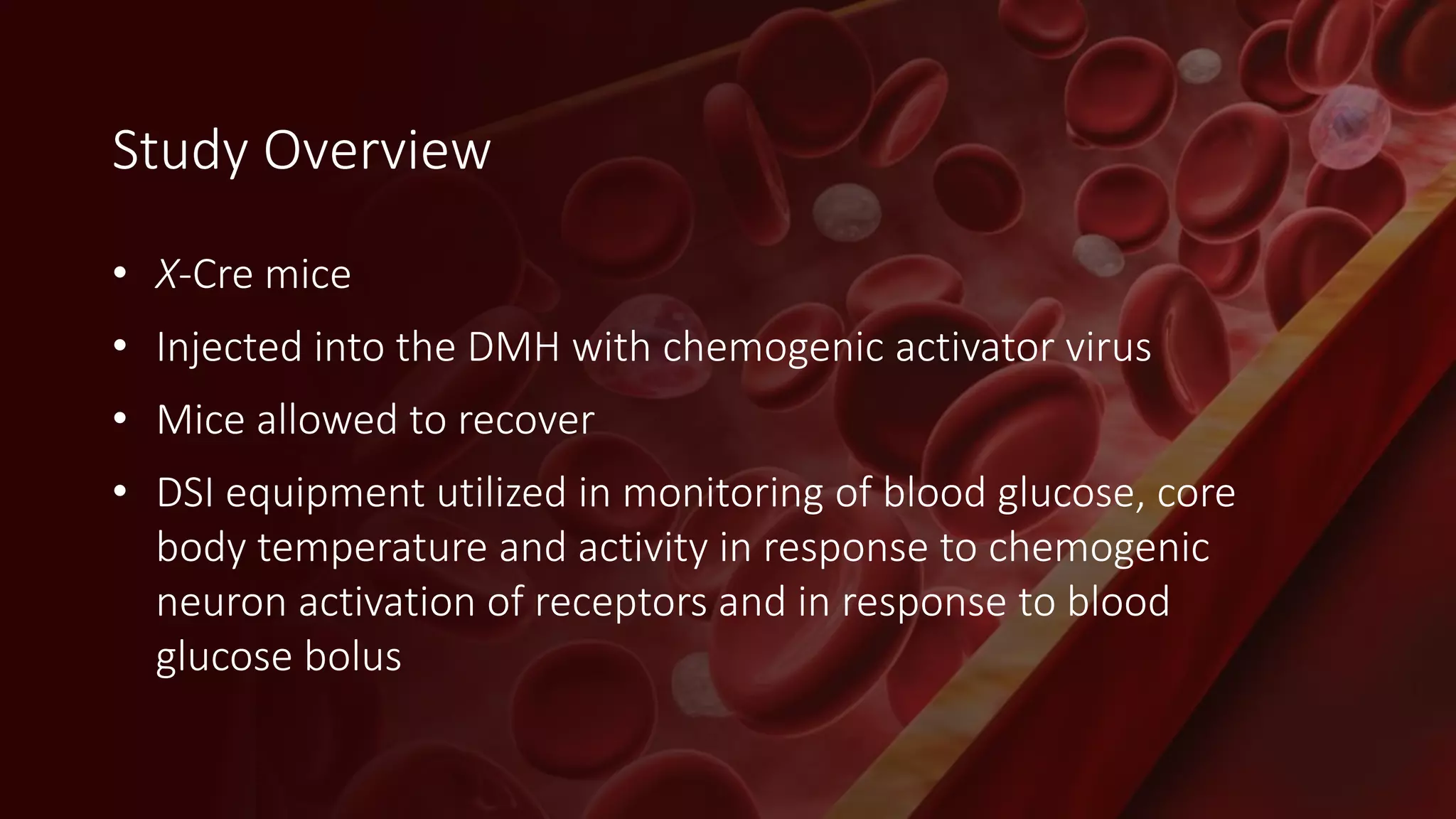
• X-Cre mice
• Injected into the DMH with chemogenic
activator virus
• Mice allowed to recover
• DSI equipment utilized in monitoring of blood
glucose, core body temperature and activity
Study Overview
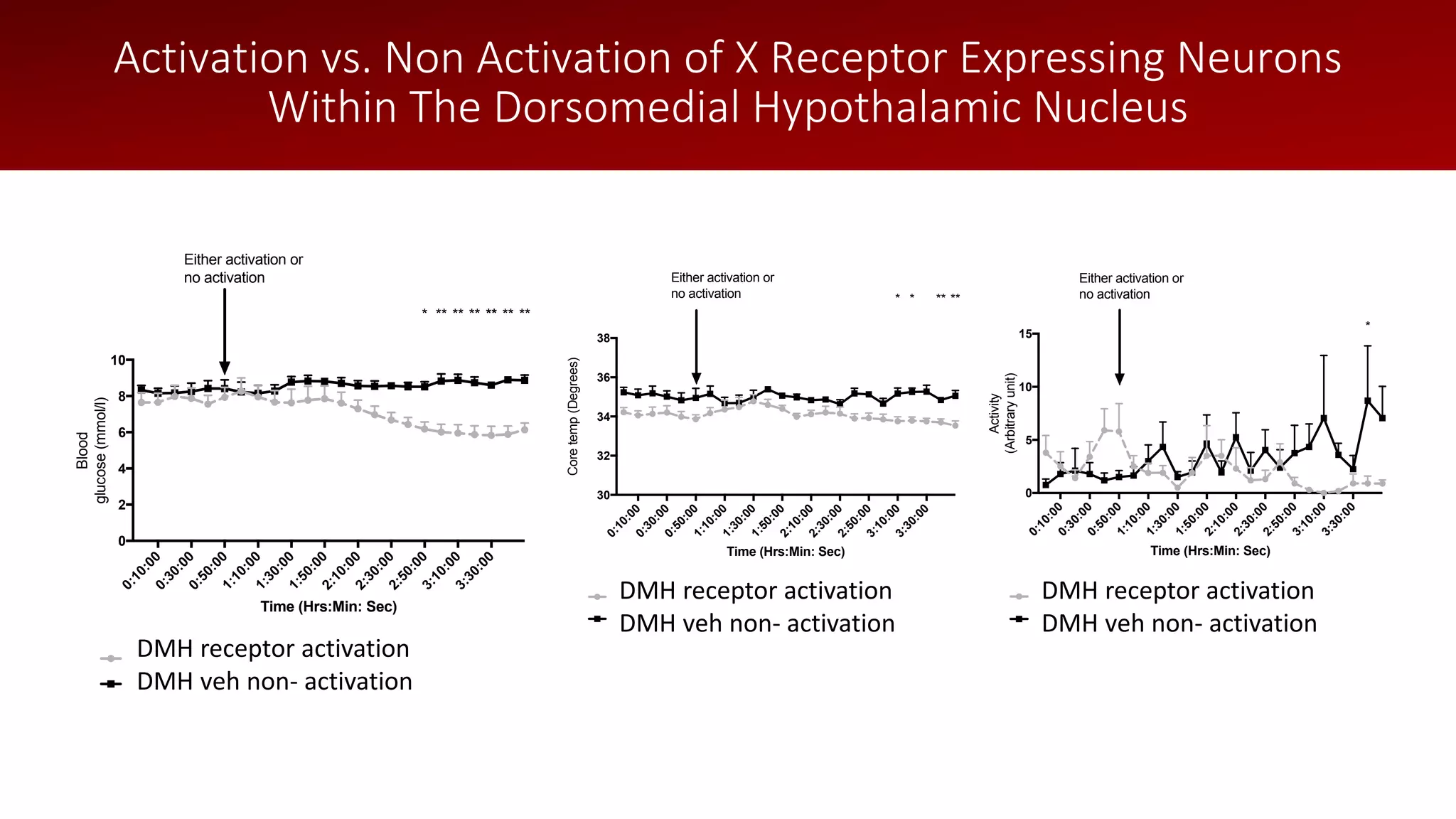
0:10:000:30:000:50:001:10:001:30:001:50:002:10:002:30:002:50:003:10:003:30:00
0
2
4
6
8
10
Time (Hrs:Min: Sec)
Blood
glucose(mmol/l)
DMH lepR activation
DMH lepR no activation
* ** ** **** ** ****
Either activation or
no activation
0:10:000:30:000:50:001:10:001:30:001:50:002:10:002:30:002:50:003:10:003:30:00
30
32
34
36
38
Time (Hrs:Min: Sec)
Coretemp(Degrees)
DMH lepR activation
DMH lepR no activation
* *** **
Either activation or
no activation
0:10:000:30:000:50:001:10:001:30:001:50:002:10:002:30:002:50:003:10:003:30:00
0
5
10
15
Time (Hrs:Min: Sec)
Activity
(Arbitraryunit)
DMH lepR activation
DMH lepR no activation
*
Either activation or
no activation
DMH receptor activation
DMH veh non- activation
DMH receptor activation
DMH veh non- activation
DMH receptor activation
DMH veh non- activation
Activation vs. Non Activation of X Receptor Expressing Neurons
Within The Dorsomedial Hypothalamic Nucleus
• X-Cre mice
• Injected into the DMH with chemogenic activator virus
• Mice allowed to recover
• DSI equipment utilized in monitoring of blood glucose, core
body temperature and activity in response to chemogenic
neuron activation of receptors and in response to blood
glucose bolus
Study Overview
00:10:000:20:000:30:000:40:000:50:001:00:001:10:001:20:001:30:001:40:001:50:002:00:002:10:002:20:002:30:002:40:002:50:003:00:003:10:003:20:00
0
5
10
15
Activity
(Arbitraryunit)
DMH lepR activation + glucose
*** *** *** **
DMH lepR no activation + glucose
***
Activation or
no activation
All mice
Glucose bolus
00:10:000:20:000:30:000:40:000:50:001:00:001:10:001:20:001:30:001:40:001:50:002:00:002:10:002:20:002:30:002:40:002:50:003:00:003:10:003:20:00
0
10
20
30
Blood
glucose(mmol/l)
DMH lepR activation + glucose
***
***
**
*
**
**
** ** ** ** **
DMH lepR no activation + glucose
Activation or
no activation
All mice
Glucose bolus
00:10:000:20:000:30:000:40:000:50:001:00:001:10:001:20:001:30:001:40:001:50:002:00:002:10:002:20:002:30:002:40:002:50:003:00:003:10:003:20:00
30
32
34
36
38
Time (Hrs:Min: Sec)
Coretemp(Degrees)
DMH lepR activation + glucose
DMH lepR no activation + glucose
Activation or
no activation
All mice
Glucose bolus
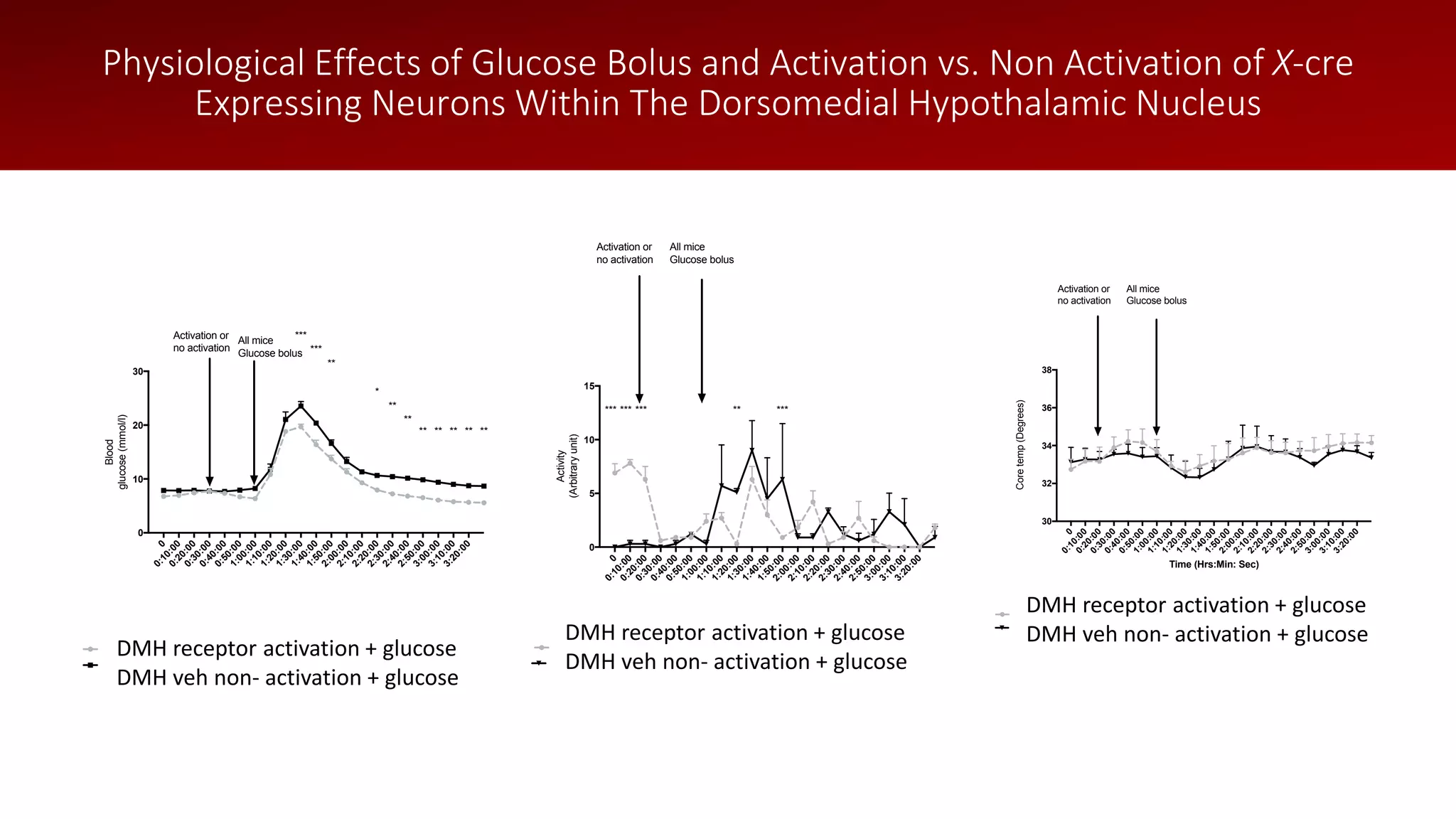
DMH receptor activation + glucose
DMH veh non- activation + glucose
DMH receptor activation + glucose
DMH veh non- activation + glucose
DMH receptor activation + glucose
DMH veh non- activation + glucose
Physiological Effects of Glucose Bolus and Activation vs. Non Activation of X-cre
Expressing Neurons Within The Dorsomedial Hypothalamic Nucleus
Using Continuous Glucose Monitoring in Combination
With Central AAV Cre Neuronal Knockdown
Modulating central physiology & measuring peripheral outputs
baseline
15
30
45
60
90
1200
10
20
30
40
Blood
glucose(mmol/l)
Time (Mins)
Baseline
Week 1
Week 3
** ****
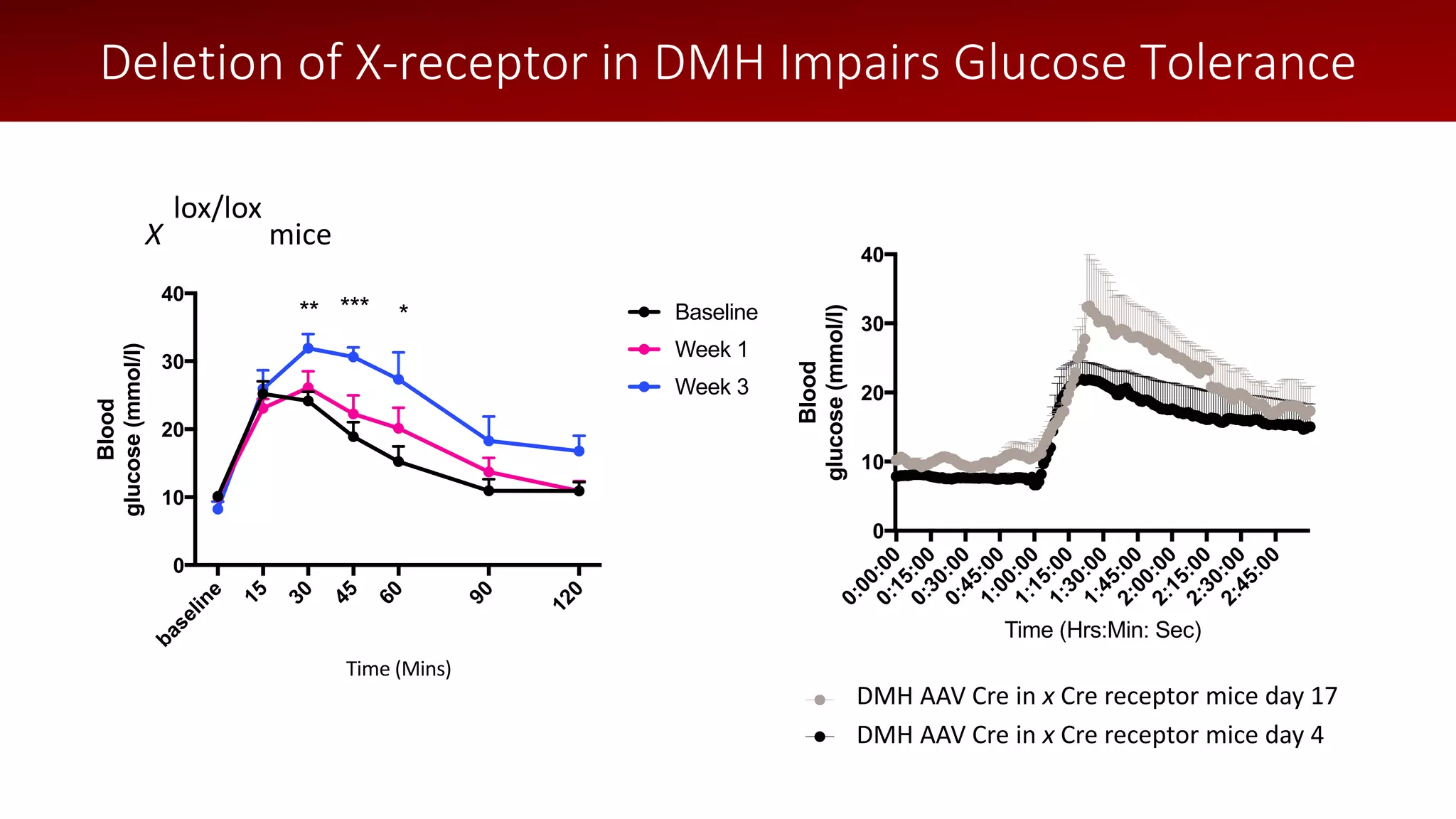
X
lox/lox
mice
0:00:000:15:000:30:000:45:001:00:001:15:001:30:001:45:002:00:002:15:002:30:002:45:00
0
10
20
30
40
Time (Hrs:Min: Sec)
Blood
glucose(mmol/l)
DMH AAV Cre in LepR flox mice day 17
DMH AAV Cre in LepR flox mice day 4
Deletion of X-receptor in DMH Impairs Glucose Tolerance
DMH AAV Cre in x Cre receptor mice day 17
DMH AAV Cre in x Cre receptor mice day 4
0:00:000:15:000:30:000:45:001:00:001:15:001:30:001:45:002:00:002:15:002:30:002:45:00
0
10
20
30
40
Time (Hrs:Min: Sec)
Blood
glucose(mmol/l)
DMH AAV Cre in LepR flox mice day 17
DMH AAV Cre in LepR flox mice day 4
19:00:00
7:00:00
19:00:00
7:00:00
19:00:00
7:00:00
19:00:00
7:00:00
19:00:00
7:00:00
19:00:00
7:00:00
19:00:00
7:00:00
19:00:00
7:00:00
19:00:00
7:00:00
19:00:00
7:00:00
19:00:00
7:00:00
19:00:00
7:00:00
19:00:00
7:00:00
19:00:00
7:00:00
19:00:00
7:00:00
19:00:00
7:00:00
-10
-5
0
5
10
Changeinbloodglucose(mmol/l)
change
DMH AAV Cre in LepR flox mice
DMH AAV Scrambled in LepR flox mice
Day 7 Day 14 Day 18
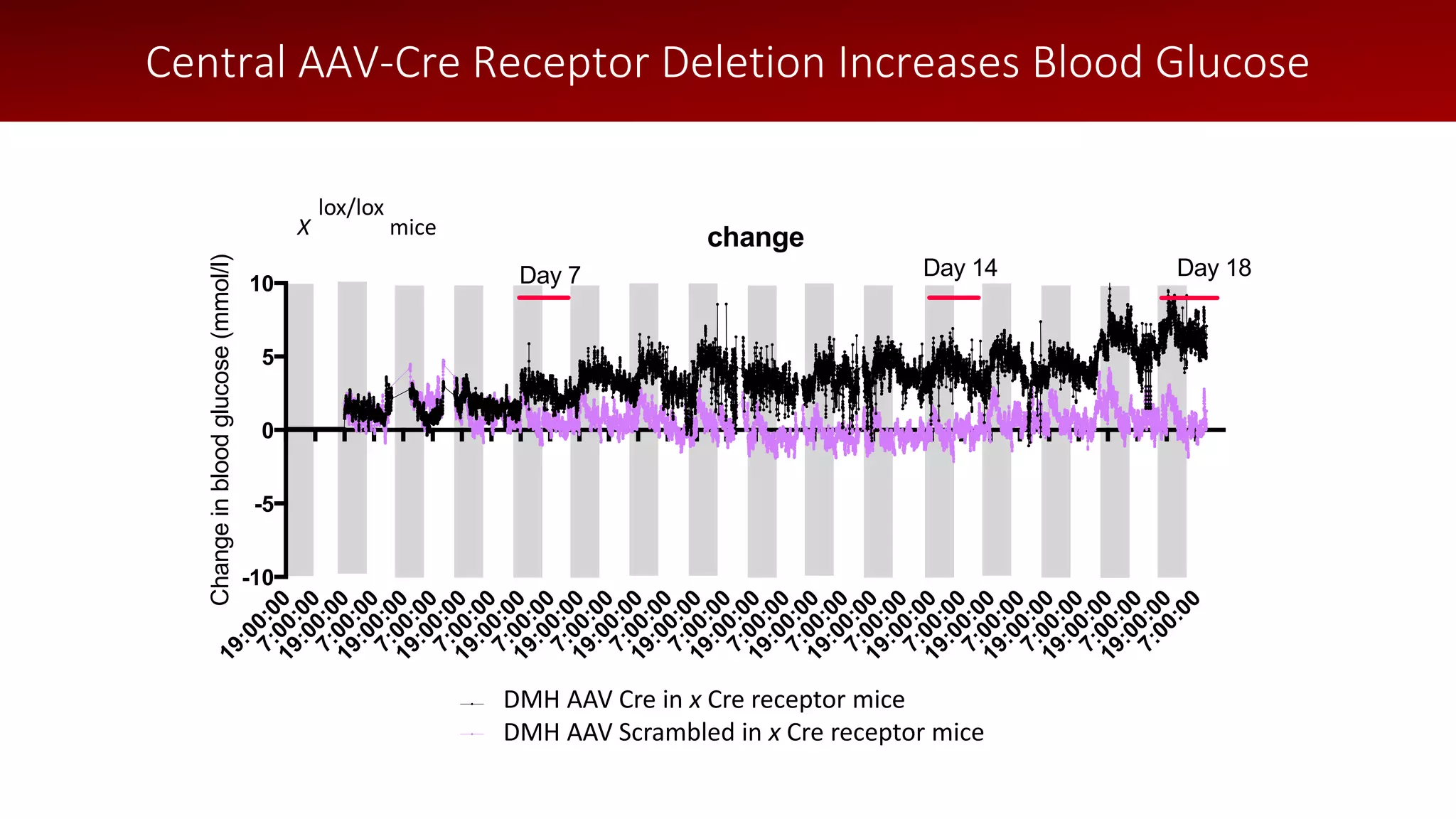
Central AAV-Cre Receptor Deletion Increases Blood Glucose
X
lox/lox
mice
DMH AAV Cre in x Cre receptor mice
DMH AAV Scrambled in x Cre receptor mice
19:00:00
7:00:00
19:00:00
7:00:00
19:00:00
7:00:00
19:00:00
7:00:00
19:00:00
7:00:00
19:00:00
7:00:00
19:00:00
7:00:00
19:00:00
7:00:00
19:00:00
7:00:00
19:00:00
7:00:00
19:00:00
7:00:00
19:00:00
7:00:00
19:00:00
7:00:00
19:00:00
7:00:00
19:00:00
7:00:00
19:00:00
7:00:00
-10
-5
0
5
10
Changeinbloodglucose(mmol/l)
change
DMH AAV Cre in LepR flox mice
DMH AAV Scrambled in LepR flox mice
Day 7 Day 14 Day 18
19:00:00
23:00:00
3:00:00
7:00:00
11:00:00
15:00:00
-2
0
2
4
6
8
10
Time (Hrs:Min: Sec)
Changeinbloodglucose(mmol/l)
Change DAY 7
DMH AAV Cre in LepR flox mice
DMH AAV Scrambled in LepR flox mice
19:00:00
23:00:00
3:00:00
7:00:00
11:00:00
15:00:00
-2
0
2
4
6
8
10
Time (Hrs:Min: Sec)
Changeinbloodglucose(mmol/l)
Change DAY 14
DMH AAV Cre in LepR flox mice
DMH AAV Scrambled in LepR flox mice
19:00:00
23:00:00
3:00:00
7:00:00
11:00:00
15:00:00
-5
0
5
10
15
Time (Hrs:Min: Sec)
Changeinbloodglucose(mmol/l)
Change DAY 18
DMH AAV Cre in LepR flox mice
DMH AAV Scrambled in LepR flox mice
Time (Hrs:Min:Sec)
x
lox/lox
mice
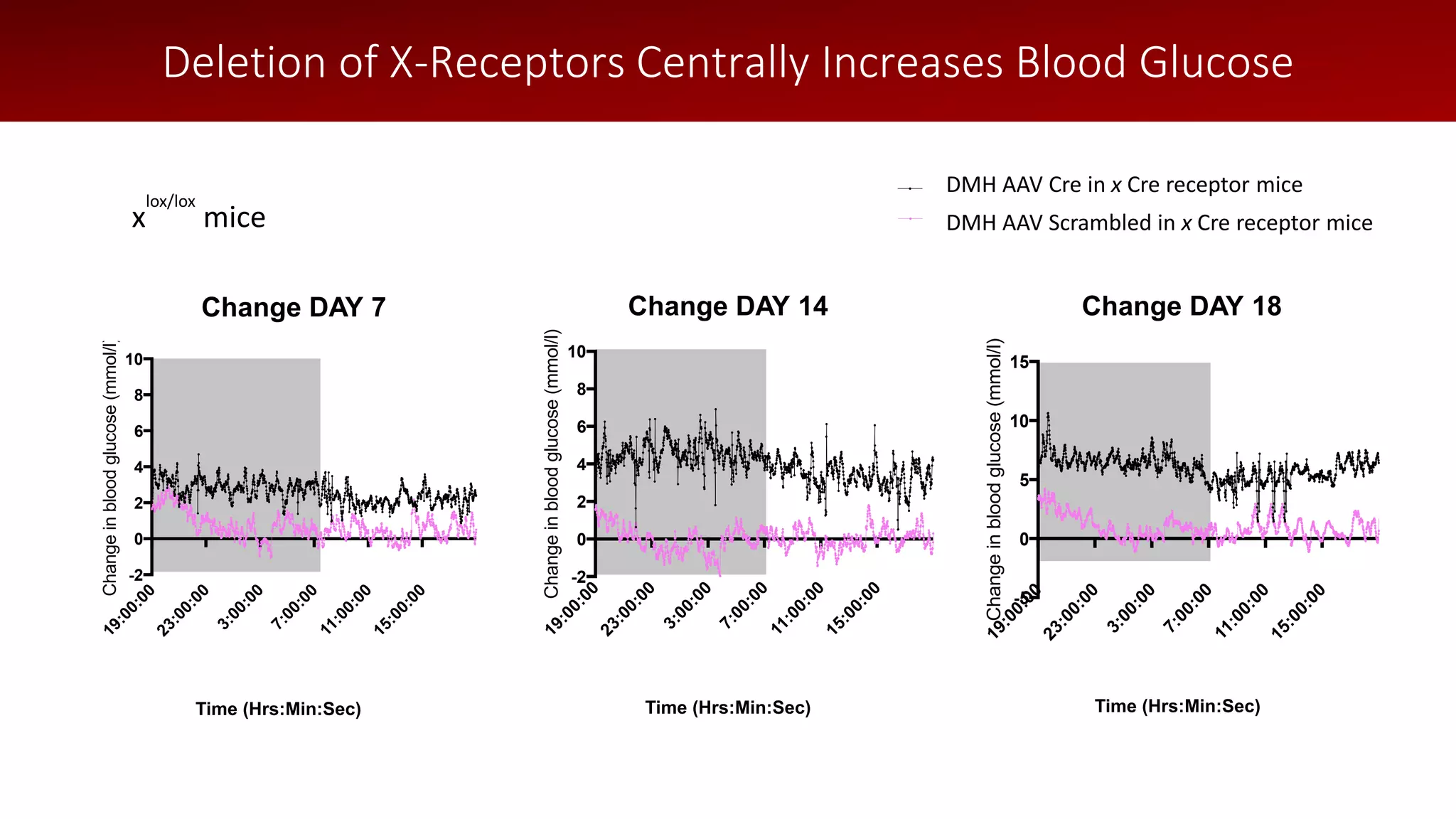
Deletion of X-Receptors Centrally Increases Blood Glucose
DMH AAV Cre in x Cre receptor mice
DMH AAV Scrambled in x Cre receptor mice
19:00:00
23:00:00
3:00:00
7:00:00
11:00:00
15:00:00
-2
0
Time (Hrs:Min: Sec)
Chang
DMH AAV Cre in LepR flox mice
DMH AAV Scrambled in LepR flox mice
Time (Hrs:Min:Sec) Time (Hrs:Min:Sec)
Change DAY 18Change DAY 14Change DAY 7
Monash University
Prof. Michael Cowley
Dr. Jack Pryor
Acknowledgements
Glucose Telemetry Surgery
Copyright 2018 Data Sciences International (DSI) and InsideScientific. All Rights Reserved.
Megan Fine, DVM
MS, DACVS-LA
Veterinary Surgeon, Attending Veterinarian DSI
© 2018 Data Sciences International
Overview
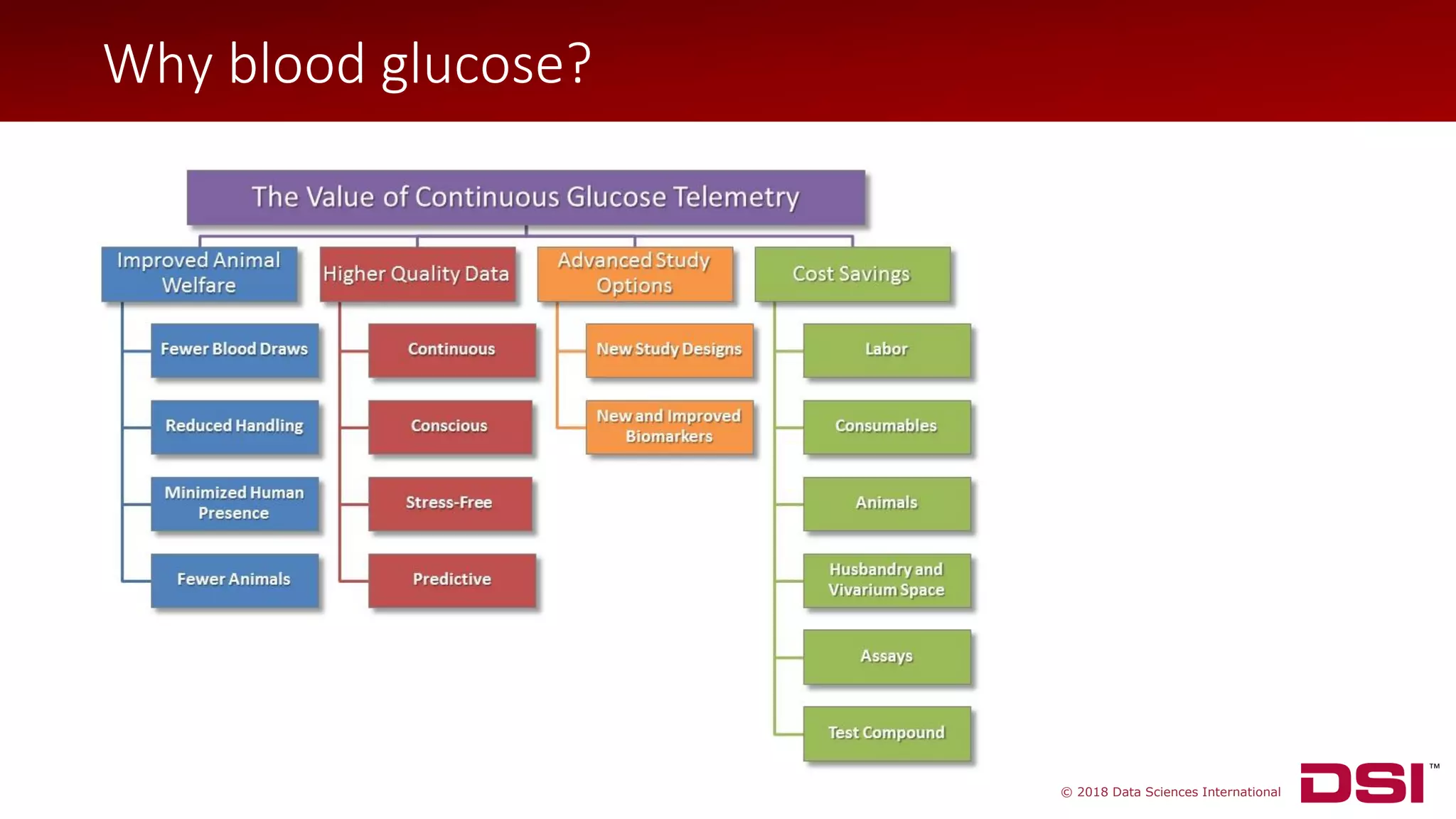
• Why blood glucose?
• Glucose telemetry surgery in mouse, rat and large animals
• Calibration best practices
• Combining additional endpoints
• Questions
© 2018 Data Sciences International
Why blood glucose?
© 2018 Data Sciences International
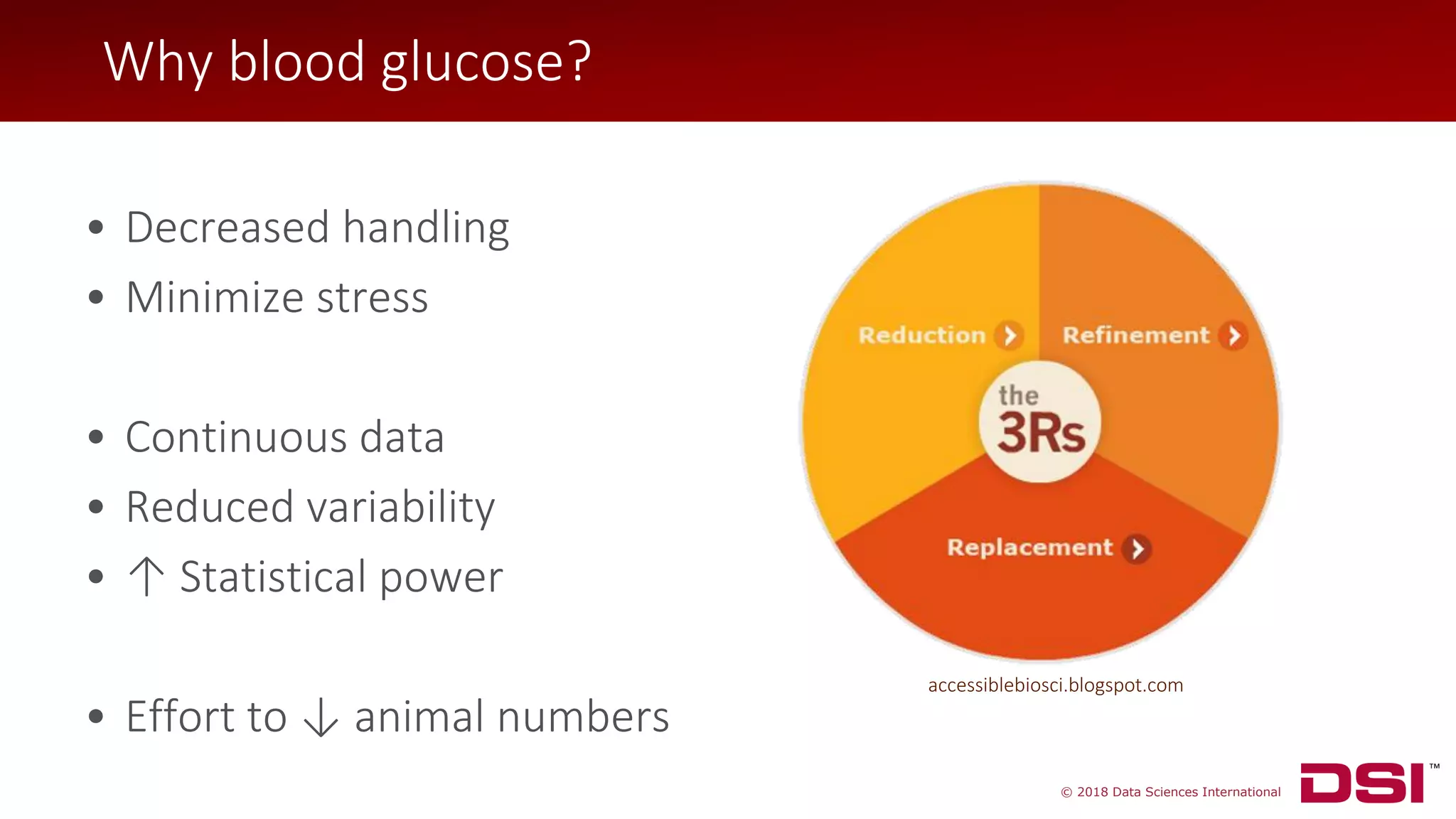
Why blood glucose?
• Decreased handling
• Minimize stress
• Continuous data
• Reduced variability
• ↑ Statistical power
• Effort to ↓ animal numbers
accessiblebiosci.blogspot.com
© 2018 Data Sciences International
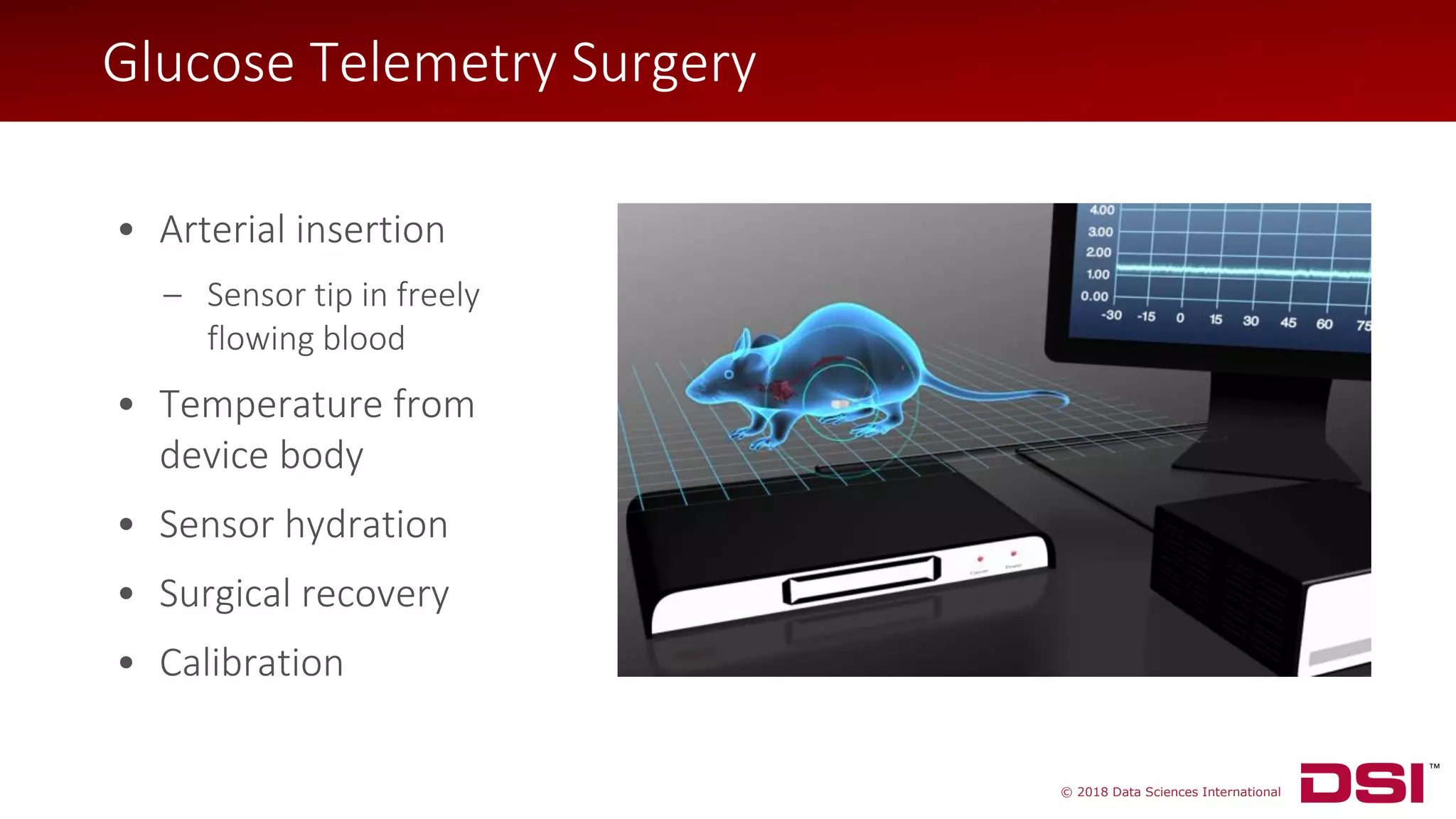
Glucose Telemetry Surgery
• Arterial insertion
– Sensor tip in freely
flowing blood
• Temperature from
device body
• Sensor hydration
• Surgical recovery
• Calibration
© 2018 Data Sciences International
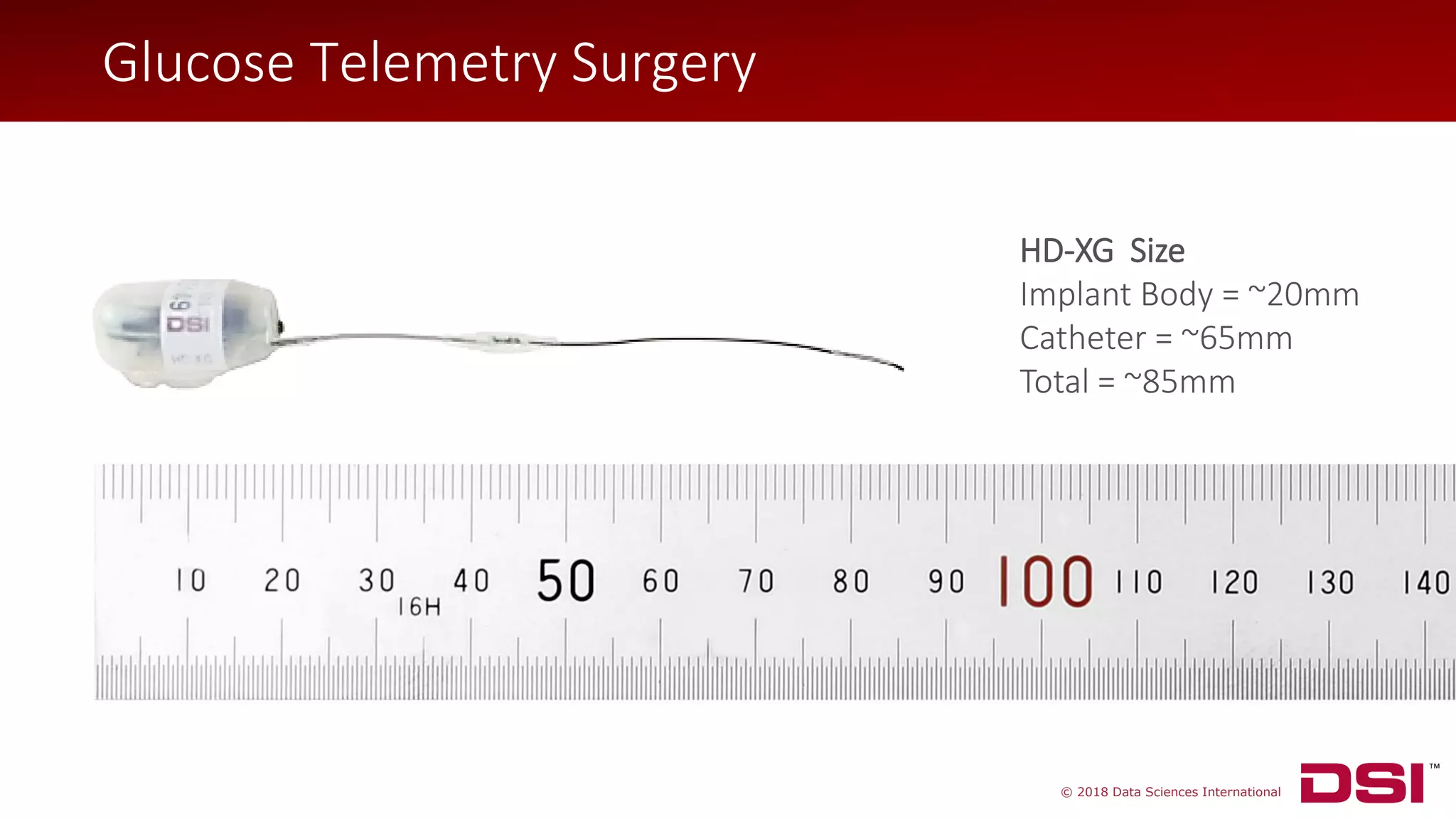
Glucose Telemetry Surgery
HD-XG Size
Implant Body = ~20mm
Catheter = ~65mm
Total = ~85mm
© 2018 Data Sciences International
Mouse Glucose Surgery
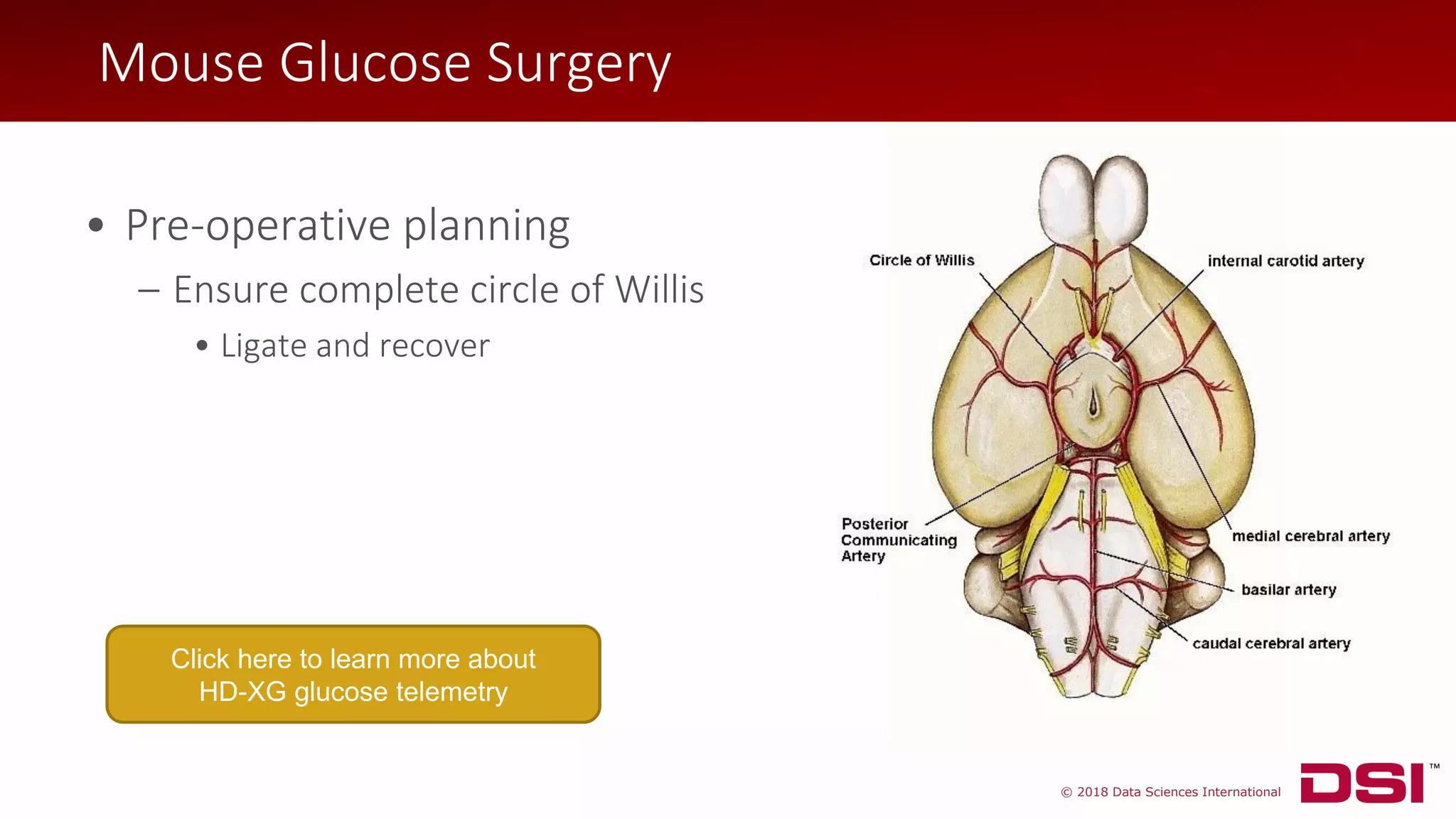
• Pre-operative planning
– Ensure complete circle of Willis
• Ligate and recover
Click here to learn more about
HD-XG glucose telemetry
© 2018 Data Sciences International
• Pre-operative planning
– Ensure complete circle of Willis
• Ligate and recover
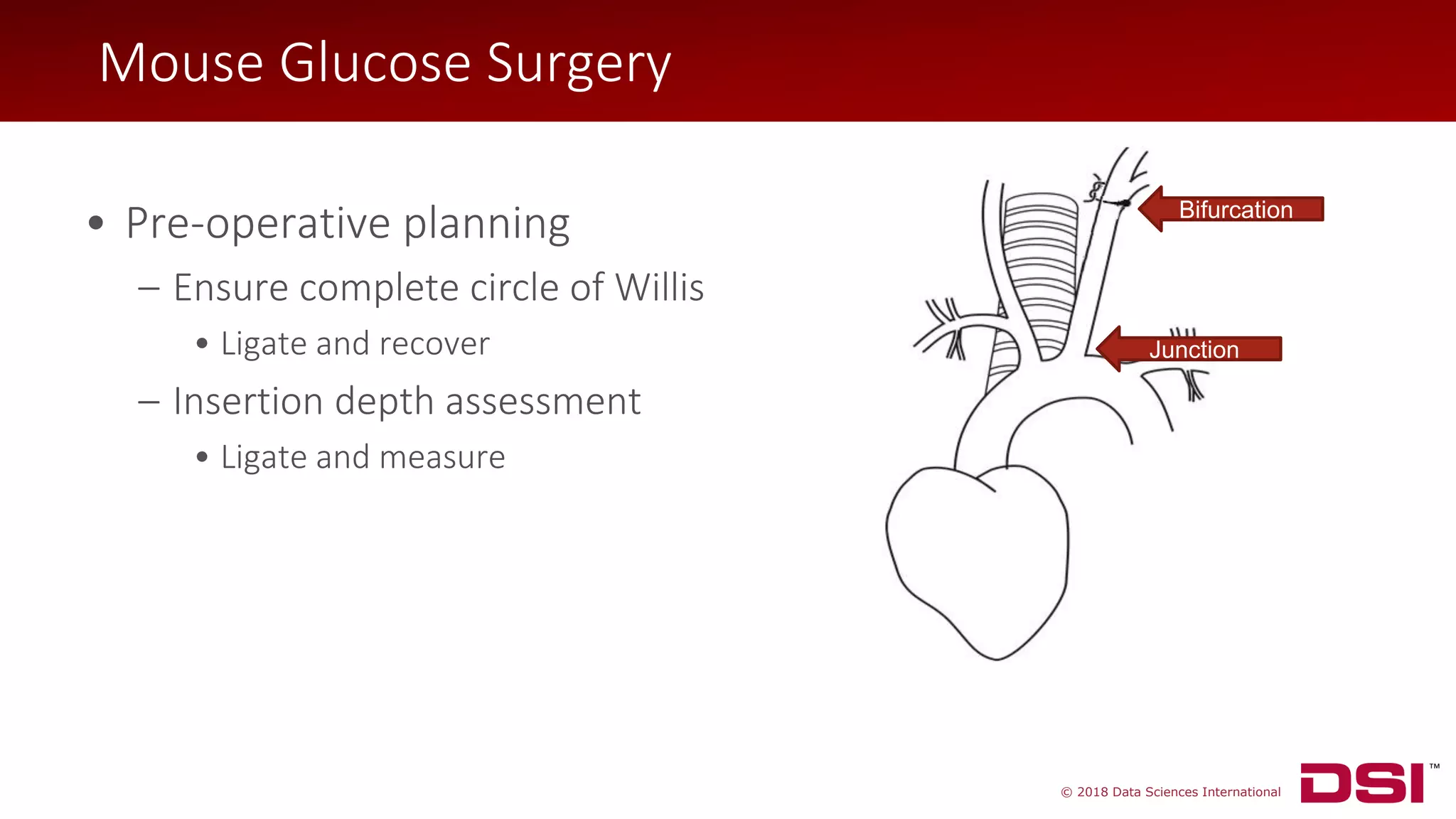
– Insertion depth assessment
• Ligate and measure
Bifurcation
Junction
Mouse Glucose Surgery
© 2018 Data Sciences International
• Pre-operative planning
– Ensure complete circle of Willis
• Ligate and recover
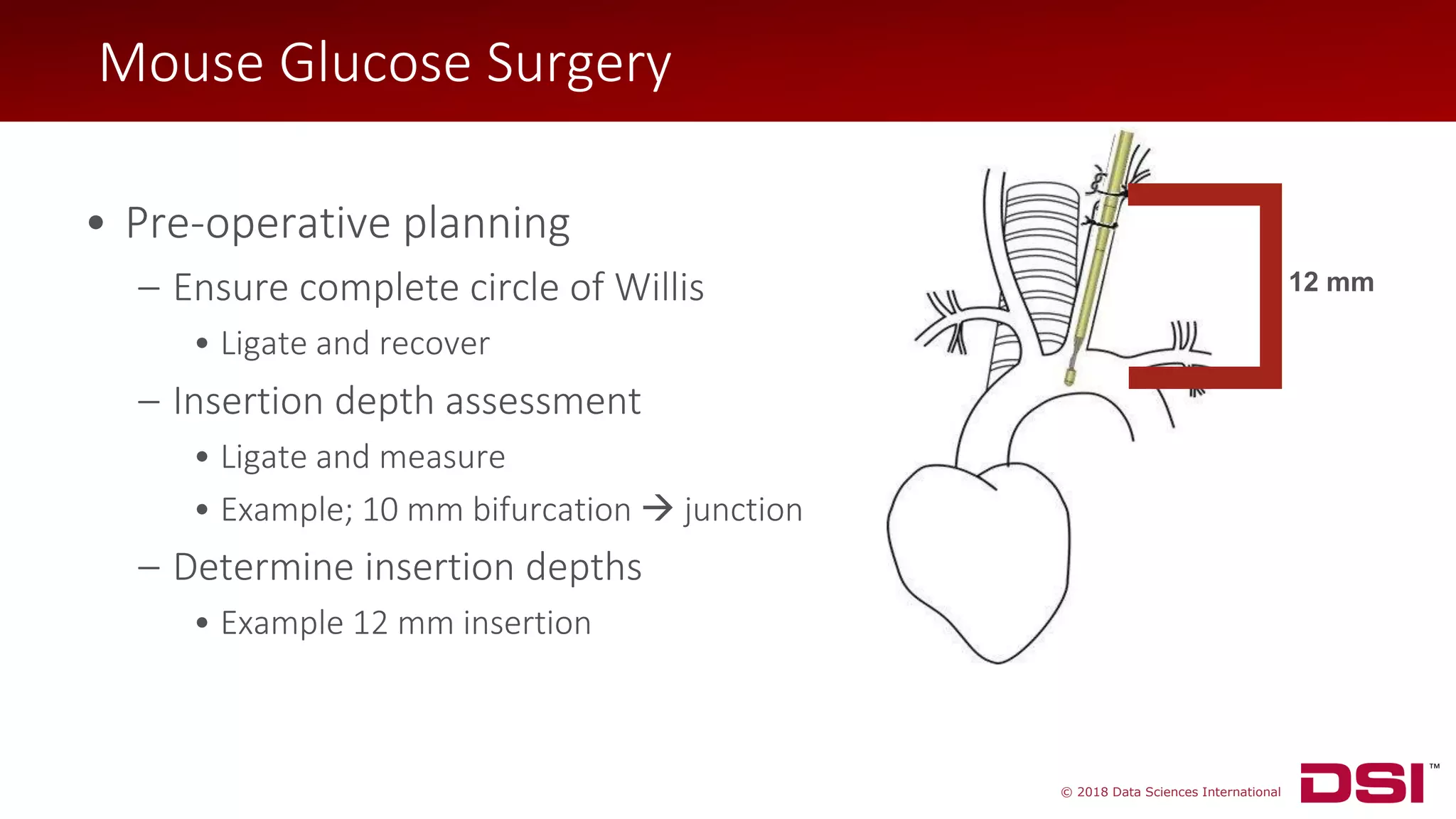
– Insertion depth assessment
• Ligate and measure
• Example; 10 mm bifurcation → junction
10 mm
Mouse Glucose Surgery
© 2018 Data Sciences International
• Pre-operative planning
– Ensure complete circle of Willis
• Ligate and recover
– Insertion depth assessment
• Ligate and measure
• Example; 10 mm bifurcation → junction
– Determine insertion depths
• Example 12 mm insertion
12 mm
Mouse Glucose Surgery
© 2018 Data Sciences International
• Pre-operative planning
– Ensure complete circle of Willis
• Ligate and recover
– Insertion depth assessment
• Ligate and measure
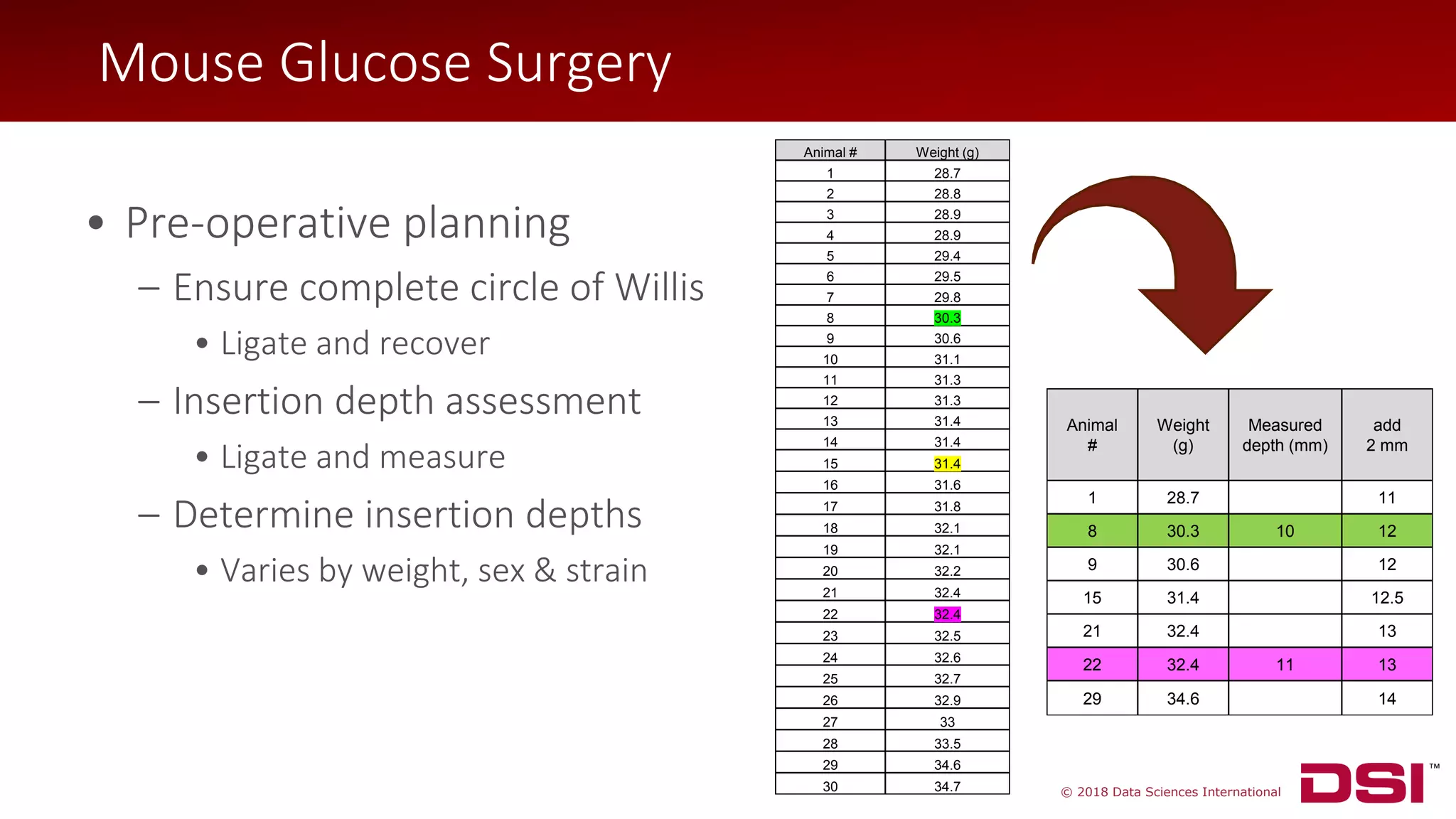
– Determine insertion depths
• Varies by weight, sex & strain
Animal
#
Weight
(g)
Measured
depth (mm)
add
2 mm
1 28.7 11
8 30.3 10 12
9 30.6 12
15 31.4 12.5
21 32.4 13
22 32.4 11 13
29 34.6 14
Mouse Glucose Surgery
Animal # Weight (g)
1 28.7
2 28.8
3 28.9
4 28.9
5 29.4
6 29.5
7 29.8
8 30.3
9 30.6
10 31.1
11 31.3
12 31.3
13 31.4
14 31.4
15 31.4
16 31.6
17 31.8
18 32.1
19 32.1
20 32.2
21 32.4
22 32.4
23 32.5
24 32.6
25 32.7
26 32.9
27 33
28 33.5
29 34.6
30 34.7
© 2018 Data Sciences International
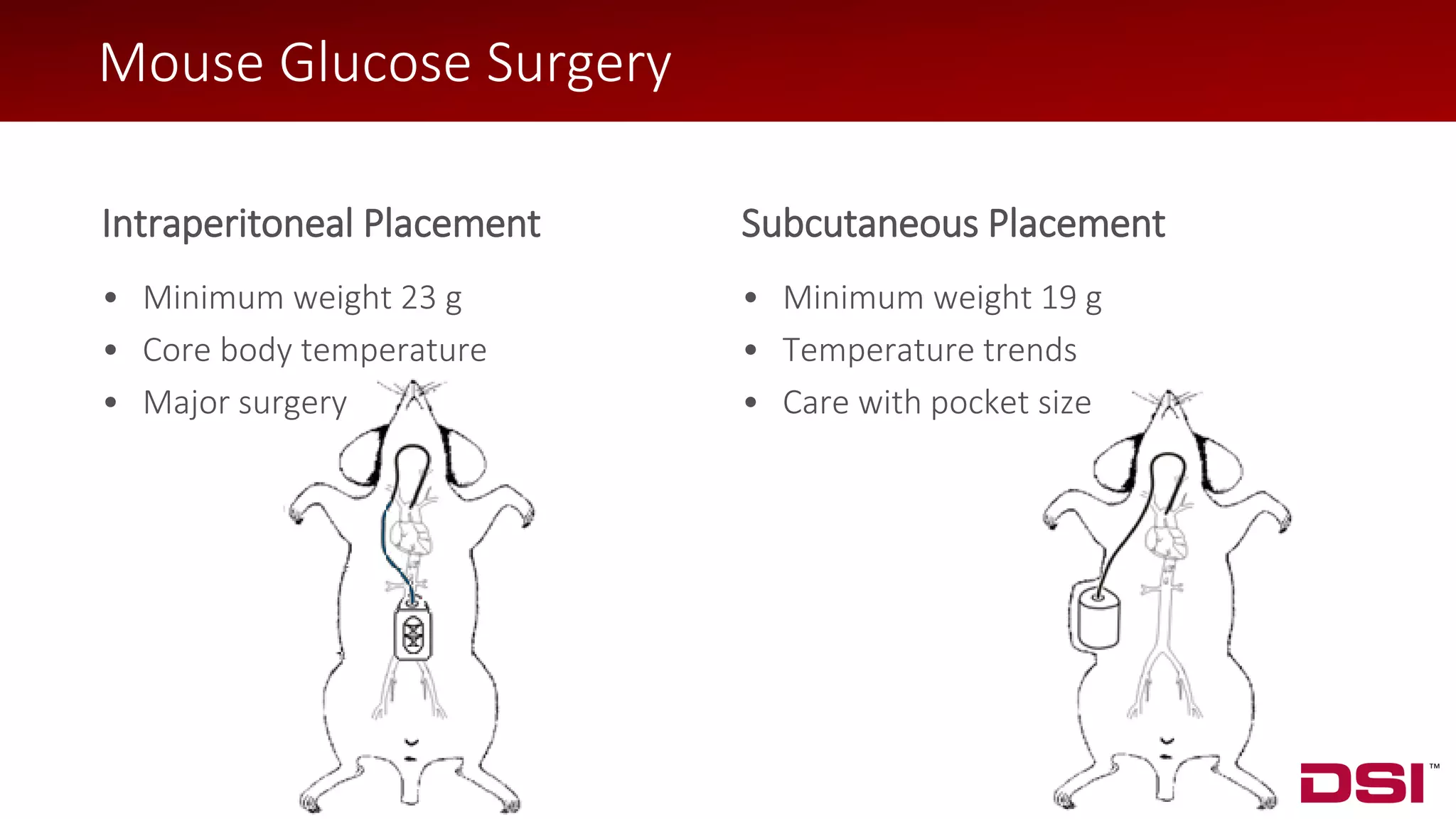
Intraperitoneal Placement
• Minimum weight 23 g
• Core body temperature
• Major surgery
Subcutaneous Placement
• Minimum weight 19 g
• Temperature trends
• Care with pocket size
Mouse Glucose Surgery
© 2018 Data Sciences International
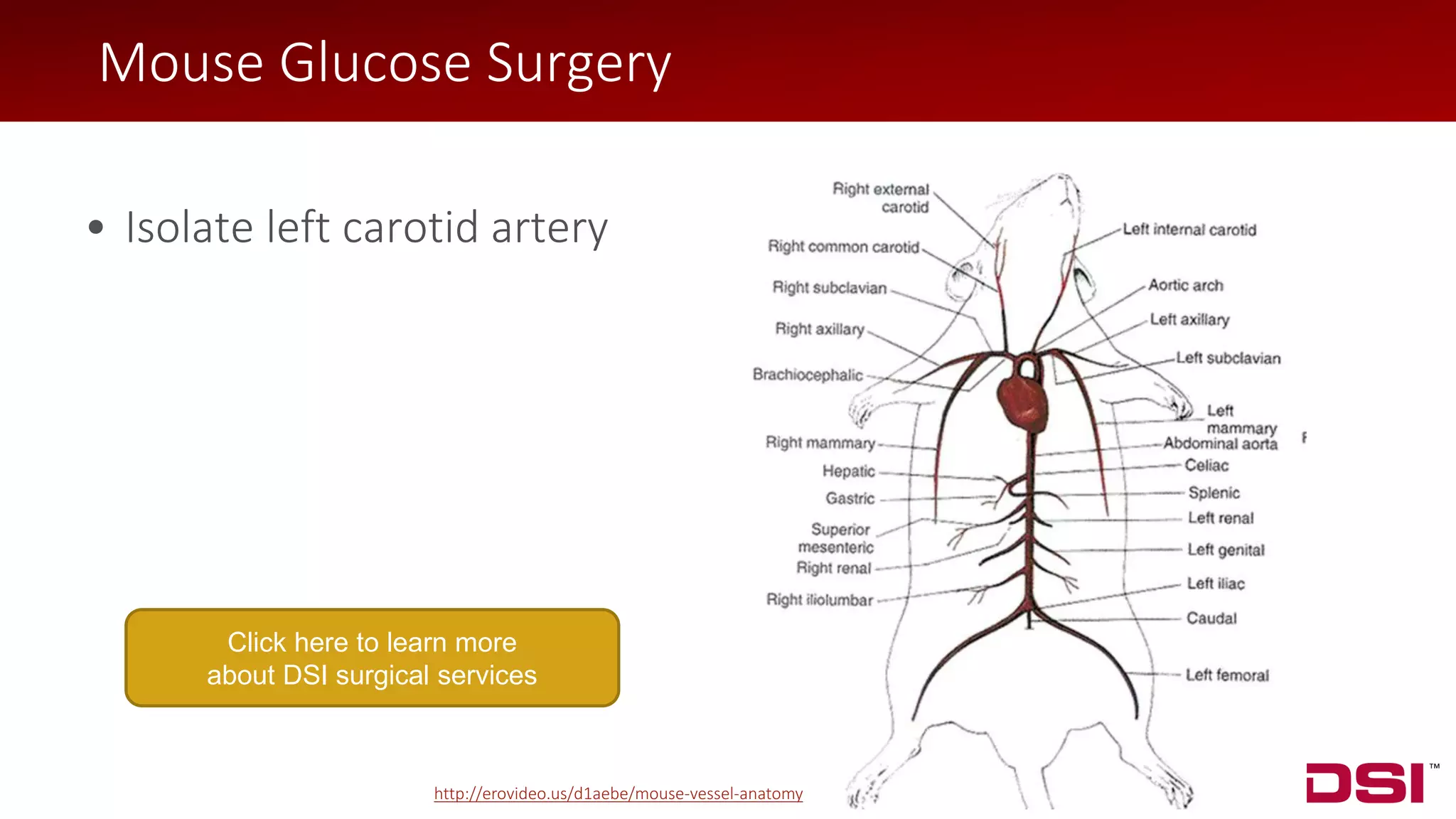
• Isolate left carotid artery • Isolate left carotid artery
Mouse Glucose Surgery
http://erovideo.us/d1aebe/mouse-vessel-anatomy
Click here to learn more
about DSI surgical services
© 2018 Data Sciences International
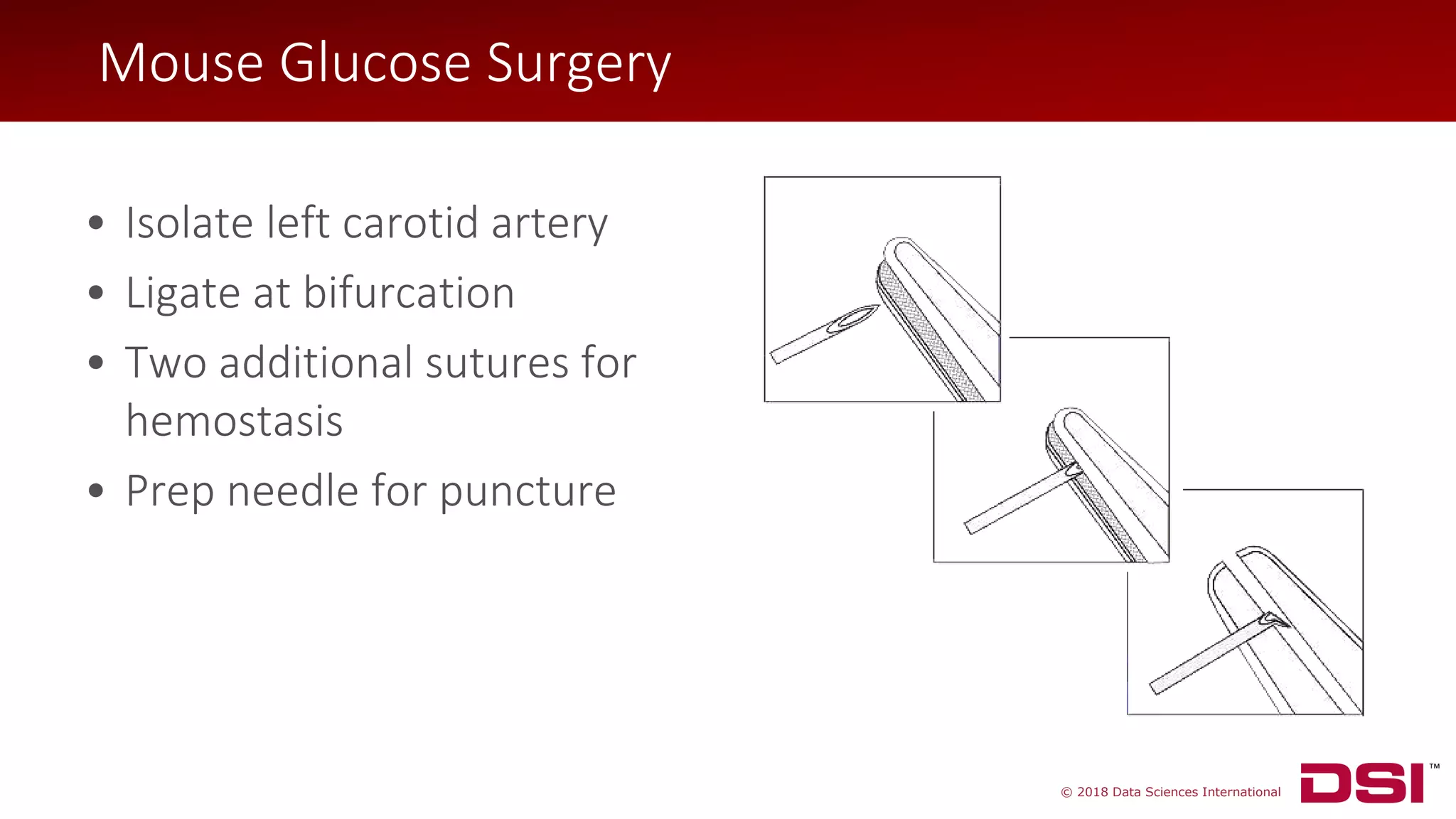
• Isolate left carotid artery
• Ligate at bifurcation
• Two additional sutures for
hemostasis
Mouse Glucose Surgery
[superior - cranial]
[inferior - caudal]
© 2018 Data Sciences International
• Isolate left carotid artery
• Ligate at bifurcation
• Two additional sutures for
hemostasis
• Prep needle for puncture
Mouse Glucose Surgery
© 2018 Data Sciences International
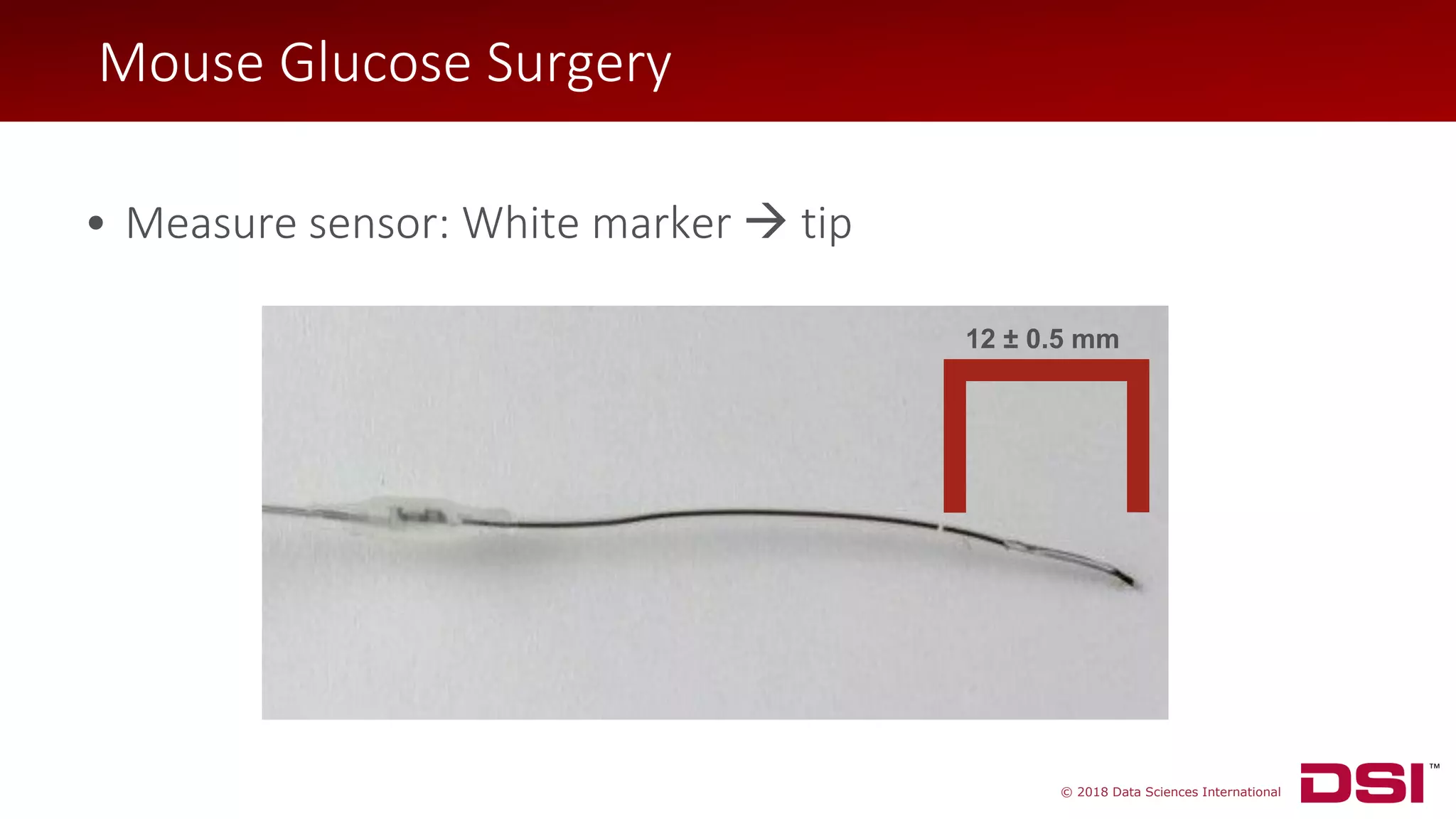
• Measure sensor: White marker → tip
12 ± 0.5 mm
Mouse Glucose Surgery
© 2018 Data Sciences International
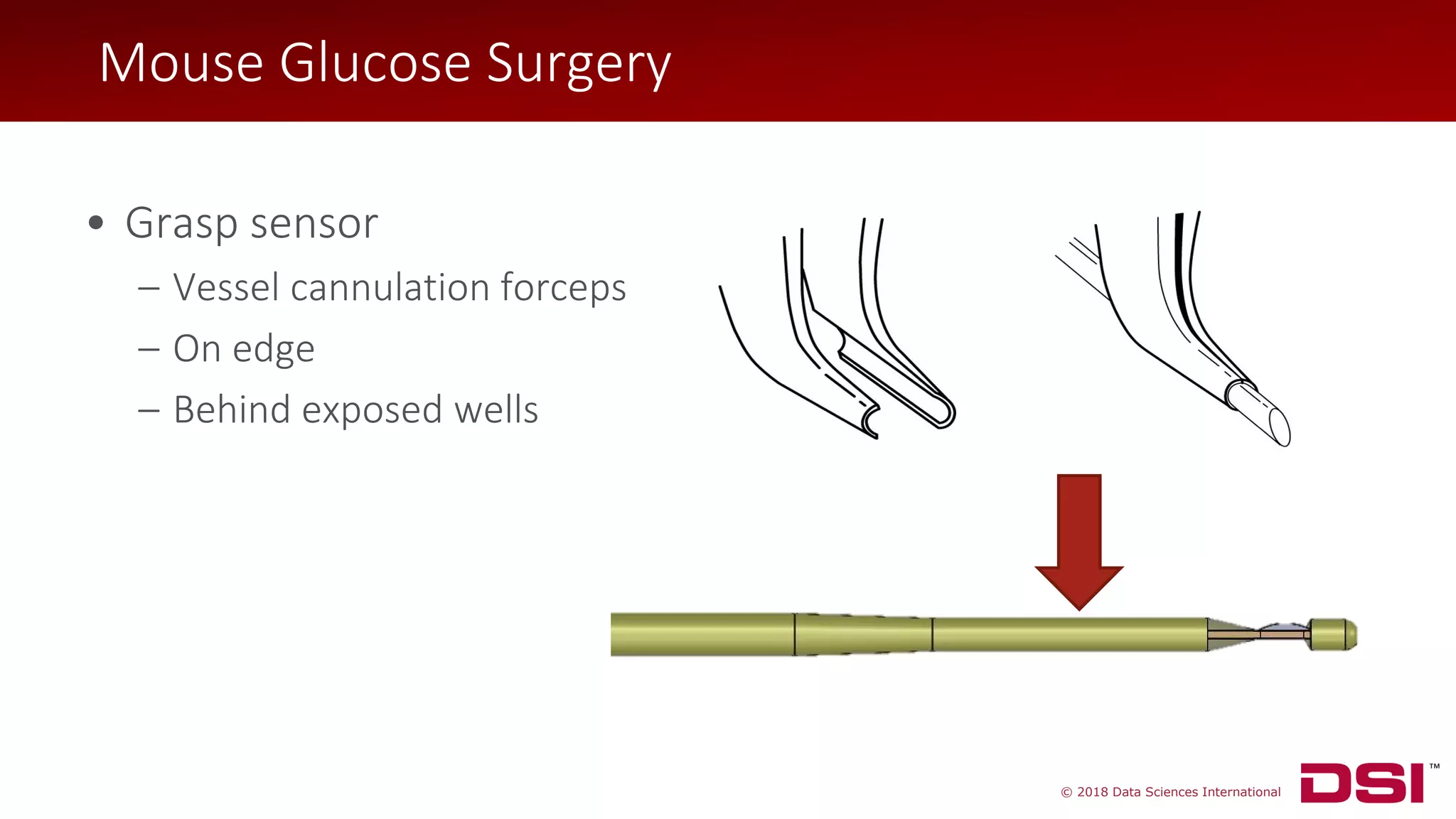
• Grasp sensor
– Vessel cannulation forceps
– On edge
– Behind exposed wells
Mouse Glucose Surgery
© 2018 Data Sciences International
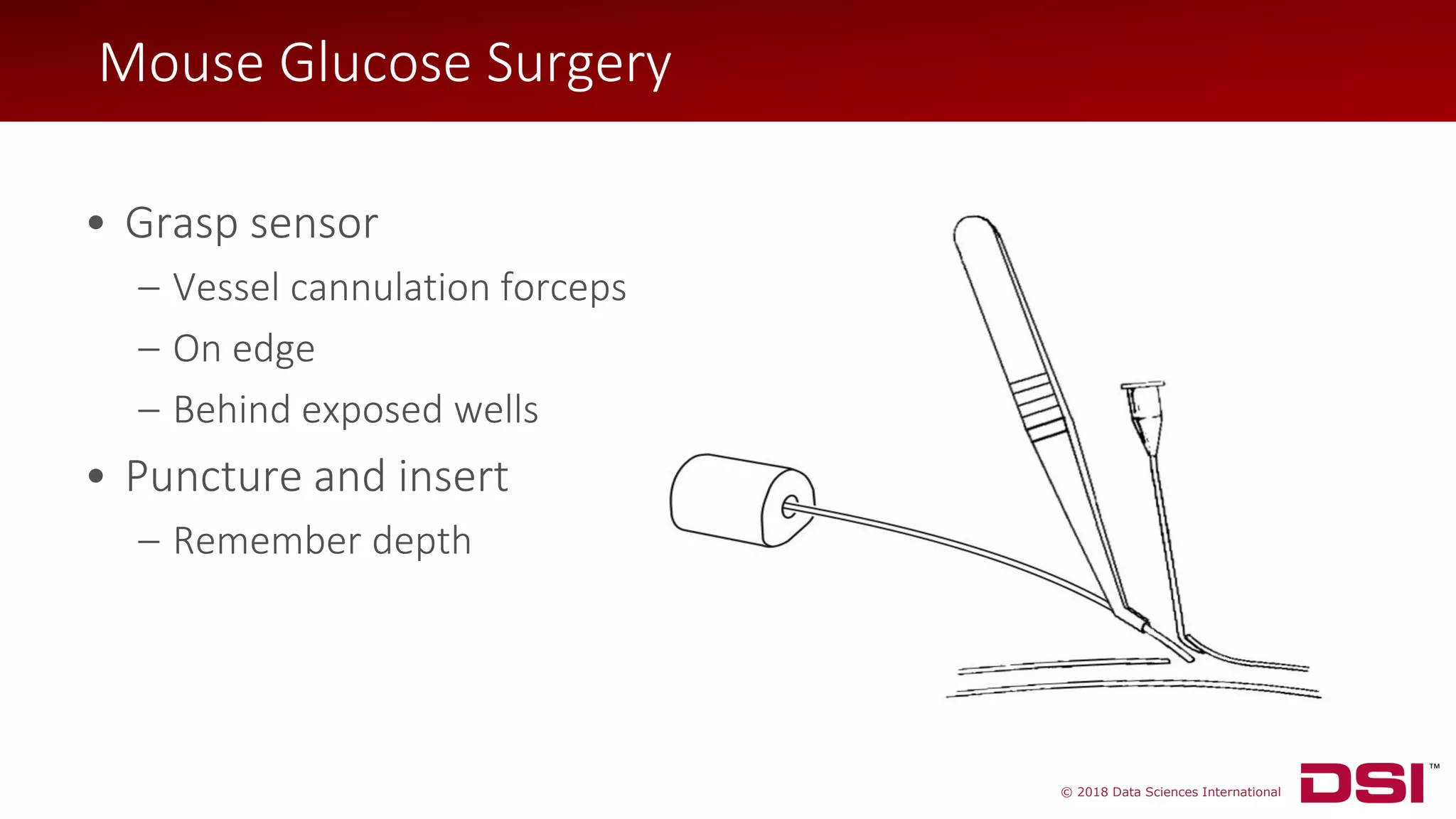
• Grasp sensor
– Vessel cannulation forceps
– On edge
– Behind exposed wells
• Puncture and insert
– Remember depth
Mouse Glucose Surgery
© 2018 Data Sciences International
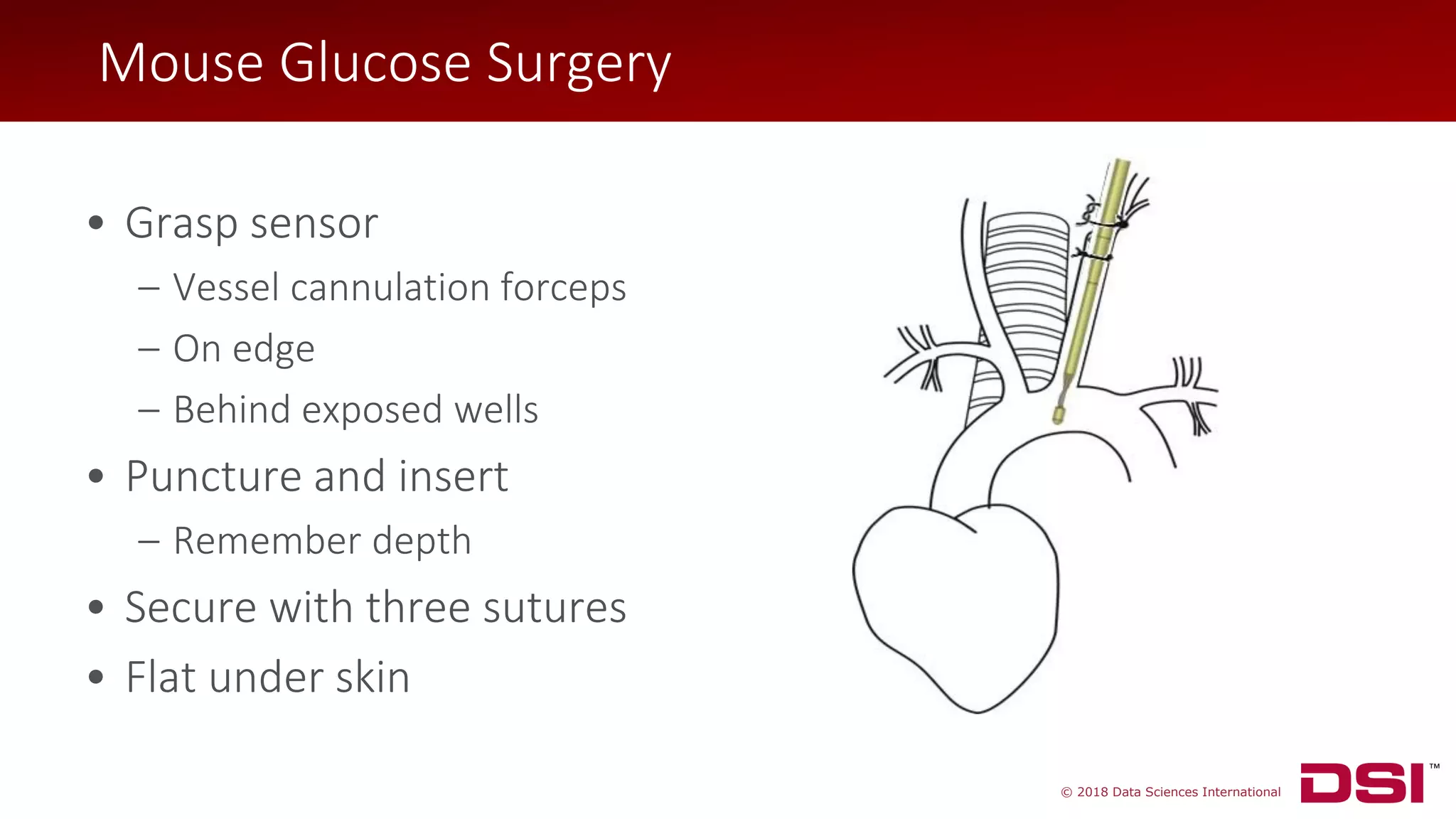
• Grasp sensor
– Vessel cannulation forceps
– On edge
– Behind exposed wells
• Puncture and insert
– Remember depth
• Secure with three sutures
• Flat under skin
Mouse Glucose Surgery
© 2018 Data Sciences International
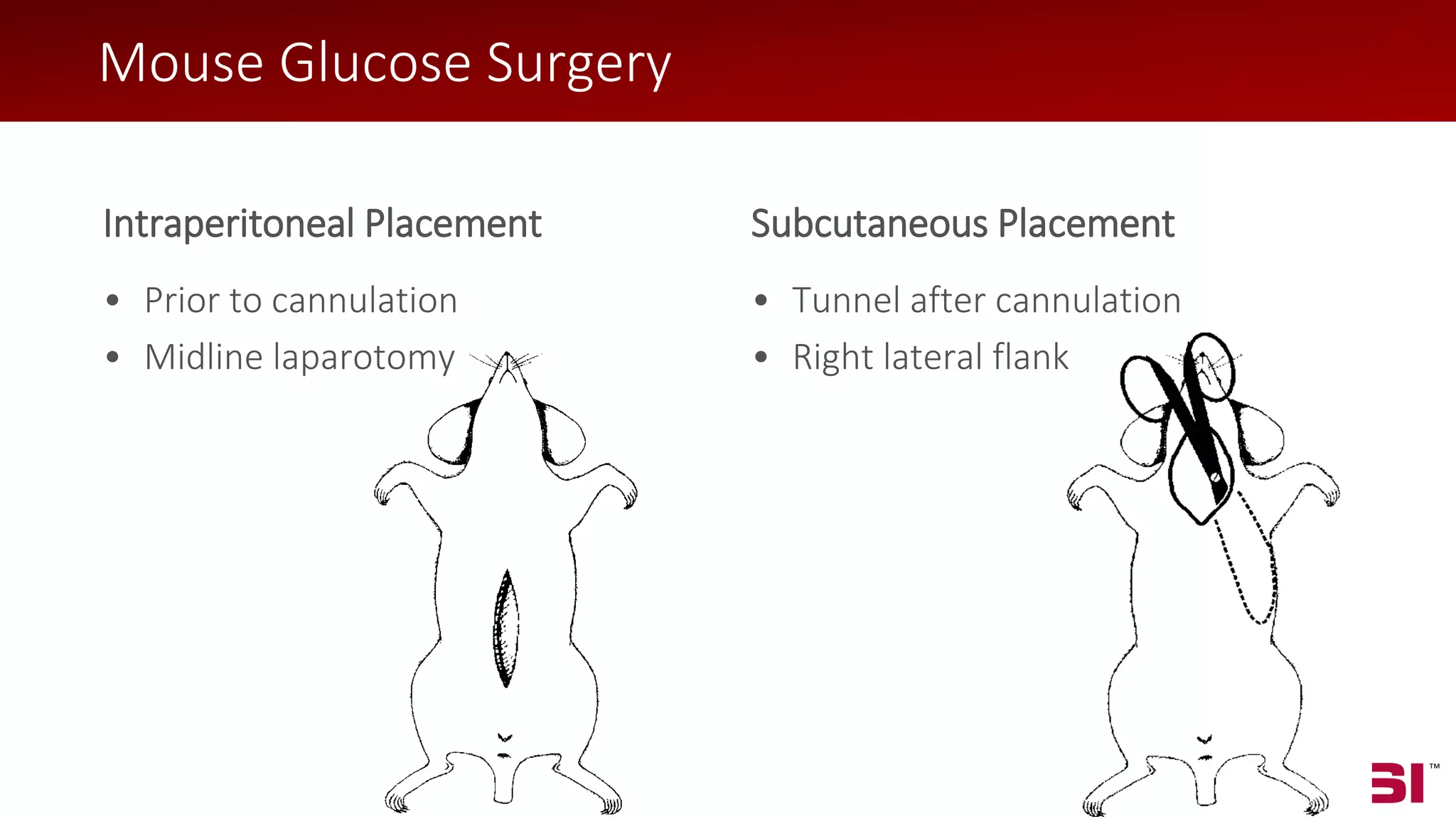
Intraperitoneal Placement
• Prior to cannulation
• Midline laparotomy
Subcutaneous Placement
• Tunnel after cannulation
• Right lateral flank
Mouse Glucose Surgery
© 2018 Data Sciences International
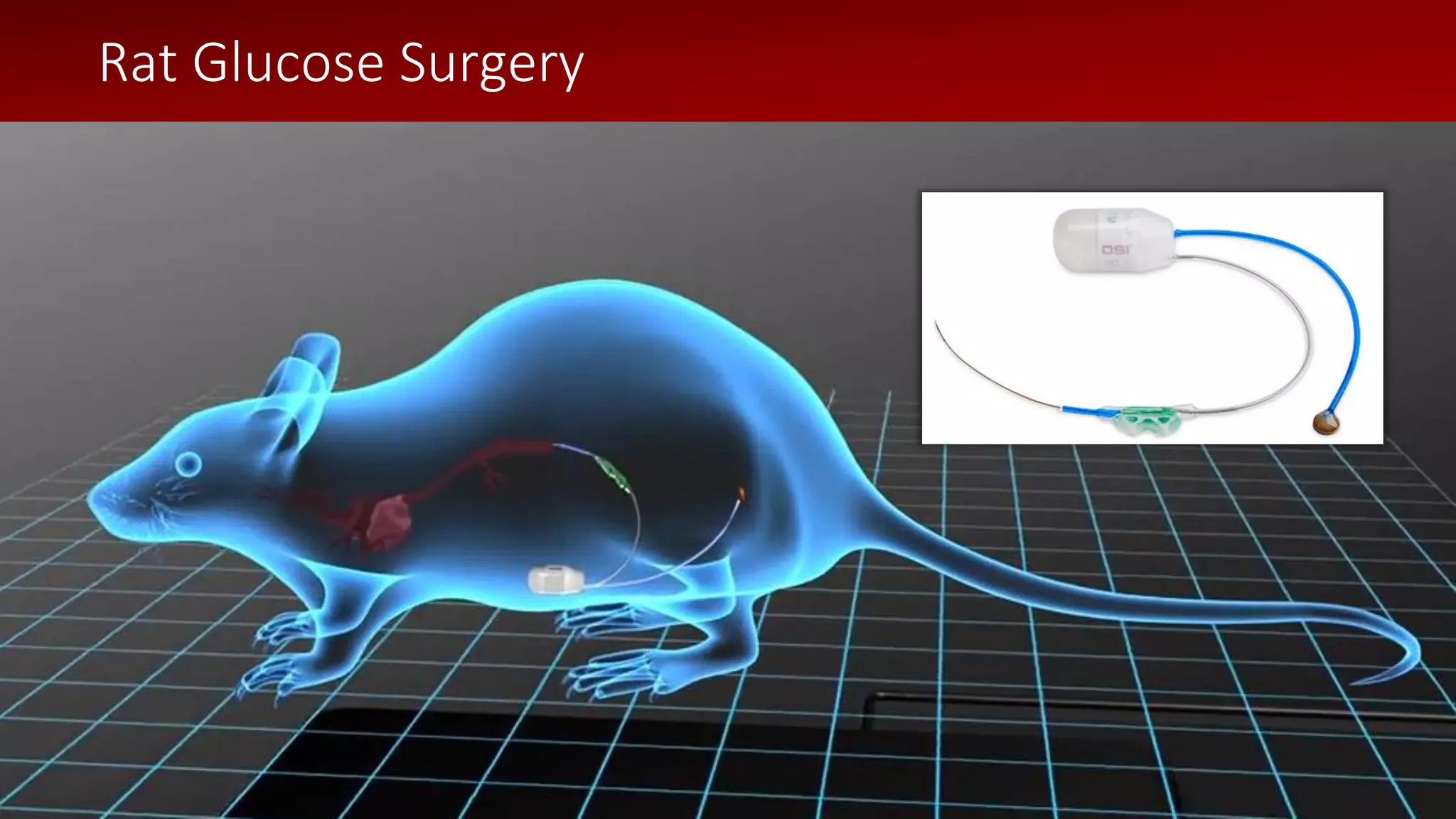
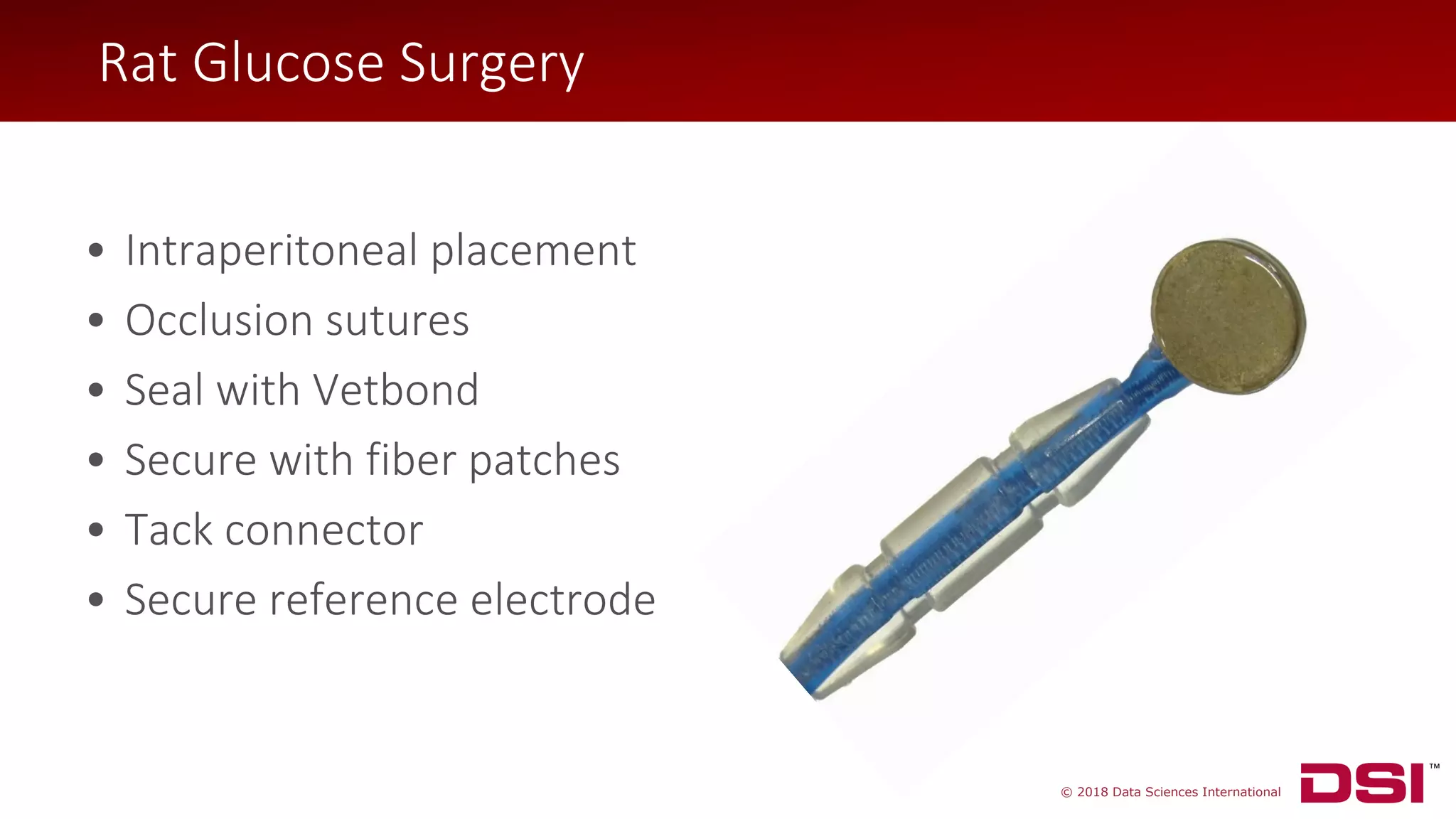
Rat Glucose Surgery
© 2018 Data Sciences International
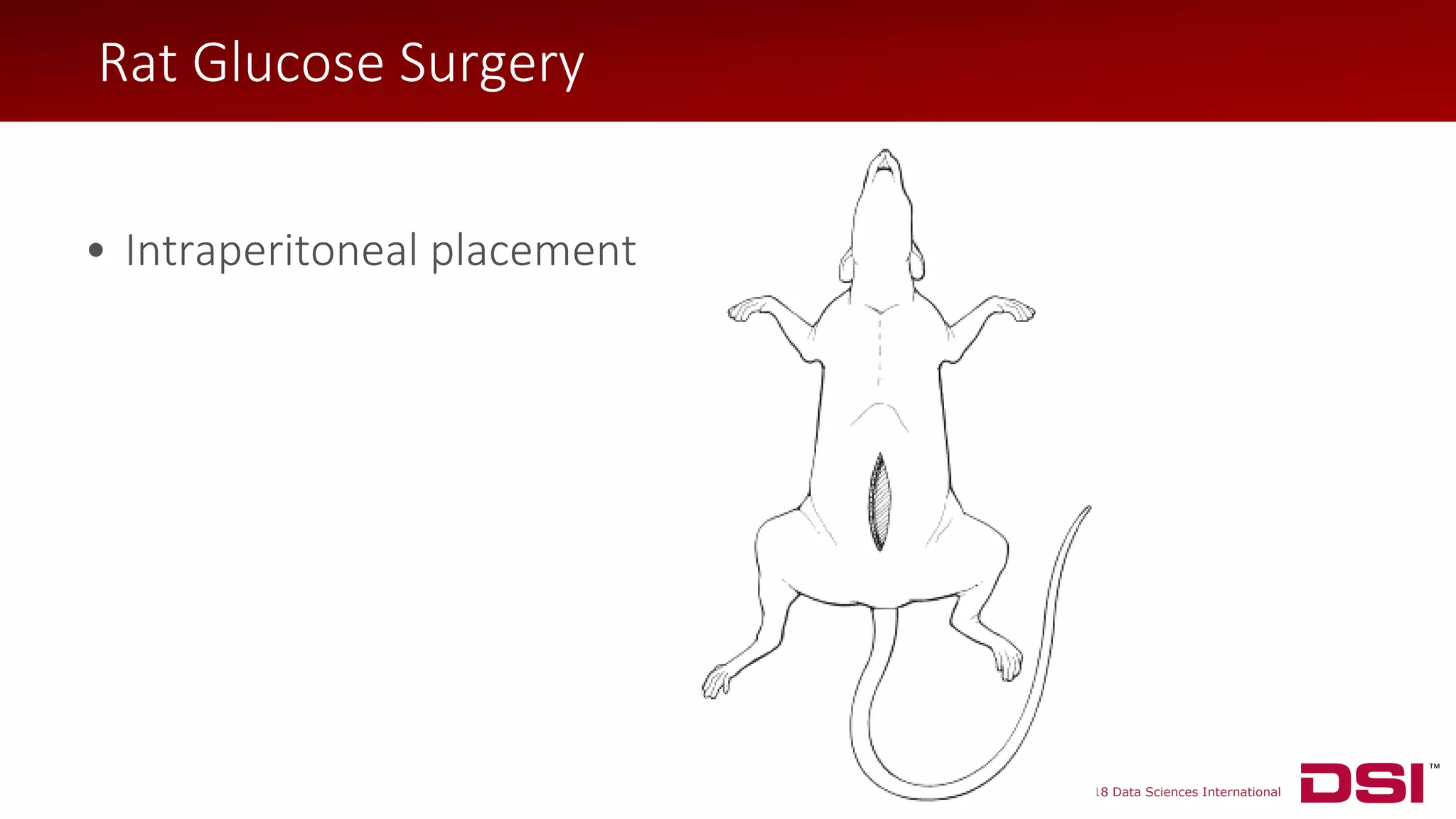
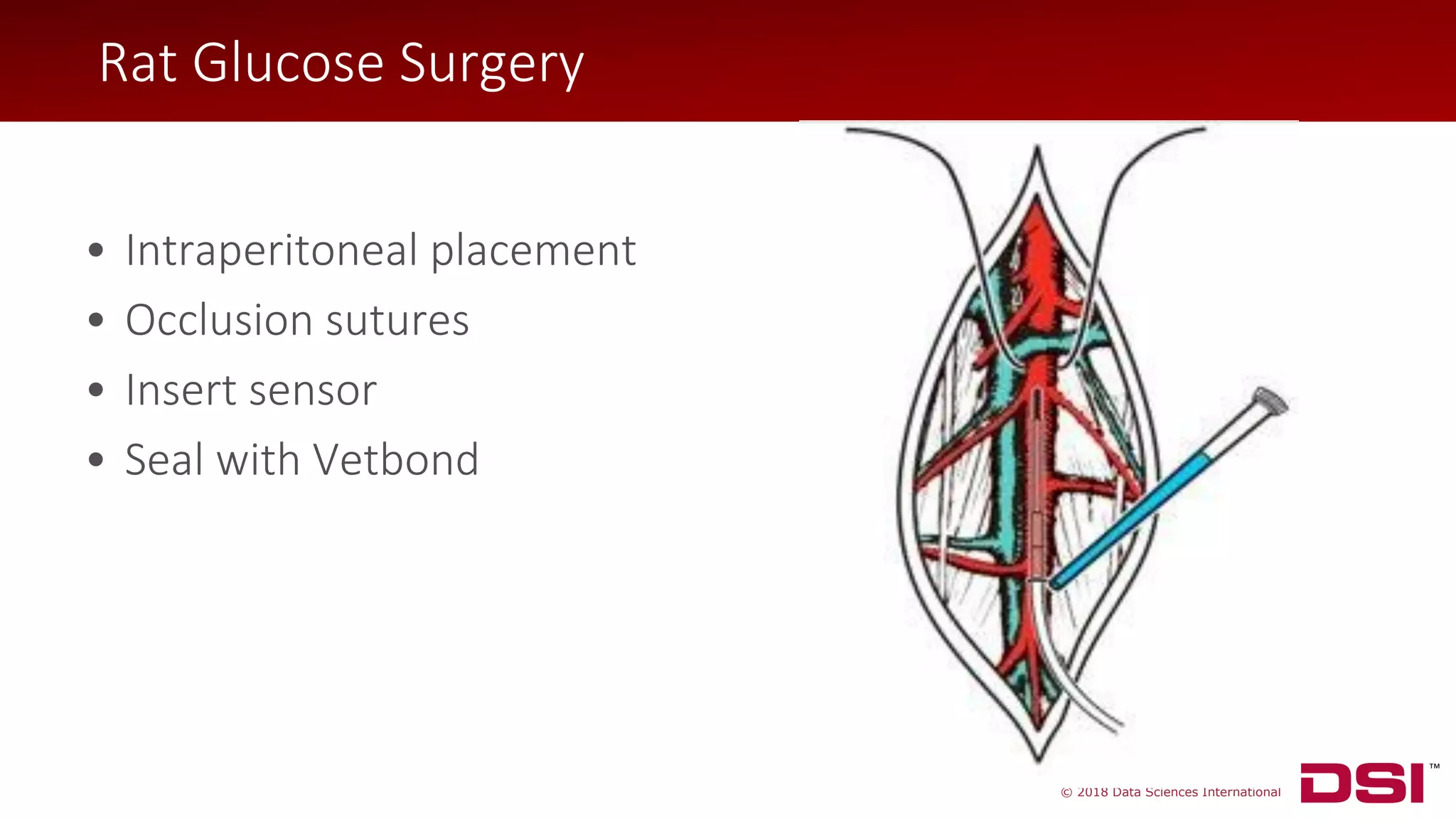
Rat Glucose Surgery
• Intraperitoneal placement
Rat Glucose Surgery
© 2018 Data Sciences International
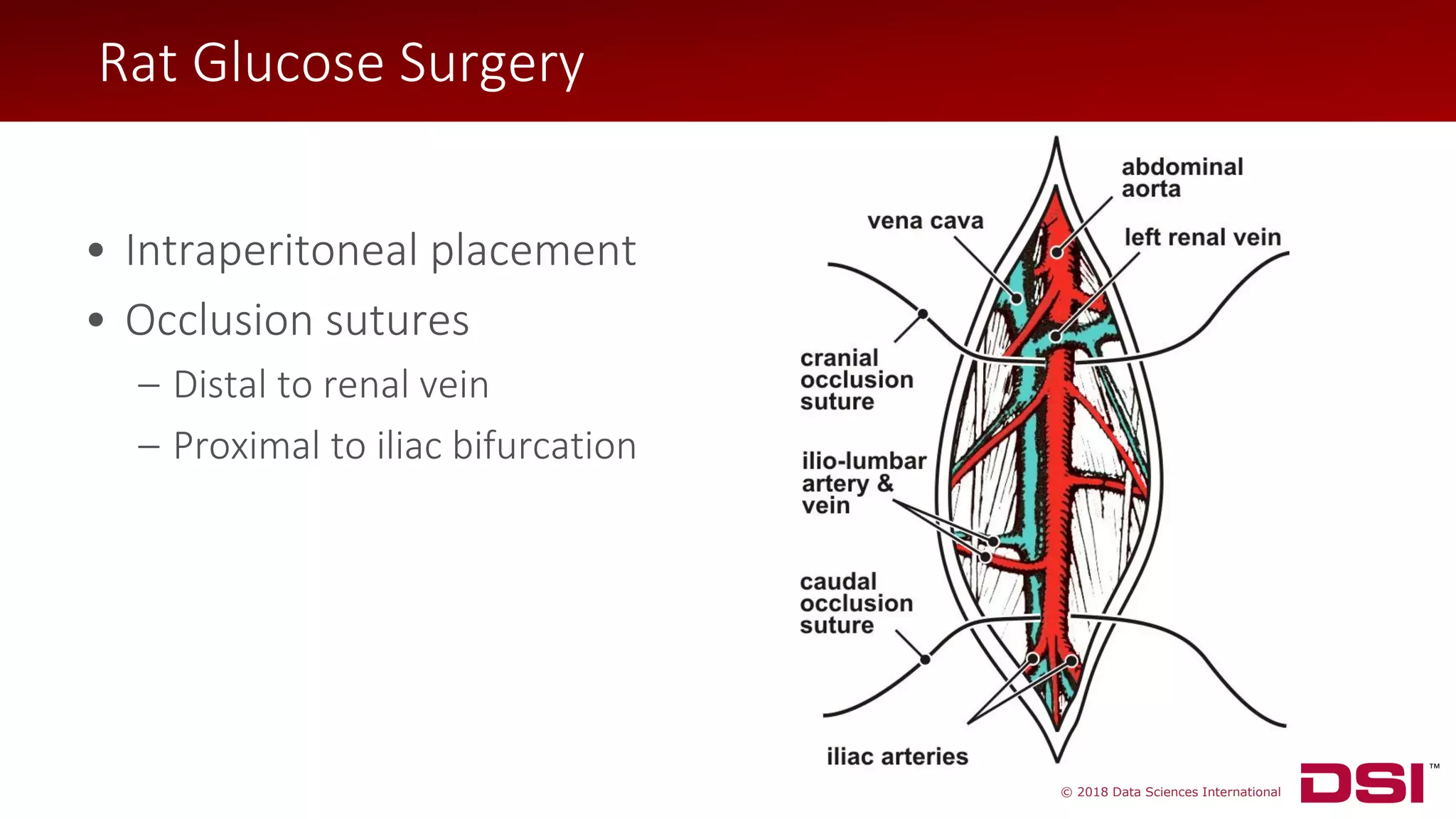
Rat Glucose Surgery
• Intraperitoneal placement
• Occlusion sutures
– Distal to renal vein
– Proximal to iliac bifurcation
Rat Glucose Surgery
© 2018 Data Sciences International
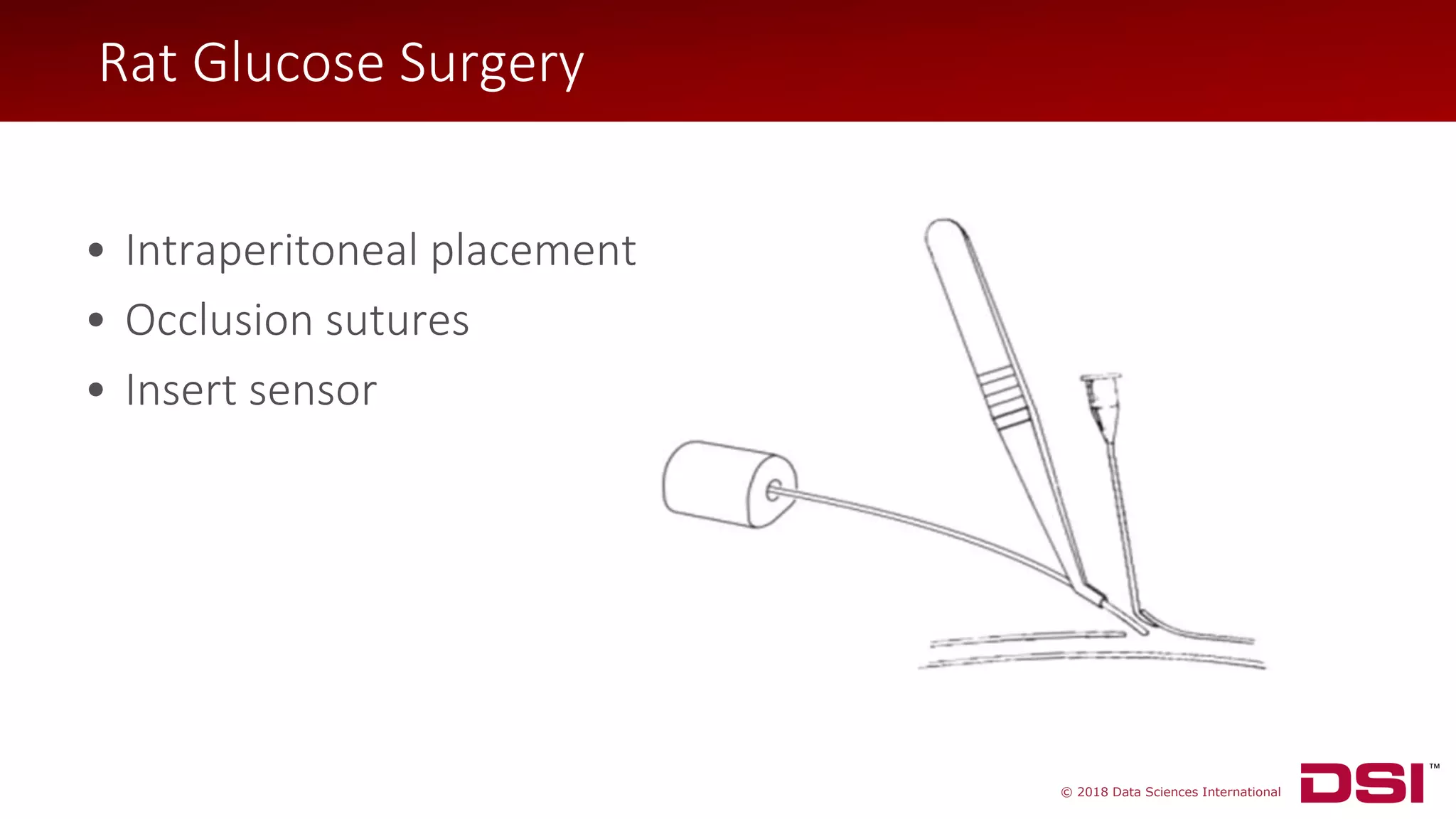
Rat Glucose Surgery
• Intraperitoneal placement
• Occlusion sutures
• Insert sensor
Rat Glucose Surgery
© 2018 Data Sciences International
Rat Glucose Surgery
• Intraperitoneal placement
• Occlusion sutures
• Insert sensor
• Seal with Vetbond
Rat Glucose Surgery
© 2018 Data Sciences International
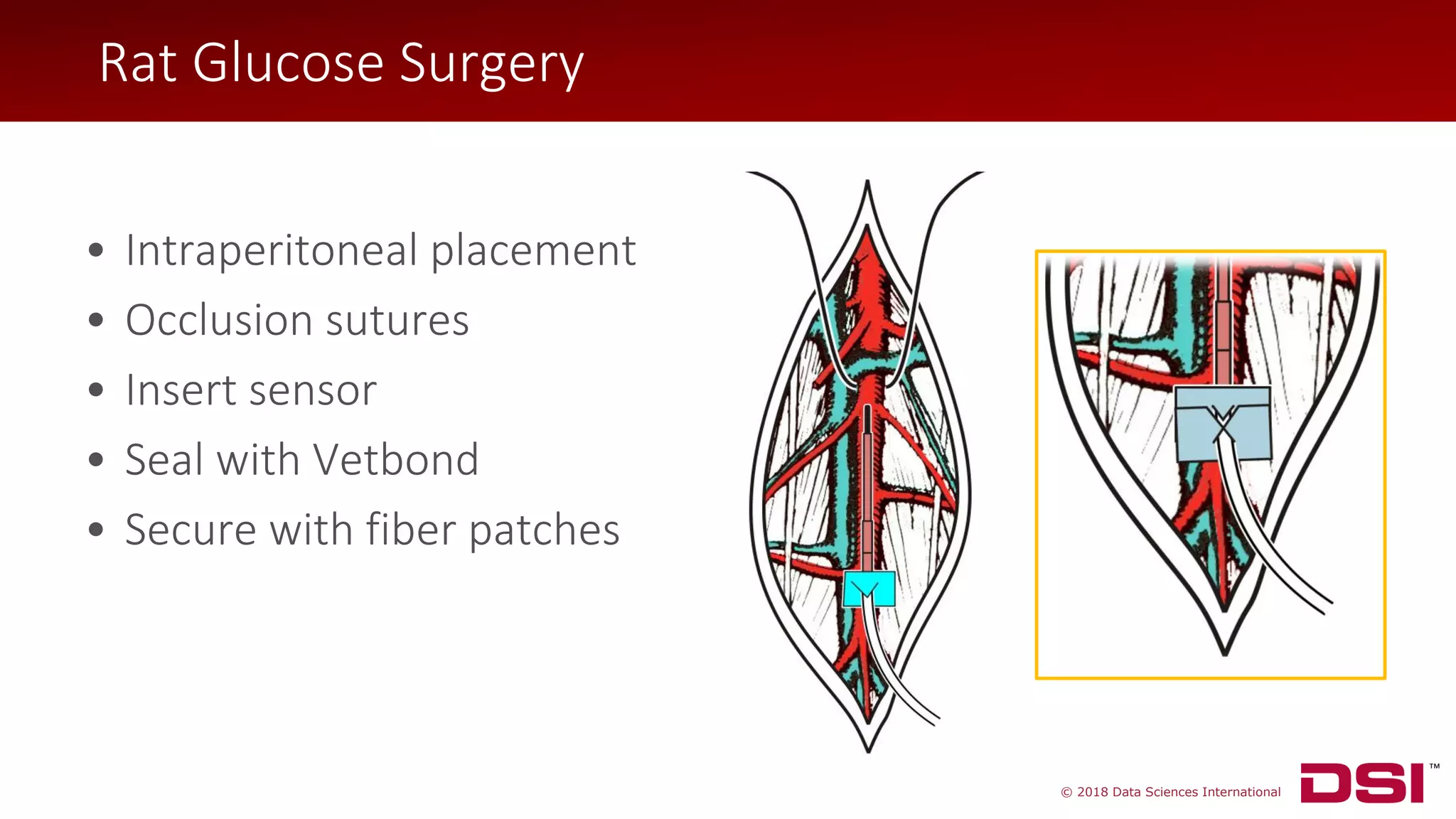
Rat Glucose Surgery
• Intraperitoneal placement
• Occlusion sutures
• Insert sensor
• Seal with Vetbond
• Secure with fiber patches
Rat Glucose Surgery
© 2018 Data Sciences International
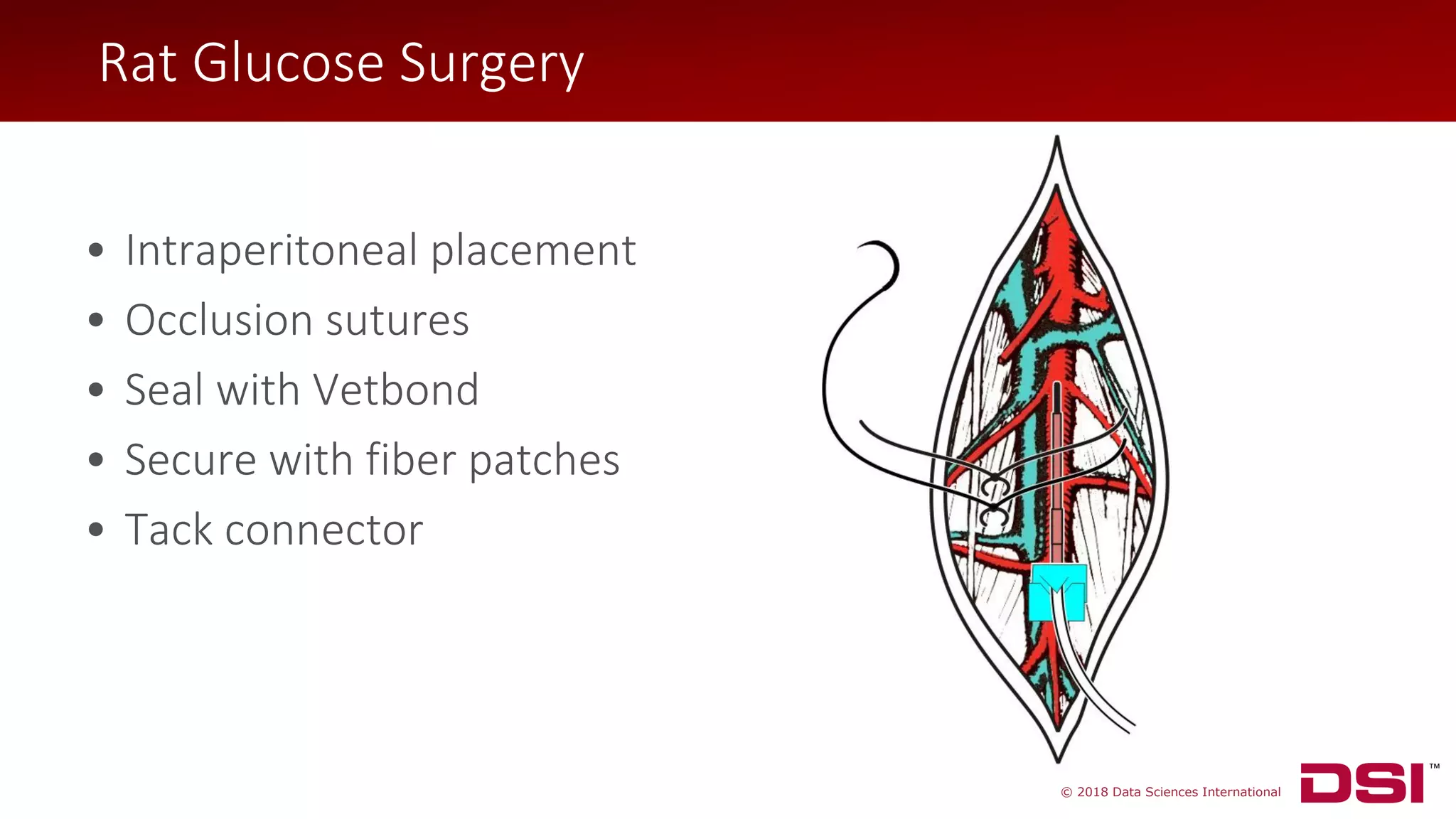
Rat Glucose Surgery
• Intraperitoneal placement
• Occlusion sutures
• Seal with Vetbond
• Secure with fiber patches
• Tack connector
Rat Glucose Surgery
© 2018 Data Sciences International
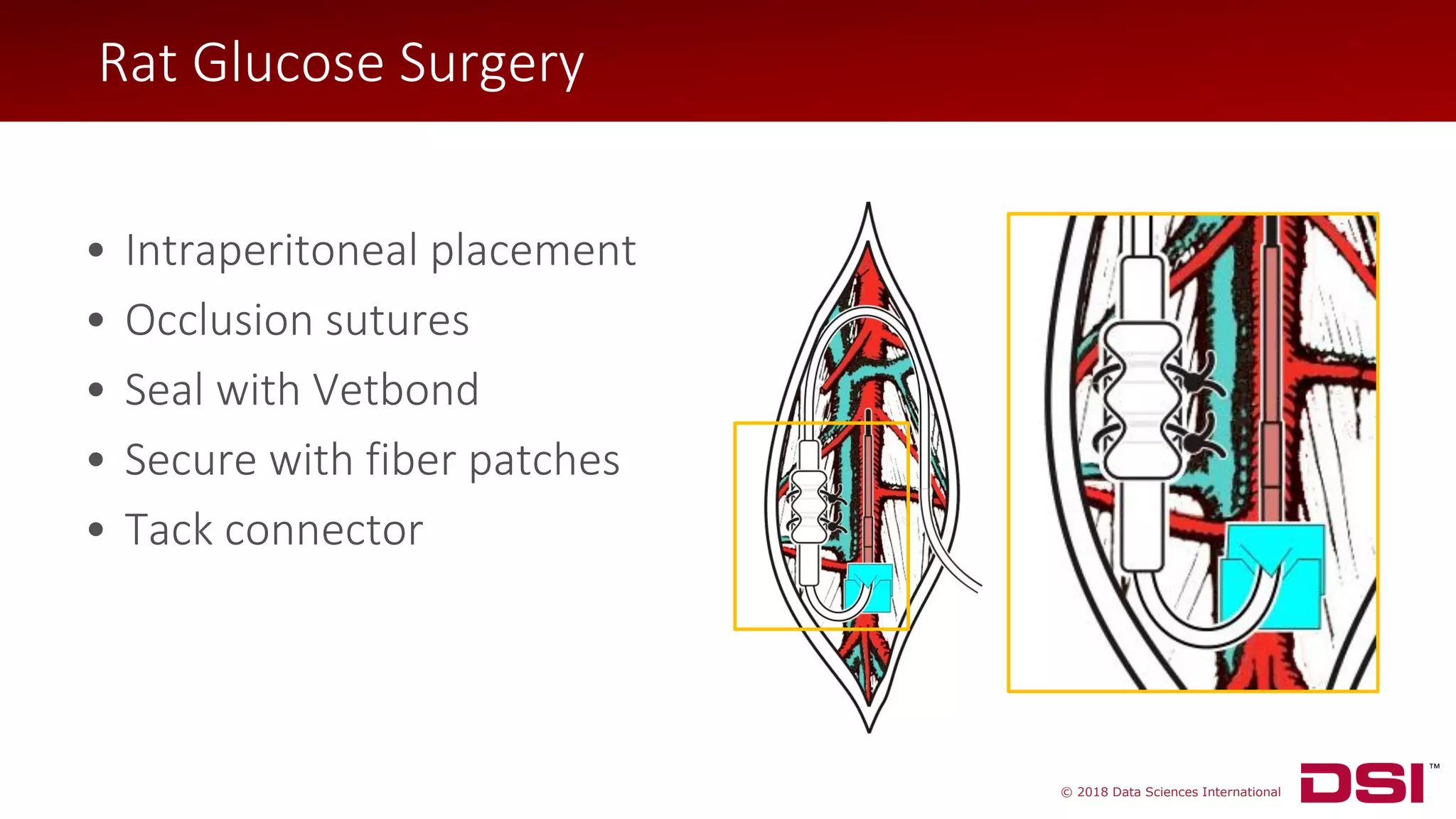
Rat Glucose Surgery
• Intraperitoneal placement
• Occlusion sutures
• Seal with Vetbond
• Secure with fiber patches
• Tack connector
Rat Glucose Surgery
© 2018 Data Sciences International
Rat Glucose Surgery
• Intraperitoneal placement
• Occlusion sutures
• Seal with Vetbond
• Secure with fiber patches
• Tack connector
• Secure reference electrode
Rat Glucose Surgery
© 2018 Data Sciences International
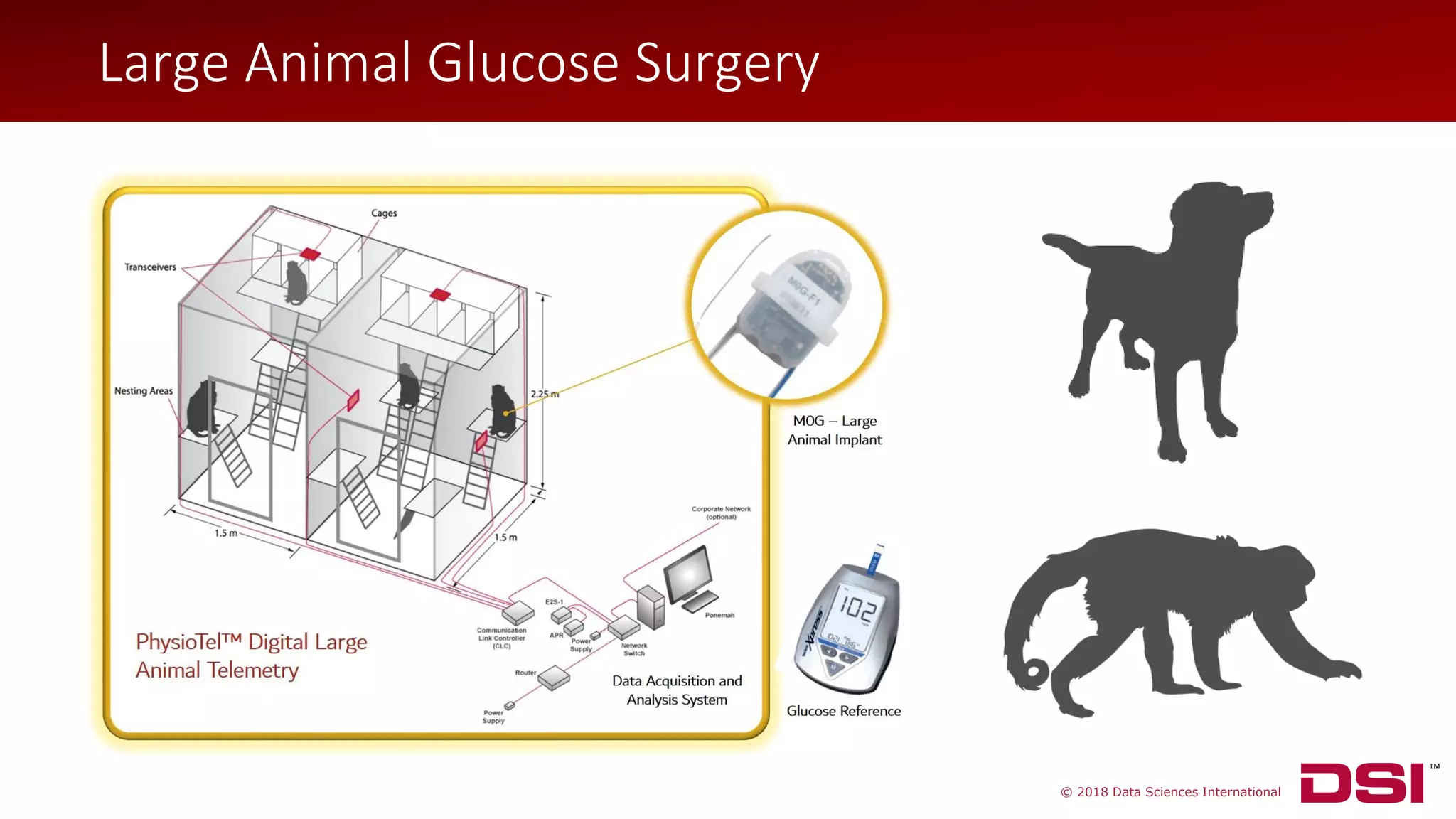
Large Animal Glucose Surgery
© 2018 Data Sciences International
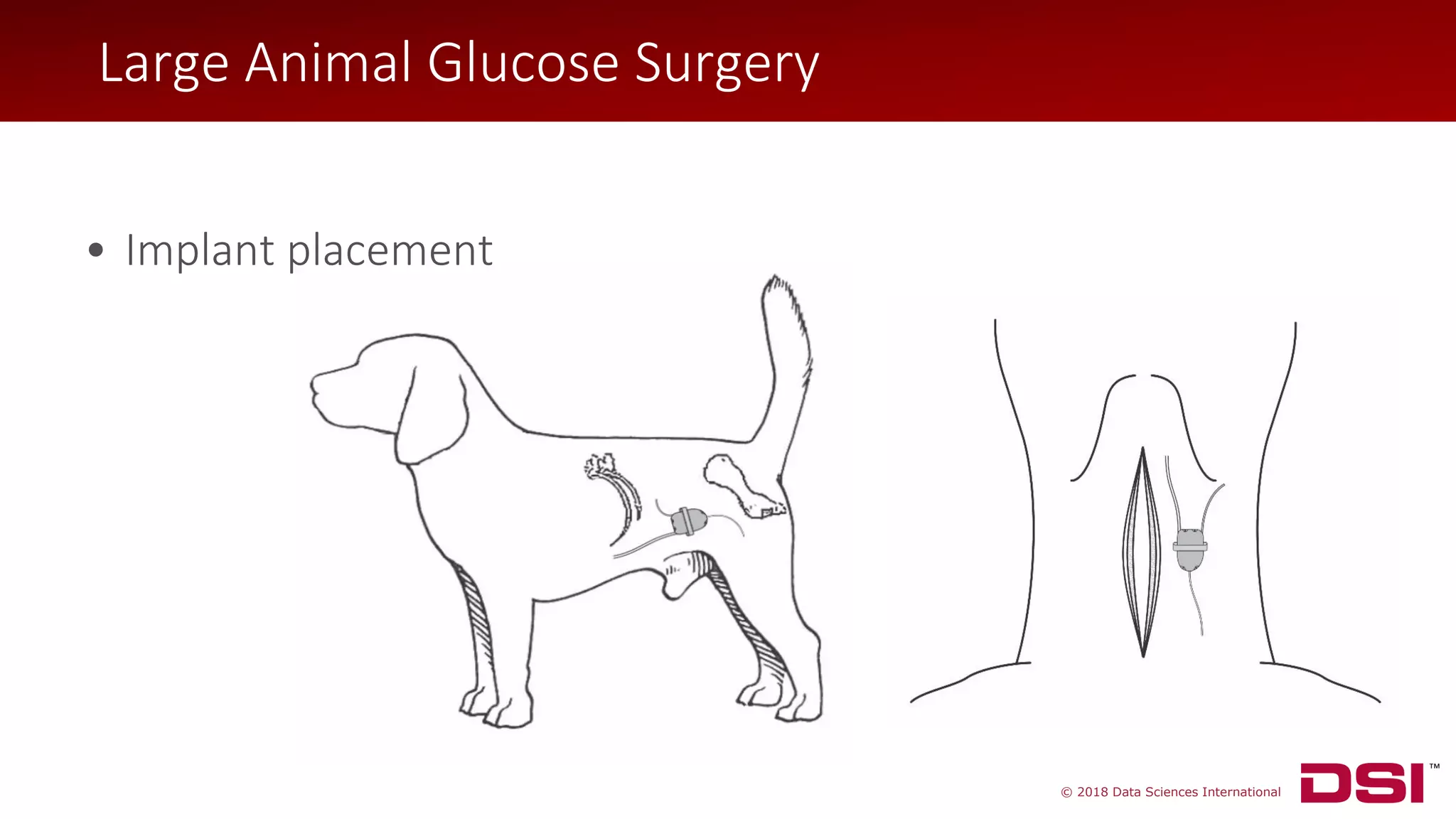
• Implant placement
Large Animal Glucose Surgery
© 2018 Data Sciences International
• Implant placement
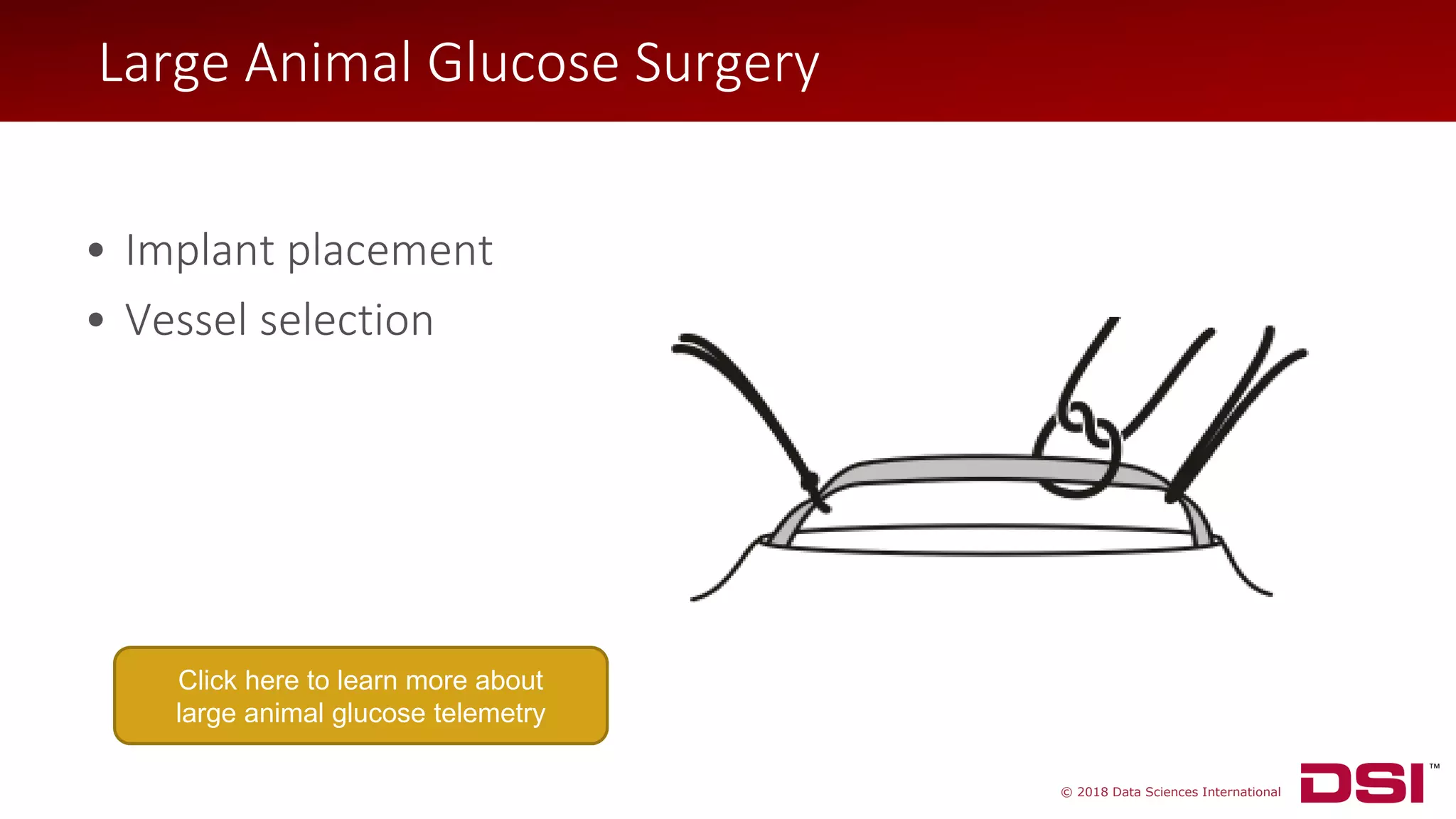
• Vessel selection
Large Animal Glucose Surgery
Click here to learn more about
large animal glucose telemetry
© 2018 Data Sciences International
• Implant placement
• Vessel selection
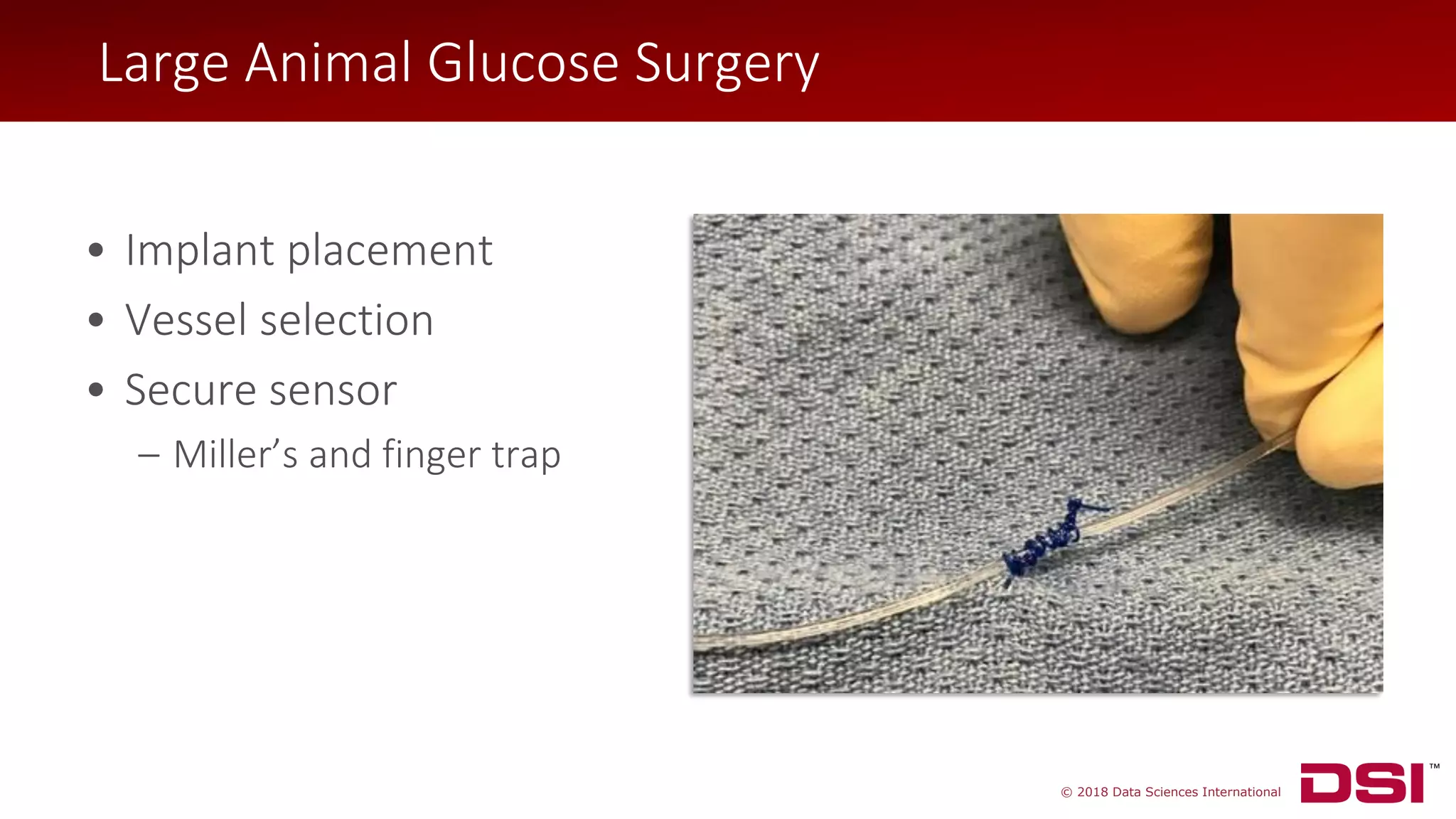
• Secure sensor
– Miller’s and finger trap
Large Animal Glucose Surgery
© 2018 Data Sciences International
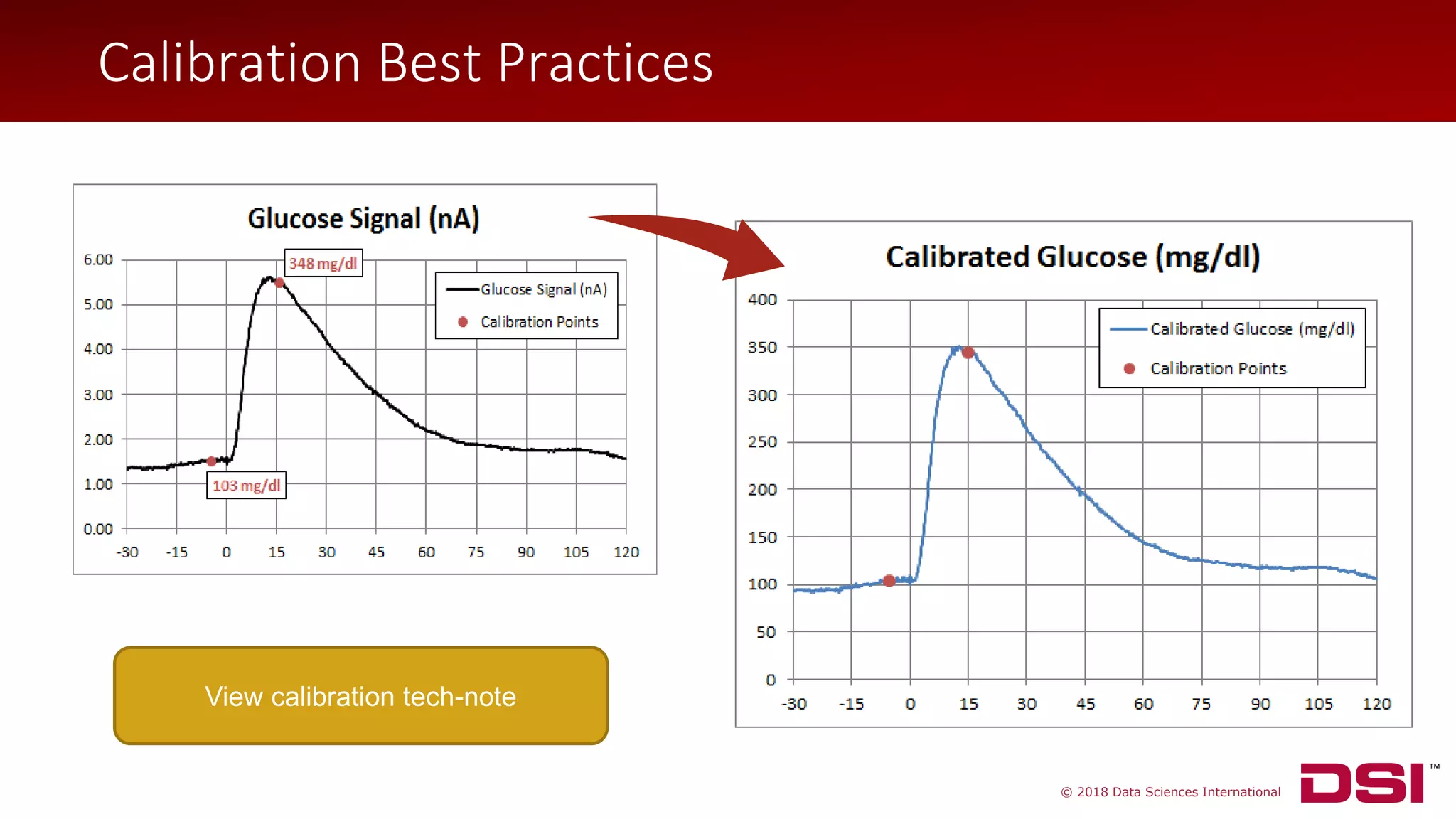
Calibration Best Practices
View calibration tech-note
© 2018 Data Sciences International
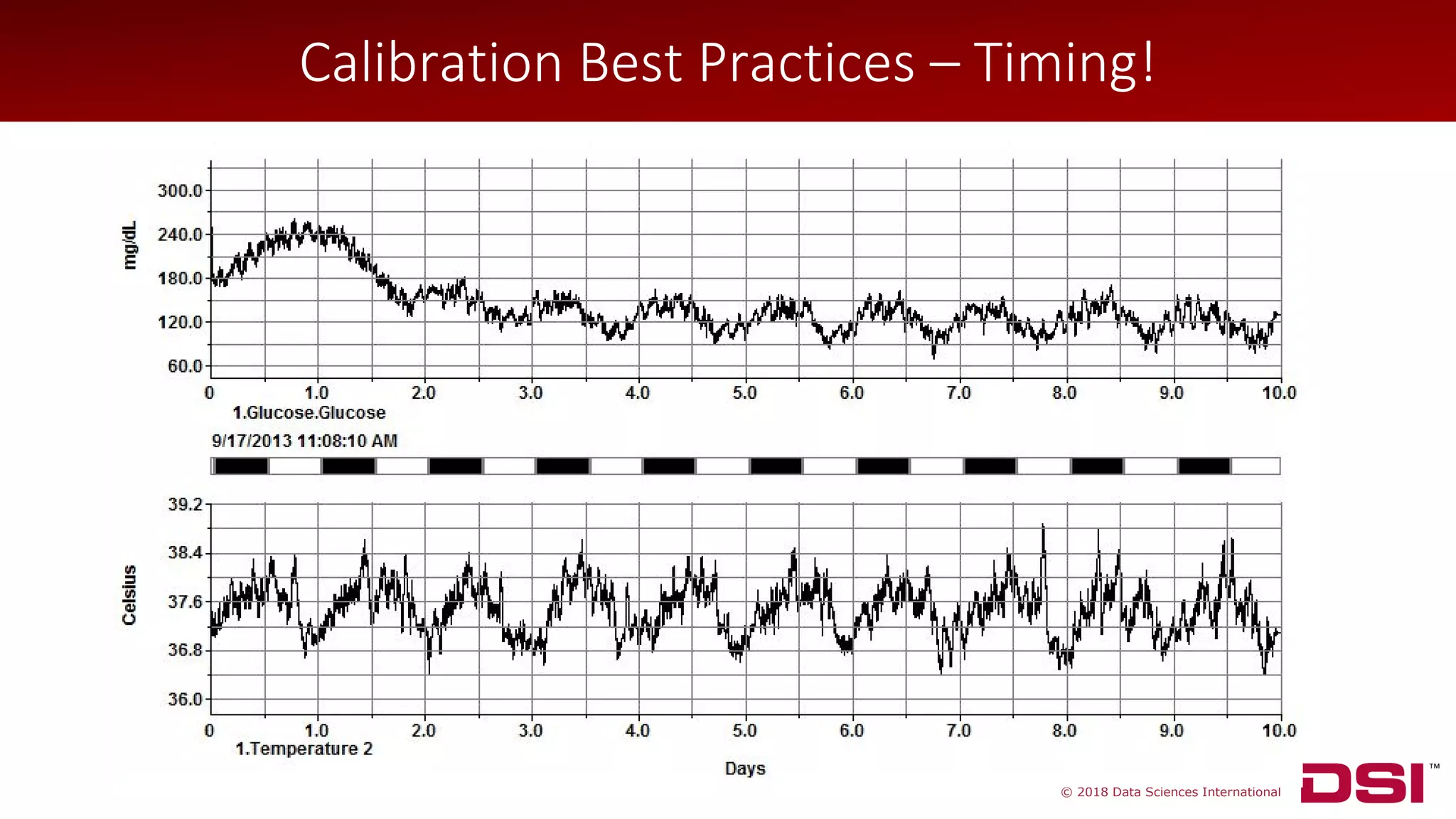
Calibration Best Practices – Timing!
© 2018 Data Sciences International
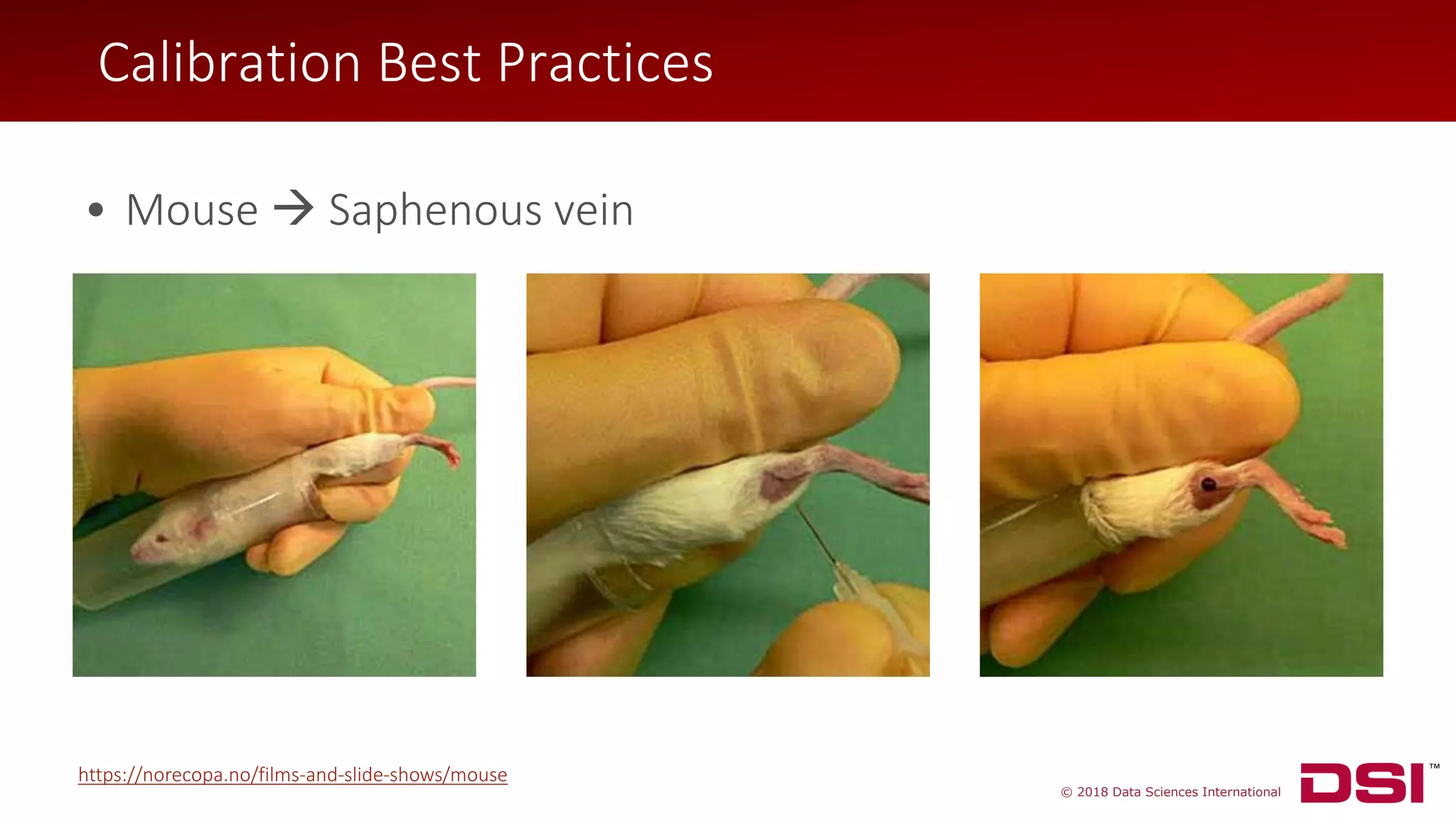
• Mouse → Saphenous vein
https://norecopa.no/films-and-slide-shows/mouse
Calibration Best Practices
© 2018 Data Sciences International
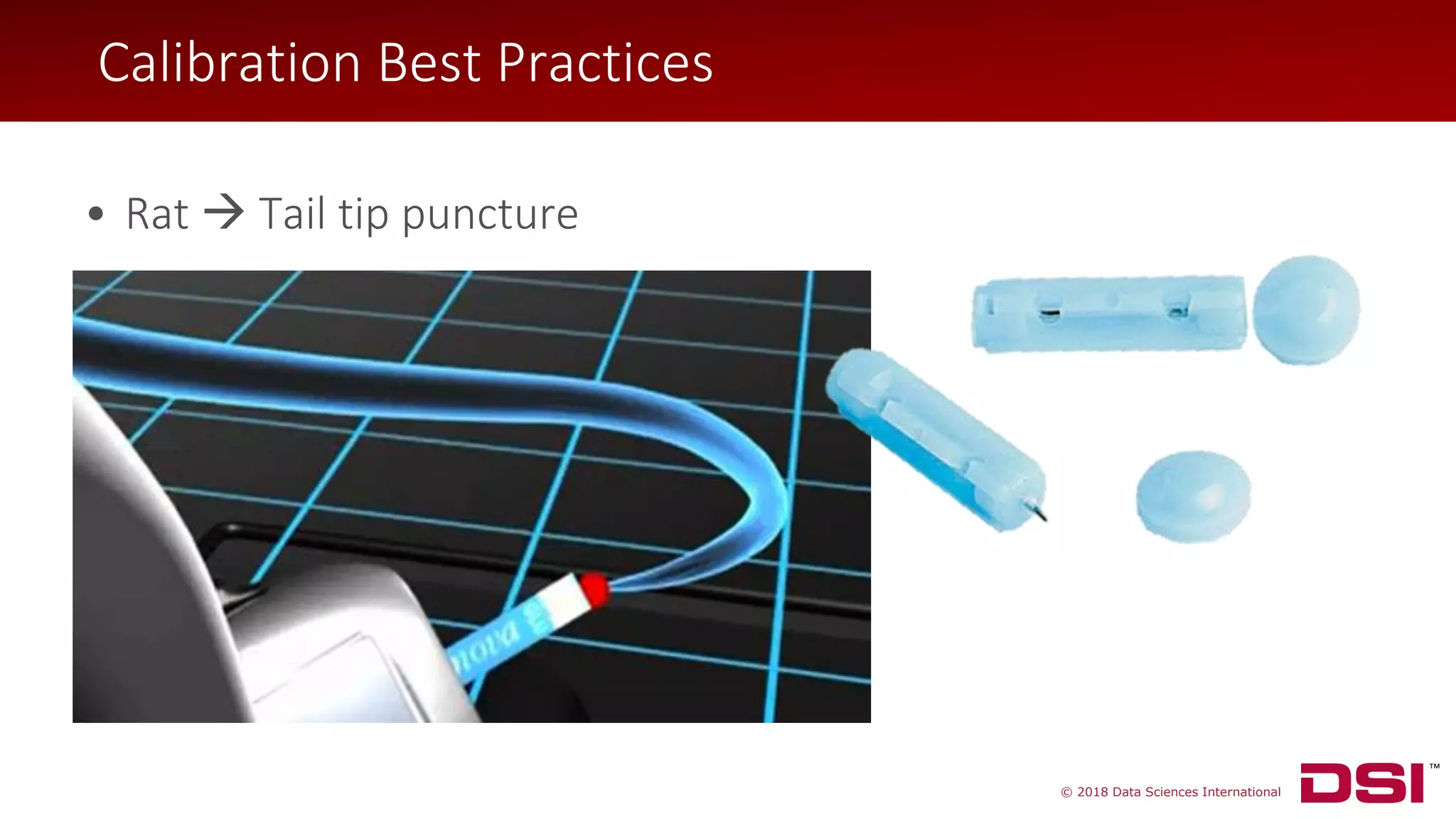
• Rat → Tail tip puncture
Calibration Best Practices
© 2018 Data Sciences International
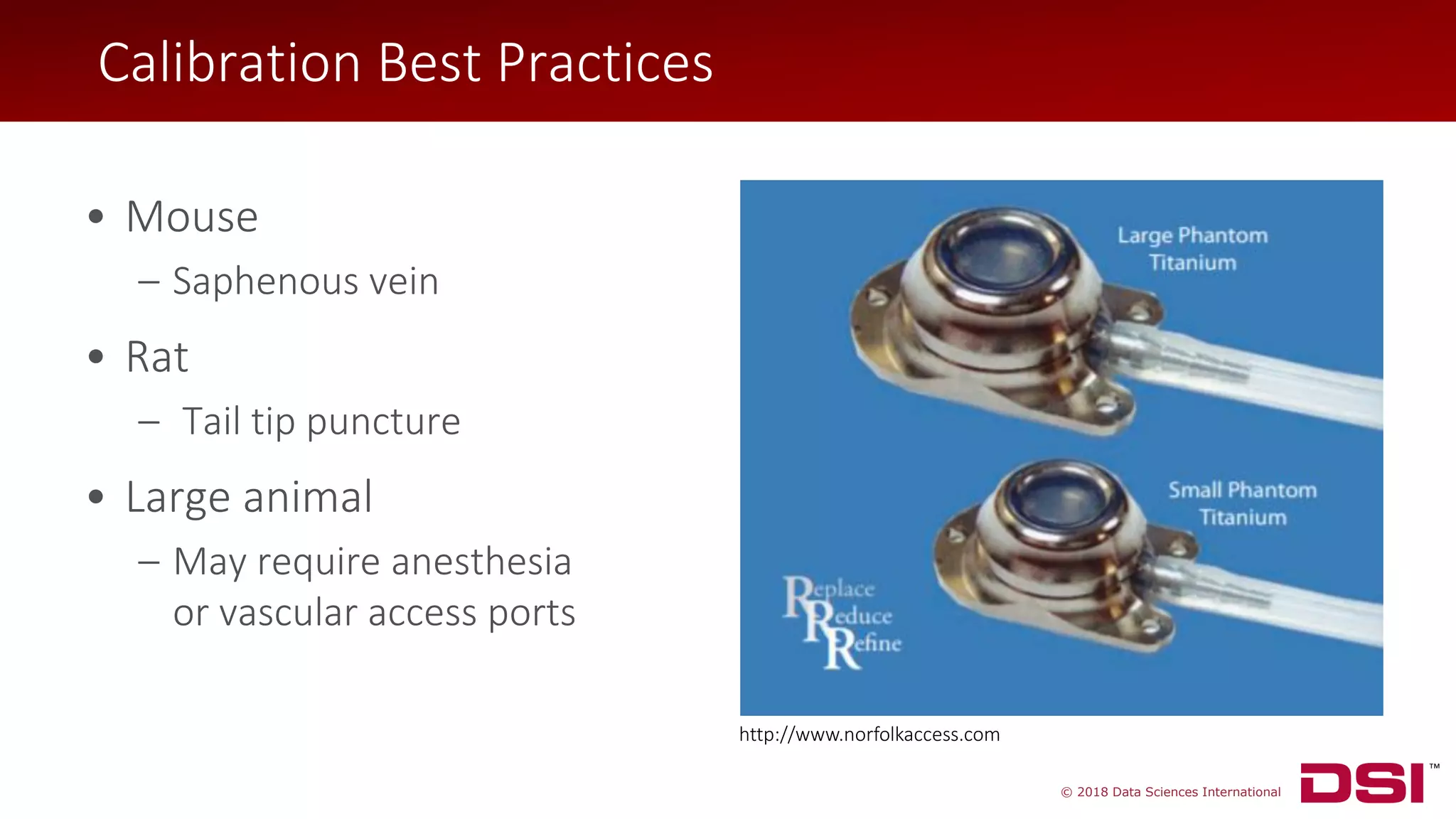
• Mouse
– Saphenous vein
• Rat
– Tail tip puncture
• Large animal
– May require anesthesia
or vascular access ports
http://www.norfolkaccess.com
Calibration Best Practices
© 2018 Data Sciences International
Combining Additional Endpoints
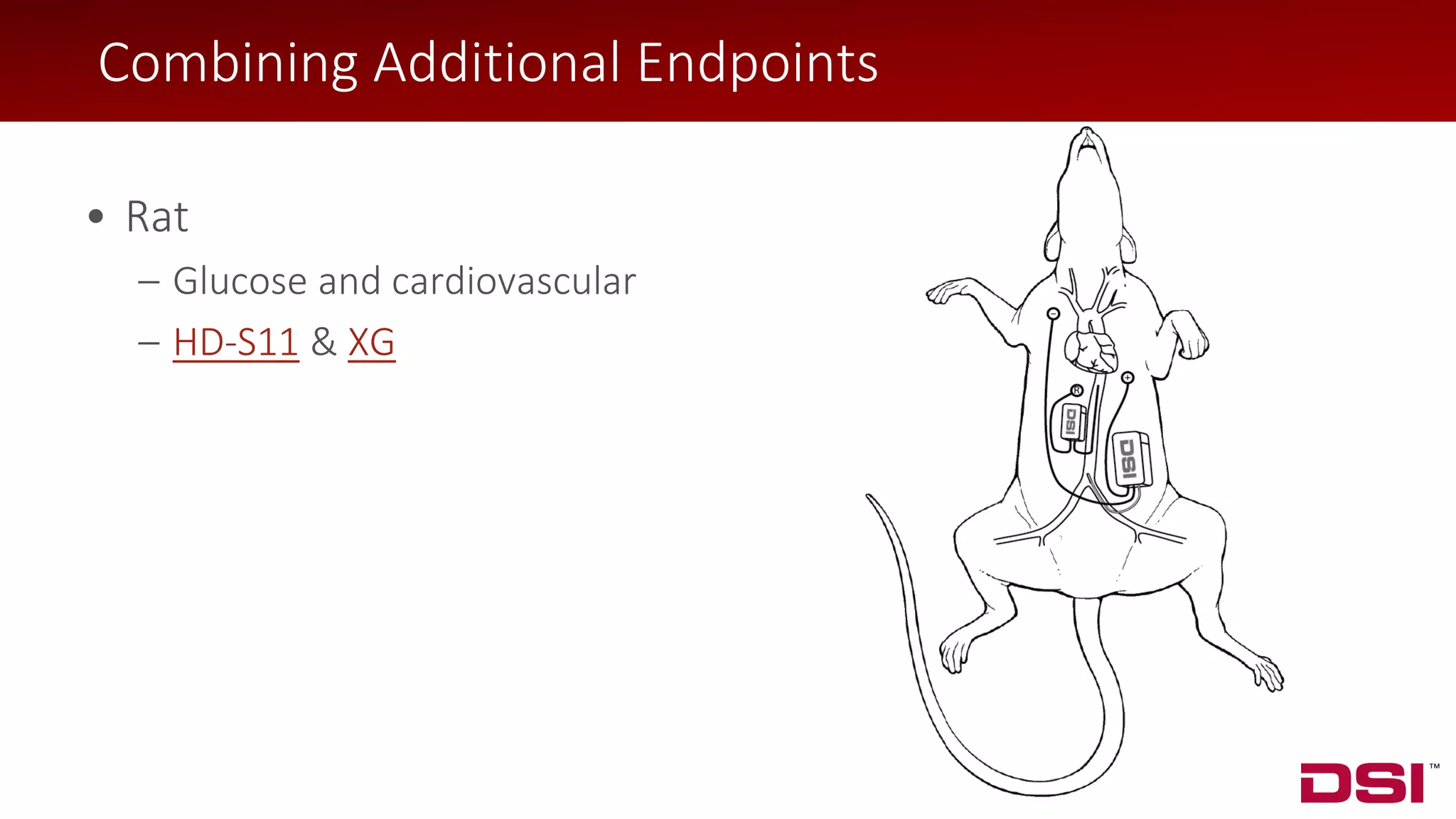
• Rat
– Glucose and cardiovascular
– HD-S11 & XG
© 2018 Data Sciences International
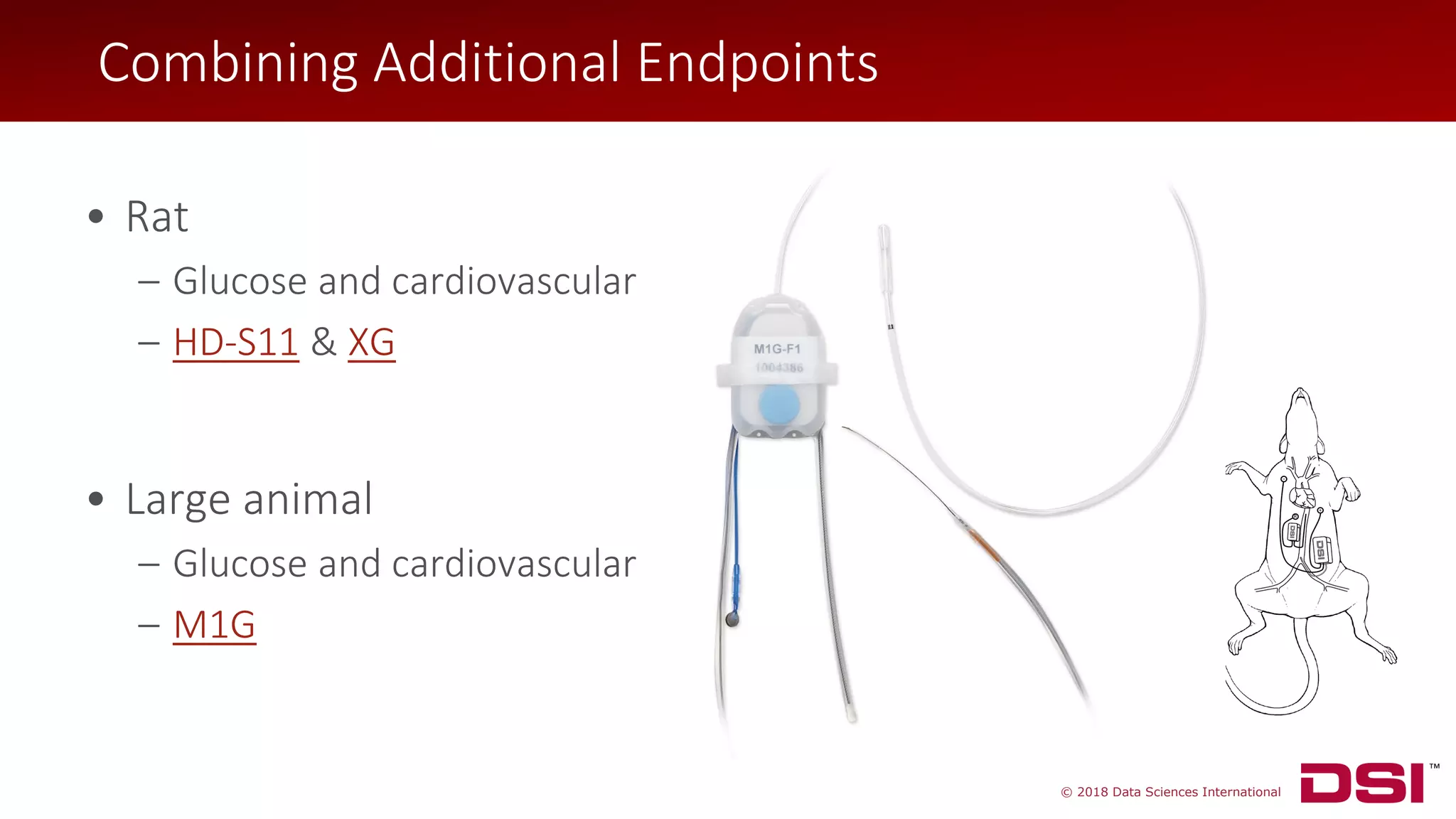
• Large animal
– Glucose and cardiovascular
– M1G
Combining Additional Endpoints
• Rat
– Glucose and cardiovascular
– HD-S11 & XG
Dr. Stephanie Simonds
NHMRC/NHF Research fellow
Monash University,
Melbourne, Australia
Megan Fine, DVM
MS, DACVS-LA
Veterinary Surgeon,
Attending Veterinarian
Data Sciences International
#LifeScienceWebinar #ISCxDSI
Thank You
For additional information on the products and applications
presented during this webinar please visit www.datasci.com

From Mouse to Monkey: Revolutionizing Research via Preclinical Continuous Glucose Telemetry

  • 1.
    From Mouse toMonkey: Revolutionizing Research via Preclinical Continuous Glucose Telemetry Scientists present wireless glucose monitoring methodology, best practices, research findings, and discuss the power of continuous glucose profiles, particularly when combined with other gold standard assays to study obesity, diabetes and cardiovascular related diseases.
  • 2.
    From Mouse toMonkey: Revolutionizing Research via Preclinical Continuous Glucose Telemetry Dr. Stephanie Simonds NHMRC/NHF Research fellow Monash University, Melbourne, Australia Megan Fine, DVM MS, DACVS-LA Veterinary Surgeon, Attending Veterinarian Data Sciences International
  • 3.
    InsideScientific is anonline educational environment designed for life science researchers. Our goal is to aid in the sharing and distribution of scientific information regarding innovative technologies, protocols, research tools and laboratory services
  • 4.
    To access webinarcontent, Q&A reports, FAQ documents, and information on lab workshops, subscribe to our mail list
  • 5.
    Copyright 2018 S.Simonds and InsideScientific. All Rights Reserved. Experimental applications of DSI continuous blood glucose monitoring in mice. Dr. Stephanie Simonds NHMRC/NHF Research fellow Monash University, Melbourne, Australia
  • 6.
    We have usedDSI equipment for >9 years We use this equipment for the study of chronic diseases including diabetes and cardiovascular diseases HD-X11 HD-XG PA-C10
  • 7.
  • 8.
  • 9.
  • 10.
    Lean DIO 0 10 20 30 40 50 60 70 Bodyweight(grams) *** Continuous TelemetricBlood Glucose 7:00:009:00:0011:00:0013:00:0015:00:0017:00:0019:00:0021:00:0023:00:001:00:003:00:005:00:00 2 4 6 8 10 Time (Hrs:Min:Sec) Bloodglucose(mmol/l) DIO fed Lean fed Light Phase Dark Phase 7:00:009:00:0011:00:0013:00:0015:00:0017:00:0019:00:0021:00:0023:00:001:00:003:00:005:00:00 2 Time (Hrs:Min:Sec) Blo DIO fed Lean fed
  • 11.
    0:00:004:00:008:00:00 12:00:00 16:00:00 20:00:000:00:004:00:008:00:00 12:00:00 16:00:00 20:00:000:00:004:00:008:00:00 12:00:00 16:00:00 20:00:000:00:004:00:008:00:00 32 34 36 38 Temp(Degrees) temp when changedto HFD Switch to HFD 0:00:004:00:008:00:00 12:00:00 16:00:00 20:00:000:00:004:00:008:00:00 12:00:00 16:00:00 20:00:000:00:004:00:008:00:00 12:00:00 16:00:00 20:00:000:00:004:00:008:00:00 0 50 100 150 Activity (Arbitraryunit) activity when changed to HFD 0:00:004:00:008:00:00 12:00:00 16:00:00 20:00:000:00:004:00:008:00:00 12:00:00 16:00:00 20:00:000:00:004:00:008:00:00 12:00:00 16:00:00 20:00:000:00:004:00:008:00:00 0 2 4 6 8 10 12 14 Blood glucose(mmol/l) BG when changed to HFD 00:00:008:00:00 12:00:00 16:00:00 20:00:000:00:004:00:008:00:00 12:00:00 16:00:00 20:00:000:00:004:00:008:00:00 12:00:00 16:00:00 20:00:000:00:004:00:008:00:00 Switch to HFD Initial Physiological Changes When Mice are Switched to a HFD
  • 12.
    Using Continuous GlucoseMonitoring to Assess Drug Therapy Efficacy
  • 13.
    0:00:00 0:30:00 1:00:00 1:30:00 2:00:00 2:30:00 3:00:00 3:30:00 4:00:00 4:30:00 5:00:00 5:30:00 6:00:00 6:30:00 7:00:00 0 10 20 30 40 Time (Hrs:Min: Sec) Blood glucose(mmol/l) Drugtreatment Glucose Bolus Veh -60 0 30 0 5 10 15 20 25 Time (Mins) Blood glucose(mmol/l) Manual gluose Veh Synthetic compound ‘B’ Synthetic compound ‘A’ Native Peptide ‘A’ Combination Drug ‘A’ + ‘B’ -60 0 30 0 5 10 15 20 25 Time (Mins) Blood glucose(mmol/l) Manual gluose Veh Synthetic compound ‘B’ Synthetic compound ‘C’ Synthetic compound ‘A’ Native Peptide ‘A’ Synthetic compound ‘D’ Combination Drug ‘A’ + ‘B’ Manual vs. Continuous Monitoring 0 30 Time (Mins) anual gluose Veh Synthetic compound ‘B’ Synthetic compound ‘C’ Synthetic compound ‘A’ Native Peptide ‘A’ Synthetic compound ‘D’ Combination Drug ‘A’ + ‘B’ Manual Continuous 0:00:00 0:30:00 1:00:00 1:30:00 2:00:00 2:30:00 3:00:00 3:30:00 4:00:00 4:30:00 5:00:00 5:30:00 6:00:00 6:30:00 7 0 Time (Hrs:Min: Sec) Synthetic compound ‘C’ Synthetic compound ‘A’ Native Peptide ‘A’ Synthetic compound ‘D’ Synthetic compound ‘E’ Combination Drug ‘A’ + ‘B’ Synthetic compound ‘B’ Veh 0:00:00 0:30:00 1:00:00 1:30:00 2:00:00 2:30:00 3:00:00 3:30:00 4:00 Time (Hrs:Min: Synthetic compound ‘C’ Synthetic compound ‘A’ Native Peptide ‘A’ Synthetic compound ‘D’ Synthetic compound ‘E’ Combination Drug ‘A’ + ‘B’ Synthetic compound ‘B’ Veh Veh Compound ‘F’ Compound ‘A’ Compound ‘B’ Compound ‘A’ + ‘B’ Compound ‘C’ Compound ‘D’ Veh Compound ‘F’ Compound ‘A’ Compound ‘B’ Compound ‘A’ + ‘B’ Compound ‘C’ Compound ‘D’ Compound ‘E’
  • 14.
    Using Continuous GlucoseMonitoring to Determine Hormone Physiological Actions
  • 15.
    https://www.ncbi.nlm.nih.gov/pubmed/8603777 More than 20years ago… Zymogenetics Corporation is a wholly owned subsidiary of Novo Nordisk A/S, a manufacturer of therapeutics for the treatment of diabetes. BBB, blood-brain barrier; CRH, corticotropin-releasing hormone; MES, 2-[Nmorpholino]ethanesulfonic acid; NPY, neuropeptide Y; PVN, paraventricular nucleus. DIABETES, VOL. 45, APRIL 1996 (A) Serum glucose in ob/ob and db/db mice after 5 daily intraperitoneal injections of 150 µg of recombinant murine leptin or saline genotype: ob/ob db/db treatment: Specificity of Leptin Action on Elevated Blood Glucose Levels and Hypothalamic Neuropeptide Y Gene Expression in ob/ob Mice Michael W. Schwartz, Denis G. Baskin, Thomas R. Bukowski, Joseph L. Kuijper, Donald Foster, Gerry Lasser, Donna E. Prunkard, Daniel Porte, Jr., Stephen C. Woods, Randy J. Seeley, and David S. Weigle
  • 16.
  • 17.
    Using Continuous GlucoseMonitoring in Combination with Chemogenetics
  • 18.
    • X-Cre mice •Injected into the DMH with chemogenic activator virus • Mice allowed to recover • DSI equipment utilized in monitoring of blood glucose, core body temperature and activity Study Overview
  • 19.
    0:10:000:30:000:50:001:10:001:30:001:50:002:10:002:30:002:50:003:10:003:30:00 0 2 4 6 8 10 Time (Hrs:Min: Sec) Blood glucose(mmol/l) DMHlepR activation DMH lepR no activation * ** ** **** ** **** Either activation or no activation 0:10:000:30:000:50:001:10:001:30:001:50:002:10:002:30:002:50:003:10:003:30:00 30 32 34 36 38 Time (Hrs:Min: Sec) Coretemp(Degrees) DMH lepR activation DMH lepR no activation * *** ** Either activation or no activation 0:10:000:30:000:50:001:10:001:30:001:50:002:10:002:30:002:50:003:10:003:30:00 0 5 10 15 Time (Hrs:Min: Sec) Activity (Arbitraryunit) DMH lepR activation DMH lepR no activation * Either activation or no activation DMH receptor activation DMH veh non- activation DMH receptor activation DMH veh non- activation DMH receptor activation DMH veh non- activation Activation vs. Non Activation of X Receptor Expressing Neurons Within The Dorsomedial Hypothalamic Nucleus
  • 20.
    • X-Cre mice •Injected into the DMH with chemogenic activator virus • Mice allowed to recover • DSI equipment utilized in monitoring of blood glucose, core body temperature and activity in response to chemogenic neuron activation of receptors and in response to blood glucose bolus Study Overview
  • 21.
    00:10:000:20:000:30:000:40:000:50:001:00:001:10:001:20:001:30:001:40:001:50:002:00:002:10:002:20:002:30:002:40:002:50:003:00:003:10:003:20:00 0 5 10 15 Activity (Arbitraryunit) DMH lepR activation+ glucose *** *** *** ** DMH lepR no activation + glucose *** Activation or no activation All mice Glucose bolus 00:10:000:20:000:30:000:40:000:50:001:00:001:10:001:20:001:30:001:40:001:50:002:00:002:10:002:20:002:30:002:40:002:50:003:00:003:10:003:20:00 0 10 20 30 Blood glucose(mmol/l) DMH lepR activation + glucose *** *** ** * ** ** ** ** ** ** ** DMH lepR no activation + glucose Activation or no activation All mice Glucose bolus 00:10:000:20:000:30:000:40:000:50:001:00:001:10:001:20:001:30:001:40:001:50:002:00:002:10:002:20:002:30:002:40:002:50:003:00:003:10:003:20:00 30 32 34 36 38 Time (Hrs:Min: Sec) Coretemp(Degrees) DMH lepR activation + glucose DMH lepR no activation + glucose Activation or no activation All mice Glucose bolus DMH receptor activation + glucose DMH veh non- activation + glucose DMH receptor activation + glucose DMH veh non- activation + glucose DMH receptor activation + glucose DMH veh non- activation + glucose Physiological Effects of Glucose Bolus and Activation vs. Non Activation of X-cre Expressing Neurons Within The Dorsomedial Hypothalamic Nucleus
  • 22.
    Using Continuous GlucoseMonitoring in Combination With Central AAV Cre Neuronal Knockdown Modulating central physiology & measuring peripheral outputs
  • 23.
    baseline 15 30 45 60 90 1200 10 20 30 40 Blood glucose(mmol/l) Time (Mins) Baseline Week 1 Week3 ** **** X lox/lox mice 0:00:000:15:000:30:000:45:001:00:001:15:001:30:001:45:002:00:002:15:002:30:002:45:00 0 10 20 30 40 Time (Hrs:Min: Sec) Blood glucose(mmol/l) DMH AAV Cre in LepR flox mice day 17 DMH AAV Cre in LepR flox mice day 4 Deletion of X-receptor in DMH Impairs Glucose Tolerance DMH AAV Cre in x Cre receptor mice day 17 DMH AAV Cre in x Cre receptor mice day 4 0:00:000:15:000:30:000:45:001:00:001:15:001:30:001:45:002:00:002:15:002:30:002:45:00 0 10 20 30 40 Time (Hrs:Min: Sec) Blood glucose(mmol/l) DMH AAV Cre in LepR flox mice day 17 DMH AAV Cre in LepR flox mice day 4
  • 24.
    19:00:00 7:00:00 19:00:00 7:00:00 19:00:00 7:00:00 19:00:00 7:00:00 19:00:00 7:00:00 19:00:00 7:00:00 19:00:00 7:00:00 19:00:00 7:00:00 19:00:00 7:00:00 19:00:00 7:00:00 19:00:00 7:00:00 19:00:00 7:00:00 19:00:00 7:00:00 19:00:00 7:00:00 19:00:00 7:00:00 19:00:00 7:00:00 -10 -5 0 5 10 Changeinbloodglucose(mmol/l) change DMH AAV Crein LepR flox mice DMH AAV Scrambled in LepR flox mice Day 7 Day 14 Day 18 Central AAV-Cre Receptor Deletion Increases Blood Glucose X lox/lox mice DMH AAV Cre in x Cre receptor mice DMH AAV Scrambled in x Cre receptor mice 19:00:00 7:00:00 19:00:00 7:00:00 19:00:00 7:00:00 19:00:00 7:00:00 19:00:00 7:00:00 19:00:00 7:00:00 19:00:00 7:00:00 19:00:00 7:00:00 19:00:00 7:00:00 19:00:00 7:00:00 19:00:00 7:00:00 19:00:00 7:00:00 19:00:00 7:00:00 19:00:00 7:00:00 19:00:00 7:00:00 19:00:00 7:00:00 -10 -5 0 5 10 Changeinbloodglucose(mmol/l) change DMH AAV Cre in LepR flox mice DMH AAV Scrambled in LepR flox mice Day 7 Day 14 Day 18
  • 25.
    19:00:00 23:00:00 3:00:00 7:00:00 11:00:00 15:00:00 -2 0 2 4 6 8 10 Time (Hrs:Min: Sec) Changeinbloodglucose(mmol/l) ChangeDAY 7 DMH AAV Cre in LepR flox mice DMH AAV Scrambled in LepR flox mice 19:00:00 23:00:00 3:00:00 7:00:00 11:00:00 15:00:00 -2 0 2 4 6 8 10 Time (Hrs:Min: Sec) Changeinbloodglucose(mmol/l) Change DAY 14 DMH AAV Cre in LepR flox mice DMH AAV Scrambled in LepR flox mice 19:00:00 23:00:00 3:00:00 7:00:00 11:00:00 15:00:00 -5 0 5 10 15 Time (Hrs:Min: Sec) Changeinbloodglucose(mmol/l) Change DAY 18 DMH AAV Cre in LepR flox mice DMH AAV Scrambled in LepR flox mice Time (Hrs:Min:Sec) x lox/lox mice Deletion of X-Receptors Centrally Increases Blood Glucose DMH AAV Cre in x Cre receptor mice DMH AAV Scrambled in x Cre receptor mice 19:00:00 23:00:00 3:00:00 7:00:00 11:00:00 15:00:00 -2 0 Time (Hrs:Min: Sec) Chang DMH AAV Cre in LepR flox mice DMH AAV Scrambled in LepR flox mice Time (Hrs:Min:Sec) Time (Hrs:Min:Sec) Change DAY 18Change DAY 14Change DAY 7
  • 26.
    Monash University Prof. MichaelCowley Dr. Jack Pryor Acknowledgements
  • 27.
    Glucose Telemetry Surgery Copyright2018 Data Sciences International (DSI) and InsideScientific. All Rights Reserved. Megan Fine, DVM MS, DACVS-LA Veterinary Surgeon, Attending Veterinarian DSI
  • 28.
    © 2018 DataSciences International Overview • Why blood glucose? • Glucose telemetry surgery in mouse, rat and large animals • Calibration best practices • Combining additional endpoints • Questions
  • 29.
    © 2018 DataSciences International Why blood glucose?
  • 30.
    © 2018 DataSciences International Why blood glucose? • Decreased handling • Minimize stress • Continuous data • Reduced variability • ↑ Statistical power • Effort to ↓ animal numbers accessiblebiosci.blogspot.com
  • 31.
    © 2018 DataSciences International Glucose Telemetry Surgery • Arterial insertion – Sensor tip in freely flowing blood • Temperature from device body • Sensor hydration • Surgical recovery • Calibration
  • 32.
    © 2018 DataSciences International Glucose Telemetry Surgery HD-XG Size Implant Body = ~20mm Catheter = ~65mm Total = ~85mm
  • 33.
    © 2018 DataSciences International Mouse Glucose Surgery • Pre-operative planning – Ensure complete circle of Willis • Ligate and recover Click here to learn more about HD-XG glucose telemetry
  • 34.
    © 2018 DataSciences International • Pre-operative planning – Ensure complete circle of Willis • Ligate and recover – Insertion depth assessment • Ligate and measure Bifurcation Junction Mouse Glucose Surgery
  • 35.
    © 2018 DataSciences International • Pre-operative planning – Ensure complete circle of Willis • Ligate and recover – Insertion depth assessment • Ligate and measure • Example; 10 mm bifurcation → junction 10 mm Mouse Glucose Surgery
  • 36.
    © 2018 DataSciences International • Pre-operative planning – Ensure complete circle of Willis • Ligate and recover – Insertion depth assessment • Ligate and measure • Example; 10 mm bifurcation → junction – Determine insertion depths • Example 12 mm insertion 12 mm Mouse Glucose Surgery
  • 37.
    © 2018 DataSciences International • Pre-operative planning – Ensure complete circle of Willis • Ligate and recover – Insertion depth assessment • Ligate and measure – Determine insertion depths • Varies by weight, sex & strain Animal # Weight (g) Measured depth (mm) add 2 mm 1 28.7 11 8 30.3 10 12 9 30.6 12 15 31.4 12.5 21 32.4 13 22 32.4 11 13 29 34.6 14 Mouse Glucose Surgery Animal # Weight (g) 1 28.7 2 28.8 3 28.9 4 28.9 5 29.4 6 29.5 7 29.8 8 30.3 9 30.6 10 31.1 11 31.3 12 31.3 13 31.4 14 31.4 15 31.4 16 31.6 17 31.8 18 32.1 19 32.1 20 32.2 21 32.4 22 32.4 23 32.5 24 32.6 25 32.7 26 32.9 27 33 28 33.5 29 34.6 30 34.7
  • 38.
    © 2018 DataSciences International Intraperitoneal Placement • Minimum weight 23 g • Core body temperature • Major surgery Subcutaneous Placement • Minimum weight 19 g • Temperature trends • Care with pocket size Mouse Glucose Surgery
  • 39.
    © 2018 DataSciences International • Isolate left carotid artery • Isolate left carotid artery Mouse Glucose Surgery http://erovideo.us/d1aebe/mouse-vessel-anatomy Click here to learn more about DSI surgical services
  • 40.
    © 2018 DataSciences International • Isolate left carotid artery • Ligate at bifurcation • Two additional sutures for hemostasis Mouse Glucose Surgery [superior - cranial] [inferior - caudal]
  • 41.
    © 2018 DataSciences International • Isolate left carotid artery • Ligate at bifurcation • Two additional sutures for hemostasis • Prep needle for puncture Mouse Glucose Surgery
  • 42.
    © 2018 DataSciences International • Measure sensor: White marker → tip 12 ± 0.5 mm Mouse Glucose Surgery
  • 43.
    © 2018 DataSciences International • Grasp sensor – Vessel cannulation forceps – On edge – Behind exposed wells Mouse Glucose Surgery
  • 44.
    © 2018 DataSciences International • Grasp sensor – Vessel cannulation forceps – On edge – Behind exposed wells • Puncture and insert – Remember depth Mouse Glucose Surgery
  • 45.
    © 2018 DataSciences International • Grasp sensor – Vessel cannulation forceps – On edge – Behind exposed wells • Puncture and insert – Remember depth • Secure with three sutures • Flat under skin Mouse Glucose Surgery
  • 46.
    © 2018 DataSciences International Intraperitoneal Placement • Prior to cannulation • Midline laparotomy Subcutaneous Placement • Tunnel after cannulation • Right lateral flank Mouse Glucose Surgery
  • 47.
    © 2018 DataSciences International Rat Glucose Surgery
  • 48.
    © 2018 DataSciences International Rat Glucose Surgery • Intraperitoneal placement Rat Glucose Surgery
  • 49.
    © 2018 DataSciences International Rat Glucose Surgery • Intraperitoneal placement • Occlusion sutures – Distal to renal vein – Proximal to iliac bifurcation Rat Glucose Surgery
  • 50.
    © 2018 DataSciences International Rat Glucose Surgery • Intraperitoneal placement • Occlusion sutures • Insert sensor Rat Glucose Surgery
  • 51.
    © 2018 DataSciences International Rat Glucose Surgery • Intraperitoneal placement • Occlusion sutures • Insert sensor • Seal with Vetbond Rat Glucose Surgery
  • 52.
    © 2018 DataSciences International Rat Glucose Surgery • Intraperitoneal placement • Occlusion sutures • Insert sensor • Seal with Vetbond • Secure with fiber patches Rat Glucose Surgery
  • 53.
    © 2018 DataSciences International Rat Glucose Surgery • Intraperitoneal placement • Occlusion sutures • Seal with Vetbond • Secure with fiber patches • Tack connector Rat Glucose Surgery
  • 54.
    © 2018 DataSciences International Rat Glucose Surgery • Intraperitoneal placement • Occlusion sutures • Seal with Vetbond • Secure with fiber patches • Tack connector Rat Glucose Surgery
  • 55.
    © 2018 DataSciences International Rat Glucose Surgery • Intraperitoneal placement • Occlusion sutures • Seal with Vetbond • Secure with fiber patches • Tack connector • Secure reference electrode Rat Glucose Surgery
  • 56.
    © 2018 DataSciences International Large Animal Glucose Surgery
  • 57.
    © 2018 DataSciences International • Implant placement Large Animal Glucose Surgery
  • 58.
    © 2018 DataSciences International • Implant placement • Vessel selection Large Animal Glucose Surgery Click here to learn more about large animal glucose telemetry
  • 59.
    © 2018 DataSciences International • Implant placement • Vessel selection • Secure sensor – Miller’s and finger trap Large Animal Glucose Surgery
  • 60.
    © 2018 DataSciences International Calibration Best Practices View calibration tech-note
  • 61.
    © 2018 DataSciences International Calibration Best Practices – Timing!
  • 62.
    © 2018 DataSciences International • Mouse → Saphenous vein https://norecopa.no/films-and-slide-shows/mouse Calibration Best Practices
  • 63.
    © 2018 DataSciences International • Rat → Tail tip puncture Calibration Best Practices
  • 64.
    © 2018 DataSciences International • Mouse – Saphenous vein • Rat – Tail tip puncture • Large animal – May require anesthesia or vascular access ports http://www.norfolkaccess.com Calibration Best Practices
  • 65.
    © 2018 DataSciences International Combining Additional Endpoints • Rat – Glucose and cardiovascular – HD-S11 & XG
  • 66.
    © 2018 DataSciences International • Large animal – Glucose and cardiovascular – M1G Combining Additional Endpoints • Rat – Glucose and cardiovascular – HD-S11 & XG
  • 67.
    Dr. Stephanie Simonds NHMRC/NHFResearch fellow Monash University, Melbourne, Australia Megan Fine, DVM MS, DACVS-LA Veterinary Surgeon, Attending Veterinarian Data Sciences International #LifeScienceWebinar #ISCxDSI Thank You For additional information on the products and applications presented during this webinar please visit www.datasci.com