You can givea brief
description of the
image here
Friction Basics
A concise overview of
friction concepts
Month 20xx 01.
2.
Introduction
Friction is aforce that opposes motion between two surfaces in contact. It plays a crucial role in daily activities and affects how objects move
or stay still. Understanding friction helps explain why things slow down and how we can control movement effectively.
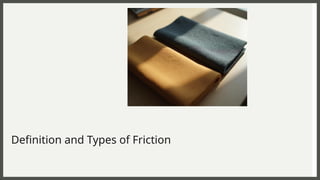
Definition of friction
Frictionis the force resisting the sliding or rolling of one surface over another. It acts parallel to the surfaces in contact and opposite to the
direction of motion or attempted motion. This force is essential for controlling movement and stability.
5.
Types of friction:static, sliding, rolling, fluid
There are four main types of friction:
- Static friction prevents motion between stationary surfaces.
- Sliding friction opposes movement when surfaces slide past each other.
- Rolling friction resists rolling of objects like wheels.
- Fluid friction occurs in liquids and gases, resisting object movement through them.
6.
Causes of friction
Frictionarises from the contact between surface irregularities at a microscopic level.
Even smooth surfaces have tiny bumps that interlock. The greater the roughness and
the force pressing surfaces together, the higher the friction. Other factors include the
nature of the materials involved and any lubrication present.
Advantages and disadvantagesof friction
Friction helps in walking, driving, and holding objects securely, making it essential for
daily tasks. However, it also causes wear and tear, energy loss, and heat generation,
which can reduce efficiency and damage machines.
9.
Methods to increaseand reduce friction
Friction can be increased by roughening surfaces or adding materials like sandpaper. It
is reduced using lubrication, smoother surfaces, or rollers to minimize direct contact.
Proper management optimizes performance and reduces damage.
10.
Real-life examples offriction
Friction helps car tires grip the road and allows shoes to prevent slipping. It also causes wear in engine parts and heating when rubbing
hands together. Lubricants in machines reduce friction and prevent overheating.
11.
Conclusions
Friction is avital force affecting motion in many ways. Understanding its causes, types, and effects allows us to control friction to our advantage
by increasing or reducing it depending on the situation. Effective friction management improves safety, efficiency, and device longevity.
12.
CREDITS: This presentationtemplate was created by
Slidesgo, and includes icons, infographics & images by
Freepik
Do you have any questions?
addyouremail@freepik.com
+00 000 000 000
yourwebsite.com
Thanks
Please keep this slide for attribution