Fr e
a
sh
nd
Fr esh WATer
PO LLUT IO N
C A P T . L A V A 3
FRESH WATER
ABOUT 97.4% found in
the ocean is saltwater
remaining 2.6%
water is freshwater
FRESH WATER
Water is solvent.
In nature, water is
“Never completely
pure”
WATER
RESOURCES
PROBLEMS
• Too much water
• river’s discharge cannot be contained
• Too little water
 Arid lands – lack of precipitation
 Semiarid lands- are subject to
frequent and prolonged droughts
• Poor quality water
• change of domestic and industrial effluent
wastes, leakage from water tanks, marine
dumping, radioactive waste and atmospheric
deposition
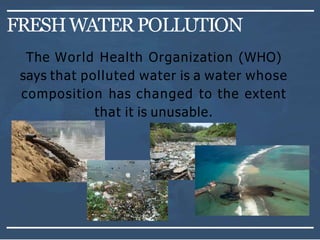
FRESHWATERPOLLUTION
The World Health Organization (WHO)
says that polluted water is a water whose
composition has changed to the extent
that it is unusable.
TYPES OF
WATER
POLLUTIONS
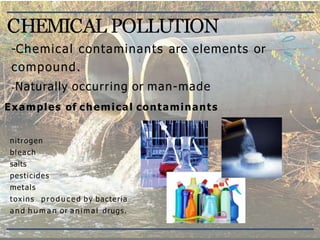
CHEMICAL POLLUTION
-Chemical contaminants are elements or
compound.
-Naturally occurring or man-made
Examples of chemical contaminants
nitrogen
bleach
salts
pesticides
metals
toxins p r o d u c e d by bacteria
a n d h u m a n or a n i m a l drugs.
GROUNDWATER
Occurs when
man-made
products get
into the
groundwater and
cause it to
become unsafe
and unfit for
human use.
MICROBIOLOGICAL
POLLUTION
-Organisms in water.
-Microbes or microbiological contaminants.
Examples of biological or microbial contaminants
include bacteria, viruses, protozoa, a nd parasites.
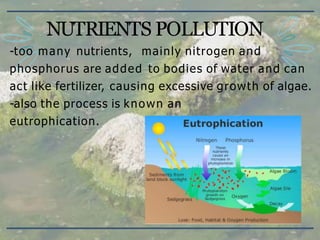
NUTRIENTS POLLUTION
-too many nutrients, mainly nitrogen and
phosphorus are added to bodies of water and can
act like fertilizer, causing excessive growth of algae.
-also the process is known an
eutrophication.
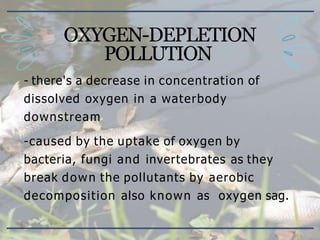
OXYGEN-DEPLETION
POLLUTION
- there's a decrease in concentration of
dissolved oxygen in a waterbody
downstream
-caused by the uptake of oxygen by
bacteria, fungi and invertebrates as they
break down the pollutants by aerobic
decomposition also known as oxygen sag.
SURFACEWATER
POLLUTION
- contaminants who primarily impact the
physical appearance or other physical
properties of water.
SO U RC ES O F
W A T E R
PO LLU TIO N
POINT POLLUTION
- easy to identify, it comes
from a single place
NON POINT POLLUTION
- Harder to identify, it comes
from many different places
ex:
pipes and drainage
ex:
road salt, sediments,
nitrate fertilizer, motor oil.
HOW
POLLUTANT
IMPACTS WATER
QUALITY AND
FRESHWATE
R SPECIES
-It can smother the habitats of
freshwater species
-Algal blooms shows up a coloured scum
on the water surface.
-It make freshwater cloudy and
degrade water quality
-Pathogens
-Heavy metals
EFFEC TS O F
W A T E R
PO LLU TIO N
DESTRUCTIONOF BIODIVERSITY
-depletes aquatic ecosystems and triggers
unbridled proliferation of phytoplankton
CONTAMINATIONOF THEFOOD CHAIN
-use of waste water for livestock farming and
agriculture can introduce toxins into foods
DISEASES
- exposing them to disease such as cholera,
hepatitis A and dysentery.
LACKOF PORTABLEWATER
-billion of people no access to clean
water to drink or sanitation, particularly in
rural areas.
INFANT MORTALITY
-diarrheal diseases linked to lack of
hygiene that causes death
WATER
MANAGEMENT
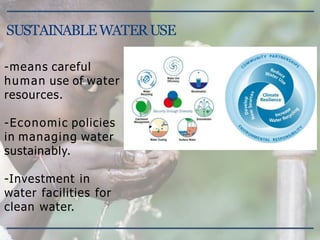
SUSTAINABLEWATERUSE
-means careful
human use of water
resources.
-Economic policies
in managing water
sustainably.
-Investment in
water facilities for
clean water.
Water supplies are obtained by the following:
-building dams
-diverting watere
-desalinization
Conservation of water includes:
-reusing water
-recycling water
-improving water-use efficiency
WATER
SUPPLIES
Dams generate
electricity and
ensure a year-
round supply of
water for
populations.
DAMS AND RESERVOIRS
REDUCE AGRICULTURAL WATER
WASTE
-irrigation
-micro-irrigation, also called drip or trickle
irrigation
WATER
CONSERVATION
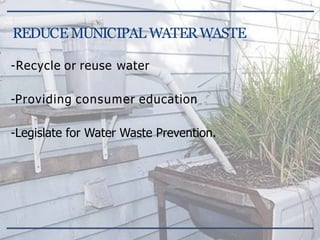
-Recycle or reuse water
-Providing consumer education
-Legislate for Water Waste Prevention.
REDUCEMUNICIPAL WATERWASTE
-electric power generators and many industrial
processes
-recapture, purify, and reuse water
REDUCEINDUSTRY WATERWASTE
SO, WHAT IS THE
SIGNIFICANCE OF
THIS TOPIC TO OUR
RELATED COURSE?
WE ARE NOW
READY TO ANSWER
YOUR QUERIES

FRESH-FRESHWATER-POLLUTION.pptx