CAUSES
• Social Cause
 One of the main factors that led to the French Revolution was the unbalanced
social structure of society during the Old Regime.
• Economic Cause
 It was the main reason of the depletion of the treasury of the king.
• Political Cause
• King was a person of Mediocre Intelligence.
• Immediate Cause
 Formation of the Estate General.
• Intellectual Cause
 Influence from the writers.
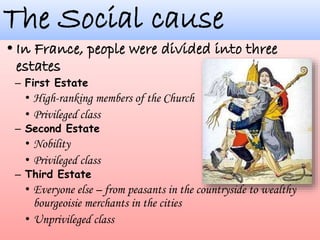
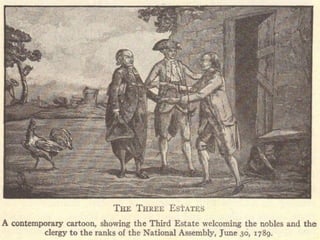
The Social cause
– First Estate
• High-ranking members of the Church
• Privileged class
– Second Estate
• Nobility
• Privileged class
– Third Estate
• Everyone else – from peasants in the countryside to wealthy
bourgeoisie merchants in the cities
• Unprivileged class
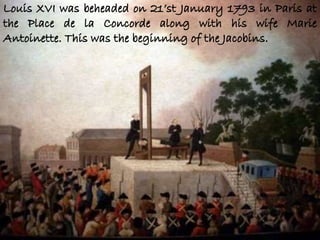
 In 1774, Louis XVI of the Bourbon family of kings ascended the throne of
France. He was 20 years old and married to the Austrian princess Marie
Antoinette. Upon his accession the new king found an empty treasury. Long
years of war had drained the financial resources of France.
 Added to this was the cost of maintaining an extravagant court at the immense
palace of Versailles.
 Under Louis XVI, France helped the thirteen American colonies to gain their
independence from the common enemy, Britain. The war added more than a
billion livres to a debt that had already risen to more than 2 billion livres.
 Lenders who gave the state credit, now began to charge 10 per cent interest
on loans. So the French government was obliged to spend an increasing
percentage of its budget on interest payments alone. To meet its regular
expenses, such as the cost of maintaining an army, the court, running
government offices or universities, the state was forced to increase taxes. Yet
even this measure would not have sufficed.
 The Church too extracted its share of taxes called tithes from the peasants,
and finally, all members of the third estate had to pay taxes to the state.
These included a direct tax, called taille, and a number of indirect taxes which
were levied on articles of everyday consumption like salt or tobacco. The burden
of financing activities of the state through taxes was borne by the third estate
alone ,which angered the common People
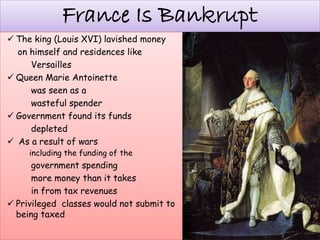
France Is Bankrupt
 The king (Louis XVI) lavished money
on himself and residences like
Versailles
 Queen Marie Antoinette
was seen as a
wasteful spender
 Government found its funds
depleted
 As a result of wars
including the funding of the
government spending
more money than it takes
in from tax revenues
 Privileged classes would not submit to
being taxed
• Louis XVI, the king of France, was a person of mediocre
intelligence. He ruled with the help of his empty headed
wife ‘Marie Antoinnette’, who appointed a number of her
friends and relatives at high posts and kept some of them
at pension. These people neither did any work nor they
contribute to the National treasury. Instead they took
salary from the Royal treasury.
• Louis XVI wanted to increase his territory. And to do so,
he had to be engaged in wars which meant that he needed
a large army for that purpose. Appointing so many
soldiers, required money to pay salaries to them. It
depleted the Royal treasury.
As a result, the king was forced to
raise the taxes with the consent of the three estates .
As the common people had to pay taxes, they became
agitated against their monarch – Louis XVI.
• Compelled by Financial bankruptcy, the
French Emperor Louis XVI called a meeting
of Estate General in 1789. It generated
much heat as the members of the 3rd Estate
were determined to put forth their demand.
However, the first two Estates i.e. ‘the
Clergy’ and ‘ The Nobility’ refused to have a
joint meeting with the Third Estate. The
members of the Third Estate walked of the
Assembly.
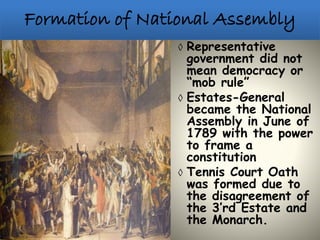
◊ Representative
government did not
mean democracy or
“mob rule”
◊ Estates-General
became the National
Assembly in June of
1789 with the power
to frame a
constitution
◊ Tennis Court Oath
was formed due to
the disagreement of
the 3’rd Estate and
the Monarch.
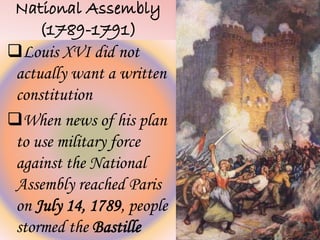
Louis XVI did not
actually want a written
constitution
When news of his plan
to use military force
against the National
Assembly reached Paris
on July 14, 1789, people
stormed the Bastille
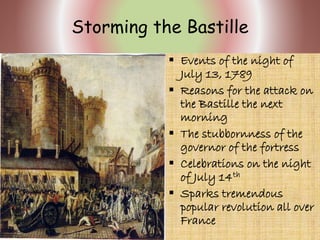
Storming the Bastille
 Events of the night of
July 13, 1789
 Reasons for the attack on
the Bastille the next
morning
 The stubbornness of the
governor of the fortress
 Celebrations on the night
of July 14th
 Sparks tremendous
popular revolution all over
France
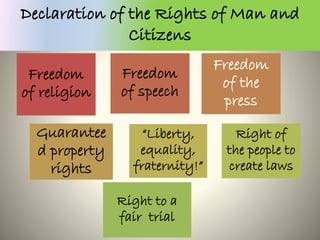
Freedom
of religion
Freedom
of speech
Freedom
of the
press
Guarantee
d property
rights
“Liberty,
equality,
fraternity!”
Right of
the people to
create laws
Right to a
fair trial
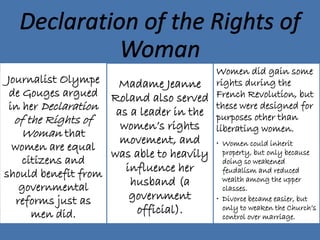
Journalist Olympe
de Gouges argued
in her Declaration
of the Rights of
Woman that
women are equal
citizens and
should benefit from
governmental
reforms just as
men did.
Madame Jeanne
Roland also served
as a leader in the
women’s rights
movement, and
was able to heavily
influence her
husband (a
government
official).
Women did gain some
rights during the
French Revolution, but
these were designed for
purposes other than
liberating women.
• Women could inherit
property, but only because
doing so weakened
feudalism and reduced
wealth among the upper
classes.
• Divorce became easier, but
only to weaken the Church’s
control over marriage.
THE
JACOBINS
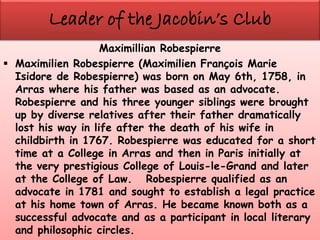
Maximillian Robespierre
 Maximilien Robespierre (Maximilien François Marie
Isidore de Robespierre) was born on May 6th, 1758, in
Arras where his father was based as an advocate.
Robespierre and his three younger siblings were brought
up by diverse relatives after their father dramatically
lost his way in life after the death of his wife in
childbirth in 1767. Robespierre was educated for a short
time at a College in Arras and then in Paris initially at
the very prestigious College of Louis-le-Grand and later
at the College of Law. Robespierre qualified as an
advocate in 1781 and sought to establish a legal practice
at his home town of Arras. He became known both as a
successful advocate and as a participant in local literary
and philosophic circles.
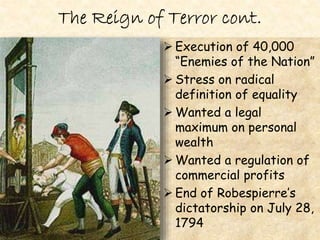
TERROR
REIGN
 Execution of 40,000
“Enemies of the Nation”
 Stress on radical
definition of equality
 Wanted a legal
maximum on personal
wealth
 Wanted a regulation of
commercial profits
 End of Robespierre’s
dictatorship on July 28,
1794
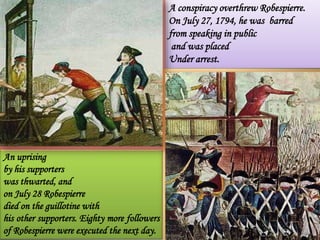
A conspiracy overthrew Robespierre.
On July 27, 1794, he was barred
from speaking in public
and was placed
Under arrest.
An uprising
by his supporters
was thwarted, and
on July 28 Robespierre
died on the guillotine with
his other supporters. Eighty more followers
of Robespierre were executed the next day.
NAPOLEAN
BONAPARTE
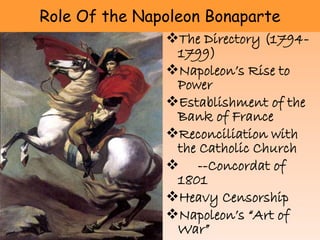
The Directory (1794-
1799)
Napoleon’s Rise to
Power
Establishment of the
Bank of France
Reconciliation with
the Catholic Church
 --Concordat of
1801
Heavy Censorship
Napoleon’s “Art of
War”
Role Of the Napoleon Bonaparte
Death of Napoleon Bonaparte
THANK
YOU!

French revolution causes

  • 2.
  • 3.
    • Social Cause One of the main factors that led to the French Revolution was the unbalanced social structure of society during the Old Regime. • Economic Cause  It was the main reason of the depletion of the treasury of the king. • Political Cause • King was a person of Mediocre Intelligence. • Immediate Cause  Formation of the Estate General. • Intellectual Cause  Influence from the writers.
  • 4.
    The Social cause –First Estate • High-ranking members of the Church • Privileged class – Second Estate • Nobility • Privileged class – Third Estate • Everyone else – from peasants in the countryside to wealthy bourgeoisie merchants in the cities • Unprivileged class
  • 6.
     In 1774,Louis XVI of the Bourbon family of kings ascended the throne of France. He was 20 years old and married to the Austrian princess Marie Antoinette. Upon his accession the new king found an empty treasury. Long years of war had drained the financial resources of France.  Added to this was the cost of maintaining an extravagant court at the immense palace of Versailles.  Under Louis XVI, France helped the thirteen American colonies to gain their independence from the common enemy, Britain. The war added more than a billion livres to a debt that had already risen to more than 2 billion livres.  Lenders who gave the state credit, now began to charge 10 per cent interest on loans. So the French government was obliged to spend an increasing percentage of its budget on interest payments alone. To meet its regular expenses, such as the cost of maintaining an army, the court, running government offices or universities, the state was forced to increase taxes. Yet even this measure would not have sufficed.  The Church too extracted its share of taxes called tithes from the peasants, and finally, all members of the third estate had to pay taxes to the state. These included a direct tax, called taille, and a number of indirect taxes which were levied on articles of everyday consumption like salt or tobacco. The burden of financing activities of the state through taxes was borne by the third estate alone ,which angered the common People
  • 7.
    France Is Bankrupt The king (Louis XVI) lavished money on himself and residences like Versailles  Queen Marie Antoinette was seen as a wasteful spender  Government found its funds depleted  As a result of wars including the funding of the government spending more money than it takes in from tax revenues  Privileged classes would not submit to being taxed
  • 8.
    • Louis XVI,the king of France, was a person of mediocre intelligence. He ruled with the help of his empty headed wife ‘Marie Antoinnette’, who appointed a number of her friends and relatives at high posts and kept some of them at pension. These people neither did any work nor they contribute to the National treasury. Instead they took salary from the Royal treasury. • Louis XVI wanted to increase his territory. And to do so, he had to be engaged in wars which meant that he needed a large army for that purpose. Appointing so many soldiers, required money to pay salaries to them. It depleted the Royal treasury. As a result, the king was forced to raise the taxes with the consent of the three estates . As the common people had to pay taxes, they became agitated against their monarch – Louis XVI.
  • 9.
    • Compelled byFinancial bankruptcy, the French Emperor Louis XVI called a meeting of Estate General in 1789. It generated much heat as the members of the 3rd Estate were determined to put forth their demand. However, the first two Estates i.e. ‘the Clergy’ and ‘ The Nobility’ refused to have a joint meeting with the Third Estate. The members of the Third Estate walked of the Assembly.
  • 11.
    ◊ Representative government didnot mean democracy or “mob rule” ◊ Estates-General became the National Assembly in June of 1789 with the power to frame a constitution ◊ Tennis Court Oath was formed due to the disagreement of the 3’rd Estate and the Monarch.
  • 12.
    Louis XVI didnot actually want a written constitution When news of his plan to use military force against the National Assembly reached Paris on July 14, 1789, people stormed the Bastille
  • 15.
    Storming the Bastille Events of the night of July 13, 1789  Reasons for the attack on the Bastille the next morning  The stubbornness of the governor of the fortress  Celebrations on the night of July 14th  Sparks tremendous popular revolution all over France
  • 17.
    Freedom of religion Freedom of speech Freedom ofthe press Guarantee d property rights “Liberty, equality, fraternity!” Right of the people to create laws Right to a fair trial
  • 18.
    Journalist Olympe de Gougesargued in her Declaration of the Rights of Woman that women are equal citizens and should benefit from governmental reforms just as men did. Madame Jeanne Roland also served as a leader in the women’s rights movement, and was able to heavily influence her husband (a government official). Women did gain some rights during the French Revolution, but these were designed for purposes other than liberating women. • Women could inherit property, but only because doing so weakened feudalism and reduced wealth among the upper classes. • Divorce became easier, but only to weaken the Church’s control over marriage.
  • 19.
  • 21.
    Maximillian Robespierre  MaximilienRobespierre (Maximilien François Marie Isidore de Robespierre) was born on May 6th, 1758, in Arras where his father was based as an advocate. Robespierre and his three younger siblings were brought up by diverse relatives after their father dramatically lost his way in life after the death of his wife in childbirth in 1767. Robespierre was educated for a short time at a College in Arras and then in Paris initially at the very prestigious College of Louis-le-Grand and later at the College of Law. Robespierre qualified as an advocate in 1781 and sought to establish a legal practice at his home town of Arras. He became known both as a successful advocate and as a participant in local literary and philosophic circles.
  • 22.
  • 24.
     Execution of40,000 “Enemies of the Nation”  Stress on radical definition of equality  Wanted a legal maximum on personal wealth  Wanted a regulation of commercial profits  End of Robespierre’s dictatorship on July 28, 1794
  • 25.
    A conspiracy overthrewRobespierre. On July 27, 1794, he was barred from speaking in public and was placed Under arrest. An uprising by his supporters was thwarted, and on July 28 Robespierre died on the guillotine with his other supporters. Eighty more followers of Robespierre were executed the next day.
  • 26.
  • 27.
    The Directory (1794- 1799) Napoleon’sRise to Power Establishment of the Bank of France Reconciliation with the Catholic Church  --Concordat of 1801 Heavy Censorship Napoleon’s “Art of War” Role Of the Napoleon Bonaparte
  • 28.
  • 30.