In this world, nothing can be said to be certain, except death and taxes.” –Benjamin
Franklin
● A person doesn’t knowhow much he has to be thankful for until he has to pay
taxes on it. ~Author Unknown
● Death and taxes may be inevitable, but they shouldn’t be related. ~J.C. Watts, Jr.
● The best things in life are free, but sooner or later the government will find a way
to tax them. ~Author Unknown
More at Tax: Jokes, Quotes,Tax was the reason America was founded
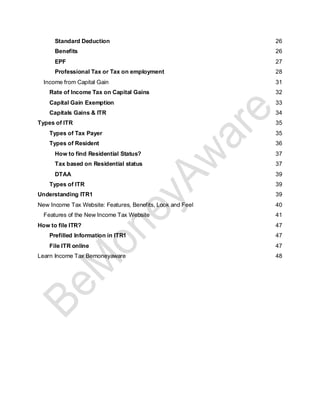
Table of Contents
Income Tax Process 4
Old or New Tax Regime to choose with Calculator for Income Tax for FY 2020-21 5
Overview of Old tax system vs new 5
Tax Calculator choose old or new tax regime 6
Video on how to choose old or new Tax slab 6
CheckList of Documents/Information for Filing ITR1 10
Time Period of Income Financial Year, Assessment Year 11
Question: What is FY for the Income earned? 12
Question: What is the FY & AY of this ITR? 12
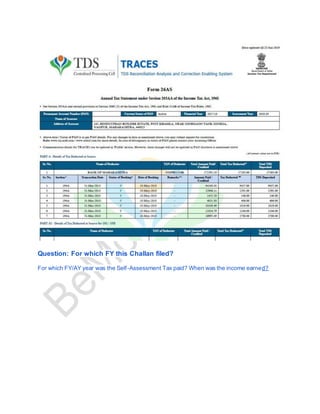
Question: What is the Assessment Year in Form 26AS? 12
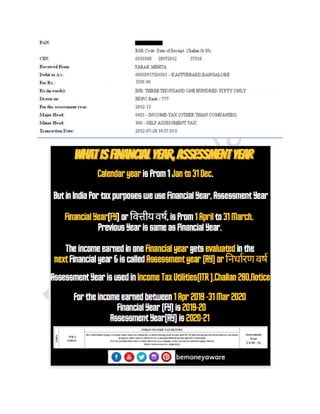
Question: For which FY this Challan filed? 13
What Income Tax Slabs 15
Terms associated with Income Tax slabs 16
Examples of Income Tax Calculation 17
0% Tax Slab or No Tax 17
5% tax slab 17
20% tax slab 17
30% tax slab 18
30% tax slab + Surcharge 18
So how much tax would one pay? 19
Types of Income 20
Question on Income Tax 21
Income from Salary 21
Overview of Salary 21
Sample Salary 22
Salary in ITR 23
Terms associated with Salary 24
Basic Salary 24
Allowances 25
Perquisites 25
Difference between allowance and perquisites 25
Standard Deduction 26
Benefits 26
EPF 27
Professional Tax or Tax on employment 28
Income from Capital Gain 31
Rate of Income Tax on Capital Gains 32
Capital Gain Exemption 33
Capitals Gains & ITR 34
Types of ITR 35
Types of Tax Payer 35
Types of Resident 36
How to find Residential Status? 37
Tax based on Residential status 37
DTAA 39
Types of ITR 39
Understanding ITR1 39
New Income Tax Website: Features, Benefits, Look and Feel 40
Features of the New Income Tax Website 41
How to file ITR? 47
Prefilled Information in ITR1 47
File ITR online 47
Learn Income Tax Bemoneyaware 48
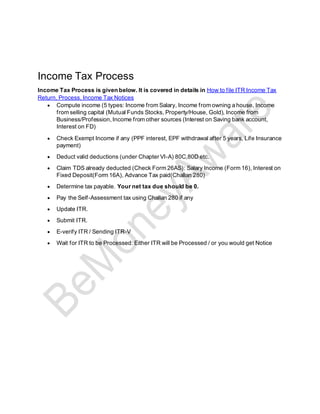
Income Tax Process
Income Tax Process is given below. It is covered in details in How to file ITR Income Tax
Return, Process, Income Tax Notices
• Compute income (5 types: Income from Salary, Income from owning a house, Income
from selling capital (Mutual Funds Stocks, Property/House, Gold), Income from
Business/Profession,Income from other sources (Interest on Saving bank account,
Interest on FD)
• Check Exempt Income if any (PPF interest, EPF withdrawal after 5 years, Life Insurance
payment)
• Deduct valid deductions (under Chapter VI-A) 80C,80D etc.
• Claim TDS already deducted (Check Form 26AS): Salary Income (Form 16), Interest on
Fixed Deposit(Form 16A), Advance Tax paid(Challan 280)
• Determine tax payable. Your net tax due should be 0.
• Pay the Self-Assessment tax using Challan 280 if any
• Update ITR.
• Submit ITR.
• E-verify ITR / Sending ITR-V
• Wait for ITR to be Processed: Either ITR will be Processed / or you would get Notice
Old or New Tax Regime to choose with Calculator for Income Tax
for FY 2020-21
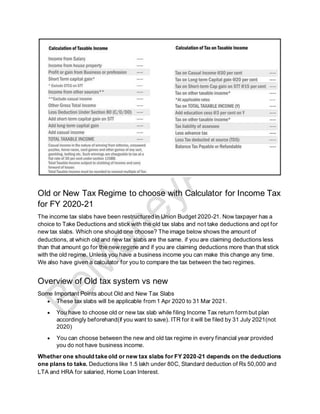
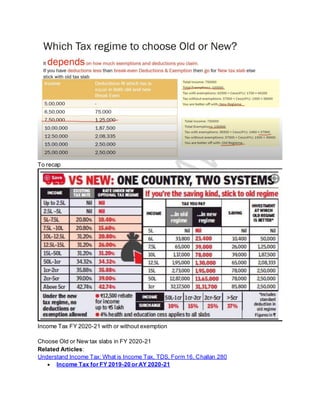
The income tax slabs have been restructured in Union Budget 2020-21. Now taxpayer has a
choice to Take Deductions and stick with the old tax slabs and not take deductions and opt for
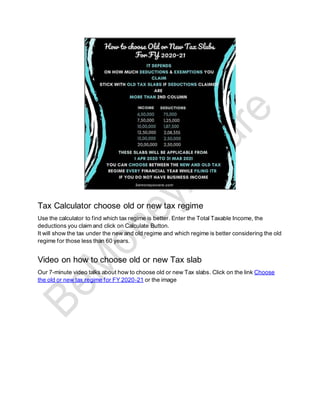
new tax slabs. Which one should one choose? The image below shows the amount of
deductions, at which old and new tax slabs are the same. if you are claiming deductions less
than that amount go for the new regime and if you are claiming deductions more than that stick
with the old regime. Unless you have a business income you can make this change any time.
We also have given a calculator for you to compare the tax between the two regimes.
Overview of Old tax system vs new
Some Important Points about Old and New Tax Slabs
• These tax slabs will be applicable from 1 Apr 2020 to 31 Mar 2021.
• You have to choose old or new tax slab while filing Income Tax return form but plan
accordingly beforehand(if you want to save). ITR for it will be filed by 31 July 2021(not
2020)
• You can choose between the new and old tax regime in every financial year provided
you do not have business income.
Whether one should take old or new tax slabs for FY 2020-21 depends on the deductions
one plans to take. Deductions like 1.5 lakh under 80C, Standard deduction of Rs 50,000 and
LTA and HRA for salaried, Home Loan Interest.
Tax Calculator choose old or new tax regime
Use the calculator to find which tax regime is better. Enter the Total Taxable Income, the
deductions you claim and click on Calculate Button.
It will show the tax under the new and old regime and which regime is better considering the old
regime for those less than 60 years.
Video on how to choose old or new Tax slab
Our 7-minute video talks about how to choose old or new Tax slabs. Click on the link Choose
the old or new tax regime for FY 2020-21 or the image
To recap
Income Tax FY 2020-21 with or without exemption
Choose Old or New tax slabs in FY 2020-21
Related Articles:
Understand Income Tax: What is Income Tax, TDS, Form 16, Challan 280
• Income Tax for FY 2019-20 or AY 2020-21
• Income Tax for FY 2020-21 AY 2021-22, Union budget
What do you think of the new Tax Regime? Is it more confusing or has become easier? Will you
go for old system or new system?
CheckList of Documents/Information for Filing ITR1
Time Period of Income Financial Year, Assessment Year
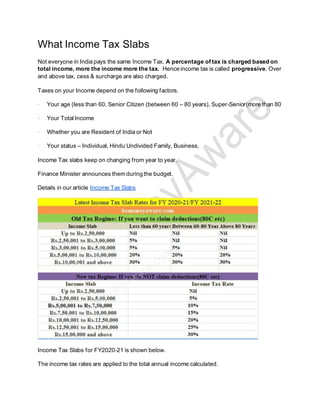
In India mostly we follow English Calendar from 1 Jan to 31 Dec.
But for Income Tax, we use Financial Year, denoted by FY, which is from 1 April and 31 March.
The income in one Financial earned gets assessed(checked) in the next Financial year which is
called Assessment year denoted by AY.
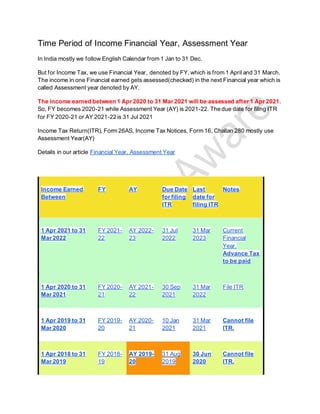
The income earned between 1 Apr 2020 to 31 Mar 2021 will be assessed after 1 Apr 2021.
So, FY becomes 2020-21 while Assessment Year (AY) is 2021-22. The due date for filing ITR
for FY 2020-21 or AY 2021-22 is 31 Jul 2021
Income Tax Return(ITR), Form 26AS, Income Tax Notices, Form 16, Challan 280 mostly use
Assessment Year(AY)
Details in our article Financial Year, Assessment Year
Income Earned
Between
FY AY Due Date
for filing
ITR
Last
date for
filing ITR
Notes
1 Apr 2021 to 31
Mar 2022
FY 2021-
22
AY 2022-
23
31 Jul
2022
31 Mar
2023
Current
Financial
Year.
Advance Tax
to be paid
1 Apr 2020 to 31
Mar 2021
FY 2020-
21
AY 2021-
22
30 Sep
2021
31 Mar
2022
File ITR
1 Apr 2019 to 31
Mar 2020
FY 2019-
20
AY 2020-
21
10 Jan
2021
31 Mar
2021
Cannot file
ITR.
1 Apr 2018 to 31
Mar 2019
FY 2018-
19
AY 2019-
20
31 Aug
2019
30 Jun
2020
Cannot file
ITR.
1 Apr 2017 to 31
Mar 2018
FY 2017-
28
AY 2018-
29
31 Aug
2018
31 Mar
2019
Cannot file
ITR.
File
Condonation
request and
pay Tax
Liability
Earlier Years Cannot file
ITR.
Question: What is FY for the Income earned?
For income earned between 1 Apr 2020 to 31 Mar 2021
What is the FY?
What is the AY?
By when do you have to file ITR?
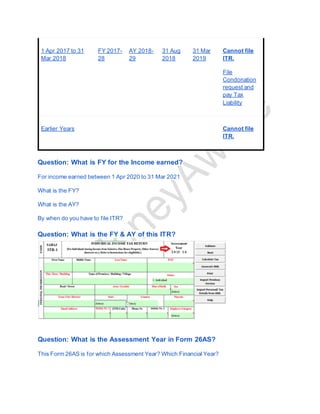
Question: What is the FY & AY of this ITR?
Question: What is the Assessment Year in Form 26AS?
This Form 26AS is for which Assessment Year? Which Financial Year?
Question: For which FY this Challan filed?
For which FY/AY year was the Self-Assessment Tax paid? When was the income earned?
What Income Tax Slabs
Not everyone in India pays the same Income Tax. A percentage of tax is charged based on
total income, more the income more the tax. Hence income tax is called progressive. Over
and above tax, cess & surcharge are also charged.
Taxes on your Income depend on the following factors.
· Your age (less than 60, Senior Citizen (between 60 – 80 years), Super-Senior(more than 80
· Your Total Income
· Whether you are Resident of India or Not
· Your status – Individual, Hindu Undivided Family, Business.
Income Tax slabs keep on changing from year to year.
Finance Minister announces them during the budget.
Details in our article Income Tax Slabs
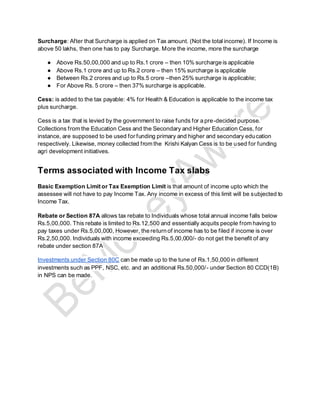
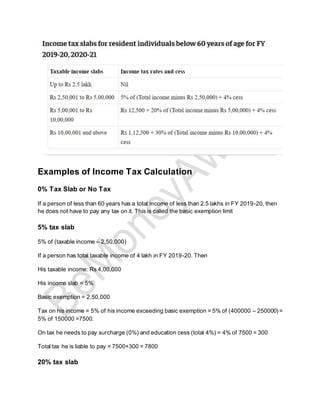
Income Tax Slabs for FY2020-21 is shown below.
The income tax rates are applied to the total annual income calculated.
Surcharge: After that Surcharge is applied on Tax amount. (Not the total income). If Income is
above 50 lakhs, then one has to pay Surcharge. More the income, more the surcharge
● Above Rs.50,00,000 and up to Rs.1 crore – then 10% surcharge is applicable
● Above Rs.1 crore and up to Rs.2 crore – then 15% surcharge is applicable
● Between Rs.2 crores and up to Rs.5 crore –then 25% surcharge is applicable;
● For Above Rs. 5 crore – then 37% surcharge is applicable.
Cess: is added to the tax payable: 4% for Health & Education is applicable to the income tax
plus surcharge.
Cess is a tax that is levied by the government to raise funds for a pre-decided purpose.
Collections from the Education Cess and the Secondary and Higher Education Cess, for
instance, are supposed to be used for funding primary and higher and secondary education
respectively. Likewise, money collected from the Krishi Kalyan Cess is to be used for funding
agri development initiatives.
Terms associated with Income Tax slabs
Basic Exemption Limit or Tax Exemption Limit is that amount of income upto which the
assessee will not have to pay Income Tax. Any income in excess of this limit will be subjected to
Income Tax.
Rebate or Section 87A allows tax rebate to Individuals whose total annual income falls below
Rs.5,00,000. This rebate is limited to Rs.12,500 and essentially acquits people from having to
pay taxes under Rs.5,00,000, However, the return of income has to be filed if income is over
Rs.2,50,000. Individuals with income exceeding Rs.5,00,000/- do not get the benefit of any
rebate under section 87A
Investments under Section 80C can be made up to the tune of Rs.1,50,000 in different
investments such as PPF, NSC, etc. and an additional Rs.50,000/- under Section 80 CCD(1B)
in NPS can be made.
Examples of Income Tax Calculation
0% Tax Slab or No Tax
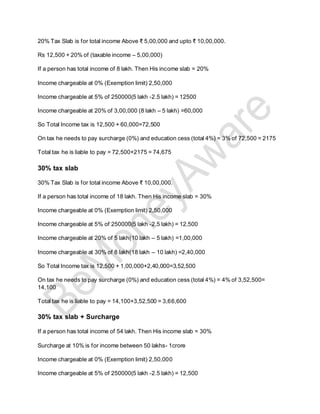
If a person of less than 60 years has a total income of less than 2.5 lakhs in FY 2019-20, then
he does not have to pay any tax on it. This is called the basic exemption limit
5% tax slab
5% of (taxable income – 2,50,000)
If a person has total taxable income of 4 lakh in FY 2019-20. Then
His taxable income: Rs 4,00,000
His income slab = 5%
Basic exemption = 2,50,000
Tax on his income = 5% of his income exceeding basic exemption = 5% of (400000 – 250000) =
5% of 150000 =7500.
On tax he needs to pay surcharge (0%) and education cess (total 4%) = 4% of 7500 = 300
Total tax he is liable to pay = 7500+300 = 7800
20% tax slab
20% Tax Slab is for total income Above ₹ 5,00,000 and upto ₹ 10,00,000.
Rs 12,500 + 20% of (taxable income – 5,00,000)
If a person has total income of 8 lakh. Then His income slab = 20%
Income chargeable at 0% (Exemption limit) 2,50,000
Income chargeable at 5% of 250000(5 lakh -2.5 lakh) = 12500
Income chargeable at 20% of 3,00,000 (8 lakh – 5 lakh) =60,000
So Total Income tax is 12,500 + 60,000=72,500
On tax he needs to pay surcharge (0%) and education cess (total 4%) = 3% of 72,500 = 2175
Total tax he is liable to pay = 72,500+2175 = 74,675
30% tax slab
30% Tax Slab is for total income Above ₹ 10,00,000.
If a person has total income of 18 lakh. Then His income slab = 30%
Income chargeable at 0% (Exemption limit) 2,50,000
Income chargeable at 5% of 250000(5 lakh -2.5 lakh) = 12,500
Income chargeable at 20% of 5 lakh(10 lakh – 5 lakh) =1,00,000
Income chargeable at 30% of 8 lakh(18 lakh – 10 lakh) =2,40,000
So Total Income tax is 12,500 + 1,00,000+2,40,000=3,52,500
On tax he needs to pay surcharge (0%) and education cess (total 4%) = 4% of 3,52,500=
14,100
Total tax he is liable to pay = 14,100+3,52,500 = 3,66,600
30% tax slab + Surcharge
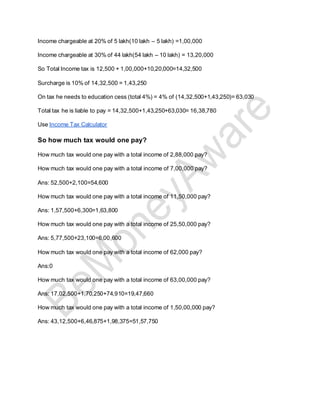
If a person has total income of 54 lakh. Then His income slab = 30%
Surcharge at 10% is for income between 50 lakhs- 1crore
Income chargeable at 0% (Exemption limit) 2,50,000
Income chargeable at 5% of 250000(5 lakh -2.5 lakh) = 12,500
Income chargeable at 20% of 5 lakh(10 lakh – 5 lakh) =1,00,000
Income chargeable at 30% of 44 lakh(54 lakh – 10 lakh) = 13,20,000
So Total Income tax is 12,500 + 1,00,000+10,20,000=14,32,500
Surcharge is 10% of 14,32,500 = 1,43,250
On tax he needs to education cess (total 4%) = 4% of (14,32,500+1,43,250)= 63,030
Total tax he is liable to pay = 14,32,500+1,43,250+63,030= 16,38,780
Use Income Tax Calculator
So how much tax would one pay?
How much tax would one pay with a total income of 2,88,000 pay?
How much tax would one pay with a total income of 7,00,000 pay?
Ans: 52,500+2,100=54,600
How much tax would one pay with a total income of 11,50,000 pay?
Ans: 1,57,500+6,300=1,63,800
How much tax would one pay with a total income of 25,50,000 pay?
Ans: 5,77,500+23,100=6,00,600
How much tax would one pay with a total income of 62,000 pay?
Ans:0
How much tax would one pay with a total income of 63,00,000 pay?
Ans: 17,02,500+1,70,250+74,910=19,47,660
How much tax would one pay with a total income of 1,50,00,000 pay?
Ans: 43,12,500+6,46,875+1,98,375=51,57,750
Types of Income
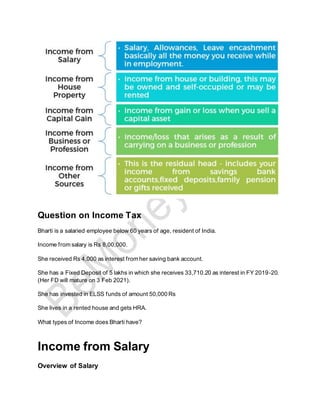
Income is classified into the following categories known as Heads of Income.
· Income from Salary:
o Salary is what is received by an employee from an employer in cash, kind or
as a facility [perquisite].
o Pension is also considered as salary. The Pension is normally paid a
periodical payment on a monthly basis which is fully taxable, under the head
Income from Salary, in the hand of the employee, whether Government
employee or non-government employee.
o Our article Senior Citizen : Income and Tax discusses it in detail
· Income from House Property:
o Income earned from rent of residential or commercial property.
o If one has taken home loan to buy a property, then interest payment is also
considered as negative Income from House Property
o Our article Income from House Property and Income Tax Return discusses it in
detail.
· Income from Profits and Gains of Profession or Business: Income earned from
freelancing, contracting, for doctors, CA,lawyers, by bloggers, YouTubers etc.
· Income from Capital Gains: Income earned from the sale of capital assets, like mutual
funds, shares, land, house.
· Income from Other Sources: Interest earned from savings accounts, fixed deposits,
winning lottery etc. Any income which does not fall in any category comes under this
· Exempt Income: Exempt Income, is the income that is not taxable. Even though these are
tax-free, all exempt incomes must be mentioned in the tax return. Our article Exempt Income
and Income Tax Return discusses it in detail.
Question on Income Tax
Bharti is a salaried employee below 60 years of age, resident of India.
Income from salary is Rs 8,00,000.
She received Rs 4,000 as interest from her saving bank account.
She has a Fixed Deposit of 5 lakhs in which she receives 33,710.20 as interest in FY 2019-20.
(Her FD will mature on 3 Feb 2021).
She has invested in ELSS funds of amount 50,000 Rs
She lives in a rented house and gets HRA.
What types of Income does Bharti have?
Income from Salary
Overview of Salary
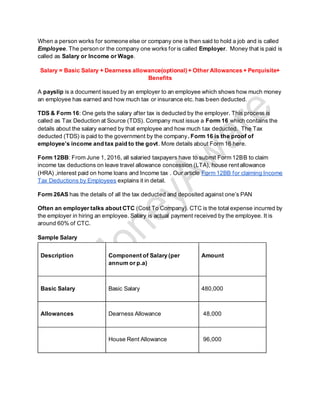
When a person works for someone else or company one is then said to hold a job and is called
Employee. The person or the company one works for is called Employer. Money that is paid is
called as Salary or Income or Wage.
Salary = Basic Salary + Dearness allowance(optional) + Other Allowances + Perquisite+
Benefits
A payslip is a document issued by an employer to an employee which shows how much money
an employee has earned and how much tax or insurance etc. has been deducted.
TDS & Form 16: One gets the salary after tax is deducted by the employer. This process is
called as Tax Deduction at Source (TDS). Company must issue a Form 16 which contains the
details about the salary earned by that employee and how much tax deducted. The Tax
deducted (TDS) is paid to the government by the company. Form 16 is the proof of
employee’s income and tax paid to the govt. More details about Form 16 here.
Form 12BB: From June 1, 2016, all salaried taxpayers have to submit Form 12BB to claim
income tax deductions on leave travel allowance concession (LTA), house rent allowance
(HRA) ,interest paid on home loans and Income tax . Our article Form 12BB for claiming Income
Tax Deductions by Employees explains it in detail.
Form 26AS has the details of all the tax deducted and deposited against one’s PAN
Often an employer talks about CTC (Cost To Company). CTC is the total expense incurred by
the employer in hiring an employee. Salary is actual payment received by the employee. It is
around 60% of CTC.
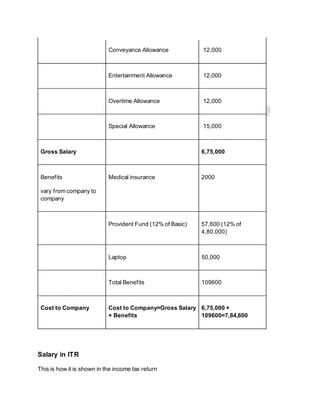
Sample Salary
Description Component of Salary (per
annum or p.a)
Amount
Basic Salary Basic Salary 480,000
Allowances Dearness Allowance 48,000
House Rent Allowance 96,000
Conveyance Allowance 12,000
Entertainment Allowance 12,000
Overtime Allowance 12,000
Special Allowance 15,000
Gross Salary 6,75,000
Benefits
vary from company to
company
Medical insurance 2000
Provident Fund (12% of Basic) 57,600 (12% of
4,80,000)
Laptop 50,000
Total Benefits 109600
Cost to Company Cost to Company=Gross Salary
+ Benefits
6,75,000 +
109600=7,84,600
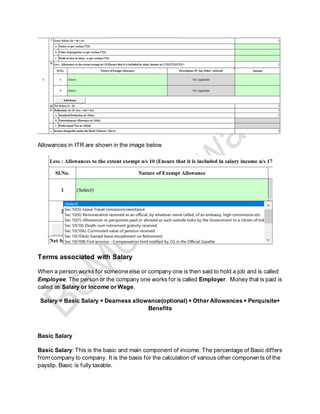
Salary in ITR
This is how it is shown in the income tax return
Allowances in ITR are shown in the image below
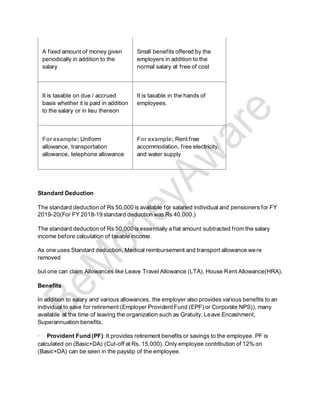
Terms associated with Salary
When a person works for someone else or company one is then said to hold a job and is called
Employee. The person or the company one works for is called Employer. Money that is paid is
called as Salary or Income or Wage.
Salary = Basic Salary + Dearness allowance(optional) + Other Allowances + Perquisite+
Benefits
Basic Salary
Basic Salary: This is the basic and main component of income. The percentage of Basic differs
from company to company. It is the basis for the calculation of various other components of the
payslip. Basic is fully taxable.
Within a company, Basic Salary generally depends on one’s designation. Any increment in the
salary is expressed as percentage of Basic salary.
Allowances
Allowances are fixed periodic amounts, apart from salary, which are paid by an employer for the
purpose of meeting some requirements of the employee. E.g., Tiffin allowance, transport
allowance, uniform allowance, etc. Some examples of Allowances are given below.
These allowances appear in Form 16(Part B)
· Dearness Allowance (DA): Dearness Allowance should neither be high nor low. It is paid to
reduce the impact of inflation on the employee. In some companies, DA is an optional head of
salary. Government employees receive Dearness Allowance
· House Rent Allowance (HRA): It is an allowance to pay out the house rent of the
employees. Employees can claim exemption on this by submitting rent receipts.
· Conveyance Allowance: It is an allowance for an employee to cover his / her expenses of
travel from home to work and work to home.
· Other Allowances: There can be various other allowances according to the company
policies. These can be uniform allowance, special allowance, city conveyance allowance, child
education allowance, etc.
Perquisites
Perquisites are benefits received by a person as a result of his/her official position and are over
and above the salary or wages. These perquisitescan be taxable or non-taxable depending
upon their nature.
They are found in Form 16, Part B & Form 12BA which gives detail. Example of perquisites in
Form 12BA are shown below
What is the value of perquisites in Form 16 (Part B) as shown in the image below
Can you name the perquisites and value found in Form?
Difference between allowance and perquisites
ALLOWANCE PERQUISITES
A fixed amount of money given
periodically in addition to the
salary
Small benefits offered by the
employers in addition to the
normal salary at free of cost
It is taxable on due / accrued
basis whether it is paid in addition
to the salary or in lieu thereon
It is taxable in the hands of
employees.
For example; Uniform
allowance, transportation
allowance, telephone allowance
For example; Rent free
accommodation, free electricity,
and water supply
Standard Deduction
The standard deduction of Rs 50,000 is available for salaried individual and pensioners for FY
2019-20(For FY 2018-19 standard deduction was Rs 40,000.)
The standard deduction of Rs 50,000 is essentially a flat amount subtracted from the salary
income before calculation of taxable income.
As one uses Standard deduction, Medical reimbursement and transport allowance were
removed
but one can claim Allowances like Leave Travel Allowance (LTA), House Rent Allowance(HRA).
Benefits
In addition to salary and various allowances, the employer also provides various benefits to an
individual to save for retirement (Employer Provident Fund (EPF) or Corporate NPS)), many
available at the time of leaving the organization such as Gratuity, Leave Encashment,
Superannuation benefits.
· Provident Fund (PF): It provides retirement benefits or savings to the employee. PF is
calculated on (Basic+DA) (Cut-off at Rs. 15,000). Only employee contribution of 12% on
(Basic+DA) can be seen in the payslip of the employee.
· Employees’ State Insurance (ESI) : It provides medical facilities to all eligible employees.
The deduction towards ESI compulsory. The cut off is Rs. 21000. The employee contributes
1.75% on gross salary.
· Superannuation is a retirement benefit that is offered to employees by the employer,
pension for employee post-retirement. Companies open a superannuation benefit fund with any
of the approved insurance companies. The employer contributes every year, a fixed percentage
of your basic pay plus dearness allowance, on your behalf towards the group superannuation
policy held by the employer.
Professional Tax (PT):It is a tax collected by the state government from all salaried
employees. PT depends on state to state government. It is calculated on the gross earnings of
the employee. Gross earnings are the sum of all income.
Tax Deducted at Source (TDS): The amount of tax deducted by the employer on behalf of the
Income Tax Department from the salary of the employee.
EPF
The Employee Provident Fund (EPF) is a retirement benefits scheme in which employees of an
organization contribute a small portion of their basic pay (12%) monthly. The employer also
contributes a similar amount on their behalf towards the EPS, EPS (employee Pension scheme,
upto 1250) &
Every employee is allotted a unique Universal Account Number (UAN) by the Employee
Provident Fund Organisation (EPFO). The employee's EPF account is linked with the UAN
which is valid throughout the employee'slife.
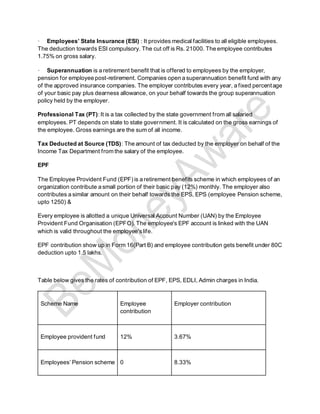
EPF contribution show up in Form 16(Part B) and employee contribution gets benefit under 80C
deduction upto 1.5 lakhs.
Table below gives the rates of contribution of EPF, EPS, EDLI, Admin charges in India.
Scheme Name Employee
contribution
Employer contribution
Employee provident fund 12% 3.67%
Employees’ Pension scheme 0 8.33%
Employees Deposit linked
insurance
0 0.5%(capped at a maximum of Rs
15,000)
EPF Administrative charges 0 0.85% (From Jan 2015) 1.1%
(Earlier)
PF Admin account 1.1%
EDLIS Administrative
charges
0 0.01%
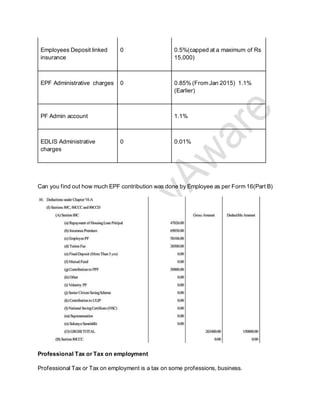
Can you find out how much EPF contribution was done by Employee as per Form 16(Part B)
Professional Tax or Tax on employment
Professional Tax or Tax on employment is a tax on some professions, business.
Every state has its own laws and regulations to govern professional tax of that state under
Article 276 of the Constitution.However, all the states do follow slab system based on the
income to levy professional tax. For example, Professional tax rate slabs in Karnataka are
shown in table below.
The maximum amount of professional tax that can be levied by a state is Rs 2,500. It is usually
deducted by the employer and deposited with the state government. In your income tax return,
professional tax is allowed as a deduction from your salary income.
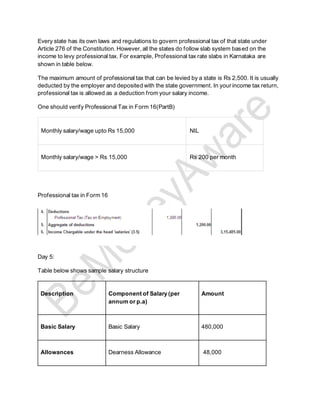
One should verify Professional Tax in Form 16(PartB)
Monthly salary/wage upto Rs 15,000 NIL
Monthly salary/wage > Rs 15,000 Rs 200 per month
Professional tax in Form 16
Day 5:
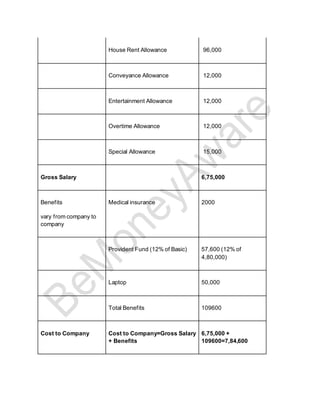
Table below shows sample salary structure
Description Component of Salary (per
annum or p.a)
Amount
Basic Salary Basic Salary 480,000
Allowances Dearness Allowance 48,000
House Rent Allowance 96,000
Conveyance Allowance 12,000
Entertainment Allowance 12,000
Overtime Allowance 12,000
Special Allowance 15,000
Gross Salary 6,75,000
Benefits
vary from company to
company
Medical insurance 2000
Provident Fund (12% of Basic) 57,600 (12% of
4,80,000)
Laptop 50,000
Total Benefits 109600
Cost to Company Cost to Company=Gross Salary
+ Benefits
6,75,000 +
109600=7,84,600
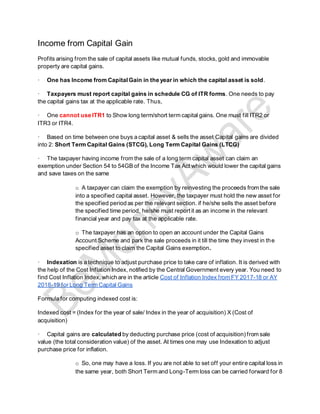
Income from Capital Gain
Profits arising from the sale of capital assets like mutual funds, stocks, gold and immovable
property are capital gains.
· One has Income from CapitalGain in the year in which the capital asset is sold.
· Taxpayers must report capital gains in schedule CG of ITR forms. One needs to pay
the capital gains tax at the applicable rate. Thus,
· One cannot use ITR1 to Show long term/short term capital gains. One must fill ITR2 or
ITR3 or ITR4.
· Based on time between one buys a capital asset & sells the asset Capital gains are divided
into 2: Short Term Capital Gains (STCG), Long Term Capital Gains (LTCG)
· The taxpayer having income from the sale of a long term capital asset can claim an
exemption under Section 54 to 54GB of the Income Tax Act which would lower the capital gains
and save taxes on the same
o A taxpayer can claim the exemption by reinvesting the proceeds from the sale
into a specified capital asset. However, the taxpayer must hold the new asset for
the specified period as per the relevant section. if he/she sells the asset before
the specified time period, he/she must report it as an income in the relevant
financial year and pay tax at the applicable rate.
o The taxpayer has an option to open an account under the Capital Gains
Account Scheme and park the sale proceeds in it till the time they invest in the
specified asset to claim the Capital Gains exemption.
· Indexation is a technique to adjust purchase price to take care of inflation. It is derived with
the help of the Cost Inflation Index, notified by the Central Government every year. You need to
find Cost Inflation Index, which are in the article Cost of Inflation Index from FY 2017-18 or AY
2018-19 for Long Term Capital Gains
Formula for computing indexed cost is:
Indexed cost = (Index for the year of sale/ Index in the year of acquisition) X (Cost of
acquisition)
· Capital gains are calculated by deducting purchase price (cost of acquisition) from sale
value (the total consideration value) of the asset. At times one may use Indexation to adjust
purchase price for inflation.
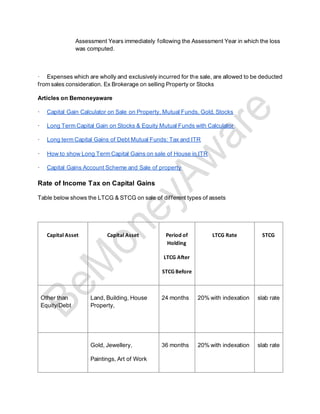
o So, one may have a loss. If you are not able to set off your entire capital loss in
the same year, both Short Term and Long-Term loss can be carried forward for 8
Assessment Years immediately following the Assessment Year in which the loss
was computed.
· Expenses which are wholly and exclusively incurred for the sale, are allowed to be deducted
from sales consideration. Ex Brokerage on selling Property or Stocks
Articles on Bemoneyaware
· Capital Gain Calculator on Sale on Property, Mutual Funds, Gold, Stocks
· Long Term Capital Gain on Stocks & Equity Mutual Funds with Calculator
· Long term Capital Gains of Debt Mutual Funds: Tax and ITR
· How to show Long Term Capital Gains on sale of House in ITR
· Capital Gains Account Scheme and Sale of property
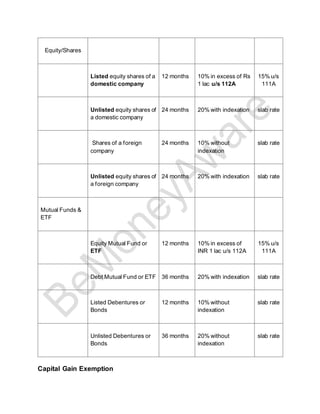
Rate of Income Tax on Capital Gains
Table below shows the LTCG & STCG on sale of different types of assets
Capital Asset Capital Asset Period of
Holding
LTCG After
STCGBefore
LTCG Rate STCG
Other than
Equity/Debt
Land, Building, House
Property,
24 months 20% with indexation slab rate
Gold, Jewellery,
Paintings, Art of Work
36 months 20% with indexation slab rate
Equity/Shares
Listed equity shares of a
domestic company
12 months 10% in excess of Rs
1 lac u/s 112A
15% u/s
111A
Unlisted equity shares of
a domestic company
24 months 20% with indexation slab rate
Shares of a foreign
company
24 months 10% without
indexation
slab rate
Unlisted equity shares of
a foreign company
24 months 20% with indexation slab rate
Mutual Funds &
ETF
Equity Mutual Fund or
ETF
12 months 10% in excess of
INR 1 lac u/s 112A
15% u/s
111A
Debt Mutual Fund or ETF 36 months 20% with indexation slab rate
Listed Debentures or
Bonds
12 months 10% without
indexation
slab rate
Unlisted Debentures or
Bonds
36 months 20% without
indexation
slab rate
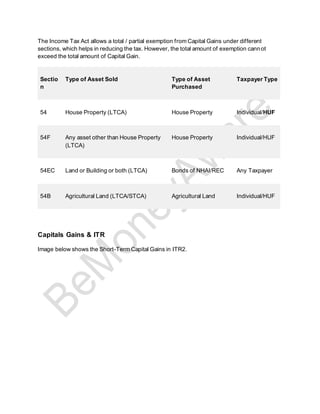
Capital Gain Exemption
The Income Tax Act allows a total / partial exemption from Capital Gains under different
sections, which helps in reducing the tax. However, the total amount of exemption cannot
exceed the total amount of Capital Gain.
Sectio
n
Type of Asset Sold Type of Asset
Purchased
Taxpayer Type
54 House Property (LTCA) House Property Individual/HUF
54F Any asset other than House Property
(LTCA)
House Property Individual/HUF
54EC Land or Building or both (LTCA) Bonds of NHAI/REC Any Taxpayer
54B Agricultural Land (LTCA/STCA) Agricultural Land Individual/HUF
Capitals Gains & ITR
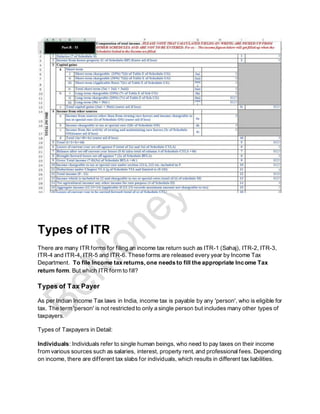
Image below shows the Short-Term Capital Gains in ITR2.
Types of ITR
There are many ITR forms for filing an income tax return such as ITR-1 (Sahaj), ITR-2, ITR-3,
ITR-4 and ITR-4, ITR-5 and ITR-6. These forms are released every year by Income Tax
Department. To file Income tax returns, one needs to fill the appropriate Income Tax
return form. But which ITR form to fill?
Types of Tax Payer
As per Indian Income Tax laws in India, income tax is payable by any 'person', who is eligible for
tax. The term 'person' is not restricted to only a single person but includes many other types of
taxpayers.
Types of Taxpayers in Detail:
Individuals: Individuals refer to single human beings, who need to pay taxes on their income
from various sources such as salaries, interest, property rent, and professional fees. Depending
on income, there are different tax slabs for individuals, which results in different tax liabilities.
Hindu Undivided Family (HUF): While not defined in tax laws, HUF is a term defined under the
Hindu personal law. HUF refers to a family including all persons who are descending from
common ancestors, wives of such people, and any daughters who are not married. An HUF is
considered as one entity or person, and the income of the HUF is charged as per individual tax
rates.
Company: For tax purposes, a company is a separate legal entity, which is distinct from its
shareholders. Companies can either be Indian or foreign. Taxes of incomes of companies are
calculated at flat tax rates, which are different from individual tax rates.
Firms: Firms refer to a partnership between two or more individuals, who have agreed to share
profits of the activity of the firm. A firm is liable to pay tax at a flat tax rate on its income. You
should note that a firm and its partners are separate entities for tax purposes.
LLP: Limited Liability Partnership is similar to a partnership firm. The key difference between the
two is that in a partnership firm, all the partners are equally liable for any legal claims against
the company or any of the other partners. Under an LLP, the partner's liability is restricted only
to their contribution in the LLP. For tax purposes, there's no difference between a partnership
and an LLP, and both have to pay tax at a flat rate, irrespective of their income.
Association of Persons (AOPs): Association of Personsrefersto two or more persons who
come together for an income-producing activity. In an AOP, the 'person' can even be a
company, and not necessarily an individual. Unlike a partnership firm, AOPs can operate even
without a formal written contract. So if two people come together for business without creating a
partnership firm, their firm will be called as Association of Persons. An AOP is a separate legal
entity with a different tax rate.
Body of Individuals (BOI): Body of Individuals is somewhat similar to an AOP. However, unlike
an AOP, which can also include companies or partnership firms, BOI can only have individuals
as 'persons.' Also, a BOI does not have a separate tax rate. Instead, the individuals, who are a
part of the BOI, pay tax on their income from BOI at their individual rates.
Co-operative societies: Co-operative societies refer to a group of people who come together for
meeting differentfinancial objectives. Some examples of co-operative societies are housing co-
operative societies and consumer co-operative societies. From a definition point of view, a co-
operative society is similar to AOPs. However, co-operative societies and AOPs have different
tax rates. Also, co-operative societies have many tax concessions when compared to AOPs.
Types of Resident
The taxability of the income of person depends on their residential status. The residential
status is different from the citizenship of a person. It depends on how many days one was
in India in the financial year. The residential status has to be determined for every financial
year for which income and taxes are computed.
Tax Residential Status in India Is Determined by No. Of Days Stayed Here Indians who are on
deputation overseas or have settled overseas -whether by way of acquiring a permanent
residency such as a green card in the US or acquiring citizenship of a foreign country -need to
be aware of their tax obligations in India.
Based on Residential Status, taxpayers are classified as
· Resident
· A resident not ordinarily resident (RNOR)
· A non-resident (NR)
How to find Residential Status?
An individual is said to be resident of India if one satisfies following both Basic Conditions:
· One should be India in the previous year for a period of 182 days or more, Or
· One has been in India for at least 365 days during four years preceding the previous year
and has been in India for at least 60 or more during Previous Year.
You should note that here 182 or so on days doesn’t means he should be in India for
continuously 182 days, he can be in India for 100 day then leave India, then come India for 2
days then again leave and then come for 80 days and so on. His total days in India is calculated
it can be with gaps too.
Tax based on Residential status
Indian Income: Indian income is always taxable in India irrespective of the residential status of
the taxpayer;
Foreign Income:
Foreign income is taxable in the hands of resident in case of a firm, co-operative society, an
association of persons, a body of individuals or resident and ordinarily resident in case of
individuals and HUFs in India.
Foreign income is not taxable in the hands of non-resident in India.
Also note that in a case of double taxation of income where the same income is getting taxed in
India as well as abroad, one may resort to the Double Taxation Avoidance Agreement (DTAA)
that India would have entered into with the other country in order to eliminate the possibility of
paying taxes twice.
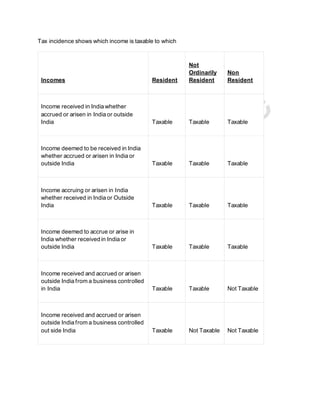
Tax incidence shows which income is taxable to which
Incomes Resident
Not
Ordinarily
Resident
Non
Resident
Income received in India whether
accrued or arisen in India or outside
India Taxable Taxable Taxable
Income deemed to be received in India
whether accrued or arisen in India or
outside India Taxable Taxable Taxable
Income accruing or arisen in India
whether received in India or Outside
India Taxable Taxable Taxable
Income deemed to accrue or arise in
India whether received in India or
outside India Taxable Taxable Taxable
Income received and accrued or arisen
outside India from a business controlled
in India Taxable Taxable Not Taxable
Income received and accrued or arisen
outside India from a business controlled
out side India Taxable Not Taxable Not Taxable
Income received and accrued or arisen
outside India from any other sources Taxable Not Taxable Not
Income accrued or arisen and received
outside India in earlier years but later on
remitted to India during the previous
Year
Not
Taxable Not Taxable Not Taxable
Example
DTAA
If an individual is a tax resident of one country but has a source of income from another country,
complexities can arise on who will tax the income or will income be tax twice.
Tax treaties ensure that the same income is not taxed twice. Double taxation is avoided in two
ways -either the country of non-tax residence exempts the income earned in the foreign country,
or the country of tax residence grants a foreign tax credit for the taxes paid in the other country .
India has entered into tax treaties with a hundred-odd countries, including US, UK, Canada,
Australia and Germany, which are popular destinations for the Indian diaspora.
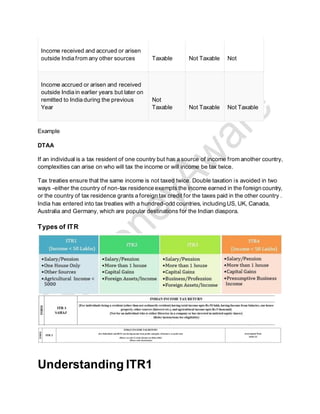
Types of ITR
Understanding ITR1
Income Tax YouTube video here.
The online ITR-1 form on the website is divided into tabs:
· General Instructions
· Part - A General Information
· Computation of Income and Tax
· Tax Details
· Taxes Paid & Verification
· Schedule DI
· Schedule 80D
· Donations -80G
· Donations - 80GGA
Before you start filling the form, it is important that you read the 'General Instructions'. This will
help you to know the format in which you are supposed to enter the data. For example, dates
must be entered in DD/MM/YYYY format.
New Income Tax Website: Features, Benefits, Look
and Feel
The Income Tax Department launched its new e-filing website www.incometax.gov.in on 7
June 2021 to provide a modern, seamless experience to taxpayers. In this article, we explore
the new Income Tax website for electronic filing of Income Tax Returns in detail.
The Income Tax Department launched its new e-filing website www.incometax.gov.in on 7
June 2021 to provide a modern, seamless experience to taxpayers. In this article, we explore
the new Income Tax website for electronic filing of Income Tax Returns in detail.
You can access the new e-filing website at www.incometax.gov.in.
A new mobile App to file ITR will be also launched soon.
The Finance Ministry has urged taxpayers/stakeholders to be patient after the launch of
the new portal “since this is a major transition”.
New Income Tax Website Features
The new income tax portal aims to simplify income tax return (ITR) filing and enable a taxpayer
to file ITR from one’s mobile phone as well.
Taxpayers can not only file ITRs but also raise complaints about refundsand other works with
the IT Department. Taxpayers can proactively update their profile to provide details of income
including salary, house property, business/profession which will be used in pre-filling their ITR.
The IT Department will utilize this website not only to process filed tax returns but also for
responding to taxpayers’ queries and giving orders like assessments, penalties, exemptions,
and appeals.
4200 crores were spent to update the new income tax website
Features of the New Income Tax Website
You can check out the guided tour of the website here
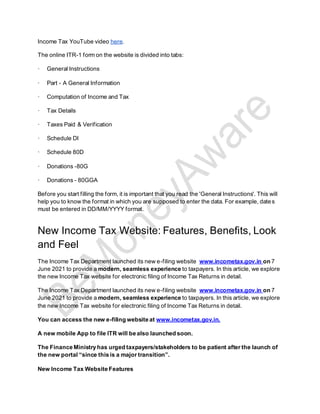
• Simple, Modern with Dark Mode
• New online payment system with multiple payment options like net banking, UPI, credit
card, and RTGS or NEFT from any account of the taxpayer in any bank, compared to
the existing system which only had UPI, Credit Card for payment of taxes.
• Detailed FAQs, User Manuals, Videos
• Chatbot/live agent at bottom right
• eVault facility
• New call center for taxpayer assistance for prompt response to taxpayer queries
• It has been developed by Infosys.
Features of the New Income Tax Website 2.0
Overview of Filing ITR for FY 2020-21
For details, You can read our article How to File ITR for FY 2020-2021
• Due to the Covid pandemic, the due date to file ITR has been extended to 30th
September 2021 this year.
• The employer is required to issue Form 16 to employees before 15th July
• Excel and Java offline Utility for filing ITR has been discontinued
• A new offline utility based on JSON is to be used.
• Choose Old and New Tax Regime for FY 2020-21
• One has to inform the Income Tax Department of his choice of Old or New Tax
Regime.
• Those with business Income have to file Form 10-IE electronically and give an
Acknowledgment number before filing
Look and Feelof the New Income Tax Website
The website is simple but modern. You can check out the guided tour of the website here
Chatbot also called as Tax genie is at the bottom right
It has Detailed FAQs, User Manuals, Videos
New Income Tax Website 2.0 has detailed FAQs, Videos, Light and Dark Mode
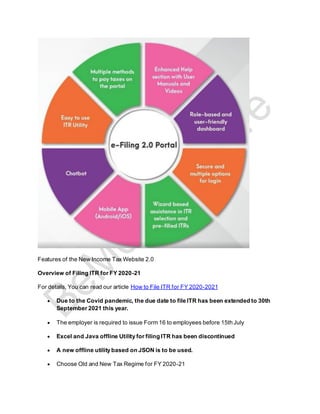
After Login the options are presented in a simple clean interface as shown in the image below.
One can
New Income Tax Website 2.0 is simple and clean
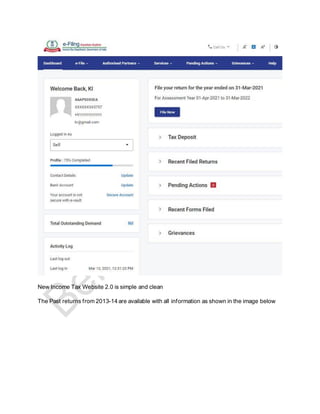
The Past returns from 2013-14 are available with all information as shown in the image below
View Past returns in New Income Tax Website 2.0
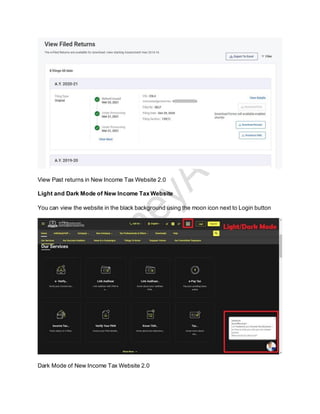
Light and Dark Mode of New Income Tax Website
You can view the website in the black background using the moon icon next to Login button
Dark Mode of New Income Tax Website 2.0
Feedback of the New Income Tax Website
After the launch,there was a backlash on Twitter.
The Finance Ministry has urged taxpayers/stakeholders to be patient after the launch of
the new portal “since this is a major transition”.
Many experts have criticized the wrong time of the launch. It also consumes a lot of data.
From Financial Express-News Article
CA Karan Batra, Founder and CEO CharteredClub.com, said, “Such a heavy site is being
made live in the peak season with so many bugs and errors is not something which the
taxpayers will appreciate.” May to October is the peak season, when there is a lot of load on
the income tax website, and from November to April, there is low traffic on the income tax
website
How to file ITR?
There are two ways to file ITR.
· Download the new utility from the e-filing website, fill in the information required, generate an
XML file and then upload it on the income tax department's e-filing website.
· 'Prepare and Submit Online'. Here you do not have to download any software utility as you
are required to enter the information directly on to the ITR form online and submit it on the
income tax e-filing website.
o Only those who are eligible to file ITR-1 or ITR-4 can file their return
using this option.
o Some information is prefilled. But if you spot any errors in these fields, then
you can edit them
Prefilled Information in ITR1
To make ITR filing process easier for taxpayers, the income tax department provides pre-filled
information, such as name, PAN, Aadhaar, salary details, to the taxpayers filing their tax return
online. Certain information such as address, mobile number, email ID and tax details from
Form-26AS will be pre-filled.
https://www.bemoneyaware.com/blog/quick-efile-itr1-itr4s-online/
File ITR online
To file ITR-1 online on the e-filing website of the income tax, you must be a registered user.
Once you have registered yourself, you can login to your account to file your ITR, using your
PAN as your user ID.
Don't forget to select the pre-validate bank account where you wish to receive your income
tax refund, if any. Also, select the bank accounts that are to be reported in while filing ITR.In
case you have closed any of your bank accounts in the previous FY, then you don't need to
select that account. Select the tick box under the 'Bank Account details' section if you wish to
file your ITR using a form in Hindi language.
After logging in to your account, you are required to select 'Filing of Income Tax Return' and you
will be re-directed to a new page where you will have to select the following from the drop-down
menu
Learn Income Tax Bemoneyaware
At bemoneyaware.com you will find all Information about Income Tax in simple terms
You can also buy the Income Tax Workbook which explains Income Tax in Simple terms and
helps you to file ITR
Thanks & Coupon Code
Thank you so much for buying this Free Guide about Income Tax
We hope you learn from the book!
If you find any mistakes, or have any feedback about what we should include more or remove
please drop us an email at bemoneyaware@gmail.com
If you didn’t like the book, please please do drop us an email at bemoneyaware@gmail.com
We have a small favor to ask – if you’re happy with our book, could you leave an online review
on Twitter/Facebook/YouTube or send email to bemoneyaware@gmail.com? It would mean the
world to us :)
As a way of saying thank you, we’re offering a 20% discount on your next purchase (book or
training), Discount Code: THANKSTAX20.
Cheers,
Bemoneyaware Team
Free-Income-Tax-Guide.pdf

Free-Income-Tax-Guide.pdf

  • 1.
    In this world,nothing can be said to be certain, except death and taxes.” –Benjamin Franklin ● A person doesn’t knowhow much he has to be thankful for until he has to pay taxes on it. ~Author Unknown ● Death and taxes may be inevitable, but they shouldn’t be related. ~J.C. Watts, Jr. ● The best things in life are free, but sooner or later the government will find a way to tax them. ~Author Unknown More at Tax: Jokes, Quotes,Tax was the reason America was founded
  • 2.
    Table of Contents IncomeTax Process 4 Old or New Tax Regime to choose with Calculator for Income Tax for FY 2020-21 5 Overview of Old tax system vs new 5 Tax Calculator choose old or new tax regime 6 Video on how to choose old or new Tax slab 6 CheckList of Documents/Information for Filing ITR1 10 Time Period of Income Financial Year, Assessment Year 11 Question: What is FY for the Income earned? 12 Question: What is the FY & AY of this ITR? 12 Question: What is the Assessment Year in Form 26AS? 12 Question: For which FY this Challan filed? 13 What Income Tax Slabs 15 Terms associated with Income Tax slabs 16 Examples of Income Tax Calculation 17 0% Tax Slab or No Tax 17 5% tax slab 17 20% tax slab 17 30% tax slab 18 30% tax slab + Surcharge 18 So how much tax would one pay? 19 Types of Income 20 Question on Income Tax 21 Income from Salary 21 Overview of Salary 21 Sample Salary 22 Salary in ITR 23 Terms associated with Salary 24 Basic Salary 24 Allowances 25 Perquisites 25 Difference between allowance and perquisites 25
  • 3.
    Standard Deduction 26 Benefits26 EPF 27 Professional Tax or Tax on employment 28 Income from Capital Gain 31 Rate of Income Tax on Capital Gains 32 Capital Gain Exemption 33 Capitals Gains & ITR 34 Types of ITR 35 Types of Tax Payer 35 Types of Resident 36 How to find Residential Status? 37 Tax based on Residential status 37 DTAA 39 Types of ITR 39 Understanding ITR1 39 New Income Tax Website: Features, Benefits, Look and Feel 40 Features of the New Income Tax Website 41 How to file ITR? 47 Prefilled Information in ITR1 47 File ITR online 47 Learn Income Tax Bemoneyaware 48
  • 4.
    Income Tax Process IncomeTax Process is given below. It is covered in details in How to file ITR Income Tax Return, Process, Income Tax Notices • Compute income (5 types: Income from Salary, Income from owning a house, Income from selling capital (Mutual Funds Stocks, Property/House, Gold), Income from Business/Profession,Income from other sources (Interest on Saving bank account, Interest on FD) • Check Exempt Income if any (PPF interest, EPF withdrawal after 5 years, Life Insurance payment) • Deduct valid deductions (under Chapter VI-A) 80C,80D etc. • Claim TDS already deducted (Check Form 26AS): Salary Income (Form 16), Interest on Fixed Deposit(Form 16A), Advance Tax paid(Challan 280) • Determine tax payable. Your net tax due should be 0. • Pay the Self-Assessment tax using Challan 280 if any • Update ITR. • Submit ITR. • E-verify ITR / Sending ITR-V • Wait for ITR to be Processed: Either ITR will be Processed / or you would get Notice
  • 5.
    Old or NewTax Regime to choose with Calculator for Income Tax for FY 2020-21 The income tax slabs have been restructured in Union Budget 2020-21. Now taxpayer has a choice to Take Deductions and stick with the old tax slabs and not take deductions and opt for new tax slabs. Which one should one choose? The image below shows the amount of deductions, at which old and new tax slabs are the same. if you are claiming deductions less than that amount go for the new regime and if you are claiming deductions more than that stick with the old regime. Unless you have a business income you can make this change any time. We also have given a calculator for you to compare the tax between the two regimes. Overview of Old tax system vs new Some Important Points about Old and New Tax Slabs • These tax slabs will be applicable from 1 Apr 2020 to 31 Mar 2021. • You have to choose old or new tax slab while filing Income Tax return form but plan accordingly beforehand(if you want to save). ITR for it will be filed by 31 July 2021(not 2020) • You can choose between the new and old tax regime in every financial year provided you do not have business income. Whether one should take old or new tax slabs for FY 2020-21 depends on the deductions one plans to take. Deductions like 1.5 lakh under 80C, Standard deduction of Rs 50,000 and LTA and HRA for salaried, Home Loan Interest.
  • 6.
    Tax Calculator chooseold or new tax regime Use the calculator to find which tax regime is better. Enter the Total Taxable Income, the deductions you claim and click on Calculate Button. It will show the tax under the new and old regime and which regime is better considering the old regime for those less than 60 years. Video on how to choose old or new Tax slab Our 7-minute video talks about how to choose old or new Tax slabs. Click on the link Choose the old or new tax regime for FY 2020-21 or the image
  • 7.
    To recap Income TaxFY 2020-21 with or without exemption Choose Old or New tax slabs in FY 2020-21 Related Articles: Understand Income Tax: What is Income Tax, TDS, Form 16, Challan 280 • Income Tax for FY 2019-20 or AY 2020-21
  • 8.
    • Income Taxfor FY 2020-21 AY 2021-22, Union budget What do you think of the new Tax Regime? Is it more confusing or has become easier? Will you go for old system or new system?
  • 10.
  • 11.
    Time Period ofIncome Financial Year, Assessment Year In India mostly we follow English Calendar from 1 Jan to 31 Dec. But for Income Tax, we use Financial Year, denoted by FY, which is from 1 April and 31 March. The income in one Financial earned gets assessed(checked) in the next Financial year which is called Assessment year denoted by AY. The income earned between 1 Apr 2020 to 31 Mar 2021 will be assessed after 1 Apr 2021. So, FY becomes 2020-21 while Assessment Year (AY) is 2021-22. The due date for filing ITR for FY 2020-21 or AY 2021-22 is 31 Jul 2021 Income Tax Return(ITR), Form 26AS, Income Tax Notices, Form 16, Challan 280 mostly use Assessment Year(AY) Details in our article Financial Year, Assessment Year Income Earned Between FY AY Due Date for filing ITR Last date for filing ITR Notes 1 Apr 2021 to 31 Mar 2022 FY 2021- 22 AY 2022- 23 31 Jul 2022 31 Mar 2023 Current Financial Year. Advance Tax to be paid 1 Apr 2020 to 31 Mar 2021 FY 2020- 21 AY 2021- 22 30 Sep 2021 31 Mar 2022 File ITR 1 Apr 2019 to 31 Mar 2020 FY 2019- 20 AY 2020- 21 10 Jan 2021 31 Mar 2021 Cannot file ITR. 1 Apr 2018 to 31 Mar 2019 FY 2018- 19 AY 2019- 20 31 Aug 2019 30 Jun 2020 Cannot file ITR.
  • 12.
    1 Apr 2017to 31 Mar 2018 FY 2017- 28 AY 2018- 29 31 Aug 2018 31 Mar 2019 Cannot file ITR. File Condonation request and pay Tax Liability Earlier Years Cannot file ITR. Question: What is FY for the Income earned? For income earned between 1 Apr 2020 to 31 Mar 2021 What is the FY? What is the AY? By when do you have to file ITR? Question: What is the FY & AY of this ITR? Question: What is the Assessment Year in Form 26AS? This Form 26AS is for which Assessment Year? Which Financial Year?
  • 13.
    Question: For whichFY this Challan filed? For which FY/AY year was the Self-Assessment Tax paid? When was the income earned?
  • 15.
    What Income TaxSlabs Not everyone in India pays the same Income Tax. A percentage of tax is charged based on total income, more the income more the tax. Hence income tax is called progressive. Over and above tax, cess & surcharge are also charged. Taxes on your Income depend on the following factors. · Your age (less than 60, Senior Citizen (between 60 – 80 years), Super-Senior(more than 80 · Your Total Income · Whether you are Resident of India or Not · Your status – Individual, Hindu Undivided Family, Business. Income Tax slabs keep on changing from year to year. Finance Minister announces them during the budget. Details in our article Income Tax Slabs Income Tax Slabs for FY2020-21 is shown below. The income tax rates are applied to the total annual income calculated.
  • 16.
    Surcharge: After thatSurcharge is applied on Tax amount. (Not the total income). If Income is above 50 lakhs, then one has to pay Surcharge. More the income, more the surcharge ● Above Rs.50,00,000 and up to Rs.1 crore – then 10% surcharge is applicable ● Above Rs.1 crore and up to Rs.2 crore – then 15% surcharge is applicable ● Between Rs.2 crores and up to Rs.5 crore –then 25% surcharge is applicable; ● For Above Rs. 5 crore – then 37% surcharge is applicable. Cess: is added to the tax payable: 4% for Health & Education is applicable to the income tax plus surcharge. Cess is a tax that is levied by the government to raise funds for a pre-decided purpose. Collections from the Education Cess and the Secondary and Higher Education Cess, for instance, are supposed to be used for funding primary and higher and secondary education respectively. Likewise, money collected from the Krishi Kalyan Cess is to be used for funding agri development initiatives. Terms associated with Income Tax slabs Basic Exemption Limit or Tax Exemption Limit is that amount of income upto which the assessee will not have to pay Income Tax. Any income in excess of this limit will be subjected to Income Tax. Rebate or Section 87A allows tax rebate to Individuals whose total annual income falls below Rs.5,00,000. This rebate is limited to Rs.12,500 and essentially acquits people from having to pay taxes under Rs.5,00,000, However, the return of income has to be filed if income is over Rs.2,50,000. Individuals with income exceeding Rs.5,00,000/- do not get the benefit of any rebate under section 87A Investments under Section 80C can be made up to the tune of Rs.1,50,000 in different investments such as PPF, NSC, etc. and an additional Rs.50,000/- under Section 80 CCD(1B) in NPS can be made.
  • 17.
    Examples of IncomeTax Calculation 0% Tax Slab or No Tax If a person of less than 60 years has a total income of less than 2.5 lakhs in FY 2019-20, then he does not have to pay any tax on it. This is called the basic exemption limit 5% tax slab 5% of (taxable income – 2,50,000) If a person has total taxable income of 4 lakh in FY 2019-20. Then His taxable income: Rs 4,00,000 His income slab = 5% Basic exemption = 2,50,000 Tax on his income = 5% of his income exceeding basic exemption = 5% of (400000 – 250000) = 5% of 150000 =7500. On tax he needs to pay surcharge (0%) and education cess (total 4%) = 4% of 7500 = 300 Total tax he is liable to pay = 7500+300 = 7800 20% tax slab
  • 18.
    20% Tax Slabis for total income Above ₹ 5,00,000 and upto ₹ 10,00,000. Rs 12,500 + 20% of (taxable income – 5,00,000) If a person has total income of 8 lakh. Then His income slab = 20% Income chargeable at 0% (Exemption limit) 2,50,000 Income chargeable at 5% of 250000(5 lakh -2.5 lakh) = 12500 Income chargeable at 20% of 3,00,000 (8 lakh – 5 lakh) =60,000 So Total Income tax is 12,500 + 60,000=72,500 On tax he needs to pay surcharge (0%) and education cess (total 4%) = 3% of 72,500 = 2175 Total tax he is liable to pay = 72,500+2175 = 74,675 30% tax slab 30% Tax Slab is for total income Above ₹ 10,00,000. If a person has total income of 18 lakh. Then His income slab = 30% Income chargeable at 0% (Exemption limit) 2,50,000 Income chargeable at 5% of 250000(5 lakh -2.5 lakh) = 12,500 Income chargeable at 20% of 5 lakh(10 lakh – 5 lakh) =1,00,000 Income chargeable at 30% of 8 lakh(18 lakh – 10 lakh) =2,40,000 So Total Income tax is 12,500 + 1,00,000+2,40,000=3,52,500 On tax he needs to pay surcharge (0%) and education cess (total 4%) = 4% of 3,52,500= 14,100 Total tax he is liable to pay = 14,100+3,52,500 = 3,66,600 30% tax slab + Surcharge If a person has total income of 54 lakh. Then His income slab = 30% Surcharge at 10% is for income between 50 lakhs- 1crore Income chargeable at 0% (Exemption limit) 2,50,000 Income chargeable at 5% of 250000(5 lakh -2.5 lakh) = 12,500
  • 19.
    Income chargeable at20% of 5 lakh(10 lakh – 5 lakh) =1,00,000 Income chargeable at 30% of 44 lakh(54 lakh – 10 lakh) = 13,20,000 So Total Income tax is 12,500 + 1,00,000+10,20,000=14,32,500 Surcharge is 10% of 14,32,500 = 1,43,250 On tax he needs to education cess (total 4%) = 4% of (14,32,500+1,43,250)= 63,030 Total tax he is liable to pay = 14,32,500+1,43,250+63,030= 16,38,780 Use Income Tax Calculator So how much tax would one pay? How much tax would one pay with a total income of 2,88,000 pay? How much tax would one pay with a total income of 7,00,000 pay? Ans: 52,500+2,100=54,600 How much tax would one pay with a total income of 11,50,000 pay? Ans: 1,57,500+6,300=1,63,800 How much tax would one pay with a total income of 25,50,000 pay? Ans: 5,77,500+23,100=6,00,600 How much tax would one pay with a total income of 62,000 pay? Ans:0 How much tax would one pay with a total income of 63,00,000 pay? Ans: 17,02,500+1,70,250+74,910=19,47,660 How much tax would one pay with a total income of 1,50,00,000 pay? Ans: 43,12,500+6,46,875+1,98,375=51,57,750
  • 20.
    Types of Income Incomeis classified into the following categories known as Heads of Income. · Income from Salary: o Salary is what is received by an employee from an employer in cash, kind or as a facility [perquisite]. o Pension is also considered as salary. The Pension is normally paid a periodical payment on a monthly basis which is fully taxable, under the head Income from Salary, in the hand of the employee, whether Government employee or non-government employee. o Our article Senior Citizen : Income and Tax discusses it in detail · Income from House Property: o Income earned from rent of residential or commercial property. o If one has taken home loan to buy a property, then interest payment is also considered as negative Income from House Property o Our article Income from House Property and Income Tax Return discusses it in detail. · Income from Profits and Gains of Profession or Business: Income earned from freelancing, contracting, for doctors, CA,lawyers, by bloggers, YouTubers etc. · Income from Capital Gains: Income earned from the sale of capital assets, like mutual funds, shares, land, house. · Income from Other Sources: Interest earned from savings accounts, fixed deposits, winning lottery etc. Any income which does not fall in any category comes under this · Exempt Income: Exempt Income, is the income that is not taxable. Even though these are tax-free, all exempt incomes must be mentioned in the tax return. Our article Exempt Income and Income Tax Return discusses it in detail.
  • 21.
    Question on IncomeTax Bharti is a salaried employee below 60 years of age, resident of India. Income from salary is Rs 8,00,000. She received Rs 4,000 as interest from her saving bank account. She has a Fixed Deposit of 5 lakhs in which she receives 33,710.20 as interest in FY 2019-20. (Her FD will mature on 3 Feb 2021). She has invested in ELSS funds of amount 50,000 Rs She lives in a rented house and gets HRA. What types of Income does Bharti have? Income from Salary Overview of Salary
  • 22.
    When a personworks for someone else or company one is then said to hold a job and is called Employee. The person or the company one works for is called Employer. Money that is paid is called as Salary or Income or Wage. Salary = Basic Salary + Dearness allowance(optional) + Other Allowances + Perquisite+ Benefits A payslip is a document issued by an employer to an employee which shows how much money an employee has earned and how much tax or insurance etc. has been deducted. TDS & Form 16: One gets the salary after tax is deducted by the employer. This process is called as Tax Deduction at Source (TDS). Company must issue a Form 16 which contains the details about the salary earned by that employee and how much tax deducted. The Tax deducted (TDS) is paid to the government by the company. Form 16 is the proof of employee’s income and tax paid to the govt. More details about Form 16 here. Form 12BB: From June 1, 2016, all salaried taxpayers have to submit Form 12BB to claim income tax deductions on leave travel allowance concession (LTA), house rent allowance (HRA) ,interest paid on home loans and Income tax . Our article Form 12BB for claiming Income Tax Deductions by Employees explains it in detail. Form 26AS has the details of all the tax deducted and deposited against one’s PAN Often an employer talks about CTC (Cost To Company). CTC is the total expense incurred by the employer in hiring an employee. Salary is actual payment received by the employee. It is around 60% of CTC. Sample Salary Description Component of Salary (per annum or p.a) Amount Basic Salary Basic Salary 480,000 Allowances Dearness Allowance 48,000 House Rent Allowance 96,000
  • 23.
    Conveyance Allowance 12,000 EntertainmentAllowance 12,000 Overtime Allowance 12,000 Special Allowance 15,000 Gross Salary 6,75,000 Benefits vary from company to company Medical insurance 2000 Provident Fund (12% of Basic) 57,600 (12% of 4,80,000) Laptop 50,000 Total Benefits 109600 Cost to Company Cost to Company=Gross Salary + Benefits 6,75,000 + 109600=7,84,600 Salary in ITR This is how it is shown in the income tax return
  • 24.
    Allowances in ITRare shown in the image below Terms associated with Salary When a person works for someone else or company one is then said to hold a job and is called Employee. The person or the company one works for is called Employer. Money that is paid is called as Salary or Income or Wage. Salary = Basic Salary + Dearness allowance(optional) + Other Allowances + Perquisite+ Benefits Basic Salary Basic Salary: This is the basic and main component of income. The percentage of Basic differs from company to company. It is the basis for the calculation of various other components of the payslip. Basic is fully taxable.
  • 25.
    Within a company,Basic Salary generally depends on one’s designation. Any increment in the salary is expressed as percentage of Basic salary. Allowances Allowances are fixed periodic amounts, apart from salary, which are paid by an employer for the purpose of meeting some requirements of the employee. E.g., Tiffin allowance, transport allowance, uniform allowance, etc. Some examples of Allowances are given below. These allowances appear in Form 16(Part B) · Dearness Allowance (DA): Dearness Allowance should neither be high nor low. It is paid to reduce the impact of inflation on the employee. In some companies, DA is an optional head of salary. Government employees receive Dearness Allowance · House Rent Allowance (HRA): It is an allowance to pay out the house rent of the employees. Employees can claim exemption on this by submitting rent receipts. · Conveyance Allowance: It is an allowance for an employee to cover his / her expenses of travel from home to work and work to home. · Other Allowances: There can be various other allowances according to the company policies. These can be uniform allowance, special allowance, city conveyance allowance, child education allowance, etc. Perquisites Perquisites are benefits received by a person as a result of his/her official position and are over and above the salary or wages. These perquisitescan be taxable or non-taxable depending upon their nature. They are found in Form 16, Part B & Form 12BA which gives detail. Example of perquisites in Form 12BA are shown below What is the value of perquisites in Form 16 (Part B) as shown in the image below Can you name the perquisites and value found in Form? Difference between allowance and perquisites ALLOWANCE PERQUISITES
  • 26.
    A fixed amountof money given periodically in addition to the salary Small benefits offered by the employers in addition to the normal salary at free of cost It is taxable on due / accrued basis whether it is paid in addition to the salary or in lieu thereon It is taxable in the hands of employees. For example; Uniform allowance, transportation allowance, telephone allowance For example; Rent free accommodation, free electricity, and water supply Standard Deduction The standard deduction of Rs 50,000 is available for salaried individual and pensioners for FY 2019-20(For FY 2018-19 standard deduction was Rs 40,000.) The standard deduction of Rs 50,000 is essentially a flat amount subtracted from the salary income before calculation of taxable income. As one uses Standard deduction, Medical reimbursement and transport allowance were removed but one can claim Allowances like Leave Travel Allowance (LTA), House Rent Allowance(HRA). Benefits In addition to salary and various allowances, the employer also provides various benefits to an individual to save for retirement (Employer Provident Fund (EPF) or Corporate NPS)), many available at the time of leaving the organization such as Gratuity, Leave Encashment, Superannuation benefits. · Provident Fund (PF): It provides retirement benefits or savings to the employee. PF is calculated on (Basic+DA) (Cut-off at Rs. 15,000). Only employee contribution of 12% on (Basic+DA) can be seen in the payslip of the employee.
  • 27.
    · Employees’ StateInsurance (ESI) : It provides medical facilities to all eligible employees. The deduction towards ESI compulsory. The cut off is Rs. 21000. The employee contributes 1.75% on gross salary. · Superannuation is a retirement benefit that is offered to employees by the employer, pension for employee post-retirement. Companies open a superannuation benefit fund with any of the approved insurance companies. The employer contributes every year, a fixed percentage of your basic pay plus dearness allowance, on your behalf towards the group superannuation policy held by the employer. Professional Tax (PT):It is a tax collected by the state government from all salaried employees. PT depends on state to state government. It is calculated on the gross earnings of the employee. Gross earnings are the sum of all income. Tax Deducted at Source (TDS): The amount of tax deducted by the employer on behalf of the Income Tax Department from the salary of the employee. EPF The Employee Provident Fund (EPF) is a retirement benefits scheme in which employees of an organization contribute a small portion of their basic pay (12%) monthly. The employer also contributes a similar amount on their behalf towards the EPS, EPS (employee Pension scheme, upto 1250) & Every employee is allotted a unique Universal Account Number (UAN) by the Employee Provident Fund Organisation (EPFO). The employee's EPF account is linked with the UAN which is valid throughout the employee'slife. EPF contribution show up in Form 16(Part B) and employee contribution gets benefit under 80C deduction upto 1.5 lakhs. Table below gives the rates of contribution of EPF, EPS, EDLI, Admin charges in India. Scheme Name Employee contribution Employer contribution Employee provident fund 12% 3.67% Employees’ Pension scheme 0 8.33%
  • 28.
    Employees Deposit linked insurance 00.5%(capped at a maximum of Rs 15,000) EPF Administrative charges 0 0.85% (From Jan 2015) 1.1% (Earlier) PF Admin account 1.1% EDLIS Administrative charges 0 0.01% Can you find out how much EPF contribution was done by Employee as per Form 16(Part B) Professional Tax or Tax on employment Professional Tax or Tax on employment is a tax on some professions, business.
  • 29.
    Every state hasits own laws and regulations to govern professional tax of that state under Article 276 of the Constitution.However, all the states do follow slab system based on the income to levy professional tax. For example, Professional tax rate slabs in Karnataka are shown in table below. The maximum amount of professional tax that can be levied by a state is Rs 2,500. It is usually deducted by the employer and deposited with the state government. In your income tax return, professional tax is allowed as a deduction from your salary income. One should verify Professional Tax in Form 16(PartB) Monthly salary/wage upto Rs 15,000 NIL Monthly salary/wage > Rs 15,000 Rs 200 per month Professional tax in Form 16 Day 5: Table below shows sample salary structure Description Component of Salary (per annum or p.a) Amount Basic Salary Basic Salary 480,000 Allowances Dearness Allowance 48,000
  • 30.
    House Rent Allowance96,000 Conveyance Allowance 12,000 Entertainment Allowance 12,000 Overtime Allowance 12,000 Special Allowance 15,000 Gross Salary 6,75,000 Benefits vary from company to company Medical insurance 2000 Provident Fund (12% of Basic) 57,600 (12% of 4,80,000) Laptop 50,000 Total Benefits 109600 Cost to Company Cost to Company=Gross Salary + Benefits 6,75,000 + 109600=7,84,600
  • 31.
    Income from CapitalGain Profits arising from the sale of capital assets like mutual funds, stocks, gold and immovable property are capital gains. · One has Income from CapitalGain in the year in which the capital asset is sold. · Taxpayers must report capital gains in schedule CG of ITR forms. One needs to pay the capital gains tax at the applicable rate. Thus, · One cannot use ITR1 to Show long term/short term capital gains. One must fill ITR2 or ITR3 or ITR4. · Based on time between one buys a capital asset & sells the asset Capital gains are divided into 2: Short Term Capital Gains (STCG), Long Term Capital Gains (LTCG) · The taxpayer having income from the sale of a long term capital asset can claim an exemption under Section 54 to 54GB of the Income Tax Act which would lower the capital gains and save taxes on the same o A taxpayer can claim the exemption by reinvesting the proceeds from the sale into a specified capital asset. However, the taxpayer must hold the new asset for the specified period as per the relevant section. if he/she sells the asset before the specified time period, he/she must report it as an income in the relevant financial year and pay tax at the applicable rate. o The taxpayer has an option to open an account under the Capital Gains Account Scheme and park the sale proceeds in it till the time they invest in the specified asset to claim the Capital Gains exemption. · Indexation is a technique to adjust purchase price to take care of inflation. It is derived with the help of the Cost Inflation Index, notified by the Central Government every year. You need to find Cost Inflation Index, which are in the article Cost of Inflation Index from FY 2017-18 or AY 2018-19 for Long Term Capital Gains Formula for computing indexed cost is: Indexed cost = (Index for the year of sale/ Index in the year of acquisition) X (Cost of acquisition) · Capital gains are calculated by deducting purchase price (cost of acquisition) from sale value (the total consideration value) of the asset. At times one may use Indexation to adjust purchase price for inflation. o So, one may have a loss. If you are not able to set off your entire capital loss in the same year, both Short Term and Long-Term loss can be carried forward for 8
  • 32.
    Assessment Years immediatelyfollowing the Assessment Year in which the loss was computed. · Expenses which are wholly and exclusively incurred for the sale, are allowed to be deducted from sales consideration. Ex Brokerage on selling Property or Stocks Articles on Bemoneyaware · Capital Gain Calculator on Sale on Property, Mutual Funds, Gold, Stocks · Long Term Capital Gain on Stocks & Equity Mutual Funds with Calculator · Long term Capital Gains of Debt Mutual Funds: Tax and ITR · How to show Long Term Capital Gains on sale of House in ITR · Capital Gains Account Scheme and Sale of property Rate of Income Tax on Capital Gains Table below shows the LTCG & STCG on sale of different types of assets Capital Asset Capital Asset Period of Holding LTCG After STCGBefore LTCG Rate STCG Other than Equity/Debt Land, Building, House Property, 24 months 20% with indexation slab rate Gold, Jewellery, Paintings, Art of Work 36 months 20% with indexation slab rate
  • 33.
    Equity/Shares Listed equity sharesof a domestic company 12 months 10% in excess of Rs 1 lac u/s 112A 15% u/s 111A Unlisted equity shares of a domestic company 24 months 20% with indexation slab rate Shares of a foreign company 24 months 10% without indexation slab rate Unlisted equity shares of a foreign company 24 months 20% with indexation slab rate Mutual Funds & ETF Equity Mutual Fund or ETF 12 months 10% in excess of INR 1 lac u/s 112A 15% u/s 111A Debt Mutual Fund or ETF 36 months 20% with indexation slab rate Listed Debentures or Bonds 12 months 10% without indexation slab rate Unlisted Debentures or Bonds 36 months 20% without indexation slab rate Capital Gain Exemption
  • 34.
    The Income TaxAct allows a total / partial exemption from Capital Gains under different sections, which helps in reducing the tax. However, the total amount of exemption cannot exceed the total amount of Capital Gain. Sectio n Type of Asset Sold Type of Asset Purchased Taxpayer Type 54 House Property (LTCA) House Property Individual/HUF 54F Any asset other than House Property (LTCA) House Property Individual/HUF 54EC Land or Building or both (LTCA) Bonds of NHAI/REC Any Taxpayer 54B Agricultural Land (LTCA/STCA) Agricultural Land Individual/HUF Capitals Gains & ITR Image below shows the Short-Term Capital Gains in ITR2.
  • 35.
    Types of ITR Thereare many ITR forms for filing an income tax return such as ITR-1 (Sahaj), ITR-2, ITR-3, ITR-4 and ITR-4, ITR-5 and ITR-6. These forms are released every year by Income Tax Department. To file Income tax returns, one needs to fill the appropriate Income Tax return form. But which ITR form to fill? Types of Tax Payer As per Indian Income Tax laws in India, income tax is payable by any 'person', who is eligible for tax. The term 'person' is not restricted to only a single person but includes many other types of taxpayers. Types of Taxpayers in Detail: Individuals: Individuals refer to single human beings, who need to pay taxes on their income from various sources such as salaries, interest, property rent, and professional fees. Depending on income, there are different tax slabs for individuals, which results in different tax liabilities.
  • 36.
    Hindu Undivided Family(HUF): While not defined in tax laws, HUF is a term defined under the Hindu personal law. HUF refers to a family including all persons who are descending from common ancestors, wives of such people, and any daughters who are not married. An HUF is considered as one entity or person, and the income of the HUF is charged as per individual tax rates. Company: For tax purposes, a company is a separate legal entity, which is distinct from its shareholders. Companies can either be Indian or foreign. Taxes of incomes of companies are calculated at flat tax rates, which are different from individual tax rates. Firms: Firms refer to a partnership between two or more individuals, who have agreed to share profits of the activity of the firm. A firm is liable to pay tax at a flat tax rate on its income. You should note that a firm and its partners are separate entities for tax purposes. LLP: Limited Liability Partnership is similar to a partnership firm. The key difference between the two is that in a partnership firm, all the partners are equally liable for any legal claims against the company or any of the other partners. Under an LLP, the partner's liability is restricted only to their contribution in the LLP. For tax purposes, there's no difference between a partnership and an LLP, and both have to pay tax at a flat rate, irrespective of their income. Association of Persons (AOPs): Association of Personsrefersto two or more persons who come together for an income-producing activity. In an AOP, the 'person' can even be a company, and not necessarily an individual. Unlike a partnership firm, AOPs can operate even without a formal written contract. So if two people come together for business without creating a partnership firm, their firm will be called as Association of Persons. An AOP is a separate legal entity with a different tax rate. Body of Individuals (BOI): Body of Individuals is somewhat similar to an AOP. However, unlike an AOP, which can also include companies or partnership firms, BOI can only have individuals as 'persons.' Also, a BOI does not have a separate tax rate. Instead, the individuals, who are a part of the BOI, pay tax on their income from BOI at their individual rates. Co-operative societies: Co-operative societies refer to a group of people who come together for meeting differentfinancial objectives. Some examples of co-operative societies are housing co- operative societies and consumer co-operative societies. From a definition point of view, a co- operative society is similar to AOPs. However, co-operative societies and AOPs have different tax rates. Also, co-operative societies have many tax concessions when compared to AOPs. Types of Resident The taxability of the income of person depends on their residential status. The residential status is different from the citizenship of a person. It depends on how many days one was
  • 37.
    in India inthe financial year. The residential status has to be determined for every financial year for which income and taxes are computed. Tax Residential Status in India Is Determined by No. Of Days Stayed Here Indians who are on deputation overseas or have settled overseas -whether by way of acquiring a permanent residency such as a green card in the US or acquiring citizenship of a foreign country -need to be aware of their tax obligations in India. Based on Residential Status, taxpayers are classified as · Resident · A resident not ordinarily resident (RNOR) · A non-resident (NR) How to find Residential Status? An individual is said to be resident of India if one satisfies following both Basic Conditions: · One should be India in the previous year for a period of 182 days or more, Or · One has been in India for at least 365 days during four years preceding the previous year and has been in India for at least 60 or more during Previous Year. You should note that here 182 or so on days doesn’t means he should be in India for continuously 182 days, he can be in India for 100 day then leave India, then come India for 2 days then again leave and then come for 80 days and so on. His total days in India is calculated it can be with gaps too. Tax based on Residential status Indian Income: Indian income is always taxable in India irrespective of the residential status of the taxpayer; Foreign Income: Foreign income is taxable in the hands of resident in case of a firm, co-operative society, an association of persons, a body of individuals or resident and ordinarily resident in case of individuals and HUFs in India. Foreign income is not taxable in the hands of non-resident in India. Also note that in a case of double taxation of income where the same income is getting taxed in India as well as abroad, one may resort to the Double Taxation Avoidance Agreement (DTAA) that India would have entered into with the other country in order to eliminate the possibility of paying taxes twice.
  • 38.
    Tax incidence showswhich income is taxable to which Incomes Resident Not Ordinarily Resident Non Resident Income received in India whether accrued or arisen in India or outside India Taxable Taxable Taxable Income deemed to be received in India whether accrued or arisen in India or outside India Taxable Taxable Taxable Income accruing or arisen in India whether received in India or Outside India Taxable Taxable Taxable Income deemed to accrue or arise in India whether received in India or outside India Taxable Taxable Taxable Income received and accrued or arisen outside India from a business controlled in India Taxable Taxable Not Taxable Income received and accrued or arisen outside India from a business controlled out side India Taxable Not Taxable Not Taxable
  • 39.
    Income received andaccrued or arisen outside India from any other sources Taxable Not Taxable Not Income accrued or arisen and received outside India in earlier years but later on remitted to India during the previous Year Not Taxable Not Taxable Not Taxable Example DTAA If an individual is a tax resident of one country but has a source of income from another country, complexities can arise on who will tax the income or will income be tax twice. Tax treaties ensure that the same income is not taxed twice. Double taxation is avoided in two ways -either the country of non-tax residence exempts the income earned in the foreign country, or the country of tax residence grants a foreign tax credit for the taxes paid in the other country . India has entered into tax treaties with a hundred-odd countries, including US, UK, Canada, Australia and Germany, which are popular destinations for the Indian diaspora. Types of ITR Understanding ITR1
  • 40.
    Income Tax YouTubevideo here. The online ITR-1 form on the website is divided into tabs: · General Instructions · Part - A General Information · Computation of Income and Tax · Tax Details · Taxes Paid & Verification · Schedule DI · Schedule 80D · Donations -80G · Donations - 80GGA Before you start filling the form, it is important that you read the 'General Instructions'. This will help you to know the format in which you are supposed to enter the data. For example, dates must be entered in DD/MM/YYYY format. New Income Tax Website: Features, Benefits, Look and Feel The Income Tax Department launched its new e-filing website www.incometax.gov.in on 7 June 2021 to provide a modern, seamless experience to taxpayers. In this article, we explore the new Income Tax website for electronic filing of Income Tax Returns in detail. The Income Tax Department launched its new e-filing website www.incometax.gov.in on 7 June 2021 to provide a modern, seamless experience to taxpayers. In this article, we explore the new Income Tax website for electronic filing of Income Tax Returns in detail. You can access the new e-filing website at www.incometax.gov.in. A new mobile App to file ITR will be also launched soon. The Finance Ministry has urged taxpayers/stakeholders to be patient after the launch of the new portal “since this is a major transition”. New Income Tax Website Features
  • 41.
    The new incometax portal aims to simplify income tax return (ITR) filing and enable a taxpayer to file ITR from one’s mobile phone as well. Taxpayers can not only file ITRs but also raise complaints about refundsand other works with the IT Department. Taxpayers can proactively update their profile to provide details of income including salary, house property, business/profession which will be used in pre-filling their ITR. The IT Department will utilize this website not only to process filed tax returns but also for responding to taxpayers’ queries and giving orders like assessments, penalties, exemptions, and appeals. 4200 crores were spent to update the new income tax website Features of the New Income Tax Website You can check out the guided tour of the website here • Simple, Modern with Dark Mode • New online payment system with multiple payment options like net banking, UPI, credit card, and RTGS or NEFT from any account of the taxpayer in any bank, compared to the existing system which only had UPI, Credit Card for payment of taxes. • Detailed FAQs, User Manuals, Videos • Chatbot/live agent at bottom right • eVault facility • New call center for taxpayer assistance for prompt response to taxpayer queries • It has been developed by Infosys.
  • 42.
    Features of theNew Income Tax Website 2.0 Overview of Filing ITR for FY 2020-21 For details, You can read our article How to File ITR for FY 2020-2021 • Due to the Covid pandemic, the due date to file ITR has been extended to 30th September 2021 this year. • The employer is required to issue Form 16 to employees before 15th July • Excel and Java offline Utility for filing ITR has been discontinued • A new offline utility based on JSON is to be used. • Choose Old and New Tax Regime for FY 2020-21
  • 43.
    • One hasto inform the Income Tax Department of his choice of Old or New Tax Regime. • Those with business Income have to file Form 10-IE electronically and give an Acknowledgment number before filing Look and Feelof the New Income Tax Website The website is simple but modern. You can check out the guided tour of the website here Chatbot also called as Tax genie is at the bottom right It has Detailed FAQs, User Manuals, Videos New Income Tax Website 2.0 has detailed FAQs, Videos, Light and Dark Mode After Login the options are presented in a simple clean interface as shown in the image below. One can
  • 44.
    New Income TaxWebsite 2.0 is simple and clean The Past returns from 2013-14 are available with all information as shown in the image below
  • 45.
    View Past returnsin New Income Tax Website 2.0 Light and Dark Mode of New Income Tax Website You can view the website in the black background using the moon icon next to Login button Dark Mode of New Income Tax Website 2.0
  • 46.
    Feedback of theNew Income Tax Website After the launch,there was a backlash on Twitter. The Finance Ministry has urged taxpayers/stakeholders to be patient after the launch of the new portal “since this is a major transition”. Many experts have criticized the wrong time of the launch. It also consumes a lot of data. From Financial Express-News Article CA Karan Batra, Founder and CEO CharteredClub.com, said, “Such a heavy site is being made live in the peak season with so many bugs and errors is not something which the taxpayers will appreciate.” May to October is the peak season, when there is a lot of load on the income tax website, and from November to April, there is low traffic on the income tax website
  • 47.
    How to fileITR? There are two ways to file ITR. · Download the new utility from the e-filing website, fill in the information required, generate an XML file and then upload it on the income tax department's e-filing website. · 'Prepare and Submit Online'. Here you do not have to download any software utility as you are required to enter the information directly on to the ITR form online and submit it on the income tax e-filing website. o Only those who are eligible to file ITR-1 or ITR-4 can file their return using this option. o Some information is prefilled. But if you spot any errors in these fields, then you can edit them Prefilled Information in ITR1 To make ITR filing process easier for taxpayers, the income tax department provides pre-filled information, such as name, PAN, Aadhaar, salary details, to the taxpayers filing their tax return online. Certain information such as address, mobile number, email ID and tax details from Form-26AS will be pre-filled. https://www.bemoneyaware.com/blog/quick-efile-itr1-itr4s-online/ File ITR online To file ITR-1 online on the e-filing website of the income tax, you must be a registered user. Once you have registered yourself, you can login to your account to file your ITR, using your PAN as your user ID. Don't forget to select the pre-validate bank account where you wish to receive your income tax refund, if any. Also, select the bank accounts that are to be reported in while filing ITR.In case you have closed any of your bank accounts in the previous FY, then you don't need to select that account. Select the tick box under the 'Bank Account details' section if you wish to file your ITR using a form in Hindi language. After logging in to your account, you are required to select 'Filing of Income Tax Return' and you will be re-directed to a new page where you will have to select the following from the drop-down menu
  • 48.
    Learn Income TaxBemoneyaware At bemoneyaware.com you will find all Information about Income Tax in simple terms You can also buy the Income Tax Workbook which explains Income Tax in Simple terms and helps you to file ITR Thanks & Coupon Code Thank you so much for buying this Free Guide about Income Tax We hope you learn from the book! If you find any mistakes, or have any feedback about what we should include more or remove please drop us an email at bemoneyaware@gmail.com If you didn’t like the book, please please do drop us an email at bemoneyaware@gmail.com We have a small favor to ask – if you’re happy with our book, could you leave an online review on Twitter/Facebook/YouTube or send email to bemoneyaware@gmail.com? It would mean the world to us :) As a way of saying thank you, we’re offering a 20% discount on your next purchase (book or training), Discount Code: THANKSTAX20. Cheers, Bemoneyaware Team