PMP EXAM
SAMPLE Q & A
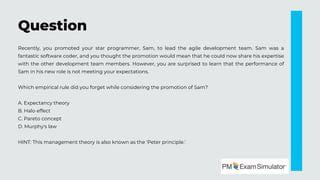
Recently, you promoted your star programmer, Sam, to lead the agile development team. Sam was a
fantastic software coder, and you thought the promotion would mean that he could now share his expertise
with the other development team members. However, you are surprised to learn that the performance of
Sam in his new role is not meeting your expectations.
Which empirical rule did you forget while considering the promotion of Sam?
A. Expectancy theory
B. Halo effect
C. Pareto concept
D. Murphy's law
HINT: This management theory is also known as the 'Peter principle.'
Question
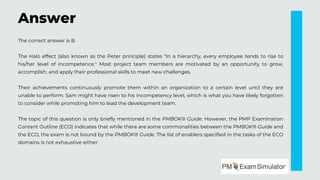
The correct answer is B.
The Halo effect (also known as the Peter principle) states "In a hierarchy, every employee tends to rise to
his/her level of incompetence." Most project team members are motivated by an opportunity to grow,
accomplish, and apply their professional skills to meet new challenges.
Their achievements continuously promote them within an organization to a certain level until they are
unable to perform. Sam might have risen to his incompetency level, which is what you have likely forgotten
to consider while promoting him to lead the development team.
The topic of this question is only briefly mentioned in the PMBOK® Guide. However, the PMP Examination
Content Outline (ECO) indicates that while there are some commonalities between the PMBOK® Guide and
the ECO, the exam is not bound by the PMBOK® Guide. The list of enablers specified in the tasks of the ECO
domains is not exhaustive either.
Answer
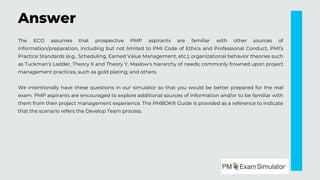
The ECO assumes that prospective PMP aspirants are familiar with other sources of
information/preparation, including but not limited to PMI Code of Ethics and Professional Conduct, PMI’s
Practice Standards (e.g., Scheduling, Earned Value Management, etc.); organizational behavior theories such
as Tuckman’s Ladder, Theory X and Theory Y, Maslow's hierarchy of needs; commonly frowned upon project
management practices, such as gold plating; and others.
We intentionally have these questions in our simulator so that you would be better prepared for the real
exam. PMP aspirants are encouraged to explore additional sources of information and/or to be familiar with
them from their project management experience. The PMBOK® Guide is provided as a reference to indicate
that the scenario refers the Develop Team process.
Answer
All our questions are updated to the latest
A Guide to the Project Management Body of Knowledge
(PMBOK® Guide) standard.
Stop by at free.pm-exam-simulator.com/ and try the
PM Exam Simulator free for 7 days.
We are a trusted and experienced education provider.

Free PMP Exam Sample Question

  • 1.
  • 2.
    Recently, you promotedyour star programmer, Sam, to lead the agile development team. Sam was a fantastic software coder, and you thought the promotion would mean that he could now share his expertise with the other development team members. However, you are surprised to learn that the performance of Sam in his new role is not meeting your expectations. Which empirical rule did you forget while considering the promotion of Sam? A. Expectancy theory B. Halo effect C. Pareto concept D. Murphy's law HINT: This management theory is also known as the 'Peter principle.' Question
  • 3.
    The correct answeris B. The Halo effect (also known as the Peter principle) states "In a hierarchy, every employee tends to rise to his/her level of incompetence." Most project team members are motivated by an opportunity to grow, accomplish, and apply their professional skills to meet new challenges. Their achievements continuously promote them within an organization to a certain level until they are unable to perform. Sam might have risen to his incompetency level, which is what you have likely forgotten to consider while promoting him to lead the development team. The topic of this question is only briefly mentioned in the PMBOK® Guide. However, the PMP Examination Content Outline (ECO) indicates that while there are some commonalities between the PMBOK® Guide and the ECO, the exam is not bound by the PMBOK® Guide. The list of enablers specified in the tasks of the ECO domains is not exhaustive either. Answer
  • 4.
    The ECO assumesthat prospective PMP aspirants are familiar with other sources of information/preparation, including but not limited to PMI Code of Ethics and Professional Conduct, PMI’s Practice Standards (e.g., Scheduling, Earned Value Management, etc.); organizational behavior theories such as Tuckman’s Ladder, Theory X and Theory Y, Maslow's hierarchy of needs; commonly frowned upon project management practices, such as gold plating; and others. We intentionally have these questions in our simulator so that you would be better prepared for the real exam. PMP aspirants are encouraged to explore additional sources of information and/or to be familiar with them from their project management experience. The PMBOK® Guide is provided as a reference to indicate that the scenario refers the Develop Team process. Answer
  • 5.
    All our questionsare updated to the latest A Guide to the Project Management Body of Knowledge (PMBOK® Guide) standard. Stop by at free.pm-exam-simulator.com/ and try the PM Exam Simulator free for 7 days. We are a trusted and experienced education provider.