Fisheries and Allied
Aquacultures in the US
A Proposal of Interest
How are We
Doing So Far?
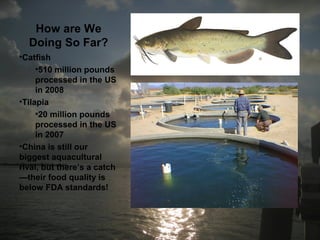
•Catfish
•510 million pounds
processed in the US
in 2008
•Tilapia
•20 million pounds
processed in the US
in 2007
•China is still our
biggest aquacultural
rival, but there’s a catch
—their food quality is
below FDA standards!
There’s More We Can Do…
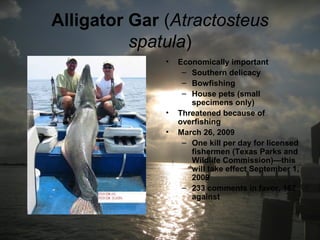
Alligator Gar (Atractosteus
spatula)
• Economically important
– Southern delicacy
– Bowfishing
– House pets (small
specimens only)
• Threatened because of
overfishing
• March 26, 2009
– One kill per day for licensed
fishermen (Texas Parks and
Wildlife Commission)—this
will take effect September 1,
2009
– 233 comments in favor, 167
against
Natural Habitat
• Breeding:
– Sexual maturity at 8
years for males, 11-12
years for females
– Bright red eggs (toxic
to predators) laid in
aquatic grasses during
the spring
• Environmental
Requirements:
– 70º Fahrenheit
– Neutral pH
– Slow-moving water
– Readily accessible live
prey
What else do we do, seeing it’s
still threatened?
Aquaculture should be the most
obvious solution!
Environmentally Friendly is
Key
Things to Have prior to
[hypothetical] Project Gar
• $$$ (R&D)
• Legal permission to use the
land
• Water and Filtration
• Crewmembers
• Protection from disease and
predators (including
poachers!)
• Gar to raise and the means to
meet their
dietary/environmental/repro
ductive needs
Possible Ways for Project Gar to
Help the US
• Market gar products to the Chinese
– Gar fillets/steaks/other cuts
– Gar liver oil
– Gar-fin soup?
• Release a percentage of farmed gar into the wild after
breeding—keep the remainder for
– Additional Breeding
– Pet Trade
– Public Aquaria
– Restaurants
• Keep the TPWC law enacted for safety
Sources
• Barboza, David. “In China, Farming Fish in Toxic Waters”. New York
Times. December 15, 2007. Web
http://www.nytimes.com/2007/12/15/world/asia/15fish.html
• Hanson, Terry. “U.S. CATFISH INDUSTRY REVIEW AND OUTLOOK –
March 2008 ”. Auburn University, AL. March 2008. Web.
http://www.aces.edu/dept/fisheries/aquaculture/documents/08catfishreview09o
• Irwin, Elise. “Highlights of Agricultural Research”. Alabama Agricultural
Experiment Station. 2000. Web
http://www.ag.auburn.edu/aaes/communications/highlights/winter00/fish
tales.html
http://www.ag.auburn.edu/aaes/communications/highlights/winter00/gar.
html
• Reed, Aaron. “Alligator Gar Bag Limit to Go into Effect Sept. 1, 2009”.
Texas Parks and Wildlife Commission. March 26, 2009.
http://www.tpwd.state.tx.us/newsmedia/releases/?req=20090326g
• Tompkins, Shannon. “Texas Gar Need Safeguard”. Houston Chronicle.
February 2009. Web.
http://www.chron.com/disp/story.mpl/sports/thingstodo/6252532.html#n
one
Sources
• Barboza, David. “In China, Farming Fish in Toxic Waters”. New York
Times. December 15, 2007. Web
http://www.nytimes.com/2007/12/15/world/asia/15fish.html
• Hanson, Terry. “U.S. CATFISH INDUSTRY REVIEW AND OUTLOOK –
March 2008 ”. Auburn University, AL. March 2008. Web.
http://www.aces.edu/dept/fisheries/aquaculture/documents/08catfishreview09o
• Irwin, Elise. “Highlights of Agricultural Research”. Alabama Agricultural
Experiment Station. 2000. Web
http://www.ag.auburn.edu/aaes/communications/highlights/winter00/fish
tales.html
http://www.ag.auburn.edu/aaes/communications/highlights/winter00/gar.
html
• Reed, Aaron. “Alligator Gar Bag Limit to Go into Effect Sept. 1, 2009”.
Texas Parks and Wildlife Commission. March 26, 2009.
http://www.tpwd.state.tx.us/newsmedia/releases/?req=20090326g
• Tompkins, Shannon. “Texas Gar Need Safeguard”. Houston Chronicle.
February 2009. Web.
http://www.chron.com/disp/story.mpl/sports/thingstodo/6252532.html#n
one

frederick bottom - disl marine bio presentation 2009

  • 1.
    Fisheries and Allied Aquaculturesin the US A Proposal of Interest
  • 2.
    How are We DoingSo Far? •Catfish •510 million pounds processed in the US in 2008 •Tilapia •20 million pounds processed in the US in 2007 •China is still our biggest aquacultural rival, but there’s a catch —their food quality is below FDA standards!
  • 3.
  • 4.
    Alligator Gar (Atractosteus spatula) •Economically important – Southern delicacy – Bowfishing – House pets (small specimens only) • Threatened because of overfishing • March 26, 2009 – One kill per day for licensed fishermen (Texas Parks and Wildlife Commission)—this will take effect September 1, 2009 – 233 comments in favor, 167 against
  • 5.
    Natural Habitat • Breeding: –Sexual maturity at 8 years for males, 11-12 years for females – Bright red eggs (toxic to predators) laid in aquatic grasses during the spring • Environmental Requirements: – 70º Fahrenheit – Neutral pH – Slow-moving water – Readily accessible live prey
  • 6.
    What else dowe do, seeing it’s still threatened?
  • 7.
    Aquaculture should bethe most obvious solution! Environmentally Friendly is Key Things to Have prior to [hypothetical] Project Gar • $$$ (R&D) • Legal permission to use the land • Water and Filtration • Crewmembers • Protection from disease and predators (including poachers!) • Gar to raise and the means to meet their dietary/environmental/repro ductive needs
  • 8.
    Possible Ways forProject Gar to Help the US • Market gar products to the Chinese – Gar fillets/steaks/other cuts – Gar liver oil – Gar-fin soup? • Release a percentage of farmed gar into the wild after breeding—keep the remainder for – Additional Breeding – Pet Trade – Public Aquaria – Restaurants • Keep the TPWC law enacted for safety
  • 9.
    Sources • Barboza, David.“In China, Farming Fish in Toxic Waters”. New York Times. December 15, 2007. Web http://www.nytimes.com/2007/12/15/world/asia/15fish.html • Hanson, Terry. “U.S. CATFISH INDUSTRY REVIEW AND OUTLOOK – March 2008 ”. Auburn University, AL. March 2008. Web. http://www.aces.edu/dept/fisheries/aquaculture/documents/08catfishreview09o • Irwin, Elise. “Highlights of Agricultural Research”. Alabama Agricultural Experiment Station. 2000. Web http://www.ag.auburn.edu/aaes/communications/highlights/winter00/fish tales.html http://www.ag.auburn.edu/aaes/communications/highlights/winter00/gar. html • Reed, Aaron. “Alligator Gar Bag Limit to Go into Effect Sept. 1, 2009”. Texas Parks and Wildlife Commission. March 26, 2009. http://www.tpwd.state.tx.us/newsmedia/releases/?req=20090326g • Tompkins, Shannon. “Texas Gar Need Safeguard”. Houston Chronicle. February 2009. Web. http://www.chron.com/disp/story.mpl/sports/thingstodo/6252532.html#n one
  • 10.
    Sources • Barboza, David.“In China, Farming Fish in Toxic Waters”. New York Times. December 15, 2007. Web http://www.nytimes.com/2007/12/15/world/asia/15fish.html • Hanson, Terry. “U.S. CATFISH INDUSTRY REVIEW AND OUTLOOK – March 2008 ”. Auburn University, AL. March 2008. Web. http://www.aces.edu/dept/fisheries/aquaculture/documents/08catfishreview09o • Irwin, Elise. “Highlights of Agricultural Research”. Alabama Agricultural Experiment Station. 2000. Web http://www.ag.auburn.edu/aaes/communications/highlights/winter00/fish tales.html http://www.ag.auburn.edu/aaes/communications/highlights/winter00/gar. html • Reed, Aaron. “Alligator Gar Bag Limit to Go into Effect Sept. 1, 2009”. Texas Parks and Wildlife Commission. March 26, 2009. http://www.tpwd.state.tx.us/newsmedia/releases/?req=20090326g • Tompkins, Shannon. “Texas Gar Need Safeguard”. Houston Chronicle. February 2009. Web. http://www.chron.com/disp/story.mpl/sports/thingstodo/6252532.html#n one