Emergency Hospitalization and
the Pink Slip Process
SEPTEMBER 14, 2020 FRANKLIN COUNTY CIT TRAINING
PRESENTED BY:
CHRISTINA SHAYNAK-DIAZ, ATTORNEY
**The content of this presentation is for general informational
purposes only and does not constitute legal advice. Contact
your legal counsel with specific questions. **
Ohio Revised Code
Chapter 5122
Key Definition:
“Mentally Ill Person Subject To Court Order”
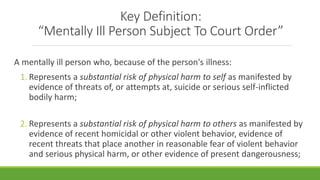
A mentally ill person who, because of the person's illness:
1. Represents a substantial risk of physical harm to self as manifested by
evidence of threats of, or attempts at, suicide or serious self-inflicted
bodily harm;
2. Represents a substantial risk of physical harm to others as manifested by
evidence of recent homicidal or other violent behavior, evidence of
recent threats that place another in reasonable fear of violent behavior
and serious physical harm, or other evidence of present dangerousness;
Key Definition:
“Mentally Ill Person Subject To Court Order”
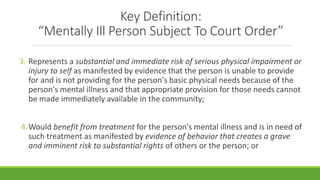
3. Represents a substantial and immediate risk of serious physical impairment or
injury to self as manifested by evidence that the person is unable to provide
for and is not providing for the person's basic physical needs because of the
person's mental illness and that appropriate provision for those needs cannot
be made immediately available in the community;
4.Would benefit from treatment for the person's mental illness and is in need of
such treatment as manifested by evidence of behavior that creates a grave
and imminent risk to substantial rights of others or the person; or
Key Definition:
“Mentally Ill Person Subject To Court Order”
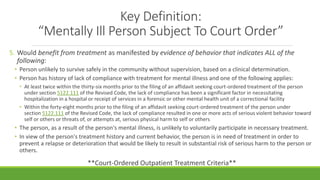
5. Would benefit from treatment as manifested by evidence of behavior that indicates ALL of the
following:
• Person unlikely to survive safely in the community without supervision, based on a clinical determination.
• Person has history of lack of compliance with treatment for mental illness and one of the following applies:
• At least twice within the thirty-six months prior to the filing of an affidavit seeking court-ordered treatment of the person
under section 5122.111 of the Revised Code, the lack of compliance has been a significant factor in necessitating
hospitalization in a hospital or receipt of services in a forensic or other mental health unit of a correctional facility
• Within the forty-eight months prior to the filing of an affidavit seeking court-ordered treatment of the person under
section 5122.111 of the Revised Code, the lack of compliance resulted in one or more acts of serious violent behavior toward
self or others or threats of, or attempts at, serious physical harm to self or others
• The person, as a result of the person's mental illness, is unlikely to voluntarily participate in necessary treatment.
• In view of the person's treatment history and current behavior, the person is in need of treatment in order to
prevent a relapse or deterioration that would be likely to result in substantial risk of serious harm to the person or
others.
**Court-Ordered Outpatient Treatment Criteria**
Emergency
Hospitalization
Process
(PINK SLIP PROCESS)
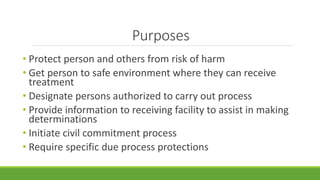
Purposes
• Protect person and others from risk of harm
• Get person to safe environment where they can receive
treatment
• Designate persons authorized to carry out process
• Provide information to receiving facility to assist in making
determinations
• Initiate civil commitment process
• Require specific due process protections
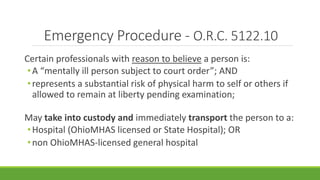
Emergency Procedure - O.R.C. 5122.10
Certain professionals with reason to believe a person is:
•A “mentally ill person subject to court order”; AND
•represents a substantial risk of physical harm to self or others if
allowed to remain at liberty pending examination;
May take into custody and immediately transport the person to a:
•Hospital (OhioMHAS licensed or State Hospital); OR
•non OhioMHAS-licensed general hospital
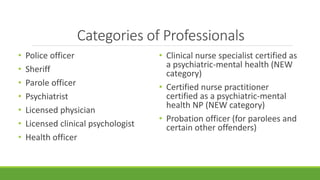
Categories of Professionals
• Police officer
• Sheriff
• Parole officer
• Psychiatrist
• Licensed physician
• Licensed clinical psychologist
• Health officer
• Clinical nurse specialist certified as
a psychiatric-mental health (NEW
category)
• Certified nurse practitioner
certified as a psychiatric-mental
health NP (NEW category)
• Probation officer (for parolees and
certain other offenders)
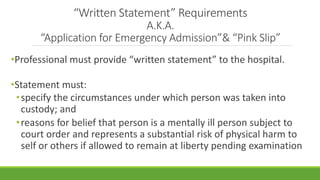
“Written Statement” Requirements
A.K.A.
“Application for Emergency Admission”& “Pink Slip”
•Professional must provide “written statement” to the hospital.
•Statement must:
•specify the circumstances under which person was taken into
custody; and
•reasons for belief that person is a mentally ill person subject to
court order and represents a substantial risk of physical harm to
self or others if allowed to remain at liberty pending examination
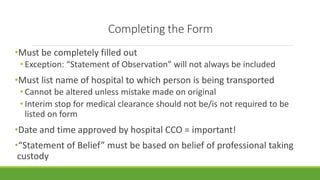
Completing the Form
•Must be completely filled out
• Exception: “Statement of Observation” will not always be included
•Must list name of hospital to which person is being transported
• Cannot be altered unless mistake made on original
• Interim stop for medical clearance should not be/is not required to be
listed on form
•Date and time approved by hospital CCO = important!
•“Statement of Belief” must be based on belief of professional taking
custody
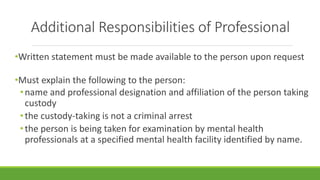
Additional Responsibilities of Professional
•Written statement must be made available to the person upon request
•Must explain the following to the person:
•name and professional designation and affiliation of the person taking
custody
•the custody-taking is not a criminal arrest
•the person is being taken for examination by mental health
professionals at a specified mental health facility identified by name.
Additional Responsibilities of Professional
• Must make every reasonable and appropriate effort to
take person into custody in the least conspicuous manner
possible
• Person has right at all times to be treated with consideration
and respect for the patient's privacy and dignity
• Must take reasonable precautions to preserve and safeguard
the personal property in the possession of or on the
premises occupied by person
Facility Options
•OhioMHAS-Licensed Hospital or Inpatient Unit
•Public/State Hospital/RPH
•General Hospital (not Ohio-MHAS licensed)
* Note: Statute later refers to a person transported to a “Community Mental
Health Services Provider” but not listed as an option to transport on pink slip
Transported to a Ohio-MHAS Licensed
Hospital or Inpatient Unit
•Chief clinical officer (CCO) of a hospital may receive for
observation, diagnosis, care, and treatment any person
whose admission is applied for under emergency or
judicial procedure
O.R.C. 5122.05
Transported to a Public/State Hospital
CCO of a public hospital, in all cases of psychiatric
medical emergencies, shall receive for observation,
diagnosis, care, and treatment any person whose
admission is applied for under emergency or judicial
procedure.
O.R.C. 5122.05
Transported to a GENERAL HOSPITAL
(not OhioMHAS-licensed)
• MAY admit the person or provide care and treatment
• MUST transfer to an OhioMHAS-licensed hospital by the
end of twenty-four hours after arrival
O.R.C. 5122.10(D)
Person must immediately be informed and provided with written
statement that person may do any of the following:
• Immediately make reasonable number of phone calls or use other reasonable means
to contact an attorney, a licensed physician, or a licensed clinical psychologist, to
contact any other person or persons to secure representation by counsel, or to
obtain medical or psychological assistance, and be provided assistance in making
calls if the assistance is needed and requested;
• Retain counsel and have independent expert evaluation of person's mental condition
and, if person is unable to obtain an attorney or independent expert evaluation, be
represented by court-appointed counsel or have independent expert evaluation of
person's mental condition, or both, at public expense if person is indigent;
• Have hearing to determine whether or not person is mentally ill person subject to
court order
Written Notice of Rights
Required Licensed/State Hospital
Notification
CCO of hospital must immediately notify:
•Person's legal guardian, spouse or next of kin, and legal counsel (if
can be determined through exercise of reasonable diligence)
and
•ADAMH Board (or the provider designated by Board) of the patient's
county of residence
Board-Designated Provider
Assessment (Prescreen)
• ADAMH Board (or designated provider) must promptly assess the
patient unless:
• the Board or designated provider has already performed the
assessment; or
• the commitment is of a NGRI or incompetent person
Purpose of the Assessment
Purpose of assessment by ADAMH Board (or
designated provider):
“to assist the hospital in determining whether the
patient is subject to involuntary hospitalization
and whether alternative services are available”
Required Licensed/State Hospital
Examination
• Must be examined within 24 hours after arrival
• If conducting of examination requires that person to
remain overnight, the person must be admitted in an
unclassified status until making a disposition
Initial Determination After Required
Examination
•If CCO believes the person is not a mentally ill person subject to
court order, must release or discharge the person immediately
unless a court has issued a temporary order of detention
applicable to the person
•If the CCO believes the person is a mentally ill person subject to
court order, may detain the person for not more than three court
days following the day of the examination
3-Day Hold Period
By end of 3-day period, CCO must either:
•admit the person as a voluntary patient;
•file an affidavit with the probate court to initiate proceedings for a
mentally ill person subject to court order; OR
•discharge the person
• unless court has issued a TOD; or
• person has been sentenced to DRC and has not been released
from the person's sentence (returned to DRC)
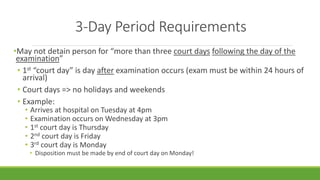
3-Day Period Requirements
•May not detain person for “more than three court days following the day of the
examination”
• 1st “court day” is day after examination occurs (exam must be within 24 hours of
arrival)
• Court days => no holidays and weekends
• Example:
• Arrives at hospital on Tuesday at 4pm
• Examination occurs on Wednesday at 3pm
• 1st court day is Thursday
• 2nd court day is Friday
• 3rd court day is Monday
• Disposition must be made by end of court day on Monday!
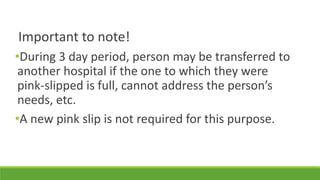
Important to note!
•During 3 day period, person may be transferred to
another hospital if the one to which they were
pink-slipped is full, cannot address the person’s
needs, etc.
•A new pink slip is not required for this purpose.
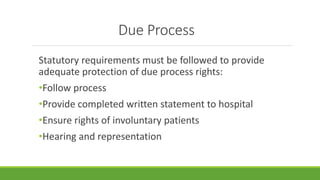
Due Process
Statutory requirements must be followed to provide
adequate protection of due process rights:
•Follow process
•Provide completed written statement to hospital
•Ensure rights of involuntary patients
•Hearing and representation
Common Issues
& Concerns
APPLICATION OF THE LAW
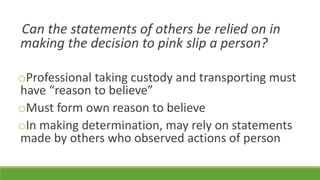
Can the statements of others be relied on in
making the decision to pink slip a person?
oProfessional taking custody and transporting must
have “reason to believe”
oMust form own reason to believe
oIn making determination, may rely on statements
made by others who observed actions of person
Is law enforcement required to transport
individuals for purposes of emergency
hospitalization?
oNo, law enforcement has authority but is not
required to take person into custody and
transport for purposes of emergency
hospitalization (unless TOD issued)
Can a state/public hospital require interim
stop at different facility for medical
examination before being transported to
the public hospital?
◦No. AG Opinion states public hospital has no
authority to require interim stop.
If making an interim stop for medical
clearance, does the stop need to be listed
on the pink slip?
o No, AG Opinion says it is permissible to first
transport to general hospital for medical exam or
treatment or CMH agency responsible for
assessment.
oLaw allows “Reasonable exercise of discretion in
determining where to transport”
Can hospital to which person pink-slipped
choose to pink slip the person to another
hospital?
oNo “serial” pink-slipping not authorized.
oNo longer “at liberty” once at hospital.
oLaw provides other mechanisms to transport/transfer
to another hospital when necessary
Can facility name on pink slip be left blank
or changed?
oNo, pink slip is a legal document, akin to an affidavit
and providing due process, and must be completed
in its entirety.
oThe law provides options for
transferring/transporting to another hospital when
necessary.
What options are available for transfer when a general
hospital (not OhioMHAS licensed) is utilized?
1. Pink slip to licensed or state hospital and make “interim stop” for
medical clearance
◦Pink slip essentially on hold until cleared and transported to
licensed/state hospital
◦24 hours for exam and 3-day hold begins when pink slip
approved/signed/dates by licensed/state hospital
2. Pink slip to general medical hospital for medical clearance or other
reasons
◦ General hospital must transfer to licensed/state hospital within 24 hours
◦ 24 hours for exam and 3-day hold begins when pink slip
approved/signed/dates by licensed/state hospital
Can hospital emergency department pink slip
person to a psychiatric hospital if person brought
to ER by family member (not pink-slipped to the
ED)?
oYes, if no psych facilities at hospital
oNot initially pink-slipped to ED so not “serial”
pink-slipping
What are the options when person
absent without leave?
oWithin 5 days of unauthorized absence, Hospital
or OhioMHAS may issue verbal or written order
for any health officer, police officer or sheriff to
take custody and transport person back to
hospital
Can a facility require that a person requesting
voluntary admission be pink-slipped for
transportation or other purposes?
oCan only be pink-slipped if criteria for emergency
hospitalization apply
oVoluntary admission should always be favored over
involuntary admissions
Can a Minor be pink-slipped?
oStatute says “any person”
oNo distinction between adults and
minors
Questions?
Thank you!

Franklin County CIT Pink Slip Training

  • 1.
    Emergency Hospitalization and thePink Slip Process SEPTEMBER 14, 2020 FRANKLIN COUNTY CIT TRAINING PRESENTED BY: CHRISTINA SHAYNAK-DIAZ, ATTORNEY **The content of this presentation is for general informational purposes only and does not constitute legal advice. Contact your legal counsel with specific questions. **
  • 2.
  • 3.
    Key Definition: “Mentally IllPerson Subject To Court Order” A mentally ill person who, because of the person's illness: 1. Represents a substantial risk of physical harm to self as manifested by evidence of threats of, or attempts at, suicide or serious self-inflicted bodily harm; 2. Represents a substantial risk of physical harm to others as manifested by evidence of recent homicidal or other violent behavior, evidence of recent threats that place another in reasonable fear of violent behavior and serious physical harm, or other evidence of present dangerousness;
  • 4.
    Key Definition: “Mentally IllPerson Subject To Court Order” 3. Represents a substantial and immediate risk of serious physical impairment or injury to self as manifested by evidence that the person is unable to provide for and is not providing for the person's basic physical needs because of the person's mental illness and that appropriate provision for those needs cannot be made immediately available in the community; 4.Would benefit from treatment for the person's mental illness and is in need of such treatment as manifested by evidence of behavior that creates a grave and imminent risk to substantial rights of others or the person; or
  • 5.
    Key Definition: “Mentally IllPerson Subject To Court Order” 5. Would benefit from treatment as manifested by evidence of behavior that indicates ALL of the following: • Person unlikely to survive safely in the community without supervision, based on a clinical determination. • Person has history of lack of compliance with treatment for mental illness and one of the following applies: • At least twice within the thirty-six months prior to the filing of an affidavit seeking court-ordered treatment of the person under section 5122.111 of the Revised Code, the lack of compliance has been a significant factor in necessitating hospitalization in a hospital or receipt of services in a forensic or other mental health unit of a correctional facility • Within the forty-eight months prior to the filing of an affidavit seeking court-ordered treatment of the person under section 5122.111 of the Revised Code, the lack of compliance resulted in one or more acts of serious violent behavior toward self or others or threats of, or attempts at, serious physical harm to self or others • The person, as a result of the person's mental illness, is unlikely to voluntarily participate in necessary treatment. • In view of the person's treatment history and current behavior, the person is in need of treatment in order to prevent a relapse or deterioration that would be likely to result in substantial risk of serious harm to the person or others. **Court-Ordered Outpatient Treatment Criteria**
  • 6.
  • 7.
    Purposes • Protect personand others from risk of harm • Get person to safe environment where they can receive treatment • Designate persons authorized to carry out process • Provide information to receiving facility to assist in making determinations • Initiate civil commitment process • Require specific due process protections
  • 8.
    Emergency Procedure -O.R.C. 5122.10 Certain professionals with reason to believe a person is: •A “mentally ill person subject to court order”; AND •represents a substantial risk of physical harm to self or others if allowed to remain at liberty pending examination; May take into custody and immediately transport the person to a: •Hospital (OhioMHAS licensed or State Hospital); OR •non OhioMHAS-licensed general hospital
  • 9.
    Categories of Professionals •Police officer • Sheriff • Parole officer • Psychiatrist • Licensed physician • Licensed clinical psychologist • Health officer • Clinical nurse specialist certified as a psychiatric-mental health (NEW category) • Certified nurse practitioner certified as a psychiatric-mental health NP (NEW category) • Probation officer (for parolees and certain other offenders)
  • 10.
    “Written Statement” Requirements A.K.A. “Applicationfor Emergency Admission”& “Pink Slip” •Professional must provide “written statement” to the hospital. •Statement must: •specify the circumstances under which person was taken into custody; and •reasons for belief that person is a mentally ill person subject to court order and represents a substantial risk of physical harm to self or others if allowed to remain at liberty pending examination
  • 12.
    Completing the Form •Mustbe completely filled out • Exception: “Statement of Observation” will not always be included •Must list name of hospital to which person is being transported • Cannot be altered unless mistake made on original • Interim stop for medical clearance should not be/is not required to be listed on form •Date and time approved by hospital CCO = important! •“Statement of Belief” must be based on belief of professional taking custody
  • 13.
    Additional Responsibilities ofProfessional •Written statement must be made available to the person upon request •Must explain the following to the person: •name and professional designation and affiliation of the person taking custody •the custody-taking is not a criminal arrest •the person is being taken for examination by mental health professionals at a specified mental health facility identified by name.
  • 14.
    Additional Responsibilities ofProfessional • Must make every reasonable and appropriate effort to take person into custody in the least conspicuous manner possible • Person has right at all times to be treated with consideration and respect for the patient's privacy and dignity • Must take reasonable precautions to preserve and safeguard the personal property in the possession of or on the premises occupied by person
  • 15.
    Facility Options •OhioMHAS-Licensed Hospitalor Inpatient Unit •Public/State Hospital/RPH •General Hospital (not Ohio-MHAS licensed) * Note: Statute later refers to a person transported to a “Community Mental Health Services Provider” but not listed as an option to transport on pink slip
  • 16.
    Transported to aOhio-MHAS Licensed Hospital or Inpatient Unit •Chief clinical officer (CCO) of a hospital may receive for observation, diagnosis, care, and treatment any person whose admission is applied for under emergency or judicial procedure O.R.C. 5122.05
  • 17.
    Transported to aPublic/State Hospital CCO of a public hospital, in all cases of psychiatric medical emergencies, shall receive for observation, diagnosis, care, and treatment any person whose admission is applied for under emergency or judicial procedure. O.R.C. 5122.05
  • 18.
    Transported to aGENERAL HOSPITAL (not OhioMHAS-licensed) • MAY admit the person or provide care and treatment • MUST transfer to an OhioMHAS-licensed hospital by the end of twenty-four hours after arrival O.R.C. 5122.10(D)
  • 19.
    Person must immediatelybe informed and provided with written statement that person may do any of the following: • Immediately make reasonable number of phone calls or use other reasonable means to contact an attorney, a licensed physician, or a licensed clinical psychologist, to contact any other person or persons to secure representation by counsel, or to obtain medical or psychological assistance, and be provided assistance in making calls if the assistance is needed and requested; • Retain counsel and have independent expert evaluation of person's mental condition and, if person is unable to obtain an attorney or independent expert evaluation, be represented by court-appointed counsel or have independent expert evaluation of person's mental condition, or both, at public expense if person is indigent; • Have hearing to determine whether or not person is mentally ill person subject to court order Written Notice of Rights
  • 20.
    Required Licensed/State Hospital Notification CCOof hospital must immediately notify: •Person's legal guardian, spouse or next of kin, and legal counsel (if can be determined through exercise of reasonable diligence) and •ADAMH Board (or the provider designated by Board) of the patient's county of residence
  • 21.
    Board-Designated Provider Assessment (Prescreen) •ADAMH Board (or designated provider) must promptly assess the patient unless: • the Board or designated provider has already performed the assessment; or • the commitment is of a NGRI or incompetent person
  • 22.
    Purpose of theAssessment Purpose of assessment by ADAMH Board (or designated provider): “to assist the hospital in determining whether the patient is subject to involuntary hospitalization and whether alternative services are available”
  • 23.
    Required Licensed/State Hospital Examination •Must be examined within 24 hours after arrival • If conducting of examination requires that person to remain overnight, the person must be admitted in an unclassified status until making a disposition
  • 24.
    Initial Determination AfterRequired Examination •If CCO believes the person is not a mentally ill person subject to court order, must release or discharge the person immediately unless a court has issued a temporary order of detention applicable to the person •If the CCO believes the person is a mentally ill person subject to court order, may detain the person for not more than three court days following the day of the examination
  • 25.
    3-Day Hold Period Byend of 3-day period, CCO must either: •admit the person as a voluntary patient; •file an affidavit with the probate court to initiate proceedings for a mentally ill person subject to court order; OR •discharge the person • unless court has issued a TOD; or • person has been sentenced to DRC and has not been released from the person's sentence (returned to DRC)
  • 26.
    3-Day Period Requirements •Maynot detain person for “more than three court days following the day of the examination” • 1st “court day” is day after examination occurs (exam must be within 24 hours of arrival) • Court days => no holidays and weekends • Example: • Arrives at hospital on Tuesday at 4pm • Examination occurs on Wednesday at 3pm • 1st court day is Thursday • 2nd court day is Friday • 3rd court day is Monday • Disposition must be made by end of court day on Monday!
  • 27.
    Important to note! •During3 day period, person may be transferred to another hospital if the one to which they were pink-slipped is full, cannot address the person’s needs, etc. •A new pink slip is not required for this purpose.
  • 28.
    Due Process Statutory requirementsmust be followed to provide adequate protection of due process rights: •Follow process •Provide completed written statement to hospital •Ensure rights of involuntary patients •Hearing and representation
  • 29.
  • 30.
    Can the statementsof others be relied on in making the decision to pink slip a person? oProfessional taking custody and transporting must have “reason to believe” oMust form own reason to believe oIn making determination, may rely on statements made by others who observed actions of person
  • 31.
    Is law enforcementrequired to transport individuals for purposes of emergency hospitalization? oNo, law enforcement has authority but is not required to take person into custody and transport for purposes of emergency hospitalization (unless TOD issued)
  • 32.
    Can a state/publichospital require interim stop at different facility for medical examination before being transported to the public hospital? ◦No. AG Opinion states public hospital has no authority to require interim stop.
  • 33.
    If making aninterim stop for medical clearance, does the stop need to be listed on the pink slip? o No, AG Opinion says it is permissible to first transport to general hospital for medical exam or treatment or CMH agency responsible for assessment. oLaw allows “Reasonable exercise of discretion in determining where to transport”
  • 34.
    Can hospital towhich person pink-slipped choose to pink slip the person to another hospital? oNo “serial” pink-slipping not authorized. oNo longer “at liberty” once at hospital. oLaw provides other mechanisms to transport/transfer to another hospital when necessary
  • 35.
    Can facility nameon pink slip be left blank or changed? oNo, pink slip is a legal document, akin to an affidavit and providing due process, and must be completed in its entirety. oThe law provides options for transferring/transporting to another hospital when necessary.
  • 36.
    What options areavailable for transfer when a general hospital (not OhioMHAS licensed) is utilized? 1. Pink slip to licensed or state hospital and make “interim stop” for medical clearance ◦Pink slip essentially on hold until cleared and transported to licensed/state hospital ◦24 hours for exam and 3-day hold begins when pink slip approved/signed/dates by licensed/state hospital 2. Pink slip to general medical hospital for medical clearance or other reasons ◦ General hospital must transfer to licensed/state hospital within 24 hours ◦ 24 hours for exam and 3-day hold begins when pink slip approved/signed/dates by licensed/state hospital
  • 37.
    Can hospital emergencydepartment pink slip person to a psychiatric hospital if person brought to ER by family member (not pink-slipped to the ED)? oYes, if no psych facilities at hospital oNot initially pink-slipped to ED so not “serial” pink-slipping
  • 38.
    What are theoptions when person absent without leave? oWithin 5 days of unauthorized absence, Hospital or OhioMHAS may issue verbal or written order for any health officer, police officer or sheriff to take custody and transport person back to hospital
  • 39.
    Can a facilityrequire that a person requesting voluntary admission be pink-slipped for transportation or other purposes? oCan only be pink-slipped if criteria for emergency hospitalization apply oVoluntary admission should always be favored over involuntary admissions
  • 40.
    Can a Minorbe pink-slipped? oStatute says “any person” oNo distinction between adults and minors
  • 41.
  • 42.

Editor's Notes