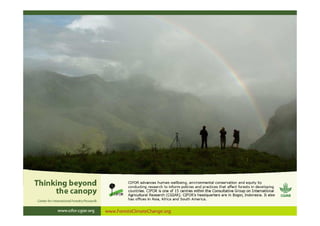
The role of Europe in
 fighting deforestation:

 Balancing the risks of
action against the risks of
        no action

    Frances Seymour
    European Parliament
    March 1, 2011
Presentation outline

 Brief introduction to CIFOR
 Review of deforestation trends
 Reasons for optimism / reasons for
 caution
 A few examples
 Implications for the way forward
 Note that the closer you get to the ground,
 the more complicated it gets….
Brief introduction to
         CIFOR
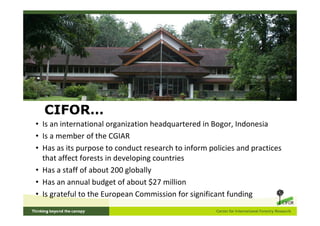
CIFOR…
• Is an international organization headquartered in Bogor, Indonesia
• Is a member of the CGIAR
• Has as its purpose to conduct research to inform policies and practices
  that affect forests in developing countries
• Has a staff of about 200 globally
• Has an annual budget of about $27 million
• Is grateful to the European Commission for significant funding
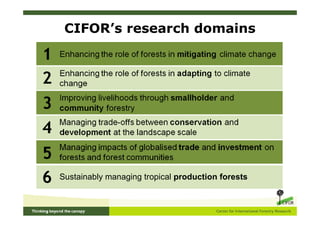
CIFOR’s research domains


6   Sustainably managing tropical production forests
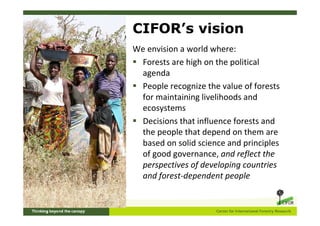
CIFOR’s vision
We envision a world where:
 Forests are high on the political
 agenda
 People recognize the value of forests
 for maintaining livelihoods and
 ecosystems
 Decisions that influence forests and
 the people that depend on them are
 based on solid science and principles
 of good governance, and reflect the
 perspectives of developing countries
 and forest-dependent people
Review of
deforestation trends
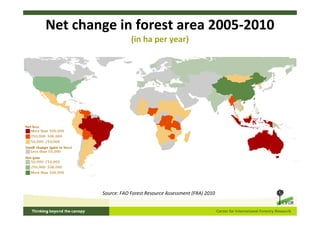
Net change in forest area 2005-2010
                    (in ha per year)


        Source: FAO Forest Resource Assessment (FRA) 2010
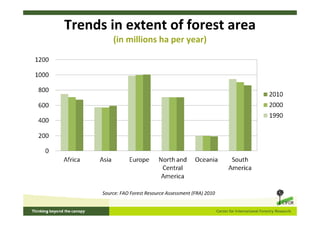
Trends in extent of forest area
          (in millions ha per year)


      Source: FAO Forest Resource Assessment (FRA) 2010
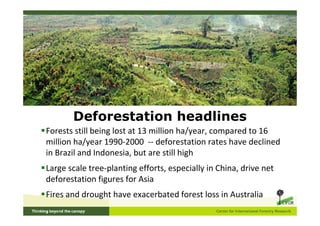
Deforestation headlines
Forests still being lost at 13 million ha/year, compared to 16
million ha/year 1990-2000 -- deforestation rates have declined
in Brazil and Indonesia, but are still high
Large scale tree-planting efforts, especially in China, drive net
deforestation figures for Asia
Fires and drought have exacerbated forest loss in Australia
Reasons for optimism/
 Reasons for caution
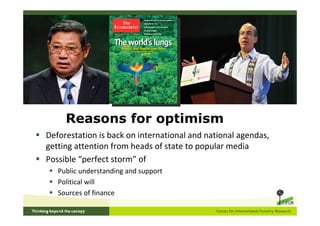
Reasons for optimism
Deforestation is back on international and national agendas,
getting attention from heads of state to popular media
Possible “perfect storm” of
   Public understanding and support
   Political will
   Sources of finance
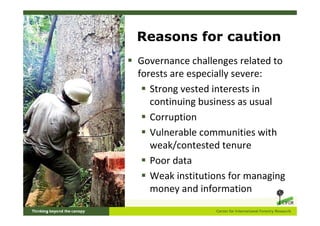
Reasons for caution
Governance challenges related to
forests are especially severe:
   Strong vested interests in
   continuing business as usual
   Corruption
   Vulnerable communities with
   weak/contested tenure
   Poor data
   Weak institutions for managing
   money and information
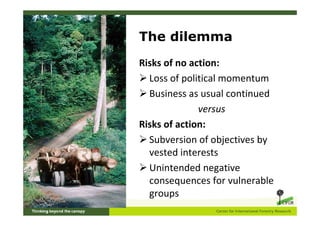
The dilemma
Risks of no action:
  Loss of political momentum
  Business as usual continued
              versus
Risks of action:
  Subversion of objectives by
  vested interests
  Unintended negative
  consequences for vulnerable
  groups
A few examples
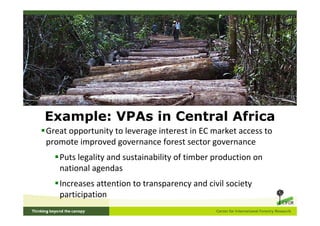
Example: VPAs in Central Africa
Great opportunity to leverage interest in EC market access to
promote improved governance forest sector governance
   Puts legality and sustainability of timber production on
   national agendas
   Increases attention to transparency and civil society
   participation
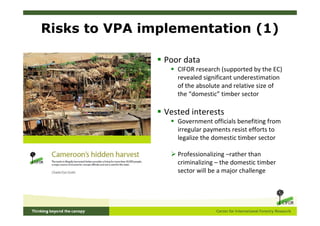
Risks to VPA implementation (1)

                Poor data
                   CIFOR research (supported by the EC)
                   revealed significant underestimation
                   of the absolute and relative size of
                   the “domestic” timber sector

                Vested interests
                   Government officials benefiting from
                   irregular payments resist efforts to
                   legalize the domestic timber sector

                   Professionalizing –rather than
                   criminalizing – the domestic timber
                   sector will be a major challenge
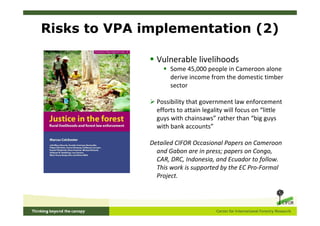
Risks to VPA implementation (2)

                Vulnerable livelihoods
                     Some 45,000 people in Cameroon alone
                     derive income from the domestic timber
                     sector

                Possibility that government law enforcement
                efforts to attain legality will focus on “little
                guys with chainsaws” rather than “big guys
                with bank accounts”

              Detailed CIFOR Occasional Papers on Cameroon
                and Gabon are in press; papers on Congo,
                CAR, DRC, Indonesia, and Ecuador to follow.
                This work is supported by the EC Pro-Formal
                Project.
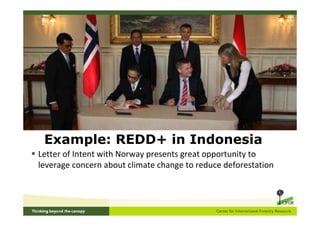
Example: REDD+ in Indonesia
Letter of Intent with Norway presents great opportunity to
leverage concern about climate change to reduce deforestation
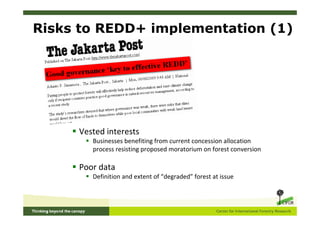
Risks to REDD+ implementation (1)


     Vested interests
        Businesses benefiting from current concession allocation
        process resisting proposed moratorium on forest conversion

     Poor data
        Definition and extent of “degraded” forest at issue
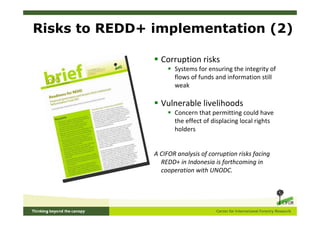
Risks to REDD+ implementation (2)

                 Corruption risks
                      Systems for ensuring the integrity of
                      flows of funds and information still
                      weak

                 Vulnerable livelihoods
                      Concern that permitting could have
                      the effect of displacing local rights
                      holders


               A CIFOR analysis of corruption risks facing
                 REDD+ in Indonesia is forthcoming in
                 cooperation with UNODC.
Example: Bioenergy
                                 Policies to promote bioenergy
                                 production have the potential to
                                 reduce climate emissions and create
                                 new livelihood opportunities in
                                 developing countries
                                 But CIFOR research (supported by
                                 the EC) suggests that such policies
                                 require complementary actions to:
                                    Protect the livelihoods of customary
                                    landusers
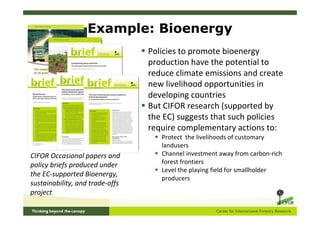
CIFOR Occasional papers and         Channel investment away from carbon-rich
policy briefs produced under        forest frontiers
                                    Level the playing field for smallholder
the EC-supported Bioenergy,
                                    producers
sustainability, and trade-offs
project
Implications for the
   way forward
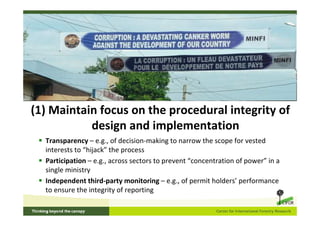
(1) Maintain focus on the procedural integrity of
           design and implementation
  Transparency – e.g., of decision-making to narrow the scope for vested
  interests to “hijack” the process
  Participation – e.g., across sectors to prevent “concentration of power” in a
  single ministry
  Independent third-party monitoring – e.g., of permit holders’ performance
  to ensure the integrity of reporting
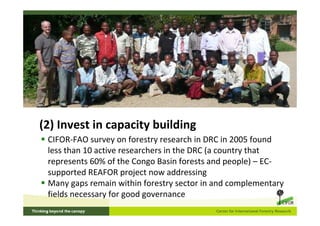
(2) Invest in capacity building
 CIFOR-FAO survey on forestry research in DRC in 2005 found
 less than 10 active researchers in the DRC (a country that
 represents 60% of the Congo Basin forests and people) – EC-
 supported REAFOR project now addressing
 Many gaps remain within forestry sector in and complementary
 fields necessary for good governance
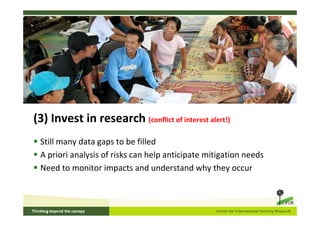
(3) Invest in research (conflict of interest alert!)
 Still many data gaps to be filled
 A priori analysis of risks can help anticipate mitigation needs
 Need to monitor impacts and understand why they occur
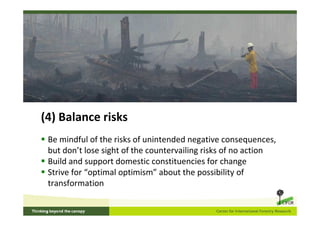
(4) Balance risks
 Be mindful of the risks of unintended negative consequences,
 but don’t lose sight of the countervailing risks of no action
 Build and support domestic constituencies for change
 Strive for “optimal optimism” about the possibility of
 transformation
Frances Seymour CIFOR

Frances Seymour CIFOR

  • 1.
    The role ofEurope in fighting deforestation: Balancing the risks of action against the risks of no action Frances Seymour European Parliament March 1, 2011
  • 2.
    Presentation outline Briefintroduction to CIFOR Review of deforestation trends Reasons for optimism / reasons for caution A few examples Implications for the way forward Note that the closer you get to the ground, the more complicated it gets….
  • 3.
  • 4.
    CIFOR… • Is aninternational organization headquartered in Bogor, Indonesia • Is a member of the CGIAR • Has as its purpose to conduct research to inform policies and practices that affect forests in developing countries • Has a staff of about 200 globally • Has an annual budget of about $27 million • Is grateful to the European Commission for significant funding
  • 5.
    CIFOR’s research domains 6 Sustainably managing tropical production forests
  • 6.
    CIFOR’s vision We envisiona world where: Forests are high on the political agenda People recognize the value of forests for maintaining livelihoods and ecosystems Decisions that influence forests and the people that depend on them are based on solid science and principles of good governance, and reflect the perspectives of developing countries and forest-dependent people
  • 7.
  • 8.
    Net change inforest area 2005-2010 (in ha per year) Source: FAO Forest Resource Assessment (FRA) 2010
  • 9.
    Trends in extentof forest area (in millions ha per year) Source: FAO Forest Resource Assessment (FRA) 2010
  • 10.
    Deforestation headlines Forests stillbeing lost at 13 million ha/year, compared to 16 million ha/year 1990-2000 -- deforestation rates have declined in Brazil and Indonesia, but are still high Large scale tree-planting efforts, especially in China, drive net deforestation figures for Asia Fires and drought have exacerbated forest loss in Australia
  • 11.
    Reasons for optimism/ Reasons for caution
  • 12.
    Reasons for optimism Deforestationis back on international and national agendas, getting attention from heads of state to popular media Possible “perfect storm” of Public understanding and support Political will Sources of finance
  • 13.
    Reasons for caution Governancechallenges related to forests are especially severe: Strong vested interests in continuing business as usual Corruption Vulnerable communities with weak/contested tenure Poor data Weak institutions for managing money and information
  • 14.
    The dilemma Risks ofno action: Loss of political momentum Business as usual continued versus Risks of action: Subversion of objectives by vested interests Unintended negative consequences for vulnerable groups
  • 15.
  • 16.
    Example: VPAs inCentral Africa Great opportunity to leverage interest in EC market access to promote improved governance forest sector governance Puts legality and sustainability of timber production on national agendas Increases attention to transparency and civil society participation
  • 17.
    Risks to VPAimplementation (1) Poor data CIFOR research (supported by the EC) revealed significant underestimation of the absolute and relative size of the “domestic” timber sector Vested interests Government officials benefiting from irregular payments resist efforts to legalize the domestic timber sector Professionalizing –rather than criminalizing – the domestic timber sector will be a major challenge
  • 18.
    Risks to VPAimplementation (2) Vulnerable livelihoods Some 45,000 people in Cameroon alone derive income from the domestic timber sector Possibility that government law enforcement efforts to attain legality will focus on “little guys with chainsaws” rather than “big guys with bank accounts” Detailed CIFOR Occasional Papers on Cameroon and Gabon are in press; papers on Congo, CAR, DRC, Indonesia, and Ecuador to follow. This work is supported by the EC Pro-Formal Project.
  • 19.
    Example: REDD+ inIndonesia Letter of Intent with Norway presents great opportunity to leverage concern about climate change to reduce deforestation
  • 20.
    Risks to REDD+implementation (1) Vested interests Businesses benefiting from current concession allocation process resisting proposed moratorium on forest conversion Poor data Definition and extent of “degraded” forest at issue
  • 21.
    Risks to REDD+implementation (2) Corruption risks Systems for ensuring the integrity of flows of funds and information still weak Vulnerable livelihoods Concern that permitting could have the effect of displacing local rights holders A CIFOR analysis of corruption risks facing REDD+ in Indonesia is forthcoming in cooperation with UNODC.
  • 22.
    Example: Bioenergy Policies to promote bioenergy production have the potential to reduce climate emissions and create new livelihood opportunities in developing countries But CIFOR research (supported by the EC) suggests that such policies require complementary actions to: Protect the livelihoods of customary landusers CIFOR Occasional papers and Channel investment away from carbon-rich policy briefs produced under forest frontiers Level the playing field for smallholder the EC-supported Bioenergy, producers sustainability, and trade-offs project
  • 23.
  • 24.
    (1) Maintain focuson the procedural integrity of design and implementation Transparency – e.g., of decision-making to narrow the scope for vested interests to “hijack” the process Participation – e.g., across sectors to prevent “concentration of power” in a single ministry Independent third-party monitoring – e.g., of permit holders’ performance to ensure the integrity of reporting
  • 25.
    (2) Invest incapacity building CIFOR-FAO survey on forestry research in DRC in 2005 found less than 10 active researchers in the DRC (a country that represents 60% of the Congo Basin forests and people) – EC- supported REAFOR project now addressing Many gaps remain within forestry sector in and complementary fields necessary for good governance
  • 26.
    (3) Invest inresearch (conflict of interest alert!) Still many data gaps to be filled A priori analysis of risks can help anticipate mitigation needs Need to monitor impacts and understand why they occur
  • 27.
    (4) Balance risks Be mindful of the risks of unintended negative consequences, but don’t lose sight of the countervailing risks of no action Build and support domestic constituencies for change Strive for “optimal optimism” about the possibility of transformation