© copyright 2004 by OSGi Alliance All rights reserved.
OSGi Framework Modularity Improvements
Glyn Normington, IBM UK Limited
© copyright 2004 by OSGi Alliance. All rights reserved.
Contents
• OSGi Framework
• What is Modularity?
• Requirements and Use Cases
• Evolution: OSGi R3, RFC 70, RFC 79
• Simple Examples
© copyright 2004 by OSGi Alliance. All rights reserved.
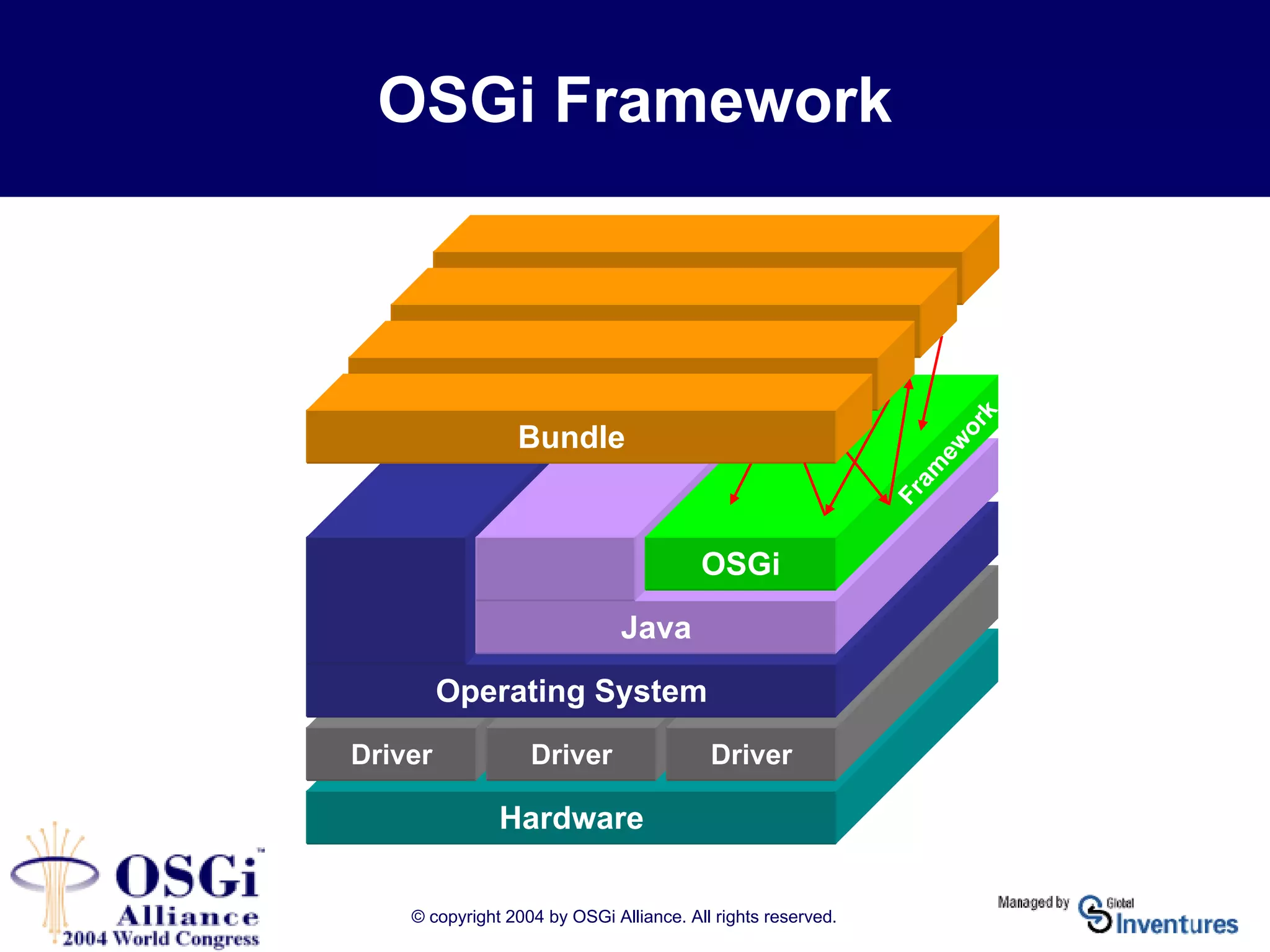
OSGi Framework
Hardware
Driver Driver Driver
Operating System
Java
OSGi
Fram
ew
ork
Bundle
© copyright 2004 by OSGi Alliance. All rights reserved.
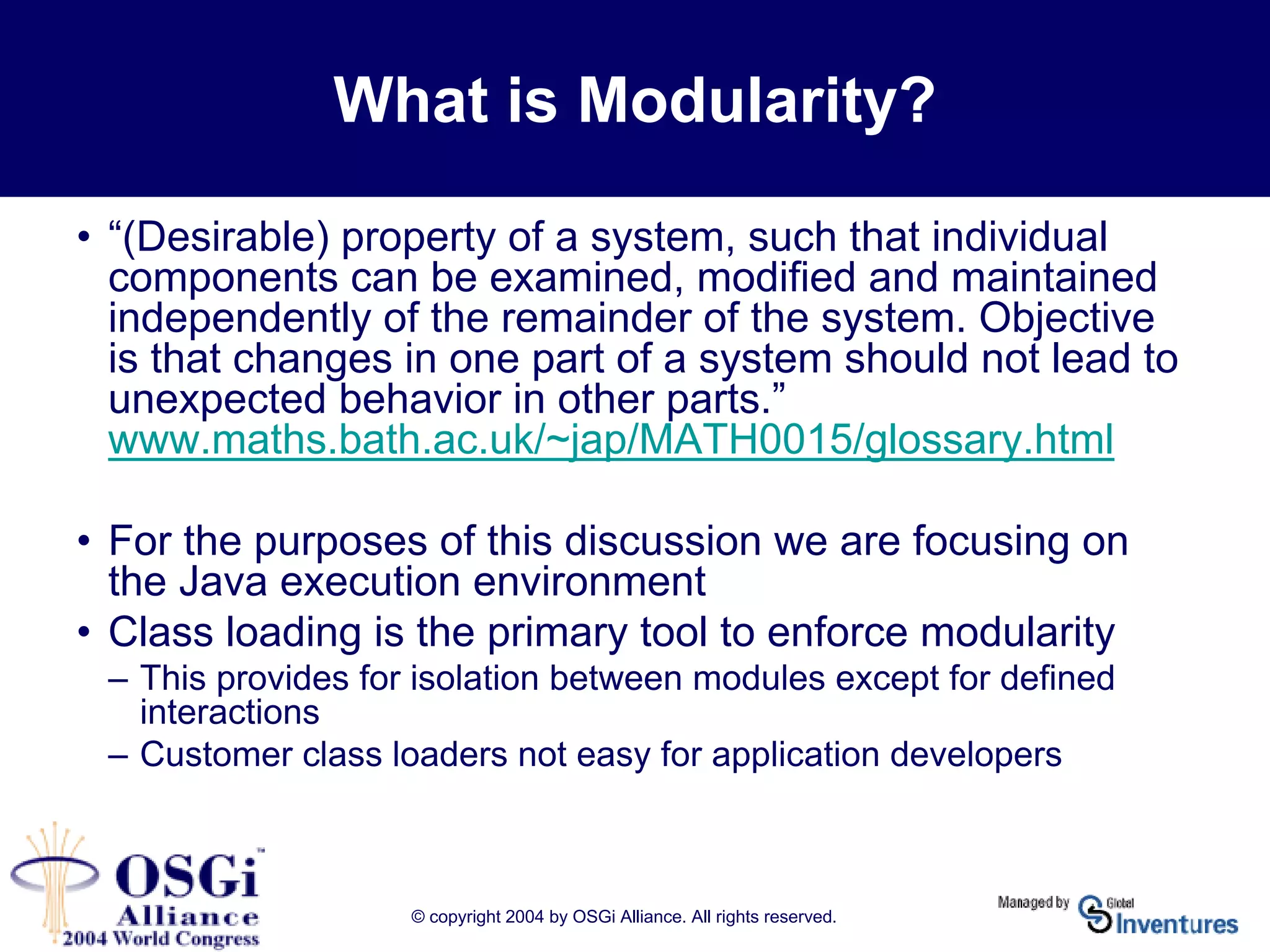
What is Modularity?
• “(Desirable) property of a system, such that individual
components can be examined, modified and maintained
independently of the remainder of the system. Objective
is that changes in one part of a system should not lead to
unexpected behavior in other parts.”
www.maths.bath.ac.uk/~jap/MATH0015/glossary.html
• For the purposes of this discussion we are focusing on
the Java execution environment
• Class loading is the primary tool to enforce modularity
– This provides for isolation between modules except for defined
interactions
– Customer class loaders not easy for application developers
© copyright 2004 by OSGi Alliance. All rights reserved.
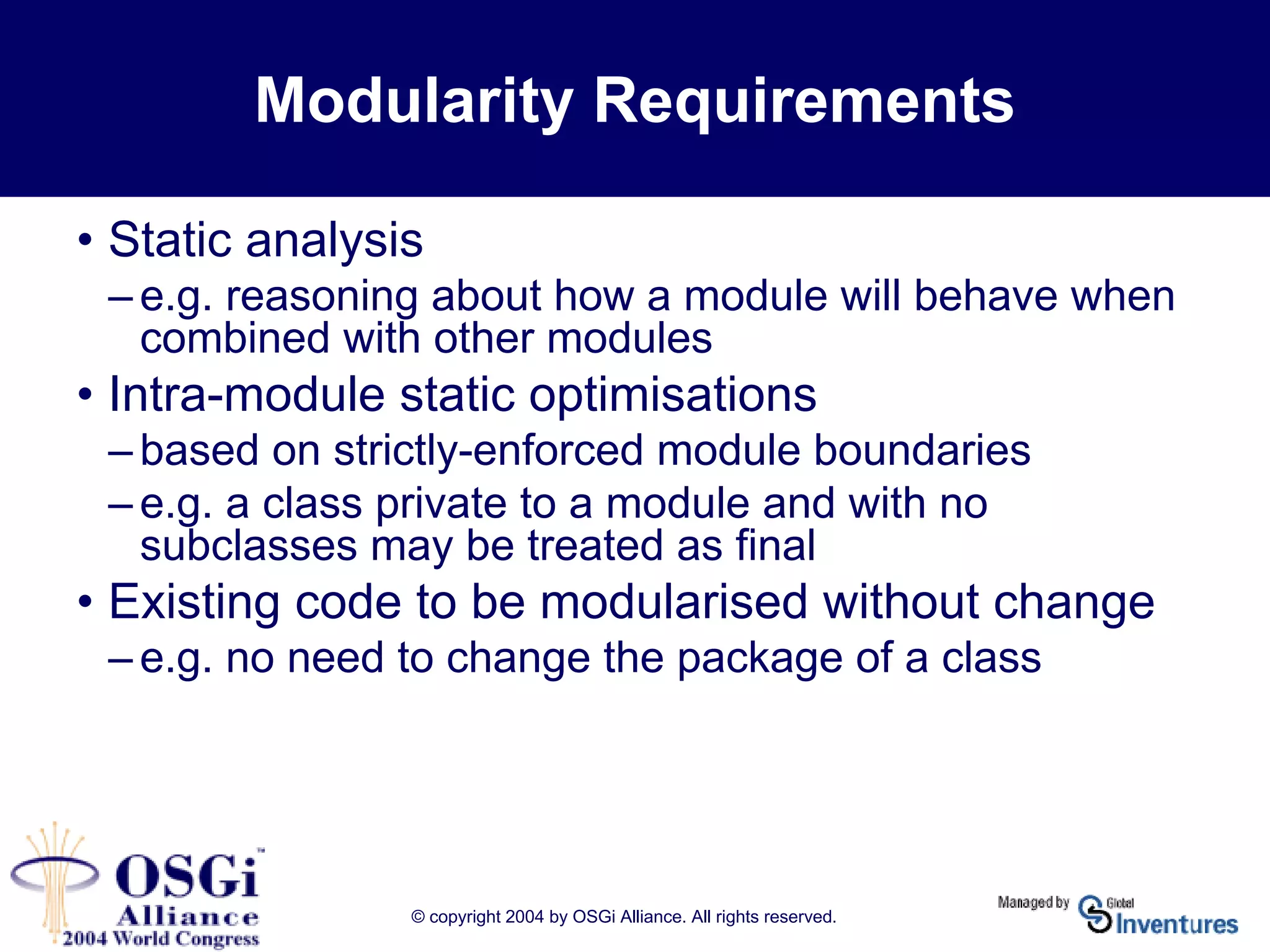
Modularity Requirements
• Static analysis
– e.g. reasoning about how a module will behave when
combined with other modules
• Intra-module static optimisations
– based on strictly-enforced module boundaries
– e.g. a class private to a module and with no
subclasses may be treated as final
• Existing code to be modularised without change
– e.g. no need to change the package of a class
© copyright 2004 by OSGi Alliance. All rights reserved.
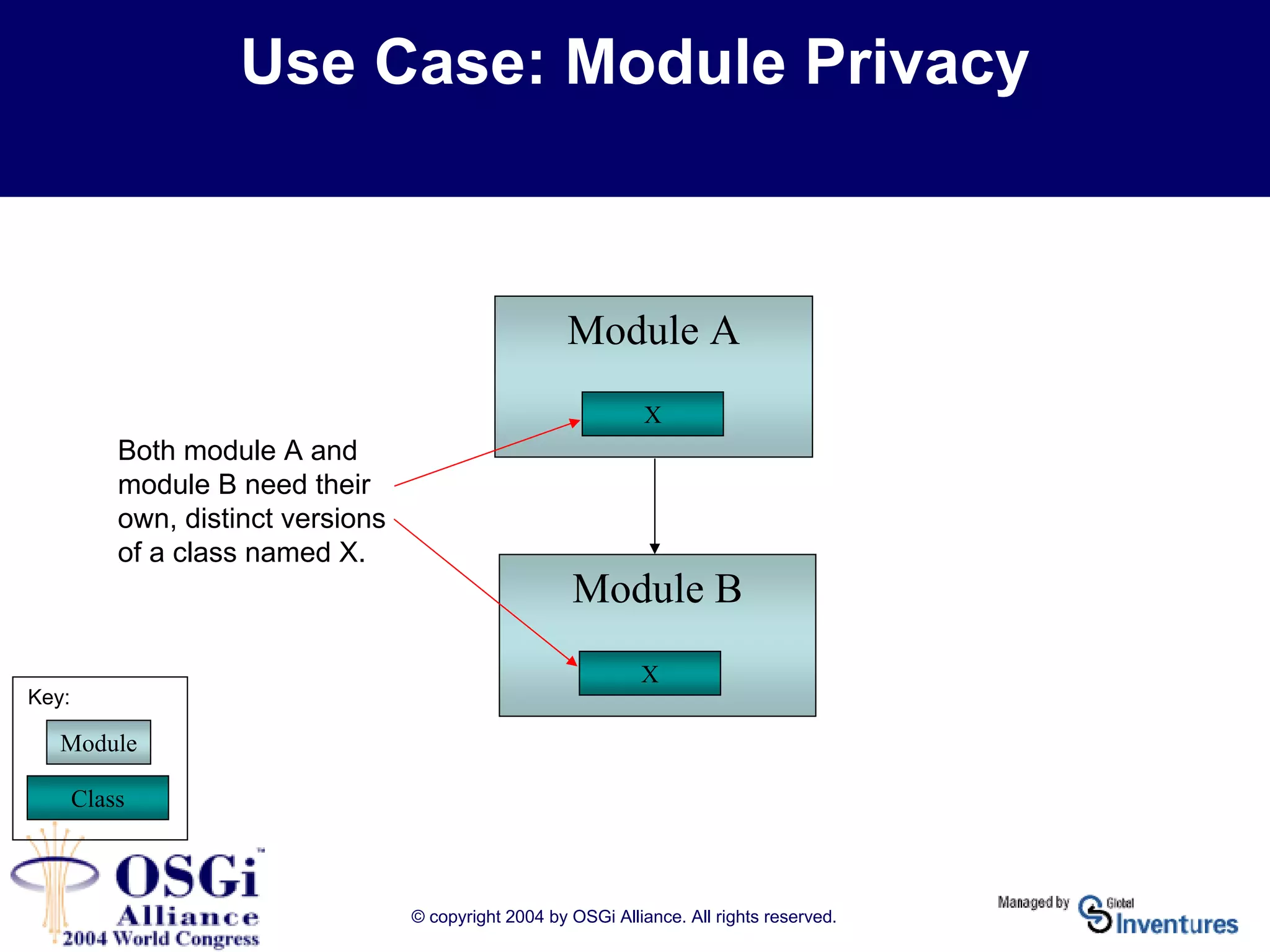
Use Case: Module Privacy
Module A
Module B
Module
Class
Key:
X
X
Both module A and
module B need their
own, distinct versions
of a class named X.
© copyright 2004 by OSGi Alliance. All rights reserved.
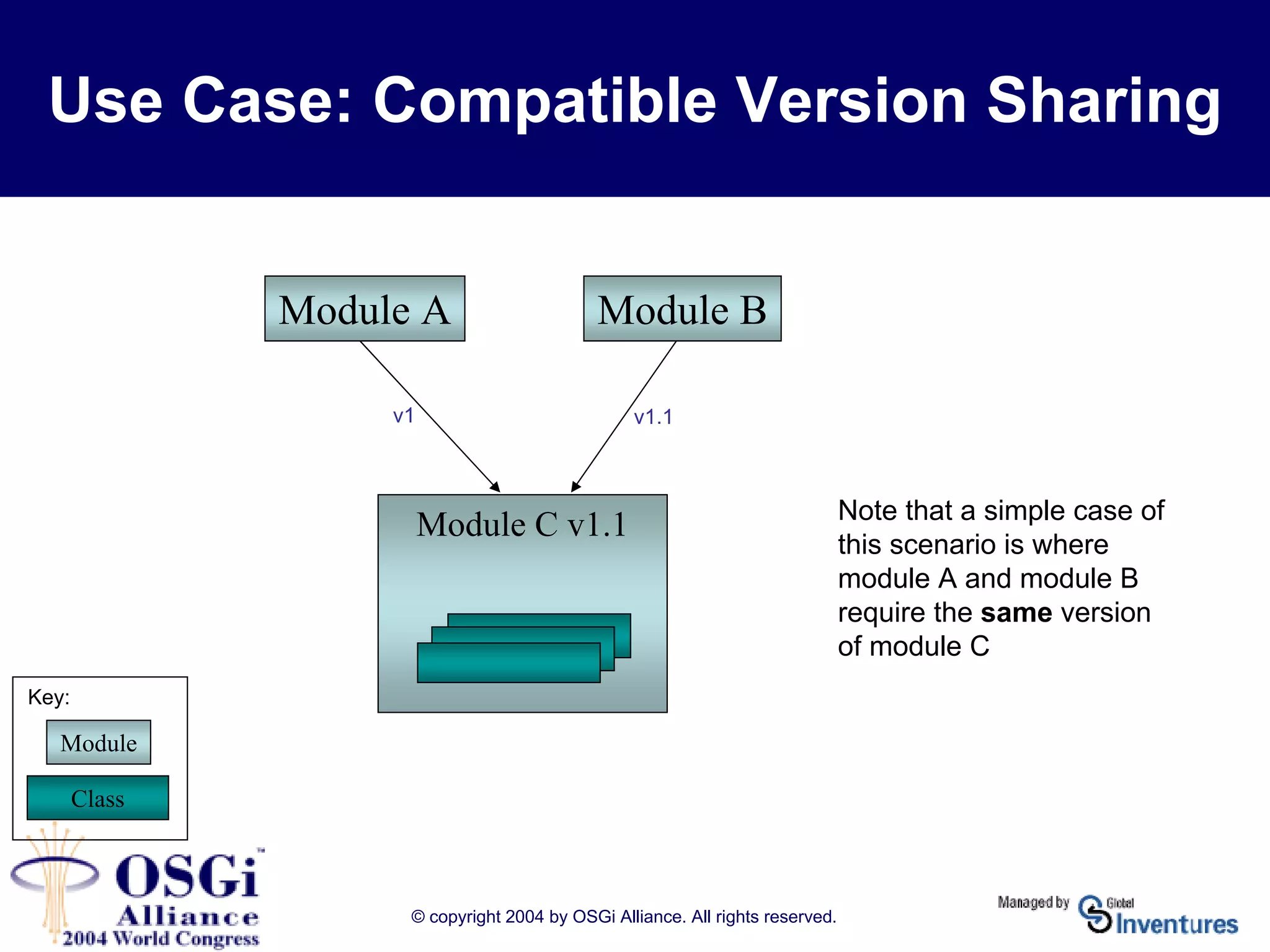
Use Case: Compatible Version Sharing
Module C v1.1
Module BModule A
v1 v1.1
Note that a simple case of
this scenario is where
module A and module B
require the same version
of module C
Module
Class
Key:
© copyright 2004 by OSGi Alliance. All rights reserved.
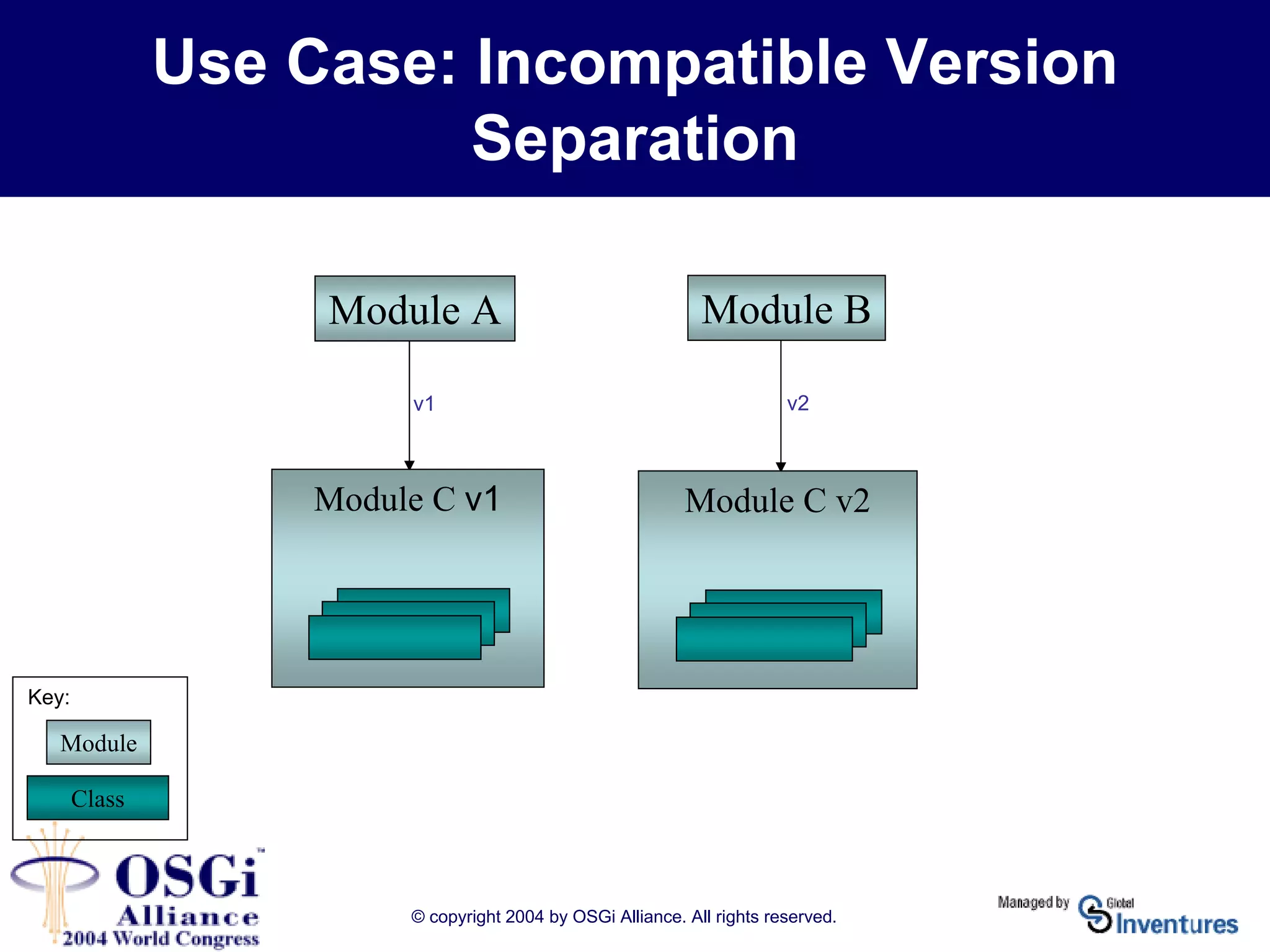
Use Case: Incompatible Version
Separation
Module C v1 Module C v2
Module BModule A
v1 v2
Module
Class
Key:
© copyright 2004 by OSGi Alliance. All rights reserved.
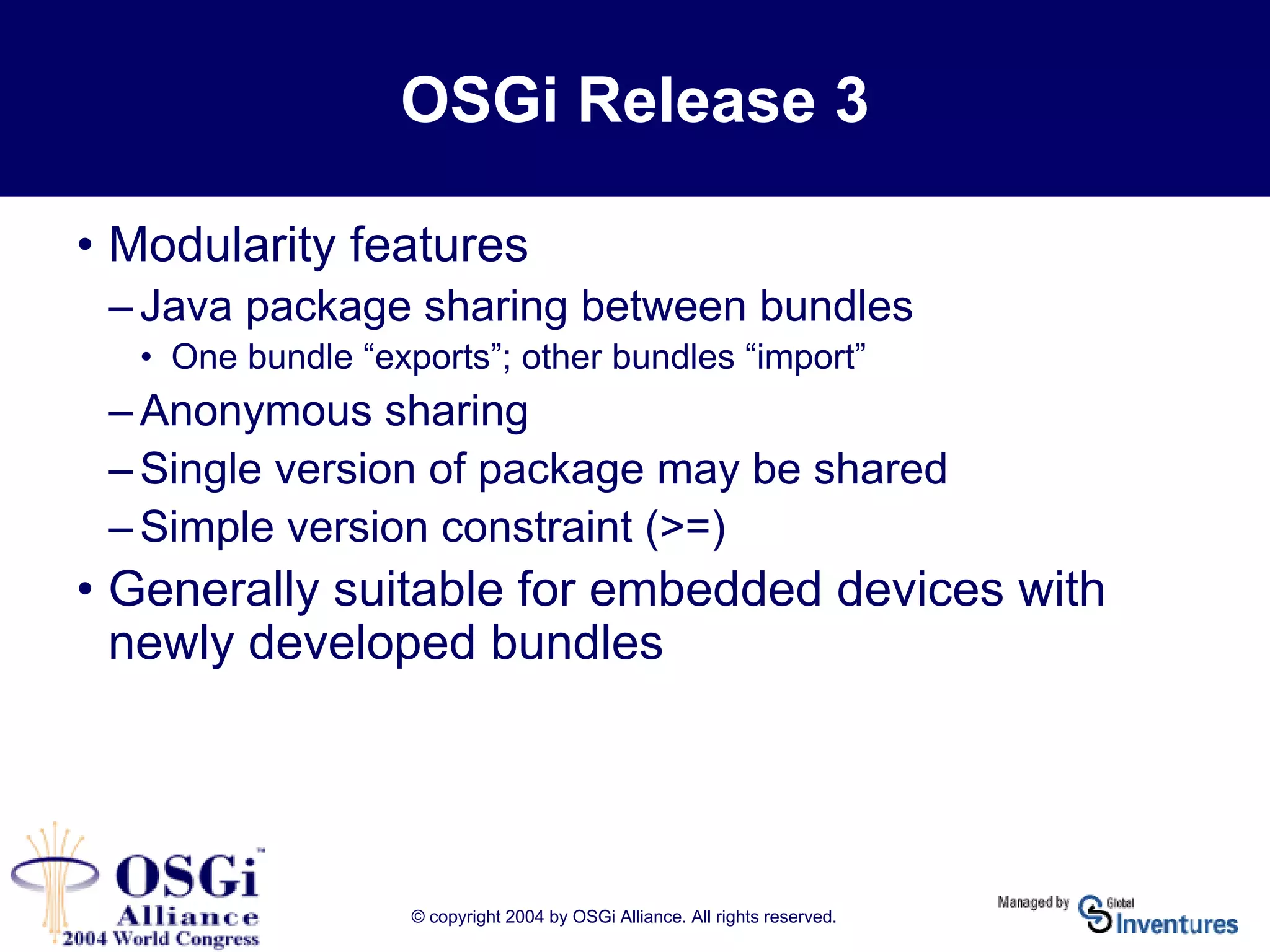
OSGi Release 3
• Modularity features
– Java package sharing between bundles
• One bundle “exports”; other bundles “import”
– Anonymous sharing
– Single version of package may be shared
– Simple version constraint (>=)
• Generally suitable for embedded devices with
newly developed bundles
© copyright 2004 by OSGi Alliance. All rights reserved.
RFC 70
• Used by Eclipse 3.0
– RFC 70 is a post-R3 design effort to support modularity concepts of
Eclipse plug-ins
– Eclipse 3.0 includes an OSGi framework which implements OSGi
R3 spec plus RFC 70 design
• New modularity features
– Grouped Java package sharing between bundles
• Multiple bundles “provide”; other bundles “require”
– Named sharing
– Multiple versions of a package may be shared
– Version range constraints using interval notation e.g. [minv, maxv]
• Suitable for larger systems with legacy code and
implementation dependencies
© copyright 2004 by OSGi Alliance. All rights reserved.
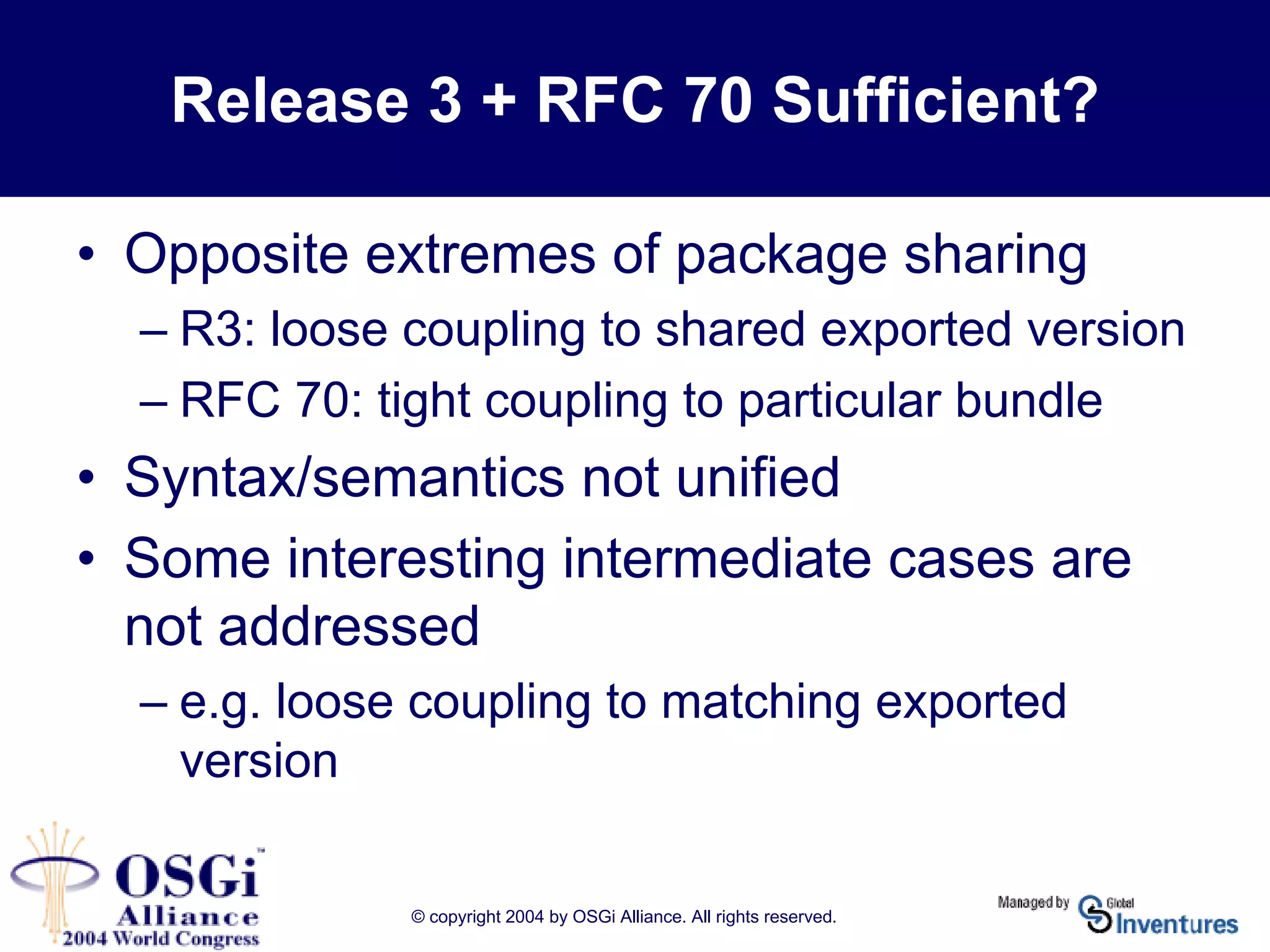
• Opposite extremes of package sharing
– R3: loose coupling to shared exported version
– RFC 70: tight coupling to particular bundle
• Syntax/semantics not unified
• Some interesting intermediate cases are
not addressed
– e.g. loose coupling to matching exported
version
Release 3 + RFC 70 Sufficient?
© copyright 2004 by OSGi Alliance. All rights reserved.
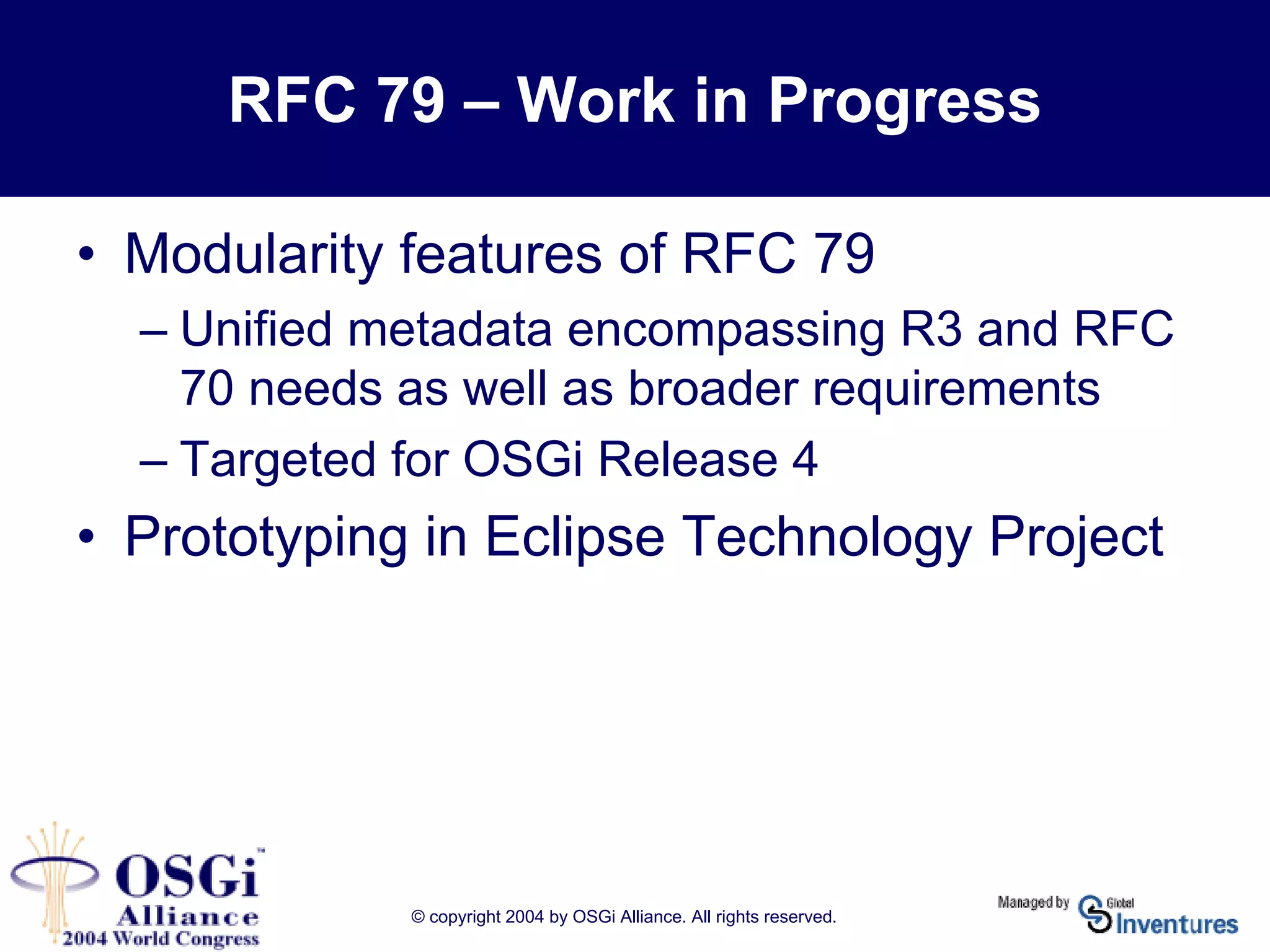
RFC 79 – Work in Progress
• Modularity features of RFC 79
– Unified metadata encompassing R3 and RFC
70 needs as well as broader requirements
– Targeted for OSGi Release 4
• Prototyping in Eclipse Technology Project
© copyright 2004 by OSGi Alliance. All rights reserved.
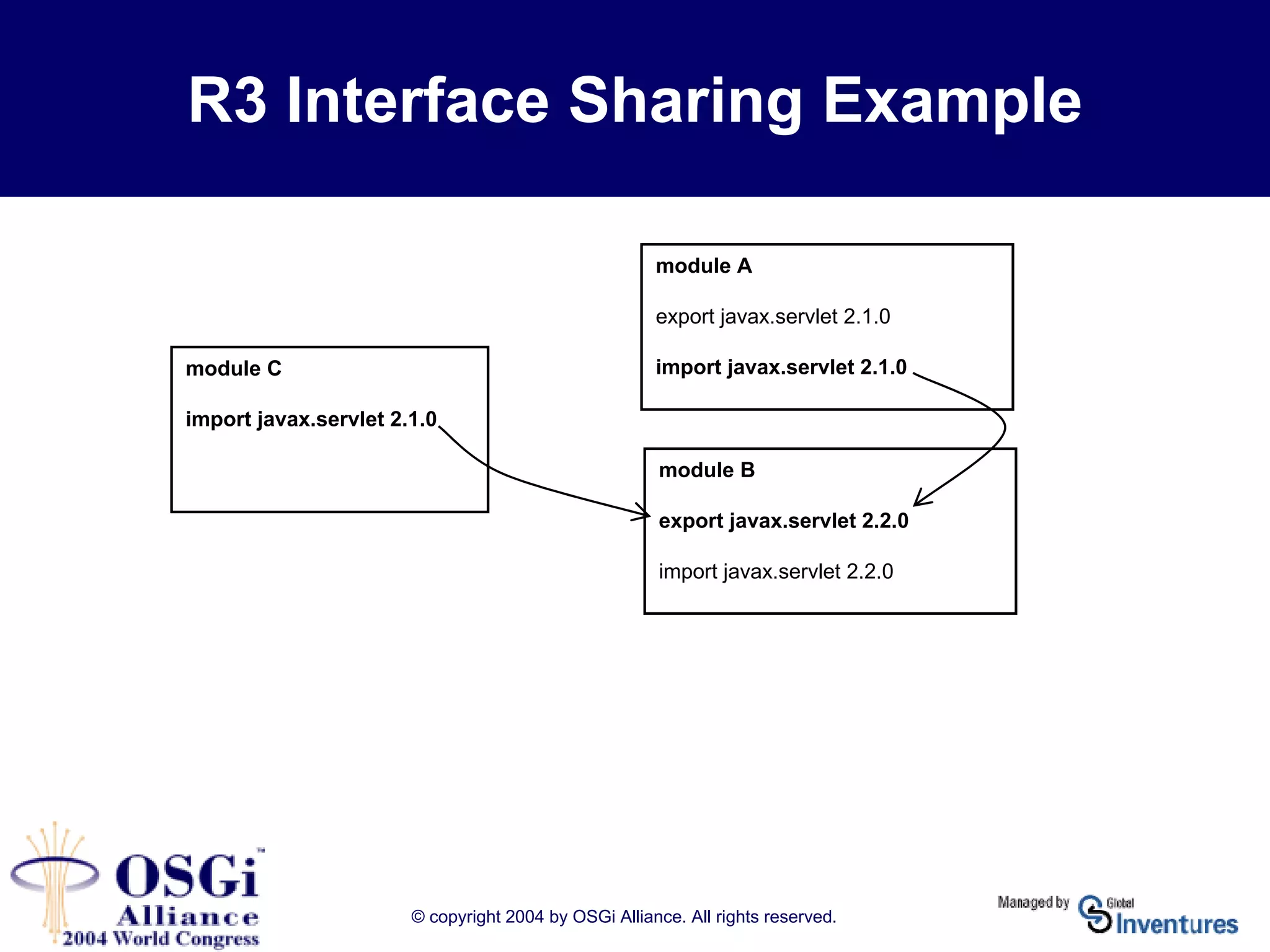
R3 Interface Sharing Example
module A
export javax.servlet 2.1.0
import javax.servlet 2.1.0
module B
export javax.servlet 2.2.0
import javax.servlet 2.2.0
module C
import javax.servlet 2.1.0
© copyright 2004 by OSGi Alliance. All rights reserved.
Implementation Sharing Example
module A
export org.foo 1.0
module B
export org.foo 2.0
module C
import org.foo [1.0, 1.0]
module D
import org.foo 2.0
© copyright 2004 by OSGi Alliance. All rights reserved.
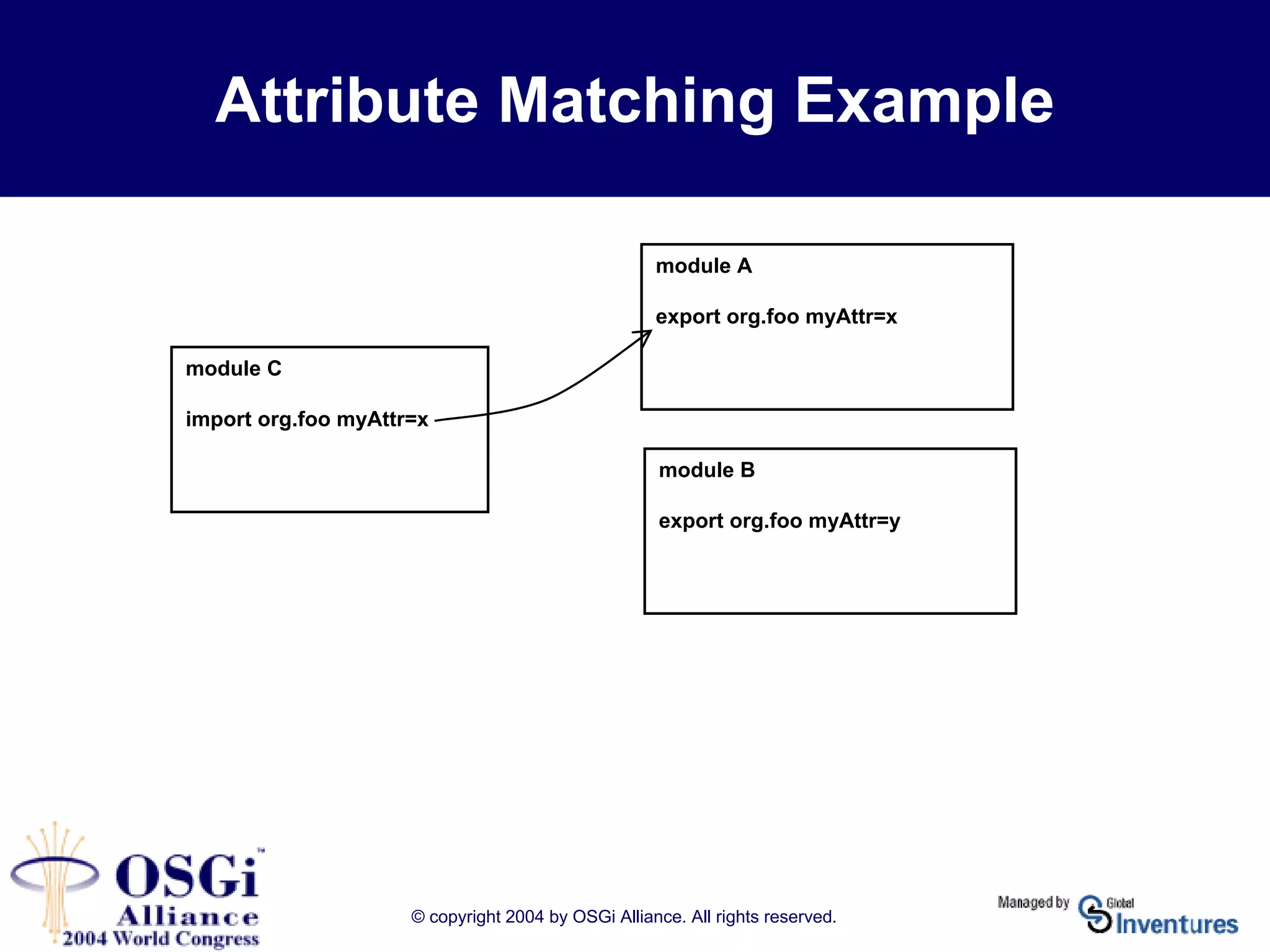
Attribute Matching Example
module A
export org.foo myAttr=x
module B
export org.foo myAttr=y
module C
import org.foo myAttr=x

Framework Modularity Layer - Glyn Normington, IBM

  • 1.
    © copyright 2004by OSGi Alliance All rights reserved. OSGi Framework Modularity Improvements Glyn Normington, IBM UK Limited
  • 2.
    © copyright 2004by OSGi Alliance. All rights reserved. Contents • OSGi Framework • What is Modularity? • Requirements and Use Cases • Evolution: OSGi R3, RFC 70, RFC 79 • Simple Examples
  • 3.
    © copyright 2004by OSGi Alliance. All rights reserved. OSGi Framework Hardware Driver Driver Driver Operating System Java OSGi Fram ew ork Bundle
  • 4.
    © copyright 2004by OSGi Alliance. All rights reserved. What is Modularity? • “(Desirable) property of a system, such that individual components can be examined, modified and maintained independently of the remainder of the system. Objective is that changes in one part of a system should not lead to unexpected behavior in other parts.” www.maths.bath.ac.uk/~jap/MATH0015/glossary.html • For the purposes of this discussion we are focusing on the Java execution environment • Class loading is the primary tool to enforce modularity – This provides for isolation between modules except for defined interactions – Customer class loaders not easy for application developers
  • 5.
    © copyright 2004by OSGi Alliance. All rights reserved. Modularity Requirements • Static analysis – e.g. reasoning about how a module will behave when combined with other modules • Intra-module static optimisations – based on strictly-enforced module boundaries – e.g. a class private to a module and with no subclasses may be treated as final • Existing code to be modularised without change – e.g. no need to change the package of a class
  • 6.
    © copyright 2004by OSGi Alliance. All rights reserved. Use Case: Module Privacy Module A Module B Module Class Key: X X Both module A and module B need their own, distinct versions of a class named X.
  • 7.
    © copyright 2004by OSGi Alliance. All rights reserved. Use Case: Compatible Version Sharing Module C v1.1 Module BModule A v1 v1.1 Note that a simple case of this scenario is where module A and module B require the same version of module C Module Class Key:
  • 8.
    © copyright 2004by OSGi Alliance. All rights reserved. Use Case: Incompatible Version Separation Module C v1 Module C v2 Module BModule A v1 v2 Module Class Key:
  • 9.
    © copyright 2004by OSGi Alliance. All rights reserved. OSGi Release 3 • Modularity features – Java package sharing between bundles • One bundle “exports”; other bundles “import” – Anonymous sharing – Single version of package may be shared – Simple version constraint (>=) • Generally suitable for embedded devices with newly developed bundles
  • 10.
    © copyright 2004by OSGi Alliance. All rights reserved. RFC 70 • Used by Eclipse 3.0 – RFC 70 is a post-R3 design effort to support modularity concepts of Eclipse plug-ins – Eclipse 3.0 includes an OSGi framework which implements OSGi R3 spec plus RFC 70 design • New modularity features – Grouped Java package sharing between bundles • Multiple bundles “provide”; other bundles “require” – Named sharing – Multiple versions of a package may be shared – Version range constraints using interval notation e.g. [minv, maxv] • Suitable for larger systems with legacy code and implementation dependencies
  • 11.
    © copyright 2004by OSGi Alliance. All rights reserved. • Opposite extremes of package sharing – R3: loose coupling to shared exported version – RFC 70: tight coupling to particular bundle • Syntax/semantics not unified • Some interesting intermediate cases are not addressed – e.g. loose coupling to matching exported version Release 3 + RFC 70 Sufficient?
  • 12.
    © copyright 2004by OSGi Alliance. All rights reserved. RFC 79 – Work in Progress • Modularity features of RFC 79 – Unified metadata encompassing R3 and RFC 70 needs as well as broader requirements – Targeted for OSGi Release 4 • Prototyping in Eclipse Technology Project
  • 13.
    © copyright 2004by OSGi Alliance. All rights reserved. R3 Interface Sharing Example module A export javax.servlet 2.1.0 import javax.servlet 2.1.0 module B export javax.servlet 2.2.0 import javax.servlet 2.2.0 module C import javax.servlet 2.1.0
  • 14.
    © copyright 2004by OSGi Alliance. All rights reserved. Implementation Sharing Example module A export org.foo 1.0 module B export org.foo 2.0 module C import org.foo [1.0, 1.0] module D import org.foo 2.0
  • 15.
    © copyright 2004by OSGi Alliance. All rights reserved. Attribute Matching Example module A export org.foo myAttr=x module B export org.foo myAttr=y module C import org.foo myAttr=x