Conversions: fractions to decimals
1
How to change a fraction to a
decimal
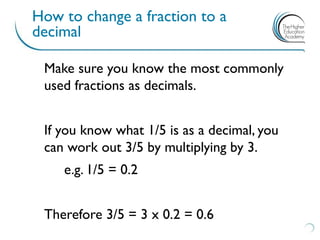
Make sure you know the most commonly
used fractions as decimals.
If you know what 1/5 is as a decimal, you
can work out 3/5 by multiplying by 3.
e.g. 1/5 = 0.2
Therefore 3/5 = 3 x 0.2 = 0.6
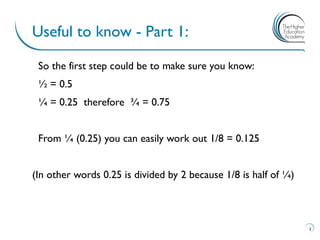
So the first step could be to make sure you know:
½ = 0.5
¼ = 0.25 therefore ¾ = 0.75
From ¼ (0.25) you can easily work out 1/8 = 0.125
(In other words 0.25 is divided by 2 because 1/8 is half of ¼)
Useful to know - Part 1:
3
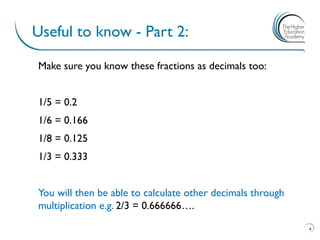
Make sure you know these fractions as decimals too:
1/5 = 0.2
1/6 = 0.166
1/8 = 0.125
1/3 = 0.333
You will then be able to calculate other decimals through
multiplication e.g. 2/3 = 0.666666….
Useful to know - Part 2:
4
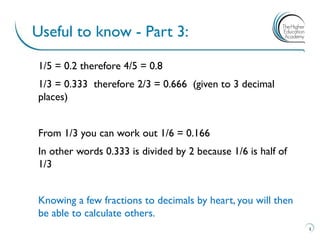
1/5 = 0.2 therefore 4/5 = 0.8
1/3 = 0.333 therefore 2/3 = 0.666 (given to 3 decimal
places)
From 1/3 you can work out 1/6 = 0.166
In other words 0.333 is divided by 2 because 1/6 is half of
1/3
Knowing a few fractions to decimals by heart, you will then
be able to calculate others.
Useful to know - Part 3:
5
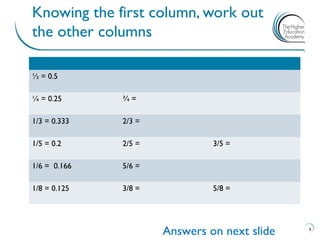
½ = 0.5
¼ = 0.25 ¾ =
1/3 = 0.333 2/3 =
1/5 = 0.2 2/5 = 3/5 =
1/6 = 0.166 5/6 =
1/8 = 0.125 3/8 = 5/8 =
Knowing the first column, work out
the other columns
6
Answers on next slide
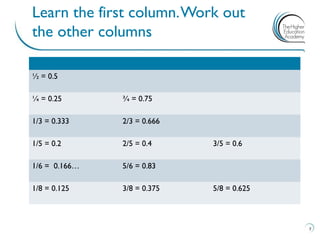
½ = 0.5
¼ = 0.25 ¾ = 0.75
1/3 = 0.333 2/3 = 0.666
1/5 = 0.2 2/5 = 0.4 3/5 = 0.6
1/6 = 0.166… 5/6 = 0.83
1/8 = 0.125 3/8 = 0.375 5/8 = 0.625
Learn the first column.Work out
the other columns
7
Fractions to decimals – Option 1
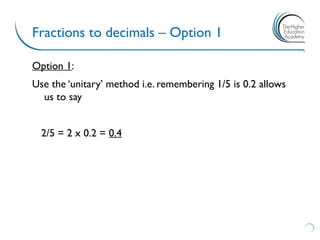
Option 1:
Use the ‘unitary’ method i.e. remembering 1/5 is 0.2 allows
us to say
2/5 = 2 x 0.2 = 0.4
Fractions to decimals – Option 1
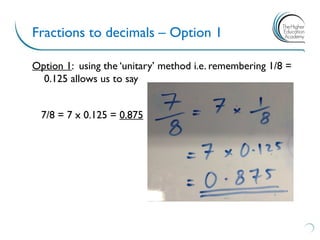
Option 1: using the ‘unitary’ method i.e. remembering 1/8 =
0.125 allows us to say
7/8 = 7 x 0.125 = 0.875
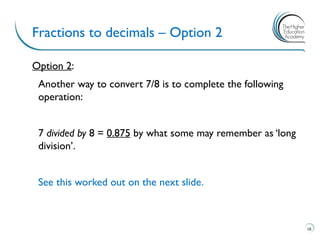
Option 2:
Another way to convert 7/8 is to complete the following
operation:
7 divided by 8 = 0.875 by what some may remember as ‘long
division’.
See this worked out on the next slide.
Fractions to decimals – Option 2
10
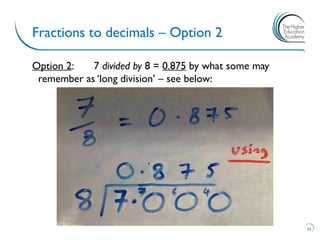
Option 2: 7 divided by 8 = 0.875 by what some may
remember as ‘long division’ – see below:
Fractions to decimals – Option 2
11
Option 3:
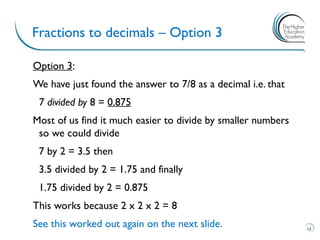
We have just found the answer to 7/8 as a decimal i.e. that
7 divided by 8 = 0.875
Most of us find it much easier to divide by smaller numbers
so we could divide
7 by 2 = 3.5 then
3.5 divided by 2 = 1.75 and finally
1.75 divided by 2 = 0.875
This works because 2 x 2 x 2 = 8
See this worked out again on the next slide.
Fractions to decimals – Option 3
12
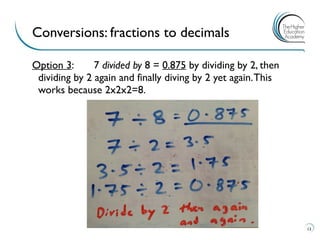
Option 3: 7 divided by 8 = 0.875 by dividing by 2, then
dividing by 2 again and finally diving by 2 yet again.This
works because 2x2x2=8.
Conversions: fractions to decimals
13
http://www.bbc.co.uk/bitesize/ks2/maths/number/fractions_t
o_decimals/play/
http://www.mathsisfun.com/converting-fractions-
decimals.html
http://www.webmath.com/fract2dec.html
http://www.cimt.plymouth.ac.uk/projects/mepres/book7/bk7i
17/bk7_17i2.htm
http://www.mathplayground.com/fractions_convert.html
Need more practice:
14
You can suggest additional resources by adding a
comment below our numeracy blog post.
Good luck!
15

Fractions to decimals

  • 1.
  • 2.
    How to changea fraction to a decimal Make sure you know the most commonly used fractions as decimals. If you know what 1/5 is as a decimal, you can work out 3/5 by multiplying by 3. e.g. 1/5 = 0.2 Therefore 3/5 = 3 x 0.2 = 0.6
  • 3.
    So the firststep could be to make sure you know: ½ = 0.5 ¼ = 0.25 therefore ¾ = 0.75 From ¼ (0.25) you can easily work out 1/8 = 0.125 (In other words 0.25 is divided by 2 because 1/8 is half of ¼) Useful to know - Part 1: 3
  • 4.
    Make sure youknow these fractions as decimals too: 1/5 = 0.2 1/6 = 0.166 1/8 = 0.125 1/3 = 0.333 You will then be able to calculate other decimals through multiplication e.g. 2/3 = 0.666666…. Useful to know - Part 2: 4
  • 5.
    1/5 = 0.2therefore 4/5 = 0.8 1/3 = 0.333 therefore 2/3 = 0.666 (given to 3 decimal places) From 1/3 you can work out 1/6 = 0.166 In other words 0.333 is divided by 2 because 1/6 is half of 1/3 Knowing a few fractions to decimals by heart, you will then be able to calculate others. Useful to know - Part 3: 5
  • 6.
    ½ = 0.5 ¼= 0.25 ¾ = 1/3 = 0.333 2/3 = 1/5 = 0.2 2/5 = 3/5 = 1/6 = 0.166 5/6 = 1/8 = 0.125 3/8 = 5/8 = Knowing the first column, work out the other columns 6 Answers on next slide
  • 7.
    ½ = 0.5 ¼= 0.25 ¾ = 0.75 1/3 = 0.333 2/3 = 0.666 1/5 = 0.2 2/5 = 0.4 3/5 = 0.6 1/6 = 0.166… 5/6 = 0.83 1/8 = 0.125 3/8 = 0.375 5/8 = 0.625 Learn the first column.Work out the other columns 7
  • 8.
    Fractions to decimals– Option 1 Option 1: Use the ‘unitary’ method i.e. remembering 1/5 is 0.2 allows us to say 2/5 = 2 x 0.2 = 0.4
  • 9.
    Fractions to decimals– Option 1 Option 1: using the ‘unitary’ method i.e. remembering 1/8 = 0.125 allows us to say 7/8 = 7 x 0.125 = 0.875
  • 10.
    Option 2: Another wayto convert 7/8 is to complete the following operation: 7 divided by 8 = 0.875 by what some may remember as ‘long division’. See this worked out on the next slide. Fractions to decimals – Option 2 10
  • 11.
    Option 2: 7divided by 8 = 0.875 by what some may remember as ‘long division’ – see below: Fractions to decimals – Option 2 11
  • 12.
    Option 3: We havejust found the answer to 7/8 as a decimal i.e. that 7 divided by 8 = 0.875 Most of us find it much easier to divide by smaller numbers so we could divide 7 by 2 = 3.5 then 3.5 divided by 2 = 1.75 and finally 1.75 divided by 2 = 0.875 This works because 2 x 2 x 2 = 8 See this worked out again on the next slide. Fractions to decimals – Option 3 12
  • 13.
    Option 3: 7divided by 8 = 0.875 by dividing by 2, then dividing by 2 again and finally diving by 2 yet again.This works because 2x2x2=8. Conversions: fractions to decimals 13
  • 14.
  • 15.
    You can suggestadditional resources by adding a comment below our numeracy blog post. Good luck! 15