REVISED SYLLABI FOR
CSS COMPETITIVE EXAMINATION, CE-2016
FPSC, F-5/1, AGA KHAN ROAD, ISLAMABAD
Updated on: 7th
July, 2015
-i-
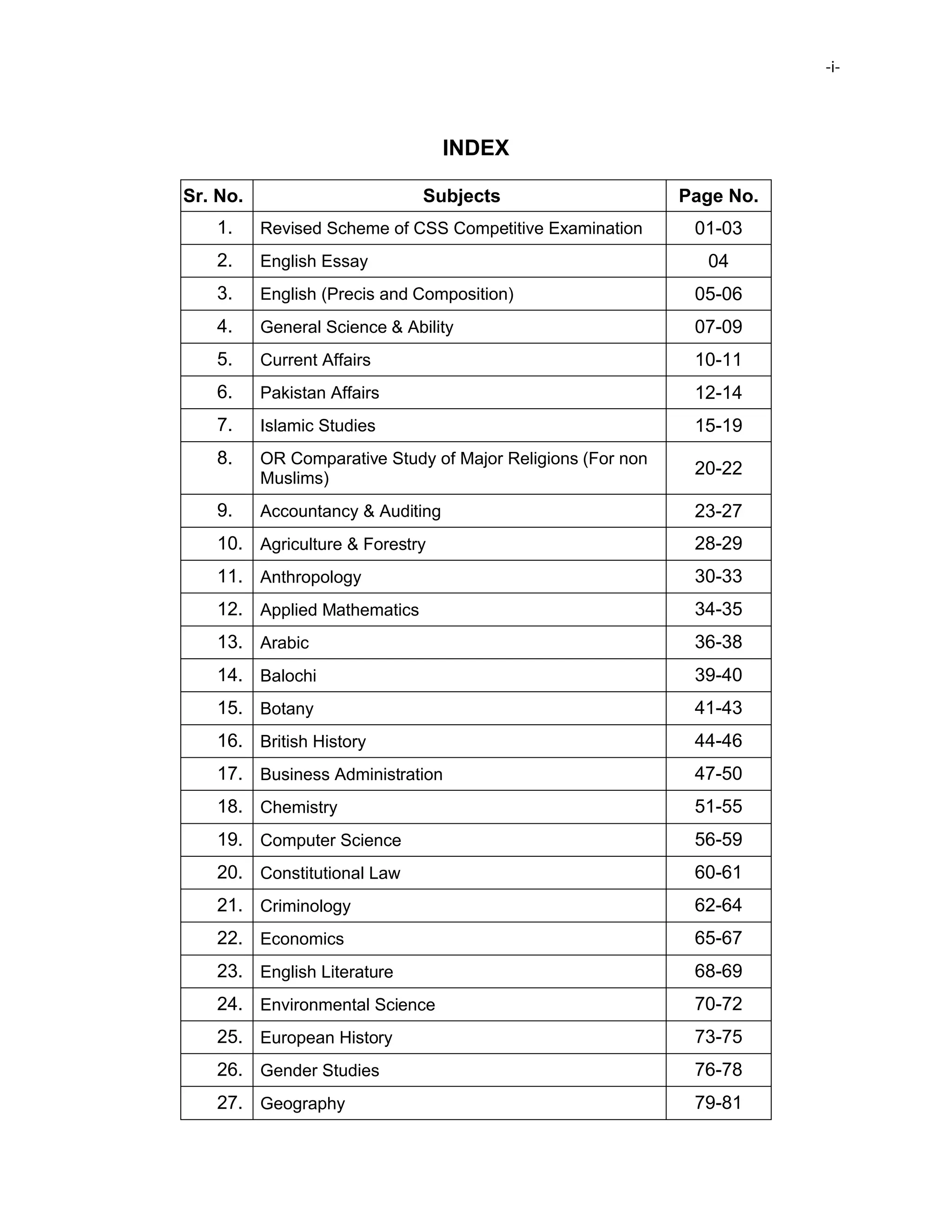
INDEX
Sr. No. Subjects Page No.
1. Revised Scheme of CSS Competitive Examination 01-03
2. English Essay 04
3. English (Precis and Composition) 05-06
4. General Science & Ability 07-09
5. Current Affairs 10-11
6. Pakistan Affairs 12-14
7. Islamic Studies 15-19
8. OR Comparative Study of Major Religions (For non
Muslims)
20-22
9. Accountancy & Auditing 23-27
10. Agriculture & Forestry 28-29
11. Anthropology 30-33
12. Applied Mathematics 34-35
13. Arabic 36-38
14. Balochi 39-40
15. Botany 41-43
16. British History 44-46
17. Business Administration 47-50
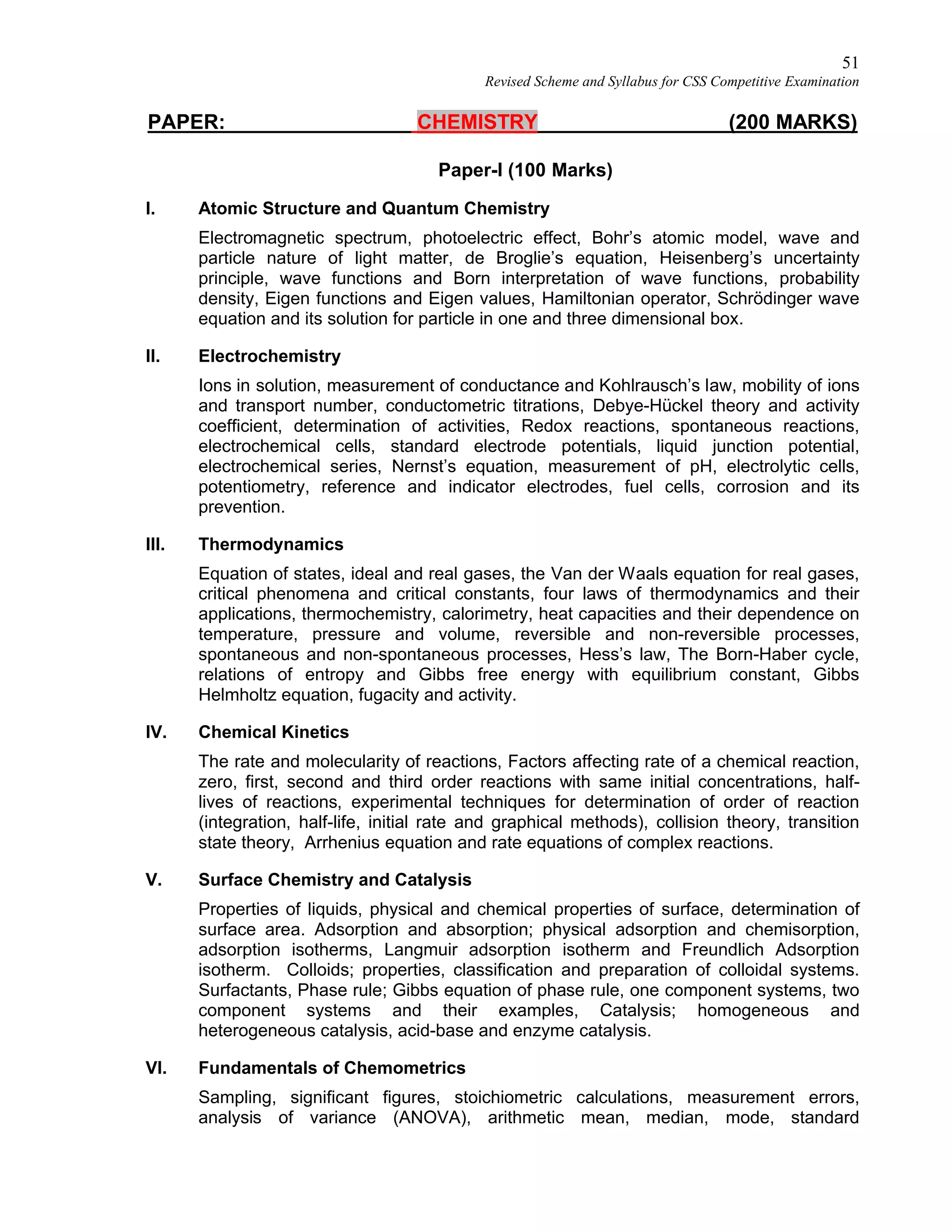
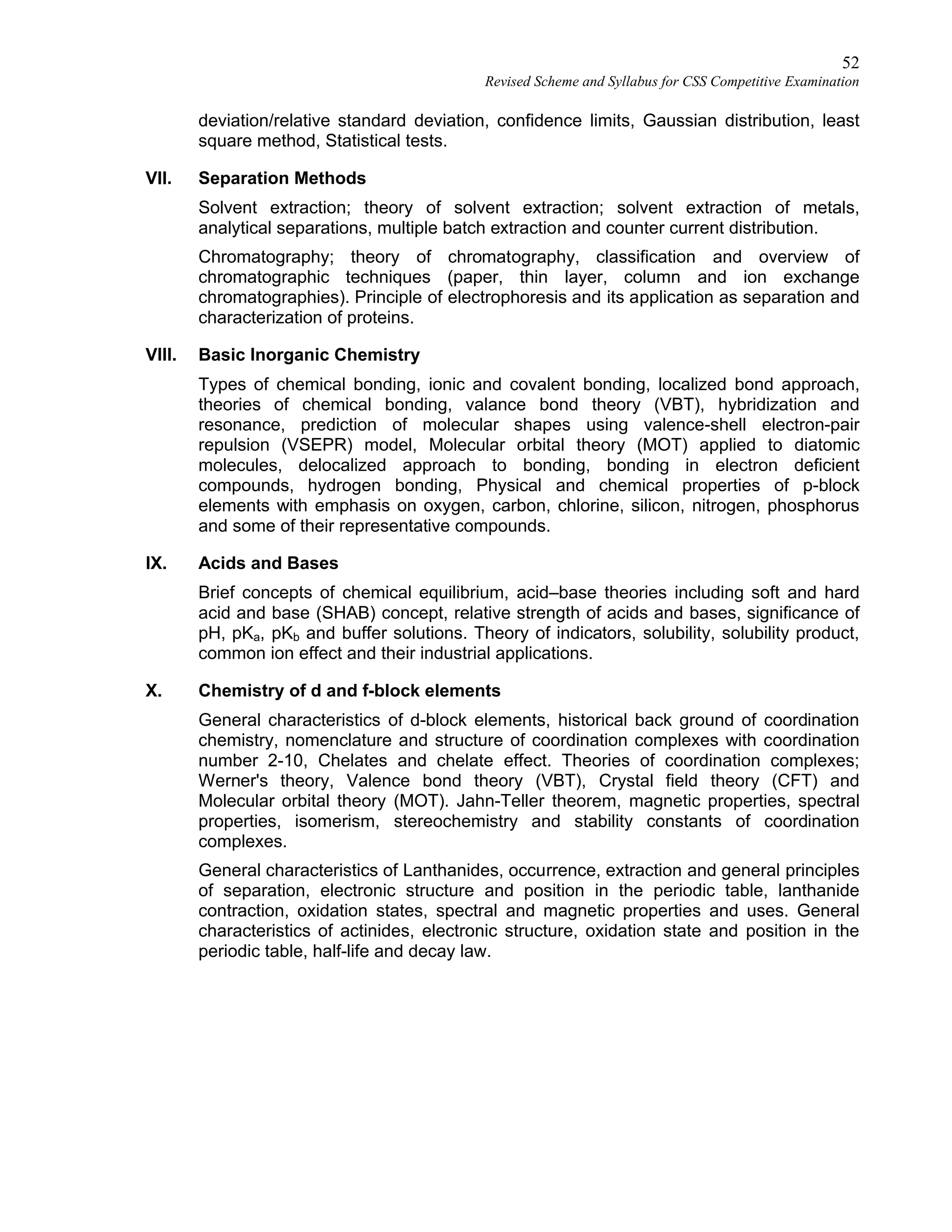
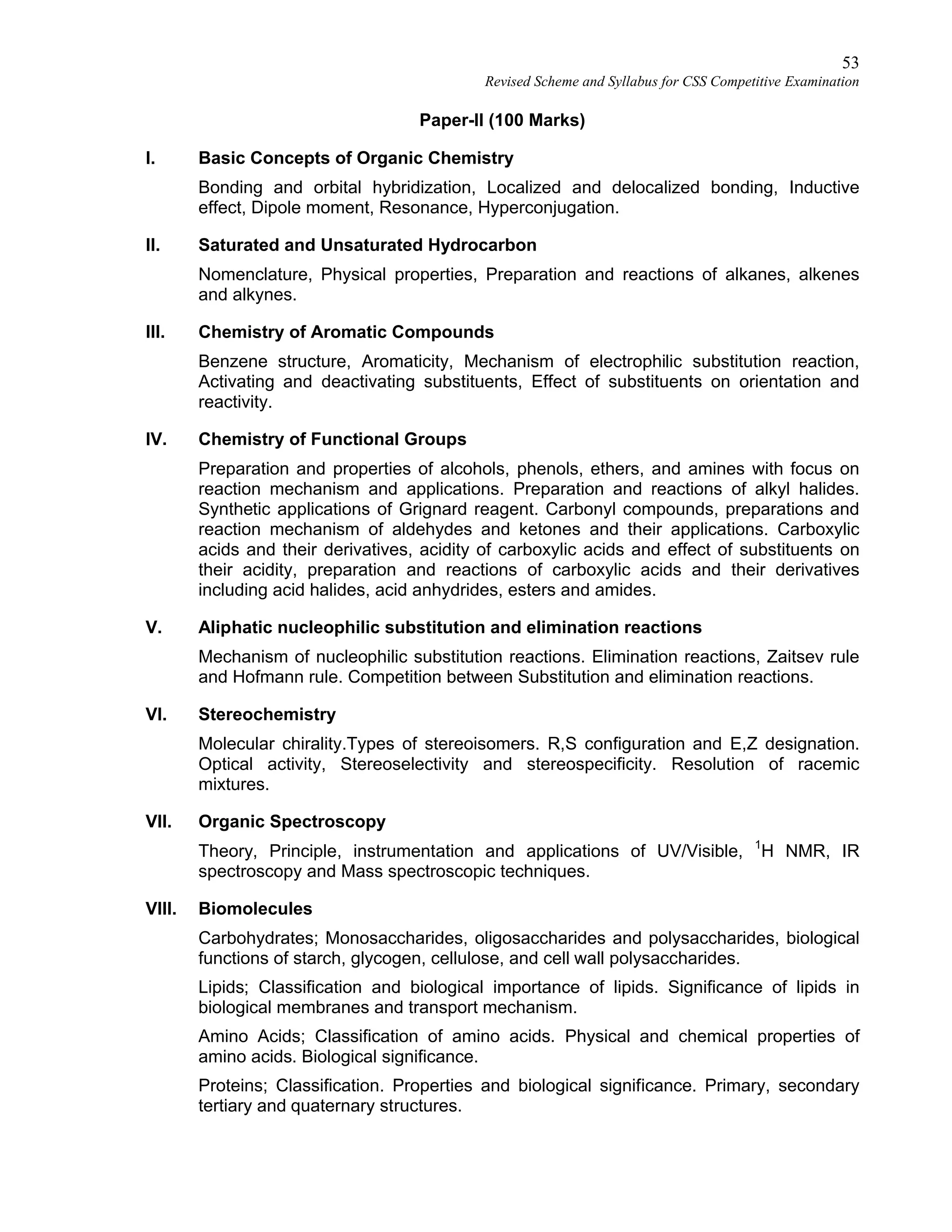
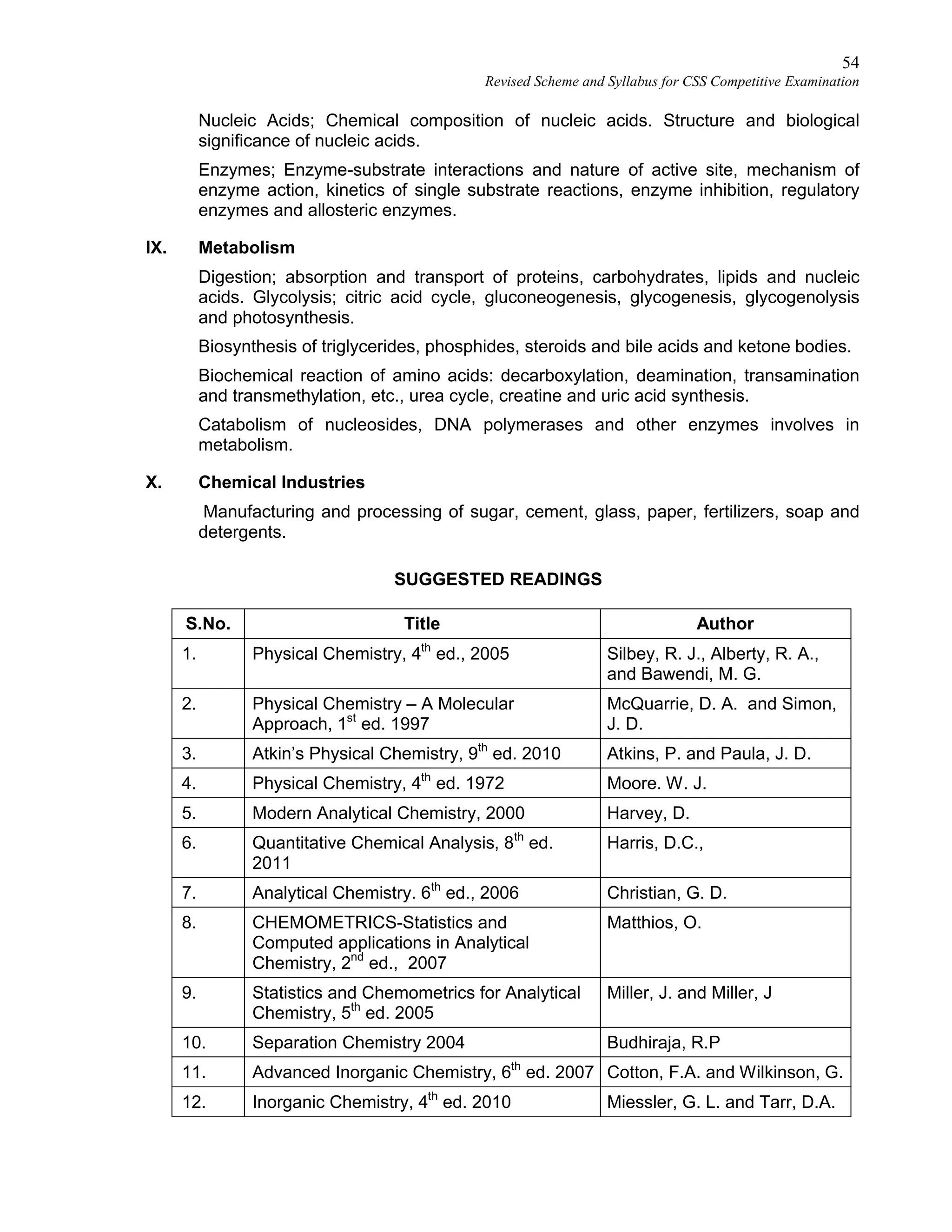
18. Chemistry 51-55
19. Computer Science 56-59
20. Constitutional Law 60-61
21. Criminology 62-64
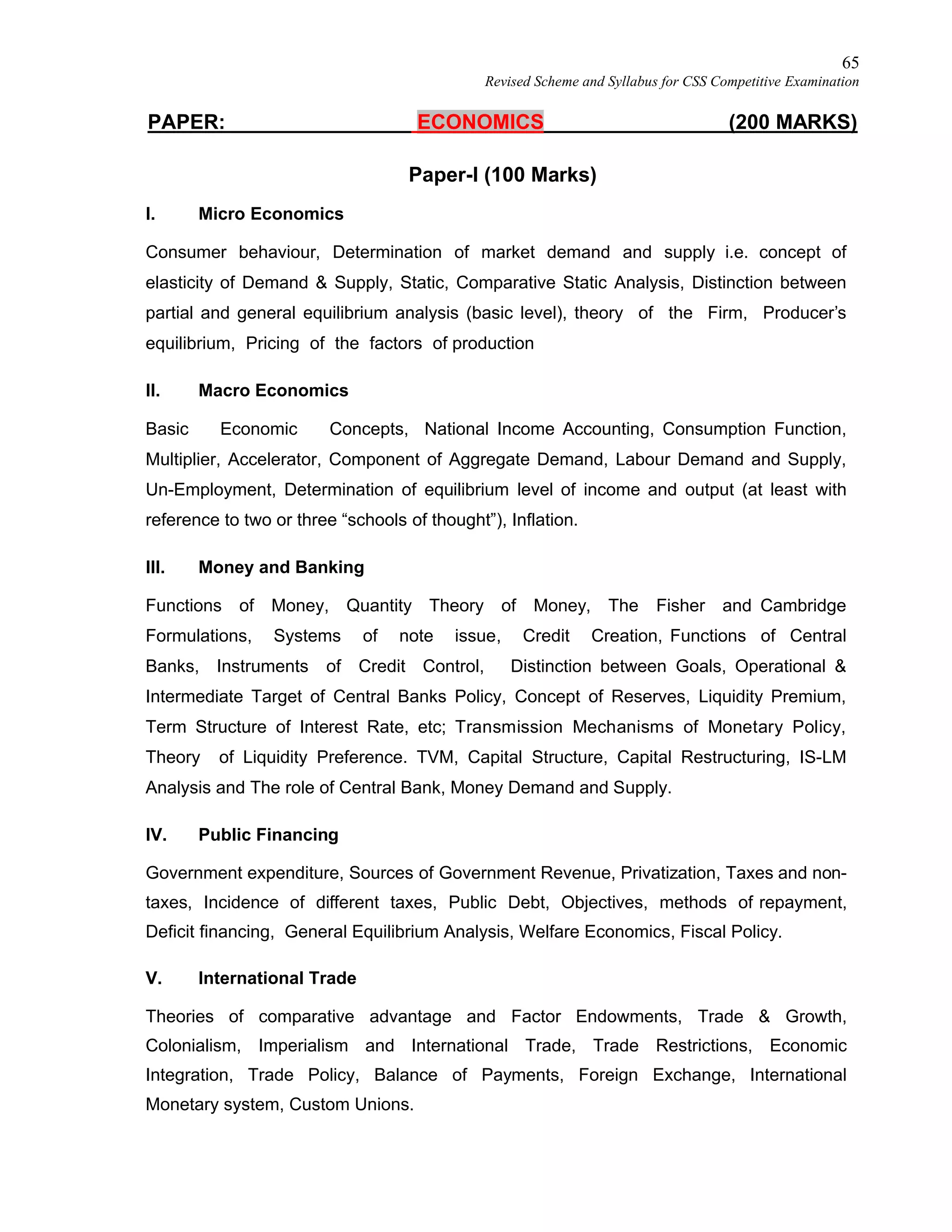
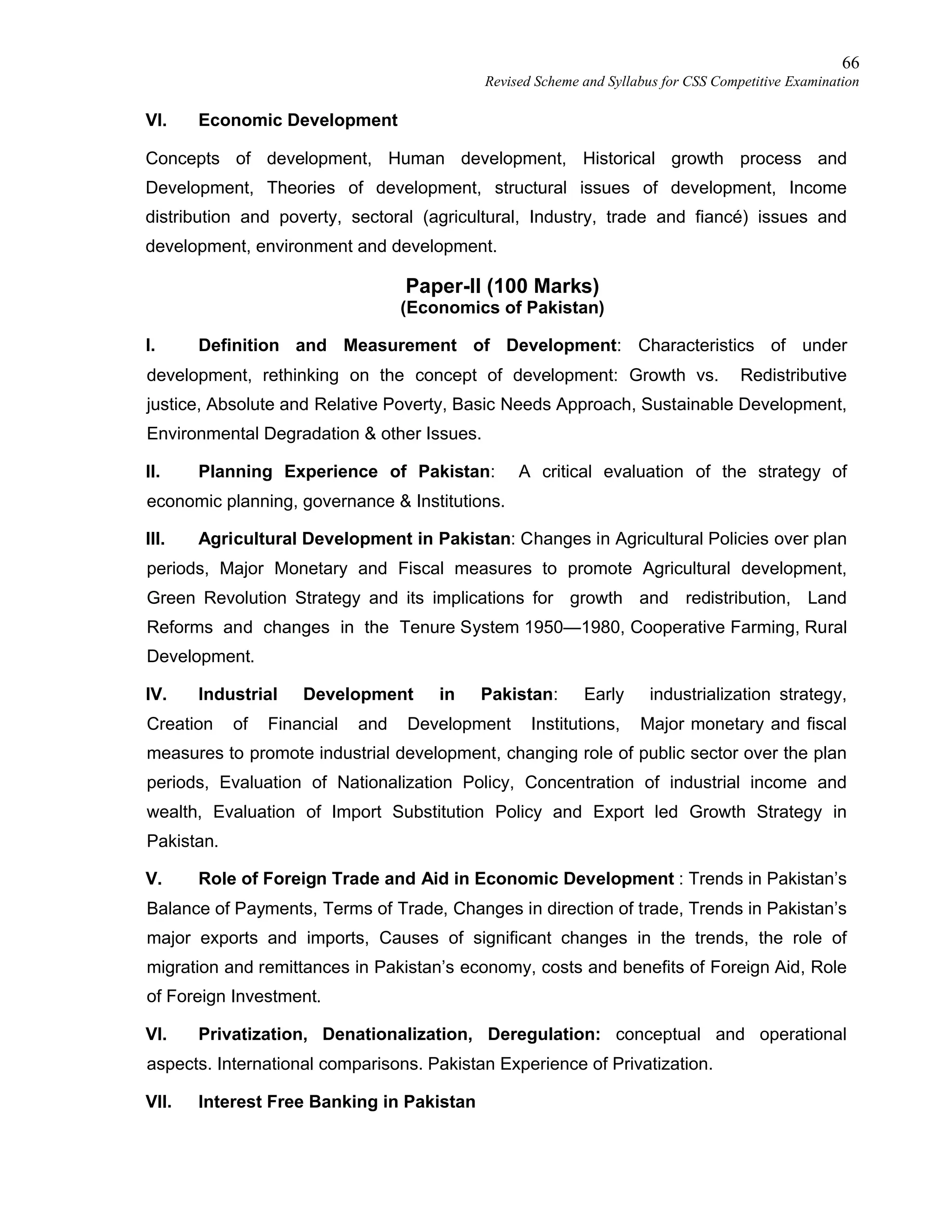
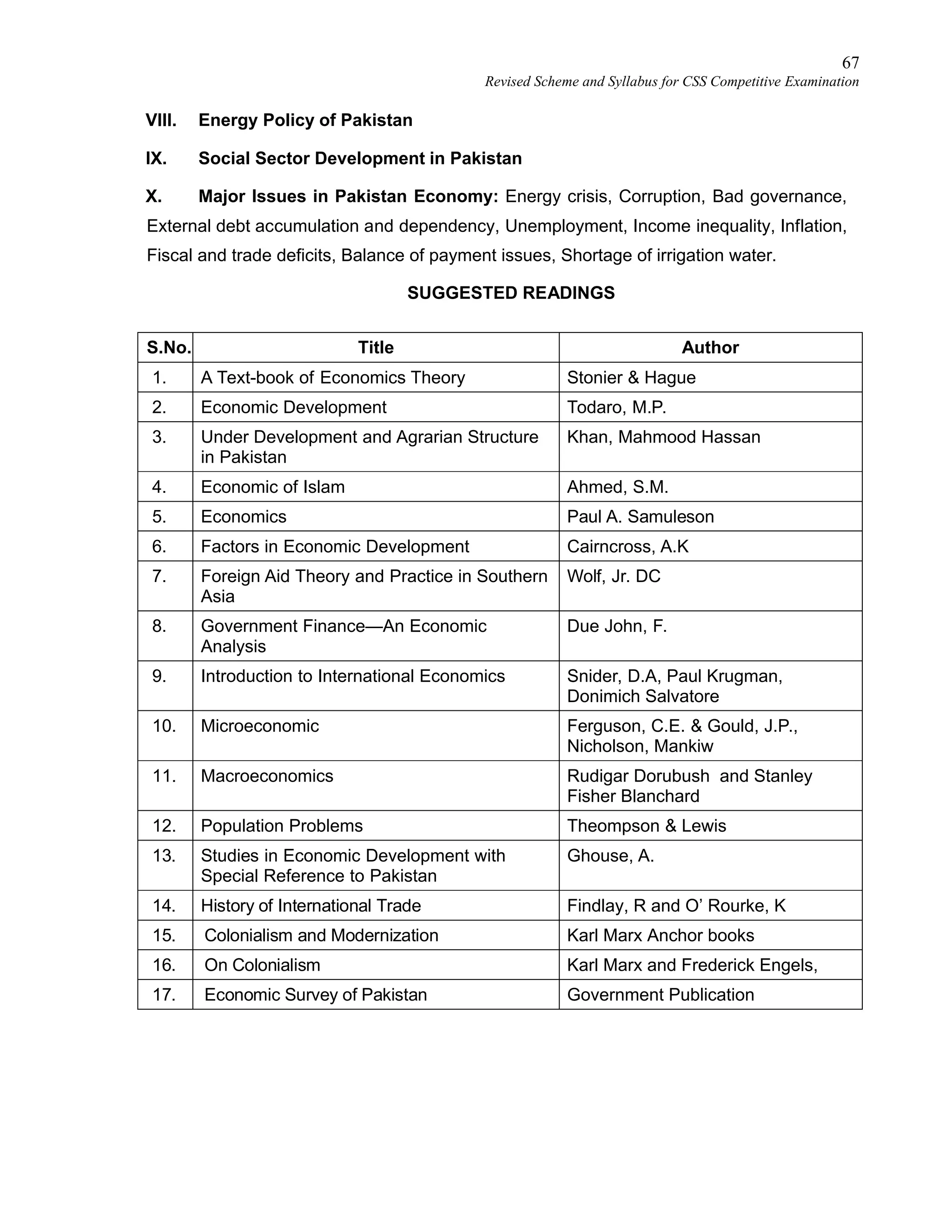
22. Economics 65-67
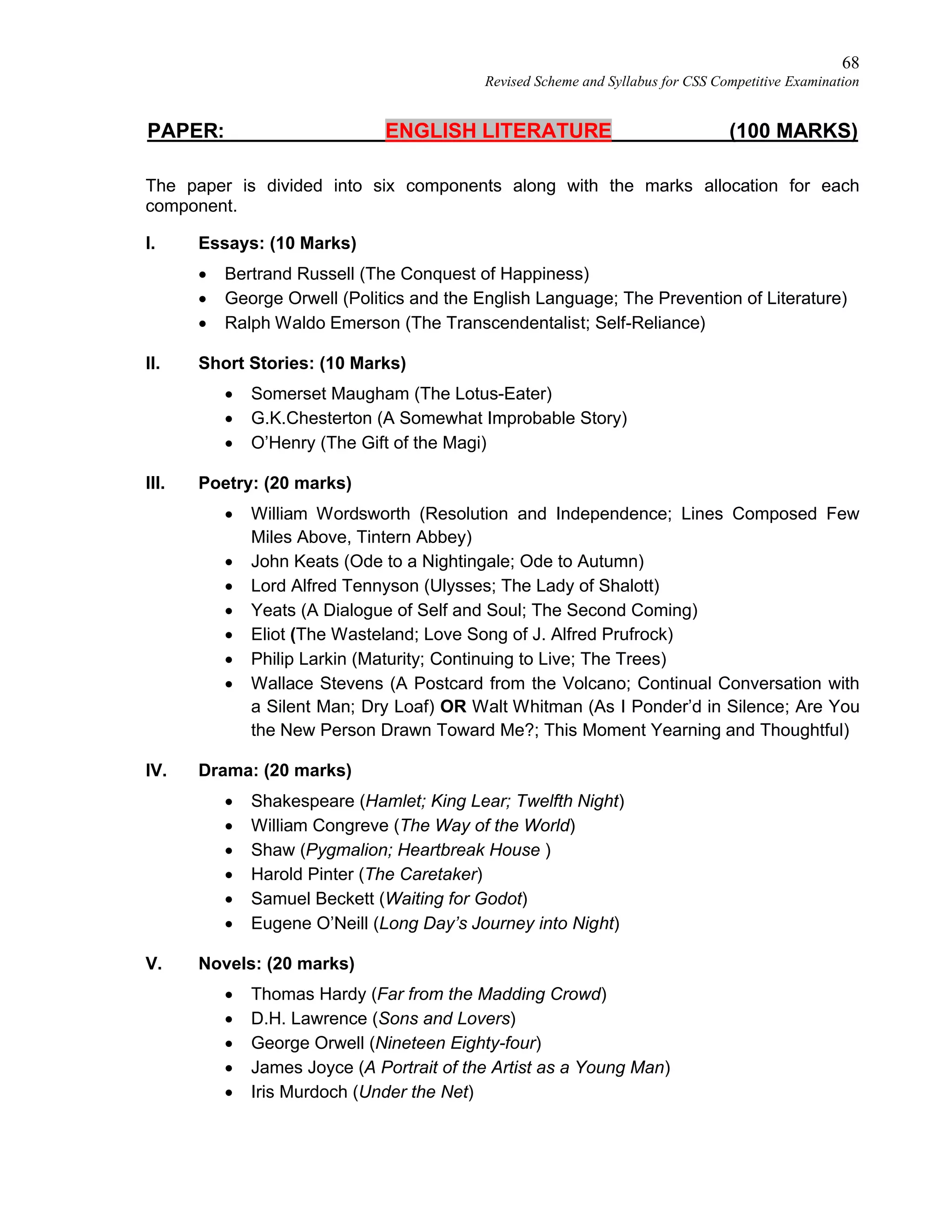
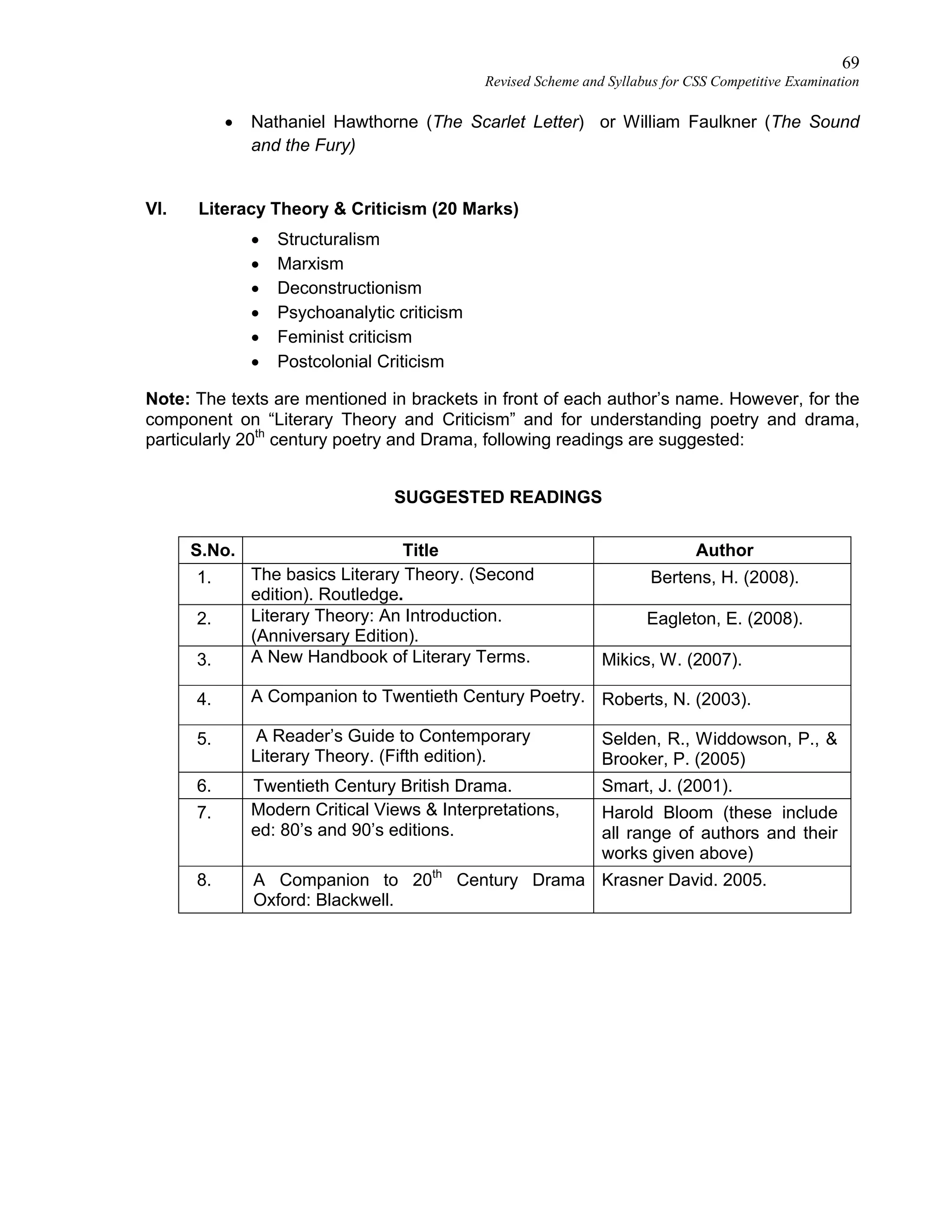
23. English Literature 68-69
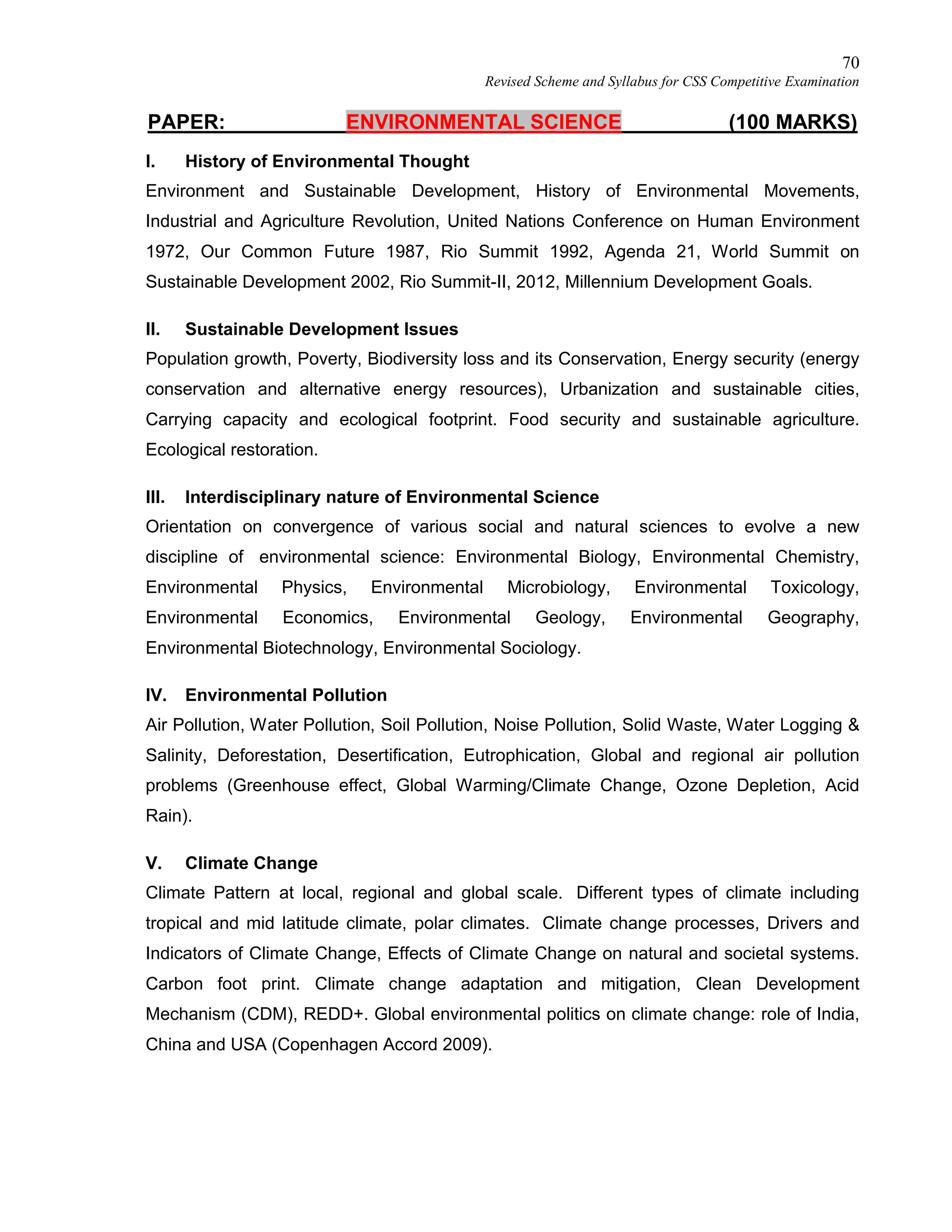
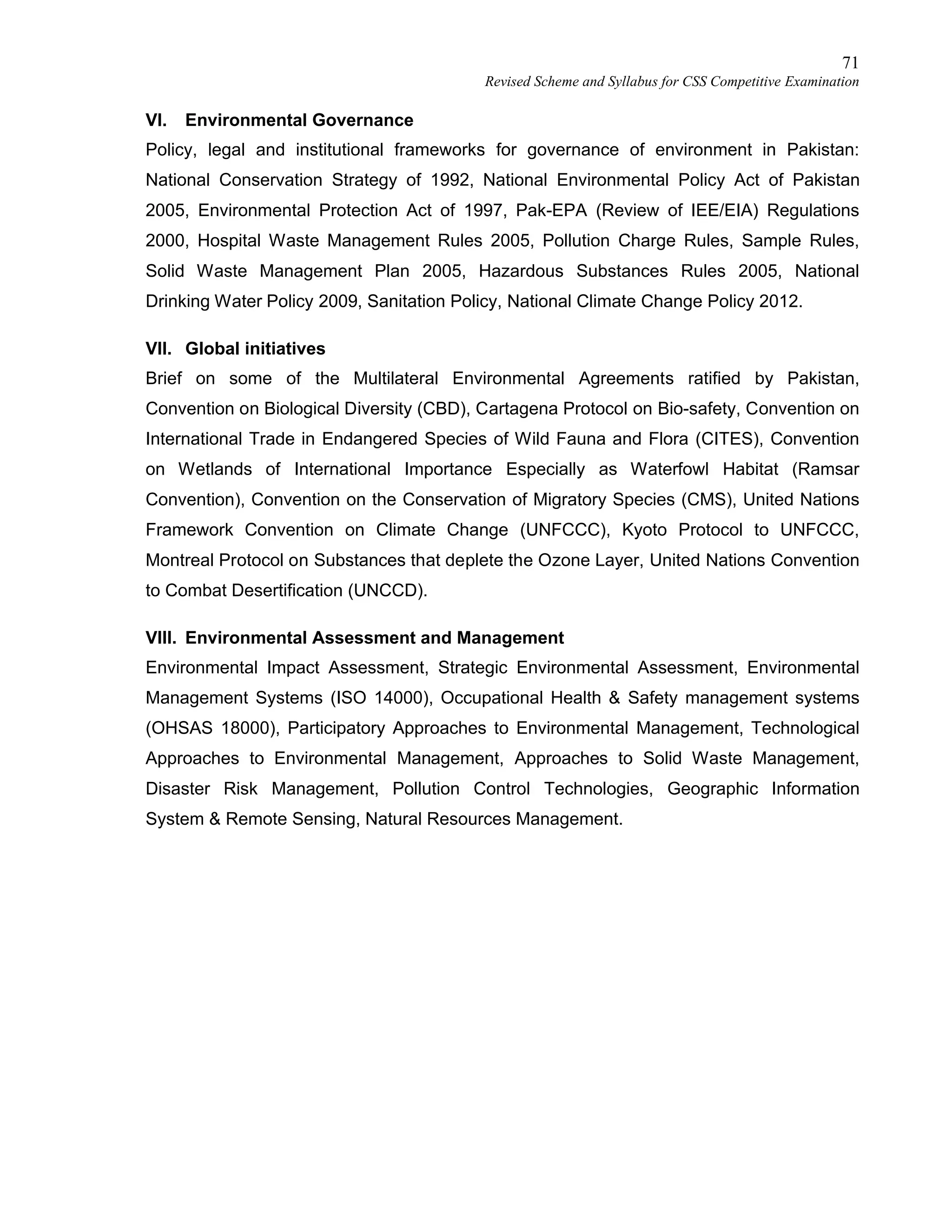
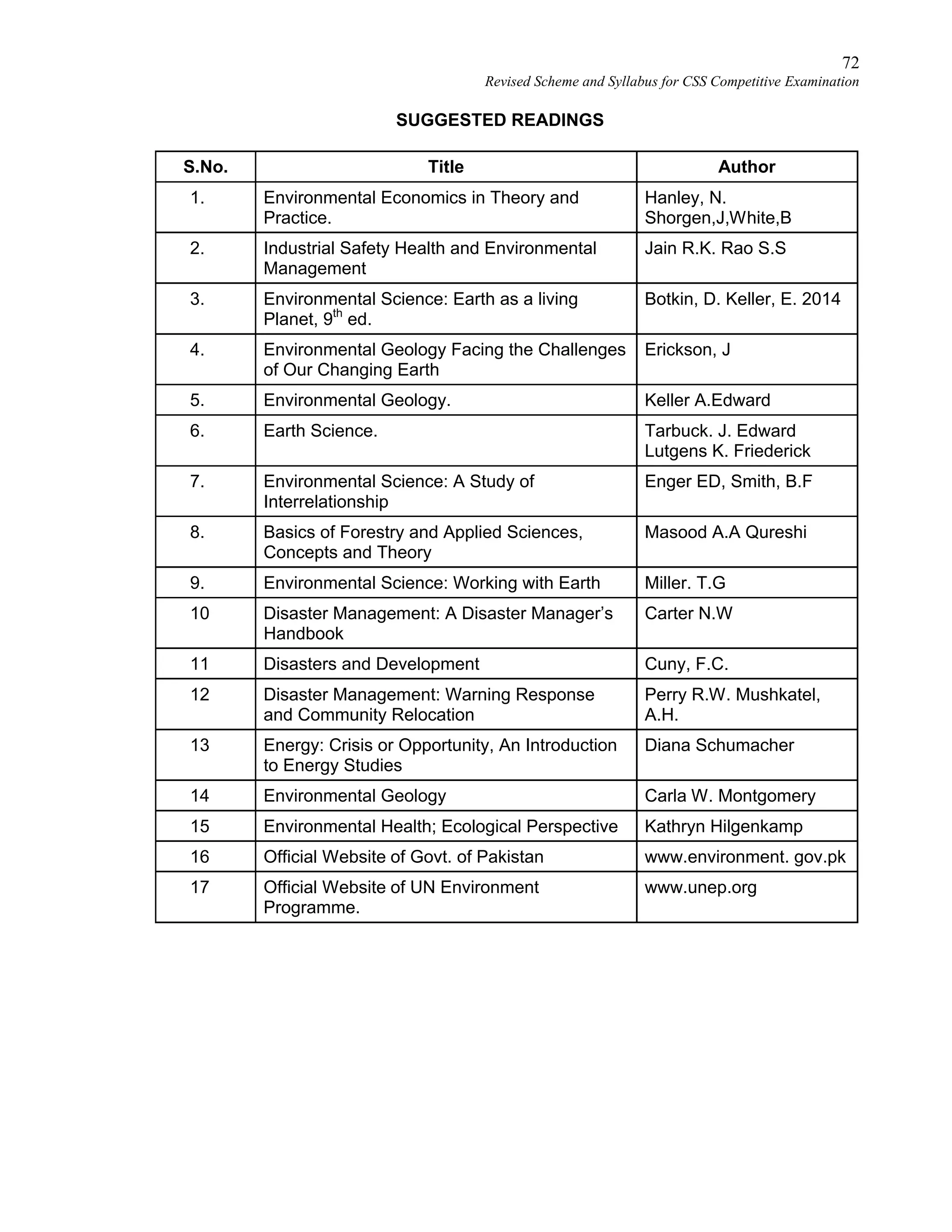
24. Environmental Science 70-72
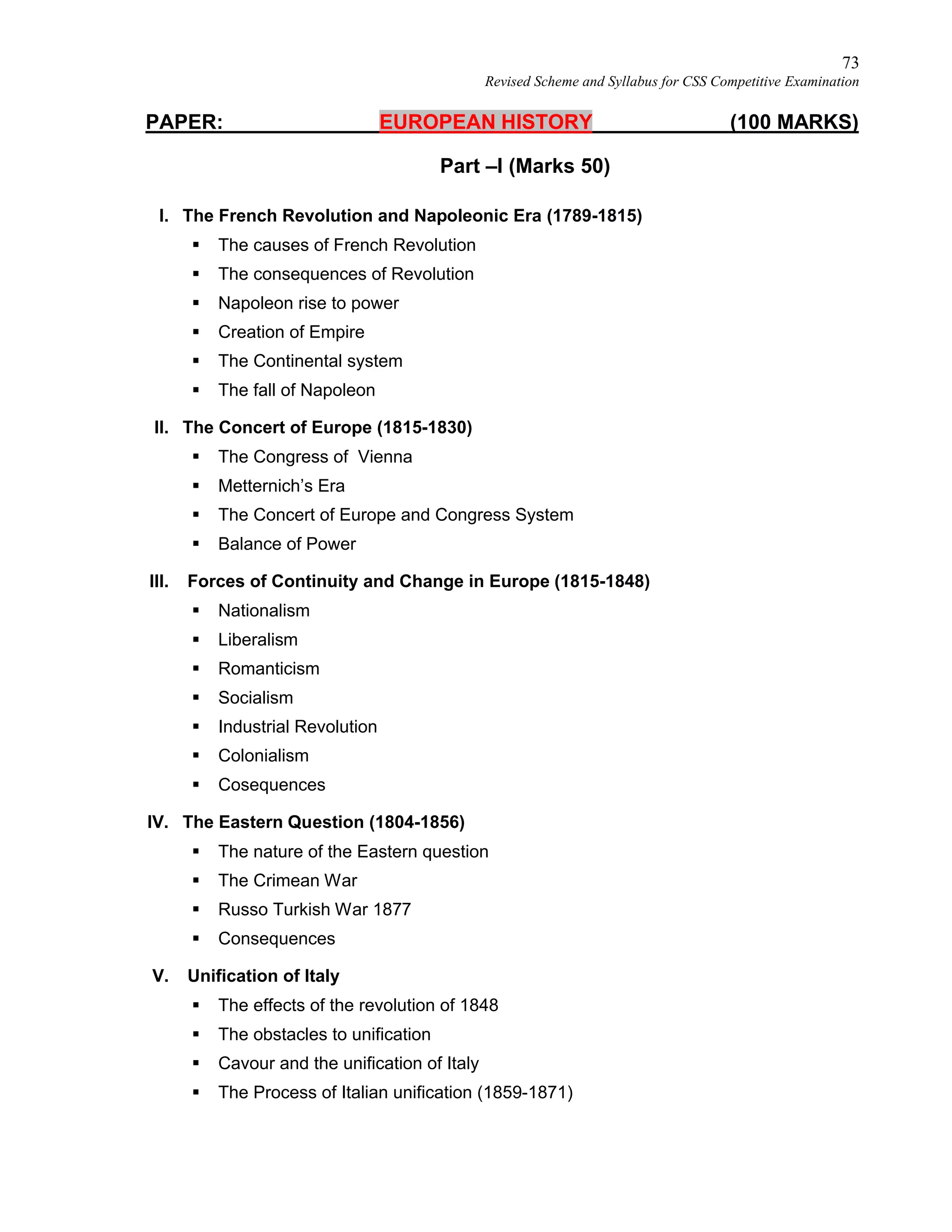
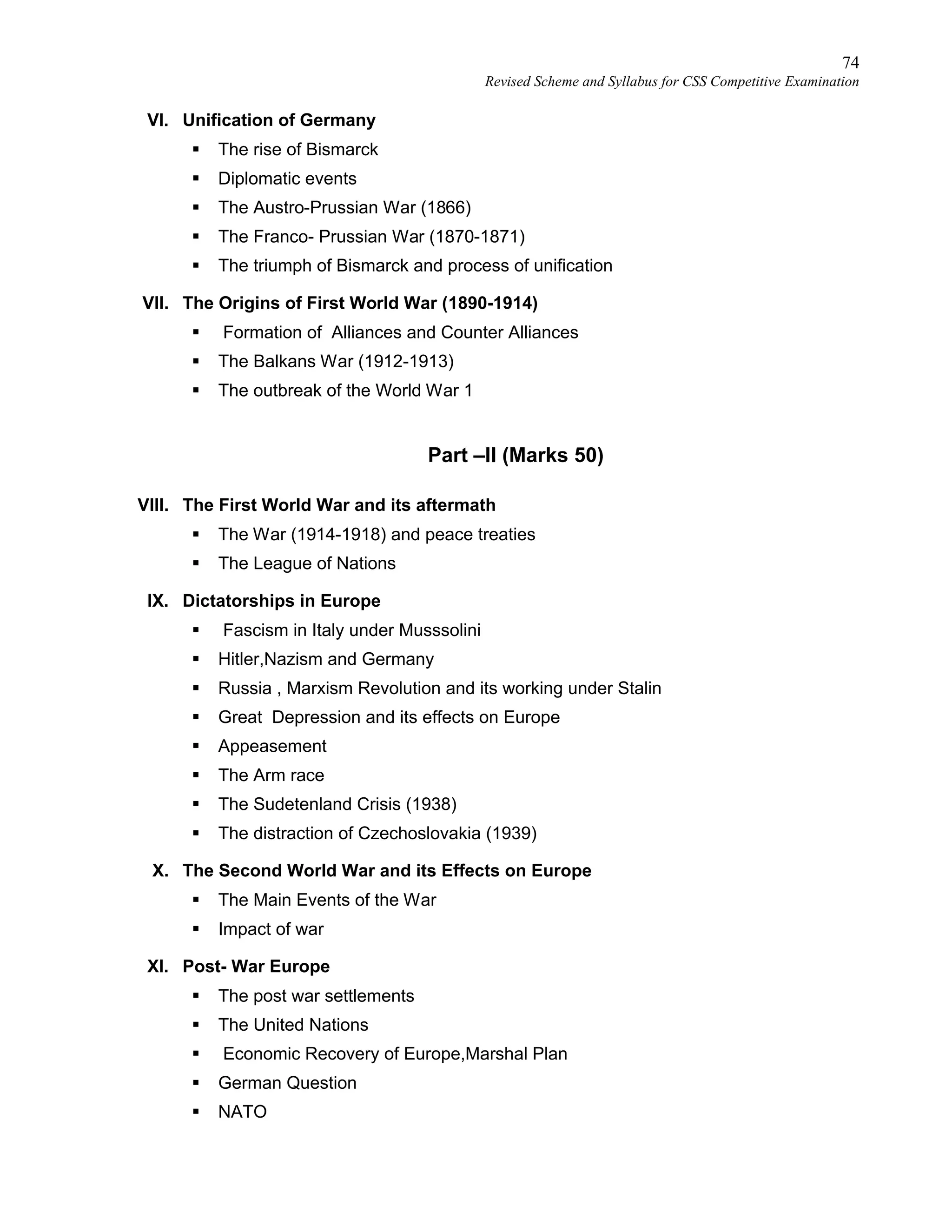
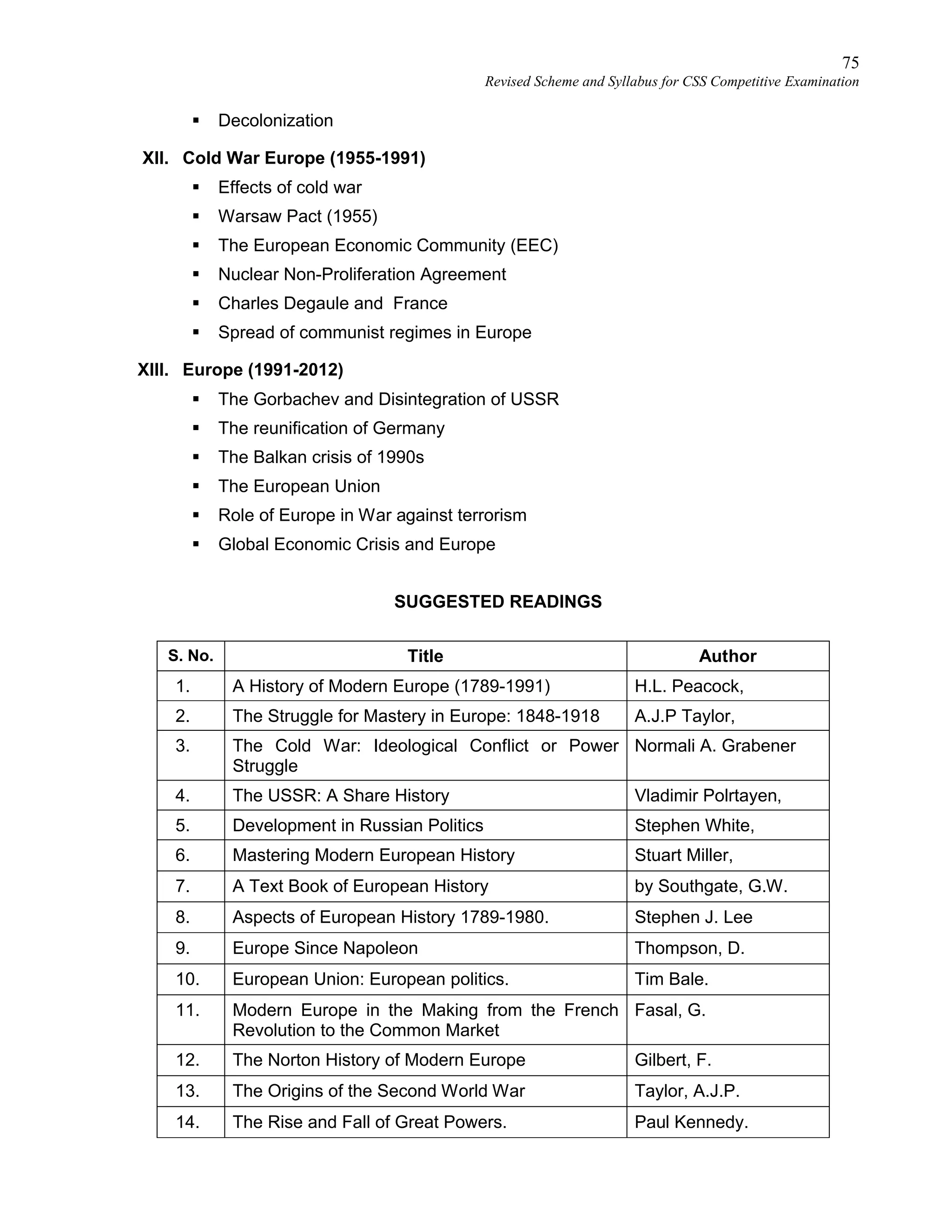
25. European History 73-75
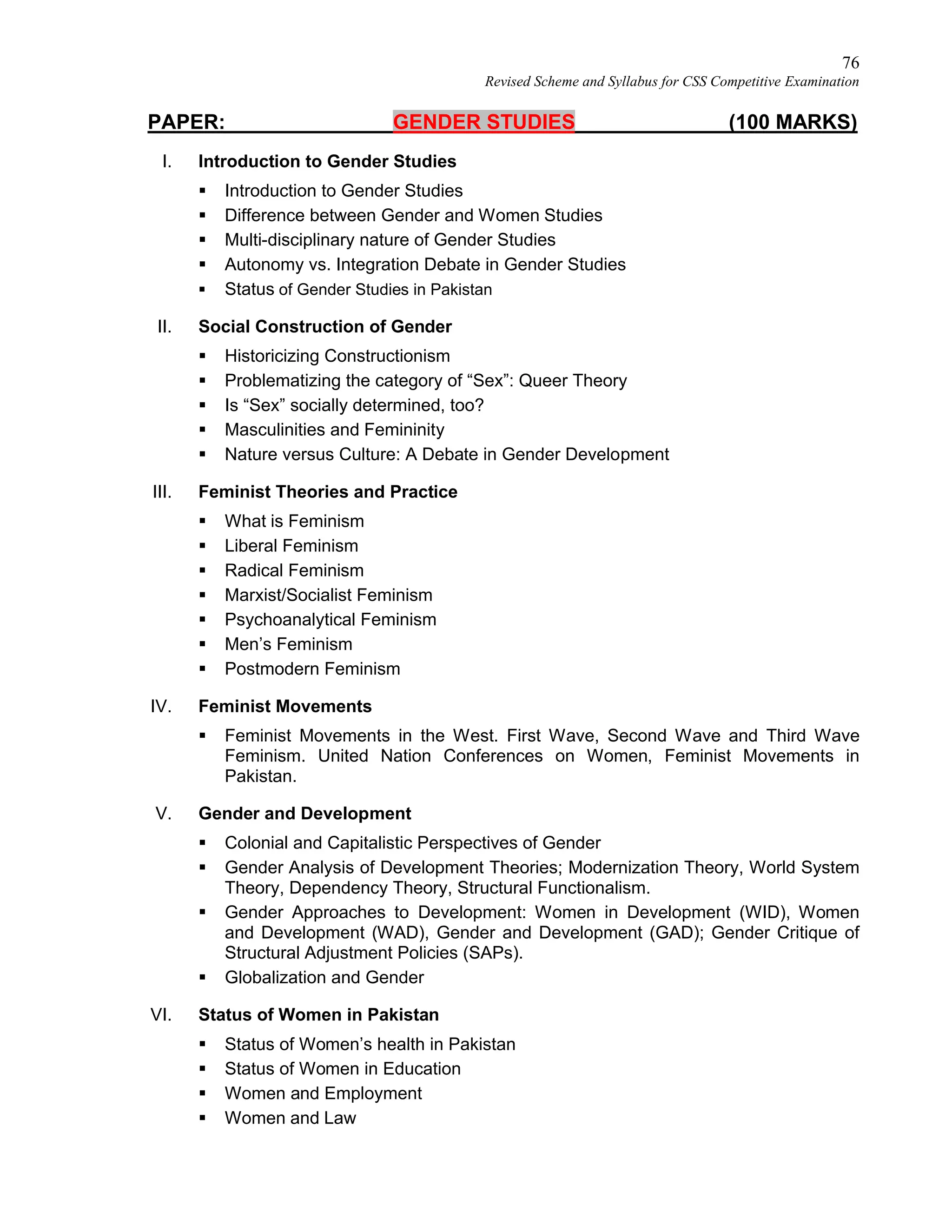
26. Gender Studies 76-78
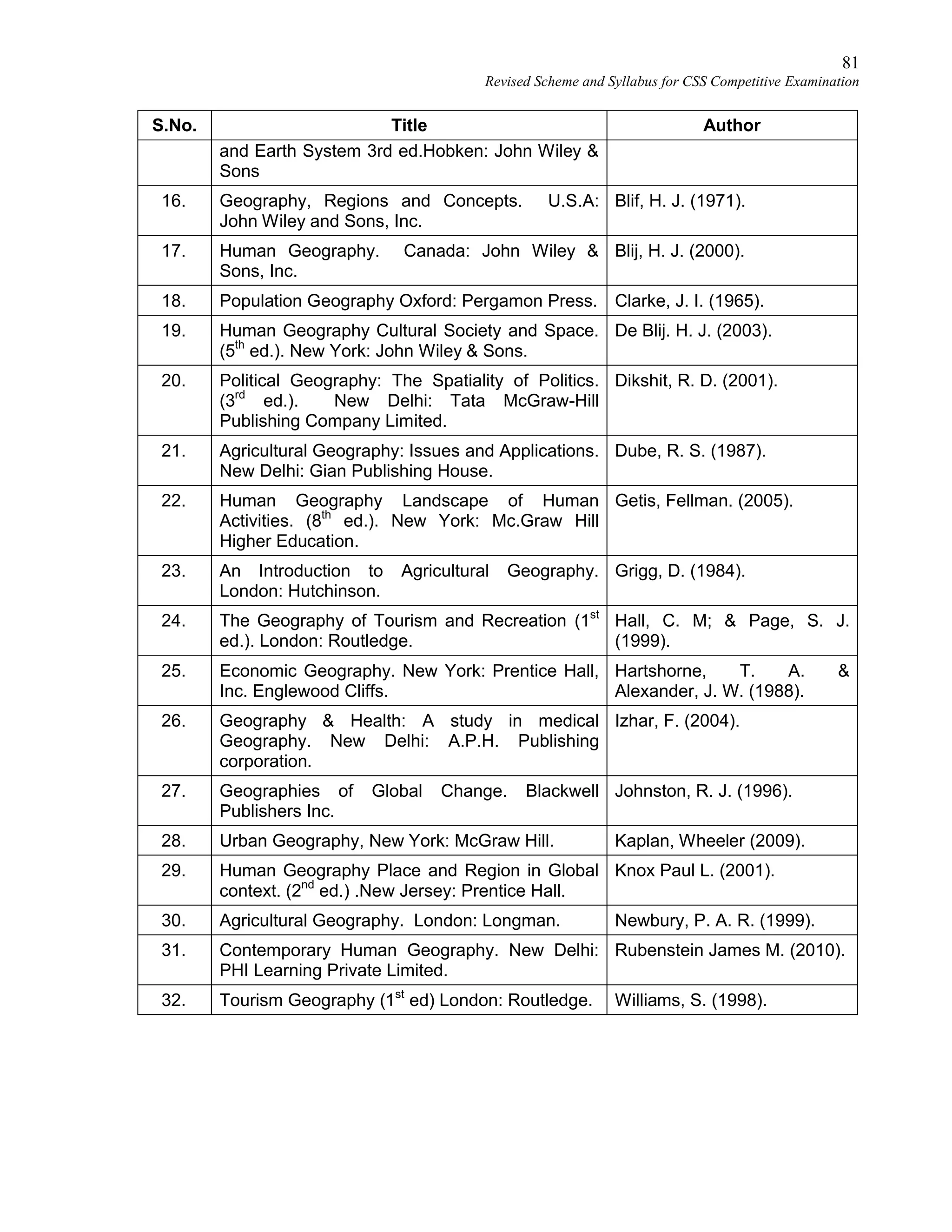
27. Geography 79-81
-ii-
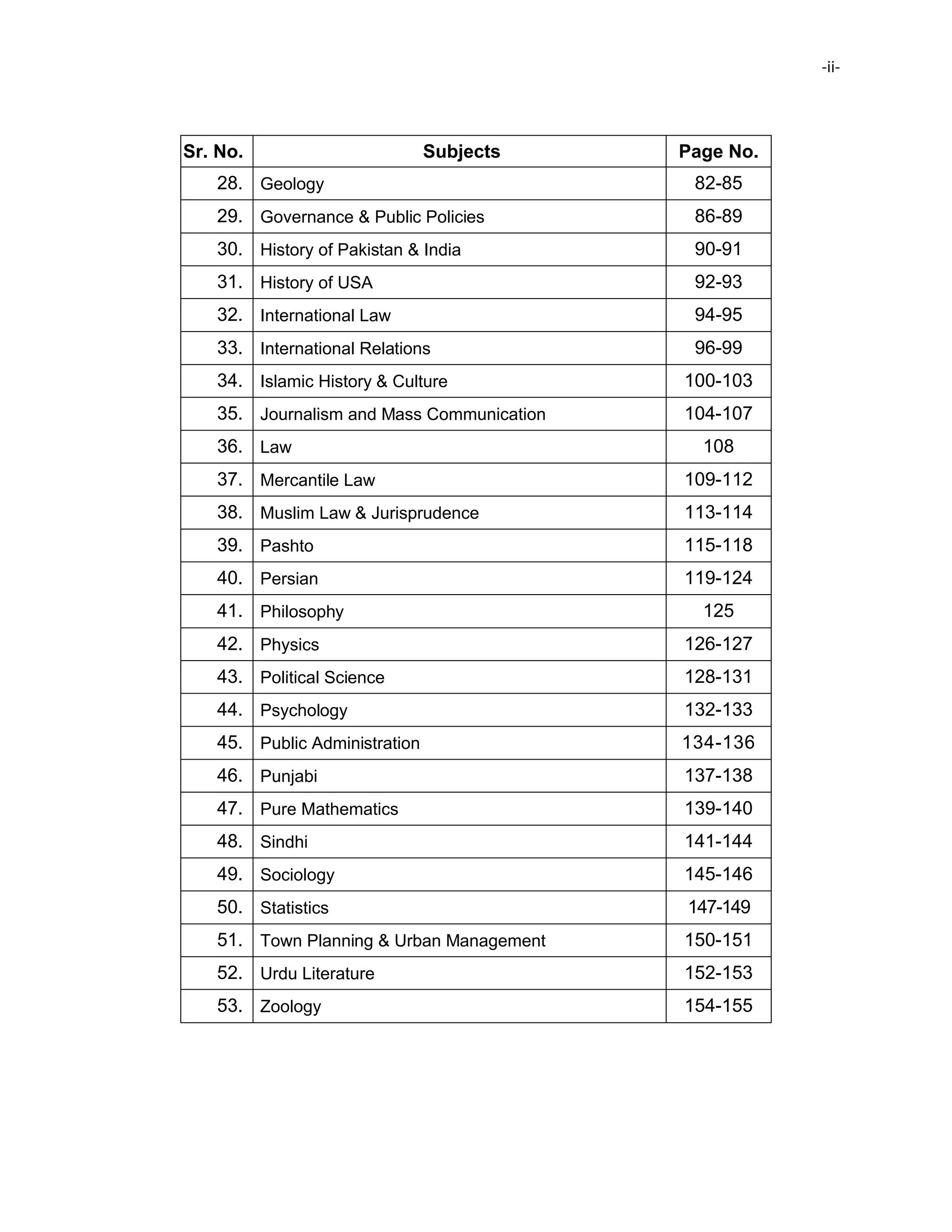
Sr. No. Subjects Page No.
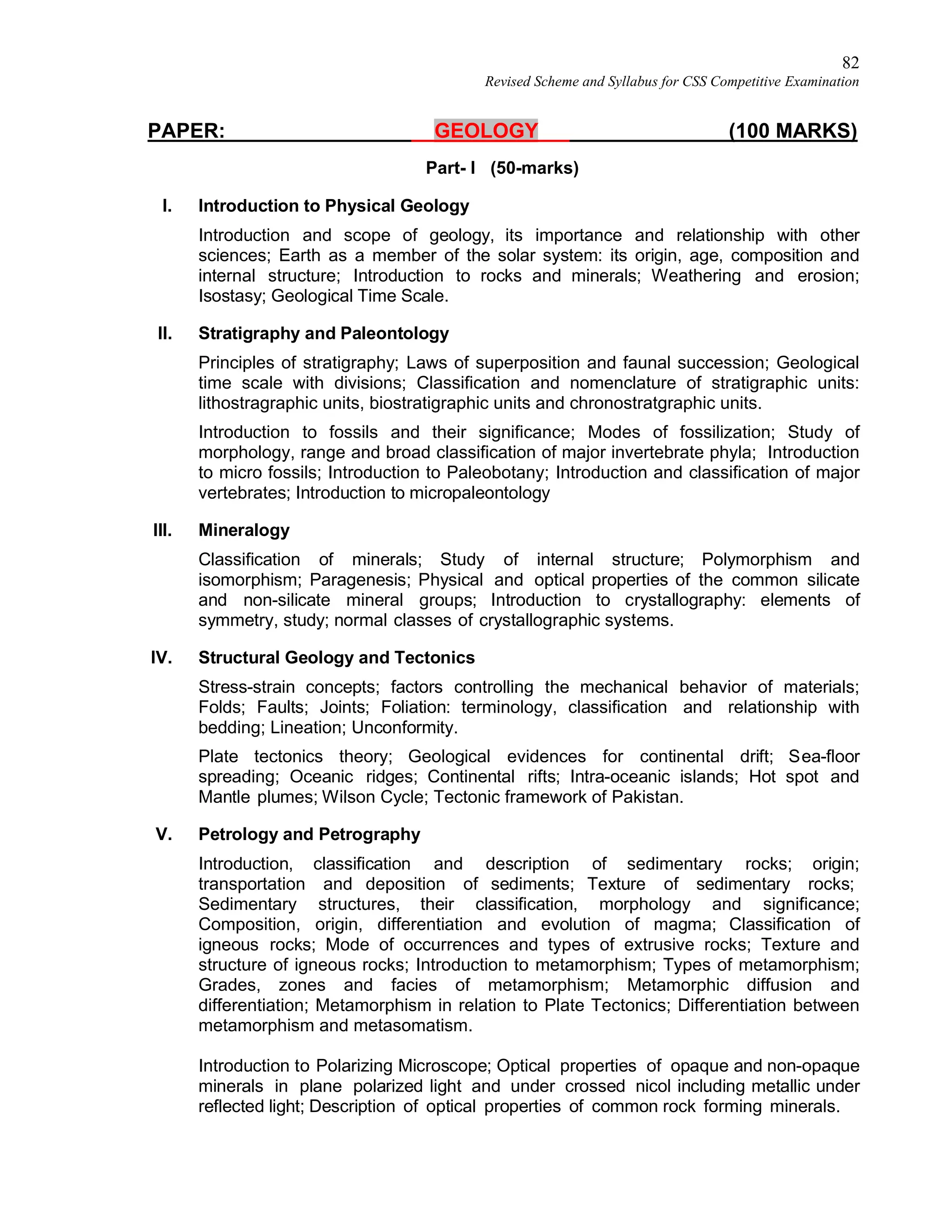
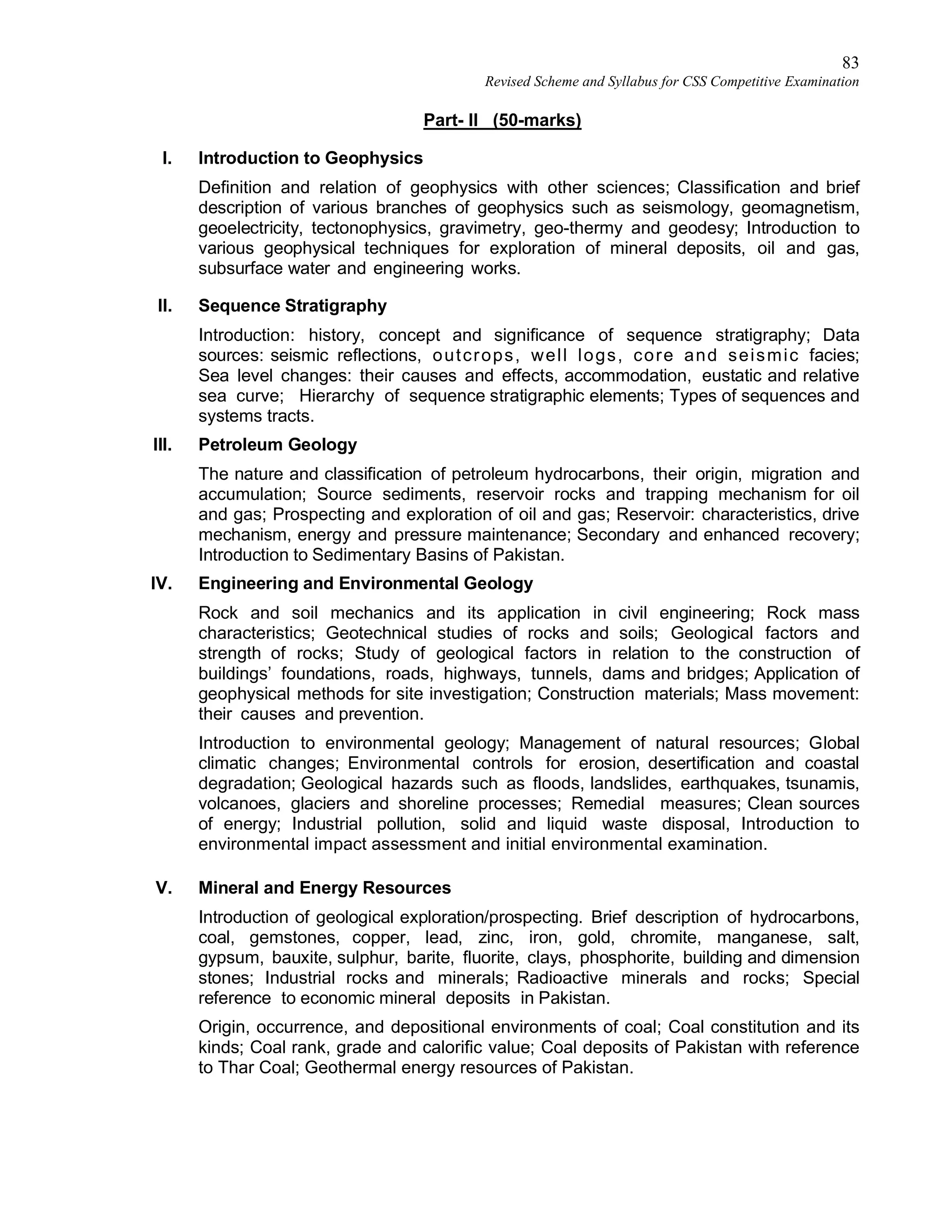
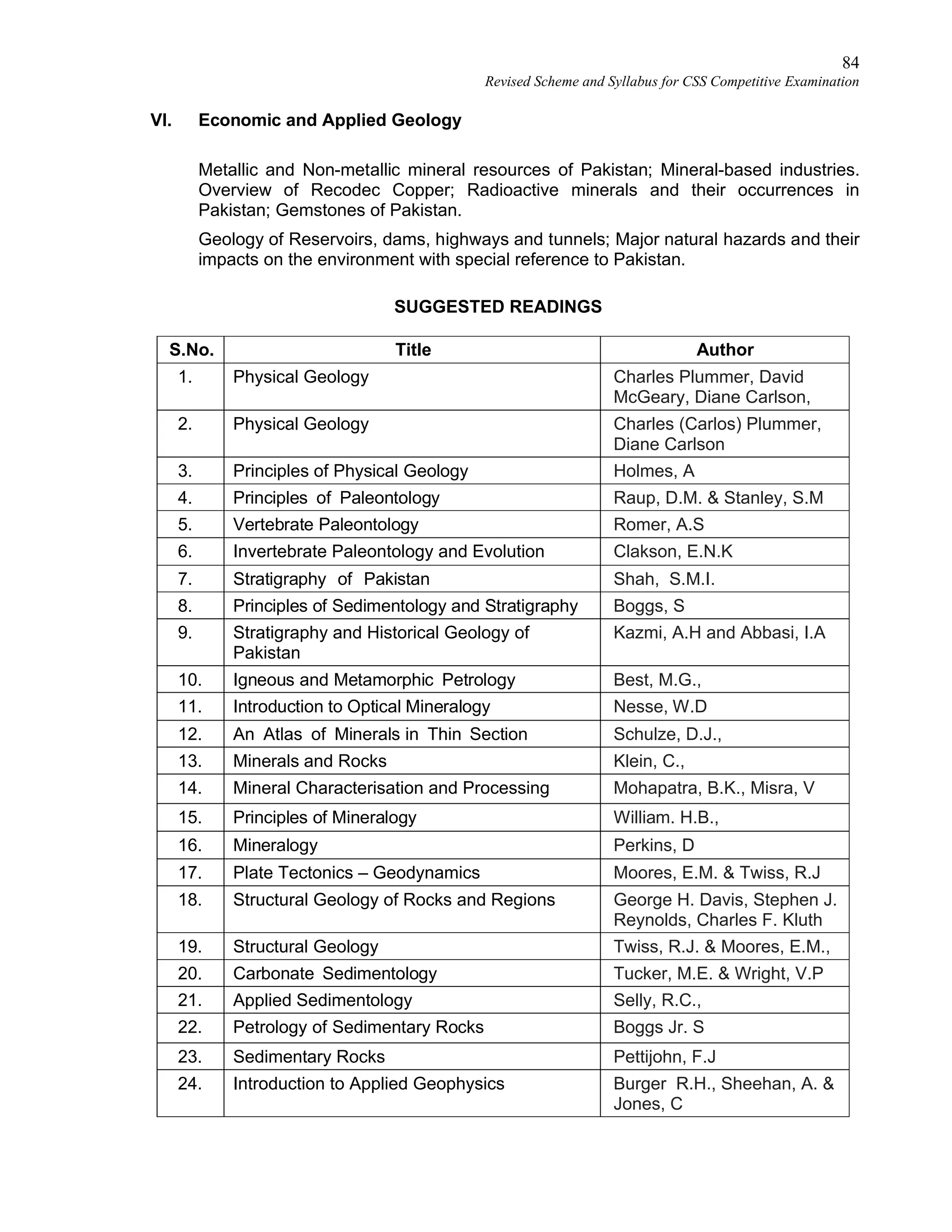
28. Geology 82-85
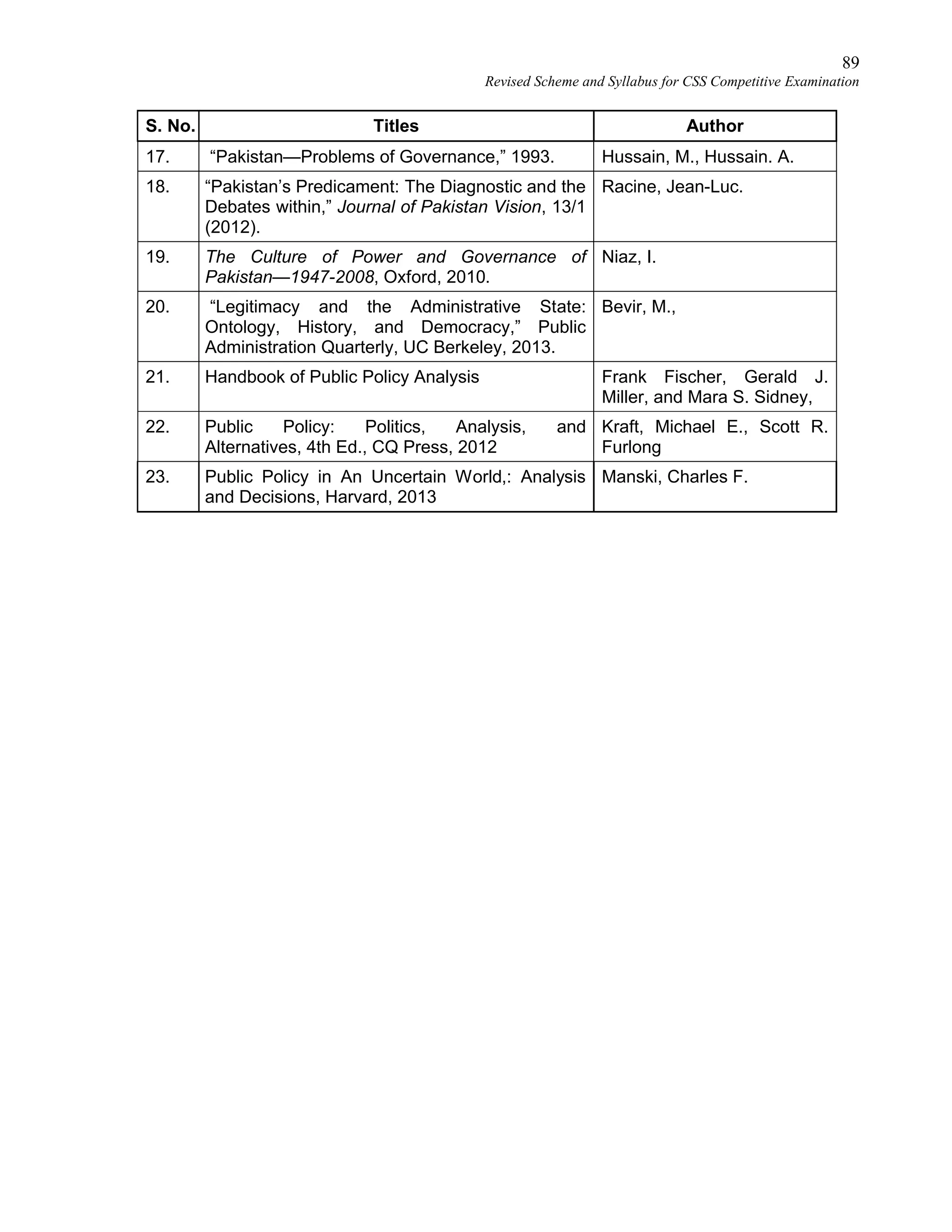
29. Governance & Public Policies 86-89
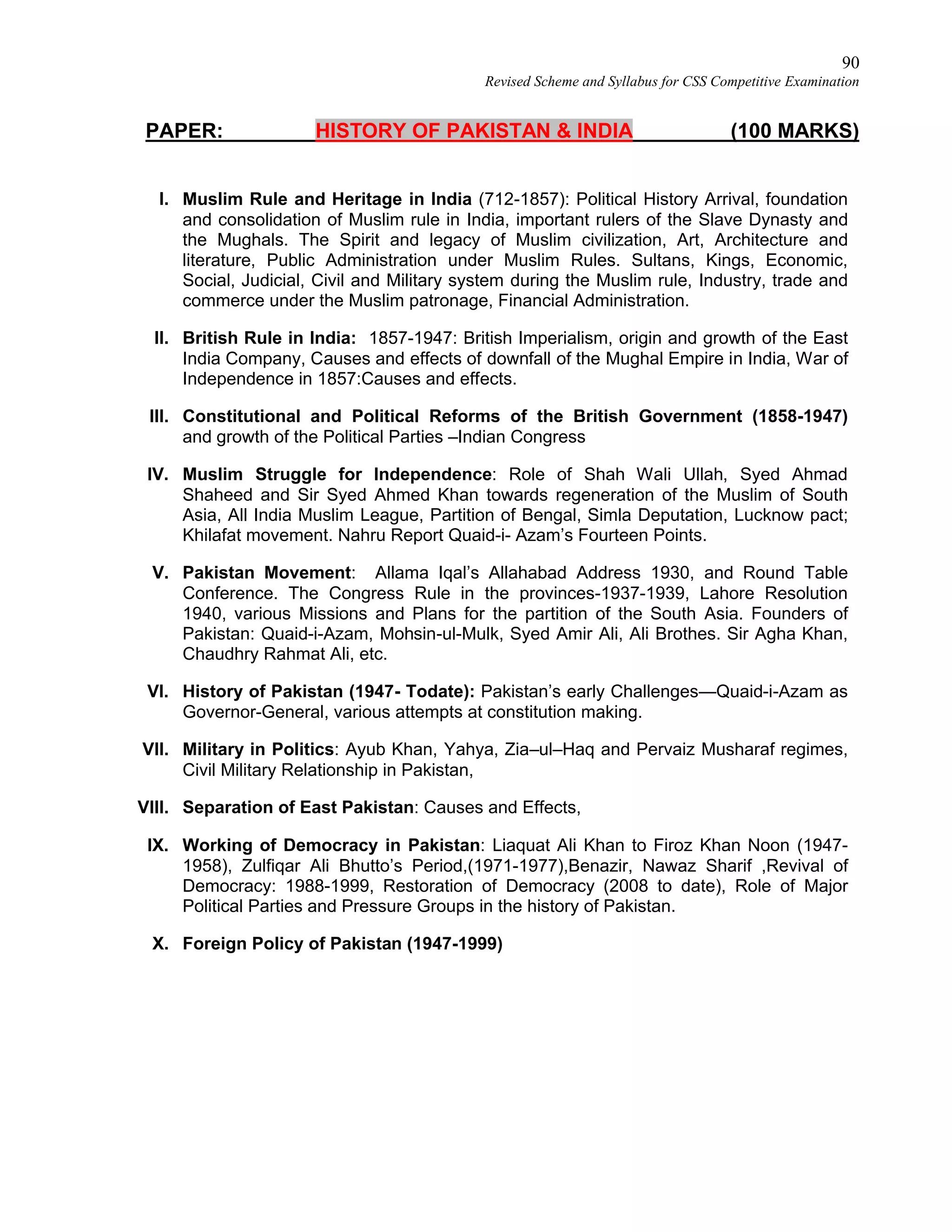
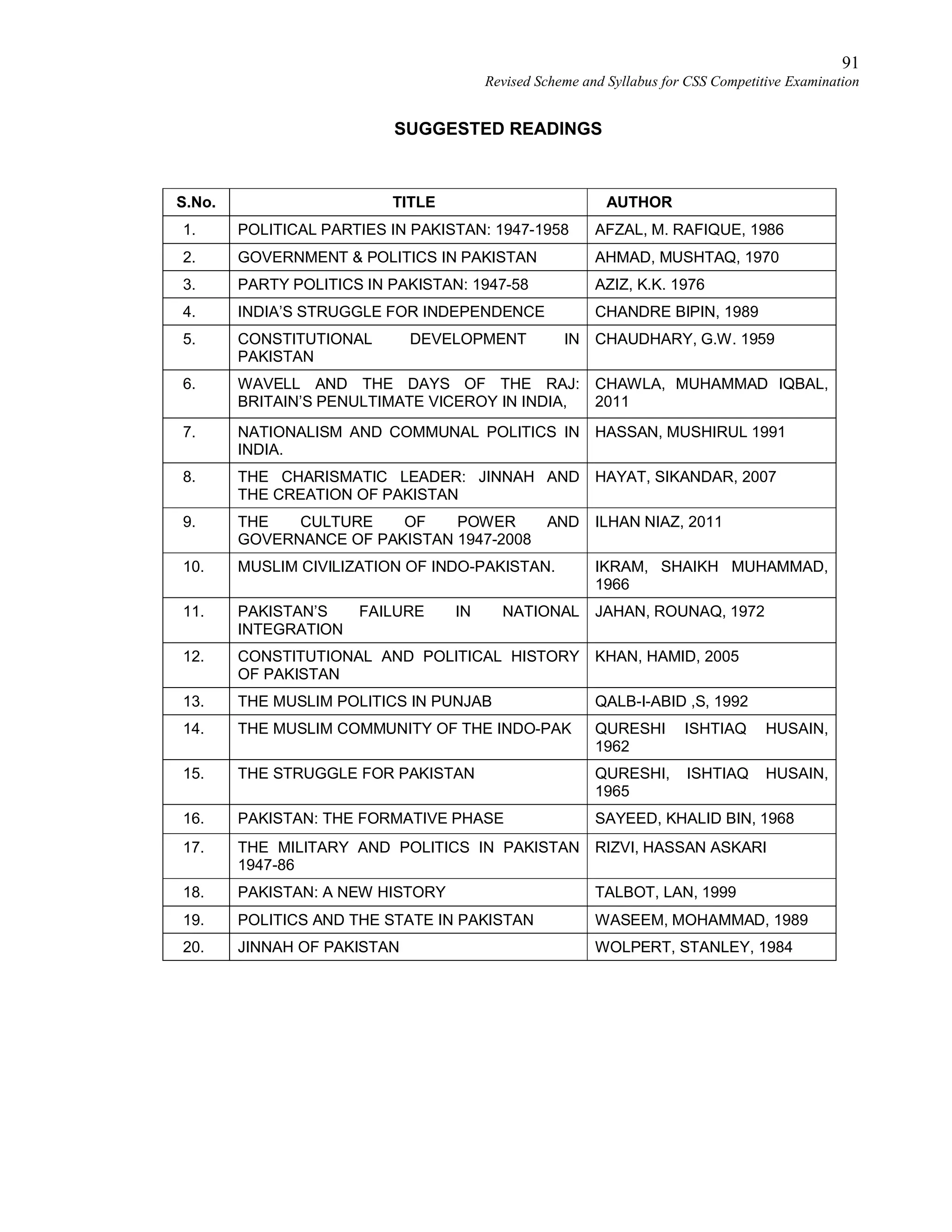
30. History of Pakistan & India 90-91
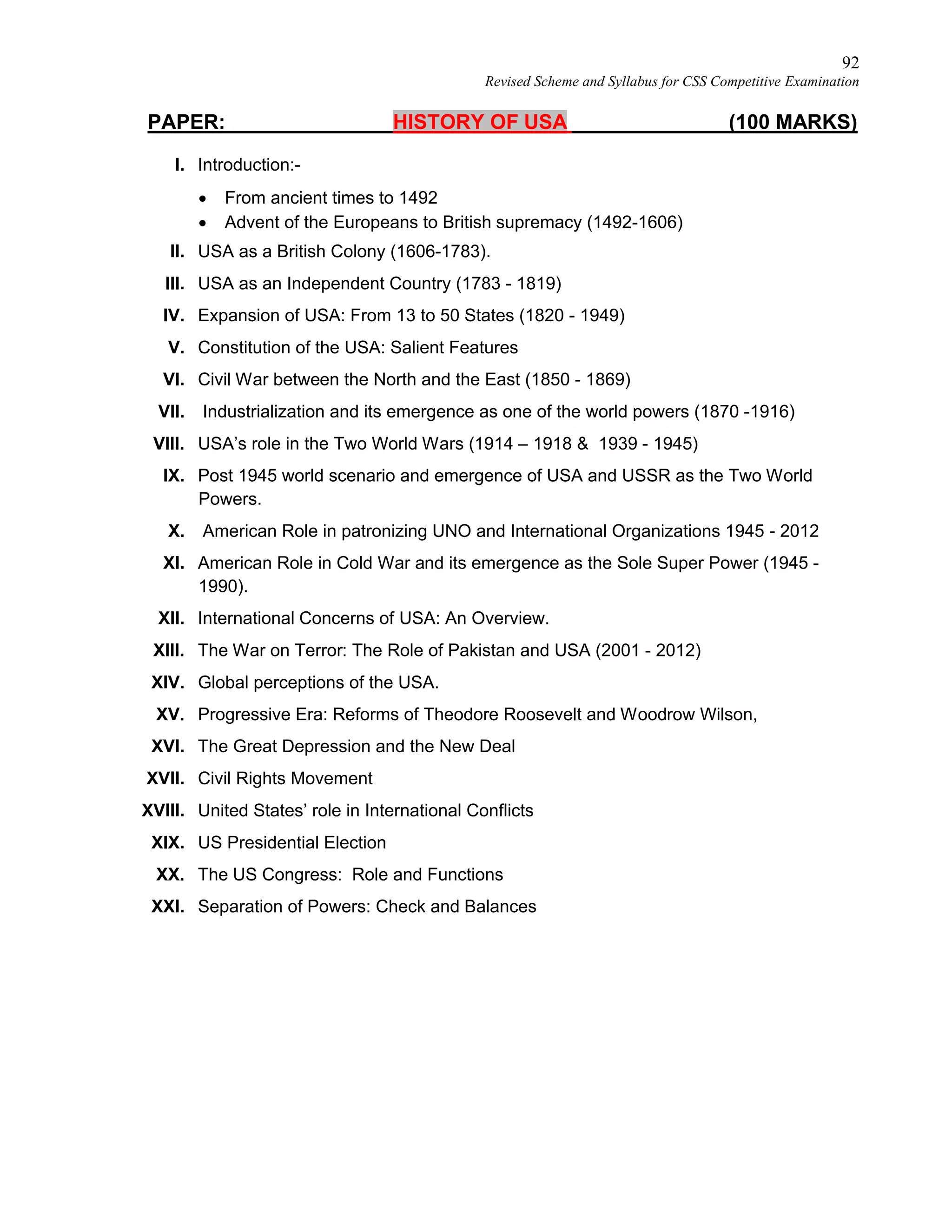
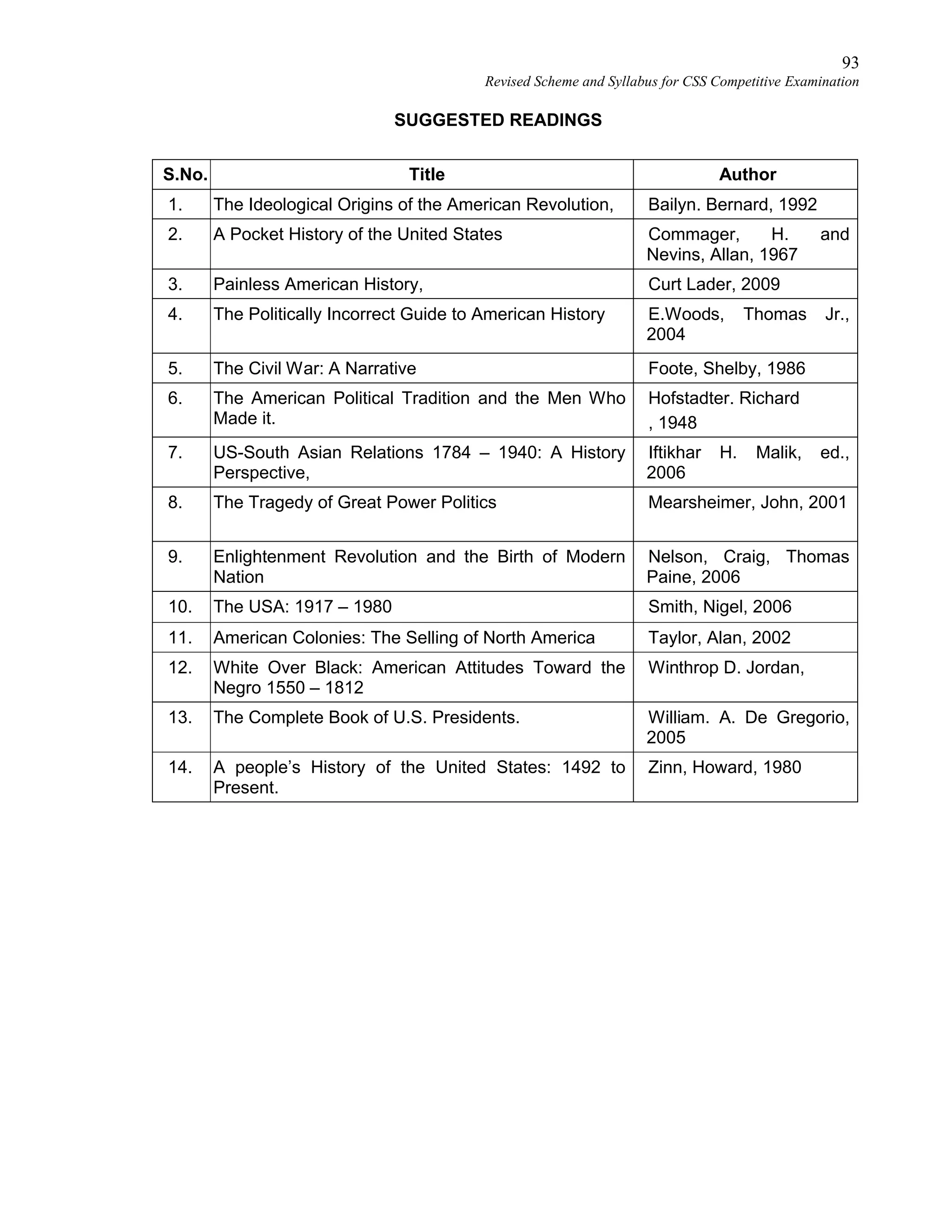
31. History of USA 92-93
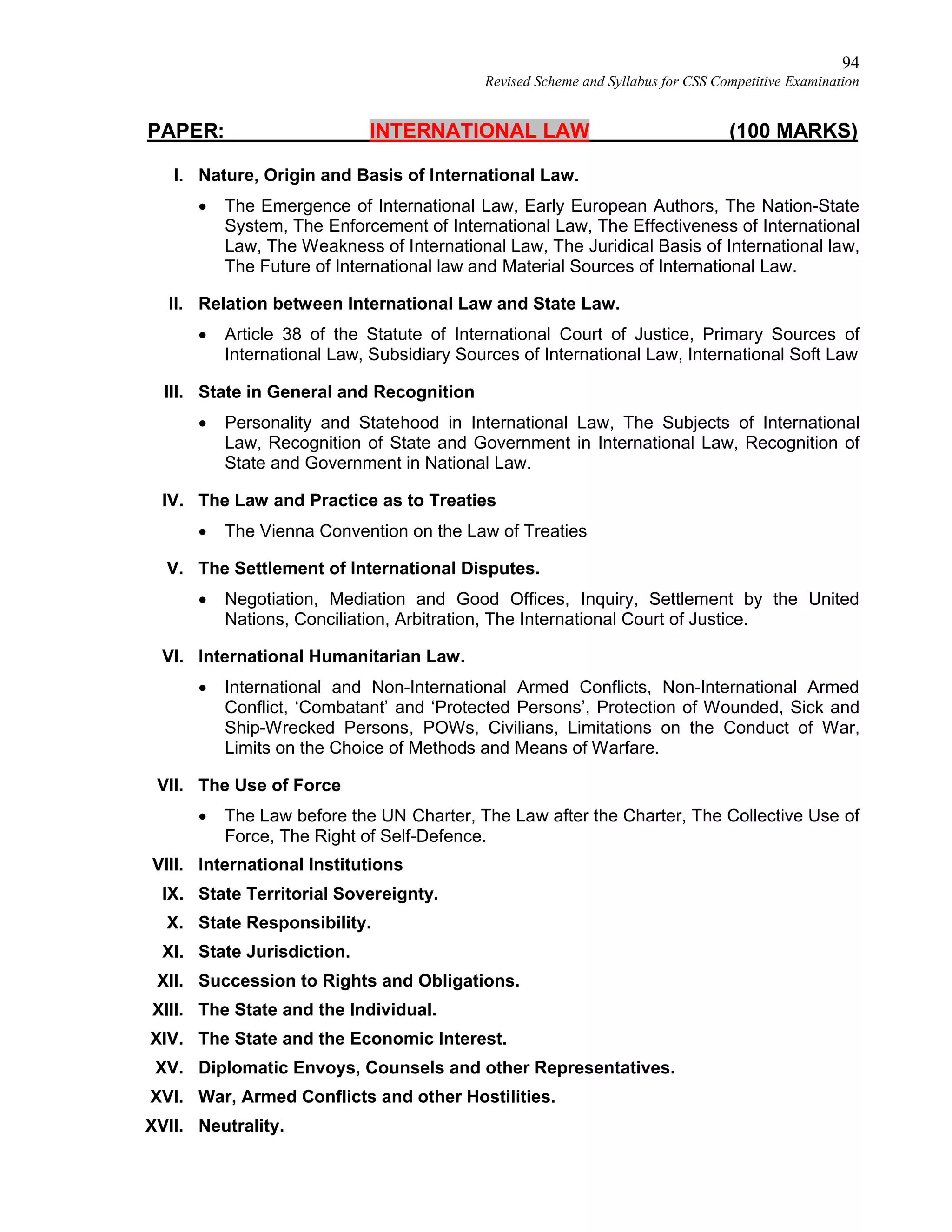
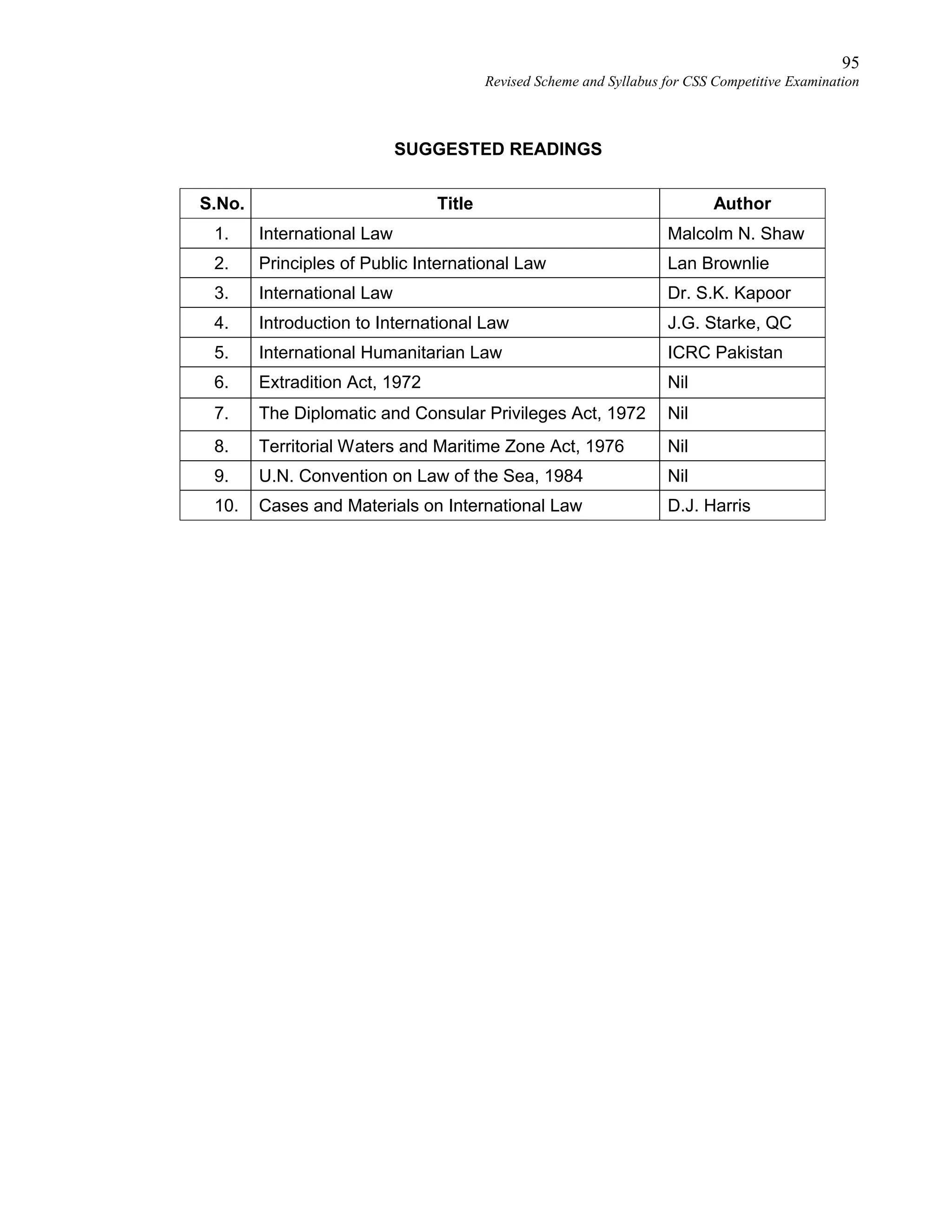
32. International Law 94-95
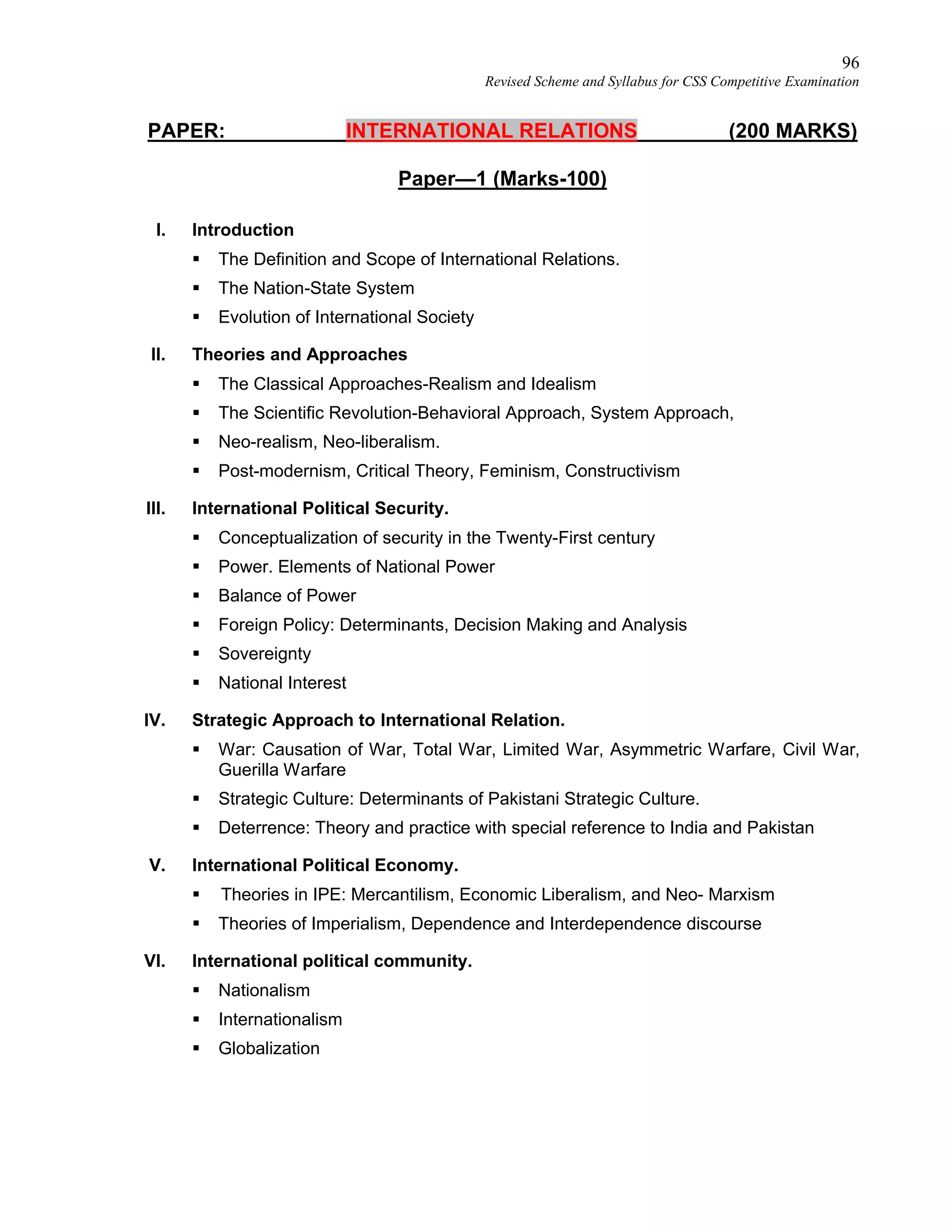
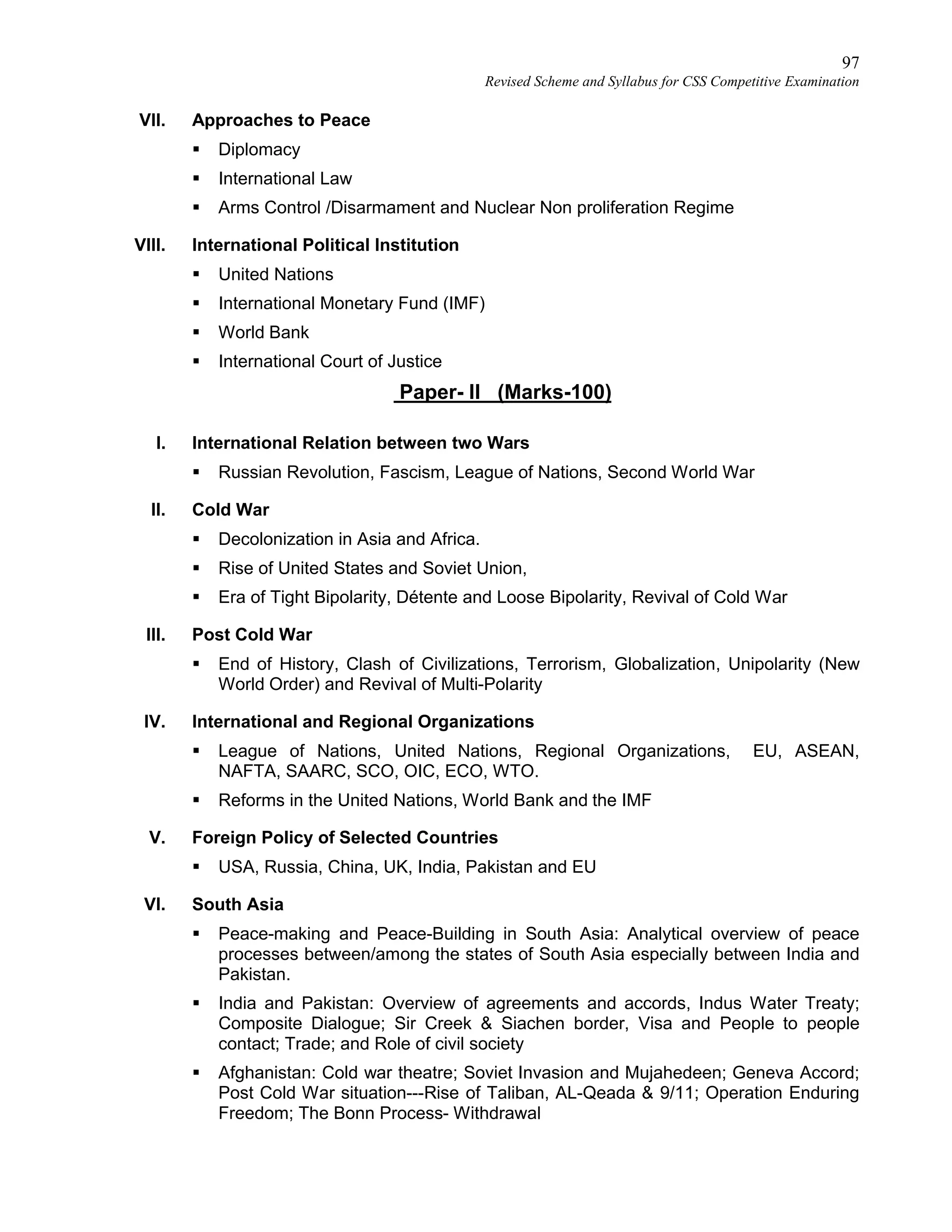
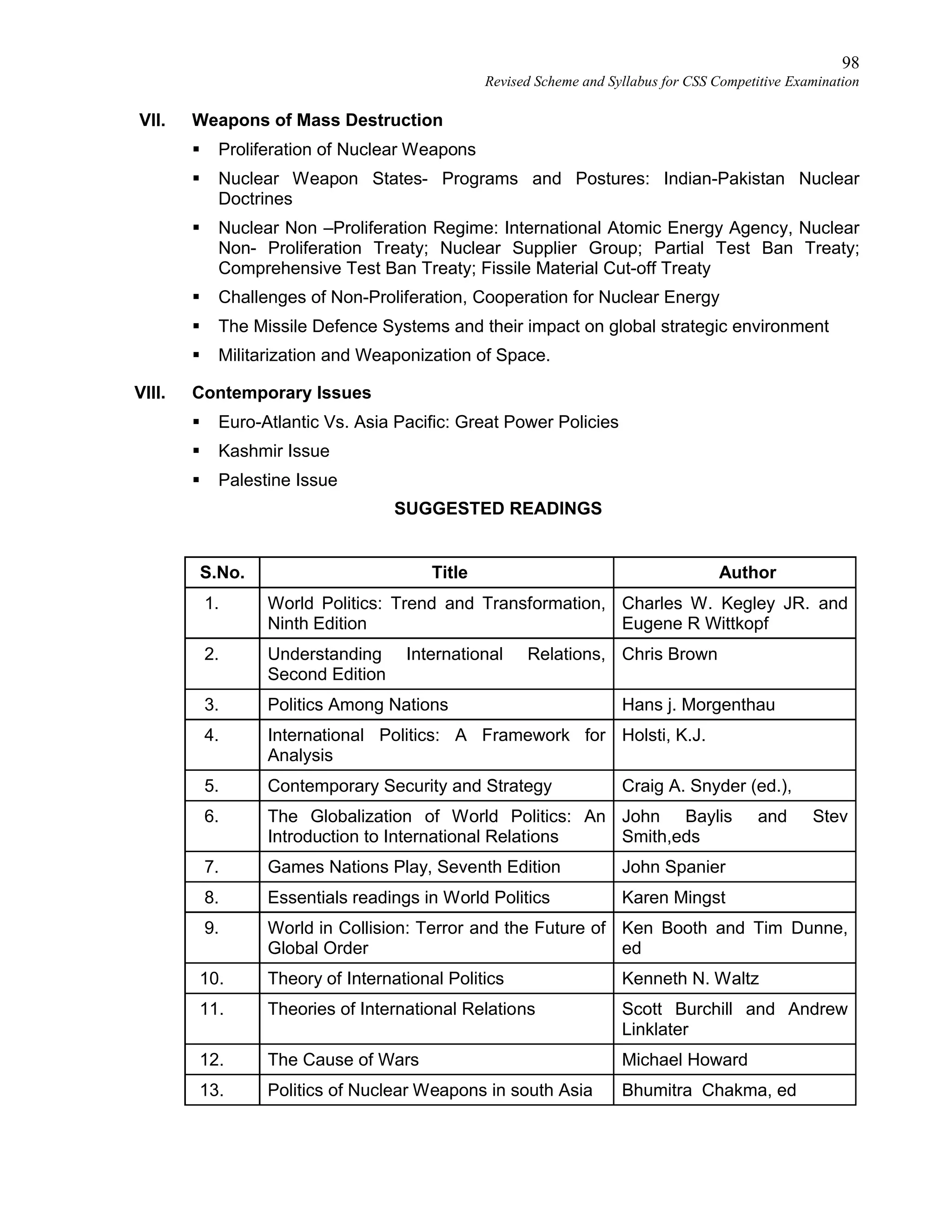
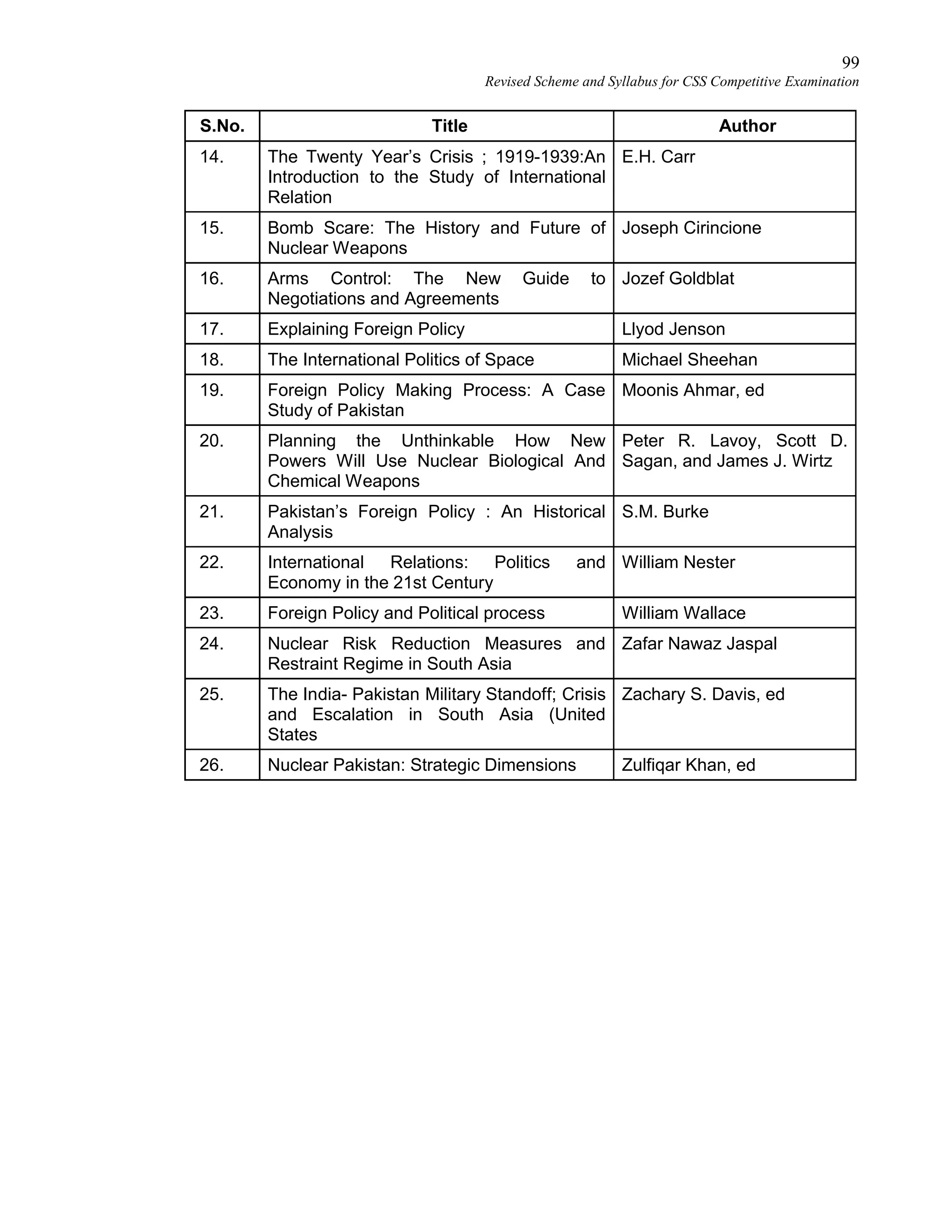
33. International Relations 96-99
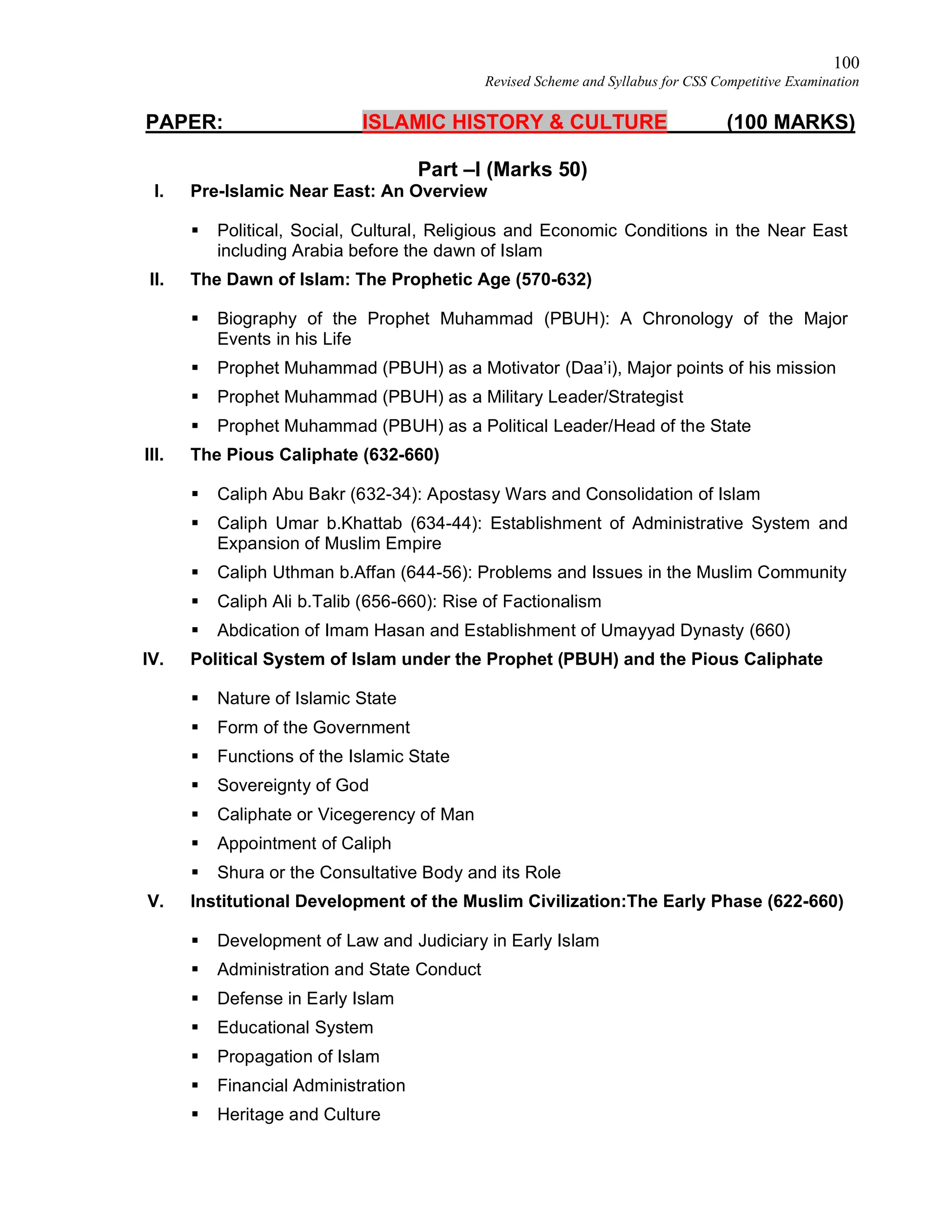
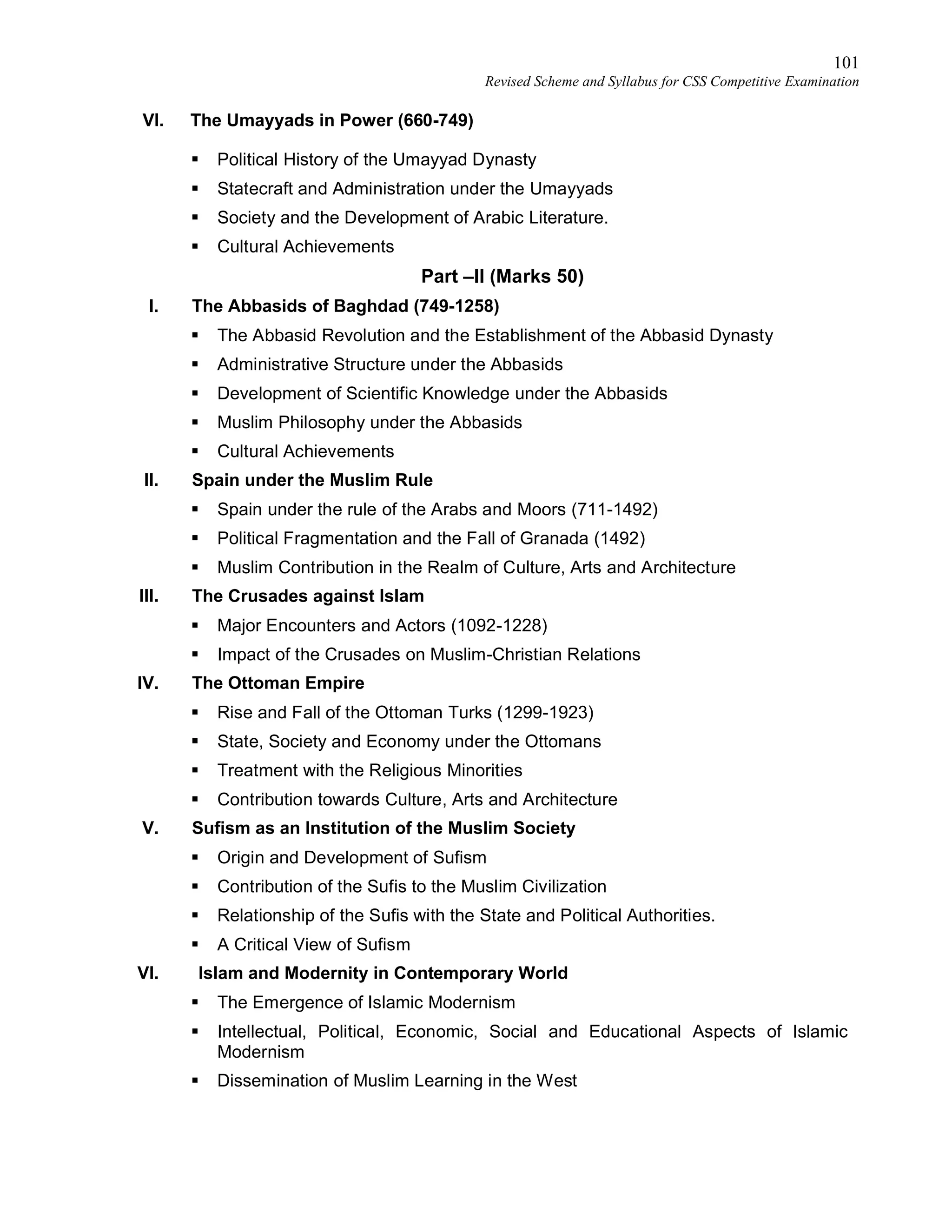
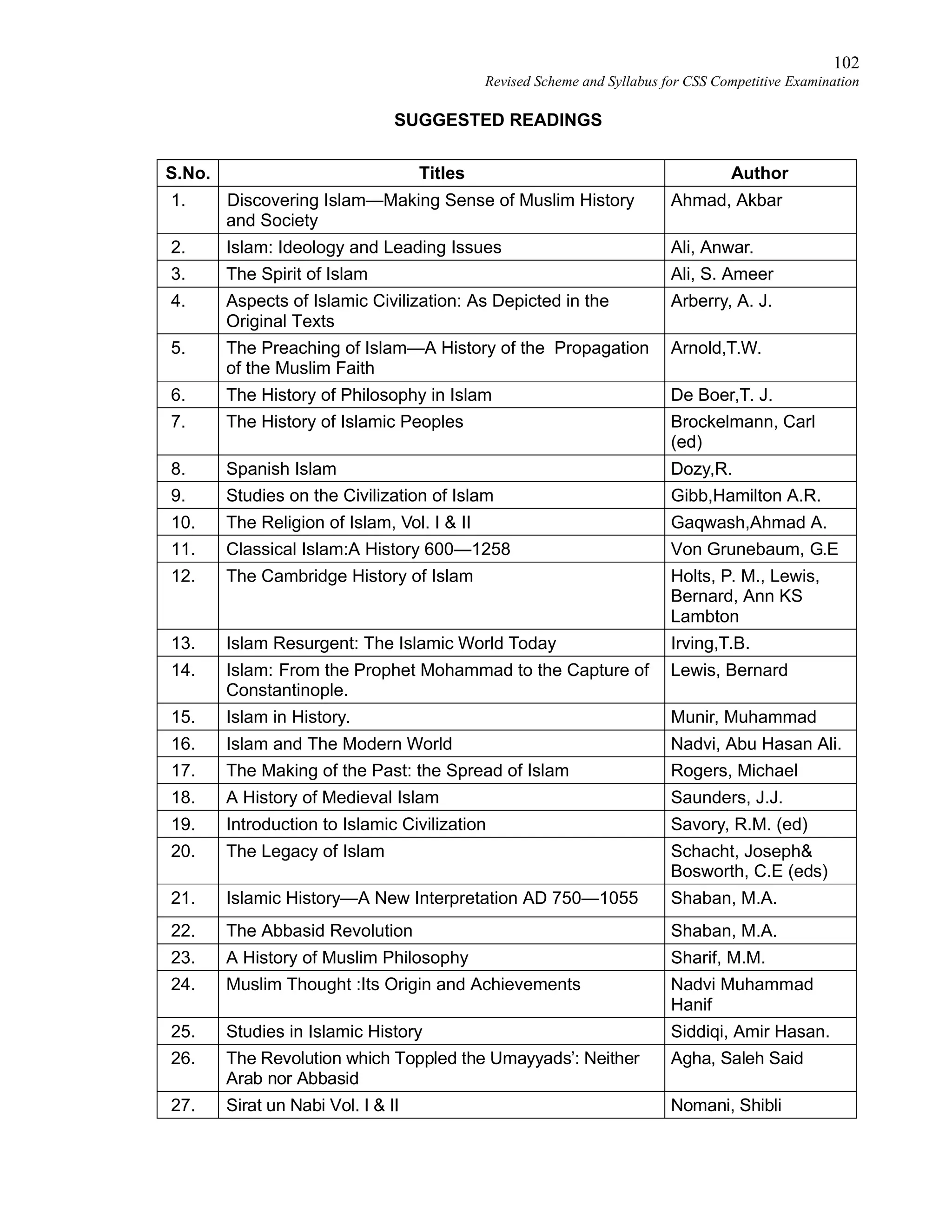
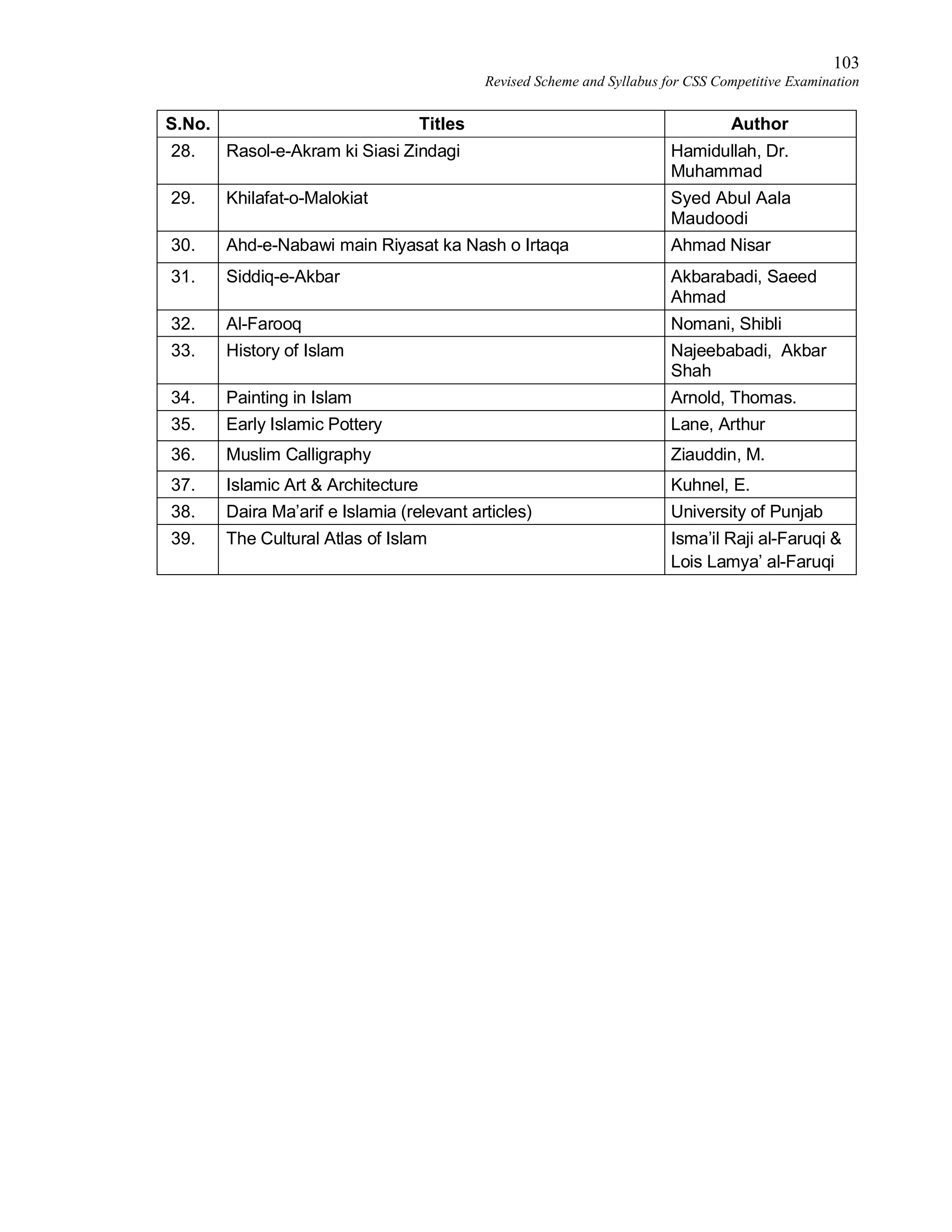
34. Islamic History & Culture 100-103
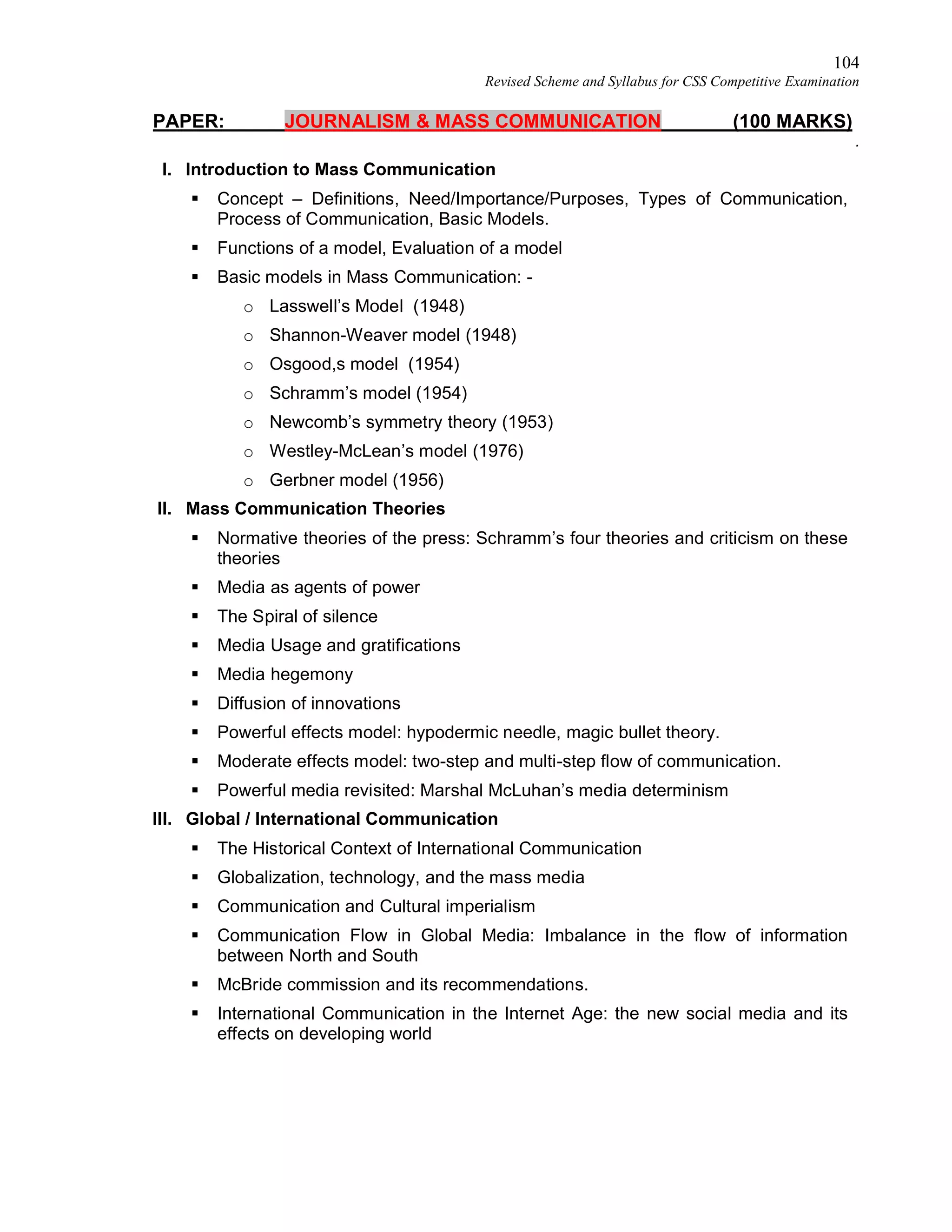
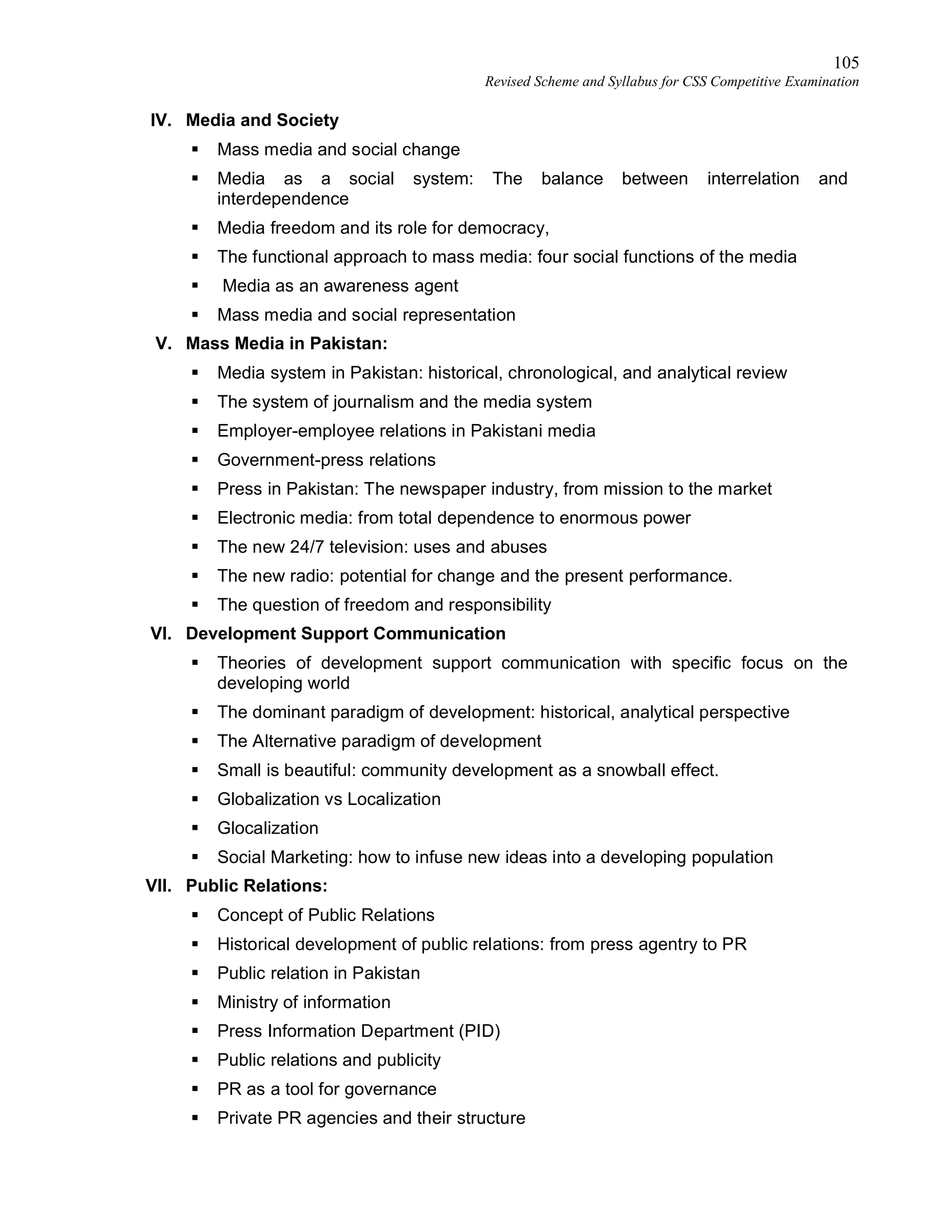
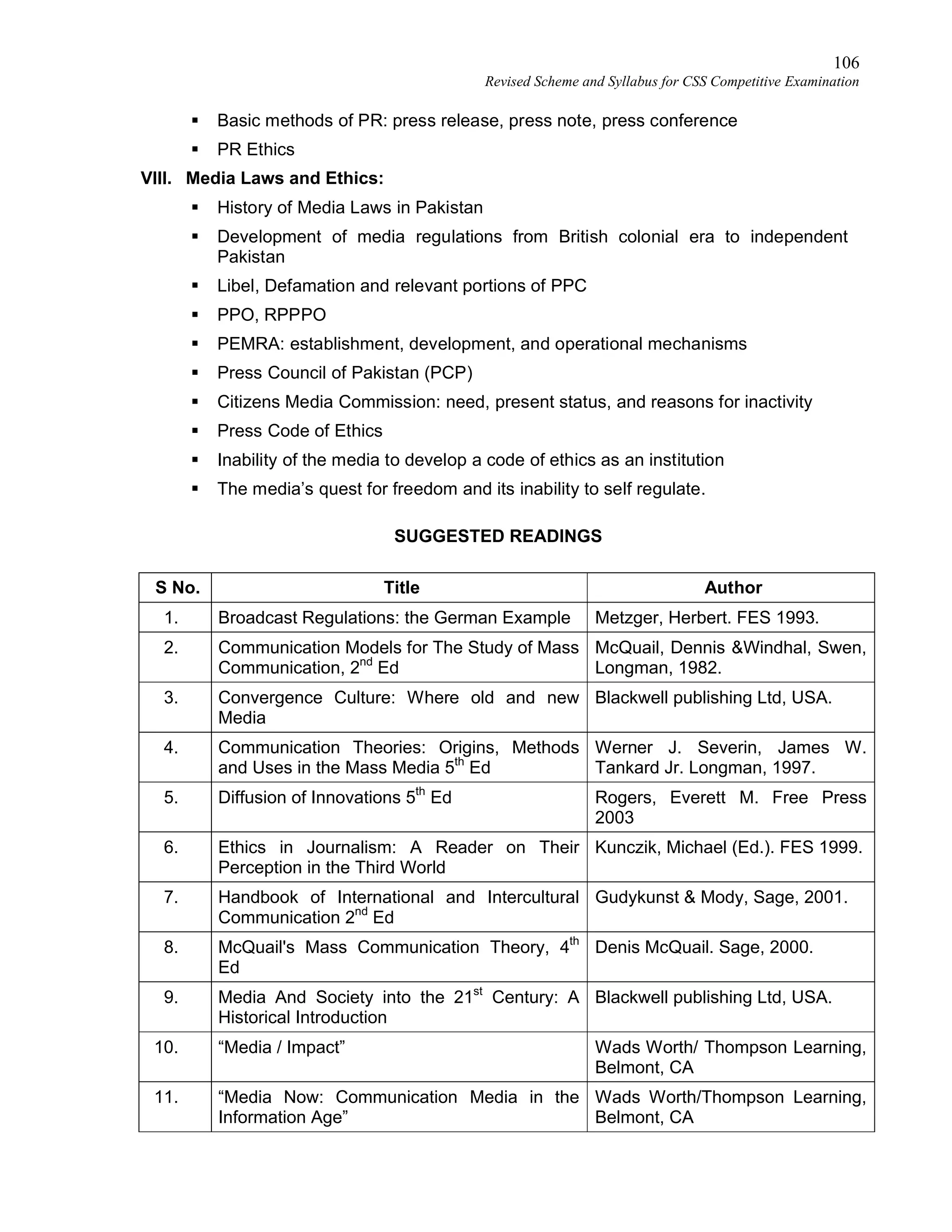
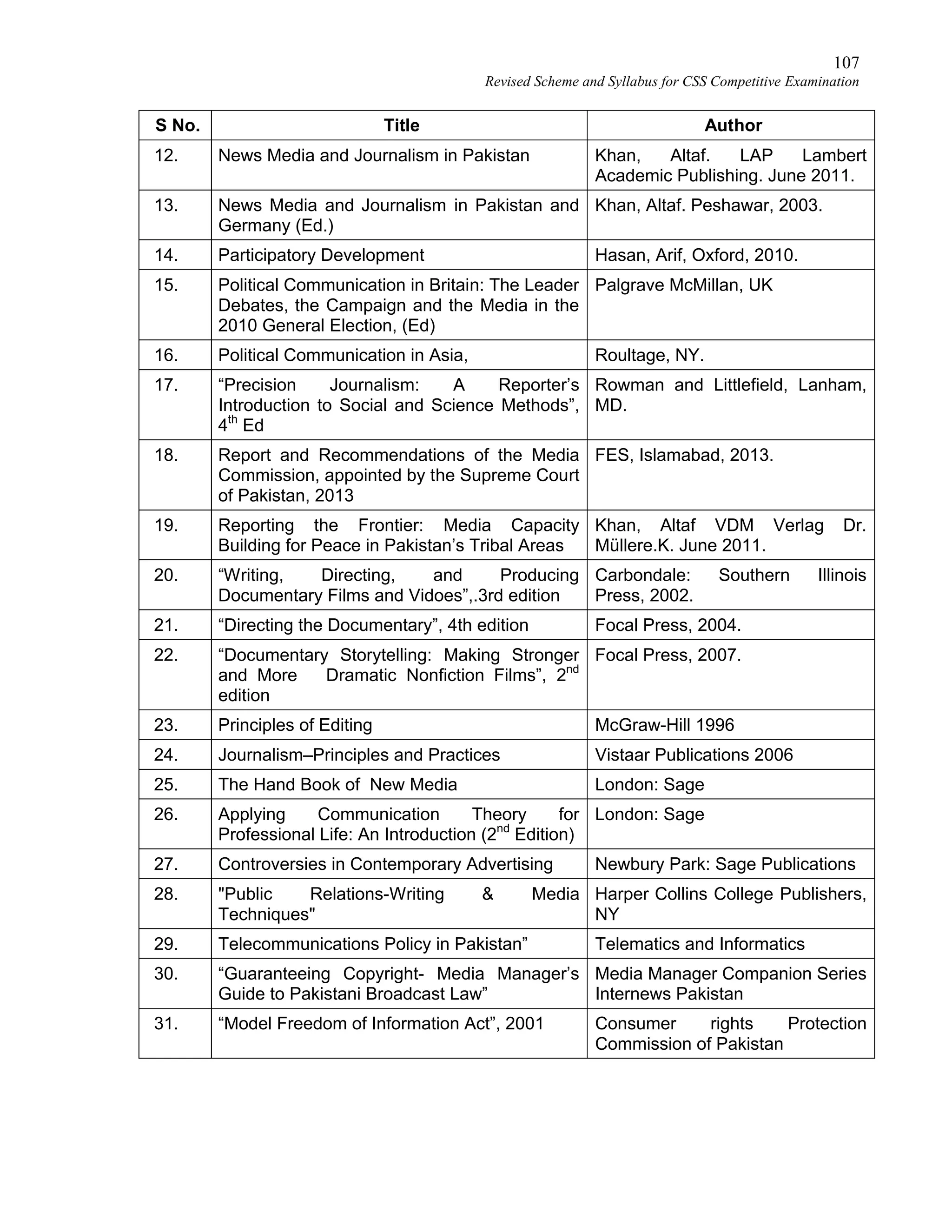
35. Journalism and Mass Communication 104-107
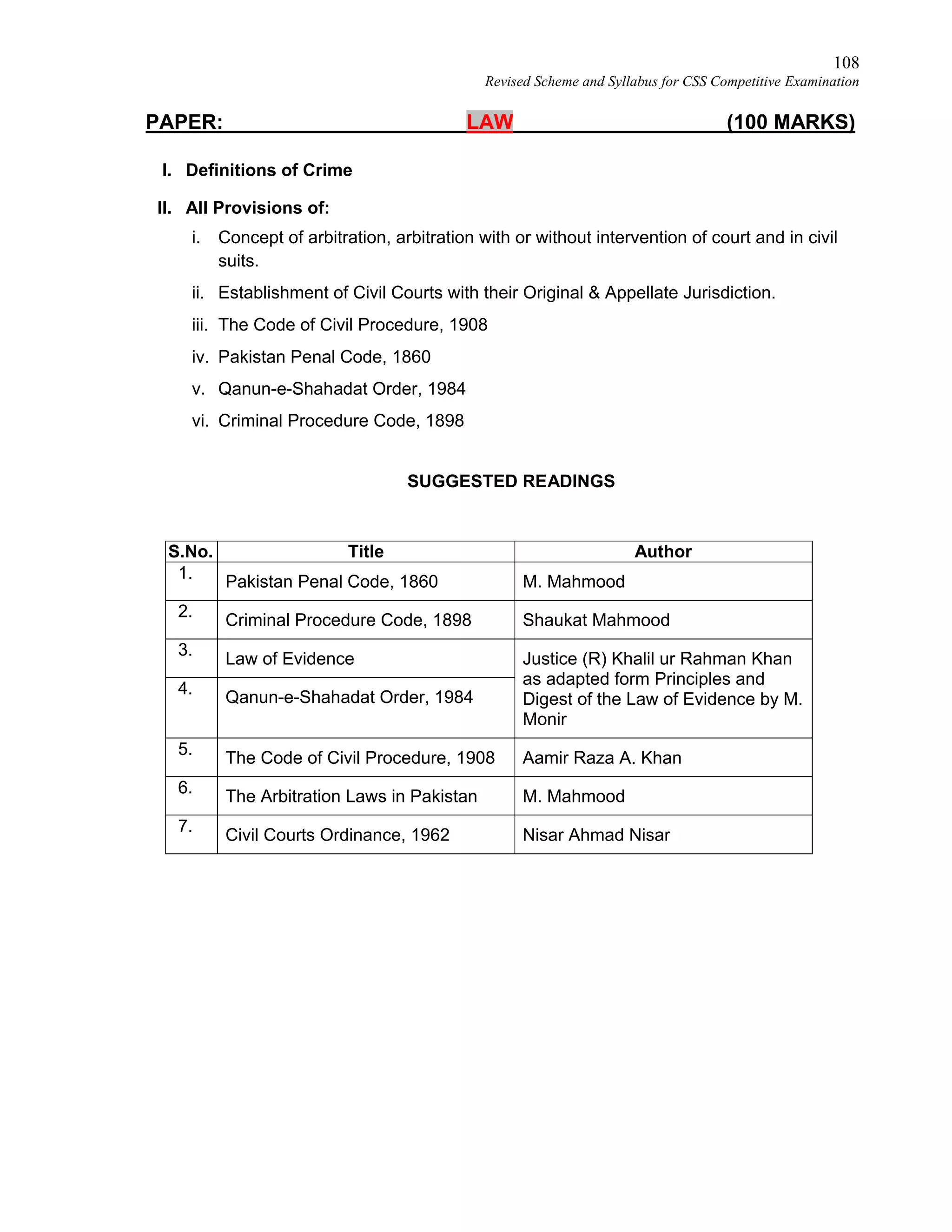
36. Law 108
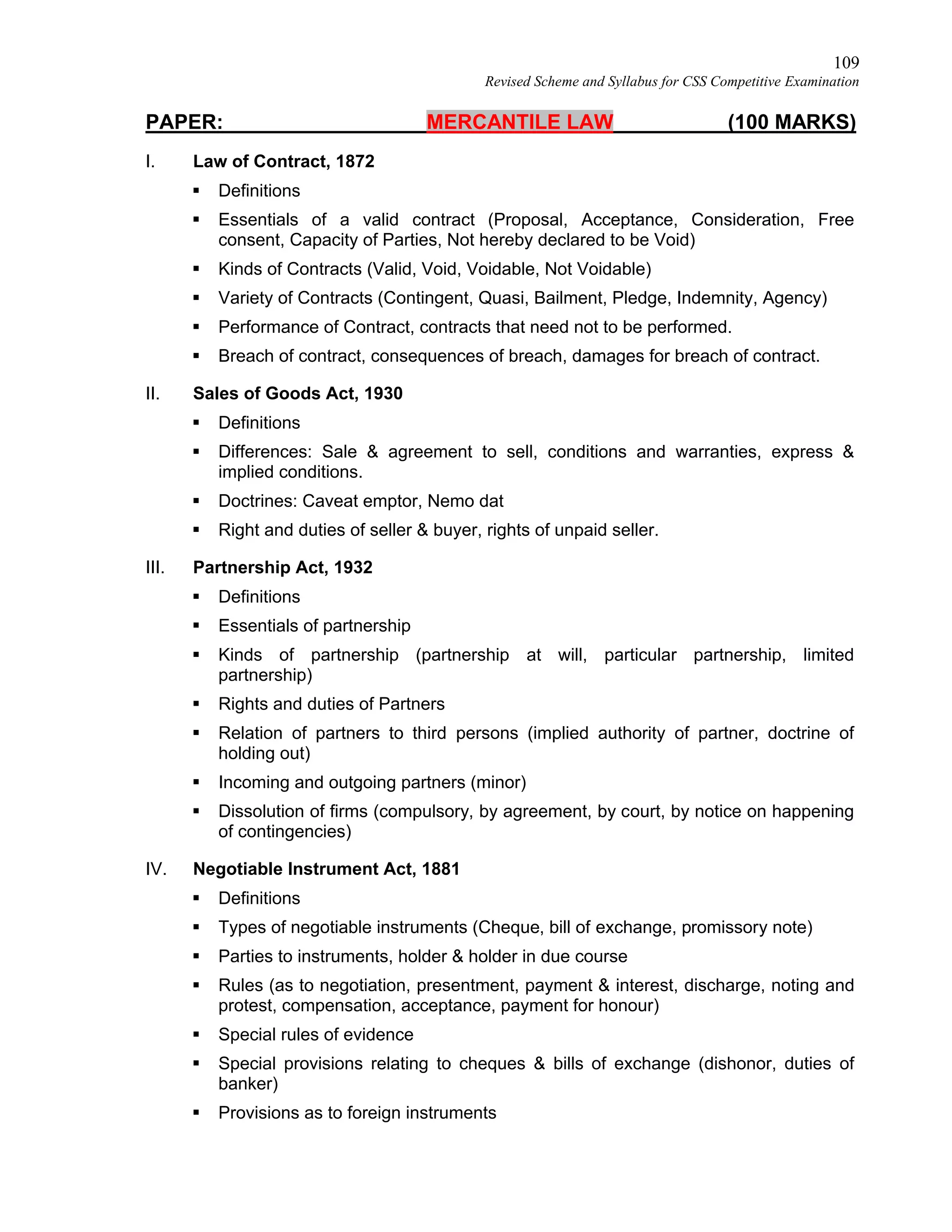
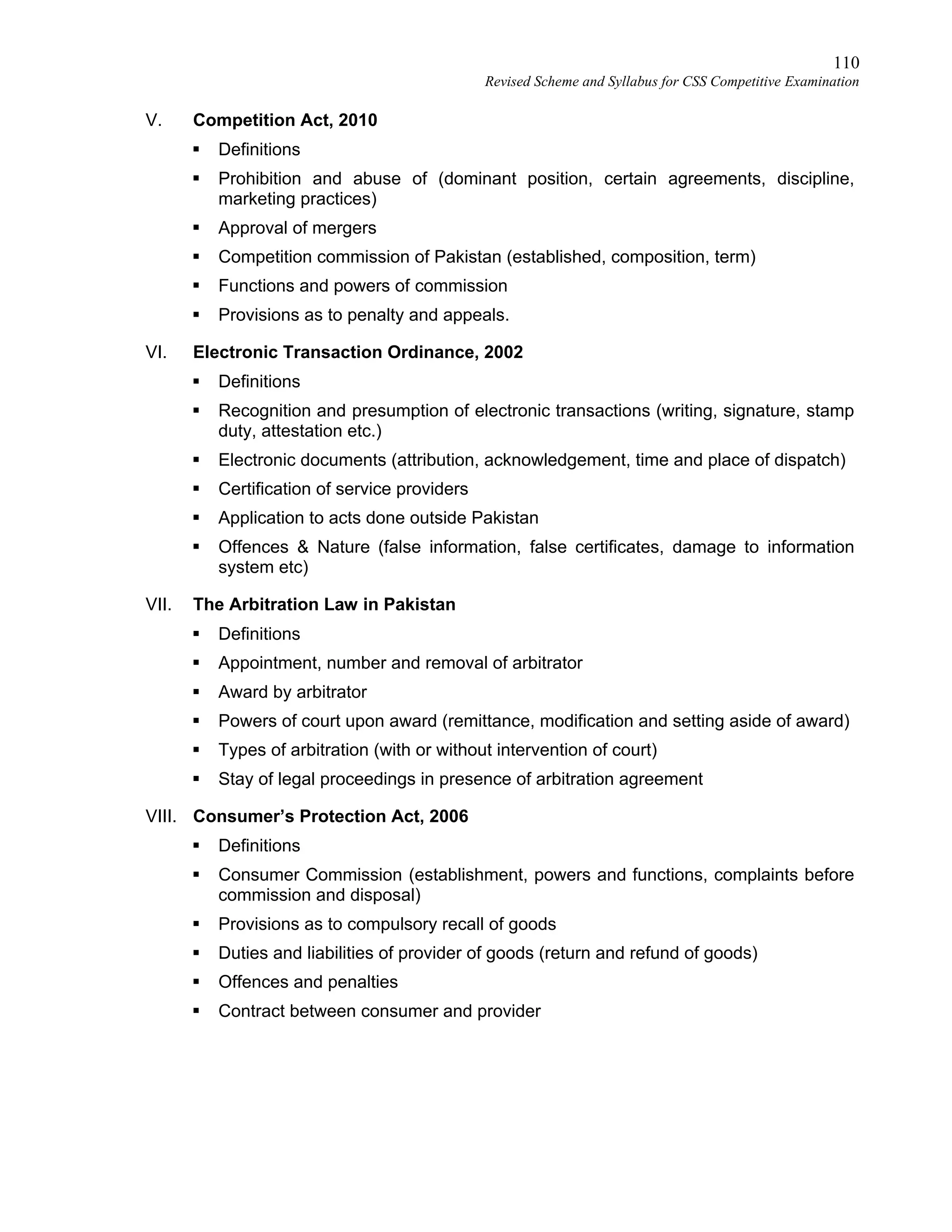
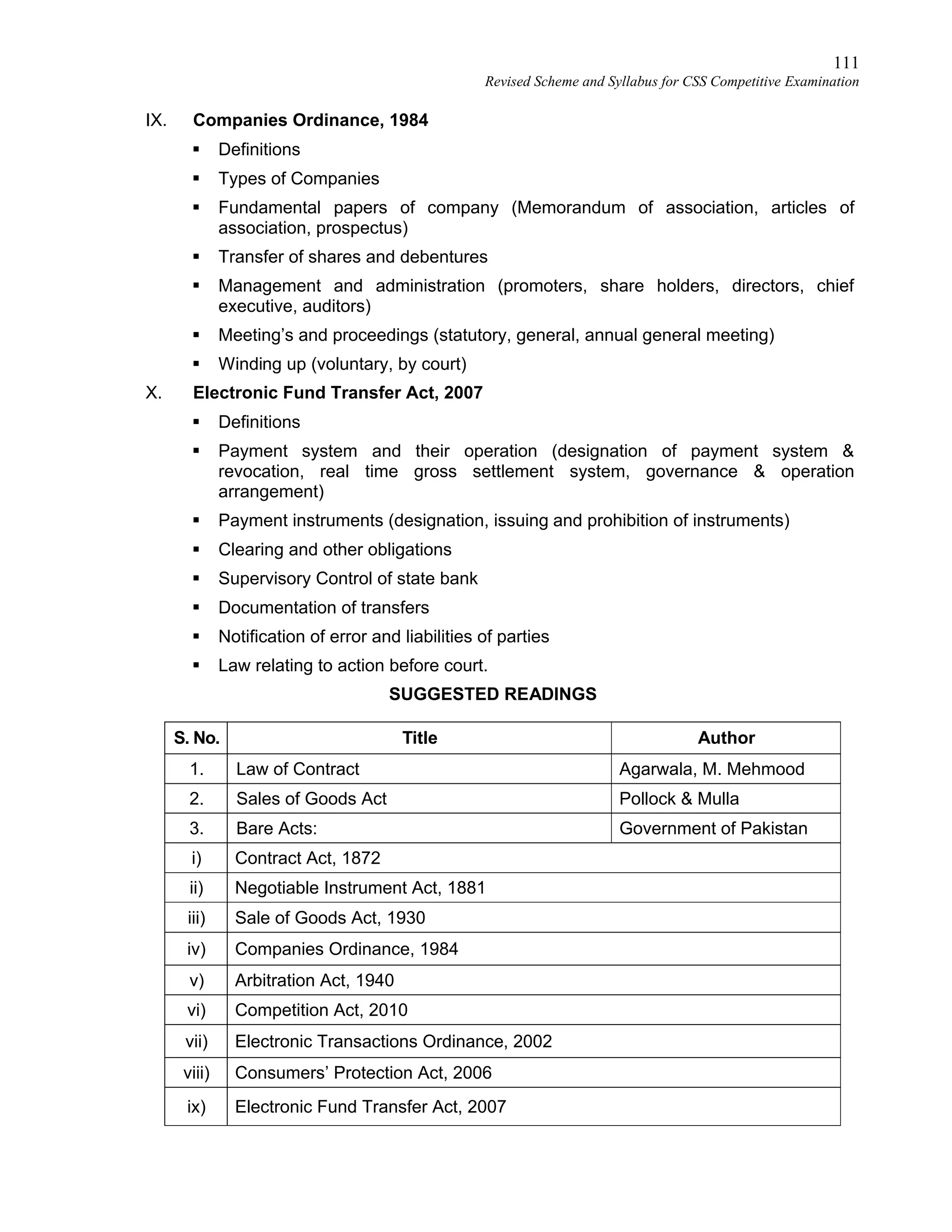
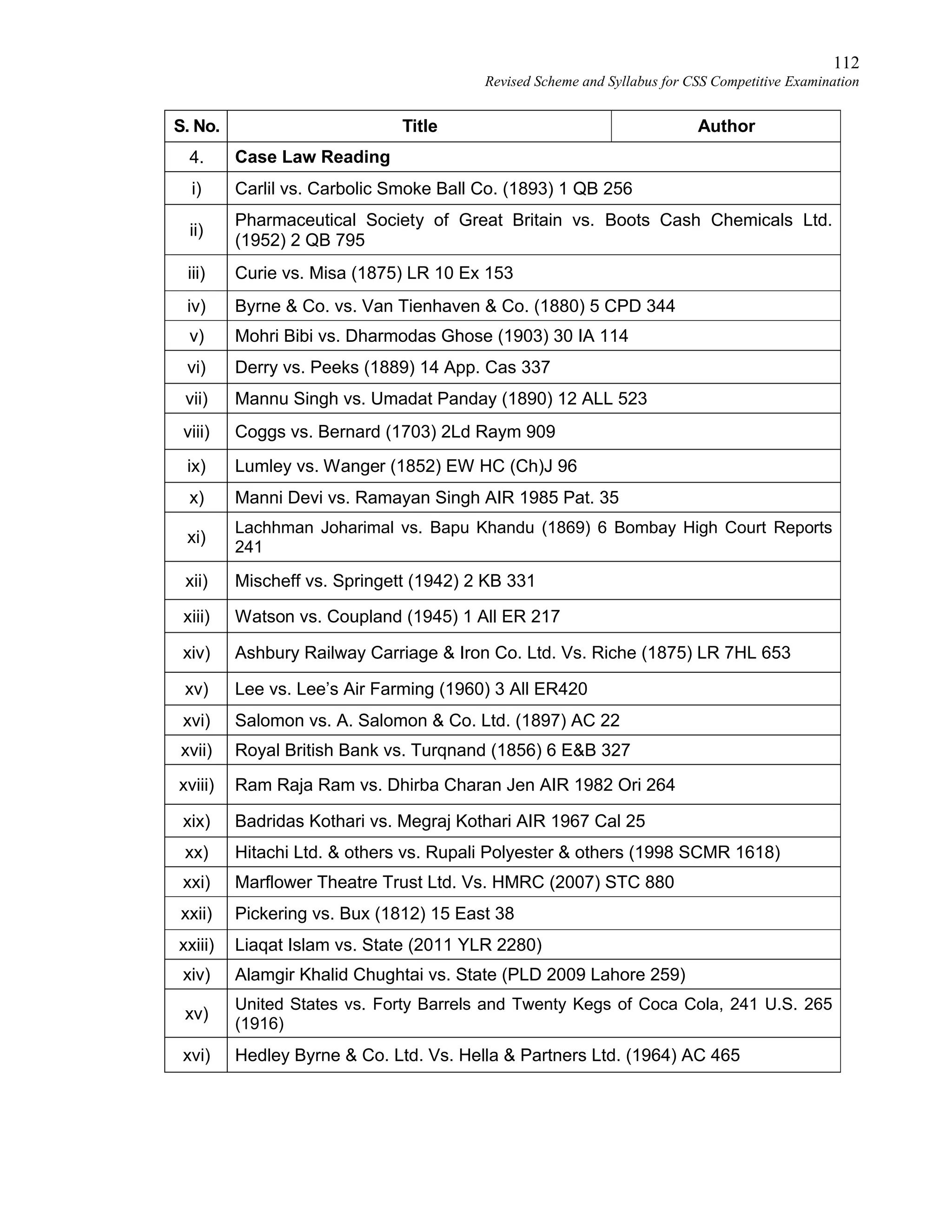
37. Mercantile Law 109-112
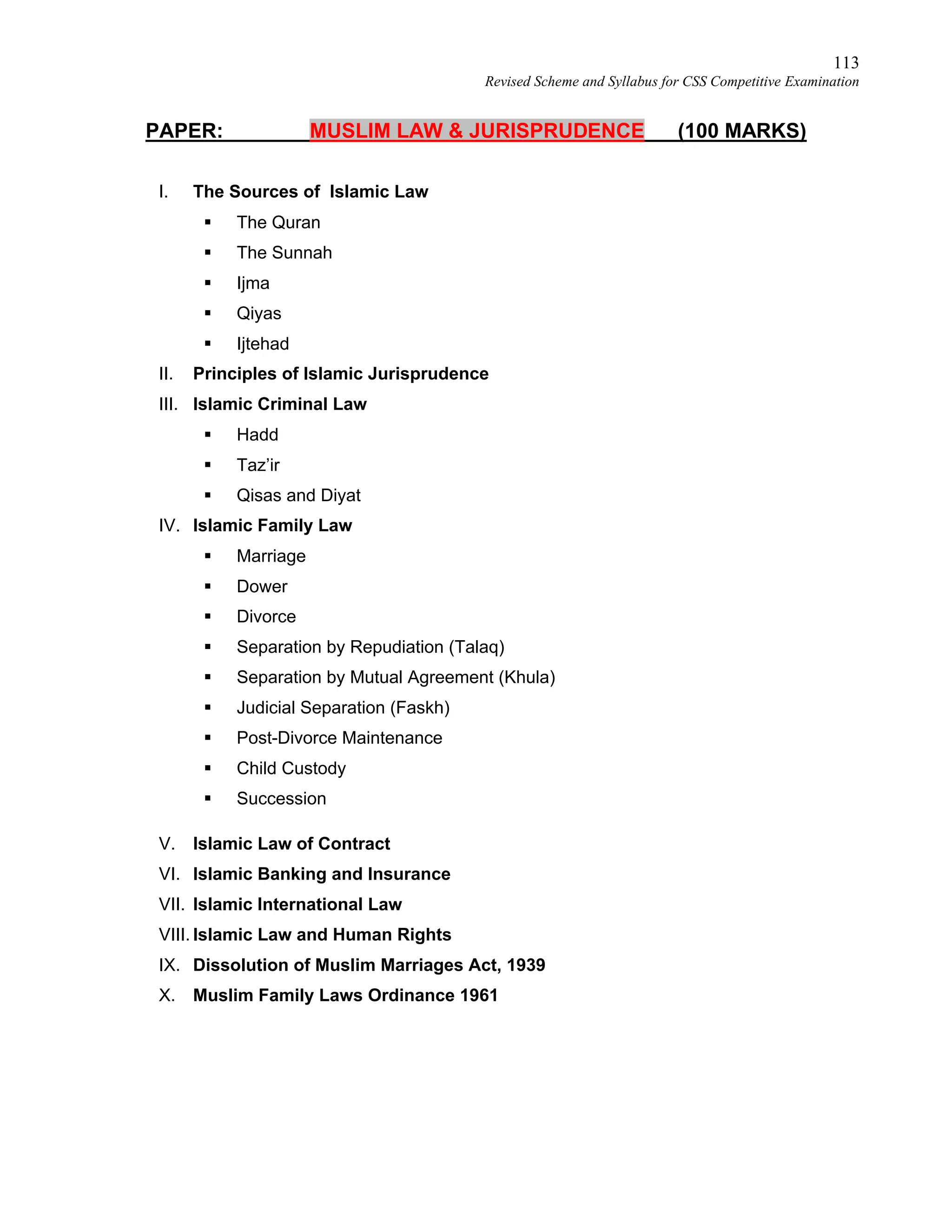
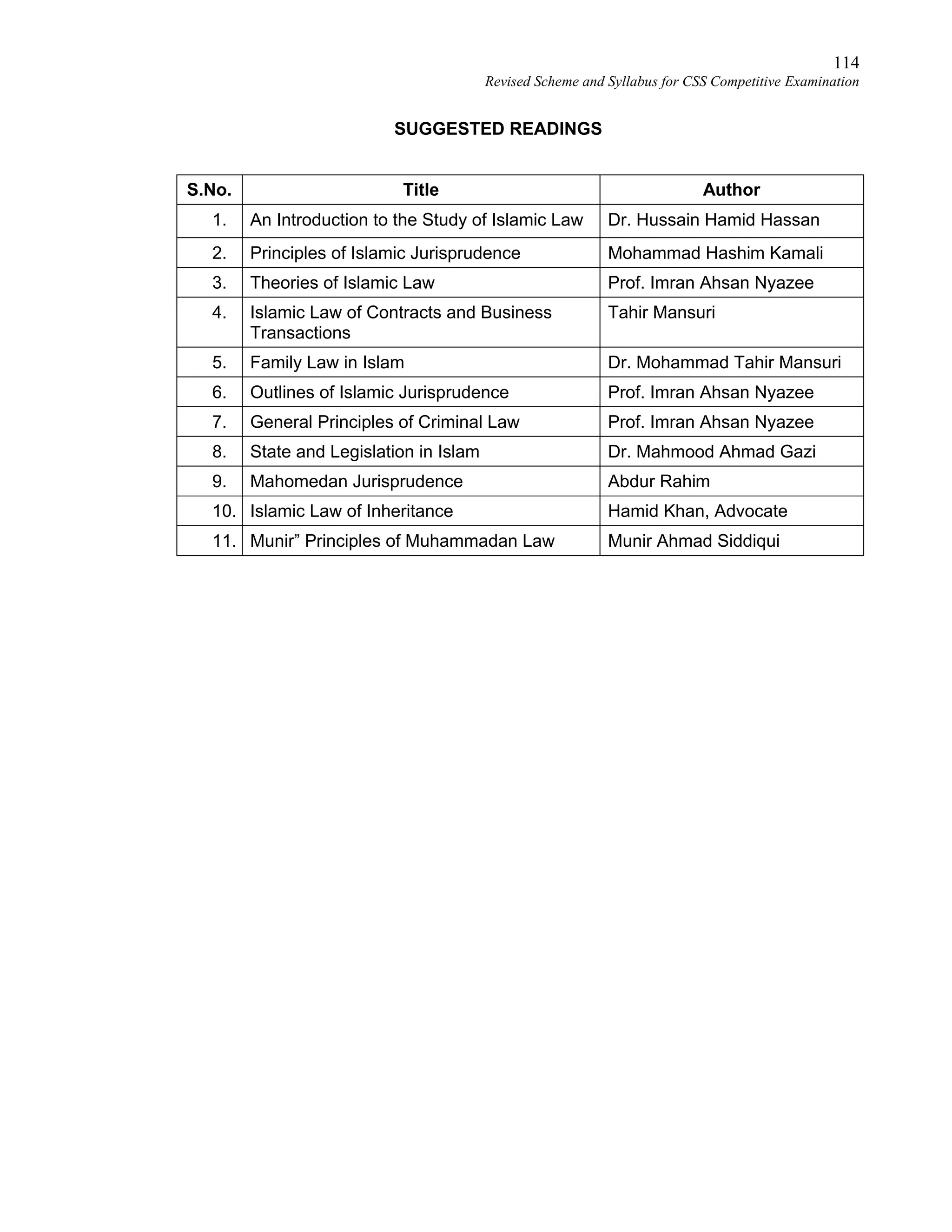
38. Muslim Law & Jurisprudence 113-114
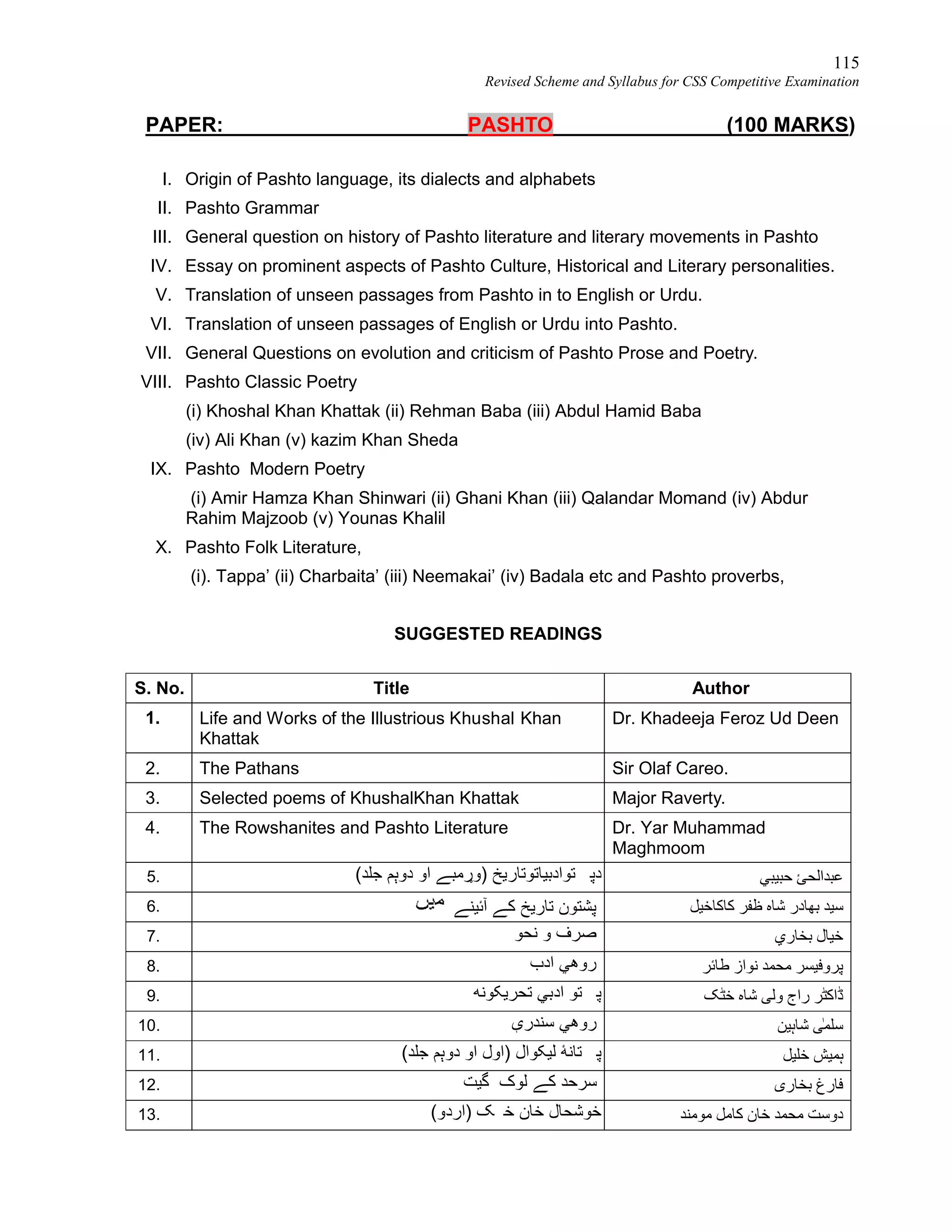
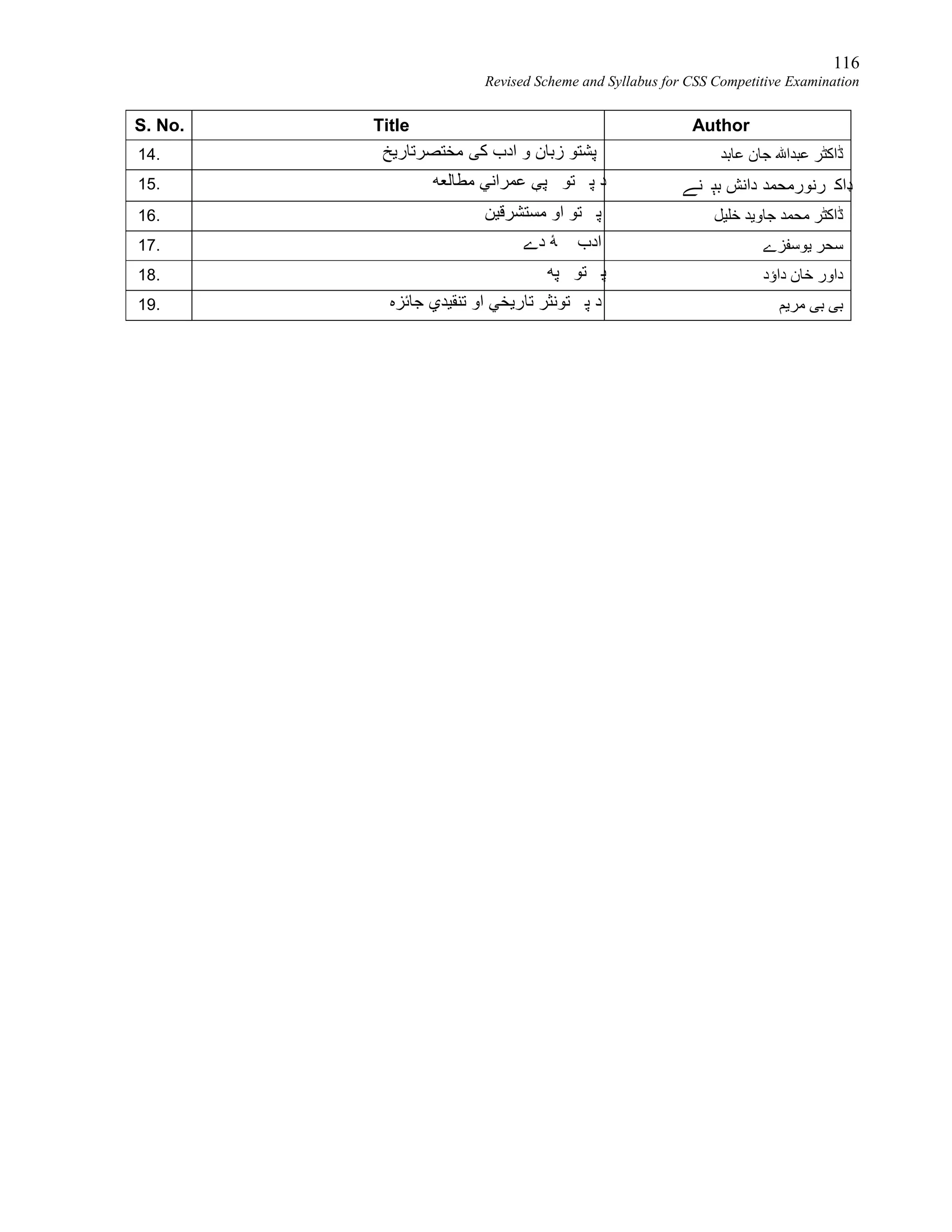
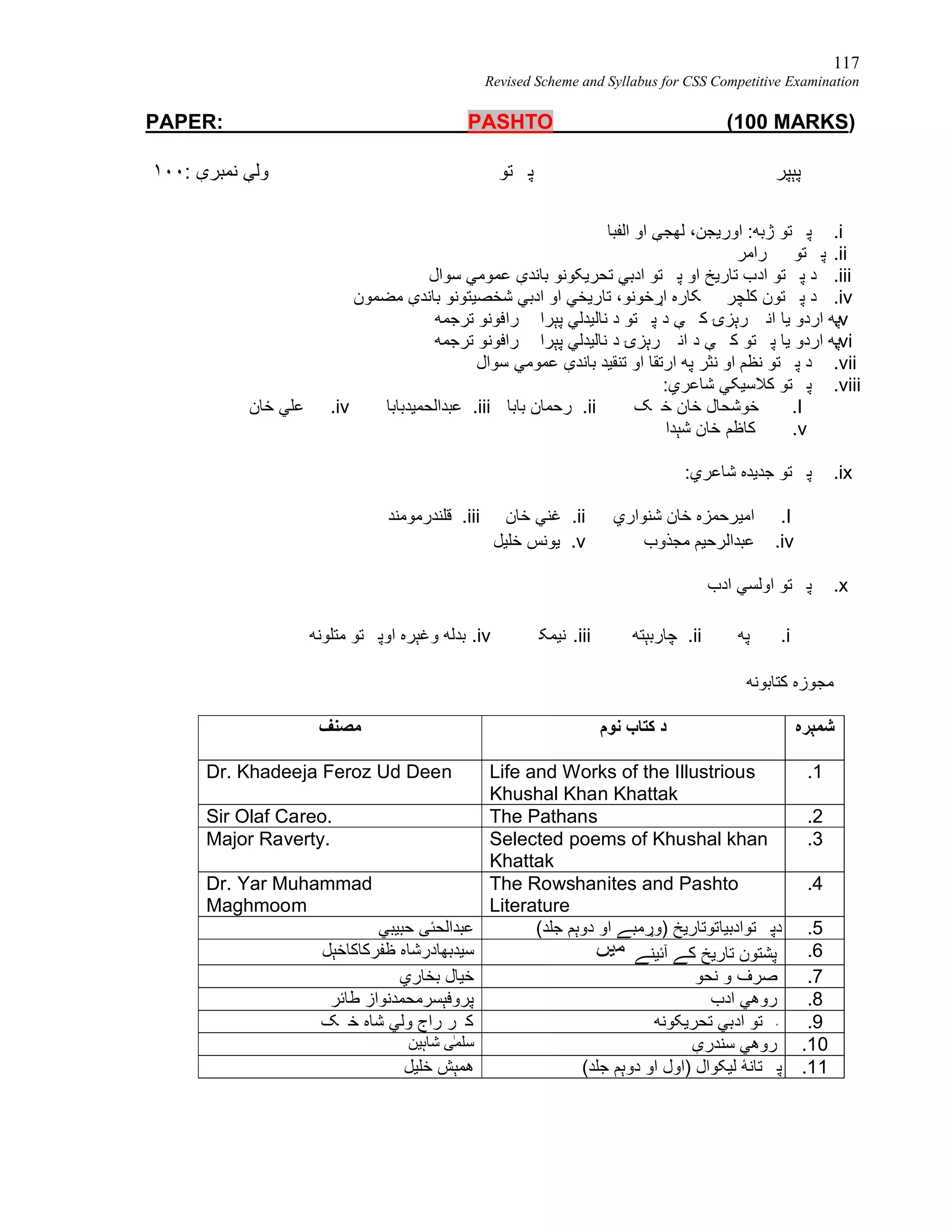
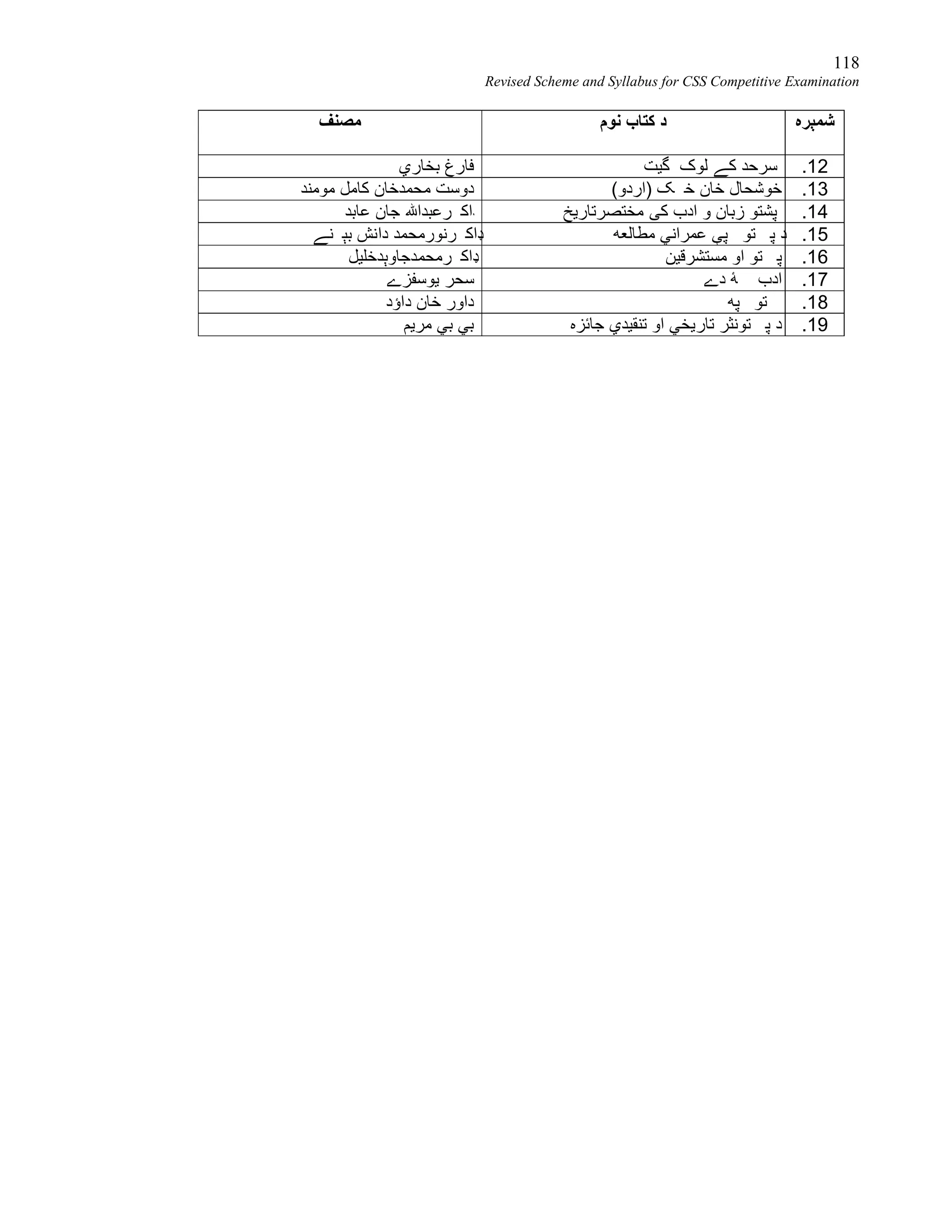
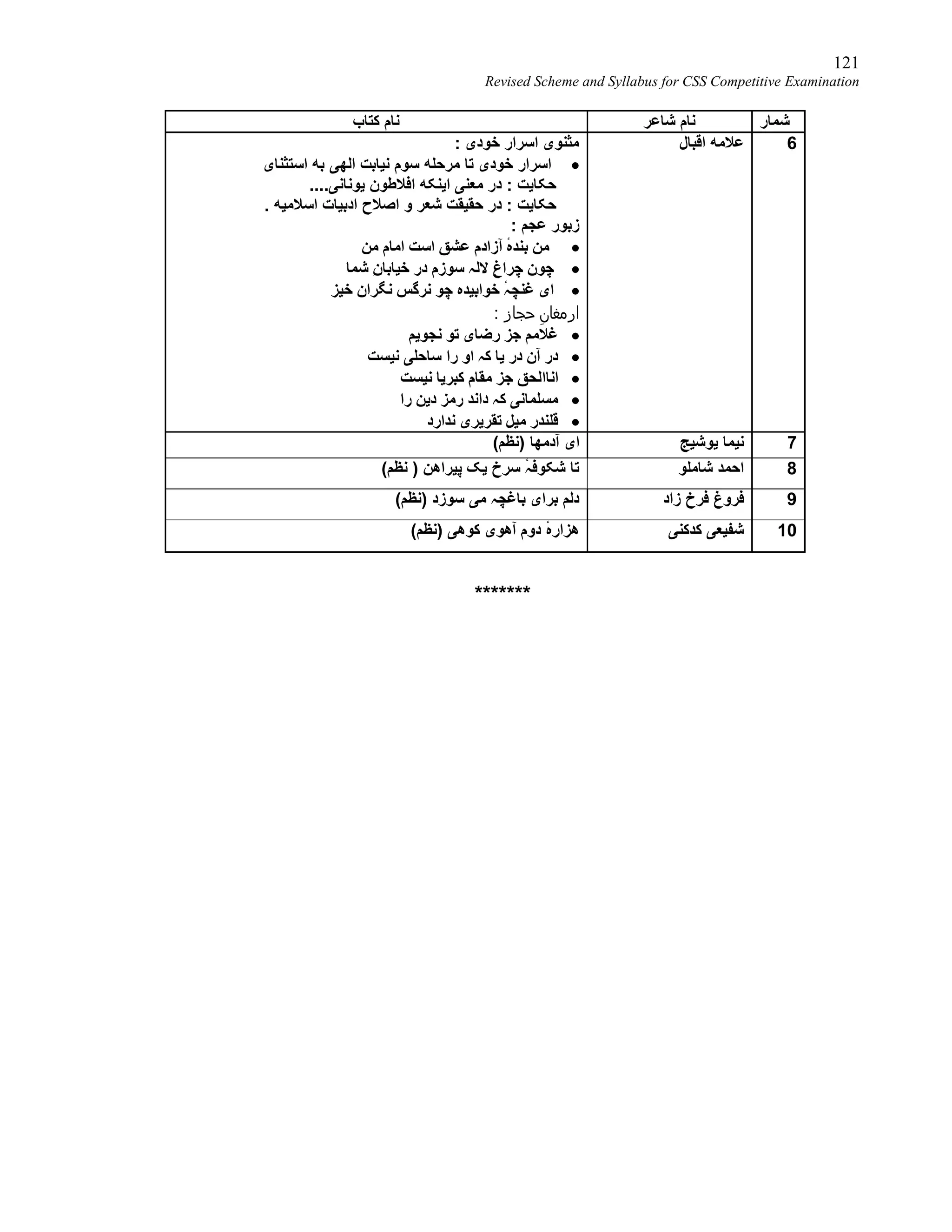
39. Pashto 115-118
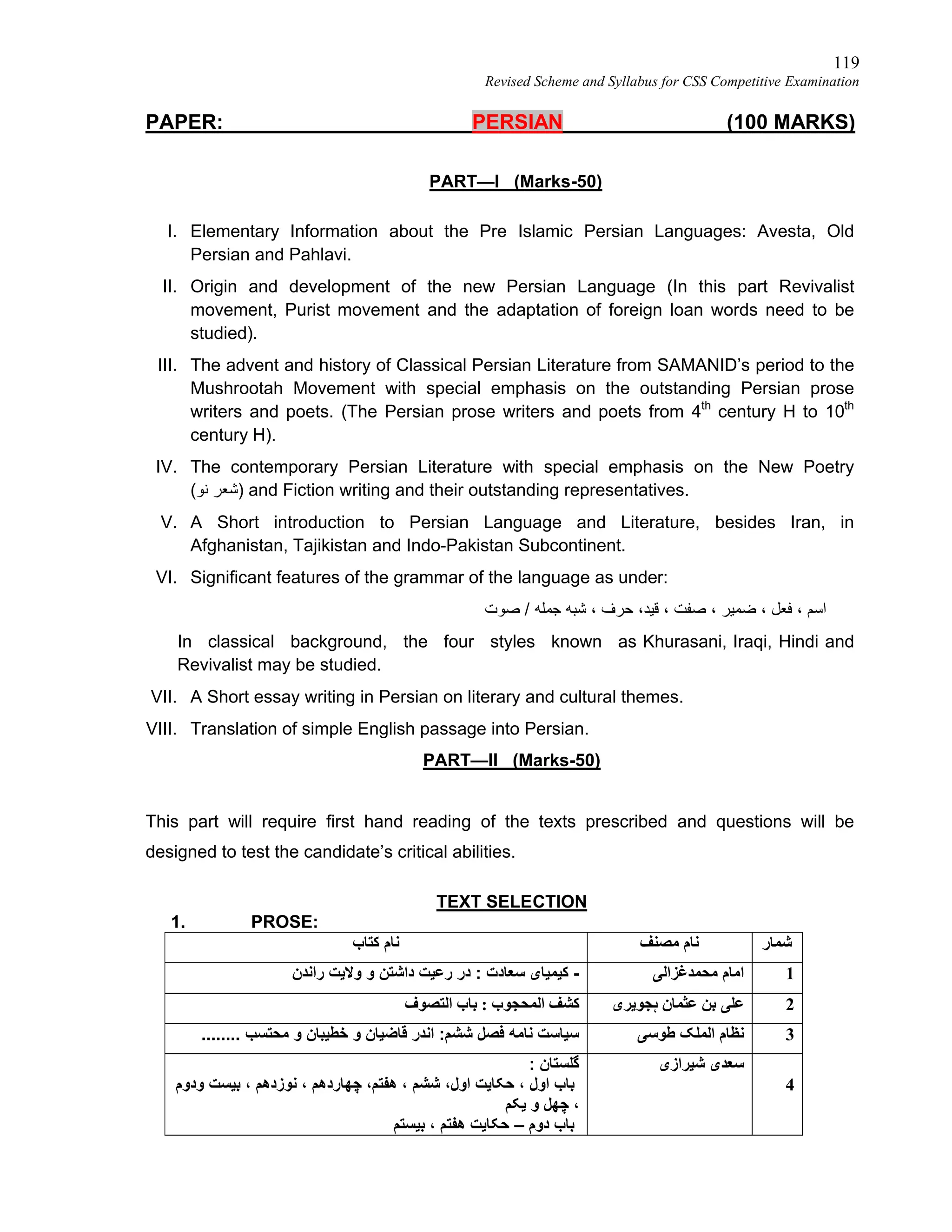
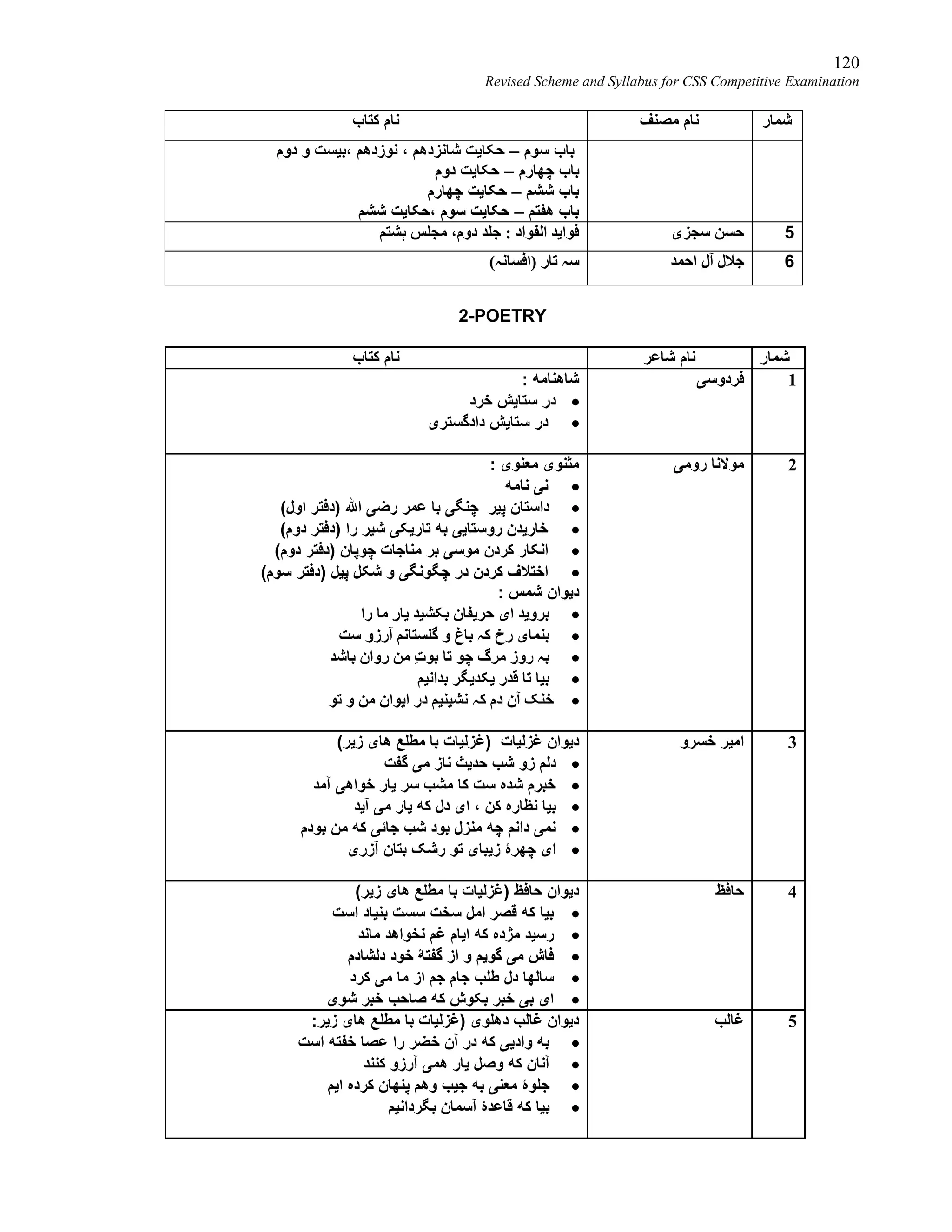
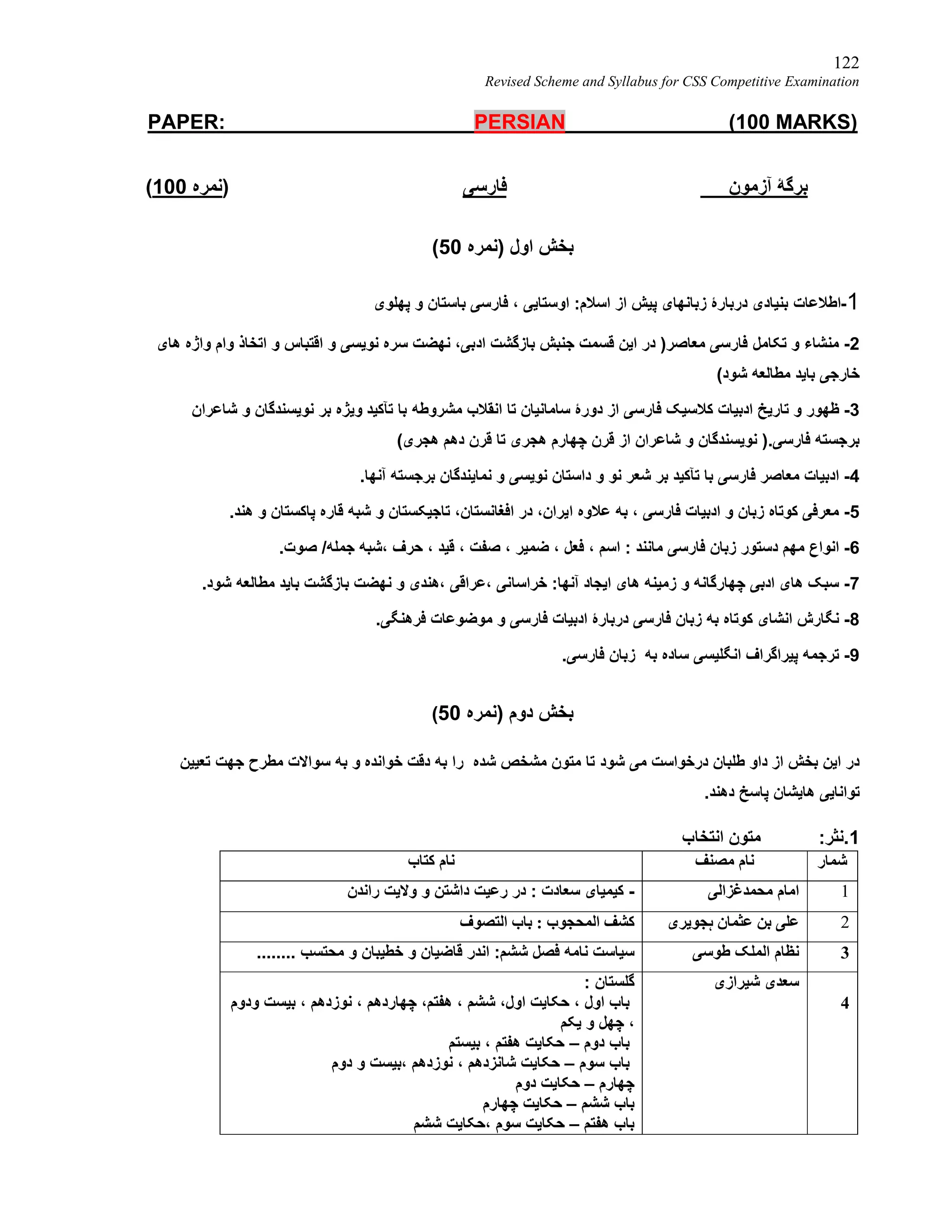
40. Persian 119-124
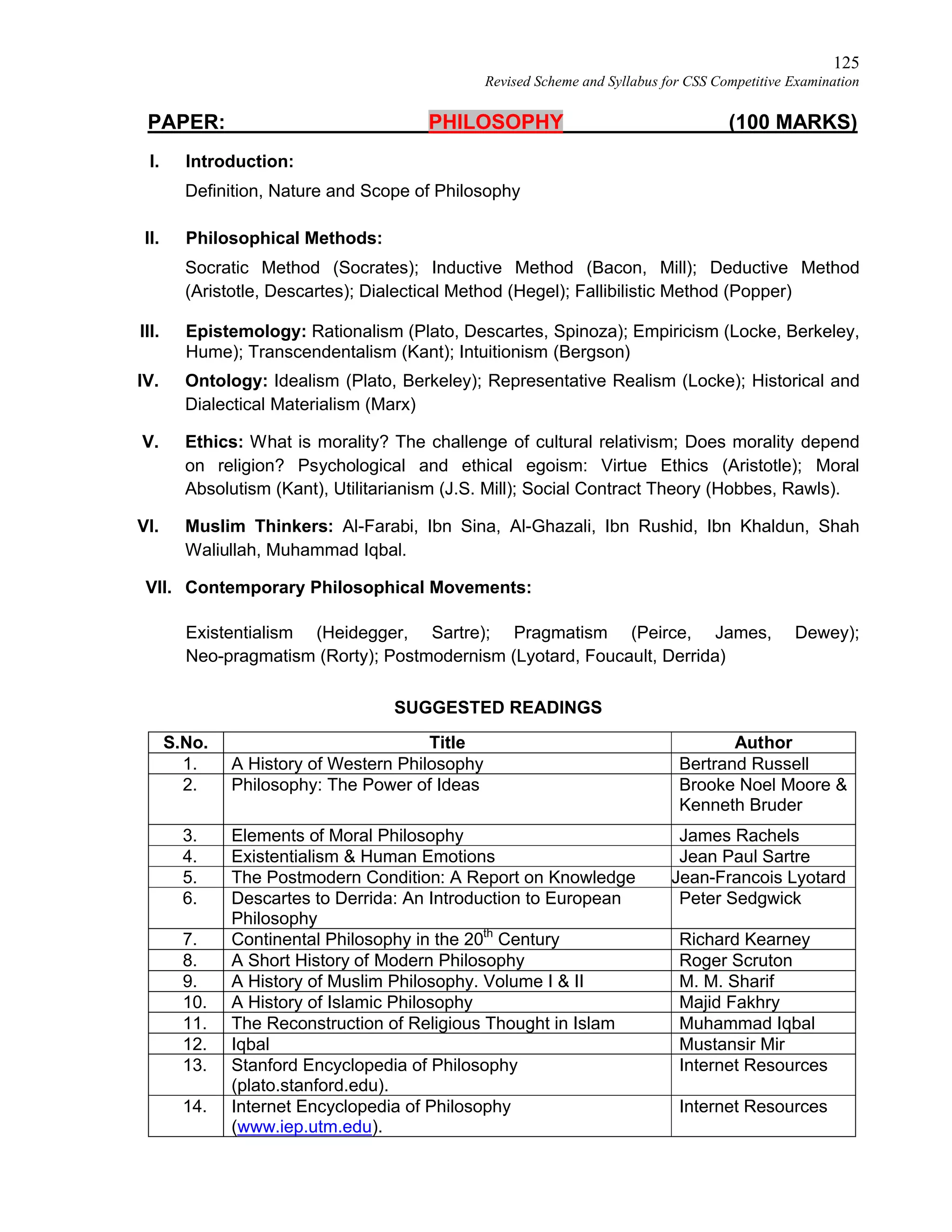
41. Philosophy 125
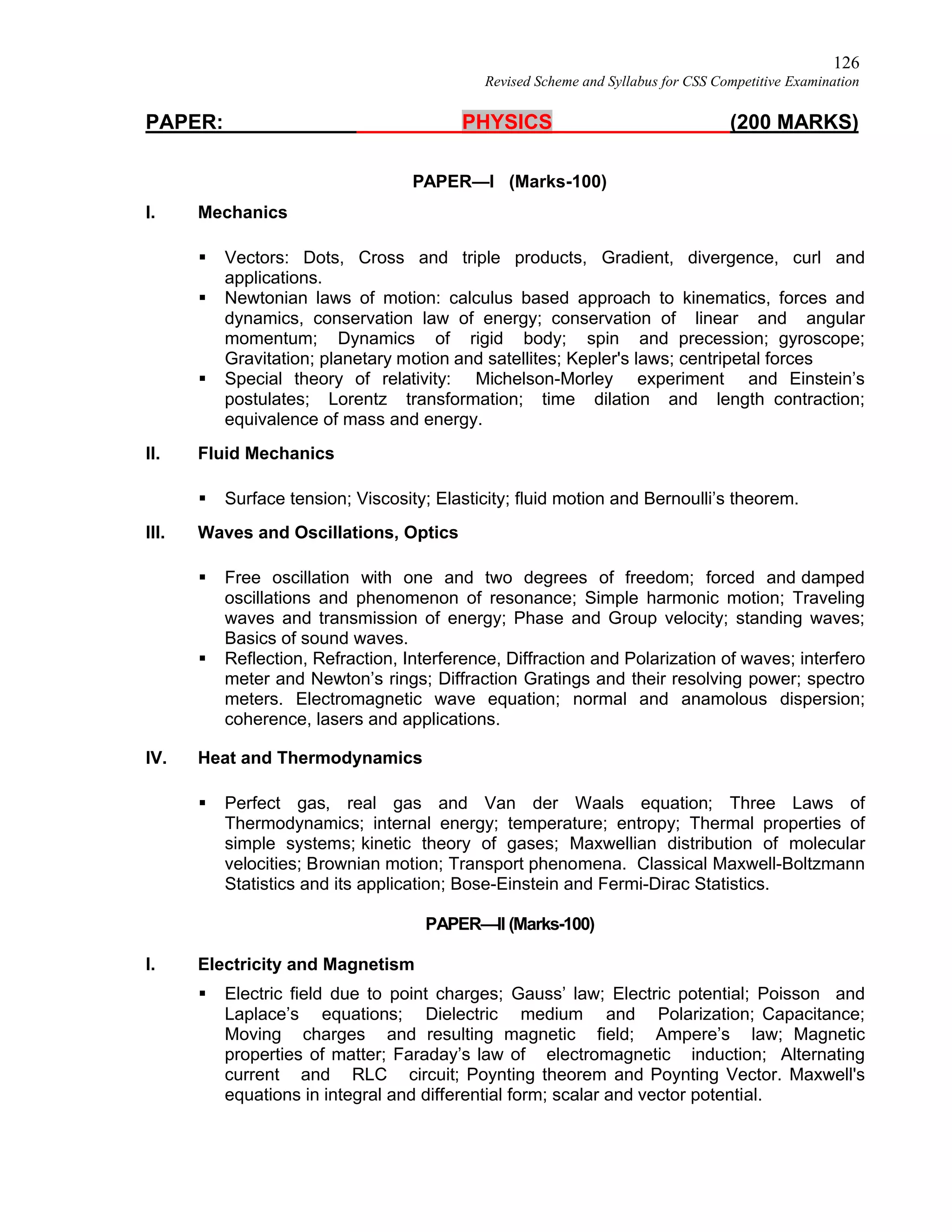
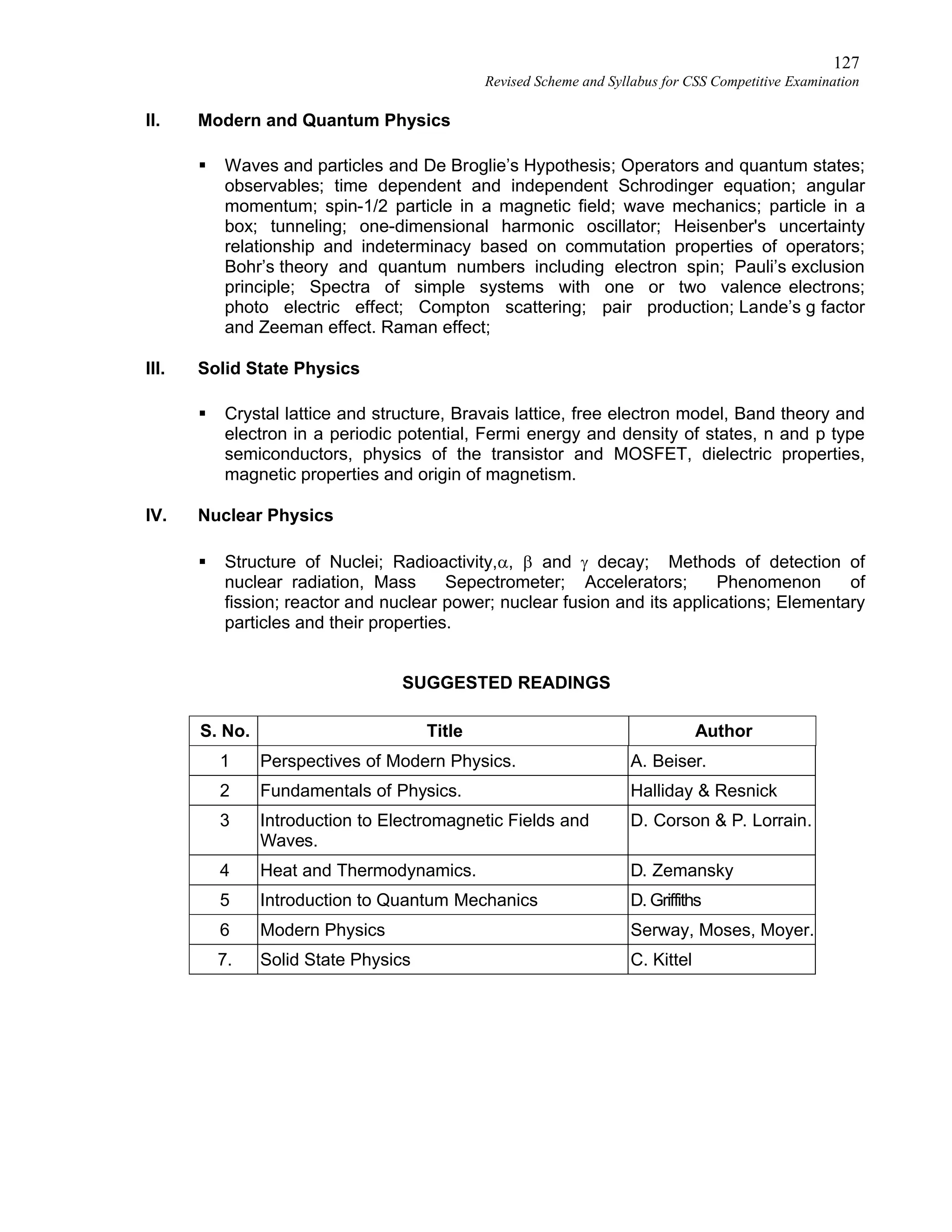
42. Physics 126-127
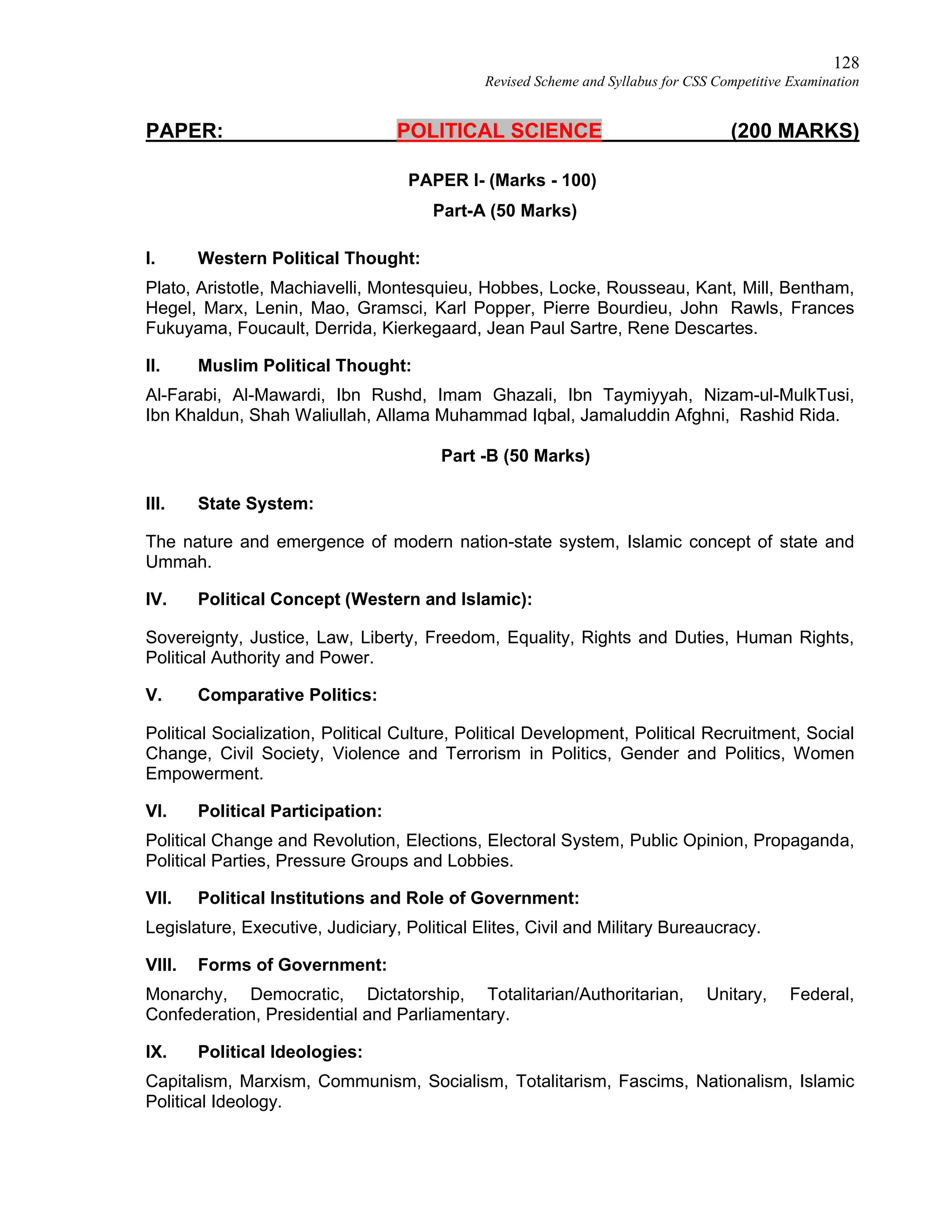
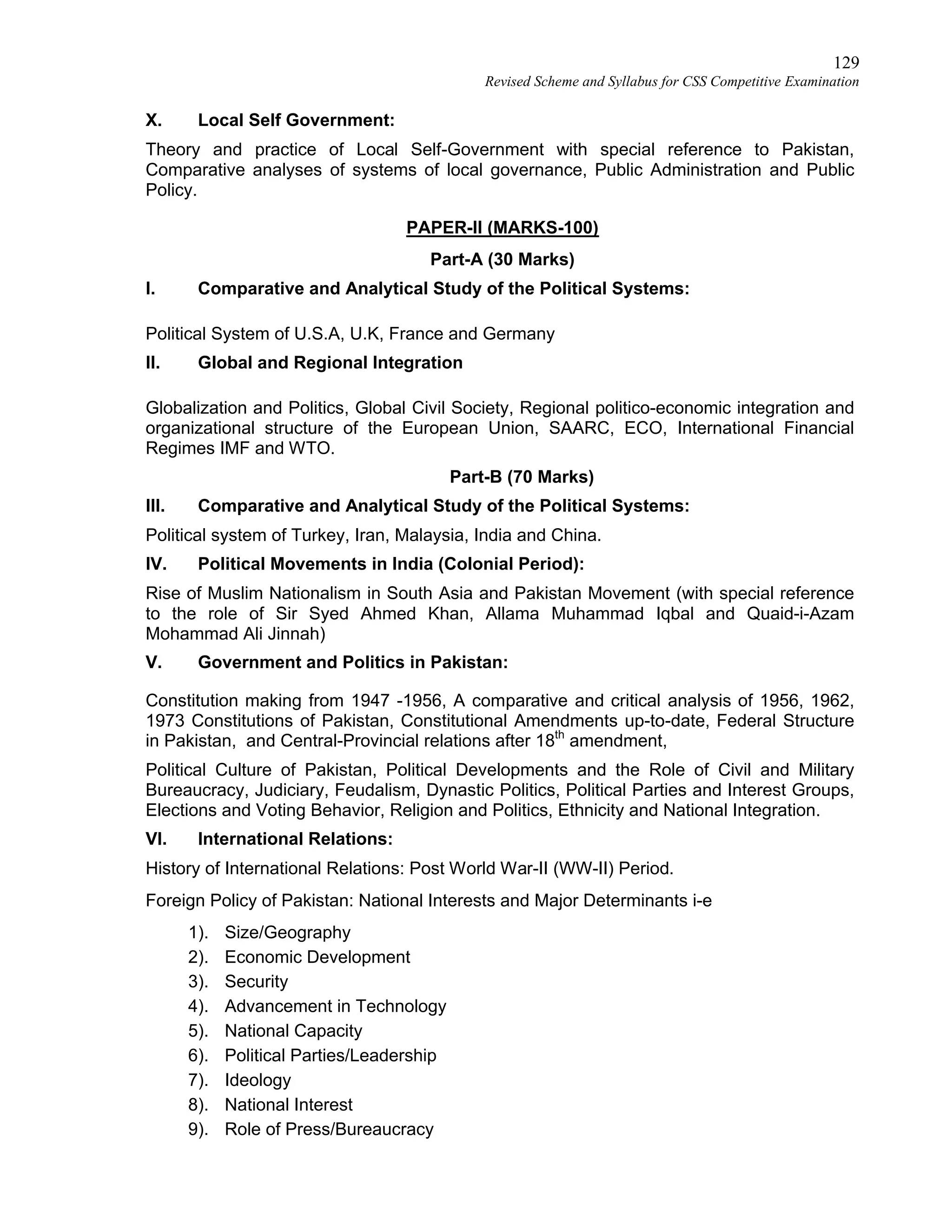
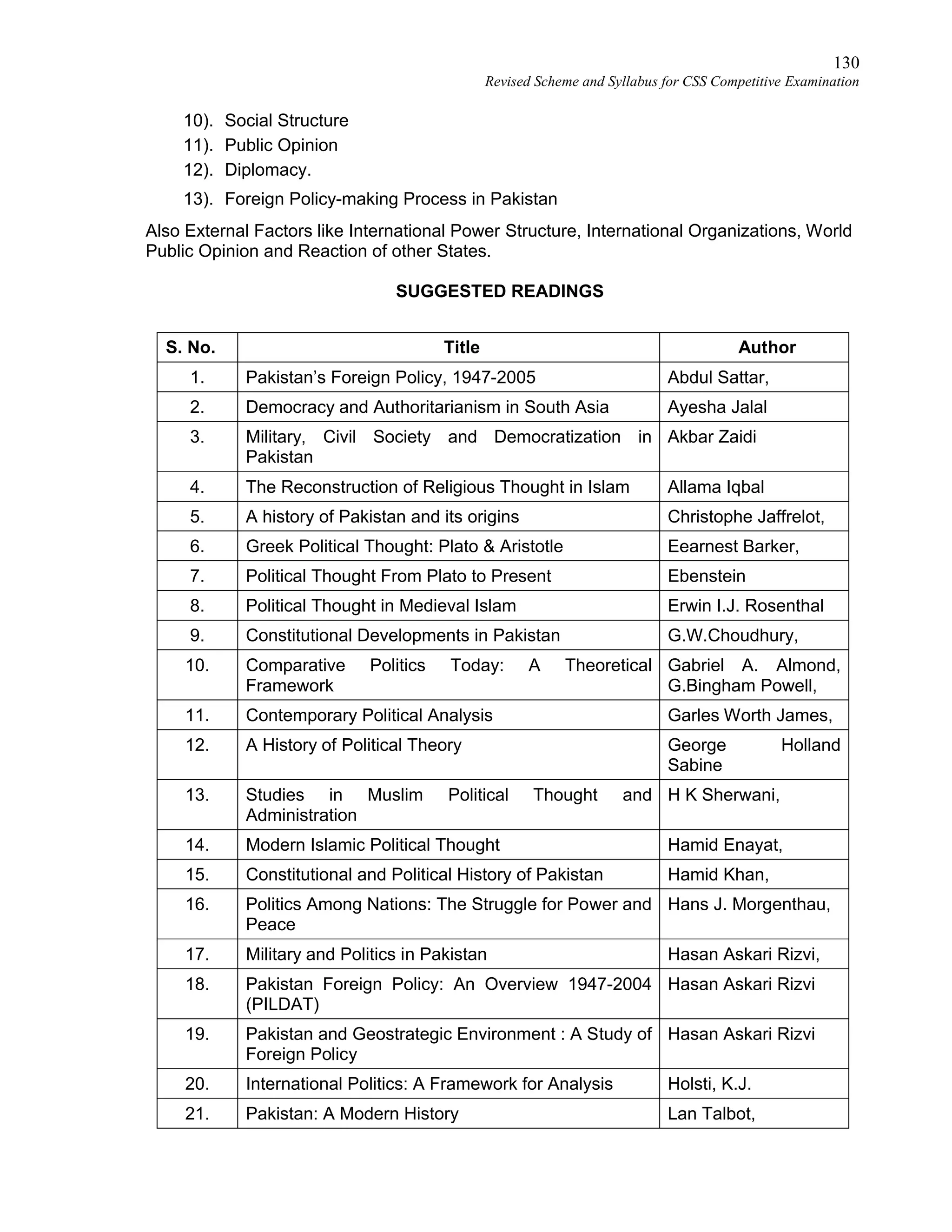
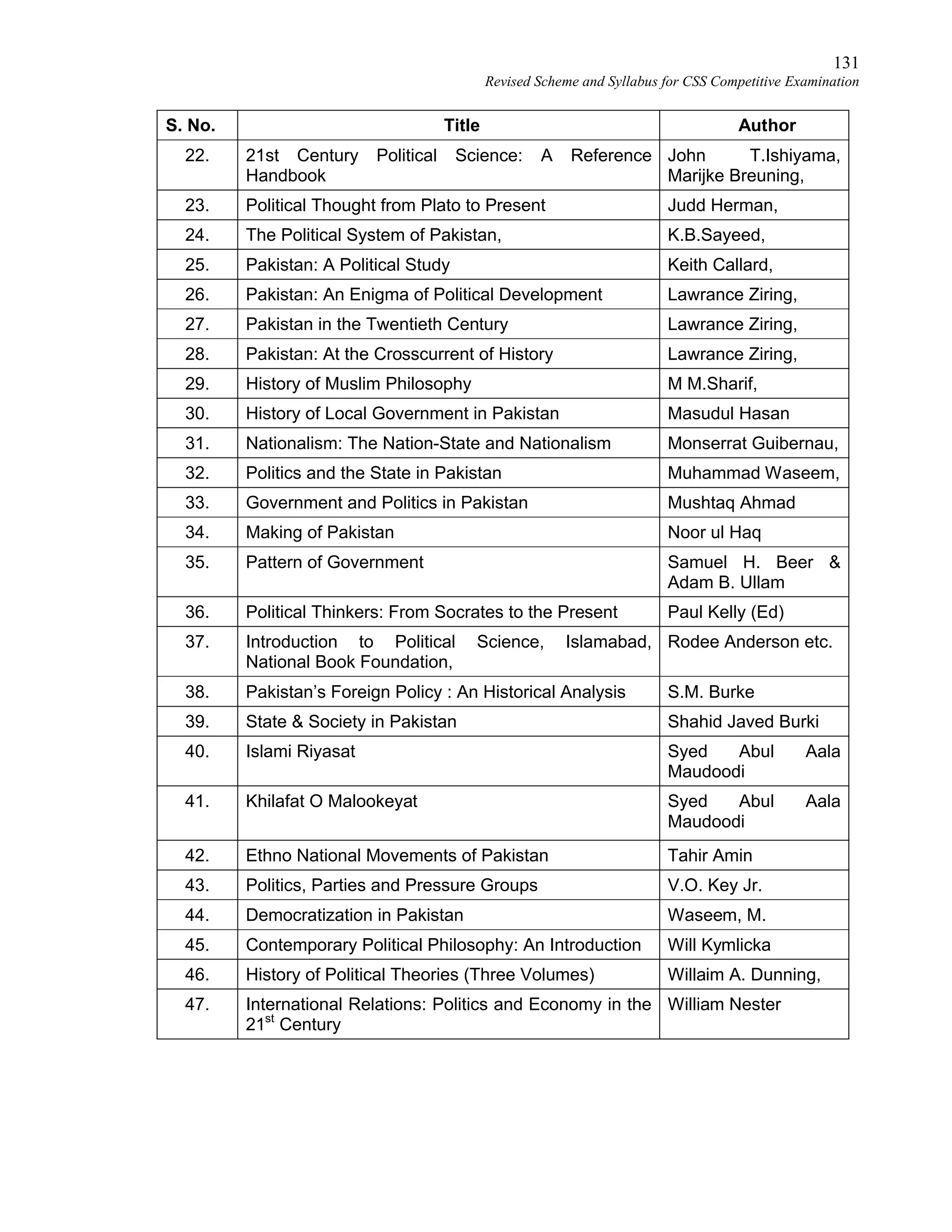
43. Political Science 128-131
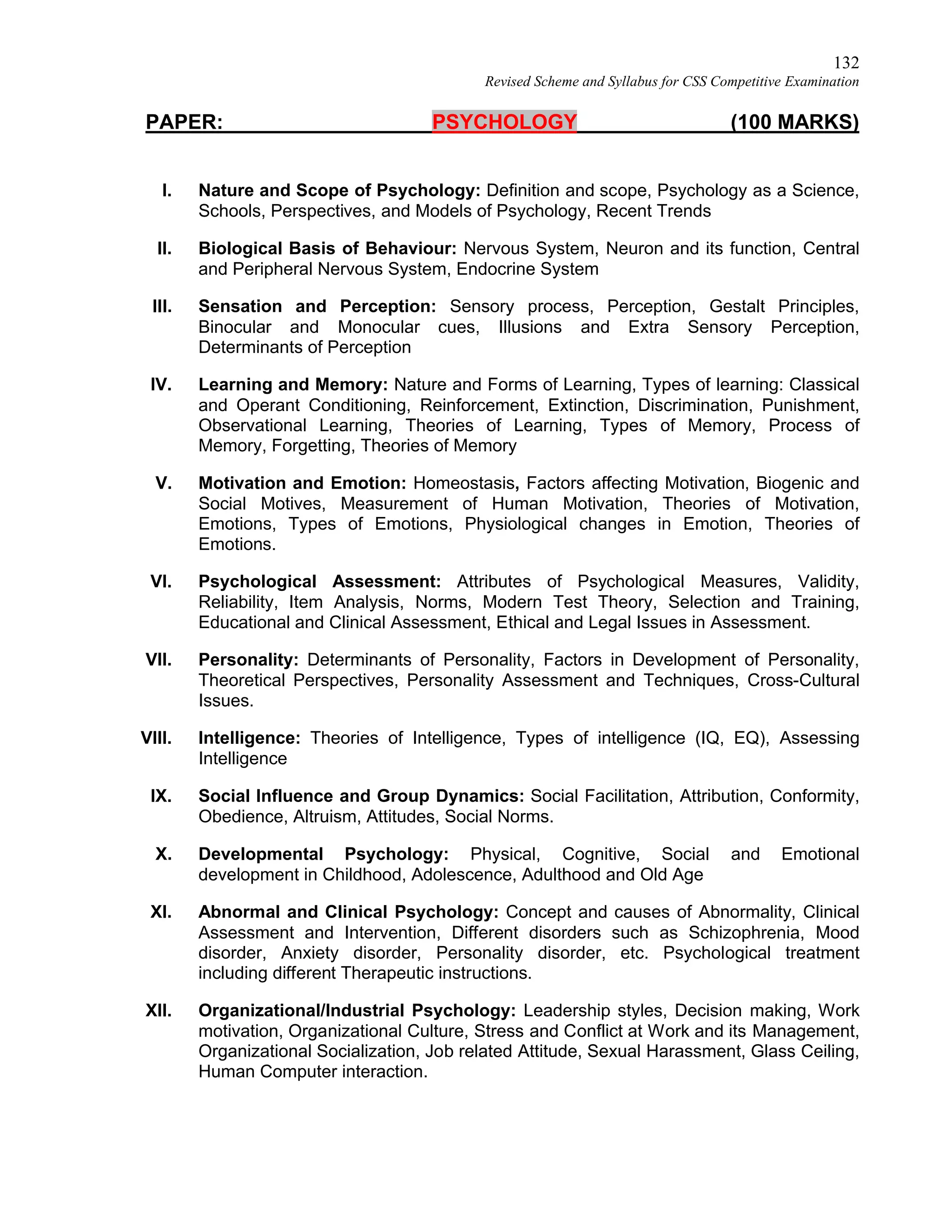
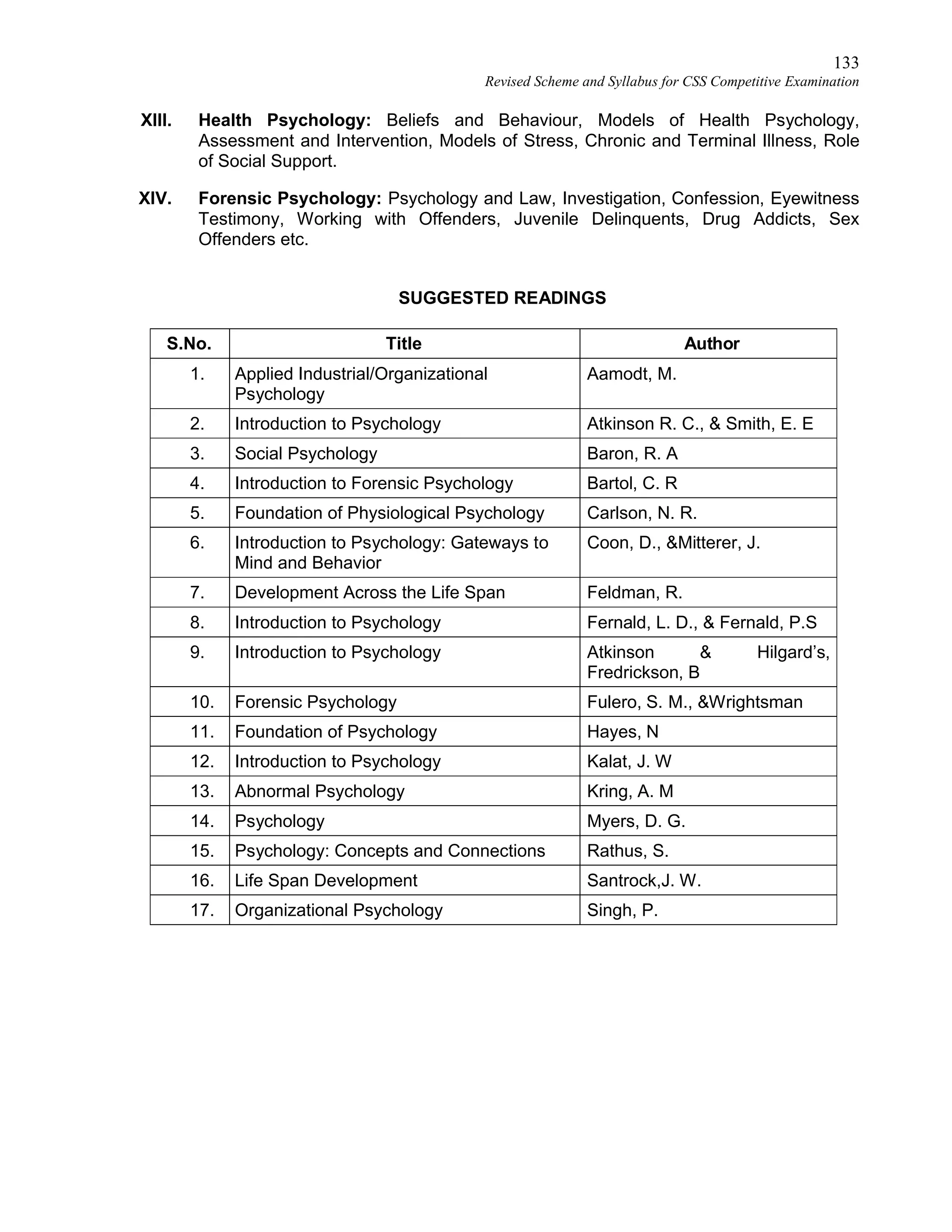
44. Psychology 132-133
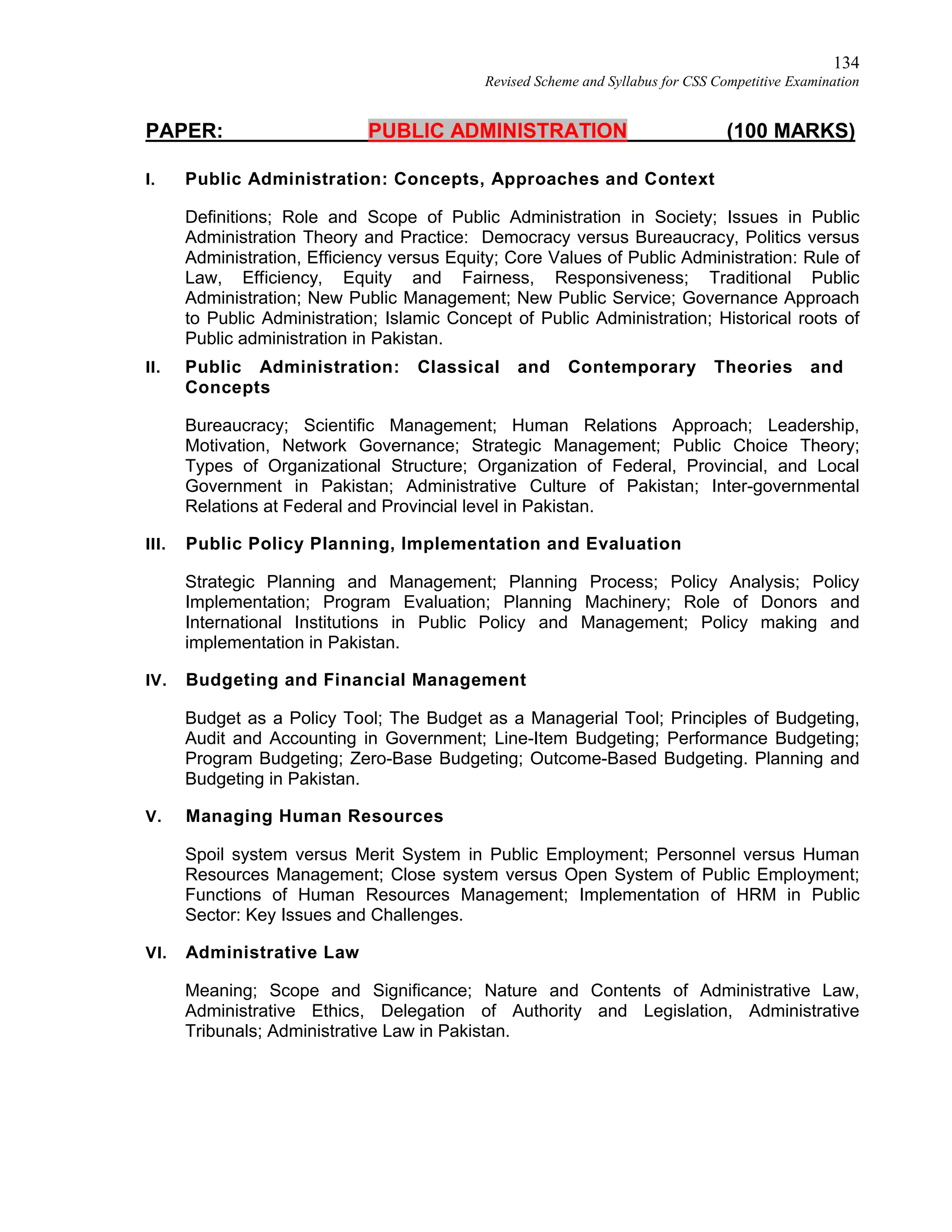
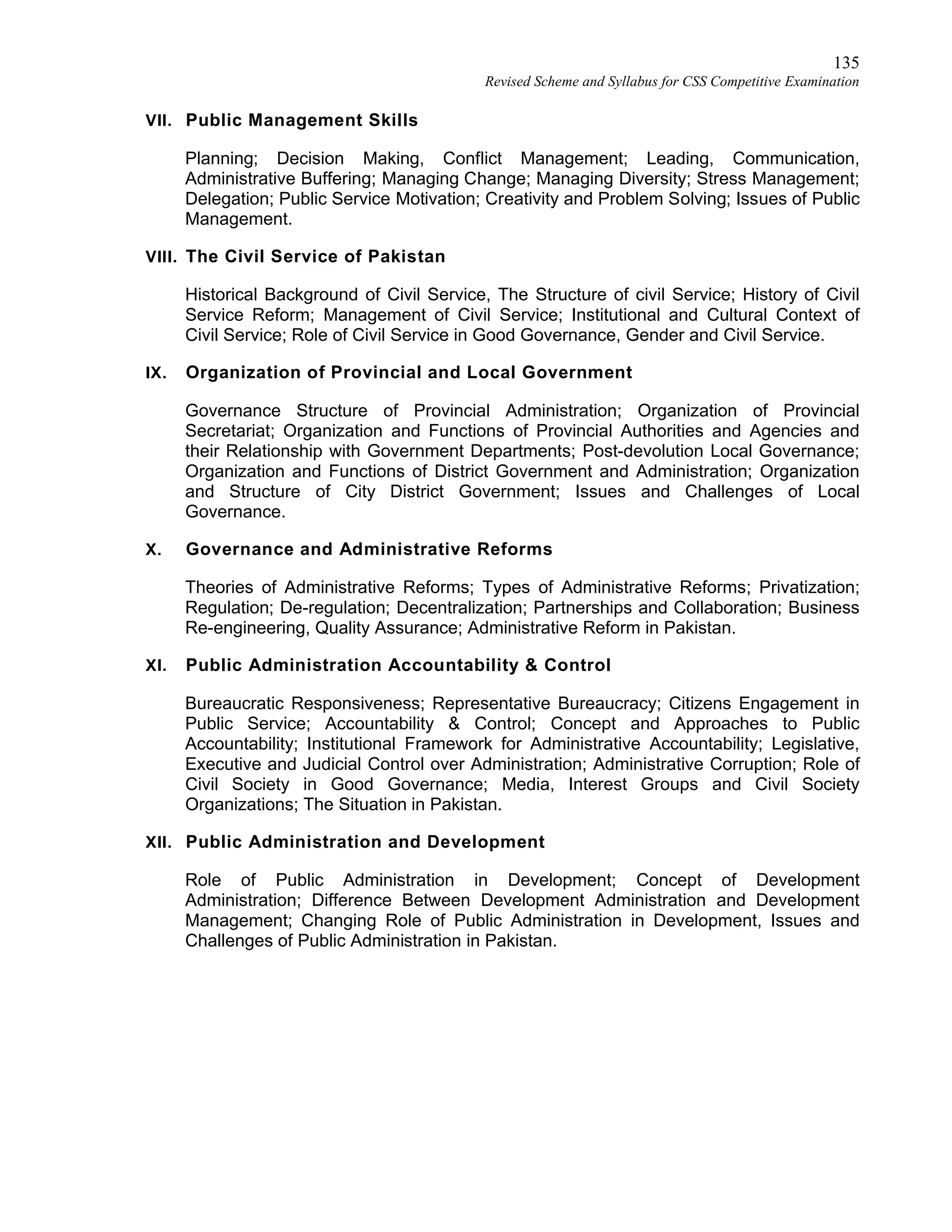
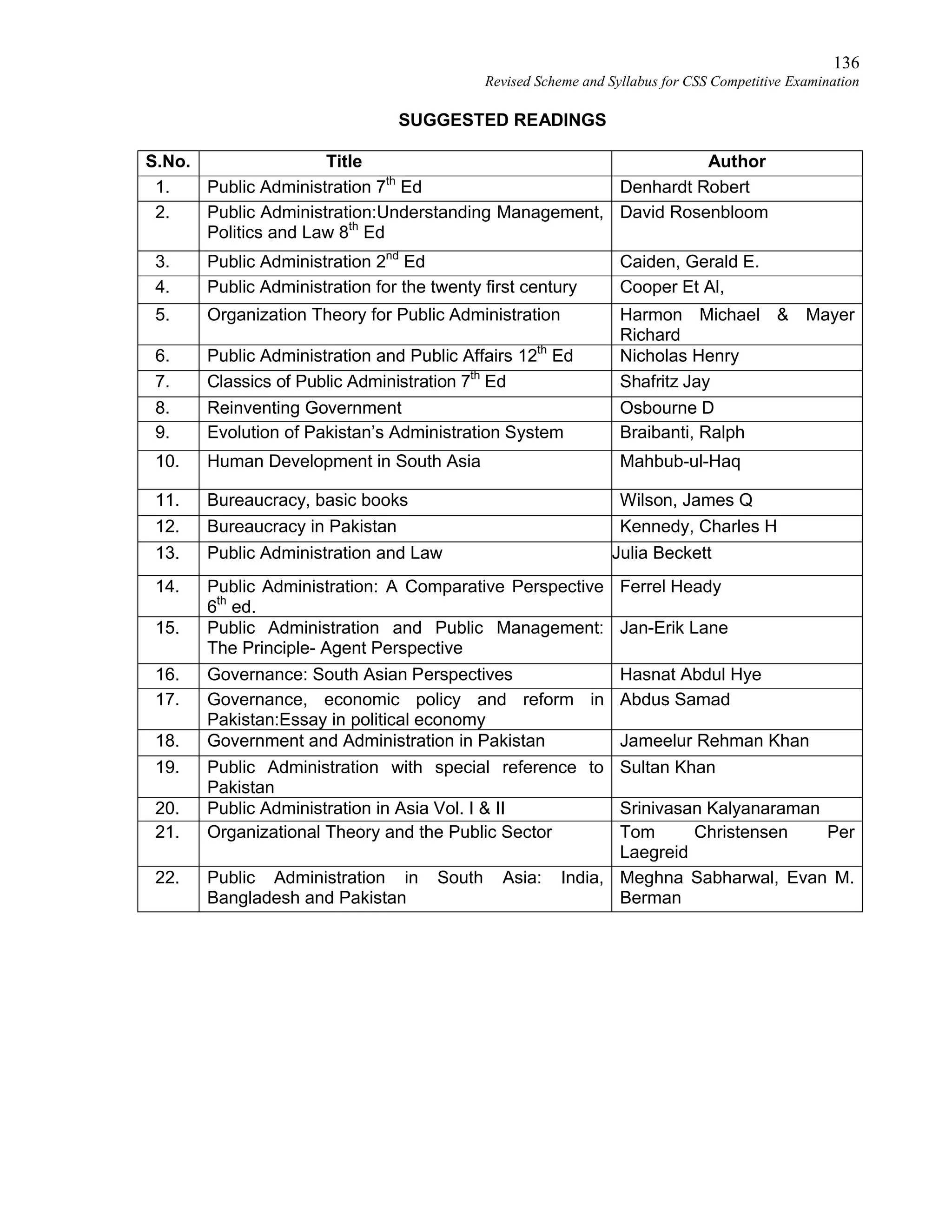
45. Public Administration 134-136
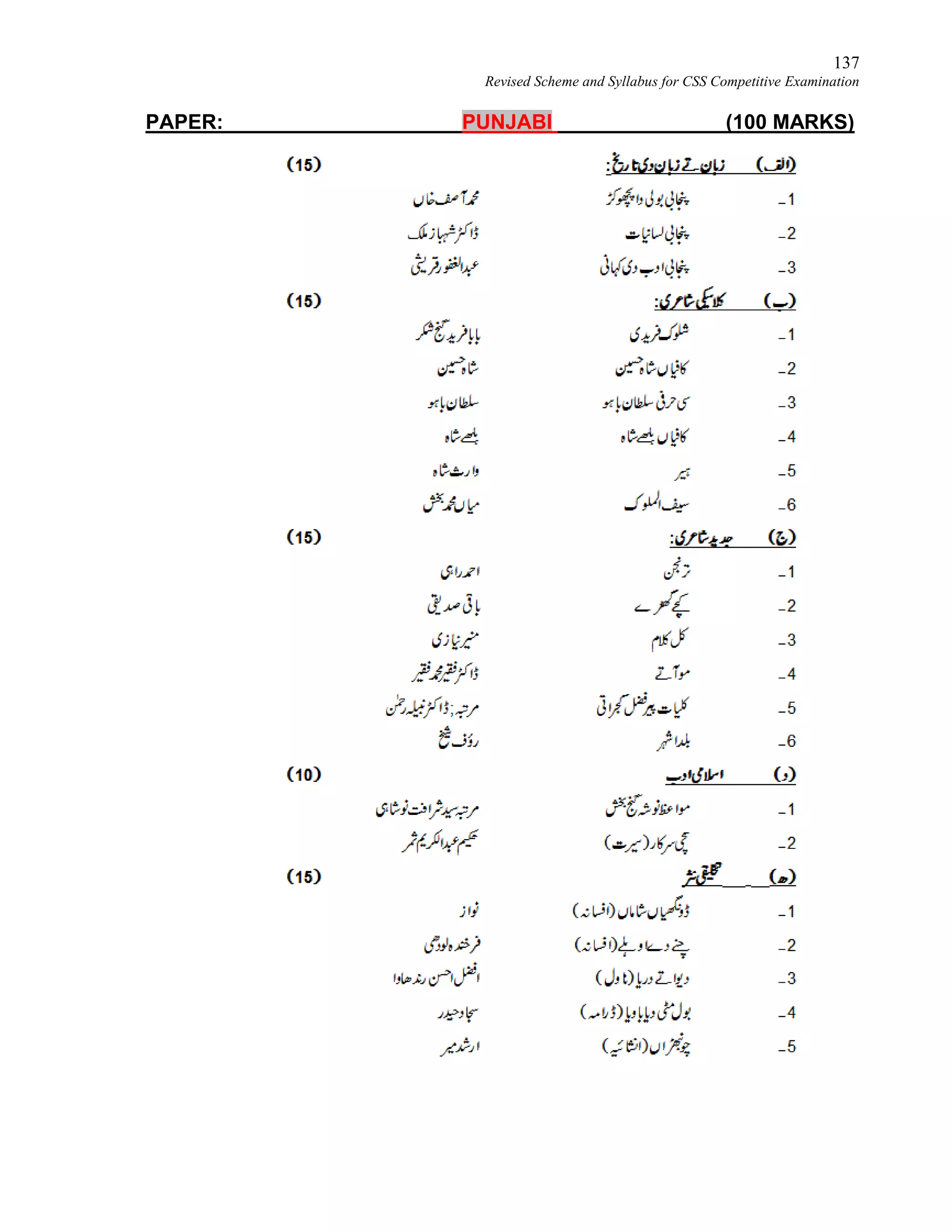
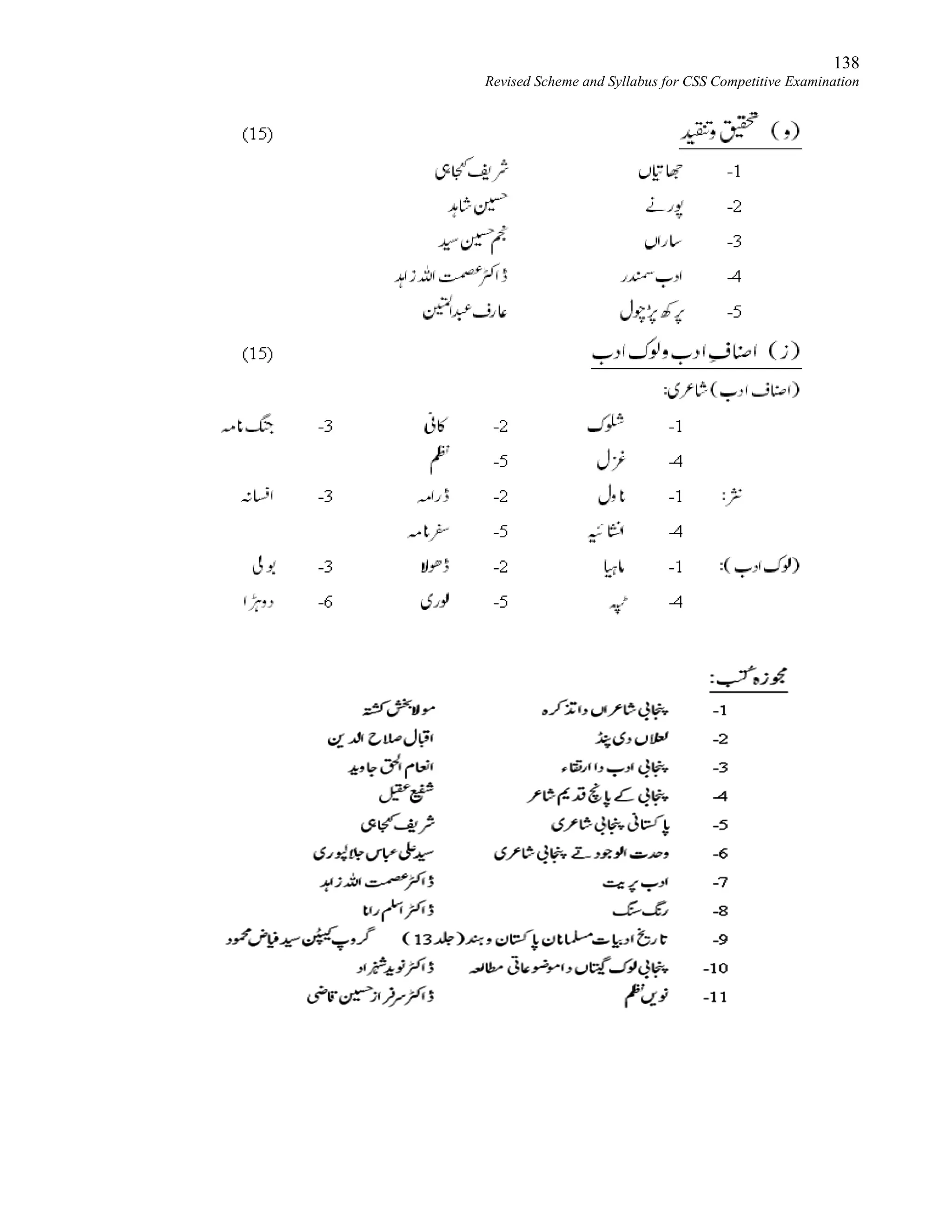
46. Punjabi 137-138
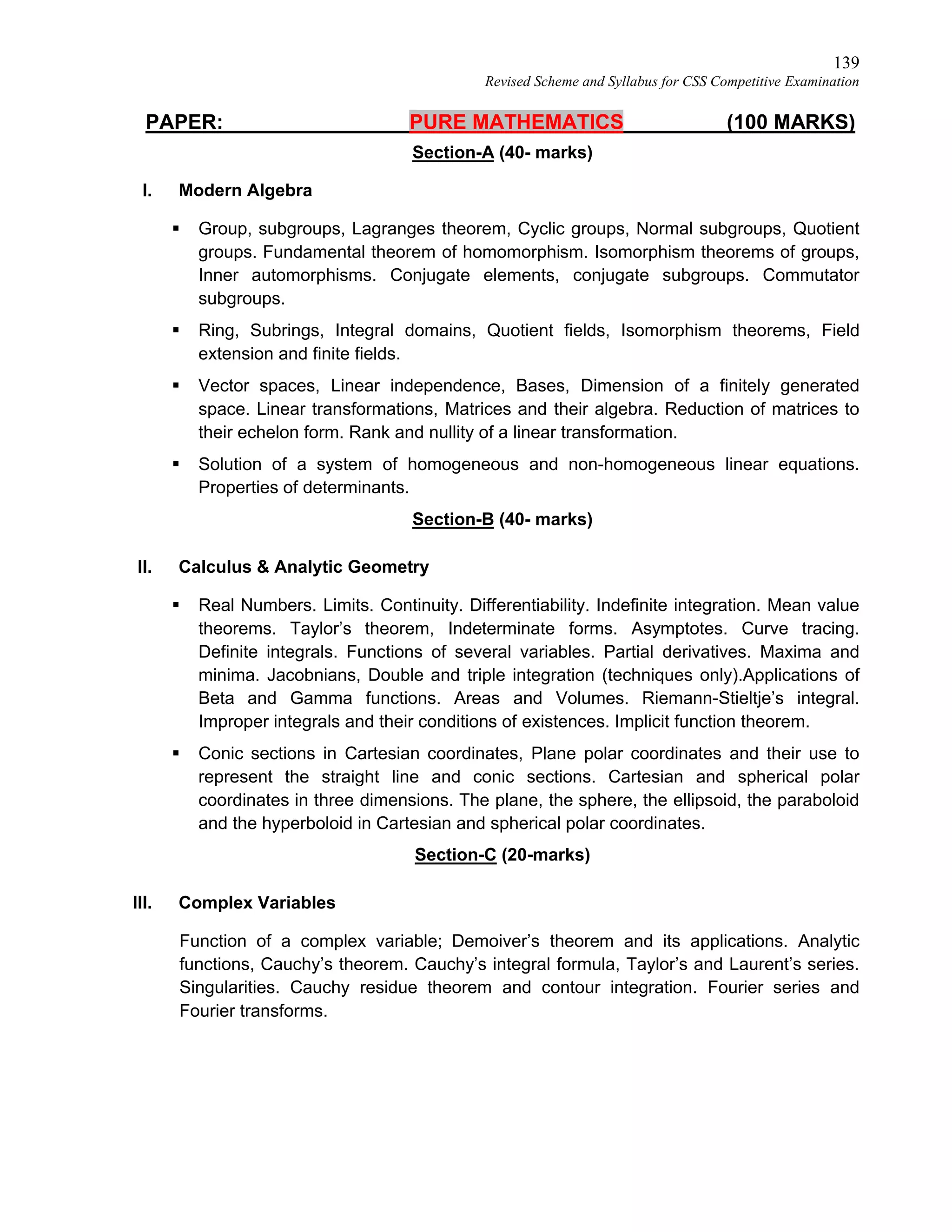
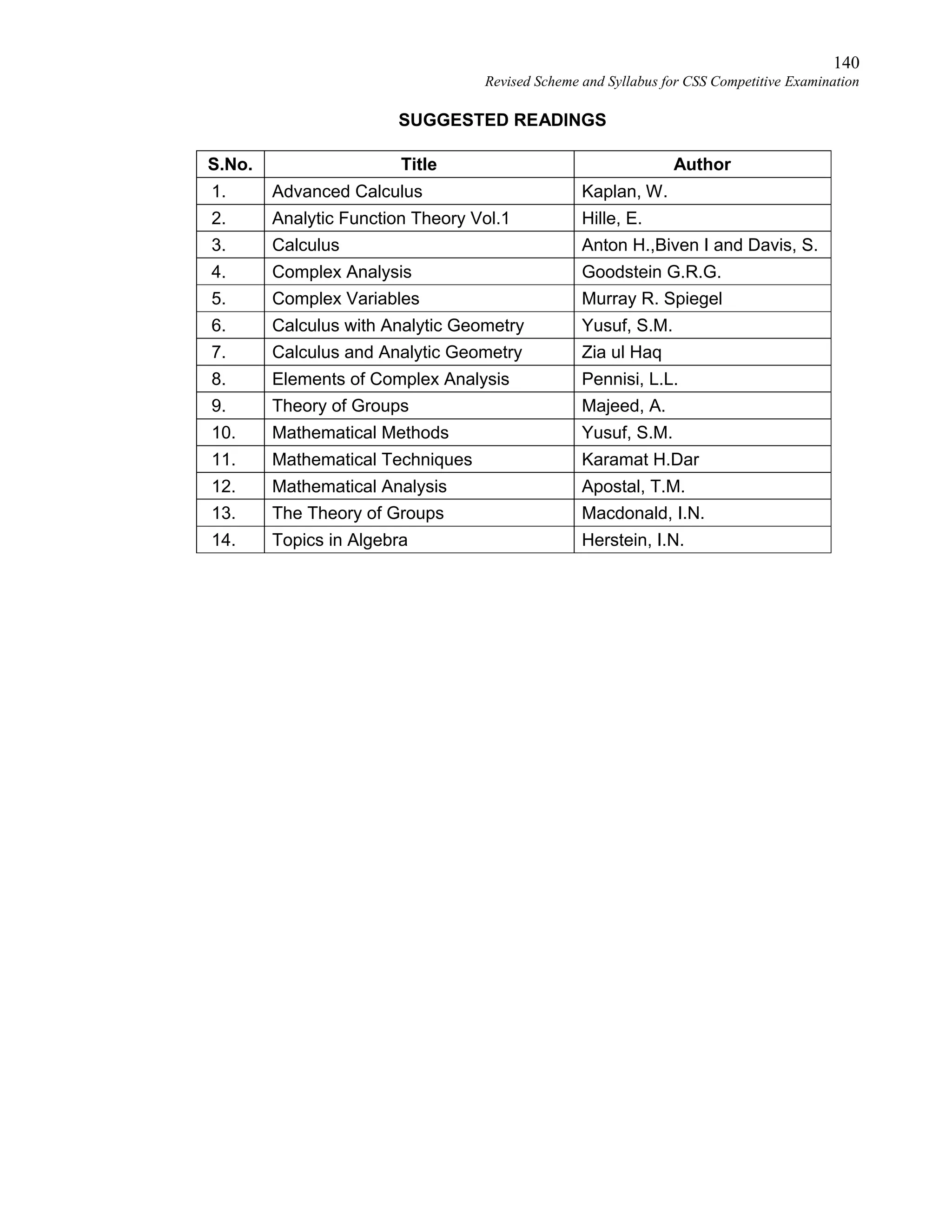
47. Pure Mathematics 139-140
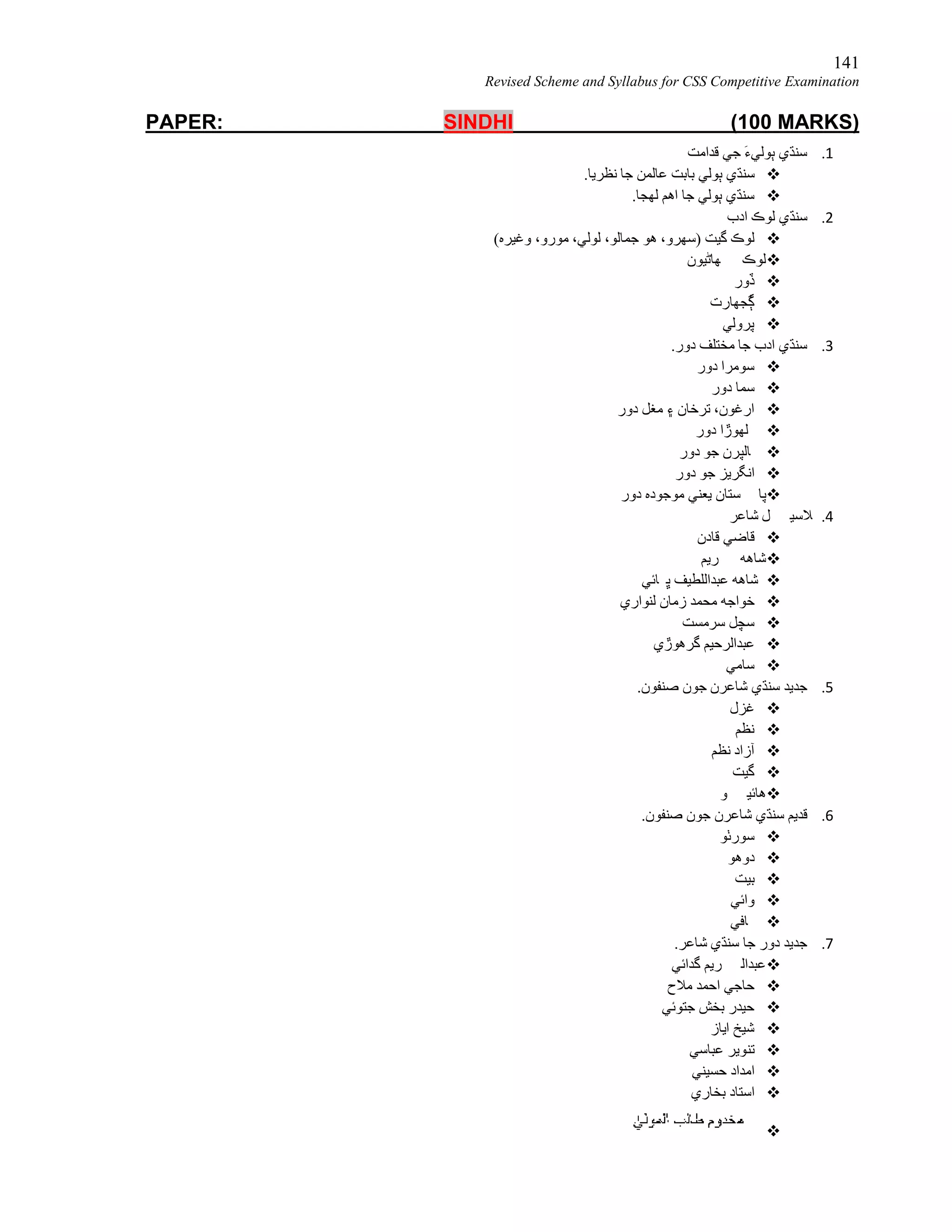
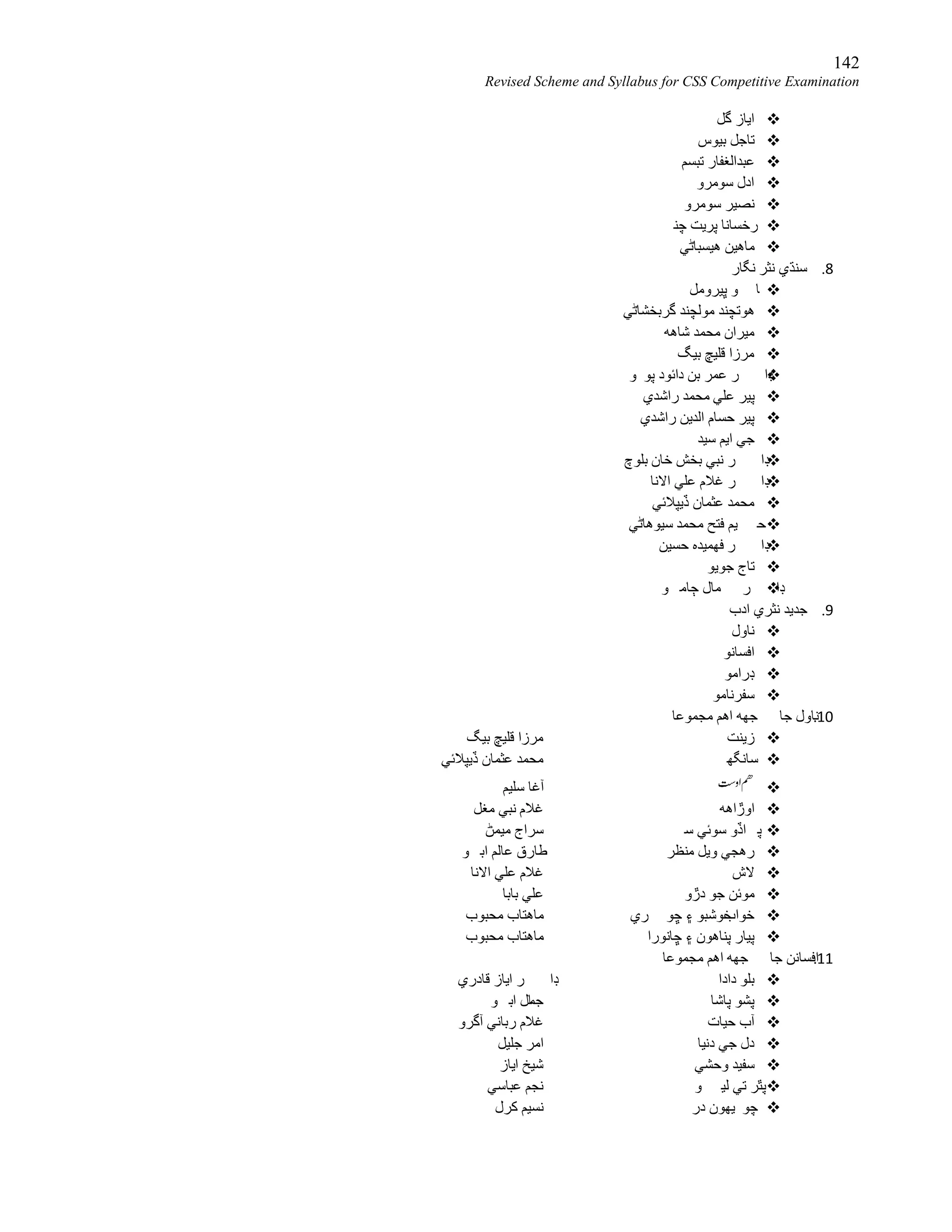
48. Sindhi 141-144
49. Sociology 145-146
50. Statistics 147-149
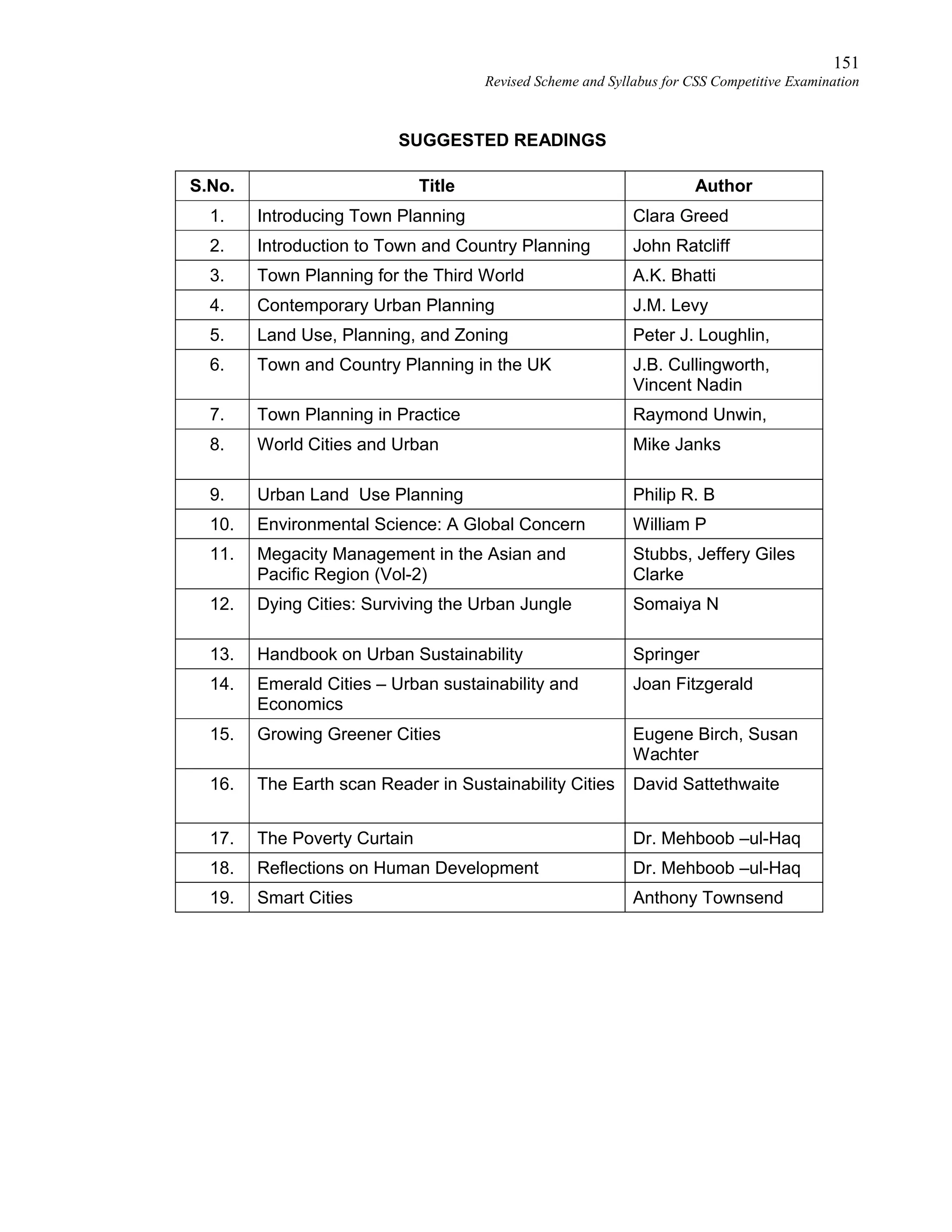
51. Town Planning & Urban Management 150-151
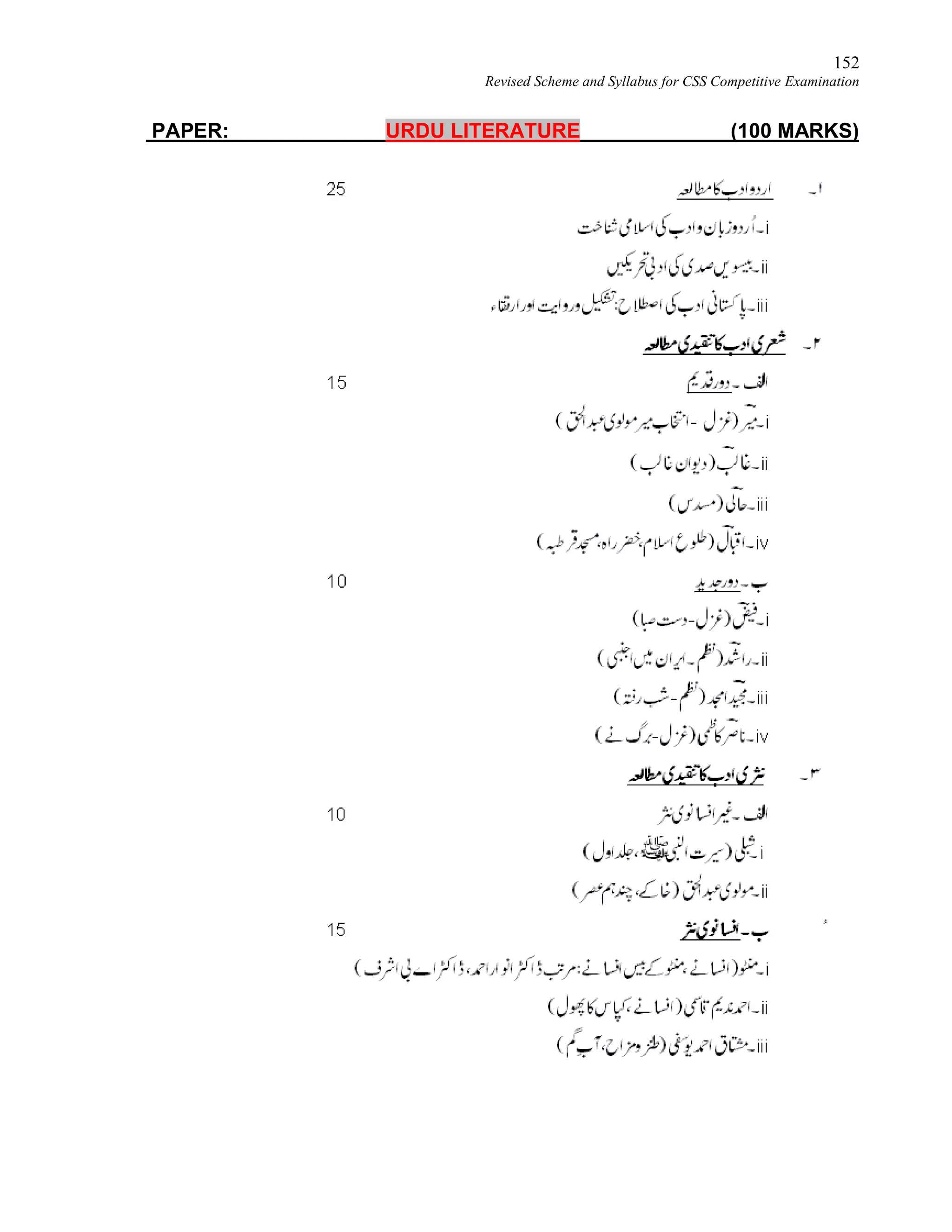
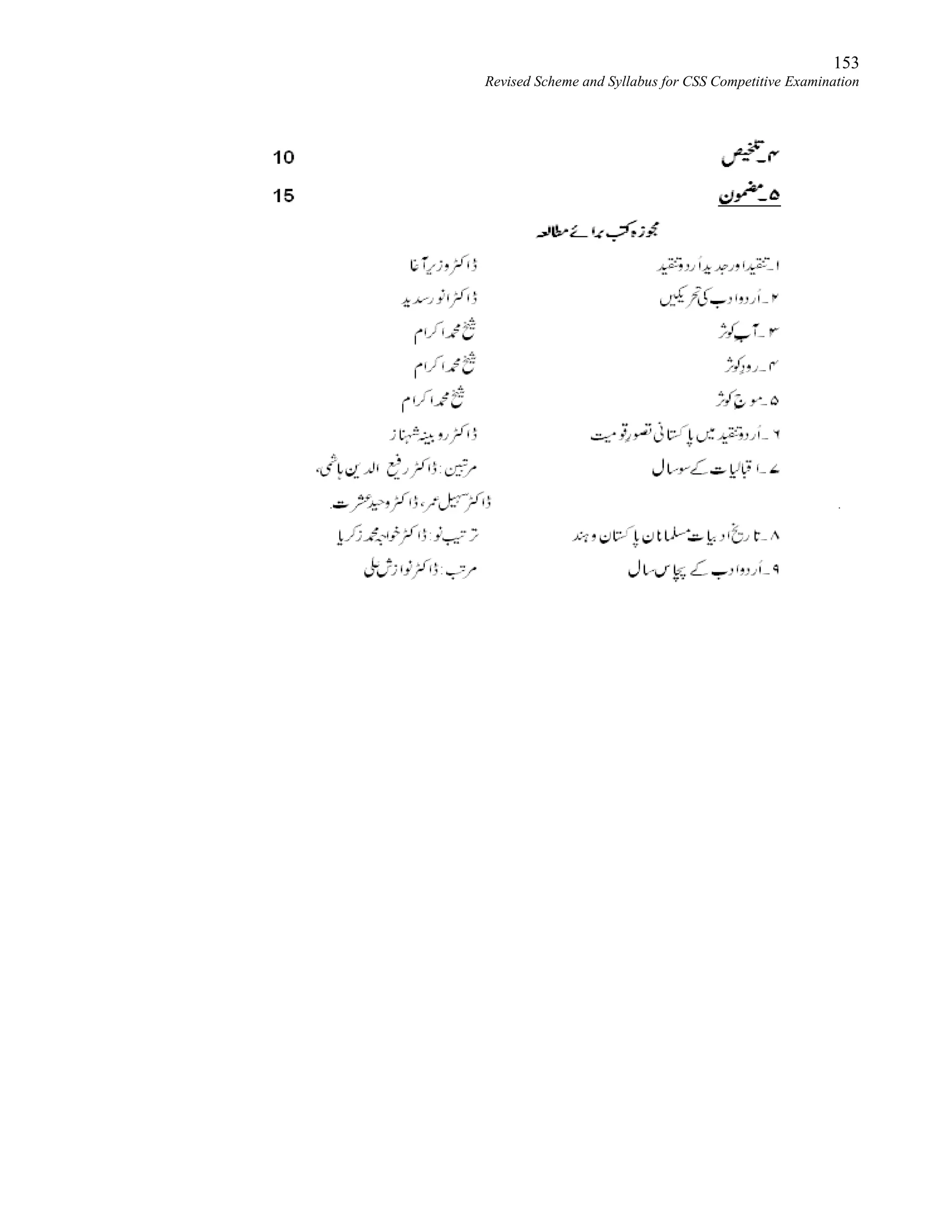
52. Urdu Literature 152-153
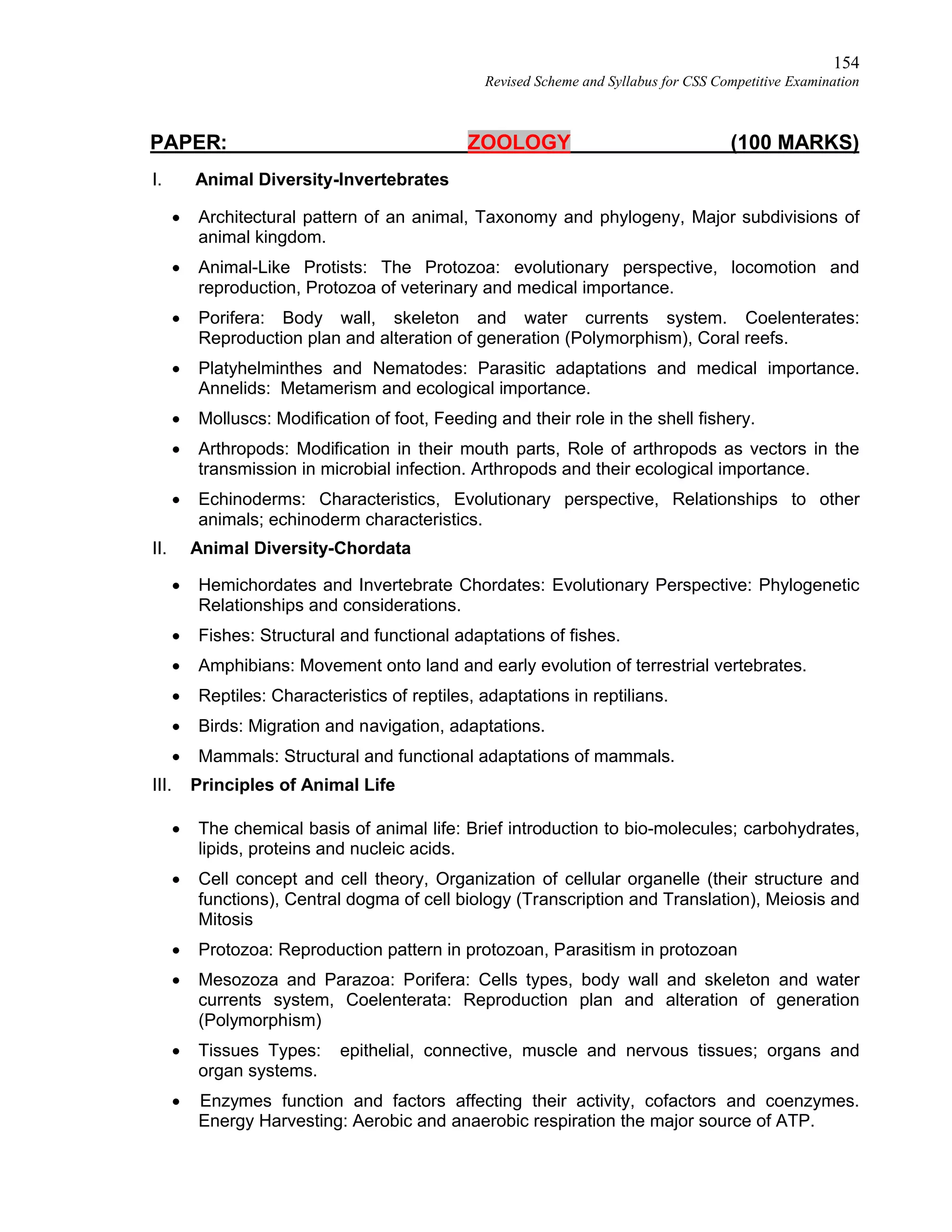
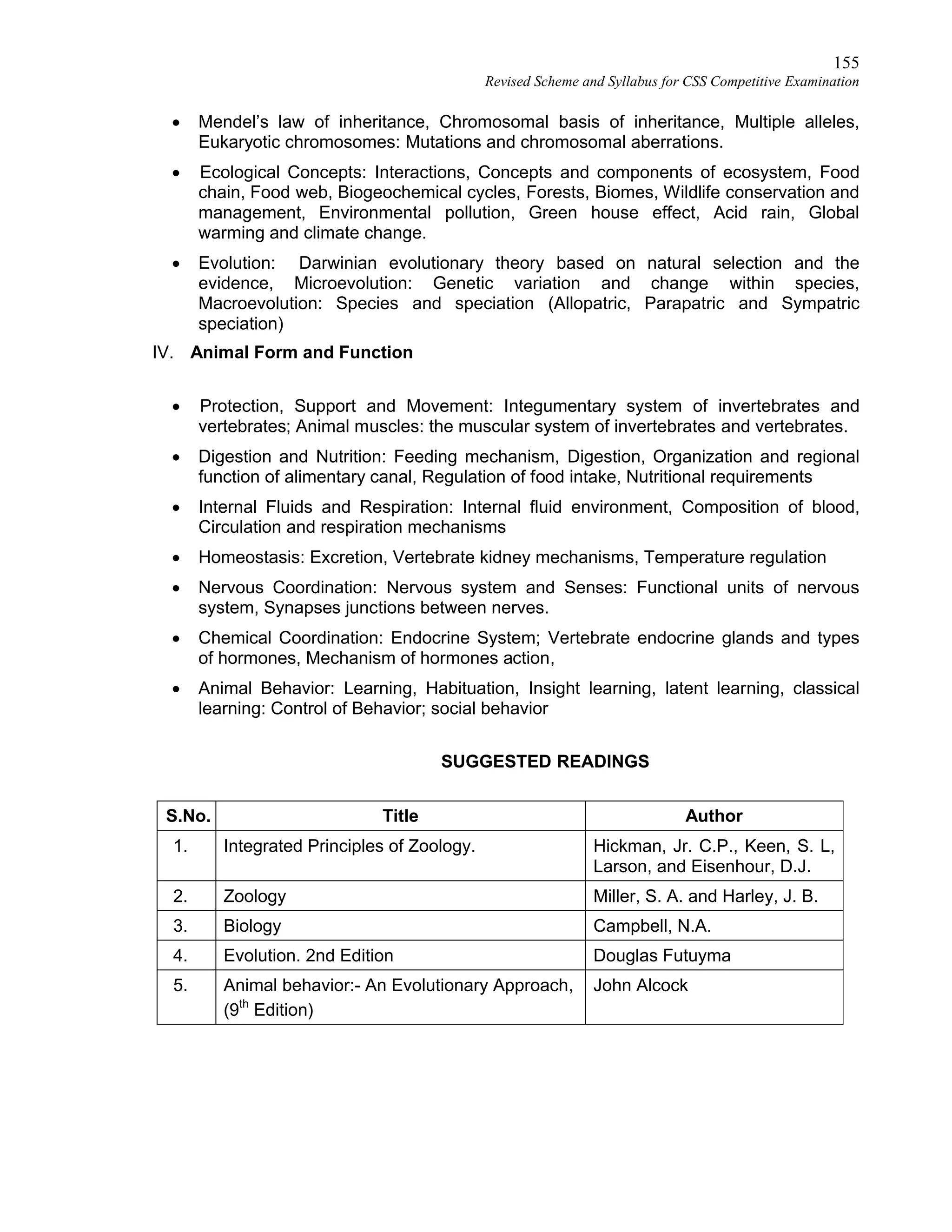
53. Zoology 154-155
1
Revised Scheme and Syllabus for CSS Competitive Examination
FEDERAL PUBLIC SERVICE COMMISSION
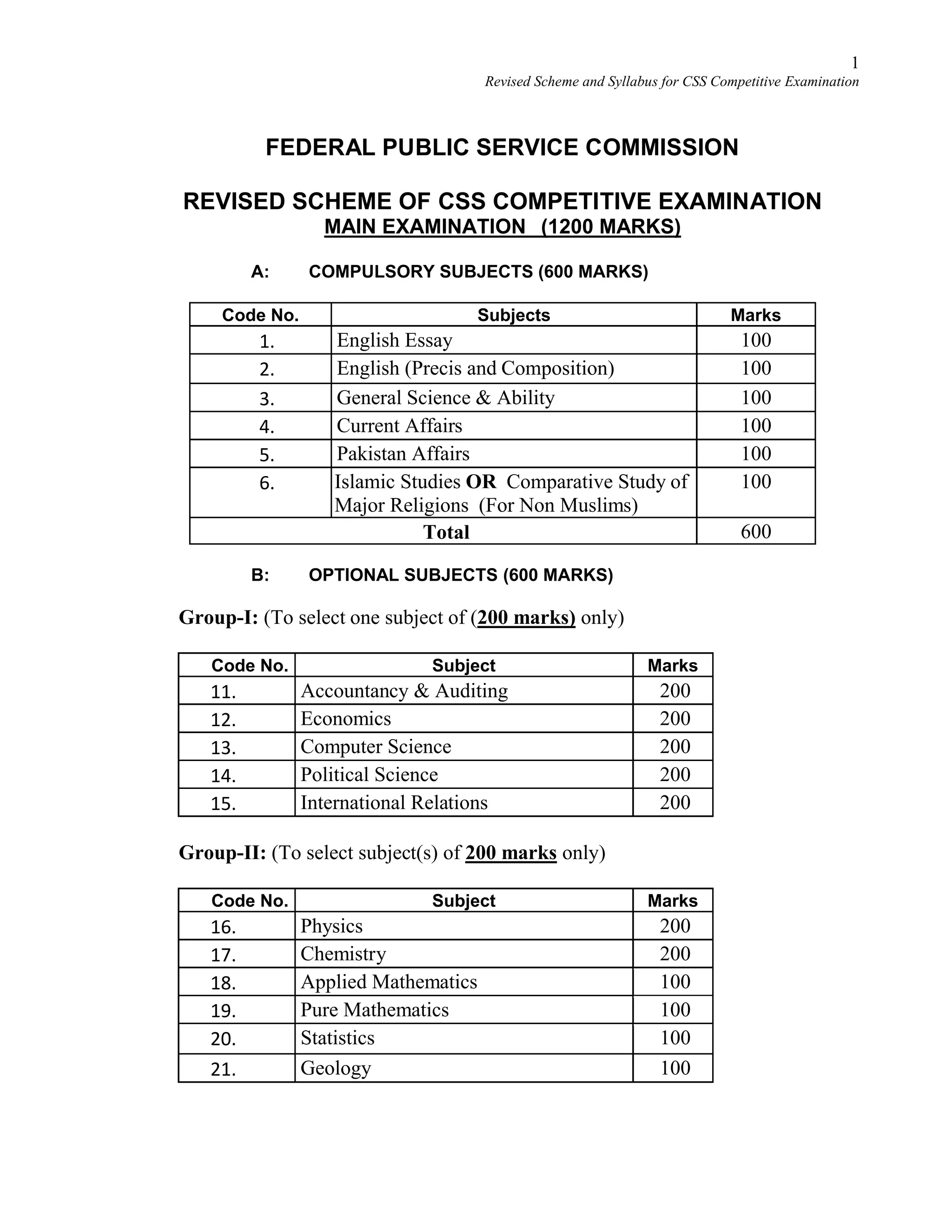
REVISED SCHEME OF CSS COMPETITIVE EXAMINATION
MAIN EXAMINATION (1200 MARKS)
A: COMPULSORY SUBJECTS (600 MARKS)
Code No. Subjects Marks
1. English Essay 100
2. English (Precis and Composition) 100
3. General Science & Ability 100
4. Current Affairs 100
5. Pakistan Affairs 100
6. Islamic Studies OR Comparative Study of
Major Religions (For Non Muslims)
100
Total 600
B: OPTIONAL SUBJECTS (600 MARKS)
Group-I: (To select one subject of (200 marks) only)
Code No. Subject Marks
11. Accountancy & Auditing 200
12. Economics 200
13. Computer Science 200
14. Political Science 200
15. International Relations 200
Group-II: (To select subject(s) of 200 marks only)
Code No. Subject Marks
16. Physics 200
17. Chemistry 200
18. Applied Mathematics 100
19. Pure Mathematics 100
20. Statistics 100
21. Geology 100
2
Revised Scheme and Syllabus for CSS Competitive Examination
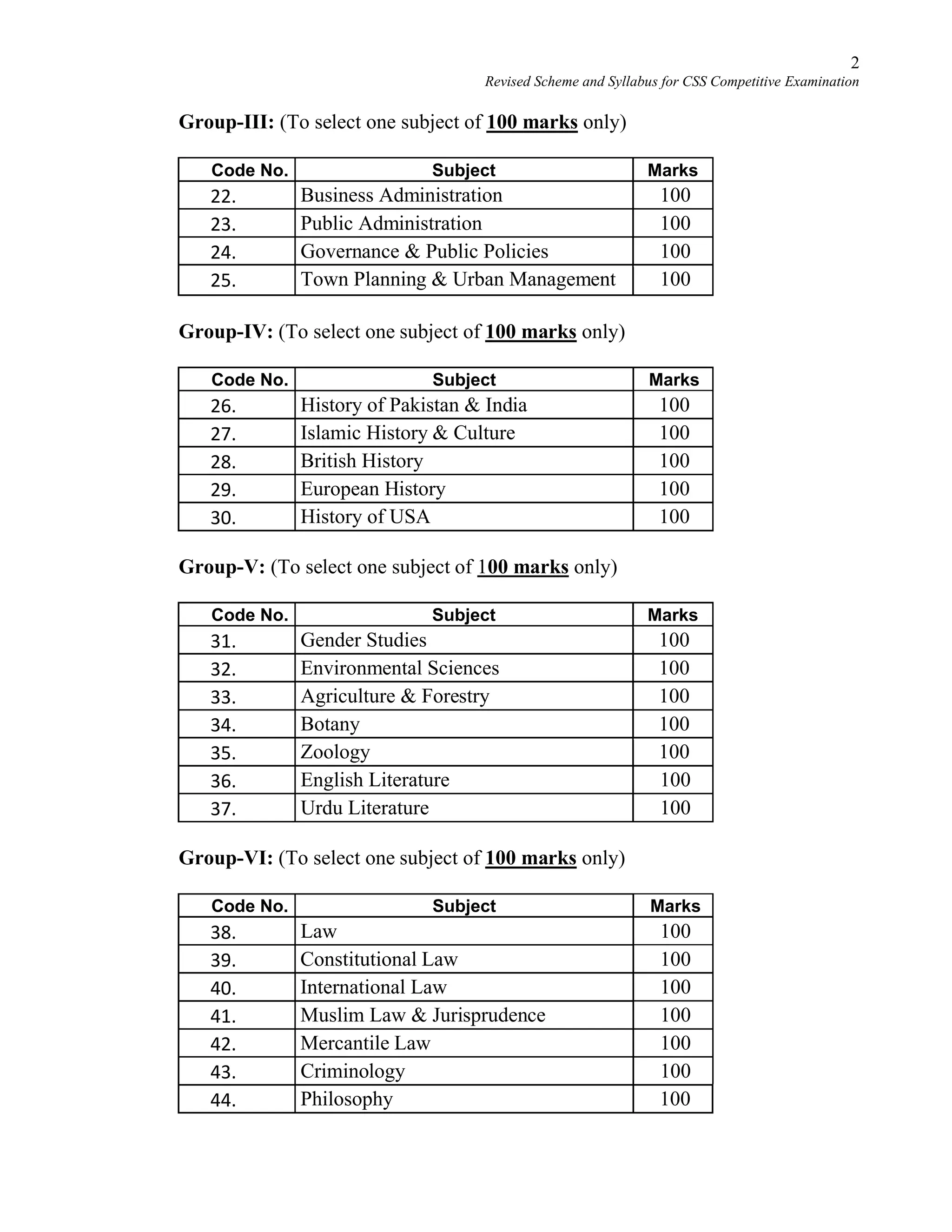
Group-III: (To select one subject of 100 marks only)
Code No. Subject Marks
22. Business Administration 100
23. Public Administration 100
24. Governance & Public Policies 100
25. Town Planning & Urban Management 100
Group-IV: (To select one subject of 100 marks only)
Code No. Subject Marks
26. History of Pakistan & India 100
27. Islamic History & Culture 100
28. British History 100
29. European History 100
30. History of USA 100
Group-V: (To select one subject of 100 marks only)
Code No. Subject Marks
31. Gender Studies 100
32. Environmental Sciences 100
33. Agriculture & Forestry 100
34. Botany 100
35. Zoology 100
36. English Literature 100
37. Urdu Literature 100
Group-VI: (To select one subject of 100 marks only)
Code No. Subject Marks
38. Law 100
39. Constitutional Law 100
40. International Law 100
41. Muslim Law & Jurisprudence 100
42. Mercantile Law 100
43. Criminology 100
44. Philosophy 100
3
Revised Scheme and Syllabus for CSS Competitive Examination
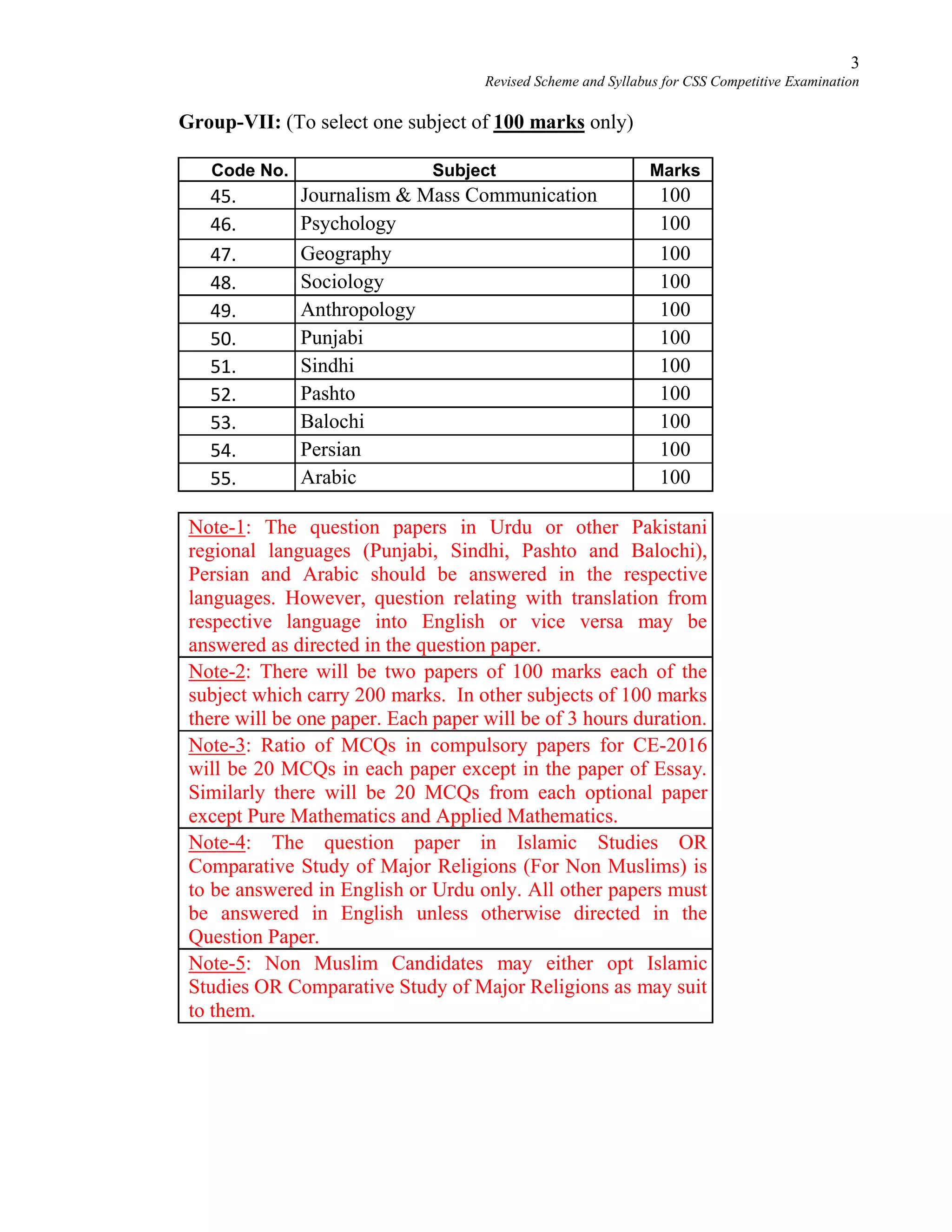
Group-VII: (To select one subject of 100 marks only)
Code No. Subject Marks
45. Journalism & Mass Communication 100
46. Psychology 100
47. Geography 100
48. Sociology 100
49. Anthropology 100
50. Punjabi 100
51. Sindhi 100
52. Pashto 100
53. Balochi 100
54. Persian 100
55. Arabic 100
Note-1: The question papers in Urdu or other Pakistani
regional languages (Punjabi, Sindhi, Pashto and Balochi),
Persian and Arabic should be answered in the respective
languages. However, question relating with translation from
respective language into English or vice versa may be
answered as directed in the question paper.
Note-2: There will be two papers of 100 marks each of the
subject which carry 200 marks. In other subjects of 100 marks
there will be one paper. Each paper will be of 3 hours duration.
Note-3: Ratio of MCQs in compulsory papers for CE-2016
will be 20 MCQs in each paper except in the paper of Essay.
Similarly there will be 20 MCQs from each optional paper
except Pure Mathematics and Applied Mathematics.
Note-4: The question paper in Islamic Studies OR
Comparative Study of Major Religions (For Non Muslims) is
to be answered in English or Urdu only. All other papers must
be answered in English unless otherwise directed in the
Question Paper.
Note-5: Non Muslim Candidates may either opt Islamic
Studies OR Comparative Study of Major Religions as may suit
to them.
4
Revised Scheme and Syllabus for CSS Competitive Examination
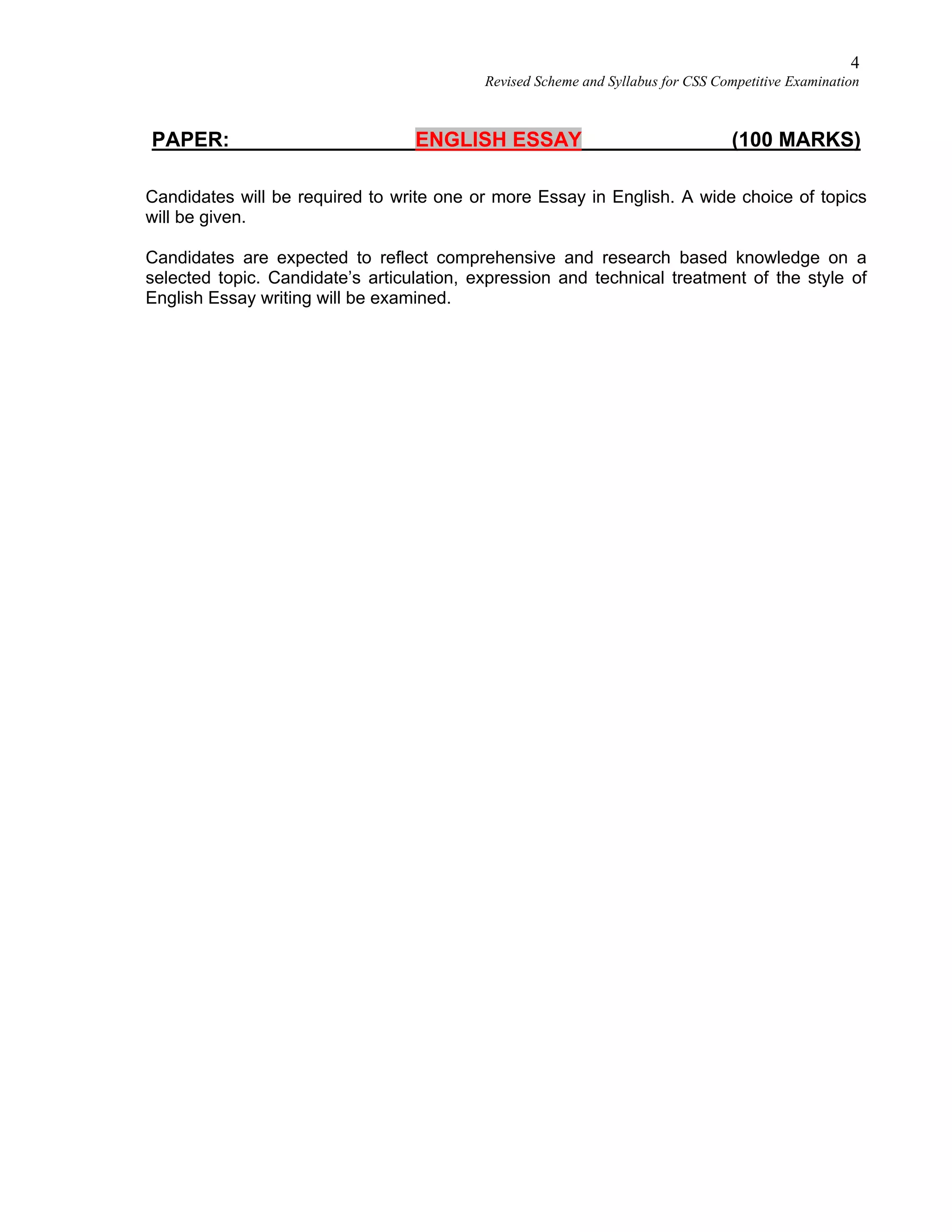
PAPER: ENGLISH ESSAY (100 MARKS)
Candidates will be required to write one or more Essay in English. A wide choice of topics
will be given.
Candidates are expected to reflect comprehensive and research based knowledge on a
selected topic. Candidate’s articulation, expression and technical treatment of the style of
English Essay writing will be examined.
5
Revised Scheme and Syllabus for CSS Competitive Examination
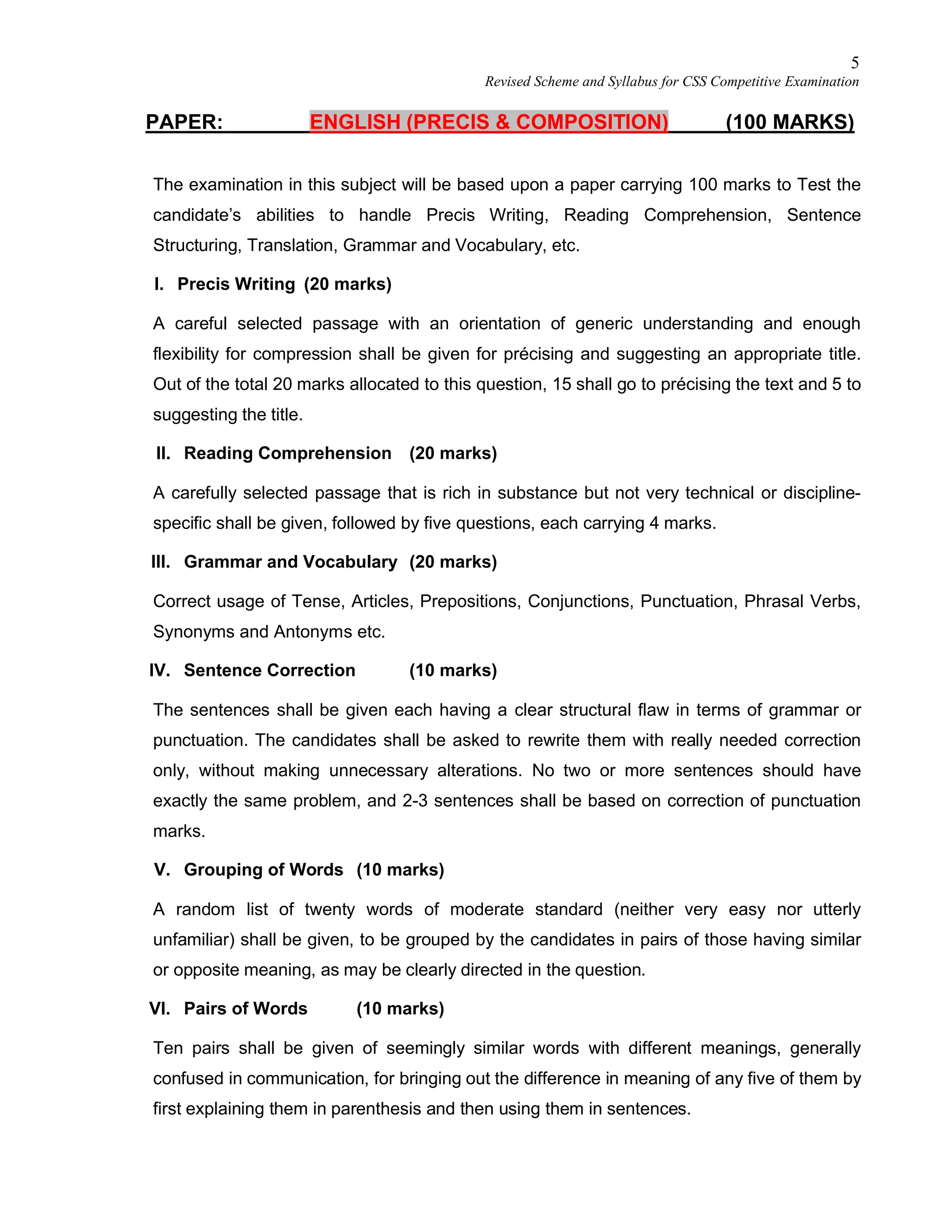
PAPER: ENGLISH (PRECIS & COMPOSITION) (100 MARKS)
The examination in this subject will be based upon a paper carrying 100 marks to Test the
candidate’s abilities to handle Precis Writing, Reading Comprehension, Sentence
Structuring, Translation, Grammar and Vocabulary, etc.
I. Precis Writing (20 marks)
A careful selected passage with an orientation of generic understanding and enough
flexibility for compression shall be given for précising and suggesting an appropriate title.
Out of the total 20 marks allocated to this question, 15 shall go to précising the text and 5 to
suggesting the title.
II. Reading Comprehension (20 marks)
A carefully selected passage that is rich in substance but not very technical or discipline-
specific shall be given, followed by five questions, each carrying 4 marks.
III. Grammar and Vocabulary (20 marks)
Correct usage of Tense, Articles, Prepositions, Conjunctions, Punctuation, Phrasal Verbs,
Synonyms and Antonyms etc.
IV. Sentence Correction (10 marks)
The sentences shall be given each having a clear structural flaw in terms of grammar or
punctuation. The candidates shall be asked to rewrite them with really needed correction
only, without making unnecessary alterations. No two or more sentences should have
exactly the same problem, and 2-3 sentences shall be based on correction of punctuation
marks.
V. Grouping of Words (10 marks)
A random list of twenty words of moderate standard (neither very easy nor utterly
unfamiliar) shall be given, to be grouped by the candidates in pairs of those having similar
or opposite meaning, as may be clearly directed in the question.
VI. Pairs of Words (10 marks)
Ten pairs shall be given of seemingly similar words with different meanings, generally
confused in communication, for bringing out the difference in meaning of any five of them by
first explaining them in parenthesis and then using them in sentences.
6
Revised Scheme and Syllabus for CSS Competitive Examination
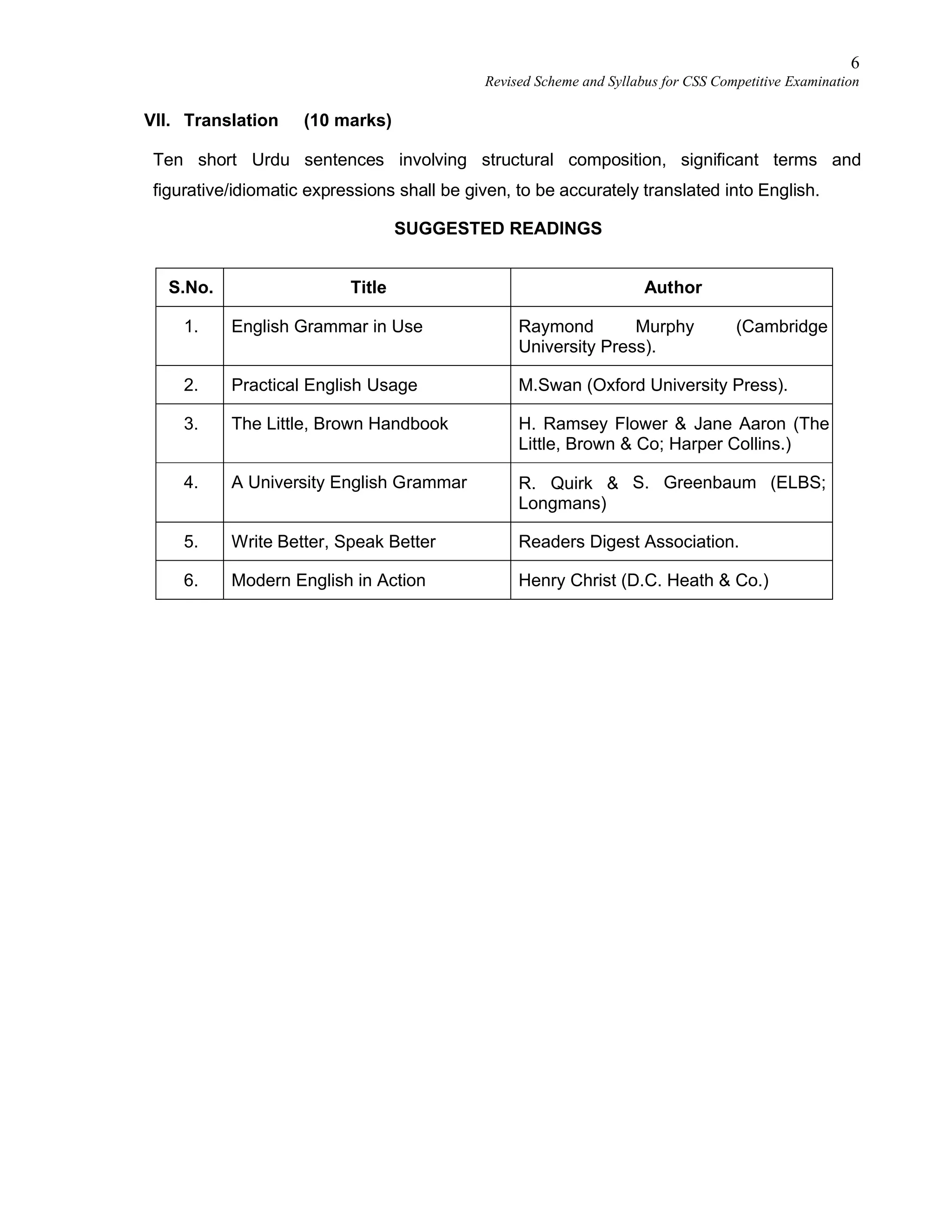
VII. Translation (10 marks)
Ten short Urdu sentences involving structural composition, significant terms and
figurative/idiomatic expressions shall be given, to be accurately translated into English.
SUGGESTED READINGS
S.No. Title Author
1. English Grammar in Use Raymond Murphy (Cambridge
University Press).
2. Practical English Usage M.Swan (Oxford University Press).
3. The Little, Brown Handbook H. Ramsey Flower & Jane Aaron (The
Little, Brown & Co; Harper Collins.)
4. A University English Grammar R. Quirk & S. Greenbaum (ELBS;
Longmans)
5. Write Better, Speak Better Readers Digest Association.
6. Modern English in Action Henry Christ (D.C. Heath & Co.)
7
Revised Scheme and Syllabus for CSS Competitive Examination
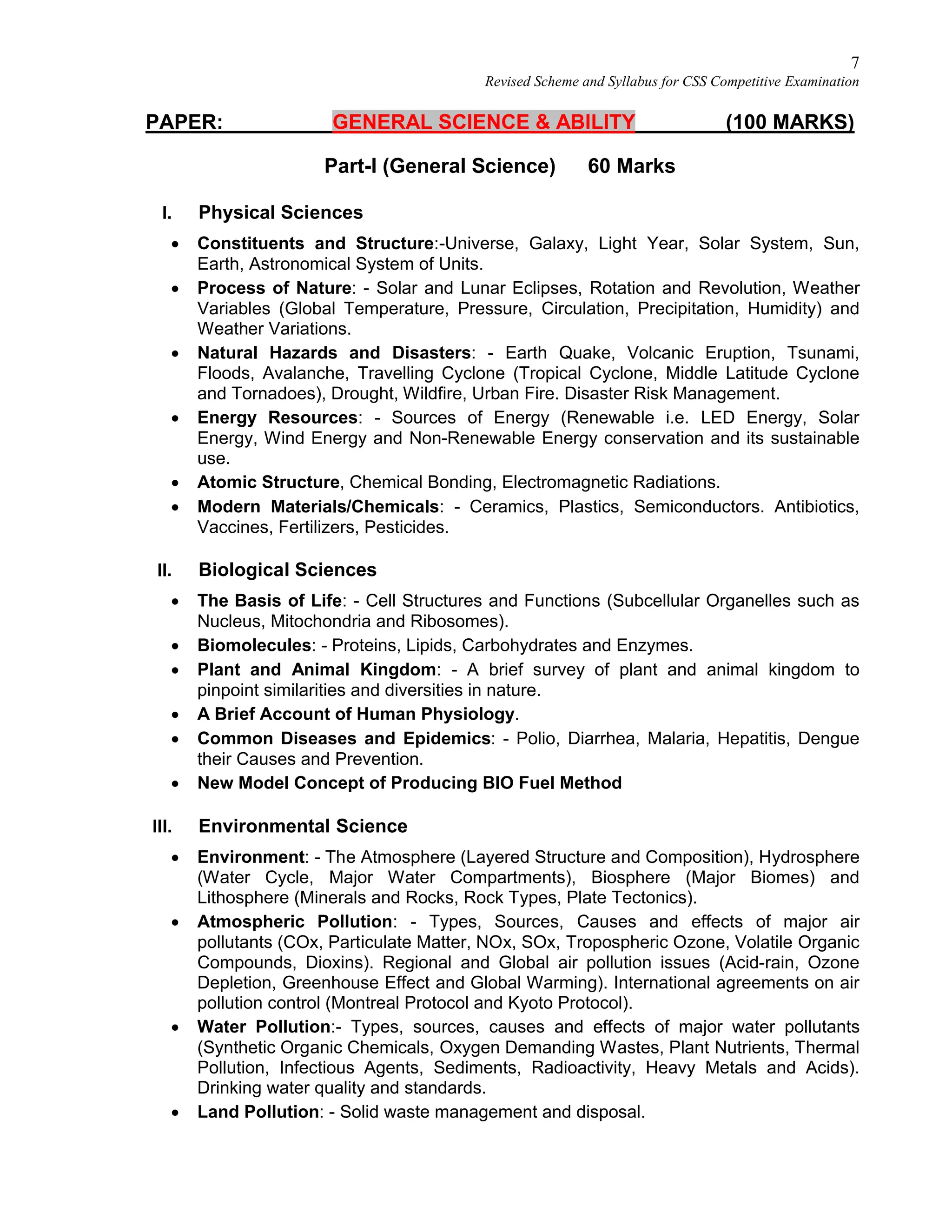
PAPER: GENERAL SCIENCE & ABILITY (100 MARKS)
Part-I (General Science) 60 Marks
I. Physical Sciences
 Constituents and Structure:-Universe, Galaxy, Light Year, Solar System, Sun,
Earth, Astronomical System of Units.
 Process of Nature: - Solar and Lunar Eclipses, Rotation and Revolution, Weather
Variables (Global Temperature, Pressure, Circulation, Precipitation, Humidity) and
Weather Variations.
 Natural Hazards and Disasters: - Earth Quake, Volcanic Eruption, Tsunami,
Floods, Avalanche, Travelling Cyclone (Tropical Cyclone, Middle Latitude Cyclone
and Tornadoes), Drought, Wildfire, Urban Fire. Disaster Risk Management.
 Energy Resources: - Sources of Energy (Renewable i.e. LED Energy, Solar
Energy, Wind Energy and Non-Renewable Energy conservation and its sustainable
use.
 Atomic Structure, Chemical Bonding, Electromagnetic Radiations.
 Modern Materials/Chemicals: - Ceramics, Plastics, Semiconductors. Antibiotics,
Vaccines, Fertilizers, Pesticides.
II. Biological Sciences
 The Basis of Life: - Cell Structures and Functions (Subcellular Organelles such as
Nucleus, Mitochondria and Ribosomes).
 Biomolecules: - Proteins, Lipids, Carbohydrates and Enzymes.
 Plant and Animal Kingdom: - A brief survey of plant and animal kingdom to
pinpoint similarities and diversities in nature.
 A Brief Account of Human Physiology.
 Common Diseases and Epidemics: - Polio, Diarrhea, Malaria, Hepatitis, Dengue
their Causes and Prevention.
 New Model Concept of Producing BIO Fuel Method
III. Environmental Science
 Environment: - The Atmosphere (Layered Structure and Composition), Hydrosphere
(Water Cycle, Major Water Compartments), Biosphere (Major Biomes) and
Lithosphere (Minerals and Rocks, Rock Types, Plate Tectonics).
 Atmospheric Pollution: - Types, Sources, Causes and effects of major air
pollutants (COx, Particulate Matter, NOx, SOx, Tropospheric Ozone, Volatile Organic
Compounds, Dioxins). Regional and Global air pollution issues (Acid-rain, Ozone
Depletion, Greenhouse Effect and Global Warming). International agreements on air
pollution control (Montreal Protocol and Kyoto Protocol).
 Water Pollution:- Types, sources, causes and effects of major water pollutants
(Synthetic Organic Chemicals, Oxygen Demanding Wastes, Plant Nutrients, Thermal
Pollution, Infectious Agents, Sediments, Radioactivity, Heavy Metals and Acids).
Drinking water quality and standards.
 Land Pollution: - Solid waste management and disposal.
8
Revised Scheme and Syllabus for CSS Competitive Examination
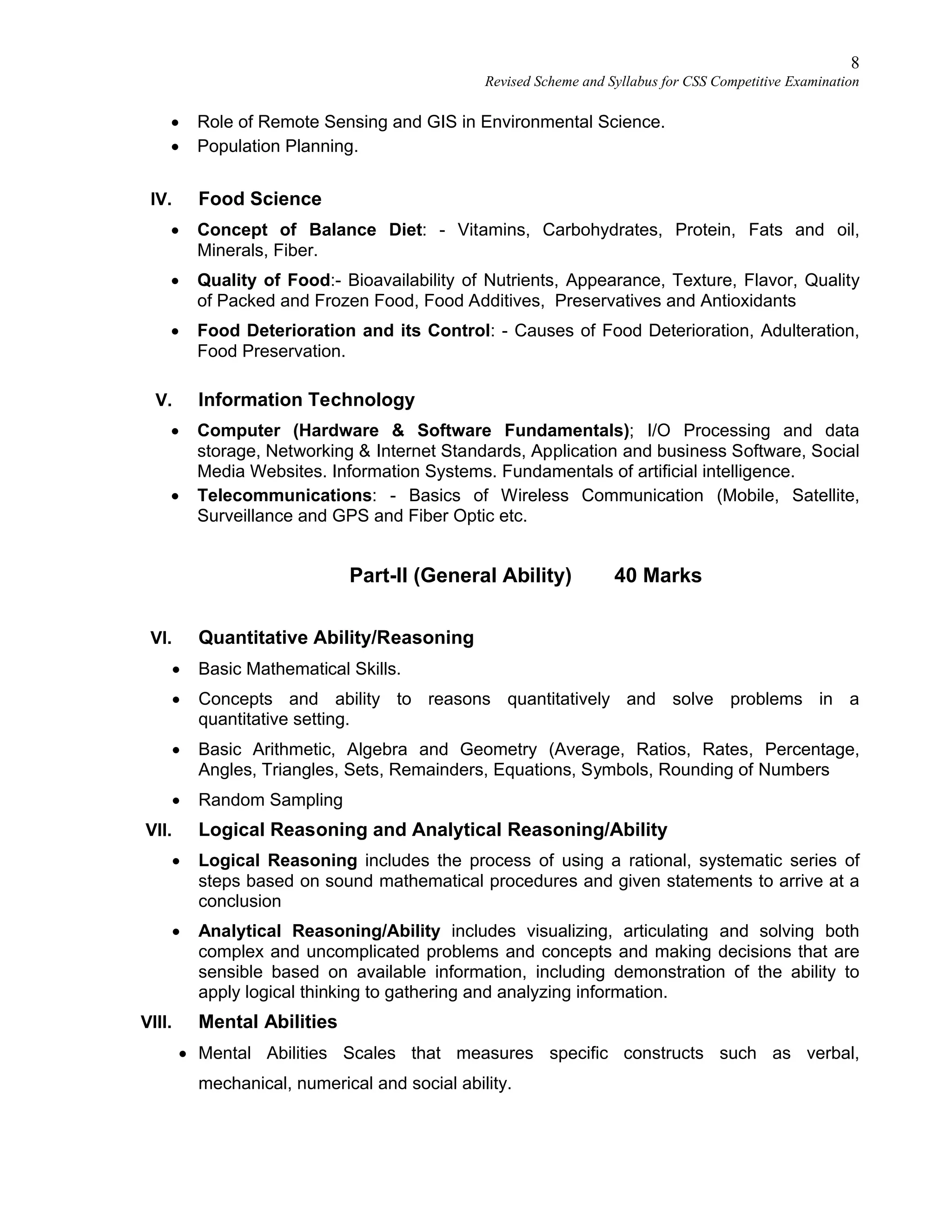
 Role of Remote Sensing and GIS in Environmental Science.
 Population Planning.
IV. Food Science
 Concept of Balance Diet: - Vitamins, Carbohydrates, Protein, Fats and oil,
Minerals, Fiber.
 Quality of Food:- Bioavailability of Nutrients, Appearance, Texture, Flavor, Quality
of Packed and Frozen Food, Food Additives, Preservatives and Antioxidants
 Food Deterioration and its Control: - Causes of Food Deterioration, Adulteration,
Food Preservation.
V. Information Technology
 Computer (Hardware & Software Fundamentals); I/O Processing and data
storage, Networking & Internet Standards, Application and business Software, Social
Media Websites. Information Systems. Fundamentals of artificial intelligence.
 Telecommunications: - Basics of Wireless Communication (Mobile, Satellite,
Surveillance and GPS and Fiber Optic etc.
Part-II (General Ability) 40 Marks
VI. Quantitative Ability/Reasoning
 Basic Mathematical Skills.
 Concepts and ability to reasons quantitatively and solve problems in a
quantitative setting.
 Basic Arithmetic, Algebra and Geometry (Average, Ratios, Rates, Percentage,
Angles, Triangles, Sets, Remainders, Equations, Symbols, Rounding of Numbers
 Random Sampling
VII. Logical Reasoning and Analytical Reasoning/Ability
 Logical Reasoning includes the process of using a rational, systematic series of
steps based on sound mathematical procedures and given statements to arrive at a
conclusion
 Analytical Reasoning/Ability includes visualizing, articulating and solving both
complex and uncomplicated problems and concepts and making decisions that are
sensible based on available information, including demonstration of the ability to
apply logical thinking to gathering and analyzing information.
VIII. Mental Abilities
 Mental Abilities Scales that measures specific constructs such as verbal,
mechanical, numerical and social ability.
9
Revised Scheme and Syllabus for CSS Competitive Examination
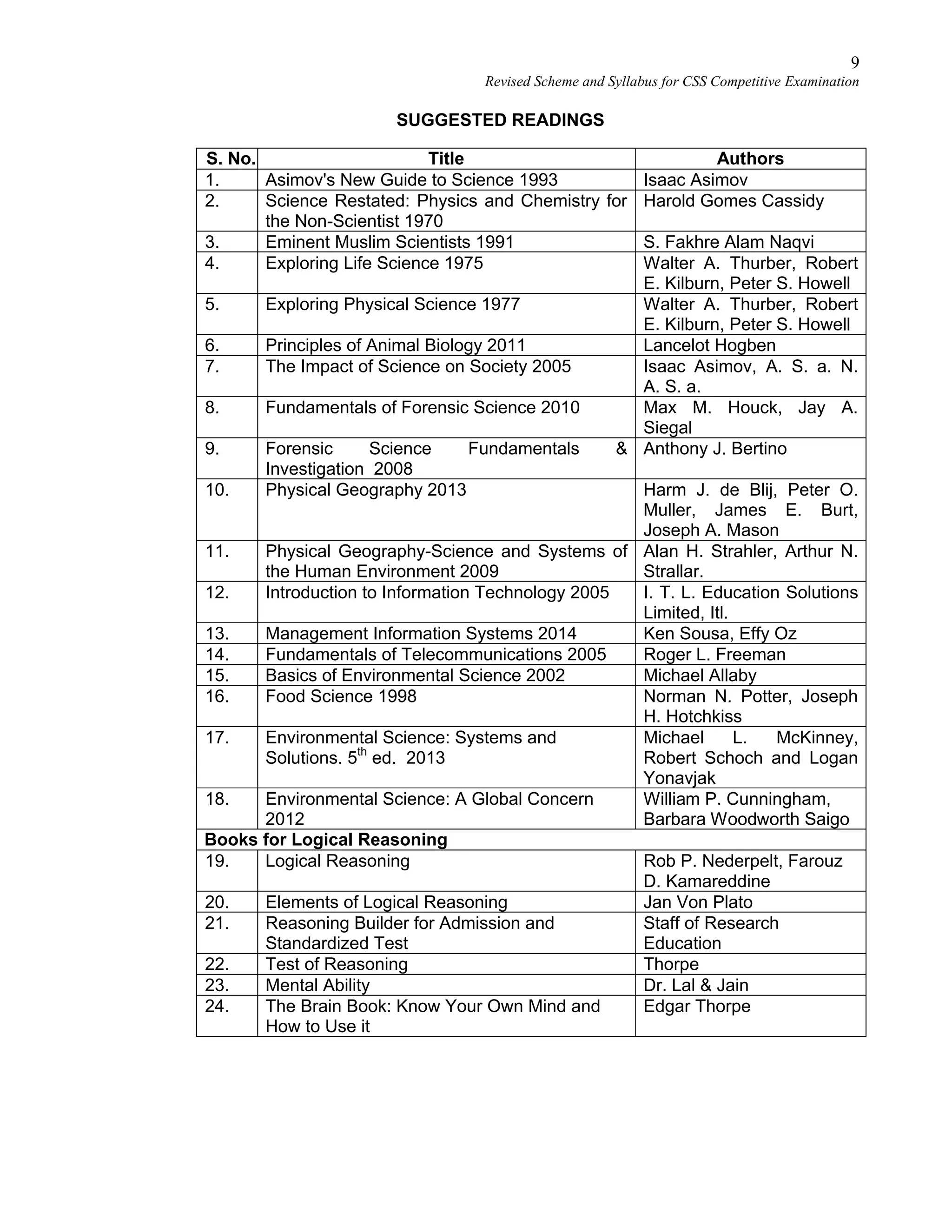
SUGGESTED READINGS
S. No. Title Authors
1. Asimov's New Guide to Science 1993 Isaac Asimov
2. Science Restated: Physics and Chemistry for
the Non-Scientist 1970
Harold Gomes Cassidy
3. Eminent Muslim Scientists 1991 S. Fakhre Alam Naqvi
4. Exploring Life Science 1975 Walter A. Thurber, Robert
E. Kilburn, Peter S. Howell
5. Exploring Physical Science 1977 Walter A. Thurber, Robert
E. Kilburn, Peter S. Howell
6. Principles of Animal Biology 2011 Lancelot Hogben
7. The Impact of Science on Society 2005 Isaac Asimov, A. S. a. N.
A. S. a.
8. Fundamentals of Forensic Science 2010 Max M. Houck, Jay A.
Siegal
9. Forensic Science Fundamentals &
Investigation 2008
Anthony J. Bertino
10. Physical Geography 2013 Harm J. de Blij, Peter O.
Muller, James E. Burt,
Joseph A. Mason
11. Physical Geography-Science and Systems of
the Human Environment 2009
Alan H. Strahler, Arthur N.
Strallar.
12. Introduction to Information Technology 2005 I. T. L. Education Solutions
Limited, Itl.
13. Management Information Systems 2014 Ken Sousa, Effy Oz
14. Fundamentals of Telecommunications 2005 Roger L. Freeman
15. Basics of Environmental Science 2002 Michael Allaby
16. Food Science 1998 Norman N. Potter, Joseph
H. Hotchkiss
17. Environmental Science: Systems and
Solutions. 5th
ed. 2013
Michael L. McKinney,
Robert Schoch and Logan
Yonavjak
18. Environmental Science: A Global Concern
2012
William P. Cunningham,
Barbara Woodworth Saigo
Books for Logical Reasoning
19. Logical Reasoning Rob P. Nederpelt, Farouz
D. Kamareddine
20. Elements of Logical Reasoning Jan Von Plato
21. Reasoning Builder for Admission and
Standardized Test
Staff of Research
Education
22. Test of Reasoning Thorpe
23. Mental Ability Dr. Lal & Jain
24. The Brain Book: Know Your Own Mind and
How to Use it
Edgar Thorpe
10
Revised Scheme and Syllabus for CSS Competitive Examination
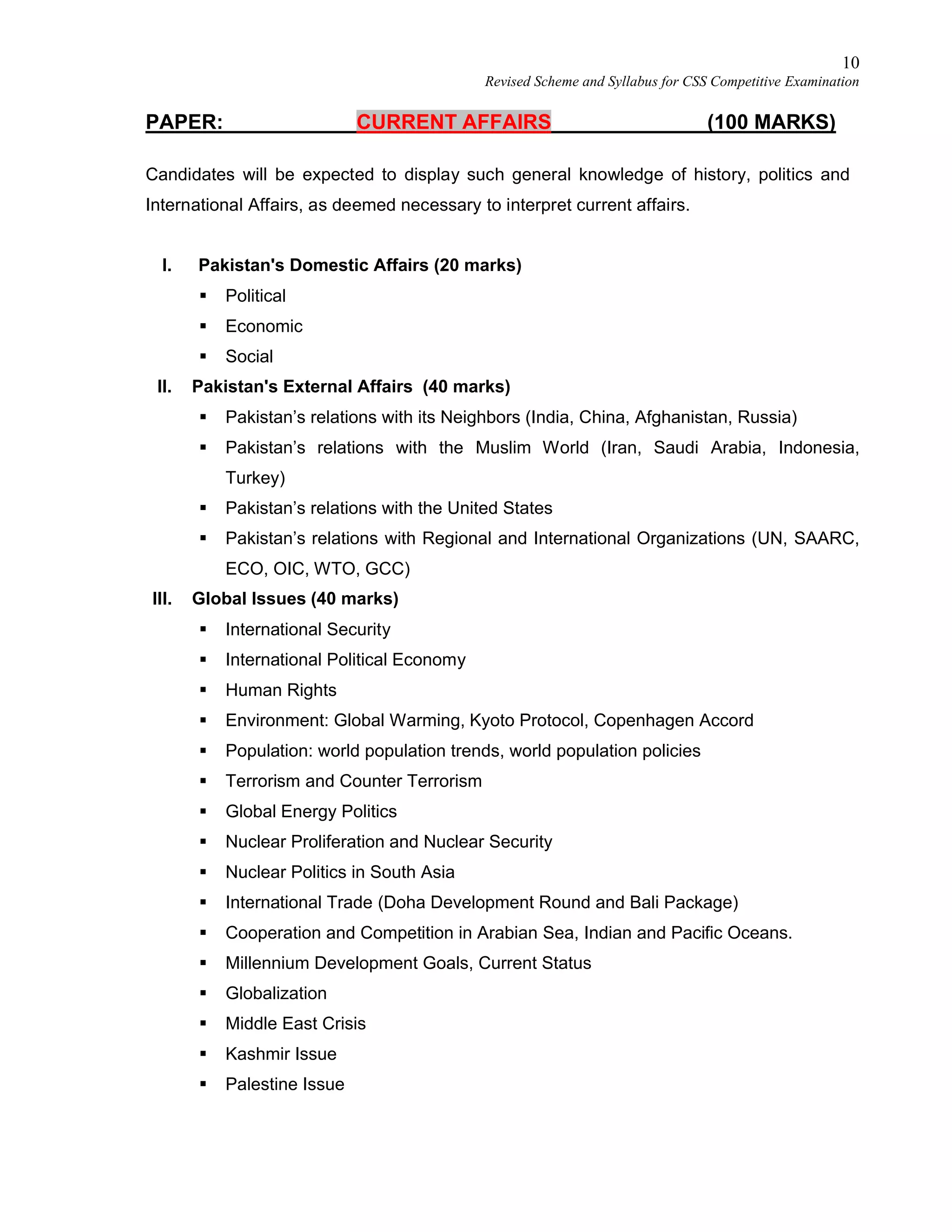
PAPER: CURRENT AFFAIRS (100 MARKS)
Candidates will be expected to display such general knowledge of history, politics and
International Affairs, as deemed necessary to interpret current affairs.
I. Pakistan's Domestic Affairs (20 marks)
 Political
 Economic
 Social
II. Pakistan's External Affairs (40 marks)
 Pakistan’s relations with its Neighbors (India, China, Afghanistan, Russia)
 Pakistan’s relations with the Muslim World (Iran, Saudi Arabia, Indonesia,
Turkey)
 Pakistan’s relations with the United States
 Pakistan’s relations with Regional and International Organizations (UN, SAARC,
ECO, OIC, WTO, GCC)
III. Global Issues (40 marks)
 International Security
 International Political Economy
 Human Rights
 Environment: Global Warming, Kyoto Protocol, Copenhagen Accord
 Population: world population trends, world population policies
 Terrorism and Counter Terrorism
 Global Energy Politics
 Nuclear Proliferation and Nuclear Security
 Nuclear Politics in South Asia
 International Trade (Doha Development Round and Bali Package)
 Cooperation and Competition in Arabian Sea, Indian and Pacific Oceans.
 Millennium Development Goals, Current Status
 Globalization
 Middle East Crisis
 Kashmir Issue
 Palestine Issue
11
Revised Scheme and Syllabus for CSS Competitive Examination
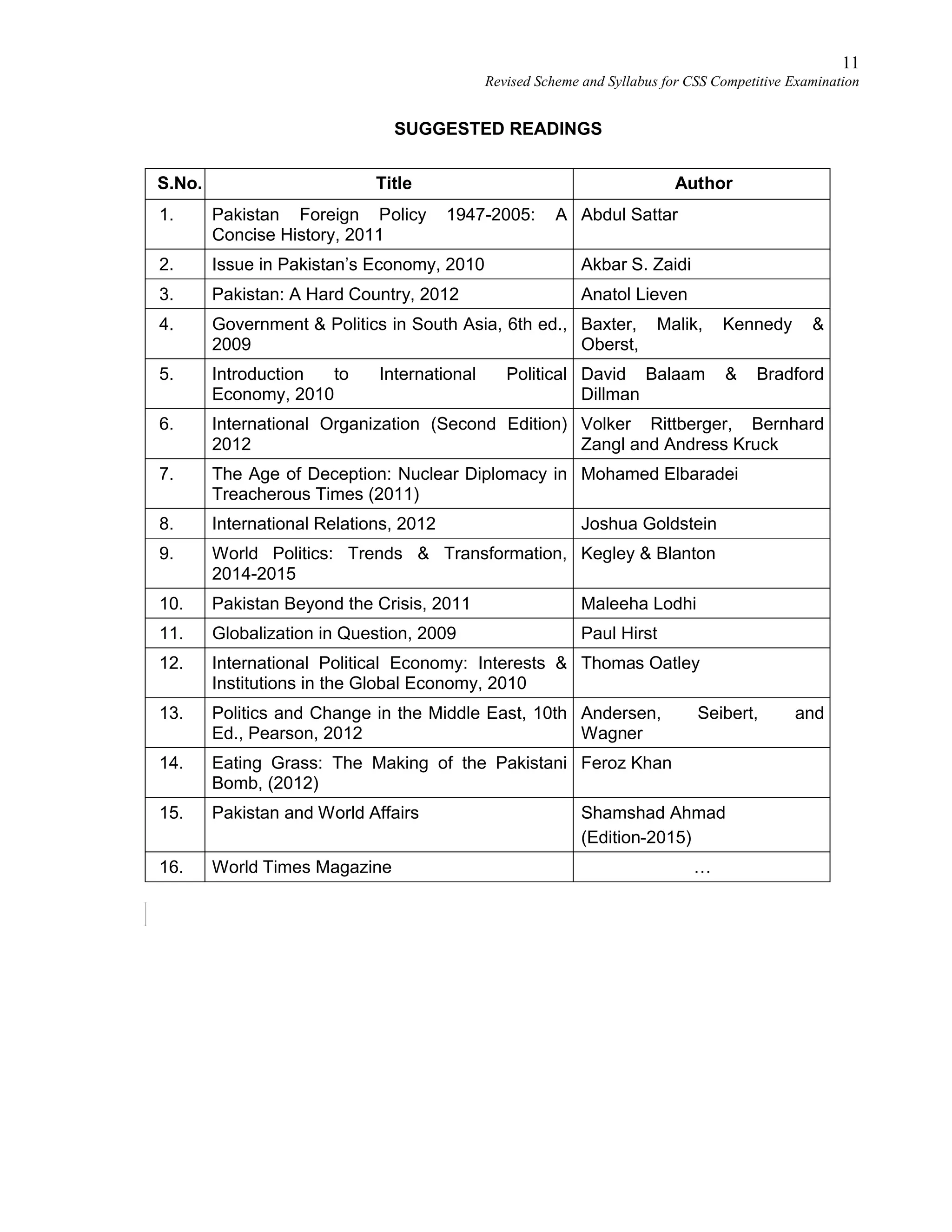
SUGGESTED READINGS
S.No. Title Author
1. Pakistan Foreign Policy 1947-2005: A
Concise History, 2011
Abdul Sattar
2. Issue in Pakistan’s Economy, 2010 Akbar S. Zaidi
3. Pakistan: A Hard Country, 2012 Anatol Lieven
4. Government & Politics in South Asia, 6th ed.,
2009
Baxter, Malik, Kennedy &
Oberst,
5. Introduction to International Political
Economy, 2010
David Balaam & Bradford
Dillman
6. International Organization (Second Edition)
2012
Volker Rittberger, Bernhard
Zangl and Andress Kruck
7. The Age of Deception: Nuclear Diplomacy in
Treacherous Times (2011)
Mohamed Elbaradei
8. International Relations, 2012 Joshua Goldstein
9. World Politics: Trends & Transformation,
2014-2015
Kegley & Blanton
10. Pakistan Beyond the Crisis, 2011 Maleeha Lodhi
11. Globalization in Question, 2009 Paul Hirst
12. International Political Economy: Interests &
Institutions in the Global Economy, 2010
Thomas Oatley
13. Politics and Change in the Middle East, 10th
Ed., Pearson, 2012
Andersen, Seibert, and
Wagner
14. Eating Grass: The Making of the Pakistani
Bomb, (2012)
Feroz Khan
15. Pakistan and World Affairs Shamshad Ahmad
(Edition-2015)
16. World Times Magazine …
12
Revised Scheme and Syllabus for CSS Competitive Examination
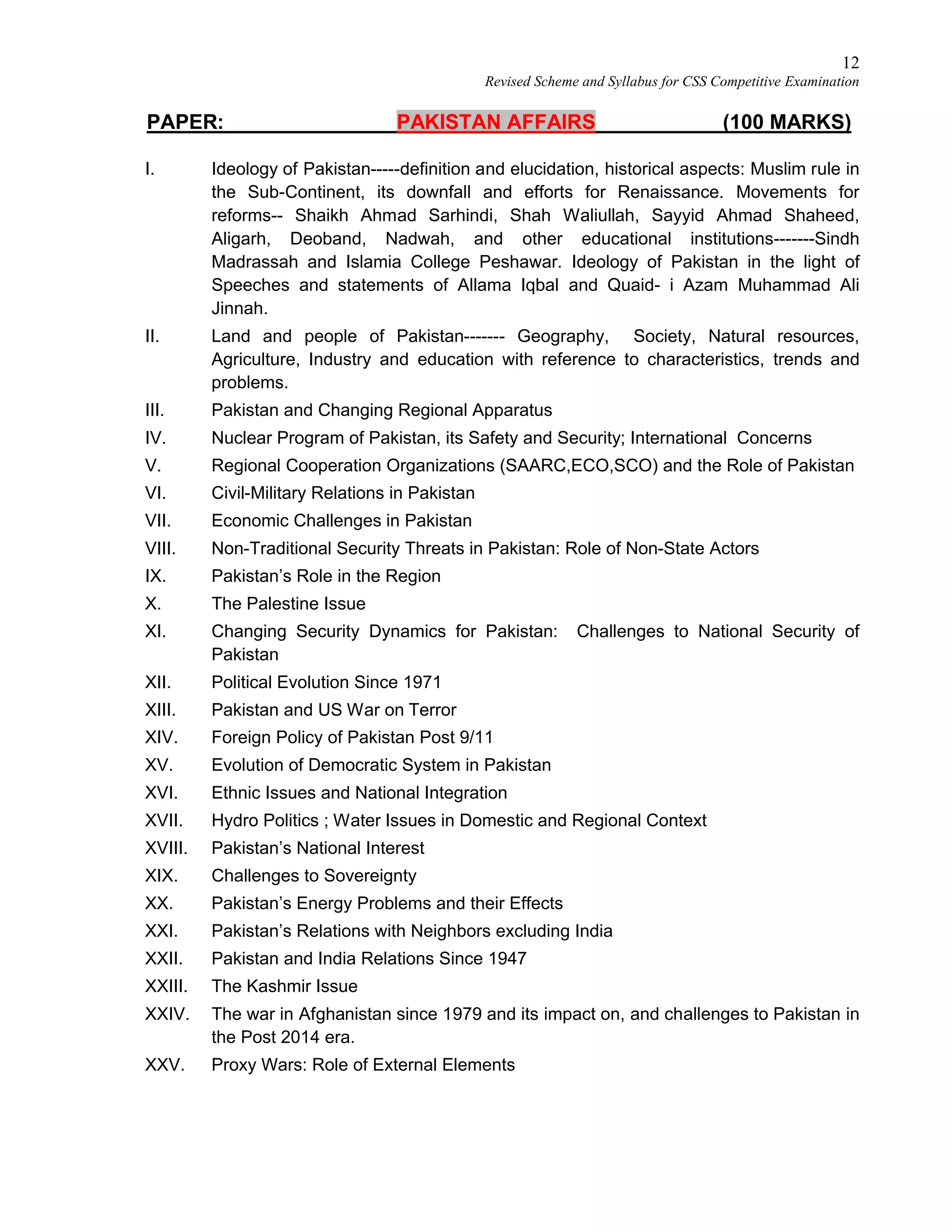
PAPER: PAKISTAN AFFAIRS (100 MARKS)
I. Ideology of Pakistan-----definition and elucidation, historical aspects: Muslim rule in
the Sub-Continent, its downfall and efforts for Renaissance. Movements for
reforms-- Shaikh Ahmad Sarhindi, Shah Waliullah, Sayyid Ahmad Shaheed,
Aligarh, Deoband, Nadwah, and other educational institutions-------Sindh
Madrassah and Islamia College Peshawar. Ideology of Pakistan in the light of
Speeches and statements of Allama Iqbal and Quaid- i Azam Muhammad Ali
Jinnah.
II. Land and people of Pakistan------- Geography, Society, Natural resources,
Agriculture, Industry and education with reference to characteristics, trends and
problems.
III. Pakistan and Changing Regional Apparatus
IV. Nuclear Program of Pakistan, its Safety and Security; International Concerns
V. Regional Cooperation Organizations (SAARC,ECO,SCO) and the Role of Pakistan
VI. Civil-Military Relations in Pakistan
VII. Economic Challenges in Pakistan
VIII. Non-Traditional Security Threats in Pakistan: Role of Non-State Actors
IX. Pakistan’s Role in the Region
X. The Palestine Issue
XI. Changing Security Dynamics for Pakistan: Challenges to National Security of
Pakistan
XII. Political Evolution Since 1971
XIII. Pakistan and US War on Terror
XIV. Foreign Policy of Pakistan Post 9/11
XV. Evolution of Democratic System in Pakistan
XVI. Ethnic Issues and National Integration
XVII. Hydro Politics ; Water Issues in Domestic and Regional Context
XVIII. Pakistan’s National Interest
XIX. Challenges to Sovereignty
XX. Pakistan’s Energy Problems and their Effects
XXI. Pakistan’s Relations with Neighbors excluding India
XXII. Pakistan and India Relations Since 1947
XXIII. The Kashmir Issue
XXIV. The war in Afghanistan since 1979 and its impact on, and challenges to Pakistan in
the Post 2014 era.
XXV. Proxy Wars: Role of External Elements
13
Revised Scheme and Syllabus for CSS Competitive Examination
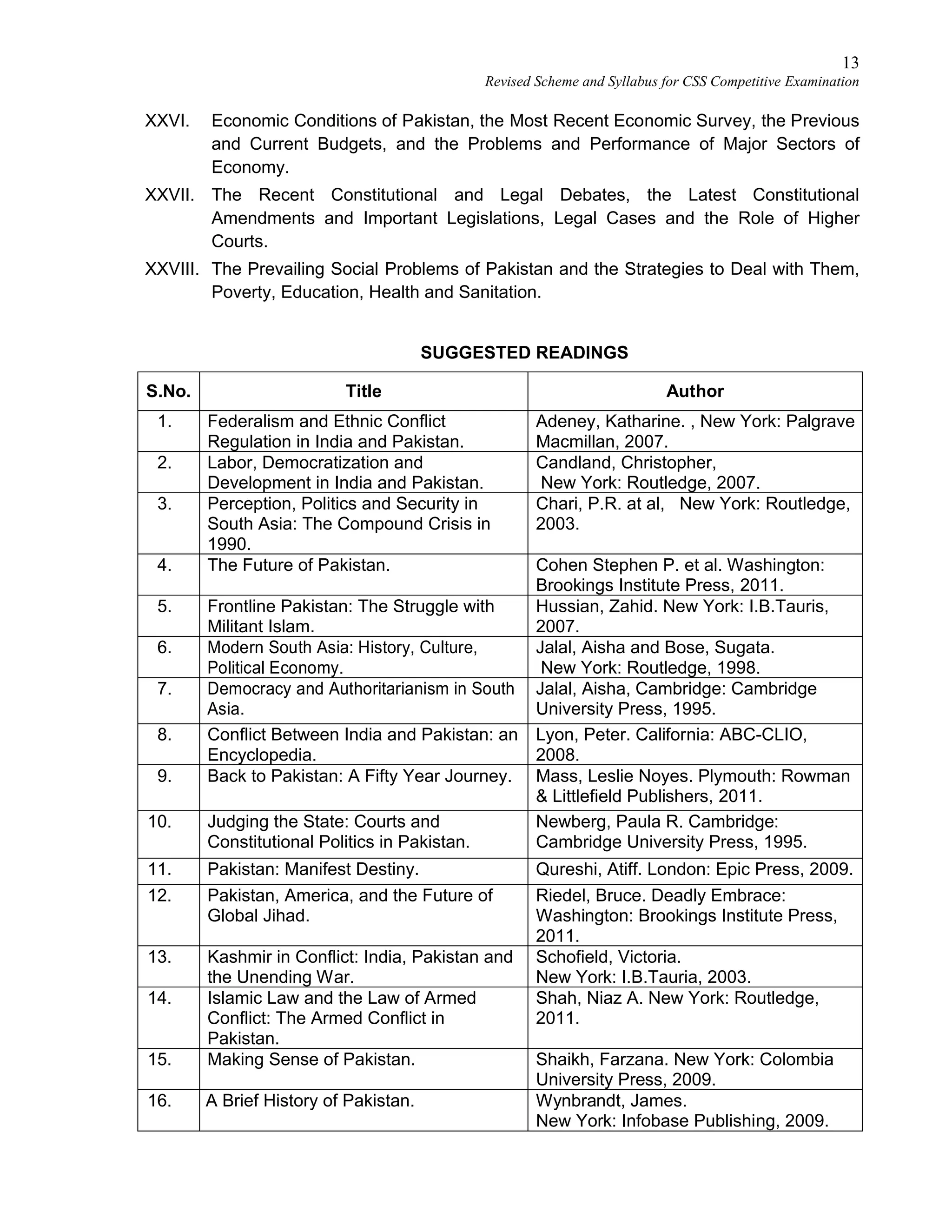
XXVI. Economic Conditions of Pakistan, the Most Recent Economic Survey, the Previous
and Current Budgets, and the Problems and Performance of Major Sectors of
Economy.
XXVII. The Recent Constitutional and Legal Debates, the Latest Constitutional
Amendments and Important Legislations, Legal Cases and the Role of Higher
Courts.
XXVIII. The Prevailing Social Problems of Pakistan and the Strategies to Deal with Them,
Poverty, Education, Health and Sanitation.
SUGGESTED READINGS
S.No. Title Author
1. Federalism and Ethnic Conflict
Regulation in India and Pakistan.
Adeney, Katharine. , New York: Palgrave
Macmillan, 2007.
2. Labor, Democratization and
Development in India and Pakistan.
Candland, Christopher,
New York: Routledge, 2007.
3. Perception, Politics and Security in
South Asia: The Compound Crisis in
1990.
Chari, P.R. at al, New York: Routledge,
2003.
4. The Future of Pakistan. Cohen Stephen P. et al. Washington:
Brookings Institute Press, 2011.
5. Frontline Pakistan: The Struggle with
Militant Islam.
Hussian, Zahid. New York: I.B.Tauris,
2007.
6. Modern South Asia: History, Culture,
Political Economy.
Jalal, Aisha and Bose, Sugata.
New York: Routledge, 1998.
7. Democracy and Authoritarianism in South
Asia.
Jalal, Aisha, Cambridge: Cambridge
University Press, 1995.
8. Conflict Between India and Pakistan: an
Encyclopedia.
Lyon, Peter. California: ABC-CLIO,
2008.
9. Back to Pakistan: A Fifty Year Journey. Mass, Leslie Noyes. Plymouth: Rowman
& Littlefield Publishers, 2011.
10. Judging the State: Courts and
Constitutional Politics in Pakistan.
Newberg, Paula R. Cambridge:
Cambridge University Press, 1995.
11. Pakistan: Manifest Destiny. Qureshi, Atiff. London: Epic Press, 2009.
12. Pakistan, America, and the Future of
Global Jihad.
Riedel, Bruce. Deadly Embrace:
Washington: Brookings Institute Press,
2011.
13. Kashmir in Conflict: India, Pakistan and
the Unending War.
Schofield, Victoria.
New York: I.B.Tauria, 2003.
14. Islamic Law and the Law of Armed
Conflict: The Armed Conflict in
Pakistan.
Shah, Niaz A. New York: Routledge,
2011.
15. Making Sense of Pakistan. Shaikh, Farzana. New York: Colombia
University Press, 2009.
16. A Brief History of Pakistan. Wynbrandt, James.
New York: Infobase Publishing, 2009.
14
Revised Scheme and Syllabus for CSS Competitive Examination
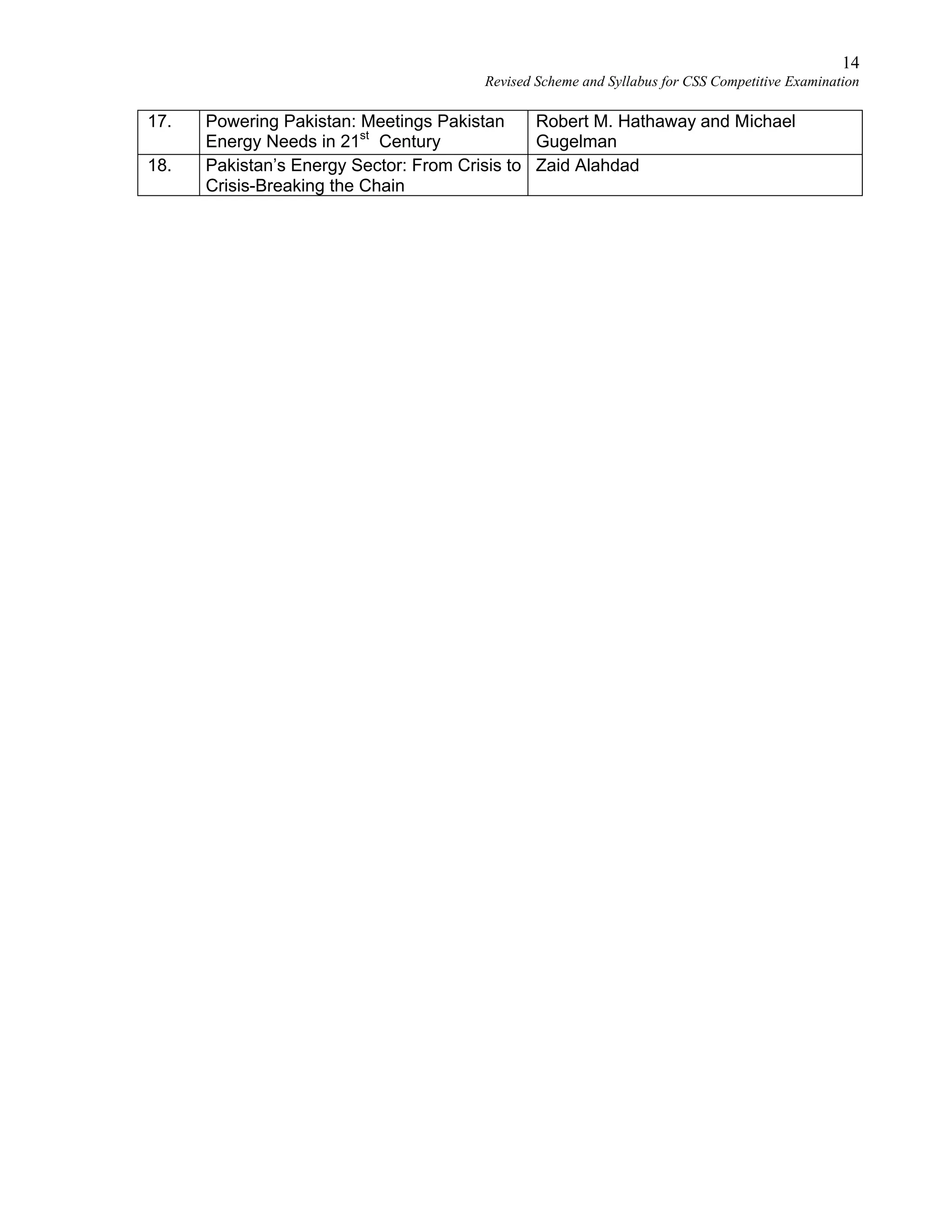
17. Powering Pakistan: Meetings Pakistan
Energy Needs in 21st
Century
Robert M. Hathaway and Michael
Gugelman
18. Pakistan’s Energy Sector: From Crisis to
Crisis-Breaking the Chain
Zaid Alahdad
15
Revised Scheme and Syllabus for CSS Competitive Examination
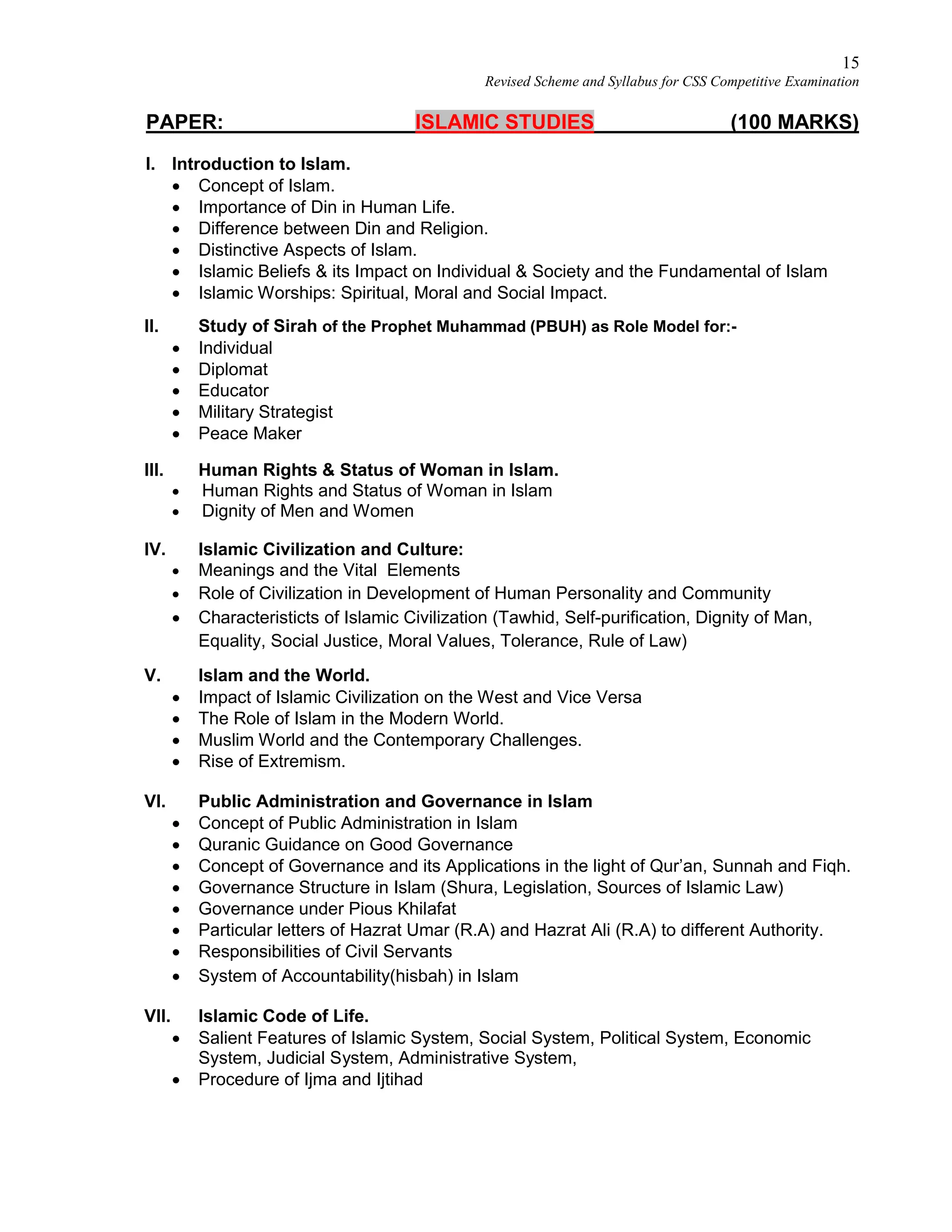
PAPER: ISLAMIC STUDIES (100 MARKS)
I. Introduction to Islam.
 Concept of Islam.
 Importance of Din in Human Life.
 Difference between Din and Religion.
 Distinctive Aspects of Islam.
 Islamic Beliefs & its Impact on Individual & Society and the Fundamental of Islam
 Islamic Worships: Spiritual, Moral and Social Impact.
II. Study of Sirah of the Prophet Muhammad (PBUH) as Role Model for:-
 Individual
 Diplomat
 Educator
 Military Strategist
 Peace Maker
III. Human Rights & Status of Woman in Islam.
 Human Rights and Status of Woman in Islam
 Dignity of Men and Women
IV. Islamic Civilization and Culture:
 Meanings and the Vital Elements
 Role of Civilization in Development of Human Personality and Community
 Characteristicts of Islamic Civilization (Tawhid, Self-purification, Dignity of Man,
Equality, Social Justice, Moral Values, Tolerance, Rule of Law)
V. Islam and the World.
 Impact of Islamic Civilization on the West and Vice Versa
 The Role of Islam in the Modern World.
 Muslim World and the Contemporary Challenges.
 Rise of Extremism.
VI. Public Administration and Governance in Islam
 Concept of Public Administration in Islam
 Quranic Guidance on Good Governance
 Concept of Governance and its Applications in the light of Qur’an, Sunnah and Fiqh.
 Governance Structure in Islam (Shura, Legislation, Sources of Islamic Law)
 Governance under Pious Khilafat
 Particular letters of Hazrat Umar (R.A) and Hazrat Ali (R.A) to different Authority.
 Responsibilities of Civil Servants
 System of Accountability(hisbah) in Islam
VII. Islamic Code of Life.
 Salient Features of Islamic System, Social System, Political System, Economic
System, Judicial System, Administrative System,
 Procedure of Ijma and Ijtihad
16
Revised Scheme and Syllabus for CSS Competitive Examination
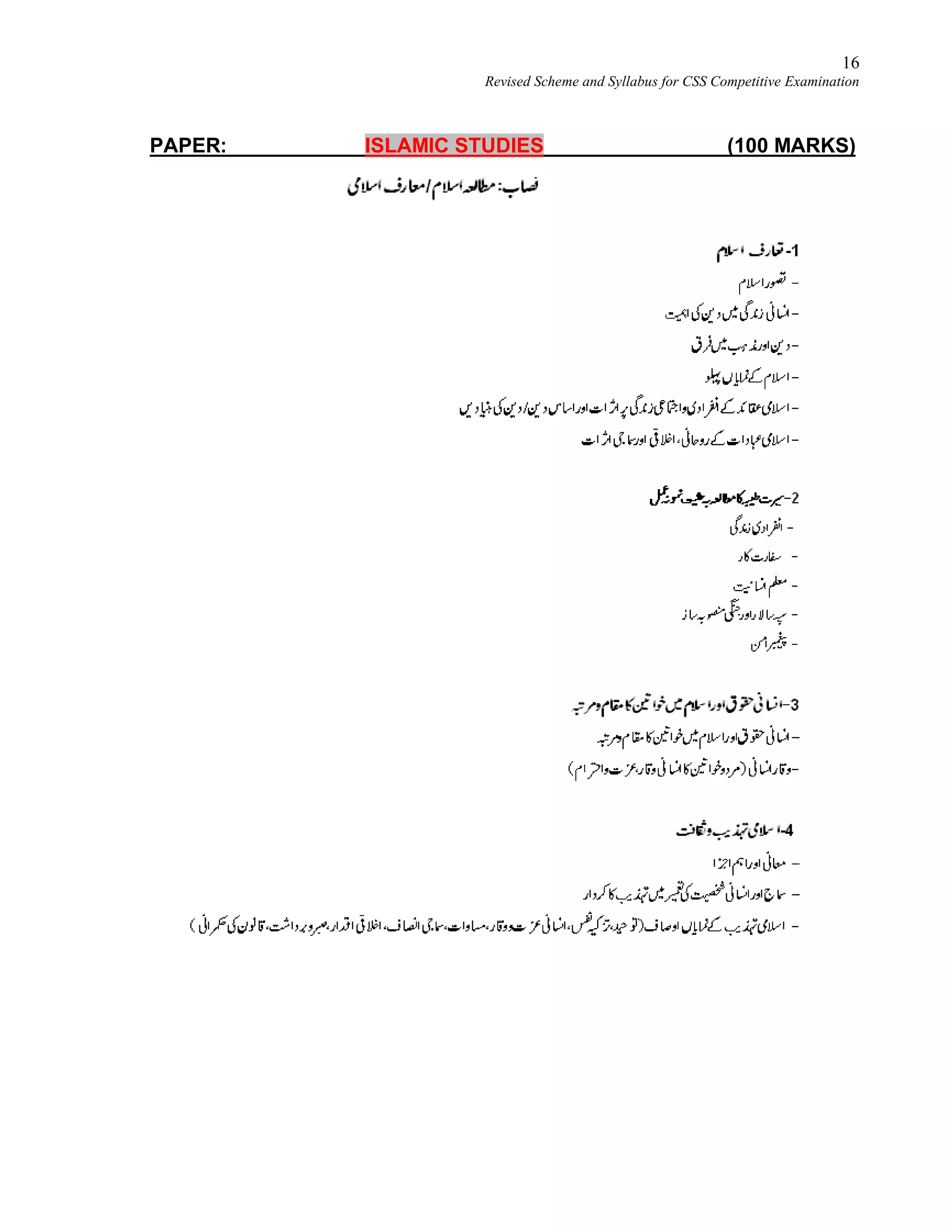
PAPER: ISLAMIC STUDIES (100 MARKS)
17
Revised Scheme and Syllabus for CSS Competitive Examination
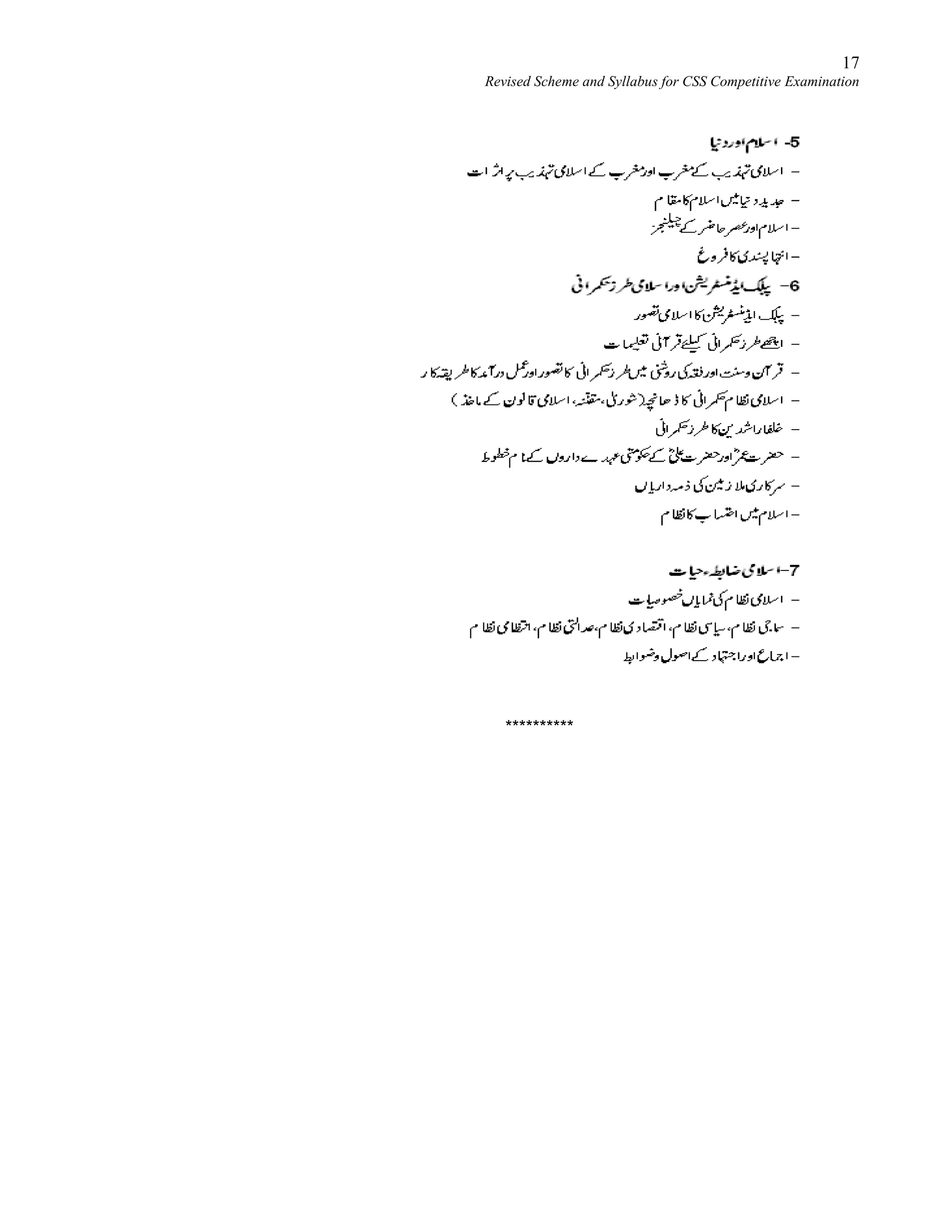
**********
18
Revised Scheme and Syllabus for CSS Competitive Examination
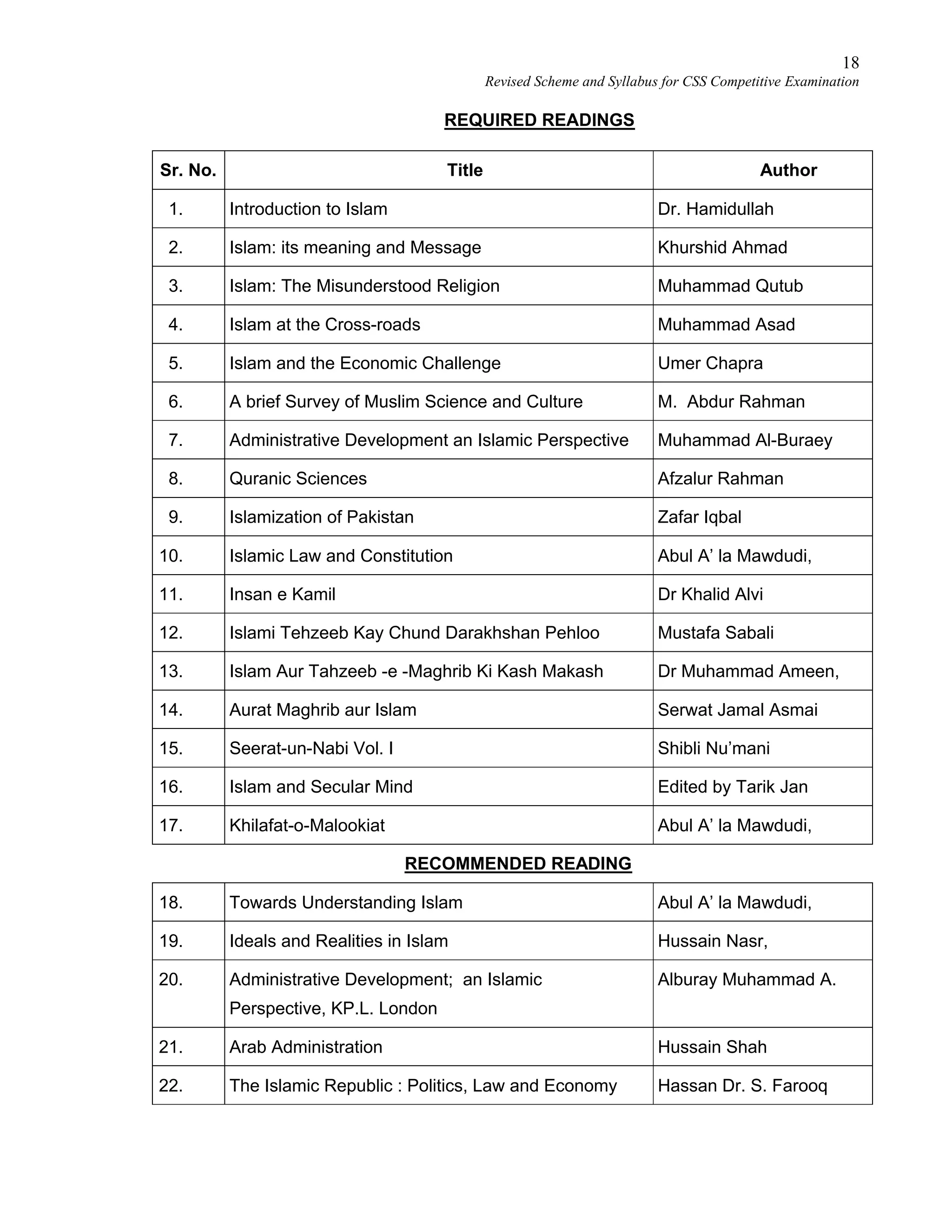
REQUIRED READINGS
Sr. No. Title Author
1. Introduction to Islam Dr. Hamidullah
2. Islam: its meaning and Message Khurshid Ahmad
3. Islam: The Misunderstood Religion Muhammad Qutub
4. Islam at the Cross-roads Muhammad Asad
5. Islam and the Economic Challenge Umer Chapra
6. A brief Survey of Muslim Science and Culture M. Abdur Rahman
7. Administrative Development an Islamic Perspective Muhammad Al-Buraey
8. Quranic Sciences Afzalur Rahman
9. Islamization of Pakistan Zafar Iqbal
10. Islamic Law and Constitution Abul A’ la Mawdudi,
11. Insan e Kamil Dr Khalid Alvi
12. Islami Tehzeeb Kay Chund Darakhshan Pehloo Mustafa Sabali
13. Islam Aur Tahzeeb -e -Maghrib Ki Kash Makash Dr Muhammad Ameen,
14. Aurat Maghrib aur Islam Serwat Jamal Asmai
15. Seerat-un-Nabi Vol. I Shibli Nu’mani
16. Islam and Secular Mind Edited by Tarik Jan
17. Khilafat-o-Malookiat Abul A’ la Mawdudi,
RECOMMENDED READING
18. Towards Understanding Islam Abul A’ la Mawdudi,
19. Ideals and Realities in Islam Hussain Nasr,
20. Administrative Development; an Islamic
Perspective, KP.L. London
Alburay Muhammad A.
21. Arab Administration Hussain Shah
22. The Islamic Republic : Politics, Law and Economy Hassan Dr. S. Farooq
19
Revised Scheme and Syllabus for CSS Competitive Examination
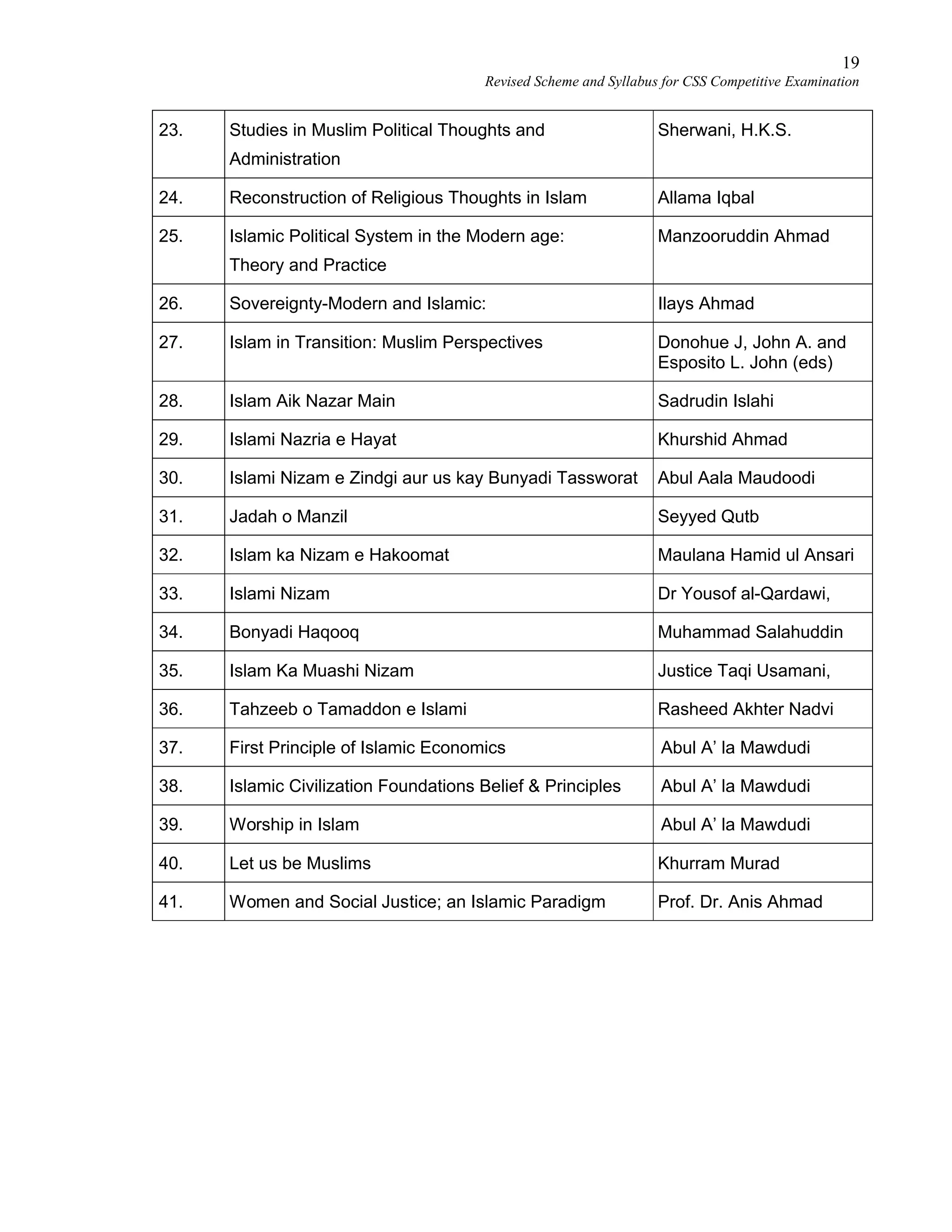
23. Studies in Muslim Political Thoughts and
Administration
Sherwani, H.K.S.
24. Reconstruction of Religious Thoughts in Islam Allama Iqbal
25. Islamic Political System in the Modern age:
Theory and Practice
Manzooruddin Ahmad
26. Sovereignty-Modern and Islamic: Ilays Ahmad
27. Islam in Transition: Muslim Perspectives Donohue J, John A. and
Esposito L. John (eds)
28. Islam Aik Nazar Main Sadrudin Islahi
29. Islami Nazria e Hayat Khurshid Ahmad
30. Islami Nizam e Zindgi aur us kay Bunyadi Tassworat Abul Aala Maudoodi
31. Jadah o Manzil Seyyed Qutb
32. Islam ka Nizam e Hakoomat Maulana Hamid ul Ansari
33. Islami Nizam Dr Yousof al-Qardawi,
34. Bonyadi Haqooq Muhammad Salahuddin
35. Islam Ka Muashi Nizam Justice Taqi Usamani,
36. Tahzeeb o Tamaddon e Islami Rasheed Akhter Nadvi
37. First Principle of Islamic Economics Abul A’ la Mawdudi
38. Islamic Civilization Foundations Belief & Principles Abul A’ la Mawdudi
39. Worship in Islam Abul A’ la Mawdudi
40. Let us be Muslims Khurram Murad
41. Women and Social Justice; an Islamic Paradigm Prof. Dr. Anis Ahmad
20
Revised Scheme and Syllabus for CSS Competitive Examination
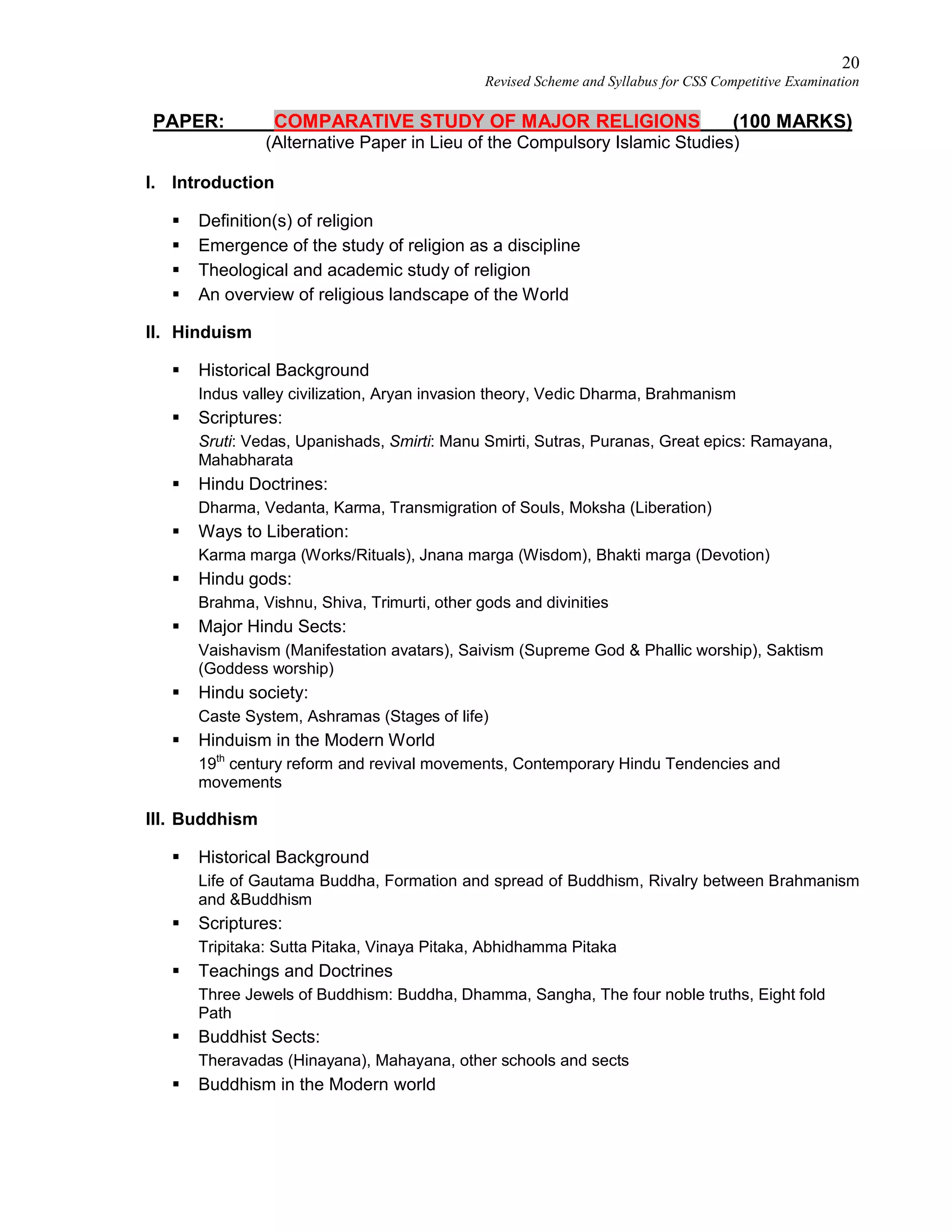
PAPER: COMPARATIVE STUDY OF MAJOR RELIGIONS (100 MARKS)
(Alternative Paper in Lieu of the Compulsory Islamic Studies)
I. Introduction
 Definition(s) of religion
 Emergence of the study of religion as a discipline
 Theological and academic study of religion
 An overview of religious landscape of the World
II. Hinduism
 Historical Background
Indus valley civilization, Aryan invasion theory, Vedic Dharma, Brahmanism
 Scriptures:
Sruti: Vedas, Upanishads, Smirti: Manu Smirti, Sutras, Puranas, Great epics: Ramayana,
Mahabharata
 Hindu Doctrines:
Dharma, Vedanta, Karma, Transmigration of Souls, Moksha (Liberation)
 Ways to Liberation:
Karma marga (Works/Rituals), Jnana marga (Wisdom), Bhakti marga (Devotion)
 Hindu gods:
Brahma, Vishnu, Shiva, Trimurti, other gods and divinities
 Major Hindu Sects:
Vaishavism (Manifestation avatars), Saivism (Supreme God & Phallic worship), Saktism
(Goddess worship)
 Hindu society:
Caste System, Ashramas (Stages of life)
 Hinduism in the Modern World
19th
century reform and revival movements, Contemporary Hindu Tendencies and
movements
III. Buddhism
 Historical Background
Life of Gautama Buddha, Formation and spread of Buddhism, Rivalry between Brahmanism
and &Buddhism
 Scriptures:
Tripitaka: Sutta Pitaka, Vinaya Pitaka, Abhidhamma Pitaka
 Teachings and Doctrines
Three Jewels of Buddhism: Buddha, Dhamma, Sangha, The four noble truths, Eight fold
Path
 Buddhist Sects:
Theravadas (Hinayana), Mahayana, other schools and sects
 Buddhism in the Modern world
21
Revised Scheme and Syllabus for CSS Competitive Examination
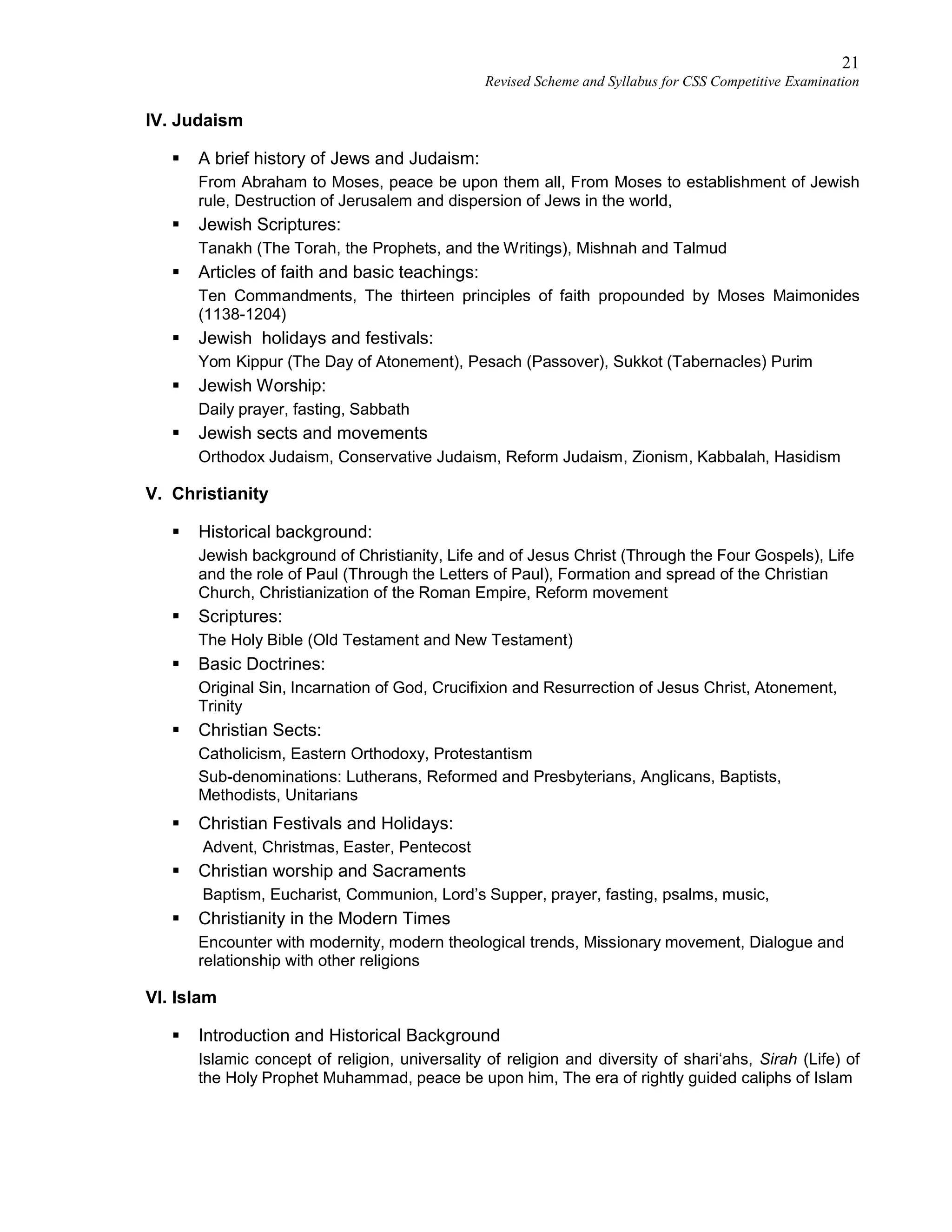
IV. Judaism
 A brief history of Jews and Judaism:
From Abraham to Moses, peace be upon them all, From Moses to establishment of Jewish
rule, Destruction of Jerusalem and dispersion of Jews in the world,
 Jewish Scriptures:
Tanakh (The Torah, the Prophets, and the Writings), Mishnah and Talmud
 Articles of faith and basic teachings:
Ten Commandments, The thirteen principles of faith propounded by Moses Maimonides
(1138-1204)
 Jewish holidays and festivals:
Yom Kippur (The Day of Atonement), Pesach (Passover), Sukkot (Tabernacles) Purim
 Jewish Worship:
Daily prayer, fasting, Sabbath
 Jewish sects and movements
Orthodox Judaism, Conservative Judaism, Reform Judaism, Zionism, Kabbalah, Hasidism
V. Christianity
 Historical background:
Jewish background of Christianity, Life and of Jesus Christ (Through the Four Gospels), Life
and the role of Paul (Through the Letters of Paul), Formation and spread of the Christian
Church, Christianization of the Roman Empire, Reform movement
 Scriptures:
The Holy Bible (Old Testament and New Testament)
 Basic Doctrines:
Original Sin, Incarnation of God, Crucifixion and Resurrection of Jesus Christ, Atonement,
Trinity
 Christian Sects:
Catholicism, Eastern Orthodoxy, Protestantism
Sub-denominations: Lutherans, Reformed and Presbyterians, Anglicans, Baptists,
Methodists, Unitarians
 Christian Festivals and Holidays:
Advent, Christmas, Easter, Pentecost
 Christian worship and Sacraments
Baptism, Eucharist, Communion, Lord’s Supper, prayer, fasting, psalms, music,
 Christianity in the Modern Times
Encounter with modernity, modern theological trends, Missionary movement, Dialogue and
relationship with other religions
VI. Islam
 Introduction and Historical Background
Islamic concept of religion, universality of religion and diversity of shari‘ahs, Sirah (Life) of
the Holy Prophet Muhammad, peace be upon him, The era of rightly guided caliphs of Islam
22
Revised Scheme and Syllabus for CSS Competitive Examination
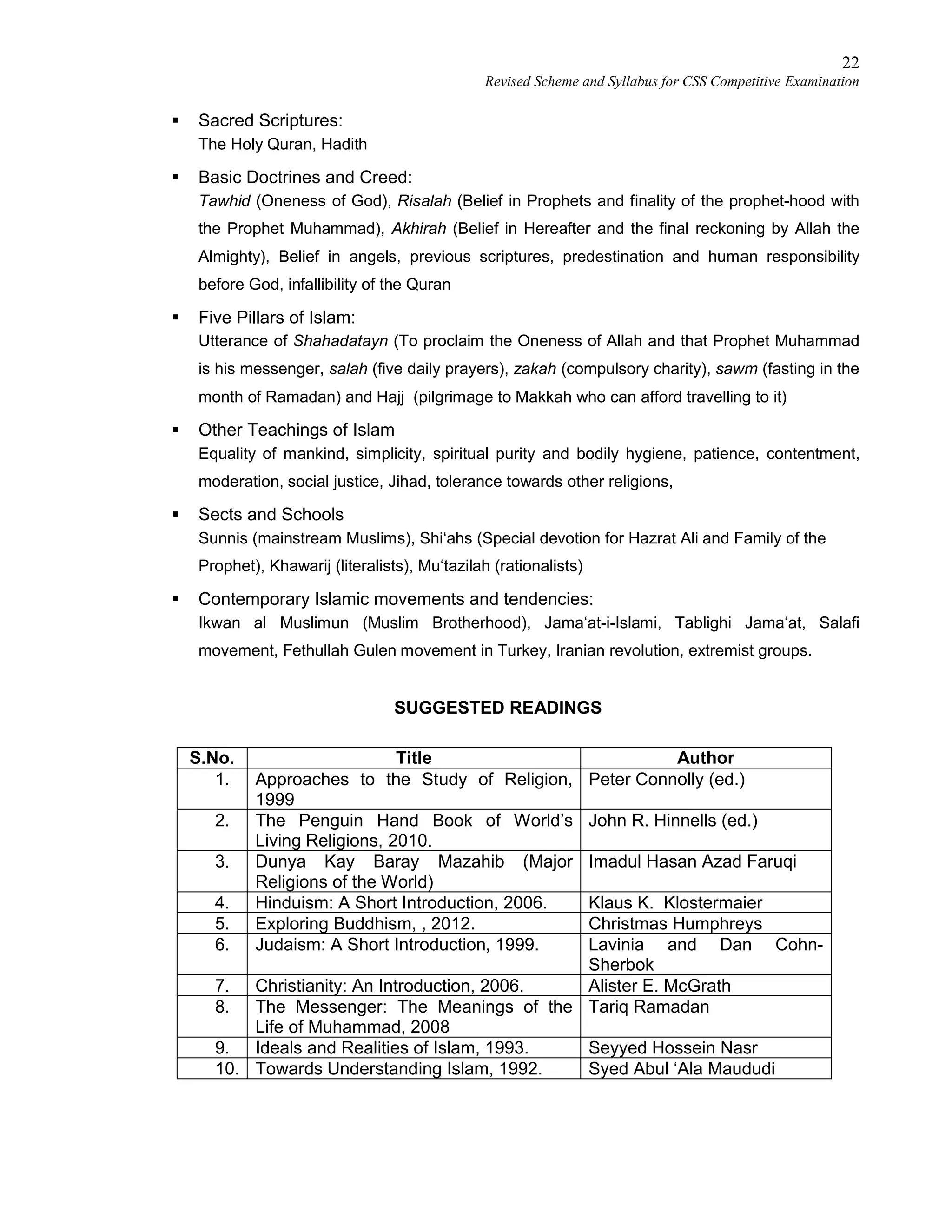
 Sacred Scriptures:
The Holy Quran, Hadith
 Basic Doctrines and Creed:
Tawhid (Oneness of God), Risalah (Belief in Prophets and finality of the prophet-hood with
the Prophet Muhammad), Akhirah (Belief in Hereafter and the final reckoning by Allah the
Almighty), Belief in angels, previous scriptures, predestination and human responsibility
before God, infallibility of the Quran
 Five Pillars of Islam:
Utterance of Shahadatayn (To proclaim the Oneness of Allah and that Prophet Muhammad
is his messenger, salah (five daily prayers), zakah (compulsory charity), sawm (fasting in the
month of Ramadan) and Hajj (pilgrimage to Makkah who can afford travelling to it)
 Other Teachings of Islam
Equality of mankind, simplicity, spiritual purity and bodily hygiene, patience, contentment,
moderation, social justice, Jihad, tolerance towards other religions,
 Sects and Schools
Sunnis (mainstream Muslims), Shi‘ahs (Special devotion for Hazrat Ali and Family of the
Prophet), Khawarij (literalists), Mu‘tazilah (rationalists)
 Contemporary Islamic movements and tendencies:
Ikwan al Muslimun (Muslim Brotherhood), Jama‘at-i-Islami, Tablighi Jama‘at, Salafi
movement, Fethullah Gulen movement in Turkey, Iranian revolution, extremist groups.
SUGGESTED READINGS
S.No. Title Author
1. Approaches to the Study of Religion,
1999
Peter Connolly (ed.)
2. The Penguin Hand Book of World’s
Living Religions, 2010.
John R. Hinnells (ed.)
3. Dunya Kay Baray Mazahib (Major
Religions of the World)
Imadul Hasan Azad Faruqi
4. Hinduism: A Short Introduction, 2006. Klaus K. Klostermaier
5. Exploring Buddhism, , 2012. Christmas Humphreys
6. Judaism: A Short Introduction, 1999. Lavinia and Dan Cohn-
Sherbok
7. Christianity: An Introduction, 2006. Alister E. McGrath
8. The Messenger: The Meanings of the
Life of Muhammad, 2008
Tariq Ramadan
9. Ideals and Realities of Islam, 1993. Seyyed Hossein Nasr
10. Towards Understanding Islam, 1992. Syed Abul ‘Ala Maududi
23
Revised Scheme and Syllabus for CSS Competitive Examination
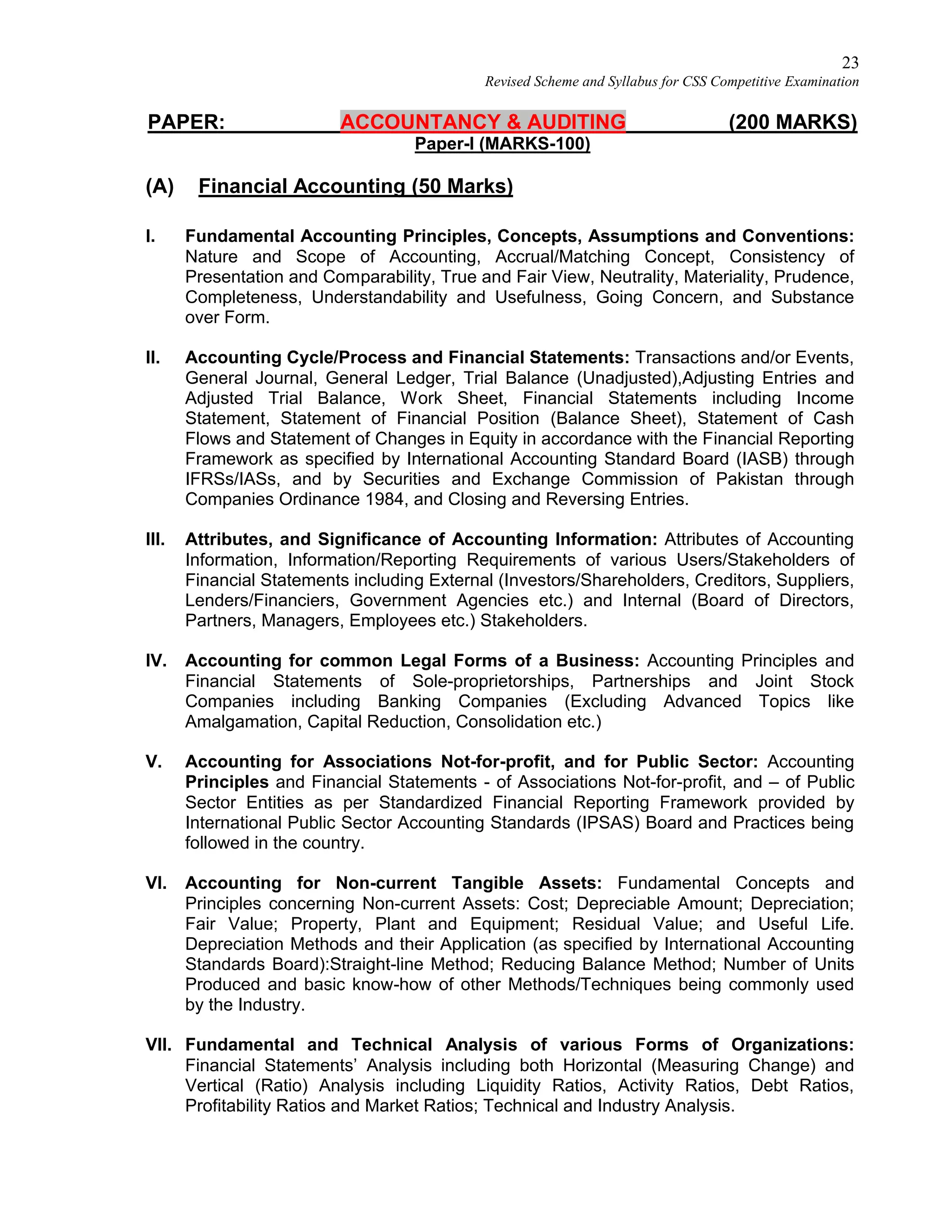
PAPER: ACCOUNTANCY & AUDITING (200 MARKS)
Paper-I (MARKS-100)
(A) Financial Accounting (50 Marks)
I. Fundamental Accounting Principles, Concepts, Assumptions and Conventions:
Nature and Scope of Accounting, Accrual/Matching Concept, Consistency of
Presentation and Comparability, True and Fair View, Neutrality, Materiality, Prudence,
Completeness, Understandability and Usefulness, Going Concern, and Substance
over Form.
II. Accounting Cycle/Process and Financial Statements: Transactions and/or Events,
General Journal, General Ledger, Trial Balance (Unadjusted),Adjusting Entries and
Adjusted Trial Balance, Work Sheet, Financial Statements including Income
Statement, Statement of Financial Position (Balance Sheet), Statement of Cash
Flows and Statement of Changes in Equity in accordance with the Financial Reporting
Framework as specified by International Accounting Standard Board (IASB) through
IFRSs/IASs, and by Securities and Exchange Commission of Pakistan through
Companies Ordinance 1984, and Closing and Reversing Entries.
III. Attributes, and Significance of Accounting Information: Attributes of Accounting
Information, Information/Reporting Requirements of various Users/Stakeholders of
Financial Statements including External (Investors/Shareholders, Creditors, Suppliers,
Lenders/Financiers, Government Agencies etc.) and Internal (Board of Directors,
Partners, Managers, Employees etc.) Stakeholders.
IV. Accounting for common Legal Forms of a Business: Accounting Principles and
Financial Statements of Sole-proprietorships, Partnerships and Joint Stock
Companies including Banking Companies (Excluding Advanced Topics like
Amalgamation, Capital Reduction, Consolidation etc.)
V. Accounting for Associations Not-for-profit, and for Public Sector: Accounting
Principles and Financial Statements - of Associations Not-for-profit, and – of Public
Sector Entities as per Standardized Financial Reporting Framework provided by
International Public Sector Accounting Standards (IPSAS) Board and Practices being
followed in the country.
VI. Accounting for Non-current Tangible Assets: Fundamental Concepts and
Principles concerning Non-current Assets: Cost; Depreciable Amount; Depreciation;
Fair Value; Property, Plant and Equipment; Residual Value; and Useful Life.
Depreciation Methods and their Application (as specified by International Accounting
Standards Board):Straight-line Method; Reducing Balance Method; Number of Units
Produced and basic know-how of other Methods/Techniques being commonly used
by the Industry.
VII. Fundamental and Technical Analysis of various Forms of Organizations:
Financial Statements’ Analysis including both Horizontal (Measuring Change) and
Vertical (Ratio) Analysis including Liquidity Ratios, Activity Ratios, Debt Ratios,
Profitability Ratios and Market Ratios; Technical and Industry Analysis.
24
Revised Scheme and Syllabus for CSS Competitive Examination
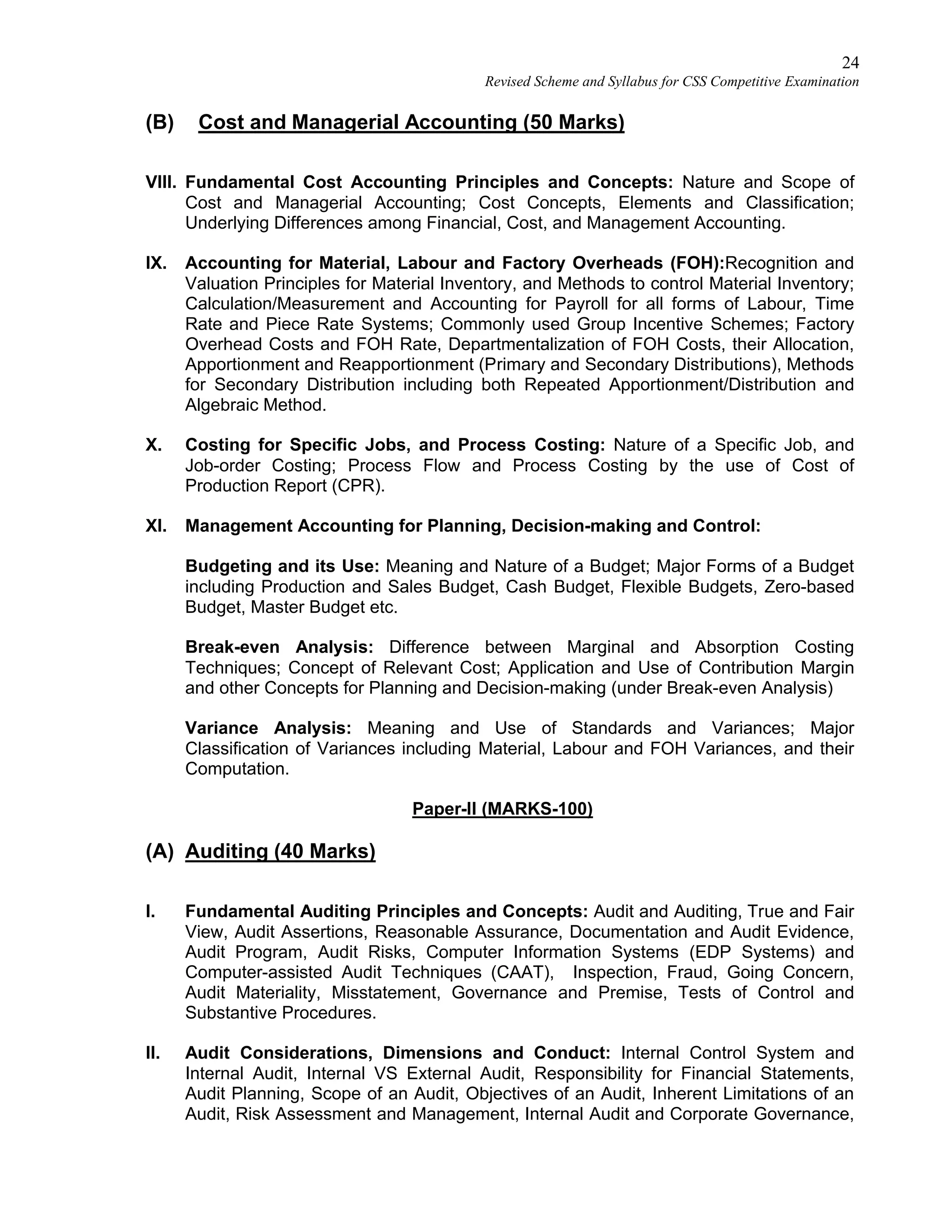
(B) Cost and Managerial Accounting (50 Marks)
VIII. Fundamental Cost Accounting Principles and Concepts: Nature and Scope of
Cost and Managerial Accounting; Cost Concepts, Elements and Classification;
Underlying Differences among Financial, Cost, and Management Accounting.
IX. Accounting for Material, Labour and Factory Overheads (FOH):Recognition and
Valuation Principles for Material Inventory, and Methods to control Material Inventory;
Calculation/Measurement and Accounting for Payroll for all forms of Labour, Time
Rate and Piece Rate Systems; Commonly used Group Incentive Schemes; Factory
Overhead Costs and FOH Rate, Departmentalization of FOH Costs, their Allocation,
Apportionment and Reapportionment (Primary and Secondary Distributions), Methods
for Secondary Distribution including both Repeated Apportionment/Distribution and
Algebraic Method.
X. Costing for Specific Jobs, and Process Costing: Nature of a Specific Job, and
Job-order Costing; Process Flow and Process Costing by the use of Cost of
Production Report (CPR).
XI. Management Accounting for Planning, Decision-making and Control:
Budgeting and its Use: Meaning and Nature of a Budget; Major Forms of a Budget
including Production and Sales Budget, Cash Budget, Flexible Budgets, Zero-based
Budget, Master Budget etc.
Break-even Analysis: Difference between Marginal and Absorption Costing
Techniques; Concept of Relevant Cost; Application and Use of Contribution Margin
and other Concepts for Planning and Decision-making (under Break-even Analysis)
Variance Analysis: Meaning and Use of Standards and Variances; Major
Classification of Variances including Material, Labour and FOH Variances, and their
Computation.
Paper-II (MARKS-100)
(A) Auditing (40 Marks)
I. Fundamental Auditing Principles and Concepts: Audit and Auditing, True and Fair
View, Audit Assertions, Reasonable Assurance, Documentation and Audit Evidence,
Audit Program, Audit Risks, Computer Information Systems (EDP Systems) and
Computer-assisted Audit Techniques (CAAT), Inspection, Fraud, Going Concern,
Audit Materiality, Misstatement, Governance and Premise, Tests of Control and
Substantive Procedures.
II. Audit Considerations, Dimensions and Conduct: Internal Control System and
Internal Audit, Internal VS External Audit, Responsibility for Financial Statements,
Audit Planning, Scope of an Audit, Objectives of an Audit, Inherent Limitations of an
Audit, Risk Assessment and Management, Internal Audit and Corporate Governance,
25
Revised Scheme and Syllabus for CSS Competitive Examination
Classification of Audit, Qualities of an Auditor, Auditing in Computer Information
Systems (EDP Systems) and Computer-assisted Audit Techniques, General Auditing
Principles and Techniques commonly applicable to various Types of Undertakings
including Merchandizing, Manufacturing, Banking, Insurance, Investment Entities etc.,
Audit Performance and Audit Completion.
III. Role and Responsibilities of an Auditor: Auditor’s professional and legal Rights,
Responsibilities & Duties, and Liabilities; Auditor’s Opinion and Report, and their
classification (Types); - as specified under the Companies Ordinance 1984, and in the
handbook of IFAC.
(B) Business Taxation (30 Marks)
IV. Tax Structure, and Fundamental Concepts vis-à-vis Income Tax in Pakistan: Tax
Structure in Pakistan; Fundamental Definitions/Terminologies defined under Section 2
of the Income Tax Ordinance 2001.
V. Income Tax and Sales Tax Principles, and their Application: Selected Provisions
from Income Tax - Income for Tax Purposes [Section 4, 9 & 10], Heads of Income
[Section 11], Tax Payable on Taxable Income [First Schedule to the Ordinance],
Salary Income and Taxation [Sections 12 to 14], Income from Property [Sections 15 &
16], Income from Business[Sections 18 to 20], Capital Gains[Sections 37 to38],
Income from other sources[Section 39, 40, 101(6), 111],Tax Credits [Sections 61 to
65], Taxation of Individuals, AOPs and Companies [Sections 86, 92, 94], Due Date for
Payment of Tax [Section 137], Deduction of Tax at Source/With-holding Tax [Sections
147, 149, 153, 155]and related Income Tax Rules 2002.
Selected Definitions and Provisions from Sales Tax –Scope of Tax [Section 3],
Exempt supply [Section 2(11)], Goods [Section 2(12)], Input Tax [2(14)], Registered
person [Section 2(25)], Supply [Section 2(33)], Tax [Section 2(34)], Retail Price and
Retailer [Section 2(27)& 2(28)], Taxable Activity [Section 2(35)], Taxable Supply
[Section 2(41)], Tax Fraction [Section 2(36)], Tax Period [Section 2(43)], Time of
Supply [Section 2(44)], and Determination of Tax Liability [Section 7].
(C) Business Studies, and Finance (30 Marks)
VI. Business Studies: Nature and Scope of a Business Entity, Contemporary
Challenges posed to a Business; Common Legal Forms of a Business Entity – Sole-
proprietorship, Partnership, Joint Stock Company, their Features, Formation and
Management; Business Combinations and their Scope; Business Cycle and its
Implications; Role of Information Technology in Business.
VII. Finance: Meaning, Nature and Scope of Finance, and Financial Management;
Common Modes (Types) of Business Finance – Short-, Medium-, and Long-term
Financing; Nature and Scope of Financial Markets and Institutions; Features and
Classification of Financial Markets; Financial Management Techniques for Decision-
making: Time Value of Money, Cost of Capital and Capital Budgeting Techniques.
26
Revised Scheme and Syllabus for CSS Competitive Examination
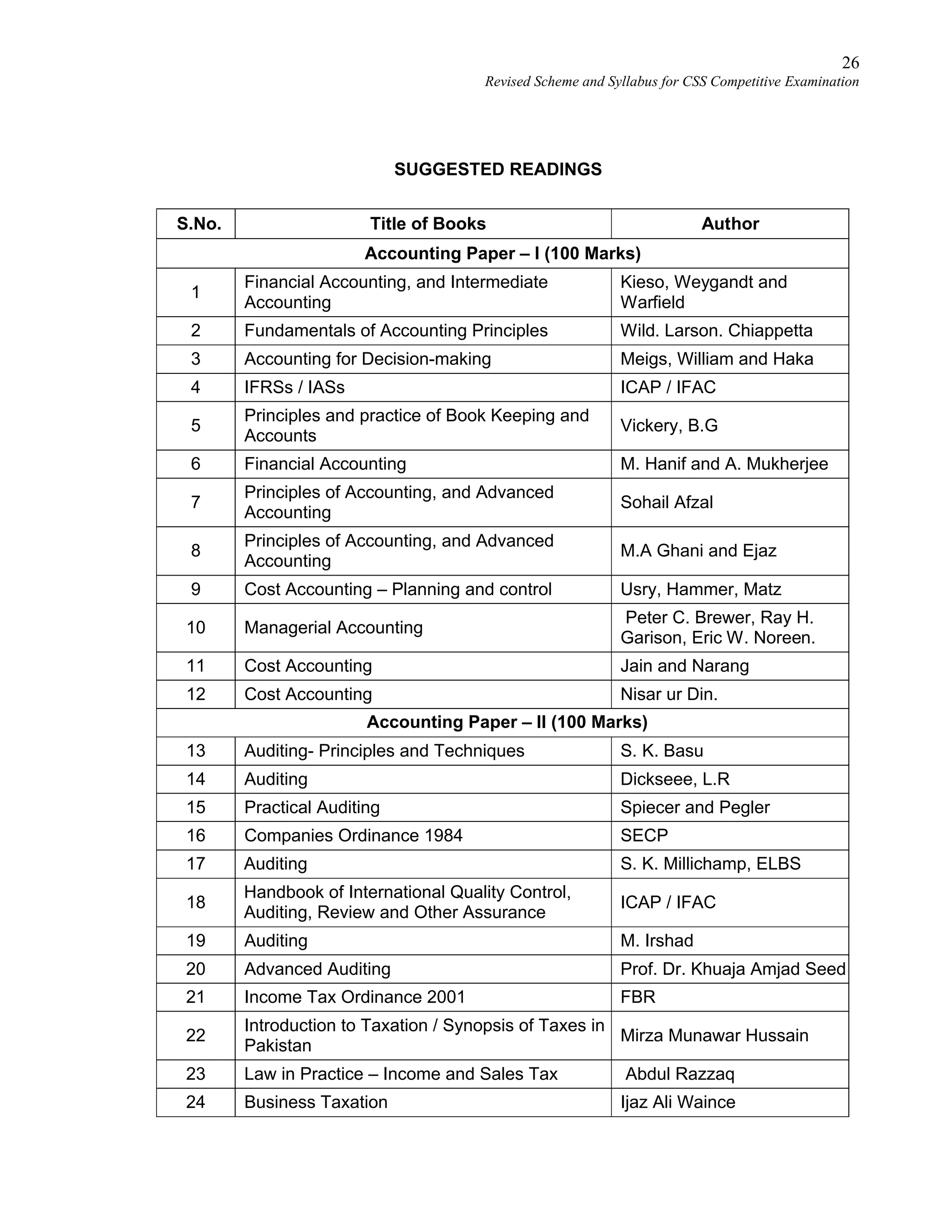
SUGGESTED READINGS
S.No. Title of Books Author
Accounting Paper – I (100 Marks)
1
Financial Accounting, and Intermediate
Accounting
Kieso, Weygandt and
Warfield
2 Fundamentals of Accounting Principles Wild. Larson. Chiappetta
3 Accounting for Decision-making Meigs, William and Haka
4 IFRSs / IASs ICAP / IFAC
5
Principles and practice of Book Keeping and
Accounts
Vickery, B.G
6 Financial Accounting M. Hanif and A. Mukherjee
7
Principles of Accounting, and Advanced
Accounting
Sohail Afzal
8
Principles of Accounting, and Advanced
Accounting
M.A Ghani and Ejaz
9 Cost Accounting – Planning and control Usry, Hammer, Matz
10 Managerial Accounting
Peter C. Brewer, Ray H.
Garison, Eric W. Noreen.
11 Cost Accounting Jain and Narang
12 Cost Accounting Nisar ur Din.
Accounting Paper – II (100 Marks)
13 Auditing- Principles and Techniques S. K. Basu
14 Auditing Dickseee, L.R
15 Practical Auditing Spiecer and Pegler
16 Companies Ordinance 1984 SECP
17 Auditing S. K. Millichamp, ELBS
18
Handbook of International Quality Control,
Auditing, Review and Other Assurance
ICAP / IFAC
19 Auditing M. Irshad
20 Advanced Auditing Prof. Dr. Khuaja Amjad Seed
21 Income Tax Ordinance 2001 FBR
22
Introduction to Taxation / Synopsis of Taxes in
Pakistan
Mirza Munawar Hussain
23 Law in Practice – Income and Sales Tax Abdul Razzaq
24 Business Taxation Ijaz Ali Waince
27
Revised Scheme and Syllabus for CSS Competitive Examination
S.No. Title of Books Author
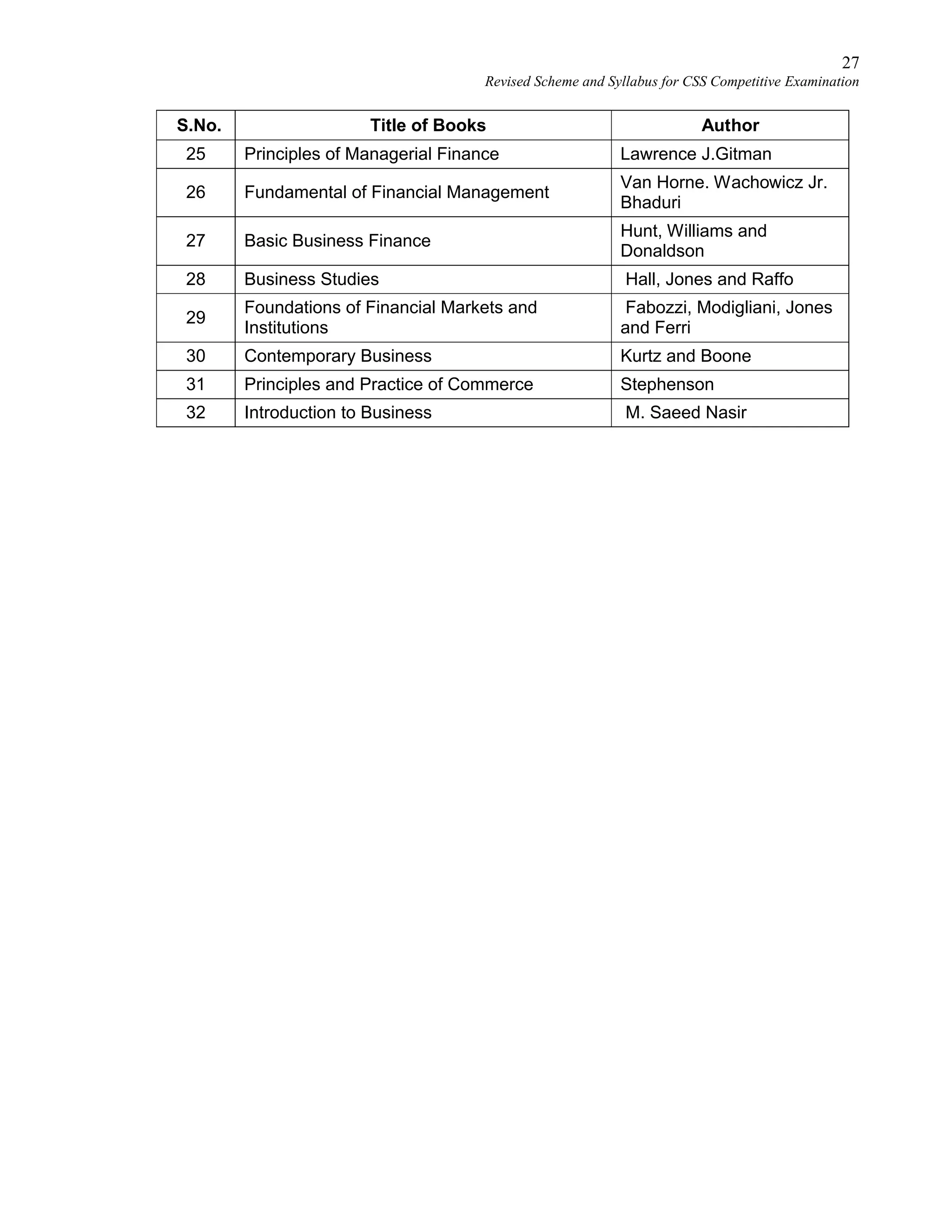
25 Principles of Managerial Finance Lawrence J.Gitman
26 Fundamental of Financial Management
Van Horne. Wachowicz Jr.
Bhaduri
27 Basic Business Finance
Hunt, Williams and
Donaldson
28 Business Studies Hall, Jones and Raffo
29
Foundations of Financial Markets and
Institutions
Fabozzi, Modigliani, Jones
and Ferri
30 Contemporary Business Kurtz and Boone
31 Principles and Practice of Commerce Stephenson
32 Introduction to Business M. Saeed Nasir
28
Revised Scheme and Syllabus for CSS Competitive Examination
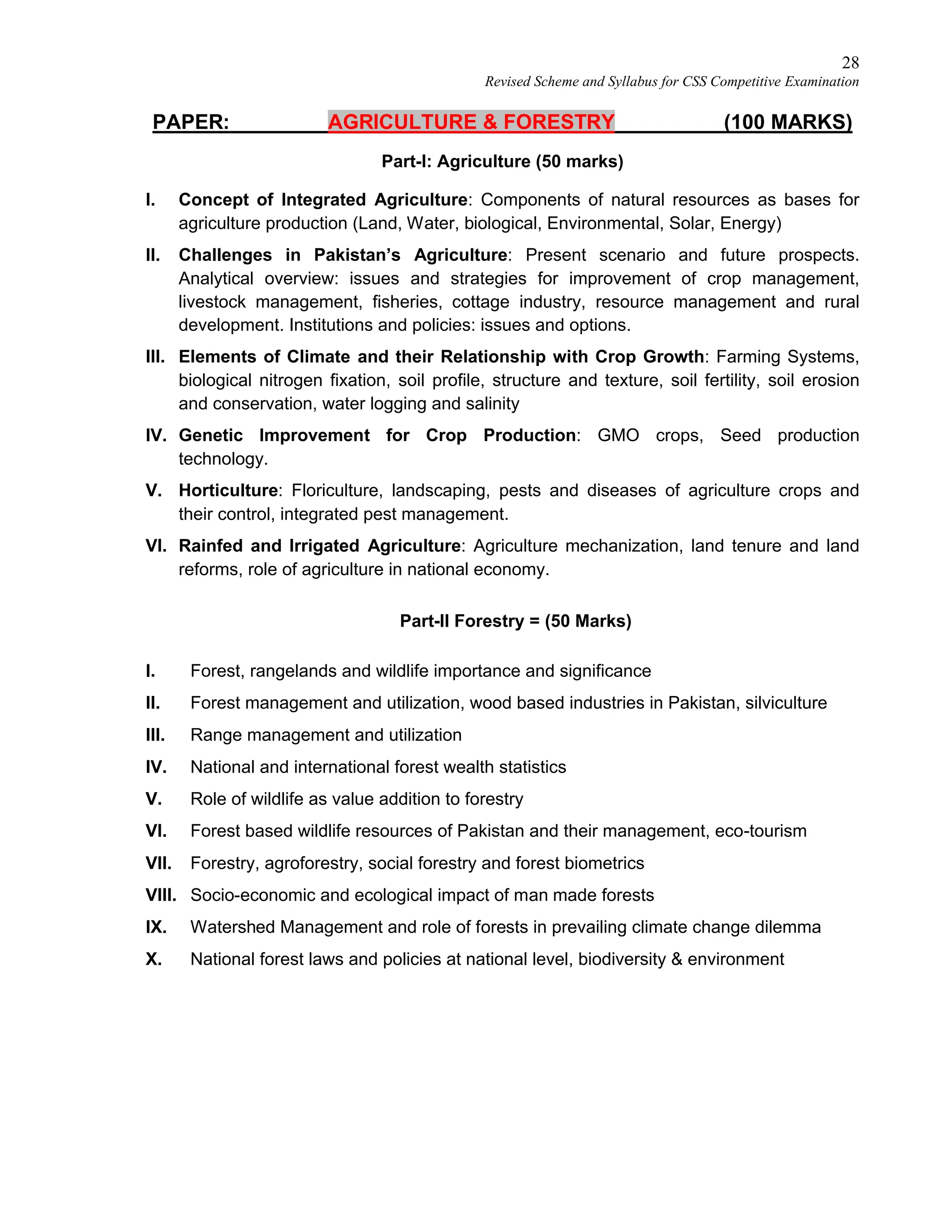
PAPER: AGRICULTURE & FORESTRY (100 MARKS)
Part-I: Agriculture (50 marks)
I. Concept of Integrated Agriculture: Components of natural resources as bases for
agriculture production (Land, Water, biological, Environmental, Solar, Energy)
II. Challenges in Pakistan’s Agriculture: Present scenario and future prospects.
Analytical overview: issues and strategies for improvement of crop management,
livestock management, fisheries, cottage industry, resource management and rural
development. Institutions and policies: issues and options.
III. Elements of Climate and their Relationship with Crop Growth: Farming Systems,
biological nitrogen fixation, soil profile, structure and texture, soil fertility, soil erosion
and conservation, water logging and salinity
IV. Genetic Improvement for Crop Production: GMO crops, Seed production
technology.
V. Horticulture: Floriculture, landscaping, pests and diseases of agriculture crops and
their control, integrated pest management.
VI. Rainfed and Irrigated Agriculture: Agriculture mechanization, land tenure and land
reforms, role of agriculture in national economy.
Part-II Forestry = (50 Marks)
I. Forest, rangelands and wildlife importance and significance
II. Forest management and utilization, wood based industries in Pakistan, silviculture
III. Range management and utilization
IV. National and international forest wealth statistics
V. Role of wildlife as value addition to forestry
VI. Forest based wildlife resources of Pakistan and their management, eco-tourism
VII. Forestry, agroforestry, social forestry and forest biometrics
VIII. Socio-economic and ecological impact of man made forests
IX. Watershed Management and role of forests in prevailing climate change dilemma
X. National forest laws and policies at national level, biodiversity & environment
29
Revised Scheme and Syllabus for CSS Competitive Examination
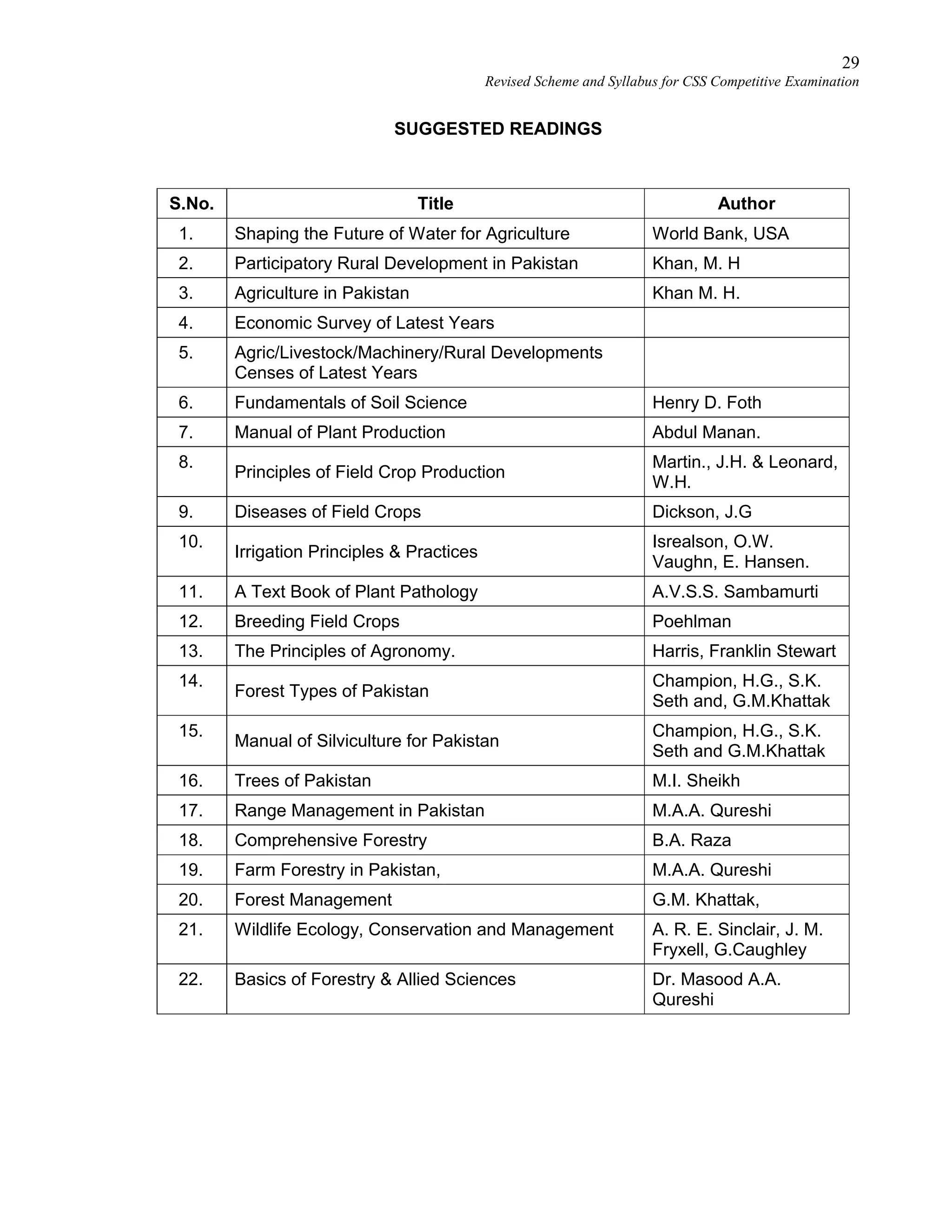
SUGGESTED READINGS
S.No. Title Author
1. Shaping the Future of Water for Agriculture World Bank, USA
2. Participatory Rural Development in Pakistan Khan, M. H
3. Agriculture in Pakistan Khan M. H.
4. Economic Survey of Latest Years
5. Agric/Livestock/Machinery/Rural Developments
Censes of Latest Years
6. Fundamentals of Soil Science Henry D. Foth
7. Manual of Plant Production Abdul Manan.
8.
Principles of Field Crop Production
Martin., J.H. & Leonard,
W.H.
9. Diseases of Field Crops Dickson, J.G
10.
Irrigation Principles & Practices
Isrealson, O.W.
Vaughn, E. Hansen.
11. A Text Book of Plant Pathology A.V.S.S. Sambamurti
12. Breeding Field Crops Poehlman
13. The Principles of Agronomy. Harris, Franklin Stewart
14.
Forest Types of Pakistan
Champion, H.G., S.K.
Seth and, G.M.Khattak
15.
Manual of Silviculture for Pakistan
Champion, H.G., S.K.
Seth and G.M.Khattak
16. Trees of Pakistan M.I. Sheikh
17. Range Management in Pakistan M.A.A. Qureshi
18. Comprehensive Forestry B.A. Raza
19. Farm Forestry in Pakistan, M.A.A. Qureshi
20. Forest Management G.M. Khattak,
21. Wildlife Ecology, Conservation and Management A. R. E. Sinclair, J. M.
Fryxell, G.Caughley
22. Basics of Forestry & Allied Sciences Dr. Masood A.A.
Qureshi
30
Revised Scheme and Syllabus for CSS Competitive Examination
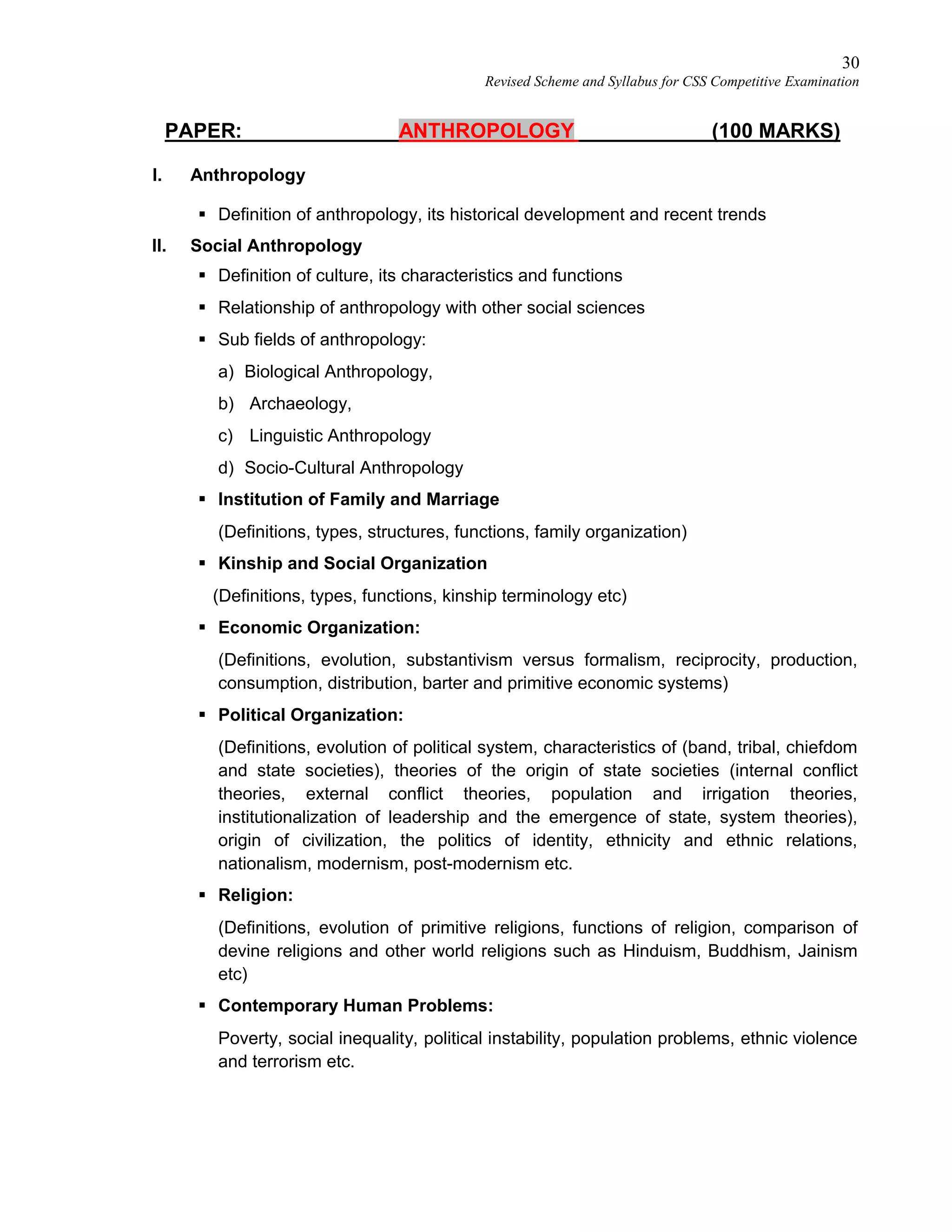
PAPER: ANTHROPOLOGY (100 MARKS)
I. Anthropology
 Definition of anthropology, its historical development and recent trends
II. Social Anthropology
 Definition of culture, its characteristics and functions
 Relationship of anthropology with other social sciences
 Sub fields of anthropology:
a) Biological Anthropology,
b) Archaeology,
c) Linguistic Anthropology
d) Socio-Cultural Anthropology
 Institution of Family and Marriage
(Definitions, types, structures, functions, family organization)
 Kinship and Social Organization
(Definitions, types, functions, kinship terminology etc)
 Economic Organization:
(Definitions, evolution, substantivism versus formalism, reciprocity, production,
consumption, distribution, barter and primitive economic systems)
 Political Organization:
(Definitions, evolution of political system, characteristics of (band, tribal, chiefdom
and state societies), theories of the origin of state societies (internal conflict
theories, external conflict theories, population and irrigation theories,
institutionalization of leadership and the emergence of state, system theories),
origin of civilization, the politics of identity, ethnicity and ethnic relations,
nationalism, modernism, post-modernism etc.
 Religion:
(Definitions, evolution of primitive religions, functions of religion, comparison of
devine religions and other world religions such as Hinduism, Buddhism, Jainism
etc)
 Contemporary Human Problems:
Poverty, social inequality, political instability, population problems, ethnic violence
and terrorism etc.
31
Revised Scheme and Syllabus for CSS Competitive Examination
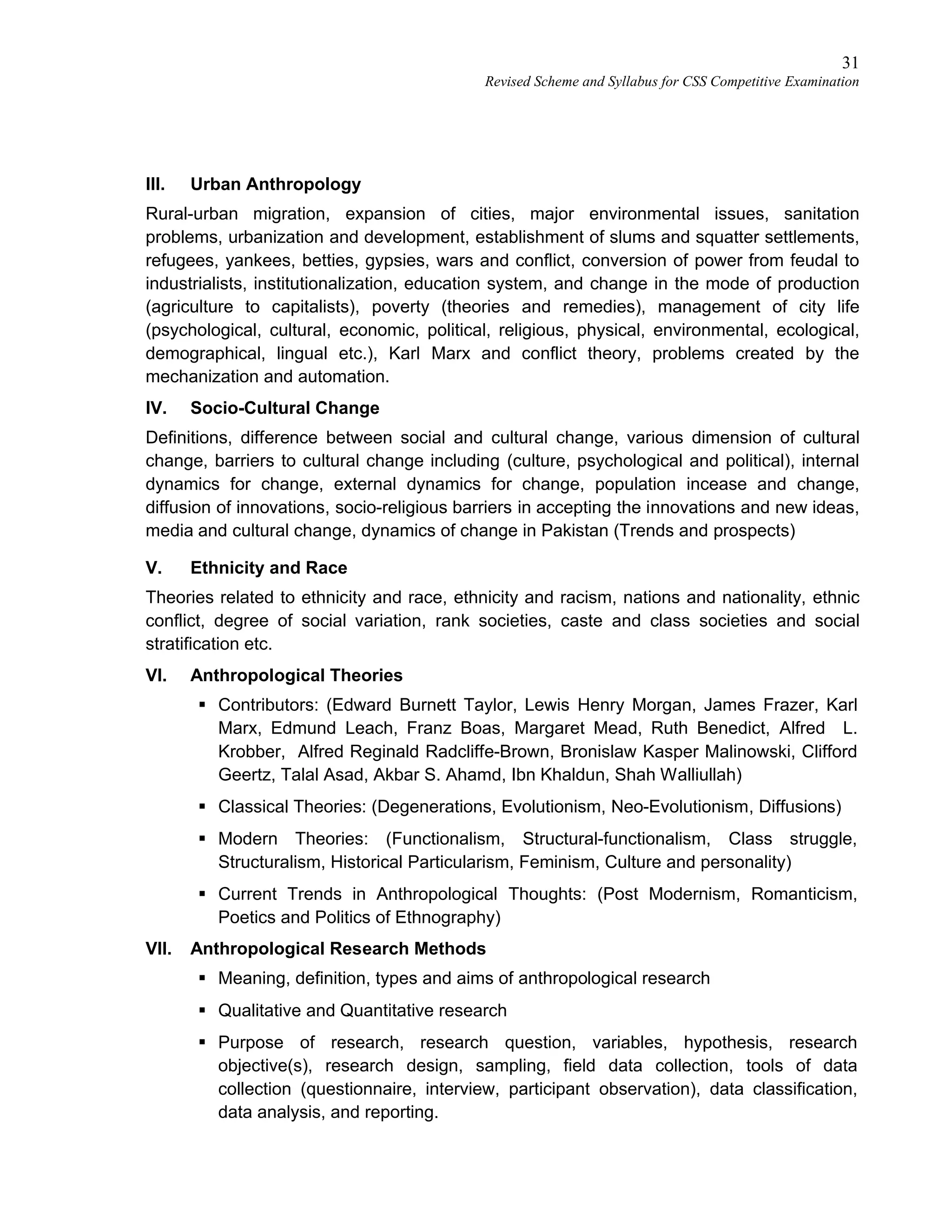
III. Urban Anthropology
Rural-urban migration, expansion of cities, major environmental issues, sanitation
problems, urbanization and development, establishment of slums and squatter settlements,
refugees, yankees, betties, gypsies, wars and conflict, conversion of power from feudal to
industrialists, institutionalization, education system, and change in the mode of production
(agriculture to capitalists), poverty (theories and remedies), management of city life
(psychological, cultural, economic, political, religious, physical, environmental, ecological,
demographical, lingual etc.), Karl Marx and conflict theory, problems created by the
mechanization and automation.
IV. Socio-Cultural Change
Definitions, difference between social and cultural change, various dimension of cultural
change, barriers to cultural change including (culture, psychological and political), internal
dynamics for change, external dynamics for change, population incease and change,
diffusion of innovations, socio-religious barriers in accepting the innovations and new ideas,
media and cultural change, dynamics of change in Pakistan (Trends and prospects)
V. Ethnicity and Race
Theories related to ethnicity and race, ethnicity and racism, nations and nationality, ethnic
conflict, degree of social variation, rank societies, caste and class societies and social
stratification etc.
VI. Anthropological Theories
 Contributors: (Edward Burnett Taylor, Lewis Henry Morgan, James Frazer, Karl
Marx, Edmund Leach, Franz Boas, Margaret Mead, Ruth Benedict, Alfred L.
Krobber, Alfred Reginald Radcliffe-Brown, Bronislaw Kasper Malinowski, Clifford
Geertz, Talal Asad, Akbar S. Ahamd, Ibn Khaldun, Shah Walliullah)
 Classical Theories: (Degenerations, Evolutionism, Neo-Evolutionism, Diffusions)
 Modern Theories: (Functionalism, Structural-functionalism, Class struggle,
Structuralism, Historical Particularism, Feminism, Culture and personality)
 Current Trends in Anthropological Thoughts: (Post Modernism, Romanticism,
Poetics and Politics of Ethnography)
VII. Anthropological Research Methods
 Meaning, definition, types and aims of anthropological research
 Qualitative and Quantitative research
 Purpose of research, research question, variables, hypothesis, research
objective(s), research design, sampling, field data collection, tools of data
collection (questionnaire, interview, participant observation), data classification,
data analysis, and reporting.
32
Revised Scheme and Syllabus for CSS Competitive Examination
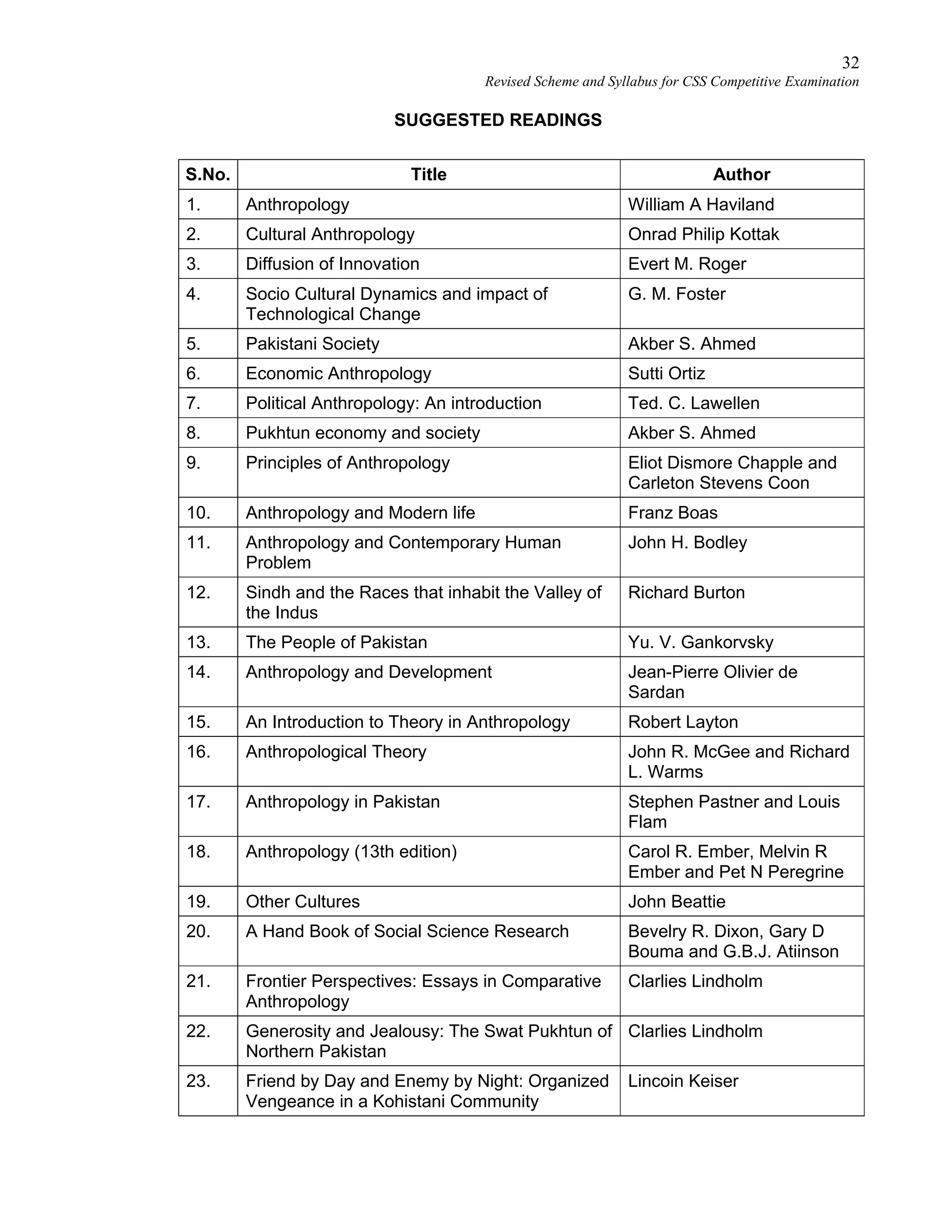
SUGGESTED READINGS
S.No. Title Author
1. Anthropology William A Haviland
2. Cultural Anthropology Onrad Philip Kottak
3. Diffusion of Innovation Evert M. Roger
4. Socio Cultural Dynamics and impact of
Technological Change
G. M. Foster
5. Pakistani Society Akber S. Ahmed
6. Economic Anthropology Sutti Ortiz
7. Political Anthropology: An introduction Ted. C. Lawellen
8. Pukhtun economy and society Akber S. Ahmed
9. Principles of Anthropology Eliot Dismore Chapple and
Carleton Stevens Coon
10. Anthropology and Modern life Franz Boas
11. Anthropology and Contemporary Human
Problem
John H. Bodley
12. Sindh and the Races that inhabit the Valley of
the Indus
Richard Burton
13. The People of Pakistan Yu. V. Gankorvsky
14. Anthropology and Development Jean-Pierre Olivier de
Sardan
15. An Introduction to Theory in Anthropology Robert Layton
16. Anthropological Theory John R. McGee and Richard
L. Warms
17. Anthropology in Pakistan Stephen Pastner and Louis
Flam
18. Anthropology (13th edition) Carol R. Ember, Melvin R
Ember and Pet N Peregrine
19. Other Cultures John Beattie
20. A Hand Book of Social Science Research Bevelry R. Dixon, Gary D
Bouma and G.B.J. Atiinson
21. Frontier Perspectives: Essays in Comparative
Anthropology
Clarlies Lindholm
22. Generosity and Jealousy: The Swat Pukhtun of
Northern Pakistan
Clarlies Lindholm
23. Friend by Day and Enemy by Night: Organized
Vengeance in a Kohistani Community
Lincoin Keiser
33
Revised Scheme and Syllabus for CSS Competitive Examination
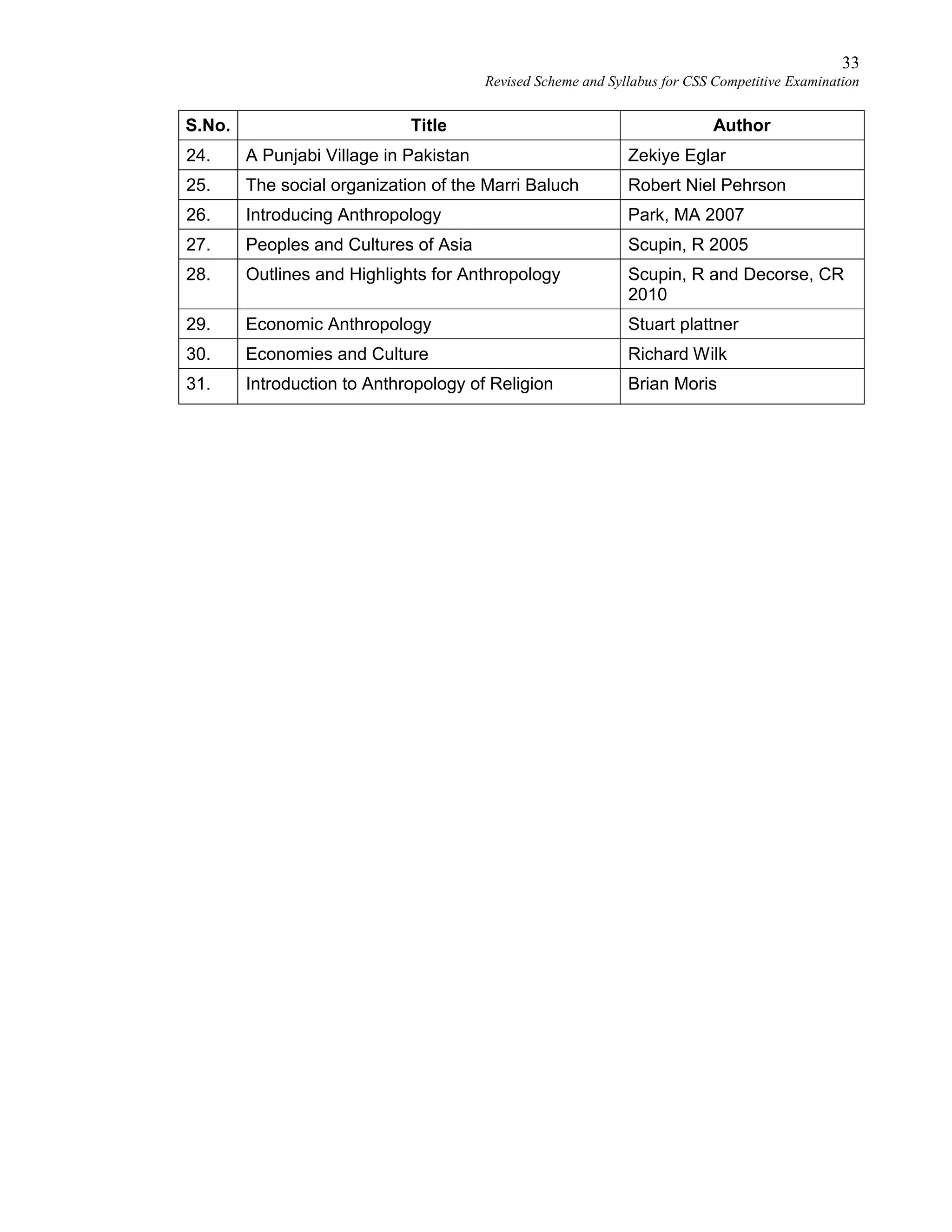
S.No. Title Author
24. A Punjabi Village in Pakistan Zekiye Eglar
25. The social organization of the Marri Baluch Robert Niel Pehrson
26. Introducing Anthropology Park, MA 2007
27. Peoples and Cultures of Asia Scupin, R 2005
28. Outlines and Highlights for Anthropology Scupin, R and Decorse, CR
2010
29. Economic Anthropology Stuart plattner
30. Economies and Culture Richard Wilk
31. Introduction to Anthropology of Religion Brian Moris
34
Revised Scheme and Syllabus for CSS Competitive Examination
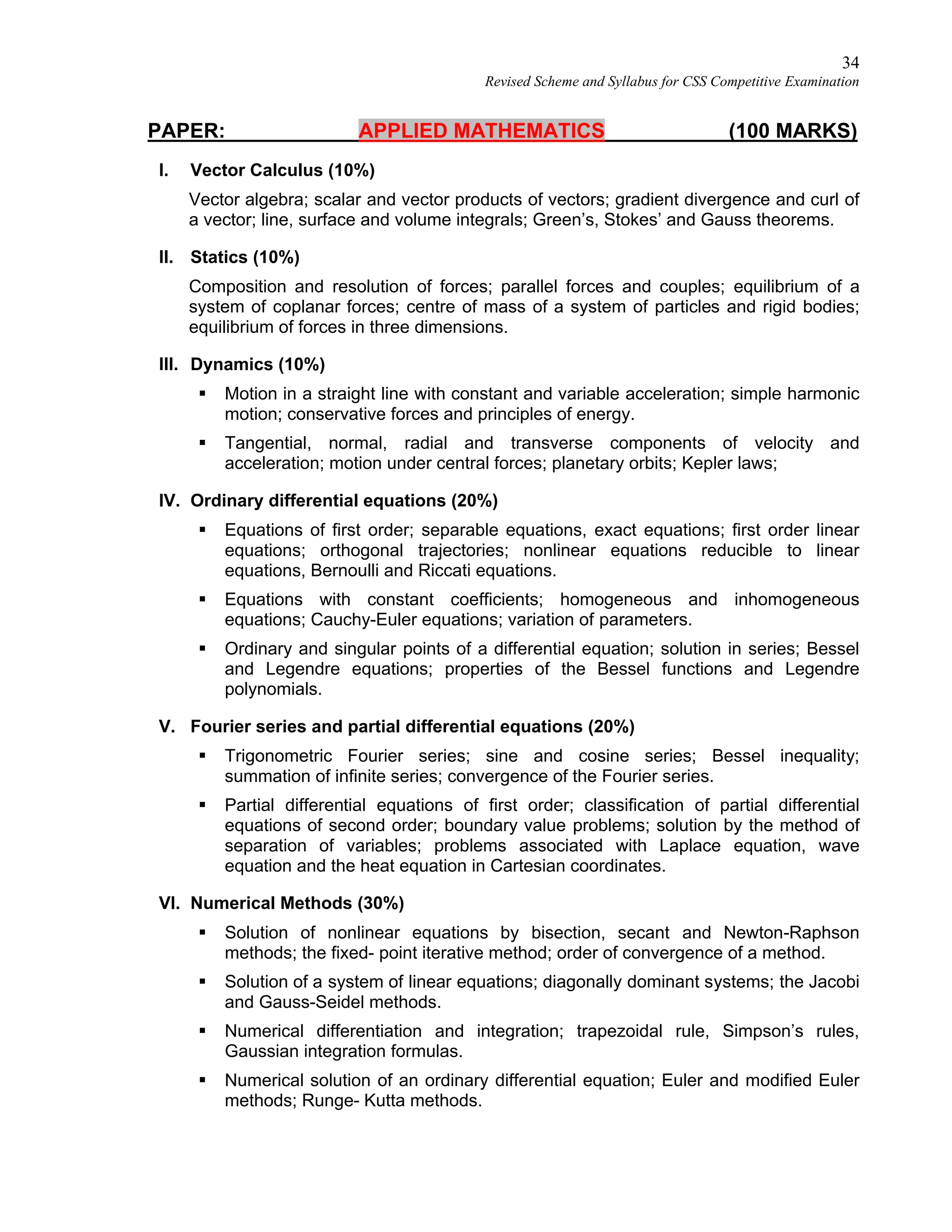
PAPER: APPLIED MATHEMATICS (100 MARKS)
I. Vector Calculus (10%)
Vector algebra; scalar and vector products of vectors; gradient divergence and curl of
a vector; line, surface and volume integrals; Green’s, Stokes’ and Gauss theorems.
II. Statics (10%)
Composition and resolution of forces; parallel forces and couples; equilibrium of a
system of coplanar forces; centre of mass of a system of particles and rigid bodies;
equilibrium of forces in three dimensions.
III. Dynamics (10%)
 Motion in a straight line with constant and variable acceleration; simple harmonic
motion; conservative forces and principles of energy.
 Tangential, normal, radial and transverse components of velocity and
acceleration; motion under central forces; planetary orbits; Kepler laws;
IV. Ordinary differential equations (20%)
 Equations of first order; separable equations, exact equations; first order linear
equations; orthogonal trajectories; nonlinear equations reducible to linear
equations, Bernoulli and Riccati equations.
 Equations with constant coefficients; homogeneous and inhomogeneous
equations; Cauchy-Euler equations; variation of parameters.
 Ordinary and singular points of a differential equation; solution in series; Bessel
and Legendre equations; properties of the Bessel functions and Legendre
polynomials.
V. Fourier series and partial differential equations (20%)
 Trigonometric Fourier series; sine and cosine series; Bessel inequality;
summation of infinite series; convergence of the Fourier series.
 Partial differential equations of first order; classification of partial differential
equations of second order; boundary value problems; solution by the method of
separation of variables; problems associated with Laplace equation, wave
equation and the heat equation in Cartesian coordinates.
VI. Numerical Methods (30%)
 Solution of nonlinear equations by bisection, secant and Newton-Raphson
methods; the fixed- point iterative method; order of convergence of a method.
 Solution of a system of linear equations; diagonally dominant systems; the Jacobi
and Gauss-Seidel methods.
 Numerical differentiation and integration; trapezoidal rule, Simpson’s rules,
Gaussian integration formulas.
 Numerical solution of an ordinary differential equation; Euler and modified Euler
methods; Runge- Kutta methods.
35
Revised Scheme and Syllabus for CSS Competitive Examination
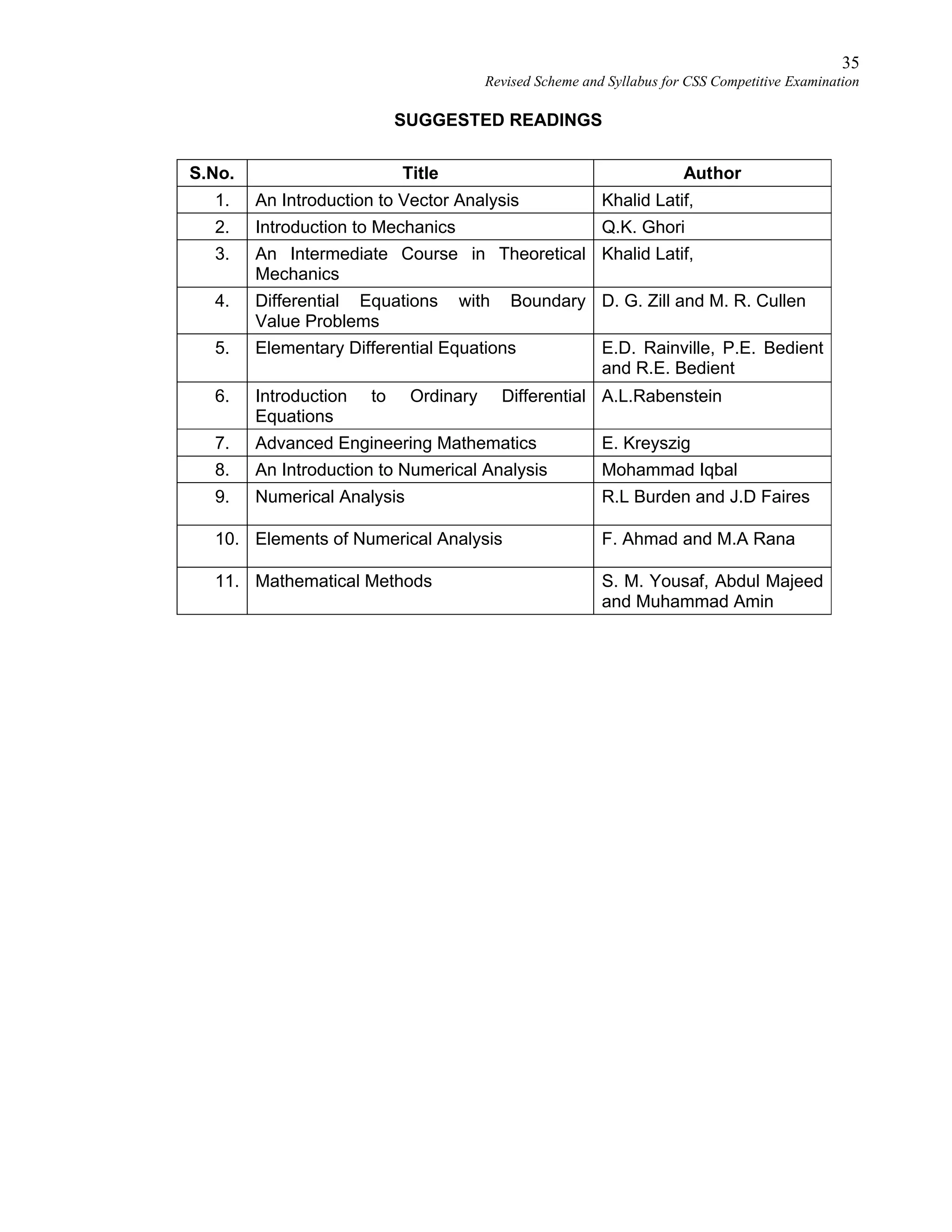
SUGGESTED READINGS
S.No. Title Author
1. An Introduction to Vector Analysis Khalid Latif,
2. Introduction to Mechanics Q.K. Ghori
3. An Intermediate Course in Theoretical
Mechanics
Khalid Latif,
4. Differential Equations with Boundary
Value Problems
D. G. Zill and M. R. Cullen
5. Elementary Differential Equations E.D. Rainville, P.E. Bedient
and R.E. Bedient
6. Introduction to Ordinary Differential
Equations
A.L.Rabenstein
7. Advanced Engineering Mathematics E. Kreyszig
8. An Introduction to Numerical Analysis Mohammad Iqbal
9. Numerical Analysis R.L Burden and J.D Faires
10. Elements of Numerical Analysis F. Ahmad and M.A Rana
11. Mathematical Methods S. M. Yousaf, Abdul Majeed
and Muhammad Amin
36
Revised Scheme and Syllabus for CSS Competitive Examination
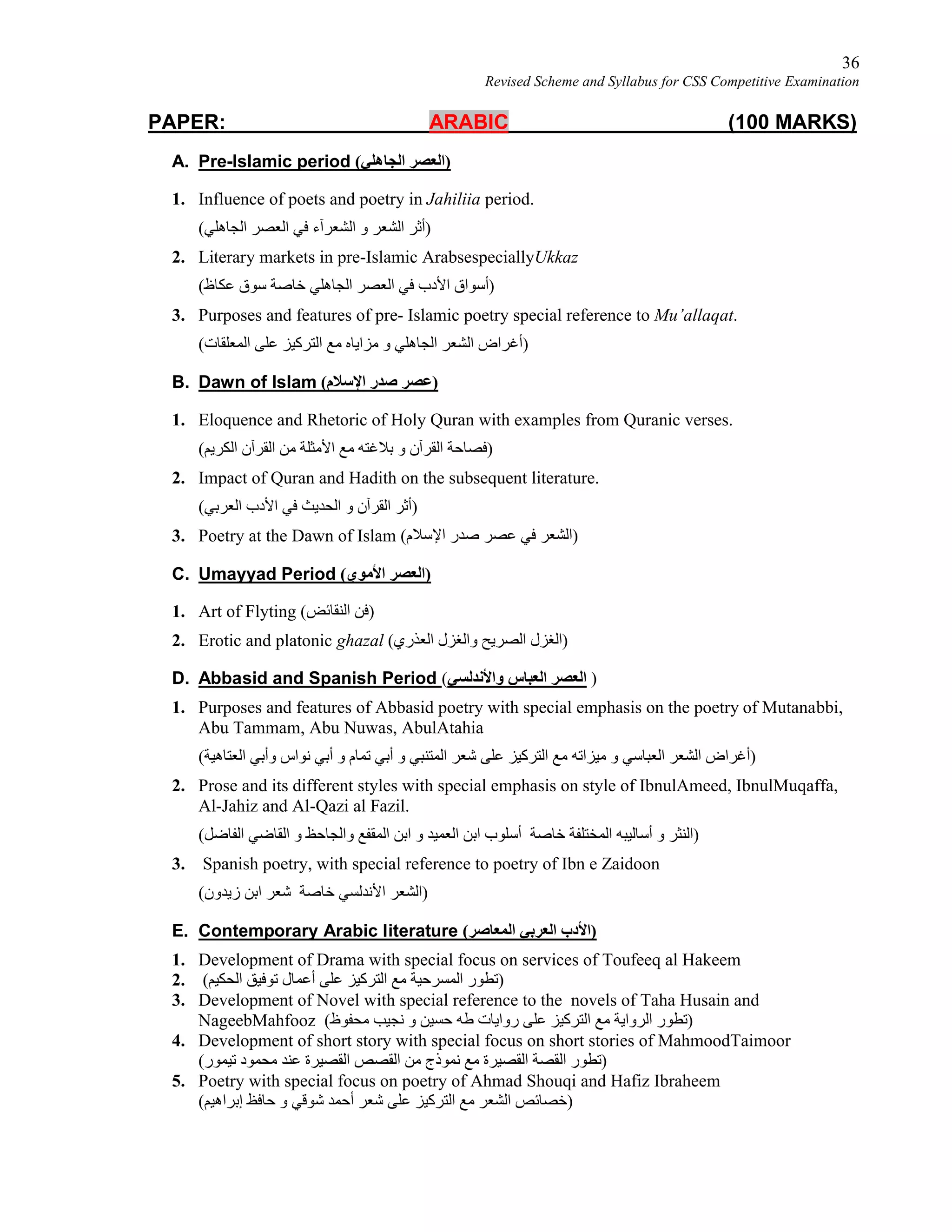
PAPER: ARABIC (100 MARKS)
A. Pre-Islamic period (‫اﻟﺠﺎھﻠﻲ‬ ‫)اﻟﻌﺼﺮ‬
1. Influence of poets and poetry in Jahiliia period.
(‫اﻟﺠﺎھﻠﻲ‬ ‫اﻟﻌﺼﺮ‬ ‫ﻓﻲ‬ ‫اﻟﺸﻌﺮآء‬ ‫و‬ ‫اﻟﺸﻌﺮ‬ ‫)أﺛﺮ‬
2. Literary markets in pre-Islamic ArabsespeciallyUkkaz
(‫ﻋﻜﺎظ‬ ‫ﺳﻮق‬ ‫ﺧﺎﺻﺔ‬ ‫اﻟﺠﺎھﻠﻲ‬ ‫اﻟﻌﺼﺮ‬ ‫ﻓﻲ‬ ‫اﻷدب‬ ‫)أﺳﻮاق‬
3. Purposes and features of pre- Islamic poetry special reference to Mu’allaqat.
(‫اﻟﻤﻌﻠﻘﺎت‬ ‫ﻋﻠﻰ‬ ‫اﻟﺘﺮﻛﯿﺰ‬ ‫ﻣﻊ‬ ‫ﻣﺰاﯾﺎه‬ ‫و‬ ‫اﻟﺠﺎھﻠﻲ‬ ‫اﻟﺸﻌﺮ‬ ‫)أﻏﺮاض‬
B. Dawn of Islam (‫اﻹﺳﻼم‬ ‫ﺻﺪر‬ ‫)ﻋﺼﺮ‬
1. Eloquence and Rhetoric of Holy Quran with examples from Quranic verses.
(‫اﻟﻜﺮﯾﻢ‬ ‫اﻟﻘﺮآن‬ ‫ﻣﻦ‬ ‫اﻷﻣﺜﻠﺔ‬ ‫ﻣﻊ‬ ‫ﺑﻼﻏﺘﮫ‬ ‫و‬ ‫اﻟﻘﺮآن‬ ‫)ﻓﺼﺎﺣﺔ‬
2. Impact of Quran and Hadith on the subsequent literature.
(‫اﻟﻌﺮﺑﻲ‬ ‫اﻷدب‬ ‫ﻓﻲ‬ ‫اﻟﺤﺪﯾﺚ‬ ‫و‬ ‫اﻟﻘﺮآن‬ ‫)أﺛﺮ‬
3. Poetry at the Dawn of Islam (‫اﻹﺳﻼم‬ ‫ﺻﺪر‬ ‫ﻋﺼﺮ‬ ‫ﻓﻲ‬ ‫)اﻟﺸﻌﺮ‬
C. Umayyad Period (‫اﻷﻣﻮي‬ ‫)اﻟﻌﺼﺮ‬
1. Art of Flyting (‫اﻟﻨﻘﺎﺋﺾ‬ ‫)ﻓﻦ‬
2. Erotic and platonic ghazal (‫اﻟﻌﺬري‬ ‫واﻟﻐﺰل‬ ‫اﻟﺼﺮﯾﺢ‬ ‫)اﻟﻐﺰل‬
D. Abbasid and Spanish Period (‫واﻷﻧﺪﻟﺴﻲ‬ ‫اﻟﻌﺒﺎس‬ ‫اﻟﻌﺼﺮ‬ )
1. Purposes and features of Abbasid poetry with special emphasis on the poetry of Mutanabbi,
Abu Tammam, Abu Nuwas, AbulAtahia
(‫اﻟﻌﺘﺎھﯿﺔ‬ ‫وأﺑﻲ‬ ‫ﻧﻮاس‬ ‫أﺑﻲ‬ ‫و‬ ‫ﺗﻤﺎم‬ ‫أﺑﻲ‬ ‫و‬ ‫اﻟﻤﺘﻨﺒﻲ‬ ‫ﺷﻌﺮ‬ ‫ﻋﻠﻰ‬ ‫اﻟﺘﺮﻛﯿﺰ‬ ‫ﻣﻊ‬ ‫ﻣﯿﺰاﺗﮫ‬ ‫و‬ ‫اﻟﻌﺒﺎﺳﻲ‬ ‫اﻟﺸﻌﺮ‬ ‫)أﻏﺮاض‬
2. Prose and its different styles with special emphasis on style of IbnulAmeed, IbnulMuqaffa,
Al-Jahiz and Al-Qazi al Fazil.
(‫اﻟﻔﺎﺿﻞ‬ ‫اﻟﻘﺎﺿﻲ‬ ‫و‬ ‫واﻟﺠﺎﺣﻆ‬ ‫اﻟﻤﻘﻔﻊ‬ ‫اﺑﻦ‬ ‫و‬ ‫اﻟﻌﻤﯿﺪ‬ ‫اﺑﻦ‬ ‫أﺳﻠﻮب‬ ‫ﺧﺎﺻﺔ‬ ‫اﻟﻤﺨﺘﻠﻔﺔ‬ ‫أﺳﺎﻟﯿﺒﮫ‬ ‫و‬ ‫)اﻟﻨﺜﺮ‬
3. Spanish poetry, with special reference to poetry of Ibn e Zaidoon
(‫زﯾﺪون‬ ‫اﺑﻦ‬ ‫ﺷﻌﺮ‬ ‫ﺧﺎﺻﺔ‬ ‫اﻷﻧﺪﻟﺴﻲ‬ ‫)اﻟﺸﻌﺮ‬
E. Contemporary Arabic literature (‫اﻟﻤﻌﺎﺻﺮ‬ ‫اﻟﻌﺮﺑﻲ‬ ‫)اﻷدب‬
1. Development of Drama with special focus on services of Toufeeq al Hakeem
2. (‫اﻟﺤﻜﯿﻢ‬ ‫ﺗﻮﻓﯿﻖ‬ ‫أﻋﻤﺎل‬ ‫ﻋﻠﻰ‬ ‫اﻟﺘﺮﻛﯿﺰ‬ ‫ﻣﻊ‬ ‫اﻟﻤﺴﺮﺣﯿﺔ‬ ‫)ﺗﻄﻮر‬
3. Development of Novel with special reference to the novels of Taha Husain and
NageebMahfooz (‫ﻣﺤﻔﻮظ‬ ‫ﻧﺠﯿﺐ‬ ‫و‬ ‫ﺣﺴﯿﻦ‬ ‫ﻃﮫ‬ ‫رواﯾﺎت‬ ‫ﻋﻠﻰ‬ ‫اﻟﺘﺮﻛﯿﺰ‬ ‫ﻣﻊ‬ ‫اﻟﺮواﯾﺔ‬ ‫)ﺗﻄﻮر‬
4. Development of short story with special focus on short stories of MahmoodTaimoor
(‫ﺗﯿﻤﻮر‬ ‫ﻣﺤﻤﻮد‬ ‫ﻋﻨﺪ‬ ‫اﻟﻘﺼﯿﺮة‬ ‫اﻟﻘﺼﺺ‬ ‫ﻣﻦ‬ ‫ﻧﻤﻮذج‬ ‫ﻣﻊ‬ ‫اﻟﻘﺼﯿﺮة‬ ‫اﻟﻘﺼﺔ‬ ‫)ﺗﻄﻮر‬
5. Poetry with special focus on poetry of Ahmad Shouqi and Hafiz Ibraheem
(‫إﺑﺮاھﯿﻢ‬ ‫ﺣﺎﻓﻆ‬ ‫و‬ ‫ﺷﻮﻗﻲ‬ ‫أﺣﻤﺪ‬ ‫ﺷﻌﺮ‬ ‫ﻋﻠﻰ‬ ‫اﻟﺘﺮﻛﯿﺰ‬ ‫ﻣﻊ‬ ‫اﻟﺸﻌﺮ‬ ‫)ﺧﺼﺎﺋﺺ‬
37
Revised Scheme and Syllabus for CSS Competitive Examination
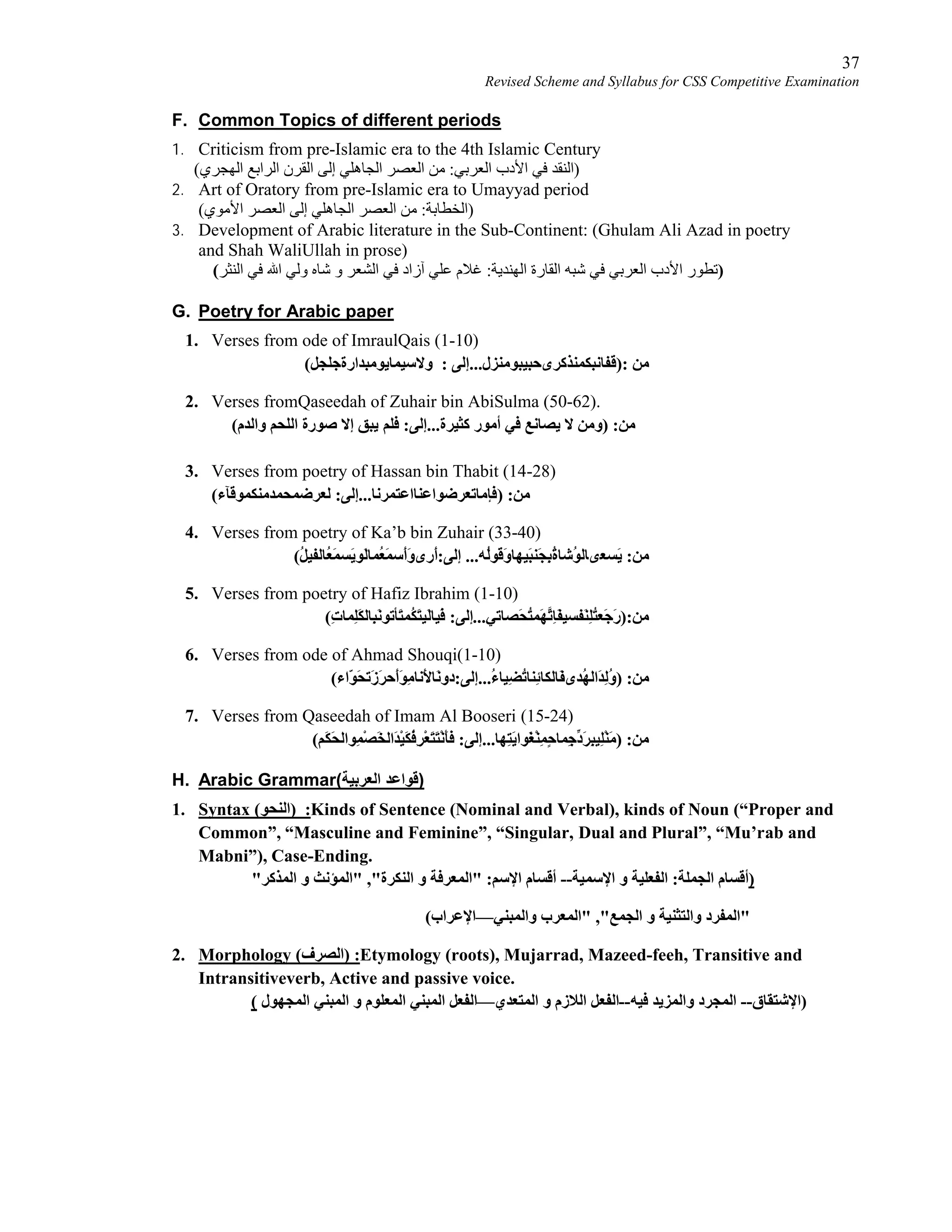
F. Common Topics of different periods
1. Criticism from pre-Islamic era to the 4th Islamic Century
(‫اﻟﮭﺠﺮي‬ ‫اﻟﺮاﺑﻊ‬ ‫اﻟﻘﺮن‬ ‫إﻟﻰ‬ ‫اﻟﺠﺎھﻠﻲ‬ ‫اﻟﻌﺼﺮ‬ ‫ﻣﻦ‬ :‫اﻟﻌﺮﺑﻲ‬ ‫اﻷدب‬ ‫ﻓﻲ‬ ‫)اﻟﻨﻘﺪ‬
2. Art of Oratory from pre-Islamic era to Umayyad period
(‫اﻷﻣﻮي‬ ‫اﻟﻌﺼﺮ‬ ‫إﻟﻰ‬ ‫اﻟﺠﺎھﻠﻲ‬ ‫اﻟﻌﺼﺮ‬ ‫ﻣﻦ‬ :‫)اﻟﺨﻄﺎﺑﺔ‬
3. Development of Arabic literature in the Sub-Continent: (Ghulam Ali Azad in poetry
and Shah WaliUllah in prose)
)‫اﻟﻨﺜﺮ‬ ‫ﻓﻲ‬ ‫اﷲ‬ ‫وﻟﻲ‬ ‫ﺷﺎه‬ ‫و‬ ‫اﻟﺸﻌﺮ‬ ‫ﻓﻲ‬ ‫آزاد‬ ‫ﻋﻠﻲ‬ ‫ﻏﻼم‬ :‫اﻟﮭﻨﺪﯾﺔ‬ ‫اﻟﻘﺎرة‬ ‫ﺷﺒﮫ‬ ‫ﻓﻲ‬ ‫اﻟﻌﺮﺑﻲ‬ ‫اﻷدب‬ ‫ﺗﻄﻮر‬(
G. Poetry for Arabic paper
1. Verses from ode of ImraulQais (1-10)
‫ﻣﻦ‬):‫ﻗﻔﺎﻧﺒﻜﻤﻨﺬﻛﺮىﺤﺒﯿﺒﻮﻣﻨﺰل‬...‫إﻟﻰ‬:‫وﻻ‬‫ﺳﯿﻤﺎﯾﻮﻣﺒﺪارةﺟﻠﺠﻞ‬(
2. Verses fromQaseedah of Zuhair bin AbiSulma (50-62).
:‫ﻛﺜﯿﺮة...إﻟﻰ‬ ‫أﻣﻮر‬ ‫ﻓﻲ‬ ‫ﯾﺼﺎﻧﻊ‬ ‫ﻻ‬ ‫)وﻣﻦ‬ :‫ﻣﻦ‬‫واﻟﺪم‬ ‫اﻟﻠﺤﻢ‬ ‫ﺻﻮرة‬ ‫إﻻ‬ ‫ﯾﺒﻖ‬ ‫ﻓﻠﻢ‬(
3. Verses from poetry of Hassan bin Thabit (14-28)
(‫ﻟﻌﺮﺿﻤﺤﻤﺪﻣﻨﻜﻤﻮﻗﺂء‬ :‫)ﻓﺈﻣﺎﺗﻌﺮﺿﻮاﻋﻨﺎاﻋﺘﻤﺮﻧﺎ...إﻟﻰ‬ :‫ﻣﻦ‬
4. Verses from poetry of Ka’b bin Zuhair (33-40)
‫ﻣﻦ‬:‫َﯿﮭﺎ‬‫ﺒ‬‫َﻨ‬‫ﺠ‬ِ‫ﺑ‬ُ‫ة‬‫ُﺷﺎ‬‫ﻮ‬‫َﺴﻌىﺎﻟ‬‫ﯾ‬:‫إﻟﻰ‬ ...‫ُﮫ‬‫ﻟ‬‫َﻮ‬‫ﻗ‬َ‫و‬ُ‫ﻞ‬‫ُﺎﻟﻔﯿ‬‫ﻌ‬َ‫ﻤ‬‫َﺴ‬‫ﯾ‬‫َﻮ‬‫ﻟ‬‫ُﻤﺎ‬‫ﻌ‬َ‫ﻤ‬‫َﺳ‬‫أ‬َ‫ﻮ‬‫َرى‬‫أ‬(
5. Verses from poetry of Hafiz Ibrahim (1-10)
):‫ﻣﻦ‬‫َﺼﺎﺗﻲ‬‫ﺤ‬ُ‫ﺘ‬‫َﻤ‬‫ﮭ‬‫ﱠ‬‫ﺗ‬ِ‫ﺎ‬َ‫ﻔ‬‫َﻔﺴﯿ‬‫ﻨ‬ِ‫ﻠ‬ُ‫ﺘ‬‫َﻌ‬‫ﺟ‬َ‫ر‬:‫...إﻟﻰ‬ِ‫ت‬‫ِﻤﺎ‬‫ﻠ‬َ‫ﻜ‬‫ِﺎﻟ‬‫ﺒ‬َ‫ﻧ‬‫َﺄﺗﻮ‬‫ﺘ‬‫ُﻤ‬‫ﻜ‬َ‫ﺘ‬‫َﯿ‬‫ﻟ‬‫َﯿﺎ‬‫ﻓ‬(
6. Verses from ode of Ahmad Shouqi(1-10)
) :‫ﻣﻦ‬ُ‫ء‬‫ِﯿﺎ‬‫ﻀ‬ُ‫ﺗ‬‫ِﻨﺎ‬‫ﺋ‬‫َﺎﻟﻜﺎ‬‫ﻔ‬‫ُﺪى‬‫ﮭ‬‫َاﻟ‬‫ﺪ‬ِ‫ﻟ‬ُ‫و‬:‫...إﻟﻰ‬‫َﺗ‬‫ز‬َ‫ﺮ‬‫َﺣ‬‫أ‬َ‫ﻮ‬ِ‫ﻣ‬‫َﻧﺎ‬‫ﻷ‬‫َﺎ‬‫ﻧ‬‫دو‬(‫ّاء‬‫ﻮ‬َ‫ﺤ‬
7. Verses from Qaseedah of Imam Al Booseri (15-24)
) :‫ﻣﻦ‬‫ِﮭﺎ‬‫ﺘ‬َ‫ﯾ‬‫َﻮا‬‫ﻐ‬ْ‫ﻨ‬ِ‫ﻤ‬ٍ‫ﺣ‬‫ِﻤﺎ‬‫ﺟ‬‫ﱢ‬‫د‬َ‫ﺮ‬ِ‫ﺒ‬‫ِﯿ‬‫ﻠ‬ْ‫ﻨ‬َ‫ﻣ‬:‫...إﻟﻰ‬َ‫ﻜ‬َ‫ﺤ‬‫ِﻮاﻟ‬‫ﻤ‬ْ‫ﺼ‬َ‫ﺨ‬‫َاﻟ‬‫ﺪ‬ْ‫ﯿ‬َ‫ﻜ‬ُ‫ﻓ‬ِ‫ﺮ‬ْ‫ﻌ‬َ‫ﺘ‬َ‫ﺘ‬ْ‫ﻧ‬َ‫ﺄ‬‫ﻓ‬(‫ﻢ‬
H. Arabic Grammar(‫اﻟﻌﺮﺑﯿﺔ‬ ‫)ﻗﻮاﻋﺪ‬
1. Syntax (‫)اﻟﻨﺤﻮ‬ :Kinds of Sentence (Nominal and Verbal), kinds of Noun (“Proper and
Common”, “Masculine and Feminine”, “Singular, Dual and Plural”, “Mu’rab and
Mabni”), Case-Ending.
)‫اﻹﺳﻤﯿﺔ‬ ‫و‬ ‫اﻟﻔﻌﻠﯿﺔ‬ :‫اﻟﺠﻤﻠﺔ‬ ‫أﻗﺴﺎم‬--‫"اﻟﻤﺆﻧﺚ‬ ,"‫اﻟﻨﻜﺮة‬ ‫و‬ ‫"اﻟﻤﻌﺮﻓﺔ‬ :‫اﻹﺳﻢ‬ ‫أﻗﺴﺎم‬"‫اﻟﻤﺬﻛﺮ‬ ‫و‬
‫واﻟﻤﺒﻨﻲ‬ ‫"اﻟﻤﻌﺮب‬ ,"‫اﻟﺠﻤﻊ‬ ‫و‬ ‫واﻟﺘﺜﻨﯿﺔ‬ ‫"اﻟﻤﻔﺮد‬—(‫اﻹﻋﺮاب‬
2. Morphology (‫)اﻟﺼﺮف‬ :Etymology (roots), Mujarrad, Mazeed-feeh, Transitive and
Intransitiveverb, Active and passive voice.
( ‫اﻟﻤﺠﮭﻮل‬ ‫اﻟﻤﺒﻨﻲ‬ ‫و‬ ‫اﻟﻤﻌﻠﻮم‬ ‫اﻟﻤﺒﻨﻲ‬ ‫اﻟﻤﺘﻌﺪي—اﻟﻔﻌﻞ‬ ‫و‬ ‫اﻟﻼزم‬ ‫ﻓﯿﮫ--اﻟﻔﻌﻞ‬ ‫واﻟﻤﺰﯾﺪ‬ ‫اﻟﻤﺠﺮد‬ --‫)اﻹﺷﺘﻘﺎق‬
38
Revised Scheme and Syllabus for CSS Competitive Examination
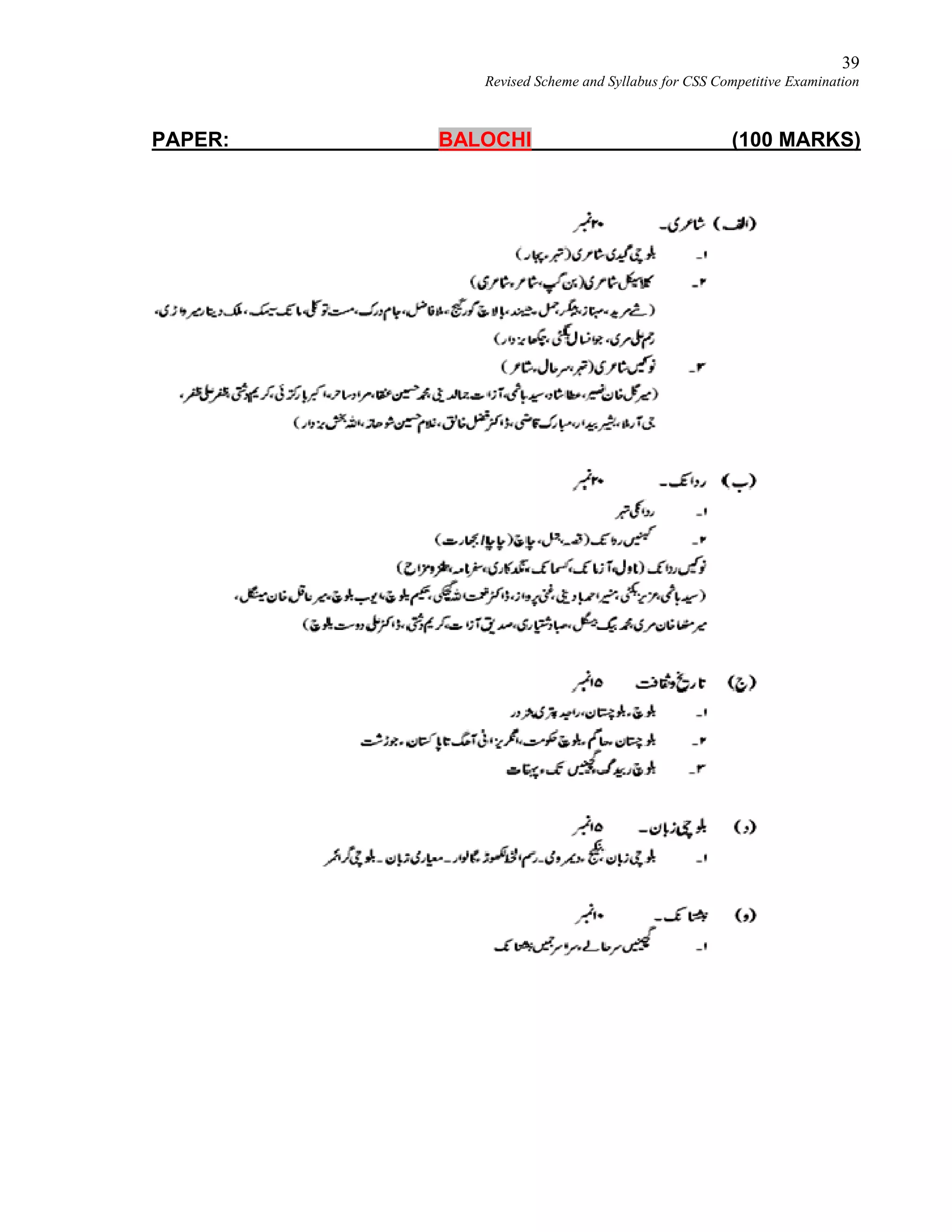
39
Revised Scheme and Syllabus for CSS Competitive Examination
PAPER: BALOCHI (100 MARKS)
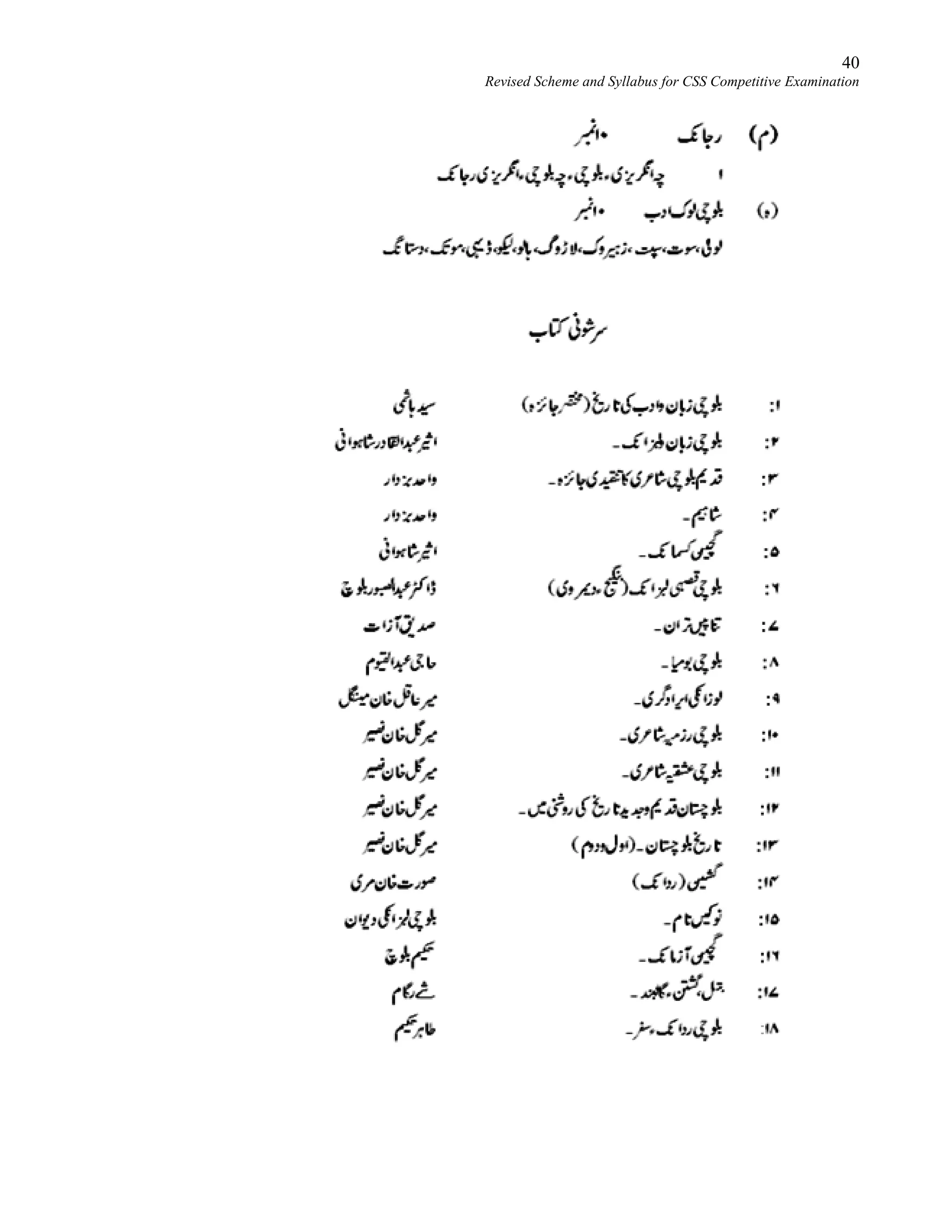
40
Revised Scheme and Syllabus for CSS Competitive Examination
41
Revised Scheme and Syllabus for CSS Competitive Examination
PAPER: BOTANY (100 MARKS)
I. Algae, Fungi and Bryophytes
 Phycology: Distribution, Classification, Structure, Life History and Economic
importance of the main groups of Algae.
 Mycology and Plant Pathology: Structure, Reproduction, Classification and
Economic importance of the main groups of Fungi. Diseases of economically
important crops and general principles of their control
 Bryology: Structure and reproduction of bryophytes, Evolution of Gametophyte
and Sporophyte.
II. Peteridophyta and Gymnosperms
 General account with special reference to structure, life history and affinities of
both Pteridophytes and Gymnosperms. Ontogeny and structure of seed,
classification and economic importance of Gymnosperms.
III. Anatomy and Embryology
 Primary and secondary tissues. Meristems. Secondary growth in dicot stem.
Anatomy of leaf, stem and root.
 Micro and megasporogenesis, pollination mechanism, fertilization, development of
Embryo and Endosperm, Seed dispersal.
IV. Taxonomy of Angiosperms
 Systems of classification. Rules of botanical nomenclature. Concepts of
speciation. Introduction to modern trends in plant taxonomy: bio-systematic,
chemotaxonomy and numerical taxonomy. General characters and economic
importance of common angiosperm families.
V. Plant Physiology
 Plant water relations, Osmotic Quantities, component potentials of water and their
role in transport, water absorption by roots, transpiration. Role of essential mineral
elements and their uptake. Plant hormones. Photoperiodism, Vernalization.
Dormancy and Seed germination.Enzymes.
 Photosynthesis: Plant pigments, Light reaction, CO2 fixation, Mechanism of
photophosphorylation.
 Respiration: Glycolysis, Kreb cycle, Mechanism of oxidative phosphorylation.
VI. Ecology
 Influence of climatic, edaphic and biotic factors on plant growth. Vegetation
sampling techniques. Concepts of ecosystems and their productivity, ecological
energetics, Pyramids (of numbers, biomass and energy), trophic levels, food
chains and food webs. Biogeochemical cycles (Hydrological and Nitrogen).
Succession.
 Causes and reclamation of soil salinity and water logging in Pakistan. Soil
erosion, its control and soil conservation methods. Deforestation. Biodiversity
conservation.Pollution.
42
Revised Scheme and Syllabus for CSS Competitive Examination
VII. Cytology
 Cell cycle, cellular morphology, chemistry of cell wall and cell membrane, cell to
cell communication, plant tissue and cell culture, cell senescence and cell death.
 Ultra-structure of various cell organelles: Mitochondria, Golgi bodies, Endoplasmic
reticulum, Plastids, Ribosomes, Glyoxysomes, Vaculoes, Nucleus.
VIII. Genetics
 Mendelian Genetics, Multiple Alleles, Polygenic inheritance, Gene interaction,
Epistasis and pleiotropy, Sex-linked inheritance, Chromosomal aberrations,
Mutations, DNA repair.
IX. Evolution
 Introduction of Evolution, Evolutionary history, Evolution of life, Convergent
Evolution, Divergent Evolution, Parallel Evolution and Natural selection
X. Molecular Biology
 Nucleic acids, DNA as hereditary material, DNA replication, Transcription, Genetic
code, Protein synthesis, Genetic engineering and its application, Genetically
Modified Organisms (GMO).
SUGGESTED READINGS
S. No. Title Author
1. Esau’s Plant Anatormy: Meristems, Cells and
Tissues of the Plant Body: Their Structure,
Function and Development
Evert, F.F. and S.
Hichhorn 2006
2. Cryptogamic Botany-Algae and Fungi Smith, G. M. 2001
3. Cryptogamic Botany-Bryophyte and
Pteridophyte
Smith, G. M. 2001
4. Comparative Morphology of the Vascular Plants Foster, A.S. and E.H.
Gifford. 1989
5. Plant and Environment Daubermine, R, F, 1974
6. Plant Taxonomy and Biosystematics Stac, C. A. 1980
7. Plant Physiology Taiz, L.& E. Zeiger 2006
8. Genetics: A Conceptual Approach. 4th
edition Pierce, B. A. 2012
9. Molecular Cell Biology Lodish,H., A. Berk, S.L.
Zipursky, P. Matsudaira,
D. Baltimore and J.
Darnell 2000
10. Concepts of Genetics. 10th
edition William S. Klug. 2012
11. Ilmi Biomolecules, Cell Biology and Genetics. Cheema, T.A. and
Cheema Z.T. 2009
43
Revised Scheme and Syllabus for CSS Competitive Examination
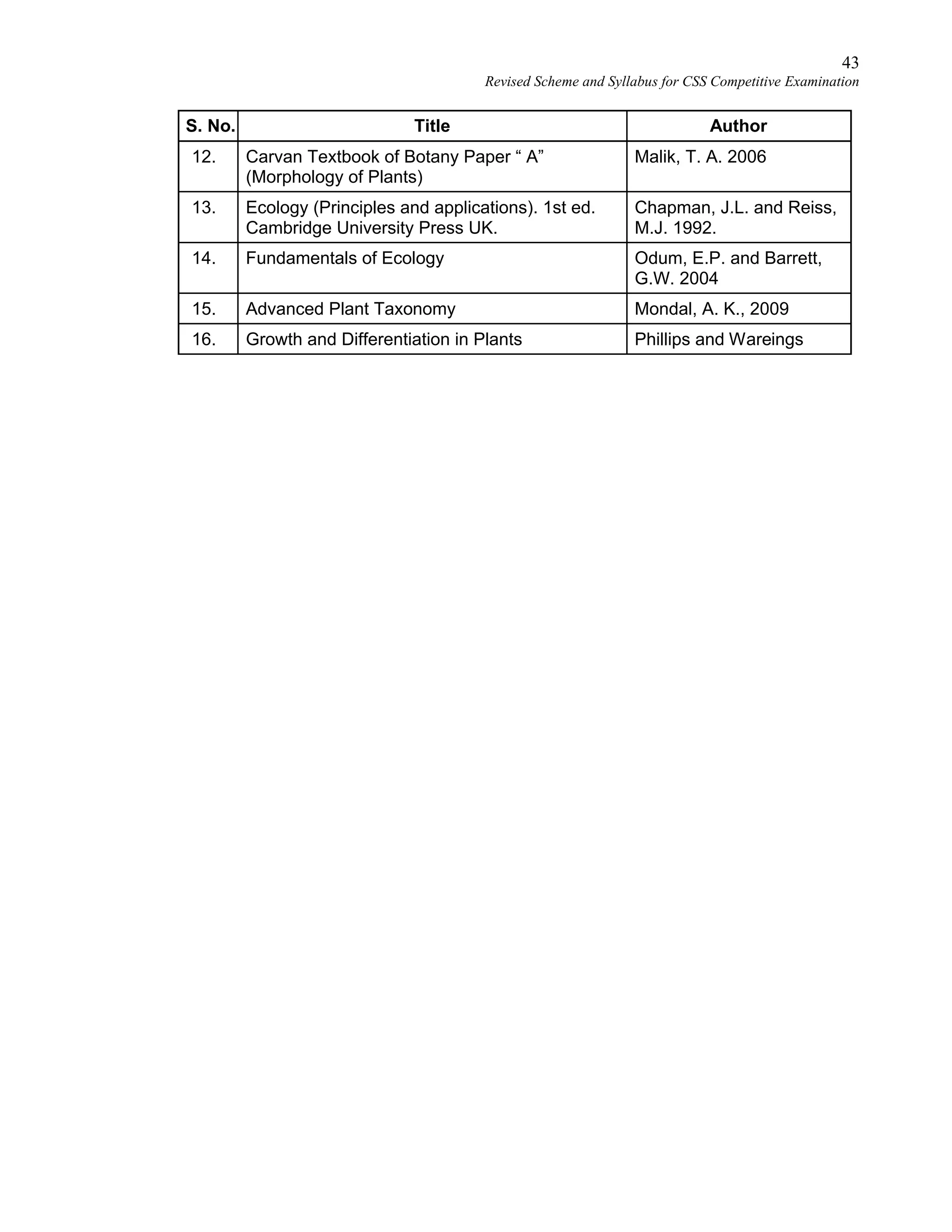
S. No. Title Author
12. Carvan Textbook of Botany Paper “ A”
(Morphology of Plants)
Malik, T. A. 2006
13. Ecology (Principles and applications). 1st ed.
Cambridge University Press UK.
Chapman, J.L. and Reiss,
M.J. 1992.
14. Fundamentals of Ecology Odum, E.P. and Barrett,
G.W. 2004
15. Advanced Plant Taxonomy Mondal, A. K., 2009
16. Growth and Differentiation in Plants Phillips and Wareings
44
Revised Scheme and Syllabus for CSS Competitive Examination
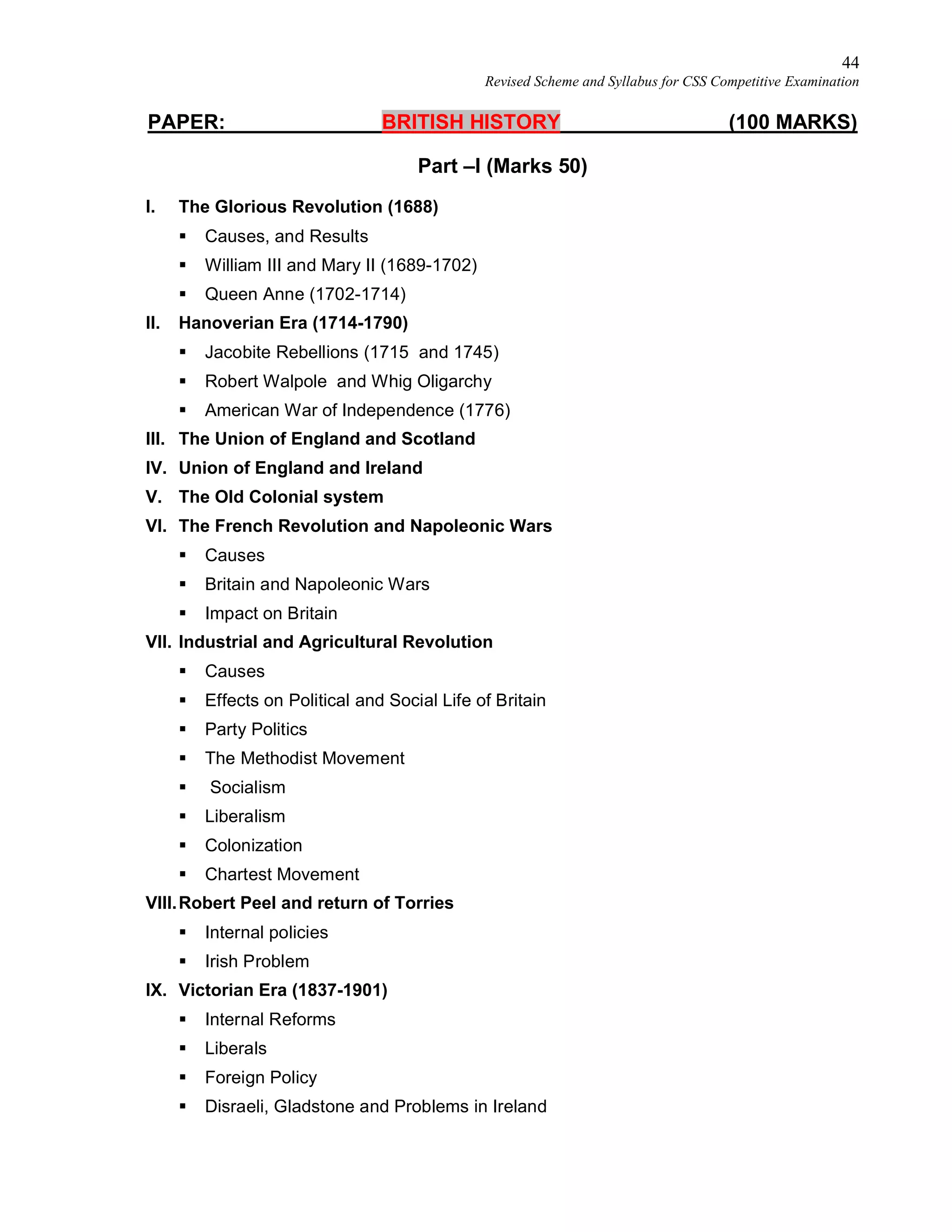
PAPER: BRITISH HISTORY (100 MARKS)
Part –I (Marks 50)
I. The Glorious Revolution (1688)
 Causes, and Results
 William III and Mary II (1689-1702)
 Queen Anne (1702-1714)
II. Hanoverian Era (1714-1790)
 Jacobite Rebellions (1715 and 1745)
 Robert Walpole and Whig Oligarchy
 American War of Independence (1776)
III. The Union of England and Scotland
IV. Union of England and Ireland
V. The Old Colonial system
VI. The French Revolution and Napoleonic Wars
 Causes
 Britain and Napoleonic Wars
 Impact on Britain
VII. Industrial and Agricultural Revolution
 Causes
 Effects on Political and Social Life of Britain
 Party Politics
 The Methodist Movement
 Socialism
 Liberalism
 Colonization
 Chartest Movement
VIII.Robert Peel and return of Torries
 Internal policies
 Irish Problem
IX. Victorian Era (1837-1901)
 Internal Reforms
 Liberals
 Foreign Policy
 Disraeli, Gladstone and Problems in Ireland
45
Revised Scheme and Syllabus for CSS Competitive Examination
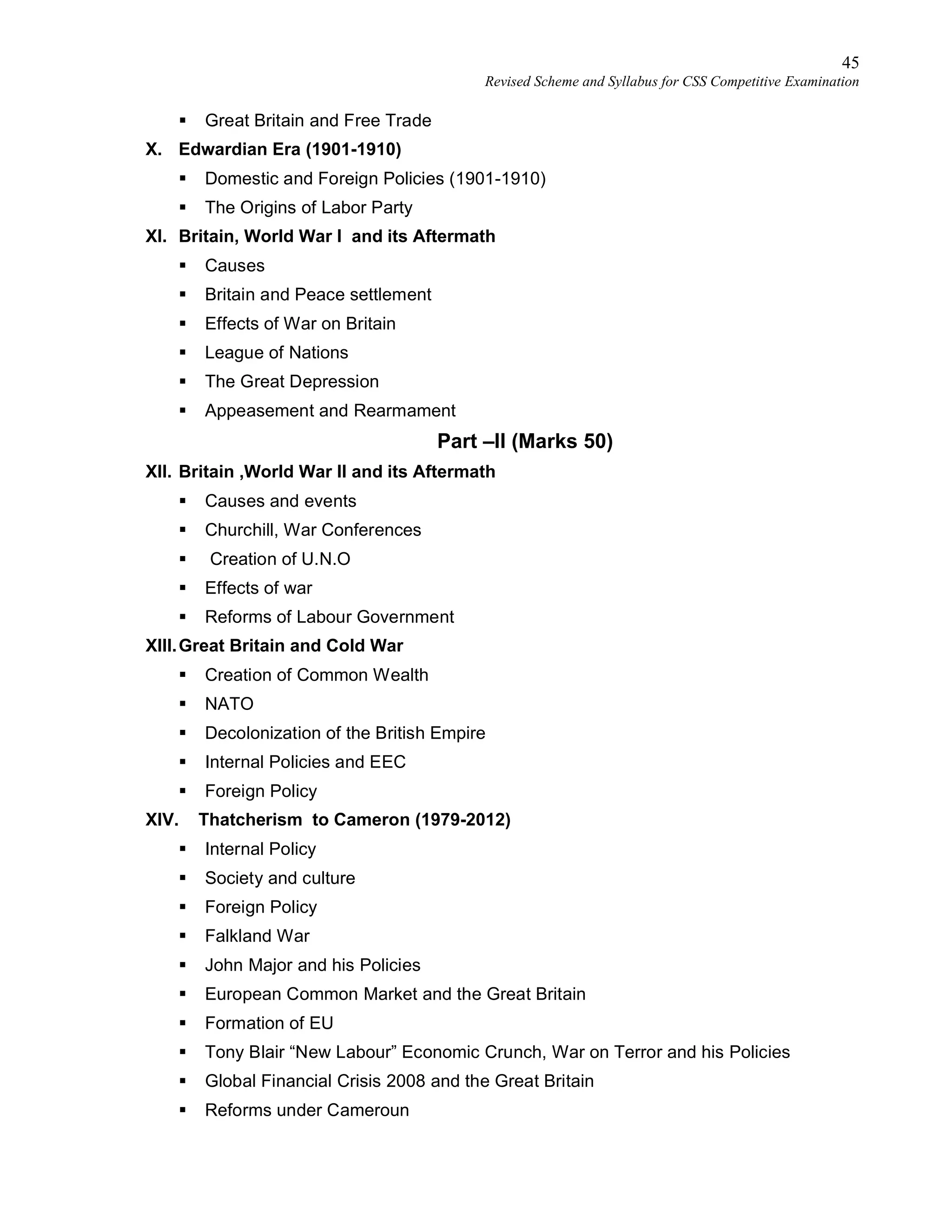
 Great Britain and Free Trade
X. Edwardian Era (1901-1910)
 Domestic and Foreign Policies (1901-1910)
 The Origins of Labor Party
XI. Britain, World War I and its Aftermath
 Causes
 Britain and Peace settlement
 Effects of War on Britain
 League of Nations
 The Great Depression
 Appeasement and Rearmament
Part –II (Marks 50)
XII. Britain ,World War II and its Aftermath
 Causes and events
 Churchill, War Conferences
 Creation of U.N.O
 Effects of war
 Reforms of Labour Government
XIII.Great Britain and Cold War
 Creation of Common Wealth
 NATO
 Decolonization of the British Empire
 Internal Policies and EEC
 Foreign Policy
XIV. Thatcherism to Cameron (1979-2012)
 Internal Policy
 Society and culture
 Foreign Policy
 Falkland War
 John Major and his Policies
 European Common Market and the Great Britain
 Formation of EU
 Tony Blair “New Labour” Economic Crunch, War on Terror and his Policies
 Global Financial Crisis 2008 and the Great Britain
 Reforms under Cameroun
46
Revised Scheme and Syllabus for CSS Competitive Examination
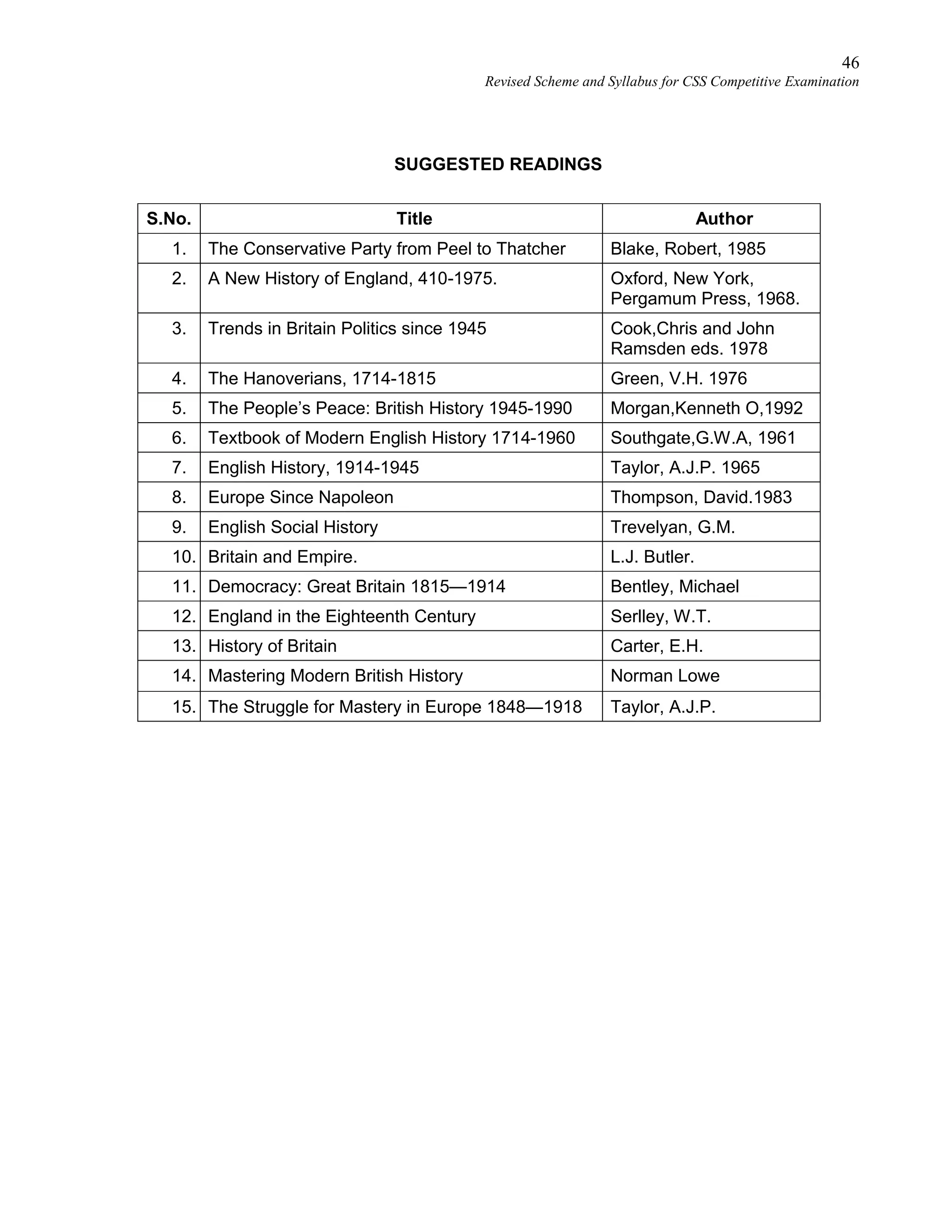
SUGGESTED READINGS
S.No. Title Author
1. The Conservative Party from Peel to Thatcher Blake, Robert, 1985
2. A New History of England, 410-1975. Oxford, New York,
Pergamum Press, 1968.
3. Trends in Britain Politics since 1945 Cook,Chris and John
Ramsden eds. 1978
4. The Hanoverians, 1714-1815 Green, V.H. 1976
5. The People’s Peace: British History 1945-1990 Morgan,Kenneth O,1992
6. Textbook of Modern English History 1714-1960 Southgate,G.W.A, 1961
7. English History, 1914-1945 Taylor, A.J.P. 1965
8. Europe Since Napoleon Thompson, David.1983
9. English Social History Trevelyan, G.M.
10. Britain and Empire. L.J. Butler.
11. Democracy: Great Britain 1815—1914 Bentley, Michael
12. England in the Eighteenth Century Serlley, W.T.
13. History of Britain Carter, E.H.
14. Mastering Modern British History Norman Lowe
15. The Struggle for Mastery in Europe 1848—1918 Taylor, A.J.P.
47
Revised Scheme and Syllabus for CSS Competitive Examination
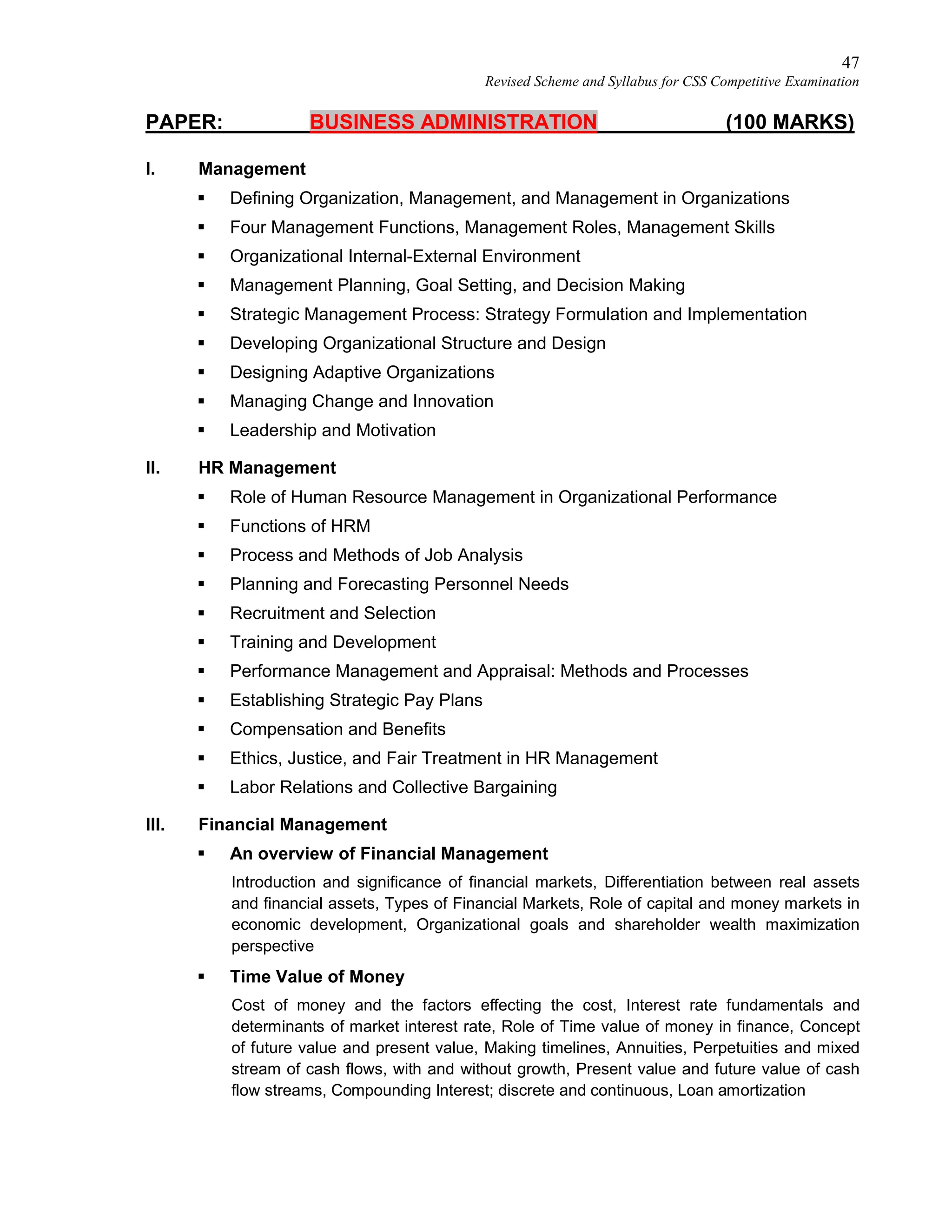
PAPER: BUSINESS ADMINISTRATION (100 MARKS)
I. Management
 Defining Organization, Management, and Management in Organizations
 Four Management Functions, Management Roles, Management Skills
 Organizational Internal-External Environment
 Management Planning, Goal Setting, and Decision Making
 Strategic Management Process: Strategy Formulation and Implementation
 Developing Organizational Structure and Design
 Designing Adaptive Organizations
 Managing Change and Innovation
 Leadership and Motivation
II. HR Management
 Role of Human Resource Management in Organizational Performance
 Functions of HRM
 Process and Methods of Job Analysis
 Planning and Forecasting Personnel Needs
 Recruitment and Selection
 Training and Development
 Performance Management and Appraisal: Methods and Processes
 Establishing Strategic Pay Plans
 Compensation and Benefits
 Ethics, Justice, and Fair Treatment in HR Management
 Labor Relations and Collective Bargaining
III. Financial Management
 An overview of Financial Management
Introduction and significance of financial markets, Differentiation between real assets
and financial assets, Types of Financial Markets, Role of capital and money markets in
economic development, Organizational goals and shareholder wealth maximization
perspective
 Time Value of Money
Cost of money and the factors effecting the cost, Interest rate fundamentals and
determinants of market interest rate, Role of Time value of money in finance, Concept
of future value and present value, Making timelines, Annuities, Perpetuities and mixed
stream of cash flows, with and without growth, Present value and future value of cash
flow streams, Compounding Interest; discrete and continuous, Loan amortization
48
Revised Scheme and Syllabus for CSS Competitive Examination
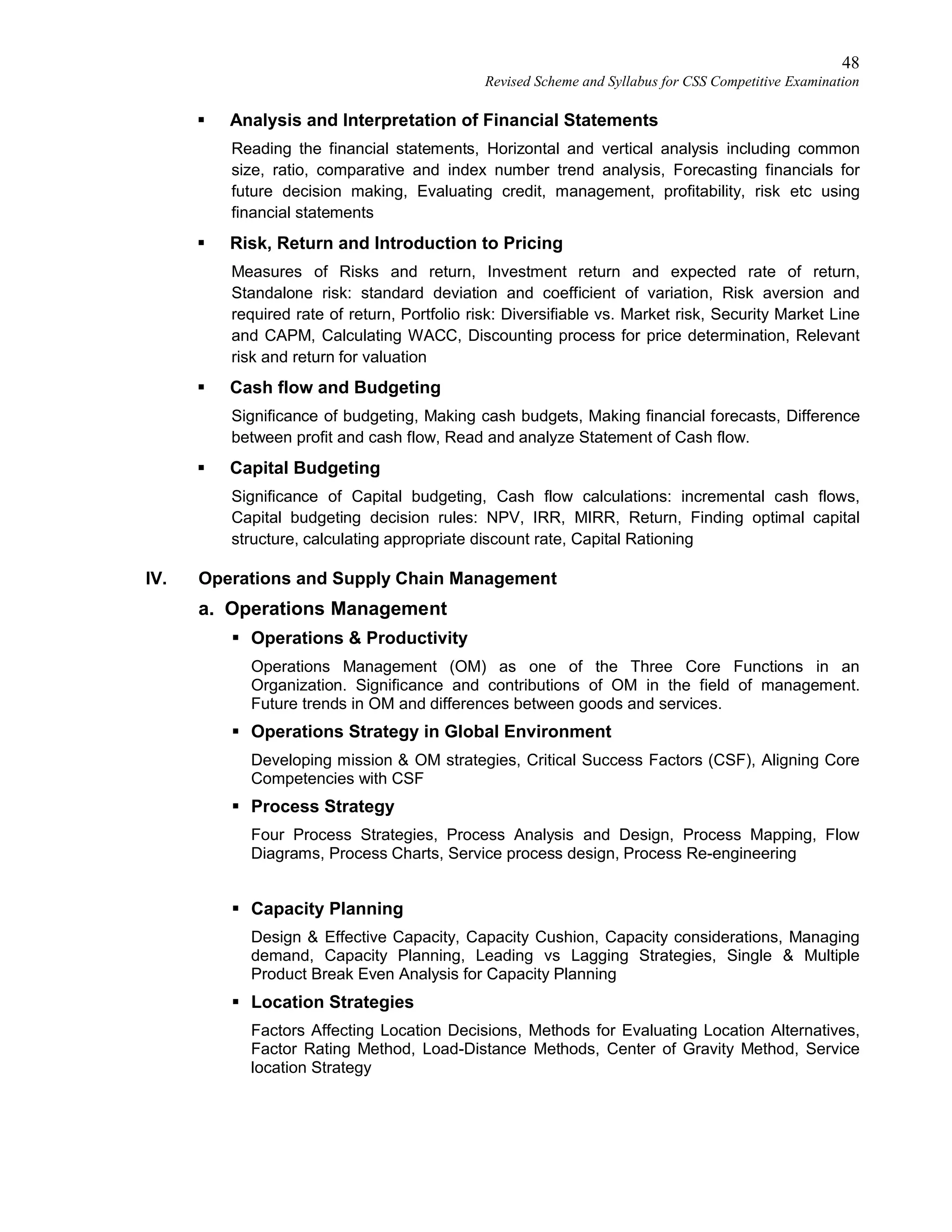
 Analysis and Interpretation of Financial Statements
Reading the financial statements, Horizontal and vertical analysis including common
size, ratio, comparative and index number trend analysis, Forecasting financials for
future decision making, Evaluating credit, management, profitability, risk etc using
financial statements
 Risk, Return and Introduction to Pricing
Measures of Risks and return, Investment return and expected rate of return,
Standalone risk: standard deviation and coefficient of variation, Risk aversion and
required rate of return, Portfolio risk: Diversifiable vs. Market risk, Security Market Line
and CAPM, Calculating WACC, Discounting process for price determination, Relevant
risk and return for valuation
 Cash flow and Budgeting
Significance of budgeting, Making cash budgets, Making financial forecasts, Difference
between profit and cash flow, Read and analyze Statement of Cash flow.
 Capital Budgeting
Significance of Capital budgeting, Cash flow calculations: incremental cash flows,
Capital budgeting decision rules: NPV, IRR, MIRR, Return, Finding optimal capital
structure, calculating appropriate discount rate, Capital Rationing
IV. Operations and Supply Chain Management
a. Operations Management
 Operations & Productivity
Operations Management (OM) as one of the Three Core Functions in an
Organization. Significance and contributions of OM in the field of management.
Future trends in OM and differences between goods and services.
 Operations Strategy in Global Environment
Developing mission & OM strategies, Critical Success Factors (CSF), Aligning Core
Competencies with CSF
 Process Strategy
Four Process Strategies, Process Analysis and Design, Process Mapping, Flow
Diagrams, Process Charts, Service process design, Process Re-engineering
 Capacity Planning
Design & Effective Capacity, Capacity Cushion, Capacity considerations, Managing
demand, Capacity Planning, Leading vs Lagging Strategies, Single & Multiple
Product Break Even Analysis for Capacity Planning
 Location Strategies
Factors Affecting Location Decisions, Methods for Evaluating Location Alternatives,
Factor Rating Method, Load-Distance Methods, Center of Gravity Method, Service
location Strategy
49
Revised Scheme and Syllabus for CSS Competitive Examination
 Layout Strategies
Types of Layout, Layout Design, Fixed Position Layout, Process- Oriented Layouts,
Office Layout, Retail Layout, Assembly Line Balancing
 Inventory Management
Role of Inventory in Operations, ABC analysis, Record accuracy, Cycle counting,
Inventory Models, Fixed Period Systems, Continuous Review Systems, Basic EOQ
Inventory Model, Safety Stock, Service Level
b. Supply Chain Management
 Introduction to supply chain management and logistics management
What is supply chain management and logistics management, Objectives,
Importance, Examples of supply chain management and logistics management,
Decision phases in supply chains
 Supply chain performance
Achieving strategic fit, Challenges in achieving strategic fit, Supply chain cost, Supply
chain quality, Supply chain lead time
 Supply chain drivers
Facilities as a driver, Inventory as a driver, Information as a driver, Transportation as
a driver, Sourcing as a driver, Pricing as a driver
 Balancing supply and demand
Bullwhip effect, Demand collaboration, Information sharing in supply chains, accurate
response strategy
 Supply chain coordination
Obstacles in coordination, Vendor managed inventory, Collaborative planning
forecasting and replenishment, Managerial levers to achieve coordination
 IT in supply chain management
Role of IT in supply chain management, Customer relationship management,
Supplier relationship management, Risk management in IT, Supply chain IT in
practice
V. Marketing
 Introduction to marketing
 Developing marketing strategies and plans
 Scanning the marketing environment
 Analyzing consumer markets
 Market segmentation
 Managing marketing information
 Branding
 Product life cycle
 Pricing
 Managing distribution channels
 Integrated marketing communications
50
Revised Scheme and Syllabus for CSS Competitive Examination
SUGGESTED READINGS
S.No Title Author
1. Management Richard L. Daft,
2.
Management
Stephen P. Robbins, Mary Coulter,
and NeharikaVohara
3. The Practice of Management Peter F. Drucker
4. Human Resource Management Gary Dessler and BijuVarkkey
5. Human Resource Management Noe, Hollenbeck, Gerhart, Wright.
6.
Human Resource Management
David A. DeCenzo& Stephen P.
Robbins
7. Human Resource Management Derek Torrington & Laura Hall
8. Essentials of Corporate Finance Ross, Westerfield and Jordan
9. Principles of Finance Besley and Brigham
10. Financial statement Analysis George Foster
11. Principles of Managerial Finance Gitman and Zitter
12. Fundamentals of Corporate Finance Brealey, Myers and Marcus
13. Advanced Corporate Finance Ogden, Jen and O’ Conner
14. Operations Management for Competitive
Advantage, 2006
Chase, Richard B., Aquilano,
Nicholas J., and Jacobs, F. Roberts
15. Principles of Operations Management 2005 Raturi, Amitabh S., Evans, James R
16. Operations Management 2008 Heizer, Jay and Render, Barry,
17. Supply Chain Management: Strategy,
Planning, and Operations
Sunil Chopra, Peter Meindl, and D.V.
Kalra,
18. Supply Chain Management: From Vision to
Implementation
Stanley E. Fawcett, Lisa M. Ellram,
and Jeffrey A. Ogden
19. Business Logistics & Supply chain
management
Ronald H. Ballou
20. Principles of Marketing Kotler, Armstrong, Agnihotri and
Haque
21. Basic Marketing Perreault and McCarthy
22. Marketing a Practical Approach Peter Rix
51
Revised Scheme and Syllabus for CSS Competitive Examination
PAPER: CHEMISTRY (200 MARKS)
Paper-I (100 Marks)
I. Atomic Structure and Quantum Chemistry
Electromagnetic spectrum, photoelectric effect, Bohr’s atomic model, wave and
particle nature of light matter, de Broglie’s equation, Heisenberg’s uncertainty
principle, wave functions and Born interpretation of wave functions, probability
density, Eigen functions and Eigen values, Hamiltonian operator, Schrödinger wave
equation and its solution for particle in one and three dimensional box.
II. Electrochemistry
Ions in solution, measurement of conductance and Kohlrausch’s law, mobility of ions
and transport number, conductometric titrations, Debye-Hückel theory and activity
coefficient, determination of activities, Redox reactions, spontaneous reactions,
electrochemical cells, standard electrode potentials, liquid junction potential,
electrochemical series, Nernst’s equation, measurement of pH, electrolytic cells,
potentiometry, reference and indicator electrodes, fuel cells, corrosion and its
prevention.
III. Thermodynamics
Equation of states, ideal and real gases, the Van der Waals equation for real gases,
critical phenomena and critical constants, four laws of thermodynamics and their
applications, thermochemistry, calorimetry, heat capacities and their dependence on
temperature, pressure and volume, reversible and non-reversible processes,
spontaneous and non-spontaneous processes, Hess’s law, The Born-Haber cycle,
relations of entropy and Gibbs free energy with equilibrium constant, Gibbs
Helmholtz equation, fugacity and activity.
IV. Chemical Kinetics
The rate and molecularity of reactions, Factors affecting rate of a chemical reaction,
zero, first, second and third order reactions with same initial concentrations, half-
lives of reactions, experimental techniques for determination of order of reaction
(integration, half-life, initial rate and graphical methods), collision theory, transition
state theory, Arrhenius equation and rate equations of complex reactions.
V. Surface Chemistry and Catalysis
Properties of liquids, physical and chemical properties of surface, determination of
surface area. Adsorption and absorption; physical adsorption and chemisorption,
adsorption isotherms, Langmuir adsorption isotherm and Freundlich Adsorption
isotherm. Colloids; properties, classification and preparation of colloidal systems.
Surfactants, Phase rule; Gibbs equation of phase rule, one component systems, two
component systems and their examples, Catalysis; homogeneous and
heterogeneous catalysis, acid-base and enzyme catalysis.
VI. Fundamentals of Chemometrics
Sampling, significant figures, stoichiometric calculations, measurement errors,
analysis of variance (ANOVA), arithmetic mean, median, mode, standard
52
Revised Scheme and Syllabus for CSS Competitive Examination
deviation/relative standard deviation, confidence limits, Gaussian distribution, least
square method, Statistical tests.
VII. Separation Methods
Solvent extraction; theory of solvent extraction; solvent extraction of metals,
analytical separations, multiple batch extraction and counter current distribution.
Chromatography; theory of chromatography, classification and overview of
chromatographic techniques (paper, thin layer, column and ion exchange
chromatographies). Principle of electrophoresis and its application as separation and
characterization of proteins.
VIII. Basic Inorganic Chemistry
Types of chemical bonding, ionic and covalent bonding, localized bond approach,
theories of chemical bonding, valance bond theory (VBT), hybridization and
resonance, prediction of molecular shapes using valence-shell electron-pair
repulsion (VSEPR) model, Molecular orbital theory (MOT) applied to diatomic
molecules, delocalized approach to bonding, bonding in electron deficient
compounds, hydrogen bonding, Physical and chemical properties of p-block
elements with emphasis on oxygen, carbon, chlorine, silicon, nitrogen, phosphorus
and some of their representative compounds.
IX. Acids and Bases
Brief concepts of chemical equilibrium, acid–base theories including soft and hard
acid and base (SHAB) concept, relative strength of acids and bases, significance of
pH, pKa, pKb and buffer solutions. Theory of indicators, solubility, solubility product,
common ion effect and their industrial applications.
X. Chemistry of d and f-block elements
General characteristics of d-block elements, historical back ground of coordination
chemistry, nomenclature and structure of coordination complexes with coordination
number 2-10, Chelates and chelate effect. Theories of coordination complexes;
Werner's theory, Valence bond theory (VBT), Crystal field theory (CFT) and
Molecular orbital theory (MOT). Jahn-Teller theorem, magnetic properties, spectral
properties, isomerism, stereochemistry and stability constants of coordination
complexes.
General characteristics of Lanthanides, occurrence, extraction and general principles
of separation, electronic structure and position in the periodic table, lanthanide
contraction, oxidation states, spectral and magnetic properties and uses. General
characteristics of actinides, electronic structure, oxidation state and position in the
periodic table, half-life and decay law.
53
Revised Scheme and Syllabus for CSS Competitive Examination
Paper-II (100 Marks)
I. Basic Concepts of Organic Chemistry
Bonding and orbital hybridization, Localized and delocalized bonding, Inductive
effect, Dipole moment, Resonance, Hyperconjugation.
II. Saturated and Unsaturated Hydrocarbon
Nomenclature, Physical properties, Preparation and reactions of alkanes, alkenes
and alkynes.
III. Chemistry of Aromatic Compounds
Benzene structure, Aromaticity, Mechanism of electrophilic substitution reaction,
Activating and deactivating substituents, Effect of substituents on orientation and
reactivity.
IV. Chemistry of Functional Groups
Preparation and properties of alcohols, phenols, ethers, and amines with focus on
reaction mechanism and applications. Preparation and reactions of alkyl halides.
Synthetic applications of Grignard reagent. Carbonyl compounds, preparations and
reaction mechanism of aldehydes and ketones and their applications. Carboxylic
acids and their derivatives, acidity of carboxylic acids and effect of substituents on
their acidity, preparation and reactions of carboxylic acids and their derivatives
including acid halides, acid anhydrides, esters and amides.
V. Aliphatic nucleophilic substitution and elimination reactions
Mechanism of nucleophilic substitution reactions. Elimination reactions, Zaitsev rule
and Hofmann rule. Competition between Substitution and elimination reactions.
VI. Stereochemistry
Molecular chirality.Types of stereoisomers. R,S configuration and E,Z designation.
Optical activity, Stereoselectivity and stereospecificity. Resolution of racemic
mixtures.
VII. Organic Spectroscopy
Theory, Principle, instrumentation and applications of UV/Visible, 1
H NMR, IR
spectroscopy and Mass spectroscopic techniques.
VIII. Biomolecules
Carbohydrates; Monosaccharides, oligosaccharides and polysaccharides, biological
functions of starch, glycogen, cellulose, and cell wall polysaccharides.
Lipids; Classification and biological importance of lipids. Significance of lipids in
biological membranes and transport mechanism.
Amino Acids; Classification of amino acids. Physical and chemical properties of
amino acids. Biological significance.
Proteins; Classification. Properties and biological significance. Primary, secondary
tertiary and quaternary structures.
54
Revised Scheme and Syllabus for CSS Competitive Examination
Nucleic Acids; Chemical composition of nucleic acids. Structure and biological
significance of nucleic acids.
Enzymes; Enzyme-substrate interactions and nature of active site, mechanism of
enzyme action, kinetics of single substrate reactions, enzyme inhibition, regulatory
enzymes and allosteric enzymes.
IX. Metabolism
Digestion; absorption and transport of proteins, carbohydrates, lipids and nucleic
acids. Glycolysis; citric acid cycle, gluconeogenesis, glycogenesis, glycogenolysis
and photosynthesis.
Biosynthesis of triglycerides, phosphides, steroids and bile acids and ketone bodies.
Biochemical reaction of amino acids: decarboxylation, deamination, transamination
and transmethylation, etc., urea cycle, creatine and uric acid synthesis.
Catabolism of nucleosides, DNA polymerases and other enzymes involves in
metabolism.
X. Chemical Industries
Manufacturing and processing of sugar, cement, glass, paper, fertilizers, soap and
detergents.
SUGGESTED READINGS
S.No. Title Author
1. Physical Chemistry, 4th
ed., 2005 Silbey, R. J., Alberty, R. A.,
and Bawendi, M. G.
2. Physical Chemistry – A Molecular
Approach, 1st
ed. 1997
McQuarrie, D. A. and Simon,
J. D.
3. Atkin’s Physical Chemistry, 9th
ed. 2010 Atkins, P. and Paula, J. D.
4. Physical Chemistry, 4th
ed. 1972 Moore. W. J.
5. Modern Analytical Chemistry, 2000 Harvey, D.
6. Quantitative Chemical Analysis, 8th
ed.
2011
Harris, D.C.,
7. Analytical Chemistry. 6th
ed., 2006 Christian, G. D.
8. CHEMOMETRICS-Statistics and
Computed applications in Analytical
Chemistry, 2nd
ed., 2007
Matthios, O.
9. Statistics and Chemometrics for Analytical
Chemistry, 5th
ed. 2005
Miller, J. and Miller, J
10. Separation Chemistry 2004 Budhiraja, R.P
11. Advanced Inorganic Chemistry, 6th
ed. 2007 Cotton, F.A. and Wilkinson, G.
12. Inorganic Chemistry, 4th
ed. 2010 Miessler, G. L. and Tarr, D.A.
55
Revised Scheme and Syllabus for CSS Competitive Examination
S.No. Title Author
13. Inorganic Chemistry, 5th
ed. 2010 Shriver, D. and Atkins, P.
14. Textbook of Inorganic Chemistry 2013 Chaudhary, S. U.
15. Organic Chemistry, 10th
ed. 2011 Solomons, T. W. G., and
Fryhle, C. B.
16. Organic Chemistry, 6th
ed. 2012 Brown, W. H., Fotte, C. S.,
Iverson,B.L. and Anslyn, E. V.
17. Organic Chemistry, 8th
ed. 2012 John, E. M.
18. Introduction to Spectroscopy, 4th
ed., 2009 Pavia, D. L.,Lampman, G. M.,
Kriz,G.S. and Vyvyan, J. R.,
19. Spectrometric Identification of Organic
Compounds 2005
Silverstein, R. M. Webster, F.
X. and Kiemle, D.
20. Organic Spectroscopy 2006 Younas, M.
21. Stereochemistry (Basic Concepts in
Chemistry) 2002
Morris, D. G.
22. Shreve's Chemical Process Industries, 5th
ed. 1984
Shreve, R. N. and Austin, G. T.
23. Riegel's Handbook of Industrial Chemistry
2003
Riegel, E. R., and Kent, J. A.
56
Revised Scheme and Syllabus for CSS Competitive Examination
PAPER: COMPUTER SCIENCE (200 MARKS)
Paper-I (100 Marks)
Section-A (50 Marks)
I. Introduction to Computing
Introduction to Information Technology and Computers, History of Computing, Computer
HW and SW Details, Computer System Components and Communication System, Input &
Output devices and their types, Storage Media and their types, Types of Computer
Hardware, Software, and Programming languages, Information Representation & Number
Systems, User interfaces, Major Software Issues, Creation, formatting, and maintenance of
Computer documents, Usage of Word processors, Spread sheets, Power-Point, Email,
Search Engines, Browsers, Messengers, and Internet , Computers & Society, Information
Security/Privacy, Computer Crimes and Ethical Challenges, Viruses, Plagiarism,
Intellectual Property Rights, Difference between computer science, software engineering,
information technology, information systems, computer engineering and bioinformatics;
IEEE / ACM computing disciplines guidelines.
II. Programming Fundamentals
Basic programming elements and concepts, Problem Solving & Program Design,
Components of a programming language, Program development and execution, Program
structure, Data types and variable declarations, Standard I/O streams, and statements,
Control structures, Standard library functions, User defined functions and parameter
passing, Arrays, pointers, and strings, Structures, unions, and bit manipulation operators.
III. Object Oriented Paradigm
Object Oriented Programming Concepts ( Object-oriented paradigm, data abstraction,
encapsulation, inheritance, Polymorphism), Introduction to Classes and Objects ( classes,
objects, data members, member functions), Classes Advanced ( friends, static,
composition, this, const), Operator overloading (stream insertion, stream extraction, binary
operator, unary operator), Inheritance (single inheritance, multiple inheritances, protected
members, method over-riding), Polymorphism (virtual function, pure-virtual functions,
abstract class, abstract super class), Standard Template Library (STL), Files & streams
(sequential access files, random access files), File processing, Exception Handling
Section-B (50 Marks)
IV. Algorithms & Data Structures
Fundamental concepts, Properties of algorithms, Criteria for an Algorithm, Parameters for
selecting an algorithm, Algorithm Representations, Pseudo Code and Flow Charts,
Designing Algorithms, Algorithm Analysis and Asymptotic Notations, Classification of Lists,
Abstract Data Types, Implementation of Stacks and Queues using ADTs, Searching and
Sorting Algorithms (Linear Search, Binary Search, Bubble Sort, Merge Sort, Quick Sort,
Heap Sort), Stacks and Queues, Hash Tables (Linear Probing, Bucketing, Chaining),
Recursion, Trees (Binary Trees, Binary Search trees, AVL Trees, Two-Three Trees),
Graphs, Heuristic (Guided) Search, Genetic Algorithms, Encryption Algorithms (DES, RSA)
57
Revised Scheme and Syllabus for CSS Competitive Examination
V. Software Engineering
Software Processes, Software Process Models, Agile Software Development, Analysis
Modeling, Requirements Engineering, Design Concepts, Architectural Design, Design &
Implementation, Software Testing, System Delivery and Maintenance, Software Evolution
Formal Specification, Software Quality Assurance, Introduction to Proofs of Correctness
(LNO), Distributed Software Engineering, Aspect-Oriented Software Engineering, Project
Management, Process Improvement
VI. Compiler Construction
Difference among various type of Translators, Phases of Compilers, Classification of
Compilers, Lexical Analysis (Input buffering, Specification & Recognition of tokens, Regular
expressions, Finite automata, Syntax Analysis (Context-free grammars and their
classification, LL(k) vs. LR(k) grammars, Top-down vs. Bottom-Up parsers, Parsing
Techniques, FIRST and FOLLOW sets, Predictive Parsing using LL(1) grammars, Syntax
error handling and recovery strategies), Syntax Directed Translation (Synthesized
attributes, Inherited attributes, Construction of syntax trees, Top-down translation),
Semantic analysis (Symbol tables, Type Expressions, Type Checking of statements),
Intermediate Code Generation, Code Generation (Issues in the design of code generation,
The target machine, Run-time storage management, Register allocation), Code
optimization (Elimination of Redundant code, Folding of Constant, Loop optimization,
Peephole optimization, Problems of optimization)
Paper-II (100 Marks)
Section-A (50 Marks)
I. Computer Organization & Architecture
Fundamental concepts, Overview of a Computer System, Evolution & Performance
Languages, Architectural levels, Virtual machines, Processor types, Metrics, Machine
instructions, Instruction execution cycle, CISC vs. RISC, Parallelism, Internal/External data
representation, Computer Function and Interconnections, Cache Memory, Internal Memory,
External Memory, Input /Output System, Computer Arithmetic Microprocessor and its Bus
Structure, I/O Types, Types of Buses, Memory Organization and Structure, information
flow and execution in Machine, Instruction Representation, Machine Instruction
Characteristics, Instruction Processing, Processor Structure & Function, Control Unit
Operation, Micro-programmed Control, Instruction-Level Parallelism And Superscalar
Processors, Parallel Processing, Multi-Processor and Multi-core Systems
II. Computer Communications & Networks
Basic Concepts and Classification of Networks, Circuit switching, Packet switching,
Multiplexing (TDM, FDM), Layering: OSI and TCP/IP, Application Layer (Network
application architectures, HTTP, FTP, Email, DNS, P2P applications), Transport Layer
(Multiplexing in UDP and TCP, Connectionless Transport: UDP, Reliable data transfer and
TCP, Congestion avoidance and control), Network Layer (The Internet Protocol, IPv4
Datagram, Internet Address Classes, Special IP Addresses ARP, IPv6, ICMP, Network
Address Translation (NAT), Internet Routing Protocols and Algorithms, X.25, Frame relay
and ATM, MPLS), Physical & Link Layer Functionalities (Error Detection & Control, ARQ,
Link layer addressing, LAN Technologies, Bridges and Hubs, Multiple Access), Special
58
Revised Scheme and Syllabus for CSS Competitive Examination
topics (Security, Overlay networks, naming, Content distribution networks, Peer to peer
systems, DHTs, Network Attacks)
III. Operating Systems Concepts
Roles of an Operating System, Operating-System Evolution, Structures, and Operations,
Classification of Operating Systems, Computing Environments, Design and Components of
OS, Process Management, Process Synchronization, Deadlocks, Memory Management,
Virtual Memory Management, File Systems (UNIX and Windows Systems), I/O
Management
Section-B (50 Marks)
IV. Database Systems
Introduction to Database Systems, Relational Data Model & Relational Database
Constraints, Relational Data Model, SQL, Relational Algebra & Calculus, ER Model, ER to
Relational Mapping, PL/SQL Stored Procedures & Triggers, Functional Dependencies and
Normalization, Storage & Indexing, Indexing Structure, XML documents & Web Services,
Query Processing & Evaluation, Query Optimization, Transaction processing, Object-
Oriented Databases, Distributed Databases, Database Security & Access Control
V. Digital Image Processing
The relation between Image Processing, Computer Graphics, Computer Vision and Artificial
Intelligence; Image Sensing and Acquisition Techniques; Representing Digital Image;
Image Sampling and Quantization; Image Storage and Operations; Image Transformations
(Translation, Scaling, Rotation, Shear); Image Histogram; Image Enhancement (Contrast,
Smoothing, Sharpening); Gray-scale and Color Images; Color Models (RGB, CMYK and
HIS); Image Restoration; Noise Models; Morphological Operators (Erosion, Dilation,
Opening, Closing, Skeletonization, Thinning); Image Segmentation; Point Detection, Line
Detection, Edge Detection and Boundary Detection; Image Compression
VI. Web Engineering & Technologies
Modeling techniques for web applications, Introduction to web engineering, requirement
engineering, requirement, types of requirements, functional requirements, non functional
requirements, Requirement engineering process (Elicitation and negotiation,
Documentation, Validation and verification, Management), HTML(hypertext markup
language), Software Architecture, Styles, Patterns, and frameworks, Components of Web
Architecture, Classifications of web architecture , Web Application layered architecture (
client server, n- layered, JSP model, struts, OOHDM ), Integration Architecture, Data
Aspect architectures, Cascading Style Sheet(CSS), CSS properties, JavaScript
(Functionalities, Events, Variables, Operators), DOM(Document Object Model), XML, RSS,
API, Client-side programming using (HTML, XHTML, XML, JavaScript, and CSS), Server-
side programming using PHP, Web development process, Web Application Development
Methodologies, Web site promotion and deployment, Web applications Issues
(Accessibility, testing, performance, operation, maintenance, security)
59
Revised Scheme and Syllabus for CSS Competitive Examination
SUGGESTED READINGS
S. No. Title Author
1. C++ How to Program Harvey M. Deitel and Paul J.
Deitel.
2. Compilers: Principles, Techniques, and Tools Alfred V. Aho, Ravi Sethi, and
Jeffrey D. Ullman
3. Operating System Concepts Silberschatz, Galvin, and
Gagne. John
4. Operating Systems William Stallings
5. Computer Organization & Architecture William Stallings
6. Computer System Architecture M. Morris Mano
7. Computer Organization and Design: The
Hardware/ Software Interface
David A. Patterson and John L.
Hennessy
8. Software Engineering Ian Sommerville
9. Software Engineering A Practitioner’s Approach Roger S. Pressman
10. Data Structures and Algorithm Analysis in C++ Mark Allen Weiss
11. Computer Networking: A Top Down approach
featuring the Internet
James F. Kurose and Keith W.
Ross
12. Data and Computer Communications William Stallings
13. Computer Networks Andrew Tanenbaum
14. Fundamentals of Database Systems Ramez Elmasri and S. B
15. Database Systems Concepts Silberchatz, Abraham & Korth,
Sudarshan
16. Web Services: Principles and Technology Michael Papazoglu
17. Electronic Commerce: The Second Wave, Ninth
Edition
Gary P. Schneider
18. Electronic-Commerce –A Managerial
Perspective
Turban, Lee, King, Chung
19. Web Engineering Kappel, G., Proll, B. Reich, S. &
Retschitzegger
20. Styling Web Pages with CSS Tom Negrino and Dori Smith
21. PHP: The Good Parts Peter B. MacIntyre
22. Learn JavaScript Chuck Easttom
23. ADTs, Data Structures, and Problem Solving
with C++
Larry R. Nayhoff
24. Digital Image Processing Gonzalez and Woods
60
Revised Scheme and Syllabus for CSS Competitive Examination
PAPER: CONSTITUTIONAL LAW (100 MARKS)
I. Definition and Scope of Constitutional Law, Basic Constitutional Concepts
(Constitutional Conventions, Rule of Law, Due Process), Constitutional Structures
(Parliamentary, Presidential, Separation of Powers), Judiciary (Independence of
Judiciary, Judicial Review, Theories of Constitutional Interpretation) Fundamental
Human and Political Rights and Civil Liberties (freedom of speech, association,
assembly, movement and Right to Counsel, life, property, religion, privacy, self
incrimination, double jeopardy).
II. Principles of Constitutional Law with special reference to United Kingdom, United
States of America, France, Russia, China, Pakistan, India and Turkey.
III. Constitutional History of Pakistan: Principles of Constitutional Law of Pakistan,
Salient feature of the Government of India Act, 1935, Indian Independence Act 1947,
Objectives Resolution 1949, Constitutions of 1956, 1962 and 1973, Abrogation and
Suspension of the Constitutions and the Martial Laws, Legal Framework Order,
1970, The PCO of 1981, The RCO of 1985, The LFO-2002, Amendments in the 1973
Constitution.
IV. Legal Development:
 Maulvi Tamizuddin Khan v. Federation of Pakistan PLD 1955 Sindh 96.
 Federation of Pakistan vs. Maulvi Tamizuddin Khan, PLD 1955 FC 240
 Reference by the Governor-General PLD 1955 FC 435
 State v. Dosso PLD 1958 SC 533.
 Usif Patel v. Crown PLD 1955 FC 387
 Begum Nusrat Bhutto v. Chief of the Army Staff PLD 1977 SC 657
 Hakim Khan v. Government of Pakistan PLD 1992 SC 595
 Nawaz Sharif v. President of Pakistan PLD 1993 SC 473
 Benazir Bhutto v. the President of Pakistan PLD 1992 SC 492
 Khawaja Muhammad Sharif, PLD 1988 Lah. 725
 Federation of Pakistan v. Haji Saifullah Khan PLD 1989 SC 166
 Khawaja Ahmad Tariq Rahim PLD 1992 SC 646
 Benazir Bhutto v. President of Pakistan, PLD 1998 SC 388
 Asma Jilani v. Government of the Punjab PLD 1972 SC 139
 State v. Zia ur Rehman PLD 1973 SC 49
 Mahmood Khan Achakzai v. Fed. of Pakistan PLD 1997 SC 426
 Zafar Ali Shah v. General Pervez Musharraf, PLD 2000 SC 869.
 Sindh High Court Association v. Federation of Pakistan, PLD 2009 SC 879.
61
Revised Scheme and Syllabus for CSS Competitive Examination
SUGGESTED READINGS
S.No. Title Author
1. Comparative Constitutional Law Hamid Khan & M.W. Rana
2. Constitution of Pakistan 1973 Shabbar Raza Rizvi
3. Introduction to the Study of the Law of the
Constitution
Dicey
4. Elgar Encyclopedia of Comparative Law J.M. Smits
5. Constitutional & Political History of Pakistan Hamid Khan, Advocate
6. Human Rights in Constitutional Law SR. Bansali
7. Constitutional Documents of Pakistan Safdar Mahmood
8. The Leading Cases in Constitutional Law A.G.Chaudhry
62
Revised Scheme and Syllabus for CSS Competitive Examination
PAPER: CRIMINOLOGY (100 MARKS)
Section-I (25 Marks)
I. Introduction
Basic concepts used in understanding crime, criminality and criminal behaviour.
II. Understanding Criminology
Definition, meaning and scope of criminology; Criminology and criminal law; Crime as
social problem; Deviance, Sin Vice, Evil, Norms, Values; Security (Physical, Social,
Economic)
III. Crime and Criminals
Occasional criminals, Habitual criminals, Professional criminals, White-collar crime,
Organized crime, corporate crimes.
IV. Crime and Criminality: Theoretical Perspectives
Early explanation of criminal behavior
 Biological Theories; Psychological Theories; Sociological Theories.
 Social Disorganization theory
 Strain theory
 Social Control theory
 Learning theory
 Labeling Theory
 Islamic perspective on deviance and crime.
Section-II (25 Marks)
V. Juvenile Delinquency
Meaning, definitions (Behavioral Vs Legal), Juvenile delinquent Vs status offender,
Official statistics of juvenile delinquency
VI. Juvenile Justice System
 Role of police
 Juvenile court process:
 pretrial, trial and sentencing
 Role of prosecutor, defense counsel, juvenile judge, juvenile probation officer
 Juvenile correctional institutions; probation and non-punitive alternatives
63
Revised Scheme and Syllabus for CSS Competitive Examination
VII. The Criminal Justice System:
 Police and its role
 Trial and Conviction of Offenders
 Agencies: formal and informal
 Criminal courts: procedures and problems
 Role of prosecutors
 Prisons, Probation and Parole
VIII. Punitive and Reformative Treatment of Criminals
Corporal punishment, Imprisonment, Rehabilitation of criminals.
Section-III (25 Marks)
IX. Criminal Investigation
Principles of criminal investigation, Manual of preliminary investigation, Intelligence
operations, Data base investigation, Electronic investigation, Forensic Investigation
X. Techniques of Investigations
Gathering information from persons, Interviewing and interrogation techniques,
Criminal investigation analysis,
XI. Legal and Ethical Guidelines for Investigators
Stop and frisk operations, Arrest procedures, Search and seizure.
XII. International Policing and Criminal Justice Monitoring Organizations
UNAFEI, INTERPOL, EUROPOL, UNODC, UNICEF, IPA, etc.
Section-IV (25 Marks)
XIII. Modern Concepts in Contemporary Criminology
 Terrorism, Radicalism and War on Terror
 Media’s representation of Crime and the Criminal Justice System
 Modern Law Enforcement and Crime Prevention
 Intelligence-led Policing
 Community Policing
 Private Public Partnership
 Gender and Crime in Urban and Rural Pakistan
 Crime and Urbanization, Organized Crime and White-Collar Crime
 Human Rights Abuses and Protection, especially of Children; Women and
Minorities; The role of civil society and NGOs
 Money-laundering
 Cyber Crime
 Role of NAB, FIA, ANF
64
Revised Scheme and Syllabus for CSS Competitive Examination
SUGGESTED READINGS
S.No. Title Author
1. New Perspectives in Criminology Conklin, J.E
2. Criminal Interrogation and Confessions. Fred, E.I., John, E.R.,
Joseph, P.B. and
Brian, C.J.
3. Theoretical Criminology George B. Vold,
Thomas J. Bernard,
Jeffrey B. Snipes
4. Modern Criminology: Crime, Criminal Behavior and its
Control.
Hagan, J.
5. Juvenile Delinquency: An Integrated Approach James, B.
6. Security Studies: An Introduction Paul, D.W.
7. Crime, Justice and Society: An Introduction to
Criminology
Ronald, J.B., Marvin,
D.F. and Patricia, S.
8. Juvenile Delinquency: Theory, Practice, and Law Seigel, L.J.
9. Crime Prevention: Theory and Practice Stephen, S.
Suggested Websites
10. International Society of Criminology (ICS): http://www.isc-sic.org
11. American Society of Criminology (ASC): http://www.asc41.com/
12. British Society of Criminology (BSC): http://www.britsoccrim.org/
13. European Society of Criminology (ESC):http://www.esc-eurocrim.org/
14. International Police Executive Symposium (IPES); http://www.ipes.info/
15. Asian Criminological Society (ACS):
http://www.ntpu.edu.tw/college/e4/acs/home.php
16. Asian Association of Police Studies (AAPS):http://www.aaps.or.kr/
17. Campbell Library: http://www.campbellcollaboration.org/library.php
18. UNAFEI (Japan): http://www.unafei.or.jp/english/
19. Pakistan Society of Criminology (PSC): www.pakistansocietyofcriminology.com
20. South Asian Society of Criminology and Victimology (SASCV):
http://www.sascv.org/
65
Revised Scheme and Syllabus for CSS Competitive Examination
PAPER: ECONOMICS (200 MARKS)
Paper-I (100 Marks)
I. Micro Economics
Consumer behaviour, Determination of market demand and supply i.e. concept of
elasticity of Demand & Supply, Static, Comparative Static Analysis, Distinction between
partial and general equilibrium analysis (basic level), theory of the Firm, Producer’s
equilibrium, Pricing of the factors of production
II. Macro Economics
Basic Economic Concepts, National Income Accounting, Consumption Function,
Multiplier, Accelerator, Component of Aggregate Demand, Labour Demand and Supply,
Un-Employment, Determination of equilibrium level of income and output (at least with
reference to two or three “schools of thought”), Inflation.
III. Money and Banking
Functions of Money, Quantity Theory of Money, The Fisher and Cambridge
Formulations, Systems of note issue, Credit Creation, Functions of Central
Banks, Instruments of Credit Control, Distinction between Goals, Operational &
Intermediate Target of Central Banks Policy, Concept of Reserves, Liquidity Premium,
Term Structure of Interest Rate, etc; Transmission Mechanisms of Monetary Policy,
Theory of Liquidity Preference. TVM, Capital Structure, Capital Restructuring, IS-LM
Analysis and The role of Central Bank, Money Demand and Supply.
IV. Public Financing
Government expenditure, Sources of Government Revenue, Privatization, Taxes and non-
taxes, Incidence of different taxes, Public Debt, Objectives, methods of repayment,
Deficit financing, General Equilibrium Analysis, Welfare Economics, Fiscal Policy.
V. International Trade
Theories of comparative advantage and Factor Endowments, Trade & Growth,
Colonialism, Imperialism and International Trade, Trade Restrictions, Economic
Integration, Trade Policy, Balance of Payments, Foreign Exchange, International
Monetary system, Custom Unions.
66
Revised Scheme and Syllabus for CSS Competitive Examination
VI. Economic Development
Concepts of development, Human development, Historical growth process and
Development, Theories of development, structural issues of development, Income
distribution and poverty, sectoral (agricultural, Industry, trade and fiancé) issues and
development, environment and development.
Paper-II (100 Marks)
(Economics of Pakistan)
I. Definition and Measurement of Development: Characteristics of under
development, rethinking on the concept of development: Growth vs. Redistributive
justice, Absolute and Relative Poverty, Basic Needs Approach, Sustainable Development,
Environmental Degradation & other Issues.
II. Planning Experience of Pakistan: A critical evaluation of the strategy of
economic planning, governance & Institutions.
III. Agricultural Development in Pakistan: Changes in Agricultural Policies over plan
periods, Major Monetary and Fiscal measures to promote Agricultural development,
Green Revolution Strategy and its implications for growth and redistribution, Land
Reforms and changes in the Tenure System 1950—1980, Cooperative Farming, Rural
Development.
IV. Industrial Development in Pakistan: Early industrialization strategy,
Creation of Financial and Development Institutions, Major monetary and fiscal
measures to promote industrial development, changing role of public sector over the plan
periods, Evaluation of Nationalization Policy, Concentration of industrial income and
wealth, Evaluation of Import Substitution Policy and Export led Growth Strategy in
Pakistan.
V. Role of Foreign Trade and Aid in Economic Development : Trends in Pakistan’s
Balance of Payments, Terms of Trade, Changes in direction of trade, Trends in Pakistan’s
major exports and imports, Causes of significant changes in the trends, the role of
migration and remittances in Pakistan’s economy, costs and benefits of Foreign Aid, Role
of Foreign Investment.
VI. Privatization, Denationalization, Deregulation: conceptual and operational
aspects. International comparisons. Pakistan Experience of Privatization.
VII. Interest Free Banking in Pakistan
67
Revised Scheme and Syllabus for CSS Competitive Examination
VIII. Energy Policy of Pakistan
IX. Social Sector Development in Pakistan
X. Major Issues in Pakistan Economy: Energy crisis, Corruption, Bad governance,
External debt accumulation and dependency, Unemployment, Income inequality, Inflation,
Fiscal and trade deficits, Balance of payment issues, Shortage of irrigation water.
SUGGESTED READINGS
S.No. Title Author
1. A Text-book of Economics Theory Stonier & Hague
2. Economic Development Todaro, M.P.
3. Under Development and Agrarian Structure
in Pakistan
Khan, Mahmood Hassan
4. Economic of Islam Ahmed, S.M.
5. Economics Paul A. Samuleson
6. Factors in Economic Development Cairncross, A.K
7. Foreign Aid Theory and Practice in Southern
Asia
Wolf, Jr. DC
8. Government Finance—An Economic
Analysis
Due John, F.
9. Introduction to International Economics Snider, D.A, Paul Krugman,
Donimich Salvatore
10. Microeconomic Ferguson, C.E. & Gould, J.P.,
Nicholson, Mankiw
11. Macroeconomics Rudigar Dorubush and Stanley
Fisher Blanchard
12. Population Problems Theompson & Lewis
13. Studies in Economic Development with
Special Reference to Pakistan
Ghouse, A.
14. History of International Trade Findlay, R and O’ Rourke, K
15. Colonialism and Modernization Karl Marx Anchor books
16. On Colonialism Karl Marx and Frederick Engels,
17. Economic Survey of Pakistan Government Publication
68
Revised Scheme and Syllabus for CSS Competitive Examination
PAPER: ENGLISH LITERATURE (100 MARKS)
The paper is divided into six components along with the marks allocation for each
component.
I. Essays: (10 Marks)
 Bertrand Russell (The Conquest of Happiness)
 George Orwell (Politics and the English Language; The Prevention of Literature)
 Ralph Waldo Emerson (The Transcendentalist; Self-Reliance)
II. Short Stories: (10 Marks)
 Somerset Maugham (The Lotus-Eater)
 G.K.Chesterton (A Somewhat Improbable Story)
 O’Henry (The Gift of the Magi)
III. Poetry: (20 marks)
 William Wordsworth (Resolution and Independence; Lines Composed Few
Miles Above, Tintern Abbey)
 John Keats (Ode to a Nightingale; Ode to Autumn)
 Lord Alfred Tennyson (Ulysses; The Lady of Shalott)
 Yeats (A Dialogue of Self and Soul; The Second Coming)
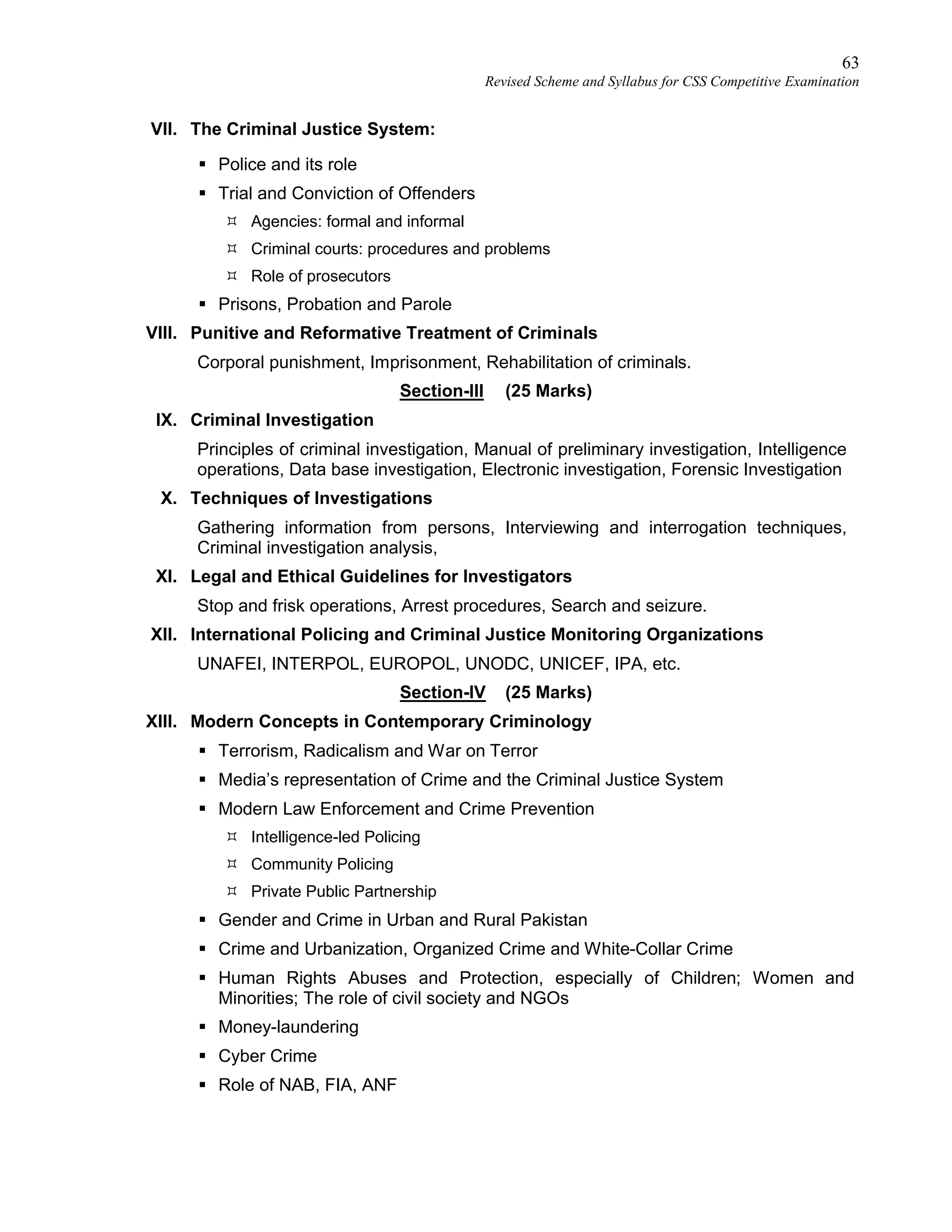
 Eliot (The Wasteland; Love Song of J. Alfred Prufrock)
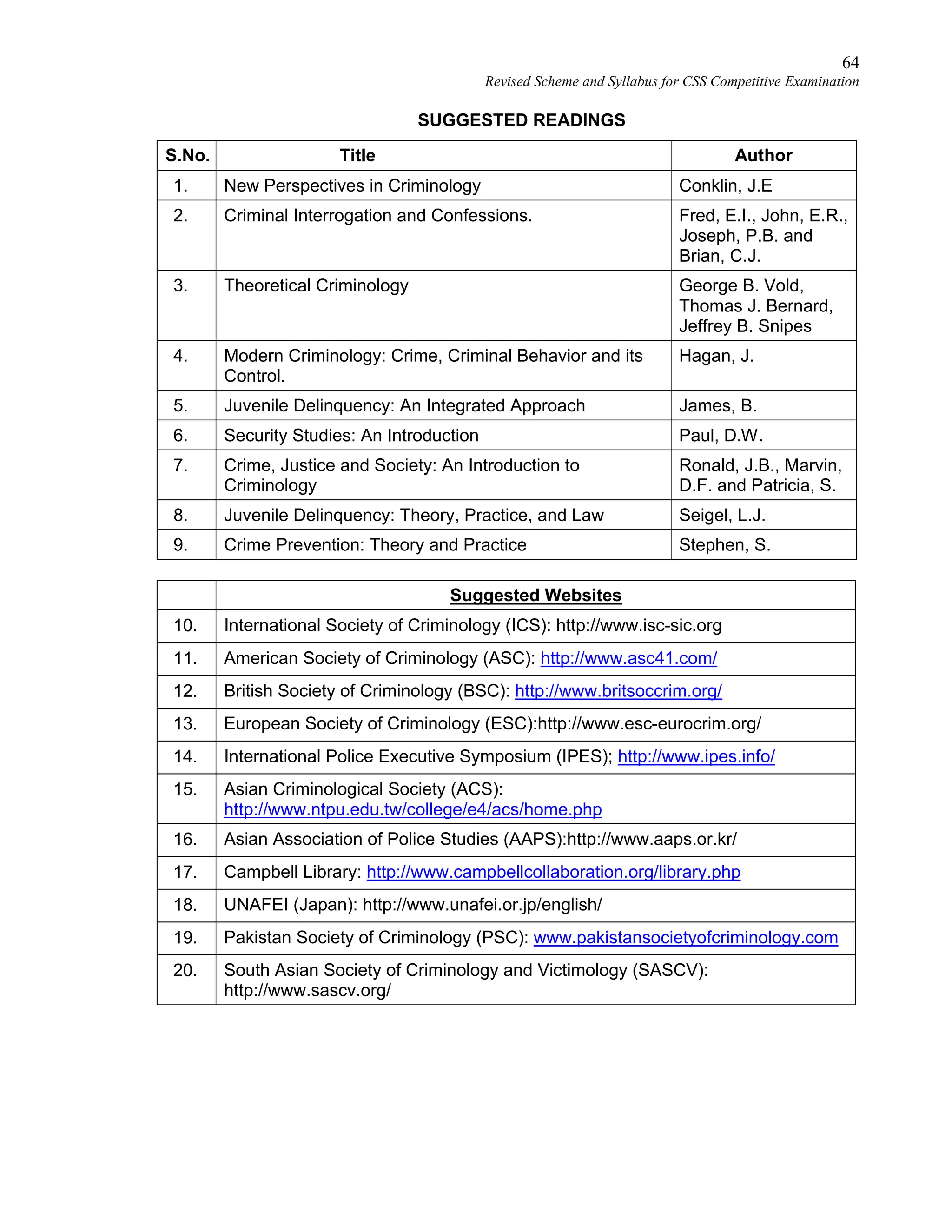
 Philip Larkin (Maturity; Continuing to Live; The Trees)
 Wallace Stevens (A Postcard from the Volcano; Continual Conversation with
a Silent Man; Dry Loaf) OR Walt Whitman (As I Ponder’d in Silence; Are You
the New Person Drawn Toward Me?; This Moment Yearning and Thoughtful)
IV. Drama: (20 marks)
 Shakespeare (Hamlet; King Lear; Twelfth Night)
 William Congreve (The Way of the World)
 Shaw (Pygmalion; Heartbreak House )
 Harold Pinter (The Caretaker)
 Samuel Beckett (Waiting for Godot)
 Eugene O’Neill (Long Day’s Journey into Night)
V. Novels: (20 marks)
 Thomas Hardy (Far from the Madding Crowd)
 D.H. Lawrence (Sons and Lovers)
 George Orwell (Nineteen Eighty-four)
 James Joyce (A Portrait of the Artist as a Young Man)
 Iris Murdoch (Under the Net)
69
Revised Scheme and Syllabus for CSS Competitive Examination
 Nathaniel Hawthorne (The Scarlet Letter) or William Faulkner (The Sound
and the Fury)
VI. Literacy Theory & Criticism (20 Marks)
 Structuralism
 Marxism
 Deconstructionism
 Psychoanalytic criticism
 Feminist criticism
 Postcolonial Criticism
Note: The texts are mentioned in brackets in front of each author’s name. However, for the
component on “Literary Theory and Criticism” and for understanding poetry and drama,
particularly 20th
century poetry and Drama, following readings are suggested:
SUGGESTED READINGS
S.No. Title Author
1. The basics Literary Theory. (Second
edition). Routledge.
Bertens, H. (2008).
2. Literary Theory: An Introduction.
(Anniversary Edition).
Eagleton, E. (2008).
3. A New Handbook of Literary Terms. Mikics, W. (2007).
4. A Companion to Twentieth Century Poetry. Roberts, N. (2003).
5. A Reader’s Guide to Contemporary
Literary Theory. (Fifth edition).
Selden, R., Widdowson, P., &
Brooker, P. (2005)
6. Twentieth Century British Drama. Smart, J. (2001).
7. Modern Critical Views & Interpretations,
ed: 80’s and 90’s editions.
Harold Bloom (these include
all range of authors and their
works given above)
8. A Companion to 20th
Century Drama
Oxford: Blackwell.
Krasner David. 2005.
70
Revised Scheme and Syllabus for CSS Competitive Examination
PAPER: ENVIRONMENTAL SCIENCE (100 MARKS)
I. History of Environmental Thought
Environment and Sustainable Development, History of Environmental Movements,
Industrial and Agriculture Revolution, United Nations Conference on Human Environment
1972, Our Common Future 1987, Rio Summit 1992, Agenda 21, World Summit on
Sustainable Development 2002, Rio Summit-II, 2012, Millennium Development Goals.
II. Sustainable Development Issues
Population growth, Poverty, Biodiversity loss and its Conservation, Energy security (energy
conservation and alternative energy resources), Urbanization and sustainable cities,
Carrying capacity and ecological footprint. Food security and sustainable agriculture.
Ecological restoration.
III. Interdisciplinary nature of Environmental Science
Orientation on convergence of various social and natural sciences to evolve a new
discipline of environmental science: Environmental Biology, Environmental Chemistry,
Environmental Physics, Environmental Microbiology, Environmental Toxicology,
Environmental Economics, Environmental Geology, Environmental Geography,
Environmental Biotechnology, Environmental Sociology.
IV. Environmental Pollution
Air Pollution, Water Pollution, Soil Pollution, Noise Pollution, Solid Waste, Water Logging &
Salinity, Deforestation, Desertification, Eutrophication, Global and regional air pollution
problems (Greenhouse effect, Global Warming/Climate Change, Ozone Depletion, Acid
Rain).
V. Climate Change
Climate Pattern at local, regional and global scale. Different types of climate including
tropical and mid latitude climate, polar climates. Climate change processes, Drivers and
Indicators of Climate Change, Effects of Climate Change on natural and societal systems.
Carbon foot print. Climate change adaptation and mitigation, Clean Development
Mechanism (CDM), REDD+. Global environmental politics on climate change: role of India,
China and USA (Copenhagen Accord 2009).
71
Revised Scheme and Syllabus for CSS Competitive Examination
VI. Environmental Governance
Policy, legal and institutional frameworks for governance of environment in Pakistan:
National Conservation Strategy of 1992, National Environmental Policy Act of Pakistan
2005, Environmental Protection Act of 1997, Pak-EPA (Review of IEE/EIA) Regulations
2000, Hospital Waste Management Rules 2005, Pollution Charge Rules, Sample Rules,
Solid Waste Management Plan 2005, Hazardous Substances Rules 2005, National
Drinking Water Policy 2009, Sanitation Policy, National Climate Change Policy 2012.
VII. Global initiatives
Brief on some of the Multilateral Environmental Agreements ratified by Pakistan,
Convention on Biological Diversity (CBD), Cartagena Protocol on Bio-safety, Convention on
International Trade in Endangered Species of Wild Fauna and Flora (CITES), Convention
on Wetlands of International Importance Especially as Waterfowl Habitat (Ramsar
Convention), Convention on the Conservation of Migratory Species (CMS), United Nations
Framework Convention on Climate Change (UNFCCC), Kyoto Protocol to UNFCCC,
Montreal Protocol on Substances that deplete the Ozone Layer, United Nations Convention
to Combat Desertification (UNCCD).
VIII. Environmental Assessment and Management
Environmental Impact Assessment, Strategic Environmental Assessment, Environmental
Management Systems (ISO 14000), Occupational Health & Safety management systems
(OHSAS 18000), Participatory Approaches to Environmental Management, Technological
Approaches to Environmental Management, Approaches to Solid Waste Management,
Disaster Risk Management, Pollution Control Technologies, Geographic Information
System & Remote Sensing, Natural Resources Management.
72
Revised Scheme and Syllabus for CSS Competitive Examination
SUGGESTED READINGS
S.No. Title Author
1. Environmental Economics in Theory and
Practice.
Hanley, N.
Shorgen,J,White,B
2. Industrial Safety Health and Environmental
Management
Jain R.K. Rao S.S
3. Environmental Science: Earth as a living
Planet, 9th
ed.
Botkin, D. Keller, E. 2014
4. Environmental Geology Facing the Challenges
of Our Changing Earth
Erickson, J
5. Environmental Geology. Keller A.Edward
6. Earth Science. Tarbuck. J. Edward
Lutgens K. Friederick
7. Environmental Science: A Study of
Interrelationship
Enger ED, Smith, B.F
8. Basics of Forestry and Applied Sciences,
Concepts and Theory
Masood A.A Qureshi
9. Environmental Science: Working with Earth Miller. T.G
10 Disaster Management: A Disaster Manager’s
Handbook
Carter N.W
11 Disasters and Development Cuny, F.C.
12 Disaster Management: Warning Response
and Community Relocation
Perry R.W. Mushkatel,
A.H.
13 Energy: Crisis or Opportunity, An Introduction
to Energy Studies
Diana Schumacher
14 Environmental Geology Carla W. Montgomery
15 Environmental Health; Ecological Perspective Kathryn Hilgenkamp
16 Official Website of Govt. of Pakistan www.environment. gov.pk
17 Official Website of UN Environment
Programme.
www.unep.org
73
Revised Scheme and Syllabus for CSS Competitive Examination
PAPER: EUROPEAN HISTORY (100 MARKS)
Part –I (Marks 50)
I. The French Revolution and Napoleonic Era (1789-1815)
 The causes of French Revolution
 The consequences of Revolution
 Napoleon rise to power
 Creation of Empire
 The Continental system
 The fall of Napoleon
II. The Concert of Europe (1815-1830)
 The Congress of Vienna
 Metternich’s Era
 The Concert of Europe and Congress System
 Balance of Power
III. Forces of Continuity and Change in Europe (1815-1848)
 Nationalism
 Liberalism
 Romanticism
 Socialism
 Industrial Revolution
 Colonialism
 Cosequences
IV. The Eastern Question (1804-1856)
 The nature of the Eastern question
 The Crimean War
 Russo Turkish War 1877
 Consequences
V. Unification of Italy
 The effects of the revolution of 1848
 The obstacles to unification
 Cavour and the unification of Italy
 The Process of Italian unification (1859-1871)
74
Revised Scheme and Syllabus for CSS Competitive Examination
VI. Unification of Germany
 The rise of Bismarck
 Diplomatic events
 The Austro-Prussian War (1866)
 The Franco- Prussian War (1870-1871)
 The triumph of Bismarck and process of unification
VII. The Origins of First World War (1890-1914)
 Formation of Alliances and Counter Alliances
 The Balkans War (1912-1913)
 The outbreak of the World War 1
Part –II (Marks 50)
VIII. The First World War and its aftermath
 The War (1914-1918) and peace treaties
 The League of Nations
IX. Dictatorships in Europe
 Fascism in Italy under Musssolini
 Hitler,Nazism and Germany
 Russia , Marxism Revolution and its working under Stalin
 Great Depression and its effects on Europe
 Appeasement
 The Arm race
 The Sudetenland Crisis (1938)
 The distraction of Czechoslovakia (1939)
X. The Second World War and its Effects on Europe
 The Main Events of the War
 Impact of war
XI. Post- War Europe
 The post war settlements
 The United Nations
 Economic Recovery of Europe,Marshal Plan
 German Question
 NATO
75
Revised Scheme and Syllabus for CSS Competitive Examination
 Decolonization
XII. Cold War Europe (1955-1991)
 Effects of cold war
 Warsaw Pact (1955)
 The European Economic Community (EEC)
 Nuclear Non-Proliferation Agreement
 Charles Degaule and France
 Spread of communist regimes in Europe
XIII. Europe (1991-2012)
 The Gorbachev and Disintegration of USSR
 The reunification of Germany
 The Balkan crisis of 1990s
 The European Union
 Role of Europe in War against terrorism
 Global Economic Crisis and Europe
SUGGESTED READINGS
S. No. Title Author
1. A History of Modern Europe (1789-1991) H.L. Peacock,
2. The Struggle for Mastery in Europe: 1848-1918 A.J.P Taylor,
3. The Cold War: Ideological Conflict or Power
Struggle
Normali A. Grabener
4. The USSR: A Share History Vladimir Polrtayen,
5. Development in Russian Politics Stephen White,
6. Mastering Modern European History Stuart Miller,
7. A Text Book of European History by Southgate, G.W.
8. Aspects of European History 1789-1980. Stephen J. Lee
9. Europe Since Napoleon Thompson, D.
10. European Union: European politics. Tim Bale.
11. Modern Europe in the Making from the French
Revolution to the Common Market
Fasal, G.
12. The Norton History of Modern Europe Gilbert, F.
13. The Origins of the Second World War Taylor, A.J.P.
14. The Rise and Fall of Great Powers. Paul Kennedy.
76
Revised Scheme and Syllabus for CSS Competitive Examination
PAPER: GENDER STUDIES (100 MARKS)
I. Introduction to Gender Studies
 Introduction to Gender Studies
 Difference between Gender and Women Studies
 Multi-disciplinary nature of Gender Studies
 Autonomy vs. Integration Debate in Gender Studies
 Status of Gender Studies in Pakistan
II. Social Construction of Gender
 Historicizing Constructionism
 Problematizing the category of “Sex”: Queer Theory
 Is “Sex” socially determined, too?
 Masculinities and Femininity
 Nature versus Culture: A Debate in Gender Development
III. Feminist Theories and Practice
 What is Feminism
 Liberal Feminism
 Radical Feminism
 Marxist/Socialist Feminism
 Psychoanalytical Feminism
 Men’s Feminism
 Postmodern Feminism
IV. Feminist Movements
 Feminist Movements in the West. First Wave, Second Wave and Third Wave
Feminism. United Nation Conferences on Women, Feminist Movements in
Pakistan.
V. Gender and Development
 Colonial and Capitalistic Perspectives of Gender
 Gender Analysis of Development Theories; Modernization Theory, World System
Theory, Dependency Theory, Structural Functionalism.
 Gender Approaches to Development: Women in Development (WID), Women
and Development (WAD), Gender and Development (GAD); Gender Critique of
Structural Adjustment Policies (SAPs).
 Globalization and Gender
VI. Status of Women in Pakistan
 Status of Women’s health in Pakistan
 Status of Women in Education
 Women and Employment
 Women and Law
77
Revised Scheme and Syllabus for CSS Competitive Examination
VII. Gender and Governance
 Defining Governance
 Suffragist Movement
 Gender Issues in Women as Voters
 Gender Issues in Women as Candidates
 Gender Issues in Women as Representatives
 Impact of Political Quota in Pakistan
VIII. Gender Based Violence
 Defining Gender Based Violence
 Theories of Violence against Women
 Structural and Direct Forms of Violence
 Strategies to Eliminate Violence against Women
IX. Case Studies of:
 Mukhtaran Mai
 Mallala Yousaf Zai
 Shermin Ubaid Chinoy
SUGGESTED READINGS
S.No. Title Author
1. Theories of Women Studies Eds., Bowles. Gloria and
Renate D. Klein
2. Introduction: Theories of Women Studies and
the Autonomy/ Integration Debate in Theories
of Women Studies.
Bowles G and Renate, K.
3. The State of the Discipline of Women Studies in
Pakistan in Social Sciences in Pakistan
Saigol, Rubina
4. The State of Women Studies in Pakistan in
Journal of Asian Women Studies
Bari, Farzana
5. Women’s Law in Legal Education and Practice
in Pakistan.
Shaheed, F. and Mehdi, R.
(ed.) (1997)
6. Locating the self: Perspectives on Women and
Multiple Identities.
Khan, N.S. et al.(ed.) (1998)
7. The Social Construction of Gender Lorber, Judith
8. Queer Theory Lorber, Judith
9. Gender,USA, Harriet Bradley(2013)
10. Women of Pakistan: Two Steps Forward, One
Step Back.
Mumtaz,Khawar& Shaheed,
Farida(1987)
78
Revised Scheme and Syllabus for CSS Competitive Examination
S.No. Title Author
11. Feminism and its Relevance in South Asia Saeed K, Nighat & Bahsin,
Kamla
12. Feminist Thoughts Tong, Rosemarie
13. Reversed Realities Kabeer, Naila
14. Gender Planning and Development Moser, Caroline
15. Electoral Politics: Making Quotas Work For
Women.
Hoodfar,Homa&Tajali, Mona
(2011)
16. The Gender face of Asian Politics Ayaz, Aazar &
Fleschenberg,
Andrea(2009)
17. Performance Assessment of Women
Parliamentarians in Pakistan
Bari, Farzan (2002)
18. Base line Report: Women’s Participation in
Political and Public Life
Zia, Shahla & Bari, Farzana.
(1999)
19. Freedom from Violence Schuler, Margarte (1992)
20. Human Rights Commission of Pakistan Report
79
Revised Scheme and Syllabus for CSS Competitive Examination
PAPER: GEOGRAPHY (100 MARKS)
Part –I (Marks 50)
Physical Geography
I. Factors controlling landform development; endogenic and exogenic forces; origin and
evolution of the earth’s crust; physical conditions of the earth’s interior; geosynclines;
continental drift; isostasy; sea-floor spreading; plate tectonics; mountain building;
volcanicity; earthquakes; concepts of geomorphic cycles; landforms associated with
fluvial, arid, glacial, coastal and Karst cycle; groundwater.
II. Elements and Factors of climate, structure and composition of atmosphere, insolation,
temperature, Pressure belts of the world; Heat budget of the earth; Atmospheric
circulation: planetary,monsoon and local winds; Air masses and Fronts; Hydrological
cycle; Types of condensation and precipitation; Factors of global distribution of
precipitation.
III. Origin of oceans and seas, Characteristic features of the ocean basins, temperature,
salinity distribution cause and effects, Ocean floor deposits, their characteristics and
classification, Ocean circulation, Waves, currents and tides, their nature, causes and
effects.
IV. Factors of climate and Environmental change. Transformation of nature by man;
environmental degradation and conservation; Nature and Types of pollution. Problems
caused by pollution, Global Warming, Global Environment Patterns, Environmental
Hazards and Risk Management.
Part –II (Marks 50)
Human Geography
V. Origin and Diffusion of Culture, Geographic patterns of culture, Classification of
Languages, World Distribution of Languages, Indo-European Languages, Origins of
Religions, Diffusion of Religions, Global Distribution, Regional conflicts, Ethnicities and
Nationalities, Ethnic Conflicts, Ethnic Diversity in the World, Factors of Ethnic
Cleansing, Ethnic Cleansing in the World, Development Indicators, Economic
Indicators, Social Indicators, Health Indicators, Development through Trade, Impacts
of development Indicators.
VI. Factors effecting Agriculture, Subsistence Agriculture and population growth,
Commercial Agriculture and Market Forces, Sustainable Agriculture, Types and
Distribution of Agriculture, Factors of Industrial locations, The Industrial Revolution,
Industrial Theories, Distribution of Industries and Industrial Estates, Renewable
Resources, Recycling Resources, Sustainable resources.
VII. Factors of Population Growth, Components of Change, Population Structure, The
Demographic Transition, World distribution of Population, Over and under Population
threats and their consequences, Models of Internal Structure of Cities, World Urban
Patterns, Settlement Theories, Patterns and Problems within urban areas.
80
Revised Scheme and Syllabus for CSS Competitive Examination
VIII. Politics, Geography and Political Geography, State as a Politico-Territorial
Phenomenon, State, Nation and the Nation-State, World Politics and International
Relations, Geopolitics of uneven Development and Globalization of Capital,
Geography of Tourism and Recreation, The demand for tourism and recreation, The
supply for tourism and recreation, The impact of tourism and recreation: (Socio-
economic impacts, Physical-environmental impacts), Global patterns in health and
diseases, Models in medical geography, Recent issues and developments.
SUGGESTED READINGS
S.No. Title Author
1. Discovering Physical Geography 2nd ed.
Hoboken:John Wiley &Sons,Inc.
Alan F. Arbogast (2011).
2. Introducing Physical Geography. Hobken: John
Wiley & Sons
Alan Strahler, (2011).
3. Atmosphere, Weather and Climate (7th ed.).
London: Clays St. Davis.
Barry, R. (1998).
4. Meknight’s Physical Geography A Landscape
application 10th
ed PHI Learning, New Delhi.
Darrel Hess (2012).
5. Text Book of Population Geography, Randam
Publications, New Delhi.
Dr. Martin Ardagh (2013).
6. Atmosphere, Climate and Change. New York:
Scientific American Library
Graedel, T. (1995).
7. An Introduction to Oceanography. Johnson H. (1996).
8. Economic Geography, Randam Publications,
New Delhi.
Philip Emeral (2013).
9. Essentials of Physical Geography 8thed
Australia.
Robert E. Gabler& James F.
Petersen (2007)
10. Geosystems: An Introduction to Physical
Geography 7th
ed. New Jersey:Pearson Prentice
Hall
Robert W. Christopherson
(2009),
11. Tourism Geography: Randam Publications, New
Delhi.
Shweta Singh (2013).
12. Elements of physical geography. New York.
John Wiley.
Strahler, A. N. (1998).
13. Natural Disaster Management: New
technologies and opportunities, The Icfai Uni.
Press, Agartala.
Subir Ghosh (2012).
14. Economic Geography 3rd
ed. PHI Learning, New
Delhi.
Truman A. Hartshorn (2010).
15. Environmental Geography: Science Landuse William M. Marsh (2005).
81
Revised Scheme and Syllabus for CSS Competitive Examination
S.No. Title Author
and Earth System 3rd ed.Hobken: John Wiley &
Sons
16. Geography, Regions and Concepts. U.S.A:
John Wiley and Sons, Inc.
Blif, H. J. (1971).
17. Human Geography. Canada: John Wiley &
Sons, Inc.
Blij, H. J. (2000).
18. Population Geography Oxford: Pergamon Press. Clarke, J. I. (1965).
19. Human Geography Cultural Society and Space.
(5th
ed.). New York: John Wiley & Sons.
De Blij. H. J. (2003).
20. Political Geography: The Spatiality of Politics.
(3rd
ed.). New Delhi: Tata McGraw-Hill
Publishing Company Limited.
Dikshit, R. D. (2001).
21. Agricultural Geography: Issues and Applications.
New Delhi: Gian Publishing House.
Dube, R. S. (1987).
22. Human Geography Landscape of Human
Activities. (8th
ed.). New York: Mc.Graw Hill
Higher Education.
Getis, Fellman. (2005).
23. An Introduction to Agricultural Geography.
London: Hutchinson.
Grigg, D. (1984).
24. The Geography of Tourism and Recreation (1st
ed.). London: Routledge.
Hall, C. M; & Page, S. J.
(1999).
25. Economic Geography. New York: Prentice Hall,
Inc. Englewood Cliffs.
Hartshorne, T. A. &
Alexander, J. W. (1988).
26. Geography & Health: A study in medical
Geography. New Delhi: A.P.H. Publishing
corporation.
Izhar, F. (2004).
27. Geographies of Global Change. Blackwell
Publishers Inc.
Johnston, R. J. (1996).
28. Urban Geography, New York: McGraw Hill. Kaplan, Wheeler (2009).
29. Human Geography Place and Region in Global
context. (2nd
ed.) .New Jersey: Prentice Hall.
Knox Paul L. (2001).
30. Agricultural Geography. London: Longman. Newbury, P. A. R. (1999).
31. Contemporary Human Geography. New Delhi:
PHI Learning Private Limited.
Rubenstein James M. (2010).
32. Tourism Geography (1st
ed) London: Routledge. Williams, S. (1998).
82
Revised Scheme and Syllabus for CSS Competitive Examination
PAPER: GEOLOGY (100 MARKS)
Part- I (50-marks)
I. Introduction to Physical Geology
Introduction and scope of geology, its importance and relationship with other
sciences; Earth as a member of the solar system: its origin, age, composition and
internal structure; Introduction to rocks and minerals; Weathering and erosion;
Isostasy; Geological Time Scale.
II. Stratigraphy and Paleontology
Principles of stratigraphy; Laws of superposition and faunal succession; Geological
time scale with divisions; Classification and nomenclature of stratigraphic units:
lithostragraphic units, biostratigraphic units and chronostratgraphic units.
Introduction to fossils and their significance; Modes of fossilization; Study of
morphology, range and broad classification of major invertebrate phyla; Introduction
to micro fossils; Introduction to Paleobotany; Introduction and classification of major
vertebrates; Introduction to micropaleontology
III. Mineralogy
Classification of minerals; Study of internal structure; Polymorphism and
isomorphism; Paragenesis; Physical and optical properties of the common silicate
and non-silicate mineral groups; Introduction to crystallography: elements of
symmetry, study; normal classes of crystallographic systems.
IV. Structural Geology and Tectonics
Stress-strain concepts; factors controlling the mechanical behavior of materials;
Folds; Faults; Joints; Foliation: terminology, classification and relationship with
bedding; Lineation; Unconformity.
Plate tectonics theory; Geological evidences for continental drift; Sea-floor
spreading; Oceanic ridges; Continental rifts; Intra-oceanic islands; Hot spot and
Mantle plumes; Wilson Cycle; Tectonic framework of Pakistan.
V. Petrology and Petrography
Introduction, classification and description of sedimentary rocks; origin;
transportation and deposition of sediments; Texture of sedimentary rocks;
Sedimentary structures, their classification, morphology and significance;
Composition, origin, differentiation and evolution of magma; Classification of
igneous rocks; Mode of occurrences and types of extrusive rocks; Texture and
structure of igneous rocks; Introduction to metamorphism; Types of metamorphism;
Grades, zones and facies of metamorphism; Metamorphic diffusion and
differentiation; Metamorphism in relation to Plate Tectonics; Differentiation between
metamorphism and metasomatism.
Introduction to Polarizing Microscope; Optical properties of opaque and non-opaque
minerals in plane polarized light and under crossed nicol including metallic under
reflected light; Description of optical properties of common rock forming minerals.
83
Revised Scheme and Syllabus for CSS Competitive Examination
Part- II (50-marks)
I. Introduction to Geophysics
Definition and relation of geophysics with other sciences; Classification and brief
description of various branches of geophysics such as seismology, geomagnetism,
geoelectricity, tectonophysics, gravimetry, geo-thermy and geodesy; Introduction to
various geophysical techniques for exploration of mineral deposits, oil and gas,
subsurface water and engineering works.
II. Sequence Stratigraphy
Introduction: history, concept and significance of sequence stratigraphy; Data
sources: seismic reflections, outcrops, well logs, core and seismic facies;
Sea level changes: their causes and effects, accommodation, eustatic and relative
sea curve; Hierarchy of sequence stratigraphic elements; Types of sequences and
systems tracts.
III. Petroleum Geology
The nature and classification of petroleum hydrocarbons, their origin, migration and
accumulation; Source sediments, reservoir rocks and trapping mechanism for oil
and gas; Prospecting and exploration of oil and gas; Reservoir: characteristics, drive
mechanism, energy and pressure maintenance; Secondary and enhanced recovery;
Introduction to Sedimentary Basins of Pakistan.
IV. Engineering and Environmental Geology
Rock and soil mechanics and its application in civil engineering; Rock mass
characteristics; Geotechnical studies of rocks and soils; Geological factors and
strength of rocks; Study of geological factors in relation to the construction of
buildings’ foundations, roads, highways, tunnels, dams and bridges; Application of
geophysical methods for site investigation; Construction materials; Mass movement:
their causes and prevention.
Introduction to environmental geology; Management of natural resources; Global
climatic changes; Environmental controls for erosion, desertification and coastal
degradation; Geological hazards such as floods, landslides, earthquakes, tsunamis,
volcanoes, glaciers and shoreline processes; Remedial measures; Clean sources
of energy; Industrial pollution, solid and liquid waste disposal, Introduction to
environmental impact assessment and initial environmental examination.
V. Mineral and Energy Resources
Introduction of geological exploration/prospecting. Brief description of hydrocarbons,
coal, gemstones, copper, lead, zinc, iron, gold, chromite, manganese, salt,
gypsum, bauxite, sulphur, barite, fluorite, clays, phosphorite, building and dimension
stones; Industrial rocks and minerals; Radioactive minerals and rocks; Special
reference to economic mineral deposits in Pakistan.
Origin, occurrence, and depositional environments of coal; Coal constitution and its
kinds; Coal rank, grade and calorific value; Coal deposits of Pakistan with reference
to Thar Coal; Geothermal energy resources of Pakistan.
84
Revised Scheme and Syllabus for CSS Competitive Examination
VI. Economic and Applied Geology
Metallic and Non-metallic mineral resources of Pakistan; Mineral-based industries.
Overview of Recodec Copper; Radioactive minerals and their occurrences in
Pakistan; Gemstones of Pakistan.
Geology of Reservoirs, dams, highways and tunnels; Major natural hazards and their
impacts on the environment with special reference to Pakistan.
SUGGESTED READINGS
S.No. Title Author
1. Physical Geology Charles Plummer, David
McGeary, Diane Carlson,
2. Physical Geology Charles (Carlos) Plummer,
Diane Carlson
3. Principles of Physical Geology Holmes, A
4. Principles of Paleontology Raup, D.M. & Stanley, S.M
5. Vertebrate Paleontology Romer, A.S
6. Invertebrate Paleontology and Evolution Clakson, E.N.K
7. Stratigraphy of Pakistan Shah, S.M.I.
8. Principles of Sedimentology and Stratigraphy Boggs, S
9. Stratigraphy and Historical Geology of
Pakistan
Kazmi, A.H and Abbasi, I.A
10. Igneous and Metamorphic Petrology Best, M.G.,
11. Introduction to Optical Mineralogy Nesse, W.D
12. An Atlas of Minerals in Thin Section Schulze, D.J.,
13. Minerals and Rocks Klein, C.,
14. Mineral Characterisation and Processing Mohapatra, B.K., Misra, V
15. Principles of Mineralogy William. H.B.,
16. Mineralogy Perkins, D
17. Plate Tectonics – Geodynamics Moores, E.M. & Twiss, R.J
18. Structural Geology of Rocks and Regions George H. Davis, Stephen J.
Reynolds, Charles F. Kluth
19. Structural Geology Twiss, R.J. & Moores, E.M.,
20. Carbonate Sedimentology Tucker, M.E. & Wright, V.P
21. Applied Sedimentology Selly, R.C.,
22. Petrology of Sedimentary Rocks Boggs Jr. S
23. Sedimentary Rocks Pettijohn, F.J
24. Introduction to Applied Geophysics Burger R.H., Sheehan, A. &
Jones, C
85
Revised Scheme and Syllabus for CSS Competitive Examination
S.No. Title Author
25. Geophysical Methods in Geology Sharma, P.V
26. The Solid Earth: An Introduction to Global
Geophysics
Fowler, CMR
27. Igneous and Metamorphic Petrology Best, M.G
28. Petrology: Igneous, Sedimentary, &
Metamorphic
Blatt, H., Tracy, R.& Owens,
D
29. Igneous and Metamorphic Petrology Best, M.G.,
30. Metamorphic Petrology Turner, F.J.,
31. Sequence Stratigraphy Emery, D. & Myers, K.J.,
32. Elements of Petroleum Geology Richard C. Selley,
33. Petroleum Geology North, F.K.,
34. Geology of Pakistan Bender, F.K. & Raza, H.A.,
35. Engineering Geology: Principles and Practice David George Price, Michael
de Freitas
36. Engineering Geology F G Bell
37. Fundamentals of Engineering Geology Bell, F.A.G.,
38. Environmental Geology Montgomery, C.W.,
39. Geology of Himalaya, Karakuram, Hindukush
in Pakistan
Tahirkheli, R.A.K.,
40. Geology of Pakistan Bender, F.K. & Raza,
41. Stratigraphy and Historical Geology of
Pakistan
Kazmi, A.H and Abbasi, I.A
42. Economic Geology: Principles and Practice Walter L. Pohl
43. Directory of Mineral Deposits of Pakistan Zaki, A.,
44. An Introduction to Ore Geology Evans, A.M.,
45. Metallogeny and Mineral Deposits of Pakistan Kazmi, A.H. & Abbas, S.G.,
46. Introduction to Mineral Exploration Moon, C.J., Whateley, M.K.G.
and Evans, A.M.
47. Energy Resources Brown and Skipsy
48. Pakistan Energy Yearbook 2012 Ministry of Petroleum and
Natural Resources
Hydrocarbon Development
Institute of Pakistan.
Islamabad
86
Revised Scheme and Syllabus for CSS Competitive Examination
PAPER: GOVERNANCE & PUBLIC POLICIES (100 MARKS)
I. Basic Concepts of Governance:
 Origin of the term Governance
 Definition of Governance
 Definition of Good Governance
 Characteristics of Good Governance: Participation, Rule of law, Transparency,
Responsiveness, Equity, Effectiveness and Efficiency, Accountability, Strategic
Vision
 Collapse/Failure of Governance: its indicators diagnostic tools & Effects
II. Governance Theories:
 Communitarianism
 Decentered Theory
 Libertarian Socialism
 Institutionalism
 Marxism
 Neoliberalism
 Rational Choice Theory
 Regulation Theory
III. Governance Indicators laid by World Bank/IMF/UNESCO/UNDP/ADB, their
Explanation & Application Level in Pakistan:
 Voice and Accountability
 Political Stability and Absence of Violence
 Government Effectiveness
 Regulatory Authorities & their Quality
 Rule of Law
 Control of Corruption
IV. Public Policy and Planning Institutions and their role in Planning
 Institutional Framework for Policy Coordination and Planning(ECNEC, Economic
Coordination Committees of the Cabinet, The Federal Cabinet, The Secretaries
Committee, The Prime Minister’s Secretariat, The Planning Commission, The
Finance Division, The Cabinet Division, and all Federal Ministries for their
respective subjects)
 Role of Planning Commission in Policy and Planning
 Strategic Planning in Federal
 Provincial Government and Local Government
 Role of International Donors in Policy Formulation (IMF Document “Memorandum
on Economic and Financial Policies 2013/14–2015/16,” that underpins almost all
public policies.)
 Public Policy and Implementation in Key Sectors (i.e., Health, Education).
87
Revised Scheme and Syllabus for CSS Competitive Examination
V. Accountability:
 General Introduction to Accountability and its concepts(Standards, Symbolism,
regional and country-wide comparisons, a Review of Contemporary Studies)
 Types of Accountability- Political Accountability, Legal/ Judicial Accountability,
Administrative Accountability, Professional Accountability, Private vs. Public
Accountability
 National Strategies against Corruption and remedial measures.
VI. Bureaucracy:
 Introduction to the Concept of Bureaucracy(History, Neutrality, Steel Frame of the
State, Negative Connotations Associated with the term)
 Theories of Bureaucracy (Max Weber, Marx, John Stewart Mill, Woodrow Wilson)
 Role of Bureaucracy in Pakistan (British legacy, civil-military relations, neutrality,
dilution of neutrality, political allegiance, power, corrupting the incumbent,
institutional degradation, constitutional guarantees, indexing of salaries with the
CPI or lack thereof.)
 Public Administration and Code of Ethics (Effectiveness of the Estacode and the
Code of Ethics, Comparison with other countries)
VII. Public Policy Formulation and Implementation
 The Policy Making Process: How Policies are Made (Six including diagnosis and
six stages with cautions to be exercise at each stage)
 Policy Implementation & Role of Bureaucracy (Training, Pervasive Inertia and
how to break it, Lack of Decision Making, Culture of postponement and delays,
Lack of resources, Political interference, Ability to say “No.”)
 Policy Analysis, The Quest for Solutions (Lack of research in policy analysis,
Lack of coordination among departments, secrecy, openness)
 Policy Evaluation: Assessing The Impact of Public Policy, Program Evaluation-
Success and failure of Govt.
VIII. Multi-level Governance in Pakistan:
 Legislature: National Assembly, Senate, Provisional Assemblies
 Judiciary: Supreme Court, High Courts, Lower Courts
 Functioning of the offices:
 President of Pakistan,
 Prime Minister of Pakistan
 Office of Governor,
 Office of Chief Minister, Federal Cabinet, Cabinet Committees, Federal
Secretariat, Provincial Secretariat
 Local Government system: District Government, Zila Government, Tehsil
Government, Union Administration, Its Efficacy, Performance & Causes of
Success or Failure
88
Revised Scheme and Syllabus for CSS Competitive Examination
IX. Federalism, Devolution and Decentralization
 Constituents participation in Federal Structure
 Principle of Subsidiarity in Public Service Delivery
 Decentralization Model of Kerala
X. Role of Citizens in Governance
XI. Good Governance in Islam
 Quranic Guidance on Good Governance
 Concept of Governance and its application in light of Quran; Sunnah and Fiqh.
SUGGESTED READINGS
S. No. Titles Author
1. Governance Anne Mette Kjær
2. Encyclopedia of Governance, Volume 2 Mark Bevir
3. Implementing Public Policy: Governance in
Theory and in Practice.
Hill M. and Hupe P.
4. Accountability: Managing for Maximum Results Sam R LLyod
5. Guidance for Good Governance: Explorations in
Qur'anic, Scientific & Cross-Cultural Approaches
Abdullah Ahsan&
Stephen Bonsal Young
6. How Governments Work Muzaffar A. Ghaffaar
7. Government and Administration in Pakistan Dr Jamil-ur Rehman
8. Public Administration With Special Reference To
Pakistan
Dr Sultan Khan
9. Constitution of Islamic Republic of Pakistan, National Assembly of
Pakistan
10. Pakistan: Beyond the Crisis State Maleeha Lodhi
11. Power Dynamics, Institutional Instability and
Economics Growth: The Case of Pakistan
Akmal Hussain
12. Federalism and Rights Ellis Katz and G Allan Tarr
13. Local Government Reforms in Pakistan:
Context, Content and Causes
Ali Chmeema, Asim Ijaz
Khawaja and Adnan Qadir
14. Economics Democracy Through Pro Poor
Growth
PonnaWignaraja, Akmal
Hussain Susil Sirivardana
15. Governance: South Asian Perspective Hasnat Abdul Hye
16. Governance, Economic Policy and Reform in
Pakistan
Abdus Samad
89
Revised Scheme and Syllabus for CSS Competitive Examination
S. No. Titles Author
17. “Pakistan—Problems of Governance,” 1993. Hussain, M., Hussain. A.
18. “Pakistan’s Predicament: The Diagnostic and the
Debates within,” Journal of Pakistan Vision, 13/1
(2012).
Racine, Jean-Luc.
19. The Culture of Power and Governance of
Pakistan—1947-2008, Oxford, 2010.
Niaz, I.
20. “Legitimacy and the Administrative State:
Ontology, History, and Democracy,” Public
Administration Quarterly, UC Berkeley, 2013.
Bevir, M.,
21. Handbook of Public Policy Analysis Frank Fischer, Gerald J.
Miller, and Mara S. Sidney,
22. Public Policy: Politics, Analysis, and
Alternatives, 4th Ed., CQ Press, 2012
Kraft, Michael E., Scott R.
Furlong
23. Public Policy in An Uncertain World,: Analysis
and Decisions, Harvard, 2013
Manski, Charles F.
90
Revised Scheme and Syllabus for CSS Competitive Examination
PAPER: HISTORY OF PAKISTAN & INDIA (100 MARKS)
I. Muslim Rule and Heritage in India (712-1857): Political History Arrival, foundation
and consolidation of Muslim rule in India, important rulers of the Slave Dynasty and
the Mughals. The Spirit and legacy of Muslim civilization, Art, Architecture and
literature, Public Administration under Muslim Rules. Sultans, Kings, Economic,
Social, Judicial, Civil and Military system during the Muslim rule, Industry, trade and
commerce under the Muslim patronage, Financial Administration.
II. British Rule in India: 1857-1947: British Imperialism, origin and growth of the East
India Company, Causes and effects of downfall of the Mughal Empire in India, War of
Independence in 1857:Causes and effects.
III. Constitutional and Political Reforms of the British Government (1858-1947)
and growth of the Political Parties –Indian Congress
IV. Muslim Struggle for Independence: Role of Shah Wali Ullah, Syed Ahmad
Shaheed and Sir Syed Ahmed Khan towards regeneration of the Muslim of South
Asia, All India Muslim League, Partition of Bengal, Simla Deputation, Lucknow pact;
Khilafat movement. Nahru Report Quaid-i- Azam’s Fourteen Points.
V. Pakistan Movement: Allama Iqal’s Allahabad Address 1930, and Round Table
Conference. The Congress Rule in the provinces-1937-1939, Lahore Resolution
1940, various Missions and Plans for the partition of the South Asia. Founders of
Pakistan: Quaid-i-Azam, Mohsin-ul-Mulk, Syed Amir Ali, Ali Brothes. Sir Agha Khan,
Chaudhry Rahmat Ali, etc.
VI. History of Pakistan (1947- Todate): Pakistan’s early Challenges—Quaid-i-Azam as
Governor-General, various attempts at constitution making.
VII. Military in Politics: Ayub Khan, Yahya, Zia–ul–Haq and Pervaiz Musharaf regimes,
Civil Military Relationship in Pakistan,
VIII. Separation of East Pakistan: Causes and Effects,
IX. Working of Democracy in Pakistan: Liaquat Ali Khan to Firoz Khan Noon (1947-
1958), Zulfiqar Ali Bhutto’s Period,(1971-1977),Benazir, Nawaz Sharif ,Revival of
Democracy: 1988-1999, Restoration of Democracy (2008 to date), Role of Major
Political Parties and Pressure Groups in the history of Pakistan.
X. Foreign Policy of Pakistan (1947-1999)
91
Revised Scheme and Syllabus for CSS Competitive Examination
SUGGESTED READINGS
S.No. TITLE AUTHOR
1. POLITICAL PARTIES IN PAKISTAN: 1947-1958 AFZAL, M. RAFIQUE, 1986
2. GOVERNMENT & POLITICS IN PAKISTAN AHMAD, MUSHTAQ, 1970
3. PARTY POLITICS IN PAKISTAN: 1947-58 AZIZ, K.K. 1976
4. INDIA’S STRUGGLE FOR INDEPENDENCE CHANDRE BIPIN, 1989
5. CONSTITUTIONAL DEVELOPMENT IN
PAKISTAN
CHAUDHARY, G.W. 1959
6. WAVELL AND THE DAYS OF THE RAJ:
BRITAIN’S PENULTIMATE VICEROY IN INDIA,
CHAWLA, MUHAMMAD IQBAL,
2011
7. NATIONALISM AND COMMUNAL POLITICS IN
INDIA.
HASSAN, MUSHIRUL 1991
8. THE CHARISMATIC LEADER: JINNAH AND
THE CREATION OF PAKISTAN
HAYAT, SIKANDAR, 2007
9. THE CULTURE OF POWER AND
GOVERNANCE OF PAKISTAN 1947-2008
ILHAN NIAZ, 2011
10. MUSLIM CIVILIZATION OF INDO-PAKISTAN. IKRAM, SHAIKH MUHAMMAD,
1966
11. PAKISTAN’S FAILURE IN NATIONAL
INTEGRATION
JAHAN, ROUNAQ, 1972
12. CONSTITUTIONAL AND POLITICAL HISTORY
OF PAKISTAN
KHAN, HAMID, 2005
13. THE MUSLIM POLITICS IN PUNJAB QALB-I-ABID ,S, 1992
14. THE MUSLIM COMMUNITY OF THE INDO-PAK QURESHI ISHTIAQ HUSAIN,
1962
15. THE STRUGGLE FOR PAKISTAN QURESHI, ISHTIAQ HUSAIN,
1965
16. PAKISTAN: THE FORMATIVE PHASE SAYEED, KHALID BIN, 1968
17. THE MILITARY AND POLITICS IN PAKISTAN
1947-86
RIZVI, HASSAN ASKARI
18. PAKISTAN: A NEW HISTORY TALBOT, LAN, 1999
19. POLITICS AND THE STATE IN PAKISTAN WASEEM, MOHAMMAD, 1989
20. JINNAH OF PAKISTAN WOLPERT, STANLEY, 1984
92
Revised Scheme and Syllabus for CSS Competitive Examination
PAPER: HISTORY OF USA (100 MARKS)
I. Introduction:-
 From ancient times to 1492
 Advent of the Europeans to British supremacy (1492-1606)
II. USA as a British Colony (1606-1783).
III. USA as an Independent Country (1783 - 1819)
IV. Expansion of USA: From 13 to 50 States (1820 - 1949)
V. Constitution of the USA: Salient Features
VI. Civil War between the North and the East (1850 - 1869)
VII. Industrialization and its emergence as one of the world powers (1870 -1916)
VIII. USA’s role in the Two World Wars (1914 – 1918 & 1939 - 1945)
IX. Post 1945 world scenario and emergence of USA and USSR as the Two World
Powers.
X. American Role in patronizing UNO and International Organizations 1945 - 2012
XI. American Role in Cold War and its emergence as the Sole Super Power (1945 -
1990).
XII. International Concerns of USA: An Overview.
XIII. The War on Terror: The Role of Pakistan and USA (2001 - 2012)
XIV. Global perceptions of the USA.
XV. Progressive Era: Reforms of Theodore Roosevelt and Woodrow Wilson,
XVI. The Great Depression and the New Deal
XVII. Civil Rights Movement
XVIII. United States’ role in International Conflicts
XIX. US Presidential Election
XX. The US Congress: Role and Functions
XXI. Separation of Powers: Check and Balances
93
Revised Scheme and Syllabus for CSS Competitive Examination
SUGGESTED READINGS
S.No. Title Author
1. The Ideological Origins of the American Revolution, Bailyn. Bernard, 1992
2. A Pocket History of the United States Commager, H. and
Nevins, Allan, 1967
3. Painless American History, Curt Lader, 2009
4. The Politically Incorrect Guide to American History E.Woods, Thomas Jr.,
2004
5. The Civil War: A Narrative Foote, Shelby, 1986
6. The American Political Tradition and the Men Who
Made it.
Hofstadter. Richard
, 1948
7. US-South Asian Relations 1784 – 1940: A History
Perspective,
Iftikhar H. Malik, ed.,
2006
8. The Tragedy of Great Power Politics Mearsheimer, John, 2001
9. Enlightenment Revolution and the Birth of Modern
Nation
Nelson, Craig, Thomas
Paine, 2006
10. The USA: 1917 – 1980 Smith, Nigel, 2006
11. American Colonies: The Selling of North America Taylor, Alan, 2002
12. White Over Black: American Attitudes Toward the
Negro 1550 – 1812
Winthrop D. Jordan,
13. The Complete Book of U.S. Presidents. William. A. De Gregorio,
2005
14. A people’s History of the United States: 1492 to
Present.
Zinn, Howard, 1980
94
Revised Scheme and Syllabus for CSS Competitive Examination
PAPER: INTERNATIONAL LAW (100 MARKS)
I. Nature, Origin and Basis of International Law.
 The Emergence of International Law, Early European Authors, The Nation-State
System, The Enforcement of International Law, The Effectiveness of International
Law, The Weakness of International Law, The Juridical Basis of International law,
The Future of International law and Material Sources of International Law.
II. Relation between International Law and State Law.
 Article 38 of the Statute of International Court of Justice, Primary Sources of
International Law, Subsidiary Sources of International Law, International Soft Law
III. State in General and Recognition
 Personality and Statehood in International Law, The Subjects of International
Law, Recognition of State and Government in International Law, Recognition of
State and Government in National Law.
IV. The Law and Practice as to Treaties
 The Vienna Convention on the Law of Treaties
V. The Settlement of International Disputes.
 Negotiation, Mediation and Good Offices, Inquiry, Settlement by the United
Nations, Conciliation, Arbitration, The International Court of Justice.
VI. International Humanitarian Law.
 International and Non-International Armed Conflicts, Non-International Armed
Conflict, ‘Combatant’ and ‘Protected Persons’, Protection of Wounded, Sick and
Ship-Wrecked Persons, POWs, Civilians, Limitations on the Conduct of War,
Limits on the Choice of Methods and Means of Warfare.
VII. The Use of Force
 The Law before the UN Charter, The Law after the Charter, The Collective Use of
Force, The Right of Self-Defence.
VIII. International Institutions
IX. State Territorial Sovereignty.
X. State Responsibility.
XI. State Jurisdiction.
XII. Succession to Rights and Obligations.
XIII. The State and the Individual.
XIV. The State and the Economic Interest.
XV. Diplomatic Envoys, Counsels and other Representatives.
XVI. War, Armed Conflicts and other Hostilities.
XVII. Neutrality.
95
Revised Scheme and Syllabus for CSS Competitive Examination
SUGGESTED READINGS
S.No. Title Author
1. International Law Malcolm N. Shaw
2. Principles of Public International Law Lan Brownlie
3. International Law Dr. S.K. Kapoor
4. Introduction to International Law J.G. Starke, QC
5. International Humanitarian Law ICRC Pakistan
6. Extradition Act, 1972 Nil
7. The Diplomatic and Consular Privileges Act, 1972 Nil
8. Territorial Waters and Maritime Zone Act, 1976 Nil
9. U.N. Convention on Law of the Sea, 1984 Nil
10. Cases and Materials on International Law D.J. Harris
96
Revised Scheme and Syllabus for CSS Competitive Examination
PAPER: INTERNATIONAL RELATIONS (200 MARKS)
Paper—1 (Marks-100)
I. Introduction
 The Definition and Scope of International Relations.
 The Nation-State System
 Evolution of International Society
II. Theories and Approaches
 The Classical Approaches-Realism and Idealism
 The Scientific Revolution-Behavioral Approach, System Approach,
 Neo-realism, Neo-liberalism.
 Post-modernism, Critical Theory, Feminism, Constructivism
III. International Political Security.
 Conceptualization of security in the Twenty-First century
 Power. Elements of National Power
 Balance of Power
 Foreign Policy: Determinants, Decision Making and Analysis
 Sovereignty
 National Interest
IV. Strategic Approach to International Relation.
 War: Causation of War, Total War, Limited War, Asymmetric Warfare, Civil War,
Guerilla Warfare
 Strategic Culture: Determinants of Pakistani Strategic Culture.
 Deterrence: Theory and practice with special reference to India and Pakistan
V. International Political Economy.
 Theories in IPE: Mercantilism, Economic Liberalism, and Neo- Marxism
 Theories of Imperialism, Dependence and Interdependence discourse
VI. International political community.
 Nationalism
 Internationalism
 Globalization
97
Revised Scheme and Syllabus for CSS Competitive Examination
VII. Approaches to Peace
 Diplomacy
 International Law
 Arms Control /Disarmament and Nuclear Non proliferation Regime
VIII. International Political Institution
 United Nations
 International Monetary Fund (IMF)
 World Bank
 International Court of Justice
Paper- II (Marks-100)
I. International Relation between two Wars
 Russian Revolution, Fascism, League of Nations, Second World War
II. Cold War
 Decolonization in Asia and Africa.
 Rise of United States and Soviet Union,
 Era of Tight Bipolarity, Détente and Loose Bipolarity, Revival of Cold War
III. Post Cold War
 End of History, Clash of Civilizations, Terrorism, Globalization, Unipolarity (New
World Order) and Revival of Multi-Polarity
IV. International and Regional Organizations
 League of Nations, United Nations, Regional Organizations, EU, ASEAN,
NAFTA, SAARC, SCO, OIC, ECO, WTO.
 Reforms in the United Nations, World Bank and the IMF
V. Foreign Policy of Selected Countries
 USA, Russia, China, UK, India, Pakistan and EU
VI. South Asia
 Peace-making and Peace-Building in South Asia: Analytical overview of peace
processes between/among the states of South Asia especially between India and
Pakistan.
 India and Pakistan: Overview of agreements and accords, Indus Water Treaty;
Composite Dialogue; Sir Creek & Siachen border, Visa and People to people
contact; Trade; and Role of civil society
 Afghanistan: Cold war theatre; Soviet Invasion and Mujahedeen; Geneva Accord;
Post Cold War situation---Rise of Taliban, AL-Qeada & 9/11; Operation Enduring
Freedom; The Bonn Process- Withdrawal
98
Revised Scheme and Syllabus for CSS Competitive Examination
VII. Weapons of Mass Destruction
 Proliferation of Nuclear Weapons
 Nuclear Weapon States- Programs and Postures: Indian-Pakistan Nuclear
Doctrines
 Nuclear Non –Proliferation Regime: International Atomic Energy Agency, Nuclear
Non- Proliferation Treaty; Nuclear Supplier Group; Partial Test Ban Treaty;
Comprehensive Test Ban Treaty; Fissile Material Cut-off Treaty
 Challenges of Non-Proliferation, Cooperation for Nuclear Energy
 The Missile Defence Systems and their impact on global strategic environment
 Militarization and Weaponization of Space.
VIII. Contemporary Issues
 Euro-Atlantic Vs. Asia Pacific: Great Power Policies
 Kashmir Issue
 Palestine Issue
SUGGESTED READINGS
S.No. Title Author
1. World Politics: Trend and Transformation,
Ninth Edition
Charles W. Kegley JR. and
Eugene R Wittkopf
2. Understanding International Relations,
Second Edition
Chris Brown
3. Politics Among Nations Hans j. Morgenthau
4. International Politics: A Framework for
Analysis
Holsti, K.J.
5. Contemporary Security and Strategy Craig A. Snyder (ed.),
6. The Globalization of World Politics: An
Introduction to International Relations
John Baylis and Stev
Smith,eds
7. Games Nations Play, Seventh Edition John Spanier
8. Essentials readings in World Politics Karen Mingst
9. World in Collision: Terror and the Future of
Global Order
Ken Booth and Tim Dunne,
ed
10. Theory of International Politics Kenneth N. Waltz
11. Theories of International Relations Scott Burchill and Andrew
Linklater
12. The Cause of Wars Michael Howard
13. Politics of Nuclear Weapons in south Asia Bhumitra Chakma, ed
99
Revised Scheme and Syllabus for CSS Competitive Examination
S.No. Title Author
14. The Twenty Year’s Crisis ; 1919-1939:An
Introduction to the Study of International
Relation
E.H. Carr
15. Bomb Scare: The History and Future of
Nuclear Weapons
Joseph Cirincione
16. Arms Control: The New Guide to
Negotiations and Agreements
Jozef Goldblat
17. Explaining Foreign Policy Llyod Jenson
18. The International Politics of Space Michael Sheehan
19. Foreign Policy Making Process: A Case
Study of Pakistan
Moonis Ahmar, ed
20. Planning the Unthinkable How New
Powers Will Use Nuclear Biological And
Chemical Weapons
Peter R. Lavoy, Scott D.
Sagan, and James J. Wirtz
21. Pakistan’s Foreign Policy : An Historical
Analysis
S.M. Burke
22. International Relations: Politics and
Economy in the 21st Century
William Nester
23. Foreign Policy and Political process William Wallace
24. Nuclear Risk Reduction Measures and
Restraint Regime in South Asia
Zafar Nawaz Jaspal
25. The India- Pakistan Military Standoff; Crisis
and Escalation in South Asia (United
States
Zachary S. Davis, ed
26. Nuclear Pakistan: Strategic Dimensions Zulfiqar Khan, ed
100
Revised Scheme and Syllabus for CSS Competitive Examination
PAPER: ISLAMIC HISTORY & CULTURE (100 MARKS)
Part –I (Marks 50)
I. Pre-Islamic Near East: An Overview
 Political, Social, Cultural, Religious and Economic Conditions in the Near East
including Arabia before the dawn of Islam
II. The Dawn of Islam: The Prophetic Age (570-632)
 Biography of the Prophet Muhammad (PBUH): A Chronology of the Major
Events in his Life
 Prophet Muhammad (PBUH) as a Motivator (Daa’i), Major points of his mission
 Prophet Muhammad (PBUH) as a Military Leader/Strategist
 Prophet Muhammad (PBUH) as a Political Leader/Head of the State
III. The Pious Caliphate (632-660)
 Caliph Abu Bakr (632-34): Apostasy Wars and Consolidation of Islam
 Caliph Umar b.Khattab (634-44): Establishment of Administrative System and
Expansion of Muslim Empire
 Caliph Uthman b.Affan (644-56): Problems and Issues in the Muslim Community
 Caliph Ali b.Talib (656-660): Rise of Factionalism
 Abdication of Imam Hasan and Establishment of Umayyad Dynasty (660)
IV. Political System of Islam under the Prophet (PBUH) and the Pious Caliphate
 Nature of Islamic State
 Form of the Government
 Functions of the Islamic State
 Sovereignty of God
 Caliphate or Vicegerency of Man
 Appointment of Caliph
 Shura or the Consultative Body and its Role
V. Institutional Development of the Muslim Civilization:The Early Phase (622-660)
 Development of Law and Judiciary in Early Islam
 Administration and State Conduct
 Defense in Early Islam
 Educational System
 Propagation of Islam
 Financial Administration
 Heritage and Culture
101
Revised Scheme and Syllabus for CSS Competitive Examination
VI. The Umayyads in Power (660-749)
 Political History of the Umayyad Dynasty
 Statecraft and Administration under the Umayyads
 Society and the Development of Arabic Literature.
 Cultural Achievements
Part –II (Marks 50)
I. The Abbasids of Baghdad (749-1258)
 The Abbasid Revolution and the Establishment of the Abbasid Dynasty
 Administrative Structure under the Abbasids
 Development of Scientific Knowledge under the Abbasids
 Muslim Philosophy under the Abbasids
 Cultural Achievements
II. Spain under the Muslim Rule
 Spain under the rule of the Arabs and Moors (711-1492)
 Political Fragmentation and the Fall of Granada (1492)
 Muslim Contribution in the Realm of Culture, Arts and Architecture
III. The Crusades against Islam
 Major Encounters and Actors (1092-1228)
 Impact of the Crusades on Muslim-Christian Relations
IV. The Ottoman Empire
 Rise and Fall of the Ottoman Turks (1299-1923)
 State, Society and Economy under the Ottomans
 Treatment with the Religious Minorities
 Contribution towards Culture, Arts and Architecture
V. Sufism as an Institution of the Muslim Society
 Origin and Development of Sufism
 Contribution of the Sufis to the Muslim Civilization
 Relationship of the Sufis with the State and Political Authorities.
 A Critical View of Sufism
VI. Islam and Modernity in Contemporary World
 The Emergence of Islamic Modernism
 Intellectual, Political, Economic, Social and Educational Aspects of Islamic
Modernism
 Dissemination of Muslim Learning in the West
102
Revised Scheme and Syllabus for CSS Competitive Examination
SUGGESTED READINGS
S.No. Titles Author
1. Discovering Islam—Making Sense of Muslim History
and Society
Ahmad, Akbar
2. Islam: Ideology and Leading Issues Ali, Anwar.
3. The Spirit of Islam Ali, S. Ameer
4. Aspects of Islamic Civilization: As Depicted in the
Original Texts
Arberry, A. J.
5. The Preaching of Islam—A History of the Propagation
of the Muslim Faith
Arnold,T.W.
6. The History of Philosophy in Islam De Boer,T. J.
7. The History of Islamic Peoples Brockelmann, Carl
(ed)
8. Spanish Islam Dozy,R.
9. Studies on the Civilization of Islam Gibb,Hamilton A.R.
10. The Religion of Islam, Vol. I & II Gaqwash,Ahmad A.
11. Classical Islam:A History 600—1258 Von Grunebaum, G.E
12. The Cambridge History of Islam Holts, P. M., Lewis,
Bernard, Ann KS
Lambton
13. Islam Resurgent: The Islamic World Today Irving,T.B.
14. Islam: From the Prophet Mohammad to the Capture of
Constantinople.
Lewis, Bernard
15. Islam in History. Munir, Muhammad
16. Islam and The Modern World Nadvi, Abu Hasan Ali.
17. The Making of the Past: the Spread of Islam Rogers, Michael
18. A History of Medieval Islam Saunders, J.J.
19. Introduction to Islamic Civilization Savory, R.M. (ed)
20. The Legacy of Islam Schacht, Joseph&
Bosworth, C.E (eds)
21. Islamic History—A New Interpretation AD 750—1055 Shaban, M.A.
22. The Abbasid Revolution Shaban, M.A.
23. A History of Muslim Philosophy Sharif, M.M.
24. Muslim Thought :Its Origin and Achievements Nadvi Muhammad
Hanif
25. Studies in Islamic History Siddiqi, Amir Hasan.
26. The Revolution which Toppled the Umayyads’: Neither
Arab nor Abbasid
Agha, Saleh Said
27. Sirat un Nabi Vol. I & II Nomani, Shibli
103
Revised Scheme and Syllabus for CSS Competitive Examination
S.No. Titles Author
28. Rasol-e-Akram ki Siasi Zindagi Hamidullah, Dr.
Muhammad
29. Khilafat-o-Malokiat Syed Abul Aala
Maudoodi
30. Ahd-e-Nabawi main Riyasat ka Nash o Irtaqa Ahmad Nisar
31. Siddiq-e-Akbar Akbarabadi, Saeed
Ahmad
32. Al-Farooq Nomani, Shibli
33. History of Islam Najeebabadi, Akbar
Shah
34. Painting in Islam Arnold, Thomas.
35. Early Islamic Pottery Lane, Arthur
36. Muslim Calligraphy Ziauddin, M.
37. Islamic Art & Architecture Kuhnel, E.
38. Daira Ma’arif e Islamia (relevant articles) University of Punjab
39. The Cultural Atlas of Islam Isma’il Raji al-Faruqi &
Lois Lamya’ al-Faruqi
104
Revised Scheme and Syllabus for CSS Competitive Examination
PAPER: JOURNALISM & MASS COMMUNICATION (100 MARKS)
.
I. Introduction to Mass Communication
 Concept – Definitions, Need/Importance/Purposes, Types of Communication,
Process of Communication, Basic Models.
 Functions of a model, Evaluation of a model
 Basic models in Mass Communication: -
o Lasswell’s Model (1948)
o Shannon-Weaver model (1948)
o Osgood,s model (1954)
o Schramm’s model (1954)
o Newcomb’s symmetry theory (1953)
o Westley-McLean’s model (1976)
o Gerbner model (1956)
II. Mass Communication Theories
 Normative theories of the press: Schramm’s four theories and criticism on these
theories
 Media as agents of power
 The Spiral of silence
 Media Usage and gratifications
 Media hegemony
 Diffusion of innovations
 Powerful effects model: hypodermic needle, magic bullet theory.
 Moderate effects model: two-step and multi-step flow of communication.
 Powerful media revisited: Marshal McLuhan’s media determinism
III. Global / International Communication
 The Historical Context of International Communication
 Globalization, technology, and the mass media
 Communication and Cultural imperialism
 Communication Flow in Global Media: Imbalance in the flow of information
between North and South
 McBride commission and its recommendations.
 International Communication in the Internet Age: the new social media and its
effects on developing world
105
Revised Scheme and Syllabus for CSS Competitive Examination
IV. Media and Society
 Mass media and social change
 Media as a social system: The balance between interrelation and
interdependence
 Media freedom and its role for democracy,
 The functional approach to mass media: four social functions of the media
 Media as an awareness agent
 Mass media and social representation
V. Mass Media in Pakistan:
 Media system in Pakistan: historical, chronological, and analytical review
 The system of journalism and the media system
 Employer-employee relations in Pakistani media
 Government-press relations
 Press in Pakistan: The newspaper industry, from mission to the market
 Electronic media: from total dependence to enormous power
 The new 24/7 television: uses and abuses
 The new radio: potential for change and the present performance.
 The question of freedom and responsibility
VI. Development Support Communication
 Theories of development support communication with specific focus on the
developing world
 The dominant paradigm of development: historical, analytical perspective
 The Alternative paradigm of development
 Small is beautiful: community development as a snowball effect.
 Globalization vs Localization
 Glocalization
 Social Marketing: how to infuse new ideas into a developing population
VII. Public Relations:
 Concept of Public Relations
 Historical development of public relations: from press agentry to PR
 Public relation in Pakistan
 Ministry of information
 Press Information Department (PID)
 Public relations and publicity
 PR as a tool for governance
 Private PR agencies and their structure
106
Revised Scheme and Syllabus for CSS Competitive Examination
 Basic methods of PR: press release, press note, press conference
 PR Ethics
VIII. Media Laws and Ethics:
 History of Media Laws in Pakistan
 Development of media regulations from British colonial era to independent
Pakistan
 Libel, Defamation and relevant portions of PPC
 PPO, RPPPO
 PEMRA: establishment, development, and operational mechanisms
 Press Council of Pakistan (PCP)
 Citizens Media Commission: need, present status, and reasons for inactivity
 Press Code of Ethics
 Inability of the media to develop a code of ethics as an institution
 The media’s quest for freedom and its inability to self regulate.
SUGGESTED READINGS
S No. Title Author
1. Broadcast Regulations: the German Example Metzger, Herbert. FES 1993.
2. Communication Models for The Study of Mass
Communication, 2nd
Ed
McQuail, Dennis &Windhal, Swen,
Longman, 1982.
3. Convergence Culture: Where old and new
Media
Blackwell publishing Ltd, USA.
4. Communication Theories: Origins, Methods
and Uses in the Mass Media 5th
Ed
Werner J. Severin, James W.
Tankard Jr. Longman, 1997.
5. Diffusion of Innovations 5th
Ed Rogers, Everett M. Free Press
2003
6. Ethics in Journalism: A Reader on Their
Perception in the Third World
Kunczik, Michael (Ed.). FES 1999.
7. Handbook of International and Intercultural
Communication 2nd
Ed
Gudykunst & Mody, Sage, 2001.
8. McQuail's Mass Communication Theory, 4th
Ed
Denis McQuail. Sage, 2000.
9. Media And Society into the 21st
Century: A
Historical Introduction
Blackwell publishing Ltd, USA.
10. “Media / Impact” Wads Worth/ Thompson Learning,
Belmont, CA
11. “Media Now: Communication Media in the
Information Age”
Wads Worth/Thompson Learning,
Belmont, CA
107
Revised Scheme and Syllabus for CSS Competitive Examination
S No. Title Author
12. News Media and Journalism in Pakistan Khan, Altaf. LAP Lambert
Academic Publishing. June 2011.
13. News Media and Journalism in Pakistan and
Germany (Ed.)
Khan, Altaf. Peshawar, 2003.
14. Participatory Development Hasan, Arif, Oxford, 2010.
15. Political Communication in Britain: The Leader
Debates, the Campaign and the Media in the
2010 General Election, (Ed)
Palgrave McMillan, UK
16. Political Communication in Asia, Roultage, NY.
17. “Precision Journalism: A Reporter’s
Introduction to Social and Science Methods”,
4th
Ed
Rowman and Littlefield, Lanham,
MD.
18. Report and Recommendations of the Media
Commission, appointed by the Supreme Court
of Pakistan, 2013
FES, Islamabad, 2013.
19. Reporting the Frontier: Media Capacity
Building for Peace in Pakistan’s Tribal Areas
Khan, Altaf VDM Verlag Dr.
Müllere.K. June 2011.
20. “Writing, Directing, and Producing
Documentary Films and Vidoes”,.3rd edition
Carbondale: Southern Illinois
Press, 2002.
21. “Directing the Documentary”, 4th edition Focal Press, 2004.
22. “Documentary Storytelling: Making Stronger
and More Dramatic Nonfiction Films”, 2nd
edition
Focal Press, 2007.
23. Principles of Editing McGraw-Hill 1996
24. Journalism–Principles and Practices Vistaar Publications 2006
25. The Hand Book of New Media London: Sage
26. Applying Communication Theory for
Professional Life: An Introduction (2nd
Edition)
London: Sage
27. Controversies in Contemporary Advertising Newbury Park: Sage Publications
28. "Public Relations-Writing & Media
Techniques"
Harper Collins College Publishers,
NY
29. Telecommunications Policy in Pakistan” Telematics and Informatics
30. “Guaranteeing Copyright- Media Manager’s
Guide to Pakistani Broadcast Law”
Media Manager Companion Series
Internews Pakistan
31. “Model Freedom of Information Act”, 2001 Consumer rights Protection
Commission of Pakistan
108
Revised Scheme and Syllabus for CSS Competitive Examination
PAPER: LAW (100 MARKS)
I. Definitions of Crime
II. All Provisions of:
i. Concept of arbitration, arbitration with or without intervention of court and in civil
suits.
ii. Establishment of Civil Courts with their Original & Appellate Jurisdiction.
iii. The Code of Civil Procedure, 1908
iv. Pakistan Penal Code, 1860
v. Qanun-e-Shahadat Order, 1984
vi. Criminal Procedure Code, 1898
SUGGESTED READINGS
S.No. Title Author
1. Pakistan Penal Code, 1860 M. Mahmood
2. Criminal Procedure Code, 1898 Shaukat Mahmood
3.
Law of Evidence Justice (R) Khalil ur Rahman Khan
as adapted form Principles and
Digest of the Law of Evidence by M.
Monir
4. Qanun-e-Shahadat Order, 1984
5. The Code of Civil Procedure, 1908 Aamir Raza A. Khan
6. The Arbitration Laws in Pakistan M. Mahmood
7. Civil Courts Ordinance, 1962 Nisar Ahmad Nisar
109
Revised Scheme and Syllabus for CSS Competitive Examination
PAPER: MERCANTILE LAW (100 MARKS)
I. Law of Contract, 1872
 Definitions
 Essentials of a valid contract (Proposal, Acceptance, Consideration, Free
consent, Capacity of Parties, Not hereby declared to be Void)
 Kinds of Contracts (Valid, Void, Voidable, Not Voidable)
 Variety of Contracts (Contingent, Quasi, Bailment, Pledge, Indemnity, Agency)
 Performance of Contract, contracts that need not to be performed.
 Breach of contract, consequences of breach, damages for breach of contract.
II. Sales of Goods Act, 1930
 Definitions
 Differences: Sale & agreement to sell, conditions and warranties, express &
implied conditions.
 Doctrines: Caveat emptor, Nemo dat
 Right and duties of seller & buyer, rights of unpaid seller.
III. Partnership Act, 1932
 Definitions
 Essentials of partnership
 Kinds of partnership (partnership at will, particular partnership, limited
partnership)
 Rights and duties of Partners
 Relation of partners to third persons (implied authority of partner, doctrine of
holding out)
 Incoming and outgoing partners (minor)
 Dissolution of firms (compulsory, by agreement, by court, by notice on happening
of contingencies)
IV. Negotiable Instrument Act, 1881
 Definitions
 Types of negotiable instruments (Cheque, bill of exchange, promissory note)
 Parties to instruments, holder & holder in due course
 Rules (as to negotiation, presentment, payment & interest, discharge, noting and
protest, compensation, acceptance, payment for honour)
 Special rules of evidence
 Special provisions relating to cheques & bills of exchange (dishonor, duties of
banker)
 Provisions as to foreign instruments
110
Revised Scheme and Syllabus for CSS Competitive Examination
V. Competition Act, 2010
 Definitions
 Prohibition and abuse of (dominant position, certain agreements, discipline,
marketing practices)
 Approval of mergers
 Competition commission of Pakistan (established, composition, term)
 Functions and powers of commission
 Provisions as to penalty and appeals.
VI. Electronic Transaction Ordinance, 2002
 Definitions
 Recognition and presumption of electronic transactions (writing, signature, stamp
duty, attestation etc.)
 Electronic documents (attribution, acknowledgement, time and place of dispatch)
 Certification of service providers
 Application to acts done outside Pakistan
 Offences & Nature (false information, false certificates, damage to information
system etc)
VII. The Arbitration Law in Pakistan
 Definitions
 Appointment, number and removal of arbitrator
 Award by arbitrator
 Powers of court upon award (remittance, modification and setting aside of award)
 Types of arbitration (with or without intervention of court)
 Stay of legal proceedings in presence of arbitration agreement
VIII. Consumer’s Protection Act, 2006
 Definitions
 Consumer Commission (establishment, powers and functions, complaints before
commission and disposal)
 Provisions as to compulsory recall of goods
 Duties and liabilities of provider of goods (return and refund of goods)
 Offences and penalties
 Contract between consumer and provider
111
Revised Scheme and Syllabus for CSS Competitive Examination
IX. Companies Ordinance, 1984
 Definitions
 Types of Companies
 Fundamental papers of company (Memorandum of association, articles of
association, prospectus)
 Transfer of shares and debentures
 Management and administration (promoters, share holders, directors, chief
executive, auditors)
 Meeting’s and proceedings (statutory, general, annual general meeting)
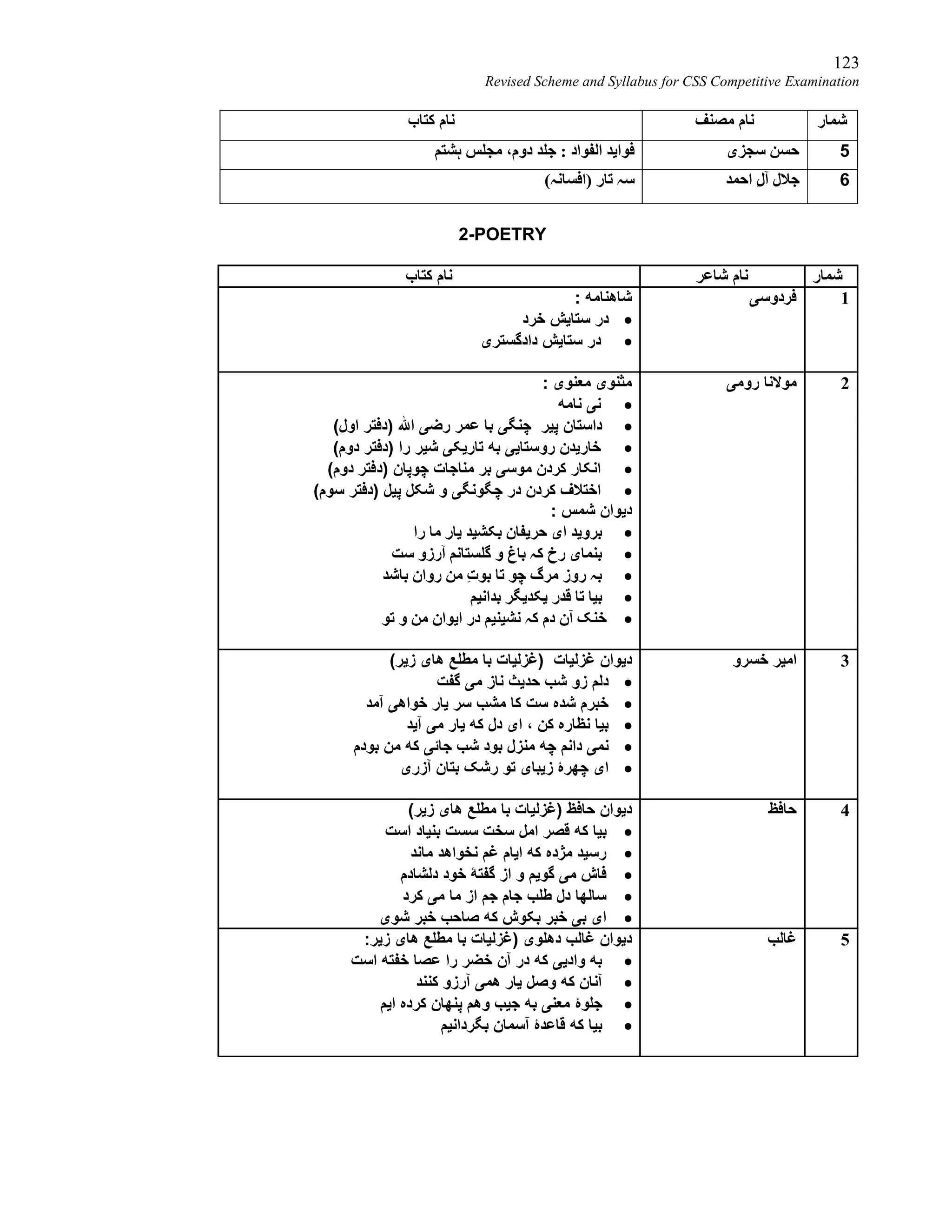
 Winding up (voluntary, by court)
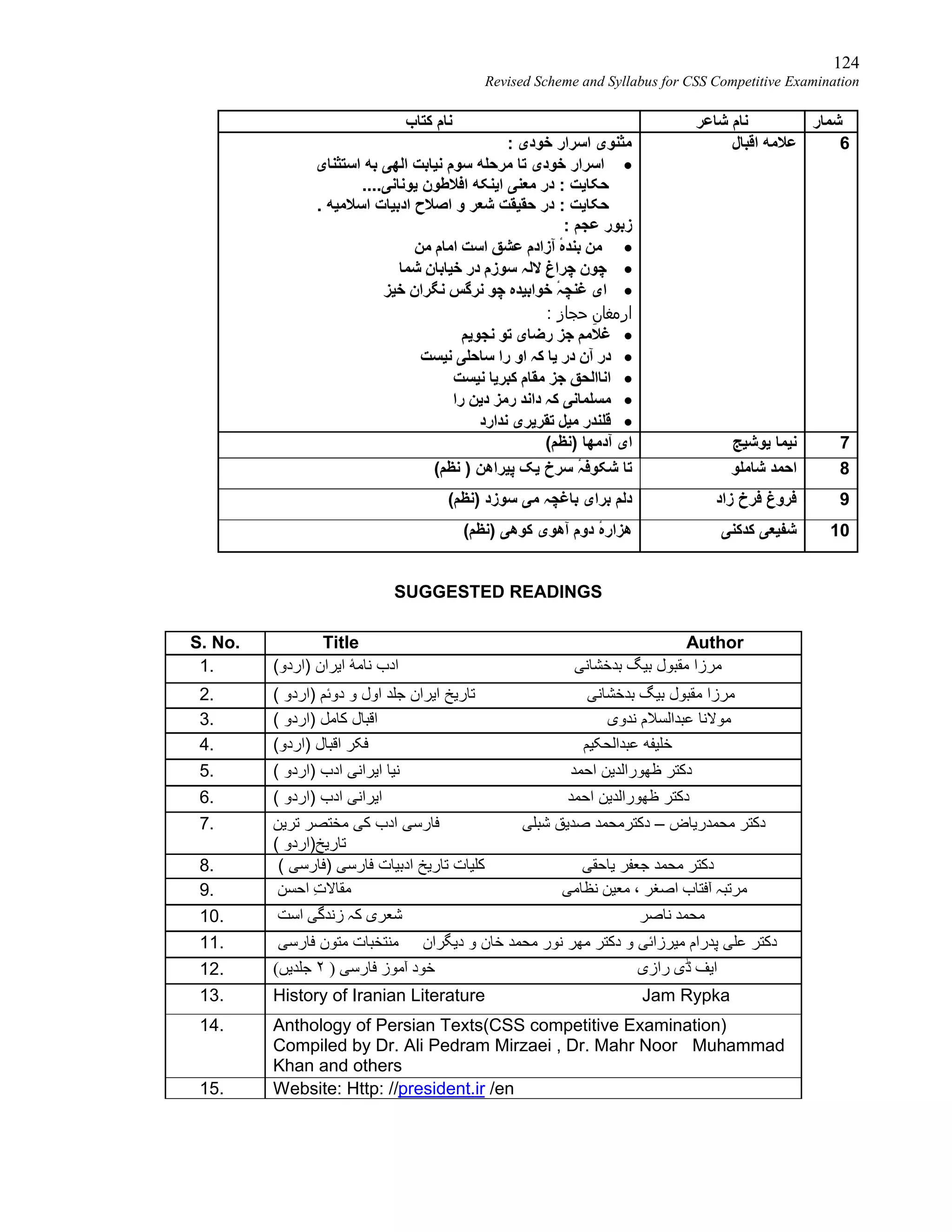
X. Electronic Fund Transfer Act, 2007
 Definitions
 Payment system and their operation (designation of payment system &
revocation, real time gross settlement system, governance & operation
arrangement)
 Payment instruments (designation, issuing and prohibition of instruments)
 Clearing and other obligations
 Supervisory Control of state bank
 Documentation of transfers
 Notification of error and liabilities of parties
 Law relating to action before court.
SUGGESTED READINGS
S. No. Title Author
1. Law of Contract Agarwala, M. Mehmood
2. Sales of Goods Act Pollock & Mulla
3. Bare Acts: Government of Pakistan
i) Contract Act, 1872
ii) Negotiable Instrument Act, 1881
iii) Sale of Goods Act, 1930
iv) Companies Ordinance, 1984
v) Arbitration Act, 1940
vi) Competition Act, 2010
vii) Electronic Transactions Ordinance, 2002
viii) Consumers’ Protection Act, 2006
ix) Electronic Fund Transfer Act, 2007
112
Revised Scheme and Syllabus for CSS Competitive Examination
S. No. Title Author
4. Case Law Reading
i) Carlil vs. Carbolic Smoke Ball Co. (1893) 1 QB 256
ii)
Pharmaceutical Society of Great Britain vs. Boots Cash Chemicals Ltd.
(1952) 2 QB 795
iii) Curie vs. Misa (1875) LR 10 Ex 153
iv) Byrne & Co. vs. Van Tienhaven & Co. (1880) 5 CPD 344
v) Mohri Bibi vs. Dharmodas Ghose (1903) 30 IA 114
vi) Derry vs. Peeks (1889) 14 App. Cas 337
vii) Mannu Singh vs. Umadat Panday (1890) 12 ALL 523
viii) Coggs vs. Bernard (1703) 2Ld Raym 909
ix) Lumley vs. Wanger (1852) EW HC (Ch)J 96
x) Manni Devi vs. Ramayan Singh AIR 1985 Pat. 35
xi)
Lachhman Joharimal vs. Bapu Khandu (1869) 6 Bombay High Court Reports
241
xii) Mischeff vs. Springett (1942) 2 KB 331
xiii) Watson vs. Coupland (1945) 1 All ER 217
xiv) Ashbury Railway Carriage & Iron Co. Ltd. Vs. Riche (1875) LR 7HL 653
xv) Lee vs. Lee’s Air Farming (1960) 3 All ER420
xvi) Salomon vs. A. Salomon & Co. Ltd. (1897) AC 22
xvii) Royal British Bank vs. Turqnand (1856) 6 E&B 327
xviii) Ram Raja Ram vs. Dhirba Charan Jen AIR 1982 Ori 264
xix) Badridas Kothari vs. Megraj Kothari AIR 1967 Cal 25
xx) Hitachi Ltd. & others vs. Rupali Polyester & others (1998 SCMR 1618)
xxi) Marflower Theatre Trust Ltd. Vs. HMRC (2007) STC 880
xxii) Pickering vs. Bux (1812) 15 East 38
xxiii) Liaqat Islam vs. State (2011 YLR 2280)
xiv) Alamgir Khalid Chughtai vs. State (PLD 2009 Lahore 259)
xv)
United States vs. Forty Barrels and Twenty Kegs of Coca Cola, 241 U.S. 265
(1916)
xvi) Hedley Byrne & Co. Ltd. Vs. Hella & Partners Ltd. (1964) AC 465
113
Revised Scheme and Syllabus for CSS Competitive Examination
PAPER: MUSLIM LAW & JURISPRUDENCE (100 MARKS)
I. The Sources of Islamic Law
 The Quran
 The Sunnah
 Ijma
 Qiyas
 Ijtehad
II. Principles of Islamic Jurisprudence
III. Islamic Criminal Law
 Hadd
 Taz’ir
 Qisas and Diyat
IV. Islamic Family Law
 Marriage
 Dower
 Divorce
 Separation by Repudiation (Talaq)
 Separation by Mutual Agreement (Khula)
 Judicial Separation (Faskh)
 Post-Divorce Maintenance
 Child Custody
 Succession
V. Islamic Law of Contract
VI. Islamic Banking and Insurance
VII. Islamic International Law
VIII. Islamic Law and Human Rights
IX. Dissolution of Muslim Marriages Act, 1939
X. Muslim Family Laws Ordinance 1961
114
Revised Scheme and Syllabus for CSS Competitive Examination
SUGGESTED READINGS
S.No. Title Author
1. An Introduction to the Study of Islamic Law Dr. Hussain Hamid Hassan
2. Principles of Islamic Jurisprudence Mohammad Hashim Kamali
3. Theories of Islamic Law Prof. Imran Ahsan Nyazee
4. Islamic Law of Contracts and Business
Transactions
Tahir Mansuri
5. Family Law in Islam Dr. Mohammad Tahir Mansuri
6. Outlines of Islamic Jurisprudence Prof. Imran Ahsan Nyazee
7. General Principles of Criminal Law Prof. Imran Ahsan Nyazee
8. State and Legislation in Islam Dr. Mahmood Ahmad Gazi
9. Mahomedan Jurisprudence Abdur Rahim
10. Islamic Law of Inheritance Hamid Khan, Advocate
11. Munir” Principles of Muhammadan Law Munir Ahmad Siddiqui
115
Revised Scheme and Syllabus for CSS Competitive Examination
PAPER: PASHTO (100 MARKS)
I. Origin of Pashto language, its dialects and alphabets
II. Pashto Grammar
III. General question on history of Pashto literature and literary movements in Pashto
IV. Essay on prominent aspects of Pashto Culture, Historical and Literary personalities.
V. Translation of unseen passages from Pashto in to English or Urdu.
VI. Translation of unseen passages of English or Urdu into Pashto.
VII. General Questions on evolution and criticism of Pashto Prose and Poetry.
VIII. Pashto Classic Poetry
(i) Khoshal Khan Khattak (ii) Rehman Baba (iii) Abdul Hamid Baba
(iv) Ali Khan (v) kazim Khan Sheda
IX. Pashto Modern Poetry
(i) Amir Hamza Khan Shinwari (ii) Ghani Khan (iii) Qalandar Momand (iv) Abdur
Rahim Majzoob (v) Younas Khalil
X. Pashto Folk Literature,
(i). Tappa’ (ii) Charbaita’ (iii) Neemakai’ (iv) Badala etc and Pashto proverbs,
SUGGESTED READINGS
AuthorTitleS. No.
Dr. Khadeeja Feroz Ud DeenLife and Works of the Illustrious Khushal Khan
Khattak
1.
Sir Olaf Careo.The Pathans2.
Major Raverty.Selected poems of KhushalKhan Khattak3.
Dr. Yar Muhammad
Maghmoom
The Rowshanites and Pashto Literature4.
‫ﺣﺒﯿﺒﻲ‬ ‫ﻋﺒﺪاﻟﺤﺊ‬‫او‬ ‫)وړﻣﺒﮯ‬ ‫ﺘﻮادﺑﯿﺎﺗﻮﺗﺎرﯾﺦ‬ ‫دﭘ‬(‫ﺟﻠﺪ‬ ‫دوﯦﻢ‬5.
‫ﺑﮭﺎدر‬ ‫ﺳﯿﺪ‬‫ﺷﺎه‬‫ﮐﺎﮐﺎﺧﯿﻞ‬ ‫ﻇﻔﺮ‬‫آﺋﯿﻨﮯ‬ ‫ﮐﮯ‬ ‫ﺗﺎرﯾﺦ‬ ‫ﭘﺸﺘﻮن‬6.
‫ﺑﺨﺎري‬ ‫ﺧﯿﺎل‬‫ﻧﺤﻮ‬ ‫و‬ ‫ﺻﺮف‬7.
‫ﻃﺎﺋﺮ‬ ‫ﻧﻮاز‬ ‫ﻣﺤﻤﺪ‬ ‫ﭘﺮوﻓﯿﺴﺮ‬‫ادب‬ ‫روھﻲ‬8.
‫ﺧﭩﮏ‬ ‫ﺷﺎﮦ‬ ‫وﻟﯽ‬ ‫راج‬ ‫ڈاﮐﭩﺮ‬‫ﺗﺤﺮﯾﮑﻮﻧﮫ‬ ‫ادﺑﻲ‬ ‫ﺘﻮ‬ ‫ﭘ‬9.
ٰ‫ﻤ‬‫ﺳﻠ‬‫ﺷﺎﮨﯿﻦ‬ ‫ﯽ‬‫ﺳﻨﺪرې‬ ‫روھﻲ‬10.
‫ﺧﻠﯿﻞ‬ ‫ﮨﻤﯿﺶ‬(‫ﺟﻠﺪ‬ ‫دوﯦﻢ‬ ‫او‬ ‫)اول‬ ‫ﻟﯿﮑﻮال‬ ‫ﺘﺎﻧﮥ‬ ‫ﭘ‬11.
‫ﺑﺨﺎری‬ ‫ﻓﺎرغ‬‫ﮔﯿﺖ‬ ‫ﻟﻮک‬ ‫ﮐﮯ‬ ‫ﺳﺮﺣﺪ‬12.
‫ﻣﻮﻣﻨﺪ‬ ‫ﮐﺎﻣﻞ‬ ‫ﺧﺎن‬ ‫ﻣﺤﻤﺪ‬ ‫دوﺳﺖ‬(‫)اردو‬ ‫ﮏ‬ ‫ﺧ‬ ‫ﺧﺎن‬ ‫ﺧﻮﺷﺤﺎل‬13.
116
Revised Scheme and Syllabus for CSS Competitive Examination
AuthorTitleS. No.
‫ﻋﺎﺑﺪ‬ ‫ﺟﺎن‬ ‫ﻋﺒﺪاﷲ‬ ‫ڈاﮐﭩﺮ‬‫ﻣﺨﺘﺼﺮﺗﺎرﯾﺦ‬ ‫ﮐﻰ‬ ‫ادب‬ ‫و‬ ‫زﺑﺎن‬ ‫ﭘﺸﺘﻮ‬14.
‫ﻨﮯ‬ ‫ﺑﯧ‬ ‫داﻧﺶ‬ ‫ﺮﻧﻮرﻣﺤﻤﺪ‬ ‫ډاﮐ‬‫ﻣﻄﺎﻟﻌﮫ‬ ‫ﻋﻤﺮاﻧﻲ‬ ‫ﭙﯥ‬ ‫ﺘﻮ‬ ‫ﭘ‬ ‫د‬15.
‫ﺧﻠﯿﻞ‬ ‫ﺟﺎوﯾﺪ‬ ‫ﻣﺤﻤﺪ‬ ‫ڈاﮐﭩﺮ‬‫ﻣﺴﺘ‬ ‫او‬ ‫ﺘﻮ‬ ‫ﭘ‬‫ﺸﺮﻗﯿﻦ‬16.
‫ﯾﻮﺳﻔﺰے‬ ‫ﺳﺤﺮ‬‫دے‬ ‫ﮥ‬ ‫ادب‬17.
‫داؤد‬ ‫ﺧﺎن‬ ‫داور‬‫ﭙﮫ‬ ‫ﺘﻮ‬ ‫ﭘ‬18.
‫ﻣﺮﯾﻢ‬ ‫ﺑﯽ‬ ‫ﺑﯽ‬‫ﺟﺎﺋﺰه‬ ‫ﺗﻨﻘﯿﺪي‬ ‫او‬ ‫ﺗﺎرﯾﺨﻲ‬ ‫ﺘﻮﻧﺜﺮ‬ ‫ﭘ‬ ‫د‬19.
117
Revised Scheme and Syllabus for CSS Competitive Examination
PAPER: PASHTO (100 MARKS)
‫ﭘﯧﭙﺮ‬‫ﺘﻮ‬ ‫ﭘ‬: ‫ﻧﻤﺒﺮې‬ ‫ﻮﻟﯥ‬١٠٠
i.‫اور‬ :‫ژﺑﮫ‬ ‫ﺘﻮ‬ ‫ﭘ‬‫اﻟﻔﺒﺎ‬ ‫او‬ ‫ﻟﮭﺠﯥ‬ ،‫ﯾﺠﻦ‬
ii.‫ﺮاﻣﺮ‬ ‫ﺘﻮ‬ ‫ﭘ‬
iii.‫ﺳﻮال‬ ‫ﻋﻤﻮﻣﻲ‬ ‫ﺑﺎﻧﺪې‬ ‫ﺗﺤﺮﯾﮑﻮﻧﻮ‬ ‫ادﺑﻲ‬ ‫ﺘﻮ‬ ‫ﭘ‬ ‫او‬ ‫ﺗﺎرﯾﺦ‬ ‫ادب‬ ‫ﺘﻮ‬ ‫ﭘ‬ ‫د‬
iv.‫ﻣﻀﻤﻮن‬ ‫ﺑﺎﻧﺪې‬ ‫ﺷﺨﺼﯿﺘﻮﻧﻮ‬ ‫ادﺑﻲ‬ ‫او‬ ‫ﺗﺎرﯾﺨﻲ‬ ،‫اړﺧﻮﻧﻮ‬ ‫ﮑﺎره‬ ‫ﮐﻠﭽﺮ‬ ‫ﺘﻮن‬ ‫ﭘ‬ ‫د‬
v.‫ﺗﺮﺟﻤﮫ‬ ‫ﺮاﻓﻮﻧﻮ‬ ‫ﭘﯧﺮا‬ ‫ﻧﺎﻟﯿﺪﻟﻲ‬ ‫د‬ ‫ﺘﻮ‬ ‫ﭘ‬ ‫د‬ ‫ﯥ‬ ‫ﮐ‬ ‫ﺮﯦﺰۍ‬ ‫اﻧ‬ ‫ﯾﺎ‬ ‫اردو‬ ‫ﭘﮫ‬
vi.‫ﺮاﻓ‬ ‫ﭘﯧﺮا‬ ‫ﻧﺎﻟﯿﺪﻟﻲ‬ ‫د‬ ‫ﺮﯦﺰۍ‬ ‫اﻧ‬ ‫د‬ ‫ﯥ‬ ‫ﮐ‬ ‫ﺘﻮ‬ ‫ﭘ‬ ‫ﯾﺎ‬ ‫اردو‬ ‫ﭘﮫ‬‫ﺗﺮﺟﻤﮫ‬ ‫ﻮﻧﻮ‬
vii.‫ﺳﻮال‬ ‫ﻋﻤﻮﻣﻲ‬ ‫ﺑﺎﻧﺪې‬ ‫ﺗﻨﻘﯿﺪ‬ ‫او‬ ‫ارﺗﻘﺎ‬ ‫ﭘﮫ‬ ‫ﻧﺜﺮ‬ ‫او‬ ‫ﻧﻈﻢ‬ ‫ﺘﻮ‬ ‫ﭘ‬ ‫د‬
viii.:‫ﺷﺎﻋﺮي‬ ‫ﮐﻼﺳﯿﮑﻲ‬ ‫ﺘﻮ‬ ‫ﭘ‬
I.‫ﮏ‬ ‫ﺧ‬ ‫ﺧﺎن‬ ‫ﺧﻮﺷﺤﺎل‬.ii‫ﺑﺎﺑﺎ‬ ‫رﺣﻤﺎن‬.iii‫ﻋﺒﺪاﻟﺤﻤﯿﺪﺑﺎﺑﺎ‬.iv‫ﺧﺎن‬ ‫ﻋﻠﻲ‬
.v‫ﺷﯧﺪا‬ ‫ﺧﺎن‬ ‫ﮐﺎﻇﻢ‬
ix.:‫ﺷﺎﻋﺮي‬ ‫ﺟﺪﯾﺪه‬ ‫ﺘﻮ‬ ‫ﭘ‬
I.‫ﺷﻨﻮاري‬ ‫ﺧﺎن‬ ‫اﻣﯿﺮﺣﻤﺰه‬.ii‫ﺧﺎن‬ ‫ﻏﻨﻲ‬.iii‫ﻗﻠﻨﺪرﻣﻮﻣﻨﺪ‬
.iv‫ﻣﺠﺬوب‬ ‫ﻋﺒﺪاﻟﺮﺣﯿﻢ‬.v‫ﺧﻠﯿﻞ‬ ‫ﯾﻮﻧﺲ‬
x.‫ادب‬ ‫اوﻟﺴﻲ‬ ‫ﺘﻮ‬ ‫ﭘ‬
i.‫ﭙﮫ‬.ii‫ﭼﺎرﺑﯧﺘﮫ‬.iii‫ﻧﯿﻤﮑ‬.iv‫ﻣﺘﻠﻮﻧﮫ‬ ‫ﺘﻮ‬ ‫اوﭘ‬ ‫وﻏﯧﺮه‬ ‫ﺑﺪﻟﮫ‬
‫ﮐﺘﺎﺑﻮﻧﮫ‬ ‫ﻣﺠﻮزه‬
‫ﺷﻤﯧﺮه‬‫ﻧﻮم‬ ‫ﮐﺘﺎب‬ ‫د‬‫ﻣﺼﻨﻒ‬
.1Life and Works of the Illustrious
Khushal Khan Khattak
Dr. Khadeeja Feroz Ud Deen
.2The PathansSir Olaf Careo.
.3Selected poems of Khushal khan
Khattak
Major Raverty.
.4The Rowshanites and Pashto
Literature
Dr. Yar Muhammad
Maghmoom
5.‫او‬ ‫)وړﻣﺒﮯ‬ ‫ﺘﻮادﺑﯿﺎﺗﻮﺗﺎرﯾﺦ‬ ‫دﭘ‬(‫ﺟﻠﺪ‬ ‫دوﯦﻢ‬‫ﺣﺒﯿﺒﻲ‬ ‫ﻋﺒﺪاﻟﺤﺌﻰ‬
6.‫آﺋﯿﻨﮯ‬ ‫ﮐﮯ‬ ‫ﺗﺎرﯾﺦ‬ ‫ﭘﺸﺘﻮن‬‫ﺳﯿﺪ‬‫ﻇﻔﺮﮐﺎﮐﺎﺧﯧﻞ‬ ‫ﺑﮭﺎدرﺷﺎه‬
7.‫ﻧﺤﻮ‬ ‫و‬ ‫ﺻﺮف‬‫ﺑﺨﺎري‬ ‫ﺧﯿﺎل‬
8.‫ادب‬ ‫روھﻲ‬‫ﻃﺎﺋﺮ‬ ‫ﭘﺮوﻓﯧﺴﺮﻣﺤﻤﺪﻧﻮاز‬
9.‫ﺗﺤﺮﯾﮑﻮﻧﮫ‬ ‫ادﺑﻲ‬ ‫ﺘﻮ‬ ‫ﭘ‬‫ﮏ‬ ‫ﺧ‬ ‫ﺷﺎه‬ ‫وﻟﻲ‬ ‫راج‬ ‫ﺮ‬ ‫ډاﮐ‬
0.1‫ﺳﻨﺪرې‬ ‫روھﻲ‬ٰ‫ﻤ‬‫ﺳﻠ‬‫ﺷﺎﮨﯿﻦ‬ ‫ﯽ‬
1.1(‫ﺟﻠﺪ‬ ‫دوﯦﻢ‬ ‫او‬ ‫)اول‬ ‫ﻟﯿﮑﻮال‬ ‫ﺘﺎﻧﮥ‬ ‫ﭘ‬‫ﺧﻠﯿﻞ‬ ‫ھﻤﯧﺶ‬
118
Revised Scheme and Syllabus for CSS Competitive Examination
‫ﺷﻤﯧﺮه‬‫ﻧﻮم‬ ‫ﮐﺘﺎب‬ ‫د‬‫ﻣﺼﻨﻒ‬
2.1‫ﮔﯿﺖ‬ ‫ﻟﻮک‬ ‫ﮐﮯ‬ ‫ﺳﺮﺣﺪ‬‫ﺑﺨﺎر‬ ‫ﻓﺎرغ‬‫ي‬
3.1(‫)اردو‬ ‫ﮏ‬ ‫ﺧ‬ ‫ﺧﺎن‬ ‫ﺧﻮﺷﺤﺎل‬‫ﻣﻮﻣﻨﺪ‬ ‫ﮐﺎﻣﻞ‬ ‫ﻣﺤﻤﺪﺧﺎن‬ ‫دوﺳﺖ‬
4.1‫ﻣﺨﺘﺼﺮﺗﺎرﯾﺦ‬ ‫ﮐﻰ‬ ‫ادب‬ ‫و‬ ‫زﺑﺎن‬ ‫ﭘﺸﺘﻮ‬‫ﻋﺎﺑﺪ‬ ‫ﺟﺎن‬ ‫ﺮﻋﺒﺪاﷲ‬ ‫ډاﮐ‬
5.1‫ﻣﻄﺎﻟﻌﮫ‬ ‫ﻋﻤﺮاﻧﻲ‬ ‫ﭙﯥ‬ ‫ﺘﻮ‬ ‫ﭘ‬ ‫د‬‫ﻨﮯ‬ ‫ﺑﯧ‬ ‫داﻧﺶ‬ ‫ﺮﻧﻮرﻣﺤﻤﺪ‬ ‫ډاﮐ‬
6.1‫ﻣﺴﺘﺸﺮﻗﯿﻦ‬ ‫او‬ ‫ﺘﻮ‬ ‫ﭘ‬‫ﺮﻣﺤﻤﺪﺟﺎوﯦﺪﺧﻠﯿﻞ‬ ‫ډاﮐ‬
7.1‫دے‬ ‫ﮥ‬ ‫ادب‬‫ﯾﻮﺳﻔﺰے‬ ‫ﺳﺤﺮ‬
8.1‫ﭙﮫ‬ ‫ﺘﻮ‬ ‫ﭘ‬‫د‬ ‫ﺧﺎن‬ ‫داور‬‫اؤد‬
19.‫ﺟﺎﺋﺰه‬ ‫ﺗﻨﻘﯿﺪي‬ ‫او‬ ‫ﺗﺎرﯾﺨﻲ‬ ‫ﺘﻮﻧﺜﺮ‬ ‫ﭘ‬ ‫د‬‫ﻣﺮﯾﻢ‬ ‫ﺑﻲ‬ ‫ﺑﻲ‬
119
Revised Scheme and Syllabus for CSS Competitive Examination
PAPER: PERSIAN (100 MARKS)
PART—I (Marks-50)
I. Elementary Information about the Pre Islamic Persian Languages: Avesta, Old
Persian and Pahlavi.
II. Origin and development of the new Persian Language (In this part Revivalist
movement, Purist movement and the adaptation of foreign loan words need to be
studied).
III. The advent and history of Classical Persian Literature from SAMANID’s period to the
Mushrootah Movement with special emphasis on the outstanding Persian prose
writers and poets. (The Persian prose writers and poets from 4th
century H to 10th
century H).
IV. The contemporary Persian Literature with special emphasis on the New Poetry
(‫ﻧﻮ‬ ‫)ﺷﻌﺮ‬ and Fiction writing and their outstanding representatives.
V. A Short introduction to Persian Language and Literature, besides Iran, in
Afghanistan, Tajikistan and Indo-Pakistan Subcontinent.
VI. Significant features of the grammar of the language as under:
‫ﺻﻮت‬ / ‫ﺟﻤﻠﮫ‬ ‫ﺷﺒﮫ‬ ، ‫ﺣﺮف‬ ،‫ﻗﯿﺪ‬ ، ‫ﺻﻔﺖ‬ ، ‫ﺿﻤﯿﺮ‬ ، ‫ﻓﻌﻞ‬ ، ‫اﺳﻢ‬
In classical background, the four styles known as Khurasani, Iraqi, Hindi and
Revivalist may be studied.
VII. A Short essay writing in Persian on literary and cultural themes.
VIII. Translation of simple English passage into Persian.
PART—II (Marks-50)
This part will require first hand reading of the texts prescribed and questions will be
designed to test the candidate’s critical abilities.
TEXT SELECTION
1. PROSE:
‫ﺷﻤﺎر‬‫ﻣﺼﻨﻒ‬ ‫ﻧﺎم‬‫ﮐﺘﺎب‬ ‫ﻧﺎم‬
1‫ﻣﺤﻤﺪﻏﺰاﻟﯽ‬ ‫اﻣﺎم‬‫راﻧﺪن‬ ‫وﻻﯾﺖ‬ ‫و‬ ‫داﺷﺘﻦ‬ ‫رﻋﯿﺖ‬ ‫در‬ : ‫ﺳﻌﺎدت‬ ‫ﮐﯿﻤﯿﺎی‬ -
2‫ﮨﺠﻮﯾﺮی‬ ‫ﻋﺜﻤﺎن‬ ‫ﺑﻦ‬ ‫ﻋﻠﯽ‬‫اﻟﺘﺼﻮف‬ ‫ﺑﺎب‬ : ‫اﻟﻤﺤﺠﻮب‬ ‫ﮐﺸﻒ‬
3‫ﻃﻮﺳﯽ‬ ‫اﻟﻤﻠﮏ‬ ‫ﻧﻈﺎم‬........ ‫ﻣﺤﺘﺴﺐ‬ ‫و‬ ‫ﺧﻄﯿﺒﺎن‬ ‫و‬ ‫ﻗﺎﺿﯿﺎن‬ ‫اﻧﺪر‬ :‫ﺷﺸﻢ‬ ‫ﻓﺼﻞ‬ ‫ﻧﺎﻣﮫ‬ ‫ﺳﯿﺎﺳﺖ‬
4
‫ﺷﯿﺮازی‬ ‫ﺳﻌﺪی‬: ‫ﮔﻠﺴﺘﺎن‬
‫ودوم‬ ‫ﺑﯿﺴﺖ‬ ، ‫ﻧﻮزدھﻢ‬ ، ‫ﭼﮭﺎردھﻢ‬ ،‫ھﻔﺘﻢ‬ ، ‫ﺷﺸﻢ‬ ،‫اول‬ ‫ﺣﮑﺎﯾﺖ‬ ، ‫اول‬ ‫ﺑﺎب‬
‫ﯾﮑﻢ‬ ‫و‬ ‫ﭼﮭﻞ‬ ،
‫ﺑﯿﺴﺘﻢ‬ ، ‫ھﻔﺘﻢ‬ ‫ﺣﮑﺎﯾﺖ‬ – ‫دوم‬ ‫ﺑﺎب‬
120
Revised Scheme and Syllabus for CSS Competitive Examination
‫ﺷﻤﺎر‬‫ﻣﺼﻨﻒ‬ ‫ﻧﺎم‬‫ﮐﺘﺎب‬ ‫ﻧﺎم‬
‫دوم‬ ‫و‬ ‫،ﺑﯿﺴﺖ‬ ‫ﻧﻮزدھﻢ‬ ، ‫ﺷﺎﻧﺰدھﻢ‬ ‫ﺣﮑﺎﯾﺖ‬ – ‫ﺳﻮم‬ ‫ﺑﺎب‬
‫دوم‬ ‫ﺣﮑﺎﯾﺖ‬ – ‫ﭼﮭﺎرم‬ ‫ﺑﺎب‬
‫ﭼﮭﺎرم‬ ‫ﺣﮑﺎﯾﺖ‬ – ‫ﺷﺸﻢ‬ ‫ﺑﺎب‬
‫ﺷﺸﻢ‬ ‫،ﺣﮑﺎﯾﺖ‬ ‫ﺳﻮم‬ ‫ﺣﮑﺎﯾﺖ‬ – ‫ھﻔﺘﻢ‬ ‫ﺑﺎب‬
5‫ﺳﺠﺰی‬ ‫ﺣﺴﻦ‬‫ﮨﺸﺘﻢ‬ ‫ﻣﺠﻠﺲ‬ ،‫دوم‬ ‫ﺟﻠﺪ‬ : ‫اﻟﻔﻮاد‬ ‫ﻓﻮاﯾﺪ‬
6‫اﺣﻤﺪ‬ ِ‫ل‬ٓ‫ا‬ ‫ﺟﻼل‬(‫)اﻓﺴﺎﻧہ‬ ‫ﺗﺎر‬ ‫ﺳہ‬
2-POETRY
‫ﺷﻤﺎر‬‫ﺷﺎﻋﺮ‬ ‫ﻧﺎم‬‫ﮐﺘﺎب‬ ‫ﻧﺎم‬
1‫ﻓﺮدوﺳﯽ‬: ‫ﺷﺎھﻨﺎﻣﮫ‬
‫ﺧﺮد‬ ‫ﺳﺘﺎﯾﺶ‬ ‫در‬
‫دادﮔﺴﺘﺮی‬ ‫ﺳﺘﺎﯾﺶ‬ ‫در‬
2‫روﻣﯽ‬ ‫ﻣﻮﻻﻧﺎ‬: ‫ﻣﻌﻨﻮی‬ ‫ﻣﺜﻨﻮی‬
‫ﻧﺎﻣﮫ‬ ‫ﻧﯽ‬
‫ﭘﯿﺮ‬ ‫داﺳﺘﺎن‬‫رﺿ‬ ‫ﻋﻤﺮ‬ ‫ﺑﺎ‬ ‫ﭼﻨﮕﯽ‬(‫اول‬ ‫)دﻓﺘﺮ‬ ‫اﷲ‬ ‫ﯽ‬
(‫دوم‬ ‫)دﻓﺘﺮ‬ ‫را‬ ‫ﺷﯿﺮ‬ ‫ﺗﺎرﯾﮑﯽ‬ ‫ﺑﮫ‬ ‫روﺳﺘﺎﯾﯽ‬ ‫ﺧﺎرﯾﺪن‬
(‫دوم‬ ‫)دﻓﺘﺮ‬ ‫ﭼﻮﭘﺎن‬ ‫ﻣﻨﺎﺟﺎت‬ ‫ﺑﺮ‬ ‫ﻣﻮﺳﯽ‬ ‫ﮐﺮدن‬ ‫اﻧﮑﺎر‬
(‫ﺳﻮم‬ ‫)دﻓﺘﺮ‬ ‫ﭘﯿﻞ‬ ‫ﺷﮑﻞ‬ ‫و‬ ‫ﭼﮕﻮﻧﮕﯽ‬ ‫در‬ ‫ﮐﺮدن‬ ‫اﺧﺘﻼف‬
: ‫ﺷﻤﺲ‬ ‫دﯾﻮان‬
‫را‬ ‫ﻣﺎ‬ ِ‫ر‬‫ﯾﺎ‬ ‫ﺑﮑﺸﯿﺪ‬ ‫ﺣﺮﯾﻔﺎن‬ ‫ای‬ ‫ﺑﺮوﯾﺪ‬
‫ﮔﻠﺴﺘ‬ ‫و‬ ‫ﺑﺎغ‬ ‫ﮐہ‬ ‫رخ‬ ‫ﺑﻨﻤﺎی‬‫ﺳﺖ‬ ‫ٓرزو‬‫ا‬ ‫ﺎﻧﻢ‬
‫ﺑﺎﺷﺪ‬ ‫روان‬ ‫ﻣﻦ‬ ِ‫ت‬‫ﺑﻮ‬ ‫ﺗﺎ‬ ‫ﭼﻮ‬ ‫ﻣﺮگ‬ ‫روز‬ ‫ﺑہ‬
‫ﺑﺪاﻧﯿﻢ‬ ‫ﯾﮑﺪﯾﮕﺮ‬ ‫ﻗﺪر‬ ‫ﺗﺎ‬ ‫ﺑﯿﺎ‬
‫ﺗﻮ‬ ‫و‬ ‫ﻣﻦ‬ ‫اﯾﻮان‬ ‫در‬ ‫ﻧﺸﯿﻨﯿﻢ‬ ‫ﮐہ‬ ‫دم‬ ‫ٓن‬‫ا‬ ‫ﺧﻨﮏ‬
3‫ﺧﺴﺮو‬ ‫اﻣﯿﺮ‬(‫زﯾﺮ‬ ‫ھﺎی‬ ‫ﻣﻄﻠﻊ‬ ‫ﺑﺎ‬ ‫)ﻏﺰﻟﯿﺎت‬ ‫ﻏﺰﻟﯿﺎت‬ ‫دﯾﻮان‬
‫ﮔﻔﺖ‬ ‫ﻣﯽ‬ ‫ﻧﺎز‬ ‫ﺣﺪﯾﺚ‬ ‫ﺷﺐ‬ ‫زو‬ ‫دﻟﻢ‬
‫ﺧﻮاھﯽ‬ ‫ﯾﺎر‬ ‫ﺳﺮ‬ ‫ﻣﺸﺐ‬ ‫ﮐﺎ‬ ‫ﺳﺖ‬ ‫ﺷﺪه‬ ‫ﺧﺒﺮم‬‫آﻣﺪ‬
‫آﯾﺪ‬ ‫ﻣﯽ‬ ‫ﯾﺎر‬ ‫ﮐﮫ‬ ‫دل‬ ‫ای‬ ، ‫ﮐﻦ‬ ‫ﻧﻈﺎره‬ ‫ﺑﯿﺎ‬
‫ﺑﻮدم‬ ‫ﻣﻦ‬ ‫ﮐﮫ‬ ‫ﺟﺎﺋﯽ‬ ‫ﺷﺐ‬ ‫ﺑﻮد‬ ‫ﻣﻨﺰل‬ ‫ﭼﮫ‬ ‫داﻧﻢ‬ ‫ﻧﻤﯽ‬
‫آزری‬ ‫ﺑﺘﺎن‬ ‫رﺷﮏ‬ ‫ﺗﻮ‬ ‫زﯾﺒﺎی‬ ‫ﭼﮭﺮۀ‬ ‫ای‬
4‫ﺣﺎﻓﻆ‬(‫زﯾﺮ‬ ‫ھﺎی‬ ‫ﻣﻄﻠﻊ‬ ‫ﺑﺎ‬ ‫)ﻏﺰﻟﯿﺎت‬ ‫ﺣﺎﻓﻆ‬ ‫دﯾﻮان‬
‫اﺳﺖ‬ ‫ﺑﻨﯿﺎد‬ ‫ﺳﺴﺖ‬ ‫ﺳﺨﺖ‬ ‫اﻣﻞ‬ ‫ﻗﺼﺮ‬ ‫ﮐﮫ‬ ‫ﺑﯿﺎ‬
‫ﻣﺎﻧﺪ‬ ‫ﻧﺨﻮاھﺪ‬ ‫ﻏﻢ‬ ‫اﯾﺎم‬ ‫ﮐﮫ‬ ‫ﻣﮋده‬ ‫رﺳﯿﺪ‬
‫دﻟﺸﺎدم‬ ‫ﺧﻮد‬ ‫ﮔﻔﺘﮥ‬ ‫از‬ ‫و‬ ‫ﮔﻮﯾﻢ‬ ‫ﻣﯽ‬ ‫ﻓﺎش‬
‫ﮐﺮد‬ ‫ﻣﯽ‬ ‫ﻣﺎ‬ ‫از‬ ‫ﺟﻢ‬ ‫ﺟﺎم‬ ‫ﻃﻠﺐ‬ ‫دل‬ ‫ﺳﺎﻟﮭﺎ‬
‫ﺷﻮی‬ ‫ﺧﺒﺮ‬ ‫ﺻﺎﺣﺐ‬ ‫ﮐﮫ‬ ‫ﺑﮑﻮش‬ ‫ﺧﺒﺮ‬ ‫ﺑﯽ‬ ‫ای‬
5‫ﻏﺎﻟﺐ‬:‫زﯾﺮ‬ ‫ھﺎی‬ ‫ﻣﻄﻠﻊ‬ ‫ﺑﺎ‬ ‫)ﻏﺰﻟﯿﺎت‬ ‫دھﻠﻮی‬ ‫ﻏﺎﻟﺐ‬ ‫دﯾﻮان‬
‫اﺳﺖ‬ ‫ﺧﻔﺘﮫ‬ ‫ﻋﺼﺎ‬ ‫را‬ ‫ﺧﻀﺮ‬ ‫آن‬ ‫در‬ ‫ﮐﮫ‬ ‫وادﯾﯽ‬ ‫ﺑﮫ‬
‫ﮐﻨﻨﺪ‬ ‫آرزو‬ ‫ھﻤﯽ‬ ‫ﯾﺎر‬ ‫وﺻﻞ‬ ‫ﮐﮫ‬ ‫آﻧﺎن‬
‫ﺑ‬ ‫ﻣﻌﻨﯽ‬ ‫ﺟﻠﻮۀ‬‫اﯾﻢ‬ ‫ﮐﺮده‬ ‫ﭘﻨﮭﺎن‬ ‫وھﻢ‬ ‫ﺟﯿﺐ‬ ‫ﮫ‬
‫ﺑﮕﺮداﻧﯿﻢ‬ ‫آﺳﻤﺎن‬ ‫ﻗﺎﻋﺪۀ‬ ‫ﮐﮫ‬ ‫ﺑﯿﺎ‬
121
Revised Scheme and Syllabus for CSS Competitive Examination
‫ﺷﻤﺎر‬‫ﺷﺎﻋﺮ‬ ‫ﻧﺎم‬‫ﮐﺘﺎب‬ ‫ﻧﺎم‬
6‫اﻗﺒﺎل‬ ‫ﻋﻼﻣﮫ‬: ‫ﺧﻮدی‬ ‫اﺳﺮار‬ ‫ﻣﺜﻨﻮی‬
‫اﺳﺘﺜﻨﺎی‬ ‫ﺑﮫ‬ ‫اﻟﮭﯽ‬ ‫ﻧﯿﺎﺑﺖ‬ ‫ﺳﻮم‬ ‫ﻣﺮﺣﻠﮫ‬ ‫ﺗﺎ‬ ‫ﺧﻮدی‬ ‫اﺳﺮار‬ 
‫ﺣﮑﺎﯾﺖ‬‫د‬ :‫ر‬....‫ﯾﻮﻧﺎﻧﯽ‬ ‫اﻓﻼﻃﻮن‬ ‫اﯾﻨﮑﮫ‬ ‫ﻣﻌﻨﯽ‬
‫ﺣﮑﺎﯾﺖ‬:‫اﺳﻼ‬ ‫ادﺑﯿﺎت‬ ‫اﺻﻼح‬ ‫و‬ ‫ﺷﻌﺮ‬ ‫ﺣﻘﯿﻘﺖ‬ ‫در‬. ‫ﻣﯿﮫ‬
: ‫ﻋﺠﻢ‬ ‫زﺑﻮر‬
‫ﻣﻦ‬ ‫اﻣﺎم‬ ‫اﺳﺖ‬ ‫ﻋﺸﻖ‬ ‫ٓزادم‬‫ا‬ ٔ‫ﮦ‬‫ﺑﻨﺪ‬ ‫ﻣﻦ‬
‫ﺷﻤﺎ‬ ِ‫ن‬‫ﺧﯿﺎﺑﺎ‬ ‫در‬ ‫ﺳﻮزم‬ ‫ﻻﻟہ‬ ِ‫غ‬‫ﭼﺮا‬ ‫ﭼﻮن‬
‫ﺧﯿﺰ‬ ‫ﻧﮕﺮان‬ ‫ﻧﺮﮔﺲ‬ ‫ﭼﻮ‬ ‫ﺧﻮاﺑﯿﺪﮦ‬ ٔ‫ہ‬‫ﻏﻨﭽ‬ ‫ای‬
: ‫ﺣﺟﺎز‬ ِ‫ارﻣﻐﺎن‬
‫ﻧﺠﻮﯾﻢ‬ ‫ﺗﻮ‬ ‫رﺿﺎی‬ ‫ﺟﺰ‬ ‫ﻏﻼﻣﻢ‬
‫ﻧﯿﺴﺖ‬ ‫ﺳﺎﺣﻠﯽ‬ ‫را‬ ‫او‬ ‫ﮐہ‬ ‫ﯾﺎ‬ ‫در‬ ‫ٓن‬‫ا‬ ‫در‬
‫ﻧﯿﺴﺖ‬ ‫ﮐﺒﺮﯾﺎ‬ ‫ﻣﻘﺎم‬ ‫ﺟﺰ‬ ‫اﻧﺎاﻟﺤﻖ‬
‫ﻣﺴﻠﻤﺎ‬‫را‬ ‫دﯾﻦ‬ ‫رﻣﺰ‬ ‫داﻧﺪ‬ ‫ﮐہ‬ ‫ﻧﯽ‬
‫ﻧﺪارد‬ ‫ﺗﻘﺮﯾﺮی‬ ‫ﻣﯿﻞ‬ ‫ﻗﻠﻨﺪر‬
7‫ﯾﻮﺷﯿﺞ‬ ‫ﻧﯿﻤﺎ‬(‫)ﻧﻈﻢ‬ ‫آدﻣﮭﺎ‬ ‫ای‬
8‫ﺷﺎﻣﻠﻮ‬ ‫اﺣﻤﺪ‬(‫ﻧﻈﻢ‬ ) ‫ﭘﯿﺮاھﻦ‬ ‫ﯾﮏ‬ ‫ﺳﺮخ‬ ٔ‫ہ‬‫ﺷﮑﻮﻓ‬ ‫ﺗﺎ‬
9‫زاد‬ ‫ﻓﺮخ‬ ‫ﻓﺮوغ‬(‫)ﻧﻈﻢ‬ ‫ﺳﻮزد‬ ‫ﻣﯽ‬ ‫ﺑﺎﻏﭽہ‬ ‫ﺑﺮای‬ ‫دﻟﻢ‬
10‫ﮐﺪﮐﻨﯽ‬ ‫ﺷﻔﯿﻌﯽ‬(‫)ﻧﻈﻢ‬ ‫ﮐﻮھﯽ‬ ‫ٓھﻮی‬‫ا‬ ‫دوم‬ ٔ‫ﮦ‬‫ھﺰار‬
*******
122
Revised Scheme and Syllabus for CSS Competitive Examination
PAPER: PERSIAN (100 MARKS)
(100 ‫)ﻧﻤﺮه‬ ‫ﻓﺎرﺳﯽ‬ ‫آزﻣﻮن‬ ‫ﺑﺮﮔﮥ‬
(50 ‫)ﻧﻤﺮه‬ ‫اول‬ ‫ﺑﺨﺶ‬
‫ﭘﮭﻠﻮی‬ ‫و‬ ‫ﺑﺎﺳﺘﺎن‬ ‫ﻓﺎرﺳﯽ‬ ، ‫اوﺳﺘﺎﯾﯽ‬ :‫اﺳﻼم‬ ‫از‬ ‫ﭘﯿﺶ‬ ‫زﺑﺎﻧﮭﺎی‬ ‫درﺑﺎرۀ‬ ‫ﺑﻨﯿﺎدی‬ ‫-اﻃﻼﻋﺎت‬1
‫ھﺎی‬ ‫واژه‬ ‫وام‬ ‫اﺗﺨﺎذ‬ ‫و‬ ‫اﻗﺘﺒﺎس‬ ‫و‬ ‫ﻧﻮﯾﺴﯽ‬ ‫ﺳﺮه‬ ‫ﻧﮭﻀﺖ‬ ،‫ادﺑﯽ‬ ‫ﺑﺎزﮔﺸﺖ‬ ‫ﺟﻨﺒﺶ‬ ‫ﻗﺴﻤﺖ‬ ‫اﯾﻦ‬ ‫در‬ )‫ﻣﻌﺎﺻﺮ‬ ‫ﻓﺎرﺳﯽ‬ ‫ﺗﮑﺎﻣﻞ‬ ‫و‬ ‫ﻣﻨﺸﺎء‬ -2
(‫ﺷﻮد‬ ‫ﻣﻄﺎﻟﻌﮫ‬ ‫ﺑﺎﯾﺪ‬ ‫ﺧﺎرﺟﯽ‬
‫ﺷﺎﻋﺮان‬ ‫و‬ ‫ﻧﻮﯾﺴﻨﺪﮔﺎن‬ ‫ﺑﺮ‬ ‫وﯾﮋه‬ ‫ﺗﺂﮐﯿﺪ‬ ‫ﺑﺎ‬ ‫ﻣﺸﺮوﻃﮫ‬ ‫اﻧﻘﻼب‬ ‫ﺗﺎ‬ ‫ﺳﺎﻣﺎﻧﯿﺎن‬ ‫دورۀ‬ ‫از‬ ‫ﻓﺎرﺳﯽ‬ ‫ﮐﻼﺳﯿﮏ‬ ‫ادﺑﯿﺎت‬ ‫ﺗﺎرﯾﺦ‬ ‫و‬ ‫ﻇﮭﻮر‬ -3
(‫ھﺠﺮی‬ ‫دھﻢ‬ ‫ﻗﺮن‬ ‫ﺗﺎ‬ ‫ھﺠﺮی‬ ‫ﭼﮭﺎرم‬ ‫ﻗﺮن‬ ‫از‬ ‫ﺷﺎﻋﺮان‬ ‫و‬ ‫ﻧﻮﯾﺴﻨﺪﮔﺎن‬ ).‫ﻓﺎرﺳﯽ‬ ‫ﺑﺮﺟﺴﺘﮫ‬
.‫آﻧﮭﺎ‬ ‫ﺑﺮﺟﺴﺘﮫ‬ ‫ﻧﻤﺎﯾﻨﺪﮔﺎن‬ ‫و‬ ‫ﻧﻮﯾﺴﯽ‬ ‫داﺳﺘﺎن‬ ‫و‬ ‫ﻧﻮ‬ ‫ﺷﻌﺮ‬ ‫ﺑﺮ‬ ‫ﺗﺂﮐﯿﺪ‬ ‫ﺑﺎ‬ ‫ﻓﺎرﺳﯽ‬ ‫ﻣﻌﺎﺻﺮ‬ ‫ادﺑﯿﺎت‬ -4
.‫ھﻨﺪ‬ ‫و‬ ‫ﭘﺎﮐﺴﺘﺎن‬ ‫ﻗﺎره‬ ‫ﺷﺒﮫ‬ ‫و‬ ‫ﺗﺎﺟﯿﮑﺴﺘﺎن‬ ،‫اﻓﻐﺎﻧﺴﺘﺎن‬ ‫در‬ ،‫اﯾﺮان‬ ‫ﻋﻼوه‬ ‫ﺑﮫ‬ ، ‫ﻓﺎرﺳﯽ‬ ‫ادﺑﯿﺎت‬ ‫و‬ ‫زﺑﺎن‬ ‫ﮐﻮﺗﺎه‬ ‫ﻣﻌﺮﻓﯽ‬ -5
.‫ﺻﻮت‬ /‫ﺟﻤﻠﮫ‬ ‫،ﺷﺒﮫ‬ ‫ﺣﺮف‬ ، ‫ﻗﯿﺪ‬ ، ‫ﺻﻔﺖ‬ ، ‫ﺿﻤﯿﺮ‬ ، ‫ﻓﻌﻞ‬ ، ‫اﺳﻢ‬ : ‫ﻣﺎﻧﻨﺪ‬ ‫ﻓﺎرﺳﯽ‬ ‫زﺑﺎن‬ ‫دﺳﺘﻮر‬ ‫ﻣﮭﻢ‬ ‫اﻧﻮاع‬ -6
.‫ﺷﻮد‬ ‫ﻣﻄﺎﻟﻌﮫ‬ ‫ﺑﺎﯾﺪ‬ ‫ﺑﺎزﮔﺸﺖ‬ ‫ﻧﮭﻀﺖ‬ ‫و‬ ‫،ھﻨﺪی‬ ‫،ﻋﺮاﻗﯽ‬ ‫ﺧﺮاﺳﺎﻧﯽ‬ :‫آﻧﮭﺎ‬ ‫اﯾﺠﺎد‬ ‫ھﺎی‬ ‫زﻣﯿﻨﮫ‬ ‫و‬ ‫ﭼﮭﺎرﮔﺎﻧﮫ‬ ‫ادﺑﯽ‬ ‫ھﺎی‬ ‫ﺳﺒﮏ‬ -7
.‫ﻓﺮھﻨﮕﯽ‬ ‫ﻣﻮﺿﻮﻋﺎت‬ ‫و‬ ‫ﻓﺎرﺳﯽ‬ ‫ادﺑﯿﺎت‬ ‫درﺑﺎرۀ‬ ‫ﻓﺎرﺳﯽ‬ ‫زﺑﺎن‬ ‫ﺑﮫ‬ ‫ﮐﻮﺗﺎه‬ ‫اﻧﺸﺎی‬ ‫ﻧﮕﺎرش‬ -8
.‫ﻓﺎرﺳﯽ‬ ‫زﺑﺎن‬ ‫ﺑﮫ‬ ‫ﺳﺎده‬ ‫اﻧﮕﻠﯿﺴﯽ‬ ‫ﭘﯿﺮاﮔﺮاف‬ ‫ﺗﺮﺟﻤﮫ‬ -9
(50 ‫)ﻧﻤﺮه‬ ‫دوم‬ ‫ﺑﺨﺶ‬
‫ﺗﻌﯿﯿﻦ‬ ‫ﺟﮭﺖ‬ ‫ﻣﻄﺮح‬ ‫ﺳﻮاﻻت‬ ‫ﺑﮫ‬ ‫و‬ ‫ﺧﻮاﻧﺪه‬ ‫دﻗﺖ‬ ‫ﺑﮫ‬ ‫را‬ ‫ﺷﺪه‬ ‫ﻣﺸﺨﺺ‬ ‫ﻣﺘﻮن‬ ‫ﺗﺎ‬ ‫ﺷﻮد‬ ‫ﻣﯽ‬ ‫درﺧﻮاﺳﺖ‬ ‫ﻃﻠﺒﺎن‬ ‫داو‬ ‫از‬ ‫ﺑﺨﺶ‬ ‫اﯾﻦ‬ ‫در‬
.‫دھﻨﺪ‬ ‫ﭘﺎﺳﺦ‬ ‫ھﺎﯾﺸﺎن‬ ‫ﺗﻮاﻧﺎﯾﯽ‬
1‫اﻧﺘﺨﺎب‬ ‫ﻣﺘﻮن‬ :‫.ﻧﺜﺮ‬
‫ﺷﻤﺎر‬‫ﻣﺼﻨﻒ‬ ‫ﻧﺎم‬‫ﮐﺘﺎب‬ ‫ﻧﺎم‬
1‫ﻣﺤﻤﺪﻏﺰاﻟﯽ‬ ‫اﻣﺎم‬‫راﻧﺪن‬ ‫وﻻﯾﺖ‬ ‫و‬ ‫داﺷﺘﻦ‬ ‫رﻋﯿﺖ‬ ‫در‬ : ‫ﺳﻌﺎدت‬ ‫ﮐﯿﻤﯿﺎی‬ -
2‫ﮨﺠﻮﯾﺮی‬ ‫ﻋﺜﻤﺎن‬ ‫ﺑﻦ‬ ‫ﻋﻠﯽ‬‫اﻟﺘﺼﻮف‬ ‫ﺑﺎب‬ : ‫اﻟﻤﺤﺠﻮب‬ ‫ﮐﺸﻒ‬
3‫ﻃﻮﺳﯽ‬ ‫اﻟﻤﻠﮏ‬ ‫ﻧﻈﺎم‬........ ‫ﻣﺤﺘﺴﺐ‬ ‫و‬ ‫ﺧﻄﯿﺒﺎن‬ ‫و‬ ‫ﻗﺎﺿﯿﺎن‬ ‫اﻧﺪر‬ :‫ﺷﺸﻢ‬ ‫ﻓﺼﻞ‬ ‫ﻧﺎﻣﮫ‬ ‫ﺳﯿﺎﺳﺖ‬
4
‫ﺷﯿﺮازی‬ ‫ﺳﻌﺪی‬: ‫ﮔﻠﺴﺘﺎن‬
‫ودوم‬ ‫ﺑﯿﺴﺖ‬ ، ‫ﻧﻮزدھﻢ‬ ، ‫ﭼﮭﺎردھﻢ‬ ،‫ھﻔﺘﻢ‬ ، ‫ﺷﺸﻢ‬ ،‫اول‬ ‫ﺣﮑﺎﯾﺖ‬ ، ‫اول‬ ‫ﺑﺎب‬
‫ﯾﮑﻢ‬ ‫و‬ ‫ﭼﮭﻞ‬ ،
‫ﺑﯿﺴﺘﻢ‬ ، ‫ھﻔﺘﻢ‬ ‫ﺣﮑﺎﯾﺖ‬ – ‫دوم‬ ‫ﺑﺎب‬
‫دوم‬ ‫و‬ ‫،ﺑﯿﺴﺖ‬ ‫ﻧﻮزدھﻢ‬ ، ‫ﺷﺎﻧﺰدھﻢ‬ ‫ﺣﮑﺎﯾﺖ‬ – ‫ﺳﻮم‬ ‫ﺑﺎب‬
‫دوم‬ ‫ﺣﮑﺎﯾﺖ‬ – ‫ﭼﮭﺎرم‬
‫ﭼﮭﺎرم‬ ‫ﺣﮑﺎﯾﺖ‬ – ‫ﺷﺸﻢ‬ ‫ﺑﺎب‬
‫ﺷﺸﻢ‬ ‫،ﺣﮑﺎﯾﺖ‬ ‫ﺳﻮم‬ ‫ﺣﮑﺎﯾﺖ‬ – ‫ھﻔﺘﻢ‬ ‫ﺑﺎب‬
123
Revised Scheme and Syllabus for CSS Competitive Examination
‫ﺷﻤﺎر‬‫ﻣﺼﻨﻒ‬ ‫ﻧﺎم‬‫ﮐﺘﺎب‬ ‫ﻧﺎم‬
5‫ﺳﺠﺰی‬ ‫ﺣﺴﻦ‬‫ﮨﺸﺘﻢ‬ ‫ﻣﺠﻠﺲ‬ ،‫دوم‬ ‫ﺟﻠﺪ‬ : ‫اﻟﻔﻮاد‬ ‫ﻓﻮاﯾﺪ‬
6‫اﺣﻤﺪ‬ ِ‫ل‬ٓ‫ا‬ ‫ﺟﻼل‬(‫)اﻓﺴﺎﻧہ‬ ‫ﺗﺎر‬ ‫ﺳہ‬
2-POETRY
‫ﺷﻤﺎر‬‫ﺷﺎﻋﺮ‬ ‫ﻧﺎم‬‫ﮐﺘﺎب‬ ‫ﻧﺎم‬
1‫ﻓﺮدوﺳﯽ‬: ‫ﺷﺎھﻨﺎﻣﮫ‬
‫ﺧﺮد‬ ‫ﺳﺘﺎﯾﺶ‬ ‫در‬
‫دادﮔﺴﺘﺮی‬ ‫ﺳﺘﺎﯾﺶ‬ ‫در‬
2‫روﻣﯽ‬ ‫ﻣﻮﻻﻧﺎ‬: ‫ﻣﻌﻨﻮی‬ ‫ﻣﺜﻨﻮی‬
‫ﻧﺎﻣﮫ‬ ‫ﻧﯽ‬
‫ﭘﯿﺮ‬ ‫داﺳﺘﺎن‬‫ﭼﻨﮕﯽ‬(‫اول‬ ‫)دﻓﺘﺮ‬ ‫اﷲ‬ ‫رﺿﯽ‬ ‫ﻋﻤﺮ‬ ‫ﺑﺎ‬
(‫دوم‬ ‫)دﻓﺘﺮ‬ ‫را‬ ‫ﺷﯿﺮ‬ ‫ﺗﺎرﯾﮑﯽ‬ ‫ﺑﮫ‬ ‫روﺳﺘﺎﯾﯽ‬ ‫ﺧﺎرﯾﺪن‬
(‫دوم‬ ‫)دﻓﺘﺮ‬ ‫ﭼﻮﭘﺎن‬ ‫ﻣﻨﺎﺟﺎت‬ ‫ﺑﺮ‬ ‫ﻣﻮﺳﯽ‬ ‫ﮐﺮدن‬ ‫اﻧﮑﺎر‬
(‫ﺳﻮم‬ ‫)دﻓﺘﺮ‬ ‫ﭘﯿﻞ‬ ‫ﺷﮑﻞ‬ ‫و‬ ‫ﭼﮕﻮﻧﮕﯽ‬ ‫در‬ ‫ﮐﺮدن‬ ‫اﺧﺘﻼف‬
: ‫ﺷﻤﺲ‬ ‫دﯾﻮان‬
‫را‬ ‫ﻣﺎ‬ ِ‫ر‬‫ﯾﺎ‬ ‫ﺑﮑﺸﯿﺪ‬ ‫ﺣﺮﯾﻔﺎن‬ ‫ای‬ ‫ﺑﺮوﯾﺪ‬
‫ﺑ‬ ‫ﮐہ‬ ‫رخ‬ ‫ﺑﻨﻤﺎی‬‫ﺳﺖ‬ ‫ٓرزو‬‫ا‬ ‫ﮔﻠﺴﺘﺎﻧﻢ‬ ‫و‬ ‫ﺎغ‬
‫ﺑﺎﺷﺪ‬ ‫روان‬ ‫ﻣﻦ‬ ِ‫ت‬‫ﺑﻮ‬ ‫ﺗﺎ‬ ‫ﭼﻮ‬ ‫ﻣﺮگ‬ ‫روز‬ ‫ﺑہ‬
‫ﺑﺪاﻧﯿﻢ‬ ‫ﯾﮑﺪﯾﮕﺮ‬ ‫ﻗﺪر‬ ‫ﺗﺎ‬ ‫ﺑﯿﺎ‬
‫ﺗﻮ‬ ‫و‬ ‫ﻣﻦ‬ ‫اﯾﻮان‬ ‫در‬ ‫ﻧﺸﯿﻨﯿﻢ‬ ‫ﮐہ‬ ‫دم‬ ‫ٓن‬‫ا‬ ‫ﺧﻨﮏ‬
3‫ﺧﺴﺮو‬ ‫اﻣﯿﺮ‬(‫زﯾﺮ‬ ‫ھﺎی‬ ‫ﻣﻄﻠﻊ‬ ‫ﺑﺎ‬ ‫)ﻏﺰﻟﯿﺎت‬ ‫ﻏﺰﻟﯿﺎت‬ ‫دﯾﻮان‬
‫ﮔﻔﺖ‬ ‫ﻣﯽ‬ ‫ﻧﺎز‬ ‫ﺣﺪﯾﺚ‬ ‫ﺷﺐ‬ ‫زو‬ ‫دﻟﻢ‬
‫ﯾ‬ ‫ﺳﺮ‬ ‫ﻣﺸﺐ‬ ‫ﮐﺎ‬ ‫ﺳﺖ‬ ‫ﺷﺪه‬ ‫ﺧﺒﺮم‬‫آﻣﺪ‬ ‫ﺧﻮاھﯽ‬ ‫ﺎر‬
‫آﯾﺪ‬ ‫ﻣﯽ‬ ‫ﯾﺎر‬ ‫ﮐﮫ‬ ‫دل‬ ‫ای‬ ، ‫ﮐﻦ‬ ‫ﻧﻈﺎره‬ ‫ﺑﯿﺎ‬
‫ﺑﻮدم‬ ‫ﻣﻦ‬ ‫ﮐﮫ‬ ‫ﺟﺎﺋﯽ‬ ‫ﺷﺐ‬ ‫ﺑﻮد‬ ‫ﻣﻨﺰل‬ ‫ﭼﮫ‬ ‫داﻧﻢ‬ ‫ﻧﻤﯽ‬
‫آزری‬ ‫ﺑﺘﺎن‬ ‫رﺷﮏ‬ ‫ﺗﻮ‬ ‫زﯾﺒﺎی‬ ‫ﭼﮭﺮۀ‬ ‫ای‬
4‫ﺣﺎﻓﻆ‬(‫زﯾﺮ‬ ‫ھﺎی‬ ‫ﻣﻄﻠﻊ‬ ‫ﺑﺎ‬ ‫)ﻏﺰﻟﯿﺎت‬ ‫ﺣﺎﻓﻆ‬ ‫دﯾﻮان‬
‫اﺳﺖ‬ ‫ﺑﻨﯿﺎد‬ ‫ﺳﺴﺖ‬ ‫ﺳﺨﺖ‬ ‫اﻣﻞ‬ ‫ﻗﺼﺮ‬ ‫ﮐﮫ‬ ‫ﺑﯿﺎ‬
‫ﻧﺨﻮاھﺪ‬ ‫ﻏﻢ‬ ‫اﯾﺎم‬ ‫ﮐﮫ‬ ‫ﻣﮋده‬ ‫رﺳﯿﺪ‬‫ﻣﺎﻧﺪ‬
‫دﻟﺸﺎدم‬ ‫ﺧﻮد‬ ‫ﮔﻔﺘﮥ‬ ‫از‬ ‫و‬ ‫ﮔﻮﯾﻢ‬ ‫ﻣﯽ‬ ‫ﻓﺎش‬
‫ﮐﺮد‬ ‫ﻣﯽ‬ ‫ﻣﺎ‬ ‫از‬ ‫ﺟﻢ‬ ‫ﺟﺎم‬ ‫ﻃﻠﺐ‬ ‫دل‬ ‫ﺳﺎﻟﮭﺎ‬
‫ﺷﻮی‬ ‫ﺧﺒﺮ‬ ‫ﺻﺎﺣﺐ‬ ‫ﮐﮫ‬ ‫ﺑﮑﻮش‬ ‫ﺧﺒﺮ‬ ‫ﺑﯽ‬ ‫ای‬
5‫ﻏﺎﻟﺐ‬:‫زﯾﺮ‬ ‫ھﺎی‬ ‫ﻣﻄﻠﻊ‬ ‫ﺑﺎ‬ ‫)ﻏﺰﻟﯿﺎت‬ ‫دھﻠﻮی‬ ‫ﻏﺎﻟﺐ‬ ‫دﯾﻮان‬
‫اﺳﺖ‬ ‫ﺧﻔﺘﮫ‬ ‫ﻋﺼﺎ‬ ‫را‬ ‫ﺧﻀﺮ‬ ‫آن‬ ‫در‬ ‫ﮐﮫ‬ ‫وادﯾﯽ‬ ‫ﺑﮫ‬
‫ﮐﻨﻨﺪ‬ ‫آرزو‬ ‫ھﻤﯽ‬ ‫ﯾﺎر‬ ‫وﺻﻞ‬ ‫ﮐﮫ‬ ‫آﻧﺎن‬
‫ﺟﻠ‬‫اﯾﻢ‬ ‫ﮐﺮده‬ ‫ﭘﻨﮭﺎن‬ ‫وھﻢ‬ ‫ﺟﯿﺐ‬ ‫ﺑﮫ‬ ‫ﻣﻌﻨﯽ‬ ‫ﻮۀ‬
‫ﺑﮕﺮداﻧﯿﻢ‬ ‫آﺳﻤﺎن‬ ‫ﻗﺎﻋﺪۀ‬ ‫ﮐﮫ‬ ‫ﺑﯿﺎ‬
124
Revised Scheme and Syllabus for CSS Competitive Examination
‫ﺷﻤﺎر‬‫ﺷﺎﻋﺮ‬ ‫ﻧﺎم‬‫ﮐﺘﺎب‬ ‫ﻧﺎم‬
6‫اﻗﺒﺎل‬ ‫ﻋﻼﻣﮫ‬: ‫ﺧﻮدی‬ ‫اﺳﺮار‬ ‫ﻣﺜﻨﻮی‬
‫اﺳﺘﺜﻨﺎی‬ ‫ﺑﮫ‬ ‫اﻟﮭﯽ‬ ‫ﻧﯿﺎﺑﺖ‬ ‫ﺳﻮم‬ ‫ﻣﺮﺣﻠﮫ‬ ‫ﺗﺎ‬ ‫ﺧﻮدی‬ ‫اﺳﺮار‬ 
‫ﺣﮑﺎﯾﺖ‬‫د‬ :‫ر‬....‫ﯾﻮﻧﺎﻧﯽ‬ ‫اﻓﻼﻃﻮن‬ ‫اﯾﻨﮑﮫ‬ ‫ﻣﻌﻨﯽ‬
‫ﺣﮑﺎﯾﺖ‬:‫اد‬ ‫اﺻﻼح‬ ‫و‬ ‫ﺷﻌﺮ‬ ‫ﺣﻘﯿﻘﺖ‬ ‫در‬. ‫اﺳﻼﻣﯿﮫ‬ ‫ﺑﯿﺎت‬
: ‫ﻋﺠﻢ‬ ‫زﺑﻮر‬
‫ﻣﻦ‬ ‫اﻣﺎم‬ ‫اﺳﺖ‬ ‫ﻋﺸﻖ‬ ‫ٓزادم‬‫ا‬ ٔ‫ﮦ‬‫ﺑﻨﺪ‬ ‫ﻣﻦ‬
‫ﺷﻤﺎ‬ ِ‫ن‬‫ﺧﯿﺎﺑﺎ‬ ‫در‬ ‫ﺳﻮزم‬ ‫ﻻﻟہ‬ ِ‫غ‬‫ﭼﺮا‬ ‫ﭼﻮن‬
‫ﺧﯿﺰ‬ ‫ﻧﮕﺮان‬ ‫ﻧﺮﮔﺲ‬ ‫ﭼﻮ‬ ‫ﺧﻮاﺑﯿﺪﮦ‬ ٔ‫ہ‬‫ﻏﻨﭽ‬ ‫ای‬
: ‫ﺣﺟﺎز‬ ِ‫ارﻣﻐﺎن‬
‫ﻧﺠﻮﯾﻢ‬ ‫ﺗﻮ‬ ‫رﺿﺎی‬ ‫ﺟﺰ‬ ‫ﻏﻼﻣﻢ‬
‫ﻧﯿﺴﺖ‬ ‫ﺳﺎﺣﻠﯽ‬ ‫را‬ ‫او‬ ‫ﮐہ‬ ‫ﯾﺎ‬ ‫در‬ ‫ٓن‬‫ا‬ ‫در‬
‫ﻧﯿﺴﺖ‬ ‫ﮐﺒﺮﯾﺎ‬ ‫ﻣﻘﺎم‬ ‫ﺟﺰ‬ ‫اﻧﺎاﻟﺤﻖ‬
‫را‬ ‫دﯾﻦ‬ ‫رﻣﺰ‬ ‫داﻧﺪ‬ ‫ﮐہ‬ ‫ﻣﺴﻠﻤﺎﻧﯽ‬
‫ﻧﺪارد‬ ‫ﺗﻘﺮﯾﺮی‬ ‫ﻣﯿﻞ‬ ‫ﻗﻠﻨﺪر‬
7‫ﯾﻮﺷﯿﺞ‬ ‫ﻧﯿﻤﺎ‬(‫)ﻧﻈﻢ‬ ‫آدﻣﮭﺎ‬ ‫ای‬
8‫ﺷﺎﻣﻠﻮ‬ ‫اﺣﻤﺪ‬(‫ﻧﻈﻢ‬ ) ‫ﭘﯿﺮاھﻦ‬ ‫ﯾﮏ‬ ‫ﺳﺮخ‬ ٔ‫ہ‬‫ﺷﮑﻮﻓ‬ ‫ﺗﺎ‬
9‫زاد‬ ‫ﻓﺮخ‬ ‫ﻓﺮوغ‬(‫)ﻧﻈﻢ‬ ‫ﺳﻮزد‬ ‫ﻣﯽ‬ ‫ﺑﺎﻏﭽہ‬ ‫ﺑﺮای‬ ‫دﻟﻢ‬
10‫ﮐﺪﮐﻨﯽ‬ ‫ﺷﻔﯿﻌﯽ‬(‫)ﻧﻈﻢ‬ ‫ﮐﻮھﯽ‬ ‫ٓھﻮی‬‫ا‬ ‫دوم‬ ٔ‫ﮦ‬‫ھﺰار‬
SUGGESTED READINGS
S. No. Title Author
1. (‫)اردو‬ ‫اﯾﺮان‬ ‫ﻧﺎﻣﮥ‬ ‫ادب‬ ‫ﺑﺪﺧﺸﺎﻧﯽ‬ ‫ﺑﯿﮓ‬ ‫ﻣﻘﺒﻮل‬ ‫ﻣﺮزا‬
2. ( ‫)اردو‬ ‫دوﺋﻢ‬ ‫و‬ ‫اول‬ ‫ﺟﻠﺪ‬ ‫اﯾﺮان‬ ‫ﺗﺎرﯾﺦ‬ ‫ﺑﺪﺧﺸﺎﻧﯽ‬ ‫ﺑﯿﮓ‬ ‫ﻣﻘﺒﻮل‬ ‫ﻣﺮزا‬
3. ( ‫)اردو‬ ‫ﮐﺎﻣﻞ‬ ‫اﻗﺒﺎل‬ ‫ﻧﺪوی‬ ‫ﻋﺒﺪاﻟﺴﻼم‬ ‫ﻣﻮﻻﻧﺎ‬
4. (‫)اردو‬ ‫اﻗﺒﺎل‬ ‫ﻓﮑﺮ‬ ‫ﻋﺒﺪاﻟﺤﮑﯿﻢ‬ ‫ﺧﻠﯿﻔﮫ‬
5. ( ‫)اردو‬ ‫ادب‬ ‫اﯾﺮاﻧﯽ‬ ‫ﻧﯿﺎ‬ ‫اﺣﻤﺪ‬ ‫ﻇﮭﻮراﻟﺪﯾﻦ‬ ‫دﮐﺘﺮ‬
6. ( ‫)اردو‬ ‫ادب‬ ‫اﯾﺮاﻧﯽ‬ ‫اﺣﻤﺪ‬ ‫ﻇﮭﻮراﻟﺪﯾﻦ‬ ‫دﮐﺘﺮ‬
7. ‫ﺗﺮﯾﻦ‬ ‫ﻣﺨﺘﺼﺮ‬ ‫ﮐﯽ‬ ‫ادب‬ ‫ﻓﺎرﺳﯽ‬ ‫ﺷﺒﻠﯽ‬ ‫ﺻﺪﯾﻖ‬ ‫دﮐﺘﺮﻣﺤﻤﺪ‬ – ‫ﻣﺤﻤﺪرﯾﺎض‬ ‫دﮐﺘﺮ‬
( ‫ﺗﺎرﯾﺦ)اردو‬
8. ( ‫)ﻓﺎرﺳﯽ‬ ‫ﻓﺎرﺳﯽ‬ ‫ادﺑﯿﺎت‬ ‫ﺗﺎرﯾﺦ‬ ‫ﮐﻠﯿﺎت‬ ‫ﯾﺎﺣﻘﯽ‬ ‫ﺟﻌﻔﺮ‬ ‫ﻣﺤﻤﺪ‬ ‫دﮐﺘﺮ‬
9. ‫اﺣﺴﻦ‬ ِ‫ت‬‫ﻣﻘﺎﻻ‬ ‫ﻧﻈﺎﻣﯽ‬ ‫ﻣﻌﯿﻦ‬ ، ‫اﺻﻐﺮ‬ ‫ٓﻓﺘﺎب‬‫ا‬ ‫ﻣﺮﺗﺒہ‬
10. ‫اﺳﺖ‬ ‫زﻧﺪﮔﯽ‬ ‫ﮐہ‬ ‫ﺷﻌﺮی‬ ‫ﻧﺎﺻﺮ‬ ‫ﻣﺤﻤﺪ‬
11. ‫ﻓﺎرﺳﯽ‬ ‫ﻣﺘﻮن‬ ‫ﻣﻨﺘﺨﺒﺎت‬ ‫دﯾﮕﺮان‬ ‫و‬ ‫ﺧﺎن‬ ‫ﻣﺤﻤﺪ‬ ‫ﻧﻮر‬ ‫ﻣﮭﺮ‬ ‫دﮐﺘﺮ‬ ‫و‬ ‫ﻣﯿﺮزاﺋﯽ‬ ‫ﭘﺪرام‬ ‫ﻋﻠﯽ‬ ‫دﮐﺘﺮ‬
12. (‫ﺟﻠﺪﯾﮟ‬ ٢ ) ‫ﻓﺎرﺳﯽ‬ ‫ٓﻣﻮز‬‫ا‬ ‫ﺧﻮد‬ ‫رازی‬ ‫ڈی‬ ‫اﯾﻒ‬
13. History of Iranian Literature Jam Rypka
14. Anthology of Persian Texts(CSS competitive Examination)
Compiled by Dr. Ali Pedram Mirzaei , Dr. Mahr Noor Muhammad
Khan and others
15. Website: Http: //president.ir /en
125
Revised Scheme and Syllabus for CSS Competitive Examination
PAPER: PHILOSOPHY (100 MARKS)
I. Introduction:
Definition, Nature and Scope of Philosophy
II. Philosophical Methods:
Socratic Method (Socrates); Inductive Method (Bacon, Mill); Deductive Method
(Aristotle, Descartes); Dialectical Method (Hegel); Fallibilistic Method (Popper)
III. Epistemology: Rationalism (Plato, Descartes, Spinoza); Empiricism (Locke, Berkeley,
Hume); Transcendentalism (Kant); Intuitionism (Bergson)
IV. Ontology: Idealism (Plato, Berkeley); Representative Realism (Locke); Historical and
Dialectical Materialism (Marx)
V. Ethics: What is morality? The challenge of cultural relativism; Does morality depend
on religion? Psychological and ethical egoism: Virtue Ethics (Aristotle); Moral
Absolutism (Kant), Utilitarianism (J.S. Mill); Social Contract Theory (Hobbes, Rawls).
VI. Muslim Thinkers: Al-Farabi, Ibn Sina, Al-Ghazali, Ibn Rushid, Ibn Khaldun, Shah
Waliullah, Muhammad Iqbal.
VII. Contemporary Philosophical Movements:
Existentialism (Heidegger, Sartre); Pragmatism (Peirce, James, Dewey);
Neo-pragmatism (Rorty); Postmodernism (Lyotard, Foucault, Derrida)
SUGGESTED READINGS
S.No. Title Author
1. A History of Western Philosophy Bertrand Russell
2. Philosophy: The Power of Ideas Brooke Noel Moore &
Kenneth Bruder
3. Elements of Moral Philosophy James Rachels
4. Existentialism & Human Emotions Jean Paul Sartre
5. The Postmodern Condition: A Report on Knowledge Jean-Francois Lyotard
6. Descartes to Derrida: An Introduction to European
Philosophy
Peter Sedgwick
7. Continental Philosophy in the 20th
Century Richard Kearney
8. A Short History of Modern Philosophy Roger Scruton
9. A History of Muslim Philosophy. Volume I & II M. M. Sharif
10. A History of Islamic Philosophy Majid Fakhry
11. The Reconstruction of Religious Thought in Islam Muhammad Iqbal
12. Iqbal Mustansir Mir
13. Stanford Encyclopedia of Philosophy
(plato.stanford.edu).
Internet Resources
14. Internet Encyclopedia of Philosophy
(www.iep.utm.edu).
Internet Resources
126
Revised Scheme and Syllabus for CSS Competitive Examination
PAPER: PHYSICS (200 MARKS)
PAPER—I (Marks-100)
I. Mechanics
 Vectors: Dots, Cross and triple products, Gradient, divergence, curl and
applications.
 Newtonian laws of motion: calculus based approach to kinematics, forces and
dynamics, conservation law of energy; conservation of linear and angular
momentum; Dynamics of rigid body; spin and precession; gyroscope;
Gravitation; planetary motion and satellites; Kepler's laws; centripetal forces
 Special theory of relativity: Michelson-Morley experiment and Einstein’s
postulates; Lorentz transformation; time dilation and length contraction;
equivalence of mass and energy.
II. Fluid Mechanics
 Surface tension; Viscosity; Elasticity; fluid motion and Bernoulli’s theorem.
III. Waves and Oscillations, Optics
 Free oscillation with one and two degrees of freedom; forced and damped
oscillations and phenomenon of resonance; Simple harmonic motion; Traveling
waves and transmission of energy; Phase and Group velocity; standing waves;
Basics of sound waves.
 Reflection, Refraction, Interference, Diffraction and Polarization of waves; interfero
meter and Newton’s rings; Diffraction Gratings and their resolving power; spectro
meters. Electromagnetic wave equation; normal and anamolous dispersion;
coherence, lasers and applications.
IV. Heat and Thermodynamics
 Perfect gas, real gas and Van der Waals equation; Three Laws of
Thermodynamics; internal energy; temperature; entropy; Thermal properties of
simple systems; kinetic theory of gases; Maxwellian distribution of molecular
velocities; Brownian motion; Transport phenomena. Classical Maxwell-Boltzmann
Statistics and its application; Bose-Einstein and Fermi-Dirac Statistics.
PAPER—II (Marks-100)
I. Electricity and Magnetism
 Electric field due to point charges; Gauss’ law; Electric potential; Poisson and
Laplace’s equations; Dielectric medium and Polarization; Capacitance;
Moving charges and resulting magnetic field; Ampere’s law; Magnetic
properties of matter; Faraday’s law of electromagnetic induction; Alternating
current and RLC circuit; Poynting theorem and Poynting Vector. Maxwell's
equations in integral and differential form; scalar and vector potential.
127
Revised Scheme and Syllabus for CSS Competitive Examination
II. Modern and Quantum Physics
 Waves and particles and De Broglie’s Hypothesis; Operators and quantum states;
observables; time dependent and independent Schrodinger equation; angular
momentum; spin-1/2 particle in a magnetic field; wave mechanics; particle in a
box; tunneling; one-dimensional harmonic oscillator; Heisenber's uncertainty
relationship and indeterminacy based on commutation properties of operators;
Bohr’s theory and quantum numbers including electron spin; Pauli’s exclusion
principle; Spectra of simple systems with one or two valence electrons;
photo electric effect; Compton scattering; pair production; Lande’s g factor
and Zeeman effect. Raman effect;
III. Solid State Physics
 Crystal lattice and structure, Bravais lattice, free electron model, Band theory and
electron in a periodic potential, Fermi energy and density of states, n and p type
semiconductors, physics of the transistor and MOSFET, dielectric properties,
magnetic properties and origin of magnetism.
IV. Nuclear Physics
 Structure of Nuclei; Radioactivity,,  and  decay; Methods of detection of
nuclear radiation, Mass Sepectrometer; Accelerators; Phenomenon of
fission; reactor and nuclear power; nuclear fusion and its applications; Elementary
particles and their properties.
SUGGESTED READINGS
S. No. Title Author
1 Perspectives of Modern Physics. A. Beiser.
2 Fundamentals of Physics. Halliday & Resnick
3 Introduction to Electromagnetic Fields and
Waves.
D. Corson & P. Lorrain.
4 Heat and Thermodynamics. D. Zemansky
5 Introduction to Quantum Mechanics D. Griffiths
6 Modern Physics Serway, Moses, Moyer.
7. Solid State Physics C. Kittel
128
Revised Scheme and Syllabus for CSS Competitive Examination
PAPER: POLITICAL SCIENCE (200 MARKS)
PAPER I- (Marks - 100)
Part-A (50 Marks)
I. Western Political Thought:
Plato, Aristotle, Machiavelli, Montesquieu, Hobbes, Locke, Rousseau, Kant, Mill, Bentham,
Hegel, Marx, Lenin, Mao, Gramsci, Karl Popper, Pierre Bourdieu, John Rawls, Frances
Fukuyama, Foucault, Derrida, Kierkegaard, Jean Paul Sartre, Rene Descartes.
II. Muslim Political Thought:
Al-Farabi, Al-Mawardi, Ibn Rushd, Imam Ghazali, Ibn Taymiyyah, Nizam-ul-MulkTusi,
Ibn Khaldun, Shah Waliullah, Allama Muhammad Iqbal, Jamaluddin Afghni, Rashid Rida.
Part -B (50 Marks)
III. State System:
The nature and emergence of modern nation-state system, Islamic concept of state and
Ummah.
IV. Political Concept (Western and Islamic):
Sovereignty, Justice, Law, Liberty, Freedom, Equality, Rights and Duties, Human Rights,
Political Authority and Power.
V. Comparative Politics:
Political Socialization, Political Culture, Political Development, Political Recruitment, Social
Change, Civil Society, Violence and Terrorism in Politics, Gender and Politics, Women
Empowerment.
VI. Political Participation:
Political Change and Revolution, Elections, Electoral System, Public Opinion, Propaganda,
Political Parties, Pressure Groups and Lobbies.
VII. Political Institutions and Role of Government:
Legislature, Executive, Judiciary, Political Elites, Civil and Military Bureaucracy.
VIII. Forms of Government:
Monarchy, Democratic, Dictatorship, Totalitarian/Authoritarian, Unitary, Federal,
Confederation, Presidential and Parliamentary.
IX. Political Ideologies:
Capitalism, Marxism, Communism, Socialism, Totalitarism, Fascims, Nationalism, Islamic
Political Ideology.
129
Revised Scheme and Syllabus for CSS Competitive Examination
X. Local Self Government:
Theory and practice of Local Self-Government with special reference to Pakistan,
Comparative analyses of systems of local governance, Public Administration and Public
Policy.
PAPER-II (MARKS-100)
Part-A (30 Marks)
I. Comparative and Analytical Study of the Political Systems:
Political System of U.S.A, U.K, France and Germany
II. Global and Regional Integration
Globalization and Politics, Global Civil Society, Regional politico-economic integration and
organizational structure of the European Union, SAARC, ECO, International Financial
Regimes IMF and WTO.
Part-B (70 Marks)
III. Comparative and Analytical Study of the Political Systems:
Political system of Turkey, Iran, Malaysia, India and China.
IV. Political Movements in India (Colonial Period):
Rise of Muslim Nationalism in South Asia and Pakistan Movement (with special reference
to the role of Sir Syed Ahmed Khan, Allama Muhammad Iqbal and Quaid-i-Azam
Mohammad Ali Jinnah)
V. Government and Politics in Pakistan:
Constitution making from 1947 -1956, A comparative and critical analysis of 1956, 1962,
1973 Constitutions of Pakistan, Constitutional Amendments up-to-date, Federal Structure
in Pakistan, and Central-Provincial relations after 18th
amendment,
Political Culture of Pakistan, Political Developments and the Role of Civil and Military
Bureaucracy, Judiciary, Feudalism, Dynastic Politics, Political Parties and Interest Groups,
Elections and Voting Behavior, Religion and Politics, Ethnicity and National Integration.
VI. International Relations:
History of International Relations: Post World War-II (WW-II) Period.
Foreign Policy of Pakistan: National Interests and Major Determinants i-e
1). Size/Geography
2). Economic Development
3). Security
4). Advancement in Technology
5). National Capacity
6). Political Parties/Leadership
7). Ideology
8). National Interest
9). Role of Press/Bureaucracy
130
Revised Scheme and Syllabus for CSS Competitive Examination
10). Social Structure
11). Public Opinion
12). Diplomacy.
13). Foreign Policy-making Process in Pakistan
Also External Factors like International Power Structure, International Organizations, World
Public Opinion and Reaction of other States.
SUGGESTED READINGS
S. No. Title Author
1. Pakistan’s Foreign Policy, 1947-2005 Abdul Sattar,
2. Democracy and Authoritarianism in South Asia Ayesha Jalal
3. Military, Civil Society and Democratization in
Pakistan
Akbar Zaidi
4. The Reconstruction of Religious Thought in Islam Allama Iqbal
5. A history of Pakistan and its origins Christophe Jaffrelot,
6. Greek Political Thought: Plato & Aristotle Eearnest Barker,
7. Political Thought From Plato to Present Ebenstein
8. Political Thought in Medieval Islam Erwin I.J. Rosenthal
9. Constitutional Developments in Pakistan G.W.Choudhury,
10. Comparative Politics Today: A Theoretical
Framework
Gabriel A. Almond,
G.Bingham Powell,
11. Contemporary Political Analysis Garles Worth James,
12. A History of Political Theory George Holland
Sabine
13. Studies in Muslim Political Thought and
Administration
H K Sherwani,
14. Modern Islamic Political Thought Hamid Enayat,
15. Constitutional and Political History of Pakistan Hamid Khan,
16. Politics Among Nations: The Struggle for Power and
Peace
Hans J. Morgenthau,
17. Military and Politics in Pakistan Hasan Askari Rizvi,
18. Pakistan Foreign Policy: An Overview 1947-2004
(PILDAT)
Hasan Askari Rizvi
19. Pakistan and Geostrategic Environment : A Study of
Foreign Policy
Hasan Askari Rizvi
20. International Politics: A Framework for Analysis Holsti, K.J.
21. Pakistan: A Modern History Lan Talbot,
131
Revised Scheme and Syllabus for CSS Competitive Examination
S. No. Title Author
22. 21st Century Political Science: A Reference
Handbook
John T.Ishiyama,
Marijke Breuning,
23. Political Thought from Plato to Present Judd Herman,
24. The Political System of Pakistan, K.B.Sayeed,
25. Pakistan: A Political Study Keith Callard,
26. Pakistan: An Enigma of Political Development Lawrance Ziring,
27. Pakistan in the Twentieth Century Lawrance Ziring,
28. Pakistan: At the Crosscurrent of History Lawrance Ziring,
29. History of Muslim Philosophy M M.Sharif,
30. History of Local Government in Pakistan Masudul Hasan
31. Nationalism: The Nation-State and Nationalism Monserrat Guibernau,
32. Politics and the State in Pakistan Muhammad Waseem,
33. Government and Politics in Pakistan Mushtaq Ahmad
34. Making of Pakistan Noor ul Haq
35. Pattern of Government Samuel H. Beer &
Adam B. Ullam
36. Political Thinkers: From Socrates to the Present Paul Kelly (Ed)
37. Introduction to Political Science, Islamabad,
National Book Foundation,
Rodee Anderson etc.
38. Pakistan’s Foreign Policy : An Historical Analysis S.M. Burke
39. State & Society in Pakistan Shahid Javed Burki
40. Islami Riyasat Syed Abul Aala
Maudoodi
41. Khilafat O Malookeyat Syed Abul Aala
Maudoodi
42. Ethno National Movements of Pakistan Tahir Amin
43. Politics, Parties and Pressure Groups V.O. Key Jr.
44. Democratization in Pakistan Waseem, M.
45. Contemporary Political Philosophy: An Introduction Will Kymlicka
46. History of Political Theories (Three Volumes) Willaim A. Dunning,
47. International Relations: Politics and Economy in the
21st
Century
William Nester
132
Revised Scheme and Syllabus for CSS Competitive Examination
PAPER: PSYCHOLOGY (100 MARKS)
I. Nature and Scope of Psychology: Definition and scope, Psychology as a Science,
Schools, Perspectives, and Models of Psychology, Recent Trends
II. Biological Basis of Behaviour: Nervous System, Neuron and its function, Central
and Peripheral Nervous System, Endocrine System
III. Sensation and Perception: Sensory process, Perception, Gestalt Principles,
Binocular and Monocular cues, Illusions and Extra Sensory Perception,
Determinants of Perception
IV. Learning and Memory: Nature and Forms of Learning, Types of learning: Classical
and Operant Conditioning, Reinforcement, Extinction, Discrimination, Punishment,
Observational Learning, Theories of Learning, Types of Memory, Process of
Memory, Forgetting, Theories of Memory
V. Motivation and Emotion: Homeostasis, Factors affecting Motivation, Biogenic and
Social Motives, Measurement of Human Motivation, Theories of Motivation,
Emotions, Types of Emotions, Physiological changes in Emotion, Theories of
Emotions.
VI. Psychological Assessment: Attributes of Psychological Measures, Validity,
Reliability, Item Analysis, Norms, Modern Test Theory, Selection and Training,
Educational and Clinical Assessment, Ethical and Legal Issues in Assessment.
VII. Personality: Determinants of Personality, Factors in Development of Personality,
Theoretical Perspectives, Personality Assessment and Techniques, Cross-Cultural
Issues.
VIII. Intelligence: Theories of Intelligence, Types of intelligence (IQ, EQ), Assessing
Intelligence
IX. Social Influence and Group Dynamics: Social Facilitation, Attribution, Conformity,
Obedience, Altruism, Attitudes, Social Norms.
X. Developmental Psychology: Physical, Cognitive, Social and Emotional
development in Childhood, Adolescence, Adulthood and Old Age
XI. Abnormal and Clinical Psychology: Concept and causes of Abnormality, Clinical
Assessment and Intervention, Different disorders such as Schizophrenia, Mood
disorder, Anxiety disorder, Personality disorder, etc. Psychological treatment
including different Therapeutic instructions.
XII. Organizational/Industrial Psychology: Leadership styles, Decision making, Work
motivation, Organizational Culture, Stress and Conflict at Work and its Management,
Organizational Socialization, Job related Attitude, Sexual Harassment, Glass Ceiling,
Human Computer interaction.
133
Revised Scheme and Syllabus for CSS Competitive Examination
XIII. Health Psychology: Beliefs and Behaviour, Models of Health Psychology,
Assessment and Intervention, Models of Stress, Chronic and Terminal Illness, Role
of Social Support.
XIV. Forensic Psychology: Psychology and Law, Investigation, Confession, Eyewitness
Testimony, Working with Offenders, Juvenile Delinquents, Drug Addicts, Sex
Offenders etc.
SUGGESTED READINGS
S.No. Title Author
1. Applied Industrial/Organizational
Psychology
Aamodt, M.
2. Introduction to Psychology Atkinson R. C., & Smith, E. E
3. Social Psychology Baron, R. A
4. Introduction to Forensic Psychology Bartol, C. R
5. Foundation of Physiological Psychology Carlson, N. R.
6. Introduction to Psychology: Gateways to
Mind and Behavior
Coon, D., &Mitterer, J.
7. Development Across the Life Span Feldman, R.
8. Introduction to Psychology Fernald, L. D., & Fernald, P.S
9. Introduction to Psychology Atkinson & Hilgard’s,
Fredrickson, B
10. Forensic Psychology Fulero, S. M., &Wrightsman
11. Foundation of Psychology Hayes, N
12. Introduction to Psychology Kalat, J. W
13. Abnormal Psychology Kring, A. M
14. Psychology Myers, D. G.
15. Psychology: Concepts and Connections Rathus, S.
16. Life Span Development Santrock,J. W.
17. Organizational Psychology Singh, P.
134
Revised Scheme and Syllabus for CSS Competitive Examination
PAPER: PUBLIC ADMINISTRATION (100 MARKS)
I. Public Administration: Concepts, Approaches and Context
Definitions; Role and Scope of Public Administration in Society; Issues in Public
Administration Theory and Practice: Democracy versus Bureaucracy, Politics versus
Administration, Efficiency versus Equity; Core Values of Public Administration: Rule of
Law, Efficiency, Equity and Fairness, Responsiveness; Traditional Public
Administration; New Public Management; New Public Service; Governance Approach
to Public Administration; Islamic Concept of Public Administration; Historical roots of
Public administration in Pakistan.
II. Public Administration: Classical and Contemporary Theories and
Concepts
Bureaucracy; Scientific Management; Human Relations Approach; Leadership,
Motivation, Network Governance; Strategic Management; Public Choice Theory;
Types of Organizational Structure; Organization of Federal, Provincial, and Local
Government in Pakistan; Administrative Culture of Pakistan; Inter-governmental
Relations at Federal and Provincial level in Pakistan.
III. Public Policy Planning, Implementation and Evaluation
Strategic Planning and Management; Planning Process; Policy Analysis; Policy
Implementation; Program Evaluation; Planning Machinery; Role of Donors and
International Institutions in Public Policy and Management; Policy making and
implementation in Pakistan.
IV. Budgeting and Financial Management
Budget as a Policy Tool; The Budget as a Managerial Tool; Principles of Budgeting,
Audit and Accounting in Government; Line-Item Budgeting; Performance Budgeting;
Program Budgeting; Zero-Base Budgeting; Outcome-Based Budgeting. Planning and
Budgeting in Pakistan.
V. Managing Human Resources
Spoil system versus Merit System in Public Employment; Personnel versus Human
Resources Management; Close system versus Open System of Public Employment;
Functions of Human Resources Management; Implementation of HRM in Public
Sector: Key Issues and Challenges.
VI. Administrative Law
Meaning; Scope and Significance; Nature and Contents of Administrative Law,
Administrative Ethics, Delegation of Authority and Legislation, Administrative
Tribunals; Administrative Law in Pakistan.
135
Revised Scheme and Syllabus for CSS Competitive Examination
VII. Public Management Skills
Planning; Decision Making, Conflict Management; Leading, Communication,
Administrative Buffering; Managing Change; Managing Diversity; Stress Management;
Delegation; Public Service Motivation; Creativity and Problem Solving; Issues of Public
Management.
VIII. The Civil Service of Pakistan
Historical Background of Civil Service, The Structure of civil Service; History of Civil
Service Reform; Management of Civil Service; Institutional and Cultural Context of
Civil Service; Role of Civil Service in Good Governance, Gender and Civil Service.
IX. Organization of Provincial and Local Government
Governance Structure of Provincial Administration; Organization of Provincial
Secretariat; Organization and Functions of Provincial Authorities and Agencies and
their Relationship with Government Departments; Post-devolution Local Governance;
Organization and Functions of District Government and Administration; Organization
and Structure of City District Government; Issues and Challenges of Local
Governance.
X. Governance and Administrative Reforms
Theories of Administrative Reforms; Types of Administrative Reforms; Privatization;
Regulation; De-regulation; Decentralization; Partnerships and Collaboration; Business
Re-engineering, Quality Assurance; Administrative Reform in Pakistan.
XI. Public Administration Accountability & Control
Bureaucratic Responsiveness; Representative Bureaucracy; Citizens Engagement in
Public Service; Accountability & Control; Concept and Approaches to Public
Accountability; Institutional Framework for Administrative Accountability; Legislative,
Executive and Judicial Control over Administration; Administrative Corruption; Role of
Civil Society in Good Governance; Media, Interest Groups and Civil Society
Organizations; The Situation in Pakistan.
XII. Public Administration and Development
Role of Public Administration in Development; Concept of Development
Administration; Difference Between Development Administration and Development
Management; Changing Role of Public Administration in Development, Issues and
Challenges of Public Administration in Pakistan.
136
Revised Scheme and Syllabus for CSS Competitive Examination
SUGGESTED READINGS
S.No. Title Author
1. Public Administration 7th
Ed Denhardt Robert
2. Public Administration:Understanding Management,
Politics and Law 8th
Ed
David Rosenbloom
3. Public Administration 2nd
Ed Caiden, Gerald E.
4. Public Administration for the twenty first century Cooper Et Al,
5. Organization Theory for Public Administration Harmon Michael & Mayer
Richard
6. Public Administration and Public Affairs 12th
Ed Nicholas Henry
7. Classics of Public Administration 7th
Ed Shafritz Jay
8. Reinventing Government Osbourne D
9. Evolution of Pakistan’s Administration System Braibanti, Ralph
10. Human Development in South Asia Mahbub-ul-Haq
11. Bureaucracy, basic books Wilson, James Q
12. Bureaucracy in Pakistan Kennedy, Charles H
13. Public Administration and Law Julia Beckett
14. Public Administration: A Comparative Perspective
6th
ed.
Ferrel Heady
15. Public Administration and Public Management:
The Principle- Agent Perspective
Jan-Erik Lane
16. Governance: South Asian Perspectives Hasnat Abdul Hye
17. Governance, economic policy and reform in
Pakistan:Essay in political economy
Abdus Samad
18. Government and Administration in Pakistan Jameelur Rehman Khan
19. Public Administration with special reference to
Pakistan
Sultan Khan
20. Public Administration in Asia Vol. I & II Srinivasan Kalyanaraman
21. Organizational Theory and the Public Sector Tom Christensen Per
Laegreid
22. Public Administration in South Asia: India,
Bangladesh and Pakistan
Meghna Sabharwal, Evan M.
Berman
137
Revised Scheme and Syllabus for CSS Competitive Examination
PAPER: PUNJABI (100 MARKS)
138
Revised Scheme and Syllabus for CSS Competitive Examination
139
Revised Scheme and Syllabus for CSS Competitive Examination
PAPER: PURE MATHEMATICS (100 MARKS)
Section-A (40- marks)
I. Modern Algebra
 Group, subgroups, Lagranges theorem, Cyclic groups, Normal subgroups, Quotient
groups. Fundamental theorem of homomorphism. Isomorphism theorems of groups,
Inner automorphisms. Conjugate elements, conjugate subgroups. Commutator
subgroups.
 Ring, Subrings, Integral domains, Quotient fields, Isomorphism theorems, Field
extension and finite fields.
 Vector spaces, Linear independence, Bases, Dimension of a finitely generated
space. Linear transformations, Matrices and their algebra. Reduction of matrices to
their echelon form. Rank and nullity of a linear transformation.
 Solution of a system of homogeneous and non-homogeneous linear equations.
Properties of determinants.
Section-B (40- marks)
II. Calculus & Analytic Geometry
 Real Numbers. Limits. Continuity. Differentiability. Indefinite integration. Mean value
theorems. Taylor’s theorem, Indeterminate forms. Asymptotes. Curve tracing.
Definite integrals. Functions of several variables. Partial derivatives. Maxima and
minima. Jacobnians, Double and triple integration (techniques only).Applications of
Beta and Gamma functions. Areas and Volumes. Riemann-Stieltje’s integral.
Improper integrals and their conditions of existences. Implicit function theorem.
 Conic sections in Cartesian coordinates, Plane polar coordinates and their use to
represent the straight line and conic sections. Cartesian and spherical polar
coordinates in three dimensions. The plane, the sphere, the ellipsoid, the paraboloid
and the hyperboloid in Cartesian and spherical polar coordinates.
Section-C (20-marks)
III. Complex Variables
Function of a complex variable; Demoiver’s theorem and its applications. Analytic
functions, Cauchy’s theorem. Cauchy’s integral formula, Taylor’s and Laurent’s series.
Singularities. Cauchy residue theorem and contour integration. Fourier series and
Fourier transforms.
140
Revised Scheme and Syllabus for CSS Competitive Examination
SUGGESTED READINGS
S.No. Title Author
1. Advanced Calculus Kaplan, W.
2. Analytic Function Theory Vol.1 Hille, E.
3. Calculus Anton H.,Biven I and Davis, S.
4. Complex Analysis Goodstein G.R.G.
5. Complex Variables Murray R. Spiegel
6. Calculus with Analytic Geometry Yusuf, S.M.
7. Calculus and Analytic Geometry Zia ul Haq
8. Elements of Complex Analysis Pennisi, L.L.
9. Theory of Groups Majeed, A.
10. Mathematical Methods Yusuf, S.M.
11. Mathematical Techniques Karamat H.Dar
12. Mathematical Analysis Apostal, T.M.
13. The Theory of Groups Macdonald, I.N.
14. Topics in Algebra Herstein, I.N.
141
Revised Scheme and Syllabus for CSS Competitive Examination
PAPER: SINDHI (100 MARKS)
1.‫ﻗﺪاﻣﺖ‬ ‫ﺟﻲ‬ َ‫ء‬‫ﭔﻮﻟﻲ‬ ‫ﺳﻨﮅي‬
.‫ﻧﻈﺮﯾﺎ‬ ‫ﺟﺎ‬ ‫ﻋﺎﻟﻤﻦ‬ ‫ﺑﺎﺑﺖ‬ ‫ﭔﻮﻟﻲ‬ ‫ﺳﻨﮅي‬
.‫ﻟﮭﺠﺎ‬ ‫اھﻢ‬ ‫ﺟﺎ‬ ‫ﭔﻮﻟﻲ‬ ‫ﺳﻨﮅي‬
2.‫ادب‬ ‫ﻟﻮڪ‬ ‫ﺳﻨﮅي‬
(‫وﻏﯿﺮه‬ ،‫ﻣﻮرو‬ ،‫ﻟﻮﻟﻲ‬ ،‫ﺟﻤﺎﻟﻮ‬ ‫ھﻮ‬ ،‫)ﺳﮭﺮو‬ ‫ﮔﯿﺖ‬ ‫ﻟﻮڪ‬
‫ﮭﺎﭨﯿﻮن‬ ‫ﻟﻮڪ‬
‫ڏور‬
‫ُﺠﮭﺎرت‬‫ﮘ‬
‫ﭘﺮوﻟﻲ‬
3..‫دور‬ ‫ﻣﺨﺘﻠﻒ‬ ‫ﺟﺎ‬ ‫ادب‬ ‫ﺳﻨﮅي‬
‫دور‬ ‫ﺳﻮﻣﺮا‬
‫دور‬ ‫ﺳﻤﺎ‬
‫دور‬ ‫ﻣﻐﻞ‬ ‫۽‬ ‫ﺗﺮﺧﺎن‬ ،‫ارﻏﻮن‬
‫دور‬ ‫ﻠﮭﻮڙا‬
‫ﺎﻟﭙﺮن‬‫دور‬ ‫ﺟﻮ‬
‫دور‬ ‫ﺟﻮ‬ ‫اﻧﮕﺮﯾﺰ‬
‫دور‬ ‫ﻣﻮﺟﻮده‬ ‫ﯾﻌﻨﻲ‬ ‫ﺴﺘﺎن‬ ‫ﭘﺎ‬
4.‫ﺷﺎﻋﺮ‬ ‫ﻞ‬ ‫ﻼﺳﯿ‬
‫ﻗﺎدن‬ ‫ﻗﺎﺿﻲ‬
‫ﺮﯾﻢ‬ ‫ﺷﺎھﮫ‬
‫ﺎﺋﻲ‬ ‫ﭜ‬ ‫ﻋﺒﺪاﻟﻠﻄﯿﻒ‬ ‫ﺷﺎھﮫ‬
‫ﻟﻨﻮاري‬ ‫زﻣﺎن‬ ‫ﻣﺤﻤﺪ‬ ‫ﺧﻮاﺟﮫ‬
‫ﺳﺮﻣﺴﺖ‬ ‫ﺳﭽﻞ‬
‫ﮔﺮھﻮڙي‬ ‫ﻋﺒﺪاﻟﺮﺣﯿﻢ‬
‫ﺳﺎﻣﻲ‬
5..‫ﺻﻨﻔﻮن‬ ‫ﺟﻮن‬ ‫ﺷﺎﻋﺮن‬ ‫ﺳﻨﮅي‬ ‫ﺟﺪﯾﺪ‬
‫ﻏﺰل‬
‫ﻧﻈﻢ‬
‫ﻧﻈﻢ‬ ‫آزاد‬
‫ﮔﯿﺖ‬
‫ﻮ‬ ‫ھﺎﺋﯿ‬
6..‫ﺻﻨﻔﻮن‬ ‫ﺟﻮن‬ ‫ﺷﺎﻋﺮن‬ ‫ﺳﻨﮅي‬ ‫ﻗﺪﯾﻢ‬
‫ﺳﻮرﭠﻮ‬
‫دوھﻮ‬
‫ﺑﯿ‬‫ﺖ‬
‫واﺋﻲ‬
‫ﺎﻓﻲ‬
7..‫ﺷﺎﻋﺮ‬ ‫ﺳﻨﮅي‬ ‫ﺟﺎ‬ ‫دور‬ ‫ﺟﺪﯾﺪ‬
‫ﮔﺪاﺋﻲ‬ ‫ﺮﯾﻢ‬ ‫ﻋﺒﺪاﻟ‬
‫ﻣﻼح‬ ‫اﺣﻤﺪ‬ ‫ﺣﺎﺟﻲ‬
‫ﺟﺘﻮﺋﻲ‬ ‫ﺑﺨﺶ‬ ‫ﺣﯿﺪر‬
‫اﯾﺎز‬ ‫ﺷﯿﺦ‬
‫ﻋﺒﺎﺳﻲ‬ ‫ﺗﻨﻮﯾﺮ‬
‫ﺣﺴﯿﻨﻲ‬ ‫اﻣﺪاد‬
‫ﺑﺨﺎري‬ ‫اﺳﺘﺎد‬

142
Revised Scheme and Syllabus for CSS Competitive Examination
‫ﮔﻞ‬ ‫اﯾﺎز‬
‫ﺑﯿﻮس‬ ‫ﺗﺎﺟﻞ‬
‫ﺗﺒﺴﻢ‬ ‫ﻋﺒﺪاﻟﻐﻔﺎر‬
‫ﺳﻮﻣﺮو‬ ‫ادل‬
‫ﺳﻮﻣﺮو‬ ‫ﻧﺼﯿﺮ‬
‫ﭼﻨ‬ ‫ﭘﺮﯾﺖ‬ ‫رﺧﺴﺎﻧﺎ‬
‫ھﯿﺴﺒﺎﭨﻲ‬ ‫ﻣﺎھﯿﻦ‬
8.‫ﻧﮕﺎر‬ ‫ﻧﺜﺮ‬ ‫ﺳﻨﮅي‬
‫ﭜﯿﺮوﻣﻞ‬ ‫ﻮ‬ ‫ﺎ‬
‫ﮔﺮﺑﺨ‬ ‫ﻣﻮﻟﭽﻨﺪ‬ ‫ھﻮﺗﭽﻨﺪ‬‫ﺸﺎﭨﻲ‬
‫ﺷﺎھﮫ‬ ‫ﻣﺤﻤﺪ‬ ‫ﻣﯿﺮان‬
‫ﺑﯿﮓ‬ ‫ﻗﻠﯿﭻ‬ ‫ﻣﺮزا‬
‫ﻮ‬ ‫ﭘﻮ‬ ‫داﺋﻮد‬ ‫ﺑﻦ‬ ‫ﻋﻤﺮ‬ ‫ﺮ‬ ‫ڊا‬
‫راﺷﺪي‬ ‫ﻣﺤﻤﺪ‬ ‫ﻋﻠﻲ‬ ‫ﭘﯿﺮ‬
‫راﺷﺪي‬ ‫اﻟﺪﯾﻦ‬ ‫ﺣﺴﺎم‬ ‫ﭘﯿﺮ‬
‫ﺳﯿﺪ‬ ‫اﯾﻢ‬ ‫ﺟﻲ‬
‫ﺑﻠﻮچ‬ ‫ﺧﺎن‬ ‫ﺑﺨﺶ‬ ‫ﻧﺒﻲ‬ ‫ﺮ‬ ‫ڊا‬
‫اﻻﻧﺎ‬ ‫ﻋﻠﻲ‬ ‫ﻏﻼم‬ ‫ﺮ‬ ‫ڊا‬
‫ڏﯾﭙﻼﺋﻲ‬ ‫ﻋﺜﻤﺎن‬ ‫ﻣﺤﻤﺪ‬
‫ﺳﯿﻮھﺎﭨﻲ‬ ‫ﻣﺤﻤﺪ‬ ‫ﻓﺘﺢ‬ ‫ﯿﻢ‬ ‫ﺣ‬
‫ﺣﺴﯿﻦ‬ ‫ﻓﮭﻤﯿﺪه‬ ‫ﺮ‬ ‫ڊا‬
‫ﺟﻮﯾﻮ‬ ‫ﺗﺎج‬
‫و‬ ‫ﭴﺎﻣ‬ ‫ﻤﺎل‬ ‫ﺮ‬ ‫ڊا‬
9.‫ادب‬ ‫ﻧﺜﺮي‬ ‫ﺟﺪﯾﺪ‬
‫ﻧﺎو‬‫ل‬
‫اﻓﺴﺎﻧﻮ‬
‫ڊراﻣﻮ‬
‫ﺳﻔﺮﻧﺎﻣﻮ‬
10.‫ﻣﺠﻤﻮﻋﺎ‬ ‫اھﻢ‬ ‫ﺠﮭﮫ‬ ‫ﺟﺎ‬ ‫ﻧﺎول‬
‫زﯾﻨﺖ‬‫ﺑﯿﮓ‬ ‫ﻗﻠﯿﭻ‬ ‫ﻣﺮزا‬
‫ﺳﺎﻧﮕﮭ‬‫ڏﯾﭙﻼﺋﻲ‬ ‫ﻋﺜﻤﺎن‬ ‫ﻣﺤﻤﺪ‬
‫ﺳﻠﯿﻢ‬ ‫آﻏﺎ‬
‫اوڙاھﮫ‬‫ﻣﻐﻞ‬ ‫ﻧﺒﻲ‬ ‫ﻏﻼم‬
‫ﺳ‬ ‫ﺳﻮﺋﻲ‬ ‫اڏو‬ ‫ﭘ‬‫ﻣﯿﻤﮡ‬ ‫ﺳﺮاج‬
‫ﻣﻨﻈﺮ‬ ‫وﯾﻞ‬ ‫رھﺠﻲ‬‫و‬ ‫اﺑ‬ ‫ﻋﺎﻟﻢ‬ ‫ﻃﺎرق‬
‫ﻻش‬‫اﻻﻧﺎ‬ ‫ﻋﻠﻲ‬ ‫ﻏﻼم‬
‫دڙو‬ ‫ﺟﻮ‬ ‫ﻣﻮﺋﻦ‬‫ﺑﺎﺑﺎ‬ ‫ﻋﻠﻲ‬
‫ﺧﻮاب‬‫ﺮي‬ ‫ﮀﻮ‬ ‫۽‬ ‫ﺧﻮﺷﺒﻮ‬‫ﻣﺤﺒﻮب‬ ‫ﻣﺎھﺘﺎب‬
‫ﮀﺎﻧﻮرا‬ ‫۽‬ ‫ﭘﻨﺎھﻮن‬ ‫ﭘﯿﺎر‬‫ﻣﺤﺒﻮب‬ ‫ﻣﺎھﺘﺎب‬
11.‫ﻣﺠﻤﻮﻋﺎ‬ ‫اھﻢ‬ ‫ﺠﮭﮫ‬ ‫ﺟﺎ‬ ‫اﻓﺴﺎﻧﻦ‬
‫دادا‬ ‫ﺑﻠﻮ‬‫ﻗﺎدري‬ ‫اﯾﺎز‬ ‫ﺮ‬ ‫ڊا‬
‫ﭘﺎﺷﺎ‬ ‫ﭘﺸﻮ‬‫ﺟ‬‫ﻤ‬‫و‬ ‫اﺑ‬ ‫ﺎل‬
‫ﺣﯿﺎت‬ ‫آب‬‫آﮔﺮو‬ ‫رﺑﺎﻧﻲ‬ ‫ﻏﻼم‬
‫دﻧﯿﺎ‬ ‫ﺟﻲ‬ ‫دل‬‫ﺟﻠﯿﻞ‬ ‫اﻣﺮ‬
‫وﺣﺸﻲ‬ ‫ﺳﻔﯿﺪ‬‫اﯾﺎز‬ ‫ﺷﯿﺦ‬
‫ﻮ‬ ‫ﻟﯿ‬ ‫ﺗﻲ‬ ‫ﭘﭥﺮ‬‫ﻋﺒﺎﺳﻲ‬ ‫ﻧﺠﻢ‬
‫در‬ ‫ﯿﮭﻮن‬ ‫ﭼﻮ‬‫ﮐﺮل‬ ‫ﻧﺴﯿﻢ‬
143
Revised Scheme and Syllabus for CSS Competitive Examination
‫ھﻮﻧﺪس‬ ‫ﻧﮫ‬ ‫ﻣﺎن‬ ‫ھﻦ‬ ‫ﺟ‬‫ﺟﻠﯿﻞ‬ ‫اﻣﺮ‬
‫ﻋﯿﺪ‬ ‫ﺟﻲ‬ َ‫ء‬‫ﻗﯿﺪي‬‫ﻲ‬ ‫ﭜ‬ ‫ﺳﺘﺎر‬
‫اﻧﺖ‬ ‫ﺟﻮ‬ ‫ﺗﺨﻠﯿﻖ‬‫ﮔﮭﺎﻧﮕﮭﺮو‬ ‫ﻋﺎﺑﺪه‬
‫ﻧﺎﻣﻮ‬ ‫وﺻﯿﺖ‬‫ﺎ‬ ‫ﺎ‬ ‫اﻧﻮر‬
‫ﺗﻤﻨﺎﺋﻲ‬ ‫ﺟﺎ‬ ‫ﭼﻨ‬‫ﺳﻠﯿﻢ‬ ‫آﻏﺎ‬
‫ﺗﺎرون‬ ‫ﺟﻮن‬ ‫ﭼﺎﻧﺪي‬‫ﻣﺤﺒﻮب‬ ‫ﻣﺎھﺘﺎب‬
12.‫ﻣﺠﻤﻮﻋﺎ‬ ‫اھﻢ‬ ‫ﺠﮭﮫ‬ ‫ﺟﺎ‬ ‫ڊراﻣﻦ‬
‫ﻣﺠﻨﻮن‬ ‫ﻟﯿﻠﻲ‬‫ﺑﯿﮓ‬ ‫ﻗﻠﯿﭻ‬ ‫ﻣﺮزا‬
‫دﻟﺪار‬ ‫ﺣﺴﻨﺎ‬‫ﺑﯿﮓ‬ ‫ﻗﻠﯿﭻ‬ ‫ﻣﺮزا‬
‫ﺑﮭﺮام‬ ‫ﺷﮭﺰادو‬‫ﺑﯿﮓ‬ ‫ﻗﻠﯿﭻ‬ ‫ﻣﺮزا‬
‫آﻓﯿﺴﺮ‬ ‫ﻮاﺋﺮي‬ ‫اﻧ‬‫ﺑﯿﮓ‬ ‫ﻗﻠﯿﭻ‬ ‫ﻣﺮزا‬
‫ﭤﺮي‬ ‫ﻧﺼﯿﺐ‬ ‫ﺑﺪ‬‫ﻋﺮﺳﺎﭨﻲ‬ ‫اﺳﻤﺎﻋﯿﻞ‬ ‫ﻣﺤﻤﺪ‬
‫ﻣﺤﻞ‬ ‫ﺎڪ‬‫اﻟﺤﯿﺪري‬ ‫ﺷﻤﺸﯿﺮ‬
‫رات‬ ‫آﺧﺮي‬‫ﻣﺮزا‬ ‫ﻣﻤﺘﺎز‬
‫زﻧﺠﯿﺮ‬ ‫ڪ‬ ‫ﻟ‬ ‫ڪ‬ ‫ﻟ‬‫ﺧﺎدم‬ ‫ﻗﺎﺿﻲ‬
‫ﭔﻮﻟﯿﻮ‬ ‫ﭔﯿﺠﻞ‬ ‫ﺟﻮ‬ ‫ﻲ‬‫اﯾﺎز‬ ‫ﺷﯿﺦ‬
‫ﻻٽ‬ ‫۾‬ ‫واﭼﻮڙن‬‫ﺷﮭﺒﺎز‬ ‫ﻗﻤﺮ‬
13.‫ﺳﻔﺮﻧﺎﻣﺎ‬ ‫اھﻢ‬
‫ڊاﺋﺮي‬ ‫ﺟﻲ‬ ‫ﯾﻮرپ‬‫ﻋﺒﺪاﻟ‬ ‫ﻗﺎﺿﻲ‬‫ﻋﺎﺑﺪ‬ ‫ﻤﺠﯿﺪ‬
‫ﺳﻔﺮ‬ ‫۽‬ ‫ﺳﯿﺮ‬‫ﺷﺎھﮫ‬ ‫ﻣﺼﻄﻔﻲ‬ ‫ﻏﻼم‬ ‫ﺳﯿﺪ‬
‫۾‬ ‫ﻣﻠ‬ ‫ﺟﻲ‬ ‫ﻣﺎﺋﻮ‬‫ﺟﻮﭨﯿﺠﻮ‬ ‫ﻋﺒﺪاﻟﺠﺒﺎر‬ ‫ﺮ‬ ‫ڊا‬
‫ﺳﺎﺣﻞ‬ ‫ﻣﻨﮭﻨﺠﻮ‬ ‫ﺳﺎﮔﺮ‬ ‫ﻣﻨﮭﻨﺠﻮ‬‫ﺷﯿﺦ‬ ‫اﻟﻄﺎف‬
‫ﻣﺎﭨﮭﻮ‬ ‫ھﯿﭨﺎ‬ ‫ھﻤﺎﻟﯿﮫ‬ ‫ﺳﮕﮭﺎرو‬‫ﻻﺷﺎري‬ ‫ﻣﺤﻤﺪ‬ ‫ﻓﻘﯿﺮ‬
‫ڏﭠﻮ‬ ‫ڏﯾﮭﮫ‬ ‫ﺟﻮ‬ ‫ﻟﯿﻨﻦ‬ ‫ﻣﻮن‬‫ﻋﺰﯾﺰ‬ ‫ﺷﯿﺦ‬
‫ﻮ‬ ‫ﻣﺎﺳ‬ ‫ﮐﺎن‬ ‫ﻣﯿﮭ‬‫ﺷﯿﺦ‬ ‫ﻣﺤﺒﻮب‬
‫ڏﯾﮭﮫ‬ ‫ڏوري‬ ‫ڏوري‬‫ﻋﺒﺎﺳﻲ‬ ‫ﺗﻨﻮﯾﺮ‬
‫ﯾﻮن‬ ‫ﮔﮭ‬ ‫ﭼﺎر‬‫۾‬ ‫ﭼﯿﻦ‬‫رﻧﺪ‬ ‫ﻋﻠﻲ‬ ‫اﺣﻤﺪ‬
‫ﺳﺎر‬ ‫ﺳﺮھﻲ‬ ‫ﺳﺮھﻲ‬‫ﻣﺤﺒﻮب‬ ‫ﻣﺎھﺘﺎب‬
‫ﭘﺎر‬ ‫ھﻦ‬ ‫ﭘﺮﯾﻦ‬‫اﻧﺼﺎري‬ ‫اﺳﺤﺎق‬
14.‫ﺘﺎب‬ ‫ﻣﺪدي‬ ِ‫ء‬‫ﻻ‬ ‫ﺗﯿﺎري‬
1‫رﺳﺎﻟﻮ‬ ‫ﺟﻮ‬ ‫ﺷﺎھﮫ‬‫آڏواﭨﻲ‬ ‫ﻠﯿﺎڻ‬
2‫ﻟﻄﯿﻔﻲ‬ ‫ﻣﻘﺪﻣﮫ‬‫ﮔﺮﺑﺨﺸﺎﭨﻲ‬ ‫ﺮ‬ ‫ڊا‬
3‫ﭔﻮﻟﻲ‬ ‫ﺳﻨﮅي‬‫ﺳﺮاج‬
4‫ﻟﻄﯿﻒ‬ ‫ﭘﯿﻐﺎم‬‫ﺳﯿﺪ‬ ‫اﯾﻢ‬ ‫ﺟﻲ‬
5‫ﺷﺎﻋﺮي‬ ‫ﻋﻮاﻣﻲ‬ ‫ﺟﻲ‬ ‫ﺷﺎھﮫ‬‫ﻋﺒﺎﺳﻲ‬ ‫ﺗﻨﻮﯾﺮ‬
6‫ﭔﻮﻟ‬ ‫ﺳﻨﮅي‬‫ﺗﺎرﯾﺦ‬ ‫ﺟﻲ‬ ‫ادب‬ ‫۽‬ ‫ﻲ‬‫ﺑﻠﻮچ‬ ‫ﺑﺨﺶ‬ ‫ﻧﺒﻲ‬ ‫ﺮ‬ ‫ڊا‬
7‫ﺗﺎرﯾﺦ‬ ‫ﺟﻲ‬ ‫ﭔﻮﻟﻲ‬ ‫ﺳﻨﮅي‬‫آڏواﭨﻲ‬ ‫ﭜﯿﺮوﻣﻞ‬
8‫ﺑﻨﯿﺎد‬ ‫ﺑﮡ‬ ‫ﺟﻮ‬ ‫ﭔﻮﻟﻲ‬ ‫ﺳﻨﮅي‬‫اﻻﻧﺎ‬ ‫ﻋﻠﻲ‬ ‫ﻏﻼم‬ ‫ﺮ‬ ‫ڊا‬
9‫ﺗﺎرﯾﺦ‬ ‫ﺟﻲ‬ ‫ادب‬ ‫ﺳﻨﮅي‬‫ﺟﻮﭨﯿﺠﻮ‬ ‫ﻋﺒﺪاﻟﺠﺒﺎر‬ ‫ﺮ‬ ‫ڊا‬
‫ﺟﻠﺪ‬1‫ﺣﯿﺪرآﺑﺎد‬ ،‫ﻲ‬ ‫اﭤﺎر‬ ‫ﻟﺌﻨﮕﻮﺋﯿﺞ‬ ‫ﺳﻨﮅي‬ :‫ﭘﺒﻠﺸﺮ‬
‫ﺟﻠﺪ‬2
‫ﺟﻠﺪ‬3
10‫ﻼم‬ ‫ﺟﻮ‬ ‫ﻗﺎدن‬ ‫ﻗﺎﺿﻲ‬‫ھﯿﺮو‬‫ﺮ‬ ‫ﭠ‬
144
Revised Scheme and Syllabus for CSS Competitive Examination
11‫ﻼم‬ ‫ﺟﻮ‬ ‫ﺮﯾﻢ‬ ‫ﺷﺎھﮫ‬‫ﻮ‬ ‫ﭘﻮ‬ ‫داﺋﻮد‬ ‫ﺮ‬ ‫ڊا‬
12‫ﻼم‬ ‫ﺟﻮ‬ ‫ﺳﭽﻞ‬‫اﻧﺼﺎري‬ ‫ﻋﺜﻤﺎن‬
13‫ﺻﻨﻔﻮن‬ ‫ﺟﻮن‬ ‫ﺷﺎﻋﺮي‬ ‫ﺳﻨﮅي‬‫ﻋﺒﺎﺳﻲ‬ ‫ﻇﻔﺮ‬
14‫ﺗﺎرﯾﺦ‬ ‫ﻣﺨﺘﺼﺮ‬ ‫ﺟﻲ‬ ‫ادب‬ ‫۽‬ ‫ﭔﻮﻟﻲ‬ ‫ﺳﻨﮅي‬‫ﺮاﭼﻲ‬ ‫ﻮر‬ ‫اﺳ‬ ‫ﺎﭠﯿﺎواڙ‬ :‫ﭘﺒﻠﺸﺮ‬ ‫ﺷﯿﺦ‬ ‫ﻋﺰﯾﺰ‬ ‫ﻃﺎرق‬
15‫ﻣﻘﺎﻻ‬ ‫ﭼﺎر‬‫ﻋﺮﺳﺎﭨﻲ‬ ‫اﺳﻤﺎﻋﯿﻞ‬
16‫ﺟﺎﺋﺰو‬ ‫ﺗﺤﻘﯿﻘﻲ‬ ‫ﺟﻮ‬ ‫ادب‬ ‫ﻟﻮڪ‬ ‫ﺳﻨﮅي‬‫ﻋﺒﺪا‬‫ﺳﻨﺪﯾﻠﻮ‬ ‫ﺮﯾﻢ‬ ‫ﻟ‬
17‫ﺗﺎرﯾﺦ‬ ‫ﺟﻲ‬ ‫ادب‬ ‫ﺳﻨﮅي‬‫ﻣﻼح‬ ‫ﻣﺨﺘﯿﺎر‬
18‫ﮭﺎﭨﯿﻮن‬ ‫ﻟﻮڪ‬ ‫ﺳﻨﮅي‬‫ﺑﻠﻮچ‬ ‫ﺑﺨﺶ‬ ‫ﻧﺒﻲ‬ ‫ﺮ‬ ‫ڊا‬
19(‫ﺘﺎب‬ ‫ﺟﻮ‬ ‫)ﻣﻀﻤﻮﻧﻦ‬ ‫ﺎر‬ ‫ھﭕ‬‫ﺷﻮق‬ ‫ﻋﻠﻲ‬ ‫ﻧﻮاز‬ ‫ﺮ‬ ‫ڊا‬
20‫اﻓﺴﺎﻧﻮ‬ ‫ﺳﻨﮅي‬‫ﺧﺎن‬ ‫راﻧﺠﮭﮡ‬ ‫ﻣﯿﻤﮡ‬
21‫ﺗﺎرﯾﺦ‬ ‫ﺟﻲ‬ ‫ﻧﺜﺮ‬ ‫ﺳﻨﮅي‬‫ﺎﭨﻲ‬ ‫ﻣﻠ‬ ‫ﻣﻨﮕﮭﺎرام‬
22‫اﻓﺴﺎﻧﺎ‬ ‫ﺳﻨﮅي‬ ‫ﭼﻮﻧ‬‫اﻻﻧﺎ‬ ‫ﻋﻠﻲ‬ ‫ﻏﻼم‬ ‫ﺮ‬ ‫ڊا‬
23‫ﺳﭽ‬‫ﺳﭻ‬ ‫ﺳﺎرو‬ ‫ﻞ‬‫ﺷﻮق‬ ‫ﻋﻠﻲ‬ ‫ﻧﻮاز‬ ‫ﺮ‬ ‫ڊا‬ :‫ﻣﺮﺗﺐ‬
24‫ﻣﻮر‬ ‫ﺟﺎ‬ َ‫ء‬‫ﭽﮭﺮي‬‫و‬ ‫ﭴﺎﻣ‬ ‫ﻤﺎل‬ ‫ﺮ‬ ‫ڊا‬
25‫اﭜﯿﺎس‬ ‫ﺷﺎﻋﺮاﭨﻮ‬‫و‬ ‫ﮐﮭ‬ ‫ﻣﻨﻈﻮر‬ ‫ﭘﺮوﻓﯿﺴﺮ‬
26‫ﺷﺎﻋﺮ‬ ‫ﺻﻮﻓﻲ‬ ‫ﺟﺎ‬ ‫ﭔﻮﻟﯿﻦ‬ ‫ﺴﺘﺎﻧﻲ‬ ‫ﭘﺎ‬ ‫۽‬ ‫ﺎﺋﻲ‬ ‫ﭜ‬ ‫ﻋﺒﺪاﻟﻠﻄﯿﻒ‬ ‫ﺷﺎھﮫ‬
(‫ﺷﯿﺦ‬ ‫ﻋﺰﯾﺰ‬ ‫ﻃﺎرق‬ ‫۽‬ ‫و‬ ‫ﭴﺎﻣ‬ ‫ﻤﺎل‬ )
15.‫ﺗﺮﺟﻤﻮ‬ ‫۾‬ ‫اﻧﮕﺮﯾﺰي‬ ‫ﺟﻮ‬ ‫ﻣﻀﻤﻮن‬ ‫ڏﻧﻞ‬ ‫۾‬ ‫ﺳﻨﮅي‬ (‫)اﻟﻒ‬
‫اﻧﮕﺮﯾ‬ (‫)ب‬‫ﺗﺮﺟﻤﻮ‬ ‫۾‬ ‫ﺳﻨﮅي‬ ‫ﺟﻮ‬ ‫ﭘﯿﺮاﮔﺮاف‬ ‫ڏﻧﻞ‬ ‫۾‬ ‫ﺰي‬
145
Revised Scheme and Syllabus for CSS Competitive Examination
PAPER: SOCIOLOGY (100 MARKS)
I. General Sociology
1. Individual: Sociability or the sociality of man.
2. Culture: Meaning and Characteristics (Culture is variable, learnt, social, shared,
transmissive, dynamic and adaptive), types (Material, Non –material), functions
(transfer of knowledge, define situation, provide behaviour pattern, moulds
personality) and elements of culture (norms, values, beliefs, sanctions,
customs).Culture and Socialization; formal and non-formal socialization,
transmission of culture, cultural relativism. Sub-cultures. Ethnocentrism and
xenocentrism, Cultural lag, High culture and popular culture. Multiculturalism,
assimilation, and acculturation.
3. Society: Meaning and characteristics. Community; meaning and characteristics.
Individual and society. Relationship between individual and society. Two main
theories regarding the relationship of man and society (i) the social contact theory
and (ii) the organismic theory. Social and cultural evolution of society (Hunting and
Gathering Society, Herding and Advance Herding Society, Horticultural Society,
Agrarian Society, Industrial Society, Post modern Society).
4. Social Interaction: Caste and classes, Forms of social classes, Feudal system in
Pakistan, Social Mobility-nature of social mobility and its determinants in Pakistani
society, Culture of poverty.
5. Social Control: Mechanisms of social control-formal and informal means of social
control, Anomie, Alienation and social Integration-Means of social integration in
Pakistani Society.
6. Social and Cultural Change and Social Policy: Processes of Social and Cultural
Change-discovery, Inhibitions to social and cultural change in Pakistan, Social
planning and directed social and cultural change, Effect of Industrialization,
Urbanization, Modernization and Modern Means of Communication on Social
Change.
7. Public Opinion: Formation of public openion, concept of opinion leader,
characteristics of opinion leadership.
8. Community: The rural community, Traditional Characteristics of rural life, The
urban community, Rural – Urban convergence, Urbanism, Future of cities in
Pakistan.
9. Social Institutions: The nature and genesis of institutions, The process of
institutionalization, Functions of Social Institutions: Family, Religion, Education,
Economy and Politics.
10.Social Problems in Pakistan: High population growth rate, Rural –urban
migration. Issues of technical/vocational training, Deviance and street crime,
Unemployment, illiteracy and School drop out, Smuggling, Prostitution, Poverty,
146
Revised Scheme and Syllabus for CSS Competitive Examination
Drug Addiction, Child Labour and Abuse, Bonded Labour, Social customs and
Traditions affecting Women in Pakistan, Violence Against Women and Domestic
Violence, Issues concerning the Elderly in Pakistan.
II. Sociological Theory:
Three sociological perspectives: Structural Functionalism, Symbolic interactions and
Conflict. Theorists: Ibn-i-Khaldun, Spencer, August Comte, Emile Dukheim, Max
Weber, Karl Marx, Parson.
III. Methods of Sociological Research:
Scientific Method, Steps in research, Types of Questionnaire Research Design,
Surveys, Observation and Case Studies.
SUGGESTED READINGS
S.No. Title Author
1. Sociology : A down to earth approach James M. Henslin
2. Methods of Social Research Baily
3. Poverty Curtains Dr. Mehboob-ul-haq
4. Contemporary Sociological Theories Pitrim Sorokin
5. Master of Sociological Thought Lewis A.Coser
6. Sociology Ogbum &Nimkoff
7. Social Change and History Robert Nisbet
8. Feudal System in Pakistan Nawab Haider Naqvi
9. The Sociology of Rural Life Lynn Smith, T.
10. Sociology-Social Structure and Social Conflict Kerbo, Harold R. (1989).
11. Sociology: An Introduction to the Science of
Society
Koening Samuel
12. Marriage and The Family Lee, Alfred Mclung and Lee,
Elizabeth Briant (1961).
13. The Design of Social Research, Ackoff, Russel, L. (Latest ed.)
14. An Introduction to the History of Sociology Barnes, H.E. (Ed.) (1966)
15. Pakistani Society Akbar Ahmad, S.
16. Contemporary Sociological Theories Pitrim Sorokin
17. Sociology,10th edition John, J. Macionis. 2004.
18. Research Methodology Neuman, Lawrance (Rvs. Ed.)
19. Sociological Theory Ritzer, Georg, (1988).
147
Revised Scheme and Syllabus for CSS Competitive Examination
PAPER: STATISTICS (100 MARKS)
Part – I (50 marks)
I. Descriptive Statistics
Definition, Importance and scope of Statistics, Descriptive and Inferential Statistics,
Presentation of the Data, Tables, Graphs and Charts: Stem-and leaf diagram, Box
and Whisker Plots. Measures of Central Tendency/location, Measures of
Dispersion/Variability: Measures of Skewness and Kurtosis.
II. Basic Probability
Basic Probability Concepts, Additive and Multiplicative laws of Probability, Joint and
Marginal Probabilities, Conditional Probability and Statistical Independence, Bayes’
rule. Concept of a Random Variable, Mathematical Expectations, Discrete and
Continuous Random Variables, Probability Distribution, Mean and Variance of a
Discrete Probability Distribution.
III. Probability Distributions
Discrete and continuous Probability Distributions. Properties, applications of
Binomial, Poisson, Hyper-geometric distribution, Normal Distribution and its
properties, Standard Normal Curve, Normal approximation to Binomial and Poisson
distribution.
IV. Regression Analysis & Correlation Analysis
Concepts of Regression and Correlation and their application, Simple and Multiple
Linear Regression (upto three variables), Estimation of the Parameters of simple
regression Model, Method of least square, Inference regarding regression
parameters.
Correlation, Correlation Coefficient, Properties of Correlation Coefficient, Inference
regarding correlation coefficient, Partial Correlation and Multiple Correlation
Coefficients (upto three variables).
V. Non-Parametric Methods
Parametric versus nonparametric tests, when to use non-parametric procedures,
One-sample tests: Sign test, Wilcoxan signed ranks tests, Kolmogrov-Smirnov test,
run test.
Tests for two related samples: sign test, run tests, chi-square test, Test for two
independent samples: Mann-Whitney test, Kolmogrov-Smirnov test.
Part – II (50 marks)
I. Sampling & Sampling Distributions
Population and Sample, Advantages of Sampling, Sampling Design, Probability &
Non-Probability Sampling techniques. Brief Concepts of Simple Random, Stratified,
148
Revised Scheme and Syllabus for CSS Competitive Examination
Systematic, Cluster, Multiphase and Multistage Sampling. Non-probability sampling:
Purposive, Quota Sampling, Convenience & Accidental Sampling.
Sampling with and without replacement, Application of Central Limit Theorem in
Sampling, Sampling Distribution of Mean, difference between two Means,
Proportion, difference between two Proportion and Variance.
II. Statistical Inferences
Estimation: Point Estimation, Properties of a good Estimator. Interval Estimation.
Interval Estimation of Single Population means and Single proportion. Difference
between two means and Difference between two proportions.
Hypothesis Testing: Types of errors. Hypothesis Testing for Population Mean.
Inferences for difference between Two Population Means. Inferences for the
difference between Means of Two Normal Populations using Independent Samples
(variances are assumed Equal) for sample size. Inference for Two Populations Mean
using Paired Samples.Hypothesis testing for Single Population Proportion and
difference between two population proportions. Estimation of sample size
Analysis of categorized data. Goodness of fit tests. Contingency tables. Test of
independence in contingency tables.
III. Design of Experiments
One-way and Two-way Analysis of Variance, Design of Experiments, Concepts of
Treatment, Replication, Blocking, Experimental Units and Experimental Error, Basic
Principles of Design of Experiments, Description, Layout and Statistical Analysis of
Completely Randomized Design (CRD), Randomized Complete Block Design
(RCBD), Multiple Comparison tests (LSD test).
IV. Population Analysis & Vital Statistics
Population and Demographic Methods, Sources of Demographic data, Basic
Demographic Measures, Sex Ratio, Child Women Ratio, Vital Index, Crude and
Specific Birth and Death Rates, Total Fertility and Net Reproduction Rates.
Official Statistics: Statistical Systems in Pakistan, Functions of Statistics Division,
Bureaus of Statistics and NADRA. The National Income, Gross Domestic Product,
Saving and Wealth, Index Numbers.
149
Revised Scheme and Syllabus for CSS Competitive Examination
SUGGESTED READINGS
Sr. No. Title Author
1. Principles and Procedures of Statistics Steel, R and Torrie, J.H.
2. Probability and Statistics for Engineers and
Scientist
Walpole, R.E., Myers, R.H.
and Myers, S.L.
3. Introduction to Statistical Theory, Part-I & II Chaudhry, S.M. and Kamal, S.
4. Introduction to Probability Theory and
Statistical Inference, 3rd
Edition.
Larson, H.J.
5. Design and Analysis of Experiments Montgomery, D.C.
6. Fundamentals of Modern Statistical
Methods
Wilcox, R.
7. Biostatistical Analysis Zar, J.H.
8. Latest Statistical Methods Vaidyanathan, M.
9. Statistical Methods Aggarwal, Y.P.
10. Mathematical Statistics Freund, John E.
11. Demographic Methods Andrew Hinde
12. Publications of Federal Board of Statistics
and Provincial Board of Statistics,
Pakistan.
Govt. of Pakistan
150
Revised Scheme and Syllabus for CSS Competitive Examination
PAPER: TOWN PLANNING & URBAN MANAGEMENT (100 MARKS)
I. Definition of Town Planning, Goals and objectives of Town Planning: Town
Planning as a multi-disciplinary approach and relationship of Town Planning with
other professions.
II. Historical Perspective of Urban Planning: Planning of historical towns in the
world. Examples of planned towns in Europe, Nile Valley region, Euphrates and
Tigris Valley region and Indus Valley region (Mohenjodaro, Harappa, Kot Diji and
Mehr Garh and Gandhara Civilization).
III. Urban Rural Differences and Hierarchy of Settlements: Urbanization and its
effects on the environment of urban areas.
IV. History of planning in Pakistan: 5 year plans, Regional Plans, Master Plans etc.
V. Managing Urbanization
 How to manage urbanization
 Best Practices
 Land use classification policy
 Building and development control
 Removal of encroachments
 Introduction to Intelligent Transport Systems (ITS)
VI. Housing community and Economic Development: To prepare professionals with
the skills and knowledge of equitable development. Commitment to expanding
opportunities and providing quality of life for disadvantaged groups.
VII. Public Policy and Urban Design Management: Solving social and environmental
problems using:
a. Economics,
b. Policy analysis,
c. Political science and
d. Urban Design
VIII. Sustainability, Environmental Policy and Planning: How society conserves and
manages its natural resources and works to promote development, while conserving
and maintaining healthy environment.
IX. Urban Information Systems: Use of planning related software and spatial analysis
tools and systems e.g. GIS, SPSS etc.
151
Revised Scheme and Syllabus for CSS Competitive Examination
SUGGESTED READINGS
S.No. Title Author
1. Introducing Town Planning Clara Greed
2. Introduction to Town and Country Planning John Ratcliff
3. Town Planning for the Third World A.K. Bhatti
4. Contemporary Urban Planning J.M. Levy
5. Land Use, Planning, and Zoning Peter J. Loughlin,
6. Town and Country Planning in the UK J.B. Cullingworth,
Vincent Nadin
7. Town Planning in Practice Raymond Unwin,
8. World Cities and Urban Mike Janks
9. Urban Land Use Planning Philip R. B
10. Environmental Science: A Global Concern William P
11. Megacity Management in the Asian and
Pacific Region (Vol-2)
Stubbs, Jeffery Giles
Clarke
12. Dying Cities: Surviving the Urban Jungle Somaiya N
13. Handbook on Urban Sustainability Springer
14. Emerald Cities – Urban sustainability and
Economics
Joan Fitzgerald
15. Growing Greener Cities Eugene Birch, Susan
Wachter
16. The Earth scan Reader in Sustainability Cities David Sattethwaite
17. The Poverty Curtain Dr. Mehboob –ul-Haq
18. Reflections on Human Development Dr. Mehboob –ul-Haq
19. Smart Cities Anthony Townsend
152
Revised Scheme and Syllabus for CSS Competitive Examination
PAPER: URDU LITERATURE (100 MARKS)
153
Revised Scheme and Syllabus for CSS Competitive Examination
154
Revised Scheme and Syllabus for CSS Competitive Examination
PAPER: ZOOLOGY (100 MARKS)
I. Animal Diversity-Invertebrates
 Architectural pattern of an animal, Taxonomy and phylogeny, Major subdivisions of
animal kingdom.
 Animal-Like Protists: The Protozoa: evolutionary perspective, locomotion and
reproduction, Protozoa of veterinary and medical importance.
 Porifera: Body wall, skeleton and water currents system. Coelenterates:
Reproduction plan and alteration of generation (Polymorphism), Coral reefs.
 Platyhelminthes and Nematodes: Parasitic adaptations and medical importance.
Annelids: Metamerism and ecological importance.
 Molluscs: Modification of foot, Feeding and their role in the shell fishery.
 Arthropods: Modification in their mouth parts, Role of arthropods as vectors in the
transmission in microbial infection. Arthropods and their ecological importance.
 Echinoderms: Characteristics, Evolutionary perspective, Relationships to other
animals; echinoderm characteristics.
II. Animal Diversity-Chordata
 Hemichordates and Invertebrate Chordates: Evolutionary Perspective: Phylogenetic
Relationships and considerations.
 Fishes: Structural and functional adaptations of fishes.
 Amphibians: Movement onto land and early evolution of terrestrial vertebrates.
 Reptiles: Characteristics of reptiles, adaptations in reptilians.
 Birds: Migration and navigation, adaptations.
 Mammals: Structural and functional adaptations of mammals.
III. Principles of Animal Life
 The chemical basis of animal life: Brief introduction to bio-molecules; carbohydrates,
lipids, proteins and nucleic acids.
 Cell concept and cell theory, Organization of cellular organelle (their structure and
functions), Central dogma of cell biology (Transcription and Translation), Meiosis and
Mitosis
 Protozoa: Reproduction pattern in protozoan, Parasitism in protozoan
 Mesozoza and Parazoa: Porifera: Cells types, body wall and skeleton and water
currents system, Coelenterata: Reproduction plan and alteration of generation
(Polymorphism)
 Tissues Types: epithelial, connective, muscle and nervous tissues; organs and
organ systems.
 Enzymes function and factors affecting their activity, cofactors and coenzymes.
Energy Harvesting: Aerobic and anaerobic respiration the major source of ATP.
155
Revised Scheme and Syllabus for CSS Competitive Examination
 Mendel’s law of inheritance, Chromosomal basis of inheritance, Multiple alleles,
Eukaryotic chromosomes: Mutations and chromosomal aberrations.
 Ecological Concepts: Interactions, Concepts and components of ecosystem, Food
chain, Food web, Biogeochemical cycles, Forests, Biomes, Wildlife conservation and
management, Environmental pollution, Green house effect, Acid rain, Global
warming and climate change.
 Evolution: Darwinian evolutionary theory based on natural selection and the
evidence, Microevolution: Genetic variation and change within species,
Macroevolution: Species and speciation (Allopatric, Parapatric and Sympatric
speciation)
IV. Animal Form and Function
 Protection, Support and Movement: Integumentary system of invertebrates and
vertebrates; Animal muscles: the muscular system of invertebrates and vertebrates.
 Digestion and Nutrition: Feeding mechanism, Digestion, Organization and regional
function of alimentary canal, Regulation of food intake, Nutritional requirements
 Internal Fluids and Respiration: Internal fluid environment, Composition of blood,
Circulation and respiration mechanisms
 Homeostasis: Excretion, Vertebrate kidney mechanisms, Temperature regulation
 Nervous Coordination: Nervous system and Senses: Functional units of nervous
system, Synapses junctions between nerves.
 Chemical Coordination: Endocrine System; Vertebrate endocrine glands and types
of hormones, Mechanism of hormones action,
 Animal Behavior: Learning, Habituation, Insight learning, latent learning, classical
learning: Control of Behavior; social behavior
SUGGESTED READINGS
S.No. Title Author
1. Integrated Principles of Zoology. Hickman, Jr. C.P., Keen, S. L,
Larson, and Eisenhour, D.J.
2. Zoology Miller, S. A. and Harley, J. B.
3. Biology Campbell, N.A.
4. Evolution. 2nd Edition Douglas Futuyma
5. Animal behavior:- An Evolutionary Approach,
(9th
Edition)
John Alcock

FPSC : " REVISED SYLLABI FOR CSS COMPETITIVE EXAMINATION, CE-2016 "

  • 1.
    REVISED SYLLABI FOR CSSCOMPETITIVE EXAMINATION, CE-2016 FPSC, F-5/1, AGA KHAN ROAD, ISLAMABAD Updated on: 7th July, 2015
  • 2.
    -i- INDEX Sr. No. SubjectsPage No. 1. Revised Scheme of CSS Competitive Examination 01-03 2. English Essay 04 3. English (Precis and Composition) 05-06 4. General Science & Ability 07-09 5. Current Affairs 10-11 6. Pakistan Affairs 12-14 7. Islamic Studies 15-19 8. OR Comparative Study of Major Religions (For non Muslims) 20-22 9. Accountancy & Auditing 23-27 10. Agriculture & Forestry 28-29 11. Anthropology 30-33 12. Applied Mathematics 34-35 13. Arabic 36-38 14. Balochi 39-40 15. Botany 41-43 16. British History 44-46 17. Business Administration 47-50 18. Chemistry 51-55 19. Computer Science 56-59 20. Constitutional Law 60-61 21. Criminology 62-64 22. Economics 65-67 23. English Literature 68-69 24. Environmental Science 70-72 25. European History 73-75 26. Gender Studies 76-78 27. Geography 79-81
  • 3.
    -ii- Sr. No. SubjectsPage No. 28. Geology 82-85 29. Governance & Public Policies 86-89 30. History of Pakistan & India 90-91 31. History of USA 92-93 32. International Law 94-95 33. International Relations 96-99 34. Islamic History & Culture 100-103 35. Journalism and Mass Communication 104-107 36. Law 108 37. Mercantile Law 109-112 38. Muslim Law & Jurisprudence 113-114 39. Pashto 115-118 40. Persian 119-124 41. Philosophy 125 42. Physics 126-127 43. Political Science 128-131 44. Psychology 132-133 45. Public Administration 134-136 46. Punjabi 137-138 47. Pure Mathematics 139-140 48. Sindhi 141-144 49. Sociology 145-146 50. Statistics 147-149 51. Town Planning & Urban Management 150-151 52. Urdu Literature 152-153 53. Zoology 154-155
  • 4.
    1 Revised Scheme andSyllabus for CSS Competitive Examination FEDERAL PUBLIC SERVICE COMMISSION REVISED SCHEME OF CSS COMPETITIVE EXAMINATION MAIN EXAMINATION (1200 MARKS) A: COMPULSORY SUBJECTS (600 MARKS) Code No. Subjects Marks 1. English Essay 100 2. English (Precis and Composition) 100 3. General Science & Ability 100 4. Current Affairs 100 5. Pakistan Affairs 100 6. Islamic Studies OR Comparative Study of Major Religions (For Non Muslims) 100 Total 600 B: OPTIONAL SUBJECTS (600 MARKS) Group-I: (To select one subject of (200 marks) only) Code No. Subject Marks 11. Accountancy & Auditing 200 12. Economics 200 13. Computer Science 200 14. Political Science 200 15. International Relations 200 Group-II: (To select subject(s) of 200 marks only) Code No. Subject Marks 16. Physics 200 17. Chemistry 200 18. Applied Mathematics 100 19. Pure Mathematics 100 20. Statistics 100 21. Geology 100
  • 5.
    2 Revised Scheme andSyllabus for CSS Competitive Examination Group-III: (To select one subject of 100 marks only) Code No. Subject Marks 22. Business Administration 100 23. Public Administration 100 24. Governance & Public Policies 100 25. Town Planning & Urban Management 100 Group-IV: (To select one subject of 100 marks only) Code No. Subject Marks 26. History of Pakistan & India 100 27. Islamic History & Culture 100 28. British History 100 29. European History 100 30. History of USA 100 Group-V: (To select one subject of 100 marks only) Code No. Subject Marks 31. Gender Studies 100 32. Environmental Sciences 100 33. Agriculture & Forestry 100 34. Botany 100 35. Zoology 100 36. English Literature 100 37. Urdu Literature 100 Group-VI: (To select one subject of 100 marks only) Code No. Subject Marks 38. Law 100 39. Constitutional Law 100 40. International Law 100 41. Muslim Law & Jurisprudence 100 42. Mercantile Law 100 43. Criminology 100 44. Philosophy 100
  • 6.
    3 Revised Scheme andSyllabus for CSS Competitive Examination Group-VII: (To select one subject of 100 marks only) Code No. Subject Marks 45. Journalism & Mass Communication 100 46. Psychology 100 47. Geography 100 48. Sociology 100 49. Anthropology 100 50. Punjabi 100 51. Sindhi 100 52. Pashto 100 53. Balochi 100 54. Persian 100 55. Arabic 100 Note-1: The question papers in Urdu or other Pakistani regional languages (Punjabi, Sindhi, Pashto and Balochi), Persian and Arabic should be answered in the respective languages. However, question relating with translation from respective language into English or vice versa may be answered as directed in the question paper. Note-2: There will be two papers of 100 marks each of the subject which carry 200 marks. In other subjects of 100 marks there will be one paper. Each paper will be of 3 hours duration. Note-3: Ratio of MCQs in compulsory papers for CE-2016 will be 20 MCQs in each paper except in the paper of Essay. Similarly there will be 20 MCQs from each optional paper except Pure Mathematics and Applied Mathematics. Note-4: The question paper in Islamic Studies OR Comparative Study of Major Religions (For Non Muslims) is to be answered in English or Urdu only. All other papers must be answered in English unless otherwise directed in the Question Paper. Note-5: Non Muslim Candidates may either opt Islamic Studies OR Comparative Study of Major Religions as may suit to them.
  • 7.
    4 Revised Scheme andSyllabus for CSS Competitive Examination PAPER: ENGLISH ESSAY (100 MARKS) Candidates will be required to write one or more Essay in English. A wide choice of topics will be given. Candidates are expected to reflect comprehensive and research based knowledge on a selected topic. Candidate’s articulation, expression and technical treatment of the style of English Essay writing will be examined.
  • 8.
    5 Revised Scheme andSyllabus for CSS Competitive Examination PAPER: ENGLISH (PRECIS & COMPOSITION) (100 MARKS) The examination in this subject will be based upon a paper carrying 100 marks to Test the candidate’s abilities to handle Precis Writing, Reading Comprehension, Sentence Structuring, Translation, Grammar and Vocabulary, etc. I. Precis Writing (20 marks) A careful selected passage with an orientation of generic understanding and enough flexibility for compression shall be given for précising and suggesting an appropriate title. Out of the total 20 marks allocated to this question, 15 shall go to précising the text and 5 to suggesting the title. II. Reading Comprehension (20 marks) A carefully selected passage that is rich in substance but not very technical or discipline- specific shall be given, followed by five questions, each carrying 4 marks. III. Grammar and Vocabulary (20 marks) Correct usage of Tense, Articles, Prepositions, Conjunctions, Punctuation, Phrasal Verbs, Synonyms and Antonyms etc. IV. Sentence Correction (10 marks) The sentences shall be given each having a clear structural flaw in terms of grammar or punctuation. The candidates shall be asked to rewrite them with really needed correction only, without making unnecessary alterations. No two or more sentences should have exactly the same problem, and 2-3 sentences shall be based on correction of punctuation marks. V. Grouping of Words (10 marks) A random list of twenty words of moderate standard (neither very easy nor utterly unfamiliar) shall be given, to be grouped by the candidates in pairs of those having similar or opposite meaning, as may be clearly directed in the question. VI. Pairs of Words (10 marks) Ten pairs shall be given of seemingly similar words with different meanings, generally confused in communication, for bringing out the difference in meaning of any five of them by first explaining them in parenthesis and then using them in sentences.
  • 9.
    6 Revised Scheme andSyllabus for CSS Competitive Examination VII. Translation (10 marks) Ten short Urdu sentences involving structural composition, significant terms and figurative/idiomatic expressions shall be given, to be accurately translated into English. SUGGESTED READINGS S.No. Title Author 1. English Grammar in Use Raymond Murphy (Cambridge University Press). 2. Practical English Usage M.Swan (Oxford University Press). 3. The Little, Brown Handbook H. Ramsey Flower & Jane Aaron (The Little, Brown & Co; Harper Collins.) 4. A University English Grammar R. Quirk & S. Greenbaum (ELBS; Longmans) 5. Write Better, Speak Better Readers Digest Association. 6. Modern English in Action Henry Christ (D.C. Heath & Co.)
  • 10.
    7 Revised Scheme andSyllabus for CSS Competitive Examination PAPER: GENERAL SCIENCE & ABILITY (100 MARKS) Part-I (General Science) 60 Marks I. Physical Sciences  Constituents and Structure:-Universe, Galaxy, Light Year, Solar System, Sun, Earth, Astronomical System of Units.  Process of Nature: - Solar and Lunar Eclipses, Rotation and Revolution, Weather Variables (Global Temperature, Pressure, Circulation, Precipitation, Humidity) and Weather Variations.  Natural Hazards and Disasters: - Earth Quake, Volcanic Eruption, Tsunami, Floods, Avalanche, Travelling Cyclone (Tropical Cyclone, Middle Latitude Cyclone and Tornadoes), Drought, Wildfire, Urban Fire. Disaster Risk Management.  Energy Resources: - Sources of Energy (Renewable i.e. LED Energy, Solar Energy, Wind Energy and Non-Renewable Energy conservation and its sustainable use.  Atomic Structure, Chemical Bonding, Electromagnetic Radiations.  Modern Materials/Chemicals: - Ceramics, Plastics, Semiconductors. Antibiotics, Vaccines, Fertilizers, Pesticides. II. Biological Sciences  The Basis of Life: - Cell Structures and Functions (Subcellular Organelles such as Nucleus, Mitochondria and Ribosomes).  Biomolecules: - Proteins, Lipids, Carbohydrates and Enzymes.  Plant and Animal Kingdom: - A brief survey of plant and animal kingdom to pinpoint similarities and diversities in nature.  A Brief Account of Human Physiology.  Common Diseases and Epidemics: - Polio, Diarrhea, Malaria, Hepatitis, Dengue their Causes and Prevention.  New Model Concept of Producing BIO Fuel Method III. Environmental Science  Environment: - The Atmosphere (Layered Structure and Composition), Hydrosphere (Water Cycle, Major Water Compartments), Biosphere (Major Biomes) and Lithosphere (Minerals and Rocks, Rock Types, Plate Tectonics).  Atmospheric Pollution: - Types, Sources, Causes and effects of major air pollutants (COx, Particulate Matter, NOx, SOx, Tropospheric Ozone, Volatile Organic Compounds, Dioxins). Regional and Global air pollution issues (Acid-rain, Ozone Depletion, Greenhouse Effect and Global Warming). International agreements on air pollution control (Montreal Protocol and Kyoto Protocol).  Water Pollution:- Types, sources, causes and effects of major water pollutants (Synthetic Organic Chemicals, Oxygen Demanding Wastes, Plant Nutrients, Thermal Pollution, Infectious Agents, Sediments, Radioactivity, Heavy Metals and Acids). Drinking water quality and standards.  Land Pollution: - Solid waste management and disposal.
  • 11.
    8 Revised Scheme andSyllabus for CSS Competitive Examination  Role of Remote Sensing and GIS in Environmental Science.  Population Planning. IV. Food Science  Concept of Balance Diet: - Vitamins, Carbohydrates, Protein, Fats and oil, Minerals, Fiber.  Quality of Food:- Bioavailability of Nutrients, Appearance, Texture, Flavor, Quality of Packed and Frozen Food, Food Additives, Preservatives and Antioxidants  Food Deterioration and its Control: - Causes of Food Deterioration, Adulteration, Food Preservation. V. Information Technology  Computer (Hardware & Software Fundamentals); I/O Processing and data storage, Networking & Internet Standards, Application and business Software, Social Media Websites. Information Systems. Fundamentals of artificial intelligence.  Telecommunications: - Basics of Wireless Communication (Mobile, Satellite, Surveillance and GPS and Fiber Optic etc. Part-II (General Ability) 40 Marks VI. Quantitative Ability/Reasoning  Basic Mathematical Skills.  Concepts and ability to reasons quantitatively and solve problems in a quantitative setting.  Basic Arithmetic, Algebra and Geometry (Average, Ratios, Rates, Percentage, Angles, Triangles, Sets, Remainders, Equations, Symbols, Rounding of Numbers  Random Sampling VII. Logical Reasoning and Analytical Reasoning/Ability  Logical Reasoning includes the process of using a rational, systematic series of steps based on sound mathematical procedures and given statements to arrive at a conclusion  Analytical Reasoning/Ability includes visualizing, articulating and solving both complex and uncomplicated problems and concepts and making decisions that are sensible based on available information, including demonstration of the ability to apply logical thinking to gathering and analyzing information. VIII. Mental Abilities  Mental Abilities Scales that measures specific constructs such as verbal, mechanical, numerical and social ability.
  • 12.
    9 Revised Scheme andSyllabus for CSS Competitive Examination SUGGESTED READINGS S. No. Title Authors 1. Asimov's New Guide to Science 1993 Isaac Asimov 2. Science Restated: Physics and Chemistry for the Non-Scientist 1970 Harold Gomes Cassidy 3. Eminent Muslim Scientists 1991 S. Fakhre Alam Naqvi 4. Exploring Life Science 1975 Walter A. Thurber, Robert E. Kilburn, Peter S. Howell 5. Exploring Physical Science 1977 Walter A. Thurber, Robert E. Kilburn, Peter S. Howell 6. Principles of Animal Biology 2011 Lancelot Hogben 7. The Impact of Science on Society 2005 Isaac Asimov, A. S. a. N. A. S. a. 8. Fundamentals of Forensic Science 2010 Max M. Houck, Jay A. Siegal 9. Forensic Science Fundamentals & Investigation 2008 Anthony J. Bertino 10. Physical Geography 2013 Harm J. de Blij, Peter O. Muller, James E. Burt, Joseph A. Mason 11. Physical Geography-Science and Systems of the Human Environment 2009 Alan H. Strahler, Arthur N. Strallar. 12. Introduction to Information Technology 2005 I. T. L. Education Solutions Limited, Itl. 13. Management Information Systems 2014 Ken Sousa, Effy Oz 14. Fundamentals of Telecommunications 2005 Roger L. Freeman 15. Basics of Environmental Science 2002 Michael Allaby 16. Food Science 1998 Norman N. Potter, Joseph H. Hotchkiss 17. Environmental Science: Systems and Solutions. 5th ed. 2013 Michael L. McKinney, Robert Schoch and Logan Yonavjak 18. Environmental Science: A Global Concern 2012 William P. Cunningham, Barbara Woodworth Saigo Books for Logical Reasoning 19. Logical Reasoning Rob P. Nederpelt, Farouz D. Kamareddine 20. Elements of Logical Reasoning Jan Von Plato 21. Reasoning Builder for Admission and Standardized Test Staff of Research Education 22. Test of Reasoning Thorpe 23. Mental Ability Dr. Lal & Jain 24. The Brain Book: Know Your Own Mind and How to Use it Edgar Thorpe
  • 13.
    10 Revised Scheme andSyllabus for CSS Competitive Examination PAPER: CURRENT AFFAIRS (100 MARKS) Candidates will be expected to display such general knowledge of history, politics and International Affairs, as deemed necessary to interpret current affairs. I. Pakistan's Domestic Affairs (20 marks)  Political  Economic  Social II. Pakistan's External Affairs (40 marks)  Pakistan’s relations with its Neighbors (India, China, Afghanistan, Russia)  Pakistan’s relations with the Muslim World (Iran, Saudi Arabia, Indonesia, Turkey)  Pakistan’s relations with the United States  Pakistan’s relations with Regional and International Organizations (UN, SAARC, ECO, OIC, WTO, GCC) III. Global Issues (40 marks)  International Security  International Political Economy  Human Rights  Environment: Global Warming, Kyoto Protocol, Copenhagen Accord  Population: world population trends, world population policies  Terrorism and Counter Terrorism  Global Energy Politics  Nuclear Proliferation and Nuclear Security  Nuclear Politics in South Asia  International Trade (Doha Development Round and Bali Package)  Cooperation and Competition in Arabian Sea, Indian and Pacific Oceans.  Millennium Development Goals, Current Status  Globalization  Middle East Crisis  Kashmir Issue  Palestine Issue
  • 14.
    11 Revised Scheme andSyllabus for CSS Competitive Examination SUGGESTED READINGS S.No. Title Author 1. Pakistan Foreign Policy 1947-2005: A Concise History, 2011 Abdul Sattar 2. Issue in Pakistan’s Economy, 2010 Akbar S. Zaidi 3. Pakistan: A Hard Country, 2012 Anatol Lieven 4. Government & Politics in South Asia, 6th ed., 2009 Baxter, Malik, Kennedy & Oberst, 5. Introduction to International Political Economy, 2010 David Balaam & Bradford Dillman 6. International Organization (Second Edition) 2012 Volker Rittberger, Bernhard Zangl and Andress Kruck 7. The Age of Deception: Nuclear Diplomacy in Treacherous Times (2011) Mohamed Elbaradei 8. International Relations, 2012 Joshua Goldstein 9. World Politics: Trends & Transformation, 2014-2015 Kegley & Blanton 10. Pakistan Beyond the Crisis, 2011 Maleeha Lodhi 11. Globalization in Question, 2009 Paul Hirst 12. International Political Economy: Interests & Institutions in the Global Economy, 2010 Thomas Oatley 13. Politics and Change in the Middle East, 10th Ed., Pearson, 2012 Andersen, Seibert, and Wagner 14. Eating Grass: The Making of the Pakistani Bomb, (2012) Feroz Khan 15. Pakistan and World Affairs Shamshad Ahmad (Edition-2015) 16. World Times Magazine …
  • 15.
    12 Revised Scheme andSyllabus for CSS Competitive Examination PAPER: PAKISTAN AFFAIRS (100 MARKS) I. Ideology of Pakistan-----definition and elucidation, historical aspects: Muslim rule in the Sub-Continent, its downfall and efforts for Renaissance. Movements for reforms-- Shaikh Ahmad Sarhindi, Shah Waliullah, Sayyid Ahmad Shaheed, Aligarh, Deoband, Nadwah, and other educational institutions-------Sindh Madrassah and Islamia College Peshawar. Ideology of Pakistan in the light of Speeches and statements of Allama Iqbal and Quaid- i Azam Muhammad Ali Jinnah. II. Land and people of Pakistan------- Geography, Society, Natural resources, Agriculture, Industry and education with reference to characteristics, trends and problems. III. Pakistan and Changing Regional Apparatus IV. Nuclear Program of Pakistan, its Safety and Security; International Concerns V. Regional Cooperation Organizations (SAARC,ECO,SCO) and the Role of Pakistan VI. Civil-Military Relations in Pakistan VII. Economic Challenges in Pakistan VIII. Non-Traditional Security Threats in Pakistan: Role of Non-State Actors IX. Pakistan’s Role in the Region X. The Palestine Issue XI. Changing Security Dynamics for Pakistan: Challenges to National Security of Pakistan XII. Political Evolution Since 1971 XIII. Pakistan and US War on Terror XIV. Foreign Policy of Pakistan Post 9/11 XV. Evolution of Democratic System in Pakistan XVI. Ethnic Issues and National Integration XVII. Hydro Politics ; Water Issues in Domestic and Regional Context XVIII. Pakistan’s National Interest XIX. Challenges to Sovereignty XX. Pakistan’s Energy Problems and their Effects XXI. Pakistan’s Relations with Neighbors excluding India XXII. Pakistan and India Relations Since 1947 XXIII. The Kashmir Issue XXIV. The war in Afghanistan since 1979 and its impact on, and challenges to Pakistan in the Post 2014 era. XXV. Proxy Wars: Role of External Elements
  • 16.
    13 Revised Scheme andSyllabus for CSS Competitive Examination XXVI. Economic Conditions of Pakistan, the Most Recent Economic Survey, the Previous and Current Budgets, and the Problems and Performance of Major Sectors of Economy. XXVII. The Recent Constitutional and Legal Debates, the Latest Constitutional Amendments and Important Legislations, Legal Cases and the Role of Higher Courts. XXVIII. The Prevailing Social Problems of Pakistan and the Strategies to Deal with Them, Poverty, Education, Health and Sanitation. SUGGESTED READINGS S.No. Title Author 1. Federalism and Ethnic Conflict Regulation in India and Pakistan. Adeney, Katharine. , New York: Palgrave Macmillan, 2007. 2. Labor, Democratization and Development in India and Pakistan. Candland, Christopher, New York: Routledge, 2007. 3. Perception, Politics and Security in South Asia: The Compound Crisis in 1990. Chari, P.R. at al, New York: Routledge, 2003. 4. The Future of Pakistan. Cohen Stephen P. et al. Washington: Brookings Institute Press, 2011. 5. Frontline Pakistan: The Struggle with Militant Islam. Hussian, Zahid. New York: I.B.Tauris, 2007. 6. Modern South Asia: History, Culture, Political Economy. Jalal, Aisha and Bose, Sugata. New York: Routledge, 1998. 7. Democracy and Authoritarianism in South Asia. Jalal, Aisha, Cambridge: Cambridge University Press, 1995. 8. Conflict Between India and Pakistan: an Encyclopedia. Lyon, Peter. California: ABC-CLIO, 2008. 9. Back to Pakistan: A Fifty Year Journey. Mass, Leslie Noyes. Plymouth: Rowman & Littlefield Publishers, 2011. 10. Judging the State: Courts and Constitutional Politics in Pakistan. Newberg, Paula R. Cambridge: Cambridge University Press, 1995. 11. Pakistan: Manifest Destiny. Qureshi, Atiff. London: Epic Press, 2009. 12. Pakistan, America, and the Future of Global Jihad. Riedel, Bruce. Deadly Embrace: Washington: Brookings Institute Press, 2011. 13. Kashmir in Conflict: India, Pakistan and the Unending War. Schofield, Victoria. New York: I.B.Tauria, 2003. 14. Islamic Law and the Law of Armed Conflict: The Armed Conflict in Pakistan. Shah, Niaz A. New York: Routledge, 2011. 15. Making Sense of Pakistan. Shaikh, Farzana. New York: Colombia University Press, 2009. 16. A Brief History of Pakistan. Wynbrandt, James. New York: Infobase Publishing, 2009.
  • 17.
    14 Revised Scheme andSyllabus for CSS Competitive Examination 17. Powering Pakistan: Meetings Pakistan Energy Needs in 21st Century Robert M. Hathaway and Michael Gugelman 18. Pakistan’s Energy Sector: From Crisis to Crisis-Breaking the Chain Zaid Alahdad
  • 18.
    15 Revised Scheme andSyllabus for CSS Competitive Examination PAPER: ISLAMIC STUDIES (100 MARKS) I. Introduction to Islam.  Concept of Islam.  Importance of Din in Human Life.  Difference between Din and Religion.  Distinctive Aspects of Islam.  Islamic Beliefs & its Impact on Individual & Society and the Fundamental of Islam  Islamic Worships: Spiritual, Moral and Social Impact. II. Study of Sirah of the Prophet Muhammad (PBUH) as Role Model for:-  Individual  Diplomat  Educator  Military Strategist  Peace Maker III. Human Rights & Status of Woman in Islam.  Human Rights and Status of Woman in Islam  Dignity of Men and Women IV. Islamic Civilization and Culture:  Meanings and the Vital Elements  Role of Civilization in Development of Human Personality and Community  Characteristicts of Islamic Civilization (Tawhid, Self-purification, Dignity of Man, Equality, Social Justice, Moral Values, Tolerance, Rule of Law) V. Islam and the World.  Impact of Islamic Civilization on the West and Vice Versa  The Role of Islam in the Modern World.  Muslim World and the Contemporary Challenges.  Rise of Extremism. VI. Public Administration and Governance in Islam  Concept of Public Administration in Islam  Quranic Guidance on Good Governance  Concept of Governance and its Applications in the light of Qur’an, Sunnah and Fiqh.  Governance Structure in Islam (Shura, Legislation, Sources of Islamic Law)  Governance under Pious Khilafat  Particular letters of Hazrat Umar (R.A) and Hazrat Ali (R.A) to different Authority.  Responsibilities of Civil Servants  System of Accountability(hisbah) in Islam VII. Islamic Code of Life.  Salient Features of Islamic System, Social System, Political System, Economic System, Judicial System, Administrative System,  Procedure of Ijma and Ijtihad
  • 19.
    16 Revised Scheme andSyllabus for CSS Competitive Examination PAPER: ISLAMIC STUDIES (100 MARKS)
  • 20.
    17 Revised Scheme andSyllabus for CSS Competitive Examination **********
  • 21.
    18 Revised Scheme andSyllabus for CSS Competitive Examination REQUIRED READINGS Sr. No. Title Author 1. Introduction to Islam Dr. Hamidullah 2. Islam: its meaning and Message Khurshid Ahmad 3. Islam: The Misunderstood Religion Muhammad Qutub 4. Islam at the Cross-roads Muhammad Asad 5. Islam and the Economic Challenge Umer Chapra 6. A brief Survey of Muslim Science and Culture M. Abdur Rahman 7. Administrative Development an Islamic Perspective Muhammad Al-Buraey 8. Quranic Sciences Afzalur Rahman 9. Islamization of Pakistan Zafar Iqbal 10. Islamic Law and Constitution Abul A’ la Mawdudi, 11. Insan e Kamil Dr Khalid Alvi 12. Islami Tehzeeb Kay Chund Darakhshan Pehloo Mustafa Sabali 13. Islam Aur Tahzeeb -e -Maghrib Ki Kash Makash Dr Muhammad Ameen, 14. Aurat Maghrib aur Islam Serwat Jamal Asmai 15. Seerat-un-Nabi Vol. I Shibli Nu’mani 16. Islam and Secular Mind Edited by Tarik Jan 17. Khilafat-o-Malookiat Abul A’ la Mawdudi, RECOMMENDED READING 18. Towards Understanding Islam Abul A’ la Mawdudi, 19. Ideals and Realities in Islam Hussain Nasr, 20. Administrative Development; an Islamic Perspective, KP.L. London Alburay Muhammad A. 21. Arab Administration Hussain Shah 22. The Islamic Republic : Politics, Law and Economy Hassan Dr. S. Farooq
  • 22.
    19 Revised Scheme andSyllabus for CSS Competitive Examination 23. Studies in Muslim Political Thoughts and Administration Sherwani, H.K.S. 24. Reconstruction of Religious Thoughts in Islam Allama Iqbal 25. Islamic Political System in the Modern age: Theory and Practice Manzooruddin Ahmad 26. Sovereignty-Modern and Islamic: Ilays Ahmad 27. Islam in Transition: Muslim Perspectives Donohue J, John A. and Esposito L. John (eds) 28. Islam Aik Nazar Main Sadrudin Islahi 29. Islami Nazria e Hayat Khurshid Ahmad 30. Islami Nizam e Zindgi aur us kay Bunyadi Tassworat Abul Aala Maudoodi 31. Jadah o Manzil Seyyed Qutb 32. Islam ka Nizam e Hakoomat Maulana Hamid ul Ansari 33. Islami Nizam Dr Yousof al-Qardawi, 34. Bonyadi Haqooq Muhammad Salahuddin 35. Islam Ka Muashi Nizam Justice Taqi Usamani, 36. Tahzeeb o Tamaddon e Islami Rasheed Akhter Nadvi 37. First Principle of Islamic Economics Abul A’ la Mawdudi 38. Islamic Civilization Foundations Belief & Principles Abul A’ la Mawdudi 39. Worship in Islam Abul A’ la Mawdudi 40. Let us be Muslims Khurram Murad 41. Women and Social Justice; an Islamic Paradigm Prof. Dr. Anis Ahmad
  • 23.
    20 Revised Scheme andSyllabus for CSS Competitive Examination PAPER: COMPARATIVE STUDY OF MAJOR RELIGIONS (100 MARKS) (Alternative Paper in Lieu of the Compulsory Islamic Studies) I. Introduction  Definition(s) of religion  Emergence of the study of religion as a discipline  Theological and academic study of religion  An overview of religious landscape of the World II. Hinduism  Historical Background Indus valley civilization, Aryan invasion theory, Vedic Dharma, Brahmanism  Scriptures: Sruti: Vedas, Upanishads, Smirti: Manu Smirti, Sutras, Puranas, Great epics: Ramayana, Mahabharata  Hindu Doctrines: Dharma, Vedanta, Karma, Transmigration of Souls, Moksha (Liberation)  Ways to Liberation: Karma marga (Works/Rituals), Jnana marga (Wisdom), Bhakti marga (Devotion)  Hindu gods: Brahma, Vishnu, Shiva, Trimurti, other gods and divinities  Major Hindu Sects: Vaishavism (Manifestation avatars), Saivism (Supreme God & Phallic worship), Saktism (Goddess worship)  Hindu society: Caste System, Ashramas (Stages of life)  Hinduism in the Modern World 19th century reform and revival movements, Contemporary Hindu Tendencies and movements III. Buddhism  Historical Background Life of Gautama Buddha, Formation and spread of Buddhism, Rivalry between Brahmanism and &Buddhism  Scriptures: Tripitaka: Sutta Pitaka, Vinaya Pitaka, Abhidhamma Pitaka  Teachings and Doctrines Three Jewels of Buddhism: Buddha, Dhamma, Sangha, The four noble truths, Eight fold Path  Buddhist Sects: Theravadas (Hinayana), Mahayana, other schools and sects  Buddhism in the Modern world
  • 24.
    21 Revised Scheme andSyllabus for CSS Competitive Examination IV. Judaism  A brief history of Jews and Judaism: From Abraham to Moses, peace be upon them all, From Moses to establishment of Jewish rule, Destruction of Jerusalem and dispersion of Jews in the world,  Jewish Scriptures: Tanakh (The Torah, the Prophets, and the Writings), Mishnah and Talmud  Articles of faith and basic teachings: Ten Commandments, The thirteen principles of faith propounded by Moses Maimonides (1138-1204)  Jewish holidays and festivals: Yom Kippur (The Day of Atonement), Pesach (Passover), Sukkot (Tabernacles) Purim  Jewish Worship: Daily prayer, fasting, Sabbath  Jewish sects and movements Orthodox Judaism, Conservative Judaism, Reform Judaism, Zionism, Kabbalah, Hasidism V. Christianity  Historical background: Jewish background of Christianity, Life and of Jesus Christ (Through the Four Gospels), Life and the role of Paul (Through the Letters of Paul), Formation and spread of the Christian Church, Christianization of the Roman Empire, Reform movement  Scriptures: The Holy Bible (Old Testament and New Testament)  Basic Doctrines: Original Sin, Incarnation of God, Crucifixion and Resurrection of Jesus Christ, Atonement, Trinity  Christian Sects: Catholicism, Eastern Orthodoxy, Protestantism Sub-denominations: Lutherans, Reformed and Presbyterians, Anglicans, Baptists, Methodists, Unitarians  Christian Festivals and Holidays: Advent, Christmas, Easter, Pentecost  Christian worship and Sacraments Baptism, Eucharist, Communion, Lord’s Supper, prayer, fasting, psalms, music,  Christianity in the Modern Times Encounter with modernity, modern theological trends, Missionary movement, Dialogue and relationship with other religions VI. Islam  Introduction and Historical Background Islamic concept of religion, universality of religion and diversity of shari‘ahs, Sirah (Life) of the Holy Prophet Muhammad, peace be upon him, The era of rightly guided caliphs of Islam
  • 25.
    22 Revised Scheme andSyllabus for CSS Competitive Examination  Sacred Scriptures: The Holy Quran, Hadith  Basic Doctrines and Creed: Tawhid (Oneness of God), Risalah (Belief in Prophets and finality of the prophet-hood with the Prophet Muhammad), Akhirah (Belief in Hereafter and the final reckoning by Allah the Almighty), Belief in angels, previous scriptures, predestination and human responsibility before God, infallibility of the Quran  Five Pillars of Islam: Utterance of Shahadatayn (To proclaim the Oneness of Allah and that Prophet Muhammad is his messenger, salah (five daily prayers), zakah (compulsory charity), sawm (fasting in the month of Ramadan) and Hajj (pilgrimage to Makkah who can afford travelling to it)  Other Teachings of Islam Equality of mankind, simplicity, spiritual purity and bodily hygiene, patience, contentment, moderation, social justice, Jihad, tolerance towards other religions,  Sects and Schools Sunnis (mainstream Muslims), Shi‘ahs (Special devotion for Hazrat Ali and Family of the Prophet), Khawarij (literalists), Mu‘tazilah (rationalists)  Contemporary Islamic movements and tendencies: Ikwan al Muslimun (Muslim Brotherhood), Jama‘at-i-Islami, Tablighi Jama‘at, Salafi movement, Fethullah Gulen movement in Turkey, Iranian revolution, extremist groups. SUGGESTED READINGS S.No. Title Author 1. Approaches to the Study of Religion, 1999 Peter Connolly (ed.) 2. The Penguin Hand Book of World’s Living Religions, 2010. John R. Hinnells (ed.) 3. Dunya Kay Baray Mazahib (Major Religions of the World) Imadul Hasan Azad Faruqi 4. Hinduism: A Short Introduction, 2006. Klaus K. Klostermaier 5. Exploring Buddhism, , 2012. Christmas Humphreys 6. Judaism: A Short Introduction, 1999. Lavinia and Dan Cohn- Sherbok 7. Christianity: An Introduction, 2006. Alister E. McGrath 8. The Messenger: The Meanings of the Life of Muhammad, 2008 Tariq Ramadan 9. Ideals and Realities of Islam, 1993. Seyyed Hossein Nasr 10. Towards Understanding Islam, 1992. Syed Abul ‘Ala Maududi
  • 26.
    23 Revised Scheme andSyllabus for CSS Competitive Examination PAPER: ACCOUNTANCY & AUDITING (200 MARKS) Paper-I (MARKS-100) (A) Financial Accounting (50 Marks) I. Fundamental Accounting Principles, Concepts, Assumptions and Conventions: Nature and Scope of Accounting, Accrual/Matching Concept, Consistency of Presentation and Comparability, True and Fair View, Neutrality, Materiality, Prudence, Completeness, Understandability and Usefulness, Going Concern, and Substance over Form. II. Accounting Cycle/Process and Financial Statements: Transactions and/or Events, General Journal, General Ledger, Trial Balance (Unadjusted),Adjusting Entries and Adjusted Trial Balance, Work Sheet, Financial Statements including Income Statement, Statement of Financial Position (Balance Sheet), Statement of Cash Flows and Statement of Changes in Equity in accordance with the Financial Reporting Framework as specified by International Accounting Standard Board (IASB) through IFRSs/IASs, and by Securities and Exchange Commission of Pakistan through Companies Ordinance 1984, and Closing and Reversing Entries. III. Attributes, and Significance of Accounting Information: Attributes of Accounting Information, Information/Reporting Requirements of various Users/Stakeholders of Financial Statements including External (Investors/Shareholders, Creditors, Suppliers, Lenders/Financiers, Government Agencies etc.) and Internal (Board of Directors, Partners, Managers, Employees etc.) Stakeholders. IV. Accounting for common Legal Forms of a Business: Accounting Principles and Financial Statements of Sole-proprietorships, Partnerships and Joint Stock Companies including Banking Companies (Excluding Advanced Topics like Amalgamation, Capital Reduction, Consolidation etc.) V. Accounting for Associations Not-for-profit, and for Public Sector: Accounting Principles and Financial Statements - of Associations Not-for-profit, and – of Public Sector Entities as per Standardized Financial Reporting Framework provided by International Public Sector Accounting Standards (IPSAS) Board and Practices being followed in the country. VI. Accounting for Non-current Tangible Assets: Fundamental Concepts and Principles concerning Non-current Assets: Cost; Depreciable Amount; Depreciation; Fair Value; Property, Plant and Equipment; Residual Value; and Useful Life. Depreciation Methods and their Application (as specified by International Accounting Standards Board):Straight-line Method; Reducing Balance Method; Number of Units Produced and basic know-how of other Methods/Techniques being commonly used by the Industry. VII. Fundamental and Technical Analysis of various Forms of Organizations: Financial Statements’ Analysis including both Horizontal (Measuring Change) and Vertical (Ratio) Analysis including Liquidity Ratios, Activity Ratios, Debt Ratios, Profitability Ratios and Market Ratios; Technical and Industry Analysis.
  • 27.
    24 Revised Scheme andSyllabus for CSS Competitive Examination (B) Cost and Managerial Accounting (50 Marks) VIII. Fundamental Cost Accounting Principles and Concepts: Nature and Scope of Cost and Managerial Accounting; Cost Concepts, Elements and Classification; Underlying Differences among Financial, Cost, and Management Accounting. IX. Accounting for Material, Labour and Factory Overheads (FOH):Recognition and Valuation Principles for Material Inventory, and Methods to control Material Inventory; Calculation/Measurement and Accounting for Payroll for all forms of Labour, Time Rate and Piece Rate Systems; Commonly used Group Incentive Schemes; Factory Overhead Costs and FOH Rate, Departmentalization of FOH Costs, their Allocation, Apportionment and Reapportionment (Primary and Secondary Distributions), Methods for Secondary Distribution including both Repeated Apportionment/Distribution and Algebraic Method. X. Costing for Specific Jobs, and Process Costing: Nature of a Specific Job, and Job-order Costing; Process Flow and Process Costing by the use of Cost of Production Report (CPR). XI. Management Accounting for Planning, Decision-making and Control: Budgeting and its Use: Meaning and Nature of a Budget; Major Forms of a Budget including Production and Sales Budget, Cash Budget, Flexible Budgets, Zero-based Budget, Master Budget etc. Break-even Analysis: Difference between Marginal and Absorption Costing Techniques; Concept of Relevant Cost; Application and Use of Contribution Margin and other Concepts for Planning and Decision-making (under Break-even Analysis) Variance Analysis: Meaning and Use of Standards and Variances; Major Classification of Variances including Material, Labour and FOH Variances, and their Computation. Paper-II (MARKS-100) (A) Auditing (40 Marks) I. Fundamental Auditing Principles and Concepts: Audit and Auditing, True and Fair View, Audit Assertions, Reasonable Assurance, Documentation and Audit Evidence, Audit Program, Audit Risks, Computer Information Systems (EDP Systems) and Computer-assisted Audit Techniques (CAAT), Inspection, Fraud, Going Concern, Audit Materiality, Misstatement, Governance and Premise, Tests of Control and Substantive Procedures. II. Audit Considerations, Dimensions and Conduct: Internal Control System and Internal Audit, Internal VS External Audit, Responsibility for Financial Statements, Audit Planning, Scope of an Audit, Objectives of an Audit, Inherent Limitations of an Audit, Risk Assessment and Management, Internal Audit and Corporate Governance,
  • 28.
    25 Revised Scheme andSyllabus for CSS Competitive Examination Classification of Audit, Qualities of an Auditor, Auditing in Computer Information Systems (EDP Systems) and Computer-assisted Audit Techniques, General Auditing Principles and Techniques commonly applicable to various Types of Undertakings including Merchandizing, Manufacturing, Banking, Insurance, Investment Entities etc., Audit Performance and Audit Completion. III. Role and Responsibilities of an Auditor: Auditor’s professional and legal Rights, Responsibilities & Duties, and Liabilities; Auditor’s Opinion and Report, and their classification (Types); - as specified under the Companies Ordinance 1984, and in the handbook of IFAC. (B) Business Taxation (30 Marks) IV. Tax Structure, and Fundamental Concepts vis-à-vis Income Tax in Pakistan: Tax Structure in Pakistan; Fundamental Definitions/Terminologies defined under Section 2 of the Income Tax Ordinance 2001. V. Income Tax and Sales Tax Principles, and their Application: Selected Provisions from Income Tax - Income for Tax Purposes [Section 4, 9 & 10], Heads of Income [Section 11], Tax Payable on Taxable Income [First Schedule to the Ordinance], Salary Income and Taxation [Sections 12 to 14], Income from Property [Sections 15 & 16], Income from Business[Sections 18 to 20], Capital Gains[Sections 37 to38], Income from other sources[Section 39, 40, 101(6), 111],Tax Credits [Sections 61 to 65], Taxation of Individuals, AOPs and Companies [Sections 86, 92, 94], Due Date for Payment of Tax [Section 137], Deduction of Tax at Source/With-holding Tax [Sections 147, 149, 153, 155]and related Income Tax Rules 2002. Selected Definitions and Provisions from Sales Tax –Scope of Tax [Section 3], Exempt supply [Section 2(11)], Goods [Section 2(12)], Input Tax [2(14)], Registered person [Section 2(25)], Supply [Section 2(33)], Tax [Section 2(34)], Retail Price and Retailer [Section 2(27)& 2(28)], Taxable Activity [Section 2(35)], Taxable Supply [Section 2(41)], Tax Fraction [Section 2(36)], Tax Period [Section 2(43)], Time of Supply [Section 2(44)], and Determination of Tax Liability [Section 7]. (C) Business Studies, and Finance (30 Marks) VI. Business Studies: Nature and Scope of a Business Entity, Contemporary Challenges posed to a Business; Common Legal Forms of a Business Entity – Sole- proprietorship, Partnership, Joint Stock Company, their Features, Formation and Management; Business Combinations and their Scope; Business Cycle and its Implications; Role of Information Technology in Business. VII. Finance: Meaning, Nature and Scope of Finance, and Financial Management; Common Modes (Types) of Business Finance – Short-, Medium-, and Long-term Financing; Nature and Scope of Financial Markets and Institutions; Features and Classification of Financial Markets; Financial Management Techniques for Decision- making: Time Value of Money, Cost of Capital and Capital Budgeting Techniques.
  • 29.
    26 Revised Scheme andSyllabus for CSS Competitive Examination SUGGESTED READINGS S.No. Title of Books Author Accounting Paper – I (100 Marks) 1 Financial Accounting, and Intermediate Accounting Kieso, Weygandt and Warfield 2 Fundamentals of Accounting Principles Wild. Larson. Chiappetta 3 Accounting for Decision-making Meigs, William and Haka 4 IFRSs / IASs ICAP / IFAC 5 Principles and practice of Book Keeping and Accounts Vickery, B.G 6 Financial Accounting M. Hanif and A. Mukherjee 7 Principles of Accounting, and Advanced Accounting Sohail Afzal 8 Principles of Accounting, and Advanced Accounting M.A Ghani and Ejaz 9 Cost Accounting – Planning and control Usry, Hammer, Matz 10 Managerial Accounting Peter C. Brewer, Ray H. Garison, Eric W. Noreen. 11 Cost Accounting Jain and Narang 12 Cost Accounting Nisar ur Din. Accounting Paper – II (100 Marks) 13 Auditing- Principles and Techniques S. K. Basu 14 Auditing Dickseee, L.R 15 Practical Auditing Spiecer and Pegler 16 Companies Ordinance 1984 SECP 17 Auditing S. K. Millichamp, ELBS 18 Handbook of International Quality Control, Auditing, Review and Other Assurance ICAP / IFAC 19 Auditing M. Irshad 20 Advanced Auditing Prof. Dr. Khuaja Amjad Seed 21 Income Tax Ordinance 2001 FBR 22 Introduction to Taxation / Synopsis of Taxes in Pakistan Mirza Munawar Hussain 23 Law in Practice – Income and Sales Tax Abdul Razzaq 24 Business Taxation Ijaz Ali Waince
  • 30.
    27 Revised Scheme andSyllabus for CSS Competitive Examination S.No. Title of Books Author 25 Principles of Managerial Finance Lawrence J.Gitman 26 Fundamental of Financial Management Van Horne. Wachowicz Jr. Bhaduri 27 Basic Business Finance Hunt, Williams and Donaldson 28 Business Studies Hall, Jones and Raffo 29 Foundations of Financial Markets and Institutions Fabozzi, Modigliani, Jones and Ferri 30 Contemporary Business Kurtz and Boone 31 Principles and Practice of Commerce Stephenson 32 Introduction to Business M. Saeed Nasir
  • 31.
    28 Revised Scheme andSyllabus for CSS Competitive Examination PAPER: AGRICULTURE & FORESTRY (100 MARKS) Part-I: Agriculture (50 marks) I. Concept of Integrated Agriculture: Components of natural resources as bases for agriculture production (Land, Water, biological, Environmental, Solar, Energy) II. Challenges in Pakistan’s Agriculture: Present scenario and future prospects. Analytical overview: issues and strategies for improvement of crop management, livestock management, fisheries, cottage industry, resource management and rural development. Institutions and policies: issues and options. III. Elements of Climate and their Relationship with Crop Growth: Farming Systems, biological nitrogen fixation, soil profile, structure and texture, soil fertility, soil erosion and conservation, water logging and salinity IV. Genetic Improvement for Crop Production: GMO crops, Seed production technology. V. Horticulture: Floriculture, landscaping, pests and diseases of agriculture crops and their control, integrated pest management. VI. Rainfed and Irrigated Agriculture: Agriculture mechanization, land tenure and land reforms, role of agriculture in national economy. Part-II Forestry = (50 Marks) I. Forest, rangelands and wildlife importance and significance II. Forest management and utilization, wood based industries in Pakistan, silviculture III. Range management and utilization IV. National and international forest wealth statistics V. Role of wildlife as value addition to forestry VI. Forest based wildlife resources of Pakistan and their management, eco-tourism VII. Forestry, agroforestry, social forestry and forest biometrics VIII. Socio-economic and ecological impact of man made forests IX. Watershed Management and role of forests in prevailing climate change dilemma X. National forest laws and policies at national level, biodiversity & environment
  • 32.
    29 Revised Scheme andSyllabus for CSS Competitive Examination SUGGESTED READINGS S.No. Title Author 1. Shaping the Future of Water for Agriculture World Bank, USA 2. Participatory Rural Development in Pakistan Khan, M. H 3. Agriculture in Pakistan Khan M. H. 4. Economic Survey of Latest Years 5. Agric/Livestock/Machinery/Rural Developments Censes of Latest Years 6. Fundamentals of Soil Science Henry D. Foth 7. Manual of Plant Production Abdul Manan. 8. Principles of Field Crop Production Martin., J.H. & Leonard, W.H. 9. Diseases of Field Crops Dickson, J.G 10. Irrigation Principles & Practices Isrealson, O.W. Vaughn, E. Hansen. 11. A Text Book of Plant Pathology A.V.S.S. Sambamurti 12. Breeding Field Crops Poehlman 13. The Principles of Agronomy. Harris, Franklin Stewart 14. Forest Types of Pakistan Champion, H.G., S.K. Seth and, G.M.Khattak 15. Manual of Silviculture for Pakistan Champion, H.G., S.K. Seth and G.M.Khattak 16. Trees of Pakistan M.I. Sheikh 17. Range Management in Pakistan M.A.A. Qureshi 18. Comprehensive Forestry B.A. Raza 19. Farm Forestry in Pakistan, M.A.A. Qureshi 20. Forest Management G.M. Khattak, 21. Wildlife Ecology, Conservation and Management A. R. E. Sinclair, J. M. Fryxell, G.Caughley 22. Basics of Forestry & Allied Sciences Dr. Masood A.A. Qureshi
  • 33.
    30 Revised Scheme andSyllabus for CSS Competitive Examination PAPER: ANTHROPOLOGY (100 MARKS) I. Anthropology  Definition of anthropology, its historical development and recent trends II. Social Anthropology  Definition of culture, its characteristics and functions  Relationship of anthropology with other social sciences  Sub fields of anthropology: a) Biological Anthropology, b) Archaeology, c) Linguistic Anthropology d) Socio-Cultural Anthropology  Institution of Family and Marriage (Definitions, types, structures, functions, family organization)  Kinship and Social Organization (Definitions, types, functions, kinship terminology etc)  Economic Organization: (Definitions, evolution, substantivism versus formalism, reciprocity, production, consumption, distribution, barter and primitive economic systems)  Political Organization: (Definitions, evolution of political system, characteristics of (band, tribal, chiefdom and state societies), theories of the origin of state societies (internal conflict theories, external conflict theories, population and irrigation theories, institutionalization of leadership and the emergence of state, system theories), origin of civilization, the politics of identity, ethnicity and ethnic relations, nationalism, modernism, post-modernism etc.  Religion: (Definitions, evolution of primitive religions, functions of religion, comparison of devine religions and other world religions such as Hinduism, Buddhism, Jainism etc)  Contemporary Human Problems: Poverty, social inequality, political instability, population problems, ethnic violence and terrorism etc.
  • 34.
    31 Revised Scheme andSyllabus for CSS Competitive Examination III. Urban Anthropology Rural-urban migration, expansion of cities, major environmental issues, sanitation problems, urbanization and development, establishment of slums and squatter settlements, refugees, yankees, betties, gypsies, wars and conflict, conversion of power from feudal to industrialists, institutionalization, education system, and change in the mode of production (agriculture to capitalists), poverty (theories and remedies), management of city life (psychological, cultural, economic, political, religious, physical, environmental, ecological, demographical, lingual etc.), Karl Marx and conflict theory, problems created by the mechanization and automation. IV. Socio-Cultural Change Definitions, difference between social and cultural change, various dimension of cultural change, barriers to cultural change including (culture, psychological and political), internal dynamics for change, external dynamics for change, population incease and change, diffusion of innovations, socio-religious barriers in accepting the innovations and new ideas, media and cultural change, dynamics of change in Pakistan (Trends and prospects) V. Ethnicity and Race Theories related to ethnicity and race, ethnicity and racism, nations and nationality, ethnic conflict, degree of social variation, rank societies, caste and class societies and social stratification etc. VI. Anthropological Theories  Contributors: (Edward Burnett Taylor, Lewis Henry Morgan, James Frazer, Karl Marx, Edmund Leach, Franz Boas, Margaret Mead, Ruth Benedict, Alfred L. Krobber, Alfred Reginald Radcliffe-Brown, Bronislaw Kasper Malinowski, Clifford Geertz, Talal Asad, Akbar S. Ahamd, Ibn Khaldun, Shah Walliullah)  Classical Theories: (Degenerations, Evolutionism, Neo-Evolutionism, Diffusions)  Modern Theories: (Functionalism, Structural-functionalism, Class struggle, Structuralism, Historical Particularism, Feminism, Culture and personality)  Current Trends in Anthropological Thoughts: (Post Modernism, Romanticism, Poetics and Politics of Ethnography) VII. Anthropological Research Methods  Meaning, definition, types and aims of anthropological research  Qualitative and Quantitative research  Purpose of research, research question, variables, hypothesis, research objective(s), research design, sampling, field data collection, tools of data collection (questionnaire, interview, participant observation), data classification, data analysis, and reporting.
  • 35.
    32 Revised Scheme andSyllabus for CSS Competitive Examination SUGGESTED READINGS S.No. Title Author 1. Anthropology William A Haviland 2. Cultural Anthropology Onrad Philip Kottak 3. Diffusion of Innovation Evert M. Roger 4. Socio Cultural Dynamics and impact of Technological Change G. M. Foster 5. Pakistani Society Akber S. Ahmed 6. Economic Anthropology Sutti Ortiz 7. Political Anthropology: An introduction Ted. C. Lawellen 8. Pukhtun economy and society Akber S. Ahmed 9. Principles of Anthropology Eliot Dismore Chapple and Carleton Stevens Coon 10. Anthropology and Modern life Franz Boas 11. Anthropology and Contemporary Human Problem John H. Bodley 12. Sindh and the Races that inhabit the Valley of the Indus Richard Burton 13. The People of Pakistan Yu. V. Gankorvsky 14. Anthropology and Development Jean-Pierre Olivier de Sardan 15. An Introduction to Theory in Anthropology Robert Layton 16. Anthropological Theory John R. McGee and Richard L. Warms 17. Anthropology in Pakistan Stephen Pastner and Louis Flam 18. Anthropology (13th edition) Carol R. Ember, Melvin R Ember and Pet N Peregrine 19. Other Cultures John Beattie 20. A Hand Book of Social Science Research Bevelry R. Dixon, Gary D Bouma and G.B.J. Atiinson 21. Frontier Perspectives: Essays in Comparative Anthropology Clarlies Lindholm 22. Generosity and Jealousy: The Swat Pukhtun of Northern Pakistan Clarlies Lindholm 23. Friend by Day and Enemy by Night: Organized Vengeance in a Kohistani Community Lincoin Keiser
  • 36.
    33 Revised Scheme andSyllabus for CSS Competitive Examination S.No. Title Author 24. A Punjabi Village in Pakistan Zekiye Eglar 25. The social organization of the Marri Baluch Robert Niel Pehrson 26. Introducing Anthropology Park, MA 2007 27. Peoples and Cultures of Asia Scupin, R 2005 28. Outlines and Highlights for Anthropology Scupin, R and Decorse, CR 2010 29. Economic Anthropology Stuart plattner 30. Economies and Culture Richard Wilk 31. Introduction to Anthropology of Religion Brian Moris
  • 37.
    34 Revised Scheme andSyllabus for CSS Competitive Examination PAPER: APPLIED MATHEMATICS (100 MARKS) I. Vector Calculus (10%) Vector algebra; scalar and vector products of vectors; gradient divergence and curl of a vector; line, surface and volume integrals; Green’s, Stokes’ and Gauss theorems. II. Statics (10%) Composition and resolution of forces; parallel forces and couples; equilibrium of a system of coplanar forces; centre of mass of a system of particles and rigid bodies; equilibrium of forces in three dimensions. III. Dynamics (10%)  Motion in a straight line with constant and variable acceleration; simple harmonic motion; conservative forces and principles of energy.  Tangential, normal, radial and transverse components of velocity and acceleration; motion under central forces; planetary orbits; Kepler laws; IV. Ordinary differential equations (20%)  Equations of first order; separable equations, exact equations; first order linear equations; orthogonal trajectories; nonlinear equations reducible to linear equations, Bernoulli and Riccati equations.  Equations with constant coefficients; homogeneous and inhomogeneous equations; Cauchy-Euler equations; variation of parameters.  Ordinary and singular points of a differential equation; solution in series; Bessel and Legendre equations; properties of the Bessel functions and Legendre polynomials. V. Fourier series and partial differential equations (20%)  Trigonometric Fourier series; sine and cosine series; Bessel inequality; summation of infinite series; convergence of the Fourier series.  Partial differential equations of first order; classification of partial differential equations of second order; boundary value problems; solution by the method of separation of variables; problems associated with Laplace equation, wave equation and the heat equation in Cartesian coordinates. VI. Numerical Methods (30%)  Solution of nonlinear equations by bisection, secant and Newton-Raphson methods; the fixed- point iterative method; order of convergence of a method.  Solution of a system of linear equations; diagonally dominant systems; the Jacobi and Gauss-Seidel methods.  Numerical differentiation and integration; trapezoidal rule, Simpson’s rules, Gaussian integration formulas.  Numerical solution of an ordinary differential equation; Euler and modified Euler methods; Runge- Kutta methods.
  • 38.
    35 Revised Scheme andSyllabus for CSS Competitive Examination SUGGESTED READINGS S.No. Title Author 1. An Introduction to Vector Analysis Khalid Latif, 2. Introduction to Mechanics Q.K. Ghori 3. An Intermediate Course in Theoretical Mechanics Khalid Latif, 4. Differential Equations with Boundary Value Problems D. G. Zill and M. R. Cullen 5. Elementary Differential Equations E.D. Rainville, P.E. Bedient and R.E. Bedient 6. Introduction to Ordinary Differential Equations A.L.Rabenstein 7. Advanced Engineering Mathematics E. Kreyszig 8. An Introduction to Numerical Analysis Mohammad Iqbal 9. Numerical Analysis R.L Burden and J.D Faires 10. Elements of Numerical Analysis F. Ahmad and M.A Rana 11. Mathematical Methods S. M. Yousaf, Abdul Majeed and Muhammad Amin
  • 39.
    36 Revised Scheme andSyllabus for CSS Competitive Examination PAPER: ARABIC (100 MARKS) A. Pre-Islamic period (‫اﻟﺠﺎھﻠﻲ‬ ‫)اﻟﻌﺼﺮ‬ 1. Influence of poets and poetry in Jahiliia period. (‫اﻟﺠﺎھﻠﻲ‬ ‫اﻟﻌﺼﺮ‬ ‫ﻓﻲ‬ ‫اﻟﺸﻌﺮآء‬ ‫و‬ ‫اﻟﺸﻌﺮ‬ ‫)أﺛﺮ‬ 2. Literary markets in pre-Islamic ArabsespeciallyUkkaz (‫ﻋﻜﺎظ‬ ‫ﺳﻮق‬ ‫ﺧﺎﺻﺔ‬ ‫اﻟﺠﺎھﻠﻲ‬ ‫اﻟﻌﺼﺮ‬ ‫ﻓﻲ‬ ‫اﻷدب‬ ‫)أﺳﻮاق‬ 3. Purposes and features of pre- Islamic poetry special reference to Mu’allaqat. (‫اﻟﻤﻌﻠﻘﺎت‬ ‫ﻋﻠﻰ‬ ‫اﻟﺘﺮﻛﯿﺰ‬ ‫ﻣﻊ‬ ‫ﻣﺰاﯾﺎه‬ ‫و‬ ‫اﻟﺠﺎھﻠﻲ‬ ‫اﻟﺸﻌﺮ‬ ‫)أﻏﺮاض‬ B. Dawn of Islam (‫اﻹﺳﻼم‬ ‫ﺻﺪر‬ ‫)ﻋﺼﺮ‬ 1. Eloquence and Rhetoric of Holy Quran with examples from Quranic verses. (‫اﻟﻜﺮﯾﻢ‬ ‫اﻟﻘﺮآن‬ ‫ﻣﻦ‬ ‫اﻷﻣﺜﻠﺔ‬ ‫ﻣﻊ‬ ‫ﺑﻼﻏﺘﮫ‬ ‫و‬ ‫اﻟﻘﺮآن‬ ‫)ﻓﺼﺎﺣﺔ‬ 2. Impact of Quran and Hadith on the subsequent literature. (‫اﻟﻌﺮﺑﻲ‬ ‫اﻷدب‬ ‫ﻓﻲ‬ ‫اﻟﺤﺪﯾﺚ‬ ‫و‬ ‫اﻟﻘﺮآن‬ ‫)أﺛﺮ‬ 3. Poetry at the Dawn of Islam (‫اﻹﺳﻼم‬ ‫ﺻﺪر‬ ‫ﻋﺼﺮ‬ ‫ﻓﻲ‬ ‫)اﻟﺸﻌﺮ‬ C. Umayyad Period (‫اﻷﻣﻮي‬ ‫)اﻟﻌﺼﺮ‬ 1. Art of Flyting (‫اﻟﻨﻘﺎﺋﺾ‬ ‫)ﻓﻦ‬ 2. Erotic and platonic ghazal (‫اﻟﻌﺬري‬ ‫واﻟﻐﺰل‬ ‫اﻟﺼﺮﯾﺢ‬ ‫)اﻟﻐﺰل‬ D. Abbasid and Spanish Period (‫واﻷﻧﺪﻟﺴﻲ‬ ‫اﻟﻌﺒﺎس‬ ‫اﻟﻌﺼﺮ‬ ) 1. Purposes and features of Abbasid poetry with special emphasis on the poetry of Mutanabbi, Abu Tammam, Abu Nuwas, AbulAtahia (‫اﻟﻌﺘﺎھﯿﺔ‬ ‫وأﺑﻲ‬ ‫ﻧﻮاس‬ ‫أﺑﻲ‬ ‫و‬ ‫ﺗﻤﺎم‬ ‫أﺑﻲ‬ ‫و‬ ‫اﻟﻤﺘﻨﺒﻲ‬ ‫ﺷﻌﺮ‬ ‫ﻋﻠﻰ‬ ‫اﻟﺘﺮﻛﯿﺰ‬ ‫ﻣﻊ‬ ‫ﻣﯿﺰاﺗﮫ‬ ‫و‬ ‫اﻟﻌﺒﺎﺳﻲ‬ ‫اﻟﺸﻌﺮ‬ ‫)أﻏﺮاض‬ 2. Prose and its different styles with special emphasis on style of IbnulAmeed, IbnulMuqaffa, Al-Jahiz and Al-Qazi al Fazil. (‫اﻟﻔﺎﺿﻞ‬ ‫اﻟﻘﺎﺿﻲ‬ ‫و‬ ‫واﻟﺠﺎﺣﻆ‬ ‫اﻟﻤﻘﻔﻊ‬ ‫اﺑﻦ‬ ‫و‬ ‫اﻟﻌﻤﯿﺪ‬ ‫اﺑﻦ‬ ‫أﺳﻠﻮب‬ ‫ﺧﺎﺻﺔ‬ ‫اﻟﻤﺨﺘﻠﻔﺔ‬ ‫أﺳﺎﻟﯿﺒﮫ‬ ‫و‬ ‫)اﻟﻨﺜﺮ‬ 3. Spanish poetry, with special reference to poetry of Ibn e Zaidoon (‫زﯾﺪون‬ ‫اﺑﻦ‬ ‫ﺷﻌﺮ‬ ‫ﺧﺎﺻﺔ‬ ‫اﻷﻧﺪﻟﺴﻲ‬ ‫)اﻟﺸﻌﺮ‬ E. Contemporary Arabic literature (‫اﻟﻤﻌﺎﺻﺮ‬ ‫اﻟﻌﺮﺑﻲ‬ ‫)اﻷدب‬ 1. Development of Drama with special focus on services of Toufeeq al Hakeem 2. (‫اﻟﺤﻜﯿﻢ‬ ‫ﺗﻮﻓﯿﻖ‬ ‫أﻋﻤﺎل‬ ‫ﻋﻠﻰ‬ ‫اﻟﺘﺮﻛﯿﺰ‬ ‫ﻣﻊ‬ ‫اﻟﻤﺴﺮﺣﯿﺔ‬ ‫)ﺗﻄﻮر‬ 3. Development of Novel with special reference to the novels of Taha Husain and NageebMahfooz (‫ﻣﺤﻔﻮظ‬ ‫ﻧﺠﯿﺐ‬ ‫و‬ ‫ﺣﺴﯿﻦ‬ ‫ﻃﮫ‬ ‫رواﯾﺎت‬ ‫ﻋﻠﻰ‬ ‫اﻟﺘﺮﻛﯿﺰ‬ ‫ﻣﻊ‬ ‫اﻟﺮواﯾﺔ‬ ‫)ﺗﻄﻮر‬ 4. Development of short story with special focus on short stories of MahmoodTaimoor (‫ﺗﯿﻤﻮر‬ ‫ﻣﺤﻤﻮد‬ ‫ﻋﻨﺪ‬ ‫اﻟﻘﺼﯿﺮة‬ ‫اﻟﻘﺼﺺ‬ ‫ﻣﻦ‬ ‫ﻧﻤﻮذج‬ ‫ﻣﻊ‬ ‫اﻟﻘﺼﯿﺮة‬ ‫اﻟﻘﺼﺔ‬ ‫)ﺗﻄﻮر‬ 5. Poetry with special focus on poetry of Ahmad Shouqi and Hafiz Ibraheem (‫إﺑﺮاھﯿﻢ‬ ‫ﺣﺎﻓﻆ‬ ‫و‬ ‫ﺷﻮﻗﻲ‬ ‫أﺣﻤﺪ‬ ‫ﺷﻌﺮ‬ ‫ﻋﻠﻰ‬ ‫اﻟﺘﺮﻛﯿﺰ‬ ‫ﻣﻊ‬ ‫اﻟﺸﻌﺮ‬ ‫)ﺧﺼﺎﺋﺺ‬
  • 40.
    37 Revised Scheme andSyllabus for CSS Competitive Examination F. Common Topics of different periods 1. Criticism from pre-Islamic era to the 4th Islamic Century (‫اﻟﮭﺠﺮي‬ ‫اﻟﺮاﺑﻊ‬ ‫اﻟﻘﺮن‬ ‫إﻟﻰ‬ ‫اﻟﺠﺎھﻠﻲ‬ ‫اﻟﻌﺼﺮ‬ ‫ﻣﻦ‬ :‫اﻟﻌﺮﺑﻲ‬ ‫اﻷدب‬ ‫ﻓﻲ‬ ‫)اﻟﻨﻘﺪ‬ 2. Art of Oratory from pre-Islamic era to Umayyad period (‫اﻷﻣﻮي‬ ‫اﻟﻌﺼﺮ‬ ‫إﻟﻰ‬ ‫اﻟﺠﺎھﻠﻲ‬ ‫اﻟﻌﺼﺮ‬ ‫ﻣﻦ‬ :‫)اﻟﺨﻄﺎﺑﺔ‬ 3. Development of Arabic literature in the Sub-Continent: (Ghulam Ali Azad in poetry and Shah WaliUllah in prose) )‫اﻟﻨﺜﺮ‬ ‫ﻓﻲ‬ ‫اﷲ‬ ‫وﻟﻲ‬ ‫ﺷﺎه‬ ‫و‬ ‫اﻟﺸﻌﺮ‬ ‫ﻓﻲ‬ ‫آزاد‬ ‫ﻋﻠﻲ‬ ‫ﻏﻼم‬ :‫اﻟﮭﻨﺪﯾﺔ‬ ‫اﻟﻘﺎرة‬ ‫ﺷﺒﮫ‬ ‫ﻓﻲ‬ ‫اﻟﻌﺮﺑﻲ‬ ‫اﻷدب‬ ‫ﺗﻄﻮر‬( G. Poetry for Arabic paper 1. Verses from ode of ImraulQais (1-10) ‫ﻣﻦ‬):‫ﻗﻔﺎﻧﺒﻜﻤﻨﺬﻛﺮىﺤﺒﯿﺒﻮﻣﻨﺰل‬...‫إﻟﻰ‬:‫وﻻ‬‫ﺳﯿﻤﺎﯾﻮﻣﺒﺪارةﺟﻠﺠﻞ‬( 2. Verses fromQaseedah of Zuhair bin AbiSulma (50-62). :‫ﻛﺜﯿﺮة...إﻟﻰ‬ ‫أﻣﻮر‬ ‫ﻓﻲ‬ ‫ﯾﺼﺎﻧﻊ‬ ‫ﻻ‬ ‫)وﻣﻦ‬ :‫ﻣﻦ‬‫واﻟﺪم‬ ‫اﻟﻠﺤﻢ‬ ‫ﺻﻮرة‬ ‫إﻻ‬ ‫ﯾﺒﻖ‬ ‫ﻓﻠﻢ‬( 3. Verses from poetry of Hassan bin Thabit (14-28) (‫ﻟﻌﺮﺿﻤﺤﻤﺪﻣﻨﻜﻤﻮﻗﺂء‬ :‫)ﻓﺈﻣﺎﺗﻌﺮﺿﻮاﻋﻨﺎاﻋﺘﻤﺮﻧﺎ...إﻟﻰ‬ :‫ﻣﻦ‬ 4. Verses from poetry of Ka’b bin Zuhair (33-40) ‫ﻣﻦ‬:‫َﯿﮭﺎ‬‫ﺒ‬‫َﻨ‬‫ﺠ‬ِ‫ﺑ‬ُ‫ة‬‫ُﺷﺎ‬‫ﻮ‬‫َﺴﻌىﺎﻟ‬‫ﯾ‬:‫إﻟﻰ‬ ...‫ُﮫ‬‫ﻟ‬‫َﻮ‬‫ﻗ‬َ‫و‬ُ‫ﻞ‬‫ُﺎﻟﻔﯿ‬‫ﻌ‬َ‫ﻤ‬‫َﺴ‬‫ﯾ‬‫َﻮ‬‫ﻟ‬‫ُﻤﺎ‬‫ﻌ‬َ‫ﻤ‬‫َﺳ‬‫أ‬َ‫ﻮ‬‫َرى‬‫أ‬( 5. Verses from poetry of Hafiz Ibrahim (1-10) ):‫ﻣﻦ‬‫َﺼﺎﺗﻲ‬‫ﺤ‬ُ‫ﺘ‬‫َﻤ‬‫ﮭ‬‫ﱠ‬‫ﺗ‬ِ‫ﺎ‬َ‫ﻔ‬‫َﻔﺴﯿ‬‫ﻨ‬ِ‫ﻠ‬ُ‫ﺘ‬‫َﻌ‬‫ﺟ‬َ‫ر‬:‫...إﻟﻰ‬ِ‫ت‬‫ِﻤﺎ‬‫ﻠ‬َ‫ﻜ‬‫ِﺎﻟ‬‫ﺒ‬َ‫ﻧ‬‫َﺄﺗﻮ‬‫ﺘ‬‫ُﻤ‬‫ﻜ‬َ‫ﺘ‬‫َﯿ‬‫ﻟ‬‫َﯿﺎ‬‫ﻓ‬( 6. Verses from ode of Ahmad Shouqi(1-10) ) :‫ﻣﻦ‬ُ‫ء‬‫ِﯿﺎ‬‫ﻀ‬ُ‫ﺗ‬‫ِﻨﺎ‬‫ﺋ‬‫َﺎﻟﻜﺎ‬‫ﻔ‬‫ُﺪى‬‫ﮭ‬‫َاﻟ‬‫ﺪ‬ِ‫ﻟ‬ُ‫و‬:‫...إﻟﻰ‬‫َﺗ‬‫ز‬َ‫ﺮ‬‫َﺣ‬‫أ‬َ‫ﻮ‬ِ‫ﻣ‬‫َﻧﺎ‬‫ﻷ‬‫َﺎ‬‫ﻧ‬‫دو‬(‫ّاء‬‫ﻮ‬َ‫ﺤ‬ 7. Verses from Qaseedah of Imam Al Booseri (15-24) ) :‫ﻣﻦ‬‫ِﮭﺎ‬‫ﺘ‬َ‫ﯾ‬‫َﻮا‬‫ﻐ‬ْ‫ﻨ‬ِ‫ﻤ‬ٍ‫ﺣ‬‫ِﻤﺎ‬‫ﺟ‬‫ﱢ‬‫د‬َ‫ﺮ‬ِ‫ﺒ‬‫ِﯿ‬‫ﻠ‬ْ‫ﻨ‬َ‫ﻣ‬:‫...إﻟﻰ‬َ‫ﻜ‬َ‫ﺤ‬‫ِﻮاﻟ‬‫ﻤ‬ْ‫ﺼ‬َ‫ﺨ‬‫َاﻟ‬‫ﺪ‬ْ‫ﯿ‬َ‫ﻜ‬ُ‫ﻓ‬ِ‫ﺮ‬ْ‫ﻌ‬َ‫ﺘ‬َ‫ﺘ‬ْ‫ﻧ‬َ‫ﺄ‬‫ﻓ‬(‫ﻢ‬ H. Arabic Grammar(‫اﻟﻌﺮﺑﯿﺔ‬ ‫)ﻗﻮاﻋﺪ‬ 1. Syntax (‫)اﻟﻨﺤﻮ‬ :Kinds of Sentence (Nominal and Verbal), kinds of Noun (“Proper and Common”, “Masculine and Feminine”, “Singular, Dual and Plural”, “Mu’rab and Mabni”), Case-Ending. )‫اﻹﺳﻤﯿﺔ‬ ‫و‬ ‫اﻟﻔﻌﻠﯿﺔ‬ :‫اﻟﺠﻤﻠﺔ‬ ‫أﻗﺴﺎم‬--‫"اﻟﻤﺆﻧﺚ‬ ,"‫اﻟﻨﻜﺮة‬ ‫و‬ ‫"اﻟﻤﻌﺮﻓﺔ‬ :‫اﻹﺳﻢ‬ ‫أﻗﺴﺎم‬"‫اﻟﻤﺬﻛﺮ‬ ‫و‬ ‫واﻟﻤﺒﻨﻲ‬ ‫"اﻟﻤﻌﺮب‬ ,"‫اﻟﺠﻤﻊ‬ ‫و‬ ‫واﻟﺘﺜﻨﯿﺔ‬ ‫"اﻟﻤﻔﺮد‬—(‫اﻹﻋﺮاب‬ 2. Morphology (‫)اﻟﺼﺮف‬ :Etymology (roots), Mujarrad, Mazeed-feeh, Transitive and Intransitiveverb, Active and passive voice. ( ‫اﻟﻤﺠﮭﻮل‬ ‫اﻟﻤﺒﻨﻲ‬ ‫و‬ ‫اﻟﻤﻌﻠﻮم‬ ‫اﻟﻤﺒﻨﻲ‬ ‫اﻟﻤﺘﻌﺪي—اﻟﻔﻌﻞ‬ ‫و‬ ‫اﻟﻼزم‬ ‫ﻓﯿﮫ--اﻟﻔﻌﻞ‬ ‫واﻟﻤﺰﯾﺪ‬ ‫اﻟﻤﺠﺮد‬ --‫)اﻹﺷﺘﻘﺎق‬
  • 41.
    38 Revised Scheme andSyllabus for CSS Competitive Examination
  • 42.
    39 Revised Scheme andSyllabus for CSS Competitive Examination PAPER: BALOCHI (100 MARKS)
  • 43.
    40 Revised Scheme andSyllabus for CSS Competitive Examination
  • 44.
    41 Revised Scheme andSyllabus for CSS Competitive Examination PAPER: BOTANY (100 MARKS) I. Algae, Fungi and Bryophytes  Phycology: Distribution, Classification, Structure, Life History and Economic importance of the main groups of Algae.  Mycology and Plant Pathology: Structure, Reproduction, Classification and Economic importance of the main groups of Fungi. Diseases of economically important crops and general principles of their control  Bryology: Structure and reproduction of bryophytes, Evolution of Gametophyte and Sporophyte. II. Peteridophyta and Gymnosperms  General account with special reference to structure, life history and affinities of both Pteridophytes and Gymnosperms. Ontogeny and structure of seed, classification and economic importance of Gymnosperms. III. Anatomy and Embryology  Primary and secondary tissues. Meristems. Secondary growth in dicot stem. Anatomy of leaf, stem and root.  Micro and megasporogenesis, pollination mechanism, fertilization, development of Embryo and Endosperm, Seed dispersal. IV. Taxonomy of Angiosperms  Systems of classification. Rules of botanical nomenclature. Concepts of speciation. Introduction to modern trends in plant taxonomy: bio-systematic, chemotaxonomy and numerical taxonomy. General characters and economic importance of common angiosperm families. V. Plant Physiology  Plant water relations, Osmotic Quantities, component potentials of water and their role in transport, water absorption by roots, transpiration. Role of essential mineral elements and their uptake. Plant hormones. Photoperiodism, Vernalization. Dormancy and Seed germination.Enzymes.  Photosynthesis: Plant pigments, Light reaction, CO2 fixation, Mechanism of photophosphorylation.  Respiration: Glycolysis, Kreb cycle, Mechanism of oxidative phosphorylation. VI. Ecology  Influence of climatic, edaphic and biotic factors on plant growth. Vegetation sampling techniques. Concepts of ecosystems and their productivity, ecological energetics, Pyramids (of numbers, biomass and energy), trophic levels, food chains and food webs. Biogeochemical cycles (Hydrological and Nitrogen). Succession.  Causes and reclamation of soil salinity and water logging in Pakistan. Soil erosion, its control and soil conservation methods. Deforestation. Biodiversity conservation.Pollution.
  • 45.
    42 Revised Scheme andSyllabus for CSS Competitive Examination VII. Cytology  Cell cycle, cellular morphology, chemistry of cell wall and cell membrane, cell to cell communication, plant tissue and cell culture, cell senescence and cell death.  Ultra-structure of various cell organelles: Mitochondria, Golgi bodies, Endoplasmic reticulum, Plastids, Ribosomes, Glyoxysomes, Vaculoes, Nucleus. VIII. Genetics  Mendelian Genetics, Multiple Alleles, Polygenic inheritance, Gene interaction, Epistasis and pleiotropy, Sex-linked inheritance, Chromosomal aberrations, Mutations, DNA repair. IX. Evolution  Introduction of Evolution, Evolutionary history, Evolution of life, Convergent Evolution, Divergent Evolution, Parallel Evolution and Natural selection X. Molecular Biology  Nucleic acids, DNA as hereditary material, DNA replication, Transcription, Genetic code, Protein synthesis, Genetic engineering and its application, Genetically Modified Organisms (GMO). SUGGESTED READINGS S. No. Title Author 1. Esau’s Plant Anatormy: Meristems, Cells and Tissues of the Plant Body: Their Structure, Function and Development Evert, F.F. and S. Hichhorn 2006 2. Cryptogamic Botany-Algae and Fungi Smith, G. M. 2001 3. Cryptogamic Botany-Bryophyte and Pteridophyte Smith, G. M. 2001 4. Comparative Morphology of the Vascular Plants Foster, A.S. and E.H. Gifford. 1989 5. Plant and Environment Daubermine, R, F, 1974 6. Plant Taxonomy and Biosystematics Stac, C. A. 1980 7. Plant Physiology Taiz, L.& E. Zeiger 2006 8. Genetics: A Conceptual Approach. 4th edition Pierce, B. A. 2012 9. Molecular Cell Biology Lodish,H., A. Berk, S.L. Zipursky, P. Matsudaira, D. Baltimore and J. Darnell 2000 10. Concepts of Genetics. 10th edition William S. Klug. 2012 11. Ilmi Biomolecules, Cell Biology and Genetics. Cheema, T.A. and Cheema Z.T. 2009
  • 46.
    43 Revised Scheme andSyllabus for CSS Competitive Examination S. No. Title Author 12. Carvan Textbook of Botany Paper “ A” (Morphology of Plants) Malik, T. A. 2006 13. Ecology (Principles and applications). 1st ed. Cambridge University Press UK. Chapman, J.L. and Reiss, M.J. 1992. 14. Fundamentals of Ecology Odum, E.P. and Barrett, G.W. 2004 15. Advanced Plant Taxonomy Mondal, A. K., 2009 16. Growth and Differentiation in Plants Phillips and Wareings
  • 47.
    44 Revised Scheme andSyllabus for CSS Competitive Examination PAPER: BRITISH HISTORY (100 MARKS) Part –I (Marks 50) I. The Glorious Revolution (1688)  Causes, and Results  William III and Mary II (1689-1702)  Queen Anne (1702-1714) II. Hanoverian Era (1714-1790)  Jacobite Rebellions (1715 and 1745)  Robert Walpole and Whig Oligarchy  American War of Independence (1776) III. The Union of England and Scotland IV. Union of England and Ireland V. The Old Colonial system VI. The French Revolution and Napoleonic Wars  Causes  Britain and Napoleonic Wars  Impact on Britain VII. Industrial and Agricultural Revolution  Causes  Effects on Political and Social Life of Britain  Party Politics  The Methodist Movement  Socialism  Liberalism  Colonization  Chartest Movement VIII.Robert Peel and return of Torries  Internal policies  Irish Problem IX. Victorian Era (1837-1901)  Internal Reforms  Liberals  Foreign Policy  Disraeli, Gladstone and Problems in Ireland
  • 48.
    45 Revised Scheme andSyllabus for CSS Competitive Examination  Great Britain and Free Trade X. Edwardian Era (1901-1910)  Domestic and Foreign Policies (1901-1910)  The Origins of Labor Party XI. Britain, World War I and its Aftermath  Causes  Britain and Peace settlement  Effects of War on Britain  League of Nations  The Great Depression  Appeasement and Rearmament Part –II (Marks 50) XII. Britain ,World War II and its Aftermath  Causes and events  Churchill, War Conferences  Creation of U.N.O  Effects of war  Reforms of Labour Government XIII.Great Britain and Cold War  Creation of Common Wealth  NATO  Decolonization of the British Empire  Internal Policies and EEC  Foreign Policy XIV. Thatcherism to Cameron (1979-2012)  Internal Policy  Society and culture  Foreign Policy  Falkland War  John Major and his Policies  European Common Market and the Great Britain  Formation of EU  Tony Blair “New Labour” Economic Crunch, War on Terror and his Policies  Global Financial Crisis 2008 and the Great Britain  Reforms under Cameroun
  • 49.
    46 Revised Scheme andSyllabus for CSS Competitive Examination SUGGESTED READINGS S.No. Title Author 1. The Conservative Party from Peel to Thatcher Blake, Robert, 1985 2. A New History of England, 410-1975. Oxford, New York, Pergamum Press, 1968. 3. Trends in Britain Politics since 1945 Cook,Chris and John Ramsden eds. 1978 4. The Hanoverians, 1714-1815 Green, V.H. 1976 5. The People’s Peace: British History 1945-1990 Morgan,Kenneth O,1992 6. Textbook of Modern English History 1714-1960 Southgate,G.W.A, 1961 7. English History, 1914-1945 Taylor, A.J.P. 1965 8. Europe Since Napoleon Thompson, David.1983 9. English Social History Trevelyan, G.M. 10. Britain and Empire. L.J. Butler. 11. Democracy: Great Britain 1815—1914 Bentley, Michael 12. England in the Eighteenth Century Serlley, W.T. 13. History of Britain Carter, E.H. 14. Mastering Modern British History Norman Lowe 15. The Struggle for Mastery in Europe 1848—1918 Taylor, A.J.P.
  • 50.
    47 Revised Scheme andSyllabus for CSS Competitive Examination PAPER: BUSINESS ADMINISTRATION (100 MARKS) I. Management  Defining Organization, Management, and Management in Organizations  Four Management Functions, Management Roles, Management Skills  Organizational Internal-External Environment  Management Planning, Goal Setting, and Decision Making  Strategic Management Process: Strategy Formulation and Implementation  Developing Organizational Structure and Design  Designing Adaptive Organizations  Managing Change and Innovation  Leadership and Motivation II. HR Management  Role of Human Resource Management in Organizational Performance  Functions of HRM  Process and Methods of Job Analysis  Planning and Forecasting Personnel Needs  Recruitment and Selection  Training and Development  Performance Management and Appraisal: Methods and Processes  Establishing Strategic Pay Plans  Compensation and Benefits  Ethics, Justice, and Fair Treatment in HR Management  Labor Relations and Collective Bargaining III. Financial Management  An overview of Financial Management Introduction and significance of financial markets, Differentiation between real assets and financial assets, Types of Financial Markets, Role of capital and money markets in economic development, Organizational goals and shareholder wealth maximization perspective  Time Value of Money Cost of money and the factors effecting the cost, Interest rate fundamentals and determinants of market interest rate, Role of Time value of money in finance, Concept of future value and present value, Making timelines, Annuities, Perpetuities and mixed stream of cash flows, with and without growth, Present value and future value of cash flow streams, Compounding Interest; discrete and continuous, Loan amortization
  • 51.
    48 Revised Scheme andSyllabus for CSS Competitive Examination  Analysis and Interpretation of Financial Statements Reading the financial statements, Horizontal and vertical analysis including common size, ratio, comparative and index number trend analysis, Forecasting financials for future decision making, Evaluating credit, management, profitability, risk etc using financial statements  Risk, Return and Introduction to Pricing Measures of Risks and return, Investment return and expected rate of return, Standalone risk: standard deviation and coefficient of variation, Risk aversion and required rate of return, Portfolio risk: Diversifiable vs. Market risk, Security Market Line and CAPM, Calculating WACC, Discounting process for price determination, Relevant risk and return for valuation  Cash flow and Budgeting Significance of budgeting, Making cash budgets, Making financial forecasts, Difference between profit and cash flow, Read and analyze Statement of Cash flow.  Capital Budgeting Significance of Capital budgeting, Cash flow calculations: incremental cash flows, Capital budgeting decision rules: NPV, IRR, MIRR, Return, Finding optimal capital structure, calculating appropriate discount rate, Capital Rationing IV. Operations and Supply Chain Management a. Operations Management  Operations & Productivity Operations Management (OM) as one of the Three Core Functions in an Organization. Significance and contributions of OM in the field of management. Future trends in OM and differences between goods and services.  Operations Strategy in Global Environment Developing mission & OM strategies, Critical Success Factors (CSF), Aligning Core Competencies with CSF  Process Strategy Four Process Strategies, Process Analysis and Design, Process Mapping, Flow Diagrams, Process Charts, Service process design, Process Re-engineering  Capacity Planning Design & Effective Capacity, Capacity Cushion, Capacity considerations, Managing demand, Capacity Planning, Leading vs Lagging Strategies, Single & Multiple Product Break Even Analysis for Capacity Planning  Location Strategies Factors Affecting Location Decisions, Methods for Evaluating Location Alternatives, Factor Rating Method, Load-Distance Methods, Center of Gravity Method, Service location Strategy
  • 52.
    49 Revised Scheme andSyllabus for CSS Competitive Examination  Layout Strategies Types of Layout, Layout Design, Fixed Position Layout, Process- Oriented Layouts, Office Layout, Retail Layout, Assembly Line Balancing  Inventory Management Role of Inventory in Operations, ABC analysis, Record accuracy, Cycle counting, Inventory Models, Fixed Period Systems, Continuous Review Systems, Basic EOQ Inventory Model, Safety Stock, Service Level b. Supply Chain Management  Introduction to supply chain management and logistics management What is supply chain management and logistics management, Objectives, Importance, Examples of supply chain management and logistics management, Decision phases in supply chains  Supply chain performance Achieving strategic fit, Challenges in achieving strategic fit, Supply chain cost, Supply chain quality, Supply chain lead time  Supply chain drivers Facilities as a driver, Inventory as a driver, Information as a driver, Transportation as a driver, Sourcing as a driver, Pricing as a driver  Balancing supply and demand Bullwhip effect, Demand collaboration, Information sharing in supply chains, accurate response strategy  Supply chain coordination Obstacles in coordination, Vendor managed inventory, Collaborative planning forecasting and replenishment, Managerial levers to achieve coordination  IT in supply chain management Role of IT in supply chain management, Customer relationship management, Supplier relationship management, Risk management in IT, Supply chain IT in practice V. Marketing  Introduction to marketing  Developing marketing strategies and plans  Scanning the marketing environment  Analyzing consumer markets  Market segmentation  Managing marketing information  Branding  Product life cycle  Pricing  Managing distribution channels  Integrated marketing communications
  • 53.
    50 Revised Scheme andSyllabus for CSS Competitive Examination SUGGESTED READINGS S.No Title Author 1. Management Richard L. Daft, 2. Management Stephen P. Robbins, Mary Coulter, and NeharikaVohara 3. The Practice of Management Peter F. Drucker 4. Human Resource Management Gary Dessler and BijuVarkkey 5. Human Resource Management Noe, Hollenbeck, Gerhart, Wright. 6. Human Resource Management David A. DeCenzo& Stephen P. Robbins 7. Human Resource Management Derek Torrington & Laura Hall 8. Essentials of Corporate Finance Ross, Westerfield and Jordan 9. Principles of Finance Besley and Brigham 10. Financial statement Analysis George Foster 11. Principles of Managerial Finance Gitman and Zitter 12. Fundamentals of Corporate Finance Brealey, Myers and Marcus 13. Advanced Corporate Finance Ogden, Jen and O’ Conner 14. Operations Management for Competitive Advantage, 2006 Chase, Richard B., Aquilano, Nicholas J., and Jacobs, F. Roberts 15. Principles of Operations Management 2005 Raturi, Amitabh S., Evans, James R 16. Operations Management 2008 Heizer, Jay and Render, Barry, 17. Supply Chain Management: Strategy, Planning, and Operations Sunil Chopra, Peter Meindl, and D.V. Kalra, 18. Supply Chain Management: From Vision to Implementation Stanley E. Fawcett, Lisa M. Ellram, and Jeffrey A. Ogden 19. Business Logistics & Supply chain management Ronald H. Ballou 20. Principles of Marketing Kotler, Armstrong, Agnihotri and Haque 21. Basic Marketing Perreault and McCarthy 22. Marketing a Practical Approach Peter Rix
  • 54.
    51 Revised Scheme andSyllabus for CSS Competitive Examination PAPER: CHEMISTRY (200 MARKS) Paper-I (100 Marks) I. Atomic Structure and Quantum Chemistry Electromagnetic spectrum, photoelectric effect, Bohr’s atomic model, wave and particle nature of light matter, de Broglie’s equation, Heisenberg’s uncertainty principle, wave functions and Born interpretation of wave functions, probability density, Eigen functions and Eigen values, Hamiltonian operator, Schrödinger wave equation and its solution for particle in one and three dimensional box. II. Electrochemistry Ions in solution, measurement of conductance and Kohlrausch’s law, mobility of ions and transport number, conductometric titrations, Debye-Hückel theory and activity coefficient, determination of activities, Redox reactions, spontaneous reactions, electrochemical cells, standard electrode potentials, liquid junction potential, electrochemical series, Nernst’s equation, measurement of pH, electrolytic cells, potentiometry, reference and indicator electrodes, fuel cells, corrosion and its prevention. III. Thermodynamics Equation of states, ideal and real gases, the Van der Waals equation for real gases, critical phenomena and critical constants, four laws of thermodynamics and their applications, thermochemistry, calorimetry, heat capacities and their dependence on temperature, pressure and volume, reversible and non-reversible processes, spontaneous and non-spontaneous processes, Hess’s law, The Born-Haber cycle, relations of entropy and Gibbs free energy with equilibrium constant, Gibbs Helmholtz equation, fugacity and activity. IV. Chemical Kinetics The rate and molecularity of reactions, Factors affecting rate of a chemical reaction, zero, first, second and third order reactions with same initial concentrations, half- lives of reactions, experimental techniques for determination of order of reaction (integration, half-life, initial rate and graphical methods), collision theory, transition state theory, Arrhenius equation and rate equations of complex reactions. V. Surface Chemistry and Catalysis Properties of liquids, physical and chemical properties of surface, determination of surface area. Adsorption and absorption; physical adsorption and chemisorption, adsorption isotherms, Langmuir adsorption isotherm and Freundlich Adsorption isotherm. Colloids; properties, classification and preparation of colloidal systems. Surfactants, Phase rule; Gibbs equation of phase rule, one component systems, two component systems and their examples, Catalysis; homogeneous and heterogeneous catalysis, acid-base and enzyme catalysis. VI. Fundamentals of Chemometrics Sampling, significant figures, stoichiometric calculations, measurement errors, analysis of variance (ANOVA), arithmetic mean, median, mode, standard
  • 55.
    52 Revised Scheme andSyllabus for CSS Competitive Examination deviation/relative standard deviation, confidence limits, Gaussian distribution, least square method, Statistical tests. VII. Separation Methods Solvent extraction; theory of solvent extraction; solvent extraction of metals, analytical separations, multiple batch extraction and counter current distribution. Chromatography; theory of chromatography, classification and overview of chromatographic techniques (paper, thin layer, column and ion exchange chromatographies). Principle of electrophoresis and its application as separation and characterization of proteins. VIII. Basic Inorganic Chemistry Types of chemical bonding, ionic and covalent bonding, localized bond approach, theories of chemical bonding, valance bond theory (VBT), hybridization and resonance, prediction of molecular shapes using valence-shell electron-pair repulsion (VSEPR) model, Molecular orbital theory (MOT) applied to diatomic molecules, delocalized approach to bonding, bonding in electron deficient compounds, hydrogen bonding, Physical and chemical properties of p-block elements with emphasis on oxygen, carbon, chlorine, silicon, nitrogen, phosphorus and some of their representative compounds. IX. Acids and Bases Brief concepts of chemical equilibrium, acid–base theories including soft and hard acid and base (SHAB) concept, relative strength of acids and bases, significance of pH, pKa, pKb and buffer solutions. Theory of indicators, solubility, solubility product, common ion effect and their industrial applications. X. Chemistry of d and f-block elements General characteristics of d-block elements, historical back ground of coordination chemistry, nomenclature and structure of coordination complexes with coordination number 2-10, Chelates and chelate effect. Theories of coordination complexes; Werner's theory, Valence bond theory (VBT), Crystal field theory (CFT) and Molecular orbital theory (MOT). Jahn-Teller theorem, magnetic properties, spectral properties, isomerism, stereochemistry and stability constants of coordination complexes. General characteristics of Lanthanides, occurrence, extraction and general principles of separation, electronic structure and position in the periodic table, lanthanide contraction, oxidation states, spectral and magnetic properties and uses. General characteristics of actinides, electronic structure, oxidation state and position in the periodic table, half-life and decay law.
  • 56.
    53 Revised Scheme andSyllabus for CSS Competitive Examination Paper-II (100 Marks) I. Basic Concepts of Organic Chemistry Bonding and orbital hybridization, Localized and delocalized bonding, Inductive effect, Dipole moment, Resonance, Hyperconjugation. II. Saturated and Unsaturated Hydrocarbon Nomenclature, Physical properties, Preparation and reactions of alkanes, alkenes and alkynes. III. Chemistry of Aromatic Compounds Benzene structure, Aromaticity, Mechanism of electrophilic substitution reaction, Activating and deactivating substituents, Effect of substituents on orientation and reactivity. IV. Chemistry of Functional Groups Preparation and properties of alcohols, phenols, ethers, and amines with focus on reaction mechanism and applications. Preparation and reactions of alkyl halides. Synthetic applications of Grignard reagent. Carbonyl compounds, preparations and reaction mechanism of aldehydes and ketones and their applications. Carboxylic acids and their derivatives, acidity of carboxylic acids and effect of substituents on their acidity, preparation and reactions of carboxylic acids and their derivatives including acid halides, acid anhydrides, esters and amides. V. Aliphatic nucleophilic substitution and elimination reactions Mechanism of nucleophilic substitution reactions. Elimination reactions, Zaitsev rule and Hofmann rule. Competition between Substitution and elimination reactions. VI. Stereochemistry Molecular chirality.Types of stereoisomers. R,S configuration and E,Z designation. Optical activity, Stereoselectivity and stereospecificity. Resolution of racemic mixtures. VII. Organic Spectroscopy Theory, Principle, instrumentation and applications of UV/Visible, 1 H NMR, IR spectroscopy and Mass spectroscopic techniques. VIII. Biomolecules Carbohydrates; Monosaccharides, oligosaccharides and polysaccharides, biological functions of starch, glycogen, cellulose, and cell wall polysaccharides. Lipids; Classification and biological importance of lipids. Significance of lipids in biological membranes and transport mechanism. Amino Acids; Classification of amino acids. Physical and chemical properties of amino acids. Biological significance. Proteins; Classification. Properties and biological significance. Primary, secondary tertiary and quaternary structures.
  • 57.
    54 Revised Scheme andSyllabus for CSS Competitive Examination Nucleic Acids; Chemical composition of nucleic acids. Structure and biological significance of nucleic acids. Enzymes; Enzyme-substrate interactions and nature of active site, mechanism of enzyme action, kinetics of single substrate reactions, enzyme inhibition, regulatory enzymes and allosteric enzymes. IX. Metabolism Digestion; absorption and transport of proteins, carbohydrates, lipids and nucleic acids. Glycolysis; citric acid cycle, gluconeogenesis, glycogenesis, glycogenolysis and photosynthesis. Biosynthesis of triglycerides, phosphides, steroids and bile acids and ketone bodies. Biochemical reaction of amino acids: decarboxylation, deamination, transamination and transmethylation, etc., urea cycle, creatine and uric acid synthesis. Catabolism of nucleosides, DNA polymerases and other enzymes involves in metabolism. X. Chemical Industries Manufacturing and processing of sugar, cement, glass, paper, fertilizers, soap and detergents. SUGGESTED READINGS S.No. Title Author 1. Physical Chemistry, 4th ed., 2005 Silbey, R. J., Alberty, R. A., and Bawendi, M. G. 2. Physical Chemistry – A Molecular Approach, 1st ed. 1997 McQuarrie, D. A. and Simon, J. D. 3. Atkin’s Physical Chemistry, 9th ed. 2010 Atkins, P. and Paula, J. D. 4. Physical Chemistry, 4th ed. 1972 Moore. W. J. 5. Modern Analytical Chemistry, 2000 Harvey, D. 6. Quantitative Chemical Analysis, 8th ed. 2011 Harris, D.C., 7. Analytical Chemistry. 6th ed., 2006 Christian, G. D. 8. CHEMOMETRICS-Statistics and Computed applications in Analytical Chemistry, 2nd ed., 2007 Matthios, O. 9. Statistics and Chemometrics for Analytical Chemistry, 5th ed. 2005 Miller, J. and Miller, J 10. Separation Chemistry 2004 Budhiraja, R.P 11. Advanced Inorganic Chemistry, 6th ed. 2007 Cotton, F.A. and Wilkinson, G. 12. Inorganic Chemistry, 4th ed. 2010 Miessler, G. L. and Tarr, D.A.
  • 58.
    55 Revised Scheme andSyllabus for CSS Competitive Examination S.No. Title Author 13. Inorganic Chemistry, 5th ed. 2010 Shriver, D. and Atkins, P. 14. Textbook of Inorganic Chemistry 2013 Chaudhary, S. U. 15. Organic Chemistry, 10th ed. 2011 Solomons, T. W. G., and Fryhle, C. B. 16. Organic Chemistry, 6th ed. 2012 Brown, W. H., Fotte, C. S., Iverson,B.L. and Anslyn, E. V. 17. Organic Chemistry, 8th ed. 2012 John, E. M. 18. Introduction to Spectroscopy, 4th ed., 2009 Pavia, D. L.,Lampman, G. M., Kriz,G.S. and Vyvyan, J. R., 19. Spectrometric Identification of Organic Compounds 2005 Silverstein, R. M. Webster, F. X. and Kiemle, D. 20. Organic Spectroscopy 2006 Younas, M. 21. Stereochemistry (Basic Concepts in Chemistry) 2002 Morris, D. G. 22. Shreve's Chemical Process Industries, 5th ed. 1984 Shreve, R. N. and Austin, G. T. 23. Riegel's Handbook of Industrial Chemistry 2003 Riegel, E. R., and Kent, J. A.
  • 59.
    56 Revised Scheme andSyllabus for CSS Competitive Examination PAPER: COMPUTER SCIENCE (200 MARKS) Paper-I (100 Marks) Section-A (50 Marks) I. Introduction to Computing Introduction to Information Technology and Computers, History of Computing, Computer HW and SW Details, Computer System Components and Communication System, Input & Output devices and their types, Storage Media and their types, Types of Computer Hardware, Software, and Programming languages, Information Representation & Number Systems, User interfaces, Major Software Issues, Creation, formatting, and maintenance of Computer documents, Usage of Word processors, Spread sheets, Power-Point, Email, Search Engines, Browsers, Messengers, and Internet , Computers & Society, Information Security/Privacy, Computer Crimes and Ethical Challenges, Viruses, Plagiarism, Intellectual Property Rights, Difference between computer science, software engineering, information technology, information systems, computer engineering and bioinformatics; IEEE / ACM computing disciplines guidelines. II. Programming Fundamentals Basic programming elements and concepts, Problem Solving & Program Design, Components of a programming language, Program development and execution, Program structure, Data types and variable declarations, Standard I/O streams, and statements, Control structures, Standard library functions, User defined functions and parameter passing, Arrays, pointers, and strings, Structures, unions, and bit manipulation operators. III. Object Oriented Paradigm Object Oriented Programming Concepts ( Object-oriented paradigm, data abstraction, encapsulation, inheritance, Polymorphism), Introduction to Classes and Objects ( classes, objects, data members, member functions), Classes Advanced ( friends, static, composition, this, const), Operator overloading (stream insertion, stream extraction, binary operator, unary operator), Inheritance (single inheritance, multiple inheritances, protected members, method over-riding), Polymorphism (virtual function, pure-virtual functions, abstract class, abstract super class), Standard Template Library (STL), Files & streams (sequential access files, random access files), File processing, Exception Handling Section-B (50 Marks) IV. Algorithms & Data Structures Fundamental concepts, Properties of algorithms, Criteria for an Algorithm, Parameters for selecting an algorithm, Algorithm Representations, Pseudo Code and Flow Charts, Designing Algorithms, Algorithm Analysis and Asymptotic Notations, Classification of Lists, Abstract Data Types, Implementation of Stacks and Queues using ADTs, Searching and Sorting Algorithms (Linear Search, Binary Search, Bubble Sort, Merge Sort, Quick Sort, Heap Sort), Stacks and Queues, Hash Tables (Linear Probing, Bucketing, Chaining), Recursion, Trees (Binary Trees, Binary Search trees, AVL Trees, Two-Three Trees), Graphs, Heuristic (Guided) Search, Genetic Algorithms, Encryption Algorithms (DES, RSA)
  • 60.
    57 Revised Scheme andSyllabus for CSS Competitive Examination V. Software Engineering Software Processes, Software Process Models, Agile Software Development, Analysis Modeling, Requirements Engineering, Design Concepts, Architectural Design, Design & Implementation, Software Testing, System Delivery and Maintenance, Software Evolution Formal Specification, Software Quality Assurance, Introduction to Proofs of Correctness (LNO), Distributed Software Engineering, Aspect-Oriented Software Engineering, Project Management, Process Improvement VI. Compiler Construction Difference among various type of Translators, Phases of Compilers, Classification of Compilers, Lexical Analysis (Input buffering, Specification & Recognition of tokens, Regular expressions, Finite automata, Syntax Analysis (Context-free grammars and their classification, LL(k) vs. LR(k) grammars, Top-down vs. Bottom-Up parsers, Parsing Techniques, FIRST and FOLLOW sets, Predictive Parsing using LL(1) grammars, Syntax error handling and recovery strategies), Syntax Directed Translation (Synthesized attributes, Inherited attributes, Construction of syntax trees, Top-down translation), Semantic analysis (Symbol tables, Type Expressions, Type Checking of statements), Intermediate Code Generation, Code Generation (Issues in the design of code generation, The target machine, Run-time storage management, Register allocation), Code optimization (Elimination of Redundant code, Folding of Constant, Loop optimization, Peephole optimization, Problems of optimization) Paper-II (100 Marks) Section-A (50 Marks) I. Computer Organization & Architecture Fundamental concepts, Overview of a Computer System, Evolution & Performance Languages, Architectural levels, Virtual machines, Processor types, Metrics, Machine instructions, Instruction execution cycle, CISC vs. RISC, Parallelism, Internal/External data representation, Computer Function and Interconnections, Cache Memory, Internal Memory, External Memory, Input /Output System, Computer Arithmetic Microprocessor and its Bus Structure, I/O Types, Types of Buses, Memory Organization and Structure, information flow and execution in Machine, Instruction Representation, Machine Instruction Characteristics, Instruction Processing, Processor Structure & Function, Control Unit Operation, Micro-programmed Control, Instruction-Level Parallelism And Superscalar Processors, Parallel Processing, Multi-Processor and Multi-core Systems II. Computer Communications & Networks Basic Concepts and Classification of Networks, Circuit switching, Packet switching, Multiplexing (TDM, FDM), Layering: OSI and TCP/IP, Application Layer (Network application architectures, HTTP, FTP, Email, DNS, P2P applications), Transport Layer (Multiplexing in UDP and TCP, Connectionless Transport: UDP, Reliable data transfer and TCP, Congestion avoidance and control), Network Layer (The Internet Protocol, IPv4 Datagram, Internet Address Classes, Special IP Addresses ARP, IPv6, ICMP, Network Address Translation (NAT), Internet Routing Protocols and Algorithms, X.25, Frame relay and ATM, MPLS), Physical & Link Layer Functionalities (Error Detection & Control, ARQ, Link layer addressing, LAN Technologies, Bridges and Hubs, Multiple Access), Special
  • 61.
    58 Revised Scheme andSyllabus for CSS Competitive Examination topics (Security, Overlay networks, naming, Content distribution networks, Peer to peer systems, DHTs, Network Attacks) III. Operating Systems Concepts Roles of an Operating System, Operating-System Evolution, Structures, and Operations, Classification of Operating Systems, Computing Environments, Design and Components of OS, Process Management, Process Synchronization, Deadlocks, Memory Management, Virtual Memory Management, File Systems (UNIX and Windows Systems), I/O Management Section-B (50 Marks) IV. Database Systems Introduction to Database Systems, Relational Data Model & Relational Database Constraints, Relational Data Model, SQL, Relational Algebra & Calculus, ER Model, ER to Relational Mapping, PL/SQL Stored Procedures & Triggers, Functional Dependencies and Normalization, Storage & Indexing, Indexing Structure, XML documents & Web Services, Query Processing & Evaluation, Query Optimization, Transaction processing, Object- Oriented Databases, Distributed Databases, Database Security & Access Control V. Digital Image Processing The relation between Image Processing, Computer Graphics, Computer Vision and Artificial Intelligence; Image Sensing and Acquisition Techniques; Representing Digital Image; Image Sampling and Quantization; Image Storage and Operations; Image Transformations (Translation, Scaling, Rotation, Shear); Image Histogram; Image Enhancement (Contrast, Smoothing, Sharpening); Gray-scale and Color Images; Color Models (RGB, CMYK and HIS); Image Restoration; Noise Models; Morphological Operators (Erosion, Dilation, Opening, Closing, Skeletonization, Thinning); Image Segmentation; Point Detection, Line Detection, Edge Detection and Boundary Detection; Image Compression VI. Web Engineering & Technologies Modeling techniques for web applications, Introduction to web engineering, requirement engineering, requirement, types of requirements, functional requirements, non functional requirements, Requirement engineering process (Elicitation and negotiation, Documentation, Validation and verification, Management), HTML(hypertext markup language), Software Architecture, Styles, Patterns, and frameworks, Components of Web Architecture, Classifications of web architecture , Web Application layered architecture ( client server, n- layered, JSP model, struts, OOHDM ), Integration Architecture, Data Aspect architectures, Cascading Style Sheet(CSS), CSS properties, JavaScript (Functionalities, Events, Variables, Operators), DOM(Document Object Model), XML, RSS, API, Client-side programming using (HTML, XHTML, XML, JavaScript, and CSS), Server- side programming using PHP, Web development process, Web Application Development Methodologies, Web site promotion and deployment, Web applications Issues (Accessibility, testing, performance, operation, maintenance, security)
  • 62.
    59 Revised Scheme andSyllabus for CSS Competitive Examination SUGGESTED READINGS S. No. Title Author 1. C++ How to Program Harvey M. Deitel and Paul J. Deitel. 2. Compilers: Principles, Techniques, and Tools Alfred V. Aho, Ravi Sethi, and Jeffrey D. Ullman 3. Operating System Concepts Silberschatz, Galvin, and Gagne. John 4. Operating Systems William Stallings 5. Computer Organization & Architecture William Stallings 6. Computer System Architecture M. Morris Mano 7. Computer Organization and Design: The Hardware/ Software Interface David A. Patterson and John L. Hennessy 8. Software Engineering Ian Sommerville 9. Software Engineering A Practitioner’s Approach Roger S. Pressman 10. Data Structures and Algorithm Analysis in C++ Mark Allen Weiss 11. Computer Networking: A Top Down approach featuring the Internet James F. Kurose and Keith W. Ross 12. Data and Computer Communications William Stallings 13. Computer Networks Andrew Tanenbaum 14. Fundamentals of Database Systems Ramez Elmasri and S. B 15. Database Systems Concepts Silberchatz, Abraham & Korth, Sudarshan 16. Web Services: Principles and Technology Michael Papazoglu 17. Electronic Commerce: The Second Wave, Ninth Edition Gary P. Schneider 18. Electronic-Commerce –A Managerial Perspective Turban, Lee, King, Chung 19. Web Engineering Kappel, G., Proll, B. Reich, S. & Retschitzegger 20. Styling Web Pages with CSS Tom Negrino and Dori Smith 21. PHP: The Good Parts Peter B. MacIntyre 22. Learn JavaScript Chuck Easttom 23. ADTs, Data Structures, and Problem Solving with C++ Larry R. Nayhoff 24. Digital Image Processing Gonzalez and Woods
  • 63.
    60 Revised Scheme andSyllabus for CSS Competitive Examination PAPER: CONSTITUTIONAL LAW (100 MARKS) I. Definition and Scope of Constitutional Law, Basic Constitutional Concepts (Constitutional Conventions, Rule of Law, Due Process), Constitutional Structures (Parliamentary, Presidential, Separation of Powers), Judiciary (Independence of Judiciary, Judicial Review, Theories of Constitutional Interpretation) Fundamental Human and Political Rights and Civil Liberties (freedom of speech, association, assembly, movement and Right to Counsel, life, property, religion, privacy, self incrimination, double jeopardy). II. Principles of Constitutional Law with special reference to United Kingdom, United States of America, France, Russia, China, Pakistan, India and Turkey. III. Constitutional History of Pakistan: Principles of Constitutional Law of Pakistan, Salient feature of the Government of India Act, 1935, Indian Independence Act 1947, Objectives Resolution 1949, Constitutions of 1956, 1962 and 1973, Abrogation and Suspension of the Constitutions and the Martial Laws, Legal Framework Order, 1970, The PCO of 1981, The RCO of 1985, The LFO-2002, Amendments in the 1973 Constitution. IV. Legal Development:  Maulvi Tamizuddin Khan v. Federation of Pakistan PLD 1955 Sindh 96.  Federation of Pakistan vs. Maulvi Tamizuddin Khan, PLD 1955 FC 240  Reference by the Governor-General PLD 1955 FC 435  State v. Dosso PLD 1958 SC 533.  Usif Patel v. Crown PLD 1955 FC 387  Begum Nusrat Bhutto v. Chief of the Army Staff PLD 1977 SC 657  Hakim Khan v. Government of Pakistan PLD 1992 SC 595  Nawaz Sharif v. President of Pakistan PLD 1993 SC 473  Benazir Bhutto v. the President of Pakistan PLD 1992 SC 492  Khawaja Muhammad Sharif, PLD 1988 Lah. 725  Federation of Pakistan v. Haji Saifullah Khan PLD 1989 SC 166  Khawaja Ahmad Tariq Rahim PLD 1992 SC 646  Benazir Bhutto v. President of Pakistan, PLD 1998 SC 388  Asma Jilani v. Government of the Punjab PLD 1972 SC 139  State v. Zia ur Rehman PLD 1973 SC 49  Mahmood Khan Achakzai v. Fed. of Pakistan PLD 1997 SC 426  Zafar Ali Shah v. General Pervez Musharraf, PLD 2000 SC 869.  Sindh High Court Association v. Federation of Pakistan, PLD 2009 SC 879.
  • 64.
    61 Revised Scheme andSyllabus for CSS Competitive Examination SUGGESTED READINGS S.No. Title Author 1. Comparative Constitutional Law Hamid Khan & M.W. Rana 2. Constitution of Pakistan 1973 Shabbar Raza Rizvi 3. Introduction to the Study of the Law of the Constitution Dicey 4. Elgar Encyclopedia of Comparative Law J.M. Smits 5. Constitutional & Political History of Pakistan Hamid Khan, Advocate 6. Human Rights in Constitutional Law SR. Bansali 7. Constitutional Documents of Pakistan Safdar Mahmood 8. The Leading Cases in Constitutional Law A.G.Chaudhry
  • 65.
    62 Revised Scheme andSyllabus for CSS Competitive Examination PAPER: CRIMINOLOGY (100 MARKS) Section-I (25 Marks) I. Introduction Basic concepts used in understanding crime, criminality and criminal behaviour. II. Understanding Criminology Definition, meaning and scope of criminology; Criminology and criminal law; Crime as social problem; Deviance, Sin Vice, Evil, Norms, Values; Security (Physical, Social, Economic) III. Crime and Criminals Occasional criminals, Habitual criminals, Professional criminals, White-collar crime, Organized crime, corporate crimes. IV. Crime and Criminality: Theoretical Perspectives Early explanation of criminal behavior  Biological Theories; Psychological Theories; Sociological Theories.  Social Disorganization theory  Strain theory  Social Control theory  Learning theory  Labeling Theory  Islamic perspective on deviance and crime. Section-II (25 Marks) V. Juvenile Delinquency Meaning, definitions (Behavioral Vs Legal), Juvenile delinquent Vs status offender, Official statistics of juvenile delinquency VI. Juvenile Justice System  Role of police  Juvenile court process:  pretrial, trial and sentencing  Role of prosecutor, defense counsel, juvenile judge, juvenile probation officer  Juvenile correctional institutions; probation and non-punitive alternatives
  • 66.
    63 Revised Scheme andSyllabus for CSS Competitive Examination VII. The Criminal Justice System:  Police and its role  Trial and Conviction of Offenders  Agencies: formal and informal  Criminal courts: procedures and problems  Role of prosecutors  Prisons, Probation and Parole VIII. Punitive and Reformative Treatment of Criminals Corporal punishment, Imprisonment, Rehabilitation of criminals. Section-III (25 Marks) IX. Criminal Investigation Principles of criminal investigation, Manual of preliminary investigation, Intelligence operations, Data base investigation, Electronic investigation, Forensic Investigation X. Techniques of Investigations Gathering information from persons, Interviewing and interrogation techniques, Criminal investigation analysis, XI. Legal and Ethical Guidelines for Investigators Stop and frisk operations, Arrest procedures, Search and seizure. XII. International Policing and Criminal Justice Monitoring Organizations UNAFEI, INTERPOL, EUROPOL, UNODC, UNICEF, IPA, etc. Section-IV (25 Marks) XIII. Modern Concepts in Contemporary Criminology  Terrorism, Radicalism and War on Terror  Media’s representation of Crime and the Criminal Justice System  Modern Law Enforcement and Crime Prevention  Intelligence-led Policing  Community Policing  Private Public Partnership  Gender and Crime in Urban and Rural Pakistan  Crime and Urbanization, Organized Crime and White-Collar Crime  Human Rights Abuses and Protection, especially of Children; Women and Minorities; The role of civil society and NGOs  Money-laundering  Cyber Crime  Role of NAB, FIA, ANF
  • 67.
    64 Revised Scheme andSyllabus for CSS Competitive Examination SUGGESTED READINGS S.No. Title Author 1. New Perspectives in Criminology Conklin, J.E 2. Criminal Interrogation and Confessions. Fred, E.I., John, E.R., Joseph, P.B. and Brian, C.J. 3. Theoretical Criminology George B. Vold, Thomas J. Bernard, Jeffrey B. Snipes 4. Modern Criminology: Crime, Criminal Behavior and its Control. Hagan, J. 5. Juvenile Delinquency: An Integrated Approach James, B. 6. Security Studies: An Introduction Paul, D.W. 7. Crime, Justice and Society: An Introduction to Criminology Ronald, J.B., Marvin, D.F. and Patricia, S. 8. Juvenile Delinquency: Theory, Practice, and Law Seigel, L.J. 9. Crime Prevention: Theory and Practice Stephen, S. Suggested Websites 10. International Society of Criminology (ICS): http://www.isc-sic.org 11. American Society of Criminology (ASC): http://www.asc41.com/ 12. British Society of Criminology (BSC): http://www.britsoccrim.org/ 13. European Society of Criminology (ESC):http://www.esc-eurocrim.org/ 14. International Police Executive Symposium (IPES); http://www.ipes.info/ 15. Asian Criminological Society (ACS): http://www.ntpu.edu.tw/college/e4/acs/home.php 16. Asian Association of Police Studies (AAPS):http://www.aaps.or.kr/ 17. Campbell Library: http://www.campbellcollaboration.org/library.php 18. UNAFEI (Japan): http://www.unafei.or.jp/english/ 19. Pakistan Society of Criminology (PSC): www.pakistansocietyofcriminology.com 20. South Asian Society of Criminology and Victimology (SASCV): http://www.sascv.org/
  • 68.
    65 Revised Scheme andSyllabus for CSS Competitive Examination PAPER: ECONOMICS (200 MARKS) Paper-I (100 Marks) I. Micro Economics Consumer behaviour, Determination of market demand and supply i.e. concept of elasticity of Demand & Supply, Static, Comparative Static Analysis, Distinction between partial and general equilibrium analysis (basic level), theory of the Firm, Producer’s equilibrium, Pricing of the factors of production II. Macro Economics Basic Economic Concepts, National Income Accounting, Consumption Function, Multiplier, Accelerator, Component of Aggregate Demand, Labour Demand and Supply, Un-Employment, Determination of equilibrium level of income and output (at least with reference to two or three “schools of thought”), Inflation. III. Money and Banking Functions of Money, Quantity Theory of Money, The Fisher and Cambridge Formulations, Systems of note issue, Credit Creation, Functions of Central Banks, Instruments of Credit Control, Distinction between Goals, Operational & Intermediate Target of Central Banks Policy, Concept of Reserves, Liquidity Premium, Term Structure of Interest Rate, etc; Transmission Mechanisms of Monetary Policy, Theory of Liquidity Preference. TVM, Capital Structure, Capital Restructuring, IS-LM Analysis and The role of Central Bank, Money Demand and Supply. IV. Public Financing Government expenditure, Sources of Government Revenue, Privatization, Taxes and non- taxes, Incidence of different taxes, Public Debt, Objectives, methods of repayment, Deficit financing, General Equilibrium Analysis, Welfare Economics, Fiscal Policy. V. International Trade Theories of comparative advantage and Factor Endowments, Trade & Growth, Colonialism, Imperialism and International Trade, Trade Restrictions, Economic Integration, Trade Policy, Balance of Payments, Foreign Exchange, International Monetary system, Custom Unions.
  • 69.
    66 Revised Scheme andSyllabus for CSS Competitive Examination VI. Economic Development Concepts of development, Human development, Historical growth process and Development, Theories of development, structural issues of development, Income distribution and poverty, sectoral (agricultural, Industry, trade and fiancé) issues and development, environment and development. Paper-II (100 Marks) (Economics of Pakistan) I. Definition and Measurement of Development: Characteristics of under development, rethinking on the concept of development: Growth vs. Redistributive justice, Absolute and Relative Poverty, Basic Needs Approach, Sustainable Development, Environmental Degradation & other Issues. II. Planning Experience of Pakistan: A critical evaluation of the strategy of economic planning, governance & Institutions. III. Agricultural Development in Pakistan: Changes in Agricultural Policies over plan periods, Major Monetary and Fiscal measures to promote Agricultural development, Green Revolution Strategy and its implications for growth and redistribution, Land Reforms and changes in the Tenure System 1950—1980, Cooperative Farming, Rural Development. IV. Industrial Development in Pakistan: Early industrialization strategy, Creation of Financial and Development Institutions, Major monetary and fiscal measures to promote industrial development, changing role of public sector over the plan periods, Evaluation of Nationalization Policy, Concentration of industrial income and wealth, Evaluation of Import Substitution Policy and Export led Growth Strategy in Pakistan. V. Role of Foreign Trade and Aid in Economic Development : Trends in Pakistan’s Balance of Payments, Terms of Trade, Changes in direction of trade, Trends in Pakistan’s major exports and imports, Causes of significant changes in the trends, the role of migration and remittances in Pakistan’s economy, costs and benefits of Foreign Aid, Role of Foreign Investment. VI. Privatization, Denationalization, Deregulation: conceptual and operational aspects. International comparisons. Pakistan Experience of Privatization. VII. Interest Free Banking in Pakistan
  • 70.
    67 Revised Scheme andSyllabus for CSS Competitive Examination VIII. Energy Policy of Pakistan IX. Social Sector Development in Pakistan X. Major Issues in Pakistan Economy: Energy crisis, Corruption, Bad governance, External debt accumulation and dependency, Unemployment, Income inequality, Inflation, Fiscal and trade deficits, Balance of payment issues, Shortage of irrigation water. SUGGESTED READINGS S.No. Title Author 1. A Text-book of Economics Theory Stonier & Hague 2. Economic Development Todaro, M.P. 3. Under Development and Agrarian Structure in Pakistan Khan, Mahmood Hassan 4. Economic of Islam Ahmed, S.M. 5. Economics Paul A. Samuleson 6. Factors in Economic Development Cairncross, A.K 7. Foreign Aid Theory and Practice in Southern Asia Wolf, Jr. DC 8. Government Finance—An Economic Analysis Due John, F. 9. Introduction to International Economics Snider, D.A, Paul Krugman, Donimich Salvatore 10. Microeconomic Ferguson, C.E. & Gould, J.P., Nicholson, Mankiw 11. Macroeconomics Rudigar Dorubush and Stanley Fisher Blanchard 12. Population Problems Theompson & Lewis 13. Studies in Economic Development with Special Reference to Pakistan Ghouse, A. 14. History of International Trade Findlay, R and O’ Rourke, K 15. Colonialism and Modernization Karl Marx Anchor books 16. On Colonialism Karl Marx and Frederick Engels, 17. Economic Survey of Pakistan Government Publication
  • 71.
    68 Revised Scheme andSyllabus for CSS Competitive Examination PAPER: ENGLISH LITERATURE (100 MARKS) The paper is divided into six components along with the marks allocation for each component. I. Essays: (10 Marks)  Bertrand Russell (The Conquest of Happiness)  George Orwell (Politics and the English Language; The Prevention of Literature)  Ralph Waldo Emerson (The Transcendentalist; Self-Reliance) II. Short Stories: (10 Marks)  Somerset Maugham (The Lotus-Eater)  G.K.Chesterton (A Somewhat Improbable Story)  O’Henry (The Gift of the Magi) III. Poetry: (20 marks)  William Wordsworth (Resolution and Independence; Lines Composed Few Miles Above, Tintern Abbey)  John Keats (Ode to a Nightingale; Ode to Autumn)  Lord Alfred Tennyson (Ulysses; The Lady of Shalott)  Yeats (A Dialogue of Self and Soul; The Second Coming)  Eliot (The Wasteland; Love Song of J. Alfred Prufrock)  Philip Larkin (Maturity; Continuing to Live; The Trees)  Wallace Stevens (A Postcard from the Volcano; Continual Conversation with a Silent Man; Dry Loaf) OR Walt Whitman (As I Ponder’d in Silence; Are You the New Person Drawn Toward Me?; This Moment Yearning and Thoughtful) IV. Drama: (20 marks)  Shakespeare (Hamlet; King Lear; Twelfth Night)  William Congreve (The Way of the World)  Shaw (Pygmalion; Heartbreak House )  Harold Pinter (The Caretaker)  Samuel Beckett (Waiting for Godot)  Eugene O’Neill (Long Day’s Journey into Night) V. Novels: (20 marks)  Thomas Hardy (Far from the Madding Crowd)  D.H. Lawrence (Sons and Lovers)  George Orwell (Nineteen Eighty-four)  James Joyce (A Portrait of the Artist as a Young Man)  Iris Murdoch (Under the Net)
  • 72.
    69 Revised Scheme andSyllabus for CSS Competitive Examination  Nathaniel Hawthorne (The Scarlet Letter) or William Faulkner (The Sound and the Fury) VI. Literacy Theory & Criticism (20 Marks)  Structuralism  Marxism  Deconstructionism  Psychoanalytic criticism  Feminist criticism  Postcolonial Criticism Note: The texts are mentioned in brackets in front of each author’s name. However, for the component on “Literary Theory and Criticism” and for understanding poetry and drama, particularly 20th century poetry and Drama, following readings are suggested: SUGGESTED READINGS S.No. Title Author 1. The basics Literary Theory. (Second edition). Routledge. Bertens, H. (2008). 2. Literary Theory: An Introduction. (Anniversary Edition). Eagleton, E. (2008). 3. A New Handbook of Literary Terms. Mikics, W. (2007). 4. A Companion to Twentieth Century Poetry. Roberts, N. (2003). 5. A Reader’s Guide to Contemporary Literary Theory. (Fifth edition). Selden, R., Widdowson, P., & Brooker, P. (2005) 6. Twentieth Century British Drama. Smart, J. (2001). 7. Modern Critical Views & Interpretations, ed: 80’s and 90’s editions. Harold Bloom (these include all range of authors and their works given above) 8. A Companion to 20th Century Drama Oxford: Blackwell. Krasner David. 2005.
  • 73.
    70 Revised Scheme andSyllabus for CSS Competitive Examination PAPER: ENVIRONMENTAL SCIENCE (100 MARKS) I. History of Environmental Thought Environment and Sustainable Development, History of Environmental Movements, Industrial and Agriculture Revolution, United Nations Conference on Human Environment 1972, Our Common Future 1987, Rio Summit 1992, Agenda 21, World Summit on Sustainable Development 2002, Rio Summit-II, 2012, Millennium Development Goals. II. Sustainable Development Issues Population growth, Poverty, Biodiversity loss and its Conservation, Energy security (energy conservation and alternative energy resources), Urbanization and sustainable cities, Carrying capacity and ecological footprint. Food security and sustainable agriculture. Ecological restoration. III. Interdisciplinary nature of Environmental Science Orientation on convergence of various social and natural sciences to evolve a new discipline of environmental science: Environmental Biology, Environmental Chemistry, Environmental Physics, Environmental Microbiology, Environmental Toxicology, Environmental Economics, Environmental Geology, Environmental Geography, Environmental Biotechnology, Environmental Sociology. IV. Environmental Pollution Air Pollution, Water Pollution, Soil Pollution, Noise Pollution, Solid Waste, Water Logging & Salinity, Deforestation, Desertification, Eutrophication, Global and regional air pollution problems (Greenhouse effect, Global Warming/Climate Change, Ozone Depletion, Acid Rain). V. Climate Change Climate Pattern at local, regional and global scale. Different types of climate including tropical and mid latitude climate, polar climates. Climate change processes, Drivers and Indicators of Climate Change, Effects of Climate Change on natural and societal systems. Carbon foot print. Climate change adaptation and mitigation, Clean Development Mechanism (CDM), REDD+. Global environmental politics on climate change: role of India, China and USA (Copenhagen Accord 2009).
  • 74.
    71 Revised Scheme andSyllabus for CSS Competitive Examination VI. Environmental Governance Policy, legal and institutional frameworks for governance of environment in Pakistan: National Conservation Strategy of 1992, National Environmental Policy Act of Pakistan 2005, Environmental Protection Act of 1997, Pak-EPA (Review of IEE/EIA) Regulations 2000, Hospital Waste Management Rules 2005, Pollution Charge Rules, Sample Rules, Solid Waste Management Plan 2005, Hazardous Substances Rules 2005, National Drinking Water Policy 2009, Sanitation Policy, National Climate Change Policy 2012. VII. Global initiatives Brief on some of the Multilateral Environmental Agreements ratified by Pakistan, Convention on Biological Diversity (CBD), Cartagena Protocol on Bio-safety, Convention on International Trade in Endangered Species of Wild Fauna and Flora (CITES), Convention on Wetlands of International Importance Especially as Waterfowl Habitat (Ramsar Convention), Convention on the Conservation of Migratory Species (CMS), United Nations Framework Convention on Climate Change (UNFCCC), Kyoto Protocol to UNFCCC, Montreal Protocol on Substances that deplete the Ozone Layer, United Nations Convention to Combat Desertification (UNCCD). VIII. Environmental Assessment and Management Environmental Impact Assessment, Strategic Environmental Assessment, Environmental Management Systems (ISO 14000), Occupational Health & Safety management systems (OHSAS 18000), Participatory Approaches to Environmental Management, Technological Approaches to Environmental Management, Approaches to Solid Waste Management, Disaster Risk Management, Pollution Control Technologies, Geographic Information System & Remote Sensing, Natural Resources Management.
  • 75.
    72 Revised Scheme andSyllabus for CSS Competitive Examination SUGGESTED READINGS S.No. Title Author 1. Environmental Economics in Theory and Practice. Hanley, N. Shorgen,J,White,B 2. Industrial Safety Health and Environmental Management Jain R.K. Rao S.S 3. Environmental Science: Earth as a living Planet, 9th ed. Botkin, D. Keller, E. 2014 4. Environmental Geology Facing the Challenges of Our Changing Earth Erickson, J 5. Environmental Geology. Keller A.Edward 6. Earth Science. Tarbuck. J. Edward Lutgens K. Friederick 7. Environmental Science: A Study of Interrelationship Enger ED, Smith, B.F 8. Basics of Forestry and Applied Sciences, Concepts and Theory Masood A.A Qureshi 9. Environmental Science: Working with Earth Miller. T.G 10 Disaster Management: A Disaster Manager’s Handbook Carter N.W 11 Disasters and Development Cuny, F.C. 12 Disaster Management: Warning Response and Community Relocation Perry R.W. Mushkatel, A.H. 13 Energy: Crisis or Opportunity, An Introduction to Energy Studies Diana Schumacher 14 Environmental Geology Carla W. Montgomery 15 Environmental Health; Ecological Perspective Kathryn Hilgenkamp 16 Official Website of Govt. of Pakistan www.environment. gov.pk 17 Official Website of UN Environment Programme. www.unep.org
  • 76.
    73 Revised Scheme andSyllabus for CSS Competitive Examination PAPER: EUROPEAN HISTORY (100 MARKS) Part –I (Marks 50) I. The French Revolution and Napoleonic Era (1789-1815)  The causes of French Revolution  The consequences of Revolution  Napoleon rise to power  Creation of Empire  The Continental system  The fall of Napoleon II. The Concert of Europe (1815-1830)  The Congress of Vienna  Metternich’s Era  The Concert of Europe and Congress System  Balance of Power III. Forces of Continuity and Change in Europe (1815-1848)  Nationalism  Liberalism  Romanticism  Socialism  Industrial Revolution  Colonialism  Cosequences IV. The Eastern Question (1804-1856)  The nature of the Eastern question  The Crimean War  Russo Turkish War 1877  Consequences V. Unification of Italy  The effects of the revolution of 1848  The obstacles to unification  Cavour and the unification of Italy  The Process of Italian unification (1859-1871)
  • 77.
    74 Revised Scheme andSyllabus for CSS Competitive Examination VI. Unification of Germany  The rise of Bismarck  Diplomatic events  The Austro-Prussian War (1866)  The Franco- Prussian War (1870-1871)  The triumph of Bismarck and process of unification VII. The Origins of First World War (1890-1914)  Formation of Alliances and Counter Alliances  The Balkans War (1912-1913)  The outbreak of the World War 1 Part –II (Marks 50) VIII. The First World War and its aftermath  The War (1914-1918) and peace treaties  The League of Nations IX. Dictatorships in Europe  Fascism in Italy under Musssolini  Hitler,Nazism and Germany  Russia , Marxism Revolution and its working under Stalin  Great Depression and its effects on Europe  Appeasement  The Arm race  The Sudetenland Crisis (1938)  The distraction of Czechoslovakia (1939) X. The Second World War and its Effects on Europe  The Main Events of the War  Impact of war XI. Post- War Europe  The post war settlements  The United Nations  Economic Recovery of Europe,Marshal Plan  German Question  NATO
  • 78.
    75 Revised Scheme andSyllabus for CSS Competitive Examination  Decolonization XII. Cold War Europe (1955-1991)  Effects of cold war  Warsaw Pact (1955)  The European Economic Community (EEC)  Nuclear Non-Proliferation Agreement  Charles Degaule and France  Spread of communist regimes in Europe XIII. Europe (1991-2012)  The Gorbachev and Disintegration of USSR  The reunification of Germany  The Balkan crisis of 1990s  The European Union  Role of Europe in War against terrorism  Global Economic Crisis and Europe SUGGESTED READINGS S. No. Title Author 1. A History of Modern Europe (1789-1991) H.L. Peacock, 2. The Struggle for Mastery in Europe: 1848-1918 A.J.P Taylor, 3. The Cold War: Ideological Conflict or Power Struggle Normali A. Grabener 4. The USSR: A Share History Vladimir Polrtayen, 5. Development in Russian Politics Stephen White, 6. Mastering Modern European History Stuart Miller, 7. A Text Book of European History by Southgate, G.W. 8. Aspects of European History 1789-1980. Stephen J. Lee 9. Europe Since Napoleon Thompson, D. 10. European Union: European politics. Tim Bale. 11. Modern Europe in the Making from the French Revolution to the Common Market Fasal, G. 12. The Norton History of Modern Europe Gilbert, F. 13. The Origins of the Second World War Taylor, A.J.P. 14. The Rise and Fall of Great Powers. Paul Kennedy.
  • 79.
    76 Revised Scheme andSyllabus for CSS Competitive Examination PAPER: GENDER STUDIES (100 MARKS) I. Introduction to Gender Studies  Introduction to Gender Studies  Difference between Gender and Women Studies  Multi-disciplinary nature of Gender Studies  Autonomy vs. Integration Debate in Gender Studies  Status of Gender Studies in Pakistan II. Social Construction of Gender  Historicizing Constructionism  Problematizing the category of “Sex”: Queer Theory  Is “Sex” socially determined, too?  Masculinities and Femininity  Nature versus Culture: A Debate in Gender Development III. Feminist Theories and Practice  What is Feminism  Liberal Feminism  Radical Feminism  Marxist/Socialist Feminism  Psychoanalytical Feminism  Men’s Feminism  Postmodern Feminism IV. Feminist Movements  Feminist Movements in the West. First Wave, Second Wave and Third Wave Feminism. United Nation Conferences on Women, Feminist Movements in Pakistan. V. Gender and Development  Colonial and Capitalistic Perspectives of Gender  Gender Analysis of Development Theories; Modernization Theory, World System Theory, Dependency Theory, Structural Functionalism.  Gender Approaches to Development: Women in Development (WID), Women and Development (WAD), Gender and Development (GAD); Gender Critique of Structural Adjustment Policies (SAPs).  Globalization and Gender VI. Status of Women in Pakistan  Status of Women’s health in Pakistan  Status of Women in Education  Women and Employment  Women and Law
  • 80.
    77 Revised Scheme andSyllabus for CSS Competitive Examination VII. Gender and Governance  Defining Governance  Suffragist Movement  Gender Issues in Women as Voters  Gender Issues in Women as Candidates  Gender Issues in Women as Representatives  Impact of Political Quota in Pakistan VIII. Gender Based Violence  Defining Gender Based Violence  Theories of Violence against Women  Structural and Direct Forms of Violence  Strategies to Eliminate Violence against Women IX. Case Studies of:  Mukhtaran Mai  Mallala Yousaf Zai  Shermin Ubaid Chinoy SUGGESTED READINGS S.No. Title Author 1. Theories of Women Studies Eds., Bowles. Gloria and Renate D. Klein 2. Introduction: Theories of Women Studies and the Autonomy/ Integration Debate in Theories of Women Studies. Bowles G and Renate, K. 3. The State of the Discipline of Women Studies in Pakistan in Social Sciences in Pakistan Saigol, Rubina 4. The State of Women Studies in Pakistan in Journal of Asian Women Studies Bari, Farzana 5. Women’s Law in Legal Education and Practice in Pakistan. Shaheed, F. and Mehdi, R. (ed.) (1997) 6. Locating the self: Perspectives on Women and Multiple Identities. Khan, N.S. et al.(ed.) (1998) 7. The Social Construction of Gender Lorber, Judith 8. Queer Theory Lorber, Judith 9. Gender,USA, Harriet Bradley(2013) 10. Women of Pakistan: Two Steps Forward, One Step Back. Mumtaz,Khawar& Shaheed, Farida(1987)
  • 81.
    78 Revised Scheme andSyllabus for CSS Competitive Examination S.No. Title Author 11. Feminism and its Relevance in South Asia Saeed K, Nighat & Bahsin, Kamla 12. Feminist Thoughts Tong, Rosemarie 13. Reversed Realities Kabeer, Naila 14. Gender Planning and Development Moser, Caroline 15. Electoral Politics: Making Quotas Work For Women. Hoodfar,Homa&Tajali, Mona (2011) 16. The Gender face of Asian Politics Ayaz, Aazar & Fleschenberg, Andrea(2009) 17. Performance Assessment of Women Parliamentarians in Pakistan Bari, Farzan (2002) 18. Base line Report: Women’s Participation in Political and Public Life Zia, Shahla & Bari, Farzana. (1999) 19. Freedom from Violence Schuler, Margarte (1992) 20. Human Rights Commission of Pakistan Report
  • 82.
    79 Revised Scheme andSyllabus for CSS Competitive Examination PAPER: GEOGRAPHY (100 MARKS) Part –I (Marks 50) Physical Geography I. Factors controlling landform development; endogenic and exogenic forces; origin and evolution of the earth’s crust; physical conditions of the earth’s interior; geosynclines; continental drift; isostasy; sea-floor spreading; plate tectonics; mountain building; volcanicity; earthquakes; concepts of geomorphic cycles; landforms associated with fluvial, arid, glacial, coastal and Karst cycle; groundwater. II. Elements and Factors of climate, structure and composition of atmosphere, insolation, temperature, Pressure belts of the world; Heat budget of the earth; Atmospheric circulation: planetary,monsoon and local winds; Air masses and Fronts; Hydrological cycle; Types of condensation and precipitation; Factors of global distribution of precipitation. III. Origin of oceans and seas, Characteristic features of the ocean basins, temperature, salinity distribution cause and effects, Ocean floor deposits, their characteristics and classification, Ocean circulation, Waves, currents and tides, their nature, causes and effects. IV. Factors of climate and Environmental change. Transformation of nature by man; environmental degradation and conservation; Nature and Types of pollution. Problems caused by pollution, Global Warming, Global Environment Patterns, Environmental Hazards and Risk Management. Part –II (Marks 50) Human Geography V. Origin and Diffusion of Culture, Geographic patterns of culture, Classification of Languages, World Distribution of Languages, Indo-European Languages, Origins of Religions, Diffusion of Religions, Global Distribution, Regional conflicts, Ethnicities and Nationalities, Ethnic Conflicts, Ethnic Diversity in the World, Factors of Ethnic Cleansing, Ethnic Cleansing in the World, Development Indicators, Economic Indicators, Social Indicators, Health Indicators, Development through Trade, Impacts of development Indicators. VI. Factors effecting Agriculture, Subsistence Agriculture and population growth, Commercial Agriculture and Market Forces, Sustainable Agriculture, Types and Distribution of Agriculture, Factors of Industrial locations, The Industrial Revolution, Industrial Theories, Distribution of Industries and Industrial Estates, Renewable Resources, Recycling Resources, Sustainable resources. VII. Factors of Population Growth, Components of Change, Population Structure, The Demographic Transition, World distribution of Population, Over and under Population threats and their consequences, Models of Internal Structure of Cities, World Urban Patterns, Settlement Theories, Patterns and Problems within urban areas.
  • 83.
    80 Revised Scheme andSyllabus for CSS Competitive Examination VIII. Politics, Geography and Political Geography, State as a Politico-Territorial Phenomenon, State, Nation and the Nation-State, World Politics and International Relations, Geopolitics of uneven Development and Globalization of Capital, Geography of Tourism and Recreation, The demand for tourism and recreation, The supply for tourism and recreation, The impact of tourism and recreation: (Socio- economic impacts, Physical-environmental impacts), Global patterns in health and diseases, Models in medical geography, Recent issues and developments. SUGGESTED READINGS S.No. Title Author 1. Discovering Physical Geography 2nd ed. Hoboken:John Wiley &Sons,Inc. Alan F. Arbogast (2011). 2. Introducing Physical Geography. Hobken: John Wiley & Sons Alan Strahler, (2011). 3. Atmosphere, Weather and Climate (7th ed.). London: Clays St. Davis. Barry, R. (1998). 4. Meknight’s Physical Geography A Landscape application 10th ed PHI Learning, New Delhi. Darrel Hess (2012). 5. Text Book of Population Geography, Randam Publications, New Delhi. Dr. Martin Ardagh (2013). 6. Atmosphere, Climate and Change. New York: Scientific American Library Graedel, T. (1995). 7. An Introduction to Oceanography. Johnson H. (1996). 8. Economic Geography, Randam Publications, New Delhi. Philip Emeral (2013). 9. Essentials of Physical Geography 8thed Australia. Robert E. Gabler& James F. Petersen (2007) 10. Geosystems: An Introduction to Physical Geography 7th ed. New Jersey:Pearson Prentice Hall Robert W. Christopherson (2009), 11. Tourism Geography: Randam Publications, New Delhi. Shweta Singh (2013). 12. Elements of physical geography. New York. John Wiley. Strahler, A. N. (1998). 13. Natural Disaster Management: New technologies and opportunities, The Icfai Uni. Press, Agartala. Subir Ghosh (2012). 14. Economic Geography 3rd ed. PHI Learning, New Delhi. Truman A. Hartshorn (2010). 15. Environmental Geography: Science Landuse William M. Marsh (2005).
  • 84.
    81 Revised Scheme andSyllabus for CSS Competitive Examination S.No. Title Author and Earth System 3rd ed.Hobken: John Wiley & Sons 16. Geography, Regions and Concepts. U.S.A: John Wiley and Sons, Inc. Blif, H. J. (1971). 17. Human Geography. Canada: John Wiley & Sons, Inc. Blij, H. J. (2000). 18. Population Geography Oxford: Pergamon Press. Clarke, J. I. (1965). 19. Human Geography Cultural Society and Space. (5th ed.). New York: John Wiley & Sons. De Blij. H. J. (2003). 20. Political Geography: The Spatiality of Politics. (3rd ed.). New Delhi: Tata McGraw-Hill Publishing Company Limited. Dikshit, R. D. (2001). 21. Agricultural Geography: Issues and Applications. New Delhi: Gian Publishing House. Dube, R. S. (1987). 22. Human Geography Landscape of Human Activities. (8th ed.). New York: Mc.Graw Hill Higher Education. Getis, Fellman. (2005). 23. An Introduction to Agricultural Geography. London: Hutchinson. Grigg, D. (1984). 24. The Geography of Tourism and Recreation (1st ed.). London: Routledge. Hall, C. M; & Page, S. J. (1999). 25. Economic Geography. New York: Prentice Hall, Inc. Englewood Cliffs. Hartshorne, T. A. & Alexander, J. W. (1988). 26. Geography & Health: A study in medical Geography. New Delhi: A.P.H. Publishing corporation. Izhar, F. (2004). 27. Geographies of Global Change. Blackwell Publishers Inc. Johnston, R. J. (1996). 28. Urban Geography, New York: McGraw Hill. Kaplan, Wheeler (2009). 29. Human Geography Place and Region in Global context. (2nd ed.) .New Jersey: Prentice Hall. Knox Paul L. (2001). 30. Agricultural Geography. London: Longman. Newbury, P. A. R. (1999). 31. Contemporary Human Geography. New Delhi: PHI Learning Private Limited. Rubenstein James M. (2010). 32. Tourism Geography (1st ed) London: Routledge. Williams, S. (1998).
  • 85.
    82 Revised Scheme andSyllabus for CSS Competitive Examination PAPER: GEOLOGY (100 MARKS) Part- I (50-marks) I. Introduction to Physical Geology Introduction and scope of geology, its importance and relationship with other sciences; Earth as a member of the solar system: its origin, age, composition and internal structure; Introduction to rocks and minerals; Weathering and erosion; Isostasy; Geological Time Scale. II. Stratigraphy and Paleontology Principles of stratigraphy; Laws of superposition and faunal succession; Geological time scale with divisions; Classification and nomenclature of stratigraphic units: lithostragraphic units, biostratigraphic units and chronostratgraphic units. Introduction to fossils and their significance; Modes of fossilization; Study of morphology, range and broad classification of major invertebrate phyla; Introduction to micro fossils; Introduction to Paleobotany; Introduction and classification of major vertebrates; Introduction to micropaleontology III. Mineralogy Classification of minerals; Study of internal structure; Polymorphism and isomorphism; Paragenesis; Physical and optical properties of the common silicate and non-silicate mineral groups; Introduction to crystallography: elements of symmetry, study; normal classes of crystallographic systems. IV. Structural Geology and Tectonics Stress-strain concepts; factors controlling the mechanical behavior of materials; Folds; Faults; Joints; Foliation: terminology, classification and relationship with bedding; Lineation; Unconformity. Plate tectonics theory; Geological evidences for continental drift; Sea-floor spreading; Oceanic ridges; Continental rifts; Intra-oceanic islands; Hot spot and Mantle plumes; Wilson Cycle; Tectonic framework of Pakistan. V. Petrology and Petrography Introduction, classification and description of sedimentary rocks; origin; transportation and deposition of sediments; Texture of sedimentary rocks; Sedimentary structures, their classification, morphology and significance; Composition, origin, differentiation and evolution of magma; Classification of igneous rocks; Mode of occurrences and types of extrusive rocks; Texture and structure of igneous rocks; Introduction to metamorphism; Types of metamorphism; Grades, zones and facies of metamorphism; Metamorphic diffusion and differentiation; Metamorphism in relation to Plate Tectonics; Differentiation between metamorphism and metasomatism. Introduction to Polarizing Microscope; Optical properties of opaque and non-opaque minerals in plane polarized light and under crossed nicol including metallic under reflected light; Description of optical properties of common rock forming minerals.
  • 86.
    83 Revised Scheme andSyllabus for CSS Competitive Examination Part- II (50-marks) I. Introduction to Geophysics Definition and relation of geophysics with other sciences; Classification and brief description of various branches of geophysics such as seismology, geomagnetism, geoelectricity, tectonophysics, gravimetry, geo-thermy and geodesy; Introduction to various geophysical techniques for exploration of mineral deposits, oil and gas, subsurface water and engineering works. II. Sequence Stratigraphy Introduction: history, concept and significance of sequence stratigraphy; Data sources: seismic reflections, outcrops, well logs, core and seismic facies; Sea level changes: their causes and effects, accommodation, eustatic and relative sea curve; Hierarchy of sequence stratigraphic elements; Types of sequences and systems tracts. III. Petroleum Geology The nature and classification of petroleum hydrocarbons, their origin, migration and accumulation; Source sediments, reservoir rocks and trapping mechanism for oil and gas; Prospecting and exploration of oil and gas; Reservoir: characteristics, drive mechanism, energy and pressure maintenance; Secondary and enhanced recovery; Introduction to Sedimentary Basins of Pakistan. IV. Engineering and Environmental Geology Rock and soil mechanics and its application in civil engineering; Rock mass characteristics; Geotechnical studies of rocks and soils; Geological factors and strength of rocks; Study of geological factors in relation to the construction of buildings’ foundations, roads, highways, tunnels, dams and bridges; Application of geophysical methods for site investigation; Construction materials; Mass movement: their causes and prevention. Introduction to environmental geology; Management of natural resources; Global climatic changes; Environmental controls for erosion, desertification and coastal degradation; Geological hazards such as floods, landslides, earthquakes, tsunamis, volcanoes, glaciers and shoreline processes; Remedial measures; Clean sources of energy; Industrial pollution, solid and liquid waste disposal, Introduction to environmental impact assessment and initial environmental examination. V. Mineral and Energy Resources Introduction of geological exploration/prospecting. Brief description of hydrocarbons, coal, gemstones, copper, lead, zinc, iron, gold, chromite, manganese, salt, gypsum, bauxite, sulphur, barite, fluorite, clays, phosphorite, building and dimension stones; Industrial rocks and minerals; Radioactive minerals and rocks; Special reference to economic mineral deposits in Pakistan. Origin, occurrence, and depositional environments of coal; Coal constitution and its kinds; Coal rank, grade and calorific value; Coal deposits of Pakistan with reference to Thar Coal; Geothermal energy resources of Pakistan.
  • 87.
    84 Revised Scheme andSyllabus for CSS Competitive Examination VI. Economic and Applied Geology Metallic and Non-metallic mineral resources of Pakistan; Mineral-based industries. Overview of Recodec Copper; Radioactive minerals and their occurrences in Pakistan; Gemstones of Pakistan. Geology of Reservoirs, dams, highways and tunnels; Major natural hazards and their impacts on the environment with special reference to Pakistan. SUGGESTED READINGS S.No. Title Author 1. Physical Geology Charles Plummer, David McGeary, Diane Carlson, 2. Physical Geology Charles (Carlos) Plummer, Diane Carlson 3. Principles of Physical Geology Holmes, A 4. Principles of Paleontology Raup, D.M. & Stanley, S.M 5. Vertebrate Paleontology Romer, A.S 6. Invertebrate Paleontology and Evolution Clakson, E.N.K 7. Stratigraphy of Pakistan Shah, S.M.I. 8. Principles of Sedimentology and Stratigraphy Boggs, S 9. Stratigraphy and Historical Geology of Pakistan Kazmi, A.H and Abbasi, I.A 10. Igneous and Metamorphic Petrology Best, M.G., 11. Introduction to Optical Mineralogy Nesse, W.D 12. An Atlas of Minerals in Thin Section Schulze, D.J., 13. Minerals and Rocks Klein, C., 14. Mineral Characterisation and Processing Mohapatra, B.K., Misra, V 15. Principles of Mineralogy William. H.B., 16. Mineralogy Perkins, D 17. Plate Tectonics – Geodynamics Moores, E.M. & Twiss, R.J 18. Structural Geology of Rocks and Regions George H. Davis, Stephen J. Reynolds, Charles F. Kluth 19. Structural Geology Twiss, R.J. & Moores, E.M., 20. Carbonate Sedimentology Tucker, M.E. & Wright, V.P 21. Applied Sedimentology Selly, R.C., 22. Petrology of Sedimentary Rocks Boggs Jr. S 23. Sedimentary Rocks Pettijohn, F.J 24. Introduction to Applied Geophysics Burger R.H., Sheehan, A. & Jones, C
  • 88.
    85 Revised Scheme andSyllabus for CSS Competitive Examination S.No. Title Author 25. Geophysical Methods in Geology Sharma, P.V 26. The Solid Earth: An Introduction to Global Geophysics Fowler, CMR 27. Igneous and Metamorphic Petrology Best, M.G 28. Petrology: Igneous, Sedimentary, & Metamorphic Blatt, H., Tracy, R.& Owens, D 29. Igneous and Metamorphic Petrology Best, M.G., 30. Metamorphic Petrology Turner, F.J., 31. Sequence Stratigraphy Emery, D. & Myers, K.J., 32. Elements of Petroleum Geology Richard C. Selley, 33. Petroleum Geology North, F.K., 34. Geology of Pakistan Bender, F.K. & Raza, H.A., 35. Engineering Geology: Principles and Practice David George Price, Michael de Freitas 36. Engineering Geology F G Bell 37. Fundamentals of Engineering Geology Bell, F.A.G., 38. Environmental Geology Montgomery, C.W., 39. Geology of Himalaya, Karakuram, Hindukush in Pakistan Tahirkheli, R.A.K., 40. Geology of Pakistan Bender, F.K. & Raza, 41. Stratigraphy and Historical Geology of Pakistan Kazmi, A.H and Abbasi, I.A 42. Economic Geology: Principles and Practice Walter L. Pohl 43. Directory of Mineral Deposits of Pakistan Zaki, A., 44. An Introduction to Ore Geology Evans, A.M., 45. Metallogeny and Mineral Deposits of Pakistan Kazmi, A.H. & Abbas, S.G., 46. Introduction to Mineral Exploration Moon, C.J., Whateley, M.K.G. and Evans, A.M. 47. Energy Resources Brown and Skipsy 48. Pakistan Energy Yearbook 2012 Ministry of Petroleum and Natural Resources Hydrocarbon Development Institute of Pakistan. Islamabad
  • 89.
    86 Revised Scheme andSyllabus for CSS Competitive Examination PAPER: GOVERNANCE & PUBLIC POLICIES (100 MARKS) I. Basic Concepts of Governance:  Origin of the term Governance  Definition of Governance  Definition of Good Governance  Characteristics of Good Governance: Participation, Rule of law, Transparency, Responsiveness, Equity, Effectiveness and Efficiency, Accountability, Strategic Vision  Collapse/Failure of Governance: its indicators diagnostic tools & Effects II. Governance Theories:  Communitarianism  Decentered Theory  Libertarian Socialism  Institutionalism  Marxism  Neoliberalism  Rational Choice Theory  Regulation Theory III. Governance Indicators laid by World Bank/IMF/UNESCO/UNDP/ADB, their Explanation & Application Level in Pakistan:  Voice and Accountability  Political Stability and Absence of Violence  Government Effectiveness  Regulatory Authorities & their Quality  Rule of Law  Control of Corruption IV. Public Policy and Planning Institutions and their role in Planning  Institutional Framework for Policy Coordination and Planning(ECNEC, Economic Coordination Committees of the Cabinet, The Federal Cabinet, The Secretaries Committee, The Prime Minister’s Secretariat, The Planning Commission, The Finance Division, The Cabinet Division, and all Federal Ministries for their respective subjects)  Role of Planning Commission in Policy and Planning  Strategic Planning in Federal  Provincial Government and Local Government  Role of International Donors in Policy Formulation (IMF Document “Memorandum on Economic and Financial Policies 2013/14–2015/16,” that underpins almost all public policies.)  Public Policy and Implementation in Key Sectors (i.e., Health, Education).
  • 90.
    87 Revised Scheme andSyllabus for CSS Competitive Examination V. Accountability:  General Introduction to Accountability and its concepts(Standards, Symbolism, regional and country-wide comparisons, a Review of Contemporary Studies)  Types of Accountability- Political Accountability, Legal/ Judicial Accountability, Administrative Accountability, Professional Accountability, Private vs. Public Accountability  National Strategies against Corruption and remedial measures. VI. Bureaucracy:  Introduction to the Concept of Bureaucracy(History, Neutrality, Steel Frame of the State, Negative Connotations Associated with the term)  Theories of Bureaucracy (Max Weber, Marx, John Stewart Mill, Woodrow Wilson)  Role of Bureaucracy in Pakistan (British legacy, civil-military relations, neutrality, dilution of neutrality, political allegiance, power, corrupting the incumbent, institutional degradation, constitutional guarantees, indexing of salaries with the CPI or lack thereof.)  Public Administration and Code of Ethics (Effectiveness of the Estacode and the Code of Ethics, Comparison with other countries) VII. Public Policy Formulation and Implementation  The Policy Making Process: How Policies are Made (Six including diagnosis and six stages with cautions to be exercise at each stage)  Policy Implementation & Role of Bureaucracy (Training, Pervasive Inertia and how to break it, Lack of Decision Making, Culture of postponement and delays, Lack of resources, Political interference, Ability to say “No.”)  Policy Analysis, The Quest for Solutions (Lack of research in policy analysis, Lack of coordination among departments, secrecy, openness)  Policy Evaluation: Assessing The Impact of Public Policy, Program Evaluation- Success and failure of Govt. VIII. Multi-level Governance in Pakistan:  Legislature: National Assembly, Senate, Provisional Assemblies  Judiciary: Supreme Court, High Courts, Lower Courts  Functioning of the offices:  President of Pakistan,  Prime Minister of Pakistan  Office of Governor,  Office of Chief Minister, Federal Cabinet, Cabinet Committees, Federal Secretariat, Provincial Secretariat  Local Government system: District Government, Zila Government, Tehsil Government, Union Administration, Its Efficacy, Performance & Causes of Success or Failure
  • 91.
    88 Revised Scheme andSyllabus for CSS Competitive Examination IX. Federalism, Devolution and Decentralization  Constituents participation in Federal Structure  Principle of Subsidiarity in Public Service Delivery  Decentralization Model of Kerala X. Role of Citizens in Governance XI. Good Governance in Islam  Quranic Guidance on Good Governance  Concept of Governance and its application in light of Quran; Sunnah and Fiqh. SUGGESTED READINGS S. No. Titles Author 1. Governance Anne Mette Kjær 2. Encyclopedia of Governance, Volume 2 Mark Bevir 3. Implementing Public Policy: Governance in Theory and in Practice. Hill M. and Hupe P. 4. Accountability: Managing for Maximum Results Sam R LLyod 5. Guidance for Good Governance: Explorations in Qur'anic, Scientific & Cross-Cultural Approaches Abdullah Ahsan& Stephen Bonsal Young 6. How Governments Work Muzaffar A. Ghaffaar 7. Government and Administration in Pakistan Dr Jamil-ur Rehman 8. Public Administration With Special Reference To Pakistan Dr Sultan Khan 9. Constitution of Islamic Republic of Pakistan, National Assembly of Pakistan 10. Pakistan: Beyond the Crisis State Maleeha Lodhi 11. Power Dynamics, Institutional Instability and Economics Growth: The Case of Pakistan Akmal Hussain 12. Federalism and Rights Ellis Katz and G Allan Tarr 13. Local Government Reforms in Pakistan: Context, Content and Causes Ali Chmeema, Asim Ijaz Khawaja and Adnan Qadir 14. Economics Democracy Through Pro Poor Growth PonnaWignaraja, Akmal Hussain Susil Sirivardana 15. Governance: South Asian Perspective Hasnat Abdul Hye 16. Governance, Economic Policy and Reform in Pakistan Abdus Samad
  • 92.
    89 Revised Scheme andSyllabus for CSS Competitive Examination S. No. Titles Author 17. “Pakistan—Problems of Governance,” 1993. Hussain, M., Hussain. A. 18. “Pakistan’s Predicament: The Diagnostic and the Debates within,” Journal of Pakistan Vision, 13/1 (2012). Racine, Jean-Luc. 19. The Culture of Power and Governance of Pakistan—1947-2008, Oxford, 2010. Niaz, I. 20. “Legitimacy and the Administrative State: Ontology, History, and Democracy,” Public Administration Quarterly, UC Berkeley, 2013. Bevir, M., 21. Handbook of Public Policy Analysis Frank Fischer, Gerald J. Miller, and Mara S. Sidney, 22. Public Policy: Politics, Analysis, and Alternatives, 4th Ed., CQ Press, 2012 Kraft, Michael E., Scott R. Furlong 23. Public Policy in An Uncertain World,: Analysis and Decisions, Harvard, 2013 Manski, Charles F.
  • 93.
    90 Revised Scheme andSyllabus for CSS Competitive Examination PAPER: HISTORY OF PAKISTAN & INDIA (100 MARKS) I. Muslim Rule and Heritage in India (712-1857): Political History Arrival, foundation and consolidation of Muslim rule in India, important rulers of the Slave Dynasty and the Mughals. The Spirit and legacy of Muslim civilization, Art, Architecture and literature, Public Administration under Muslim Rules. Sultans, Kings, Economic, Social, Judicial, Civil and Military system during the Muslim rule, Industry, trade and commerce under the Muslim patronage, Financial Administration. II. British Rule in India: 1857-1947: British Imperialism, origin and growth of the East India Company, Causes and effects of downfall of the Mughal Empire in India, War of Independence in 1857:Causes and effects. III. Constitutional and Political Reforms of the British Government (1858-1947) and growth of the Political Parties –Indian Congress IV. Muslim Struggle for Independence: Role of Shah Wali Ullah, Syed Ahmad Shaheed and Sir Syed Ahmed Khan towards regeneration of the Muslim of South Asia, All India Muslim League, Partition of Bengal, Simla Deputation, Lucknow pact; Khilafat movement. Nahru Report Quaid-i- Azam’s Fourteen Points. V. Pakistan Movement: Allama Iqal’s Allahabad Address 1930, and Round Table Conference. The Congress Rule in the provinces-1937-1939, Lahore Resolution 1940, various Missions and Plans for the partition of the South Asia. Founders of Pakistan: Quaid-i-Azam, Mohsin-ul-Mulk, Syed Amir Ali, Ali Brothes. Sir Agha Khan, Chaudhry Rahmat Ali, etc. VI. History of Pakistan (1947- Todate): Pakistan’s early Challenges—Quaid-i-Azam as Governor-General, various attempts at constitution making. VII. Military in Politics: Ayub Khan, Yahya, Zia–ul–Haq and Pervaiz Musharaf regimes, Civil Military Relationship in Pakistan, VIII. Separation of East Pakistan: Causes and Effects, IX. Working of Democracy in Pakistan: Liaquat Ali Khan to Firoz Khan Noon (1947- 1958), Zulfiqar Ali Bhutto’s Period,(1971-1977),Benazir, Nawaz Sharif ,Revival of Democracy: 1988-1999, Restoration of Democracy (2008 to date), Role of Major Political Parties and Pressure Groups in the history of Pakistan. X. Foreign Policy of Pakistan (1947-1999)
  • 94.
    91 Revised Scheme andSyllabus for CSS Competitive Examination SUGGESTED READINGS S.No. TITLE AUTHOR 1. POLITICAL PARTIES IN PAKISTAN: 1947-1958 AFZAL, M. RAFIQUE, 1986 2. GOVERNMENT & POLITICS IN PAKISTAN AHMAD, MUSHTAQ, 1970 3. PARTY POLITICS IN PAKISTAN: 1947-58 AZIZ, K.K. 1976 4. INDIA’S STRUGGLE FOR INDEPENDENCE CHANDRE BIPIN, 1989 5. CONSTITUTIONAL DEVELOPMENT IN PAKISTAN CHAUDHARY, G.W. 1959 6. WAVELL AND THE DAYS OF THE RAJ: BRITAIN’S PENULTIMATE VICEROY IN INDIA, CHAWLA, MUHAMMAD IQBAL, 2011 7. NATIONALISM AND COMMUNAL POLITICS IN INDIA. HASSAN, MUSHIRUL 1991 8. THE CHARISMATIC LEADER: JINNAH AND THE CREATION OF PAKISTAN HAYAT, SIKANDAR, 2007 9. THE CULTURE OF POWER AND GOVERNANCE OF PAKISTAN 1947-2008 ILHAN NIAZ, 2011 10. MUSLIM CIVILIZATION OF INDO-PAKISTAN. IKRAM, SHAIKH MUHAMMAD, 1966 11. PAKISTAN’S FAILURE IN NATIONAL INTEGRATION JAHAN, ROUNAQ, 1972 12. CONSTITUTIONAL AND POLITICAL HISTORY OF PAKISTAN KHAN, HAMID, 2005 13. THE MUSLIM POLITICS IN PUNJAB QALB-I-ABID ,S, 1992 14. THE MUSLIM COMMUNITY OF THE INDO-PAK QURESHI ISHTIAQ HUSAIN, 1962 15. THE STRUGGLE FOR PAKISTAN QURESHI, ISHTIAQ HUSAIN, 1965 16. PAKISTAN: THE FORMATIVE PHASE SAYEED, KHALID BIN, 1968 17. THE MILITARY AND POLITICS IN PAKISTAN 1947-86 RIZVI, HASSAN ASKARI 18. PAKISTAN: A NEW HISTORY TALBOT, LAN, 1999 19. POLITICS AND THE STATE IN PAKISTAN WASEEM, MOHAMMAD, 1989 20. JINNAH OF PAKISTAN WOLPERT, STANLEY, 1984
  • 95.
    92 Revised Scheme andSyllabus for CSS Competitive Examination PAPER: HISTORY OF USA (100 MARKS) I. Introduction:-  From ancient times to 1492  Advent of the Europeans to British supremacy (1492-1606) II. USA as a British Colony (1606-1783). III. USA as an Independent Country (1783 - 1819) IV. Expansion of USA: From 13 to 50 States (1820 - 1949) V. Constitution of the USA: Salient Features VI. Civil War between the North and the East (1850 - 1869) VII. Industrialization and its emergence as one of the world powers (1870 -1916) VIII. USA’s role in the Two World Wars (1914 – 1918 & 1939 - 1945) IX. Post 1945 world scenario and emergence of USA and USSR as the Two World Powers. X. American Role in patronizing UNO and International Organizations 1945 - 2012 XI. American Role in Cold War and its emergence as the Sole Super Power (1945 - 1990). XII. International Concerns of USA: An Overview. XIII. The War on Terror: The Role of Pakistan and USA (2001 - 2012) XIV. Global perceptions of the USA. XV. Progressive Era: Reforms of Theodore Roosevelt and Woodrow Wilson, XVI. The Great Depression and the New Deal XVII. Civil Rights Movement XVIII. United States’ role in International Conflicts XIX. US Presidential Election XX. The US Congress: Role and Functions XXI. Separation of Powers: Check and Balances
  • 96.
    93 Revised Scheme andSyllabus for CSS Competitive Examination SUGGESTED READINGS S.No. Title Author 1. The Ideological Origins of the American Revolution, Bailyn. Bernard, 1992 2. A Pocket History of the United States Commager, H. and Nevins, Allan, 1967 3. Painless American History, Curt Lader, 2009 4. The Politically Incorrect Guide to American History E.Woods, Thomas Jr., 2004 5. The Civil War: A Narrative Foote, Shelby, 1986 6. The American Political Tradition and the Men Who Made it. Hofstadter. Richard , 1948 7. US-South Asian Relations 1784 – 1940: A History Perspective, Iftikhar H. Malik, ed., 2006 8. The Tragedy of Great Power Politics Mearsheimer, John, 2001 9. Enlightenment Revolution and the Birth of Modern Nation Nelson, Craig, Thomas Paine, 2006 10. The USA: 1917 – 1980 Smith, Nigel, 2006 11. American Colonies: The Selling of North America Taylor, Alan, 2002 12. White Over Black: American Attitudes Toward the Negro 1550 – 1812 Winthrop D. Jordan, 13. The Complete Book of U.S. Presidents. William. A. De Gregorio, 2005 14. A people’s History of the United States: 1492 to Present. Zinn, Howard, 1980
  • 97.
    94 Revised Scheme andSyllabus for CSS Competitive Examination PAPER: INTERNATIONAL LAW (100 MARKS) I. Nature, Origin and Basis of International Law.  The Emergence of International Law, Early European Authors, The Nation-State System, The Enforcement of International Law, The Effectiveness of International Law, The Weakness of International Law, The Juridical Basis of International law, The Future of International law and Material Sources of International Law. II. Relation between International Law and State Law.  Article 38 of the Statute of International Court of Justice, Primary Sources of International Law, Subsidiary Sources of International Law, International Soft Law III. State in General and Recognition  Personality and Statehood in International Law, The Subjects of International Law, Recognition of State and Government in International Law, Recognition of State and Government in National Law. IV. The Law and Practice as to Treaties  The Vienna Convention on the Law of Treaties V. The Settlement of International Disputes.  Negotiation, Mediation and Good Offices, Inquiry, Settlement by the United Nations, Conciliation, Arbitration, The International Court of Justice. VI. International Humanitarian Law.  International and Non-International Armed Conflicts, Non-International Armed Conflict, ‘Combatant’ and ‘Protected Persons’, Protection of Wounded, Sick and Ship-Wrecked Persons, POWs, Civilians, Limitations on the Conduct of War, Limits on the Choice of Methods and Means of Warfare. VII. The Use of Force  The Law before the UN Charter, The Law after the Charter, The Collective Use of Force, The Right of Self-Defence. VIII. International Institutions IX. State Territorial Sovereignty. X. State Responsibility. XI. State Jurisdiction. XII. Succession to Rights and Obligations. XIII. The State and the Individual. XIV. The State and the Economic Interest. XV. Diplomatic Envoys, Counsels and other Representatives. XVI. War, Armed Conflicts and other Hostilities. XVII. Neutrality.
  • 98.
    95 Revised Scheme andSyllabus for CSS Competitive Examination SUGGESTED READINGS S.No. Title Author 1. International Law Malcolm N. Shaw 2. Principles of Public International Law Lan Brownlie 3. International Law Dr. S.K. Kapoor 4. Introduction to International Law J.G. Starke, QC 5. International Humanitarian Law ICRC Pakistan 6. Extradition Act, 1972 Nil 7. The Diplomatic and Consular Privileges Act, 1972 Nil 8. Territorial Waters and Maritime Zone Act, 1976 Nil 9. U.N. Convention on Law of the Sea, 1984 Nil 10. Cases and Materials on International Law D.J. Harris
  • 99.
    96 Revised Scheme andSyllabus for CSS Competitive Examination PAPER: INTERNATIONAL RELATIONS (200 MARKS) Paper—1 (Marks-100) I. Introduction  The Definition and Scope of International Relations.  The Nation-State System  Evolution of International Society II. Theories and Approaches  The Classical Approaches-Realism and Idealism  The Scientific Revolution-Behavioral Approach, System Approach,  Neo-realism, Neo-liberalism.  Post-modernism, Critical Theory, Feminism, Constructivism III. International Political Security.  Conceptualization of security in the Twenty-First century  Power. Elements of National Power  Balance of Power  Foreign Policy: Determinants, Decision Making and Analysis  Sovereignty  National Interest IV. Strategic Approach to International Relation.  War: Causation of War, Total War, Limited War, Asymmetric Warfare, Civil War, Guerilla Warfare  Strategic Culture: Determinants of Pakistani Strategic Culture.  Deterrence: Theory and practice with special reference to India and Pakistan V. International Political Economy.  Theories in IPE: Mercantilism, Economic Liberalism, and Neo- Marxism  Theories of Imperialism, Dependence and Interdependence discourse VI. International political community.  Nationalism  Internationalism  Globalization
  • 100.
    97 Revised Scheme andSyllabus for CSS Competitive Examination VII. Approaches to Peace  Diplomacy  International Law  Arms Control /Disarmament and Nuclear Non proliferation Regime VIII. International Political Institution  United Nations  International Monetary Fund (IMF)  World Bank  International Court of Justice Paper- II (Marks-100) I. International Relation between two Wars  Russian Revolution, Fascism, League of Nations, Second World War II. Cold War  Decolonization in Asia and Africa.  Rise of United States and Soviet Union,  Era of Tight Bipolarity, Détente and Loose Bipolarity, Revival of Cold War III. Post Cold War  End of History, Clash of Civilizations, Terrorism, Globalization, Unipolarity (New World Order) and Revival of Multi-Polarity IV. International and Regional Organizations  League of Nations, United Nations, Regional Organizations, EU, ASEAN, NAFTA, SAARC, SCO, OIC, ECO, WTO.  Reforms in the United Nations, World Bank and the IMF V. Foreign Policy of Selected Countries  USA, Russia, China, UK, India, Pakistan and EU VI. South Asia  Peace-making and Peace-Building in South Asia: Analytical overview of peace processes between/among the states of South Asia especially between India and Pakistan.  India and Pakistan: Overview of agreements and accords, Indus Water Treaty; Composite Dialogue; Sir Creek & Siachen border, Visa and People to people contact; Trade; and Role of civil society  Afghanistan: Cold war theatre; Soviet Invasion and Mujahedeen; Geneva Accord; Post Cold War situation---Rise of Taliban, AL-Qeada & 9/11; Operation Enduring Freedom; The Bonn Process- Withdrawal
  • 101.
    98 Revised Scheme andSyllabus for CSS Competitive Examination VII. Weapons of Mass Destruction  Proliferation of Nuclear Weapons  Nuclear Weapon States- Programs and Postures: Indian-Pakistan Nuclear Doctrines  Nuclear Non –Proliferation Regime: International Atomic Energy Agency, Nuclear Non- Proliferation Treaty; Nuclear Supplier Group; Partial Test Ban Treaty; Comprehensive Test Ban Treaty; Fissile Material Cut-off Treaty  Challenges of Non-Proliferation, Cooperation for Nuclear Energy  The Missile Defence Systems and their impact on global strategic environment  Militarization and Weaponization of Space. VIII. Contemporary Issues  Euro-Atlantic Vs. Asia Pacific: Great Power Policies  Kashmir Issue  Palestine Issue SUGGESTED READINGS S.No. Title Author 1. World Politics: Trend and Transformation, Ninth Edition Charles W. Kegley JR. and Eugene R Wittkopf 2. Understanding International Relations, Second Edition Chris Brown 3. Politics Among Nations Hans j. Morgenthau 4. International Politics: A Framework for Analysis Holsti, K.J. 5. Contemporary Security and Strategy Craig A. Snyder (ed.), 6. The Globalization of World Politics: An Introduction to International Relations John Baylis and Stev Smith,eds 7. Games Nations Play, Seventh Edition John Spanier 8. Essentials readings in World Politics Karen Mingst 9. World in Collision: Terror and the Future of Global Order Ken Booth and Tim Dunne, ed 10. Theory of International Politics Kenneth N. Waltz 11. Theories of International Relations Scott Burchill and Andrew Linklater 12. The Cause of Wars Michael Howard 13. Politics of Nuclear Weapons in south Asia Bhumitra Chakma, ed
  • 102.
    99 Revised Scheme andSyllabus for CSS Competitive Examination S.No. Title Author 14. The Twenty Year’s Crisis ; 1919-1939:An Introduction to the Study of International Relation E.H. Carr 15. Bomb Scare: The History and Future of Nuclear Weapons Joseph Cirincione 16. Arms Control: The New Guide to Negotiations and Agreements Jozef Goldblat 17. Explaining Foreign Policy Llyod Jenson 18. The International Politics of Space Michael Sheehan 19. Foreign Policy Making Process: A Case Study of Pakistan Moonis Ahmar, ed 20. Planning the Unthinkable How New Powers Will Use Nuclear Biological And Chemical Weapons Peter R. Lavoy, Scott D. Sagan, and James J. Wirtz 21. Pakistan’s Foreign Policy : An Historical Analysis S.M. Burke 22. International Relations: Politics and Economy in the 21st Century William Nester 23. Foreign Policy and Political process William Wallace 24. Nuclear Risk Reduction Measures and Restraint Regime in South Asia Zafar Nawaz Jaspal 25. The India- Pakistan Military Standoff; Crisis and Escalation in South Asia (United States Zachary S. Davis, ed 26. Nuclear Pakistan: Strategic Dimensions Zulfiqar Khan, ed
  • 103.
    100 Revised Scheme andSyllabus for CSS Competitive Examination PAPER: ISLAMIC HISTORY & CULTURE (100 MARKS) Part –I (Marks 50) I. Pre-Islamic Near East: An Overview  Political, Social, Cultural, Religious and Economic Conditions in the Near East including Arabia before the dawn of Islam II. The Dawn of Islam: The Prophetic Age (570-632)  Biography of the Prophet Muhammad (PBUH): A Chronology of the Major Events in his Life  Prophet Muhammad (PBUH) as a Motivator (Daa’i), Major points of his mission  Prophet Muhammad (PBUH) as a Military Leader/Strategist  Prophet Muhammad (PBUH) as a Political Leader/Head of the State III. The Pious Caliphate (632-660)  Caliph Abu Bakr (632-34): Apostasy Wars and Consolidation of Islam  Caliph Umar b.Khattab (634-44): Establishment of Administrative System and Expansion of Muslim Empire  Caliph Uthman b.Affan (644-56): Problems and Issues in the Muslim Community  Caliph Ali b.Talib (656-660): Rise of Factionalism  Abdication of Imam Hasan and Establishment of Umayyad Dynasty (660) IV. Political System of Islam under the Prophet (PBUH) and the Pious Caliphate  Nature of Islamic State  Form of the Government  Functions of the Islamic State  Sovereignty of God  Caliphate or Vicegerency of Man  Appointment of Caliph  Shura or the Consultative Body and its Role V. Institutional Development of the Muslim Civilization:The Early Phase (622-660)  Development of Law and Judiciary in Early Islam  Administration and State Conduct  Defense in Early Islam  Educational System  Propagation of Islam  Financial Administration  Heritage and Culture
  • 104.
    101 Revised Scheme andSyllabus for CSS Competitive Examination VI. The Umayyads in Power (660-749)  Political History of the Umayyad Dynasty  Statecraft and Administration under the Umayyads  Society and the Development of Arabic Literature.  Cultural Achievements Part –II (Marks 50) I. The Abbasids of Baghdad (749-1258)  The Abbasid Revolution and the Establishment of the Abbasid Dynasty  Administrative Structure under the Abbasids  Development of Scientific Knowledge under the Abbasids  Muslim Philosophy under the Abbasids  Cultural Achievements II. Spain under the Muslim Rule  Spain under the rule of the Arabs and Moors (711-1492)  Political Fragmentation and the Fall of Granada (1492)  Muslim Contribution in the Realm of Culture, Arts and Architecture III. The Crusades against Islam  Major Encounters and Actors (1092-1228)  Impact of the Crusades on Muslim-Christian Relations IV. The Ottoman Empire  Rise and Fall of the Ottoman Turks (1299-1923)  State, Society and Economy under the Ottomans  Treatment with the Religious Minorities  Contribution towards Culture, Arts and Architecture V. Sufism as an Institution of the Muslim Society  Origin and Development of Sufism  Contribution of the Sufis to the Muslim Civilization  Relationship of the Sufis with the State and Political Authorities.  A Critical View of Sufism VI. Islam and Modernity in Contemporary World  The Emergence of Islamic Modernism  Intellectual, Political, Economic, Social and Educational Aspects of Islamic Modernism  Dissemination of Muslim Learning in the West
  • 105.
    102 Revised Scheme andSyllabus for CSS Competitive Examination SUGGESTED READINGS S.No. Titles Author 1. Discovering Islam—Making Sense of Muslim History and Society Ahmad, Akbar 2. Islam: Ideology and Leading Issues Ali, Anwar. 3. The Spirit of Islam Ali, S. Ameer 4. Aspects of Islamic Civilization: As Depicted in the Original Texts Arberry, A. J. 5. The Preaching of Islam—A History of the Propagation of the Muslim Faith Arnold,T.W. 6. The History of Philosophy in Islam De Boer,T. J. 7. The History of Islamic Peoples Brockelmann, Carl (ed) 8. Spanish Islam Dozy,R. 9. Studies on the Civilization of Islam Gibb,Hamilton A.R. 10. The Religion of Islam, Vol. I & II Gaqwash,Ahmad A. 11. Classical Islam:A History 600—1258 Von Grunebaum, G.E 12. The Cambridge History of Islam Holts, P. M., Lewis, Bernard, Ann KS Lambton 13. Islam Resurgent: The Islamic World Today Irving,T.B. 14. Islam: From the Prophet Mohammad to the Capture of Constantinople. Lewis, Bernard 15. Islam in History. Munir, Muhammad 16. Islam and The Modern World Nadvi, Abu Hasan Ali. 17. The Making of the Past: the Spread of Islam Rogers, Michael 18. A History of Medieval Islam Saunders, J.J. 19. Introduction to Islamic Civilization Savory, R.M. (ed) 20. The Legacy of Islam Schacht, Joseph& Bosworth, C.E (eds) 21. Islamic History—A New Interpretation AD 750—1055 Shaban, M.A. 22. The Abbasid Revolution Shaban, M.A. 23. A History of Muslim Philosophy Sharif, M.M. 24. Muslim Thought :Its Origin and Achievements Nadvi Muhammad Hanif 25. Studies in Islamic History Siddiqi, Amir Hasan. 26. The Revolution which Toppled the Umayyads’: Neither Arab nor Abbasid Agha, Saleh Said 27. Sirat un Nabi Vol. I & II Nomani, Shibli
  • 106.
    103 Revised Scheme andSyllabus for CSS Competitive Examination S.No. Titles Author 28. Rasol-e-Akram ki Siasi Zindagi Hamidullah, Dr. Muhammad 29. Khilafat-o-Malokiat Syed Abul Aala Maudoodi 30. Ahd-e-Nabawi main Riyasat ka Nash o Irtaqa Ahmad Nisar 31. Siddiq-e-Akbar Akbarabadi, Saeed Ahmad 32. Al-Farooq Nomani, Shibli 33. History of Islam Najeebabadi, Akbar Shah 34. Painting in Islam Arnold, Thomas. 35. Early Islamic Pottery Lane, Arthur 36. Muslim Calligraphy Ziauddin, M. 37. Islamic Art & Architecture Kuhnel, E. 38. Daira Ma’arif e Islamia (relevant articles) University of Punjab 39. The Cultural Atlas of Islam Isma’il Raji al-Faruqi & Lois Lamya’ al-Faruqi
  • 107.
    104 Revised Scheme andSyllabus for CSS Competitive Examination PAPER: JOURNALISM & MASS COMMUNICATION (100 MARKS) . I. Introduction to Mass Communication  Concept – Definitions, Need/Importance/Purposes, Types of Communication, Process of Communication, Basic Models.  Functions of a model, Evaluation of a model  Basic models in Mass Communication: - o Lasswell’s Model (1948) o Shannon-Weaver model (1948) o Osgood,s model (1954) o Schramm’s model (1954) o Newcomb’s symmetry theory (1953) o Westley-McLean’s model (1976) o Gerbner model (1956) II. Mass Communication Theories  Normative theories of the press: Schramm’s four theories and criticism on these theories  Media as agents of power  The Spiral of silence  Media Usage and gratifications  Media hegemony  Diffusion of innovations  Powerful effects model: hypodermic needle, magic bullet theory.  Moderate effects model: two-step and multi-step flow of communication.  Powerful media revisited: Marshal McLuhan’s media determinism III. Global / International Communication  The Historical Context of International Communication  Globalization, technology, and the mass media  Communication and Cultural imperialism  Communication Flow in Global Media: Imbalance in the flow of information between North and South  McBride commission and its recommendations.  International Communication in the Internet Age: the new social media and its effects on developing world
  • 108.
    105 Revised Scheme andSyllabus for CSS Competitive Examination IV. Media and Society  Mass media and social change  Media as a social system: The balance between interrelation and interdependence  Media freedom and its role for democracy,  The functional approach to mass media: four social functions of the media  Media as an awareness agent  Mass media and social representation V. Mass Media in Pakistan:  Media system in Pakistan: historical, chronological, and analytical review  The system of journalism and the media system  Employer-employee relations in Pakistani media  Government-press relations  Press in Pakistan: The newspaper industry, from mission to the market  Electronic media: from total dependence to enormous power  The new 24/7 television: uses and abuses  The new radio: potential for change and the present performance.  The question of freedom and responsibility VI. Development Support Communication  Theories of development support communication with specific focus on the developing world  The dominant paradigm of development: historical, analytical perspective  The Alternative paradigm of development  Small is beautiful: community development as a snowball effect.  Globalization vs Localization  Glocalization  Social Marketing: how to infuse new ideas into a developing population VII. Public Relations:  Concept of Public Relations  Historical development of public relations: from press agentry to PR  Public relation in Pakistan  Ministry of information  Press Information Department (PID)  Public relations and publicity  PR as a tool for governance  Private PR agencies and their structure
  • 109.
    106 Revised Scheme andSyllabus for CSS Competitive Examination  Basic methods of PR: press release, press note, press conference  PR Ethics VIII. Media Laws and Ethics:  History of Media Laws in Pakistan  Development of media regulations from British colonial era to independent Pakistan  Libel, Defamation and relevant portions of PPC  PPO, RPPPO  PEMRA: establishment, development, and operational mechanisms  Press Council of Pakistan (PCP)  Citizens Media Commission: need, present status, and reasons for inactivity  Press Code of Ethics  Inability of the media to develop a code of ethics as an institution  The media’s quest for freedom and its inability to self regulate. SUGGESTED READINGS S No. Title Author 1. Broadcast Regulations: the German Example Metzger, Herbert. FES 1993. 2. Communication Models for The Study of Mass Communication, 2nd Ed McQuail, Dennis &Windhal, Swen, Longman, 1982. 3. Convergence Culture: Where old and new Media Blackwell publishing Ltd, USA. 4. Communication Theories: Origins, Methods and Uses in the Mass Media 5th Ed Werner J. Severin, James W. Tankard Jr. Longman, 1997. 5. Diffusion of Innovations 5th Ed Rogers, Everett M. Free Press 2003 6. Ethics in Journalism: A Reader on Their Perception in the Third World Kunczik, Michael (Ed.). FES 1999. 7. Handbook of International and Intercultural Communication 2nd Ed Gudykunst & Mody, Sage, 2001. 8. McQuail's Mass Communication Theory, 4th Ed Denis McQuail. Sage, 2000. 9. Media And Society into the 21st Century: A Historical Introduction Blackwell publishing Ltd, USA. 10. “Media / Impact” Wads Worth/ Thompson Learning, Belmont, CA 11. “Media Now: Communication Media in the Information Age” Wads Worth/Thompson Learning, Belmont, CA
  • 110.
    107 Revised Scheme andSyllabus for CSS Competitive Examination S No. Title Author 12. News Media and Journalism in Pakistan Khan, Altaf. LAP Lambert Academic Publishing. June 2011. 13. News Media and Journalism in Pakistan and Germany (Ed.) Khan, Altaf. Peshawar, 2003. 14. Participatory Development Hasan, Arif, Oxford, 2010. 15. Political Communication in Britain: The Leader Debates, the Campaign and the Media in the 2010 General Election, (Ed) Palgrave McMillan, UK 16. Political Communication in Asia, Roultage, NY. 17. “Precision Journalism: A Reporter’s Introduction to Social and Science Methods”, 4th Ed Rowman and Littlefield, Lanham, MD. 18. Report and Recommendations of the Media Commission, appointed by the Supreme Court of Pakistan, 2013 FES, Islamabad, 2013. 19. Reporting the Frontier: Media Capacity Building for Peace in Pakistan’s Tribal Areas Khan, Altaf VDM Verlag Dr. Müllere.K. June 2011. 20. “Writing, Directing, and Producing Documentary Films and Vidoes”,.3rd edition Carbondale: Southern Illinois Press, 2002. 21. “Directing the Documentary”, 4th edition Focal Press, 2004. 22. “Documentary Storytelling: Making Stronger and More Dramatic Nonfiction Films”, 2nd edition Focal Press, 2007. 23. Principles of Editing McGraw-Hill 1996 24. Journalism–Principles and Practices Vistaar Publications 2006 25. The Hand Book of New Media London: Sage 26. Applying Communication Theory for Professional Life: An Introduction (2nd Edition) London: Sage 27. Controversies in Contemporary Advertising Newbury Park: Sage Publications 28. "Public Relations-Writing & Media Techniques" Harper Collins College Publishers, NY 29. Telecommunications Policy in Pakistan” Telematics and Informatics 30. “Guaranteeing Copyright- Media Manager’s Guide to Pakistani Broadcast Law” Media Manager Companion Series Internews Pakistan 31. “Model Freedom of Information Act”, 2001 Consumer rights Protection Commission of Pakistan
  • 111.
    108 Revised Scheme andSyllabus for CSS Competitive Examination PAPER: LAW (100 MARKS) I. Definitions of Crime II. All Provisions of: i. Concept of arbitration, arbitration with or without intervention of court and in civil suits. ii. Establishment of Civil Courts with their Original & Appellate Jurisdiction. iii. The Code of Civil Procedure, 1908 iv. Pakistan Penal Code, 1860 v. Qanun-e-Shahadat Order, 1984 vi. Criminal Procedure Code, 1898 SUGGESTED READINGS S.No. Title Author 1. Pakistan Penal Code, 1860 M. Mahmood 2. Criminal Procedure Code, 1898 Shaukat Mahmood 3. Law of Evidence Justice (R) Khalil ur Rahman Khan as adapted form Principles and Digest of the Law of Evidence by M. Monir 4. Qanun-e-Shahadat Order, 1984 5. The Code of Civil Procedure, 1908 Aamir Raza A. Khan 6. The Arbitration Laws in Pakistan M. Mahmood 7. Civil Courts Ordinance, 1962 Nisar Ahmad Nisar
  • 112.
    109 Revised Scheme andSyllabus for CSS Competitive Examination PAPER: MERCANTILE LAW (100 MARKS) I. Law of Contract, 1872  Definitions  Essentials of a valid contract (Proposal, Acceptance, Consideration, Free consent, Capacity of Parties, Not hereby declared to be Void)  Kinds of Contracts (Valid, Void, Voidable, Not Voidable)  Variety of Contracts (Contingent, Quasi, Bailment, Pledge, Indemnity, Agency)  Performance of Contract, contracts that need not to be performed.  Breach of contract, consequences of breach, damages for breach of contract. II. Sales of Goods Act, 1930  Definitions  Differences: Sale & agreement to sell, conditions and warranties, express & implied conditions.  Doctrines: Caveat emptor, Nemo dat  Right and duties of seller & buyer, rights of unpaid seller. III. Partnership Act, 1932  Definitions  Essentials of partnership  Kinds of partnership (partnership at will, particular partnership, limited partnership)  Rights and duties of Partners  Relation of partners to third persons (implied authority of partner, doctrine of holding out)  Incoming and outgoing partners (minor)  Dissolution of firms (compulsory, by agreement, by court, by notice on happening of contingencies) IV. Negotiable Instrument Act, 1881  Definitions  Types of negotiable instruments (Cheque, bill of exchange, promissory note)  Parties to instruments, holder & holder in due course  Rules (as to negotiation, presentment, payment & interest, discharge, noting and protest, compensation, acceptance, payment for honour)  Special rules of evidence  Special provisions relating to cheques & bills of exchange (dishonor, duties of banker)  Provisions as to foreign instruments
  • 113.
    110 Revised Scheme andSyllabus for CSS Competitive Examination V. Competition Act, 2010  Definitions  Prohibition and abuse of (dominant position, certain agreements, discipline, marketing practices)  Approval of mergers  Competition commission of Pakistan (established, composition, term)  Functions and powers of commission  Provisions as to penalty and appeals. VI. Electronic Transaction Ordinance, 2002  Definitions  Recognition and presumption of electronic transactions (writing, signature, stamp duty, attestation etc.)  Electronic documents (attribution, acknowledgement, time and place of dispatch)  Certification of service providers  Application to acts done outside Pakistan  Offences & Nature (false information, false certificates, damage to information system etc) VII. The Arbitration Law in Pakistan  Definitions  Appointment, number and removal of arbitrator  Award by arbitrator  Powers of court upon award (remittance, modification and setting aside of award)  Types of arbitration (with or without intervention of court)  Stay of legal proceedings in presence of arbitration agreement VIII. Consumer’s Protection Act, 2006  Definitions  Consumer Commission (establishment, powers and functions, complaints before commission and disposal)  Provisions as to compulsory recall of goods  Duties and liabilities of provider of goods (return and refund of goods)  Offences and penalties  Contract between consumer and provider
  • 114.
    111 Revised Scheme andSyllabus for CSS Competitive Examination IX. Companies Ordinance, 1984  Definitions  Types of Companies  Fundamental papers of company (Memorandum of association, articles of association, prospectus)  Transfer of shares and debentures  Management and administration (promoters, share holders, directors, chief executive, auditors)  Meeting’s and proceedings (statutory, general, annual general meeting)  Winding up (voluntary, by court) X. Electronic Fund Transfer Act, 2007  Definitions  Payment system and their operation (designation of payment system & revocation, real time gross settlement system, governance & operation arrangement)  Payment instruments (designation, issuing and prohibition of instruments)  Clearing and other obligations  Supervisory Control of state bank  Documentation of transfers  Notification of error and liabilities of parties  Law relating to action before court. SUGGESTED READINGS S. No. Title Author 1. Law of Contract Agarwala, M. Mehmood 2. Sales of Goods Act Pollock & Mulla 3. Bare Acts: Government of Pakistan i) Contract Act, 1872 ii) Negotiable Instrument Act, 1881 iii) Sale of Goods Act, 1930 iv) Companies Ordinance, 1984 v) Arbitration Act, 1940 vi) Competition Act, 2010 vii) Electronic Transactions Ordinance, 2002 viii) Consumers’ Protection Act, 2006 ix) Electronic Fund Transfer Act, 2007
  • 115.
    112 Revised Scheme andSyllabus for CSS Competitive Examination S. No. Title Author 4. Case Law Reading i) Carlil vs. Carbolic Smoke Ball Co. (1893) 1 QB 256 ii) Pharmaceutical Society of Great Britain vs. Boots Cash Chemicals Ltd. (1952) 2 QB 795 iii) Curie vs. Misa (1875) LR 10 Ex 153 iv) Byrne & Co. vs. Van Tienhaven & Co. (1880) 5 CPD 344 v) Mohri Bibi vs. Dharmodas Ghose (1903) 30 IA 114 vi) Derry vs. Peeks (1889) 14 App. Cas 337 vii) Mannu Singh vs. Umadat Panday (1890) 12 ALL 523 viii) Coggs vs. Bernard (1703) 2Ld Raym 909 ix) Lumley vs. Wanger (1852) EW HC (Ch)J 96 x) Manni Devi vs. Ramayan Singh AIR 1985 Pat. 35 xi) Lachhman Joharimal vs. Bapu Khandu (1869) 6 Bombay High Court Reports 241 xii) Mischeff vs. Springett (1942) 2 KB 331 xiii) Watson vs. Coupland (1945) 1 All ER 217 xiv) Ashbury Railway Carriage & Iron Co. Ltd. Vs. Riche (1875) LR 7HL 653 xv) Lee vs. Lee’s Air Farming (1960) 3 All ER420 xvi) Salomon vs. A. Salomon & Co. Ltd. (1897) AC 22 xvii) Royal British Bank vs. Turqnand (1856) 6 E&B 327 xviii) Ram Raja Ram vs. Dhirba Charan Jen AIR 1982 Ori 264 xix) Badridas Kothari vs. Megraj Kothari AIR 1967 Cal 25 xx) Hitachi Ltd. & others vs. Rupali Polyester & others (1998 SCMR 1618) xxi) Marflower Theatre Trust Ltd. Vs. HMRC (2007) STC 880 xxii) Pickering vs. Bux (1812) 15 East 38 xxiii) Liaqat Islam vs. State (2011 YLR 2280) xiv) Alamgir Khalid Chughtai vs. State (PLD 2009 Lahore 259) xv) United States vs. Forty Barrels and Twenty Kegs of Coca Cola, 241 U.S. 265 (1916) xvi) Hedley Byrne & Co. Ltd. Vs. Hella & Partners Ltd. (1964) AC 465
  • 116.
    113 Revised Scheme andSyllabus for CSS Competitive Examination PAPER: MUSLIM LAW & JURISPRUDENCE (100 MARKS) I. The Sources of Islamic Law  The Quran  The Sunnah  Ijma  Qiyas  Ijtehad II. Principles of Islamic Jurisprudence III. Islamic Criminal Law  Hadd  Taz’ir  Qisas and Diyat IV. Islamic Family Law  Marriage  Dower  Divorce  Separation by Repudiation (Talaq)  Separation by Mutual Agreement (Khula)  Judicial Separation (Faskh)  Post-Divorce Maintenance  Child Custody  Succession V. Islamic Law of Contract VI. Islamic Banking and Insurance VII. Islamic International Law VIII. Islamic Law and Human Rights IX. Dissolution of Muslim Marriages Act, 1939 X. Muslim Family Laws Ordinance 1961
  • 117.
    114 Revised Scheme andSyllabus for CSS Competitive Examination SUGGESTED READINGS S.No. Title Author 1. An Introduction to the Study of Islamic Law Dr. Hussain Hamid Hassan 2. Principles of Islamic Jurisprudence Mohammad Hashim Kamali 3. Theories of Islamic Law Prof. Imran Ahsan Nyazee 4. Islamic Law of Contracts and Business Transactions Tahir Mansuri 5. Family Law in Islam Dr. Mohammad Tahir Mansuri 6. Outlines of Islamic Jurisprudence Prof. Imran Ahsan Nyazee 7. General Principles of Criminal Law Prof. Imran Ahsan Nyazee 8. State and Legislation in Islam Dr. Mahmood Ahmad Gazi 9. Mahomedan Jurisprudence Abdur Rahim 10. Islamic Law of Inheritance Hamid Khan, Advocate 11. Munir” Principles of Muhammadan Law Munir Ahmad Siddiqui
  • 118.
    115 Revised Scheme andSyllabus for CSS Competitive Examination PAPER: PASHTO (100 MARKS) I. Origin of Pashto language, its dialects and alphabets II. Pashto Grammar III. General question on history of Pashto literature and literary movements in Pashto IV. Essay on prominent aspects of Pashto Culture, Historical and Literary personalities. V. Translation of unseen passages from Pashto in to English or Urdu. VI. Translation of unseen passages of English or Urdu into Pashto. VII. General Questions on evolution and criticism of Pashto Prose and Poetry. VIII. Pashto Classic Poetry (i) Khoshal Khan Khattak (ii) Rehman Baba (iii) Abdul Hamid Baba (iv) Ali Khan (v) kazim Khan Sheda IX. Pashto Modern Poetry (i) Amir Hamza Khan Shinwari (ii) Ghani Khan (iii) Qalandar Momand (iv) Abdur Rahim Majzoob (v) Younas Khalil X. Pashto Folk Literature, (i). Tappa’ (ii) Charbaita’ (iii) Neemakai’ (iv) Badala etc and Pashto proverbs, SUGGESTED READINGS AuthorTitleS. No. Dr. Khadeeja Feroz Ud DeenLife and Works of the Illustrious Khushal Khan Khattak 1. Sir Olaf Careo.The Pathans2. Major Raverty.Selected poems of KhushalKhan Khattak3. Dr. Yar Muhammad Maghmoom The Rowshanites and Pashto Literature4. ‫ﺣﺒﯿﺒﻲ‬ ‫ﻋﺒﺪاﻟﺤﺊ‬‫او‬ ‫)وړﻣﺒﮯ‬ ‫ﺘﻮادﺑﯿﺎﺗﻮﺗﺎرﯾﺦ‬ ‫دﭘ‬(‫ﺟﻠﺪ‬ ‫دوﯦﻢ‬5. ‫ﺑﮭﺎدر‬ ‫ﺳﯿﺪ‬‫ﺷﺎه‬‫ﮐﺎﮐﺎﺧﯿﻞ‬ ‫ﻇﻔﺮ‬‫آﺋﯿﻨﮯ‬ ‫ﮐﮯ‬ ‫ﺗﺎرﯾﺦ‬ ‫ﭘﺸﺘﻮن‬6. ‫ﺑﺨﺎري‬ ‫ﺧﯿﺎل‬‫ﻧﺤﻮ‬ ‫و‬ ‫ﺻﺮف‬7. ‫ﻃﺎﺋﺮ‬ ‫ﻧﻮاز‬ ‫ﻣﺤﻤﺪ‬ ‫ﭘﺮوﻓﯿﺴﺮ‬‫ادب‬ ‫روھﻲ‬8. ‫ﺧﭩﮏ‬ ‫ﺷﺎﮦ‬ ‫وﻟﯽ‬ ‫راج‬ ‫ڈاﮐﭩﺮ‬‫ﺗﺤﺮﯾﮑﻮﻧﮫ‬ ‫ادﺑﻲ‬ ‫ﺘﻮ‬ ‫ﭘ‬9. ٰ‫ﻤ‬‫ﺳﻠ‬‫ﺷﺎﮨﯿﻦ‬ ‫ﯽ‬‫ﺳﻨﺪرې‬ ‫روھﻲ‬10. ‫ﺧﻠﯿﻞ‬ ‫ﮨﻤﯿﺶ‬(‫ﺟﻠﺪ‬ ‫دوﯦﻢ‬ ‫او‬ ‫)اول‬ ‫ﻟﯿﮑﻮال‬ ‫ﺘﺎﻧﮥ‬ ‫ﭘ‬11. ‫ﺑﺨﺎری‬ ‫ﻓﺎرغ‬‫ﮔﯿﺖ‬ ‫ﻟﻮک‬ ‫ﮐﮯ‬ ‫ﺳﺮﺣﺪ‬12. ‫ﻣﻮﻣﻨﺪ‬ ‫ﮐﺎﻣﻞ‬ ‫ﺧﺎن‬ ‫ﻣﺤﻤﺪ‬ ‫دوﺳﺖ‬(‫)اردو‬ ‫ﮏ‬ ‫ﺧ‬ ‫ﺧﺎن‬ ‫ﺧﻮﺷﺤﺎل‬13.
  • 119.
    116 Revised Scheme andSyllabus for CSS Competitive Examination AuthorTitleS. No. ‫ﻋﺎﺑﺪ‬ ‫ﺟﺎن‬ ‫ﻋﺒﺪاﷲ‬ ‫ڈاﮐﭩﺮ‬‫ﻣﺨﺘﺼﺮﺗﺎرﯾﺦ‬ ‫ﮐﻰ‬ ‫ادب‬ ‫و‬ ‫زﺑﺎن‬ ‫ﭘﺸﺘﻮ‬14. ‫ﻨﮯ‬ ‫ﺑﯧ‬ ‫داﻧﺶ‬ ‫ﺮﻧﻮرﻣﺤﻤﺪ‬ ‫ډاﮐ‬‫ﻣﻄﺎﻟﻌﮫ‬ ‫ﻋﻤﺮاﻧﻲ‬ ‫ﭙﯥ‬ ‫ﺘﻮ‬ ‫ﭘ‬ ‫د‬15. ‫ﺧﻠﯿﻞ‬ ‫ﺟﺎوﯾﺪ‬ ‫ﻣﺤﻤﺪ‬ ‫ڈاﮐﭩﺮ‬‫ﻣﺴﺘ‬ ‫او‬ ‫ﺘﻮ‬ ‫ﭘ‬‫ﺸﺮﻗﯿﻦ‬16. ‫ﯾﻮﺳﻔﺰے‬ ‫ﺳﺤﺮ‬‫دے‬ ‫ﮥ‬ ‫ادب‬17. ‫داؤد‬ ‫ﺧﺎن‬ ‫داور‬‫ﭙﮫ‬ ‫ﺘﻮ‬ ‫ﭘ‬18. ‫ﻣﺮﯾﻢ‬ ‫ﺑﯽ‬ ‫ﺑﯽ‬‫ﺟﺎﺋﺰه‬ ‫ﺗﻨﻘﯿﺪي‬ ‫او‬ ‫ﺗﺎرﯾﺨﻲ‬ ‫ﺘﻮﻧﺜﺮ‬ ‫ﭘ‬ ‫د‬19.
  • 120.
    117 Revised Scheme andSyllabus for CSS Competitive Examination PAPER: PASHTO (100 MARKS) ‫ﭘﯧﭙﺮ‬‫ﺘﻮ‬ ‫ﭘ‬: ‫ﻧﻤﺒﺮې‬ ‫ﻮﻟﯥ‬١٠٠ i.‫اور‬ :‫ژﺑﮫ‬ ‫ﺘﻮ‬ ‫ﭘ‬‫اﻟﻔﺒﺎ‬ ‫او‬ ‫ﻟﮭﺠﯥ‬ ،‫ﯾﺠﻦ‬ ii.‫ﺮاﻣﺮ‬ ‫ﺘﻮ‬ ‫ﭘ‬ iii.‫ﺳﻮال‬ ‫ﻋﻤﻮﻣﻲ‬ ‫ﺑﺎﻧﺪې‬ ‫ﺗﺤﺮﯾﮑﻮﻧﻮ‬ ‫ادﺑﻲ‬ ‫ﺘﻮ‬ ‫ﭘ‬ ‫او‬ ‫ﺗﺎرﯾﺦ‬ ‫ادب‬ ‫ﺘﻮ‬ ‫ﭘ‬ ‫د‬ iv.‫ﻣﻀﻤﻮن‬ ‫ﺑﺎﻧﺪې‬ ‫ﺷﺨﺼﯿﺘﻮﻧﻮ‬ ‫ادﺑﻲ‬ ‫او‬ ‫ﺗﺎرﯾﺨﻲ‬ ،‫اړﺧﻮﻧﻮ‬ ‫ﮑﺎره‬ ‫ﮐﻠﭽﺮ‬ ‫ﺘﻮن‬ ‫ﭘ‬ ‫د‬ v.‫ﺗﺮﺟﻤﮫ‬ ‫ﺮاﻓﻮﻧﻮ‬ ‫ﭘﯧﺮا‬ ‫ﻧﺎﻟﯿﺪﻟﻲ‬ ‫د‬ ‫ﺘﻮ‬ ‫ﭘ‬ ‫د‬ ‫ﯥ‬ ‫ﮐ‬ ‫ﺮﯦﺰۍ‬ ‫اﻧ‬ ‫ﯾﺎ‬ ‫اردو‬ ‫ﭘﮫ‬ vi.‫ﺮاﻓ‬ ‫ﭘﯧﺮا‬ ‫ﻧﺎﻟﯿﺪﻟﻲ‬ ‫د‬ ‫ﺮﯦﺰۍ‬ ‫اﻧ‬ ‫د‬ ‫ﯥ‬ ‫ﮐ‬ ‫ﺘﻮ‬ ‫ﭘ‬ ‫ﯾﺎ‬ ‫اردو‬ ‫ﭘﮫ‬‫ﺗﺮﺟﻤﮫ‬ ‫ﻮﻧﻮ‬ vii.‫ﺳﻮال‬ ‫ﻋﻤﻮﻣﻲ‬ ‫ﺑﺎﻧﺪې‬ ‫ﺗﻨﻘﯿﺪ‬ ‫او‬ ‫ارﺗﻘﺎ‬ ‫ﭘﮫ‬ ‫ﻧﺜﺮ‬ ‫او‬ ‫ﻧﻈﻢ‬ ‫ﺘﻮ‬ ‫ﭘ‬ ‫د‬ viii.:‫ﺷﺎﻋﺮي‬ ‫ﮐﻼﺳﯿﮑﻲ‬ ‫ﺘﻮ‬ ‫ﭘ‬ I.‫ﮏ‬ ‫ﺧ‬ ‫ﺧﺎن‬ ‫ﺧﻮﺷﺤﺎل‬.ii‫ﺑﺎﺑﺎ‬ ‫رﺣﻤﺎن‬.iii‫ﻋﺒﺪاﻟﺤﻤﯿﺪﺑﺎﺑﺎ‬.iv‫ﺧﺎن‬ ‫ﻋﻠﻲ‬ .v‫ﺷﯧﺪا‬ ‫ﺧﺎن‬ ‫ﮐﺎﻇﻢ‬ ix.:‫ﺷﺎﻋﺮي‬ ‫ﺟﺪﯾﺪه‬ ‫ﺘﻮ‬ ‫ﭘ‬ I.‫ﺷﻨﻮاري‬ ‫ﺧﺎن‬ ‫اﻣﯿﺮﺣﻤﺰه‬.ii‫ﺧﺎن‬ ‫ﻏﻨﻲ‬.iii‫ﻗﻠﻨﺪرﻣﻮﻣﻨﺪ‬ .iv‫ﻣﺠﺬوب‬ ‫ﻋﺒﺪاﻟﺮﺣﯿﻢ‬.v‫ﺧﻠﯿﻞ‬ ‫ﯾﻮﻧﺲ‬ x.‫ادب‬ ‫اوﻟﺴﻲ‬ ‫ﺘﻮ‬ ‫ﭘ‬ i.‫ﭙﮫ‬.ii‫ﭼﺎرﺑﯧﺘﮫ‬.iii‫ﻧﯿﻤﮑ‬.iv‫ﻣﺘﻠﻮﻧﮫ‬ ‫ﺘﻮ‬ ‫اوﭘ‬ ‫وﻏﯧﺮه‬ ‫ﺑﺪﻟﮫ‬ ‫ﮐﺘﺎﺑﻮﻧﮫ‬ ‫ﻣﺠﻮزه‬ ‫ﺷﻤﯧﺮه‬‫ﻧﻮم‬ ‫ﮐﺘﺎب‬ ‫د‬‫ﻣﺼﻨﻒ‬ .1Life and Works of the Illustrious Khushal Khan Khattak Dr. Khadeeja Feroz Ud Deen .2The PathansSir Olaf Careo. .3Selected poems of Khushal khan Khattak Major Raverty. .4The Rowshanites and Pashto Literature Dr. Yar Muhammad Maghmoom 5.‫او‬ ‫)وړﻣﺒﮯ‬ ‫ﺘﻮادﺑﯿﺎﺗﻮﺗﺎرﯾﺦ‬ ‫دﭘ‬(‫ﺟﻠﺪ‬ ‫دوﯦﻢ‬‫ﺣﺒﯿﺒﻲ‬ ‫ﻋﺒﺪاﻟﺤﺌﻰ‬ 6.‫آﺋﯿﻨﮯ‬ ‫ﮐﮯ‬ ‫ﺗﺎرﯾﺦ‬ ‫ﭘﺸﺘﻮن‬‫ﺳﯿﺪ‬‫ﻇﻔﺮﮐﺎﮐﺎﺧﯧﻞ‬ ‫ﺑﮭﺎدرﺷﺎه‬ 7.‫ﻧﺤﻮ‬ ‫و‬ ‫ﺻﺮف‬‫ﺑﺨﺎري‬ ‫ﺧﯿﺎل‬ 8.‫ادب‬ ‫روھﻲ‬‫ﻃﺎﺋﺮ‬ ‫ﭘﺮوﻓﯧﺴﺮﻣﺤﻤﺪﻧﻮاز‬ 9.‫ﺗﺤﺮﯾﮑﻮﻧﮫ‬ ‫ادﺑﻲ‬ ‫ﺘﻮ‬ ‫ﭘ‬‫ﮏ‬ ‫ﺧ‬ ‫ﺷﺎه‬ ‫وﻟﻲ‬ ‫راج‬ ‫ﺮ‬ ‫ډاﮐ‬ 0.1‫ﺳﻨﺪرې‬ ‫روھﻲ‬ٰ‫ﻤ‬‫ﺳﻠ‬‫ﺷﺎﮨﯿﻦ‬ ‫ﯽ‬ 1.1(‫ﺟﻠﺪ‬ ‫دوﯦﻢ‬ ‫او‬ ‫)اول‬ ‫ﻟﯿﮑﻮال‬ ‫ﺘﺎﻧﮥ‬ ‫ﭘ‬‫ﺧﻠﯿﻞ‬ ‫ھﻤﯧﺶ‬
  • 121.
    118 Revised Scheme andSyllabus for CSS Competitive Examination ‫ﺷﻤﯧﺮه‬‫ﻧﻮم‬ ‫ﮐﺘﺎب‬ ‫د‬‫ﻣﺼﻨﻒ‬ 2.1‫ﮔﯿﺖ‬ ‫ﻟﻮک‬ ‫ﮐﮯ‬ ‫ﺳﺮﺣﺪ‬‫ﺑﺨﺎر‬ ‫ﻓﺎرغ‬‫ي‬ 3.1(‫)اردو‬ ‫ﮏ‬ ‫ﺧ‬ ‫ﺧﺎن‬ ‫ﺧﻮﺷﺤﺎل‬‫ﻣﻮﻣﻨﺪ‬ ‫ﮐﺎﻣﻞ‬ ‫ﻣﺤﻤﺪﺧﺎن‬ ‫دوﺳﺖ‬ 4.1‫ﻣﺨﺘﺼﺮﺗﺎرﯾﺦ‬ ‫ﮐﻰ‬ ‫ادب‬ ‫و‬ ‫زﺑﺎن‬ ‫ﭘﺸﺘﻮ‬‫ﻋﺎﺑﺪ‬ ‫ﺟﺎن‬ ‫ﺮﻋﺒﺪاﷲ‬ ‫ډاﮐ‬ 5.1‫ﻣﻄﺎﻟﻌﮫ‬ ‫ﻋﻤﺮاﻧﻲ‬ ‫ﭙﯥ‬ ‫ﺘﻮ‬ ‫ﭘ‬ ‫د‬‫ﻨﮯ‬ ‫ﺑﯧ‬ ‫داﻧﺶ‬ ‫ﺮﻧﻮرﻣﺤﻤﺪ‬ ‫ډاﮐ‬ 6.1‫ﻣﺴﺘﺸﺮﻗﯿﻦ‬ ‫او‬ ‫ﺘﻮ‬ ‫ﭘ‬‫ﺮﻣﺤﻤﺪﺟﺎوﯦﺪﺧﻠﯿﻞ‬ ‫ډاﮐ‬ 7.1‫دے‬ ‫ﮥ‬ ‫ادب‬‫ﯾﻮﺳﻔﺰے‬ ‫ﺳﺤﺮ‬ 8.1‫ﭙﮫ‬ ‫ﺘﻮ‬ ‫ﭘ‬‫د‬ ‫ﺧﺎن‬ ‫داور‬‫اؤد‬ 19.‫ﺟﺎﺋﺰه‬ ‫ﺗﻨﻘﯿﺪي‬ ‫او‬ ‫ﺗﺎرﯾﺨﻲ‬ ‫ﺘﻮﻧﺜﺮ‬ ‫ﭘ‬ ‫د‬‫ﻣﺮﯾﻢ‬ ‫ﺑﻲ‬ ‫ﺑﻲ‬
  • 122.
    119 Revised Scheme andSyllabus for CSS Competitive Examination PAPER: PERSIAN (100 MARKS) PART—I (Marks-50) I. Elementary Information about the Pre Islamic Persian Languages: Avesta, Old Persian and Pahlavi. II. Origin and development of the new Persian Language (In this part Revivalist movement, Purist movement and the adaptation of foreign loan words need to be studied). III. The advent and history of Classical Persian Literature from SAMANID’s period to the Mushrootah Movement with special emphasis on the outstanding Persian prose writers and poets. (The Persian prose writers and poets from 4th century H to 10th century H). IV. The contemporary Persian Literature with special emphasis on the New Poetry (‫ﻧﻮ‬ ‫)ﺷﻌﺮ‬ and Fiction writing and their outstanding representatives. V. A Short introduction to Persian Language and Literature, besides Iran, in Afghanistan, Tajikistan and Indo-Pakistan Subcontinent. VI. Significant features of the grammar of the language as under: ‫ﺻﻮت‬ / ‫ﺟﻤﻠﮫ‬ ‫ﺷﺒﮫ‬ ، ‫ﺣﺮف‬ ،‫ﻗﯿﺪ‬ ، ‫ﺻﻔﺖ‬ ، ‫ﺿﻤﯿﺮ‬ ، ‫ﻓﻌﻞ‬ ، ‫اﺳﻢ‬ In classical background, the four styles known as Khurasani, Iraqi, Hindi and Revivalist may be studied. VII. A Short essay writing in Persian on literary and cultural themes. VIII. Translation of simple English passage into Persian. PART—II (Marks-50) This part will require first hand reading of the texts prescribed and questions will be designed to test the candidate’s critical abilities. TEXT SELECTION 1. PROSE: ‫ﺷﻤﺎر‬‫ﻣﺼﻨﻒ‬ ‫ﻧﺎم‬‫ﮐﺘﺎب‬ ‫ﻧﺎم‬ 1‫ﻣﺤﻤﺪﻏﺰاﻟﯽ‬ ‫اﻣﺎم‬‫راﻧﺪن‬ ‫وﻻﯾﺖ‬ ‫و‬ ‫داﺷﺘﻦ‬ ‫رﻋﯿﺖ‬ ‫در‬ : ‫ﺳﻌﺎدت‬ ‫ﮐﯿﻤﯿﺎی‬ - 2‫ﮨﺠﻮﯾﺮی‬ ‫ﻋﺜﻤﺎن‬ ‫ﺑﻦ‬ ‫ﻋﻠﯽ‬‫اﻟﺘﺼﻮف‬ ‫ﺑﺎب‬ : ‫اﻟﻤﺤﺠﻮب‬ ‫ﮐﺸﻒ‬ 3‫ﻃﻮﺳﯽ‬ ‫اﻟﻤﻠﮏ‬ ‫ﻧﻈﺎم‬........ ‫ﻣﺤﺘﺴﺐ‬ ‫و‬ ‫ﺧﻄﯿﺒﺎن‬ ‫و‬ ‫ﻗﺎﺿﯿﺎن‬ ‫اﻧﺪر‬ :‫ﺷﺸﻢ‬ ‫ﻓﺼﻞ‬ ‫ﻧﺎﻣﮫ‬ ‫ﺳﯿﺎﺳﺖ‬ 4 ‫ﺷﯿﺮازی‬ ‫ﺳﻌﺪی‬: ‫ﮔﻠﺴﺘﺎن‬ ‫ودوم‬ ‫ﺑﯿﺴﺖ‬ ، ‫ﻧﻮزدھﻢ‬ ، ‫ﭼﮭﺎردھﻢ‬ ،‫ھﻔﺘﻢ‬ ، ‫ﺷﺸﻢ‬ ،‫اول‬ ‫ﺣﮑﺎﯾﺖ‬ ، ‫اول‬ ‫ﺑﺎب‬ ‫ﯾﮑﻢ‬ ‫و‬ ‫ﭼﮭﻞ‬ ، ‫ﺑﯿﺴﺘﻢ‬ ، ‫ھﻔﺘﻢ‬ ‫ﺣﮑﺎﯾﺖ‬ – ‫دوم‬ ‫ﺑﺎب‬
  • 123.
    120 Revised Scheme andSyllabus for CSS Competitive Examination ‫ﺷﻤﺎر‬‫ﻣﺼﻨﻒ‬ ‫ﻧﺎم‬‫ﮐﺘﺎب‬ ‫ﻧﺎم‬ ‫دوم‬ ‫و‬ ‫،ﺑﯿﺴﺖ‬ ‫ﻧﻮزدھﻢ‬ ، ‫ﺷﺎﻧﺰدھﻢ‬ ‫ﺣﮑﺎﯾﺖ‬ – ‫ﺳﻮم‬ ‫ﺑﺎب‬ ‫دوم‬ ‫ﺣﮑﺎﯾﺖ‬ – ‫ﭼﮭﺎرم‬ ‫ﺑﺎب‬ ‫ﭼﮭﺎرم‬ ‫ﺣﮑﺎﯾﺖ‬ – ‫ﺷﺸﻢ‬ ‫ﺑﺎب‬ ‫ﺷﺸﻢ‬ ‫،ﺣﮑﺎﯾﺖ‬ ‫ﺳﻮم‬ ‫ﺣﮑﺎﯾﺖ‬ – ‫ھﻔﺘﻢ‬ ‫ﺑﺎب‬ 5‫ﺳﺠﺰی‬ ‫ﺣﺴﻦ‬‫ﮨﺸﺘﻢ‬ ‫ﻣﺠﻠﺲ‬ ،‫دوم‬ ‫ﺟﻠﺪ‬ : ‫اﻟﻔﻮاد‬ ‫ﻓﻮاﯾﺪ‬ 6‫اﺣﻤﺪ‬ ِ‫ل‬ٓ‫ا‬ ‫ﺟﻼل‬(‫)اﻓﺴﺎﻧہ‬ ‫ﺗﺎر‬ ‫ﺳہ‬ 2-POETRY ‫ﺷﻤﺎر‬‫ﺷﺎﻋﺮ‬ ‫ﻧﺎم‬‫ﮐﺘﺎب‬ ‫ﻧﺎم‬ 1‫ﻓﺮدوﺳﯽ‬: ‫ﺷﺎھﻨﺎﻣﮫ‬ ‫ﺧﺮد‬ ‫ﺳﺘﺎﯾﺶ‬ ‫در‬ ‫دادﮔﺴﺘﺮی‬ ‫ﺳﺘﺎﯾﺶ‬ ‫در‬ 2‫روﻣﯽ‬ ‫ﻣﻮﻻﻧﺎ‬: ‫ﻣﻌﻨﻮی‬ ‫ﻣﺜﻨﻮی‬ ‫ﻧﺎﻣﮫ‬ ‫ﻧﯽ‬ ‫ﭘﯿﺮ‬ ‫داﺳﺘﺎن‬‫رﺿ‬ ‫ﻋﻤﺮ‬ ‫ﺑﺎ‬ ‫ﭼﻨﮕﯽ‬(‫اول‬ ‫)دﻓﺘﺮ‬ ‫اﷲ‬ ‫ﯽ‬ (‫دوم‬ ‫)دﻓﺘﺮ‬ ‫را‬ ‫ﺷﯿﺮ‬ ‫ﺗﺎرﯾﮑﯽ‬ ‫ﺑﮫ‬ ‫روﺳﺘﺎﯾﯽ‬ ‫ﺧﺎرﯾﺪن‬ (‫دوم‬ ‫)دﻓﺘﺮ‬ ‫ﭼﻮﭘﺎن‬ ‫ﻣﻨﺎﺟﺎت‬ ‫ﺑﺮ‬ ‫ﻣﻮﺳﯽ‬ ‫ﮐﺮدن‬ ‫اﻧﮑﺎر‬ (‫ﺳﻮم‬ ‫)دﻓﺘﺮ‬ ‫ﭘﯿﻞ‬ ‫ﺷﮑﻞ‬ ‫و‬ ‫ﭼﮕﻮﻧﮕﯽ‬ ‫در‬ ‫ﮐﺮدن‬ ‫اﺧﺘﻼف‬ : ‫ﺷﻤﺲ‬ ‫دﯾﻮان‬ ‫را‬ ‫ﻣﺎ‬ ِ‫ر‬‫ﯾﺎ‬ ‫ﺑﮑﺸﯿﺪ‬ ‫ﺣﺮﯾﻔﺎن‬ ‫ای‬ ‫ﺑﺮوﯾﺪ‬ ‫ﮔﻠﺴﺘ‬ ‫و‬ ‫ﺑﺎغ‬ ‫ﮐہ‬ ‫رخ‬ ‫ﺑﻨﻤﺎی‬‫ﺳﺖ‬ ‫ٓرزو‬‫ا‬ ‫ﺎﻧﻢ‬ ‫ﺑﺎﺷﺪ‬ ‫روان‬ ‫ﻣﻦ‬ ِ‫ت‬‫ﺑﻮ‬ ‫ﺗﺎ‬ ‫ﭼﻮ‬ ‫ﻣﺮگ‬ ‫روز‬ ‫ﺑہ‬ ‫ﺑﺪاﻧﯿﻢ‬ ‫ﯾﮑﺪﯾﮕﺮ‬ ‫ﻗﺪر‬ ‫ﺗﺎ‬ ‫ﺑﯿﺎ‬ ‫ﺗﻮ‬ ‫و‬ ‫ﻣﻦ‬ ‫اﯾﻮان‬ ‫در‬ ‫ﻧﺸﯿﻨﯿﻢ‬ ‫ﮐہ‬ ‫دم‬ ‫ٓن‬‫ا‬ ‫ﺧﻨﮏ‬ 3‫ﺧﺴﺮو‬ ‫اﻣﯿﺮ‬(‫زﯾﺮ‬ ‫ھﺎی‬ ‫ﻣﻄﻠﻊ‬ ‫ﺑﺎ‬ ‫)ﻏﺰﻟﯿﺎت‬ ‫ﻏﺰﻟﯿﺎت‬ ‫دﯾﻮان‬ ‫ﮔﻔﺖ‬ ‫ﻣﯽ‬ ‫ﻧﺎز‬ ‫ﺣﺪﯾﺚ‬ ‫ﺷﺐ‬ ‫زو‬ ‫دﻟﻢ‬ ‫ﺧﻮاھﯽ‬ ‫ﯾﺎر‬ ‫ﺳﺮ‬ ‫ﻣﺸﺐ‬ ‫ﮐﺎ‬ ‫ﺳﺖ‬ ‫ﺷﺪه‬ ‫ﺧﺒﺮم‬‫آﻣﺪ‬ ‫آﯾﺪ‬ ‫ﻣﯽ‬ ‫ﯾﺎر‬ ‫ﮐﮫ‬ ‫دل‬ ‫ای‬ ، ‫ﮐﻦ‬ ‫ﻧﻈﺎره‬ ‫ﺑﯿﺎ‬ ‫ﺑﻮدم‬ ‫ﻣﻦ‬ ‫ﮐﮫ‬ ‫ﺟﺎﺋﯽ‬ ‫ﺷﺐ‬ ‫ﺑﻮد‬ ‫ﻣﻨﺰل‬ ‫ﭼﮫ‬ ‫داﻧﻢ‬ ‫ﻧﻤﯽ‬ ‫آزری‬ ‫ﺑﺘﺎن‬ ‫رﺷﮏ‬ ‫ﺗﻮ‬ ‫زﯾﺒﺎی‬ ‫ﭼﮭﺮۀ‬ ‫ای‬ 4‫ﺣﺎﻓﻆ‬(‫زﯾﺮ‬ ‫ھﺎی‬ ‫ﻣﻄﻠﻊ‬ ‫ﺑﺎ‬ ‫)ﻏﺰﻟﯿﺎت‬ ‫ﺣﺎﻓﻆ‬ ‫دﯾﻮان‬ ‫اﺳﺖ‬ ‫ﺑﻨﯿﺎد‬ ‫ﺳﺴﺖ‬ ‫ﺳﺨﺖ‬ ‫اﻣﻞ‬ ‫ﻗﺼﺮ‬ ‫ﮐﮫ‬ ‫ﺑﯿﺎ‬ ‫ﻣﺎﻧﺪ‬ ‫ﻧﺨﻮاھﺪ‬ ‫ﻏﻢ‬ ‫اﯾﺎم‬ ‫ﮐﮫ‬ ‫ﻣﮋده‬ ‫رﺳﯿﺪ‬ ‫دﻟﺸﺎدم‬ ‫ﺧﻮد‬ ‫ﮔﻔﺘﮥ‬ ‫از‬ ‫و‬ ‫ﮔﻮﯾﻢ‬ ‫ﻣﯽ‬ ‫ﻓﺎش‬ ‫ﮐﺮد‬ ‫ﻣﯽ‬ ‫ﻣﺎ‬ ‫از‬ ‫ﺟﻢ‬ ‫ﺟﺎم‬ ‫ﻃﻠﺐ‬ ‫دل‬ ‫ﺳﺎﻟﮭﺎ‬ ‫ﺷﻮی‬ ‫ﺧﺒﺮ‬ ‫ﺻﺎﺣﺐ‬ ‫ﮐﮫ‬ ‫ﺑﮑﻮش‬ ‫ﺧﺒﺮ‬ ‫ﺑﯽ‬ ‫ای‬ 5‫ﻏﺎﻟﺐ‬:‫زﯾﺮ‬ ‫ھﺎی‬ ‫ﻣﻄﻠﻊ‬ ‫ﺑﺎ‬ ‫)ﻏﺰﻟﯿﺎت‬ ‫دھﻠﻮی‬ ‫ﻏﺎﻟﺐ‬ ‫دﯾﻮان‬ ‫اﺳﺖ‬ ‫ﺧﻔﺘﮫ‬ ‫ﻋﺼﺎ‬ ‫را‬ ‫ﺧﻀﺮ‬ ‫آن‬ ‫در‬ ‫ﮐﮫ‬ ‫وادﯾﯽ‬ ‫ﺑﮫ‬ ‫ﮐﻨﻨﺪ‬ ‫آرزو‬ ‫ھﻤﯽ‬ ‫ﯾﺎر‬ ‫وﺻﻞ‬ ‫ﮐﮫ‬ ‫آﻧﺎن‬ ‫ﺑ‬ ‫ﻣﻌﻨﯽ‬ ‫ﺟﻠﻮۀ‬‫اﯾﻢ‬ ‫ﮐﺮده‬ ‫ﭘﻨﮭﺎن‬ ‫وھﻢ‬ ‫ﺟﯿﺐ‬ ‫ﮫ‬ ‫ﺑﮕﺮداﻧﯿﻢ‬ ‫آﺳﻤﺎن‬ ‫ﻗﺎﻋﺪۀ‬ ‫ﮐﮫ‬ ‫ﺑﯿﺎ‬
  • 124.
    121 Revised Scheme andSyllabus for CSS Competitive Examination ‫ﺷﻤﺎر‬‫ﺷﺎﻋﺮ‬ ‫ﻧﺎم‬‫ﮐﺘﺎب‬ ‫ﻧﺎم‬ 6‫اﻗﺒﺎل‬ ‫ﻋﻼﻣﮫ‬: ‫ﺧﻮدی‬ ‫اﺳﺮار‬ ‫ﻣﺜﻨﻮی‬ ‫اﺳﺘﺜﻨﺎی‬ ‫ﺑﮫ‬ ‫اﻟﮭﯽ‬ ‫ﻧﯿﺎﺑﺖ‬ ‫ﺳﻮم‬ ‫ﻣﺮﺣﻠﮫ‬ ‫ﺗﺎ‬ ‫ﺧﻮدی‬ ‫اﺳﺮار‬  ‫ﺣﮑﺎﯾﺖ‬‫د‬ :‫ر‬....‫ﯾﻮﻧﺎﻧﯽ‬ ‫اﻓﻼﻃﻮن‬ ‫اﯾﻨﮑﮫ‬ ‫ﻣﻌﻨﯽ‬ ‫ﺣﮑﺎﯾﺖ‬:‫اﺳﻼ‬ ‫ادﺑﯿﺎت‬ ‫اﺻﻼح‬ ‫و‬ ‫ﺷﻌﺮ‬ ‫ﺣﻘﯿﻘﺖ‬ ‫در‬. ‫ﻣﯿﮫ‬ : ‫ﻋﺠﻢ‬ ‫زﺑﻮر‬ ‫ﻣﻦ‬ ‫اﻣﺎم‬ ‫اﺳﺖ‬ ‫ﻋﺸﻖ‬ ‫ٓزادم‬‫ا‬ ٔ‫ﮦ‬‫ﺑﻨﺪ‬ ‫ﻣﻦ‬ ‫ﺷﻤﺎ‬ ِ‫ن‬‫ﺧﯿﺎﺑﺎ‬ ‫در‬ ‫ﺳﻮزم‬ ‫ﻻﻟہ‬ ِ‫غ‬‫ﭼﺮا‬ ‫ﭼﻮن‬ ‫ﺧﯿﺰ‬ ‫ﻧﮕﺮان‬ ‫ﻧﺮﮔﺲ‬ ‫ﭼﻮ‬ ‫ﺧﻮاﺑﯿﺪﮦ‬ ٔ‫ہ‬‫ﻏﻨﭽ‬ ‫ای‬ : ‫ﺣﺟﺎز‬ ِ‫ارﻣﻐﺎن‬ ‫ﻧﺠﻮﯾﻢ‬ ‫ﺗﻮ‬ ‫رﺿﺎی‬ ‫ﺟﺰ‬ ‫ﻏﻼﻣﻢ‬ ‫ﻧﯿﺴﺖ‬ ‫ﺳﺎﺣﻠﯽ‬ ‫را‬ ‫او‬ ‫ﮐہ‬ ‫ﯾﺎ‬ ‫در‬ ‫ٓن‬‫ا‬ ‫در‬ ‫ﻧﯿﺴﺖ‬ ‫ﮐﺒﺮﯾﺎ‬ ‫ﻣﻘﺎم‬ ‫ﺟﺰ‬ ‫اﻧﺎاﻟﺤﻖ‬ ‫ﻣﺴﻠﻤﺎ‬‫را‬ ‫دﯾﻦ‬ ‫رﻣﺰ‬ ‫داﻧﺪ‬ ‫ﮐہ‬ ‫ﻧﯽ‬ ‫ﻧﺪارد‬ ‫ﺗﻘﺮﯾﺮی‬ ‫ﻣﯿﻞ‬ ‫ﻗﻠﻨﺪر‬ 7‫ﯾﻮﺷﯿﺞ‬ ‫ﻧﯿﻤﺎ‬(‫)ﻧﻈﻢ‬ ‫آدﻣﮭﺎ‬ ‫ای‬ 8‫ﺷﺎﻣﻠﻮ‬ ‫اﺣﻤﺪ‬(‫ﻧﻈﻢ‬ ) ‫ﭘﯿﺮاھﻦ‬ ‫ﯾﮏ‬ ‫ﺳﺮخ‬ ٔ‫ہ‬‫ﺷﮑﻮﻓ‬ ‫ﺗﺎ‬ 9‫زاد‬ ‫ﻓﺮخ‬ ‫ﻓﺮوغ‬(‫)ﻧﻈﻢ‬ ‫ﺳﻮزد‬ ‫ﻣﯽ‬ ‫ﺑﺎﻏﭽہ‬ ‫ﺑﺮای‬ ‫دﻟﻢ‬ 10‫ﮐﺪﮐﻨﯽ‬ ‫ﺷﻔﯿﻌﯽ‬(‫)ﻧﻈﻢ‬ ‫ﮐﻮھﯽ‬ ‫ٓھﻮی‬‫ا‬ ‫دوم‬ ٔ‫ﮦ‬‫ھﺰار‬ *******
  • 125.
    122 Revised Scheme andSyllabus for CSS Competitive Examination PAPER: PERSIAN (100 MARKS) (100 ‫)ﻧﻤﺮه‬ ‫ﻓﺎرﺳﯽ‬ ‫آزﻣﻮن‬ ‫ﺑﺮﮔﮥ‬ (50 ‫)ﻧﻤﺮه‬ ‫اول‬ ‫ﺑﺨﺶ‬ ‫ﭘﮭﻠﻮی‬ ‫و‬ ‫ﺑﺎﺳﺘﺎن‬ ‫ﻓﺎرﺳﯽ‬ ، ‫اوﺳﺘﺎﯾﯽ‬ :‫اﺳﻼم‬ ‫از‬ ‫ﭘﯿﺶ‬ ‫زﺑﺎﻧﮭﺎی‬ ‫درﺑﺎرۀ‬ ‫ﺑﻨﯿﺎدی‬ ‫-اﻃﻼﻋﺎت‬1 ‫ھﺎی‬ ‫واژه‬ ‫وام‬ ‫اﺗﺨﺎذ‬ ‫و‬ ‫اﻗﺘﺒﺎس‬ ‫و‬ ‫ﻧﻮﯾﺴﯽ‬ ‫ﺳﺮه‬ ‫ﻧﮭﻀﺖ‬ ،‫ادﺑﯽ‬ ‫ﺑﺎزﮔﺸﺖ‬ ‫ﺟﻨﺒﺶ‬ ‫ﻗﺴﻤﺖ‬ ‫اﯾﻦ‬ ‫در‬ )‫ﻣﻌﺎﺻﺮ‬ ‫ﻓﺎرﺳﯽ‬ ‫ﺗﮑﺎﻣﻞ‬ ‫و‬ ‫ﻣﻨﺸﺎء‬ -2 (‫ﺷﻮد‬ ‫ﻣﻄﺎﻟﻌﮫ‬ ‫ﺑﺎﯾﺪ‬ ‫ﺧﺎرﺟﯽ‬ ‫ﺷﺎﻋﺮان‬ ‫و‬ ‫ﻧﻮﯾﺴﻨﺪﮔﺎن‬ ‫ﺑﺮ‬ ‫وﯾﮋه‬ ‫ﺗﺂﮐﯿﺪ‬ ‫ﺑﺎ‬ ‫ﻣﺸﺮوﻃﮫ‬ ‫اﻧﻘﻼب‬ ‫ﺗﺎ‬ ‫ﺳﺎﻣﺎﻧﯿﺎن‬ ‫دورۀ‬ ‫از‬ ‫ﻓﺎرﺳﯽ‬ ‫ﮐﻼﺳﯿﮏ‬ ‫ادﺑﯿﺎت‬ ‫ﺗﺎرﯾﺦ‬ ‫و‬ ‫ﻇﮭﻮر‬ -3 (‫ھﺠﺮی‬ ‫دھﻢ‬ ‫ﻗﺮن‬ ‫ﺗﺎ‬ ‫ھﺠﺮی‬ ‫ﭼﮭﺎرم‬ ‫ﻗﺮن‬ ‫از‬ ‫ﺷﺎﻋﺮان‬ ‫و‬ ‫ﻧﻮﯾﺴﻨﺪﮔﺎن‬ ).‫ﻓﺎرﺳﯽ‬ ‫ﺑﺮﺟﺴﺘﮫ‬ .‫آﻧﮭﺎ‬ ‫ﺑﺮﺟﺴﺘﮫ‬ ‫ﻧﻤﺎﯾﻨﺪﮔﺎن‬ ‫و‬ ‫ﻧﻮﯾﺴﯽ‬ ‫داﺳﺘﺎن‬ ‫و‬ ‫ﻧﻮ‬ ‫ﺷﻌﺮ‬ ‫ﺑﺮ‬ ‫ﺗﺂﮐﯿﺪ‬ ‫ﺑﺎ‬ ‫ﻓﺎرﺳﯽ‬ ‫ﻣﻌﺎﺻﺮ‬ ‫ادﺑﯿﺎت‬ -4 .‫ھﻨﺪ‬ ‫و‬ ‫ﭘﺎﮐﺴﺘﺎن‬ ‫ﻗﺎره‬ ‫ﺷﺒﮫ‬ ‫و‬ ‫ﺗﺎﺟﯿﮑﺴﺘﺎن‬ ،‫اﻓﻐﺎﻧﺴﺘﺎن‬ ‫در‬ ،‫اﯾﺮان‬ ‫ﻋﻼوه‬ ‫ﺑﮫ‬ ، ‫ﻓﺎرﺳﯽ‬ ‫ادﺑﯿﺎت‬ ‫و‬ ‫زﺑﺎن‬ ‫ﮐﻮﺗﺎه‬ ‫ﻣﻌﺮﻓﯽ‬ -5 .‫ﺻﻮت‬ /‫ﺟﻤﻠﮫ‬ ‫،ﺷﺒﮫ‬ ‫ﺣﺮف‬ ، ‫ﻗﯿﺪ‬ ، ‫ﺻﻔﺖ‬ ، ‫ﺿﻤﯿﺮ‬ ، ‫ﻓﻌﻞ‬ ، ‫اﺳﻢ‬ : ‫ﻣﺎﻧﻨﺪ‬ ‫ﻓﺎرﺳﯽ‬ ‫زﺑﺎن‬ ‫دﺳﺘﻮر‬ ‫ﻣﮭﻢ‬ ‫اﻧﻮاع‬ -6 .‫ﺷﻮد‬ ‫ﻣﻄﺎﻟﻌﮫ‬ ‫ﺑﺎﯾﺪ‬ ‫ﺑﺎزﮔﺸﺖ‬ ‫ﻧﮭﻀﺖ‬ ‫و‬ ‫،ھﻨﺪی‬ ‫،ﻋﺮاﻗﯽ‬ ‫ﺧﺮاﺳﺎﻧﯽ‬ :‫آﻧﮭﺎ‬ ‫اﯾﺠﺎد‬ ‫ھﺎی‬ ‫زﻣﯿﻨﮫ‬ ‫و‬ ‫ﭼﮭﺎرﮔﺎﻧﮫ‬ ‫ادﺑﯽ‬ ‫ھﺎی‬ ‫ﺳﺒﮏ‬ -7 .‫ﻓﺮھﻨﮕﯽ‬ ‫ﻣﻮﺿﻮﻋﺎت‬ ‫و‬ ‫ﻓﺎرﺳﯽ‬ ‫ادﺑﯿﺎت‬ ‫درﺑﺎرۀ‬ ‫ﻓﺎرﺳﯽ‬ ‫زﺑﺎن‬ ‫ﺑﮫ‬ ‫ﮐﻮﺗﺎه‬ ‫اﻧﺸﺎی‬ ‫ﻧﮕﺎرش‬ -8 .‫ﻓﺎرﺳﯽ‬ ‫زﺑﺎن‬ ‫ﺑﮫ‬ ‫ﺳﺎده‬ ‫اﻧﮕﻠﯿﺴﯽ‬ ‫ﭘﯿﺮاﮔﺮاف‬ ‫ﺗﺮﺟﻤﮫ‬ -9 (50 ‫)ﻧﻤﺮه‬ ‫دوم‬ ‫ﺑﺨﺶ‬ ‫ﺗﻌﯿﯿﻦ‬ ‫ﺟﮭﺖ‬ ‫ﻣﻄﺮح‬ ‫ﺳﻮاﻻت‬ ‫ﺑﮫ‬ ‫و‬ ‫ﺧﻮاﻧﺪه‬ ‫دﻗﺖ‬ ‫ﺑﮫ‬ ‫را‬ ‫ﺷﺪه‬ ‫ﻣﺸﺨﺺ‬ ‫ﻣﺘﻮن‬ ‫ﺗﺎ‬ ‫ﺷﻮد‬ ‫ﻣﯽ‬ ‫درﺧﻮاﺳﺖ‬ ‫ﻃﻠﺒﺎن‬ ‫داو‬ ‫از‬ ‫ﺑﺨﺶ‬ ‫اﯾﻦ‬ ‫در‬ .‫دھﻨﺪ‬ ‫ﭘﺎﺳﺦ‬ ‫ھﺎﯾﺸﺎن‬ ‫ﺗﻮاﻧﺎﯾﯽ‬ 1‫اﻧﺘﺨﺎب‬ ‫ﻣﺘﻮن‬ :‫.ﻧﺜﺮ‬ ‫ﺷﻤﺎر‬‫ﻣﺼﻨﻒ‬ ‫ﻧﺎم‬‫ﮐﺘﺎب‬ ‫ﻧﺎم‬ 1‫ﻣﺤﻤﺪﻏﺰاﻟﯽ‬ ‫اﻣﺎم‬‫راﻧﺪن‬ ‫وﻻﯾﺖ‬ ‫و‬ ‫داﺷﺘﻦ‬ ‫رﻋﯿﺖ‬ ‫در‬ : ‫ﺳﻌﺎدت‬ ‫ﮐﯿﻤﯿﺎی‬ - 2‫ﮨﺠﻮﯾﺮی‬ ‫ﻋﺜﻤﺎن‬ ‫ﺑﻦ‬ ‫ﻋﻠﯽ‬‫اﻟﺘﺼﻮف‬ ‫ﺑﺎب‬ : ‫اﻟﻤﺤﺠﻮب‬ ‫ﮐﺸﻒ‬ 3‫ﻃﻮﺳﯽ‬ ‫اﻟﻤﻠﮏ‬ ‫ﻧﻈﺎم‬........ ‫ﻣﺤﺘﺴﺐ‬ ‫و‬ ‫ﺧﻄﯿﺒﺎن‬ ‫و‬ ‫ﻗﺎﺿﯿﺎن‬ ‫اﻧﺪر‬ :‫ﺷﺸﻢ‬ ‫ﻓﺼﻞ‬ ‫ﻧﺎﻣﮫ‬ ‫ﺳﯿﺎﺳﺖ‬ 4 ‫ﺷﯿﺮازی‬ ‫ﺳﻌﺪی‬: ‫ﮔﻠﺴﺘﺎن‬ ‫ودوم‬ ‫ﺑﯿﺴﺖ‬ ، ‫ﻧﻮزدھﻢ‬ ، ‫ﭼﮭﺎردھﻢ‬ ،‫ھﻔﺘﻢ‬ ، ‫ﺷﺸﻢ‬ ،‫اول‬ ‫ﺣﮑﺎﯾﺖ‬ ، ‫اول‬ ‫ﺑﺎب‬ ‫ﯾﮑﻢ‬ ‫و‬ ‫ﭼﮭﻞ‬ ، ‫ﺑﯿﺴﺘﻢ‬ ، ‫ھﻔﺘﻢ‬ ‫ﺣﮑﺎﯾﺖ‬ – ‫دوم‬ ‫ﺑﺎب‬ ‫دوم‬ ‫و‬ ‫،ﺑﯿﺴﺖ‬ ‫ﻧﻮزدھﻢ‬ ، ‫ﺷﺎﻧﺰدھﻢ‬ ‫ﺣﮑﺎﯾﺖ‬ – ‫ﺳﻮم‬ ‫ﺑﺎب‬ ‫دوم‬ ‫ﺣﮑﺎﯾﺖ‬ – ‫ﭼﮭﺎرم‬ ‫ﭼﮭﺎرم‬ ‫ﺣﮑﺎﯾﺖ‬ – ‫ﺷﺸﻢ‬ ‫ﺑﺎب‬ ‫ﺷﺸﻢ‬ ‫،ﺣﮑﺎﯾﺖ‬ ‫ﺳﻮم‬ ‫ﺣﮑﺎﯾﺖ‬ – ‫ھﻔﺘﻢ‬ ‫ﺑﺎب‬
  • 126.
    123 Revised Scheme andSyllabus for CSS Competitive Examination ‫ﺷﻤﺎر‬‫ﻣﺼﻨﻒ‬ ‫ﻧﺎم‬‫ﮐﺘﺎب‬ ‫ﻧﺎم‬ 5‫ﺳﺠﺰی‬ ‫ﺣﺴﻦ‬‫ﮨﺸﺘﻢ‬ ‫ﻣﺠﻠﺲ‬ ،‫دوم‬ ‫ﺟﻠﺪ‬ : ‫اﻟﻔﻮاد‬ ‫ﻓﻮاﯾﺪ‬ 6‫اﺣﻤﺪ‬ ِ‫ل‬ٓ‫ا‬ ‫ﺟﻼل‬(‫)اﻓﺴﺎﻧہ‬ ‫ﺗﺎر‬ ‫ﺳہ‬ 2-POETRY ‫ﺷﻤﺎر‬‫ﺷﺎﻋﺮ‬ ‫ﻧﺎم‬‫ﮐﺘﺎب‬ ‫ﻧﺎم‬ 1‫ﻓﺮدوﺳﯽ‬: ‫ﺷﺎھﻨﺎﻣﮫ‬ ‫ﺧﺮد‬ ‫ﺳﺘﺎﯾﺶ‬ ‫در‬ ‫دادﮔﺴﺘﺮی‬ ‫ﺳﺘﺎﯾﺶ‬ ‫در‬ 2‫روﻣﯽ‬ ‫ﻣﻮﻻﻧﺎ‬: ‫ﻣﻌﻨﻮی‬ ‫ﻣﺜﻨﻮی‬ ‫ﻧﺎﻣﮫ‬ ‫ﻧﯽ‬ ‫ﭘﯿﺮ‬ ‫داﺳﺘﺎن‬‫ﭼﻨﮕﯽ‬(‫اول‬ ‫)دﻓﺘﺮ‬ ‫اﷲ‬ ‫رﺿﯽ‬ ‫ﻋﻤﺮ‬ ‫ﺑﺎ‬ (‫دوم‬ ‫)دﻓﺘﺮ‬ ‫را‬ ‫ﺷﯿﺮ‬ ‫ﺗﺎرﯾﮑﯽ‬ ‫ﺑﮫ‬ ‫روﺳﺘﺎﯾﯽ‬ ‫ﺧﺎرﯾﺪن‬ (‫دوم‬ ‫)دﻓﺘﺮ‬ ‫ﭼﻮﭘﺎن‬ ‫ﻣﻨﺎﺟﺎت‬ ‫ﺑﺮ‬ ‫ﻣﻮﺳﯽ‬ ‫ﮐﺮدن‬ ‫اﻧﮑﺎر‬ (‫ﺳﻮم‬ ‫)دﻓﺘﺮ‬ ‫ﭘﯿﻞ‬ ‫ﺷﮑﻞ‬ ‫و‬ ‫ﭼﮕﻮﻧﮕﯽ‬ ‫در‬ ‫ﮐﺮدن‬ ‫اﺧﺘﻼف‬ : ‫ﺷﻤﺲ‬ ‫دﯾﻮان‬ ‫را‬ ‫ﻣﺎ‬ ِ‫ر‬‫ﯾﺎ‬ ‫ﺑﮑﺸﯿﺪ‬ ‫ﺣﺮﯾﻔﺎن‬ ‫ای‬ ‫ﺑﺮوﯾﺪ‬ ‫ﺑ‬ ‫ﮐہ‬ ‫رخ‬ ‫ﺑﻨﻤﺎی‬‫ﺳﺖ‬ ‫ٓرزو‬‫ا‬ ‫ﮔﻠﺴﺘﺎﻧﻢ‬ ‫و‬ ‫ﺎغ‬ ‫ﺑﺎﺷﺪ‬ ‫روان‬ ‫ﻣﻦ‬ ِ‫ت‬‫ﺑﻮ‬ ‫ﺗﺎ‬ ‫ﭼﻮ‬ ‫ﻣﺮگ‬ ‫روز‬ ‫ﺑہ‬ ‫ﺑﺪاﻧﯿﻢ‬ ‫ﯾﮑﺪﯾﮕﺮ‬ ‫ﻗﺪر‬ ‫ﺗﺎ‬ ‫ﺑﯿﺎ‬ ‫ﺗﻮ‬ ‫و‬ ‫ﻣﻦ‬ ‫اﯾﻮان‬ ‫در‬ ‫ﻧﺸﯿﻨﯿﻢ‬ ‫ﮐہ‬ ‫دم‬ ‫ٓن‬‫ا‬ ‫ﺧﻨﮏ‬ 3‫ﺧﺴﺮو‬ ‫اﻣﯿﺮ‬(‫زﯾﺮ‬ ‫ھﺎی‬ ‫ﻣﻄﻠﻊ‬ ‫ﺑﺎ‬ ‫)ﻏﺰﻟﯿﺎت‬ ‫ﻏﺰﻟﯿﺎت‬ ‫دﯾﻮان‬ ‫ﮔﻔﺖ‬ ‫ﻣﯽ‬ ‫ﻧﺎز‬ ‫ﺣﺪﯾﺚ‬ ‫ﺷﺐ‬ ‫زو‬ ‫دﻟﻢ‬ ‫ﯾ‬ ‫ﺳﺮ‬ ‫ﻣﺸﺐ‬ ‫ﮐﺎ‬ ‫ﺳﺖ‬ ‫ﺷﺪه‬ ‫ﺧﺒﺮم‬‫آﻣﺪ‬ ‫ﺧﻮاھﯽ‬ ‫ﺎر‬ ‫آﯾﺪ‬ ‫ﻣﯽ‬ ‫ﯾﺎر‬ ‫ﮐﮫ‬ ‫دل‬ ‫ای‬ ، ‫ﮐﻦ‬ ‫ﻧﻈﺎره‬ ‫ﺑﯿﺎ‬ ‫ﺑﻮدم‬ ‫ﻣﻦ‬ ‫ﮐﮫ‬ ‫ﺟﺎﺋﯽ‬ ‫ﺷﺐ‬ ‫ﺑﻮد‬ ‫ﻣﻨﺰل‬ ‫ﭼﮫ‬ ‫داﻧﻢ‬ ‫ﻧﻤﯽ‬ ‫آزری‬ ‫ﺑﺘﺎن‬ ‫رﺷﮏ‬ ‫ﺗﻮ‬ ‫زﯾﺒﺎی‬ ‫ﭼﮭﺮۀ‬ ‫ای‬ 4‫ﺣﺎﻓﻆ‬(‫زﯾﺮ‬ ‫ھﺎی‬ ‫ﻣﻄﻠﻊ‬ ‫ﺑﺎ‬ ‫)ﻏﺰﻟﯿﺎت‬ ‫ﺣﺎﻓﻆ‬ ‫دﯾﻮان‬ ‫اﺳﺖ‬ ‫ﺑﻨﯿﺎد‬ ‫ﺳﺴﺖ‬ ‫ﺳﺨﺖ‬ ‫اﻣﻞ‬ ‫ﻗﺼﺮ‬ ‫ﮐﮫ‬ ‫ﺑﯿﺎ‬ ‫ﻧﺨﻮاھﺪ‬ ‫ﻏﻢ‬ ‫اﯾﺎم‬ ‫ﮐﮫ‬ ‫ﻣﮋده‬ ‫رﺳﯿﺪ‬‫ﻣﺎﻧﺪ‬ ‫دﻟﺸﺎدم‬ ‫ﺧﻮد‬ ‫ﮔﻔﺘﮥ‬ ‫از‬ ‫و‬ ‫ﮔﻮﯾﻢ‬ ‫ﻣﯽ‬ ‫ﻓﺎش‬ ‫ﮐﺮد‬ ‫ﻣﯽ‬ ‫ﻣﺎ‬ ‫از‬ ‫ﺟﻢ‬ ‫ﺟﺎم‬ ‫ﻃﻠﺐ‬ ‫دل‬ ‫ﺳﺎﻟﮭﺎ‬ ‫ﺷﻮی‬ ‫ﺧﺒﺮ‬ ‫ﺻﺎﺣﺐ‬ ‫ﮐﮫ‬ ‫ﺑﮑﻮش‬ ‫ﺧﺒﺮ‬ ‫ﺑﯽ‬ ‫ای‬ 5‫ﻏﺎﻟﺐ‬:‫زﯾﺮ‬ ‫ھﺎی‬ ‫ﻣﻄﻠﻊ‬ ‫ﺑﺎ‬ ‫)ﻏﺰﻟﯿﺎت‬ ‫دھﻠﻮی‬ ‫ﻏﺎﻟﺐ‬ ‫دﯾﻮان‬ ‫اﺳﺖ‬ ‫ﺧﻔﺘﮫ‬ ‫ﻋﺼﺎ‬ ‫را‬ ‫ﺧﻀﺮ‬ ‫آن‬ ‫در‬ ‫ﮐﮫ‬ ‫وادﯾﯽ‬ ‫ﺑﮫ‬ ‫ﮐﻨﻨﺪ‬ ‫آرزو‬ ‫ھﻤﯽ‬ ‫ﯾﺎر‬ ‫وﺻﻞ‬ ‫ﮐﮫ‬ ‫آﻧﺎن‬ ‫ﺟﻠ‬‫اﯾﻢ‬ ‫ﮐﺮده‬ ‫ﭘﻨﮭﺎن‬ ‫وھﻢ‬ ‫ﺟﯿﺐ‬ ‫ﺑﮫ‬ ‫ﻣﻌﻨﯽ‬ ‫ﻮۀ‬ ‫ﺑﮕﺮداﻧﯿﻢ‬ ‫آﺳﻤﺎن‬ ‫ﻗﺎﻋﺪۀ‬ ‫ﮐﮫ‬ ‫ﺑﯿﺎ‬
  • 127.
    124 Revised Scheme andSyllabus for CSS Competitive Examination ‫ﺷﻤﺎر‬‫ﺷﺎﻋﺮ‬ ‫ﻧﺎم‬‫ﮐﺘﺎب‬ ‫ﻧﺎم‬ 6‫اﻗﺒﺎل‬ ‫ﻋﻼﻣﮫ‬: ‫ﺧﻮدی‬ ‫اﺳﺮار‬ ‫ﻣﺜﻨﻮی‬ ‫اﺳﺘﺜﻨﺎی‬ ‫ﺑﮫ‬ ‫اﻟﮭﯽ‬ ‫ﻧﯿﺎﺑﺖ‬ ‫ﺳﻮم‬ ‫ﻣﺮﺣﻠﮫ‬ ‫ﺗﺎ‬ ‫ﺧﻮدی‬ ‫اﺳﺮار‬  ‫ﺣﮑﺎﯾﺖ‬‫د‬ :‫ر‬....‫ﯾﻮﻧﺎﻧﯽ‬ ‫اﻓﻼﻃﻮن‬ ‫اﯾﻨﮑﮫ‬ ‫ﻣﻌﻨﯽ‬ ‫ﺣﮑﺎﯾﺖ‬:‫اد‬ ‫اﺻﻼح‬ ‫و‬ ‫ﺷﻌﺮ‬ ‫ﺣﻘﯿﻘﺖ‬ ‫در‬. ‫اﺳﻼﻣﯿﮫ‬ ‫ﺑﯿﺎت‬ : ‫ﻋﺠﻢ‬ ‫زﺑﻮر‬ ‫ﻣﻦ‬ ‫اﻣﺎم‬ ‫اﺳﺖ‬ ‫ﻋﺸﻖ‬ ‫ٓزادم‬‫ا‬ ٔ‫ﮦ‬‫ﺑﻨﺪ‬ ‫ﻣﻦ‬ ‫ﺷﻤﺎ‬ ِ‫ن‬‫ﺧﯿﺎﺑﺎ‬ ‫در‬ ‫ﺳﻮزم‬ ‫ﻻﻟہ‬ ِ‫غ‬‫ﭼﺮا‬ ‫ﭼﻮن‬ ‫ﺧﯿﺰ‬ ‫ﻧﮕﺮان‬ ‫ﻧﺮﮔﺲ‬ ‫ﭼﻮ‬ ‫ﺧﻮاﺑﯿﺪﮦ‬ ٔ‫ہ‬‫ﻏﻨﭽ‬ ‫ای‬ : ‫ﺣﺟﺎز‬ ِ‫ارﻣﻐﺎن‬ ‫ﻧﺠﻮﯾﻢ‬ ‫ﺗﻮ‬ ‫رﺿﺎی‬ ‫ﺟﺰ‬ ‫ﻏﻼﻣﻢ‬ ‫ﻧﯿﺴﺖ‬ ‫ﺳﺎﺣﻠﯽ‬ ‫را‬ ‫او‬ ‫ﮐہ‬ ‫ﯾﺎ‬ ‫در‬ ‫ٓن‬‫ا‬ ‫در‬ ‫ﻧﯿﺴﺖ‬ ‫ﮐﺒﺮﯾﺎ‬ ‫ﻣﻘﺎم‬ ‫ﺟﺰ‬ ‫اﻧﺎاﻟﺤﻖ‬ ‫را‬ ‫دﯾﻦ‬ ‫رﻣﺰ‬ ‫داﻧﺪ‬ ‫ﮐہ‬ ‫ﻣﺴﻠﻤﺎﻧﯽ‬ ‫ﻧﺪارد‬ ‫ﺗﻘﺮﯾﺮی‬ ‫ﻣﯿﻞ‬ ‫ﻗﻠﻨﺪر‬ 7‫ﯾﻮﺷﯿﺞ‬ ‫ﻧﯿﻤﺎ‬(‫)ﻧﻈﻢ‬ ‫آدﻣﮭﺎ‬ ‫ای‬ 8‫ﺷﺎﻣﻠﻮ‬ ‫اﺣﻤﺪ‬(‫ﻧﻈﻢ‬ ) ‫ﭘﯿﺮاھﻦ‬ ‫ﯾﮏ‬ ‫ﺳﺮخ‬ ٔ‫ہ‬‫ﺷﮑﻮﻓ‬ ‫ﺗﺎ‬ 9‫زاد‬ ‫ﻓﺮخ‬ ‫ﻓﺮوغ‬(‫)ﻧﻈﻢ‬ ‫ﺳﻮزد‬ ‫ﻣﯽ‬ ‫ﺑﺎﻏﭽہ‬ ‫ﺑﺮای‬ ‫دﻟﻢ‬ 10‫ﮐﺪﮐﻨﯽ‬ ‫ﺷﻔﯿﻌﯽ‬(‫)ﻧﻈﻢ‬ ‫ﮐﻮھﯽ‬ ‫ٓھﻮی‬‫ا‬ ‫دوم‬ ٔ‫ﮦ‬‫ھﺰار‬ SUGGESTED READINGS S. No. Title Author 1. (‫)اردو‬ ‫اﯾﺮان‬ ‫ﻧﺎﻣﮥ‬ ‫ادب‬ ‫ﺑﺪﺧﺸﺎﻧﯽ‬ ‫ﺑﯿﮓ‬ ‫ﻣﻘﺒﻮل‬ ‫ﻣﺮزا‬ 2. ( ‫)اردو‬ ‫دوﺋﻢ‬ ‫و‬ ‫اول‬ ‫ﺟﻠﺪ‬ ‫اﯾﺮان‬ ‫ﺗﺎرﯾﺦ‬ ‫ﺑﺪﺧﺸﺎﻧﯽ‬ ‫ﺑﯿﮓ‬ ‫ﻣﻘﺒﻮل‬ ‫ﻣﺮزا‬ 3. ( ‫)اردو‬ ‫ﮐﺎﻣﻞ‬ ‫اﻗﺒﺎل‬ ‫ﻧﺪوی‬ ‫ﻋﺒﺪاﻟﺴﻼم‬ ‫ﻣﻮﻻﻧﺎ‬ 4. (‫)اردو‬ ‫اﻗﺒﺎل‬ ‫ﻓﮑﺮ‬ ‫ﻋﺒﺪاﻟﺤﮑﯿﻢ‬ ‫ﺧﻠﯿﻔﮫ‬ 5. ( ‫)اردو‬ ‫ادب‬ ‫اﯾﺮاﻧﯽ‬ ‫ﻧﯿﺎ‬ ‫اﺣﻤﺪ‬ ‫ﻇﮭﻮراﻟﺪﯾﻦ‬ ‫دﮐﺘﺮ‬ 6. ( ‫)اردو‬ ‫ادب‬ ‫اﯾﺮاﻧﯽ‬ ‫اﺣﻤﺪ‬ ‫ﻇﮭﻮراﻟﺪﯾﻦ‬ ‫دﮐﺘﺮ‬ 7. ‫ﺗﺮﯾﻦ‬ ‫ﻣﺨﺘﺼﺮ‬ ‫ﮐﯽ‬ ‫ادب‬ ‫ﻓﺎرﺳﯽ‬ ‫ﺷﺒﻠﯽ‬ ‫ﺻﺪﯾﻖ‬ ‫دﮐﺘﺮﻣﺤﻤﺪ‬ – ‫ﻣﺤﻤﺪرﯾﺎض‬ ‫دﮐﺘﺮ‬ ( ‫ﺗﺎرﯾﺦ)اردو‬ 8. ( ‫)ﻓﺎرﺳﯽ‬ ‫ﻓﺎرﺳﯽ‬ ‫ادﺑﯿﺎت‬ ‫ﺗﺎرﯾﺦ‬ ‫ﮐﻠﯿﺎت‬ ‫ﯾﺎﺣﻘﯽ‬ ‫ﺟﻌﻔﺮ‬ ‫ﻣﺤﻤﺪ‬ ‫دﮐﺘﺮ‬ 9. ‫اﺣﺴﻦ‬ ِ‫ت‬‫ﻣﻘﺎﻻ‬ ‫ﻧﻈﺎﻣﯽ‬ ‫ﻣﻌﯿﻦ‬ ، ‫اﺻﻐﺮ‬ ‫ٓﻓﺘﺎب‬‫ا‬ ‫ﻣﺮﺗﺒہ‬ 10. ‫اﺳﺖ‬ ‫زﻧﺪﮔﯽ‬ ‫ﮐہ‬ ‫ﺷﻌﺮی‬ ‫ﻧﺎﺻﺮ‬ ‫ﻣﺤﻤﺪ‬ 11. ‫ﻓﺎرﺳﯽ‬ ‫ﻣﺘﻮن‬ ‫ﻣﻨﺘﺨﺒﺎت‬ ‫دﯾﮕﺮان‬ ‫و‬ ‫ﺧﺎن‬ ‫ﻣﺤﻤﺪ‬ ‫ﻧﻮر‬ ‫ﻣﮭﺮ‬ ‫دﮐﺘﺮ‬ ‫و‬ ‫ﻣﯿﺮزاﺋﯽ‬ ‫ﭘﺪرام‬ ‫ﻋﻠﯽ‬ ‫دﮐﺘﺮ‬ 12. (‫ﺟﻠﺪﯾﮟ‬ ٢ ) ‫ﻓﺎرﺳﯽ‬ ‫ٓﻣﻮز‬‫ا‬ ‫ﺧﻮد‬ ‫رازی‬ ‫ڈی‬ ‫اﯾﻒ‬ 13. History of Iranian Literature Jam Rypka 14. Anthology of Persian Texts(CSS competitive Examination) Compiled by Dr. Ali Pedram Mirzaei , Dr. Mahr Noor Muhammad Khan and others 15. Website: Http: //president.ir /en
  • 128.
    125 Revised Scheme andSyllabus for CSS Competitive Examination PAPER: PHILOSOPHY (100 MARKS) I. Introduction: Definition, Nature and Scope of Philosophy II. Philosophical Methods: Socratic Method (Socrates); Inductive Method (Bacon, Mill); Deductive Method (Aristotle, Descartes); Dialectical Method (Hegel); Fallibilistic Method (Popper) III. Epistemology: Rationalism (Plato, Descartes, Spinoza); Empiricism (Locke, Berkeley, Hume); Transcendentalism (Kant); Intuitionism (Bergson) IV. Ontology: Idealism (Plato, Berkeley); Representative Realism (Locke); Historical and Dialectical Materialism (Marx) V. Ethics: What is morality? The challenge of cultural relativism; Does morality depend on religion? Psychological and ethical egoism: Virtue Ethics (Aristotle); Moral Absolutism (Kant), Utilitarianism (J.S. Mill); Social Contract Theory (Hobbes, Rawls). VI. Muslim Thinkers: Al-Farabi, Ibn Sina, Al-Ghazali, Ibn Rushid, Ibn Khaldun, Shah Waliullah, Muhammad Iqbal. VII. Contemporary Philosophical Movements: Existentialism (Heidegger, Sartre); Pragmatism (Peirce, James, Dewey); Neo-pragmatism (Rorty); Postmodernism (Lyotard, Foucault, Derrida) SUGGESTED READINGS S.No. Title Author 1. A History of Western Philosophy Bertrand Russell 2. Philosophy: The Power of Ideas Brooke Noel Moore & Kenneth Bruder 3. Elements of Moral Philosophy James Rachels 4. Existentialism & Human Emotions Jean Paul Sartre 5. The Postmodern Condition: A Report on Knowledge Jean-Francois Lyotard 6. Descartes to Derrida: An Introduction to European Philosophy Peter Sedgwick 7. Continental Philosophy in the 20th Century Richard Kearney 8. A Short History of Modern Philosophy Roger Scruton 9. A History of Muslim Philosophy. Volume I & II M. M. Sharif 10. A History of Islamic Philosophy Majid Fakhry 11. The Reconstruction of Religious Thought in Islam Muhammad Iqbal 12. Iqbal Mustansir Mir 13. Stanford Encyclopedia of Philosophy (plato.stanford.edu). Internet Resources 14. Internet Encyclopedia of Philosophy (www.iep.utm.edu). Internet Resources
  • 129.
    126 Revised Scheme andSyllabus for CSS Competitive Examination PAPER: PHYSICS (200 MARKS) PAPER—I (Marks-100) I. Mechanics  Vectors: Dots, Cross and triple products, Gradient, divergence, curl and applications.  Newtonian laws of motion: calculus based approach to kinematics, forces and dynamics, conservation law of energy; conservation of linear and angular momentum; Dynamics of rigid body; spin and precession; gyroscope; Gravitation; planetary motion and satellites; Kepler's laws; centripetal forces  Special theory of relativity: Michelson-Morley experiment and Einstein’s postulates; Lorentz transformation; time dilation and length contraction; equivalence of mass and energy. II. Fluid Mechanics  Surface tension; Viscosity; Elasticity; fluid motion and Bernoulli’s theorem. III. Waves and Oscillations, Optics  Free oscillation with one and two degrees of freedom; forced and damped oscillations and phenomenon of resonance; Simple harmonic motion; Traveling waves and transmission of energy; Phase and Group velocity; standing waves; Basics of sound waves.  Reflection, Refraction, Interference, Diffraction and Polarization of waves; interfero meter and Newton’s rings; Diffraction Gratings and their resolving power; spectro meters. Electromagnetic wave equation; normal and anamolous dispersion; coherence, lasers and applications. IV. Heat and Thermodynamics  Perfect gas, real gas and Van der Waals equation; Three Laws of Thermodynamics; internal energy; temperature; entropy; Thermal properties of simple systems; kinetic theory of gases; Maxwellian distribution of molecular velocities; Brownian motion; Transport phenomena. Classical Maxwell-Boltzmann Statistics and its application; Bose-Einstein and Fermi-Dirac Statistics. PAPER—II (Marks-100) I. Electricity and Magnetism  Electric field due to point charges; Gauss’ law; Electric potential; Poisson and Laplace’s equations; Dielectric medium and Polarization; Capacitance; Moving charges and resulting magnetic field; Ampere’s law; Magnetic properties of matter; Faraday’s law of electromagnetic induction; Alternating current and RLC circuit; Poynting theorem and Poynting Vector. Maxwell's equations in integral and differential form; scalar and vector potential.
  • 130.
    127 Revised Scheme andSyllabus for CSS Competitive Examination II. Modern and Quantum Physics  Waves and particles and De Broglie’s Hypothesis; Operators and quantum states; observables; time dependent and independent Schrodinger equation; angular momentum; spin-1/2 particle in a magnetic field; wave mechanics; particle in a box; tunneling; one-dimensional harmonic oscillator; Heisenber's uncertainty relationship and indeterminacy based on commutation properties of operators; Bohr’s theory and quantum numbers including electron spin; Pauli’s exclusion principle; Spectra of simple systems with one or two valence electrons; photo electric effect; Compton scattering; pair production; Lande’s g factor and Zeeman effect. Raman effect; III. Solid State Physics  Crystal lattice and structure, Bravais lattice, free electron model, Band theory and electron in a periodic potential, Fermi energy and density of states, n and p type semiconductors, physics of the transistor and MOSFET, dielectric properties, magnetic properties and origin of magnetism. IV. Nuclear Physics  Structure of Nuclei; Radioactivity,,  and  decay; Methods of detection of nuclear radiation, Mass Sepectrometer; Accelerators; Phenomenon of fission; reactor and nuclear power; nuclear fusion and its applications; Elementary particles and their properties. SUGGESTED READINGS S. No. Title Author 1 Perspectives of Modern Physics. A. Beiser. 2 Fundamentals of Physics. Halliday & Resnick 3 Introduction to Electromagnetic Fields and Waves. D. Corson & P. Lorrain. 4 Heat and Thermodynamics. D. Zemansky 5 Introduction to Quantum Mechanics D. Griffiths 6 Modern Physics Serway, Moses, Moyer. 7. Solid State Physics C. Kittel
  • 131.
    128 Revised Scheme andSyllabus for CSS Competitive Examination PAPER: POLITICAL SCIENCE (200 MARKS) PAPER I- (Marks - 100) Part-A (50 Marks) I. Western Political Thought: Plato, Aristotle, Machiavelli, Montesquieu, Hobbes, Locke, Rousseau, Kant, Mill, Bentham, Hegel, Marx, Lenin, Mao, Gramsci, Karl Popper, Pierre Bourdieu, John Rawls, Frances Fukuyama, Foucault, Derrida, Kierkegaard, Jean Paul Sartre, Rene Descartes. II. Muslim Political Thought: Al-Farabi, Al-Mawardi, Ibn Rushd, Imam Ghazali, Ibn Taymiyyah, Nizam-ul-MulkTusi, Ibn Khaldun, Shah Waliullah, Allama Muhammad Iqbal, Jamaluddin Afghni, Rashid Rida. Part -B (50 Marks) III. State System: The nature and emergence of modern nation-state system, Islamic concept of state and Ummah. IV. Political Concept (Western and Islamic): Sovereignty, Justice, Law, Liberty, Freedom, Equality, Rights and Duties, Human Rights, Political Authority and Power. V. Comparative Politics: Political Socialization, Political Culture, Political Development, Political Recruitment, Social Change, Civil Society, Violence and Terrorism in Politics, Gender and Politics, Women Empowerment. VI. Political Participation: Political Change and Revolution, Elections, Electoral System, Public Opinion, Propaganda, Political Parties, Pressure Groups and Lobbies. VII. Political Institutions and Role of Government: Legislature, Executive, Judiciary, Political Elites, Civil and Military Bureaucracy. VIII. Forms of Government: Monarchy, Democratic, Dictatorship, Totalitarian/Authoritarian, Unitary, Federal, Confederation, Presidential and Parliamentary. IX. Political Ideologies: Capitalism, Marxism, Communism, Socialism, Totalitarism, Fascims, Nationalism, Islamic Political Ideology.
  • 132.
    129 Revised Scheme andSyllabus for CSS Competitive Examination X. Local Self Government: Theory and practice of Local Self-Government with special reference to Pakistan, Comparative analyses of systems of local governance, Public Administration and Public Policy. PAPER-II (MARKS-100) Part-A (30 Marks) I. Comparative and Analytical Study of the Political Systems: Political System of U.S.A, U.K, France and Germany II. Global and Regional Integration Globalization and Politics, Global Civil Society, Regional politico-economic integration and organizational structure of the European Union, SAARC, ECO, International Financial Regimes IMF and WTO. Part-B (70 Marks) III. Comparative and Analytical Study of the Political Systems: Political system of Turkey, Iran, Malaysia, India and China. IV. Political Movements in India (Colonial Period): Rise of Muslim Nationalism in South Asia and Pakistan Movement (with special reference to the role of Sir Syed Ahmed Khan, Allama Muhammad Iqbal and Quaid-i-Azam Mohammad Ali Jinnah) V. Government and Politics in Pakistan: Constitution making from 1947 -1956, A comparative and critical analysis of 1956, 1962, 1973 Constitutions of Pakistan, Constitutional Amendments up-to-date, Federal Structure in Pakistan, and Central-Provincial relations after 18th amendment, Political Culture of Pakistan, Political Developments and the Role of Civil and Military Bureaucracy, Judiciary, Feudalism, Dynastic Politics, Political Parties and Interest Groups, Elections and Voting Behavior, Religion and Politics, Ethnicity and National Integration. VI. International Relations: History of International Relations: Post World War-II (WW-II) Period. Foreign Policy of Pakistan: National Interests and Major Determinants i-e 1). Size/Geography 2). Economic Development 3). Security 4). Advancement in Technology 5). National Capacity 6). Political Parties/Leadership 7). Ideology 8). National Interest 9). Role of Press/Bureaucracy
  • 133.
    130 Revised Scheme andSyllabus for CSS Competitive Examination 10). Social Structure 11). Public Opinion 12). Diplomacy. 13). Foreign Policy-making Process in Pakistan Also External Factors like International Power Structure, International Organizations, World Public Opinion and Reaction of other States. SUGGESTED READINGS S. No. Title Author 1. Pakistan’s Foreign Policy, 1947-2005 Abdul Sattar, 2. Democracy and Authoritarianism in South Asia Ayesha Jalal 3. Military, Civil Society and Democratization in Pakistan Akbar Zaidi 4. The Reconstruction of Religious Thought in Islam Allama Iqbal 5. A history of Pakistan and its origins Christophe Jaffrelot, 6. Greek Political Thought: Plato & Aristotle Eearnest Barker, 7. Political Thought From Plato to Present Ebenstein 8. Political Thought in Medieval Islam Erwin I.J. Rosenthal 9. Constitutional Developments in Pakistan G.W.Choudhury, 10. Comparative Politics Today: A Theoretical Framework Gabriel A. Almond, G.Bingham Powell, 11. Contemporary Political Analysis Garles Worth James, 12. A History of Political Theory George Holland Sabine 13. Studies in Muslim Political Thought and Administration H K Sherwani, 14. Modern Islamic Political Thought Hamid Enayat, 15. Constitutional and Political History of Pakistan Hamid Khan, 16. Politics Among Nations: The Struggle for Power and Peace Hans J. Morgenthau, 17. Military and Politics in Pakistan Hasan Askari Rizvi, 18. Pakistan Foreign Policy: An Overview 1947-2004 (PILDAT) Hasan Askari Rizvi 19. Pakistan and Geostrategic Environment : A Study of Foreign Policy Hasan Askari Rizvi 20. International Politics: A Framework for Analysis Holsti, K.J. 21. Pakistan: A Modern History Lan Talbot,
  • 134.
    131 Revised Scheme andSyllabus for CSS Competitive Examination S. No. Title Author 22. 21st Century Political Science: A Reference Handbook John T.Ishiyama, Marijke Breuning, 23. Political Thought from Plato to Present Judd Herman, 24. The Political System of Pakistan, K.B.Sayeed, 25. Pakistan: A Political Study Keith Callard, 26. Pakistan: An Enigma of Political Development Lawrance Ziring, 27. Pakistan in the Twentieth Century Lawrance Ziring, 28. Pakistan: At the Crosscurrent of History Lawrance Ziring, 29. History of Muslim Philosophy M M.Sharif, 30. History of Local Government in Pakistan Masudul Hasan 31. Nationalism: The Nation-State and Nationalism Monserrat Guibernau, 32. Politics and the State in Pakistan Muhammad Waseem, 33. Government and Politics in Pakistan Mushtaq Ahmad 34. Making of Pakistan Noor ul Haq 35. Pattern of Government Samuel H. Beer & Adam B. Ullam 36. Political Thinkers: From Socrates to the Present Paul Kelly (Ed) 37. Introduction to Political Science, Islamabad, National Book Foundation, Rodee Anderson etc. 38. Pakistan’s Foreign Policy : An Historical Analysis S.M. Burke 39. State & Society in Pakistan Shahid Javed Burki 40. Islami Riyasat Syed Abul Aala Maudoodi 41. Khilafat O Malookeyat Syed Abul Aala Maudoodi 42. Ethno National Movements of Pakistan Tahir Amin 43. Politics, Parties and Pressure Groups V.O. Key Jr. 44. Democratization in Pakistan Waseem, M. 45. Contemporary Political Philosophy: An Introduction Will Kymlicka 46. History of Political Theories (Three Volumes) Willaim A. Dunning, 47. International Relations: Politics and Economy in the 21st Century William Nester
  • 135.
    132 Revised Scheme andSyllabus for CSS Competitive Examination PAPER: PSYCHOLOGY (100 MARKS) I. Nature and Scope of Psychology: Definition and scope, Psychology as a Science, Schools, Perspectives, and Models of Psychology, Recent Trends II. Biological Basis of Behaviour: Nervous System, Neuron and its function, Central and Peripheral Nervous System, Endocrine System III. Sensation and Perception: Sensory process, Perception, Gestalt Principles, Binocular and Monocular cues, Illusions and Extra Sensory Perception, Determinants of Perception IV. Learning and Memory: Nature and Forms of Learning, Types of learning: Classical and Operant Conditioning, Reinforcement, Extinction, Discrimination, Punishment, Observational Learning, Theories of Learning, Types of Memory, Process of Memory, Forgetting, Theories of Memory V. Motivation and Emotion: Homeostasis, Factors affecting Motivation, Biogenic and Social Motives, Measurement of Human Motivation, Theories of Motivation, Emotions, Types of Emotions, Physiological changes in Emotion, Theories of Emotions. VI. Psychological Assessment: Attributes of Psychological Measures, Validity, Reliability, Item Analysis, Norms, Modern Test Theory, Selection and Training, Educational and Clinical Assessment, Ethical and Legal Issues in Assessment. VII. Personality: Determinants of Personality, Factors in Development of Personality, Theoretical Perspectives, Personality Assessment and Techniques, Cross-Cultural Issues. VIII. Intelligence: Theories of Intelligence, Types of intelligence (IQ, EQ), Assessing Intelligence IX. Social Influence and Group Dynamics: Social Facilitation, Attribution, Conformity, Obedience, Altruism, Attitudes, Social Norms. X. Developmental Psychology: Physical, Cognitive, Social and Emotional development in Childhood, Adolescence, Adulthood and Old Age XI. Abnormal and Clinical Psychology: Concept and causes of Abnormality, Clinical Assessment and Intervention, Different disorders such as Schizophrenia, Mood disorder, Anxiety disorder, Personality disorder, etc. Psychological treatment including different Therapeutic instructions. XII. Organizational/Industrial Psychology: Leadership styles, Decision making, Work motivation, Organizational Culture, Stress and Conflict at Work and its Management, Organizational Socialization, Job related Attitude, Sexual Harassment, Glass Ceiling, Human Computer interaction.
  • 136.
    133 Revised Scheme andSyllabus for CSS Competitive Examination XIII. Health Psychology: Beliefs and Behaviour, Models of Health Psychology, Assessment and Intervention, Models of Stress, Chronic and Terminal Illness, Role of Social Support. XIV. Forensic Psychology: Psychology and Law, Investigation, Confession, Eyewitness Testimony, Working with Offenders, Juvenile Delinquents, Drug Addicts, Sex Offenders etc. SUGGESTED READINGS S.No. Title Author 1. Applied Industrial/Organizational Psychology Aamodt, M. 2. Introduction to Psychology Atkinson R. C., & Smith, E. E 3. Social Psychology Baron, R. A 4. Introduction to Forensic Psychology Bartol, C. R 5. Foundation of Physiological Psychology Carlson, N. R. 6. Introduction to Psychology: Gateways to Mind and Behavior Coon, D., &Mitterer, J. 7. Development Across the Life Span Feldman, R. 8. Introduction to Psychology Fernald, L. D., & Fernald, P.S 9. Introduction to Psychology Atkinson & Hilgard’s, Fredrickson, B 10. Forensic Psychology Fulero, S. M., &Wrightsman 11. Foundation of Psychology Hayes, N 12. Introduction to Psychology Kalat, J. W 13. Abnormal Psychology Kring, A. M 14. Psychology Myers, D. G. 15. Psychology: Concepts and Connections Rathus, S. 16. Life Span Development Santrock,J. W. 17. Organizational Psychology Singh, P.
  • 137.
    134 Revised Scheme andSyllabus for CSS Competitive Examination PAPER: PUBLIC ADMINISTRATION (100 MARKS) I. Public Administration: Concepts, Approaches and Context Definitions; Role and Scope of Public Administration in Society; Issues in Public Administration Theory and Practice: Democracy versus Bureaucracy, Politics versus Administration, Efficiency versus Equity; Core Values of Public Administration: Rule of Law, Efficiency, Equity and Fairness, Responsiveness; Traditional Public Administration; New Public Management; New Public Service; Governance Approach to Public Administration; Islamic Concept of Public Administration; Historical roots of Public administration in Pakistan. II. Public Administration: Classical and Contemporary Theories and Concepts Bureaucracy; Scientific Management; Human Relations Approach; Leadership, Motivation, Network Governance; Strategic Management; Public Choice Theory; Types of Organizational Structure; Organization of Federal, Provincial, and Local Government in Pakistan; Administrative Culture of Pakistan; Inter-governmental Relations at Federal and Provincial level in Pakistan. III. Public Policy Planning, Implementation and Evaluation Strategic Planning and Management; Planning Process; Policy Analysis; Policy Implementation; Program Evaluation; Planning Machinery; Role of Donors and International Institutions in Public Policy and Management; Policy making and implementation in Pakistan. IV. Budgeting and Financial Management Budget as a Policy Tool; The Budget as a Managerial Tool; Principles of Budgeting, Audit and Accounting in Government; Line-Item Budgeting; Performance Budgeting; Program Budgeting; Zero-Base Budgeting; Outcome-Based Budgeting. Planning and Budgeting in Pakistan. V. Managing Human Resources Spoil system versus Merit System in Public Employment; Personnel versus Human Resources Management; Close system versus Open System of Public Employment; Functions of Human Resources Management; Implementation of HRM in Public Sector: Key Issues and Challenges. VI. Administrative Law Meaning; Scope and Significance; Nature and Contents of Administrative Law, Administrative Ethics, Delegation of Authority and Legislation, Administrative Tribunals; Administrative Law in Pakistan.
  • 138.
    135 Revised Scheme andSyllabus for CSS Competitive Examination VII. Public Management Skills Planning; Decision Making, Conflict Management; Leading, Communication, Administrative Buffering; Managing Change; Managing Diversity; Stress Management; Delegation; Public Service Motivation; Creativity and Problem Solving; Issues of Public Management. VIII. The Civil Service of Pakistan Historical Background of Civil Service, The Structure of civil Service; History of Civil Service Reform; Management of Civil Service; Institutional and Cultural Context of Civil Service; Role of Civil Service in Good Governance, Gender and Civil Service. IX. Organization of Provincial and Local Government Governance Structure of Provincial Administration; Organization of Provincial Secretariat; Organization and Functions of Provincial Authorities and Agencies and their Relationship with Government Departments; Post-devolution Local Governance; Organization and Functions of District Government and Administration; Organization and Structure of City District Government; Issues and Challenges of Local Governance. X. Governance and Administrative Reforms Theories of Administrative Reforms; Types of Administrative Reforms; Privatization; Regulation; De-regulation; Decentralization; Partnerships and Collaboration; Business Re-engineering, Quality Assurance; Administrative Reform in Pakistan. XI. Public Administration Accountability & Control Bureaucratic Responsiveness; Representative Bureaucracy; Citizens Engagement in Public Service; Accountability & Control; Concept and Approaches to Public Accountability; Institutional Framework for Administrative Accountability; Legislative, Executive and Judicial Control over Administration; Administrative Corruption; Role of Civil Society in Good Governance; Media, Interest Groups and Civil Society Organizations; The Situation in Pakistan. XII. Public Administration and Development Role of Public Administration in Development; Concept of Development Administration; Difference Between Development Administration and Development Management; Changing Role of Public Administration in Development, Issues and Challenges of Public Administration in Pakistan.
  • 139.
    136 Revised Scheme andSyllabus for CSS Competitive Examination SUGGESTED READINGS S.No. Title Author 1. Public Administration 7th Ed Denhardt Robert 2. Public Administration:Understanding Management, Politics and Law 8th Ed David Rosenbloom 3. Public Administration 2nd Ed Caiden, Gerald E. 4. Public Administration for the twenty first century Cooper Et Al, 5. Organization Theory for Public Administration Harmon Michael & Mayer Richard 6. Public Administration and Public Affairs 12th Ed Nicholas Henry 7. Classics of Public Administration 7th Ed Shafritz Jay 8. Reinventing Government Osbourne D 9. Evolution of Pakistan’s Administration System Braibanti, Ralph 10. Human Development in South Asia Mahbub-ul-Haq 11. Bureaucracy, basic books Wilson, James Q 12. Bureaucracy in Pakistan Kennedy, Charles H 13. Public Administration and Law Julia Beckett 14. Public Administration: A Comparative Perspective 6th ed. Ferrel Heady 15. Public Administration and Public Management: The Principle- Agent Perspective Jan-Erik Lane 16. Governance: South Asian Perspectives Hasnat Abdul Hye 17. Governance, economic policy and reform in Pakistan:Essay in political economy Abdus Samad 18. Government and Administration in Pakistan Jameelur Rehman Khan 19. Public Administration with special reference to Pakistan Sultan Khan 20. Public Administration in Asia Vol. I & II Srinivasan Kalyanaraman 21. Organizational Theory and the Public Sector Tom Christensen Per Laegreid 22. Public Administration in South Asia: India, Bangladesh and Pakistan Meghna Sabharwal, Evan M. Berman
  • 140.
    137 Revised Scheme andSyllabus for CSS Competitive Examination PAPER: PUNJABI (100 MARKS)
  • 141.
    138 Revised Scheme andSyllabus for CSS Competitive Examination
  • 142.
    139 Revised Scheme andSyllabus for CSS Competitive Examination PAPER: PURE MATHEMATICS (100 MARKS) Section-A (40- marks) I. Modern Algebra  Group, subgroups, Lagranges theorem, Cyclic groups, Normal subgroups, Quotient groups. Fundamental theorem of homomorphism. Isomorphism theorems of groups, Inner automorphisms. Conjugate elements, conjugate subgroups. Commutator subgroups.  Ring, Subrings, Integral domains, Quotient fields, Isomorphism theorems, Field extension and finite fields.  Vector spaces, Linear independence, Bases, Dimension of a finitely generated space. Linear transformations, Matrices and their algebra. Reduction of matrices to their echelon form. Rank and nullity of a linear transformation.  Solution of a system of homogeneous and non-homogeneous linear equations. Properties of determinants. Section-B (40- marks) II. Calculus & Analytic Geometry  Real Numbers. Limits. Continuity. Differentiability. Indefinite integration. Mean value theorems. Taylor’s theorem, Indeterminate forms. Asymptotes. Curve tracing. Definite integrals. Functions of several variables. Partial derivatives. Maxima and minima. Jacobnians, Double and triple integration (techniques only).Applications of Beta and Gamma functions. Areas and Volumes. Riemann-Stieltje’s integral. Improper integrals and their conditions of existences. Implicit function theorem.  Conic sections in Cartesian coordinates, Plane polar coordinates and their use to represent the straight line and conic sections. Cartesian and spherical polar coordinates in three dimensions. The plane, the sphere, the ellipsoid, the paraboloid and the hyperboloid in Cartesian and spherical polar coordinates. Section-C (20-marks) III. Complex Variables Function of a complex variable; Demoiver’s theorem and its applications. Analytic functions, Cauchy’s theorem. Cauchy’s integral formula, Taylor’s and Laurent’s series. Singularities. Cauchy residue theorem and contour integration. Fourier series and Fourier transforms.
  • 143.
    140 Revised Scheme andSyllabus for CSS Competitive Examination SUGGESTED READINGS S.No. Title Author 1. Advanced Calculus Kaplan, W. 2. Analytic Function Theory Vol.1 Hille, E. 3. Calculus Anton H.,Biven I and Davis, S. 4. Complex Analysis Goodstein G.R.G. 5. Complex Variables Murray R. Spiegel 6. Calculus with Analytic Geometry Yusuf, S.M. 7. Calculus and Analytic Geometry Zia ul Haq 8. Elements of Complex Analysis Pennisi, L.L. 9. Theory of Groups Majeed, A. 10. Mathematical Methods Yusuf, S.M. 11. Mathematical Techniques Karamat H.Dar 12. Mathematical Analysis Apostal, T.M. 13. The Theory of Groups Macdonald, I.N. 14. Topics in Algebra Herstein, I.N.
  • 144.
    141 Revised Scheme andSyllabus for CSS Competitive Examination PAPER: SINDHI (100 MARKS) 1.‫ﻗﺪاﻣﺖ‬ ‫ﺟﻲ‬ َ‫ء‬‫ﭔﻮﻟﻲ‬ ‫ﺳﻨﮅي‬ .‫ﻧﻈﺮﯾﺎ‬ ‫ﺟﺎ‬ ‫ﻋﺎﻟﻤﻦ‬ ‫ﺑﺎﺑﺖ‬ ‫ﭔﻮﻟﻲ‬ ‫ﺳﻨﮅي‬ .‫ﻟﮭﺠﺎ‬ ‫اھﻢ‬ ‫ﺟﺎ‬ ‫ﭔﻮﻟﻲ‬ ‫ﺳﻨﮅي‬ 2.‫ادب‬ ‫ﻟﻮڪ‬ ‫ﺳﻨﮅي‬ (‫وﻏﯿﺮه‬ ،‫ﻣﻮرو‬ ،‫ﻟﻮﻟﻲ‬ ،‫ﺟﻤﺎﻟﻮ‬ ‫ھﻮ‬ ،‫)ﺳﮭﺮو‬ ‫ﮔﯿﺖ‬ ‫ﻟﻮڪ‬ ‫ﮭﺎﭨﯿﻮن‬ ‫ﻟﻮڪ‬ ‫ڏور‬ ‫ُﺠﮭﺎرت‬‫ﮘ‬ ‫ﭘﺮوﻟﻲ‬ 3..‫دور‬ ‫ﻣﺨﺘﻠﻒ‬ ‫ﺟﺎ‬ ‫ادب‬ ‫ﺳﻨﮅي‬ ‫دور‬ ‫ﺳﻮﻣﺮا‬ ‫دور‬ ‫ﺳﻤﺎ‬ ‫دور‬ ‫ﻣﻐﻞ‬ ‫۽‬ ‫ﺗﺮﺧﺎن‬ ،‫ارﻏﻮن‬ ‫دور‬ ‫ﻠﮭﻮڙا‬ ‫ﺎﻟﭙﺮن‬‫دور‬ ‫ﺟﻮ‬ ‫دور‬ ‫ﺟﻮ‬ ‫اﻧﮕﺮﯾﺰ‬ ‫دور‬ ‫ﻣﻮﺟﻮده‬ ‫ﯾﻌﻨﻲ‬ ‫ﺴﺘﺎن‬ ‫ﭘﺎ‬ 4.‫ﺷﺎﻋﺮ‬ ‫ﻞ‬ ‫ﻼﺳﯿ‬ ‫ﻗﺎدن‬ ‫ﻗﺎﺿﻲ‬ ‫ﺮﯾﻢ‬ ‫ﺷﺎھﮫ‬ ‫ﺎﺋﻲ‬ ‫ﭜ‬ ‫ﻋﺒﺪاﻟﻠﻄﯿﻒ‬ ‫ﺷﺎھﮫ‬ ‫ﻟﻨﻮاري‬ ‫زﻣﺎن‬ ‫ﻣﺤﻤﺪ‬ ‫ﺧﻮاﺟﮫ‬ ‫ﺳﺮﻣﺴﺖ‬ ‫ﺳﭽﻞ‬ ‫ﮔﺮھﻮڙي‬ ‫ﻋﺒﺪاﻟﺮﺣﯿﻢ‬ ‫ﺳﺎﻣﻲ‬ 5..‫ﺻﻨﻔﻮن‬ ‫ﺟﻮن‬ ‫ﺷﺎﻋﺮن‬ ‫ﺳﻨﮅي‬ ‫ﺟﺪﯾﺪ‬ ‫ﻏﺰل‬ ‫ﻧﻈﻢ‬ ‫ﻧﻈﻢ‬ ‫آزاد‬ ‫ﮔﯿﺖ‬ ‫ﻮ‬ ‫ھﺎﺋﯿ‬ 6..‫ﺻﻨﻔﻮن‬ ‫ﺟﻮن‬ ‫ﺷﺎﻋﺮن‬ ‫ﺳﻨﮅي‬ ‫ﻗﺪﯾﻢ‬ ‫ﺳﻮرﭠﻮ‬ ‫دوھﻮ‬ ‫ﺑﯿ‬‫ﺖ‬ ‫واﺋﻲ‬ ‫ﺎﻓﻲ‬ 7..‫ﺷﺎﻋﺮ‬ ‫ﺳﻨﮅي‬ ‫ﺟﺎ‬ ‫دور‬ ‫ﺟﺪﯾﺪ‬ ‫ﮔﺪاﺋﻲ‬ ‫ﺮﯾﻢ‬ ‫ﻋﺒﺪاﻟ‬ ‫ﻣﻼح‬ ‫اﺣﻤﺪ‬ ‫ﺣﺎﺟﻲ‬ ‫ﺟﺘﻮﺋﻲ‬ ‫ﺑﺨﺶ‬ ‫ﺣﯿﺪر‬ ‫اﯾﺎز‬ ‫ﺷﯿﺦ‬ ‫ﻋﺒﺎﺳﻲ‬ ‫ﺗﻨﻮﯾﺮ‬ ‫ﺣﺴﯿﻨﻲ‬ ‫اﻣﺪاد‬ ‫ﺑﺨﺎري‬ ‫اﺳﺘﺎد‬ 
  • 145.
    142 Revised Scheme andSyllabus for CSS Competitive Examination ‫ﮔﻞ‬ ‫اﯾﺎز‬ ‫ﺑﯿﻮس‬ ‫ﺗﺎﺟﻞ‬ ‫ﺗﺒﺴﻢ‬ ‫ﻋﺒﺪاﻟﻐﻔﺎر‬ ‫ﺳﻮﻣﺮو‬ ‫ادل‬ ‫ﺳﻮﻣﺮو‬ ‫ﻧﺼﯿﺮ‬ ‫ﭼﻨ‬ ‫ﭘﺮﯾﺖ‬ ‫رﺧﺴﺎﻧﺎ‬ ‫ھﯿﺴﺒﺎﭨﻲ‬ ‫ﻣﺎھﯿﻦ‬ 8.‫ﻧﮕﺎر‬ ‫ﻧﺜﺮ‬ ‫ﺳﻨﮅي‬ ‫ﭜﯿﺮوﻣﻞ‬ ‫ﻮ‬ ‫ﺎ‬ ‫ﮔﺮﺑﺨ‬ ‫ﻣﻮﻟﭽﻨﺪ‬ ‫ھﻮﺗﭽﻨﺪ‬‫ﺸﺎﭨﻲ‬ ‫ﺷﺎھﮫ‬ ‫ﻣﺤﻤﺪ‬ ‫ﻣﯿﺮان‬ ‫ﺑﯿﮓ‬ ‫ﻗﻠﯿﭻ‬ ‫ﻣﺮزا‬ ‫ﻮ‬ ‫ﭘﻮ‬ ‫داﺋﻮد‬ ‫ﺑﻦ‬ ‫ﻋﻤﺮ‬ ‫ﺮ‬ ‫ڊا‬ ‫راﺷﺪي‬ ‫ﻣﺤﻤﺪ‬ ‫ﻋﻠﻲ‬ ‫ﭘﯿﺮ‬ ‫راﺷﺪي‬ ‫اﻟﺪﯾﻦ‬ ‫ﺣﺴﺎم‬ ‫ﭘﯿﺮ‬ ‫ﺳﯿﺪ‬ ‫اﯾﻢ‬ ‫ﺟﻲ‬ ‫ﺑﻠﻮچ‬ ‫ﺧﺎن‬ ‫ﺑﺨﺶ‬ ‫ﻧﺒﻲ‬ ‫ﺮ‬ ‫ڊا‬ ‫اﻻﻧﺎ‬ ‫ﻋﻠﻲ‬ ‫ﻏﻼم‬ ‫ﺮ‬ ‫ڊا‬ ‫ڏﯾﭙﻼﺋﻲ‬ ‫ﻋﺜﻤﺎن‬ ‫ﻣﺤﻤﺪ‬ ‫ﺳﯿﻮھﺎﭨﻲ‬ ‫ﻣﺤﻤﺪ‬ ‫ﻓﺘﺢ‬ ‫ﯿﻢ‬ ‫ﺣ‬ ‫ﺣﺴﯿﻦ‬ ‫ﻓﮭﻤﯿﺪه‬ ‫ﺮ‬ ‫ڊا‬ ‫ﺟﻮﯾﻮ‬ ‫ﺗﺎج‬ ‫و‬ ‫ﭴﺎﻣ‬ ‫ﻤﺎل‬ ‫ﺮ‬ ‫ڊا‬ 9.‫ادب‬ ‫ﻧﺜﺮي‬ ‫ﺟﺪﯾﺪ‬ ‫ﻧﺎو‬‫ل‬ ‫اﻓﺴﺎﻧﻮ‬ ‫ڊراﻣﻮ‬ ‫ﺳﻔﺮﻧﺎﻣﻮ‬ 10.‫ﻣﺠﻤﻮﻋﺎ‬ ‫اھﻢ‬ ‫ﺠﮭﮫ‬ ‫ﺟﺎ‬ ‫ﻧﺎول‬ ‫زﯾﻨﺖ‬‫ﺑﯿﮓ‬ ‫ﻗﻠﯿﭻ‬ ‫ﻣﺮزا‬ ‫ﺳﺎﻧﮕﮭ‬‫ڏﯾﭙﻼﺋﻲ‬ ‫ﻋﺜﻤﺎن‬ ‫ﻣﺤﻤﺪ‬ ‫ﺳﻠﯿﻢ‬ ‫آﻏﺎ‬ ‫اوڙاھﮫ‬‫ﻣﻐﻞ‬ ‫ﻧﺒﻲ‬ ‫ﻏﻼم‬ ‫ﺳ‬ ‫ﺳﻮﺋﻲ‬ ‫اڏو‬ ‫ﭘ‬‫ﻣﯿﻤﮡ‬ ‫ﺳﺮاج‬ ‫ﻣﻨﻈﺮ‬ ‫وﯾﻞ‬ ‫رھﺠﻲ‬‫و‬ ‫اﺑ‬ ‫ﻋﺎﻟﻢ‬ ‫ﻃﺎرق‬ ‫ﻻش‬‫اﻻﻧﺎ‬ ‫ﻋﻠﻲ‬ ‫ﻏﻼم‬ ‫دڙو‬ ‫ﺟﻮ‬ ‫ﻣﻮﺋﻦ‬‫ﺑﺎﺑﺎ‬ ‫ﻋﻠﻲ‬ ‫ﺧﻮاب‬‫ﺮي‬ ‫ﮀﻮ‬ ‫۽‬ ‫ﺧﻮﺷﺒﻮ‬‫ﻣﺤﺒﻮب‬ ‫ﻣﺎھﺘﺎب‬ ‫ﮀﺎﻧﻮرا‬ ‫۽‬ ‫ﭘﻨﺎھﻮن‬ ‫ﭘﯿﺎر‬‫ﻣﺤﺒﻮب‬ ‫ﻣﺎھﺘﺎب‬ 11.‫ﻣﺠﻤﻮﻋﺎ‬ ‫اھﻢ‬ ‫ﺠﮭﮫ‬ ‫ﺟﺎ‬ ‫اﻓﺴﺎﻧﻦ‬ ‫دادا‬ ‫ﺑﻠﻮ‬‫ﻗﺎدري‬ ‫اﯾﺎز‬ ‫ﺮ‬ ‫ڊا‬ ‫ﭘﺎﺷﺎ‬ ‫ﭘﺸﻮ‬‫ﺟ‬‫ﻤ‬‫و‬ ‫اﺑ‬ ‫ﺎل‬ ‫ﺣﯿﺎت‬ ‫آب‬‫آﮔﺮو‬ ‫رﺑﺎﻧﻲ‬ ‫ﻏﻼم‬ ‫دﻧﯿﺎ‬ ‫ﺟﻲ‬ ‫دل‬‫ﺟﻠﯿﻞ‬ ‫اﻣﺮ‬ ‫وﺣﺸﻲ‬ ‫ﺳﻔﯿﺪ‬‫اﯾﺎز‬ ‫ﺷﯿﺦ‬ ‫ﻮ‬ ‫ﻟﯿ‬ ‫ﺗﻲ‬ ‫ﭘﭥﺮ‬‫ﻋﺒﺎﺳﻲ‬ ‫ﻧﺠﻢ‬ ‫در‬ ‫ﯿﮭﻮن‬ ‫ﭼﻮ‬‫ﮐﺮل‬ ‫ﻧﺴﯿﻢ‬
  • 146.
    143 Revised Scheme andSyllabus for CSS Competitive Examination ‫ھﻮﻧﺪس‬ ‫ﻧﮫ‬ ‫ﻣﺎن‬ ‫ھﻦ‬ ‫ﺟ‬‫ﺟﻠﯿﻞ‬ ‫اﻣﺮ‬ ‫ﻋﯿﺪ‬ ‫ﺟﻲ‬ َ‫ء‬‫ﻗﯿﺪي‬‫ﻲ‬ ‫ﭜ‬ ‫ﺳﺘﺎر‬ ‫اﻧﺖ‬ ‫ﺟﻮ‬ ‫ﺗﺨﻠﯿﻖ‬‫ﮔﮭﺎﻧﮕﮭﺮو‬ ‫ﻋﺎﺑﺪه‬ ‫ﻧﺎﻣﻮ‬ ‫وﺻﯿﺖ‬‫ﺎ‬ ‫ﺎ‬ ‫اﻧﻮر‬ ‫ﺗﻤﻨﺎﺋﻲ‬ ‫ﺟﺎ‬ ‫ﭼﻨ‬‫ﺳﻠﯿﻢ‬ ‫آﻏﺎ‬ ‫ﺗﺎرون‬ ‫ﺟﻮن‬ ‫ﭼﺎﻧﺪي‬‫ﻣﺤﺒﻮب‬ ‫ﻣﺎھﺘﺎب‬ 12.‫ﻣﺠﻤﻮﻋﺎ‬ ‫اھﻢ‬ ‫ﺠﮭﮫ‬ ‫ﺟﺎ‬ ‫ڊراﻣﻦ‬ ‫ﻣﺠﻨﻮن‬ ‫ﻟﯿﻠﻲ‬‫ﺑﯿﮓ‬ ‫ﻗﻠﯿﭻ‬ ‫ﻣﺮزا‬ ‫دﻟﺪار‬ ‫ﺣﺴﻨﺎ‬‫ﺑﯿﮓ‬ ‫ﻗﻠﯿﭻ‬ ‫ﻣﺮزا‬ ‫ﺑﮭﺮام‬ ‫ﺷﮭﺰادو‬‫ﺑﯿﮓ‬ ‫ﻗﻠﯿﭻ‬ ‫ﻣﺮزا‬ ‫آﻓﯿﺴﺮ‬ ‫ﻮاﺋﺮي‬ ‫اﻧ‬‫ﺑﯿﮓ‬ ‫ﻗﻠﯿﭻ‬ ‫ﻣﺮزا‬ ‫ﭤﺮي‬ ‫ﻧﺼﯿﺐ‬ ‫ﺑﺪ‬‫ﻋﺮﺳﺎﭨﻲ‬ ‫اﺳﻤﺎﻋﯿﻞ‬ ‫ﻣﺤﻤﺪ‬ ‫ﻣﺤﻞ‬ ‫ﺎڪ‬‫اﻟﺤﯿﺪري‬ ‫ﺷﻤﺸﯿﺮ‬ ‫رات‬ ‫آﺧﺮي‬‫ﻣﺮزا‬ ‫ﻣﻤﺘﺎز‬ ‫زﻧﺠﯿﺮ‬ ‫ڪ‬ ‫ﻟ‬ ‫ڪ‬ ‫ﻟ‬‫ﺧﺎدم‬ ‫ﻗﺎﺿﻲ‬ ‫ﭔﻮﻟﯿﻮ‬ ‫ﭔﯿﺠﻞ‬ ‫ﺟﻮ‬ ‫ﻲ‬‫اﯾﺎز‬ ‫ﺷﯿﺦ‬ ‫ﻻٽ‬ ‫۾‬ ‫واﭼﻮڙن‬‫ﺷﮭﺒﺎز‬ ‫ﻗﻤﺮ‬ 13.‫ﺳﻔﺮﻧﺎﻣﺎ‬ ‫اھﻢ‬ ‫ڊاﺋﺮي‬ ‫ﺟﻲ‬ ‫ﯾﻮرپ‬‫ﻋﺒﺪاﻟ‬ ‫ﻗﺎﺿﻲ‬‫ﻋﺎﺑﺪ‬ ‫ﻤﺠﯿﺪ‬ ‫ﺳﻔﺮ‬ ‫۽‬ ‫ﺳﯿﺮ‬‫ﺷﺎھﮫ‬ ‫ﻣﺼﻄﻔﻲ‬ ‫ﻏﻼم‬ ‫ﺳﯿﺪ‬ ‫۾‬ ‫ﻣﻠ‬ ‫ﺟﻲ‬ ‫ﻣﺎﺋﻮ‬‫ﺟﻮﭨﯿﺠﻮ‬ ‫ﻋﺒﺪاﻟﺠﺒﺎر‬ ‫ﺮ‬ ‫ڊا‬ ‫ﺳﺎﺣﻞ‬ ‫ﻣﻨﮭﻨﺠﻮ‬ ‫ﺳﺎﮔﺮ‬ ‫ﻣﻨﮭﻨﺠﻮ‬‫ﺷﯿﺦ‬ ‫اﻟﻄﺎف‬ ‫ﻣﺎﭨﮭﻮ‬ ‫ھﯿﭨﺎ‬ ‫ھﻤﺎﻟﯿﮫ‬ ‫ﺳﮕﮭﺎرو‬‫ﻻﺷﺎري‬ ‫ﻣﺤﻤﺪ‬ ‫ﻓﻘﯿﺮ‬ ‫ڏﭠﻮ‬ ‫ڏﯾﮭﮫ‬ ‫ﺟﻮ‬ ‫ﻟﯿﻨﻦ‬ ‫ﻣﻮن‬‫ﻋﺰﯾﺰ‬ ‫ﺷﯿﺦ‬ ‫ﻮ‬ ‫ﻣﺎﺳ‬ ‫ﮐﺎن‬ ‫ﻣﯿﮭ‬‫ﺷﯿﺦ‬ ‫ﻣﺤﺒﻮب‬ ‫ڏﯾﮭﮫ‬ ‫ڏوري‬ ‫ڏوري‬‫ﻋﺒﺎﺳﻲ‬ ‫ﺗﻨﻮﯾﺮ‬ ‫ﯾﻮن‬ ‫ﮔﮭ‬ ‫ﭼﺎر‬‫۾‬ ‫ﭼﯿﻦ‬‫رﻧﺪ‬ ‫ﻋﻠﻲ‬ ‫اﺣﻤﺪ‬ ‫ﺳﺎر‬ ‫ﺳﺮھﻲ‬ ‫ﺳﺮھﻲ‬‫ﻣﺤﺒﻮب‬ ‫ﻣﺎھﺘﺎب‬ ‫ﭘﺎر‬ ‫ھﻦ‬ ‫ﭘﺮﯾﻦ‬‫اﻧﺼﺎري‬ ‫اﺳﺤﺎق‬ 14.‫ﺘﺎب‬ ‫ﻣﺪدي‬ ِ‫ء‬‫ﻻ‬ ‫ﺗﯿﺎري‬ 1‫رﺳﺎﻟﻮ‬ ‫ﺟﻮ‬ ‫ﺷﺎھﮫ‬‫آڏواﭨﻲ‬ ‫ﻠﯿﺎڻ‬ 2‫ﻟﻄﯿﻔﻲ‬ ‫ﻣﻘﺪﻣﮫ‬‫ﮔﺮﺑﺨﺸﺎﭨﻲ‬ ‫ﺮ‬ ‫ڊا‬ 3‫ﭔﻮﻟﻲ‬ ‫ﺳﻨﮅي‬‫ﺳﺮاج‬ 4‫ﻟﻄﯿﻒ‬ ‫ﭘﯿﻐﺎم‬‫ﺳﯿﺪ‬ ‫اﯾﻢ‬ ‫ﺟﻲ‬ 5‫ﺷﺎﻋﺮي‬ ‫ﻋﻮاﻣﻲ‬ ‫ﺟﻲ‬ ‫ﺷﺎھﮫ‬‫ﻋﺒﺎﺳﻲ‬ ‫ﺗﻨﻮﯾﺮ‬ 6‫ﭔﻮﻟ‬ ‫ﺳﻨﮅي‬‫ﺗﺎرﯾﺦ‬ ‫ﺟﻲ‬ ‫ادب‬ ‫۽‬ ‫ﻲ‬‫ﺑﻠﻮچ‬ ‫ﺑﺨﺶ‬ ‫ﻧﺒﻲ‬ ‫ﺮ‬ ‫ڊا‬ 7‫ﺗﺎرﯾﺦ‬ ‫ﺟﻲ‬ ‫ﭔﻮﻟﻲ‬ ‫ﺳﻨﮅي‬‫آڏواﭨﻲ‬ ‫ﭜﯿﺮوﻣﻞ‬ 8‫ﺑﻨﯿﺎد‬ ‫ﺑﮡ‬ ‫ﺟﻮ‬ ‫ﭔﻮﻟﻲ‬ ‫ﺳﻨﮅي‬‫اﻻﻧﺎ‬ ‫ﻋﻠﻲ‬ ‫ﻏﻼم‬ ‫ﺮ‬ ‫ڊا‬ 9‫ﺗﺎرﯾﺦ‬ ‫ﺟﻲ‬ ‫ادب‬ ‫ﺳﻨﮅي‬‫ﺟﻮﭨﯿﺠﻮ‬ ‫ﻋﺒﺪاﻟﺠﺒﺎر‬ ‫ﺮ‬ ‫ڊا‬ ‫ﺟﻠﺪ‬1‫ﺣﯿﺪرآﺑﺎد‬ ،‫ﻲ‬ ‫اﭤﺎر‬ ‫ﻟﺌﻨﮕﻮﺋﯿﺞ‬ ‫ﺳﻨﮅي‬ :‫ﭘﺒﻠﺸﺮ‬ ‫ﺟﻠﺪ‬2 ‫ﺟﻠﺪ‬3 10‫ﻼم‬ ‫ﺟﻮ‬ ‫ﻗﺎدن‬ ‫ﻗﺎﺿﻲ‬‫ھﯿﺮو‬‫ﺮ‬ ‫ﭠ‬
  • 147.
    144 Revised Scheme andSyllabus for CSS Competitive Examination 11‫ﻼم‬ ‫ﺟﻮ‬ ‫ﺮﯾﻢ‬ ‫ﺷﺎھﮫ‬‫ﻮ‬ ‫ﭘﻮ‬ ‫داﺋﻮد‬ ‫ﺮ‬ ‫ڊا‬ 12‫ﻼم‬ ‫ﺟﻮ‬ ‫ﺳﭽﻞ‬‫اﻧﺼﺎري‬ ‫ﻋﺜﻤﺎن‬ 13‫ﺻﻨﻔﻮن‬ ‫ﺟﻮن‬ ‫ﺷﺎﻋﺮي‬ ‫ﺳﻨﮅي‬‫ﻋﺒﺎﺳﻲ‬ ‫ﻇﻔﺮ‬ 14‫ﺗﺎرﯾﺦ‬ ‫ﻣﺨﺘﺼﺮ‬ ‫ﺟﻲ‬ ‫ادب‬ ‫۽‬ ‫ﭔﻮﻟﻲ‬ ‫ﺳﻨﮅي‬‫ﺮاﭼﻲ‬ ‫ﻮر‬ ‫اﺳ‬ ‫ﺎﭠﯿﺎواڙ‬ :‫ﭘﺒﻠﺸﺮ‬ ‫ﺷﯿﺦ‬ ‫ﻋﺰﯾﺰ‬ ‫ﻃﺎرق‬ 15‫ﻣﻘﺎﻻ‬ ‫ﭼﺎر‬‫ﻋﺮﺳﺎﭨﻲ‬ ‫اﺳﻤﺎﻋﯿﻞ‬ 16‫ﺟﺎﺋﺰو‬ ‫ﺗﺤﻘﯿﻘﻲ‬ ‫ﺟﻮ‬ ‫ادب‬ ‫ﻟﻮڪ‬ ‫ﺳﻨﮅي‬‫ﻋﺒﺪا‬‫ﺳﻨﺪﯾﻠﻮ‬ ‫ﺮﯾﻢ‬ ‫ﻟ‬ 17‫ﺗﺎرﯾﺦ‬ ‫ﺟﻲ‬ ‫ادب‬ ‫ﺳﻨﮅي‬‫ﻣﻼح‬ ‫ﻣﺨﺘﯿﺎر‬ 18‫ﮭﺎﭨﯿﻮن‬ ‫ﻟﻮڪ‬ ‫ﺳﻨﮅي‬‫ﺑﻠﻮچ‬ ‫ﺑﺨﺶ‬ ‫ﻧﺒﻲ‬ ‫ﺮ‬ ‫ڊا‬ 19(‫ﺘﺎب‬ ‫ﺟﻮ‬ ‫)ﻣﻀﻤﻮﻧﻦ‬ ‫ﺎر‬ ‫ھﭕ‬‫ﺷﻮق‬ ‫ﻋﻠﻲ‬ ‫ﻧﻮاز‬ ‫ﺮ‬ ‫ڊا‬ 20‫اﻓﺴﺎﻧﻮ‬ ‫ﺳﻨﮅي‬‫ﺧﺎن‬ ‫راﻧﺠﮭﮡ‬ ‫ﻣﯿﻤﮡ‬ 21‫ﺗﺎرﯾﺦ‬ ‫ﺟﻲ‬ ‫ﻧﺜﺮ‬ ‫ﺳﻨﮅي‬‫ﺎﭨﻲ‬ ‫ﻣﻠ‬ ‫ﻣﻨﮕﮭﺎرام‬ 22‫اﻓﺴﺎﻧﺎ‬ ‫ﺳﻨﮅي‬ ‫ﭼﻮﻧ‬‫اﻻﻧﺎ‬ ‫ﻋﻠﻲ‬ ‫ﻏﻼم‬ ‫ﺮ‬ ‫ڊا‬ 23‫ﺳﭽ‬‫ﺳﭻ‬ ‫ﺳﺎرو‬ ‫ﻞ‬‫ﺷﻮق‬ ‫ﻋﻠﻲ‬ ‫ﻧﻮاز‬ ‫ﺮ‬ ‫ڊا‬ :‫ﻣﺮﺗﺐ‬ 24‫ﻣﻮر‬ ‫ﺟﺎ‬ َ‫ء‬‫ﭽﮭﺮي‬‫و‬ ‫ﭴﺎﻣ‬ ‫ﻤﺎل‬ ‫ﺮ‬ ‫ڊا‬ 25‫اﭜﯿﺎس‬ ‫ﺷﺎﻋﺮاﭨﻮ‬‫و‬ ‫ﮐﮭ‬ ‫ﻣﻨﻈﻮر‬ ‫ﭘﺮوﻓﯿﺴﺮ‬ 26‫ﺷﺎﻋﺮ‬ ‫ﺻﻮﻓﻲ‬ ‫ﺟﺎ‬ ‫ﭔﻮﻟﯿﻦ‬ ‫ﺴﺘﺎﻧﻲ‬ ‫ﭘﺎ‬ ‫۽‬ ‫ﺎﺋﻲ‬ ‫ﭜ‬ ‫ﻋﺒﺪاﻟﻠﻄﯿﻒ‬ ‫ﺷﺎھﮫ‬ (‫ﺷﯿﺦ‬ ‫ﻋﺰﯾﺰ‬ ‫ﻃﺎرق‬ ‫۽‬ ‫و‬ ‫ﭴﺎﻣ‬ ‫ﻤﺎل‬ ) 15.‫ﺗﺮﺟﻤﻮ‬ ‫۾‬ ‫اﻧﮕﺮﯾﺰي‬ ‫ﺟﻮ‬ ‫ﻣﻀﻤﻮن‬ ‫ڏﻧﻞ‬ ‫۾‬ ‫ﺳﻨﮅي‬ (‫)اﻟﻒ‬ ‫اﻧﮕﺮﯾ‬ (‫)ب‬‫ﺗﺮﺟﻤﻮ‬ ‫۾‬ ‫ﺳﻨﮅي‬ ‫ﺟﻮ‬ ‫ﭘﯿﺮاﮔﺮاف‬ ‫ڏﻧﻞ‬ ‫۾‬ ‫ﺰي‬
  • 148.
    145 Revised Scheme andSyllabus for CSS Competitive Examination PAPER: SOCIOLOGY (100 MARKS) I. General Sociology 1. Individual: Sociability or the sociality of man. 2. Culture: Meaning and Characteristics (Culture is variable, learnt, social, shared, transmissive, dynamic and adaptive), types (Material, Non –material), functions (transfer of knowledge, define situation, provide behaviour pattern, moulds personality) and elements of culture (norms, values, beliefs, sanctions, customs).Culture and Socialization; formal and non-formal socialization, transmission of culture, cultural relativism. Sub-cultures. Ethnocentrism and xenocentrism, Cultural lag, High culture and popular culture. Multiculturalism, assimilation, and acculturation. 3. Society: Meaning and characteristics. Community; meaning and characteristics. Individual and society. Relationship between individual and society. Two main theories regarding the relationship of man and society (i) the social contact theory and (ii) the organismic theory. Social and cultural evolution of society (Hunting and Gathering Society, Herding and Advance Herding Society, Horticultural Society, Agrarian Society, Industrial Society, Post modern Society). 4. Social Interaction: Caste and classes, Forms of social classes, Feudal system in Pakistan, Social Mobility-nature of social mobility and its determinants in Pakistani society, Culture of poverty. 5. Social Control: Mechanisms of social control-formal and informal means of social control, Anomie, Alienation and social Integration-Means of social integration in Pakistani Society. 6. Social and Cultural Change and Social Policy: Processes of Social and Cultural Change-discovery, Inhibitions to social and cultural change in Pakistan, Social planning and directed social and cultural change, Effect of Industrialization, Urbanization, Modernization and Modern Means of Communication on Social Change. 7. Public Opinion: Formation of public openion, concept of opinion leader, characteristics of opinion leadership. 8. Community: The rural community, Traditional Characteristics of rural life, The urban community, Rural – Urban convergence, Urbanism, Future of cities in Pakistan. 9. Social Institutions: The nature and genesis of institutions, The process of institutionalization, Functions of Social Institutions: Family, Religion, Education, Economy and Politics. 10.Social Problems in Pakistan: High population growth rate, Rural –urban migration. Issues of technical/vocational training, Deviance and street crime, Unemployment, illiteracy and School drop out, Smuggling, Prostitution, Poverty,
  • 149.
    146 Revised Scheme andSyllabus for CSS Competitive Examination Drug Addiction, Child Labour and Abuse, Bonded Labour, Social customs and Traditions affecting Women in Pakistan, Violence Against Women and Domestic Violence, Issues concerning the Elderly in Pakistan. II. Sociological Theory: Three sociological perspectives: Structural Functionalism, Symbolic interactions and Conflict. Theorists: Ibn-i-Khaldun, Spencer, August Comte, Emile Dukheim, Max Weber, Karl Marx, Parson. III. Methods of Sociological Research: Scientific Method, Steps in research, Types of Questionnaire Research Design, Surveys, Observation and Case Studies. SUGGESTED READINGS S.No. Title Author 1. Sociology : A down to earth approach James M. Henslin 2. Methods of Social Research Baily 3. Poverty Curtains Dr. Mehboob-ul-haq 4. Contemporary Sociological Theories Pitrim Sorokin 5. Master of Sociological Thought Lewis A.Coser 6. Sociology Ogbum &Nimkoff 7. Social Change and History Robert Nisbet 8. Feudal System in Pakistan Nawab Haider Naqvi 9. The Sociology of Rural Life Lynn Smith, T. 10. Sociology-Social Structure and Social Conflict Kerbo, Harold R. (1989). 11. Sociology: An Introduction to the Science of Society Koening Samuel 12. Marriage and The Family Lee, Alfred Mclung and Lee, Elizabeth Briant (1961). 13. The Design of Social Research, Ackoff, Russel, L. (Latest ed.) 14. An Introduction to the History of Sociology Barnes, H.E. (Ed.) (1966) 15. Pakistani Society Akbar Ahmad, S. 16. Contemporary Sociological Theories Pitrim Sorokin 17. Sociology,10th edition John, J. Macionis. 2004. 18. Research Methodology Neuman, Lawrance (Rvs. Ed.) 19. Sociological Theory Ritzer, Georg, (1988).
  • 150.
    147 Revised Scheme andSyllabus for CSS Competitive Examination PAPER: STATISTICS (100 MARKS) Part – I (50 marks) I. Descriptive Statistics Definition, Importance and scope of Statistics, Descriptive and Inferential Statistics, Presentation of the Data, Tables, Graphs and Charts: Stem-and leaf diagram, Box and Whisker Plots. Measures of Central Tendency/location, Measures of Dispersion/Variability: Measures of Skewness and Kurtosis. II. Basic Probability Basic Probability Concepts, Additive and Multiplicative laws of Probability, Joint and Marginal Probabilities, Conditional Probability and Statistical Independence, Bayes’ rule. Concept of a Random Variable, Mathematical Expectations, Discrete and Continuous Random Variables, Probability Distribution, Mean and Variance of a Discrete Probability Distribution. III. Probability Distributions Discrete and continuous Probability Distributions. Properties, applications of Binomial, Poisson, Hyper-geometric distribution, Normal Distribution and its properties, Standard Normal Curve, Normal approximation to Binomial and Poisson distribution. IV. Regression Analysis & Correlation Analysis Concepts of Regression and Correlation and their application, Simple and Multiple Linear Regression (upto three variables), Estimation of the Parameters of simple regression Model, Method of least square, Inference regarding regression parameters. Correlation, Correlation Coefficient, Properties of Correlation Coefficient, Inference regarding correlation coefficient, Partial Correlation and Multiple Correlation Coefficients (upto three variables). V. Non-Parametric Methods Parametric versus nonparametric tests, when to use non-parametric procedures, One-sample tests: Sign test, Wilcoxan signed ranks tests, Kolmogrov-Smirnov test, run test. Tests for two related samples: sign test, run tests, chi-square test, Test for two independent samples: Mann-Whitney test, Kolmogrov-Smirnov test. Part – II (50 marks) I. Sampling & Sampling Distributions Population and Sample, Advantages of Sampling, Sampling Design, Probability & Non-Probability Sampling techniques. Brief Concepts of Simple Random, Stratified,
  • 151.
    148 Revised Scheme andSyllabus for CSS Competitive Examination Systematic, Cluster, Multiphase and Multistage Sampling. Non-probability sampling: Purposive, Quota Sampling, Convenience & Accidental Sampling. Sampling with and without replacement, Application of Central Limit Theorem in Sampling, Sampling Distribution of Mean, difference between two Means, Proportion, difference between two Proportion and Variance. II. Statistical Inferences Estimation: Point Estimation, Properties of a good Estimator. Interval Estimation. Interval Estimation of Single Population means and Single proportion. Difference between two means and Difference between two proportions. Hypothesis Testing: Types of errors. Hypothesis Testing for Population Mean. Inferences for difference between Two Population Means. Inferences for the difference between Means of Two Normal Populations using Independent Samples (variances are assumed Equal) for sample size. Inference for Two Populations Mean using Paired Samples.Hypothesis testing for Single Population Proportion and difference between two population proportions. Estimation of sample size Analysis of categorized data. Goodness of fit tests. Contingency tables. Test of independence in contingency tables. III. Design of Experiments One-way and Two-way Analysis of Variance, Design of Experiments, Concepts of Treatment, Replication, Blocking, Experimental Units and Experimental Error, Basic Principles of Design of Experiments, Description, Layout and Statistical Analysis of Completely Randomized Design (CRD), Randomized Complete Block Design (RCBD), Multiple Comparison tests (LSD test). IV. Population Analysis & Vital Statistics Population and Demographic Methods, Sources of Demographic data, Basic Demographic Measures, Sex Ratio, Child Women Ratio, Vital Index, Crude and Specific Birth and Death Rates, Total Fertility and Net Reproduction Rates. Official Statistics: Statistical Systems in Pakistan, Functions of Statistics Division, Bureaus of Statistics and NADRA. The National Income, Gross Domestic Product, Saving and Wealth, Index Numbers.
  • 152.
    149 Revised Scheme andSyllabus for CSS Competitive Examination SUGGESTED READINGS Sr. No. Title Author 1. Principles and Procedures of Statistics Steel, R and Torrie, J.H. 2. Probability and Statistics for Engineers and Scientist Walpole, R.E., Myers, R.H. and Myers, S.L. 3. Introduction to Statistical Theory, Part-I & II Chaudhry, S.M. and Kamal, S. 4. Introduction to Probability Theory and Statistical Inference, 3rd Edition. Larson, H.J. 5. Design and Analysis of Experiments Montgomery, D.C. 6. Fundamentals of Modern Statistical Methods Wilcox, R. 7. Biostatistical Analysis Zar, J.H. 8. Latest Statistical Methods Vaidyanathan, M. 9. Statistical Methods Aggarwal, Y.P. 10. Mathematical Statistics Freund, John E. 11. Demographic Methods Andrew Hinde 12. Publications of Federal Board of Statistics and Provincial Board of Statistics, Pakistan. Govt. of Pakistan
  • 153.
    150 Revised Scheme andSyllabus for CSS Competitive Examination PAPER: TOWN PLANNING & URBAN MANAGEMENT (100 MARKS) I. Definition of Town Planning, Goals and objectives of Town Planning: Town Planning as a multi-disciplinary approach and relationship of Town Planning with other professions. II. Historical Perspective of Urban Planning: Planning of historical towns in the world. Examples of planned towns in Europe, Nile Valley region, Euphrates and Tigris Valley region and Indus Valley region (Mohenjodaro, Harappa, Kot Diji and Mehr Garh and Gandhara Civilization). III. Urban Rural Differences and Hierarchy of Settlements: Urbanization and its effects on the environment of urban areas. IV. History of planning in Pakistan: 5 year plans, Regional Plans, Master Plans etc. V. Managing Urbanization  How to manage urbanization  Best Practices  Land use classification policy  Building and development control  Removal of encroachments  Introduction to Intelligent Transport Systems (ITS) VI. Housing community and Economic Development: To prepare professionals with the skills and knowledge of equitable development. Commitment to expanding opportunities and providing quality of life for disadvantaged groups. VII. Public Policy and Urban Design Management: Solving social and environmental problems using: a. Economics, b. Policy analysis, c. Political science and d. Urban Design VIII. Sustainability, Environmental Policy and Planning: How society conserves and manages its natural resources and works to promote development, while conserving and maintaining healthy environment. IX. Urban Information Systems: Use of planning related software and spatial analysis tools and systems e.g. GIS, SPSS etc.
  • 154.
    151 Revised Scheme andSyllabus for CSS Competitive Examination SUGGESTED READINGS S.No. Title Author 1. Introducing Town Planning Clara Greed 2. Introduction to Town and Country Planning John Ratcliff 3. Town Planning for the Third World A.K. Bhatti 4. Contemporary Urban Planning J.M. Levy 5. Land Use, Planning, and Zoning Peter J. Loughlin, 6. Town and Country Planning in the UK J.B. Cullingworth, Vincent Nadin 7. Town Planning in Practice Raymond Unwin, 8. World Cities and Urban Mike Janks 9. Urban Land Use Planning Philip R. B 10. Environmental Science: A Global Concern William P 11. Megacity Management in the Asian and Pacific Region (Vol-2) Stubbs, Jeffery Giles Clarke 12. Dying Cities: Surviving the Urban Jungle Somaiya N 13. Handbook on Urban Sustainability Springer 14. Emerald Cities – Urban sustainability and Economics Joan Fitzgerald 15. Growing Greener Cities Eugene Birch, Susan Wachter 16. The Earth scan Reader in Sustainability Cities David Sattethwaite 17. The Poverty Curtain Dr. Mehboob –ul-Haq 18. Reflections on Human Development Dr. Mehboob –ul-Haq 19. Smart Cities Anthony Townsend
  • 155.
    152 Revised Scheme andSyllabus for CSS Competitive Examination PAPER: URDU LITERATURE (100 MARKS)
  • 156.
    153 Revised Scheme andSyllabus for CSS Competitive Examination
  • 157.
    154 Revised Scheme andSyllabus for CSS Competitive Examination PAPER: ZOOLOGY (100 MARKS) I. Animal Diversity-Invertebrates  Architectural pattern of an animal, Taxonomy and phylogeny, Major subdivisions of animal kingdom.  Animal-Like Protists: The Protozoa: evolutionary perspective, locomotion and reproduction, Protozoa of veterinary and medical importance.  Porifera: Body wall, skeleton and water currents system. Coelenterates: Reproduction plan and alteration of generation (Polymorphism), Coral reefs.  Platyhelminthes and Nematodes: Parasitic adaptations and medical importance. Annelids: Metamerism and ecological importance.  Molluscs: Modification of foot, Feeding and their role in the shell fishery.  Arthropods: Modification in their mouth parts, Role of arthropods as vectors in the transmission in microbial infection. Arthropods and their ecological importance.  Echinoderms: Characteristics, Evolutionary perspective, Relationships to other animals; echinoderm characteristics. II. Animal Diversity-Chordata  Hemichordates and Invertebrate Chordates: Evolutionary Perspective: Phylogenetic Relationships and considerations.  Fishes: Structural and functional adaptations of fishes.  Amphibians: Movement onto land and early evolution of terrestrial vertebrates.  Reptiles: Characteristics of reptiles, adaptations in reptilians.  Birds: Migration and navigation, adaptations.  Mammals: Structural and functional adaptations of mammals. III. Principles of Animal Life  The chemical basis of animal life: Brief introduction to bio-molecules; carbohydrates, lipids, proteins and nucleic acids.  Cell concept and cell theory, Organization of cellular organelle (their structure and functions), Central dogma of cell biology (Transcription and Translation), Meiosis and Mitosis  Protozoa: Reproduction pattern in protozoan, Parasitism in protozoan  Mesozoza and Parazoa: Porifera: Cells types, body wall and skeleton and water currents system, Coelenterata: Reproduction plan and alteration of generation (Polymorphism)  Tissues Types: epithelial, connective, muscle and nervous tissues; organs and organ systems.  Enzymes function and factors affecting their activity, cofactors and coenzymes. Energy Harvesting: Aerobic and anaerobic respiration the major source of ATP.
  • 158.
    155 Revised Scheme andSyllabus for CSS Competitive Examination  Mendel’s law of inheritance, Chromosomal basis of inheritance, Multiple alleles, Eukaryotic chromosomes: Mutations and chromosomal aberrations.  Ecological Concepts: Interactions, Concepts and components of ecosystem, Food chain, Food web, Biogeochemical cycles, Forests, Biomes, Wildlife conservation and management, Environmental pollution, Green house effect, Acid rain, Global warming and climate change.  Evolution: Darwinian evolutionary theory based on natural selection and the evidence, Microevolution: Genetic variation and change within species, Macroevolution: Species and speciation (Allopatric, Parapatric and Sympatric speciation) IV. Animal Form and Function  Protection, Support and Movement: Integumentary system of invertebrates and vertebrates; Animal muscles: the muscular system of invertebrates and vertebrates.  Digestion and Nutrition: Feeding mechanism, Digestion, Organization and regional function of alimentary canal, Regulation of food intake, Nutritional requirements  Internal Fluids and Respiration: Internal fluid environment, Composition of blood, Circulation and respiration mechanisms  Homeostasis: Excretion, Vertebrate kidney mechanisms, Temperature regulation  Nervous Coordination: Nervous system and Senses: Functional units of nervous system, Synapses junctions between nerves.  Chemical Coordination: Endocrine System; Vertebrate endocrine glands and types of hormones, Mechanism of hormones action,  Animal Behavior: Learning, Habituation, Insight learning, latent learning, classical learning: Control of Behavior; social behavior SUGGESTED READINGS S.No. Title Author 1. Integrated Principles of Zoology. Hickman, Jr. C.P., Keen, S. L, Larson, and Eisenhour, D.J. 2. Zoology Miller, S. A. and Harley, J. B. 3. Biology Campbell, N.A. 4. Evolution. 2nd Edition Douglas Futuyma 5. Animal behavior:- An Evolutionary Approach, (9th Edition) John Alcock