FOUNDATIONS OF STRATEGY
Jyostna Jain
WHAT IS A STRATEGY?
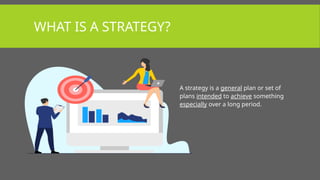
A strategy is a general plan or set of
plans intended to achieve something
especially over a long period.
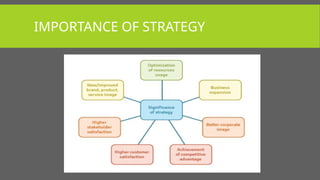
IMPORTANCE OF STRATEGY
ELEMENTS OF STRATEGY
1. Objectives:Clear objectives align the efforts of all members of the organization,
ensuring that every action and decision is focused on achieving these end goals.
Whether aiming for market leadership, profitability, or customer satisfaction,
objectives provide the measurable targets that a strategy seeks to reach.
2. Culture:An organization’s culture is integral to strategy execution because it
influences how employees approach tasks, respond to change, and collaborate.
For example, a culture of risk-taking and innovation can drive strategic moves
toward new market opportunities.
3. Costs:. Strategies often involve making decisions about cost leadership (being the
lowest-cost provider in the market) or differentiating based on value, which may
involve higher costs but offer premium products or services.
4. Capabilities:These can include technological infrastructure, operational expertise,
intellectual property, or skilled workforce. For instance, a technology firm may
need to invest in R&D capabilities to pursue a strategy of innovation.
4 P’S OF STRATEGY
1. Purpose – This refers to the organization’s core mission, vision, and long-term goals. It
defines why the business exists and what it seeks to achieve in the future.
2. Position – Positioning involves how the business differentiates itself in the market. It
focuses on the unique value proposition, target market, and competitive advantage in
comparison to others in the same industry.
3. Perspective – This refers to the company’s mindset or worldview regarding its strategy.
It includes its approach to innovation, customer experience, market trends, and its
overall attitude towards competition and change.
4. Plan – This is the actionable roadmap or set of activities the organization will undertake
to achieve its purpose. It includes specific strategies, tactics, and resource allocation for
executing the overall vision.
CORPORATE AND SBU
A strategic business unit (SBU) is a division of a company that focuses on
a specific product line or service. SBUs are often used to help companies
manage their products and services more effectively
.
•Apparel: A company that adds a swimwear line as a separate brand
•Electronics: A computer company that starts selling smartphones with a different brand name
•Appliances: A company that adds a home decor section to its appliances
•Food: A company that starts making snacks using a different brand name
•Beauty: A company that makes products for skin care, hair care, and personal care
•Grooming: A company that makes products for shaving, such as razors and shaving creams
•Health care: A company that makes health-related products, such as oral care
•Fabric and home care: A company that makes household cleaning products and detergents
•Baby, feminine, and family care: A company that makes products for babies, such as diapers and
baby wipes
•Consumer durables: A company that makes refrigerators, washing machines, air conditioners,
and televisions
FOUR LEVERS OF SBU
 1. Scope:
• Definition: Scope refers to the boundaries of a business, including the
markets it serves, the products or services it offers, and the geographic
areas it covers.
• Example:
• Apple: Initially, Apple focused primarily on computers, but its scope has
expanded to include mobile devices (iPhones), wearables (Apple Watch),
services (iCloud, Apple Music), and even content creation (Apple TV+). This
broadening of scope allows Apple to target a wider range of customers
and create a more integrated ecosystem.
• Tesla: Tesla's scope includes electric vehicles (EVs), energy storage
solutions (Powerwall), and solar products, giving it a wide-ranging
presence in the clean energy sector, not just cars.
 2. Assets:
• Definition: Assets refer to the physical, financial, human, and intellectual
resources a company has at its disposal to execute its strategy. This
includes everything from technology and machinery to patents and skilled
labor.
• Example:
• Google: Google has significant assets in terms of its data centers (physical
assets), proprietary search algorithms (intellectual assets), and a large team
of software engineers (human assets). These assets enable Google to
maintain its dominant position in the search engine market.
• Coca-Cola: Coca-Cola's brand and intellectual property (its secret recipe) are
key assets that differentiate it from competitors, along with its global
distribution network.
 3. Design:
• Definition: Design refers to how a company structures its operations,
products, services, and customer experiences to deliver its strategic
objectives. This can involve organizational design, service delivery, and
the design of products themselves.
• Example:
• IKEA: IKEA’s design strategy is about providing functional, well-designed
furniture at an affordable price. Its self-assembly model, combined with a
global supply chain and warehouse format, is a key part of its design that
allows it to scale efficiently.
• Airbnb: The design of Airbnb’s platform makes it easy for users to book
unique accommodations around the world, leveraging user-generated
content and peer reviews. This design enables a seamless customer
experience and scalability.
 4.Scale:
• Definition: Scale refers to the size of operations and the ability to
leverage economies of scale, reducing per-unit costs as production or
service delivery increases.
• Example:
• Walmart: Walmart’s vast scale allows it to negotiate lower prices with
suppliers, which it can then pass on to customers, giving it a cost
advantage over smaller competitors. Its large distribution network helps
it maintain low costs and high efficiency.
• Amazon: Amazon benefits from economies of scale due to its enormous
distribution and fulfillment network. The company’s massive purchasing
power allows it to offer competitive prices and free shipping, helping to
dominate the e-commerce space.
POSITIONING OUTCOMES
 1.Value Proposition:
• Definition: The value proposition is the unique promise a company
makes to customers, stating why they should choose its product or
service over competitors.
• Example:
• Tesla: Tesla’s value proposition is centered around producing high-
performance electric vehicles (EVs) that are not only environmentally
friendly but also technologically advanced. The company promises an
exceptional driving experience with zero emissions.
• Nike: Nike’s value proposition focuses on offering high-quality, innovative
athletic footwear and apparel that enhance performance, comfort, and
style. Their "Just Do It" slogan embodies motivation and empowerment,
appealing to athletes and active individuals.
 2. Bargaining Power:
• Definition: Bargaining power refers to the ability of a company to
influence its suppliers, customers, or other stakeholders in terms of
prices, terms, and conditions.
• Example:
• Apple: Apple has significant bargaining power with suppliers because it is
one of the largest buyers of components like chips, displays, and other
materials. It can negotiate better terms with suppliers due to its scale and
demand for high-quality components.
• Amazon: Amazon holds substantial bargaining power over its third-party
sellers. By being the largest e-commerce platform, it can impose terms
and conditions that suppliers must accept, such as commission fees and
shipping requirements.
 3.Cost Structure:
• Definition: Cost structure refers to the composition of fixed and variable costs that
a company incurs to produce its products or services. A company with a strong
cost structure can optimize its operations to remain competitive and profitable.
• Example:
• Cost Leadership – Ryanair: Ryanair operates with a low-cost structure by minimizing
frills (e.g., no free snacks, pay-for-extras like checked bags), using a single aircraft
model (Boeing 737) to reduce maintenance costs, and flying to less expensive
secondary airports. This enables Ryanair to offer the lowest fares in the European
airline market.
• Cost Leadership – McDonald's: McDonald's operates with a highly optimized cost
structure. Through standardization, economies of scale in purchasing, and efficient
supply chain management, it delivers food quickly and at low prices across its global
network.
INTERRELATIONSHIPS BETWEEN LEVERS
AND POSITIONING OUTCOMES
•Scope and Value Proposition: Expanding the scope of a company (such as through diversification or entering new markets) can
enhance its value proposition by offering more choices to customers or addressing a broader set of customer needs.
Example: Amazon, which expanded from books to a variety of goods and services, positions itself as a one-stop-shop with a broad
value proposition (convenience, wide selection, fast delivery).
•Assets and Bargaining Power: Companies with valuable assets (e.g., intellectual property, data, proprietary technologies) can use
these to increase their bargaining power with suppliers or customers.
Example: Apple uses its intellectual property (e.g., iOS, patented designs) to have bargaining power in negotiations with app
developers and hardware suppliers.
•Design and Cost Structure: A well-designed business model can help reduce inefficiencies and optimize the cost structure, leading
to a cost advantage.
Example: IKEA’s flat-pack design allows it to reduce shipping costs, pass savings to customers, and maintain a low cost structure,
while still offering a compelling value proposition of stylish, affordable furniture.
•Scale and Cost Structure: Companies that scale their operations can spread their fixed costs over a larger number of units, which
lowers the per-unit cost and contributes to a favorable cost structure.
Example: Walmart uses its enormous scale to lower its per-unit costs and pass on those savings to customers, which helps maintain
a competitive cost structure and position as a cost leader.
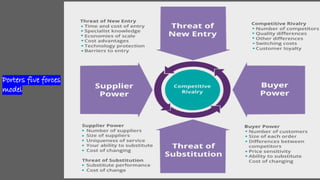
Porters five forces
model
VALUE CHAIN ANALYSIS
 Value Chain Analysis is a way for businesses to understand how they
create value for their customers. It breaks down all the steps involved in
making a product or service, from start to finish, to identify where the
company can improve or become more efficient.
 In simple terms, it helps a business figure out how each part of its
operations (like production, marketing, or customer service) adds value
and where they can do better to increase profits or reduce costs.
KEY STEPS IN VALUE CHAIN ANALYSIS:
•Inbound Logistics: How the company gets and manages the materials or resources needed to
create its product (e.g., raw materials, supplies).
•Operations: The process of turning those materials into the final product or service (e.g.,
manufacturing or assembly).
•Outbound Logistics: How the finished product is stored and delivered to customers (e.g.,
warehousing, shipping).
•Marketing & Sales: The activities that promote and sell the product, like advertising, pricing, and
selling strategies.
•Service: The post-sale support to customers, such as maintenance, repairs, or customer service.
SUPPORT ACTIVITIES
•Procurement: How the company buys the resources it needs.
•Technology Development: How the company uses technology to improve its product or operations.
•Human Resources Management: Managing employees, hiring, and training.
•Firm Infrastructure: Overall management, finance, and other support functions
PORTERS GENERIC STRATEGIES
 . 1.Cost Leadership (Be the Cheapest)
• The goal is to be the lowest-cost producer in the industry, offering
products or services at a lower price than competitors.
• How it works: The company focuses on efficiency, reducing costs in
production, and maximizing economies of scale.
• Example: Walmart is a good example of cost leadership. They sell a
wide range of products at low prices by keeping costs down, like
through bulk purchasing and efficient operations.
 2.Differentiation (Be Unique)
• The goal is to offer something unique that customers value and are
willing to pay more for, making the product or service stand out from
competitors.
• How it works: The company focuses on innovation, quality, or special
features to create a product that is different from others in the market.
• Example: Apple is an example of differentiation. Their products (like
iPhones and MacBooks) have unique features, sleek design, and high-
quality materials, which customers are willing to pay a premium for.
 3.Focus (Target a Specific Niche)
• The goal is to focus on a particular market segment or niche and serve
that group better than competitors who target a broad market.
• How it works: The company can either focus on being the lowest cost
or offer differentiated products within a specific market segment (a
small group of customers).
• Example: A luxury car brand like Ferrari focuses on a specific niche of
wealthy customers, offering high-end, exclusive cars. Another example
could be a local organic food store that focuses on health-conscious
buyers in a specific community.
RESOURCE-BASED VIEW
 The (RBV) is a theory that explains how companies can achieve a competitive advantage
by using their unique resources and capabilities.
 According to this view, the key to a company’s success lies in the resources it possesses and
how well it uses them to create value.
•Resources: These are the assets, skills, and capabilities a company owns or controls.
Resources can be:
•Tangible: Physical assets like equipment, buildings, or cash.
•Intangible: Non-physical assets like brand reputation, intellectual property, and knowledge.
•Capabilities: These refer to the company’s ability to use its resources effectively. It includes
things like management skills, technological know-how, or strong customer relationships
VRIS FRAMEWORK
•.
Valuable:The resource must help the company exploit market opportunities or neutralize threats.
Flipkart has a strong brand and a vast network that allows it to take advantage of the growing e-
commerce market in India. It helps the company compete against rivals like Amazon by offering localized
services, a wide product range, and an understanding of Indian consumer behavior.
Rare:The resource must be unique or rare, something that competitors cannot easily replicate.
•Example: Zomato’s restaurant database, along with its deep knowledge of regional food preferences
and behavior, is a rare asset, making it stand out in the highly competitive food delivery industry.
Inimitable:The resource must be difficult to imitate or copy. This could be due to historical conditions,
complexity, or a unique company culture.Example: The trust in Tata’s products and services (whether in
automobiles, IT services, or steel production) has been built over generations, making it inimitable and a
key competitive advantage for the group.
Non-substitutable:The resource cannot be easily replaced by another resource or capability.
•Example: The cooperative structure and the direct relationship with farmers are unique to Amul, and no
other company in India can easily substitute or replace this model to achieve the same level of supply
chain efficiency and trust.
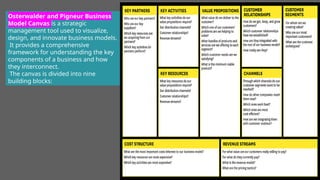
Osterwalder and Pigneur Business
Model Canvas is a strategic
management tool used to visualize,
design, and innovate business models.
It provides a comprehensive
framework for understanding the key
components of a business and how
they interconnect.
The canvas is divided into nine
building blocks:
ZOMATO’S CUSTOMER SEGMENT
 Zomato's target customers include:
• Foodies: People who love exploring new restaurants and ordering
food.
• Restaurant owners: Businesses that use Zomato to promote their
menu and offer delivery services.
• Delivery Partners: The people who deliver the food to customers.
• Advertisers: Brands that want to advertise their products through
Zomato.
2. VALUE PROPOSITIONS
 Zomato offers value to different customer
segments:
• For foodies: Convenience of discovering new
restaurants, reading reviews, and ordering
food easily.
• For restaurant owners: A platform to reach
more customers and increase sales.
• For delivery partners: Flexibility in earning
money by delivering food.
• For advertisers: A platform with high user
engagement for advertising their products.
3.CHANNEL
 Zomato reaches its customers through:
• Mobile app: The main platform where
customers order food and restaurants
interact.
• Website: Another platform for ordering
and restaurant discovery.
• Social media: Zomato uses Facebook,
Instagram, and Twitter to engage with
customers.
4. CUSTOMER RELATIONSHIPS
 Zomato builds relationships with its
customers by offering:
• Personalized recommendations for foodies
based on their past orders.
• Customer support through chat or call for
any delivery issues or queries.
• Loyalty programs like Zomato Pro, offering
discounts to repeat customers
5. REVENUE STREAMS
•Delivery fees: Charges customers for delivering
food.
•Subscription services: Zomato Pro, where users
pay a fee for discounts and offers.
•Restaurant listing fees: Restaurants pay to get
listed or promoted on the platform.
•Advertising: Restaurants and brands pay for ads
displayed on the platform.
6. KEY RESOURCES
 Zomato’s key resources include:
• Technology: The mobile app and
website, which are central to
Zomato’s business.
• Brand: The recognition and trust that
Zomato has built over the years.
• Data: Insights into customer
preferences, restaurant ratings, and
food trends.
• Delivery fleet: The team of delivery
partners who ensure timely delivery.
7. KEY ACTIVITIES
 Zomato’s key activities are:
• Platform development and
maintenance: Ensuring that the app and
website are user-friendly and working
smoothly.
• Customer support: Addressing user
issues with orders or app functionality.
• Marketing and promotion: Attracting
new customers and restaurants to the
platform.
• Managing partnerships: Engaging with
restaurants, delivery partners, and
advertisers
8.KEY PARTNERSHIPS
 Zomato collaborates with:
• Restaurants: For food listings and delivery
services.
• Delivery partners: Independent delivery
drivers who help deliver food to customers.
• Payment gateways: Companies that
process payments for orders (e.g., Paytm,
Razorpay).
• Advertisers: Brands that want to advertise
on the platform.
9. COST STRUCTURE
 Zomato's main costs include:
• Technology development: Maintaining and
improving the app and website.
• Marketing and advertising: Promoting
Zomato to attract more users and restaurants.
• Employee salaries: Paying staff in technology,
marketing, and customer support.
• Logistics: Costs related to managing delivery
partners.
• Partnerships: Paying commissions to
restaurants and delivery partners.
BUSINESS ECOSYSTEM AND FIRM
NETWORK
 A "business ecosystem" refers to a broader network of interconnected
organizations, including suppliers, customers, competitors, and other
stakeholders, all working together to deliver a product or service,
 A "firm network" is a more focused group of companies directly
collaborating with each other, usually within a specific industry or value
chain, to achieve shared goals; essentially, a firm network is a smaller,
more tightly knit part of a larger business ecosystem
Example:
•Business Ecosystem:The smartphone industry, where phone manufacturers, app developers,
network providers, accessory makers, and consumers all interact within a complex ecosystem to
create a complete mobile experience.
•Firm Network:A group of consulting companies forming a strategic alliance to jointly bid on
large projects, leveraging each other's expertise in different areas.
 Key Differences:
• Scope:A business ecosystem encompasses a wider range of actors, including
not just direct business partners but also supporting organizations, consumers,
and even regulatory bodies, while a firm network usually involves a smaller,
more defined group of companies with direct business relationships.
• Dynamic Interaction:Within a business ecosystem, interactions between
companies are often more dynamic and fluid, with competition and
cooperation occurring simultaneously, whereas a firm network is usually based
on more structured collaborations with defined roles and responsibilities.
• Focus on Value Creation:A business ecosystem is primarily concerned with
creating overall value for the entire market through innovation and
collaboration, while a firm network focuses on maximizing value for the
participating companies through their specific partnership.
BLUE OCEAN STRATEGY
 The Blue Ocean Strategy is a business concept that focuses on
creating new, untapped market spaces (referred to as "blue oceans")
where there is little to no competition. Instead of fighting against
competitors in an existing market (which is referred to as a "red ocean"
due to intense competition), companies using a Blue Ocean Strategy
aim to innovate and create new demand, making the competition
irrelevant.
KEY IDEAS OF BLUE OCEAN STRATEGY:
1.Innovation and Value Creation: The goal is to offer something
innovative that stands out and provides unique value to customers.
2.Uncontested Market Space: The company looks for a niche market
or creates a new category where competition is minimal or nonexistent.
3.Lower Costs, Increased Value: Companies can often offer lower prices
while maintaining or increasing value, which helps attract new
customers.
EXAMPLE OF BLUE OCEAN STRATEGY
 When Amul started, the Indian dairy market was fragmented, and milk products were sold
primarily by local vendors. Most dairy companies focused on traditional, unbranded milk with
limited variety.
 What Did Amul Do?
1.Product Innovation: Amul created branded dairy products (like Amul butter, cheese, milk, ice
cream, etc.) which were not commonly available in India at that time. They introduced
processed, standardized dairy products with consistent quality and packaging, which was new
and unheard of for Indian consumers.
2.Creating Trust and Accessibility: Amul created a strong brand identity that emphasized quality
and trust, positioning itself as a reliable source of dairy products. They introduced their products
through milk cooperatives, which also helped small dairy farmers get a fair price for their milk.
3.Expanding the Market: Instead of just competing with local milk vendors, Amul expanded the
market by promoting a wide range of products, including cheese, ice cream, and milk powder,
which were new categories for many consumers in India. This helped them create new demand
for dairy products across the country, even in rural areas.
REVIEW QUESTIONS
1. 1. Choose a company (e.g., an Indian company like Reliance Industries or Flipkart). Conduct a SWOT analysis and explain
how the company can leverage its strengths and opportunities to counter its weaknesses and threats.
2. 2. Apply Porter's Five Forces framework to analyze the competitive environment of the Indian telecommunications industry
(e.g., Airtel, Jio, Vodafone). How do these forces impact the profitability and strategies of firms in the industry?
3. Can you identify a Blue Ocean Strategy used by an Indian company (e.g., Ola, Zomato, or Amul)? How did the company
create a new, uncontested market space, and what was the result?
4. How does a company like Tata Motors maintain a competitive advantage in the Indian automotive industry? Identify and
explain the resources or capabilities that give Tata Motors an edge over its competitors.
5. Choose an Indian startup (e.g., Byju’s, UrbanClap, or Paytm) and fill out the Business Model Canvas for the company. How
does the startup create, deliver, and capture value in the market?
6. Pick an Indian manufacturing company (e.g., Bajaj Auto, Maruti Suzuki, or Mahindra & Mahindra). Conduct a Value
Chain Analysis for the company and identify which activities in the value chain (primary and support) create the most value for
the company. How can the company improve its efficiency in these activities to increase its competitive edge?
7. Consider an Indian retail company (e.g., Big Bazaar, D-Mart, or Reliance Fresh). Based on Porter’s Generic Strategies
(Cost Leadership, Differentiation, Focus), identify the strategy that the company is following. Provide examples from their
operations, pricing, or marketing strategy that support your choice. What challenges might the company face while
implementing this strategy?

Foundations of Strategy.pptx MBA Sem2 with examples

  • 1.
  • 2.
    WHAT IS ASTRATEGY? A strategy is a general plan or set of plans intended to achieve something especially over a long period.
  • 3.
  • 4.
    ELEMENTS OF STRATEGY 1.Objectives:Clear objectives align the efforts of all members of the organization, ensuring that every action and decision is focused on achieving these end goals. Whether aiming for market leadership, profitability, or customer satisfaction, objectives provide the measurable targets that a strategy seeks to reach. 2. Culture:An organization’s culture is integral to strategy execution because it influences how employees approach tasks, respond to change, and collaborate. For example, a culture of risk-taking and innovation can drive strategic moves toward new market opportunities. 3. Costs:. Strategies often involve making decisions about cost leadership (being the lowest-cost provider in the market) or differentiating based on value, which may involve higher costs but offer premium products or services. 4. Capabilities:These can include technological infrastructure, operational expertise, intellectual property, or skilled workforce. For instance, a technology firm may need to invest in R&D capabilities to pursue a strategy of innovation.
  • 5.
    4 P’S OFSTRATEGY 1. Purpose – This refers to the organization’s core mission, vision, and long-term goals. It defines why the business exists and what it seeks to achieve in the future. 2. Position – Positioning involves how the business differentiates itself in the market. It focuses on the unique value proposition, target market, and competitive advantage in comparison to others in the same industry. 3. Perspective – This refers to the company’s mindset or worldview regarding its strategy. It includes its approach to innovation, customer experience, market trends, and its overall attitude towards competition and change. 4. Plan – This is the actionable roadmap or set of activities the organization will undertake to achieve its purpose. It includes specific strategies, tactics, and resource allocation for executing the overall vision.
  • 6.
    CORPORATE AND SBU Astrategic business unit (SBU) is a division of a company that focuses on a specific product line or service. SBUs are often used to help companies manage their products and services more effectively . •Apparel: A company that adds a swimwear line as a separate brand •Electronics: A computer company that starts selling smartphones with a different brand name •Appliances: A company that adds a home decor section to its appliances •Food: A company that starts making snacks using a different brand name •Beauty: A company that makes products for skin care, hair care, and personal care •Grooming: A company that makes products for shaving, such as razors and shaving creams •Health care: A company that makes health-related products, such as oral care •Fabric and home care: A company that makes household cleaning products and detergents •Baby, feminine, and family care: A company that makes products for babies, such as diapers and baby wipes •Consumer durables: A company that makes refrigerators, washing machines, air conditioners, and televisions
  • 7.
    FOUR LEVERS OFSBU  1. Scope: • Definition: Scope refers to the boundaries of a business, including the markets it serves, the products or services it offers, and the geographic areas it covers. • Example: • Apple: Initially, Apple focused primarily on computers, but its scope has expanded to include mobile devices (iPhones), wearables (Apple Watch), services (iCloud, Apple Music), and even content creation (Apple TV+). This broadening of scope allows Apple to target a wider range of customers and create a more integrated ecosystem. • Tesla: Tesla's scope includes electric vehicles (EVs), energy storage solutions (Powerwall), and solar products, giving it a wide-ranging presence in the clean energy sector, not just cars.
  • 8.
     2. Assets: •Definition: Assets refer to the physical, financial, human, and intellectual resources a company has at its disposal to execute its strategy. This includes everything from technology and machinery to patents and skilled labor. • Example: • Google: Google has significant assets in terms of its data centers (physical assets), proprietary search algorithms (intellectual assets), and a large team of software engineers (human assets). These assets enable Google to maintain its dominant position in the search engine market. • Coca-Cola: Coca-Cola's brand and intellectual property (its secret recipe) are key assets that differentiate it from competitors, along with its global distribution network.
  • 9.
     3. Design: •Definition: Design refers to how a company structures its operations, products, services, and customer experiences to deliver its strategic objectives. This can involve organizational design, service delivery, and the design of products themselves. • Example: • IKEA: IKEA’s design strategy is about providing functional, well-designed furniture at an affordable price. Its self-assembly model, combined with a global supply chain and warehouse format, is a key part of its design that allows it to scale efficiently. • Airbnb: The design of Airbnb’s platform makes it easy for users to book unique accommodations around the world, leveraging user-generated content and peer reviews. This design enables a seamless customer experience and scalability.
  • 10.
     4.Scale: • Definition:Scale refers to the size of operations and the ability to leverage economies of scale, reducing per-unit costs as production or service delivery increases. • Example: • Walmart: Walmart’s vast scale allows it to negotiate lower prices with suppliers, which it can then pass on to customers, giving it a cost advantage over smaller competitors. Its large distribution network helps it maintain low costs and high efficiency. • Amazon: Amazon benefits from economies of scale due to its enormous distribution and fulfillment network. The company’s massive purchasing power allows it to offer competitive prices and free shipping, helping to dominate the e-commerce space.
  • 11.
    POSITIONING OUTCOMES  1.ValueProposition: • Definition: The value proposition is the unique promise a company makes to customers, stating why they should choose its product or service over competitors. • Example: • Tesla: Tesla’s value proposition is centered around producing high- performance electric vehicles (EVs) that are not only environmentally friendly but also technologically advanced. The company promises an exceptional driving experience with zero emissions. • Nike: Nike’s value proposition focuses on offering high-quality, innovative athletic footwear and apparel that enhance performance, comfort, and style. Their "Just Do It" slogan embodies motivation and empowerment, appealing to athletes and active individuals.
  • 12.
     2. BargainingPower: • Definition: Bargaining power refers to the ability of a company to influence its suppliers, customers, or other stakeholders in terms of prices, terms, and conditions. • Example: • Apple: Apple has significant bargaining power with suppliers because it is one of the largest buyers of components like chips, displays, and other materials. It can negotiate better terms with suppliers due to its scale and demand for high-quality components. • Amazon: Amazon holds substantial bargaining power over its third-party sellers. By being the largest e-commerce platform, it can impose terms and conditions that suppliers must accept, such as commission fees and shipping requirements.
  • 13.
     3.Cost Structure: •Definition: Cost structure refers to the composition of fixed and variable costs that a company incurs to produce its products or services. A company with a strong cost structure can optimize its operations to remain competitive and profitable. • Example: • Cost Leadership – Ryanair: Ryanair operates with a low-cost structure by minimizing frills (e.g., no free snacks, pay-for-extras like checked bags), using a single aircraft model (Boeing 737) to reduce maintenance costs, and flying to less expensive secondary airports. This enables Ryanair to offer the lowest fares in the European airline market. • Cost Leadership – McDonald's: McDonald's operates with a highly optimized cost structure. Through standardization, economies of scale in purchasing, and efficient supply chain management, it delivers food quickly and at low prices across its global network.
  • 14.
    INTERRELATIONSHIPS BETWEEN LEVERS ANDPOSITIONING OUTCOMES •Scope and Value Proposition: Expanding the scope of a company (such as through diversification or entering new markets) can enhance its value proposition by offering more choices to customers or addressing a broader set of customer needs. Example: Amazon, which expanded from books to a variety of goods and services, positions itself as a one-stop-shop with a broad value proposition (convenience, wide selection, fast delivery). •Assets and Bargaining Power: Companies with valuable assets (e.g., intellectual property, data, proprietary technologies) can use these to increase their bargaining power with suppliers or customers. Example: Apple uses its intellectual property (e.g., iOS, patented designs) to have bargaining power in negotiations with app developers and hardware suppliers. •Design and Cost Structure: A well-designed business model can help reduce inefficiencies and optimize the cost structure, leading to a cost advantage. Example: IKEA’s flat-pack design allows it to reduce shipping costs, pass savings to customers, and maintain a low cost structure, while still offering a compelling value proposition of stylish, affordable furniture. •Scale and Cost Structure: Companies that scale their operations can spread their fixed costs over a larger number of units, which lowers the per-unit cost and contributes to a favorable cost structure. Example: Walmart uses its enormous scale to lower its per-unit costs and pass on those savings to customers, which helps maintain a competitive cost structure and position as a cost leader.
  • 15.
  • 16.
    VALUE CHAIN ANALYSIS Value Chain Analysis is a way for businesses to understand how they create value for their customers. It breaks down all the steps involved in making a product or service, from start to finish, to identify where the company can improve or become more efficient.  In simple terms, it helps a business figure out how each part of its operations (like production, marketing, or customer service) adds value and where they can do better to increase profits or reduce costs.
  • 17.
    KEY STEPS INVALUE CHAIN ANALYSIS: •Inbound Logistics: How the company gets and manages the materials or resources needed to create its product (e.g., raw materials, supplies). •Operations: The process of turning those materials into the final product or service (e.g., manufacturing or assembly). •Outbound Logistics: How the finished product is stored and delivered to customers (e.g., warehousing, shipping). •Marketing & Sales: The activities that promote and sell the product, like advertising, pricing, and selling strategies. •Service: The post-sale support to customers, such as maintenance, repairs, or customer service.
  • 18.
    SUPPORT ACTIVITIES •Procurement: Howthe company buys the resources it needs. •Technology Development: How the company uses technology to improve its product or operations. •Human Resources Management: Managing employees, hiring, and training. •Firm Infrastructure: Overall management, finance, and other support functions
  • 19.
    PORTERS GENERIC STRATEGIES . 1.Cost Leadership (Be the Cheapest) • The goal is to be the lowest-cost producer in the industry, offering products or services at a lower price than competitors. • How it works: The company focuses on efficiency, reducing costs in production, and maximizing economies of scale. • Example: Walmart is a good example of cost leadership. They sell a wide range of products at low prices by keeping costs down, like through bulk purchasing and efficient operations.
  • 20.
     2.Differentiation (BeUnique) • The goal is to offer something unique that customers value and are willing to pay more for, making the product or service stand out from competitors. • How it works: The company focuses on innovation, quality, or special features to create a product that is different from others in the market. • Example: Apple is an example of differentiation. Their products (like iPhones and MacBooks) have unique features, sleek design, and high- quality materials, which customers are willing to pay a premium for.
  • 21.
     3.Focus (Targeta Specific Niche) • The goal is to focus on a particular market segment or niche and serve that group better than competitors who target a broad market. • How it works: The company can either focus on being the lowest cost or offer differentiated products within a specific market segment (a small group of customers). • Example: A luxury car brand like Ferrari focuses on a specific niche of wealthy customers, offering high-end, exclusive cars. Another example could be a local organic food store that focuses on health-conscious buyers in a specific community.
  • 22.
    RESOURCE-BASED VIEW  The(RBV) is a theory that explains how companies can achieve a competitive advantage by using their unique resources and capabilities.  According to this view, the key to a company’s success lies in the resources it possesses and how well it uses them to create value. •Resources: These are the assets, skills, and capabilities a company owns or controls. Resources can be: •Tangible: Physical assets like equipment, buildings, or cash. •Intangible: Non-physical assets like brand reputation, intellectual property, and knowledge. •Capabilities: These refer to the company’s ability to use its resources effectively. It includes things like management skills, technological know-how, or strong customer relationships
  • 23.
    VRIS FRAMEWORK •. Valuable:The resourcemust help the company exploit market opportunities or neutralize threats. Flipkart has a strong brand and a vast network that allows it to take advantage of the growing e- commerce market in India. It helps the company compete against rivals like Amazon by offering localized services, a wide product range, and an understanding of Indian consumer behavior. Rare:The resource must be unique or rare, something that competitors cannot easily replicate. •Example: Zomato’s restaurant database, along with its deep knowledge of regional food preferences and behavior, is a rare asset, making it stand out in the highly competitive food delivery industry. Inimitable:The resource must be difficult to imitate or copy. This could be due to historical conditions, complexity, or a unique company culture.Example: The trust in Tata’s products and services (whether in automobiles, IT services, or steel production) has been built over generations, making it inimitable and a key competitive advantage for the group. Non-substitutable:The resource cannot be easily replaced by another resource or capability. •Example: The cooperative structure and the direct relationship with farmers are unique to Amul, and no other company in India can easily substitute or replace this model to achieve the same level of supply chain efficiency and trust.
  • 24.
    Osterwalder and PigneurBusiness Model Canvas is a strategic management tool used to visualize, design, and innovate business models. It provides a comprehensive framework for understanding the key components of a business and how they interconnect. The canvas is divided into nine building blocks:
  • 25.
    ZOMATO’S CUSTOMER SEGMENT Zomato's target customers include: • Foodies: People who love exploring new restaurants and ordering food. • Restaurant owners: Businesses that use Zomato to promote their menu and offer delivery services. • Delivery Partners: The people who deliver the food to customers. • Advertisers: Brands that want to advertise their products through Zomato.
  • 26.
    2. VALUE PROPOSITIONS Zomato offers value to different customer segments: • For foodies: Convenience of discovering new restaurants, reading reviews, and ordering food easily. • For restaurant owners: A platform to reach more customers and increase sales. • For delivery partners: Flexibility in earning money by delivering food. • For advertisers: A platform with high user engagement for advertising their products.
  • 27.
    3.CHANNEL  Zomato reachesits customers through: • Mobile app: The main platform where customers order food and restaurants interact. • Website: Another platform for ordering and restaurant discovery. • Social media: Zomato uses Facebook, Instagram, and Twitter to engage with customers.
  • 28.
    4. CUSTOMER RELATIONSHIPS Zomato builds relationships with its customers by offering: • Personalized recommendations for foodies based on their past orders. • Customer support through chat or call for any delivery issues or queries. • Loyalty programs like Zomato Pro, offering discounts to repeat customers
  • 29.
    5. REVENUE STREAMS •Deliveryfees: Charges customers for delivering food. •Subscription services: Zomato Pro, where users pay a fee for discounts and offers. •Restaurant listing fees: Restaurants pay to get listed or promoted on the platform. •Advertising: Restaurants and brands pay for ads displayed on the platform.
  • 30.
    6. KEY RESOURCES Zomato’s key resources include: • Technology: The mobile app and website, which are central to Zomato’s business. • Brand: The recognition and trust that Zomato has built over the years. • Data: Insights into customer preferences, restaurant ratings, and food trends. • Delivery fleet: The team of delivery partners who ensure timely delivery.
  • 31.
    7. KEY ACTIVITIES Zomato’s key activities are: • Platform development and maintenance: Ensuring that the app and website are user-friendly and working smoothly. • Customer support: Addressing user issues with orders or app functionality. • Marketing and promotion: Attracting new customers and restaurants to the platform. • Managing partnerships: Engaging with restaurants, delivery partners, and advertisers
  • 32.
    8.KEY PARTNERSHIPS  Zomatocollaborates with: • Restaurants: For food listings and delivery services. • Delivery partners: Independent delivery drivers who help deliver food to customers. • Payment gateways: Companies that process payments for orders (e.g., Paytm, Razorpay). • Advertisers: Brands that want to advertise on the platform.
  • 33.
    9. COST STRUCTURE Zomato's main costs include: • Technology development: Maintaining and improving the app and website. • Marketing and advertising: Promoting Zomato to attract more users and restaurants. • Employee salaries: Paying staff in technology, marketing, and customer support. • Logistics: Costs related to managing delivery partners. • Partnerships: Paying commissions to restaurants and delivery partners.
  • 34.
    BUSINESS ECOSYSTEM ANDFIRM NETWORK  A "business ecosystem" refers to a broader network of interconnected organizations, including suppliers, customers, competitors, and other stakeholders, all working together to deliver a product or service,  A "firm network" is a more focused group of companies directly collaborating with each other, usually within a specific industry or value chain, to achieve shared goals; essentially, a firm network is a smaller, more tightly knit part of a larger business ecosystem Example: •Business Ecosystem:The smartphone industry, where phone manufacturers, app developers, network providers, accessory makers, and consumers all interact within a complex ecosystem to create a complete mobile experience. •Firm Network:A group of consulting companies forming a strategic alliance to jointly bid on large projects, leveraging each other's expertise in different areas.
  • 35.
     Key Differences: •Scope:A business ecosystem encompasses a wider range of actors, including not just direct business partners but also supporting organizations, consumers, and even regulatory bodies, while a firm network usually involves a smaller, more defined group of companies with direct business relationships. • Dynamic Interaction:Within a business ecosystem, interactions between companies are often more dynamic and fluid, with competition and cooperation occurring simultaneously, whereas a firm network is usually based on more structured collaborations with defined roles and responsibilities. • Focus on Value Creation:A business ecosystem is primarily concerned with creating overall value for the entire market through innovation and collaboration, while a firm network focuses on maximizing value for the participating companies through their specific partnership.
  • 36.
    BLUE OCEAN STRATEGY The Blue Ocean Strategy is a business concept that focuses on creating new, untapped market spaces (referred to as "blue oceans") where there is little to no competition. Instead of fighting against competitors in an existing market (which is referred to as a "red ocean" due to intense competition), companies using a Blue Ocean Strategy aim to innovate and create new demand, making the competition irrelevant.
  • 37.
    KEY IDEAS OFBLUE OCEAN STRATEGY: 1.Innovation and Value Creation: The goal is to offer something innovative that stands out and provides unique value to customers. 2.Uncontested Market Space: The company looks for a niche market or creates a new category where competition is minimal or nonexistent. 3.Lower Costs, Increased Value: Companies can often offer lower prices while maintaining or increasing value, which helps attract new customers.
  • 38.
    EXAMPLE OF BLUEOCEAN STRATEGY  When Amul started, the Indian dairy market was fragmented, and milk products were sold primarily by local vendors. Most dairy companies focused on traditional, unbranded milk with limited variety.  What Did Amul Do? 1.Product Innovation: Amul created branded dairy products (like Amul butter, cheese, milk, ice cream, etc.) which were not commonly available in India at that time. They introduced processed, standardized dairy products with consistent quality and packaging, which was new and unheard of for Indian consumers. 2.Creating Trust and Accessibility: Amul created a strong brand identity that emphasized quality and trust, positioning itself as a reliable source of dairy products. They introduced their products through milk cooperatives, which also helped small dairy farmers get a fair price for their milk. 3.Expanding the Market: Instead of just competing with local milk vendors, Amul expanded the market by promoting a wide range of products, including cheese, ice cream, and milk powder, which were new categories for many consumers in India. This helped them create new demand for dairy products across the country, even in rural areas.
  • 39.
    REVIEW QUESTIONS 1. 1.Choose a company (e.g., an Indian company like Reliance Industries or Flipkart). Conduct a SWOT analysis and explain how the company can leverage its strengths and opportunities to counter its weaknesses and threats. 2. 2. Apply Porter's Five Forces framework to analyze the competitive environment of the Indian telecommunications industry (e.g., Airtel, Jio, Vodafone). How do these forces impact the profitability and strategies of firms in the industry? 3. Can you identify a Blue Ocean Strategy used by an Indian company (e.g., Ola, Zomato, or Amul)? How did the company create a new, uncontested market space, and what was the result? 4. How does a company like Tata Motors maintain a competitive advantage in the Indian automotive industry? Identify and explain the resources or capabilities that give Tata Motors an edge over its competitors. 5. Choose an Indian startup (e.g., Byju’s, UrbanClap, or Paytm) and fill out the Business Model Canvas for the company. How does the startup create, deliver, and capture value in the market? 6. Pick an Indian manufacturing company (e.g., Bajaj Auto, Maruti Suzuki, or Mahindra & Mahindra). Conduct a Value Chain Analysis for the company and identify which activities in the value chain (primary and support) create the most value for the company. How can the company improve its efficiency in these activities to increase its competitive edge? 7. Consider an Indian retail company (e.g., Big Bazaar, D-Mart, or Reliance Fresh). Based on Porter’s Generic Strategies (Cost Leadership, Differentiation, Focus), identify the strategy that the company is following. Provide examples from their operations, pricing, or marketing strategy that support your choice. What challenges might the company face while implementing this strategy?