What is a
Blockchain?
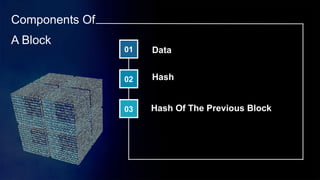
Ablockchain is “a distributed database that
maintains a continuously growing list of
ordered records, called blocks.” These
blocks “are linked using cryptography. Each
block contains a cryptographic hash of the
previous block, a timestamp, and
transaction data.
Cryptography
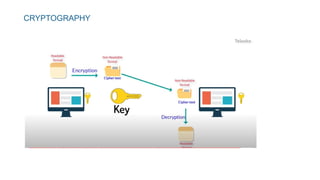
Cryptography is thescience and practice of securing communication
and data by converting it into a form that cannot be understood by
unauthorized parties. It involves techniques for encoding information
in such a way that only those with the right "key" or "code" can
access and understand the original data. This process of converting
readable data into unreadable form is called encryption, and the
reverse process, converting the encrypted data back into its original
form, is called decryption.
Cryptography plays a vital role in ensuring the confidentiality,
integrity, and authenticity of information in various applications,
including secure communication, digital signatures, authentication
systems, secure online transactions, and, as mentioned earlier, in the
context of blockchain technology. It is a fundamental component of
modern-day cybersecurity and is used extensively to protect sensitive
information from unauthorized access or tampering.
5.
Hash
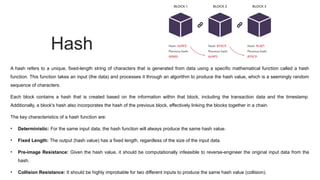
A hash refersto a unique, fixed-length string of characters that is generated from data using a specific mathematical function called a hash
function. This function takes an input (the data) and processes it through an algorithm to produce the hash value, which is a seemingly random
sequence of characters.
Each block contains a hash that is created based on the information within that block, including the transaction data and the timestamp.
Additionally, a block's hash also incorporates the hash of the previous block, effectively linking the blocks together in a chain.
The key characteristics of a hash function are:
• Deterministic: For the same input data, the hash function will always produce the same hash value.
• Fixed Length: The output (hash value) has a fixed length, regardless of the size of the input data.
• Pre-image Resistance: Given the hash value, it should be computationally infeasible to reverse-engineer the original input data from the
hash.
• Collision Resistance: It should be highly improbable for two different inputs to produce the same hash value (collision).
6.
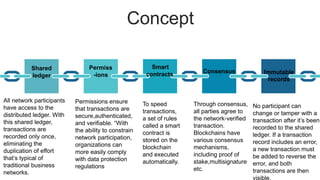
Concept
Shared
ledger
Immutable
records
Permiss
-ions
Smart
contracts Consensus
All networkparticipants
have access to the
distributed ledger. With
this shared ledger,
transactions are
recorded only once,
eliminating the
duplication of effort
that’s typical of
traditional business
networks.
Permissions ensure
that transactions are
secure,authenticated,
and verifiable. “With
the ability to constrain
network participation,
organizations can
more easily comply
with data protection
regulations
To speed
transactions,
a set of rules
called a smart
contract is
stored on the
blockchain
and executed
automatically.
Through consensus,
all parties agree to
the network-verified
transaction.
Blockchains have
various consensus
mechanisms,
including proof of
stake,multisignature
etc.
No participant can
change or tamper with a
transaction after it’s been
recorded to the shared
ledger. If a transaction
record includes an error,
a new transaction must
be added to reverse the
error, and both
transactions are then
visible.
7.
Why Use BlockchainTechnology?
Greater Trust
Greater Security
More Efficiencies
8.
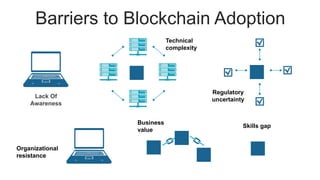
Barriers to BlockchainAdoption
Technical
complexity
Regulatory
uncertainty
Business
value
Organizational
resistance
.
Lack Of
Awareness
Skills gap
9.
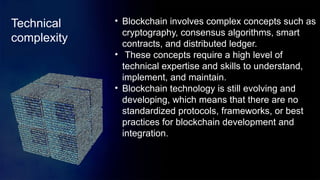
Technical
complexity
• Blockchain involvescomplex concepts such as
cryptography, consensus algorithms, smart
contracts, and distributed ledger.
• These concepts require a high level of
technical expertise and skills to understand,
implement, and maintain.
• Blockchain technology is still evolving and
developing, which means that there are no
standardized protocols, frameworks, or best
practices for blockchain development and
integration.
10.
Regulatory
uncertainty
• Blockchain technologyoperates in a global
and decentralized manner, which poses
challenges for the existing legal and regulatory
frameworks.
• Different countries and regions have different
laws and regulations regarding blockchain
technology, such as data privacy, consumer
protection, taxation, and anti-money
laundering.
• Some jurisdictions are more supportive and
flexible, while others are more restrictive and
cautious.
• This creates confusion and inconsistency for
blockchain projects, especially those that
involve cross-border transactions or multiple
11.
Organizational
resistance
• A thirdbarrier to blockchain adoption is the
organizational resistance that may arise from the
existing stakeholders and processes.
• Blockchain technology requires a shift in the way
organizations operate and collaborate.
• It challenges the traditional roles and functions of
intermediaries, central authorities, and legacy
systems. It also requires a high level of trust and
cooperation among the participants of the
blockchain network.
• Therefore, blockchain adoption may encounter
resistance from those who are reluctant to change,
lose control, or share information. This may result
in cultural, political, or operational conflicts within
or between organizations.
12.
Business value
• Itis difficult to demonstrate and measure the
business value of the technology.
• Blockchain technology is often hyped as a
disruptive and innovative solution for various
problems and opportunities.
• However, not all cases and scenarios require or
benefit from blockchain technology. Some may be
better served by existing or alternative
technologies.
• Therefore, blockchain projects need to have a
clear and realistic vision, strategy, and roadmap
for how blockchain technology can create value for
the organization and its customers. They also
need to have reliable and relevant metrics and
indicators to evaluate and communicate the
impact and return on investment of blockchain
technology.
13.
Skills gap
• Afifth barrier to blockchain adoption is the skills
gap that exists in the market. Blockchain
technology requires a diverse and multidisciplinary
set of skills and competencies, such as technical,
business, legal, and social skills.
• However, there is a shortage of qualified and
experienced professionals who can design,
develop, and deploy blockchain solutions.
• According to a report by LinkedIn, blockchain was
the most in-demand skill in 2020, but there were
not enough candidates to meet the demand. This
creates a challenge for organizations to find,
attract, and retain talent for their blockchain
projects.
14.
User
adoption/Lack
of Awareness
• Blockchaintechnology is still relatively new and
unfamiliar to many people, who may not fully
grasp its benefits, risks, and implications.
• There is lack of awareness, understanding, and
acceptance of the technology by the end-users.
• Moreover, some users may have concerns or
misconceptions about blockchain technology, such
as its complexity, security, privacy, or legality.
• Therefore, blockchain projects need to educate
and engage their users and stakeholders, and
provide them with a user-friendly and intuitive
interface and experience.
15.
TECHNOLOGICAL AND CRYPTOGRAPHICELEMENTS IN BLOCKCHAIN
Address
A blockchain address is a unique sequence of numbers and letters and functions very much like an email
address. It refers to a specific destination on the network where cryptocurrency can be sent to, and it can
be used only once. The idea is to give a person a unique address every time he or she is to receive crypto.
For example, all Bitcoin addresses start with 1, 3 or bc1. All Ethereum addresses start with 0x. Addresses
can vary in length, but a Bitcoin address is generally 34 characters.
Nodes
Blockchain nodes are network stakeholders and their devices are authorized to keep track of the
distributed ledger and serve as communication hubs for various network tasks.
A Blockchain node’s primary job is to confirm the legality of each subsequent batch of network
transactions, known as blocks.
Types:
Full Node:Full nodes are the most important type of node in the Blockchain network, as they maintain a
complete copy of the Blockchain ledger. These nodes download and store a copy of every transaction
and block on the network, which allows them to independently verify the entire Blockchain history.
16.
Light Nodes: Lightnodes, also known as SPV (Simplified Payment Verification) nodes, are a more
lightweight version of full nodes. Light nodes do not download the entire Blockchain but rather a
small portion of it that contains information relevant to their transactions.Light nodes rely on full
nodes for transaction validation and block verification.
Miner Nodes: Miner nodes are responsible for verifying transactions and adding new blocks to the
Blockchain. These nodes perform complex calculations to solve mathematical problems that allow
them to create new blocks and receive rewards in the form of cryptocurrency.
Smart Contracts
Consensus
Cryptographic Hash
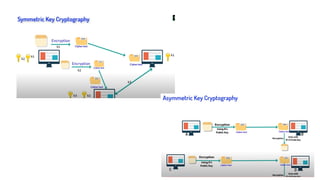
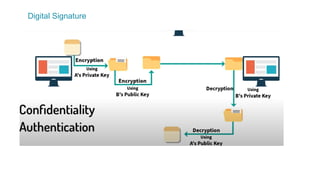
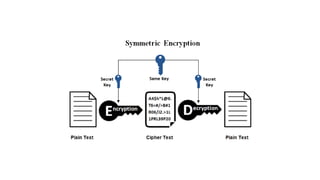
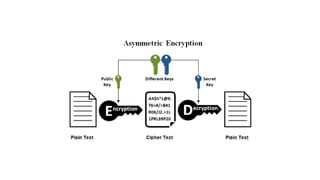
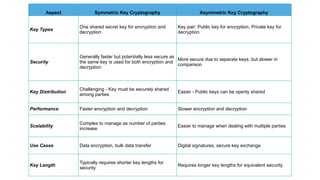
Aspect Symmetric KeyCryptography Asymmetric Key Cryptography
Key Types
One shared secret key for encryption and
decryption
Key pair: Public key for encryption, Private key for
decryption
Security
Generally faster but potentially less secure as
the same key is used for both encryption and
decryption
More secure due to separate keys, but slower in
comparison
Key Distribution
Challenging - Key must be securely shared
among parties
Easier - Public keys can be openly shared
Performance Faster encryption and decryption Slower encryption and decryption
Scalability
Complex to manage as number of parties
increase
Easier to manage when dealing with multiple parties
Use Cases Data encryption, bulk data transfer Digital signatures, secure key exchange
Key Length
Typically requires shorter key lengths for
security
Requires longer key lengths for equivalent security
23.
Types of
Blockchain
1. PublicBlockchain
A public blockchain is a type of blockchain
network that operates in an open and
permissionless manner. In a public
blockchain, anyone can participate as a
node in the network, validate transactions,
and contribute to the consensus process.
Additionally, all data and transactions
recorded on the public blockchain are
accessible to anyone, providing a high level
of transparency.
24.
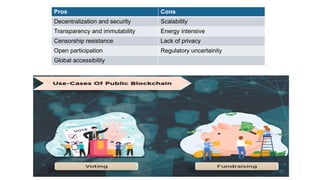
Pros Cons
Decentralization andsecurity Scalability
Transparency and immutability Energy intensive
Censorship resistance Lack of privacy
Open participation Regulatory uncertainity
Global accessibility
25.
Private Blockchain
A privateblockchain is a type of blockchain network
that operates in a closed and permissioned manner.
Unlike public blockchains, which are open to anyone,
a private blockchain restricts access and
participation to a select group of authorized entities
or users. In a private blockchain, participants need
approval from the network administrator or owner
to join and interact with the blockchain.
26.
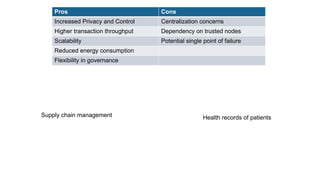
Pros Cons
Increased Privacyand Control Centralization concerns
Higher transaction throughput Dependency on trusted nodes
Scalability Potential single point of failure
Reduced energy consumption
Flexibility in governance
Supply chain management Health records of patients
27.
Hybrid Blockchain
A hybridblockchain is a type of
blockchain that combines elements of
both public and private blockchains. It
seeks to leverage the benefits of both
models, offering a more versatile and
flexible solution for specific use cases.
In a hybrid blockchain, certain parts of
the network are open to the public,
while other parts require permission to
access and participate.
A consortium blockchainis a type of blockchain
network that operates under the control of a pre-
selected group of organizations or entities. Unlike
public blockchains where anyone can participate, or
private blockchains controlled by a single organization,
consortium blockchains require permission to join and
participate in the network's consensus process.
Consortium blockchains are often used for specific
enterprise or industry use cases where a level of trust
and cooperation is established among the
participating members.
Consortium blockchain
30.
1. Ethereum
Blockchain Platforms
•Introduced in 2013, Ethereum is one of the oldest and most established
blockchain platforms. It provides a truly decentralized blockchain that is
comparable to the Bitcoin blockchain network. Its key strength is that it
enables true decentralization with support for smart contracts. Its key
weaknesses include slow processing times and higher transaction processing
costs compared to other platforms. Besides its role as a blockchain platform
that underpins enterprise applications, it has its own cryptocurrency
called ether.
• The Ethereum platform is experiencing extensive acceptance among
developers who create decentralized applications, known as dApps, on its
network. One prominent use case is the emergence of various platforms and
exchanges dedicated to non-fungible tokens (NFTs) – a unique type of digital
asset that can be traded and managed on the Ethereum blockchain.
• The Ethereum community has also migrated from a proof of work (PoW)
consensus mechanism to proof of stake (PoS), which is more energy-friendly.
31.
2. IBM Blockchain• IBM Blockchain is a private, decentralized blockchain network that
has been the most successful with enterprise clients who are less
risk-averse.
• The biggest opportunities in using it to link into enterprise cloud and
legacy technologies is more seamless than other decentralized
networks.
• The IBM Blockchain developer tool was developed with the intention
of being highly adaptable, practical, and customizable. Additionally,
IBM has made efforts to create an intuitive user interface that
streamlines essential processes like smart contract configuration,
testing, and rapid deployment, making it more user-friendly.
• According to Rakesh Mohan, IBM's director of development for
blockchain solutions, the company has observed substantial
advancements in the financial services, banking, and supply chain
sectors. Notable instances of successful blockchain applications
include IBM Food Trust, which has processed over 18 million
transactions for more than 17,000 products, and the Blockchain
Community Initiative in Thailand, facilitating services like payment
obligations and enterprise auctions for 22 Thai banks.
32.
3. Hyperledger Fabric
•Hyperledger Fabric is a collection of tools designed to facilitate
the development of blockchain applications. Supported by the
Linux Foundation, it was built for enterprise distributed ledger
applications.
• The platform offers a diverse ecosystem of components that can
be seamlessly integrated into a modular architecture. Hyperledger
Fabric excels in private or closed blockchain deployments,
enhancing both security and performance. Moreover, it provides
support for an open smart contract model that accommodates
various data models, including account and unspent transaction
output (UTXO) models.
• Hyperledger Fabric offers enhanced data privacy features by
segregating transactions into channels and enabling selective sharing
of private data on a need-to-know basis through private data
collections. Additionally, proponents of the platform claim that it
facilitates high-speed transactions with low latency for finality and
confirmation.
• Recent updates to Hyperledger Fabric introduce a feature that allows
organizations to join a channel without the necessity of copying the
entire ledger history. As a result, this enables a faster startup process
33.
• There isan ongoing debate regarding whether R3 Corda should be
classified as a traditional blockchain or a distinct type of distributed
ledger. Its unique consensus mechanism cryptographically links
transactions but does not batch them into blocks periodically. Even
the official Corda website acknowledges this ambiguity by
describing it as "both a blockchain and not a blockchain." One of its
primary advantages is real-time transaction processing, which can
enhance performance compared to conventional blockchains.
• R3 Corda has gained significant traction in the financial sector,
appealing to organizations for financial transactions and secure smart
contracts. Major supporters include Bank of America, HSBC, Intel, and
Microsoft.
• Experts believe that Corda has a strong potential to become the leading
network for insurance-related transaction processing. However, it faces
competition from other federated blockchain networks that can process
transactions faster and at a lower cost.
4. R3 Corda
34.
• Undergoing developmentsince 2014, Tezos is an
established platform that facilitates decentralized
applications, smart contracts, and innovative
financial instruments like NFTs, which can be
likened to digital asset-backed trading cards.
• Tezos offers a dynamically upgradable protocol and
modular software clients, ensuring adaptability to
new applications.
• The Tezos community actively upgrades the
platform, resulting in recent improvements to
performance and increased smart contract size
limits. Additionally, the platform has developed
tools to automate the integration of NFTs into
enterprise supply chains.
5. Tezos
35.
• Stellar isa more recent blockchain platform that
focuses on enabling various types of decentralized
finance (DeFi) applications. It employs the Stellar
Consensus Protocol, which aims to accelerate
transaction processing and finalization on a public
blockchain network.
• The platform also incorporates robust security
mechanisms to prevent the involvement of
malicious or dubious actors in financial
transactions. As a result, it has gained adoption by
numerous companies for international trade and
cross-border money exchange.
• Several notable applications have been built on the
Stellar blockchain, illustrating its versatility and
practicality. Examples include MoneyGram, which
utilizes the platform for money transfers, Circle for
payment and treasury infrastructure, and
Flutterwave, which leverages Stellar to integrate
payment processing into enterprise applications.
These use cases highlight how Stellar's technology
is being embraced by real-world businesses to
enhance global financial operations and enable
seamless transactions.
6.Stellar
36.
• The EOSIOblockchain platform was initially launched as an
open-source project in 2018. It is specifically designed for
decentralized application and smart contract development.
• EOSIO employs a sophisticated Proof of Stake (PoS)
consensus mechanism that, according to its advocates,
offers better performance compared to older mechanisms
like Ethereum. The platform also incorporates a governance
feature that allows users to vote on proposed changes to the
system.
• One of its primary strengths is its ability to handle fast
transactions, along with advanced account permission
features, which are beneficial for deploying applications. As
evidence of its success, the platform has seen the
development of over 400 applications, including those for
identity management, supply chain management (SCM), and
gaming.
• The EOSIO community provides a wide array of tools to
customize blockchain implementations for various
decentralized use cases in areas like SCM, healthcare, and
decentralized finance (DeFi).
7. EOSIO
37.
• Quorum isa specialized version of the Ethereum blockchain platform
developed by JPMorgan, a financial services company. The platform is
designed to facilitate high-speed transactions between institutions like
banks and insurance companies on a private network.
• In late 2021, ConsenSys acquired the intellectual property assets of the
Quorum platform from JPMorgan. ConsenSys integrated these assets
into its own work, resulting in the creation of the ConsenSys Quorum
open-source protocol layer.
• ConsenSys also offers development services for the combined platform
to enterprise clients, including JPMorgan and the South African Reserve
Bank. Additionally, in July 2022, ConsenSys launched the Quorum
Blockchain Service on Microsoft Azure as a fully managed service,
simplifying enterprise deployments on the platform.
8. ConsenSys Quorum
Limitations/Challenges
• Scalability: Oneof the primary limitations of blockchain is its scalability. As the number of
transactions increases, the processing time and resource requirements also increase, potentially
leading to slower transaction confirmation times and higher costs.
• Energy Consumption: Many blockchain networks, especially those using Proof of Work (PoW)
consensus algorithms, require significant computational power, leading to high energy
consumption and environmental concerns.
• Storage Requirements: As the blockchain grows over time, the storage requirements for
running a full node can become substantial, making it difficult for smaller participants to join the
network and contributing to centralization.
• Speed and Latency: Traditional blockchains can suffer from slow transaction confirmation times,
which can be a limitation for applications that require real-time or high-throughput transactions.
42.
Limitations/Challenges
• Immutability andData Deletion: While immutability is a strength of blockchain, it can also be a limitation.
Once data is recorded on the blockchain, it cannot be easily deleted or modified, which can be problematic
for compliance with data privacy laws or correcting errors.
• Governance and Consensus Issues: Achieving consensus in a decentralized network can be challenging,
especially when participants have conflicting interests. Governance mechanisms need to be robust and
efficient to address potential disputes and make crucial decisions about the network's future.
• Interoperability: Seamless interoperability between different blockchain networks remains a challenge,
making it difficult to transfer assets or data between different chains.
• Security Concerns: While blockchain is considered secure due to its cryptographic nature, it is not immune
to vulnerabilities. Smart contract bugs, 51% attacks on PoW networks, and other exploits can lead to security
breaches and loss of funds.
43.
• Regulatory Uncertainty:The lack of clear and consistent regulations in various jurisdictions
creates uncertainty for blockchain projects and businesses, hindering wider adoption and
implementation in some industries.
• Upgradability: Making significant changes or upgrades to a blockchain network can be
challenging due to the need for consensus among stakeholders. This can hinder the ability to
adapt to changing technological requirements or address identified issues.
• Privacy Concerns: While transactions on a public blockchain are transparent, the
pseudonymous nature of participants can raise privacy concerns, as transaction histories can
potentially be traced back to individuals.
Limitations/Challenges
44.
Opportunities
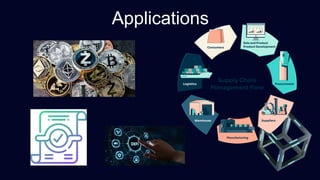
• Finance andPayments: Blockchain has the potential to transform traditional financial systems
by enabling faster, cheaper, and borderless transactions. It can reduce the need for
intermediaries like banks, leading to financial inclusion and cost savings
• Cross-Border Payments and Remittances: Blockchain can enable faster and cheaper cross-
border payments and remittances, providing significant benefits for individuals and businesses
dealing with international transactions.
• Crowd Funding: Smart contracts initiates the funding automatically once all the terms and
conditions are met without the involvement of any intermediaries.
• Fake Product Identification: Every product must have a QR code generated using blockchain
and this code and the block must contain all the information about the authenticity of the
product.
• Multi-send: Example, consider that the employer can make the salary payments to everyone at
once.
45.
Opportunities
• International Trade:Smart contracts are an essential element of the blockchain ecosystem that many
businesses have grown to adopt. It simplifies documents such as licenses and certificates, among others.
This reduces overall costs while eliminating reliability on third parties. Additionally, it improves both speed and
accuracy in the conduct of international trade.
• Solving the problem of AI generated content : One of the key challenges with AI-generated content is
determining its origin and authorship. Blockchain can establish a transparent and tamper-proof record of
content creation, tracking each step of the content's creation process. This could enable content creators to
prove their ownership and help consumers verify the authenticity of the content.
46.
Evil side ofBlockchain Technology
• Illicit Activities: The decentralised and secure network can be used for illegal
activities like fraud, money laundering, tax evasion, drug trade etc.
• Scams and Ponzi schemes: Blockchain technology has been exploited in
some cases to facilitate Ponzi schemes due to its pseudonymous and
decentralized nature, which can make it challenging to trace and regulate
transactions. Scammers may create tokens or projects that promise
substantial returns and use blockchain networks to facilitate transactions
• Hackers : They are stealing the information and data and manipulating it and
changing the transaction address.
• Smart Contract vulnerabilities: There might be unintended errors in the
coding of the algorithm which might light to security breach and loss of data.
• Energy depletion: High consumption of renewable source like power will
lead to environment impact and climate changes.
47.
Evil Side OfBlockchain Technology
Cryptocurrency fluctuation and volatility:
Unemployment of unskilled employees:
Lack of Regulation: The decentralized and cross-border nature of blockchain technology can
make it difficult for regulators to enforce laws and regulations. This can create legal gray areas
and potential challenges for law enforcement agencies.
Privacy Concerns: While blockchain transactions are transparent and traceable, the level of
privacy varies. Public blockchains may expose transaction details to everyone, while private
blockchains may raise concerns about who has access to sensitive data.
Misunderstanding of Technology: The complexity of blockchain technology can lead to
misconceptions and misunderstandings among the general public, which might result in unrealistic
expectations or investment in projects with little substance.
Terrorist Funding:
48.
Legal Regulations inIndia
• Cryptocurrency Regulation: The Reserve Bank of India (RBI) had taken a somewhat cautious approach
towards cryptocurrencies. In 2018, the RBI had banned banks and financial institutions from providing
services to cryptocurrency-related businesses. However, the Supreme Court of India lifted this ban in March
2020, allowing individuals and businesses to engage in cryptocurrency transactions.
• Draft Cryptocurrency Bill: In 2019, there were reports of a draft bill titled "Banning of Cryptocurrency and
Regulation of Official Digital Currency Bill" that proposed a complete ban on private cryptocurrencies while
allowing the government to explore the potential for a Central Bank Digital Currency (CBDC). However, the
status and details of this bill were not finalized.
• Blockchain Adoption: While the regulatory stance on cryptocurrencies was somewhat uncertain, there was
growing interest in blockchain technology itself. Various government agencies and departments were
exploring the use of blockchain for applications like supply chain management, land records, and more.
• Industry Engagement: The Indian government and regulatory bodies were engaging in discussions with
stakeholders, including industry players, to better understand the technology and its potential impact. This
indicated a willingness to explore blockchain's benefits while addressing concerns.
• Cautionary Advisories: The RBI and other government agencies had issued advisories to the public about
the risks associated with investing in cryptocurrencies and related schemes. They emphasized the need for
careful consideration and due diligence.
49.
Legal Regulations
• ConsumerProtection Laws: Blockchain-based businesses and applications that deal with
consumers should follow consumer protection laws to ensure fair practices, accurate
disclosures, and consumer rights.
• Data Protection and Privacy: Blockchain solutions that involve personal data must comply with
data protection laws like the General Data Protection Regulation (GDPR) in the European Union.
Users' rights to control their data and the ability to erase it should be maintained.
• Digital Identity and Identity Theft: Blockchain-based digital identity solutions should adhere to
identity theft and cybersecurity regulations, ensuring secure handling of sensitive personal
information.
• Taxation: The taxation of cryptocurrency transactions remained a point of discussion. As of my
last update, cryptocurrencies were considered assets subject to capital gains tax, and
businesses dealing with cryptocurrencies were subject to Goods and Services Tax (GST).
Editor's Notes
#24 Censorship resistance: meaning that no central authority can prevent or censor transactions. This feature is crucial for applications that require free and open access to the network.












![What is Blockchain? [Applications of Blockchain in Cryptocurrency and Banking]](https://cdn.slidesharecdn.com/ss_thumbnails/blockchaindecentralizedstoragepowposmechanisms-250609045147-b01d52eb-thumbnail.jpg?width=640&height=640&fit=bounds)


