Defining IKS
• IKSis a very generic phase that covers practically every thing about India .
• It can be said that all the social, cultural practices, literature , historical evidences and
other such knowledge assets available in all the Indian languages, dialects and
geographical regions and all the knowledge assets available from pre-historic times to
the current day will technically fall in the category of IKS
As stated by Mahadevan (2024)
5.
Defining key words
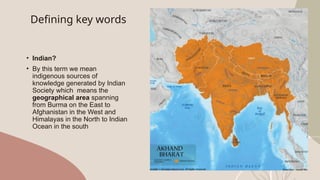
•Indian?
• By this term we mean
indigenous sources of
knowledge generated by Indian
Society which means the
geographical area spanning
from Burma on the East to
Afghanistan in the West and
Himalayas in the North to Indian
Ocean in the south
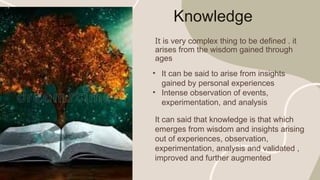
Knowledge
It is verycomplex thing to be defined . it
arises from the wisdom gained through
ages
• It can be said to arise from insights
gained by personal experiences
• Intense observation of events,
experimentation, and analysis
It can said that knowledge is that which
emerges from wisdom and insights arising
out of experiences, observation,
experimentation, analysis and validated ,
improved and further augmented
8.
System
• System isa structured methodology and classification scheme to
access the available corpus of knowledge . There is codification
and classification of available knowledge and there has to
interconnection between different parts of knowledge.
8
9.
9
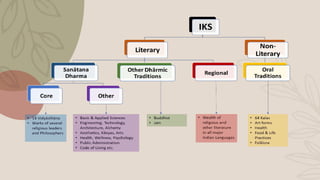
Indian Knowledge System
•The Indian Knowledge Systems comprise of Jnan, Vignan, and Jeevan Darshan that have
evolved out of experience, observation, experimentation, and rigorous analysis. This tradition of
validating and putting into practice has impacted our education, arts, administration, law, justice,
health, manufacturing, and commerce. This has influenced classical and other languages of
Bharat, that were transmitted through textual, oral, and artistic traditions. “Knowledge of India” in
this sense includes knowledge from ancient India and, its successes and challenges, and a
sense of India’s future aspirations specific to education, health, environment and indeed all
aspects of life.
• As per the Ministry of Education https://www.education.gov.in/en/nep/indian-knowledge-systems
11.
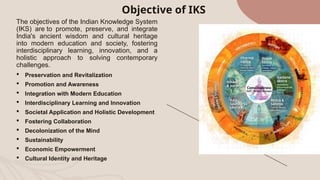
Objective of IKS
Preservation and Revitalization
Promotion and Awareness
Integration with Modern Education
Interdisciplinary Learning and Innovation
Societal Application and Holistic Development
Fostering Collaboration
Decolonization of the Mind
Sustainability
Economic Empowerment
Cultural Identity and Heritage
The objectives of the Indian Knowledge System
(IKS) are to promote, preserve, and integrate
India's ancient wisdom and cultural heritage
into modern education and society, fostering
interdisciplinary learning, innovation, and a
holistic approach to solving contemporary
challenges.
12.
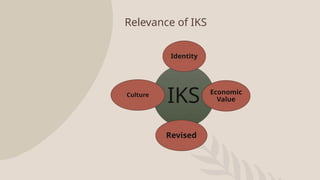
Relevance of IKS
1.Dowe need IKS? Indian products that have been patented by foreign
countries, through a process known as biopiracy, include
the Neem tree, Turmeric, Basmati rice, and other
traditional Indian medicinal plants and crops. Examples
include a patent on the use of turmeric for wound
healing, which was challenged and invalidated, and a
patent on neem oil for its fungicidal properties that was
later revoked after public outcry. Foreign companies
have also attempted to patent the Basmati rice variety.
IKS not mere knowing about the
ancient knowledge.
Biopiracy happens when researchers or research
organisations take biological resources without
official sanction, largely from less affluent countries
or marginalized people.
Biopiracy is not limited to drug development. It also
occurs in agricultural and industrial contexts. Indian
products such as the neem tree, tamarind, turmeric,
and Darjeeling tea have all been patented by foreign
firms for different lucrative purposes.
14
Identity
• The quintessentialvalue that ancient knowledge brings to society is the identity it
provides to fellow members of the society. Essentially it defines the context for
several aspects of the day-to-day living of every individual. The social practices and
norms have continuity as most are transmitted from generation to generation.
15.
Culture
o Culture hasseveral dimensions. In a direct sense, it is the manifestation of human
intellectual achievement regarded collectively by society over time. From a social
perspective, culture is nothing but the set of ideas, customs, and behaviour of society.
In other words, culture provides a sense of identity at a societal level by providing a
common medium for communication and the transaction of ideas. The prevailing
knowledge and the literary traditions play a significant role in shaping the culture of the
society. If the underlying knowledge systems are abruptly withdrawn from society, the
cultural practices will be rudely jolted. It may create distortions and discontinuities in
societal progress.
15
16.
Economic value
16
Transforming knowledgeinto economic value has been fully formalized with the
global intellectual property rights regulations and patent laws. Therefore, the
ancient knowledge system will be beneficial to a country like India .
Received Wisdom
Knowledge and innovation are in a continuum. Innovation and new
knowledge creation in any society is 'path-dependent. What it essentially
means is that the road travelled so far determines the future path.


 Most read
 Most read
 Most read