Why Does Democracy Need Education?
Author(s): Edward L. Glaeser, Giacomo A. M. Ponzetto and Andrei Shleifer
Source: Journal of Economic Growth, Vol. 12, No. 2 (Jun., 2007), pp. 77-99
Published by: Springer
Stable URL: http://www.jstor.org/stable/40216116 .
Accessed: 21/04/2013 10:40
Your use of the JSTOR archive indicates your acceptance of the Terms & Conditions of Use, available at .
http://www.jstor.org/page/info/about/policies/terms.jsp
.
JSTOR is a not-for-profit service that helps scholars, researchers, and students discover, use, and build upon a wide range of
content in a trusted digital archive. We use information technology and tools to increase productivity and facilitate new forms
of scholarship. For more information about JSTOR, please contact support@jstor.org.
.
Springer is collaborating with JSTOR to digitize, preserve and extend access to Journal of Economic Growth.
http://www.jstor.org
This content downloaded from 202.52.238.92 on Sun, 21 Apr 2013 10:40:32 AM
All use subject to JSTOR Terms and Conditions
JEconGrowth(2007) 12:77-99
DOI 10.1007/s10887-007-9015-1
Whydoesdemocracyneededucation?
Edward L. Glaeser • Giacomo A. M. Ponzetto•
AndreiShleifer
Publishedonline:31May2007
© SpringerScience+BusinessMedia,LLC 2007
Abstract Acrosscountries,educationanddemocracyarehighlycorrelated.Wemotivate
empiricallyandthenmodela causal mechanismexplainingthiscorrelation,in ourmodel,
schoolingteachespeopleto interactwithothersand raisesthebenefitsofcivicparticipa-
tion,includingvotingand organizing.In thebattlebetweendemocracyand dictatorship,
democracyhasa widepotentialbase ofsupportbutoffersweakincentivestoitsdefenders.
Dictatorshipprovidesstrongerincentivestoa narrowerbase.As educationraisesthebenefits
of civic engagement,it raisesparticipationin supportof a broad-basedregime(democ-
racy)relativetothatinsupportofa narrow-basedregime(dictatorship).Thisincreasesthe
likelihoodof successfuldemocraticrevolutionsagainstdictatorships,and reducesthatof
successfulanti-democraticcoups.
Keywords Democracy• Education• Politicalparticipation
1 Introduction
Thehypothesisthathighereducationleadstomoredemocraticpolitics(Lipset,1959,1960)
has receiveda good deal ofempiricalsupport(Barro,1999; Glaeser,LaPorta,Lopez-de-
Silanes,andShleifer,2004; PapaioannouandSiourounis,2005). However,thetheoretical
reasonsforthisrelationshipremainunexplored.Indeed,accordingto(Barro,1999,p.SI 82),
"giventhestrengthoftheAristotle/Lipsethypothesisas anempiricalregularity,itis surpris-
ingthatconvincingtheoreticalmodelsofthisrelationshipdo notexist."In thispaper,we
firstmotivateandthenproposeonemodelofa causalimpactofeducationondemocracy.
Ourstartingpointis theconnectionbetweeneducationandpoliticalparticipation.This
connectionhas been emphasizedby Almondand Verba (1989,1sted. 1963), who see
E. L. Glaeser• A. Shleifer
HarvardUniversityandNBER,Cambridge,MA,USA
G. A.M. Ponzetto•A. Shleifer(El)
DepartmentofEconomics,HarvardUniversity,M9LittauerCenter,Cambridge,MA02138,USA
£i Springer
This content downloaded from 202.52.238.92 on Sun, 21 Apr 2013 10:40:32 AM
All use subject to JSTOR Terms and Conditions
78 JEconGrowth(2007) 12:77-99
educationas a crucialdeterminantof"civicculture"and participationindemocraticpol-
itics."The uneducatedmanorthemanwithlimitededucationis a differentpoliticalactor
fromthemanwhohasachieveda higherlevelofeducation(p. 315)." AlmondandVerba's
workhas influencedbothpoliticalscience(e.g., Brady,Verba,andSchlozman,1995) and
sociology(e.g., Kamens,1988),andourworkcan be seenas an elaborationoftheirideas
usingtheoreticalandempiricaltoolsofeconomics.
A dramaticplacetosee theeffectofeducationonpoliticalparticipationis studentactiv-
ism.StudentsriotedagainstauthorityatOxford,Bologna,andParisevenintheMiddleAges.
MartinLutherfoundthemostimmediateintensesupportfromthestudentsinWittenbergand
otherGermanuniversities.Studentsplayedkeyrolesinliberalmovementsandrevolutions
inEuropeinthemiddleofthe19thcentury."Iftherevolutionhada core,itwastheyoung
educatedelite"(Rander-Pehrson,1999,p.145). Studentdemonstrationsplayeda roleinthe
overthrowofPeroninArgentinain 1955,theHungarianRevolutionin 1956,thedownfall
ofPerezJimenezinVenezuelain 1958,theresignationoftheKishigovernmentinJapanin
1960,theresistancetoDiem inVietnamin 1963,theanti-SukarnomovementinIndonesia
andthetopplingoftheRheegovernmentinKoreain 1966,thePragueSpringin 1968,and
thedownfallofAyubKhaninPakistanin 1969.The Tianenmenstudentuprisingof 1989
failedto depose theCommunistParty,perhapsbecause thestudentsgotlittlesupportin
generallyuneducatedChinaandwerecrushedbythetroops.Mostrecently,peacefuldemon-
strationsinwhichstudentsplayeda keyparthelpedsavedemocracyinUkraineagainstthe
aggrandizementbytheex-Presidentwhostoletheelection.
Itwouldbe incorrecttoconcludefromtheseexamplesthatstudentshavea preferencefor
democraticgovernment- perhapsbecausetheyvaluefreedom,information,orelections-
ratherthanforpoliticalparticipation.Thehep-hepanti-semiticriotsinBavariain1819 started
whenduringanacademicceremonyanagedprofessorwhohadrecentlycomeoutinfavorof
civicrightsforJewshadtorunforhislifeas angrystudentsassaultedhim.Mussolinienjoyed
substantialsupportfromstudentsintheyoungfascistmovement.Hitlerlikewisereliedonthe
Nazi students,whoeventuallyseizedcontroloftheuniversities.In LatinAmerica,students
offeredstrongsupporttotheChe Guevaraledcommunistguerillamovement,nofriendsof
democracy.The evidencethatstudentsorganizetoparticipateincollectiveaction- demo-
craticoranti-democratic- is muchmorecompellingthantheevidenceoftheirpreference
fordemocracy.Ourgoal,then,is toexploremoredeeplytheconsequencesofwhatwetake
tobe theprimitiveconnectionbetweeneducationandparticipation.
In Sect.2 we brieflyreviewtheevidenceoneducationanddemocracy.Althoughecono-
metriccontroversiesaboutthisevidencestilllinger,theweightofrecentresearchsuggests
thattheLipsethypothesisis valid,andthattheoriestoexplainitareindeedcalledfor.
In Sect.3, we motivateourbasicassumptionthateducationleadstohigherparticipation
ina wholerangeofsocialactivities,includingpolitics.Thismightbe so forseveralreasons.
Inoneview,schoolingincorporatesindoctrinationaboutthevirtuesofpoliticalparticipation.
A secondviewsees humancapitalas actuallysocialcapital:schoolslargelyteachstudents
to interactwithone another.By improvinginterpersonalskills,educationfacilitatescivic
involvement.Usingmicro-evidencefromboththeUS andothercountries,wedocumentthe
robustcorrelationbetweenmanyformsofcivicactivity,includingpoliticalparticipation,and
education.Thisevidenceis mostnaturallyconsistentwiththesecondview.
Motivatedbythisevidence,we presenta modelofregimestabilityinSect.4. Unlikethe
literatureonregimechangethattypicallyfocusesonthepayoffstocitizensunderalternative
politicalregimes(e.g.,BourguignonandVerdier,2000), ourmodeldescribesincentivesto
participateinthepoliticalactivityitself.These includetop-downincentives,suchas pun-
ishmentsmetedoutbypoliticalleaderstotheirpresumedsupporterswhoareshirking.But
& Springer
This content downloaded from 202.52.238.92 on Sun, 21 Apr 2013 10:40:32 AM
All use subject to JSTOR Terms and Conditions
JEconGrowth(2007) 12:77-99 79
thesealso includelateralincentives,providedbyparticipantsinpoliticswhoencourageor
shametheirfriendsand peerstojoin them.Democraciesare moreinclusiveregimesthan
dictatorships,so,inthespiritofOlson,theydeliverweakertop-downincentives.Largepop-
ularmovementscannotreadilycompeltheirmembersto voteordemonstrate.Butourkey
assumptionis thateducationraisesthebenefitsof politicalparticipation:bettereducated
peersarebetteratpersuadingfriendstojoin. As a consequence,althougheducationraises
participationinbothdemocraticanddictatorialregimes,theincreaseis greaterforthemore
inclusive(democratic)regime.Whenpoliticalsuccessis determinedbytherawnumberof
supporters,educationfavorsdemocracyrelativetodictatorship.
In thismodel,thepoliticalsuccessofa democracyhingeson havinga largenumberof
supporterswhosebenefitsofpoliticalparticipationaresufficientlyhighthattheyfightfor
itevenintheabsenceofdirectrewards.Educationsuppliessuchsupportersandstabilizes
democracy.Conversely,incountrieswithlowlevelsofeducation,dictatorshiporoligarchyis
morestablethandemocracy,becauseonlydictatorshipsofferthestrongtop-downincentives
neededtoinducepeopletodefendthem.InthemodelinSect.4,countrieswithhigherlevels
of educationaremorelikelybothto experiencea transitionfromdictatorshipto democ-
racy,andtowithstandanti-democraticchallenges.Moreover,thesizeofthemostsuccessful
challengerregimetoanexistingdictatorshipriseswiththelevelofeducation.
In additiontohavingsomeempiricalsupportforitscoreassumptionanddeliveringthe
broadempiricalpredictionsdocumentedinSect.2,themodelhasseveralnewimplications.
Itpredictsthat,ingeneral,educationcausesthemoreinclusivegroupstodominatepolitics.
In particular,as educationincreases,groupschallengingexistingregimesbecomeprogres-
sivelylarger- smallcoups arereplacedby largerevolutions.Althoughtheyremainto be
formallytested,thesepredictionsareconsistentwitha broadoutlineofEuropeantransition
todemocracy.
2 The empiricalrelationshipbetweeneducationand democracy
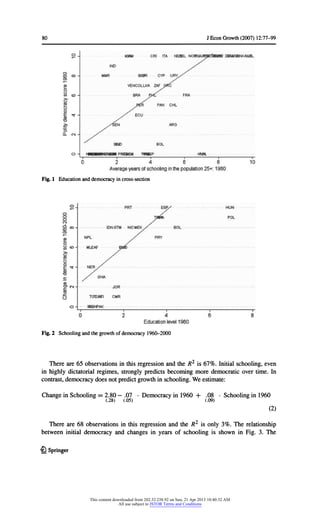
Acrosstheworld,thecorrelationbetweeneducationanddemocracyisextremelyhigh.1Fig-
ure1showstherelationshipbetweenthePolityIV indexofdemocracy(JaggersandMarshall,
2003) andtheyearsofschoolinginthecountryin 1960(BarroandLee, 2001). Across91
countries,thecorrelationcoefficientbetweenthesevariablesis 74%.
Ofcourse,thiscorrelationdoesnotestablishcausality.Barro(1997, 1999)conductedthe
initialresearchon thetime-seriesrelationshipbetweeneducationand democracy.In that
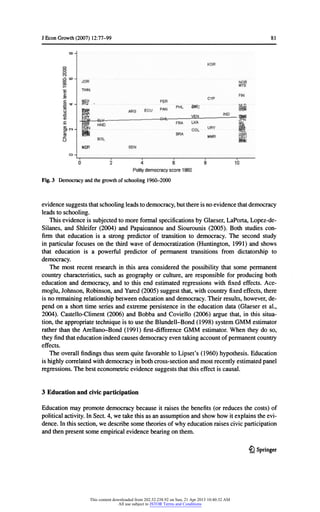
spirit,considertheevidenceontransitionsfromdictatorshiptodemocracy.Figure2 shows
therawcorrelationbetweenthechangeintheJaggersandMarshall(2003) democracyscore
andyearsofschoolingin 1960(fromBarroandLee) forcountriesthathadlowdemocracy
ratings(zeroorone)in1960.Thiscorrelationis66%. Ifwetaketheentiresampleofcountries
andregressthechangeindemocracyoninitialdemocracyandinitialyearsofeducation,we
estimate:
ChaneeinDemocracy= 4.13 - .98 • Democracyin1960 + .84 • Schoolingin 1960
(.48) (.09) (.15)
(1)
1 Przeworski,Alvarez,Cheibub,andLimongi(2000),Barro(1999),BoixandStokes(2003),Glaeser,LaPorta,
Lopez-de-Silanes,andShleifer(2004),andPapaioannouandSiourounis(2005)alsoconsidertherelationship
betweenincomeanddemocracy.Theconclusionemergingfromthecontroversiesis thatincomedoescause
transitiontodemocracy,as wellas itsstability.Ourfocus,however,is oneducationnotincome.Nordo we
considertheconsequencesofdemocracy,see,e.g.,PrzeworskiandLimongi(1993) andMulligan,Gil,and
Sala-i-Martin(2004).
£l Springer
This content downloaded from 202.52.238.92 on Sun, 21 Apr 2013 10:40:32 AM
All use subject to JSTOR Terms and Conditions
80 JEconGrowth(2007) 12:77-99
Fig.1 Educationanddemocracyincross-section
Fig.2 Schoolingandthegrowthofdemocracy1960-2000
Thereare65 observationsinthisregressionandtheR2 is 67%. Initialschooling,even
in highlydictatorialregimes,stronglypredictsbecomingmoredemocraticovertime.In
contrast,democracydoes notpredictgrowthinschooling.Weestimate:
ChangeinSchooling= 2.80 - .07 • Democracyin 1960 + .08 • Schoolingin 1960
(.28) (.05) (.09)
(2)
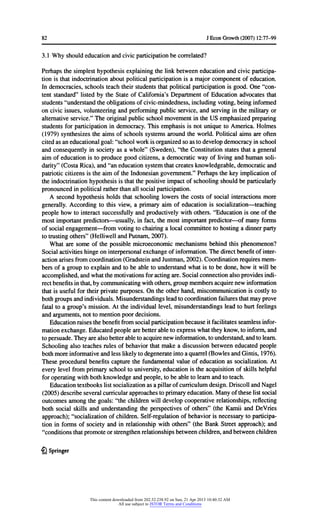
Thereare 68 observationsin thisregressionand the R2 is only3%. The relationship
betweeninitialdemocracyand changesin yearsof schoolingis shownin Fig. 3. The
£} Springer
This content downloaded from 202.52.238.92 on Sun, 21 Apr 2013 10:40:32 AM
All use subject to JSTOR Terms and Conditions
JEconGrowth(2007) 12:77-99 81
Fig.3 Democracyandthegrowthofschooling1960-2000
evidencesuggeststhatschoolingleadstodemocracy,butthereisnoevidencethatdemocracy
leadstoschooling.
Thisevidenceis subjectedtomoreformalspecificationsbyGlaeser,LaPorta,Lopez-de-
Silanes,and Shleifer(2004) and Papaioannouand Siourounis(2005). Both studiescon-
firmthateducationis a strongpredictorof transitionto democracy.The second study
in particularfocuseson thethirdwaveof democratization(Huntington,1991) and shows
thateducationis a powerfulpredictorof permanenttransitionsfromdictatorshipto
democracy.
The mostrecentresearchin thisarea consideredthepossibilitythatsome permanent
countrycharacteristics,suchas geographyor culture,are responsibleforproducingboth
educationand democracy,and to thisend estimatedregressionswithfixedeffects.Ace-
moglu,Johnson,Robinson,andYared(2005) suggestthat,withcountryfixedeffects,there
is noremainingrelationshipbetweeneducationanddemocracy.Theirresults,however,de-
pendon a shorttimeseriesandextremepersistencein theeducationdata (Glaeseret al.,
2004). Castello-Climent(2006) and Bobba and Coviello (2006) arguethat,in thissitua-
tion,theappropriatetechniqueis touse theBlundell-Bond(1998) systemGMM estimator
ratherthantheArellano-Bond(1991) first-differenceGMM estimator.Whentheydo so,
theyfindthateducationindeedcausesdemocracyeventakingaccountofpermanentcountry
effects.
The overallfindingsthusseemquitefavorabletoLipset's(1960) hypothesis.Education
is highlycorrelatedwithdemocracyinbothcross-sectionandmostrecentlyestimatedpanel
regressions.Thebesteconometricevidencesuggeststhatthiseffectis causal.
3 Education and civicparticipation
Educationmaypromotedemocracybecause itraisesthebenefits(or reducesthecosts)of
politicalactivity.InSect.4, wetakethisas an assumptionandshowhowitexplainstheevi-
dence.Inthissection,wedescribesometheoriesofwhyeducationraisescivicparticipation
andthenpresentsomeempiricalevidencebearingonthem.
£l Springer
This content downloaded from 202.52.238.92 on Sun, 21 Apr 2013 10:40:32 AM
All use subject to JSTOR Terms and Conditions
82 JEconGrowth(2007) 12:77-99
3.1 Whyshouldeducationandcivicparticipationbe correlated?
Perhapsthesimplesthypothesisexplainingthelinkbetweeneducationandcivicparticipa-
tionis thatindoctrinationaboutpoliticalparticipationis a majorcomponentofeducation.
In democracies,schoolsteachtheirstudentsthatpoliticalparticipationis good. One "con-
tentstandard"listedbytheStateof California'sDepartmentof Educationadvocatesthat
students"understandtheobligationsofcivic-mindedness,includingvoting,beinginformed
on civicissues,volunteeringandperformingpublicservice,and servinginthemilitaryor
alternativeservice."The originalpublicschoolmovementintheUS emphasizedpreparing
studentsforparticipationin democracy.Thisemphasisis notuniquetoAmerica.Holmes
(1979) synthesizestheaimsofschoolssystemsaroundtheworld.Politicalaimsareoften
citedas aneducationalgoal:"schoolworkisorganizedso as todevelopdemocracyinschool
andconsequentlyin societyas a whole"(Sweden),"theConstitutionstatesthata general
aimofeducationis to producegood citizens,a democraticwayoflivingandhumansoli-
darity"(CostaRica), and"aneducationsystemthatcreatesknowledgeable,democraticand
patrioticcitizensis theaimoftheIndonesiangovernment."Perhapsthekeyimplicationof
theindoctrinationhypothesisis thatthepositiveimpactofschoolingshouldbe particularly
pronouncedinpoliticalratherthanall socialparticipation.
A secondhypothesisholdsthatschoolinglowersthecostsof social interactionsmore
generally.Accordingto thisview,a primaryaim of educationis socialization- teaching
peoplehowtointeractsuccessfullyandproductivelywithothers."Educationis oneofthe
mostimportantpredictors- usually,infact,themostimportantpredictor- ofmanyforms
ofsocialengagement- fromvotingtochairinga local committeetohostinga dinnerparty
totrustingothers"(HelliwellandPutnam,2007).
Whatare someof thepossiblemicroeconomicmechanismsbehindthisphenomenon?
Social activitieshingeoninterpersonalexchangeofinformation.Thedirectbenefitofinter-
actionarisesfromcoordination(GradsteinandJustman,2002). Coordinationrequiresmem-
bersofa grouptoexplainandtobe able tounderstandwhatis tobe done,howitwillbe
accomplished,andwhatthemotivationsforactingare.Social connectionalsoprovidesindi-
rectbenefitsinthat,bycommunicatingwithothers,groupmembersacquirenewinformation
thatis usefulfortheirprivatepurposes.On theotherhand,miscommunicationis costlyto
bothgroupsandindividuals.Misunderstandingsleadtocoordinationfailuresthatmayprove
fataltoa group'smission.Attheindividuallevel,misunderstandingslead tohurtfeelings
andarguments,nottomentionpoordecisions.
Educationraisesthebenefitfromsocialparticipationbecauseitfacilitatesseamlessinfor-
mationexchange.Educatedpeoplearebetterabletoexpresswhattheyknow,toinform,and
topersuade.Theyarealsobetterabletoacquirenewinformation,tounderstand,andtolearn.
Schoolingalso teachesrulesofbehaviorthatmakea discussionbetweeneducatedpeople
bothmoreinformativeandlesslikelytodegenerateintoa quarrel(BowlesandGintis,1976).
These proceduralbenefitscapturethefundamentalvalueofeducationas socialization.At
everylevelfromprimaryschooltouniversity,educationis theacquisitionofskillshelpful
foroperatingwithbothknowledgeandpeople,tobe abletolearnandtoteach.
Educationtextbookslistsocializationas a pillarofcurriculumdesign.DriscollandNagel
(2005) describeseveralcurricularapproachestoprimaryeducation.Manyoftheselistsocial
outcomesamongthegoals: "thechildrenwilldevelopcooperativerelationships,reflecting
bothsocial skillsand understandingtheperspectivesof others"(theKamii and DeVries
approach);"socializationofchildren.Self-regulationofbehavioris necessarytoparticipa-
tionin formsof societyand in relationshipwithothers"(theBank Streetapproach);and
"conditionsthatpromoteorstrengthenrelationshipsbetweenchildren,andbetweenchildren
£} Springer
This content downloaded from 202.52.238.92 on Sun, 21 Apr 2013 10:40:32 AM
All use subject to JSTOR Terms and Conditions
JEconGrowth(2007) 12:77-99 83
andadults"(theWaldorfapproach).GordonandBrowne(2004) writethat"a majorrolefor
theearlychildhoodteacheristoseethatchildrenhaveenjoyablesocialcontactsandtohelp
motivatechildrentowarda desiretobe withothers,"because"enhancingsocialintelligence
buildsa setofskillsthatmaybe amongthemostessentialforlifesuccessofmanykinds."
Whydo schoolsspendso muchefforton socializingchildren?An altruisticviewmight
suggestthattheabilityto workwellin social settingsis amongthemostimportantskills
neededtofunctioninsociety.A morecynicalviewseessocializedchildrenas easierfortheir
teacherstomanage.Whateverthereason,schoolsinallpoliticalandreligiousregimesdevote
considerableresourcestoteachingsocialcooperation.2
The socializationhypothesispredictsthateducationshouldimpactall formsof social
involvement.Itsabilitytopredictpoliticalengagementshouldbe no strongerthanthatfor
otherformsofsocial participation.Thistheoryalso predictsno differenceintheimpactof
educationon socialactivitiesindemocraciesornon-democracies.
Thesetwohypothesesbothassumethateducationcausescivicparticipation.Itis atleast
possiblethatthelinkbetweenschoolingandeducationrepresentsselection,nottreatment,
andthatexogenouscharacteristicsthatmakepeopletolerantofeducationalso enablethem
tositthroughmeetingsorwaitinlinetovote.Ifthisweretrue,thenexogenousincreasesin
schoolingwouldhavenoimpactonoveralllevelsofcivicparticipation.Furthermore,ifinnate
characteristicsvarymorewithinthanacrossareas,thisviewpredictsa low(ornon-existent)
relationshipbetweeneducationandcivicparticipationattheaggregatelevel.
3.2 Empiricalevidenceoneducationandcivicparticipation
UsingtheWorldValuesSurvey(WVS), we beginwithcross-countryevidenceon educa-
tionandmembershipin social groups.We excludecountrieswiththePolityIV autocracy
scoreabove4 fromtheanalysisbecausethesecountriesforcepartyandotherparticipation.
(Forexample,25% oftheChineserespondentsreportmembershipintheCommunistparty).
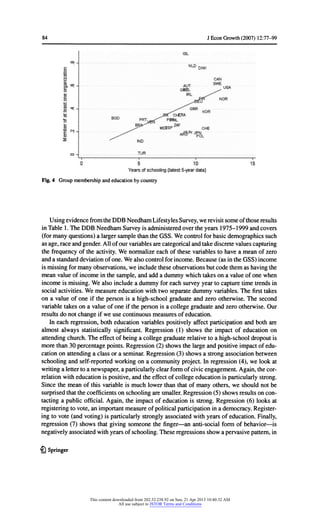
Figure4 presentstheresultsfortheavailable34 countries.Itshowsa sharplypositiveand
statisticallysignificant(t = 3.31) relationshipbetweeneducationandparticipationinsocial
groups.Thisevidenceisbroadlyconsistentwithourtheoreticalperspective,butunfortunately
doesnotallowus todistinguishthevarioushypotheses.
Wecando thatbetterwithindividual-levelevidencefromtheUS. Therearetwoprimary
individual-levelsourcesforinformationonsocialactivities:theGeneralSocial Survey(GSS)
andtheDDE NeedhamLifestylesSurvey.UsingtheGSS, DiPasquale andGlaeser(1999)
documenta strongpositiverelationshipbetweeneducationanda varietyofsocialoutcomes.
Collegegraduatesare 27% morelikelythanhigh-schooldropoutsto saythattheyvotein
localelectionsand29% morelikelytosaythattheyhelpsolvelocalproblems.
Collegegraduatesarealsomorelikelytojoinorganizations.GlaeserandSacerdote(2001)
showthistobetruefor15outof16 formsofgroupmembership:theexceptionistrade-union
membership.UsingtheWVS,theyalsofinda significantpositiverelationshipbetweenyears
ofeducationandgroupmembershipinalmosteverycountry.Educationalso positivelypre-
dictschurchattendancein theGSS. FiftypercentofAmericancollegegraduatessaythat
theyattendchurchmorethanseveraltimesperyear;36% ofhigh-schoolgraduatessaythey
attendthatoften.
2
Bysocialcooperationwedonotmeanobediencetoauthority.Obediencetoauthorityisofcoursesomething
differentthatschoolsalsoteach,althoughevidentlynotas successfully,astheevidenceofstudent- andmore
generallyeducatedpeople's- activismagainstauthorityillustrates.
£} Springer
This content downloaded from 202.52.238.92 on Sun, 21 Apr 2013 10:40:32 AM
All use subject to JSTOR Terms and Conditions
84 JEconGrowth(2007) 12:77-99
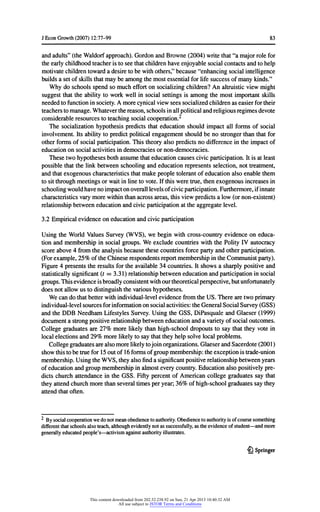
Fig.4 Groupmembershipandeducationbycountry
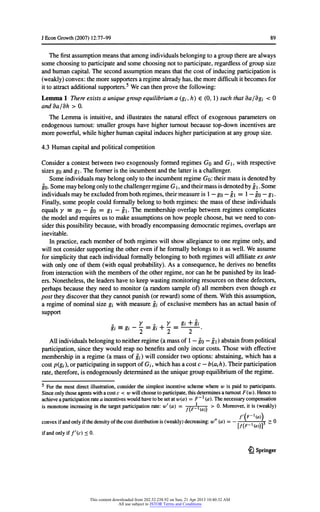
UsingevidencefromtheDDB NeedhamLifestylesSurvey,werevisitsomeofthoseresults
inTable 1. TheDDB NeedhamSurveyis administeredovertheyears1975-1999 andcovers
(formanyquestions)a largersamplethantheGSS. Wecontrolforbasicdemographicssuch
as age,raceandgender.Allofourvariablesarecategoricalandtakediscretevaluescapturing
thefrequencyoftheactivity.We normalizeeach ofthesevariablestohavea meanofzero
anda standarddeviationofone.Wealsocontrolforincome.Because (as intheGSS) income
ismissingformanyobservations,weincludetheseobservationsbutcodethemas havingthe
meanvalueofincomeinthesample,andadda dummywhichtakesona valueofonewhen
incomeis missing.We also includea dummyforeachsurveyyeartocapturetimetrendsin
social activities.We measureeducationwithtwoseparatedummyvariables.The firsttakes
on a valueofone ifthepersonis a high-schoolgraduateand zerootherwise.The second
variabletakeson a valueofone ifthepersonis a collegegraduateandzerootherwise.Our
resultsdo notchangeifwe usecontinuousmeasuresofeducation.
In each regression,botheducationvariablespositivelyaffectparticipationandbothare
almostalways statisticallysignificant.Regression(1) showstheimpactof educationon
attendingchurch.Theeffectofbeinga collegegraduaterelativetoa high-schooldropoutis
morethan30 percentagepoints.Regression(2) showsthelargeandpositiveimpactofedu-
cationon attendinga class ora seminar.Regression(3) showsa strongassociationbetween
schoolingandself-reportedworkingon a communityproject.In regression(4), we lookat
writinga lettertoa newspaper,a particularlyclearformofcivicengagement.Again,thecor-
relationwitheducationis positive,andtheeffectofcollegeeducationis particularlystrong.
Since themeanofthisvariableis muchlowerthanthatofmanyothers,we shouldnotbe
surprisedthatthecoefficientsonschoolingaresmaller.Regression(5) showsresultsoncon-
tactinga publicofficial.Again,theimpactofeducationis strong.Regression(6) looksat
registeringtovote,animportantmeasureofpoliticalparticipationina democracy.Register-
ingtovote(andvoting)is particularlystronglyassociatedwithyearsofeducation.Finally,
regression(7) showsthatgivingsomeonethefinger- an anti-socialformofbehavior- is
negativelyassociatedwithyearsofschooling.Theseregressionsshowa pervasivepattern,in
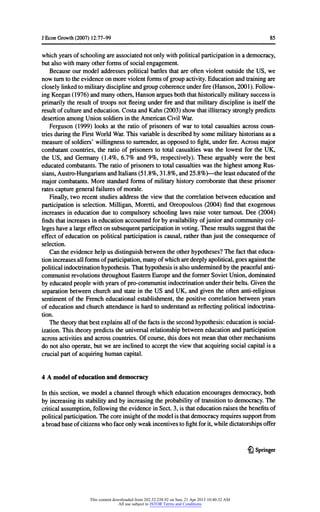
£l Springer
This content downloaded from 202.52.238.92 on Sun, 21 Apr 2013 10:40:32 AM
All use subject to JSTOR Terms and Conditions
JEconGrowth(2007) 12:77-99 85
whichyearsofschoolingareassociatednotonlywithpoliticalparticipationina democracy,
butalso withmanyotherformsofsocialengagement.
Because ourmodeladdressespoliticalbattlesthatareoftenviolentoutsidetheUS, we
nowturntotheevidenceonmoreviolentformsofgroupactivity.Educationandtrainingare
closelylinkedtomilitarydisciplineandgroupcoherenceunderfire(Hanson,2001). Follow-
ingKeegan(1976) andmanyothers,Hansonarguesboththathistoricallymilitarysuccessis
primarilytheresultoftroopsnotfleeingunderfireandthatmilitarydisciplineis itselfthe
resultofcultureandeducation.CostaandKahn(2003) showthatilliteracystronglypredicts
desertionamongUnionsoldiersintheAmericanCivilWar.
Ferguson(1999) looks at theratioofprisonersof warto totalcasualtiesacrosscoun-
triesduringtheFirstWorldWar.Thisvariableis describedbysomemilitaryhistoriansas a
measureofsoldiers'willingnesstosurrender,as opposedtofight,underfire.Acrossmajor
combatantcountries,theratioof prisonersto totalcasualtieswas thelowestfortheUK,
theUS, and Germany(1.4%, 6.7% and 9%, respectively).These arguablywerethebest
educatedcombatants.The ratioofprisonerstototalcasualtieswas thehighestamongRus-
sians,Austro-HungariansandItalians(51.8%,31.8%,and25.8%)- theleasteducatedofthe
majorcombatants.Morestandardformsofmilitaryhistorycorroboratethattheseprisoner
ratescapturegeneralfailuresofmorale.
Finally,tworecentstudiesaddresstheviewthatthecorrelationbetweeneducationand
participationis selection.Milligan,Moretti,and Oreopoulous(2004) findthatexogenous
increasesin educationdue to compulsoryschoolinglaws raisevoterturnout.Dee (2004)
findsthatincreasesineducationaccountedforbyavailabilityofjuniorandcommunitycol-
legeshavea largeeffectonsubsequentparticipationinvoting.Theseresultssuggestthatthe
effectofeducationon politicalparticipationis causal,ratherthanjusttheconsequenceof
selection.
Can theevidencehelpus distinguishbetweentheotherhypotheses?The factthateduca-
tionincreasesallformsofparticipation,manyofwhicharedeeplyapolitical,goesagainstthe
politicalindoctrinationhypothesis.Thathypothesisis alsounderminedbythepeacefulanti-
communistrevolutionsthroughoutEasternEuropeandtheformerSovietUnion,dominated
byeducatedpeoplewithyearsofpro-communistindoctrinationundertheirbelts.Giventhe
separationbetweenchurchand stateintheUS andUK, andgiventheoftenanti-religious
sentimentoftheFrencheducationalestablishment,thepositivecorrelationbetweenyears
ofeducationandchurchattendanceis hardtounderstandas reflectingpoliticalindoctrina-
tion.
Thetheorythatbestexplainsallofthefactsisthesecondhypothesis:educationis social-
ization.Thistheorypredictstheuniversalrelationshipbetweeneducationandparticipation
acrossactivitiesandacrosscountries.Ofcourse,thisdoes notmeanthatothermechanisms
do notalso operate,butwe areinclinedtoaccepttheviewthatacquiringsocialcapitalis a
crucialpartofacquiringhumancapital.
4 A modelofeducationand democracy
In thissection,we modela channelthroughwhicheducationencouragesdemocracy,both
byincreasingitsstabilityandbyincreasingtheprobabilityoftransitiontodemocracy.The
criticalassumption,followingtheevidenceinSect.3,is thateducationraisesthebenefitsof
politicalparticipation.Thecoreinsightofthemodelisthatdemocracyrequiressupportfrom
a broadbaseofcitizenswhofaceonlyweakincentivestofightforit,whiledictatorshipsoffer
£l Springer
This content downloaded from 202.52.238.92 on Sun, 21 Apr 2013 10:40:32 AM
All use subject to JSTOR Terms and Conditions
86 JEconGrowth(2007) 12:77-99
if
1 JB
° * S *k8 <u ,. 2 Ik2 ? 8^j^8^
£, O <c cs I C I £, d 3 I S I C I S © S I C S ©
J . i
S<a §§d tdS dCdOd^lSlSd^dSlc^dffl
Q
Q
*2 £
^S^ ^2^2^ d^S^d^S^d^.S^d^d^So °
^Uo. csd^dS iSdeiCdSlSdSlB.lSPid^
Jl ddCdSdSdBdSdSdCd^lCidwlS^omIflii?ifllle|flilll?l?I !S>2 ddCdSdSdBdSdSdCd^lCidwlS^o 'S
i S
C^8 SdedOl^dSSdSdSlCd3dSdS-^^d g
1 1
«ls■>^s ^, o 33§ss?siB?s?3iSiM3?ii58|^ O v- ' O **-<* I n-»' O ■>^-' I >«^ I v^ O n-' O >- ' I ■w' I sS' f'l v, / ^-< O iJg
■>^s ^, o ^ O v- ' O **-<* I n-»' O ■>^-' I >«^ I v^ O n-' O >- ' I ■w' I sS' f'l v, / ^-< O Jg
si s
•s -is Ic«_-t> # ^ # ^ ^ * c
i sU Sii31?ia8ll!l?it5i5?l§l?i I*-• to
g « g * >
w .2 e <s « 3
'§ I ^ .5 2^*0
08 «.SPfO3§60^'SS'£o>^O^^'7
H
08
Qxu^£<oQ<6jSuoft;z
^ Springer
This content downloaded from 202.52.238.92 on Sun, 21 Apr 2013 10:40:32 AM
All use subject to JSTOR Terms and Conditions
JEconGrowth(2007) 12:77-99 87
strongincentivesto a narrowbase of supporters.Educationraisesthebenefitsofpolitical
participationanddrawsrelativelymorepeopletosupportdemocracy.
4.1 Modelsetup
Thecountryis populatedbymeasureoneofhomogeneouscitizens,eachwitha humancap-
itallevelofh > 0.3 A regimeis definedas a setC/ ofinsiders,withg; 6 [0, 1] beingthe
measureoftheset,orthesize oftheregime.Weinterpreta largergj as a moredemocratic
regime.Wecall a regimewithg; = 1 a perfectdemocracy.
Inperiodzero,thereis an exogenousstatusquo regimeGo ofsize go.In periodone,an
alternativeregimeG ofsize gis proposed.Membershipineachregimeis exogenous.In
periodtwo,each individualchooseswhethertodefendtheexistingregime,tofightforthe
newregime,ortostaypoliticallyuninvolved.Individualsmaynotsupportbothregimes.In
thismodel,whileeachindividualtakesas givenhismembershipina particularregime(orin
neither),hestillchooseswhethertoparticipateinpolitics.
We letSi e [0,gj] denotetheendogenouslydeterminedmassofinsiderswhochooseto
supportregimeGj. The challengerunseatstheincumbentifandonlyifsqso 5 fi^i, where
Sj is a randomshocktotheeffectivenessofeachfaction'ssupporters.The ratiop = eo/s
hasa continuousprobabilitydistributionZ(p) onR+.
Each individualis of measurezero and so does notimpacttheprobabilitythateither
regimesucceeds.Individualsthereforedo notbase theirpoliticalparticipationdecisionson
theirimpacton theoutcome.Instead,participationin politicsis based on threedifferent
forces.First,regimesprovideincentivestotheirmembersto participate.These incentives
taketheformof punishinga regime'sinsiderswho do notfightforit (or,equivalently,
rewardingregimeinsiderswhodo comeoutandfight).Second,regimeinsiderswhopartici-
patethemselvesmotivatetheirfellowinsiderstojointhemthroughpersuasion,camaraderie,
orpeerpressure.Wemodelthisas a benefitfromparticipation(equivalently,itcanbe a cost
ofnon-participation,ifyourfriendsshameyouwhenyousitout).Wealso assumethatthere
areindividual-specificcostsofparticipation.Inourmodel,whatis crucialis thenetbenefit
ofparticipatinginpoliticsrelativetonotparticipating,so itdoes notmatterwhethereither
regime-levelorpeer-levelincentivestaketheformofpunishmentsorrewards.
Weformallymodela regime'spowertomotivateinsidersbyassumingthatinsiderswho
failto supporttheirregimesufferan expectedutilityloss describedby thecontinuously
differentiablefunctionp(gj) suchthatforall gi € [0, 1]
p(8i) >0 andp'(gi)<0.
Smallergroupsimposelargerpunishmentson free-riders:"thegreatereffectivenessof
relativelysmallgroups[. . .] is evidentfromobservationand experienceas well as from
theory"(Olson,1965,p.53). Smallergroupsbenefitfrombettermonitoringandpunishment
oftransgressors.As Olson (p. 61) writes,"In general,socialpressureandsocial incentives
operateonlyingroupsofsmallersize."Thisassumptionsetsupthebasic tradeoffbetween
smallerandlargerregimes.Smallregimesprovidestrongincentivestoa smallbase. Larger
(i.e.,moredemocratic)regimesprovideweakerincentivesbuttoa largerpotentialbase of
supporters.
Thethreatofpunishment(orthepromiseofrewards)capturestheglobalincentivespro-
videdbytheleaderstoallinsiders.Wealsoallowregimeinsiderswhoparticipatetomotivate
3 InBourguignonandVerdier(2000)politicalparticipationdependsoneducation,buteducationisdetermined
bytheinitialincomedistributionandparticipationincentivesarenotconsidered.
£} Springer
This content downloaded from 202.52.238.92 on Sun, 21 Apr 2013 10:40:32 AM
All use subject to JSTOR Terms and Conditions
88 JEconGrowth(2007) 12:77-99
theirpeerstodolikewise.Whiletheregime-levelmotivationshouldbethoughtofaslead-
ersthreateningmembers,wethinkofthislocalmotivationas friendsconvincingfriendsto
comeoutandfight.Preciselybecauseoftheirlocalnature,thesebenefitsdependnotonthe
aggregatesizeoftheregime,butontherateofparticipationa€[0,1],whichcapturesthe
shareoffriendswhoturnouttosupporta regimeandprovidemotivation,oridenticallythe
probabilitythateachfriendturnsout.
Wealsoassumethatthesebenefitsofparticipationarea functionofthehumancapi-
talofregimemembers,andspecificallythattheyarerepresentedbya twicecontinuously
differentiablefunctionb(ajh) suchthatb(0) = 0 andforalla€[0,1]andh > 0
baih)>0andZ/'(a,/0< 0.
Higherlevelsofhumancapitalmakepeoplebetteratinducingtheirpeerstoparticipate
politically.4AsdiscussedinSect.3,thisreflectsthetwofoldroleofeducationincreating
socialskills.First,moreeducatedpeoplearebetteratcajoling,encouraging,motivating,or
otherwisepersuadingotherstheyinteractwithtojointhem.Second,moreeducatedpeopleare
betterabletoreapthebenefitsofsocialinteractionthemselves,perhapsbecausetheyunder-
standbetterwhytheyareparticipating.Socializationcoversthetwinpowerstopersuadeand
tounderstand,bothcapturedbyb{.).Itismoreappealingtoparticipateinacollectiveactivity
themoreeducateda personis,andthemoreeducatedtheotherparticipantsare.
Offsettingtheglobalandlocalincentivesisaneffortcostcofpoliticalparticipation,which
isidenticallyandindependentlydistributedacrossallindividualswithcontinuousdistribu-
tionF(c). Thisidiosyncraticcostisrealizedatthestartofperiodtwo,aftermembershipin
thetworegimeshasbeendefined.
4.2 Groupequilibrium
Peerincentivesforparticipationdeterminea socialmultiplier,whichcouldbeunderstoodas
a bandwagoneffect.Themoreactivemembersagroupalreadyhas,themorelikelytopartic-
ipatetheremainingmembersare.Theparticipationratea, isthenendogenouslydetermined
asa functionoftheexogenousparametersgjandh.Ina groupequilibrium,
ai = F(p(gi)+ b(aih)).
Inprinciple,strategiccomplementaritycouldleadmultipleequilibria,someofwhich
wouldtypicallybeParetoranked(CooperandJohn,1988).Althoughcoordinationfailures
mayplayapartintheempiricaldeterminationofturnout,theyarenotcentraltoouranalysis.
Moreover,consideringa scenariowithoutcoordinationfailuresallowsustoestablisha more
robustlinkbetweeneducationandparticipation,beforetakingintoaccounttheroleofhuman
capitalinresolvingcoordinationfailures.
Hence,wemaketwoeconomicallyintuitiveassumptionsonthedistributionofcoststhat
guaranteeuniquenessofthegroupequilibrium:
Assumption1 c hasa connectedsupportC thatincludestherangeofp(g{) + b(cijh).
Assumption2 c has a continuouslydifferentiabledensityf(c) thatis monotone
non-increasing:f'(c) < 0 foreveryc eC.
4 Thereis nolossofgeneralityinhavingh enterlinearly,becausewechoosehowtomeasureh.Wecould
writeb{ath{H)), whereh(.) isanymonotoneincreasingfunctionandH isanothermorenaturalmeasureof
humancapital,suchas yearsofschooling.
£lSpringer
This content downloaded from 202.52.238.92 on Sun, 21 Apr 2013 10:40:32 AM
All use subject to JSTOR Terms and Conditions
JEconGrowth(2007) 12:77-99 89
Thefirstassumptionmeansthatamongindividualsbelongingtoa grouptherearealways
somechoosingtoparticipateandsomechoosingnottoparticipate,regardlessofgroupsize
andhumancapital.The secondassumptionmeansthatthecostofinducingparticipationis
(weakly)convex:themoresupportersa regimealreadyhas,themoredifficultitbecomesfor
ittoattractadditionalsupporters.5Wecanthenprovethefollowing:
Lemma 1 Thereexistsa uniquegroupequilibriuma(gj,h) € (0, 1) suchthatda/dgi < 0
andda/dh > 0.
The Lemmais intuitive,and illustratesthenaturaleffectof exogenousparameterson
endogenousturnout:smallergroupshavehigherturnoutbecausetop-downincentivesare
morepowerful,whilehigherhumancapitalinduceshigherparticipationatanygroupsize.
4.3 Humancapitalandpoliticalcompetition
Considera contestbetweentwoexogenouslyformedregimesGo and G, withrespective
sizesgoandg. Theformeris theincumbentandthelatteris a challenger.
SomeindividualsmaybelongonlytotheincumbentregimeGo: theirmassis denotedby
go-SomemaybelongonlytothechallengerregimeG,andtheirmassisdenotedbyg.Some
individualsmaybe excludedfrombothregimes,theirmeasureis 1- go- g= 1- go- g.
Finally,somepeoplecouldformallybelongtobothregimes:themassoftheseindividuals
equals y = go - go = g - g-The membershipoverlapbetweenregimescomplicates
themodelandrequiresus tomakeassumptionson howpeoplechoose,butwe needtocon-
siderthispossibilitybecause,withbroadlyencompassingdemocraticregimes,overlapsare
inevitable.
In practice,each memberofbothregimeswillshowallegiancetoone regimeonly,and
willnotconsidersupportingtheotherevenifhe formallybelongstoitas well.We assume
forsimplicitythateach individualformallybelongingtobothregimeswillaffiliateexante
withonlyone ofthem(withequal probability).As a consequence,he derivesno benefits
frominteractionwiththemembersoftheotherregime,norcan he be punishedbyitslead-
ers.Nonetheless,theleadershavetokeepwastingmonitoringresourcesonthesedefectors,
perhapsbecause theyneedto monitor(a randomsampleof) all memberseventhoughex
posttheydiscoverthattheycannotpunish(orreward)someofthem.Withthisassumption,
a regimeofnominalsize gi withmeasuregj ofexclusivemembershas an actualbasinof
support
y . y gi+ h
gi=gi-^=gi
+
^
=
2
*
Allindividualsbelongingtoneitherregime(a massof1- go- g) abstainfrompolitical
participation,sincetheywouldreapno benefitsandonlyincurcosts.Those witheffective
membershipin a regime(a massofgj) willconsidertwooptions:abstaining,whichhas a
costp(gj orparticipatinginsupportofG,,whichhasa costc - b(ajh). Theirparticipation
rate,therefore,is endogenouslydeterminedas theuniquegroupequilibriumoftheregime.
5 Forthemostdirectillustration,considerthesimplestincentiveschemewherew is paidto participants.
Sinceonlythoseagentswitha costc < wwillchoosetoparticipate,thisdeterminesa turnoutF(w). Henceto
achievea participationratea incentiveswouldhavetobesetatw(a) - F~l(a). Thenecessarycompensation
is monotoneincreasinginthetargetparticipationrate:w' (a) = , V v > 0. Moreover,itis (weakly)
f(F-l(a))*
convexifandonlyifthedensityofthecostdistributionis(weakly)decreasing:w" (a) = - * - -4- > 0
f(F Ha))
ifandonlyif/'(c)<0.
£} Springer
This content downloaded from 202.52.238.92 on Sun, 21 Apr 2013 10:40:32 AM
All use subject to JSTOR Terms and Conditions
90 JEconGrowth(2007) 12:77-99
It
0.8 ■
^^
g.= 0.15 S^
0.6 /
0.4 ■
I
~~~ ~~ "~ - - __
0.2 . /
0.4 / 0.6 1
_; , ,- a - , . _ )
0.2 0.8
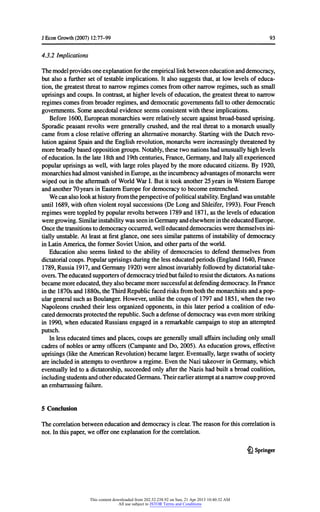
Fig.5 Theprobabilitythata go = 30% oligarchyisreplacedbya smallerg= 15% oligarchyorbyperfect
democracy(g= 100%)as a functionofhumancapital
TheprobabilitythatthechallengerGreplacestheincumbentGo equals
n _ z /gia(g,h)
goa(go*h))'
Wecanprovethefollowing:
Proposition1 Considera contestbetweentwogivenregimesGo and G. Theprobability
thatthemoredemocraticregime(G ifandonlyifg> go)succeedsismonotoneincreasing
inthelevelofhumancapitalh.
Proposition1 is illustratedin Fig. 5. The mechanismunderpinningthispropositionis
intuitive.Participationinsupportofa regimedependsontwodifferentkindsofincentives:
thoseprovidedbytheleadership,andthoseprovidedbyotherparticipants.Humancapital
makesthelattermoreeffective,andthereforeitis particularlyimportantinelicitingsupport
forgroupsthatareprimarilydrivenbypeerpersuasionratherthanbytop-downmonitoring.
Sincetheeffectivenessofthelatterisdecreasingingroupsize,whiletheformerisunaffected,
humancapitalis a moreimportantdeterminantofsupportformoredemocraticregimes.
4.3.1 Thesizeand compositionofmost-threateningchallengerregimes
We haveshownthat,amongtworivalregimesofgivensizes,an increaseinhumancapital
makesitmorelikelythatthemoreinclusiveoneprevails.In particular,democracyis more
likelytobeinstitutedandpreserved.Wenextaska complementaryquestion:fora givenlevel
ofhumancapital,whatis thesize andcompositionofa regimethatposesthegreatestthreat
toa particularincumbent?Thisanalysisoffersanotherperspectiveonregimestability.
FollowingLemma 1,increasingthesize ofa grouphastwoopposingeffectsonitssup-
port:broadeningthebaseanddecreasingtheincentivesforthatbasetoparticipate.Ashuman
capitalincreases,incentivesareless andlessdependentongroupsize,so thatwe canprove
thefollowing:
£) Springer
This content downloaded from 202.52.238.92 on Sun, 21 Apr 2013 10:40:32 AM
All use subject to JSTOR Terms and Conditions
JEconGrowth(2007) 12:77-99 91
gi*
1 I
0.8 . /
0.6 y^
0.4
"
j
- '^*~
0.2 .
0.2 0.4 0.6 0.8 1
Fig.6 Thesizeofthemostdangerouschallengertoa go = 30%oligarchyas a functionofhumancapital
Proposition2 Consideran incumbentoligarchicregimeGo ofsize go e (0, 1]. Thesize
g* e (0, 1] ofthechallengerregimemostlikelyto overthrowGo is monotone(weakly)
increasinginthelevelofhumancapitalh.
Proposition2 is illustratedinFigs.6 and7. As humancapitalincreases,thegreatestthreat
to an incumbentregimebecomesan evermoredemocraticregime.Therecan be a finite
levelofhumancapitalh(go) abovewhichthemostdangerouschallengerbecomesa perfect
democracy,g* = 1.
Butwhatisthecompositionofthemostthreateningregime?Fora fixedincumbentregime
Go,thesupportofa challengerGi dependsontwofactors:thesizeofitsmembershipgand
theextentoftheoverlapofthemembershipofthecompetingregimes.Recallingthaty isthe
measureofoverlap,theprobabilitythatthechallengerGreplacestheincumbentGo equals
ff_7/(gi-$)fl(g».*A
Fora challenger,recruitingmembersfromtheincumbentregimeratherthanamongthose
excludedfromithastwoopposingeffects:itstealssupportfromtheincumbent,butitalso
introducesa wedgebetweenthesize ofthechallengingregimeanditsownactualbasinof
support.Theresolutionofthistrade-offcomesfroma comparisonofthesizesofthecompet-
ingregimes.Thesmallerregimeismoreaffectedbythea priorilossofhalfoftheagentswith
dualmembership.Hence,a challengerregimethatismoredemocraticthantheincumbentis
morelikelytosucceedwhenitincludesall membersoftheincumbentitself.Conversely,a
lessdemocraticchallengerismorelikelytosucceedwhenitincludesas fewmembersofthe
incumbentregimeas possible(givenitssize). Formally,wecanprovethefollowing:
Corollary1 Consideran incumbentoligarchicregimeGo- The compositionofthemost
dangerouschallengercan be characterizedasfollows:
(1) ifthemostdangerouschallengeris less democraticthantheincumbent(g* < go),it
isminimallyoverlapping:thesizeofthegroupofcitizensbelongingtobothregimesis
y = max{0,gJe-(l
-
go)};
£}Springer
This content downloaded from 202.52.238.92 on Sun, 21 Apr 2013 10:40:32 AM
All use subject to JSTOR Terms and Conditions
92 JEconGrowth(2007) 12:77-99
Fig.7 Thesizeofthemostdangerouschallengertoa perfectdemocracy(go = 100%) asa functionofhuman
capital
(2) ifthemostdangerouschallengeris moredemocraticthantheincumbent(g* > go),it
isstrictlymoreinclusive:Go C G*.
AccordingtoProposition2, atlowlevelsofeducation,statusquo dictatorshipsaremost
effectivelychallengedbysmallcoups.Indeed,somehistoricalandstatisticalevidencesug-
geststhatchallengerstodictatorshipsinsuchcountriesareoftenbandsofdisgruntledoppo-
nents(CampanteandDo, 2005;Finer,1988;Huntington,1957).Athigherlevelsofeducation,
thesizesofoptimaluprisingsagainstbothdictatorshipanddemocracyrise.InEuropeduring
theage ofRevolutions,increasinglylargegroupsfoughttooverthrowtheexistingregime.
Similarly,revoltsagainstdemocracy,suchas theFascisttakeoverin Italyin the1920sor
theNazi movementin Germany,becameincreasinglybroad-basedin societieswithmore
education.
The Corollaryfurthertellsus that,as humancapitalincreases,notonlythesize butthe
natureofthemostdangerouschallengerchanges.Whenh is low,anincumbentdictatorship
ismostlikelytobereplacedbyanothersmalldictatorshipthatcomprisesa completelydiffer-
entsetofagents:thethreatcomesnotfroma subsetofthecurrentelitetryingto exclude
otherinsiders,butfromcurrentoutsiderstryingtooustthem.Whenhishigh,themosteffec-
tivechallengeris insteada (relatively)democraticregimethatdoes notattempttoremove
anyofthecurrentinsiders,butsimplytoadd morememberstotheregime.In thelimit,as
humancapitalrises,thegreatestthreattodictatorshipcomesfroma fulldemocracy,which
bydefinitionincludesthewholepopulation.
Anintermediatecase ispresentwhentheincumbentregimeislarge,go € (1/2,1].Inthis
case,themaximumprobabilityofsuccessmaycomefroma challengerthatincludesall the
currentoutsidersbutalso a subgroupofcurrentinsiders.Needlesstosay,thiscase istheonly
possibleone whentheincumbentregimeis a perfectdemocracy:thenanychallengercan
includeonlymembersofthecurrentregime.Forsufficientlyhighlevelsofhumancapital,the
highestprobabilityofsuccessisassociatedwithdemocraticturnover.Inotherwords,boththe
challengerandtheincumbentareperfectdemocracies,andcitizensfreelychoosetoaffiliate
witheithergroup.Our particularspecification,then,deliverstheoutcomeofcompetition
amongregimesperfectlycommittedtodemocracyathighenoughlevelsofhumancapital.
£} Springer
gi*
0.2 0.4 0.6 7 o78 r
0.8 /
0.6 /
0.4 /
0.2 __^--*^^
This content downloaded from 202.52.238.92 on Sun, 21 Apr 2013 10:40:32 AM
All use subject to JSTOR Terms and Conditions
JEconGrowth(2007) 12:77-99 93
4.3.2 Implications
Themodelprovidesoneexplanationfortheempiricallinkbetweeneducationanddemocracy,
butalso a furthersetoftestableimplications.Italso suggeststhat,at low levelsofeduca-
tion,thegreatestthreattonarrowregimescomesfromothernarrowregimes,suchas small
uprisingsandcoups.Incontrast,athigherlevelsofeducation,thegreatestthreattonarrow
regimescomesfrombroaderregimes,anddemocraticgovernmentsfalltootherdemocratic
governments.Someanecdotalevidenceseemsconsistentwiththeseimplications.
Before1600,Europeanmonarchieswererelativelysecureagainstbroad-baseduprising.
Sporadicpeasantrevoltsweregenerallycrushed,andtherealthreatto a monarchusually
camefroma close relativeofferingan alternativemonarchy.StartingwiththeDutchrevo-
lutionagainstSpainandtheEnglishrevolution,monarchswereincreasinglythreatenedby
morebroadlybasedoppositiongroups.Notably,thesetwonationshadunusuallyhighlevels
ofeducation.Inthelate18thand 19thcenturies,France,Germany,andItalyallexperienced
popularuprisingsas well,withlargerolesplayedbythemoreeducatedcitizens.By 1920,
monarchieshadalmostvanishedinEurope,as theincumbencyadvantagesofmonarchswere
wipedoutintheaftermathofWorldWarI. Butittookanother25yearsinWesternEurope
andanother70yearsinEasternEuropefordemocracytobecomeentrenched.
Wecanalsolookathistoryfromtheperspectiveofpoliticalstability.Englandwasunstable
until1689,withoftenviolentroyalsuccessions(De LongandShleifer,1993).FourFrench
regimesweretoppledbypopularrevoltsbetween1789and 1871,as thelevelsofeducation
weregrowing.SimilarinstabilitywasseeninGermanyandelsewhereintheeducatedEurope.
Oncethetransitionstodemocracyoccurred,welleducateddemocracieswerethemselvesini-
tiallyunstable.Atleastatfirstglance,one sees similarpatternsofinstabilityofdemocracy
inLatinAmerica,theformerSovietUnion,andotherpartsoftheworld.
Educationalso seems linkedto theabilityof democraciesto defendthemselvesfrom
dictatorialcoups.Popularuprisingsduringthelesseducatedperiods(England1640,France
1789,Russia1917,andGermany1920)werealmostinvariablyfollowedbydictatorialtake-
overs.Theeducatedsupportersofdemocracytriedbutfailedtoresistthedictators.Asnations
becamemoreeducated,theyalsobecamemoresuccessfulatdefendingdemocracy.InFrance
inthe1870sand1880s,theThirdRepublicfacedrisksfromboththemonarchistsanda pop-
ulargeneralsuchas Boulanger.However,unlikethecoupsof1797and1851,whenthetwo
Napoleonscrushedtheirless organizedopponents,in thislaterperioda coalitionofedu-
cateddemocratsprotectedtherepublic.Sucha defenseofdemocracywasevenmorestriking
in 1990,wheneducatedRussiansengagedina remarkablecampaignto stopan attempted
putsch.
Inlesseducatedtimesandplaces,coupsaregenerallysmallaffairsincludingonlysmall
cadresofnoblesorarmyofficers(CampanteandDo, 2005). As educationgrows,effective
uprisings(liketheAmericanRevolution)becamelarger.Eventually,largeswathsofsociety
areincludedinattemptstooverthrowa regime.EventheNazi takeoverinGermany,which
eventuallyledtoa dictatorship,succeededonlyaftertheNazis hadbuilta broadcoalition,
includingstudentsandothereducatedGermans.Theirearlierattemptata narrowcoupproved
anembarrassingfailure.
5 Conclusion
Thecorrelationbetweeneducationanddemocracyisclear.Thereasonforthiscorrelationis
not.Inthispaper,we offeroneexplanationforthecorrelation.
£} Springer
This content downloaded from 202.52.238.92 on Sun, 21 Apr 2013 10:40:32 AM
All use subject to JSTOR Terms and Conditions
94 JEconGrowth(2007) 12:77-99
Ourexplanationhingeson theconnectionbetweeneducationandthecostsandbenefits
ofpoliticalengagement.Schools socialize youngpeopleandpoliticalinvolvementis one
formofsocialization;a varietyofevidenceshowsa positiveconnectionbetweeneducation
andcivicengagement.We modeleducationas raisingthebenefitsofpoliticalactionwhen
individualschoosetosupporta moreorless democraticregime.In thismodel,democratic
regimesofferweakincentivesto a wide base of potentialsupporters,whiledictatorships
offerstrongincentivestoa narrowerbase. Educationincreasesthesociety-widesupportfor
democracybecausedemocracyrelieson peoplewithhighparticipationbenefitsforitssup-
port.We showthatbettereducatednationsaremorelikelybothtopreservedemocracyand
toprotectitfromcoups.
Theanalysisraisesthreebroaderquestionsthatareworthmentioninginconclusion.First,
whileourmodelhasfocusedontheeffectsofeducationonparticipation,theanalysisapplies
toall socialgluethatencouragescollectiveaction.Forexample,theanalysismightsuggest
thatethnichomogeneityis good fordemocracy(althoughincross-countryorpanelregres-
sionswitheducationcontrols,ethnicheterogeneitydoes notmatterfordemocracy).This
surelyseemsplausible,and remainsto be explored.Perhapsas interestingly,theanalysis
suggestsa solutionofOlson'sfree-riderprobleminallorganizations,andnotjustinpolitical
regimes,namelyhumancapitalorothersocialglueas a motivationtoparticipate.
Second,ouranalysisrunsintotheold puzzle,namelywhydo somedictatorsinvestin
educationiftheyknowthatdoingso eventuallydoomsthem?Theexamplesoffallendicta-
torsinEastAsia,EasternEurope,andtheformerSovietUnionaretellingremindersofthis
risk.Thereareseveralpossibleanswers.One is thatmanydictatorsfacean externalthreat,
and thereforemustgrowtheireconomiesand theirarmies(includinginvestingin human
capital)tocounterthesethreatsevenifthisraisestheriskofdemocratization.A secondis
thatevenselfishdictatorsunconcernedwithexternalthreatsmightderiveincomefromeco-
nomicgrowth,andthereforepromoteeducationtogetricher.A thirdideaisthatalldictators
facesignificantousterrisks,andthatitis muchbetterforthedictator'slifeforhimto be
replacedbya democracyinan educatedcountrythanbyanotherdictatorinan uneducated
one.A symmetricalpoint,ofcourse,is thatdemocracieshaveanextraincentivetoinvestin
educationinordertosecureandstabilizethemselvesagainstoligarchiccoups.
Third,ouranalysisdeals withthesize ofthemostproductivecoalitionsinpolitics,but
Lemma1 appliestoorganizationsandgroupsmorebroadly.The resultssuggest,then,that
higherhumancapitalsocietiescan moreefficientlymaintainlargerorganizationsinwhich
bothtop-downandpeer-providedincentivesplaya role.Whetherthispredictionistrueabout
firmsandotherinstitutionsandgroupsremainsa questionforfurtherresearch.
AcknowledgementsGlaeserthankstheTaubmanCenterforStateandLocalGovernment.Ponzettothanks
theMarcoFannoandtheMarioGasbarriFoundations.WearegratefultoTimothyBesley,FilipeCampante,
RubenEnikolopov,OdedGalor,NicolaGennaioli,ElhananHelpman,EliasPapaiouannou,RichardPosner,
JoshuaSchwartzstein,SidneyVerba,andtwoanonymousrefereesforcomments,andtoJoshuaGottliebfor
outstandingresearchassistance.
Appendix:Proofs
A. 1 ProofofLemma1
Forease ofnotation,weomitthesubscripti denotinggroup-specificparametersintheanal-
ysisofgroupequilibrium.A groupequilibriumis a rootoftheauxiliaryfunction
Q(a;g,h) = F(p(g) + b(ah))-a
5i Springer
This content downloaded from 202.52.238.92 on Sun, 21 Apr 2013 10:40:32 AM
All use subject to JSTOR Terms and Conditions
JEconGrowth(2007) 12:77-99 95
whichistwicecontinuouslydifferentiablewithrespecttoa, becausesoareb andF. Omitting
argumentsforthesakeofbrevity,thefirstderivativeis
Qa = hfb'- 1
andthesecondis
Qaa=h2[f'{bf + fb"]<0
whosesignfollowsfromAssumption2.
Assumption1impliesfurthermorethat
Q(0g,h) = F(p(g))>0
Q(Ug,h) = F(p(g) + b(h))-l<0
andthereforebycontinuitythereexistsatleastoneroota e (0, 1).
Moreover,Q (0; g,h) > 0 impliesthatatthefirstrootQa (a;g,h) < 0. Concavitythen
impliesQa(a; g,h) < OVa> a, whichimpliesthattheroota is unique.Thecondition
Q(a;g,h)=0^Qa(a;g,h) < 0
canalsobe interpretedas showingthestabilityofthegroupequilibrium.
By theimplicit-functiontheorem,equilibriumparticipationis a differentiablefunction
a (g, h) suchthatQ (a (g, h) ; g, h) = 0. Since
Qg= fp'<o
Qh= afbf> 0
itsgradientis
da
_ Qg _ fp'
H Qa -hfb'
da
_ Qh = afbf
dh
_
Qa
=
1- hfb'
>
recallingthatQa < 0 inequilibrium.
A. 2 ProofofProposition1
Theimplicit-functiontheoremalsoallowsustocomputehigher-orderderivatives,andamong
these
d2d
= QQgh
~ QhQa QSa
-
QgQa Qha + QgQhQaa
SgSh Q
where
Qgh= af'p'b' > 0
Qga= hf'p'b' > 0
Qha= fb'+ ahf'(bf+ahfb"
£} Springer
This content downloaded from 202.52.238.92 on Sun, 21 Apr 2013 10:40:32 AM
All use subject to JSTOR Terms and Conditions
96 JEconGrowth(2007) 12:77-99
Therefore,
a2loga _ J/ j?a_ _ Sa_Sa
Sgdh ~a2dgdh
_ _
dgdh)
=
2753ia (Ql Qsh
- QhQaQga~ QgQaQha+ QgQhQaa) + QgQhQa]
*^a
=
JTp-{"Qo (QoQgh
-
QhQga)+ Qg[a {QhQaa- QaQha)+ QhQa]}
=^rW(°"hfbf)alf>pty+a2hfpftr{bf+fb"^
^p'(fb'+hf2b") o
(l-A/*03
Letfl,-=a(gi,h):ihe probabilityofvictoryforregimeGoverregimeGois

(gCt
1- I = Z (exp{log|i - loggo+ logai - logflo})
^0^0/
sothat
^L = - (h5l Jogii-iogJb+iogfli-logoo/81°g*l _ 81°gfl0
3A
=
VloflO/ V M
_
dh )
andthus
dn rt
-77-> 0rt4> gi > go
A.3 ProofofProposition2 andCorollary1
Recallthattheprobabilityofsuccessofa challengeris
(*o-£)«<«>,*)/
sothatthechallengerthatismostlikelytosucceedisthemaximizerof
M (g,y;go,h) = logo(g,h)+ logg
-
-j
- log^0
-
-r)
subjectto
gi €[0,1] andy €[max{0,gi - (1 - go)},min{g0,g}]
Tobeginwith,since
theoptimalvalueofy isindefiniteifg= goanditliesina cornerifg^ go.
Hencetheoptimalregimesizeis
8*(80,h) = arg max {loga (guh) + X(gi,go)}
£l€[0,l]
whereX(gi,go)isdefinedbythejointlyoptimalchoiceofoverlapy.
£}Springer
This content downloaded from 202.52.238.92 on Sun, 21 Apr 2013 10:40:32 AM
All use subject to JSTOR Terms and Conditions
JEconGrowth(2007) 12:77-99 97
TherearetwodifferentcasesbasedonthesizeoftheincumbentGo:smallgo€(0, j or
largego€(j, l]. Thefirstwillonlyhavetwopotentialcornersolutionsforoptimaloverlap:
y = 0 andy = go;thelatterwillalsohavethepossibilityofy = g- (1 - go) > 0.
1. Ifgo€(0,j] theoptimaloverlapis
gi e [0,go)
[0,go] g= go
go g€(go,1]
andtherefore
w« o  flog^i - loggo gi €[0,g0]
^'^-llog^-fj-logf
w« o 
g!€[gO,l]
a continuousfunctionthatismonotoneincreasingingandpiecewiseconcaveingfor
gi €[0,go]andge [go,1],butwitha convexkinkatg= go
2. Ifgo€(5, l] theoptimaloverlapis
0 gi e [0,1- g0]
v(o-yKgx)~
£i-0 -So) Si€[l-go,go)v(o-yKgx)~
[2go-l,go] gi=go
go 8€(go,1]
andtherefore
- loggo g€[0,1- g0]
Iloggi
log£rz|Q±i_log£Qz|i±i gl€[l-go,go]
log(gi-f)-logf Si€[go,l]
a continuousfunctionthatismonotoneincreasingingandpiecewiseconcaveingfor
g€[0,go]andg€ [go,1],butwitha convexkinkatg= goanda concavekinkat
g= 1- go-
Givenanygo€(0, l],g*(go,h) e (0,1]iswell-definedasthemaximandofacontinuous
functionona compact.ConsidertwolevelsofhumancapitalHl < h^. Supposethat
g*L= g*(go,hL) > g*(go,hH) ssg^
Thisimpliesbydefinitionthat
( log*(gl hL)+ k(gl go) > loga (g*H,hL)+ X(g*H,go)
1log*(g^, hH)+X(g*H,go) > oga(gl hH)+ X(gl go)
andthereforerearranging
logo(gl, hi)-oga (g*HihL)>X (g*H,go)-X (gl go)>oga (g*L>hH)-oga (g*H,hH)
andfinally
loga (g*H,hH)
- loga (g*HihL) > logfl(gl hH)
~ oga(gl hL)
ButintheproofofProposition1weestablishedthat
a^iog.
dgdh
whichprovesbycontradictionthat
hL <hH=>g$ (go,hL) < g*(go,hH)
£lSpringer
This content downloaded from 202.52.238.92 on Sun, 21 Apr 2013 10:40:32 AM
All use subject to JSTOR Terms and Conditions
98 JEconGrowth(2007) 12:77-99
References
Acemoglu,D., Johnson,S., Robinson,J.,& Yared,P. (2005). Fromeducationto democracy.American
EconomicReviewPapersandProceedings,95,44-49.
Almond,G.,& Verba,S. (1989, 1sted. 1963).Thecivicculture:Politicalattitudesanddemocracyinfive
nations.London:SagePublications.
Arellano,M, & Bond,S. (1991). Sometestsofspecificationforpaneldata:MonteCarloevidenceandan
applicationtoemploymentequations.TheReviewofEconomicStudies,58,277-297.
Barro,R. (1997).Determinantsofeconomicgrowth.Cambridge,MA:MIT Press.
Barro,R. (1999).Determinantsofdemocracy.JournalofPoliticalEconomy,107,158-183.
Barro,R.,& Lee,J.-W.(2001).Internationaldataoneducationalattainment:Updatesandimplications.Oxford
EconomicPapers,53,541-563.
Blundell,R.,& Bond,S. (1998). Initialconditionsandmomentrestrictionsindynamicpaneldatamodels.
JournalofEconometrics,87, 115-143.
Bobba,M., & Coviello,D. (2006). Weakinstrumentsandweakidentificationinestimatingtheeffectsof
educationondemocracy.EconomicsLetters(forthcoming).
Boix,C, & Stokes,S. (2003),Endogenousdemocratization.WorldPolitics,55,517-549.
Bourguignon,F, & Verdier,T.(2000).Oligarchy,democracy,inequality,andgrowth.JournalofDevelopment
Economics,62,285-313.
Bowles,S.,& Gintis,H. (1976).SchoolingincapitalistAmerica:Educationalreformandthecontradictions
ofcapitalistlife.NewYork:BasicBooks.
Brady,H.,Verba,S., & Schlozman,K. L. (1995).BeyondSES: A resourcemodelofpoliticalparticipation.
AmericanPoliticalScienceReview,89,271-294.
Campante,F, & Do, Q.-A.(2005).Inequality,redistribution,andpopulation.Mimeo,HarvardUniversity.
Castello-Climent,A. (2006).Onthedistributionofeducationanddemocracy.WorkingPaper0602,Institute
ofInternationalEconomics,UniversityofValencia.
Cooper,R.,& John,A. (1988). CoordinatingcoordinationfailuresinKeynesianmodels.QuarterlyJournal
ofEconomics,103,441-465.
Costa,D., & Kahn,M. (2003). Cowardsandheroes:GrouployaltyintheAmericancivilwar.Quarterly
JournalofEconomics,775,519-548.
Dee,T.(2004).Aretherecivicreturnstoeducation?JournalofPublicEconomics,88,1697-1720.
De Long,B.,& Shleifer,A. (1993).Princesandmerchants:Europeancitygrowthbeforetheindustrialrevo-
lution.JournalofLawandEconomics,36,671-702.
DiPasquale,D., & Glaeser,E. (1999). Incentiveandsocialcapital:Arehomeownersbettercitizens?Journal
ofUrbanEconomics,45,354-384.
Driscoll,A.,& Nagel,N. (2005).Earlychildhoodeducationbirthto8: Theworldofchildren,familiesand
educators(3rded.).Boston:PearsonEducation.
Ferguson,N. (1999).Thepityofwar.NewYork:BasicBooks.
Finer,S. (1988). Themanonhorseback:Theroleofthemilitaryinpolitics.Boulder,Colorado:Westview
Press.
Glaeser,E.,LaPorta,R.,Lopez-de-Silanes,F, andShleifer,A. (2004).Do institutionscausegrowth?Journal
ofEconomicGrowth,9,271-303.
Glaeser,E.,& Sacerdote,B. (2001).Educationandreligion,NBER WorkingPaper.
Gordon,A.,& Browne,K. (2004).Beginningsandbeyond:Foundationsinearlychildhoodeducation(6th
ed.).CliftonPark,NY:ThomsonDelmarLearning.
Gradstein,M.,& Justman,M. (2002).Education,socialcohesion,andeconomicgrowth.AmericanEconomic
Review,92, 1192-1204.
Hanson,V.(2001).CarnageandCulture:LandmarkbattlesintheriseofWesternpower.NewYork:Double-
day.
Helliwell,J.,& Putnam,R. (2007).Educationandsocialcapital.EasternEconomicsJournal(forthcoming).
Holmes,B. (1979).Internationalguidetoeducationsystems.Paris:UNESCO.
Huntington,S. (1957).Thesoldierandthestate:Thetheoryandpoliticsofcivil-militaryrelations.Cambridge,
Massachusetts:HarvardUniversityPress.
Huntington,S. (1991).Thethirdwave:Democratizationinthelatetwentiethcentury.Norman,OK: University
ofOklahomaPress.
Jaggers,K., & Marshall,M. (2003). PolityIV project.CenterforInternationalDevelopmentandConflict
Management,UniversityofMaryland.
Kamens,D. (1988).Educationanddemocracy:A comparativeinstitutionalanalysis.SociologyofEducation,
67,114-127.
Keegan,J.(1976).Thefaceofbattle.NewYork:VikingPress.
& Springer
This content downloaded from 202.52.238.92 on Sun, 21 Apr 2013 10:40:32 AM
All use subject to JSTOR Terms and Conditions
JEconGrowth(2007) 12:77-99 99
Lipset,S. M.(1959).Somesocialrequisitesfordemocracy:Economicdevelopmentandpoliticallegitimacy.
AmericanPoliticalScienceReview,53,69-105.
Lipset,S. M.(I960). Politicalman:Thesocialbasisofmodernpolitics.NewYork:Doubleday.
Milligan,K.,Moretti,E.,& Oreopoulous,P.(2004).Does educationimprovecitizenship?Evidencefromthe
U.S. andtheU.K.JournalofPublicEconomics,88, 1667-1695.
Mulligan,C, Gil,R.,& Sala-i-Martin,X. (2004).Do democracieshavedifferentpublicpoliciesthannon-
democracies?JournalofEconomicPerspectives,18,51-74.
Mulligan,C, & Shleifer,A.(2005).Theextentofthemarketandthesupplyofregulation.QuarterlyJournal
ofEconomics,120,1445-1473.
Olson,M.(1965).Thelogicofcollectiveaction:Publicgoodsandthetheoryofgroups.Cambridge,Massa-
chusetts:HarvardUniversityPress.
Papaioannou,E.,& Siourounis,G. (2005).Economicandsocialfactorsdrivingthethirdwaveofdemocrati-
zation.Mimeo,LondonBusinessSchool.
Przeworski,A.,& Limongi,F.(1993).Politicalregimesandeconomicgrowth.JournalofEconomicPerspec-
tives,7,51-70.
Przeworski,A.,Alvarez,M.,Cheibub,J.,& Limongi,F.(2000).Democracyanddevelopment:Politicalinsti-
tutionsandwell-beingintheworld,1950-1990.Cambridge:CambridgeUniversityPress.
Rander-Pehrson,J.D. (1999).Germanyandtherevolutionof1848-1849.NewYork:PeterLang.
£} Springer
This content downloaded from 202.52.238.92 on Sun, 21 Apr 2013 10:40:32 AM
All use subject to JSTOR Terms and Conditions

Foundation journal

  • 1.
    Why Does DemocracyNeed Education? Author(s): Edward L. Glaeser, Giacomo A. M. Ponzetto and Andrei Shleifer Source: Journal of Economic Growth, Vol. 12, No. 2 (Jun., 2007), pp. 77-99 Published by: Springer Stable URL: http://www.jstor.org/stable/40216116 . Accessed: 21/04/2013 10:40 Your use of the JSTOR archive indicates your acceptance of the Terms & Conditions of Use, available at . http://www.jstor.org/page/info/about/policies/terms.jsp . JSTOR is a not-for-profit service that helps scholars, researchers, and students discover, use, and build upon a wide range of content in a trusted digital archive. We use information technology and tools to increase productivity and facilitate new forms of scholarship. For more information about JSTOR, please contact support@jstor.org. . Springer is collaborating with JSTOR to digitize, preserve and extend access to Journal of Economic Growth. http://www.jstor.org This content downloaded from 202.52.238.92 on Sun, 21 Apr 2013 10:40:32 AM All use subject to JSTOR Terms and Conditions
  • 2.
    JEconGrowth(2007) 12:77-99 DOI 10.1007/s10887-007-9015-1 Whydoesdemocracyneededucation? EdwardL. Glaeser • Giacomo A. M. Ponzetto• AndreiShleifer Publishedonline:31May2007 © SpringerScience+BusinessMedia,LLC 2007 Abstract Acrosscountries,educationanddemocracyarehighlycorrelated.Wemotivate empiricallyandthenmodela causal mechanismexplainingthiscorrelation,in ourmodel, schoolingteachespeopleto interactwithothersand raisesthebenefitsofcivicparticipa- tion,includingvotingand organizing.In thebattlebetweendemocracyand dictatorship, democracyhasa widepotentialbase ofsupportbutoffersweakincentivestoitsdefenders. Dictatorshipprovidesstrongerincentivestoa narrowerbase.As educationraisesthebenefits of civic engagement,it raisesparticipationin supportof a broad-basedregime(democ- racy)relativetothatinsupportofa narrow-basedregime(dictatorship).Thisincreasesthe likelihoodof successfuldemocraticrevolutionsagainstdictatorships,and reducesthatof successfulanti-democraticcoups. Keywords Democracy• Education• Politicalparticipation 1 Introduction Thehypothesisthathighereducationleadstomoredemocraticpolitics(Lipset,1959,1960) has receiveda good deal ofempiricalsupport(Barro,1999; Glaeser,LaPorta,Lopez-de- Silanes,andShleifer,2004; PapaioannouandSiourounis,2005). However,thetheoretical reasonsforthisrelationshipremainunexplored.Indeed,accordingto(Barro,1999,p.SI 82), "giventhestrengthoftheAristotle/Lipsethypothesisas anempiricalregularity,itis surpris- ingthatconvincingtheoreticalmodelsofthisrelationshipdo notexist."In thispaper,we firstmotivateandthenproposeonemodelofa causalimpactofeducationondemocracy. Ourstartingpointis theconnectionbetweeneducationandpoliticalparticipation.This connectionhas been emphasizedby Almondand Verba (1989,1sted. 1963), who see E. L. Glaeser• A. Shleifer HarvardUniversityandNBER,Cambridge,MA,USA G. A.M. Ponzetto•A. Shleifer(El) DepartmentofEconomics,HarvardUniversity,M9LittauerCenter,Cambridge,MA02138,USA £i Springer This content downloaded from 202.52.238.92 on Sun, 21 Apr 2013 10:40:32 AM All use subject to JSTOR Terms and Conditions
  • 3.
    78 JEconGrowth(2007) 12:77-99 educationasa crucialdeterminantof"civicculture"and participationindemocraticpol- itics."The uneducatedmanorthemanwithlimitededucationis a differentpoliticalactor fromthemanwhohasachieveda higherlevelofeducation(p. 315)." AlmondandVerba's workhas influencedbothpoliticalscience(e.g., Brady,Verba,andSchlozman,1995) and sociology(e.g., Kamens,1988),andourworkcan be seenas an elaborationoftheirideas usingtheoreticalandempiricaltoolsofeconomics. A dramaticplacetosee theeffectofeducationonpoliticalparticipationis studentactiv- ism.StudentsriotedagainstauthorityatOxford,Bologna,andParisevenintheMiddleAges. MartinLutherfoundthemostimmediateintensesupportfromthestudentsinWittenbergand otherGermanuniversities.Studentsplayedkeyrolesinliberalmovementsandrevolutions inEuropeinthemiddleofthe19thcentury."Iftherevolutionhada core,itwastheyoung educatedelite"(Rander-Pehrson,1999,p.145). Studentdemonstrationsplayeda roleinthe overthrowofPeroninArgentinain 1955,theHungarianRevolutionin 1956,thedownfall ofPerezJimenezinVenezuelain 1958,theresignationoftheKishigovernmentinJapanin 1960,theresistancetoDiem inVietnamin 1963,theanti-SukarnomovementinIndonesia andthetopplingoftheRheegovernmentinKoreain 1966,thePragueSpringin 1968,and thedownfallofAyubKhaninPakistanin 1969.The Tianenmenstudentuprisingof 1989 failedto depose theCommunistParty,perhapsbecause thestudentsgotlittlesupportin generallyuneducatedChinaandwerecrushedbythetroops.Mostrecently,peacefuldemon- strationsinwhichstudentsplayeda keyparthelpedsavedemocracyinUkraineagainstthe aggrandizementbytheex-Presidentwhostoletheelection. Itwouldbe incorrecttoconcludefromtheseexamplesthatstudentshavea preferencefor democraticgovernment- perhapsbecausetheyvaluefreedom,information,orelections- ratherthanforpoliticalparticipation.Thehep-hepanti-semiticriotsinBavariain1819 started whenduringanacademicceremonyanagedprofessorwhohadrecentlycomeoutinfavorof civicrightsforJewshadtorunforhislifeas angrystudentsassaultedhim.Mussolinienjoyed substantialsupportfromstudentsintheyoungfascistmovement.Hitlerlikewisereliedonthe Nazi students,whoeventuallyseizedcontroloftheuniversities.In LatinAmerica,students offeredstrongsupporttotheChe Guevaraledcommunistguerillamovement,nofriendsof democracy.The evidencethatstudentsorganizetoparticipateincollectiveaction- demo- craticoranti-democratic- is muchmorecompellingthantheevidenceoftheirpreference fordemocracy.Ourgoal,then,is toexploremoredeeplytheconsequencesofwhatwetake tobe theprimitiveconnectionbetweeneducationandparticipation. In Sect.2 we brieflyreviewtheevidenceoneducationanddemocracy.Althoughecono- metriccontroversiesaboutthisevidencestilllinger,theweightofrecentresearchsuggests thattheLipsethypothesisis valid,andthattheoriestoexplainitareindeedcalledfor. In Sect.3, we motivateourbasicassumptionthateducationleadstohigherparticipation ina wholerangeofsocialactivities,includingpolitics.Thismightbe so forseveralreasons. Inoneview,schoolingincorporatesindoctrinationaboutthevirtuesofpoliticalparticipation. A secondviewsees humancapitalas actuallysocialcapital:schoolslargelyteachstudents to interactwithone another.By improvinginterpersonalskills,educationfacilitatescivic involvement.Usingmicro-evidencefromboththeUS andothercountries,wedocumentthe robustcorrelationbetweenmanyformsofcivicactivity,includingpoliticalparticipation,and education.Thisevidenceis mostnaturallyconsistentwiththesecondview. Motivatedbythisevidence,we presenta modelofregimestabilityinSect.4. Unlikethe literatureonregimechangethattypicallyfocusesonthepayoffstocitizensunderalternative politicalregimes(e.g.,BourguignonandVerdier,2000), ourmodeldescribesincentivesto participateinthepoliticalactivityitself.These includetop-downincentives,suchas pun- ishmentsmetedoutbypoliticalleaderstotheirpresumedsupporterswhoareshirking.But & Springer This content downloaded from 202.52.238.92 on Sun, 21 Apr 2013 10:40:32 AM All use subject to JSTOR Terms and Conditions
  • 4.
    JEconGrowth(2007) 12:77-99 79 thesealsoincludelateralincentives,providedbyparticipantsinpoliticswhoencourageor shametheirfriendsand peerstojoin them.Democraciesare moreinclusiveregimesthan dictatorships,so,inthespiritofOlson,theydeliverweakertop-downincentives.Largepop- ularmovementscannotreadilycompeltheirmembersto voteordemonstrate.Butourkey assumptionis thateducationraisesthebenefitsof politicalparticipation:bettereducated peersarebetteratpersuadingfriendstojoin. As a consequence,althougheducationraises participationinbothdemocraticanddictatorialregimes,theincreaseis greaterforthemore inclusive(democratic)regime.Whenpoliticalsuccessis determinedbytherawnumberof supporters,educationfavorsdemocracyrelativetodictatorship. In thismodel,thepoliticalsuccessofa democracyhingeson havinga largenumberof supporterswhosebenefitsofpoliticalparticipationaresufficientlyhighthattheyfightfor itevenintheabsenceofdirectrewards.Educationsuppliessuchsupportersandstabilizes democracy.Conversely,incountrieswithlowlevelsofeducation,dictatorshiporoligarchyis morestablethandemocracy,becauseonlydictatorshipsofferthestrongtop-downincentives neededtoinducepeopletodefendthem.InthemodelinSect.4,countrieswithhigherlevels of educationaremorelikelybothto experiencea transitionfromdictatorshipto democ- racy,andtowithstandanti-democraticchallenges.Moreover,thesizeofthemostsuccessful challengerregimetoanexistingdictatorshipriseswiththelevelofeducation. In additiontohavingsomeempiricalsupportforitscoreassumptionanddeliveringthe broadempiricalpredictionsdocumentedinSect.2,themodelhasseveralnewimplications. Itpredictsthat,ingeneral,educationcausesthemoreinclusivegroupstodominatepolitics. In particular,as educationincreases,groupschallengingexistingregimesbecomeprogres- sivelylarger- smallcoups arereplacedby largerevolutions.Althoughtheyremainto be formallytested,thesepredictionsareconsistentwitha broadoutlineofEuropeantransition todemocracy. 2 The empiricalrelationshipbetweeneducationand democracy Acrosstheworld,thecorrelationbetweeneducationanddemocracyisextremelyhigh.1Fig- ure1showstherelationshipbetweenthePolityIV indexofdemocracy(JaggersandMarshall, 2003) andtheyearsofschoolinginthecountryin 1960(BarroandLee, 2001). Across91 countries,thecorrelationcoefficientbetweenthesevariablesis 74%. Ofcourse,thiscorrelationdoesnotestablishcausality.Barro(1997, 1999)conductedthe initialresearchon thetime-seriesrelationshipbetweeneducationand democracy.In that spirit,considertheevidenceontransitionsfromdictatorshiptodemocracy.Figure2 shows therawcorrelationbetweenthechangeintheJaggersandMarshall(2003) democracyscore andyearsofschoolingin 1960(fromBarroandLee) forcountriesthathadlowdemocracy ratings(zeroorone)in1960.Thiscorrelationis66%. Ifwetaketheentiresampleofcountries andregressthechangeindemocracyoninitialdemocracyandinitialyearsofeducation,we estimate: ChaneeinDemocracy= 4.13 - .98 • Democracyin1960 + .84 • Schoolingin 1960 (.48) (.09) (.15) (1) 1 Przeworski,Alvarez,Cheibub,andLimongi(2000),Barro(1999),BoixandStokes(2003),Glaeser,LaPorta, Lopez-de-Silanes,andShleifer(2004),andPapaioannouandSiourounis(2005)alsoconsidertherelationship betweenincomeanddemocracy.Theconclusionemergingfromthecontroversiesis thatincomedoescause transitiontodemocracy,as wellas itsstability.Ourfocus,however,is oneducationnotincome.Nordo we considertheconsequencesofdemocracy,see,e.g.,PrzeworskiandLimongi(1993) andMulligan,Gil,and Sala-i-Martin(2004). £l Springer This content downloaded from 202.52.238.92 on Sun, 21 Apr 2013 10:40:32 AM All use subject to JSTOR Terms and Conditions
  • 5.
    80 JEconGrowth(2007) 12:77-99 Fig.1Educationanddemocracyincross-section Fig.2 Schoolingandthegrowthofdemocracy1960-2000 Thereare65 observationsinthisregressionandtheR2 is 67%. Initialschooling,even in highlydictatorialregimes,stronglypredictsbecomingmoredemocraticovertime.In contrast,democracydoes notpredictgrowthinschooling.Weestimate: ChangeinSchooling= 2.80 - .07 • Democracyin 1960 + .08 • Schoolingin 1960 (.28) (.05) (.09) (2) Thereare 68 observationsin thisregressionand the R2 is only3%. The relationship betweeninitialdemocracyand changesin yearsof schoolingis shownin Fig. 3. The £} Springer This content downloaded from 202.52.238.92 on Sun, 21 Apr 2013 10:40:32 AM All use subject to JSTOR Terms and Conditions
  • 6.
    JEconGrowth(2007) 12:77-99 81 Fig.3Democracyandthegrowthofschooling1960-2000 evidencesuggeststhatschoolingleadstodemocracy,butthereisnoevidencethatdemocracy leadstoschooling. Thisevidenceis subjectedtomoreformalspecificationsbyGlaeser,LaPorta,Lopez-de- Silanes,and Shleifer(2004) and Papaioannouand Siourounis(2005). Both studiescon- firmthateducationis a strongpredictorof transitionto democracy.The second study in particularfocuseson thethirdwaveof democratization(Huntington,1991) and shows thateducationis a powerfulpredictorof permanenttransitionsfromdictatorshipto democracy. The mostrecentresearchin thisarea consideredthepossibilitythatsome permanent countrycharacteristics,suchas geographyor culture,are responsibleforproducingboth educationand democracy,and to thisend estimatedregressionswithfixedeffects.Ace- moglu,Johnson,Robinson,andYared(2005) suggestthat,withcountryfixedeffects,there is noremainingrelationshipbetweeneducationanddemocracy.Theirresults,however,de- pendon a shorttimeseriesandextremepersistencein theeducationdata (Glaeseret al., 2004). Castello-Climent(2006) and Bobba and Coviello (2006) arguethat,in thissitua- tion,theappropriatetechniqueis touse theBlundell-Bond(1998) systemGMM estimator ratherthantheArellano-Bond(1991) first-differenceGMM estimator.Whentheydo so, theyfindthateducationindeedcausesdemocracyeventakingaccountofpermanentcountry effects. The overallfindingsthusseemquitefavorabletoLipset's(1960) hypothesis.Education is highlycorrelatedwithdemocracyinbothcross-sectionandmostrecentlyestimatedpanel regressions.Thebesteconometricevidencesuggeststhatthiseffectis causal. 3 Education and civicparticipation Educationmaypromotedemocracybecause itraisesthebenefits(or reducesthecosts)of politicalactivity.InSect.4, wetakethisas an assumptionandshowhowitexplainstheevi- dence.Inthissection,wedescribesometheoriesofwhyeducationraisescivicparticipation andthenpresentsomeempiricalevidencebearingonthem. £l Springer This content downloaded from 202.52.238.92 on Sun, 21 Apr 2013 10:40:32 AM All use subject to JSTOR Terms and Conditions
  • 7.
    82 JEconGrowth(2007) 12:77-99 3.1Whyshouldeducationandcivicparticipationbe correlated? Perhapsthesimplesthypothesisexplainingthelinkbetweeneducationandcivicparticipa- tionis thatindoctrinationaboutpoliticalparticipationis a majorcomponentofeducation. In democracies,schoolsteachtheirstudentsthatpoliticalparticipationis good. One "con- tentstandard"listedbytheStateof California'sDepartmentof Educationadvocatesthat students"understandtheobligationsofcivic-mindedness,includingvoting,beinginformed on civicissues,volunteeringandperformingpublicservice,and servinginthemilitaryor alternativeservice."The originalpublicschoolmovementintheUS emphasizedpreparing studentsforparticipationin democracy.Thisemphasisis notuniquetoAmerica.Holmes (1979) synthesizestheaimsofschoolssystemsaroundtheworld.Politicalaimsareoften citedas aneducationalgoal:"schoolworkisorganizedso as todevelopdemocracyinschool andconsequentlyin societyas a whole"(Sweden),"theConstitutionstatesthata general aimofeducationis to producegood citizens,a democraticwayoflivingandhumansoli- darity"(CostaRica), and"aneducationsystemthatcreatesknowledgeable,democraticand patrioticcitizensis theaimoftheIndonesiangovernment."Perhapsthekeyimplicationof theindoctrinationhypothesisis thatthepositiveimpactofschoolingshouldbe particularly pronouncedinpoliticalratherthanall socialparticipation. A secondhypothesisholdsthatschoolinglowersthecostsof social interactionsmore generally.Accordingto thisview,a primaryaim of educationis socialization- teaching peoplehowtointeractsuccessfullyandproductivelywithothers."Educationis oneofthe mostimportantpredictors- usually,infact,themostimportantpredictor- ofmanyforms ofsocialengagement- fromvotingtochairinga local committeetohostinga dinnerparty totrustingothers"(HelliwellandPutnam,2007). Whatare someof thepossiblemicroeconomicmechanismsbehindthisphenomenon? Social activitieshingeoninterpersonalexchangeofinformation.Thedirectbenefitofinter- actionarisesfromcoordination(GradsteinandJustman,2002). Coordinationrequiresmem- bersofa grouptoexplainandtobe able tounderstandwhatis tobe done,howitwillbe accomplished,andwhatthemotivationsforactingare.Social connectionalsoprovidesindi- rectbenefitsinthat,bycommunicatingwithothers,groupmembersacquirenewinformation thatis usefulfortheirprivatepurposes.On theotherhand,miscommunicationis costlyto bothgroupsandindividuals.Misunderstandingsleadtocoordinationfailuresthatmayprove fataltoa group'smission.Attheindividuallevel,misunderstandingslead tohurtfeelings andarguments,nottomentionpoordecisions. Educationraisesthebenefitfromsocialparticipationbecauseitfacilitatesseamlessinfor- mationexchange.Educatedpeoplearebetterabletoexpresswhattheyknow,toinform,and topersuade.Theyarealsobetterabletoacquirenewinformation,tounderstand,andtolearn. Schoolingalso teachesrulesofbehaviorthatmakea discussionbetweeneducatedpeople bothmoreinformativeandlesslikelytodegenerateintoa quarrel(BowlesandGintis,1976). These proceduralbenefitscapturethefundamentalvalueofeducationas socialization.At everylevelfromprimaryschooltouniversity,educationis theacquisitionofskillshelpful foroperatingwithbothknowledgeandpeople,tobe abletolearnandtoteach. Educationtextbookslistsocializationas a pillarofcurriculumdesign.DriscollandNagel (2005) describeseveralcurricularapproachestoprimaryeducation.Manyoftheselistsocial outcomesamongthegoals: "thechildrenwilldevelopcooperativerelationships,reflecting bothsocial skillsand understandingtheperspectivesof others"(theKamii and DeVries approach);"socializationofchildren.Self-regulationofbehavioris necessarytoparticipa- tionin formsof societyand in relationshipwithothers"(theBank Streetapproach);and "conditionsthatpromoteorstrengthenrelationshipsbetweenchildren,andbetweenchildren £} Springer This content downloaded from 202.52.238.92 on Sun, 21 Apr 2013 10:40:32 AM All use subject to JSTOR Terms and Conditions
  • 8.
    JEconGrowth(2007) 12:77-99 83 andadults"(theWaldorfapproach).GordonandBrowne(2004)writethat"a majorrolefor theearlychildhoodteacheristoseethatchildrenhaveenjoyablesocialcontactsandtohelp motivatechildrentowarda desiretobe withothers,"because"enhancingsocialintelligence buildsa setofskillsthatmaybe amongthemostessentialforlifesuccessofmanykinds." Whydo schoolsspendso muchefforton socializingchildren?An altruisticviewmight suggestthattheabilityto workwellin social settingsis amongthemostimportantskills neededtofunctioninsociety.A morecynicalviewseessocializedchildrenas easierfortheir teacherstomanage.Whateverthereason,schoolsinallpoliticalandreligiousregimesdevote considerableresourcestoteachingsocialcooperation.2 The socializationhypothesispredictsthateducationshouldimpactall formsof social involvement.Itsabilitytopredictpoliticalengagementshouldbe no strongerthanthatfor otherformsofsocial participation.Thistheoryalso predictsno differenceintheimpactof educationon socialactivitiesindemocraciesornon-democracies. Thesetwohypothesesbothassumethateducationcausescivicparticipation.Itis atleast possiblethatthelinkbetweenschoolingandeducationrepresentsselection,nottreatment, andthatexogenouscharacteristicsthatmakepeopletolerantofeducationalso enablethem tositthroughmeetingsorwaitinlinetovote.Ifthisweretrue,thenexogenousincreasesin schoolingwouldhavenoimpactonoveralllevelsofcivicparticipation.Furthermore,ifinnate characteristicsvarymorewithinthanacrossareas,thisviewpredictsa low(ornon-existent) relationshipbetweeneducationandcivicparticipationattheaggregatelevel. 3.2 Empiricalevidenceoneducationandcivicparticipation UsingtheWorldValuesSurvey(WVS), we beginwithcross-countryevidenceon educa- tionandmembershipin social groups.We excludecountrieswiththePolityIV autocracy scoreabove4 fromtheanalysisbecausethesecountriesforcepartyandotherparticipation. (Forexample,25% oftheChineserespondentsreportmembershipintheCommunistparty). Figure4 presentstheresultsfortheavailable34 countries.Itshowsa sharplypositiveand statisticallysignificant(t = 3.31) relationshipbetweeneducationandparticipationinsocial groups.Thisevidenceisbroadlyconsistentwithourtheoreticalperspective,butunfortunately doesnotallowus todistinguishthevarioushypotheses. Wecando thatbetterwithindividual-levelevidencefromtheUS. Therearetwoprimary individual-levelsourcesforinformationonsocialactivities:theGeneralSocial Survey(GSS) andtheDDE NeedhamLifestylesSurvey.UsingtheGSS, DiPasquale andGlaeser(1999) documenta strongpositiverelationshipbetweeneducationanda varietyofsocialoutcomes. Collegegraduatesare 27% morelikelythanhigh-schooldropoutsto saythattheyvotein localelectionsand29% morelikelytosaythattheyhelpsolvelocalproblems. Collegegraduatesarealsomorelikelytojoinorganizations.GlaeserandSacerdote(2001) showthistobetruefor15outof16 formsofgroupmembership:theexceptionistrade-union membership.UsingtheWVS,theyalsofinda significantpositiverelationshipbetweenyears ofeducationandgroupmembershipinalmosteverycountry.Educationalso positivelypre- dictschurchattendancein theGSS. FiftypercentofAmericancollegegraduatessaythat theyattendchurchmorethanseveraltimesperyear;36% ofhigh-schoolgraduatessaythey attendthatoften. 2 Bysocialcooperationwedonotmeanobediencetoauthority.Obediencetoauthorityisofcoursesomething differentthatschoolsalsoteach,althoughevidentlynotas successfully,astheevidenceofstudent- andmore generallyeducatedpeople's- activismagainstauthorityillustrates. £} Springer This content downloaded from 202.52.238.92 on Sun, 21 Apr 2013 10:40:32 AM All use subject to JSTOR Terms and Conditions
  • 9.
    84 JEconGrowth(2007) 12:77-99 Fig.4Groupmembershipandeducationbycountry UsingevidencefromtheDDB NeedhamLifestylesSurvey,werevisitsomeofthoseresults inTable 1. TheDDB NeedhamSurveyis administeredovertheyears1975-1999 andcovers (formanyquestions)a largersamplethantheGSS. Wecontrolforbasicdemographicssuch as age,raceandgender.Allofourvariablesarecategoricalandtakediscretevaluescapturing thefrequencyoftheactivity.We normalizeeach ofthesevariablestohavea meanofzero anda standarddeviationofone.Wealsocontrolforincome.Because (as intheGSS) income ismissingformanyobservations,weincludetheseobservationsbutcodethemas havingthe meanvalueofincomeinthesample,andadda dummywhichtakesona valueofonewhen incomeis missing.We also includea dummyforeachsurveyyeartocapturetimetrendsin social activities.We measureeducationwithtwoseparatedummyvariables.The firsttakes on a valueofone ifthepersonis a high-schoolgraduateand zerootherwise.The second variabletakeson a valueofone ifthepersonis a collegegraduateandzerootherwise.Our resultsdo notchangeifwe usecontinuousmeasuresofeducation. In each regression,botheducationvariablespositivelyaffectparticipationandbothare almostalways statisticallysignificant.Regression(1) showstheimpactof educationon attendingchurch.Theeffectofbeinga collegegraduaterelativetoa high-schooldropoutis morethan30 percentagepoints.Regression(2) showsthelargeandpositiveimpactofedu- cationon attendinga class ora seminar.Regression(3) showsa strongassociationbetween schoolingandself-reportedworkingon a communityproject.In regression(4), we lookat writinga lettertoa newspaper,a particularlyclearformofcivicengagement.Again,thecor- relationwitheducationis positive,andtheeffectofcollegeeducationis particularlystrong. Since themeanofthisvariableis muchlowerthanthatofmanyothers,we shouldnotbe surprisedthatthecoefficientsonschoolingaresmaller.Regression(5) showsresultsoncon- tactinga publicofficial.Again,theimpactofeducationis strong.Regression(6) looksat registeringtovote,animportantmeasureofpoliticalparticipationina democracy.Register- ingtovote(andvoting)is particularlystronglyassociatedwithyearsofeducation.Finally, regression(7) showsthatgivingsomeonethefinger- an anti-socialformofbehavior- is negativelyassociatedwithyearsofschooling.Theseregressionsshowa pervasivepattern,in £l Springer This content downloaded from 202.52.238.92 on Sun, 21 Apr 2013 10:40:32 AM All use subject to JSTOR Terms and Conditions
  • 10.
    JEconGrowth(2007) 12:77-99 85 whichyearsofschoolingareassociatednotonlywithpoliticalparticipationinademocracy, butalso withmanyotherformsofsocialengagement. Because ourmodeladdressespoliticalbattlesthatareoftenviolentoutsidetheUS, we nowturntotheevidenceonmoreviolentformsofgroupactivity.Educationandtrainingare closelylinkedtomilitarydisciplineandgroupcoherenceunderfire(Hanson,2001). Follow- ingKeegan(1976) andmanyothers,Hansonarguesboththathistoricallymilitarysuccessis primarilytheresultoftroopsnotfleeingunderfireandthatmilitarydisciplineis itselfthe resultofcultureandeducation.CostaandKahn(2003) showthatilliteracystronglypredicts desertionamongUnionsoldiersintheAmericanCivilWar. Ferguson(1999) looks at theratioofprisonersof warto totalcasualtiesacrosscoun- triesduringtheFirstWorldWar.Thisvariableis describedbysomemilitaryhistoriansas a measureofsoldiers'willingnesstosurrender,as opposedtofight,underfire.Acrossmajor combatantcountries,theratioof prisonersto totalcasualtieswas thelowestfortheUK, theUS, and Germany(1.4%, 6.7% and 9%, respectively).These arguablywerethebest educatedcombatants.The ratioofprisonerstototalcasualtieswas thehighestamongRus- sians,Austro-HungariansandItalians(51.8%,31.8%,and25.8%)- theleasteducatedofthe majorcombatants.Morestandardformsofmilitaryhistorycorroboratethattheseprisoner ratescapturegeneralfailuresofmorale. Finally,tworecentstudiesaddresstheviewthatthecorrelationbetweeneducationand participationis selection.Milligan,Moretti,and Oreopoulous(2004) findthatexogenous increasesin educationdue to compulsoryschoolinglaws raisevoterturnout.Dee (2004) findsthatincreasesineducationaccountedforbyavailabilityofjuniorandcommunitycol- legeshavea largeeffectonsubsequentparticipationinvoting.Theseresultssuggestthatthe effectofeducationon politicalparticipationis causal,ratherthanjusttheconsequenceof selection. Can theevidencehelpus distinguishbetweentheotherhypotheses?The factthateduca- tionincreasesallformsofparticipation,manyofwhicharedeeplyapolitical,goesagainstthe politicalindoctrinationhypothesis.Thathypothesisis alsounderminedbythepeacefulanti- communistrevolutionsthroughoutEasternEuropeandtheformerSovietUnion,dominated byeducatedpeoplewithyearsofpro-communistindoctrinationundertheirbelts.Giventhe separationbetweenchurchand stateintheUS andUK, andgiventheoftenanti-religious sentimentoftheFrencheducationalestablishment,thepositivecorrelationbetweenyears ofeducationandchurchattendanceis hardtounderstandas reflectingpoliticalindoctrina- tion. Thetheorythatbestexplainsallofthefactsisthesecondhypothesis:educationis social- ization.Thistheorypredictstheuniversalrelationshipbetweeneducationandparticipation acrossactivitiesandacrosscountries.Ofcourse,thisdoes notmeanthatothermechanisms do notalso operate,butwe areinclinedtoaccepttheviewthatacquiringsocialcapitalis a crucialpartofacquiringhumancapital. 4 A modelofeducationand democracy In thissection,we modela channelthroughwhicheducationencouragesdemocracy,both byincreasingitsstabilityandbyincreasingtheprobabilityoftransitiontodemocracy.The criticalassumption,followingtheevidenceinSect.3,is thateducationraisesthebenefitsof politicalparticipation.Thecoreinsightofthemodelisthatdemocracyrequiressupportfrom a broadbaseofcitizenswhofaceonlyweakincentivestofightforit,whiledictatorshipsoffer £l Springer This content downloaded from 202.52.238.92 on Sun, 21 Apr 2013 10:40:32 AM All use subject to JSTOR Terms and Conditions
  • 11.
    86 JEconGrowth(2007) 12:77-99 if 1JB ° * S *k8 <u ,. 2 Ik2 ? 8^j^8^ £, O <c cs I C I £, d 3 I S I C I S © S I C S © J . i S<a §§d tdS dCdOd^lSlSd^dSlc^dffl Q Q *2 £ ^S^ ^2^2^ d^S^d^S^d^.S^d^d^So ° ^Uo. csd^dS iSdeiCdSlSdSlB.lSPid^ Jl ddCdSdSdBdSdSdCd^lCidwlS^omIflii?ifllle|flilll?l?I !S>2 ddCdSdSdBdSdSdCd^lCidwlS^o 'S i S C^8 SdedOl^dSSdSdSlCd3dSdS-^^d g 1 1 «ls■>^s ^, o 33§ss?siB?s?3iSiM3?ii58|^ O v- ' O **-<* I n-»' O ■>^-' I >«^ I v^ O n-' O >- ' I ■w' I sS' f'l v, / ^-< O iJg ■>^s ^, o ^ O v- ' O **-<* I n-»' O ■>^-' I >«^ I v^ O n-' O >- ' I ■w' I sS' f'l v, / ^-< O Jg si s •s -is Ic«_-t> # ^ # ^ ^ * c i sU Sii31?ia8ll!l?it5i5?l§l?i I*-• to g « g * > w .2 e <s « 3 '§ I ^ .5 2^*0 08 «.SPfO3§60^'SS'£o>^O^^'7 H 08 Qxu^£<oQ<6jSuoft;z ^ Springer This content downloaded from 202.52.238.92 on Sun, 21 Apr 2013 10:40:32 AM All use subject to JSTOR Terms and Conditions
  • 12.
    JEconGrowth(2007) 12:77-99 87 strongincentivestoa narrowbase of supporters.Educationraisesthebenefitsofpolitical participationanddrawsrelativelymorepeopletosupportdemocracy. 4.1 Modelsetup Thecountryis populatedbymeasureoneofhomogeneouscitizens,eachwitha humancap- itallevelofh > 0.3 A regimeis definedas a setC/ ofinsiders,withg; 6 [0, 1] beingthe measureoftheset,orthesize oftheregime.Weinterpreta largergj as a moredemocratic regime.Wecall a regimewithg; = 1 a perfectdemocracy. Inperiodzero,thereis an exogenousstatusquo regimeGo ofsize go.In periodone,an alternativeregimeG ofsize gis proposed.Membershipineachregimeis exogenous.In periodtwo,each individualchooseswhethertodefendtheexistingregime,tofightforthe newregime,ortostaypoliticallyuninvolved.Individualsmaynotsupportbothregimes.In thismodel,whileeachindividualtakesas givenhismembershipina particularregime(orin neither),hestillchooseswhethertoparticipateinpolitics. We letSi e [0,gj] denotetheendogenouslydeterminedmassofinsiderswhochooseto supportregimeGj. The challengerunseatstheincumbentifandonlyifsqso 5 fi^i, where Sj is a randomshocktotheeffectivenessofeachfaction'ssupporters.The ratiop = eo/s hasa continuousprobabilitydistributionZ(p) onR+. Each individualis of measurezero and so does notimpacttheprobabilitythateither regimesucceeds.Individualsthereforedo notbase theirpoliticalparticipationdecisionson theirimpacton theoutcome.Instead,participationin politicsis based on threedifferent forces.First,regimesprovideincentivestotheirmembersto participate.These incentives taketheformof punishinga regime'sinsiderswho do notfightforit (or,equivalently, rewardingregimeinsiderswhodo comeoutandfight).Second,regimeinsiderswhopartici- patethemselvesmotivatetheirfellowinsiderstojointhemthroughpersuasion,camaraderie, orpeerpressure.Wemodelthisas a benefitfromparticipation(equivalently,itcanbe a cost ofnon-participation,ifyourfriendsshameyouwhenyousitout).Wealso assumethatthere areindividual-specificcostsofparticipation.Inourmodel,whatis crucialis thenetbenefit ofparticipatinginpoliticsrelativetonotparticipating,so itdoes notmatterwhethereither regime-levelorpeer-levelincentivestaketheformofpunishmentsorrewards. Weformallymodela regime'spowertomotivateinsidersbyassumingthatinsiderswho failto supporttheirregimesufferan expectedutilityloss describedby thecontinuously differentiablefunctionp(gj) suchthatforall gi € [0, 1] p(8i) >0 andp'(gi)<0. Smallergroupsimposelargerpunishmentson free-riders:"thegreatereffectivenessof relativelysmallgroups[. . .] is evidentfromobservationand experienceas well as from theory"(Olson,1965,p.53). Smallergroupsbenefitfrombettermonitoringandpunishment oftransgressors.As Olson (p. 61) writes,"In general,socialpressureandsocial incentives operateonlyingroupsofsmallersize."Thisassumptionsetsupthebasic tradeoffbetween smallerandlargerregimes.Smallregimesprovidestrongincentivestoa smallbase. Larger (i.e.,moredemocratic)regimesprovideweakerincentivesbuttoa largerpotentialbase of supporters. Thethreatofpunishment(orthepromiseofrewards)capturestheglobalincentivespro- videdbytheleaderstoallinsiders.Wealsoallowregimeinsiderswhoparticipatetomotivate 3 InBourguignonandVerdier(2000)politicalparticipationdependsoneducation,buteducationisdetermined bytheinitialincomedistributionandparticipationincentivesarenotconsidered. £} Springer This content downloaded from 202.52.238.92 on Sun, 21 Apr 2013 10:40:32 AM All use subject to JSTOR Terms and Conditions
  • 13.
    88 JEconGrowth(2007) 12:77-99 theirpeerstodolikewise.Whiletheregime-levelmotivationshouldbethoughtofaslead- ersthreateningmembers,wethinkofthislocalmotivationasfriendsconvincingfriendsto comeoutandfight.Preciselybecauseoftheirlocalnature,thesebenefitsdependnotonthe aggregatesizeoftheregime,butontherateofparticipationa€[0,1],whichcapturesthe shareoffriendswhoturnouttosupporta regimeandprovidemotivation,oridenticallythe probabilitythateachfriendturnsout. Wealsoassumethatthesebenefitsofparticipationarea functionofthehumancapi- talofregimemembers,andspecificallythattheyarerepresentedbya twicecontinuously differentiablefunctionb(ajh) suchthatb(0) = 0 andforalla€[0,1]andh > 0 baih)>0andZ/'(a,/0< 0. Higherlevelsofhumancapitalmakepeoplebetteratinducingtheirpeerstoparticipate politically.4AsdiscussedinSect.3,thisreflectsthetwofoldroleofeducationincreating socialskills.First,moreeducatedpeoplearebetteratcajoling,encouraging,motivating,or otherwisepersuadingotherstheyinteractwithtojointhem.Second,moreeducatedpeopleare betterabletoreapthebenefitsofsocialinteractionthemselves,perhapsbecausetheyunder- standbetterwhytheyareparticipating.Socializationcoversthetwinpowerstopersuadeand tounderstand,bothcapturedbyb{.).Itismoreappealingtoparticipateinacollectiveactivity themoreeducateda personis,andthemoreeducatedtheotherparticipantsare. Offsettingtheglobalandlocalincentivesisaneffortcostcofpoliticalparticipation,which isidenticallyandindependentlydistributedacrossallindividualswithcontinuousdistribu- tionF(c). Thisidiosyncraticcostisrealizedatthestartofperiodtwo,aftermembershipin thetworegimeshasbeendefined. 4.2 Groupequilibrium Peerincentivesforparticipationdeterminea socialmultiplier,whichcouldbeunderstoodas a bandwagoneffect.Themoreactivemembersagroupalreadyhas,themorelikelytopartic- ipatetheremainingmembersare.Theparticipationratea, isthenendogenouslydetermined asa functionoftheexogenousparametersgjandh.Ina groupequilibrium, ai = F(p(gi)+ b(aih)). Inprinciple,strategiccomplementaritycouldleadmultipleequilibria,someofwhich wouldtypicallybeParetoranked(CooperandJohn,1988).Althoughcoordinationfailures mayplayapartintheempiricaldeterminationofturnout,theyarenotcentraltoouranalysis. Moreover,consideringa scenariowithoutcoordinationfailuresallowsustoestablisha more robustlinkbetweeneducationandparticipation,beforetakingintoaccounttheroleofhuman capitalinresolvingcoordinationfailures. Hence,wemaketwoeconomicallyintuitiveassumptionsonthedistributionofcoststhat guaranteeuniquenessofthegroupequilibrium: Assumption1 c hasa connectedsupportC thatincludestherangeofp(g{) + b(cijh). Assumption2 c has a continuouslydifferentiabledensityf(c) thatis monotone non-increasing:f'(c) < 0 foreveryc eC. 4 Thereis nolossofgeneralityinhavingh enterlinearly,becausewechoosehowtomeasureh.Wecould writeb{ath{H)), whereh(.) isanymonotoneincreasingfunctionandH isanothermorenaturalmeasureof humancapital,suchas yearsofschooling. £lSpringer This content downloaded from 202.52.238.92 on Sun, 21 Apr 2013 10:40:32 AM All use subject to JSTOR Terms and Conditions
  • 14.
    JEconGrowth(2007) 12:77-99 89 Thefirstassumptionmeansthatamongindividualsbelongingtoagrouptherearealways somechoosingtoparticipateandsomechoosingnottoparticipate,regardlessofgroupsize andhumancapital.The secondassumptionmeansthatthecostofinducingparticipationis (weakly)convex:themoresupportersa regimealreadyhas,themoredifficultitbecomesfor ittoattractadditionalsupporters.5Wecanthenprovethefollowing: Lemma 1 Thereexistsa uniquegroupequilibriuma(gj,h) € (0, 1) suchthatda/dgi < 0 andda/dh > 0. The Lemmais intuitive,and illustratesthenaturaleffectof exogenousparameterson endogenousturnout:smallergroupshavehigherturnoutbecausetop-downincentivesare morepowerful,whilehigherhumancapitalinduceshigherparticipationatanygroupsize. 4.3 Humancapitalandpoliticalcompetition Considera contestbetweentwoexogenouslyformedregimesGo and G, withrespective sizesgoandg. Theformeris theincumbentandthelatteris a challenger. SomeindividualsmaybelongonlytotheincumbentregimeGo: theirmassis denotedby go-SomemaybelongonlytothechallengerregimeG,andtheirmassisdenotedbyg.Some individualsmaybe excludedfrombothregimes,theirmeasureis 1- go- g= 1- go- g. Finally,somepeoplecouldformallybelongtobothregimes:themassoftheseindividuals equals y = go - go = g - g-The membershipoverlapbetweenregimescomplicates themodelandrequiresus tomakeassumptionson howpeoplechoose,butwe needtocon- siderthispossibilitybecause,withbroadlyencompassingdemocraticregimes,overlapsare inevitable. In practice,each memberofbothregimeswillshowallegiancetoone regimeonly,and willnotconsidersupportingtheotherevenifhe formallybelongstoitas well.We assume forsimplicitythateach individualformallybelongingtobothregimeswillaffiliateexante withonlyone ofthem(withequal probability).As a consequence,he derivesno benefits frominteractionwiththemembersoftheotherregime,norcan he be punishedbyitslead- ers.Nonetheless,theleadershavetokeepwastingmonitoringresourcesonthesedefectors, perhapsbecause theyneedto monitor(a randomsampleof) all memberseventhoughex posttheydiscoverthattheycannotpunish(orreward)someofthem.Withthisassumption, a regimeofnominalsize gi withmeasuregj ofexclusivemembershas an actualbasinof support y . y gi+ h gi=gi-^=gi + ^ = 2 * Allindividualsbelongingtoneitherregime(a massof1- go- g) abstainfrompolitical participation,sincetheywouldreapno benefitsandonlyincurcosts.Those witheffective membershipin a regime(a massofgj) willconsidertwooptions:abstaining,whichhas a costp(gj orparticipatinginsupportofG,,whichhasa costc - b(ajh). Theirparticipation rate,therefore,is endogenouslydeterminedas theuniquegroupequilibriumoftheregime. 5 Forthemostdirectillustration,considerthesimplestincentiveschemewherew is paidto participants. Sinceonlythoseagentswitha costc < wwillchoosetoparticipate,thisdeterminesa turnoutF(w). Henceto achievea participationratea incentiveswouldhavetobesetatw(a) - F~l(a). Thenecessarycompensation is monotoneincreasinginthetargetparticipationrate:w' (a) = , V v > 0. Moreover,itis (weakly) f(F-l(a))* convexifandonlyifthedensityofthecostdistributionis(weakly)decreasing:w" (a) = - * - -4- > 0 f(F Ha)) ifandonlyif/'(c)<0. £} Springer This content downloaded from 202.52.238.92 on Sun, 21 Apr 2013 10:40:32 AM All use subject to JSTOR Terms and Conditions
  • 15.
    90 JEconGrowth(2007) 12:77-99 It 0.8■ ^^ g.= 0.15 S^ 0.6 / 0.4 ■ I ~~~ ~~ "~ - - __ 0.2 . / 0.4 / 0.6 1 _; , ,- a - , . _ ) 0.2 0.8 Fig.5 Theprobabilitythata go = 30% oligarchyisreplacedbya smallerg= 15% oligarchyorbyperfect democracy(g= 100%)as a functionofhumancapital TheprobabilitythatthechallengerGreplacestheincumbentGo equals n _ z /gia(g,h) goa(go*h))' Wecanprovethefollowing: Proposition1 Considera contestbetweentwogivenregimesGo and G. Theprobability thatthemoredemocraticregime(G ifandonlyifg> go)succeedsismonotoneincreasing inthelevelofhumancapitalh. Proposition1 is illustratedin Fig. 5. The mechanismunderpinningthispropositionis intuitive.Participationinsupportofa regimedependsontwodifferentkindsofincentives: thoseprovidedbytheleadership,andthoseprovidedbyotherparticipants.Humancapital makesthelattermoreeffective,andthereforeitis particularlyimportantinelicitingsupport forgroupsthatareprimarilydrivenbypeerpersuasionratherthanbytop-downmonitoring. Sincetheeffectivenessofthelatterisdecreasingingroupsize,whiletheformerisunaffected, humancapitalis a moreimportantdeterminantofsupportformoredemocraticregimes. 4.3.1 Thesizeand compositionofmost-threateningchallengerregimes We haveshownthat,amongtworivalregimesofgivensizes,an increaseinhumancapital makesitmorelikelythatthemoreinclusiveoneprevails.In particular,democracyis more likelytobeinstitutedandpreserved.Wenextaska complementaryquestion:fora givenlevel ofhumancapital,whatis thesize andcompositionofa regimethatposesthegreatestthreat toa particularincumbent?Thisanalysisoffersanotherperspectiveonregimestability. FollowingLemma 1,increasingthesize ofa grouphastwoopposingeffectsonitssup- port:broadeningthebaseanddecreasingtheincentivesforthatbasetoparticipate.Ashuman capitalincreases,incentivesareless andlessdependentongroupsize,so thatwe canprove thefollowing: £) Springer This content downloaded from 202.52.238.92 on Sun, 21 Apr 2013 10:40:32 AM All use subject to JSTOR Terms and Conditions
  • 16.
    JEconGrowth(2007) 12:77-99 91 gi* 1I 0.8 . / 0.6 y^ 0.4 " j - '^*~ 0.2 . 0.2 0.4 0.6 0.8 1 Fig.6 Thesizeofthemostdangerouschallengertoa go = 30%oligarchyas a functionofhumancapital Proposition2 Consideran incumbentoligarchicregimeGo ofsize go e (0, 1]. Thesize g* e (0, 1] ofthechallengerregimemostlikelyto overthrowGo is monotone(weakly) increasinginthelevelofhumancapitalh. Proposition2 is illustratedinFigs.6 and7. As humancapitalincreases,thegreatestthreat to an incumbentregimebecomesan evermoredemocraticregime.Therecan be a finite levelofhumancapitalh(go) abovewhichthemostdangerouschallengerbecomesa perfect democracy,g* = 1. Butwhatisthecompositionofthemostthreateningregime?Fora fixedincumbentregime Go,thesupportofa challengerGi dependsontwofactors:thesizeofitsmembershipgand theextentoftheoverlapofthemembershipofthecompetingregimes.Recallingthaty isthe measureofoverlap,theprobabilitythatthechallengerGreplacestheincumbentGo equals ff_7/(gi-$)fl(g».*A Fora challenger,recruitingmembersfromtheincumbentregimeratherthanamongthose excludedfromithastwoopposingeffects:itstealssupportfromtheincumbent,butitalso introducesa wedgebetweenthesize ofthechallengingregimeanditsownactualbasinof support.Theresolutionofthistrade-offcomesfroma comparisonofthesizesofthecompet- ingregimes.Thesmallerregimeismoreaffectedbythea priorilossofhalfoftheagentswith dualmembership.Hence,a challengerregimethatismoredemocraticthantheincumbentis morelikelytosucceedwhenitincludesall membersoftheincumbentitself.Conversely,a lessdemocraticchallengerismorelikelytosucceedwhenitincludesas fewmembersofthe incumbentregimeas possible(givenitssize). Formally,wecanprovethefollowing: Corollary1 Consideran incumbentoligarchicregimeGo- The compositionofthemost dangerouschallengercan be characterizedasfollows: (1) ifthemostdangerouschallengeris less democraticthantheincumbent(g* < go),it isminimallyoverlapping:thesizeofthegroupofcitizensbelongingtobothregimesis y = max{0,gJe-(l - go)}; £}Springer This content downloaded from 202.52.238.92 on Sun, 21 Apr 2013 10:40:32 AM All use subject to JSTOR Terms and Conditions
  • 17.
    92 JEconGrowth(2007) 12:77-99 Fig.7Thesizeofthemostdangerouschallengertoa perfectdemocracy(go = 100%) asa functionofhuman capital (2) ifthemostdangerouschallengeris moredemocraticthantheincumbent(g* > go),it isstrictlymoreinclusive:Go C G*. AccordingtoProposition2, atlowlevelsofeducation,statusquo dictatorshipsaremost effectivelychallengedbysmallcoups.Indeed,somehistoricalandstatisticalevidencesug- geststhatchallengerstodictatorshipsinsuchcountriesareoftenbandsofdisgruntledoppo- nents(CampanteandDo, 2005;Finer,1988;Huntington,1957).Athigherlevelsofeducation, thesizesofoptimaluprisingsagainstbothdictatorshipanddemocracyrise.InEuropeduring theage ofRevolutions,increasinglylargegroupsfoughttooverthrowtheexistingregime. Similarly,revoltsagainstdemocracy,suchas theFascisttakeoverin Italyin the1920sor theNazi movementin Germany,becameincreasinglybroad-basedin societieswithmore education. The Corollaryfurthertellsus that,as humancapitalincreases,notonlythesize butthe natureofthemostdangerouschallengerchanges.Whenh is low,anincumbentdictatorship ismostlikelytobereplacedbyanothersmalldictatorshipthatcomprisesa completelydiffer- entsetofagents:thethreatcomesnotfroma subsetofthecurrentelitetryingto exclude otherinsiders,butfromcurrentoutsiderstryingtooustthem.Whenhishigh,themosteffec- tivechallengeris insteada (relatively)democraticregimethatdoes notattempttoremove anyofthecurrentinsiders,butsimplytoadd morememberstotheregime.In thelimit,as humancapitalrises,thegreatestthreattodictatorshipcomesfroma fulldemocracy,which bydefinitionincludesthewholepopulation. Anintermediatecase ispresentwhentheincumbentregimeislarge,go € (1/2,1].Inthis case,themaximumprobabilityofsuccessmaycomefroma challengerthatincludesall the currentoutsidersbutalso a subgroupofcurrentinsiders.Needlesstosay,thiscase istheonly possibleone whentheincumbentregimeis a perfectdemocracy:thenanychallengercan includeonlymembersofthecurrentregime.Forsufficientlyhighlevelsofhumancapital,the highestprobabilityofsuccessisassociatedwithdemocraticturnover.Inotherwords,boththe challengerandtheincumbentareperfectdemocracies,andcitizensfreelychoosetoaffiliate witheithergroup.Our particularspecification,then,deliverstheoutcomeofcompetition amongregimesperfectlycommittedtodemocracyathighenoughlevelsofhumancapital. £} Springer gi* 0.2 0.4 0.6 7 o78 r 0.8 / 0.6 / 0.4 / 0.2 __^--*^^ This content downloaded from 202.52.238.92 on Sun, 21 Apr 2013 10:40:32 AM All use subject to JSTOR Terms and Conditions
  • 18.
    JEconGrowth(2007) 12:77-99 93 4.3.2Implications Themodelprovidesoneexplanationfortheempiricallinkbetweeneducationanddemocracy, butalso a furthersetoftestableimplications.Italso suggeststhat,at low levelsofeduca- tion,thegreatestthreattonarrowregimescomesfromothernarrowregimes,suchas small uprisingsandcoups.Incontrast,athigherlevelsofeducation,thegreatestthreattonarrow regimescomesfrombroaderregimes,anddemocraticgovernmentsfalltootherdemocratic governments.Someanecdotalevidenceseemsconsistentwiththeseimplications. Before1600,Europeanmonarchieswererelativelysecureagainstbroad-baseduprising. Sporadicpeasantrevoltsweregenerallycrushed,andtherealthreatto a monarchusually camefroma close relativeofferingan alternativemonarchy.StartingwiththeDutchrevo- lutionagainstSpainandtheEnglishrevolution,monarchswereincreasinglythreatenedby morebroadlybasedoppositiongroups.Notably,thesetwonationshadunusuallyhighlevels ofeducation.Inthelate18thand 19thcenturies,France,Germany,andItalyallexperienced popularuprisingsas well,withlargerolesplayedbythemoreeducatedcitizens.By 1920, monarchieshadalmostvanishedinEurope,as theincumbencyadvantagesofmonarchswere wipedoutintheaftermathofWorldWarI. Butittookanother25yearsinWesternEurope andanother70yearsinEasternEuropefordemocracytobecomeentrenched. Wecanalsolookathistoryfromtheperspectiveofpoliticalstability.Englandwasunstable until1689,withoftenviolentroyalsuccessions(De LongandShleifer,1993).FourFrench regimesweretoppledbypopularrevoltsbetween1789and 1871,as thelevelsofeducation weregrowing.SimilarinstabilitywasseeninGermanyandelsewhereintheeducatedEurope. Oncethetransitionstodemocracyoccurred,welleducateddemocracieswerethemselvesini- tiallyunstable.Atleastatfirstglance,one sees similarpatternsofinstabilityofdemocracy inLatinAmerica,theformerSovietUnion,andotherpartsoftheworld. Educationalso seems linkedto theabilityof democraciesto defendthemselvesfrom dictatorialcoups.Popularuprisingsduringthelesseducatedperiods(England1640,France 1789,Russia1917,andGermany1920)werealmostinvariablyfollowedbydictatorialtake- overs.Theeducatedsupportersofdemocracytriedbutfailedtoresistthedictators.Asnations becamemoreeducated,theyalsobecamemoresuccessfulatdefendingdemocracy.InFrance inthe1870sand1880s,theThirdRepublicfacedrisksfromboththemonarchistsanda pop- ulargeneralsuchas Boulanger.However,unlikethecoupsof1797and1851,whenthetwo Napoleonscrushedtheirless organizedopponents,in thislaterperioda coalitionofedu- cateddemocratsprotectedtherepublic.Sucha defenseofdemocracywasevenmorestriking in 1990,wheneducatedRussiansengagedina remarkablecampaignto stopan attempted putsch. Inlesseducatedtimesandplaces,coupsaregenerallysmallaffairsincludingonlysmall cadresofnoblesorarmyofficers(CampanteandDo, 2005). As educationgrows,effective uprisings(liketheAmericanRevolution)becamelarger.Eventually,largeswathsofsociety areincludedinattemptstooverthrowa regime.EventheNazi takeoverinGermany,which eventuallyledtoa dictatorship,succeededonlyaftertheNazis hadbuilta broadcoalition, includingstudentsandothereducatedGermans.Theirearlierattemptata narrowcoupproved anembarrassingfailure. 5 Conclusion Thecorrelationbetweeneducationanddemocracyisclear.Thereasonforthiscorrelationis not.Inthispaper,we offeroneexplanationforthecorrelation. £} Springer This content downloaded from 202.52.238.92 on Sun, 21 Apr 2013 10:40:32 AM All use subject to JSTOR Terms and Conditions
  • 19.
    94 JEconGrowth(2007) 12:77-99 Ourexplanationhingesontheconnectionbetweeneducationandthecostsandbenefits ofpoliticalengagement.Schools socialize youngpeopleandpoliticalinvolvementis one formofsocialization;a varietyofevidenceshowsa positiveconnectionbetweeneducation andcivicengagement.We modeleducationas raisingthebenefitsofpoliticalactionwhen individualschoosetosupporta moreorless democraticregime.In thismodel,democratic regimesofferweakincentivesto a wide base of potentialsupporters,whiledictatorships offerstrongincentivestoa narrowerbase. Educationincreasesthesociety-widesupportfor democracybecausedemocracyrelieson peoplewithhighparticipationbenefitsforitssup- port.We showthatbettereducatednationsaremorelikelybothtopreservedemocracyand toprotectitfromcoups. Theanalysisraisesthreebroaderquestionsthatareworthmentioninginconclusion.First, whileourmodelhasfocusedontheeffectsofeducationonparticipation,theanalysisapplies toall socialgluethatencouragescollectiveaction.Forexample,theanalysismightsuggest thatethnichomogeneityis good fordemocracy(althoughincross-countryorpanelregres- sionswitheducationcontrols,ethnicheterogeneitydoes notmatterfordemocracy).This surelyseemsplausible,and remainsto be explored.Perhapsas interestingly,theanalysis suggestsa solutionofOlson'sfree-riderprobleminallorganizations,andnotjustinpolitical regimes,namelyhumancapitalorothersocialglueas a motivationtoparticipate. Second,ouranalysisrunsintotheold puzzle,namelywhydo somedictatorsinvestin educationiftheyknowthatdoingso eventuallydoomsthem?Theexamplesoffallendicta- torsinEastAsia,EasternEurope,andtheformerSovietUnionaretellingremindersofthis risk.Thereareseveralpossibleanswers.One is thatmanydictatorsfacean externalthreat, and thereforemustgrowtheireconomiesand theirarmies(includinginvestingin human capital)tocounterthesethreatsevenifthisraisestheriskofdemocratization.A secondis thatevenselfishdictatorsunconcernedwithexternalthreatsmightderiveincomefromeco- nomicgrowth,andthereforepromoteeducationtogetricher.A thirdideaisthatalldictators facesignificantousterrisks,andthatitis muchbetterforthedictator'slifeforhimto be replacedbya democracyinan educatedcountrythanbyanotherdictatorinan uneducated one.A symmetricalpoint,ofcourse,is thatdemocracieshaveanextraincentivetoinvestin educationinordertosecureandstabilizethemselvesagainstoligarchiccoups. Third,ouranalysisdeals withthesize ofthemostproductivecoalitionsinpolitics,but Lemma1 appliestoorganizationsandgroupsmorebroadly.The resultssuggest,then,that higherhumancapitalsocietiescan moreefficientlymaintainlargerorganizationsinwhich bothtop-downandpeer-providedincentivesplaya role.Whetherthispredictionistrueabout firmsandotherinstitutionsandgroupsremainsa questionforfurtherresearch. AcknowledgementsGlaeserthankstheTaubmanCenterforStateandLocalGovernment.Ponzettothanks theMarcoFannoandtheMarioGasbarriFoundations.WearegratefultoTimothyBesley,FilipeCampante, RubenEnikolopov,OdedGalor,NicolaGennaioli,ElhananHelpman,EliasPapaiouannou,RichardPosner, JoshuaSchwartzstein,SidneyVerba,andtwoanonymousrefereesforcomments,andtoJoshuaGottliebfor outstandingresearchassistance. Appendix:Proofs A. 1 ProofofLemma1 Forease ofnotation,weomitthesubscripti denotinggroup-specificparametersintheanal- ysisofgroupequilibrium.A groupequilibriumis a rootoftheauxiliaryfunction Q(a;g,h) = F(p(g) + b(ah))-a 5i Springer This content downloaded from 202.52.238.92 on Sun, 21 Apr 2013 10:40:32 AM All use subject to JSTOR Terms and Conditions
  • 20.
    JEconGrowth(2007) 12:77-99 95 whichistwicecontinuouslydifferentiablewithrespecttoa,becausesoareb andF. Omitting argumentsforthesakeofbrevity,thefirstderivativeis Qa = hfb'- 1 andthesecondis Qaa=h2[f'{bf + fb"]<0 whosesignfollowsfromAssumption2. Assumption1impliesfurthermorethat Q(0g,h) = F(p(g))>0 Q(Ug,h) = F(p(g) + b(h))-l<0 andthereforebycontinuitythereexistsatleastoneroota e (0, 1). Moreover,Q (0; g,h) > 0 impliesthatatthefirstrootQa (a;g,h) < 0. Concavitythen impliesQa(a; g,h) < OVa> a, whichimpliesthattheroota is unique.Thecondition Q(a;g,h)=0^Qa(a;g,h) < 0 canalsobe interpretedas showingthestabilityofthegroupequilibrium. By theimplicit-functiontheorem,equilibriumparticipationis a differentiablefunction a (g, h) suchthatQ (a (g, h) ; g, h) = 0. Since Qg= fp'<o Qh= afbf> 0 itsgradientis da _ Qg _ fp' H Qa -hfb' da _ Qh = afbf dh _ Qa = 1- hfb' > recallingthatQa < 0 inequilibrium. A. 2 ProofofProposition1 Theimplicit-functiontheoremalsoallowsustocomputehigher-orderderivatives,andamong these d2d = QQgh ~ QhQa QSa - QgQa Qha + QgQhQaa SgSh Q where Qgh= af'p'b' > 0 Qga= hf'p'b' > 0 Qha= fb'+ ahf'(bf+ahfb" £} Springer This content downloaded from 202.52.238.92 on Sun, 21 Apr 2013 10:40:32 AM All use subject to JSTOR Terms and Conditions
  • 21.
    96 JEconGrowth(2007) 12:77-99 Therefore, a2loga_ J/ j?a_ _ Sa_Sa Sgdh ~a2dgdh _ _ dgdh) = 2753ia (Ql Qsh - QhQaQga~ QgQaQha+ QgQhQaa) + QgQhQa] *^a = JTp-{"Qo (QoQgh - QhQga)+ Qg[a {QhQaa- QaQha)+ QhQa]} =^rW(°"hfbf)alf>pty+a2hfpftr{bf+fb"^ ^p'(fb'+hf2b") o (l-A/*03 Letfl,-=a(gi,h):ihe probabilityofvictoryforregimeGoverregimeGois (gCt 1- I = Z (exp{log|i - loggo+ logai - logflo}) ^0^0/ sothat ^L = - (h5l Jogii-iogJb+iogfli-logoo/81°g*l _ 81°gfl0 3A = VloflO/ V M _ dh ) andthus dn rt -77-> 0rt4> gi > go A.3 ProofofProposition2 andCorollary1 Recallthattheprobabilityofsuccessofa challengeris (*o-£)«<«>,*)/ sothatthechallengerthatismostlikelytosucceedisthemaximizerof M (g,y;go,h) = logo(g,h)+ logg - -j - log^0 - -r) subjectto gi €[0,1] andy €[max{0,gi - (1 - go)},min{g0,g}] Tobeginwith,since theoptimalvalueofy isindefiniteifg= goanditliesina cornerifg^ go. Hencetheoptimalregimesizeis 8*(80,h) = arg max {loga (guh) + X(gi,go)} £l€[0,l] whereX(gi,go)isdefinedbythejointlyoptimalchoiceofoverlapy. £}Springer This content downloaded from 202.52.238.92 on Sun, 21 Apr 2013 10:40:32 AM All use subject to JSTOR Terms and Conditions
  • 22.
    JEconGrowth(2007) 12:77-99 97 TherearetwodifferentcasesbasedonthesizeoftheincumbentGo:smallgo€(0,j or largego€(j, l]. Thefirstwillonlyhavetwopotentialcornersolutionsforoptimaloverlap: y = 0 andy = go;thelatterwillalsohavethepossibilityofy = g- (1 - go) > 0. 1. Ifgo€(0,j] theoptimaloverlapis gi e [0,go) [0,go] g= go go g€(go,1] andtherefore w« o flog^i - loggo gi €[0,g0] ^'^-llog^-fj-logf w« o g!€[gO,l] a continuousfunctionthatismonotoneincreasingingandpiecewiseconcaveingfor gi €[0,go]andge [go,1],butwitha convexkinkatg= go 2. Ifgo€(5, l] theoptimaloverlapis 0 gi e [0,1- g0] v(o-yKgx)~ £i-0 -So) Si€[l-go,go)v(o-yKgx)~ [2go-l,go] gi=go go 8€(go,1] andtherefore - loggo g€[0,1- g0] Iloggi log£rz|Q±i_log£Qz|i±i gl€[l-go,go] log(gi-f)-logf Si€[go,l] a continuousfunctionthatismonotoneincreasingingandpiecewiseconcaveingfor g€[0,go]andg€ [go,1],butwitha convexkinkatg= goanda concavekinkat g= 1- go- Givenanygo€(0, l],g*(go,h) e (0,1]iswell-definedasthemaximandofacontinuous functionona compact.ConsidertwolevelsofhumancapitalHl < h^. Supposethat g*L= g*(go,hL) > g*(go,hH) ssg^ Thisimpliesbydefinitionthat ( log*(gl hL)+ k(gl go) > loga (g*H,hL)+ X(g*H,go) 1log*(g^, hH)+X(g*H,go) > oga(gl hH)+ X(gl go) andthereforerearranging logo(gl, hi)-oga (g*HihL)>X (g*H,go)-X (gl go)>oga (g*L>hH)-oga (g*H,hH) andfinally loga (g*H,hH) - loga (g*HihL) > logfl(gl hH) ~ oga(gl hL) ButintheproofofProposition1weestablishedthat a^iog. dgdh whichprovesbycontradictionthat hL <hH=>g$ (go,hL) < g*(go,hH) £lSpringer This content downloaded from 202.52.238.92 on Sun, 21 Apr 2013 10:40:32 AM All use subject to JSTOR Terms and Conditions
  • 23.
    98 JEconGrowth(2007) 12:77-99 References Acemoglu,D.,Johnson,S., Robinson,J.,& Yared,P. (2005). Fromeducationto democracy.American EconomicReviewPapersandProceedings,95,44-49. Almond,G.,& Verba,S. (1989, 1sted. 1963).Thecivicculture:Politicalattitudesanddemocracyinfive nations.London:SagePublications. Arellano,M, & Bond,S. (1991). Sometestsofspecificationforpaneldata:MonteCarloevidenceandan applicationtoemploymentequations.TheReviewofEconomicStudies,58,277-297. Barro,R. (1997).Determinantsofeconomicgrowth.Cambridge,MA:MIT Press. Barro,R. (1999).Determinantsofdemocracy.JournalofPoliticalEconomy,107,158-183. Barro,R.,& Lee,J.-W.(2001).Internationaldataoneducationalattainment:Updatesandimplications.Oxford EconomicPapers,53,541-563. Blundell,R.,& Bond,S. (1998). Initialconditionsandmomentrestrictionsindynamicpaneldatamodels. JournalofEconometrics,87, 115-143. Bobba,M., & Coviello,D. (2006). Weakinstrumentsandweakidentificationinestimatingtheeffectsof educationondemocracy.EconomicsLetters(forthcoming). Boix,C, & Stokes,S. (2003),Endogenousdemocratization.WorldPolitics,55,517-549. Bourguignon,F, & Verdier,T.(2000).Oligarchy,democracy,inequality,andgrowth.JournalofDevelopment Economics,62,285-313. Bowles,S.,& Gintis,H. (1976).SchoolingincapitalistAmerica:Educationalreformandthecontradictions ofcapitalistlife.NewYork:BasicBooks. Brady,H.,Verba,S., & Schlozman,K. L. (1995).BeyondSES: A resourcemodelofpoliticalparticipation. AmericanPoliticalScienceReview,89,271-294. Campante,F, & Do, Q.-A.(2005).Inequality,redistribution,andpopulation.Mimeo,HarvardUniversity. Castello-Climent,A. (2006).Onthedistributionofeducationanddemocracy.WorkingPaper0602,Institute ofInternationalEconomics,UniversityofValencia. Cooper,R.,& John,A. (1988). CoordinatingcoordinationfailuresinKeynesianmodels.QuarterlyJournal ofEconomics,103,441-465. Costa,D., & Kahn,M. (2003). Cowardsandheroes:GrouployaltyintheAmericancivilwar.Quarterly JournalofEconomics,775,519-548. Dee,T.(2004).Aretherecivicreturnstoeducation?JournalofPublicEconomics,88,1697-1720. De Long,B.,& Shleifer,A. (1993).Princesandmerchants:Europeancitygrowthbeforetheindustrialrevo- lution.JournalofLawandEconomics,36,671-702. DiPasquale,D., & Glaeser,E. (1999). Incentiveandsocialcapital:Arehomeownersbettercitizens?Journal ofUrbanEconomics,45,354-384. Driscoll,A.,& Nagel,N. (2005).Earlychildhoodeducationbirthto8: Theworldofchildren,familiesand educators(3rded.).Boston:PearsonEducation. Ferguson,N. (1999).Thepityofwar.NewYork:BasicBooks. Finer,S. (1988). Themanonhorseback:Theroleofthemilitaryinpolitics.Boulder,Colorado:Westview Press. Glaeser,E.,LaPorta,R.,Lopez-de-Silanes,F, andShleifer,A. (2004).Do institutionscausegrowth?Journal ofEconomicGrowth,9,271-303. Glaeser,E.,& Sacerdote,B. (2001).Educationandreligion,NBER WorkingPaper. Gordon,A.,& Browne,K. (2004).Beginningsandbeyond:Foundationsinearlychildhoodeducation(6th ed.).CliftonPark,NY:ThomsonDelmarLearning. Gradstein,M.,& Justman,M. (2002).Education,socialcohesion,andeconomicgrowth.AmericanEconomic Review,92, 1192-1204. Hanson,V.(2001).CarnageandCulture:LandmarkbattlesintheriseofWesternpower.NewYork:Double- day. Helliwell,J.,& Putnam,R. (2007).Educationandsocialcapital.EasternEconomicsJournal(forthcoming). Holmes,B. (1979).Internationalguidetoeducationsystems.Paris:UNESCO. Huntington,S. (1957).Thesoldierandthestate:Thetheoryandpoliticsofcivil-militaryrelations.Cambridge, Massachusetts:HarvardUniversityPress. Huntington,S. (1991).Thethirdwave:Democratizationinthelatetwentiethcentury.Norman,OK: University ofOklahomaPress. Jaggers,K., & Marshall,M. (2003). PolityIV project.CenterforInternationalDevelopmentandConflict Management,UniversityofMaryland. Kamens,D. (1988).Educationanddemocracy:A comparativeinstitutionalanalysis.SociologyofEducation, 67,114-127. Keegan,J.(1976).Thefaceofbattle.NewYork:VikingPress. & Springer This content downloaded from 202.52.238.92 on Sun, 21 Apr 2013 10:40:32 AM All use subject to JSTOR Terms and Conditions
  • 24.
    JEconGrowth(2007) 12:77-99 99 Lipset,S.M.(1959).Somesocialrequisitesfordemocracy:Economicdevelopmentandpoliticallegitimacy. AmericanPoliticalScienceReview,53,69-105. Lipset,S. M.(I960). Politicalman:Thesocialbasisofmodernpolitics.NewYork:Doubleday. Milligan,K.,Moretti,E.,& Oreopoulous,P.(2004).Does educationimprovecitizenship?Evidencefromthe U.S. andtheU.K.JournalofPublicEconomics,88, 1667-1695. Mulligan,C, Gil,R.,& Sala-i-Martin,X. (2004).Do democracieshavedifferentpublicpoliciesthannon- democracies?JournalofEconomicPerspectives,18,51-74. Mulligan,C, & Shleifer,A.(2005).Theextentofthemarketandthesupplyofregulation.QuarterlyJournal ofEconomics,120,1445-1473. Olson,M.(1965).Thelogicofcollectiveaction:Publicgoodsandthetheoryofgroups.Cambridge,Massa- chusetts:HarvardUniversityPress. Papaioannou,E.,& Siourounis,G. (2005).Economicandsocialfactorsdrivingthethirdwaveofdemocrati- zation.Mimeo,LondonBusinessSchool. Przeworski,A.,& Limongi,F.(1993).Politicalregimesandeconomicgrowth.JournalofEconomicPerspec- tives,7,51-70. Przeworski,A.,Alvarez,M.,Cheibub,J.,& Limongi,F.(2000).Democracyanddevelopment:Politicalinsti- tutionsandwell-beingintheworld,1950-1990.Cambridge:CambridgeUniversityPress. Rander-Pehrson,J.D. (1999).Germanyandtherevolutionof1848-1849.NewYork:PeterLang. £} Springer This content downloaded from 202.52.238.92 on Sun, 21 Apr 2013 10:40:32 AM All use subject to JSTOR Terms and Conditions