Evolution
Presented by :
Lakhi Kumari
Table Of Contents
1. Evolution
2.Darwin’s Theory
3.Natural Selection
4.Darwin’s Finches
5.Camouflage
6.Patterns of Evolution
7. Extinction
8.Applications
9.Conclusion
What do you think of when you hear the word
?
Change?
Charles
Darwin?
Fossils?
Survival? Extinction?
Science?
Humans?
Animals?
“EVOLUTION”
Evolution is a very complex and controversial issue. This lesson is an
introduction to the theory of evolution and natural selection as presented by
Charles Darwin
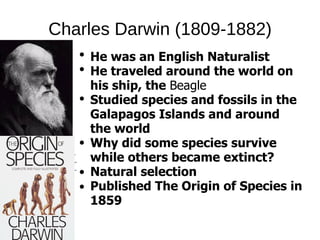
Charles Darwin (1809-1882)
He was an English Naturalist
He traveled around the world on
his ship, the Beagle
Studied species and fossils in the
Galapagos Islands and around
the world
Why did some species survive
while others became extinct?
Natural selection
Published The Origin of Species in
1859
Darwin’s Theory
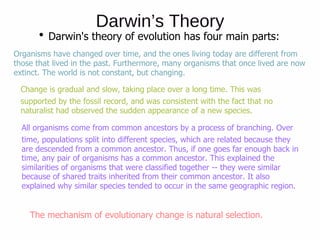
Darwin's theory of evolution has four main parts:
Organisms have changed over time, and the ones living today are different from
those that lived in the past. Furthermore, many organisms that once lived are now
extinct. The world is not constant, but changing.
Change is gradual and slow, taking place over a long time. This was
supported by the fossil record, and was consistent with the fact that no
naturalist had observed the sudden appearance of a new species.
All organisms come from common ancestors by a process of branching. Over
time, populations split into different species, which are related because they
are descended from a common ancestor. Thus, if one goes far enough back in
time, any pair of organisms has a common ancestor. This explained the
similarities of organisms that were classified together -- they were similar
because of shared traits inherited from their common ancestor. It also
explained why similar species tended to occur in the same geographic region.
The mechanism of evolutionary change is natural selection.
Natural Selection
“I have called this principle, by which each slight
variation, if useful, is preserved, by the term of
natural selection.”
– Charles Darwin - The Origin of Species
Darwin's theory of natural selection holds that
variation within species occurs randomly and that
the survival or extinction of each organism is
determined by that organism's ability to adapt to its
environment.
On The Galapagos Islands
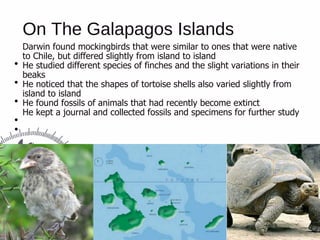
Darwin found mockingbirds that were similar to ones that were native
to Chile, but differed slightly from island to island
He studied different species of finches and the slight variations in their
beaks
He noticed that the shapes of tortoise shells also varied slightly from
island to island
He found fossils of animals that had recently become extinct
He kept a journal and collected fossils and specimens for further study
Darwin’s Finches
These are some of the finches
that Darwin studied on his
voyage
Though they are all finches, their
beaks distinguish them from one
another
Some finches developed short,
strong beaks that made it
possible for them to crack nuts
Some developed long, fine beaks
to reach insect larvae in tiny
holes
This is an example of how these
finches adapted to their
environment to survive (natural
selection)
Darwin’s Finches
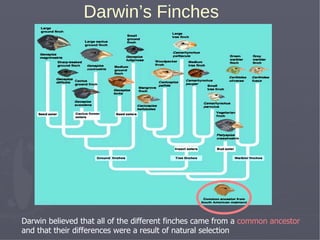
Darwin believed that all of the different finches came from a common ancestor
and that their differences were a result of natural selection
Example of Natural Selection
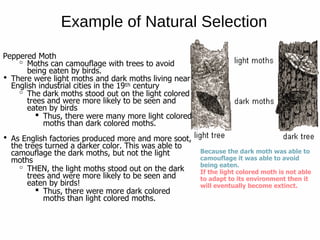
Peppered Moth
Moths can camouflage with trees to avoid
being eaten by birds.
There were light moths and dark moths living near
English industrial cities in the 19ᵗʰ century
The dark moths stood out on the light colored
trees and were more likely to be seen and
eaten by birds
Thus, there were many more light colored
moths than dark colored moths.
As English factories produced more and more soot,
the trees turned a darker color. This was able to
camouflage the dark moths, but not the light
moths
THEN, the light moths stood out on the dark
trees and were more likely to be seen and
eaten by birds!
Thus, there were more dark colored
moths than light colored moths.
Because the dark moth was able to
camouflage it was able to avoid
being eaten.
If the light colored moth is not able
to adapt to its environment then it
will eventually become extinct.
Camouflage
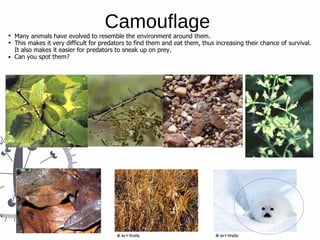
Many animals have evolved to resemble the environment around them.
This makes it very difficult for predators to find them and eat them, thus increasing their chance of survival.
It also makes it easier for predators to sneak up on prey.
Can you spot them?
Brimstone Butterfly
Camo Moth
Stick Bug
Lion
Large Fly
Seal
Preying Mantis
Patterns of Evolution
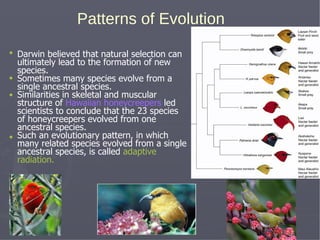
Darwin believed that natural selection can
ultimately lead to the formation of new
species.
Sometimes many species evolve from a
single ancestral species.
Similarities in skeletal and muscular
structure of Hawaiian honeycreepers led
scientists to conclude that the 23 species
of honeycreepers evolved from one
ancestral species.
Such an evolutionary pattern, in which
many related species evolved from a single
ancestral species, is called adaptive
radiation.
Adaptive Radiation
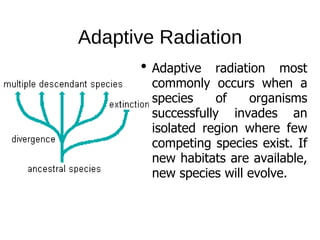
Adaptive radiation most
commonly occurs when a
species of organisms
successfully invades an
isolated region where few
competing species exist. If
new habitats are available,
new species will evolve.
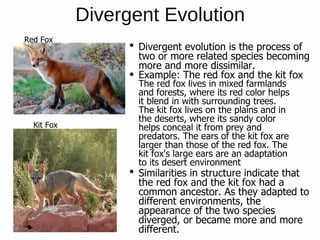
Divergent Evolution
Similarities in structure indicate that
the red fox and the kit fox had a
common ancestor. As they adapted to
different environments, the
appearance of the two species
diverged, or became more and more
different.
Divergent evolution is the process of
two or more related species becoming
more and more dissimilar.
Example: The red fox and the kit fox
The red fox lives in mixed farmlands
and forests, where its red color helps
it blend in with surrounding trees.
The kit fox lives on the plains and in
the deserts, where its sandy color
helps conceal it from prey and
predators. The ears of the kit fox are
larger than those of the red fox. The
kit fox's large ears are an adaptation
to its desert environment
Red Fox
Kit Fox
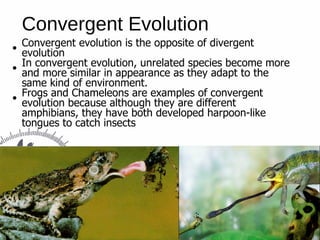
Convergent Evolution
Convergent evolution is the opposite of divergent
evolution
In convergent evolution, unrelated species become more
and more similar in appearance as they adapt to the
same kind of environment.
Frogs and Chameleons are examples of convergent
evolution because although they are different
amphibians, they have both developed harpoon-like
tongues to catch insects
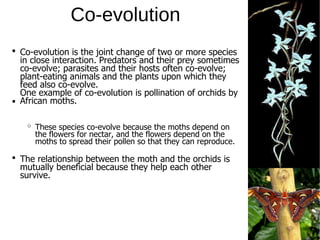
Co-evolution
The relationship between the moth and the orchids is
mutually beneficial because they help each other
survive.
Co-evolution is the joint change of two or more species
in close interaction. Predators and their prey sometimes
co-evolve; parasites and their hosts often co-evolve;
plant-eating animals and the plants upon which they
feed also co-evolve.
One example of co-evolution is pollination of orchids by
African moths.
These species co-evolve because the moths depend on
the flowers for nectar, and the flowers depend on the
moths to spread their pollen so that they can reproduce.
Why is This Important?
Divergent, convergent and co-evolution are
different ways organisms adapt to the
environment. These are examples of how
the diversity of life on earth is due to the
ever-changing interaction between a
species and its environment.
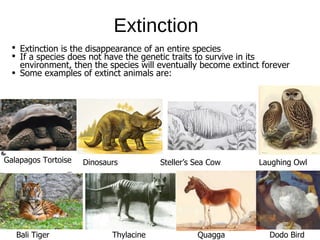
Extinction
Extinction is the disappearance of an entire species
If a species does not have the genetic traits to survive in its
environment, then the species will eventually become extinct forever
Some examples of extinct animals are:
Bali Tiger
Galapagos Tortoise Dinosaurs
Thylacine
Steller’s Sea Cow
Quagga Dodo Bird
Laughing Owl
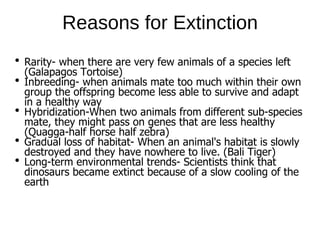
Reasons for Extinction
Rarity- when there are very few animals of a species left
(Galapagos Tortoise)
Inbreeding- when animals mate too much within their own
group the offspring become less able to survive and adapt
in a healthy way
Hybridization-When two animals from different sub-species
mate, they might pass on genes that are less healthy
(Quagga-half horse half zebra)
Gradual loss of habitat- When an animal's habitat is slowly
destroyed and they have nowhere to live. (Bali Tiger)
Long-term environmental trends- Scientists think that
dinosaurs became extinct because of a slow cooling of the
earth
Catastrophe- Volcanic eruption, dramatic change in climate, tsunami,
etc.
Extinction or reduction of mutualistic population- If two species are
dependent on each other, then the endangering of one also endangers
the other
Competition- When a new species is introduced to a habitat, then the
stronger of the two species will be more likely to survive.
Predators-When the population of a species of predator in a habitat
suddenly increases, the population of their prey decreases
Disease- If a particular sickness spreads quickly throughout a particular
species, then many may die before they can reproduce
Hunting and collecting- Hunters have been largely responsible for the
endangerment of many animal species.
Reasons for Extinction
Applications
Knowledge about evolution and natural selection
has benefited our society in many ways, and has
helped make numerous technological advances,
especially in the field of biology and medicine
Using Darwin’s theory of natural selection, scientists have
been able to identify the desirable traits which would
improve the probability of survival in certain species
It has helped scientists and doctors in treating viruses
and diseases.
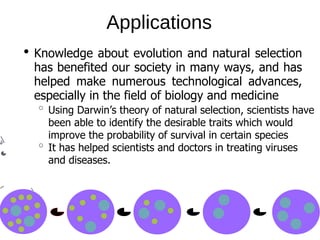
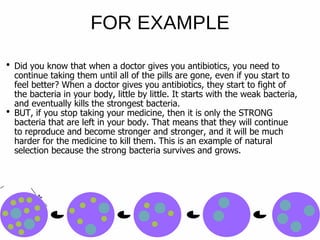
Did you know that when a doctor gives you antibiotics, you need to
continue taking them until all of the pills are gone, even if you start to
feel better? When a doctor gives you antibiotics, they start to fight of
the bacteria in your body, little by little. It starts with the weak bacteria,
and eventually kills the strongest bacteria.
BUT, if you stop taking your medicine, then it is only the STRONG
bacteria that are left in your body. That means that they will continue
to reproduce and become stronger and stronger, and it will be much
harder for the medicine to kill them. This is an example of natural
selection because the strong bacteria survives and grows.
FOR EXAMPLE
Conclusion
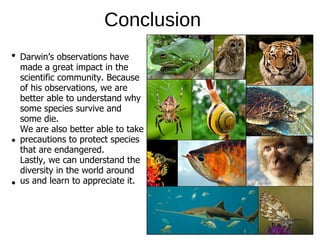
Darwin’s observations have
made a great impact in the
scientific community. Because
of his observations, we are
better able to understand why
some species survive and
some die.
We are also better able to take
precautions to protect species
that are endangered.
Lastly, we can understand the
diversity in the world around
us and learn to appreciate it.
Thank You !

Evolution-Presentation.ppt (1).pdf_20240813_001806_0000.pdf

  • 1.
  • 2.
    Table Of Contents 1.Evolution 2.Darwin’s Theory 3.Natural Selection 4.Darwin’s Finches 5.Camouflage 6.Patterns of Evolution 7. Extinction 8.Applications 9.Conclusion
  • 3.
    What do youthink of when you hear the word ? Change? Charles Darwin? Fossils? Survival? Extinction? Science? Humans? Animals? “EVOLUTION” Evolution is a very complex and controversial issue. This lesson is an introduction to the theory of evolution and natural selection as presented by Charles Darwin
  • 4.
    Charles Darwin (1809-1882) Hewas an English Naturalist He traveled around the world on his ship, the Beagle Studied species and fossils in the Galapagos Islands and around the world Why did some species survive while others became extinct? Natural selection Published The Origin of Species in 1859
  • 5.
    Darwin’s Theory Darwin's theoryof evolution has four main parts: Organisms have changed over time, and the ones living today are different from those that lived in the past. Furthermore, many organisms that once lived are now extinct. The world is not constant, but changing. Change is gradual and slow, taking place over a long time. This was supported by the fossil record, and was consistent with the fact that no naturalist had observed the sudden appearance of a new species. All organisms come from common ancestors by a process of branching. Over time, populations split into different species, which are related because they are descended from a common ancestor. Thus, if one goes far enough back in time, any pair of organisms has a common ancestor. This explained the similarities of organisms that were classified together -- they were similar because of shared traits inherited from their common ancestor. It also explained why similar species tended to occur in the same geographic region. The mechanism of evolutionary change is natural selection.
  • 6.
    Natural Selection “I havecalled this principle, by which each slight variation, if useful, is preserved, by the term of natural selection.” – Charles Darwin - The Origin of Species Darwin's theory of natural selection holds that variation within species occurs randomly and that the survival or extinction of each organism is determined by that organism's ability to adapt to its environment.
  • 7.
    On The GalapagosIslands Darwin found mockingbirds that were similar to ones that were native to Chile, but differed slightly from island to island He studied different species of finches and the slight variations in their beaks He noticed that the shapes of tortoise shells also varied slightly from island to island He found fossils of animals that had recently become extinct He kept a journal and collected fossils and specimens for further study
  • 8.
    Darwin’s Finches These aresome of the finches that Darwin studied on his voyage Though they are all finches, their beaks distinguish them from one another Some finches developed short, strong beaks that made it possible for them to crack nuts Some developed long, fine beaks to reach insect larvae in tiny holes This is an example of how these finches adapted to their environment to survive (natural selection)
  • 9.
    Darwin’s Finches Darwin believedthat all of the different finches came from a common ancestor and that their differences were a result of natural selection
  • 10.
    Example of NaturalSelection Peppered Moth Moths can camouflage with trees to avoid being eaten by birds. There were light moths and dark moths living near English industrial cities in the 19ᵗʰ century The dark moths stood out on the light colored trees and were more likely to be seen and eaten by birds Thus, there were many more light colored moths than dark colored moths. As English factories produced more and more soot, the trees turned a darker color. This was able to camouflage the dark moths, but not the light moths THEN, the light moths stood out on the dark trees and were more likely to be seen and eaten by birds! Thus, there were more dark colored moths than light colored moths. Because the dark moth was able to camouflage it was able to avoid being eaten. If the light colored moth is not able to adapt to its environment then it will eventually become extinct.
  • 11.
    Camouflage Many animals haveevolved to resemble the environment around them. This makes it very difficult for predators to find them and eat them, thus increasing their chance of survival. It also makes it easier for predators to sneak up on prey. Can you spot them? Brimstone Butterfly Camo Moth Stick Bug Lion Large Fly Seal Preying Mantis
  • 12.
    Patterns of Evolution Darwinbelieved that natural selection can ultimately lead to the formation of new species. Sometimes many species evolve from a single ancestral species. Similarities in skeletal and muscular structure of Hawaiian honeycreepers led scientists to conclude that the 23 species of honeycreepers evolved from one ancestral species. Such an evolutionary pattern, in which many related species evolved from a single ancestral species, is called adaptive radiation.
  • 13.
    Adaptive Radiation Adaptive radiationmost commonly occurs when a species of organisms successfully invades an isolated region where few competing species exist. If new habitats are available, new species will evolve.
  • 14.
    Divergent Evolution Similarities instructure indicate that the red fox and the kit fox had a common ancestor. As they adapted to different environments, the appearance of the two species diverged, or became more and more different. Divergent evolution is the process of two or more related species becoming more and more dissimilar. Example: The red fox and the kit fox The red fox lives in mixed farmlands and forests, where its red color helps it blend in with surrounding trees. The kit fox lives on the plains and in the deserts, where its sandy color helps conceal it from prey and predators. The ears of the kit fox are larger than those of the red fox. The kit fox's large ears are an adaptation to its desert environment Red Fox Kit Fox
  • 15.
    Convergent Evolution Convergent evolutionis the opposite of divergent evolution In convergent evolution, unrelated species become more and more similar in appearance as they adapt to the same kind of environment. Frogs and Chameleons are examples of convergent evolution because although they are different amphibians, they have both developed harpoon-like tongues to catch insects
  • 16.
    Co-evolution The relationship betweenthe moth and the orchids is mutually beneficial because they help each other survive. Co-evolution is the joint change of two or more species in close interaction. Predators and their prey sometimes co-evolve; parasites and their hosts often co-evolve; plant-eating animals and the plants upon which they feed also co-evolve. One example of co-evolution is pollination of orchids by African moths. These species co-evolve because the moths depend on the flowers for nectar, and the flowers depend on the moths to spread their pollen so that they can reproduce.
  • 17.
    Why is ThisImportant? Divergent, convergent and co-evolution are different ways organisms adapt to the environment. These are examples of how the diversity of life on earth is due to the ever-changing interaction between a species and its environment.
  • 18.
    Extinction Extinction is thedisappearance of an entire species If a species does not have the genetic traits to survive in its environment, then the species will eventually become extinct forever Some examples of extinct animals are: Bali Tiger Galapagos Tortoise Dinosaurs Thylacine Steller’s Sea Cow Quagga Dodo Bird Laughing Owl
  • 19.
    Reasons for Extinction Rarity-when there are very few animals of a species left (Galapagos Tortoise) Inbreeding- when animals mate too much within their own group the offspring become less able to survive and adapt in a healthy way Hybridization-When two animals from different sub-species mate, they might pass on genes that are less healthy (Quagga-half horse half zebra) Gradual loss of habitat- When an animal's habitat is slowly destroyed and they have nowhere to live. (Bali Tiger) Long-term environmental trends- Scientists think that dinosaurs became extinct because of a slow cooling of the earth
  • 20.
    Catastrophe- Volcanic eruption,dramatic change in climate, tsunami, etc. Extinction or reduction of mutualistic population- If two species are dependent on each other, then the endangering of one also endangers the other Competition- When a new species is introduced to a habitat, then the stronger of the two species will be more likely to survive. Predators-When the population of a species of predator in a habitat suddenly increases, the population of their prey decreases Disease- If a particular sickness spreads quickly throughout a particular species, then many may die before they can reproduce Hunting and collecting- Hunters have been largely responsible for the endangerment of many animal species. Reasons for Extinction
  • 21.
    Applications Knowledge about evolutionand natural selection has benefited our society in many ways, and has helped make numerous technological advances, especially in the field of biology and medicine Using Darwin’s theory of natural selection, scientists have been able to identify the desirable traits which would improve the probability of survival in certain species It has helped scientists and doctors in treating viruses and diseases.
  • 22.
    Did you knowthat when a doctor gives you antibiotics, you need to continue taking them until all of the pills are gone, even if you start to feel better? When a doctor gives you antibiotics, they start to fight of the bacteria in your body, little by little. It starts with the weak bacteria, and eventually kills the strongest bacteria. BUT, if you stop taking your medicine, then it is only the STRONG bacteria that are left in your body. That means that they will continue to reproduce and become stronger and stronger, and it will be much harder for the medicine to kill them. This is an example of natural selection because the strong bacteria survives and grows. FOR EXAMPLE
  • 23.
    Conclusion Darwin’s observations have madea great impact in the scientific community. Because of his observations, we are better able to understand why some species survive and some die. We are also better able to take precautions to protect species that are endangered. Lastly, we can understand the diversity in the world around us and learn to appreciate it.
  • 24.