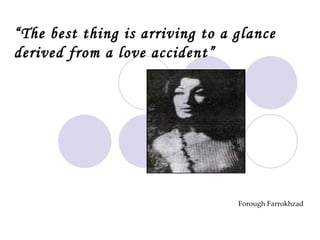
Forough Farrokhzad “ The best thing is arriving to a glance derived from a love accident”                                         
“ Poetry is a serious business for me. It is a responsibility I feel vies-a-vi my own being. It is a sort of answer I feel compelled to give to my own life. ” Forough Farrokhzad was born on January 5, 1935 into a middle class family with seven children. She was born and raised in the capital city Tehran, Iran, attending public school and graduated junior high at the age of 15. After graduating, she transferred to Kamalolmolk Technical School where her primary focus was dressmaking and painting. In 1951, she married her cousin who was a man of literary ambition and fathered her only child. Soon after she had published her first collection of work, her and her husband divorced, he gained custody of their child leaving which led to her to embark on a risky journey of an independent life style and experimenting in poetry. However, as she was becoming an Independent woman, she was treated differently, thus causing such powerful emotional distress that she was hospitalized for a month, due to a nervous breakdown. Throughout her literary career, Farrokhzad published a total of five collections of verses, each produced at different times in her life, each influenced by the prominent atmosphere she lived in. What makes Farrokhzad unique was not the fact that she is among the first female poets, in fact several women publish verses in the late 19 th  – early 20 th  century; but that she was the first poet to rise to fame without the support of a prominent male figure. Her poetry alone broke new grounds with its modern form and equally modern sensibility. The focus of her poetry is very strong and proves to be so by the use of several devices and because of the influences in her life; her style and focus portrays her life, a time when she began her voice is weak, it grows stronger, eventually it becomes to be something that no poet would expect – especially from an Iranian woman.
The Captive I want you, yet I know that never can I embrace you to my heart's content. You are that clear and bright sky.  I, in this corner of the cage, am a captive bird. From behind the cold and dark bars directing toward you my rueful look of astonishment, I am thinking that a hand might come and I might suddenly spread my wings in your direction. I am thinking that in a moment of neglect I might fly from this silent prison, laugh in the eyes of the man who is my jailer and beside you begin life anew. I am thinking these things, yet I know that I can not, dare not leave this prison. even if the jailer would wish it, no breath or breeze remains for my flight. from behind the bars, every bright morning the look of a child smile in my face; when I begin a song of joy, Its lips come toward me with a kiss. O sky, if I want one day to fly from this silent prison, what shall I say to the weeping child's eyes: forget about me, for I am captive bird? I am that candle which illumines a ruins with the burning of her heart. If I want to choose silent darkness, I will bring a nest to ruin. This poem was among the first verses that  Farrokhzad had published in her writing career. The theme of  poem takes aim at the strictures of conventional Iranian marriage, constantly linking it to that of a prison and cage for a woman – when really it should be something full of happiness as well as approaches the law which states a woman cannot gain custody of her child after a divorce.  The beginning of the poem introduces the “captive bird” image which is maintained throughout, as a way of putting an image to the feelings the individual has towards her life: “I, in this corner of the cage, am a captive bird”. Her marriage is represented by the jail image, “From behind the cold and dark bars” and her husband a “ jailer”. It also presents the main theme of freedom, however it is not clear in the beginning if the source of freedom is that of a person or just the idea: “I want you, yet I know that never/ can I embrace you to my heart’s content/ You are that clear and bright sky”. The third stanza the “silent prison” (marriage) is brought up again, how she holds that strength in the possibility of breaking free from this horrid marriage and beginning a new life: “I might fly from this silent prison,/ laugh in the eyes of the man who is my jailer”. It also specifies that the narrator is in fact speaking to or about another individual: “And beside you begin life anew”. The strict law that comes into this poem is that which states a woman cannot gain custody of her child after a divorce, and in the sixth stanza it shows that the woman cannot leave her child because that child is innocent and will not understand that she is a “captive bird”. The final stanza sets off a strong image of a candle, and its power to illuminate something in the dark: “I am that candle which illumines a ruins/ with the burning of her heart”. The final presentation that we are shown is that the woman is the one who holds it altogether, that without her  the ruins will crumble, regardless if they say that the man has all the power “If I want to choose silent darkness/ I will bring a nest to ruin.”
The Captive I want you, yet I know that never can I embrace you to my heart's content. You are that clear and bright sky.  I, in this corner of the cage, am a captive bird. From behind the cold and dark bars directing toward you my rueful look of astonishment, I am thinking that a hand might come and I might suddenly spread my wings in your direction. I am thinking that in a moment of neglect I might fly from this silent prison, laugh in the eyes of the man who is my jailer and beside you begin life anew. I am thinking these things, yet I know that I can not, dare not leave this prison. even if the jailer would wish it, no breath or breeze remains for my flight. from behind the bars, every bright morning the look of a child smile in my face; when I begin a song of joy, Its lips come toward me with a kiss. O sky, if I want one day to fly from this silent prison, what shall I say to the weeping child's eyes: forget about me, for I am captive bird? I am that candle which illumines a ruins with the burning of her heart. If I want to choose silent darkness, I will bring a nest to ruin. It includes few literary devices: Apostrophe: “O sky, if I want one day…”, it is used to show the praising of the sky, how it has no limits, which creates that feel and need for freedom.  Metaphor: marriage and a jail: “…yet I know/ that I can not, dare not, leave this prison”, to the woman as a captive bird: “I, in this corner of the cage, am a captive bird”. The idea of comparing the marriage to a cold, dingy jail, emphasizes the reasons as to why the lady wants to leave, to find a new life, or a new beginning, as well as when she states that she is a captive bird, she is hidden from the world. These two metaphors are the most prominent of the poem.  Imagery: “From behind the cold and dark bars” This quote provides a vivid image of the life in which the speaker lives in, as it is in a “dark” worded phrase, the mental image that is created would be one full of unpleasant life.  “What shall I say to the weeping child’s eyes” The weeping eyes of the child provide a sympathetic and yet heart breaking image of a child who, innocent, is affected by the loss of a mother because she cannot bare the life she lives. “Silent darkness” This image links to the dingy and cold quote about the comparison to the jail, one would picture black, and stillness, completely alone.  Personification: “No breath of breeze remains for my flight” This quote provides her journey to freedom with human characteristics that would make it survive, however over time, the freedom movement has become tired, and weak, no longer being able to be put into action.
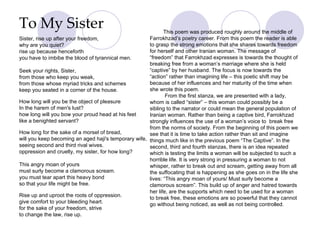
To My Sister Sister, rise up after your freedom,  why are you quiet?  rise up because henceforth  you have to imbibe the blood of tyrannical men.  Seek your rights, Sister,  from those who keep you weak, from those whose myriad tricks and schemes keep you seated in a corner of the house. How long will you be the object of pleasure In the harem of men's lust? how long will you bow your proud head at his feet like a benighted servant? How long for the sake of a morsel of bread, will you keep becoming an aged haji's temporary wife, seeing second and third rival wives. oppression and cruelty, my sister, for how long? This angry moan of yours must surly become a clamorous scream. you must tear apart this heavy bond so that your life might be free. Rise up and uproot the roots of oppression. give comfort to your bleeding heart. for the sake of your freedom, strive to change the law, rise up. About women in Iran This poem was produced roughly around the middle of Farrokhzad’s poetry career. From this poem the reader is able to grasp the strong emotions that she shares towards freedom for herself and other Iranian woman. The message of “freedom” that Farrokhzad expresses is towards the thought of breaking free from a woman’s marriage where she is held “captive” by her husband. The focus is now towards the “action” rather than imagining life – this poetic shift may be because of her influences and her maturity of the time when she wrote this poem. From the first stanza, we are presented with a lady, whom is called “sister” – this woman could possibly be a sibling to the narrator or could mean the general population of Iranian woman. Rather than being a captive bird, Farrokhzad strongly influences the use of a woman’s voice to  break free from the norms of society. From the beginning of this poem we see that it is time to take action rather than sit and imagine things much like in the previous poem “The Captive”. In the second, third and fourth stanzas, there is an idea repeated which is testing the limits a woman will be subjected to such a horrible life. It is very strong in pressuring a woman to not whisper, rather to break out and scream, getting away from all the suffocating that is happening as she goes on in the life she lives: “This angry moan of yours/ Must surly become a clamorous scream”. This build up of anger and hatred towards her life, are the supports which need to be used for a woman to break free, these emotions are so powerful that they cannot go without being noticed, as well as not being controlled.                                             
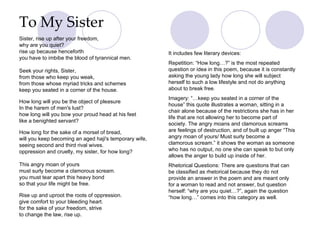
To My Sister Sister, rise up after your freedom,  why are you quiet?  rise up because henceforth  you have to imbibe the blood of tyrannical men.  Seek your rights, Sister,  from those who keep you weak, from those whose myriad tricks and schemes keep you seated in a corner of the house. How long will you be the object of pleasure In the harem of men's lust? how long will you bow your proud head at his feet like a benighted servant? How long for the sake of a morsel of bread, will you keep becoming an aged haji's temporary wife, seeing second and third rival wives. oppression and cruelty, my sister, for how long? This angry moan of yours must surly become a clamorous scream. you must tear apart this heavy bond so that your life might be free. Rise up and uproot the roots of oppression. give comfort to your bleeding heart. for the sake of your freedom, strive to change the law, rise up. About women in Iran It includes few literary devices: Repetition: “How long…?” is the most repeated question or idea in this poem, because it is constantly asking the young lady how long she will subject herself to such a low lifestyle and not do anything about to break free.  Imagery: “…keep you seated in a corner of the house” this quote illustrates a woman, sitting in a chair alone because of the restrictions she has in her life that are not allowing her to become part of society. The angry moans and clamorous screams are feelings of destruction, and of built up anger “This angry moan of yours/ Must surly become a clamorous scream.” it shows the woman as someone who has no output, no one she can speak to but only allows the anger to build up inside of her.  Rhetorical Questions: There are questions that can be classified as rhetorical because they do not provide an answer in the poem and are meant only for a woman to read and not answer, but question herself: “why are you quiet…?”, again the question “how long…” comes into this category as well.
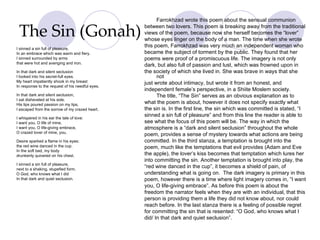
The Sin (Gonah) I sinned a sin full of pleasure, In an embrace which was warm and fiery. I sinned surrounded by arms that were hot and avenging and iron. In that dark and silent seclusion I looked into his secret-full eyes. My heart impatiently shook in my breast In response to the request of his needful eyes. In that dark and silent seclusion, I sat disheveled at his side. His lips poured passion on my lips, I escaped from the sorrow of my crazed heart. I whispered in his ear the tale of love: I want you, O life of mine, I want you, O life-giving embrace, O crazed lover of mine, you. Desire sparked a flame in his eyes; the red wine danced in the cup. In the soft bed, my body drunkenly quivered on his chest. I sinned a sin full of pleasure, next to a shaking, stupefied form. O God, who knows what I did In that dark and quiet seclusion. Farrokhzad wrote this poem about the sensual communion between two lovers. This poem is breaking away from the traditional views of the poem, because now she herself becomes the “lover” whose eyes linger on the body of a man. The time when she wrote this poem, Farrokhzad was very much an independent woman who became the subject of torment by the public. They found that her poems were proof of a promiscuous life. The imagery is not only dark, but also full of passion and lust, which was frowned upon in the society of which she lived in. She was brave in ways that she not just wrote about intimacy, but wrote it from an honest, and independent female’s perspective, in a Shiite Moslem society.  The title, “The Sin” serves as an obvious explanation as to what the poem is about, however it does not specify exactly what the sin is. In the first line, the sin which was committed is stated, “I sinned a sin full of pleasure” and from this line the reader is able to see what the focus of this poem will be. The way in which the atmosphere is a “dark and silent seclusion” throughout the whole poem, provides a sense of mystery towards what actions are being committed. In the third stanza, a temptation is brought into the poem, much like the temptations that evil provides (Adam and Eve the apple), the lover’s kiss becomes that temptation which lures her into committing the sin. Another temptation is brought into play, the “ red wine danced in the cup”, it becomes a shield of pain, of understanding what is going on.  The dark imagery is primary in this poem, however there is a time where light imagery comes in, “I want you, O life-giving embrace”. As before this poem is about the freedom the narrator feels when they are with an individual, that this person is providing them a life they did not know about, nor could reach before. In the last stanza there is a feeling of possible regret for committing the sin that is resented: “O God, who knows what I did/ In that dark and quiet seclusion”.
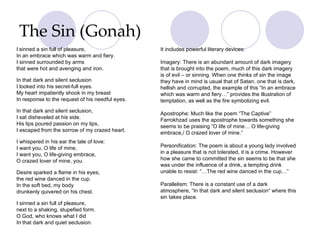
The Sin (Gonah) I   sinned a sin full of pleasure, In an embrace which was warm and fiery. I sinned surrounded by arms that were hot and avenging and iron. In that dark and silent seclusion I looked into his secret-full eyes. My heart impatiently shook in my breast In response to the request of his needful eyes. In that dark and silent seclusion, I sat disheveled at his side. His lips poured passion on my lips, I escaped from the sorrow of my crazed heart. I whispered in his ear the tale of love: I want you, O life of mine, I want you, O life-giving embrace, O crazed lover of mine, you. Desire sparked a flame in his eyes; the red wine danced in the cup. In the soft bed, my body drunkenly quivered on his chest. I sinned a sin full of pleasure, next to a shaking, stupefied form. O God, who knows what I did In that dark and quiet seclusion. It includes powerful literary devices: Imagery: There is an abundant amount of dark imagery that is brought into the poem, much of this dark imagery is of evil – or sinning. When one thinks of sin the image they have in mind is usual that of Satan, one that is dark, hellish and corrupted, the example of this “In an embrace which was warm and fiery…” provides the illustration of temptation, as well as the fire symbolizing evil. Apostrophe: Much like the poem “The Captive” Farrokhzad uses the apostrophe towards something she seems to be praising “O life of mine… O life-giving embrace,/ O crazed lover of mine.” Personification: The poem is about a young lady involved in a pleasure that is not tolerated, it is a crime. However how she came to committed the sin seems to be that she was under the influence of a drink, a tempting drink unable to resist: “…The red wine danced in the cup…”  Parallelism: There is a constant use of a dark atmosphere, “In that dark and silent seclusion“ where this sin takes place.
Discussion Questions Poem : The Captive (Asir) Are there places in the world today that woman feel like captive birds? Is the phrase “captive bird” well used and powerful way in this poem to show  the true feelings the narrator feels? Poem : To My Sister Do you think that woman should be under this sort of torture during their marriage, regardless of the time period and country? What purpose does this poem serve to the society at large? Poem : The Sin (Gonah) As already mentioned, there are sins of temptation that are within this poem, the alcohol, passion of a kiss. What other links of “sin” can you relate to the poem. What other imagery can you derive from this poem, is there only dark imagery or some light?

Forough Farrokhzad

  • 1.
    Forough Farrokhzad “The best thing is arriving to a glance derived from a love accident”                                         
  • 2.
    “ Poetry isa serious business for me. It is a responsibility I feel vies-a-vi my own being. It is a sort of answer I feel compelled to give to my own life. ” Forough Farrokhzad was born on January 5, 1935 into a middle class family with seven children. She was born and raised in the capital city Tehran, Iran, attending public school and graduated junior high at the age of 15. After graduating, she transferred to Kamalolmolk Technical School where her primary focus was dressmaking and painting. In 1951, she married her cousin who was a man of literary ambition and fathered her only child. Soon after she had published her first collection of work, her and her husband divorced, he gained custody of their child leaving which led to her to embark on a risky journey of an independent life style and experimenting in poetry. However, as she was becoming an Independent woman, she was treated differently, thus causing such powerful emotional distress that she was hospitalized for a month, due to a nervous breakdown. Throughout her literary career, Farrokhzad published a total of five collections of verses, each produced at different times in her life, each influenced by the prominent atmosphere she lived in. What makes Farrokhzad unique was not the fact that she is among the first female poets, in fact several women publish verses in the late 19 th – early 20 th century; but that she was the first poet to rise to fame without the support of a prominent male figure. Her poetry alone broke new grounds with its modern form and equally modern sensibility. The focus of her poetry is very strong and proves to be so by the use of several devices and because of the influences in her life; her style and focus portrays her life, a time when she began her voice is weak, it grows stronger, eventually it becomes to be something that no poet would expect – especially from an Iranian woman.
  • 3.
    The Captive Iwant you, yet I know that never can I embrace you to my heart's content. You are that clear and bright sky. I, in this corner of the cage, am a captive bird. From behind the cold and dark bars directing toward you my rueful look of astonishment, I am thinking that a hand might come and I might suddenly spread my wings in your direction. I am thinking that in a moment of neglect I might fly from this silent prison, laugh in the eyes of the man who is my jailer and beside you begin life anew. I am thinking these things, yet I know that I can not, dare not leave this prison. even if the jailer would wish it, no breath or breeze remains for my flight. from behind the bars, every bright morning the look of a child smile in my face; when I begin a song of joy, Its lips come toward me with a kiss. O sky, if I want one day to fly from this silent prison, what shall I say to the weeping child's eyes: forget about me, for I am captive bird? I am that candle which illumines a ruins with the burning of her heart. If I want to choose silent darkness, I will bring a nest to ruin. This poem was among the first verses that Farrokhzad had published in her writing career. The theme of poem takes aim at the strictures of conventional Iranian marriage, constantly linking it to that of a prison and cage for a woman – when really it should be something full of happiness as well as approaches the law which states a woman cannot gain custody of her child after a divorce. The beginning of the poem introduces the “captive bird” image which is maintained throughout, as a way of putting an image to the feelings the individual has towards her life: “I, in this corner of the cage, am a captive bird”. Her marriage is represented by the jail image, “From behind the cold and dark bars” and her husband a “ jailer”. It also presents the main theme of freedom, however it is not clear in the beginning if the source of freedom is that of a person or just the idea: “I want you, yet I know that never/ can I embrace you to my heart’s content/ You are that clear and bright sky”. The third stanza the “silent prison” (marriage) is brought up again, how she holds that strength in the possibility of breaking free from this horrid marriage and beginning a new life: “I might fly from this silent prison,/ laugh in the eyes of the man who is my jailer”. It also specifies that the narrator is in fact speaking to or about another individual: “And beside you begin life anew”. The strict law that comes into this poem is that which states a woman cannot gain custody of her child after a divorce, and in the sixth stanza it shows that the woman cannot leave her child because that child is innocent and will not understand that she is a “captive bird”. The final stanza sets off a strong image of a candle, and its power to illuminate something in the dark: “I am that candle which illumines a ruins/ with the burning of her heart”. The final presentation that we are shown is that the woman is the one who holds it altogether, that without her the ruins will crumble, regardless if they say that the man has all the power “If I want to choose silent darkness/ I will bring a nest to ruin.”
  • 4.
    The Captive Iwant you, yet I know that never can I embrace you to my heart's content. You are that clear and bright sky. I, in this corner of the cage, am a captive bird. From behind the cold and dark bars directing toward you my rueful look of astonishment, I am thinking that a hand might come and I might suddenly spread my wings in your direction. I am thinking that in a moment of neglect I might fly from this silent prison, laugh in the eyes of the man who is my jailer and beside you begin life anew. I am thinking these things, yet I know that I can not, dare not leave this prison. even if the jailer would wish it, no breath or breeze remains for my flight. from behind the bars, every bright morning the look of a child smile in my face; when I begin a song of joy, Its lips come toward me with a kiss. O sky, if I want one day to fly from this silent prison, what shall I say to the weeping child's eyes: forget about me, for I am captive bird? I am that candle which illumines a ruins with the burning of her heart. If I want to choose silent darkness, I will bring a nest to ruin. It includes few literary devices: Apostrophe: “O sky, if I want one day…”, it is used to show the praising of the sky, how it has no limits, which creates that feel and need for freedom. Metaphor: marriage and a jail: “…yet I know/ that I can not, dare not, leave this prison”, to the woman as a captive bird: “I, in this corner of the cage, am a captive bird”. The idea of comparing the marriage to a cold, dingy jail, emphasizes the reasons as to why the lady wants to leave, to find a new life, or a new beginning, as well as when she states that she is a captive bird, she is hidden from the world. These two metaphors are the most prominent of the poem. Imagery: “From behind the cold and dark bars” This quote provides a vivid image of the life in which the speaker lives in, as it is in a “dark” worded phrase, the mental image that is created would be one full of unpleasant life. “What shall I say to the weeping child’s eyes” The weeping eyes of the child provide a sympathetic and yet heart breaking image of a child who, innocent, is affected by the loss of a mother because she cannot bare the life she lives. “Silent darkness” This image links to the dingy and cold quote about the comparison to the jail, one would picture black, and stillness, completely alone. Personification: “No breath of breeze remains for my flight” This quote provides her journey to freedom with human characteristics that would make it survive, however over time, the freedom movement has become tired, and weak, no longer being able to be put into action.
  • 5.
    To My SisterSister, rise up after your freedom, why are you quiet? rise up because henceforth you have to imbibe the blood of tyrannical men. Seek your rights, Sister, from those who keep you weak, from those whose myriad tricks and schemes keep you seated in a corner of the house. How long will you be the object of pleasure In the harem of men's lust? how long will you bow your proud head at his feet like a benighted servant? How long for the sake of a morsel of bread, will you keep becoming an aged haji's temporary wife, seeing second and third rival wives. oppression and cruelty, my sister, for how long? This angry moan of yours must surly become a clamorous scream. you must tear apart this heavy bond so that your life might be free. Rise up and uproot the roots of oppression. give comfort to your bleeding heart. for the sake of your freedom, strive to change the law, rise up. About women in Iran This poem was produced roughly around the middle of Farrokhzad’s poetry career. From this poem the reader is able to grasp the strong emotions that she shares towards freedom for herself and other Iranian woman. The message of “freedom” that Farrokhzad expresses is towards the thought of breaking free from a woman’s marriage where she is held “captive” by her husband. The focus is now towards the “action” rather than imagining life – this poetic shift may be because of her influences and her maturity of the time when she wrote this poem. From the first stanza, we are presented with a lady, whom is called “sister” – this woman could possibly be a sibling to the narrator or could mean the general population of Iranian woman. Rather than being a captive bird, Farrokhzad strongly influences the use of a woman’s voice to break free from the norms of society. From the beginning of this poem we see that it is time to take action rather than sit and imagine things much like in the previous poem “The Captive”. In the second, third and fourth stanzas, there is an idea repeated which is testing the limits a woman will be subjected to such a horrible life. It is very strong in pressuring a woman to not whisper, rather to break out and scream, getting away from all the suffocating that is happening as she goes on in the life she lives: “This angry moan of yours/ Must surly become a clamorous scream”. This build up of anger and hatred towards her life, are the supports which need to be used for a woman to break free, these emotions are so powerful that they cannot go without being noticed, as well as not being controlled.                                            
  • 6.
    To My SisterSister, rise up after your freedom, why are you quiet? rise up because henceforth you have to imbibe the blood of tyrannical men. Seek your rights, Sister, from those who keep you weak, from those whose myriad tricks and schemes keep you seated in a corner of the house. How long will you be the object of pleasure In the harem of men's lust? how long will you bow your proud head at his feet like a benighted servant? How long for the sake of a morsel of bread, will you keep becoming an aged haji's temporary wife, seeing second and third rival wives. oppression and cruelty, my sister, for how long? This angry moan of yours must surly become a clamorous scream. you must tear apart this heavy bond so that your life might be free. Rise up and uproot the roots of oppression. give comfort to your bleeding heart. for the sake of your freedom, strive to change the law, rise up. About women in Iran It includes few literary devices: Repetition: “How long…?” is the most repeated question or idea in this poem, because it is constantly asking the young lady how long she will subject herself to such a low lifestyle and not do anything about to break free. Imagery: “…keep you seated in a corner of the house” this quote illustrates a woman, sitting in a chair alone because of the restrictions she has in her life that are not allowing her to become part of society. The angry moans and clamorous screams are feelings of destruction, and of built up anger “This angry moan of yours/ Must surly become a clamorous scream.” it shows the woman as someone who has no output, no one she can speak to but only allows the anger to build up inside of her. Rhetorical Questions: There are questions that can be classified as rhetorical because they do not provide an answer in the poem and are meant only for a woman to read and not answer, but question herself: “why are you quiet…?”, again the question “how long…” comes into this category as well.
  • 7.
    The Sin (Gonah)I sinned a sin full of pleasure, In an embrace which was warm and fiery. I sinned surrounded by arms that were hot and avenging and iron. In that dark and silent seclusion I looked into his secret-full eyes. My heart impatiently shook in my breast In response to the request of his needful eyes. In that dark and silent seclusion, I sat disheveled at his side. His lips poured passion on my lips, I escaped from the sorrow of my crazed heart. I whispered in his ear the tale of love: I want you, O life of mine, I want you, O life-giving embrace, O crazed lover of mine, you. Desire sparked a flame in his eyes; the red wine danced in the cup. In the soft bed, my body drunkenly quivered on his chest. I sinned a sin full of pleasure, next to a shaking, stupefied form. O God, who knows what I did In that dark and quiet seclusion. Farrokhzad wrote this poem about the sensual communion between two lovers. This poem is breaking away from the traditional views of the poem, because now she herself becomes the “lover” whose eyes linger on the body of a man. The time when she wrote this poem, Farrokhzad was very much an independent woman who became the subject of torment by the public. They found that her poems were proof of a promiscuous life. The imagery is not only dark, but also full of passion and lust, which was frowned upon in the society of which she lived in. She was brave in ways that she not just wrote about intimacy, but wrote it from an honest, and independent female’s perspective, in a Shiite Moslem society. The title, “The Sin” serves as an obvious explanation as to what the poem is about, however it does not specify exactly what the sin is. In the first line, the sin which was committed is stated, “I sinned a sin full of pleasure” and from this line the reader is able to see what the focus of this poem will be. The way in which the atmosphere is a “dark and silent seclusion” throughout the whole poem, provides a sense of mystery towards what actions are being committed. In the third stanza, a temptation is brought into the poem, much like the temptations that evil provides (Adam and Eve the apple), the lover’s kiss becomes that temptation which lures her into committing the sin. Another temptation is brought into play, the “ red wine danced in the cup”, it becomes a shield of pain, of understanding what is going on. The dark imagery is primary in this poem, however there is a time where light imagery comes in, “I want you, O life-giving embrace”. As before this poem is about the freedom the narrator feels when they are with an individual, that this person is providing them a life they did not know about, nor could reach before. In the last stanza there is a feeling of possible regret for committing the sin that is resented: “O God, who knows what I did/ In that dark and quiet seclusion”.
  • 8.
    The Sin (Gonah)I sinned a sin full of pleasure, In an embrace which was warm and fiery. I sinned surrounded by arms that were hot and avenging and iron. In that dark and silent seclusion I looked into his secret-full eyes. My heart impatiently shook in my breast In response to the request of his needful eyes. In that dark and silent seclusion, I sat disheveled at his side. His lips poured passion on my lips, I escaped from the sorrow of my crazed heart. I whispered in his ear the tale of love: I want you, O life of mine, I want you, O life-giving embrace, O crazed lover of mine, you. Desire sparked a flame in his eyes; the red wine danced in the cup. In the soft bed, my body drunkenly quivered on his chest. I sinned a sin full of pleasure, next to a shaking, stupefied form. O God, who knows what I did In that dark and quiet seclusion. It includes powerful literary devices: Imagery: There is an abundant amount of dark imagery that is brought into the poem, much of this dark imagery is of evil – or sinning. When one thinks of sin the image they have in mind is usual that of Satan, one that is dark, hellish and corrupted, the example of this “In an embrace which was warm and fiery…” provides the illustration of temptation, as well as the fire symbolizing evil. Apostrophe: Much like the poem “The Captive” Farrokhzad uses the apostrophe towards something she seems to be praising “O life of mine… O life-giving embrace,/ O crazed lover of mine.” Personification: The poem is about a young lady involved in a pleasure that is not tolerated, it is a crime. However how she came to committed the sin seems to be that she was under the influence of a drink, a tempting drink unable to resist: “…The red wine danced in the cup…” Parallelism: There is a constant use of a dark atmosphere, “In that dark and silent seclusion“ where this sin takes place.
  • 9.
    Discussion Questions Poem: The Captive (Asir) Are there places in the world today that woman feel like captive birds? Is the phrase “captive bird” well used and powerful way in this poem to show the true feelings the narrator feels? Poem : To My Sister Do you think that woman should be under this sort of torture during their marriage, regardless of the time period and country? What purpose does this poem serve to the society at large? Poem : The Sin (Gonah) As already mentioned, there are sins of temptation that are within this poem, the alcohol, passion of a kiss. What other links of “sin” can you relate to the poem. What other imagery can you derive from this poem, is there only dark imagery or some light?