Study Card for Contemporary Business Mathematics with
Canadian Applications, Tenth Edition
S.A. Hummelbrunner Kelly Haliday K. Suzanne Coombs
LIST OF FORMULAS
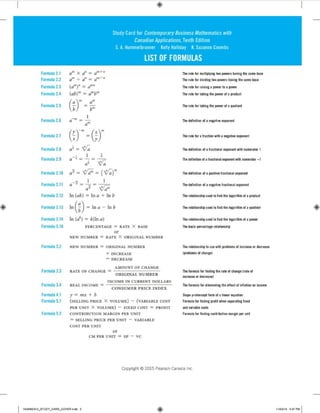
Formula 2.1 d" X a" = d"*"
Formula 2.2 a" a = a"
The rule for muitiplying hwo powers having the same base
The rule for dividing two powers having the same base
Formula 2.3 (a"" == d""
Formula 2.4
The rule for raising a power to a power
(ab)" = d"b" The rule for taking the power of a product
-
Formula 2.5 The rule for taking the power of a quotient
Formula2.6 a The defintion of a negatve expot ent
(-
Formula 2.7 Tne rule tora fraction with a negative exponent
Formula 2.8 a = Va
Formula2.9 ai=
The definition of a fractional exporent with numeratar 1
The definition of a fractioral exponent with numerator 1
Formula 2.10 a = Va" = (Va)" The definition of a positive fractioral exponent
Formula2.11 a V
The definition of a negafive fractional exporent
Formula2.12 In (ab) =
Ina + Inb The relationship used to find the logarithm af a prodect
Formula 2.13
Inna-Inb The relationship used to find the iogarithm of aquetient
Formula 2.14 In () = k{ln a) The relationship used to find the loganithm of a power
Formula 3.1 PERCENTAGE= RATE X BASE The basic percentage relationship
NEWNUMBER= RATEX ORIGINAL NUMBER
Formula 3.2NEW NUMBER= ORIGINAL NUMBER The relationship to use with problems af increase or decrease
INCREASE problems of change)
DECREASE
AMOUNTOFCHANGEE
Formula 3.3 RATE OF CHANGE= The formula for tinding the rate of chasge (rate of
ORIGINAL NUMBER ncrease or decrease)
INCOMEINCURRENTDOLLARS
Formula3.4 REAL INCOME The formula for eliminating the effect of infiation an income
CONSUMER PRICE INDEX
Formula4.1 y mx+b
Formula5.1 (sELLING PRICE X voLUME)= (VARLABLE COST
Siope-pinterceptform of a linear equation
Formula for finding profit when separafing fzed
PER UNIT X vOLUME) - FIXED COST = PROFIT
and variable costs
Formula 5.2 cONTRIBUTION MARGIN PER UNIT Formula for finding contribution margin per unit
SELLING PRICE PER UNIT VARIABLE
CoST PER UNIT
or
CM PER UNIT= SP VC
Copyright 2015 Pearscn Canada Inc.
HUMM2312_STUDY_CARD_COVERindd 2 11/02/14 4:37 PM
Formula 5.3 TOTALCONTRIBUTION MARGIN= (SELLING PRICE PER UNIT Formula for finding total
VARIABLE coST PER UNIT) X vOLUME COrtribution margin
or
TOTALCM =
(SP- vc) X x
Formula 5.4 BREAK-EVEN VOLUME (in units) Formula for finding hreak-even volume im units based on the
FIXED COST unit contribution margin
UNIT CONTRIBUTION MARGIN
or
FC
*CMper unit
Formula5.5 cONTRIBUTION RATE = -
=UNITcONTRIBUTION MARGIN Formula for finding cortribution rate
UNIT SELLING PRICE
Formula 5.6 BREAK-EVEN SALES (in sales dollars) FIXEDCOST Formula for finding break-even sales
CONTRIBUTION RATE
ased on contribution rate
Formula 6.1 AMOUNT OF RATE OF
Findig the amount ot dscount when the lst price is known
DISCOUNT DISCOUNT St PRICE
Formula 6.2 NET PRICE LIST PRICE AMOUNT OF DIScoUNT Finding the net amount when the amount of discouet is know
Formula6.3 N = L(1- d)
Formula6.4 N L(1 - d,01 - d,)(1 - d)... (1 - d,)
Finding the net price factor (NPF)
Finding the net amount direct)y without computing the amount
of discount
Formula 6.5 SINGLE EQUIVALENT RATE OF DIScoUNT Finding the single rate of discount that has the same etfect as a
FOR A DIScoUNT SERIES gven series of discounts
=I -
NPE FOR THE
DISCOUNTSERIES
=1 -
[(1 -
d,)(1 -
d,)(1 -
d,)...(1 -
d,)]
SELLING
Formula 6.6
PRICE
cosT OF BUYING t EXPENSES PROFIT Basicrelationshipbetween seling price, cost of
buying operating expenses (ar overhead), and profít
s =C+E+P
Formula 6.7 MARKUP = EXPENSES + PROFIT
or Basicrelationship between markup. cost of buying.
M =E+P operating expenses (or overhead), and profit
LING
Formula 6.8
PRICE
COSI
OF BOYING T MARKUP
PRICE
or
sC+M
Formula 6.9 KATE OF MARKUP MARKUP M
BASED ON COST x100 Finding the rate of markup asa percent of cost
coST
RATE OF MARKUP
MARKUP
SELLING PRICE S
Formula 6.10 BASED ONN X 100 Finding the rate af markup as a percent of seling price
SELLING PRICE
MARKDOWN=. 1ARKDOWN MD x 100
Formula 6.11
RATE REGULAR SELLING PRICE S
Formula7.1A I= Prt imding the amount of interest when the principal, the rate, and the time are
known Finding the amount of interest on promissory notes
Formula7.2 S= P+I Finding the future value (maturity valee) wten the principal and the amount of
interest are known
Formula7.3A S= P(1 + rt) Finding the future value (maturity value) at simple interest directly when the
principal, rate of interest, and time are known
Formula 9.1A FV = PV(1 + 1)" Finding the future value (or maturity value) when the original principal, the
rate of interest, and the time period are known
Copyright 2015 Pearson Canada Inc.
Formula 9.1C PV= FV(1 + i)" Finding the present value by means of the discourt factor (the reciprocal of the
compounding facter)
Formula 9.10 In(1+i) calculatirg the total number af corversion periods
Formula sE
=PV-1 calculating the periodic interest rate
Formula9.2A i Fitding the periodic rate af interestwhen nominal rate af interest and the mumber
of compounding periods per year are given
Formula 9.28 n= number of years in the term X m Finding the number ofcompounding (comversion) periods in the term
Formula10.1 f=(1+i)"-1 Finding the effective rate af interest, { for a nominal annual rate compounded m
times per year
Formula 11.1A FV, = PMT| Finding the future value (accumulated value) of an ordinary simple annuity
Formula11.24 PV, = PMT
Formula12.1 P=(1+i)-1|
Finding the present value (discounted value) of an ordinary simple annuity
Finding the equivalent rate of interest per payment period pfor anominal annual
rate of interest compeu nded c times per payment intera
Formula 122 FV, = PMT P Finding the future value of ar ordinary general anmuity using the equivalent rate of
iterest per payment period
where p= (1 + )- 1
23 PV = PAMT p Firding the present value af an ordinary general annuty using
the equivalent rate af interest per payment period
Formula 12.4 SIZE OF THE ITH PAYMENT=
PMT(1 + k)"=
Formula 12.5 SUM OF THE
PERIODIC CONSTANT-GROWTH
inding the size af the nth payment of a
constani-growth annuity
Finding the sum of the periodic payments of a
constan-growth annuity.
PAYMENTS = PMT|TR I
Formula 126 FV PMT +
i-k
Finding the future value at an ordinary simple
constan-growth annuity
Formula 127 PV =PMT t ' +
i-k
Finding the present value ofl a series af payments forming a constamt-
rowth annuity
Formula 128 FV = n(PMT)(1 + )"- Fnding the future value of an ordimary simple constant-growth annuity
hen the constant-growth rate and the mumber of conversion periods
the same
Formuta123 PV =
n{PMT)(1 + inding the present value of an ordinary simple constant-growth annuity
when the constant-growth rate and the mumber of conversion periods
rethe same
Frmula13.1A FV,(due) =
PMT + Finding the feture value of a simple anmuity due
Formula13.2A PV,(due) =
PMT| + Finding the present value of a simple anuity due
i
14 FV{due) =
PMT| a+p Fining the future value of a general annuty due using the equivalent
rate of interest per payment period
where p=(1+ =1
Copyright 2015 Pearson Canada Inc.
Formula13.44 PV,(due) =
PMT| Pa+p) Fnding the present value of a general annuty due using the
P equivalent rate of interest per payment period
where p (1+ ) -1
Formula13.5 PV i
Finding the present value of an ordinary simple perpetuity
PMT
Formula 13.6 PV=
P
Finding the present value of an ordinary general perpetuity
where p(1 + -
11
PMT
Formula13.7 PV(due) =
PMT + Finding the present value of a simple perpeteity due
PMT
Formula13.8 PV(due) =
PMT + Finding the present value of a geteral perpetuity due
where p (1 +
i -
1
Formula 15.1 PP = FV(1 + )"+ PMT Finding the purchase price of a bond when
the interest payment interval and the yield rate comversion
period are equal
Formula15.2 PP = FV(1 + p)"+ PMT Finding the purchase price of a bond
P when the interest payment interval and the yield rate
where p= (1 +
9
-
1 comversion period are different
- (1+
Formula15.3 PREMIUM OR DISCoUNT= (b X FACE VALUEiX REDEMPTION PRICE)
Finding the premium or discount of a bond (a negative answer imdicates a discourti
AVERAGEINCOMEPERINTERESTPAYMENTINTERVAL
Formula 15.4 APPROxIMATE VALUE OF 1 =
AVERAGE BOOK VALUE
where
AVERAGEBOOK VALUE =(QUoTED PRICE+ REDEMPTION PRICE)
and
OTAL INTEREST PAYMENTS REMIOM
+DIscoUNT
AVERAGE INCOME
PER INTEREST
NUMBER OF INTEREST PAYMENT INTERVALS
PAYMENT INTERVAL
Finding the yield rate using the methad of averages
Formula 16.1 PRESENT =
PRESENT VALUE
(NPV)
PRESENT VALUE
Formula forfinding the difference betwees
the present value of cash ietiows and the
OF INFLows OF OUTLAYS
present value ef cash outflaws, known as
the net present value
Formula 16.2 PROFITABILITY PRESENT VALUE OFINFLOWS = PVIN Formula for finding the relationship by
PRESENT VALUE OF O0TLAYS
PVoUT dividing the present value d cash inlow
by the present value of cast outlows,
known as the profitability index
www.pearsoncanada.ca
PEARSON ALWAYS LEARNING

Formula sheet.pdf

  • 1.
    Study Card forContemporary Business Mathematics with Canadian Applications, Tenth Edition S.A. Hummelbrunner Kelly Haliday K. Suzanne Coombs LIST OF FORMULAS Formula 2.1 d" X a" = d"*" Formula 2.2 a" a = a" The rule for muitiplying hwo powers having the same base The rule for dividing two powers having the same base Formula 2.3 (a"" == d"" Formula 2.4 The rule for raising a power to a power (ab)" = d"b" The rule for taking the power of a product - Formula 2.5 The rule for taking the power of a quotient Formula2.6 a The defintion of a negatve expot ent (- Formula 2.7 Tne rule tora fraction with a negative exponent Formula 2.8 a = Va Formula2.9 ai= The definition of a fractional exporent with numeratar 1 The definition of a fractioral exponent with numerator 1 Formula 2.10 a = Va" = (Va)" The definition of a positive fractioral exponent Formula2.11 a V The definition of a negafive fractional exporent Formula2.12 In (ab) = Ina + Inb The relationship used to find the logarithm af a prodect Formula 2.13 Inna-Inb The relationship used to find the iogarithm of aquetient Formula 2.14 In () = k{ln a) The relationship used to find the loganithm of a power Formula 3.1 PERCENTAGE= RATE X BASE The basic percentage relationship NEWNUMBER= RATEX ORIGINAL NUMBER Formula 3.2NEW NUMBER= ORIGINAL NUMBER The relationship to use with problems af increase or decrease INCREASE problems of change) DECREASE AMOUNTOFCHANGEE Formula 3.3 RATE OF CHANGE= The formula for tinding the rate of chasge (rate of ORIGINAL NUMBER ncrease or decrease) INCOMEINCURRENTDOLLARS Formula3.4 REAL INCOME The formula for eliminating the effect of infiation an income CONSUMER PRICE INDEX Formula4.1 y mx+b Formula5.1 (sELLING PRICE X voLUME)= (VARLABLE COST Siope-pinterceptform of a linear equation Formula for finding profit when separafing fzed PER UNIT X vOLUME) - FIXED COST = PROFIT and variable costs Formula 5.2 cONTRIBUTION MARGIN PER UNIT Formula for finding contribution margin per unit SELLING PRICE PER UNIT VARIABLE CoST PER UNIT or CM PER UNIT= SP VC Copyright 2015 Pearscn Canada Inc. HUMM2312_STUDY_CARD_COVERindd 2 11/02/14 4:37 PM
  • 2.
    Formula 5.3 TOTALCONTRIBUTIONMARGIN= (SELLING PRICE PER UNIT Formula for finding total VARIABLE coST PER UNIT) X vOLUME COrtribution margin or TOTALCM = (SP- vc) X x Formula 5.4 BREAK-EVEN VOLUME (in units) Formula for finding hreak-even volume im units based on the FIXED COST unit contribution margin UNIT CONTRIBUTION MARGIN or FC *CMper unit Formula5.5 cONTRIBUTION RATE = - =UNITcONTRIBUTION MARGIN Formula for finding cortribution rate UNIT SELLING PRICE Formula 5.6 BREAK-EVEN SALES (in sales dollars) FIXEDCOST Formula for finding break-even sales CONTRIBUTION RATE ased on contribution rate Formula 6.1 AMOUNT OF RATE OF Findig the amount ot dscount when the lst price is known DISCOUNT DISCOUNT St PRICE Formula 6.2 NET PRICE LIST PRICE AMOUNT OF DIScoUNT Finding the net amount when the amount of discouet is know Formula6.3 N = L(1- d) Formula6.4 N L(1 - d,01 - d,)(1 - d)... (1 - d,) Finding the net price factor (NPF) Finding the net amount direct)y without computing the amount of discount Formula 6.5 SINGLE EQUIVALENT RATE OF DIScoUNT Finding the single rate of discount that has the same etfect as a FOR A DIScoUNT SERIES gven series of discounts =I - NPE FOR THE DISCOUNTSERIES =1 - [(1 - d,)(1 - d,)(1 - d,)...(1 - d,)] SELLING Formula 6.6 PRICE cosT OF BUYING t EXPENSES PROFIT Basicrelationshipbetween seling price, cost of buying operating expenses (ar overhead), and profít s =C+E+P Formula 6.7 MARKUP = EXPENSES + PROFIT or Basicrelationship between markup. cost of buying. M =E+P operating expenses (or overhead), and profit LING Formula 6.8 PRICE COSI OF BOYING T MARKUP PRICE or sC+M Formula 6.9 KATE OF MARKUP MARKUP M BASED ON COST x100 Finding the rate of markup asa percent of cost coST RATE OF MARKUP MARKUP SELLING PRICE S Formula 6.10 BASED ONN X 100 Finding the rate af markup as a percent of seling price SELLING PRICE MARKDOWN=. 1ARKDOWN MD x 100 Formula 6.11 RATE REGULAR SELLING PRICE S Formula7.1A I= Prt imding the amount of interest when the principal, the rate, and the time are known Finding the amount of interest on promissory notes Formula7.2 S= P+I Finding the future value (maturity valee) wten the principal and the amount of interest are known Formula7.3A S= P(1 + rt) Finding the future value (maturity value) at simple interest directly when the principal, rate of interest, and time are known Formula 9.1A FV = PV(1 + 1)" Finding the future value (or maturity value) when the original principal, the rate of interest, and the time period are known Copyright 2015 Pearson Canada Inc.
  • 3.
    Formula 9.1C PV=FV(1 + i)" Finding the present value by means of the discourt factor (the reciprocal of the compounding facter) Formula 9.10 In(1+i) calculatirg the total number af corversion periods Formula sE =PV-1 calculating the periodic interest rate Formula9.2A i Fitding the periodic rate af interestwhen nominal rate af interest and the mumber of compounding periods per year are given Formula 9.28 n= number of years in the term X m Finding the number ofcompounding (comversion) periods in the term Formula10.1 f=(1+i)"-1 Finding the effective rate af interest, { for a nominal annual rate compounded m times per year Formula 11.1A FV, = PMT| Finding the future value (accumulated value) of an ordinary simple annuity Formula11.24 PV, = PMT Formula12.1 P=(1+i)-1| Finding the present value (discounted value) of an ordinary simple annuity Finding the equivalent rate of interest per payment period pfor anominal annual rate of interest compeu nded c times per payment intera Formula 122 FV, = PMT P Finding the future value of ar ordinary general anmuity using the equivalent rate of iterest per payment period where p= (1 + )- 1 23 PV = PAMT p Firding the present value af an ordinary general annuty using the equivalent rate af interest per payment period Formula 12.4 SIZE OF THE ITH PAYMENT= PMT(1 + k)"= Formula 12.5 SUM OF THE PERIODIC CONSTANT-GROWTH inding the size af the nth payment of a constani-growth annuity Finding the sum of the periodic payments of a constan-growth annuity. PAYMENTS = PMT|TR I Formula 126 FV PMT + i-k Finding the future value at an ordinary simple constan-growth annuity Formula 127 PV =PMT t ' + i-k Finding the present value ofl a series af payments forming a constamt- rowth annuity Formula 128 FV = n(PMT)(1 + )"- Fnding the future value of an ordimary simple constant-growth annuity hen the constant-growth rate and the mumber of conversion periods the same Formuta123 PV = n{PMT)(1 + inding the present value of an ordinary simple constant-growth annuity when the constant-growth rate and the mumber of conversion periods rethe same Frmula13.1A FV,(due) = PMT + Finding the feture value of a simple anmuity due Formula13.2A PV,(due) = PMT| + Finding the present value of a simple anuity due i 14 FV{due) = PMT| a+p Fining the future value of a general annuty due using the equivalent rate of interest per payment period where p=(1+ =1 Copyright 2015 Pearson Canada Inc.
  • 4.
    Formula13.44 PV,(due) = PMT|Pa+p) Fnding the present value of a general annuty due using the P equivalent rate of interest per payment period where p (1+ ) -1 Formula13.5 PV i Finding the present value of an ordinary simple perpetuity PMT Formula 13.6 PV= P Finding the present value of an ordinary general perpetuity where p(1 + - 11 PMT Formula13.7 PV(due) = PMT + Finding the present value of a simple perpeteity due PMT Formula13.8 PV(due) = PMT + Finding the present value of a geteral perpetuity due where p (1 + i - 1 Formula 15.1 PP = FV(1 + )"+ PMT Finding the purchase price of a bond when the interest payment interval and the yield rate comversion period are equal Formula15.2 PP = FV(1 + p)"+ PMT Finding the purchase price of a bond P when the interest payment interval and the yield rate where p= (1 + 9 - 1 comversion period are different - (1+ Formula15.3 PREMIUM OR DISCoUNT= (b X FACE VALUEiX REDEMPTION PRICE) Finding the premium or discount of a bond (a negative answer imdicates a discourti AVERAGEINCOMEPERINTERESTPAYMENTINTERVAL Formula 15.4 APPROxIMATE VALUE OF 1 = AVERAGE BOOK VALUE where AVERAGEBOOK VALUE =(QUoTED PRICE+ REDEMPTION PRICE) and OTAL INTEREST PAYMENTS REMIOM +DIscoUNT AVERAGE INCOME PER INTEREST NUMBER OF INTEREST PAYMENT INTERVALS PAYMENT INTERVAL Finding the yield rate using the methad of averages Formula 16.1 PRESENT = PRESENT VALUE (NPV) PRESENT VALUE Formula forfinding the difference betwees the present value of cash ietiows and the OF INFLows OF OUTLAYS present value ef cash outflaws, known as the net present value Formula 16.2 PROFITABILITY PRESENT VALUE OFINFLOWS = PVIN Formula for finding the relationship by PRESENT VALUE OF O0TLAYS PVoUT dividing the present value d cash inlow by the present value of cast outlows, known as the profitability index www.pearsoncanada.ca PEARSON ALWAYS LEARNING