Formal Semantics of SQL
(and Cypher)
Paolo Guagliardo
SQL
• Standard query language for relational databases
• $30B/year business
• Implemented in all major RDBMSs (free and commercial)
• First standardized in 1986 (ANSI) and 1987 (ISO)
• Several revision afterwards
(SQL-89, SQL-92, SQL:1999, SQL:2003, SQL:2006, SQL:2008, SQL:2011, SQL:2016)
“The nice thing about standards is that you have
so many to choose from” — Andrew S. Tanenbaum
How standard is SQL?
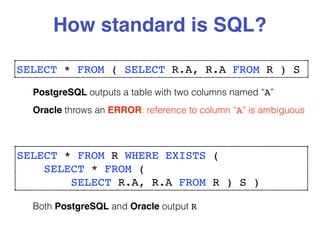
SELECT * FROM R WHERE EXISTS (
SELECT * FROM (
SELECT R.A, R.A FROM R ) S )
Both PostgreSQL and Oracle output R
SELECT * FROM ( SELECT R.A, R.A FROM R ) S
PostgreSQL outputs a table with two columns named “A”
Oracle throws an ERROR: reference to column “A” is ambiguous
Who is right?
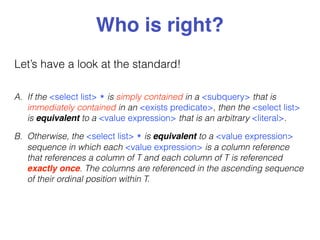
Let’s have a look at the standard!
A. If the <select list> * is simply contained in a <subquery> that is
immediately contained in an <exists predicate>, then the <select list>
is equivalent to a <value expression> that is an arbitrary <literal>.
B. Otherwise, the <select list> * is equivalent to a <value expression>
sequence in which each <value expression> is a column reference
that references a column of T and each column of T is referenced
exactly once. The columns are referenced in the ascending sequence
of their ordinal position within T.
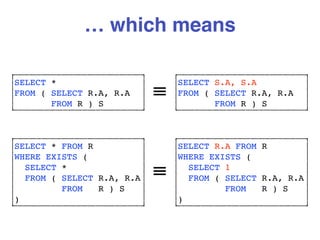
… which means
SELECT * FROM R
WHERE EXISTS (
SELECT *
FROM ( SELECT R.A, R.A
FROM R ) S
)
SELECT *
FROM ( SELECT R.A, R.A
FROM R ) S
SELECT S.A, S.A
FROM ( SELECT R.A, R.A
FROM R ) S
SELECT R.A FROM R
WHERE EXISTS (
SELECT 1
FROM ( SELECT R.A, R.A
FROM R ) S
)
≡
≡
The Need for a Formal Semantics
• Avoid ambiguity of natural language
• Clearly defined and not subject to interpretation
• Easy to understand and implement
Previous attempts
• Many simplifying assumptions: no bags, no nulls
• No justification of correctness
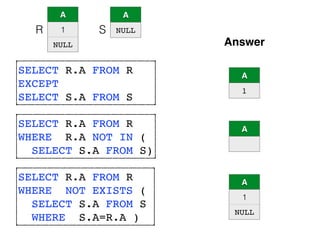
SELECT R.A FROM R
WHERE R.A NOT IN (
SELECT S.A FROM S)
SELECT R.A FROM R
EXCEPT
SELECT S.A FROM S
SELECT R.A FROM R
WHERE NOT EXISTS (
SELECT S.A FROM S
WHERE S.A=R.A )
A
1
NULL
A
NULLR S
A
1
A
1
NULL
A
Answer
Core SQL fragment
⌧ := (T1, . . . , Tk), := (N1, . . . , Nk), k > 0
↵ := (A1, . . . , Am), 0
:= (N0
1, . . . , N0
m), m > 0
Queries:
Q := SELECT [DISTINCT] (↵: 0
| *) FROM ⌧ : WHERE ✓
| Q (UNION | INTERSECT | EXCEPT) [ ALL ] Q
Conditions:
✓ := TRUE | ¯t (= | 6=) ¯t | t IS [ NOT ] NULL
| ¯t [ NOT ] IN Q | EXISTS Q
| ✓ AND ✓ | ✓ OR ✓ | NOT ✓
Figure 1: Syntax of core SQL
tribute), or a pair of names (e.g., R1.A), and values are
either constants in C or NULL.
The field name fi and the field value vi of the i-th
as the only com
arbitrary compa
clause is compu
can simply atta
2.2 Semant
The semantic
database D and
a partial map fr
⌘ provides the
name and attri
fined. One star
the semantics o
vironment gets
the notation JQ
to D and ⌘; th
JQKD,?.
To explain th
definitions rela
tions on relatio
Essentially SQL without arithmetic, grouping and aggregation
Formal Semantics: Challenges
Data model
• Base relations / query outputs / intermediate results
• Primitive data manipulation operations
Attribute references
• Binding rules in subqueries
• Environment collects and propagates bindings
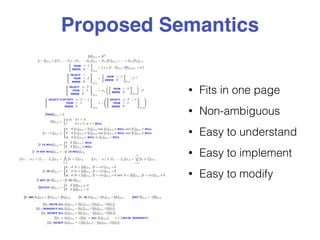
Proposed Semantics
JRKD,⌘ = RD
J⌧ : KD,⌘ = J(T1, . . . , Tk) : (N1, . . . , Nk)KD,⌘ = N1.JT1KD,⌘ ⇥ · · · ⇥ Nk.JTkKD,⌘
s
FROM ⌧ :
WHERE ✓
{
D,⌘
= ¯a 2 J⌧ : KD,⌘ | J✓KD,⌘;⌘¯a = t
t
SELECT ⇤
FROM ⌧ :
WHERE ✓
|
D,⌘
=
s
FROM ⌧ :
WHERE ✓
{
D,⌘
: 1
t
SELECT ↵ : 0
FROM ⌧ :
WHERE ✓
|
D,⌘
= ⇡↵
s
FROM ⌧ :
WHERE ✓
{
D,⌘
!
: 0
t
SELECT DISTINCT ↵ : 0
| ⇤
FROM ⌧ :
WHERE ✓
|
D,⌘
= "
0
@
t
SELECT ↵ : 0
| ⇤
FROM ⌧ :
WHERE ✓
|
D,⌘
1
A
JTRUEKD,⌘ = t
JtKD,⌘ =
⇢
⌘(A) if t = A
t if t 2 C or t = NULL
Jt1 = t2KD,⌘ =
8
<
:
t if Jt1KD,⌘ = Jt2KD,⌘ and Jt1KD,⌘ 6= NULL and Jt2KD,⌘ 6= NULL
f if Jt1KD,⌘ 6= Jt2KD,⌘ and Jt1KD,⌘ 6= NULL and Jt2KD,⌘ 6= NULL
u if Jt1KD,⌘ = NULL or Jt2KD,⌘ = NULL
Jt IS NULLKD,⌘ =
⇢
t if JtKD,⌘ = NULL
f if JtKD,⌘ 6= NULL
Jt IS NOT NULLKD,⌘ = ¬Jt IS NULLKD,⌘
J(t1, . . . tn) = (t0
1, . . . , t0
n)KD,⌘ =
n^
i=1
Jti = t0
iKD,⌘ J(t1, . . . tn) 6= (t0
1, . . . , t0
n)KD,⌘ =
n_
i=1
Jti 6= t0
iKD,⌘
J¯t IN QKD,⌘ =
8
<
:
t if 9¯r 2 JQKD,⌘ : J¯t = ⌫(¯r)KD,⌘ = t
f if 8¯r 2 JQKD,⌘ : J¯t = ⌫(¯r)KD,⌘ = f
u if @¯r 2 JQKD,⌘ : J¯t = ⌫(¯r)KD,⌘ = t and 9¯r 2 JQKD,⌘ : J¯t = ⌫(¯r)KD,⌘ 6= f
J¯t NOT IN QKD,⌘ = ¬J¯t IN QKD,⌘
JEXISTS QKD,⌘ =
⇢
t if JQKD,⌘ 6= ?
f if JQKD,⌘ = ?
J✓1 AND ✓2KD,⌘ = J✓1KD,⌘ ^ J✓2KD,⌘ J✓1 OR ✓2KD,⌘ = J✓1KD,⌘ _ J✓2KD,⌘ JNOT ✓KD,⌘ = ¬J✓KD,⌘
JQ1 UNION ALL Q2KD,⌘ = JQ1KD,⌘ [ JQ2KD,⌘ : `(JQ1K)
JQ1 INTERSECT ALL Q2KD,⌘ = JQ1KD,⌘  JQ2KD,⌘ : `(JQ1K)
JQ1 EXCEPT ALL Q2KD,⌘ = JQ1KD,⌘ JQ2KD,⌘ : `(JQ1K)
JQ1 ? Q2KD,⌘ = " JQ1 ? ALL Q2KD,⌘ , ? 2 {UNION, INTERSECT}
JQ1 EXCEPT Q2KD,⌘ = "(JQ1KD,⌘) JQ2KD,⌘ : `(JQ1K)
Figure 2: Semantics of core SQL
• Fits in one page
• Non-ambiguous
• Easy to understand
• Easy to implement
• Easy to modify
Formal Semantics: Validation
• Cannot prove that semantics is correct
• Provide sufficient experimental evidence
• Implemented in Python
• Validated on 100000+ random SQL queries
Formal Semantics of Cypher
• Collaboration between Neo Technology
and the University of Edinburgh
• Preliminary meeting in December
• Legal agreements finalized recently
• Neo Technology sponsors a researcher
(Nadime Francis)
Challenges
• Getting the (abstract) data model right
• Intermediate representation (QUIL?)
• Identify core fragment
• Language constantly evolving
• Follow the footsteps of SQL? (nulls)

Formal Semantics of SQL and Cypher

  • 1.
    Formal Semantics ofSQL (and Cypher) Paolo Guagliardo
  • 2.
    SQL • Standard querylanguage for relational databases • $30B/year business • Implemented in all major RDBMSs (free and commercial) • First standardized in 1986 (ANSI) and 1987 (ISO) • Several revision afterwards (SQL-89, SQL-92, SQL:1999, SQL:2003, SQL:2006, SQL:2008, SQL:2011, SQL:2016) “The nice thing about standards is that you have so many to choose from” — Andrew S. Tanenbaum
  • 3.
    How standard isSQL? SELECT * FROM R WHERE EXISTS ( SELECT * FROM ( SELECT R.A, R.A FROM R ) S ) Both PostgreSQL and Oracle output R SELECT * FROM ( SELECT R.A, R.A FROM R ) S PostgreSQL outputs a table with two columns named “A” Oracle throws an ERROR: reference to column “A” is ambiguous
  • 4.
    Who is right? Let’shave a look at the standard! A. If the <select list> * is simply contained in a <subquery> that is immediately contained in an <exists predicate>, then the <select list> is equivalent to a <value expression> that is an arbitrary <literal>. B. Otherwise, the <select list> * is equivalent to a <value expression> sequence in which each <value expression> is a column reference that references a column of T and each column of T is referenced exactly once. The columns are referenced in the ascending sequence of their ordinal position within T.
  • 5.
    … which means SELECT* FROM R WHERE EXISTS ( SELECT * FROM ( SELECT R.A, R.A FROM R ) S ) SELECT * FROM ( SELECT R.A, R.A FROM R ) S SELECT S.A, S.A FROM ( SELECT R.A, R.A FROM R ) S SELECT R.A FROM R WHERE EXISTS ( SELECT 1 FROM ( SELECT R.A, R.A FROM R ) S ) ≡ ≡
  • 6.
    The Need fora Formal Semantics • Avoid ambiguity of natural language • Clearly defined and not subject to interpretation • Easy to understand and implement Previous attempts • Many simplifying assumptions: no bags, no nulls • No justification of correctness
  • 7.
    SELECT R.A FROMR WHERE R.A NOT IN ( SELECT S.A FROM S) SELECT R.A FROM R EXCEPT SELECT S.A FROM S SELECT R.A FROM R WHERE NOT EXISTS ( SELECT S.A FROM S WHERE S.A=R.A ) A 1 NULL A NULLR S A 1 A 1 NULL A Answer
  • 8.
    Core SQL fragment ⌧:= (T1, . . . , Tk), := (N1, . . . , Nk), k > 0 ↵ := (A1, . . . , Am), 0 := (N0 1, . . . , N0 m), m > 0 Queries: Q := SELECT [DISTINCT] (↵: 0 | *) FROM ⌧ : WHERE ✓ | Q (UNION | INTERSECT | EXCEPT) [ ALL ] Q Conditions: ✓ := TRUE | ¯t (= | 6=) ¯t | t IS [ NOT ] NULL | ¯t [ NOT ] IN Q | EXISTS Q | ✓ AND ✓ | ✓ OR ✓ | NOT ✓ Figure 1: Syntax of core SQL tribute), or a pair of names (e.g., R1.A), and values are either constants in C or NULL. The field name fi and the field value vi of the i-th as the only com arbitrary compa clause is compu can simply atta 2.2 Semant The semantic database D and a partial map fr ⌘ provides the name and attri fined. One star the semantics o vironment gets the notation JQ to D and ⌘; th JQKD,?. To explain th definitions rela tions on relatio Essentially SQL without arithmetic, grouping and aggregation
  • 9.
    Formal Semantics: Challenges Datamodel • Base relations / query outputs / intermediate results • Primitive data manipulation operations Attribute references • Binding rules in subqueries • Environment collects and propagates bindings
  • 10.
    Proposed Semantics JRKD,⌘ =RD J⌧ : KD,⌘ = J(T1, . . . , Tk) : (N1, . . . , Nk)KD,⌘ = N1.JT1KD,⌘ ⇥ · · · ⇥ Nk.JTkKD,⌘ s FROM ⌧ : WHERE ✓ { D,⌘ = ¯a 2 J⌧ : KD,⌘ | J✓KD,⌘;⌘¯a = t t SELECT ⇤ FROM ⌧ : WHERE ✓ | D,⌘ = s FROM ⌧ : WHERE ✓ { D,⌘ : 1 t SELECT ↵ : 0 FROM ⌧ : WHERE ✓ | D,⌘ = ⇡↵ s FROM ⌧ : WHERE ✓ { D,⌘ ! : 0 t SELECT DISTINCT ↵ : 0 | ⇤ FROM ⌧ : WHERE ✓ | D,⌘ = " 0 @ t SELECT ↵ : 0 | ⇤ FROM ⌧ : WHERE ✓ | D,⌘ 1 A JTRUEKD,⌘ = t JtKD,⌘ = ⇢ ⌘(A) if t = A t if t 2 C or t = NULL Jt1 = t2KD,⌘ = 8 < : t if Jt1KD,⌘ = Jt2KD,⌘ and Jt1KD,⌘ 6= NULL and Jt2KD,⌘ 6= NULL f if Jt1KD,⌘ 6= Jt2KD,⌘ and Jt1KD,⌘ 6= NULL and Jt2KD,⌘ 6= NULL u if Jt1KD,⌘ = NULL or Jt2KD,⌘ = NULL Jt IS NULLKD,⌘ = ⇢ t if JtKD,⌘ = NULL f if JtKD,⌘ 6= NULL Jt IS NOT NULLKD,⌘ = ¬Jt IS NULLKD,⌘ J(t1, . . . tn) = (t0 1, . . . , t0 n)KD,⌘ = n^ i=1 Jti = t0 iKD,⌘ J(t1, . . . tn) 6= (t0 1, . . . , t0 n)KD,⌘ = n_ i=1 Jti 6= t0 iKD,⌘ J¯t IN QKD,⌘ = 8 < : t if 9¯r 2 JQKD,⌘ : J¯t = ⌫(¯r)KD,⌘ = t f if 8¯r 2 JQKD,⌘ : J¯t = ⌫(¯r)KD,⌘ = f u if @¯r 2 JQKD,⌘ : J¯t = ⌫(¯r)KD,⌘ = t and 9¯r 2 JQKD,⌘ : J¯t = ⌫(¯r)KD,⌘ 6= f J¯t NOT IN QKD,⌘ = ¬J¯t IN QKD,⌘ JEXISTS QKD,⌘ = ⇢ t if JQKD,⌘ 6= ? f if JQKD,⌘ = ? J✓1 AND ✓2KD,⌘ = J✓1KD,⌘ ^ J✓2KD,⌘ J✓1 OR ✓2KD,⌘ = J✓1KD,⌘ _ J✓2KD,⌘ JNOT ✓KD,⌘ = ¬J✓KD,⌘ JQ1 UNION ALL Q2KD,⌘ = JQ1KD,⌘ [ JQ2KD,⌘ : `(JQ1K) JQ1 INTERSECT ALL Q2KD,⌘ = JQ1KD,⌘ JQ2KD,⌘ : `(JQ1K) JQ1 EXCEPT ALL Q2KD,⌘ = JQ1KD,⌘ JQ2KD,⌘ : `(JQ1K) JQ1 ? Q2KD,⌘ = " JQ1 ? ALL Q2KD,⌘ , ? 2 {UNION, INTERSECT} JQ1 EXCEPT Q2KD,⌘ = "(JQ1KD,⌘) JQ2KD,⌘ : `(JQ1K) Figure 2: Semantics of core SQL • Fits in one page • Non-ambiguous • Easy to understand • Easy to implement • Easy to modify
  • 11.
    Formal Semantics: Validation •Cannot prove that semantics is correct • Provide sufficient experimental evidence • Implemented in Python • Validated on 100000+ random SQL queries
  • 12.
    Formal Semantics ofCypher • Collaboration between Neo Technology and the University of Edinburgh • Preliminary meeting in December • Legal agreements finalized recently • Neo Technology sponsors a researcher (Nadime Francis)
  • 13.
    Challenges • Getting the(abstract) data model right • Intermediate representation (QUIL?) • Identify core fragment • Language constantly evolving • Follow the footsteps of SQL? (nulls)