KANIMOZHI S
BE(CSE)
FINITE AUTOMATA
M={Q, ∑, δ,q0,F}
M-finite automata
Q-set of states
∑-inputs
δ-transition function(δ(Q* ∑)->Q)
q0-initial state
F-final state
this is a formal definition for finite automata.
 Deterministic finite automata(DFA) can also
be represented by same 5 tuples.
NON DETERMINISTIC FINITE AUTOMATA(NFA)
M={Q, ∑, δ,q0,F}
Q-set of states
∑-inputs
δ-transition function(δ(Q* ∑)->2^Q)
q0-initial state
F-final state
 Here the NFA it accepts same input as more
time.
 This is the major difference between DFA and
NFA
 The NFA with epsilon also denoted like this.
But there is transition function is
 δ’(Q* ∑*)->2^Q
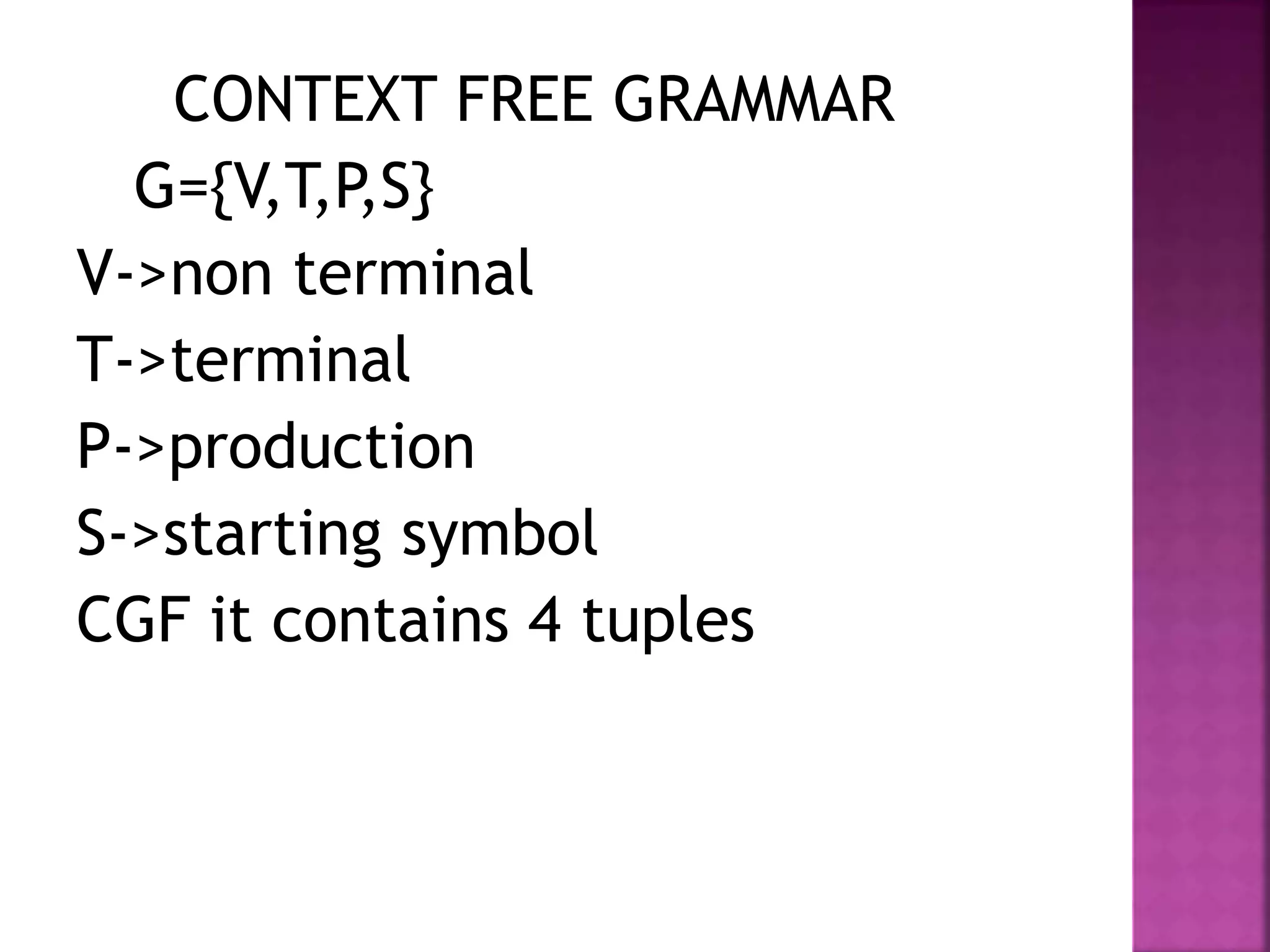
CONTEXT FREE GRAMMAR
G={V,T,P,S}
V->non terminal
T->terminal
P->production
S->starting symbol
CGF it contains 4 tuples
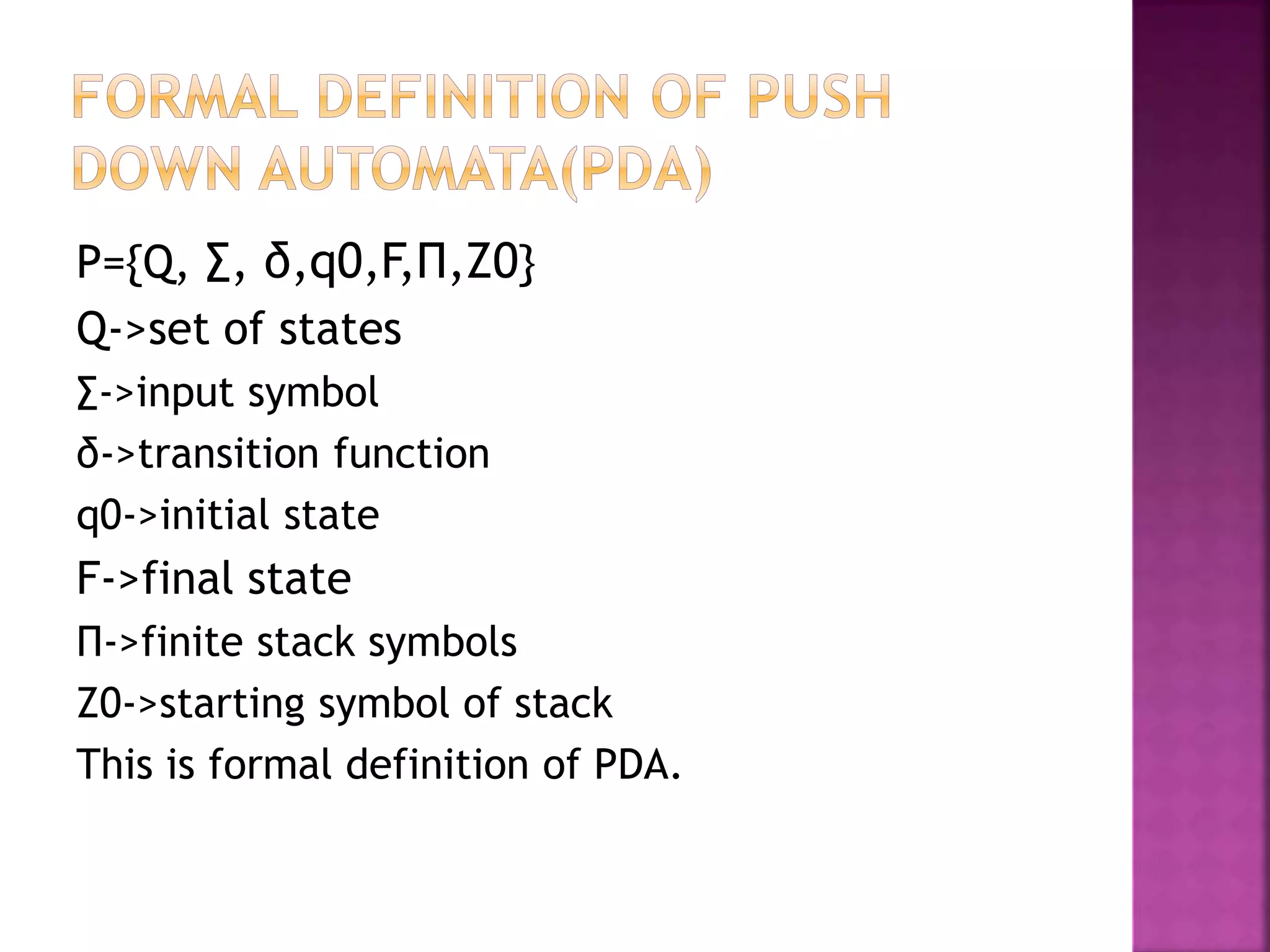
P={Q, ∑, δ,q0,F,Π,Z0}
Q->set of states
∑->input symbol
δ->transition function
q0->initial state
F->final state
Π->finite stack symbols
Z0->starting symbol of stack
This is formal definition of PDA.
δ(q,a,x)=(p,γ)
q->current state
a->input symbol
x->top stack symbol
P->new state after reading a
γ
If γ=ε then stack will popped
If γ=x then stack not change
If γ=yz then x is replaced by z and y.

formal definitions in theory of computation

  • 1.
  • 2.
    FINITE AUTOMATA M={Q, ∑,δ,q0,F} M-finite automata Q-set of states ∑-inputs δ-transition function(δ(Q* ∑)->Q) q0-initial state F-final state this is a formal definition for finite automata.  Deterministic finite automata(DFA) can also be represented by same 5 tuples.
  • 3.
    NON DETERMINISTIC FINITEAUTOMATA(NFA) M={Q, ∑, δ,q0,F} Q-set of states ∑-inputs δ-transition function(δ(Q* ∑)->2^Q) q0-initial state F-final state  Here the NFA it accepts same input as more time.  This is the major difference between DFA and NFA  The NFA with epsilon also denoted like this. But there is transition function is  δ’(Q* ∑*)->2^Q
  • 4.
    CONTEXT FREE GRAMMAR G={V,T,P,S} V->nonterminal T->terminal P->production S->starting symbol CGF it contains 4 tuples
  • 5.
    P={Q, ∑, δ,q0,F,Π,Z0} Q->setof states ∑->input symbol δ->transition function q0->initial state F->final state Π->finite stack symbols Z0->starting symbol of stack This is formal definition of PDA.
  • 6.
    δ(q,a,x)=(p,γ) q->current state a->input symbol x->topstack symbol P->new state after reading a γ If γ=ε then stack will popped If γ=x then stack not change If γ=yz then x is replaced by z and y.