BY MILITARY SCIENTIST RAKAU FARMASUM FELIX BILLY
IN REGARD TO OPERATION WARP SPEED
OCTOBER 29, 2020
FORESIGHT ON MANUFACTURING MEDICAL
LABORATORY EQUIPMENT- FOR CENTURY
AUTOMATION
INTRODUCTION






Medical laboratory automation of the 21st century
demonstrate each and every second into the future.
It stretches back in time as labs took their tentative steps
towards advancement in automation.
Driven by the imperatives of greater efficiency, more precision
and round the clock operation are used.
Sophisticated forms of automation are now widely applied in
enhancing medical laboratory productivity.
Medical laboratory device, equipment, test strips and kits are
designed and manufactured based on problem solving.
Including new medical discoveries, design control, quality
assurance, reducing error, accelerating research,
standardising process and improving safety.
INTRODUCTION CONT.




The word automation is inspired by the word automatic
which means exercising control without interference.
Automation means getting work done by machines which
can run on their own without continuous monitoring.
Shaping the laboratories of the future address effectively
human computer interaction, which is emerging as the key
challenge in creating a productive and efficient lab of the
future.
The health care system is meant to be programmed with
medical laboratory automated readiness, in order to test
and tackle emerging and remerging infectious diseases.
INTODUCTION CONT.






The three key areas that would impact on the laboratory
of the tomorrow include :
The driving forces that shape how workplaces will look
like in the future;
Relevant research themes tackled among team work;
And what the implications are for laboratory automation.
Innovation in robotics and information technology have
transformed research.
In the search for new medical discoveries, automated
laboratories use robots to manipulate, store and retrieve
titre plates.
INTRODUCTION CONT.




Clinical diagnosis automation is an integral part of the
medical laboratory automation process.
It is a multidisciplinary strategy for the purpose of
capitalizing, optimizing, developing and research on
the technologies used in clinical diagnosis.
As a clinical diagnosis automation professional,
advanced and new technologies are developed in
order to improve productivity;
By enhancing the data quality of the experiments,
decreasing the lab process cycle time, and enabling
experimentation.
INTRODUCTION CONT.




Laboratory robotics field for example comprises of many
different types of automated instruments and devices;
Such as autosamplers, software algorithms, and various
methodologies.
These instruments and algorithms are employed to
enhance the effectiveness and efficiency of clinical
diagnosis in medical laboratories.
The most common software and equipment found in the
global clinical diagnosis automation market are
informatics and software, retrieval systems, standalone
robots, microplate readers and automated liquid handling
equipment.
MANUFACTURERS DESIGN CONTROL





Manufacturers are intended to understand quality system
requirement concerning design control.
Design controls are an interrelated set of practices and
procedures that are incorporated into the design and
development process, i.e. a system of check and balances.
Errors and discrepancies are corrected between the
proposed designs and requirements, are made evident and
corrected earlier in the development process.
Medical industry encompasses a wide range of technologies
and applications, ranging from simple hand tools to complex
computer-controlled machines;
From blood-glucose test strips to diagnosing imaging
systems and laboratory test equipment.
MANUFACTURERS DESIGN CONTROL CONT.




These equipment are manufactured by companies varying
in size and structure, methods of design and development,
and methods of management.
Designers benefit both by enhanced understanding of the
degree of conformance of the design to users and patient
needs, and by improved communications and coordination.
Armed with this basic knowledge, manufacturers can and
should seek out technology-specific guidance on applying
design controls to their particular situation.
There are benefits to an organisation and the quality
improvement of an organisation by having a written design
control system.
MANUFACTURERS DESIGN CONTROL CONT.




By defining this system on paper, a corporation allows
all its employees to understand the requirement, the
process and expectations of the design.
And also how the quality of design is assured and
perceived by the system.
It also provides a baseline to review the system
periodically for further improvements based on history ,
problems and failures of the system.
Verification and validation are checks and balances in
the design process that identify deficiencies and
discrepancies in the design before the equipment is
produced.
MANUFACTURERS DESIGN CONTROL CONT.




The requirements specification is an elaboration,
expansion, and translation of the need into engineering
terms.
The requirement specifications begin the design
process by defining what is needed.
The first assessment of how a new product can meet
business objectives typically needs to be done before
any significant development or investment takes place.
The second phase of the requirements capture
method, involves use of the functional analysis tool and
is intended to identify functional and performance
requirement.
MANUFACTURERS DESIGN CONTROL CONT.




Functional analysis is often done during the concept
generation of the design in order to help designers
generate possible solutions.
The purpose of the matrix checklist is to identify
requirements not captured by functional analysis.
Most of the requirements apply to the product as a
whole, not to a particular function.
Hence, the requirement specification method captures
problem definition, functional analysis, matrix checklist,
regulatory requirements guidelines, and specification
templates.
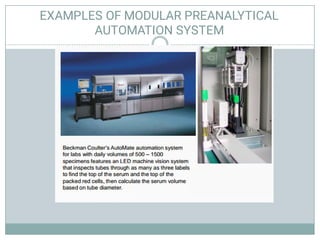
EXAMPLES OF MODULAR PREANALYTICAL
AUTOMATION SYSTEM
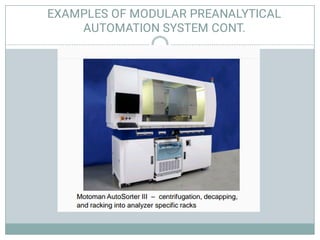
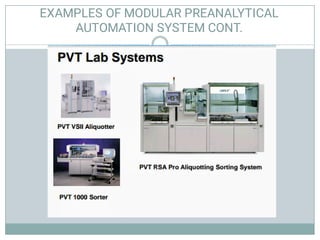
EXAMPLES OF MODULAR PREANALYTICAL
AUTOMATION SYSTEM CONT.
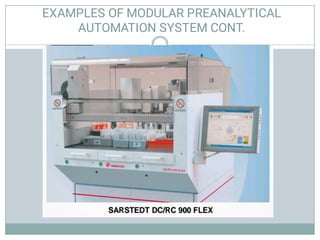
EXAMPLES OF MODULAR PREANALYTICAL
AUTOMATION SYSTEM CONT.
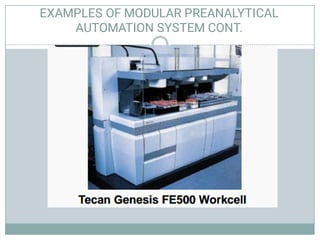
EXAMPLES OF MODULAR PREANALYTICAL
AUTOMATION SYSTEM CONT.
EXAMPLES OF MODULAR PREANALYTICAL
AUTOMATION SYSTEM CONT.
EXAMPLES OF MODULAR PREANALYTICAL
AUTOMATION SYSTEM CONT.
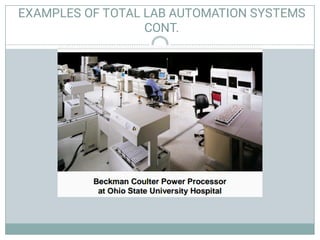
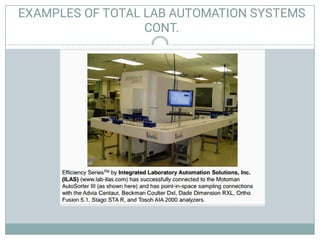
EXAMPLES OF TOTAL LAB AUTOMATION SYSTEMS
CONT.
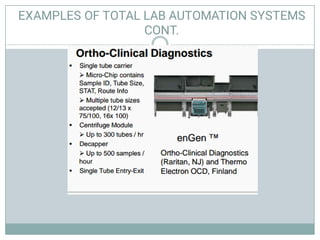
EXAMPLES OF TOTAL LAB AUTOMATION SYSTEMS
CONT.
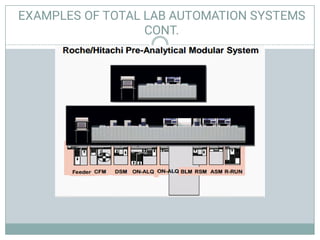
EXAMPLES OF TOTAL LAB AUTOMATION SYSTEMS
CONT.
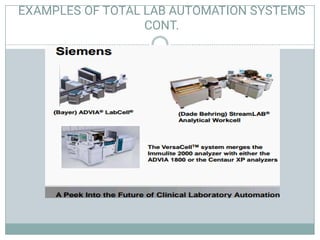
EXAMPLES OF TOTAL LAB AUTOMATION SYSTEMS
CONT.
EXAMPLES OF TOTAL LAB AUTOMATION SYSTEMS
CONT.
PARTNERING GOVERNMENT AND INTERNATIONAL
ORGANISATION










UNITED STATES MILITARY
UNITED STATES AIR FORCE
UNITED STATES SPACE FORCE
DEFENCE ADVANCED RESEARCH PROJECTS AGENCY
AIR FORCE RESEARCH LABORATORY
NATIONAL ASSOCIATION OF MANUFACTURERS
UNITED STATES MINORITY CONTRACTORS ASSOCIATION
INDUSTRIAL EXHIBITION
UNITED STATES AGENCY FOR INTERNATIONAL
DEVELOPMENT
PRESIDENT’S EMERGENCY PLAN FOR AIDS RELIEF
REGULATIONS AND REFERENCE








EUROPEAN UNION REGULATIONS
UNITED KINGDOM MEDICAL DEVICES AGENCY
GUIDANCE
FOOD AND DRUG ADMINISTRATION DEVICE ADVICE
CENTER FOR DEVICES AND RADIOLOGICAL HEALTH
AMERICAN NATIONAL STANDARD INSTITUTE
INTERNATIONAL ELECTROTECHNICAL COMMISSION
INTERNATIONAL ORGANIZATION FOR
STANDARDIZATION
CENTERS FOR DISEASE CONTROL AND PREVENTION

FORESIGHT_ON_MANUFACTURING_MEDICAL_LABOR.pdf

  • 1.
    BY MILITARY SCIENTISTRAKAU FARMASUM FELIX BILLY IN REGARD TO OPERATION WARP SPEED OCTOBER 29, 2020 FORESIGHT ON MANUFACTURING MEDICAL LABORATORY EQUIPMENT- FOR CENTURY AUTOMATION
  • 2.
    INTRODUCTION       Medical laboratory automationof the 21st century demonstrate each and every second into the future. It stretches back in time as labs took their tentative steps towards advancement in automation. Driven by the imperatives of greater efficiency, more precision and round the clock operation are used. Sophisticated forms of automation are now widely applied in enhancing medical laboratory productivity. Medical laboratory device, equipment, test strips and kits are designed and manufactured based on problem solving. Including new medical discoveries, design control, quality assurance, reducing error, accelerating research, standardising process and improving safety.
  • 3.
    INTRODUCTION CONT.     The wordautomation is inspired by the word automatic which means exercising control without interference. Automation means getting work done by machines which can run on their own without continuous monitoring. Shaping the laboratories of the future address effectively human computer interaction, which is emerging as the key challenge in creating a productive and efficient lab of the future. The health care system is meant to be programmed with medical laboratory automated readiness, in order to test and tackle emerging and remerging infectious diseases.
  • 4.
    INTODUCTION CONT.       The threekey areas that would impact on the laboratory of the tomorrow include : The driving forces that shape how workplaces will look like in the future; Relevant research themes tackled among team work; And what the implications are for laboratory automation. Innovation in robotics and information technology have transformed research. In the search for new medical discoveries, automated laboratories use robots to manipulate, store and retrieve titre plates.
  • 5.
    INTRODUCTION CONT.     Clinical diagnosisautomation is an integral part of the medical laboratory automation process. It is a multidisciplinary strategy for the purpose of capitalizing, optimizing, developing and research on the technologies used in clinical diagnosis. As a clinical diagnosis automation professional, advanced and new technologies are developed in order to improve productivity; By enhancing the data quality of the experiments, decreasing the lab process cycle time, and enabling experimentation.
  • 6.
    INTRODUCTION CONT.     Laboratory roboticsfield for example comprises of many different types of automated instruments and devices; Such as autosamplers, software algorithms, and various methodologies. These instruments and algorithms are employed to enhance the effectiveness and efficiency of clinical diagnosis in medical laboratories. The most common software and equipment found in the global clinical diagnosis automation market are informatics and software, retrieval systems, standalone robots, microplate readers and automated liquid handling equipment.
  • 7.
    MANUFACTURERS DESIGN CONTROL      Manufacturersare intended to understand quality system requirement concerning design control. Design controls are an interrelated set of practices and procedures that are incorporated into the design and development process, i.e. a system of check and balances. Errors and discrepancies are corrected between the proposed designs and requirements, are made evident and corrected earlier in the development process. Medical industry encompasses a wide range of technologies and applications, ranging from simple hand tools to complex computer-controlled machines; From blood-glucose test strips to diagnosing imaging systems and laboratory test equipment.
  • 8.
    MANUFACTURERS DESIGN CONTROLCONT.     These equipment are manufactured by companies varying in size and structure, methods of design and development, and methods of management. Designers benefit both by enhanced understanding of the degree of conformance of the design to users and patient needs, and by improved communications and coordination. Armed with this basic knowledge, manufacturers can and should seek out technology-specific guidance on applying design controls to their particular situation. There are benefits to an organisation and the quality improvement of an organisation by having a written design control system.
  • 9.
    MANUFACTURERS DESIGN CONTROLCONT.     By defining this system on paper, a corporation allows all its employees to understand the requirement, the process and expectations of the design. And also how the quality of design is assured and perceived by the system. It also provides a baseline to review the system periodically for further improvements based on history , problems and failures of the system. Verification and validation are checks and balances in the design process that identify deficiencies and discrepancies in the design before the equipment is produced.
  • 10.
    MANUFACTURERS DESIGN CONTROLCONT.     The requirements specification is an elaboration, expansion, and translation of the need into engineering terms. The requirement specifications begin the design process by defining what is needed. The first assessment of how a new product can meet business objectives typically needs to be done before any significant development or investment takes place. The second phase of the requirements capture method, involves use of the functional analysis tool and is intended to identify functional and performance requirement.
  • 11.
    MANUFACTURERS DESIGN CONTROLCONT.     Functional analysis is often done during the concept generation of the design in order to help designers generate possible solutions. The purpose of the matrix checklist is to identify requirements not captured by functional analysis. Most of the requirements apply to the product as a whole, not to a particular function. Hence, the requirement specification method captures problem definition, functional analysis, matrix checklist, regulatory requirements guidelines, and specification templates.
  • 12.
    EXAMPLES OF MODULARPREANALYTICAL AUTOMATION SYSTEM
  • 13.
    EXAMPLES OF MODULARPREANALYTICAL AUTOMATION SYSTEM CONT.
  • 14.
    EXAMPLES OF MODULARPREANALYTICAL AUTOMATION SYSTEM CONT.
  • 15.
    EXAMPLES OF MODULARPREANALYTICAL AUTOMATION SYSTEM CONT.
  • 16.
    EXAMPLES OF MODULARPREANALYTICAL AUTOMATION SYSTEM CONT.
  • 17.
    EXAMPLES OF MODULARPREANALYTICAL AUTOMATION SYSTEM CONT.
  • 18.
    EXAMPLES OF TOTALLAB AUTOMATION SYSTEMS
  • 19.
    EXAMPLES OF TOTALLAB AUTOMATION SYSTEMS CONT.
  • 20.
    EXAMPLES OF TOTALLAB AUTOMATION SYSTEMS CONT.
  • 21.
    EXAMPLES OF TOTALLAB AUTOMATION SYSTEMS CONT.
  • 22.
    EXAMPLES OF TOTALLAB AUTOMATION SYSTEMS CONT.
  • 23.
    EXAMPLES OF TOTALLAB AUTOMATION SYSTEMS CONT.
  • 24.
    PARTNERING GOVERNMENT ANDINTERNATIONAL ORGANISATION           UNITED STATES MILITARY UNITED STATES AIR FORCE UNITED STATES SPACE FORCE DEFENCE ADVANCED RESEARCH PROJECTS AGENCY AIR FORCE RESEARCH LABORATORY NATIONAL ASSOCIATION OF MANUFACTURERS UNITED STATES MINORITY CONTRACTORS ASSOCIATION INDUSTRIAL EXHIBITION UNITED STATES AGENCY FOR INTERNATIONAL DEVELOPMENT PRESIDENT’S EMERGENCY PLAN FOR AIDS RELIEF
  • 25.
    REGULATIONS AND REFERENCE         EUROPEANUNION REGULATIONS UNITED KINGDOM MEDICAL DEVICES AGENCY GUIDANCE FOOD AND DRUG ADMINISTRATION DEVICE ADVICE CENTER FOR DEVICES AND RADIOLOGICAL HEALTH AMERICAN NATIONAL STANDARD INSTITUTE INTERNATIONAL ELECTROTECHNICAL COMMISSION INTERNATIONAL ORGANIZATION FOR STANDARDIZATION CENTERS FOR DISEASE CONTROL AND PREVENTION