PROVISIONS PERTAINING TO SANITARY AND PHYTOSANITRY MEASURES
SUBMITTED BY:-
KANCHAN
LL.B (Hons.) – 5th Sem.
• 1 Introduction
• 2 Objective & Scope
• 3 History
• 4 Basic Principles of the SPS Agreement
• 5 Risk Analysis Obligations
• 6 Other Substantive Provisions
• 7 Institutional and Procedural Provisions
• 8 Special Provisions for Developing Countries
• 9 Conclusion
• In 1994, with the creation of the planet Trade Organization, a replacement
multilateral agreement was adopted: the Agreement on the appliance of
Sanitary and Phytosanitary Measures (SPS Agreement). Within the WTO
framework, the SPS Agreement recognizes the proper of Members to adopt
science-based measures necessary to make sure food safety; human, animal
or flowers or health; or to guard the territory of a rustic from pests or
diseases.
• The SPS Agreement seeks to strike a balance between the necessity to make
sure that a country's consumers are being furnished with food that's safe to
eat and at an equivalent time, the necessity to make sure that strict health
and safety regulations aren't getting used as an excuse for shielding
domestic producers and thus restricting international trade.
• However, such measures shall not be applied during a manner which
constitutes arbitrary or unjustifiable discrimination between Members (where
similar conditions prevail) or a disguised restriction to international trade.
Objectives:-
• To make sure that customers are being furnished with safe food to eat
– “safe” by the acceptable standards;
• To provide superior choice of safe foods for consumers in the market;
• To promote international competition among producers to make
available safe and healthy food products;
• To increase the quantity of obtainable information for consumers as a
results of greater transparency in governmental procedures;
• To increase the quantity of obtainable information for importers and
to eliminate unjustified border measures;
• To eliminate the unnecessary and unjustified trade barriers.
Scope:-
• Article 1.1 - of the SPS Agreement defines the scope of application
of the Agreement. It provides:
• This Agreement applies to all or any sanitary and phytosanitary
measures which can, directly or indirectly, affect international trade.
Such measures shall be established and functional in accordance with the
provisions of this Agreement.
• 1 Fundamental Scope:-
• 2 Temporal Scope of Application
• 3 Application to Bodies aside from Central Government
• 4 Relations with other WTO Agreements
• The Agreement on the appliance of Sanitary and Phytosanitary Measures,
commonly mentioned because the SPS Agreement, is one of the WTO
agreements which resulted from the Uruguay Round of Multilateral Trade
Negotiations, held from 1986 to 1993 under the umbrella of the GATT.
•
• The SPS Agreement is contained in Annex 1 A of the 1994 Marrakesh
Agreement Establishing the Planet Trade Organization and came into force on 1
January 1995. This Agreement was negotiated in the cycle with the Agreement
on Agriculture, as negotiators wanted to form sure that the hard-won
liberalization within the agricultural sector achieved by the Agreement on
Agriculture wouldn't be undermined by the misuse of health regulations for
protectionist purposes.
• The SPS Agreement creates restraints applicable to procedures for the
protection of human and animal life or health (sanitary measures) and of plants
or health (phytosanitary measures) from certain, defined risks. The SPS
Agreement hence aims to resolve trade with legitimate concerns for the life and
health of humans, animals and plants.
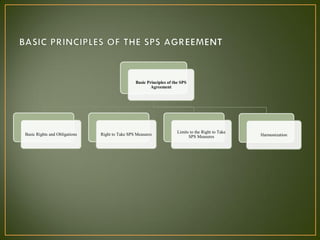
Basic Principles of the SPS
Agreement
Basic Rights and Obligations Right to Take SPS Measures
Limits to the Right to Take
SPS Measures Harmonization
Risk Assessment
Risk Management
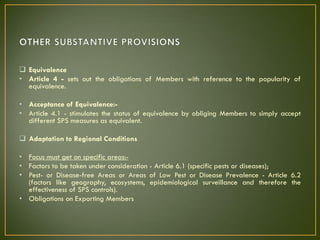
 Equivalence
• Article 4 - sets out the obligations of Members with reference to the popularity of
equivalence.
• Acceptance of Equivalence:-
• Article 4.1 - stimulates the status of equivalence by obliging Members to simply accept
different SPS measures as equivalent.
 Adaptation to Regional Conditions
• Focus must get on specific areas:-
• Factors to be taken under consideration - Article 6.1 (specific pests or diseases);
• Pest- or Disease-free Areas or Areas of Low Pest or Disease Prevalence - Article 6.2
(factors like geography, ecosystems, epidemiological surveillance and therefore the
effectiveness of SPS controls).
• Obligations on Exporting Members
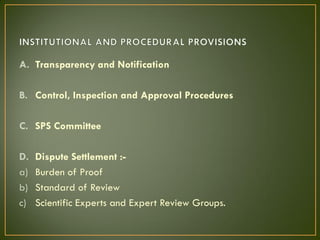
A. Transparency and Notification
B. Control, Inspection and Approval Procedures
C. SPS Committee
D. Dispute Settlement :-
a) Burden of Proof
b) Standard of Review
c) Scientific Experts and Expert Review Groups.
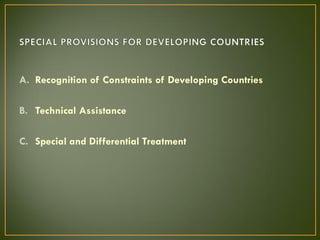
A. Recognition of Constraints of Developing Countries
B. Technical Assistance
C. Special and Differential Treatment
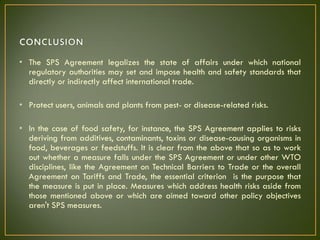
• The SPS Agreement legalizes the state of affairs under which national
regulatory authorities may set and impose health and safety standards that
directly or indirectly affect international trade.
• Protect users, animals and plants from pest- or disease-related risks.
• In the case of food safety, for instance, the SPS Agreement applies to risks
deriving from additives, contaminants, toxins or disease-causing organisms in
food, beverages or feedstuffs. It is clear from the above that so as to work
out whether a measure falls under the SPS Agreement or under other WTO
disciplines, like the Agreement on Technical Barriers to Trade or the overall
Agreement on Tariffs and Trade, the essential criterion is the purpose that
the measure is put in place. Measures which address health risks aside from
those mentioned above or which are aimed toward other policy objectives
aren't SPS measures.
Foreign Trade Law

Foreign Trade Law

  • 1.
    PROVISIONS PERTAINING TOSANITARY AND PHYTOSANITRY MEASURES SUBMITTED BY:- KANCHAN LL.B (Hons.) – 5th Sem.
  • 2.
    • 1 Introduction •2 Objective & Scope • 3 History • 4 Basic Principles of the SPS Agreement • 5 Risk Analysis Obligations • 6 Other Substantive Provisions • 7 Institutional and Procedural Provisions • 8 Special Provisions for Developing Countries • 9 Conclusion
  • 3.
    • In 1994,with the creation of the planet Trade Organization, a replacement multilateral agreement was adopted: the Agreement on the appliance of Sanitary and Phytosanitary Measures (SPS Agreement). Within the WTO framework, the SPS Agreement recognizes the proper of Members to adopt science-based measures necessary to make sure food safety; human, animal or flowers or health; or to guard the territory of a rustic from pests or diseases. • The SPS Agreement seeks to strike a balance between the necessity to make sure that a country's consumers are being furnished with food that's safe to eat and at an equivalent time, the necessity to make sure that strict health and safety regulations aren't getting used as an excuse for shielding domestic producers and thus restricting international trade. • However, such measures shall not be applied during a manner which constitutes arbitrary or unjustifiable discrimination between Members (where similar conditions prevail) or a disguised restriction to international trade.
  • 4.
    Objectives:- • To makesure that customers are being furnished with safe food to eat – “safe” by the acceptable standards; • To provide superior choice of safe foods for consumers in the market; • To promote international competition among producers to make available safe and healthy food products; • To increase the quantity of obtainable information for consumers as a results of greater transparency in governmental procedures; • To increase the quantity of obtainable information for importers and to eliminate unjustified border measures; • To eliminate the unnecessary and unjustified trade barriers.
  • 5.
    Scope:- • Article 1.1- of the SPS Agreement defines the scope of application of the Agreement. It provides: • This Agreement applies to all or any sanitary and phytosanitary measures which can, directly or indirectly, affect international trade. Such measures shall be established and functional in accordance with the provisions of this Agreement. • 1 Fundamental Scope:- • 2 Temporal Scope of Application • 3 Application to Bodies aside from Central Government • 4 Relations with other WTO Agreements
  • 6.
    • The Agreementon the appliance of Sanitary and Phytosanitary Measures, commonly mentioned because the SPS Agreement, is one of the WTO agreements which resulted from the Uruguay Round of Multilateral Trade Negotiations, held from 1986 to 1993 under the umbrella of the GATT. • • The SPS Agreement is contained in Annex 1 A of the 1994 Marrakesh Agreement Establishing the Planet Trade Organization and came into force on 1 January 1995. This Agreement was negotiated in the cycle with the Agreement on Agriculture, as negotiators wanted to form sure that the hard-won liberalization within the agricultural sector achieved by the Agreement on Agriculture wouldn't be undermined by the misuse of health regulations for protectionist purposes. • The SPS Agreement creates restraints applicable to procedures for the protection of human and animal life or health (sanitary measures) and of plants or health (phytosanitary measures) from certain, defined risks. The SPS Agreement hence aims to resolve trade with legitimate concerns for the life and health of humans, animals and plants.
  • 7.
    Basic Principles ofthe SPS Agreement Basic Rights and Obligations Right to Take SPS Measures Limits to the Right to Take SPS Measures Harmonization
  • 8.
  • 9.
     Equivalence • Article4 - sets out the obligations of Members with reference to the popularity of equivalence. • Acceptance of Equivalence:- • Article 4.1 - stimulates the status of equivalence by obliging Members to simply accept different SPS measures as equivalent.  Adaptation to Regional Conditions • Focus must get on specific areas:- • Factors to be taken under consideration - Article 6.1 (specific pests or diseases); • Pest- or Disease-free Areas or Areas of Low Pest or Disease Prevalence - Article 6.2 (factors like geography, ecosystems, epidemiological surveillance and therefore the effectiveness of SPS controls). • Obligations on Exporting Members
  • 10.
    A. Transparency andNotification B. Control, Inspection and Approval Procedures C. SPS Committee D. Dispute Settlement :- a) Burden of Proof b) Standard of Review c) Scientific Experts and Expert Review Groups.
  • 11.
    A. Recognition ofConstraints of Developing Countries B. Technical Assistance C. Special and Differential Treatment
  • 12.
    • The SPSAgreement legalizes the state of affairs under which national regulatory authorities may set and impose health and safety standards that directly or indirectly affect international trade. • Protect users, animals and plants from pest- or disease-related risks. • In the case of food safety, for instance, the SPS Agreement applies to risks deriving from additives, contaminants, toxins or disease-causing organisms in food, beverages or feedstuffs. It is clear from the above that so as to work out whether a measure falls under the SPS Agreement or under other WTO disciplines, like the Agreement on Technical Barriers to Trade or the overall Agreement on Tariffs and Trade, the essential criterion is the purpose that the measure is put in place. Measures which address health risks aside from those mentioned above or which are aimed toward other policy objectives aren't SPS measures.