Forecasting
with
Intermittent
Demand –
A New Approach
HANS LEVENBACH
ISIS SANTOS COSTA
In IJF, Almost Three Decades Ago Now
. . .
The signal failure on the part of statisticians to respond to the model building failures identified in many
empirical studies (..on forecast accuracy measurement..) has not been resolved within the forecasting
profession itself. Robert Fildes, IJF 8 (1992), 1-2.
The focus in forecast evaluation should be shifted from a measure-oriented approach to a distributions-
oriented approach in which distributions are primary and other measures are viewed as summarizing
different aspects of the distributions. Allan H. Murphy and Robert Winkler, IJF 8 (1992), 105-07,
A particularly sobering finding is the poor performance of the RMSE. The reliability of the RMSE is poor
(in forecasting) and it is scale dependent. Dennis A. Ahlburg, IJF 8 (1992). 99-100.
Agenda
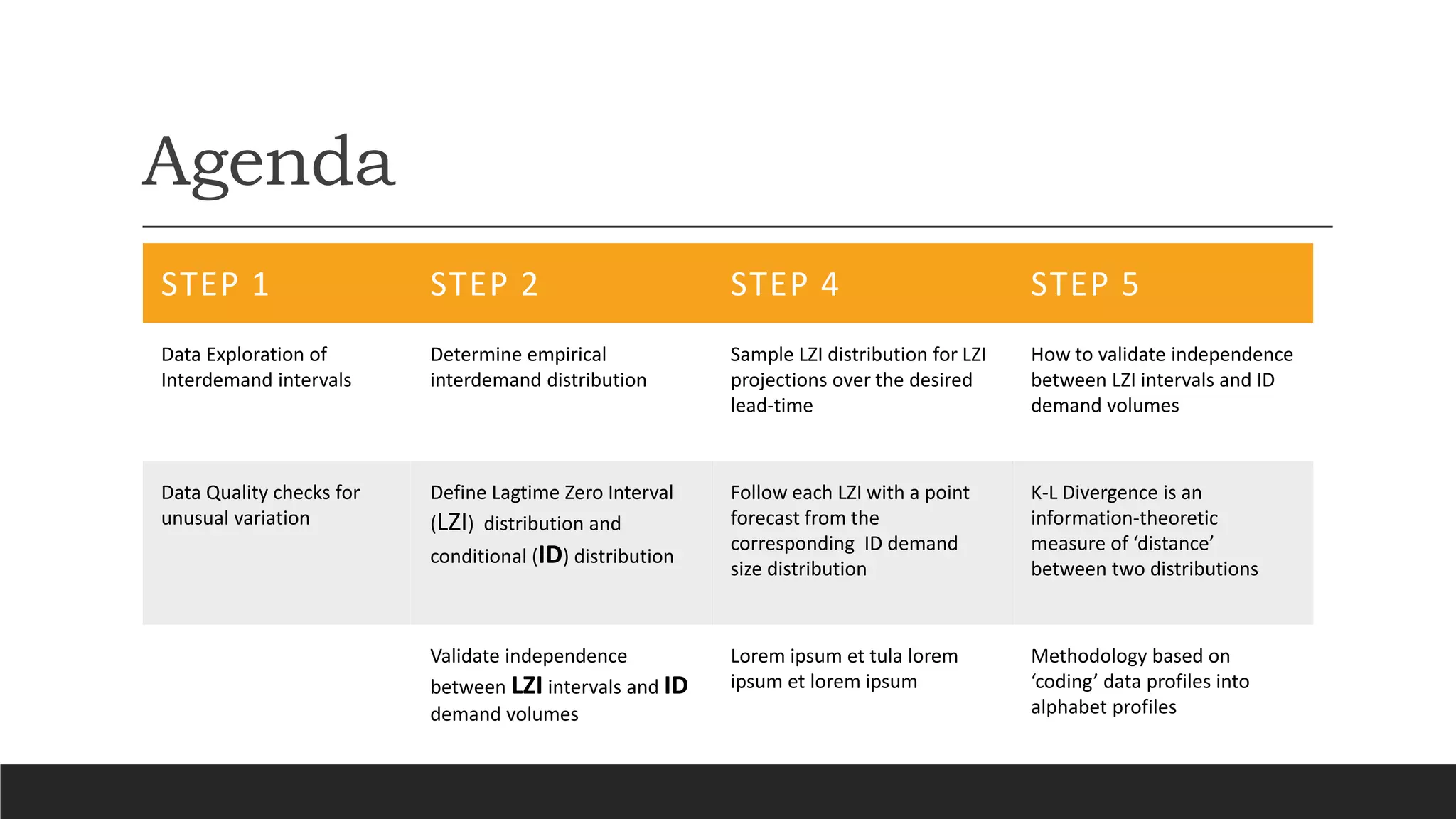
STEP 1 STEP 2 STEP 4 STEP 5
Data Exploration of
Interdemand intervals
Determine empirical
interdemand distribution
Sample LZI distribution for LZI
projections over the desired
lead-time
How to validate independence
between LZI intervals and ID
demand volumes
Data Quality checks for
unusual variation
Define Lagtime Zero Interval
(LZI) distribution and
conditional (ID) distribution
Follow each LZI with a point
forecast from the
corresponding ID demand
size distribution
K-L Divergence is an
information-theoretic
measure of ‘distance’
between two distributions
Validate independence
between LZI intervals and ID
demand volumes
Lorem ipsum et tula lorem
ipsum et lorem ipsum
Methodology based on
‘coding’ data profiles into
alphabet profiles
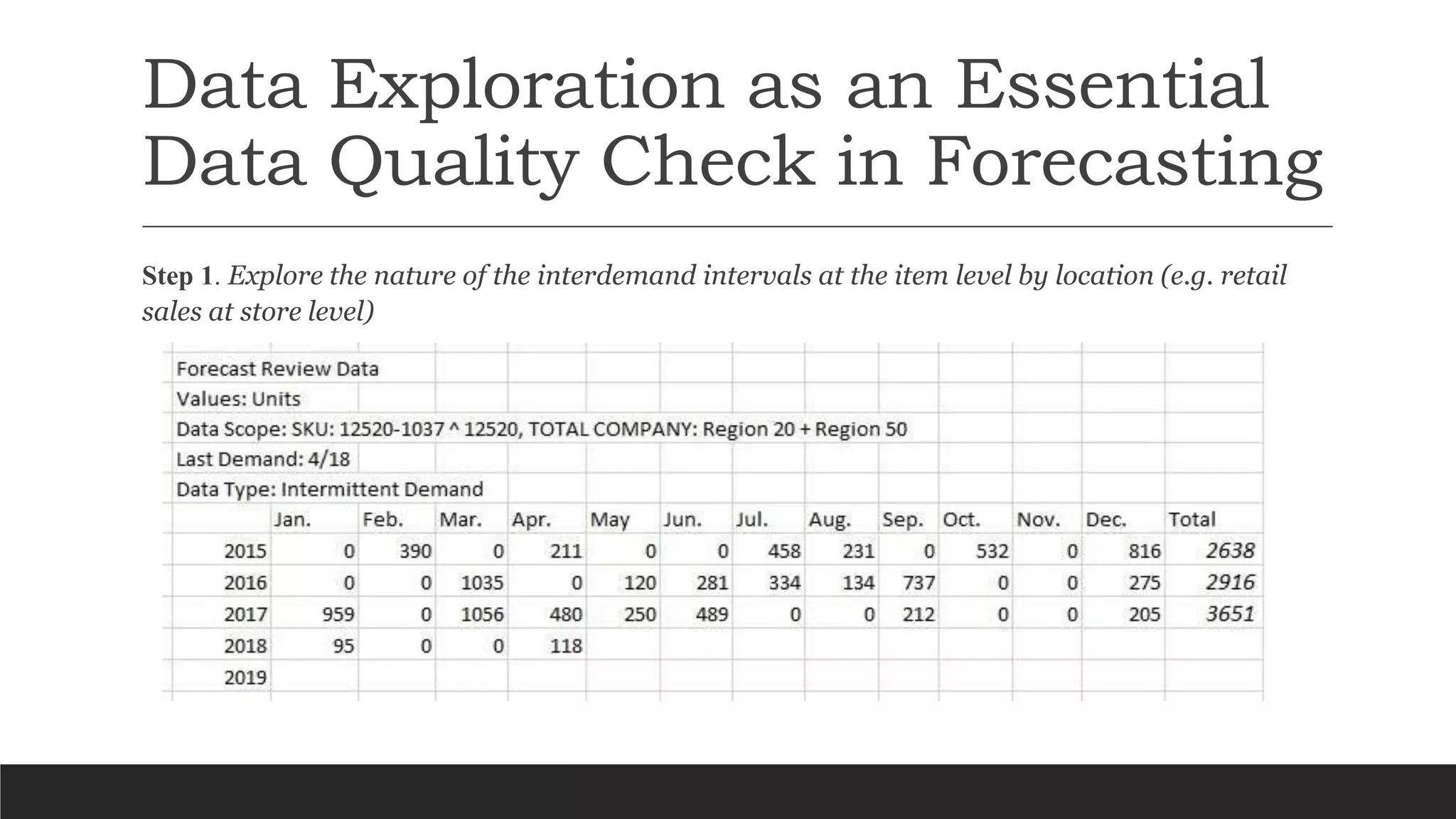
Data Exploration as an Essential
Data Quality Check in Forecasting
Step 1. Explore the nature of the interdemand intervals at the item level by location (e.g. retail
sales at store level)
Forecasting Intermittent Demand:
Going Beyond Croston Methods
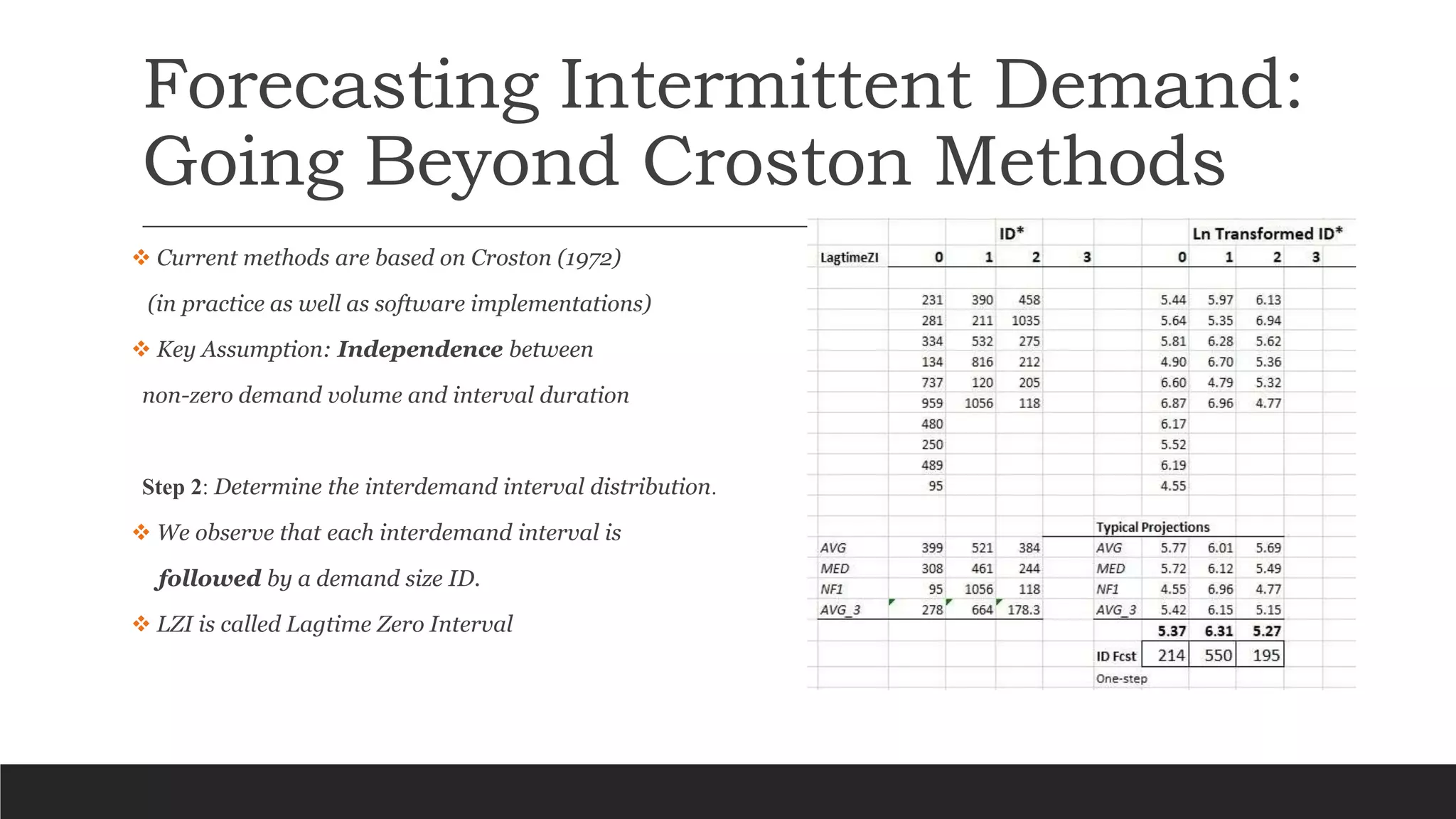
 Current methods are based on Croston (1972)
(in practice as well as software implementations)
 Key Assumption: Independence between
non-zero demand volume and interval duration
Step 2: Determine the interdemand interval distribution.
 We observe that each interdemand interval is
followed by a demand size ID.
 LZI is called Lagtime Zero Interval
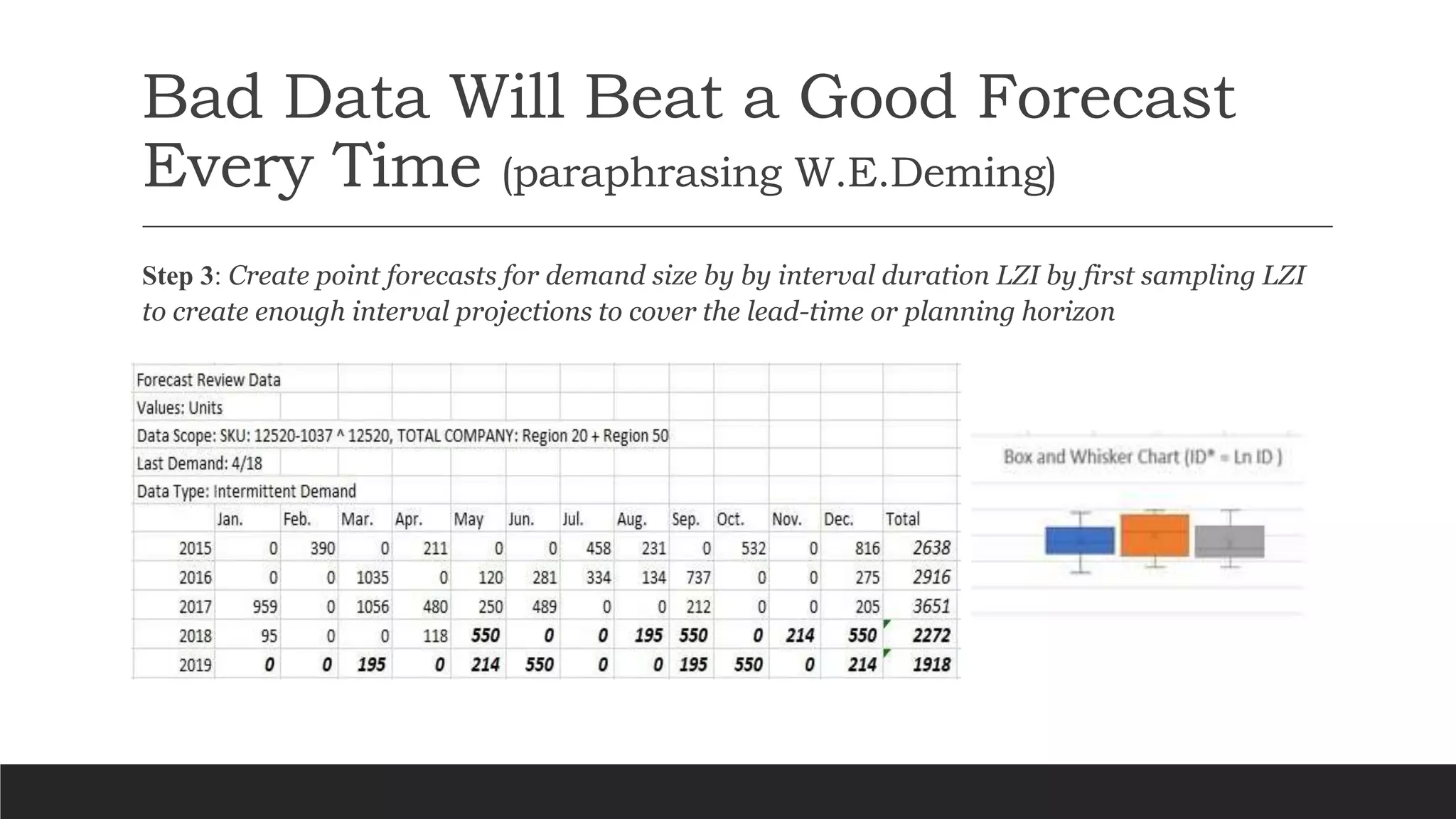
Bad Data Will Beat a Good Forecast
Every Time (paraphrasing W.E.Deming)
Step 3: Create point forecasts for demand size by by interval duration LZI by first sampling LZI
to create enough interval projections to cover the lead-time or planning horizon
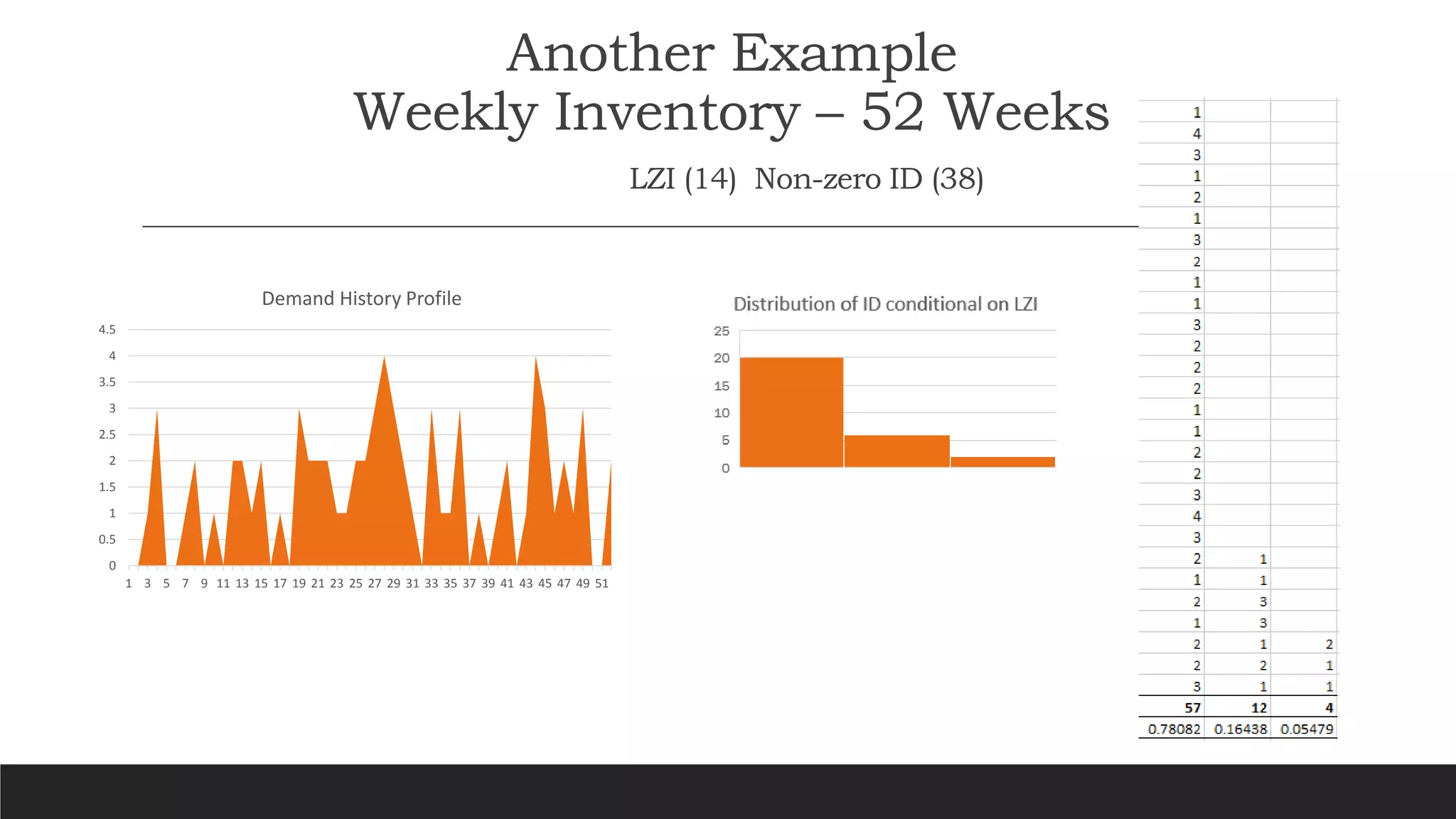
Another Example
Weekly Inventory – 52 Weeks
LZI (14) Non-zero ID (38)
0
0.5
1
1.5
2
2.5
3
3.5
4
4.5
1 3 5 7 9 11 13 15 17 19 21 23 25 27 29 31 33 35 37 39 41 43 45 47 49 51
Demand History Profile
How We Can Validate
Independence
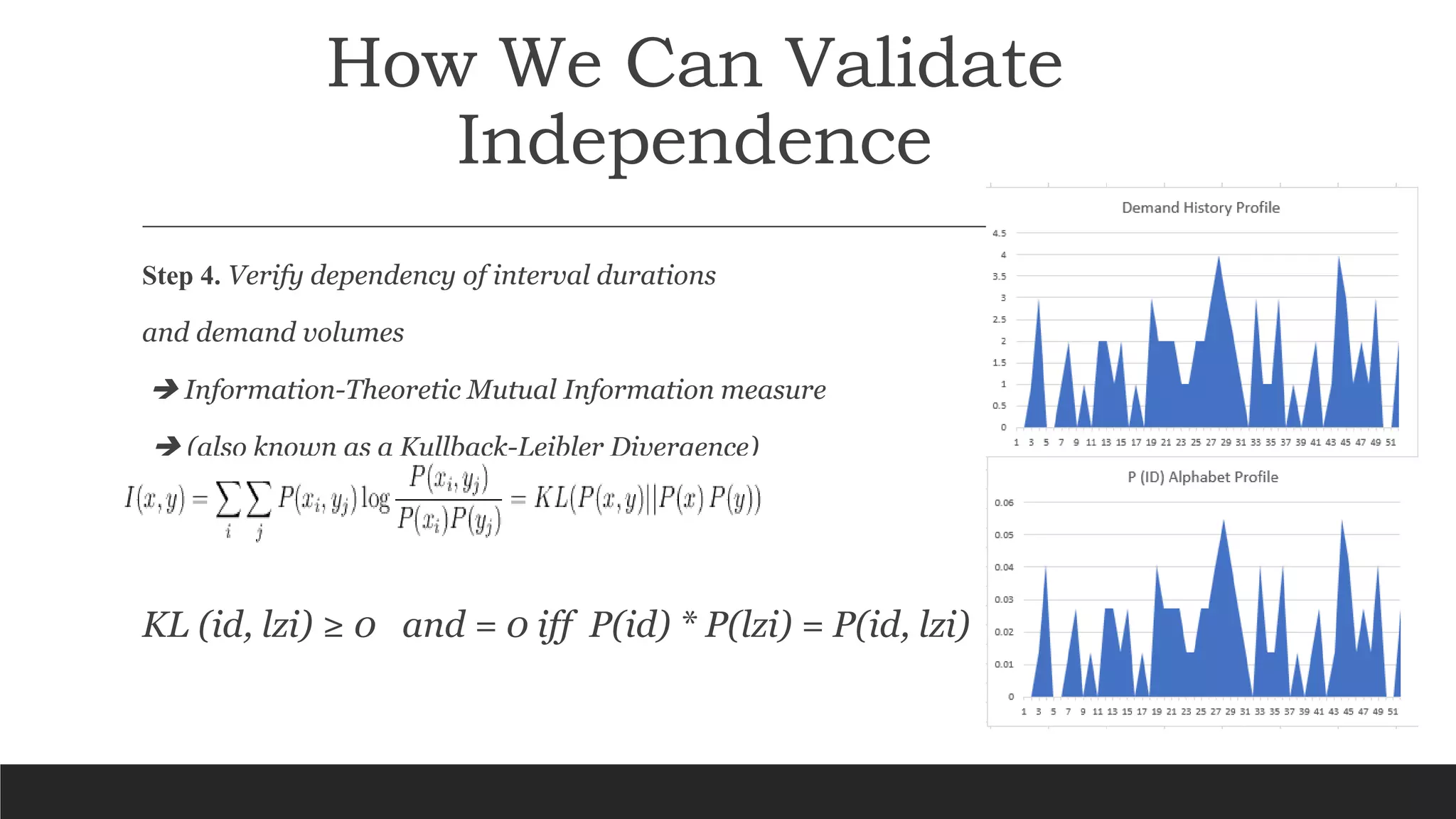
Step 4. Verify dependency of interval durations
and demand volumes
 Information-Theoretic Mutual Information measure
 (also known as a Kullback-Leibler Divergence)
KL (id, lzi) ≥ 0 and = 0 iff P(id) * P(lzi) = P(id, lzi)
Coding Alphabet
Demand Profiles
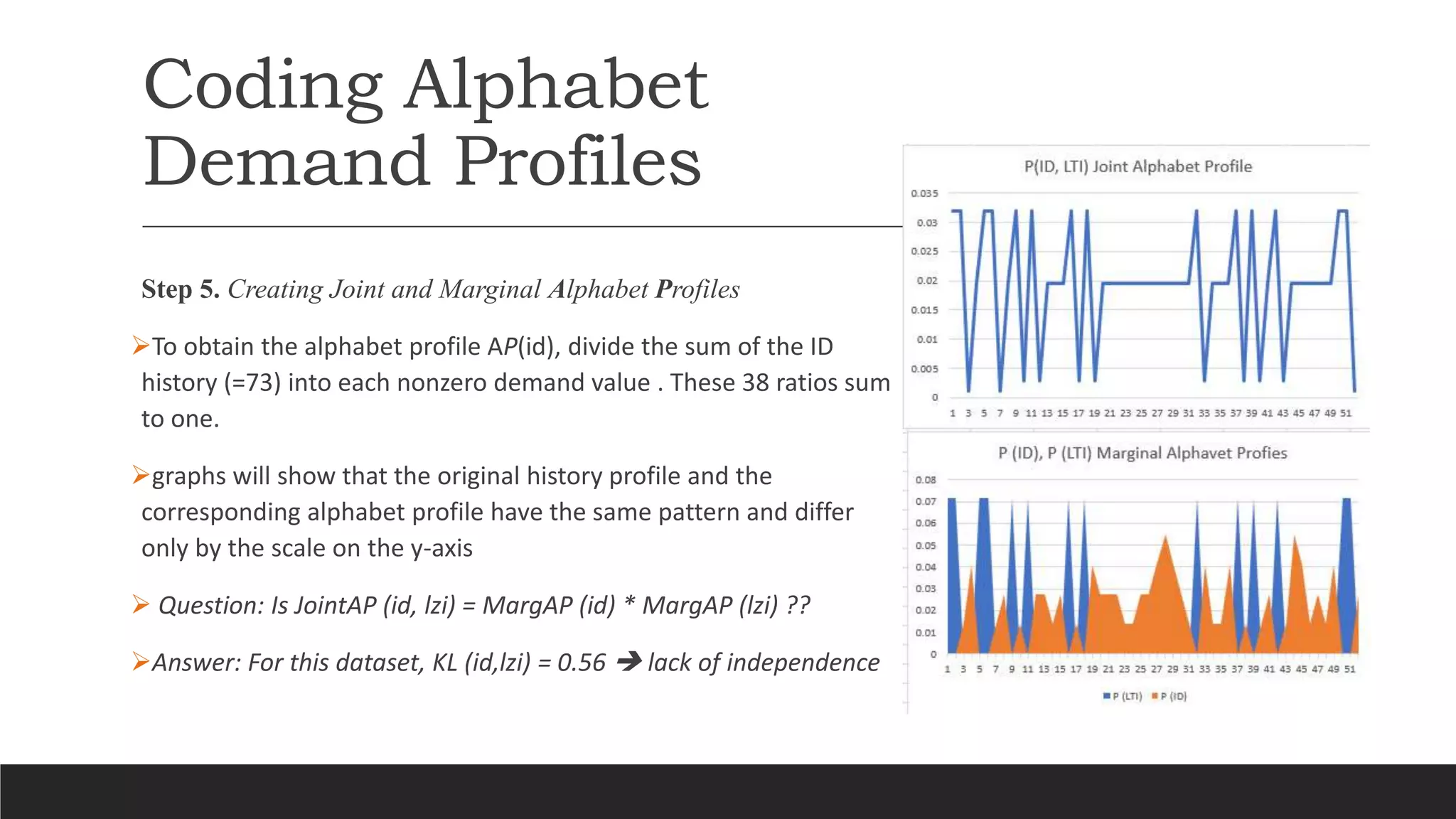
Step 5. Creating Joint and Marginal Alphabet Profiles
To obtain the alphabet profile AP(id), divide the sum of the ID
history (=73) into each nonzero demand value . These 38 ratios sum
to one.
graphs will show that the original history profile and the
corresponding alphabet profile have the same pattern and differ
only by the scale on the y-axis
 Question: Is JointAP (id, lzi) = MargAP (id) * MargAP (lzi) ??
Answer: For this dataset, KL (id,lzi) = 0.56  lack of independence
Embracing Change and Chance:
A Profile Forecasting Process for Inventory Applications
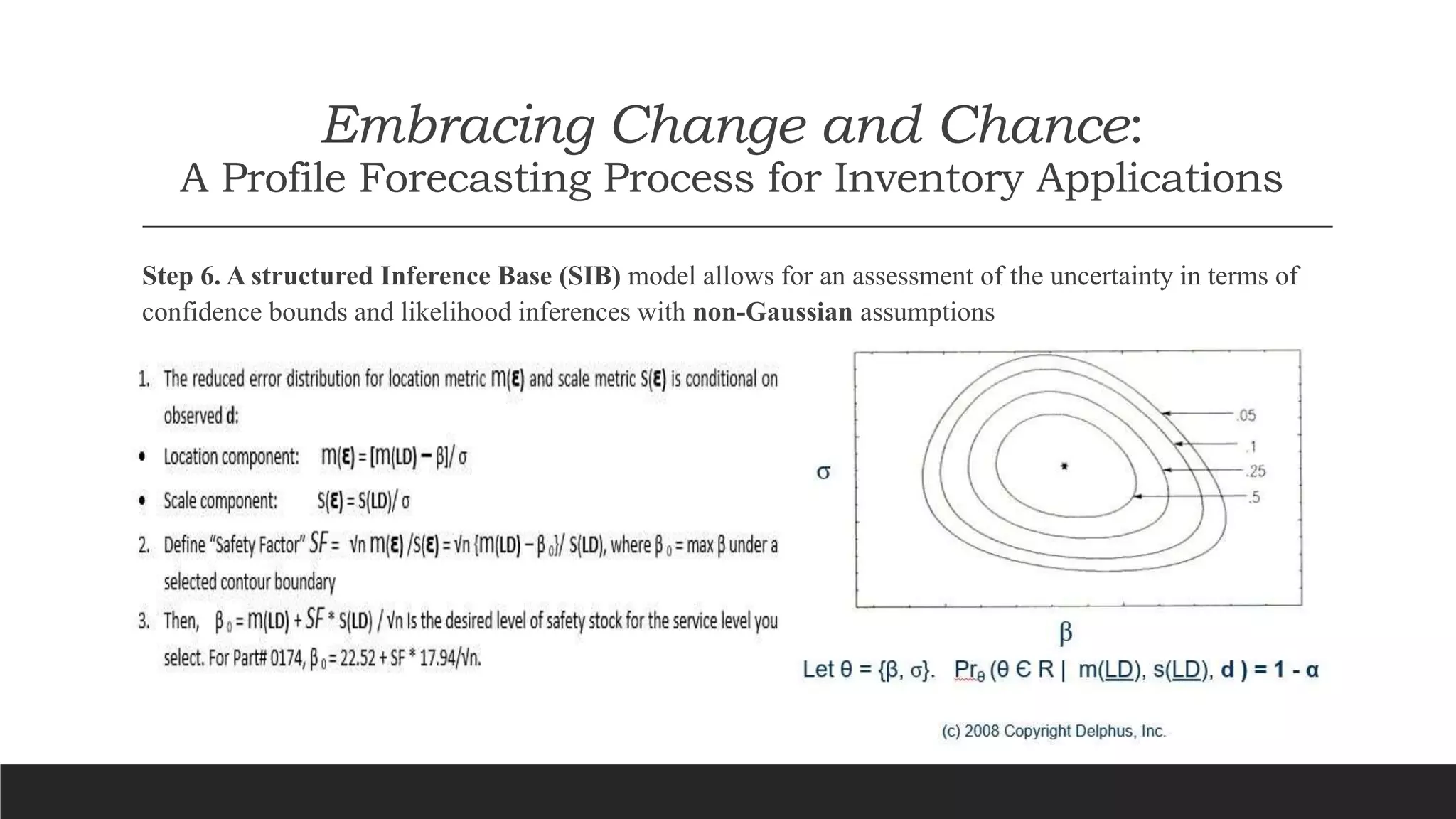
Step 6. A structured Inference Base (SIB) model allows for an assessment of the uncertainty in terms of
confidence bounds and likelihood inferences with non-Gaussian assumptions
Final Takeaway
A data-driven non-Gaussian modeling approach for lead-time intermittent demand
forecasting is based on
 No independence assumptions made on demand size and demand interval distributions as
required with Croston methods.
Using bootstrap resampling (MCMC) of the underlying empirical distributions are used to
generate lagtime zero intervals (LZI). Each interval is followed by a non-zero demand (ID)
from a conditional distribution
 Independence or lack thereof can be measured with a Mutual Information (Kullback-
Leibler Divergence) measure
Approach Added to On Demand Paperback Book &
Professional Development Workshop Manual
Available online from Amazon.com
Paperback book
https://amzn.to/2HTAU3l
Workshop Manual
https://amzn.to/2tAhoE0

Forecasting • Intermittent Demand

  • 1.
    Forecasting with Intermittent Demand – A NewApproach HANS LEVENBACH ISIS SANTOS COSTA
  • 2.
    In IJF, AlmostThree Decades Ago Now . . . The signal failure on the part of statisticians to respond to the model building failures identified in many empirical studies (..on forecast accuracy measurement..) has not been resolved within the forecasting profession itself. Robert Fildes, IJF 8 (1992), 1-2. The focus in forecast evaluation should be shifted from a measure-oriented approach to a distributions- oriented approach in which distributions are primary and other measures are viewed as summarizing different aspects of the distributions. Allan H. Murphy and Robert Winkler, IJF 8 (1992), 105-07, A particularly sobering finding is the poor performance of the RMSE. The reliability of the RMSE is poor (in forecasting) and it is scale dependent. Dennis A. Ahlburg, IJF 8 (1992). 99-100.
  • 3.
    Agenda STEP 1 STEP2 STEP 4 STEP 5 Data Exploration of Interdemand intervals Determine empirical interdemand distribution Sample LZI distribution for LZI projections over the desired lead-time How to validate independence between LZI intervals and ID demand volumes Data Quality checks for unusual variation Define Lagtime Zero Interval (LZI) distribution and conditional (ID) distribution Follow each LZI with a point forecast from the corresponding ID demand size distribution K-L Divergence is an information-theoretic measure of ‘distance’ between two distributions Validate independence between LZI intervals and ID demand volumes Lorem ipsum et tula lorem ipsum et lorem ipsum Methodology based on ‘coding’ data profiles into alphabet profiles
  • 4.
    Data Exploration asan Essential Data Quality Check in Forecasting Step 1. Explore the nature of the interdemand intervals at the item level by location (e.g. retail sales at store level)
  • 5.
    Forecasting Intermittent Demand: GoingBeyond Croston Methods  Current methods are based on Croston (1972) (in practice as well as software implementations)  Key Assumption: Independence between non-zero demand volume and interval duration Step 2: Determine the interdemand interval distribution.  We observe that each interdemand interval is followed by a demand size ID.  LZI is called Lagtime Zero Interval
  • 6.
    Bad Data WillBeat a Good Forecast Every Time (paraphrasing W.E.Deming) Step 3: Create point forecasts for demand size by by interval duration LZI by first sampling LZI to create enough interval projections to cover the lead-time or planning horizon
  • 7.
    Another Example Weekly Inventory– 52 Weeks LZI (14) Non-zero ID (38) 0 0.5 1 1.5 2 2.5 3 3.5 4 4.5 1 3 5 7 9 11 13 15 17 19 21 23 25 27 29 31 33 35 37 39 41 43 45 47 49 51 Demand History Profile
  • 8.
    How We CanValidate Independence Step 4. Verify dependency of interval durations and demand volumes  Information-Theoretic Mutual Information measure  (also known as a Kullback-Leibler Divergence) KL (id, lzi) ≥ 0 and = 0 iff P(id) * P(lzi) = P(id, lzi)
  • 9.
    Coding Alphabet Demand Profiles Step5. Creating Joint and Marginal Alphabet Profiles To obtain the alphabet profile AP(id), divide the sum of the ID history (=73) into each nonzero demand value . These 38 ratios sum to one. graphs will show that the original history profile and the corresponding alphabet profile have the same pattern and differ only by the scale on the y-axis  Question: Is JointAP (id, lzi) = MargAP (id) * MargAP (lzi) ?? Answer: For this dataset, KL (id,lzi) = 0.56  lack of independence
  • 10.
    Embracing Change andChance: A Profile Forecasting Process for Inventory Applications Step 6. A structured Inference Base (SIB) model allows for an assessment of the uncertainty in terms of confidence bounds and likelihood inferences with non-Gaussian assumptions
  • 11.
    Final Takeaway A data-drivennon-Gaussian modeling approach for lead-time intermittent demand forecasting is based on  No independence assumptions made on demand size and demand interval distributions as required with Croston methods. Using bootstrap resampling (MCMC) of the underlying empirical distributions are used to generate lagtime zero intervals (LZI). Each interval is followed by a non-zero demand (ID) from a conditional distribution  Independence or lack thereof can be measured with a Mutual Information (Kullback- Leibler Divergence) measure
  • 12.
    Approach Added toOn Demand Paperback Book & Professional Development Workshop Manual Available online from Amazon.com Paperback book https://amzn.to/2HTAU3l Workshop Manual https://amzn.to/2tAhoE0