Forces on Charged Particles and Electromagnetic Induction.pptx
1.
4 Quick Questions
1.Determine the electrostatic force between a proton and an alpha particle separated
by 3µm
2. Determine the electric field strength 0.5 µm from the proton in direction of the
alpha particle
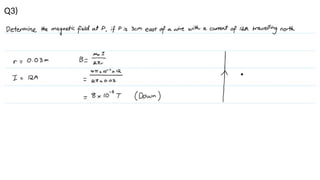
3. Determine the magnetic field at P, if P is 3 cm east of a wire with a current of 12 A
travelling north
4. For question 2 determine the position other than infinity where the electric field
would be zero.
2.
4 Quick Questions
1.Determine the electrostatic force between a
proton and an alpha particle separated by 3µm
3.
4 Quick Questions
2)Determine the electric field strength 1µm from
the proton in direction of the alpha particle
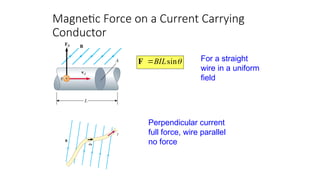
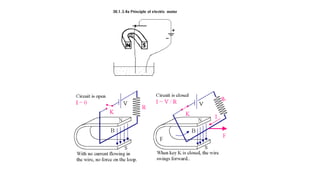
Magnetic Force ona Current Carrying
Conductor
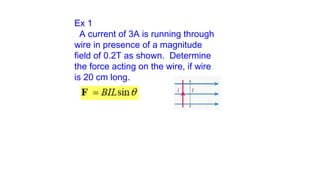
sin
BIL
F For a straight
wire in a uniform
field
Perpendicular current
full force, wire parallel
no force
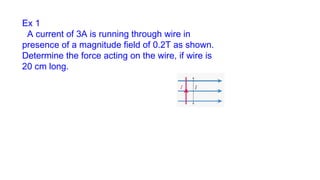
Ex 1
A currentof 3A is running through wire in
presence of a magnitude field of 0.2T as shown.
Determine the force acting on the wire, if wire is
20 cm long.
11.
Ex 1
A currentof 3A is running through
wire in presence of a magnitude
field of 0.2T as shown. Determine
the force acting on the wire, if wire
is 20 cm long.
13.
What happens toa moving
charged particle in a magnetic
field
14.
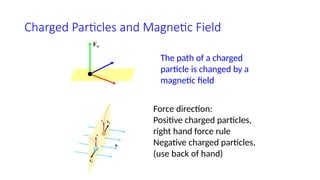
Charged Particles andMagnetic Field
q
B
v
+q
FB
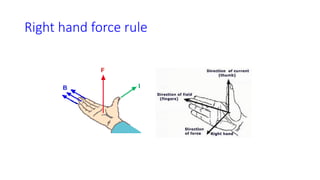
Force direction:
Positive charged particles,
right hand force rule
Negative charged particles,
(use back of hand)
The path of a charged
particle is changed by a
magnetic field
15.
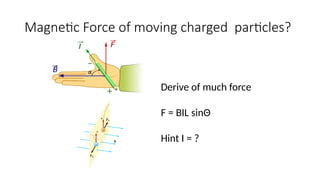
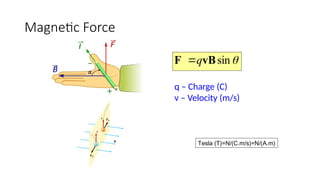
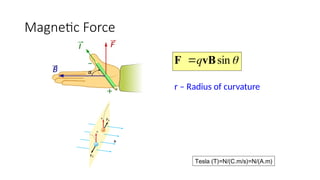
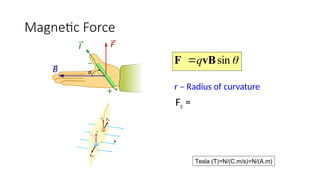
Magnetic Force ofmoving charged particles?
Derive of much force
F = BIL sinΘ
Hint I = ?
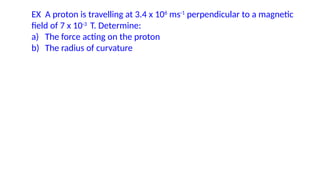
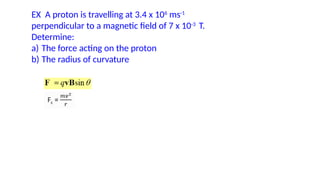
EX A protonis travelling at 3.4 x 10⁶
ms-1
perpendicular to a magnetic
field of 7 x 10⁻³
T. Determine:
a) The force acting on the proton
b) The radius of curvature
21.
EX A protonis travelling at 3.4 x 10⁶
ms-1
perpendicular to a magnetic field of 7 x 10⁻³
T.
Determine:
a) The force acting on the proton
b) The radius of curvature
22.
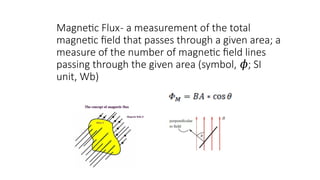
Magnetic Flux- ameasurement of the total
magnetic field that passes through a given area; a
measure of the number of magnetic field lines
passing through the given area (symbol, ; SI
𝜙
unit, Wb)
23.
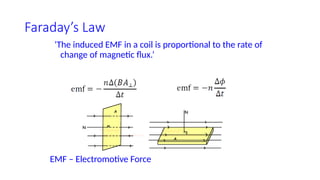
Faraday’s Law
‘The inducedEMF in a coil is proportional to the rate of
change of magnetic flux.’
EMF – Electromotive Force
24.
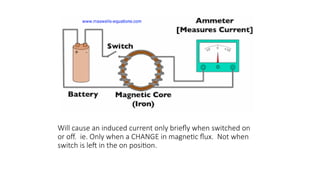
Will cause aninduced current only briefly when switched on
or off. ie. Only when a CHANGE in magnetic flux. Not when
switch is left in the on position.
25.
Dec 25, 2025
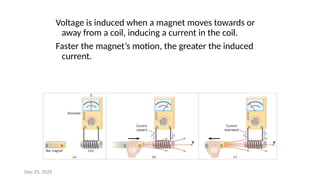
Voltageis induced when a magnet moves towards or
away from a coil, inducing a current in the coil.
Faster the magnet’s motion, the greater the induced
current.
26.
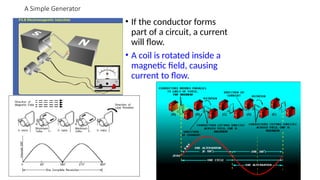
A Simple Generator
•If the conductor forms
part of a circuit, a current
will flow.
• A coil is rotated inside a
magnetic field, causing
current to flow.
27.
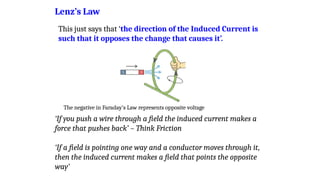
Lenz’s Law
This justsays that ‘the direction of the Induced Current is
such that it opposes the change that causes it’.
‘If you push a wire through a field the induced current makes a
force that pushes back’ – Think Friction
‘If a field is pointing one way and a conductor moves through it,
then the induced current makes a field that points the opposite
way’
The negative in Faraday’s Law represents opposite voltage
28.
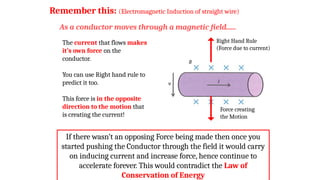
The current thatflows makes
it’s own force on the
conductor.
You can use Right hand rule to
predict it too.
This force is in the opposite
direction to the motion that
is creating the current!
As a conductor moves through a magnetic field......
Remember this: (Electromagnetic Induction of straight wire)
If there wasn’t an opposing Force being made then once you
started pushing the Conductor through the field it would carry
on inducing current and increase force, hence continue to
accelerate forever. This would contradict the Law of
Conservation of Energy
Force creating
the Motion
Right Hand Rule
(Force due to current)
29.
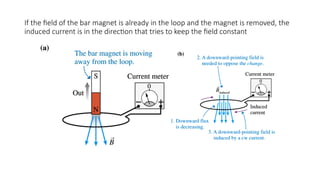
If the fieldof the bar magnet is already in the loop and the magnet is removed, the
induced current is in the direction that tries to keep the field constant
30.
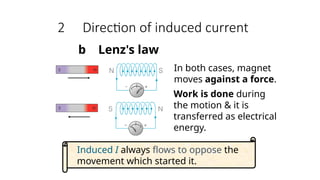
2 Direction ofinduced current
In both cases, magnet
moves against a force.
Work is done during
the motion & it is
transferred as electrical
energy.
Induced I always flows to oppose the
movement which started it.
b Lenz's law
31.
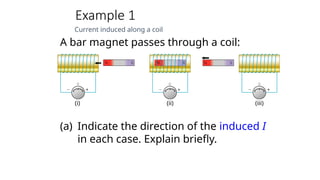
Example 1
Current inducedalong a coil
A bar magnet passes through a coil:
(a) Indicate the direction of the induced I
in each case. Explain briefly.
(i) (ii) (iii)
32.
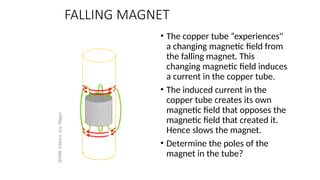
FALLING MAGNET
• Thecopper tube “experiences"
a changing magnetic field from
the falling magnet. This
changing magnetic field induces
a current in the copper tube.
• The induced current in the
copper tube creates its own
magnetic field that opposes the
magnetic field that created it.
Hence slows the magnet.
• Determine the poles of the
magnet in the tube?
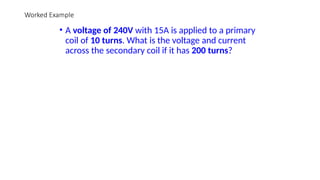
Worked Example
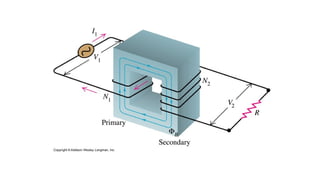
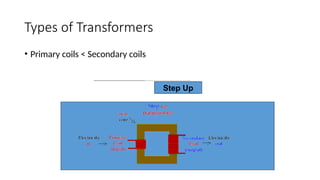
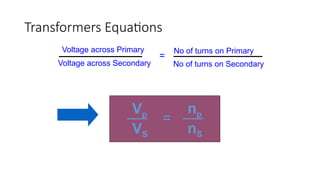
• Avoltage of 240V with 15A is applied to a primary
coil of 10 turns. What is the voltage and current
across the secondary coil if it has 200 turns?
43.
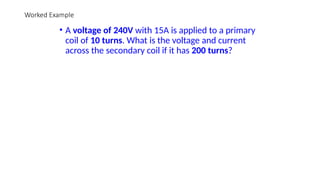
Worked Example
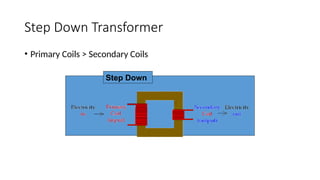
• Avoltage of 240V with 15A is applied to a primary
coil of 10 turns. What is the voltage and current
across the secondary coil if it has 200 turns?
44.
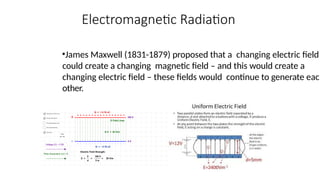
Electromagnetic Radiation
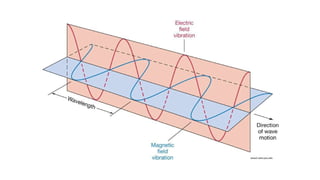
•James Maxwell(1831-1879) proposed that a changing electric field
could create a changing magnetic field – and this would create a
changing electric field – these fields would continue to generate each
other.
45.
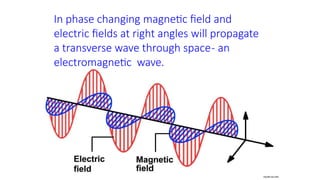
In phase changingmagnetic field and
electric fields at right angles will propagate
a transverse wave through space- an
electromagnetic wave.
mysite.du.edu
#25 Connect large coil to demo galvanometer. Move large magnet near the coil; move coil near large magnet. Pass-around box with coil, bar magnet, and galvanometer.