Football Positions
Jayson DeHaai
August 16, 2015
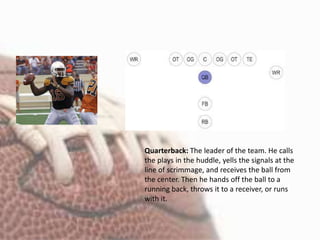
Quarterback: The leader of the team. He calls
the plays in the huddle, yells the signals at the
line of scrimmage, and receives the ball from
the center. Then he hands off the ball to a
running back, throws it to a receiver, or runs
with it.
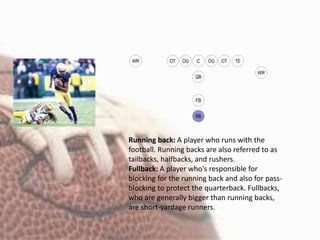
Running back: A player who runs with the
football. Running backs are also referred to as
tailbacks, halfbacks, and rushers.
Fullback: A player who's responsible for
blocking for the running back and also for pass-
blocking to protect the quarterback. Fullbacks,
who are generally bigger than running backs,
are short-yardage runners.
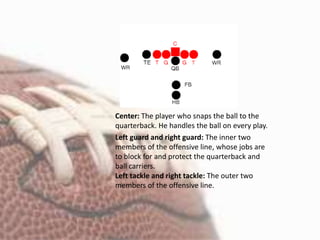
Center: The player who snaps the ball to the
quarterback. He handles the ball on every play.
Left guard and right guard: The inner two
members of the offensive line, whose jobs are
to block for and protect the quarterback and
ball carriers.
Left tackle and right tackle: The outer two
members of the offensive line.
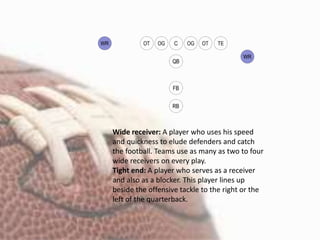
Wide receiver: A player who uses his speed
and quickness to elude defenders and catch
the football. Teams use as many as two to four
wide receivers on every play.
Tight end: A player who serves as a receiver
and also as a blocker. This player lines up
beside the offensive tackle to the right or the
left of the quarterback.
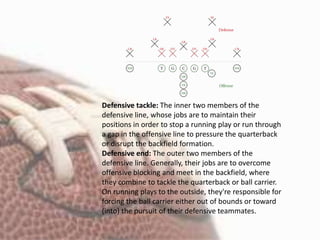
Defensive tackle: The inner two members of the
defensive line, whose jobs are to maintain their
positions in order to stop a running play or run through
a gap in the offensive line to pressure the quarterback
or disrupt the backfield formation.
Defensive end: The outer two members of the
defensive line. Generally, their jobs are to overcome
offensive blocking and meet in the backfield, where
they combine to tackle the quarterback or ball carrier.
On running plays to the outside, they're responsible for
forcing the ball carrier either out of bounds or toward
(into) the pursuit of their defensive teammates.
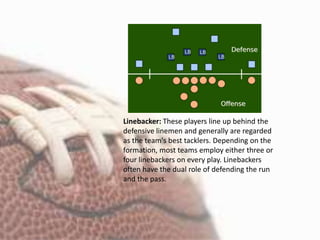
Linebacker: These players line up behind the
defensive linemen and generally are regarded
as the team's best tacklers. Depending on the
formation, most teams employ either three or
four linebackers on every play. Linebackers
often have the dual role of defending the run
and the pass.
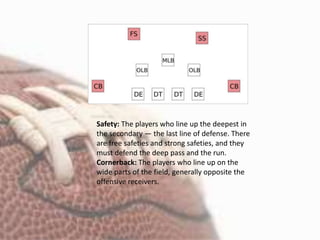
Safety: The players who line up the deepest in
the secondary — the last line of defense. There
are free safeties and strong safeties, and they
must defend the deep pass and the run.
Cornerback: The players who line up on the
wide parts of the field, generally opposite the
offensive receivers.
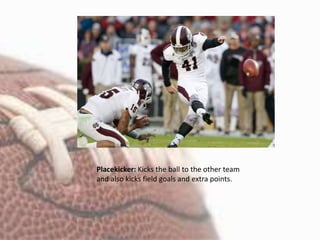
Placekicker: Kicks the ball to the other team
and also kicks field goals and extra points.
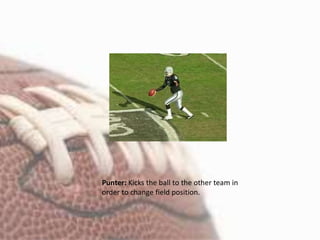
Punter: Kicks the ball to the other team in
order to change field position.

Football positions

  • 1.
  • 2.
    Quarterback: The leaderof the team. He calls the plays in the huddle, yells the signals at the line of scrimmage, and receives the ball from the center. Then he hands off the ball to a running back, throws it to a receiver, or runs with it.
  • 3.
    Running back: Aplayer who runs with the football. Running backs are also referred to as tailbacks, halfbacks, and rushers. Fullback: A player who's responsible for blocking for the running back and also for pass- blocking to protect the quarterback. Fullbacks, who are generally bigger than running backs, are short-yardage runners.
  • 4.
    Center: The playerwho snaps the ball to the quarterback. He handles the ball on every play. Left guard and right guard: The inner two members of the offensive line, whose jobs are to block for and protect the quarterback and ball carriers. Left tackle and right tackle: The outer two members of the offensive line.
  • 5.
    Wide receiver: Aplayer who uses his speed and quickness to elude defenders and catch the football. Teams use as many as two to four wide receivers on every play. Tight end: A player who serves as a receiver and also as a blocker. This player lines up beside the offensive tackle to the right or the left of the quarterback.
  • 6.
    Defensive tackle: Theinner two members of the defensive line, whose jobs are to maintain their positions in order to stop a running play or run through a gap in the offensive line to pressure the quarterback or disrupt the backfield formation. Defensive end: The outer two members of the defensive line. Generally, their jobs are to overcome offensive blocking and meet in the backfield, where they combine to tackle the quarterback or ball carrier. On running plays to the outside, they're responsible for forcing the ball carrier either out of bounds or toward (into) the pursuit of their defensive teammates.
  • 7.
    Linebacker: These playersline up behind the defensive linemen and generally are regarded as the team's best tacklers. Depending on the formation, most teams employ either three or four linebackers on every play. Linebackers often have the dual role of defending the run and the pass.
  • 8.
    Safety: The playerswho line up the deepest in the secondary — the last line of defense. There are free safeties and strong safeties, and they must defend the deep pass and the run. Cornerback: The players who line up on the wide parts of the field, generally opposite the offensive receivers.
  • 9.
    Placekicker: Kicks theball to the other team and also kicks field goals and extra points.
  • 10.
    Punter: Kicks theball to the other team in order to change field position.