Chapter one –Introduction
•Food product development refers to the process of
developing a new product to meet a consumer, market need
and or a trend.
•This involves a number of steps that are completed before
the product is introduced to the market.
•A new food product is a one that has not been presented
before in any market place anywhere.
•A food product may be a new product for a company that
has not sold it before, but is not necessarily new to a market
place: other companies elsewhere might have sold it or a
product conceptually similar to it before.
Tewodros Mebratie
3.
Characteristics ofnew food product as introduced by
specific food company
A. Product has never before been manufactured by that
company.
B. Product has never before been distributed by that
company.
C.An old established product manufacture by a company is
introduced into a geographically new area by that
company.
D.An old established product manufacture by a company is
introduced in either a new package or a new size or form.
E. An old established product manufacture by a company is
introduced into a new market niche, i.e positioned as one
with a new function.
Tewodros Mebratie
4.
Reasons for developinga new product ?
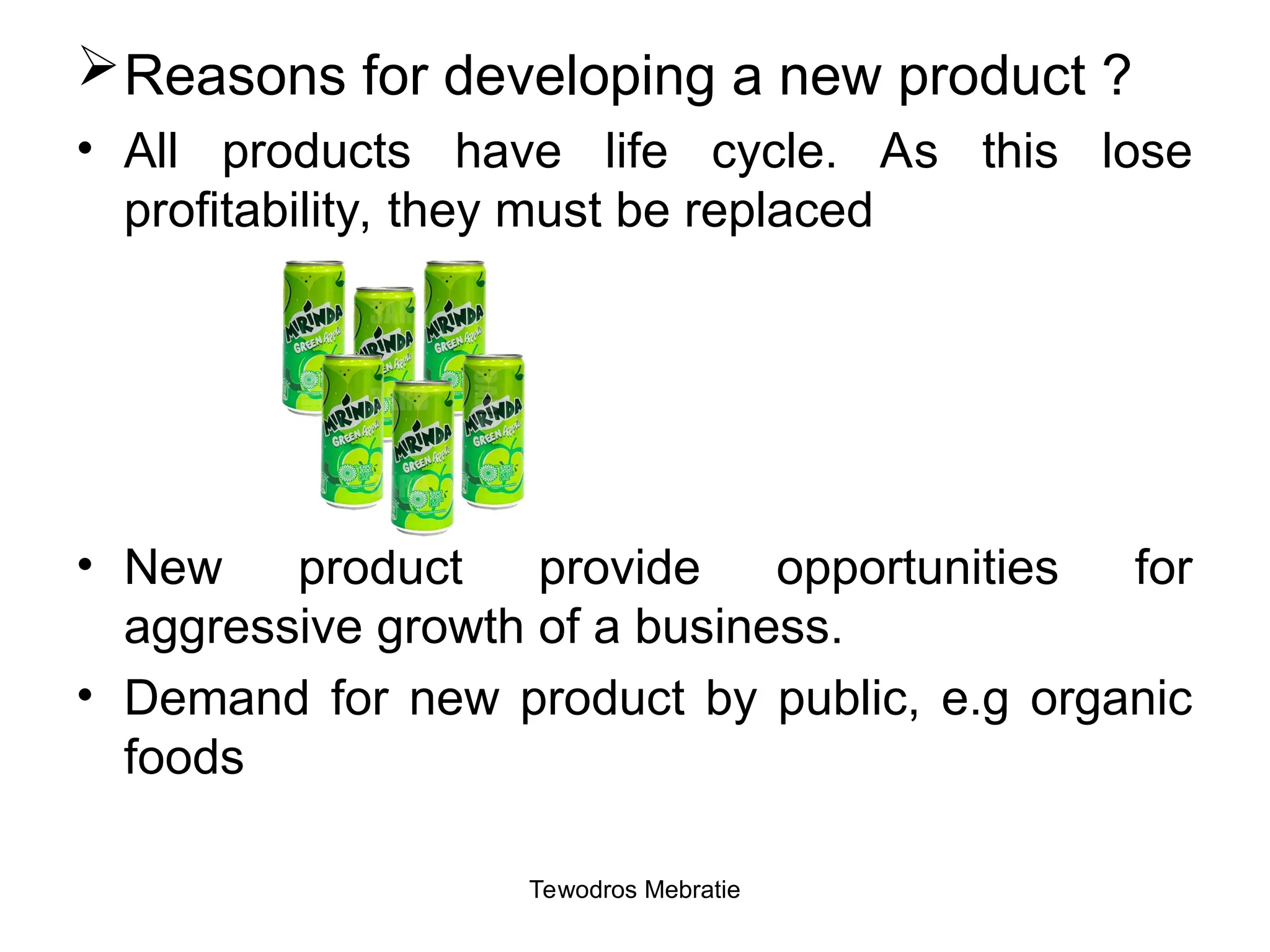
• All products have life cycle. As this lose
profitability, they must be replaced
• New product provide opportunities for
aggressive growth of a business.
• Demand for new product by public, e.g organic
foods
Tewodros Mebratie
5.
• Traditional marketplace change and new one is
created. Example: Traditionally, quinoa was
primarily consumed in the Andean countries like
Peru, Bolivia, Ecuador, and Colombia.
With growing global interest in healthy eating and
plant-based diets, quinoa gained popularity in
Western countries as a superfood due to its high
protein content, essential amino acids, and gluten-
free nature.
Tewodros Mebratie
6.
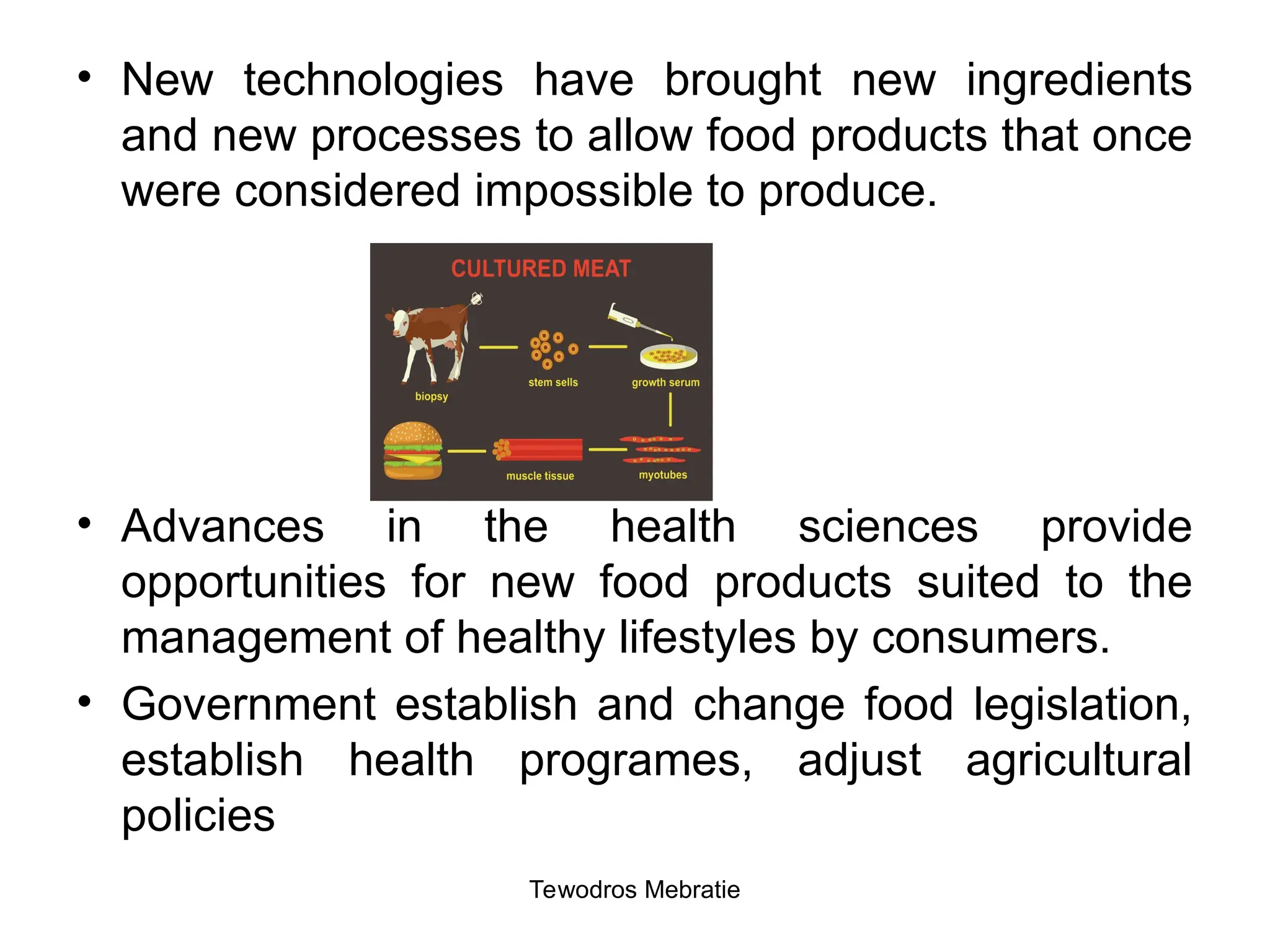
• New technologieshave brought new ingredients
and new processes to allow food products that once
were considered impossible to produce.
• Advances in the health sciences provide
opportunities for new food products suited to the
management of healthy lifestyles by consumers.
• Government establish and change food legislation,
establish health programes, adjust agricultural
policies
Tewodros Mebratie
7.
Types of newfood products
Line extension
Little time and or research required for
development
No major manufacturing changes in processing
lines or major equipment purchase.
Relatively little change in market strategy
No new purchasing skill or raw material sources.
No new storage or handling techniques for either
raw ingredients or the final product
Tewodros Mebratie
8.
• Example -if a company that makes candy bars
decides to make a new type of candy bar that is
a different shape, size, or flavor from the existing
candy bars.
Tewodros Mebratie
9.
Repositioned existing product
Researchand development time is minimal.
Manufacture is comparatively unaffected.
Marketing must develop new strategies and
promotional materials to interpret and penetrate
the newly created market niche.
Sales tactics require reevaluation to reach and
make sales within the new market place.
Tewodros Mebratie
10.
• Example: oatmeal
containingproducts
positioned as dietary
factors in reducing
cholesterol.
• Soy containing
products repositioned
as dietary factor
combating cancer.
Tewodros Mebratie
11.
New form orsize of existing products
Highly variable impact on research and
development.
Highly variable impact on physical plant
and manufacturing capabilities.
Major equipment purchase may be
required, if manufacture to be done in
house.
Tewodros Mebratie
12.
• Example: instant
coffee,teas and
flavored coffee
• Dehydrated spice
blends for sauces
Tewodros Mebratie
13.
Reformation of existingproducts
Moderate research and development required
consistent with reformation goal.
Generally little impact on physical facilities
Generally little impact on marketing and sale,
resource, unless reformation leads to
repositioning of products
Tewodros Mebratie
Repackaging of existingproducts
Novelty of repackaging will dictate the degree of
research and development required.
Slight impact on physical facilities
New packaging equipment will required
Little impact on marketing distribution and sales
Tewodros Mebratie
16.
• Example: onecompany might sell juice in
packages of six, while another sells the
same juice in packages of four
Tewodros Mebratie
17.
Innovative products
Amount ofresearch and development
depends on nature of the innovation.
Highly variable impact on manufacturing
capabilities
Possible heavy impact on marketing
Tewodros Mebratie
18.
• Example: kombuchais a fermented,
lightly effervescent, sweetened
black tea drink.
Tewodros Mebratie
19.
Creative products
• Generallyneeds heavily extensive research and
development, thereof costy venture.
• Extensive development time required
• May require new plant and equipment
• Degree of creativity may require development of
unique equipment
• Risk of failure high
Tewodros Mebratie
20.
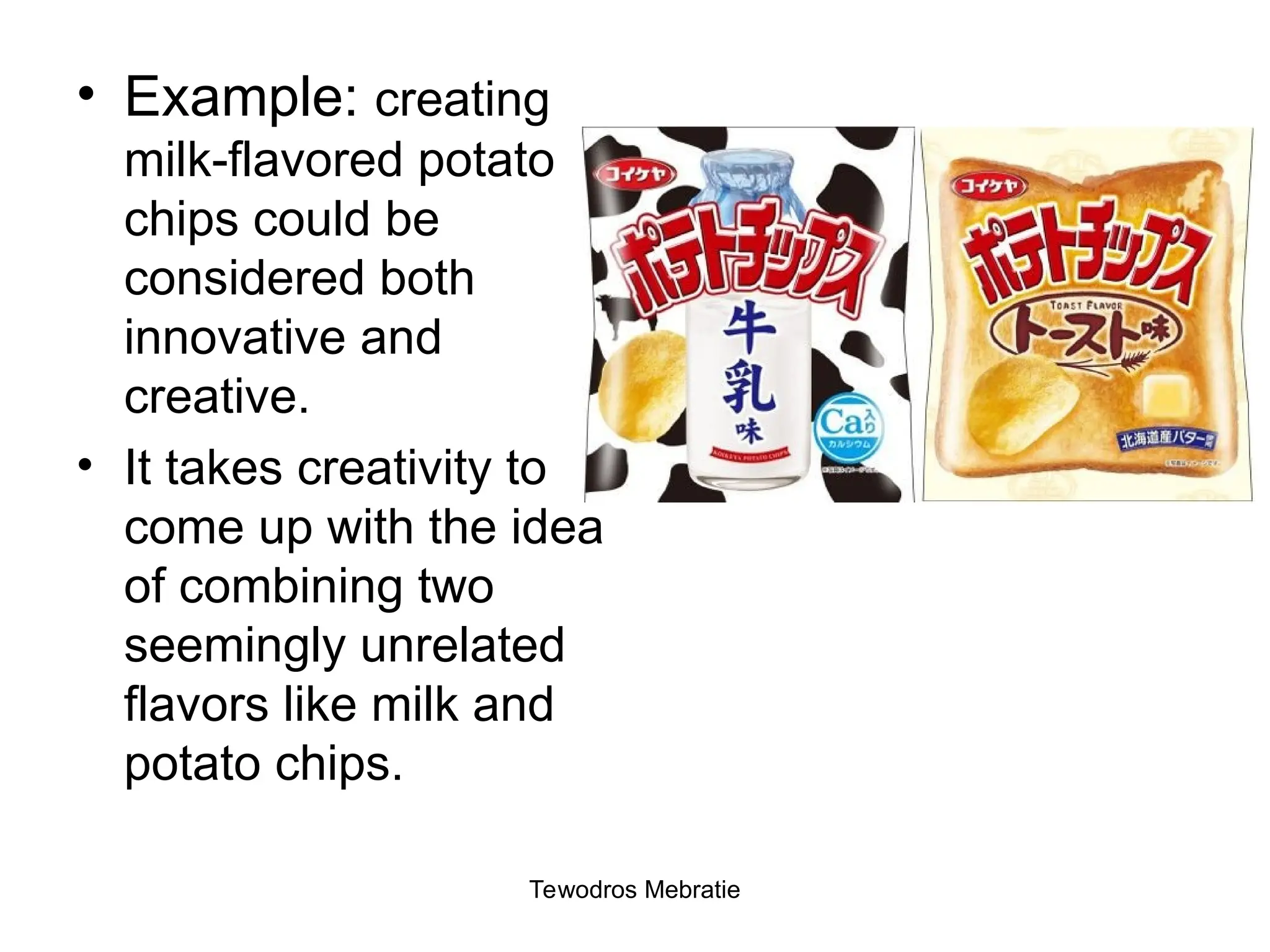
• Example: creating
milk-flavoredpotato
chips could be
considered both
innovative and
creative.
• It takes creativity to
come up with the idea
of combining two
seemingly unrelated
flavors like milk and
potato chips.
Tewodros Mebratie