0
Unit of Competency: PROCESS FOOD BY SUGAR
CONCENTRATION
Module No. 1
Module Title: PROCESSING FOOD BY SUGAR
CONCENTRATION
Republic of the Philippines
Department of Education
PUBLIC TECHNICAL-
VOCATIONAL
HIGH SCHOOLS
PUBLIC TECHNICAL-
VOCATIONAL
HIGH SCHOOLS
1
MODULE I
QUALIFICATION TITLE : FOOD PROCESSING NC II
UNIT OF COMPETENCY : PROCESS FOOD BY SUGAR
CONCENTRATION
MODULE TITLE : PROCESSING FOOD BY SUGAR
CONCENTRATION
NOMINAL DURATION : 300 HOURS
WHAT IS THIS MODULE ABOUT?
This module covers the knowledge, skills and attitudes required
in processing food by sugar concentration such as preparing
equipment, tools and utensils, preparing the raw materials,
performing acid, pectin and sugar mixture, cooking sugar
concentrates and preparing production report.
WHAT WILL YOU LEARN?
After completing this module, you should be able to:
1. prepare equipment, tools and utensils;
2. prepare the raw materials;
3. perform acid, pectin and sugar mixture;
4. cook sugar concentrates; and
5. prepare production report.
WHAT DO YOU ALREADY KNOW?
Let's find out how much you already know about processing foods by
sugar concentration. Read the following sentences carefully and select the
letters of the correct answer. Write your answers in your test notebook.
1. What is used to measure dry and liquid ingredients in small
quantity?
a. glass measuring cups c. measuring spoons
b. measuring cups d. weighing scale
2. What is used to level-off dry ingredients when measuring?
a. knife c. spatula
b. rubber scraper d. tongs
2
3. What is a bowl-shaped kitchen utensils with holes used for
draining off liquids and rinsing foods?
a. colander c. strainer
b. mixing bowl d. bowl
4. Which of the following is used to strain liquids?
a. colander c. jelly bag
b. strainer d. a piece of cloth
5. What equipment is used to filter the juices to a finer texture?
a. hydraulic press c. centrifuge
b. juice extractor d. blender
6. What instrument is used to measure the pectin contents of fruits?
a. jelmeter c. refractometer
b. jelly thermometer d. candy thermometer
7. What water-soluble substance is found in some slightly underripe
fruits that causes jellies to set?
a. acid c. pulp
b. pectin d. sugar
8. Which of the following is made from fruit juice and pulp?
a. jam c. marmalade
b. jelly d. preserve
9. If ¾ cup of sugar is needed per cup of juice, how many cups of
sugar are added if you will prepare 6 cups fruit juice?
a. 3 ½ cup c. 5 ½ cups
b. 4 ½ cups d. 6 ½ cups
10. What product is made from fruit juices?
a. jam c. marmalade
b. jelly d. preserve
11. Which of the following should be selected for jelly making?
a. ripe fruits c. mixture of slightly underripe and
ripe fruit
b. slightly underripe d. overripe fruit
12. Which of the following is used in testing the jellying point?
3
a. alcohol test c. cooking test
b. bubble formation d. pectin test
13. Which of the following is used in determining the pectin contents
of fruits?
a. flake test c. temperature test
b. jelmeter test d. acid test
14. What is a clear, jelly-like mixture in which shreds or thin slices of
fruits or peel are suspended?
a. marmalade c. preserve
b. paste d. jelly
15. What substance makes jelly firm and rigid in structure?
a. acid c. sugar
b. pectin d. salt
16. Which of the following is a form of sugar concentrates?
a. marmalade c. sausage
b. pickles d. wines
17. Which of the following is not considered in computing the cost of
your products?
a. ingredients c. cooking utensils
b. labor d. soap
18. Which of the following is used to sanitize processing implements?
a. ethyl alcohol c. chlorinated water
b. detergent in water d. drying under the sun
19. How much is the cost of the recipe if the total expenses for
ingredients is P75.00 and the total cost for operating expenses is
P35.00?
a. P105.00 c. P115.00
b. P110.00 d. P120.00
20. How much is the total sales if 10 jars of jellies are sold for P25.00
per jar?
a. P225.00 c. P250.00
b. P240.00 d. P260.00
4
LESSON 1
PREPARE EQUIPMENT, TOOLS AND UTENSILS FOR PROCESSING
WHAT IS THIS LESSON ABOUT?
Lesson 1 deals with the different tools, utensils, and equipment
needed in processing food by sugar concentration. It also deals with the
proper uses of each tool, utensil, and equipment. It includes the correct way
of cleaning and sanitizing the tools, utensils, and equipment in processing
foods by sugar concentration.
WHAT WILL YOU LEARN?
At the end of the lesson, you should be able to:
1. identify the tools, utensils and equipment needed in processing
foods by sugar concentration;
2. give the function of each tool, utensils and equipment;
3. use the tools, utensils and equipment properly;
4. clean and sanitize equipment correctly;
5. value the importance of preparing the tools, utensils, and
equipment before starting to work; and
6. recognize the importance of cleaning and sanitizing the tools,
utensils and equipment.
LET US DEFINE:
1. Processing – to subject something to a special process of treatment
before it is used.
2. Sugar concentrates – products made by boiling fruits or vegetables
using sugar as preservative.
3. PPM – parts per million, the normal method of expressing chlorine
levels
4. Tools – implements used by hand when doing an activity or work.
These are devices for doing object designed to do a particular kind of
work.
5. Equipment – the supplies and other items needed for a particular task
or activity.
6. Utensil - an implement especially for kitchen use.
7. Sanitize –to clean something thoroughly by disinfecting or sterilizing
to make it free from germs or microorganisms.
8. Sanitation – the process of treating tools, equipment, and utensils
with physical and chemical sanitizing agents to kill residual
microorganisms present after cleaning.
5
9. Disinfect –to get rid of germs; to clean something so as to destroy
disease – carrying microorganisms and prevent infection.
10. Calibrate –to test and adjust the accuracy of a measuring
instrument; a process to ensure accuracy of obtained measurements.
11. Check –to examine something in order to establish its state or
condition.
12. Assemble –to gather or collect things together in one place.
13. Operate –to make equipment function or work correctly.
14. Specification –the detailed description, dimensions, materials, etc. of
something, especially detailed enough to provide the information
about the product.
6
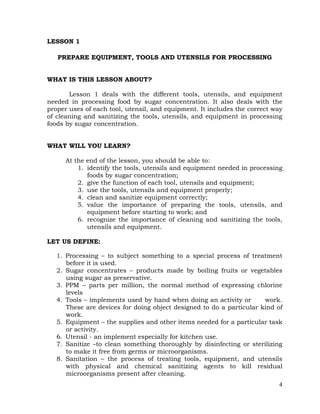
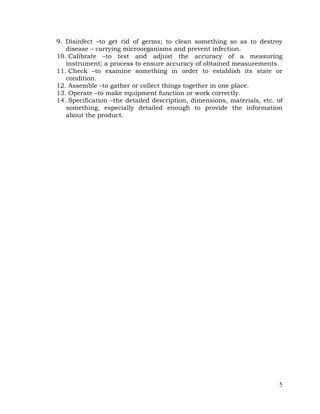
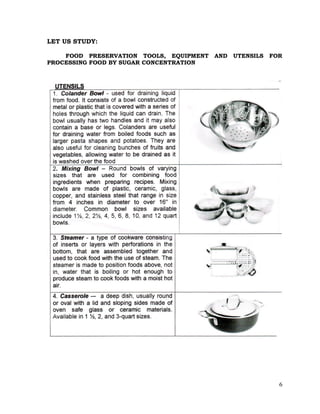
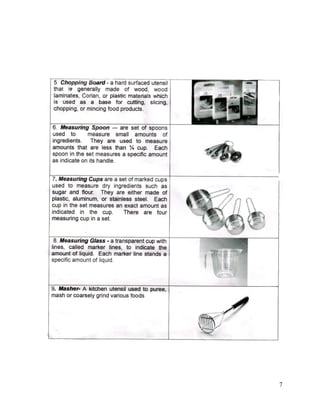
LET US STUDY:
FOOD PRESERVATION TOOLS, EQUIPMENT AND UTENSILS FOR
PROCESSING FOOD BY SUGAR CONCENTRATION
7
8
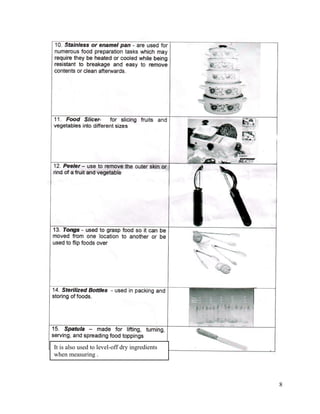
It is also used to level-off dry ingredients
when measuring .
9
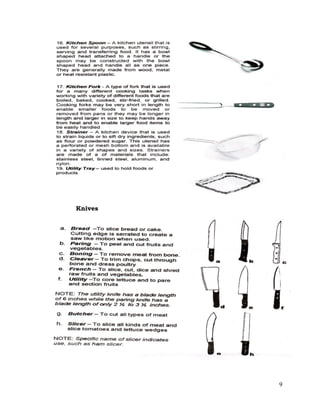
Knives
10
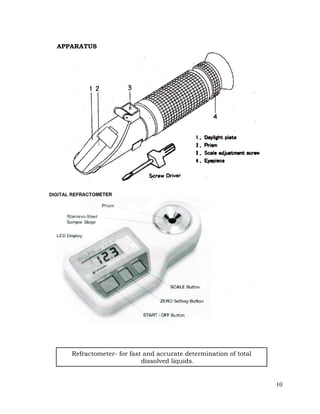
APPARATUS
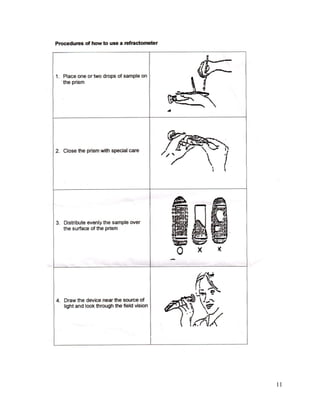
Refractometer
Refractometer- for fast and accurate determination of total
dissolved liquids.
11
12
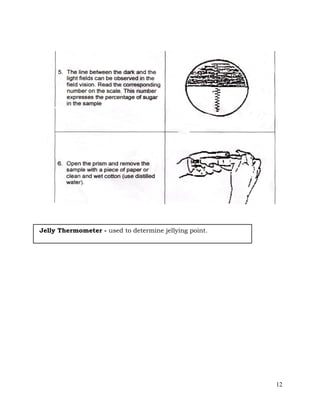
Jelly Thermometer - used to determine jellying point.
13
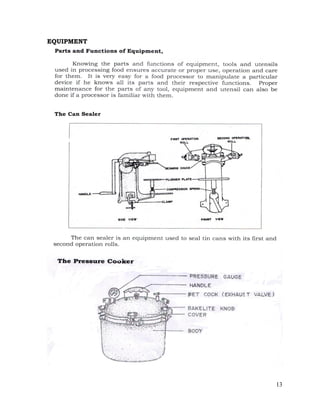
EQUIPMENT
14
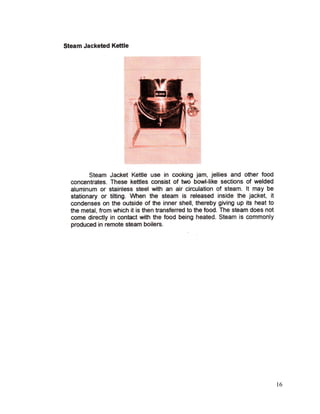
15
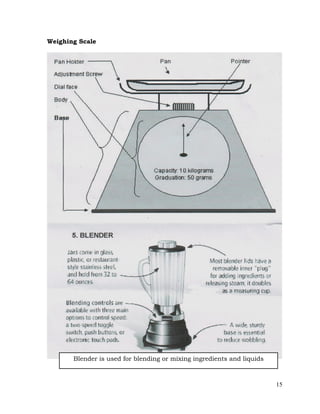
Weighing Scale
Blender is used for blending or mixing ingredients and liquids
16
17
Inspecting and Checking Condition of Equipment and
Machines
Before any equipment or machine is used, it must first be checked to
make sure that it is very functional and in good condition. Checking and
inspecting equipment and machines will guarantee that all their parts are
intact and that no part is missing or defective. This will also assure that
electric plugs and wirings are not defective and will not in anyway cause
problems or short circuits, electrocution or any form of accident. Religiously
checking and inspecting equipment and machines will facilitate preventive
maintenance which include checking the following:
1. Machine temperature
2. Hydraulic fluid
3. Wear and surface condition
4. Crack
5. Leak detection
6. Vibration
7. Corrosion
8. Electric insulation
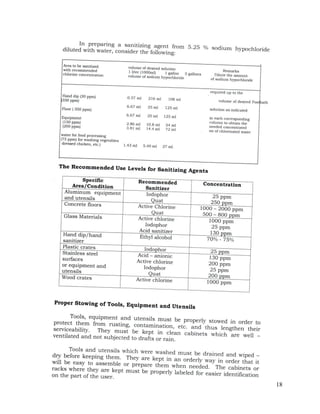
Sanitizing Agents: Uses and Specification
Sanitizing agents are substances used in cleaning the tools,
equipment and utensils thoroughly by disinfecting or sterilizing them to
make them free from germs or microorganisms that will contaminate the
food to be processed. Disinfecting the tools, equipment and utensils involves
the use of chemicals that destroy or inhibit the growth of microorganisms
that cause the spoilage of food. Sterilizing involves destroying germs or
microorganisms with the use of heat and substances capable of killing
germs and microbes.
The use of sanitizing agents leads to effective sanitation of tools,
equipment and utensils. Sanitation with the use of physical and chemical
sanitizing agents will residual microorganisms that remain after cleaning.
Cleaning with soap and water is very important as it insures the removal of
dirt or debris by physical and /or mechanical means. Clean water is to be
used to finally wash and rinse all utensils, tools and equipment. Sanitizing
or disinfecting, on the other hand rids or reduces the number of micro
organisms or surfaces where food comes in contact with. It cannot be
accomplished until surfaces where foods are processed and cleaned.
Moreover, it cannot be effective without a good pest control program.
Cleaning alone by washing will not be capable of totally eradicating
microbes, germs and viruses, hence the need to use sanitizing agents.
18
19
LET US REMEMBER:
It is important to prepare, clean and sanitize equipment, tools and
utensils in processing foods by sugar concentration. In so doing, time and
energy is saved and contamination is avoided.
HOW MUCH HAVE YOU LEARNED?
Directions: Read the sentences carefully. Select the best answer and write
the letter in your test notebook.
1. What is used to measure dry and liquid ingredients in small
quantity?
a. Glass measuring cap
b. Measuring cup
c. Measuring spoon
d. Weighing scale
2. What equipment is used to filter the juices to a finer texture?
a. Blender
b. Centrifuge
c. Hydraulic press
d. Juice extractor
3. Which of the following is used to strain liquids?
a. Colander
b. Jelly bag
c. Strainer
d. Sieve
4. Which of the following is used for slicing fruits and vegetables into
different sizes?
a. French knife
b. Food slicer
c. Paring knife
d. Table knife
5. How is processing tools, utensils and equipment sanitized?
a. Rinsing thoroughly in tap water
b. Soaking in water with detergent
c. Soaking in chlorinated water
d. Drying under the sun
20
LET US APPLY WHAT YOU HAVE LEARNED:
1. Given the different tools, equipment and utensils, select and
demonstrate how to use it properly.
2. Demonstrate how to clean and sanitize processing tools, utensils and
equipment following the correct procedure.
RESOURCES:
Food Processing Tools, Equipment and Utensils
REFERENCES:
1. Fruit and Vegetables Processing , Revised Edition
2. Good Manufacturing Practices – Prepared by Industrial
Technology Development Institute – DOST
3. Mendoza, Jose M., Philippine Foods, Their Processing and
Manufacture
pp. 100-108
4. Guzman, Alcantara de, A Module in Food Preservation Technology
and Home Economics pp. 32-37
5. Guzman, Matilde P., Preservation of Philippine Foods pp. 122-
136
21
LESSON 2
PREPARE THE RAW MATERIALS FOR JELLIES, JAM, MARMALADES
AND PRESERVES
WHAT IS THE LESSON ABOUT?
Lesson 2 focuses on how to sort and grade fruits/vegetables and the
preparation of raw materials for jellies, jams, marmalades and preserves.
WHAT WILL YOU LEARN?
At the end of the lesson, you should be able to:
1. sort and grade the raw materials for jellies, jams, marmalades
and preserves;
2. differentiate jelly, jam, marmalades and preserves;
3. prepare the raw materials for jellies, jams, marmalades and
preserves following the procedure correctly; and
4. appreciate the value of sorting and grading of fruits and
vegetables for jams, jellies, marmalades and preserves.
LET US DEFINE:
1. Jelly Bag - used to strain juice from softened fruits and pulp
2. Pare - to cut or shave off outside or the ends of something
3. Pectin -water soluble substance obtained from fruits
causing jellies to set
4. Plump -to moisten in liquid until full or round
5. Pulp -flesh of fruits/ vegetables
6. Syrup -mixture of sugar and water
22
LET US STUDY:
SELECTION OF FRUITS AND VEGETABLES FOR JELLIES, JAMS,
MARMALADES AND PRESERVES
In sorting and grading fruits and vegetables, the following qualities
must be considered:
1. Wholesomeness
2. Cleanliness
3. Freedom from undesirable substances
4. Degree of perfection in shapes
5. Uniformity of sizes
6. Freedom from blemishes
7. Desirable aroma, color, flavor and texture
8. Nutritive value
A mixture of slightly underripe and ripe fruits is best for jelly-making.
They are high in acid and pectin content. If overripe fruits are used, the
pectin changes into pectic acid. Pectic acid will not form into jelly. Too
green fruits, on the other hand, will not have enough flavor.
INGREDIENTS IN JELLY MAKING
1. Fruit. Fruits for jelly making should have full flavor. It should contain
sufficient pectin and acid. Jelly formation is possible only with the proper
pectin to sugar acid ratio.
2. Pectin. A water soluble substance found in some slightly underripe
fruits that cause jellies to set. Slightly underripe fruit is capable of forming
a gel when sugar and acid are in the right proportions. Some local fruits
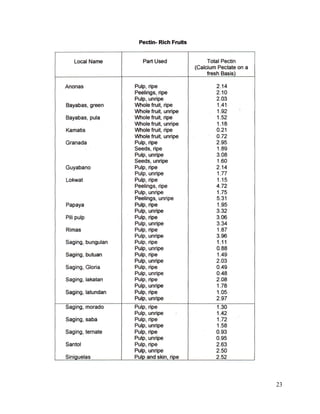
which have high pectin content are guava, guyabano, santol, siniguelas,
breadfruits, anonas and chico.
3. Acid. It makes the jelly firm and rigid in structure and is essential for
flavor and gel formation. Gel formation occurs from 2.5 to 3.5 pH value. The
ideal pH value for successful gel formation is pH 3.2. Fruits differ in acidity
and if the fruits used for jelly making lacks acid jellying maybe improved by
adding commercial citric or tartaric acid or calamansi or lemon juice.
4. Sugar. The precipitating agent of pectin causing it to form the network of
the jelly. Like acid, it controls the rigidity, strength of the jelly while acting
as preservative at the same time. Amount of sugar added depends upon the
acid and pectin content of the juice. More acid in a solution, less sugar is
required. High pectin content requires more sugar. Adding ¾ cup of sugar is
recommended. Less than this would give lower jelly strength. Always
remember to add sugar to the juice before boiling.
23
24
PREPARATION OF FRUITS OR VEGETABLES FOR JELLIES, JAMS,
MARMALADES AND PRESERVES
Preparing fruits and vegetables for jelly making
Jelly is a food that is soft, elastic, transparent, made from fruit juice,
boiled with sugar.
In preparing the fruits or vegetables for jelly-making the following
steps are followed:
1. Wash the fruit or vegetables thoroughly in cold water.
2. Slice to small pieces and place in a pan. Add enough water
to barely cover the fruit.
3. Boil the fruit slowly until soft. Do not overcook because pro-
longed boiling reduces the jellying strength of the pectin and
gives a cloudy juice.
4. Transfer the cooked pulp and juice into damp jelly bag and
allow the juice to drain completely
Extracting juice from the pulp.
5. Test for pectin content
6. Test for the fruit’s acidity
Preparing fruits and vegetables for jam making
Jam is a food made by boiling fruit pulp with sugar until thick.
Steps to be followed in preparing fruits and vegetables for jam
making:
1. Wash the fruits and vegetables very well
2. Pare the fruits, cut into small pieces and chop finely
3. Test for pectin content
4. Test for the fruit's acidity
25
Preparing fruits and vegetables for marmalade making
Marmalade is a clear, jelly-like mixture in which shreds or thin
slices of fruits or peel are suspended.
The general directions for making jelly is also applied in the
preparation of marmalade except that slices of pulp and peelings are
included.
To prepare the fruits or vegetables for marmalade making, the
following steps are followed:
1. Wash the fruits or vegetables well
2. Pare fruits and slice the pulps and peel thinly. Generally, the
juice and the sliced fruits are prepared separately. They are
mixed only during the final boiling of the fruit and juice with
sugar.
3. Place the sliced pulp or peel in a stainless steel kettle and
add enough water to barely cover the fruits.
4. Boil until soften.
5. Extract the juice. Transfer the cooked pulp and juice into a
jelly bag and allow the juice to drip.
6. Test for the pectin content.
7. Test for the acid content.
8. Combine peel and juice. Add the required amount of sugar
needed.
Preparing fruits or vegetables for making preserves
Preserves are whole small fruits or vegetables or pieces of large
fruits or vegetables cooked in thick syrup until clear, plump and somewhat
translucent.
The following are the steps in preparing fruits/vegetables for
making preserves:
1. Wash the fruits or vegetable well.
2. Pare and cut them into uniform sizes and shapes or leave them
whole if they are small.
3. Prepare syrup.
26
LET US REMEMBER:
Making jams, jellies, marmalades and preserves needs intelligent
selection and preparation of fruits and vegetables to be used in order to
avoid failures.
HOW MUCH HAVE YOU LEARNED?
DIRECTIONS: Read the questions below. Select the correct answer
from the four choices and write the letter in your test notebook.
1. Which of the following qualities is best considered in sorting fruits
and vegetables for sugar concentrates?
a. Good odor c. Tenderness
b. Sweet taste d. Uniformity of sizes
2. How do you select fruits for jelly-making?
a. Only underripe fruits c. Only ripe fruits
b . Only overripe fruits d.Only a mixture of slightly
underripe and ripe fruit
3. What product is a clear, jelly-like mixture in which shreds or thin
slices of fruits or peel are suspended?
a. jelly c. marmalade
b. jam d. preserve
4. How is the fruit pulp prepared for jam making?
a. boiling c. paring
b. chopping d. squeezing
5. Which of the following is one of the steps in preparing preserves?
a. extracting the juice c. preparing syrup
b. combining peel and juice d. testing pectin content
LET’S APPLY WHAT YOU HAVE LEARNED:
Form groups of four. Each group will bring different kinds of
fruits/vegetables. Demonstrate how to sort and grade fruits/vegetables
according to prescribed qualities. After sorting the fruits, draw your lots to
know what to prepare for; jam, jelly, marmalade or preserve.
27
RESOURCES:
Tools, Equipment and Utensils for Processing Food by Sugar
Concentration
REFERENCES:
1. Food Processing – MATEA Based Textbooks
2. Fruit and Vegetables Processing Revised Edition
3. Garcia, Ligaya B., Secondary Processing Projects
28
LESSON 3
PREPARE ACID, PECTIN AND SUGAR MIXTURE FOR JELLIES, JAMS
AND MARMALADES
WHAT IS THIS LESSON ABOUT?
Lesson 3 deals with the preparation of acid, pectin and sugar mixture
for jellies, jams and marmalades.
WHAT WILL YOU LEARN?
At the end of the lesson, you should be able to:
1. give the importance of pectin and acid in sugar concentrated
products;
2. give the three kinds of tests for determining pectin contents of
fruits;
3. perform any of the tests to measure the pectin contents of
fruits;
4. test the fruit's acidity; and
5. recognize the value of testing pectin and acid contents of fruits.
LET US DEFINE:
For better understanding of the lesson, take a look at the word
meanings below.
1. Acid – a substance having a sour taste
2. Denatured - to change the nature of; to make alcohol unfit for
drinking
3. Gel – a colloidal dispersion of a solid in a liquid which may range
from the nearly liquid to the solid state, but is typically a semi-
solid and a jelly-like consistency
4. Graduated pipette – a device with marked degrees of measurement
used for measuring and transferring small volumes of liquid
5. Lump – a shapeless mass of inert matter, especially a small mass
6. Precipitate - the solid matter that separates and usually falls at the
bottom of the liquid
7. Rigid – not easily bent
29
LET US STUDY:
How to Test Pectin Content of Fruits and Vegetables
Pectin is a water–soluble substance found in some slightly underripe
fruits that causes jellies to set. Pectin gives the continuity to the jelly
structure under certain conditions. Pectin is capable of forming a gel
when sugar and acid are in the right proportion.
To find out if a fruit has a high or low pectin content, any of the
following tests may be performed:
1. Cooking test – Boil a small amount of juice with sugar. If it
gels, then it is rich in pectin.
2. Alcohol test – mix one tablespoon of fruit juice and two
tablespoons of denatured 95% wood alcohol. The nature of the
precipitate will determine the pectin content of the fruit juice.
a. Fruit juice rich in pectin – a transparent jelly – like lump
is formed
b. Fruit juice with moderate amount of pectin – jelly-like clot
is not very firm and is broken into two or more lumps.
c. Fruit juice with very little pectin content – clot is broken
into numerous small pieces or the juice becomes cloudy.
3. Jelmeter test – A jelmeter is an instrument similar to a
graduated pipette, where fruit juice is allowed to run down the
jelmeter tube for one minute to test the pectin content.
There are two indications in a jelmeter that will show if the
fruit is high or low in pectin content.
a. Juice rich in pectin content is thicker and runs down the
tube of the jelmeter more slowly than juice with little
pectin.
b. Fruit juice that runs below the one-half (½) mark of the
jelmeter after one minute, has a low pectin content.
How to Test the Fruit’s Acidity?
Acid is the substance which makes jelly firm and rigid in structure. It
is essential for flavor and gel formation. Gel formation occurs from pH 2.5
to pH 3.4 (pH – refers to the level of acidity and alkalinity of a mixture).
The ideal pH value for successful gel formation is pH 3.2. Values above 3.4
do not permit gel formation while values below 2.5 result in weak and slack
jelly.
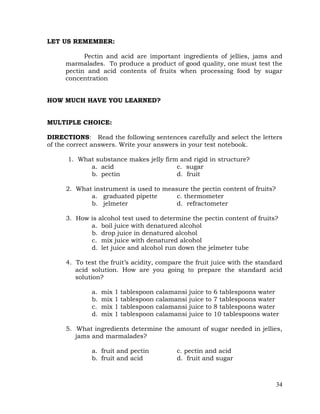
To test the acidity of fruits, mix one tablespoon of calamansi juice and
eight tablespoons ( or one-half cup) of water. The fruit juice has a high acid
content if the taste is as sour as the solution of calamansi and water. When
fruit juices lack acid, their jellying may be improved by adding acid in the
30
form of calamansi or lemon juice or commercial citric or tartaric acid. On
the other hand, if fruit juice has too high acid content, combine it with
juices low in acidity to a proportion that the combined juices taste as sour
as the standard acid solution.
It is important to test the pectin and acid content of fruits because the
amount of sugar to be added depends upon the acid and pectin content of
the juice. As a general rule, the higher the acid content, the less sugar
required; the higher the pectin content, the more sugar to be added. For
fruit juices that are rich in pectin, add ¾ to 1 cup sugar per cup of fruit
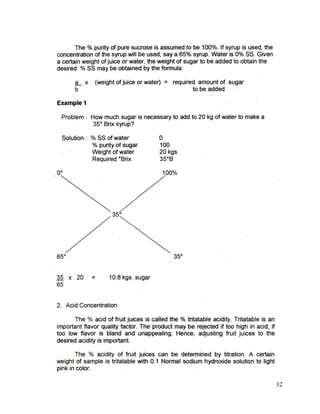
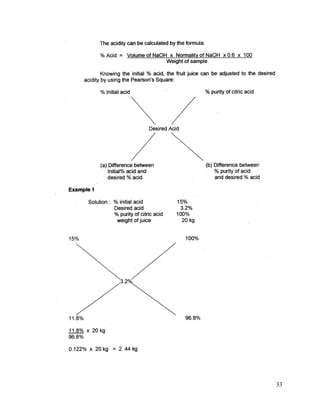
juice. Fruit juices that have moderate amount of pectin less sugar is added.
Fruit juices with small pectin content should not be utilized for jelly making
unless added with commercial pectin.
31
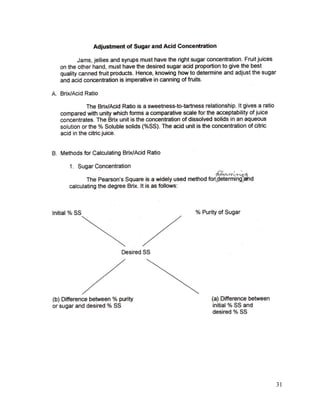
32
33
34
LET US REMEMBER:
Pectin and acid are important ingredients of jellies, jams and
marmalades. To produce a product of good quality, one must test the
pectin and acid contents of fruits when processing food by sugar
concentration
HOW MUCH HAVE YOU LEARNED?
MULTIPLE CHOICE:
DIRECTIONS: Read the following sentences carefully and select the letters
of the correct answers. Write your answers in your test notebook.
1. What substance makes jelly firm and rigid in structure?
a. acid c. sugar
b. pectin d. fruit
2. What instrument is used to measure the pectin content of fruits?
a. graduated pipette c. thermometer
b. jelmeter d. refractometer
3. How is alcohol test used to determine the pectin content of fruits?
a. boil juice with denatured alcohol
b. drop juice in denatured alcohol
c. mix juice with denatured alcohol
d. let juice and alcohol run down the jelmeter tube
4. To test the fruit’s acidity, compare the fruit juice with the standard
acid solution. How are you going to prepare the standard acid
solution?
a. mix 1 tablespoon calamansi juice to 6 tablespoons water
b. mix 1 tablespoon calamansi juice to 7 tablespoons water
c. mix 1 tablespoon calamansi juice to 8 tablespoons water
d. mix 1 tablespoon calamansi juice to 10 tablespoons water
5. What ingredients determine the amount of sugar needed in jellies,
jams and marmalades?
a. fruit and pectin c. pectin and acid
b. fruit and acid d. fruit and sugar
35
LET US APPLY WHAT YOU HAVE LEARNED:
Using alcohol test or cooking test. Each group will test the
pectin and acid contents of at least 5 kinds of fruits/vegetables in the
locality. In this activity, you will be aware of what fruits/vegetables are
good for jellies, jams, marmalades and preserves.
RESOURCES:
Raw materials, denatured alcohol and kitchen tools and
utensils.
REFERENCES:
1. Fruit and Vegetable Processing, Revised Edition, pp.78-79
2. Philippine Foods, Their Processing and Manufacture pp.
101-102, by Mendoza, Jose M.
3. Preservation of the Philippine Foods
By Leon, Sonia Y. de, Guzman, Martilde P., pp-123
36
LESSON 4
COOK JAMS, JELLIES, MARMALADES AND PRESERVES
WHAT IS THIS LESSON ABOUT?
This lesson focuses on how to cook jam, jellies, marmalades and
preserves. It discusses the different tests to be done in determining the
desired end point of the cooked product. It includes the characteristics of
good finished jellies, jams, and preserves. This lesson also tells you about
the problems encountered their causes and prevention in the process of
making sugar concentrated products.
WHAT WILL YOU LEARN?
At the end of the lesson, you should be able to:
1. give the steps in cooking jams, jellies, marmalades and
preserves;
2. cook jams, jellies, marmalades and preserves; following the
steps;
3. evaluate finished products based on the characteristics of
sugar concentrated products;
4. discuss the problems encountered and their causes of failures
and it’s prevention in making sugar concentrated products; and
5. appreciate the importance of sugar concentrated products.
LET US DEFINE:
Take a look at the word meanings below:
1. crinkles - wrinkles
2. dip - to plunge for a short time into a fluid
3. jellying point/setting point - point when sugar concentration
reaches 60%
4. lift - raise
5. plump - round
6. scum - a film covering on the surface of the jelly
7. quiver - to tremble, shake or shiver
37
LET US STUDY:
HOW TO COOK SUGAR CONCENTRATED PRODUCTS
A. Jellies
1. Measure the required amount of sugar to be added to the fruit
juice.
2. For every cup of juice, add ¾ to 1 cup sugar. Stir to dissolve the
sugar.
3. Strain again to remove any undissolved sugar, scum or dirt.
4. Cook rapidly without stirring until jellying point is reached.
5. Skim and pour in sterilized jars while still hot.
6. Seal and label.
B. Jams
1. Cook the pulp until soft. When cooking jams add sugar when
pulp of the fruits are completely softened, otherwise the fruits
become hard if the sugar is added early.
2. Add the required amount of sugar. The usual proportion is ½ to
¾ cup of sugar per cup of pulp. If the fruit is moderately rich in
protein, add smaller amount of sugar.
3. After sugar has been added, boil rapidly until the jam starts to set
in. The secret in making jam is to cook slowly before adding the
sugar and rapidly afterwards.
4. As soon as the jam reaches the setting point, remove the scum by
scooping with a clean wooden spoon.
5. Pour the jam into sterilized jars while still hot.
6. Seal and label.
C. Marmalades
1. The amount of sugar needed depends on the composition of the
juice. More sugar can be added to juices rich in pectin and acid
than those deficient in one or both constituents.
2. The sugar, juice and peel of sliced or chopped fruits are boiled to
jellying point which is usually 104◦c. A good marmalade should be
of jelly-like consistency and not syrupy.
3. Pour the marmalade into sterilized jars.
4. Seal and label.
38
D. Preserves
1. Prepare the kind of syrup needed for the fruit.
a.Thin - 3 cups water to 1 cup sugar
b. Medium - 2 cups water to 1 cup sugar
c. Thick -1 cup water to 1 cup sugar (good for sour fruits)
2. Drop the fruit into boiling syrup and cook until fruit is clear and
tender. In cooking, make sure that the fruits or vegetables are
covered with the syrup at all times so that the surface will not dry
up and harden before the syrup is absorbed by the pieces.
3. Cook rapidly so that the preserve will look bright and attractive.
4. Drain fruits.
5. Pack in sterilized jars and pour boiling syrup.
6. Remove air bubbles.
7. Half – seal.
8. Sterilized jars for 25 minutes in a boiling water.
9. Seal tightly.
10. Place jars upside down to test for leakage.
11. Label properly.
HOW TO TEST THE JELLYING POINT
One or a combination of the following tests may be used to
make sure that the mixture has reached its jellying point.
1. Bubble formation – large bubbles that tend to jump out of the pan
are formed rather than uniformly small bubbles.
2. Cold Plate test – when doing this test remove the pan from heat.
Two Ways of Doing the Cold Plate Test
a. With water. Pour a small amount of the boiling syrup into
the saucer. If the syrup forms a soft ball which crinkles when
pushed with the finger and retains its shape when lifted out of
the water, then the jellying point has been reached.
b. Without water. Cool a teaspoonful of jelly in a saucer. If the
surface of the syrup sets and crinkles when pushed with the
finger, then the jellying point has been reached.
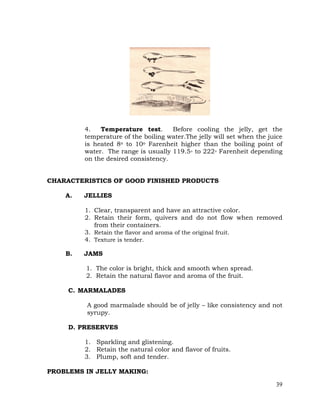
3. Spoon, sheet or flake test. Dip a wooden spoon into the boiling
jelly. Cool slightly. Lift and tilt the spoon until the syrup runs
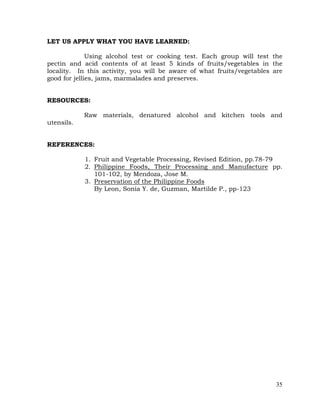
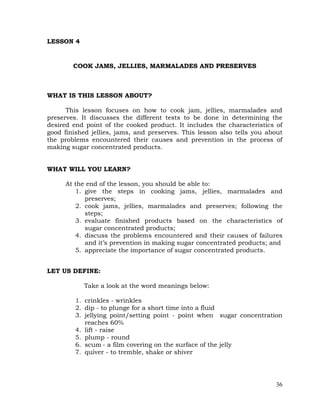
down the side. The jellying point has been reached if the jelly sets
on the spoon and the last two drops of the syrup flow together and
fall off the spoon as one sheet of flake.
39
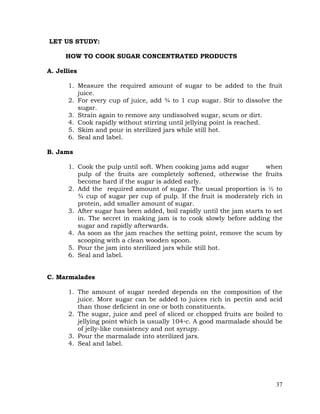
4. Temperature test. Before cooling the jelly, get the
temperature of the boiling water.The jelly will set when the juice
is heated 8o to 10o Farenheit higher than the boiling point of
water. The range is usually 119.5◦ to 222◦ Farenheit depending
on the desired consistency.
CHARACTERISTICS OF GOOD FINISHED PRODUCTS
A. JELLIES
1. Clear, transparent and have an attractive color.
2. Retain their form, quivers and do not flow when removed
from their containers.
3. Retain the flavor and aroma of the original fruit.
4. Texture is tender.
B. JAMS
1. The color is bright, thick and smooth when spread.
2. Retain the natural flavor and aroma of the fruit.
C. MARMALADES
A good marmalade should be of jelly – like consistency and not
syrupy.
D. PRESERVES
1. Sparkling and glistening.
2. Retain the natural color and flavor of fruits.
3. Plump, soft and tender.
PROBLEMS IN JELLY MAKING:
40
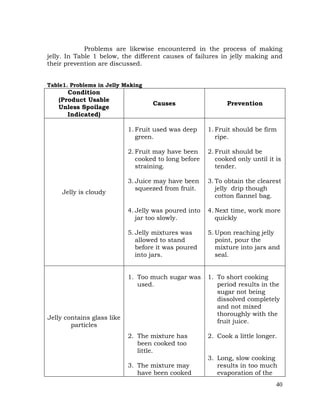
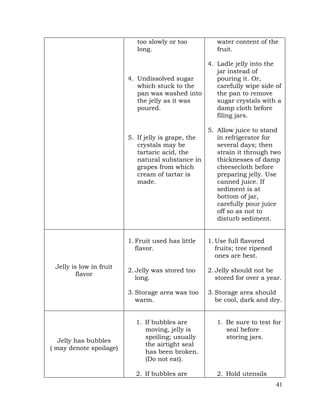
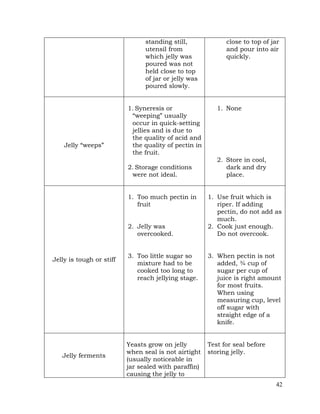
Problems are likewise encountered in the process of making
jelly. In Table 1 below, the different causes of failures in jelly making and
their prevention are discussed.
Table1. Problems in Jelly Making
Condition
(Product Usable
Unless Spoilage
Indicated)
Causes Prevention
Jelly is cloudy
1. Fruit used was deep
green.
2. Fruit may have been
cooked to long before
straining.
3. Juice may have been
squeezed from fruit.
4. Jelly was poured into
jar too slowly.
5. Jelly mixtures was
allowed to stand
before it was poured
into jars.
1. Fruit should be firm
ripe.
2. Fruit should be
cooked only until it is
tender.
3. To obtain the clearest
jelly drip though
cotton flannel bag.
4. Next time, work more
quickly
5. Upon reaching jelly
point, pour the
mixture into jars and
seal.
Jelly contains glass like
particles
1. Too much sugar was
used.
2. The mixture has
been cooked too
little.
3. The mixture may
have been cooked
1. To short cooking
period results in the
sugar not being
dissolved completely
and not mixed
thoroughly with the
fruit juice.
2. Cook a little longer.
3. Long, slow cooking
results in too much
evaporation of the
41
too slowly or too
long.
4. Undissolved sugar
which stuck to the
pan was washed into
the jelly as it was
poured.
5. If jelly is grape, the
crystals may be
tartaric acid, the
natural substance in
grapes from which
cream of tartar is
made.
water content of the
fruit.
4. Ladle jelly into the
jar instead of
pouring it. Or,
carefully wipe side of
the pan to remove
sugar crystals with a
damp cloth before
filing jars.
5. Allow juice to stand
in refrigerator for
several days; then
strain it through two
thicknesses of damp
cheesecloth before
preparing jelly. Use
canned juice. If
sediment is at
bottom of jar,
carefully pour juice
off so as not to
disturb sediment.
Jelly is low in fruit
flavor
1. Fruit used has little
flavor.
2. Jelly was stored too
long.
3. Storage area was too
warm.
1. Use full flavored
fruits; tree ripened
ones are best.
2. Jelly should not be
stored for over a year.
3. Storage area should
be cool, dark and dry.
Jelly has bubbles
( may denote spoilage)
1. If bubbles are
moving, jelly is
spoiling; usually
the airtight seal
has been broken.
(Do not eat).
2. If bubbles are
1. Be sure to test for
seal before
storing jars.
2. Hold utensils
42
standing still,
utensil from
which jelly was
poured was not
held close to top
of jar or jelly was
poured slowly.
close to top of jar
and pour into air
quickly.
Jelly “weeps”
1. Syneresis or
“weeping” usually
occur in quick-setting
jellies and is due to
the quality of acid and
the quality of pectin in
the fruit.
2. Storage conditions
were not ideal.
1. None
2. Store in cool,
dark and dry
place.
Jelly is tough or stiff
1. Too much pectin in
fruit
2. Jelly was
overcooked.
3. Too little sugar so
mixture had to be
cooked too long to
reach jellying stage.
1. Use fruit which is
riper. If adding
pectin, do not add as
much.
2. Cook just enough.
Do not overcook.
3. When pectin is not
added, ¾ cup of
sugar per cup of
juice is right amount
for most fruits.
When using
measuring cup, level
off sugar with
straight edge of a
knife.
Jelly ferments
Yeasts grow on jelly
when seal is not airtight
(usually noticeable in
jar sealed with paraffin)
causing the jelly to
Test for seal before
storing jelly.
43
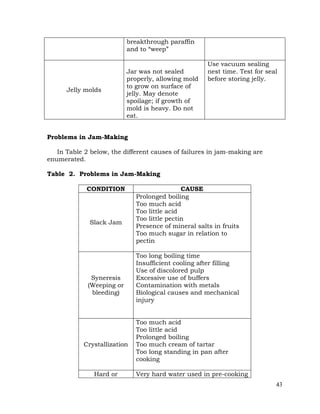
breakthrough paraffin
and to “weep”
Jelly molds
Jar was not sealed
properly, allowing mold
to grow on surface of
jelly. May denote
spoilage; if growth of
mold is heavy. Do not
eat.
Use vacuum sealing
nest time. Test for seal
before storing jelly.
Problems in Jam-Making
In Table 2 below, the different causes of failures in jam-making are
enumerated.
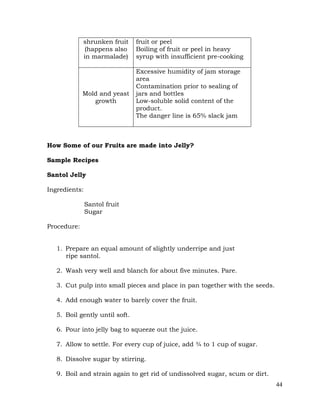
Table 2. Problems in Jam-Making
CONDITION CAUSE
Slack Jam
Prolonged boiling
Too much acid
Too little acid
Too little pectin
Presence of mineral salts in fruits
Too much sugar in relation to
pectin
Syneresis
(Weeping or
bleeding)
Too long boiling time
Insufficient cooling after filling
Use of discolored pulp
Excessive use of buffers
Contamination with metals
Biological causes and mechanical
injury
Crystallization
Too much acid
Too little acid
Prolonged boiling
Too much cream of tartar
Too long standing in pan after
cooking
Hard or Very hard water used in pre-cooking
44
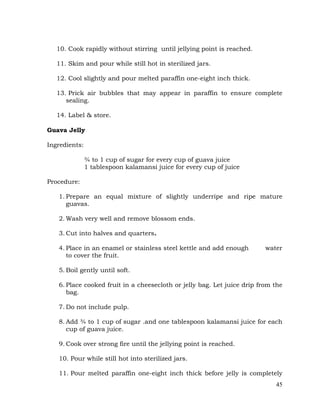
shrunken fruit
(happens also
in marmalade)
fruit or peel
Boiling of fruit or peel in heavy
syrup with insufficient pre-cooking
Mold and yeast
growth
Excessive humidity of jam storage
area
Contamination prior to sealing of
jars and bottles
Low-soluble solid content of the
product.
The danger line is 65% slack jam
How Some of our Fruits are made into Jelly?
Sample Recipes
Santol Jelly
Ingredients:
Santol fruit
Sugar
Procedure:
1. Prepare an equal amount of slightly underripe and just
ripe santol.
2. Wash very well and blanch for about five minutes. Pare.
3. Cut pulp into small pieces and place in pan together with the seeds.
4. Add enough water to barely cover the fruit.
5. Boil gently until soft.
6. Pour into jelly bag to squeeze out the juice.
7. Allow to settle. For every cup of juice, add ¾ to 1 cup of sugar.
8. Dissolve sugar by stirring.
9. Boil and strain again to get rid of undissolved sugar, scum or dirt.
45
10. Cook rapidly without stirring until jellying point is reached.
11. Skim and pour while still hot in sterilized jars.
12. Cool slightly and pour melted paraffin one-eight inch thick.
13. Prick air bubbles that may appear in paraffin to ensure complete
sealing.
14. Label & store.
Guava Jelly
Ingredients:
¾ to 1 cup of sugar for every cup of guava juice
1 tablespoon kalamansi juice for every cup of juice
Procedure:
1. Prepare an equal mixture of slightly underripe and ripe mature
guavas.
2. Wash very well and remove blossom ends.
3. Cut into halves and quarters.
4. Place in an enamel or stainless steel kettle and add enough water
to cover the fruit.
5. Boil gently until soft.
6. Place cooked fruit in a cheesecloth or jelly bag. Let juice drip from the
bag.
7. Do not include pulp.
8. Add ¾ to 1 cup of sugar .and one tablespoon kalamansi juice for each
cup of guava juice.
9. Cook over strong fire until the jellying point is reached.
10. Pour while still hot into sterilized jars.
11. Pour melted paraffin one-eight inch thick before jelly is completely
46
cooled.
12. Prick air bubbles that may appear in the paraffin to ensure complete
sealing.
13. Label and store.
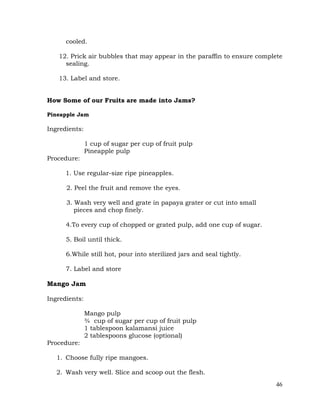
How Some of our Fruits are made into Jams?
Pineapple Jam
Ingredients:
1 cup of sugar per cup of fruit pulp
Pineapple pulp
Procedure:
1. Use regular-size ripe pineapples.
2. Peel the fruit and remove the eyes.
3. Wash very well and grate in papaya grater or cut into small
pieces and chop finely.
4.To every cup of chopped or grated pulp, add one cup of sugar.
5. Boil until thick.
6.While still hot, pour into sterilized jars and seal tightly.
7. Label and store
Mango Jam
Ingredients:
Mango pulp
¾ cup of sugar per cup of fruit pulp
1 tablespoon kalamansi juice
2 tablespoons glucose (optional)
Procedure:
1. Choose fully ripe mangoes.
2. Wash very well. Slice and scoop out the flesh.
47
3. Mash the pulp or flesh and measure. Add sugar.
4. Place in pan and boil over strong fire, stir constantly.
5. After about three minutes, add kalamansi juice.
6. Continue stirring until mixture is thick.
7. Remove from heat and pour while still hot in sterilized jars.
8. Seal tightly.
9. Label and store.
How Some of our Fruits are made into Marmalades
Santol Marmalade
Ingredients:
1 cup of santol pulp
1 cup of santol juice
1-1/2 cups of sugar
Procedure:
1. Wash and blanch santol for about five minutes.
2. Pare, cut and remove seeds.
3. Chop the pulp finely and measure in cups.
4. Place seeds and skin in an enamel or stainless steel pan and
pour enough water to just cover the fruit.
5. Simmer gently and strain the juice.
6. Combine juice with chopped pulp and measure. For every cup of
combined pulp and juice, add ¾ cup of sugar.
7. Stir well to dissolve sugar.
8. Cook over strong fire until mixture thickens and until fruit
pulp is clear and transparent.
48
9.Remove from heat, stir and skim alternately for three minutes.
10. Pour into sterilized jars while still hot and seal at once.
11. Label and store.
Mango – Orange Marmalade
Ingredients:
8 ripe mangoes
2 oranges
Peel of 1 orange
Sugar
Procedure:
1. Wash, peel and scoop out flesh of mango with spoon.
2. Chop finely using a stainless steel knife.
3. Remove peel and seeds from orange.
4. Chop finely also using a stainless steel knife.
5. Shred the orange peel.
6.Combine chopped mango, orange pulp and peel in an
enamel or stainless steel kettle. For every cup of the combined
mixture, add ¾ to 1 cup of sugar.
7. Stir until sugar is completely dissolved.
8. Boil mixture rapidly while constantly stirring until thick.
9. Pour while still hot into sterilized jars.
10.Seal immediately, label and store
49
How Some of our Fruits are made Into Preserves
Banana Preserve
Ingredients:
Banana, saba
Sugar
Water
Citric acid
Procedure
1. Use ripe saba variety bananas. Boil in enough water. Peel. Remove
adhering fibers.
2. Prepare syrup of two parts of sugar and one part of water. Cook
the bananas in the syrup for 15 minutes.
3. Soak overnight.
4. The following day, drain bananas. Boil syrup for 15 minutes and
add citric acid (1/4 tsp. for every 4 cups syrup).
5. Pack bananas in preserving jars. Fill bottles with syrup . Remove
bubbles; then, refill with syrup.
6. Half-seal sterilized jars for 25 minutes in boiling water or for 15
minutes in a pressure cooker. Seal tightly.
7. Label and store.
Nangka Preserve
1. Remove seeds and cut both ends of the fleshy bulbs.
2. Wash and cook for 10 minutes in syrup (one part of sugar to two
parts of water) Soak in syrup.
3. Drain bulbs, pack in sterilized jars and pour boiling syrup.
4. Remove air bubbles. Refill spaces with syrup. Half-seal.
5. Sterilize pint jars in boiling water for 30 minutes. Seal tightly.
Place jars upside down to test for leakage.
50
6. Cool and label.
7. Store in cool dry place.
Kamias Preserve
1. Select big mature, firm kamias. Soak in lime water (one
teaspoonful of lime to a liter of water) overnight.
2. Wash and boil in a copper vat or kettle with enough water to cover.
3. Stir once in a while. When the natural color of the kamias has set,
remove from fire and soak in cold water for two hours.
4. Drain and press each one lightly to remove excess water. Prepare
syrup made up of two parts of sugar and one part of water.
5. Boil kamias in the syrup for 30 minutes. Drain.
6. Pack in jars and pour syrup. Remove air bubbles and refill with
syrup.
7. Half-seal and sterilize pint jars for 25 minutes in boiling water.
Seal tightly.
8. Label and store.
Kundol preserve
1. Select mature kundol. Peel thinly and slice into desired size and
shape.
2. Soak in lime water (one teaspoon of lime to a liter of water)
overnight.
3. Wash and blanch in boiling water for 10 minutes. Drop in cold
water . Drain.
4. Boil in syrup (two parts of sugar and one part of water). Soak
overnight.
5. Cook in syrup until thick. Drain and pack the kundol in preserving
jars.
6. Fill with syrup. Half-seal and sterilize pint jars for 20 minutes in
boiling water. Seal tightly label and store.
LET US REMEMBER:
Undercooking and overcooking are some of the causes of failure
in making jams, jellies and marmalades. Problems in preparing these
products can be avoided if you know how to test the jellying point of your
products.
51
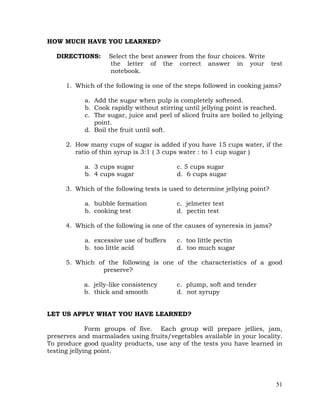
HOW MUCH HAVE YOU LEARNED?
DIRECTIONS: Select the best answer from the four choices. Write
the letter of the correct answer in your test
notebook.
1. Which of the following is one of the steps followed in cooking jams?
a. Add the sugar when pulp is completely softened.
b. Cook rapidly without stirring until jellying point is reached.
c. The sugar, juice and peel of sliced fruits are boiled to jellying
point.
d. Boil the fruit until soft.
2. How many cups of sugar is added if you have 15 cups water, if the
ratio of thin syrup is 3:1 ( 3 cups water : to 1 cup sugar )
a. 3 cups sugar c. 5 cups sugar
b. 4 cups sugar d. 6 cups sugar
3. Which of the following tests is used to determine jellying point?
a. bubble formation c. jelmeter test
b. cooking test d. pectin test
4. Which of the following is one of the causes of syneresis in jams?
a. excessive use of buffers c. too little pectin
b. too little acid d. too much sugar
5. Which of the following is one of the characteristics of a good
preserve?
a. jelly-like consistency c. plump, soft and tender
b. thick and smooth d. not syrupy
LET US APPLY WHAT YOU HAVE LEARNED?
Form groups of five. Each group will prepare jellies, jam,
preserves and marmalades using fruits/vegetables available in your locality.
To produce good quality products, use any of the tests you have learned in
testing jellying point.
52
RESOURCES:
Raw materials, ingredients, kitchen utensils, tools and
equipment.
REFERENCES:
1. Fruit and Vegetable Processing, Revised Edition pp.78-104
2. Food Processing – MATEA – Based Textbook pp.30-31
3. Philippine Foods, Their Processing and Manufacture
By Mendoza, Jose M, pp. 100-113
53
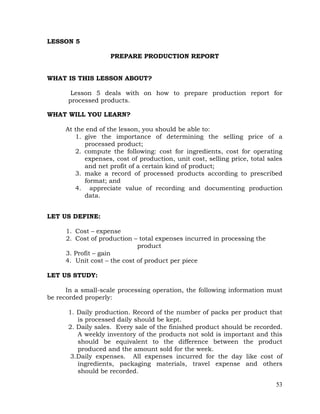
LESSON 5
PREPARE PRODUCTION REPORT
WHAT IS THIS LESSON ABOUT?
Lesson 5 deals with on how to prepare production report for
processed products.
WHAT WILL YOU LEARN?
At the end of the lesson, you should be able to:
1. give the importance of determining the selling price of a
processed product;
2. compute the following: cost for ingredients, cost for operating
expenses, cost of production, unit cost, selling price, total sales
and net profit of a certain kind of product;
3. make a record of processed products according to prescribed
format; and
4. appreciate value of recording and documenting production
data.
LET US DEFINE:
1. Cost – expense
2. Cost of production – total expenses incurred in processing the
product
3. Profit – gain
4. Unit cost – the cost of product per piece
LET US STUDY:
In a small-scale processing operation, the following information must
be recorded properly:
1. Daily production. Record of the number of packs per product that
is processed daily should be kept.
2. Daily sales. Every sale of the finished product should be recorded.
A weekly inventory of the products not sold is important and this
should be equivalent to the difference between the product
produced and the amount sold for the week.
3.Daily expenses. All expenses incurred for the day like cost of
ingredients, packaging materials, travel expense and others
should be recorded.
54
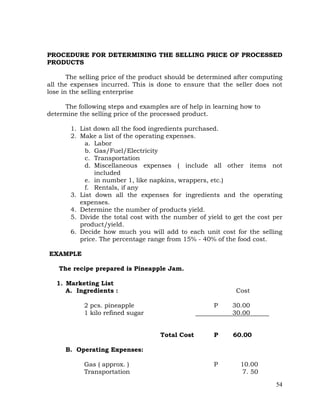
PROCEDURE FOR DETERMINING THE SELLING PRICE OF PROCESSED
PRODUCTS
The selling price of the product should be determined after computing
all the expenses incurred. This is done to ensure that the seller does not
lose in the selling enterprise
The following steps and examples are of help in learning how to
determine the selling price of the processed product.
1. List down all the food ingredients purchased.
2. Make a list of the operating expenses.
a. Labor
b. Gas/Fuel/Electricity
c. Transportation
d. Miscellaneous expenses ( include all other items not
included
e. in number 1, like napkins, wrappers, etc.)
f. Rentals, if any
3. List down all the expenses for ingredients and the operating
expenses.
4. Determine the number of products yield.
5. Divide the total cost with the number of yield to get the cost per
product/yield.
6. Decide how much you will add to each unit cost for the selling
price. The percentage range from 15% - 40% of the food cost.
EXAMPLE
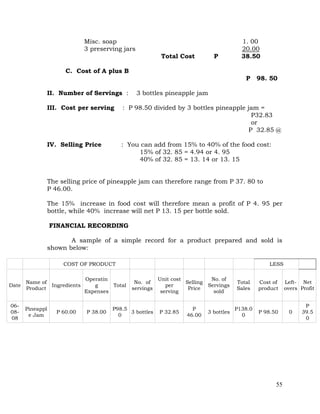
The recipe prepared is Pineapple Jam.
1. Marketing List
A. Ingredients : Cost
2 pcs. pineapple P 30.00
1 kilo refined sugar 30.00
Total Cost P 60.00
B. Operating Expenses:
Gas ( approx. ) P 10.00
Transportation 7. 50
55
Misc. soap 1. 00
3 preserving jars 20.00
Total Cost P 38.50
C. Cost of A plus B
P 98. 50
II. Number of Servings : 3 bottles pineapple jam
III. Cost per serving : P 98.50 divided by 3 bottles pineapple jam =
P32.83
or
P 32.85 @
IV. Selling Price : You can add from 15% to 40% of the food cost:
15% of 32. 85 = 4.94 or 4. 95
40% of 32. 85 = 13. 14 or 13. 15
The selling price of pineapple jam can therefore range from P 37. 80 to
P 46.00.
The 15% increase in food cost will therefore mean a profit of P 4. 95 per
bottle, while 40% increase will net P 13. 15 per bottle sold.
FINANCIAL RECORDING
A sample of a simple record for a product prepared and sold is
shown below:
COST OF PRODUCT LESS
Date
Name of
Product
Ingredients
Operatin
g
Expenses
Total
No. of
servings
Unit cost
per
serving
Selling
Price
No. of
Servings
sold
Total
Sales
Cost of
product
Left-
overs
Net
Profit
06-
08-
08
Pineappl
e Jam
P 60.00 P 38.00
P98.5
0
3 bottles P 32.85
P
46.00
3 bottles
P138.0
0
P 98.50 0
P
39.5
0
56
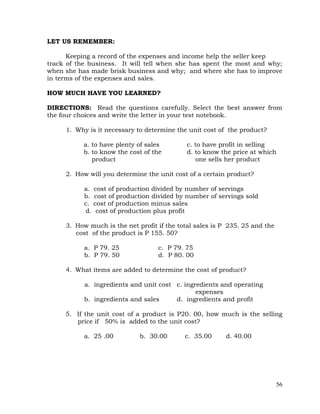
LET US REMEMBER:
Keeping a record of the expenses and income help the seller keep
track of the business. It will tell when she has spent the most and why;
when she has made brisk business and why; and where she has to improve
in terms of the expenses and sales.
HOW MUCH HAVE YOU LEARNED?
DIRECTIONS: Read the questions carefully. Select the best answer from
the four choices and write the letter in your test notebook.
1. Why is it necessary to determine the unit cost of the product?
a. to have plenty of sales c. to have profit in selling
b. to know the cost of the d. to know the price at which
product one sells her product
2. How will you determine the unit cost of a certain product?
a. cost of production divided by number of servings
b. cost of production divided by number of servings sold
c. cost of production minus sales
d. cost of production plus profit
3. How much is the net profit if the total sales is P 235. 25 and the
cost of the product is P 155. 50?
a. P 79. 25 c. P 79. 75
b. P 79. 50 d. P 80. 00
4. What items are added to determine the cost of product?
a. ingredients and unit cost c. ingredients and operating
expenses
b. ingredients and sales d. ingredients and profit
5. If the unit cost of a product is P20. 00, how much is the selling
price if 50% is added to the unit cost?
a. 25 .00 b. 30.00 c. 35.00 d. 40.00
57
LET US APPLY WHAT YOU HAVE LEARNED?
List down all the expenses incurred in processing your
products. Then, compute the cost of product; the unit cost of each
product; and determine your selling price. Make a record of your
processed products.
RESOURCES:
Record Notebook, ballpen, pad paper, calculator
REFERENCES:
Homemaking For You and Me I ( Foods and Nutrition )
pp. 15-17
Fruit and Vegetable Processing, Revised Edition pp 244-245
58
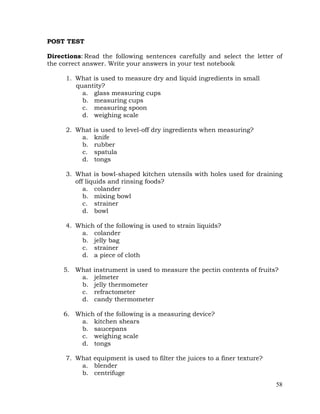
POST TEST
Directions: Read the following sentences carefully and select the letter of
the correct answer. Write your answers in your test notebook
1. What is used to measure dry and liquid ingredients in small
quantity?
a. glass measuring cups
b. measuring cups
c. measuring spoon
d. weighing scale
2. What is used to level-off dry ingredients when measuring?
a. knife
b. rubber
c. spatula
d. tongs
3. What is bowl-shaped kitchen utensils with holes used for draining
off liquids and rinsing foods?
a. colander
b. mixing bowl
c. strainer
d. bowl
4. Which of the following is used to strain liquids?
a. colander
b. jelly bag
c. strainer
d. a piece of cloth
5. What instrument is used to measure the pectin contents of fruits?
a. jelmeter
b. jelly thermometer
c. refractometer
d. candy thermometer
6. Which of the following is a measuring device?
a. kitchen shears
b. saucepans
c. weighing scale
d. tongs
7. What equipment is used to filter the juices to a finer texture?
a. blender
b. centrifuge
59
c. hydraulic press
d. juice extractor
8. Which of the following is used for slicing fruits and vegetables into
different sizes?
a. french knife
b. food slicer
c. paring knife
d. table knife
9. How is processing tools, utensils and equipment sanitized?
a. rinsing thoroughly in tap water
b. soaking in water with detergent
c. soaking in 150-200 ppm chlorinated water
d. Drying under the sun
10.What water-soluble substance is found in some slightly underripe
fruits that causes jellies to set?
a. acid
b. pectin
c. pulp
d. sugar
11. Which of the following is made from fruit juice and pulp?
a. jam
b. jelly
c. marmalade
d. preserve
12. What product is made from fruit juice only?
a. jam
b. jelly
c. marmalade
d. preserve
13. Which of the following should be selected for jelly making?
a. ripe fruits only
b. slightly underripe only
c. mixture slightly underripe and ripe fruit only
d. overripe fruits only
14. Which of the following qualities must be considered in sorting
fruits and vegetables for sugar concentrates?
a. good odor
b. tender
c. uniformity of sizes
60
d. palatability
15. What product is a clear-jelly-like mixture in which shreds or thin
slices of fruits or peel are suspended?
a. jelly
b. jam
c. marmalade
d. preserve
16. How is the fruit pulp prepared for jam making?
a. boiling
b. chopping
c. squeezing
d. paring
17.Which of the following is one of the steps in preparing preserves?
a. extracting the juice
b. combining peel and juice
c. cooking fruit in syrup
d. testing pectin content
18.What substance makes jelly firm and rigid in structure?
a. acid
b. pectin
c. sugar
d. salt
19.How is alcohol test used to determine the pectin content of fruits?
a. boil juice with denatured alcohol
b. mix juice and denatured alcohol
c. let juice and alcohol run down the jelmeter tube
d. drop juice into denatured alcohol
20. To test the fruit’s acidity, compare the fruit juice with the standard
acid solution. How do you prepare the standard acid solution?
a. mix 1 tablespoon calamansi juice to 6 tablespoons water
b. mix 1 tablespoon calamansi juice to 7 tablespoons water
c. mix 1 tablespoon calamansi juice to 8 tablespoons water
d. mix 1 tablespoon juice to 10 tablespoons water
21. What ingredients determine the amount of sugar needed in jellies,
jam and marmalade?
a. fruit and pectin
b. fruit and acid
c. pectin and acid
d. pectin and peel
61
22. Which of the following is one of the steps followed in making jams?
a. add the sugar when pulp is completely softened
b. cook rapidly without stirring until jellying point is reached
c. the sugar, juice and peel of sliced fruits are boiled to jellying
point
d. boil the sugar syrup until thick
23. How many cups of sugar is added if you have 15 cups water, if the
ratio of thin syrup is 3:1 (3 cups water to 1 cup sugar)
a. 3 cups sugar
b. 4 cups sugar
c. 5 cups sugar
d. 6 cups sugar
24. Which of the following tests is used to determine the jellying point?
a. bubble formation
b. cooking test
c. jelmeter test
d. pectin test
25. Which of the following is one of the causes of syneresis in jams?
a. excessive use of buffers
b. too little acid
c. too little pectin
d. too much sugar
26. Which of the following is one of the characteristics of a good
preserve?
a. jelly-like consistency
b. thick and smooth
c. plump, soft and tender
d. not syrupy
27. How many cup of sugar is added if the fruit juice is rich in pectin
a. ½ cup
b. ¾ cup
c. 1 cup
d. 1 ¼ cups
28. What is the secret in making jam?
a. boil rapidly before adding the sugar and slowly afterwards
b. boil slowly before adding the sugar ad rapidly afterwards
c. add sugar and boil slowly
d. add sugar and boil rapidly
62
29. Why should a seller determine the selling price of her product
before selling it?
a. to have plenty of sales
b. to obtain the unit cost
c. to know the price at which she sells her product
d. to have profit in selling
30. How do you determine the unit cost of a certain product?
a. cost of production divided by number of servings
b. cost of production divided by number of servings sold
c. cost of production minus sales
d. cost of production plus profit
31. How much is the net profit if the total sales is P235.25 and the
cost of the production is P155.50?
a. P79.25
b. P79.50
c. P79.75
d. P80.00
32. What items are added to determine the cost of product?
a. ingredients and unit cost
b. ingredients and sales
c. ingredients and operating expenses
d. ingredients and profit
33. How much is the cost of the recipe if the total expenses for
ingredients is P75.00 and the total cost for operating expenses is
P35,00?
a. P105.00
b. P110.00
c. P115.00
d. P120.00
34. How much is the total sales if 10 jars of jellies are sold for P25.00
per jar?
a. P225.00
b. P240.00
c. P250.00
d. P255.00
35. If the unit cost of a product is P20.00, how much is the selling
price of 50% is added to the unit cost?
a. P30.00
b. P40.00
c. P45.00
d. P50.00
63
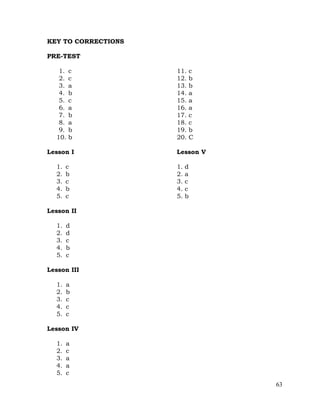
KEY TO CORRECTIONS
PRE-TEST
1. c 11. c
2. c 12. b
3. a 13. b
4. b 14. a
5. c 15. a
6. a 16. a
7. b 17. c
8. a 18. c
9. b 19. b
10. b 20. C
Lesson I Lesson V
1. c 1. d
2. b 2. a
3. c 3. c
4. b 4. c
5. c 5. b
Lesson II
1. d
2. d
3. c
4. b
5. c
Lesson III
1. a
2. b
3. c
4. c
5. c
Lesson IV
1. a
2. c
3. a
4. a
5. c
64
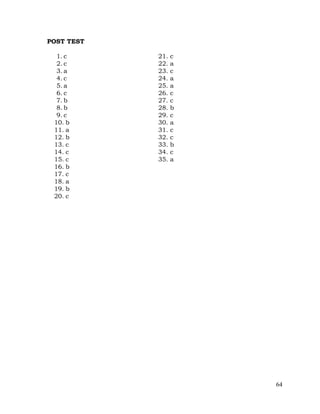
POST TEST
1. c 21. c
2. c 22. a
3. a 23. c
4. c 24. a
5. a 25. a
6. c 26. c
7. b 27. c
8. b 28. b
9. c 29. c
10. b 30. a
11. a 31. c
12. b 32. c
13. c 33. b
14. c 34. c
15. c 35. a
16. b
17. c
18. a
19. b
20. c
65
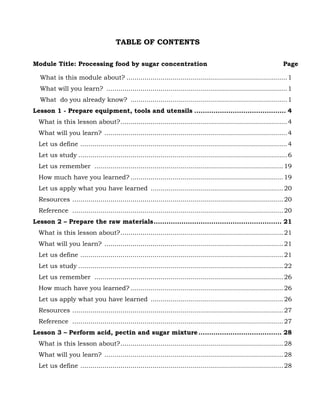
TABLE OF CONTENTS
Module Title: Processing food by sugar concentration Page
What is this module about? ................................................................................1
What will you learn? ..........................................................................................1
What do you already know? ..............................................................................1
Lesson 1 - Prepare equipment, tools and utensils ........................................... 4
What is this lesson about?...................................................................................4
What will you learn? ...........................................................................................4
Let us define .......................................................................................................4
Let us study ........................................................................................................6
Let us remember ..............................................................................................19
How much have you learned? ............................................................................19
Let us apply what you have learned ..................................................................20
Resources .........................................................................................................20
Reference .........................................................................................................20
Lesson 2 – Prepare the raw materials............................................................ 21
What is this lesson about?.................................................................................21
What will you learn? .........................................................................................21
Let us define .....................................................................................................21
Let us study ......................................................................................................22
Let us remember ..............................................................................................26
How much have you learned? ............................................................................26
Let us apply what you have learned ..................................................................26
Resources .........................................................................................................27
Reference .........................................................................................................27
Lesson 3 – Perform acid, pectin and sugar mixture....................................... 28
What is this lesson about?.................................................................................28
What will you learn? .........................................................................................28
Let us define .....................................................................................................28
66
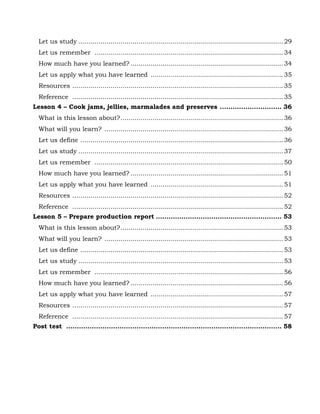
Let us study ......................................................................................................29
Let us remember ..............................................................................................34
How much have you learned? ............................................................................34
Let us apply what you have learned ..................................................................35
Resources .........................................................................................................35
Reference .........................................................................................................35
Lesson 4 – Cook jams, jellies, marmalades and preserves ............................. 36
What is this lesson about?.................................................................................36
What will you learn? .........................................................................................36
Let us define .....................................................................................................36
Let us study ......................................................................................................37
Let us remember ..............................................................................................50
How much have you learned? ............................................................................51
Let us apply what you have learned ..................................................................51
Resources .........................................................................................................52
Reference .........................................................................................................52
Lesson 5 – Prepare production report ........................................................... 53
What is this lesson about?.................................................................................53
What will you learn? .........................................................................................53
Let us define .....................................................................................................53
Let us study ......................................................................................................53
Let us remember ..............................................................................................56
How much have you learned? ............................................................................56
Let us apply what you have learned ..................................................................57
Resources .........................................................................................................57
Reference .........................................................................................................57
Post test ..................................................................................................... 58
0
Republic of the Philippines
Department of Education
PUBLIC TECHNICAL-
VOCATIONAL
HIGH SCHOOLS
PUBLIC TECHNICAL-
VOCATIONAL
HIGH SCHOOLS
Unit of Competency: PACKAGE PROCESSED FOOD PRODUCT
Module No. 2
Module Title: PACKAGING PROCESSED FOOD
PRODUCTS
1
MODULE 2
QUALIFICATION TITLE : FOOD PROCESSING NC II
UNIT OF COMPETENCY : PACKAGE PROCESSED FOOD
PRODUCT
MODULE TITLE : PACKAGING PROCESSED
FOOD PRODUCTS
NOMINAL DURATION : 100 HOURS
WHAT IS THIS MODULE ABOUT?
This module covers the knowledge, skills and attitudes required in
packaging processed food products such as preparing packaging equipment,
tools and materials, undertaking packaging and post packaging procedures
of processed food products.
WHAT WILL YOU LEARN?
After completing this module, you should be able to:
1. prepare packaging equipment, tools and materials;
2. undertake packaging processed food products; and
3. undertake post packaging procedures.
WHAT DO YOU ALREADY KNOW?
Let’s find out how much you already know about packaging of
processed food products. Read the questions carefully and select the letters
of the correct answers. Write your answers in your test notebook.
1. What is the process of putting processed foods into containers?
a. canning c. packing
b. packaging d. wrapping
2. Which of the following is not a reason for packaging finished
products?
a. Protect processed foods against contamination.
b. Make distribution of the products to various market outlets
easier.
c. Minimize damage to product while in transit.
d. Identify the products.
2
3. Which of the following is a packaging tool?
a. glass c. flexible
b. food scales d. plastic
1. Which of the following is a packaging material?
a. can sealer c. cap seal
b. plastic sealers d. plastic protect cap sealer
2. What packaging material is used for heavy loads?
a. corrugated carton c. composite cans
b. paper and paperboard d. plastic container
3. Which of the following is one of the oldest packaging materials for
many food products like preserves, condiments, beverages and juice?
a. indigenous materials c. metal containers
b. glass container d. carton
7. What packages are in demand nowadays and are used as alternatives
to traditional packaging methods?
a. bags c. jars
b. flexible d. pouches
8.. What packaging material is appropriate for ham and bacon?
a. cryovac films c. PVC wraps
b. PVDC – coated films d. PE bags
9. What is the process of identifying or describing a product by placing
printed or graphic materials on a container or wrapper?
a. labeling c. wrapping
b. packaging d. sealing
10. What is the most visible part of a package?
a. container c. label
b. cover d. wrapper
II – TRUE or FALSE
3
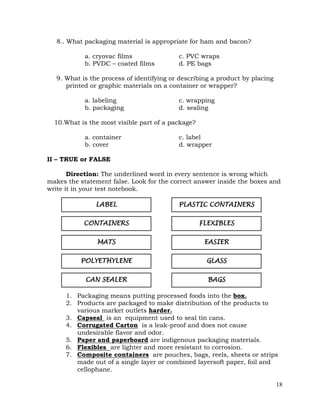
Direction: The underlined word in every sentence is wrong which
makes the statement false. Look for the correct answer inside the boxes and
write it in your test notebook.
1. Packaging means putting processed foods into the box.
2. Products are packaged to make distribution of the products to
various market outlets harder.
3. Capseal is an equipment used to seal tin cans.
4. Corrugated Carton is a leak-proof and does not cause
undesirable flavor and odor.
5. Paper and paperboard are indigenous packaging materials.
6. Flexibles are lighter and more resistant to corrosion.
7. Composite containers are pouches, bags, reels, sheets or strips
made out of a single layer or combined layersoft paper, foil and
cellophane.
8. Tags are well-suited for the small, single-serve packs so popular
nowadays.
9. Labeling is the most visible part of a package.
10. Glass jars are appropriate packaging material for dried and
smoked fish.
III – IDENTIFICATION
Direction: Read the following sentences carefully. Select
the correct answer inside the circle and write it in your
test notebook.
1. Identifying a product by placing printed materials on a container
or wrapper.
2. A part of a package that tells consumers about the product.
EASIER
CONTAINERS
GLASS
BAGS
PLASTIC CONTAINERS
FLEXIBLES
LABEL
MATS
CAN SEALER
POLYETHYLENE
 Label
 Labeling
4
3. One of the items printed in a label.
4. Flexibles should be free from pinholes.
5. Products stored in the refrigerator.
 Leak inspection
 Product testing
 Net content
 Weight of package
 Label
 Labeling
 Jams and jellies
 Tocino and
longganisa
5
LESSONS 1 AND 2
PREPARE PACKAGING EQUIPMENT, TOOLS AND MATERIALS
UNDERTAKE PACKAGING OF PROCESSED FOOD PRODUCTS
WHAT IS THIS LESSON ABOUT?
Lesson I and II deal with packaging equipment, tools and materials.
These lessons also include the appropriate packaging materials for some
processed products.
WHAT WILL YOU LEARN?
At the end of the lesson, you should be able to:
1. define packaging and tell the importance of packaging;
2. identify packaging materials for processed products;
3. identify different packaging tools and equipment;
4. enumerate appropriate packaging materials for specific type of
processed products;
5. discuss basic rules that must be observed by food handlers;
and
6. value the importance of familiarizing the proper packaging
procedure of food products.
LET US DEFINE:
1. corrosion - an act of wearing away gradually (by action of rust or
chemicals)
2. corrugated - wrinkled
3. indigenous - native
4. laminate - a product made by bonding together two or more layers of
material or materials by adhesive through heat and
pressure
5. transit – passage
LET US STUDY:
1. What is packaging?
2. Why is packaging of food products important?
6
Packaging means the process of putting processed foods into
containers before they are marketed. Products are packaged for three
reasons.
1. Protect the processed foods against contamination by organisms
that cause spoilage.
2. Make distribution of the products to various market outlets
easier.
3. Minimize damage to product while in transit.
Packaging Tools and Equipment:
1. Packaging machinery/equipment/tools
2. Weighing scales
3. Food scales
4. Can sealer
5. Plastic sealer
6. Pulper finisher
7. Plastic protect cap sealer
How to Clean and Sanitize Packaging Tools, Equipment and
Containers?
Have food containers, packaging equipment and tools ready and
thoroughly cleaned and sterilized before using. Thorough rinsing would not
be enough for they may still contain yeast cells and spores.
Glass containers and similar containers that are thoroughly washed
should be placed in boiling water for 15 minutes to be sterilized. Keep them
warm until ready to use.
Packaging Materials for Finished Products:
1. Indigenous materials. Some usable indigenous packaging materials
are mats, baskets and fibercraft items.
2. Glass containers. One of the oldest packaging materials for many food
products like preserves, condiments, beverages and
juices. It is leak-proof and does not cause
undesirable flavor and odor. Glass jars may have
either glass covers or metal screw caps. All glass
jars are sealed with a safe-elastic rubber ring
placed on the lid of the jar. Glass jars with metal
screw caps (called mason-type jars) are sealed well
after the metal caps are screwed down to the lid of
the jar.
7
Classifications of Glass Containers According to Shape:
a) Bottles. They have narrow necks and are usually used for
liquids like catsup, vinegar or small-sized solids.
b) Jars. They have wide mouths and very short, wide necks. They
are used for liquids, solids and foods with thick paste-
like or syrupy substances such as sweet preserves and
jellies.
c) Tumblers. They have no necks like ordinary drinking glasses.
They are commonly used for jellies, jams and peanut
butter.
d) Jugs. They have short, narrow necks and ear lugs. They come
in large sizes, usually half and one gallon sizes. They are
commonly used for liquids such as juice containers.
3. Metal Containers. Metal cans compared to glass containers are easier
to handle during storing and dispensing because
they are lighter and unbreakable. The kinds of metal
cans commonly used are standard tin-plate can,
coated tin can, lightweight double-reduced tin-plates
can and aluminum-coated can.
4. Plastic containers. Plastic jars are sometimes preferred over ones
made of glass or metal. Plastic packages are lighter
and more resistant to corrosion. Plastic containers
are also less likely to break unlike glass containers
Plastic containers have very low resistance to heat.
These containers also tend to deteriorate, especially
at low temperature. They are also less efficient as
barrier to solids, liquids and gases.
These packages which usually come in the form of
jugs, tumblers, based-like containers, etc. are used
for fruit concentrates, vinegar and even catsup.
5. Paper and Paperboard. Paper is primarily made into bags, wrappers
and labels. It is also an important part of laminates.
Paperboard is made into cartons, multipack
carriers, tags, composite cans and drums.
6. Corrugated Carton. Single-faced corrugated boards generally consist of
two linerboard layers and a corrugated layer. Double-
wall or triple-wall boards which contain the
corresponding number of corrugated layers are used
for heavy loads. Clay-coated or top-white linerboards
with nicely printed exteriors are ideal for shipping
fruit.
8
7. Flexibles. These are pouches, bags, reels, sheets or strips made out of
a single layer or combined layers of paper, film, foil or
cellophane.
Flexibles are in demand because of the following advantages:
1. Low package cost
2. They are an affordable and attractive alternative to
traditional packaging methods.
3. They are well-suited for the small, single-serve packs so
popular nowadays
8. Composite Cans/Containers. These consist of two dissimilar materials
such as spirally wound or convoluted
cardboard with metal or plastic ends.
Examples of products packed in such
containers are cheese balls and imported
potato chips.
Other Packaging Components:
1. Capseal. Capseal is a popular tamper-evident packaging material
made usually from shrinkable plastics like PVC. Manufacturers of
food products in jars or bottles are big users.
2. Label. The most visible part of a package is the label. It says
everything to know about the product-brand, weight, producer, usage,
instruction, special qualities, expiry dates, etc.
3. Tags. These are usually made of paperboard, serving to some extent
the function of labels. When products are displayed by hanging, tags
are used.
4. Cushion. It is an important material for transporting fragile or easily
crushed materials. To “cushion” means to protect products from
environmental shocks and vibration. Many materials can be
considered as cushioning materials-corrugated cartons, paperboard
linings, shredded or crumpled paper, sawdust, wooden shavings,
plastic bubbles, etc.
Appropriate Packaging Materials for Some Processed Products:
1. Dried fruits – laminate of moisture – proof cellophane – PE/PP, PE
bags, oriented PP/foil laminate, coated OPP/PP laminate,
OPP/PE/cast PP and coated cello or PP overwrap.
2. Heat – processed fruits and vegetables – metal cans, aluminum cans,
glass bottles and jars, paper-foil laminates, coated cartons and
papers, plastic film with foils and paper and plastic laminates.
3. Dried and Smoked Fish – Polyester – polyethylene (PET/PE),
polyethylene ( 0.002 in. thick), wooden boxes, baskets, used cartons,
9
jute sacks, woven plastic sacks and old newspapers are still widely
used packages for dried and smoked fish.
4. Heat – processed fish and shellfish – when cans are used for heat –
processed fish and shellfish and other high protein foods, can
interiors should be applied with sulfur absorbent lacquer. This will
prevent iron sulfuration.
5. Cured Meat (Tocino, Tapa, Skinless Sausage, Longanisa, Corned Beef)
– Cans, PVC wraps, vacuum packing, multi-layer laminates, like
NY/PE, “ Cryovac” films.
6. Ham and Bacon – PVDC – coated film (recommended for vacuum
packing) and “Cryovac” films.
7. Emulsified Products (Frankfurters, Hotdog, Salami, Spiced Ham, Ham
Sausage, etc.) PE effectively eliminates discoloration due to drying
out, PVDC – coated films.
8. Fermented Sausages – PVDC – coated films
9. Dried Meat Products (Dried Sausages) – PVDC – coated films.
10. Fruit jellies, jams and marmalades – jars, bottles, vacuum – sealed
glass or tin containers.
11. Vinegar and Wine- bottles
SANITARY FOOD HANDLING PRACTICES
The following are some basic rules that must be observed by food
handlers:
1. The hands should be washed thoroughly with soap and water. A
disinfectant solution of chlorinated water should be available for
rinsing the hands before handling food. Wearing rings, bracelets,
and wrist watches during processing should be avoided as these
can be the sources of contamination.
2. Whenever possible, food must not be handled directly during
preparation and packing.
3. Packing materials must never be handled directly particularly on
the side that shall be in direct contact with the food.
4. Food handlers should be properly dressed. The use of gowns,
aprons, head caps or hairnets, masks, rubber boots and gloves are
ideal. This prevents contamination of the food by foreign matters
from the handler’s body like hair, dust and germs extracted from
the nose and mouth. However, for small scale industries, clean and
light color shirts and caps or hairnets would be efficient.
5. Smoking in the preparation, processing, and packing area should
never be allowed. Smoke can be absorbed in the food or the ashes
and cigarette butts may get into the food. Spitting and blowing of
the nose should never be done within the premises of the plant.
These unhealthy habits contribute to contamination and spread of
disease.
10
LET US REMEMBER:
Proper packaging retains most, if not all, of the essential
qualities and nutrients of food. It is therefore important to select appropriate
packaging materials for processed food products.
HOW MUCH HAVE YOU LEARNED?
The underlined word in every sentence is wrong which makes the
statement false. Look for the correct answer inside the boxes and write it in
your test notebook.
1. Packaging means putting processed foods into the box.
2. Products are packaged to make distribution of the products to
various market outlets harder.
3. Capseal is an equipment used to seal tin cans.
4. Corrugated Carton is a leak-proof and does not cause
undesirable flavor and odor.
5. Paper and paperboard are indigenous packaging materials.
6. Flexibles are lighter and more resistant to corrosion.
7. Composite containers are pouches, bags, reels, sheets or strips
made out of a single layer or combined layersoft paper, foil and
cellophane.
8. Tags are well-suited for the small, single-serve packs so popular
nowadays.
9. Labeling is the most visible part of a package.
10. Glass jars are appropriate packaging material for dried and
smoked fish.
FLEXIBLES
EASIER
GLASS
BAGS
POLYETHYLENE
CAN SEALER
MATS
CONTAINERS
LABEL PLASTIC CONTAINERS
11
LET US APPLY WHAT YOU HAVE LEARNED:
5. d Paperboard – Paper is primarily
Given different packaged processed product and identify the
packaging materials used for each.
RESOURCES:
Packaging tools, Materials and Equipments.
REFERENCES:
1. Fruit and Vegetable Processing, Revised Edition, pp.232-238
2. Brochure – Know Your Food Manufacturing Industry
, tumblers,
12
LESSON 3
UNDERTAKE POST – PACKAGING PROCEDURE
WHAT IS THIS LESSON ABOUT?
Lesson III focuses on undertaking post-packaging procedures. This
lesson includes labeling processed food products, checking condition and
storing packaged processed food products.
WHAT WILL YOU LEARN?
At the end of the lesson, you should be able to:
1. define labeling and labels;
2. enumerate the information printed in a label of processed food
products;
3. discuss how condition of packaged processed products are
checked;
4. explain how packaged products are stored properly;
5. label processed products properly; and
6. recognize the importance of labeling food products.
LET US DEFINE:
1. breakage - state of being broken
2. cracks - to split or break
3. leak - to let a liquid, etc. enter or escape
undesignedly, as through a hole or crack.
4. pinholes - a minute punctured made by or as by a
pin.
5. slip - a small piece of paper for jotting down
memoranda, a record, etc.
LET US STUDY:
Labeling Packaged Processed Food Products
Labeling is defined as identifying or describing a product by placing
printed or graphic materials on the container or wrapper.
13
A label is a slip of printed or written material attached to the
container or wrapper that states the contents and gives other information
about a product.
A packaged food is labeled mainly to tell the consumer what the
product is. Labels identify the manufacturer of each product and tell about
its quality in terms of taste and nutritive value. Labeling, therefore, is a very
important consideration since it contributes to the marketability of the
goods
Starting March 1, 1989, compliance with the Labeling Law shall be
strictly enforced. Containers of articles sold should have the following
information, when applicable.
1. Name of food
The name shall indicate the true nature of the food, normally
specific and not generic and shall be prominently printed on
the principal display panel.
2. Name and address of Manufacturer, Repacker or Distributor and
Country of Manufacturer, street, city/town and province should be
indicated on the label.
If the food is not manufactured by the person or company
whose name appears on the label, the name must be qualified
by “ Manufactured for “ or “ Packed for “.The country of origin
shall be indicated if the product is being exported or imported.
3. List of ingredients
A complete list of ingredients shall be printed on the panel in
descending order of proportion. The ingredients used should be
specified as shown below:
Ingredients: mango halves, sugar and water
4. Net content or net weight
a. If the content is in liquid form, indicate the weight in cc.(
cubic centimeters) or ml. ( millimeters )
b. If solid or semi-solid, indicate the weight in grams
c. If solid, such as mango halves or pineapple slices, indicate
by numerical count ( e.g., 6 pineapple slices, 4 mango
halves, etc.)
5. Other relevant information on other materials used in the
manufacture of the food should be specified:
a. Artificial coloring or flavoring additives may be indicated as;
“artificially flavored” or artificial flavor added.
b. “ Preservative added: Sodium Benzoate”
c. Other food additives used may be specified as citric acid
added, alum added, etc.
14
6. If alcohol is contained in the product, a separate statement of the
alcohol content : 15% or 30% proof.
7. Open-date marking/Expiry date for specific products
Manufacturers may give additional information other than those
required by law such as:
1. picture of the food in its actual size, color and shape;
2. information regarding the size of the container number of pieces,
cupfuls or servings;
3. style of packing;
4. recipes using the products; and
5. direction for use or suggestions on how best to prepare the product
for serving.
Condition of Packaged Finished Food Products
Condition of packaged finished/processed food products must be
checked to ensure conformity with specified outputs.
Condition of packaged products may be checked through the following
methods:
1. Leak inspection
Test for proper seals.
As soon as jars are cooled, test them to see if they are
hermetically sealed. Turn each jar partly over in your hands to
see if it leaks. To test jars with metal lids, tap center of lid with
a spoon. A clean ringing sound means a good seal. A dull note,
however does not always mean a poor seal. If there is no
leakage, store jars and watch for signs of spoilage
Canned foods should be free from leaks, metal
contamination and entrance of air. Glass containers must be
free from breakage and cracks and flexibles should be free from
pinholes.
2. Checking of print labels
Labels of processed products should describe truthfully
the actual contents of the product.
3. Product testing
Food should look good and taste good. It should
not be spoiled or damaged and should be safe and
free from harmful ingredients.
15
Storing Packaged Processed Food Products
Dried and dehydrated foods should be guarded against moisture,
light, air, foreign odors and pests. They should be stored in a cool, dry
place.
Sugar concentrates, pickled and fermented products must be stored
in a cool, dark and dry place.
Products such as ham, bacon, tocino, longanisa, sausage and tapa
should be refrigerated.
LET US REMEMBER:
Labeling is an important aspect of food packaging. Regulations on the
labeling of food products are aimed at protecting consumers against
misbranding and adulteration.
HOW MUCH HAVE YOU LEARNED?
Direction: Read the following sentences carefully. Select the correct answer
inside the circle and write it in your test notebook.
1. Identifying a product by placing printed materials on a
container or wrapper.
2. A part of a package that tells consumers about the product.
3. One of the items printed in a label.
 Net content
 Weight of package
 Label
 Labeling
 Label
 Labeling
16
4. Flexibles should be free from pinholes.
5. Products stored in the refrigerator.
LET US APPLY WHAT YOU HAVE LEARNED:
Design a label for your processed products. All information
required must be printed in the label.
RESOURCES:
Labeling materials – paper, pentel pen, ballpen, glue, stickers, coloring
pen, tags, adhesive tapes, paperboard
REFERENCES:
1. Fruit and Vegetable Processing, Revised Edition
2. Brochure – Know Your Food Manufacturing Industry
3. Homemaking For You and Me – Food Management and
Consumerism
4. A module in Food Preservation Technology and Home Economics
by Guzman, Ines Alcantara de; pp.01-00
5. Preservation of Philippine Foods by: Leon, Sonia Y. de
Guzman, Mailde P.; pp. 195-197
 Leak inspection
 Product testing
 Jams and jellies
 Tocino and
longganisa
17
POST TEST
I – Multiple Choice
Direction: Read the questions carefully and select the letters of the
correct answers. Write your answers in your note book
1. What is the process of putting processed foods into containers?
a. canning c. packing
b. packaging d. wrapping
2. Which of the following is not a reason for packaging finished
products?
e. Protect processed foods against contamination.
f.Make distribution of the products to various market outlets
easier.
g. Minimize damage to product while in transit.
h.Identify the products.
3. Which of the following is a packaging tool?
a. glass c. flexible
b. food scales d. plastic
4. Which of the following is a packaging material?
a. can sealer c. cap seal
b. plastic sealers d. plastic protect cap sealer
5. What packaging material is used for heavy loads?
a. corrugated carton c. composite cans
b. paper and paperboard d. plastic container
6. Which of the following is one of the oldest packaging materials for
many food products like preserves, condiments, beverages and juice?
a. indigenous materials c. metal containers
b. glass container d. carton
7. What packages are in demand nowadays and are used as alternatives
to traditional packaging methods?
a. bags c. jars
b. flexible d. pouches
18
8.. What packaging material is appropriate for ham and bacon?
a. cryovac films c. PVC wraps
b. PVDC – coated films d. PE bags
9. What is the process of identifying or describing a product by placing
printed or graphic materials on a container or wrapper?
a. labeling c. wrapping
b. packaging d. sealing
10.What is the most visible part of a package?
a. container c. label
b. cover d. wrapper
II – TRUE or FALSE
Direction: The underlined word in every sentence is wrong which
makes the statement false. Look for the correct answer inside the boxes and
write it in your test notebook.
1. Packaging means putting processed foods into the box.
2. Products are packaged to make distribution of the products to
various market outlets harder.
3. Capseal is an equipment used to seal tin cans.
4. Corrugated Carton is a leak-proof and does not cause
undesirable flavor and odor.
5. Paper and paperboard are indigenous packaging materials.
6. Flexibles are lighter and more resistant to corrosion.
7. Composite containers are pouches, bags, reels, sheets or strips
made out of a single layer or combined layersoft paper, foil and
cellophane.
FLEXIBLES
EASIER
GLASS
BAGS
POLYETHYLENE
CAN SEALER
MATS
CONTAINERS
LABEL PLASTIC CONTAINERS
19
8. Tags are well-suited for the small, single-serve packs so popular
nowadays.
9. Labeling is the most visible part of a package.
10. Glass jars are appropriate packaging material for dried and
smoked fish.
III – IDENTIFICATION
Direction: Read the following sentences carefully. Select
the correct answer inside the circle and write it in your
test notebook.
1. Identifying a product by placing printed materials on a container or
wrapper.
2. A part of a package that tells consumers about the product.
3. One of the items printed in a label.
4. Flexibles should be free from pinholes.
5. Products stored in the refrigerator.
 Leak inspection
 Product testing
 Net content
 Weight of package
 Label
 Labeling
 Label
 Labeling
 Jams and jellies
 Tocino and
longganisa
20
KEY TO CORRECTIONS
PRE-TEST/POST TEST
I - II -
1. b 1. containers
2. d 2. easier
3. b 3. can sealer
4. c 4. glass
5. a 5. mats
6. b 6. plastic container
7. b 7. flexibles
8. a/b 8. flexibles
9. a 9. label
10. c 10. Polyethylene
III –
1. labeling
2. label
3. net content
4. leak inspection
5. tocino and longanisa
Lesson I and II
1. containers 6. Plastic containers
2. easier 7. flexibles
3. can sealer 8. flexibles
4. glass 9. label
5. mats 10. Polyethylene
Lesson III
1. labeling
2. label
3. net content
4. leak inspection
5. tocino and longanisa
21
TABLE OF CONTENTS
Module Title: Packaging Processed Food Products Page
What is this module about? ..................................................................... 1
What will you learn? ............................................................................... 1
What do you already know? ................................................................... 1
Lesson 1 - Prepare equipment, tools and materials .............................5
Lesson 2 – Undertake packaging of processed food products ...............5
What is this lesson about?....................................................................... 5
What will you learn? ............................................................................... 5
Let us define ........................................................................................... 5
Let us study ............................................................................................ 5
Let us remember .................................................................................. 10
How much have you learned? ................................................................ 10
Let us apply what you have learned ...................................................... 11
Resources ............................................................................................. 11
Reference ............................................................................................. 11
Lesson 3 – Undertake post-packaging procedure ............................... 12
What is this lesson about?..................................................................... 12
What will you learn? ............................................................................. 12
Let us define ......................................................................................... 12
Let us study .......................................................................................... 12
Let us remember .................................................................................. 15
How much have you learned? ................................................................ 15
Let us apply what you have learned ...................................................... 16
Resources ............................................................................................. 16
Reference ............................................................................................. 16
Post test ........................................................................................... 17

Food Processing Y4.pdf

  • 1.
    0 Unit of Competency:PROCESS FOOD BY SUGAR CONCENTRATION Module No. 1 Module Title: PROCESSING FOOD BY SUGAR CONCENTRATION Republic of the Philippines Department of Education PUBLIC TECHNICAL- VOCATIONAL HIGH SCHOOLS PUBLIC TECHNICAL- VOCATIONAL HIGH SCHOOLS
  • 2.
    1 MODULE I QUALIFICATION TITLE: FOOD PROCESSING NC II UNIT OF COMPETENCY : PROCESS FOOD BY SUGAR CONCENTRATION MODULE TITLE : PROCESSING FOOD BY SUGAR CONCENTRATION NOMINAL DURATION : 300 HOURS WHAT IS THIS MODULE ABOUT? This module covers the knowledge, skills and attitudes required in processing food by sugar concentration such as preparing equipment, tools and utensils, preparing the raw materials, performing acid, pectin and sugar mixture, cooking sugar concentrates and preparing production report. WHAT WILL YOU LEARN? After completing this module, you should be able to: 1. prepare equipment, tools and utensils; 2. prepare the raw materials; 3. perform acid, pectin and sugar mixture; 4. cook sugar concentrates; and 5. prepare production report. WHAT DO YOU ALREADY KNOW? Let's find out how much you already know about processing foods by sugar concentration. Read the following sentences carefully and select the letters of the correct answer. Write your answers in your test notebook. 1. What is used to measure dry and liquid ingredients in small quantity? a. glass measuring cups c. measuring spoons b. measuring cups d. weighing scale 2. What is used to level-off dry ingredients when measuring? a. knife c. spatula b. rubber scraper d. tongs
  • 3.
    2 3. What isa bowl-shaped kitchen utensils with holes used for draining off liquids and rinsing foods? a. colander c. strainer b. mixing bowl d. bowl 4. Which of the following is used to strain liquids? a. colander c. jelly bag b. strainer d. a piece of cloth 5. What equipment is used to filter the juices to a finer texture? a. hydraulic press c. centrifuge b. juice extractor d. blender 6. What instrument is used to measure the pectin contents of fruits? a. jelmeter c. refractometer b. jelly thermometer d. candy thermometer 7. What water-soluble substance is found in some slightly underripe fruits that causes jellies to set? a. acid c. pulp b. pectin d. sugar 8. Which of the following is made from fruit juice and pulp? a. jam c. marmalade b. jelly d. preserve 9. If ¾ cup of sugar is needed per cup of juice, how many cups of sugar are added if you will prepare 6 cups fruit juice? a. 3 ½ cup c. 5 ½ cups b. 4 ½ cups d. 6 ½ cups 10. What product is made from fruit juices? a. jam c. marmalade b. jelly d. preserve 11. Which of the following should be selected for jelly making? a. ripe fruits c. mixture of slightly underripe and ripe fruit b. slightly underripe d. overripe fruit 12. Which of the following is used in testing the jellying point?
  • 4.
    3 a. alcohol testc. cooking test b. bubble formation d. pectin test 13. Which of the following is used in determining the pectin contents of fruits? a. flake test c. temperature test b. jelmeter test d. acid test 14. What is a clear, jelly-like mixture in which shreds or thin slices of fruits or peel are suspended? a. marmalade c. preserve b. paste d. jelly 15. What substance makes jelly firm and rigid in structure? a. acid c. sugar b. pectin d. salt 16. Which of the following is a form of sugar concentrates? a. marmalade c. sausage b. pickles d. wines 17. Which of the following is not considered in computing the cost of your products? a. ingredients c. cooking utensils b. labor d. soap 18. Which of the following is used to sanitize processing implements? a. ethyl alcohol c. chlorinated water b. detergent in water d. drying under the sun 19. How much is the cost of the recipe if the total expenses for ingredients is P75.00 and the total cost for operating expenses is P35.00? a. P105.00 c. P115.00 b. P110.00 d. P120.00 20. How much is the total sales if 10 jars of jellies are sold for P25.00 per jar? a. P225.00 c. P250.00 b. P240.00 d. P260.00
  • 5.
    4 LESSON 1 PREPARE EQUIPMENT,TOOLS AND UTENSILS FOR PROCESSING WHAT IS THIS LESSON ABOUT? Lesson 1 deals with the different tools, utensils, and equipment needed in processing food by sugar concentration. It also deals with the proper uses of each tool, utensil, and equipment. It includes the correct way of cleaning and sanitizing the tools, utensils, and equipment in processing foods by sugar concentration. WHAT WILL YOU LEARN? At the end of the lesson, you should be able to: 1. identify the tools, utensils and equipment needed in processing foods by sugar concentration; 2. give the function of each tool, utensils and equipment; 3. use the tools, utensils and equipment properly; 4. clean and sanitize equipment correctly; 5. value the importance of preparing the tools, utensils, and equipment before starting to work; and 6. recognize the importance of cleaning and sanitizing the tools, utensils and equipment. LET US DEFINE: 1. Processing – to subject something to a special process of treatment before it is used. 2. Sugar concentrates – products made by boiling fruits or vegetables using sugar as preservative. 3. PPM – parts per million, the normal method of expressing chlorine levels 4. Tools – implements used by hand when doing an activity or work. These are devices for doing object designed to do a particular kind of work. 5. Equipment – the supplies and other items needed for a particular task or activity. 6. Utensil - an implement especially for kitchen use. 7. Sanitize –to clean something thoroughly by disinfecting or sterilizing to make it free from germs or microorganisms. 8. Sanitation – the process of treating tools, equipment, and utensils with physical and chemical sanitizing agents to kill residual microorganisms present after cleaning.
  • 6.
    5 9. Disinfect –toget rid of germs; to clean something so as to destroy disease – carrying microorganisms and prevent infection. 10. Calibrate –to test and adjust the accuracy of a measuring instrument; a process to ensure accuracy of obtained measurements. 11. Check –to examine something in order to establish its state or condition. 12. Assemble –to gather or collect things together in one place. 13. Operate –to make equipment function or work correctly. 14. Specification –the detailed description, dimensions, materials, etc. of something, especially detailed enough to provide the information about the product.
  • 7.
    6 LET US STUDY: FOODPRESERVATION TOOLS, EQUIPMENT AND UTENSILS FOR PROCESSING FOOD BY SUGAR CONCENTRATION
  • 8.
  • 9.
    8 It is alsoused to level-off dry ingredients when measuring .
  • 10.
  • 11.
    10 APPARATUS Refractometer Refractometer- for fastand accurate determination of total dissolved liquids.
  • 12.
  • 13.
    12 Jelly Thermometer -used to determine jellying point.
  • 14.
  • 15.
  • 16.
    15 Weighing Scale Blender isused for blending or mixing ingredients and liquids
  • 17.
  • 18.
    17 Inspecting and CheckingCondition of Equipment and Machines Before any equipment or machine is used, it must first be checked to make sure that it is very functional and in good condition. Checking and inspecting equipment and machines will guarantee that all their parts are intact and that no part is missing or defective. This will also assure that electric plugs and wirings are not defective and will not in anyway cause problems or short circuits, electrocution or any form of accident. Religiously checking and inspecting equipment and machines will facilitate preventive maintenance which include checking the following: 1. Machine temperature 2. Hydraulic fluid 3. Wear and surface condition 4. Crack 5. Leak detection 6. Vibration 7. Corrosion 8. Electric insulation Sanitizing Agents: Uses and Specification Sanitizing agents are substances used in cleaning the tools, equipment and utensils thoroughly by disinfecting or sterilizing them to make them free from germs or microorganisms that will contaminate the food to be processed. Disinfecting the tools, equipment and utensils involves the use of chemicals that destroy or inhibit the growth of microorganisms that cause the spoilage of food. Sterilizing involves destroying germs or microorganisms with the use of heat and substances capable of killing germs and microbes. The use of sanitizing agents leads to effective sanitation of tools, equipment and utensils. Sanitation with the use of physical and chemical sanitizing agents will residual microorganisms that remain after cleaning. Cleaning with soap and water is very important as it insures the removal of dirt or debris by physical and /or mechanical means. Clean water is to be used to finally wash and rinse all utensils, tools and equipment. Sanitizing or disinfecting, on the other hand rids or reduces the number of micro organisms or surfaces where food comes in contact with. It cannot be accomplished until surfaces where foods are processed and cleaned. Moreover, it cannot be effective without a good pest control program. Cleaning alone by washing will not be capable of totally eradicating microbes, germs and viruses, hence the need to use sanitizing agents.
  • 19.
  • 20.
    19 LET US REMEMBER: Itis important to prepare, clean and sanitize equipment, tools and utensils in processing foods by sugar concentration. In so doing, time and energy is saved and contamination is avoided. HOW MUCH HAVE YOU LEARNED? Directions: Read the sentences carefully. Select the best answer and write the letter in your test notebook. 1. What is used to measure dry and liquid ingredients in small quantity? a. Glass measuring cap b. Measuring cup c. Measuring spoon d. Weighing scale 2. What equipment is used to filter the juices to a finer texture? a. Blender b. Centrifuge c. Hydraulic press d. Juice extractor 3. Which of the following is used to strain liquids? a. Colander b. Jelly bag c. Strainer d. Sieve 4. Which of the following is used for slicing fruits and vegetables into different sizes? a. French knife b. Food slicer c. Paring knife d. Table knife 5. How is processing tools, utensils and equipment sanitized? a. Rinsing thoroughly in tap water b. Soaking in water with detergent c. Soaking in chlorinated water d. Drying under the sun
  • 21.
    20 LET US APPLYWHAT YOU HAVE LEARNED: 1. Given the different tools, equipment and utensils, select and demonstrate how to use it properly. 2. Demonstrate how to clean and sanitize processing tools, utensils and equipment following the correct procedure. RESOURCES: Food Processing Tools, Equipment and Utensils REFERENCES: 1. Fruit and Vegetables Processing , Revised Edition 2. Good Manufacturing Practices – Prepared by Industrial Technology Development Institute – DOST 3. Mendoza, Jose M., Philippine Foods, Their Processing and Manufacture pp. 100-108 4. Guzman, Alcantara de, A Module in Food Preservation Technology and Home Economics pp. 32-37 5. Guzman, Matilde P., Preservation of Philippine Foods pp. 122- 136
  • 22.
    21 LESSON 2 PREPARE THERAW MATERIALS FOR JELLIES, JAM, MARMALADES AND PRESERVES WHAT IS THE LESSON ABOUT? Lesson 2 focuses on how to sort and grade fruits/vegetables and the preparation of raw materials for jellies, jams, marmalades and preserves. WHAT WILL YOU LEARN? At the end of the lesson, you should be able to: 1. sort and grade the raw materials for jellies, jams, marmalades and preserves; 2. differentiate jelly, jam, marmalades and preserves; 3. prepare the raw materials for jellies, jams, marmalades and preserves following the procedure correctly; and 4. appreciate the value of sorting and grading of fruits and vegetables for jams, jellies, marmalades and preserves. LET US DEFINE: 1. Jelly Bag - used to strain juice from softened fruits and pulp 2. Pare - to cut or shave off outside or the ends of something 3. Pectin -water soluble substance obtained from fruits causing jellies to set 4. Plump -to moisten in liquid until full or round 5. Pulp -flesh of fruits/ vegetables 6. Syrup -mixture of sugar and water
  • 23.
    22 LET US STUDY: SELECTIONOF FRUITS AND VEGETABLES FOR JELLIES, JAMS, MARMALADES AND PRESERVES In sorting and grading fruits and vegetables, the following qualities must be considered: 1. Wholesomeness 2. Cleanliness 3. Freedom from undesirable substances 4. Degree of perfection in shapes 5. Uniformity of sizes 6. Freedom from blemishes 7. Desirable aroma, color, flavor and texture 8. Nutritive value A mixture of slightly underripe and ripe fruits is best for jelly-making. They are high in acid and pectin content. If overripe fruits are used, the pectin changes into pectic acid. Pectic acid will not form into jelly. Too green fruits, on the other hand, will not have enough flavor. INGREDIENTS IN JELLY MAKING 1. Fruit. Fruits for jelly making should have full flavor. It should contain sufficient pectin and acid. Jelly formation is possible only with the proper pectin to sugar acid ratio. 2. Pectin. A water soluble substance found in some slightly underripe fruits that cause jellies to set. Slightly underripe fruit is capable of forming a gel when sugar and acid are in the right proportions. Some local fruits which have high pectin content are guava, guyabano, santol, siniguelas, breadfruits, anonas and chico. 3. Acid. It makes the jelly firm and rigid in structure and is essential for flavor and gel formation. Gel formation occurs from 2.5 to 3.5 pH value. The ideal pH value for successful gel formation is pH 3.2. Fruits differ in acidity and if the fruits used for jelly making lacks acid jellying maybe improved by adding commercial citric or tartaric acid or calamansi or lemon juice. 4. Sugar. The precipitating agent of pectin causing it to form the network of the jelly. Like acid, it controls the rigidity, strength of the jelly while acting as preservative at the same time. Amount of sugar added depends upon the acid and pectin content of the juice. More acid in a solution, less sugar is required. High pectin content requires more sugar. Adding ¾ cup of sugar is recommended. Less than this would give lower jelly strength. Always remember to add sugar to the juice before boiling.
  • 24.
  • 25.
    24 PREPARATION OF FRUITSOR VEGETABLES FOR JELLIES, JAMS, MARMALADES AND PRESERVES Preparing fruits and vegetables for jelly making Jelly is a food that is soft, elastic, transparent, made from fruit juice, boiled with sugar. In preparing the fruits or vegetables for jelly-making the following steps are followed: 1. Wash the fruit or vegetables thoroughly in cold water. 2. Slice to small pieces and place in a pan. Add enough water to barely cover the fruit. 3. Boil the fruit slowly until soft. Do not overcook because pro- longed boiling reduces the jellying strength of the pectin and gives a cloudy juice. 4. Transfer the cooked pulp and juice into damp jelly bag and allow the juice to drain completely Extracting juice from the pulp. 5. Test for pectin content 6. Test for the fruit’s acidity Preparing fruits and vegetables for jam making Jam is a food made by boiling fruit pulp with sugar until thick. Steps to be followed in preparing fruits and vegetables for jam making: 1. Wash the fruits and vegetables very well 2. Pare the fruits, cut into small pieces and chop finely 3. Test for pectin content 4. Test for the fruit's acidity
  • 26.
    25 Preparing fruits andvegetables for marmalade making Marmalade is a clear, jelly-like mixture in which shreds or thin slices of fruits or peel are suspended. The general directions for making jelly is also applied in the preparation of marmalade except that slices of pulp and peelings are included. To prepare the fruits or vegetables for marmalade making, the following steps are followed: 1. Wash the fruits or vegetables well 2. Pare fruits and slice the pulps and peel thinly. Generally, the juice and the sliced fruits are prepared separately. They are mixed only during the final boiling of the fruit and juice with sugar. 3. Place the sliced pulp or peel in a stainless steel kettle and add enough water to barely cover the fruits. 4. Boil until soften. 5. Extract the juice. Transfer the cooked pulp and juice into a jelly bag and allow the juice to drip. 6. Test for the pectin content. 7. Test for the acid content. 8. Combine peel and juice. Add the required amount of sugar needed. Preparing fruits or vegetables for making preserves Preserves are whole small fruits or vegetables or pieces of large fruits or vegetables cooked in thick syrup until clear, plump and somewhat translucent. The following are the steps in preparing fruits/vegetables for making preserves: 1. Wash the fruits or vegetable well. 2. Pare and cut them into uniform sizes and shapes or leave them whole if they are small. 3. Prepare syrup.
  • 27.
    26 LET US REMEMBER: Makingjams, jellies, marmalades and preserves needs intelligent selection and preparation of fruits and vegetables to be used in order to avoid failures. HOW MUCH HAVE YOU LEARNED? DIRECTIONS: Read the questions below. Select the correct answer from the four choices and write the letter in your test notebook. 1. Which of the following qualities is best considered in sorting fruits and vegetables for sugar concentrates? a. Good odor c. Tenderness b. Sweet taste d. Uniformity of sizes 2. How do you select fruits for jelly-making? a. Only underripe fruits c. Only ripe fruits b . Only overripe fruits d.Only a mixture of slightly underripe and ripe fruit 3. What product is a clear, jelly-like mixture in which shreds or thin slices of fruits or peel are suspended? a. jelly c. marmalade b. jam d. preserve 4. How is the fruit pulp prepared for jam making? a. boiling c. paring b. chopping d. squeezing 5. Which of the following is one of the steps in preparing preserves? a. extracting the juice c. preparing syrup b. combining peel and juice d. testing pectin content LET’S APPLY WHAT YOU HAVE LEARNED: Form groups of four. Each group will bring different kinds of fruits/vegetables. Demonstrate how to sort and grade fruits/vegetables according to prescribed qualities. After sorting the fruits, draw your lots to know what to prepare for; jam, jelly, marmalade or preserve.
  • 28.
    27 RESOURCES: Tools, Equipment andUtensils for Processing Food by Sugar Concentration REFERENCES: 1. Food Processing – MATEA Based Textbooks 2. Fruit and Vegetables Processing Revised Edition 3. Garcia, Ligaya B., Secondary Processing Projects
  • 29.
    28 LESSON 3 PREPARE ACID,PECTIN AND SUGAR MIXTURE FOR JELLIES, JAMS AND MARMALADES WHAT IS THIS LESSON ABOUT? Lesson 3 deals with the preparation of acid, pectin and sugar mixture for jellies, jams and marmalades. WHAT WILL YOU LEARN? At the end of the lesson, you should be able to: 1. give the importance of pectin and acid in sugar concentrated products; 2. give the three kinds of tests for determining pectin contents of fruits; 3. perform any of the tests to measure the pectin contents of fruits; 4. test the fruit's acidity; and 5. recognize the value of testing pectin and acid contents of fruits. LET US DEFINE: For better understanding of the lesson, take a look at the word meanings below. 1. Acid – a substance having a sour taste 2. Denatured - to change the nature of; to make alcohol unfit for drinking 3. Gel – a colloidal dispersion of a solid in a liquid which may range from the nearly liquid to the solid state, but is typically a semi- solid and a jelly-like consistency 4. Graduated pipette – a device with marked degrees of measurement used for measuring and transferring small volumes of liquid 5. Lump – a shapeless mass of inert matter, especially a small mass 6. Precipitate - the solid matter that separates and usually falls at the bottom of the liquid 7. Rigid – not easily bent
  • 30.
    29 LET US STUDY: Howto Test Pectin Content of Fruits and Vegetables Pectin is a water–soluble substance found in some slightly underripe fruits that causes jellies to set. Pectin gives the continuity to the jelly structure under certain conditions. Pectin is capable of forming a gel when sugar and acid are in the right proportion. To find out if a fruit has a high or low pectin content, any of the following tests may be performed: 1. Cooking test – Boil a small amount of juice with sugar. If it gels, then it is rich in pectin. 2. Alcohol test – mix one tablespoon of fruit juice and two tablespoons of denatured 95% wood alcohol. The nature of the precipitate will determine the pectin content of the fruit juice. a. Fruit juice rich in pectin – a transparent jelly – like lump is formed b. Fruit juice with moderate amount of pectin – jelly-like clot is not very firm and is broken into two or more lumps. c. Fruit juice with very little pectin content – clot is broken into numerous small pieces or the juice becomes cloudy. 3. Jelmeter test – A jelmeter is an instrument similar to a graduated pipette, where fruit juice is allowed to run down the jelmeter tube for one minute to test the pectin content. There are two indications in a jelmeter that will show if the fruit is high or low in pectin content. a. Juice rich in pectin content is thicker and runs down the tube of the jelmeter more slowly than juice with little pectin. b. Fruit juice that runs below the one-half (½) mark of the jelmeter after one minute, has a low pectin content. How to Test the Fruit’s Acidity? Acid is the substance which makes jelly firm and rigid in structure. It is essential for flavor and gel formation. Gel formation occurs from pH 2.5 to pH 3.4 (pH – refers to the level of acidity and alkalinity of a mixture). The ideal pH value for successful gel formation is pH 3.2. Values above 3.4 do not permit gel formation while values below 2.5 result in weak and slack jelly. To test the acidity of fruits, mix one tablespoon of calamansi juice and eight tablespoons ( or one-half cup) of water. The fruit juice has a high acid content if the taste is as sour as the solution of calamansi and water. When fruit juices lack acid, their jellying may be improved by adding acid in the
  • 31.
    30 form of calamansior lemon juice or commercial citric or tartaric acid. On the other hand, if fruit juice has too high acid content, combine it with juices low in acidity to a proportion that the combined juices taste as sour as the standard acid solution. It is important to test the pectin and acid content of fruits because the amount of sugar to be added depends upon the acid and pectin content of the juice. As a general rule, the higher the acid content, the less sugar required; the higher the pectin content, the more sugar to be added. For fruit juices that are rich in pectin, add ¾ to 1 cup sugar per cup of fruit juice. Fruit juices that have moderate amount of pectin less sugar is added. Fruit juices with small pectin content should not be utilized for jelly making unless added with commercial pectin.
  • 32.
  • 33.
  • 34.
  • 35.
    34 LET US REMEMBER: Pectinand acid are important ingredients of jellies, jams and marmalades. To produce a product of good quality, one must test the pectin and acid contents of fruits when processing food by sugar concentration HOW MUCH HAVE YOU LEARNED? MULTIPLE CHOICE: DIRECTIONS: Read the following sentences carefully and select the letters of the correct answers. Write your answers in your test notebook. 1. What substance makes jelly firm and rigid in structure? a. acid c. sugar b. pectin d. fruit 2. What instrument is used to measure the pectin content of fruits? a. graduated pipette c. thermometer b. jelmeter d. refractometer 3. How is alcohol test used to determine the pectin content of fruits? a. boil juice with denatured alcohol b. drop juice in denatured alcohol c. mix juice with denatured alcohol d. let juice and alcohol run down the jelmeter tube 4. To test the fruit’s acidity, compare the fruit juice with the standard acid solution. How are you going to prepare the standard acid solution? a. mix 1 tablespoon calamansi juice to 6 tablespoons water b. mix 1 tablespoon calamansi juice to 7 tablespoons water c. mix 1 tablespoon calamansi juice to 8 tablespoons water d. mix 1 tablespoon calamansi juice to 10 tablespoons water 5. What ingredients determine the amount of sugar needed in jellies, jams and marmalades? a. fruit and pectin c. pectin and acid b. fruit and acid d. fruit and sugar
  • 36.
    35 LET US APPLYWHAT YOU HAVE LEARNED: Using alcohol test or cooking test. Each group will test the pectin and acid contents of at least 5 kinds of fruits/vegetables in the locality. In this activity, you will be aware of what fruits/vegetables are good for jellies, jams, marmalades and preserves. RESOURCES: Raw materials, denatured alcohol and kitchen tools and utensils. REFERENCES: 1. Fruit and Vegetable Processing, Revised Edition, pp.78-79 2. Philippine Foods, Their Processing and Manufacture pp. 101-102, by Mendoza, Jose M. 3. Preservation of the Philippine Foods By Leon, Sonia Y. de, Guzman, Martilde P., pp-123
  • 37.
    36 LESSON 4 COOK JAMS,JELLIES, MARMALADES AND PRESERVES WHAT IS THIS LESSON ABOUT? This lesson focuses on how to cook jam, jellies, marmalades and preserves. It discusses the different tests to be done in determining the desired end point of the cooked product. It includes the characteristics of good finished jellies, jams, and preserves. This lesson also tells you about the problems encountered their causes and prevention in the process of making sugar concentrated products. WHAT WILL YOU LEARN? At the end of the lesson, you should be able to: 1. give the steps in cooking jams, jellies, marmalades and preserves; 2. cook jams, jellies, marmalades and preserves; following the steps; 3. evaluate finished products based on the characteristics of sugar concentrated products; 4. discuss the problems encountered and their causes of failures and it’s prevention in making sugar concentrated products; and 5. appreciate the importance of sugar concentrated products. LET US DEFINE: Take a look at the word meanings below: 1. crinkles - wrinkles 2. dip - to plunge for a short time into a fluid 3. jellying point/setting point - point when sugar concentration reaches 60% 4. lift - raise 5. plump - round 6. scum - a film covering on the surface of the jelly 7. quiver - to tremble, shake or shiver
  • 38.
    37 LET US STUDY: HOWTO COOK SUGAR CONCENTRATED PRODUCTS A. Jellies 1. Measure the required amount of sugar to be added to the fruit juice. 2. For every cup of juice, add ¾ to 1 cup sugar. Stir to dissolve the sugar. 3. Strain again to remove any undissolved sugar, scum or dirt. 4. Cook rapidly without stirring until jellying point is reached. 5. Skim and pour in sterilized jars while still hot. 6. Seal and label. B. Jams 1. Cook the pulp until soft. When cooking jams add sugar when pulp of the fruits are completely softened, otherwise the fruits become hard if the sugar is added early. 2. Add the required amount of sugar. The usual proportion is ½ to ¾ cup of sugar per cup of pulp. If the fruit is moderately rich in protein, add smaller amount of sugar. 3. After sugar has been added, boil rapidly until the jam starts to set in. The secret in making jam is to cook slowly before adding the sugar and rapidly afterwards. 4. As soon as the jam reaches the setting point, remove the scum by scooping with a clean wooden spoon. 5. Pour the jam into sterilized jars while still hot. 6. Seal and label. C. Marmalades 1. The amount of sugar needed depends on the composition of the juice. More sugar can be added to juices rich in pectin and acid than those deficient in one or both constituents. 2. The sugar, juice and peel of sliced or chopped fruits are boiled to jellying point which is usually 104◦c. A good marmalade should be of jelly-like consistency and not syrupy. 3. Pour the marmalade into sterilized jars. 4. Seal and label.
  • 39.
    38 D. Preserves 1. Preparethe kind of syrup needed for the fruit. a.Thin - 3 cups water to 1 cup sugar b. Medium - 2 cups water to 1 cup sugar c. Thick -1 cup water to 1 cup sugar (good for sour fruits) 2. Drop the fruit into boiling syrup and cook until fruit is clear and tender. In cooking, make sure that the fruits or vegetables are covered with the syrup at all times so that the surface will not dry up and harden before the syrup is absorbed by the pieces. 3. Cook rapidly so that the preserve will look bright and attractive. 4. Drain fruits. 5. Pack in sterilized jars and pour boiling syrup. 6. Remove air bubbles. 7. Half – seal. 8. Sterilized jars for 25 minutes in a boiling water. 9. Seal tightly. 10. Place jars upside down to test for leakage. 11. Label properly. HOW TO TEST THE JELLYING POINT One or a combination of the following tests may be used to make sure that the mixture has reached its jellying point. 1. Bubble formation – large bubbles that tend to jump out of the pan are formed rather than uniformly small bubbles. 2. Cold Plate test – when doing this test remove the pan from heat. Two Ways of Doing the Cold Plate Test a. With water. Pour a small amount of the boiling syrup into the saucer. If the syrup forms a soft ball which crinkles when pushed with the finger and retains its shape when lifted out of the water, then the jellying point has been reached. b. Without water. Cool a teaspoonful of jelly in a saucer. If the surface of the syrup sets and crinkles when pushed with the finger, then the jellying point has been reached. 3. Spoon, sheet or flake test. Dip a wooden spoon into the boiling jelly. Cool slightly. Lift and tilt the spoon until the syrup runs down the side. The jellying point has been reached if the jelly sets on the spoon and the last two drops of the syrup flow together and fall off the spoon as one sheet of flake.
  • 40.
    39 4. Temperature test.Before cooling the jelly, get the temperature of the boiling water.The jelly will set when the juice is heated 8o to 10o Farenheit higher than the boiling point of water. The range is usually 119.5◦ to 222◦ Farenheit depending on the desired consistency. CHARACTERISTICS OF GOOD FINISHED PRODUCTS A. JELLIES 1. Clear, transparent and have an attractive color. 2. Retain their form, quivers and do not flow when removed from their containers. 3. Retain the flavor and aroma of the original fruit. 4. Texture is tender. B. JAMS 1. The color is bright, thick and smooth when spread. 2. Retain the natural flavor and aroma of the fruit. C. MARMALADES A good marmalade should be of jelly – like consistency and not syrupy. D. PRESERVES 1. Sparkling and glistening. 2. Retain the natural color and flavor of fruits. 3. Plump, soft and tender. PROBLEMS IN JELLY MAKING:
  • 41.
    40 Problems are likewiseencountered in the process of making jelly. In Table 1 below, the different causes of failures in jelly making and their prevention are discussed. Table1. Problems in Jelly Making Condition (Product Usable Unless Spoilage Indicated) Causes Prevention Jelly is cloudy 1. Fruit used was deep green. 2. Fruit may have been cooked to long before straining. 3. Juice may have been squeezed from fruit. 4. Jelly was poured into jar too slowly. 5. Jelly mixtures was allowed to stand before it was poured into jars. 1. Fruit should be firm ripe. 2. Fruit should be cooked only until it is tender. 3. To obtain the clearest jelly drip though cotton flannel bag. 4. Next time, work more quickly 5. Upon reaching jelly point, pour the mixture into jars and seal. Jelly contains glass like particles 1. Too much sugar was used. 2. The mixture has been cooked too little. 3. The mixture may have been cooked 1. To short cooking period results in the sugar not being dissolved completely and not mixed thoroughly with the fruit juice. 2. Cook a little longer. 3. Long, slow cooking results in too much evaporation of the
  • 42.
    41 too slowly ortoo long. 4. Undissolved sugar which stuck to the pan was washed into the jelly as it was poured. 5. If jelly is grape, the crystals may be tartaric acid, the natural substance in grapes from which cream of tartar is made. water content of the fruit. 4. Ladle jelly into the jar instead of pouring it. Or, carefully wipe side of the pan to remove sugar crystals with a damp cloth before filing jars. 5. Allow juice to stand in refrigerator for several days; then strain it through two thicknesses of damp cheesecloth before preparing jelly. Use canned juice. If sediment is at bottom of jar, carefully pour juice off so as not to disturb sediment. Jelly is low in fruit flavor 1. Fruit used has little flavor. 2. Jelly was stored too long. 3. Storage area was too warm. 1. Use full flavored fruits; tree ripened ones are best. 2. Jelly should not be stored for over a year. 3. Storage area should be cool, dark and dry. Jelly has bubbles ( may denote spoilage) 1. If bubbles are moving, jelly is spoiling; usually the airtight seal has been broken. (Do not eat). 2. If bubbles are 1. Be sure to test for seal before storing jars. 2. Hold utensils
  • 43.
    42 standing still, utensil from whichjelly was poured was not held close to top of jar or jelly was poured slowly. close to top of jar and pour into air quickly. Jelly “weeps” 1. Syneresis or “weeping” usually occur in quick-setting jellies and is due to the quality of acid and the quality of pectin in the fruit. 2. Storage conditions were not ideal. 1. None 2. Store in cool, dark and dry place. Jelly is tough or stiff 1. Too much pectin in fruit 2. Jelly was overcooked. 3. Too little sugar so mixture had to be cooked too long to reach jellying stage. 1. Use fruit which is riper. If adding pectin, do not add as much. 2. Cook just enough. Do not overcook. 3. When pectin is not added, ¾ cup of sugar per cup of juice is right amount for most fruits. When using measuring cup, level off sugar with straight edge of a knife. Jelly ferments Yeasts grow on jelly when seal is not airtight (usually noticeable in jar sealed with paraffin) causing the jelly to Test for seal before storing jelly.
  • 44.
    43 breakthrough paraffin and to“weep” Jelly molds Jar was not sealed properly, allowing mold to grow on surface of jelly. May denote spoilage; if growth of mold is heavy. Do not eat. Use vacuum sealing nest time. Test for seal before storing jelly. Problems in Jam-Making In Table 2 below, the different causes of failures in jam-making are enumerated. Table 2. Problems in Jam-Making CONDITION CAUSE Slack Jam Prolonged boiling Too much acid Too little acid Too little pectin Presence of mineral salts in fruits Too much sugar in relation to pectin Syneresis (Weeping or bleeding) Too long boiling time Insufficient cooling after filling Use of discolored pulp Excessive use of buffers Contamination with metals Biological causes and mechanical injury Crystallization Too much acid Too little acid Prolonged boiling Too much cream of tartar Too long standing in pan after cooking Hard or Very hard water used in pre-cooking
  • 45.
    44 shrunken fruit (happens also inmarmalade) fruit or peel Boiling of fruit or peel in heavy syrup with insufficient pre-cooking Mold and yeast growth Excessive humidity of jam storage area Contamination prior to sealing of jars and bottles Low-soluble solid content of the product. The danger line is 65% slack jam How Some of our Fruits are made into Jelly? Sample Recipes Santol Jelly Ingredients: Santol fruit Sugar Procedure: 1. Prepare an equal amount of slightly underripe and just ripe santol. 2. Wash very well and blanch for about five minutes. Pare. 3. Cut pulp into small pieces and place in pan together with the seeds. 4. Add enough water to barely cover the fruit. 5. Boil gently until soft. 6. Pour into jelly bag to squeeze out the juice. 7. Allow to settle. For every cup of juice, add ¾ to 1 cup of sugar. 8. Dissolve sugar by stirring. 9. Boil and strain again to get rid of undissolved sugar, scum or dirt.
  • 46.
    45 10. Cook rapidlywithout stirring until jellying point is reached. 11. Skim and pour while still hot in sterilized jars. 12. Cool slightly and pour melted paraffin one-eight inch thick. 13. Prick air bubbles that may appear in paraffin to ensure complete sealing. 14. Label & store. Guava Jelly Ingredients: ¾ to 1 cup of sugar for every cup of guava juice 1 tablespoon kalamansi juice for every cup of juice Procedure: 1. Prepare an equal mixture of slightly underripe and ripe mature guavas. 2. Wash very well and remove blossom ends. 3. Cut into halves and quarters. 4. Place in an enamel or stainless steel kettle and add enough water to cover the fruit. 5. Boil gently until soft. 6. Place cooked fruit in a cheesecloth or jelly bag. Let juice drip from the bag. 7. Do not include pulp. 8. Add ¾ to 1 cup of sugar .and one tablespoon kalamansi juice for each cup of guava juice. 9. Cook over strong fire until the jellying point is reached. 10. Pour while still hot into sterilized jars. 11. Pour melted paraffin one-eight inch thick before jelly is completely
  • 47.
    46 cooled. 12. Prick airbubbles that may appear in the paraffin to ensure complete sealing. 13. Label and store. How Some of our Fruits are made into Jams? Pineapple Jam Ingredients: 1 cup of sugar per cup of fruit pulp Pineapple pulp Procedure: 1. Use regular-size ripe pineapples. 2. Peel the fruit and remove the eyes. 3. Wash very well and grate in papaya grater or cut into small pieces and chop finely. 4.To every cup of chopped or grated pulp, add one cup of sugar. 5. Boil until thick. 6.While still hot, pour into sterilized jars and seal tightly. 7. Label and store Mango Jam Ingredients: Mango pulp ¾ cup of sugar per cup of fruit pulp 1 tablespoon kalamansi juice 2 tablespoons glucose (optional) Procedure: 1. Choose fully ripe mangoes. 2. Wash very well. Slice and scoop out the flesh.
  • 48.
    47 3. Mash thepulp or flesh and measure. Add sugar. 4. Place in pan and boil over strong fire, stir constantly. 5. After about three minutes, add kalamansi juice. 6. Continue stirring until mixture is thick. 7. Remove from heat and pour while still hot in sterilized jars. 8. Seal tightly. 9. Label and store. How Some of our Fruits are made into Marmalades Santol Marmalade Ingredients: 1 cup of santol pulp 1 cup of santol juice 1-1/2 cups of sugar Procedure: 1. Wash and blanch santol for about five minutes. 2. Pare, cut and remove seeds. 3. Chop the pulp finely and measure in cups. 4. Place seeds and skin in an enamel or stainless steel pan and pour enough water to just cover the fruit. 5. Simmer gently and strain the juice. 6. Combine juice with chopped pulp and measure. For every cup of combined pulp and juice, add ¾ cup of sugar. 7. Stir well to dissolve sugar. 8. Cook over strong fire until mixture thickens and until fruit pulp is clear and transparent.
  • 49.
    48 9.Remove from heat,stir and skim alternately for three minutes. 10. Pour into sterilized jars while still hot and seal at once. 11. Label and store. Mango – Orange Marmalade Ingredients: 8 ripe mangoes 2 oranges Peel of 1 orange Sugar Procedure: 1. Wash, peel and scoop out flesh of mango with spoon. 2. Chop finely using a stainless steel knife. 3. Remove peel and seeds from orange. 4. Chop finely also using a stainless steel knife. 5. Shred the orange peel. 6.Combine chopped mango, orange pulp and peel in an enamel or stainless steel kettle. For every cup of the combined mixture, add ¾ to 1 cup of sugar. 7. Stir until sugar is completely dissolved. 8. Boil mixture rapidly while constantly stirring until thick. 9. Pour while still hot into sterilized jars. 10.Seal immediately, label and store
  • 50.
    49 How Some ofour Fruits are made Into Preserves Banana Preserve Ingredients: Banana, saba Sugar Water Citric acid Procedure 1. Use ripe saba variety bananas. Boil in enough water. Peel. Remove adhering fibers. 2. Prepare syrup of two parts of sugar and one part of water. Cook the bananas in the syrup for 15 minutes. 3. Soak overnight. 4. The following day, drain bananas. Boil syrup for 15 minutes and add citric acid (1/4 tsp. for every 4 cups syrup). 5. Pack bananas in preserving jars. Fill bottles with syrup . Remove bubbles; then, refill with syrup. 6. Half-seal sterilized jars for 25 minutes in boiling water or for 15 minutes in a pressure cooker. Seal tightly. 7. Label and store. Nangka Preserve 1. Remove seeds and cut both ends of the fleshy bulbs. 2. Wash and cook for 10 minutes in syrup (one part of sugar to two parts of water) Soak in syrup. 3. Drain bulbs, pack in sterilized jars and pour boiling syrup. 4. Remove air bubbles. Refill spaces with syrup. Half-seal. 5. Sterilize pint jars in boiling water for 30 minutes. Seal tightly. Place jars upside down to test for leakage.
  • 51.
    50 6. Cool andlabel. 7. Store in cool dry place. Kamias Preserve 1. Select big mature, firm kamias. Soak in lime water (one teaspoonful of lime to a liter of water) overnight. 2. Wash and boil in a copper vat or kettle with enough water to cover. 3. Stir once in a while. When the natural color of the kamias has set, remove from fire and soak in cold water for two hours. 4. Drain and press each one lightly to remove excess water. Prepare syrup made up of two parts of sugar and one part of water. 5. Boil kamias in the syrup for 30 minutes. Drain. 6. Pack in jars and pour syrup. Remove air bubbles and refill with syrup. 7. Half-seal and sterilize pint jars for 25 minutes in boiling water. Seal tightly. 8. Label and store. Kundol preserve 1. Select mature kundol. Peel thinly and slice into desired size and shape. 2. Soak in lime water (one teaspoon of lime to a liter of water) overnight. 3. Wash and blanch in boiling water for 10 minutes. Drop in cold water . Drain. 4. Boil in syrup (two parts of sugar and one part of water). Soak overnight. 5. Cook in syrup until thick. Drain and pack the kundol in preserving jars. 6. Fill with syrup. Half-seal and sterilize pint jars for 20 minutes in boiling water. Seal tightly label and store. LET US REMEMBER: Undercooking and overcooking are some of the causes of failure in making jams, jellies and marmalades. Problems in preparing these products can be avoided if you know how to test the jellying point of your products.
  • 52.
    51 HOW MUCH HAVEYOU LEARNED? DIRECTIONS: Select the best answer from the four choices. Write the letter of the correct answer in your test notebook. 1. Which of the following is one of the steps followed in cooking jams? a. Add the sugar when pulp is completely softened. b. Cook rapidly without stirring until jellying point is reached. c. The sugar, juice and peel of sliced fruits are boiled to jellying point. d. Boil the fruit until soft. 2. How many cups of sugar is added if you have 15 cups water, if the ratio of thin syrup is 3:1 ( 3 cups water : to 1 cup sugar ) a. 3 cups sugar c. 5 cups sugar b. 4 cups sugar d. 6 cups sugar 3. Which of the following tests is used to determine jellying point? a. bubble formation c. jelmeter test b. cooking test d. pectin test 4. Which of the following is one of the causes of syneresis in jams? a. excessive use of buffers c. too little pectin b. too little acid d. too much sugar 5. Which of the following is one of the characteristics of a good preserve? a. jelly-like consistency c. plump, soft and tender b. thick and smooth d. not syrupy LET US APPLY WHAT YOU HAVE LEARNED? Form groups of five. Each group will prepare jellies, jam, preserves and marmalades using fruits/vegetables available in your locality. To produce good quality products, use any of the tests you have learned in testing jellying point.
  • 53.
    52 RESOURCES: Raw materials, ingredients,kitchen utensils, tools and equipment. REFERENCES: 1. Fruit and Vegetable Processing, Revised Edition pp.78-104 2. Food Processing – MATEA – Based Textbook pp.30-31 3. Philippine Foods, Their Processing and Manufacture By Mendoza, Jose M, pp. 100-113
  • 54.
    53 LESSON 5 PREPARE PRODUCTIONREPORT WHAT IS THIS LESSON ABOUT? Lesson 5 deals with on how to prepare production report for processed products. WHAT WILL YOU LEARN? At the end of the lesson, you should be able to: 1. give the importance of determining the selling price of a processed product; 2. compute the following: cost for ingredients, cost for operating expenses, cost of production, unit cost, selling price, total sales and net profit of a certain kind of product; 3. make a record of processed products according to prescribed format; and 4. appreciate value of recording and documenting production data. LET US DEFINE: 1. Cost – expense 2. Cost of production – total expenses incurred in processing the product 3. Profit – gain 4. Unit cost – the cost of product per piece LET US STUDY: In a small-scale processing operation, the following information must be recorded properly: 1. Daily production. Record of the number of packs per product that is processed daily should be kept. 2. Daily sales. Every sale of the finished product should be recorded. A weekly inventory of the products not sold is important and this should be equivalent to the difference between the product produced and the amount sold for the week. 3.Daily expenses. All expenses incurred for the day like cost of ingredients, packaging materials, travel expense and others should be recorded.
  • 55.
    54 PROCEDURE FOR DETERMININGTHE SELLING PRICE OF PROCESSED PRODUCTS The selling price of the product should be determined after computing all the expenses incurred. This is done to ensure that the seller does not lose in the selling enterprise The following steps and examples are of help in learning how to determine the selling price of the processed product. 1. List down all the food ingredients purchased. 2. Make a list of the operating expenses. a. Labor b. Gas/Fuel/Electricity c. Transportation d. Miscellaneous expenses ( include all other items not included e. in number 1, like napkins, wrappers, etc.) f. Rentals, if any 3. List down all the expenses for ingredients and the operating expenses. 4. Determine the number of products yield. 5. Divide the total cost with the number of yield to get the cost per product/yield. 6. Decide how much you will add to each unit cost for the selling price. The percentage range from 15% - 40% of the food cost. EXAMPLE The recipe prepared is Pineapple Jam. 1. Marketing List A. Ingredients : Cost 2 pcs. pineapple P 30.00 1 kilo refined sugar 30.00 Total Cost P 60.00 B. Operating Expenses: Gas ( approx. ) P 10.00 Transportation 7. 50
  • 56.
    55 Misc. soap 1.00 3 preserving jars 20.00 Total Cost P 38.50 C. Cost of A plus B P 98. 50 II. Number of Servings : 3 bottles pineapple jam III. Cost per serving : P 98.50 divided by 3 bottles pineapple jam = P32.83 or P 32.85 @ IV. Selling Price : You can add from 15% to 40% of the food cost: 15% of 32. 85 = 4.94 or 4. 95 40% of 32. 85 = 13. 14 or 13. 15 The selling price of pineapple jam can therefore range from P 37. 80 to P 46.00. The 15% increase in food cost will therefore mean a profit of P 4. 95 per bottle, while 40% increase will net P 13. 15 per bottle sold. FINANCIAL RECORDING A sample of a simple record for a product prepared and sold is shown below: COST OF PRODUCT LESS Date Name of Product Ingredients Operatin g Expenses Total No. of servings Unit cost per serving Selling Price No. of Servings sold Total Sales Cost of product Left- overs Net Profit 06- 08- 08 Pineappl e Jam P 60.00 P 38.00 P98.5 0 3 bottles P 32.85 P 46.00 3 bottles P138.0 0 P 98.50 0 P 39.5 0
  • 57.
    56 LET US REMEMBER: Keepinga record of the expenses and income help the seller keep track of the business. It will tell when she has spent the most and why; when she has made brisk business and why; and where she has to improve in terms of the expenses and sales. HOW MUCH HAVE YOU LEARNED? DIRECTIONS: Read the questions carefully. Select the best answer from the four choices and write the letter in your test notebook. 1. Why is it necessary to determine the unit cost of the product? a. to have plenty of sales c. to have profit in selling b. to know the cost of the d. to know the price at which product one sells her product 2. How will you determine the unit cost of a certain product? a. cost of production divided by number of servings b. cost of production divided by number of servings sold c. cost of production minus sales d. cost of production plus profit 3. How much is the net profit if the total sales is P 235. 25 and the cost of the product is P 155. 50? a. P 79. 25 c. P 79. 75 b. P 79. 50 d. P 80. 00 4. What items are added to determine the cost of product? a. ingredients and unit cost c. ingredients and operating expenses b. ingredients and sales d. ingredients and profit 5. If the unit cost of a product is P20. 00, how much is the selling price if 50% is added to the unit cost? a. 25 .00 b. 30.00 c. 35.00 d. 40.00
  • 58.
    57 LET US APPLYWHAT YOU HAVE LEARNED? List down all the expenses incurred in processing your products. Then, compute the cost of product; the unit cost of each product; and determine your selling price. Make a record of your processed products. RESOURCES: Record Notebook, ballpen, pad paper, calculator REFERENCES: Homemaking For You and Me I ( Foods and Nutrition ) pp. 15-17 Fruit and Vegetable Processing, Revised Edition pp 244-245
  • 59.
    58 POST TEST Directions: Readthe following sentences carefully and select the letter of the correct answer. Write your answers in your test notebook 1. What is used to measure dry and liquid ingredients in small quantity? a. glass measuring cups b. measuring cups c. measuring spoon d. weighing scale 2. What is used to level-off dry ingredients when measuring? a. knife b. rubber c. spatula d. tongs 3. What is bowl-shaped kitchen utensils with holes used for draining off liquids and rinsing foods? a. colander b. mixing bowl c. strainer d. bowl 4. Which of the following is used to strain liquids? a. colander b. jelly bag c. strainer d. a piece of cloth 5. What instrument is used to measure the pectin contents of fruits? a. jelmeter b. jelly thermometer c. refractometer d. candy thermometer 6. Which of the following is a measuring device? a. kitchen shears b. saucepans c. weighing scale d. tongs 7. What equipment is used to filter the juices to a finer texture? a. blender b. centrifuge
  • 60.
    59 c. hydraulic press d.juice extractor 8. Which of the following is used for slicing fruits and vegetables into different sizes? a. french knife b. food slicer c. paring knife d. table knife 9. How is processing tools, utensils and equipment sanitized? a. rinsing thoroughly in tap water b. soaking in water with detergent c. soaking in 150-200 ppm chlorinated water d. Drying under the sun 10.What water-soluble substance is found in some slightly underripe fruits that causes jellies to set? a. acid b. pectin c. pulp d. sugar 11. Which of the following is made from fruit juice and pulp? a. jam b. jelly c. marmalade d. preserve 12. What product is made from fruit juice only? a. jam b. jelly c. marmalade d. preserve 13. Which of the following should be selected for jelly making? a. ripe fruits only b. slightly underripe only c. mixture slightly underripe and ripe fruit only d. overripe fruits only 14. Which of the following qualities must be considered in sorting fruits and vegetables for sugar concentrates? a. good odor b. tender c. uniformity of sizes
  • 61.
    60 d. palatability 15. Whatproduct is a clear-jelly-like mixture in which shreds or thin slices of fruits or peel are suspended? a. jelly b. jam c. marmalade d. preserve 16. How is the fruit pulp prepared for jam making? a. boiling b. chopping c. squeezing d. paring 17.Which of the following is one of the steps in preparing preserves? a. extracting the juice b. combining peel and juice c. cooking fruit in syrup d. testing pectin content 18.What substance makes jelly firm and rigid in structure? a. acid b. pectin c. sugar d. salt 19.How is alcohol test used to determine the pectin content of fruits? a. boil juice with denatured alcohol b. mix juice and denatured alcohol c. let juice and alcohol run down the jelmeter tube d. drop juice into denatured alcohol 20. To test the fruit’s acidity, compare the fruit juice with the standard acid solution. How do you prepare the standard acid solution? a. mix 1 tablespoon calamansi juice to 6 tablespoons water b. mix 1 tablespoon calamansi juice to 7 tablespoons water c. mix 1 tablespoon calamansi juice to 8 tablespoons water d. mix 1 tablespoon juice to 10 tablespoons water 21. What ingredients determine the amount of sugar needed in jellies, jam and marmalade? a. fruit and pectin b. fruit and acid c. pectin and acid d. pectin and peel
  • 62.
    61 22. Which ofthe following is one of the steps followed in making jams? a. add the sugar when pulp is completely softened b. cook rapidly without stirring until jellying point is reached c. the sugar, juice and peel of sliced fruits are boiled to jellying point d. boil the sugar syrup until thick 23. How many cups of sugar is added if you have 15 cups water, if the ratio of thin syrup is 3:1 (3 cups water to 1 cup sugar) a. 3 cups sugar b. 4 cups sugar c. 5 cups sugar d. 6 cups sugar 24. Which of the following tests is used to determine the jellying point? a. bubble formation b. cooking test c. jelmeter test d. pectin test 25. Which of the following is one of the causes of syneresis in jams? a. excessive use of buffers b. too little acid c. too little pectin d. too much sugar 26. Which of the following is one of the characteristics of a good preserve? a. jelly-like consistency b. thick and smooth c. plump, soft and tender d. not syrupy 27. How many cup of sugar is added if the fruit juice is rich in pectin a. ½ cup b. ¾ cup c. 1 cup d. 1 ¼ cups 28. What is the secret in making jam? a. boil rapidly before adding the sugar and slowly afterwards b. boil slowly before adding the sugar ad rapidly afterwards c. add sugar and boil slowly d. add sugar and boil rapidly
  • 63.
    62 29. Why shoulda seller determine the selling price of her product before selling it? a. to have plenty of sales b. to obtain the unit cost c. to know the price at which she sells her product d. to have profit in selling 30. How do you determine the unit cost of a certain product? a. cost of production divided by number of servings b. cost of production divided by number of servings sold c. cost of production minus sales d. cost of production plus profit 31. How much is the net profit if the total sales is P235.25 and the cost of the production is P155.50? a. P79.25 b. P79.50 c. P79.75 d. P80.00 32. What items are added to determine the cost of product? a. ingredients and unit cost b. ingredients and sales c. ingredients and operating expenses d. ingredients and profit 33. How much is the cost of the recipe if the total expenses for ingredients is P75.00 and the total cost for operating expenses is P35,00? a. P105.00 b. P110.00 c. P115.00 d. P120.00 34. How much is the total sales if 10 jars of jellies are sold for P25.00 per jar? a. P225.00 b. P240.00 c. P250.00 d. P255.00 35. If the unit cost of a product is P20.00, how much is the selling price of 50% is added to the unit cost? a. P30.00 b. P40.00 c. P45.00 d. P50.00
  • 64.
    63 KEY TO CORRECTIONS PRE-TEST 1.c 11. c 2. c 12. b 3. a 13. b 4. b 14. a 5. c 15. a 6. a 16. a 7. b 17. c 8. a 18. c 9. b 19. b 10. b 20. C Lesson I Lesson V 1. c 1. d 2. b 2. a 3. c 3. c 4. b 4. c 5. c 5. b Lesson II 1. d 2. d 3. c 4. b 5. c Lesson III 1. a 2. b 3. c 4. c 5. c Lesson IV 1. a 2. c 3. a 4. a 5. c
  • 65.
    64 POST TEST 1. c21. c 2. c 22. a 3. a 23. c 4. c 24. a 5. a 25. a 6. c 26. c 7. b 27. c 8. b 28. b 9. c 29. c 10. b 30. a 11. a 31. c 12. b 32. c 13. c 33. b 14. c 34. c 15. c 35. a 16. b 17. c 18. a 19. b 20. c
  • 66.
    65 TABLE OF CONTENTS ModuleTitle: Processing food by sugar concentration Page What is this module about? ................................................................................1 What will you learn? ..........................................................................................1 What do you already know? ..............................................................................1 Lesson 1 - Prepare equipment, tools and utensils ........................................... 4 What is this lesson about?...................................................................................4 What will you learn? ...........................................................................................4 Let us define .......................................................................................................4 Let us study ........................................................................................................6 Let us remember ..............................................................................................19 How much have you learned? ............................................................................19 Let us apply what you have learned ..................................................................20 Resources .........................................................................................................20 Reference .........................................................................................................20 Lesson 2 – Prepare the raw materials............................................................ 21 What is this lesson about?.................................................................................21 What will you learn? .........................................................................................21 Let us define .....................................................................................................21 Let us study ......................................................................................................22 Let us remember ..............................................................................................26 How much have you learned? ............................................................................26 Let us apply what you have learned ..................................................................26 Resources .........................................................................................................27 Reference .........................................................................................................27 Lesson 3 – Perform acid, pectin and sugar mixture....................................... 28 What is this lesson about?.................................................................................28 What will you learn? .........................................................................................28 Let us define .....................................................................................................28
  • 67.
    66 Let us study......................................................................................................29 Let us remember ..............................................................................................34 How much have you learned? ............................................................................34 Let us apply what you have learned ..................................................................35 Resources .........................................................................................................35 Reference .........................................................................................................35 Lesson 4 – Cook jams, jellies, marmalades and preserves ............................. 36 What is this lesson about?.................................................................................36 What will you learn? .........................................................................................36 Let us define .....................................................................................................36 Let us study ......................................................................................................37 Let us remember ..............................................................................................50 How much have you learned? ............................................................................51 Let us apply what you have learned ..................................................................51 Resources .........................................................................................................52 Reference .........................................................................................................52 Lesson 5 – Prepare production report ........................................................... 53 What is this lesson about?.................................................................................53 What will you learn? .........................................................................................53 Let us define .....................................................................................................53 Let us study ......................................................................................................53 Let us remember ..............................................................................................56 How much have you learned? ............................................................................56 Let us apply what you have learned ..................................................................57 Resources .........................................................................................................57 Reference .........................................................................................................57 Post test ..................................................................................................... 58
  • 68.
    0 Republic of thePhilippines Department of Education PUBLIC TECHNICAL- VOCATIONAL HIGH SCHOOLS PUBLIC TECHNICAL- VOCATIONAL HIGH SCHOOLS Unit of Competency: PACKAGE PROCESSED FOOD PRODUCT Module No. 2 Module Title: PACKAGING PROCESSED FOOD PRODUCTS
  • 69.
    1 MODULE 2 QUALIFICATION TITLE: FOOD PROCESSING NC II UNIT OF COMPETENCY : PACKAGE PROCESSED FOOD PRODUCT MODULE TITLE : PACKAGING PROCESSED FOOD PRODUCTS NOMINAL DURATION : 100 HOURS WHAT IS THIS MODULE ABOUT? This module covers the knowledge, skills and attitudes required in packaging processed food products such as preparing packaging equipment, tools and materials, undertaking packaging and post packaging procedures of processed food products. WHAT WILL YOU LEARN? After completing this module, you should be able to: 1. prepare packaging equipment, tools and materials; 2. undertake packaging processed food products; and 3. undertake post packaging procedures. WHAT DO YOU ALREADY KNOW? Let’s find out how much you already know about packaging of processed food products. Read the questions carefully and select the letters of the correct answers. Write your answers in your test notebook. 1. What is the process of putting processed foods into containers? a. canning c. packing b. packaging d. wrapping 2. Which of the following is not a reason for packaging finished products? a. Protect processed foods against contamination. b. Make distribution of the products to various market outlets easier. c. Minimize damage to product while in transit. d. Identify the products.
  • 70.
    2 3. Which ofthe following is a packaging tool? a. glass c. flexible b. food scales d. plastic 1. Which of the following is a packaging material? a. can sealer c. cap seal b. plastic sealers d. plastic protect cap sealer 2. What packaging material is used for heavy loads? a. corrugated carton c. composite cans b. paper and paperboard d. plastic container 3. Which of the following is one of the oldest packaging materials for many food products like preserves, condiments, beverages and juice? a. indigenous materials c. metal containers b. glass container d. carton 7. What packages are in demand nowadays and are used as alternatives to traditional packaging methods? a. bags c. jars b. flexible d. pouches 8.. What packaging material is appropriate for ham and bacon? a. cryovac films c. PVC wraps b. PVDC – coated films d. PE bags 9. What is the process of identifying or describing a product by placing printed or graphic materials on a container or wrapper? a. labeling c. wrapping b. packaging d. sealing 10. What is the most visible part of a package? a. container c. label b. cover d. wrapper II – TRUE or FALSE
  • 71.
    3 Direction: The underlinedword in every sentence is wrong which makes the statement false. Look for the correct answer inside the boxes and write it in your test notebook. 1. Packaging means putting processed foods into the box. 2. Products are packaged to make distribution of the products to various market outlets harder. 3. Capseal is an equipment used to seal tin cans. 4. Corrugated Carton is a leak-proof and does not cause undesirable flavor and odor. 5. Paper and paperboard are indigenous packaging materials. 6. Flexibles are lighter and more resistant to corrosion. 7. Composite containers are pouches, bags, reels, sheets or strips made out of a single layer or combined layersoft paper, foil and cellophane. 8. Tags are well-suited for the small, single-serve packs so popular nowadays. 9. Labeling is the most visible part of a package. 10. Glass jars are appropriate packaging material for dried and smoked fish. III – IDENTIFICATION Direction: Read the following sentences carefully. Select the correct answer inside the circle and write it in your test notebook. 1. Identifying a product by placing printed materials on a container or wrapper. 2. A part of a package that tells consumers about the product. EASIER CONTAINERS GLASS BAGS PLASTIC CONTAINERS FLEXIBLES LABEL MATS CAN SEALER POLYETHYLENE  Label  Labeling
  • 72.
    4 3. One ofthe items printed in a label. 4. Flexibles should be free from pinholes. 5. Products stored in the refrigerator.  Leak inspection  Product testing  Net content  Weight of package  Label  Labeling  Jams and jellies  Tocino and longganisa
  • 73.
    5 LESSONS 1 AND2 PREPARE PACKAGING EQUIPMENT, TOOLS AND MATERIALS UNDERTAKE PACKAGING OF PROCESSED FOOD PRODUCTS WHAT IS THIS LESSON ABOUT? Lesson I and II deal with packaging equipment, tools and materials. These lessons also include the appropriate packaging materials for some processed products. WHAT WILL YOU LEARN? At the end of the lesson, you should be able to: 1. define packaging and tell the importance of packaging; 2. identify packaging materials for processed products; 3. identify different packaging tools and equipment; 4. enumerate appropriate packaging materials for specific type of processed products; 5. discuss basic rules that must be observed by food handlers; and 6. value the importance of familiarizing the proper packaging procedure of food products. LET US DEFINE: 1. corrosion - an act of wearing away gradually (by action of rust or chemicals) 2. corrugated - wrinkled 3. indigenous - native 4. laminate - a product made by bonding together two or more layers of material or materials by adhesive through heat and pressure 5. transit – passage LET US STUDY: 1. What is packaging? 2. Why is packaging of food products important?
  • 74.
    6 Packaging means theprocess of putting processed foods into containers before they are marketed. Products are packaged for three reasons. 1. Protect the processed foods against contamination by organisms that cause spoilage. 2. Make distribution of the products to various market outlets easier. 3. Minimize damage to product while in transit. Packaging Tools and Equipment: 1. Packaging machinery/equipment/tools 2. Weighing scales 3. Food scales 4. Can sealer 5. Plastic sealer 6. Pulper finisher 7. Plastic protect cap sealer How to Clean and Sanitize Packaging Tools, Equipment and Containers? Have food containers, packaging equipment and tools ready and thoroughly cleaned and sterilized before using. Thorough rinsing would not be enough for they may still contain yeast cells and spores. Glass containers and similar containers that are thoroughly washed should be placed in boiling water for 15 minutes to be sterilized. Keep them warm until ready to use. Packaging Materials for Finished Products: 1. Indigenous materials. Some usable indigenous packaging materials are mats, baskets and fibercraft items. 2. Glass containers. One of the oldest packaging materials for many food products like preserves, condiments, beverages and juices. It is leak-proof and does not cause undesirable flavor and odor. Glass jars may have either glass covers or metal screw caps. All glass jars are sealed with a safe-elastic rubber ring placed on the lid of the jar. Glass jars with metal screw caps (called mason-type jars) are sealed well after the metal caps are screwed down to the lid of the jar.
  • 75.
    7 Classifications of GlassContainers According to Shape: a) Bottles. They have narrow necks and are usually used for liquids like catsup, vinegar or small-sized solids. b) Jars. They have wide mouths and very short, wide necks. They are used for liquids, solids and foods with thick paste- like or syrupy substances such as sweet preserves and jellies. c) Tumblers. They have no necks like ordinary drinking glasses. They are commonly used for jellies, jams and peanut butter. d) Jugs. They have short, narrow necks and ear lugs. They come in large sizes, usually half and one gallon sizes. They are commonly used for liquids such as juice containers. 3. Metal Containers. Metal cans compared to glass containers are easier to handle during storing and dispensing because they are lighter and unbreakable. The kinds of metal cans commonly used are standard tin-plate can, coated tin can, lightweight double-reduced tin-plates can and aluminum-coated can. 4. Plastic containers. Plastic jars are sometimes preferred over ones made of glass or metal. Plastic packages are lighter and more resistant to corrosion. Plastic containers are also less likely to break unlike glass containers Plastic containers have very low resistance to heat. These containers also tend to deteriorate, especially at low temperature. They are also less efficient as barrier to solids, liquids and gases. These packages which usually come in the form of jugs, tumblers, based-like containers, etc. are used for fruit concentrates, vinegar and even catsup. 5. Paper and Paperboard. Paper is primarily made into bags, wrappers and labels. It is also an important part of laminates. Paperboard is made into cartons, multipack carriers, tags, composite cans and drums. 6. Corrugated Carton. Single-faced corrugated boards generally consist of two linerboard layers and a corrugated layer. Double- wall or triple-wall boards which contain the corresponding number of corrugated layers are used for heavy loads. Clay-coated or top-white linerboards with nicely printed exteriors are ideal for shipping fruit.
  • 76.
    8 7. Flexibles. Theseare pouches, bags, reels, sheets or strips made out of a single layer or combined layers of paper, film, foil or cellophane. Flexibles are in demand because of the following advantages: 1. Low package cost 2. They are an affordable and attractive alternative to traditional packaging methods. 3. They are well-suited for the small, single-serve packs so popular nowadays 8. Composite Cans/Containers. These consist of two dissimilar materials such as spirally wound or convoluted cardboard with metal or plastic ends. Examples of products packed in such containers are cheese balls and imported potato chips. Other Packaging Components: 1. Capseal. Capseal is a popular tamper-evident packaging material made usually from shrinkable plastics like PVC. Manufacturers of food products in jars or bottles are big users. 2. Label. The most visible part of a package is the label. It says everything to know about the product-brand, weight, producer, usage, instruction, special qualities, expiry dates, etc. 3. Tags. These are usually made of paperboard, serving to some extent the function of labels. When products are displayed by hanging, tags are used. 4. Cushion. It is an important material for transporting fragile or easily crushed materials. To “cushion” means to protect products from environmental shocks and vibration. Many materials can be considered as cushioning materials-corrugated cartons, paperboard linings, shredded or crumpled paper, sawdust, wooden shavings, plastic bubbles, etc. Appropriate Packaging Materials for Some Processed Products: 1. Dried fruits – laminate of moisture – proof cellophane – PE/PP, PE bags, oriented PP/foil laminate, coated OPP/PP laminate, OPP/PE/cast PP and coated cello or PP overwrap. 2. Heat – processed fruits and vegetables – metal cans, aluminum cans, glass bottles and jars, paper-foil laminates, coated cartons and papers, plastic film with foils and paper and plastic laminates. 3. Dried and Smoked Fish – Polyester – polyethylene (PET/PE), polyethylene ( 0.002 in. thick), wooden boxes, baskets, used cartons,
  • 77.
    9 jute sacks, wovenplastic sacks and old newspapers are still widely used packages for dried and smoked fish. 4. Heat – processed fish and shellfish – when cans are used for heat – processed fish and shellfish and other high protein foods, can interiors should be applied with sulfur absorbent lacquer. This will prevent iron sulfuration. 5. Cured Meat (Tocino, Tapa, Skinless Sausage, Longanisa, Corned Beef) – Cans, PVC wraps, vacuum packing, multi-layer laminates, like NY/PE, “ Cryovac” films. 6. Ham and Bacon – PVDC – coated film (recommended for vacuum packing) and “Cryovac” films. 7. Emulsified Products (Frankfurters, Hotdog, Salami, Spiced Ham, Ham Sausage, etc.) PE effectively eliminates discoloration due to drying out, PVDC – coated films. 8. Fermented Sausages – PVDC – coated films 9. Dried Meat Products (Dried Sausages) – PVDC – coated films. 10. Fruit jellies, jams and marmalades – jars, bottles, vacuum – sealed glass or tin containers. 11. Vinegar and Wine- bottles SANITARY FOOD HANDLING PRACTICES The following are some basic rules that must be observed by food handlers: 1. The hands should be washed thoroughly with soap and water. A disinfectant solution of chlorinated water should be available for rinsing the hands before handling food. Wearing rings, bracelets, and wrist watches during processing should be avoided as these can be the sources of contamination. 2. Whenever possible, food must not be handled directly during preparation and packing. 3. Packing materials must never be handled directly particularly on the side that shall be in direct contact with the food. 4. Food handlers should be properly dressed. The use of gowns, aprons, head caps or hairnets, masks, rubber boots and gloves are ideal. This prevents contamination of the food by foreign matters from the handler’s body like hair, dust and germs extracted from the nose and mouth. However, for small scale industries, clean and light color shirts and caps or hairnets would be efficient. 5. Smoking in the preparation, processing, and packing area should never be allowed. Smoke can be absorbed in the food or the ashes and cigarette butts may get into the food. Spitting and blowing of the nose should never be done within the premises of the plant. These unhealthy habits contribute to contamination and spread of disease.
  • 78.
    10 LET US REMEMBER: Properpackaging retains most, if not all, of the essential qualities and nutrients of food. It is therefore important to select appropriate packaging materials for processed food products. HOW MUCH HAVE YOU LEARNED? The underlined word in every sentence is wrong which makes the statement false. Look for the correct answer inside the boxes and write it in your test notebook. 1. Packaging means putting processed foods into the box. 2. Products are packaged to make distribution of the products to various market outlets harder. 3. Capseal is an equipment used to seal tin cans. 4. Corrugated Carton is a leak-proof and does not cause undesirable flavor and odor. 5. Paper and paperboard are indigenous packaging materials. 6. Flexibles are lighter and more resistant to corrosion. 7. Composite containers are pouches, bags, reels, sheets or strips made out of a single layer or combined layersoft paper, foil and cellophane. 8. Tags are well-suited for the small, single-serve packs so popular nowadays. 9. Labeling is the most visible part of a package. 10. Glass jars are appropriate packaging material for dried and smoked fish. FLEXIBLES EASIER GLASS BAGS POLYETHYLENE CAN SEALER MATS CONTAINERS LABEL PLASTIC CONTAINERS
  • 79.
    11 LET US APPLYWHAT YOU HAVE LEARNED: 5. d Paperboard – Paper is primarily Given different packaged processed product and identify the packaging materials used for each. RESOURCES: Packaging tools, Materials and Equipments. REFERENCES: 1. Fruit and Vegetable Processing, Revised Edition, pp.232-238 2. Brochure – Know Your Food Manufacturing Industry , tumblers,
  • 80.
    12 LESSON 3 UNDERTAKE POST– PACKAGING PROCEDURE WHAT IS THIS LESSON ABOUT? Lesson III focuses on undertaking post-packaging procedures. This lesson includes labeling processed food products, checking condition and storing packaged processed food products. WHAT WILL YOU LEARN? At the end of the lesson, you should be able to: 1. define labeling and labels; 2. enumerate the information printed in a label of processed food products; 3. discuss how condition of packaged processed products are checked; 4. explain how packaged products are stored properly; 5. label processed products properly; and 6. recognize the importance of labeling food products. LET US DEFINE: 1. breakage - state of being broken 2. cracks - to split or break 3. leak - to let a liquid, etc. enter or escape undesignedly, as through a hole or crack. 4. pinholes - a minute punctured made by or as by a pin. 5. slip - a small piece of paper for jotting down memoranda, a record, etc. LET US STUDY: Labeling Packaged Processed Food Products Labeling is defined as identifying or describing a product by placing printed or graphic materials on the container or wrapper.
  • 81.
    13 A label isa slip of printed or written material attached to the container or wrapper that states the contents and gives other information about a product. A packaged food is labeled mainly to tell the consumer what the product is. Labels identify the manufacturer of each product and tell about its quality in terms of taste and nutritive value. Labeling, therefore, is a very important consideration since it contributes to the marketability of the goods Starting March 1, 1989, compliance with the Labeling Law shall be strictly enforced. Containers of articles sold should have the following information, when applicable. 1. Name of food The name shall indicate the true nature of the food, normally specific and not generic and shall be prominently printed on the principal display panel. 2. Name and address of Manufacturer, Repacker or Distributor and Country of Manufacturer, street, city/town and province should be indicated on the label. If the food is not manufactured by the person or company whose name appears on the label, the name must be qualified by “ Manufactured for “ or “ Packed for “.The country of origin shall be indicated if the product is being exported or imported. 3. List of ingredients A complete list of ingredients shall be printed on the panel in descending order of proportion. The ingredients used should be specified as shown below: Ingredients: mango halves, sugar and water 4. Net content or net weight a. If the content is in liquid form, indicate the weight in cc.( cubic centimeters) or ml. ( millimeters ) b. If solid or semi-solid, indicate the weight in grams c. If solid, such as mango halves or pineapple slices, indicate by numerical count ( e.g., 6 pineapple slices, 4 mango halves, etc.) 5. Other relevant information on other materials used in the manufacture of the food should be specified: a. Artificial coloring or flavoring additives may be indicated as; “artificially flavored” or artificial flavor added. b. “ Preservative added: Sodium Benzoate” c. Other food additives used may be specified as citric acid added, alum added, etc.
  • 82.
    14 6. If alcoholis contained in the product, a separate statement of the alcohol content : 15% or 30% proof. 7. Open-date marking/Expiry date for specific products Manufacturers may give additional information other than those required by law such as: 1. picture of the food in its actual size, color and shape; 2. information regarding the size of the container number of pieces, cupfuls or servings; 3. style of packing; 4. recipes using the products; and 5. direction for use or suggestions on how best to prepare the product for serving. Condition of Packaged Finished Food Products Condition of packaged finished/processed food products must be checked to ensure conformity with specified outputs. Condition of packaged products may be checked through the following methods: 1. Leak inspection Test for proper seals. As soon as jars are cooled, test them to see if they are hermetically sealed. Turn each jar partly over in your hands to see if it leaks. To test jars with metal lids, tap center of lid with a spoon. A clean ringing sound means a good seal. A dull note, however does not always mean a poor seal. If there is no leakage, store jars and watch for signs of spoilage Canned foods should be free from leaks, metal contamination and entrance of air. Glass containers must be free from breakage and cracks and flexibles should be free from pinholes. 2. Checking of print labels Labels of processed products should describe truthfully the actual contents of the product. 3. Product testing Food should look good and taste good. It should not be spoiled or damaged and should be safe and free from harmful ingredients.
  • 83.
    15 Storing Packaged ProcessedFood Products Dried and dehydrated foods should be guarded against moisture, light, air, foreign odors and pests. They should be stored in a cool, dry place. Sugar concentrates, pickled and fermented products must be stored in a cool, dark and dry place. Products such as ham, bacon, tocino, longanisa, sausage and tapa should be refrigerated. LET US REMEMBER: Labeling is an important aspect of food packaging. Regulations on the labeling of food products are aimed at protecting consumers against misbranding and adulteration. HOW MUCH HAVE YOU LEARNED? Direction: Read the following sentences carefully. Select the correct answer inside the circle and write it in your test notebook. 1. Identifying a product by placing printed materials on a container or wrapper. 2. A part of a package that tells consumers about the product. 3. One of the items printed in a label.  Net content  Weight of package  Label  Labeling  Label  Labeling
  • 84.
    16 4. Flexibles shouldbe free from pinholes. 5. Products stored in the refrigerator. LET US APPLY WHAT YOU HAVE LEARNED: Design a label for your processed products. All information required must be printed in the label. RESOURCES: Labeling materials – paper, pentel pen, ballpen, glue, stickers, coloring pen, tags, adhesive tapes, paperboard REFERENCES: 1. Fruit and Vegetable Processing, Revised Edition 2. Brochure – Know Your Food Manufacturing Industry 3. Homemaking For You and Me – Food Management and Consumerism 4. A module in Food Preservation Technology and Home Economics by Guzman, Ines Alcantara de; pp.01-00 5. Preservation of Philippine Foods by: Leon, Sonia Y. de Guzman, Mailde P.; pp. 195-197  Leak inspection  Product testing  Jams and jellies  Tocino and longganisa
  • 85.
    17 POST TEST I –Multiple Choice Direction: Read the questions carefully and select the letters of the correct answers. Write your answers in your note book 1. What is the process of putting processed foods into containers? a. canning c. packing b. packaging d. wrapping 2. Which of the following is not a reason for packaging finished products? e. Protect processed foods against contamination. f.Make distribution of the products to various market outlets easier. g. Minimize damage to product while in transit. h.Identify the products. 3. Which of the following is a packaging tool? a. glass c. flexible b. food scales d. plastic 4. Which of the following is a packaging material? a. can sealer c. cap seal b. plastic sealers d. plastic protect cap sealer 5. What packaging material is used for heavy loads? a. corrugated carton c. composite cans b. paper and paperboard d. plastic container 6. Which of the following is one of the oldest packaging materials for many food products like preserves, condiments, beverages and juice? a. indigenous materials c. metal containers b. glass container d. carton 7. What packages are in demand nowadays and are used as alternatives to traditional packaging methods? a. bags c. jars b. flexible d. pouches
  • 86.
    18 8.. What packagingmaterial is appropriate for ham and bacon? a. cryovac films c. PVC wraps b. PVDC – coated films d. PE bags 9. What is the process of identifying or describing a product by placing printed or graphic materials on a container or wrapper? a. labeling c. wrapping b. packaging d. sealing 10.What is the most visible part of a package? a. container c. label b. cover d. wrapper II – TRUE or FALSE Direction: The underlined word in every sentence is wrong which makes the statement false. Look for the correct answer inside the boxes and write it in your test notebook. 1. Packaging means putting processed foods into the box. 2. Products are packaged to make distribution of the products to various market outlets harder. 3. Capseal is an equipment used to seal tin cans. 4. Corrugated Carton is a leak-proof and does not cause undesirable flavor and odor. 5. Paper and paperboard are indigenous packaging materials. 6. Flexibles are lighter and more resistant to corrosion. 7. Composite containers are pouches, bags, reels, sheets or strips made out of a single layer or combined layersoft paper, foil and cellophane. FLEXIBLES EASIER GLASS BAGS POLYETHYLENE CAN SEALER MATS CONTAINERS LABEL PLASTIC CONTAINERS
  • 87.
    19 8. Tags arewell-suited for the small, single-serve packs so popular nowadays. 9. Labeling is the most visible part of a package. 10. Glass jars are appropriate packaging material for dried and smoked fish. III – IDENTIFICATION Direction: Read the following sentences carefully. Select the correct answer inside the circle and write it in your test notebook. 1. Identifying a product by placing printed materials on a container or wrapper. 2. A part of a package that tells consumers about the product. 3. One of the items printed in a label. 4. Flexibles should be free from pinholes. 5. Products stored in the refrigerator.  Leak inspection  Product testing  Net content  Weight of package  Label  Labeling  Label  Labeling  Jams and jellies  Tocino and longganisa
  • 88.
    20 KEY TO CORRECTIONS PRE-TEST/POSTTEST I - II - 1. b 1. containers 2. d 2. easier 3. b 3. can sealer 4. c 4. glass 5. a 5. mats 6. b 6. plastic container 7. b 7. flexibles 8. a/b 8. flexibles 9. a 9. label 10. c 10. Polyethylene III – 1. labeling 2. label 3. net content 4. leak inspection 5. tocino and longanisa Lesson I and II 1. containers 6. Plastic containers 2. easier 7. flexibles 3. can sealer 8. flexibles 4. glass 9. label 5. mats 10. Polyethylene Lesson III 1. labeling 2. label 3. net content 4. leak inspection 5. tocino and longanisa
  • 89.
    21 TABLE OF CONTENTS ModuleTitle: Packaging Processed Food Products Page What is this module about? ..................................................................... 1 What will you learn? ............................................................................... 1 What do you already know? ................................................................... 1 Lesson 1 - Prepare equipment, tools and materials .............................5 Lesson 2 – Undertake packaging of processed food products ...............5 What is this lesson about?....................................................................... 5 What will you learn? ............................................................................... 5 Let us define ........................................................................................... 5 Let us study ............................................................................................ 5 Let us remember .................................................................................. 10 How much have you learned? ................................................................ 10 Let us apply what you have learned ...................................................... 11 Resources ............................................................................................. 11 Reference ............................................................................................. 11 Lesson 3 – Undertake post-packaging procedure ............................... 12 What is this lesson about?..................................................................... 12 What will you learn? ............................................................................. 12 Let us define ......................................................................................... 12 Let us study .......................................................................................... 12 Let us remember .................................................................................. 15 How much have you learned? ................................................................ 15 Let us apply what you have learned ...................................................... 16 Resources ............................................................................................. 16 Reference ............................................................................................. 16 Post test ........................................................................................... 17