Food preservation
.
Presented by: AIMA TARIQ
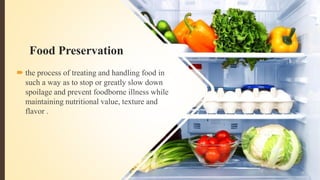
Food Preservation
 the process of treating and handling food in
such a way as to stop or greatly slow down
spoilage and prevent foodborne illness while
maintaining nutritional value, texture and
flavor .
Methods
food preservation is one of the oldest technologies used by human beings. In this,
we'll look at all of the different preservation techniques commonly used today,
including:
 Refrigeration and freezing
 Canning
 Irradiation
 Dehydration
 Freeze-drying
 Salting and Pickling
 Pasteurizing
 Fermentation
 Cheese-making
NOTE  In certain cases, a preservation technique may also destroy
enzymes naturally found in a food that cause it to spoil or
discolor quickly. An enzyme is a special protein that acts as a
catalyst for a chemical reaction, and enzymes are fairly fragile.
By increasing the temperature of food to about 150 degrees
Fahrenheit (66 degrees Celsius), enzymes are destroyed . A food
that is sterile contains no bacteria. Unless sterilized and sealed,
all food contains bacteria. For example, bacteria naturally living
in milk will spoil the milk in two or three hours if the milk is left
out on the kitchen counter at room temperature. By putting the
milk in the refrigerator you don't eliminate the bacteria already
there, but you do slow down the bacteria enough that the milk
will stay fresh for a week or two.
 Let's look at all of the different forms of food preservation in
detail.
1. REFRIGERATION AND FREEZING
 Refrigeration and freezing are probably the most popular
forms of food preservation in use today. In the case of
refrigeration, the idea is to slow bacterial action to a
crawl so that it takes food much longer (perhaps a week
or two, rather than half a day) to spoil. In the case of
freezing, the idea is to stop bacterial action altogether.
Frozen bacteria are completely inactive.
 Refrigeration and freezing are used on almost all foods:
meats, fruits, vegetables, beverages, etc. In general,
refrigeration has no effect on a food's taste or texture.
Freezing has no effect on the taste or texture of most
meats, has minimal effects on vegetables, but often
completely changes fruits (which become mushy).
2. Caning
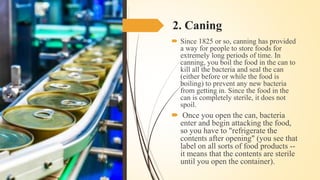
 Since 1825 or so, canning has provided
a way for people to store foods for
extremely long periods of time. In
canning, you boil the food in the can to
kill all the bacteria and seal the can
(either before or while the food is
boiling) to prevent any new bacteria
from getting in. Since the food in the
can is completely sterile, it does not
spoil.
 Once you open the can, bacteria
enter and begin attacking the food,
so you have to "refrigerate the
contents after opening" (you see that
label on all sorts of food products --
it means that the contents are sterile
until you open the container).
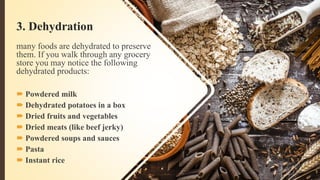
3. Dehydration
many foods are dehydrated to preserve
them. If you walk through any grocery
store you may notice the following
dehydrated products:
 Powdered milk
 Dehydrated potatoes in a box
 Dried fruits and vegetables
 Dried meats (like beef jerky)
 Powdered soups and sauces
 Pasta
 Instant rice
.
 Normally, drying completely alters
the taste and texture of the food, but
in many cases a completely new
food is created that people like just
as much as the original!
4. Freeze-drying
Freeze-drying is a
special forms of drying
that removes all
moisture and tends to
have less of an effect on
a food taste than
normal dehydration
does .
01
In freeze-drying, food is
frozen and placed in a
strong vacuum. The
water in the food then
sublimates that is, it turns
straight form ice into
vapors.
02
Freeze-drying is most
commonly used to
make instant coffee, but
also works extremely
well on fruits such as
apples.
03
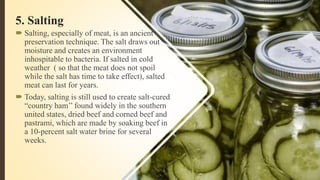
5. Salting
 Salting, especially of meat, is an ancient
preservation technique. The salt draws out
moisture and creates an environment
inhospitable to bacteria. If salted in cold
weather ( so that the meat does not spoil
while the salt has time to take effect), salted
meat can last for years.
 Today, salting is still used to create salt-cured
“country ham’’ found widely in the southern
united states, dried beef and corned beef and
pastrami, which are made by soaking beef in
a 10-percent salt water brine for several
weeks.
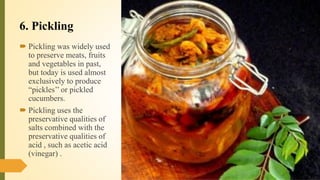
6. Pickling
 Pickling was widely used
to preserve meats, fruits
and vegetables in past,
but today is used almost
exclusively to produce
“pickles’’ or pickled
cucumbers.
 Pickling uses the
preservative qualities of
salts combined with the
preservative qualities of
acid , such as acetic acid
(vinegar) .
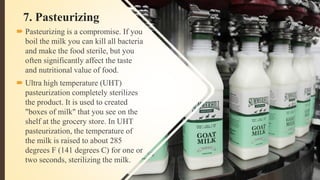
7. Pasteurizing
 Pasteurizing is a compromise. If you
boil the milk you can kill all bacteria
and make the food sterile, but you
often significantly affect the taste
and nutritional value of food.
 Ultra high temperature (UHT)
pasteurization completely sterilizes
the product. It is used to created
"boxes of milk" that you see on the
shelf at the grocery store. In UHT
pasteurization, the temperature of
the milk is raised to about 285
degrees F (141 degrees C) for one or
two seconds, sterilizing the milk.
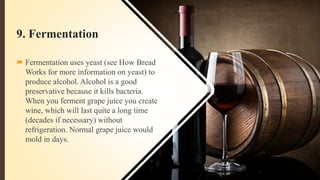
9. Fermentation
 Fermentation uses yeast (see How Bread
Works for more information on yeast) to
produce alcohol. Alcohol is a good
preservative because it kills bacteria.
When you ferment grape juice you create
wine, which will last quite a long time
(decades if necessary) without
refrigeration. Normal grape juice would
mold in days.
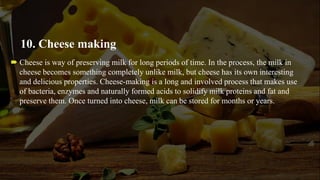
10. Cheese making
 Cheese is way of preserving milk for long periods of time. In the process, the milk in
cheese becomes something completely unlike milk, but cheese has its own interesting
and delicious properties. Cheese-making is a long and involved process that makes use
of bacteria, enzymes and naturally formed acids to solidify milk proteins and fat and
preserve them. Once turned into cheese, milk can be stored for months or years.
Thank you !

Food preservation.pdf

  • 1.
  • 2.
  • 3.
    Food Preservation  theprocess of treating and handling food in such a way as to stop or greatly slow down spoilage and prevent foodborne illness while maintaining nutritional value, texture and flavor .
  • 4.
    Methods food preservation isone of the oldest technologies used by human beings. In this, we'll look at all of the different preservation techniques commonly used today, including:  Refrigeration and freezing  Canning  Irradiation  Dehydration  Freeze-drying  Salting and Pickling  Pasteurizing  Fermentation  Cheese-making
  • 5.
    NOTE  Incertain cases, a preservation technique may also destroy enzymes naturally found in a food that cause it to spoil or discolor quickly. An enzyme is a special protein that acts as a catalyst for a chemical reaction, and enzymes are fairly fragile. By increasing the temperature of food to about 150 degrees Fahrenheit (66 degrees Celsius), enzymes are destroyed . A food that is sterile contains no bacteria. Unless sterilized and sealed, all food contains bacteria. For example, bacteria naturally living in milk will spoil the milk in two or three hours if the milk is left out on the kitchen counter at room temperature. By putting the milk in the refrigerator you don't eliminate the bacteria already there, but you do slow down the bacteria enough that the milk will stay fresh for a week or two.  Let's look at all of the different forms of food preservation in detail.
  • 6.
    1. REFRIGERATION ANDFREEZING  Refrigeration and freezing are probably the most popular forms of food preservation in use today. In the case of refrigeration, the idea is to slow bacterial action to a crawl so that it takes food much longer (perhaps a week or two, rather than half a day) to spoil. In the case of freezing, the idea is to stop bacterial action altogether. Frozen bacteria are completely inactive.  Refrigeration and freezing are used on almost all foods: meats, fruits, vegetables, beverages, etc. In general, refrigeration has no effect on a food's taste or texture. Freezing has no effect on the taste or texture of most meats, has minimal effects on vegetables, but often completely changes fruits (which become mushy).
  • 7.
    2. Caning  Since1825 or so, canning has provided a way for people to store foods for extremely long periods of time. In canning, you boil the food in the can to kill all the bacteria and seal the can (either before or while the food is boiling) to prevent any new bacteria from getting in. Since the food in the can is completely sterile, it does not spoil.  Once you open the can, bacteria enter and begin attacking the food, so you have to "refrigerate the contents after opening" (you see that label on all sorts of food products -- it means that the contents are sterile until you open the container).
  • 8.
    3. Dehydration many foodsare dehydrated to preserve them. If you walk through any grocery store you may notice the following dehydrated products:  Powdered milk  Dehydrated potatoes in a box  Dried fruits and vegetables  Dried meats (like beef jerky)  Powdered soups and sauces  Pasta  Instant rice
  • 9.
    .  Normally, dryingcompletely alters the taste and texture of the food, but in many cases a completely new food is created that people like just as much as the original!
  • 10.
    4. Freeze-drying Freeze-drying isa special forms of drying that removes all moisture and tends to have less of an effect on a food taste than normal dehydration does . 01 In freeze-drying, food is frozen and placed in a strong vacuum. The water in the food then sublimates that is, it turns straight form ice into vapors. 02 Freeze-drying is most commonly used to make instant coffee, but also works extremely well on fruits such as apples. 03
  • 11.
    5. Salting  Salting,especially of meat, is an ancient preservation technique. The salt draws out moisture and creates an environment inhospitable to bacteria. If salted in cold weather ( so that the meat does not spoil while the salt has time to take effect), salted meat can last for years.  Today, salting is still used to create salt-cured “country ham’’ found widely in the southern united states, dried beef and corned beef and pastrami, which are made by soaking beef in a 10-percent salt water brine for several weeks.
  • 12.
    6. Pickling  Picklingwas widely used to preserve meats, fruits and vegetables in past, but today is used almost exclusively to produce “pickles’’ or pickled cucumbers.  Pickling uses the preservative qualities of salts combined with the preservative qualities of acid , such as acetic acid (vinegar) .
  • 13.
    7. Pasteurizing  Pasteurizingis a compromise. If you boil the milk you can kill all bacteria and make the food sterile, but you often significantly affect the taste and nutritional value of food.  Ultra high temperature (UHT) pasteurization completely sterilizes the product. It is used to created "boxes of milk" that you see on the shelf at the grocery store. In UHT pasteurization, the temperature of the milk is raised to about 285 degrees F (141 degrees C) for one or two seconds, sterilizing the milk.
  • 14.
    9. Fermentation  Fermentationuses yeast (see How Bread Works for more information on yeast) to produce alcohol. Alcohol is a good preservative because it kills bacteria. When you ferment grape juice you create wine, which will last quite a long time (decades if necessary) without refrigeration. Normal grape juice would mold in days.
  • 15.
    10. Cheese making Cheese is way of preserving milk for long periods of time. In the process, the milk in cheese becomes something completely unlike milk, but cheese has its own interesting and delicious properties. Cheese-making is a long and involved process that makes use of bacteria, enzymes and naturally formed acids to solidify milk proteins and fat and preserve them. Once turned into cheese, milk can be stored for months or years.
  • 16.