PRAYAGRAJ
AGRICULTURAL SCIENCES AND TECHNOLOGY
[B.Sc. (Hons.) Ag.]
(Fifth Semester)
Prepared by :
Adarsh Tripathi,
Agriculture student,
united university
Topic: Food Preservation
MEANING
• Food Preservation is the process of treating
and handling food to stop or slow down food
spoilage, loss of quality, edibility, or
nutritional value and thus allow for longer
food storage.
• Preservation usually involves preventing the
growth of bacteria, fungi
• This means that the food treated that way
will go bad (spoil from bacteria) later that if it
had not been treated that way. For
thousands of years, humans have used
methods of preserving food, so that they can
store food to eat later.
 Food Preservation
 METHODS OF FOOD PRESERVATION
TRADITIONAL METHODS
• Drying
• Cooling
• Freezing
• Boiling
• Heating
• Salting
• Sugaring
• Smoking
• Pickling
• Lye
• Canning
• Jellying
• Jugging
 INDUSTRIAL MODERN METHODS
• Pasteurization
• Vacuum packing
• Artificial food additives
• Irradiation
• Pulsed electric field electroporation
• Modified atmosphere
• Nonthermal plasma
• High-pressure food preservation
• Biopreservation
• Hurdle technology
 DRYING
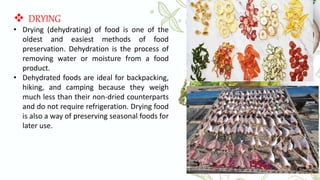
• Drying (dehydrating) of food is one of the
oldest and easiest methods of food
preservation. Dehydration is the process of
removing water or moisture from a food
product.
• Dehydrated foods are ideal for backpacking,
hiking, and camping because they weigh
much less than their non-dried counterparts
and do not require refrigeration. Drying food
is also a way of preserving seasonal foods for
later use.
 How dehydration preserves foods
Foods can be spoiled by food microorganisms or
through enzymatic reactions within the food.
Bacteria, yeast, and molds must have a sufficient
amount of moisture around them to grow and
cause spoilage. Reducing the moisture content of
food prevents the growth of these spoilage-
causing microorganisms and slows down
enzymatic reactions that take place within food.
The combination of these events helps to prevent
spoilage in dried food.
Reasons Why Dehydration is a Great Method of Food
Preservation
• Does Not Require Electricity.
• Is Less Time Consuming.
• Makes Winter Meals Easier.
• Requires Less Storage Space.
• Is Child Friendly.
 SUGARING & SALTING
• Sugaring is the process of desiccating a food
by first dehydrating it, then packing it with
pure sugar. This sugar can be crystalline in
the form of table or raw sugar, or it can be a
high sugar density liquid such as honey, syrup
or molasses.
• The purpose of sugaring is to create an
environment hostile to microbial life and
prevent food spoilage.
• Sugaring is commonly used to preserve fruits
as well as vegetables such as ginger. From
time to time sugaring has also been used for
non- food preservations.
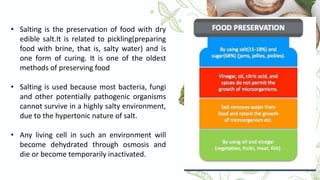
• Salting is the preservation of food with dry
edible salt.It is related to pickling(preparing
food with brine, that is, salty water) and is
one form of curing. It is one of the oldest
methods of preserving food
• Salting is used because most bacteria, fungi
and other potentially pathogenic organisms
cannot survive in a highly salty environment,
due to the hypertonic nature of salt.
• Any living cell in such an environment will
become dehydrated through osmosis and
die or become temporarily inactivated.
PICKLING
• Pickling is the process of soaking food in a
solution containing salt, acid, or alcohol.
• It can be used with most foods
• Most methods require no special equipment.
• However, pickled foods can be unsafe if
prepared carelessly or stored at room
temperature.
• Pickling is often combined with another method,
such as fermenting, canning, or just refrigerating
 FREEZING
• Freezing is the process of chilling foods to at
least o°F.
• It can be used with all foods
• True freezing is not possible in the freezer
compartment of your refrigerator where the
temperature is typically much warmer,
between 10°F to 32°F.
• Easy method
 somking
food preservation

food preservation

  • 1.
    PRAYAGRAJ AGRICULTURAL SCIENCES ANDTECHNOLOGY [B.Sc. (Hons.) Ag.] (Fifth Semester) Prepared by : Adarsh Tripathi, Agriculture student, united university Topic: Food Preservation
  • 3.
    MEANING • Food Preservationis the process of treating and handling food to stop or slow down food spoilage, loss of quality, edibility, or nutritional value and thus allow for longer food storage. • Preservation usually involves preventing the growth of bacteria, fungi • This means that the food treated that way will go bad (spoil from bacteria) later that if it had not been treated that way. For thousands of years, humans have used methods of preserving food, so that they can store food to eat later.  Food Preservation
  • 5.
     METHODS OFFOOD PRESERVATION TRADITIONAL METHODS • Drying • Cooling • Freezing • Boiling • Heating • Salting • Sugaring • Smoking • Pickling • Lye • Canning • Jellying • Jugging
  • 6.
     INDUSTRIAL MODERNMETHODS • Pasteurization • Vacuum packing • Artificial food additives • Irradiation • Pulsed electric field electroporation • Modified atmosphere • Nonthermal plasma • High-pressure food preservation • Biopreservation • Hurdle technology
  • 7.
     DRYING • Drying(dehydrating) of food is one of the oldest and easiest methods of food preservation. Dehydration is the process of removing water or moisture from a food product. • Dehydrated foods are ideal for backpacking, hiking, and camping because they weigh much less than their non-dried counterparts and do not require refrigeration. Drying food is also a way of preserving seasonal foods for later use.
  • 8.
     How dehydrationpreserves foods Foods can be spoiled by food microorganisms or through enzymatic reactions within the food. Bacteria, yeast, and molds must have a sufficient amount of moisture around them to grow and cause spoilage. Reducing the moisture content of food prevents the growth of these spoilage- causing microorganisms and slows down enzymatic reactions that take place within food. The combination of these events helps to prevent spoilage in dried food.
  • 9.
    Reasons Why Dehydrationis a Great Method of Food Preservation • Does Not Require Electricity. • Is Less Time Consuming. • Makes Winter Meals Easier. • Requires Less Storage Space. • Is Child Friendly.
  • 10.
     SUGARING &SALTING • Sugaring is the process of desiccating a food by first dehydrating it, then packing it with pure sugar. This sugar can be crystalline in the form of table or raw sugar, or it can be a high sugar density liquid such as honey, syrup or molasses. • The purpose of sugaring is to create an environment hostile to microbial life and prevent food spoilage. • Sugaring is commonly used to preserve fruits as well as vegetables such as ginger. From time to time sugaring has also been used for non- food preservations.
  • 11.
    • Salting isthe preservation of food with dry edible salt.It is related to pickling(preparing food with brine, that is, salty water) and is one form of curing. It is one of the oldest methods of preserving food • Salting is used because most bacteria, fungi and other potentially pathogenic organisms cannot survive in a highly salty environment, due to the hypertonic nature of salt. • Any living cell in such an environment will become dehydrated through osmosis and die or become temporarily inactivated.
  • 12.
    PICKLING • Pickling isthe process of soaking food in a solution containing salt, acid, or alcohol. • It can be used with most foods • Most methods require no special equipment. • However, pickled foods can be unsafe if prepared carelessly or stored at room temperature. • Pickling is often combined with another method, such as fermenting, canning, or just refrigerating
  • 13.
     FREEZING • Freezingis the process of chilling foods to at least o°F. • It can be used with all foods • True freezing is not possible in the freezer compartment of your refrigerator where the temperature is typically much warmer, between 10°F to 32°F. • Easy method
  • 14.