Fermentation and itsUses
Dr. Muneeb Khan
Assistant Professor
Riphah College of Rehabilitation and
Allied Health Sciences
Riphah International University,
Lahore
2.
Fermentation
•Anaerobic or partiallyanaerobic
oxidation of carbohydrates
•Enzymes produced by
microorganisms breakdown
carbohydrates or carbohydrate-like
materials into substances that are
less subject to undesirable microbial
activity than the original material
3.
Fermented Foods
• Importantpart of the diet all over the world
• Presently fermentation industries (e.g. baking, brewing, wine
making, vinegar manufacture) which employ pure cultures grew
out of the home-scale traditional fermentation processes that
relied primarily on the activities of mixed micro flora
• Modern fermentation plants still utilize mixed or conjoint
microbial culture to produce fermented foods (e.g. yoghurt,
cheese, sauerkraut, pickles)
4.
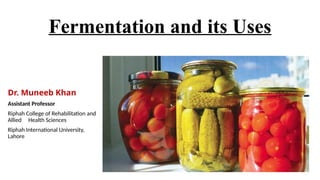
Fermented Foods
• Morethan 3500 fermented foods consumed in the world
• Numerous beverages are produced by fermentation e.g. alcoholic (beer,
wine, brandy, whisky, vodka, sake, and palm wine) and non-alcoholic
beverages (tea, coffee, and cocoa)
• Cereals are fermented to produce leavened bread, pancakes, muffins, etc
• Legumes are fermented in Far East for the production of tempeh, soy
sauce, miso, oncom
• Among dairy products cheese and yoghurt are popular
• Sausages and salami are produced from meat
• Fish is fermented in North Africa, Middle East, Europe and South East
Asia
5.
Objectives of Fermentation
•Prolongthe keeping quality of the food raw materials
especially in areas where other methods of
preservation are technically and economically difficult
to implement
•To enhance the flavor of some foods
•To Improves the physical characteristics
•To produce new products having longer shelf life
Alcoholic Fermentation
• Appliedin the production of leavened bread and alcoholic
beverages
• Sugars are converted into ethyl alcohol and carbon dioxide
Yeast
C6H12O6 = = = = = > 2C2H5OH + 2CO2
• Most commonly species of the genus Saccharomyces such as S.
cerevisiae and S. carlsbergenis are employed
• C2H5OH and to some extent CO2 act as natural preservative
agents in such fermented foods
8.
Alcoholic Beverages
• BE E R is produced from barley
Barley is allowed to germinate
under controlled conditions to
produce malt that contains active
enzymes from the germination
process. These help in the
breakdown of starch
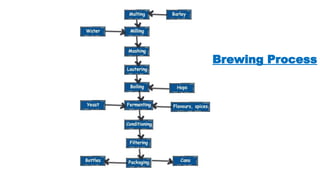
• 1. Malting:Here the conversion from carbohydrates to dextrin and maltose
takes place. The grain used as the raw material is usually barley. Barley as a
cereal can be preserved for a long time after harvesting and it is the malted
barley that gives Beer its characteristic color and taste.
• 2. Milling: The malt is then mixed with water to complete the conversion of
starches in the grain to sugar. After that the grain is milled to create the proper
consistency to the malt.
• 3. Mashing: This process converts the starches released during the malting
stage, into sugars that can be fermented.
11.
• 4. Lautering:The liquid containing the sugar extracted during mashing
is now separated from the grains. It is then generally termed as wort.
• 5. Boiling and Hopping: Boiling the wort, ensures its sterility, and thus
prevents a lot of infections. Hops are added during this stage of
boiling.As I mentioned in my earlier post, hops are used to add flavor
and aroma to balance the sweetness of the malt.
12.
Alcoholic Beverages
•Wort isallowed to ferment in special
vessels with the aid of selected strains of
brewery yeasts (S. cerevisiae & S.
carlsbergenis)
•Fermented wort is filtered to remove yeast
cells and other coarse particles. Then it is
allowed to mature in storage vessels
•Filled in bottles and pasteurized.
•Final product contains between 3-5%
ethyl alcohol
13.
Alcoholic Beverages
• WI N E S may be manufactured from any sugary raw
material
• Fruits are commonly used for the purpose
• Wines produced from grapes are regarded as the real wines,
while those made from other fruits are simply referred to as
fruit wines
• Selected grapes or fruits of proper maturity are crushed and
treated with sulphur dioxide or sulphite or pasteurized to
reduce the microbial contaminations
• Then inoculated with a suitable yeast starter and allowed to
ferment
• After a short fermentation, the wine is drawn off, placed in
storage tanks for further fermentation, racked, stored for
ageing, clarified and packed
14.
Alcoholic Beverages
•C HA M P A G N E is
manufactured from specially
selected white tale wines
produced from grapes
•Involves a secondary
fermentation that yields more
ethyl alcohol, carbon dioxide
and flavour in the product
15.
Bread Manufacture
• Inthe manufacture of pan bread and similar products,
essential ingredients (wheat flour, yeast, water and
salt) are mixed together and made into dough of
desired quality by stretching, folding and cutting
• Allowed to ferment: yeast utilizes sugars and
produces carbon dioxide and minor amount of ethyl
alcohol
• Carbon dioxide is trapped in the gluten framework of
the dough to give an increased volume
• Fermentation process in bread manufacturing is not
aimed at increasing the shelf life, but to impart certain
textural characteristics to the product such as
increased volume and open crumb
16.
Acetic Fermentation
• Aceticacid bacteria (species of the genera Acetobacter and
Acetomonas) are capable of oxidizing ethyl alcohol into acetic
acid and water
Acetic acid bacteria
C2H5OH = = = = = = = = > CH3 COOH + H2O
• Acetic acid is the main component of vinegar, which has been
used for centuries as medicine, flavoring agent and preservative
for products like tomato ketchup, mayonnaise and salad dressings
• Many pickles are also partially preserved by using vinegar
17.
Vinegar Production
• Vinegaris a product of two-stage fermentation. In the first stage,
yeast converts sugars into ethanol anaerobically.
• In the second ethanol is oxidized to acetic acid aerobically by bacteria
of genera Acetobacter and Gluconobacter.
• There are two methods of vinegar fermentation.
• Orleans Method
• Generator Method
19.
Vinegar Production
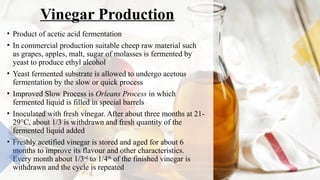
• Productof acetic acid fermentation
• In commercial production suitable cheep raw material such
as grapes, apples, malt, sugar of molasses is fermented by
yeast to produce ethyl alcohol
• Yeast fermented substrate is allowed to undergo acetous
fermentation by the slow or quick process
• Improved Slow Process is Orleans Process in which
fermented liquid is filled in special barrels
• Inoculated with fresh vinegar. After about three months at 21-
29°C, about 1/3 is withdrawn and fresh quantity of the
fermented liquid added
• Freshly acetified vinegar is stored and aged for about 6
months to improve its flavour and other characteristics.
Every month about 1/3rd
to 1/4th
of the finished vinegar is
withdrawn and the cycle is repeated
21.
Vinegar Production
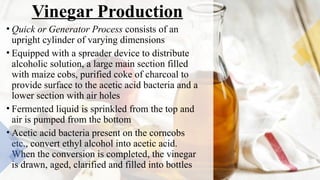
• Quickor Generator Process consists of an
upright cylinder of varying dimensions
• Equipped with a spreader device to distribute
alcoholic solution, a large main section filled
with maize cobs, purified coke of charcoal to
provide surface to the acetic acid bacteria and a
lower section with air holes
• Fermented liquid is sprinkled from the top and
air is pumped from the bottom
• Acetic acid bacteria present on the corncobs
etc., convert ethyl alcohol into acetic acid.
When the conversion is completed, the vinegar
is drawn, aged, clarified and filled into bottles
22.
Lactic Fermentation
• Mostwidely used biological preservation
technique .
• The Lactic acid bacterial act on glucose and
convert it into lactic acid and water.
Lactic acid bacteria
C6H12O6 = = = = = = = = > CH3CHCOOH +
H2O
• Great importance in the dairy industry, meat
industry, and fruits and vegetable industry.
23.
Dairy Industry
• Speciesof genera Streptococcus, Lactobacillus
and others are most often used to convert the
milk sugars to lactic acid.
• Production of yoghurt, standardized and
pasteurized milk is inoculated with a culture
containing Streptococcus thermophilus and
Lactobacillus bulgaricus.
• Lactic acid produced coagulate the milk proteins.
• Coagulated milk may be consumed as such
(yoghurt) or further processed to produce cheese.
24.
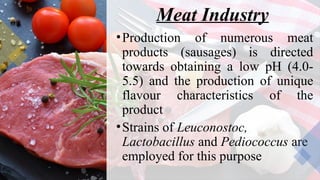
Meat Industry
•Production ofnumerous meat
products (sausages) is directed
towards obtaining a low pH (4.0-
5.5) and the production of unique
flavour characteristics of the
product
•Strains of Leuconostoc,
Lactobacillus and Pediococcus are
employed for this purpose
25.
Fruits & VegetablesIndustry
• Most important use of lactic fermentation
in the food industry worldwide is in the
fermentation of fruit and vegetable
materials to produce pickles or other
products
• Fermentation is carried out by species of
Lactobacillus, Leuconostoc, Pediococcus
and other suitable lactic acid bacteria
• Activities of other microorganisms in
these products in prohibited by the
addition of common salt (2.5% or higher)
26.
Changes in Foods
asa Result of
Fermentation
• During controlled fermentation the
growth and activities of
microorganisms resulting from the
existence of a favorable
environment lead to the breakdown
of complex components of food
molecules into simpler ones
• Substances get metabolized into
end products and are released in
the environment
• Three major components in foods
that are metabolized are
Carbohydrates, Proteins and Fats
27.
Changes in Foods
asa Result of
Fermentation
• When carbohydrates or carbohydrate-
like compounds are attacked by
microorganisms, end products such as
alcohols, organic acids, aldehydes and
ketones are released in the environment
• Human body can utilize some of them
as immediate source of energy
• Breakdown of proteinaceous material
is referred to as Proteolysis
• Lipolysis is the term that describes the
breakdown of fatty materials
• Proteolysis and Lipolysis reactions
usually produce off-odors in the
product depending upon the degree of
changes