Folklore:
What is folklore?
• It is a story, legend or myth passed down from
generation to generation by word of mouth. (Oral
retelling)
• It often explains something that happens in
nature or convey a moral or life lesson.
What Are legends?
• Legends are stories hand down from the past
about a specific person- usually someone
considered heroic. They are usually on a real
person or event in history. However, they are
often exaggerated.
(BMS. WHAT ARE LEGENDS. 2009.
https://www.slideshare.net/ebrand21/folklore-
notes?from_search=5)
What Are myths?
Myths are traditional stories that attempt to answer
unknown questions about the universe, the origin of the
world, mysteries of
nature, or social customs. They often include gods,
goddesses, and heroes.
E.g Pandora’s box.
can you think of other myths?
(BMS. WHAT ARE MYTHS? 2009.
https://www.slideshare.net/ebrand21/folklore-notes?
from_search=5)
Features:
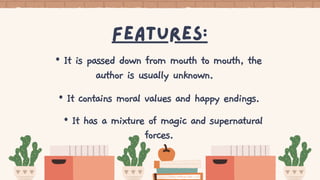
features:
• It is passed down from mouth to mouth, the
author is usually unknown.
• It contains moral values and happy endings.
• It has a mixture of magic and supernatural
forces.
Purpose:
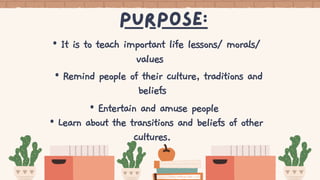
purpose:
• It is to teach important life lessons/ morals/
values
• Remind people of their culture, traditions and
beliefs
• Entertain and amuse people
• Learn about the transitions and beliefs of other
cultures.
Elements:
Elements
Characters = it’s people or animals in the
story.
Characterisation = the character’s quality or
traits. Characters change only after they have
gone through a life lesson during the lesson.
Setting = place and time the story takes
place
Conflict = the problem that the characters
encounter.
1.
2.
3.
4.
Elements
5. Theme = the moral or life lesson in the story
such as good vs evil.
6. Magical elements = talking animals, giants and
magic, the magical number of 3 (everything
happening in 3’s)
7. Style = informal and conversational
Poetry:
Poetry is a type of literature that
expresses ideas, feelings, or tells a
story in a specific form.
What is poetry?
One poem will look very different from another, and still
another poem will look very distinct from the second one, and
so on.
Each poet uses the "form" which will most effectively
EXPRESS what he wants to convey to other human beings.
Whenever we look at a poem, the first thing we will probably
notice is its form. In other words, poems have a given FORM.
(Morales.J.M. The elements of Poetry. 2014.SlideShare.)
What is the “form” of
poetry?
Poet = author of the poem
Speaker= narrator of the poem
1.
2.
point of view in poetry:
Name of the poem.
Poet.
Stanza (number of paragraphs in the poem)
Lines.
Rhythm (beat created by the sounds of
words in a poem)
• It is the layout of the poem.
it includes:
1.
2.
3.
4.
5.
External structure:
6. Rhyme - words that sound alike at the end of
a line.
7. Rhyme scheme - a rhyming pattern.
8.Punctuation.
9. Emjabment - no punctuation mark at the end
of a line.
10. Refrain - a line or verse that is repeated
External structure
cont…
T
Internal structure
It is the meaning of the poem by
analysing the figures of speech,
tone and message.
T
figures of speech
Alliteration - repetition of consonant
sounds at the beginning of the
words. Eg. Peter piper picked a peck
of pickled peppers.
Assonance -repetition of vowel
sounds in words near each other e.g
clap your hands and stomp your feet.
1.
2.
T
figures of speech cont…
3. Hyperbole - an exaggeration used for emphasis.
e.g. I’m so hungry. I could eat a horse
4. Metaphor - comparing 2 things without the use of “like” or
“as”.
5. Onomatopoeia - words that imitate a sounds
e.g. bang, buzz, beep.
T
figures of speech cont…
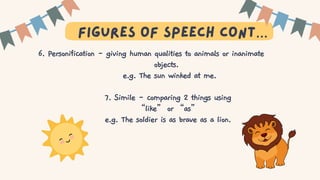
6. Personification - giving human qualities to animals or inanimate
objects.
e.g. The sun winked at me.
7. Simile - comparing 2 things using
“like” or “as”
e.g. The soldier is as brave as a lion.
Tone:
The poet’s attitude about the subject
or topic or issue.
message:
• The ideas expressed
in a poem.
• It also refers to the
theme of a poem.
Questions?
You were lovely.
Reminder: you’re great at everything you do and you
can achieve anything you put your mind to.
Thank you ! :)

Folklore SLIDESHARE.pdf

  • 1.
  • 2.
    What is folklore? •It is a story, legend or myth passed down from generation to generation by word of mouth. (Oral retelling) • It often explains something that happens in nature or convey a moral or life lesson.
  • 3.
    What Are legends? •Legends are stories hand down from the past about a specific person- usually someone considered heroic. They are usually on a real person or event in history. However, they are often exaggerated. (BMS. WHAT ARE LEGENDS. 2009. https://www.slideshare.net/ebrand21/folklore- notes?from_search=5)
  • 4.
    What Are myths? Mythsare traditional stories that attempt to answer unknown questions about the universe, the origin of the world, mysteries of nature, or social customs. They often include gods, goddesses, and heroes. E.g Pandora’s box. can you think of other myths? (BMS. WHAT ARE MYTHS? 2009. https://www.slideshare.net/ebrand21/folklore-notes? from_search=5)
  • 5.
  • 6.
    features: • It ispassed down from mouth to mouth, the author is usually unknown. • It contains moral values and happy endings. • It has a mixture of magic and supernatural forces.
  • 7.
  • 8.
    purpose: • It isto teach important life lessons/ morals/ values • Remind people of their culture, traditions and beliefs • Entertain and amuse people • Learn about the transitions and beliefs of other cultures.
  • 9.
  • 10.
    Elements Characters = it’speople or animals in the story. Characterisation = the character’s quality or traits. Characters change only after they have gone through a life lesson during the lesson. Setting = place and time the story takes place Conflict = the problem that the characters encounter. 1. 2. 3. 4.
  • 11.
    Elements 5. Theme =the moral or life lesson in the story such as good vs evil. 6. Magical elements = talking animals, giants and magic, the magical number of 3 (everything happening in 3’s) 7. Style = informal and conversational
  • 12.
  • 13.
    Poetry is atype of literature that expresses ideas, feelings, or tells a story in a specific form. What is poetry?
  • 14.
    One poem willlook very different from another, and still another poem will look very distinct from the second one, and so on. Each poet uses the "form" which will most effectively EXPRESS what he wants to convey to other human beings. Whenever we look at a poem, the first thing we will probably notice is its form. In other words, poems have a given FORM. (Morales.J.M. The elements of Poetry. 2014.SlideShare.) What is the “form” of poetry?
  • 15.
    Poet = authorof the poem Speaker= narrator of the poem 1. 2. point of view in poetry:
  • 16.
    Name of thepoem. Poet. Stanza (number of paragraphs in the poem) Lines. Rhythm (beat created by the sounds of words in a poem) • It is the layout of the poem. it includes: 1. 2. 3. 4. 5. External structure:
  • 17.
    6. Rhyme -words that sound alike at the end of a line. 7. Rhyme scheme - a rhyming pattern. 8.Punctuation. 9. Emjabment - no punctuation mark at the end of a line. 10. Refrain - a line or verse that is repeated External structure cont…
  • 18.
    T Internal structure It isthe meaning of the poem by analysing the figures of speech, tone and message.
  • 19.
    T figures of speech Alliteration- repetition of consonant sounds at the beginning of the words. Eg. Peter piper picked a peck of pickled peppers. Assonance -repetition of vowel sounds in words near each other e.g clap your hands and stomp your feet. 1. 2.
  • 20.
    T figures of speechcont… 3. Hyperbole - an exaggeration used for emphasis. e.g. I’m so hungry. I could eat a horse 4. Metaphor - comparing 2 things without the use of “like” or “as”. 5. Onomatopoeia - words that imitate a sounds e.g. bang, buzz, beep.
  • 21.
    T figures of speechcont… 6. Personification - giving human qualities to animals or inanimate objects. e.g. The sun winked at me. 7. Simile - comparing 2 things using “like” or “as” e.g. The soldier is as brave as a lion.
  • 22.
    Tone: The poet’s attitudeabout the subject or topic or issue.
  • 23.
    message: • The ideasexpressed in a poem. • It also refers to the theme of a poem.
  • 24.
  • 25.
    You were lovely. Reminder:you’re great at everything you do and you can achieve anything you put your mind to. Thank you ! :)