Objective - To multiply polynomials.
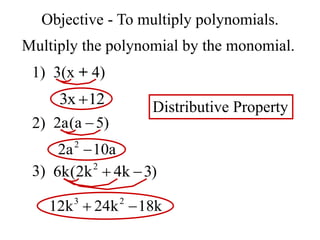
Multiply the polynomial by the monomial.
1) 3(x + 4)
2)
3) 2
6k(2k 4k 3)
 
2a(a 5)

3x 12

2
2a 10a

3 2
12k 24k 18k
 
Distributive Property
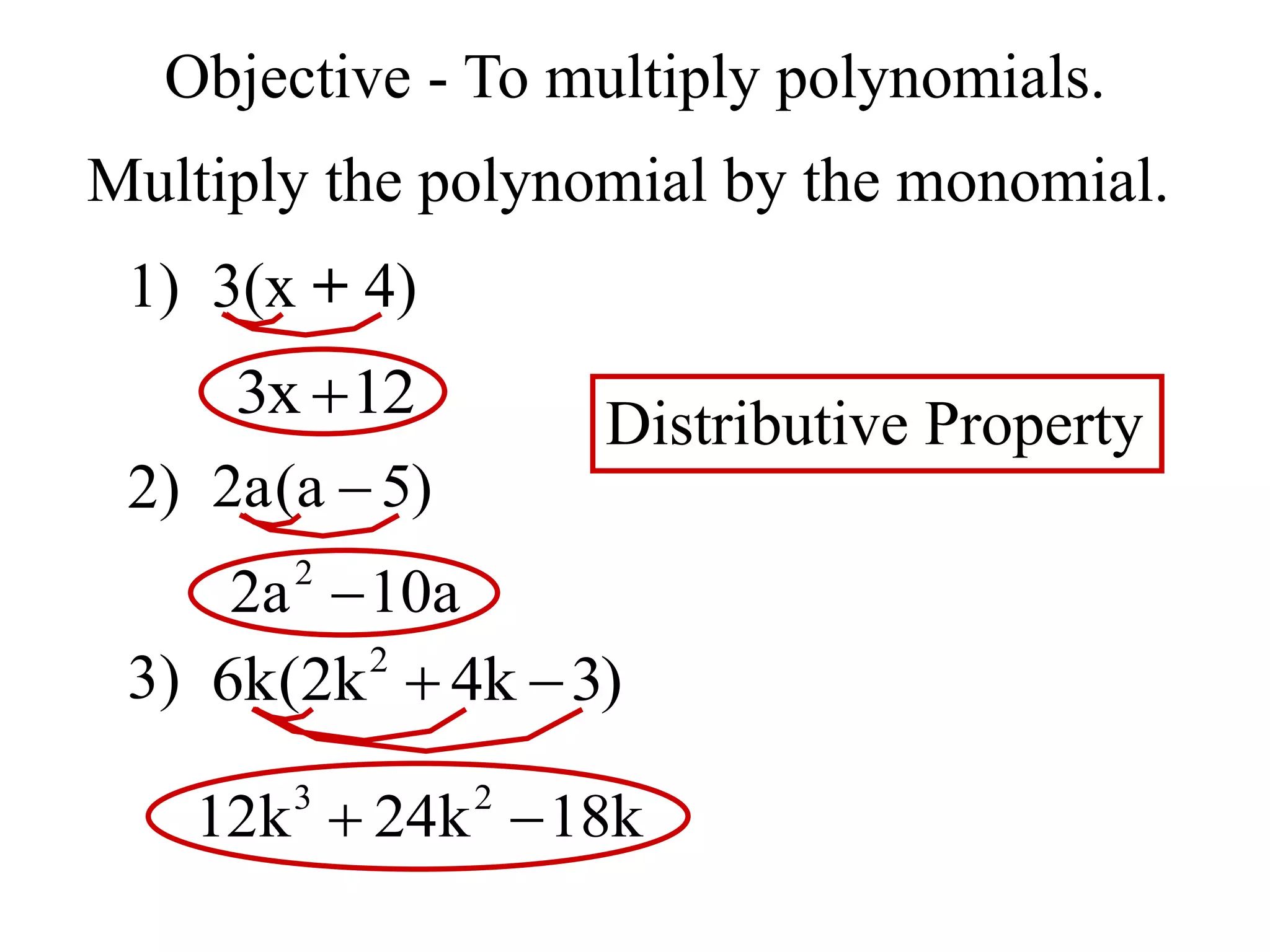
Multiplying Polynomials
Horizontal Method
(x 5)(2x 3)
 
(x 5) 2x
  + (x 5) 3
  
2
2x 10x
 + 3x 15
 
2
2x 7x 15
 
Vertical Method
(x 5)(2x 3)
 
x 5

2x 3

15

3x

10x

2
2x
2
2x 7x
 15

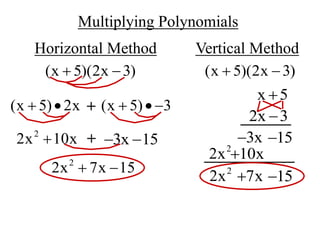
Polynomial Squares
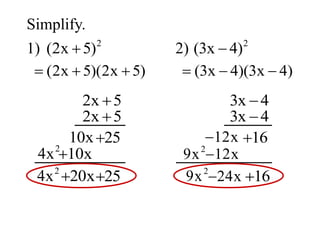
Simplify.
2
(x 3)
 2
x 9
  Common mistake!
2
(x 3)
 (x 3)(x 3)
  
x 3

x 3

9

3x
3x

2
x
2
x 6x
 9

2
(x 3)
 
Simplify.
1) 2)
2
(2x 5)

2x 5

2x 5

25

10x
10x

2
4x
2
4x 20x
 25

(2x 5)(2x 5)
  
2
(3x 4)

3x 4

3x 4

16

12x

12x

2
9x
2
9x 24x
 16

(3x 4)(3x 4)
  
5x

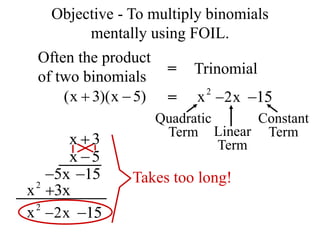
Objective - To multiply binomials
mentally using FOIL.
Often the product
of two binomials = Trinomial
(x 3)(x 5)
  =
x 3

x 5

15

3x

2
x
2
x 2x
 15

Takes too long!
Quadratic
Term Linear
Term
Constant
Term
2
x 2x
 15

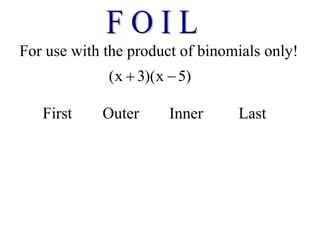
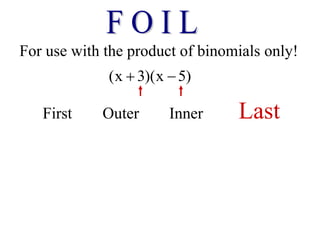
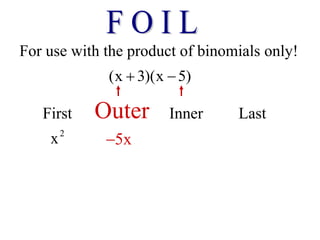
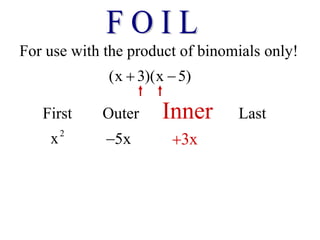
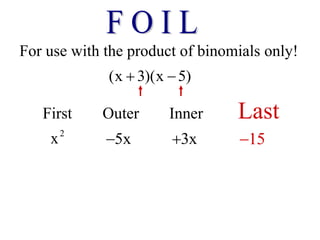
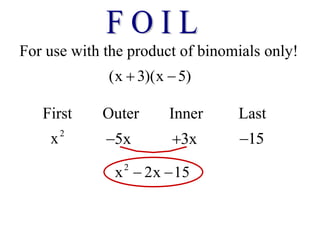
For use with the product of binomials only!
(x 3)(x 5)
 
First Outer Inner Last
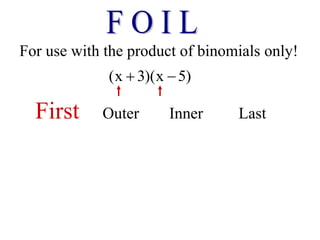
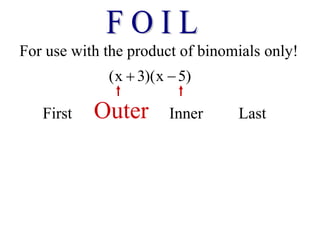
For use with the product of binomials only!
(x 3)(x 5)
 
First Outer Inner Last
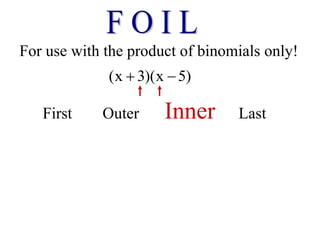
For use with the product of binomials only!
(x 3)(x 5)
 
First Outer Inner Last
For use with the product of binomials only!
(x 3)(x 5)
 
First Outer Inner Last
For use with the product of binomials only!
(x 3)(x 5)
 
First Outer Inner Last
For use with the product of binomials only!
(x 3)(x 5)
 
First Outer Inner Last
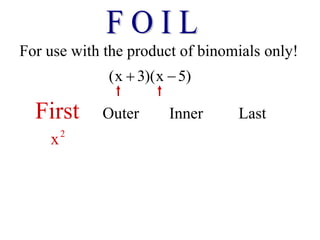
2
x
For use with the product of binomials only!
(x 3)(x 5)
 
First Outer Inner Last
2
x 5x

For use with the product of binomials only!
(x 3)(x 5)
 
First Outer Inner Last
2
x 5x
 3x

For use with the product of binomials only!
(x 3)(x 5)
 
First Outer Inner Last
2
x 5x
 3x
 15

For use with the product of binomials only!
(x 3)(x 5)
 
First Outer Inner Last
2
x 5x
 3x
 15

2
x 2x 15
 
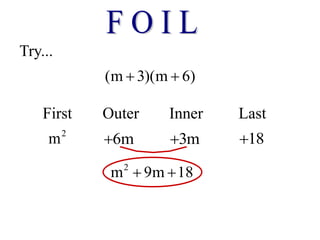
Try...
(m 3)(m 6)
 
First Outer Inner Last
2
m 6m
 3m
 18

2
m 9m 18
 
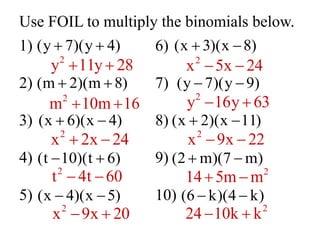
Use FOIL to multiply the binomials below.
1)
2)
3)
4)
5)
6)
7)
8)
9)
10)
(y 7)(y 4)
 
(m 2)(m 8)
 
(x 6)(x 4)
 
(t 10)(t 6)
 
(x 4)(x 5)
 
(x 3)(x 8)
 
(y 7)(y 9)
 
(x 2)(x 11)
 
(2 m)(7 m)
 
(6 k)(4 k)
 
2
y 11y 28
 
2
m 10m 16
 
2
x 2x 24
 
2
t 4t 60
 
2
x 9x 20
 
2
x 5x 24
 
2
y 16y 63
 
2
x 9x 22
 
2
14 5m m
 
2
24 10k k
 
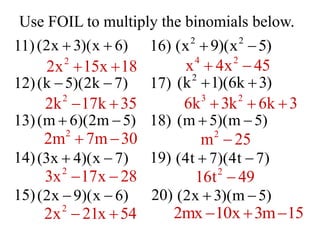
Use FOIL to multiply the binomials below.
11)
12)
13)
14)
15)
16)
17)
18)
19)
20)
(2x 3)(x 6)
 
(k 5)(2k 7)
 
(m 6)(2m 5)
 
(3x 4)(x 7)
 
(2x 9)(x 6)
 
2 2
(x 9)(x 5)
 
2
(k 1)(6k 3)
 
(m 5)(m 5)
 
(4t 7)(4t 7)
 
(2x 3)(m 5)
 
2
2x 15x 18
 
2
2k 17k 35
 
2
2m 7m 30
 
2
3x 17x 28
 
2
2x 21x 54
 
4 2
x 4x 45
 
3 2
6k 3k 6k 3
  
2
m 25

2
16t 49

2mx 10x 3m 15
  

Foil method and distributive.ppt

  • 1.
    Objective - Tomultiply polynomials. Multiply the polynomial by the monomial. 1) 3(x + 4) 2) 3) 2 6k(2k 4k 3)   2a(a 5)  3x 12  2 2a 10a  3 2 12k 24k 18k   Distributive Property
  • 2.
    Multiplying Polynomials Horizontal Method (x5)(2x 3)   (x 5) 2x   + (x 5) 3    2 2x 10x  + 3x 15   2 2x 7x 15   Vertical Method (x 5)(2x 3)   x 5  2x 3  15  3x  10x  2 2x 2 2x 7x  15 
  • 3.
    Polynomial Squares Simplify. 2 (x 3) 2 x 9   Common mistake! 2 (x 3)  (x 3)(x 3)    x 3  x 3  9  3x 3x  2 x 2 x 6x  9  2 (x 3)  
  • 4.
    Simplify. 1) 2) 2 (2x 5)  2x5  2x 5  25  10x 10x  2 4x 2 4x 20x  25  (2x 5)(2x 5)    2 (3x 4)  3x 4  3x 4  16  12x  12x  2 9x 2 9x 24x  16  (3x 4)(3x 4)   
  • 5.
    5x  Objective - Tomultiply binomials mentally using FOIL. Often the product of two binomials = Trinomial (x 3)(x 5)   = x 3  x 5  15  3x  2 x 2 x 2x  15  Takes too long! Quadratic Term Linear Term Constant Term 2 x 2x  15 
  • 6.
    For use withthe product of binomials only! (x 3)(x 5)   First Outer Inner Last
  • 7.
    For use withthe product of binomials only! (x 3)(x 5)   First Outer Inner Last
  • 8.
    For use withthe product of binomials only! (x 3)(x 5)   First Outer Inner Last
  • 9.
    For use withthe product of binomials only! (x 3)(x 5)   First Outer Inner Last
  • 10.
    For use withthe product of binomials only! (x 3)(x 5)   First Outer Inner Last
  • 11.
    For use withthe product of binomials only! (x 3)(x 5)   First Outer Inner Last 2 x
  • 12.
    For use withthe product of binomials only! (x 3)(x 5)   First Outer Inner Last 2 x 5x 
  • 13.
    For use withthe product of binomials only! (x 3)(x 5)   First Outer Inner Last 2 x 5x  3x 
  • 14.
    For use withthe product of binomials only! (x 3)(x 5)   First Outer Inner Last 2 x 5x  3x  15 
  • 15.
    For use withthe product of binomials only! (x 3)(x 5)   First Outer Inner Last 2 x 5x  3x  15  2 x 2x 15  
  • 16.
    Try... (m 3)(m 6)  First Outer Inner Last 2 m 6m  3m  18  2 m 9m 18  
  • 17.
    Use FOIL tomultiply the binomials below. 1) 2) 3) 4) 5) 6) 7) 8) 9) 10) (y 7)(y 4)   (m 2)(m 8)   (x 6)(x 4)   (t 10)(t 6)   (x 4)(x 5)   (x 3)(x 8)   (y 7)(y 9)   (x 2)(x 11)   (2 m)(7 m)   (6 k)(4 k)   2 y 11y 28   2 m 10m 16   2 x 2x 24   2 t 4t 60   2 x 9x 20   2 x 5x 24   2 y 16y 63   2 x 9x 22   2 14 5m m   2 24 10k k  
  • 18.
    Use FOIL tomultiply the binomials below. 11) 12) 13) 14) 15) 16) 17) 18) 19) 20) (2x 3)(x 6)   (k 5)(2k 7)   (m 6)(2m 5)   (3x 4)(x 7)   (2x 9)(x 6)   2 2 (x 9)(x 5)   2 (k 1)(6k 3)   (m 5)(m 5)   (4t 7)(4t 7)   (2x 3)(m 5)   2 2x 15x 18   2 2k 17k 35   2 2m 7m 30   2 3x 17x 28   2 2x 21x 54   4 2 x 4x 45   3 2 6k 3k 6k 3    2 m 25  2 16t 49  2mx 10x 3m 15   