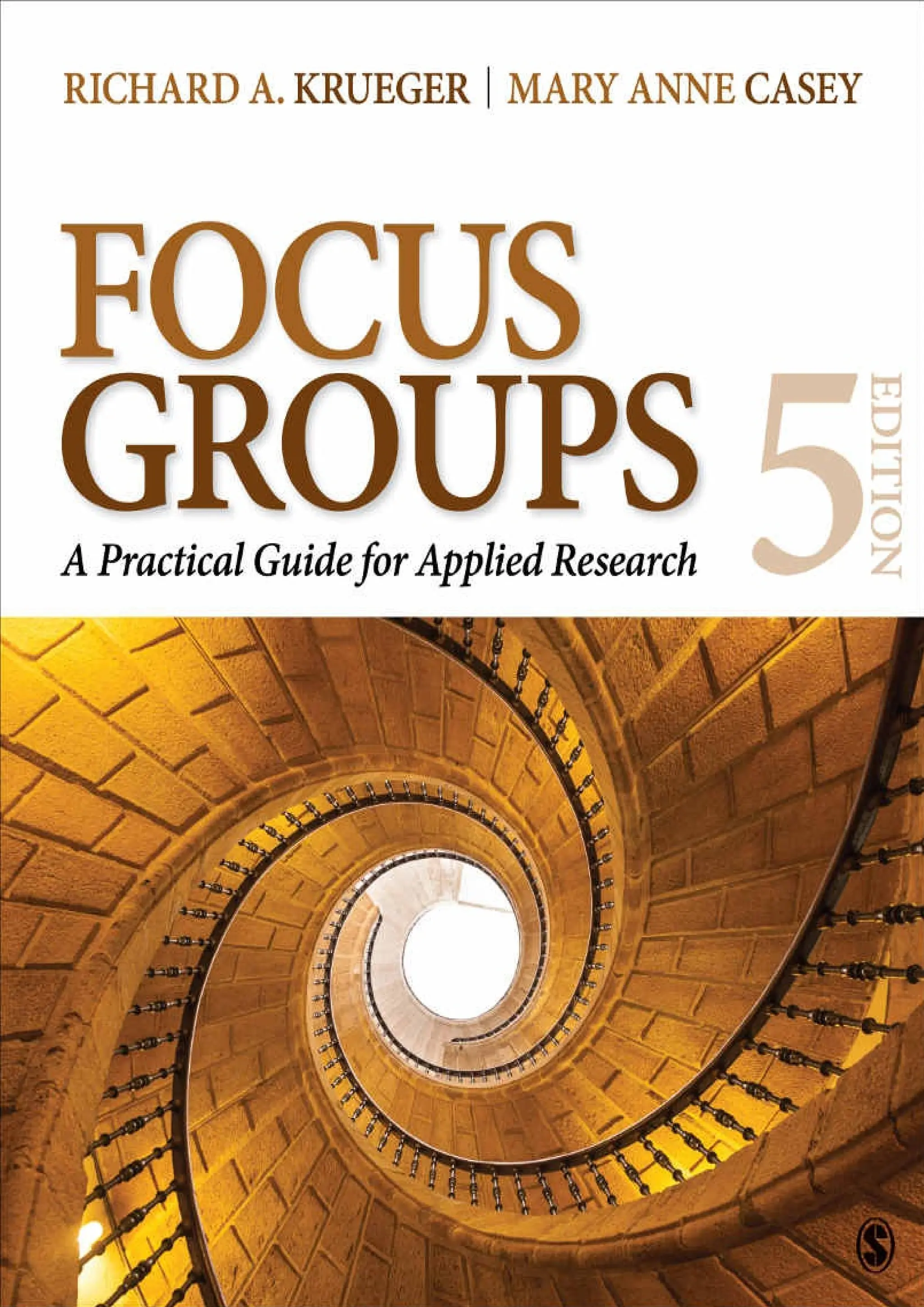
Focus Groups A Practical Guide for Applied Research 5th Edition Richard A. Krueger
Focus Groups A Practical Guide for Applied Research 5th Edition Richard A. Krueger
Focus Groups A Practical Guide for Applied Research 5th Edition Richard A. Krueger
Focus Groups A Practical Guide for Applied Research 5th Edition Richard A. Krueger
Focus Groups A Practical Guide for Applied Research 5th Edition Richard A. Krueger
1.
Focus Groups APractical Guide for Applied
Research 5th Edition Richard A. Krueger download
pdf
https://ebookultra.com/download/focus-groups-a-practical-guide-for-
applied-research-5th-edition-richard-a-krueger/
Discover thousands of ebooks and textbooks at ebookultra.com
download your favorites today!
2.
We have selectedsome products that you may be interested in
Click the link to download now or visit ebookultra.com
for more options!.
Pain Management A Practical Guide for Clinicians 6th
edition Richard S. Weiner
https://ebookultra.com/download/pain-management-a-practical-guide-for-
clinicians-6th-edition-richard-s-weiner/
Qualitative Research in Applied Linguistics A Practical
Introduction 1st Edition Juanita Heigham
https://ebookultra.com/download/qualitative-research-in-applied-
linguistics-a-practical-introduction-1st-edition-juanita-heigham/
Conflict Management A Practical Guide 5th Edition Peter
Condliffe
https://ebookultra.com/download/conflict-management-a-practical-
guide-5th-edition-peter-condliffe/
Applied Longitudinal Data Analysis for Epidemiology A
Practical Guide 1st Edition Jos W. R. Twisk
https://ebookultra.com/download/applied-longitudinal-data-analysis-
for-epidemiology-a-practical-guide-1st-edition-jos-w-r-twisk/
3.
Understanding Standards BasedEducation A Practical Guide
for Teachers and Administrators 1st Edition Richard A.
Zagranski (Editor)
https://ebookultra.com/download/understanding-standards-based-
education-a-practical-guide-for-teachers-and-administrators-1st-
edition-richard-a-zagranski-editor/
A Practical Guide To Market Research 1st Edition Edition
Paul Hague
https://ebookultra.com/download/a-practical-guide-to-market-
research-1st-edition-edition-paul-hague/
Applied data analysis for process improvement a practical
guide to six sigma black belt statistics 1st Edition
Hytinen
https://ebookultra.com/download/applied-data-analysis-for-process-
improvement-a-practical-guide-to-six-sigma-black-belt-statistics-1st-
edition-hytinen/
Cybersecurity for Executives A Practical Guide 1st Edition
Touhill
https://ebookultra.com/download/cybersecurity-for-executives-a-
practical-guide-1st-edition-touhill/
Quantitative Methods for Health Research A Practical
Interactive Guide to Epidemiology and Statistics 1st
Edition Nigel Bruce
https://ebookultra.com/download/quantitative-methods-for-health-
research-a-practical-interactive-guide-to-epidemiology-and-
statistics-1st-edition-nigel-bruce/
5.
Focus Groups APractical Guide for Applied Research
5th Edition Richard A. Krueger Digital Instant Download
Author(s): Richard A. Krueger; Mary Anne Casey
ISBN(s): 9781483365244, 1483365247
Edition: 5
File Details: PDF, 3.32 MB
Year: 2014
Language: english
Focus Groups
A PracticalGuide for Applied Research
5th Edition
Richard A. Krueger
University of Minnesota, Professor Emeritus
Mary Anne Casey
Consultant
Los Angeles
London
New Delhi
Singapore
Washington DC
3
Detailed Contents
About theAuthors
Preface
How Is This Edition Different?
What Have We Learned?
Acknowledgments
1. Overview of Focus Groups
The Focus Group Is a Special Type of Group
The Story Behind Focus Group Interviews
Why Do Focus Groups Work?
Characteristics of Focus Groups
Focus Groups Involve People
The People Possess Certain Characteristics
Focus Groups Provide Qualitative Data
Focus Groups Have a Focused Discussion
The Uses of Focus Groups
Focus Groups Can Help With Decision Making
Focus Groups Can Guide Program, Policy, or Service Development
Focus Groups Can Help Capture Insights on Behavior
Focus Groups Can Provide Insight on Organizational Concerns and Issues
Customer Satisfaction
Organizational Development
Understanding Employee Concerns
Planning and Goal Setting
Needs Assessment
Quality Movements
Policy Making and Testing
How Focus Groups Can Be Used With Other Research Methods
Criticisms of Focus Groups
Focus Group Participants Tend to Intellectualize
Focus Groups Don’t Tap Into Emotions
Focus Group Participants May Make Up Answers
Focus Groups Produce Trivial Results
Dominant Individuals Can Influence Results
You Can’t Depend on the Results of Focus Group Research
Summary
2. Planning the Focus Group Study
Determining the Purpose
7
13.
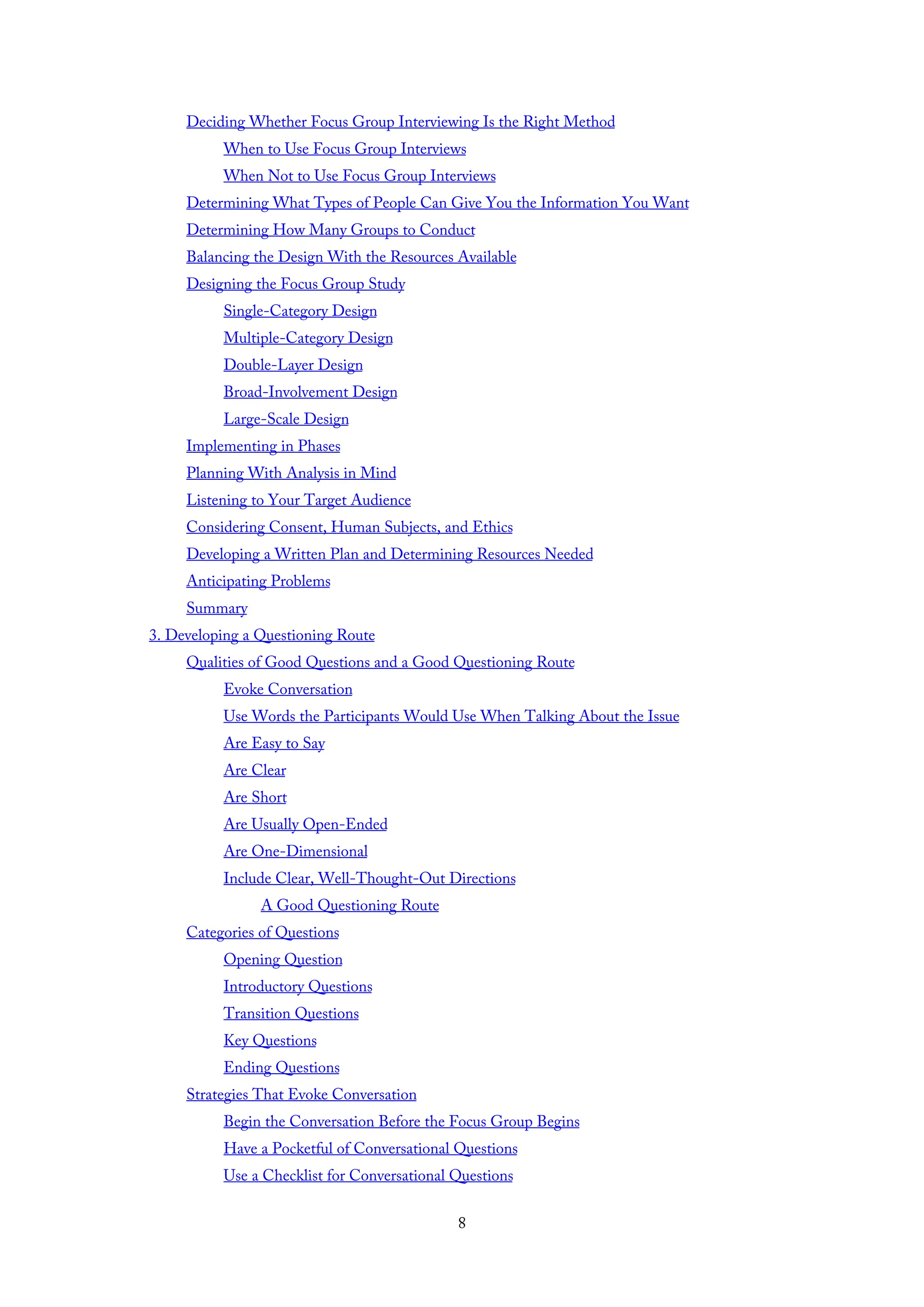
Deciding Whether FocusGroup Interviewing Is the Right Method
When to Use Focus Group Interviews
When Not to Use Focus Group Interviews
Determining What Types of People Can Give You the Information You Want
Determining How Many Groups to Conduct
Balancing the Design With the Resources Available
Designing the Focus Group Study
Single-Category Design
Multiple-Category Design
Double-Layer Design
Broad-Involvement Design
Large-Scale Design
Implementing in Phases
Planning With Analysis in Mind
Listening to Your Target Audience
Considering Consent, Human Subjects, and Ethics
Developing a Written Plan and Determining Resources Needed
Anticipating Problems
Summary
3. Developing a Questioning Route
Qualities of Good Questions and a Good Questioning Route
Evoke Conversation
Use Words the Participants Would Use When Talking About the Issue
Are Easy to Say
Are Clear
Are Short
Are Usually Open-Ended
Are One-Dimensional
Include Clear, Well-Thought-Out Directions
A Good Questioning Route
Categories of Questions
Opening Question
Introductory Questions
Transition Questions
Key Questions
Ending Questions
Strategies That Evoke Conversation
Begin the Conversation Before the Focus Group Begins
Have a Pocketful of Conversational Questions
Use a Checklist for Conversational Questions
8
14.
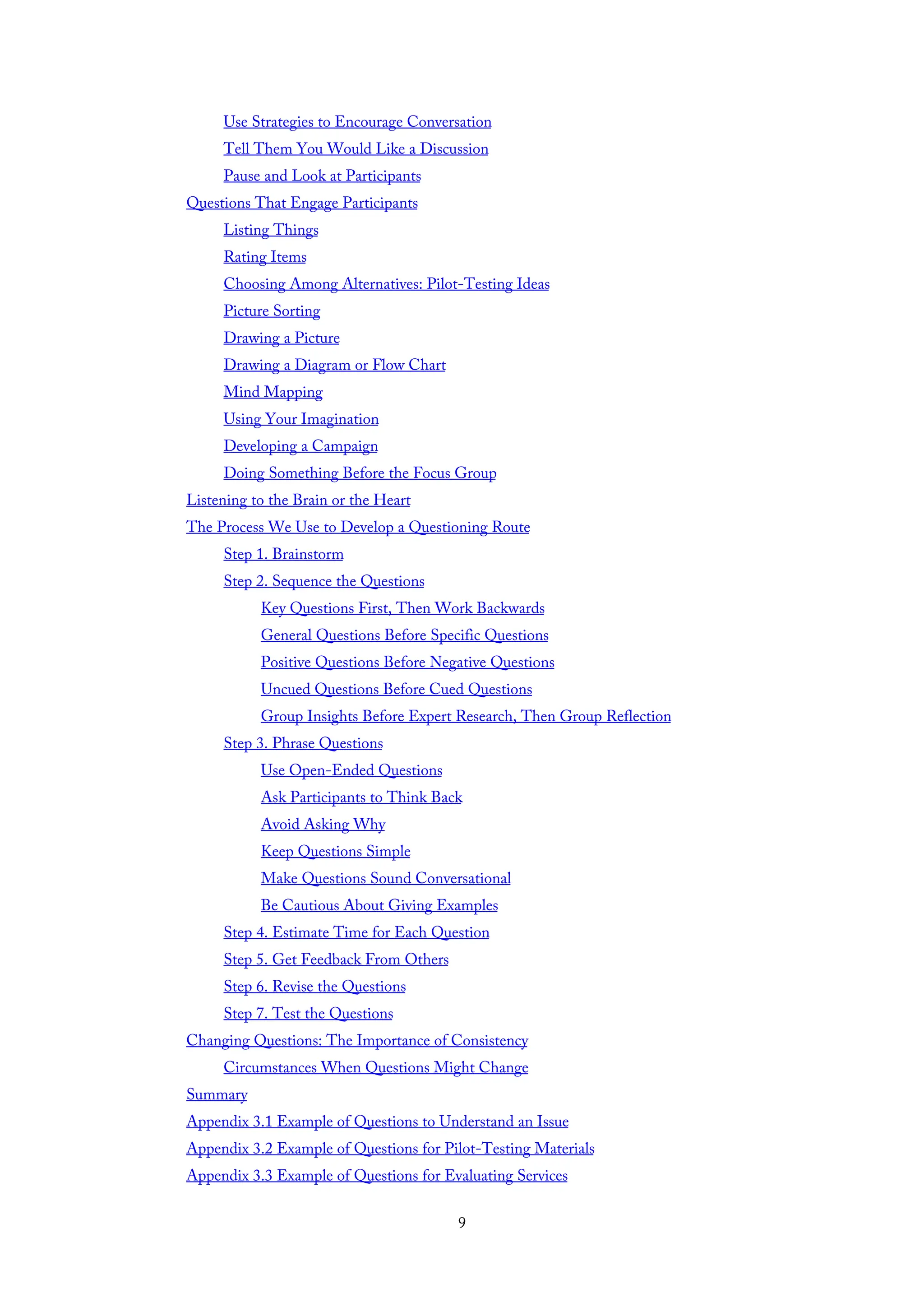
Use Strategies toEncourage Conversation
Tell Them You Would Like a Discussion
Pause and Look at Participants
Questions That Engage Participants
Listing Things
Rating Items
Choosing Among Alternatives: Pilot-Testing Ideas
Picture Sorting
Drawing a Picture
Drawing a Diagram or Flow Chart
Mind Mapping
Using Your Imagination
Developing a Campaign
Doing Something Before the Focus Group
Listening to the Brain or the Heart
The Process We Use to Develop a Questioning Route
Step 1. Brainstorm
Step 2. Sequence the Questions
Key Questions First, Then Work Backwards
General Questions Before Specific Questions
Positive Questions Before Negative Questions
Uncued Questions Before Cued Questions
Group Insights Before Expert Research, Then Group Reflection
Step 3. Phrase Questions
Use Open-Ended Questions
Ask Participants to Think Back
Avoid Asking Why
Keep Questions Simple
Make Questions Sound Conversational
Be Cautious About Giving Examples
Step 4. Estimate Time for Each Question
Step 5. Get Feedback From Others
Step 6. Revise the Questions
Step 7. Test the Questions
Changing Questions: The Importance of Consistency
Circumstances When Questions Might Change
Summary
Appendix 3.1 Example of Questions to Understand an Issue
Appendix 3.2 Example of Questions for Pilot-Testing Materials
Appendix 3.3 Example of Questions for Evaluating Services
9
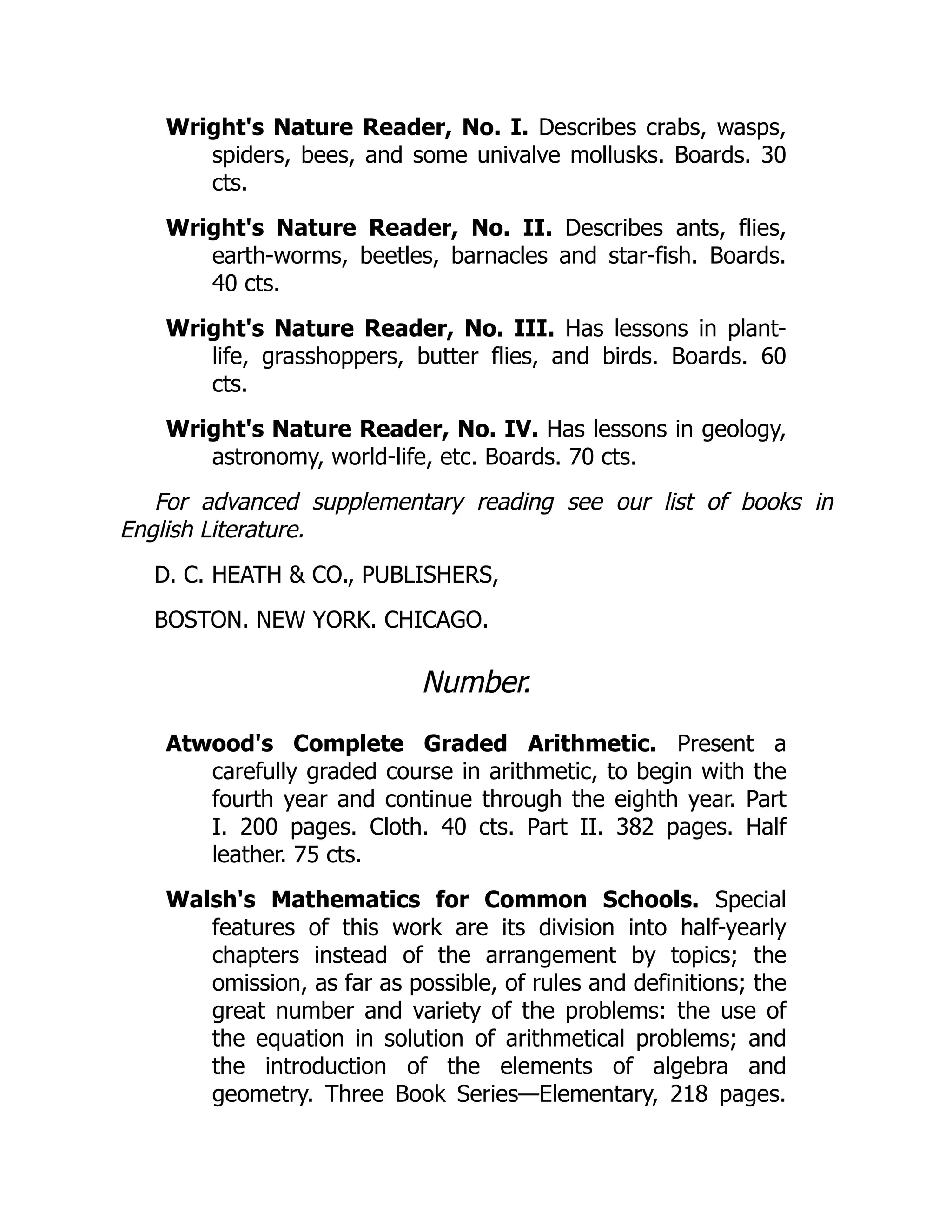
Wright's Nature Reader,No. I. Describes crabs, wasps,
spiders, bees, and some univalve mollusks. Boards. 30
cts.
Wright's Nature Reader, No. II. Describes ants, flies,
earth-worms, beetles, barnacles and star-fish. Boards.
40 cts.
Wright's Nature Reader, No. III. Has lessons in plant-
life, grasshoppers, butter flies, and birds. Boards. 60
cts.
Wright's Nature Reader, No. IV. Has lessons in geology,
astronomy, world-life, etc. Boards. 70 cts.
For advanced supplementary reading see our list of books in
English Literature.
D. C. HEATH & CO., PUBLISHERS,
BOSTON. NEW YORK. CHICAGO.
Number.
Atwood's Complete Graded Arithmetic. Present a
carefully graded course in arithmetic, to begin with the
fourth year and continue through the eighth year. Part
I. 200 pages. Cloth. 40 cts. Part II. 382 pages. Half
leather. 75 cts.
Walsh's Mathematics for Common Schools. Special
features of this work are its division into half-yearly
chapters instead of the arrangement by topics; the
omission, as far as possible, of rules and definitions; the
great number and variety of the problems: the use of
the equation in solution of arithmetical problems; and
the introduction of the elements of algebra and
geometry. Three Book Series—Elementary, 218 pages.
17.
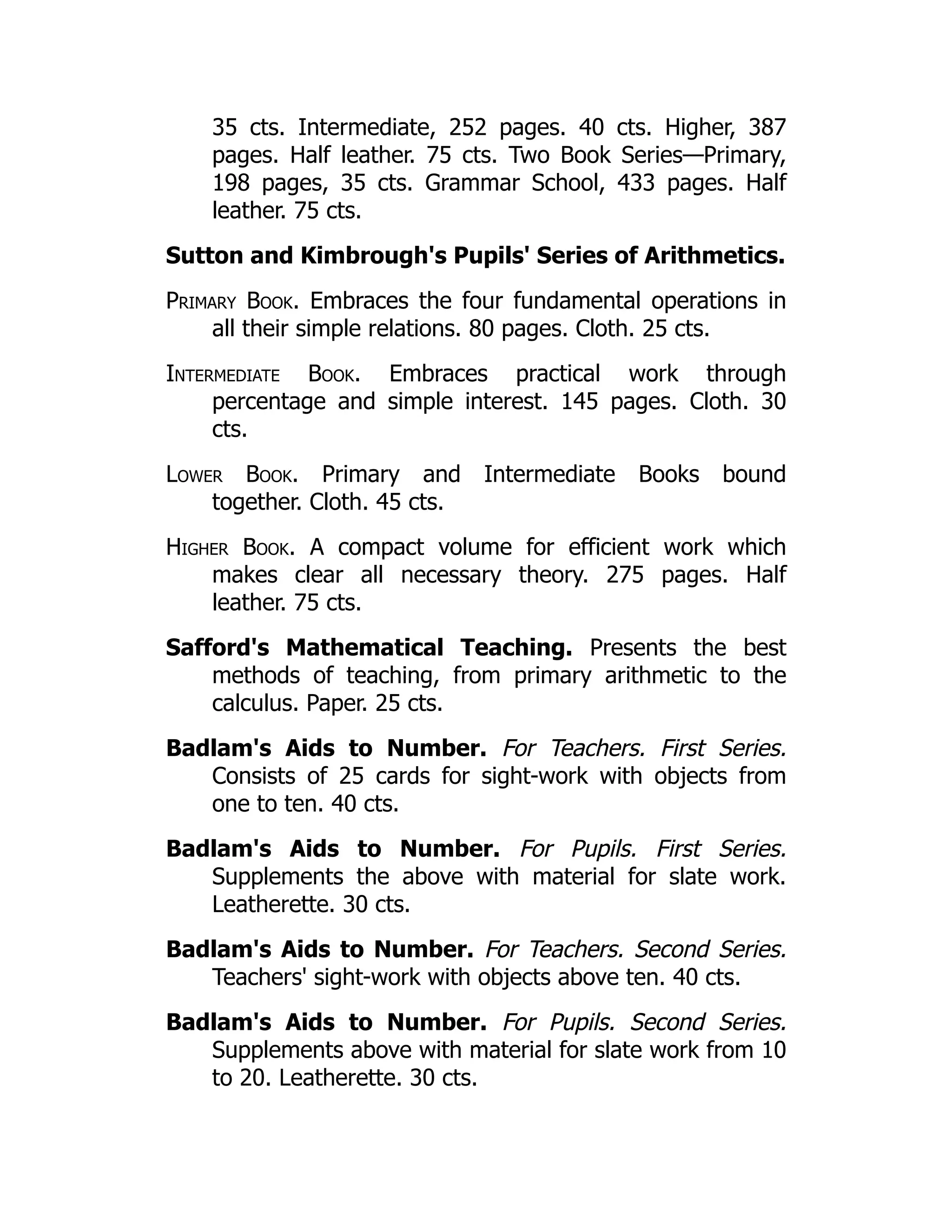
35 cts. Intermediate,252 pages. 40 cts. Higher, 387
pages. Half leather. 75 cts. Two Book Series—Primary,
198 pages, 35 cts. Grammar School, 433 pages. Half
leather. 75 cts.
Sutton and Kimbrough's Pupils' Series of Arithmetics.
Primary Book. Embraces the four fundamental operations in
all their simple relations. 80 pages. Cloth. 25 cts.
Intermediate Book. Embraces practical work through
percentage and simple interest. 145 pages. Cloth. 30
cts.
Lower Book. Primary and Intermediate Books bound
together. Cloth. 45 cts.
Higher Book. A compact volume for efficient work which
makes clear all necessary theory. 275 pages. Half
leather. 75 cts.
Safford's Mathematical Teaching. Presents the best
methods of teaching, from primary arithmetic to the
calculus. Paper. 25 cts.
Badlam's Aids to Number. For Teachers. First Series.
Consists of 25 cards for sight-work with objects from
one to ten. 40 cts.
Badlam's Aids to Number. For Pupils. First Series.
Supplements the above with material for slate work.
Leatherette. 30 cts.
Badlam's Aids to Number. For Teachers. Second Series.
Teachers' sight-work with objects above ten. 40 cts.
Badlam's Aids to Number. For Pupils. Second Series.
Supplements above with material for slate work from 10
to 20. Leatherette. 30 cts.
18.
Badlam's Number Chart.11 × 14 inches. Designed to aid
in teaching the four fundamental rules in lowest primary
grades. 5 cts. each; per hundred $4.00.
Sloane's Practical Lessons in Fractions. For elementary
grades. Boards 30 cts. Set of six fraction cards for
children to cut. 12 cts.
White's Two Years with Numbers. Number Lessons for
second and third year pupils. 40 cts.
White's Junior Arithmetic. For fourth and fifth year
pupils. Cloth. 50 cts.
White's Senior Arithmetic. In press.
For advanced work see our list of books in Mathematics.
D. C. HEATH & CO., PUBLISHERS,
BOSTON. NEW YORK. CHICAGO.
ENGLISH LANGUAGE.
Hyde's Lessons in English, Book I. For the lower grades.
Contains exercises for reproduction, picture lessons,
letter writing, uses of parts of speech, etc. 40 cts.
Hyde's Lessons in English, Book II. For Grammar
schools. Has enough technical grammar for correct use
of language. Co cts.
Hyde's Lessons in English, Book II with Supplement.
Has, in addition to the above, 118 pages of technical
grammar. 70 cts.
Supplement bound alone, 35 cts.
Hyde's Practical English Grammar. For advanced
classes in grammar schools and for high schools. 60 cts.
19.
Hyde's Lessons inEnglish, Book II with Practical
Grammar. The Practical Grammar and Book II bound
together. 80 cts.
Hyde's Derivation of Words. 15 cts.
Penniman's Common Words Difficult to Spell. Graded
lists of common words often misspelled. Boards. 25 cts.
Penniman's Prose Dictation Exercises. Short extracts
from the best authors. Boards. 30 cts.
Spalding's Problem of Elementary Composition.
Suggestions for its solution. Cloth. 45 cts.
Mathews's Outline of English Grammar, with
Selections for Practice. The application of principles
is made through composition of original sentences. 80
cts.
Buckbee's Primary Word Book. Embraces thorough drills
in articulation and in the primary difficulties of spelling
and sound. 30 cts.
Sever's Progressive Speller. For use in advanced
primary, intermediate, and grammar grades. Gives
spelling, pronunciation, definition, and use of words. 30
cts.
Badlam's Suggestive Lessons in Language. Being Part
I and Appendix of Suggestive Lessons in Language and
Reading. 50 cts.
Smith's Studies in Nature, and Language Lessons. A
combination of object lessons with language work. 50
cts. Part I bound separately, 25 cts.
Meiklejohn's English Language. Treats salient features
with a master's skill and with the utmost clearness and
simplicity. $1.30.
20.
Meiklejohn's English Grammar.Also composition,
versification, paraphrasing, etc For high schools and
colleges, go cts.
Meiklejohn's History of the English Language. 78
pages. Part III of English Language above, 35 cts.
Williams's Composition and Rhetoric by Practice. For
high school and college. Combines the smallest amount
of theory with an abundance of practice. Revised
edition. $1.00.
Strang's Exercises in English. Examples in Syntax,
Accidence, and Style for criticism and correction. 50 cts.
Huffcutt's English in the Preparatory School. Presents
advanced methods of teaching English grammar and
composition in the secondary schools. 25 cts.
Woodward's Study of English. From primary school to
college. 25 cts.
Genung's Study of Rhetoric. Shows the most practical
discipline. 25 cts.
See also our list of books for the study of English Literature.
D. C. HEATH & CO., PUBLISHERS,
BOSTON. NEW YORK. CHICAGO.
Transcriber's Note
Text was relocated to prevent illustrations from splitting
paragraphs. Minor typos were corrected. The final footnote on
Page 144 was missing and the anchor was deleted. Several
21.
cases of apossible "æ" ligature were printed as individual
characters and were left that way.
22.
*** END OFTHE PROJECT GUTENBERG EBOOK OUR FEATHERED
FRIENDS ***
Updated editions will replace the previous one—the old editions will
be renamed.
Creating the works from print editions not protected by U.S.
copyright law means that no one owns a United States copyright in
these works, so the Foundation (and you!) can copy and distribute it
in the United States without permission and without paying
copyright royalties. Special rules, set forth in the General Terms of
Use part of this license, apply to copying and distributing Project
Gutenberg™ electronic works to protect the PROJECT GUTENBERG™
concept and trademark. Project Gutenberg is a registered trademark,
and may not be used if you charge for an eBook, except by following
the terms of the trademark license, including paying royalties for use
of the Project Gutenberg trademark. If you do not charge anything
for copies of this eBook, complying with the trademark license is
very easy. You may use this eBook for nearly any purpose such as
creation of derivative works, reports, performances and research.
Project Gutenberg eBooks may be modified and printed and given
away—you may do practically ANYTHING in the United States with
eBooks not protected by U.S. copyright law. Redistribution is subject
to the trademark license, especially commercial redistribution.
START: FULL LICENSE
PLEASE READ THISBEFORE YOU DISTRIBUTE OR USE THIS WORK
To protect the Project Gutenberg™ mission of promoting the free
distribution of electronic works, by using or distributing this work (or
any other work associated in any way with the phrase “Project
Gutenberg”), you agree to comply with all the terms of the Full
Project Gutenberg™ License available with this file or online at
www.gutenberg.org/license.
Section 1. General Terms of Use and
Redistributing Project Gutenberg™
electronic works
1.A. By reading or using any part of this Project Gutenberg™
electronic work, you indicate that you have read, understand, agree
to and accept all the terms of this license and intellectual property
(trademark/copyright) agreement. If you do not agree to abide by all
the terms of this agreement, you must cease using and return or
destroy all copies of Project Gutenberg™ electronic works in your
possession. If you paid a fee for obtaining a copy of or access to a
Project Gutenberg™ electronic work and you do not agree to be
bound by the terms of this agreement, you may obtain a refund
from the person or entity to whom you paid the fee as set forth in
paragraph 1.E.8.
1.B. “Project Gutenberg” is a registered trademark. It may only be
used on or associated in any way with an electronic work by people
who agree to be bound by the terms of this agreement. There are a
few things that you can do with most Project Gutenberg™ electronic
works even without complying with the full terms of this agreement.
See paragraph 1.C below. There are a lot of things you can do with
Project Gutenberg™ electronic works if you follow the terms of this
agreement and help preserve free future access to Project
Gutenberg™ electronic works. See paragraph 1.E below.
25.
1.C. The ProjectGutenberg Literary Archive Foundation (“the
Foundation” or PGLAF), owns a compilation copyright in the
collection of Project Gutenberg™ electronic works. Nearly all the
individual works in the collection are in the public domain in the
United States. If an individual work is unprotected by copyright law
in the United States and you are located in the United States, we do
not claim a right to prevent you from copying, distributing,
performing, displaying or creating derivative works based on the
work as long as all references to Project Gutenberg are removed. Of
course, we hope that you will support the Project Gutenberg™
mission of promoting free access to electronic works by freely
sharing Project Gutenberg™ works in compliance with the terms of
this agreement for keeping the Project Gutenberg™ name associated
with the work. You can easily comply with the terms of this
agreement by keeping this work in the same format with its attached
full Project Gutenberg™ License when you share it without charge
with others.
1.D. The copyright laws of the place where you are located also
govern what you can do with this work. Copyright laws in most
countries are in a constant state of change. If you are outside the
United States, check the laws of your country in addition to the
terms of this agreement before downloading, copying, displaying,
performing, distributing or creating derivative works based on this
work or any other Project Gutenberg™ work. The Foundation makes
no representations concerning the copyright status of any work in
any country other than the United States.
1.E. Unless you have removed all references to Project Gutenberg:
1.E.1. The following sentence, with active links to, or other
immediate access to, the full Project Gutenberg™ License must
appear prominently whenever any copy of a Project Gutenberg™
work (any work on which the phrase “Project Gutenberg” appears,
or with which the phrase “Project Gutenberg” is associated) is
accessed, displayed, performed, viewed, copied or distributed:
26.
This eBook isfor the use of anyone anywhere in the United
States and most other parts of the world at no cost and with
almost no restrictions whatsoever. You may copy it, give it away
or re-use it under the terms of the Project Gutenberg License
included with this eBook or online at www.gutenberg.org. If you
are not located in the United States, you will have to check the
laws of the country where you are located before using this
eBook.
1.E.2. If an individual Project Gutenberg™ electronic work is derived
from texts not protected by U.S. copyright law (does not contain a
notice indicating that it is posted with permission of the copyright
holder), the work can be copied and distributed to anyone in the
United States without paying any fees or charges. If you are
redistributing or providing access to a work with the phrase “Project
Gutenberg” associated with or appearing on the work, you must
comply either with the requirements of paragraphs 1.E.1 through
1.E.7 or obtain permission for the use of the work and the Project
Gutenberg™ trademark as set forth in paragraphs 1.E.8 or 1.E.9.
1.E.3. If an individual Project Gutenberg™ electronic work is posted
with the permission of the copyright holder, your use and distribution
must comply with both paragraphs 1.E.1 through 1.E.7 and any
additional terms imposed by the copyright holder. Additional terms
will be linked to the Project Gutenberg™ License for all works posted
with the permission of the copyright holder found at the beginning
of this work.
1.E.4. Do not unlink or detach or remove the full Project
Gutenberg™ License terms from this work, or any files containing a
part of this work or any other work associated with Project
Gutenberg™.
1.E.5. Do not copy, display, perform, distribute or redistribute this
electronic work, or any part of this electronic work, without
prominently displaying the sentence set forth in paragraph 1.E.1
27.
with active linksor immediate access to the full terms of the Project
Gutenberg™ License.
1.E.6. You may convert to and distribute this work in any binary,
compressed, marked up, nonproprietary or proprietary form,
including any word processing or hypertext form. However, if you
provide access to or distribute copies of a Project Gutenberg™ work
in a format other than “Plain Vanilla ASCII” or other format used in
the official version posted on the official Project Gutenberg™ website
(www.gutenberg.org), you must, at no additional cost, fee or
expense to the user, provide a copy, a means of exporting a copy, or
a means of obtaining a copy upon request, of the work in its original
“Plain Vanilla ASCII” or other form. Any alternate format must
include the full Project Gutenberg™ License as specified in
paragraph 1.E.1.
1.E.7. Do not charge a fee for access to, viewing, displaying,
performing, copying or distributing any Project Gutenberg™ works
unless you comply with paragraph 1.E.8 or 1.E.9.
1.E.8. You may charge a reasonable fee for copies of or providing
access to or distributing Project Gutenberg™ electronic works
provided that:
• You pay a royalty fee of 20% of the gross profits you derive
from the use of Project Gutenberg™ works calculated using the
method you already use to calculate your applicable taxes. The
fee is owed to the owner of the Project Gutenberg™ trademark,
but he has agreed to donate royalties under this paragraph to
the Project Gutenberg Literary Archive Foundation. Royalty
payments must be paid within 60 days following each date on
which you prepare (or are legally required to prepare) your
periodic tax returns. Royalty payments should be clearly marked
as such and sent to the Project Gutenberg Literary Archive
Foundation at the address specified in Section 4, “Information
28.
about donations tothe Project Gutenberg Literary Archive
Foundation.”
• You provide a full refund of any money paid by a user who
notifies you in writing (or by e-mail) within 30 days of receipt
that s/he does not agree to the terms of the full Project
Gutenberg™ License. You must require such a user to return or
destroy all copies of the works possessed in a physical medium
and discontinue all use of and all access to other copies of
Project Gutenberg™ works.
• You provide, in accordance with paragraph 1.F.3, a full refund of
any money paid for a work or a replacement copy, if a defect in
the electronic work is discovered and reported to you within 90
days of receipt of the work.
• You comply with all other terms of this agreement for free
distribution of Project Gutenberg™ works.
1.E.9. If you wish to charge a fee or distribute a Project Gutenberg™
electronic work or group of works on different terms than are set
forth in this agreement, you must obtain permission in writing from
the Project Gutenberg Literary Archive Foundation, the manager of
the Project Gutenberg™ trademark. Contact the Foundation as set
forth in Section 3 below.
1.F.
1.F.1. Project Gutenberg volunteers and employees expend
considerable effort to identify, do copyright research on, transcribe
and proofread works not protected by U.S. copyright law in creating
the Project Gutenberg™ collection. Despite these efforts, Project
Gutenberg™ electronic works, and the medium on which they may
be stored, may contain “Defects,” such as, but not limited to,
incomplete, inaccurate or corrupt data, transcription errors, a
copyright or other intellectual property infringement, a defective or
29.
damaged disk orother medium, a computer virus, or computer
codes that damage or cannot be read by your equipment.
1.F.2. LIMITED WARRANTY, DISCLAIMER OF DAMAGES - Except for
the “Right of Replacement or Refund” described in paragraph 1.F.3,
the Project Gutenberg Literary Archive Foundation, the owner of the
Project Gutenberg™ trademark, and any other party distributing a
Project Gutenberg™ electronic work under this agreement, disclaim
all liability to you for damages, costs and expenses, including legal
fees. YOU AGREE THAT YOU HAVE NO REMEDIES FOR
NEGLIGENCE, STRICT LIABILITY, BREACH OF WARRANTY OR
BREACH OF CONTRACT EXCEPT THOSE PROVIDED IN PARAGRAPH
1.F.3. YOU AGREE THAT THE FOUNDATION, THE TRADEMARK
OWNER, AND ANY DISTRIBUTOR UNDER THIS AGREEMENT WILL
NOT BE LIABLE TO YOU FOR ACTUAL, DIRECT, INDIRECT,
CONSEQUENTIAL, PUNITIVE OR INCIDENTAL DAMAGES EVEN IF
YOU GIVE NOTICE OF THE POSSIBILITY OF SUCH DAMAGE.
1.F.3. LIMITED RIGHT OF REPLACEMENT OR REFUND - If you
discover a defect in this electronic work within 90 days of receiving
it, you can receive a refund of the money (if any) you paid for it by
sending a written explanation to the person you received the work
from. If you received the work on a physical medium, you must
return the medium with your written explanation. The person or
entity that provided you with the defective work may elect to provide
a replacement copy in lieu of a refund. If you received the work
electronically, the person or entity providing it to you may choose to
give you a second opportunity to receive the work electronically in
lieu of a refund. If the second copy is also defective, you may
demand a refund in writing without further opportunities to fix the
problem.
1.F.4. Except for the limited right of replacement or refund set forth
in paragraph 1.F.3, this work is provided to you ‘AS-IS’, WITH NO
OTHER WARRANTIES OF ANY KIND, EXPRESS OR IMPLIED,
30.
INCLUDING BUT NOTLIMITED TO WARRANTIES OF
MERCHANTABILITY OR FITNESS FOR ANY PURPOSE.
1.F.5. Some states do not allow disclaimers of certain implied
warranties or the exclusion or limitation of certain types of damages.
If any disclaimer or limitation set forth in this agreement violates the
law of the state applicable to this agreement, the agreement shall be
interpreted to make the maximum disclaimer or limitation permitted
by the applicable state law. The invalidity or unenforceability of any
provision of this agreement shall not void the remaining provisions.
1.F.6. INDEMNITY - You agree to indemnify and hold the Foundation,
the trademark owner, any agent or employee of the Foundation,
anyone providing copies of Project Gutenberg™ electronic works in
accordance with this agreement, and any volunteers associated with
the production, promotion and distribution of Project Gutenberg™
electronic works, harmless from all liability, costs and expenses,
including legal fees, that arise directly or indirectly from any of the
following which you do or cause to occur: (a) distribution of this or
any Project Gutenberg™ work, (b) alteration, modification, or
additions or deletions to any Project Gutenberg™ work, and (c) any
Defect you cause.
Section 2. Information about the Mission
of Project Gutenberg™
Project Gutenberg™ is synonymous with the free distribution of
electronic works in formats readable by the widest variety of
computers including obsolete, old, middle-aged and new computers.
It exists because of the efforts of hundreds of volunteers and
donations from people in all walks of life.
Volunteers and financial support to provide volunteers with the
assistance they need are critical to reaching Project Gutenberg™’s
goals and ensuring that the Project Gutenberg™ collection will
31.
remain freely availablefor generations to come. In 2001, the Project
Gutenberg Literary Archive Foundation was created to provide a
secure and permanent future for Project Gutenberg™ and future
generations. To learn more about the Project Gutenberg Literary
Archive Foundation and how your efforts and donations can help,
see Sections 3 and 4 and the Foundation information page at
www.gutenberg.org.
Section 3. Information about the Project
Gutenberg Literary Archive Foundation
The Project Gutenberg Literary Archive Foundation is a non-profit
501(c)(3) educational corporation organized under the laws of the
state of Mississippi and granted tax exempt status by the Internal
Revenue Service. The Foundation’s EIN or federal tax identification
number is 64-6221541. Contributions to the Project Gutenberg
Literary Archive Foundation are tax deductible to the full extent
permitted by U.S. federal laws and your state’s laws.
The Foundation’s business office is located at 809 North 1500 West,
Salt Lake City, UT 84116, (801) 596-1887. Email contact links and up
to date contact information can be found at the Foundation’s website
and official page at www.gutenberg.org/contact
Section 4. Information about Donations to
the Project Gutenberg Literary Archive
Foundation
Project Gutenberg™ depends upon and cannot survive without
widespread public support and donations to carry out its mission of
increasing the number of public domain and licensed works that can
be freely distributed in machine-readable form accessible by the
widest array of equipment including outdated equipment. Many
32.
small donations ($1to $5,000) are particularly important to
maintaining tax exempt status with the IRS.
The Foundation is committed to complying with the laws regulating
charities and charitable donations in all 50 states of the United
States. Compliance requirements are not uniform and it takes a
considerable effort, much paperwork and many fees to meet and
keep up with these requirements. We do not solicit donations in
locations where we have not received written confirmation of
compliance. To SEND DONATIONS or determine the status of
compliance for any particular state visit www.gutenberg.org/donate.
While we cannot and do not solicit contributions from states where
we have not met the solicitation requirements, we know of no
prohibition against accepting unsolicited donations from donors in
such states who approach us with offers to donate.
International donations are gratefully accepted, but we cannot make
any statements concerning tax treatment of donations received from
outside the United States. U.S. laws alone swamp our small staff.
Please check the Project Gutenberg web pages for current donation
methods and addresses. Donations are accepted in a number of
other ways including checks, online payments and credit card
donations. To donate, please visit: www.gutenberg.org/donate.
Section 5. General Information About
Project Gutenberg™ electronic works
Professor Michael S. Hart was the originator of the Project
Gutenberg™ concept of a library of electronic works that could be
freely shared with anyone. For forty years, he produced and
distributed Project Gutenberg™ eBooks with only a loose network of
volunteer support.
33.
Project Gutenberg™ eBooksare often created from several printed
editions, all of which are confirmed as not protected by copyright in
the U.S. unless a copyright notice is included. Thus, we do not
necessarily keep eBooks in compliance with any particular paper
edition.
Most people start at our website which has the main PG search
facility: www.gutenberg.org.
This website includes information about Project Gutenberg™,
including how to make donations to the Project Gutenberg Literary
Archive Foundation, how to help produce our new eBooks, and how
to subscribe to our email newsletter to hear about new eBooks.
34.
Welcome to ourwebsite – the ideal destination for book lovers and
knowledge seekers. With a mission to inspire endlessly, we offer a
vast collection of books, ranging from classic literary works to
specialized publications, self-development books, and children's
literature. Each book is a new journey of discovery, expanding
knowledge and enriching the soul of the reade
Our website is not just a platform for buying books, but a bridge
connecting readers to the timeless values of culture and wisdom. With
an elegant, user-friendly interface and an intelligent search system,
we are committed to providing a quick and convenient shopping
experience. Additionally, our special promotions and home delivery
services ensure that you save time and fully enjoy the joy of reading.
Let us accompany you on the journey of exploring knowledge and
personal growth!
ebookultra.com