Introduction to Psychology
Presented to: Ma’am Gull e Zahra
Presented by: Syed Hassan zaidi
Usman irshad
Hassan asharf
Tasmiyat bukhari
Aliya mujahid
University of Education
Department of Economics
Division of Management and Administrative Science
What are Focus Groups?
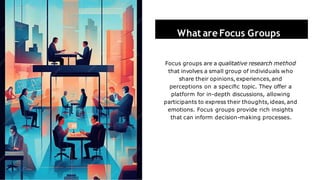
Focus groups are a qualitative research method
that involves a small group of individuals who
share their opinions,experiences,and
perceptions on a specific topic. They offer a
platform for in-depth discussions, allowing
participants to express their thoughts,ideas,and
emotions. Focus groups provide rich insights
that can inform decision-making processes.
Benefits of focus group
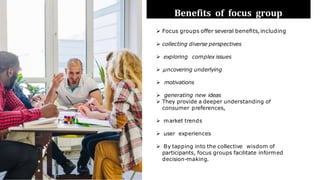
 Focus groups offer several benefits,including
 collecting diverse perspectives
 exploring complex issues
 ,uncovering underlying
 motivations
 generating new ideas
 They provide a deeper understanding of
consumer preferences,
 market trends
 user experiences
 By tapping into the collective wisdom of
participants, focus groups facilitate informed
decision-making.
When to Use Focus Groups
 Focus groups are particularly useful when
exploring new product ideas,
 evaluating marketing campaigns,
 testing prototypes,
 understanding customer needs and
preferences.
 They help organizations gain insights into
target audiences,
 identify potential challenges
 validate assumptions
 Focus groups enable decision-makers to
make informed choices based on direct
feedback from participants.
When to use focus
group
Limitations of Focus Groups
 While focus groups offer valuable
insights, they also have limitations.
These include
 potential groupthink
 ,limited
 generalizability
 ,influence of dominant personalities,
 difficulty in quantifying results
.It is important to consider these
limitations when interpreting the
findings. Supplementing focus group
data with other research methods can
provide a more comprehensive
understanding of the topic.
A
p
p
l
i
c
a
t
i
 Focus groups find applications in various
fieldssuch as
 market research,
 product development

 policy-making
 social sciences
 healthcare
 They help organizations gain insights into
consumer behavior,
 improve products and services
 shape policies
 ,understand societal issues
 enhance patient experiences.
 The versatility of focus groups makes them a
valuable tool in decision- making across
industries.
Applicable of focus group
D
e
fi
n
i
t
i
o
n
A case study is a research method
that involves an in-depth analysis of a
specific subject or phenomenon
within its real-life context.It provides
a comprehensive understanding of
the topic under investigation by
examining multiple sources of data,
such as interviews,observations,and
documents.Case studies are widely
used in social sciences,business,and
healthcare research to gain insights
into complex issues and explore
causal relationships.
Definition of
case study
Key Components of Case Study Methodology
.
The key components of case study
methodology include research questions,
data collection, data analysis, and
interpretation. Research questions guide the
study and help focus on specific aspects of
the case. Data collection involves gathering
relevant information through interviews,
observations, and document analysis. Data
analysis entails organizing, coding, and
analyzing the collected data. Finally,
interpretation involves making sense of the
data and drawing meaningful conclusions.
Types ofCaseStudies
There are several types of case studies,
including
 exploratory,
 descriptive,
 explanatory
 instrumental
. Exploratory case studies aim to explore new
phenomena and generate hypotheses.
Descriptive case studies provide a detailed
description of a particular case or situation.
Explanatory case studies focus on
understanding causal relationships and
explaining why certain outcomes occur.
Instrumental case studies use a specific case to
gain insights into a broader issue or theory.
Applications of Case Study Methodology
.
Case study methodology finds applications in
various fields, including business, education,
psychology, medicine, and social sciences. In
business, case studies help analyze real-
world problems and develop effective
strategies. In education, case studies
enhance learning by presenting practical
scenarios. In psychology, case studies provide
valuable insights into individual behavior and
mental processes. In medicine, case studies
contribute to understanding diseases and
treatment outcomes. In social sciences, case
studies help examine complex social
phenomena and societal issues.
1. Case study is in-depth study. 2. It helps in diagnosing a problem. 3. It helps in finding an appropriate solution to the problem. 4. It provide detailed information about person, event, organization
or phenomenon. 1. Case study is in-depth study. 2. It helps in diagnosing a problem. 3. It helps in finding an appropriate solution to the problem. 4. It provide detailed information about person,
event, organization or phenomenon.
Benefits of Focused Case Study
Approach
. 1. Case study is in-depth
study.
2. It helps in diagnosing a
problem.
3. It helps in finding an
appropriate solution to the
problem.
4. It provide detailed
information about person,
event, organization or
phenomenon.
Understanding
Consumer
Behavior: Insights
from Focus Groups
and Case
Introduction
Understanding Consumer Behavior:
Insights from Focus Groups and Case
Studies in Psychology Consumer
behavior is a complex field that
combines psychology and market
research Focus groups and case studies
provide valuable insights into consumer
decision-making This presentation will
explore key findings and practical
applications Let's dive into the
fascinating world of consumer
behavior!
in
What is consumer
behavior
Consumer behavior is refer to the study of
individuals , groups and organizations and the
process they used to select ,secure, use and
dispose of products , services ,experiences or
ideas to satisfy their need and wants . It
involve understanding that how a consumer
make decisions factors influencing consumer
behavior include
Cultural
Social
Psychological
Personal factors
Focus group and case study provide valuable
insights into these factors
The Role of Focus
group
Focus group are qualitative research
method that involve gathering a small
group of individuals to discuss a specific
topic. They provide in-depth insights
into consumer attitudes, motivations,
and preferences Group dynamics and
interactions allow for a richer
understanding of consumer behavior
Focus groups are particularly useful for
exploring the emotional and social
aspects of consumer decision-making
Case Studies in
psychology
Case studies in psychology do dept
analysis of individual consumers or
specific consumer groups. They
provide detailed information about
consumer behavior in real-life
contexts Case studies help identify
patterns, influences, and underlying
psychological factors By examining
unique cases, researchers can gain
valuable insights into consumer
decision-making processes
Key Findings from
Focus Groups
Insights from focus groups reveal several key
findings
Social influence: Consumers are often
influenced by the opinions and behaviors of
others
Emotional drivers: Emotions play a
significant role in consumer decision-
making
Perception and interpretation: Consumers'
perceptions and interpretations shape their
preferences
Unconscious biases: Unconscious biases can
impact consumer choices
Key findings for case
study
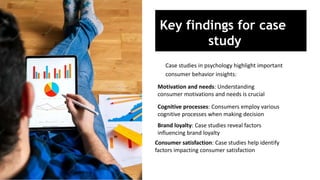
Case studies in psychology highlight important
consumer behavior insights:
Motivation and needs: Understanding
consumer motivations and needs is crucial
Cognitive processes: Consumers employ various
cognitive processes when making decision
Brand loyalty: Case studies reveal factors
influencing brand loyalty
Consumer satisfaction: Case studies help identify
factors impacting consumer satisfaction
Practical
application
Some of the practical applications are
Marketing strategies: Understanding consumer
behavior helps develop effective marketing
strategies
Product development: Insights guide the
development of products that meet consumer
needs
Customer experience: Enhancing the customer
experience based on consumer insights
Market research: Focus groups and case
studies inform market research efforts
Ethical
consideration
Informed consent: Ensuring participants fully
understand their involvement
Confidentiality: Safeguarding the privacy
and confidentiality of participants
Deception: Minimizing any potential deception or
harm to participants
Research ethics: Adhering to ethical guidelines in
conducting consumer behavior research
Future Directions
:
The field of consumer behavior continues
to evolve, offering exciting future prospects:
Advances in technology: Technology enables new
ways to study and understand consumer behavior
Cross-cultural studies: Exploring consumer
behavior across diverse cultures
Neuromarketing: Utilizing neuroscience to
uncover subconscious consumer responses
Sustainable consumption: Understanding
consumer behavior towards sustainable
choices
Limitations and
challenges
Whole focus group and case study provide
valuable insights but have some limitations
Sample size: Findings may not be
representative of the entire population
Time and resources: Conducting focus groups
and case studies can be time consuming and
resource-intensive
Generalizability: Findings may not apply
universally to all consumer contexts
Key Takeaways
Understanding consumer behavior is crucial
for businesses to thrive in a competitive
market: Focus groups and case studies provide
valuable insights into consumer decision-
making Factors such as social influence,
emotions, and perception impact consumer
behavior Practical applications include
marketing strategies, product development,
and customer experience enhancement Ethical
considerations and future directions shape the
field's progress
Conclusion
Consumer behavior is a dynamic field that combines psychology and market research.
Insights from focus groups and case studies offer valuable understanding of consumer
decision-making. By exploring factors such as social influence, emotions, and perception,
businesses can develop effective marketing strategies, enhance customer experiences,
and meet consumer needs. Ethical considerations and future directions shape the field's
progress. Keep exploring the fascinating world of consumer behavior!
Thanks!
Focus group

Focus group

  • 1.
    Introduction to Psychology Presentedto: Ma’am Gull e Zahra Presented by: Syed Hassan zaidi Usman irshad Hassan asharf Tasmiyat bukhari Aliya mujahid University of Education Department of Economics Division of Management and Administrative Science
  • 2.
    What are FocusGroups? Focus groups are a qualitative research method that involves a small group of individuals who share their opinions,experiences,and perceptions on a specific topic. They offer a platform for in-depth discussions, allowing participants to express their thoughts,ideas,and emotions. Focus groups provide rich insights that can inform decision-making processes.
  • 3.
    Benefits of focusgroup  Focus groups offer several benefits,including  collecting diverse perspectives  exploring complex issues  ,uncovering underlying  motivations  generating new ideas  They provide a deeper understanding of consumer preferences,  market trends  user experiences  By tapping into the collective wisdom of participants, focus groups facilitate informed decision-making.
  • 4.
    When to UseFocus Groups  Focus groups are particularly useful when exploring new product ideas,  evaluating marketing campaigns,  testing prototypes,  understanding customer needs and preferences.  They help organizations gain insights into target audiences,  identify potential challenges  validate assumptions  Focus groups enable decision-makers to make informed choices based on direct feedback from participants. When to use focus group
  • 5.
    Limitations of FocusGroups  While focus groups offer valuable insights, they also have limitations. These include  potential groupthink  ,limited  generalizability  ,influence of dominant personalities,  difficulty in quantifying results .It is important to consider these limitations when interpreting the findings. Supplementing focus group data with other research methods can provide a more comprehensive understanding of the topic.
  • 6.
    A p p l i c a t i  Focus groupsfind applications in various fieldssuch as  market research,  product development   policy-making  social sciences  healthcare  They help organizations gain insights into consumer behavior,  improve products and services  shape policies  ,understand societal issues  enhance patient experiences.  The versatility of focus groups makes them a valuable tool in decision- making across industries. Applicable of focus group
  • 7.
    D e fi n i t i o n A case studyis a research method that involves an in-depth analysis of a specific subject or phenomenon within its real-life context.It provides a comprehensive understanding of the topic under investigation by examining multiple sources of data, such as interviews,observations,and documents.Case studies are widely used in social sciences,business,and healthcare research to gain insights into complex issues and explore causal relationships. Definition of case study
  • 8.
    Key Components ofCase Study Methodology . The key components of case study methodology include research questions, data collection, data analysis, and interpretation. Research questions guide the study and help focus on specific aspects of the case. Data collection involves gathering relevant information through interviews, observations, and document analysis. Data analysis entails organizing, coding, and analyzing the collected data. Finally, interpretation involves making sense of the data and drawing meaningful conclusions.
  • 9.
    Types ofCaseStudies There areseveral types of case studies, including  exploratory,  descriptive,  explanatory  instrumental . Exploratory case studies aim to explore new phenomena and generate hypotheses. Descriptive case studies provide a detailed description of a particular case or situation. Explanatory case studies focus on understanding causal relationships and explaining why certain outcomes occur. Instrumental case studies use a specific case to gain insights into a broader issue or theory.
  • 10.
    Applications of CaseStudy Methodology . Case study methodology finds applications in various fields, including business, education, psychology, medicine, and social sciences. In business, case studies help analyze real- world problems and develop effective strategies. In education, case studies enhance learning by presenting practical scenarios. In psychology, case studies provide valuable insights into individual behavior and mental processes. In medicine, case studies contribute to understanding diseases and treatment outcomes. In social sciences, case studies help examine complex social phenomena and societal issues.
  • 11.
    1. Case studyis in-depth study. 2. It helps in diagnosing a problem. 3. It helps in finding an appropriate solution to the problem. 4. It provide detailed information about person, event, organization or phenomenon. 1. Case study is in-depth study. 2. It helps in diagnosing a problem. 3. It helps in finding an appropriate solution to the problem. 4. It provide detailed information about person, event, organization or phenomenon. Benefits of Focused Case Study Approach . 1. Case study is in-depth study. 2. It helps in diagnosing a problem. 3. It helps in finding an appropriate solution to the problem. 4. It provide detailed information about person, event, organization or phenomenon.
  • 12.
  • 13.
    Introduction Understanding Consumer Behavior: Insightsfrom Focus Groups and Case Studies in Psychology Consumer behavior is a complex field that combines psychology and market research Focus groups and case studies provide valuable insights into consumer decision-making This presentation will explore key findings and practical applications Let's dive into the fascinating world of consumer behavior!
  • 14.
    in What is consumer behavior Consumerbehavior is refer to the study of individuals , groups and organizations and the process they used to select ,secure, use and dispose of products , services ,experiences or ideas to satisfy their need and wants . It involve understanding that how a consumer make decisions factors influencing consumer behavior include Cultural Social Psychological Personal factors Focus group and case study provide valuable insights into these factors
  • 15.
    The Role ofFocus group Focus group are qualitative research method that involve gathering a small group of individuals to discuss a specific topic. They provide in-depth insights into consumer attitudes, motivations, and preferences Group dynamics and interactions allow for a richer understanding of consumer behavior Focus groups are particularly useful for exploring the emotional and social aspects of consumer decision-making
  • 16.
    Case Studies in psychology Casestudies in psychology do dept analysis of individual consumers or specific consumer groups. They provide detailed information about consumer behavior in real-life contexts Case studies help identify patterns, influences, and underlying psychological factors By examining unique cases, researchers can gain valuable insights into consumer decision-making processes
  • 17.
    Key Findings from FocusGroups Insights from focus groups reveal several key findings Social influence: Consumers are often influenced by the opinions and behaviors of others Emotional drivers: Emotions play a significant role in consumer decision- making Perception and interpretation: Consumers' perceptions and interpretations shape their preferences Unconscious biases: Unconscious biases can impact consumer choices
  • 18.
    Key findings forcase study Case studies in psychology highlight important consumer behavior insights: Motivation and needs: Understanding consumer motivations and needs is crucial Cognitive processes: Consumers employ various cognitive processes when making decision Brand loyalty: Case studies reveal factors influencing brand loyalty Consumer satisfaction: Case studies help identify factors impacting consumer satisfaction
  • 19.
    Practical application Some of thepractical applications are Marketing strategies: Understanding consumer behavior helps develop effective marketing strategies Product development: Insights guide the development of products that meet consumer needs Customer experience: Enhancing the customer experience based on consumer insights Market research: Focus groups and case studies inform market research efforts
  • 20.
    Ethical consideration Informed consent: Ensuringparticipants fully understand their involvement Confidentiality: Safeguarding the privacy and confidentiality of participants Deception: Minimizing any potential deception or harm to participants Research ethics: Adhering to ethical guidelines in conducting consumer behavior research
  • 21.
    Future Directions : The fieldof consumer behavior continues to evolve, offering exciting future prospects: Advances in technology: Technology enables new ways to study and understand consumer behavior Cross-cultural studies: Exploring consumer behavior across diverse cultures Neuromarketing: Utilizing neuroscience to uncover subconscious consumer responses Sustainable consumption: Understanding consumer behavior towards sustainable choices
  • 22.
    Limitations and challenges Whole focusgroup and case study provide valuable insights but have some limitations Sample size: Findings may not be representative of the entire population Time and resources: Conducting focus groups and case studies can be time consuming and resource-intensive Generalizability: Findings may not apply universally to all consumer contexts
  • 23.
    Key Takeaways Understanding consumerbehavior is crucial for businesses to thrive in a competitive market: Focus groups and case studies provide valuable insights into consumer decision- making Factors such as social influence, emotions, and perception impact consumer behavior Practical applications include marketing strategies, product development, and customer experience enhancement Ethical considerations and future directions shape the field's progress
  • 24.
    Conclusion Consumer behavior isa dynamic field that combines psychology and market research. Insights from focus groups and case studies offer valuable understanding of consumer decision-making. By exploring factors such as social influence, emotions, and perception, businesses can develop effective marketing strategies, enhance customer experiences, and meet consumer needs. Ethical considerations and future directions shape the field's progress. Keep exploring the fascinating world of consumer behavior!
  • 25.