Intravenous Fluids
Management
Dr. Muhammad Zakaullah Dogar
Resident Surgeon
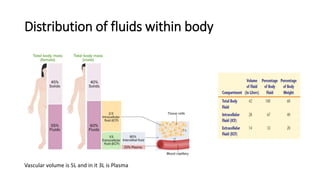
Distribution of fluids within body
Vascular volume is 5L and in it 3L is Plasma
Intravenous Fluids Therapy
Consists of:
• Crystalloids
• Colloids
• Combination of both
CRYSTALLOIDS
• Are the solutions that contain SODIUM as the major particle.
• With or without glucose
• These include
• Sodium Chloride 0.9% (Normal Saline)
• Hartmann’s Solution (Ringer Lactate)
• D5W
• 0.45%NaCl
• D5RL
• D5/0.45%NaCl
Na
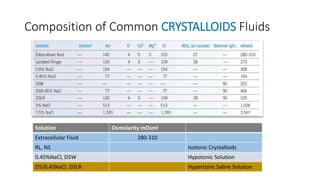
Composition of Common CRYSTALLOIDS Fluids
Solution Osmolarity mOsml
Extracellular Fluid 280-310
RL, NS Isotonic Crystalloids
0.45%NaCl, D5W Hypotonic Solution
D5/0.45NaCl, D5LR Hypertonic Saline Solution
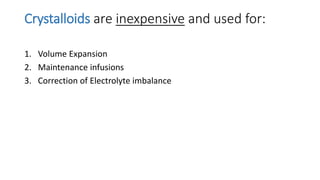
Crystalloids are inexpensive and used for:
1. Volume Expansion
2. Maintenance infusions
3. Correction of Electrolyte imbalance
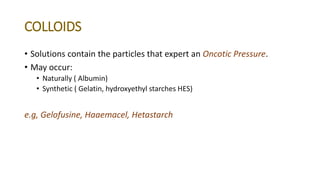
COLLOIDS
• Solutions contain the particles that expert an Oncotic Pressure.
• May occur:
• Naturally ( Albumin)
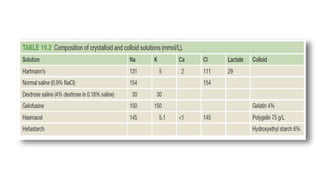
• Synthetic ( Gelatin, hydroxyethyl starches HES)
e.g, Gelofusine, Haaemacel, Hetastarch
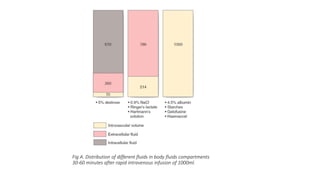
Fig A. Distribution of different fluids in body fluids compartments
30-60 minutes after rapid intravenous infusion of 1000ml.
Assessing losses in Surgical Patients
Maintenance Fluids requirements
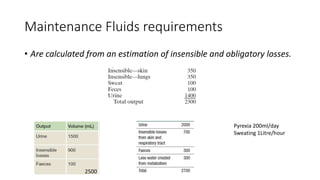
• Are calculated from an estimation of insensible and obligatory losses.
2500
Pyrexia 200ml/day
Sweating 1Litre/hour
Maintenance Fluids requirements
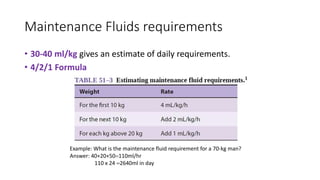
• 30-40 ml/kg gives an estimate of daily requirements.
• 4/2/1 Formula
Example: What is the maintenance fluid requirement for a 70-kg man?
Answer: 40+20+50110ml/hr
110 x 24 2640ml in day
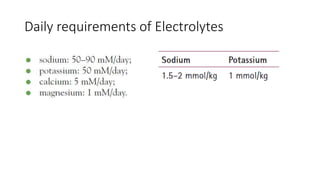
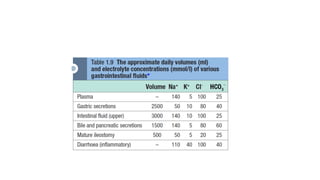
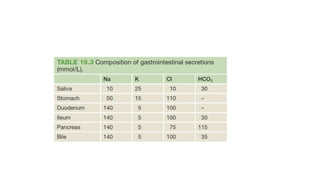
Daily requirements of Electrolytes
Daily maintenance fluids
A typical daily maintenance fluid regimen would consist of combination
of:
• 5% Dextrose solution (2/3rd) with
• Ringer lactate/ Normal Saline (1/3rd), to a volume of 2 liters
A 40kg small elderly patient 500ml of saline and 1.5 liters of 5% dextrose.
A 80kg large young patient 1 liter of saline and 2 liters of 5 % dextrose.
Fluids Management.pptx

Fluids Management.pptx

  • 1.
    Intravenous Fluids Management Dr. MuhammadZakaullah Dogar Resident Surgeon
  • 2.
    Distribution of fluidswithin body Vascular volume is 5L and in it 3L is Plasma
  • 3.
    Intravenous Fluids Therapy Consistsof: • Crystalloids • Colloids • Combination of both
  • 4.
    CRYSTALLOIDS • Are thesolutions that contain SODIUM as the major particle. • With or without glucose • These include • Sodium Chloride 0.9% (Normal Saline) • Hartmann’s Solution (Ringer Lactate) • D5W • 0.45%NaCl • D5RL • D5/0.45%NaCl Na
  • 5.
    Composition of CommonCRYSTALLOIDS Fluids Solution Osmolarity mOsml Extracellular Fluid 280-310 RL, NS Isotonic Crystalloids 0.45%NaCl, D5W Hypotonic Solution D5/0.45NaCl, D5LR Hypertonic Saline Solution
  • 6.
    Crystalloids are inexpensiveand used for: 1. Volume Expansion 2. Maintenance infusions 3. Correction of Electrolyte imbalance
  • 7.
    COLLOIDS • Solutions containthe particles that expert an Oncotic Pressure. • May occur: • Naturally ( Albumin) • Synthetic ( Gelatin, hydroxyethyl starches HES) e.g, Gelofusine, Haaemacel, Hetastarch
  • 8.
    Fig A. Distributionof different fluids in body fluids compartments 30-60 minutes after rapid intravenous infusion of 1000ml.
  • 9.
    Assessing losses inSurgical Patients
  • 10.
    Maintenance Fluids requirements •Are calculated from an estimation of insensible and obligatory losses. 2500 Pyrexia 200ml/day Sweating 1Litre/hour
  • 11.
    Maintenance Fluids requirements •30-40 ml/kg gives an estimate of daily requirements. • 4/2/1 Formula Example: What is the maintenance fluid requirement for a 70-kg man? Answer: 40+20+50110ml/hr 110 x 24 2640ml in day
  • 12.
  • 14.
    Daily maintenance fluids Atypical daily maintenance fluid regimen would consist of combination of: • 5% Dextrose solution (2/3rd) with • Ringer lactate/ Normal Saline (1/3rd), to a volume of 2 liters A 40kg small elderly patient 500ml of saline and 1.5 liters of 5% dextrose. A 80kg large young patient 1 liter of saline and 2 liters of 5 % dextrose.

Editor's Notes

  • #9 Contain high molecular weight substances, their intravascular half live is 4-24 hrs and therefore such solutions are appropriate for Fluid Resusisation