Sample Questions
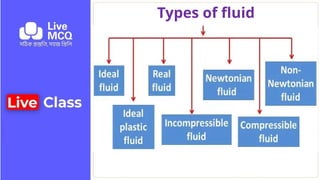
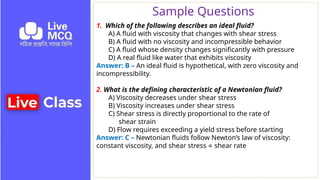
1. Whichof the following describes an ideal fluid?
A) A fluid with viscosity that changes with shear stress
B) A fluid with no viscosity and incompressible behavior
C) A fluid whose density changes significantly with pressure
D) A real fluid like water that exhibits viscosity
Answer: B – An ideal fluid is hypothetical, with zero viscosity and
incompressibility.
2. What is the defining characteristic of a Newtonian fluid?
A) Viscosity decreases under shear stress
B) Viscosity increases under shear stress
C) Shear stress is directly proportional to the rate of
shear strain
D) Flow requires exceeding a yield stress before starting
Answer: C – Newtonian fluids follow Newton’s law of viscosity:
constant viscosity, and shear stress shear rate
∝
10.
Sample Questions
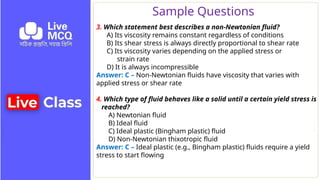
3. Whichstatement best describes a non‑Newtonian fluid?
A) Its viscosity remains constant regardless of conditions
B) Its shear stress is always directly proportional to shear rate
C) Its viscosity varies depending on the applied stress or
strain rate
D) It is always incompressible
Answer: C – Non‑Newtonian fluids have viscosity that varies with
applied stress or shear rate
4. Which type of fluid behaves like a solid until a certain yield stress is
reached?
A) Newtonian fluid
B) Ideal fluid
C) Ideal plastic (Bingham plastic) fluid
D) Non‑Newtonian thixotropic fluid
Answer: C – Ideal plastic (e.g., Bingham plastic) fluids require a yield
stress to start flowing
12.
properties of fluid
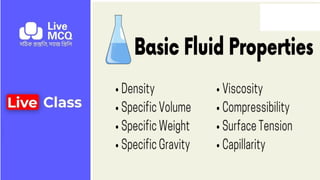
Density:-Density is defined as the mass per unit
volume of a fluid. The density of a substance varies as
per the volume of a substance. SI unit of density is
kg.m-3
.
Viscosity:- Viscosity determines the amount of
resistance offered by the fluid to shear stress. A fluid
that offers no resistance to shear stress is called an
inviscid fluid.
Specific Volume:- It is defined as the ratio of the
volume of the material to its mass. Specific volume is
the reciprocal of the density of the material. Specific
volume is inversely proportional to density.
The SI unit of specific volume is m3
.kg-1
.
13.
Properties of Fluid
SpecificWeight:- The specific weight (γ) of a fluid is
defined as the weight per unit volume. The SI unit of
specific weight is N/m3
.
Specific weight is related to density as γ = ρg. The
specific weight of fluid varies with temperature.
Specific Gravity:- It is the ratio of the specific weight of
the given fluid to the specific weight of standard fluid.
Specific Gravity is also known as relative density. It is
represented by the letter ‘S’ and has no unit.
Surface Tension:- It is the tendency of liquid surfaces to
shrink in minimum surface area. Surface tension is
caused by cohesive forces between the liquid
molecules.
14.
Properties of Fluid
Compressibility:-Compressibility is a measure of the
instantaneous relative volume change of a fluid or
solid as a response to a pressure (or mean stress)
change.
Capillarity:- Capillarity, also known as capillary
action, is the phenomenon where liquids rise or fall in
narrow tubes or porous materials due to
intermolecular forces. It occurs because of the
interplay between adhesion (attraction between liquid
and solid), cohesion (attraction between liquid
molecules), and surface tension.
Buoyancy:- Buoyancy describes the upward force on an
object that is submerged within a fluid.
15.
Sample Questions
5. Whatdoes the property "density" of a fluid represent?
A) Resistance to flow
B) Mass per unit volume
C) Ratio of viscosity to compressibility
D) Surface energy of the fluid
Answer: B – Density is the mass per unit volume, usually
expressed in kg/m³
6. Which property describes a fluid's resistance to
deformation or flow
due to internal friction?
A) Density B) Surface tension
C) Viscosity D) Compressibility
Answer: C – Viscosity measures a fluid’s resistance to
deformation or flow, arising from internal friction between
two layers.
16.
Sample Questions
7. Whatis surface tension?
A) A measure of how much a fluid resists compression
B) The mass per unit volume of a fluid
C) The cohesive force at a fluid's surface.
D) The volume per unit mass of fluid
Answer: C – Surface tension is the cohesive force at a fluid’s
surface that causes it to behave (like an elastic “skin”),
influencing phenomena like droplets and capillarity
8. Which property refers to how much a fluid can withstand
pressure?
A) Specific gravity B) Compressibility
C) Surface tension D) Specific volume
Answer: B – Compressibility indicates how easily a fluid’s
volume can change under applied pressure.
17.
Sample Questions
9. Whatis the "specific gravity" of a fluid?
A) The mass of fluid per unit volume
B) Ratio of fluid density to density of a reference
substance
C) Resistance to flow under pressure
D) The reciprocal of density
Answer: B – Specific gravity (also called relative density) is
the ratio of a fluid’s density to that of a reference—usually
water for liquids and air for gases—and is dimensionless
18.
Fluid statics isthe branch of fluid mechanics that studies
fluids at rest or in a state of static equilibrium.
It focuses on understanding pressure distribution within
fluids and the forces exerted by fluids on submerged
surfaces, without considering motion or flow.
Key Concepts in Fluid Statics are:-
1. Pressure:- pressure varies within a fluid at rest. Pressure increases with
depth due to the weight of the fluid above.
2. Buoyancy:- upward buoyant force that a fluid exerts on a submerged
object, equal to the weight of the fluid displaced by the object.
3. Pascal's Principle:- states that pressure applied to a confined fluid is
transmitted equally to every point within the fluid.
4. Hydrostatic Pressure:- the pressure exerted by a fluid at rest due to
gravity. It is directly proportional to the density of the fluid, the acceleration due
to gravity, and the depth.
5. Manometers:- measure pressure differences by balancing the weight of
a fluid column.
Fluid statics
19.
Fluid dynamics
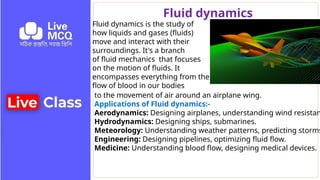
Fluid dynamicsis the study of
how liquids and gases (fluids)
move and interact with their
surroundings. It's a branch
of fluid mechanics that focuses
on the motion of fluids. It
encompasses everything from the
flow of blood in our bodies
to the movement of air around an airplane wing.
Applications of Fluid dynamics:-
Aerodynamics: Designing airplanes, understanding wind resistan
Hydrodynamics: Designing ships, submarines.
Meteorology: Understanding weather patterns, predicting storms
Engineering: Designing pipelines, optimizing fluid flow.
Medicine: Understanding blood flow, designing medical devices.
20.
Euler’s equation
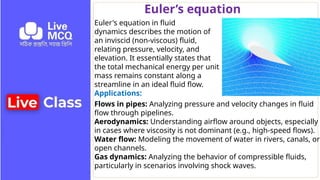
Euler's equationin fluid
dynamics describes the motion of
an inviscid (non-viscous) fluid,
relating pressure, velocity, and
elevation. It essentially states that
the total mechanical energy per unit
mass remains constant along a
streamline in an ideal fluid flow.
Applications:
Flows in pipes: Analyzing pressure and velocity changes in fluid
flow through pipelines.
Aerodynamics: Understanding airflow around objects, especially
in cases where viscosity is not dominant (e.g., high-speed flows).
Water flow: Modeling the movement of water in rivers, canals, or
open channels.
Gas dynamics: Analyzing the behavior of compressible fluids,
particularly in scenarios involving shock waves.
21.
Bernoulli’s equation
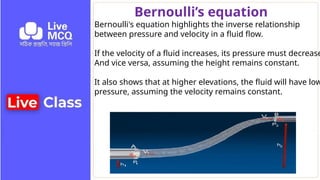
Bernoulli's equationhighlights the inverse relationship
between pressure and velocity in a fluid flow.
If the velocity of a fluid increases, its pressure must decrease
And vice versa, assuming the height remains constant.
It also shows that at higher elevations, the fluid will have low
pressure, assuming the velocity remains constant.
22.
Bernoulli’s equation
Applications:
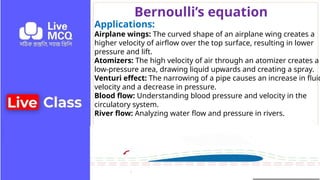
Airplane wings:The curved shape of an airplane wing creates a
higher velocity of airflow over the top surface, resulting in lower
pressure and lift.
Atomizers: The high velocity of air through an atomizer creates a
low-pressure area, drawing liquid upwards and creating a spray.
Venturi effect: The narrowing of a pipe causes an increase in fluid
velocity and a decrease in pressure.
Blood flow: Understanding blood pressure and velocity in the
circulatory system.
River flow: Analyzing water flow and pressure in rivers.
23.
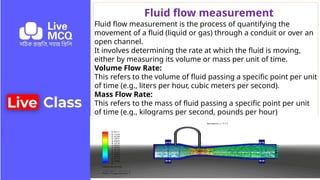
Fluid flow measurement
Fluidflow measurement is the process of quantifying the
movement of a fluid (liquid or gas) through a conduit or over an
open channel.
It involves determining the rate at which the fluid is moving,
either by measuring its volume or mass per unit of time.
Volume Flow Rate:
This refers to the volume of fluid passing a specific point per unit
of time (e.g., liters per hour, cubic meters per second).
Mass Flow Rate:
This refers to the mass of fluid passing a specific point per unit
of time (e.g., kilograms per second, pounds per hour)
24.
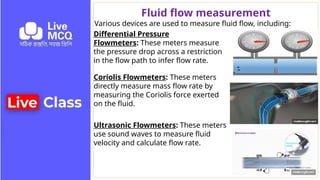
Fluid flow measurement
Variousdevices are used to measure fluid flow, including:
Differential Pressure
Flowmeters: These meters measure
the pressure drop across a restriction
in the flow path to infer flow rate.
Coriolis Flowmeters: These meters
directly measure mass flow rate by
measuring the Coriolis force exerted
on the fluid.
Ultrasonic Flowmeters: These meters
use sound waves to measure fluid
velocity and calculate flow rate.
25.
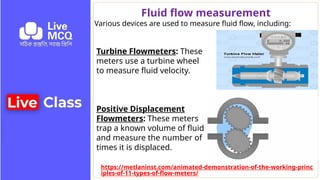
Fluid flow measurement
Variousdevices are used to measure fluid flow, including:
Turbine Flowmeters: These
meters use a turbine wheel
to measure fluid velocity.
Positive Displacement
Flowmeters: These meters
trap a known volume of fluid
and measure the number of
times it is displaced.
https://metlaninst.com/animated-demonstration-of-the-working-princ
iples-of-11-types-of-flow-meters/
26.
Sample Questions
10. Whichprinciple explains the buoyant force experienced
by a body submerged in a fluid?
A) Archimedes’ principle B) Pascal’s principle
C) Bernoulli’s principle D) Newton’s second law
Answer: A – Archimedes’ principle
11. A fluid that is at rest falls under which category?
A) Fluid Dynamics B) Fluid Mechanics
C) Fluid Statics D) Fluid Kinematics
Answer: C – Fluid Statics
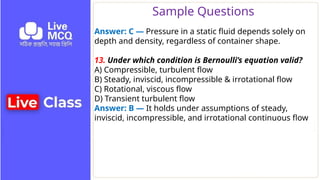
12. The pressure at a given depth in a static fluid depends
on:
A) volume of fluid above
B) shape of the container
C) Only depth and fluid density
D) The total mass of the fluid
27.
Sample Questions
Answer: C— Pressure in a static fluid depends solely on
depth and density, regardless of container shape.
13. Under which condition is Bernoulli’s equation valid?
A) Compressible, turbulent flow
B) Steady, inviscid, incompressible & irrotational flow
C) Rotational, viscous flow
D) Transient turbulent flow
Answer: B — It holds under assumptions of steady,
inviscid, incompressible, and irrotational continuous flow
28.
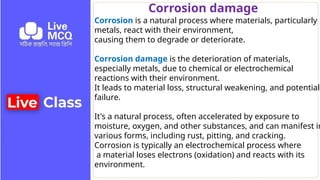
Corrosion damage
Corrosion isa natural process where materials, particularly
metals, react with their environment,
causing them to degrade or deteriorate.
Corrosion damage is the deterioration of materials,
especially metals, due to chemical or electrochemical
reactions with their environment.
It leads to material loss, structural weakening, and potential
failure.
It's a natural process, often accelerated by exposure to
moisture, oxygen, and other substances, and can manifest in
various forms, including rust, pitting, and cracking.
Corrosion is typically an electrochemical process where
a material loses electrons (oxidation) and reacts with its
environment.
29.
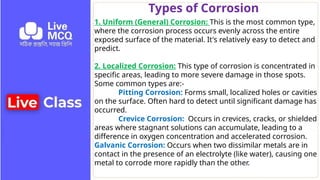
Types of Corrosion
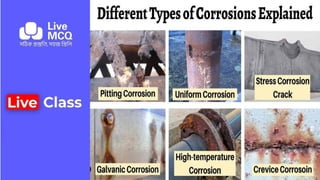
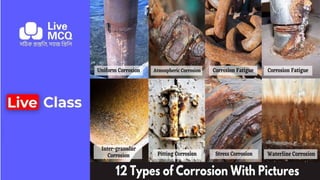
1.Uniform (General) Corrosion: This is the most common type,
where the corrosion process occurs evenly across the entire
exposed surface of the material. It's relatively easy to detect and
predict.
2. Localized Corrosion: This type of corrosion is concentrated in
specific areas, leading to more severe damage in those spots.
Some common types are:-
Pitting Corrosion: Forms small, localized holes or cavities
on the surface. Often hard to detect until significant damage has
occurred.
Crevice Corrosion: Occurs in crevices, cracks, or shielded
areas where stagnant solutions can accumulate, leading to a
difference in oxygen concentration and accelerated corrosion.
Galvanic Corrosion: Occurs when two dissimilar metals are in
contact in the presence of an electrolyte (like water), causing one
metal to corrode more rapidly than the other.
30.
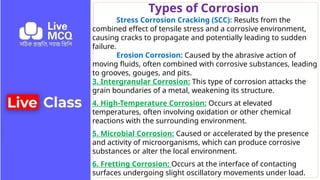
Types of Corrosion
StressCorrosion Cracking (SCC): Results from the
combined effect of tensile stress and a corrosive environment,
causing cracks to propagate and potentially leading to sudden
failure.
Erosion Corrosion: Caused by the abrasive action of
moving fluids, often combined with corrosive substances, leading
to grooves, gouges, and pits.
3. Intergranular Corrosion: This type of corrosion attacks the
grain boundaries of a metal, weakening its structure.
4. High-Temperature Corrosion: Occurs at elevated
temperatures, often involving oxidation or other chemical
reactions with the surrounding environment.
5. Microbial Corrosion: Caused or accelerated by the presence
and activity of microorganisms, which can produce corrosive
substances or alter the local environment.
6. Fretting Corrosion: Occurs at the interface of contacting
surfaces undergoing slight oscillatory movements under load.
31.
Types of Corrosion
7.Cavitation corrosion:- Cavitation is caused by the “implosion”
of gas bubbles on a metal surface which cause pits on the metal
surface. It happens when the operating pressure of fluid drops
below its vapor pressure, causing gas pockets and bubbles to
form and collapse. This type of repeated implosion of gas
bubbles eats away at the surface of the metal over time.
Cavitation often occurs within pumps, propellers, regulator and
valve discharges, pipe elbows and expansions, hydraulic blades,
and such.
8. De-Alloying (Selective Leaching):- De-alloying, or selective
leaching is caused by the corrosion of a select metal within an
alloy. This type of corrosion most commonly occurs in
unstabilized brass. Zinc is selectively leached from the metal,
resulting in a porous and weakened copper. Or medium- and
high-carbon steel, wherein decarburization occurs.
https://www.usna.edu/NAOE/_files/documents/Courses/EN380/Co
urse_Notes/Ch05_Corrosion_Types.pdf
34.
Sample Questions
14. Whatis the chemical formula of rust?
A) Fe₁O B) Fe₂O₃ C) Fe₃O₄ D) Fe(OH)₂
Answer: B — Rust is generally iron(III) oxide, Fe₂O₃.
15. Which of the following materials will undergo corrosion?
A) Metals only
B) Metals and non-metals
C) Metals, non-metals, ceramics & plastics
D) Metals, non-metals, ceramics, plastics, and rubbers
Answer: D — Corrosion can affect all these materials,
though the modes and rates differ.
35.
Sample Questions
16. Whichtype of corrosion occurs when two different
metals are in contact with each other in the presence of
an electrolyte?
A) Uniform corrosion
B) Intergranular corrosion
C) Pitting corrosion
D) Galvanic corrosion
Answer: D — Galvanic corrosion (a type of electrochemical
corrosion) occurs under these conditions
17. What type of corrosion is caused by the formation
and collapse of vapor bubbles near a metal surface?
A) Filiform corrosion B) Fretting corrosion
C) Cavitation damage D) Crevice corrosion
Answer: C — That phenomenon is characteristic of
cavitation damage.
36.
Methods of CorrosionPrevention
1. Protective Coatings:
Painting: A common method that creates a physical barrier
between the metal and the corrosive environment.
Powder Coating: A dry powder is applied and then heated to
form a smooth, protective film.
Metal Plating: A thin layer of another metal is applied to the
surface to prevent corrosion and add aesthetic appeal.
Oiling and Greasing: Applying oil or grease to moving parts
creates a barrier and allows for smooth movement.
Plastic Coating: Covering the metal with a plastic layer provides
a barrier against corrosion.
2. Material Modification:
Using Corrosion-Resistant Materials: Selecting metals like
stainless steel or aluminum, which naturally resist corrosion.
Alloying: Combining metals to create alloys with enhanced
corrosion resistance.
3. Environmental Modification:
Adding Inhibitors: Chemicals that reduce the corrosiveness of
the environment. Such as:- Chromates, Molybdates, Silicates, Amines,
Pyridines, Thiols, Alcohols
37.
Methods of CorrosionPrevention
Controlling Temperature and Flow Velocity: Adjusting
environmental factors to minimize corrosion rates.
4. Cathodic Protection:
Sacrificial Anodes: Attaching a more reactive metal to the
structure, causing it to corrode instead of the protected metal.
Impressed Current Cathodic Protection: Using an external
electrical current to suppress corrosion.
5. Other Methods:
Galvanization: Coating with zinc to provide both barrier and
sacrificial protection.
Passivation: Creating a protective layer on the metal surface
through chemical treatment.
Controlling Moisture: Keeping surfaces clean and dry can
significantly reduce corrosion.
https://www.jiwaji.edu/pdf/ecourse/physics/Corrosion%20and%20
Methods%20to%20avoide%20it.pdf
38.
Electrochemical aspects ofCorrosion
Electrochemical corrosion is a process where corrosion occurs due to
the flow of electric current between different areas of a metal surface,
or between two dissimilar metals in contact with an electrolyte (a
conductive solution).
It's essentially a series of oxidation and reduction reactions that result
in the metal being dissolved or corroded.
The key aspects are:
1. Anode: The area where oxidation occurs. The metal atoms
lose electrons and enter the solution as ions, causing the metal to
corrode.
2. Cathode: The area where reduction occurs. Electrons
released at the anode are consumed by a reduction reaction, often
involving a substance in the electrolyte like oxygen or hydrogen ions.
3. Electrolyte: A conductive medium that allows ions to move
between the anode and cathode, completing the electrical circuit.
Common electrolytes include water (especially with dissolved salts or
acids), and even moisture films on metal surfaces.
39.
Electrochemical aspects ofCorrosion
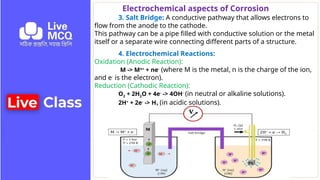
3. Salt Bridge: A conductive pathway that allows electrons to
flow from the anode to the cathode.
This pathway can be a pipe filled with conductive solution or the metal
itself or a separate wire connecting different parts of a structure.
4. Electrochemical Reactions:
Oxidation (Anodic Reaction):
M -> Mn+
+ ne-
(where M is the metal, n is the charge of the ion,
and e-
is the electron).
Reduction (Cathodic Reaction):
O2 + 2H2O + 4e-
-> 4OH-
(in neutral or alkaline solutions).
2H+
+ 2e-
-> H2 (in acidic solutions).
40.
Electrochemical aspects ofCorrosion
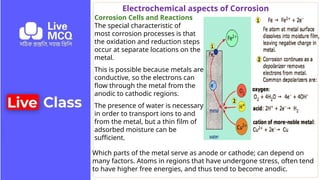
Corrosion Cells and Reactions
The special characteristic of
most corrosion processes is that
the oxidation and reduction steps
occur at separate locations on the
metal.
This is possible because metals are
conductive, so the electrons can
flow through the metal from the
anodic to cathodic regions.
The presence of water is necessary
in order to transport ions to and
from the metal, but a thin film of
adsorbed moisture can be
sufficient.
Which parts of the metal serve as anode or cathode; can depend on
many factors. Atoms in regions that have undergone stress, often tend
to have higher free energies, and thus tend to become anodic.
41.
Electrochemical aspects ofCorrosion
Factors Affecting Electrochemical Corrosion:
Metal Type: Different metals have varying tendencies to corrode.
Electrolyte Composition: The presence of specific ions, pH, and
oxygen availability can influence corrosion rates.
Temperature: Higher temperatures generally accelerate corrosion.
Surface Condition: Stressed areas, scratches, or coatings can
affect corrosion behavior.
Electrical Contact: The presence of a metallic path and a
conductive electrolyte are essential for electrochemical corrosion.
Mitigation Techniques:
Material Selection: Choosing corrosion-resistant materials.
Coatings: Applying protective layers to isolate the metal from
the corrosive environment.
Corrosion Inhibitors: Adding chemicals to the electrolyte to
slow down the corrosion process.
Cathodic Protection: Using a sacrificial anode or impressed
current to make the structure the cathode in an electrochemical cell.
https://uomosul.edu.iq/petroleumengineering/wp-content/uploads/sites/10/2025/05/
%D9%85%D8%AD%D8%A7%D8%B6%D8%B1%D8%A9-2-%D8%AA%D8%A3%D9%83%D
9%84.pdf
42.
Corrosion Testing
Types ofCorrosion Tests:
Salt Spray (Fog) Test: This widely used test exposes materials to a
salt-laden fog to simulate marine or industrial environments.
Electrochemical Tests: These tests, often conducted in aqueous
media, measure the material's corrosion rate by analyzing its electrical
properties.
Exposure Tests: Materials are exposed to specific corrosive
environments (e.g., high humidity, specific chemicals) to observe their
behavior over time.
Intergranular Corrosion (IGC) Testing: This test assesses a
material's susceptibility to cracking along its grain boundaries, which is
critical in high-stress applications.
Stress Corrosion Testing: This test evaluates the combined effect
of tensile stress and corrosive environment on material failure.
43.
Sample Questions
18. Whichreaction occurs at the cathodic spot during
corrosion in an oxygenated acidic solution?
A) 2H⁺ + 2e⁻ H₂ B) 4H⁺ + O₂ + 4e⁻ 2H₂O
→ →
C) 2H₂O + 2e⁻ H₂ + 2OH⁻ D) 2H₂O + O₂ + 4e⁻ 4OH⁻
→ →
Answer: B — The reaction in oxygenated acidic
environments.
19. Which of the following factors affect the corrosion rate
of metals?
A) Relative surface area of anode & cathode B) Nature of
the oxide layer
C) Purity of the metal D) All of the
above
Answer: D — All these factors collectively influence
corrosion rate.
44.
Sample Questions
20. Whichof the following is not true about corrosion?
A) It’s only restricted to metallic materials
B) It’s an electrochemical reaction
C) Material selection is essential in corrosion prevention
D) Environmental factors heavily influence corrosion
Answer: A — Corrosion is not limited to metals.
21. What is the primary goal of a salt spray test?
A) To measure the mechanical strength of a coating
B) To compare corrosion resistance in marine environment.
C) To evaluate thermal stability of metal surfaces
D) To determine electrical conductivity changes due to
corrosion
Answer: B — Salt spray tests are designed to evaluate to
simulate marine environments.