



FLS Implementation –
A National Approach
Friday 4 September 2015
Hilary Arden, Head of Service Delivery
Sonya Stephenson, Service Development Manager
Tim Jones, Commissioning Advisor
The National Osteoporosis Society
• The only UK-wide charity dedicated to
improving the prevention, diagnosis and
treatment of osteoporosis
• Vision: A future without fragility fractures
• Mission: Working together for a brighter
future for people with or at risk of
osteoporosis and fragility fractures across
the UK, putting an end to preventable
broken bones and helping people to live
without pain and disability
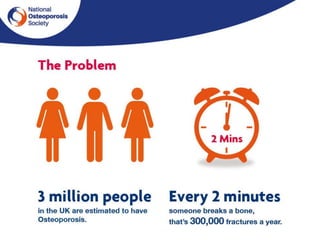
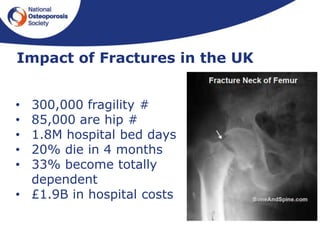
• 300,000 fragility #
• 85,000 are hip #
• 1.8M hospital bed days
• 20% die in 4 months
• 33% become totally
dependent
• £1.9B in hospital costs
Impact of Fractures in the UK
What is the solution?
A Fracture Liaison Service (FLS)
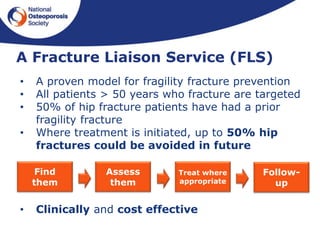
• A proven model for fragility fracture prevention
• All patients > 50 years who fracture are targeted
• 50% of hip fracture patients have had a prior
fragility fracture
• Where treatment is initiated, up to 50% hip
fractures could be avoided in future
• Clinically and cost effective
Find
them
Assess
them
Treat where
appropriate
Follow-
up
National Osteoporosis Society
Priorities and Plans for 2015
Aim 1:
Every person aged over 50 who breaks a
bone is assessed for osteoporosis and
managed appropriately.
Priority 1:
Extend coverage of Fracture Liaison
Services
Priority 2:
Improve quality of Fracture Liaison
Services and osteoporosis services
• FLS Implementation Group
• UK FLS Clinical Standards
• FLS Implementation Toolkit
• FLS Implementation Workshops
• Fracture Prevention Practitioner (FPP)
Training
• Peer Review
• Service Delivery Team
A National Approach to FLS
FLS Implementation Group
• National stakeholders & Government
• Provide strategic leadership and coordination
across projects
• Ensure good communication and partnership
across FLS stakeholders
• Plan and deliver agreed actions and
milestones
• Ensure delivery of high quality, efficient and
cost-effective FLS
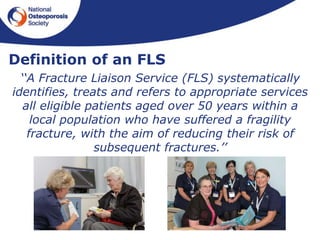
Definition of an FLS
‘‘A Fracture Liaison Service (FLS) systematically
identifies, treats and refers to appropriate services
all eligible patients aged over 50 years within a
local population who have suffered a fragility
fracture, with the aim of reducing their risk of
subsequent fractures.’’
• FLS Implementation Group
• UK FLS Clinical Standards
• FLS Implementation Toolkit
• FLS Implementation Workshops
• Fracture Prevention Practitioner (FPP)
Training
• Peer Review
• Service Delivery Team
A National Approach to FLS
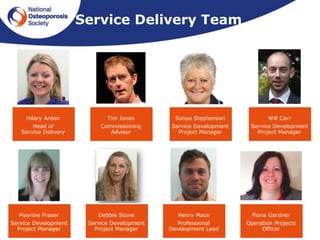
Service Delivery Team
Sonya Stephenson
Service Development
Project Manager
Will Carr
Service Development
Project Manager
Hilary Arden
Head of
Service Delivery
Tim Jones
Commissioning
Advisor
Mayrine Fraser
Service Development
Project Manager
Debbie Stone
Service Development
Project Manager
Fiona Gardner
Operation Projects
Officer
Henry Mace
Professional
Development Lead
• Facilitate stakeholder engagement
• Help establish patient/care pathway
• Project manage commissioning/funding:
o The economic and business case
o Service specification
o Resource and capacity planning
• Work with commissioners to ensure
services are sustained.
How We Help
• Provide input to enable the development of
an FLS meets the UK FLS Clinical Standards
• Help establish data collection, analysis,
evaluation and reporting
• Identify gaps in service provision, put in
place improvement plans and monitor
against agreed actions
• Peer review
How We Help
FLS: Some Localities
UK FLS Clinical Standards
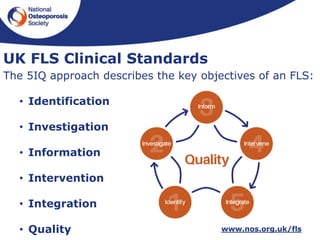
The 5IQ approach describes the key objectives of an FLS:
• Identification
• Investigation
• Information
• Intervention
• Integration
• Quality www.nos.org.uk/fls
UK FLS Clinical Standards
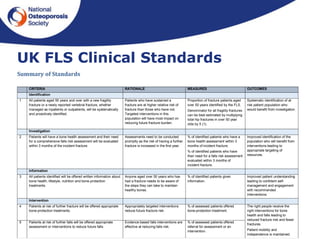
Summary of Standards
CRITERIA RATIONALE MEASURES OUTCOMES
Identification
1 All patients aged 50 years and over with a new fragility
fracture or a newly reported vertebral fracture, whether
managed as inpatients or outpatients, will be systematically
and proactively identified.
Patients who have sustained a
fracture are at higher relative risk of
fracture than those who have not.
Targeted interventions in this
population will have most impact on
reducing future fracture burden.
Proportion of fracture patients aged
over 50 years identified by the FLS.
Denominator for all fragility fractures
can be best estimated by multiplying
total hip fractures in over 50 year
olds by 5 (1).
Systematic identification of at
risk patient population who
would benefit from investigation.
Investigation
2 Patients will have a bone health assessment and their need
for a comprehensive falls risk assessment will be evaluated
within 3 months of the incident fracture.
Assessments need to be conducted
promptly as the risk of having a further
fracture is increased in the first year.
% of identified patients who have a
bone health assessment within 3
months of incident fracture.
% of identified patients who have
their need for a falls risk assessment
evaluated within 3 months of
incident fracture.
Improved identification of the
population who will benefit from
interventions leading to
appropriate targeting of
resources.
Information
3 All patients identified will be offered written information about
bone health, lifestyle, nutrition and bone-protection
treatments.
Anyone aged over 50 years who has
had a fracture needs to be aware of
the steps they can take to maintain
healthy bones.
% of identified patients given
information.
Improved patient understanding
leading to confident self-
management and engagement
with recommended
interventions.
Intervention
4 Patients at risk of further fracture will be offered appropriate
bone-protection treatments.
Appropriately targeted interventions
reduce future fracture risk.
% of assessed patients offered
bone-protection treatment.
The right people receive the
right interventions for bone
health and falls leading to
reduced fracture risk and fewer
fractures.
Patient mobility and
independence is maintained.
5 Patients at risk of further falls will be offered appropriate
assessment or interventions to reduce future falls.
Evidence-based falls interventions are
effective at reducing falls risk.
% of assessed patients offered
referral for assessment or an
intervention.
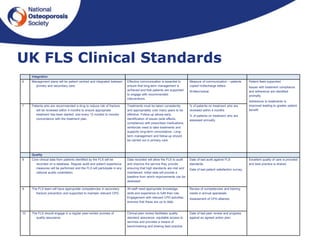
Integration
6 Management plans will be patient centred and integrated between
primary and secondary care.
Effective communication is essential to
ensure that long-term management is
achieved and that patients are supported
to engage with recommended
interventions.
Measure of communication – patients
copied in/discharge letters
Written/verbal.
Patient feels supported.
Issues with treatment compliance
and adherence are identified
promptly.
Adherence to treatments is
improved leading to greater patient
benefit.
7 Patients who are recommended a drug to reduce risk of fracture
will be reviewed within 4 months to ensure appropriate
treatment has been started; and every 12 months to monitor
concordance with the treatment plan.
Treatments must be taken consistently
and appropriately over many years to be
effective. Follow-up allows early
identification of issues (side effects,
compliance) with prescribed medications,
reinforces need to take treatments and
supports long-term concordance. Long-
term management and follow-up should
be carried out in primary care.
% of patients on treatment who are
reviewed within 4 months
% of patients on treatment who are
assessed annually.
Quality
8 Core clinical data from patients identified by the FLS will be
recorded on a database. Regular audit and patient experience
measures will be performed and the FLS will participate in any
national audits undertaken.
Data recorded will allow the FLS to audit
and improve the service they provide
ensuring that high standards are met and
maintained. Initial data will provide a
baseline from which improvements can be
assessed.
Date of last audit against FLS
standards.
Date of last patient satisfaction survey.
Excellent quality of care is provided
and best practice is shared.
9 The FLS team will have appropriate competencies in secondary
fracture prevention and supported to maintain relevant CPD.
All staff need appropriate knowledge,
skills and experience to fulfil their role.
Engagement with relevant CPD activities
ensures that these are up to date.
Review of competencies and training
needs in annual appraisals.
Assessment of CPD attained.
10 The FLS should engage in a regular peer-review process of
quality assurance.
Clinical peer review facilitates quality
standard assurance, equitable access to
services and provides a means of
benchmarking and sharing best practice.
Date of last peer review and progress
against an agreed action plan.
UK FLS Clinical Standards
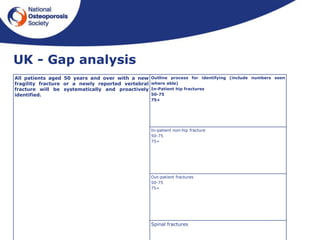
UK - Gap analysis
All patients aged 50 years and over with a new
fragility fracture or a newly reported vertebral
fracture will be systematically and proactively
identified.
outline process for identifying (include numbers seen where able)
In-Patient hip fractures
50-75
75+
Outline process for identifying (include numbers seen
where able)
In-Patient hip fractures
50-75
75+
In-patient non-hip fracture
50-75
75+
Out-patient fractures
50-75
75+
Spinal fractures
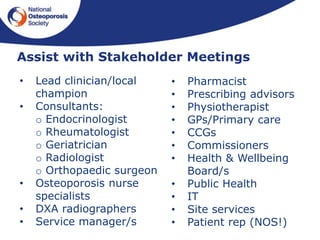
Assist with Stakeholder Meetings
• Lead clinician/local
champion
• Consultants:
o Endocrinologist
o Rheumatologist
o Geriatrician
o Radiologist
o Orthopaedic surgeon
• Osteoporosis nurse
specialists
• DXA radiographers
• Service manager/s
• Pharmacist
• Prescribing advisors
• Physiotherapist
• GPs/Primary care
• CCGs
• Commissioners
• Health & Wellbeing
Board/s
• Public Health
• IT
• Site services
• Patient rep (NOS!)
Assist with FLS Pathway
FALLS RISK
ASSESSMENT
NEW
CLINICAL FRACTURE
NEW
VERTEBRAL
FRACTURE
(RADIOLOGY REPORT)
PREVIOUS FRACTURE OR
FRACTURE NOT PRESENTING
TO ACUTE CARE
ORTHO
IP
Virtual/
#
CLINIC
‘CASE-FINDING’ BY FLS‘CASE-FINDING’
BY COTE
‘CASE-FINDING’
BY GP/SEC CARE/CH
FLS
RISK ASSESSMENT
ONE-STOP CLINIC
WITH DXA
EXERCISE
CLASSES
Rx FOR FRACTURE
2Y PREVENTION
EDUCATION
PROGRAMME
CARE OF
THE
ELDERLY
4 & 12 MONTH
FOLLOW UP
CLINIC
COMPLEX
CLINIC
(IF REQUIRED)
25
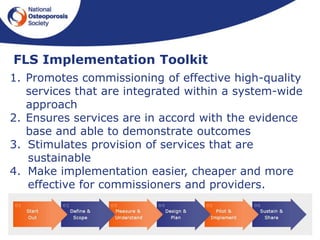
FLS Implementation Toolkit
1. Promotes commissioning of effective high-quality
services that are integrated within a system-wide
approach
2. Ensures services are in accord with the evidence
base and able to demonstrate outcomes
3. Stimulates provision of services that are
sustainable
4. Make implementation easier, cheaper and more
effective for commissioners and providers.
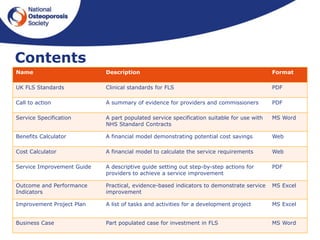
Contents
Name Description Format
UK FLS Standards Clinical standards for FLS PDF
Call to action A summary of evidence for providers and commissioners PDF
Service Specification A part populated service specification suitable for use with
NHS Standard Contracts
MS Word
Benefits Calculator A financial model demonstrating potential cost savings Web
Cost Calculator A financial model to calculate the service requirements Web
Service Improvement Guide A descriptive guide setting out step-by-step actions for
providers to achieve a service improvement
PDF
Outcome and Performance
Indicators
Practical, evidence-based indicators to demonstrate service
improvement
MS Excel
Improvement Project Plan A list of tasks and activities for a development project MS Excel
Business Case Part populated case for investment in FLS MS Word
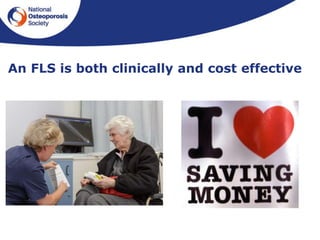
An FLS is both clinically and cost effective
FLS Benefits Calculator
• Additional resource within the
FLS-IT
• Designed for use by hospitals, community
services and commissioning organisations
to help develop an FLS
• Estimates the benefits in terms of reduced
fragility fracture incidence and cost savings
that can be realised in a local health
economy as a result of implementing an
effective FLS.
What is the Impact of an FLS?
Economic benefits in the UK:
• Reduction in hip fractures
• Hip fractures cost £1.9 billion/year
• For every 1000 FLS patients assessed in
FLS
• 18 fractures are prevented
• 11 of those are hip fractures
What Investment is Required?
• Cost of staff required:
• Consultant
• Nurse specialist
• Clerical/admin
• Set up costs – FLS accommodation, IT, DXA
scanner and other associated costs:
• DXA scans/reporting
• Other diagnostics
• Drug costs
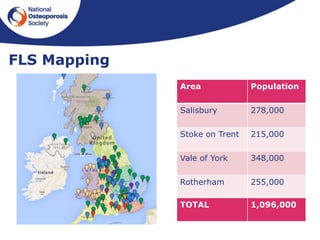
FLS Mapping
Area Population
Salisbury 278,000
Stoke on Trent 215,000
Vale of York 348,000
Rotherham 255,000
TOTAL 1,096,000
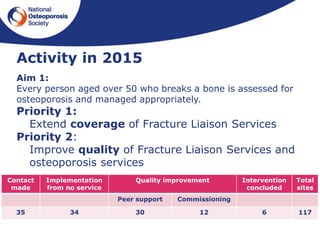
Activity in 2015
Aim 1:
Every person aged over 50 who breaks a bone is assessed for
osteoporosis and managed appropriately.
Priority 1:
Extend coverage of Fracture Liaison Services
Priority 2:
Improve quality of Fracture Liaison Services and
osteoporosis services
Contact
made
Implementation
from no service
Quality improvement Intervention
concluded
Total
sites
Peer support Commissioning
35 34 30 12 6 117
How Good is Your FLS?
“You must be the
change you wish
to see in the
world.”
Mahatma Gandhi
Hilary Arden
+44 (0)1761 473112
h.arden@nos.org.uk

FLS Implementation – A National Approach, Rotterdam 2015

  • 1.
    FLS Implementation – ANational Approach Friday 4 September 2015 Hilary Arden, Head of Service Delivery Sonya Stephenson, Service Development Manager Tim Jones, Commissioning Advisor
  • 2.
    The National OsteoporosisSociety • The only UK-wide charity dedicated to improving the prevention, diagnosis and treatment of osteoporosis • Vision: A future without fragility fractures • Mission: Working together for a brighter future for people with or at risk of osteoporosis and fragility fractures across the UK, putting an end to preventable broken bones and helping people to live without pain and disability
  • 7.
    • 300,000 fragility# • 85,000 are hip # • 1.8M hospital bed days • 20% die in 4 months • 33% become totally dependent • £1.9B in hospital costs Impact of Fractures in the UK
  • 8.
    What is thesolution?
  • 9.
    A Fracture LiaisonService (FLS) • A proven model for fragility fracture prevention • All patients > 50 years who fracture are targeted • 50% of hip fracture patients have had a prior fragility fracture • Where treatment is initiated, up to 50% hip fractures could be avoided in future • Clinically and cost effective Find them Assess them Treat where appropriate Follow- up
  • 10.
    National Osteoporosis Society Prioritiesand Plans for 2015 Aim 1: Every person aged over 50 who breaks a bone is assessed for osteoporosis and managed appropriately. Priority 1: Extend coverage of Fracture Liaison Services Priority 2: Improve quality of Fracture Liaison Services and osteoporosis services
  • 11.
    • FLS ImplementationGroup • UK FLS Clinical Standards • FLS Implementation Toolkit • FLS Implementation Workshops • Fracture Prevention Practitioner (FPP) Training • Peer Review • Service Delivery Team A National Approach to FLS
  • 12.
    FLS Implementation Group •National stakeholders & Government • Provide strategic leadership and coordination across projects • Ensure good communication and partnership across FLS stakeholders • Plan and deliver agreed actions and milestones • Ensure delivery of high quality, efficient and cost-effective FLS
  • 13.
    Definition of anFLS ‘‘A Fracture Liaison Service (FLS) systematically identifies, treats and refers to appropriate services all eligible patients aged over 50 years within a local population who have suffered a fragility fracture, with the aim of reducing their risk of subsequent fractures.’’
  • 14.
    • FLS ImplementationGroup • UK FLS Clinical Standards • FLS Implementation Toolkit • FLS Implementation Workshops • Fracture Prevention Practitioner (FPP) Training • Peer Review • Service Delivery Team A National Approach to FLS
  • 15.
    Service Delivery Team SonyaStephenson Service Development Project Manager Will Carr Service Development Project Manager Hilary Arden Head of Service Delivery Tim Jones Commissioning Advisor Mayrine Fraser Service Development Project Manager Debbie Stone Service Development Project Manager Fiona Gardner Operation Projects Officer Henry Mace Professional Development Lead
  • 16.
    • Facilitate stakeholderengagement • Help establish patient/care pathway • Project manage commissioning/funding: o The economic and business case o Service specification o Resource and capacity planning • Work with commissioners to ensure services are sustained. How We Help
  • 17.
    • Provide inputto enable the development of an FLS meets the UK FLS Clinical Standards • Help establish data collection, analysis, evaluation and reporting • Identify gaps in service provision, put in place improvement plans and monitor against agreed actions • Peer review How We Help
  • 18.
  • 19.
    UK FLS ClinicalStandards The 5IQ approach describes the key objectives of an FLS: • Identification • Investigation • Information • Intervention • Integration • Quality www.nos.org.uk/fls
  • 20.
    UK FLS ClinicalStandards Summary of Standards CRITERIA RATIONALE MEASURES OUTCOMES Identification 1 All patients aged 50 years and over with a new fragility fracture or a newly reported vertebral fracture, whether managed as inpatients or outpatients, will be systematically and proactively identified. Patients who have sustained a fracture are at higher relative risk of fracture than those who have not. Targeted interventions in this population will have most impact on reducing future fracture burden. Proportion of fracture patients aged over 50 years identified by the FLS. Denominator for all fragility fractures can be best estimated by multiplying total hip fractures in over 50 year olds by 5 (1). Systematic identification of at risk patient population who would benefit from investigation. Investigation 2 Patients will have a bone health assessment and their need for a comprehensive falls risk assessment will be evaluated within 3 months of the incident fracture. Assessments need to be conducted promptly as the risk of having a further fracture is increased in the first year. % of identified patients who have a bone health assessment within 3 months of incident fracture. % of identified patients who have their need for a falls risk assessment evaluated within 3 months of incident fracture. Improved identification of the population who will benefit from interventions leading to appropriate targeting of resources. Information 3 All patients identified will be offered written information about bone health, lifestyle, nutrition and bone-protection treatments. Anyone aged over 50 years who has had a fracture needs to be aware of the steps they can take to maintain healthy bones. % of identified patients given information. Improved patient understanding leading to confident self- management and engagement with recommended interventions. Intervention 4 Patients at risk of further fracture will be offered appropriate bone-protection treatments. Appropriately targeted interventions reduce future fracture risk. % of assessed patients offered bone-protection treatment. The right people receive the right interventions for bone health and falls leading to reduced fracture risk and fewer fractures. Patient mobility and independence is maintained. 5 Patients at risk of further falls will be offered appropriate assessment or interventions to reduce future falls. Evidence-based falls interventions are effective at reducing falls risk. % of assessed patients offered referral for assessment or an intervention.
  • 21.
    Integration 6 Management planswill be patient centred and integrated between primary and secondary care. Effective communication is essential to ensure that long-term management is achieved and that patients are supported to engage with recommended interventions. Measure of communication – patients copied in/discharge letters Written/verbal. Patient feels supported. Issues with treatment compliance and adherence are identified promptly. Adherence to treatments is improved leading to greater patient benefit. 7 Patients who are recommended a drug to reduce risk of fracture will be reviewed within 4 months to ensure appropriate treatment has been started; and every 12 months to monitor concordance with the treatment plan. Treatments must be taken consistently and appropriately over many years to be effective. Follow-up allows early identification of issues (side effects, compliance) with prescribed medications, reinforces need to take treatments and supports long-term concordance. Long- term management and follow-up should be carried out in primary care. % of patients on treatment who are reviewed within 4 months % of patients on treatment who are assessed annually. Quality 8 Core clinical data from patients identified by the FLS will be recorded on a database. Regular audit and patient experience measures will be performed and the FLS will participate in any national audits undertaken. Data recorded will allow the FLS to audit and improve the service they provide ensuring that high standards are met and maintained. Initial data will provide a baseline from which improvements can be assessed. Date of last audit against FLS standards. Date of last patient satisfaction survey. Excellent quality of care is provided and best practice is shared. 9 The FLS team will have appropriate competencies in secondary fracture prevention and supported to maintain relevant CPD. All staff need appropriate knowledge, skills and experience to fulfil their role. Engagement with relevant CPD activities ensures that these are up to date. Review of competencies and training needs in annual appraisals. Assessment of CPD attained. 10 The FLS should engage in a regular peer-review process of quality assurance. Clinical peer review facilitates quality standard assurance, equitable access to services and provides a means of benchmarking and sharing best practice. Date of last peer review and progress against an agreed action plan. UK FLS Clinical Standards
  • 22.
    UK - Gapanalysis All patients aged 50 years and over with a new fragility fracture or a newly reported vertebral fracture will be systematically and proactively identified. outline process for identifying (include numbers seen where able) In-Patient hip fractures 50-75 75+ Outline process for identifying (include numbers seen where able) In-Patient hip fractures 50-75 75+ In-patient non-hip fracture 50-75 75+ Out-patient fractures 50-75 75+ Spinal fractures
  • 23.
    Assist with StakeholderMeetings • Lead clinician/local champion • Consultants: o Endocrinologist o Rheumatologist o Geriatrician o Radiologist o Orthopaedic surgeon • Osteoporosis nurse specialists • DXA radiographers • Service manager/s • Pharmacist • Prescribing advisors • Physiotherapist • GPs/Primary care • CCGs • Commissioners • Health & Wellbeing Board/s • Public Health • IT • Site services • Patient rep (NOS!)
  • 24.
    Assist with FLSPathway FALLS RISK ASSESSMENT NEW CLINICAL FRACTURE NEW VERTEBRAL FRACTURE (RADIOLOGY REPORT) PREVIOUS FRACTURE OR FRACTURE NOT PRESENTING TO ACUTE CARE ORTHO IP Virtual/ # CLINIC ‘CASE-FINDING’ BY FLS‘CASE-FINDING’ BY COTE ‘CASE-FINDING’ BY GP/SEC CARE/CH FLS RISK ASSESSMENT ONE-STOP CLINIC WITH DXA EXERCISE CLASSES Rx FOR FRACTURE 2Y PREVENTION EDUCATION PROGRAMME CARE OF THE ELDERLY 4 & 12 MONTH FOLLOW UP CLINIC COMPLEX CLINIC (IF REQUIRED)
  • 25.
    25 FLS Implementation Toolkit 1.Promotes commissioning of effective high-quality services that are integrated within a system-wide approach 2. Ensures services are in accord with the evidence base and able to demonstrate outcomes 3. Stimulates provision of services that are sustainable 4. Make implementation easier, cheaper and more effective for commissioners and providers.
  • 26.
    Contents Name Description Format UKFLS Standards Clinical standards for FLS PDF Call to action A summary of evidence for providers and commissioners PDF Service Specification A part populated service specification suitable for use with NHS Standard Contracts MS Word Benefits Calculator A financial model demonstrating potential cost savings Web Cost Calculator A financial model to calculate the service requirements Web Service Improvement Guide A descriptive guide setting out step-by-step actions for providers to achieve a service improvement PDF Outcome and Performance Indicators Practical, evidence-based indicators to demonstrate service improvement MS Excel Improvement Project Plan A list of tasks and activities for a development project MS Excel Business Case Part populated case for investment in FLS MS Word
  • 27.
    An FLS isboth clinically and cost effective
  • 28.
    FLS Benefits Calculator •Additional resource within the FLS-IT • Designed for use by hospitals, community services and commissioning organisations to help develop an FLS • Estimates the benefits in terms of reduced fragility fracture incidence and cost savings that can be realised in a local health economy as a result of implementing an effective FLS.
  • 29.
    What is theImpact of an FLS? Economic benefits in the UK: • Reduction in hip fractures • Hip fractures cost £1.9 billion/year • For every 1000 FLS patients assessed in FLS • 18 fractures are prevented • 11 of those are hip fractures
  • 30.
    What Investment isRequired? • Cost of staff required: • Consultant • Nurse specialist • Clerical/admin • Set up costs – FLS accommodation, IT, DXA scanner and other associated costs: • DXA scans/reporting • Other diagnostics • Drug costs
  • 31.
    FLS Mapping Area Population Salisbury278,000 Stoke on Trent 215,000 Vale of York 348,000 Rotherham 255,000 TOTAL 1,096,000
  • 32.
    Activity in 2015 Aim1: Every person aged over 50 who breaks a bone is assessed for osteoporosis and managed appropriately. Priority 1: Extend coverage of Fracture Liaison Services Priority 2: Improve quality of Fracture Liaison Services and osteoporosis services Contact made Implementation from no service Quality improvement Intervention concluded Total sites Peer support Commissioning 35 34 30 12 6 117
  • 33.
    How Good isYour FLS?
  • 34.
    “You must bethe change you wish to see in the world.” Mahatma Gandhi
  • 35.
    Hilary Arden +44 (0)1761473112 h.arden@nos.org.uk

Editor's Notes

  • #3 Focus is provision of FLS. I want to share our story and
  • #4 What is the problem? Can you quantify the problem in your country, region, locality? Do you know your population figures – for hip fracture & fragility fractures.
  • #5 Creating awareness – locally, regionally, nationally
  • #6 Powers of persuasion – create your argument/case for support
  • #7 More than breast cancer Men more than stroke and MI together
  • #8 This is more bed days than heart attack and stroke combined 30% die within a year Currently rising to £2.2 billion by 2025 What are your figures???
  • #10 *Within 3 years of pharmacotherapy – reduction in incidence of re-fracture by 20-70%
  • #11 Currently 42% of UK has an FLS By the end of 2017 > 90% coverage All will have same standards of service How has the charity worked to deliver the solution???
  • #12 What have we done? Top down with FLS-IG – National Stakeholders & Government (both NHS England and Public Health England) Bottom up with Service Delivery Team through direct contact and support using the relevant resources developed
  • #13 2014 NOS bought together national and local stakeholders, clinical and patient representatives to form the FLS implementation group to cover all of UK National stakeholders & Government: NHSE; PHE
  • #14 The first task of the FLS-Implementation Group was to define by consensus the definition of FLS – so we are all working towards the same goal – consistency of approach.
  • #15 What have we done? Top down with FLS-IG – National Stakeholders & Government (both NHS England and Public Health England) Bottom up with Service Delivery Team through direct contact and support using the relevant resources developed
  • #16 SDT provides bespoke individualised support to services: Project management for commissioning of FLS Reports Mentoring of services
  • #17 The NOS gets contacted for support… We then follow up by phone, email, face to face meeting, etc…
  • #19 Some hospitals only have a part service (just a slice a cake ) Others have a very full service which covers all aspects of the NOS standards ( icing and cherries on top on their cake) Others somewhere in the middle
  • #20 The FLS clinical standards - the 5 IQ approach clearly defines an FLS Describe what ‘good’ looks like Underpin FLS-DB Alignment of variables Support clinicians Support commissioning Drive quality Ensure benchmarking Enhance patient care 5IQ approach describes the key objectives of an FLS 1 Starting with Identification finding patients with new, low trauma #’s at the time of # who will benefit from investigation Potential to extend scope to include identification of patients with prior # 2 Investigation –incorporating fracture risk FRAX with DXA to determine modifiable risk that merit intervention Tests to identify underlying causes of secondary osteoporosis including bloods and assessment of falls 3 inform - Written Information educating patients about falls and fracture risk 4 -Intervention implementing the necessary package of care including drug treatment and non pharmacological option to reduce secondary fracture risk and falls 5- Integration sharing patient specific management plans with the pt and other health professionals to ensure long term treatment concordance Quality being key to all 5 in optimising the delivery and organisation of the service through data collection and audit
  • #21 In the UK we’ve developed these standards as criteria for the ingredients in the cake recipe. The UK standards compliment the IOF Capture the Fracture Standards and in no way contradict them. However, they do not have the levels of Bronze, Silver, Gold.
  • #23 The gap analysis is our starting point for any visit, even if a locality says they have nothing, we still tend to do this as there is always something happening! Looking at Identification, where are you at??? Little service provision – so needs a full FLS Good service provision – but needs to add on identification of spinal fractures.
  • #24 Some localities can include missing standards within their organisation straight away; however others may need to address service development more fully through a business case First step - Organise for a big meeting with interested parties
  • #26 Toolkit developed to support providers and commissioners (Payors) to enable commissioning of services This tool – like a fishing rod
  • #28 OVER TO YOU TIM ………………
  • #29 Currently being web enabled in our website – available from mid September Demonstrates calculator with a report To hear more about the benefits calculator come to presentation by Tim Jones on Saturday
  • #30 Alistair McClellan For every 1000 patients assessed 18 fractures are prevented (11 hips) Glasgow
  • #32 Service Delivery Team 101 sites have had some contact since November 14 53 actively supported sites – green flags 4 approved business cases who now have a service – covering over 1 million of the population
  • #33 This table doesn’t include data for Wales yet… 2015 Mapping England (141) Scotland (14) Wales (11) Northern Ireland (5) UK (171)
  • #34 Plain cake? Bit of icing? Cherries on the top? Peer Review of osteoporosis and metabolic bone services, including FLS where present To provide review and quality assurance to improve performance based around professional credibility Appraisal of services against agreed criteria to advance and develop clinical practice and service provision for the good of patients